EP3373579B1 - Verbesserte intraprädikative codierung unter verwendung planarer darstellungen - Google Patents
Verbesserte intraprädikative codierung unter verwendung planarer darstellungen Download PDFInfo
- Publication number
- EP3373579B1 EP3373579B1 EP18167909.3A EP18167909A EP3373579B1 EP 3373579 B1 EP3373579 B1 EP 3373579B1 EP 18167909 A EP18167909 A EP 18167909A EP 3373579 B1 EP3373579 B1 EP 3373579B1
- Authority
- EP
- European Patent Office
- Prior art keywords
- prediction
- target
- pixel
- block
- value
- Prior art date
- Legal status (The legal status is an assumption and is not a legal conclusion. Google has not performed a legal analysis and makes no representation as to the accuracy of the status listed.)
- Active
Links
Images




Classifications
-
- H—ELECTRICITY
- H04—ELECTRIC COMMUNICATION TECHNIQUE
- H04N—PICTORIAL COMMUNICATION, e.g. TELEVISION
- H04N19/00—Methods or arrangements for coding, decoding, compressing or decompressing digital video signals
- H04N19/50—Methods or arrangements for coding, decoding, compressing or decompressing digital video signals using predictive coding
- H04N19/587—Methods or arrangements for coding, decoding, compressing or decompressing digital video signals using predictive coding involving temporal sub-sampling or interpolation, e.g. decimation or subsequent interpolation of pictures in a video sequence
-
- H—ELECTRICITY
- H04—ELECTRIC COMMUNICATION TECHNIQUE
- H04N—PICTORIAL COMMUNICATION, e.g. TELEVISION
- H04N19/00—Methods or arrangements for coding, decoding, compressing or decompressing digital video signals
- H04N19/10—Methods or arrangements for coding, decoding, compressing or decompressing digital video signals using adaptive coding
- H04N19/102—Methods or arrangements for coding, decoding, compressing or decompressing digital video signals using adaptive coding characterised by the element, parameter or selection affected or controlled by the adaptive coding
- H04N19/103—Selection of coding mode or of prediction mode
- H04N19/11—Selection of coding mode or of prediction mode among a plurality of spatial predictive coding modes
-
- H—ELECTRICITY
- H04—ELECTRIC COMMUNICATION TECHNIQUE
- H04N—PICTORIAL COMMUNICATION, e.g. TELEVISION
- H04N19/00—Methods or arrangements for coding, decoding, compressing or decompressing digital video signals
- H04N19/10—Methods or arrangements for coding, decoding, compressing or decompressing digital video signals using adaptive coding
- H04N19/102—Methods or arrangements for coding, decoding, compressing or decompressing digital video signals using adaptive coding characterised by the element, parameter or selection affected or controlled by the adaptive coding
- H04N19/12—Selection from among a plurality of transforms or standards, e.g. selection between discrete cosine transform [DCT] and sub-band transform or selection between H.263 and H.264
-
- H—ELECTRICITY
- H04—ELECTRIC COMMUNICATION TECHNIQUE
- H04N—PICTORIAL COMMUNICATION, e.g. TELEVISION
- H04N19/00—Methods or arrangements for coding, decoding, compressing or decompressing digital video signals
- H04N19/10—Methods or arrangements for coding, decoding, compressing or decompressing digital video signals using adaptive coding
- H04N19/102—Methods or arrangements for coding, decoding, compressing or decompressing digital video signals using adaptive coding characterised by the element, parameter or selection affected or controlled by the adaptive coding
- H04N19/124—Quantisation
-
- H—ELECTRICITY
- H04—ELECTRIC COMMUNICATION TECHNIQUE
- H04N—PICTORIAL COMMUNICATION, e.g. TELEVISION
- H04N19/00—Methods or arrangements for coding, decoding, compressing or decompressing digital video signals
- H04N19/10—Methods or arrangements for coding, decoding, compressing or decompressing digital video signals using adaptive coding
- H04N19/134—Methods or arrangements for coding, decoding, compressing or decompressing digital video signals using adaptive coding characterised by the element, parameter or criterion affecting or controlling the adaptive coding
- H04N19/136—Incoming video signal characteristics or properties
- H04N19/14—Coding unit complexity, e.g. amount of activity or edge presence estimation
-
- H—ELECTRICITY
- H04—ELECTRIC COMMUNICATION TECHNIQUE
- H04N—PICTORIAL COMMUNICATION, e.g. TELEVISION
- H04N19/00—Methods or arrangements for coding, decoding, compressing or decompressing digital video signals
- H04N19/10—Methods or arrangements for coding, decoding, compressing or decompressing digital video signals using adaptive coding
- H04N19/134—Methods or arrangements for coding, decoding, compressing or decompressing digital video signals using adaptive coding characterised by the element, parameter or criterion affecting or controlling the adaptive coding
- H04N19/146—Data rate or code amount at the encoder output
- H04N19/15—Data rate or code amount at the encoder output by monitoring actual compressed data size at the memory before deciding storage at the transmission buffer
-
- H—ELECTRICITY
- H04—ELECTRIC COMMUNICATION TECHNIQUE
- H04N—PICTORIAL COMMUNICATION, e.g. TELEVISION
- H04N19/00—Methods or arrangements for coding, decoding, compressing or decompressing digital video signals
- H04N19/10—Methods or arrangements for coding, decoding, compressing or decompressing digital video signals using adaptive coding
- H04N19/134—Methods or arrangements for coding, decoding, compressing or decompressing digital video signals using adaptive coding characterised by the element, parameter or criterion affecting or controlling the adaptive coding
- H04N19/157—Assigned coding mode, i.e. the coding mode being predefined or preselected to be further used for selection of another element or parameter
-
- H—ELECTRICITY
- H04—ELECTRIC COMMUNICATION TECHNIQUE
- H04N—PICTORIAL COMMUNICATION, e.g. TELEVISION
- H04N19/00—Methods or arrangements for coding, decoding, compressing or decompressing digital video signals
- H04N19/10—Methods or arrangements for coding, decoding, compressing or decompressing digital video signals using adaptive coding
- H04N19/134—Methods or arrangements for coding, decoding, compressing or decompressing digital video signals using adaptive coding characterised by the element, parameter or criterion affecting or controlling the adaptive coding
- H04N19/157—Assigned coding mode, i.e. the coding mode being predefined or preselected to be further used for selection of another element or parameter
- H04N19/159—Prediction type, e.g. intra-frame, inter-frame or bidirectional frame prediction
-
- H—ELECTRICITY
- H04—ELECTRIC COMMUNICATION TECHNIQUE
- H04N—PICTORIAL COMMUNICATION, e.g. TELEVISION
- H04N19/00—Methods or arrangements for coding, decoding, compressing or decompressing digital video signals
- H04N19/10—Methods or arrangements for coding, decoding, compressing or decompressing digital video signals using adaptive coding
- H04N19/169—Methods or arrangements for coding, decoding, compressing or decompressing digital video signals using adaptive coding characterised by the coding unit, i.e. the structural portion or semantic portion of the video signal being the object or the subject of the adaptive coding
- H04N19/17—Methods or arrangements for coding, decoding, compressing or decompressing digital video signals using adaptive coding characterised by the coding unit, i.e. the structural portion or semantic portion of the video signal being the object or the subject of the adaptive coding the unit being an image region, e.g. an object
- H04N19/176—Methods or arrangements for coding, decoding, compressing or decompressing digital video signals using adaptive coding characterised by the coding unit, i.e. the structural portion or semantic portion of the video signal being the object or the subject of the adaptive coding the unit being an image region, e.g. an object the region being a block, e.g. a macroblock
-
- H—ELECTRICITY
- H04—ELECTRIC COMMUNICATION TECHNIQUE
- H04N—PICTORIAL COMMUNICATION, e.g. TELEVISION
- H04N19/00—Methods or arrangements for coding, decoding, compressing or decompressing digital video signals
- H04N19/10—Methods or arrangements for coding, decoding, compressing or decompressing digital video signals using adaptive coding
- H04N19/169—Methods or arrangements for coding, decoding, compressing or decompressing digital video signals using adaptive coding characterised by the coding unit, i.e. the structural portion or semantic portion of the video signal being the object or the subject of the adaptive coding
- H04N19/182—Methods or arrangements for coding, decoding, compressing or decompressing digital video signals using adaptive coding characterised by the coding unit, i.e. the structural portion or semantic portion of the video signal being the object or the subject of the adaptive coding the unit being a pixel
-
- H—ELECTRICITY
- H04—ELECTRIC COMMUNICATION TECHNIQUE
- H04N—PICTORIAL COMMUNICATION, e.g. TELEVISION
- H04N19/00—Methods or arrangements for coding, decoding, compressing or decompressing digital video signals
- H04N19/46—Embedding additional information in the video signal during the compression process
-
- H—ELECTRICITY
- H04—ELECTRIC COMMUNICATION TECHNIQUE
- H04N—PICTORIAL COMMUNICATION, e.g. TELEVISION
- H04N19/00—Methods or arrangements for coding, decoding, compressing or decompressing digital video signals
- H04N19/50—Methods or arrangements for coding, decoding, compressing or decompressing digital video signals using predictive coding
- H04N19/593—Methods or arrangements for coding, decoding, compressing or decompressing digital video signals using predictive coding involving spatial prediction techniques
-
- H—ELECTRICITY
- H04—ELECTRIC COMMUNICATION TECHNIQUE
- H04N—PICTORIAL COMMUNICATION, e.g. TELEVISION
- H04N19/00—Methods or arrangements for coding, decoding, compressing or decompressing digital video signals
- H04N19/60—Methods or arrangements for coding, decoding, compressing or decompressing digital video signals using transform coding
- H04N19/61—Methods or arrangements for coding, decoding, compressing or decompressing digital video signals using transform coding in combination with predictive coding
-
- H—ELECTRICITY
- H04—ELECTRIC COMMUNICATION TECHNIQUE
- H04N—PICTORIAL COMMUNICATION, e.g. TELEVISION
- H04N19/00—Methods or arrangements for coding, decoding, compressing or decompressing digital video signals
- H04N19/85—Methods or arrangements for coding, decoding, compressing or decompressing digital video signals using pre-processing or post-processing specially adapted for video compression
- H04N19/86—Methods or arrangements for coding, decoding, compressing or decompressing digital video signals using pre-processing or post-processing specially adapted for video compression involving reduction of coding artifacts, e.g. of blockiness
-
- H—ELECTRICITY
- H04—ELECTRIC COMMUNICATION TECHNIQUE
- H04N—PICTORIAL COMMUNICATION, e.g. TELEVISION
- H04N19/00—Methods or arrangements for coding, decoding, compressing or decompressing digital video signals
- H04N19/90—Methods or arrangements for coding, decoding, compressing or decompressing digital video signals using coding techniques not provided for in groups H04N19/10-H04N19/85, e.g. fractals
- H04N19/91—Entropy coding, e.g. variable length coding [VLC] or arithmetic coding
Definitions
- the present invention relates to video coding and in particular to intra-frame prediction enhanced with low complexity planar prediction mode coding.
- the mode selector determines which coding method is to be used, the inter-prediction coding or the intra-prediction cording, and, when the intra-prediction coding is to be used, determines which mode of the intra-prediction coding is to be used among the plurality of intra-prediction modes. In the determining process, the mode selector uses cost functions to analyze which encoding method or which mode gives the most efficient result with respect to coding efficiency and processing costs.
- the intra-prediction modes comprise a DC mode and directional modes.
- the DC mode suitably represents a block whose pixel values are constant across the block.
- the directional modes are suited to represent a block which has a stripe pattern in a certain direction. There is another image pattern in which the image is smooth and its pixel values gradually change in a block.
- the DC mode and the directional modes are not suited to predict small gradual changes in the image content and can create annoying blocking artifacts especially at low to medium bitrates. This is because when blocks with gradually changing pixel values are encoded, the AC coefficients of the blocks tend to be quantized to zero, while the DC coefficients have non-zero values.
- the storage device 105 of the computer 100 may be one of many different types of storage device, including a stationary storage device or portable storage device.
- the storage device 105 may be a magnetic tape, disk, flash memory, volatile memory, or a different storage device.
- the storage device 105 may be a secure digital memory card or any other removable storage device 105.
- each frame or picture of a video can be broken into several slices.
- the slices are then divided into blocks of 16 ⁇ 16 pixels called macroblocks, which can then be further divided into blocks of 8 ⁇ 16, 16 ⁇ 8, 8 ⁇ 8, 4 ⁇ 8, 8 ⁇ 4, down to 4 ⁇ 4 pixels.
- I slices all the macroblocks are coded using intra-prediction.
- P slices macroblocks can be coded using intra or inter-prediction.
- P slices allow only one motion compensated prediction (MCP) signal per macroblock to be used.
- MCP motion compensated prediction
- B slices macroblocks can be coded using intra or inter-prediction. Two MCP signals may be used per prediction.
- SP slices allow P slices to be switched between different video streams efficiently.
- An SI slice is an exact match for an SP slice for random access or error recovery, while using only intra-prediction.
- each of the generated prediction blocks is compared to the target block 400 to find the optimum prediction mode, which minimizes the prediction residual 404 or produces a lesser prediction residual 404 among the prediction modes (Step 501).
- the identification of the optimum prediction mode is compressed (Step 502) and will be signaled to the decoder 301 with other control information syntax elements.
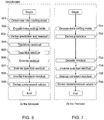
- FIG. 7 is a flowchart showing processes performed by the video encoder 201.
- the video decoder 301 decodes the identification of the optimum prediction mode signaled from the video encoder 201 (Step 701).
- the intra-prediction module 605 uses the decoded prediction mode to generate the prediction block 606, using boundary pixels of neighboring blocks previously reconstructed and stored in a frame memory 607 (Step 702).
- the arithmetic decoder 600 decodes the encoded video signal from the encoder 201 back to the quantized transform coefficients 601 (Step 703).
- the inverse quantizer 602 inversely quantizes the quantized transform coefficients to the transform coefficients (Step 704).
- the inverse transform module 603 inversely transforms the transform coefficients into the prediction residual 604 (Step 705), which is added with the prediction block 606 to reconstruct the block 608 of decoded video signal (Step 706).
- FIG. 8 is a schematic representation of a target block containing 8 ⁇ 8 pixels P ( i, j ) and reference pixels used to predict the pixels P ( i, j ) .
- the reference pixels consist of 17 horizontal pixels and 17 vertical pixels, where the upper left pixel is common to both horizontal and vertical boundaries. Therefore, 32 different pixels are available to generate prediction pixels for the target block.
- FIG. 8 shows an 8 ⁇ 8 block to be predicted, the following explanation is generalized to become applicable to various numbers of pixels in different configurations.
- a block to be predicted may comprises a 4 ⁇ 4 array of pixels.
- a prediction block may also comprise an 8 ⁇ 8 array of pixels, a 16 ⁇ 16 array of pixels, or larger arrays of pixels. Other pixel configurations, including both square and rectangular arrays, may also make up a prediction block.
- the predicted pixel values P P ( i, j ) are determined by an intra-prediction mode performed with the reference pixels ⁇ P ( i, 0): 0 ⁇ i ⁇ 2 N ⁇ ⁇ ⁇ P ( 0, j ) : 0 ⁇ j ⁇ 2 N ⁇ .
- H.264/AVC supports Intra_4 ⁇ 4 prediction, Intra_8 ⁇ 8 prediction and Intra_16 ⁇ 16 prediction.
- Intra_4 ⁇ 4 prediction is performed under nine prediction modes, including a vertical prediction mode, a horizontal prediction mode, a DC prediction mode and six angular prediction modes.
- Intra_8 ⁇ 8 prediction is performed under the nine prediction modes as performed in Intra_4 ⁇ 4 prediction.
- the planar mode according to the present invention is designed to resolve the above-mentioned issues associated with the planar mode process proposed in JCT-VC A119.
- the value P P ( N,N ) of the bottom-right pixel is derived from the reference pixels. Therefore, there is no need to signal the pixel value P P ( N,N ) of the bottom-right pixel to the decoder.
- the prediction block formed under the planar mode is used to derive a residual, which is transformed and quantized for signaling to the decoder.
- P P N N P C N 0 + P C , 0 N > > 1 , where the operator ">>" represents a right-shift operation with or without rounding.
- FIG. 10 is a schematic view showing the process of predicting pixel values performed under the planar mode according to the embodiment of the present invention, in which above Method 1 is implemented.
- the process begins with calculating the value P P ( N,N ) of the bottom-right pixel in a block using Method 1.
- P P ( N,N ) is calculated, linear interpolations are performed between the value P P ( N,N ) and reference pixel value P C ( N, 0) to obtain predicted pixel values P P ( N,j ) of the bottom row in the block.
- linear interpolations are performed between the value P P ( N,N ) and reference pixel value P C (0, N ) to obtain predicted pixel values P P ( i,N ) of the rightmost column in the block.
- a prediction block generated under the planar mode is used to derive a residual P R (1: N, 1: N ), which is transformed by the transform module 405 and quantized by the quantizer 406.
- the transformed and quantized residual P T (1: N, 1: N ) is signaled in a bitstream to the decoder.
- the transformed and quantized residual P T (1: N, 1: N ) is inversely transformed and quantized by the inverse transform module 410 and the inverse quantizer 411 to become a compressed residual P Q (1: N, 1 : N ) , which is stored in the frame memory 403 for use in predicting subsequent target blocks.
- the entire transformed and quantized residual P T (1: N, 1: N ) may be signaled in a bitstream to the decoder.
- only a part of the residual P T (1: K, 1: K ) may be signaled in a bitstream to the decoder.
- K is smaller than N ( K ⁇ N ) and is set to a predetermined value, e.g., 1.
- the value of K may be signaled in a bitstream to the decoder. If the decoder receives only a part of the residual P T (1: K, 1: K ) , it decodes the part of the residual and sets 0 to the remaining part of the residual.
- the entire residual P T (1: N ,1: N) is inversely transformed and quantized to derive a compressed residual P Q ( 1: N, 1: N ) for the purpose of predicting subsequent target blocks.
- the quantization parameter is adaptively changed to quantize a residual generated under the planar mode.
- the planar mode is applied to a block with a smooth image whose pixel values gradually change with a small planar gradient. A residual from such a smooth block tends to be quantized to zero with a mid or coarse quantization parameter.
- the quantization parameter is switched to a finer quantization parameter when a residual generated under the planar mode is quantized.
- the quantization parameter ( QP Planar ) used to quantize a residual generated under the planar mode may be defined with a base quantization parameter ( QP baseP ) .
- QP baseP may be set to a predetermined value representing a finer quantization parameter. If QP baseP is not known to the decoder, it may be signaled in a bitstream to the decoder, or more specifically signaled in the slice header or in the picture parameter set, as defined in H.264/AVC.
- QP baseP QP baseP + QP delta .
- QP delta is a quantization parameter determined from a spatial activity in a block or group of blocks to adjust QP baseP adaptively to the spatial activity.
- QP delta is signaled in a bitstream to the decoder. Since QP delta is determined from a spatial activity in a block, it may become zero depending on the image content in the block and does not affect QP baseP for the planar prediction mode.
- QP Planar is determined with a normal quantization parameter QP normal , which is used to quantize residuals generated under prediction modes other than the planar mode.
- QP Planar is determined according to one of the following five ways:
- the transform module 405 and the inverse transform module 410 switch between the primary set of transform kernels and the secondary set of transform kernels, as shown in FIG. 12 , and use the primary set of transform kernel when transforming residuals generated under prediction modes other than the planar mode, whereas using the secondary set of transform kernel when transforming residuals generated under the planar prediction mode.
- the secondary set of transform kernel is not limited to transforming residuals generated under the planar prediction mode and may be used to transform residuals generated under prediction modes other than the planar mode.
- the secondary set of forward transform kernel G F N may be a fixed-point approximation derived from one of the following options:
- the secondary set of transform kernel defined in Option 4 is preferable.
- Option 4 is advantageous in that the secondary set of transform kernel does not need to be stored separately from the primary set of transform kernel because the secondary set can be derived from the primary set.
- the planar prediction mode may be selected in one of two ways.
- a prediction block generated under the planar prediction mode is evaluated for coding efficiency, along with the prediction blocks generated under the other prediction modes. If the prediction block generated under the planar mode exhibits the best coding efficiency among the prediction blocks, the planar mode is selected. Alternatively, the planar mode is evaluated alone for coding efficiency.
- the planar prediction mode is preferable for an area where an image is smooth and its planar gradient is small. Accordingly, the content of a target block is analyzed to see the amount of high frequency energy in the block and the image discontinuities along the edges of the block. If the amount of high frequency energy is blow a threshold, and no significant discontinuities are found along the edges of the block, the planar mode is selected. Otherwise, prediction blocks generated under the other prediction modes are evaluated to select one mode. In both cases, a selection of the planar prediction mode is signaled in a bitstream to the decoder.
Landscapes
- Engineering & Computer Science (AREA)
- Multimedia (AREA)
- Signal Processing (AREA)
- Physics & Mathematics (AREA)
- Discrete Mathematics (AREA)
- General Physics & Mathematics (AREA)
- Compression Or Coding Systems Of Tv Signals (AREA)
Claims (8)
- Videokodierungsverfahren zum Vorhersagen von Pixelwerten jedes Zielpixels in einem Zielblock unter einer Vielzahl von verschiedenen Intra-Vorhersagemodi, einschließlich eines DC-Modus, Richtungsmodi und eines Planarmodus, wobei das Verfahren computerausführbare Schritte aufweist, die von einem Prozessor eines Videoencoders ausgeführt werden zum Implementieren von:Berechnen eines ersten Vorhersagewerts jedes Zielpixels unter Verwendung einer linearen Interpolation zwischen Pixelwerten von jeweiligen horizontalen Grenzpixeln in der gleichen horizontalen Position wie die jeweiligen Zielpixel an der oberen Außenseite des Zielblocks und einem Pixelwert des untersten von vertikalen Grenzpixeln, die dem Zielblock links außerhalb des Zielblocks benachbart sind, wenn der Planarmodus verwendet wird;Berechnen eines zweiten Vorhersagewerts jedes Zielpixels unter Verwendung einer linearen Interpolation zwischen Pixelwerten der jeweiligen vertikalen Grenzpixel in der gleichen vertikalen Position wie die jeweiligen Zielpixel und einem Pixelwert des äußersten rechten der dem Zielblock benachbarten horizontalen Grenzpixel auf der oberen Außenseite des Zielblocks, wenn der Planarmodus verwendet wird; undMitteln des ersten Vorhersagewerts und des zweiten Vorhersagewerts für jedes Zielpixel, um einen Vorhersagepixelwert für dieses Zielpixel in einem Vorhersageblock abzuleiten, wenn der Planarmodus verwendet wird.
- Verfahren gemäß Anspruch 1, ferner aufweisend das Signalisieren eines Residuums zwischen dem Vorhersageblock und dem Zielblock.
- Videodecodierverfahren zum Vorhersagen von Pixelwerten jedes Zielpixels in einem Zielblock, wobei das Verfahren computerausführbare Schritte aufweist, die von einem Prozessor eines Videodecoders ausgeführt werden zum Implementieren von:Ableiten eines Vorhersagemodus, der von einem Codierer ausgewählt wird, aus einer Vielzahl von verschiedenen Intra-Vorhersagemodi, einschließlich eines DC-Modus, Richtungsmodi und eines Planarmodus;Berechnen eines ersten Vorhersagewerts jedes Zielpixels unter Verwendung einer linearen Interpolation zwischen Pixelwerten von jeweiligen horizontalen Grenzpixeln in der gleichen horizontalen Position wie die jeweiligen Zielpixel an der oberen Außenseite des Zielblocks und einem Pixelwert des untersten von vertikalen Grenzpixel, die dem Zielblock links außerhalb des Zielblocks benachbart sind, wenn der Vorhersagemodus der Planarmodus ist;Berechnen eines zweiten Vorhersagewerts jedes Zielpixels unter Verwendung einer linearen Interpolation zwischen Pixelwerten der jeweiligen vertikalen Grenzpixel in der gleichen vertikalen Position wie die jeweiligen Zielpixel und einem Pixelwert des äußersten rechten der dem Zielblock benachbarten horizontalen Grenzpixel an der oberen Außenseite des Zielblocks, wenn der Vorhersagemodus der Planarmodus ist; undMitteln des ersten Vorhersagewerts und des zweiten Vorhersagewerts für jedes Zielpixel, um einen Vorhersagewert für dieses Zielpixel in einem Vorhersageblock abzuleiten, wenn der Vorhersagemodus der Planarmodus ist.
- Verfahren gemäß Anspruch 3, ferner aufweisend:Decodieren eines von einem Codierer signalisierten Residuums, das in einem Codierer im Planarmodus erzeugt wurde; undHinzufügen des decodierten Residuums zum Vorhersageblock, um Bilddaten zu rekonstruieren.
- Ein Videocodierer, der Pixelwerte jedes Zielpixels in einem Zielblock unter einer Vielzahl von verschiedenen Intra-Prädiktionsmodi einschließlich eines DC-Modus, Richtungsmodi und eines Planarmodus vorhersagt, aufweisend einen Prozessor eines Computersystems und einen Speicher, der von dem Prozessor ausführbare Programme speichert, zum:Berechnen eines ersten Vorhersagewerts jedes Zielpixels unter Verwendung einer linearen Interpolation zwischen Pixelwerten von jeweiligen horizontalen Grenzpixeln in der gleichen horizontalen Position wie die jeweiligen Zielpixel an der oberen Außenseite des Zielblocks und einem Pixelwert des untersten von vertikale Grenzpixel, die dem Zielblock links außerhalb des Zielblocks benachbart sind, wenn der Planarmodus verwendet wird;Berechnen eines zweiten Vorhersagewerts jedes Zielpixels unter Verwendung einer linearen Interpolation zwischen Pixelwerten der jeweiligen vertikalen Grenzpixel in der gleichen vertikalen Position wie die jeweiligen Zielpixel und einem Pixelwert des äußersten rechten der dem Zielblock benachbarten horizontalen Grenzpixel auf der oberen Außenseite des Zielblocks, wenn der Planarmodus verwendet wird; undfür jedes Zielpixel den ersten Vorhersagewert und den zweiten Vorhersagewert zu mitteln, um einen Vorhersagepixelwert für dieses Zielpixel in einem Vorhersageblock abzuleiten, wenn der Planarmodus verwendet wird.
- Videocodierer gemäß Anspruch 5, wobei der Prozessor ein Residuum zwischen dem Vorhersageblock und dem Zielblock signalisiert.
- Videodecodierer, der Pixelwerte jedes Zielpixels in einem Zielblock vorhersagt, aufweisend einen Prozessor eines Computersystems und einen Speicher, in dem vom Prozessor ausführbare Programme gespeichert sind, zum:Ableiten eines Vorhersagemodus, der von einem Codierer ausgewählt wird, aus einer Vielzahl von verschiedenen Intra-Vorhersagemodi, einschließlich eines DC-Modus, Richtungsmodus und eines Planarmodus;Berechnen eines ersten Vorhersagewerts jedes Zielpixels unter Verwendung einer linearen Interpolation zwischen Pixelwerten von jeweiligen horizontalen Grenzpixeln in der gleichen horizontalen Position wie die jeweiligen Zielpixel an der oberen Außenseite des Zielblocks und einem Pixelwert des untersten von vertikale Grenzpixel, die dem Zielblock links außerhalb des Zielblocks benachbart sind, wenn der Vorhersagemodus der Planarmodus ist;Berechnen eines zweiten Vorhersagewerts jedes Zielpixels unter Verwendung einer linearen Interpolation zwischen Pixelwerten der jeweiligen vertikalen Grenzpixel in der gleichen vertikalen Position wie die jeweiligen Zielpixel und einem Pixelwert des äußersten rechten der dem Zielblock benachbarten horizontalen Grenzpixel an der oberen Außenseite des Zielblocks, wenn der Vorhersagemodus der Planarmodus ist; undFür jedes Zielpixel wird der erste Vorhersagewert und der zweite Vorhersagewert gemittelt, um einen Vorhersagewert für dieses Zielpixel in einem Vorhersageblock abzuleiten, wenn der Vorhersagemodus der Planarmodus ist.
- Videodecodierer nach Anspruch 7, wobei der Prozessor ferner:einen von einem Codierer signalisiertes Residuum decodiert; unddas dekodierte Residuum zum Vorhersageblock hinzufügt.
Priority Applications (1)
| Application Number | Priority Date | Filing Date | Title |
|---|---|---|---|
| PL18167909T PL3373579T3 (pl) | 2010-12-21 | 2011-12-21 | Rozszerzone kodowanie z predykcją wewnątrzramkową wykorzystujące reprezentacje planarne |
Applications Claiming Priority (5)
| Application Number | Priority Date | Filing Date | Title |
|---|---|---|---|
| US201061425670P | 2010-12-21 | 2010-12-21 | |
| US201161449528P | 2011-03-04 | 2011-03-04 | |
| EP11851099.9A EP2656507B1 (de) | 2010-12-21 | 2011-12-21 | Verbesserte intraprädikativen kodierung unter verwendung planarer darstellungen |
| PCT/US2011/066359 WO2012088211A1 (en) | 2010-12-21 | 2011-12-21 | Enhanced intra-prediction coding using planar representations |
| EP15187580.4A EP2996334B1 (de) | 2010-12-21 | 2011-12-21 | Intraprädikativen kodierung und dekodierung unter verwendung planarer darstellungen |
Related Parent Applications (3)
| Application Number | Title | Priority Date | Filing Date |
|---|---|---|---|
| EP11851099.9A Division EP2656507B1 (de) | 2010-12-21 | 2011-12-21 | Verbesserte intraprädikativen kodierung unter verwendung planarer darstellungen |
| EP15187580.4A Division-Into EP2996334B1 (de) | 2010-12-21 | 2011-12-21 | Intraprädikativen kodierung und dekodierung unter verwendung planarer darstellungen |
| EP15187580.4A Division EP2996334B1 (de) | 2010-12-21 | 2011-12-21 | Intraprädikativen kodierung und dekodierung unter verwendung planarer darstellungen |
Publications (2)
| Publication Number | Publication Date |
|---|---|
| EP3373579A1 EP3373579A1 (de) | 2018-09-12 |
| EP3373579B1 true EP3373579B1 (de) | 2019-09-11 |
Family
ID=46314437
Family Applications (9)
| Application Number | Title | Priority Date | Filing Date |
|---|---|---|---|
| EP18167918.4A Active EP3373581B1 (de) | 2010-12-21 | 2011-12-21 | Verbesserte intraprädikative codierung unter verwendung planarer darstellungen |
| EP15187580.4A Active EP2996334B1 (de) | 2010-12-21 | 2011-12-21 | Intraprädikativen kodierung und dekodierung unter verwendung planarer darstellungen |
| EP18167909.3A Active EP3373579B1 (de) | 2010-12-21 | 2011-12-21 | Verbesserte intraprädikative codierung unter verwendung planarer darstellungen |
| EP18167914.3A Active EP3373580B1 (de) | 2010-12-21 | 2011-12-21 | Intraprädikative codierung unter verwendung planarer darstellungen |
| EP18167922.6A Active EP3370420B1 (de) | 2010-12-21 | 2011-12-21 | Verbesserte intraprädikative codierung unter verwendung planarer darstellungen |
| EP11851099.9A Active EP2656507B1 (de) | 2010-12-21 | 2011-12-21 | Verbesserte intraprädikativen kodierung unter verwendung planarer darstellungen |
| EP15190603.9A Active EP2993903B1 (de) | 2010-12-21 | 2011-12-21 | Intraprädikative kodierung und dekodierung unter planarem modus |
| EP18167935.8A Active EP3373582B1 (de) | 2010-12-21 | 2011-12-21 | Verbesserte intraprädikative codierung unter verwendung planarer darstellungen |
| EP18167958.0A Active EP3370421B1 (de) | 2010-12-21 | 2011-12-21 | Verbesserte intraprädikative codierung unter verwendung planarer darstellungen |
Family Applications Before (2)
| Application Number | Title | Priority Date | Filing Date |
|---|---|---|---|
| EP18167918.4A Active EP3373581B1 (de) | 2010-12-21 | 2011-12-21 | Verbesserte intraprädikative codierung unter verwendung planarer darstellungen |
| EP15187580.4A Active EP2996334B1 (de) | 2010-12-21 | 2011-12-21 | Intraprädikativen kodierung und dekodierung unter verwendung planarer darstellungen |
Family Applications After (6)
| Application Number | Title | Priority Date | Filing Date |
|---|---|---|---|
| EP18167914.3A Active EP3373580B1 (de) | 2010-12-21 | 2011-12-21 | Intraprädikative codierung unter verwendung planarer darstellungen |
| EP18167922.6A Active EP3370420B1 (de) | 2010-12-21 | 2011-12-21 | Verbesserte intraprädikative codierung unter verwendung planarer darstellungen |
| EP11851099.9A Active EP2656507B1 (de) | 2010-12-21 | 2011-12-21 | Verbesserte intraprädikativen kodierung unter verwendung planarer darstellungen |
| EP15190603.9A Active EP2993903B1 (de) | 2010-12-21 | 2011-12-21 | Intraprädikative kodierung und dekodierung unter planarem modus |
| EP18167935.8A Active EP3373582B1 (de) | 2010-12-21 | 2011-12-21 | Verbesserte intraprädikative codierung unter verwendung planarer darstellungen |
| EP18167958.0A Active EP3370421B1 (de) | 2010-12-21 | 2011-12-21 | Verbesserte intraprädikative codierung unter verwendung planarer darstellungen |
Country Status (17)
| Country | Link |
|---|---|
| US (8) | US10863195B2 (de) |
| EP (9) | EP3373581B1 (de) |
| JP (9) | JP5625124B2 (de) |
| KR (9) | KR101962284B1 (de) |
| CN (8) | CN103270700B (de) |
| AU (1) | AU2011349244C1 (de) |
| BR (1) | BR112013016043B1 (de) |
| CA (8) | CA3029038C (de) |
| ES (9) | ES2627907T3 (de) |
| MX (7) | MX337948B (de) |
| PH (1) | PH12013501123A1 (de) |
| PL (9) | PL3373582T3 (de) |
| PT (9) | PT3370420T (de) |
| RU (9) | RU2562762C2 (de) |
| SG (1) | SG191267A1 (de) |
| TR (2) | TR201809780T4 (de) |
| WO (1) | WO2012088211A1 (de) |
Families Citing this family (40)
| Publication number | Priority date | Publication date | Assignee | Title |
|---|---|---|---|---|
| FI3962081T3 (fi) * | 2010-05-25 | 2024-03-25 | Lg Electronics Inc | Uusi planaarinen ennustustila |
| KR20120016991A (ko) * | 2010-08-17 | 2012-02-27 | 오수미 | 인터 프리딕션 방법 |
| WO2012081895A1 (ko) | 2010-12-13 | 2012-06-21 | 한국전자통신연구원 | 인트라 예측 방법 및 그 장치 |
| KR102086145B1 (ko) | 2010-12-13 | 2020-03-09 | 한국전자통신연구원 | 인트라 예측 방법 및 그 장치 |
| PT3370420T (pt) * | 2010-12-21 | 2019-10-31 | Ntt Docomo Inc | Codificação com intra-predição melhorada utilizando representações planares |
| US9420294B2 (en) * | 2011-02-23 | 2016-08-16 | Lg Electronics Inc. | Intra-prediction method using filtering, and apparatus using the method |
| CN103650496B (zh) | 2011-07-12 | 2018-09-21 | 华为技术有限公司 | 用于在hevc中编码的基于像素的帧内预测 |
| US10645398B2 (en) | 2011-10-25 | 2020-05-05 | Texas Instruments Incorporated | Sample-based angular intra-prediction in video coding |
| WO2014003421A1 (ko) * | 2012-06-25 | 2014-01-03 | 한양대학교 산학협력단 | 비디오 부호화 및 복호화를 위한 방법 |
| KR101307257B1 (ko) * | 2012-06-28 | 2013-09-12 | 숭실대학교산학협력단 | 영상의 인트라 예측 장치 |
| US9277212B2 (en) * | 2012-07-09 | 2016-03-01 | Qualcomm Incorporated | Intra mode extensions for difference domain intra prediction |
| US10091519B2 (en) | 2013-10-14 | 2018-10-02 | Electronics And Telecommunications Research Institute | Multilayer-based image encoding/decoding method and apparatus |
| KR20150043226A (ko) * | 2013-10-14 | 2015-04-22 | 삼성전자주식회사 | 깊이 인트라 부호화 방법 및 그 장치, 복호화 방법 및 그 장치 |
| WO2015056941A1 (ko) * | 2013-10-14 | 2015-04-23 | 한국전자통신연구원 | 다계층 기반의 영상 부호화/복호화 방법 및 장치 |
| KR102070484B1 (ko) * | 2013-10-25 | 2020-01-29 | 미디어텍 인크. | 슬라이스 높이로 균등하게 분할할 수 없는 화상 높이 및/또는 화소 그룹 폭으로 균등하게 분할할 수 없는 슬라이스 폭을 갖는 화상을 처리하는 방법 및 장치 |
| WO2016200235A1 (ko) * | 2015-06-11 | 2016-12-15 | 엘지전자(주) | 인트라 예측 모드 기반 영상 처리 방법 및 이를 위한 장치 |
| KR102605285B1 (ko) * | 2015-08-19 | 2023-11-24 | 엘지전자 주식회사 | 다중 그래프 기반 모델에 따라 최적화된 변환을 이용하여 비디오 신호를 인코딩/디코딩하는 방법 및 장치 |
| CN108886613B (zh) * | 2016-03-28 | 2022-04-19 | 株式会社Kt | 用于处理视频信号的方法和装置 |
| US10917660B2 (en) | 2017-01-13 | 2021-02-09 | Vid Scale, Inc. | Prediction approaches for intra planar coding |
| KR20190112776A (ko) * | 2017-01-31 | 2019-10-07 | 샤프 가부시키가이샤 | 평면 내적 예측 비디오 코딩을 수행하기 위한 시스템들 및 방법들 |
| WO2018174457A1 (ko) * | 2017-03-22 | 2018-09-27 | 엘지전자(주) | 영상 처리 방법 및 이를 위한 장치 |
| WO2019009749A1 (en) * | 2017-07-05 | 2019-01-10 | Huawei Technologies Co., Ltd | APPARATUS AND METHOD FOR INTRA DIRECTIONAL PREDICTION USING AN ADJUSTMENT PLAN AND A PLURALITY OF PRIMARY REFERENCE SAMPLES AND A PLURALITY OF SECONDARY REFERENCE SAMPLES |
| CN115037931B (zh) | 2017-10-18 | 2025-08-26 | 英迪股份有限公司 | 图像编码/解码方法和装置以及存储有比特流的记录介质 |
| RU2762873C2 (ru) * | 2017-12-15 | 2021-12-23 | ЭлДжи ЭЛЕКТРОНИКС ИНК. | Способ кодирования изображений на основе преобразования и устройство для этого |
| WO2019155866A1 (ja) | 2018-02-06 | 2019-08-15 | 日本碍子株式会社 | ガスセンサ |
| WO2019182468A1 (en) * | 2018-03-22 | 2019-09-26 | Huawei Technologies Co., Ltd. | Apparatus and method for coding an image |
| KR20200047723A (ko) * | 2018-05-03 | 2020-05-07 | 엘지전자 주식회사 | 영상 코딩 시스템에서 블록 사이즈에 따른 변환을 사용하는 영상 디코딩 방법 및 그 장치 |
| US10947408B2 (en) | 2018-06-27 | 2021-03-16 | Prc-Desoto International, Inc. | Electrodepositable coating composition |
| US10666981B2 (en) | 2018-06-29 | 2020-05-26 | Tencent America LLC | Method, apparatus and medium for decoding or encoding |
| US10687081B2 (en) | 2018-06-29 | 2020-06-16 | Tencent America LLC | Method, apparatus and medium for decoding or encoding |
| KR102661224B1 (ko) * | 2018-11-26 | 2024-04-26 | 후아웨이 테크놀러지 컴퍼니 리미티드 | 화상의 블록을 인트라 예측하는 방법 |
| CA3121563C (en) | 2019-06-25 | 2024-06-11 | Guangdong Oppo Mobile Telecommunications Corp., Ltd. | Mapping method, encoder, decoder, and computer storage medium |
| US11274167B2 (en) * | 2019-06-27 | 2022-03-15 | Prc-Desoto International, Inc. | Carbamate functional monomers and polymers and use thereof |
| US11313048B2 (en) | 2019-06-27 | 2022-04-26 | Prc-Desoto International, Inc. | Addition polymer for electrodepositable coating compositions |
| US11485874B2 (en) | 2019-06-27 | 2022-11-01 | Prc-Desoto International, Inc. | Addition polymer for electrodepositable coating compositions |
| CN120281921A (zh) * | 2019-09-16 | 2025-07-08 | 交互数字Ce专利控股有限公司 | 用于快速视频编码器的二次变换 |
| US12482112B2 (en) | 2020-11-20 | 2025-11-25 | Huawei Technologies Co., Ltd. | Device and method for optimizing power consumption during frames rendering |
| EP4315854A4 (de) | 2021-03-31 | 2025-02-26 | Telefonaktiebolaget LM Ericsson (publ) | Vorhersage glatter oberflächen |
| US12108031B2 (en) * | 2021-04-16 | 2024-10-01 | Tencent America LLC | Harmonized design among multiple reference line intra prediction, transform partitioning and transform kernels |
| CN115278251B (zh) * | 2022-07-14 | 2025-07-29 | 上海傲显科技有限公司 | 基于移动预测编码的编码方法、显示模组和存储介质 |
Family Cites Families (24)
| Publication number | Priority date | Publication date | Assignee | Title |
|---|---|---|---|---|
| JPS5631318A (en) | 1979-08-22 | 1981-03-30 | Matsushita Electric Works Ltd | Leakage breaker |
| JPH0595538A (ja) | 1991-10-02 | 1993-04-16 | Toshiba Corp | 画像符号化装置 |
| EP0750428B1 (de) * | 1995-06-22 | 2004-03-31 | Canon Kabushiki Kaisha | Bildverarbeitungsgerät und Verfahren |
| RU2201654C2 (ru) * | 1997-12-23 | 2003-03-27 | Томсон Лайсенсинг С.А. | Способ низкошумового кодирования и декодирования |
| US6950469B2 (en) * | 2001-09-17 | 2005-09-27 | Nokia Corporation | Method for sub-pixel value interpolation |
| US20050013498A1 (en) * | 2003-07-18 | 2005-01-20 | Microsoft Corporation | Coding of motion vector information |
| US20050129130A1 (en) * | 2003-12-10 | 2005-06-16 | Microsoft Corporation | Color space coding framework |
| US8422546B2 (en) * | 2005-05-25 | 2013-04-16 | Microsoft Corporation | Adaptive video encoding using a perceptual model |
| RU2406254C2 (ru) * | 2006-03-29 | 2010-12-10 | Квэлкомм Инкорпорейтед | Видеообработка с масштабируемостью |
| AU2006346583B2 (en) * | 2006-07-28 | 2011-04-28 | Kabushiki Kaisha Toshiba | Image encoding and decoding method and apparatus |
| TW200808067A (en) | 2006-07-31 | 2008-02-01 | Univ Nat Cheng Kung | Prediction module |
| ES2630203T3 (es) * | 2006-10-10 | 2017-08-18 | Nippon Telegraph And Telephone Corporation | Método y dispositivo de control de codificación de predicción intra, su programa, y medio de almacenamiento que contiene programa |
| FR2908007A1 (fr) | 2006-10-31 | 2008-05-02 | Thomson Licensing Sas | Procede de codage d'une sequence d'images |
| WO2008062687A1 (fr) * | 2006-11-24 | 2008-05-29 | Nec Corporation | Dispositif, procédé et programme de codage et de décodage |
| WO2008084817A1 (ja) * | 2007-01-09 | 2008-07-17 | Kabushiki Kaisha Toshiba | 画像符号化と復号化の方法及び装置 |
| BR122019021946B1 (pt) * | 2007-06-29 | 2024-02-06 | Velos Media International Limited | Dispositivo de codificação de imagem para codificar imagens de entrada e dispositivo de decodificação de imagem para decodificar dados de imagens codificados |
| KR101517768B1 (ko) * | 2008-07-02 | 2015-05-06 | 삼성전자주식회사 | 영상의 부호화 방법 및 장치, 그 복호화 방법 및 장치 |
| JP5187062B2 (ja) * | 2008-08-15 | 2013-04-24 | 富士通株式会社 | 動画像符号化装置および動画像符号化方法 |
| EP2173101A3 (de) * | 2008-10-06 | 2010-08-18 | LG Electronics Inc. | Verfahren und Vorrichtung zur Dekodierung eines Videosignals |
| KR101647376B1 (ko) * | 2009-03-30 | 2016-08-10 | 엘지전자 주식회사 | 비디오 신호 처리 방법 및 장치 |
| WO2010131903A2 (en) * | 2009-05-12 | 2010-11-18 | Lg Electronics Inc. | Method and apparatus for processing a video signal |
| EP2584781A4 (de) | 2010-06-17 | 2016-03-09 | Sharp Kk | Bildfilterungsvorrichtung, entschlüsselungsvorrichtung, verschlüsselungsvorrichtung und datenstruktur |
| KR101530284B1 (ko) | 2010-07-16 | 2015-06-19 | 삼성전자주식회사 | 영상의 인트라 예측 부호화, 복호화 방법 및 장치 |
| PT3370420T (pt) * | 2010-12-21 | 2019-10-31 | Ntt Docomo Inc | Codificação com intra-predição melhorada utilizando representações planares |
-
2011
- 2011-12-21 PT PT181679226T patent/PT3370420T/pt unknown
- 2011-12-21 ES ES11851099.9T patent/ES2627907T3/es active Active
- 2011-12-21 PL PL18167935T patent/PL3373582T3/pl unknown
- 2011-12-21 PT PT151906039T patent/PT2993903T/pt unknown
- 2011-12-21 ES ES18167922T patent/ES2752723T3/es active Active
- 2011-12-21 RU RU2013133861/08A patent/RU2562762C2/ru active
- 2011-12-21 ES ES18167909T patent/ES2750325T3/es active Active
- 2011-12-21 EP EP18167918.4A patent/EP3373581B1/de active Active
- 2011-12-21 CA CA3029038A patent/CA3029038C/en active Active
- 2011-12-21 KR KR1020187006900A patent/KR101962284B1/ko active Active
- 2011-12-21 CN CN201180062138.9A patent/CN103270700B/zh active Active
- 2011-12-21 CN CN201510204609.5A patent/CN104811713B/zh active Active
- 2011-12-21 CA CA3029045A patent/CA3029045C/en active Active
- 2011-12-21 EP EP15187580.4A patent/EP2996334B1/de active Active
- 2011-12-21 US US13/261,843 patent/US10863195B2/en active Active
- 2011-12-21 PL PL18167922T patent/PL3370420T3/pl unknown
- 2011-12-21 CN CN201510206211.5A patent/CN104811702B/zh active Active
- 2011-12-21 CA CA3029047A patent/CA3029047C/en active Active
- 2011-12-21 CA CA2822391A patent/CA2822391C/en active Active
- 2011-12-21 EP EP18167909.3A patent/EP3373579B1/de active Active
- 2011-12-21 ES ES18167918T patent/ES2767926T3/es active Active
- 2011-12-21 KR KR1020137018984A patent/KR101640873B1/ko active Active
- 2011-12-21 EP EP18167914.3A patent/EP3373580B1/de active Active
- 2011-12-21 KR KR1020197008068A patent/KR102062568B1/ko active Active
- 2011-12-21 PT PT118510999T patent/PT2656507T/pt unknown
- 2011-12-21 AU AU2011349244A patent/AU2011349244C1/en active Active
- 2011-12-21 PL PL18167958T patent/PL3370421T3/pl unknown
- 2011-12-21 MX MX2015008312A patent/MX337948B/es unknown
- 2011-12-21 RU RU2015129679/08A patent/RU2600536C2/ru active
- 2011-12-21 PL PL15187580T patent/PL2996334T3/pl unknown
- 2011-12-21 PT PT181679358T patent/PT3373582T/pt unknown
- 2011-12-21 KR KR1020167018426A patent/KR101838124B1/ko active Active
- 2011-12-21 CA CA3029046A patent/CA3029046C/en active Active
- 2011-12-21 PL PL18167909T patent/PL3373579T3/pl unknown
- 2011-12-21 PT PT181679143T patent/PT3373580T/pt unknown
- 2011-12-21 CN CN201510204699.8A patent/CN104796714B/zh active Active
- 2011-12-21 MX MX2013007169A patent/MX2013007169A/es active IP Right Grant
- 2011-12-21 PH PH1/2013/501123A patent/PH12013501123A1/en unknown
- 2011-12-21 EP EP18167922.6A patent/EP3370420B1/de active Active
- 2011-12-21 KR KR1020187006898A patent/KR101949720B1/ko active Active
- 2011-12-21 ES ES15187580.4T patent/ES2682102T3/es active Active
- 2011-12-21 KR KR1020167018427A patent/KR101839466B1/ko active Active
- 2011-12-21 PL PL11851099T patent/PL2656507T3/pl unknown
- 2011-12-21 KR KR1020167018422A patent/KR101838122B1/ko active Active
- 2011-12-21 EP EP11851099.9A patent/EP2656507B1/de active Active
- 2011-12-21 TR TR2018/09780T patent/TR201809780T4/tr unknown
- 2011-12-21 ES ES18167914T patent/ES2767966T3/es active Active
- 2011-12-21 KR KR1020187006899A patent/KR101961783B1/ko active Active
- 2011-12-21 EP EP15190603.9A patent/EP2993903B1/de active Active
- 2011-12-21 JP JP2013546354A patent/JP5625124B2/ja active Active
- 2011-12-21 TR TR2018/11262T patent/TR201811262T4/tr unknown
- 2011-12-21 CN CN201510205685.8A patent/CN104796716B/zh active Active
- 2011-12-21 EP EP18167935.8A patent/EP3373582B1/de active Active
- 2011-12-21 PL PL18167918T patent/PL3373581T3/pl unknown
- 2011-12-21 CA CA2900863A patent/CA2900863C/en active Active
- 2011-12-21 PT PT151875804T patent/PT2996334T/pt unknown
- 2011-12-21 BR BR112013016043-8A patent/BR112013016043B1/pt active IP Right Grant
- 2011-12-21 CN CN201510205697.0A patent/CN104811715B/zh active Active
- 2011-12-21 KR KR1020167018423A patent/KR101838123B1/ko active Active
- 2011-12-21 ES ES15190603.9T patent/ES2681838T3/es active Active
- 2011-12-21 EP EP18167958.0A patent/EP3370421B1/de active Active
- 2011-12-21 PT PT181679093T patent/PT3373579T/pt unknown
- 2011-12-21 PT PT181679184T patent/PT3373581T/pt unknown
- 2011-12-21 ES ES18167935T patent/ES2770312T3/es active Active
- 2011-12-21 CA CA3029042A patent/CA3029042C/en active Active
- 2011-12-21 PT PT181679580T patent/PT3370421T/pt unknown
- 2011-12-21 PL PL18167914T patent/PL3373580T3/pl unknown
- 2011-12-21 CN CN201510205155.3A patent/CN104796715B/zh active Active
- 2011-12-21 MX MX2017012809A patent/MX363570B/es unknown
- 2011-12-21 WO PCT/US2011/066359 patent/WO2012088211A1/en not_active Ceased
- 2011-12-21 SG SG2013047634A patent/SG191267A1/en unknown
- 2011-12-21 CN CN201510204610.8A patent/CN104811714B/zh active Active
- 2011-12-21 ES ES18167958T patent/ES2773887T3/es active Active
- 2011-12-21 CA CA3029043A patent/CA3029043C/en active Active
- 2011-12-21 MX MX2016003941A patent/MX351231B/es unknown
- 2011-12-21 PL PL15190603T patent/PL2993903T3/pl unknown
-
2013
- 2013-06-20 MX MX2019003463A patent/MX2019003463A/es unknown
- 2013-06-20 MX MX2019003465A patent/MX2019003465A/es unknown
- 2013-06-20 MX MX2019003464A patent/MX2019003464A/es unknown
-
2014
- 2014-09-29 JP JP2014198105A patent/JP5732582B2/ja active Active
-
2015
- 2015-04-13 JP JP2015081971A patent/JP5960316B2/ja active Active
-
2016
- 2016-06-22 JP JP2016123631A patent/JP6242438B2/ja active Active
- 2016-09-07 RU RU2016136095A patent/RU2643504C1/ru active
- 2016-10-03 US US15/283,756 patent/US10205963B2/en active Active
-
2017
- 2017-11-07 JP JP2017214976A patent/JP6397555B2/ja active Active
- 2017-12-08 RU RU2017142964A patent/RU2673011C1/ru active
-
2018
- 2018-08-31 JP JP2018163393A patent/JP6615290B2/ja active Active
- 2018-10-17 US US16/162,913 patent/US10771812B2/en active Active
- 2018-10-17 US US16/163,008 patent/US10841611B2/en active Active
- 2018-10-17 US US16/162,980 patent/US10805632B2/en active Active
- 2018-10-17 US US16/163,063 patent/US10897630B2/en active Active
- 2018-10-17 US US16/162,956 patent/US10856008B2/en active Active
- 2018-10-17 US US16/163,026 patent/US10834423B2/en active Active
- 2018-11-08 RU RU2018139333A patent/RU2694013C1/ru active
- 2018-11-08 RU RU2018139332A patent/RU2696318C1/ru active
- 2018-11-08 RU RU2018139329A patent/RU2694012C1/ru active
- 2018-11-08 RU RU2018139331A patent/RU2694144C1/ru active
-
2019
- 2019-07-15 RU RU2019122170A patent/RU2713610C1/ru active
- 2019-11-05 JP JP2019200786A patent/JP6953497B2/ja active Active
- 2019-11-05 JP JP2019200789A patent/JP2020018024A/ja active Pending
- 2019-11-05 JP JP2019200788A patent/JP6851450B2/ja active Active
Non-Patent Citations (1)
| Title |
|---|
| None * |
Also Published As
Similar Documents
| Publication | Publication Date | Title |
|---|---|---|
| US10897630B2 (en) | Enhanced intra-prediction coding using planar representations | |
| AU2016202817B2 (en) | Enhanced intra-prediction coding using planar representations |
Legal Events
| Date | Code | Title | Description |
|---|---|---|---|
| PUAI | Public reference made under article 153(3) epc to a published international application that has entered the european phase |
Free format text: ORIGINAL CODE: 0009012 |
|
| STAA | Information on the status of an ep patent application or granted ep patent |
Free format text: STATUS: REQUEST FOR EXAMINATION WAS MADE |
|
| 17P | Request for examination filed |
Effective date: 20180418 |
|
| AC | Divisional application: reference to earlier application |
Ref document number: 2656507 Country of ref document: EP Kind code of ref document: P Ref document number: 2996334 Country of ref document: EP Kind code of ref document: P |
|
| AK | Designated contracting states |
Kind code of ref document: A1 Designated state(s): AL AT BE BG CH CY CZ DE DK EE ES FI FR GB GR HR HU IE IS IT LI LT LU LV MC MK MT NL NO PL PT RO RS SE SI SK SM TR |
|
| RBV | Designated contracting states (corrected) |
Designated state(s): AL AT BE BG CH CY CZ DE DK EE ES FI FR GB GR HR HU IE IS IT LI LT LU LV MC MK MT NL NO PL PT RO RS SE SI SK SM TR |
|
| GRAP | Despatch of communication of intention to grant a patent |
Free format text: ORIGINAL CODE: EPIDOSNIGR1 |
|
| RIC1 | Information provided on ipc code assigned before grant |
Ipc: H04N 19/12 20140101ALI20190411BHEP Ipc: H04N 19/587 20140101ALI20190411BHEP Ipc: H04N 19/46 20140101ALI20190411BHEP Ipc: H04N 19/176 20140101ALI20190411BHEP Ipc: H04N 19/124 20140101ALI20190411BHEP Ipc: H04N 19/157 20140101ALI20190411BHEP Ipc: H04N 19/61 20140101ALI20190411BHEP Ipc: H04N 19/159 20140101ALI20190411BHEP Ipc: H04N 19/14 20140101ALI20190411BHEP Ipc: H04N 19/182 20140101ALI20190411BHEP Ipc: H04N 19/593 20140101ALI20190411BHEP Ipc: H04N 19/86 20140101ALI20190411BHEP Ipc: H04N 19/15 20140101ALI20190411BHEP Ipc: H04N 19/11 20140101AFI20190411BHEP |
|
| STAA | Information on the status of an ep patent application or granted ep patent |
Free format text: STATUS: GRANT OF PATENT IS INTENDED |
|
| INTG | Intention to grant announced |
Effective date: 20190516 |
|
| RAP1 | Party data changed (applicant data changed or rights of an application transferred) |
Owner name: NTT DOCOMO, INC. |
|
| GRAS | Grant fee paid |
Free format text: ORIGINAL CODE: EPIDOSNIGR3 |
|
| GRAA | (expected) grant |
Free format text: ORIGINAL CODE: 0009210 |
|
| STAA | Information on the status of an ep patent application or granted ep patent |
Free format text: STATUS: THE PATENT HAS BEEN GRANTED |
|
| AC | Divisional application: reference to earlier application |
Ref document number: 2996334 Country of ref document: EP Kind code of ref document: P Ref document number: 2656507 Country of ref document: EP Kind code of ref document: P |
|
| AK | Designated contracting states |
Kind code of ref document: B1 Designated state(s): AL AT BE BG CH CY CZ DE DK EE ES FI FR GB GR HR HU IE IS IT LI LT LU LV MC MK MT NL NO PL PT RO RS SE SI SK SM TR |
|
| REG | Reference to a national code |
Ref country code: GB Ref legal event code: FG4D |
|
| REG | Reference to a national code |
Ref country code: CH Ref legal event code: EP |
|
| REG | Reference to a national code |
Ref country code: AT Ref legal event code: REF Ref document number: 1180029 Country of ref document: AT Kind code of ref document: T Effective date: 20190915 |
|
| REG | Reference to a national code |
Ref country code: RO Ref legal event code: EPE |
|
| REG | Reference to a national code |
Ref country code: DE Ref legal event code: R096 Ref document number: 602011062095 Country of ref document: DE |
|
| REG | Reference to a national code |
Ref country code: CH Ref legal event code: NV Representative=s name: VALIPAT S.A. C/O BOVARD SA NEUCHATEL, CH |
|
| REG | Reference to a national code |
Ref country code: IE Ref legal event code: FG4D |
|
| REG | Reference to a national code |
Ref country code: PT Ref legal event code: SC4A Ref document number: 3373579 Country of ref document: PT Date of ref document: 20191025 Kind code of ref document: T Free format text: AVAILABILITY OF NATIONAL TRANSLATION Effective date: 20191008 |
|
| REG | Reference to a national code |
Ref country code: SE Ref legal event code: TRGR |
|
| REG | Reference to a national code |
Ref country code: NL Ref legal event code: FP |
|
| REG | Reference to a national code |
Ref country code: NO Ref legal event code: T2 Effective date: 20190911 |
|
| REG | Reference to a national code |
Ref country code: SK Ref legal event code: T3 Ref document number: E 32383 Country of ref document: SK |
|
| REG | Reference to a national code |
Ref country code: LT Ref legal event code: MG4D |
|
| PG25 | Lapsed in a contracting state [announced via postgrant information from national office to epo] |
Ref country code: HR Free format text: LAPSE BECAUSE OF FAILURE TO SUBMIT A TRANSLATION OF THE DESCRIPTION OR TO PAY THE FEE WITHIN THE PRESCRIBED TIME-LIMIT Effective date: 20190911 Ref country code: FI Free format text: LAPSE BECAUSE OF FAILURE TO SUBMIT A TRANSLATION OF THE DESCRIPTION OR TO PAY THE FEE WITHIN THE PRESCRIBED TIME-LIMIT Effective date: 20190911 Ref country code: LT Free format text: LAPSE BECAUSE OF FAILURE TO SUBMIT A TRANSLATION OF THE DESCRIPTION OR TO PAY THE FEE WITHIN THE PRESCRIBED TIME-LIMIT Effective date: 20190911 Ref country code: BG Free format text: LAPSE BECAUSE OF FAILURE TO SUBMIT A TRANSLATION OF THE DESCRIPTION OR TO PAY THE FEE WITHIN THE PRESCRIBED TIME-LIMIT Effective date: 20191211 |
|
| PG25 | Lapsed in a contracting state [announced via postgrant information from national office to epo] |
Ref country code: AL Free format text: LAPSE BECAUSE OF FAILURE TO SUBMIT A TRANSLATION OF THE DESCRIPTION OR TO PAY THE FEE WITHIN THE PRESCRIBED TIME-LIMIT Effective date: 20190911 Ref country code: LV Free format text: LAPSE BECAUSE OF FAILURE TO SUBMIT A TRANSLATION OF THE DESCRIPTION OR TO PAY THE FEE WITHIN THE PRESCRIBED TIME-LIMIT Effective date: 20190911 Ref country code: RS Free format text: LAPSE BECAUSE OF FAILURE TO SUBMIT A TRANSLATION OF THE DESCRIPTION OR TO PAY THE FEE WITHIN THE PRESCRIBED TIME-LIMIT Effective date: 20190911 Ref country code: GR Free format text: LAPSE BECAUSE OF FAILURE TO SUBMIT A TRANSLATION OF THE DESCRIPTION OR TO PAY THE FEE WITHIN THE PRESCRIBED TIME-LIMIT Effective date: 20191212 |
|
| REG | Reference to a national code |
Ref country code: ES Ref legal event code: FG2A Ref document number: 2750325 Country of ref document: ES Kind code of ref document: T3 Effective date: 20200325 |
|
| REG | Reference to a national code |
Ref country code: AT Ref legal event code: MK05 Ref document number: 1180029 Country of ref document: AT Kind code of ref document: T Effective date: 20190911 |
|
| PG25 | Lapsed in a contracting state [announced via postgrant information from national office to epo] |
Ref country code: AT Free format text: LAPSE BECAUSE OF FAILURE TO SUBMIT A TRANSLATION OF THE DESCRIPTION OR TO PAY THE FEE WITHIN THE PRESCRIBED TIME-LIMIT Effective date: 20190911 Ref country code: EE Free format text: LAPSE BECAUSE OF FAILURE TO SUBMIT A TRANSLATION OF THE DESCRIPTION OR TO PAY THE FEE WITHIN THE PRESCRIBED TIME-LIMIT Effective date: 20190911 |
|
| PG25 | Lapsed in a contracting state [announced via postgrant information from national office to epo] |
Ref country code: SM Free format text: LAPSE BECAUSE OF FAILURE TO SUBMIT A TRANSLATION OF THE DESCRIPTION OR TO PAY THE FEE WITHIN THE PRESCRIBED TIME-LIMIT Effective date: 20190911 Ref country code: IS Free format text: LAPSE BECAUSE OF FAILURE TO SUBMIT A TRANSLATION OF THE DESCRIPTION OR TO PAY THE FEE WITHIN THE PRESCRIBED TIME-LIMIT Effective date: 20200224 |
|
| REG | Reference to a national code |
Ref country code: DE Ref legal event code: R097 Ref document number: 602011062095 Country of ref document: DE |
|
| PLBE | No opposition filed within time limit |
Free format text: ORIGINAL CODE: 0009261 |
|
| STAA | Information on the status of an ep patent application or granted ep patent |
Free format text: STATUS: NO OPPOSITION FILED WITHIN TIME LIMIT |
|
| PG2D | Information on lapse in contracting state deleted |
Ref country code: IS |
|
| PG25 | Lapsed in a contracting state [announced via postgrant information from national office to epo] |
Ref country code: DK Free format text: LAPSE BECAUSE OF FAILURE TO SUBMIT A TRANSLATION OF THE DESCRIPTION OR TO PAY THE FEE WITHIN THE PRESCRIBED TIME-LIMIT Effective date: 20190911 Ref country code: IS Free format text: LAPSE BECAUSE OF FAILURE TO SUBMIT A TRANSLATION OF THE DESCRIPTION OR TO PAY THE FEE WITHIN THE PRESCRIBED TIME-LIMIT Effective date: 20200112 |
|
| 26N | No opposition filed |
Effective date: 20200615 |
|
| PG25 | Lapsed in a contracting state [announced via postgrant information from national office to epo] |
Ref country code: MC Free format text: LAPSE BECAUSE OF FAILURE TO SUBMIT A TRANSLATION OF THE DESCRIPTION OR TO PAY THE FEE WITHIN THE PRESCRIBED TIME-LIMIT Effective date: 20190911 Ref country code: SI Free format text: LAPSE BECAUSE OF FAILURE TO SUBMIT A TRANSLATION OF THE DESCRIPTION OR TO PAY THE FEE WITHIN THE PRESCRIBED TIME-LIMIT Effective date: 20190911 |
|
| PG25 | Lapsed in a contracting state [announced via postgrant information from national office to epo] |
Ref country code: IE Free format text: LAPSE BECAUSE OF NON-PAYMENT OF DUE FEES Effective date: 20191221 Ref country code: LU Free format text: LAPSE BECAUSE OF NON-PAYMENT OF DUE FEES Effective date: 20191221 |
|
| PG25 | Lapsed in a contracting state [announced via postgrant information from national office to epo] |
Ref country code: CY Free format text: LAPSE BECAUSE OF FAILURE TO SUBMIT A TRANSLATION OF THE DESCRIPTION OR TO PAY THE FEE WITHIN THE PRESCRIBED TIME-LIMIT Effective date: 20190911 |
|
| PG25 | Lapsed in a contracting state [announced via postgrant information from national office to epo] |
Ref country code: HU Free format text: LAPSE BECAUSE OF FAILURE TO SUBMIT A TRANSLATION OF THE DESCRIPTION OR TO PAY THE FEE WITHIN THE PRESCRIBED TIME-LIMIT; INVALID AB INITIO Effective date: 20111221 Ref country code: MT Free format text: LAPSE BECAUSE OF FAILURE TO SUBMIT A TRANSLATION OF THE DESCRIPTION OR TO PAY THE FEE WITHIN THE PRESCRIBED TIME-LIMIT Effective date: 20190911 |
|
| PG25 | Lapsed in a contracting state [announced via postgrant information from national office to epo] |
Ref country code: MK Free format text: LAPSE BECAUSE OF FAILURE TO SUBMIT A TRANSLATION OF THE DESCRIPTION OR TO PAY THE FEE WITHIN THE PRESCRIBED TIME-LIMIT Effective date: 20190911 |
|
| P01 | Opt-out of the competence of the unified patent court (upc) registered |
Effective date: 20230510 |
|
| REG | Reference to a national code |
Ref country code: CH Ref legal event code: U11 Free format text: ST27 STATUS EVENT CODE: U-0-0-U10-U11 (AS PROVIDED BY THE NATIONAL OFFICE) Effective date: 20260101 |
|
| PGFP | Annual fee paid to national office [announced via postgrant information from national office to epo] |
Ref country code: DE Payment date: 20251211 Year of fee payment: 15 |
|
| PGFP | Annual fee paid to national office [announced via postgrant information from national office to epo] |
Ref country code: GB Payment date: 20251219 Year of fee payment: 15 |
|
| PGFP | Annual fee paid to national office [announced via postgrant information from national office to epo] |
Ref country code: PT Payment date: 20251211 Year of fee payment: 15 |
|
| PGFP | Annual fee paid to national office [announced via postgrant information from national office to epo] |
Ref country code: IT Payment date: 20251223 Year of fee payment: 15 |
|
| PGFP | Annual fee paid to national office [announced via postgrant information from national office to epo] |
Ref country code: FR Payment date: 20251229 Year of fee payment: 15 Ref country code: NL Payment date: 20251219 Year of fee payment: 15 |
|
| PGFP | Annual fee paid to national office [announced via postgrant information from national office to epo] |
Ref country code: TR Payment date: 20251216 Year of fee payment: 15 Ref country code: BE Payment date: 20251219 Year of fee payment: 15 |
|
| PGFP | Annual fee paid to national office [announced via postgrant information from national office to epo] |
Ref country code: SE Payment date: 20251219 Year of fee payment: 15 |
|
| PGFP | Annual fee paid to national office [announced via postgrant information from national office to epo] |
Ref country code: CZ Payment date: 20251217 Year of fee payment: 15 |
|
| PGFP | Annual fee paid to national office [announced via postgrant information from national office to epo] |
Ref country code: PL Payment date: 20251215 Year of fee payment: 15 |
|
| PGFP | Annual fee paid to national office [announced via postgrant information from national office to epo] |
Ref country code: SK Payment date: 20251218 Year of fee payment: 15 Ref country code: RO Payment date: 20251216 Year of fee payment: 15 |
|
| PGFP | Annual fee paid to national office [announced via postgrant information from national office to epo] |
Ref country code: ES Payment date: 20260130 Year of fee payment: 15 |
|
| PGFP | Annual fee paid to national office [announced via postgrant information from national office to epo] |
Ref country code: NO Payment date: 20251230 Year of fee payment: 15 |
|
| PGFP | Annual fee paid to national office [announced via postgrant information from national office to epo] |
Ref country code: CH Payment date: 20260101 Year of fee payment: 15 |