EP3371268B1 - Cyanacrylatzusammensetzungen - Google Patents
Cyanacrylatzusammensetzungen Download PDFInfo
- Publication number
- EP3371268B1 EP3371268B1 EP16790416.8A EP16790416A EP3371268B1 EP 3371268 B1 EP3371268 B1 EP 3371268B1 EP 16790416 A EP16790416 A EP 16790416A EP 3371268 B1 EP3371268 B1 EP 3371268B1
- Authority
- EP
- European Patent Office
- Prior art keywords
- crown
- cyanoacrylate
- component
- weeks
- composition according
- Prior art date
- Legal status (The legal status is an assumption and is not a legal conclusion. Google has not performed a legal analysis and makes no representation as to the accuracy of the status listed.)
- Active
Links
Images






Classifications
-
- B—PERFORMING OPERATIONS; TRANSPORTING
- B32—LAYERED PRODUCTS
- B32B—LAYERED PRODUCTS, i.e. PRODUCTS BUILT-UP OF STRATA OF FLAT OR NON-FLAT, e.g. CELLULAR OR HONEYCOMB, FORM
- B32B37/00—Methods or apparatus for laminating, e.g. by curing or by ultrasonic bonding
- B32B37/12—Methods or apparatus for laminating, e.g. by curing or by ultrasonic bonding characterised by using adhesives
-
- C—CHEMISTRY; METALLURGY
- C08—ORGANIC MACROMOLECULAR COMPOUNDS; THEIR PREPARATION OR CHEMICAL WORKING-UP; COMPOSITIONS BASED THEREON
- C08F—MACROMOLECULAR COMPOUNDS OBTAINED BY REACTIONS ONLY INVOLVING CARBON-TO-CARBON UNSATURATED BONDS
- C08F222/00—Copolymers of compounds having one or more unsaturated aliphatic radicals, each having only one carbon-to-carbon double bond, and at least one being terminated by a carboxyl radical and containing at least one other carboxyl radical in the molecule; Salts, anhydrides, esters, amides, imides, or nitriles thereof
- C08F222/30—Nitriles
- C08F222/32—Alpha-cyano-acrylic acid; Esters thereof
- C08F222/322—Alpha-cyano-acrylic acid ethyl ester, e.g. ethyl-2-cyanoacrylate
-
- C—CHEMISTRY; METALLURGY
- C08—ORGANIC MACROMOLECULAR COMPOUNDS; THEIR PREPARATION OR CHEMICAL WORKING-UP; COMPOSITIONS BASED THEREON
- C08F—MACROMOLECULAR COMPOUNDS OBTAINED BY REACTIONS ONLY INVOLVING CARBON-TO-CARBON UNSATURATED BONDS
- C08F222/00—Copolymers of compounds having one or more unsaturated aliphatic radicals, each having only one carbon-to-carbon double bond, and at least one being terminated by a carboxyl radical and containing at least one other carboxyl radical in the molecule; Salts, anhydrides, esters, amides, imides, or nitriles thereof
- C08F222/30—Nitriles
- C08F222/32—Alpha-cyano-acrylic acid; Esters thereof
- C08F222/323—Alpha-cyano-acrylic acid propyl ester
-
- C—CHEMISTRY; METALLURGY
- C08—ORGANIC MACROMOLECULAR COMPOUNDS; THEIR PREPARATION OR CHEMICAL WORKING-UP; COMPOSITIONS BASED THEREON
- C08K—Use of inorganic or non-macromolecular organic substances as compounding ingredients
- C08K5/00—Use of organic ingredients
- C08K5/04—Oxygen-containing compounds
- C08K5/10—Esters; Ether-esters
- C08K5/101—Esters; Ether-esters of monocarboxylic acids
- C08K5/103—Esters; Ether-esters of monocarboxylic acids with polyalcohols
-
- C—CHEMISTRY; METALLURGY
- C09—DYES; PAINTS; POLISHES; NATURAL RESINS; ADHESIVES; COMPOSITIONS NOT OTHERWISE PROVIDED FOR; APPLICATIONS OF MATERIALS NOT OTHERWISE PROVIDED FOR
- C09J—ADHESIVES; NON-MECHANICAL ASPECTS OF ADHESIVE PROCESSES IN GENERAL; ADHESIVE PROCESSES NOT PROVIDED FOR ELSEWHERE; USE OF MATERIALS AS ADHESIVES
- C09J11/00—Features of adhesives not provided for in group C09J9/00, e.g. additives
- C09J11/02—Non-macromolecular additives
- C09J11/04—Non-macromolecular additives inorganic
-
- C—CHEMISTRY; METALLURGY
- C09—DYES; PAINTS; POLISHES; NATURAL RESINS; ADHESIVES; COMPOSITIONS NOT OTHERWISE PROVIDED FOR; APPLICATIONS OF MATERIALS NOT OTHERWISE PROVIDED FOR
- C09J—ADHESIVES; NON-MECHANICAL ASPECTS OF ADHESIVE PROCESSES IN GENERAL; ADHESIVE PROCESSES NOT PROVIDED FOR ELSEWHERE; USE OF MATERIALS AS ADHESIVES
- C09J11/00—Features of adhesives not provided for in group C09J9/00, e.g. additives
- C09J11/02—Non-macromolecular additives
- C09J11/06—Non-macromolecular additives organic
-
- C—CHEMISTRY; METALLURGY
- C09—DYES; PAINTS; POLISHES; NATURAL RESINS; ADHESIVES; COMPOSITIONS NOT OTHERWISE PROVIDED FOR; APPLICATIONS OF MATERIALS NOT OTHERWISE PROVIDED FOR
- C09J—ADHESIVES; NON-MECHANICAL ASPECTS OF ADHESIVE PROCESSES IN GENERAL; ADHESIVE PROCESSES NOT PROVIDED FOR ELSEWHERE; USE OF MATERIALS AS ADHESIVES
- C09J11/00—Features of adhesives not provided for in group C09J9/00, e.g. additives
- C09J11/08—Macromolecular additives
-
- C—CHEMISTRY; METALLURGY
- C09—DYES; PAINTS; POLISHES; NATURAL RESINS; ADHESIVES; COMPOSITIONS NOT OTHERWISE PROVIDED FOR; APPLICATIONS OF MATERIALS NOT OTHERWISE PROVIDED FOR
- C09J—ADHESIVES; NON-MECHANICAL ASPECTS OF ADHESIVE PROCESSES IN GENERAL; ADHESIVE PROCESSES NOT PROVIDED FOR ELSEWHERE; USE OF MATERIALS AS ADHESIVES
- C09J4/00—Adhesives based on organic non-macromolecular compounds having at least one polymerisable carbon-to-carbon unsaturated bond ; adhesives, based on monomers of macromolecular compounds of groups C09J183/00 - C09J183/16
- C09J4/06—Organic non-macromolecular compounds having at least one polymerisable carbon-to-carbon unsaturated bond in combination with a macromolecular compound other than an unsaturated polymer of groups C09J159/00 - C09J187/00
Definitions
- Cyanoacrylate compositions that include an allyl-2-cyanoacrylate, a rubber toughening component and a component functionalized with at least two blocked hydroxyl groups are provided.
- Cyanoacrylate adhesive compositions are well known, and widely used as quick setting, instant adhesives with a wide variety of uses. See H.V. Coover, D.W. Dreifus and J.T. O'Connor, "Cyanoacrylate Adhesives” in Handbook of Adhesives, 27, 463-77, I. Skeist, ed., Van Nostrand Reinhold, New York, 3rd ed. (1990 ). See also G.H. Millet, "Cyanoacrylate Adhesives” in Structural Adhesives: Chemistry and Technology, S.R. Hartshorn, ed., Plenun Press, New York, p. 249-307 (1986 ).
- U.S. Patent No. 4,440,910 pioneered rubber toughened cyanoacrylate compositions through the use of certain organic polymers as toughening additives that are elastomeric, i.e., rubbery, in nature.
- the '910 patent is thus directed to and claims a curable adhesive comprising a substantially solvent-free mixture of: (a) a cyanoacrylate ester, and (b) about 0.5% to about 20% by weight of an elastomeric polymer.
- the elastomeric polymer is selected from elastomeric copolymers of a lower alkene monomer and (i) acrylic acid esters, (ii) methacrylic acid esters or (iii) vinyl acetate.
- the '910 patent notes that as toughening additives for cyanoacrylates, acrylic rubbers; polyester urethanes; ethylene-vinyl acetates; fluorinated rubbers; isoprene-acrylonitrile polymers; chlorosulfinated polyethylenes; and homopolymers of polyvinyl acetate were found to be particularly useful.
- the elastomeric polymers are described in the '910 patent as either homopolymers of alkyl esters of acrylic acid; copolymers of another polymerizable monomer, such as lower alkenes, with an alkyl or alkoxy ester of acrylic acid; and copolymers of alkyl or alkoxy esters of acrylic acid.
- Other unsaturated monomers which may be copolymerized with the alkyl and alkoxy esters of acrylic include dienes, reactive halogen-containing unsaturated compounds and other acrylic monomers such as acrylamides.
- VAMAC N123 and VAMAC B-124 are reported by DuPont to be a master batch of ethylene/acrylic elastomer.
- Henkel Corporation (as the successor to Loctite Corporation) has sold for a number of years since the filing of the '910 patent rubber toughened cyanoacrylate adhesive products under the tradename BLACK MAX, which employ as the rubber toughening component the DuPont materials called VAMAC B-124 and N123.
- Henkel has sold in the past clear and substantially colorless rubber toughened cyanoacrylate adhesive products, namely, LOCTITE 4203, 4204 and 4205, which employ as the rubber toughening component the DuPont material, VAMAC G. While VAMAC G contains no fillers to provide color or stabilizers, it does contain processing aids.
- U.S. Patent No. 5,536,799 discloses a cyanoacrylate adhesive composition which comprises (a) a cyanoacrylate and (b) at least one di- or higher functional ester, such as tri- or higher acrylates or methacrylates, having an alcohol residue and having an acid residue, where the alcohol residue is a residue of dipentaerythritol and the acid residue is a residue of an acrylic or methacrylic acid.
- the di- or higher functional ester is reported as (i) an ester of a dipentaerythritol with an acrylic acid or a methacrylic acid, (ii) an ester of a modified alcohol with an acrylic acid or a methacrylic acid, where the modified alcohol is a dipentaerythritol modified by addition of a lactone, and (iii) a combination of an ester of a dipentaerythritol with an acrylic acid or a methacrylic acid and an ester of the modified alcohol with an acrylic acid or a methacrylic acid.
- cyanoacrylate compositions that include an allyl-2-cyanoacrylate, a rubber toughening component and a component functionalized with at least two blocked hydroxyl groups. These cyanoacrylate compositions demonstrate improved thermal degradation resistance compared to known cyanoacrylate compositions.
- the rubber toughening component has (a) reaction products of the combination of ethylene, methyl acrylate and monomers having carboxylic acid cure sites, (b) dipolymers of ethylene and methyl acrylate, and combinations of (a) and (b).
- This invention is also directed to a method of bonding together two substrates, which method includes applying to at least one of the substrates a composition as described above, and thereafter mating together the substrates.
- the present invention is directed to reaction products of the inventive compositions.
- the invention is directed to a method of preparing the inventive compositions.
- cyanoacrylate compositions that include an allyl-2-cyanoacrylate, a rubber toughening component and a component functionalized with at least two blocked hydroxyl groups.
- the rubber toughening component comprises (a) reaction products of the combination of ethylene, methyl acrylate and monomers having carboxylic acid cure sites, (b) dipolymers of ethylene and methyl acrylate, and combinations of (a) and (b).
- Examples of the rubber toughening component include those materials sold under the VAMAC trade name, including G, B-124, VMX (such as VMX 1012), VCS (such as VCS 5500 or 5520), and N123, all of which being available from DuPont, Wilmington, DE.
- VAMAC N123 and VAMAC B-124 are reported by DuPont to be a master batch of ethylene/acrylic elastomer.
- the DuPont material VAMAC G is a similar copolymer, but contains no fillers to provide colour or stabilizers.
- VAMAC VCS rubber appears to be the base rubber, from which the remaining members of the VAMAC product line are compounded.
- VAMAC VCS (also known as VAMAC MR) is a reaction product of the combination of ethylene, methyl acrylate and monomers having carboxylic acid cure sites, which once formed is then substantially free of processing aids such as the release agents octadecyl amine, complex organic phosphate esters and/or stearic acid, and anti-oxidants, such as substituted diphenyl amine.
- VAMAC VMX 1012 and VCD 6200 are rubbers made from ethylene and methyl acrylate. It is believed that the VAMAC VMX 1012 rubber possesses little to no carboxylic acid in the polymer backbone. Like the VAMAC VCS rubber, the VAMAC VMX 1012 and VCD 6200 rubbers are substantially free of processing aids such as the release agents octadecyl amine, complex organic phosphate esters and/or stearic acid, and anti-oxidants, such as substituted diphenyl amine, noted above. All of these VAMAC elastomeric polymers are useful herein.
- the rubber toughening component should be present in a concentration of about 1.5% to about 20% by weight, such as about 5% to about 15% by weight, with about 8% to about 10% being particularly desirable.
- the component functionalized with at least two blocked hydroxyl groups is hexane diol diacrylate.
- the component should be present in a concentration of about 1.5% to about 20% by weight, such as about 5% to about 15% by weight, with about 8% to about 10% by weight being particularly desirable.
- the cyanoacrylate monomer is selected from methyl cyanoacrylate, ethyl-2-cyanoacrylate, propyl cyanoacrylates, butyl cyanoacrylates (such as n-butyl-2-cyanoacrylate), octyl cyanoacrylates, ß-methoxyethyl cyanoacrylate and combinations thereof.
- a particularly desirable one is ethyl-2-cyanoacrylate.
- the additional cyanoacrylate component should be included in the compositions in an amount within the range of from about 50% to about 98% by weight, with the range of about 75% to about 95% by weight being desirable, and about 85 to about 90% by weight of the total composition being particularly desirable.
- Thermal resistance conferring agents may also be added. Included among such agents are certain sulfur-containing compounds, such as sulfonates, sulfinates, sulfates and sulfites as set forth in U.S. Patent No. 5,328,944 (Attarwala ).
- Maleimide components may also be added, either alone or in combination with other thermal resistance conferring agents.
- Suitable maleimides include those having the following structures:
- R 7 may be represented by the following structure: Where the phenyl groups are optionally substituted at one or more positions with linear, branched or cyclic alkyl, alkenyl, alkynyl, alkoxy or aryl groups having from 1 to about 20 carbon atoms, with or without substitution by halogen, hydroxyl, nitrile, ester, amide or sulfate and Y may represent O, S, carbonyl, sulfone or primary or secondary methylene groups optionally substituted with linear, branched or cyclic alkyl, alkenyl, alkynyl, alkoxy or aryl groups having from about 1 to about 20 carbon atoms, with or without substitution by halogen, hydroxyl, nitrile, ester, amide or sulfate.
- the maleimide component comprises one or more of N-phenyl maleimide, N,N'-m-phenylene bismaleimide, N,N'-(4,4'-methylene diphenylene)bismaleimide, bis-(3-ethyl-5-methyl-4-maleimidephenyl)methane, or [2,2'-bis[4-(4'maleimidediphenoxy)phenyl]propane.
- compositions of the invention may optionally comprise additives which confer thermal resistance properties such as 2-sulfobenzoic acid anhydride, triethylene glycol di(p-toluene sulfonate), trifluoroethyl p-toluene sulfonate, dimethyl dioxolen-4-ylmethyl p-toluene sulfonate, p-toluene sulfonic anhydride, methanesulfonic anhydride, 1,3 propylene sulfite, dioxathiolene dioxide, 1,8-naphthosultone, sultone 1,3-propane, sultone 1,4-butene, allyl phenyl sulfone, 4-fluorophenyl sulfone, dibenzothiophene sulfone, bis(4-fluorophenyl) sulfone, ethyl p-toluenes
- the thermal resistance conferring additives may be included in the compositions in an amount within the range of from about 0.01% to about 10% by weight, with the range of about 0.1 to about 5.0% by weight being desirable, and about 1.0% by weight of the total composition being particularly desirable.
- the thermal resistance conferring additives may include a maleimide component and tetrafluoroisophthalonitrile.
- Accelerators may also be included in the inventive rubber toughened cyanoacrylate compositions, such as any one or more selected from calixarenes and oxacalixarenes, silacrowns, crown ethers, cyclodextrins, poly(ethyleneglycol) di(meth)acrylates, ethoxylated hydric compounds and combinations thereof.
- calixarene is tetrabutyl tetra[2-ethoxy-2-oxoethoxy]calix-4-arene.
- examples which may be used herein either individually or in combination, or in combination with other first accelerator include 15-crown-5, 18-crown-6, dibenzo-18-crown-6, benzo-15-crown-5-dibenzo-24-crown-8, dibenzo-30-crown-10, tribenzo-18-crown-6, asym-dibenzo-22-crown-6, dibenzo-14-crown-4, dicyclohexyl-18-crown-6, dicyclohexyl-24-crown-8, cyclohexyl-12-crown-4, 1,2-decalyl-15-crown-5, 1,2-naphtho-15-crown-5, 3,4,5-naphtyl-16-crown-5, 1,2-methyl-benzo-18-crown-6, 1,2-methylbenzo-5, 6-methylbenzo-18-crown-6, 1,2-t-butyl-18-crown-6, 1,
- a typical silacrown may be represented within the following structure: where R 3 and R 4 are organo groups which do not themselves cause polymerization of the cyanoacrylate monomer, R 5 is H or CH 3 and n is an integer of between 1 and 4.
- suitable R 3 and R 4 groups are R groups, alkoxy groups, such as methoxy, and aryloxy groups, such as phenoxy.
- the R 3 and R 4 groups may contain halogen or other substituents, an example being trifluoropropyl.
- groups not suitable as R 4 and R 5 groups are basic groups, such as amino, substituted amino and alkylamino.
- cyclodextrins may be used in connection with the present invention.
- those described and claimed in U.S. Patent No. 5,312,864 (Wenz) as hydroxyl group derivatives of an ⁇ , ⁇ or ⁇ -cyclodextrin which is at least partly soluble in the cyanoacrylate would be appropriate choices for use herein as the first accelerator component.
- poly(ethylene glycol) di(meth)acrylates suitable for use herein include those within the following structure: where n is greater than 3, such as within the range of 3 to 12, with n being 9 as particularly desirable. More specific examples include PEG 200 DMA, (where n is about 4) PEG 400 DMA (where n is about 9), PEG 600 DMA (where n is about 14), and PEG 800 DMA (where n is about 19), where the number (e.g., 400) represents the average molecular weight of the glycol portion of the molecule, excluding the two methacrylate groups, expressed as grams/mole (i.e., 400 g/mol).
- a particularly desirable PEG DMA is PEG 400 DMA.
- ethoxylated hydric compounds or ethoxylated fatty alcohols that may be employed
- appropriate ones may be chosen from those within the following structure: where C m can be a linear or branched alkyl or alkenyl chain, m is an integer between 1 to 30, such as from 5 to 20, n is an integer between 2 to 30, such as from 5 to 15, and R may be H or alkyl, such as C 1-6 alkyl.
- DEHYDOL 100 Commercially available examples of materials within the above structure include those offered under the DEHYDOL tradename from Henkel KGaA, Dusseldorf, Germany, such as DEHYDOL 100.
- a stabilizer package is also ordinarily found in cyanoacrylate compositions.
- the stabilizer package may include one or more free radical stabilizers and anionic stabilizers, each of the identity and amount of which are well known to those of ordinary skill in the art. See e.g. U.S. Patent Nos. 5,530,037 and 6,607, 632 .
- additives may be included to confer additional physical properties, such as improved shock resistance, thickness (for instance, polymethyl methacrylate), thixotropy (for instance fumed silica), and color.
- Such additives therefore may be selected from certain acidic materials (like citric acid), thixotropy or gelling agents, thickeners, dyes, and combinations thereof.
- additives may be used in the inventive compositions individually in an amount from about 0.05% to about 20%, such as about 1% to 15%, desirably 5% to 10% by weight, depending of course on the identity of the additive.
- citric acid may be used in the inventive compositions in an amount of 5 to 500 ppm, desirably 10 to 100 ppm.
- a method of bonding together two substrates which method includes applying to at least one of the substrates a composition as described above, and thereafter mating together the substrates for a time sufficient to permit the adhesive to fixture.
- the substrate should become fixed by the compositions in less than about 150 seconds, and depending on the substrate as little as about 30 seconds.
- the composition should develop shear strength on the substrates between which they have been applied, as well as side impact strength and fracture toughness.
- reaction products of the so-described compositions there is provided reaction products of the so-described compositions.
- a method of preparing the so-described compositions includes providing an allyl-2-cyanoacrylate component, a rubber toughening agent, and a component containing at least two (meth)acrylate functional groups, and mixing to form the cyanoacrylate composition.
- the rubber toughening agent is comprised of: (a) reaction products of the combination of ethylene, methyl acrylate and monomers having carboxylic acid cure sites, (b) dipolymers of ethylene and methyl acrylate, and combinations of (a) and (b).
- control sample does not comprise a component functionalized with at least two blocked hydroxyl groups. Examples 1-9 of Table 1 do not belong to the invention.
- Hexanediol dimethacrylate, di-trimethylolpropane tetracrylate (SR355), hexane diol bis cyanoacrylate (Bis CA), pentaerythritol triaacrylate (PETriA) and pentaerythritol tetracrylate (PETetraA) were also screened in this study.
- the effect of allyl and ethyl CA as well as the level of the rubber toughening agent (Vamac) were also looked at.
- Formulations 1 to 3 have varying concentrations of cyanoacrylate monomers.
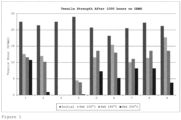
- the 100% allyl-2-cyanoacrylate formulation (No. 1) gives good results overall even without an additive, particularly after heat ageing on GBMS at 200°C.
- a 50/50 mix (No. 2) of the allyl cyanoacrylate/ethyl cyanoacrylate gives good results after heat ageing on GBMS at 150 and 180°C, but when heat aged at 200°C the tensile strengths obtained were significantly lower.
- the level of rubber toughening agent (Vamac) in the formulation also proved important. Comparing formulations 2 and 4 the results are much lower for the formulation with the lower level of rubber toughening agent (Vamac), typically half the performance with half the rubber toughening agent.
- the tensile strength determined for formulation 5 which comprises di-trimethylolpropane tetracrylate (SR355) after heat ageing at 200 °C for 3 weeks on GMBS was approximately 10 MPa. This dropped slightly to approximately 7 MPa after heat ageing at 200 °C for 6 weeks.
- the tensile strength determined for formulations 6, 7 and 8 was over 10 MPa after heat ageing at 200°C for 3 weeks, but the tensile strength for each formulation dropped off after heat ageing for a further 3 weeks (to a total of 6 weeks).
- the formulation comprising hexandiol diacrylate (formulation 6) delivered a tensile strength after heat ageing for 6 weeks at 200 °C of approximately 5 MPa, whereas the tensile strength determined for formulations 7 and 8 after the same ageing conditions was approximately 8 MPa for each formulation.
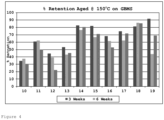
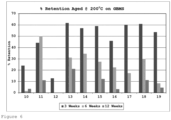
- Formulations 10 to 19 were prepared as provided in Table 2 Each of formulations 10 to 19 were evaluated for thermal performace by determining the tensile strength for each formulation on mild steel (MS) substrate, after heat ageing for 3, 6 or 12 weeks.
- MS mild steel
- Formulation 10 is the control formulation which comprises 42 wt% ethyl cyanoacrylate, 45 wt% allyl cyanoacrylate, 3 wt% stabilizer and 10 wt% rubber toughening agent.
- the tensile strength of formulation 11 on MS substrate after heat ageing for 3, 6 or 12 weeks at each of 100 °C, 120 °C, 150 °C, 180 °C and 200 °C was greater than that of the control formulation.
- hexanediol diacrylate formulation 12 further comprises 0.25 wt% of tert-butyl peroxybenzoate.
- Formulation 13 which comprises 10 wt% di-trimethylolpropane tetracrylate (SR355) demonstrated similar properties to control formulation 10: comparable tensile strengths were observed after heat ageing at 100 °C, 120 °C, 150 °C, and 180 °C, but superior tensile strength was observed after heat ageing at 200 °C. Formulation 13 also outperformed control formulation 10 when aged humidity testing was assessed. Excellent fixture time was also observed for formulation 13. Thus di-trimethylolpropane tetracrylate (SR355) proved to enhance the thermal performance of cyanoacrylate compositions comprising allyl-2-cyanoacrylate and a rubber toughening agent.
- Formulations 14 to 18 look at the effect of different levels of hexanediol diacrylate (HDDA) and rubber toughening agent.
- Higher levels of rubber toughening agent for example, Vamac
- Formulations 17 and 18 which comprise 12.5% HDDA had poor initial tensile strengths.
- Formulation 18 which comprised 12.5 wt% of rubber toughening agent (Vamac) and 12.5 wt% HDDA exhibits excellent tensile strength after heat ageing at 150°C but again has poor initial tensile strength.
- Formulation 19 looks at the effect of naphthosultone and ethylene sulfite. Thermal properties at 100°C and initially at 120/150/180°C are excellent.
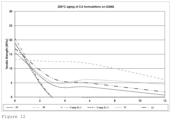
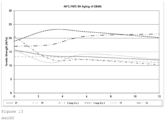
- Figures 12 to 18 show the percentage tensile strength retention after formulations 10 to 19 on mild steel substrate after heat ageing for 3, 6 and 12 weeks.
- the control formulation (20) contains 10% by weight of the rubber toughening agent and 10% by weight of hexanediol diacrylate.
- Formulations 21 to 28 comprise the following additives in varying amounts: tetrahydrophthalic anhydride, ethylene sulphite and naphthosultone. The level of each additive is varied as provided in Table 3. The level of stabilizer present in the formulations of Table 3 is 3% by weight of the total composition.
- the initial tensile strength values on mild steel substrate are generally in the range of 15 to 17 MPa with the exception of formulation 26, whose cyanoacrylate component is entirely allyl cyanoacrylate.
- Formulations 27 and 28 which comprise higher levels of rubber toughening agent and higher levels of hexane diol diacrylate had initial tensile strengths of about 12 to 13 MPa. Encouragingly the tensile strengths generally increase over time over a 12 week period at room temperature.
- the strength retention for formulations 22, 23, 27 and 28 are excellent after heat ageing at 120 °C up to about the 3 week mark. Without the additives present at a concentration of 1% by weight of the total composition, or in the case of the composition comprising solely allyl 2-cyanoacrylate as the cyanoacrylate component, the tensile strength performance dropped off after heat ageing at 120 °C. Disappointingly, after 6 weeks, the tensile strength observed for each of the formulations tested fell between 7 to 9 MPa, with a recovery to about 10 MPa after 12 weeks. Formulations with higher loadings of rubber toughening agent had tensile stength values of 13 to 15 MPa after 12 weeks.
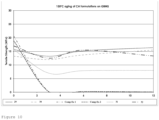
- Figure 7 shows the heat ageing performance of formulations 20 and 22 on GBMS at 120 °C.
- the tensile strength performance of formulation 22 which comprises 1% by weight (of the total composition) of each of the additives naphthosultone and ethylene sulphite performed significantly better than control formulation 20, absent said additives.
- the bond strength associated with formulation 26 is seen to increase over time at 180°C.
- Table 4 provides compositions comprising varying levels of allyl cyanoacrylate and additive components. Examples 31 and 32 do not belong to the invention. Table 4 Formulation 29 30 31 32 Ethyl CA 35.95 - 40.05 39.55 Allyl CA 38.95 74.90 40.25 39.75 Stabiliser 3.0 3.0 0.2 0.2 Vamac VSC5500 10.0 10.0 - 8.0 PMMA - - 7.0 - HDDA 10.0 10.0 - - TetrahydroPA 0.1 0.1 - - Naphthosultone 1.0 1.0 - - Ethylene Sulphite 1.0 1.0 - - 1,6-Bis CA - - 12.5 12.5
- Comparative examples 1 and 2 are general purpose instant adhesive formulations based on ethyl CA. Comparative example 1 comprises ethyl CA and PMMA, whereas comparative example 2 comprises ethyl CA and Vamac.
- Figure 8 shows the tensile strength performance of the formulations of Table 4 and comparative examples 1 and 2 on GBMS substrate after heat ageing at 100 °C over a 12 week period.
- Formulation 29 demonstrated excellent tensile strength performance with bond strengthes exceeding 23 MPa after heat ageing at the prescribed temperature for 2000 hours.
- formulation 32 shows excellent retention of bond strength out to 1000 hours and then falls to around 8 MPa after 2000 hours.
- Formulation 29 again shows excellent strength retention after 500 hours but falls to 7 MPa after 1000 hours before rebuilding its strength back to 10 MPa after 2000 hours (see Figure 9 ).
- formulation 29 and formulation 33 behave in a very similar manner with approximately 100% retention of strength being observed for formulation 29 at both temperatures (See Figures 12 and 13 ).
- a component functionalized with at least two blocked hydroxyl groups such as hexane diol diacrylate
- a cyanoacrylate formulation comprising allyl cyanoacrylate and a rubber toughening agent
- the combination excels at 100 °C and shows 100% tensile strength retention after 2000 hours at 150 °C and 180 °C. At 120 °C good tensile strength performance is demonstrated up to the 500 hour mark, with a dip in performance being witnessed thereafter, before the tensile strength recovers to about 10 MPa.
- Table 5 provides compositions with varying levels of components and additives. Examples 33 and 34 do not belong to the invention.
- Formulations 35 and 36 comprise varying levels of ethyl CA and allyl CA. Both formulations comprise 1.0 wt% tetrafluoroisophthalonitrile. The initial tensile strength and thermal performance of said compositions proved excellent.
- formulations of the invention further comprising phthalic anhydride and tetrafluoroisophthalonitrile demonstrated excellent thermal performance when aged for 6 weeks at elevated temperatures of from 100°C to 220°C.
- the effect of varying the level of tetrafluoroisophthalonitrile and hexane diol diacrylate is shown in Table 6.
- the benefit of including a maleimide component, was also examined, and as seen in formulations 41 and 42, this led to further enhancement of initial tensile strength performance and thermal aged perforamance.
- Formulations 41 and 42 which comprise phthalic anhydride, tetrafluoroisophthalonitrile and a bismaleimide additive, specifically, bis-(3-ethyl-5-methyl-4-maleimidephenyl)methane, (available from K-I Chemical Industry Co. Ltd under the tradename BMI-70) demonstrated excellent thermal resistance from 100°C to 220°C.
- the heat ageing performance of allyl cyanoacrylate formulations were particularly improved in the 100°C to 150°C range.
- formulation 41 had a 74% retention of tensile strength after heat ageing at 120°C for 1000 hours (6 weeks).
- Table 7 compares the performance of formulation 44 which comprises allyl cyanoacrylate as the sole cyanoacrylate component, with formulation 43 which comprises both allyl cyanoacrylate and ethyl cyanoacrylate.
- the tensile strength performance of both formulations which have been a range of temperatures for 1000 hours is tested, as is their performance under humid conditions. While heat ageing formulation 43 at 100°C and 120°C, led to an increase in tensile strength performance, formulation 44 retained about 85% of its tensile strength when aged at 120°C for 1000 hours, and furthermore, retained about 45% of its initial tensile strength after heat ageing at 220°C for 1000 hours.
Landscapes
- Chemical & Material Sciences (AREA)
- Organic Chemistry (AREA)
- Health & Medical Sciences (AREA)
- Chemical Kinetics & Catalysis (AREA)
- Medicinal Chemistry (AREA)
- Polymers & Plastics (AREA)
- Inorganic Chemistry (AREA)
- Adhesives Or Adhesive Processes (AREA)
- Addition Polymer Or Copolymer, Post-Treatments, Or Chemical Modifications (AREA)
- Polymerisation Methods In General (AREA)
- Graft Or Block Polymers (AREA)
Claims (13)
- Cyanacrylatzusammensetzung, umfassend:(a) Allyl-2-cyanacrylat,(b) ein Kautschukelastifikator, der i) Umsetzungsprodukte der Kombination von Ethylen, Methylacrylat und Monomeren, die Carbonsäureaushärtungsstellen aufweisen, ii) Dipolymere von Ethylen und Methylacrylat und Kombinationen von i) und ii) umfasst, und(c) eine Komponente, die mit mindestens zwei blockierten Hydroxylgruppen funktionalisiert ist, wobei die Komponente, die mit mindestens zwei blockierten Hydroxylgruppen funktionalisiert ist, Hexandioldiacrylat ist.
- Zusammensetzung nach Anspruch 1, ferner umfassend einen Füllstoff, vorzugsweise wobei der Füllstoff aus der Gruppe ausgewählt ist, bestehend aus Ruß, Kieselsäure und Kombinationen davon.
- Zusammensetzung nach Anspruch 1, ferner umfassend eine stabilisierende Menge eines sauren Stabilisators und eines Radikalinhibitors.
- Zusammensetzung nach Anspruch 1, wobei der Kautschukelastifikator in einer Menge von 1,5 Gew.-% bis 20 Gew.-% vorhanden ist.
- Zusammensetzung nach Anspruch 1, ferner umfassend eine Cyanacrylatkomponente, das aus Materialien innerhalb der Struktur H2C=C(CN)-COOR ausgewählt ist, wobei R aus C1-15-Alkyl-, Alkoxyalkyl-, Cycloalkyl-, Alkenyl-, Aralkyl-, Aryl- und Halogenalkyl-Gruppen ausgewählt ist, vorzugsweise wobei die Cyanacrylatkomponente Ethyl-2-cyanacrylat umfasst.
- Zusammensetzung nach Anspruch 1, ferner umfassend eine Beschleunigerkomponente, die aus der Gruppe ausgewählt ist, bestehend aus Calixaren, Oxacalixaren, Silakrone, Cyclodextrin, Kronenether, Poly(ethylenglycol)di(meth)acrylat, ethoxylierter Wasserverbindung und Kombinationen davon, vorzugsweise wobei das Calixaren Tetrabutyltetra[2-ethoxy-2-oxoethoxy]calix-4-aren ist und vorzugsweise der Kronenether aus Elementen innerhalb der Gruppe ausgewählt ist, bestehend aus 15-Krone-5, 18-Krone-6, Dibenzo-18-krone-6, Benzo-15-krone-5-dibenzo-24-krone-8, Dibenzo-30-krone-10, Tribenzo-18-krone-6, asym-Dibenzo-22-krone-6, Dibenzo-14-krone-4, Dicyclohexyl-18-krone-6, Dicyclohexyl-24-krone-8, Cyclohexyl-12-krone-4, 1,2-Decalyl-15-krone-5, 1,2-Naphtho-15-krone-5, 3,4,5-Naphthyl-16-krone-5, 1,2-Methyl-benzo-18-krone-6, 1,2-Methylbenzo-5, 6-Methylbenzo-18-krone-6, 1,2-t-Butyl-18-krone-6, 1,2-Vinylbenzo-15-krone-5, 1,2-Vinylbenzo-18-krone-6, 1,2-t-Butyl-cyclohexyl-18-krone-6, asym-Dibenzo-22-krone-6 und 1,2-Benzo-1, 4-benzo-5-sauerstoff-20-krone-7 und Kombinationen davon,und vorzugsweise das Poly(ethylenglycol)di(meth)acrylat innerhalb der folgenden Struktur vorliegt:
 wobei n größer als 3 ist.
 - Zusammensetzung nach einem der vorstehenden Ansprüche, ferner umfassend mindestens einen Zusatzstoff, der aus der Gruppe ausgewählt ist, bestehend aus:
2-Sulfobenzoesäureanhydrid, Triethylenglycoldi(para-toluolsulfonat), Trifluorethylpara-toluolsulfonat, Dimethyldioxolen-4-ylmethylpara-toluolsulfonat, para-Toluolsulfonsäureanhydrid, Methansulfonsäureanhydrid, 1,3-Propylensulfit, Dioxathiolendioxid, 1,8-Naphthosulton, Sulton-1,3-Propan, Sulton-1,4-Buten, Allylphenylsulfon, 4-Fluorphenylsulfon, Dibenzothiophensulfon, Bis(4-fluorphenyl)sulfon, Ethyl-p-toluolsulfonat, Trifluormethansulfonsäureanhydrid, Ethylensulfit und Tetrafluorisophthalonitril und Kombinationen davon, vorzugsweise der Zusatzstoff aus der Gruppe ausgewählt wird, bestehend aus 1,8-Naphthosulton und Ethylensulfit und Tetrafluorisophthalonitril, stärker bevorzugt das Wärmebeständigkeit verleihende Mittel eine Mischung aus 1,8-Naphthosulton und Ethylensulfit ist. - Zusammensetzung nach einem der vorstehenden Ansprüche, ferner umfassend eine Maleimidkomponente.
- Zusammensetzung nach Anspruch 8, wobei die Maleimidkomponente eine der folgenden Strukturen aufweist:
 R6 und R7 aus C1-C50-Alkyl und C4-C20-Aryl unabhängig ausgewählt sind, wobei R6 und R7 jeweils unabhängig gegebenenfalls mit einem oder mehreren von Nitro, Hydroxy, Halogen, C1-C20-Alkyl, C3-C20-Cycloalkyl, C7-C20-Aralkyl und C7-C20-Alkaryl substituiert sein können, undR8 und R9 aus H, C1-C50-Alkyl und C1-C50-Aryl unabhängig ausgewählt sind, oder zusammen R8 und R9 einen Ring ausbilden können, umfassend von 5 bis 20 Kohlenstoffatome.
 - Zusammensetzung nach Anspruch 9, wobei die Maleimidkomponente aus der Gruppe ausgewählt ist, bestehend aus:


- Umsetzungsprodukte der Zusammensetzung nach einem der vorstehenden Ansprüche.
- Verfahren zum Verkleben zweier Substrate miteinander, umfassend folgenden Schritte:Aufbringen einer Cyanacrylatzusammensetzung nach Anspruch 1 auf mindestens eines der Substrate undZusammenfügen der Substrate für eine Zeit, die ausreicht, um einer Klebeverbindung zu ermöglichen, um aus der Cyanacrylatzusammensetzung zwischen den zusammengefügten Substraten auszubilden.
- Verfahren zum Herstellen einer Cyanacrylatzusammensetzung nach Anspruch 1, umfassend die Schritte:
Bereitstellen einer Allyl-2-Cyanacrylatkomponente, eines Kautschukelastifikators, der (a) Umsetzungsprodukte der Kombination von Ethylen, Methylacrylat und Monomeren, die Carbonsäurehärtungsstellen aufweisen, (b) Dipolymere von Ethylen und Methylacrylat und Kombinationen von (a) und (b) und eine Komponente umfasst, die mindestens zwei (Meth)acrylat-Funktionsgruppen enthält, die Hexandioldiacrylat ist, und Mischen, um die Cyanacrylatzusammensetzung auszubilden.
Applications Claiming Priority (2)
| Application Number | Priority Date | Filing Date | Title |
|---|---|---|---|
| GB1519647.0A GB2544101B (en) | 2015-11-06 | 2015-11-06 | Rubber toughened cyanoacrylate compositions and uses thereof |
| PCT/EP2016/076751 WO2017077089A1 (en) | 2015-11-06 | 2016-11-04 | Cyanoacrylate compositions |
Publications (2)
| Publication Number | Publication Date |
|---|---|
| EP3371268A1 EP3371268A1 (de) | 2018-09-12 |
| EP3371268B1 true EP3371268B1 (de) | 2025-04-02 |
Family
ID=55132423
Family Applications (1)
| Application Number | Title | Priority Date | Filing Date |
|---|---|---|---|
| EP16790416.8A Active EP3371268B1 (de) | 2015-11-06 | 2016-11-04 | Cyanacrylatzusammensetzungen |
Country Status (9)
| Country | Link |
|---|---|
| US (1) | US10947418B2 (de) |
| EP (1) | EP3371268B1 (de) |
| JP (1) | JP6964075B2 (de) |
| KR (1) | KR102657838B1 (de) |
| CN (1) | CN108463525B (de) |
| BR (1) | BR112018008803B1 (de) |
| ES (1) | ES3023953T3 (de) |
| GB (1) | GB2544101B (de) |
| WO (1) | WO2017077089A1 (de) |
Families Citing this family (8)
| Publication number | Priority date | Publication date | Assignee | Title |
|---|---|---|---|---|
| GB2550846B (en) * | 2016-05-23 | 2021-01-13 | Henkel IP & Holding GmbH | Two-part Cyanoacrylate curable adhesive system |
| GB2562107B (en) * | 2017-05-05 | 2021-08-11 | Henkel IP & Holding GmbH | Cyanoacrylate compositions |
| GB2567867B (en) * | 2017-10-27 | 2020-09-16 | Henkel IP & Holding GmbH | Toughened, low odor/low bloom cyanoacrylate compositions |
| US11028294B2 (en) | 2018-08-10 | 2021-06-08 | International Business Machines Corporation Armonk, New York | Acrylate-cyanoacrylate monomers |
| CN110564311B (zh) * | 2019-09-17 | 2021-06-08 | 浙江派菲特新材料科技有限公司 | 一种抗冲击低白化瞬干胶的制备方法 |
| GB2596355B (en) * | 2020-06-26 | 2022-09-28 | Henkel Ag & Co Kgaa | Cyanoacrylate compositions |
| CN112175528A (zh) * | 2020-10-14 | 2021-01-05 | 浙江派菲特新材料科技有限公司 | 一种高稳定性瞬干胶及其制备方法 |
| CN112680120B (zh) * | 2020-12-31 | 2022-05-17 | 杭州电子科技大学 | 一种光学元件加工用材料及其制备方法 |
Family Cites Families (35)
| Publication number | Priority date | Publication date | Assignee | Title |
|---|---|---|---|---|
| IE34874B1 (en) | 1971-01-13 | 1975-09-03 | Intercontinental Chem Co Ltd | Cyanoacrylate adhesive compositions |
| US3988299A (en) * | 1974-10-10 | 1976-10-26 | Loctite Corporation | Anaerobic adhesive composition having improved strength at elevated temperature consisting of unsaturated diacrylate monomer and maleimide additive |
| US4196271A (en) | 1975-12-24 | 1980-04-01 | Toagosei Chemical Industry Co., Ltd. | Adhesive composition |
| IE51863B1 (en) | 1980-08-28 | 1987-04-15 | Loctite Corp | Additive for cyanoacrylate adhesives |
| US4490515A (en) * | 1981-06-01 | 1984-12-25 | Loctite Corporation | Hot strength cyanoacrylate adhesive composition |
| US4440910A (en) * | 1982-01-18 | 1984-04-03 | Loctite Corporation | Toughened cyanoacrylates containing elastomeric rubbers |
| JPS59147067A (ja) | 1983-02-09 | 1984-08-23 | Alpha Giken:Kk | α−シアノアクリレ−ト系耐熱性瞬間接着剤組成物 |
| US4906317A (en) | 1983-11-10 | 1990-03-06 | Loctite Corporation | Instant adhesive composition and bonding method employing same |
| US4622414A (en) | 1984-01-27 | 1986-11-11 | Loctite Limited | Novel calixarene compounds |
| US4718966A (en) | 1984-01-30 | 1988-01-12 | Loctite (Ireland) Ltd. | Bonding method utilizing cyanoacrylate adhesive having calixarene accelerator |
| US4695615A (en) | 1984-11-21 | 1987-09-22 | Loctite (Ireland) Limited | Instant adhesive composition utilizing mixed functionality calixarenes as accelerators |
| US4636539A (en) | 1984-01-30 | 1987-01-13 | Loctite (Ireland) Limited | Instant adhesive composition utilizing calixarene accelerators |
| US4556700A (en) | 1984-01-30 | 1985-12-03 | Loctite Limited | Instant adhesive composition utilizing calixarene accelerators |
| IE59509B1 (en) | 1987-01-21 | 1994-03-09 | Loctite Ireland Ltd | Functionalised oxacalixarenes, their preparation and use in instant adhesive compositions |
| US4837260A (en) | 1986-05-23 | 1989-06-06 | Toagosei Chemical Industry Co., Ltd. | Cyanoacrylate compositions |
| DE4009621A1 (de) | 1990-03-26 | 1991-10-02 | Henkel Kgaa | (alpha) -cyanacrylatklebstoffzusammensetzungen |
| US5328944A (en) * | 1992-07-14 | 1994-07-12 | Loctite Corporation | Cyanoacrylate adhesives with improved cured thermal properties |
| US5424343A (en) | 1992-10-08 | 1995-06-13 | Loctite Corporation | Thermally resistant cyanoacrylates employing substituted napthasultone additive |
| US5288794A (en) | 1992-10-23 | 1994-02-22 | Loctite Corporation | Cyanoacrylate adhesives with improved cured thermal properties utilizing substituted aromatic additive |
| JP2776178B2 (ja) * | 1992-11-09 | 1998-07-16 | 東亞合成株式会社 | シアノアクリレート系接着剤組成物 |
| JPH06145606A (ja) | 1992-11-11 | 1994-05-27 | Toagosei Chem Ind Co Ltd | シアノアクリレート系接着剤組成物 |
| TW359683B (en) | 1993-12-23 | 1999-06-01 | Loctite Ireland Ltd | Sterilized cyanoacrylate adhesive composition, and a method of making such composition |
| JPH08259899A (ja) * | 1995-03-23 | 1996-10-08 | Three Bond Co Ltd | シアノアクリレート系接着剤組成物 |
| AU740789B2 (en) | 1996-08-16 | 2001-11-15 | Loctite (Ireland) Limited | Cyanoacrylate adhesive compositions for bonding glass |
| US5922783A (en) * | 1997-02-27 | 1999-07-13 | Loctite Corporation | Radiation-curable, cyanoacrylate-containing compositions |
| IES990974A2 (en) * | 1998-11-23 | 2000-05-31 | Loctite R & D Ltd | Cyanoacrylate Compositions |
| TWI385231B (zh) * | 2005-03-18 | 2013-02-11 | Three Bond Co Ltd | A cyanoacrylate-based adhesive composition |
| AU2006268160B2 (en) * | 2005-07-11 | 2011-12-22 | Henkel Corporation | Toughened cyanoacrylate compositions |
| US9249237B2 (en) * | 2008-02-15 | 2016-02-02 | Catalyse | Self-repairing composition, self-repairing materials, self-repairing methods and applications |
| PT2511355E (pt) * | 2011-04-12 | 2014-01-28 | Henkel Ireland Ltd | Adesivo de cianoacrilato com resistência à água melhorada |
| JP5878631B2 (ja) * | 2011-07-15 | 2016-03-08 | ヘンケル アイピー アンド ホールディング ゲゼルシャフト ミット ベシュレンクテル ハフツング | シアノアクリレート組成物 |
| CN103865405B (zh) * | 2012-12-13 | 2016-06-29 | 上海海鹰粘接科技有限公司 | 一种环保耐老化丙烯酸酯胶粘剂 |
| US9783714B2 (en) * | 2013-03-15 | 2017-10-10 | Henkel IP & Holding GmbH | Cyanoacrylate compositions |
| CN103555212B (zh) * | 2013-10-24 | 2015-03-18 | 北京天山新材料技术有限公司 | 一种耐湿热氰基丙烯酸酯胶粘剂 |
| GB2544272B (en) * | 2015-11-06 | 2020-02-19 | Henkel IP & Holding GmbH | Cyanoacrylate compositions |
-
2015
- 2015-11-06 GB GB1519647.0A patent/GB2544101B/en active Active
-
2016
- 2016-11-04 CN CN201680077663.0A patent/CN108463525B/zh active Active
- 2016-11-04 JP JP2018522581A patent/JP6964075B2/ja active Active
- 2016-11-04 EP EP16790416.8A patent/EP3371268B1/de active Active
- 2016-11-04 KR KR1020187013232A patent/KR102657838B1/ko active Active
- 2016-11-04 BR BR112018008803-0A patent/BR112018008803B1/pt active IP Right Grant
- 2016-11-04 ES ES16790416T patent/ES3023953T3/es active Active
- 2016-11-04 WO PCT/EP2016/076751 patent/WO2017077089A1/en not_active Ceased
-
2018
- 2018-05-07 US US15/972,944 patent/US10947418B2/en active Active
Also Published As
| Publication number | Publication date |
|---|---|
| GB2544101B (en) | 2020-07-15 |
| KR102657838B1 (ko) | 2024-04-17 |
| EP3371268A1 (de) | 2018-09-12 |
| CN108463525A (zh) | 2018-08-28 |
| JP6964075B2 (ja) | 2021-11-10 |
| ES3023953T3 (en) | 2025-06-03 |
| CN108463525B (zh) | 2021-07-09 |
| US20180362808A1 (en) | 2018-12-20 |
| KR20180081517A (ko) | 2018-07-16 |
| BR112018008803A2 (pt) | 2018-10-30 |
| JP2019501235A (ja) | 2019-01-17 |
| WO2017077089A1 (en) | 2017-05-11 |
| US10947418B2 (en) | 2021-03-16 |
| BR112018008803B1 (pt) | 2022-06-28 |
| GB201519647D0 (en) | 2015-12-23 |
| GB2544101A (en) | 2017-05-10 |
Similar Documents
| Publication | Publication Date | Title |
|---|---|---|
| EP3371268B1 (de) | Cyanacrylatzusammensetzungen | |
| US11015088B2 (en) | Cyanoacrylate compositions | |
| EP2121777B1 (de) | Cyanacrylat-zusammensetzungen mit graphitplättchen | |
| US10100235B2 (en) | Two-part cyanoacrylate curable adhesive system | |
| CA2525011C (en) | Cyanoacrylate compositions | |
| WO2019081759A1 (en) | CYANOACRYLATE COMPOSITIONS | |
| US8303705B2 (en) | Cyanoacrylate compositions | |
| WO2019081753A1 (en) | LOW ODOR AND LOW EFFOROR ENHANCED CYANOACRYLATE COMPOSITIONS | |
| GB2577817A (en) | Cyanoacrylate compositions | |
| US20230135462A1 (en) | Cyanoacrylate compositions |
Legal Events
| Date | Code | Title | Description |
|---|---|---|---|
| STAA | Information on the status of an ep patent application or granted ep patent |
Free format text: STATUS: UNKNOWN |
|
| STAA | Information on the status of an ep patent application or granted ep patent |
Free format text: STATUS: THE INTERNATIONAL PUBLICATION HAS BEEN MADE |
|
| PUAI | Public reference made under article 153(3) epc to a published international application that has entered the european phase |
Free format text: ORIGINAL CODE: 0009012 |
|
| STAA | Information on the status of an ep patent application or granted ep patent |
Free format text: STATUS: REQUEST FOR EXAMINATION WAS MADE |
|
| 17P | Request for examination filed |
Effective date: 20180504 |
|
| AK | Designated contracting states |
Kind code of ref document: A1 Designated state(s): AL AT BE BG CH CY CZ DE DK EE ES FI FR GB GR HR HU IE IS IT LI LT LU LV MC MK MT NL NO PL PT RO RS SE SI SK SM TR |
|
| AX | Request for extension of the european patent |
Extension state: BA ME |
|
| DAV | Request for validation of the european patent (deleted) | ||
| DAX | Request for extension of the european patent (deleted) | ||
| STAA | Information on the status of an ep patent application or granted ep patent |
Free format text: STATUS: EXAMINATION IS IN PROGRESS |
|
| 17Q | First examination report despatched |
Effective date: 20220128 |
|
| RAP1 | Party data changed (applicant data changed or rights of an application transferred) |
Owner name: HENKEL AG & CO. KGAA |
|
| P01 | Opt-out of the competence of the unified patent court (upc) registered |
Effective date: 20230531 |
|
| GRAP | Despatch of communication of intention to grant a patent |
Free format text: ORIGINAL CODE: EPIDOSNIGR1 |
|
| STAA | Information on the status of an ep patent application or granted ep patent |
Free format text: STATUS: GRANT OF PATENT IS INTENDED |
|
| INTG | Intention to grant announced |
Effective date: 20241211 |
|
| GRAS | Grant fee paid |
Free format text: ORIGINAL CODE: EPIDOSNIGR3 |
|
| GRAA | (expected) grant |
Free format text: ORIGINAL CODE: 0009210 |
|
| STAA | Information on the status of an ep patent application or granted ep patent |
Free format text: STATUS: THE PATENT HAS BEEN GRANTED |
|
| AK | Designated contracting states |
Kind code of ref document: B1 Designated state(s): AL AT BE BG CH CY CZ DE DK EE ES FI FR GB GR HR HU IE IS IT LI LT LU LV MC MK MT NL NO PL PT RO RS SE SI SK SM TR |
|
| REG | Reference to a national code |
Ref country code: GB Ref legal event code: FG4D |
|
| REG | Reference to a national code |
Ref country code: CH Ref legal event code: EP |
|
| REG | Reference to a national code |
Ref country code: DE Ref legal event code: R096 Ref document number: 602016091774 Country of ref document: DE |
|
| REG | Reference to a national code |
Ref country code: IE Ref legal event code: FG4D |
|
| REG | Reference to a national code |
Ref country code: ES Ref legal event code: FG2A Ref document number: 3023953 Country of ref document: ES Kind code of ref document: T3 Effective date: 20250603 |
|
| REG | Reference to a national code |
Ref country code: NL Ref legal event code: MP Effective date: 20250402 |
|
| PG25 | Lapsed in a contracting state [announced via postgrant information from national office to epo] |
Ref country code: NL Free format text: LAPSE BECAUSE OF FAILURE TO SUBMIT A TRANSLATION OF THE DESCRIPTION OR TO PAY THE FEE WITHIN THE PRESCRIBED TIME-LIMIT Effective date: 20250402 |
|
| REG | Reference to a national code |
Ref country code: AT Ref legal event code: MK05 Ref document number: 1781268 Country of ref document: AT Kind code of ref document: T Effective date: 20250402 |
|
| PG25 | Lapsed in a contracting state [announced via postgrant information from national office to epo] |
Ref country code: PT Free format text: LAPSE BECAUSE OF FAILURE TO SUBMIT A TRANSLATION OF THE DESCRIPTION OR TO PAY THE FEE WITHIN THE PRESCRIBED TIME-LIMIT Effective date: 20250804 Ref country code: FI Free format text: LAPSE BECAUSE OF FAILURE TO SUBMIT A TRANSLATION OF THE DESCRIPTION OR TO PAY THE FEE WITHIN THE PRESCRIBED TIME-LIMIT Effective date: 20250402 |
|
| REG | Reference to a national code |
Ref country code: LT Ref legal event code: MG9D |
|
| PG25 | Lapsed in a contracting state [announced via postgrant information from national office to epo] |
Ref country code: GR Free format text: LAPSE BECAUSE OF FAILURE TO SUBMIT A TRANSLATION OF THE DESCRIPTION OR TO PAY THE FEE WITHIN THE PRESCRIBED TIME-LIMIT Effective date: 20250703 Ref country code: NO Free format text: LAPSE BECAUSE OF FAILURE TO SUBMIT A TRANSLATION OF THE DESCRIPTION OR TO PAY THE FEE WITHIN THE PRESCRIBED TIME-LIMIT Effective date: 20250702 |
|
| PG25 | Lapsed in a contracting state [announced via postgrant information from national office to epo] |
Ref country code: PL Free format text: LAPSE BECAUSE OF FAILURE TO SUBMIT A TRANSLATION OF THE DESCRIPTION OR TO PAY THE FEE WITHIN THE PRESCRIBED TIME-LIMIT Effective date: 20250402 |
|
| PG25 | Lapsed in a contracting state [announced via postgrant information from national office to epo] |
Ref country code: BG Free format text: LAPSE BECAUSE OF FAILURE TO SUBMIT A TRANSLATION OF THE DESCRIPTION OR TO PAY THE FEE WITHIN THE PRESCRIBED TIME-LIMIT Effective date: 20250402 |
|
| PG25 | Lapsed in a contracting state [announced via postgrant information from national office to epo] |
Ref country code: HR Free format text: LAPSE BECAUSE OF FAILURE TO SUBMIT A TRANSLATION OF THE DESCRIPTION OR TO PAY THE FEE WITHIN THE PRESCRIBED TIME-LIMIT Effective date: 20250402 |
|
| PG25 | Lapsed in a contracting state [announced via postgrant information from national office to epo] |
Ref country code: AT Free format text: LAPSE BECAUSE OF FAILURE TO SUBMIT A TRANSLATION OF THE DESCRIPTION OR TO PAY THE FEE WITHIN THE PRESCRIBED TIME-LIMIT Effective date: 20250402 |
|
| PG25 | Lapsed in a contracting state [announced via postgrant information from national office to epo] |
Ref country code: RS Free format text: LAPSE BECAUSE OF FAILURE TO SUBMIT A TRANSLATION OF THE DESCRIPTION OR TO PAY THE FEE WITHIN THE PRESCRIBED TIME-LIMIT Effective date: 20250702 |
|
| PG25 | Lapsed in a contracting state [announced via postgrant information from national office to epo] |
Ref country code: IS Free format text: LAPSE BECAUSE OF FAILURE TO SUBMIT A TRANSLATION OF THE DESCRIPTION OR TO PAY THE FEE WITHIN THE PRESCRIBED TIME-LIMIT Effective date: 20250802 |
|
| PG25 | Lapsed in a contracting state [announced via postgrant information from national office to epo] |
Ref country code: LV Free format text: LAPSE BECAUSE OF FAILURE TO SUBMIT A TRANSLATION OF THE DESCRIPTION OR TO PAY THE FEE WITHIN THE PRESCRIBED TIME-LIMIT Effective date: 20250402 |
|
| REG | Reference to a national code |
Ref country code: DE Ref legal event code: R097 Ref document number: 602016091774 Country of ref document: DE |
|
| PGFP | Annual fee paid to national office [announced via postgrant information from national office to epo] |
Ref country code: DE Payment date: 20251119 Year of fee payment: 10 |
|
| PGFP | Annual fee paid to national office [announced via postgrant information from national office to epo] |
Ref country code: GB Payment date: 20251121 Year of fee payment: 10 |
|
| PG25 | Lapsed in a contracting state [announced via postgrant information from national office to epo] |
Ref country code: SM Free format text: LAPSE BECAUSE OF FAILURE TO SUBMIT A TRANSLATION OF THE DESCRIPTION OR TO PAY THE FEE WITHIN THE PRESCRIBED TIME-LIMIT Effective date: 20250402 Ref country code: DK Free format text: LAPSE BECAUSE OF FAILURE TO SUBMIT A TRANSLATION OF THE DESCRIPTION OR TO PAY THE FEE WITHIN THE PRESCRIBED TIME-LIMIT Effective date: 20250402 |
|
| PGFP | Annual fee paid to national office [announced via postgrant information from national office to epo] |
Ref country code: IT Payment date: 20251125 Year of fee payment: 10 |
|
| PGFP | Annual fee paid to national office [announced via postgrant information from national office to epo] |
Ref country code: FR Payment date: 20251126 Year of fee payment: 10 |
|
| PG25 | Lapsed in a contracting state [announced via postgrant information from national office to epo] |
Ref country code: CZ Free format text: LAPSE BECAUSE OF FAILURE TO SUBMIT A TRANSLATION OF THE DESCRIPTION OR TO PAY THE FEE WITHIN THE PRESCRIBED TIME-LIMIT Effective date: 20250402 |
|
| PG25 | Lapsed in a contracting state [announced via postgrant information from national office to epo] |
Ref country code: EE Free format text: LAPSE BECAUSE OF FAILURE TO SUBMIT A TRANSLATION OF THE DESCRIPTION OR TO PAY THE FEE WITHIN THE PRESCRIBED TIME-LIMIT Effective date: 20250402 |
|
| PG25 | Lapsed in a contracting state [announced via postgrant information from national office to epo] |
Ref country code: SK Free format text: LAPSE BECAUSE OF FAILURE TO SUBMIT A TRANSLATION OF THE DESCRIPTION OR TO PAY THE FEE WITHIN THE PRESCRIBED TIME-LIMIT Effective date: 20250402 Ref country code: RO Free format text: LAPSE BECAUSE OF FAILURE TO SUBMIT A TRANSLATION OF THE DESCRIPTION OR TO PAY THE FEE WITHIN THE PRESCRIBED TIME-LIMIT Effective date: 20250402 |
|
| PGFP | Annual fee paid to national office [announced via postgrant information from national office to epo] |
Ref country code: ES Payment date: 20251229 Year of fee payment: 10 |
|
| PLBE | No opposition filed within time limit |
Free format text: ORIGINAL CODE: 0009261 |
|
| STAA | Information on the status of an ep patent application or granted ep patent |
Free format text: STATUS: NO OPPOSITION FILED WITHIN TIME LIMIT |
|
| REG | Reference to a national code |
Ref country code: CH Ref legal event code: L10 Free format text: ST27 STATUS EVENT CODE: U-0-0-L10-L00 (AS PROVIDED BY THE NATIONAL OFFICE) Effective date: 20260211 |
|
| 26N | No opposition filed |
Effective date: 20260105 |