EP3369792A1 - Antifouling film, antifouling film forming composition, antifouling film laminate, and production method for antifouling film laminate - Google Patents
Antifouling film, antifouling film forming composition, antifouling film laminate, and production method for antifouling film laminate Download PDFInfo
- Publication number
- EP3369792A1 EP3369792A1 EP16859667.4A EP16859667A EP3369792A1 EP 3369792 A1 EP3369792 A1 EP 3369792A1 EP 16859667 A EP16859667 A EP 16859667A EP 3369792 A1 EP3369792 A1 EP 3369792A1
- Authority
- EP
- European Patent Office
- Prior art keywords
- group
- general formula
- polymer
- antifouling film
- represented
- Prior art date
- Legal status (The legal status is an assumption and is not a legal conclusion. Google has not performed a legal analysis and makes no representation as to the accuracy of the status listed.)
- Withdrawn
Links
- 230000003373 anti-fouling effect Effects 0.000 title claims abstract description 316
- 239000000203 mixture Substances 0.000 title claims abstract description 109
- 238000004519 manufacturing process Methods 0.000 title claims abstract description 14
- 229920000642 polymer Polymers 0.000 claims abstract description 250
- 125000004432 carbon atom Chemical group C* 0.000 claims abstract description 118
- 125000004435 hydrogen atom Chemical group [H]* 0.000 claims abstract description 65
- VYPSYNLAJGMNEJ-UHFFFAOYSA-N Silicium dioxide Chemical compound O=[Si]=O VYPSYNLAJGMNEJ-UHFFFAOYSA-N 0.000 claims abstract description 64
- 125000001424 substituent group Chemical group 0.000 claims abstract description 57
- HRPVXLWXLXDGHG-UHFFFAOYSA-N Acrylamide Chemical group NC(=O)C=C HRPVXLWXLXDGHG-UHFFFAOYSA-N 0.000 claims abstract description 47
- 238000000034 method Methods 0.000 claims abstract description 33
- 125000001183 hydrocarbyl group Chemical group 0.000 claims abstract description 19
- 125000004429 atom Chemical group 0.000 claims abstract description 11
- 150000001768 cations Chemical class 0.000 claims abstract description 10
- 239000000178 monomer Substances 0.000 claims description 99
- 150000001875 compounds Chemical class 0.000 claims description 83
- XLYOFNOQVPJJNP-UHFFFAOYSA-N water Substances O XLYOFNOQVPJJNP-UHFFFAOYSA-N 0.000 claims description 78
- KWIUHFFTVRNATP-UHFFFAOYSA-N Betaine Natural products C[N+](C)(C)CC([O-])=O KWIUHFFTVRNATP-UHFFFAOYSA-N 0.000 claims description 77
- 125000002947 alkylene group Chemical group 0.000 claims description 75
- 125000002496 methyl group Chemical group [H]C([H])([H])* 0.000 claims description 68
- -1 acrylamide compound Chemical class 0.000 claims description 64
- 239000000463 material Substances 0.000 claims description 63
- 239000003505 polymerization initiator Substances 0.000 claims description 56
- 125000000217 alkyl group Chemical group 0.000 claims description 42
- 239000002243 precursor Substances 0.000 claims description 42
- 229960003237 betaine Drugs 0.000 claims description 40
- 125000005647 linker group Chemical group 0.000 claims description 31
- 230000036961 partial effect Effects 0.000 claims description 26
- 125000001495 ethyl group Chemical group [H]C([H])([H])C([H])([H])* 0.000 claims description 21
- 125000001449 isopropyl group Chemical group [H]C([H])([H])C([H])(*)C([H])([H])[H] 0.000 claims description 17
- 125000004123 n-propyl group Chemical group [H]C([H])([H])C([H])([H])C([H])([H])* 0.000 claims description 16
- 125000003118 aryl group Chemical group 0.000 claims description 12
- 125000002887 hydroxy group Chemical group [H]O* 0.000 claims description 11
- 239000004721 Polyphenylene oxide Substances 0.000 claims description 10
- 229920000570 polyether Polymers 0.000 claims description 10
- PSBDWGZCVUAZQS-UHFFFAOYSA-N (dimethylsulfonio)acetate Chemical group C[S+](C)CC([O-])=O PSBDWGZCVUAZQS-UHFFFAOYSA-N 0.000 claims description 8
- ABLZXFCXXLZCGV-UHFFFAOYSA-N phosphonic acid group Chemical group P(O)(O)=O ABLZXFCXXLZCGV-UHFFFAOYSA-N 0.000 claims description 7
- NBIIXXVUZAFLBC-UHFFFAOYSA-N Phosphoric acid Chemical group OP(O)(O)=O NBIIXXVUZAFLBC-UHFFFAOYSA-N 0.000 claims description 6
- 125000000542 sulfonic acid group Chemical group 0.000 claims description 5
- 125000002843 carboxylic acid group Chemical group 0.000 claims description 4
- QGZKDVFQNNGYKY-UHFFFAOYSA-O ammonium group Chemical group [NH4+] QGZKDVFQNNGYKY-UHFFFAOYSA-O 0.000 claims description 3
- 150000007942 carboxylates Chemical group 0.000 claims description 3
- 125000002467 phosphate group Chemical group [H]OP(=O)(O[H])O[*] 0.000 claims description 3
- 125000001273 sulfonato group Chemical group [O-]S(*)(=O)=O 0.000 claims description 3
- KWIUHFFTVRNATP-UHFFFAOYSA-O N,N,N-trimethylglycinium Chemical compound C[N+](C)(C)CC(O)=O KWIUHFFTVRNATP-UHFFFAOYSA-O 0.000 claims 6
- OKKJLVBELUTLKV-UHFFFAOYSA-N Methanol Chemical compound OC OKKJLVBELUTLKV-UHFFFAOYSA-N 0.000 description 81
- 238000000576 coating method Methods 0.000 description 68
- 239000011248 coating agent Substances 0.000 description 66
- 239000000243 solution Substances 0.000 description 66
- 239000000126 substance Substances 0.000 description 52
- 239000002245 particle Substances 0.000 description 42
- 239000011230 binding agent Substances 0.000 description 36
- 238000006243 chemical reaction Methods 0.000 description 32
- KPUWHANPEXNPJT-UHFFFAOYSA-N disiloxane Chemical class [SiH3]O[SiH3] KPUWHANPEXNPJT-UHFFFAOYSA-N 0.000 description 32
- 239000002904 solvent Substances 0.000 description 30
- 239000007787 solid Substances 0.000 description 26
- XEKOWRVHYACXOJ-UHFFFAOYSA-N Ethyl acetate Chemical compound CCOC(C)=O XEKOWRVHYACXOJ-UHFFFAOYSA-N 0.000 description 24
- 230000015572 biosynthetic process Effects 0.000 description 24
- 238000004140 cleaning Methods 0.000 description 24
- 230000000052 comparative effect Effects 0.000 description 24
- 238000003786 synthesis reaction Methods 0.000 description 23
- 229920001296 polysiloxane Polymers 0.000 description 20
- IJGRMHOSHXDMSA-UHFFFAOYSA-N Atomic nitrogen Chemical compound N#N IJGRMHOSHXDMSA-UHFFFAOYSA-N 0.000 description 19
- CSNNHWWHGAXBCP-UHFFFAOYSA-L Magnesium sulfate Chemical compound [Mg+2].[O-][S+2]([O-])([O-])[O-] CSNNHWWHGAXBCP-UHFFFAOYSA-L 0.000 description 19
- 239000002563 ionic surfactant Substances 0.000 description 19
- 230000001681 protective effect Effects 0.000 description 19
- 239000000049 pigment Substances 0.000 description 18
- 238000011156 evaluation Methods 0.000 description 17
- 239000003999 initiator Substances 0.000 description 17
- 239000010802 sludge Substances 0.000 description 16
- YMWUJEATGCHHMB-UHFFFAOYSA-N Dichloromethane Chemical compound ClCCl YMWUJEATGCHHMB-UHFFFAOYSA-N 0.000 description 15
- 239000010410 layer Substances 0.000 description 14
- UIIMBOGNXHQVGW-UHFFFAOYSA-M Sodium bicarbonate Chemical compound [Na+].OC([O-])=O UIIMBOGNXHQVGW-UHFFFAOYSA-M 0.000 description 12
- 230000000694 effects Effects 0.000 description 12
- 238000001035 drying Methods 0.000 description 11
- 229910052757 nitrogen Inorganic materials 0.000 description 11
- 230000002829 reductive effect Effects 0.000 description 11
- 239000002994 raw material Substances 0.000 description 10
- 238000006460 hydrolysis reaction Methods 0.000 description 9
- 229910052943 magnesium sulfate Inorganic materials 0.000 description 9
- 235000019341 magnesium sulphate Nutrition 0.000 description 9
- 239000011347 resin Substances 0.000 description 9
- 229920005989 resin Polymers 0.000 description 9
- 238000005160 1H NMR spectroscopy Methods 0.000 description 8
- 229940125904 compound 1 Drugs 0.000 description 8
- 230000002209 hydrophobic effect Effects 0.000 description 8
- 239000011541 reaction mixture Substances 0.000 description 8
- WYURNTSHIVDZCO-UHFFFAOYSA-N Tetrahydrofuran Chemical compound C1CCOC1 WYURNTSHIVDZCO-UHFFFAOYSA-N 0.000 description 7
- 229910001873 dinitrogen Inorganic materials 0.000 description 7
- 238000010992 reflux Methods 0.000 description 7
- WEVYAHXRMPXWCK-UHFFFAOYSA-N Acetonitrile Chemical compound CC#N WEVYAHXRMPXWCK-UHFFFAOYSA-N 0.000 description 6
- LFQSCWFLJHTTHZ-UHFFFAOYSA-N Ethanol Chemical compound CCO LFQSCWFLJHTTHZ-UHFFFAOYSA-N 0.000 description 6
- YXFVVABEGXRONW-UHFFFAOYSA-N Toluene Chemical compound CC1=CC=CC=C1 YXFVVABEGXRONW-UHFFFAOYSA-N 0.000 description 6
- HFBMWMNUJJDEQZ-UHFFFAOYSA-N acryloyl chloride Chemical compound ClC(=O)C=C HFBMWMNUJJDEQZ-UHFFFAOYSA-N 0.000 description 6
- 239000000853 adhesive Substances 0.000 description 6
- 230000001070 adhesive effect Effects 0.000 description 6
- 125000003368 amide group Chemical group 0.000 description 6
- 238000004440 column chromatography Methods 0.000 description 6
- 238000006392 deoxygenation reaction Methods 0.000 description 6
- 230000008034 disappearance Effects 0.000 description 6
- 239000011521 glass Substances 0.000 description 6
- 239000000413 hydrolysate Substances 0.000 description 6
- 239000007788 liquid Substances 0.000 description 6
- 239000000047 product Substances 0.000 description 6
- 229910000030 sodium bicarbonate Inorganic materials 0.000 description 6
- 238000010438 heat treatment Methods 0.000 description 5
- NLYAJNPCOHFWQQ-UHFFFAOYSA-N kaolin Chemical compound O.O.O=[Al]O[Si](=O)O[Si](=O)O[Al]=O NLYAJNPCOHFWQQ-UHFFFAOYSA-N 0.000 description 5
- WVFLGSMUPMVNTQ-UHFFFAOYSA-N n-(2-hydroxyethyl)-2-[[1-(2-hydroxyethylamino)-2-methyl-1-oxopropan-2-yl]diazenyl]-2-methylpropanamide Chemical compound OCCNC(=O)C(C)(C)N=NC(C)(C)C(=O)NCCO WVFLGSMUPMVNTQ-UHFFFAOYSA-N 0.000 description 5
- 125000004433 nitrogen atom Chemical group N* 0.000 description 5
- 229920002635 polyurethane Polymers 0.000 description 5
- 239000004814 polyurethane Substances 0.000 description 5
- 239000005871 repellent Substances 0.000 description 5
- 230000002194 synthesizing effect Effects 0.000 description 5
- 238000012719 thermal polymerization Methods 0.000 description 5
- 239000004925 Acrylic resin Substances 0.000 description 4
- 229920000178 Acrylic resin Polymers 0.000 description 4
- 0 C1CC*CC1 Chemical compound C1CC*CC1 0.000 description 4
- KFZMGEQAYNKOFK-UHFFFAOYSA-N Isopropanol Chemical compound CC(C)O KFZMGEQAYNKOFK-UHFFFAOYSA-N 0.000 description 4
- 230000002776 aggregation Effects 0.000 description 4
- 238000004220 aggregation Methods 0.000 description 4
- 239000004566 building material Substances 0.000 description 4
- 239000002131 composite material Substances 0.000 description 4
- 239000000356 contaminant Substances 0.000 description 4
- 125000006165 cyclic alkyl group Chemical group 0.000 description 4
- 239000006185 dispersion Substances 0.000 description 4
- 238000005227 gel permeation chromatography Methods 0.000 description 4
- 229910052751 metal Inorganic materials 0.000 description 4
- 239000002184 metal Substances 0.000 description 4
- 125000000962 organic group Chemical group 0.000 description 4
- 239000012074 organic phase Substances 0.000 description 4
- 239000012071 phase Substances 0.000 description 4
- 239000011164 primary particle Substances 0.000 description 4
- 125000004805 propylene group Chemical group [H]C([H])([H])C([H])([*:1])C([H])([H])[*:2] 0.000 description 4
- 239000007921 spray Substances 0.000 description 4
- 229940117986 sulfobetaine Drugs 0.000 description 4
- ISXSCDLOGDJUNJ-UHFFFAOYSA-N tert-butyl prop-2-enoate Chemical compound CC(C)(C)OC(=O)C=C ISXSCDLOGDJUNJ-UHFFFAOYSA-N 0.000 description 4
- VXNZUUAINFGPBY-UHFFFAOYSA-N 1-Butene Chemical group CCC=C VXNZUUAINFGPBY-UHFFFAOYSA-N 0.000 description 3
- WMYINDVYGQKYMI-UHFFFAOYSA-N 2-[2,2-bis(hydroxymethyl)butoxymethyl]-2-ethylpropane-1,3-diol Chemical compound CCC(CO)(CO)COCC(CC)(CO)CO WMYINDVYGQKYMI-UHFFFAOYSA-N 0.000 description 3
- LWRBVKNFOYUCNP-UHFFFAOYSA-N 2-methyl-1-(4-methylsulfanylphenyl)-2-morpholin-4-ylpropan-1-one Chemical compound C1=CC(SC)=CC=C1C(=O)C(C)(C)N1CCOCC1 LWRBVKNFOYUCNP-UHFFFAOYSA-N 0.000 description 3
- NLHHRLWOUZZQLW-UHFFFAOYSA-N Acrylonitrile Chemical compound C=CC#N NLHHRLWOUZZQLW-UHFFFAOYSA-N 0.000 description 3
- 229920000388 Polyphosphate Polymers 0.000 description 3
- 229920002125 Sokalan® Polymers 0.000 description 3
- 125000003545 alkoxy group Chemical group 0.000 description 3
- 150000001412 amines Chemical class 0.000 description 3
- 125000003277 amino group Chemical group 0.000 description 3
- 239000002216 antistatic agent Substances 0.000 description 3
- 239000007869 azo polymerization initiator Substances 0.000 description 3
- 150000001721 carbon Chemical group 0.000 description 3
- 229910052799 carbon Inorganic materials 0.000 description 3
- 239000003054 catalyst Substances 0.000 description 3
- 239000008119 colloidal silica Substances 0.000 description 3
- 238000009833 condensation Methods 0.000 description 3
- 230000005494 condensation Effects 0.000 description 3
- 238000011109 contamination Methods 0.000 description 3
- 125000004122 cyclic group Chemical group 0.000 description 3
- 230000006866 deterioration Effects 0.000 description 3
- 239000000428 dust Substances 0.000 description 3
- 125000000816 ethylene group Chemical group [H]C([H])([*:1])C([H])([H])[*:2] 0.000 description 3
- NWVVVBRKAWDGAB-UHFFFAOYSA-N p-methoxyphenol Chemical compound COC1=CC=C(O)C=C1 NWVVVBRKAWDGAB-UHFFFAOYSA-N 0.000 description 3
- 230000000704 physical effect Effects 0.000 description 3
- 239000004584 polyacrylic acid Substances 0.000 description 3
- 229920000768 polyamine Polymers 0.000 description 3
- 239000004417 polycarbonate Substances 0.000 description 3
- 229920000515 polycarbonate Polymers 0.000 description 3
- 239000001205 polyphosphate Substances 0.000 description 3
- 235000011176 polyphosphates Nutrition 0.000 description 3
- 239000002244 precipitate Substances 0.000 description 3
- 238000000926 separation method Methods 0.000 description 3
- APSBXTVYXVQYAB-UHFFFAOYSA-M sodium docusate Chemical compound [Na+].CCCCC(CC)COC(=O)CC(S([O-])(=O)=O)C(=O)OCC(CC)CCCC APSBXTVYXVQYAB-UHFFFAOYSA-M 0.000 description 3
- 239000012798 spherical particle Substances 0.000 description 3
- 239000000758 substrate Substances 0.000 description 3
- 238000000967 suction filtration Methods 0.000 description 3
- YLQBMQCUIZJEEH-UHFFFAOYSA-N tetrahydrofuran Natural products C=1C=COC=1 YLQBMQCUIZJEEH-UHFFFAOYSA-N 0.000 description 3
- POILWHVDKZOXJZ-ARJAWSKDSA-M (z)-4-oxopent-2-en-2-olate Chemical compound C\C([O-])=C\C(C)=O POILWHVDKZOXJZ-ARJAWSKDSA-M 0.000 description 2
- CMCBDXRRFKYBDG-UHFFFAOYSA-N 1-dodecoxydodecane Chemical compound CCCCCCCCCCCCOCCCCCCCCCCCC CMCBDXRRFKYBDG-UHFFFAOYSA-N 0.000 description 2
- SMZOUWXMTYCWNB-UHFFFAOYSA-N 2-(2-methoxy-5-methylphenyl)ethanamine Chemical compound COC1=CC=C(C)C=C1CCN SMZOUWXMTYCWNB-UHFFFAOYSA-N 0.000 description 2
- NIXOWILDQLNWCW-UHFFFAOYSA-N 2-Propenoic acid Natural products OC(=O)C=C NIXOWILDQLNWCW-UHFFFAOYSA-N 0.000 description 2
- CFVWNXQPGQOHRJ-UHFFFAOYSA-N 2-methylpropyl prop-2-enoate Chemical compound CC(C)COC(=O)C=C CFVWNXQPGQOHRJ-UHFFFAOYSA-N 0.000 description 2
- CSCPPACGZOOCGX-UHFFFAOYSA-N Acetone Chemical compound CC(C)=O CSCPPACGZOOCGX-UHFFFAOYSA-N 0.000 description 2
- VHUUQVKOLVNVRT-UHFFFAOYSA-N Ammonium hydroxide Chemical compound [NH4+].[OH-] VHUUQVKOLVNVRT-UHFFFAOYSA-N 0.000 description 2
- SOGAXMICEFXMKE-UHFFFAOYSA-N Butylmethacrylate Chemical compound CCCCOC(=O)C(C)=C SOGAXMICEFXMKE-UHFFFAOYSA-N 0.000 description 2
- JIGUQPWFLRLWPJ-UHFFFAOYSA-N Ethyl acrylate Chemical compound CCOC(=O)C=C JIGUQPWFLRLWPJ-UHFFFAOYSA-N 0.000 description 2
- IAYPIBMASNFSPL-UHFFFAOYSA-N Ethylene oxide Chemical compound C1CO1 IAYPIBMASNFSPL-UHFFFAOYSA-N 0.000 description 2
- BAPJBEWLBFYGME-UHFFFAOYSA-N Methyl acrylate Chemical compound COC(=O)C=C BAPJBEWLBFYGME-UHFFFAOYSA-N 0.000 description 2
- VVQNEPGJFQJSBK-UHFFFAOYSA-N Methyl methacrylate Chemical compound COC(=O)C(C)=C VVQNEPGJFQJSBK-UHFFFAOYSA-N 0.000 description 2
- PXHVJJICTQNCMI-UHFFFAOYSA-N Nickel Chemical compound [Ni] PXHVJJICTQNCMI-UHFFFAOYSA-N 0.000 description 2
- 239000002202 Polyethylene glycol Substances 0.000 description 2
- DBMJMQXJHONAFJ-UHFFFAOYSA-M Sodium laurylsulphate Chemical compound [Na+].CCCCCCCCCCCCOS([O-])(=O)=O DBMJMQXJHONAFJ-UHFFFAOYSA-M 0.000 description 2
- 229910000831 Steel Inorganic materials 0.000 description 2
- XSQUKJJJFZCRTK-UHFFFAOYSA-N Urea Chemical compound NC(N)=O XSQUKJJJFZCRTK-UHFFFAOYSA-N 0.000 description 2
- 229910052782 aluminium Inorganic materials 0.000 description 2
- XAGFODPZIPBFFR-UHFFFAOYSA-N aluminium Chemical compound [Al] XAGFODPZIPBFFR-UHFFFAOYSA-N 0.000 description 2
- QGZKDVFQNNGYKY-UHFFFAOYSA-N ammonia Natural products N QGZKDVFQNNGYKY-UHFFFAOYSA-N 0.000 description 2
- 238000004458 analytical method Methods 0.000 description 2
- 239000003945 anionic surfactant Substances 0.000 description 2
- OTBHHUPVCYLGQO-UHFFFAOYSA-N bis(3-aminopropyl)amine Chemical compound NCCCNCCCN OTBHHUPVCYLGQO-UHFFFAOYSA-N 0.000 description 2
- CQEYYJKEWSMYFG-UHFFFAOYSA-N butyl acrylate Chemical compound CCCCOC(=O)C=C CQEYYJKEWSMYFG-UHFFFAOYSA-N 0.000 description 2
- 238000011088 calibration curve Methods 0.000 description 2
- BVKZGUZCCUSVTD-UHFFFAOYSA-N carbonic acid Chemical compound OC(O)=O BVKZGUZCCUSVTD-UHFFFAOYSA-N 0.000 description 2
- 125000003178 carboxy group Chemical group [H]OC(*)=O 0.000 description 2
- 238000006482 condensation reaction Methods 0.000 description 2
- 230000001186 cumulative effect Effects 0.000 description 2
- 125000000113 cyclohexyl group Chemical group [H]C1([H])C([H])([H])C([H])([H])C([H])(*)C([H])([H])C1([H])[H] 0.000 description 2
- 150000002168 ethanoic acid esters Chemical class 0.000 description 2
- XYIBRDXRRQCHLP-UHFFFAOYSA-N ethyl acetoacetate Chemical compound CCOC(=O)CC(C)=O XYIBRDXRRQCHLP-UHFFFAOYSA-N 0.000 description 2
- 230000001747 exhibiting effect Effects 0.000 description 2
- 125000000623 heterocyclic group Chemical group 0.000 description 2
- 230000003301 hydrolyzing effect Effects 0.000 description 2
- 229920001477 hydrophilic polymer Polymers 0.000 description 2
- 238000007654 immersion Methods 0.000 description 2
- 230000001771 impaired effect Effects 0.000 description 2
- 125000001570 methylene group Chemical group [H]C([H])([*:1])[*:2] 0.000 description 2
- 239000011259 mixed solution Substances 0.000 description 2
- ZNXOOYUEXQOMNK-UHFFFAOYSA-N n,n-bis[3-(dimethylamino)propyl]prop-2-enamide Chemical compound CN(C)CCCN(C(=O)C=C)CCCN(C)C ZNXOOYUEXQOMNK-UHFFFAOYSA-N 0.000 description 2
- 125000004108 n-butyl group Chemical group [H]C([H])([H])C([H])([H])C([H])([H])C([H])([H])* 0.000 description 2
- 239000012299 nitrogen atmosphere Substances 0.000 description 2
- 239000002736 nonionic surfactant Substances 0.000 description 2
- 239000003921 oil Substances 0.000 description 2
- MHYFEEDKONKGEB-UHFFFAOYSA-N oxathiane 2,2-dioxide Chemical compound O=S1(=O)CCCCO1 MHYFEEDKONKGEB-UHFFFAOYSA-N 0.000 description 2
- PNJWIWWMYCMZRO-UHFFFAOYSA-N pent‐4‐en‐2‐one Natural products CC(=O)CC=C PNJWIWWMYCMZRO-UHFFFAOYSA-N 0.000 description 2
- 229920001223 polyethylene glycol Polymers 0.000 description 2
- BWHMMNNQKKPAPP-UHFFFAOYSA-L potassium carbonate Chemical compound [K+].[K+].[O-]C([O-])=O BWHMMNNQKKPAPP-UHFFFAOYSA-L 0.000 description 2
- 238000002360 preparation method Methods 0.000 description 2
- 125000001436 propyl group Chemical group [H]C([*])([H])C([H])([H])C([H])([H])[H] 0.000 description 2
- 230000009257 reactivity Effects 0.000 description 2
- 235000019333 sodium laurylsulphate Nutrition 0.000 description 2
- 238000005507 spraying Methods 0.000 description 2
- 239000010959 steel Substances 0.000 description 2
- 238000003756 stirring Methods 0.000 description 2
- 125000000547 substituted alkyl group Chemical group 0.000 description 2
- 238000001308 synthesis method Methods 0.000 description 2
- 125000000999 tert-butyl group Chemical group [H]C([H])([H])C(*)(C([H])([H])[H])C([H])([H])[H] 0.000 description 2
- JOXIMZWYDAKGHI-UHFFFAOYSA-N toluene-4-sulfonic acid Chemical compound CC1=CC=C(S(O)(=O)=O)C=C1 JOXIMZWYDAKGHI-UHFFFAOYSA-N 0.000 description 2
- 210000002268 wool Anatomy 0.000 description 2
- DZSVIVLGBJKQAP-UHFFFAOYSA-N 1-(2-methyl-5-propan-2-ylcyclohex-2-en-1-yl)propan-1-one Chemical class CCC(=O)C1CC(C(C)C)CC=C1C DZSVIVLGBJKQAP-UHFFFAOYSA-N 0.000 description 1
- VILCJCGEZXAXTO-UHFFFAOYSA-N 2,2,2-tetramine Chemical compound NCCNCCNCCN VILCJCGEZXAXTO-UHFFFAOYSA-N 0.000 description 1
- ZSZRUEAFVQITHH-UHFFFAOYSA-N 2-(2-methylprop-2-enoyloxy)ethyl 2-(trimethylazaniumyl)ethyl phosphate Chemical compound CC(=C)C(=O)OCCOP([O-])(=O)OCC[N+](C)(C)C ZSZRUEAFVQITHH-UHFFFAOYSA-N 0.000 description 1
- GOXQRTZXKQZDDN-UHFFFAOYSA-N 2-Ethylhexyl acrylate Chemical compound CCCCC(CC)COC(=O)C=C GOXQRTZXKQZDDN-UHFFFAOYSA-N 0.000 description 1
- FIOCEWASVZHBTK-UHFFFAOYSA-N 2-[2-(2-oxo-2-phenylacetyl)oxyethoxy]ethyl 2-oxo-2-phenylacetate Chemical compound C=1C=CC=CC=1C(=O)C(=O)OCCOCCOC(=O)C(=O)C1=CC=CC=C1 FIOCEWASVZHBTK-UHFFFAOYSA-N 0.000 description 1
- WDQMWEYDKDCEHT-UHFFFAOYSA-N 2-ethylhexyl 2-methylprop-2-enoate Chemical compound CCCCC(CC)COC(=O)C(C)=C WDQMWEYDKDCEHT-UHFFFAOYSA-N 0.000 description 1
- XHZPRMZZQOIPDS-UHFFFAOYSA-M 2-methyl-2-(prop-2-enoylamino)propane-1-sulfonate Chemical compound [O-]S(=O)(=O)CC(C)(C)NC(=O)C=C XHZPRMZZQOIPDS-UHFFFAOYSA-M 0.000 description 1
- RUMACXVDVNRZJZ-UHFFFAOYSA-N 2-methylpropyl 2-methylprop-2-enoate Chemical compound CC(C)COC(=O)C(C)=C RUMACXVDVNRZJZ-UHFFFAOYSA-N 0.000 description 1
- JCEZOHLWDIONSP-UHFFFAOYSA-N 3-[2-[2-(3-aminopropoxy)ethoxy]ethoxy]propan-1-amine Chemical compound NCCCOCCOCCOCCCN JCEZOHLWDIONSP-UHFFFAOYSA-N 0.000 description 1
- FLCAEMBIQVZWIF-UHFFFAOYSA-N 6-(dimethylamino)-2-methylhex-2-enamide Chemical compound CN(C)CCCC=C(C)C(N)=O FLCAEMBIQVZWIF-UHFFFAOYSA-N 0.000 description 1
- NIXOWILDQLNWCW-UHFFFAOYSA-M Acrylate Chemical compound [O-]C(=O)C=C NIXOWILDQLNWCW-UHFFFAOYSA-M 0.000 description 1
- DDBBLUFHNORBNA-UHFFFAOYSA-N C=CC(CNCCN(CCNC(C=C)=O)C(C=C)=O)=O Chemical compound C=CC(CNCCN(CCNC(C=C)=O)C(C=C)=O)=O DDBBLUFHNORBNA-UHFFFAOYSA-N 0.000 description 1
- SJYGGBYFGTXVTC-UHFFFAOYSA-N CCC(C)NCCCOCC(COCCCNC(C=C)=O)(COCCCNC(C=C)=O)NC(C=C)=O Chemical compound CCC(C)NCCCOCC(COCCCNC(C=C)=O)(COCCCNC(C=C)=O)NC(C=C)=O SJYGGBYFGTXVTC-UHFFFAOYSA-N 0.000 description 1
- OKTJSMMVPCPJKN-UHFFFAOYSA-N Carbon Chemical group [C] OKTJSMMVPCPJKN-UHFFFAOYSA-N 0.000 description 1
- RPNUMPOLZDHAAY-UHFFFAOYSA-N Diethylenetriamine Chemical compound NCCNCCN RPNUMPOLZDHAAY-UHFFFAOYSA-N 0.000 description 1
- ROSDSFDQCJNGOL-UHFFFAOYSA-N Dimethylamine Chemical class CNC ROSDSFDQCJNGOL-UHFFFAOYSA-N 0.000 description 1
- UFHFLCQGNIYNRP-UHFFFAOYSA-N Hydrogen Chemical compound [H][H] UFHFLCQGNIYNRP-UHFFFAOYSA-N 0.000 description 1
- CERQOIWHTDAKMF-UHFFFAOYSA-N Methacrylic acid Chemical class CC(=C)C(O)=O CERQOIWHTDAKMF-UHFFFAOYSA-N 0.000 description 1
- CNCOEDDPFOAUMB-UHFFFAOYSA-N N-Methylolacrylamide Chemical compound OCNC(=O)C=C CNCOEDDPFOAUMB-UHFFFAOYSA-N 0.000 description 1
- 238000005481 NMR spectroscopy Methods 0.000 description 1
- 229910019142 PO4 Inorganic materials 0.000 description 1
- 239000004793 Polystyrene Substances 0.000 description 1
- KWYUFKZDYYNOTN-UHFFFAOYSA-M Potassium hydroxide Chemical compound [OH-].[K+] KWYUFKZDYYNOTN-UHFFFAOYSA-M 0.000 description 1
- 239000007868 Raney catalyst Substances 0.000 description 1
- 229910000564 Raney nickel Inorganic materials 0.000 description 1
- XUIMIQQOPSSXEZ-UHFFFAOYSA-N Silicon Chemical group [Si] XUIMIQQOPSSXEZ-UHFFFAOYSA-N 0.000 description 1
- XFSBVAOIAHNAPC-WSORPINJSA-N acetylbenzoylaconine Chemical compound O([C@H]1[C@]2(O)C[C@H]3C45[C@@H]6[C@@H]([C@@]([C@H]31)(OC(C)=O)[C@@H](O)[C@@H]2OC)[C@H](OC)C4[C@]([C@@H](C[C@H]5OC)O)(COC)CN6CC)C(=O)C1=CC=CC=C1 XFSBVAOIAHNAPC-WSORPINJSA-N 0.000 description 1
- 230000002378 acidificating effect Effects 0.000 description 1
- 150000001252 acrylic acid derivatives Chemical class 0.000 description 1
- 125000005396 acrylic acid ester group Chemical group 0.000 description 1
- 230000003213 activating effect Effects 0.000 description 1
- 239000000654 additive Substances 0.000 description 1
- 230000000996 additive effect Effects 0.000 description 1
- 125000003342 alkenyl group Chemical group 0.000 description 1
- 150000004703 alkoxides Chemical class 0.000 description 1
- 150000004996 alkyl benzenes Chemical class 0.000 description 1
- 150000008051 alkyl sulfates Chemical class 0.000 description 1
- 125000005211 alkyl trimethyl ammonium group Chemical group 0.000 description 1
- PNEYBMLMFCGWSK-UHFFFAOYSA-N aluminium oxide Inorganic materials [O-2].[O-2].[O-2].[Al+3].[Al+3] PNEYBMLMFCGWSK-UHFFFAOYSA-N 0.000 description 1
- 239000002280 amphoteric surfactant Substances 0.000 description 1
- 239000007864 aqueous solution Substances 0.000 description 1
- 125000000732 arylene group Chemical group 0.000 description 1
- 239000012298 atmosphere Substances 0.000 description 1
- 239000011324 bead Substances 0.000 description 1
- 229940077388 benzenesulfonate Drugs 0.000 description 1
- 230000005540 biological transmission Effects 0.000 description 1
- 239000003093 cationic surfactant Substances 0.000 description 1
- 239000000919 ceramic Substances 0.000 description 1
- 239000007795 chemical reaction product Substances 0.000 description 1
- 239000011247 coating layer Substances 0.000 description 1
- 239000000805 composite resin Substances 0.000 description 1
- 229940125782 compound 2 Drugs 0.000 description 1
- 229940126214 compound 3 Drugs 0.000 description 1
- 238000001816 cooling Methods 0.000 description 1
- 239000003431 cross linking reagent Substances 0.000 description 1
- 239000012043 crude product Substances 0.000 description 1
- 239000013078 crystal Substances 0.000 description 1
- 125000001995 cyclobutyl group Chemical group [H]C1([H])C([H])([H])C([H])(*)C1([H])[H] 0.000 description 1
- OIWOHHBRDFKZNC-UHFFFAOYSA-N cyclohexyl 2-methylprop-2-enoate Chemical compound CC(=C)C(=O)OC1CCCCC1 OIWOHHBRDFKZNC-UHFFFAOYSA-N 0.000 description 1
- KBLWLMPSVYBVDK-UHFFFAOYSA-N cyclohexyl prop-2-enoate Chemical compound C=CC(=O)OC1CCCCC1 KBLWLMPSVYBVDK-UHFFFAOYSA-N 0.000 description 1
- 125000001511 cyclopentyl group Chemical group [H]C1([H])C([H])([H])C([H])([H])C([H])(*)C1([H])[H] 0.000 description 1
- 125000001559 cyclopropyl group Chemical group [H]C1([H])C([H])([H])C1([H])* 0.000 description 1
- 238000010908 decantation Methods 0.000 description 1
- 230000002542 deteriorative effect Effects 0.000 description 1
- 238000011161 development Methods 0.000 description 1
- 238000007865 diluting Methods 0.000 description 1
- IEJIGPNLZYLLBP-UHFFFAOYSA-N dimethyl carbonate Chemical compound COC(=O)OC IEJIGPNLZYLLBP-UHFFFAOYSA-N 0.000 description 1
- 238000003618 dip coating Methods 0.000 description 1
- YVIGPQSYEAOLAD-UHFFFAOYSA-L disodium;dodecyl phosphate Chemical compound [Na+].[Na+].CCCCCCCCCCCCOP([O-])([O-])=O YVIGPQSYEAOLAD-UHFFFAOYSA-L 0.000 description 1
- GVGUFUZHNYFZLC-UHFFFAOYSA-N dodecyl benzenesulfonate;sodium Chemical compound [Na].CCCCCCCCCCCCOS(=O)(=O)C1=CC=CC=C1 GVGUFUZHNYFZLC-UHFFFAOYSA-N 0.000 description 1
- 239000003792 electrolyte Substances 0.000 description 1
- 238000000921 elemental analysis Methods 0.000 description 1
- 239000003480 eluent Substances 0.000 description 1
- SUPCQIBBMFXVTL-UHFFFAOYSA-N ethyl 2-methylprop-2-enoate Chemical compound CCOC(=O)C(C)=C SUPCQIBBMFXVTL-UHFFFAOYSA-N 0.000 description 1
- 229940093858 ethyl acetoacetate Drugs 0.000 description 1
- 238000001704 evaporation Methods 0.000 description 1
- 230000008020 evaporation Effects 0.000 description 1
- 239000000945 filler Substances 0.000 description 1
- 239000000706 filtrate Substances 0.000 description 1
- 238000001914 filtration Methods 0.000 description 1
- MDNFYIAABKQDML-UHFFFAOYSA-N heptyl 2-methylprop-2-enoate Chemical compound CCCCCCCOC(=O)C(C)=C MDNFYIAABKQDML-UHFFFAOYSA-N 0.000 description 1
- SCFQUKBBGYTJNC-UHFFFAOYSA-N heptyl prop-2-enoate Chemical compound CCCCCCCOC(=O)C=C SCFQUKBBGYTJNC-UHFFFAOYSA-N 0.000 description 1
- LNCPIMCVTKXXOY-UHFFFAOYSA-N hexyl 2-methylprop-2-enoate Chemical compound CCCCCCOC(=O)C(C)=C LNCPIMCVTKXXOY-UHFFFAOYSA-N 0.000 description 1
- LNMQRPPRQDGUDR-UHFFFAOYSA-N hexyl prop-2-enoate Chemical compound CCCCCCOC(=O)C=C LNMQRPPRQDGUDR-UHFFFAOYSA-N 0.000 description 1
- 229920001519 homopolymer Polymers 0.000 description 1
- 239000001257 hydrogen Substances 0.000 description 1
- 229910052739 hydrogen Inorganic materials 0.000 description 1
- 230000007062 hydrolysis Effects 0.000 description 1
- 125000001165 hydrophobic group Chemical group 0.000 description 1
- 230000002401 inhibitory effect Effects 0.000 description 1
- 238000002347 injection Methods 0.000 description 1
- 239000007924 injection Substances 0.000 description 1
- 125000000959 isobutyl group Chemical group [H]C([H])([H])C([H])(C([H])([H])[H])C([H])([H])* 0.000 description 1
- 238000004898 kneading Methods 0.000 description 1
- 238000010030 laminating Methods 0.000 description 1
- 238000004949 mass spectrometry Methods 0.000 description 1
- 238000005259 measurement Methods 0.000 description 1
- 230000007246 mechanism Effects 0.000 description 1
- 230000010534 mechanism of action Effects 0.000 description 1
- 238000002844 melting Methods 0.000 description 1
- 230000008018 melting Effects 0.000 description 1
- 150000002739 metals Chemical class 0.000 description 1
- 125000005341 metaphosphate group Chemical group 0.000 description 1
- FQPSGWSUVKBHSU-UHFFFAOYSA-N methacrylamide Chemical compound CC(=C)C(N)=O FQPSGWSUVKBHSU-UHFFFAOYSA-N 0.000 description 1
- 238000002156 mixing Methods 0.000 description 1
- 238000013365 molecular weight analysis method Methods 0.000 description 1
- WFKDPJRCBCBQNT-UHFFFAOYSA-N n,2-dimethylprop-2-enamide Chemical compound CNC(=O)C(C)=C WFKDPJRCBCBQNT-UHFFFAOYSA-N 0.000 description 1
- QRWZCJXEAOZAAW-UHFFFAOYSA-N n,n,2-trimethylprop-2-enamide Chemical compound CN(C)C(=O)C(C)=C QRWZCJXEAOZAAW-UHFFFAOYSA-N 0.000 description 1
- JMCVCHBBHPFWBF-UHFFFAOYSA-N n,n-diethyl-2-methylprop-2-enamide Chemical compound CCN(CC)C(=O)C(C)=C JMCVCHBBHPFWBF-UHFFFAOYSA-N 0.000 description 1
- OVHHHVAVHBHXAK-UHFFFAOYSA-N n,n-diethylprop-2-enamide Chemical compound CCN(CC)C(=O)C=C OVHHHVAVHBHXAK-UHFFFAOYSA-N 0.000 description 1
- 229940088644 n,n-dimethylacrylamide Drugs 0.000 description 1
- YLGYACDQVQQZSW-UHFFFAOYSA-N n,n-dimethylprop-2-enamide Chemical compound CN(C)C(=O)C=C YLGYACDQVQQZSW-UHFFFAOYSA-N 0.000 description 1
- BXYVQNNEFZOBOZ-UHFFFAOYSA-N n-[3-(dimethylamino)propyl]-n',n'-dimethylpropane-1,3-diamine Chemical compound CN(C)CCCNCCCN(C)C BXYVQNNEFZOBOZ-UHFFFAOYSA-N 0.000 description 1
- ZIWDVJPPVMGJGR-UHFFFAOYSA-N n-ethyl-2-methylprop-2-enamide Chemical compound CCNC(=O)C(C)=C ZIWDVJPPVMGJGR-UHFFFAOYSA-N 0.000 description 1
- SWPMNMYLORDLJE-UHFFFAOYSA-N n-ethylprop-2-enamide Chemical compound CCNC(=O)C=C SWPMNMYLORDLJE-UHFFFAOYSA-N 0.000 description 1
- 125000001280 n-hexyl group Chemical group C(CCCCC)* 0.000 description 1
- YPHQUSNPXDGUHL-UHFFFAOYSA-N n-methylprop-2-enamide Chemical compound CNC(=O)C=C YPHQUSNPXDGUHL-UHFFFAOYSA-N 0.000 description 1
- 125000000740 n-pentyl group Chemical group [H]C([H])([H])C([H])([H])C([H])([H])C([H])([H])C([H])([H])* 0.000 description 1
- LKEDKQWWISEKSW-UHFFFAOYSA-N nonyl 2-methylprop-2-enoate Chemical compound CCCCCCCCCOC(=O)C(C)=C LKEDKQWWISEKSW-UHFFFAOYSA-N 0.000 description 1
- MDYPDLBFDATSCF-UHFFFAOYSA-N nonyl prop-2-enoate Chemical compound CCCCCCCCCOC(=O)C=C MDYPDLBFDATSCF-UHFFFAOYSA-N 0.000 description 1
- NZIDBRBFGPQCRY-UHFFFAOYSA-N octyl 2-methylprop-2-enoate Chemical compound CCCCCCCCOC(=O)C(C)=C NZIDBRBFGPQCRY-UHFFFAOYSA-N 0.000 description 1
- 229940065472 octyl acrylate Drugs 0.000 description 1
- ANISOHQJBAQUQP-UHFFFAOYSA-N octyl prop-2-enoate Chemical compound CCCCCCCCOC(=O)C=C ANISOHQJBAQUQP-UHFFFAOYSA-N 0.000 description 1
- 239000012044 organic layer Substances 0.000 description 1
- 150000002923 oximes Chemical class 0.000 description 1
- 125000004430 oxygen atom Chemical group O* 0.000 description 1
- GYDSPAVLTMAXHT-UHFFFAOYSA-N pentyl 2-methylprop-2-enoate Chemical compound CCCCCOC(=O)C(C)=C GYDSPAVLTMAXHT-UHFFFAOYSA-N 0.000 description 1
- ULDDEWDFUNBUCM-UHFFFAOYSA-N pentyl prop-2-enoate Chemical compound CCCCCOC(=O)C=C ULDDEWDFUNBUCM-UHFFFAOYSA-N 0.000 description 1
- JRKICGRDRMAZLK-UHFFFAOYSA-L peroxydisulfate Chemical compound [O-]S(=O)(=O)OOS([O-])(=O)=O JRKICGRDRMAZLK-UHFFFAOYSA-L 0.000 description 1
- 150000004968 peroxymonosulfuric acids Chemical class 0.000 description 1
- 239000010452 phosphate Substances 0.000 description 1
- FSDNTQSJGHSJBG-UHFFFAOYSA-N piperidine-4-carbonitrile Chemical compound N#CC1CCNCC1 FSDNTQSJGHSJBG-UHFFFAOYSA-N 0.000 description 1
- 229920003229 poly(methyl methacrylate) Polymers 0.000 description 1
- 229920001228 polyisocyanate Chemical group 0.000 description 1
- 239000005056 polyisocyanate Chemical group 0.000 description 1
- 239000004926 polymethyl methacrylate Substances 0.000 description 1
- 150000003077 polyols Chemical group 0.000 description 1
- 229920002223 polystyrene Polymers 0.000 description 1
- 229910000027 potassium carbonate Inorganic materials 0.000 description 1
- OQZCJRJRGMMSGK-UHFFFAOYSA-M potassium metaphosphate Chemical compound [K+].[O-]P(=O)=O OQZCJRJRGMMSGK-UHFFFAOYSA-M 0.000 description 1
- 235000019828 potassium polyphosphate Nutrition 0.000 description 1
- 239000000843 powder Substances 0.000 description 1
- 239000003755 preservative agent Substances 0.000 description 1
- 230000002335 preservative effect Effects 0.000 description 1
- 230000008569 process Effects 0.000 description 1
- BOQSSGDQNWEFSX-UHFFFAOYSA-N propan-2-yl 2-methylprop-2-enoate Chemical compound CC(C)OC(=O)C(C)=C BOQSSGDQNWEFSX-UHFFFAOYSA-N 0.000 description 1
- LYBIZMNPXTXVMV-UHFFFAOYSA-N propan-2-yl prop-2-enoate Chemical compound CC(C)OC(=O)C=C LYBIZMNPXTXVMV-UHFFFAOYSA-N 0.000 description 1
- NHARPDSAXCBDDR-UHFFFAOYSA-N propyl 2-methylprop-2-enoate Chemical compound CCCOC(=O)C(C)=C NHARPDSAXCBDDR-UHFFFAOYSA-N 0.000 description 1
- PNXMTCDJUBJHQJ-UHFFFAOYSA-N propyl prop-2-enoate Chemical compound CCCOC(=O)C=C PNXMTCDJUBJHQJ-UHFFFAOYSA-N 0.000 description 1
- 125000001453 quaternary ammonium group Chemical group 0.000 description 1
- 230000005855 radiation Effects 0.000 description 1
- 230000035484 reaction time Effects 0.000 description 1
- 238000006722 reduction reaction Methods 0.000 description 1
- 230000002441 reversible effect Effects 0.000 description 1
- 238000007761 roller coating Methods 0.000 description 1
- 150000003839 salts Chemical class 0.000 description 1
- 239000010865 sewage Substances 0.000 description 1
- 229910000077 silane Inorganic materials 0.000 description 1
- 239000000377 silicon dioxide Substances 0.000 description 1
- 239000002002 slurry Substances 0.000 description 1
- 235000017557 sodium bicarbonate Nutrition 0.000 description 1
- 229940080264 sodium dodecylbenzenesulfonate Drugs 0.000 description 1
- 235000019830 sodium polyphosphate Nutrition 0.000 description 1
- HFQQZARZPUDIFP-UHFFFAOYSA-M sodium;2-dodecylbenzenesulfonate Chemical compound [Na+].CCCCCCCCCCCCC1=CC=CC=C1S([O-])(=O)=O HFQQZARZPUDIFP-UHFFFAOYSA-M 0.000 description 1
- 238000004611 spectroscopical analysis Methods 0.000 description 1
- 238000012916 structural analysis Methods 0.000 description 1
- 239000006228 supernatant Substances 0.000 description 1
- 239000004094 surface-active agent Substances 0.000 description 1
- 239000000725 suspension Substances 0.000 description 1
- SJMYWORNLPSJQO-UHFFFAOYSA-N tert-butyl 2-methylprop-2-enoate Chemical compound CC(=C)C(=O)OC(C)(C)C SJMYWORNLPSJQO-UHFFFAOYSA-N 0.000 description 1
- 238000012546 transfer Methods 0.000 description 1
- LENZDBCJOHFCAS-UHFFFAOYSA-N tris Chemical compound OCC(N)(CO)CO LENZDBCJOHFCAS-UHFFFAOYSA-N 0.000 description 1
- 238000001291 vacuum drying Methods 0.000 description 1
- 239000012808 vapor phase Substances 0.000 description 1
- 238000009736 wetting Methods 0.000 description 1
- 238000004876 x-ray fluorescence Methods 0.000 description 1
Classifications
-
- C—CHEMISTRY; METALLURGY
- C09—DYES; PAINTS; POLISHES; NATURAL RESINS; ADHESIVES; COMPOSITIONS NOT OTHERWISE PROVIDED FOR; APPLICATIONS OF MATERIALS NOT OTHERWISE PROVIDED FOR
- C09D—COATING COMPOSITIONS, e.g. PAINTS, VARNISHES OR LACQUERS; FILLING PASTES; CHEMICAL PAINT OR INK REMOVERS; INKS; CORRECTING FLUIDS; WOODSTAINS; PASTES OR SOLIDS FOR COLOURING OR PRINTING; USE OF MATERIALS THEREFOR
- C09D5/00—Coating compositions, e.g. paints, varnishes or lacquers, characterised by their physical nature or the effects produced; Filling pastes
- C09D5/16—Antifouling paints; Underwater paints
- C09D5/1606—Antifouling paints; Underwater paints characterised by the anti-fouling agent
- C09D5/1637—Macromolecular compounds
- C09D5/165—Macromolecular compounds containing hydrolysable groups
-
- B—PERFORMING OPERATIONS; TRANSPORTING
- B32—LAYERED PRODUCTS
- B32B—LAYERED PRODUCTS, i.e. PRODUCTS BUILT-UP OF STRATA OF FLAT OR NON-FLAT, e.g. CELLULAR OR HONEYCOMB, FORM
- B32B27/00—Layered products comprising a layer of synthetic resin
- B32B27/18—Layered products comprising a layer of synthetic resin characterised by the use of special additives
- B32B27/20—Layered products comprising a layer of synthetic resin characterised by the use of special additives using fillers, pigments, thixotroping agents
-
- B—PERFORMING OPERATIONS; TRANSPORTING
- B32—LAYERED PRODUCTS
- B32B—LAYERED PRODUCTS, i.e. PRODUCTS BUILT-UP OF STRATA OF FLAT OR NON-FLAT, e.g. CELLULAR OR HONEYCOMB, FORM
- B32B27/00—Layered products comprising a layer of synthetic resin
- B32B27/30—Layered products comprising a layer of synthetic resin comprising vinyl (co)polymers; comprising acrylic (co)polymers
-
- C—CHEMISTRY; METALLURGY
- C09—DYES; PAINTS; POLISHES; NATURAL RESINS; ADHESIVES; COMPOSITIONS NOT OTHERWISE PROVIDED FOR; APPLICATIONS OF MATERIALS NOT OTHERWISE PROVIDED FOR
- C09D—COATING COMPOSITIONS, e.g. PAINTS, VARNISHES OR LACQUERS; FILLING PASTES; CHEMICAL PAINT OR INK REMOVERS; INKS; CORRECTING FLUIDS; WOODSTAINS; PASTES OR SOLIDS FOR COLOURING OR PRINTING; USE OF MATERIALS THEREFOR
- C09D133/00—Coating compositions based on homopolymers or copolymers of compounds having one or more unsaturated aliphatic radicals, each having only one carbon-to-carbon double bond, and at least one being terminated by only one carboxyl radical, or of salts, anhydrides, esters, amides, imides, or nitriles thereof; Coating compositions based on derivatives of such polymers
- C09D133/24—Homopolymers or copolymers of amides or imides
- C09D133/26—Homopolymers or copolymers of acrylamide or methacrylamide
-
- C—CHEMISTRY; METALLURGY
- C09—DYES; PAINTS; POLISHES; NATURAL RESINS; ADHESIVES; COMPOSITIONS NOT OTHERWISE PROVIDED FOR; APPLICATIONS OF MATERIALS NOT OTHERWISE PROVIDED FOR
- C09D—COATING COMPOSITIONS, e.g. PAINTS, VARNISHES OR LACQUERS; FILLING PASTES; CHEMICAL PAINT OR INK REMOVERS; INKS; CORRECTING FLUIDS; WOODSTAINS; PASTES OR SOLIDS FOR COLOURING OR PRINTING; USE OF MATERIALS THEREFOR
- C09D4/00—Coating compositions, e.g. paints, varnishes or lacquers, based on organic non-macromolecular compounds having at least one polymerisable carbon-to-carbon unsaturated bond ; Coating compositions, based on monomers of macromolecular compounds of groups C09D183/00 - C09D183/16
- C09D4/06—Organic non-macromolecular compounds having at least one polymerisable carbon-to-carbon unsaturated bond in combination with a macromolecular compound other than an unsaturated polymer of groups C09D159/00 - C09D187/00
-
- C—CHEMISTRY; METALLURGY
- C09—DYES; PAINTS; POLISHES; NATURAL RESINS; ADHESIVES; COMPOSITIONS NOT OTHERWISE PROVIDED FOR; APPLICATIONS OF MATERIALS NOT OTHERWISE PROVIDED FOR
- C09D—COATING COMPOSITIONS, e.g. PAINTS, VARNISHES OR LACQUERS; FILLING PASTES; CHEMICAL PAINT OR INK REMOVERS; INKS; CORRECTING FLUIDS; WOODSTAINS; PASTES OR SOLIDS FOR COLOURING OR PRINTING; USE OF MATERIALS THEREFOR
- C09D5/00—Coating compositions, e.g. paints, varnishes or lacquers, characterised by their physical nature or the effects produced; Filling pastes
-
- C—CHEMISTRY; METALLURGY
- C09—DYES; PAINTS; POLISHES; NATURAL RESINS; ADHESIVES; COMPOSITIONS NOT OTHERWISE PROVIDED FOR; APPLICATIONS OF MATERIALS NOT OTHERWISE PROVIDED FOR
- C09D—COATING COMPOSITIONS, e.g. PAINTS, VARNISHES OR LACQUERS; FILLING PASTES; CHEMICAL PAINT OR INK REMOVERS; INKS; CORRECTING FLUIDS; WOODSTAINS; PASTES OR SOLIDS FOR COLOURING OR PRINTING; USE OF MATERIALS THEREFOR
- C09D5/00—Coating compositions, e.g. paints, varnishes or lacquers, characterised by their physical nature or the effects produced; Filling pastes
- C09D5/16—Antifouling paints; Underwater paints
- C09D5/1656—Antifouling paints; Underwater paints characterised by the film-forming substance
- C09D5/1662—Synthetic film-forming substance
- C09D5/1668—Vinyl-type polymers
-
- C—CHEMISTRY; METALLURGY
- C09—DYES; PAINTS; POLISHES; NATURAL RESINS; ADHESIVES; COMPOSITIONS NOT OTHERWISE PROVIDED FOR; APPLICATIONS OF MATERIALS NOT OTHERWISE PROVIDED FOR
- C09D—COATING COMPOSITIONS, e.g. PAINTS, VARNISHES OR LACQUERS; FILLING PASTES; CHEMICAL PAINT OR INK REMOVERS; INKS; CORRECTING FLUIDS; WOODSTAINS; PASTES OR SOLIDS FOR COLOURING OR PRINTING; USE OF MATERIALS THEREFOR
- C09D7/00—Features of coating compositions, not provided for in group C09D5/00; Processes for incorporating ingredients in coating compositions
- C09D7/40—Additives
-
- C—CHEMISTRY; METALLURGY
- C09—DYES; PAINTS; POLISHES; NATURAL RESINS; ADHESIVES; COMPOSITIONS NOT OTHERWISE PROVIDED FOR; APPLICATIONS OF MATERIALS NOT OTHERWISE PROVIDED FOR
- C09D—COATING COMPOSITIONS, e.g. PAINTS, VARNISHES OR LACQUERS; FILLING PASTES; CHEMICAL PAINT OR INK REMOVERS; INKS; CORRECTING FLUIDS; WOODSTAINS; PASTES OR SOLIDS FOR COLOURING OR PRINTING; USE OF MATERIALS THEREFOR
- C09D7/00—Features of coating compositions, not provided for in group C09D5/00; Processes for incorporating ingredients in coating compositions
- C09D7/40—Additives
- C09D7/60—Additives non-macromolecular
- C09D7/61—Additives non-macromolecular inorganic
-
- C—CHEMISTRY; METALLURGY
- C08—ORGANIC MACROMOLECULAR COMPOUNDS; THEIR PREPARATION OR CHEMICAL WORKING-UP; COMPOSITIONS BASED THEREON
- C08F—MACROMOLECULAR COMPOUNDS OBTAINED BY REACTIONS ONLY INVOLVING CARBON-TO-CARBON UNSATURATED BONDS
- C08F220/00—Copolymers of compounds having one or more unsaturated aliphatic radicals, each having only one carbon-to-carbon double bond, and only one being terminated by only one carboxyl radical or a salt, anhydride ester, amide, imide or nitrile thereof
- C08F220/02—Monocarboxylic acids having less than ten carbon atoms; Derivatives thereof
- C08F220/52—Amides or imides
- C08F220/54—Amides, e.g. N,N-dimethylacrylamide or N-isopropylacrylamide
- C08F220/58—Amides, e.g. N,N-dimethylacrylamide or N-isopropylacrylamide containing oxygen in addition to the carbonamido oxygen, e.g. N-methylolacrylamide, N-(meth)acryloylmorpholine
- C08F220/585—Amides, e.g. N,N-dimethylacrylamide or N-isopropylacrylamide containing oxygen in addition to the carbonamido oxygen, e.g. N-methylolacrylamide, N-(meth)acryloylmorpholine and containing other heteroatoms, e.g. 2-acrylamido-2-methylpropane sulfonic acid [AMPS]
-
- C—CHEMISTRY; METALLURGY
- C08—ORGANIC MACROMOLECULAR COMPOUNDS; THEIR PREPARATION OR CHEMICAL WORKING-UP; COMPOSITIONS BASED THEREON
- C08K—Use of inorganic or non-macromolecular organic substances as compounding ingredients
- C08K3/00—Use of inorganic substances as compounding ingredients
- C08K3/34—Silicon-containing compounds
- C08K3/36—Silica
Definitions
- the present disclosure relates to an antifouling film, a composition for forming an antifouling film, an antifouling film laminate, and a method for manufacturing an antifouling film laminate.
- the devices, members, building materials, and the like used for a long period of time in a state of being installed in indoor spaces or outdoor spaces are exposed to various environments. Therefore, the surface of the devices and the like are protected by various protection means such that the durability thereof is further improved.
- the protection means include means for disposing a protective member such as a cover or a protective sheet on the surface of a member and the like, means for coating the surface of a member with a protective film, and the like.
- the surface of the devices and the like includes protection means such as a protective film, dust, dirt, sludge, and the like are accumulated over a long period of time, or the protection means becomes wet with rain at the time of rainstorm. As a result, the protection means cannot perform the desired function or performance in some cases.
- protective covers for surveillance cameras For example, generally, protective covers for surveillance cameras, protective covers for headlights, reflecting mirrors, surface protection films for traffic signs, and the like are used for a long period of time once the members or devices protected with the aforementioned protection means are installed. Therefore, protective films are required to have light-transmitting properties, protect members or devices in need of protection for a long period of time, and exhibit self-cleaning properties that do not require cleaning.
- the surface of protection means is made hydrophilic so as to inhibit the light-transmitting properties from deteriorating due to fogging of the surface and to make it difficult for an aqueous stain to adhere to the surface.
- a hydrophilic member which includes, on a substrate, an undercoat layer that contains a substance obtained by hydrolyzing and polycondensing a metal alkoxide compound and a hydrophilic film that contains a substance obtained by hydrolyzing and polycondensing a hydrophilic polymer and a metal alkoxide compound, in which the hydrophilic film has excellent durability (for example, see JP2008-132764A ).
- a water-repellent film which has a film containing metal alkoxide, a silane compound, and colloidal silica (for example, see JP2009-154480A ).
- the devices, members, building materials, and the like which are installed in outdoor spaces and exposed to ever-changing environments such as rainstorms, tend to experience the deterioration of various functions they originally have by the adherence of a stain. Therefore, the devices, members, building materials, and the like require cleaning or part replacement at regular time intervals.
- surface protection is performed using a hydrophilic film as described in JP2008-132764A , although antifogging properties can be maintained for a long period of time, in a case where a stain such as sewage containing solid contents adheres thereto, sometimes it is difficult to remove the solidified stain even though the hydrophilic film is wet with moisture by rainfall or the like.
- the protective member is a member having so-called self-cleaning properties, which makes it easy to remove the stain having adhered to the surface of the protective member in a case where the protective member is wet with water from the rain, it is possible to greatly lighten the workload of cleaning or part replacement. Accordingly, there is a strong demand for an antifouling film which can function to maintain antifouling properties and antifogging properties for a long period of time and is almost maintenance-free.
- the water-repellent film described in JP2009-154480A has low surface energy and is able to prevent the adherence of dust, dirt, and the like in the atmosphere.
- the water-repellent film is not necessarily satisfactory.
- An object of an embodiment of the present invention is to provide an antifouling film which maintains antifouling properties and antifogging properties for a long period of time and has self-cleaning properties that make it easy to remove sludge and the like in a case where the sludge and the like adhere thereto.
- An object of another embodiment of the present invention is to provide a composition for forming an antifouling film making it possible to form an antifouling film, which maintains antifouling properties and antifogging properties for a long period of time and has self-cleaning properties that make it easy to remove sludge and the like in a case where the sludge and the like adhere thereto, an antifouling film laminate including the antifouling film, and a method for manufacturing an antifouling film laminate.
- R represents a hydrogen atom or a methyl group, and a plurality of R's may be the same as or different from each other.
- L represents -O-, an alkylene group having 2 to 4 carbon atoms, or a divalent linking group obtained by combining -O- and an alkylene group having 2 to 4 carbon atoms.
- R 1 represents a hydrogen atom or a methyl group, and a plurality of R 1 's may be the same as or different from each other.
- R 2 and R 4 each independently represent -O-, an alkylene group having 1 to 4 carbon atoms, or a divalent linking group obtained by combining -O- and an alkylene group having 1 to 4 carbon atoms
- R 3 represents -O-, an alkylene group having 1 to 4 carbon atoms, a group represented by General Formula (III) shown below, or a divalent linking group obtained by combining two or more groups selected from -O-, an alkylene group having 1 to 4 carbon atoms, and the group represented by General Formula (III) shown below.
- L 1 and L 2 each independently represent a single bond or a group represented by General Formula (III) shown below.
- R 31 represents a hydrogen atom or a methyl group
- * represents a binding site
- R 41 represents a methyl group, an ethyl group, a n-propyl group, or an i-propyl group, and a plurality of R 41 's may be the same as or different from each other.
- R 42 represents a hydrogen atom or a methyl group
- R 43 represents -NH- or -O-.
- n4 represents an integer of 1 to 4.
- 14 represents an integer of 1 to 4.
- M 4 represents -SO 3 - or -COO - .
- R 51 represents a methyl group, an ethyl group, a n-propyl group, or an i-propyl group, and a plurality of R 51 's may be the same as or different from each other.
- R 52 represents a hydrogen atom or a methyl group.
- n5 represents an integer of 1 to 4.
- L 51 represents a linear or branched alkylene group having 3 or 4 carbon atoms.
- M 5 represents -SO 3 - or -COO - .
- R 1 and R 4 each independently represent a hydrogen atom or a methyl group.
- R 2 and R 3 each independently represent a hydrogen atom, a methyl group, or an ethyl group.
- R 5 represents an alkyl group having 2 or more carbon atoms or a substituent represented by General Formula (3) shown below.
- a content of the structural unit represented by General Formula (2) having the substituent represented by General Formula (3) with respect to all the structural units included in the polymer (c) is equal to or smaller than 70 mol%.
- L represents an alkylene group having 2 to 6 carbon atoms
- R 6 represents an unsubstituted alkyl group having 4 or more carbon atoms or an aromatic group-substituted alkyl group.
- n represents the average number of moles of polyether added and is 2 to 4.
- R 7 represents a hydrogen atom or a methyl group.
- X represents a single bond or a divalent linking group constituted with at least one group selected from the group consisting of the divalent linking groups shown in A group.
- Y represents a carboxylic acid group, a carboxylate group, a sulfonic acid group, a sulfonate group, a phosphoric acid group, a phosphate group, a phosphonic acid group, a phosphonate group, a hydroxy group, a carbobetaine group, a sulfobetaine group, an ammonium group, or a substituent represented by General Formula (3) shown below.
- L represents an alkylene group having 2 to 6 carbon atoms
- R 6 represents an unsubstituted alkyl group having 4 or more carbon atoms or an aromatic group-substituted alkyl group.
- n represents the average number of moles of polyether added and is 2 to 4.
- R 41 represents a methyl group, an ethyl group, a n-propyl group, or an i-propyl group, and a plurality of R 41 's may be the same as or different from each other.
- R 42 represents a hydrogen atom or a methyl group
- R 43 represents -NH- or -O-.
- n4 represents an integer of 1 to 4.
- 14 represents an integer of 1 to 4.
- M 4 represents -SO 3 - or -COO - .
- R 51 represents a methyl group, an ethyl group, a n-propyl group, or an i-propyl group, and a plurality of R 51 's may be the same as or different from each other.
- R 52 represents a hydrogen atom or a methyl group.
- n5 represents an integer of 1 to 4.
- L 51 represents a linear or branched alkylene group having 3 or 4 carbon atoms.
- M 5 represents -SO 3 - or -COO - .
- R 4 represents a hydrogen atom or a methyl group.
- R 5 represents an alkyl group or a substituent represented by General Formula (3) shown below.
- a content of the structural unit represented by General Formula (2) having the substituent represented by General Formula (3) with respect to all the structural units included in the polymer (d) is equal to or smaller than 70 mol%.
- L represents an alkylene group having 2 to 6 carbon atoms
- R 6 represents an unsubstituted alkyl group having 4 or more carbon atoms or an aromatic group-substituted alkyl group.
- n represents the average number of moles of polyether added and is 2 to 4.
- the polymer (d) is a polymer obtained by adding a partial structure including a structural unit that is derived from at least one kind of betaine monomer selected from the group consisting of the compound represented by General Formula (IV) shown below and the compound represented by General Formula (V) shown below and the structural unit that is represented by General Formula (2) shown below to all the terminals represented by STAR mark of at least one kind of polyfunctional (meth)acrylamide compound selected from the group consisting of a compound represented by General Formula (I-2) shown below and a compound represented by General Formula (II-2) shown below.
- R represents a hydrogen atom or a methyl group, and a plurality of R's may be the same as or different from each other.
- L represents -O-, an alkylene group having 2 to 4 carbon atoms, or a divalent linking group obtained by combining -O- and an alkylene group having 2 to 4 carbon atoms.
- STAR mark represents a site to which a partial structure including a structural unit that is derived from at least one kind of betaine monomer selected from the group consisting of the compounds represented by General Formula (IV) and General Formula (V) and the structural unit that is represented by General Formula (2) is added.
- R 1 represents a hydrogen atom or a methyl group
- R 2 and R 4 each independently represent -O-, an alkylene group having 1 to 4 carbon atoms, or a divalent linking group obtained by combining -O- and an alkylene group having 1 to 4 carbon atoms
- R 3 represents -O-, an alkylene group having 1 to 4 carbon atoms, a group represented by General Formula (III-2) shown below, or a divalent linking group obtained by combining two or more groups selected from the group consisting of -O-, an alkylene group having 1 to 4 carbon atoms, and the group represented by General Formula (III-2) shown below
- L 1 and L 2 each independently represent a single bond or the group represented by General Formula (III-2) shown below.
- a plurality of R 1 's may be the same as or different from each other.
- STAR mark represents a site to which a partial structure including a structural unit that is derived from at least one kind of betaine monomer selected from the group consisting of the compounds represented by General Formula (IV) and General Formula (V) and the structural unit that is represented by General Formula (2) is added.
- R 31 represents a hydrogen atom or a methyl group
- * represents a site bonded to a compound represented by General Formula (II-2)
- STAR mark represents a site to which a partial structure including a structural unit that is derived from at least one kind of betaine monomer selected from the group consisting of the compounds represented by General Formula (IV) and General Formula (V) and the structural unit that is represented by General Formula (2).
- R 41 represents a methyl group, an ethyl group, a n-propyl group, or an i-propyl group, and a plurality of R 41 's may be the same as or different from each other.
- R 42 represents a hydrogen atom or a methyl group
- R 43 represents -NH- or -O-.
- n4 represents an integer of 1 to 4.
- 14 represents an integer of 1 to 4.
- M 4 represents -SO 3 - or -COO - .
- R 51 represents a methyl group, an ethyl group, a n-propyl group, or an i-propyl group, and a plurality of R 51 's may be the same as or different from each other.
- R 52 represents a hydrogen atom or a methyl group.
- n5 represents an integer of 1 to 4.
- L 51 represents a linear or branched alkylene group having 3 or 4 carbon atoms.
- M 5 represents -SO 3 - or -COO - .
- R 4 represents a hydrogen atom or a methyl group.
- R 5 represents an alkyl group or a substituent represented by General Formula (3) shown below.
- a content of the structural unit represented by General Formula (2) having the substituent represented by General Formula (3) with respect to all the structural units included in the polymer (d) is equal to or smaller than 70 mol%.
- L represents an alkylene group having 2 to 6 carbon atoms
- R 6 represents an unsubstituted alkyl group having 4 or more carbon atoms or an aromatic group-substituted alkyl group.
- n represents the average number of moles of polyether added and is 2 to 4.
- an antifouling film which maintains antifouling properties and antifogging properties for a long period of time and has self-cleaning properties that make it easy to remove sludge and the like in a case where the sludge and the like adhere thereto.
- a composition for forming an antifouling film making it possible to form an antifouling film, which maintains antifouling properties and antifogging properties for a long period of time and has self-cleaning properties that make it easy to remove sludge and the like in a case where the sludge and the like adhere thereto, an antifouling film laminate including the antifouling film, and a method for manufacturing an antifouling film laminate.
- an antifouling film a composition for forming an antifouling film, an antifouling film laminate, and a method for manufacturing an antifouling film laminate as an embodiment of the present invention will be specifically described.
- the amount of each of the components in a composition in a case where the amount of each of the components in a composition is mentioned, provided that the composition contains a plurality of substances corresponding to each of the components, unless otherwise specified, the amount of each of the components means the total amount of the plurality of substances present in the composition.
- solid contents means the components except for a solvent.
- a liquid component such as a low-molecular weight component other than a solvent is also included in “solid contents" in the present specification.
- a range of numerical values described using "to” means a range including the numbers listed before and after “to” as a minimum value and a maximum value respectively.
- the upper limit or the lower limit of one range of numerical values that is gradationally described may be substituted with the upper limit or the lower limit of another range of numerical values that is gradationally described.
- the upper limit or the lower limit of a range of numerical values described in the present specification may be substituted with the values shown in examples.
- the antifouling film contains silica particles (a), a polymer (b) having an acrylamide structure and at least one substituent selected from the group consisting of -SO 3 M and -COOM, and a polymer (c) having an acrylamide structure and a hydrocarbon group having 2 to 20 carbon atoms.
- M represents a hydrogen atom or represents an atom or an atomic group which can become a cation by being dissociated.
- sica particles (a) will be referred to as particles (a)
- polymer (b) having an acrylamide structure and at least one substituent selected from the group consisting of -SO 3 M and -COOM will be referred to as a polymer (b)
- polymer (c) having an acrylamide structure and a hydrocarbon group having 2 to 20 carbon atoms will be referred to as a polymer (c).
- the substituents -SO 3 M and -COOM in the polymer (b) are present as counterions of a quaternary ammonium cation in a betaine structure, the substituents are in the forms of -SO 3 - and -COO - .
- the substituents are in the forms of -SO 3 - and -COO - as counterions in a betaine structure, -SO 3 - and -COO - are also included in the substituents represented by -SO 3 M and -COOM.
- the antifouling film of the present disclosure contains the hydrophilic silica particles (a), the polymer (b) having a substituent exhibiting excellent hydrophilicity, and the polymer (c) having a hydrophobic partial structure. Accordingly, in the polymers, a hydrophilic region and a hydrophobic region are mixed with each other in a well-balanced state. Due to the presence of the hydrophilic region, antifouling properties, which make it difficult for dirt or dust to adhere to the film, and antifogging properties are exhibited. Furthermore, due to the presence of a water-repellent region having the hydrophobic partial structure, a stain having adhered to the film is inhibited from firmly adhering to the film.
- the antifouling film exhibits excellent self-cleaning properties in which by allowing the film to become wet with rain or the like, the water-repellent region repels the moisture having adhered to the film such that the sludge or the like having adhered to the surface easily floats and is dispersed in the moisture, and in this state, the sludge or the like is easily removed from the surface.
- a structure derived from acrylate having a polyfunctional acrylamide structure is excellently compatible with a structural unit derived from a betaine monomer having an acrylamide structure.
- the hydrophilicity of the polymer (b) is further improved, and better antifouling properties and antifogging properties are exhibited.
- the antifouling film contains the hydrophilic silica particles (a), the polymer (b) having excellent hydrophilicity, and at least one of the substituents represented by -SO 3 M and -COOM which are stable substituents.
- the coexisting polymer (c) has a hydrophobic group in a molecule thereof. Therefore, the antifouling film is hardly affected by the hydrophobic components volatilized from a silicone-based adhesive.
- the antifouling film is used for a member, such as a headlight cover for vehicles, fixed using a silicone-based adhesive, the deterioration of hydrophilicity of the surface of the antifouling film is inhibited for a long period of time.
- the film containing the silica particles (a) also contains the polymer (b) and the polymer (c), the effects of the antifouling film are exerted. Therefore, an aspect may be adopted in which the polymer (b) and the polymer (c) are contained in the antifouling film as binders of the silica particles (a) and present between the silica particles (a) adjacent to each other. Alternatively, an aspect may be adopted in which the polymer (b) and the polymer (c) are present only in the surface region of the film containing the silica particles (a).
- the antifouling film as an embodiment of the present invention exerts the aforementioned effects as in the case where the polymer (b) and the polymer (c) are used in combination.
- the polymer (d) will be specifically described later.
- the antifouling film in the present disclosure contains at least one kind of silica particles (a) (particles (a)).
- the particles (a) favor the hydrophilicity through a hydroxy group on the surface of the particles and play a role of a hard filler. In this way, the particles (a) can improve the physical resistance of the antifouling film.
- the shape of the particles (a) used in the antifouling film is not particularly limited, and according to the purpose, particles of various shapes can be used.
- the particles can have a spherical shape, a plate shape, a needle shape, a bead shape, and the like.
- spherical particles are preferable because such particles can be easily obtained and allow the antifouling film to have excellent surface properties.
- the spherical particles also include the particles close to spherical particles that are seemingly spherical.
- the average primary particle diameter of the particles (a) is preferably equal to or smaller than 100 nm, more preferably equal to or smaller than 50 nm, and even more preferably equal to or smaller than 30 nm.
- the particle diameter is not limited to the above range.
- the average primary particle diameter of the particles (a) is preferably equal to or greater than 2 nm.
- only one kind of particles (a) may be used, or two or more kinds of particles (a) may be used in combination.
- particles having different sizes, particles having different shapes, and the like may be used in combination.
- the average primary particle diameter of the particles (a) is determined in a manner in which the particles are observed and imaged using a transmission electron microscope, a projected area is measured for 300 or more particles from the image taken and approximated to a circular shape having an area equivalent to the projected area, and measuring the diameter of the obtained circle.
- silica particles (a) examples include wet-process silica particles, vapor-phase process silica particles, colloidal silica, anhydrous silica particles, hydrous silica particles, and the like. Among these, from the viewpoint of preventing the aggregation of the silica particles, wet-process silica particles and colloidal silica are preferable.
- silica particles (a) commercial products may be used.
- examples of commercial silica particles usable as the particles (a) in the present embodiment include a SNOWTEX (registered trademark) series (for example, SNOWTEX O and the like) manufactured by NISSAN CHEMICAL INDUSTRIES, LTD., a Nalco (registered trademark) series (for example, Nalco 8699 and the like) manufactured by Nalco Chemical Company, and the like.
- the content of the silica particles (a) with respect to the total solid content of the antifouling film is preferably 5% by mass to 95% by mass, more preferably 10% by mass to 90% by mass, and even more preferably within a range of 20% by mass to 80% by mass.
- the content of the particles (a) is within the above range, the hardness, the scratch resistance, the impact resistance, and the hydrophilicity of the antifouling film become excellent.
- the antifouling film can be formed using a composition for forming an antifouling film containing the silica particles (a).
- a coating solution for forming an antifouling film containing the particles (a) is prepared, the content rate of the particles (a) in the coating solution with respect to the total mass of the coating solution is preferably equal to or lower than 30% by mass, more preferably equal to or lower than 20% by mass, and even more preferably equal to or lower than 10% by mass. It is preferable that the proportion of the particles (a) in the coating solution is within the above range, because then the dispersibility of the particles (a) in the solution is improved, and the particles (a) in the composition are hardly aggregated.
- the antifouling film in the present disclosure contains the polymer (b) having an acrylamide structure and at least one substituent selected from the group consisting of -SO 3 M and -COOM.
- M represents a hydrogen atom or represents an atom or an atomic group which can become a cation by being dissociated.
- the polymer (b) has a partial structure derived from a polyfunctional acrylamide structure having a plurality of acrylamide structures in a molecule.
- the polymer (b) has a structure derived from at least one kind of polyfunctional (meth)acrylamide compound selected from the group consisting of a compound represented by General Formula (I) shown below and a compound represented by General Formula (II) shown below.
- the polyfunctional (meth)acrylamide compound has an amide bond. Accordingly, the compound can form a film having excellent hydrophilicity. Furthermore, the polyfunctional (meth)acrylamide compound has a plurality of ethylenically unsaturated bonds. Accordingly, the compound can function as a cross-linking agent. As a result, the antifouling film having a structure derived from the polyfunctional (meth)acrylamide compound has higher film hardness and more effectively maintains antifogging properties and antifouling properties.
- R represents a hydrogen atom or a methyl group, and a plurality of R's may be the same as or different from each other.
- L represents -O-, an alkylene group having 2 to 4 carbon atoms, or a divalent linking group obtained by combining -O- and an alkylene group having 2 to 4 carbon atoms. It is preferable that a carbon atom is present in a position adjacent to a nitrogen atom in the amide group adjacent to L. That is, as a group adjacent to a nitrogen atom in the amide group, an alkylene group having 2 to 4 carbon atoms is preferable.
- alkylene group having 2 to 4 carbon atoms examples include an ethylene group, a propylene group, a n-butylene group, an i-butylene group, a t-butylene group, and the like.
- Examples of "divalent linking group obtained by combining -O- and an alkylene group having 2 to 4 carbon atoms” include an alkylene group having 2 to 4 carbon atoms containing -O- such as -OCH 2 CH 2 -, -OCH 2 CH 2 CH 2 -, -OCH 2 CH 2 CH 2 CH 2 -, -CH 2 OCH 2 -, -CH 2 OCH 2 CH 2 -, or -CH 2 OCH 2 CH 2 CH 2 -, a group represented by -(O-alkylene group (having 2 to 4 carbon atoms)) n -, and the like.
- n represents an integer equal to or greater than 2.
- the upper limit of n is not particularly limited, but is preferably about 100, for example.
- an amide group may be bonded to any of the two binding sites.
- an alkylene group having 2 to 4 carbon atoms containing -O- that is, an aspect in which an oxygen atom is contained in any of carbon chains of an alkylene group is more preferable.
- R 1 represents a hydrogen atom or a methyl group.
- a plurality of R 1 's may be the same as or different from each other.
- R 2 and R 4 each independently represent -O-, an alkylene group having 1 to 4 carbon atoms, or a divalent linking group obtained by combining -O- and an alkylene group having 2 to 4 carbon atoms.
- a carbon atom is in a position adjacent to a nitrogen atom in the amide group adjacent to R 2 and R 4 .
- an alkylene group having 1 to 4 carbon atoms is preferable.
- alkylene group having 1 to 4 carbon atoms examples include a methylene group, an ethylene group, a propylene group, a n-butylene group, an i-butylene group, and a t-butylene group.
- Examples of "divalent linking group obtained by combining -O- and an alkylene group having 1 to 4 carbon atoms” include an alkylene group having 1 to 4 carbon atoms containing -O- such as -OCH 2 -, -OCH 2 CH 2 -, -OCH 2 CH 2 CH 2 -, -OCH 2 CH 2 CH 2 CH 2 -, -CH 2 OCH 2 -, -CH 2 OCH 2 CH 2 -, or -CH 2 OCH 2 CH 2 CH 2 -, a group represented by -(O-alkylene group (having 1 to 4 carbon atoms)) n -, and the like.
- n represents an integer equal to or greater than 2.
- n is not particularly limited, but is preferably about 100, for example.
- an amide group may be bonded to any of two binding sites.
- R 2 and R 4 from the viewpoint of the effects, an alkylene group having 1 to 4 carbon atoms containing -O- is more preferable.
- R 3 represents -O-, an alkylene group having 1 to 4 carbon atoms, a linking group represented by General Formula (III) shown below, or a divalent linking group obtained by combining two or more groups selected from -O-, an alkylene group having 1 to 4 carbon atoms, and a group represented by General Formula (III) shown below.
- alkylene group having 1 to 4 carbon atoms examples include a methylene group, an ethylene group, a propylene group, a n-butylene group, an i-butylene group, and a t-butylene group.
- Examples of “divalent linking group obtained by combining two or more groups selected from -O-, an alkylene group having 1 to 4 carbon atoms, and a group represented by General Formula (III) shown below” include the aforementioned groups represented by R 2 and R4. In a case where a group represented by General Formula (III) is combined with another group, it is preferable that an alkylene group having 1 to 4 carbon atoms is bonded to a nitrogen atom in the group represented by General Formula (III).
- R 3 from the viewpoint of effects, an alkylene group having 1 to 4 carbon atoms, an alkylene group having 1 to 4 carbon atoms containing -O-, or a group represented by General Formula (III) is preferable.
- L 1 and L 2 each independently represent a single bond or a group represented by General Formula (III) shown below.
- L 1 and L 2 both represent a single bond, because then a harder antifouling film can be formed.
- R 31 represents a hydrogen atom or a methyl group
- * represents a binding site.
- a carbon atom is positioned at the binding site represented by *.
- the compounds represented by General Formula (I) or General Formula (II) the compounds obtained by synthesis or various commercial products may be used.
- the compound represented by General Formula (I) or General Formula (II) can be synthesized by the synthesis method described in technical disclosure No. 013-502654.
- the polymer (b) may have only one kind of partial structure derived from a polyfunctional (meth)acrylamide compound or two or more kinds of partial structures derived from a polyfunctional (meth)acrylamide.
- examples of the partial structure derived from a polyfunctional (meth)acrylamide compound include a structure obtained by removing one hydrogen atom from a terminal double bond included in the polyfunctional (meth)acrylamide compound.
- the polymer (b) an aspect is preferable in which a betaine monomer, which will be described later, is added to a site at which one hydrogen atom is removed from a terminal double bond of the polyfunctional (meth)acrylamide compound.
- the polymer (b) is synthesized, it is preferable to use a composition for synthesizing the polymer (b) containing a polyfunctional (meth)acrylamide compound, a betaine monomer which will be described later, and a polymerization initiator.
- the content of the polyfunctional (meth)acrylamide compound with respect to the total solid content of the composition is preferably equal to or greater than 10% by mass and less than 90% by mass, and more preferably 20% by mass to 80% by mass.
- an aspect can be exemplified in which a structural unit derived from at least one kind of betaine monomer selected from the group consisting of a compound represented by General Formula (IV) shown below and a compound represented by General Formula (V) shown below is added to a terminal double bond of the aforementioned polyfunctional (meth)acrylamide compound.
- the polymer (b) has the structural unit derived from a betaine monomer, the hydrophilicity of the polymer (b) is further improved, and hence the hydrophilicity of the antifouling film containing the polymer (b) is further improved.
- R 41 represents a methyl group, an ethyl group, a n-propyl group, or an i-propyl group, and is preferably a methyl group.
- a plurality of R 41 's may be the same as or different from each other. It is preferable that R 41 's are the same as each other, because then the compound can be easily synthesized.
- R 42 represents a hydrogen atom or a methyl group
- R 43 represents -NH- or -O-.
- M 4 represents -SO 3 - or -COO - .
- n4 represents an integer of 1 to 4. In a case where n4 is within a range of 1 to 4, the alkylene chain length falls into a suitable range, and the solubility of the betaine monomer in a solvent becomes excellent. From the viewpoint of the solubility of the compound represented by General Formula (IV) in a solvent, in a case where M 4 in General Formula (IV) represents -SO 3 - , n4 is more preferably 3. In a case where M 4 in General Formula (IV) represents -COO - , n4 is more preferably 2.
- 14 represents an integer of 1 to 4.
- 14 is an integer of 1 to 4.
- the alkylene chain length falls into a suitable range, and the solubility of the compound represented by General Formula (IV) in a solvent becomes excellent.
- M 4 in General Formula (IV) represents -SO 3 -
- 14 is more preferably 4.
- M 4 in General Formula (IV) represents -COO -
- 14 is more preferably 1.
- R 43 is preferably -NH-.
- R 43 is preferably -O-.
- R 51 represents a methyl group, an ethyl group, a n-propyl group, or an i-propyl group, and a plurality of R 51 's may be the same as or different from each other.
- R 51 's are the same substituents, because then the compound represented by General Formula (V) can be easily synthesized. Particularly, R 51 is more preferably a methyl group.
- the partial structures shown in the square bracket in General Formula (V) may be the same as or different from each other. However, from the viewpoint of ease of synthesis, it is preferable that the partial structures are the same as each other.
- R 52 represents a hydrogen atom or a methyl group.
- n5 represents an integer of 1 to 4. In a case where n5 is within a range of 1 to 4, the alkylene chain length falls into a suitable range, and the solubility of the compound represented by General Formula (IV) in a solvent becomes excellent. From the viewpoint of the solubility in a solvent, in a case where M 5 in General Formula (V) is -SO 3 - , n5 is more preferably 3. In a case where M 5 in General Formula (V) is -COO - , n5 is more preferably 1 or 2.
- L 51 represents a linear or branched alkylene group having 3 or 4 carbon atoms.
- examples of L 51 include structures represented by Formulae (L1) to (L5) shown below.
- * represents a linking site.
- M 5 represents -SO 3 - or -COO - .
- the betaine monomer becomes a sulfobetaine monomer.
- the betaine monomer becomes a carboxybetaine monomer.
- the betaine monomer which can be used for synthesizing the polymer (b) can be synthesized by a common method.
- the betaine monomer for example, the synthesis examples or the example compounds disclosed in JP2012-187907A , JP2012-31400A , and the like can be referred to.
- a predetermined polyamine compound with a (meth)acrylic acid chloride compound
- a (meth)acrylamide compound containing an amino group is obtained.
- a compound having a sulfobetaine structure can be obtained.
- the description in paragraphs "0189" to "0193" in JP2012-31400A can be referred to.
- the polymer (b) may have one kind of structural unit derived from a betaine monomer or two or more kinds of structural units derived from a betaine monomer.
- a mass ratio between the partial structure derived from a polyfunctional (meth)acrylamide compound and the structural unit derived from a betaine monomer is preferably 10:90 to 90:10 and more preferably 10:90 to 50:50.
- the total content of the polyfunctional (meth)acrylamide compound and the betaine monomer, which are contained as a raw material components in the composition for forming an antifouling film used for forming the antifouling film, with respect to the solid contents of the composition is preferably equal to or greater than 80% by mass, and more preferably 90% by mass to 99% by mass.
- the polymer (b) may have, as a structural unit the polymer (b) has on the terminal of the partial structure derived from the aforementioned polyfunctional (meth)acrylamide compound, structural units derived from other monomers different from the aforementioned monomers, in addition to the structural unit derived from a betaine monomer.
- the polymer (b) may have only one kind of structural unit derived from other monomers or two or more kinds of structural units derived from other monomers.
- the content of the polymer (b) with respect to the total solid content of the antifouling film is preferably 0.1% by mass to 90% by mass, and more preferably 1% by mass to 75% by mass.
- the antifouling film in the present disclosure contains a polymer (c) having an acrylamide structure and a hydrocarbon group having 2 to 20 carbon atoms.
- the polymer (c) has a hydrophilic acrylamide structure and a hydrophobic hydrocarbon group having 2 to 20 carbon atoms in a molecule, appropriate hydrophobicity is imparted to the antifouling film.
- hydrocarbon group having 2 to 20 carbon atoms examples include a linear, branched, or cyclic alkyl group, alkylene group, arylene group, aralkylene group, or the like.
- a linear, branched, or cyclic alkyl group is preferable, because this alkyl group enables antifogging properties and antifouling properties to be compatible with each other in a well-balanced manner.
- polymer (c) a polymer having a structural unit represented by General Formula (1) shown below and a structural unit represented by General Formula (2) shown below is preferable.
- R 1 and R 4 each independently represent a hydrogen atom or a methyl group.
- R 2 and R 3 each independently represent a hydrogen atom, a methyl group, or an ethyl group.
- R 2 and R 3 preferably each represent a hydrogen atom or a methyl group. From the viewpoint of further improving water solubility, it is more preferable that R 2 and R 3 both represent a hydrogen atom.
- R 5 represents an alkyl group having 2 or more carbon atoms or a substituent represented by General Formula (3) shown below.
- the alkyl group may be any of a linear alkyl group, an alkyl group having a branch, and a cyclic alkyl group. Furthermore, the alkyl group may be an unsubstituted alkyl group or a substituted alkyl group having an aromatic ring or a heterocyclic ring as a substituent.
- examples of the alkyl group include an alkyl group having 2 to 20 carbon atoms that is exemplified above in the description of the hydrocarbon group having 2 to 20 carbon atoms contained in the polymer (c), for example, a linear or branched alkyl group such as an ethyl group, a propyl group, a propylene group, a n-butyl group, an i-butyl group, or a t-butyl group, and a cyclic alkyl group such as a cyclopropyl group, a cyclobutyl group, a cyclopentyl group, or a cyclohexyl group.
- a linear or branched alkyl group such as an ethyl group, a propyl group, a propylene group, a n-butyl group, an i-butyl group, or a t-butyl group
- a cyclic alkyl group such as
- R 5 a linear, branched, or cyclic unsubstituted alkyl group having 2 to 8 carbon atoms or a substituent represented by General Formula (3) shown below is preferable. Furthermore, a branched alkyl group having 2 to 8 carbon atoms is more preferable, because this alkyl group can impart better hydrophobicity to the antifouling film.
- the number of carbon atoms in the alkyl group is preferably 2 to 6. From the viewpoint of further improving the balance between hydrophobicity and hydrophilicity, an alkyl group having 3 or 4 carbon atoms is most preferable.
- L represents an alkylene group having 2 to 6 carbon atoms
- R 6 represents an unsubstituted alkyl group having 4 or more carbon atoms or an aromatic group-substituted alkyl group.
- n represents the average number of moles of polyether added and is 2 to 4.
- R 5 is a substituent represented by General Formula (3)
- the content of the structural unit represented by General Formula (2) having the substituent represented by General Formula (3) with respect to all the structural units included in the polymer (c) is preferably equal to or smaller than 70 mol%, and more preferably within a range of 5 mol% to 60 mol%.
- Preferred examples of the combination of the repeating units represented by each of General Formula (1) and General Formula (2) include a combination in which R 1 and R 4 in General Formula (1) and General Formula (2) both represent a hydrogen atom, and a combination in which R 2 and R 3 in General Formula (1) both represent a hydrogen atom and R 5 in General Formula (2) represents a branched unsubstituted alkyl group having 3 or 4 carbon atoms.
- the polymer (c) does not contain a group selected from the group consisting of a hydroxy group, a carboxylic acid group, a phosphoric acid group, a phosphonic acid group, and salts of these in a molecule, because then the desired hydrophobicity is easily imparted to the antifouling film.
- monomers from which the structural unit represented by General Formula (1) is derived include acrylamide, methacrylamide, N-methylacrylamide, N-methylmethacrylamide, N-ethylacrylamide, N-ethylmethacrylamide, N,N-dimethylacrylamide, N,N-dimethylmethacrylamide, N,N-diethylacrylamide, N,N-diethylmethacrylamide, N,N-ethylmethylacrylamide, N,N-ethylmethylmethacrylamide, and the like.
- monomers from which the structural unit represented by General Formula (2) is derived include methyl acrylate, ethyl acrylate, propyl acrylate, isopropyl acrylate, n-butyl acrylate, i-butyl acrylate, t-butyl acrylate, pentyl acrylate, hexyl acrylate, cyclohexyl acrylate, heptyl acrylate, octyl acrylate, 2-ethylhexyl acrylate, nonyl acrylate, decanyl acrylate, methyl methacrylate, ethyl methacrylate, propyl methacrylate, isopropyl methacrylate, n-butyl methacrylate, i-butyl methacrylate, t-butyl methacrylate, pentyl methacrylate, hexyl methacrylate, cyclohexyl methacrylate,
- the polymer (c) is preferably a polymer having the structural unit represented by General Formula (1) in an amount of 70 mol% to 95 mol% and the structural unit represented by General Formula (2) in an amount of 5 mol% to 30 mol%, more preferably a polymer having the structural unit represented by General Formula (1) in an amount of 70 mol% to 80 mol% and the structural unit represented by General Formula (2) in an amount of 20 mol% to 30 mol%, and even more preferably a polymer having the structural unit represented by General Formula (1) in an amount of 75 mol% to 80 mol% and the structural unit represented by General Formula (2) in an amount of 20 mol% to 25 mol%.
- the polymer (c) can have, in addition to the structural unit represented by General Formula (1) and the structural unit represented by General Formula (2) described above, other structural units different from the structural unit represented by General Formula (1) and the structural unit represented by General Formula (2) according to the purpose.
- the physical properties, the molecular weight, and the like of the polymer (c) can be adjusted.
- the polymer (c) can have a structural unit represented by General Formula (4) as other structural units.
- the content of the structural unit with respect to all the structural units included in the polymer (c) is preferably 0.3 mol% to 5.0 mol%, and more preferably 0.5 mol% to 2 mol%.
- R 7 represents a hydrogen atom or a methyl group.
- X represents a single bond or a divalent linking group constituted with at least one group selected from the group consisting of divalent linking groups shown in A group.
- Y represents a carboxylic acid group, a carboxylate group, a sulfonic acid group, a sulfonate group, a phosphoric acid group, a phosphate group, a phosphonic acid group, a phosphonate group, a hydroxy group, a carbobetaine group, a sulfobetaine group, an ammonium group, or a substituent represented by General Formula (3) shown below.
- the substituent represented by General Formula (3) has the same definition as the substituent represented by General Formula (3) described regarding General Formula (2), and preferred examples thereof are also the same.
- the polymer (c) will be shown below by using the structural units [(c-1) to (c-5)] in the polymer (c), but the polymer (c) in the present disclosure is not limited to the specific examples shown below.
- a, b, and c shown in each of the structural units represent the content (mol%) of each of the structural units in the polymer (c).
- a is preferably within a range of 50 to 95
- b is preferably within a range of 5 to 75
- c is preferably within a range of 0.1 to 10.
- the sum of a, b, and c equals 100 mol%.
- the polymer (c) can be synthesized by the method described in JP2012-73597A . Furthermore, the example compounds of hydrophilic polymers described in paragraphs '0027" to "0035" in JP2012-73597A can be suitably used as the polymer (c) in the present embodiment.
- the weight-average molecular weight (Mw) of the polymer (c) is preferably 10,000 to 200,000, more preferably 10,000 to 100,000, and most preferably 10,000 to 30,000.
- the weight-average molecular weight (Mw) of the polymer (c) can be measured by the method described below.
- the weight-average molecular weight of the polymer (c) can be measured by gel permeation chromatography (GPC).
- the weight-average molecular weight can be measured using HLC-8120GPC and SC-8020 (manufactured by Tosoh Corporation), two columns of TSKgel, SuperHM-H (manufactured by Tosoh Corporation, 6.0 mmID ⁇ 15 cm), and tetrahydrofuran (THF) as an eluent.
- the weight-average molecular weight can be measured using a differential refractometer (RI) detector under the conditions of a sample concentration of 0.5% by mass, a flow rate of 0.6 ml (milliliter)/min, a sample injection amount of 10 ⁇ l (microliter), and a measurement temperature of 40°C.
- RI differential refractometer
- the content of the polymer (c) with respect to the total solid content of the antifouling film is preferably 0.1% by mass to 90% by mass, and more preferably 1% by mass to 75% by mass.
- the antifouling film of the present embodiment can further contain, in addition to the components described above, binder components (hereinafter, referred to as other binder components in some cases) other than the polymer (b) and the polymer (c) and an additive such as a preservative as other components.
- binder components hereinafter, referred to as other binder components in some cases
- an additive such as a preservative as other components.
- binder components include a siloxane binder, polyurethane, an acryl resin (hereinafter, referred to as an acrylic resin in some cases) including at least a structural unit derived from an acryl monomer, and a binder component such as polyphosphate or metaphosphate having a polar group (for example, a hydroxyl group, a carboxy group, a phosphoric acid group, a sulfonic acid group, an amino group or the like) on a terminal thereof.
- a siloxane binder polyurethane
- an acrylic resin hereinafter, referred to as an acrylic resin in some cases
- a binder component such as polyphosphate or metaphosphate having a polar group (for example, a hydroxyl group, a carboxy group, a phosphoric acid group, a sulfonic acid group, an amino group or the like) on a terminal thereof.
- the antifouling film contains another binder components, in a case where the antifouling film is provided on a base material, the adhesiveness between the antifouling film and the base material (particularly, a polycarbonate base material) is further improved.
- binder component having a hydroxyl group, a carboxy group, or a phosphoric acid group on a terminal thereof is preferable, and polyurethane, an acrylic resin, and polyphosphate are more preferable.
- the polyurethane is not particularly limited, and examples thereof include polyurethane having a soft segment/hard segment structure constituted with a polyol skeleton and a polyisocyanate skeleton, and the like.
- polyurethane commercial products may be used, and examples thereof include a TAKELAC (registered trademark) W series, a TAKELAC WS series, and a TAKELAC WD series manufactured by Mitsui Chemicals, Inc., a PERMARIN (registered trademark) series, a UCOAT (registered trademark) series, and a UPRENE (registered trademark) series manufactured by Sanyo Chemical Industries, Ltd., and the like.
- TAKELAC registered trademark
- TAKELAC WS series TAKELAC WD series
- Mitsui Chemicals, Inc. a PERMARIN (registered trademark) series
- UCOAT registered trademark
- UPRENE registered trademark
- acrylic resin examples include a homopolymer of an acrylic acid (polyacrylic acid), an acrylic acid, an acrylic acid derivative such as an acrylic acid ester, a methacrylic acid derivative such as methyl methacrylate, and the like.
- a polyacrylic acid is preferable.
- the weight-average molecular weight of the polyacrylic acid is preferably 2,000 to 5,000,000, more preferably 10,000 to 2,000,000, and even more preferably 250,000 to 1,000,000.
- polyphosphate examples include sodium polyphosphate, potassium polyphosphate, and the like.
- the content rate of other binders with respect to the total solid content of the antifouling film is preferably 0.001% by mass to 0.1% by mass, more preferably 0.001% by mass to 0.01% by mass, and even more preferably 0.002% by mass to 0.008% by mass. In a case where the content rate of other binders is within the above range, it is easy to form an antifouling film that exhibits better adhesiveness with respect to a base material.
- the content rate of other binders in the composition with respect to the total solid content of the composition is preferably 0.001% by mass to 0.1% by mass, more preferably 0.001% by mass to 0.01% by mass, and even more preferably 0.002% by mass to 0.008% by mass.
- the antifouling film in the present disclosure contains the particles (a), the polymer (b), and the polymer (c), the aspect relating to how each of the components is contained in the antifouling film is not particularly limited.
- the antifouling film has the polymer (b) and the polymer (c) in at least a portion of the surface of the antifouling film.
- the antifouling film exhibits excellent antifouling properties and antifogging properties and becomes a film having excellent self-cleaning properties.
- a pure water contact angle of the surface thereof is preferably equal to or smaller than 10°.
- the pure water contact angle of the antifouling film surface is more preferably equal to or smaller than 8°.
- the pure water contact angle of the antifouling film surface can be measured using a contact angle meter M553G-XM (Shiro Industry Co.). 1 ⁇ l of pure water is added dropwise to the surface of the antifouling film, and by using the contact angle meter M553G-XM, a contact angle [°] is measured by a ⁇ /2 method. The average of values obtained by measuring the contact angle five times is taken as a pure water contact angle in the present specification.
- the antifouling film contains the polymer (b) and the polymer (c)
- an aspect can be exemplified in which the antifouling film contains the polymer (b) and the polymer (c) as binders in a case where the antifouling film containing the particles (a) is formed.
- the polymer (b) and the polymer (c) are used as binders, at least one kind of polymer between the polymer (b) and the polymer (c) is present between the silica particles (a) adjacent to each other, and by at least one kind of polymer between the polymer (b) and the polymer (c), the particles (a) adjacent to each other are fixed to each other.
- an aspect can be exemplified in which a film containing the particles (a) is formed using the silica particles (a) and other binders different from the polymer (b) and the polymer (c) and then the polymer (b) and the polymer (c) are imparted to the surface of the film.
- the antifouling film has the polymer (b) and the polymer (c) only in the vicinity of the surface thereof.
- a siloxane binder is preferable because this binder improves the film hardness.
- the siloxane binder as one of other binders preferably used for fixing the silica particles (a) will be described.
- a layer containing the particles (a) and the siloxane binder is formed, and then the polymer (b) and the polymer (c) described above are imparted to the surface of the layer so as to form an antifouling film. Therefore, the layer containing the silica particles (a) and the siloxane binder will be referred to as "antifouling film precursor" in some cases.
- the siloxane binder which is one of other binders being able to be used for forming the layer containing the particles (a), contains at least one kind of siloxane binder formed of a compound (hereinafter, referred to as "specific siloxane compound" as well) represented by General Formula (5).
- the specific siloxane compound is a siloxane oligomer.
- the siloxane binder in the present disclosure is a compound obtained by subjecting the specific siloxane compound (siloxane oligomer) represented by General Formula (5) shown below to a condensation reaction.
- the hydrophilicity of the surface of the antifouling film precursor can be improved.
- R 51 , R 52 , R 53 , and R 54 each independently represent a monovalent organic group having 1 to 6 carbon atoms.
- n represents an integer of 2 to 20.
- the organic group having 1 to 6 carbon atoms represented by R 51 , R 52 , R 53 , and R 54 may be a linear, branched, or cyclic.
- Examples of the monovalent organic group include an alkyl group, an alkenyl group, and the like. Among these, an alkyl group is preferable.
- R 51 , R 52 , R 53 , and R 54 represent an alkyl group
- examples of the alkyl group include a methyl group, an ethyl group, a propyl group, an isopropyl group, a n-butyl group, a tert-butyl group, a n-pentyl group, a n-hexyl group, a cyclohexyl group, and the like.
- the hydrolyzability of the siloxane oligomer becomes excellent.
- R 51 to R 54 more preferably each independently represent an alkyl group having 1 to 4 carbon atoms, and even more preferably each independently represent an alkyl group having 1 or 2 carbon atoms.
- n in General Formula (5) represents an integer of 2 to 20.
- n is within a range of 2 to 20.
- the viscosity of a coating solution for forming the antifouling film precursor containing the specific siloxane compound can be made fall into an appropriate range.
- the reactivity of the siloxane oligomer can be controlled to be within a preferred range.
- n is preferably 3 to 12, and more preferably 5 to 10.
- n is equal to or smaller than 20
- the viscosity of the coating solution does not become too high, and the handleability becomes excellent, and the coating solution is excellent uniformly applied in a case where the antifouling film precursor is formed by coating.
- n is equal to or greater than 2
- the weight-average molecular weight (Mw) of the specific siloxane compound (siloxane oligomer) is preferably within a range of 300 to 1,500, and more preferably within a range of 500 to 1,200.
- the amount of water required during hydrolysis equals the molar amount of the alkoxy group included in the specific siloxane compound. From the viewpoint of causing the hydrolysis reaction to efficiently proceed, it is preferable that a large excess of water is present in the reaction system.
- the hydrolysis reaction of the specific siloxane compound proceeds at room temperature (25°C)
- the obtained mixture may be heated to about 30°C to 50°C.
- the longer the reaction time of the hydrolysis reaction the more preferable, because the reaction proceeds further. Therefore, from the viewpoint of causing the hydrolysis reaction to sufficiently proceed, it is also preferable that the reaction is performed for 1 hour to 36 hours in a heating state.
- the hydrolysis reaction is a reversible reaction. Therefore, in a case where water is removed from the mixture, a condensation reaction starts to occur between hydroxy groups in the hydrolysate of the siloxane oligomer and proceeds. Accordingly, in a case where the hydrolysate of the specific siloxane compound is obtained by causing the hydrolysis reaction in the mixture containing the specific siloxane compound and preferably a large excess of water, it is preferable to use the mixture (solution) as it is for preparing a coating solution for forming the antifouling film precursor without isolating the hydrolysate.
- a coating solution for forming the antifouling film precursor containing the specific siloxane compound (siloxane oligomer) is prepared, the prepared coating solution is applied to a base material and dried such that at least some of the hydroxy groups contained in the hydrolysate of the siloxane oligomer are bonded to each other, and in this way, the antifouling film precursor containing a siloxane binder formed by the condensation of the siloxane oligomer is obtained.
- the antifouling film precursor may contain only one kind of siloxane binder or two or more kinds of siloxane binders.
- the content rate of the specific siloxane binder in the antifouling film precursor with respect to the total solid content of the antifouling film precursor is preferably 5% by mass to 95% by mass, and more preferably 10% by mass to 80% by mass. In a case where the content rate of the siloxane binder is within the above range, the hydrophilicity of the surface of the antifouling film precursor becomes excellent.
- the content rate of the specific siloxane compound (siloxane oligomer) represented by General Formula (5) in the coating solution with respect to the total mass of the coating solution for forming the antifouling film precursor is preferably 0.3% by mass to 70% by mass, more preferably 0.5% by mass to 60% by mass, and even more preferably 1% by mass to 50% by mass.
- the amount of the polymer (b) and the polymer (c) imparted to the surface of the obtained antifouling film precursor is appropriately selected according to the purpose.
- the total amount of the polymer (b) and the polymer (c) is preferably set such that the film thickness becomes 0.001 ⁇ m to 1 ⁇ m after drying, and more preferably set such that the film thickness becomes 0.005 ⁇ m to 0.5 ⁇ m after drying.
- the antifouling film of the present embodiment contains the polymer (b) and the polymer (c) as described above, suitable hydrophilicity and hydrophobicity are well-balanced, and the antifouling properties, the antifogging properties, and the self-cleaning properties become compatible with each other.
- the inventor of the present invention has found that in a case where one polymer having both the structure of the polymer (b) and the structure of the polymer (c) is used, the same effect as in the case where the polymer (b) and the polymer (c) are used in combination is brought about.
- the antifouling film according to another embodiment is an antifouling film containing the silica particles (a) and a polymer (d) which has an acrylamide structure and has, in a molecule, at least one substituent selected from the group consisting of -SO 3 M and -COOM and a hydrocarbon group having 2 to 20 carbon atoms.
- M represents a hydrogen atom or represents an atom or an atomic group which can become a cation by being dissociated.
- the polymer (d) is preferably a polymer to which a partial structure, including a structural unit that is derived from at least one kind of betaine monomer selected from the group consisting of a compound represented by General Formula (IV) shown below and a compound represented by General Formula (V) shown below and a structural unit that is represented by General Formula (2) shown below, is added.
- the polymer (d) is a polymer obtained by adding a partial structure including a structural unit that is derived from at least one kind of betaine monomer selected from the group consisting of a compound represented by General Formula (IV) shown below and a compound represented by General Formula (V) shown below and a structural unit that is represented by General Formula (2) shown below to all the terminals represented by STAR mark of at least one kind of polyfunctional (meth)acrylamide compound selected from the group consisting of a compound represented by General Formula (I-2) shown below and a compound represented by General Formula (II-2) shown below.
- R represents a hydrogen atom or a methyl group, and a plurality of R's may be the same as or different from each other.
- L represents -O-, an alkylene group having 2 to 4 carbon atoms, or a divalent linking group obtained by combining -O- and an alkylene group having 2 to 4 carbon atoms.
- STAR mark represents a site to which a partial structure including a structural unit that is derived from at least one kind of betaine monomer selected from the group consisting of the compounds represented by General Formula (IV) and General Formula (V) and a structural unit that is represented by General Formula (2) is added.
- R in General Formula (I-2) has the same definition as R in General Formula (I), and preferred examples thereof are also the same.
- R 1 represents a hydrogen atom or a methyl group, and a plurality of R 1 's may be the same as or different from each other.
- R 2 and R 4 each independently represent -O-, an alkylene group having 1 to 4 carbon atoms, or a divalent linking group obtained by combining -O- and an alkylene group having 1 to 4 carbon atoms
- R 3 represents -O-, an alkylene group having 1 to 4 carbon atoms, a group represented by General Formula (III-2) shown below, or a divalent linking group obtained by combining two or more groups selected from -O-, an alkylene group having 1 to 4 carbon atoms, and a group represented by General Formula (III-2) shown below
- L 1 and L 2 each independently represent a single bond or a group represented by General Formula (III-2) shown below.
- STAR mark represents a site to which a partial structure including a structural unit that is derived from at least one kind of betaine monomer selected from the group consisting of compounds represented by General Formula (IV) and General Formula (V) and a structural unit that is represented by General Formula (2) is added.
- R 1 , R 2 , R 4 , L 1 , and L 2 in General Formula (II-2) have the same definitions as R 1 , R 2 , R 4 , L 1 , and L 2 in General Formula (II), and preferred examples thereof are also the same.
- R 31 represents a hydrogen atom or a methyl group
- * represents a site bonded to the compound represented by General Formula (II-2)
- STAR mark represents a site to which a partial structure including a structural unit derived from at least one kind of betaine monomer selected from the group consisting of the compounds represented by General Formula (IV) and General Formula (V) and the structural unit that is represented by General Formula (2) is added.
- R 41 represents a methyl group, an ethyl group, a n-propyl group, or an i-propyl group, and a plurality of R 41 's may be the same as or different from each other.
- R 42 represents a hydrogen atom or a methyl group
- R 43 represents -NH- or -O-.
- n4 represents an integer of 1 to 4.
- 14 represents an integer of 1 to 4.
- M 4 represents -SO 3 - or -COO - .
- R 41 , R 42 , R 43 , n4, 14, and M 4 in General Formula (IV) are as described above, and preferred examples thereof are as described above as well.
- R 51 represents a methyl group, an ethyl group, a n-propyl group, or an i-propyl group, and a plurality of R 51 's may be the same as or different from each other.
- R 52 represents a hydrogen atom or a methyl group.
- n5 represents an integer of 1 to 4.
- L 51 represents a linear or branched alkylene group having 3 or 4 carbon atoms.
- M 5 represents -SO 3 - or -COO - .
- R 51 , R 52 , R 53 , n5, and M 5 in General Formula (V) are as described above, and preferred examples thereof are as described above as well.
- R 4 represents a hydrogen atom or a methyl group.
- R 5 represents a linear, branched, or cyclic unsubstituted alkyl group having 2 or more carbon atoms, a substituted alkyl group which may have an aromatic ring or a heterocyclic ring as a substituent, or a substituent represented by General Formula (3) shown below.
- a content of the structural unit represented by General Formula (2) having the substituent represented by General Formula (3) with respect to all the structural units included in the polymer (d) is preferably equal to or smaller than 70 mol%.
- R 4 and R 5 in General Formula (2) are as described above, and preferred examples thereof are as described above as well.
- L represents an alkylene group having 2 to 6 carbon atoms
- R 6 represents an unsubstituted alkyl group having 4 or more carbon atoms or an aromatic group-substituted alkyl group.
- n represents the average number of moles of polyether added and is 2 to 4.
- polymer (d) examples include the following compounds, but the polymer (d) in the present disclosure is not limited to the specific examples shown below.
- the polymer (d) described above can be synthesized, for example, using at least one kind of betaine monomer that is selected from the group consisting of a compound represented by General Formula (IV) and a compound represented by General Formula (V) and a composition that contains a monomer being able to form a structural unit represented by General Formula (2), in the same manner as that used for synthesizing the polymer (b).
- the polymer (d) can be synthesized by incorporating at least one kind of polyfunctional (meth)acrylamide compound, which is selected from the group consisting of a compound represented by General Formula (I) and a compound represented by General Formula (II), into a betaine monomer and a monomer being able to form a structural unit represented by General Formula (2).
- the balance between the hydrophilicity and the hydrophobicity of the polymer (d) can be adjusted, for example, by the type of the polyfunctional (meth)acrylamide compound and the content ratio between betaine monomer used for synthesis and the monomer being able to form a structural unit represented by General Formula (2).
- the antifouling film may contain only one kind of polymer (d) or two or more kinds of polymers (d).
- the content of the polymer (d) in the antifouling film with respect to the total solid content of the antifouling film is preferably within a range of 0.1% by mass to 90% by mass, and more preferably within a range of 1% by mass to 75% by mass.
- the thickness of the antifouling film is preferably within a range of 20 nm to 600 nm, and more preferably within a range of 50 nm to 350 nm.
- the aforementioned antifouling film in the present disclosure can be formed using a composition for forming an antifouling film.
- composition for forming an antifouling film
- compositions include compositions of aspects shown below.
- the composition examples include an aspect in which the composition contains silica particles (a), a precursor of a polymer (b) having an acrylamide structure and at least one substituent selected from the group consisting of -SO 3 M and -COOM, and a precursor of a polymer (c) having an acrylamide structure and a hydrocarbon group having 2 to 20 carbon atoms, and a polymerization initiator (e); an aspect in which the composition contains silica particles (a), a precursor of a polymer (b) having an acrylamide structure and at least one substituent selected from the group consisting of -SO 3 M and -COOM, a polymer (c) having an acrylamide structure and a hydrocarbon group having at least 2 to 20 carbon atoms, and a polymerization initiator (e); an aspect in which the composition contains silica particles (a), a polymer (b) having an acrylamide structure and at least one substituent selected from the group consisting of -SO 3 M and -COOM, a precursor of
- M represents a hydrogen atom or represents an atom or an atomic group which becomes a countercation by being dissociated.
- a composition which contains silica particles (a), a precursor of a polymer (b) having an acrylamide structure and at least one substituent selected from the group consisting of -SO 3 M and -COOM, a polymer (c) having an acrylamide structure and a hydrocarbon group having 2 to 20 carbon atoms, and a polymerization initiator (e).
- composition which preferably contains, as the precursor of the polymer (b), at least one kind of polyfunctional (meth)acrylamide compound which is selected from the group consisting of the compound represented by General Formula (I) and the compound represented by General Formula (II) described above and at least one kind of betaine monomer which is selected from the group consisting of the compound represented by General Formula (IV) and a compound represented by General Formula (V) shown below.
- the polymer (c) may be contained as it is in the composition or may be contained in the composition in the form of a monomer as a precursor of the polymer (c). Particularly, from the viewpoint of ease of manufacturing, it is preferable that the polymer (c) is contained as it is in the composition.
- the composition contains the precursor of the polymer
- the composition further contains a polymerization initiator.
- the polymerization initiator may be a thermal polymerization initiator or a photopolymerization initiator.
- the composition contains a monomer compound as the polymer precursor and a polymerization initiator
- thermal polymerization initiator examples include an azo-based polymerization initiator, a persulfate-based polymerization initiator, a persulfuric acid substance-based polymerization initiator, a redox-based polymerization initiator, and the like.
- thermal polymerization initiator commercial products can be used.
- commercial thermal polymerization initiators include VA-046B (trade name: manufactured by Wako Pure Chemical Industries, Ltd.) and the like.
- the photopolymerization initiator examples include an alkynephenone-based photopolymerization initiator, a methoxyketone-based photopolymerization initiator, an acylphosphine oxide-based photopolymerization initiator, a hydroxyketone-based photopolymerization initiator (for example, 1,2- ⁇ -hydroxyalkylphenone or the like), an aminoketone-based photopolymerization initiator (for example, 2-methyl-1-[4-(methylthio)phenyl]-2-morpholino-propan-1-one), an oxime-based photopolymerization initiator, an oxyphenyl acetic acid ester-based photopolymerization initiator, an azo polymerization initiator, and the like.
- an alkynephenone-based photopolymerization initiator examples include an alkynephenone-based photopolymerization initiator, a methoxyketone-based photopolymerization initiator, an acylphosphine oxide-
- the photopolymerization initiator commercial products may be used, and examples of the commercial products include VA-044 (trade name: azo-based polymerization initiator, manufactured by Wako Pure Chemical Industries, Ltd.), VA-061 (trade name: azo polymerization initiator, manufactured by Wako Pure Chemical Industries, Ltd.), VA-086 (trade name: azo polymerization initiator, manufactured by Wako Pure Chemical Industries, Ltd.), IRGACURE (registered trademark) 184 (1,2- ⁇ -hydroxyalkylphenone: hydroxyketone-based photopolymerization initiator), IRGACURE 907 (2-methyl-1-[4-(methylthio)phenyl]-2-morpholino-propan-1-one: aminoketone-based photopolymerization initiator), IRGACURE 754 (oxyphenyl acetic acid ester-based photopolymerization initiator), and the like.
- IRGACURE is a registered trademark of BASF SE.
- the polymerization initiator may be water-soluble or oil-soluble. From the viewpoint of uniformity of the composition, it is preferable that the polymerization initiator is water-soluble.
- one kind of polymerization initiator may be used singly, or two or more kinds of polymerization initiators may be used.
- the content of the polymerization initiator in the composition is not particularly limited, but is preferably equal to or greater than 0.5% by mass and less than 10% by mass and more preferably 1.0% by mass to 5.0% by mass with respect to the solid content in the composition.
- composition for forming an antifouling film an aspect can be exemplified in which the composition contains the polymer (b), the polymer (c), and a solvent which can dissolve the polymers.
- the composition contains the polymer (b), the polymer (c), and a solvent which can dissolve the polymers.
- a coating film by means of coating using the composition and then removing the solvent by means of drying, an antifouling film can be formed.
- the solvent is not particularly limited as long as it can make the polymer (b) and the polymer (c) into a homogenous solution.
- the coating film can be dried by a common method.
- the coating film may be dried naturally or dried by heating. It is preferable to adopt a method of drying by heating because this method has excellent productivity.
- the composition in the present disclosure contains an ionic surfactant.
- antistatic properties can be imparted to the formed antifouling film.
- the antifouling film has antistatic properties, the adherence of a stain is more effectively prevented.
- the ionic surfactant tends to be precipitated mainly in the vicinity of the surface of the coating film. Therefore, even though a small amount of the ionic surfactant is added, an antistatic effect could be obtained.
- the ionic surfactant examples include an anionic surfactant such as alkyl sulfate (example: sodium dodecyl sulfate, sodium lauryl sulfate, and the like), alkyl benzene sulfonate (example: sodium dodecyl benzene sulfonate, sodium lauryl benzene sulfonate, and the like), alkyl sulfosuccinate (example: sodium di(2-ethylhexyl)sulfosuccinate and the like), and alkyl phosphate (example: sodium dodecyl phosphate and the like); a cationic surfactant such as an alkyl trimethyl ammonium salt and a dialkyl dimethyl ammonium salt; and an amphoteric surfactant such as alkyl carboxybetaine.
- anionic surfactant such as alkyl sulfate (example: sodium dodecy
- the content of the ionic surfactant with respect to the total solid content in the antifouling film is preferably equal to or smaller than 50% by mass, more preferably equal to or smaller than 20% by mass, and even more preferably equal to or smaller than 10% by mass.
- the content of the ionic surfactant is within the above range, it is possible to further improve the antifouling properties of the antifouling film without causing the aggregation of the silica particles (a).
- the content of the ionic surfactant is preferably equal to or greater than 0.05% by mass.
- the content of the ionic surfactant in the composition with respect to the total mass of the composition is preferably equal to or smaller than 1.0% by mass, more preferably equal to or smaller than 0.8% by mass, and even more preferably equal to or smaller than 0.5% by mass.
- the proportion of the ionic surfactant in the coating solution is within the above range, the occurrence of the aggregation of the particles (a) is inhibited, and the antifouling properties of the antifouling film are further improved.
- the antifouling film is provided on an appropriate base material, the antifouling film is more stabilized.
- the antifouling film laminate in the present disclosure is a laminate having the aforementioned antifouling film in the present disclosure on a base material.
- the base material for forming the antifouling film laminate is not particularly limited, and it is possible to use those appropriately selected from various materials, such as glass, resin materials, metals, and ceramics, according to the purpose.
- glass can be used for a variety of uses and is suitable as a base material of the antifouling film laminate.
- resin materials are also suitable.
- resin materials are frequently used.
- a resin material selected from polycarbonate and polymethyl methacrylate is preferable because such a resin material exhibits excellent durability against light and heat.
- the base material may be a composite base material including a plurality of materials.
- the composite base material include a base material in which a composite material including glass and a resin material that are mixed with each other to form a complex is used, a composite resin base material obtained by kneading or bonding together a plurality of kinds of resin materials, a composite base material having a laminated structure obtained by laminating a plurality of materials, and the like.
- the thickness of the base material is not particularly limited, and may be appropriately selected according to the use, the purpose of use, and the like.
- the thickness of the base material can be 0.05 mm to 10 mm, for example.
- the antifouling film laminate can be formed by preparing the aforementioned composition for forming an antifouling film and applying the prepared composition to a desired base material.
- the preparation condition for the composition for forming an antifouling film is not particularly limited. However, from the viewpoint of preventing the particles (a) from being aggregated due to the pH or the concentration of the coexisting components, the particles (a) are preferably added later in the step of preparing the composition and preferably added at the end. In a case where the particles (a) are used as a dispersion, it is preferable to make both the dispersion and the solvent used in the coating solution have acidic pH or basic pH, and to adjust the pH values of the dispersion of the particles (a) and the solvent of the coating solution to be the same as or close to each other.
- the method for applying the prepared composition to a base material is not particularly limited, and examples thereof include a coating method, an immersion method, a printing method, a transfer method, and the like. Among these, a coating method is preferable because this method makes it possible to easily form a uniform coating film.
- the coating method for coating a base material with the composition is not particularly limited.
- the coating method for example, it is possible to use known methods such as press coating, brush coating, roller coating, bar coating, and dip coating (immersion coating).
- the antifouling film laminate can be formed, for example, by coating a base material with the composition for forming an antifouling film by means of a coating method so as to form a coating film and drying the formed coating film.
- the coating film obtained after the base material is coated with the coating solution may be dried at room temperature (25°C) or may be dried by being heated at 40°C to 150°C. In a case where the coating film is heated, the drying time can be about 1 minute to 30 minutes.
- the thickness of the coating film formed by coating is preferably within a range of 50 nm to 350 nm in terms of a dry thickness.
- the antifouling film laminate can be formed.
- the method for manufacturing an antifouling film laminate includes applying the composition for forming an antifouling film onto a base material and applying energy to the composition for forming an antifouling film applied to the base material.
- Examples of the energy to be applied include heat, actinic rays such as light, radiation, and the like.
- the energy to be applied is selected according to the type of the polymerization initiator. It is preferable that the energy is applied under the condition in which the polymerization initiator can be activated.
- the composition contains a polymer precursor and a polymerization initiator
- a polymer precursor and a polymerization initiator by drying the coating film of the composition for forming an antifouling film and then applying energy to the formed coating film so as to cure the coating film, an antifouling film can be obtained.
- the coating film is heated for 1 minute to 120 minutes by using heat energy under the temperature condition of 40°C to 150°C.
- the coating film is irradiated with light energy under the irradiation condition of a cumulative intensity of 0.05 J/cm 2 to 10 J/cm 2 .
- the pure water contact angle of the antifouling film is preferably equal to or smaller than 30°, more preferably equal to or smaller than 25°, even more preferably equal to or smaller than 15°, and particularly preferably equal to or smaller than 10°. In a case where the pure water contact angle is within the above range, the hydrophilicity of the surface of the antifouling film is further improved.
- the pure water contact angle is measured using a contact angle meter M553G-XM (manufactured by Shiro Industry Co). 1 ⁇ l of pure water is added dropwise to the surface of the antifouling film, and by using the contact angle meter M553G-XM, the pure water contact angle is determined by a ⁇ /2 method. The average of values obtained by measuring the pure water contact angle five times is taken as the value of a contact angle.
- the pure water contact angle of the surface of the antifouling film which is allowed to coexist with a silicone component for a certain period of time, is preferably equal to or smaller than 25°, more preferably equal to or smaller than 20°, even more preferably equal to or smaller than 15°, and particularly preferably equal to or smaller than 10°.
- the pure water contact angle of the antifouling film surface is within the above range, even though the antifouling film is allowed to coexist with a silicone component and then used, for example, in a member fixed using a silicone-based adhesive, the surface hydrophilicity of the antifouling film can be determined to be maintained at a level that is unproblematic for practical use.
- a high-temperature and high-humidity device SH-641 manufactured by ESPEC CORP is kept under the condition of 65°C and 25% RH, and an open glass container containing the antifouling film and silicone FZ-2222 manufactured by Dow Corning Toray Co., Ltd is put into the device and left to stand for 150 hours. Thereafter, by the same method as that used for measuring the pure water contact angle described above, it is possible to measure the pure water contact angle obtained after a period of time for which the antifouling film is allowed to coexist with a silicone component.
- the antifouling film in the present disclosure has excellent light-transmitting properties, and the surface thereof has excellent antistatic properties and hydrophilicity. Therefore, the surface of the antifouling film has excellent antifouling properties.
- the antifouling film Furthermore, in the antifouling film, hydrophilicity and hydrophobicity are well-balanced. Therefore, in a case where a contaminant adheres to the surface thereof, the antifouling film exhibits excellent self-cleaning properties which make it easy to wash off particularly a contaminant containing solid contents such as sludge by wetting the contaminant with moisture by using, for example, water, rain of rainy days, and the like.
- the antifouling film and the protective film laminate in the present disclosure are suitably used as protective materials for protecting surveillance cameras and lighting installed in outdoor spaces, protective materials for headlight covers of vehicles, roof materials of garages, roadside mirrors, and traffic signs, protective materials for building materials, and the like.
- the resultant was purified by silica column chromatography (as a developing solvent, a solvent was used which was obtained by mixing ethyl acetate with methanol at a volume ratio of 9:1), thereby obtaining a monomer (b-5) (yield: 43%).
- the monomer (b-5) was water-soluble.
- the melting point of the monomer (b-5) was -27°C.
- Dimethylaminopropyl methacrylamide (manufactured by Wako Pure Chemical Industries, Ltd., 119.18 g), acetonitrile (manufactured by Wako Pure Chemical Industries, Ltd., 350 g), and p-methoxyphenol (manufactured by Wako Pure Chemical Industries, Ltd., 0.060 g) were put into a three-neck flask having a volume of 1 L equipped with a stirring blade and a cooling pipe. While the mixture was being stirred, 95.32 g of 1,4-butanesultone (manufactured by Wako Pure Chemical Industries, Ltd.) was added dropwise thereto for 30 minutes.
- TBAS (2-acrylamide-2-methylpropane sulfonic acid derivative) having a structure represented by (b-iv) shown below manufactured by Mitsubishi Chemical Corporation was used.
- dipropylene glycol diacrylate having a structure represented by (b-6) shown below manufactured by Daicel-Allnex Ltd. was prepared.
- a stirrer, a thermometer, a dropping funnel, a nitrogen introduction pipe, and a reflux condenser were mounted on a 500 ml four-neck flask. While deoxygenation was being performed by introducing a nitrogen gas into the flask, 61 g of methanol and 15 g of water were added thereto, and the flask was heated until the internal temperature became 60°C.
- a dropping solution 1 composed of 46 g of methanol, 11 g of water, 57 g of acrylamide (manufactured by Wako Pure Chemical Industries, Ltd.), and 20 g of ethyl acrylate and a dropping solution 2 composed of 46 g of methanol, 11 g of water, and 4.825 g of a polymerization initiator VA-046B (manufactured by Wako Pure Chemical Industries, Ltd.) were prepared at room temperature. Then, the dropping solution 1 and the dropping solution 2 were added dropwise to the flask for 2 hours. After the dropwise addition was finished, the reaction was continued for 2 hours at a temperature kept at 60°C.
- a stirrer, a thermometer, a dropping funnel, a nitrogen introduction pipe, and a reflux condenser were mounted on a 500 ml four-neck flask. While deoxygenation was being performed by introducing a nitrogen gas into the flask, 62 g of methanol and 26 g of water were added thereto, and the flask was heated until the internal temperature became 60°C.
- a dropping solution 1 composed of 46 g of methanol, 20 g of water, 57 g of acrylamide (manufactured by Wako Pure Chemical Industries, Ltd.), and 26 g of n-butyl acrylate and a dropping solution 2 composed of 46 g of methanol, 20 g of water, and 4.825 g of a polymerization initiator VA-046B (manufactured by Wako Pure Chemical Industries, Ltd.) were prepared at room temperature. Then, the dropping solution 1 and the dropping solution 2 were added dropwise to the flask for 2 hours. After the dropwise addition was finished, the reaction was continued for 2 hours at a temperature kept at 60°C.
- a stirrer, a thermometer, a dropping funnel, a nitrogen introduction pipe, and a reflux condenser were mounted on a 500 ml four-neck flask. While deoxygenation was being performed by introducing a nitrogen gas into the flask, 62 g of methanol and 26 g of water were added thereto, and the flask was heated until the internal temperature became 60°C.
- a dropping solution 1 composed of 46 g of methanol, 20 g of water, 57 g of acrylamide (manufactured by Wako Pure Chemical Industries, Ltd.), and 26 g of i-butyl acrylate and a dropping solution 2 composed of 46 g of methanol, 20 g of water, and 4.825 g of a polymerization initiator VA-046B (manufactured by Wako Pure Chemical Industries, Ltd.) were prepared at room temperature. Then, the dropping solution 1 and the dropping solution 2 were added dropwise to the flask for 2 hours. After the dropwise addition was finished, the reaction was continued for 2 hours at a temperature kept at 60°C.
- a stirrer, a thermometer, a dropping funnel, a nitrogen introduction pipe, and a reflux condenser were mounted on a 500 ml four-neck flask. While deoxygenation was being performed by introducing a nitrogen gas into the flask, 62 g of methanol and 26 g of water were added thereto, and the flask was heated until the internal temperature became 60°C.
- a dropping solution 1 composed of 46 g of methanol, 20 g of water, 57 g of acrylamide (manufactured by Wako Pure Chemical Industries, Ltd.), and 26 g of t-butyl acrylate and a dropping solution 2 composed of 46 g of methanol, 20 g of water, and 4.825 g of a polymerization initiator VA-046B (manufactured by Wako Pure Chemical Industries, Ltd.) were prepared at room temperature. Then, the dropping solution 1 and the dropping solution 2 were added dropwise to the flask for 2 hours. After the dropwise addition was finished, the reaction was continued for 2 hours at a temperature kept at 60°C.
- a stirrer, a thermometer, a dropping funnel, a nitrogen introduction pipe, and a reflux condenser were mounted on a 500 ml four-neck flask. While deoxygenation was being performed by introducing a nitrogen gas into the flask, 62 g of methanol and 26 g of water were added thereto, and the flask was heated until the internal temperature became 60°C.
- a dropping solution 1 composed of 46 g of methanol, 20 g of water, 57 g of acrylamide (manufactured by Wako Pure Chemical Industries, Ltd.), 26 g of t-butyl acrylate, and 1 g of 2-acryloylamino-2-methyl-1-propane sulfonate and a dropping solution 2 composed of 46 g of methanol, 20 g of water, and 4.825 g of a polymerization initiator VA-046B (manufactured by Wako Pure Chemical Industries, Ltd.) were prepared at room temperature. Then, the dropping solution 1 and the dropping solution 2 were added dropwise to the flask for 2 hours.
- a polymerization initiator VA-046B manufactured by Wako Pure Chemical Industries, Ltd.
- a stirrer, a thermometer, a dropping funnel, a nitrogen introduction pipe, and a reflux condenser were mounted on a 500 ml four-neck flask. While deoxygenation was being performed by introducing a nitrogen gas into the flask, 62 g of methanol and 26 g of water were added thereto, and the flask was heated until the internal temperature became 60°C.
- a dropping solution 1 composed of 46 g of methanol, 20 g of water, 57 g of acrylamide (manufactured by Wako Pure Chemical Industries, Ltd.), 13 g of t-butyl acrylate, 3 g of the monomer (b-1) having a polyfunctional acrylamide structure, and 10 g of the betaine monomer (b-i) and a dropping solution 2 composed of 46 g of methanol, 20 g of water, and 4.825 g of a polymerization initiator VA-046B (manufactured by Wako Pure Chemical Industries, Ltd.) were prepared at room temperature. Then, the dropping solution 1 and the dropping solution 2 were added dropwise to the flask for 2 hours.
- a polymerization initiator VA-046B manufactured by Wako Pure Chemical Industries, Ltd.
- an anionic surfactant sodium di(2-ethylhexyl)sulfosuccinate (solution obtained by diluting this compound manufactured by Kishida Chemical Co., Ltd such that the concentration of the solid content becomes 0.2%) and 16.00 g of silica particles ("SNOWTEX O" (concentration of solid content: 20%) manufactured by NISSAN CHEMICAL INDUSTRIES, LTD were added to 170.00 g of ethanol and 90.00 g of water, thereby preparing a mixed solution.
- an anionic surfactant sodium di(2-ethylhexyl)sulfosuccinate (solution obtained by diluting this compound manufactured by Kishida Chemical Co., Ltd such that the concentration of the solid content becomes 0.2%)
- 16.00 g of silica particles (“SNOWTEX O" (concentration of solid content: 20%) manufactured by NISSAN CHEMICAL INDUSTRIES, LTD were added to 170.00 g of ethanol and 90.00 g of water, thereby preparing a mixed solution
- the monomer (precursor of the polymer (b)), the polymer (c), the polymer (d-1), and a polymerization initiator were added to and mixed with the obtained mixed solution, thereby preparing compositions for forming an antifouling film of Examples 1 to 17 and Comparative Examples 1 to 4.
- a composition for forming an antifouling film of Comparative Example 5 was prepared by the same method as that in Example 1, except that in Example 1, silica particles ("SNOWTEX O" (concentration of solid content: 20%) manufactured by NISSAN CHEMICAL INDUSTRIES, LTD.) were not added.
- silica particles (“SNOWTEX O” (concentration of solid content: 20%) manufactured by NISSAN CHEMICAL INDUSTRIES, LTD.) were not added.
- a composition for forming an antifouling film of Comparative Example 6 was prepared in the same manner as in Example 1, except that in Example 1, the synthesized Comparative compound 1 was used instead of the monomer (b-1), and a compound 2-methacryloyloxyethyl phosphorylcholine (MPC: manufactured by NOF CORPORATION) shown below was used instead of the monomer (b-i).
- MPC 2-methacryloyloxyethyl phosphorylcholine
- the base materials shown in Tables 1 to 3 were spray-coated with each of the obtained compositions for forming an antifouling film, thereby forming coating films.
- Each of the formed coating films was dried for 10 minutes at 100°C, thereby obtaining an antifouling film laminate including an antifouling film having a thickness of 130 nm (0.13 ⁇ m) on a base material.
- a spray device (PREVAL, manufactured by Precision Valve Corporation) was used.
- a composition for forming an antifouling film was prepared in the same manner as in Example 1, except that the polymerization initiator was changed to a photopolymerization initiator [abbreviated to "initiator A” in Table 2] having the following structure as shown in Table 2.
- a base material was coated with the composition, and the composition was dried for 1 hour at room temperature (25°C), thereby forming a coating film.
- a coating film of Example 19 was formed by the method described below.
- siloxane oligomer the aforementioned specific siloxane compound: Compound 1
- 0.94 g of a 1% by mass isopropanol solution catalyst for accelerating condensation of siloxane oligomer
- aluminum bis(ethylacetoaceate)mono(acetylacetonate) were added to and mixed with 81.07 g of ethanol.
- Example 2 The same base material as that used in Example 1 was spray-coated with the obtained coating agent A-1, thereby forming a coating film.
- the formed coating film was dried for 1 hour at 25°C, thereby forming an antifouling film precursor layer having a thickness of 130 nm (0.13 ⁇ m).
- the surface of the formed antifouling film precursor layer was spray-coated with the composition for forming an antifouling film used in Comparative Example 5 such that the thickness became 10 nm (0.01 ⁇ m) after drying, thereby forming a coating film.
- an antifouling film laminate of Example 19 was obtained in which the polymer (b) and the polymer (c) were imparted to the surface of the antifouling film precursor layer containing silica particles fixed by a siloxane binder.
- the antifouling film was evaluated as having excellent hydrophilicity.
- a high-temperature and high-humidity device SH-641 manufactured by ESPEC CORP was kept under the condition of 65°C and 25% RH, and an open glass container containing the obtained antifouling film and silicone FZ-2222 (trade name: silicone-based adhesive) manufactured by Dow Corning Toray Co., Ltd was put into the high-temperature and high-humidity device and left to stand for 150 hours. Thereafter, by the same method as that described above, the pure water contact angle was evaluated.
- the antifouling film was evaluated as having excellent hydrophilicity.
- a natural yellow ocher pigment (manufactured by HOLBEIN WORKS, Ltd.) was evenly dispersed on the surface (side on which the antifouling film was formed) of the antifouling film laminate such that the pigment adhered thereto. Then, the rear surface (base material side) of the antifouling film laminate was tapped such that the natural yellow ocher pigment having adhered to the antifouling film fell away. This operation was repeated five times. Thereafter, the surface of the antifouling film laminate to which the natural yellow ocher pigment adhered was visually observed, and the degree of contamination was evaluated according to the evaluation standards described below.
- the surface of the antifouling film in the antifouling film laminate was wet with water by spraying in advance, a natural yellow ocher pigment (manufactured by HOLBEIN WORKS, Ltd.) was then evenly dispersed on the surface of the antifouling film such that the pigment adhered thereto, and the antifouling film was left to stand for 1 hour at room temperature (25°C).
- a natural yellow ocher pigment manufactured by HOLBEIN WORKS, Ltd.
- the surface of the antifouling film having been left to stand was brought into contact with water for 10 seconds at a rate of 12 L of running water/min under the condition of a faucet diameter of 13 mm. Thereafter, the antifouling film was dried again at room temperature until the moisture was completely dried. Subsequently, the degree of contamination was visually observed and evaluated according to the evaluation standards described below.
- Steel wool (model number #0000) was cut in a size of 1 cm 2 , and the surface of the cut steel wool was brought into contact with the surface side of the antifouling film of the antifouling film laminate.
- the antifouling film was rubbed 10 times under a load shown below, and the scratch resistance was evaluated according to the evaluation standards described below.
- the evaluation standards A to C, A and B were regarded as an allowable range.
- the antifouling films of all of the antifouling film laminates exhibited high hydrophilicity, and even after a period of time for which the antifouling film was allowed to coexist with a silicone component, the hydrophilicity was maintained. Furthermore, the antifouling films of examples were excellent in all of the antifouling properties, the self-cleaning properties by running water, and the scratch resistance of the surface. Therefore, the antifouling film laminates including the antifouling films of examples could exhibit excellent durability.
- the antifouling film laminate of Example 17 in which the polymer (d-1) having both the hydrophilic structural unit in the polymer (b) and the hydrophobic structural unit in the polymer (c) was used instead of the polymer (b) and the polymer (c), was at an unproblematic level for practical use in terms of all of the hydrophilicity of the antifouling film, the hydrophilicity after a period of time for which the antifouling film was allowed to coexist with a silicone component, the antifouling properties, the self-cleaning properties, and the scratch resistance.
- Comparative Examples 1, 2, and 4 in which the antifouling film did not contain the polymer (c), experienced the deterioration of hydrophilicity in a case where the antifouling film was allowed to coexist with a silicone component, and the self-cleaning properties and the scratch resistance thereof were poor.
- Comparative Example 1 in which the composition for forming an antifouling film did not contain the precursor of the polymer (b), a stable cured film was not formed, and the scratch resistance was poor.
- the antifouling film of Comparative Example 6 in which a polymer obtained by adding a structural unit derived from a monomer that had an acrylamide structure and a betaine structure but did not have a substituent selected from -SO 3 - and -COO - to a terminal double bond of a polyfunctional compound that did not have an acrylamide structure was used instead of the polymer (b), exhibited extremely low surface hydrophilicity, and the antifouling properties, the self-cleaning properties, and the scratch resistance thereof were poor.
Landscapes
- Chemical & Material Sciences (AREA)
- Organic Chemistry (AREA)
- Life Sciences & Earth Sciences (AREA)
- Engineering & Computer Science (AREA)
- Materials Engineering (AREA)
- Wood Science & Technology (AREA)
- Inorganic Chemistry (AREA)
- Addition Polymer Or Copolymer, Post-Treatments, Or Chemical Modifications (AREA)
- Laminated Bodies (AREA)
- Compositions Of Macromolecular Compounds (AREA)
- Paints Or Removers (AREA)
- Polymerisation Methods In General (AREA)
- Graft Or Block Polymers (AREA)
Abstract
Provided are an antifouling film, which includes silica particles (a), a polymer (b) having an acrylamide structure and at least one substituent selected from the group consisting of -SO 3 M and -COOM, and a polymer (c) having an acrylamide structure and a hydrocarbon group having 2 to 20 carbon atoms, and a composition for forming an antifouling film, an antifouling film laminate, and a method for manufacturing an antifouling film which are applications of the antifouling film. M represents a hydrogen atom or represents an atom or an atomic group which can become a cation by being dissociated.
Description
- The present disclosure relates to an antifouling film, a composition for forming an antifouling film, an antifouling film laminate, and a method for manufacturing an antifouling film laminate.
- The devices, members, building materials, and the like used for a long period of time in a state of being installed in indoor spaces or outdoor spaces are exposed to various environments. Therefore, the surface of the devices and the like are protected by various protection means such that the durability thereof is further improved. Examples of the protection means include means for disposing a protective member such as a cover or a protective sheet on the surface of a member and the like, means for coating the surface of a member with a protective film, and the like.
- Even though the surface of the devices and the like includes protection means such as a protective film, dust, dirt, sludge, and the like are accumulated over a long period of time, or the protection means becomes wet with rain at the time of rainstorm. As a result, the protection means cannot perform the desired function or performance in some cases.
- For example, generally, protective covers for surveillance cameras, protective covers for headlights, reflecting mirrors, surface protection films for traffic signs, and the like are used for a long period of time once the members or devices protected with the aforementioned protection means are installed. Therefore, protective films are required to have light-transmitting properties, protect members or devices in need of protection for a long period of time, and exhibit self-cleaning properties that do not require cleaning.
- Usually, the surface of protection means is made hydrophilic so as to inhibit the light-transmitting properties from deteriorating due to fogging of the surface and to make it difficult for an aqueous stain to adhere to the surface.
- For example, a hydrophilic member is suggested which includes, on a substrate, an undercoat layer that contains a substance obtained by hydrolyzing and polycondensing a metal alkoxide compound and a hydrophilic film that contains a substance obtained by hydrolyzing and polycondensing a hydrophilic polymer and a metal alkoxide compound, in which the hydrophilic film has excellent durability (for example, see
JP2008-132764A - As other means for preventing the adherence of sludge and the like, a water-repellent film is suggested which has a film containing metal alkoxide, a silane compound, and colloidal silica (for example, see
JP2009-154480A - The devices, members, building materials, and the like, which are installed in outdoor spaces and exposed to ever-changing environments such as rainstorms, tend to experience the deterioration of various functions they originally have by the adherence of a stain. Therefore, the devices, members, building materials, and the like require cleaning or part replacement at regular time intervals. For example, provided that surface protection is performed using a hydrophilic film as described in
JP2008-132764A - However, even though a stain adheres to a protective member, for example, provided that the protective member is a member having so-called self-cleaning properties, which makes it easy to remove the stain having adhered to the surface of the protective member in a case where the protective member is wet with water from the rain, it is possible to greatly lighten the workload of cleaning or part replacement. Accordingly, there is a strong demand for an antifouling film which can function to maintain antifouling properties and antifogging properties for a long period of time and is almost maintenance-free.
- The water-repellent film described in
JP2009-154480A - Furthermore, according to the examination performed by the inventor of the present invention, it was revealed that in a case where a silicone-based adhesive is used for fixing a protective member or the like to a required position, the components of the silicone-based adhesive are slowly volatilized over time, and thus affect the surface of the protective member, the protective film, and the like, the hydrophilicity of the surface slowly deteriorates, and the required antifogging properties cannot be obtained.
- An object of an embodiment of the present invention is to provide an antifouling film which maintains antifouling properties and antifogging properties for a long period of time and has self-cleaning properties that make it easy to remove sludge and the like in a case where the sludge and the like adhere thereto.
- An object of another embodiment of the present invention is to provide a composition for forming an antifouling film making it possible to form an antifouling film, which maintains antifouling properties and antifogging properties for a long period of time and has self-cleaning properties that make it easy to remove sludge and the like in a case where the sludge and the like adhere thereto, an antifouling film laminate including the antifouling film, and a method for manufacturing an antifouling film laminate.
- Specific means for achieving the aforementioned objects includes the following embodiments.
- <1> An antifouling film comprising silica particles (a), a polymer (b) having an acrylamide structure and at least one substituent selected from the group consisting of -SO3M and -COOM, and a polymer (c) having an acrylamide structure and a hydrocarbon group having 2 to 20 carbon atoms. M represents a hydrogen atom or represents an atom or an atomic group which is able to become a cation by being dissociated.
- <2> The antifouling film described in <1>, in which the polymer (b) is a polymer obtained by adding at least one kind of betaine monomer selected from the group consisting of a compound represented by General Formula (IV) shown below and a compound represented by General Formula (V) shown below to a terminal double bond included in at least one kind of polyfunctional (meth)acrylamide compound selected from the group consisting of a compound represented by General Formula (I) shown below and a compound represented by General Formula (II) shown below.
- In General Formula (I), R represents a hydrogen atom or a methyl group, and a plurality of R's may be the same as or different from each other. L represents -O-, an alkylene group having 2 to 4 carbon atoms, or a divalent linking group obtained by combining -O- and an alkylene group having 2 to 4 carbon atoms.

- In General Formula (II), R1 represents a hydrogen atom or a methyl group, and a plurality of R1's may be the same as or different from each other. R2 and R4 each independently represent -O-, an alkylene group having 1 to 4 carbon atoms, or a divalent linking group obtained by combining -O- and an alkylene group having 1 to 4 carbon atoms, and R3 represents -O-, an alkylene group having 1 to 4 carbon atoms, a group represented by General Formula (III) shown below, or a divalent linking group obtained by combining two or more groups selected from -O-, an alkylene group having 1 to 4 carbon atoms, and the group represented by General Formula (III) shown below. L1 and L2 each independently represent a single bond or a group represented by General Formula (III) shown below.

- In General Formula (III), R31 represents a hydrogen atom or a methyl group, and * represents a binding site.

- In General Formula (IV), R41 represents a methyl group, an ethyl group, a n-propyl group, or an i-propyl group, and a plurality of R41's may be the same as or different from each other. R42 represents a hydrogen atom or a methyl group, and R43 represents -NH- or -O-. n4 represents an integer of 1 to 4. 14 represents an integer of 1 to 4. M4 represents -SO3 - or -COO-.

- In General Formula (V), R51 represents a methyl group, an ethyl group, a n-propyl group, or an i-propyl group, and a plurality of R51's may be the same as or different from each other. R52 represents a hydrogen atom or a methyl group. n5 represents an integer of 1 to 4. L51 represents a linear or branched alkylene group having 3 or 4 carbon atoms. M5 represents -SO3 - or -COO-.
- <3> The antifouling film described in <1> or <2>, in which the polymer (c) is a polymer having a structural unit represented by General Formula (1) shown below and a structural unit represented by General Formula (2) shown below.

- In General Formula (1) and General Formula (2), R1 and R4 each independently represent a hydrogen atom or a methyl group. R2 and R3 each independently represent a hydrogen atom, a methyl group, or an ethyl group. R5 represents an alkyl group having 2 or more carbon atoms or a substituent represented by General Formula (3) shown below. In a case where R5 represents a substituent represented by General Formula (3) shown below, a content of the structural unit represented by General Formula (2) having the substituent represented by General Formula (3) with respect to all the structural units included in the polymer (c) is equal to or smaller than 70 mol%.

- In General Formula (3), L represents an alkylene group having 2 to 6 carbon atoms, and R6 represents an unsubstituted alkyl group having 4 or more carbon atoms or an aromatic group-substituted alkyl group. n represents the average number of moles of polyether added and is 2 to 4.
- <4> The antifouling film described in any one of <1> to <3>, in which at least a portion of a surface of the antifouling film is provided with the polymer (b) and the polymer (c).
- <5> The antifouling film described in any one of <1> to <4>, in which a pure water contact angle of a surface of the antifouling film is equal to or smaller than 10°.
- <6> The antifouling film described in any one of <1> to <5>, in which at least one kind of the polymer (b) or the polymer (c) is present between the silica particles adjacent to each other.
- <7> The antifouling film described in any one of <1> to <6>, in which the polymer (c) further includes a structural unit represented by General Formula (4) shown below, and a content of the structural unit represented by General Formula (4) shown below with respect to all the structural units included in the polymer (c) is 0.3 mol% to 5.0 mol%.
- In General Formula (4), R7 represents a hydrogen atom or a methyl group. X represents a single bond or a divalent linking group constituted with at least one group selected from the group consisting of the divalent linking groups shown in A group.
- Y represents a carboxylic acid group, a carboxylate group, a sulfonic acid group, a sulfonate group, a phosphoric acid group, a phosphate group, a phosphonic acid group, a phosphonate group, a hydroxy group, a carbobetaine group, a sulfobetaine group, an ammonium group, or a substituent represented by General Formula (3) shown below.

- In General Formula (3), L represents an alkylene group having 2 to 6 carbon atoms, and R6 represents an unsubstituted alkyl group having 4 or more carbon atoms or an aromatic group-substituted alkyl group. n represents the average number of moles of polyether added and is 2 to 4.
- <8> An antifouling film comprising silica particles (a) and a polymer (d) which has an acrylamide structure and has, in a molecule, at least one substituent selected from the group consisting of -SO3M and -COOM and a hydrocarbon group having 2 to 20 carbon atoms. M represents a hydrogen atom or represents an atom or an atomic group which is able to become a cation by being dissociated.
- <9> The antifouling film described in <8>, in which the polymer (d) is a polymer including a structural unit, which is derived from at least one kind of betaine monomer selected from the group consisting of a compound represented by General Formula (IV) shown below and a compound represented by General Formula (V) shown below, and a structural unit represented by General Formula (2) shown below.
- In General Formula (IV), R41 represents a methyl group, an ethyl group, a n-propyl group, or an i-propyl group, and a plurality of R41's may be the same as or different from each other.
- R42 represents a hydrogen atom or a methyl group, and R43 represents -NH- or -O-. n4 represents an integer of 1 to 4. 14 represents an integer of 1 to 4. M4 represents -SO3 - or -COO-.

- In General Formula (V), R51 represents a methyl group, an ethyl group, a n-propyl group, or an i-propyl group, and a plurality of R51's may be the same as or different from each other.
- R52 represents a hydrogen atom or a methyl group. n5 represents an integer of 1 to 4. L51 represents a linear or branched alkylene group having 3 or 4 carbon atoms. M5 represents -SO3 - or -COO-.

- In General Formula (2), R4 represents a hydrogen atom or a methyl group. R5 represents an alkyl group or a substituent represented by General Formula (3) shown below. In a case where R5 is a substituent represented by General Formula (3) shown below, a content of the structural unit represented by General Formula (2) having the substituent represented by General Formula (3) with respect to all the structural units included in the polymer (d) is equal to or smaller than 70 mol%.
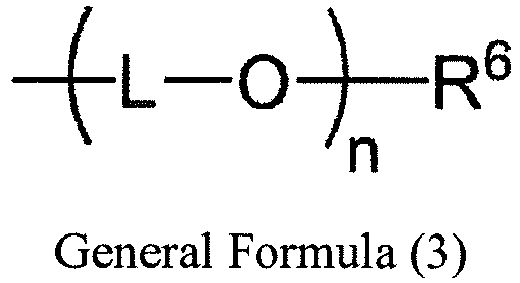
- In General Formula (3), L represents an alkylene group having 2 to 6 carbon atoms, and R6 represents an unsubstituted alkyl group having 4 or more carbon atoms or an aromatic group-substituted alkyl group. n represents the average number of moles of polyether added and is 2 to 4.
- <10> The antifouling film described in <8> or <9>, in which the polymer (d) is a polymer obtained by adding a partial structure including a structural unit that is derived from at least one kind of betaine monomer selected from the group consisting of the compound represented by General Formula (IV) shown below and the compound represented by General Formula (V) shown below and the structural unit that is represented by General Formula (2) shown below to all the terminals represented by STAR mark of at least one kind of polyfunctional (meth)acrylamide compound selected from the group consisting of a compound represented by General Formula (I-2) shown below and a compound represented by General Formula (II-2) shown below.


- In General Formula (I-2), R represents a hydrogen atom or a methyl group, and a plurality of R's may be the same as or different from each other. L represents -O-, an alkylene group having 2 to 4 carbon atoms, or a divalent linking group obtained by combining -O- and an alkylene group having 2 to 4 carbon atoms. STAR mark represents a site to which a partial structure including a structural unit that is derived from at least one kind of betaine monomer selected from the group consisting of the compounds represented by General Formula (IV) and General Formula (V) and the structural unit that is represented by General Formula (2) is added.

- In General Formula (II-2), R1 represents a hydrogen atom or a methyl group, R2 and R4 each independently represent -O-, an alkylene group having 1 to 4 carbon atoms, or a divalent linking group obtained by combining -O- and an alkylene group having 1 to 4 carbon atoms, R3 represents -O-, an alkylene group having 1 to 4 carbon atoms, a group represented by General Formula (III-2) shown below, or a divalent linking group obtained by combining two or more groups selected from the group consisting of -O-, an alkylene group having 1 to 4 carbon atoms, and the group represented by General Formula (III-2) shown below, and L1 and L2 each independently represent a single bond or the group represented by General Formula (III-2) shown below. A plurality of R1's may be the same as or different from each other. STAR mark represents a site to which a partial structure including a structural unit that is derived from at least one kind of betaine monomer selected from the group consisting of the compounds represented by General Formula (IV) and General Formula (V) and the structural unit that is represented by General Formula (2) is added.

- In General Formula (III-2), R31 represents a hydrogen atom or a methyl group, * represents a site bonded to a compound represented by General Formula (II-2), and STAR mark represents a site to which a partial structure including a structural unit that is derived from at least one kind of betaine monomer selected from the group consisting of the compounds represented by General Formula (IV) and General Formula (V) and the structural unit that is represented by General Formula (2).

- In General Formula (IV), R41 represents a methyl group, an ethyl group, a n-propyl group, or an i-propyl group, and a plurality of R41's may be the same as or different from each other.
- R42 represents a hydrogen atom or a methyl group, and R43 represents -NH- or -O-. n4 represents an integer of 1 to 4. 14 represents an integer of 1 to 4. M4 represents -SO3 - or -COO-.

- In General Formula (V), R51 represents a methyl group, an ethyl group, a n-propyl group, or an i-propyl group, and a plurality of R51's may be the same as or different from each other.
- R52 represents a hydrogen atom or a methyl group. n5 represents an integer of 1 to 4. L51 represents a linear or branched alkylene group having 3 or 4 carbon atoms. M5 represents -SO3 - or -COO-.

- In General Formula (2), R4 represents a hydrogen atom or a methyl group. R5 represents an alkyl group or a substituent represented by General Formula (3) shown below. In a case where R5 is the substituent represented by General Formula (3) shown below, a content of the structural unit represented by General Formula (2) having the substituent represented by General Formula (3) with respect to all the structural units included in the polymer (d) is equal to or smaller than 70 mol%.

- In General Formula (3), L represents an alkylene group having 2 to 6 carbon atoms, and R6 represents an unsubstituted alkyl group having 4 or more carbon atoms or an aromatic group-substituted alkyl group. n represents the average number of moles of polyether added and is 2 to 4.
- <11> A composition for forming an antifouling film, comprising silica particles (a), a precursor of a polymer (b) having an acrylamide structure and at least one substituent selected from the group consisting of -SO3M and -COOM, a polymer (c) having an acrylamide structure and a hydrocarbon group containing 2 to 20 carbon atoms, and a polymerization initiator (e). M represents a hydrogen atom or represents an atom or an atomic group that is able to become a cation by being dissociated.
- <12> An antifouling film laminate comprising a base material and the antifouling film described in any one of <1> to <10> on the base material.
- <13> A method for manufacturing an antifouling film laminate, comprising applying the composition for forming an antifouling film described in <11> onto a base material.
- <14> The method for manufacturing an antifouling film laminate described in <13>, further comprising applying energy to the composition for forming an antifouling film applied onto the base material.
- According to an embodiment of the present invention, there is provided an antifouling film which maintains antifouling properties and antifogging properties for a long period of time and has self-cleaning properties that make it easy to remove sludge and the like in a case where the sludge and the like adhere thereto.
- According to another embodiment of the present invention, there are provided a composition for forming an antifouling film making it possible to form an antifouling film, which maintains antifouling properties and antifogging properties for a long period of time and has self-cleaning properties that make it easy to remove sludge and the like in a case where the sludge and the like adhere thereto, an antifouling film laminate including the antifouling film, and a method for manufacturing an antifouling film laminate.
- Hereinafter, an antifouling film, a composition for forming an antifouling film, an antifouling film laminate, and a method for manufacturing an antifouling film laminate as an embodiment of the present invention will be specifically described.
- In the present specification, in a case where the amount of each of the components in a composition is mentioned, provided that the composition contains a plurality of substances corresponding to each of the components, unless otherwise specified, the amount of each of the components means the total amount of the plurality of substances present in the composition.
- In the present specification, the term "solid contents" means the components except for a solvent. A liquid component such as a low-molecular weight component other than a solvent is also included in "solid contents" in the present specification.
- In the present specification, a range of numerical values described using "to" means a range including the numbers listed before and after "to" as a minimum value and a maximum value respectively.
- In the present specification, regarding ranges of numerical values that are gradationally described, the upper limit or the lower limit of one range of numerical values that is gradationally described may be substituted with the upper limit or the lower limit of another range of numerical values that is gradationally described. Furthermore, the upper limit or the lower limit of a range of numerical values described in the present specification may be substituted with the values shown in examples.
- The antifouling film contains silica particles (a), a polymer (b) having an acrylamide structure and at least one substituent selected from the group consisting of -SO3M and -COOM, and a polymer (c) having an acrylamide structure and a hydrocarbon group having 2 to 20 carbon atoms. M represents a hydrogen atom or represents an atom or an atomic group which can become a cation by being dissociated.
- Hereinafter, in some cases, "silica particles (a)" will be referred to as particles (a), "polymer (b) having an acrylamide structure and at least one substituent selected from the group consisting of -SO3M and -COOM" will be referred to as a polymer (b), and "polymer (c) having an acrylamide structure and a hydrocarbon group having 2 to 20 carbon atoms" will be referred to as a polymer (c).
- For example, in a case where the substituents -SO3M and -COOM in the polymer (b) are present as counterions of a quaternary ammonium cation in a betaine structure, the substituents are in the forms of -SO3 - and -COO-. In the present specification, in a case where the aforementioned substituents are in the forms of -SO3 - and -COO- as counterions in a betaine structure, -SO3 - and -COO- are also included in the substituents represented by -SO3M and -COOM.
- The mechanism of action of the antifouling film of an embodiment in the present disclosure is unclear but is assumed to be as below.
- The antifouling film of the present disclosure contains the hydrophilic silica particles (a), the polymer (b) having a substituent exhibiting excellent hydrophilicity, and the polymer (c) having a hydrophobic partial structure. Accordingly, in the polymers, a hydrophilic region and a hydrophobic region are mixed with each other in a well-balanced state. Due to the presence of the hydrophilic region, antifouling properties, which make it difficult for dirt or dust to adhere to the film, and antifogging properties are exhibited. Furthermore, due to the presence of a water-repellent region having the hydrophobic partial structure, a stain having adhered to the film is inhibited from firmly adhering to the film. It is considered that, therefore, for example, even in a case where sludge or the like adheres to the antifouling film, the antifouling film exhibits excellent self-cleaning properties in which by allowing the film to become wet with rain or the like, the water-repellent region repels the moisture having adhered to the film such that the sludge or the like having adhered to the surface easily floats and is dispersed in the moisture, and in this state, the sludge or the like is easily removed from the surface.
- Particularly, in a preferred aspect of the polymer (b), a structure derived from acrylate having a polyfunctional acrylamide structure is excellently compatible with a structural unit derived from a betaine monomer having an acrylamide structure. Presumably, for this reason, the hydrophilicity of the polymer (b) is further improved, and better antifouling properties and antifogging properties are exhibited.
- The antifouling film contains the hydrophilic silica particles (a), the polymer (b) having excellent hydrophilicity, and at least one of the substituents represented by -SO3M and -COOM which are stable substituents. In addition, the coexisting polymer (c) has a hydrophobic group in a molecule thereof. Therefore, the antifouling film is hardly affected by the hydrophobic components volatilized from a silicone-based adhesive. Presumably, as a result, even in a case where the antifouling film is used for a member, such as a headlight cover for vehicles, fixed using a silicone-based adhesive, the deterioration of hydrophilicity of the surface of the antifouling film is inhibited for a long period of time.
- Because the film containing the silica particles (a) also contains the polymer (b) and the polymer (c), the effects of the antifouling film are exerted. Therefore, an aspect may be adopted in which the polymer (b) and the polymer (c) are contained in the antifouling film as binders of the silica particles (a) and present between the silica particles (a) adjacent to each other. Alternatively, an aspect may be adopted in which the polymer (b) and the polymer (c) are present only in the surface region of the film containing the silica particles (a).
- Even in a case where a polymer (d) is used which has a hydrophilic partial structure included in the polymer (b) and a hydrophobic partial structure included in the polymer (c) in combination in one molecule, the antifouling film as an embodiment of the present invention exerts the aforementioned effects as in the case where the polymer (b) and the polymer (c) are used in combination. The polymer (d) will be specifically described later.
- Here, the present disclosure is not limited to the presumptive mechanism described above.
- The antifouling film in the present disclosure contains at least one kind of silica particles (a) (particles (a)). The particles (a) favor the hydrophilicity through a hydroxy group on the surface of the particles and play a role of a hard filler. In this way, the particles (a) can improve the physical resistance of the antifouling film.
- The shape of the particles (a) used in the antifouling film is not particularly limited, and according to the purpose, particles of various shapes can be used. For example, the particles can have a spherical shape, a plate shape, a needle shape, a bead shape, and the like. Among these, spherical particles are preferable because such particles can be easily obtained and allow the antifouling film to have excellent surface properties. In the present specification, the spherical particles also include the particles close to spherical particles that are seemingly spherical.
- Regarding the particle diameter of the particles (a), from the viewpoint of inhibiting the scattering of transmitted light, the average primary particle diameter of the particles (a) is preferably equal to or smaller than 100 nm, more preferably equal to or smaller than 50 nm, and even more preferably equal to or smaller than 30 nm. In a case where the antifouling film is used for the purpose in which the transparency of the antifouling film is not important, the particle diameter is not limited to the above range.
- Meanwhile, from the viewpoint of preventing the aggregation of the silica particles and the like, the average primary particle diameter of the particles (a) is preferably equal to or greater than 2 nm.
- In the antifouling film, only one kind of particles (a) may be used, or two or more kinds of particles (a) may be used in combination. In a case where two or more kinds of particles (a) are used in combination, particles having different sizes, particles having different shapes, and the like may be used in combination.
- The average primary particle diameter of the particles (a) is determined in a manner in which the particles are observed and imaged using a transmission electron microscope, a projected area is measured for 300 or more particles from the image taken and approximated to a circular shape having an area equivalent to the projected area, and measuring the diameter of the obtained circle.
- Examples of the silica particles (a) include wet-process silica particles, vapor-phase process silica particles, colloidal silica, anhydrous silica particles, hydrous silica particles, and the like. Among these, from the viewpoint of preventing the aggregation of the silica particles, wet-process silica particles and colloidal silica are preferable.
- As the silica particles (a), commercial products may be used. Examples of commercial silica particles usable as the particles (a) in the present embodiment include a SNOWTEX (registered trademark) series (for example, SNOWTEX O and the like) manufactured by NISSAN CHEMICAL INDUSTRIES, LTD., a Nalco (registered trademark) series (for example, Nalco 8699 and the like) manufactured by Nalco Chemical Company, and the like.
- The content of the silica particles (a) with respect to the total solid content of the antifouling film is preferably 5% by mass to 95% by mass, more preferably 10% by mass to 90% by mass, and even more preferably within a range of 20% by mass to 80% by mass.
- In a case where the content of the particles (a) is within the above range, the hardness, the scratch resistance, the impact resistance, and the hydrophilicity of the antifouling film become excellent.
- As will be described later, the antifouling film can be formed using a composition for forming an antifouling film containing the silica particles (a). In a case where a coating solution for forming an antifouling film containing the particles (a) is prepared, the content rate of the particles (a) in the coating solution with respect to the total mass of the coating solution is preferably equal to or lower than 30% by mass, more preferably equal to or lower than 20% by mass, and even more preferably equal to or lower than 10% by mass. It is preferable that the proportion of the particles (a) in the coating solution is within the above range, because then the dispersibility of the particles (a) in the solution is improved, and the particles (a) in the composition are hardly aggregated.
- The antifouling film in the present disclosure contains the polymer (b) having an acrylamide structure and at least one substituent selected from the group consisting of -SO3M and -COOM. M represents a hydrogen atom or represents an atom or an atomic group which can become a cation by being dissociated.
- It is preferable that the polymer (b) has a partial structure derived from a polyfunctional acrylamide structure having a plurality of acrylamide structures in a molecule.
- More specifically, it is preferable that the polymer (b) has a structure derived from at least one kind of polyfunctional (meth)acrylamide compound selected from the group consisting of a compound represented by General Formula (I) shown below and a compound represented by General Formula (II) shown below.
- The polyfunctional (meth)acrylamide compound has an amide bond. Accordingly, the compound can form a film having excellent hydrophilicity. Furthermore, the polyfunctional (meth)acrylamide compound has a plurality of ethylenically unsaturated bonds. Accordingly, the compound can function as a cross-linking agent. As a result, the antifouling film having a structure derived from the polyfunctional (meth)acrylamide compound has higher film hardness and more effectively maintains antifogging properties and antifouling properties.

- In General Formula (I), R represents a hydrogen atom or a methyl group, and a plurality of R's may be the same as or different from each other.
- L represents -O-, an alkylene group having 2 to 4 carbon atoms, or a divalent linking group obtained by combining -O- and an alkylene group having 2 to 4 carbon atoms. It is preferable that a carbon atom is present in a position adjacent to a nitrogen atom in the amide group adjacent to L. That is, as a group adjacent to a nitrogen atom in the amide group, an alkylene group having 2 to 4 carbon atoms is preferable.
- Examples of the alkylene group having 2 to 4 carbon atoms include an ethylene group, a propylene group, a n-butylene group, an i-butylene group, a t-butylene group, and the like.
- Examples of "divalent linking group obtained by combining -O- and an alkylene group having 2 to 4 carbon atoms" include an alkylene group having 2 to 4 carbon atoms containing -O- such as -OCH2CH2-, -OCH2CH2CH2-, -OCH2CH2CH2CH2-, -CH2OCH2-, -CH2OCH2CH2-, or -CH2OCH2CH2CH2-, a group represented by -(O-alkylene group (having 2 to 4 carbon atoms))n-, and the like. n represents an integer equal to or greater than 2. The upper limit of n is not particularly limited, but is preferably about 100, for example. In each of the divalent linking groups exemplified above, an amide group may be bonded to any of the two binding sites.
- Among these, as L, from the viewpoint of the effects, an alkylene group having 2 to 4 carbon atoms containing -O-, that is, an aspect in which an oxygen atom is contained in any of carbon chains of an alkylene group is more preferable.

- In General Formula (II), R1 represents a hydrogen atom or a methyl group. A plurality of R1's may be the same as or different from each other.
- R2 and R4 each independently represent -O-, an alkylene group having 1 to 4 carbon atoms, or a divalent linking group obtained by combining -O- and an alkylene group having 2 to 4 carbon atoms. Generally, a carbon atom is in a position adjacent to a nitrogen atom in the amide group adjacent to R2 and R4. As the group adjacent to a nitrogen atom in the amide group, an alkylene group having 1 to 4 carbon atoms is preferable.
- Examples of the alkylene group having 1 to 4 carbon atoms include a methylene group, an ethylene group, a propylene group, a n-butylene group, an i-butylene group, and a t-butylene group.
- Examples of "divalent linking group obtained by combining -O- and an alkylene group having 1 to 4 carbon atoms" include an alkylene group having 1 to 4 carbon atoms containing -O- such as -OCH2-, -OCH2CH2-, -OCH2CH2CH2-, -OCH2CH2CH2CH2-, -CH2OCH2-, -CH2OCH2CH2-, or -CH2OCH2CH2CH2-, a group represented by -(O-alkylene group (having 1 to 4 carbon atoms))n-, and the like. n represents an integer equal to or greater than 2. The upper limit of n is not particularly limited, but is preferably about 100, for example. In each of the groups exemplified above as "divalent linking group obtained by combining -O- and an alkylene group having 1 to 4 carbon atoms", an amide group may be bonded to any of two binding sites.
- Among these, as R2 and R4, from the viewpoint of the effects, an alkylene group having 1 to 4 carbon atoms containing -O- is more preferable.
- R3 represents -O-, an alkylene group having 1 to 4 carbon atoms, a linking group represented by General Formula (III) shown below, or a divalent linking group obtained by combining two or more groups selected from -O-, an alkylene group having 1 to 4 carbon atoms, and a group represented by General Formula (III) shown below.
- Examples of the alkylene group having 1 to 4 carbon atoms include a methylene group, an ethylene group, a propylene group, a n-butylene group, an i-butylene group, and a t-butylene group.
- Examples of "divalent linking group obtained by combining two or more groups selected from -O-, an alkylene group having 1 to 4 carbon atoms, and a group represented by General Formula (III) shown below" include the aforementioned groups represented by R2 and R4. In a case where a group represented by General Formula (III) is combined with another group, it is preferable that an alkylene group having 1 to 4 carbon atoms is bonded to a nitrogen atom in the group represented by General Formula (III).
- Among these, as R3, from the viewpoint of effects, an alkylene group having 1 to 4 carbon atoms, an alkylene group having 1 to 4 carbon atoms containing -O-, or a group represented by General Formula (III) is preferable.
- L1 and L2 each independently represent a single bond or a group represented by General Formula (III) shown below.
- In a case where R3 represents a linking group represented by General Formula (III), it is preferable that L1 and L2 both represent a single bond, because then a harder antifouling film can be formed.

- In General Formula (III), R31 represents a hydrogen atom or a methyl group, and * represents a binding site. Generally, a carbon atom is positioned at the binding site represented by *.
- Specific examples (b-1) to (b-5) of the compound represented by General Formula (I) or General Formula (II) will be shown below, but the present embodiment is not limited to the following specific examples.


- As the compound represented by General Formula (I) or General Formula (II), the compounds obtained by synthesis or various commercial products may be used. The compound represented by General Formula (I) or General Formula (II) can be synthesized by the synthesis method described in technical disclosure No. 013-502654.
- The polymer (b) may have only one kind of partial structure derived from a polyfunctional (meth)acrylamide compound or two or more kinds of partial structures derived from a polyfunctional (meth)acrylamide.
- Specifically, examples of the partial structure derived from a polyfunctional (meth)acrylamide compound include a structure obtained by removing one hydrogen atom from a terminal double bond included in the polyfunctional (meth)acrylamide compound. As the polymer (b), an aspect is preferable in which a betaine monomer, which will be described later, is added to a site at which one hydrogen atom is removed from a terminal double bond of the polyfunctional (meth)acrylamide compound.
- In a case where the polymer (b) is synthesized, it is preferable to use a composition for synthesizing the polymer (b) containing a polyfunctional (meth)acrylamide compound, a betaine monomer which will be described later, and a polymerization initiator. In the composition for synthesizing the polymer (b), the content of the polyfunctional (meth)acrylamide compound with respect to the total solid content of the composition is preferably equal to or greater than 10% by mass and less than 90% by mass, and more preferably 20% by mass to 80% by mass.
- In the present embodiment, as a preferred aspect of the polymer (b), an aspect can be exemplified in which a structural unit derived from at least one kind of betaine monomer selected from the group consisting of a compound represented by General Formula (IV) shown below and a compound represented by General Formula (V) shown below is added to a terminal double bond of the aforementioned polyfunctional (meth)acrylamide compound. In a case where the polymer (b) has the structural unit derived from a betaine monomer, the hydrophilicity of the polymer (b) is further improved, and hence the hydrophilicity of the antifouling film containing the polymer (b) is further improved.

- In General Formula (IV), R41 represents a methyl group, an ethyl group, a n-propyl group, or an i-propyl group, and is preferably a methyl group.
- A plurality of R41's may be the same as or different from each other. It is preferable that R41's are the same as each other, because then the compound can be easily synthesized.
- R42 represents a hydrogen atom or a methyl group, and R43 represents -NH- or -O-.
- M4 represents -SO3 - or -COO-.
- n4 represents an integer of 1 to 4. In a case where n4 is within a range of 1 to 4, the alkylene chain length falls into a suitable range, and the solubility of the betaine monomer in a solvent becomes excellent. From the viewpoint of the solubility of the compound represented by General Formula (IV) in a solvent, in a case where M4 in General Formula (IV) represents -SO3 -, n4 is more preferably 3. In a case where M4 in General Formula (IV) represents -COO-, n4 is more preferably 2.
- 14 represents an integer of 1 to 4. 14 is an integer of 1 to 4. In a case where 14 is within a range of 1 to 4, the alkylene chain length falls into a suitable range, and the solubility of the compound represented by General Formula (IV) in a solvent becomes excellent. From the viewpoint of the solubility in a solvent, in a case where M4 in General Formula (IV) represents -SO3 -, 14 is more preferably 4. In a case where M4 in General Formula (IV) represents -COO-, likewise, from the viewpoint of the solubility in a solvent, 14 is more preferably 1.
- In a case where M4 represents -SO3 -, the compound represented by General Formula (IV) becomes a sulfobetaine monomer. In a case where M4 represents -COO3 -, the compound represented by General Formula (IV) becomes a carboxybetaine monomer.
- In a case where M4 in General Formula (IV) is -SO3 -, likewise, from the viewpoint of the solubility in a solvent, R43 is preferably -NH-.
- In a case where M4 in General Formula (IV) is -COO-, likewise, from the viewpoint of the solubility in a solvent, R43 is preferably -O-.
- Specific examples (b-i) and (b-ii) preferred as the compound represented by General Formula (IV) will be shown below, but the present embodiment is not limited to the following specific examples.

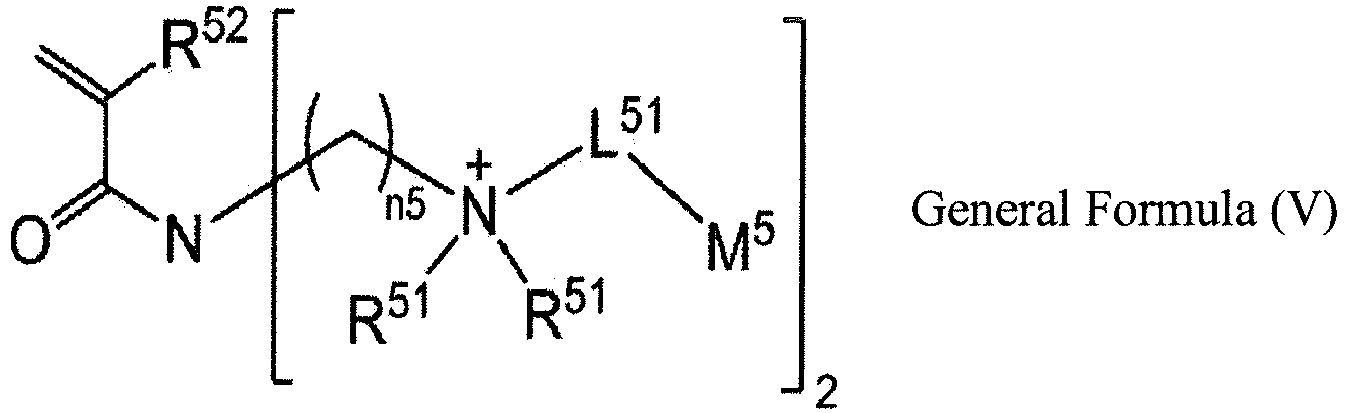
- In General Formula (V), R51 represents a methyl group, an ethyl group, a n-propyl group, or an i-propyl group, and a plurality of R51's may be the same as or different from each other.
- It is preferable that R51's are the same substituents, because then the compound represented by General Formula (V) can be easily synthesized. Particularly, R51 is more preferably a methyl group. The partial structures shown in the square bracket in General Formula (V) may be the same as or different from each other. However, from the viewpoint of ease of synthesis, it is preferable that the partial structures are the same as each other.
- R52 represents a hydrogen atom or a methyl group.
- n5 represents an integer of 1 to 4. In a case where n5 is within a range of 1 to 4, the alkylene chain length falls into a suitable range, and the solubility of the compound represented by General Formula (IV) in a solvent becomes excellent. From the viewpoint of the solubility in a solvent, in a case where M5 in General Formula (V) is -SO3 -, n5 is more preferably 3. In a case where M5 in General Formula (V) is -COO-, n5 is more preferably 1 or 2.
- L51 represents a linear or branched alkylene group having 3 or 4 carbon atoms. Specifically, examples of L51 include structures represented by Formulae (L1) to (L5) shown below. In the following structures, * represents a linking site.
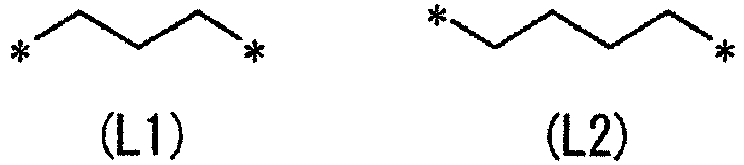

- M5 represents -SO3 - or -COO-. In a case where M5 is -SO3 -, the betaine monomer becomes a sulfobetaine monomer. In a case where M5 is -COO-, the betaine monomer becomes a carboxybetaine monomer.
- A specific example (b-iii) preferred as the compound represented by General Formula (V) will be shown below, but the present embodiment is not limited to the following specific example.

- In the present embodiment, the betaine monomer which can be used for synthesizing the polymer (b) can be synthesized by a common method. Regarding the betaine monomer, for example, the synthesis examples or the example compounds disclosed in
JP2012-187907A JP2012-31400A JP2012-31400A - The polymer (b) may have one kind of structural unit derived from a betaine monomer or two or more kinds of structural units derived from a betaine monomer.
- In the polymer (b), from the viewpoint of further improving the aforementioned effects of the antifouling film, a mass ratio between the partial structure derived from a polyfunctional (meth)acrylamide compound and the structural unit derived from a betaine monomer (polyfunctional (meth)acrylamide compound:betaine monomer) is preferably 10:90 to 90:10 and more preferably 10:90 to 50:50.
- The total content of the polyfunctional (meth)acrylamide compound and the betaine monomer, which are contained as a raw material components in the composition for forming an antifouling film used for forming the antifouling film, with respect to the solid contents of the composition is preferably equal to or greater than 80% by mass, and more preferably 90% by mass to 99% by mass.
- As long as the effects of the present invention are not impaired, the polymer (b) may have, as a structural unit the polymer (b) has on the terminal of the partial structure derived from the aforementioned polyfunctional (meth)acrylamide compound, structural units derived from other monomers different from the aforementioned monomers, in addition to the structural unit derived from a betaine monomer.
- In a case where the polymer (b) has structural units derived from other monomers that the polymer (b) can have if desired, the polymer (b) may have only one kind of structural unit derived from other monomers or two or more kinds of structural units derived from other monomers.
- The content of the polymer (b) with respect to the total solid content of the antifouling film is preferably 0.1% by mass to 90% by mass, and more preferably 1% by mass to 75% by mass.
- The antifouling film in the present disclosure contains a polymer (c) having an acrylamide structure and a hydrocarbon group having 2 to 20 carbon atoms.
- Because the polymer (c) has a hydrophilic acrylamide structure and a hydrophobic hydrocarbon group having 2 to 20 carbon atoms in a molecule, appropriate hydrophobicity is imparted to the antifouling film.
- Examples of the hydrocarbon group having 2 to 20 carbon atoms include a linear, branched, or cyclic alkyl group, alkylene group, arylene group, aralkylene group, or the like. Among these, a linear, branched, or cyclic alkyl group is preferable, because this alkyl group enables antifogging properties and antifouling properties to be compatible with each other in a well-balanced manner.
- More specifically, as the polymer (c), a polymer having a structural unit represented by General Formula (1) shown below and a structural unit represented by General Formula (2) shown below is preferable.

- In General Formula (1) and General Formula (2), R1 and R4 each independently represent a hydrogen atom or a methyl group.
- R2 and R3 each independently represent a hydrogen atom, a methyl group, or an ethyl group. R2 and R3 preferably each represent a hydrogen atom or a methyl group. From the viewpoint of further improving water solubility, it is more preferable that R2 and R3 both represent a hydrogen atom.
- R5 represents an alkyl group having 2 or more carbon atoms or a substituent represented by General Formula (3) shown below.
- In a case where R5 represents an alkyl group having 2 or more carbon atoms, the alkyl group may be any of a linear alkyl group, an alkyl group having a branch, and a cyclic alkyl group. Furthermore, the alkyl group may be an unsubstituted alkyl group or a substituted alkyl group having an aromatic ring or a heterocyclic ring as a substituent.
- More specifically, examples of the alkyl group include an alkyl group having 2 to 20 carbon atoms that is exemplified above in the description of the hydrocarbon group having 2 to 20 carbon atoms contained in the polymer (c), for example, a linear or branched alkyl group such as an ethyl group, a propyl group, a propylene group, a n-butyl group, an i-butyl group, or a t-butyl group, and a cyclic alkyl group such as a cyclopropyl group, a cyclobutyl group, a cyclopentyl group, or a cyclohexyl group.
- Among these, as R5, a linear, branched, or cyclic unsubstituted alkyl group having 2 to 8 carbon atoms or a substituent represented by General Formula (3) shown below is preferable. Furthermore, a branched alkyl group having 2 to 8 carbon atoms is more preferable, because this alkyl group can impart better hydrophobicity to the antifouling film. The number of carbon atoms in the alkyl group is preferably 2 to 6. From the viewpoint of further improving the balance between hydrophobicity and hydrophilicity, an alkyl group having 3 or 4 carbon atoms is most preferable.

- In General Formula (3), L represents an alkylene group having 2 to 6 carbon atoms, and R6 represents an unsubstituted alkyl group having 4 or more carbon atoms or an aromatic group-substituted alkyl group. n represents the average number of moles of polyether added and is 2 to 4.
- In a case where R5 is a substituent represented by General Formula (3), the content of the structural unit represented by General Formula (2) having the substituent represented by General Formula (3) with respect to all the structural units included in the polymer (c) is preferably equal to or smaller than 70 mol%, and more preferably within a range of 5 mol% to 60 mol%.
- Preferred examples of the combination of the repeating units represented by each of General Formula (1) and General Formula (2) include a combination in which R1 and R4 in General Formula (1) and General Formula (2) both represent a hydrogen atom, and a combination in which R2 and R3 in General Formula (1) both represent a hydrogen atom and R5 in General Formula (2) represents a branched unsubstituted alkyl group having 3 or 4 carbon atoms.
- It is preferable that the polymer (c) does not contain a group selected from the group consisting of a hydroxy group, a carboxylic acid group, a phosphoric acid group, a phosphonic acid group, and salts of these in a molecule, because then the desired hydrophobicity is easily imparted to the antifouling film.
- Specific examples of monomers from which the structural unit represented by General Formula (1) is derived include acrylamide, methacrylamide, N-methylacrylamide, N-methylmethacrylamide, N-ethylacrylamide, N-ethylmethacrylamide, N,N-dimethylacrylamide, N,N-dimethylmethacrylamide, N,N-diethylacrylamide, N,N-diethylmethacrylamide, N,N-ethylmethylacrylamide, N,N-ethylmethylmethacrylamide, and the like.
- Specific examples of monomers from which the structural unit represented by General Formula (2) is derived include methyl acrylate, ethyl acrylate, propyl acrylate, isopropyl acrylate, n-butyl acrylate, i-butyl acrylate, t-butyl acrylate, pentyl acrylate, hexyl acrylate, cyclohexyl acrylate, heptyl acrylate, octyl acrylate, 2-ethylhexyl acrylate, nonyl acrylate, decanyl acrylate, methyl methacrylate, ethyl methacrylate, propyl methacrylate, isopropyl methacrylate, n-butyl methacrylate, i-butyl methacrylate, t-butyl methacrylate, pentyl methacrylate, hexyl methacrylate, cyclohexyl methacrylate, heptyl methacrylate, octyl methacrylate, 2-ethylhexyl methacrylate, nonyl methacrylate, decanyl methacrylate, and the like.
- The polymer (c) is preferably a polymer having the structural unit represented by General Formula (1) in an amount of 70 mol% to 95 mol% and the structural unit represented by General Formula (2) in an amount of 5 mol% to 30 mol%, more preferably a polymer having the structural unit represented by General Formula (1) in an amount of 70 mol% to 80 mol% and the structural unit represented by General Formula (2) in an amount of 20 mol% to 30 mol%, and even more preferably a polymer having the structural unit represented by General Formula (1) in an amount of 75 mol% to 80 mol% and the structural unit represented by General Formula (2) in an amount of 20 mol% to 25 mol%.
- As long as the effects of the present invention are not impaired, the polymer (c) can have, in addition to the structural unit represented by General Formula (1) and the structural unit represented by General Formula (2) described above, other structural units different from the structural unit represented by General Formula (1) and the structural unit represented by General Formula (2) according to the purpose.
- In a case where the polymer (c) has other structural units, the physical properties, the molecular weight, and the like of the polymer (c) can be adjusted.
- The polymer (c) can have a structural unit represented by General Formula (4) as other structural units.
- In a case where the polymer (c) has the structural unit represented by General Formula (4), the content of the structural unit with respect to all the structural units included in the polymer (c) is preferably 0.3 mol% to 5.0 mol%, and more preferably 0.5 mol% to 2 mol%.


- In General Formula (4), R7 represents a hydrogen atom or a methyl group. X represents a single bond or a divalent linking group constituted with at least one group selected from the group consisting of divalent linking groups shown in A group.
- Y represents a carboxylic acid group, a carboxylate group, a sulfonic acid group, a sulfonate group, a phosphoric acid group, a phosphate group, a phosphonic acid group, a phosphonate group, a hydroxy group, a carbobetaine group, a sulfobetaine group, an ammonium group, or a substituent represented by General Formula (3) shown below.

- The substituent represented by General Formula (3) has the same definition as the substituent represented by General Formula (3) described regarding General Formula (2), and preferred examples thereof are also the same.
- The polymer (c) will be shown below by using the structural units [(c-1) to (c-5)] in the polymer (c), but the polymer (c) in the present disclosure is not limited to the specific examples shown below. a, b, and c shown in each of the structural units represent the content (mol%) of each of the structural units in the polymer (c). a is preferably within a range of 50 to 95, b is preferably within a range of 5 to 75, and c is preferably within a range of 0.1 to 10. The sum of a, b, and c equals 100 mol%.


- The polymer (c) can be synthesized by the method described in
JP2012-73597A JP2012-73597A - The weight-average molecular weight (Mw) of the polymer (c) is preferably 10,000 to 200,000, more preferably 10,000 to 100,000, and most preferably 10,000 to 30,000.
- The weight-average molecular weight (Mw) of the polymer (c) can be measured by the method described below.
- The weight-average molecular weight of the polymer (c) can be measured by gel permeation chromatography (GPC).
- Specifically, the weight-average molecular weight can be measured using HLC-8120GPC and SC-8020 (manufactured by Tosoh Corporation), two columns of TSKgel, SuperHM-H (manufactured by Tosoh Corporation, 6.0 mmID × 15 cm), and tetrahydrofuran (THF) as an eluent. Furthermore, the weight-average molecular weight can be measured using a differential refractometer (RI) detector under the conditions of a sample concentration of 0.5% by mass, a flow rate of 0.6 ml (milliliter)/min, a sample injection amount of 10 µl (microliter), and a measurement temperature of 40°C.
- As a calibration curve, it is possible to use a calibration curve prepared from 10 samples of "polystyrene standard sample TSK standard" manufactured by Tosoh Corporation: "A-500", "F-1", "F-10", "F-80", "F-380", "A-2500", "F-4", "F-40", "F-128", and "F-700".
- The content of the polymer (c) with respect to the total solid content of the antifouling film is preferably 0.1% by mass to 90% by mass, and more preferably 1% by mass to 75% by mass.
- If necessary, the antifouling film of the present embodiment can further contain, in addition to the components described above, binder components (hereinafter, referred to as other binder components in some cases) other than the polymer (b) and the polymer (c) and an additive such as a preservative as other components.
- Examples of other binder components include a siloxane binder, polyurethane, an acryl resin (hereinafter, referred to as an acrylic resin in some cases) including at least a structural unit derived from an acryl monomer, and a binder component such as polyphosphate or metaphosphate having a polar group (for example, a hydroxyl group, a carboxy group, a phosphoric acid group, a sulfonic acid group, an amino group or the like) on a terminal thereof.
- Provided that the antifouling film contains another binder components, in a case where the antifouling film is provided on a base material, the adhesiveness between the antifouling film and the base material (particularly, a polycarbonate base material) is further improved.
- Among other binder components, from the viewpoint of further improving the adhesiveness between the antifouling film and a base material, a binder component having a hydroxyl group, a carboxy group, or a phosphoric acid group on a terminal thereof is preferable, and polyurethane, an acrylic resin, and polyphosphate are more preferable.
- The polyurethane is not particularly limited, and examples thereof include polyurethane having a soft segment/hard segment structure constituted with a polyol skeleton and a polyisocyanate skeleton, and the like.
- As the polyurethane, commercial products may be used, and examples thereof include a TAKELAC (registered trademark) W series, a TAKELAC WS series, and a TAKELAC WD series manufactured by Mitsui Chemicals, Inc., a PERMARIN (registered trademark) series, a UCOAT (registered trademark) series, and a UPRENE (registered trademark) series manufactured by Sanyo Chemical Industries, Ltd., and the like.
- Examples of the acrylic resin include a homopolymer of an acrylic acid (polyacrylic acid), an acrylic acid, an acrylic acid derivative such as an acrylic acid ester, a methacrylic acid derivative such as methyl methacrylate, and the like.
- Among the aforementioned acrylic resins, a polyacrylic acid is preferable. The weight-average molecular weight of the polyacrylic acid is preferably 2,000 to 5,000,000, more preferably 10,000 to 2,000,000, and even more preferably 250,000 to 1,000,000.
- Examples of the polyphosphate include sodium polyphosphate, potassium polyphosphate, and the like.
- In a case where the antifouling film contains other binders, the content rate of other binders with respect to the total solid content of the antifouling film is preferably 0.001% by mass to 0.1% by mass, more preferably 0.001% by mass to 0.01% by mass, and even more preferably 0.002% by mass to 0.008% by mass. In a case where the content rate of other binders is within the above range, it is easy to form an antifouling film that exhibits better adhesiveness with respect to a base material.
- In a case where a composition for forming an antifouling film containing other binders is prepared, the content rate of other binders in the composition with respect to the total solid content of the composition is preferably 0.001% by mass to 0.1% by mass, more preferably 0.001% by mass to 0.01% by mass, and even more preferably 0.002% by mass to 0.008% by mass.
- As long as the antifouling film in the present disclosure contains the particles (a), the polymer (b), and the polymer (c), the aspect relating to how each of the components is contained in the antifouling film is not particularly limited.
- From the viewpoint of the effects, an aspect is preferable in which the antifouling film has the polymer (b) and the polymer (c) in at least a portion of the surface of the antifouling film. In a case where the antifouling film has the polymer (b) and the polymer (c) in at least a portion of the surface thereof, the antifouling film exhibits excellent antifouling properties and antifogging properties and becomes a film having excellent self-cleaning properties.
- In the antifouling film containing the polymer (b) and the polymer (c), a pure water contact angle of the surface thereof is preferably equal to or smaller than 10°. The pure water contact angle of the antifouling film surface is more preferably equal to or smaller than 8°.
- The pure water contact angle of the antifouling film surface can be measured using a contact angle meter M553G-XM (Shiro Industry Co.). 1 µl of pure water is added dropwise to the surface of the antifouling film, and by using the contact angle meter M553G-XM, a contact angle [°] is measured by a θ/2 method. The average of values obtained by measuring the contact angle five times is taken as a pure water contact angle in the present specification.
- As an aspect in which the antifouling film contains the polymer (b) and the polymer (c), an aspect can be exemplified in which the antifouling film contains the polymer (b) and the polymer (c) as binders in a case where the antifouling film containing the particles (a) is formed. In a case where the polymer (b) and the polymer (c) are used as binders, at least one kind of polymer between the polymer (b) and the polymer (c) is present between the silica particles (a) adjacent to each other, and by at least one kind of polymer between the polymer (b) and the polymer (c), the particles (a) adjacent to each other are fixed to each other.
- As another aspect, an aspect can be exemplified in which a film containing the particles (a) is formed using the silica particles (a) and other binders different from the polymer (b) and the polymer (c) and then the polymer (b) and the polymer (c) are imparted to the surface of the film. In this aspect, the antifouling film has the polymer (b) and the polymer (c) only in the vicinity of the surface thereof.
- As other binders used for forming the film containing the particles (a), a siloxane binder is preferable because this binder improves the film hardness.
- Hereinafter, the siloxane binder as one of other binders preferably used for fixing the silica particles (a) will be described. In the present embodiment, a layer containing the particles (a) and the siloxane binder is formed, and then the polymer (b) and the polymer (c) described above are imparted to the surface of the layer so as to form an antifouling film. Therefore, the layer containing the silica particles (a) and the siloxane binder will be referred to as "antifouling film precursor" in some cases.
- It is preferable that the siloxane binder, which is one of other binders being able to be used for forming the layer containing the particles (a), contains at least one kind of siloxane binder formed of a compound (hereinafter, referred to as "specific siloxane compound" as well) represented by General Formula (5).
- The specific siloxane compound is a siloxane oligomer. The siloxane binder in the present disclosure is a compound obtained by subjecting the specific siloxane compound (siloxane oligomer) represented by General Formula (5) shown below to a condensation reaction. In a case where the antifouling film precursor contains the siloxane binder, the hydrophilicity of the surface of the antifouling film precursor can be improved.

- In General Formula (5), R51, R52, R53, and R54 each independently represent a monovalent organic group having 1 to 6 carbon atoms. n represents an integer of 2 to 20.
- The organic group having 1 to 6 carbon atoms represented by R51, R52, R53, and R54 may be a linear, branched, or cyclic. Examples of the monovalent organic group include an alkyl group, an alkenyl group, and the like. Among these, an alkyl group is preferable.
- In a case where R51, R52, R53, and R54 represent an alkyl group, examples of the alkyl group include a methyl group, an ethyl group, a propyl group, an isopropyl group, a n-butyl group, a tert-butyl group, a n-pentyl group, a n-hexyl group, a cyclohexyl group, and the like.
- In a case where the organic group, which is preferably an alkyl group, represented by R51 to R54 in the specific siloxane compound has 1 to 6 carbon atoms, the hydrolyzability of the siloxane oligomer becomes excellent. From the viewpoint of further improving the hydrolyzability, R51 to R54 more preferably each independently represent an alkyl group having 1 to 4 carbon atoms, and even more preferably each independently represent an alkyl group having 1 or 2 carbon atoms.
- n in General Formula (5) represents an integer of 2 to 20. In a case where n is within a range of 2 to 20, the viscosity of a coating solution for forming the antifouling film precursor containing the specific siloxane compound can be made fall into an appropriate range. Furthermore, the reactivity of the siloxane oligomer can be controlled to be within a preferred range. n is preferably 3 to 12, and more preferably 5 to 10.
- In a case where n is equal to or smaller than 20, the viscosity of the coating solution does not become too high, and the handleability becomes excellent, and the coating solution is excellent uniformly applied in a case where the antifouling film precursor is formed by coating. In contrast, in a case where n is equal to or greater than 2, it is easy to control the reactivity of the siloxane compound, and for example, an antifouling layer with a surface having excellent hydrophilicity can be formed by coating.
- Hereinafter, examples of the specific siloxane compound will be described using R51 to R54 and n in General Formula (5), but the present disclosure is not limited to those example compounds.
Specific siloxane compound R51 R52 R53 R54 n Compound 1 Methyl group Methyl group Methyl group Methyl group 5 Compound 2 Methyl group Methyl group Methyl group Methyl group 10 Compound 3 Ethyl group Ethyl group Ethyl group Ethyl group 5 Compound 4 Ethyl group Ethyl group Ethyl group Ethyl group 10 - The weight-average molecular weight (Mw) of the specific siloxane compound (siloxane oligomer) is preferably within a range of 300 to 1,500, and more preferably within a range of 500 to 1,200.
- In a case where the specific siloxane compound coexists with water, at least a portion thereof is hydrolyzed. By the reaction between the siloxane oligomer and water, at least some of OR51, OR52, OR53, and OR54 bonded to silicon atoms of the specific siloxane compound are substituted with a hydroxy group, and as a result, a compound is obtained which is a hydrolysate of the specific siloxane compound. Presumably, due to the hydroxy group which is a hydrophilic group, the surface hydrophilicity of the antifouling layer formed through, for example, coating and drying becomes excellent.
- During hydrolysis reaction, it is not necessary for all the alkoxy groups included in the specific siloxane compound to react. However, for example, from the viewpoint of further improving the hydrophilicity of a coating film obtained by coating and drying the coating solution for forming an antifouling layer, it is preferable that more alkoxy groups are hydrolyzed.
- The amount of water required during hydrolysis equals the molar amount of the alkoxy group included in the specific siloxane compound. From the viewpoint of causing the hydrolysis reaction to efficiently proceed, it is preferable that a large excess of water is present in the reaction system.
- Although the hydrolysis reaction of the specific siloxane compound proceeds at room temperature (25°C), in order to accelerate the reaction, after a mixture is prepared by bringing the specific siloxane compound into contact with water, the obtained mixture may be heated to about 30°C to 50°C. The longer the reaction time of the hydrolysis reaction, the more preferable, because the reaction proceeds further. Therefore, from the viewpoint of causing the hydrolysis reaction to sufficiently proceed, it is also preferable that the reaction is performed for 1 hour to 36 hours in a heating state. In addition, by allowing a catalyst, which will be described later, accelerating the hydrolysis reaction of the specific siloxane compound to coexist with the mixture, it is possible to obtain a hydrolysate of the specific siloxane compound necessary for hydrophilicity in about half a day.
- The hydrolysis reaction is a reversible reaction. Therefore, in a case where water is removed from the mixture, a condensation reaction starts to occur between hydroxy groups in the hydrolysate of the siloxane oligomer and proceeds. Accordingly, in a case where the hydrolysate of the specific siloxane compound is obtained by causing the hydrolysis reaction in the mixture containing the specific siloxane compound and preferably a large excess of water, it is preferable to use the mixture (solution) as it is for preparing a coating solution for forming the antifouling film precursor without isolating the hydrolysate.
- Regarding the siloxane binder contained in the antifouling film precursor, a coating solution for forming the antifouling film precursor containing the specific siloxane compound (siloxane oligomer) is prepared, the prepared coating solution is applied to a base material and dried such that at least some of the hydroxy groups contained in the hydrolysate of the siloxane oligomer are bonded to each other, and in this way, the antifouling film precursor containing a siloxane binder formed by the condensation of the siloxane oligomer is obtained.
- The antifouling film precursor may contain only one kind of siloxane binder or two or more kinds of siloxane binders.
- The content rate of the specific siloxane binder in the antifouling film precursor with respect to the total solid content of the antifouling film precursor is preferably 5% by mass to 95% by mass, and more preferably 10% by mass to 80% by mass. In a case where the content rate of the siloxane binder is within the above range, the hydrophilicity of the surface of the antifouling film precursor becomes excellent.
- In a case where the coating solution for forming the antifouling film precursor is prepared, the content rate of the specific siloxane compound (siloxane oligomer) represented by General Formula (5) in the coating solution with respect to the total mass of the coating solution for forming the antifouling film precursor is preferably 0.3% by mass to 70% by mass, more preferably 0.5% by mass to 60% by mass, and even more preferably 1% by mass to 50% by mass.
- The amount of the polymer (b) and the polymer (c) imparted to the surface of the obtained antifouling film precursor is appropriately selected according to the purpose. From the viewpoint of the effects, the total amount of the polymer (b) and the polymer (c) is preferably set such that the film thickness becomes 0.001 µm to 1 µm after drying, and more preferably set such that the film thickness becomes 0.005 µm to 0.5 µm after drying.
- Because the antifouling film of the present embodiment contains the polymer (b) and the polymer (c) as described above, suitable hydrophilicity and hydrophobicity are well-balanced, and the antifouling properties, the antifogging properties, and the self-cleaning properties become compatible with each other.
- As another embodiment of the present invention, the inventor of the present invention has found that in a case where one polymer having both the structure of the polymer (b) and the structure of the polymer (c) is used, the same effect as in the case where the polymer (b) and the polymer (c) are used in combination is brought about.
- The antifouling film according to another embodiment is an antifouling film containing the silica particles (a) and a polymer (d) which has an acrylamide structure and has, in a molecule, at least one substituent selected from the group consisting of -SO3M and -COOM and a hydrocarbon group having 2 to 20 carbon atoms. M represents a hydrogen atom or represents an atom or an atomic group which can become a cation by being dissociated.
- More specifically, the polymer (d) is preferably a polymer to which a partial structure, including a structural unit that is derived from at least one kind of betaine monomer selected from the group consisting of a compound represented by General Formula (IV) shown below and a compound represented by General Formula (V) shown below and a structural unit that is represented by General Formula (2) shown below, is added.
- As another specific example, an aspect can be exemplified in which the polymer (d) is a polymer obtained by adding a partial structure including a structural unit that is derived from at least one kind of betaine monomer selected from the group consisting of a compound represented by General Formula (IV) shown below and a compound represented by General Formula (V) shown below and a structural unit that is represented by General Formula (2) shown below to all the terminals represented by STAR mark of at least one kind of polyfunctional (meth)acrylamide compound selected from the group consisting of a compound represented by General Formula (I-2) shown below and a compound represented by General Formula (II-2) shown below.

- In General Formula (I-2), R represents a hydrogen atom or a methyl group, and a plurality of R's may be the same as or different from each other. L represents -O-, an alkylene group having 2 to 4 carbon atoms, or a divalent linking group obtained by combining -O- and an alkylene group having 2 to 4 carbon atoms. STAR mark represents a site to which a partial structure including a structural unit that is derived from at least one kind of betaine monomer selected from the group consisting of the compounds represented by General Formula (IV) and General Formula (V) and a structural unit that is represented by General Formula (2) is added.
- R in General Formula (I-2) has the same definition as R in General Formula (I), and preferred examples thereof are also the same.

- In General Formula (II-2), R1 represents a hydrogen atom or a methyl group, and a plurality of R1's may be the same as or different from each other. R2 and R4 each independently represent -O-, an alkylene group having 1 to 4 carbon atoms, or a divalent linking group obtained by combining -O- and an alkylene group having 1 to 4 carbon atoms, R3 represents -O-, an alkylene group having 1 to 4 carbon atoms, a group represented by General Formula (III-2) shown below, or a divalent linking group obtained by combining two or more groups selected from -O-, an alkylene group having 1 to 4 carbon atoms, and a group represented by General Formula (III-2) shown below, and L1 and L2 each independently represent a single bond or a group represented by General Formula (III-2) shown below. STAR mark represents a site to which a partial structure including a structural unit that is derived from at least one kind of betaine monomer selected from the group consisting of compounds represented by General Formula (IV) and General Formula (V) and a structural unit that is represented by General Formula (2) is added.
- R1, R2, R4, L1, and L2 in General Formula (II-2) have the same definitions as R1, R2, R4, L1, and L2 in General Formula (II), and preferred examples thereof are also the same.

- In General Formula (III-2), R31 represents a hydrogen atom or a methyl group, * represents a site bonded to the compound represented by General Formula (II-2), and STAR mark represents a site to which a partial structure including a structural unit derived from at least one kind of betaine monomer selected from the group consisting of the compounds represented by General Formula (IV) and General Formula (V) and the structural unit that is represented by General Formula (2) is added.

- In General Formula (IV), R41 represents a methyl group, an ethyl group, a n-propyl group, or an i-propyl group, and a plurality of R41's may be the same as or different from each other.
- R42 represents a hydrogen atom or a methyl group, and R43 represents -NH- or -O-. n4 represents an integer of 1 to 4. 14 represents an integer of 1 to 4. M4 represents -SO3 - or -COO-.
- R41, R42, R43, n4, 14, and M4 in General Formula (IV) are as described above, and preferred examples thereof are as described above as well.

- In General Formula (V), R51 represents a methyl group, an ethyl group, a n-propyl group, or an i-propyl group, and a plurality of R51's may be the same as or different from each other.
- R52 represents a hydrogen atom or a methyl group. n5 represents an integer of 1 to 4. L51 represents a linear or branched alkylene group having 3 or 4 carbon atoms. M5 represents -SO3 - or -COO-.
- R51, R52, R53, n5, and M5 in General Formula (V) are as described above, and preferred examples thereof are as described above as well.

- In General Formula (2), R4 represents a hydrogen atom or a methyl group. R5 represents a linear, branched, or cyclic unsubstituted alkyl group having 2 or more carbon atoms, a substituted alkyl group which may have an aromatic ring or a heterocyclic ring as a substituent, or a substituent represented by General Formula (3) shown below. In a case where R5 is a substituent represented by General Formula (3) shown below, a content of the structural unit represented by General Formula (2) having the substituent represented by General Formula (3) with respect to all the structural units included in the polymer (d) is preferably equal to or smaller than 70 mol%.
- R4 and R5 in General Formula (2) are as described above, and preferred examples thereof are as described above as well.

- In General Formula (3), L represents an alkylene group having 2 to 6 carbon atoms, and R6 represents an unsubstituted alkyl group having 4 or more carbon atoms or an aromatic group-substituted alkyl group. n represents the average number of moles of polyether added and is 2 to 4.
- L, R6, and n in General Formula (3) are as described above, and preferred examples thereof are as described above as well.
- Specific examples of the polymer (d) include the following compounds, but the polymer (d) in the present disclosure is not limited to the specific examples shown below.


- The polymer (d) described above can be synthesized, for example, using at least one kind of betaine monomer that is selected from the group consisting of a compound represented by General Formula (IV) and a compound represented by General Formula (V) and a composition that contains a monomer being able to form a structural unit represented by General Formula (2), in the same manner as that used for synthesizing the polymer (b).
- Furthermore, the polymer (d) can be synthesized by incorporating at least one kind of polyfunctional (meth)acrylamide compound, which is selected from the group consisting of a compound represented by General Formula (I) and a compound represented by General Formula (II), into a betaine monomer and a monomer being able to form a structural unit represented by General Formula (2).
- The balance between the hydrophilicity and the hydrophobicity of the polymer (d) can be adjusted, for example, by the type of the polyfunctional (meth)acrylamide compound and the content ratio between betaine monomer used for synthesis and the monomer being able to form a structural unit represented by General Formula (2).
- The antifouling film may contain only one kind of polymer (d) or two or more kinds of polymers (d).
- The content of the polymer (d) in the antifouling film with respect to the total solid content of the antifouling film is preferably within a range of 0.1% by mass to 90% by mass, and more preferably within a range of 1% by mass to 75% by mass.
- The thickness of the antifouling film is preferably within a range of 20 nm to 600 nm, and more preferably within a range of 50 nm to 350 nm.
- The aforementioned antifouling film in the present disclosure can be formed using a composition for forming an antifouling film.
- Examples of the composition for forming an antifouling film (hereinafter, simply referred to as "composition" in some cases) include compositions of aspects shown below.
- Examples of the composition include an aspect in which the composition contains silica particles (a), a precursor of a polymer (b) having an acrylamide structure and at least one substituent selected from the group consisting of -SO3M and -COOM, and a precursor of a polymer (c) having an acrylamide structure and a hydrocarbon group having 2 to 20 carbon atoms, and a polymerization initiator (e); an aspect in which the composition contains silica particles (a), a precursor of a polymer (b) having an acrylamide structure and at least one substituent selected from the group consisting of -SO3M and -COOM, a polymer (c) having an acrylamide structure and a hydrocarbon group having at least 2 to 20 carbon atoms, and a polymerization initiator (e); an aspect in which the composition contains silica particles (a), a polymer (b) having an acrylamide structure and at least one substituent selected from the group consisting of -SO3M and -COOM, a precursor of a polymer (c) having an acrylamide structure and a hydrocarbon group having 2 to 20 carbon atoms, and a polymerization initiator (e); and an aspect in which the composition contains silica particles (a), a polymer (b) having an acrylamide structure and at least one substituent selected from the group consisting of -SO3M and -COOM, a polymer (c) having an acrylamide structure and a hydrocarbon group having 2 to 20 carbon atoms, and a solvent (f).
- M represents a hydrogen atom or represents an atom or an atomic group which becomes a countercation by being dissociated.
- Among these, from the viewpoint of ease of manufacturing, a composition is preferable which contains silica particles (a), a precursor of a polymer (b) having an acrylamide structure and at least one substituent selected from the group consisting of -SO3M and -COOM, a polymer (c) having an acrylamide structure and a hydrocarbon group having 2 to 20 carbon atoms, and a polymerization initiator (e).
- More specifically, a composition is preferable which preferably contains, as the precursor of the polymer (b), at least one kind of polyfunctional (meth)acrylamide compound which is selected from the group consisting of the compound represented by General Formula (I) and the compound represented by General Formula (II) described above and at least one kind of betaine monomer which is selected from the group consisting of the compound represented by General Formula (IV) and a compound represented by General Formula (V) shown below.
- The polymer (c) may be contained as it is in the composition or may be contained in the composition in the form of a monomer as a precursor of the polymer (c). Particularly, from the viewpoint of ease of manufacturing, it is preferable that the polymer (c) is contained as it is in the composition.
- In a case where the composition contains the precursor of the polymer, the composition further contains a polymerization initiator.
- The polymerization initiator may be a thermal polymerization initiator or a photopolymerization initiator.
- In a case where the composition contains a monomer compound as the polymer precursor and a polymerization initiator, by performing coating using the composition and applying energy which can activate the polymerization initiator, that is, by performing heating or light irradiation according to the type of the polymerization initiator, the composition is cured, and an antifouling film is formed.
- Examples of the thermal polymerization initiator include an azo-based polymerization initiator, a persulfate-based polymerization initiator, a persulfuric acid substance-based polymerization initiator, a redox-based polymerization initiator, and the like.
- As the thermal polymerization initiator, commercial products can be used. Examples of the commercial thermal polymerization initiators include VA-046B (trade name: manufactured by Wako Pure Chemical Industries, Ltd.) and the like.
- Examples of the photopolymerization initiator include an alkynephenone-based photopolymerization initiator, a methoxyketone-based photopolymerization initiator, an acylphosphine oxide-based photopolymerization initiator, a hydroxyketone-based photopolymerization initiator (for example, 1,2-α-hydroxyalkylphenone or the like), an aminoketone-based photopolymerization initiator (for example, 2-methyl-1-[4-(methylthio)phenyl]-2-morpholino-propan-1-one), an oxime-based photopolymerization initiator, an oxyphenyl acetic acid ester-based photopolymerization initiator, an azo polymerization initiator, and the like.
- As the photopolymerization initiator, commercial products may be used, and examples of the commercial products include VA-044 (trade name: azo-based polymerization initiator, manufactured by Wako Pure Chemical Industries, Ltd.), VA-061 (trade name: azo polymerization initiator, manufactured by Wako Pure Chemical Industries, Ltd.), VA-086 (trade name: azo polymerization initiator, manufactured by Wako Pure Chemical Industries, Ltd.), IRGACURE (registered trademark) 184 (1,2-α-hydroxyalkylphenone: hydroxyketone-based photopolymerization initiator), IRGACURE 907 (2-methyl-1-[4-(methylthio)phenyl]-2-morpholino-propan-1-one: aminoketone-based photopolymerization initiator), IRGACURE 754 (oxyphenyl acetic acid ester-based photopolymerization initiator), and the like. IRGACURE is a registered trademark of BASF SE.
- The polymerization initiator may be water-soluble or oil-soluble. From the viewpoint of uniformity of the composition, it is preferable that the polymerization initiator is water-soluble.
- In the composition, one kind of polymerization initiator may be used singly, or two or more kinds of polymerization initiators may be used.
- The content of the polymerization initiator in the composition is not particularly limited, but is preferably equal to or greater than 0.5% by mass and less than 10% by mass and more preferably 1.0% by mass to 5.0% by mass with respect to the solid content in the composition.
- As another aspect of the composition for forming an antifouling film, an aspect can be exemplified in which the composition contains the polymer (b), the polymer (c), and a solvent which can dissolve the polymers. In this aspect, by forming a coating film by means of coating using the composition and then removing the solvent by means of drying, an antifouling film can be formed.
- The solvent is not particularly limited as long as it can make the polymer (b) and the polymer (c) into a homogenous solution.
- The coating film can be dried by a common method. The coating film may be dried naturally or dried by heating. It is preferable to adopt a method of drying by heating because this method has excellent productivity.
- It is preferable that the composition in the present disclosure contains an ionic surfactant. In a case where the composition contains an ionic surfactant, antistatic properties can be imparted to the formed antifouling film. In a case where the antifouling film has antistatic properties, the adherence of a stain is more effectively prevented.
- In a case where the antifouling film is formed, for example, by a coating method, the ionic surfactant tends to be precipitated mainly in the vicinity of the surface of the coating film. Therefore, even though a small amount of the ionic surfactant is added, an antistatic effect could be obtained.
- Examples of the ionic surfactant include an anionic surfactant such as alkyl sulfate (example: sodium dodecyl sulfate, sodium lauryl sulfate, and the like), alkyl benzene sulfonate (example: sodium dodecyl benzene sulfonate, sodium lauryl benzene sulfonate, and the like), alkyl sulfosuccinate (example: sodium di(2-ethylhexyl)sulfosuccinate and the like), and alkyl phosphate (example: sodium dodecyl phosphate and the like); a cationic surfactant such as an alkyl trimethyl ammonium salt and a dialkyl dimethyl ammonium salt; and an amphoteric surfactant such as alkyl carboxybetaine.
- It is known that in a case where an excess of the ionic surfactant is added to the composition for forming an antifouling film, the amount of electrolytes in the system increases, and hence the silica particles are aggregated. Therefore, the composition in which an ionic surfactant and silica particles are used in combination has been avoided. However, the inventor of the present invention obtained knowledge that in a case where the ionic surfactant is incorporated into the antifouling film, the surfactant demonstrates a function of preventing the contamination with contaminants. Based on the knowledge, the inventor has found that incorporating the ionic surfactant as an antistatic agent into the composition for forming an antifouling film is a preferred aspect. In a case where the composition contains the ionic surfactant, the obtained antifouling film exhibits better antifouling properties and better self-cleaning properties by rinsing with water.
- In a case where the ionic surfactant is incorporated as an antistatic agent into the composition, the content of the ionic surfactant with respect to the total solid content in the antifouling film is preferably equal to or smaller than 50% by mass, more preferably equal to or smaller than 20% by mass, and even more preferably equal to or smaller than 10% by mass. In a case where the content of the ionic surfactant is within the above range, it is possible to further improve the antifouling properties of the antifouling film without causing the aggregation of the silica particles (a). From the viewpoint of effectively improving the antifouling properties of the antifouling film by incorporating the ionic surfactant into the composition, the content of the ionic surfactant is preferably equal to or greater than 0.05% by mass.
- In a case where the composition for forming an antifouling film is prepared using the ionic surfactant, the content of the ionic surfactant in the composition with respect to the total mass of the composition is preferably equal to or smaller than 1.0% by mass, more preferably equal to or smaller than 0.8% by mass, and even more preferably equal to or smaller than 0.5% by mass. In a case where the proportion of the ionic surfactant in the coating solution is within the above range, the occurrence of the aggregation of the particles (a) is inhibited, and the antifouling properties of the antifouling film are further improved.
- In a case where the antifouling film is provided on an appropriate base material, the antifouling film is more stabilized.
- The antifouling film laminate in the present disclosure is a laminate having the aforementioned antifouling film in the present disclosure on a base material.
- The base material for forming the antifouling film laminate is not particularly limited, and it is possible to use those appropriately selected from various materials, such as glass, resin materials, metals, and ceramics, according to the purpose.
- As the base material, glass can be used for a variety of uses and is suitable as a base material of the antifouling film laminate.
- As the base material, resin materials are also suitable. For example, as a base material for protective materials for surveillance cameras, resin materials are frequently used. Among the resin materials, a resin material selected from polycarbonate and polymethyl methacrylate is preferable because such a resin material exhibits excellent durability against light and heat.
- The base material may be a composite base material including a plurality of materials. Examples of the composite base material include a base material in which a composite material including glass and a resin material that are mixed with each other to form a complex is used, a composite resin base material obtained by kneading or bonding together a plurality of kinds of resin materials, a composite base material having a laminated structure obtained by laminating a plurality of materials, and the like.
- The thickness of the base material is not particularly limited, and may be appropriately selected according to the use, the purpose of use, and the like. The thickness of the base material can be 0.05 mm to 10 mm, for example.
- The antifouling film laminate can be formed by preparing the aforementioned composition for forming an antifouling film and applying the prepared composition to a desired base material.
- The preparation condition for the composition for forming an antifouling film is not particularly limited. However, from the viewpoint of preventing the particles (a) from being aggregated due to the pH or the concentration of the coexisting components, the particles (a) are preferably added later in the step of preparing the composition and preferably added at the end. In a case where the particles (a) are used as a dispersion, it is preferable to make both the dispersion and the solvent used in the coating solution have acidic pH or basic pH, and to adjust the pH values of the dispersion of the particles (a) and the solvent of the coating solution to be the same as or close to each other.
- The method for applying the prepared composition to a base material is not particularly limited, and examples thereof include a coating method, an immersion method, a printing method, a transfer method, and the like. Among these, a coating method is preferable because this method makes it possible to easily form a uniform coating film.
- The coating method for coating a base material with the composition is not particularly limited.
- As the coating method, for example, it is possible to use known methods such as press coating, brush coating, roller coating, bar coating, and dip coating (immersion coating).
- The antifouling film laminate can be formed, for example, by coating a base material with the composition for forming an antifouling film by means of a coating method so as to form a coating film and drying the formed coating film.
- The coating film obtained after the base material is coated with the coating solution may be dried at room temperature (25°C) or may be dried by being heated at 40°C to 150°C. In a case where the coating film is heated, the drying time can be about 1 minute to 30 minutes.
- The thickness of the coating film formed by coating is preferably within a range of 50 nm to 350 nm in terms of a dry thickness.
- In a case where a composition containing a polymer precursor and a polymerization initiator is used, by preparing the composition for forming an antifouling film, forming a coating film by means of coating a base material with the prepared composition by a coating method, applying energy to the formed coating film, and curing the composition, the antifouling film laminate can be formed.
- That is, in a case where the composition contains a polymer precursor and a polymerization initiator, the method for manufacturing an antifouling film laminate includes applying the composition for forming an antifouling film onto a base material and applying energy to the composition for forming an antifouling film applied to the base material.
- Examples of the energy to be applied include heat, actinic rays such as light, radiation, and the like.
- The energy to be applied is selected according to the type of the polymerization initiator. It is preferable that the energy is applied under the condition in which the polymerization initiator can be activated.
- In a case where the composition contains a polymer precursor and a polymerization initiator, by drying the coating film of the composition for forming an antifouling film and then applying energy to the formed coating film so as to cure the coating film, an antifouling film can be obtained.
- For example, in a case where the polymerization initiator is a thermal polymerization initiator, the coating film is heated for 1 minute to 120 minutes by using heat energy under the temperature condition of 40°C to 150°C.
- In a case where the polymerization initiator is a photopolymerization initiator, the coating film is irradiated with light energy under the irradiation condition of a cumulative intensity of 0.05 J/cm2 to 10 J/cm2.
- Hereinafter, preferred physical properties of the antifouling film will be exemplified.
- The pure water contact angle of the antifouling film is preferably equal to or smaller than 30°, more preferably equal to or smaller than 25°, even more preferably equal to or smaller than 15°, and particularly preferably equal to or smaller than 10°. In a case where the pure water contact angle is within the above range, the hydrophilicity of the surface of the antifouling film is further improved.
- The pure water contact angle is measured using a contact angle meter M553G-XM (manufactured by Shiro Industry Co). 1 µl of pure water is added dropwise to the surface of the antifouling film, and by using the contact angle meter M553G-XM, the pure water contact angle is determined by a θ/2 method. The average of values obtained by measuring the pure water contact angle five times is taken as the value of a contact angle.
- In the present disclosure, the pure water contact angle of the surface of the antifouling film, which is allowed to coexist with a silicone component for a certain period of time, is preferably equal to or smaller than 25°, more preferably equal to or smaller than 20°, even more preferably equal to or smaller than 15°, and particularly preferably equal to or smaller than 10°. In a case where the pure water contact angle of the antifouling film surface is within the above range, even though the antifouling film is allowed to coexist with a silicone component and then used, for example, in a member fixed using a silicone-based adhesive, the surface hydrophilicity of the antifouling film can be determined to be maintained at a level that is unproblematic for practical use.
- For measuring the pure water contact angle, a high-temperature and high-humidity device SH-641 manufactured by ESPEC CORP is kept under the condition of 65°C and 25% RH, and an open glass container containing the antifouling film and silicone FZ-2222 manufactured by Dow Corning Toray Co., Ltd is put into the device and left to stand for 150 hours. Thereafter, by the same method as that used for measuring the pure water contact angle described above, it is possible to measure the pure water contact angle obtained after a period of time for which the antifouling film is allowed to coexist with a silicone component.
- The antifouling film in the present disclosure has excellent light-transmitting properties, and the surface thereof has excellent antistatic properties and hydrophilicity. Therefore, the surface of the antifouling film has excellent antifouling properties.
- Furthermore, in the antifouling film, hydrophilicity and hydrophobicity are well-balanced. Therefore, in a case where a contaminant adheres to the surface thereof, the antifouling film exhibits excellent self-cleaning properties which make it easy to wash off particularly a contaminant containing solid contents such as sludge by wetting the contaminant with moisture by using, for example, water, rain of rainy days, and the like.
- Accordingly, the antifouling film and the protective film laminate in the present disclosure are suitably used as protective materials for protecting surveillance cameras and lighting installed in outdoor spaces, protective materials for headlight covers of vehicles, roof materials of garages, roadside mirrors, and traffic signs, protective materials for building materials, and the like.
- Hereinafter, the present invention will be more specifically described based on examples, but the present invention is not limited to the following examples as long as the gist of the present invention is maintained.
- In the following description, unless otherwise specified, "%" means "% by mass".
- 121 g (1 equivalent) of tris(hydroxymethyl)aminomethane (manufactured by TOKYO CHEMICAL INDUSTRY CO., LTD.), 84 ml of a 50% aqueous potassium hydroxide solution, and 423 ml of toluene were put into a three-neck flask having a volume of 1 L (liter) equipped with a stirrer bar and stirred. While the flask was being bathed with water such that the internal temperature of the reaction system was kept at 20°C to 25°C, 397.5 g (7.5 equivalents) of acrylonitrile was added dropwise thereto for 2 hours. After the dropwise addition, the mixture was stirred for 1.5 hours, 540 ml of toluene was then added to the reaction system, the reaction mixture was moved to a separating funnel, and a water phase was removed. The remaining organic phase was dried over magnesium sulfate and filtered through celite, and the solvent was distilled away under reduced pressure, thereby obtaining an acrylonitrile adduct. The obtained substance was analyzed by proton-nuclear magnetic resonance spectroscopy (1H-NMR, the same shall be applied to the following description) and mass spectrometry (MS, the same shall be applied to the following description). The analysis results were exactly identical to the known analysis results. Therefore, the obtained substance was used for the next reduction reaction without being further purified.
- 24 g of the acrylonitrile adduct obtained as above, 48 g of nickel catalyst (Raney nickel 2400, manufactured by W. R. Grace & Co.-Conn.), and 600 ml of 25% by mass aqueous ammonia:methanol = 1:1 solution were put into an autoclave having a volume of 1 L, made into a suspension, and sealed. Hydrogen at 10 Mpa was introduced into the autoclave, and a reaction was performed for 16 hours at a reaction temperature of 25°C.
- By 1H-NMR, the disappearance of the raw material was confirmed. Then, the reaction mixture was filtered through celite, and the celite was washed several times with methanol. The solvent in the filtrate was distilled away under reduced pressure, thereby obtaining a polyamine substance. The obtained substance was used for the next reaction without being further purified.
- 30 g of the polyamine substance obtained as above, 120 g (14 equivalents) of sodium hydrogen carbonate (NaHCO3), 1 L of dichloromethane, and 50 ml of water were put into a three-neck flask having a volume of 2 L equipped with a stirrer. In an ice bath, 92.8 g (10 equivalents) of acrylic acid chloride was added dropwise thereto for 3 hours. Then, the reaction mixture was stirred for 3 hours at room temperature (25°C, the same shall be applied to the following description). By 1H-NMR, the disappearance of the raw material was confirmed. Then, the solvent in the reaction mixture was distilled away under reduced pressure, the reaction mixture was dried over magnesium sulfate and filtered through celite, and the solvent was distilled away under reduced pressure. Finally, the resultant was purified by column chromatography (ethyl acetate/methanol = 4:1), thereby obtaining a white solid (yield: 40%) at room temperature. The obtained compound was used as a monomer (b-1).
- 30 g of diethylene triamine (manufactured by TOKYO CHEMICAL INDUSTRY CO., LTD.) as a raw material amine, 220.1 g of NaHCO3, 1 L of dichloromethane, and 200 ml of water were put into a three-neck flask having a volume of 2 L equipped with a stirrer. In an ice bath, 157.5 g of acrylic acid chloride was added dropwise to the three-neck flask for 3 hours, and then the mixture was stirred for 1 hour at room temperature. By 1H-NMR, the disappearance of the raw material was confirmed. Thereafter, a water phase was removed by a liquid separation treatment, the remaining organic phase was dried over magnesium sulfate, the magnesium sulfate was filtered through celite, and then the solvent was distilled away under reduced pressure. Finally, the resultant was purified by column chromatography (ethyl acetate/methanol = 4:1), thereby obtaining a white solid (yield: 54%) at room temperature. The obtained compound was used as a monomer (b-2).
- 30 g of diethylene glycol bis(3-aminopropyl) ether (manufactured by TOKYO CHEMICAL INDUSTRY CO., LTD.) as a raw material amine, 68.6 g of NaHCO3, 1 L of dichloromethane, and 200 ml of water were put into a three-neck flask having a volume of 2 L equipped with a stirrer. In an ice bath, 49.2 g of acrylic acid chloride was added dropwise thereto for 3 hours, and then the mixture was stirred for 1 hour at room temperature. By 1H-NMR, the disappearance of the raw material was confirmed. Thereafter, a water phase was removed by a liquid separation treatment, the remaining organic phase was dried over magnesium sulfate, the magnesium sulfate was filtered through celite, and then the solvent was distilled away under reduced pressure. Finally, the resultant was purified by column chromatography (ethyl acetate/methanol = 4:1), thereby obtaining a white solid (yield: 44%) at room temperature. The obtained compound was used as a monomer (b-3).
- 30 g of triethylenetetramine (manufactured by Sigma-Aldrich Co. LLC.) as a raw material amine, 206.6 g of NaHCO3, 1 L of dichloromethane, and 200 ml of water were put into a three-neck flask having a volume of 2 L equipped with a stirrer. In an ice bath, 148.4 g of acrylic acid chloride was added dropwise thereto for 3 hours, and then the mixture was stirred for 1 hour at room temperature. By 1H-NMR, the disappearance of the raw material was confirmed. Thereafter, a water phase was removed by a liquid separation treatment, the remaining organic phase was dried over magnesium sulfate, the magnesium sulfate was filtered through celite, and then the solvent was distilled away under reduced pressure. Finally, the resultant was purified by column chromatography (ethyl acetate/methanol = 4:1), thereby obtaining a white solid (yield: 44%) at room temperature. The obtained compound was used as a monomer (b-4).
- First, 30 g of bis(3-aminopropyl)amine (manufactured by TOKYO CHEMICAL INDUSTRY CO., LTD.), 301 g of NaHCO3 (14 equivalents with respect to a -NH2 group contained in bis(3-aminopropyl)amine), 1 L of dichloromethane, and 50 ml of water were put into a three-neck flask having a volume of 2 L equipped with a stirrer, and the three-neck flask was placed in an ice bath. Thereafter, 232 g (10 equivalents with respect to the aforementioned -NH2 group, Wako Pure Chemical Industries, Ltd.) of acrylic acid chloride was added dropwise into the three-neck flask for 3 hours, and then the mixture was stirred for 3 hours at room temperature. By 1H-NMR, the disappearance of the raw material was confirmed. Subsequently, the solvent in the reaction mixture was distilled away under reduced pressure. The reaction mixture was dried over magnesium sulfate and filtered through celite, and the solvent was distilled away under reduced pressure. Finally, the resultant was purified by silica column chromatography (as a developing solvent, a solvent was used which was obtained by mixing ethyl acetate with methanol at a volume ratio of 9:1), thereby obtaining a monomer (b-5) (yield: 43%). The monomer (b-5) was water-soluble. The melting point of the monomer (b-5) was -27°C.


- Dimethylaminopropyl methacrylamide (manufactured by Wako Pure Chemical Industries, Ltd., 119.18 g), acetonitrile (manufactured by Wako Pure Chemical Industries, Ltd., 350 g), and p-methoxyphenol (manufactured by Wako Pure Chemical Industries, Ltd., 0.060 g) were put into a three-neck flask having a volume of 1 L equipped with a stirring blade and a cooling pipe. While the mixture was being stirred, 95.32 g of 1,4-butanesultone (manufactured by Wako Pure Chemical Industries, Ltd.) was added dropwise thereto for 30 minutes. After the dropwise addition was finished, the mixture was heated at 80°C for 5 hours. After the reaction was finished, the reaction solution divided into two layers was left to stand at room temperature for 10 hours such that a white solid was precipitated from the lower layer. In a nitrogen atmosphere, the white solid was collected by suction filtration and washed by being stirred in 800 ml of acetone. After being washed, the solid was subjected to suction filtration again and dried, thereby obtaining a monomer (b-i) (192.15 g).
- 25.10 g of 3,3'-iminobis(N,N-dimethylpropylamine), 31.02g of potassium carbonate, 100 g of ethyl acetate, and 50 g of water were weighed and put into a 300 ml three-neck flask equipped with a stirrer and a thermometer. In an ice bath, 11.76 g of acrylic acid chloride was added dropwise thereto for 30 minutes. The mixture was further stirred for 30 minutes at 0°C, and the generated white precipitate was separated by filtration. The organic layer was dried over anhydrous magnesium sulfate, and the solvent was distilled away under reduced pressure. The obtained yellow crude product was purified by alumina column chromatography (ethyl acetate/methanol development), thereby obtaining 7.73 g of N,N-bis(3-(dimethylamino)propyl)acrylamide.
- 7.73 g of N,N-bis(3-(dimethylamino)propyl)acrylamide obtained as above, 3.0 mg of p-methoxyphenol, and 40 g of acetonitrile were weighed and put into a 200 ml three-neck flask equipped with a stirrer, a thermometer, and a reflux pipe. At room temperature, 8.77 g of 1,4-butanesultone was added dropwise thereto, and the mixture was reacted for 4 hours by being heated to 80°C. After the reaction mixture was left to cool, the supernatant was removed by decantation, and the purified white precipitate was made into a slurry by using 20 ml of methanol/800 ml of ethyl acetate. Thereafter, in a nitrogen atmosphere, the precipitate was collected by suction filtration and dried in an oven at 40°C under reduced pressure, thereby obtaining a monomer (b-iii) (15.30 g) as a white solid.

- As a monomer, TBAS (2-acrylamide-2-methylpropane sulfonic acid derivative) having a structure represented by (b-iv) shown below manufactured by Mitsubishi Chemical Corporation was used.

- As a polyfunctional monomer not having an acrylamide structure, dipropylene glycol diacrylate having a structure represented by (b-6) shown below manufactured by Daicel-Allnex Ltd. was prepared.

- A stirrer, a thermometer, a dropping funnel, a nitrogen introduction pipe, and a reflux condenser were mounted on a 500 ml four-neck flask. While deoxygenation was being performed by introducing a nitrogen gas into the flask, 61 g of methanol and 15 g of water were added thereto, and the flask was heated until the internal temperature became 60°C. Meanwhile, a dropping solution 1 composed of 46 g of methanol, 11 g of water, 57 g of acrylamide (manufactured by Wako Pure Chemical Industries, Ltd.), and 20 g of ethyl acrylate and a dropping solution 2 composed of 46 g of methanol, 11 g of water, and 4.825 g of a polymerization initiator VA-046B (manufactured by Wako Pure Chemical Industries, Ltd.) were prepared at room temperature. Then, the dropping solution 1 and the dropping solution 2 were added dropwise to the flask for 2 hours. After the dropwise addition was finished, the reaction was continued for 2 hours at a temperature kept at 60°C. Furthermore, 2.413 g of the initiator VA-046B (manufactured by Wako Pure Chemical Industries, Ltd.) was added to the reaction solution, and the reaction was continued for 2 hours. Finally, the solution was cooled to room temperature, thereby obtaining a polymer (c-1).
- A stirrer, a thermometer, a dropping funnel, a nitrogen introduction pipe, and a reflux condenser were mounted on a 500 ml four-neck flask. While deoxygenation was being performed by introducing a nitrogen gas into the flask, 62 g of methanol and 26 g of water were added thereto, and the flask was heated until the internal temperature became 60°C. Meanwhile, a dropping solution 1 composed of 46 g of methanol, 20 g of water, 57 g of acrylamide (manufactured by Wako Pure Chemical Industries, Ltd.), and 26 g of n-butyl acrylate and a dropping solution 2 composed of 46 g of methanol, 20 g of water, and 4.825 g of a polymerization initiator VA-046B (manufactured by Wako Pure Chemical Industries, Ltd.) were prepared at room temperature. Then, the dropping solution 1 and the dropping solution 2 were added dropwise to the flask for 2 hours. After the dropwise addition was finished, the reaction was continued for 2 hours at a temperature kept at 60°C. Furthermore, 2.413 g of the polymerization initiator VA-046B (manufactured by Wako Pure Chemical Industries, Ltd.) was added to the reaction solution, and the reaction was continued for 2 hours. Finally, the solution was cooled to room temperature, thereby obtaining a polymer (c-2).
- A stirrer, a thermometer, a dropping funnel, a nitrogen introduction pipe, and a reflux condenser were mounted on a 500 ml four-neck flask. While deoxygenation was being performed by introducing a nitrogen gas into the flask, 62 g of methanol and 26 g of water were added thereto, and the flask was heated until the internal temperature became 60°C. Meanwhile, a dropping solution 1 composed of 46 g of methanol, 20 g of water, 57 g of acrylamide (manufactured by Wako Pure Chemical Industries, Ltd.), and 26 g of i-butyl acrylate and a dropping solution 2 composed of 46 g of methanol, 20 g of water, and 4.825 g of a polymerization initiator VA-046B (manufactured by Wako Pure Chemical Industries, Ltd.) were prepared at room temperature. Then, the dropping solution 1 and the dropping solution 2 were added dropwise to the flask for 2 hours. After the dropwise addition was finished, the reaction was continued for 2 hours at a temperature kept at 60°C. Furthermore, 2.413 g of the polymerization initiator VA-046B (manufactured by Wako Pure Chemical Industries, Ltd.) was added to the reaction solution, and the reaction was continued for 2 hours. Finally, the solution was cooled to room temperature, thereby obtaining (c-3).
- A stirrer, a thermometer, a dropping funnel, a nitrogen introduction pipe, and a reflux condenser were mounted on a 500 ml four-neck flask. While deoxygenation was being performed by introducing a nitrogen gas into the flask, 62 g of methanol and 26 g of water were added thereto, and the flask was heated until the internal temperature became 60°C. Meanwhile, a dropping solution 1 composed of 46 g of methanol, 20 g of water, 57 g of acrylamide (manufactured by Wako Pure Chemical Industries, Ltd.), and 26 g of t-butyl acrylate and a dropping solution 2 composed of 46 g of methanol, 20 g of water, and 4.825 g of a polymerization initiator VA-046B (manufactured by Wako Pure Chemical Industries, Ltd.) were prepared at room temperature. Then, the dropping solution 1 and the dropping solution 2 were added dropwise to the flask for 2 hours. After the dropwise addition was finished, the reaction was continued for 2 hours at a temperature kept at 60°C. Furthermore, 2.413 g of the polymerization initiator VA-046B (manufactured by Wako Pure Chemical Industries, Ltd.) was added to the reaction solution, and the reaction was continued for 2 hours. Finally, the solution was cooled to room temperature, thereby obtaining a polymer (c-4).
- A stirrer, a thermometer, a dropping funnel, a nitrogen introduction pipe, and a reflux condenser were mounted on a 500 ml four-neck flask. While deoxygenation was being performed by introducing a nitrogen gas into the flask, 62 g of methanol and 26 g of water were added thereto, and the flask was heated until the internal temperature became 60°C. Meanwhile, a dropping solution 1 composed of 46 g of methanol, 20 g of water, 57 g of acrylamide (manufactured by Wako Pure Chemical Industries, Ltd.), 26 g of t-butyl acrylate, and 1 g of 2-acryloylamino-2-methyl-1-propane sulfonate and a dropping solution 2 composed of 46 g of methanol, 20 g of water, and 4.825 g of a polymerization initiator VA-046B (manufactured by Wako Pure Chemical Industries, Ltd.) were prepared at room temperature. Then, the dropping solution 1 and the dropping solution 2 were added dropwise to the flask for 2 hours. After the dropwise addition was finished, the reaction was continued for 2 hours at a temperature kept at 60°C. Furthermore, 2.413 g of the polymerization initiator VA-046B (manufactured by Wako Pure Chemical Industries, Ltd.) was added to the reaction solution, and the reaction was continued for 2 hours. Finally, the solution was cooled to room temperature, thereby obtaining a polymer (c-5).
- A stirrer, a thermometer, a dropping funnel, a nitrogen introduction pipe, and a reflux condenser were mounted on a 500 ml four-neck flask. While deoxygenation was being performed by introducing a nitrogen gas into the flask, 62 g of methanol and 26 g of water were added thereto, and the flask was heated until the internal temperature became 60°C. Meanwhile, a dropping solution 1 composed of 46 g of methanol, 20 g of water, 57 g of acrylamide (manufactured by Wako Pure Chemical Industries, Ltd.), 13 g of t-butyl acrylate, 3 g of the monomer (b-1) having a polyfunctional acrylamide structure, and 10 g of the betaine monomer (b-i) and a dropping solution 2 composed of 46 g of methanol, 20 g of water, and 4.825 g of a polymerization initiator VA-046B (manufactured by Wako Pure Chemical Industries, Ltd.) were prepared at room temperature. Then, the dropping solution 1 and the dropping solution 2 were added dropwise to the flask for 2 hours. After the dropwise addition was finished, the reaction was continued for 2 hours at a temperature kept at 60°C. Furthermore, 2.413 g of the polymerization initiator VA-046B (manufactured by Wako Pure Chemical Industries, Ltd.) was added to the reaction solution, and the reaction was continued for 2 hours. Finally, the solution was cooled to room temperature, thereby obtaining a polymer (d-1) corresponding to the polymer (d) having a structural unit derived from a betaine monomer and a structural unit derived from a hydrophobic monomer on a terminal of a partial structure derived from a polyfunctional acrylamide compound.
- 26.00 g of an anionic surfactant: sodium di(2-ethylhexyl)sulfosuccinate (solution obtained by diluting this compound manufactured by Kishida Chemical Co., Ltd such that the concentration of the solid content becomes 0.2%) and 16.00 g of silica particles ("SNOWTEX O" (concentration of solid content: 20%) manufactured by NISSAN CHEMICAL INDUSTRIES, LTD were added to 170.00 g of ethanol and 90.00 g of water, thereby preparing a mixed solution.
- According to the type and amount shown in Tables 1 to 3, the monomer (precursor of the polymer (b)), the polymer (c), the polymer (d-1), and a polymerization initiator were added to and mixed with the obtained mixed solution, thereby preparing compositions for forming an antifouling film of Examples 1 to 17 and Comparative Examples 1 to 4.
- The polymerization initiators described in Tables 1 to 3 are as shown below.
- Polymerization initiator: VA-044 (trade name: Wako Pure Chemical Industries, Ltd., abbreviated to "VA-044" in the tables)
- Polymerization initiator: VA-061 (trade name: Wako Pure Chemical Industries, Ltd., abbreviated to "VA-061" in the tables)
- Polymerization initiator: VA-086 (trade name: Wako Pure Chemical Industries, Ltd., abbreviated to "VA-086" in the tables)
- A composition for forming an antifouling film of Comparative Example 5 was prepared by the same method as that in Example 1, except that in Example 1, silica particles ("SNOWTEX O" (concentration of solid content: 20%) manufactured by NISSAN CHEMICAL INDUSTRIES, LTD.) were not added.
- In a four-neck separable flask, 250 g (1 mol) of ditrimethylolpropane, 444 g (4.4 mol) of N-methylolacrylamide, and 0.3 g (0.002 mol) of hydroquinone monomethyl ether were dissolved in 800 ml of dehydrated tetrahydrofuran (THF) by stirring. The separable flask was installed in an oil bath, and the temperature of the oil bath was set to be 50°C. Thereafter, 0.3 g (0.0016 mol) of p-toluene sulfonic acid was added to the separable flask, the solution was stirred for 1 hour under a nitrogen gas stream and then neutralized with aqueous ammonia diluted to 10% such that the reaction was finished. Subsequently, the solvent was removed by evaporation and vacuum drying, and the obtained paste-like reaction product was recrystallized, thereby synthesizing ditrimethylolpropane tetraacrylamide (Comparative compound 1) as crystals of white powder. The Comparative compound 1 is represented by the Structural Formula shown below.

- A composition for forming an antifouling film of Comparative Example 6 was prepared in the same manner as in Example 1, except that in Example 1, the synthesized Comparative compound 1 was used instead of the monomer (b-1), and a compound 2-methacryloyloxyethyl phosphorylcholine (MPC: manufactured by NOF CORPORATION) shown below was used instead of the monomer (b-i).

- The base materials shown in Tables 1 to 3 were spray-coated with each of the obtained compositions for forming an antifouling film, thereby forming coating films. Each of the formed coating films was dried for 10 minutes at 100°C, thereby obtaining an antifouling film laminate including an antifouling film having a thickness of 130 nm (0.13 µm) on a base material.
- The base materials described in Tables 1 to 3 are as shown below.
- OA-10G (trade name: alkali-free glass substrate, manufactured by Nippon Electric Glass Co., Ltd., abbreviated to "OA-10G" in the tables)
- CARBOGLASS (registered trademark) C110C (trade name: polycarbonate substrate, ASAHI GLASS CO., LTD., abbreviated to "CARBOGLASS C110C" in the tables)
- For spray coating, a spray device (PREVAL, manufactured by Precision Valve Corporation) was used.
- By using X-ray fluorescence elemental analysis, MS spectroscopy, structural analysis such as NMR spectroscopy, and weight-average molecular weight analysis based on gel permeation chromatography (GPC) in combination, it was confirmed that the polymer (b) and the polymer (c) were present on the surface of the antifouling film laminate.
- As is evident from Tables 1 to 3 shown below, because the composition for forming an antifouling film used for forming the antifouling film of Comparative Example 2 did not contain a polymerization initiator, even after the coating film was dried, the polymer (b) was not formed, and a precursor monomer of the polymer (b) was present.
- A composition for forming an antifouling film was prepared in the same manner as in Example 1, except that the polymerization initiator was changed to a photopolymerization initiator [abbreviated to "initiator A" in Table 2] having the following structure as shown in Table 2. A base material was coated with the composition, and the composition was dried for 1 hour at room temperature (25°C), thereby forming a coating film.

- Thereafter, instead of heating, irradiation was performed using ultraviolet rays having a wavelength of 350 nm under the condition of a cumulative intensity of 3 J/cm2 such that the coating film was cured, thereby obtaining an antifouling film laminate of Example 18.
- A coating film of Example 19 was formed by the method described below.
- 3.06 g of a siloxane oligomer (the aforementioned specific siloxane compound: Compound 1) and 0.94 g of a 1% by mass isopropanol solution (catalyst for accelerating condensation of siloxane oligomer) of aluminum bis(ethylacetoaceate)mono(acetylacetonate) were added to and mixed with 81.07 g of ethanol. 114.80 g of an aqueous solution, in which 0.057 g of polyethylene glycol monolauryl ether (number of repeating ethylene oxide portions: 15; nonionic surfactant as a component exhibiting surface activating properties) was dissolved, was slowly added to the obtained solution, and the solution was stirred for 12 hours or longer at room temperature such that the siloxane oligomer was hydrolyzed, thereby preparing a mother liquid B-1 of a coating agent.
- Then, 7.36 g of ethanol, 12.58 g of water, and 0.0056 g of polyethylene glycol monolauryl ether (number of repeating ethylene oxide portions: 15; nonionic surfactant) were added to 19.99 g of the mother liquid B-1 of a coating agent. Subsequently, 0.0011 g sodium di(2-ethylhexyl) sulfosuccinate (ionic surfactant as an antistatic agent) was added thereto and diluted. Furthermore, 0.85 g of a 1% by mass isopropanol solution (catalyst for accelerating condensation of a siloxane oligomer) of aluminum bis(ethylacetoacetate)mono(acetylacetonate) and 1.70 g of a 33% by mass dispersion of silica particles (SNOWTEX (registered trademark) O, average primary particle diameter: 10 nm to 15 nm, manufactured by NISSAN CHEMICAL INDUSTRIES, LTD.) were added to the obtained solution, thereby preparing a coating agent A-1.
- The same base material as that used in Example 1 was spray-coated with the obtained coating agent A-1, thereby forming a coating film. The formed coating film was dried for 1 hour at 25°C, thereby forming an antifouling film precursor layer having a thickness of 130 nm (0.13 µm).
- The surface of the formed antifouling film precursor layer was spray-coated with the composition for forming an antifouling film used in Comparative Example 5 such that the thickness became 10 nm (0.01 µm) after drying, thereby forming a coating film. By drying the coating film, an antifouling film laminate of Example 19 was obtained in which the polymer (b) and the polymer (c) were imparted to the surface of the antifouling film precursor layer containing silica particles fixed by a siloxane binder.
- In the column of Example 19 in Table 2, the makeup of the coating agent A-1 is schematically described in the upper portion, and the makeup of the imparted polymers is described in the lower portion.
- Each of the obtained antifouling film laminates was evaluated based on the following standards. The results are shown in Tables 1 to 3.
- By using a contact angle meter M553G-XM (Shiro Industry Co.), 1 µl of pure water was added dropwise to the surface of the hydrophilic antifouling coating layer, and a contact angle [°] was measured by a θ/2 method. The average of values obtained by measuring the contact angle five times was taken as a contact angle.
- In a case where the pure water contact angle was equal to or smaller than 20°, the antifouling film was evaluated as having excellent hydrophilicity.
- A high-temperature and high-humidity device SH-641 manufactured by ESPEC CORP was kept under the condition of 65°C and 25% RH, and an open glass container containing the obtained antifouling film and silicone FZ-2222 (trade name: silicone-based adhesive) manufactured by Dow Corning Toray Co., Ltd was put into the high-temperature and high-humidity device and left to stand for 150 hours. Thereafter, by the same method as that described above, the pure water contact angle was evaluated.
- In a case where the pure water contact angle, obtained after a period of time for which the antifouling film was allowed to coexist with a silicone component, was equal to or smaller than 20°, the antifouling film was evaluated as having excellent hydrophilicity.
- A natural yellow ocher pigment (manufactured by HOLBEIN WORKS, Ltd.) was evenly dispersed on the surface (side on which the antifouling film was formed) of the antifouling film laminate such that the pigment adhered thereto. Then, the rear surface (base material side) of the antifouling film laminate was tapped such that the natural yellow ocher pigment having adhered to the antifouling film fell away. This operation was repeated five times. Thereafter, the surface of the antifouling film laminate to which the natural yellow ocher pigment adhered was visually observed, and the degree of contamination was evaluated according to the evaluation standards described below.
- Among the evaluation standards A to E, A and B were regarded as an allowable range.
-
- A: The natural yellow ocher pigment did not adhere to the surface of the antifouling film, and the antifouling film remained colorless and transparent.
- B: Although the natural yellow ocher pigment adhered to the antifouling film, the proportion of the area to which the pigment adhered was equal to or lower than 10% of the entire area.
- C: The proportion of the region of the antifouling film, to which the natural yellow ocher pigment adhered, was higher than 10% and equal to or lower than 50% of the surface area of the antifouling film.
- D: Although the transparency was maintained, the proportion of the region to which the natural yellow ocher pigment adhered was higher than 50% of the surface area of the antifouling film.
- E: The natural yellow ocher pigment adhered substantially to the entirety of the surface area of the antifouling film, and the antifouling film was partially or totally non-transparent.
- The surface of the antifouling film in the antifouling film laminate was wet with water by spraying in advance, a natural yellow ocher pigment (manufactured by HOLBEIN WORKS, Ltd.) was then evenly dispersed on the surface of the antifouling film such that the pigment adhered thereto, and the antifouling film was left to stand for 1 hour at room temperature (25°C).
- The surface of the antifouling film having been left to stand was brought into contact with water for 10 seconds at a rate of 12 L of running water/min under the condition of a faucet diameter of 13 mm. Thereafter, the antifouling film was dried again at room temperature until the moisture was completely dried. Subsequently, the degree of contamination was visually observed and evaluated according to the evaluation standards described below.
- Among the evaluation standards A to E, A and B were regarded as an allowable range.
-
- A: The natural yellow ocher pigment did not adhere to the surface of the antifouling film, and the antifouling film remained colorless and transparent.
- B: Although the natural yellow ocher pigment adhered to the antifouling film, the proportion of the area to which the pigment adhered was equal to or lower than 10% of the entire area.
- C: The proportion of the region of the antifouling film, to which the natural yellow ocher pigment adhered, was higher than 10% and equal to or lower than 50% of the surface area of the antifouling film.
- D: Although the transparency was maintained, the proportion of the region to which the natural yellow ocher pigment adhered was higher than 50% of the surface area of the antifouling film.
- E: The natural yellow ocher pigment adhered substantially to the entirety of the surface area of the antifouling film, and the antifouling film was partially or totally non-transparent.
- Steel wool (model number #0000) was cut in a size of 1 cm2, and the surface of the cut steel wool was brought into contact with the surface side of the antifouling film of the antifouling film laminate. The antifouling film was rubbed 10 times under a load shown below, and the scratch resistance was evaluated according to the evaluation standards described below. Among the evaluation standards A to C, A and B were regarded as an allowable range.
-
- A: No scratch was made even under a load of 30 g.
- B: A scratch was made under a load of 20 g.
- C: A scratch was made under a load of 10 g.
- D: A scratch was made under a load of 5 g.
- E: A scratch was made under a load of 1 g.
- As is evident from the evaluation results shown in Tables 1 to 3, in examples, the antifouling films of all of the antifouling film laminates exhibited high hydrophilicity, and even after a period of time for which the antifouling film was allowed to coexist with a silicone component, the hydrophilicity was maintained. Furthermore, the antifouling films of examples were excellent in all of the antifouling properties, the self-cleaning properties by running water, and the scratch resistance of the surface. Therefore, the antifouling film laminates including the antifouling films of examples could exhibit excellent durability.
- It was confirmed that similarly to the examples containing the polymer (b) and the polymer (c), the antifouling film laminate of Example 17, in which the polymer (d-1) having both the hydrophilic structural unit in the polymer (b) and the hydrophobic structural unit in the polymer (c) was used instead of the polymer (b) and the polymer (c), was at an unproblematic level for practical use in terms of all of the hydrophilicity of the antifouling film, the hydrophilicity after a period of time for which the antifouling film was allowed to coexist with a silicone component, the antifouling properties, the self-cleaning properties, and the scratch resistance.
- In contrast, Comparative Examples 1, 2, and 4, in which the antifouling film did not contain the polymer (c), experienced the deterioration of hydrophilicity in a case where the antifouling film was allowed to coexist with a silicone component, and the self-cleaning properties and the scratch resistance thereof were poor. Particularly, in Comparative Example 1 in which the composition for forming an antifouling film did not contain the precursor of the polymer (b), a stable cured film was not formed, and the scratch resistance was poor.
- Comparative Example 3 in which the antifouling film did not contain the polymer (b) had low surface hydrophilicity and was poorer than the antifouling film laminates of examples in terms of all of the antifouling properties, the self-cleaning properties, and the scratch resistance.
- In Comparative Example 5 that did not contain the silica particles (a), the antifouling film exhibited low surface hydrophilicity, and the antifouling properties thereof were at a problematic level for practical use.
- The antifouling film of Comparative Example 6, in which a polymer obtained by adding a structural unit derived from a monomer that had an acrylamide structure and a betaine structure but did not have a substituent selected from -SO3 - and -COO- to a terminal double bond of a polyfunctional compound that did not have an acrylamide structure was used instead of the polymer (b), exhibited extremely low surface hydrophilicity, and the antifouling properties, the self-cleaning properties, and the scratch resistance thereof were poor.
- The entire content of
JP2015-213337 field on October 29, 2015 - All of the documents, the patent applications, and the technical specifications described in the present specification are incorporated into the present specification by reference, as if the present specification describes that each of the documents, the patent applications, and the technical specifications are specifically and individually incorporated into the present specification by reference.


| Composition for forming antifouling film | Base material | Evaluation | |||||||||||
| Silica particles (a) | Precursor monomer of polymer (b) | Polymer (c) | Polymerization initiator | Pure water contact angle [°] | Pure water contact angle after period of time for which antifouling film was allowed to coexist with silicone component [°] | Antifouling properties | Self-cleaning properties | Scratch resistance | |||||
| Type of monomer | Added amount | Type of monomer | Added amount | Type of monomer | Added amount | ||||||||
| Example 1 | Present | (b-1) | 0.60 g | (c-1) | 1.13 g | VA-044 | 0.02 g | OA-10G | 8 | 8 | B | A | A |
| (b-i) | 0.95 g | ||||||||||||
| Example 2 | Present | (b-2) | 0.60 g | (c-1) | 1.13 g | VA-044 | 0.03 g | OA-10G | 9 | 9 | A | A | A |
| (b-i) | 0.95 g | ||||||||||||
| Example 3 | Present | (b-3) | 0.60 g | (c-2) | 1.13 g | VA-044 | 0.05 g | OA-10G | 8 | 8 | A | A | B |
| (b-i) | 0.95 g | ||||||||||||
| Example 4 | Present | (b-4) | 0.60 g | (c-2) | 1.13 g | VA-044 | 0.08 g | OA-10G | 8 | 8 | B | A | A |
| (b-i) | 0.95 g | ||||||||||||
| Example 5 | Present | (b-5) | 0.60 g | (c-3) | 1.13 g | VA-044 | 0.10 g | OA-10G | 7 | 8 | A | B | A |
| (b-i) | 0.95 g | ||||||||||||
| Example 6 | Present | (b-1) | 0.60 g | (c-3) | 1.95 g | VA-044 | 0.05 g | OA-10G | 7 | 8 | B | B | B |
| (b-iii) | 0.95 g | ||||||||||||
| Example 7 | Present | (b-2) | 0.60 g | (c-4) | 1.95 g | VA-044 | 0.05 g | OA-10G | 8 | 9 | A | A | B |
| (b-iii) | 0.95 g | ||||||||||||
| Example 8 | Present | (b-3) | 0.60 g | (c-4) | 1.95 g | VA-044 | 0.05 g | OA-10G | 9 | 9 | A | B | B |
| (b-iii) | 0.95 g | ||||||||||||
| Example 9 | Present | (b-4) | 0.60 g | (c-5) | 1.95 g | VA-044 | 0.05 g | OA-10G | 5 | 5 | A | A | A |
| (b-iii) | 0.95 g | ||||||||||||
| Example 10 | Present | (b-5) | 0.60 g | (c-5) | 1.95 g | VA-044 | 0.05 g | OA-10G | 5 | 5 | A | A | A |
| (b-iii) | 0.95 g | ||||||||||||
| Composition for forming antifouling film | Base material | Evaluation | |||||||||||
| Silica particles (a) | Precursor monomer of polymer (b) | Polymer (c) | Polymerization initiator | Pure water contact angle [°] | Pure water contact angle after period of time for which antifouling film was allowed to coexist with silicone component [°] | Antifouling properties | Self-cleaning properties | Scratch resistance | |||||
| Type of monomer | Added amount | Type of monomer | Added amount | Type of monomer | Added amount | ||||||||
| Example 11 | Present | (b-1) | 0.45 g | (c-1) | 1.13 g | VA-044 | 0.05 g | CARBOGLASS C110C | 8 | 9 | B | A | A |
| (b-i) | 1.07 g | ||||||||||||
| Example 12 | Present | (b-2) | 0.80 g | (c-2) | 1.95 g | VA-061 | 0.05 g | OA-10G | 8 | 9 | A | B | B |
| (b-iii) | 0.64 g | ||||||||||||
| Example 13 | Present | (b-3) | 0.45 g | (c-3) | 1.95 g | VA-061 | 0.08 g | CARBOGLASS C110C | 9 | 10 | B | B | A |
| (b-i) | 1.07 g | ||||||||||||
| Example 14 | Present | (b-4) | 0.80 g | (c-4) | 1.13 g | VA-086 | 0.03 g | OA-10G | 10 | 10 | A | B | A |
| (b-i) | 0.64 g | ||||||||||||
| Example 15 | Present | (b-5) | 0.60 g | (c-5) | 1.95 g | VA-086 | 0.05 g | CARBOGLASS C110C | 5 | 5 | A | A | B |
| (b-i) | 0.95 g | ||||||||||||
| Example 16 | Present | (b-6) (b-iv) | 0.60 g 0.95 g | (c-1) | 1.13 g | VA-044 | 0.02 g | OA-10G | 15 | 15 | B | B | B |
| Example 17 | Present | Polymer (d-1) | 2.63 g | VA-044 | 0.02 g | OA-10G | 8 | 8 | B | A | A | ||
| Example 18 | Present | (b-1) | 0.60 g | (c-1) | 1.13 g | (polymerization initiator A) | 0.02 g | OA-10G | 8 | 9 | B | A | A |
| (b-i) | 0.95 g | ||||||||||||
| Example 19 | Present | Siloxane oligomer (compound 1) | OA-10G | 8 | 9 | B | A | A | |||||
| (b-1) | 0.60 g | (c-1) | 1.13 g | VA-044 | 0.02 g | ||||||||
| (b-i) | 0.95 g | ||||||||||||
| Composition for forming antifouling film | Base material | Evaluation | |||||||||||
| Silica particles (a) | Precursor monomer of polymer (b) | Polymer (c) | Polymerization initiator | Pure water contact angle [°] | Pure water contact angle after period of time for which antifouling film was allowed to coexist with silicone component [°] | Antifouling properties | Self-cleaning properties | Scratch resistance | |||||
| Type of monomer | Added amount | Type of monomer | Added amount | Type of monomer | Added amount | ||||||||
| Comparative Example 1 | Present | - | - | - | - | - | - | OA-10G | 8 | 90 | B | E | E |
| Comparative Example 2 | Present | (b-1) | 0.60 g | - | - | - | - | OA-10G | 10 | 55 | D | D | E |
| (b-i) | 0.95 g | ||||||||||||
| Comparative Example 3 | Present | - | - | (c-1) | 1.13 g | - | - | OA-10G | 35 | 60 | C | C | C |
| Comparative Example 4 | Present | (b-1) | 0.60 g | - | - | VA-044 | 0.05 g | OA-10G | 11 | 40 | C | D | D |
| (b-i) | 0.95 g | ||||||||||||
| Comparative Example 5 | - | (b-1) | 0.60 g | (c-1) | 1.13 g | VA-044 | 0.02 g | OA-10G | 20 | 22 | D | C | B |
| (b-i) | 0.95 g | ||||||||||||
| Comparative Example 6 | Present | Comparative compound 1 MPC | 0.60 g | (c-1) | 1.13 g | VA-044 | 0.02 g | OA-10G | 55 | 55 | D | D | C |
| 0.95 g | |||||||||||||
Claims (14)
- An antifouling film comprising:silica particles (a);a polymer (b) having an acrylamide structure and at least one substituent selected from the group consisting of -SO3M and -COOM; anda polymer (c) having an acrylamide structure and a hydrocarbon group having 2 to 20 carbon atoms,wherein M represents a hydrogen atom or represents an atom or an atomic group which is able to become a cation by being dissociated.
- The antifouling film according to claim 1,
wherein the polymer (b) is a polymer obtained by adding at least one kind of betaine monomer selected from the group consisting of a compound represented by General Formula (IV) shown below and a compound represented by General Formula (V) shown below to a terminal double bond included in at least one kind of polyfunctional (meth)acrylamide compound selected from the group consisting of a compound represented by General Formula (I) shown below and a compound represented by General Formula (II) shown below,


R52 represents a hydrogen atom or a methyl group, n5 represents an integer of 1 to 4, L51 represents a linear or branched alkylene group having 3 or 4 carbon atoms, and M5 represents -SO3 - or -COO-. - The antifouling film according to claim 1 or 2,
wherein the polymer (c) is a polymer having a structural unit represented by General Formula (1) shown below and a structural unit represented by General Formula (2) shown below,

- The antifouling film according to any one of claims 1 to 3,
wherein at least a portion of a surface of the antifouling film is provided with the polymer (b) and the polymer (c). - The antifouling film according to any one of claims 1 to 4,
wherein a pure water contact angle of a surface of the antifouling film is equal to or smaller than 10°. - The antifouling film according to any one of claims 1 to 5,
wherein at least one kind of the polymer (b) or the polymer (c) is present between the silica particles adjacent to each other. - The antifouling film according to any one of claims 1 to 6,
wherein the polymer (c) further includes a structural unit represented by General Formula (4) shown below, and a content of the structural unit represented by General Formula (4) shown below with respect to all the structural units included in the polymer (c) is 0.3 mol% to 5.0 mol%,


Y represents a carboxylic acid group, a carboxylate group, a sulfonic acid group, a sulfonate group, a phosphoric acid group, a phosphate group, a phosphonic acid group, a phosphonate group, a hydroxy group, a carbobetaine group, a sulfobetaine group, an ammonium group, or a substituent represented by General Formula (3) shown below,
- An antifouling film comprising:silica particles (a); anda polymer (d) which has an acrylamide structure and at least one substituent selected from the group consisting of -SO3M and -COOM and a hydrocarbon group having 2 to 20 carbon atoms,wherein M represents a hydrogen atom or represents an atom or an atomic group which is able to become a cation by being dissociated.
- The antifouling film according to claim 8,
wherein the polymer (d) is a polymer including a structural unit, which is derived from at least one kind of betaine monomer selected from the group consisting of a compound represented by General Formula (IV) shown below and a compound represented by General Formula (V) shown below, and a structural unit represented by General Formula (2) shown below,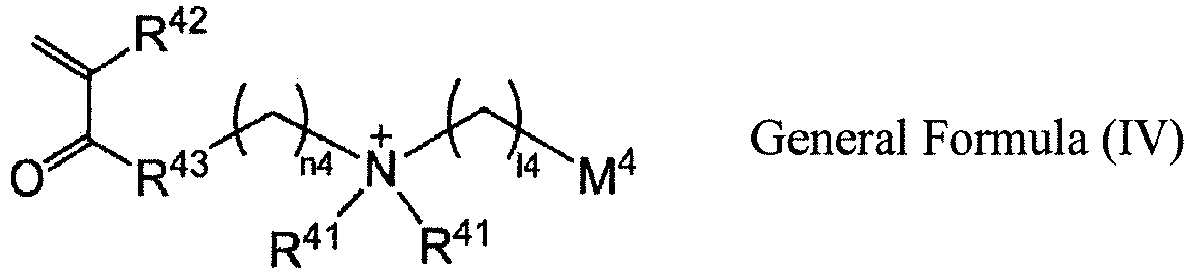
R42 represents a hydrogen atom or a methyl group, R43 represents -NH- or -O-, n4 represents an integer of 1 to 4, 14 represents an integer of 1 to 4, and M4 represents -SO3 - or -COO-,
R52 represents a hydrogen atom or a methyl group, n5 represents an integer of 1 to 4, L51 represents a linear or branched alkylene group having 3 or 4 carbon atoms, and M5 represents -SO3 - or -COO-,

- The antifouling film according to claim 8 or 9,
wherein the polymer (d) is a polymer obtained by adding a partial structure including a structural unit that is derived from at least one kind of betaine monomer selected from the group consisting of the compound represented by General Formula (IV) shown below and the compound represented by General Formula (V) shown below and the structural unit that is represented by General Formula (2) shown below to all the terminals represented by STAR mark of at least one kind of polyfunctional (meth)acrylamide compound selected from the group consisting of a compound represented by General Formula (1-2) shown below and a compound represented by General Formula (II-2) shown below,


R42 represents a hydrogen atom or a methyl group, R43 represents -NH- or -O-, n4 represents an integer of 1 to 4, 14 represents an integer of 1 to 4, and M4 represents -SO3 - or -COO-,
R52 represents a hydrogen atom or a methyl group, n5 represents an integer of 1 to 4, L51 represents a linear or branched alkylene group having 3 or 4 carbon atoms, and M5 represents -SO3 - or -COO-,

- A composition for forming an antifouling film, comprising:silica particles (a);a precursor of a polymer (b) having an acrylamide structure and at least one substituent selected from the group consisting of -SO3M and -COOM;a polymer (c) having an acrylamide structure and a hydrocarbon group containing 2 to 20 carbon atoms; anda polymerization initiator (e),wherein M represents a hydrogen atom or represents an atom or an atomic group that is able to become a cation by being dissociated.
- An antifouling film laminate comprising:a base material; andthe antifouling film according to any one of claims 1 to 10 on the base material.
- A method for manufacturing an antifouling film laminate, comprising:
applying the composition for forming an antifouling film according to claim 11 onto a base material. - The method for manufacturing an antifouling film laminate according to claim 13, further comprising:
applying energy to the composition for forming an antifouling film applied onto the base material.
Applications Claiming Priority (2)
| Application Number | Priority Date | Filing Date | Title |
|---|---|---|---|
| JP2015213337 | 2015-10-29 | ||
| PCT/JP2016/081022 WO2017073437A1 (en) | 2015-10-29 | 2016-10-19 | Antifouling film, antifouling film forming composition, antifouling film laminate, and production method for antifouling film laminate |
Publications (2)
| Publication Number | Publication Date |
|---|---|
| EP3369792A4 EP3369792A4 (en) | 2018-09-05 |
| EP3369792A1 true EP3369792A1 (en) | 2018-09-05 |
Family
ID=58631440
Family Applications (1)
| Application Number | Title | Priority Date | Filing Date |
|---|---|---|---|
| EP16859667.4A Withdrawn EP3369792A1 (en) | 2015-10-29 | 2016-10-19 | Antifouling film, antifouling film forming composition, antifouling film laminate, and production method for antifouling film laminate |
Country Status (5)
| Country | Link |
|---|---|
| US (1) | US20180215925A1 (en) |
| EP (1) | EP3369792A1 (en) |
| JP (1) | JP6526225B2 (en) |
| CN (1) | CN108350306A (en) |
| WO (1) | WO2017073437A1 (en) |
Families Citing this family (20)
| Publication number | Priority date | Publication date | Assignee | Title |
|---|---|---|---|---|
| US20180171207A1 (en) | 2015-06-17 | 2018-06-21 | Clariant International Ltd. | Water-Soluble Or Water-Swellable Polymers As Water Loss Reducers In Cement Slurries |
| US11384186B2 (en) | 2016-12-12 | 2022-07-12 | Clariant International Ltd | Polymer comprising certain level of bio-based carbon |
| ES2867526T3 (en) | 2016-12-12 | 2021-10-20 | Clariant Int Ltd | Use of a bio-derived polymer in a cosmetic, dermatological or pharmaceutical composition |
| EP3554644B1 (en) | 2016-12-15 | 2025-03-19 | Clariant International Ltd | Water-soluble and/or water-swellable hybrid polymer |
| ES3017507T3 (en) | 2016-12-15 | 2025-05-13 | Clariant Int Ltd | Water-soluble and/or water-swellable hybrid polymer |
| US11339241B2 (en) | 2016-12-15 | 2022-05-24 | Clariant International Ltd. | Water-soluble and/or water-swellable hybrid polymer |
| EP3554643B1 (en) | 2016-12-15 | 2025-03-19 | Clariant International Ltd | Water-soluble and/or water-swellable hybrid polymer |
| CN111164115B (en) | 2017-10-18 | 2021-11-23 | 富士胶片株式会社 | Curable composition, film, cured product, and medical member |
| EP3699210A4 (en) * | 2017-10-18 | 2020-09-23 | FUJIFILM Corporation | Curable composition, film, cured product, and medical member |
| JP6872629B2 (en) * | 2017-10-18 | 2021-05-19 | 富士フイルム株式会社 | Curable compositions, membranes, cured products, medical components |
| JP2021137964A (en) * | 2018-05-23 | 2021-09-16 | 富士フイルム株式会社 | Anti-fog laminate and composition for forming anti-fog laminate |
| KR20200035337A (en) * | 2018-09-26 | 2020-04-03 | 제이엔씨 주식회사 | Thermosetting compositions, cured film and color filter |
| WO2020066632A1 (en) * | 2018-09-27 | 2020-04-02 | 富士フイルム株式会社 | Method for producing cell culture apparatus and cell culture apparatus |
| JP7053433B2 (en) * | 2018-11-15 | 2022-04-12 | クラレノリタケデンタル株式会社 | Curable composition |
| CN112011204B (en) * | 2019-05-29 | 2021-11-19 | 华为技术有限公司 | Fingerprint-resistant coating, terminal and preparation method |
| JP7780069B2 (en) * | 2021-02-19 | 2025-12-04 | 藤倉化成株式会社 | Anti-fog paint |
| JP7715508B2 (en) * | 2021-02-24 | 2025-07-30 | 東京応化工業株式会社 | Polymerizable composition and hydrophilic treatment method |
| WO2023162789A1 (en) * | 2022-02-22 | 2023-08-31 | 富士フイルム株式会社 | Composition, film, method for producing film, optical filter, solid-state imaging element, image display device, and structure |
| WO2023176900A1 (en) * | 2022-03-16 | 2023-09-21 | Toto株式会社 | Member |
| JP2023180173A (en) * | 2022-06-08 | 2023-12-20 | 花王株式会社 | surface treatment composition |
Family Cites Families (12)
| Publication number | Priority date | Publication date | Assignee | Title |
|---|---|---|---|---|
| JPH1171538A (en) * | 1997-08-28 | 1999-03-16 | Taisei Corp | Antifouling paint |
| JP2001019874A (en) * | 1999-07-09 | 2001-01-23 | Nof Corp | Coating composition and cured product thereof |
| JP2005036177A (en) * | 2002-11-27 | 2005-02-10 | Hitachi Chem Co Ltd | Antifogging paint, antifogging molded article, and method for producing antifogging paint |
| US9533006B2 (en) * | 2007-11-19 | 2017-01-03 | University Of Washington | Marine coatings |
| US20090155335A1 (en) * | 2007-12-05 | 2009-06-18 | Semprus Biosciences Corp. | Non-leaching non-fouling antimicrobial coatings |
| JP5124496B2 (en) * | 2008-02-01 | 2013-01-23 | 富士フイルム株式会社 | Hydrophilic member |
| WO2009099126A1 (en) * | 2008-02-07 | 2009-08-13 | Riken | Photoreactive copolymer, surface modifier, hydrophilic treatment agent, adsorption inhibitor, substance-immobilizing agent, surface modification method, hydrophilization method, adsorption inhibition method, and substance-immobilizing method |
| JP2009243873A (en) * | 2008-03-12 | 2009-10-22 | Fujifilm Corp | Fin material, fin material for heat exchanger, and air conditioner |
| CN101735096B (en) * | 2009-12-22 | 2015-05-13 | 浙江大学 | Betaine ester derivative, organic silicon material, preparation method and application thereof |
| JP5690671B2 (en) * | 2010-06-30 | 2015-03-25 | 富士フイルム株式会社 | NOVEL POLYMERIZABLE COMPOSITION, POLYMERIZABLE COMPOUND USED FOR THE SAME, IMAGE-FORMING MATERIAL USING NOVEL POLYMERIZABLE COMPOSITION, AND lithographic printing plate precursor |
| CN104073114B (en) * | 2013-03-29 | 2016-04-13 | 中国科学院兰州化学物理研究所 | A kind of preparation method with anti-marine biological polution function surface material |
| CN104327663A (en) * | 2014-11-24 | 2015-02-04 | 山东交通学院 | Antifouling and antibacterial coating paint and applications thereof |
-
2016
- 2016-10-19 WO PCT/JP2016/081022 patent/WO2017073437A1/en not_active Ceased
- 2016-10-19 JP JP2017547754A patent/JP6526225B2/en not_active Expired - Fee Related
- 2016-10-19 EP EP16859667.4A patent/EP3369792A1/en not_active Withdrawn
- 2016-10-19 CN CN201680061321.XA patent/CN108350306A/en active Pending
-
2018
- 2018-03-28 US US15/937,886 patent/US20180215925A1/en not_active Abandoned
Also Published As
| Publication number | Publication date |
|---|---|
| CN108350306A (en) | 2018-07-31 |
| EP3369792A4 (en) | 2018-09-05 |
| JP6526225B2 (en) | 2019-06-05 |
| JPWO2017073437A1 (en) | 2018-08-30 |
| WO2017073437A1 (en) | 2017-05-04 |
| US20180215925A1 (en) | 2018-08-02 |
Similar Documents
| Publication | Publication Date | Title |
|---|---|---|
| EP3369792A1 (en) | Antifouling film, antifouling film forming composition, antifouling film laminate, and production method for antifouling film laminate | |
| TWI704202B (en) | Adhesive composition and surface-protective film | |
| JP5981641B2 (en) | Copolymer and hydrophilic material comprising the same | |
| JP6434519B2 (en) | Hydrophilic material comprising sulfonic acid copolymer and amino resin | |
| KR101300382B1 (en) | Hydrophilic film | |
| WO2017188332A1 (en) | Coating | |
| CA2650406A1 (en) | Active energy ray-curable coating composition and molded article having cured coating film of the composition | |
| JPWO2016068103A1 (en) | Water and oil repellent coating composition | |
| US5958598A (en) | Radiation curable hardcoat compositions possessing anti-fog properties | |
| WO2014168123A1 (en) | Film comprising copolymer or composition | |
| KR20190003632A (en) | Composition | |
| EP3351604B1 (en) | Film for plastic restoration, surface-protected article, and process for producing film for plastic restoration | |
| KR20150102860A (en) | Silsesquioxane composite polymer and method for manufacturing thereof | |
| KR102342176B1 (en) | Compounds, and Compositions Comprising Compounds | |
| KR20190122656A (en) | Member for photosensitive siloxane resin composition, cured film, and touch panel | |
| KR101828112B1 (en) | Reaction product of a cyclic urea and a multifunctional aldehyde | |
| TW201617421A (en) | Layered body with antifouling layer, protective material for security camera, and security camera | |
| JP2021147399A (en) | Antifogging agent composition, antifogging article having antifogging film formed from said composition | |
| JP7111039B2 (en) | Antifogging agent composition and antifogging article | |
| CN116457429B (en) | Anti-fog paint | |
| KR20150102864A (en) | Silsesquioxane composite polymer and method for manufacturing thereof | |
| US20260035521A1 (en) | Organosilane coating compositions | |
| TW202611014A (en) | Methods for manufacturing adhesives, adhesive compositions, and compounds. | |
| JP2024140073A (en) | Anti-fog agent composition and anti-fog article having anti-fog coating film | |
| TW202511303A (en) | Hardening composition, hardened product thereof, and article |
Legal Events
| Date | Code | Title | Description |
|---|---|---|---|
| PUAI | Public reference made under article 153(3) epc to a published international application that has entered the european phase |
Free format text: ORIGINAL CODE: 0009012 |
|
| 17P | Request for examination filed |
Effective date: 20180425 |
|
| A4 | Supplementary search report drawn up and despatched |
Effective date: 20180803 |
|
| AK | Designated contracting states |
Kind code of ref document: A1 Designated state(s): AL AT BE BG CH CY CZ DE DK EE ES FI FR GB GR HR HU IE IS IT LI LT LU LV MC MK MT NL NO PL PT RO RS SE SI SK SM TR |
|
| AX | Request for extension of the european patent |
Extension state: BA ME |
|
| DAV | Request for validation of the european patent (deleted) | ||
| DAX | Request for extension of the european patent (deleted) | ||
| STAA | Information on the status of an ep patent application or granted ep patent |
Free format text: STATUS: THE APPLICATION HAS BEEN WITHDRAWN |
|
| 18W | Application withdrawn |
Effective date: 20191220 |