EP3368637B1 - Liquid-crystal medium - Google Patents
Liquid-crystal medium Download PDFInfo
- Publication number
- EP3368637B1 EP3368637B1 EP16781676.8A EP16781676A EP3368637B1 EP 3368637 B1 EP3368637 B1 EP 3368637B1 EP 16781676 A EP16781676 A EP 16781676A EP 3368637 B1 EP3368637 B1 EP 3368637B1
- Authority
- EP
- European Patent Office
- Prior art keywords
- atoms
- compounds
- polymerisable
- formula
- component
- Prior art date
- Legal status (The legal status is an assumption and is not a legal conclusion. Google has not performed a legal analysis and makes no representation as to the accuracy of the status listed.)
- Not-in-force
Links
- 239000004973 liquid crystal related substance Substances 0.000 title claims description 392
- 150000001875 compounds Chemical class 0.000 claims description 353
- 125000004432 carbon atom Chemical group C* 0.000 claims description 139
- 125000000217 alkyl group Chemical group 0.000 claims description 97
- 125000000325 methylidene group Chemical group [H]C([H])=* 0.000 claims description 95
- 229910052731 fluorine Inorganic materials 0.000 claims description 73
- 125000003342 alkenyl group Chemical group 0.000 claims description 68
- 229910052801 chlorine Inorganic materials 0.000 claims description 49
- 229910052739 hydrogen Inorganic materials 0.000 claims description 39
- 125000002496 methyl group Chemical group [H]C([H])([H])* 0.000 claims description 36
- 125000003545 alkoxy group Chemical group 0.000 claims description 34
- 125000004430 oxygen atom Chemical group O* 0.000 claims description 28
- 125000003118 aryl group Chemical group 0.000 claims description 25
- 238000000034 method Methods 0.000 claims description 24
- 125000001072 heteroaryl group Chemical group 0.000 claims description 23
- 125000006413 ring segment Chemical group 0.000 claims description 23
- 125000003367 polycyclic group Chemical group 0.000 claims description 21
- 150000003254 radicals Chemical class 0.000 claims description 20
- 125000000876 trifluoromethoxy group Chemical group FC(F)(F)O* 0.000 claims description 18
- QUPDWYMUPZLYJZ-UHFFFAOYSA-N ethyl Chemical compound C[CH2] QUPDWYMUPZLYJZ-UHFFFAOYSA-N 0.000 claims description 16
- 125000002023 trifluoromethyl group Chemical group FC(F)(F)* 0.000 claims description 16
- 230000008569 process Effects 0.000 claims description 15
- 125000006850 spacer group Chemical group 0.000 claims description 15
- 125000003302 alkenyloxy group Chemical group 0.000 claims description 13
- 238000004519 manufacturing process Methods 0.000 claims description 13
- 125000002950 monocyclic group Chemical group 0.000 claims description 13
- 125000000753 cycloalkyl group Chemical group 0.000 claims description 10
- 125000004400 (C1-C12) alkyl group Chemical group 0.000 claims description 9
- 239000000654 additive Substances 0.000 claims description 9
- 125000004435 hydrogen atom Chemical group [H]* 0.000 claims description 9
- 125000004434 sulfur atom Chemical group 0.000 claims description 9
- 238000009281 ultraviolet germicidal irradiation Methods 0.000 claims description 9
- 125000000391 vinyl group Chemical group [H]C([*])=C([H])[H] 0.000 claims description 9
- 125000004183 alkoxy alkyl group Chemical group 0.000 claims description 8
- VUWZPRWSIVNGKG-UHFFFAOYSA-N fluoromethane Chemical compound F[CH2] VUWZPRWSIVNGKG-UHFFFAOYSA-N 0.000 claims description 7
- JNCMHMUGTWEVOZ-UHFFFAOYSA-N F[CH]F Chemical compound F[CH]F JNCMHMUGTWEVOZ-UHFFFAOYSA-N 0.000 claims description 6
- 125000004122 cyclic group Chemical group 0.000 claims description 6
- 125000000623 heterocyclic group Chemical group 0.000 claims description 6
- 238000002156 mixing Methods 0.000 claims description 6
- 125000003107 substituted aryl group Chemical group 0.000 claims description 6
- 125000002723 alicyclic group Chemical group 0.000 claims description 5
- 125000000596 cyclohexenyl group Chemical group C1(=CCCCC1)* 0.000 claims description 5
- 125000004956 cyclohexylene group Chemical group 0.000 claims description 5
- 229910052736 halogen Inorganic materials 0.000 claims description 5
- 125000000449 nitro group Chemical group [O-][N+](*)=O 0.000 claims description 4
- 125000001181 organosilyl group Chemical group [SiH3]* 0.000 claims description 4
- 125000006165 cyclic alkyl group Chemical group 0.000 claims description 3
- 125000001183 hydrocarbyl group Chemical group 0.000 claims 7
- 125000005843 halogen group Chemical group 0.000 claims 1
- 239000000203 mixture Substances 0.000 description 131
- -1 photoinitiators Substances 0.000 description 118
- 239000000758 substrate Substances 0.000 description 64
- 229920000642 polymer Polymers 0.000 description 59
- 0 CCC1([C@@]2C1CCC2)*1CCC1 Chemical compound CCC1([C@@]2C1CCC2)*1CCC1 0.000 description 57
- 150000002430 hydrocarbons Chemical group 0.000 description 29
- 239000000178 monomer Substances 0.000 description 21
- 230000015572 biosynthetic process Effects 0.000 description 14
- NNBZCPXTIHJBJL-UHFFFAOYSA-N decalin Chemical compound C1CCCC2CCCCC21 NNBZCPXTIHJBJL-UHFFFAOYSA-N 0.000 description 14
- CERQOIWHTDAKMF-UHFFFAOYSA-M Methacrylate Chemical compound CC(=C)C([O-])=O CERQOIWHTDAKMF-UHFFFAOYSA-M 0.000 description 12
- 125000004429 atom Chemical group 0.000 description 11
- 238000006116 polymerization reaction Methods 0.000 description 11
- 229910052799 carbon Inorganic materials 0.000 description 10
- 239000002019 doping agent Substances 0.000 description 10
- 239000003999 initiator Substances 0.000 description 10
- 230000005855 radiation Effects 0.000 description 10
- 239000003381 stabilizer Substances 0.000 description 10
- OKTJSMMVPCPJKN-UHFFFAOYSA-N Carbon Chemical compound [C] OKTJSMMVPCPJKN-UHFFFAOYSA-N 0.000 description 9
- 239000011521 glass Substances 0.000 description 9
- 239000000463 material Substances 0.000 description 9
- 125000004123 n-propyl group Chemical group [H]C([H])([H])C([H])([H])C([H])([H])* 0.000 description 9
- 229910052760 oxygen Inorganic materials 0.000 description 9
- NIXOWILDQLNWCW-UHFFFAOYSA-M Acrylate Chemical compound [O-]C(=O)C=C NIXOWILDQLNWCW-UHFFFAOYSA-M 0.000 description 8
- 125000004093 cyano group Chemical group *C#N 0.000 description 8
- 125000001495 ethyl group Chemical group [H]C([H])([H])C([H])([H])* 0.000 description 8
- 229910052740 iodine Inorganic materials 0.000 description 8
- 229910052757 nitrogen Inorganic materials 0.000 description 8
- 230000003287 optical effect Effects 0.000 description 7
- 238000005191 phase separation Methods 0.000 description 7
- 229910052698 phosphorus Inorganic materials 0.000 description 7
- 230000004044 response Effects 0.000 description 7
- 229910052717 sulfur Inorganic materials 0.000 description 7
- 239000011203 carbon fibre reinforced carbon Substances 0.000 description 6
- 230000007547 defect Effects 0.000 description 6
- 125000001997 phenyl group Chemical group [H]C1=C([H])C([H])=C(*)C([H])=C1[H] 0.000 description 6
- 239000004033 plastic Substances 0.000 description 6
- 229920003023 plastic Polymers 0.000 description 6
- 230000010287 polarization Effects 0.000 description 6
- WROUWQQRXUBECT-UHFFFAOYSA-N 2-ethylacrylic acid Chemical compound CCC(=C)C(O)=O WROUWQQRXUBECT-UHFFFAOYSA-N 0.000 description 5
- 239000004642 Polyimide Substances 0.000 description 5
- 229910052794 bromium Inorganic materials 0.000 description 5
- 125000004786 difluoromethoxy group Chemical group [H]C(F)(F)O* 0.000 description 5
- ZUOUZKKEUPVFJK-UHFFFAOYSA-N diphenyl Chemical compound C1=CC=CC=C1C1=CC=CC=C1 ZUOUZKKEUPVFJK-UHFFFAOYSA-N 0.000 description 5
- 125000005842 heteroatom Chemical group 0.000 description 5
- 125000000956 methoxy group Chemical group [H]C([H])([H])O* 0.000 description 5
- 125000004108 n-butyl group Chemical group [H]C([H])([H])C([H])([H])C([H])([H])C([H])([H])* 0.000 description 5
- 229920001721 polyimide Polymers 0.000 description 5
- 230000035882 stress Effects 0.000 description 5
- 125000001424 substituent group Chemical group 0.000 description 5
- 125000001140 1,4-phenylene group Chemical group [H]C1=C([H])C([*:2])=C([H])C([H])=C1[*:1] 0.000 description 4
- ORILYTVJVMAKLC-UHFFFAOYSA-N adamantane Chemical compound C1C(C2)CC3CC1CC2C3 ORILYTVJVMAKLC-UHFFFAOYSA-N 0.000 description 4
- MWPLVEDNUUSJAV-UHFFFAOYSA-N anthracene Chemical compound C1=CC=CC2=CC3=CC=CC=C3C=C21 MWPLVEDNUUSJAV-UHFFFAOYSA-N 0.000 description 4
- 230000008901 benefit Effects 0.000 description 4
- DIOQZVSQGTUSAI-UHFFFAOYSA-N decane Chemical compound CCCCCCCCCC DIOQZVSQGTUSAI-UHFFFAOYSA-N 0.000 description 4
- 125000002704 decyl group Chemical group [H]C([H])([H])C([H])([H])C([H])([H])C([H])([H])C([H])([H])C([H])([H])C([H])([H])C([H])([H])C([H])([H])C([H])([H])* 0.000 description 4
- 238000011049 filling Methods 0.000 description 4
- 230000004927 fusion Effects 0.000 description 4
- 229910052732 germanium Inorganic materials 0.000 description 4
- 150000002367 halogens Chemical class 0.000 description 4
- 239000011159 matrix material Substances 0.000 description 4
- 238000001000 micrograph Methods 0.000 description 4
- 229910052711 selenium Inorganic materials 0.000 description 4
- 229910052710 silicon Inorganic materials 0.000 description 4
- 239000000126 substance Substances 0.000 description 4
- 229910052714 tellurium Inorganic materials 0.000 description 4
- 125000006168 tricyclic group Chemical group 0.000 description 4
- 125000004169 (C1-C6) alkyl group Chemical group 0.000 description 3
- YJTKZCDBKVTVBY-UHFFFAOYSA-N 1,3-Diphenylbenzene Chemical group C1=CC=CC=C1C1=CC=CC(C=2C=CC=CC=2)=C1 YJTKZCDBKVTVBY-UHFFFAOYSA-N 0.000 description 3
- YLQBMQCUIZJEEH-UHFFFAOYSA-N Furan Chemical compound C=1C=COC=1 YLQBMQCUIZJEEH-UHFFFAOYSA-N 0.000 description 3
- OKKJLVBELUTLKV-UHFFFAOYSA-N Methanol Chemical compound OC OKKJLVBELUTLKV-UHFFFAOYSA-N 0.000 description 3
- RWRDLPDLKQPQOW-UHFFFAOYSA-N Pyrrolidine Chemical compound C1CCNC1 RWRDLPDLKQPQOW-UHFFFAOYSA-N 0.000 description 3
- OCBFFGCSTGGPSQ-UHFFFAOYSA-N [CH2]CC Chemical compound [CH2]CC OCBFFGCSTGGPSQ-UHFFFAOYSA-N 0.000 description 3
- 125000005073 adamantyl group Chemical group C12(CC3CC(CC(C1)C3)C2)* 0.000 description 3
- 125000002947 alkylene group Chemical group 0.000 description 3
- 125000000304 alkynyl group Chemical group 0.000 description 3
- 235000010290 biphenyl Nutrition 0.000 description 3
- 230000008859 change Effects 0.000 description 3
- 239000011248 coating agent Substances 0.000 description 3
- 238000000576 coating method Methods 0.000 description 3
- 238000011109 contamination Methods 0.000 description 3
- HGCIXCUEYOPUTN-UHFFFAOYSA-N cyclohexene Chemical compound C1CCC=CC1 HGCIXCUEYOPUTN-UHFFFAOYSA-N 0.000 description 3
- 125000000640 cyclooctyl group Chemical group [H]C1([H])C([H])([H])C([H])([H])C([H])([H])C([H])(*)C([H])([H])C([H])([H])C1([H])[H] 0.000 description 3
- DMEGYFMYUHOHGS-UHFFFAOYSA-N heptamethylene Natural products C1CCCCCC1 DMEGYFMYUHOHGS-UHFFFAOYSA-N 0.000 description 3
- RAXXELZNTBOGNW-UHFFFAOYSA-N imidazole Natural products C1=CNC=N1 RAXXELZNTBOGNW-UHFFFAOYSA-N 0.000 description 3
- 239000003112 inhibitor Substances 0.000 description 3
- 125000001624 naphthyl group Chemical group 0.000 description 3
- 125000002868 norbornyl group Chemical group C12(CCC(CC1)C2)* 0.000 description 3
- AHHWIHXENZJRFG-UHFFFAOYSA-N oxetane Chemical compound C1COC1 AHHWIHXENZJRFG-UHFFFAOYSA-N 0.000 description 3
- 239000002245 particle Substances 0.000 description 3
- 238000002360 preparation method Methods 0.000 description 3
- 229920006395 saturated elastomer Polymers 0.000 description 3
- 150000003384 small molecules Chemical class 0.000 description 3
- 239000002904 solvent Substances 0.000 description 3
- 125000000999 tert-butyl group Chemical group [H]C([H])([H])C(*)(C([H])([H])[H])C([H])([H])[H] 0.000 description 3
- 125000006169 tetracyclic group Chemical group 0.000 description 3
- PXXNTAGJWPJAGM-UHFFFAOYSA-N vertaline Natural products C1C2C=3C=C(OC)C(OC)=CC=3OC(C=C3)=CC=C3CCC(=O)OC1CC1N2CCCC1 PXXNTAGJWPJAGM-UHFFFAOYSA-N 0.000 description 3
- WQADWIOXOXRPLN-UHFFFAOYSA-N 1,3-dithiane Chemical compound C1CSCSC1 WQADWIOXOXRPLN-UHFFFAOYSA-N 0.000 description 2
- YBYIRNPNPLQARY-UHFFFAOYSA-N 1H-indene Chemical compound C1=CC=C2CC=CC2=C1 YBYIRNPNPLQARY-UHFFFAOYSA-N 0.000 description 2
- KWVGIHKZDCUPEU-UHFFFAOYSA-N 2,2-dimethoxy-2-phenylacetophenone Chemical compound C=1C=CC=CC=1C(OC)(OC)C(=O)C1=CC=CC=C1 KWVGIHKZDCUPEU-UHFFFAOYSA-N 0.000 description 2
- KDCGOANMDULRCW-UHFFFAOYSA-N 7H-purine Chemical compound N1=CNC2=NC=NC2=C1 KDCGOANMDULRCW-UHFFFAOYSA-N 0.000 description 2
- XXPBFNVKTVJZKF-UHFFFAOYSA-N 9,10-dihydrophenanthrene Chemical compound C1=CC=C2CCC3=CC=CC=C3C2=C1 XXPBFNVKTVJZKF-UHFFFAOYSA-N 0.000 description 2
- CSCPPACGZOOCGX-UHFFFAOYSA-N Acetone Chemical compound CC(C)=O CSCPPACGZOOCGX-UHFFFAOYSA-N 0.000 description 2
- 239000004215 Carbon black (E152) Substances 0.000 description 2
- HEDRZPFGACZZDS-UHFFFAOYSA-N Chloroform Chemical compound ClC(Cl)Cl HEDRZPFGACZZDS-UHFFFAOYSA-N 0.000 description 2
- XDTMQSROBMDMFD-UHFFFAOYSA-N Cyclohexane Chemical compound C1CCCCC1 XDTMQSROBMDMFD-UHFFFAOYSA-N 0.000 description 2
- RGSFGYAAUTVSQA-UHFFFAOYSA-N Cyclopentane Chemical compound C1CCCC1 RGSFGYAAUTVSQA-UHFFFAOYSA-N 0.000 description 2
- LFQSCWFLJHTTHZ-UHFFFAOYSA-N Ethanol Chemical compound CCO LFQSCWFLJHTTHZ-UHFFFAOYSA-N 0.000 description 2
- PXGOKWXKJXAPGV-UHFFFAOYSA-N Fluorine Chemical group FF PXGOKWXKJXAPGV-UHFFFAOYSA-N 0.000 description 2
- SIKJAQJRHWYJAI-UHFFFAOYSA-N Indole Chemical compound C1=CC=C2NC=CC2=C1 SIKJAQJRHWYJAI-UHFFFAOYSA-N 0.000 description 2
- JCXJVPUVTGWSNB-UHFFFAOYSA-N Nitrogen dioxide Chemical compound O=[N]=O JCXJVPUVTGWSNB-UHFFFAOYSA-N 0.000 description 2
- PCNDJXKNXGMECE-UHFFFAOYSA-N Phenazine Natural products C1=CC=CC2=NC3=CC=CC=C3N=C21 PCNDJXKNXGMECE-UHFFFAOYSA-N 0.000 description 2
- NQRYJNQNLNOLGT-UHFFFAOYSA-N Piperidine Chemical compound C1CCNCC1 NQRYJNQNLNOLGT-UHFFFAOYSA-N 0.000 description 2
- 239000004696 Poly ether ether ketone Substances 0.000 description 2
- KYQCOXFCLRTKLS-UHFFFAOYSA-N Pyrazine Chemical compound C1=CN=CC=N1 KYQCOXFCLRTKLS-UHFFFAOYSA-N 0.000 description 2
- JUJWROOIHBZHMG-UHFFFAOYSA-N Pyridine Chemical compound C1=CC=NC=C1 JUJWROOIHBZHMG-UHFFFAOYSA-N 0.000 description 2
- KAESVJOAVNADME-UHFFFAOYSA-N Pyrrole Chemical compound C=1C=CNC=1 KAESVJOAVNADME-UHFFFAOYSA-N 0.000 description 2
- SMWDFEZZVXVKRB-UHFFFAOYSA-N Quinoline Chemical compound N1=CC=CC2=CC=CC=C21 SMWDFEZZVXVKRB-UHFFFAOYSA-N 0.000 description 2
- 239000004990 Smectic liquid crystal Substances 0.000 description 2
- WYURNTSHIVDZCO-UHFFFAOYSA-N Tetrahydrofuran Chemical compound C1CCOC1 WYURNTSHIVDZCO-UHFFFAOYSA-N 0.000 description 2
- YTPLMLYBLZKORZ-UHFFFAOYSA-N Thiophene Chemical compound C=1C=CSC=1 YTPLMLYBLZKORZ-UHFFFAOYSA-N 0.000 description 2
- 238000010521 absorption reaction Methods 0.000 description 2
- DZBUGLKDJFMEHC-UHFFFAOYSA-N acridine Chemical compound C1=CC=CC2=CC3=CC=CC=C3N=C21 DZBUGLKDJFMEHC-UHFFFAOYSA-N 0.000 description 2
- 239000000853 adhesive Substances 0.000 description 2
- 125000004453 alkoxycarbonyl group Chemical group 0.000 description 2
- 125000005194 alkoxycarbonyloxy group Chemical group 0.000 description 2
- 125000002877 alkyl aryl group Chemical group 0.000 description 2
- 125000005248 alkyl aryloxy group Chemical group 0.000 description 2
- 125000004448 alkyl carbonyl group Chemical group 0.000 description 2
- 125000005196 alkyl carbonyloxy group Chemical group 0.000 description 2
- 229910052785 arsenic Inorganic materials 0.000 description 2
- 125000003710 aryl alkyl group Chemical group 0.000 description 2
- 125000002102 aryl alkyloxo group Chemical group 0.000 description 2
- 125000004104 aryloxy group Chemical group 0.000 description 2
- IOJUPLGTWVMSFF-UHFFFAOYSA-N benzothiazole Chemical compound C1=CC=C2SC=NC2=C1 IOJUPLGTWVMSFF-UHFFFAOYSA-N 0.000 description 2
- 230000005540 biological transmission Effects 0.000 description 2
- 239000004305 biphenyl Substances 0.000 description 2
- 229910052796 boron Inorganic materials 0.000 description 2
- 125000004369 butenyl group Chemical group C(=CCC)* 0.000 description 2
- 125000000484 butyl group Chemical group [H]C([*])([H])C([H])([H])C([H])([H])C([H])([H])[H] 0.000 description 2
- 125000002915 carbonyl group Chemical group [*:2]C([*:1])=O 0.000 description 2
- 238000012512 characterization method Methods 0.000 description 2
- WDECIBYCCFPHNR-UHFFFAOYSA-N chrysene Chemical compound C1=CC=CC2=CC=C3C4=CC=CC=C4C=CC3=C21 WDECIBYCCFPHNR-UHFFFAOYSA-N 0.000 description 2
- TXCDCPKCNAJMEE-UHFFFAOYSA-N dibenzofuran Chemical compound C1=CC=C2C3=CC=CC=C3OC2=C1 TXCDCPKCNAJMEE-UHFFFAOYSA-N 0.000 description 2
- IYYZUPMFVPLQIF-UHFFFAOYSA-N dibenzothiophene Chemical compound C1=CC=C2C3=CC=CC=C3SC2=C1 IYYZUPMFVPLQIF-UHFFFAOYSA-N 0.000 description 2
- 239000003085 diluting agent Substances 0.000 description 2
- 239000000975 dye Substances 0.000 description 2
- 238000000635 electron micrograph Methods 0.000 description 2
- 238000000295 emission spectrum Methods 0.000 description 2
- 238000005516 engineering process Methods 0.000 description 2
- 125000002534 ethynyl group Chemical group [H]C#C* 0.000 description 2
- 229920002457 flexible plastic Polymers 0.000 description 2
- 239000011737 fluorine Chemical group 0.000 description 2
- 125000000524 functional group Chemical group 0.000 description 2
- 238000010438 heat treatment Methods 0.000 description 2
- 125000005553 heteroaryloxy group Chemical group 0.000 description 2
- 125000006038 hexenyl group Chemical group 0.000 description 2
- 229930195733 hydrocarbon Natural products 0.000 description 2
- PQNFLJBBNBOBRQ-UHFFFAOYSA-N indane Chemical compound C1=CC=C2CCCC2=C1 PQNFLJBBNBOBRQ-UHFFFAOYSA-N 0.000 description 2
- 125000001449 isopropyl group Chemical group [H]C([H])([H])C([H])(*)C([H])([H])[H] 0.000 description 2
- AWJUIBRHMBBTKR-UHFFFAOYSA-N isoquinoline Chemical compound C1=NC=CC2=CC=CC=C21 AWJUIBRHMBBTKR-UHFFFAOYSA-N 0.000 description 2
- CTAPFRYPJLPFDF-UHFFFAOYSA-N isoxazole Chemical compound C=1C=NOC=1 CTAPFRYPJLPFDF-UHFFFAOYSA-N 0.000 description 2
- 238000002844 melting Methods 0.000 description 2
- 230000008018 melting Effects 0.000 description 2
- 125000000740 n-pentyl group Chemical group [H]C([H])([H])C([H])([H])C([H])([H])C([H])([H])C([H])([H])* 0.000 description 2
- 239000002105 nanoparticle Substances 0.000 description 2
- UMRZSTCPUPJPOJ-KNVOCYPGSA-N norbornane Chemical compound C1C[C@H]2CC[C@@H]1C2 UMRZSTCPUPJPOJ-KNVOCYPGSA-N 0.000 description 2
- 125000000962 organic group Chemical group 0.000 description 2
- 125000002255 pentenyl group Chemical group C(=CCCC)* 0.000 description 2
- 125000001147 pentyl group Chemical group C(CCCC)* 0.000 description 2
- YNPNZTXNASCQKK-UHFFFAOYSA-N phenanthrene Chemical compound C1=CC=C2C3=CC=CC=C3C=CC2=C1 YNPNZTXNASCQKK-UHFFFAOYSA-N 0.000 description 2
- RDOWQLZANAYVLL-UHFFFAOYSA-N phenanthridine Chemical compound C1=CC=C2C3=CC=CC=C3C=NC2=C1 RDOWQLZANAYVLL-UHFFFAOYSA-N 0.000 description 2
- 230000000704 physical effect Effects 0.000 description 2
- 229920001230 polyarylate Polymers 0.000 description 2
- 229920002530 polyetherether ketone Polymers 0.000 description 2
- 239000002243 precursor Substances 0.000 description 2
- 125000006238 prop-1-en-1-yl group Chemical group [H]\C(*)=C(/[H])C([H])([H])[H] 0.000 description 2
- 125000004368 propenyl group Chemical group C(=CC)* 0.000 description 2
- 125000001436 propyl group Chemical group [H]C([*])([H])C([H])([H])C([H])([H])[H] 0.000 description 2
- BBEAQIROQSPTKN-UHFFFAOYSA-N pyrene Chemical compound C1=CC=C2C=CC3=CC=CC4=CC=C1C2=C43 BBEAQIROQSPTKN-UHFFFAOYSA-N 0.000 description 2
- XSCHRSMBECNVNS-UHFFFAOYSA-N quinoxaline Chemical compound N1=CC=NC2=CC=CC=C21 XSCHRSMBECNVNS-UHFFFAOYSA-N 0.000 description 2
- 150000003839 salts Chemical class 0.000 description 2
- CTDQAGUNKPRERK-UHFFFAOYSA-N spirodecane Chemical compound C1CCCC21CCCCC2 CTDQAGUNKPRERK-UHFFFAOYSA-N 0.000 description 2
- 150000001911 terphenyls Chemical class 0.000 description 2
- 230000008646 thermal stress Effects 0.000 description 2
- 125000005407 trans-1,4-cyclohexylene group Chemical group [H]C1([H])C([H])([H])[C@]([H])([*:2])C([H])([H])C([H])([H])[C@@]1([H])[*:1] 0.000 description 2
- 230000007704 transition Effects 0.000 description 2
- QNODIIQQMGDSEF-UHFFFAOYSA-N (1-hydroxycyclohexyl)-phenylmethanone Chemical compound C=1C=CC=CC=1C(=O)C1(O)CCCCC1 QNODIIQQMGDSEF-UHFFFAOYSA-N 0.000 description 1
- 125000003837 (C1-C20) alkyl group Chemical group 0.000 description 1
- 125000004191 (C1-C6) alkoxy group Chemical group 0.000 description 1
- 125000006710 (C2-C12) alkenyl group Chemical group 0.000 description 1
- 125000006711 (C2-C12) alkynyl group Chemical group 0.000 description 1
- ICPSWZFVWAPUKF-UHFFFAOYSA-N 1,1'-spirobi[fluorene] Chemical compound C1=CC=C2C=C3C4(C=5C(C6=CC=CC=C6C=5)=CC=C4)C=CC=C3C2=C1 ICPSWZFVWAPUKF-UHFFFAOYSA-N 0.000 description 1
- ZFXBERJDEUDDMX-UHFFFAOYSA-N 1,2,3,5-tetrazine Chemical compound C1=NC=NN=N1 ZFXBERJDEUDDMX-UHFFFAOYSA-N 0.000 description 1
- UGUHFDPGDQDVGX-UHFFFAOYSA-N 1,2,3-thiadiazole Chemical compound C1=CSN=N1 UGUHFDPGDQDVGX-UHFFFAOYSA-N 0.000 description 1
- JYEUMXHLPRZUAT-UHFFFAOYSA-N 1,2,3-triazine Chemical compound C1=CN=NN=C1 JYEUMXHLPRZUAT-UHFFFAOYSA-N 0.000 description 1
- HTJMXYRLEDBSLT-UHFFFAOYSA-N 1,2,4,5-tetrazine Chemical compound C1=NN=CN=N1 HTJMXYRLEDBSLT-UHFFFAOYSA-N 0.000 description 1
- BBVIDBNAYOIXOE-UHFFFAOYSA-N 1,2,4-oxadiazole Chemical compound C=1N=CON=1 BBVIDBNAYOIXOE-UHFFFAOYSA-N 0.000 description 1
- YGTAZGSLCXNBQL-UHFFFAOYSA-N 1,2,4-thiadiazole Chemical compound C=1N=CSN=1 YGTAZGSLCXNBQL-UHFFFAOYSA-N 0.000 description 1
- FYADHXFMURLYQI-UHFFFAOYSA-N 1,2,4-triazine Chemical compound C1=CN=NC=N1 FYADHXFMURLYQI-UHFFFAOYSA-N 0.000 description 1
- UDGKZGLPXCRRAM-UHFFFAOYSA-N 1,2,5-thiadiazole Chemical compound C=1C=NSN=1 UDGKZGLPXCRRAM-UHFFFAOYSA-N 0.000 description 1
- UUSUFQUCLACDTA-UHFFFAOYSA-N 1,2-dihydropyrene Chemical compound C1=CC=C2C=CC3=CCCC4=CC=C1C2=C43 UUSUFQUCLACDTA-UHFFFAOYSA-N 0.000 description 1
- FKASFBLJDCHBNZ-UHFFFAOYSA-N 1,3,4-oxadiazole Chemical compound C1=NN=CO1 FKASFBLJDCHBNZ-UHFFFAOYSA-N 0.000 description 1
- MBIZXFATKUQOOA-UHFFFAOYSA-N 1,3,4-thiadiazole Chemical compound C1=NN=CS1 MBIZXFATKUQOOA-UHFFFAOYSA-N 0.000 description 1
- JIHQDMXYYFUGFV-UHFFFAOYSA-N 1,3,5-triazine Chemical compound C1=NC=NC=N1 JIHQDMXYYFUGFV-UHFFFAOYSA-N 0.000 description 1
- BCMCBBGGLRIHSE-UHFFFAOYSA-N 1,3-benzoxazole Chemical compound C1=CC=C2OC=NC2=C1 BCMCBBGGLRIHSE-UHFFFAOYSA-N 0.000 description 1
- VDFVNEFVBPFDSB-UHFFFAOYSA-N 1,3-dioxane Chemical compound C1COCOC1 VDFVNEFVBPFDSB-UHFFFAOYSA-N 0.000 description 1
- FLBAYUMRQUHISI-UHFFFAOYSA-N 1,8-naphthyridine Chemical compound N1=CC=CC2=CC=CN=C21 FLBAYUMRQUHISI-UHFFFAOYSA-N 0.000 description 1
- WPWHSFAFEBZWBB-UHFFFAOYSA-N 1-butyl radical Chemical compound [CH2]CCC WPWHSFAFEBZWBB-UHFFFAOYSA-N 0.000 description 1
- WJFKNYWRSNBZNX-UHFFFAOYSA-N 10H-phenothiazine Chemical compound C1=CC=C2NC3=CC=CC=C3SC2=C1 WJFKNYWRSNBZNX-UHFFFAOYSA-N 0.000 description 1
- TZMSYXZUNZXBOL-UHFFFAOYSA-N 10H-phenoxazine Chemical compound C1=CC=C2NC3=CC=CC=C3OC2=C1 TZMSYXZUNZXBOL-UHFFFAOYSA-N 0.000 description 1
- QWENRTYMTSOGBR-UHFFFAOYSA-N 1H-1,2,3-Triazole Chemical compound C=1C=NNN=1 QWENRTYMTSOGBR-UHFFFAOYSA-N 0.000 description 1
- HYZJCKYKOHLVJF-UHFFFAOYSA-N 1H-benzimidazole Chemical compound C1=CC=C2NC=NC2=C1 HYZJCKYKOHLVJF-UHFFFAOYSA-N 0.000 description 1
- BAXOFTOLAUCFNW-UHFFFAOYSA-N 1H-indazole Chemical compound C1=CC=C2C=NNC2=C1 BAXOFTOLAUCFNW-UHFFFAOYSA-N 0.000 description 1
- USYCQABRSUEURP-UHFFFAOYSA-N 1h-benzo[f]benzimidazole Chemical compound C1=CC=C2C=C(NC=N3)C3=CC2=C1 USYCQABRSUEURP-UHFFFAOYSA-N 0.000 description 1
- 125000004206 2,2,2-trifluoroethyl group Chemical group [H]C([H])(*)C(F)(F)F 0.000 description 1
- VEPOHXYIFQMVHW-XOZOLZJESA-N 2,3-dihydroxybutanedioic acid (2S,3S)-3,4-dimethyl-2-phenylmorpholine Chemical compound OC(C(O)C(O)=O)C(O)=O.C[C@H]1[C@@H](OCCN1C)c1ccccc1 VEPOHXYIFQMVHW-XOZOLZJESA-N 0.000 description 1
- UXGVMFHEKMGWMA-UHFFFAOYSA-N 2-benzofuran Chemical compound C1=CC=CC2=COC=C21 UXGVMFHEKMGWMA-UHFFFAOYSA-N 0.000 description 1
- LYTMVABTDYMBQK-UHFFFAOYSA-N 2-benzothiophene Chemical compound C1=CC=CC2=CSC=C21 LYTMVABTDYMBQK-UHFFFAOYSA-N 0.000 description 1
- UHFFVFAKEGKNAQ-UHFFFAOYSA-N 2-benzyl-2-(dimethylamino)-1-(4-morpholin-4-ylphenyl)butan-1-one Chemical compound C=1C=C(N2CCOCC2)C=CC=1C(=O)C(CC)(N(C)C)CC1=CC=CC=C1 UHFFVFAKEGKNAQ-UHFFFAOYSA-N 0.000 description 1
- SZTBMYHIYNGYIA-UHFFFAOYSA-M 2-chloroacrylate Chemical compound [O-]C(=O)C(Cl)=C SZTBMYHIYNGYIA-UHFFFAOYSA-M 0.000 description 1
- WWQRDAMGSQVYAE-UHFFFAOYSA-N 2-ethenoxyprop-2-enoic acid Chemical compound OC(=O)C(=C)OC=C WWQRDAMGSQVYAE-UHFFFAOYSA-N 0.000 description 1
- XMLYCEVDHLAQEL-UHFFFAOYSA-N 2-hydroxy-2-methyl-1-phenylpropan-1-one Chemical compound CC(C)(O)C(=O)C1=CC=CC=C1 XMLYCEVDHLAQEL-UHFFFAOYSA-N 0.000 description 1
- LWRBVKNFOYUCNP-UHFFFAOYSA-N 2-methyl-1-(4-methylsulfanylphenyl)-2-morpholin-4-ylpropan-1-one Chemical compound C1=CC(SC)=CC=C1C(=O)C(C)(C)N1CCOCC1 LWRBVKNFOYUCNP-UHFFFAOYSA-N 0.000 description 1
- 125000004493 2-methylbut-1-yl group Chemical group CC(C*)CC 0.000 description 1
- VHMICKWLTGFITH-UHFFFAOYSA-N 2H-isoindole Chemical compound C1=CC=CC2=CNC=C21 VHMICKWLTGFITH-UHFFFAOYSA-N 0.000 description 1
- NSPMIYGKQJPBQR-UHFFFAOYSA-N 4H-1,2,4-triazole Chemical compound C=1N=CNN=1 NSPMIYGKQJPBQR-UHFFFAOYSA-N 0.000 description 1
- 125000001054 5 membered carbocyclic group Chemical group 0.000 description 1
- 125000004008 6 membered carbocyclic group Chemical group 0.000 description 1
- 125000001960 7 membered carbocyclic group Chemical group 0.000 description 1
- 125000003627 8 membered carbocyclic group Chemical group 0.000 description 1
- BPMFPOGUJAAYHL-UHFFFAOYSA-N 9H-Pyrido[2,3-b]indole Chemical compound C1=CC=C2C3=CC=CC=C3NC2=N1 BPMFPOGUJAAYHL-UHFFFAOYSA-N 0.000 description 1
- FMMWHPNWAFZXNH-UHFFFAOYSA-N Benz[a]pyrene Chemical compound C1=C2C3=CC=CC=C3C=C(C=C3)C2=C2C3=CC=CC2=C1 FMMWHPNWAFZXNH-UHFFFAOYSA-N 0.000 description 1
- 125000003358 C2-C20 alkenyl group Chemical group 0.000 description 1
- 125000000882 C2-C6 alkenyl group Chemical group 0.000 description 1
- OAKFFVBGTSPYEG-UHFFFAOYSA-N C=CC(OC(CC1)CCC1OC(C=C)=O)=O Chemical compound C=CC(OC(CC1)CCC1OC(C=C)=O)=O OAKFFVBGTSPYEG-UHFFFAOYSA-N 0.000 description 1
- JLLMMSUZQIKFEY-UHFFFAOYSA-N C=CC(OC(CC1)CCC1OC=C)=O Chemical compound C=CC(OC(CC1)CCC1OC=C)=O JLLMMSUZQIKFEY-UHFFFAOYSA-N 0.000 description 1
- KUIDSTKCJKFHLZ-UHFFFAOYSA-N C=CC(OCC1CCC(COC(C=C)=O)CC1)=O Chemical compound C=CC(OCC1CCC(COC(C=C)=O)CC1)=O KUIDSTKCJKFHLZ-UHFFFAOYSA-N 0.000 description 1
- KZXYLSAIXZGGNY-UHFFFAOYSA-N C=CC(ONC(CC1)CCC1NOC=C)=O Chemical compound C=CC(ONC(CC1)CCC1NOC=C)=O KZXYLSAIXZGGNY-UHFFFAOYSA-N 0.000 description 1
- ZXSXWOGUHSCEBA-UHFFFAOYSA-N CC(C(OC(CC1)CCC1OC=C)=O)=C Chemical compound CC(C(OC(CC1)CCC1OC=C)=O)=C ZXSXWOGUHSCEBA-UHFFFAOYSA-N 0.000 description 1
- GFQQVKXFHHNQOP-UHFFFAOYSA-N CC(C(OCNC(CC1)CCC1NOC(C(C)=C)=O)=O)=C Chemical compound CC(C(OCNC(CC1)CCC1NOC(C(C)=C)=O)=O)=C GFQQVKXFHHNQOP-UHFFFAOYSA-N 0.000 description 1
- OCWYEMOEOGEQAN-UHFFFAOYSA-N CC(C)(C)c(cc(C)cc1-[n]2nc(cc(cc3)Cl)c3n2)c1O Chemical compound CC(C)(C)c(cc(C)cc1-[n]2nc(cc(cc3)Cl)c3n2)c1O OCWYEMOEOGEQAN-UHFFFAOYSA-N 0.000 description 1
- ZVVFVKJZNVSANF-UHFFFAOYSA-N CC(C)(C)c(cc(CCC(OCCCCCCOC(CCc(cc1C(C)(C)C)cc(C(C)(C)C)c1O)=O)=O)cc1C(C)(C)C)c1O Chemical compound CC(C)(C)c(cc(CCC(OCCCCCCOC(CCc(cc1C(C)(C)C)cc(C(C)(C)C)c1O)=O)=O)cc1C(C)(C)C)c1O ZVVFVKJZNVSANF-UHFFFAOYSA-N 0.000 description 1
- IRRXURZCIFYEFS-UHFFFAOYSA-N CC(C)(C)c1cccc(N(NC2C=C3)N=C2C=C3Cl)c1O Chemical compound CC(C)(C)c1cccc(N(NC2C=C3)N=C2C=C3Cl)c1O IRRXURZCIFYEFS-UHFFFAOYSA-N 0.000 description 1
- WJSWMLZEHITVJG-UHFFFAOYSA-O CC(C)CCCOc1ccc(c(c([o]2)c3N)ccc3[OH+]C=[N]=CCN=C)c2c1N Chemical compound CC(C)CCCOc1ccc(c(c([o]2)c3N)ccc3[OH+]C=[N]=CCN=C)c2c1N WJSWMLZEHITVJG-UHFFFAOYSA-O 0.000 description 1
- SXDFVUOJVSMRCX-UHFFFAOYSA-N CC(CC1)CC=C1c(c(N)c1N)ccc1ON Chemical compound CC(CC1)CC=C1c(c(N)c1N)ccc1ON SXDFVUOJVSMRCX-UHFFFAOYSA-N 0.000 description 1
- KSMVBYPXNKCPAJ-UHFFFAOYSA-N CC(CC1)CCC1N Chemical compound CC(CC1)CCC1N KSMVBYPXNKCPAJ-UHFFFAOYSA-N 0.000 description 1
- HVZRMOBCNQAXHL-UHFFFAOYSA-N CC(CC1)CCC1c(c(C)c1N)ccc1O Chemical compound CC(CC1)CCC1c(c(C)c1N)ccc1O HVZRMOBCNQAXHL-UHFFFAOYSA-N 0.000 description 1
- CSKUIRUKVKPAFH-UHFFFAOYSA-N CC(CC1)CCC1c(ccc(c1ccc2C)c3[o]c1c2F)c3F Chemical compound CC(CC1)CCC1c(ccc(c1ccc2C)c3[o]c1c2F)c3F CSKUIRUKVKPAFH-UHFFFAOYSA-N 0.000 description 1
- WPDTUCWUAUUTBB-UHFFFAOYSA-N CC1C=C(C2)C(C3)C2CC3C1(C)CNC Chemical compound CC1C=C(C2)C(C3)C2CC3C1(C)CNC WPDTUCWUAUUTBB-UHFFFAOYSA-N 0.000 description 1
- MCPKSFINULVDNX-UHFFFAOYSA-N Cc(cc1-[n]2nc(cccc3)c3n2)ccc1O Chemical compound Cc(cc1-[n]2nc(cccc3)c3n2)ccc1O MCPKSFINULVDNX-UHFFFAOYSA-N 0.000 description 1
- KKTHLYNYAXENOQ-UHFFFAOYSA-N Cc(ccc(-c(cc1)ccc1C(C1F)=CC=C(C)C1=[F])c1F)c1F Chemical compound Cc(ccc(-c(cc1)ccc1C(C1F)=CC=C(C)C1=[F])c1F)c1F KKTHLYNYAXENOQ-UHFFFAOYSA-N 0.000 description 1
- GZSQAYLWWKUZSG-UHFFFAOYSA-N Cc1ccc(-c2ccc(-c(cc3)ccc3F)c(F)c2)c(F)c1 Chemical compound Cc1ccc(-c2ccc(-c(cc3)ccc3F)c(F)c2)c(F)c1 GZSQAYLWWKUZSG-UHFFFAOYSA-N 0.000 description 1
- YZCKVEUIGOORGS-OUBTZVSYSA-N Deuterium Chemical compound [2H] YZCKVEUIGOORGS-OUBTZVSYSA-N 0.000 description 1
- 239000004890 Hydrophobing Agent Substances 0.000 description 1
- YHBTXTFFTYXOFV-UHFFFAOYSA-N Liquid thiophthene Chemical compound C1=CSC2=C1C=CS2 YHBTXTFFTYXOFV-UHFFFAOYSA-N 0.000 description 1
- ZCQWOFVYLHDMMC-UHFFFAOYSA-N Oxazole Chemical compound C1=COC=N1 ZCQWOFVYLHDMMC-UHFFFAOYSA-N 0.000 description 1
- 229920012266 Poly(ether sulfone) PES Polymers 0.000 description 1
- WTKZEGDFNFYCGP-UHFFFAOYSA-N Pyrazole Chemical compound C=1C=NNC=1 WTKZEGDFNFYCGP-UHFFFAOYSA-N 0.000 description 1
- CZPWVGJYEJSRLH-UHFFFAOYSA-N Pyrimidine Chemical compound C1=CN=CN=C1 CZPWVGJYEJSRLH-UHFFFAOYSA-N 0.000 description 1
- XBDYBAVJXHJMNQ-UHFFFAOYSA-N Tetrahydroanthracene Natural products C1=CC=C2C=C(CCCC3)C3=CC2=C1 XBDYBAVJXHJMNQ-UHFFFAOYSA-N 0.000 description 1
- DHXVGJBLRPWPCS-UHFFFAOYSA-N Tetrahydropyran Chemical compound C1CCOCC1 DHXVGJBLRPWPCS-UHFFFAOYSA-N 0.000 description 1
- DPOPAJRDYZGTIR-UHFFFAOYSA-N Tetrazine Chemical compound C1=CN=NN=N1 DPOPAJRDYZGTIR-UHFFFAOYSA-N 0.000 description 1
- GAMYVSCDDLXAQW-AOIWZFSPSA-N Thermopsosid Natural products O(C)c1c(O)ccc(C=2Oc3c(c(O)cc(O[C@H]4[C@H](O)[C@@H](O)[C@H](O)[C@H](CO)O4)c3)C(=O)C=2)c1 GAMYVSCDDLXAQW-AOIWZFSPSA-N 0.000 description 1
- YPWFISCTZQNZAU-UHFFFAOYSA-N Thiane Chemical compound C1CCSCC1 YPWFISCTZQNZAU-UHFFFAOYSA-N 0.000 description 1
- FZWLAAWBMGSTSO-UHFFFAOYSA-N Thiazole Chemical compound C1=CSC=N1 FZWLAAWBMGSTSO-UHFFFAOYSA-N 0.000 description 1
- DGEZNRSVGBDHLK-UHFFFAOYSA-N [1,10]phenanthroline Chemical compound C1=CN=C2C3=NC=CC=C3C=CC2=C1 DGEZNRSVGBDHLK-UHFFFAOYSA-N 0.000 description 1
- 239000002253 acid Substances 0.000 description 1
- 239000013543 active substance Substances 0.000 description 1
- 230000001070 adhesive effect Effects 0.000 description 1
- 125000005672 alkyl ethenyl alkyl group Chemical group 0.000 description 1
- 125000005742 alkyl ethenyl group Chemical group 0.000 description 1
- HSFWRNGVRCDJHI-UHFFFAOYSA-N alpha-acetylene Natural products C#C HSFWRNGVRCDJHI-UHFFFAOYSA-N 0.000 description 1
- 125000003277 amino group Chemical group 0.000 description 1
- 239000002518 antifoaming agent Substances 0.000 description 1
- 125000002029 aromatic hydrocarbon group Chemical group 0.000 description 1
- 125000005129 aryl carbonyl group Chemical group 0.000 description 1
- 125000005199 aryl carbonyloxy group Chemical group 0.000 description 1
- 125000005161 aryl oxy carbonyl group Chemical group 0.000 description 1
- 125000000732 arylene group Chemical group 0.000 description 1
- 125000005200 aryloxy carbonyloxy group Chemical group 0.000 description 1
- 150000007514 bases Chemical class 0.000 description 1
- 238000005452 bending Methods 0.000 description 1
- RFRXIWQYSOIBDI-UHFFFAOYSA-N benzarone Chemical compound CCC=1OC2=CC=CC=C2C=1C(=O)C1=CC=C(O)C=C1 RFRXIWQYSOIBDI-UHFFFAOYSA-N 0.000 description 1
- WMUIZUWOEIQJEH-UHFFFAOYSA-N benzo[e][1,3]benzoxazole Chemical compound C1=CC=C2C(N=CO3)=C3C=CC2=C1 WMUIZUWOEIQJEH-UHFFFAOYSA-N 0.000 description 1
- FZICDBOJOMQACG-UHFFFAOYSA-N benzo[h]isoquinoline Chemical compound C1=NC=C2C3=CC=CC=C3C=CC2=C1 FZICDBOJOMQACG-UHFFFAOYSA-N 0.000 description 1
- QRUDEWIWKLJBPS-UHFFFAOYSA-N benzotriazole Chemical compound C1=CC=C2N[N][N]C2=C1 QRUDEWIWKLJBPS-UHFFFAOYSA-N 0.000 description 1
- 239000012964 benzotriazole Substances 0.000 description 1
- BOQVAQFBJWXETA-UHFFFAOYSA-N bicyclo[2.2.1]heptane Chemical compound C1CC2CCC1C2.C1CC2CCC1C2 BOQVAQFBJWXETA-UHFFFAOYSA-N 0.000 description 1
- GPRLTFBKWDERLU-UHFFFAOYSA-N bicyclo[2.2.2]octane Chemical compound C1CC2CCC1CC2 GPRLTFBKWDERLU-UHFFFAOYSA-N 0.000 description 1
- AWYMFBJJKFTCFO-UHFFFAOYSA-N bicyclo[3.2.0]heptane Chemical compound C1CCC2CCC21 AWYMFBJJKFTCFO-UHFFFAOYSA-N 0.000 description 1
- ZDZHCHYQNPQSGG-UHFFFAOYSA-N binaphthyl group Chemical group C1(=CC=CC2=CC=CC=C12)C1=CC=CC2=CC=CC=C12 ZDZHCHYQNPQSGG-UHFFFAOYSA-N 0.000 description 1
- 150000004074 biphenyls Chemical class 0.000 description 1
- 125000005569 butenylene group Chemical group 0.000 description 1
- 125000000480 butynyl group Chemical group [*]C#CC([H])([H])C([H])([H])[H] 0.000 description 1
- 150000001721 carbon Chemical group 0.000 description 1
- 238000006243 chemical reaction Methods 0.000 description 1
- WCZVZNOTHYJIEI-UHFFFAOYSA-N cinnoline Chemical compound N1=NC=CC2=CC=CC=C21 WCZVZNOTHYJIEI-UHFFFAOYSA-N 0.000 description 1
- 230000006835 compression Effects 0.000 description 1
- 238000007906 compression Methods 0.000 description 1
- 238000009833 condensation Methods 0.000 description 1
- 230000005494 condensation Effects 0.000 description 1
- 239000000470 constituent Substances 0.000 description 1
- 238000001816 cooling Methods 0.000 description 1
- ZYGHJZDHTFUPRJ-UHFFFAOYSA-N coumarin Chemical compound C1=CC=C2OC(=O)C=CC2=C1 ZYGHJZDHTFUPRJ-UHFFFAOYSA-N 0.000 description 1
- 150000003983 crown ethers Chemical class 0.000 description 1
- 125000000392 cycloalkenyl group Chemical group 0.000 description 1
- 125000001162 cycloheptenyl group Chemical group C1(=CCCCCC1)* 0.000 description 1
- 125000000582 cycloheptyl group Chemical group [H]C1([H])C([H])([H])C([H])([H])C([H])([H])C([H])(*)C([H])([H])C1([H])[H] 0.000 description 1
- 125000000113 cyclohexyl group Chemical group [H]C1([H])C([H])([H])C([H])([H])C([H])(*)C([H])([H])C1([H])[H] 0.000 description 1
- 125000006547 cyclononyl group Chemical group [H]C1([H])C([H])([H])C([H])([H])C([H])([H])C([H])([H])C([H])(*)C([H])([H])C([H])([H])C1([H])[H] 0.000 description 1
- 125000000522 cyclooctenyl group Chemical group C1(=CCCCCCC1)* 0.000 description 1
- NLUNLVTVUDIHFE-UHFFFAOYSA-N cyclooctylcyclooctane Chemical compound C1CCCCCCC1C1CCCCCCC1 NLUNLVTVUDIHFE-UHFFFAOYSA-N 0.000 description 1
- 125000002433 cyclopentenyl group Chemical group C1(=CCCC1)* 0.000 description 1
- 125000001511 cyclopentyl group Chemical group [H]C1([H])C([H])([H])C([H])([H])C([H])(*)C1([H])[H] 0.000 description 1
- 230000003247 decreasing effect Effects 0.000 description 1
- 239000007857 degradation product Substances 0.000 description 1
- 238000000151 deposition Methods 0.000 description 1
- 230000006866 deterioration Effects 0.000 description 1
- 229910052805 deuterium Inorganic materials 0.000 description 1
- 150000004826 dibenzofurans Chemical class 0.000 description 1
- 125000001028 difluoromethyl group Chemical group [H]C(F)(F)* 0.000 description 1
- 239000002270 dispersing agent Substances 0.000 description 1
- 238000004821 distillation Methods 0.000 description 1
- HKNRNTYTYUWGLN-UHFFFAOYSA-N dithieno[3,2-a:2',3'-d]thiophene Chemical compound C1=CSC2=C1SC1=C2C=CS1 HKNRNTYTYUWGLN-UHFFFAOYSA-N 0.000 description 1
- RBBNOVKRLWDEGC-UHFFFAOYSA-M dodecyl-ethyl-dimethylazanium;4-hexoxybenzoate Chemical compound CCCCCCOC1=CC=C(C([O-])=O)C=C1.CCCCCCCCCCCC[N+](C)(C)CC RBBNOVKRLWDEGC-UHFFFAOYSA-M 0.000 description 1
- 230000000694 effects Effects 0.000 description 1
- 125000006575 electron-withdrawing group Chemical group 0.000 description 1
- 150000002118 epoxides Chemical class 0.000 description 1
- 125000003700 epoxy group Chemical group 0.000 description 1
- 125000005670 ethenylalkyl group Chemical group 0.000 description 1
- 125000005678 ethenylene group Chemical group [H]C([*:1])=C([H])[*:2] 0.000 description 1
- 238000005429 filling process Methods 0.000 description 1
- 229930003944 flavone Natural products 0.000 description 1
- 150000002212 flavone derivatives Chemical class 0.000 description 1
- 235000011949 flavones Nutrition 0.000 description 1
- GVEPBJHOBDJJJI-UHFFFAOYSA-N fluoranthrene Natural products C1=CC(C2=CC=CC=C22)=C3C2=CC=CC3=C1 GVEPBJHOBDJJJI-UHFFFAOYSA-N 0.000 description 1
- RMBPEFMHABBEKP-UHFFFAOYSA-N fluorene Chemical compound C1=CC=C2C3=C[CH]C=CC3=CC2=C1 RMBPEFMHABBEKP-UHFFFAOYSA-N 0.000 description 1
- 125000001153 fluoro group Chemical group F* 0.000 description 1
- ZYMKZMDQUPCXRP-UHFFFAOYSA-N fluoro prop-2-enoate Chemical compound FOC(=O)C=C ZYMKZMDQUPCXRP-UHFFFAOYSA-N 0.000 description 1
- 125000003709 fluoroalkyl group Chemical group 0.000 description 1
- 125000004785 fluoromethoxy group Chemical group [H]C([H])(F)O* 0.000 description 1
- 125000004216 fluoromethyl group Chemical group [H]C([H])(F)* 0.000 description 1
- 238000011010 flushing procedure Methods 0.000 description 1
- 239000011888 foil Substances 0.000 description 1
- JKFAIQOWCVVSKC-UHFFFAOYSA-N furazan Chemical compound C=1C=NON=1 JKFAIQOWCVVSKC-UHFFFAOYSA-N 0.000 description 1
- 230000009477 glass transition Effects 0.000 description 1
- PCHJSUWPFVWCPO-UHFFFAOYSA-N gold Chemical compound [Au] PCHJSUWPFVWCPO-UHFFFAOYSA-N 0.000 description 1
- 239000010931 gold Substances 0.000 description 1
- 229910052737 gold Inorganic materials 0.000 description 1
- 125000005549 heteroarylene group Chemical group 0.000 description 1
- 125000004051 hexyl group Chemical group [H]C([H])([H])C([H])([H])C([H])([H])C([H])([H])C([H])([H])C([H])([H])* 0.000 description 1
- 125000005980 hexynyl group Chemical group 0.000 description 1
- 230000006872 improvement Effects 0.000 description 1
- PJULCNAVAGQLAT-UHFFFAOYSA-N indeno[2,1-a]fluorene Chemical compound C1=CC=C2C=C3C4=CC5=CC=CC=C5C4=CC=C3C2=C1 PJULCNAVAGQLAT-UHFFFAOYSA-N 0.000 description 1
- PZOUSPYUWWUPPK-UHFFFAOYSA-N indole Natural products CC1=CC=CC2=C1C=CN2 PZOUSPYUWWUPPK-UHFFFAOYSA-N 0.000 description 1
- RKJUIXBNRJVNHR-UHFFFAOYSA-N indolenine Natural products C1=CC=C2CC=NC2=C1 RKJUIXBNRJVNHR-UHFFFAOYSA-N 0.000 description 1
- HOBCFUWDNJPFHB-UHFFFAOYSA-N indolizine Chemical compound C1=CC=CN2C=CC=C21 HOBCFUWDNJPFHB-UHFFFAOYSA-N 0.000 description 1
- 238000007641 inkjet printing Methods 0.000 description 1
- 230000010354 integration Effects 0.000 description 1
- 230000003993 interaction Effects 0.000 description 1
- 230000001678 irradiating effect Effects 0.000 description 1
- 230000001788 irregular Effects 0.000 description 1
- 125000000959 isobutyl group Chemical group [H]C([H])([H])C([H])(C([H])([H])[H])C([H])([H])* 0.000 description 1
- ZLTPDFXIESTBQG-UHFFFAOYSA-N isothiazole Chemical compound C=1C=NSC=1 ZLTPDFXIESTBQG-UHFFFAOYSA-N 0.000 description 1
- 239000007788 liquid Substances 0.000 description 1
- 239000000314 lubricant Substances 0.000 description 1
- SNVLJLYUUXKWOJ-UHFFFAOYSA-N methylidenecarbene Chemical compound C=[C] SNVLJLYUUXKWOJ-UHFFFAOYSA-N 0.000 description 1
- 125000003136 n-heptyl group Chemical group [H]C([H])([H])C([H])([H])C([H])([H])C([H])([H])C([H])([H])C([H])([H])C([H])([H])* 0.000 description 1
- 125000001280 n-hexyl group Chemical group C(CCCCC)* 0.000 description 1
- 150000002825 nitriles Chemical class 0.000 description 1
- NIHNNTQXNPWCJQ-UHFFFAOYSA-N o-biphenylenemethane Natural products C1=CC=C2CC3=CC=CC=C3C2=C1 NIHNNTQXNPWCJQ-UHFFFAOYSA-N 0.000 description 1
- 125000004365 octenyl group Chemical group C(=CCCCCCC)* 0.000 description 1
- 125000005069 octynyl group Chemical group [H]C([H])([H])C([H])([H])C([H])([H])C([H])([H])C([H])([H])C([H])([H])C#C* 0.000 description 1
- 239000003960 organic solvent Substances 0.000 description 1
- WCPAKWJPBJAGKN-UHFFFAOYSA-N oxadiazole Chemical compound C1=CON=N1 WCPAKWJPBJAGKN-UHFFFAOYSA-N 0.000 description 1
- 238000002161 passivation Methods 0.000 description 1
- SLIUAWYAILUBJU-UHFFFAOYSA-N pentacene Chemical compound C1=CC=CC2=CC3=CC4=CC5=CC=CC=C5C=C4C=C3C=C21 SLIUAWYAILUBJU-UHFFFAOYSA-N 0.000 description 1
- 125000004115 pentoxy group Chemical group [*]OC([H])([H])C([H])([H])C([H])([H])C(C([H])([H])[H])([H])[H] 0.000 description 1
- 125000005981 pentynyl group Chemical group 0.000 description 1
- 125000005005 perfluorohexyl group Chemical group FC(F)(F)C(F)(F)C(F)(F)C(F)(F)C(F)(F)C(F)(F)* 0.000 description 1
- 125000005007 perfluorooctyl group Chemical group FC(C(C(C(C(C(C(C(F)(F)F)(F)F)(F)F)(F)F)(F)F)(F)F)(F)F)(F)* 0.000 description 1
- 125000002080 perylenyl group Chemical group C1(=CC=C2C=CC=C3C4=CC=CC5=CC=CC(C1=C23)=C45)* 0.000 description 1
- CSHWQDPOILHKBI-UHFFFAOYSA-N peryrene Natural products C1=CC(C2=CC=CC=3C2=C2C=CC=3)=C3C2=CC=CC3=C1 CSHWQDPOILHKBI-UHFFFAOYSA-N 0.000 description 1
- 150000002987 phenanthrenes Chemical class 0.000 description 1
- 229950000688 phenothiazine Drugs 0.000 description 1
- 239000000049 pigment Substances 0.000 description 1
- 239000004417 polycarbonate Substances 0.000 description 1
- 229920000515 polycarbonate Polymers 0.000 description 1
- 238000006068 polycondensation reaction Methods 0.000 description 1
- 238000011176 pooling Methods 0.000 description 1
- 238000003825 pressing Methods 0.000 description 1
- 238000007639 printing Methods 0.000 description 1
- 125000006410 propenylene group Chemical group 0.000 description 1
- 125000002568 propynyl group Chemical group [*]C#CC([H])([H])[H] 0.000 description 1
- CPNGPNLZQNNVQM-UHFFFAOYSA-N pteridine Chemical compound N1=CN=CC2=NC=CN=C21 CPNGPNLZQNNVQM-UHFFFAOYSA-N 0.000 description 1
- PBMFSQRYOILNGV-UHFFFAOYSA-N pyridazine Chemical compound C1=CC=NN=C1 PBMFSQRYOILNGV-UHFFFAOYSA-N 0.000 description 1
- UMJSCPRVCHMLSP-UHFFFAOYSA-N pyridine Natural products COC1=CC=CN=C1 UMJSCPRVCHMLSP-UHFFFAOYSA-N 0.000 description 1
- JWVCLYRUEFBMGU-UHFFFAOYSA-N quinazoline Chemical compound N1=CN=CC2=CC=CC=C21 JWVCLYRUEFBMGU-UHFFFAOYSA-N 0.000 description 1
- 229920013730 reactive polymer Polymers 0.000 description 1
- 230000009467 reduction Effects 0.000 description 1
- 230000001846 repelling effect Effects 0.000 description 1
- 239000011347 resin Substances 0.000 description 1
- 229920005989 resin Polymers 0.000 description 1
- 238000007142 ring opening reaction Methods 0.000 description 1
- 238000007789 sealing Methods 0.000 description 1
- 125000002914 sec-butyl group Chemical group [H]C([H])([H])C([H])([H])C([H])(*)C([H])([H])[H] 0.000 description 1
- MABNMNVCOAICNO-UHFFFAOYSA-N selenophene Chemical compound C=1C=C[se]C=1 MABNMNVCOAICNO-UHFFFAOYSA-N 0.000 description 1
- 230000035945 sensitivity Effects 0.000 description 1
- VMNDCBPWBMKDBI-UHFFFAOYSA-N silinane Chemical compound C1CC[SiH2]CC1 VMNDCBPWBMKDBI-UHFFFAOYSA-N 0.000 description 1
- 239000007787 solid Substances 0.000 description 1
- 238000004528 spin coating Methods 0.000 description 1
- 125000003003 spiro group Chemical group 0.000 description 1
- LBJQKYPPYSCCBH-UHFFFAOYSA-N spiro[3.3]heptane Chemical compound C1CCC21CCC2 LBJQKYPPYSCCBH-UHFFFAOYSA-N 0.000 description 1
- LMUMMJCCZMWLEN-UHFFFAOYSA-N spiro[3.3]heptyl Chemical group [CH]1CCC11CCC1 LMUMMJCCZMWLEN-UHFFFAOYSA-N 0.000 description 1
- 230000002269 spontaneous effect Effects 0.000 description 1
- 230000007480 spreading Effects 0.000 description 1
- 238000003892 spreading Methods 0.000 description 1
- 230000000087 stabilizing effect Effects 0.000 description 1
- 238000003860 storage Methods 0.000 description 1
- 239000004094 surface-active agent Substances 0.000 description 1
- IFLREYGFSNHWGE-UHFFFAOYSA-N tetracene Chemical compound C1=CC=CC2=CC3=CC4=CC=CC=C4C=C3C=C21 IFLREYGFSNHWGE-UHFFFAOYSA-N 0.000 description 1
- 125000001712 tetrahydronaphthyl group Chemical group C1(CCCC2=CC=CC=C12)* 0.000 description 1
- RAOIDOHSFRTOEL-UHFFFAOYSA-N tetrahydrothiophene Chemical compound C1CCSC1 RAOIDOHSFRTOEL-UHFFFAOYSA-N 0.000 description 1
- CXWXQJXEFPUFDZ-UHFFFAOYSA-N tetralin Chemical compound C1=CC=C2CCCCC2=C1 CXWXQJXEFPUFDZ-UHFFFAOYSA-N 0.000 description 1
- 150000003536 tetrazoles Chemical class 0.000 description 1
- NMFKEMBATXKZSP-UHFFFAOYSA-N thieno[3,2-b]thiophene Chemical compound S1C=CC2=C1C=CS2.S1C=CC2=C1C=CS2 NMFKEMBATXKZSP-UHFFFAOYSA-N 0.000 description 1
- 125000004001 thioalkyl group Chemical group 0.000 description 1
- 229930192474 thiophene Natural products 0.000 description 1
- 230000009466 transformation Effects 0.000 description 1
- VHBFFQKBGNRLFZ-UHFFFAOYSA-N vitamin p Natural products O1C2=CC=CC=C2C(=O)C=C1C1=CC=CC=C1 VHBFFQKBGNRLFZ-UHFFFAOYSA-N 0.000 description 1
- 239000000080 wetting agent Substances 0.000 description 1
Images


Classifications
-
- C—CHEMISTRY; METALLURGY
- C09—DYES; PAINTS; POLISHES; NATURAL RESINS; ADHESIVES; COMPOSITIONS NOT OTHERWISE PROVIDED FOR; APPLICATIONS OF MATERIALS NOT OTHERWISE PROVIDED FOR
- C09K—MATERIALS FOR MISCELLANEOUS APPLICATIONS, NOT PROVIDED FOR ELSEWHERE
- C09K19/00—Liquid crystal materials
- C09K19/04—Liquid crystal materials characterised by the chemical structure of the liquid crystal components, e.g. by a specific unit
- C09K19/06—Non-steroidal liquid crystal compounds
- C09K19/08—Non-steroidal liquid crystal compounds containing at least two non-condensed rings
- C09K19/10—Non-steroidal liquid crystal compounds containing at least two non-condensed rings containing at least two benzene rings
- C09K19/12—Non-steroidal liquid crystal compounds containing at least two non-condensed rings containing at least two benzene rings at least two benzene rings directly linked, e.g. biphenyls
-
- C—CHEMISTRY; METALLURGY
- C09—DYES; PAINTS; POLISHES; NATURAL RESINS; ADHESIVES; COMPOSITIONS NOT OTHERWISE PROVIDED FOR; APPLICATIONS OF MATERIALS NOT OTHERWISE PROVIDED FOR
- C09K—MATERIALS FOR MISCELLANEOUS APPLICATIONS, NOT PROVIDED FOR ELSEWHERE
- C09K19/00—Liquid crystal materials
- C09K19/04—Liquid crystal materials characterised by the chemical structure of the liquid crystal components, e.g. by a specific unit
- C09K19/06—Non-steroidal liquid crystal compounds
- C09K19/065—Non-steroidal liquid crystal compounds containing one non-condensed unsaturated non-aromatic ring, e.g. cyclohexene ring
-
- C—CHEMISTRY; METALLURGY
- C09—DYES; PAINTS; POLISHES; NATURAL RESINS; ADHESIVES; COMPOSITIONS NOT OTHERWISE PROVIDED FOR; APPLICATIONS OF MATERIALS NOT OTHERWISE PROVIDED FOR
- C09K—MATERIALS FOR MISCELLANEOUS APPLICATIONS, NOT PROVIDED FOR ELSEWHERE
- C09K19/00—Liquid crystal materials
- C09K19/04—Liquid crystal materials characterised by the chemical structure of the liquid crystal components, e.g. by a specific unit
- C09K19/06—Non-steroidal liquid crystal compounds
- C09K19/08—Non-steroidal liquid crystal compounds containing at least two non-condensed rings
- C09K19/30—Non-steroidal liquid crystal compounds containing at least two non-condensed rings containing saturated or unsaturated non-aromatic rings, e.g. cyclohexane rings
-
- G—PHYSICS
- G02—OPTICS
- G02F—OPTICAL DEVICES OR ARRANGEMENTS FOR THE CONTROL OF LIGHT BY MODIFICATION OF THE OPTICAL PROPERTIES OF THE MEDIA OF THE ELEMENTS INVOLVED THEREIN; NON-LINEAR OPTICS; FREQUENCY-CHANGING OF LIGHT; OPTICAL LOGIC ELEMENTS; OPTICAL ANALOGUE/DIGITAL CONVERTERS
- G02F1/00—Devices or arrangements for the control of the intensity, colour, phase, polarisation or direction of light arriving from an independent light source, e.g. switching, gating or modulating; Non-linear optics
- G02F1/01—Devices or arrangements for the control of the intensity, colour, phase, polarisation or direction of light arriving from an independent light source, e.g. switching, gating or modulating; Non-linear optics for the control of the intensity, phase, polarisation or colour
- G02F1/13—Devices or arrangements for the control of the intensity, colour, phase, polarisation or direction of light arriving from an independent light source, e.g. switching, gating or modulating; Non-linear optics for the control of the intensity, phase, polarisation or colour based on liquid crystals, e.g. single liquid crystal display cells
- G02F1/137—Devices or arrangements for the control of the intensity, colour, phase, polarisation or direction of light arriving from an independent light source, e.g. switching, gating or modulating; Non-linear optics for the control of the intensity, phase, polarisation or colour based on liquid crystals, e.g. single liquid crystal display cells characterised by the electro-optical or magneto-optical effect, e.g. field-induced phase transition, orientation effect, guest-host interaction or dynamic scattering
-
- C—CHEMISTRY; METALLURGY
- C08—ORGANIC MACROMOLECULAR COMPOUNDS; THEIR PREPARATION OR CHEMICAL WORKING-UP; COMPOSITIONS BASED THEREON
- C08F—MACROMOLECULAR COMPOUNDS OBTAINED BY REACTIONS ONLY INVOLVING CARBON-TO-CARBON UNSATURATED BONDS
- C08F2/00—Processes of polymerisation
- C08F2/46—Polymerisation initiated by wave energy or particle radiation
- C08F2/48—Polymerisation initiated by wave energy or particle radiation by ultraviolet or visible light
-
- C—CHEMISTRY; METALLURGY
- C09—DYES; PAINTS; POLISHES; NATURAL RESINS; ADHESIVES; COMPOSITIONS NOT OTHERWISE PROVIDED FOR; APPLICATIONS OF MATERIALS NOT OTHERWISE PROVIDED FOR
- C09K—MATERIALS FOR MISCELLANEOUS APPLICATIONS, NOT PROVIDED FOR ELSEWHERE
- C09K19/00—Liquid crystal materials
- C09K19/04—Liquid crystal materials characterised by the chemical structure of the liquid crystal components, e.g. by a specific unit
- C09K2019/0444—Liquid crystal materials characterised by the chemical structure of the liquid crystal components, e.g. by a specific unit characterized by a linking chain between rings or ring systems, a bridging chain between extensive mesogenic moieties or an end chain group
- C09K2019/0448—Liquid crystal materials characterised by the chemical structure of the liquid crystal components, e.g. by a specific unit characterized by a linking chain between rings or ring systems, a bridging chain between extensive mesogenic moieties or an end chain group the end chain group being a polymerizable end group, e.g. -Sp-P or acrylate
-
- G—PHYSICS
- G02—OPTICS
- G02F—OPTICAL DEVICES OR ARRANGEMENTS FOR THE CONTROL OF LIGHT BY MODIFICATION OF THE OPTICAL PROPERTIES OF THE MEDIA OF THE ELEMENTS INVOLVED THEREIN; NON-LINEAR OPTICS; FREQUENCY-CHANGING OF LIGHT; OPTICAL LOGIC ELEMENTS; OPTICAL ANALOGUE/DIGITAL CONVERTERS
- G02F1/00—Devices or arrangements for the control of the intensity, colour, phase, polarisation or direction of light arriving from an independent light source, e.g. switching, gating or modulating; Non-linear optics
- G02F1/01—Devices or arrangements for the control of the intensity, colour, phase, polarisation or direction of light arriving from an independent light source, e.g. switching, gating or modulating; Non-linear optics for the control of the intensity, phase, polarisation or colour
- G02F1/13—Devices or arrangements for the control of the intensity, colour, phase, polarisation or direction of light arriving from an independent light source, e.g. switching, gating or modulating; Non-linear optics for the control of the intensity, phase, polarisation or colour based on liquid crystals, e.g. single liquid crystal display cells
- G02F1/133—Constructional arrangements; Operation of liquid crystal cells; Circuit arrangements
- G02F1/1333—Constructional arrangements; Manufacturing methods
- G02F1/133305—Flexible substrates, e.g. plastics, organic film
-
- G—PHYSICS
- G02—OPTICS
- G02F—OPTICAL DEVICES OR ARRANGEMENTS FOR THE CONTROL OF LIGHT BY MODIFICATION OF THE OPTICAL PROPERTIES OF THE MEDIA OF THE ELEMENTS INVOLVED THEREIN; NON-LINEAR OPTICS; FREQUENCY-CHANGING OF LIGHT; OPTICAL LOGIC ELEMENTS; OPTICAL ANALOGUE/DIGITAL CONVERTERS
- G02F1/00—Devices or arrangements for the control of the intensity, colour, phase, polarisation or direction of light arriving from an independent light source, e.g. switching, gating or modulating; Non-linear optics
- G02F1/01—Devices or arrangements for the control of the intensity, colour, phase, polarisation or direction of light arriving from an independent light source, e.g. switching, gating or modulating; Non-linear optics for the control of the intensity, phase, polarisation or colour
- G02F1/13—Devices or arrangements for the control of the intensity, colour, phase, polarisation or direction of light arriving from an independent light source, e.g. switching, gating or modulating; Non-linear optics for the control of the intensity, phase, polarisation or colour based on liquid crystals, e.g. single liquid crystal display cells
- G02F1/137—Devices or arrangements for the control of the intensity, colour, phase, polarisation or direction of light arriving from an independent light source, e.g. switching, gating or modulating; Non-linear optics for the control of the intensity, phase, polarisation or colour based on liquid crystals, e.g. single liquid crystal display cells characterised by the electro-optical or magneto-optical effect, e.g. field-induced phase transition, orientation effect, guest-host interaction or dynamic scattering
- G02F1/13706—Devices or arrangements for the control of the intensity, colour, phase, polarisation or direction of light arriving from an independent light source, e.g. switching, gating or modulating; Non-linear optics for the control of the intensity, phase, polarisation or colour based on liquid crystals, e.g. single liquid crystal display cells characterised by the electro-optical or magneto-optical effect, e.g. field-induced phase transition, orientation effect, guest-host interaction or dynamic scattering the liquid crystal having positive dielectric anisotropy
-
- G—PHYSICS
- G02—OPTICS
- G02F—OPTICAL DEVICES OR ARRANGEMENTS FOR THE CONTROL OF LIGHT BY MODIFICATION OF THE OPTICAL PROPERTIES OF THE MEDIA OF THE ELEMENTS INVOLVED THEREIN; NON-LINEAR OPTICS; FREQUENCY-CHANGING OF LIGHT; OPTICAL LOGIC ELEMENTS; OPTICAL ANALOGUE/DIGITAL CONVERTERS
- G02F1/00—Devices or arrangements for the control of the intensity, colour, phase, polarisation or direction of light arriving from an independent light source, e.g. switching, gating or modulating; Non-linear optics
- G02F1/01—Devices or arrangements for the control of the intensity, colour, phase, polarisation or direction of light arriving from an independent light source, e.g. switching, gating or modulating; Non-linear optics for the control of the intensity, phase, polarisation or colour
- G02F1/13—Devices or arrangements for the control of the intensity, colour, phase, polarisation or direction of light arriving from an independent light source, e.g. switching, gating or modulating; Non-linear optics for the control of the intensity, phase, polarisation or colour based on liquid crystals, e.g. single liquid crystal display cells
- G02F1/137—Devices or arrangements for the control of the intensity, colour, phase, polarisation or direction of light arriving from an independent light source, e.g. switching, gating or modulating; Non-linear optics for the control of the intensity, phase, polarisation or colour based on liquid crystals, e.g. single liquid crystal display cells characterised by the electro-optical or magneto-optical effect, e.g. field-induced phase transition, orientation effect, guest-host interaction or dynamic scattering
- G02F1/13712—Devices or arrangements for the control of the intensity, colour, phase, polarisation or direction of light arriving from an independent light source, e.g. switching, gating or modulating; Non-linear optics for the control of the intensity, phase, polarisation or colour based on liquid crystals, e.g. single liquid crystal display cells characterised by the electro-optical or magneto-optical effect, e.g. field-induced phase transition, orientation effect, guest-host interaction or dynamic scattering the liquid crystal having negative dielectric anisotropy
Definitions
- Flexible displays another type of free form displays, have also been developed, and have been proposed for example for use in mobile phones or smart watches utilizing the advantages of flexibility. Further potential applications are foldable or rollable mobile phones, as well as extra-large screens for presentations or home entertainment, which require due to their size to be rollable or foldable for being transported or stowed.
- Advantageously such devices are based on plastic substrates, instead of rigid glass substrates as used in conventional, unflexible LC displays.
- LC layer thickness is critical for proper device operation.
- a proper combination of defined LC layer thickness and LC material properties ensures that the pixels can be switched between a black state and light transmitting state.
- unwanted interference with the gap distance between the substrates can result in visible optical defects. It should therefore be ensured that the LC layer thickness is not influenced by the bending or the lack of rigidity of flexible plastic substrates.
- FIG. 1 shows an LC mixture consisting of LC host molecules (rods), polymerisable monomer (dots), and photo-initiator (not shown).
- Fig. 1 (b) the LC mixture is filled into the display, or the LC mixture is spread on a first substrate and a second substrate applied on top, and UV radiation (indicated by the arrows) is applied through a photomask.
- US6130738 and EP2818534 A1 disclose an LC display that comprises polymer walls formed from one or two polymerisable monomers that are contained in the LC host mixture.
- LC molecules trapped in the polymer wall can lead to reduced transparency and contrast of the display, a deterioration of the electrooptical response due to formation of domains with different switching speed, and decreased adhesion of the polymer walls to the substrates.
- undesired amounts of polymer molecules in the LC host mixture can negatively affect the LC mixture properties.
- Another object of the present invention is to provide an improved technical solution for enabling LCD technology for free form and unbreakable plastic substrate based LC displays.
- the polymerisable compounds contained in the LC medium can also be used to form spacers to maintain a constant cell gap between the substrates of the LC display. This can support or even replace the spacer materials that are normally used in prior art.
- US2013/065179A1 discloses a positive resist composition comprising a specific resin, a photo acid generator, a basic compound and a solvent, and further discloses a polymerisable compound comprising a cyclooctyl group, but does neither disclose nor suggest a liquid crystal medium or its use for preparing polymer walls as disclosed and claimed hereinafter.
- the invention furthermore relates to an LC medium or LC display as described above and below, wherein the polymerisable compounds, or the compounds of component A), are polymerised.
- the invention furthermore relates to a process for preparing an LC medium as described above and below, comprising the steps of mixing an LC host mixture or LC component B) as described above and below, with one or more polymerisable compounds as described above and below, and optionally with further LC compounds and/or additives.
- the invention furthermore relates to an LC display comprising an LC medium as described above and below.
- the invention furthermore relates to an LC display comprising polymer walls obtainable by polymerisation of one or more polymerisable compounds or a polymerisable component A) as described above and below, or comprising an LC medium as described above and below.
- the invention furthermore relates to an LC display comprising two substrates, at least one which is transparent to light, an electrode provided on each substrate or two electrodes provided on only one of the substrates, and located between the substrates a layer of an LC medium as described above and below, wherein the polymerisable compounds are polymerised between the substrates of the display.
- the invention furthermore relates to a process for manufacturing an LC display as described above and below, comprising the steps of filling or otherwise providing an LC medium as described above and below between the substrates of the display, and polymerising the polymerisable compounds.
- the polymerisable compounds of the polymerisable compoment are preferably polymerised by photopolymerisation, very preferably by UV photopolymerisation.
- free form display will be understood to mean a display that has either a permanent shape other than a plane-parallel shape, like for example a curved shape, or a flexible display.
- flexible display will be understood to mean a display which is bendable without breaking, like for example a display having flexible plastic substrates instead of rigid glass substrates and not comprising any other rigid layers.
- curved display will be understood to mean a display which has top and bottom subtrates that are not plane-parallel but curved.
- flat display with reduced touch Mura sensitivity will be understood to mean a display wherein irregular luminosity variation defects, which are caused by touching the front screen of a display, are reduced.
- bi- or polycyclic group will be understood to mean a group that consists of two or more fused rings, i.e. rings that share at last one common atom (in contrast to rings that are connected via covalent bonds between atoms belonging to different rings), wherein fusion of the rings occurs
- RM reactive mesogen
- polymerisable compounds or RMs with one polymerisable reactive group are also referred to as “monoreactive”
- polymerisable compounds or RMs with two polymerisable reactive groups are also referred to as “direactive”
- polymerisable compounds or RMs with three polymerisable reactive groups are also referred to as “trireactive”.
- LC mixture is used when referring to the LC host mixture (i.e. without the RMs or polymerizable compounds), while the expression “LC medium” is used when referring to the LC host mixture plus the RM(s) or polymerizable compounds.
- the polymerisable compounds and RMs are preferably selected from achiral compounds.
- active layer and “switchable layer” mean a layer in an electrooptical display, for example an LC display, that comprises one or more molecules having structural and optical anisotropy, like for example LC molecules, which change their orientation upon an external stimulus like an electric or magnetic field, resulting in a change of the transmission of the layer for polarized or unpolarized light.
- reactive mesogen and "RM” will be understood to mean a compound containing a mesogenic or liquid crystalline skeleton, and one or more functional groups attached thereto which are suitable for polymerisation and are also referred to as “polymerisable group” or "P".
- polymerisable compound as used herein will be understood to mean a polymerisable monomeric compound.
- unpolymerisable compound will be understood to mean a compound that does not contain a functional group that is suitable for polymerisation under the conditions usually applied for the polymerisation of the RMs or polymerizable compounds.
- spacer group hereinafter also referred to as "Sp”, as used herein is known to the person skilled in the art and is described in the literature, see, for example, Pure Appl. Chem. 2001, 73(5), 888 and C. Tschierske, G. Pelzl, S. Diele, Angew. Chem. 2004, 116, 6340-6368 .
- spacer group or “spacer” mean a flexible group, for example an alkylene group, which connects the mesogenic group and the polymerisable group(s) in a polymerisable mesogenic compound.
- organic group denotes a carbon or hydrocarbon group.
- Carbon group denotes a mono- or polyvalent organic group containing at least one carbon atom, where this either contains no further atoms (such as, for example, -C ⁇ C-) or optionally contains one or more further atoms, such as, for example, N, O, S, B, P, Si, Se, As, Te or Ge (for example carbonyl, etc.).
- hydrocarbon group denotes a carbon group which additionally contains one or more H atoms and optionally one or more heteroatoms, such as, for example, N, O, S, B, P, Si, Se, As, Te or Ge.
- Preferred carbon and hydrocarbon groups are optionally substituted, straight-chain, branched or cyclic, alkyl, alkenyl, alkynyl, alkoxy, alkylcarbonyl, alkoxycarbonyl, alkylcarbonyloxy and alkoxycarbonyloxy having 1 to 40, preferably 1 to 20, very preferably 1 to 12, C atoms, optionally substituted aryl or aryloxy having 5 to 30, preferably 6 to 25, C atoms, or optionally substituted alkylaryl, arylalkyl, alkylaryloxy, arylalkyloxy, arylcarbonyl, aryloxycarbonyl, arylcarbonyloxy and aryloxycarbonyloxy having 5 to 30, preferably 6 to 25, C atoms, wherein one or more C atoms may also be replaced by hetero atoms, preferably selected from N, O, S, Se, Te, Si and Ge.
- hetero atoms preferably selected from N, O, S, Se, Te, Si
- carbon and hydrocarbon groups are C 1 -C 20 alkyl, C 2 -C 20 alkenyl, C 2 -C 20 alkynyl, C 3 -C 20 allyl, C 4 -C 20 alkyldienyl, C 4 -C 20 polyenyl, C 6 -C 20 cycloalkyl, C 4 -C 15 cycloalkenyl, C 6 -C 30 aryl, C 6 -C 30 alkylaryl, C 6 -C 30 arylalkyl, C 6 -C 30 alkylaryloxy, C 6 -C 30 arylalkyloxy, C 2 -C 30 heteroaryl, C 2 -C 30 heteroaryloxy.
- C 1 -C 12 alkyl Particular preference is given to C 1 -C 12 alkyl, C 2 -C 12 alkenyl, C 2 -C 12 alkynyl, C 6 -C 25 aryl and C 2 -C 25 heteroaryl.
- Preferred alkyl groups are, for example, methyl, ethyl, n-propyl, isopropyl, n-butyl, isobutyl, s-butyl, t-butyl, 2-methylbutyl, n-pentyl, s-pentyl, cyclopentyl, n-hexyl, cyclohexyl, 2-ethylhexyl, n-heptyl, cycloheptyl, n-octyl, cyclooctyl, n-nonyl, n-decyl, n-undecyl, n-dodecyl, dodecanyl, trifluoromethyl, perfluoro-n-butyl, 2,2,2-trifluoroethyl, perfluorooctyl, perfluorohexyl, etc.
- Preferred alkenyl groups are, for example, ethenyl, propenyl, butenyl, pentenyl, cyclopentenyl, hexenyl, cyclohexenyl, heptenyl, cycloheptenyl, octenyl, cyclooctenyl, etc.
- Preferred alkynyl groups are, for example, ethynyl, propynyl, butynyl, pentynyl, hexynyl, octynyl, etc.
- Preferred alkoxy groups are, for example, methoxy, ethoxy, 2-methoxy-ethoxy, n-propoxy, i-propoxy, n-butoxy, i-butoxy, s-butoxy, t-butoxy, 2-methylbutoxy, n-pentoxy, n-hexoxy, n-heptoxy, n-octoxy, n-nonoxy, n-decoxy, n-undecoxy, n-dodecoxy, etc.
- Preferred amino groups are, for example, dimethylamino, methylamino, methylphenylamino, phenylamino, etc.
- Preferred aryl groups are, for example, phenyl, biphenyl, terphenyl, [1,1':3',1"]terphenyl-2'-yl, naphthyl, anthracene, binaphthyl, phenanthrene, 9,10-dihydro-phenanthrene, pyrene, dihydropyrene, chrysene, perylene, tetracene, pentacene, benzopyrene, fluorene, indene, indenofluorene, spirobifluorene, etc.
- the (non-aromatic) alicyclic and heterocyclic groups encompass both saturated rings, i.e. those containing exclusively single bonds, and also partially unsaturated rings, i.e. those which may also contain multiple bonds.
- Heterocyclic rings contain one or more heteroatoms, preferably selected from Si, O, N, S and Se.
- the (non-aromatic) alicyclic and heterocyclic groups can be monocyclic, i.e. contain only one ring (such as, for example, cyclohexane), or polycyclic, i.e. contain a plurality of rings (such as, for example, decahydronaphthalene or bicyclooctane). Particular preference is given to saturated groups. Preference is furthermore given to mono-, bi- or tricyclic groups having 5 to 25 ring atoms, which optionally contain fused rings and are optionally substituted.
- Preferred alicyclic and heterocyclic groups are, for example, 5-membered groups, such as cyclopentane, tetrahydrofuran, tetrahydrothiofuran, pyrrolidine, 6-membered groups, such as cyclohexane, silinane, cyclohexene, tetrahydropyran, tetrahydrothiopyran, 1,3-dioxane, 1,3-dithiane, piperidine, 7-membered groups, such as cycloheptane, and fused groups, such as tetrahydronaphthalene, decahydronaphthalene, indane, bicyclo[1.1.1]-pentane-1,3-diyl, bicyclo[2.2.2]octane-1,4-diyl, spiro[3.3]heptane-2,6-diyl, octahydro-4,7-methanoindane
- Preferred substituents are, for example, solubility-promoting groups, such as alkyl or alkoxy, electron-withdrawing groups, such as fluorine, nitro or nitrile, or substituents for increasing the glass transition temperature (Tg) in the polymer, in particular bulky groups, such as, for example, t-butyl or optionally substituted aryl groups.
- the polymerisable group P or P 1,2 is a group which is suitable for a polymerisation reaction, such as, for example, free-radical or ionic chain polymerisation, polyaddition or polycondensation, or for a polymer-analogous reaction, for example addition or condensation onto a main polymer chain.
- a polymerisation reaction such as, for example, free-radical or ionic chain polymerisation, polyaddition or polycondensation, or for a polymer-analogous reaction, for example addition or condensation onto a main polymer chain.
- groups which are suitable for polymerisation with ring opening such as, for example, oxetane or epoxide groups.
- polymerisable groups P and P 1,2 are selected from the group consisting of vinyloxy, acrylate, methacrylate, ethacrylate, fluoroacrylate, chloroacrylate, oxetane and epoxide, most preferably from acrylate and methacrylate.
- Typical spacer groups Sp, Sp 1,2 and -Sp"-X"- are, for example, -(CH 2 ) p1 -, -(CH 2 CH 2 O) q1 -CH 2 CH 2 -, -CH 2 CH 2 -S-CH 2 CH 2 -, -CH 2 CH 2 -NH-CH 2 CH 2 - or -(SiR 0 R 00 -O) p1 -, in which p1 is an integer from 1 to 12, q1 is an integer from 1 to 3, and R 0 and R 00 have the meanings indicated above.
- Particularly preferred groups Sp, Sp 1,2 and -Sp"-X"- are -(CH 2 ) p1 -, -(CH 2 ) p1 -O-,-(CH 2 ) p1 -O-CO-, -(CH 2 ) p1 -CO-O-, -(CH 2 ) p1 -O-CO-O-, in which p1 and q1 have the meanings indicated above.
- Particularly preferred groups Sp" are, in each case straight-chain, ethylene, propylene, butylene, pentylene, hexylene, heptylene, octylene, nonylene, decylene, undecylene, dodecylene, octadecylene, ethyleneoxyethylene, methyleneoxybutylene, ethylenethioethylene, ethylene-N-methyliminoethylene, 1-methylalkylene, ethenylene, propenylene and butenylene.
- the LC medium according to the present invention contains a polymerisable component A) comprising one or more first polymerisable compounds with a polymerisable group and a ⁇ 8-membered monocycylic hydrocarbon group, one or more second polymerisable compounds comprising a polymerisable group and a straight-chain, branched or ⁇ 8-membered monocyclic hydrocarbon group, and one or more third polymerisable compounds comprising two or more polymerisable groups and a straight-chain, branched or monocyclic hydrocarbon group.
- the hydrocarbon group contained in the first, second and third polymerisable compounds is preferably a non-aromatic group.
- the monocyclic hydrocarbon group in the first polymerisable compound is a cycloalkyl group having from 8 to 24 ring atoms, preferably having from 8 to 18 ring atoms, that is optionally substituted by one or more groups L as defined in formula I, and wherein one or more CH 2 -groups are optionally replaced by -O- and/or -CO- such that O-atoms are not directly adjacent to one another.
- Preferred compounds of formula I are selected from the following formulae wherein P and Sp have the meanings given in formula I or one of the preferred meanings given above and below.
- component A) of the LC medium comprises one or more second polymerisable compounds comprising a polymerisable group and a bi- or polycylic hydrocarbon group having from 4 to 30 ring atoms, preferably from 6 to 25 ring atoms, which is preferably a non-aromatic hydrocarbon group.
- component A) of the LC medium comprises, in addition or alternatively to the compounds of formula II, one or more second polymerisable compounds selected of formula IIA P-Sp-G 2A IIA
- the bi- or polycyclic hydrocarbon group or group G 2A is a bi-, tri- or tetracyclic group.
- the bi- or polycyclic hydrocarbon group or group G 2A is a fused bi- or polycyclic hydrocarbon group, i.e. which consists of fused hydrocarbon rings, preferably fused cycloalkyl rings, where fusion occurs across a bond between two atoms, like in bicyclo[3.2.0]heptane or bicyclo[4.4.0]decane (decalin).
- the bi- or polycyclic hydrocarbon group or group G 2A is a spirocyclic group, i.e. which consists of fused hydrocarbon rings, preferably fused cycloalkyl rings, where fusion occurs at a single atom (spiro atom), like in spiro[3.3]heptane or spiro[4.5]decane.
- the bi- or polycyclic group or group G 2A is optionally substituted by one or more substituents, preferably selected from the group L as defined above and below.
- the bi- or polycyclic group or group G 2A is selected from the group consisting of bicyclo[1.1.1]pentyl, bicyclo[2.1.1]hexyl, bicyclo[2.2.1]heptyl (norbornyl), bicyclo[3.2.1]octyl, bicyclo[2.2.2]octyl, bicyclo[3.2.2]nonyl, bicyclo[3.3.1]nonyl, bicyclo[3.3.2]decyl, bicyclo[3.3.3]undecyl, tricyclo[3.3.3.1]decyl (adamantyl), tricyclo[5.2.1.0]decyl (tetrahydrodicyclopentadiyl), bicyclo[2.1.0]pentyl, bicyclo[2.2.0]hexyl, bicyclo[3.2.0]heptyl, bicyclo[4.2.0]octyl, bicyclo[3.3.0]octyl, bicyclo[
- the bi- or polycyclic group or group G 2A is selected from the group consisting of bicyclo[1.1.1]pentyl, bicyclo[2.1.1]hexyl, bicyclo[2.2.1]heptyl (norbornyl), bicyclo[3.2.1]octyl, bicyclo[2.2.2]octyl, bicyclo[3.2.2]nonyl, bicyclo[3.3.1]nonyl, bicyclo[3.3.2]decyl, bicyclo[3.3.3]undecyl, tricyclo[3.3.3.1]decyl (adamantyl), all of which are optionally substituted by one or more groups L as defined above and below.
- bi- or polycyclic group or group G 2A is selected from the group consisting of bicyclo[2.2.1]heptyl (norbornyl), bicyclo[2.2.2]octyl, tricyclo[3.3.3.1]decyl (adamantyl), all of which are optionally substituted by one or more groups L as defined above and below.
- Very preferred compounds of formula IIA are selected from the following formulae wherein n is 0 or an integer from 1 to 8, W is H, CH 3 or C 2 H 5 and W 11 , W 12 and W 13 are H, F or C 1 -C 12 -alkyl, preferably methyl.
- P 1 and P 2 are preferably selected from acrylate, methacrylate, ethacrylate, and vinyloxy groups.
- one of P 1 and P 2 in formula III is vinyloxy and the other is acrylate, methacrylate or ethacrylate, most preferably methacrylate.
- Sp 1 and Sp 2 in formula III preferably denote a single bond.
- hydrocarbon group or group G 3 in the third polymerisable compounds is a cyclic group, it is preferably a monocyclic cycloalkyl group, which preferably has from 5 to 7 ring atoms and is optionally substituted by one or more groups L as defined above and below.
- the hydrocarbon group or group G 3 in the third polymerisable compounds is a bi-, tri- or tetracyclic group, and preferably has from 4 to 30 C atoms, which is optionally substituted by one or more groups L as defined above and below.
- Preferred bi-, tri- or tetracyclic groups or groups G 3 in the third polymerisable compound are those having one of the meanings of group G 2A in formula IIA or its preferred meanings given above.
- the component A) of the LC medium comprises one or more compounds of formula III or its subformulae wherein P 1 and P 2 are identical polymerisable groups.
- These compounds are preferably selected from formula IV P 1 -Sp 1 -B 1 -(Z b -B 2 ) m -Sp 2 -P 2 IV in which P 1 , P 2 , Sp 1 , Sp 2 are as defined in formula III,
- Particularly preferred compounds of formula IV are those in which B 1 and B 2 each, independently of one another, denote 1,4-phenylene, 1,3-phenylene, naphthalene-1,4-diyl, naphthalene-2,6-diyl, phenanthrene-2,7-diyl, 9,10-dihydro-phenanthrene-2,7-diyl, anthracene-2,7-diyl, fluorene-2,7-diyl, coumarine, flavone, where, in addition, one or more CH groups in these groups may be replaced by N, cyclohexane-1,4-diyl, in which, in addition, one or more non-adjacent CH 2 groups may be replaced by O and/or S, 1,4-cyclohexenylene, bicyclo[1.1.1]pentane-1,3-diyl, bicyclo[2.2.2]octane-1,4-diyl
- the group is preferably wherein L on each occurrence, identically or differently, has one of the meanings given above or below, and is preferably F, Cl, CN, NO 2 , CH 3 , C 2 H 5 , C(CH 3 ) 3 , CH(CH 3 ) 2 , CH 2 CH(CH 3 )C 2 H 5 , OCH 3 , OC 2 H 5 , COCH 3 , COC 2 H 5 , COOCH 3 , COOC 2 H 5 , CF 3 , OCF 3 , OCHF 2 , OC 2 F 5 or P-Sp-, very preferably F, Cl, CN, CH 3 , C 2 H 5 , OCH 3 , COCH 3 , OCF 3 , more preferably F, Cl, CH 3 , OCH 3 , COCH 3 , CF 3 oder OCF 3 , especially F or CH 3 .
- Preferred compounds of formulae IV1 to IV13 are those wherein one of P 1 and P 2 denotes a vinyloxy group and the other denotes an acrylate, methacrylate or ethacrylate group, very preferably a methacrylate group.
- the concentration of the first polymerisable compounds, especially those of formula I, in the LC medium is preferably from 0.5 to 20%, very preferably from 1 to 18%, most preferably from 2 to 15%.
- the concentration of the fourth polymerisable compounds, especially those of formula IV, in the LC medium is preferably from 0.05 to 5%, very preferably from 0.1 to 3%, most preferably from 0.2 to 2%.
- the total concentration of the first, second, third and fourth polymerisable compounds, especially those of formula I, II, III and IV, in the LC medium is preferably from 1 to 30% by weight, very preferably from 1 to 25% by weight.
- the total concentration of the first, second, third and fourth polymerisable compounds, especially those of formula I, II, III and IV, in the LC medium is from 10 to 20% by weight.
- the total concentration of the first, second, third and fourth polymerisable compounds, especially those of formula I, II, III and IV, in the LC medium is from 5 to 10% by weight.
- the total concentration of the first, second, third and fourth polymerisable compounds, especially those of formula I, II, III and IV, in the LC medium is from 1 to 5% by weight.
- the ratio of first polymerisable compounds or compounds of formula I, and second polymerisable compounds or compounds of formula II, in the LC medium is preferably from 50:1 to 1:50, very preferably from 10:1 to 1:10, most preferably from 4:1 to 1:4.
- the total concentration of third and fifth polymerisable compounds with (exactly) two polymerisable groups, or compounds of formula III and IV, in the LC medium is preferably from 0.1 to 10%, very preferably from 0.1 to 5%, most preferably from 0.1 to 2% by weight.
- polymerisable component A comprises one, two or three first polymerisable compounds, preferably of formula I, one, two or three second polymerisable compounds, preferably of formula II, one, two or three third polymerisable compounds, preferably of formula III, and optionally one, two or three fourth polymerisable compounds, preferably of formula IV.
- the LC medium according to the present invention comprises an LC component B), or LC host mixture, comprising one or more, preferably two or more LC compounds which are selected from low-molecular-weight compounds that are unpolymerisable. These LC compounds are selected such that they stable and/or unreactive to a polymerisation reaction under the conditions applied to the polymerisation of the polymerisable compounds.
- LC media in which the LC component B), or the LC host mixture has a nematic LC phase, and preferably has no chiral liquid crystal phase.
- the LC component B), or LC host mixture is preferably a nematic LC mixture.
- the proportion of the LC component B) in the LC medium is from 70 to 95% by weight.
- the LC media and LC host mixtures of the present invention preferably have a nematic phase range ⁇ 80 K, very preferably ⁇ 100 K, and preferably a rotational viscosity ⁇ 250 mPa ⁇ s, very preferably ⁇ 200 mPa ⁇ s, at 20°C.
- the LC medium contains an component B) or LC host mixture having a positive dielectric anisotropy ⁇ .
- the LC media and LC host mixtures according to this first preferred embodiment preferably have a positive dielectric anisotropy ⁇ from +2 to +30, particularly preferably from +3 to +20, at 20°C and 1 kHz.
- liquid-crystalline component B) or LC host mixture comprises one or more compounds selected from formula A and B in which the individual radicals have, independently of each other and on each occurrence identically or differently, the following meanings: each, independently of one another, and on each occurrence, identically or differently
- R 21 and R 31 are preferably selected from straight-chain alkyl or alkoxy with 1, 2, 3, 4, 5 or 6 C atoms, and straight-chain alkenyl with 2, 3, 4, 5, 6 or 7 C atoms.
- g is preferably 1 or 2.
- component B) of the LC medium comprises one or more compounds of formula A selected from the group consisting of the following formulae: in which A 21 , R 21 , X 0 , L 21 and L 22 have the meanings given in formula A, L 23 and L 24 each, independently of one another, are H or F, and X 0 is preferably F. Particularly preferred are compounds of formulae A1 and A2.
- Particularly preferred compounds of formula A1 are selected from the group consisting of the following subformulae: in which R 21 , X 0 , L 21 and L 22 have the meaning given in formula A1, L 23 , L 24 , L 25 and L 26 are each, independently of one another, H or F, and X 0 is preferably F.
- Very particularly preferred compounds of formula A1 are selected from the group consisting of the following subformulae: in which R 21 is as defined in formula A1.
- Particularly preferred compounds of formula A2 are selected from the group consisting of the following subformulae: in which R 21 , X 0 , L 21 and L 22 have the meaning given in formula A2, L 23 , L 24 , L 25 and L 26 each, independently of one another, are H or F, and X 0 is preferably F.
- Very particularly preferred compounds of formula A2 are selected from the group consisting of the following subformulae: in which R 21 and X 0 are as defined in formula A2.
- Particularly preferred compounds of formula A3 are selected from the group consisting of the following subformulae: in which R 21 , X 0 , L 21 and L 22 have the meaning given in formula A3, and X 0 is preferably F.
- Particularly preferred compounds of formula B1 are selected from the group consisting of the following subformulae: in which R 31 , X 0 , L 31 and L 32 have the meaning given in formula B1, and X 0 is preferably F.
- Very particularly preferred compounds of formula B1b are selected from the group consisting of the following subformulae: in which R 31 is as defined in formula B1.
- Very particularly preferred compounds of formula B2 are selected from the group consisting of the following subformulae: in which R 31 is as defined in formula B2.
- Very particularly preferred compounds of formula B2b are selected from the group consisting of the following subformulae in which R 31 is as defined in formula B2.
- Very particularly preferred compounds of formula B2c are selected from the group consisting of the following subformulae: in which R 31 is as defined in formula B2.
- Very particularly preferred compounds of formula B2d and B2e are selected from the group consisting of the following subformulae: in which R 31 is as defined in formula B2.
- Very particularly preferred compounds of formula B2f are selected from the group consisting of the following subformulae: in which R 31 is as defined in formula B2.
- Very particularly preferred compounds of formula B2g are selected from the group consisting of the following subformulae: in which R 31 is as defined in formula B2.
- Very particularly preferred compounds of formula B2i are selected from the group consisting of the following subformulae: in which R 31 is as defined in formula B2.
- Very particularly preferred compounds of formula B2k are selected from the group consisting of the following subformulae: in which R 31 is as defined in formula B2.
- Very particularly preferred compounds of formula B2l are selected from the group consisting of the following subformulae: in which R 31 is as defined in formula B2.
- the compounds of formula B1 and/or B2 component B) of the LC medium may also comprise one or more compounds of formula B3 as defined above.
- Particularly preferred compounds of formula B3 are selected from the group consisting of the following subformulae: in which R 31 is as defined in formula B3.
- R 41 and R 42 are preferably selected from straight-chain alkyl or alkoxy with 1, 2, 3, 4, 5 or 6 C atoms, and straight-chain alkenyl with 2, 3, 4, 5, 6 or 7 C atoms.
- h is preferably 0, 1 or 2.
- Preferred compounds of formula C are selected from the group consisting of the following subformulae: wherein R 41 and R 42 have the meanings given in formula C, and preferably denote each, independently of one another, alkyl, alkoxy, fluorinated alkyl or fluorinated alkoxy with 1 to 7 C atoms, or alkenyl, alkenyloxy, alkoxyalkyl or fluorinated alkenyl with 2 to 7 C atoms.
- component B) of the LC medium comprises, in addition to the compounds of formula A and/or B, one or more compounds of formula D in which A 41 , A 42 , Z 41 , Z 42 , R 41 , R 42 and h have the meanings given in formula C or one of the preferred meanings given above.
- component B) of the LC medium comprises, in addition to the compounds of formula A and/or B, one or more compounds of formula E containing an alkenyl group in which the individual radicals, on each occurrence identically or differently, each, independently of one another, have the following meaning:
- Preferred compounds of formula E are selected from the following sub-formulae: in which alkyl and alkyl* each, independently of one another, denote a straight-chain alkyl radical having 1-6 C atoms, and alkenyl and alkenyl* each, independently of one another, denote a straight-chain alkenyl radical having 2-7 C atoms.
- Very preferred compounds of the formula E are selected from the following sub-formulae: in which m denotes 1, 2, 3, 4, 5 or 6, i denotes 0, 1, 2 or 3, and R b1 denotes H, CH 3 or C 2 H 5 .
- component B) of the LC medium comprises, in addition to the compounds of formula A and/or B, one or more compounds of formula F in which the individual radicals have, independently of each other and on each occurrence identically or differently, the following meanings: denote
- Very particularly preferred compounds of formula F1-F3 are selected from the group consisting of the following subformulae: in which R 21 is as defined in formula F1.
- R 51 is particularly preferably alkyl or alkoxy having 1 to 8 carbon atoms, or alkenyl having from 2 to 7 carbon atoms.
- the concentration of the compounds of formula A and B in the LC host mixture is preferably from 2 to 60%, very preferably from 3 to 45%, most preferably from 4 to 35%.
- the concentration of the compounds of formula C and D in the LC host mixture is preferably from 2 to 70%, very preferably from 5 to 65%, most preferably from 10 to 60%.
- Preferred compounds of formula CC are those wherein R C denotes straight-chain alkyl with 2 to 6 C-atoms, very preferably ethyl, n-propyl or n-butyl.
- Preferred compounds of formula CC are those wherein L C1 and L C2 are F.
- Preferred compounds of formula CC are those wherein X C denotes F or OCF 3 , very preferably F.
- Preferred media comprise one or more compounds selected from the formulae 01, 03 and 04.
- Particularly preferred compounds of the formula FI are selected from the group consisting of the following sub-formulae: in which R 7 preferably denotes straight-chain alkyl, and R 9 denotes CH 3 , C 2 H 5 or n-C 3 H 7 . Particular preference is given to the compounds of the formulae FI1, FI2 and FI3.
- Particularly preferred compounds of the formulae BC, CR and RC are selected from the group consisting of the following sub-formulae: in which alkyl and alkyl* each, independently of one another, denote a straight-chain alkyl radical having 1-6 C atoms, (O) denotes an oxygen atom or a single bond, c is 1 or 2, and alkenyl and alkenyl* each, independently of one another, denote a straight-chain alkenyl radical having 2-6 C atoms.
- both L 1 and L 2 denote F or one of L 1 and L 2 denotes F and the other denotes Cl,
- the use of an LC host mixture together with the use of a polymerisable component comprising a combination of a first, second and third polymerisable compound as described above leads to advantageous properties in LC displays.
- one or more of the following advantages could be achieved:
- the present invention also relates to a process for the production of an LC display as described above and below, comprising the steps of providing an LC medium as described above and below into the display, and polymerising the polymerisable compounds in defined regions of the display.
- the polymerisable compounds are photopolymerised by exposure to UV irradiation.
- the polymerisable compounds are photopolymerised by exposure to UV irradiation through a photomask.
- the UV radiation can be generated by a variety of light sources which are known to the skilled person, including but not limited to arc lamps, led lights, laser light sources, or others.
- the photomask is preferably designed such that it comprises regions that are transparent to the UV radiation used for photopolymerisation, and regions that are not transparent to the UV radiation used for photopolymerisation, and wherein the transparent regions form a pattern or image that corresponds to the desired shape of the polymer walls.
- the polymerisable compounds are only polymerised in those parts of the display that are covered by the transparent regions of the photomask, thus forming polymer walls of the desired shape.
- a light source can be used that emits light with an already shaped profile.
- Such profile can for example be generated by interference of two laser beams.
- the intensity is changed during UV exposure.
- the intensity is gradually increased during UV exposure.
- an LC display according to the present invention can be manufactured as follows. Polymerisable compounds as described above and below are combined with a suitable LC host mixture. This resulting LC medium can then be included into the display by using conventional manufacturing processes. The resulting LC medium can be filled for example using capillary forces into the cell gap formed by two substrates.
- the LC medium can be deposited as a layer onto a substrate, and another substrate is placed on top of the LC layer under vacuum in order to prevent inclusion of air bubbles.
- the LC medium is in either case located in the cell gap formed by the two substrates, as exemplarily illustrated in Fig. 1a .
- These substrates usually are covered by an alignment layer which is in direct contact with the LC medium.
- the substrates itself can carry other functional components like TFTs, black matrix, colour filter, or similar.
- polymerization induced phase separation is initiated by exposure of the LC medium, which is either in the nematic or the isotropic phase, to UV radiation with collimated light through a photomask, as exemplarily illustrated in Fig. 1b .
- This process can advantageously utilize display manufacturing processes that are established in the industry.
- both the display filling process for example by one-drop-filling (ODF)
- ODF one-drop-filling
- PS-type display modes like PS-VA are established techniques in conventional LCD manufacturing.
- a preferred LC display of the present invention comprises:
- the LC display may comprise further elements, like a colour filter, a black matrix, a passivation layer, optical retardation layers, transistor elements for addressing the individual pixels, etc., all of which are well known to the person skilled in the art and can be employed without inventive skill.
- the first and/or second alignment layer controls the alignment direction of the LC molecules of the LC layer.
- the alignment layer is selected such that it imparts to the LC molecules an orientation direction parallel to the surface
- VA displays the alignment layer is selected such that it imparts to the LC molecules a homeotropic alignment, i.e. an orientation direction perpendicular to the surface.
- Such an alignment layer may for example comprise a polyimide, which may also be rubbed, or may be prepared by a photoalignment method.
- plastic substrates are used. These plastic substrates preferably have a low birefringence. Examples are polycarbonate (PC), polyethersulfone (PES), polycyclic olefine (PCO), polyarylate (PAR), polyetheretherketone (PEEK), or colourless polyimide (CPI) substrates.
- PC polycarbonate
- PES polyethersulfone
- PCO polycyclic olefine
- PAR polyarylate
- PEEK polyetheretherketone
- CPI colourless polyimide
- the LC layer with the LC medium can be deposited between the substrates of the display by methods that are conventionally used by display manufacturers, for example the one-drop-filling (ODF) method.
- ODF one-drop-filling
- the polymerisable component of the LC medium is then polymerised for example by UV photopolymerisation.
- the second substrate which may also carry colour filter, TFT devices, a black matrix, a polyimide coating, or other components typically found on a display substarte, is place ontop of the first substrate so that the LC film comes to rest in between the two substrates.
- one or more polymerisation initiators are added to the LC medium.
- Suitable conditions for the polymerisation and suitable types and amounts of initiators are known to the person skilled in the art and are described in the literature.
- Suitable for free-radical polymerisation are, for example, the commercially available photoinitiators Irgacure651®, Irgacure184®, Irgacure907®, Irgacure369® or Darocure1173® (Ciba AG). If a polymerisation initiator is employed, its proportion is preferably 0.001 to 5% by weight, particularly preferably 0.001 to 1% by weight.
- the polymerisable compounds according to the invention are also suitable for polymerisation without an initiator, which is accompanied by considerable advantages, such, for example, lower material costs and in particular less contamination of the LC medium by possible residual amounts of the initiator or degradation products thereof.
- the polymerisation can thus also be carried out without the addition of an initiator.
- the LC medium contains a polymerisation initiator.
- the LC medium may also comprise one or more stabilisers or inhibitors in order to prevent undesired spontaneous polymerisation of the RMs, for example during storage or transport.
- Suitable types and amounts of stabilisers are known to the person skilled in the art and are described in the literature. Particularly suitable are, for example, the commercially available stabilisers from the Irganox® series (Ciba AG), such as, for example, Irganox® 1076. If stabilisers are employed, their proportion, based on the total amount of RMs or the polymerisable component (component A), is preferably 10-500,000 ppm, particularly preferably 50-50,000 ppm.
- the LC medium according to the present invention does essentially consist of a polymerisable component A) and an LC component B) (or LC host mixture) as described above and below.
- the LC medium may additionally comprise one or more further components or additives.
- the LC media according to the invention may also comprise further additives which are known to the person skilled in the art and are described in the literature, such as, for example, polymerisation initiators, inhibitors, stabilisers, surface-active substances or chiral dopants. These may be polymerisable or non-polymerisable. Polymerisable additives are accordingly ascribed to the polymerisable component or component A). Non-polymerisable additives are accordingly ascribed to the non-polymerisable component or component B).
- Preferred additives are selected from the list including but not limited to comonomers, chiral dopants, polymerisation initiators, inhibitors, stabilizers, surfactants, wetting agents, lubricating agents, dispersing agents, hydrophobing agents, adhesive agents, flow improvers, defoaming agents, deaerators, diluents, reactive diluents, auxiliaries, colourants, dyes, pigments and nanoparticles.
- the LC media contain one or more chiral dopants, preferably in a concentration from 0.01 to 1% by weight, very preferably from 0.05 to 0.5% by weight.
- the chiral dopants are preferably selected from the group consisting of compounds from Table B below, very preferably from the group consisting of R- or S-1011, R- or S-2011, R- or S-3011, R- or S-4011, and R- or S-5011.
- the LC media contain a racemate of one or more chiral dopants, which are preferably selected from the chiral dopants mentioned in the previous paragraph.
- LC media for example, 0 to 15% by weight of pleochroic dyes, furthermore nanoparticles, conductive salts, preferably ethyldimethyldodecylammonium 4-hexoxybenzoate, tetrabutylammonium tetraphenylborate or complex salts of crown ethers (cf., for example, Haller et al., Mol. Cryst. Liq. Cryst. 24, 249-258 (1973 )), for improving the conductivity, or substances for modifying the dielectric anisotropy, the viscosity and/or the alignment of the nematic phases. Substances of this type are described, for example, in DE-A 22 09 127 , 22 40 864 , 23 21 632 , 23 38 281 , 24 50 088 , 26 37 430 and 28 53 728 .
- conductive salts preferably ethyldimethyldodecylammonium 4-hexoxybenz
- the LC media which can be used in accordance with the invention are prepared in a manner conventional per se, for example by mixing one or more of the above-mentioned compounds with one or more polymerisable compounds as defined above, and optionally with further liquid-crystalline compounds and/or additives.
- the desired amount of the components used in lesser amount is dissolved in the components making up the principal constituent, advantageously at elevated temperature. It is also possible to mix solutions of the components in an organic solvent, for example in acetone, chloroform or methanol, and to remove the solvent again, for example by distillation, after thorough mixing.
- the invention furthermore relates to the process for the preparation of the LC media according to the invention.
- the LC media according to the invention may also comprise compounds in which, for example, H, N, O, Cl, F have been replaced by the corresponding isotopes like deuterium etc.
- Preferred mixture components are shown in Tables A1 and A2 below.
- the compounds shown in Table A1 are especially suitable for use in LC mixtures with positive dielectric anisotropy.
- the compounds shown in Table A2 are especially suitable for use in LC mixtures with negative dielectric anisotropy.
- R 1* denotes a group selected from the left-hand side chains and R 2* denotes a group selected from the right-hand side chains listed in Table III
- L 1* and L 2* are independently of each other H or F
- m and n are independently of each other an integer from 1 to 12, preferably 1, 2, 3, 4, 5 or 6, k is 0, 1, 2, 3, 4, 5 or 6,
- (O)C m H 2m+1 means C m H 2m+1 or OC m H 2m+1 .
- the LC media according to the invention comprise one or more compounds selected from the group consisting of compounds from Table A1.
- the LC media according to the invention comprise one or more compounds selected from the group consisting of compounds from Table A2.
- Table B shows possible chiral dopants which can be added to the LC media according to the invention.
- the LC media preferably comprise 0 to 10% by weight, in particular 0.01 to 5% by weight, particularly preferably 0.1 to 3% by weight, of dopants.
- the LC media preferably comprise one or more dopants selected from the group consisting of compounds from Table B.
- Table C Table C shows possible stabilisers which can be added to the LC media according to the invention.
- n denotes an integer from 1 to 12, preferably 1, 2, 3, 4, 5, 6, 7 or 8, and terminal methyl groups are not shown.
- the LC media preferably comprise 0 to 10% by weight, in particular 1 ppm to 5% by weight, particularly preferably 1 ppm to 1% by weight, of stabilisers.
- the LC media preferably comprise one or more stabilisers selected from the group consisting of compounds from Table C.
- threshold voltage for the present invention relates to the capacitive threshold (V 0 ), also known as the Freedericks threshold, unless explicitly indicated otherwise.
- the optical threshold may also, as generally usual, be quoted for 10% relative contrast (V 10 ).
- the nematic LC host mixture N1 is formulated as follows.
- PGUQU-4-F 7.00% PGUQU-5-F 3.00% PUQU-3-F 6.00%
- the nematic LC host mixture N2 is formulated as follows. PUQU-3-F 5.50 cl.p. 80.1°C CC-3-V 40.00 ⁇ n 0.1095 CC-3-V1 10.00 ⁇ 9.1 CCP-V1 10.00 ⁇ ⁇ 12.4 APUQU-2-F 5.00 ⁇ 1 65 mPa ⁇ s APUQU-3-F 10.50 PGUQU-3-F 3.50 PGUQU-4-F 8.00 PGP-2-2V 7.50
- the nematic LC host mixture N3 is formulated as follows. CC-3-V 40.00 cl.p. 81.5°C CC-3-V1 8.00 ⁇ n 0.0827 PUQU-2-F 3.00 ⁇ 9.4 PUQU-3-F 8.00 ⁇ ⁇ 12.8 APUQU-2-F 7.00 ⁇ 1 75 mPa ⁇ s APUQU-3-F 7.00 CCP-3-1 7.00 CCOC-3-3 5.00 CCOC-4-3 5.00 CDUQU-3-F 10.00
- Polymerisable mixture preparation Polymerisable LC media for polymer wall formation are prepared by mixing LC host, monomer and photoinitiator and then homogenizing the resulting mixture by heating above the clearing point.
- Polymerisable mixtures 1-17 according to the invention contain host mixture N1, N2 or N3 having positive dielectric anisotropy, and further contain a monoreactive first monomer of formula I, optionally a monoreactive second momoner of formula II or IIA, and optionally one or two di- or multireactive third monomers of formula III, respectively.
- Test Cells comprise two glass substrates coated with ITO, which are kept apart by spacer particles or foils at a layer thickness of 3-4 microns and glued together by an adhesive (usually Norland, NEA 123).
- an adhesive usually Norland, NEA 123.
- polyimide alignment layers Nisan SE-6514 or SE2414 are applied which are rubbed parallel or antiparallel.
- the test cells are filled with the LC medium and placed on a black, non-reflecting surface.
- a photomask is placed on top of the test cells and the sample is subjected for 30min to UV radiation (Hg/Xe arch lamp, LOT QuantumDesign Europe, LS0205, intensity at sample 4mW/cm 2 measured at 365+/-10nm FWHM). Radiation of the emission spectrum below 320nm is removed by a dichroic mirror.
- the photomask usually has a pattern of equidistant lines of the same thickness. Typical line thickness is 10microns, typcial distance between the lines is 100 microns.
- Test cells are subjected to a mechanical stress by applying pressure to the top substrate by a 0.5mm 2 tip with a force of 10N for 10s. Damages to the polymer wall structure are evaluated with the polarization microscope.
- Electron micrographs The structure of the polymer walls and contamination of the pixel area by polymer are investigated by taking electron micrographs.
- the samples are prepared by either lifting off the top substrate for top-view images, or breaking the glass slides in half for viewing the cross section of the walls.
- the LC is removed by flushing the sample with ethanol, subsequently the substrates is dried in an air flow and sputter coated with a conductive layer (gold).
- Electro-optical characterization The electro-optical properties of the liquid crystal host are characterized by applying an electrical potential between 0 and 10V in steps of 0.05V. The resulting response is recorded by measuring the transmission change of the sample in between crossed polarizers (DMS 301 equipped with integration sphere).
- Polymerisable LC mixtures 1-17 are each filled into a test cell and subjected to UV irradiation under a photomask as described above.
- Fig.2-10 show polarization microscope images of the test cells prepared from polymerisable mixtures 1-8, respectively, after polymerization. The formed polymer walls can be seen as dark lines.
- Fig.10-18 show polarization microscope images of test cells prepared from polymerisable mixtures 9-17, respectively, after polymerization (a), after mechanical stress test (b) and after thermal stress test (c).
- the formed polymer walls can be seen as dark lines.
Landscapes
- Chemical & Material Sciences (AREA)
- Crystallography & Structural Chemistry (AREA)
- Engineering & Computer Science (AREA)
- Materials Engineering (AREA)
- Organic Chemistry (AREA)
- Physics & Mathematics (AREA)
- Nonlinear Science (AREA)
- General Physics & Mathematics (AREA)
- Optics & Photonics (AREA)
- Liquid Crystal Substances (AREA)
- Addition Polymer Or Copolymer, Post-Treatments, Or Chemical Modifications (AREA)
Description
- The present invention relates to a liquid crystal (LC) medium comprising polymerisable compounds, to a process for its preparation, to its use for optical, electro-optical and electronic purposes, in particular in flexible LC displays, and to LC displays comprising it.
- Recently liquid crystal (LC) mixtures have been developed for the realization of flexible substrate based LC displays. These LC mixtures contain reactive polymer precursors that allow the formation of polymer walls in the display, which help to maintain the gap distance of the LC layer. This technology thus enables manufacturing of free form and robust displays by using LC materials.
- Free form LC displays can either have a permanent shape other than a rigid flat panel displays,for example a curved shape, or can even be flexible. The simplest form of the first type are curved TVs that have been developed in the recent past and offer the viewer an enhanced viewing experience.
Thereby it is possible to provide displays that are not only shaped in one, but two dimensions, and could be used for example as car dashboards or advertising screens. - Flexible displays, another type of free form displays, have also been developed, and have been proposed for example for use in mobile phones or smart watches utilizing the advantages of flexibility. Further potential applications are foldable or rollable mobile phones, as well as extra-large screens for presentations or home entertainment, which require due to their size to be rollable or foldable for being transported or stowed.
Advantageously such devices are based on plastic substrates, instead of rigid glass substrates as used in conventional, unflexible LC displays. - Another display concept, 'unbreakable' displays, are also based on plastic substrates and refers to a display design featuring particular robustness, durability, and resistance against mechanical impact. One problem that should be solved is that mobile devices have an elevated risk of being dropped accidentally or becoming otherwise damaged during their normal use. In view of the high value of these devices, a solution to this problem would be highly desirable.
- There is thus a great demand for free form or unbreakable LC displays.
- One of the main technical challenges of LC displays with flexible substrates is that the LC layer thickness is critical for proper device operation. A proper combination of defined LC layer thickness and LC material properties ensures that the pixels can be switched between a black state and light transmitting state. In case of a varying layer thickness, unwanted interference with the gap distance between the substrates can result in visible optical defects. It should therefore be ensured that the LC layer thickness is not influenced by the bending or the lack of rigidity of flexible plastic substrates.
- In conventional LC displays with rigid glass substrates, usually spacer particles are added to the LC layer in order to define and maintain a constant layer thickness. A possible solution for free form displays is to adapt this concept by incorporating supporting structures, like for example polymer walls, that can both resist compression and bind the two substrates together. A suitable manufacturing process is to prefabricate the polymer wall structures, spread the LC mixture on the substrate, and subsequently close the panel with the top substrate. Potential problems with this approach are for example that spreading of the LC mixture is obstructed by the support structures, and that bonding to the top substrate might not be sufficient.
- An alternative solution is to create the polymer wall structures by means of a photolithographic process after the display has been assembled. This is schematically illustrated in
Fig. 1 showing a polymer wall formation process.Fig. 1 (a) shows an LC mixture consisting of LC host molecules (rods), polymerisable monomer (dots), and photo-initiator (not shown). As shown inFig. 1 (b) the LC mixture is filled into the display, or the LC mixture is spread on a first substrate and a second substrate applied on top, and UV radiation (indicated by the arrows) is applied through a photomask. Polymerization induced phase separation takes place, as a result of which polymer walls are formed in irradiated regions according to the mask pattern as shown inFig. 1 (c) , while the LC phase of the LC host molecules (rods) in the pixel area is restored. - The principle of creating polymer walls by this method for LC display applications is a known technique that has been described in the literature and has been suggested for use in a variety of display modes.
- For example,
US6130738 andEP2818534 A1 disclose an LC display that comprises polymer walls formed from one or two polymerisable monomers that are contained in the LC host mixture. - However, the currently used LC mixtures and monomers for use in flexible LC displays with polymer wall formation do still have several drawbacks and leave room for further improvement.
- For example, it was observed that the polymerisable compounds and LC media used in prior art do often show insufficient phase separation between the polymer walls and the LC molecules of the LC host mixture. This leads on the one hand to the undesired inclusion of LC molecules in the polymer walls, and on the other hand to increased amounts of polymer molecules dissolved or dispersed in the LC host mixture, both of which can negatively influence the display performance.
- Thus, LC molecules trapped in the polymer wall can lead to reduced transparency and contrast of the display, a deterioration of the electrooptical response due to formation of domains with different switching speed, and decreased adhesion of the polymer walls to the substrates. On the other hand, undesired amounts of polymer molecules in the LC host mixture can negatively affect the LC mixture properties.
- Moreover, it was observed that the thickness of the polymer walls is often not constant but varying, which can lead to non-uniform pixel size. Besides the polymer walls do often still not show sufficient stability against mechanical pressure on the one hand and sufficient elasticity on the other hand. Also, the polymer walls are often too thick, which reduces transparency and contrast of the display.
- It is therefore desirable to have available improved LC mixtures and monomers for use in flexible LC displays which can overcome the drawbacks of materials used in prior art as described above.
- The present invention is based on the object of providing novel suitable materials, in particular LC host mixtures comprising polymerisable monomers, for use in flexible LC displays with polymer walls, which do not have the disadvantages indicated above or do so only to a reduced extent.
- In particular, the invention is based on the object of providing LC media comprising polymerisable monomers, which enable the formation of polymer walls in a time- and cost-effective manner, and which are suitable for mass production. The formed polymer walls should show clear phase separation from the LC host mixture, without or with a reduced amount of defects or LC molecules trapped in the polymer wall, and without or with a reduced amount of polymer molecules dissolved in the LC host mixture. Also, the polymer walls should show constant thickness, high elasticity, high stability against mechanical pressure, and good adhesion to the substrates.
- Another object of the invention is to provide improved LC host mixtures for flexible displays which should show high specific resistance values, high VHR values, high reliability, low threshold voltages, short response times, high birefringence, show good UV absorption especially at longer wavelengths, allow quick and complete polymerisation of the monomers contained therein, and reduce or prevent the occurrence of image sticking in the display.
- Another object of the invention is to provide LC dsiplays with polymer walls that show high transparency in the addressed state, good contrast, high switching speed and a large operating temperature range.
- Another object of the present invention is to provide an improved technical solution for enabling LCD technology for free form and unbreakable plastic substrate based LC displays.
- The above objects have been achieved in accordance with the present invention by materials and processes as described and claimed hereinafter.
- Thus, it has surprisingly been found that at least some of the above-mentioned objects can be achieved by using an LC medium which comprises an LC host mixture and one or more polymerisable monomers as disclosed and claimed hereinafter, which contains a polymerisable compound having a polymerisable group and a cycloalkyl group to the LC medium. It was observed that, by using such an LC medium, it is possible to achieve polymer walls with a more constant thickness and better phase separation between the polymer walls and the LC host mixture.
- It has also been surprisingly found that the polymerisable compounds contained in the LC medium can also be used to form spacers to maintain a constant cell gap between the substrates of the LC display. This can support or even replace the spacer materials that are normally used in prior art.
-
US2013/065179A1 discloses a positive resist composition comprising a specific resin, a photo acid generator, a basic compound and a solvent, and further discloses a polymerisable compound comprising a cyclooctyl group, but does neither disclose nor suggest a liquid crystal medium or its use for preparing polymer walls as disclosed and claimed hereinafter. - The invention relates to a liquid crystal (LC) medium comprising a polymerisable component A) which comprises, and preferably consists of, one or more polymerisable compounds, and a liquid-crystalline component B), hereinafter also referred to as "LC host mixture", which comprises, and preferably consists of, one or more mesogenic or liquid-crystalline compounds, wherein the polymerisable component A) comprises
one or more first polymerisable compounds comprising a monocylic hydrocarbon group having from 8 to 24 ring atoms and attached thereto (exactly) one polymerisable group,
optionally one or more second polymerisable compounds comprising a straight-chain or branched hydrocarbon group having from 1 to 30 C atoms, or a monocyclic hydrocarbon group having from 3 to 7 ring atoms, or a bi- or polycyclic hydrocarbon group having from 4 to 30 ring atoms, and attached thereto (exactly) one polymerisable group, optionally one or more third polymerisable compounds comprising a straight-chain, branched or cyclic hydrocarbon group having from 1 to 30 C atoms, and attached thereto two or more polymerisable groups, and
optionally one or more fourth polymerisable compounds comprising a ring system containing one or more aromatic or heteroaromatic rings or condensed aromatic or heteroaromatic rings, and attached thereto two polymerisable groups that are preferably different from each other. - The liquid-crystalline component B) of an LC medium according to the present invention is hereinafter also referred to as "LC host mixture", and preferably contains LC compounds that are selected only from low-molecular-weight compounds which are unpolymerisable, and optionally contains further additives like photoinitiators, stabilisers or chiral dopants.
- The invention furthermore relates to an LC medium or LC display as described above and below, wherein the polymerisable compounds, or the compounds of component A), are polymerised.
- The invention furthermore relates to a process for preparing an LC medium as described above and below, comprising the steps of mixing an LC host mixture or LC component B) as described above and below, with one or more polymerisable compounds as described above and below, and optionally with further LC compounds and/or additives.
- The invention further relates to the use of LC medium in LC displays, preferably in flexible LC displays.
- The invention furthermore relates to an LC display comprising an LC medium as described above and below.
- The invention furthermore relates to an LC display comprising polymer walls obtainable by polymerisation of one or more polymerisable compounds or a polymerisable component A) as described above and below, or comprising an LC medium as described above and below.
- The invention furthermore relates to an LC display comprising spacers obtainable by polymerisation of one or more polymerisable compounds or a polymerisable component A) as described above and below, or comprising an LC medium as described above and below.
- The LC display according to the present invention is preferably a flexible LC display, and preferably a TN, OCB, IPS, FFS, posi-VA, VA or UB-FFS display.
- The invention furthermore relates to an LC display comprising two substrates, at least one which is transparent to light, an electrode provided on each substrate or two electrodes provided on only one of the substrates, and located between the substrates a layer of an LC medium as described above and below, wherein the polymerisable compounds are polymerised between the substrates of the display.
- The invention furthermore relates to a process for manufacturing an LC display as described above and below, comprising the steps of filling or otherwise providing an LC medium as described above and below between the substrates of the display, and polymerising the polymerisable compounds.
- The displays according to the invention have two electrodes, preferably in the form of transparent layers, which are applied to one or both of the substrates. In some displays, for example in TN, OCB or VA displays, one electrode is applied to each of the two substrates. In other displays, for example in IPS, FFS or UB-FFS displays, both electrodes are applied to only one of the two substrates.
- The polymerisable compounds of the polymerisable compoment are preferably polymerised by photopolymerisation, very preferably by UV photopolymerisation.
-
-
Fig. 1 schematically illustrates the polymer wall formation process in displays according to prior art and according to the present invention. -
Fig.2-9 show polarization microscope images of test cells containing polymerisable mixtures 1-8 according to Use Examples 1-8, respectively, after polymerization. -
Fig.10-18 show polarization microscope images of test cells containing polymerisable mixtures 9-17 according to Use Examples 9-17, respectively, after polymerization (a), after mechanical stress test (b) and after thermal stress test (c). - Above and below, the term "free form display" will be understood to mean a display that has either a permanent shape other than a plane-parallel shape, like for example a curved shape, or a flexible display. The term "flexible display" will be understood to mean a display which is bendable without breaking, like for example a display having flexible plastic substrates instead of rigid glass substrates and not comprising any other rigid layers. The term "curved display" will be understood to mean a display which has top and bottom subtrates that are not plane-parallel but curved.
- Above and below, the term "flat display with reduced touch Mura sensitivity" will be understood to mean a display wherein irregular luminosity variation defects, which are caused by touching the front screen of a display, are reduced.
- Above and below, the term "bi- or polycyclic group" will be understood to mean a group that consists of two or more fused rings, i.e. rings that share at last one common atom (in contrast to rings that are connected via covalent bonds between atoms belonging to different rings), wherein fusion of the rings occurs
- a) across a sequence of atoms (bridgehead), like for example in bicyclo[2.2.1]heptane (norbornane) or tricyclo[3.3.3.1]decane (adamantane), hereinafter also referred to as "bridged bi- or polycyclic groups",
- b) across a bond between two atoms, like for example in bicyclo[4.4.0]decane (decalin), hereinafter also referred to as "fused bi- or polycyclic groups"
- c) at a single atom (spiro atom), like for example in spiro[4.5]decane, hereinafter also referred to as "spirocyclic groups".
- Unless indicated otherwise, the abbreviation "RM" is used above and below when referring to a reactive mesogen.
- Above and below, polymerisable compounds or RMs with one polymerisable reactive group are also referred to as "monoreactive", polymerisable compounds or RMs with two polymerisable reactive groups are also referred to as "direactive", and polymerisable compounds or RMs with three polymerisable reactive groups are also referred to as "trireactive".
- Unless indicated otherwise, the expression "LC mixture" is used when referring to the LC host mixture (i.e. without the RMs or polymerizable compounds), while the expression "LC medium" is used when referring to the LC host mixture plus the RM(s) or polymerizable compounds.
- Unless stated otherwise, the polymerisable compounds and RMs are preferably selected from achiral compounds.
- As used herein, the terms "active layer" and "switchable layer" mean a layer in an electrooptical display, for example an LC display, that comprises one or more molecules having structural and optical anisotropy, like for example LC molecules, which change their orientation upon an external stimulus like an electric or magnetic field, resulting in a change of the transmission of the layer for polarized or unpolarized light.
- As used herein, the terms "reactive mesogen" and "RM" will be understood to mean a compound containing a mesogenic or liquid crystalline skeleton, and one or more functional groups attached thereto which are suitable for polymerisation and are also referred to as "polymerisable group" or "P".
- Unless stated otherwise, the term "polymerisable compound" as used herein will be understood to mean a polymerisable monomeric compound.
- As used herein, the term "low-molecular-weight compound" will be understood to mean to a compound that is monomeric and/or is not prepared by a polymerisation reaction, as opposed to a "polymeric compound" or a "polymer".
- As used herein, the term "unpolymerisable compound" will be understood to mean a compound that does not contain a functional group that is suitable for polymerisation under the conditions usually applied for the polymerisation of the RMs or polymerizable compounds.
- The term "mesogenic group" as used herein is known to the person skilled in the art and described in the literature, and means a group which, due to the anisotropy of its attracting and repelling interactions, essentially contributes to causing a liquid-crystal (LC) phase in low-molecular-weight or polymeric substances. Compounds containing mesogenic groups (mesogenic compounds) do not necessarily have to have an LC phase themselves. It is also possible for mesogenic compounds to exhibit LC phase behaviour only after mixing with other compounds and/or after polymerisation. Typical mesogenic groups are, for example, rigid rod- or disc-shaped units. An overview of the terms and definitions used in connection with mesogenic or LC compounds is given in Pure Appl. Chem. 2001, 73(5), 888 and C. Tschierske, G. Pelzl, S. Diele, Angew. Chem. 2004, 116, 6340-6368.
- The term "spacer group", hereinafter also referred to as "Sp", as used herein is known to the person skilled in the art and is described in the literature, see, for example, Pure Appl. Chem. 2001, 73(5), 888 and C. Tschierske, G. Pelzl, S. Diele, Angew. Chem. 2004, 116, 6340-6368. As used herein, the terms "spacer group" or "spacer" mean a flexible group, for example an alkylene group, which connects the mesogenic group and the polymerisable group(s) in a polymerisable mesogenic compound.
- Above and below,


- Above and below "organic group" denotes a carbon or hydrocarbon group.
- "Carbon group" denotes a mono- or polyvalent organic group containing at least one carbon atom, where this either contains no further atoms (such as, for example, -C≡C-) or optionally contains one or more further atoms, such as, for example, N, O, S, B, P, Si, Se, As, Te or Ge (for example carbonyl, etc.). The term "hydrocarbon group" denotes a carbon group which additionally contains one or more H atoms and optionally one or more heteroatoms, such as, for example, N, O, S, B, P, Si, Se, As, Te or Ge.
- "Halogen" denotes F, Cl, Br or I. -CO-, -C(=O)- and -C(O)- denote a carbonyl group, i.e.

- A carbon or hydrocarbon group can be a saturated or unsaturated group. Unsaturated groups are, for example, aryl, alkenyl or alkynyl groups. A carbon or hydrocarbon radical having more than 3 C atoms can be straight-chain, branched and/or cyclic and may also contain spiro links or condensed rings.
- The terms "alkyl", "aryl", "heteroaryl", etc., also encompass polyvalent groups, for example alkylene, arylene, heteroarylene, etc.
- The term "aryl" denotes an aromatic carbon group or a group derived therefrom. The term "heteroaryl" denotes "aryl" as defined above, containing one or more heteroatoms, preferably selected from N, O, S, Se, Te, Si and Ge.
- Preferred carbon and hydrocarbon groups are optionally substituted, straight-chain, branched or cyclic, alkyl, alkenyl, alkynyl, alkoxy, alkylcarbonyl, alkoxycarbonyl, alkylcarbonyloxy and alkoxycarbonyloxy having 1 to 40, preferably 1 to 20, very preferably 1 to 12, C atoms, optionally substituted aryl or aryloxy having 5 to 30, preferably 6 to 25, C atoms, or optionally substituted alkylaryl, arylalkyl, alkylaryloxy, arylalkyloxy, arylcarbonyl, aryloxycarbonyl, arylcarbonyloxy and aryloxycarbonyloxy having 5 to 30, preferably 6 to 25, C atoms, wherein one or more C atoms may also be replaced by hetero atoms, preferably selected from N, O, S, Se, Te, Si and Ge.
- Further preferred carbon and hydrocarbon groups are C1-C20 alkyl, C2-C20 alkenyl, C2-C20 alkynyl, C3-C20 allyl, C4-C20 alkyldienyl, C4-C20 polyenyl, C6-C20 cycloalkyl, C4-C15 cycloalkenyl, C6-C30 aryl, C6-C30 alkylaryl, C6-C30 arylalkyl, C6-C30 alkylaryloxy, C6-C30 arylalkyloxy, C2-C30 heteroaryl, C2-C30 heteroaryloxy.
- Particular preference is given to C1-C12 alkyl, C2-C12 alkenyl, C2-C12 alkynyl, C6-C25 aryl and C2-C25 heteroaryl.
- Further preferred carbon and hydrocarbon groups are straight-chain, branched or cyclic alkyl having 1 to 20, preferably 1 to 12, C atoms, which are unsubstituted or mono- or polysubstituted by F, Cl, Br, I or CN and in which one or more non-adjacent CH2 groups may each be replaced, independently of one another, by -C(Rx)=C(Rx)-, -C≡C-, -N(Rx)-, -O-, -S-, -CO-, -CO-O-, -O-CO-, -O-CO-O- in such a way that O and/or S atoms are not linked directly to one another, and
Rx denotes H, F, Cl, CN, a straight-chain, branched or cyclic alkyl chain having 1 to 25 C atoms, in which, in addition, one or more non-adjacent C atoms may be replaced by -O-, -S-, -CO-, -CO-O-, -O-CO-, -O-CO-O- and in which one or more H atoms may be replaced by F or Cl, or denotes an optionally substituted aryl or aryloxy group with 6 to 30 C atoms, or an optionally substituted heteroaryl or heteroaryloxy group with 2 to 30 C atoms. - Preferred alkyl groups are, for example, methyl, ethyl, n-propyl, isopropyl, n-butyl, isobutyl, s-butyl, t-butyl, 2-methylbutyl, n-pentyl, s-pentyl, cyclopentyl, n-hexyl, cyclohexyl, 2-ethylhexyl, n-heptyl, cycloheptyl, n-octyl, cyclooctyl, n-nonyl, n-decyl, n-undecyl, n-dodecyl, dodecanyl, trifluoromethyl, perfluoro-n-butyl, 2,2,2-trifluoroethyl, perfluorooctyl, perfluorohexyl, etc.
- Preferred alkenyl groups are, for example, ethenyl, propenyl, butenyl, pentenyl, cyclopentenyl, hexenyl, cyclohexenyl, heptenyl, cycloheptenyl, octenyl, cyclooctenyl, etc.
- Preferred alkynyl groups are, for example, ethynyl, propynyl, butynyl, pentynyl, hexynyl, octynyl, etc.
- Preferred alkoxy groups are, for example, methoxy, ethoxy, 2-methoxy-ethoxy, n-propoxy, i-propoxy, n-butoxy, i-butoxy, s-butoxy, t-butoxy, 2-methylbutoxy, n-pentoxy, n-hexoxy, n-heptoxy, n-octoxy, n-nonoxy, n-decoxy, n-undecoxy, n-dodecoxy, etc.
- Preferred amino groups are, for example, dimethylamino, methylamino, methylphenylamino, phenylamino, etc.
- Aryl and heteroaryl groups can be monocyclic or polycyclic, i.e. they can contain one ring (such as, for example, phenyl) or two or more rings, which may also be fused (such as, for example, naphthyl) or covalently bonded (such as, for example, biphenyl), or contain a combination of fused and linked rings. Heteroaryl groups contain one or more heteroatoms, preferably selected from O, N, S and Se.
- Particular preference is given to mono-, bi- or tricyclic aryl groups having 6 to 25 C atoms and mono-, bi- or tricyclic heteroaryl groups having 5 to 25 ring atoms, which optionally contain fused rings and are optionally substituted. Preference is furthermore given to 5-, 6- or 7-membered aryl and heteroaryl groups, in which, in addition, one or more CH groups may be replaced by N, S or O in such a way that O atoms and/or S atoms are not linked directly to one another.
- Preferred aryl groups are, for example, phenyl, biphenyl, terphenyl, [1,1':3',1"]terphenyl-2'-yl, naphthyl, anthracene, binaphthyl, phenanthrene, 9,10-dihydro-phenanthrene, pyrene, dihydropyrene, chrysene, perylene, tetracene, pentacene, benzopyrene, fluorene, indene, indenofluorene, spirobifluorene, etc.
- Preferred heteroaryl groups are, for example, 5-membered rings, such as pyrrole, pyrazole, imidazole, 1,2,3-triazole, 1,2,4-triazole, tetrazole, furan, thiophene, selenophene, oxazole, isoxazole, 1,2-thiazole, 1,3-thiazole, 1,2,3-oxadiazole, 1,2,4-oxadiazole, 1,2,5-oxadiazole, 1,3,4-oxadiazole, 1,2,3-thiadiazole, 1,2,4-thiadiazole, 1,2,5-thiadiazole, 1,3,4-thiadiazole, 6-membered rings, such as pyridine, pyridazine, pyrimidine, pyrazine, 1,3,5-triazine, 1,2,4-triazine, 1,2,3-triazine, 1,2,4,5-tetrazine, 1,2,3,4-tetrazine, 1,2,3,5-tetrazine, or condensed groups, such as indole, isoindole, indolizine, indazole, benzimidazole, benzotriazole, purine, naphthimidazole, phenanthrimidazole, pyridimidazole, pyrazinimidazole, quinoxalinimidazole, benzoxazole, naphthoxazole, anthroxazole, phenanthroxazole, isoxazole, benzothiazole, benzofuran, isobenzofuran, dibenzofuran, quinoline, isoquinoline, pteridine, benzo-5,6-quinoline, benzo-6,7-quinoline, benzo-7,8-quinoline, benzoisoquinoline, acridine, phenothiazine, phenoxazine, benzopyridazine, benzopyrimidine, quinoxaline, phenazine, naphthyridine, azacarbazole, benzocarboline, phenanthridine, phenanthroline, thieno[2,3b]thiophene, thieno[3,2b]thiophene, dithienothiophene, isobenzothiophene, dibenzothiophene, benzothiadiazothiophene, or combinations of these groups.
- The aryl and heteroaryl groups mentioned above and below may also be substituted by alkyl, alkoxy, thioalkyl, fluorine, fluoroalkyl or further aryl or heteroaryl groups.
- The (non-aromatic) alicyclic and heterocyclic groups encompass both saturated rings, i.e. those containing exclusively single bonds, and also partially unsaturated rings, i.e. those which may also contain multiple bonds. Heterocyclic rings contain one or more heteroatoms, preferably selected from Si, O, N, S and Se.
- The (non-aromatic) alicyclic and heterocyclic groups can be monocyclic, i.e. contain only one ring (such as, for example, cyclohexane), or polycyclic, i.e. contain a plurality of rings (such as, for example, decahydronaphthalene or bicyclooctane). Particular preference is given to saturated groups. Preference is furthermore given to mono-, bi- or tricyclic groups having 5 to 25 ring atoms, which optionally contain fused rings and are optionally substituted. Preference is furthermore given to 5-, 6-, 7- or 8-membered carbocyclic groups, in which, in addition, one or more C atoms may be replaced by Si and/or one or more CH groups may be replaced by N and/or one or more non-adjacent CH2 groups may be replaced by -O- and/or -S-.
- Preferred alicyclic and heterocyclic groups are, for example, 5-membered groups, such as cyclopentane, tetrahydrofuran, tetrahydrothiofuran, pyrrolidine, 6-membered groups, such as cyclohexane, silinane, cyclohexene, tetrahydropyran, tetrahydrothiopyran, 1,3-dioxane, 1,3-dithiane, piperidine, 7-membered groups, such as cycloheptane, and fused groups, such as tetrahydronaphthalene, decahydronaphthalene, indane, bicyclo[1.1.1]-pentane-1,3-diyl, bicyclo[2.2.2]octane-1,4-diyl, spiro[3.3]heptane-2,6-diyl, octahydro-4,7-methanoindane-2,5-diyl.
- Preferred substituents are, for example, solubility-promoting groups, such as alkyl or alkoxy, electron-withdrawing groups, such as fluorine, nitro or nitrile, or substituents for increasing the glass transition temperature (Tg) in the polymer, in particular bulky groups, such as, for example, t-butyl or optionally substituted aryl groups.
- Preferred substituents, hereinafter also referred to as LS, are, for example, F, Cl, Br, I, -CN, -NO2, -NCO, -NCS, -OCN, -SCN, -C(=O)N(Rx)2, -C(=O)Y1,-C(=O)Rx, -N(Rx)2, straight-chain or branched alkyl, alkoxy, alkylcarbonyl, alkoxycarbonyl, alkylcarbonyloxy or alkoxycarbonyloxy each having 1 to 25 C atoms, in which one or more H atoms may optionally be replaced by F or Cl, optionally substituted silyl having 1 to 20 Si atoms, or optionally substituted aryl having 6 to 25, preferably 6 to 15, C atoms,
wherein Rx denotes H, F, Cl, CN, or straight chain, branched or cyclic alkyl having 1 to 25 C atoms, wherein one or more non-adjacent CH2-groups are optionally replaced by -O-, -S-, -CO-, -CO-O-, -O-CO-, -O-CO-O- in such a manner that O- and/or S-atoms are not directly connected with each other, and wherein one or more H atoms are each optionally replaced by F, Cl, P- or P-Sp-, and
Y1 denotes halogen. - "Substituted silyl or aryl" preferably means substituted by halogen, -CN, R0, -OR0, -CO-R0, -CO-O-R0, -O-CO-R0 or -O-CO-O-R0, wherein R0 denotes H or alkyl with 1 to 20 C atoms.
- Particularly preferred substituents L are, for example, F, Cl, CN, NO2, CH3, C2H5, OCH3, OC2H5, COCH3, COC2H5, COOCH3, COOC2H5, CF3, OCF3, OCHF2, OC2F5, furthermore phenyl.


- The polymerisable group P or P1,2 is a group which is suitable for a polymerisation reaction, such as, for example, free-radical or ionic chain polymerisation, polyaddition or polycondensation, or for a polymer-analogous reaction, for example addition or condensation onto a main polymer chain. Particular preference is given to groups for chain polymerisation, in particular those containing a C=C double bond or -C≡C- triple bond, and groups which are suitable for polymerisation with ring opening, such as, for example, oxetane or epoxide groups.
- Preferred groups P and P1,2 are selected from the group consisting of CH2=CW1-CO-O-, CH2=CW1-CO-,


- Very preferred groups P and P1,2 are selected from the group consisting of CH2=CW1-CO-O-, CH2=CW1-CO-,


- Very particularly preferred groups P and P1,2 are selected from the group consisting of CH2=CW1-CO-O-, in particular CH2=CH-CO-O-, CH2=C(CH3)-CO-O- and CH2=CF-CO-O-, furthermore CH2=CH-O-, CH2=CH2CH-O-CO-, (CH2=CH)2CH-O-,
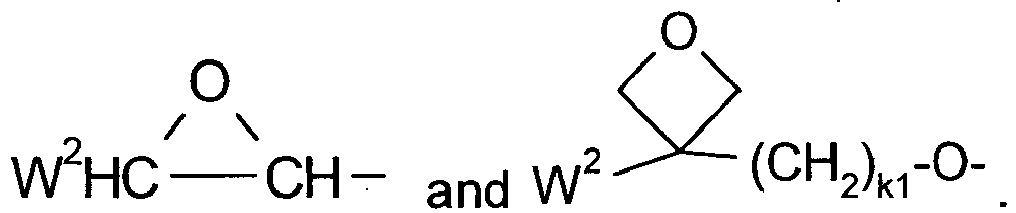
- Further preferred polymerisable groups P and P1,2 are selected from the group consisting of vinyloxy, acrylate, methacrylate, ethacrylate, fluoroacrylate, chloroacrylate, oxetane and epoxide, most preferably from acrylate and methacrylate.
- If Sp or Sp1,2 is different from a single bond, it is preferably selected of the formula Sp"-X", so that the respective radical P-Sp- conforms to the formula P-Sp"-X"-, wherein
- Sp" denotes alkylene having 1 to 20, preferably 1 to 12, C atoms, which is optionally mono- or polysubstituted by F, Cl, Br, I or CN and in which, in addition, one or more non-adjacent CH2 groups may each be replaced, independently of one another, by -O-, -S-, -NH-, -N(R0)-, -Si(R0R00)-,-CO-, -CO-O-, -O-CO-, -O-CO-O-, -S-CO-, -CO-S-, -N(R00)-CO-O-, -O-CO-N(R0)-, -N(R0)-CO-N(R00)-, -CH=CH- or -C≡C- in such a way that O and/or S atoms are not linked directly to one another,
- X" denotes -O-, -S-, -CO-, -CO-O-, -O-CO-, -O-CO-O-, -CO-N(R0)-, -N(R0)-CO-, -N(R0)-CO-N(R00)-, -OCH2-, -CH2O-, -SCH2-, -CH2S-, -CF2O-,-OCF2-, -CF2S-, -SCF2-, -CF2CH2-, -CH2CF2-, -CF2CF2-, -CH=N-,-N=CH-, -N=N-, -CH=CR0-, -CY2=CY3-, -C≡C-, -CH=CH-CO-O-, -O-CO-CH=CH- or a single bond,
- R0 and R00 each, independently of one another, denote H or alkyl having 1 to 20 C atoms, and
- Y2 and Y3 each, independently of one another, denote H, F, Cl or CN.
- X" is preferably -O-, -S-, -CO-, -COO-, -OCO-, -O-COO-, -CO-NR0-, -NR0-CO-, -NR0-CO-NR00- or a single bond.
- Typical spacer groups Sp, Sp1,2 and -Sp"-X"- are, for example, -(CH2)p1-, -(CH2CH2O)q1-CH2CH2-, -CH2CH2-S-CH2CH2-, -CH2CH2-NH-CH2CH2- or -(SiR0R00-O)p1-, in which p1 is an integer from 1 to 12, q1 is an integer from 1 to 3, and R0 and R00 have the meanings indicated above.
- Particularly preferred groups Sp, Sp1,2 and -Sp"-X"- are -(CH2)p1-, -(CH2)p1-O-,-(CH2)p1-O-CO-, -(CH2)p1-CO-O-, -(CH2)p1-O-CO-O-, in which p1 and q1 have the meanings indicated above.
- Particularly preferred groups Sp" are, in each case straight-chain, ethylene, propylene, butylene, pentylene, hexylene, heptylene, octylene, nonylene, decylene, undecylene, dodecylene, octadecylene, ethyleneoxyethylene, methyleneoxybutylene, ethylenethioethylene, ethylene-N-methyliminoethylene, 1-methylalkylene, ethenylene, propenylene and butenylene.
- The LC medium according to the present invention contains a polymerisable component A) comprising one or more first polymerisable compounds with a polymerisable group and a ≥8-membered monocycylic hydrocarbon group, one or more second polymerisable compounds comprising a polymerisable group and a straight-chain, branched or <8-membered monocyclic hydrocarbon group, and one or more third polymerisable compounds comprising two or more polymerisable groups and a straight-chain, branched or monocyclic hydrocarbon group.
- The hydrocarbon group contained in the first, second and third polymerisable compounds is preferably a non-aromatic group.
- Preferably the monocyclic hydrocarbon group in the first polymerisable compound is a cycloalkyl group having from 8 to 24 ring atoms, preferably having from 8 to 18 ring atoms, that is optionally substituted by one or more groups L as defined in formula I, and wherein one or more CH2-groups are optionally replaced by -O- and/or -CO- such that O-atoms are not directly adjacent to one another.
- Preferably component A) of the LC medium comprises one or more first polymerisable compounds selected of formula I
P-Sp-G1 I
wherein - P is a polymerisable group,
- Sp is a spacer group or a single bond,
- G1 is a monocyclic hydrocarbon group having 8 to 24 ring atoms, preferably 8 to 18 ring atoms, which is optionally substituted by one or more groups L,
- L is F, Cl, -CN, -NO2, -NCO, -NCS, -OCN, -SCN, -C(=O)N(Rx)2, -C(=O)Y1, -C(=O)Rx, -N(Rx)2, optionally substituted silyl, optionally substituted aryl or heteroaryl having 5 to 20 ring atoms, or straight-chain or branched alkyl having 1 to 25, particularly preferably 1 to 10, C atoms, in which, in addition, one or more non-adjacent CH2 groups may each be replaced, independently of one another, by -C(R0)=C(R00)-, -C≡C-, -N(R0)-, -O-, -S-, -CO-, -CO-O-, -O-CO-, -O-CO-O- in such a way that O and/or S atoms are not linked directly to one another, and in which, in addition, one or more H atoms may be replaced by F, Cl, -CN,
- Rx is H, F, Cl, CN, or straight chain, branched or cyclic alkyl having 1 to 25 C atoms, wherein one or more non-adjacent CH2-groups are optionally replaced by -O-, -S-, -CO-, -CO-O-, -O-CO-, -O-CO-O- in such a manner that O- and/or S-atoms are not directly connected with each other, and wherein one or more H atoms are each optionally replaced by F or Cl,
- R0, R00 are H or alkyl having 1 to 20 C atoms,
- Y1 is halogen, preferably F or Cl.
- P is preferably acrylate, methacrylate or oxetane, very preferably acrylate or methacrylate.
- Sp is preferably of the formula Sp"-X", so that the respective radical P-Sp-conforms to the formula P-Sp"-X"-, wherein Sp" and X" are as defined above.
- Sp is very preferably -(CH2)p1-,-(CH2)p1-O-, -(CH2)p1-O-CO-, -(CH2)p1-CO-O-, -(CH2)p1-O-CO-O-, in which p1 is an integer from 1 to 12.
- L is preferably selected from F, Cl, -CN and straight-chain or branched alkyl having 1 to 25, particularly preferably 1 to 10, C atoms, in which, in addition, one or more non-adjacent CH2 groups may each be replaced, independently of one another, by -C(R0)=C(R00)-, -C≡C-, -N(R0)-, -O-, -S-, -CO-, -CO-O-, -O-CO-, -O-CO-O- in such a way that O and/or S atoms are not linked directly to one another, and in which, in addition, one or more H atoms may be replaced by F, Cl, Br, I or CN.
- L is very preferably selected from F, -CN, and alkyl or alkoxy with 1 to 6 C atoms that is optionally fluorinated, preferably F, Cl, CN, CH3, OCH3, OCF3, OCF2H or OCFH2, very preferably F.
- G1 is preferably selected the group consisting of cyclooctyl, cyclononyl, cyclodecyl, cycloundecyl, cyclododecyl, cyclotridecyl, cyclotetradecyl, cylcopentadecyl, cyclohexadecyl, cycloheptadecyl and cyclooctadecyl, all of which are optionally substituted by one or more groups L.
- Preferred compounds of formula I are selected from the following formulae


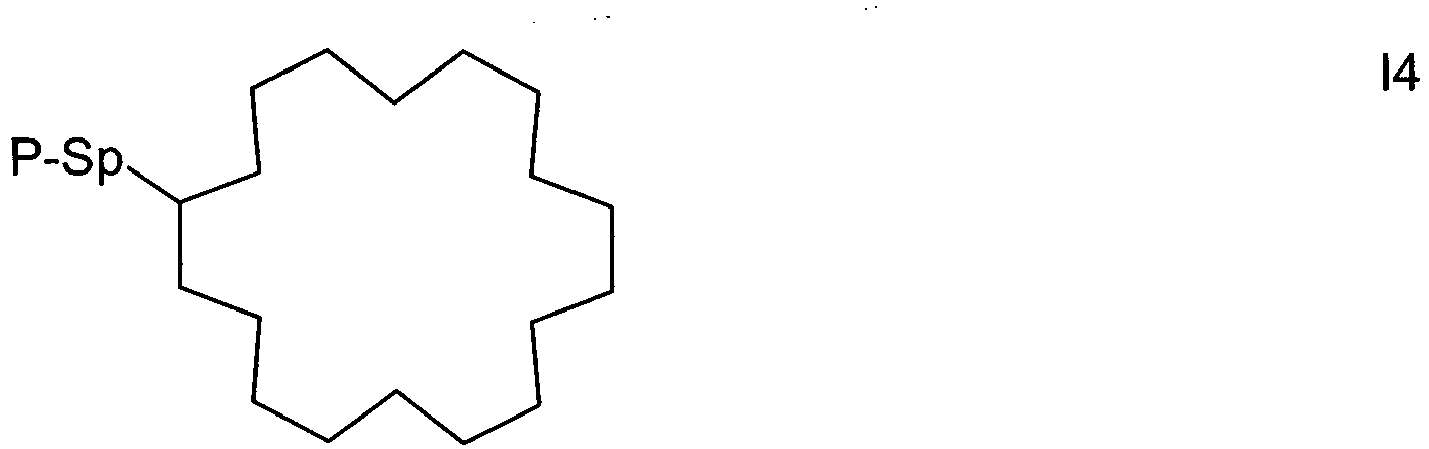
- Very preferred compounds of formula I are selected from the following formulae


- Preferably component A) of the LC medium comprises one or more second polymerisable compounds selected of formula II
P-Sp-G2 II
wherein - P and Sp have the meanings given in formula I or one of the preferred meanings given above and below for formula I, and
- G2 is a straight-chain or branched alkyl group with 1 to 20 C atoms, or a monocyclic alkyl group with 3 to 7 C atoms, that is optionally mono-, poly- or perfluorinated and is optionally substituted by one or more groups L as defined in formula I, and wherein one or more CH2-groups are optionally replaced by -O-, -CO-, -O-CO- or -CO-O- such that O-atoms are not directly adjacent to one another.
- Preferred compounds of formula II are selected from the following formulae
P-Sp-(CHW11)n2-(CH2)n1-(CHW12)n3-CH3 II1
P-Sp-(CH2)n2-(CF2)n1-CFW13W14 II2


- P, Sp
- have the meanings given in formula I or one of the preferred meanings given above and below,
- W11, W12
- are H, F or straight-chain or branched C1-C12-alkyl,
- W13, W14
- are H or F,
- n1
- is an integer from 2 to 15,
- n2, n3
- are 0 or an integer from 1 to 3,
- Very preferred compounds of formula II are selected from the following formulae
CH2=CW-CO-O-(CHW11)n2-(CH2)n1-(CHW12)n3-CH3 II1a
CH2=CW-CO-O-(CH2)n2-(CF2)n1-CFW13W14 II2a


- Further preferred compounds of formula II are selected from the following formulae








- In another preferred embodiment of the present invention component A) of the LC medium comprises one or more second polymerisable compounds comprising a polymerisable group and a bi- or polycylic hydrocarbon group having from 4 to 30 ring atoms, preferably from 6 to 25 ring atoms, which is preferably a non-aromatic hydrocarbon group.
- Preferably component A) of the LC medium according to this preferred embodiment comprises, in addition or alternatively to the compounds of formula II, one or more second polymerisable compounds selected of formula IIA
P-Sp-G2A IIA
- wherein P and Sp have the meanings given in formula I or one of the preferred meanings given above and below for formula I, and
- G2A is a bi- or polycyclic hydrocarbon group, preferably a bridged or fused bi- or polycyclic alkyl group, having 4 to 30 ring atoms, preferably 6 to 25 ring atoms, which is optionally substituted by one or more groups L.
- Preferably the bi- or polycyclic hydrocarbon group or group G2A is a bi-, tri- or tetracyclic group.
- Preferably the bi- or polycyclic hydrocarbon group or group G2A is a bridged bi- or polycyclic hydrocarbon group, i.e. which consists of fused hydrocarbon rings, preferably fused cycloalkyl rings, where fusion occurs across a sequence of atoms (bridgehead), preferably a bipodal bridge, like in bicyclo[2.2.1]heptane (norbornane), bicyclo[2.2.2]octane or tricyclo[3.3.3.1]decane (adamantane).
- In another preferred embodiment the present invention the bi- or polycyclic hydrocarbon group or group G2A is a fused bi- or polycyclic hydrocarbon group, i.e. which consists of fused hydrocarbon rings, preferably fused cycloalkyl rings, where fusion occurs across a bond between two atoms, like in bicyclo[3.2.0]heptane or bicyclo[4.4.0]decane (decalin).
- In yet another preferred embodiment the present invention the bi- or polycyclic hydrocarbon group or group G2A is a spirocyclic group, i.e. which consists of fused hydrocarbon rings, preferably fused cycloalkyl rings, where fusion occurs at a single atom (spiro atom), like in spiro[3.3]heptane or spiro[4.5]decane.
- The bi- or polycyclic group or group G2A is optionally substituted by one or more substituents, preferably selected from the group L as defined above and below.
- Preferably the bi- or polycyclic group or group G2A is selected from the group consisting of bicyclo[1.1.1]pentyl, bicyclo[2.1.1]hexyl, bicyclo[2.2.1]heptyl (norbornyl), bicyclo[3.2.1]octyl, bicyclo[2.2.2]octyl, bicyclo[3.2.2]nonyl, bicyclo[3.3.1]nonyl, bicyclo[3.3.2]decyl, bicyclo[3.3.3]undecyl, tricyclo[3.3.3.1]decyl (adamantyl), tricyclo[5.2.1.0]decyl (tetrahydrodicyclopentadiyl), bicyclo[2.1.0]pentyl, bicyclo[2.2.0]hexyl, bicyclo[3.2.0]heptyl, bicyclo[4.2.0]octyl, bicyclo[3.3.0]octyl, bicyclo[4.3.0]nonyl, bicyclo[4.4.0]decyl (decalin), spiro[2.2]pentyl, spiro[3.2]hexyl, spiro[3.3]heptyl, spiro[4.3]octyl, spiro[4.4]nonyl, spiro[4.5]decyl, all of which are optionally substituted by one or more groups L as defined above and below.
- Very preferably the bi- or polycyclic group or group G2A is selected from the group consisting of bicyclo[1.1.1]pentyl, bicyclo[2.1.1]hexyl, bicyclo[2.2.1]heptyl (norbornyl), bicyclo[3.2.1]octyl, bicyclo[2.2.2]octyl, bicyclo[3.2.2]nonyl, bicyclo[3.3.1]nonyl, bicyclo[3.3.2]decyl, bicyclo[3.3.3]undecyl, tricyclo[3.3.3.1]decyl (adamantyl), all of which are optionally substituted by one or more groups L as defined above and below.
- Most preferably the bi- or polycyclic group or group G2A is selected from the group consisting of bicyclo[2.2.1]heptyl (norbornyl), bicyclo[2.2.2]octyl, tricyclo[3.3.3.1]decyl (adamantyl), all of which are optionally substituted by one or more groups L as defined above and below.
- Preferred compounds of formula IIA are selected from the following formulae


- Further preferred compounds of formula IIA are selected from the following formulae


- Very preferred compounds of formula IIA are selected from the following formulae


- Further preferred compounds of formula IIA are selected from the following formulae


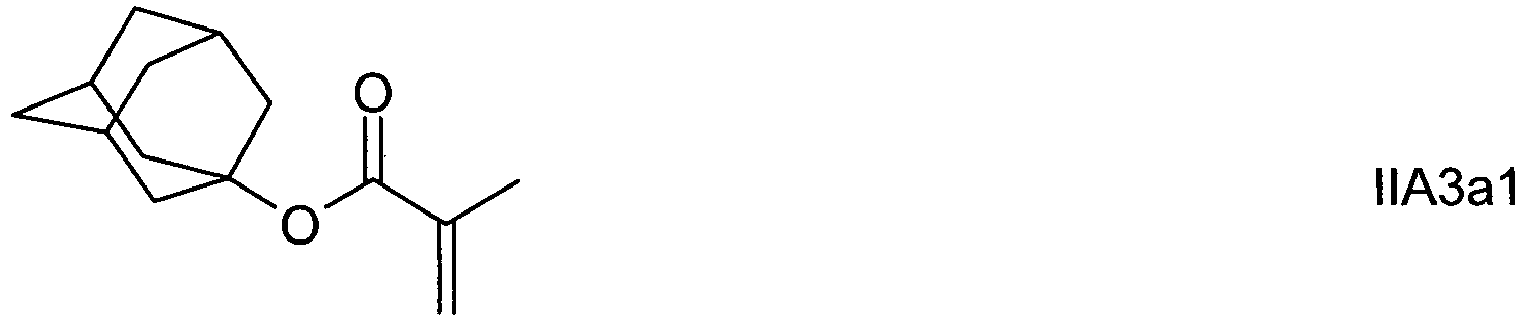


- Preferably component A) of the LC medium comprises one or more third polymerisable compounds selected of formula III
P1-Sp1-G3-Sp2-P2 III
wherein - P1 and P2
- independently of each other independently of each other, and on each occurrence identically or differently, denote a polymerisable group,
- Sp1, Sp2
- denote independently of each other identical or different spacer groups or a single bond,
- G3
- is a straight-chain, branched or cyclic alkyl group with 1 to 20 C atoms that is optionally mono-, poly- or perfluorinated and is optionally substituted by one or more groups P-Sp- or L as defined in formula I, and wherein one or more CH2-groups are optionally replaced by -O-, -CO-, -O-CO- or -CO-O- such that O-atoms are not directly adjacent to one another.
- P1 and P2 are preferably selected from acrylate, methacrylate, ethacrylate, and vinyloxy groups.
- Further preferably one of P1 and P2 in formula III is vinyloxy and the other is acrylate, methacrylate or ethacrylate, most preferably methacrylate.
- Sp1 and Sp2 in formula III preferably denote a single bond.
- If the hydrocarbon group or group G3 in the third polymerisable compounds is a cyclic group, it is preferably a monocyclic cycloalkyl group, which preferably has from 5 to 7 ring atoms and is optionally substituted by one or more groups L as defined above and below.
- In another preferred embodiment of the present invention the hydrocarbon group or group G3 in the third polymerisable compounds is a bi-, tri- or tetracyclic group, and preferably has from 4 to 30 C atoms, which is optionally substituted by one or more groups L as defined above and below. Preferred bi-, tri- or tetracyclic groups or groups G3 in the third polymerisable compound are those having one of the meanings of group G2A in formula IIA or its preferred meanings given above.
- Preferred compounds of formula III are selected from the following formulae
P1-Sp1-(CHW11)n2-(CH2)n1-(CHW12)n3-Sp2-P2 III1

P1-(CH2)n2-(CF2)n1-(CH2)n3-P2 III3
(P1-Sp1-(CH2)n4)n5CH4-n5 III4
wherein P1, P2, Sp1, Sp2 are as defined in formula III, - W11
- is, on each occurrence identically or differently, H, F or C1-C12-alkyl,
- n1
- is an integer from 2 to 15,
- n2, n3
- are independently of each other 0 or an integer from 1 to 3,
- n4
- is 0 or an integer from 1 to 15,
- n5
- is 3 or 4,
- In a preferred embodiment of the present invention the component A) of the LC medium comprises one or more compounds of formula III or its subformulae wherein P1 and P2 are different polymerisable groups.
- In another preferred embodiment of the present invention the component A) of the LC medium comprises one or more compounds of formula III or its subformulae wherein P1 and P2 are identical polymerisable groups.
- In the third polymerisable compounds, the polymerisable groups are preferably selected from acrylate, methacrylate, ethacrylate and vinyloxy groups. Very preferably one of the polymerisable groups is vinyloxy and the other is acrylate or methacrylate, most preferably methacrylate.
- Very preferred compounds of formula III are selected from the following formulae
CH2=CW-CO-O-(CHW11)n4-(CH2)n1-O-CH=CH2 III1a
CH2=CH-O-(CHW1)n4-(CH2)n1-O-CO-CH=CH2 III1b
CH2=CW-CO-O-(CHW11)n2-(CH2)n1-(CHW12)n3-O-CO-CW=CH2 III1c


CH2=CW-CO-O-(CH2)n2-(CF2)n1-(CH2)n3-O-CH=CH2 III3a
CH2=CW-CO-O-(CH2)n2-(CF2)n1-(CH2)n3-O-CO-CW=CH2 III3b
(CH2=CW-CO-O-(CH2)n2)3CH III4a
(CH2=CW-CO-O-(CH2)n2)4C III4b
wherein W is H, CH3 or C2H5 and W11, n1, n2 and n4 are as defined in formula III1-III4, and the cyclohexylene ring in formula III2a-c is optionally substituted by one or more identical or different groups W11. - Further preferred compounds of formula III are selected from the following formulae








- Further preferred compounds of formula III are selected from the following formulae


- Further preferred compounds of formula III are selected from the following formulae


- In another preferred embodiment of the present invention component A) of the LC medium additionally comprises, in addition or alternatively to the third polymerisable compounds, one or more fourth polymerisable compounds comprising a ring system containing one or more aromatic or heteroaromatic rings or condensed aromatic or heteroaromatic rings, and attached thereto two polymerisable groups that are preferably different from each other.
- These compounds are preferably selected from formula IV
P1-Sp1-B1-(Zb-B2)m-Sp2-P2 IV
in which P1, P2, Sp1, Sp2 are as defined in formula III, - B1 and B2
- are independently of each other, and on each occurrence identically or differently, an aromatic, heteroaromatic, alicyclic or heterocyclic group, preferably having 4 to 25 ring atoms, which may also contain fused rings, and which is unsubstituted, or mono- or polysubstituted by L as defined in formula I, wherein at least one of B1 and B2 denotes an aromatic or heteroaromatic group,
- Zb
- is, on each occurrence identically or differently, -O-, -S-, -CO-, -CO-O-, -OCO-, -O-CO-O-, -OCH2-, -CH2O-, -SCH2-, -CH2S-, -CF2O-, -OCF2-, -CF2S-, -SCF2-, -(CH2)n11-, -CF2CH2-, -CH2CF2-, -(CF2)n1-, -CH=CH-, -CF=CF-, -C≡C-, -CH=CH-COO-, -OCO-CH=CH-, CR0R00 or a single bond,
- R0 and R00
- each, independently of one another, denote H or alkyl having 1 to 12 C atoms,
- m
- denotes 0, 1, 2, 3 or 4,
- n11
- denotes 1, 2, 3 or 4,
- Particularly preferred compounds of formula IV are those in which B1 and B2 each, independently of one another, denote 1,4-phenylene, 1,3-phenylene, naphthalene-1,4-diyl, naphthalene-2,6-diyl, phenanthrene-2,7-diyl, 9,10-dihydro-phenanthrene-2,7-diyl, anthracene-2,7-diyl, fluorene-2,7-diyl, coumarine, flavone, where, in addition, one or more CH groups in these groups may be replaced by N, cyclohexane-1,4-diyl, in which, in addition, one or more non-adjacent CH2 groups may be replaced by O and/or S, 1,4-cyclohexenylene, bicyclo[1.1.1]pentane-1,3-diyl, bicyclo[2.2.2]octane-1,4-diyl, spiro[3.3]heptane-2,6-diyl, piperidine-1,4-diyl, decahydronaphthalene-2,6-diyl, 1,2,3,4-tetrahydronaphthalene-2,6-diyl, indane-2,5-diyl or octahydro-4,7-methanoindane-2,5-diyl, where all these groups may be unsubstituted or mono- or polysubstituted by L as defined above.
- Very particularly preferred compounds of formula IV are those in which B1 and B2 each, independently of one another, denote 1,4-phenylene, 1,3-phenylene, naphthalene-1,4-diyl or naphthalene-2,6-diyl.
- Further preferred compounds of formula IV are selected from the group consisting of the following formulae:





- Z1
- is -O-, -CO-, -C(RyRz)- or -CF2CF2-,
- Z2, Z3
- are independently of each other -CO-O-, -O-CO-, -CH2O-,-OCH2-, -CF2O-, -OCF2- or -(CH2)n11-, where n11 is 2, 3 or 4,
- r
- is 0, 1, 2, 3 or 4,
- s
- is 0, 1, 2 or 3,
- t
- is 0, 1 or 2.
- Especially preferred are direactive compounds of formula IV2 and IV3.
- In the compounds of formulae IV1 to IV13 the group
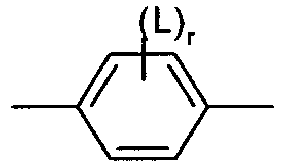


- Preferred compounds of formulae IV1 to IV13 are those wherein one of P1 and P2 denotes a vinyloxy group and the other denotes an acrylate, methacrylate or ethacrylate group, very preferably a methacrylate group.
- Further preferred compounds of formulae IV1 to IV13 are those wherein Sp1 and Sp2 are a single bond.
- Further preferred compounds of formulae IV1 to IV13 are those wherein one of Sp1 and Sp2 is a single bond and the other is different from a single bond.
- Further preferred compounds of formulae IV1 to IV13 are those wherein the group Sp1 and Sp3 that is different from a single bond is -(CH2)s1-X"-, wherein s1 is an integer from 1 to 6, preferably 2, 3, 4 or 5, and X" is X" is the linkage to the benzene ring and is -O-, -O-CO-, -CO-O, -O-CO-O- or a single bond.
- Very preferred compounds of formula IV are selected from the group consisting of the following formulae:




- The concentration of the first polymerisable compounds, especially those of formula I, in the LC medium is preferably from 0.5 to 20%, very preferably from 1 to 18%, most preferably from 2 to 15%.
- The concentration of the second polymerisable compounds, especially those of formula II, in the LC medium is preferably from 0.5 to 15%, very preferably from 1 to 12%, most preferably from 2 to 10%.
- The concentration of the third polymerisable compounds, especially those of formula III, in the LC medium is preferably from 0.05 to 5%, very preferably from 0.1 to 3%, most preferably from 0.2 to 2%.
- The concentration of the fourth polymerisable compounds, especially those of formula IV, in the LC medium is preferably from 0.05 to 5%, very preferably from 0.1 to 3%, most preferably from 0.2 to 2%.
- The total concentration of the first, second, third and fourth polymerisable compounds, especially those of formula I, II, III and IV, in the LC medium is preferably from 1 to 30% by weight, very preferably from 1 to 25% by weight.
- In a first preferred embodiment of the present invention, the total concentration of the first, second, third and fourth polymerisable compounds, especially those of formula I, II, III and IV, in the LC medium is from 10 to 20% by weight.
- In a second preferred embodiment of the present invention, the total concentration of the first, second, third and fourth polymerisable compounds, especially those of formula I, II, III and IV, in the LC medium is from 5 to 10% by weight.
- In a third preferred embodiment of the present invention, the total concentration of the first, second, third and fourth polymerisable compounds, especially those of formula I, II, III and IV, in the LC medium is from 1 to 5% by weight.
- The ratio of first polymerisable compounds or compounds of formula I, and second polymerisable compounds or compounds of formula II, in the LC medium is preferably from 50:1 to 1:50, very preferably from 10:1 to 1:10, most preferably from 4:1 to 1:4.
- The total concentration of first and second polymerisable compounds with (exactly) one polymerisable group, or compounds of formula I and II, in the LC medium is preferably from 5 to 30% by weight.
- The total concentration of third and fifth polymerisable compounds with (exactly) two polymerisable groups, or compounds of formula III and IV, in the LC medium is preferably from 0.1 to 10%, very preferably from 0.1 to 5%, most preferably from 0.1 to 2% by weight.
- Particular preference is given to LC media wherein the polymerisable component A) comprises one, two or three first polymerisable compounds, preferably of formula I, one, two or three second polymerisable compounds, preferably of formula II, one, two or three third polymerisable compounds, preferably of formula III, and optionally one, two or three fourth polymerisable compounds, preferably of formula IV.
- Besides the polymerisable component A) as described above, the LC medium according to the present invention comprises an LC component B), or LC host mixture, comprising one or more, preferably two or more LC compounds which are selected from low-molecular-weight compounds that are unpolymerisable. These LC compounds are selected such that they stable and/or unreactive to a polymerisation reaction under the conditions applied to the polymerisation of the polymerisable compounds.
- Preference is given to LC media in which the LC component B), or the LC host mixture, has a nematic LC phase, and preferably has no chiral liquid crystal phase. The LC component B), or LC host mixture, is preferably a nematic LC mixture.
- Preference is furthermore given to achiral polymerisable compounds, and to LC media in which the compounds of component A) and/or B) are selected exclusively from the group consisting of achiral compounds.
- Preferably the proportion of the LC component B) in the LC medium is from 70 to 95% by weight.
- The LC media and LC host mixtures of the present invention preferably have a nematic phase range ≥ 80 K, very preferably ≥ 100 K, and preferably a rotational viscosity ≤ 250 mPa·s, very preferably ≤ 200 mPa·s, at 20°C.
- The birefringence Δn of LC media and LC host mixtures according to the invention is preferably preferably from 0.07 to 0.15, particularly preferably from 0.08 to 0.15.
- In a first preferred embodiment of the present invention, the LC medium contains an component B) or LC host mixture having a positive dielectric anisotropy Δε.
- Such LC media are especially suitable for use in TN, OCB-, Posi-VA-, IPS- or FFS-displays or related modes using LC-materials with Δε>0.
- The LC media and LC host mixtures according to this first preferred embodiment preferably have a positive dielectric anisotropy Δε from +2 to +30, particularly preferably from +3 to +20, at 20°C and 1 kHz.
- Particularly preferred is an LC medium of this first preferred embodiment, wherein the liquid-crystalline component B) or LC host mixture comprises one or more compounds selected from formula A and B


- R21, R31
- each, independently of one another, alkyl, alkoxy, oxaalkyl or alkoxyalkyl having 1 to 9 C atoms or alkenyl or alkenyloxy having 2 to 9 C atoms, all of which are optionally fluorinated,
- X0
- F, Cl, halogenated alkyl or alkoxy having 1 to 6 C atoms or halogenated alkenyl or alkenyloxy having 2 to 6 C atoms,
- Z31
- -CH2CH2-, -CF2CF2-, -COO-, trans-CH=CH-, trans-CF=CF-, -CH2O- or a single bond, preferably -CH2CH2-,-COO-, trans-CH=CH- or a single bond, particularly preferably -COO-, trans-CH=CH- or a single bond,
- L21, L22, L31, L32
- each, independently of one another, H or F,
- g
- 0, 1, 2 or 3.
- In the compounds of formula A and B, R21 and R31 are preferably selected from straight-chain alkyl or alkoxy with 1, 2, 3, 4, 5 or 6 C atoms, and straight-chain alkenyl with 2, 3, 4, 5, 6 or 7 C atoms.
- In the compounds of formula A and B, g is preferably 1 or 2.
- In the compounds of formula B, Z31 is preferably COO, trans-CH=CH or a single bond, very preferably COO or a single bond.
- Preferably component B) of the LC medium comprises one or more compounds of formula A selected from the group consisting of the following formulae:
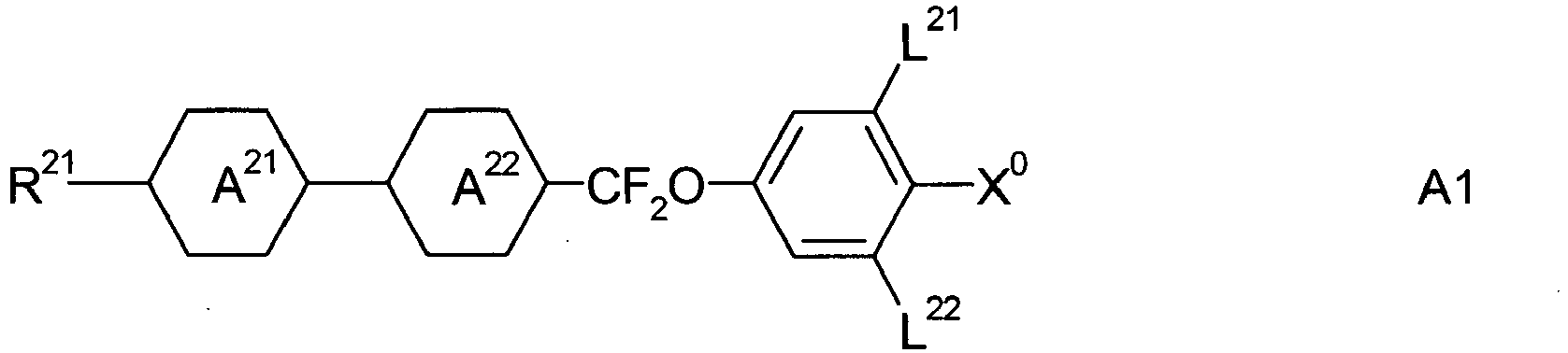


- Particularly preferred compounds of formula A1 are selected from the group consisting of the following subformulae:


- Very particularly preferred compounds of formula A1 are selected from the group consisting of the following subformulae:


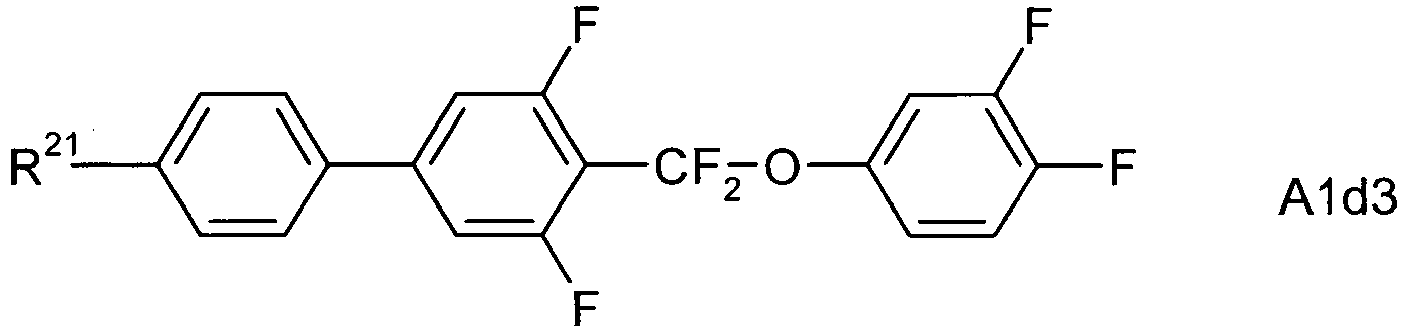


- Particularly preferred compounds of formula A2 are selected from the group consisting of the following subformulae:


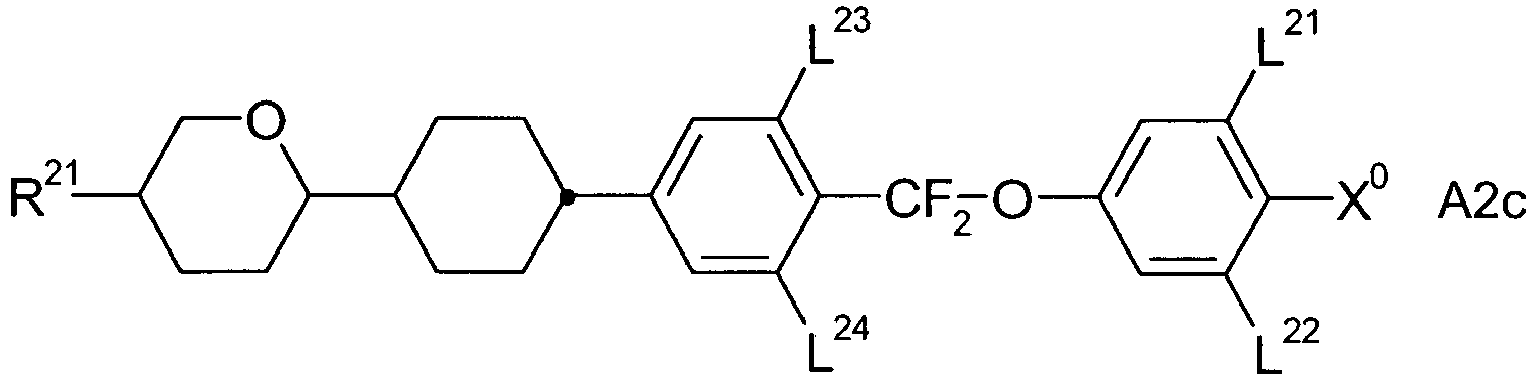


- Very particularly preferred compounds of formula A2 are selected from the group consisting of the following subformulae:


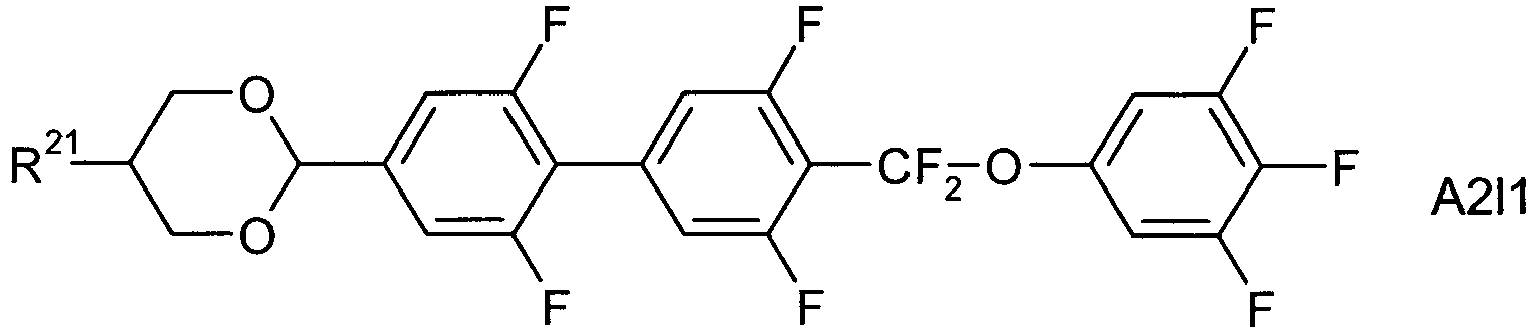

- Particularly preferred compounds of formula A3 are selected from the group consisting of the following subformulae:


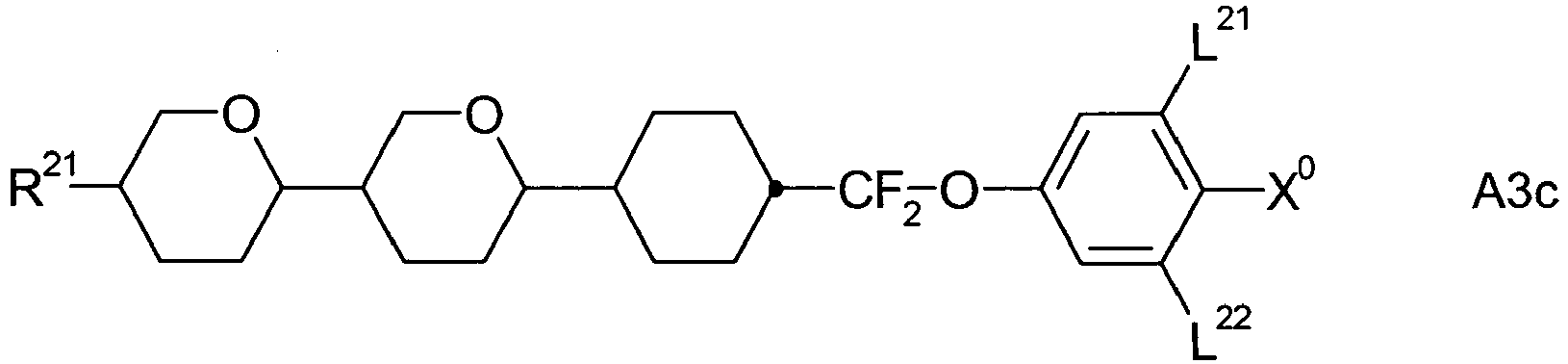
- Particularly preferred compounds of formula A4 are selected from the group consisting of the following subformulae:

- Preferably component B) of the LC medium comprises one or more compounds of formula B selected from the group consisting of the following formulae:


- Particularly preferred compounds of formula B1 are selected from the group consisting of the following subformulae:


- Very particularly preferred compounds of formula B1a are selected from the group consisting of the following subformulae:




- Very particularly preferred compounds of formula B1b are selected from the group consisting of the following subformulae:


- Particularly preferred compounds of formula B2 are selected from the group consisting of the following subformulae:


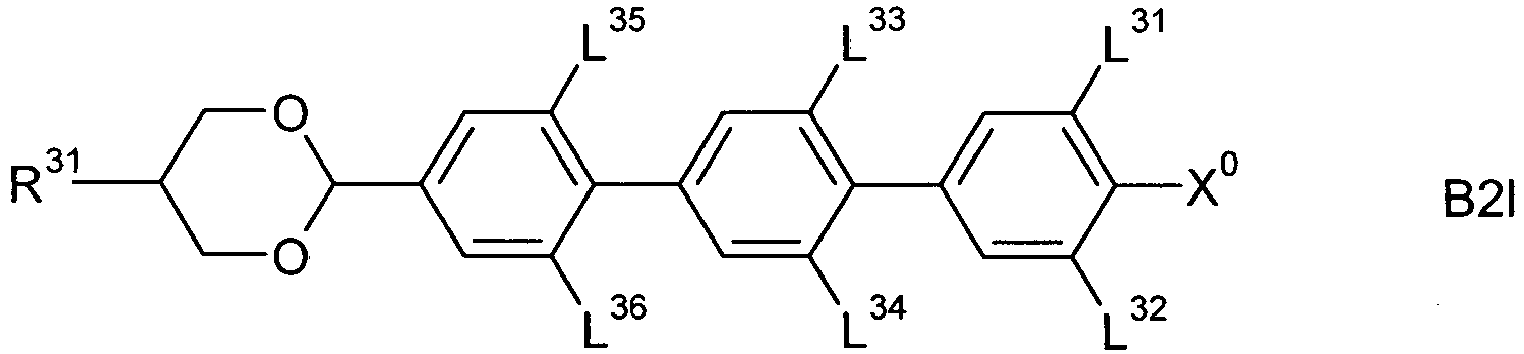
- Very particularly preferred compounds of formula B2 are selected from the group consisting of the following subformulae:


- Very particularly preferred compounds of formula B2b are selected from the group consisting of the following subformulae


- Very particularly preferred compounds of formula B2c are selected from the group consisting of the following subformulae:


- Very particularly preferred compounds of formula B2d and B2e are selected from the group consisting of the following subformulae:


- Very particularly preferred compounds of formula B2f are selected from the group consisting of the following subformulae:


- Very particularly preferred compounds of formula B2g are selected from the group consisting of the following subformulae:


- Very particularly preferred compounds of formula B2h are selected from the group consisting of the following subformulae:


- Very particularly preferred compounds of formula B2i are selected from the group consisting of the following subformulae:


- Very particularly preferred compounds of formula B2k are selected from the group consisting of the following subformulae:


- Very particularly preferred compounds of formula B2l are selected from the group consisting of the following subformulae:


- Alternatively to, or in addition to, the compounds of formula B1 and/or B2 component B) of the LC medium may also comprise one or more compounds of formula B3 as defined above.
- Particularly preferred compounds of formula B3 are selected from the group consisting of the following subformulae:


- Preferably component B) of the LC medium comprises, in addition to the compounds of formula A and/or B, one or more compounds of formula C


- R41, R42
- each, independently of one another, alkyl, alkoxy, oxaalkyl or alkoxyalkyl having 1 to 9 C atoms or alkenyl or alkenyloxy having 2 to 9 C atoms, all of which are optionally fluorinated,
- Z41, Z42
- each, independently of one another, -CH2CH2-, -COO-, trans-CH=CH-, trans-CF=CF-, -CH2O-, -CF2O-, -C≡C- or a single bond, preferably a single bond,
- h
- 0, 1, 2 or 3.
- In the compounds of formula C, R41 and R42 are preferably selected from straight-chain alkyl or alkoxy with 1, 2, 3, 4, 5 or 6 C atoms, and straight-chain alkenyl with 2, 3, 4, 5, 6 or 7 C atoms.
- In the compounds of formula C, h is preferably 0, 1 or 2.
- In the compounds of formula C, Z41 and Z42 are preferably selected from COO, trans-CH=CH and a single bond, very preferably from COO and a single bond.
- Preferred compounds of formula C are selected from the group consisting of the following subformulae:







- In another preferred embodiment of the present invention component B) of the LC medium comprises, in addition to the compounds of formula A and/or B, one or more compounds of formula D

- Preferred compounds of formula D are selected from the group consisting of the following subformulae:


- In another preferred embodiment of the present invention component B) of the LC medium comprises, in addition to the compounds of formula A and/or B, one or more compounds of formula E containing an alkenyl group




- RA1
- alkenyl having 2 to 9 C atoms or, if at least one of the rings X, Y and Z denotes cyclohexenyl, also one of the meanings of RA2,
- RA2
- alkyl having 1 to 12 C atoms, in which, in addition, one or two non-adjacent CH2 groups may be replaced by -O-, -CH=CH-, -CO-, -OCO- or -COO- in such a way that O atoms are not linked directly to one another,
- x
- 1 or 2.
- Preferred compounds of formula E are selected from the following sub-formulae:








- Very preferred compounds of the formula E are selected from the following sub-formulae:


- Very particularly preferred compounds of the formula E are selected from the following sub-formulae:




- Most preferred are compounds of formula E1a2, E1a5, E3a1 and E6a1.
- In another preferred embodiment of the present invention component B) of the LC medium comprises, in addition to the compounds of formula A and/or B, one or more compounds of formula F


- R21, R31
- each, independently of one another, alkyl, alkoxy, oxaalkyl or alkoxyalkyl having 1 to 9 C atoms or alkenyl or alkenyloxy having 2 to 9 C atoms, all of which are optionally fluorinated,
- X0
- F, Cl, halogenated alkyl or alkoxy having 1 to 6 C atoms or halogenated alkenyl or alkenyloxy having 2 to 6 C atoms,
- Z21
- -CH2CH2-, -CF2CF2-, -COO-, trans-CH=CH-, trans-CF=CF-, -CH2O-, -CF2O-, -C≡C- or a single bond, preferably -CF2O-,
- L21, L22, L23, L24
- each, independently of one another, H or F,
- g
- 0, 1, 2 or 3.
- Particularly preferred compounds of formula F are selected from the group consisting of the following formulae:


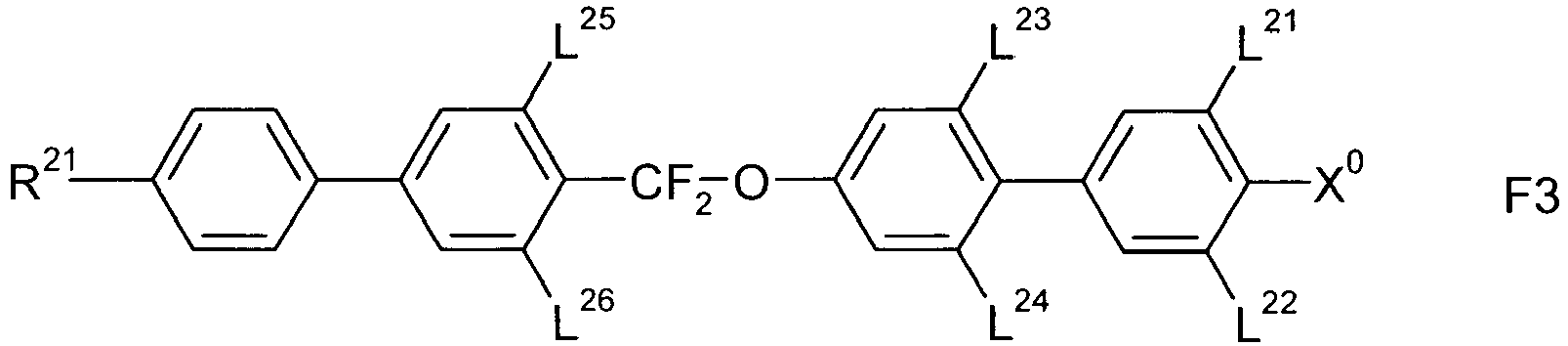
- Very particularly preferred compounds of formula F1-F3 are selected from the group consisting of the following subformulae:


- In another preferred embodiment of the present invention component B) of the LC medium comprises, in addition to the compounds of formula A and/or B, one or more compounds of formula G containing a cyano group.


- R51, R52
- each, independently of one another, alkyl, alkoxy, oxaalkyl or alkoxyalkyl having 1 to 9 C atoms or alkenyl or alkenyloxy having 2 to 9 C atoms, all of which are optionally fluorinated,
- Z51, Z42
- -CH2CH2-, -COO-, trans-CH=CH-, trans-CF=CF-, -CH2O-, -CF2O-, -C≡C- or a single bond, preferably a single bond,
- L51, L52
- each, independently of one another, H or F,
- i
- 0, 1, 2 or 3.
- Preferred compounds of formula G are selected from the following subformulae
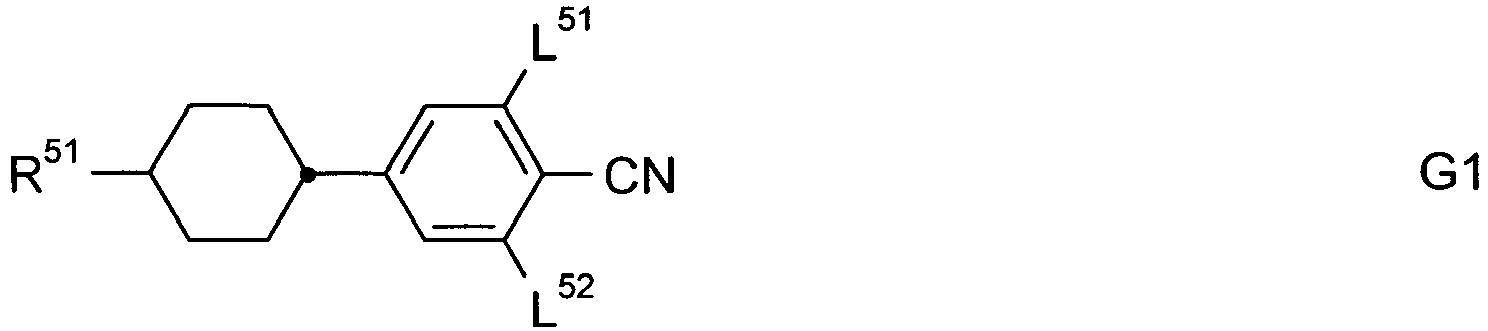


- Very preferred are compounds of formula G1, G2 and G5.
- Preferred compounds of formula G1-G9 are those wherein L51 and L52 are F.
- Further preferred compounds of formula G1-G7 are those wherein L51 is F and L52 is H.
- Very preferred compounds of formula G are selected from the group consisting of the following subformulae:


- In the compounds of formula G, G1-G7 and their subformulae, R51 is particularly preferably alkyl or alkoxy having 1 to 8 carbon atoms, or alkenyl having from 2 to 7 carbon atoms.
- The concentration of the compounds of formula A and B in the LC host mixture is preferably from 2 to 60%, very preferably from 3 to 45%, most preferably from 4 to 35%.
- The concentration of the compounds of formula C and D in the LC host mixture is preferably from 2 to 70%, very preferably from 5 to 65%, most preferably from 10 to 60%.
- The concentration of the compounds of formula E in the LC host mixture is preferably from 5 to 50%, very preferably from 5 to 35%.
- The concentration of the compounds of formula F in the LC host mixture is preferably from 2 to 30%, very preferably from 5 to 20%.
- Further preferred embodiments of the present invention are listed below, including any combination thereof.
- a) The LC host mixture comprises one or more compounds of formula A and/or B with high positive dielectric anisotropy, preferably with Δε > 15.
- b) The LC host mixture comprises one or more compounds selected from the group consisting of formulae A1a2, A1b1, A1d1, A1f1, A2a1, A2h1, A2l1, A2l2, A2k1, B2h3, B2l1, F1a. The proportion of these compounds in the LC host mixture is preferably from 4 to 40%, very preferably from 5 to 35%.
- c) The LC host mixture comprises one or more compounds selected from the group consisting of formulae C3, C4, C5, C9 and D2. The proportion of these compounds in the LC host mixture is preferably from 8 to 70%, very preferably from 10 to 60%.
- d) The LC host mixture comprises one or more compounds selected from the group consisting of formulae G1, G2 and G5, preferably G1a, G2a and G5a. The proportion of these compounds in the LC host mixture is preferably from 4 to 40%, very preferably from 5 to 35%.
- e) The LC host mixture comprises one or more compounds selected from the group consisting of formulae E1, E3 and E6, preferably E1a, E3a and E6a, very preferably E1a2, E1a5, E3a1 and E6a1. The proportion of these compounds in the LC host mixture is preferably from 5 to 60%, very preferably from 10 to 50%.
- In a second preferred embodiment of the present invention, the LC medium contains an component B) or LC host mixture having a negative dielectric anisotropy Δε.
- Such LC media are especially suitable for use in VA, IPS and UB-FFS displays or related modes using LC-materials with Δε<0.
- The LC media and LC host mixtures according to this second preferred embodiment preferably have a negative dielectric anisotropy Δε from -0.5 to-10, very preferably from -2.5 to -7.5, at 20°C and 1 kHz.
- Particularly preferred embodiments of an LC medium according to this second preferred embodiment are those of sections a)-z2) below:
- a) LC medium wherein the component B) or LC host mixture comprises one or more compounds selected from formulae CY and PY:


- a
- denotes 1 or 2,
- b
- denotes 0 or 1,

- R1 and R2
- each, independently of one another, denote alkyl having 1 to 12 C atoms, where, in addition, one or two non-adjacent CH2 groups may be replaced by -O-, -CH=CH-, -CO-, -OCO- or -COO- in such a way that O atoms are not linked directly to one another, preferably alkyl or alkoxy having 1 to 6 C atoms,
- Zx and Zy
- each, independently of one another, denote -CH2CH2-, -CH=CH-, -CF2O-, -OCF2-, -CH2O-, -OCH2-, -CO-O-, -O-CO-, -C2F4-, -CF=CF-, -CH=CH-CH2O- or a single bond, preferably a single bond,
- L1-4
- each, independently of one another, denote F, Cl, OCF3, CF3, CH3, CH2F, CHF2.
- Preferably, both L1 and L2 denote F or one of L1 and L2 denotes F and the other denotes Cl, or both L3 and L4 denote F or one of L3 and L4 denotes F and the other denotes Cl.
- The compounds of the formula CY are preferably selected from the group consisting of the following sub-formulae:





- Especially preferred are compounds selected from formulae CY2, CY8, CY10 and CY16.
- The compounds of the formula PY are preferably selected from the group consisting of the following sub-formulae:








- Especially preferred are compounds selected from formulae PY2, PY8, PY10 and PY16.
- Preferably the concentration of the compounds of formula CY and PY and their subformulae in the LC medium is from 10 to 70% by weight, very preferably from 15 to 50% by weight.
- Preferably the concentration of the compounds of formula CY and its subformulae in the LC medium is from 2 to 40% by weight, very preferably from 3 to 30% by weight.
- Preferably the concentration of the compounds of formula PY and its subformulae in the LC medium is from 2 to 50% by weight, very preferably from 3 to 40% by weight.
b) LC medium wherein the component B) or LC host mixture comprises one or more mesogenic or LC compounds comprising an alkenyl group (hereinafter also referred to as "alkenyl compounds"), wherein said alkenyl group is stable to a polymerisation reaction under the conditions used for polymerisation of the polymerisable compounds contained in the LC medium. - Preferably the component B) or LC host mixture comprises one or more alkenyl compounds selected from formulae AN and AY


- RA1
- alkenyl having 2 to 9 C atoms or, if at least one of the rings X, Y and Z denotes cyclohexenyl, also one of the meanings of RA2,
- RA2
- alkyl having 1 to 12 C atoms, in which, in addition, one or two non-adjacent CH2 groups may be replaced by -O-, -CH=CH-, -CO-, -OCO- or -COO- in such a way that O atoms are not linked directly to one another,
- Zx
- -CH2CH2-, -CH=CH-, -CF2O-, -OCF2-, -CH2O-, -OCH2-, -CO-O-, -O-CO-, -C2F4-, -CF=CF-, -CH=CH-CH2O-, or a single bond, preferably a single bond,
- L1,2
- H, F, Cl, OCF3, CF3, CH3, CH2F or CHF2H, preferably H, F or Cl,
- x
- 1 or 2,
- z
- 0 or 1.
- Preferred compounds of formula AN and AY are those wherein RA2 is selected from ethenyl, propenyl, butenyl, pentenyl, hexenyl and heptenyl.
- In a preferred embodiment the component B) or LC host mixture comprises one or more compounds of formula AN selected from the following sub-formulae:





- Preferably the the component B) or LC host mixture comprises one or more compounds selected from formulae AN1, AN2, AN3 and AN6, very preferably one or more compounds of formula AN1.
- In another preferred embodiment the component B) or LC host mixture comprises one or more compounds of formula AN selected from the following sub-formulae:


- In another preferred embodiment the component B) or LC host mixture comprises one or more compounds selected from the following sub-formulae:


- Most preferred are compounds of formula AN1a2 and AN1a5.
- In another preferred embodiment the component B) or LC host mixture comprises one or more compounds of formula AY selected from the following sub-formulae:







- In another preferred embodiment the component B) or LC host mixture comprises one or more compounds of formula AY selected from the following sub-formulae:





- Preferably the proportion of compounds of formula AN and AY in the LC medium is from 2 to 70% by weight, very preferably from 5 to 60% by weight, most preferably from 10 to 50% by weight.
- Preferably the LC medium or LC host mixture contains 1 to 5, preferably 1, 2 or 3 compounds selected from formulae AN and AY.
- In another preferred embodiment of the present invention the LC medium comprises one or more compounds of formula AY14, very preferably of AY14a. The proportion of compounds of formula AY14 or AY14a in the LC medium is preferably 3 to 20% by weight.
- The addition of alkenyl compounds of formula AN and/or AY enables a reduction of the viscosity and response time of the LC medium.
c) LC medium wherein the component B) or LC host mixture comprises one or more compounds of the following formula:


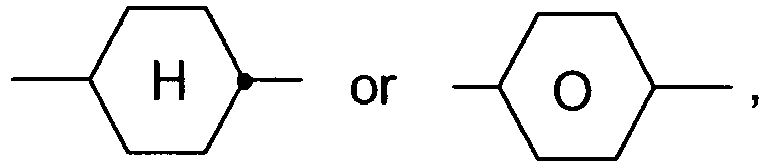
- R3 and R4
- each, independently of one another, denote alkyl having 1 to 12 C atoms, in which, in addition, one or two non-adjacent CH2 groups may be replaced by -O-, -CH=CH-, -CO-, -O-CO- or -CO-O- in such a way that O atoms are not linked directly to one another,
- Zy
- denotes -CH2CH2-, -CH=CH-, -CF2O-, -OCF2-, -CH2O-, -OCH2-, -CO-O-, -O-CO-, -C2F4-, -CF=CF-, -CH=CH-CH2O- or a single bond, preferably a single bond.
- The compounds of the formula ZK are preferably selected from the group consisting of the following sub-formulae:





- Especially preferred are compounds of formula ZK1.
- Particularly preferred compounds of formula ZK are selected from the following sub-formulae:


- Most preferred are compounds of formula ZK1a.
d) LC medium wherein component B) or the LC host mixture additionally comprises one or more compounds of the following formula:
- R5 and R6
- each, independently of one another, denote alkyl having 1 to 12 C atoms, where, in addition, one or two non-adjacent CH2 groups may be replaced by -O-, -CH=CH-, -CO-, -OCO- or -COO- in such a way that O atoms are not linked directly to one another, preferably alkyl or alkoxy having 1 to 6 C atoms,


- e
- denotes 1 or 2.
- The compounds of the formula DK are preferably selected from the group consisting of the following sub-formulae:






e) LC medium wherein component B) or the LC host mixture additionally comprises one or more compounds of the following formula:


- f
- denotes 1 or 2,
- R1 and R2
- each, independently of one another, denote alkyl having 1 to 12 C atoms, where, in addition, one or two non-adjacent CH2 groups may be replaced by -O-, -CH=CH-, -CO-, -OCO- or -COO- in such a way that O atoms are not linked directly to one another,
- Zx
- denotes -CH2CH2-, -CH=CH-, -CF2O-, -OCF2-, -CH2O-, -OCH2-, -CO-O-, -O-CO-, -C2F4-, -CF=CF-, -CH=CH-CH2O- or a single bond, preferably a single bond,
- L1 and L2
- each, independently of one another, denote F, Cl, OCF3, CF3, CH3, CH2F, CHF2.
- Preferably, both radicals L1 and L2 denote F or one of the radicals L1 and L2 denotes F and the other denotes Cl.
- The compounds of the formula LY are preferably selected from the group consisting of the following sub-formulae:











- f) LC medium wherein component B) or the LC host mixture additionally comprises one or more compounds selected from the group consisting of the following formulae:


- g) LC medium wherein component B) or the LC host mixture additionally comprises one or more compounds selected from the group consisting of the following formulae:


- h) LC medium wherein component B) or the LC host mixture additionally comprises one or more biphenyl compounds selected from the group consisting of the following formulae:


- The proportion of the biphenyls of the formulae B1 to B3 in the LC host mixture is preferably at least 3% by weight, in particular ≥ 5% by weight.
- The compounds of the formula B2 are particularly preferred.
- The compounds of the formulae B1 to B3 are preferably selected from the group consisting of the following sub-formulae:


i) LC medium wherein component B) or the LC host mixture additionally comprises one or more terphenyl compounds of the following formula:


- The compounds of the formula T are preferably selected from the group consisting of the following sub-formulae:





- R preferably denotes methyl, ethyl, propyl, butyl, pentyl, hexyl, methoxy, ethoxy, propoxy, butoxy or pentoxy.
- The LC host mixture according to the invention preferably comprises the terphenyls of the formula T and the preferred sub-formulae thereof in an amount of 0.5-30% by weight, in particular 1-20% by weight.
- Particular preference is given to compounds of the formulae T1, T2, T3 and T21. In these compounds, R preferably denotes alkyl, furthermore alkoxy, each having 1-5 C atoms.
- The terphenyls are preferably employed in LC media according to the invention if the Δn value of the mixture is to be ≥ 0.1. Preferred LC media comprise 2-20% by weight of one or more terphenyl compounds of the formula T, preferably selected from the group of compounds T1 to T22.
k) LC medium wherein component B) or the LC host mixture additionally comprises one or more quaterphenyl compounds selected from the group consisting of the following formulae:
- RQ
- is alkyl, alkoxy, oxaalkyl or alkoxyalkyl having 1 to 9 C atoms or alkenyl or alkenyloxy having 2 to 9 C atoms, all of which are optionally fluorinated,
- XQ
- is F, Cl, halogenated alkyl or alkoxy having 1 to 6 C atoms or halogenated alkenyl or alkenyloxy having 2 to 6 C atoms,
- LQ1 to LQ6
- independently of each other are H or F, with at least one of LQ1 to LQ6 being F.
- Preferred compounds of formula Q are those wherein RQ denotes straight-chain alkyl with 2 to 6 C-atoms, very preferably ethyl, n-propyl or n-butyl.
- Preferred compounds of formula Q are those wherein LQ3 and LQ4 are F. Further preferred compounds of formula Q are those wherein LQ3, LQ4 and one or two of LQ1 and LQ2 are F.
- Preferred compounds of formula Q are those wherein XQ denotes F or OCF3, very preferably F.
- The compounds of formula Q are preferably selected from the following subformulae


- Especially preferred are compounds of formula Q1, in particular those wherein RQ is n-propyl.
- Preferably the proportion of compounds of formula Q in the LC host mixture is from >0 to ≤5% by weight, very preferably from 0.1 to 2% by weight, most preferably from 0.2 to 1.5% by weight.
- Preferably the LC host mixture contains 1 to 5, preferably 1 or 2 compounds of formula Q.
- The addition of quaterphenyl compounds of formula Q to the LC host mixture enables to reduce ODF mura, whilst maintaining high UV absorption, enabling quick and complete polymerisation, enabling strong and quick tilt angle generation, and increasing the UV stability of the LC medium.
- Besides, the addition of compounds of formula Q, which have positive dielectric anisotropy, to the LC medium with negative dielectric anisotropy allows a better control of the values of the dielectric constants ε∥ and ε⊥, and in particular enables to achieve a high value of the dielectric constant ε∥ while keeping the dielectric anisotropy Δε constant, thereby reducing the kick-back voltage and reducing image sticking.
I) LC medium wherein component B) or the LC host mixture additionally comprises one or more compounds of formula CC:
- RC
- denotes alkyl, alkoxy, oxaalkyl or alkoxyalkyl having 1 to 9 C atoms or alkenyl or alkenyloxy having 2 to 9 C atoms, all of which are optionally fluorinated,
- XC
- denotes F, Cl, halogenated alkyl or alkoxy having 1 to 6 C atoms or halogenated alkenyl or alkenyloxy having 2 to 6 C atoms,
- LC1, LC2
- independently of each other denote H or F, with at least one of LC1 and LC2 being F.
- Preferred compounds of formula CC are those wherein RC denotes straight-chain alkyl with 2 to 6 C-atoms, very preferably ethyl, n-propyl or n-butyl.
- Preferred compounds of formula CC are those wherein LC1 and LC2 are F.
- Preferred compounds of formula CC are those wherein XC denotes F or OCF3, very preferably F.
- Preferred compounds of formula CC are selected from the following formula

- Preferably the proportion of compounds of formula CC in the LC host mixture is from >0 to ≤ 10% by weight, very preferably from 0.1 to 8% by weight, most preferably from 0.2 to 5% by weight.
- Preferably the LC host mixture contains 1 to 5, preferably 1, 2 or 3 compounds of formula CC.
- The addition of compounds of formula CC, which have positive dielectric anisotropy, to the LC medium with negative dielectric anisotropy allows a better control of the values of the dielectric constants ε∥ and ε⊥, and in particular enables to achieve a high value of the dielectric constant ε∥ while keeping the dielectric anisotropy Δε constant, thereby reducing the kick-back voltage and reducing image sticking. Besides, the addition of compounds of formula CC enables to reduce the viscosity and the response time of the LC medium.
m) LC medium wherein component B) or the LC host mixture additionally comprises one or more compounds selected from the group consisting of the following formulae:





- Preferred media comprise one or more compounds selected from the formulae 01, 03 and 04.
n) LC medium wherein component B) or the LC host mixture additionally comprises one or more compounds of the following formula:


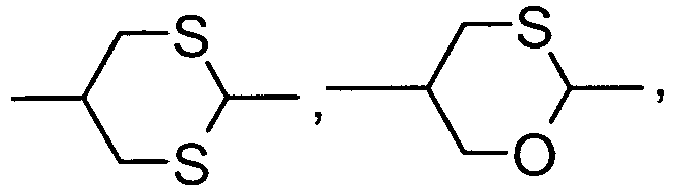
- Particularly preferred compounds of the formula FI are selected from the group consisting of the following sub-formulae:




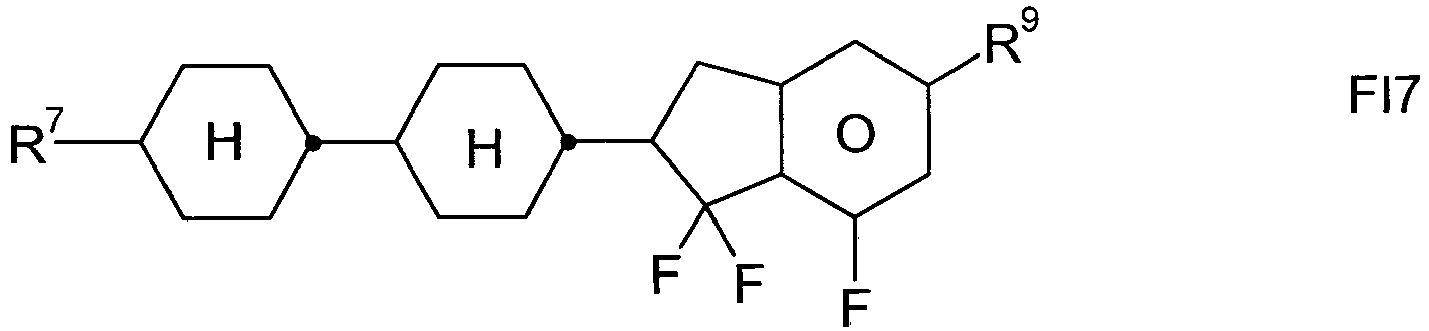

- o) LC medium wherein component B) or the LC host mixture additionally comprises one or more compounds selected from the group consisting of the following formulae:


- p) LC medium wherein component B) or the LC host mixture additionally comprises one or more compounds which contain a tetrahydronaphthyl or naphthyl unit, such as, for example, the compounds selected from the group consisting of the following formulae:


- R10 and R11 each, independently of one another, denote alkyl having 1 to 12 C atoms, where, in addition, one or two non-adjacent CH2 groups may be replaced by -O-, -CH=CH-, -CO-, -OCO- or -COO- in such a way that O atoms are not linked directly to one another, preferably alkyl or alkoxy having 1 to 6 C atoms, and R10 and R11 preferably denote straight-chain alkyl or alkoxy having 1 to 6 C atoms or straight-chain alkenyl having 2 to 6 C atoms, and
- Z1 and Z2 each, independently of one another, denote -C2H4-, -CH=CH-, -(CH2)4-, -(CH2)3O-, -O(CH2)3-, -CH=CH-CH2CH2-, -CH2CH2CH=CH-, -CH2O-, -OCH2-, -CO-O-, -O-CO-, -C2F4-, -CF=CF-, -CF=CH-, -CH=CF-, -CH2- or a single bond.
- q) LC medium wherein component B) or the LC host mixture additionally comprises one or more difluorodibenzochromans and/or chromans of the following formulae:


- R11 and R12
- each, independently of one another, have one of the meanings indicated above for R11,
- ring M
- is trans-1,4-cyclohexylene or 1,4-phenylene,
- Zm
- -C2H4-, -CH2O-, -OCH2-, -CO-O- or -O-CO-,
- c
- is 0, 1 or 2,
- Particularly preferred compounds of the formulae BC, CR and RC are selected from the group consisting of the following sub-formulae:



- Very particular preference is given to LC host mixtures comprising one, two or three compounds of the formula BC-2.
r) LC medium wherein component B) or the LC host mixture additionally comprises one or more fluorinated phenanthrenes and/or dibenzofurans of the following formulae:

- Particularly preferred compounds of the formulae PH and BF are selected from the group consisting of the following sub-formulae:


s) LC medium wherein component B) or the LC host mixture additionally comprises one or more monocyclic compounds of the following formula
- R1 and R2
- each, independently of one another, denote alkyl having 1 to 12 C atoms, where, in addition, one or two non-adjacent CH2 groups may be replaced by -O-, -CH=CH-, -CO-, -OCO- or -COO- in such a way that O atoms are not linked directly to one another, preferably alkyl or alkoxy having 1 to 6 C atoms,
- L1 and L2
- each, independently of one another, denote F, Cl, OCF3, CF3, CH3, CH2F, CHF2.
- Preferably, both L1 and L2 denote F or one of L1 and L2 denotes F and the other denotes Cl,
- The compounds of the formula Y are preferably selected from the group consisting of the following sub-formulae:


- Particularly preferred compounds of the formula Y are selected from the group consisting of the following sub-formulae:


- t) LC medium which, apart from the polymerisable compounds as described above and below, does not contain a compound which contains a terminal vinyloxy group (-O-CH=CH2).
- u) LC medium wherein component B) or the LC host mixture comprises 1 to 8, preferably 1 to 5, compounds of the formulae CY1, CY2, PY1 and/or PY2. The proportion of these compounds in the LC host mixture as a whole is preferably 5 to 60%, particularly preferably 10 to 35%. The content of these individual compounds is preferably in each case 2 to 20%.
- v) LC medium wherein component B) or the LC host mixture comprises 1 to 8, preferably 1 to 5, compounds of the formulae CY9, CY10, PY9 and/or PY10. The proportion of these compounds in the LC host mixture as a whole is preferably 5 to 60%, particularly preferably 10 to 35%. The content of these individual compounds is preferably in each case 2 to 20%.
- w) LC medium wherein component B) or the LC host mixture comprises 1 to 10, preferably 1 to 8, compounds of the formula ZK, in particular compounds of the formulae ZK1, ZK2 and/or ZK6. The proportion of these compounds in the LC host mixture as a whole is preferably 3 to 25%, particularly preferably 5 to 45%. The content of these individual compounds is preferably in each case 2 to 20%.
- x) LC medium in which the proportion of compounds of the formulae CY, PY and ZK in the LC host mixture as a whole is greater than 70%, preferably greater than 80%.
- y) LC medium in which the LC host mixture contains one or more compounds containing an alkenyl group, preferably selected from formulae AN and AY, very preferably selected from formulae AN1, AN3, AN6 and AY14, most preferably from formulae AN1a, AN3a, AN6a and AY14. The concentration of these compounds in the LC host mixture is preferably from 2 to 70%, very preferably from 3 to 55%.
- z) LC medium wherein component B) or the LC host mixture contains one or more, preferably 1 to 5, compounds selected of formula PY1-PY8, very preferably of formula PY2. The proportion of these compounds in the LC host mixture as a whole is preferably 1 to 30%, particularly preferably 2 to 20%. The content of these individual compounds is preferably in each case 1 to 20%.
- z1) LC medium wherein component B) or the LC host mixture contains one or more, preferably 1, 2 or 3, compounds selected from formulae T1, T2, T3 and T21, very preferably from formula T2. The content of these compounds in the LC host mixture as a whole is preferably 1 to 20%.
- z2) LC medium in which the LC host mixture contains one or more, preferably 1, 2 or 3, compounds of formula BF1, and one or more, preferably 1, 2 or 3, compounds selected from formulae AY14, AY15 and AY16, very preferably of formula AY14. The proportion of the compounds of formula AY14-AY16 in the LC host mixture is preferably from 2 to 35%, very preferably from 3 to 30%. The proportion of the compounds of formula BF1 in the LC host mixture is preferably from 0.5 to 20%, very preferably from 1 to 15%. Further preferably the LC host mixture according to this preferred embodiment contains one or more, preferably 1, 2 or 3 compounds of formula T, preferably selected from formula T1, T2 and T3, very preferably from formula T2. The proportion of the compounds of formula T in the LC host mixture medium is preferably from 0.5 to 15%, very preferably from 1 to 10%.
- In the LC medium according to the present invention, the use of an LC host mixture together with the use of a polymerisable component comprising a combination of a first, second and third polymerisable compound as described above leads to advantageous properties in LC displays. In particular, one or more of the following advantages could be achieved:
- easy and quick formation of polymer walls by polymerisation-induced phase separation of the polymer formed by the first and second polymerisable compounds,
- formation of polymer walls with highly defined shape and constant thickness,
- constant cell gap,
- high flexibility of the display cell in case plastic substrates are used,
- high resistance of the display cell against mechanical pressure, and low variation of the cell gap under pressure,
- good adhesion of the polymer walls to the substrates,
- low number of defects,
- reduced formation of domains with different electrooptical properties like response time or contrast,
- high transparency,
- good contrast,
- fast response times.
- The display manufacture process is known to the skilled person and is described in the literature, for example in
US6130738 andEP2818534 A1 . - The present invention also relates to a process for the production of an LC display as described above and below, comprising the steps of providing an LC medium as described above and below into the display, and polymerising the polymerisable compounds in defined regions of the display.
- Preferably the polymerisable compounds are photopolymerised by exposure to UV irradiation.
- Further preferably the polymerisable compounds are photopolymerised by exposure to UV irradiation through a photomask. The UV radiation can be generated by a variety of light sources which are known to the skilled person, including but not limited to arc lamps, led lights, laser light sources, or others.
- The photomask is preferably designed such that it comprises regions that are transparent to the UV radiation used for photopolymerisation, and regions that are not transparent to the UV radiation used for photopolymerisation, and wherein the transparent regions form a pattern or image that corresponds to the desired shape of the polymer walls. As a result the polymerisable compounds are only polymerised in those parts of the display that are covered by the transparent regions of the photomask, thus forming polymer walls of the desired shape.
- Alternatively to using a photomask, a light source can be used that emits light with an already shaped profile. Such profile can for example be generated by interference of two laser beams.
- In a preferred embodiment of the present invention, the display is subjected to a second UV irradiation step, preferably without a photomask applied, after the first UV irradiation step as described above. Thereby it is possible to complete polymerisation of monomers that were not or only partially polymerised in the first step. The second UV step can have an emission spectrum and/or intensity which is the same as that of the first step, or which is different from the first step.
- Alternatively two applying two separate irradiation steps, the intensity is changed during UV exposure. Preferably, the intensity is gradually increased during UV exposure.
- For example, an LC display according to the present invention can be manufactured as follows. Polymerisable compounds as described above and below are combined with a suitable LC host mixture. This resulting LC medium can then be included into the display by using conventional manufacturing processes. The resulting LC medium can be filled for example using capillary forces into the cell gap formed by two substrates.
- Alternatively, the LC medium can be deposited as a layer onto a substrate, and another substrate is placed on top of the LC layer under vacuum in order to prevent inclusion of air bubbles. The LC medium is in either case located in the cell gap formed by the two substrates, as exemplarily illustrated in
Fig. 1a . These substrates usually are covered by an alignment layer which is in direct contact with the LC medium. The substrates itself can carry other functional components like TFTs, black matrix, colour filter, or similar. - Subsequently, polymerization induced phase separation is initiated by exposure of the LC medium, which is either in the nematic or the isotropic phase, to UV radiation with collimated light through a photomask, as exemplarily illustrated in
Fig. 1b . This leads to the formation of polymer wall structures, restoration of the LC host, and alignment of the LC phase with the alignment layer, as exemplarily illustrated inFig. 1c . - This process can advantageously utilize display manufacturing processes that are established in the industry. Thus, both the display filling process, for example by one-drop-filling (ODF), and the radiation initiated polymerization step after sealing the display, which is known for example from polymer stabilised or PS-type display modes like PS-VA, are established techniques in conventional LCD manufacturing.
- A preferred LC display of the present invention comprises:
- a first substrate including a pixel electrode defining pixel areas, the pixel electrode being connected to a switching element disposed in each pixel area and optionally including a micro-slit pattern, and optionally a first alignment layer disposed on the pixel electrode,
- a second substrate including a common electrode layer, which may be disposed on the entire portion of the second substrate facing the first substrate, and optionally a second alignment layer,
- an LC layer disposed between the first and second substrates and including an LC medium comprising a polymerisable component A) and a liquid-crystalline component B) as described above and below, wherein the polymerisable component A) is polymerised.
- The LC display may comprise further elements, like a colour filter, a black matrix, a passivation layer, optical retardation layers, transistor elements for addressing the individual pixels, etc., all of which are well known to the person skilled in the art and can be employed without inventive skill.
- The electrode structure can be designed by the skilled person depending on the individual display type. For example for VA displays a multi-domain orientation of the LC molecules can be induced by providing electrodes having slits and/or bumps or protrusions in order to create two, four or more different tilt alignment directions.
- The first and/or second alignment layer controls the alignment direction of the LC molecules of the LC layer. For example, in TN displays the alignment layer is selected such that it imparts to the LC molecules an orientation direction parallel to the surface, while in VA displays the alignment layer is selected such that it imparts to the LC molecules a homeotropic alignment, i.e. an orientation direction perpendicular to the surface. Such an alignment layer may for example comprise a polyimide, which may also be rubbed, or may be prepared by a photoalignment method.
- The substrate can be a glass substrate, for example in case of a curved display. The use of an LC medium according to the present invention in an LC display with glass substrates can provide several advantages. For example, the formation of polymer wall structures in the LC medium helps to prevent the so-called "pooling effect" where pressure applied on the glass substrates causes unwanted optical defects. The stabilizing effect of the polymer wall structures also allows to further minimize the panel thickness. Moreover, in bent panels with glass substrates the polymer wall structures enable a smaller radius of curvature.
- For flexible LC displays preferably plastic substrates are used. These plastic substrates preferably have a low birefringence. Examples are polycarbonate (PC), polyethersulfone (PES), polycyclic olefine (PCO), polyarylate (PAR), polyetheretherketone (PEEK), or colourless polyimide (CPI) substrates.
- The LC layer with the LC medium can be deposited between the substrates of the display by methods that are conventionally used by display manufacturers, for example the one-drop-filling (ODF) method. The polymerisable component of the LC medium is then polymerised for example by UV photopolymerisation.
- In case the polymerisable compounds are used as a replacement for spacer particles, the display manufacturing process preferably comprises the following steps:
- In a first step, the LC medium containing the LC host and monomer precursor is applied to one of the two substrates, preferably by using one of the following deposition methods: one drop filling, ink jet printing, spin coating, slit coating, flexo printing, or a comparable method. The substrate in that instance may carry a colour filter, TFT devices, a black matrix, a polyimide coating, or other components typically found on a display substrate. The applied LC medium forms a thin, uniform film with the thickness of the targeted cell gap of the final device.
- In a second step, the applied film is subjected to UV radiation having an intensity profile. This profile is generated for example by irradiating through a photomask, using laser interference, direct laser writing, or a comparable method. Irradiation of the film can either occour from either side of the substrate. In case of using a photomask, the mask can either placed on the substrate and the LC film is cured by the light passing through the substrate, or the mask is directly brought in close proximity to the LC film and the LC medium is cured directly.
- Subsequently, the second substrate, which may also carry colour filter, TFT devices, a black matrix, a polyimide coating, or other components typically found on a display substarte, is place ontop of the first substrate so that the LC film comes to rest in between the two substrates.
- A further irradiation is now optionally possible to convert unreacted monomers, generate adhesion between the two substartes, and/or seal the edges of the display.
- The polymerisation of the polymerisable compounds can be carried out in one step or in two or more steps. It is also possible to carry out the polymerisation in a sequence of several UV irradiation and/or heating or cooling steps. For example, a display manufacturing process may include a first UV irradiation step at room temperature to produce a pretilt angle, and subsequently, in a second polymerisation step to polymerise or crosslink the compounds which have not reacted in the first step ("end curing").
- Upon polymerisation the polymerisable compounds react with each other to a polymer which undergoes macroscopical phase-separation from the LC host mixture and forms polymer walls in the LC medium.
- Suitable and preferred polymerisation methods are, for example, thermal or photopolymerisation, preferably photopolymerisation, in particular UV induced photopolymerisation, which can be achieved by exposure of the polymerisable compounds to UV radiation.
- Optionally one or more polymerisation initiators are added to the LC medium. Suitable conditions for the polymerisation and suitable types and amounts of initiators are known to the person skilled in the art and are described in the literature. Suitable for free-radical polymerisation are, for example, the commercially available photoinitiators Irgacure651®, Irgacure184®, Irgacure907®, Irgacure369® or Darocure1173® (Ciba AG). If a polymerisation initiator is employed, its proportion is preferably 0.001 to 5% by weight, particularly preferably 0.001 to 1% by weight.
- The polymerisable compounds according to the invention are also suitable for polymerisation without an initiator, which is accompanied by considerable advantages, such, for example, lower material costs and in particular less contamination of the LC medium by possible residual amounts of the initiator or degradation products thereof. The polymerisation can thus also be carried out without the addition of an initiator. In a preferred embodiment, the LC medium contains a polymerisation initiator.
- The LC medium may also comprise one or more stabilisers or inhibitors in order to prevent undesired spontaneous polymerisation of the RMs, for example during storage or transport. Suitable types and amounts of stabilisers are known to the person skilled in the art and are described in the literature. Particularly suitable are, for example, the commercially available stabilisers from the Irganox® series (Ciba AG), such as, for example, Irganox® 1076. If stabilisers are employed, their proportion, based on the total amount of RMs or the polymerisable component (component A), is preferably 10-500,000 ppm, particularly preferably 50-50,000 ppm.
- Preferably the LC medium according to the present invention does essentially consist of a polymerisable component A) and an LC component B) (or LC host mixture) as described above and below. However, the LC medium may additionally comprise one or more further components or additives.
- The LC media according to the invention may also comprise further additives which are known to the person skilled in the art and are described in the literature, such as, for example, polymerisation initiators, inhibitors, stabilisers, surface-active substances or chiral dopants. These may be polymerisable or non-polymerisable. Polymerisable additives are accordingly ascribed to the polymerisable component or component A). Non-polymerisable additives are accordingly ascribed to the non-polymerisable component or component B).
- Preferred additives are selected from the list including but not limited to comonomers, chiral dopants, polymerisation initiators, inhibitors, stabilizers, surfactants, wetting agents, lubricating agents, dispersing agents, hydrophobing agents, adhesive agents, flow improvers, defoaming agents, deaerators, diluents, reactive diluents, auxiliaries, colourants, dyes, pigments and nanoparticles.
- In a preferred embodiment the LC media contain one or more chiral dopants, preferably in a concentration from 0.01 to 1% by weight, very preferably from 0.05 to 0.5% by weight. The chiral dopants are preferably selected from the group consisting of compounds from Table B below, very preferably from the group consisting of R- or S-1011, R- or S-2011, R- or S-3011, R- or S-4011, and R- or S-5011.
- In another preferred embodiment the LC media contain a racemate of one or more chiral dopants, which are preferably selected from the chiral dopants mentioned in the previous paragraph.
- Furthermore, it is possible to add to the LC media, for example, 0 to 15% by weight of pleochroic dyes, furthermore nanoparticles, conductive salts, preferably ethyldimethyldodecylammonium 4-hexoxybenzoate, tetrabutylammonium tetraphenylborate or complex salts of crown ethers (cf., for example, Haller et al., Mol. Cryst. Liq. Cryst. 24, 249-258 (1973)), for improving the conductivity, or substances for modifying the dielectric anisotropy, the viscosity and/or the alignment of the nematic phases. Substances of this type are described, for example, in
DE-A 22 09 127 ,22 40 864 ,23 21 632 ,23 38 281 ,24 50 088 ,26 37 430 and28 53 728 . - The LC media which can be used in accordance with the invention are prepared in a manner conventional per se, for example by mixing one or more of the above-mentioned compounds with one or more polymerisable compounds as defined above, and optionally with further liquid-crystalline compounds and/or additives. In general, the desired amount of the components used in lesser amount is dissolved in the components making up the principal constituent, advantageously at elevated temperature. It is also possible to mix solutions of the components in an organic solvent, for example in acetone, chloroform or methanol, and to remove the solvent again, for example by distillation, after thorough mixing. The invention furthermore relates to the process for the preparation of the LC media according to the invention.
- It goes without saying to the person skilled in the art that the LC media according to the invention may also comprise compounds in which, for example, H, N, O, Cl, F have been replaced by the corresponding isotopes like deuterium etc.
- The following examples explain the present invention without restricting it. However, they show the person skilled in the art preferred mixture concepts with compounds preferably to be employed and the respective concentrations thereof and combinations thereof with one another. In addition, the examples illustrate which properties and property combinations are accessible.
- Throughout the patent application and in the working examples, the structures of the liquid-crystal compounds are indicated by means of acronyms. Unless indicated otherwise, the transformation into chemical formulae takes place in accordance with Tables I-III. All radicals CnH2n+1, CmH2m+1, CnH2n, CmH2m and CkH2k are straight-chain alkyl radicals or alkenyl radicals respectively, in each case having n, m or k C atoms; n and m each, independently of one another, denote 1, 2, 3, 4, 5, 6, 7, 8, 9, 10, 11 or 12, preferably 1, 2, 3, 4, 5 or 6, and k is 0, 1, 2, 3, 4, 5 or 6. In Table I the ring elements of the respective compound are coded, in Table II the bridging members are listed and in Table III the meanings of the symbols for the left-hand and right-hand side chains of the compounds are indicated.


Table II: Bridging members E -CH2CH2- V -CH=CH- T -C≡C- W -CF2CF2- Z -COO- ZI -OCO- O -CH2O- OI -OCH2- Q -CF2O- QI -OCF2- Table III: Side chains Left-hand side chain Right-hand side chain n- CnH2n+1- -n -CnH2n+1 nO- CnH2n+1-O- -On -O-CnH2n+1 V- CH2=CH- -V -CH=CH2 nV- CnH2n+1-CH=CH- -nV -CnH2n-CH=CH2 Vn- CH2=CH-CnH2n- -Vn -CH=CH-CnH2n+1 nVm- CnH2n+1-CH=CH-CmH2m- -nVm - CnH2n-CH=CH-CmH2m+1 N- N≡C- -N -C≡N F- F- -F -F Cl- Cl- -Cl -Cl M- CFH2- -M -CFH2 D- CF2H- -D -CF2H T- CF3- -T -CF3 MO- CFH2O- -OM -OCFH2 DO- CF2HO- -OD -OCF2H TO- CF3O- -OT -OCF3 T- CF3- -T -CF3 A- H-C≡C- -A -C≡C-H FXO- CF2=CHO- -OXF -OCH=CF2 - Preferred mixture components are shown in Tables A1 and A2 below. The compounds shown in Table A1 are especially suitable for use in LC mixtures with positive dielectric anisotropy. The compounds shown in Table A2 are especially suitable for use in LC mixtures with negative dielectric anisotropy.
Table A1 In Table A1, R1* denotes a group selected from the left-hand side chains and R2* denotes a group selected from the right-hand side chains listed in Table III, L1* and L2* are independently of each other H or F, m and n are independently of each other an integer from 1 to 12, preferably 1, 2, 3, 4, 5 or 6, k is 0, 1, 2, 3, 4, 5 or 6, and (O)CmH2m+1 means CmH2m+1 or OCmH2m+1. 


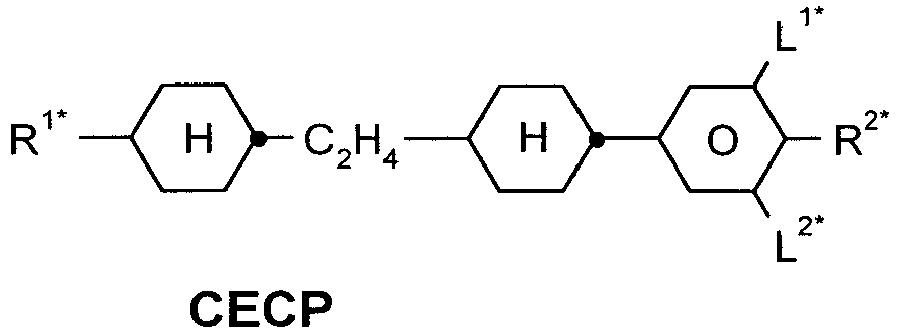


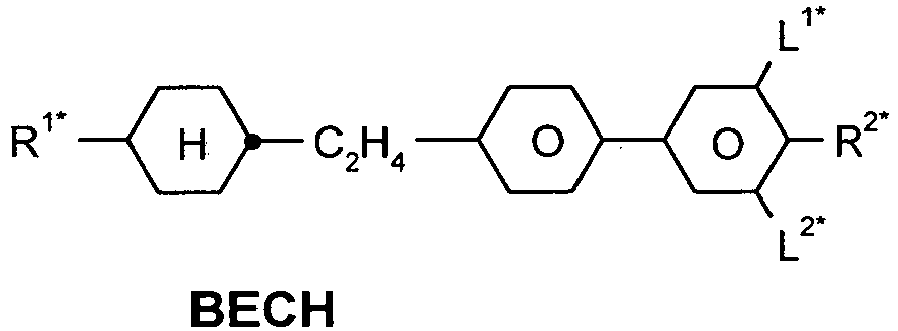


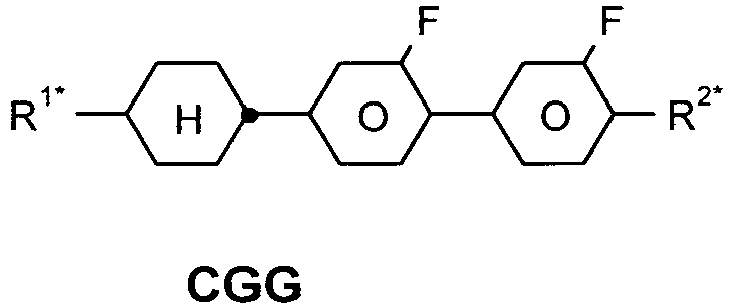


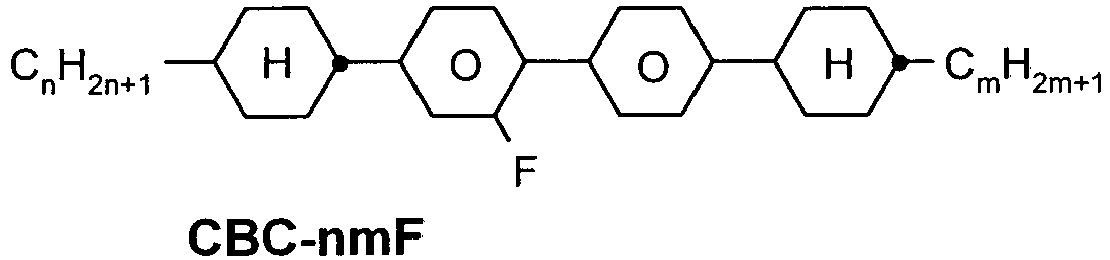


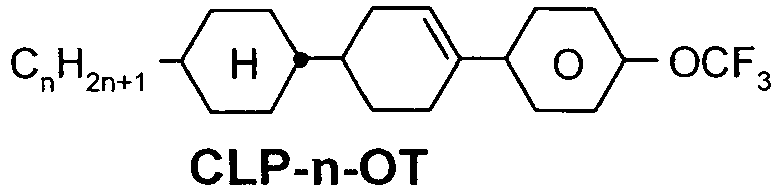


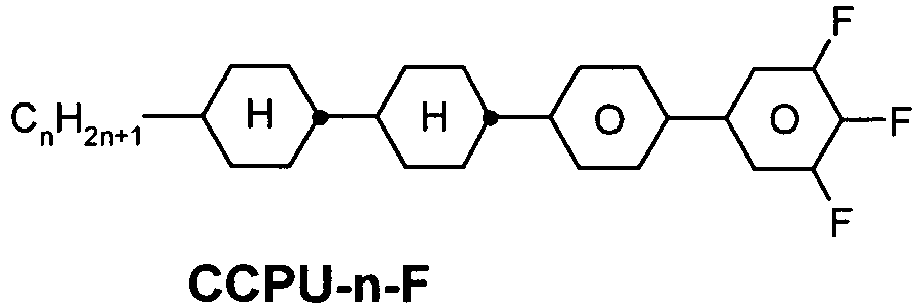


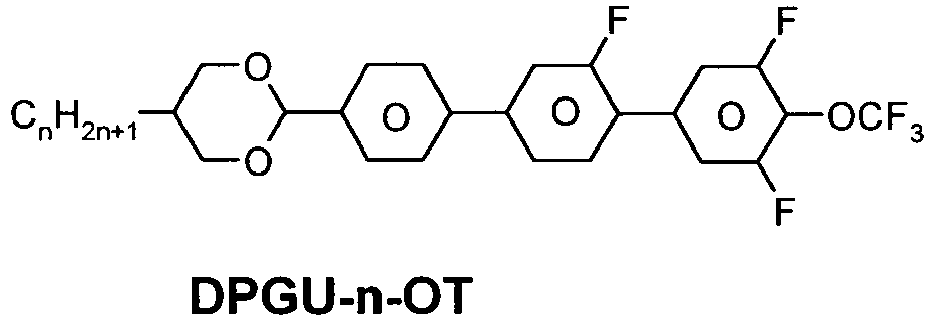

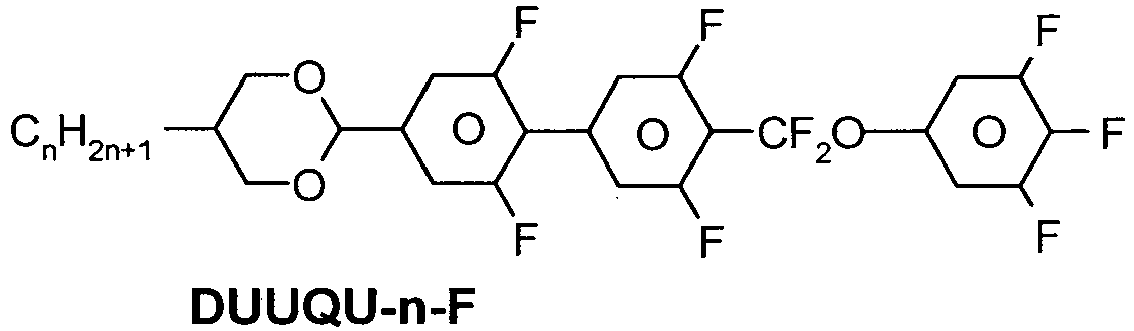
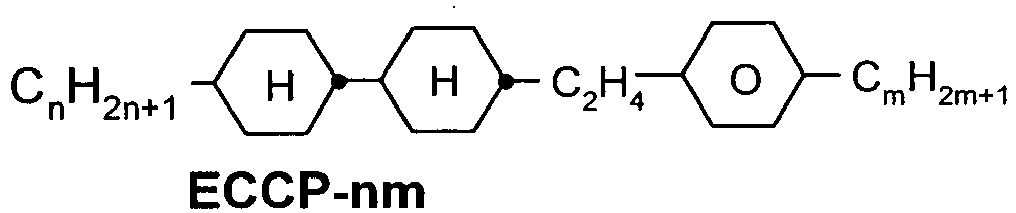


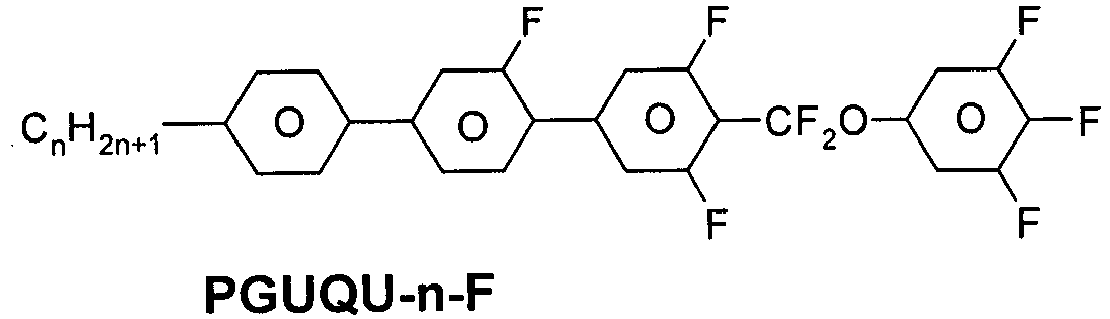
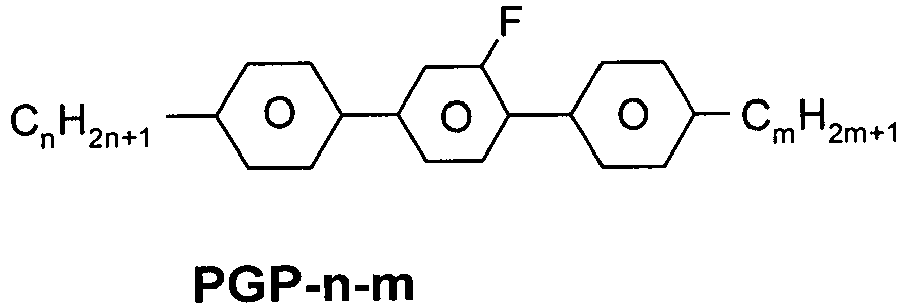
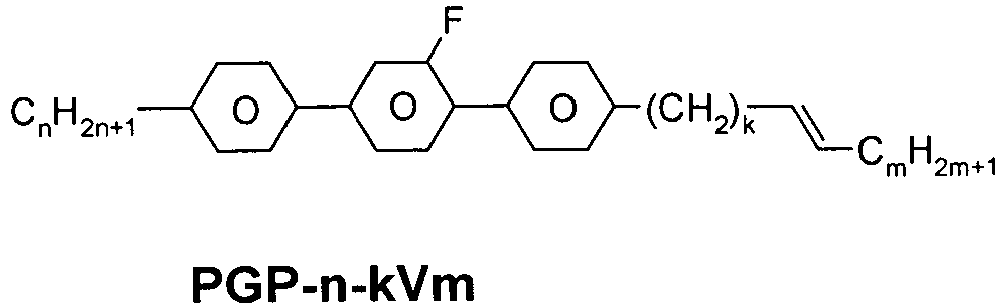


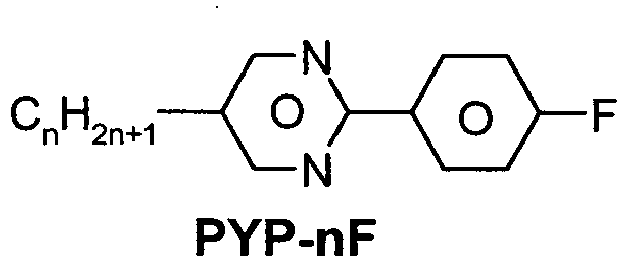
Table A2 In the formulae below m and n are independently of each other an integer from 1 to 12, preferably 1, 2, 3, 4, 5 or 6, k is 0, 1, 2, 3, 4, 5 or 6 and (O)CmH2m+1 means CmH2m+1 or OCmH2m+1. 


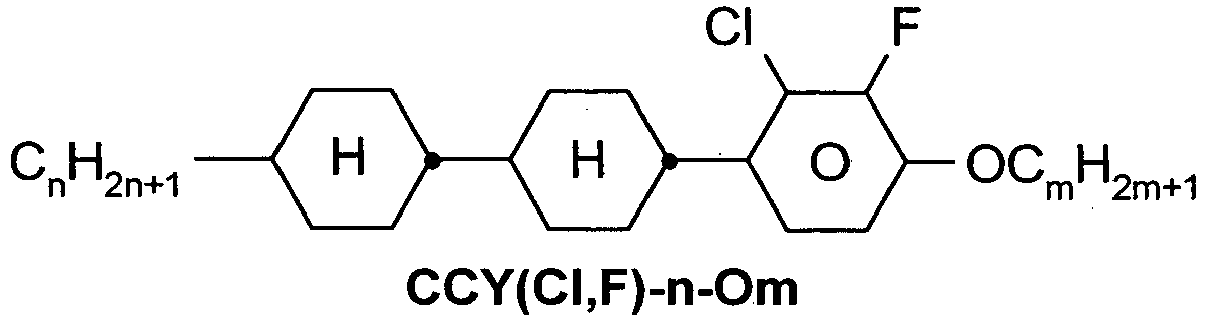


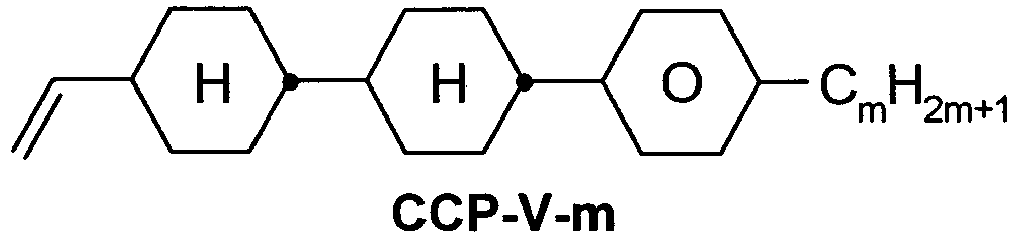


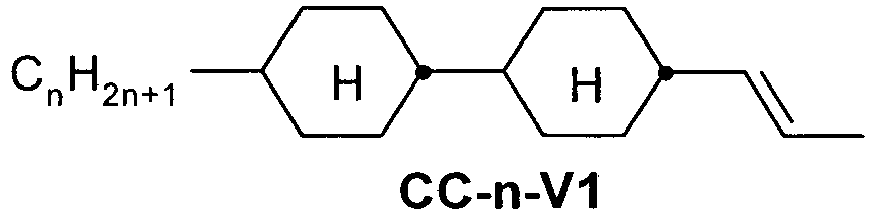


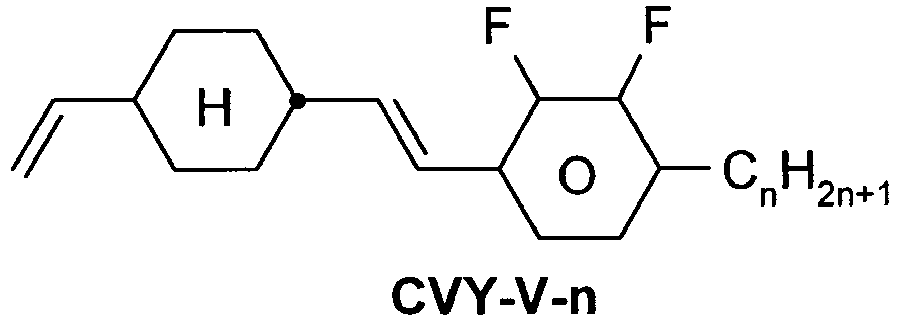


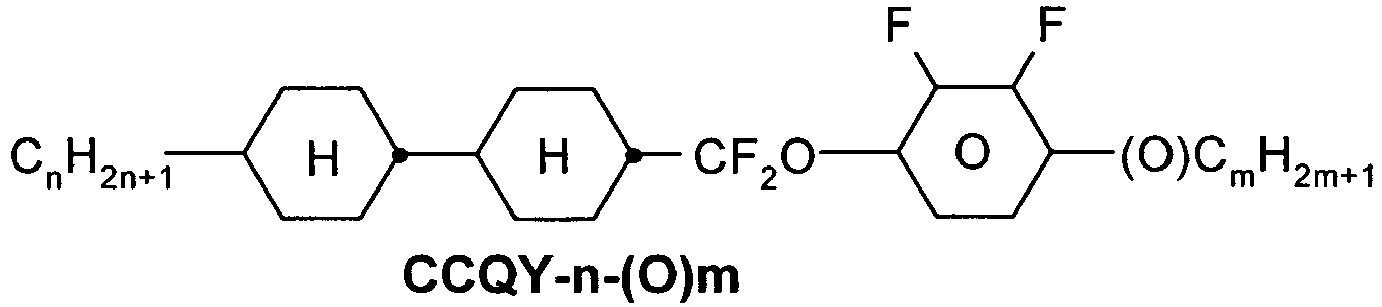


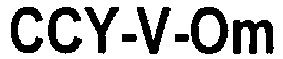


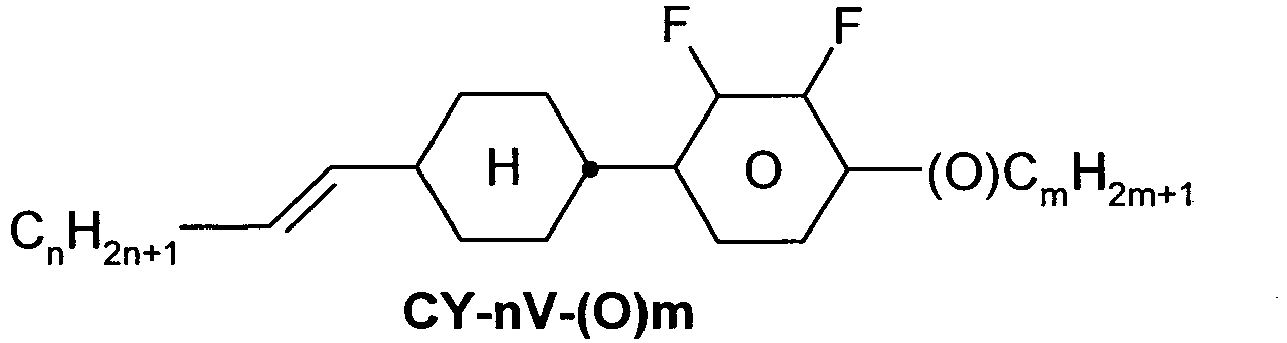


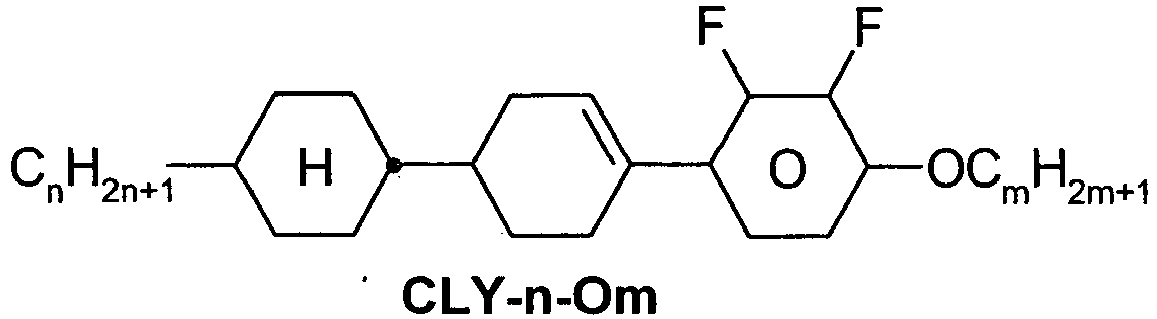


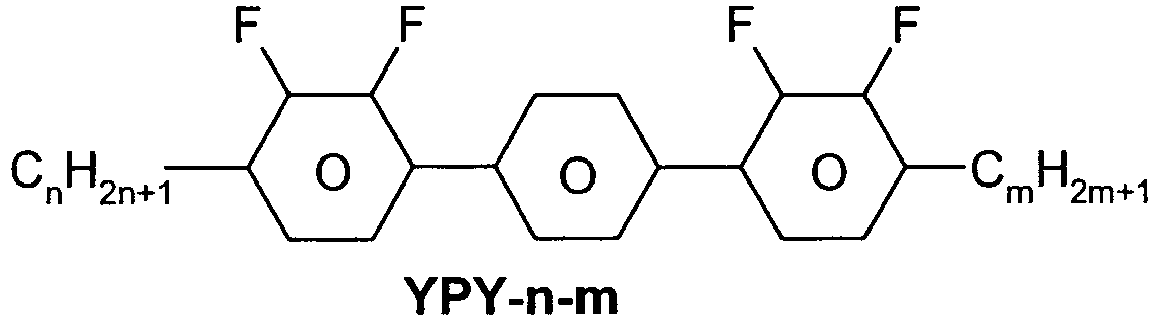


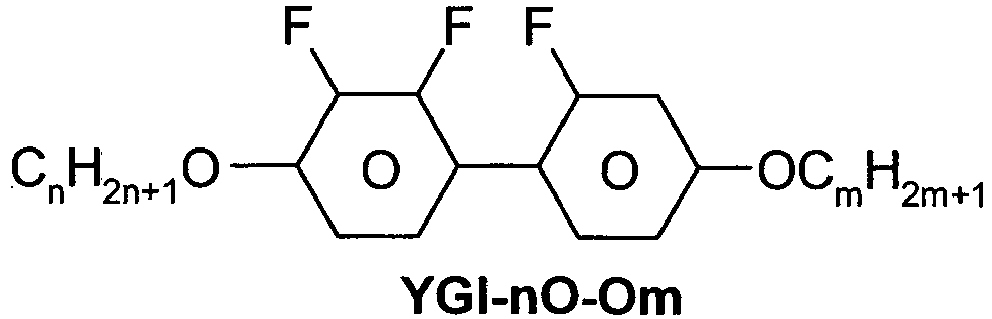


- In a first preferred embodiment of the present invention, the LC media according to the invention, especially those with positive dielectric anisotropy, comprise one or more compounds selected from the group consisting of compounds from Table A1.
- In a second preferred embodiment of the present invention, the LC media according to the invention, especially those with negaitve dielectric anisotropy, comprise one or more compounds selected from the group consisting of compounds from Table A2.
Table B Table B shows possible chiral dopants which can be added to the LC media according to the invention. 

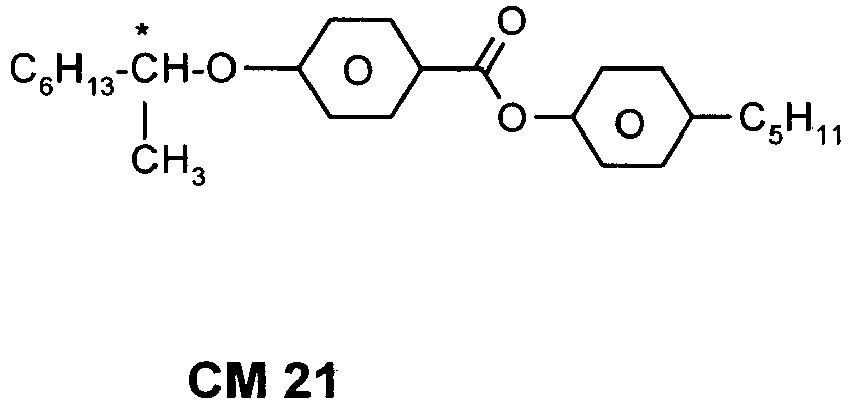


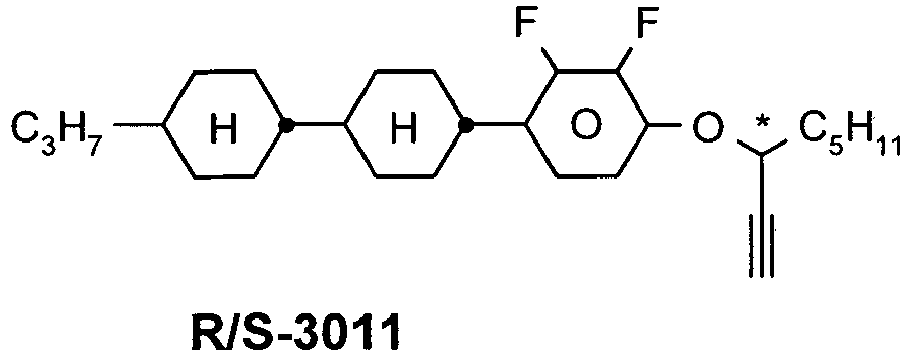
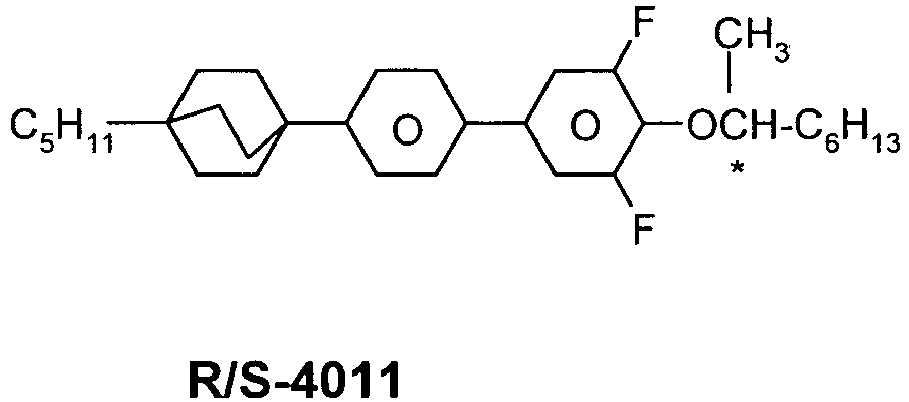


- The LC media preferably comprise 0 to 10% by weight, in particular 0.01 to 5% by weight, particularly preferably 0.1 to 3% by weight, of dopants. The LC media preferably comprise one or more dopants selected from the group consisting of compounds from Table B.
Table C Table C shows possible stabilisers which can be added to the LC media according to the invention. Therein n denotes an integer from 1 to 12, preferably 1, 2, 3, 4, 5, 6, 7 or 8, and terminal methyl groups are not shown. 


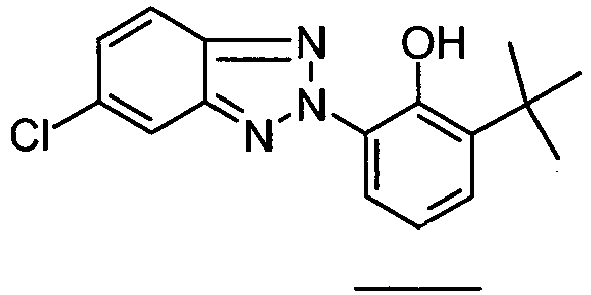


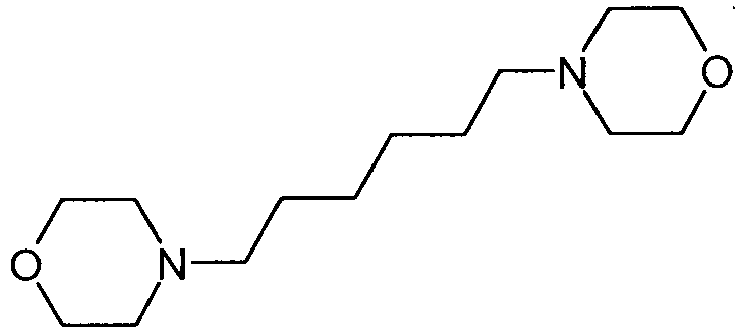


- The LC media preferably comprise 0 to 10% by weight, in particular 1 ppm to 5% by weight, particularly preferably 1 ppm to 1% by weight, of stabilisers.
- The LC media preferably comprise one or more stabilisers selected from the group consisting of compounds from Table C.
- In addition, the following abbreviations and symbols are used:
- V0
- threshold voltage, capacitive [V] at 20°C,
- ne
- extraordinary refractive index at 20°C and 589 nm,
- no
- ordinary refractive index at 20°C and 589 nm,
- Δn
- optical anisotropy at 20°C and 589 nm,
- ε⊥
- dielectric permittivity perpendicular to the director at 20°C and 1 kHz,
- ε∥
- dielectric permittivity parallel to the director at 20°C and 1 kHz,
- Δε
- dielectric anisotropy at 20°C and 1 kHz,
- cl.p., T(N,I)
- clearing point [°C],
- γ1
- rotational viscosity at 20°C [mPa·s],
- K1
- elastic constant, "splay" deformation at 20°C [pN],
- K2
- elastic constant, "twist" deformation at 20°C [pN],
- K3
- elastic constant, "bend" deformation at 20°C [pN].
- Unless explicitly noted otherwise, all concentrations and ratios in the present application are quoted in per cent by weight, and preferably relate to the corresponding mixture as a whole, comprising all solid or liquid-crystalline components, without solvents.
- Unless explicitly noted otherwise, all temperature values indicated in the present application, such as, for example, for the melting point T(C,N), the transition from the smectic (S) to the nematic (N) phase T(S,N) and the clearing point T(N,I), are quoted in degrees Celsius (°C). M.p. denotes melting point, cl.p. = clearing point. Furthermore, C = crystalline state, N = nematic phase, S = smectic phase and I = isotropic phase. The data between these symbols represent the transition temperatures.
- All physical properties are and have been determined in accordance with "Merck Liquid Crystals, Physical Properties of Liquid Crystals", Status Nov. 1997, Merck KGaA, Germany, and apply for a temperature of 20°C, and Δn is determined at 589 nm and Δε at 1 kHz, unless explicitly indicated otherwise in each case.
- The term "threshold voltage" for the present invention relates to the capacitive threshold (V0), also known as the Freedericks threshold, unless explicitly indicated otherwise. In the examples, the optical threshold may also, as generally usual, be quoted for 10% relative contrast (V10).
- The nematic LC host mixture N1 is formulated as follows.
APUQU-2-F 6.00% cl.p. 79.5°C APUQU-3-F 6.00% Δn 0.1086 CC-3-V 44.50% Δε 9.6 CC-3-V1 4.00% ε∥ 12.9 CCP-30CF3 7.00% γ1 67 mPa·s CCP-V-1 5.00% CPGU-3-OT 3.00% PGP-2-V 5.50% PGUQU-3-F 3.00% PGUQU-4-F 7.00% PGUQU-5-F 3.00% PUQU-3-F 6.00% - The nematic LC host mixture N2 is formulated as follows.
PUQU-3-F 5.50 cl.p. 80.1°C CC-3-V 40.00 Δn 0.1095 CC-3-V1 10.00 Δε 9.1 CCP-V1 10.00 ε∥ 12.4 APUQU-2-F 5.00 γ1 65 mPa·s APUQU-3-F 10.50 PGUQU-3-F 3.50 PGUQU-4-F 8.00 PGP-2-2V 7.50 - The nematic LC host mixture N3 is formulated as follows.
CC-3-V 40.00 cl.p. 81.5°C CC-3-V1 8.00 Δn 0.0827 PUQU-2-F 3.00 Δε 9.4 PUQU-3-F 8.00 ε∥ 12.8 APUQU-2-F 7.00 γ1 75 mPa·s APUQU-3-F 7.00 CCP-3-1 7.00 CCOC-3-3 5.00 CCOC-4-3 5.00 CDUQU-3-F 10.00 - Polymerisable mixture preparation: Polymerisable LC media for polymer wall formation are prepared by mixing LC host, monomer and photoinitiator and then homogenizing the resulting mixture by heating above the clearing point.
- The structures of the monomer (including its formula and name in the composition table) are listed below.

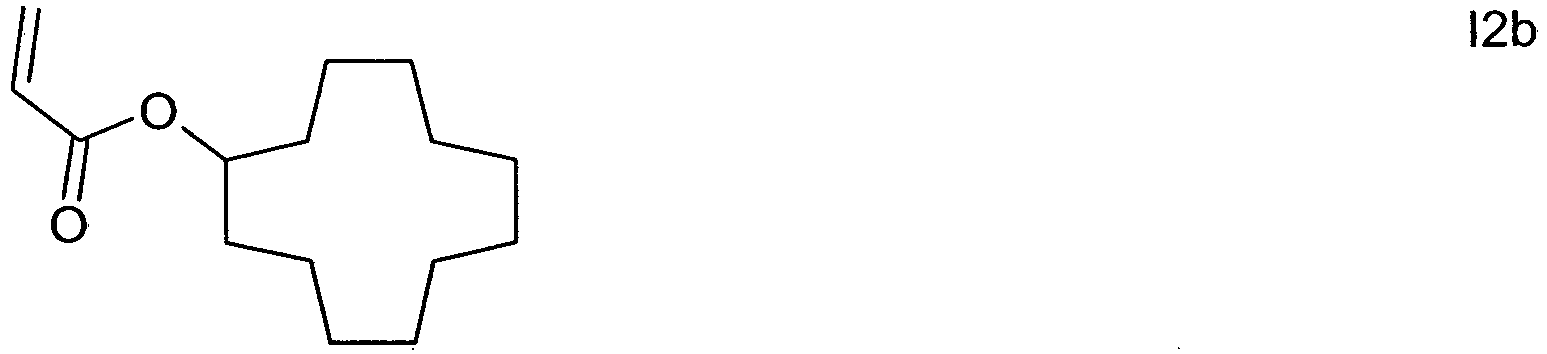





- The mixture compositions are shown in Table 1 below.
Table 1 - Polymerisable Mixture Compositions No. Host [Host] (%) Monomer 1 [Monomer 1] (%) Monomer 2 [Monomer 2] (%) Monomer 3/4 [Monomer 3/4] (%) IRG-651 [%] 1 N1 87.88 I2a 3.60 II1a1 8.00 III4b1 0.20 0.12 III1a2 0.20 2 N1 87.88 I2a 8.00 II1a1 3.60 III4b1 0.20 0.12 III1a2 0.20 3 N1 87.88 I2a 1.60 II1a1 10.00 III4b1 0.20 0.12 III1a2 0.20 4 N1 87.88 I2a 1.60 II1a14 10.00 III4b1 0.20 0.12 III1a2 0.20 5 N1 87.88 I2a 3.60 II1a14 8.00 III4b1 0.20 0.12 III1a2 0.20 6 N1 87.88 I2a 8.00 II1a14 3.60 III4b1 0.20 0.12 III1a2 0.20 7 N1 87.88 I2b 3.60 II1a13 8.00 III4b1 0.20 0.12 III1a2 0.20 8 N1 87.88 I2a 3.60 II1a13 8.00 III4b1 0.20 0.12 III1a2 0.20 9 N2 86.87 I3a 6.00 II1a7 6.00 III4b1 1.00 0.13 10 N2 86.87 I3a 6.00 II1a1 6.00 III4b1 1.00 0.13 11 N2 86.87 I3a 6.00 II1a1 6.00 III1a1 1.00 0.13 12 N2 86.87 I3a 6.00 II1a1 6.00 III1a2 1.00 0.13 13 N3 86.87 I3a 6.00 II1a7 6.00 III1a1 1.00 0.13 14 N3 84.85 I2a 15.00 - - - - 0.15 15 N3 84.85 I2a 14.00 - - III1a8 1.00 0.15 16 N2 86.87 I3a 6.00 IIA1a1 6.00 III1a20 1.00 0.13 17 N2 86.87 I3a 6.00 IIA1a1 6.00 III1a1 1.00 0.13 - Polymerisable mixtures 1-17 according to the invention contain host mixture N1, N2 or N3 having positive dielectric anisotropy, and further contain a monoreactive first monomer of formula I, optionally a monoreactive second momoner of formula II or IIA, and optionally one or two di- or multireactive third monomers of formula III, respectively.
- Test Cells: The test cells comprise two glass substrates coated with ITO, which are kept apart by spacer particles or foils at a layer thickness of 3-4 microns and glued together by an adhesive (usually Norland, NEA 123). On top of the electrode layers polyimide alignment layers (Nissan SE-6514 or SE2414) are applied which are rubbed parallel or antiparallel.
- Wall formation: The test cells are filled with the LC medium and placed on a black, non-reflecting surface. A photomask is placed on top of the test cells and the sample is subjected for 30min to UV radiation (Hg/Xe arch lamp, LOT QuantumDesign Europe, LS0205, intensity at sample 4mW/cm2 measured at 365+/-10nm FWHM). Radiation of the emission spectrum below 320nm is removed by a dichroic mirror. The photomask usually has a pattern of equidistant lines of the same thickness. Typical line thickness is 10microns, typcial distance between the lines is 100 microns.
- Characterization: Samples are analyzed under a polarization microscope. The isotropic polymer walls can clearly be distinguished from areas containing birefringend LC. The width of the walls and inclusions of LC into the polymer walls, and defects in the pixel area caused by contamination of polymer, or misalignment of the LC caused by the wall formation process can be observed.
- Mechanical stress test: Test cells are subjected to a mechanical stress by applying pressure to the top substrate by a 0.5mm2 tip with a force of 10N for 10s. Damages to the polymer wall structure are evaluated with the polarization microscope.
- It was observed that the polymer wall structure did not show significant damages caused by mechanical stress.
- Electron micrographs: The structure of the polymer walls and contamination of the pixel area by polymer are investigated by taking electron micrographs. The samples are prepared by either lifting off the top substrate for top-view images, or breaking the glass slides in half for viewing the cross section of the walls. The LC is removed by flushing the sample with ethanol, subsequently the substrates is dried in an air flow and sputter coated with a conductive layer (gold).
- Electro-optical characterization: The electro-optical properties of the liquid crystal host are characterized by applying an electrical potential between 0 and 10V in steps of 0.05V. The resulting response is recorded by measuring the transmission change of the sample in between crossed polarizers (DMS 301 equipped with integration sphere).
- It was observed that the electrooptical properties of the liquid crystal host were not significantly affected by the polymer wall structures.
- Polymerisable LC mixtures 1-17 are each filled into a test cell and subjected to UV irradiation under a photomask as described above.
Fig.2-10 show polarization microscope images of the test cells prepared from polymerisable mixtures 1-8, respectively, after polymerization. The formed polymer walls can be seen as dark lines. -
Fig.10-18 show polarization microscope images of test cells prepared from polymerisable mixtures 9-17, respectively, after polymerization (a), after mechanical stress test (b) and after thermal stress test (c). The formed polymer walls can be seen as dark lines.
Claims (36)
- A liquid crystal (LC) medium comprising a polymerisable component A) which comprises one or more polymerisable compounds, and a liquid-crystalline component B) which comprises one or more mesogenic or liquid-crystalline compounds, characterized in that polymerisable component A) comprises one or more first polymerisable compounds comprising a monocylic hydrocarbon group having from 8 to 24 ring atoms, and attached thereto one polymerisable group.
- The LC medium of claim 1, characterized in that component A) additionally comprises one or more second polymerisable compounds comprising a straight-chain or branched hydrocarbon group having from 1 to 30 C atoms, or a monocyclic hydrocarbon group having from 3 to 7 ring atoms, or a bi- or polycyclic hydrocarbon group having from 4 to 30 ring atoms, and attached thereto one polymerisable group.
- The LC medium of claim 1 or 2, characterized in that component A) additionally comprises one or more third polymerisable compounds comprising a straight-chain, branched or cyclic hydrocarbon group having from 1 to 30 C atoms and attached thereto two or more polymerisable groups.
- The LC medium according to any one of claims 1 to 3, characterized in that component A) comprises one or more first polymerisable compounds selected from formula I
P-Sp-G1 I
whereinP is a polymerisable group,Sp is a spacer group or a single bond,G1 is a monocyclic hydrocarbon group having 8 to 24 C atoms, which is optionally substituted by one or more groups L,L is F, Cl, -CN, -NO2 , -NCO, -NCS, -OCN, -SCN, -C(=O)N(Rx)2, -C(=O)Y1, -C(=O)Rx, -N(Rx)2, optionally substituted silyl, optionally substituted aryl or heteroaryl having 5 to 20 ring atoms, or straight-chain or branched alkyl having 1 to 25 C atoms in which, in addition, one or more non-adjacent CH2 groups may each be replaced, independently of one another, by -C(R0)=C(R00)-, -C≡C-, -N(R0)-, -O-, -S-, -CO-, -CO-O-, -O-CO-, -O-CO-O- in such a way that O and/or S atoms are not linked directly to one another, and in which, in addition, one or more H atoms may be replaced by F, Cl, -CN,Rx is H, F, Cl, CN, or straight chain, branched or cyclic alkyl having 1 to 25 C atoms, wherein one or more non-adjacent CH2-groups are optionally replaced by -O-, -S-, -CO-, -CO-O-, -O-CO-, -O-CO-O- in such a manner that O- and/or S-atoms are not directly connected with each other, and wherein one or more H atoms are each optionally replaced by F or Cl,R0, R00 are H or alkyl having 1 to 20 C atoms,Y1 is halogen. - The LC medium according to any one of claims 1 to 4, characterized in that component A) comprises one or more first polymerisable compounds selected from the following formulae


- The LC medium according to any one of claims 1 to 5, characterized in that component A) comprises one or more first polymerisable compounds selected from the following formulae


- The LC medium according to any one of claims 1 to 6, characterized in that component A) comprises one or more second polymerisable compounds selected from formula II
P-Sp-G2 II
wherein P and Sp have the meanings given in claim 4, and G2 is a straight-chain or branched alkyl group with 1 to 20 C atoms, or a monocyclic alkyl group with 3 to 7 C atoms, that is optionally mono-, poly- or perfluorinated and is optionally substituted by one or more groups L as defined in claim 4, and wherein one or more CH2-groups are optionally replaced by -O-, -CO-, -O-CO- or -CO-O- such that O-atoms are not directly adjacent to one another. - The LC medium according to any one of claims 1 to 7, characterized in that component A) comprises one or more second polymerisable compounds selected from the following formulae
P-Sp-(CHW11)n2-(CH2)n1-(CHW12)n3-CH3 II1
P-Sp-(CH2)n2-(CF2)n1-CFW13W14 II2

 P, Sp have the meanings given in claim 4,W11, W12 are H, F or straight-chain or branched C1-C12-alkyl,W13, W14 are H or F,n1 is an integer from 2 to 15,n2, n3 are 0 or an integer from 1 to 3,
 - The LC medium according to any one of claims 1 to 8, characterized in that component A) comprises one or more second polymerisable compounds selected from the following formulae





- The LC medium according to any one of claims 1 to 9, characterized in that component A) comprises one or more second polymerisable compounds comprising a bi- or polycylic hydrocarbon group having from 4 to 30 ring atoms, and attached thereto a polymerisable group.
- The LC medium according to any one of claims 1 to 10, characterized in that component A) comprises one or more second polymerisable compounds selected from formula IIA
P-Sp-G2A IIA
wherein P and Sp have the meanings given in claim 2, and G2A is a bi- or polycyclic hydrocarbon group having 4 to 30 ring atoms, which is optionally substituted by one or more groups L as defined in claim 4. - The LC medium according to any one of claims 1 to 11, characterized in that component A) comprises one or more second polymerisable compounds selected from the following formulae


- The LC medium according to any one of claims 1 to 12, characterized in that component A) comprises one or more second polymerisable compounds selected from the following formulae


- The LC medium according to any one of claims 1 to 13, characterized in that component A) comprises one or more second polymerisable compounds selected from the following formulae




- The LC medium according to any one of claims 1 to 14, characterized in that component A) comprises one or more second polymerisable compounds selected from the following formulae


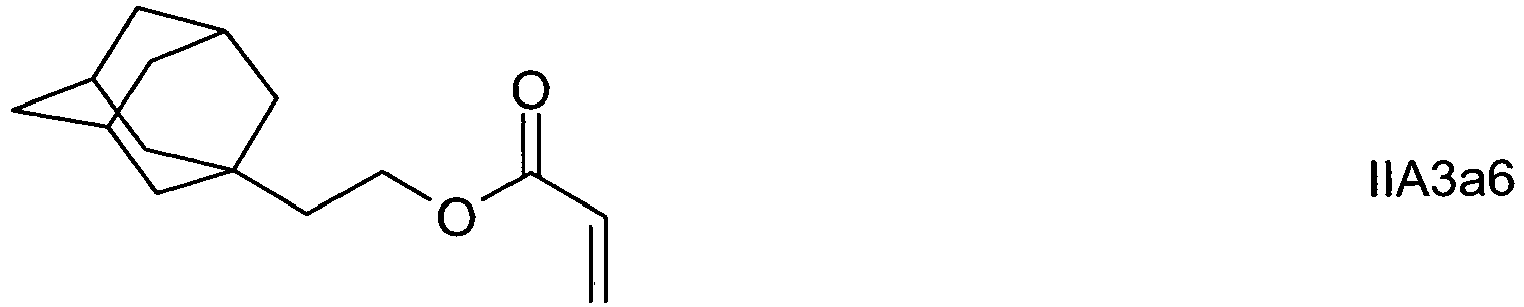

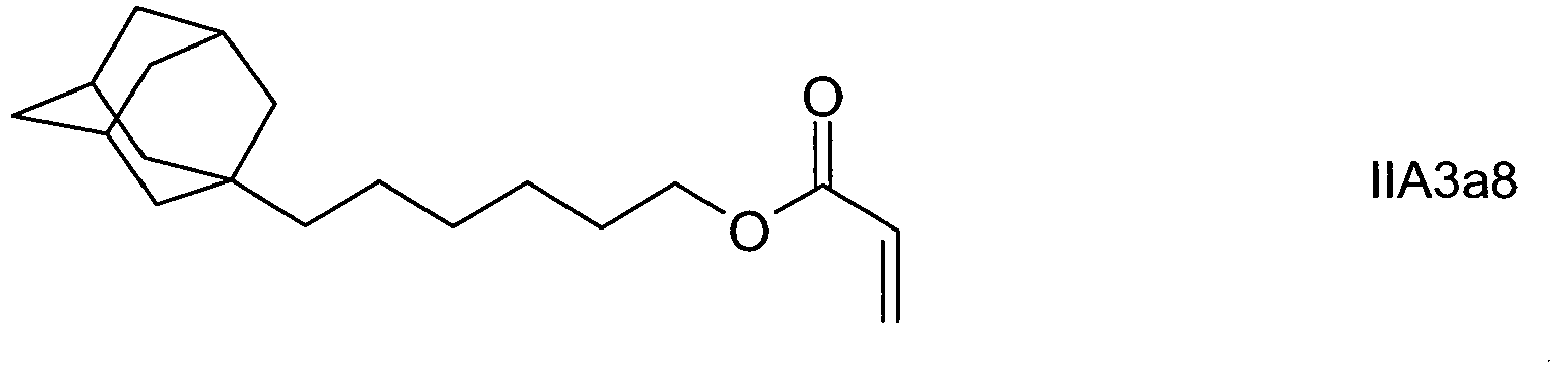


- The LC medium according to any one of claims 1 to 15, characterized in that component A) comprises one or more third polymerisable compounds selected of formula III
P1-Sp1-G3-Sp2-P2 III
whereinP1 and P2 independently of each other and on each occurrence identically or differently denote a polymerisable group,Sp1, Sp2 denote independently of each other identical or different spacer groups or a single bond,G3 is a straight-chain, branched or cyclic alkyl group with 1 to 20 C atoms that is optionally mono-, poly- or perfluorinated and is optionally substituted by one or more groups L as defined in claim 4, and wherein one or more CH2-groups are optionally replaced by -O-, -CO-, -O-CO- or -CO-O- such that O-atoms are not directly adjacent to one another. - The LC medium according to any one of claims 1 to 16, characterized in that component A) comprises one or more third polymerisable compounds selected from the following formulae
P1-Sp1-(CHW11)n2-(CH2)n1-(CHW12)n3-Sp2-P2 III1

P1-(CH2)n2-(CF2)n1-(CH2)n3-P2 III3
(P1-Sp1-(CH2)n4)n5CH4-n5 III4
wherein P1, P2, Sp1, Sp2 are as defined in claim 16,W11 is, on each occurrence identically or differently, H, F or C1-C12-alkyl,n1 is an integer from 2 to 15,n2, n3 are independently of each other 0 or an integer from 1 to 3,n4 is 0 or an integer from 1 to 15,n5 is 3 or 4,and the cyclohexylene ring in formula III2 is optionally substituted by one or more identical or different groups W11. - The LC medium according to any one of claims 1 to 17, characterized in that component A) comprises one or more third polymerisable compounds selected from the following formulae
CH2=CW-CO-O-(CHW11)n4-(CH2)n1-O-CH=CH2 III1a
CH2=CH-O-(CHW1)n4-(CH2)n1-O-CO-CH=CH2 III1b
CH2=CW-CO-O-(CHW11)n2-(CH2)n1-(CHW12)n3-O-CO-CW=CH2 III1c


CH2=CW-CO-O-(CH2)n2-(CF2)n1-(CH2)n3-O-CH=CH2 III3a
CH2=CW-CO-O-(CH2)n2-(CF2)n1-(CH2)n3-O-CO-CW=CH2 III3b
(CH2=CW-CO-O-(CH2)n2)3CH III4a
(CH2=CW-CO-O-(CH2)n2)4C III4b
wherein W is H, CH3 or C2H5 and W11, n1, n2 and n4 are as defined in claim 17, and the cyclohexylene ring in formula III2a-c is optionally substituted by one or more identical or different groups W11. - The LC medium according to any one of claims 1 to 18, characterized in that component A) comprises one or more third polymerisable compounds selected from the following formulae














- The LC medium according to any one of claims 1 to 19, characterized in that component A) comprises one or more fourth polymerisable compounds comprising a ring system containing one or more aromatic or heteroaromatic rings or condensed aroamtic or heteroaromatic rings, and attached thereto two polymerisable groups that are different from each other.
- The LC medium according to any one of claims 1 to 20, characterized in that component A) comprises one or more fourth polymerisable compounds selected from the following formula
P1-Sp1-B1-(Zb-B2)m-Sp2-P2 IV
in which P1, P2, Sp1, Sp2 are as defined in claim 16,B1 and B2 are independently of each other, and on each occurrence identically or differently, an aromatic, heteroaromatic, alicyclic or heterocyclic group having 4 to 25 ring atoms, which may also contain fused rings, and which is unsubstituted, or mono- or polysubstituted by L as defined in claim 4, wherein at least one of B1 and B2 denotes an aromatic or heteroaromatic group,Zb is, on each occurrence identically or differently, -O-, -S-, -CO-, -CO-O-, -OCO-, -O-CO-O-, -OCH2-, -CH2O-, -SCH2-, -CH2S-, -CF2O-, -OCF2-, -CF2S-, -SCF2-, -(CH2)n1-, -CF2CH2-, -CH2CF2-, -(CF2)n11-, -CH=CH-, -CF=CF-, -C≡C-, -CH=CH-COO-, -OCO-CH=CH-, CR0R00 or a single bond,R0 and R00 each, independently of one another, denote H or alkyl having 1 to 12 C atoms,m denotes 0, 1, 2, 3 or 4,n11 denotes 1, 2, 3 or 4. - The LC medium according to any one of claims 1 to 21, characterized in that component A) comprises one or more fourth polymerisable compounds selected from the following formulae


 Z1 is -O-, -CO-, -C(RyRz)- or -CF2CF2-,Z2, Z3 are independently of each other -CO-O-, -O-CO-, -CH2O-, -OCH2-, -CF2O-, -OCF2- or -(CH2)n11-, where n11 is 2, 3 or 4,r is 0, 1, 2, 3 or 4,s is 0, 1, 2 or 3,t is 0, 1 or 2.
 - The LC medium according to any one of claims 1 to 22, characterized in that the total concentration of the first, second, third and fourth polymerisable compounds in the LC medium is from 1 to 30% by weight.
- The LC medium according to any one of claims 1 to 23, characterized in that the ratio of first polymerisable compounds relative to the second polymerisable compounds in the LC medium is from 10:1 to 1:10.
- The LC medium according to any one of claims 1 to 24, characterized in that component B) comprises one or more compounds selected from formulae A and B


 R21, R31 each, independently of one another, alkyl, alkoxy, oxaalkyl or alkoxyalkyl having 1 to 9 C atoms or alkenyl or alkenyloxy having 2 to 9 C atoms, all of which are optionally fluorinated,X0 F, Cl, halogenated alkyl or alkoxy having 1 to 6 C atoms or halogenated alkenyl or alkenyloxy having 2 to 6 C atoms,Z31 -CH2CH2-, -CF2CF2-, -COO-, trans-CH=CH-, trans-CF=CF-, -CH2O- or a single bond,L21, L22, L31, L32 each, independently of one another, H or F,g 0, 1, 2 or 3.
 - The LC medium according to claim 25, characterized in that component B) comprises, in addition to the compounds of formula A and/or B, one or more compounds of formula E containing an alkenyl group




 RA1 alkenyl having 2 to 9 C atoms or, if at least one of the rings X, Y and Z denotes cyclohexenyl, also one of the meanings of RA2,RA2 alkyl having 1 to 12 C atoms, in which, in addition, one or two non-adjacent CH2 groups may be replaced by -O-, -CH=CH-, -CO-, -OCO- or -COO- in such a way that O atoms are not linked directly to one another,x 1 or 2.
 - The LC medium according to any one of claims 1 to 24, characterized in that component B) comprises one or more compounds selected from formulae CY and PY:

 a denotes 1 or 2,b denotes 0 or 1,
 R1 and R2 each, independently of one another, denote alkyl having 1 to 12 C atoms, where, in addition, one or two non-adjacent CH2 groups may be replaced by -O-, -CH=CH-, -CO-, -OCO-or -COO- in such a way that O atoms are not linked directly to one another,Zx and Zy each, independently of one another, denote -CH2CH2-, -CH=CH-, -CF2O-, -OCF2-, -CH2O-, -OCH2-, -CO-O-, -O-CO-, -C2F4-, -CF=CF-, -CH=CH-CH2O- or a single bond,L1-4 each, independently of one another, denote F, Cl, OCF3, CF3, CH3, CH2F, CHF2.
 - The LC medium according to claim 27, characterized in that component B) comprises one or more alkenyl compounds selected from formulae AN and AY


 RA1 alkenyl having 2 to 9 C atoms or, if at least one of the rings X, Y and Z denotes cyclohexenyl, also one of the meanings of RA2,RA2 alkyl having 1 to 12 C atoms, in which, in addition, one or two non-adjacent CH2 groups may be replaced by -O-, -CH=CH-, -CO-, -OCO- or -COO- in such a way that O atoms are not linked directly to one another,Zx -CH2CH2-, -CH=CH-, -CF2O-, -OCF2-, -CH2O-, -OCH2-, -CO-O-, -O-CO-, -C2F4-, -CF=CF-, -CH=CH-CH2O- or a single bond,L1,2 H, F, Cl, OCF3, CF3, CH3, CH2F or CHF2H,x 1 or 2,z 0 or 1.
 - The LC medium according to any one of claims 1 to 28 characterized in that the polymerisable compounds are polymerised.
- An LC display comprising an LC medium according to any one of claims 1 to 29.
- The LC display of claim 30, which is a flexible or curved display.
- The LC display of claim 30 or 31, which is a TN, OCB, IPS, FFS, posi-VA, VA or UB-FFS display.
- A process for the production of an LC display according to any one of claims 30 to 32, comprising the steps of providing an LC medium as defined in any one of claims 1 to 28 into the display, and polymerising the polymerisable compounds in defined regions of the display.
- The process of claim 33, wherein the polymerisable compounds are photopolymerised by exposure to UV irradiation.
- The process of claim 34, wherein the polymerisable compounds are photopolymerised by exposure to UV irradiation through a photomask.
- A process of preparing an LC medium according to any one of claims 1 to 28, comprising the steps of mixing a liquid-crystalline component B) as defined in any one of claims 1 and 25 to 28, with one or more polymerisable compounds, or with component A), as defined in any one of claims 1 to 24, and optionally with further LC compounds and/or additives.
Applications Claiming Priority (2)
| Application Number | Priority Date | Filing Date | Title |
|---|---|---|---|
| EP15003123 | 2015-10-30 | ||
| PCT/EP2016/001669 WO2017071793A1 (en) | 2015-10-30 | 2016-10-07 | Liquid-crystal medium |
Publications (2)
| Publication Number | Publication Date |
|---|---|
| EP3368637A1 EP3368637A1 (en) | 2018-09-05 |
| EP3368637B1 true EP3368637B1 (en) | 2019-08-07 |
Family
ID=54539794
Family Applications (1)
| Application Number | Title | Priority Date | Filing Date |
|---|---|---|---|
| EP16781676.8A Not-in-force EP3368637B1 (en) | 2015-10-30 | 2016-10-07 | Liquid-crystal medium |
Country Status (7)
| Country | Link |
|---|---|
| US (1) | US10759996B2 (en) |
| EP (1) | EP3368637B1 (en) |
| JP (1) | JP2019501233A (en) |
| KR (1) | KR20180075581A (en) |
| CN (1) | CN108350361B (en) |
| TW (1) | TW201728751A (en) |
| WO (1) | WO2017071793A1 (en) |
Families Citing this family (10)
| Publication number | Priority date | Publication date | Assignee | Title |
|---|---|---|---|---|
| KR20180022811A (en) * | 2015-06-26 | 2018-03-06 | 메르크 파텐트 게엠베하 | A liquid crystal medium containing a polymerizable compound |
| WO2017071793A1 (en) * | 2015-10-30 | 2017-05-04 | Merck Patent Gmbh | Liquid-crystal medium |
| EP3529332B1 (en) * | 2016-10-19 | 2020-11-25 | Merck Patent GmbH | Liquid-crystal medium |
| EP3529333B1 (en) * | 2016-10-19 | 2020-11-25 | Merck Patent GmbH | Liquid-crystal medium |
| JP7183541B2 (en) * | 2018-01-18 | 2022-12-06 | Dic株式会社 | Liquid crystal composition and liquid crystal display element |
| TWI640609B (en) * | 2018-05-07 | 2018-11-11 | 達興材料股份有限公司 | Liquid crystal composition and liquid crystal display device |
| TW201947018A (en) * | 2018-05-07 | 2019-12-16 | 達興材料股份有限公司 | Liquid crystal composition and liquid crystal display including the same |
| CN115515990B (en) * | 2020-04-28 | 2024-07-19 | 富士胶片株式会社 | Fluoropolymer, composition, optical film, liquid crystal film, hard coat film, and polarizing plate |
| CN116997854A (en) * | 2021-03-15 | 2023-11-03 | 日产化学株式会社 | Liquid crystal composition, method for manufacturing liquid crystal display element, and liquid crystal display element |
| JP7099578B1 (en) * | 2021-03-31 | 2022-07-12 | 凸版印刷株式会社 | A dimming sheet, a dimming device, a photosensitive composition, and a method for manufacturing a dimming sheet. |
Family Cites Families (23)
| Publication number | Priority date | Publication date | Assignee | Title |
|---|---|---|---|---|
| US3254065A (en) * | 1962-09-17 | 1966-05-31 | Eastman Kodak Co | Cyclododecyl acrylate and methacrylate, and polymers thereof |
| BE795849A (en) | 1972-02-26 | 1973-08-23 | Merck Patent Gmbh | MODIFIED NEMATIC PHASES |
| US3814700A (en) | 1972-08-03 | 1974-06-04 | Ibm | Method for controllably varying the electrical properties of nematic liquids and dopants therefor |
| DE2450088A1 (en) | 1974-10-22 | 1976-04-29 | Merck Patent Gmbh | Liquid crystalline dielectrics for electronic components - contg biphenylyl carboxylic acid phenyl ester or benzoic acid biphenylyl ester components |
| DE2637430A1 (en) | 1976-08-20 | 1978-02-23 | Merck Patent Gmbh | Heterocyclic diaza cpd. in liquid crystalline dielectric - for electrooptical registration devices, giving stable orientation parallel to electrode surfaces |
| DE2853728A1 (en) | 1978-12-13 | 1980-07-17 | Merck Patent Gmbh | LIQUID CRYSTALLINE CARBONIC ACID ESTER, METHOD FOR THE PRODUCTION THEREOF, ITS CONTAINING DIELECTRICS AND ELECTRO-OPTICAL DISPLAY ELEMENT |
| ES2071289T3 (en) * | 1989-12-01 | 1995-06-16 | Hoechst Ag | USE OF COMPLEX LIGANDS FOR IONS IN MIXTURES OF FERROELECTRIC LIQUID CRYSTALS. |
| JPH10307287A (en) | 1997-05-09 | 1998-11-17 | Minolta Co Ltd | Liquid crystal element and its manufacturing method |
| DE10257711B4 (en) * | 2001-12-27 | 2019-09-26 | Merck Patent Gmbh | Polymerizable monocyclic compounds containing liquid crystal mixtures |
| EP2261201B1 (en) * | 2008-04-01 | 2018-05-30 | DIC Corporation | Trifunctional (meth)acrylate compound and polymerizable composition containing the compound |
| DE102010006691A1 (en) * | 2009-02-06 | 2010-10-28 | Merck Patent Gmbh | Liquid-crystalline medium and liquid-crystal display |
| DE102011015546A1 (en) * | 2010-04-26 | 2012-01-26 | Merck Patent Gmbh | Polymerizable compounds and their use in liquid crystal media and liquid crystal displays |
| JP6386378B2 (en) * | 2011-09-06 | 2018-09-05 | メルク パテント ゲゼルシャフト ミット ベシュレンクテル ハフツングMerck Patent Gesellschaft mit beschraenkter Haftung | Liquid crystal medium and liquid crystal display |
| JP5715014B2 (en) * | 2011-09-12 | 2015-05-07 | 信越化学工業株式会社 | Positive resist composition and pattern forming method |
| JP5948832B2 (en) * | 2011-12-08 | 2016-07-06 | Jnc株式会社 | Optically isotropic liquid crystal composition and optical device containing monofunctional monofunctional monomer |
| EP2818534B1 (en) * | 2013-06-28 | 2017-11-15 | LG Display Co., Ltd. | Liquid crystal polymer composition, liquid crystal display and method for manufacturing the same |
| KR102093759B1 (en) * | 2013-07-19 | 2020-03-26 | 동우 화인켐 주식회사 | Photosensitive resin composition for transparent pixel |
| CN104298074B (en) * | 2013-07-19 | 2019-11-01 | 东友精细化工有限公司 | Transparent pixels are formed with photosensitive polymer combination and the colour filter formed using it |
| WO2015101405A1 (en) * | 2013-12-30 | 2015-07-09 | Merck Patent Gmbh | Liquid crystal medium and liquid crystal display |
| CN104178180B (en) * | 2014-07-17 | 2016-04-06 | 北京大学 | A kind of Nematic phase liquid crystal material and application thereof with large degree of birefringence |
| WO2017071793A1 (en) * | 2015-10-30 | 2017-05-04 | Merck Patent Gmbh | Liquid-crystal medium |
| EP3529333B1 (en) * | 2016-10-19 | 2020-11-25 | Merck Patent GmbH | Liquid-crystal medium |
| EP3529332B1 (en) * | 2016-10-19 | 2020-11-25 | Merck Patent GmbH | Liquid-crystal medium |
-
2016
- 2016-10-07 WO PCT/EP2016/001669 patent/WO2017071793A1/en not_active Ceased
- 2016-10-07 EP EP16781676.8A patent/EP3368637B1/en not_active Not-in-force
- 2016-10-07 KR KR1020187014649A patent/KR20180075581A/en not_active Withdrawn
- 2016-10-07 CN CN201680062649.3A patent/CN108350361B/en active Active
- 2016-10-07 JP JP2018521859A patent/JP2019501233A/en active Pending
- 2016-10-07 US US15/771,590 patent/US10759996B2/en not_active Expired - Fee Related
- 2016-10-28 TW TW105135163A patent/TW201728751A/en unknown
Non-Patent Citations (1)
| Title |
|---|
| None * |
Also Published As
| Publication number | Publication date |
|---|---|
| US20180312756A1 (en) | 2018-11-01 |
| CN108350361B (en) | 2021-12-14 |
| CN108350361A (en) | 2018-07-31 |
| TW201728751A (en) | 2017-08-16 |
| KR20180075581A (en) | 2018-07-04 |
| EP3368637A1 (en) | 2018-09-05 |
| US10759996B2 (en) | 2020-09-01 |
| WO2017071793A1 (en) | 2017-05-04 |
| JP2019501233A (en) | 2019-01-17 |
Similar Documents
| Publication | Publication Date | Title |
|---|---|---|
| US10759996B2 (en) | Liquid-crystal medium | |
| US10570335B2 (en) | Liquid crystal medium containing polymerisable compounds | |
| EP3529332B1 (en) | Liquid-crystal medium | |
| US10894918B2 (en) | Liquid crystal medium containing polymerisable compounds | |
| US10590344B2 (en) | Liquid crystal medium containing polymerisable compounds | |
| EP2848676B1 (en) | Liquid crystal medium | |
| EP3020785B1 (en) | Liquid crystal medium | |
| EP3029127A1 (en) | Liquid crystal medium | |
| EP3529333B1 (en) | Liquid-crystal medium | |
| EP3298105A1 (en) | Liquid-crystal medium | |
| EP3322769B1 (en) | Method of reducing odf mura in polymer stabilised liquid crystal displays | |
| WO2019180060A1 (en) | Liquid-chrystal display | |
| EP3802730B1 (en) | Liquid-crystal medium | |
| WO2019110473A1 (en) | Liquid-crystal medium | |
| WO2019025398A1 (en) | Liquid-crystal medium | |
| WO2019154740A1 (en) | Liquid-crystal medium |
Legal Events
| Date | Code | Title | Description |
|---|---|---|---|
| STAA | Information on the status of an ep patent application or granted ep patent |
Free format text: STATUS: THE INTERNATIONAL PUBLICATION HAS BEEN MADE |
|
| PUAI | Public reference made under article 153(3) epc to a published international application that has entered the european phase |
Free format text: ORIGINAL CODE: 0009012 |
|
| STAA | Information on the status of an ep patent application or granted ep patent |
Free format text: STATUS: REQUEST FOR EXAMINATION WAS MADE |
|
| 17P | Request for examination filed |
Effective date: 20180406 |
|
| AK | Designated contracting states |
Kind code of ref document: A1 Designated state(s): AL AT BE BG CH CY CZ DE DK EE ES FI FR GB GR HR HU IE IS IT LI LT LU LV MC MK MT NL NO PL PT RO RS SE SI SK SM TR |
|
| AX | Request for extension of the european patent |
Extension state: BA ME |
|
| DAV | Request for validation of the european patent (deleted) | ||
| DAX | Request for extension of the european patent (deleted) | ||
| GRAP | Despatch of communication of intention to grant a patent |
Free format text: ORIGINAL CODE: EPIDOSNIGR1 |
|
| STAA | Information on the status of an ep patent application or granted ep patent |
Free format text: STATUS: GRANT OF PATENT IS INTENDED |
|
| RIC1 | Information provided on ipc code assigned before grant |
Ipc: C09K 19/04 20060101ALI20190321BHEP Ipc: G02F 1/137 20060101ALI20190321BHEP Ipc: C08F 2/48 20060101ALI20190321BHEP Ipc: C09K 19/06 20060101ALI20190321BHEP Ipc: C09K 19/12 20060101ALI20190321BHEP Ipc: G02F 1/1333 20060101ALI20190321BHEP Ipc: C09K 19/30 20060101AFI20190321BHEP |
|
| INTG | Intention to grant announced |
Effective date: 20190418 |
|
| GRAS | Grant fee paid |
Free format text: ORIGINAL CODE: EPIDOSNIGR3 |
|
| GRAA | (expected) grant |
Free format text: ORIGINAL CODE: 0009210 |
|
| STAA | Information on the status of an ep patent application or granted ep patent |
Free format text: STATUS: THE PATENT HAS BEEN GRANTED |
|
| AK | Designated contracting states |
Kind code of ref document: B1 Designated state(s): AL AT BE BG CH CY CZ DE DK EE ES FI FR GB GR HR HU IE IS IT LI LT LU LV MC MK MT NL NO PL PT RO RS SE SI SK SM TR |
|
| REG | Reference to a national code |
Ref country code: GB Ref legal event code: FG4D |
|
| REG | Reference to a national code |
Ref country code: CH Ref legal event code: EP Ref country code: AT Ref legal event code: REF Ref document number: 1163853 Country of ref document: AT Kind code of ref document: T Effective date: 20190815 |
|
| REG | Reference to a national code |
Ref country code: DE Ref legal event code: R096 Ref document number: 602016018300 Country of ref document: DE |
|
| REG | Reference to a national code |
Ref country code: IE Ref legal event code: FG4D |
|
| REG | Reference to a national code |
Ref country code: NL Ref legal event code: MP Effective date: 20190807 |
|
| REG | Reference to a national code |
Ref country code: LT Ref legal event code: MG4D |
|
| PG25 | Lapsed in a contracting state [announced via postgrant information from national office to epo] |
Ref country code: FI Free format text: LAPSE BECAUSE OF FAILURE TO SUBMIT A TRANSLATION OF THE DESCRIPTION OR TO PAY THE FEE WITHIN THE PRESCRIBED TIME-LIMIT Effective date: 20190807 Ref country code: PT Free format text: LAPSE BECAUSE OF FAILURE TO SUBMIT A TRANSLATION OF THE DESCRIPTION OR TO PAY THE FEE WITHIN THE PRESCRIBED TIME-LIMIT Effective date: 20191209 Ref country code: HR Free format text: LAPSE BECAUSE OF FAILURE TO SUBMIT A TRANSLATION OF THE DESCRIPTION OR TO PAY THE FEE WITHIN THE PRESCRIBED TIME-LIMIT Effective date: 20190807 Ref country code: SE Free format text: LAPSE BECAUSE OF FAILURE TO SUBMIT A TRANSLATION OF THE DESCRIPTION OR TO PAY THE FEE WITHIN THE PRESCRIBED TIME-LIMIT Effective date: 20190807 Ref country code: BG Free format text: LAPSE BECAUSE OF FAILURE TO SUBMIT A TRANSLATION OF THE DESCRIPTION OR TO PAY THE FEE WITHIN THE PRESCRIBED TIME-LIMIT Effective date: 20191107 Ref country code: NL Free format text: LAPSE BECAUSE OF FAILURE TO SUBMIT A TRANSLATION OF THE DESCRIPTION OR TO PAY THE FEE WITHIN THE PRESCRIBED TIME-LIMIT Effective date: 20190807 Ref country code: NO Free format text: LAPSE BECAUSE OF FAILURE TO SUBMIT A TRANSLATION OF THE DESCRIPTION OR TO PAY THE FEE WITHIN THE PRESCRIBED TIME-LIMIT Effective date: 20191107 Ref country code: LT Free format text: LAPSE BECAUSE OF FAILURE TO SUBMIT A TRANSLATION OF THE DESCRIPTION OR TO PAY THE FEE WITHIN THE PRESCRIBED TIME-LIMIT Effective date: 20190807 |
|
| REG | Reference to a national code |
Ref country code: AT Ref legal event code: MK05 Ref document number: 1163853 Country of ref document: AT Kind code of ref document: T Effective date: 20190807 |
|
| PG25 | Lapsed in a contracting state [announced via postgrant information from national office to epo] |
Ref country code: LV Free format text: LAPSE BECAUSE OF FAILURE TO SUBMIT A TRANSLATION OF THE DESCRIPTION OR TO PAY THE FEE WITHIN THE PRESCRIBED TIME-LIMIT Effective date: 20190807 Ref country code: GR Free format text: LAPSE BECAUSE OF FAILURE TO SUBMIT A TRANSLATION OF THE DESCRIPTION OR TO PAY THE FEE WITHIN THE PRESCRIBED TIME-LIMIT Effective date: 20191108 Ref country code: ES Free format text: LAPSE BECAUSE OF FAILURE TO SUBMIT A TRANSLATION OF THE DESCRIPTION OR TO PAY THE FEE WITHIN THE PRESCRIBED TIME-LIMIT Effective date: 20190807 Ref country code: AL Free format text: LAPSE BECAUSE OF FAILURE TO SUBMIT A TRANSLATION OF THE DESCRIPTION OR TO PAY THE FEE WITHIN THE PRESCRIBED TIME-LIMIT Effective date: 20190807 Ref country code: RS Free format text: LAPSE BECAUSE OF FAILURE TO SUBMIT A TRANSLATION OF THE DESCRIPTION OR TO PAY THE FEE WITHIN THE PRESCRIBED TIME-LIMIT Effective date: 20190807 Ref country code: IS Free format text: LAPSE BECAUSE OF FAILURE TO SUBMIT A TRANSLATION OF THE DESCRIPTION OR TO PAY THE FEE WITHIN THE PRESCRIBED TIME-LIMIT Effective date: 20191207 |
|
| PG25 | Lapsed in a contracting state [announced via postgrant information from national office to epo] |
Ref country code: TR Free format text: LAPSE BECAUSE OF FAILURE TO SUBMIT A TRANSLATION OF THE DESCRIPTION OR TO PAY THE FEE WITHIN THE PRESCRIBED TIME-LIMIT Effective date: 20190807 |
|
| PG25 | Lapsed in a contracting state [announced via postgrant information from national office to epo] |
Ref country code: EE Free format text: LAPSE BECAUSE OF FAILURE TO SUBMIT A TRANSLATION OF THE DESCRIPTION OR TO PAY THE FEE WITHIN THE PRESCRIBED TIME-LIMIT Effective date: 20190807 Ref country code: PL Free format text: LAPSE BECAUSE OF FAILURE TO SUBMIT A TRANSLATION OF THE DESCRIPTION OR TO PAY THE FEE WITHIN THE PRESCRIBED TIME-LIMIT Effective date: 20190807 Ref country code: RO Free format text: LAPSE BECAUSE OF FAILURE TO SUBMIT A TRANSLATION OF THE DESCRIPTION OR TO PAY THE FEE WITHIN THE PRESCRIBED TIME-LIMIT Effective date: 20190807 Ref country code: AT Free format text: LAPSE BECAUSE OF FAILURE TO SUBMIT A TRANSLATION OF THE DESCRIPTION OR TO PAY THE FEE WITHIN THE PRESCRIBED TIME-LIMIT Effective date: 20190807 Ref country code: DK Free format text: LAPSE BECAUSE OF FAILURE TO SUBMIT A TRANSLATION OF THE DESCRIPTION OR TO PAY THE FEE WITHIN THE PRESCRIBED TIME-LIMIT Effective date: 20190807 Ref country code: IT Free format text: LAPSE BECAUSE OF FAILURE TO SUBMIT A TRANSLATION OF THE DESCRIPTION OR TO PAY THE FEE WITHIN THE PRESCRIBED TIME-LIMIT Effective date: 20190807 |
|
| PG25 | Lapsed in a contracting state [announced via postgrant information from national office to epo] |
Ref country code: SK Free format text: LAPSE BECAUSE OF FAILURE TO SUBMIT A TRANSLATION OF THE DESCRIPTION OR TO PAY THE FEE WITHIN THE PRESCRIBED TIME-LIMIT Effective date: 20190807 Ref country code: CZ Free format text: LAPSE BECAUSE OF FAILURE TO SUBMIT A TRANSLATION OF THE DESCRIPTION OR TO PAY THE FEE WITHIN THE PRESCRIBED TIME-LIMIT Effective date: 20190807 Ref country code: SM Free format text: LAPSE BECAUSE OF FAILURE TO SUBMIT A TRANSLATION OF THE DESCRIPTION OR TO PAY THE FEE WITHIN THE PRESCRIBED TIME-LIMIT Effective date: 20190807 Ref country code: IS Free format text: LAPSE BECAUSE OF FAILURE TO SUBMIT A TRANSLATION OF THE DESCRIPTION OR TO PAY THE FEE WITHIN THE PRESCRIBED TIME-LIMIT Effective date: 20200224 Ref country code: MC Free format text: LAPSE BECAUSE OF FAILURE TO SUBMIT A TRANSLATION OF THE DESCRIPTION OR TO PAY THE FEE WITHIN THE PRESCRIBED TIME-LIMIT Effective date: 20190807 |
|
| REG | Reference to a national code |
Ref country code: CH Ref legal event code: PL |
|
| REG | Reference to a national code |
Ref country code: DE Ref legal event code: R097 Ref document number: 602016018300 Country of ref document: DE |
|
| PLBE | No opposition filed within time limit |
Free format text: ORIGINAL CODE: 0009261 |
|
| STAA | Information on the status of an ep patent application or granted ep patent |
Free format text: STATUS: NO OPPOSITION FILED WITHIN TIME LIMIT |
|
| PG2D | Information on lapse in contracting state deleted |
Ref country code: IS |
|
| PG25 | Lapsed in a contracting state [announced via postgrant information from national office to epo] |
Ref country code: CH Free format text: LAPSE BECAUSE OF NON-PAYMENT OF DUE FEES Effective date: 20191031 Ref country code: LU Free format text: LAPSE BECAUSE OF NON-PAYMENT OF DUE FEES Effective date: 20191007 Ref country code: LI Free format text: LAPSE BECAUSE OF NON-PAYMENT OF DUE FEES Effective date: 20191031 |
|
| 26N | No opposition filed |
Effective date: 20200603 |
|
| REG | Reference to a national code |
Ref country code: BE Ref legal event code: MM Effective date: 20191031 |
|
| PG25 | Lapsed in a contracting state [announced via postgrant information from national office to epo] |
Ref country code: BE Free format text: LAPSE BECAUSE OF NON-PAYMENT OF DUE FEES Effective date: 20191031 Ref country code: SI Free format text: LAPSE BECAUSE OF FAILURE TO SUBMIT A TRANSLATION OF THE DESCRIPTION OR TO PAY THE FEE WITHIN THE PRESCRIBED TIME-LIMIT Effective date: 20190807 |
|
| PG25 | Lapsed in a contracting state [announced via postgrant information from national office to epo] |
Ref country code: IE Free format text: LAPSE BECAUSE OF NON-PAYMENT OF DUE FEES Effective date: 20191007 Ref country code: FR Free format text: LAPSE BECAUSE OF NON-PAYMENT OF DUE FEES Effective date: 20191007 |
|
| PGFP | Annual fee paid to national office [announced via postgrant information from national office to epo] |
Ref country code: DE Payment date: 20200922 Year of fee payment: 5 |
|
| PG25 | Lapsed in a contracting state [announced via postgrant information from national office to epo] |
Ref country code: CY Free format text: LAPSE BECAUSE OF FAILURE TO SUBMIT A TRANSLATION OF THE DESCRIPTION OR TO PAY THE FEE WITHIN THE PRESCRIBED TIME-LIMIT Effective date: 20190807 |
|
| GBPC | Gb: european patent ceased through non-payment of renewal fee |
Effective date: 20201007 |
|
| PG25 | Lapsed in a contracting state [announced via postgrant information from national office to epo] |
Ref country code: MT Free format text: LAPSE BECAUSE OF FAILURE TO SUBMIT A TRANSLATION OF THE DESCRIPTION OR TO PAY THE FEE WITHIN THE PRESCRIBED TIME-LIMIT Effective date: 20190807 Ref country code: HU Free format text: LAPSE BECAUSE OF FAILURE TO SUBMIT A TRANSLATION OF THE DESCRIPTION OR TO PAY THE FEE WITHIN THE PRESCRIBED TIME-LIMIT; INVALID AB INITIO Effective date: 20161007 |
|
| PG25 | Lapsed in a contracting state [announced via postgrant information from national office to epo] |
Ref country code: GB Free format text: LAPSE BECAUSE OF NON-PAYMENT OF DUE FEES Effective date: 20201007 |
|
| REG | Reference to a national code |
Ref country code: DE Ref legal event code: R119 Ref document number: 602016018300 Country of ref document: DE |
|
| PG25 | Lapsed in a contracting state [announced via postgrant information from national office to epo] |
Ref country code: MK Free format text: LAPSE BECAUSE OF FAILURE TO SUBMIT A TRANSLATION OF THE DESCRIPTION OR TO PAY THE FEE WITHIN THE PRESCRIBED TIME-LIMIT Effective date: 20190807 |
|
| PG25 | Lapsed in a contracting state [announced via postgrant information from national office to epo] |
Ref country code: DE Free format text: LAPSE BECAUSE OF NON-PAYMENT OF DUE FEES Effective date: 20220503 |