EP3366535A1 - Druckmodulator für ein antiblockier-bremssystem (abs) - Google Patents
Druckmodulator für ein antiblockier-bremssystem (abs) Download PDFInfo
- Publication number
- EP3366535A1 EP3366535A1 EP17158353.7A EP17158353A EP3366535A1 EP 3366535 A1 EP3366535 A1 EP 3366535A1 EP 17158353 A EP17158353 A EP 17158353A EP 3366535 A1 EP3366535 A1 EP 3366535A1
- Authority
- EP
- European Patent Office
- Prior art keywords
- pressure modulator
- hydraulic
- armature
- modulator according
- volume
- Prior art date
- Legal status (The legal status is an assumption and is not a legal conclusion. Google has not performed a legal analysis and makes no representation as to the accuracy of the status listed.)
- Granted
Links
Images
Classifications
-
- B—PERFORMING OPERATIONS; TRANSPORTING
- B60—VEHICLES IN GENERAL
- B60T—VEHICLE BRAKE CONTROL SYSTEMS OR PARTS THEREOF; BRAKE CONTROL SYSTEMS OR PARTS THEREOF, IN GENERAL; ARRANGEMENT OF BRAKING ELEMENTS ON VEHICLES IN GENERAL; PORTABLE DEVICES FOR PREVENTING UNWANTED MOVEMENT OF VEHICLES; VEHICLE MODIFICATIONS TO FACILITATE COOLING OF BRAKES
- B60T8/00—Arrangements for adjusting wheel-braking force to meet varying vehicular or ground-surface conditions, e.g. limiting or varying distribution of braking force
- B60T8/32—Arrangements for adjusting wheel-braking force to meet varying vehicular or ground-surface conditions, e.g. limiting or varying distribution of braking force responsive to a speed condition, e.g. acceleration or deceleration
- B60T8/34—Arrangements for adjusting wheel-braking force to meet varying vehicular or ground-surface conditions, e.g. limiting or varying distribution of braking force responsive to a speed condition, e.g. acceleration or deceleration having a fluid pressure regulator responsive to a speed condition
- B60T8/42—Arrangements for adjusting wheel-braking force to meet varying vehicular or ground-surface conditions, e.g. limiting or varying distribution of braking force responsive to a speed condition, e.g. acceleration or deceleration having a fluid pressure regulator responsive to a speed condition having expanding chambers for controlling pressure, i.e. closed systems
- B60T8/4208—Debooster systems
- B60T8/4266—Debooster systems having an electro-mechanically actuated expansion unit, e.g. solenoid, electric motor, piezo stack
Definitions
- the invention relates to a pressure modulator for an ABS system having a housing which has a hydraulic input and a hydraulic output connected via a hydraulic line, wherein a against a spring force of a spring element to be opened volume memory is provided, the volume of the hydraulic at an activated anti-lock function Increased line, wherein a linear drive, in particular proportional solenoid, with a rotor, in particular armature, is provided and a movement of the armature causes the opening of the volume memory.
- Such a pressure modulator is for example by the DE 10 2014 007 717 B3 known.
- the pressure modulator disclosed there has a relatively large length. Furthermore, a part of the hydraulic line is movable relative to the housing of the pressure modulator, which may result in a susceptibility to failure.
- the object of the present invention is to provide a pressure modulator for an ABS system, in particular for an ABS system of a two-wheeler, which is particularly compact and functionally reliable.
- a pressure modulator for an ABS system having a housing which has a hydraulic input and a hydraulic output connected via a hydraulic line, wherein a against a spring force of a spring element to be opened volume memory is provided, the at an activated anti-lock function Increased volume of the hydraulic line, wherein a linear drive, in particular proportional solenoid, with a rotor, in particular armature, is provided and a movement of the armature causes the opening of the volume accumulator, wherein the spring element is designed as a gas spring.
- the rotor can be moved against the restoring force of the spring element and thus create or open a volume reservoir into which hydraulic fluid can flow.
- the pressure of the hydraulic medium is reduced, thus reducing the pressure on the brake shoes of a brake caliper, so that the wheel can turn again.
- the gas spring can be realized without additional seal. So few components are needed, so low cost.
- the gas spring is designed as an air spring.
- the compact design of the pressure modulator is also conducive if the gas spring volume is formed in the armature.
- the gas spring is realized on a shorter length than, for example, a helical spring, so that the length of the armature can be short.
- a in the anchor in particular the gas spring volume, projecting, firmly connected to the housing control piston is provided.
- the control piston represents the piston of the gas spring.
- a gas spring has the advantage that a (high) pressure gas is used to provide the spring force. Advantages over coil springs are the spring travel almost independent force and the small footprint.
- the pressure modulator has exactly one dynamic seal, which preferably acts between the armature and the control piston.
- the functional reliability can be increased if only a few dynamic seals are provided.
- the control piston may be formed as a hollow body. This makes it possible in particular to fill the gas spring volume through the control piston with a gas having a predetermined pressure. In this context, it is advantageous if the control piston is connected to a closable gas line, by means of which the gas spring volume can be filled with a gas, in particular air.
- the armature of hydraulic medium is arranged flow around in the hydraulic line.
- the armature can be guided in the housing and the hydraulic fluid can cause a lubrication of the armature, so that this wear and low friction in the housing is movable.
- the hydraulic medium can be performed via the guide clearance between the armature and a guide bush or housing wall.
- the armature has at least one HydraulikfluidausEnglishung, in particular on its lateral surface at least one in the longitudinal direction of the armature or helically extending groove.
- hydraulic fluid can flow across the groove along the armature.
- the armature it is conceivable for the armature to have aligned through openings in the longitudinal direction of the armature, through which hydraulic fluid can flow from the hydraulic input to the hydraulic output of the pressure modulator.
- the valve can be opened by the armature when it is in an initial position, that is pressed by the spring element to a defined maximum pressure in a predetermined position.
- the armature for example, press against a, in particular spring-loaded, ball of a check valve and thereby open the valve.
- the anti-lock function is activated and the armature is moved counter to the spring force of the spring element, the contact between the armature and the ball of the valve is released, so that the ball closes the valve and further hydraulic fluid feed through a master cylinder is prevented. Consequently
- a master cylinder communicating with an actuator may be disconnected from the hydraulic line inside the pressure modulator while the ABS function is activated, and the pressure of the hydraulic medium may be adjusted by the pressure modulator assembly.
- valve assembly only a single valve in the pressure modulator is necessary.
- the ball and a component with attached seal would be conceivable, which closes a bore between the hydraulic input and the armature.
- An electronic circuit can be arranged in the housing.
- the electronic circuit can be fully integrated in the pressure modulator.
- the electronic circuit which serves to drive the linear drive may be provided in the pressure modulator. This results in a particularly space-saving arrangement.
- all time critical signals, calculations, power stages, etc. can be generated or present within the pressure modulator, so that less safety-related and time-critical signal connections are necessary.
- a pressure sensor in the volume accumulator can be provided.
- the pressure sensor can be connected to the volume accumulator via a direct hydraulic connection. This is a cost-effective, lightweight solution that takes up little space.
- the pressure sensor can be arranged on a circuit board having the electronic circuit.
- the pressure sensor can be particularly cost-effectively integrated directly on the board, especially in SMD design.
- the board By integrating the board into the robust metallic housing of the pressure modulator, it is not only protected from environmental influences such as dirt, water, dust, but also from EMC interference such as emissions from other control units, motors or the like.
- EMC interference such as emissions from other control units, motors or the like.
- the integration of pressure sensor, acceleration sensor and microcontroller also prevents a disturbance of the signals due to magnetic fields, since signal paths between sensor and controller are virtually no longer present.
- the environment of the pressure modulator is protected by the integration in the metallic housing before the radiation of the pressure modulator and its electronics. This makes it easier to implement requirements for EMC compatibility.
- the electronic circuit can be arranged in a separate chamber of the housing and thereby protected from hydraulic fluid.
- the electronic circuit can be located axially next to the volume memory. So that hydraulic fluid can enter the volume accumulator, the hydraulic line can be passed through the electronic circuit, in particular the circuit board of the electronic circuit. Possible positions are an arrangement between the hydraulic input and the volume memory or between the volume memory and the hydraulic output.
- a hydraulic brake system with anti-lock function comprising a hydraulic pressure generating master cylinder, which is hydraulically communicating via a hydraulic line in which a pressure modulator according to the invention is arranged with a wheel brake.
- the pressure modulator may include a brake booster.
- a brake booster According to the invention is thus a pressure modulator with integrated Brake booster provided.
- the pressure modulator can be placed in one place of the bicycle, where it does not bother. It is therefore no problem if the pressure modulator builds slightly larger at this point, especially with a larger diameter. This in turn means that lower friction gaskets can be used.
- the pressure modulator and the brake booster have a common, one-piece housing or that at least the outer wall of the housing is integrally formed.
- a brake booster housing part is connected to an actuator housing part, wherein the pressure modulation arrangement can be arranged in the actuator housing part.
- the part of the pressure modulator having the pressure modulation assembly and the brake booster can first be made separately and then connected together.
- the brake booster housing part and the actuator housing part can be clipped.
- a cylinder space in which a stepped piston is arranged with two sections of different cross-sectional area, wherein between a housing wall and a stepped piston larger cross-section area a filling volume and between a housing wall and a stepped piston section smaller cross-sectional area Working volume is formed.
- the stepped piston of the brake booster in a simple manner, in particular space-saving manner, realized.
- the cylinder chamber can be arranged at least predominantly in the brake booster housing part.
- the stepped piston can be movable against the restoring force of a restoring element.
- the stepped piston to be ferromagnetic and be moved by a magnet as a return element.
- a spring element as a restoring element.
- an annular space in which the return element is arranged.
- the restoring element which can be designed as a spring element, in particular a helical spring, also in the working space.
- the return element would increase the size of the brake booster at this position.
- the annular space is advantageous anyway for the function of the brake booster. It is also used according to the invention for the arrangement of the return element. As a result, no additional length is caused.
- the arrangement of the return element in the annular space further causes the distance traveled by the stepped piston path is limited by the return element.
- a relatively soft spring can be provided at a small axial length of the return element, which has the same rigidity as a spring, which would have to be arranged in the working space alternatively with significantly larger dimensions.
- the annulus is formed without atmosphere connection. If a brake is performed, therefore, the air that is present in the annulus, compressed. As a result, the braking force can be limited. In addition, the restoring element in the annular space can be dimensioned thereby weaker. If there is no atmosphere connection, it can also be ensured that no dirt gets into the cylinder chamber. The compressed air may continue to assist the return member to retract the stepped piston to its original position when no braking is needed. The failure safety of the brake is increased by the lack of atmospheric connection. If a leak occurs on the stepped piston, the hydraulic fluid only reaches the annular space. If there was an atmosphere connection, brake fluid could escape, with the result that braking could no longer be carried out.
- the annulus may communicate with a vent passage. In the annulus reaching hydraulic medium can then be drained through the vent channel.
- a valve is arranged in the stepped piston. This allows the valve itself to be open. Accordingly, if hydraulic medium is delivered during a brake operation, the hydraulic medium first flows through the working volume, the valve and the filling volume and enters the cylinder chamber or chambers in which the brake piston or pistons of a brake caliper are arranged. This corresponds to a so-called filling phase. Now, if all spaces in the brake calliper are filled with hydraulic fluid and the brake pads, which are acted upon by the brake piston, abut the brake disc, is on both sides of the stepped piston (in the filling volume and working volume) at the same pressure.
- the stepped piston sections have different cross-sectional areas, this causes the stepped piston to be displaced in the cylinder space.
- the valve is closed, so that upon further pressurization by means of the actuating device the stepped piston is displaced and the hydraulic fluid in the working volume of the cylinder chamber becomes effective. This means that in a further actuation of the actuator, the brake piston act on the brake pads with a normal force against the brake disc and thus braking takes place.
- valve is supported via a spring element on the stepped piston. This results in a compact arrangement.
- a filter element is provided. This can prevent particles from entering the hydraulic line during the backflow of hydraulic medium and causing wear and malfunctions there.
- a filter element is provided in the region of the hydraulic input. This measure prevents that particles enter the pressure modulator from the entrance.
- the provision of two filter elements - one in the region of the hydraulic outlet and one in the region of the hydraulic input - is particularly advantageous. This can ensure that no particles or contamination in the interior, in particular the hydraulic line and / or the rotor space of the pressure modulator get.
- the functionality of the valves arranged in the pressure modulator can be ensured. The movement of a rotor relative to the housing in the hydraulic medium can thus run trouble-free and wear.
- the filter elements Due to their arrangement, the filter elements have no influence on the control dynamics of the pressure modulator, in particular the ABS control.
- the housing of the pressure modulator may be formed at least partially ferromagnetic.
- the housing can be used to form a magnetic circuit used to move the rotor.
- the rotor can be arranged in a rotor space having the hydraulic medium, in particular armature space, wherein in addition to the rotor space and outside of the rotor at least one hydraulic channel is provided, which allows a hydraulic medium transport past the rotor. It can thus be ensured that hydraulic medium can be conveyed quickly to the rotor, in particular armature, past one end of the pressure modulator to the other end of the pressure modulator, without a damping effect taking place by the pressure modulator.
- the hydraulic channel can run at least in sections in a housing wall. This makes it possible the air gap to keep small between the ferromagnetic housing and the rotor or the anchor and still ensure sufficient transport of hydraulic fluid.
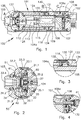
- the Fig. 1 shows a pressure modulator 100 according to the invention.
- the pressure modulator 100 comprises a housing 101 with a hydraulic input 102 and a hydraulic output 103.
- the Hydraulic inlet 102 and the hydraulic outlet 103 are interconnected by a hydraulic line 104 in the interior of the housing 101.
- the hydraulic inputs and outputs 102, 103 can be realized via plug connectors, in order to enable a simple and tool-free assembly / disassembly during servicing.
- the armature 105 is arranged movably in a rotor space 104, which is part of the hydraulic line 104, and is moved to the right in the position shown due to the spring force of the spring element 106, which is designed as a gas spring, so that it bears against a housing wall 107 , In this position, the armature 105 presses against a valve element 108, so that a valve 108a is opened and hydraulic medium can flow through the valve 108a.
- the hydraulic medium can then continue to flow in the armature space 104a along a gap between the lateral surface of the armature 105 and the housing wall 109 to the hydraulic outlet 103, if a valve to be described in more detail in a brake booster 50 is opened.
- the housing 101 has an inner wall 118 with a passage opening through which the armature 105 protrudes.
- the inner wall 118 is formed of ferromagnetic material.
- ABS function anti-lock function
- a linear drive in particular a proportional solenoid 126
- armature 105 counter to the spring force of the spring element 106.
- the volume of the hydraulic line 104 between the housing wall 107th and the armature 105 is increased, so that the pressure exerted by the hydraulic medium on a wheel brake pressure is lower and the wheel brake is opened.
- Moving the armature 105 to the left also has the effect of moving the valve member 108 to the left, thus closing the valve 108a.
- a master cylinder in the region of a brake actuator is thus decoupled from the wheel brake.
- the proportional magnet 126 has a cylindrical coil arrangement 112, by means of which the armature 105 can be attracted.
- the spring element 106 comprises a gas spring volume 106a, which is formed in the armature 105.
- a non-magnetic control piston 113 which is fixedly connected to the housing 101 and sealed from the gas spring volume 106a by the dynamic seal 115.
- the armature 105 is sealed off from the control piston 113 via the dynamic seal 115.
- the control piston 113 is hollow-cylindrical, so that the gas spring volume 106a can be filled with a gas, in particular air, with a predetermined pressure.
- the control piston 113 is to communicate with a closable gas line, not shown.
- the biasing pressure of the spring element 106 should be at least as high as the maximum hydraulic pressure in the pressure modulator 100 in order to keep the system in its non-energized state in its zero position.
- the housing 101 is magnetically conductive, in particular ferromagnetic, at least in the region of the coil arrangement 112.
- the brake booster 50 (see also Fig. 2 ) has a brake booster housing part 51 which is connected to an actuator housing part 101b.
- a cylinder chamber 32 is present in the housing 101, in particular in the brake booster housing part 51.
- a stepped piston 33 is arranged, which has a section 33.1 with a larger cross section and a section 33.2 with a smaller cross section.
- a filling volume 60 Between the portion 33.1 and the housing wall 31.1 is a filling volume 60 and between the portion 33.2 and the housing wall 31.2 is a working volume 61 is formed.
- the intermediate space between the section 33.1 and the housing section 31.3 forms an annular space 32.1.
- the stepped piston 33 is supported via a return element 34 on the housing section 31.3.
- a stepped piston 33 has the advantage that this simply a brake booster 50 is realized.
- the brake booster 50 is realized within the housing 101. This saves weight, costs and allows the combination of a slim design with increased braking power.
- a valve 35 is arranged within the stepped piston 33. Upon initiation of braking, the valve 35 is initially opened and allows a free flow of hydraulic medium until the application of brake pads on a brake disc. The valve 35 is opened by abutment of the valve stem 35.1 on a housing wall 37 with stepped piston 33 displaced to the right.
- a brake system comprising an actuating device, non-working stepped pistons 33 and brake pistons, not shown, operates in this phase with a low amplification factor. This means that a relatively large displacement of the brake piston takes place with a small distance traveled by an actuating element of an actuating device.
- the stepped piston 33 is therefore pressed against the return element 34 and moved against the restoring force and under compression of air contained in the annular space 32.1.
- the movement of the stepped piston 33 causes a closure of the valve 35 due to the action of a spring element 35.2, which is supported on the stepped piston 33.
- the annular space 32.1 is in the illustrated embodiment, as well as the interior of the armature 105 (via the hollow control piston 113) with a vent passage 150 in connection. If necessary, hydraulic fluid entering the annulus 32.1 and / or the interior of the armature 105 may be drained to ensure operability.
- the brake system works in this phase with a large amplification factor.
- the inner wall 118 (FIG. Fig. 1 ) has passage openings 130 along its circumference, which form a section of hydraulic passages 131.
- the passage openings 130 extend parallel to the armature space 104a. They are located outside of the armature 105 and arranged in particular in the region of the housing 101.
- the hydraulic channels 131 represent a bypass of the armature chamber 104a for the hydraulic medium.
- hydraulic medium can not only be transported from the hydraulic inlet 102 to the hydraulic outlet 103 in the armature space 104a along the armature 105, but can be transported past the armature 105 through the hydraulic channels 131.
- hydraulic fluid can be transported faster from the hydraulic input 102 to the hydraulic output 103, without creating a damping effect.
- the stepped piston 33 has a filter element 40 which protects the valve 35 from contamination.
- the hydraulic channels 131 line sections 132, 133 which open into both the armature space 104a and into the through-holes 130 and formed in a housing 134.
- the hydraulic channels 131 are arranged in the region of the inner wall 118, namely at the point at which a particularly small air gap between the housing 101 and the armature 106 has to be realized.
- a filter element 41 is arranged, which protects the valve 108a with the valve element 108 from polluted hydraulic medium, which comes from a donor cylinder, not shown.
- a blocking wheel sensors may be provided, the signals of which receives a control device which controls the pressure modulation arrangement comprising the linear drive and the valve 108a and the hydraulic line 104.
Landscapes
- Engineering & Computer Science (AREA)
- Physics & Mathematics (AREA)
- Fluid Mechanics (AREA)
- Transportation (AREA)
- Mechanical Engineering (AREA)
- Regulating Braking Force (AREA)
Abstract
Description
- Die Erfindung betrifft einen Druckmodulator für ein ABS-System mit einem Gehäuse, das einen Hydraulikeingang und einen damit über eine hydraulische Leitung verbundenen Hydraulikausgang aufweist, wobei ein gegen eine Federkraft eines Federelements zu öffnender Volumenspeicher vorgesehen ist, der bei einer aktivierten Antiblockierfunktion das Volumen der hydraulischen Leitung vergrößert, wobei ein Linearantrieb, insbesondere Proportionalmagnet, mit einem Läufer, insbesondere Anker, vorgesehen ist und eine Verfahrbewegung des Ankers das Öffnen des Volumenspeichers bewirkt.
- Ein solcher Druckmodulator ist beispielsweise durch die
DE 10 2014 007 717 B3 bekannt geworden. - Der dort offenbarte Druckmodulator weist eine relativ große Länge auf. Weiterhin ist ein Teil der hydraulischen Leitung relativ zum Gehäuse des Druckmodulators bewegbar, wodurch sich eine Störungsanfälligkeit ergeben kann.
- Aufgabe der vorliegenden Erfindung ist es, einen Druckmodulator für ein ABS-System, insbesondere für ein ABS-System eines Zweirads, bereitzustellen, der besonders klein bauend und funktionssicher ist.
- Gelöst wird diese Aufgabe erfindungsgemäß durch einen Druckmodulator für ein ABS-System mit einem Gehäuse, das einen Hydraulikeingang und einen damit über eine hydraulische Leitung verbundenen Hydraulikausgang aufweist, wobei ein gegen eine Federkraft eines Federelements zu öffnender Volumenspeicher vorgesehen ist, der bei einer aktivierten Antiblockierfunktion das Volumen der hydraulischen Leitung vergrößert, wobei ein Linearantrieb, insbesondere Proportionalmagnet, mit einem Läufer, insbesondere Anker, vorgesehen ist und eine Verfahrbewegung des Ankers das Öffnen des Volumenspeichers bewirkt, wobei das Federelement als Gasfeder ausgebildet ist.
- Wird demnach das Blockieren eines Rads detektiert, so kann der Läufer gegen die Rückstellkraft des Federelements bewegt werden und damit einen Volumenspeicher schaffen oder öffnen, in den Hydraulikmedium fließen kann. Dadurch wird der Druck des Hydraulikmediums reduziert und somit der Druck auf die Bremsbacken einer Bremszange reduziert, sodass sich das Rad wieder drehen kann.
- Dadurch, dass als Federelement eine Gasfeder vorgesehen ist, kann der Läufer und damit das Gehäuse verkürzt werden. Dadurch ergibt sich ein im Vergleich zum Stand der Technik klein bauender, insbesondere kürzerer Druckmodulator. Außerdem kann durch die erfindungsgemäße Anordnung vermieden werden, dass ein Teil der Hydraulikleitung relativ zum Gehäuse des Druckmodulators bewegbar ist. Dadurch wird die Funktionssicherheit des Druckmodulators erhöht. Außerdem kann die Anzahl dynamischer Abdichtungen verringert werden.
- Dadurch, dass keine Feder, wie z.B. eine Stahlfeder, notwendig ist, entsteht weniger Reibung, da die Federreibung wegfällt. Somit kann ein Federelement eingespart werden. Außerdem ist die Gasfeder ohne zusätzliche Dichtung realisierbar. Es werden also wenige Bauteile benötigt, sodass geringe Kosten entstehen. Vorzugsweise ist die Gasfeder als Luftfeder ausgebildet.
- Der kompakten Ausgestaltung des Druckmodulators förderlich ist es zudem, wenn das Gasfedervolumen im Anker ausgebildet ist. Die Gasfeder ist auf geringerer Länge realisierbar als beispielsweise eine Schraubenfeder, sodass die Länge des Ankers kurz ausfallen kann.
- Vorzugsweise ist ein in den Anker, insbesondere das Gasfedervolumen, ragender, fest mit dem Gehäuse verbundener Steuerkolben vorgesehen. Der Steuerkolben stellt den Kolben der Gasfeder dar. Eine Gasfeder hat den Vorteil, dass ein unter (Hoch-)druck stehendes Gas zur Bereitstellung der Federkraft genutzt wird. Vorteile gegenüber Schraubenfedern sind die vom Federweg nahezu unabhängige Kraft und der geringe Platzbedarf.
- Weitere Vorteile ergeben sich, wenn der Druckmodulator genau eine dynamische Dichtung aufweist, die vorzugsweise zwischen dem Anker und dem Steuerkolben wirkt. Die Funktionssicherheit kann erhöht werden, wenn wenige dynamische Dichtungen vorgesehen sind.
- Der Steuerkolben kann als Hohlkörper ausgebildet sein. Dadurch ist es insbesondere möglich, das Gasfedervolumen durch den Steuerkolben hindurch mit einem Gas mit einem vorgegebenen Druck zu befüllen. In diesem Zusammenhang ist es vorteilhaft, wenn der Steuerkolben mit einer verschließbaren Gasleitung verbunden ist, mittels derer das Gasfedervolumen mit einem Gas, insbesondere Luft, befüllt werden kann.
- Besondere Vorteile ergeben sich, wenn der Anker von Hydraulikmedium umströmbar in der hydraulischen Leitung angeordnet ist. Insbesondere kann der Anker im Gehäuse geführt sein und kann die Hydraulikflüssigkeit eine Schmierung des Ankers bewirken, sodass dieser verschleiß- und reibungsarm im Gehäuse bewegbar ist. Insbesondere kann das Hydraulikmedium über das Führungsspiel zwischen dem Anker und einer Führungsbuchse oder Gehäusewand durchgeführt sein.
- Weiterhin kann vorgesehen sein, dass der Anker zumindest eine Hydraulikfluidausnehmung aufweist, insbesondere an seiner Mantelfläche zumindest eine sich in Längsrichtung des Ankers oder wendelförmig erstreckende Rille aufweist. Somit kann Hydraulikflüssigkeit über die Rille entlang des Ankers fließen. Alternativ oder zusätzlich ist es denkbar, dass der Anker in Längsrichtung des Ankers ausgerichtete Durchgangsöffnungen aufweist, durch die hindurch Hydraulikflüssigkeit vom Hydraulikeingang zum Hydraulikausgang des Druckmodulators fließen kann.
- Gemäß einer besonders vorteilhaften Ausgestaltung der Erfindung kann vorgesehen sein, dass in der hydraulischen Leitung eine durch den Anker betätigbare Ventilanordnung vorgesehen ist. Insbesondere kann das Ventil durch den Anker geöffnet werden, wenn dieser sich in einer Ausgangsstellung befindet, d. h. durch das Federelement bis zu einem definierten Maximaldruck in eine vorgegebene Stellung gedrückt wird. Dadurch kann der Anker beispielsweise gegen eine, insbesondere federbeaufschlagte, Kugel eines Rückschlagventils drücken und dadurch das Ventil öffnen. Wird dagegen die Antiblockierfunktion aktiviert und der Anker entgegen der Federkraft des Federelements bewegt, wird der Kontakt zwischen dem Anker und der Kugel des Ventils aufgelöst, sodass die Kugel das Ventil verschließt und ein weiteres Nachführen von Hydraulikflüssigkeit durch einen Geberzylinder verhindert wird. Somit kann ein Geberzylinder, der mit einer Betätigungsvorrichtung in Verbindung steht, bei aktivierter ABS-Funktion von der hydraulischen Leitung im Inneren des Druckmodulators abgekoppelt werden und kann der Druck des Hydraulikmediums durch die Druckmodulationsanordnung eingestellt werden.
- Durch eine so ausgeführte Ventilanordnung ist nur ein einziges Ventil im Druckmodulator notwendig. Als Alternative zur Kugel wäre auch ein Bauteil mit darauf angebrachter Dichtung denkbar, welches eine Bohrung zwischen hydraulischem Eingang und dem Anker verschließt.
- In dem Gehäuse kann eine Elektronikschaltung angeordnet sein. Insbesondere kann die Elektronikschaltung in den Druckmodulator voll integriert sein. Somit kann die Elektronikschaltung, die zur Ansteuerung des Linearantriebs dient, in dem Druckmodulator vorgesehen sein. Es ergibt sich damit eine besonders platzsparende Anordnung. Somit können alle zeitkritischen Signale, Berechnungen, Leistungsendstufen usw. innerhalb des Druckmodulators erzeugt bzw. vorhanden sein, sodass weniger sicherheitstechnische und zeitkritische Signalverbindungen notwendig sind.
- Weiterhin kann ein den Druck im Volumenspeicher erfassender Drucksensor vorgesehen sein. Der Drucksensor kann über eine direkte hydraulische Anbindung mit dem Volumenspeicher verbunden sein. Dies ist eine kostengünstige, leichte Lösung, die wenig Platz benötigt.
- Dabei kann der Drucksensor auf einer die Elektronikschaltung aufweisenden Platine angeordnet sein. Der Drucksensor kann insbesondere in SMD-Bauweise besonders kostengünstig direkt auf der Platine integriert sein.
- Durch die Integration der Platine in das robuste metallische Gehäuse des Druckmodulators wird sie neben Umwelteinflüssen wie Dreck, Wasser, Staub auch vor EMV-Störungen wie Abstrahlungen von anderen Steuergeräten, Motoren oder Ähnlichem geschützt. Die Integration von Drucksensor, Beschleunigungssensor und Microcontroller verhindert auch eine Störung der Signale durch Magnetfelder, da Signalwege zwischen Sensor und Controller quasi nicht mehr vorhanden sind.
- Auch wird das Umfeld des Druckmodulators durch die Integration in das metallische Gehäuse vor der Abstrahlung des Druckmodulators und dessen Elektronik geschützt. So lassen sich Anforderungen an EMV-Verträglichkeit leichter umsetzen.
- Die Elektronikschaltung kann in einer separaten Kammer des Gehäuses und dadurch geschützt vor Hydraulikflüssigkeit angeordnet sein. Insbesondere kann sich die elektronische Schaltung axial neben dem Volumenspeicher befinden. Damit Hydraulikflüssigkeit in den Volumenspeicher gelangen kann, kann die hydraulische Leitung durch die Elektronikschaltung, insbesondere die Platine der Elektronikschaltung, hindurchgeführt sein. Mögliche Positionen sind dabei eine Anordnung zwischen hydraulischem Eingang und Volumenspeicher oder zwischen Volumenspeicher und hydraulischem Ausgang.
- In den Rahmen der Erfindung fällt außerdem eine hydraulische Bremsanlage mit Antiblockierfunktion, umfassend einen den hydraulischen Druck erzeugenden Geberzylinder, der über eine hydraulische Leitung, in der ein erfindungsgemäßer Druckmodulator angeordnet ist, mit einer Radbremse hydraulisch kommunizierend verbunden ist.
- Der Druckmodulator kann einen Bremskraftverstärker aufweisen. Erfindungsgemäß ist somit ein Druckmodulator mit integriertem Bremskraftverstärker vorgesehen. Der Druckmodulator kann an einer Stelle des Zweirads angeordnet werden, wo er nicht stört. Es ist daher kein Problem, wenn der Druckmodulator an dieser Stelle etwas größer baut, insbesondere mit einem größeren Durchmesser. Dies wiederum führt dazu, dass reibungsärmere Dichtungen verwendet werden können.
- Dank des Bremskraftverstärkers und dessen Druckübersetzung kann der Linearantrieb schwächer und somit kompakter, leichter und günstiger ausgelegt werden.
- Grundsätzlich ist es denkbar, dass der Druckmodulator und der Bremskraftverstärker ein gemeinsames, einstückiges Gehäuse aufweisen oder dass zumindest die Außenwand des Gehäuses einstückig ausgebildet ist. Aus Herstellungsgründen kann es jedoch vorteilhaft sein, wenn ein Bremskraftverstärkergehäuseteil mit einem Aktorgehäuseteil verbunden ist, wobei die Druckmodulationsanordnung im Aktorgehäuseteil angeordnet sein kann. Somit können der Teil des Druckmodulators, der die Druckmodulationsanordnung aufweist, und der Bremskraftverstärker zunächst getrennt hergestellt werden und anschließend miteinander verbunden werden. Dabei können das Bremskraftverstärkergehäuseteil und das Aktorgehäuseteil verclipst sein. Alternativ ist es denkbar, das Bremskraftverstärkergehäuseteil und das Aktorgehäuseteil miteinander zu verschrauben. Auch Bördeln oder Pressen sind zum Verbinden der Gehäuseteile denkbar.
- Besondere Vorteile ergeben sich, wenn in dem Gehäuse ein Zylinderraum ausgebildet ist, in dem ein Stufenkolben mit zwei Abschnitten unterschiedlicher Querschnittsfläche angeordnet ist, wobei zwischen einer Gehäusewand und einem Stufenkolbenabschnitt größerer Querschnittfläche ein Füllvolumen und zwischen einer Gehäusewand und einem Stufenkolbenabschnitt kleinerer Querschnittsfläche ein Arbeitsvolumen ausgebildet ist. Durch den Stufenkolben wird der Bremskraftverstärker auf einfache Art und Weise, insbesondere platzsparende Art und Weise, realisiert. Insbesondere kann der Zylinderraum zumindest überwiegend im Bremskraftverstärkergehäuseteil angeordnet sein.
- Der Stufenkolben kann gegen die Rückstellkraft eines Rückstellelements bewegbar sein. Beispielsweise kann der Stufenkolben dazu ferromagnetisch ausgebildet sein und durch einen Magneten als Rückstellelement bewegt werden. Alternativ ist es denkbar, ein Federelement als Rückstellelement vorzusehen.
- Zwischen einem Gehäuseabschnitt und dem Stufenkolbenabschnitt größerer Querschnittsfläche kann ein Ringraum ausgebildet sein, in dem das Rückstellelement angeordnet ist. Grundsätzlich ist es denkbar, das Rückstellelement, welches als Federelement, insbesondere Schraubenfeder, ausgebildet sein kann, auch im Arbeitsraum vorzusehen. Dies hätte jedoch den Nachteil, dass das Rückstellelement mit einem geringeren Durchmesser ausgebildet werden müsste. Außerdem würde das Rückstellelement an dieser Position die Baugröße des Bremskraftverstärkers vergrößern. Der Ringraum ist für die Funktion des Bremskraftverstärkers ohnehin vorteilhaft. Er wird erfindungsgemäß auch für die Anordnung des Rückstellelements genutzt. Dadurch wird keine zusätzliche Baulänge verursacht. Die Anordnung des Rückstellelements im Ringraum bewirkt weiterhin, dass der vom Stufenkolben zurückgelegte Weg durch das Rückstellelement begrenzt wird. Außerdem kann an dieser Stelle eine relativ weiche Feder bei kleiner axialer Länge des Rückstellelements vorgesehen werden, die die gleiche Steifigkeit aufweist wie eine Feder, die im Arbeitsraum alternativ mit deutlich größeren Dimensionen angeordnet werden müsste.
- Erfindungsgemäß kann weiterhin vorgesehen sein, dass der Ringraum ohne Atmosphärenanschluss ausgebildet ist. Wird eine Bremsung ausgeführt, wird demnach die Luft, die im Ringraum vorhanden ist, komprimiert. Dadurch kann die Bremskraft begrenzt werden. Außerdem kann das Rückstellelement im Ringraum dadurch schwächer dimensioniert werden. Wenn kein Atmosphärenanschluss vorhanden ist, kann auch sichergestellt werden, dass kein Schmutz in den Zylinderraum gelangt. Die komprimierte Luft kann auch weiterhin das Rückstellelement unterstützen, um den Stufenkolben in seine Ausgangsstellung zurückzugbewegen, wenn keine Bremsung benötigt wird. Auch die Ausfallsicherheit der Bremse wird durch den fehlenden Atmosphärenanschluss erhöht. Tritt eine Undichtigkeit am Stufenkolben auf, so gelangt die Hydraulikflüssigkeit lediglich in den Ringraum. Wäre ein Atmosphärenanschluss vorhanden, könnte Bremsflüssigkeit entweichen, mit der Folge, dass keine Bremsung mehr durchgeführt werden könnte.
- Gemäß einer alternativen Ausführungsform kann der Ringraum mit einem Entlüftungskanal in Verbindung stehen. In den Ringraum gelangendes Hydraulikmedium kann dann über den Entlüftungskanal abgelassen werden.
- Besondere Vorteile ergeben sich, wenn der Zylinderraum und ein Läuferraum koaxial angeordnet sind. Dies bedeutet, dass der Bremskraftverstärker und die Druckmodulationsanordnung in Strömungsrichtung des Hydraulikmediums vom Hydraulikeingang zum Hydraulikausgang gesehen hintereinander angeordnet sind. Durch diese Anordnung erhöht sich zwar die Länge des Druckmodulators etwas, dafür kann er relativ schlank gehalten werden.
- Besondere Vorteile ergeben sich dadurch, dass im Stufenkolben ein Ventil angeordnet ist. Dadurch kann das Ventil selbst geöffnet sein. Wenn demnach bei einer Bremsbetätigung Hydraulikmedium gefördert wird, durchströmt das Hydraulikmedium zunächst das Arbeitsvolumen, das Ventil und das Füllvolumen und gelangt in den oder die Zylinderräume, in denen der oder die Bremskolben einer Bremszange angeordnet sind. Dies entspricht einer so genannten Füllphase. Wenn nun sämtliche Räume in der Bremszange mit Hydraulikflüssigkeit gefüllt sind und die Bremsbeläge, die durch die Bremskolben beaufschlagt sind, an der Bremsscheibe anliegen, steht an beiden Seiten des Stufenkolbens (im Füllvolumen und Arbeitsvolumen) der gleiche Druck an. Da die Stufenkolbenabschnitte jedoch unterschiedliche Querschnittsflächen aufweisen, bewirkt dies, dass der Stufenkolben im Zylinderraum verlagert wird. Bei der Verlagerung des Stufenkolbens wird das Ventil geschlossen, sodass bei einer weiteren Druckbeaufschlagung mittels der Betätigungsvorrichtung der Stufenkolben verlagert wird und die Hydraulikflüssigkeit im Arbeitsvolumen des Zylinderraums wirksam wird. Dies bedeutet, dass bei einer weiteren Betätigung der Betätigungsvorrichtung die Bremskolben die Bremsbeläge mit einer Normalkraft gegen die Bremsscheibe beaufschlagen und somit eine Bremsung erfolgt.
- Besonders bevorzugt ist es, wenn sich das Ventil über ein Federelement am Stufenkolben abstützt. Dadurch ergibt sich eine kompakte Anordnung.
- Besondere Vorteile ergeben sich, wenn ausgangsseitig des Stufenkolbens ein Filterelement vorgesehen ist. Dadurch kann verhindert werden, dass beim Zurückfließen von Hydraulikmedium Partikel in die hydraulische Leitung gelangen und dort für Verschleiß und Störungen sorgen.
- Weitere Vorteile ergeben sich, wenn im Bereich des Hydraulikeingangs ein Filterelement vorgesehen ist. Durch diese Maßnahme wird verhindert, dass Partikel vom Eingang her in den Druckmodulator gelangen. Insbesondere ist das Vorsehen von zwei Filterelementen - eines im Bereich des Hydraulikausgangs und eines im Bereich des Hydraulikeingangs - besonders vorteilhaft. Dadurch kann sichergestellt werden, dass keine Partikel oder Verschmutzung in den Innenraum, insbesondere die hydraulische Leitung und/oder den Läuferraum des Druckmodulators, gelangen. Dadurch kann die Funktionsfähigkeit der im Druckmodulator angeordneten Ventile sichergestellt werden. Auch die Bewegung eines Läufers relativ zum Gehäuse im Hydraulikmedium kann dadurch störungsfrei und verschleißarm verlaufen.
- Die Filterelemente haben aufgrund ihrer Anordnung keinen Einfluss auf die Regeldynamik des Druckmodulators, insbesondere der ABS-Regelung.
- Das Gehäuse des Druckmodulators kann zumindest abschnittsweise ferromagnetisch ausgebildet sein. Somit kann das Gehäuse verwendet werden, um einen magnetischen Kreis zu bilden, der zur Bewegung des Läufers verwendet wird.
- Der Läufer kann in einem das Hydraulikmedium aufweisenden Läuferraum, insbesondere Ankerraum, angeordnet sein, wobei zusätzlich zum Läuferraum und außerhalb des Läufers zumindest ein Hydraulikkanal vorgesehen ist, der einen Hydraulikmediumtransport am Läufer vorbei erlaubt. Somit kann sichergestellt werden, dass Hydraulikmedium schnell am Läufer, insbesondere Anker, vorbei von einem Ende des Druckmodulators zum anderen Ende des Druckmodulators befördert werden kann, ohne dass durch den Druckmodulator eine Dämpfungswirkung erfolgt.
- Der Hydraulikkanal kann zumindest abschnittsweise in einer Gehäusewandung verlaufen. Dadurch ist es möglich, den Luftspalt zwischen dem ferromagnetischen Gehäuse und dem Läufer bzw. dem Anker gering zu halten und dennoch einen ausreichenden Transport von Hydraulikmedium sicherzustellen.
- Weitere Merkmale und Vorteile der Erfindung ergeben sich aus der nachfolgenden Beschreibung eines Ausführungsbeispiels der Erfindung, anhand der Figuren der Zeichnung, die erfindungswesentliche Einzelheiten zeigt, sowie aus den Ansprüchen. Die dort gezeigten Merkmale sind nicht notwendig maßstäblich zu verstehen und derart dargestellt, dass die erfindungsgemäßen Besonderheiten deutlich sichtbar gemacht werden können. Die verschiedenen Merkmale können je einzeln für sich oder zu mehreren in beliebigen Kombinationen bei Varianten der Erfindung verwirklicht sein.
- In der schematischen Zeichnung ist ein Ausführungsbeispiel der Erfindung dargestellt und in der nachfolgenden Beschreibung näher erläutert.
- Es zeigen:
- Fig. 1
- eine schematische Längsschnittdarstellung eines erfindungsgemäßen Druckmodulators bei nicht aktivierter ABS-Funktion;
- Fig. 2
- ein Detail A der
Fig. 1 ; - Fig. 3
- ein Detail B der
Fig. 1 ; - Fig. 4
- ein Detail C der
Fig. 1 . - Die
Fig. 1 zeigt einen erfindungsgemäßen Druckmodulator 100. Der Druckmodulator 100 umfasst ein Gehäuse 101 mit einem Hydraulikeingang 102 und einem Hydraulikausgang 103. Der Hydraulikeingang 102 und der Hydraulikausgang 103 sind durch eine Hydraulikleitung 104 im Inneren des Gehäuses 101 miteinander verbunden. - Die Hydraulikein- und -ausgänge 102, 103 können über Steckverbinder realisiert werden, um im Servicefall eine einfache und werkzeuglose Montage/Demontage zu ermöglichen.
- Bei nicht aktivierter ABS-Funktion befindet sich ein als Anker 105 ausgebildeter Läufer aus Stahl oder einem Sondermaterial in einer in der
Fig. 1 gezeigten Nullstellung. Der Anker 105 ist in einem als Ankerraum 104a ausgebildeten Läuferraum, der Teil der Hydraulikleitung 104 ist, bewegbar angeordnet und in der gezeigten Stellung aufgrund der Federkraft des Federelements 106, welches als Gasfeder ausgebildet ist, nach rechts bewegt, sodass er an einer Gehäusewand 107 anliegt. In dieser Stellung drückt der Anker 105 gegen ein Ventilelement 108, sodass ein Ventil 108a geöffnet ist und Hydraulikmedium das Ventil 108a durchströmen kann. Das Hydraulikmedium kann dann im Ankerraum 104a weiterhin entlang eines Spalts zwischen der Mantelfläche des Ankers 105 und der Gehäusewand 109 zum Hydraulikausgang 103 fließen, sofern ein noch näher zu beschreibendes Ventil in einem Bremskraftverstärker 50 geöffnet ist. - Das Gehäuse 101 weist eine Innenwand 118 mit einer Durchgangsöffnung auf, durch die der Anker 105 ragt. Die Innenwand 118 ist aus ferromagnetischem Material ausgebildet.
- Bei aktivierter Antiblockierfunktion (ABS-Funktion) wird ein Linearantrieb, insbesondere ein Proportionalmagnet 126, aktiviert, der den Anker 105 entgegen der Federkraft des Federelements 106 bewegt. Dadurch wird das Volumen der Hydraulikleitung 104 zwischen der Gehäusewand 107 und dem Anker 105 vergrößert, sodass der durch das Hydraulikmedium auf eine Radbremse ausgeübte Druck geringer wird und die Radbremse geöffnet wird. Das Verschieben des Ankers 105 nach links hat weiterhin den Effekt, dass das Ventilelement 108 nach links bewegt wird und somit das Ventil 108a verschließt. Ein Geberzylinder im Bereich einer Bremsbetätigungsvorrichtung ist somit von der Radbremse abgekoppelt.
- Der Proportionalmagnet 126 weist eine zylinderförmige Spulenanordnung 112 auf, durch die der Anker 105 angezogen werden kann.
- Das Federelement 106 umfasst ein Gasfedervolumen 106a, das im Anker 105 ausgebildet ist. In das Gasfedervolumen 106a ragt ein nicht magnetischer Steuerkolben 113, der fest mit dem Gehäuse 101 verbunden und gegenüber dem Gasfedervolumen 106a durch die dynamische Dichtung 115 abgedichtet ist. Insbesondere ist der Anker 105 gegenüber dem Steuerkolben 113 über die dynamische Dichtung 115 abgedichtet. Der Steuerkolben 113 ist hohlzylindrisch ausgebildet, sodass das Gasfedervolumen 106a mit einem Gas, insbesondere Luft, mit einem vorgegebenen Druck befüllt werden kann. Der Steuerkolben 113 steht dazu mit einer nicht dargestellten verschließbaren Gasleitung in Verbindung. Der Vorspanndruck des Federelements 106 sollte mindestens so hoch gewählt sein wie der maximale hydraulische Druck im Druckmodulator 100, um das System im nicht bestromten Zustand in seiner Nullstellung zu halten.
- Das Gehäuse 101 ist zumindest im Bereich der Spulenanordnung 112 magnetisch leitend, insbesondere ferromagnetisch, ausgebildet.
- Der Bremskraftverstärker 50 (s. auch
Fig. 2 ) weist ein Bremskraftverstärkergehäuseteil 51 auf, das mit einem Aktuatorgehäuseteil 101b verbunden ist. Im Gehäuse 101, insbesondere im Bremskraftverstärkergehäuseteil 51, ist ein Zylinderraum 32 vorhanden. In dem Zylinderraum 32 ist ein Stufenkolben 33 angeordnet, der einen Abschnitt 33.1 mit größerem Querschnitt und einen Abschnitt 33.2 mit kleinerem Querschnitt aufweist. Zwischen dem Abschnitt 33.1 und der Gehäusewand 31.1 ist ein Füllvolumen 60 und zwischen dem Abschnitt 33.2 und der Gehäusewand 31.2 ist ein Arbeitsvolumen 61 ausgebildet. Der Zwischenraum zwischen dem Abschnitt 33.1 und dem Gehäuseabschnitt 31.3 bildet einen Ringraum 32.1. Der Stufenkolben 33 stützt sich über ein Rückstellelement 34 an dem Gehäuseabschnitt 31.3 ab. - Das Vorsehen eines Stufenkolbens 33 hat den Vorteil, dass dadurch einfach ein Bremskraftverstärker 50 realisiert wird. Der Bremskraftverstärker 50 wird dabei innerhalb des Gehäuses 101 realisiert. Dies spart Gewicht, Kosten und ermöglicht die Kombination von einem schlanken Design bei einer erhöhten Bremskraft.
- Innerhalb des Stufenkolbens 33 ist ein Ventil 35 angeordnet. Bei Einleitung einer Bremsung ist das Ventil 35 zunächst geöffnet und ermöglicht ein freies Durchströmen von Hydraulikmedium bis zur Anlage von Bremsbelägen an einer Bremsscheibe. Das Ventil 35 ist durch Anlage des Ventilstößels 35.1 an einer Gehäusewandung 37 bei nach rechts verlagertem Stufenkolben 33 geöffnet.
- Eine Bremsanlage, umfassend eine Betätigungsvorrichtung, nicht arbeitenden Stufenkolben 33 und nicht dargestellte Bremskolben, arbeitet in dieser Phase mit einem geringen Verstärkungsfaktor. Dies bedeutet, dass mit geringem von einem Betätigungselement einer Betätigungsvorrichtung zurückgelegtem Weg eine relativ große Verstellung der Bremskolben erfolgt.
- Sobald Beläge der Radbremse an einer Bremsscheibe anliegen, baut sich ein hydraulischer Druck auf, der auf beiden Seiten des Stufenkolbens 33 gleich groß ist. Da die Kolbenflächen an den Stirnseiten unterschiedlich groß sind, wird der Stufenkolben 33 jedoch nach links bewegt.
- Entsprechend der Flächendifferenz der Kolbenflächen 33.3, 33.4 des Stufenkolbens 33 wird der Stufenkolben 33 daher gegen das Rückstellelement 34 gedrückt und gegen dessen Rückstellkraft und unter Kompression von im Ringraum 32.1 enthaltener Luft bewegt. Die Bewegung des Stufenkolbens 33 bewirkt ein Verschließen des Ventils 35 aufgrund der Wirkung eines Federelements 35.2, das sich am Stufenkolben 33 abstützt.
- Der Ringraum 32.1 steht im gezeigten Ausführungsbeispiel genau wie der Innenraum des Ankers 105 (über den hohlen Steuerkolben 113) mit einem Entlüftungskanal 150 in Verbindung. Bei Bedarf kann Hydraulikmedium, das in den Ringraum 32.1 und/oder den Innenraum des Ankers 105 gelangt, abgelassen werden, um die Funktionsfähigkeit sicherzustellen.
- Durch das Kräftegleichgewicht beidseits des Stufenkolbens 33 ergibt sich trotz geringen Betätigungsdruckes im Füllvolumen 60 ein hoher Druck im Arbeitsraum 61.
- Die Bremsanlage arbeitet in dieser Phase mit einem großen Verstärkungsfaktor.
- Die Innenwand 118 (
Fig. 1 ) weist entlang ihres Umfangs Durchgangsöffnungen 130 auf, die einen Abschnitt von Hydraulikkanälen 131 bilden. Die Durchgangsöffnungen 130 verlaufen parallel zum Ankerraum 104a. Sie sind außerhalb des Ankers 105 angeordnet und insbesondere im Bereich des Gehäuses 101 angeordnet. Die Hydraulikkanäle 131 stellen quasi einen Bypass des Ankerraums 104a für das Hydraulikmedium dar. Somit kann Hydraulikmedium vom Hydraulikeingang 102 zum Hydraulikausgang 103 nicht nur im Ankerraum 104a entlang des Ankers 105 transportiert werden, sondern kann am Anker 105 vorbei durch die Hydraulikkanäle 131 transportiert werden. Somit kann Hydraulikmedium schneller vom Hydraulikeingang 102 zum Hydraulikausgang 103 transportiert werden, ohne dass eine Dämpfungswirkung entsteht. - Der
Fig. 2 kann man auch entnehmen, dass der Stufenkolben 33 ein Filterelement 40 aufweist, das das Ventil 35 vor Verschmutzung schützt. - Wie sich der Darstellung der
Fig. 3 entnehmen lässt, weisen die Hydraulikkanäle 131 Leitungsabschnitte 132, 133 auf, die sowohl in den Ankerraum 104a als auch in die Durchgangsöffnungen 130 münden und in einer Gehäusewandung 134 ausgebildet sind. Insbesondere sind die Hydraulikkanäle 131 im Bereich der Innenwand 118 angeordnet, nämlich an der Stelle, an der ein besonders kleiner Luftspalt zwischen dem Gehäuse 101 und dem Anker 106 realisiert werden muss. - Der
Fig. 4 kann man entnehmen, dass im Bereich des Hydraulikeingangs 102 ein Filterelement 41 angeordnet ist, das das Ventil 108a mit dem Ventilelement 108 vor verschmutztem Hydraulikmedium schützt, das von einem nicht gezeigten Geberzylinder kommt. - Zur Erfassung eines blockierenden Rads können Sensoren vorgesehen sein, deren Signale eine Steuereinrichtung empfängt, die die Druckmodulationsanordnung, umfassend den Linearantrieb und das Ventil 108a sowie die Hydraulikleitung 104, steuert.
Claims (15)
- Druckmodulator (100) für ein ABS-System mit einem Gehäuse (101), das einen Hydraulikeingang (102) und einen damit über eine hydraulische Leitung (104) verbundenen Hydraulikausgang (103) aufweist, wobei ein gegen eine Federkraft eines Federelements (106) zu öffnender Volumenspeicher vorgesehen ist, der bei einer aktivierten Antiblockierfunktion das Volumen der hydraulischen Leitung (104) vergrößert, wobei ein Linearantrieb, insbesondere Proportionalmagnet (126), mit einem Läufer, insbesondere Anker (105), vorgesehen ist und eine Verfahrbewegung des Ankers (105) das Öffnen des Volumenspeichers bewirkt, dadurch gekennzeichnet, dass das Federelement (106) als Gasfeder ausgebildet ist.
- Druckmodulator nach Anspruch 1, dadurch gekennzeichnet, dass das Gasfedervolumen im Anker (105) ausgebildet ist.
- Druckmodulator nach einem der vorhergehenden Ansprüche, dadurch gekennzeichnet, dass ein in den Anker (105), insbesondere in das Gasfedervolumen, ragender, fest mit dem Gehäuse (101) verbundener Steuerkolben (113) vorgesehen ist.
- Druckmodulator nach einem der vorhergehenden Ansprüche, dadurch gekennzeichnet, dass der Druckmodulator (100) genau eine dynamische Dichtung (115) aufweist, die vorzugsweise zwischen dem Anker (105) und dem Steuerkolben (113) wirkt.
- Druckmodulator nach einem der vorhergehenden Ansprüche, dadurch gekennzeichnet, dass der Steuerkolben (113) als Hohlkörper ausgebildet ist.
- Druckmodulator nach einem der vorhergehenden Ansprüche, dadurch gekennzeichnet, dass der Steuerkolben (113) mit einer verschließbaren Gasleitung verbunden ist.
- Druckmodulator nach einem der vorhergehenden Ansprüche, dadurch gekennzeichnet, dass der Anker (105) von Hydraulikmedium umströmbar in der hydraulischen Leitung (104) angeordnet ist.
- Druckmodulator nach einem der vorhergehenden Ansprüche, dadurch gekennzeichnet, dass der Druckmodulator (100) einen Bremskraftverstärker (50) aufweist.
- Druckmodulator nach einem der vorhergehenden Ansprüche, dadurch gekennzeichnet, dass ein Ventil (108a) vorgesehen ist, durch das die hydraulische Leitung (104) im Bereich des Hydraulikeingangs (102) bei aktivierter ABS-Funktion verschließbar ist.
- Druckmodulator nach einem der vorhergehenden Ansprüche, dadurch gekennzeichnet, dass in dem Gehäuse (101) ein Zylinderraum (32) ausgebildet ist, in dem ein Stufenkolben (33) mit zwei Abschnitten (33.1, 33.2) unterschiedlicher Querschnittsfläche angeordnet ist, wobei zwischen einer Gehäusewand (31.1) und einem Stufenkolbenabschnitt (33.1) größerer Querschnittsfläche ein Füllvolumen (60) und zwischen einer Gehäusewand (31.2) und einem Stufenkolbenabschnitt (33.2) kleinerer Querschnittsfläche ein Arbeitsvolumen (61) ausgebildet ist.
- Druckmodulator nach Anspruch 10, dadurch gekennzeichnet, dass der Stufenkolben (33) gegen die Rückstellkraft eines Rückstellelements (34) bewegbar ist.
- Druckmodulator nach einem der vorhergehenden Ansprüche, dadurch gekennzeichnet, dass im Stufenkolben (33) ein Ventil (35) angeordnet ist.
- Druckmodulator nach Anspruch 8, dadurch gekennzeichnet, dass sich das Ventil (35) über ein Federelement (35.2) am Stufenkolben (33) abstützt.
- Druckmodulator nach einem der vorhergehenden Ansprüche, dadurch gekennzeichnet, dass ausgangsseitig des Stufenkolbens (33) ein Filterelement (40) vorgesehen ist.
- Druckmodulator nach einem der vorhergehenden Ansprüche, dadurch gekennzeichnet, dass im Bereich des Hydraulikeingangs (102) ein Filterelement (41) vorgesehen ist.
Priority Applications (3)
| Application Number | Priority Date | Filing Date | Title |
|---|---|---|---|
| EP17158353.7A EP3366535B1 (de) | 2017-02-28 | 2017-02-28 | Druckmodulator für ein antiblockier-bremssystem (abs) |
| ES17158353T ES2737836T3 (es) | 2017-02-28 | 2017-02-28 | Modulador de presión para un sistema de frenado antibloqueo |
| DK17158353.7T DK3366535T3 (da) | 2017-02-28 | 2017-02-28 | Trykmodulator til antiblokeringsbremsesystem (abs) |
Applications Claiming Priority (1)
| Application Number | Priority Date | Filing Date | Title |
|---|---|---|---|
| EP17158353.7A EP3366535B1 (de) | 2017-02-28 | 2017-02-28 | Druckmodulator für ein antiblockier-bremssystem (abs) |
Publications (2)
| Publication Number | Publication Date |
|---|---|
| EP3366535A1 true EP3366535A1 (de) | 2018-08-29 |
| EP3366535B1 EP3366535B1 (de) | 2019-04-24 |
Family
ID=58192169
Family Applications (1)
| Application Number | Title | Priority Date | Filing Date |
|---|---|---|---|
| EP17158353.7A Active EP3366535B1 (de) | 2017-02-28 | 2017-02-28 | Druckmodulator für ein antiblockier-bremssystem (abs) |
Country Status (3)
| Country | Link |
|---|---|
| EP (1) | EP3366535B1 (de) |
| DK (1) | DK3366535T3 (de) |
| ES (1) | ES2737836T3 (de) |
Citations (4)
| Publication number | Priority date | Publication date | Assignee | Title |
|---|---|---|---|---|
| EP0209817A1 (de) * | 1985-07-23 | 1987-01-28 | Robert Bosch Gmbh | Druckverstärker und -modulator |
| US5044701A (en) * | 1989-04-14 | 1991-09-03 | Miyako Jidosha Kogyo Kabushikikaisha | Elastic body apparatus especially intended for an anti-lock brake system |
| DE19501487A1 (de) * | 1995-01-19 | 1996-07-25 | Deinlein Kalb Hans | Einrichtung zum kombinierten Antiblockier- und Antriebsschlupfregelung für Motorräder |
| DE102014007717B3 (de) | 2014-05-28 | 2015-09-03 | Brake Force One Gmbh | Hydraulische Bremsanlage mit Antiblockier-Funktion |
-
2017
- 2017-02-28 EP EP17158353.7A patent/EP3366535B1/de active Active
- 2017-02-28 ES ES17158353T patent/ES2737836T3/es active Active
- 2017-02-28 DK DK17158353.7T patent/DK3366535T3/da active
Patent Citations (4)
| Publication number | Priority date | Publication date | Assignee | Title |
|---|---|---|---|---|
| EP0209817A1 (de) * | 1985-07-23 | 1987-01-28 | Robert Bosch Gmbh | Druckverstärker und -modulator |
| US5044701A (en) * | 1989-04-14 | 1991-09-03 | Miyako Jidosha Kogyo Kabushikikaisha | Elastic body apparatus especially intended for an anti-lock brake system |
| DE19501487A1 (de) * | 1995-01-19 | 1996-07-25 | Deinlein Kalb Hans | Einrichtung zum kombinierten Antiblockier- und Antriebsschlupfregelung für Motorräder |
| DE102014007717B3 (de) | 2014-05-28 | 2015-09-03 | Brake Force One Gmbh | Hydraulische Bremsanlage mit Antiblockier-Funktion |
Also Published As
| Publication number | Publication date |
|---|---|
| EP3366535B1 (de) | 2019-04-24 |
| DK3366535T3 (da) | 2019-07-15 |
| ES2737836T3 (es) | 2020-01-16 |
Similar Documents
| Publication | Publication Date | Title |
|---|---|---|
| EP2985198B1 (de) | Hydraulische bremsanlage mit antiblockier-funktion | |
| EP3266663B1 (de) | Druckmodulator für ein abs-system | |
| EP2004428B1 (de) | Schaltventil | |
| EP3551512B1 (de) | Hauptbremszylinderanordnung mit positionsgeberelement und dichtungsanordnung | |
| DE102012107522B4 (de) | Fahrzeugtürantrieb mit Zahnstange | |
| DE102011086258A1 (de) | Bremsanlage für Kaftfahrzeuge | |
| EP3266662B1 (de) | Druckmodulator für ein abs-system | |
| DE102008002539A1 (de) | Regelventil für ein Fahrzeugbremssystem und korrespondierendes Fahrzeugbremssystem | |
| DE102017200647A1 (de) | Bremssystem | |
| DE3700697C2 (de) | ||
| DE102010038328A1 (de) | Bremssystem für Kraftfahrzeuge | |
| EP4065439B1 (de) | Hydraulikblock für ein hydraulikaggregat einer hydraulischen fremdkraft-fahrzeugbremsanlage | |
| EP3366536A1 (de) | Druckmodulator mit integriertem bremskraftverstärker | |
| DE102007050151B4 (de) | Druckentlastetes Schaltventil und Federanlage | |
| DE102017209618A1 (de) | Pedalwegsimulator für eine hydraulische Fremdkraft-Fahrzeugbremsanlage | |
| DE3700698C2 (de) | ||
| DE4218402B4 (de) | Antiblockierregelsystem | |
| DE112013006806T5 (de) | Elektromagnetisches Ventil | |
| EP3408553A1 (de) | Vorrichtung zur betätigung einer kupplung | |
| EP3366535B1 (de) | Druckmodulator für ein antiblockier-bremssystem (abs) | |
| DE102009049246A1 (de) | Kupplungspedalkraftunterstützungseinrichtung | |
| DE2927902C2 (de) | ||
| EP1613875A1 (de) | Kolbeneinrichtung und mit einer kolbeneinrichtung ausgeführte kolben-zylinder-anordnung | |
| DE10258266A1 (de) | Betätigungseinheit | |
| DE102011018873A1 (de) | Pneumatisches Ventil und seine Verwendung für einen angeschlossenen Verbraucher |
Legal Events
| Date | Code | Title | Description |
|---|---|---|---|
| PUAI | Public reference made under article 153(3) epc to a published international application that has entered the european phase |
Free format text: ORIGINAL CODE: 0009012 |
|
| STAA | Information on the status of an ep patent application or granted ep patent |
Free format text: STATUS: THE APPLICATION HAS BEEN PUBLISHED |
|
| AK | Designated contracting states |
Kind code of ref document: A1 Designated state(s): AL AT BE BG CH CY CZ DE DK EE ES FI FR GB GR HR HU IE IS IT LI LT LU LV MC MK MT NL NO PL PT RO RS SE SI SK SM TR |
|
| AX | Request for extension of the european patent |
Extension state: BA ME |
|
| STAA | Information on the status of an ep patent application or granted ep patent |
Free format text: STATUS: REQUEST FOR EXAMINATION WAS MADE |
|
| 17P | Request for examination filed |
Effective date: 20181017 |
|
| RBV | Designated contracting states (corrected) |
Designated state(s): AL AT BE BG CH CY CZ DE DK EE ES FI FR GB GR HR HU IE IS IT LI LT LU LV MC MK MT NL NO PL PT RO RS SE SI SK SM TR |
|
| GRAP | Despatch of communication of intention to grant a patent |
Free format text: ORIGINAL CODE: EPIDOSNIGR1 |
|
| STAA | Information on the status of an ep patent application or granted ep patent |
Free format text: STATUS: GRANT OF PATENT IS INTENDED |
|
| INTG | Intention to grant announced |
Effective date: 20181213 |
|
| GRAS | Grant fee paid |
Free format text: ORIGINAL CODE: EPIDOSNIGR3 |
|
| GRAA | (expected) grant |
Free format text: ORIGINAL CODE: 0009210 |
|
| STAA | Information on the status of an ep patent application or granted ep patent |
Free format text: STATUS: THE PATENT HAS BEEN GRANTED |
|
| AK | Designated contracting states |
Kind code of ref document: B1 Designated state(s): AL AT BE BG CH CY CZ DE DK EE ES FI FR GB GR HR HU IE IS IT LI LT LU LV MC MK MT NL NO PL PT RO RS SE SI SK SM TR |
|
| REG | Reference to a national code |
Ref country code: GB Ref legal event code: FG4D Free format text: NOT ENGLISH |
|
| REG | Reference to a national code |
Ref country code: CH Ref legal event code: EP |
|
| REG | Reference to a national code |
Ref country code: DE Ref legal event code: R096 Ref document number: 502017001155 Country of ref document: DE |
|
| REG | Reference to a national code |
Ref country code: AT Ref legal event code: REF Ref document number: 1123770 Country of ref document: AT Kind code of ref document: T Effective date: 20190515 Ref country code: CH Ref legal event code: NV Representative=s name: ROTTMANN, ZIMMERMANN + PARTNER AG, CH Ref country code: IE Ref legal event code: FG4D Free format text: LANGUAGE OF EP DOCUMENT: GERMAN |
|
| REG | Reference to a national code |
Ref country code: NL Ref legal event code: FP |
|
| REG | Reference to a national code |
Ref country code: DK Ref legal event code: T3 Effective date: 20190708 |
|
| REG | Reference to a national code |
Ref country code: LT Ref legal event code: MG4D |
|
| PG25 | Lapsed in a contracting state [announced via postgrant information from national office to epo] |
Ref country code: AL Free format text: LAPSE BECAUSE OF FAILURE TO SUBMIT A TRANSLATION OF THE DESCRIPTION OR TO PAY THE FEE WITHIN THE PRESCRIBED TIME-LIMIT Effective date: 20190424 Ref country code: PT Free format text: LAPSE BECAUSE OF FAILURE TO SUBMIT A TRANSLATION OF THE DESCRIPTION OR TO PAY THE FEE WITHIN THE PRESCRIBED TIME-LIMIT Effective date: 20190824 Ref country code: FI Free format text: LAPSE BECAUSE OF FAILURE TO SUBMIT A TRANSLATION OF THE DESCRIPTION OR TO PAY THE FEE WITHIN THE PRESCRIBED TIME-LIMIT Effective date: 20190424 Ref country code: NO Free format text: LAPSE BECAUSE OF FAILURE TO SUBMIT A TRANSLATION OF THE DESCRIPTION OR TO PAY THE FEE WITHIN THE PRESCRIBED TIME-LIMIT Effective date: 20190724 Ref country code: LT Free format text: LAPSE BECAUSE OF FAILURE TO SUBMIT A TRANSLATION OF THE DESCRIPTION OR TO PAY THE FEE WITHIN THE PRESCRIBED TIME-LIMIT Effective date: 20190424 Ref country code: SE Free format text: LAPSE BECAUSE OF FAILURE TO SUBMIT A TRANSLATION OF THE DESCRIPTION OR TO PAY THE FEE WITHIN THE PRESCRIBED TIME-LIMIT Effective date: 20190424 Ref country code: HR Free format text: LAPSE BECAUSE OF FAILURE TO SUBMIT A TRANSLATION OF THE DESCRIPTION OR TO PAY THE FEE WITHIN THE PRESCRIBED TIME-LIMIT Effective date: 20190424 |
|
| PG25 | Lapsed in a contracting state [announced via postgrant information from national office to epo] |
Ref country code: LV Free format text: LAPSE BECAUSE OF FAILURE TO SUBMIT A TRANSLATION OF THE DESCRIPTION OR TO PAY THE FEE WITHIN THE PRESCRIBED TIME-LIMIT Effective date: 20190424 Ref country code: PL Free format text: LAPSE BECAUSE OF FAILURE TO SUBMIT A TRANSLATION OF THE DESCRIPTION OR TO PAY THE FEE WITHIN THE PRESCRIBED TIME-LIMIT Effective date: 20190424 Ref country code: RS Free format text: LAPSE BECAUSE OF FAILURE TO SUBMIT A TRANSLATION OF THE DESCRIPTION OR TO PAY THE FEE WITHIN THE PRESCRIBED TIME-LIMIT Effective date: 20190424 Ref country code: BG Free format text: LAPSE BECAUSE OF FAILURE TO SUBMIT A TRANSLATION OF THE DESCRIPTION OR TO PAY THE FEE WITHIN THE PRESCRIBED TIME-LIMIT Effective date: 20190724 Ref country code: GR Free format text: LAPSE BECAUSE OF FAILURE TO SUBMIT A TRANSLATION OF THE DESCRIPTION OR TO PAY THE FEE WITHIN THE PRESCRIBED TIME-LIMIT Effective date: 20190725 |
|
| PG25 | Lapsed in a contracting state [announced via postgrant information from national office to epo] |
Ref country code: IS Free format text: LAPSE BECAUSE OF FAILURE TO SUBMIT A TRANSLATION OF THE DESCRIPTION OR TO PAY THE FEE WITHIN THE PRESCRIBED TIME-LIMIT Effective date: 20190824 |
|
| REG | Reference to a national code |
Ref country code: ES Ref legal event code: FG2A Ref document number: 2737836 Country of ref document: ES Kind code of ref document: T3 Effective date: 20200116 |
|
| REG | Reference to a national code |
Ref country code: DE Ref legal event code: R097 Ref document number: 502017001155 Country of ref document: DE |
|
| PG25 | Lapsed in a contracting state [announced via postgrant information from national office to epo] |
Ref country code: EE Free format text: LAPSE BECAUSE OF FAILURE TO SUBMIT A TRANSLATION OF THE DESCRIPTION OR TO PAY THE FEE WITHIN THE PRESCRIBED TIME-LIMIT Effective date: 20190424 Ref country code: CZ Free format text: LAPSE BECAUSE OF FAILURE TO SUBMIT A TRANSLATION OF THE DESCRIPTION OR TO PAY THE FEE WITHIN THE PRESCRIBED TIME-LIMIT Effective date: 20190424 Ref country code: RO Free format text: LAPSE BECAUSE OF FAILURE TO SUBMIT A TRANSLATION OF THE DESCRIPTION OR TO PAY THE FEE WITHIN THE PRESCRIBED TIME-LIMIT Effective date: 20190424 Ref country code: SK Free format text: LAPSE BECAUSE OF FAILURE TO SUBMIT A TRANSLATION OF THE DESCRIPTION OR TO PAY THE FEE WITHIN THE PRESCRIBED TIME-LIMIT Effective date: 20190424 |
|
| PG25 | Lapsed in a contracting state [announced via postgrant information from national office to epo] |
Ref country code: SM Free format text: LAPSE BECAUSE OF FAILURE TO SUBMIT A TRANSLATION OF THE DESCRIPTION OR TO PAY THE FEE WITHIN THE PRESCRIBED TIME-LIMIT Effective date: 20190424 |
|
| PLBE | No opposition filed within time limit |
Free format text: ORIGINAL CODE: 0009261 |
|
| STAA | Information on the status of an ep patent application or granted ep patent |
Free format text: STATUS: NO OPPOSITION FILED WITHIN TIME LIMIT |
|
| PG25 | Lapsed in a contracting state [announced via postgrant information from national office to epo] |
Ref country code: TR Free format text: LAPSE BECAUSE OF FAILURE TO SUBMIT A TRANSLATION OF THE DESCRIPTION OR TO PAY THE FEE WITHIN THE PRESCRIBED TIME-LIMIT Effective date: 20190424 |
|
| 26N | No opposition filed |
Effective date: 20200127 |
|
| PGFP | Annual fee paid to national office [announced via postgrant information from national office to epo] |
Ref country code: ES Payment date: 20200320 Year of fee payment: 4 Ref country code: DK Payment date: 20200220 Year of fee payment: 4 |
|
| PGFP | Annual fee paid to national office [announced via postgrant information from national office to epo] |
Ref country code: BE Payment date: 20200220 Year of fee payment: 4 |
|
| PGFP | Annual fee paid to national office [announced via postgrant information from national office to epo] |
Ref country code: FR Payment date: 20200219 Year of fee payment: 4 |
|
| PG25 | Lapsed in a contracting state [announced via postgrant information from national office to epo] |
Ref country code: LU Free format text: LAPSE BECAUSE OF NON-PAYMENT OF DUE FEES Effective date: 20200228 Ref country code: MC Free format text: LAPSE BECAUSE OF FAILURE TO SUBMIT A TRANSLATION OF THE DESCRIPTION OR TO PAY THE FEE WITHIN THE PRESCRIBED TIME-LIMIT Effective date: 20190424 |
|
| PG25 | Lapsed in a contracting state [announced via postgrant information from national office to epo] |
Ref country code: IE Free format text: LAPSE BECAUSE OF NON-PAYMENT OF DUE FEES Effective date: 20200228 |
|
| REG | Reference to a national code |
Ref country code: DE Ref legal event code: R082 Ref document number: 502017001155 Country of ref document: DE |
|
| REG | Reference to a national code |
Ref country code: DE Ref legal event code: R081 Ref document number: 502017001155 Country of ref document: DE Owner name: ZF FRIEDRICHSHAFEN AG, DE Free format text: FORMER OWNER: BRAKE FORCE ONE GMBH, 72074 TUEBINGEN, DE |
|
| REG | Reference to a national code |
Ref country code: DK Ref legal event code: EBP Effective date: 20210228 |
|
| GBPC | Gb: european patent ceased through non-payment of renewal fee |
Effective date: 20210228 |
|
| REG | Reference to a national code |
Ref country code: BE Ref legal event code: MM Effective date: 20210228 |
|
| PG25 | Lapsed in a contracting state [announced via postgrant information from national office to epo] |
Ref country code: FR Free format text: LAPSE BECAUSE OF NON-PAYMENT OF DUE FEES Effective date: 20210228 Ref country code: GB Free format text: LAPSE BECAUSE OF NON-PAYMENT OF DUE FEES Effective date: 20210228 Ref country code: DK Free format text: LAPSE BECAUSE OF NON-PAYMENT OF DUE FEES Effective date: 20210228 |
|
| REG | Reference to a national code |
Ref country code: ES Ref legal event code: FD2A Effective date: 20220504 |
|
| PG25 | Lapsed in a contracting state [announced via postgrant information from national office to epo] |
Ref country code: MT Free format text: LAPSE BECAUSE OF FAILURE TO SUBMIT A TRANSLATION OF THE DESCRIPTION OR TO PAY THE FEE WITHIN THE PRESCRIBED TIME-LIMIT Effective date: 20190424 Ref country code: CY Free format text: LAPSE BECAUSE OF FAILURE TO SUBMIT A TRANSLATION OF THE DESCRIPTION OR TO PAY THE FEE WITHIN THE PRESCRIBED TIME-LIMIT Effective date: 20190424 |
|
| PG25 | Lapsed in a contracting state [announced via postgrant information from national office to epo] |
Ref country code: MK Free format text: LAPSE BECAUSE OF FAILURE TO SUBMIT A TRANSLATION OF THE DESCRIPTION OR TO PAY THE FEE WITHIN THE PRESCRIBED TIME-LIMIT Effective date: 20190424 |
|
| PG25 | Lapsed in a contracting state [announced via postgrant information from national office to epo] |
Ref country code: ES Free format text: LAPSE BECAUSE OF NON-PAYMENT OF DUE FEES Effective date: 20210301 Ref country code: BE Free format text: LAPSE BECAUSE OF NON-PAYMENT OF DUE FEES Effective date: 20210228 |
|
| P01 | Opt-out of the competence of the unified patent court (upc) registered |
Effective date: 20230528 |
|
| PG25 | Lapsed in a contracting state [announced via postgrant information from national office to epo] |
Ref country code: SI Free format text: LAPSE BECAUSE OF FAILURE TO SUBMIT A TRANSLATION OF THE DESCRIPTION OR TO PAY THE FEE WITHIN THE PRESCRIBED TIME-LIMIT Effective date: 20190424 |
|
| PGFP | Annual fee paid to national office [announced via postgrant information from national office to epo] |
Ref country code: AT Payment date: 20240125 Year of fee payment: 8 |
|
| REG | Reference to a national code |
Ref country code: AT Ref legal event code: MM01 Ref document number: 1123770 Country of ref document: AT Kind code of ref document: T Effective date: 20250228 |
|
| PG25 | Lapsed in a contracting state [announced via postgrant information from national office to epo] |
Ref country code: AT Free format text: LAPSE BECAUSE OF NON-PAYMENT OF DUE FEES Effective date: 20250228 |
|
| PGFP | Annual fee paid to national office [announced via postgrant information from national office to epo] |
Ref country code: NL Payment date: 20260106 Year of fee payment: 10 |
|
| REG | Reference to a national code |
Ref country code: CH Ref legal event code: U11 Free format text: ST27 STATUS EVENT CODE: U-0-0-U10-U11 (AS PROVIDED BY THE NATIONAL OFFICE) Effective date: 20260301 |
|
| REG | Reference to a national code |
Ref country code: CH Ref legal event code: R17 Free format text: ST27 STATUS EVENT CODE: U-0-0-R10-R17 (AS PROVIDED BY THE NATIONAL OFFICE) Effective date: 20260410 |
|
| PGFP | Annual fee paid to national office [announced via postgrant information from national office to epo] |
Ref country code: DE Payment date: 20260102 Year of fee payment: 10 |
|
| PGFP | Annual fee paid to national office [announced via postgrant information from national office to epo] |
Ref country code: IT Payment date: 20260122 Year of fee payment: 10 |
|
| PGFP | Annual fee paid to national office [announced via postgrant information from national office to epo] |
Ref country code: CH Payment date: 20260301 Year of fee payment: 10 |