EP3366114A1 - System for preventing condensation on crops - Google Patents
System for preventing condensation on crops Download PDFInfo
- Publication number
- EP3366114A1 EP3366114A1 EP18157885.7A EP18157885A EP3366114A1 EP 3366114 A1 EP3366114 A1 EP 3366114A1 EP 18157885 A EP18157885 A EP 18157885A EP 3366114 A1 EP3366114 A1 EP 3366114A1
- Authority
- EP
- European Patent Office
- Prior art keywords
- crops
- greenhouse
- shading net
- control unit
- condensation
- Prior art date
- Legal status (The legal status is an assumption and is not a legal conclusion. Google has not performed a legal analysis and makes no representation as to the accuracy of the status listed.)
- Granted
Links
Images



Classifications
-
- A—HUMAN NECESSITIES
- A01—AGRICULTURE; FORESTRY; ANIMAL HUSBANDRY; HUNTING; TRAPPING; FISHING
- A01G—HORTICULTURE; CULTIVATION OF VEGETABLES, FLOWERS, RICE, FRUIT, VINES, HOPS OR SEAWEED; FORESTRY; WATERING
- A01G9/00—Cultivation in receptacles, forcing-frames or greenhouses; Edging for beds, lawn or the like
- A01G9/22—Shades or blinds for greenhouses, or the like
- A01G9/222—Lamellar or like blinds
-
- A—HUMAN NECESSITIES
- A01—AGRICULTURE; FORESTRY; ANIMAL HUSBANDRY; HUNTING; TRAPPING; FISHING
- A01G—HORTICULTURE; CULTIVATION OF VEGETABLES, FLOWERS, RICE, FRUIT, VINES, HOPS OR SEAWEED; FORESTRY; WATERING
- A01G9/00—Cultivation in receptacles, forcing-frames or greenhouses; Edging for beds, lawn or the like
- A01G9/22—Shades or blinds for greenhouses, or the like
-
- A—HUMAN NECESSITIES
- A01—AGRICULTURE; FORESTRY; ANIMAL HUSBANDRY; HUNTING; TRAPPING; FISHING
- A01G—HORTICULTURE; CULTIVATION OF VEGETABLES, FLOWERS, RICE, FRUIT, VINES, HOPS OR SEAWEED; FORESTRY; WATERING
- A01G7/00—Botany in general
- A01G7/06—Treatment of growing trees or plants, e.g. for preventing decay of wood, for tingeing flowers or wood, for prolonging the life of plants
-
- A—HUMAN NECESSITIES
- A01—AGRICULTURE; FORESTRY; ANIMAL HUSBANDRY; HUNTING; TRAPPING; FISHING
- A01G—HORTICULTURE; CULTIVATION OF VEGETABLES, FLOWERS, RICE, FRUIT, VINES, HOPS OR SEAWEED; FORESTRY; WATERING
- A01G9/00—Cultivation in receptacles, forcing-frames or greenhouses; Edging for beds, lawn or the like
- A01G9/14—Greenhouses
- A01G9/143—Equipment for handling produce in greenhouses
-
- A—HUMAN NECESSITIES
- A01—AGRICULTURE; FORESTRY; ANIMAL HUSBANDRY; HUNTING; TRAPPING; FISHING
- A01G—HORTICULTURE; CULTIVATION OF VEGETABLES, FLOWERS, RICE, FRUIT, VINES, HOPS OR SEAWEED; FORESTRY; WATERING
- A01G9/00—Cultivation in receptacles, forcing-frames or greenhouses; Edging for beds, lawn or the like
- A01G9/24—Devices or systems for heating, ventilating, regulating temperature, illuminating, or watering, in greenhouses, forcing-frames, or the like
- A01G9/241—Arrangement of opening or closing systems for windows and ventilation panels
- A01G9/242—Arrangement of opening or closing systems for windows and ventilation panels for greenhouses with flexible coverings
-
- A—HUMAN NECESSITIES
- A01—AGRICULTURE; FORESTRY; ANIMAL HUSBANDRY; HUNTING; TRAPPING; FISHING
- A01G—HORTICULTURE; CULTIVATION OF VEGETABLES, FLOWERS, RICE, FRUIT, VINES, HOPS OR SEAWEED; FORESTRY; WATERING
- A01G9/00—Cultivation in receptacles, forcing-frames or greenhouses; Edging for beds, lawn or the like
- A01G9/24—Devices or systems for heating, ventilating, regulating temperature, illuminating, or watering, in greenhouses, forcing-frames, or the like
- A01G9/26—Electric devices
-
- G—PHYSICS
- G06—COMPUTING OR CALCULATING; COUNTING
- G06Q—INFORMATION AND COMMUNICATION TECHNOLOGY [ICT] SPECIALLY ADAPTED FOR ADMINISTRATIVE, COMMERCIAL, FINANCIAL, MANAGERIAL OR SUPERVISORY PURPOSES; SYSTEMS OR METHODS SPECIALLY ADAPTED FOR ADMINISTRATIVE, COMMERCIAL, FINANCIAL, MANAGERIAL OR SUPERVISORY PURPOSES, NOT OTHERWISE PROVIDED FOR
- G06Q50/00—Information and communication technology [ICT] specially adapted for implementation of business processes of specific business sectors, e.g. utilities or tourism
- G06Q50/02—Agriculture; Fishing; Forestry; Mining
-
- Y—GENERAL TAGGING OF NEW TECHNOLOGICAL DEVELOPMENTS; GENERAL TAGGING OF CROSS-SECTIONAL TECHNOLOGIES SPANNING OVER SEVERAL SECTIONS OF THE IPC; TECHNICAL SUBJECTS COVERED BY FORMER USPC CROSS-REFERENCE ART COLLECTIONS [XRACs] AND DIGESTS
- Y02—TECHNOLOGIES OR APPLICATIONS FOR MITIGATION OR ADAPTATION AGAINST CLIMATE CHANGE
- Y02A—TECHNOLOGIES FOR ADAPTATION TO CLIMATE CHANGE
- Y02A40/00—Adaptation technologies in agriculture, forestry, livestock or agroalimentary production
- Y02A40/10—Adaptation technologies in agriculture, forestry, livestock or agroalimentary production in agriculture
- Y02A40/25—Greenhouse technology, e.g. cooling systems therefor
-
- Y—GENERAL TAGGING OF NEW TECHNOLOGICAL DEVELOPMENTS; GENERAL TAGGING OF CROSS-SECTIONAL TECHNOLOGIES SPANNING OVER SEVERAL SECTIONS OF THE IPC; TECHNICAL SUBJECTS COVERED BY FORMER USPC CROSS-REFERENCE ART COLLECTIONS [XRACs] AND DIGESTS
- Y02—TECHNOLOGIES OR APPLICATIONS FOR MITIGATION OR ADAPTATION AGAINST CLIMATE CHANGE
- Y02P—CLIMATE CHANGE MITIGATION TECHNOLOGIES IN THE PRODUCTION OR PROCESSING OF GOODS
- Y02P60/00—Technologies relating to agriculture, livestock or agroalimentary industries
- Y02P60/12—Technologies relating to agriculture, livestock or agroalimentary industries using renewable energies, e.g. solar water pumping
Definitions
- the present invention relates to a system for preventing condensation on crops, and more specifically, for preventing condensation on the surface of the crops in a greenhouse.
- Condensation forms on the surface of the crops in a greenhouse, for example, when temperature in the greenhouse rises quicker than rising of temperature of the crops right after sunrise.
- Prevention for the condensation is indispensable because it causes mold and blight on the crops.
- the present invention is to solve the aforementioned problems of the former techniques, aiming to provide the system for preventing condensation on crops to prevent condensation without running energy facilities like the heater and the dehumidifier.
- the object of the present invention is achieved by a system for preventing condensation on crops in a greenhouse according to an aspect of the present invention, comprising: a shading net for controlling quantity of incident light in the greenhouse; and a control unit for controlling the open and close of the shading net based on the trigger information on insolation to control the transpiration of the crop.
- control unit controls the shading net based on the trigger information and weather information.
- the trigger information comprises sunrise time
- the control unit might control the open and close of the shading net based on the sunrise time.
- the trigger information comprises the variation of the quantity of the incident light in the greenhouse for predetermined period of time
- the control unit might compare the variation of the quantity of the incident light in the greenhouse for predetermined period of time with a predetermined reference value to decide on the open or the close of the shading net.
- control unit adjusts the reference value, which is related to the variation of the incident light in the greenhouse for the predetermined period of time, based on weather information.
- control unit might make the shading net open if the surface temperature of the crop is beyond the dew point temperature in the greenhouse.
- control unit might control the shading net based on the trigger information and dew point temperature estimated according to the transpiration of the crops.
- the present invention to control the transpiration of the crops for preventing condensation can reduce energy cost more than the former system to run energy facilities for preventing condensation.
- the accuracy of the control can be improved based on various data such like a temperature and humidity in the greenhouse, a surface temperature of the crops, the quantity of incident light in the greenhouse, sunrise time, and weather information.
- the system for preventing condensation on crops according to an embodiment of the present invention is to prevent the condensation on the crops in a greenhouse according to the present invention.
- FIG.1 is a sketchy illustration of the system for preventing condensation on crops according to an embodiment of the present invention
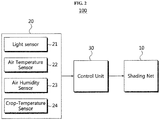
- FIG.2 is a block diagram of components of the system for preventing condensation on crops according to an embodiment of the present invention.
- the system 100 for preventing condensation on crops comprises a shading net 10, a sensor module 20, and a control unit 30.
- the shading net 10 controls quantity of incident sunlight in the greenhouse G by covering the top of the greenhouse G, and it can be installed inside or outside the greenhouse as necessary.
- the shading net 10 can be opened or closed automatically with being interlocked with other power plants (not shown) like motors, and installed in various forms such like foldable screen, rolled type and so on. As shown in FIG.1 , the shading net can be placed inside the greenhouse G to cover the top horizontally, or to operate corresponding to the roof shape of the greenhouse G. Also, the shading net 10 blocks the incident light completely or partly according to a form and extent of the open and close. The shading net 10 is sufficient if it is possible to block the incident sunlight completely or partly, and the form of the shading net is not restricted.
- the shading net 10 can be composed as multilayers besides single layer to make more delicate control of the incident light.
- the number of the layers of the shading net 10 to be unfolded can be controlled based on amount of the incident light that has to be blocked. For example, multilayers are spaced, some layers can be controlled to be unfolded and to block the incident light relatively more, and only one layer can be controlled to be unfolded to block the incident light little.
- a sensor module 20 is a module for sensing condition inside the greenhouse and it can comprises a temperature sensor 22 to measure air temperature in the greenhouse, a humidity sensor 23 to measure air humidity, a light sensor 21 to measure the incident sunlight in the greenhouse, and a contacting or non-contacting crop-temperature sensor 24 to measure the surface temperature of the crops such like fruit-temperature sensor to measure temperature of fruits or a leaf-temperature sensor to measure the temperature of the leaves.
- Information from the sensor module 20 can be used for basic information to control the extent of the open and close of the shading net 10.
- the control unit 30 controls a level of the quantity of the incident light by controlling the extent of the open and close of the shading net 10 based on a trigger information related to the insolation which raises the temperature in the greenhouse to prevent the condensation.
- the trigger information is information directly or indirectly related to the incident light that raises the temperature in the greenhouse G, and it is a basis for the selection and extent of the open or close of the shading net 10.
- a variation of the quantity of the incident light in the greenhouse can be used as the trigger information, and the sunrise time information can be used as the trigger information because the insolation varies depending on a location of the Sun,.
- the control unit 30 can control the shading net 10 based on only one information, or combination of multiple trigger information. Meanwhile, the control unit 30 can be linked to the sensor module 20 and a timer (not shown) for time information to get the trigger information.
- control unit 30 controls the shading net 10 based on the trigger information related to the insolation so that the extent of the incident sunlight in the greenhouse might be adjusted and the photosynthesis of the plants might be suppressed or decreased.
- the transpiration of the crops is suppressed or delayed so as to prevent the condensation on the crops resulted from the increase of humidity in the greenhouse.
- control unit 30 controls the open and close of the shading net 10 based on the trigger information.
- the control unit 30 makes the shading net 10 cover the greenhouse so as to adjust the incident light and thus prevent the effect of the transpiration, that is, the increase of a gap between temperatures in the atmosphere and the surface of the crops which is caused by a rapid increase of humidity and evaporation heat raised by the transpiration.
- the data estimated from the statistical information by dates, seasons, and regions, or the forecast of the sunrise time provided from the outside can be used.
- the control unit 30 can situationally delay the photosynthesis by suppressing visible light, but also make the shading net 10 allow the suitable amount of the visible light to balance the increase of the temperature of the crops with the increase of the dew point temperature due to the rise of humidity for the transpiration.
- the control unit 30 determines adaptively the quantity of the incident light based on the standard data of the increase of humidity due to the transpiration of the crops according to the intension of the incident light, and the information on the surface temperature of the crops monitored by the sensor module 20, and it can control a level of blocking the incident light with the shading net 10 according to the determined quantity of the incident light. In this regard, it is limited adequate for the prevention of the condensation to suppress the photosynthesis, and thus the effect on the growth of the crops is minimized.
- the control unit 30 compares the variation of the quantity of the incident light for the predetermined period of time with a predetermined reference value and makes the shading net 10 close when the variation is higher than the reference value so as to delay or decrease the transpiration.
- FIG.3 is a graph to describe the comparison between the extents of the condensation in a sunny day and a cloudy day.
- FIG.3 comprises (a) a graph by dates, (b) a graph by times of 10 March 2017, (c) a graph by times of 12 March 2017.
- black lines show the surface temperature of the crops (A)
- red lines show the temperature of the air (B)
- blue lines show the dew point (C)
- green lines show the relative humidity (D)
- orange lines show the solar radiation (E).
- FIG.3(b) is a graph on 10 March 2017 of the sunny day, showing the large variation of the quantity of the light versus time due to the increase of the solar radiation after the sunrise.
- the probability of the condensation is high in the range of the dotted line R1, because the dew point is higher than the temperature of the crops in the range of R1. It is recognized that there is the high probability of the condensation between about 8 AM and 9 AM.
- FIG.3(c) is a graph on 12. March. 2017 of cloudy day, showing a smaller variation of the quantity of the light versus time after the sunrise than the FIG.3(b) .
- the condensation section is narrower than that in sunny day because the surface temperature of the crops is higher than the dew point, except the dotted section R2 where the dew point is higher than the surface temperature of the crops.
- the control unit 30 determines adaptively the quantity of the incident light based on the standard data of the increase of humidity due to the transpiration of the crops according to the intension of the incident light, and the information on the surface temperature of the crops monitored by the sensor module 20, and it can adjust a level of blocking the incident light with the shading net 10 according to the determined quantity of the incident light.
- control unit 30 blocks light completely or partly with the shading net 10 based on the trigger information related to the sunrise time, the variation of the quantity of the light, etc. so as to adjust the transpiration and thus prevent the condensation.
- control unit 30 might refer to the comparison of the dew point temperature and the surface temperature of the crops as well as the trigger information for the selection of the close or open and its extent for the shading net 1 0.
- the dew point can be calculated based on the air temperature and air humidity measured by the sensor module 20. For example, although the quantity of the light rises after the sunrise, if the comparison of the dew point with the surface temperature of the crops indicates no or ultimately low probability of the condensation then it is needless to close the shading net 10. In contrast, although the variation of the quantity of the light is small than the predetermined reference value, if the surface temperature of the crops is lower than the dew point which shows high probability of the condensation, then it is needed to close the shading net 10. Thus, the control unit 30 needs to use the various information together and it helps to prevent the condensation more efficiently.
- the increase of the dew temperature can be estimated based on the change of the humidity due to the transpiration according to the increase of the light after sunrise, and be used for the comparison.
- control unit 30 can take weather information to control the shading net 10 with the trigger information. For example, if the weather forecast is a sunny day, the possibility of the condensation cannot be denied even though the variation of the quantity of the light is low for some period of time. Therefore, a goal to prevent the condensation can be achieved by lowering a standard value related to the variation of the quantity of the light on sunny day.
- control unit 30 opens the shading net 10 to promote the photosynthesis if the surface temperature of the crops increases higher than the dew point.
- FIG.4 is a flow chart of a method to prevent the condensation on the crops in the greenhouse with the system 100 for preventing condensation on crops as aforementioned.
- FIG.4 a systematic operation of each part of the system 100 for preventing condensation on crops will be described.
- the control unit gets the trigger information related to the insolation from the sensor module 20 or the timer (S10).
- the trigger information is the information, such like the sunrise time, the variation of the incident light in the greenhouse for some period of time and so on, which can help directly and indirectly to grasp the variation of the insolation which causes rapid increase of the temperature of the greenhouse for some period of time.
- the control unit 30 closes the shading net 1 0 to control the transpiration of the crops if a predetermined condition of the close that the sunrise time comes or the variation of the quantity of the light increases from 0 to some threshold is satisfied (S20, S30).
- control unit 30 can refers to both of the time information and the variation of the quantity of the light as well as one of both for the determination of the open or close of the shading net 10.
- the condition of the close of the shading net 10 is that the sunrise time comes and the variation of the quantity of the light is more than a threshold.
- control unit 30 can use the weather information which can help to anticipate or decide the condensation, the dew point temperature that calculated based on the air temperature and humidity from the sensor module 20, and surface temperature of the crops.
- control unit 30 might adjust adaptively the reference value for the variation of the quantity of the light based on the weather information.
- the reference value would be lowered if the weather report says a sunny day, but the reference value would be increased if the weather report says a rainy or cloudy day, and the extent of changing the reference value would be varied based on the accuracy of the weather information.
- priority or weight can be set to each of multiple information to decide to open or close based on the multiple information.
- control unit 30 monitors the dew point temperature and the surface temperature of the crops and then if the surface temperature of the crops is higher than the dew point temperature it opens the shading net 10 to promote the photosynthesis of the crops(S40, S50).
- FIG.5 is a graph to show the effect of preventing condensation after applying the system 100 for preventing condensation on crops.
- a black line shows the surface temperature of the crops (A)
- a red line shows the air temperature (B)
- a blue line shows the dew point (C)
- a green line shows relative humidity (D).
- the surface temperature of the crops (A) is higher than the dew point (C) from 4 A.M. to 10 A.M. including the sunrise time, which shows that the system 100 for preventing condensation on crops according to the embodiment of the present invention is effective to prevent the condensation on the crops.
- the system of the present invention can control the transpiration of the crops with the control of the close or open of the shading net 10 and thus prevent the condensation which is caused by both the decrease of the temperature of the crops and the increase of the humidity resulted from evaporation heat due to the transpiration. It can reduce energy cost and prevent the condensation more effectively with solving the problem of the prior arts to run energy facilities such like heater or dehumidifier.
- the timer can be implemented to be embedded in the control unit 30 unlike the aforementioned examples to recognize the sunrise time based on the data table that has saved information about the sunrise time or the sunrise time forecast information, or the control unit 30 can be implemented only to receives the signal that the sunrise time comes.
Landscapes
- Life Sciences & Earth Sciences (AREA)
- Environmental Sciences (AREA)
- Engineering & Computer Science (AREA)
- Forests & Forestry (AREA)
- Ecology (AREA)
- Biodiversity & Conservation Biology (AREA)
- Business, Economics & Management (AREA)
- Primary Health Care (AREA)
- General Business, Economics & Management (AREA)
- General Health & Medical Sciences (AREA)
- Human Resources & Organizations (AREA)
- Marketing (AREA)
- Health & Medical Sciences (AREA)
- Strategic Management (AREA)
- Tourism & Hospitality (AREA)
- Physics & Mathematics (AREA)
- Economics (AREA)
- General Physics & Mathematics (AREA)
- Theoretical Computer Science (AREA)
- Mining & Mineral Resources (AREA)
- Marine Sciences & Fisheries (AREA)
- Animal Husbandry (AREA)
- Agronomy & Crop Science (AREA)
- Wood Science & Technology (AREA)
- Botany (AREA)
- Greenhouses (AREA)
Abstract
Description
- The present invention relates to a system for preventing condensation on crops, and more specifically, for preventing condensation on the surface of the crops in a greenhouse.
- Condensation forms on the surface of the crops in a greenhouse, for example, when temperature in the greenhouse rises quicker than rising of temperature of the crops right after sunrise. Prevention for the condensation is indispensable because it causes mold and blight on the crops.
- As disclosed on Japanese Patent Publication No.
2003-143974 dehumidifier 2 hours before sunrise to reduce the gap between the temperature inside the greenhouse and of the crops by turning the temperature up or humidity down inside the greenhouse so far. - However, the customary way had economic pressure for loss of energy cost by running the heater and the dehumidifier. Though there was endeavors to reduce the economic pressure by controlling the running hours of the machines, there is a limit to solve the general inefficiency of energy since the machines have to be run.
- The present invention is to solve the aforementioned problems of the former techniques, aiming to provide the system for preventing condensation on crops to prevent condensation without running energy facilities like the heater and the dehumidifier.
- The object of the present invention is achieved by a system for preventing condensation on crops in a greenhouse according to an aspect of the present invention, comprising: a shading net for controlling quantity of incident light in the greenhouse; and a control unit for controlling the open and close of the shading net based on the trigger information on insolation to control the transpiration of the crop.
- Herein, the control unit controls the shading net based on the trigger information and weather information.
- Meanwhile, the trigger information comprises sunrise time, and the control unit might control the open and close of the shading net based on the sunrise time. Or the trigger information comprises the variation of the quantity of the incident light in the greenhouse for predetermined period of time, and the control unit might compare the variation of the quantity of the incident light in the greenhouse for predetermined period of time with a predetermined reference value to decide on the open or the close of the shading net.
- Meanwhile, the control unit adjusts the reference value, which is related to the variation of the incident light in the greenhouse for the predetermined period of time, based on weather information.
- Also, the control unit might make the shading net open if the surface temperature of the crop is beyond the dew point temperature in the greenhouse.
- Also, the control unit might control the shading net based on the trigger information and dew point temperature estimated according to the transpiration of the crops.
- As explained above, the present invention to control the transpiration of the crops for preventing condensation can reduce energy cost more than the former system to run energy facilities for preventing condensation.
- Also, according to the present invention, the accuracy of the control can be improved based on various data such like a temperature and humidity in the greenhouse, a surface temperature of the crops, the quantity of incident light in the greenhouse, sunrise time, and weather information.
-
-
FIG. 1 is a sketchy illustration of the system for preventing condensation on crops according to an embodiment of the present invention. -
FIG. 2 is the block diagram of components of the system for preventing condensation on crops according to an embodiment of the present invention. -
FIG. 3 is a graph to compare degrees of condensation in sunny day and cloudy day. -
FIG. 4 is a flowchart for a method of preventing condensation through the system for preventing condensation on crops according to an embodiment of the present invention. -
FIG. 5 is a graph of condensation preventing effect when the system for preventing condensation on crops according to an embodiment of the present invention is applied. - Hereinafter, exemplary embodiments of the present invention will be described in detail referring to the appended drawings.
- The system for preventing condensation on crops according to an embodiment of the present invention is to prevent the condensation on the crops in a greenhouse according to the present invention.
FIG.1 is a sketchy illustration of the system for preventing condensation on crops according to an embodiment of the present invention, andFIG.2 is a block diagram of components of the system for preventing condensation on crops according to an embodiment of the present invention. - Referring to
FIG.1 andFIG.2 , thesystem 100 for preventing condensation on crops comprises a shadingnet 10, asensor module 20, and acontrol unit 30. - The shading net 10 controls quantity of incident sunlight in the greenhouse G by covering the top of the greenhouse G, and it can be installed inside or outside the greenhouse as necessary.
- The shading
net 10 can be opened or closed automatically with being interlocked with other power plants (not shown) like motors, and installed in various forms such like foldable screen, rolled type and so on. As shown inFIG.1 , the shading net can be placed inside the greenhouse G to cover the top horizontally, or to operate corresponding to the roof shape of the greenhouse G. Also, the shading net 10 blocks the incident light completely or partly according to a form and extent of the open and close. Theshading net 10 is sufficient if it is possible to block the incident sunlight completely or partly, and the form of the shading net is not restricted. - Meanwhile, the shading
net 10 can be composed as multilayers besides single layer to make more delicate control of the incident light. The number of the layers of the shadingnet 10 to be unfolded can be controlled based on amount of the incident light that has to be blocked. For example, multilayers are spaced, some layers can be controlled to be unfolded and to block the incident light relatively more, and only one layer can be controlled to be unfolded to block the incident light little. - A
sensor module 20 is a module for sensing condition inside the greenhouse and it can comprises atemperature sensor 22 to measure air temperature in the greenhouse, ahumidity sensor 23 to measure air humidity, alight sensor 21 to measure the incident sunlight in the greenhouse, and a contacting or non-contacting crop-temperature sensor 24 to measure the surface temperature of the crops such like fruit-temperature sensor to measure temperature of fruits or a leaf-temperature sensor to measure the temperature of the leaves. - Information from the
sensor module 20 can be used for basic information to control the extent of the open and close of the shadingnet 10. - The
control unit 30 controls a level of the quantity of the incident light by controlling the extent of the open and close of the shadingnet 10 based on a trigger information related to the insolation which raises the temperature in the greenhouse to prevent the condensation. Herein, the trigger information is information directly or indirectly related to the incident light that raises the temperature in the greenhouse G, and it is a basis for the selection and extent of the open or close of the shadingnet 10. A variation of the quantity of the incident light in the greenhouse can be used as the trigger information, and the sunrise time information can be used as the trigger information because the insolation varies depending on a location of the Sun,. - The
control unit 30 can control the shadingnet 10 based on only one information, or combination of multiple trigger information. Meanwhile, thecontrol unit 30 can be linked to thesensor module 20 and a timer (not shown) for time information to get the trigger information. - The increase of the incident light after the sunrise promotes the photosynthesis of the crop, then the breathe holes of the crops open and the transpiration becomes active. As a result, the transpiration increases the humidity and the rise of the humidity raises the dew point in the greenhouse that causes the condensation on the crops easily. Accordingly, the
control unit 30 controls the shadingnet 10 based on the trigger information related to the insolation so that the extent of the incident sunlight in the greenhouse might be adjusted and the photosynthesis of the plants might be suppressed or decreased. Thus, the transpiration of the crops is suppressed or delayed so as to prevent the condensation on the crops resulted from the increase of humidity in the greenhouse. - Hereinafter, example that the
control unit 30 controls the open and close of the shadingnet 10 based on the trigger information will be described. - First of all, for the example of the sunrise time as the trigger information, as the sunrise time comes the
control unit 30 makes the shading net 10 cover the greenhouse so as to adjust the incident light and thus prevent the effect of the transpiration, that is, the increase of a gap between temperatures in the atmosphere and the surface of the crops which is caused by a rapid increase of humidity and evaporation heat raised by the transpiration. Herein, for the information related to the sunrise time, the data estimated from the statistical information by dates, seasons, and regions, or the forecast of the sunrise time provided from the outside can be used. - At this time, the
control unit 30 can situationally delay the photosynthesis by suppressing visible light, but also make theshading net 10 allow the suitable amount of the visible light to balance the increase of the temperature of the crops with the increase of the dew point temperature due to the rise of humidity for the transpiration. To do this, thecontrol unit 30 determines adaptively the quantity of the incident light based on the standard data of the increase of humidity due to the transpiration of the crops according to the intension of the incident light, and the information on the surface temperature of the crops monitored by thesensor module 20, and it can control a level of blocking the incident light with the shadingnet 10 according to the determined quantity of the incident light. In this regard, it is limited adequate for the prevention of the condensation to suppress the photosynthesis, and thus the effect on the growth of the crops is minimized. - In addition, for using as the trigger information the variation of the incident light in the greenhouse for a predetermined period of time, the quantity of the incident light increases rapidly from 0 after the sunrise, and thus the sunrise can be recognized based on the variation of the incident light in the greenhouse for the predetermined period of time. So, the
control unit 30 compares the variation of the quantity of the incident light for the predetermined period of time with a predetermined reference value and makes the shading net 10 close when the variation is higher than the reference value so as to delay or decrease the transpiration. - However, as in a cloudy or rainy day, the variation of the quantity of the light is little even after the sunrise and the temperature inside the greenhouse doesn't increase rapidly, the probability of the condensation is low even without closing the shading
net 10. -
FIG.3 is a graph to describe the comparison between the extents of the condensation in a sunny day and a cloudy day.FIG.3 comprises (a) a graph by dates, (b) a graph by times of 10 March 2017, (c) a graph by times of 12 March 2017. In the graph ofFIG.3 , black lines show the surface temperature of the crops (A), red lines show the temperature of the air (B), blue lines show the dew point (C), green lines show the relative humidity (D), and orange lines show the solar radiation (E). - Referring to the graph (a) in
FIG.3 , 10 March 2017 was a sunny day with the steady curving line of the solar radiation. On the other hand, 12 March 2017 was a cloudy day with irregular line of solar radiation. -
FIG.3(b) is a graph on 10 March 2017 of the sunny day, showing the large variation of the quantity of the light versus time due to the increase of the solar radiation after the sunrise. The probability of the condensation is high in the range of the dotted line R1, because the dew point is higher than the temperature of the crops in the range of R1. It is recognized that there is the high probability of the condensation between about 8 AM and 9 AM. - Meanwhile,
FIG.3(c) is a graph on 12. March. 2017 of cloudy day, showing a smaller variation of the quantity of the light versus time after the sunrise than theFIG.3(b) . The condensation section is narrower than that in sunny day because the surface temperature of the crops is higher than the dew point, except the dotted section R2 where the dew point is higher than the surface temperature of the crops. - Therefore, using the variation of the quantity of the incident light, it is possible to recognize the weather condition of the day related to the possibility of the condensation and thus to control the close and open of the
shading net 10 in specific day or time of high possibility of the condensation, that minimizes the effects on the growth of the crops. - Meanwhile, when unfolding the
shading net 10 for large variation of the quantity of the light, as stated previously, thecontrol unit 30 determines adaptively the quantity of the incident light based on the standard data of the increase of humidity due to the transpiration of the crops according to the intension of the incident light, and the information on the surface temperature of the crops monitored by thesensor module 20, and it can adjust a level of blocking the incident light with theshading net 10 according to the determined quantity of the incident light. - Thus, the
control unit 30 blocks light completely or partly with theshading net 10 based on the trigger information related to the sunrise time, the variation of the quantity of the light, etc. so as to adjust the transpiration and thus prevent the condensation. - In addition, the
control unit 30 might refer to the comparison of the dew point temperature and the surface temperature of the crops as well as the trigger information for the selection of the close or open and its extent for the shading net 1 0. - For reference, the dew point can be calculated based on the air temperature and air humidity measured by the
sensor module 20. For example, although the quantity of the light rises after the sunrise, if the comparison of the dew point with the surface temperature of the crops indicates no or ultimately low probability of the condensation then it is needless to close theshading net 10. In contrast, although the variation of the quantity of the light is small than the predetermined reference value, if the surface temperature of the crops is lower than the dew point which shows high probability of the condensation, then it is needed to close theshading net 10. Thus, thecontrol unit 30 needs to use the various information together and it helps to prevent the condensation more efficiently. Also, with regard to the dew temperature to compare with the surface temperature of the crops for the determination of the close or open of theshading net 10, the increase of the dew temperature can be estimated based on the change of the humidity due to the transpiration according to the increase of the light after sunrise, and be used for the comparison. - Also, the
control unit 30 can take weather information to control theshading net 10 with the trigger information. For example, if the weather forecast is a sunny day, the possibility of the condensation cannot be denied even though the variation of the quantity of the light is low for some period of time. Therefore, a goal to prevent the condensation can be achieved by lowering a standard value related to the variation of the quantity of the light on sunny day. - Although the condensation would be prevented by covering the
shading net 10 inside the greenhouse, long-lasting covering could affect the growth of the crops and therefore it is important to determine optimal time to open theshading net 10. Therefore, thecontrol unit 30 opens theshading net 10 to promote the photosynthesis if the surface temperature of the crops increases higher than the dew point. -
FIG.4 is a flow chart of a method to prevent the condensation on the crops in the greenhouse with thesystem 100 for preventing condensation on crops as aforementioned. Hereinafter, referring toFIG.4 , a systematic operation of each part of thesystem 100 for preventing condensation on crops will be described. - Referring to
FIG.4 , the control unit gets the trigger information related to the insolation from thesensor module 20 or the timer (S10). The trigger information, as aforementioned, is the information, such like the sunrise time, the variation of the incident light in the greenhouse for some period of time and so on, which can help directly and indirectly to grasp the variation of the insolation which causes rapid increase of the temperature of the greenhouse for some period of time. - The
control unit 30 closes the shading net 1 0 to control the transpiration of the crops if a predetermined condition of the close that the sunrise time comes or the variation of the quantity of the light increases from 0 to some threshold is satisfied (S20, S30). - Meanwhile, the
control unit 30 can refers to both of the time information and the variation of the quantity of the light as well as one of both for the determination of the open or close of theshading net 10. For example, the condition of the close of theshading net 10 is that the sunrise time comes and the variation of the quantity of the light is more than a threshold. - Also, besides the trigger information, the
control unit 30 can use the weather information which can help to anticipate or decide the condensation, the dew point temperature that calculated based on the air temperature and humidity from thesensor module 20, and surface temperature of the crops. - For example, the
control unit 30 might adjust adaptively the reference value for the variation of the quantity of the light based on the weather information. The reference value would be lowered if the weather report says a sunny day, but the reference value would be increased if the weather report says a rainy or cloudy day, and the extent of changing the reference value would be varied based on the accuracy of the weather information. - Meanwhile, priority or weight can be set to each of multiple information to decide to open or close based on the multiple information.
- After closing the
shading net 10, thecontrol unit 30 monitors the dew point temperature and the surface temperature of the crops and then if the surface temperature of the crops is higher than the dew point temperature it opens theshading net 10 to promote the photosynthesis of the crops(S40, S50). -
FIG.5 is a graph to show the effect of preventing condensation after applying thesystem 100 for preventing condensation on crops. On the graph ofFIG.5 , a black line shows the surface temperature of the crops (A), a red line shows the air temperature (B), a blue line shows the dew point (C), and a green line shows relative humidity (D). - Referring to
FIG.5 , the surface temperature of the crops (A) is higher than the dew point (C) from 4 A.M. to 10 A.M. including the sunrise time, which shows that thesystem 100 for preventing condensation on crops according to the embodiment of the present invention is effective to prevent the condensation on the crops. - As stated above, the system of the present invention can control the transpiration of the crops with the control of the close or open of the
shading net 10 and thus prevent the condensation which is caused by both the decrease of the temperature of the crops and the increase of the humidity resulted from evaporation heat due to the transpiration. It can reduce energy cost and prevent the condensation more effectively with solving the problem of the prior arts to run energy facilities such like heater or dehumidifier. - The above description has been briefly introduced the exemplary embodiment of the present invention, but those of ordinary skill in the art can understand that various modifications, additions and substitutions will be possible without departing from technical ideas of the invention.
- For example, the timer can be implemented to be embedded in the
control unit 30 unlike the aforementioned examples to recognize the sunrise time based on the data table that has saved information about the sunrise time or the sunrise time forecast information, or thecontrol unit 30 can be implemented only to receives the signal that the sunrise time comes. - Thus, the aforementioned exemplary embodiment of the present invention has to be comprehended as an example. And the scope of the invention should be construed as equivalent to the scope of the following claims.
Claims (7)
- System for preventing condensation on crops in a greenhouse, comprising:a shading net for controlling quantity of incident light in the greenhouse; anda control unit for controlling the open and close of the shading net based on the trigger information on insolation to control the transpiration of the crop.
- System for preventing condensation on crops according to claim 1,
wherein the control unit controls the shading net based on the trigger information and weather information. - System for preventing condensation on crops according to claim 1 or 2,
wherein the trigger information comprises sunrise time, and
the control unit controls the open and close of the shading net based on the sunrise time. - System for preventing condensation on crops according to one of claims 1 to3,
wherein the trigger information comprises the variation of the quantity of the incident light in the greenhouse for predetermined period of time, and
the control unit compares the variation of the quantity of the incident light in the greenhouse for predetermined period of time with a predetermined reference value to decide on the open or the close of the shading net. - System for preventing condensation on crops according to claim 4,
wherein the control unit adjusts the reference value, which is related to the variation of the incident light in the greenhouse for the predetermined period of time, based on weather information. - System for preventing condensation on crops according to one of claims 1 to 5,
wherein the control unit makes the shading net open if the surface temperature of the crop is beyond the dew point temperature in the greenhouse. - System for preventing condensation on crops according to one of claims 1 to 6,
wherein the control unit controls the shading net based on the trigger information and dew point temperature estimated according to the transpiration of the crops.
Applications Claiming Priority (1)
| Application Number | Priority Date | Filing Date | Title |
|---|---|---|---|
| KR1020170024555A KR101913398B1 (en) | 2017-02-24 | 2017-02-24 | System for preventing condensation on crops |
Publications (2)
| Publication Number | Publication Date |
|---|---|
| EP3366114A1 true EP3366114A1 (en) | 2018-08-29 |
| EP3366114B1 EP3366114B1 (en) | 2024-04-03 |
Family
ID=61256695
Family Applications (1)
| Application Number | Title | Priority Date | Filing Date |
|---|---|---|---|
| EP18157885.7A Active EP3366114B1 (en) | 2017-02-24 | 2018-02-21 | System for preventing condensation on crops |
Country Status (2)
| Country | Link |
|---|---|
| EP (1) | EP3366114B1 (en) |
| KR (1) | KR101913398B1 (en) |
Cited By (7)
| Publication number | Priority date | Publication date | Assignee | Title |
|---|---|---|---|---|
| WO2021075963A1 (en) * | 2019-10-15 | 2021-04-22 | Priva Holding B.V. | Method of cultivating plants and system therefor |
| US10990076B2 (en) * | 2019-01-09 | 2021-04-27 | International Business Machines Corporation | Automatic evapotranspiration mitigation |
| US20210315170A1 (en) * | 2018-10-08 | 2021-10-14 | Mjnn Llc | Control of latent and sensible loads in controlled environment agriculture |
| WO2021205833A1 (en) * | 2020-04-09 | 2021-10-14 | パナソニック株式会社 | Temperature control method, temperature control device, temperature control program, and temperature control system |
| JP2021166508A (en) * | 2020-04-09 | 2021-10-21 | パナソニック株式会社 | Temperature control method, temperature control device, temperature control program and system |
| CN118679988A (en) * | 2024-06-07 | 2024-09-24 | 江苏荣亿达温控科技有限公司 | Greenhouse temperature control device and control method thereof |
| US12361343B2 (en) | 2019-05-02 | 2025-07-15 | Mjnn Llc | Automated placement of plant varieties for optimum performance within a grow space subject to environmental condition variability |
Families Citing this family (3)
| Publication number | Priority date | Publication date | Assignee | Title |
|---|---|---|---|---|
| EP3732957B1 (en) * | 2017-12-26 | 2021-10-13 | Bayer CropScience K.K. | Information processing device and information processing method |
| KR102620290B1 (en) * | 2020-12-24 | 2024-01-03 | 강원특별자치도 | Smart Farm System for Preventing Condensation |
| KR102786754B1 (en) * | 2023-11-20 | 2025-04-14 | 신승호 | Fishing for cutlassfish equipped with auxiliary fishing that can fix bait |
Citations (4)
| Publication number | Priority date | Publication date | Assignee | Title |
|---|---|---|---|---|
| EP0031884A1 (en) * | 1979-11-15 | 1981-07-15 | Hans Lang | Shading device for plant cultivation installations |
| JP2003143974A (en) | 2001-11-14 | 2003-05-20 | Yasuo Ozawa | Method for preventing dew condensation on crop in greenhouse cultivation |
| US20160066517A1 (en) * | 2013-05-13 | 2016-03-10 | Panasonic Intellectual Property Management Co., Ltd. | Installation evaluation apparatus for greenhouse, insolation regulation apparatus for greenhouse, and program |
| WO2016054846A1 (en) * | 2014-10-11 | 2016-04-14 | 黄文永 | Hard thermally-insulating solar greenhouse |
Family Cites Families (4)
| Publication number | Priority date | Publication date | Assignee | Title |
|---|---|---|---|---|
| JP2002153147A (en) | 2000-11-22 | 2002-05-28 | National Agricultural Research Organization | Cherry fruit cracking prevention device and cherry heating facility |
| JP2011172522A (en) | 2010-02-25 | 2011-09-08 | Iseki & Co Ltd | Greenhouse shading device |
| KR101048517B1 (en) | 2011-02-21 | 2011-07-12 | (주)제이케이알에스티 | Condensation prevention automatic control device and method |
| JP5939057B2 (en) | 2012-06-29 | 2016-06-22 | 井関農機株式会社 | Cultivation facility |
-
2017
- 2017-02-24 KR KR1020170024555A patent/KR101913398B1/en active Active
-
2018
- 2018-02-21 EP EP18157885.7A patent/EP3366114B1/en active Active
Patent Citations (4)
| Publication number | Priority date | Publication date | Assignee | Title |
|---|---|---|---|---|
| EP0031884A1 (en) * | 1979-11-15 | 1981-07-15 | Hans Lang | Shading device for plant cultivation installations |
| JP2003143974A (en) | 2001-11-14 | 2003-05-20 | Yasuo Ozawa | Method for preventing dew condensation on crop in greenhouse cultivation |
| US20160066517A1 (en) * | 2013-05-13 | 2016-03-10 | Panasonic Intellectual Property Management Co., Ltd. | Installation evaluation apparatus for greenhouse, insolation regulation apparatus for greenhouse, and program |
| WO2016054846A1 (en) * | 2014-10-11 | 2016-04-14 | 黄文永 | Hard thermally-insulating solar greenhouse |
Cited By (8)
| Publication number | Priority date | Publication date | Assignee | Title |
|---|---|---|---|---|
| US20210315170A1 (en) * | 2018-10-08 | 2021-10-14 | Mjnn Llc | Control of latent and sensible loads in controlled environment agriculture |
| US10990076B2 (en) * | 2019-01-09 | 2021-04-27 | International Business Machines Corporation | Automatic evapotranspiration mitigation |
| US12361343B2 (en) | 2019-05-02 | 2025-07-15 | Mjnn Llc | Automated placement of plant varieties for optimum performance within a grow space subject to environmental condition variability |
| WO2021075963A1 (en) * | 2019-10-15 | 2021-04-22 | Priva Holding B.V. | Method of cultivating plants and system therefor |
| NL2024022B1 (en) * | 2019-10-15 | 2021-06-17 | Priva Holding B V | Method of cultivating plants and system therefor |
| WO2021205833A1 (en) * | 2020-04-09 | 2021-10-14 | パナソニック株式会社 | Temperature control method, temperature control device, temperature control program, and temperature control system |
| JP2021166508A (en) * | 2020-04-09 | 2021-10-21 | パナソニック株式会社 | Temperature control method, temperature control device, temperature control program and system |
| CN118679988A (en) * | 2024-06-07 | 2024-09-24 | 江苏荣亿达温控科技有限公司 | Greenhouse temperature control device and control method thereof |
Also Published As
| Publication number | Publication date |
|---|---|
| KR20180097859A (en) | 2018-09-03 |
| EP3366114B1 (en) | 2024-04-03 |
| KR101913398B1 (en) | 2018-10-30 |
Similar Documents
| Publication | Publication Date | Title |
|---|---|---|
| EP3366114B1 (en) | System for preventing condensation on crops | |
| CA1207058A (en) | Plant oriented control system | |
| US8456729B2 (en) | Weather-responsive shade control system | |
| JP7157940B2 (en) | Management control device and management control method for plant cultivation facility | |
| JP2017086038A (en) | Control device and facility horticulture house | |
| WO2021205833A1 (en) | Temperature control method, temperature control device, temperature control program, and temperature control system | |
| JP2014103856A (en) | Air-conditioning system and culture method | |
| KR101518966B1 (en) | Highland vegetables that can be grown in vinyl houses system at high temperature period | |
| KR101031820B1 (en) | Greenhouse Environment Automatic Control Method and System | |
| KR101566445B1 (en) | multiplex environment control system of green house and control method thereof | |
| KR101546873B1 (en) | multiplex environment control system of green house and control method thereof | |
| CN121325625A (en) | North greenhouse tropical fruit microclimate self-adaptive control system based on reinforcement learning | |
| CN102033496A (en) | Electric window control system and indoor environment parameter adjusting method | |
| JP2016023428A (en) | Blind control method and blind control system | |
| JP2004201630A (en) | Method for controlling environment in greenhouse and apparatus therefor | |
| KR102175122B1 (en) | Curtain ascent and descent device and control method | |
| KR102094997B1 (en) | Greenhouse system and management method thereof | |
| JP7577371B1 (en) | Shading device for tea farms | |
| KR20120106009A (en) | Highland crop method that grow low temperature in flatland | |
| US20250357883A1 (en) | Agrivoltaic system and method | |
| JP6737130B2 (en) | Plant cultivation equipment | |
| JP7394349B2 (en) | Shading control system and method for plant cultivation | |
| CN221488485U (en) | Sunlight greenhouse with automatic ventilation function | |
| KR101684570B1 (en) | Apparatus for controlling opening and shutting in a vinyl plastic hothouse | |
| US20150255652A1 (en) | Photo-voltaic device having improved shading degradation resistance |
Legal Events
| Date | Code | Title | Description |
|---|---|---|---|
| PUAI | Public reference made under article 153(3) epc to a published international application that has entered the european phase |
Free format text: ORIGINAL CODE: 0009012 |
|
| STAA | Information on the status of an ep patent application or granted ep patent |
Free format text: STATUS: REQUEST FOR EXAMINATION WAS MADE |
|
| 17P | Request for examination filed |
Effective date: 20180314 |
|
| AK | Designated contracting states |
Kind code of ref document: A1 Designated state(s): AL AT BE BG CH CY CZ DE DK EE ES FI FR GB GR HR HU IE IS IT LI LT LU LV MC MK MT NL NO PL PT RO RS SE SI SK SM TR |
|
| AX | Request for extension of the european patent |
Extension state: BA ME |
|
| RBV | Designated contracting states (corrected) |
Designated state(s): AL AT BE BG CH CY CZ DE DK EE ES FI FR GB GR HR HU IE IS IT LI LT LU LV MC MK MT NL NO PL PT RO RS SE SI SK SM TR |
|
| STAA | Information on the status of an ep patent application or granted ep patent |
Free format text: STATUS: EXAMINATION IS IN PROGRESS |
|
| 17Q | First examination report despatched |
Effective date: 20190903 |
|
| GRAP | Despatch of communication of intention to grant a patent |
Free format text: ORIGINAL CODE: EPIDOSNIGR1 |
|
| STAA | Information on the status of an ep patent application or granted ep patent |
Free format text: STATUS: GRANT OF PATENT IS INTENDED |
|
| INTG | Intention to grant announced |
Effective date: 20231110 |
|
| GRAS | Grant fee paid |
Free format text: ORIGINAL CODE: EPIDOSNIGR3 |
|
| GRAA | (expected) grant |
Free format text: ORIGINAL CODE: 0009210 |
|
| STAA | Information on the status of an ep patent application or granted ep patent |
Free format text: STATUS: THE PATENT HAS BEEN GRANTED |
|
| AK | Designated contracting states |
Kind code of ref document: B1 Designated state(s): AL AT BE BG CH CY CZ DE DK EE ES FI FR GB GR HR HU IE IS IT LI LT LU LV MC MK MT NL NO PL PT RO RS SE SI SK SM TR |
|
| REG | Reference to a national code |
Ref country code: GB Ref legal event code: FG4D |
|
| REG | Reference to a national code |
Ref country code: CH Ref legal event code: EP |
|
| REG | Reference to a national code |
Ref country code: IE Ref legal event code: FG4D |
|
| REG | Reference to a national code |
Ref country code: DE Ref legal event code: R096 Ref document number: 602018067390 Country of ref document: DE |
|
| P01 | Opt-out of the competence of the unified patent court (upc) registered |
Effective date: 20240404 |
|
| REG | Reference to a national code |
Ref country code: LT Ref legal event code: MG9D |
|
| REG | Reference to a national code |
Ref country code: NL Ref legal event code: MP Effective date: 20240403 |
|
| REG | Reference to a national code |
Ref country code: AT Ref legal event code: MK05 Ref document number: 1671178 Country of ref document: AT Kind code of ref document: T Effective date: 20240403 |
|
| PG25 | Lapsed in a contracting state [announced via postgrant information from national office to epo] |
Ref country code: NL Free format text: LAPSE BECAUSE OF FAILURE TO SUBMIT A TRANSLATION OF THE DESCRIPTION OR TO PAY THE FEE WITHIN THE PRESCRIBED TIME-LIMIT Effective date: 20240403 |
|
| PG25 | Lapsed in a contracting state [announced via postgrant information from national office to epo] |
Ref country code: NL Free format text: LAPSE BECAUSE OF FAILURE TO SUBMIT A TRANSLATION OF THE DESCRIPTION OR TO PAY THE FEE WITHIN THE PRESCRIBED TIME-LIMIT Effective date: 20240403 |
|
| PG25 | Lapsed in a contracting state [announced via postgrant information from national office to epo] |
Ref country code: IS Free format text: LAPSE BECAUSE OF FAILURE TO SUBMIT A TRANSLATION OF THE DESCRIPTION OR TO PAY THE FEE WITHIN THE PRESCRIBED TIME-LIMIT Effective date: 20240803 |
|
| PG25 | Lapsed in a contracting state [announced via postgrant information from national office to epo] |
Ref country code: BG Free format text: LAPSE BECAUSE OF FAILURE TO SUBMIT A TRANSLATION OF THE DESCRIPTION OR TO PAY THE FEE WITHIN THE PRESCRIBED TIME-LIMIT Effective date: 20240403 |
|
| PG25 | Lapsed in a contracting state [announced via postgrant information from national office to epo] |
Ref country code: HR Free format text: LAPSE BECAUSE OF FAILURE TO SUBMIT A TRANSLATION OF THE DESCRIPTION OR TO PAY THE FEE WITHIN THE PRESCRIBED TIME-LIMIT Effective date: 20240403 Ref country code: FI Free format text: LAPSE BECAUSE OF FAILURE TO SUBMIT A TRANSLATION OF THE DESCRIPTION OR TO PAY THE FEE WITHIN THE PRESCRIBED TIME-LIMIT Effective date: 20240403 |
|
| PG25 | Lapsed in a contracting state [announced via postgrant information from national office to epo] |
Ref country code: GR Free format text: LAPSE BECAUSE OF FAILURE TO SUBMIT A TRANSLATION OF THE DESCRIPTION OR TO PAY THE FEE WITHIN THE PRESCRIBED TIME-LIMIT Effective date: 20240704 |
|
| PG25 | Lapsed in a contracting state [announced via postgrant information from national office to epo] |
Ref country code: PT Free format text: LAPSE BECAUSE OF FAILURE TO SUBMIT A TRANSLATION OF THE DESCRIPTION OR TO PAY THE FEE WITHIN THE PRESCRIBED TIME-LIMIT Effective date: 20240805 |
|
| PG25 | Lapsed in a contracting state [announced via postgrant information from national office to epo] |
Ref country code: ES Free format text: LAPSE BECAUSE OF FAILURE TO SUBMIT A TRANSLATION OF THE DESCRIPTION OR TO PAY THE FEE WITHIN THE PRESCRIBED TIME-LIMIT Effective date: 20240403 |
|
| PG25 | Lapsed in a contracting state [announced via postgrant information from national office to epo] |
Ref country code: CZ Free format text: LAPSE BECAUSE OF FAILURE TO SUBMIT A TRANSLATION OF THE DESCRIPTION OR TO PAY THE FEE WITHIN THE PRESCRIBED TIME-LIMIT Effective date: 20240403 |
|
| PG25 | Lapsed in a contracting state [announced via postgrant information from national office to epo] |
Ref country code: AT Free format text: LAPSE BECAUSE OF FAILURE TO SUBMIT A TRANSLATION OF THE DESCRIPTION OR TO PAY THE FEE WITHIN THE PRESCRIBED TIME-LIMIT Effective date: 20240403 |
|
| PG25 | Lapsed in a contracting state [announced via postgrant information from national office to epo] |
Ref country code: PL Free format text: LAPSE BECAUSE OF FAILURE TO SUBMIT A TRANSLATION OF THE DESCRIPTION OR TO PAY THE FEE WITHIN THE PRESCRIBED TIME-LIMIT Effective date: 20240403 |
|
| PG25 | Lapsed in a contracting state [announced via postgrant information from national office to epo] |
Ref country code: LV Free format text: LAPSE BECAUSE OF FAILURE TO SUBMIT A TRANSLATION OF THE DESCRIPTION OR TO PAY THE FEE WITHIN THE PRESCRIBED TIME-LIMIT Effective date: 20240403 |
|
| PG25 | Lapsed in a contracting state [announced via postgrant information from national office to epo] |
Ref country code: PT Free format text: LAPSE BECAUSE OF FAILURE TO SUBMIT A TRANSLATION OF THE DESCRIPTION OR TO PAY THE FEE WITHIN THE PRESCRIBED TIME-LIMIT Effective date: 20240805 Ref country code: PL Free format text: LAPSE BECAUSE OF FAILURE TO SUBMIT A TRANSLATION OF THE DESCRIPTION OR TO PAY THE FEE WITHIN THE PRESCRIBED TIME-LIMIT Effective date: 20240403 Ref country code: NO Free format text: LAPSE BECAUSE OF FAILURE TO SUBMIT A TRANSLATION OF THE DESCRIPTION OR TO PAY THE FEE WITHIN THE PRESCRIBED TIME-LIMIT Effective date: 20240703 Ref country code: LV Free format text: LAPSE BECAUSE OF FAILURE TO SUBMIT A TRANSLATION OF THE DESCRIPTION OR TO PAY THE FEE WITHIN THE PRESCRIBED TIME-LIMIT Effective date: 20240403 Ref country code: IS Free format text: LAPSE BECAUSE OF FAILURE TO SUBMIT A TRANSLATION OF THE DESCRIPTION OR TO PAY THE FEE WITHIN THE PRESCRIBED TIME-LIMIT Effective date: 20240803 Ref country code: HR Free format text: LAPSE BECAUSE OF FAILURE TO SUBMIT A TRANSLATION OF THE DESCRIPTION OR TO PAY THE FEE WITHIN THE PRESCRIBED TIME-LIMIT Effective date: 20240403 Ref country code: GR Free format text: LAPSE BECAUSE OF FAILURE TO SUBMIT A TRANSLATION OF THE DESCRIPTION OR TO PAY THE FEE WITHIN THE PRESCRIBED TIME-LIMIT Effective date: 20240704 Ref country code: FI Free format text: LAPSE BECAUSE OF FAILURE TO SUBMIT A TRANSLATION OF THE DESCRIPTION OR TO PAY THE FEE WITHIN THE PRESCRIBED TIME-LIMIT Effective date: 20240403 Ref country code: ES Free format text: LAPSE BECAUSE OF FAILURE TO SUBMIT A TRANSLATION OF THE DESCRIPTION OR TO PAY THE FEE WITHIN THE PRESCRIBED TIME-LIMIT Effective date: 20240403 Ref country code: CZ Free format text: LAPSE BECAUSE OF FAILURE TO SUBMIT A TRANSLATION OF THE DESCRIPTION OR TO PAY THE FEE WITHIN THE PRESCRIBED TIME-LIMIT Effective date: 20240403 Ref country code: BG Free format text: LAPSE BECAUSE OF FAILURE TO SUBMIT A TRANSLATION OF THE DESCRIPTION OR TO PAY THE FEE WITHIN THE PRESCRIBED TIME-LIMIT Effective date: 20240403 Ref country code: AT Free format text: LAPSE BECAUSE OF FAILURE TO SUBMIT A TRANSLATION OF THE DESCRIPTION OR TO PAY THE FEE WITHIN THE PRESCRIBED TIME-LIMIT Effective date: 20240403 Ref country code: RS Free format text: LAPSE BECAUSE OF FAILURE TO SUBMIT A TRANSLATION OF THE DESCRIPTION OR TO PAY THE FEE WITHIN THE PRESCRIBED TIME-LIMIT Effective date: 20240703 |
|
| REG | Reference to a national code |
Ref country code: DE Ref legal event code: R097 Ref document number: 602018067390 Country of ref document: DE |
|
| PG25 | Lapsed in a contracting state [announced via postgrant information from national office to epo] |
Ref country code: DK Free format text: LAPSE BECAUSE OF FAILURE TO SUBMIT A TRANSLATION OF THE DESCRIPTION OR TO PAY THE FEE WITHIN THE PRESCRIBED TIME-LIMIT Effective date: 20240403 |
|
| PG25 | Lapsed in a contracting state [announced via postgrant information from national office to epo] |
Ref country code: EE Free format text: LAPSE BECAUSE OF FAILURE TO SUBMIT A TRANSLATION OF THE DESCRIPTION OR TO PAY THE FEE WITHIN THE PRESCRIBED TIME-LIMIT Effective date: 20240403 |
|
| PG25 | Lapsed in a contracting state [announced via postgrant information from national office to epo] |
Ref country code: RO Free format text: LAPSE BECAUSE OF FAILURE TO SUBMIT A TRANSLATION OF THE DESCRIPTION OR TO PAY THE FEE WITHIN THE PRESCRIBED TIME-LIMIT Effective date: 20240403 Ref country code: SK Free format text: LAPSE BECAUSE OF FAILURE TO SUBMIT A TRANSLATION OF THE DESCRIPTION OR TO PAY THE FEE WITHIN THE PRESCRIBED TIME-LIMIT Effective date: 20240403 |
|
| PG25 | Lapsed in a contracting state [announced via postgrant information from national office to epo] |
Ref country code: SM Free format text: LAPSE BECAUSE OF FAILURE TO SUBMIT A TRANSLATION OF THE DESCRIPTION OR TO PAY THE FEE WITHIN THE PRESCRIBED TIME-LIMIT Effective date: 20240403 |
|
| PG25 | Lapsed in a contracting state [announced via postgrant information from national office to epo] |
Ref country code: SM Free format text: LAPSE BECAUSE OF FAILURE TO SUBMIT A TRANSLATION OF THE DESCRIPTION OR TO PAY THE FEE WITHIN THE PRESCRIBED TIME-LIMIT Effective date: 20240403 Ref country code: SK Free format text: LAPSE BECAUSE OF FAILURE TO SUBMIT A TRANSLATION OF THE DESCRIPTION OR TO PAY THE FEE WITHIN THE PRESCRIBED TIME-LIMIT Effective date: 20240403 Ref country code: RO Free format text: LAPSE BECAUSE OF FAILURE TO SUBMIT A TRANSLATION OF THE DESCRIPTION OR TO PAY THE FEE WITHIN THE PRESCRIBED TIME-LIMIT Effective date: 20240403 Ref country code: EE Free format text: LAPSE BECAUSE OF FAILURE TO SUBMIT A TRANSLATION OF THE DESCRIPTION OR TO PAY THE FEE WITHIN THE PRESCRIBED TIME-LIMIT Effective date: 20240403 Ref country code: DK Free format text: LAPSE BECAUSE OF FAILURE TO SUBMIT A TRANSLATION OF THE DESCRIPTION OR TO PAY THE FEE WITHIN THE PRESCRIBED TIME-LIMIT Effective date: 20240403 |
|
| PLBE | No opposition filed within time limit |
Free format text: ORIGINAL CODE: 0009261 |
|
| STAA | Information on the status of an ep patent application or granted ep patent |
Free format text: STATUS: NO OPPOSITION FILED WITHIN TIME LIMIT |
|
| 26N | No opposition filed |
Effective date: 20250106 |
|
| PG25 | Lapsed in a contracting state [announced via postgrant information from national office to epo] |
Ref country code: SI Free format text: LAPSE BECAUSE OF FAILURE TO SUBMIT A TRANSLATION OF THE DESCRIPTION OR TO PAY THE FEE WITHIN THE PRESCRIBED TIME-LIMIT Effective date: 20240403 |
|
| REG | Reference to a national code |
Ref country code: DE Ref legal event code: R119 Ref document number: 602018067390 Country of ref document: DE |
|
| PG25 | Lapsed in a contracting state [announced via postgrant information from national office to epo] |
Ref country code: SE Free format text: LAPSE BECAUSE OF FAILURE TO SUBMIT A TRANSLATION OF THE DESCRIPTION OR TO PAY THE FEE WITHIN THE PRESCRIBED TIME-LIMIT Effective date: 20240403 |
|
| PG25 | Lapsed in a contracting state [announced via postgrant information from national office to epo] |
Ref country code: MC Free format text: LAPSE BECAUSE OF FAILURE TO SUBMIT A TRANSLATION OF THE DESCRIPTION OR TO PAY THE FEE WITHIN THE PRESCRIBED TIME-LIMIT Effective date: 20240403 |
|
| REG | Reference to a national code |
Ref country code: CH Ref legal event code: PL |
|
| PG25 | Lapsed in a contracting state [announced via postgrant information from national office to epo] |
Ref country code: LU Free format text: LAPSE BECAUSE OF NON-PAYMENT OF DUE FEES Effective date: 20250221 |
|
| PG25 | Lapsed in a contracting state [announced via postgrant information from national office to epo] |
Ref country code: CH Free format text: LAPSE BECAUSE OF NON-PAYMENT OF DUE FEES Effective date: 20250228 |
|
| GBPC | Gb: european patent ceased through non-payment of renewal fee |
Effective date: 20250221 |
|
| REG | Reference to a national code |
Ref country code: BE Ref legal event code: MM Effective date: 20250228 |
|
| PG25 | Lapsed in a contracting state [announced via postgrant information from national office to epo] |
Ref country code: DE Free format text: LAPSE BECAUSE OF NON-PAYMENT OF DUE FEES Effective date: 20250902 |
|
| PG25 | Lapsed in a contracting state [announced via postgrant information from national office to epo] |
Ref country code: GB Free format text: LAPSE BECAUSE OF NON-PAYMENT OF DUE FEES Effective date: 20250221 |
|
| PG25 | Lapsed in a contracting state [announced via postgrant information from national office to epo] |
Ref country code: FR Free format text: LAPSE BECAUSE OF NON-PAYMENT OF DUE FEES Effective date: 20250228 |
|
| PG25 | Lapsed in a contracting state [announced via postgrant information from national office to epo] |
Ref country code: BE Free format text: LAPSE BECAUSE OF NON-PAYMENT OF DUE FEES Effective date: 20250228 |
|
| PG25 | Lapsed in a contracting state [announced via postgrant information from national office to epo] |
Ref country code: IE Free format text: LAPSE BECAUSE OF NON-PAYMENT OF DUE FEES Effective date: 20250221 |
|
| PG25 | Lapsed in a contracting state [announced via postgrant information from national office to epo] |
Ref country code: IT Free format text: LAPSE BECAUSE OF FAILURE TO SUBMIT A TRANSLATION OF THE DESCRIPTION OR TO PAY THE FEE WITHIN THE PRESCRIBED TIME-LIMIT Effective date: 20240403 |