EP3364665B1 - Wireless speaker, controller, wireless audio system, and computer-readable program - Google Patents
Wireless speaker, controller, wireless audio system, and computer-readable program Download PDFInfo
- Publication number
- EP3364665B1 EP3364665B1 EP16855218.0A EP16855218A EP3364665B1 EP 3364665 B1 EP3364665 B1 EP 3364665B1 EP 16855218 A EP16855218 A EP 16855218A EP 3364665 B1 EP3364665 B1 EP 3364665B1
- Authority
- EP
- European Patent Office
- Prior art keywords
- output
- input
- wireless speaker
- wireless
- controller
- Prior art date
- Legal status (The legal status is an assumption and is not a legal conclusion. Google has not performed a legal analysis and makes no representation as to the accuracy of the status listed.)
- Active
Links
Images





Classifications
-
- H—ELECTRICITY
- H04—ELECTRIC COMMUNICATION TECHNIQUE
- H04R—LOUDSPEAKERS, MICROPHONES, GRAMOPHONE PICK-UPS OR LIKE ACOUSTIC ELECTROMECHANICAL TRANSDUCERS; ELECTRIC HEARING AIDS; PUBLIC ADDRESS SYSTEMS
- H04R3/00—Circuits for transducers
- H04R3/12—Circuits for transducers for distributing signals to two or more loudspeakers
-
- H—ELECTRICITY
- H04—ELECTRIC COMMUNICATION TECHNIQUE
- H04S—STEREOPHONIC SYSTEMS
- H04S7/00—Indicating arrangements; Control arrangements, e.g. balance control
- H04S7/30—Control circuits for electronic adaptation of the sound field
- H04S7/302—Electronic adaptation of stereophonic sound system to listener position or orientation
- H04S7/303—Tracking of listener position or orientation
-
- G—PHYSICS
- G06—COMPUTING OR CALCULATING; COUNTING
- G06F—ELECTRIC DIGITAL DATA PROCESSING
- G06F3/00—Input arrangements for transferring data to be processed into a form capable of being handled by the computer; Output arrangements for transferring data from processing unit to output unit, e.g. interface arrangements
- G06F3/16—Sound input; Sound output
- G06F3/165—Management of the audio stream, e.g. setting of volume, audio stream path
-
- H—ELECTRICITY
- H04—ELECTRIC COMMUNICATION TECHNIQUE
- H04R—LOUDSPEAKERS, MICROPHONES, GRAMOPHONE PICK-UPS OR LIKE ACOUSTIC ELECTROMECHANICAL TRANSDUCERS; ELECTRIC HEARING AIDS; PUBLIC ADDRESS SYSTEMS
- H04R1/00—Details of transducers, loudspeakers or microphones
- H04R1/06—Arranging circuit leads; Relieving strain on circuit leads
-
- H—ELECTRICITY
- H04—ELECTRIC COMMUNICATION TECHNIQUE
- H04R—LOUDSPEAKERS, MICROPHONES, GRAMOPHONE PICK-UPS OR LIKE ACOUSTIC ELECTROMECHANICAL TRANSDUCERS; ELECTRIC HEARING AIDS; PUBLIC ADDRESS SYSTEMS
- H04R3/00—Circuits for transducers
-
- H—ELECTRICITY
- H04—ELECTRIC COMMUNICATION TECHNIQUE
- H04R—LOUDSPEAKERS, MICROPHONES, GRAMOPHONE PICK-UPS OR LIKE ACOUSTIC ELECTROMECHANICAL TRANSDUCERS; ELECTRIC HEARING AIDS; PUBLIC ADDRESS SYSTEMS
- H04R1/00—Details of transducers, loudspeakers or microphones
-
- H—ELECTRICITY
- H04—ELECTRIC COMMUNICATION TECHNIQUE
- H04R—LOUDSPEAKERS, MICROPHONES, GRAMOPHONE PICK-UPS OR LIKE ACOUSTIC ELECTROMECHANICAL TRANSDUCERS; ELECTRIC HEARING AIDS; PUBLIC ADDRESS SYSTEMS
- H04R2420/00—Details of connection covered by H04R, not provided for in its groups
- H04R2420/07—Applications of wireless loudspeakers or wireless microphones
-
- H—ELECTRICITY
- H04—ELECTRIC COMMUNICATION TECHNIQUE
- H04R—LOUDSPEAKERS, MICROPHONES, GRAMOPHONE PICK-UPS OR LIKE ACOUSTIC ELECTROMECHANICAL TRANSDUCERS; ELECTRIC HEARING AIDS; PUBLIC ADDRESS SYSTEMS
- H04R2430/00—Signal processing covered by H04R, not provided for in its groups
- H04R2430/01—Aspects of volume control, not necessarily automatic, in sound systems
Definitions
- the present invention relates to a technology of controlling a wireless speaker.
- Patent Literature 1 there is disclosed a wireless audio system, which includes a plurality of wireless speakers grouped into a plurality of groups, and is capable of reproducing music data that is different for each group.
- the wireless audio system for each group, the plurality of wireless speakers belonging to the group perform arbitration to select one wireless speaker from among those wireless speakers. Then, the selected wireless speaker serves as a group leader to receive from a user an operation for the plurality of wireless speakers belonging to the same group and transmit a control signal to those wireless speakers.
- this wireless audio system for example, when a plurality of wireless speakers are installed in each of a plurality of rooms, and the wireless speakers installed in the same room are set as belonging to the same group, music data that is different for each room can be reproduced.
- a wireless speaker includes a reception circuit for wirelessly receiving command data from an audio player and, when the reception circuit wirelessly receives power-off command data from the audio player, turns off a main power while using a sub-power to put the reception circuit into operation intermittently.
- the wireless audio system described in Patent Literature 1 has a problem in that, when a listener leaves a room in which a wireless speaker currently outputting music data is installed without stopping the output of the music data and does not return to the room, an audio signal is kept output despite the absence of a listener, which is a waste of power.
- the technology described in Patent Literature 2 is a technology of reducing the standby power of a wireless speaker, and pays no consideration on the reduction of power consumed by a useless output of an audio signal.
- the present invention has been made in view of the circumstances described above, and an object of the present invention is to provide a technology with which power consumption can be reduced by preventing a useless output of an audio signal.
- one embodiment of the present invention involves comparing an audio signal that is output from a wireless speaker and an audio signal that is input to a microphone of a controller carried by a user, and determining from the result of the comparison whether the listener is away from the vicinity of the wireless speaker. When it is determined that the listener is away from the vicinity of the wireless speaker, the output of an audio signal from the wireless speaker is stopped.
- a wireless speaker as set out in claim 1.
- the audio signal that is output from the wireless speaker and the audio signal that is input to the microphone of the controller are compared, and it is determined from the result of the comparison whether the listener carrying the controller is away from the vicinity of the wireless speaker.
- the output of an audio signal from the wireless speaker is stopped. This enables a wireless speaker currently outputting an audio signal to automatically stop the output of an audio signal when a listener leaves a room in which the wireless speaker is installed without stopping the output of an audio signal. Power consumption can thus be reduced by preventing a useless output of an audio signal.
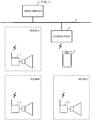
- FIG. 1 is a schematic configuration diagram of a wireless audio system according to a first embodiment of the present invention.
- the wireless audio system includes a plurality of wireless speakers 1-1 to 1-3 (hereinafter may also simply be referred to as “wireless speaker(s) 1") each having an ID attached thereto, an audio controller 2, which is a portable terminal including a microphone, and a media server 3 and an access point 4, which are connected to a network 5. It is assumed that the wireless speakers 1-1 to 1-3 are installed in individual Rooms A to C, respectively.
- Each of the wireless speakers 1 is connected to the audio controller 2 and the media server 3 via the access point 4, and acquires music data from the media server 3 and reproduces the music data for output in accordance with a reproduction instruction received from the audio controller 2.
- the wireless speaker 1 sequentially measures the output volume levels of audio signals output from the wireless speaker 1 within a predetermined period, and sequentially receives the input volume levels of audio signals from the audio controller 2.
- the wireless speaker 1 compares the latest input volume level received and the latest output volume level measured to determine whether a listener carrying the audio controller 2 has left the room in which this wireless speaker 1 is installed. When it is determined that the listener has left the room, the output of an audio signal is stopped.
- the audio controller 2 is also connected to the wireless speakers 1 and the media server 3 via the access point 4, and transmits the reproduction instruction, which includes the specification of music data selected by a listener from among pieces of music data stored in the media server 3, to one of the wireless speakers 1 that is the output destination of the music data.
- the audio controller 2 sequentially measures the input volume levels of audio signals input to the microphone within a predetermined period, and transmits the measured input volume levels to the wireless speaker 1 that is the output destination of the music data.
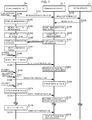
- FIG. 2 is a flow chart for illustrating the operation of the wireless audio system according to the first embodiment.
- the description given here takes as an example a case in which a listener carrying the audio controller 2 enjoys music with the use of the wireless speaker 1-1 installed in Room A.
- the audio controller 2 receives from the listener carrying the audio controller 2 and staying in Room A music selection operation, which involves the specification of music data to be reproduced and the specification of the ID of the wireless speaker 1-1 as the output destination of the music data (Step S100), and multicasts a reproduction instruction in which the music data to be reproduced and the ID of the wireless speaker 1-1 are specified over the network 5 (Step S101) .
- the audio controller 2 also turns on the microphone included in the audio controller 2 (Step S102) .
- the wireless speaker 1-1 receives the reproduction instruction in which the ID of the wireless speaker 1-1 is specified over the network 5, and transmits to the media server 3 a music data request in which the music data specified by the reproduction instruction is specified (Step S103) .
- the media server 3 receives the request, identifies the music data that is specified in the music data request received from the wireless speaker 1-1 from among pieces of music data stored in the media server 3, and transmits the identified music data to the wireless speaker 1-1 (Step S104) .
- the wireless speaker 1-1 receives the music data from the media server 3, and starts reproducing the music data as audio signals and outputting the reproduced audio signals (Step S105).
- the wireless speaker 1-1 also starts measuring an output volume level Vout of audio signals that are output within a predetermined period T2 (for example, 1 second) at a predetermined interval T1 (for example, a 1-second interval) (Step S106).
- the audio controller 2 detects that the audio signals output from the wireless speaker 1-1 are input to the microphone included in the audio controller 2 (Step S107), and starts measuring an input volume level Vin of audio signals that are input to the microphone within the predetermined period T2 at the predetermined interval T1 (Step S108). Each time the input volume level Vin is newly measured, the audio controller 2 multicasts an input volume level notification (Vin notification) in which the newly measured input volume level Vin and the ID of the wireless speaker 1-1 are specified over the network 5 (Step S109).
- Vin notification input volume level notification
- the wireless speaker 1-1 receives the notification and starts receiving an input volume level notification in which the ID of the wireless speaker 1-1 is specified over the network 5 (Step S110) .
- the wireless speaker 1-1 obtains a volume level ratio Vin/Vout, which indicates the proportion of the input volume level Vin that is included in the newly received input volume level notification to the output volume level Vout that is newly measured by the wireless speaker 1-1, and monitors a change in the volume level ratio Vin/Vout (Step S111).
- Step S112 the listener carrying the audio controller 2 leaves Room A (Step S112), thereby causing the input volume level Vin of an audio signal that is input to the microphone of the audio controller 2 to decrease.
- the volume level ratio Vin/Vout calculated by the wireless speaker 1-1 rapidly drops as a result.
- the wireless speaker 1-1 detects that the volume level ratio Vin/Vout has dropped by a predetermined value P (for example, 5 dB) or more within a predetermined period T3 (for example, 4 seconds to 6 seconds) (Step S113), and determines that the listener has left Room A.
- P for example, 5 dB
- T3 for example, 4 seconds to 6 seconds
- the wireless speaker 1-1 then registers the value of a sound volume Vol of the wireless speaker 1-1 as resumption information, changes the value of the sound volume Vol to a zero value, and stops outputting an audio signal (Step S114).
- the wireless speaker 1-1 subsequently waits for a predetermined time-out time T4 (for example, 3 minutes) to elapse.
- the listener carrying the audio controller 2 reenters Room A (Step S115) .
- the audio controller 2 receives, from the listener, resumption operation, which involves the specification of the ID of the wireless speaker 1-1 (Step S116), and multicasts a resumption instruction in which the ID of the wireless speaker 1-1 is specified over the network 5 (Step S117).
- the wireless speaker 1-1 After the output of an audio signal is stopped and before the time-out time T4 elapses, the wireless speaker 1-1 receives the resumption instruction in which the ID of the wireless speaker 1-1 is specified over the network 5, changes the value of the sound volume Vol from the zero value to the value registered as the resumption information, and resumes the output of an audio signal (Step S118) .
- Step S119 the listener carrying the audio controller 2 leaves Room A again (Step S119), thereby causing the input volume level Vin of an audio signal that is input to the microphone of the audio controller 2 to decrease.
- the volume level ratio Vin/Vout calculated by the wireless speaker 1-1 rapidly drops as a result.
- the wireless speaker 1-1 detects that the volume level ratio Vin/Vout has dropped by the predetermined value P or more within the predetermined period T3 (Step S120), and determines that the listener has left Room A.
- the wireless speaker 1-1 registers the value of a sound volume Vol of the wireless speaker 1-1 as resumption information, changes the value of the sound volume Vol to a zero value, and stops outputting an audio signal (Step S121) .
- the wireless speaker 1-1 subsequently waits for the predetermined time-out time T4 to elapse.
- the wireless speaker 1-1 detects time-out (Step S122), stops the reproduction of music data as audio signals, and powers off (Step S123).
- the wireless speaker 1 is described first.
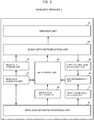
- FIG. 3 is a schematic functional block diagram of the wireless speaker 1.
- the functional configuration of the wireless speaker 1 illustrated in FIG. 3 is implemented by, for example, a CPU included in a computer along with a memory, an auxiliary storage device, which is a flash memory or the like, a wireless communication device, which is a wireless LAN adapter or the like, and a speaker by loading a predetermined program onto the memory from the auxiliary storage device and executing the program.
- the wireless speaker 1 includes speaker unit 10, a wireless network interface unit 11, an instruction reception unit 12, a music data acquisition unit 13, a music data storage unit 14, a music data reproduction unit 15, an output volume level measurement unit 16, an input volume level reception unit 17, an exit determination unit 18, and a main control unit 19.
- the wireless network interface unit 11 is an interface for, for example, communicating to/from the audio controller 2 and communicating to/from the media server 3 connected to the network 5 via the access point 4.
- the instruction reception unit 12 receives various instructions to each of which the ID of its own wireless speaker 1 is attached from the audio controller 2 via the wireless network interface unit 11.
- the music data acquisition unit 13 transmits a music data request including the specification of music data to be reproduced to the media server 3 via the wireless network interface unit 11, and acquires the music data to be reproduced from the media server 3.
- the music data storage unit 14 stores the music data acquired by the music data acquisition unit 13 from the media server 3.
- the music data reproduction unit 15 reproduces music data stored in the music data storage unit 14 as audio signals, and outputs the audio signals from the speaker unit 10.
- the output volume level measurement unit 16 measures, at the predetermined interval T1 (for example, a 1-second interval), the output volume level Vout, which is an average of output volumes of audio signals that are output from the speaker unit 10 by the music data reproduction unit 15 within the predetermined period T2 (for example, 1 second).
- the input volume level reception unit 17 receives via the wireless network interface unit 11 an input volume level notification, which is transmitted regularly from the audio controller 2 and which includes the ID of its own wireless speaker 1.
- the exit determination unit 18 obtains, each time the input volume level reception unit 17 newly receives an input volume level notification that includes the ID of its own wireless speaker, the volume level ratio Vin/Vout, which indicates the proportion of the input volume level Vin included in the input volume level notification to the latest output volume level Vout measured by the output volume level measurement unit 16. Based on a change in the volume level ratio Vin/Vout, the exit determination unit 18 determines whether the listener carrying the audio controller 2 has left the room in which its own wireless speaker 1 is installed.
- the main control unit 19 controls the units 10 to 18 of the wireless speaker 1 in an integrated manner.
- the main control unit 19 also controls the reproduction/output of music data by the music data reproduction unit 15 and the powering on/off based on the determination made in the exit determination unit 18.
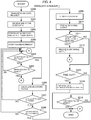
- FIG. 4 is a flow chart for illustrating the operation of the wireless speaker 1. This flow is started when the instruction reception unit 12 receives a reproduction instruction to which the ID of its own wireless speaker 1 is attached from the audio controller 2 via the wireless network interface unit 11.
- the instruction reception unit 12 hands over the received reproduction instruction to the main control unit 19.
- the main control unit 19 receives the reproduction instruction, and notifies music data specified by the received reproduction instruction as data to be reproduced to the music data acquisition unit 13.
- the music data acquisition unit 13 transmits a music data request in which the specification of the music data notified by the main control unit 19 is included to the media server 3 via the wireless network interface unit 11 (Step S200).
- the music data acquisition unit 13 receives the music data from the media server 3, and stores the received music data in the music data storage unit 14 (Step S201) .
- the music data acquisition unit 13 also notifies the main control unit 19 of the completion of the acquisition of the music data.
- the main control unit 19 receives the notification, and notifies the music data to be reproduced to the music data reproduction unit 15.
- the music data reproduction unit 15 reads the music data to be reproduced out of the music data storage unit 14, reproduces the read data as audio signals, and outputs the reproduced audio signals from the speaker unit 10 (Step S202).
- the output volume level measurement unit 16 measures at the predetermined interval T1 the output volume level Vout, which is an average of output volumes of audio signals that are output from the speaker unit 10 by the music data reproduction unit 15 within the predetermined period T2 (Step S203).
- the main control unit 19 ends this flow.
- the input volume level reception unit 17 receives via the wireless network interface unit 11 an input volume level notification (Vin notification), which is transmitted regularly from the audio controller 2 and which includes the ID of its own wireless speaker 1 ("YES" in Step S204), at a point preceding the end of the audio signal reproduction by the music data reproduction unit 15 ("NO" in Step S205), the input volume level reception unit 17 hands over the input volume level Vin that is included in the input volume level notification to the exit determination unit 18.
- Vin notification input volume level notification
- the exit determination unit 18 receives the input volume level Vin, and calculates and stores the volume level ratio Vin/Vout, which indicates the proportion of the input volume level Vin received from the input volume level reception unit 17 to the latest output volume level Vout measured by the output volume level measurement unit 16 (Step S206).
- the exit determination unit 18 determines whether a volume level ratio Vin/Vout calculated at a point that goes back by the predetermined period T3 (for example, 4 seconds to 6 seconds) is stored (Step S207). When it is determined that a volume level ratio Vin/Vout calculated at a point that goes back by the predetermined period T3 is not stored ("NO" in Step S207), the flow returns to Step S204.
- T3 for example, 4 seconds to 6 seconds
- Step S207 When it is determined that a volume level ratio Vin/Vout calculated at a point that goes back by the predetermined period T3 is stored ("YES" in Step S207), on the other hand, the exit determination unit 18 compares the volume level ratio Vin/Vout calculated at a point that goes back by the predetermined period T3 and the newly calculated volume level ratio Vin/Vout to determine whether the newly calculated volume level ratio Vin/Vout is lower than the volume level ratio Vin/Vout calculated at a point that goes back by the predetermined period T3 by the predetermined value P (for example, 5 dB) or more (Step S208) . When the newly calculated volume level ratio Vin/Vout is not lower than the volume level ratio Vin/Vout calculated at a point that goes back by the predetermined period T3 by the predetermined value P or more ("NO" in Step S208), the flow returns to Step S204.
- P for example, 5 dB
- the exit determination unit 18 notifies the main control unit 19 of that fact.
- the main control unit 19 registers the value of the sound volume Vol of the music data reproduction unit 15 as resumption information (Step S209), changes the sound volume Vol of the music data reproduction unit 15 to a zero value, and stops the output of an audio signal from the speaker unit 10 (Step S210).
- the output volume level measurement unit 16 may stop the measurement of the output volume level Vout at this point.
- the main control unit 19 waits for the reception of a resumption instruction from the audio controller 2 via the wireless network interface unit 11 and the instruction reception unit 12 (Step S211) .
- the instruction reception unit 12 receives a resumption instruction in which the ID of its own wireless speaker 1 is specified from the audio controller 2 via the wireless network interface unit 11 ("YES" in Step S211), and notifies the resumption instruction to the main control unit 19.
- the main control unit 19 receives the resumption instruction, changes the sound volume Vol of the music data reproduction unit 15 from the zero value to the value registered as the resumption information, and resumes the output of an audio signal from the speaker unit 10 (Step S212) .
- the output volume level measurement unit 16 resumes the measurement of the output volume level Vout. The flow then returns to Step S204.
- the main control unit 19 causes the music data reproduction unit 15 to stop the reproduction of audio signals from music data, and then turns off the main power (Step S214) to end this flow.
- the main control unit 19 ends this flow also when the audio signal reproduction by the music data reproduction unit 15 is finished ("YES” in Step S215) before the predetermined time-out time T4 elapses ("NO” in Step S213) without receiving a resumption instruction from the audio controller 2 via the wireless network interface unit 11 and the instruction reception unit 12 ("NO" in Step S211).
- the audio controller 2 is described next.
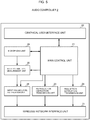
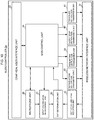
- FIG. 5 is a schematic functional block diagram of the audio controller 2.
- the functional configuration of the audio controller 2 illustrated in FIG. 5 is implemented by, for example, a CPU included in a portable computer, which is a smartphone, a tablet PC, or the like, along with a memory, an auxiliary storage device, which is a flash memory or the like, a touch panel, a display, an input/output device, which is a pointing device or the like, a wireless communication device, which is a wireless LAN adapter or the like, and a microphone by loading a predetermined program onto the memory from the auxiliary storage device and executing the program.
- the audio controller 2 includes a microphone unit 20, a wireless network interface unit 21, a graphical user interface unit 22, a reproduction instruction transmission unit 23, a resumption instruction transmission unit 24, an input volume level measurement unit 25, an input volume level notification unit 26, and a main control unit 27.
- the wireless network interface unit 21 is an interface for communicating to/from the wireless speaker 1 via the access point 4.
- the graphical user interface unit 22 is an interface for, for example, displaying information and receiving various operations from the user.
- the reproduction instruction transmission unit 23 multicasts, from the wireless network interface unit 21, a reproduction instruction in which music data to be reproduced and the ID of one of the wireless speakers 1 that is the output destination of the music data are specified.
- the resumption instruction transmission unit 24 multicasts a resumption instruction in which the ID of one of the wireless speakers 1 that is the output destination of the music data is specified from the wireless network interface unit 21.
- the input volume level measurement unit 25 measures, at the predetermined interval T1 (for example, a 1-second interval), the input volume level Vin, which is an average of input volumes of audio signals that are input to the microphone unit 20 within the predetermined period T2 (for example, 1 second).
- the input volume level notification unit 26 Each time the input volume level measurement unit 25 measures the input volume level Vin, the input volume level notification unit 26 multicasts an input volume level notification including the measured input volume level Vin and the specification of the ID of one of the wireless speakers 1 that is the output destination of music data from the wireless network interface unit 21.
- the main control unit 27 controls the units 20 to 26 of the audio controller 2 in an integrated manner.
- FIG. 6 is a flow chart for illustrating the operation of the audio controller 2. This flow is started when the main control unit 27 receives music selection operation, which involves the specification of music data to be reproduced and the specification of the ID of one of the wireless speakers 1 that is the output destination of the music data, from the listener via the graphical user interface unit 22.
- music selection operation which involves the specification of music data to be reproduced and the specification of the ID of one of the wireless speakers 1 that is the output destination of the music data, from the listener via the graphical user interface unit 22.
- the main control unit 27 first hands over the music data to be reproduced and the ID of the wireless speaker 1 that is the output destination of the music data to the reproduction instruction transmission unit 23.
- the reproduction instruction transmission unit 23 receives the music data and the ID, and multicasts the reproduction instruction in which the music data to be reproduced and the ID of the wireless speaker 1 that is the output destination of the music data are specified from the wireless network interface unit 21 (Step S300).
- the main control unit 27 next turns on the microphone unit 20 (Step S301) and waits for an input of an audio signal to the microphone unit 20 (Step S302) .
- the main control unit 27 instructs the input volume level measurement unit 25 to start measuring the input volume level Vin, and instructs the input volume level notification unit 26 to start transmitting an input volume level notification by notifying the ID of the wireless speaker 1 that is the output destination of the music data to the input volume level notification unit 26.
- the input volume level measurement unit 25 responds to the instruction by measuring, at the predetermined interval T1, the input volume level Vin, which is an average of input volumes of audio signals that are input to the microphone unit 20 within the predetermined period T2.
- the input volume level notification unit 26 multicasts an input volume level notification including the measured input volume level Vin and the specification of the ID of the wireless speaker 1 that is the output destination of the music data from the wireless network interface unit 21 (Step S303).
- the main control unit 27 subsequently receives resumption operation, which involves the specification of the ID of the wireless speaker 1 that is the output destination of the music data, from the listener via the graphical user interface unit 22 ("YES" in Step S304), and hands over the ID of this output destination wireless speaker 1 to the resumption instruction transmission unit 24.
- the resumption instruction transmission unit 24 receives the ID, and multicasts a resumption instruction in which the ID of the output destination wireless speaker 1 is specified from the wireless network interface unit 21 (Step S305).
- Step S306 When remote control ending operation for ending the remote control of the relevant wireless speaker 1 is received from the listener via the graphical user interface unit 22 ("YES" in Step S306), the main control unit 27 instructs the input volume level measurement unit 25 to end the measurement of the input volume level Vin, and instructs the input volume level notification unit 26 to end the transmission of an input volume level notification.
- the input volume level measurement unit 25 ends the measurement of the input volume level Vin in response to the instruction.
- the input volume level notification unit 26 ends the multicasting of an input volume level notification (Step S307).
- the main control unit 27 then turns off the microphone unit 20 (Step S308), and ends this flow.
- the output volume level Vout of audio signals output from the speaker unit 10 of one of the wireless speakers 1 and the input volume level Vin of audio signals input to the microphone unit 20 of the audio controller 2 are compared to determine, from the ratio of the two volume levels, namely, Vin/Vout, whether a listener carrying the audio controller 2 has left the room in which the wireless speaker 1 is installed.
- the output of an audio signal from the wireless speaker 1 is stopped.
- the output of an audio signal can thus be automatically stopped when a listener leaves a room in which the wireless speaker 1 is currently outputting an audio signal without stopping the output of an audio signal. Power consumption can accordingly be reduced by preventing a useless output of an audio signal.
- the wireless speakers 1 when one of the wireless speakers 1 receives a resumption instruction from the audio controller 2 in a period that follows the stop of the output of an audio signal and that precedes the elapse of the predetermined time-out time T4, the sound volume Vol is returned to a state prior to the stop of the output of an output signal to resume the output of an audio signal.
- the time runs out with the elapse of the time-out time T4 without receiving a resumption instruction from the audio controller 2 on the other hand, the reproduction of music data as audio signals is stopped and the wireless speaker 1 is powered off.
- a listener carrying the audio controller 2 has left a room in which one of the wireless speakers 1 is installed when the volume level ratio Vin/Vout drops by the predetermined value P or more within the predetermined period T3 (Step S113 and Step S120 of FIG. 2 and Step S208 of FIG. 4 ).
- the present invention is not limited to the first embodiment in which the output volume level Vout of audio signals output from the speaker unit 10 of one of the wireless speakers 1 and the input volume level Vin of audio signals input to the microphone unit 20 of the audio controller 2 are compared to determine, from the ratio of the two volume levels, namely, Vin/Vout, whether a listener carrying the audio controller 2 has left the room in which the wireless speaker 1 is installed
- each of the wireless speakers 1 measures at the predetermined interval T1 the output waveforms of audio signals output from the speaker unit 10 within the predetermined period T2
- the audio controller 2 measures at the predetermined interval T1 the input waveforms of audio signals input to the microphone unit 20 within the predetermined period T2 to transmit the input waveforms to the wireless speaker 1.
- the wireless speaker 1 compares the latest output waveform measured and the latest input waveform received from the audio controller 2, and determines whether a listener carrying the audio controller 2 is away from the vicinity of the wireless speaker 1 based on whether a delay time of the input waveform with respect to the output waveform (a phase difference) is equal to more than a predetermined length of time.
- a wireless audio system according to a second embodiment of the present invention differs from the wireless audio system according to the first embodiment, which is illustrated in FIG. 1 , in that wireless speakers 1a-1 to 1a-3 (hereinafter may also simply be referred to as “wireless speaker (s) 1a”) are used in place of the wireless speakers 1-1 to 1-3, and in that an audio controller 2a is used in place of the audio controller 2. The rest are the same as in the wireless audio system of the first embodiment illustrated in FIG. 1 .
- Each of the wireless speakers 1a is connected to the audio controller 2a and the media server 3 via the access point 4, and acquires music data from the media server 3 and reproduces the music data for output in accordance with a reproduction instruction received from the audio controller 2a.
- the wireless speaker 1a sequentially measures the output volume levels of audio signals output from the wireless speaker 1a within a predetermined period, and transmits the output volume levels to the audio controller 2a, which is the sender of the reproduction instruction.
- the wireless speaker 1a stops outputting an audio signal by following an output stop instruction issued by the audio controller 2a.
- the audio controller 2a is also connected to the wireless speakers 1a and the media server 3 via the access point 4, and transmits the reproduction instruction, which includes the specification of music data selected by a listener from among pieces of music data stored in the media server 3, to one of the wireless speakers 1a that is the output destination of the music data.
- the audio controller 2a sequentially measures the input volume levels of audio signals input to the microphone within a predetermined period, and sequentially receives the output volume levels of audio signals from the wireless speaker 1a.
- the audio controller 2a compares the input volume levels and the output volume levels to determine whether a listener carrying the audio controller 2 has left the room in which the wireless speaker 1a is installed. When it is determined that the listener has left the room in which the wireless speaker 1a is installed, the audio controller 2a transmits an audio signal output stop instruction to the wireless speaker 1a that is the output destination of the music data.
- FIG. 7 is a flow chart for illustrating the operation of the wireless audio system according to the second embodiment.
- the description given here takes as an example a case in which a listener carrying the audio controller 2a enjoys music with the use of the wireless speaker 1a-1 installed in Room A.
- the audio controller 2a receives from the listener carrying the audio controller 2a and staying in Room A music selection operation, which involves the specification of music data to be reproduced and the specification of the ID of the wireless speaker 1a-1 as the output destination of the music data (Step S150), and multicasts a reproduction instruction in which the music data to be reproduced and the ID of the wireless speaker 1a-1 are specified over the network 5 (Step S151) .
- the audio controller 2a also turns on the microphone included in the audio controller 2a (Step S152) .
- the wireless speaker 1a-1 receives the reproduction instruction in which the ID of the wireless speaker 1a-1 is specified over the network 5, and transmits to the media server 3 a music data request in which the music data specified by the reproduction instruction is specified (Step S153) .
- the media server 3 receives the request, identifies the music data that is specified in the music data request received from the wireless speaker 1a-1 from among pieces of music data stored in the media server 3, and transmits the identified music data to the wireless speaker 1a-1 (Step S154) .
- the wireless speaker 1a-1 receives the music data from the media server 3, reproduces the music data as audio signals, and starts outputting the reproduced audio signals (Step S155).
- the wireless speaker 1a-1 also starts measuring an output volume level Vout of audio signals that are output within the predetermined period T2 (for example, 1 second) at the predetermined interval T1 (for example, a 1-second interval) (Step S156). Each time the output volume level Vout is newly measured, the wireless speaker 1a-1 transmits an output volume level notification (Vout notification) in which the newly measured output volume level Vout is included to the audio controller 2a, which is the sender of the reproduction instruction (Step S157).
- Vout notification output volume level notification in which the newly measured output volume level Vout is included to the audio controller 2a, which is the sender of the reproduction instruction
- the audio controller 2a detects that an audio signal output from the wireless speaker 1a-1 is input to the microphone, which is included in the audio controller 2a (Step S158), and starts measuring the input volume level Vin of audio signals input to the microphone within the predetermined period T2 at the predetermined interval T1 (Step S159).
- the audio controller 2a also starts receiving an output volume level notification from the wireless speaker 1-a (Step S160).
- the audio controller 2a obtains the volume level ratio Vin/Vout, which indicates the proportion of the input volume level Vin newly measured by the audio controller 2a to the output volume level Vout included in the newly received output volume level notification, and monitors a change in the volume level ratio Vin/Vout (Step S161).
- Step S162 the listener carrying the audio controller 2a leaves Room A (Step S162), thereby causing the input volume level Vin of an audio signal that is input to the microphone of the audio controller 2a to decrease.
- the volume level ratio Vin/Vout calculated by the audio controller 2a rapidly drops as a result.
- the audio controller 2a detects that the volume level ratio Vin/Vout has dropped by the predetermined value P (for example, 5 dB) or more within the predetermined period T3 (for example, 4 seconds to 6 seconds) (Step S163), and determines that the listener has left Room A.
- the audio controller 2a multicasts an output stop instruction specifying the ID of the wireless speaker 1a-1, which is the output destination of the music data (Step S164) .
- the audio controller 2a subsequently waits for the predetermined time-out time T4 (for example, 3 minutes) to elapse.
- the wireless speaker 1a-1 receives the output stop instruction in which the ID of the wireless speaker 1a-1 is specified from the audio controller 2a, registers the value of the sound volume Vol of the wireless speaker la-1 as resumption information, changes the sound volume Vol to a zero value, and stops outputting an audio signal (Step S165).
- the wireless speaker 1a-1 may stop the measurement of the output volume level Vout at this point.
- Step S166 the listener carrying the audio controller 2a reenters Room A.
- the audio controller 2a receives, from the listener, resumption operation, which involves the specification of the ID of the wireless speaker 1a-1 (Step S167), and multicasts a resumption instruction in which the ID of the wireless speaker 1a-1 is specified over the network 5 (Step S168) .
- the wireless speaker 1a-1 receives the resumption instruction in which the ID of the wireless speaker 1a-1 is specified from the audio controller 2a, changes the value of the sound volume Vol from the zero value to the value registered as the resumption information, and resumes the output of an audio signal (Step S169) . In the case where the measurement of the volume level Vout has been stopped during the period in which the output of an audio signal is stopped, the wireless speaker 1a-1 resumes the measurement of the output volume level Vout.
- Step S170 the listener carrying the audio controller 2a leaves Room A again (Step S170), thereby causing the input volume level Vin of an audio signal that is input to the microphone of the audio controller 2a to decrease.
- the volume level ratio Vin/Vout calculated by the audio controller 2a rapidly drops as a result.
- the audio controller 2a detects that the volume level ratio Vin/Vout has dropped by the predetermined value P or more within the predetermined period T3 (StepS171), and determines that the listener has left Room A.
- the audio controller 2a multicasts an output stop instruction specifying the ID of the wireless speaker 1a-1, which is the output destination of the music data (Step S172) .
- the wireless speaker 1a-1 may stop the measurement of the output volume level Vout at this point.
- the audio controller 2a subsequently waits for the predetermined time-out time T4 (for example, 3 minutes) to elapse.
- the wireless speaker 1a-1 receives the output stop instruction in which the ID of the wireless speaker 1a-1 is specified from the audio controller 2a, registers the value of the sound volume Vol of the wireless speaker la-1 as resumption information, changes the sound volume Vol to a zero value, and stops outputting an audio signal (Step S173).
- the audio controller 2a multicasts a power-off instruction in which the ID of the wireless speaker 1a-1 is specified over the network 5 (Step 5175).
- the wireless speaker 1a-1 receives the power-off instruction in which the ID of the wireless speaker 1a-1 is specified from the audio controller 2a, stops the reproduction of the music data as audio signals, and powers off (Step S176).
- the wireless speaker 1a is described first.
- FIG. 8 is a schematic functional block diagram of the wireless speaker 1a.
- the functional configuration of the wireless speaker 1a illustrated in FIG. 8 is implemented by, for example, a CPU included in a computer along with a memory, an auxiliary storage device, which is a flash memory or the like, a wireless communication device, which is a wireless LAN adapter or the like, and a speaker by loading a predetermined program onto the memory from the auxiliary storage device and executing the program.
- the wireless speaker 1a includes the speaker unit 10, the wireless network interface unit 11, the instruction reception unit 12, the music data acquisition unit 13, the music data storage unit 14, the music data reproduction unit 15, the output volume level measurement unit 16, an output volume level notification unit 30, and a main control unit 31.
- the units in FIG. 8 that have the same functions as those of the wireless speaker 1 in the first embodiment illustrated in FIG. 3 are denoted by the same reference symbols.
- the output volume level notification unit 30 transmits, each time the output volume level measurement unit 16 measures the output volume level Vout, an output volume level notification including the measured output volume level Vout via the wireless network interface unit 11 to the audio controller 2a, which is the sender of a reproduction instruction issued to music data that is currently being reproduced as audio signals by the music data reproduction unit 15.
- the main control unit 31 controls the units 10 to 16 and 30 of the wireless speaker 1a in an integrated manner.
- the main control unit 31 also controls the reproduction/output of music data by the music data reproduction unit 15 and the powering on/off based on instructions received from the audio controller 2a via the instruction reception unit 12.
- FIG. 9 is a flow chart for illustrating the operation of the wireless speaker 1a. This flow is started when the instruction reception unit 12 receives a reproduction instruction to which the ID of its own wireless speaker 1a is attached from the audio controller 2a via the wireless network interface unit 11.
- the instruction reception unit 12 hands over the received reproduction instruction to the main control unit 31.
- the main control unit 31 receives the reproduction instruction, notifies the address of the audio controller 2a, which is the sender of the reproduction instruction, to the output volume level notification unit 30, and notifies music data specified by the received reproduction instruction as data to be reproduced to the music data acquisition unit 13.
- the music data acquisition unit 13 transmits a music data request in which the specification of the music data notified by the main control unit 31 is included to the media server 3 via the wireless network interface unit 11 (Step S250).
- the music data acquisition unit 13 receives the music data from the media server 3, and stores the received music data in the music data storage unit 14 (Step S251) .
- the music data acquisition unit 13 also notifies the main control unit 31 of the completion of the acquisition of the music data.
- the main control unit 31 receives the notification, and notifies the music data to be reproduced to the music data reproduction unit 15.
- the music data reproduction unit 15 reads the music data to be reproduced out of the music data storage unit 14, reproduces the read data as audio signals, and outputs the reproduced audio signals from the speaker unit 10 (Step S252).
- the output volume level measurement unit 16 measures at the predetermined interval T1 the output volume level Vout, which is an average of output volumes of audio signals that are output from the speaker unit 10 by the music data reproduction unit 15 within the predetermined period T2.
- the output volume level notification unit 30 transmits an output volume level notification including the measured output volume level Vout via the wireless network interface unit 11 to the audio controller 2a, which is identified from the address notified by the main control unit 31 (Step S253).
- the main control unit 31 waits for the reception of an output stop instruction from the audio controller 2a via the wireless network interface unit 11 and the instruction reception unit 12 (Step S254) .
- the instruction reception unit 12 receives an output stop instruction to which the ID of its own wireless speaker 1a is attached from the audio controller 2a via the wireless network interface unit 11 ("YES" in Step S254), and hands over the received output stop instruction to the main control unit 31.
- the main control unit 31 receives the output stop instruction, registers the value of the sound volume Vol of the music data reproduction unit 15 as resumption information (Step S255), changes the sound volume Vol of the music data reproduction unit 15 to a zero value, and stops the output of an audio signal from the speaker unit 10 (Step S256) .
- the output volume level measurement unit 16 may stop the measurement of the output volume level Vout at this point.
- the main control unit 31 waits for the reception of a resumption instruction or a power-off instruction from the audio controller 2a via the wireless network interface unit 11 and the instruction reception unit 12 (Step S258 and Step S260).
- Step S258 When receiving a resumption instruction to which the ID of its own wireless speaker 1a is attached from the audio controller 2a via the wireless network interface unit 11 ("YES" in Step S258), the instruction reception unit 12 hands over the resumption instruction to the control unit 31.
- the main control unit 31 receives the resumption instruction, changes the sound volume Vol of the music data reproduction unit 15 from the zero value to the value registered as the resumption information, and resumes the output of an audio signal from the speaker unit 10 (Step S259).
- the output volume level measurement unit 16 resumes the measurement of the output volume level Vout. The flow then returns to Step S254.
- Step S260 When receiving a power-off instruction to which the ID of its own wireless speaker 1a is attached from the audio controller 2a via the wireless network interface unit 11 ("YES" in Step S260), the instruction reception unit 12 hands over the power-off instruction to the main control unit 31.
- the main control unit 31 receives the power-off instruction, causes the music data reproduction unit 15 to stop the reproduction of the music data as audio signals, and then turns off the main power (Step S261) to end this flow.
- the main control unit 31 ends this flow also when the audio signal reproduction by the music data reproduction unit 15 is finished ("YES" in Step S257 or "YES” in Step S262).
- the audio controller 2a is described next.
- FIG. 10 is a schematic functional block diagram of the audio controller 2a.
- the functional configuration of the audio controller 2a illustrated in FIG. 10 is implemented by, for example, a CPU included in a portable computer, which is a smartphone, a tablet PC, or the like, along with a memory, an auxiliary storage device, which is a flash memory or the like, a touch panel, a display, an input/output device, which is a pointing device or the like, a wireless communication device, which is a wireless LAN adapter or the like, and a microphone by loading a predetermined program onto the memory from the auxiliary storage device and executing the program.
- the audio controller 2a includes the microphone unit 20, the wireless network interface unit 21, the graphical user interface unit 22, the reproduction instruction transmission unit 23, the resumption instruction transmission unit 24, the input volume level measurement unit 25, an output stop instruction transmission unit 40, a power-off instruction transmission unit 41, an output volume level reception unit 42, an exit determination unit 43, and a main control unit 44.
- the units in FIG. 10 that have the same functions as those of the audio controller 2 in the first embodiment illustrated in FIG. 5 are denoted by the same reference symbols.
- the output stop instruction transmission unit 40 multicasts an output stop instruction including the specification of the ID of one of the wireless speakers 1a that is the output destination of music data from the wireless network interface unit 21.
- the power-off instruction transmission unit 41 multicasts a power-off instruction including the specification of the ID of one of the wireless speakers 1a that is the output destination of music data from the wireless network interface unit 21.
- the output volume level reception unit 42 receives via the wireless network interface unit 21 an output volume level notification, which is transmitted regularly from each of the wireless speakers 1a.
- the exit determination unit 43 obtains, each time the output volume level reception unit 42 newly receives an output volume level notification, the volume level ratio Vin/Vout, which indicates the proportion of the latest input volume level Vin measured by the input volume level measurement unit 25 to the output volume level Vout included in the received output volume level notification. Based on a change in the volume level ratio Vin/Vout, the exit determination unit 43 determines whether a listener carrying the audio controller 2a has left the room in which one of the wireless speakers 1a that is the output destination of music data is installed.
- the main control unit 44 controls the units 20 to 25 and 40 to 43 of the audio controller 2a in an integrated manner.
- FIG. 11 is a flow chart for illustrating the operation of the audio controller 2a. This flow is started when the main control unit 44 receives music selection operation, which involves the specification of music data to be reproduced and the specification of the ID of one of the wireless speakers 1a that is the output destination of the music data, from the listener via the graphical user interface unit 22.
- music selection operation which involves the specification of music data to be reproduced and the specification of the ID of one of the wireless speakers 1a that is the output destination of the music data, from the listener via the graphical user interface unit 22.
- the main control unit 44 first hands over the music data to be reproduced and the ID of the wireless speaker 1a that is the output destination of the music data to the reproduction instruction transmission unit 23.
- the reproduction instruction transmission unit 23 receives the music data and the ID, and multicasts a reproduction instruction in which the music data to be reproduced and the ID of the wireless speaker 1a that is the output destination of the music data are specified from the wireless network interface unit 21 (Step S350).
- the main control unit 44 next turns on the microphone unit 20 (Step S351) and waits for an input of an audio signal to the microphone unit 20 (Step S352) .
- the main control unit 44 instructs the input volume level measurement unit 25 to start measuring the input volume level Vin.
- the input volume level measurement unit 25 responds to the instruction by measuring, at the predetermined interval T1, the input volume level Vin, which is an average of input volumes of audio signals that are input to the microphone unit 20 within the predetermined period T2 (Step S353) .
- the output volume level reception unit 42 receives an output volume level notification (Vout notification), which is transmitted regularly from the wireless speaker 1a, via the wireless network interface unit 21 ("YES" in Step S354), and hands over the output volume level Vout included in the output volume level notification to the exit determination unit 43.
- the exit determination unit 43 receives the output volume level Vout, and calculates and stores the volume level ratio Vin/Vout, which indicates the proportion of the latest input volume level Vin measured by the input volume level measurement unit 25 to the output volume level Vout received from the output volume level reception unit 42 (Step S355).
- the exit determination unit 43 determines whether a volume level ratio Vin/Vout calculated at a point that goes back by the predetermined period T3 (for example, 4 seconds to 6 seconds) is stored (Step S356). When it is determined that a volume level ratio Vin/Vout calculated at a point that goes back by the predetermined period T3 is not stored ("NO" in Step S356), the flow returns to Step S354.
- T3 for example, 4 seconds to 6 seconds
- Step S356 When it is determined that a volume level ratio Vin/Vout calculated at a point that goes back by the predetermined period T3 is stored ("YES" in Step S356), on the other hand, the exit determination unit 43 compares the volume level ratio Vin/Vout calculated at a point that goes back by the predetermined period T3 and the newly calculated volume level ratio Vin/Vout to determine whether the newly calculated volume level ratio Vin/Vout is lower than the volume level ratio Vin/Vout calculated at a point that goes back by the predetermined period T3 by the predetermined value P (for example, 5 dB) or more (Step S357) . When the newly calculated volume level ratio Vin/Vout is not lower than the volume level ratio Vin/Vout calculated at a point that goes back by the predetermined period T3 by the predetermined value P or more ("NO" in Step S357), the flow returns to Step S354.
- P for example, 5 dB
- the exit determination unit 43 notifies the main control unit 44 of that fact.
- the main control unit 44 notifies the ID of the wireless speaker 1a that is the output destination of the music data to the output stop instruction transmission unit 40.
- the output stop instruction transmission unit 40 multicasts an output stop instruction in which the ID of the output destination wireless speaker 1a is specified from the wireless network interface unit 21 (Step S358).
- the input volume level measurement unit 25 may stop the measurement of the input volume level Vin at this point.
- Step S361 the main control unit 44 waits for the reception of resumption operation from the listener via the graphical user interface unit 22 (Step S359).
- the main control unit 44 subsequently receives resumption operation from the listener via the graphical user interface unit 22 ("YES" in Step S359), and notifies the ID of the wireless speaker 1a that is the output destination of the music data to the resumption instruction transmission unit 24.
- the resumption instruction transmission unit 24 multicasts a resumption instruction in which the ID of the wireless speaker 1a that is the output destination of the music data is specified from the wireless network interface unit 21 (Step S360).
- the input volume level measurement unit 25 resumes the measurement of the input volume level Vin. The flow then returns to Step S354.
- the main control unit 44 When the time runs out with the elapse of the time-out time T4 ("YES" in Step S361) without receiving resumption operation from the listener ("NO” in Step S359), on the other hand, the main control unit 44 notifies the ID of the wireless speaker 1a that is the output destination of the music data to the power-off instruction transmission unit 41.
- the power-off instruction transmission unit 41 multicasts a power-off instruction in which the ID of the output destination wireless speaker 1a is specified from the wireless network interface unit 21 (Step S362) .
- the main control unit 44 then instructs the input volume level measurement unit 25 to end the measurement of the input volume level Vin.
- the input volume level measurement unit 25 ends the measurement of the input volume level Vin in response to the instruction (Step S363) .
- the main control unit 44 then turns off the microphone unit 20 (Step S364), and ends this flow.
- Step S365 When remote control ending operation for ending the remote control of the relevant wireless speaker 1a is received from the listener via the graphical user interface unit 22 ("YES" in Step S365), the main control unit 44 instructs the input volume level measurement unit 25 to end the measurement of the input volume level Vin.
- the input volume level measurement unit 25 ends the measurement of the input volume level Vin in response to the instruction (Step S363).
- the main control unit 44 then turns off the microphone unit 20 (Step S364), and ends this flow.
- the output volume level Vout of audio signals output from the speaker unit 10 of one of the wireless speakers 1a and the input volume level Vin of audio signals input to the microphone unit 20 of the audio controller 2a are compared to determine, from the ratio of the two volume levels, namely, Vin/Vout, whether a listener carrying the audio controller 2a has left the room in which the wireless speaker 1a is installed.
- the output of an audio signal from the wireless speaker 1a is stopped.
- the output of an audio signal can thus be automatically stopped when a listener leaves a room in which the wireless speaker 1a is currently outputting an audio signal without stopping the output of an audio signal. Power consumption can accordingly be reduced by preventing a useless output of an audio signal.
- the audio controller 2a in the second embodiment transmits a resumption instruction for causing one of the wireless speakers 1a to resume the output of an audio signal when receiving resumption operation from the listener in a period that follows the transmission of an output stop instruction for causing the wireless speaker 1a to stop the output of an audio signal and that precedes the elapse of the predetermined time-out time T4.
- the audio controller 2a transmits a power-off instruction for causing the wireless speaker 1a to stop the reproduction of music data as audio signals and to power off.
- the second embodiment in the same manner as in the first embodiment, it is determined that a listener carrying the audio controller 2a has left a room in which one of the wireless speakers 1a is installed when the volume level ratio Vin/Vout drops by the predetermined value P or more within the predetermined period T3 (Step S163 and Step S171 of FIG. 7 and Step S357 of FIG. 11 ).
- the output volume level Vout of audio signals output from the speaker unit 10 of one of the wireless speakers 1a and the input volume level Vin of audio signals input to the microphone unit 20 of the audio controller 2a are compared to determine, from the ratio of the two volume levels, namely, Vin/Vout, whether a listener carrying the audio controller 2a has left the room in which the wireless speaker 1a is installed.
- the present invention is not limited thereto.
- each of the wireless speakers 1a measures at the predetermined interval T1 the output waveforms of audio signals output from the speaker unit 10 within the predetermined period T2 to transmit the output waveforms to the audio controller 2a
- the audio controller 2a measures at the predetermined interval T1 the input waveforms of audio signals input to the microphone unit 20 within the predetermined period T2.
- the audio controller 2a compares the latest input waveform measured and the latest output waveform received from the wireless speaker 1a, and determines whether a listener carrying the audio controller 2a is away from the vicinity of the wireless speaker 1a based on whether a delay time of the input waveform with respect to the output waveform (a phase difference) is equal to more than a predetermined length of time.
- the multicast transmission may be replaced with unicast transmission when the audio controller 2 or 2a is aware of the address of each wireless speaker 1 or each wireless speaker 1a.
- the audio controller 2 or 2a in the embodiments described above is connected to the wireless speakers 1 or the wireless speakers 1a via the access point 4 and the network 5.
- the audio controller 2 or 2a and the wireless speakers 1 or the wireless speakers 1a may be connected directly by a wireless network through an ad-hoc mode of wireless LAN, Bluetooth (trademark), or other types of short-distance wireless communication.
- the media server 3 is connected to the network 5, but the media server 3 may be connected to a wireless network.
- the media server 3 may be built into the audio controller 2 or 2a, or into any one of the wireless speakers 1 or wireless speakers 1a.
- the wireless speaker 1 or 1a acquires music data from the audio controller 2 or 2a.
- another wireless speaker 1 or 1a acquires music data from the wireless speaker 1 or 1a into which the media server 3 is built.
Landscapes
- Engineering & Computer Science (AREA)
- Physics & Mathematics (AREA)
- Acoustics & Sound (AREA)
- Signal Processing (AREA)
- General Health & Medical Sciences (AREA)
- Theoretical Computer Science (AREA)
- Health & Medical Sciences (AREA)
- Audiology, Speech & Language Pathology (AREA)
- Human Computer Interaction (AREA)
- General Engineering & Computer Science (AREA)
- General Physics & Mathematics (AREA)
- Multimedia (AREA)
- Otolaryngology (AREA)
- Circuit For Audible Band Transducer (AREA)
- Details Of Audible-Bandwidth Transducers (AREA)
Applications Claiming Priority (2)
| Application Number | Priority Date | Filing Date | Title |
|---|---|---|---|
| JP2015204130A JP6632855B2 (ja) | 2015-10-15 | 2015-10-15 | ワイヤレススピーカ、コントローラ、ワイヤレスオーディオシステム、およびコンピュータで読み取り可能なプログラム |
| PCT/JP2016/076849 WO2017064964A1 (ja) | 2015-10-15 | 2016-09-12 | ワイヤレススピーカ、コントローラ、ワイヤレスオーディオシステム、およびコンピュータで読み取り可能なプログラム |
Publications (3)
| Publication Number | Publication Date |
|---|---|
| EP3364665A1 EP3364665A1 (en) | 2018-08-22 |
| EP3364665A4 EP3364665A4 (en) | 2019-06-05 |
| EP3364665B1 true EP3364665B1 (en) | 2021-02-17 |
Family
ID=58517166
Family Applications (1)
| Application Number | Title | Priority Date | Filing Date |
|---|---|---|---|
| EP16855218.0A Active EP3364665B1 (en) | 2015-10-15 | 2016-09-12 | Wireless speaker, controller, wireless audio system, and computer-readable program |
Country Status (4)
| Country | Link |
|---|---|
| US (1) | US20180302716A1 (enExample) |
| EP (1) | EP3364665B1 (enExample) |
| JP (1) | JP6632855B2 (enExample) |
| WO (1) | WO2017064964A1 (enExample) |
Families Citing this family (7)
| Publication number | Priority date | Publication date | Assignee | Title |
|---|---|---|---|---|
| JP6604865B2 (ja) * | 2016-02-08 | 2019-11-13 | 株式会社ディーアンドエムホールディングス | ワイヤレスオーディオシステム、コントローラ、ワイヤレススピーカ、およびコンピュータで読み取り可能なプログラム |
| WO2018101459A1 (ja) * | 2016-12-02 | 2018-06-07 | ヤマハ株式会社 | コンテンツ再生機器、収音機器、及びコンテンツ再生システム |
| DE102018128202A1 (de) * | 2018-11-12 | 2020-05-14 | Sennheiser Electronic Gmbh & Co. Kg | Audio-Wiedergabeanlage, Verfahren zur Konfiguration einer Audio-Wiedergabeanlage und Server für eine Audio-Wiedergabeanlage |
| KR20230152173A (ko) | 2020-08-31 | 2023-11-02 | 소노스 인코포레이티드 | 오디오 재생 장치를 위한 무선 전력 전송 |
| JP7650122B2 (ja) * | 2021-01-19 | 2025-03-24 | 株式会社ディーアンドエムホールディングス | ワイヤレススピーカ、ワイヤレスオーディオシステム、プログラム、およびワイヤレススピーカの状態制御方法 |
| WO2022202176A1 (ja) * | 2021-03-23 | 2022-09-29 | ヤマハ株式会社 | 音響システム、音響システムの制御方法、および音響機器 |
| CN117813825A (zh) * | 2021-08-02 | 2024-04-02 | Lg电子株式会社 | 显示装置及其操作方法 |
Family Cites Families (11)
| Publication number | Priority date | Publication date | Assignee | Title |
|---|---|---|---|---|
| JP4083361B2 (ja) * | 1999-12-21 | 2008-04-30 | パイオニア株式会社 | 情報再生システム |
| US6549630B1 (en) * | 2000-02-04 | 2003-04-15 | Plantronics, Inc. | Signal expander with discrimination between close and distant acoustic source |
| US7136709B2 (en) * | 2003-11-04 | 2006-11-14 | Universal Electronics Inc. | Home appliance control system and methods in a networked environment |
| GB0402952D0 (en) * | 2004-02-11 | 2004-03-17 | Koninkl Philips Electronics Nv | Remote control system and related method and apparatus |
| JP2007074710A (ja) * | 2005-08-12 | 2007-03-22 | Mitsubishi Materials Corp | オーディオ・ビジュアルデータ通信システム、オーディオ・ビジュアルデータ通信方法、オーディオ・ビジュアルデータ通信プログラム及びオーディオ・ビジュアルデータ通信システム用の鑑賞空間切替装置 |
| JP2009060232A (ja) * | 2007-08-30 | 2009-03-19 | Pioneer Electronic Corp | 音声処理装置等 |
| JP5672739B2 (ja) * | 2010-03-29 | 2015-02-18 | ヤマハ株式会社 | 音響処理装置 |
| US9191914B2 (en) * | 2013-03-15 | 2015-11-17 | Comcast Cable Communications, Llc | Activating devices based on user location |
| EP2892240B1 (en) * | 2014-01-06 | 2020-11-25 | Harman International Industries, Inc. | Apparatus and method for automatic device selection for wireless media devices |
| US9693165B2 (en) * | 2015-09-17 | 2017-06-27 | Sonos, Inc. | Validation of audio calibration using multi-dimensional motion check |
| US9838646B2 (en) * | 2015-09-24 | 2017-12-05 | Cisco Technology, Inc. | Attenuation of loudspeaker in microphone array |
-
2015
- 2015-10-15 JP JP2015204130A patent/JP6632855B2/ja active Active
-
2016
- 2016-09-12 EP EP16855218.0A patent/EP3364665B1/en active Active
- 2016-09-12 US US15/767,744 patent/US20180302716A1/en not_active Abandoned
- 2016-09-12 WO PCT/JP2016/076849 patent/WO2017064964A1/ja not_active Ceased
Non-Patent Citations (1)
| Title |
|---|
| None * |
Also Published As
| Publication number | Publication date |
|---|---|
| WO2017064964A1 (ja) | 2017-04-20 |
| JP6632855B2 (ja) | 2020-01-22 |
| US20180302716A1 (en) | 2018-10-18 |
| EP3364665A1 (en) | 2018-08-22 |
| EP3364665A4 (en) | 2019-06-05 |
| JP2017076914A (ja) | 2017-04-20 |
Similar Documents
| Publication | Publication Date | Title |
|---|---|---|
| EP3364665A1 (en) | Wireless speaker, controller, wireless audio system, and computer-readable program | |
| US11733768B2 (en) | Power control based on packet type | |
| US11394229B2 (en) | Headset wireless charging dock | |
| CN108695997B (zh) | 输电设备及其控制方法和存储介质 | |
| JP6602086B2 (ja) | ワイヤレスオーディオシステム | |
| KR20210053018A (ko) | UWB(Ultra Wide Band)를 통해 레인징을 수행하는 전자 디바이스 및 전자 디바이스의 동작 방법 | |
| CN103677214A (zh) | 用于移动终端的耗电控制方法、装置以及移动终端 | |
| CN105142010A (zh) | 一种多播放设备的蓝牙连接选择方法及主播放设备 | |
| KR101826648B1 (ko) | 기기 제어 방법 및 기기 | |
| CN104507005A (zh) | 无线音箱的分组控制方法及系统 | |
| US20160259419A1 (en) | Techniques for controlling devices based on user proximity | |
| US20210084406A1 (en) | Portable smart speaker power control | |
| CN110768382A (zh) | 无线充电方法、装置、存储介质及电子设备 | |
| CN108028851A (zh) | 设备群组管理方法、装置和系统 | |
| US11163350B2 (en) | Application power management for mobile devices | |
| JP4732197B2 (ja) | 通信方法、通信装置、通信システム、及びコンピュータプログラム | |
| CN115836589A (zh) | 基于相对距离信息选择用于呈现娱乐照明的照明设备 | |
| WO2022199497A1 (zh) | 一种协同唤醒第一电子设备的方法及第一电子设备 | |
| US20210400384A1 (en) | Method for operating a device having a speaker so as to prevent unexpected audio output | |
| US20120084581A1 (en) | Power supply control apparatus, electric device, power supply control system, and power supply control method and program | |
| CN117793859A (zh) | 音箱设备休眠方法、系统、设备、存储介质及程序产品 | |
| CN114070660B (zh) | 一种智能语音终端和应答方法 | |
| US20080113620A1 (en) | Radio communication apparatus and power control method of radio communication apparatus | |
| JP5569625B2 (ja) | 無線オーディオシステム | |
| JP5299183B2 (ja) | 無線オーディオシステム |
Legal Events
| Date | Code | Title | Description |
|---|---|---|---|
| STAA | Information on the status of an ep patent application or granted ep patent |
Free format text: STATUS: THE INTERNATIONAL PUBLICATION HAS BEEN MADE |
|
| PUAI | Public reference made under article 153(3) epc to a published international application that has entered the european phase |
Free format text: ORIGINAL CODE: 0009012 |
|
| STAA | Information on the status of an ep patent application or granted ep patent |
Free format text: STATUS: REQUEST FOR EXAMINATION WAS MADE |
|
| 17P | Request for examination filed |
Effective date: 20180426 |
|
| AK | Designated contracting states |
Kind code of ref document: A1 Designated state(s): AL AT BE BG CH CY CZ DE DK EE ES FI FR GB GR HR HU IE IS IT LI LT LU LV MC MK MT NL NO PL PT RO RS SE SI SK SM TR |
|
| AX | Request for extension of the european patent |
Extension state: BA ME |
|
| DAV | Request for validation of the european patent (deleted) | ||
| DAX | Request for extension of the european patent (deleted) | ||
| A4 | Supplementary search report drawn up and despatched |
Effective date: 20190506 |
|
| RIC1 | Information provided on ipc code assigned before grant |
Ipc: H04R 1/06 20060101AFI20190429BHEP Ipc: H04S 7/00 20060101ALI20190429BHEP Ipc: H04R 3/00 20060101ALI20190429BHEP |
|
| GRAP | Despatch of communication of intention to grant a patent |
Free format text: ORIGINAL CODE: EPIDOSNIGR1 |
|
| STAA | Information on the status of an ep patent application or granted ep patent |
Free format text: STATUS: GRANT OF PATENT IS INTENDED |
|
| INTG | Intention to grant announced |
Effective date: 20201030 |
|
| GRAS | Grant fee paid |
Free format text: ORIGINAL CODE: EPIDOSNIGR3 |
|
| GRAA | (expected) grant |
Free format text: ORIGINAL CODE: 0009210 |
|
| STAA | Information on the status of an ep patent application or granted ep patent |
Free format text: STATUS: THE PATENT HAS BEEN GRANTED |
|
| AK | Designated contracting states |
Kind code of ref document: B1 Designated state(s): AL AT BE BG CH CY CZ DE DK EE ES FI FR GB GR HR HU IE IS IT LI LT LU LV MC MK MT NL NO PL PT RO RS SE SI SK SM TR |
|
| REG | Reference to a national code |
Ref country code: GB Ref legal event code: FG4D |
|
| REG | Reference to a national code |
Ref country code: CH Ref legal event code: EP |
|
| REG | Reference to a national code |
Ref country code: DE Ref legal event code: R096 Ref document number: 602016052808 Country of ref document: DE |
|
| REG | Reference to a national code |
Ref country code: AT Ref legal event code: REF Ref document number: 1363086 Country of ref document: AT Kind code of ref document: T Effective date: 20210315 |
|
| 111Z | Information provided on other rights and legal means of execution |
Free format text: AL AT BE BG CH CY CZ DE DK EE ES FI FR GB GR HR HU IE IS IT LT LU LV MC MK MT NL NO PL PT RO RS SE SI SK SM TR Effective date: 20201204 |
|
| REG | Reference to a national code |
Ref country code: IE Ref legal event code: FG4D |
|
| 111Z | Information provided on other rights and legal means of execution |
Free format text: AL AT BE BG CH CY CZ DE DK EE ES FI FR GB GR HR HU IE IS IT LT LU LV MC MK MT NL NO PL PT RO RS SE SI SK SM TR AL AT BE BG CH CY CZ DE DK EE ES FI FR GB GR HR HU IE IS IT LT LU LV MC MK MT NL NO PL PT RO RS SE SI SK SM TR Effective date: 20201204 |
|
| REG | Reference to a national code |
Ref country code: LT Ref legal event code: MG9D |
|
| REG | Reference to a national code |
Ref country code: NL Ref legal event code: MP Effective date: 20210217 |
|
| PG25 | Lapsed in a contracting state [announced via postgrant information from national office to epo] |
Ref country code: NO Free format text: LAPSE BECAUSE OF FAILURE TO SUBMIT A TRANSLATION OF THE DESCRIPTION OR TO PAY THE FEE WITHIN THE PRESCRIBED TIME-LIMIT Effective date: 20210517 Ref country code: PT Free format text: LAPSE BECAUSE OF FAILURE TO SUBMIT A TRANSLATION OF THE DESCRIPTION OR TO PAY THE FEE WITHIN THE PRESCRIBED TIME-LIMIT Effective date: 20210617 Ref country code: HR Free format text: LAPSE BECAUSE OF FAILURE TO SUBMIT A TRANSLATION OF THE DESCRIPTION OR TO PAY THE FEE WITHIN THE PRESCRIBED TIME-LIMIT Effective date: 20210217 Ref country code: FI Free format text: LAPSE BECAUSE OF FAILURE TO SUBMIT A TRANSLATION OF THE DESCRIPTION OR TO PAY THE FEE WITHIN THE PRESCRIBED TIME-LIMIT Effective date: 20210217 Ref country code: GR Free format text: LAPSE BECAUSE OF FAILURE TO SUBMIT A TRANSLATION OF THE DESCRIPTION OR TO PAY THE FEE WITHIN THE PRESCRIBED TIME-LIMIT Effective date: 20210518 Ref country code: LT Free format text: LAPSE BECAUSE OF FAILURE TO SUBMIT A TRANSLATION OF THE DESCRIPTION OR TO PAY THE FEE WITHIN THE PRESCRIBED TIME-LIMIT Effective date: 20210217 Ref country code: BG Free format text: LAPSE BECAUSE OF FAILURE TO SUBMIT A TRANSLATION OF THE DESCRIPTION OR TO PAY THE FEE WITHIN THE PRESCRIBED TIME-LIMIT Effective date: 20210517 |
|
| REG | Reference to a national code |
Ref country code: AT Ref legal event code: MK05 Ref document number: 1363086 Country of ref document: AT Kind code of ref document: T Effective date: 20210217 |
|
| PG25 | Lapsed in a contracting state [announced via postgrant information from national office to epo] |
Ref country code: SE Free format text: LAPSE BECAUSE OF FAILURE TO SUBMIT A TRANSLATION OF THE DESCRIPTION OR TO PAY THE FEE WITHIN THE PRESCRIBED TIME-LIMIT Effective date: 20210217 Ref country code: RS Free format text: LAPSE BECAUSE OF FAILURE TO SUBMIT A TRANSLATION OF THE DESCRIPTION OR TO PAY THE FEE WITHIN THE PRESCRIBED TIME-LIMIT Effective date: 20210217 Ref country code: PL Free format text: LAPSE BECAUSE OF FAILURE TO SUBMIT A TRANSLATION OF THE DESCRIPTION OR TO PAY THE FEE WITHIN THE PRESCRIBED TIME-LIMIT Effective date: 20210217 Ref country code: LV Free format text: LAPSE BECAUSE OF FAILURE TO SUBMIT A TRANSLATION OF THE DESCRIPTION OR TO PAY THE FEE WITHIN THE PRESCRIBED TIME-LIMIT Effective date: 20210217 Ref country code: NL Free format text: LAPSE BECAUSE OF FAILURE TO SUBMIT A TRANSLATION OF THE DESCRIPTION OR TO PAY THE FEE WITHIN THE PRESCRIBED TIME-LIMIT Effective date: 20210217 |
|
| PG25 | Lapsed in a contracting state [announced via postgrant information from national office to epo] |
Ref country code: IS Free format text: LAPSE BECAUSE OF FAILURE TO SUBMIT A TRANSLATION OF THE DESCRIPTION OR TO PAY THE FEE WITHIN THE PRESCRIBED TIME-LIMIT Effective date: 20210617 |
|
| PG25 | Lapsed in a contracting state [announced via postgrant information from national office to epo] |
Ref country code: AT Free format text: LAPSE BECAUSE OF FAILURE TO SUBMIT A TRANSLATION OF THE DESCRIPTION OR TO PAY THE FEE WITHIN THE PRESCRIBED TIME-LIMIT Effective date: 20210217 Ref country code: SM Free format text: LAPSE BECAUSE OF FAILURE TO SUBMIT A TRANSLATION OF THE DESCRIPTION OR TO PAY THE FEE WITHIN THE PRESCRIBED TIME-LIMIT Effective date: 20210217 Ref country code: CZ Free format text: LAPSE BECAUSE OF FAILURE TO SUBMIT A TRANSLATION OF THE DESCRIPTION OR TO PAY THE FEE WITHIN THE PRESCRIBED TIME-LIMIT Effective date: 20210217 Ref country code: EE Free format text: LAPSE BECAUSE OF FAILURE TO SUBMIT A TRANSLATION OF THE DESCRIPTION OR TO PAY THE FEE WITHIN THE PRESCRIBED TIME-LIMIT Effective date: 20210217 |
|
| REG | Reference to a national code |
Ref country code: DE Ref legal event code: R097 Ref document number: 602016052808 Country of ref document: DE |
|
| PG25 | Lapsed in a contracting state [announced via postgrant information from national office to epo] |
Ref country code: DK Free format text: LAPSE BECAUSE OF FAILURE TO SUBMIT A TRANSLATION OF THE DESCRIPTION OR TO PAY THE FEE WITHIN THE PRESCRIBED TIME-LIMIT Effective date: 20210217 Ref country code: RO Free format text: LAPSE BECAUSE OF FAILURE TO SUBMIT A TRANSLATION OF THE DESCRIPTION OR TO PAY THE FEE WITHIN THE PRESCRIBED TIME-LIMIT Effective date: 20210217 Ref country code: SK Free format text: LAPSE BECAUSE OF FAILURE TO SUBMIT A TRANSLATION OF THE DESCRIPTION OR TO PAY THE FEE WITHIN THE PRESCRIBED TIME-LIMIT Effective date: 20210217 |
|
| PLBE | No opposition filed within time limit |
Free format text: ORIGINAL CODE: 0009261 |
|
| STAA | Information on the status of an ep patent application or granted ep patent |
Free format text: STATUS: NO OPPOSITION FILED WITHIN TIME LIMIT |
|
| 26N | No opposition filed |
Effective date: 20211118 |
|
| PG25 | Lapsed in a contracting state [announced via postgrant information from national office to epo] |
Ref country code: ES Free format text: LAPSE BECAUSE OF FAILURE TO SUBMIT A TRANSLATION OF THE DESCRIPTION OR TO PAY THE FEE WITHIN THE PRESCRIBED TIME-LIMIT Effective date: 20210217 Ref country code: AL Free format text: LAPSE BECAUSE OF FAILURE TO SUBMIT A TRANSLATION OF THE DESCRIPTION OR TO PAY THE FEE WITHIN THE PRESCRIBED TIME-LIMIT Effective date: 20210217 |
|
| PG25 | Lapsed in a contracting state [announced via postgrant information from national office to epo] |
Ref country code: SI Free format text: LAPSE BECAUSE OF FAILURE TO SUBMIT A TRANSLATION OF THE DESCRIPTION OR TO PAY THE FEE WITHIN THE PRESCRIBED TIME-LIMIT Effective date: 20210217 |
|
| PG25 | Lapsed in a contracting state [announced via postgrant information from national office to epo] |
Ref country code: IT Free format text: LAPSE BECAUSE OF FAILURE TO SUBMIT A TRANSLATION OF THE DESCRIPTION OR TO PAY THE FEE WITHIN THE PRESCRIBED TIME-LIMIT Effective date: 20210217 |
|
| REG | Reference to a national code |
Ref country code: CH Ref legal event code: PL |
|
| REG | Reference to a national code |
Ref country code: BE Ref legal event code: MM Effective date: 20210930 |
|
| PG25 | Lapsed in a contracting state [announced via postgrant information from national office to epo] |
Ref country code: IS Free format text: LAPSE BECAUSE OF FAILURE TO SUBMIT A TRANSLATION OF THE DESCRIPTION OR TO PAY THE FEE WITHIN THE PRESCRIBED TIME-LIMIT Effective date: 20210617 Ref country code: MC Free format text: LAPSE BECAUSE OF FAILURE TO SUBMIT A TRANSLATION OF THE DESCRIPTION OR TO PAY THE FEE WITHIN THE PRESCRIBED TIME-LIMIT Effective date: 20210217 |
|
| PG25 | Lapsed in a contracting state [announced via postgrant information from national office to epo] |
Ref country code: LU Free format text: LAPSE BECAUSE OF NON-PAYMENT OF DUE FEES Effective date: 20210912 Ref country code: IE Free format text: LAPSE BECAUSE OF NON-PAYMENT OF DUE FEES Effective date: 20210912 Ref country code: BE Free format text: LAPSE BECAUSE OF NON-PAYMENT OF DUE FEES Effective date: 20210930 |
|
| PG25 | Lapsed in a contracting state [announced via postgrant information from national office to epo] |
Ref country code: LI Free format text: LAPSE BECAUSE OF NON-PAYMENT OF DUE FEES Effective date: 20210930 Ref country code: CH Free format text: LAPSE BECAUSE OF NON-PAYMENT OF DUE FEES Effective date: 20210930 |
|
| PG25 | Lapsed in a contracting state [announced via postgrant information from national office to epo] |
Ref country code: CY Free format text: LAPSE BECAUSE OF FAILURE TO SUBMIT A TRANSLATION OF THE DESCRIPTION OR TO PAY THE FEE WITHIN THE PRESCRIBED TIME-LIMIT Effective date: 20210217 |
|
| P01 | Opt-out of the competence of the unified patent court (upc) registered |
Effective date: 20230531 |
|
| PG25 | Lapsed in a contracting state [announced via postgrant information from national office to epo] |
Ref country code: HU Free format text: LAPSE BECAUSE OF FAILURE TO SUBMIT A TRANSLATION OF THE DESCRIPTION OR TO PAY THE FEE WITHIN THE PRESCRIBED TIME-LIMIT; INVALID AB INITIO Effective date: 20160912 |
|
| PG25 | Lapsed in a contracting state [announced via postgrant information from national office to epo] |
Ref country code: MK Free format text: LAPSE BECAUSE OF FAILURE TO SUBMIT A TRANSLATION OF THE DESCRIPTION OR TO PAY THE FEE WITHIN THE PRESCRIBED TIME-LIMIT Effective date: 20210217 |
|
| PG25 | Lapsed in a contracting state [announced via postgrant information from national office to epo] |
Ref country code: MT Free format text: LAPSE BECAUSE OF FAILURE TO SUBMIT A TRANSLATION OF THE DESCRIPTION OR TO PAY THE FEE WITHIN THE PRESCRIBED TIME-LIMIT Effective date: 20210217 |
|
| PGFP | Annual fee paid to national office [announced via postgrant information from national office to epo] |
Ref country code: DE Payment date: 20250819 Year of fee payment: 10 |
|
| PGFP | Annual fee paid to national office [announced via postgrant information from national office to epo] |
Ref country code: GB Payment date: 20250818 Year of fee payment: 10 |
|
| PGFP | Annual fee paid to national office [announced via postgrant information from national office to epo] |
Ref country code: FR Payment date: 20250818 Year of fee payment: 10 |
|
| PG25 | Lapsed in a contracting state [announced via postgrant information from national office to epo] |
Ref country code: TR Free format text: LAPSE BECAUSE OF FAILURE TO SUBMIT A TRANSLATION OF THE DESCRIPTION OR TO PAY THE FEE WITHIN THE PRESCRIBED TIME-LIMIT Effective date: 20210217 |