EP3363849A1 - Polyolefin resin powder for selective laser sintering and preparation method therefor - Google Patents
Polyolefin resin powder for selective laser sintering and preparation method therefor Download PDFInfo
- Publication number
- EP3363849A1 EP3363849A1 EP16854740.4A EP16854740A EP3363849A1 EP 3363849 A1 EP3363849 A1 EP 3363849A1 EP 16854740 A EP16854740 A EP 16854740A EP 3363849 A1 EP3363849 A1 EP 3363849A1
- Authority
- EP
- European Patent Office
- Prior art keywords
- weight
- parts
- polyolefin resin
- autoclave
- mpa
- Prior art date
- Legal status (The legal status is an assumption and is not a legal conclusion. Google has not performed a legal analysis and makes no representation as to the accuracy of the status listed.)
- Granted
Links
Images

Classifications
-
- C—CHEMISTRY; METALLURGY
- C08—ORGANIC MACROMOLECULAR COMPOUNDS; THEIR PREPARATION OR CHEMICAL WORKING-UP; COMPOSITIONS BASED THEREON
- C08J—WORKING-UP; GENERAL PROCESSES OF COMPOUNDING; AFTER-TREATMENT NOT COVERED BY SUBCLASSES C08B, C08C, C08F, C08G or C08H
- C08J3/00—Processes of treating or compounding macromolecular substances
- C08J3/12—Powdering or granulating
- C08J3/14—Powdering or granulating by precipitation from solutions
-
- B—PERFORMING OPERATIONS; TRANSPORTING
- B29—WORKING OF PLASTICS; WORKING OF SUBSTANCES IN A PLASTIC STATE IN GENERAL
- B29B—PREPARATION OR PRETREATMENT OF THE MATERIAL TO BE SHAPED; MAKING GRANULES OR PREFORMS; RECOVERY OF PLASTICS OR OTHER CONSTITUENTS OF WASTE MATERIAL CONTAINING PLASTICS
- B29B13/00—Conditioning or physical treatment of the material to be shaped
- B29B13/007—Treatment of sinter powders
-
- B—PERFORMING OPERATIONS; TRANSPORTING
- B29—WORKING OF PLASTICS; WORKING OF SUBSTANCES IN A PLASTIC STATE IN GENERAL
- B29B—PREPARATION OR PRETREATMENT OF THE MATERIAL TO BE SHAPED; MAKING GRANULES OR PREFORMS; RECOVERY OF PLASTICS OR OTHER CONSTITUENTS OF WASTE MATERIAL CONTAINING PLASTICS
- B29B13/00—Conditioning or physical treatment of the material to be shaped
- B29B13/02—Conditioning or physical treatment of the material to be shaped by heating
-
- B—PERFORMING OPERATIONS; TRANSPORTING
- B29—WORKING OF PLASTICS; WORKING OF SUBSTANCES IN A PLASTIC STATE IN GENERAL
- B29B—PREPARATION OR PRETREATMENT OF THE MATERIAL TO BE SHAPED; MAKING GRANULES OR PREFORMS; RECOVERY OF PLASTICS OR OTHER CONSTITUENTS OF WASTE MATERIAL CONTAINING PLASTICS
- B29B13/00—Conditioning or physical treatment of the material to be shaped
- B29B13/04—Conditioning or physical treatment of the material to be shaped by cooling
-
- B—PERFORMING OPERATIONS; TRANSPORTING
- B29—WORKING OF PLASTICS; WORKING OF SUBSTANCES IN A PLASTIC STATE IN GENERAL
- B29B—PREPARATION OR PRETREATMENT OF THE MATERIAL TO BE SHAPED; MAKING GRANULES OR PREFORMS; RECOVERY OF PLASTICS OR OTHER CONSTITUENTS OF WASTE MATERIAL CONTAINING PLASTICS
- B29B13/00—Conditioning or physical treatment of the material to be shaped
- B29B13/06—Conditioning or physical treatment of the material to be shaped by drying
-
- B—PERFORMING OPERATIONS; TRANSPORTING
- B29—WORKING OF PLASTICS; WORKING OF SUBSTANCES IN A PLASTIC STATE IN GENERAL
- B29B—PREPARATION OR PRETREATMENT OF THE MATERIAL TO BE SHAPED; MAKING GRANULES OR PREFORMS; RECOVERY OF PLASTICS OR OTHER CONSTITUENTS OF WASTE MATERIAL CONTAINING PLASTICS
- B29B9/00—Making granules
- B29B9/10—Making granules by moulding the material, i.e. treating it in the molten state
-
- B—PERFORMING OPERATIONS; TRANSPORTING
- B33—ADDITIVE MANUFACTURING TECHNOLOGY
- B33Y—ADDITIVE MANUFACTURING, i.e. MANUFACTURING OF THREE-DIMENSIONAL [3D] OBJECTS BY ADDITIVE DEPOSITION, ADDITIVE AGGLOMERATION OR ADDITIVE LAYERING, e.g. BY 3D PRINTING, STEREOLITHOGRAPHY OR SELECTIVE LASER SINTERING
- B33Y70/00—Materials specially adapted for additive manufacturing
-
- C—CHEMISTRY; METALLURGY
- C08—ORGANIC MACROMOLECULAR COMPOUNDS; THEIR PREPARATION OR CHEMICAL WORKING-UP; COMPOSITIONS BASED THEREON
- C08F—MACROMOLECULAR COMPOUNDS OBTAINED BY REACTIONS ONLY INVOLVING CARBON-TO-CARBON UNSATURATED BONDS
- C08F110/00—Homopolymers of unsaturated aliphatic hydrocarbons having only one carbon-to-carbon double bond
- C08F110/02—Ethene
-
- C—CHEMISTRY; METALLURGY
- C08—ORGANIC MACROMOLECULAR COMPOUNDS; THEIR PREPARATION OR CHEMICAL WORKING-UP; COMPOSITIONS BASED THEREON
- C08F—MACROMOLECULAR COMPOUNDS OBTAINED BY REACTIONS ONLY INVOLVING CARBON-TO-CARBON UNSATURATED BONDS
- C08F110/00—Homopolymers of unsaturated aliphatic hydrocarbons having only one carbon-to-carbon double bond
- C08F110/04—Monomers containing three or four carbon atoms
- C08F110/06—Propene
-
- C—CHEMISTRY; METALLURGY
- C08—ORGANIC MACROMOLECULAR COMPOUNDS; THEIR PREPARATION OR CHEMICAL WORKING-UP; COMPOSITIONS BASED THEREON
- C08F—MACROMOLECULAR COMPOUNDS OBTAINED BY REACTIONS ONLY INVOLVING CARBON-TO-CARBON UNSATURATED BONDS
- C08F6/00—Post-polymerisation treatments
- C08F6/06—Treatment of polymer solutions
- C08F6/12—Separation of polymers from solutions
-
- C—CHEMISTRY; METALLURGY
- C08—ORGANIC MACROMOLECULAR COMPOUNDS; THEIR PREPARATION OR CHEMICAL WORKING-UP; COMPOSITIONS BASED THEREON
- C08K—Use of inorganic or non-macromolecular organic substances as compounding ingredients
- C08K3/00—Use of inorganic substances as compounding ingredients
- C08K3/18—Oxygen-containing compounds, e.g. metal carbonyls
- C08K3/20—Oxides; Hydroxides
- C08K3/22—Oxides; Hydroxides of metals
-
- C—CHEMISTRY; METALLURGY
- C08—ORGANIC MACROMOLECULAR COMPOUNDS; THEIR PREPARATION OR CHEMICAL WORKING-UP; COMPOSITIONS BASED THEREON
- C08K—Use of inorganic or non-macromolecular organic substances as compounding ingredients
- C08K3/00—Use of inorganic substances as compounding ingredients
- C08K3/34—Silicon-containing compounds
- C08K3/346—Clay
-
- C—CHEMISTRY; METALLURGY
- C08—ORGANIC MACROMOLECULAR COMPOUNDS; THEIR PREPARATION OR CHEMICAL WORKING-UP; COMPOSITIONS BASED THEREON
- C08K—Use of inorganic or non-macromolecular organic substances as compounding ingredients
- C08K3/00—Use of inorganic substances as compounding ingredients
- C08K3/34—Silicon-containing compounds
- C08K3/36—Silica
-
- C—CHEMISTRY; METALLURGY
- C08—ORGANIC MACROMOLECULAR COMPOUNDS; THEIR PREPARATION OR CHEMICAL WORKING-UP; COMPOSITIONS BASED THEREON
- C08L—COMPOSITIONS OF MACROMOLECULAR COMPOUNDS
- C08L23/00—Compositions of homopolymers or copolymers of unsaturated aliphatic hydrocarbons having only one carbon-to-carbon double bond; Compositions of derivatives of such polymers
- C08L23/02—Compositions of homopolymers or copolymers of unsaturated aliphatic hydrocarbons having only one carbon-to-carbon double bond; Compositions of derivatives of such polymers not modified by chemical after-treatment
- C08L23/10—Homopolymers or copolymers of propene
- C08L23/12—Polypropene
-
- B—PERFORMING OPERATIONS; TRANSPORTING
- B22—CASTING; POWDER METALLURGY
- B22F—WORKING METALLIC POWDER; MANUFACTURE OF ARTICLES FROM METALLIC POWDER; MAKING METALLIC POWDER; APPARATUS OR DEVICES SPECIALLY ADAPTED FOR METALLIC POWDER
- B22F1/00—Metallic powder; Treatment of metallic powder, e.g. to facilitate working or to improve properties
- B22F1/10—Metallic powder containing lubricating or binding agents; Metallic powder containing organic material
-
- B—PERFORMING OPERATIONS; TRANSPORTING
- B29—WORKING OF PLASTICS; WORKING OF SUBSTANCES IN A PLASTIC STATE IN GENERAL
- B29B—PREPARATION OR PRETREATMENT OF THE MATERIAL TO BE SHAPED; MAKING GRANULES OR PREFORMS; RECOVERY OF PLASTICS OR OTHER CONSTITUENTS OF WASTE MATERIAL CONTAINING PLASTICS
- B29B9/00—Making granules
- B29B9/12—Making granules characterised by structure or composition
- B29B2009/125—Micropellets, microgranules, microparticles
-
- B—PERFORMING OPERATIONS; TRANSPORTING
- B29—WORKING OF PLASTICS; WORKING OF SUBSTANCES IN A PLASTIC STATE IN GENERAL
- B29C—SHAPING OR JOINING OF PLASTICS; SHAPING OF MATERIAL IN A PLASTIC STATE, NOT OTHERWISE PROVIDED FOR; AFTER-TREATMENT OF THE SHAPED PRODUCTS, e.g. REPAIRING
- B29C64/00—Additive manufacturing, i.e. manufacturing of three-dimensional [3D] objects by additive deposition, additive agglomeration or additive layering, e.g. by 3D printing, stereolithography or selective laser sintering
- B29C64/10—Processes of additive manufacturing
- B29C64/141—Processes of additive manufacturing using only solid materials
- B29C64/153—Processes of additive manufacturing using only solid materials using layers of powder being selectively joined, e.g. by selective laser sintering or melting
-
- B—PERFORMING OPERATIONS; TRANSPORTING
- B29—WORKING OF PLASTICS; WORKING OF SUBSTANCES IN A PLASTIC STATE IN GENERAL
- B29K—INDEXING SCHEME ASSOCIATED WITH SUBCLASSES B29B, B29C OR B29D, RELATING TO MOULDING MATERIALS OR TO MATERIALS FOR MOULDS, REINFORCEMENTS, FILLERS OR PREFORMED PARTS, e.g. INSERTS
- B29K2023/00—Use of polyalkenes or derivatives thereof as moulding material
- B29K2023/04—Polymers of ethylene
- B29K2023/06—PE, i.e. polyethylene
-
- B—PERFORMING OPERATIONS; TRANSPORTING
- B29—WORKING OF PLASTICS; WORKING OF SUBSTANCES IN A PLASTIC STATE IN GENERAL
- B29K—INDEXING SCHEME ASSOCIATED WITH SUBCLASSES B29B, B29C OR B29D, RELATING TO MOULDING MATERIALS OR TO MATERIALS FOR MOULDS, REINFORCEMENTS, FILLERS OR PREFORMED PARTS, e.g. INSERTS
- B29K2023/00—Use of polyalkenes or derivatives thereof as moulding material
- B29K2023/10—Polymers of propylene
- B29K2023/12—PP, i.e. polypropylene
-
- B—PERFORMING OPERATIONS; TRANSPORTING
- B29—WORKING OF PLASTICS; WORKING OF SUBSTANCES IN A PLASTIC STATE IN GENERAL
- B29K—INDEXING SCHEME ASSOCIATED WITH SUBCLASSES B29B, B29C OR B29D, RELATING TO MOULDING MATERIALS OR TO MATERIALS FOR MOULDS, REINFORCEMENTS, FILLERS OR PREFORMED PARTS, e.g. INSERTS
- B29K2105/00—Condition, form or state of moulded material or of the material to be shaped
- B29K2105/25—Solid
- B29K2105/251—Particles, powder or granules
-
- B—PERFORMING OPERATIONS; TRANSPORTING
- B33—ADDITIVE MANUFACTURING TECHNOLOGY
- B33Y—ADDITIVE MANUFACTURING, i.e. MANUFACTURING OF THREE-DIMENSIONAL [3D] OBJECTS BY ADDITIVE DEPOSITION, ADDITIVE AGGLOMERATION OR ADDITIVE LAYERING, e.g. BY 3D PRINTING, STEREOLITHOGRAPHY OR SELECTIVE LASER SINTERING
- B33Y10/00—Processes of additive manufacturing
-
- C—CHEMISTRY; METALLURGY
- C08—ORGANIC MACROMOLECULAR COMPOUNDS; THEIR PREPARATION OR CHEMICAL WORKING-UP; COMPOSITIONS BASED THEREON
- C08J—WORKING-UP; GENERAL PROCESSES OF COMPOUNDING; AFTER-TREATMENT NOT COVERED BY SUBCLASSES C08B, C08C, C08F, C08G or C08H
- C08J2323/00—Characterised by the use of homopolymers or copolymers of unsaturated aliphatic hydrocarbons having only one carbon-to-carbon double bond; Derivatives of such polymers
-
- C—CHEMISTRY; METALLURGY
- C08—ORGANIC MACROMOLECULAR COMPOUNDS; THEIR PREPARATION OR CHEMICAL WORKING-UP; COMPOSITIONS BASED THEREON
- C08K—Use of inorganic or non-macromolecular organic substances as compounding ingredients
- C08K3/00—Use of inorganic substances as compounding ingredients
- C08K3/18—Oxygen-containing compounds, e.g. metal carbonyls
- C08K3/20—Oxides; Hydroxides
- C08K3/22—Oxides; Hydroxides of metals
- C08K2003/2206—Oxides; Hydroxides of metals of calcium, strontium or barium
Definitions
- the present invention relates to the technical field of polymer processing, in particular to a method for preparing a polyolefin resin powder and a polyolefin resin powder obtained thereby and its use for selective laser sintering.
- SLS Selective Laser Sintering
- the SLS technology is a method in which a computer first scans a three-dimensional solid article, and then high-strength laser light is used to irradiate material powders pre-spreading on a workbench or a component, and selectively melt-sinter it layer-by-layer, thereby realizing a layer-by-layer molding technology.
- the SLS technology has a high degree of design flexibility, is capable of producing accurate models and prototypes, and is capable of molding components that have reliable structure and can be used directly.
- the types of molding materials that can be used for the SLS technology are relatively extensive, such as polymers, paraffins, metals, ceramics, and their composites.
- the performances and properties of molding materials are one of the essential factors to successful sintering of the SLS technology, because they directly affect the molding speed, precision, physical and chemical properties and overall performance of molded parts.
- the polymer powdery raw materials that can be directly applied to the SLS technology for successfully manufacturing molded products with small dimensional deviations, good surface regularity, and low porosity are rarely seen in the market. Therefore, it is urgent to develop and improve the polymer types applicable to the SLS technology and their corresponding solid powdery raw materials.
- a pulverization method such as a cryogenic pulverization method is generally used to prepare powdery raw materials suitable for the SLS.
- a cryogenic pulverization method is disclosed in CN104031319A .
- this method requires a specific equipment.
- the surface of the prepared powdery raw material particle is rough, the particle size is not uniform enough, and the shape is irregular, which is not conducive to the formation of sintered molded body and affects the performance of the molded body.
- a precipitation method may be used to prepare polymer powdery raw materials, such as polyamide powders.
- the polyamide is usually dissolved in a suitable solvent, uniformly dispersed in the solvent by stirring, and then the powders are precipitated upon cooling.
- CN103374223A discloses a precipitation polymer powder based on an AABB-type polyamide, which is obtained by reprecipitating a polyamide formed by polycondensation of a diamine and a dicarboxylic acid.
- alcoholic solvents are used during reprecipitation.
- a first aspect of the present invention is to provide a polyolefin resin powder and a preparation method thereof and its use for selective laser sintering.
- the polyolefin resin powder provided according to the present invention has good oxidation resistance, good powder flowability, moderate size, suitable bulk density, well-proportioned particle shape and uniform particle size distribution, which is particularly suitable for selective laser sintering to prepare various molded articles.
- the method for preparing a polyolefin resin powder according to the present invention includes the following steps:
- a second aspect of the present invention lies in a polyolefin resin powder obtained according to the method of the present invention.
- a third aspect of the present invention lies in a selective laser sintering method.
- a fourth aspect of the present invention lies in use of a polyolefin resin powder obtained according to the method of the present invention in a method of producing a three-dimensional object.
- a suitable polyolefin in the preparation method of the polyolefin resin powder according to the present invention, there is no particular limitation on a suitable polyolefin as long as it can be made in the form of a powder material.
- Polyolefins suitable for use in the method of the present invention may be selected from polymers which are obtained by polymerizing or copolymerizing linear, branched or cyclic olefins, e.g. C 2 -C 10 olefins, preferably ⁇ -olefins, or mixtures of these polymers.
- Suitable olefins include, for example, ethylene, propylene, 1-butene, 1-pentene, 1-hexene, 1-octene, 4-methyl-1-pentene, and the like.
- the polyolefin is selected from polypropylene (PP) and polyethylene (PE) or mixtures thereof. More preferably, the polyolefin is one of polypropylene or polyethylene.
- the polypropylene is at least one selected from the group consisting of homopolypropylene resin and atactic polypropylene resin.
- the homopolypropylene resin has an isotacticity of ⁇ 95%, for example 95-98%; and the atactic polypropylene resin has an isotacticity of ⁇ 95%, for example 91-94.5%.
- the homopolypropylene resin and the atactic polypropylene resin have a melt index, measured at 210°C and a load of 2.16 kg, of 20-100 g/10 min, preferably 30-80 g/10 min.
- the polyethylene resin has a density of ⁇ 0.900 g/cm 3 , preferably 0.910-0.990 g/cm 3 ; a melt index, measured at 190°C and a load of 2.16 kg, of 20-100 g/10 min, preferably 30-80 g/10 min. Within these ranges, the polyolefin resin exhibits good flowability, which is advantageous to the laser sintering process.
- the organic solvent is selected to have a solubility parameter less than or equal to the solubility parameter of the polyolefin resin, and the difference is within 0-20%, preferably within 0-15%, for example, within 0-12% of the solubility parameter of the polyolefin resin.
- the solvent is further selected to be a low boiling solvent.
- the term "low boiling (solvent)" means that the solvent has a boiling point of no more than 160°C, such as no more than 150°C or 130°C, at normal pressure.
- the organic solvent is used in an amount of 600-1200 parts by weight, preferably 800-1000 parts by weight, based on 100 parts by weight of the polyolefin resin. When the organic solvent is used in an amount within this range, a polyolefin resin powder having good morphology and dispersibility can be obtained.
- the organic solvent is selected from C 5 -C 12 alkanes, preferably C 5 -C 9 alkanes, more preferably at least one selected from the group consisting of n-pentane, isopentane, n-hexane, 2-methylpentane, 3-methylpentane, 2,2-dimethylbutane, 2,3-dimethylbutane, cyclohexane, n-heptane, 2-methylhexane, 3-methylhexane, 2,2-dimethylpentane, 2,3-dimethylpentane, 2,4-dimethylpentane, 3,3-dimethylpentane, 3-ethylpentane, 2,2,3-trimethylbutane, n-octane, and n-nonane.
- n-pentane isopentane
- n-hexane 2-methylpentane
- 2-methylpentane 3-methylpentane
- the organic solvent is selected from C 6 -C 8 alkanes such as n-hexane, n-heptane and/or n-octane.
- the inventors of the present invention have further found through extensive experiments that when using the above organic solvents, particularly n-hexane and/or n-heptane, to dissolve the polyolefin resin and cooling to precipitate, the polyolefin resin can precipitate in a spherical and/or spheroidal shape, with a particle size of 25-150 ⁇ m.
- the obtained polyolefin resin powder has smooth surface, good dispersibility and small size distribution, and is particularly suitable for selective laser sintering technology.
- the polyolefin resin is advantageously heated to a temperature of 60-200°C, e.g., 70-190°C or 80-160°C.
- polypropylene resin is heated to 90-180°C, preferably 100-150°C, more preferably 110-140°C.
- polyethylene resin is heated to 70-150°C, preferably 80-130°C, more preferably 90-110°C.
- the polyolefin resin solution may be held at said heating temperature for 30-90 minutes for sufficient dissolution.
- the dissolution of step a) and the reprecipitation of step b) are advantageously carried out under pressure.
- the pressure can be established by vapor pressure of a solvent in a closed system.
- a nucleating agent may optionally be added in step a).
- Said nucleating agent is at least one selected from the group consisting of silica, calcium oxide, calcium carbonate, barium sulfate, hydrotalcite, talc, carbon black, kaolin and mica.
- the nucleating agent may be used in an amount of 0.01-2 parts by weight, preferably 0.05-1 parts by weight, and more preferably 0.1-0.5 parts by weight, based on 100 parts by weight of the polyolefin resin.
- the inventors of the present invention have found in experiments that, when these nucleating agents are added, the crystallization rate of the polyolefin resin can be increased, and the surface smoothness, heat resistance, and mechanical properties of the obtained polyolefin powder can be improved.
- a nucleating agent is used in the case when a polypropylene resin powder is used as the polyolefin resin.
- the average cooling rate is 0.1°C/min to 1°C/min.
- the polyolefin resin solution is preferably cooled down to a target temperature and held at the target temperature for 30-90 minutes, wherein the target temperature is preferably 10-30°C, for example, room temperature (i.e., about 25°C).
- the cooling of the polyolefin resin solution can be performed at a uniform rate in one step, or it can be performed in a stepwise manner.
- the polyolefin resin solution is cooled to a target temperature via one or more intermediate temperatures and held at said intermediate temperatures for 30-90 minutes, said intermediate temperatures being in the range of 40-100°C, for example, 50-90°C.
- the intermediate temperature is preferably 60-100°C, more preferably 70-90°C; for polyethylene, the intermediate temperature is preferably 40-80°C, more preferably 50-70°C. This will bring out a better precipitation effect.
- the intermediate temperature refers to the temperature between the heating temperature of step a) and the target temperature of step b).
- a homopolyolefin (e.g., homopolypropylene) resin solution can be cooled from a heating temperature of 130°C to 90°C and held at 90°C for 60 minutes, and then cooled down to room temperature; or directly cooled from a heating temperature of 130°C to room temperature.
- atactic polyolefin (e.g., atactic polypropylene) resin solution is cooled from a heating temperature to 70-80°C and held at this temperature for 30-90 minutes, a better precipitation effect can be obtained.
- a polyethylene resin solution can be cooled from a heating temperature of 110°C to 60-70°C and held at this temperature for 30-90 minutes, and then cooled down to room temperature; or directly cooled from a heating temperature of 110°C to room temperature.
- powder particles having a uniform particle size distribution can be obtained, which thus are particularly suitable for selective laser sintering applications.
- one or more adjuvants may optionally be added to the solid-liquid mixture.
- adjuvants are known in the processing of polyolefin resins and, particularly include powder release agents, antioxidants, antistatic agents, antibacterial agents and/or glass fiber reinforcements.
- the antioxidant may be selected from antioxidant 1010 and/or antioxidant 168, preferably a combination of both. More preferably, the antioxidant is used in an amount of 0.1-0.5 parts by weight, preferably 0.2-0.4 parts by weight, based on 100 parts by weight of the polyolefin resin.
- the inventors of the present invention have found in experiments that the addition of an antioxidant can not only prevent chain transfer of oxidation reaction, but also improve stability of the polyolefin resin such as polypropylene exposed to light, slow down oxidation of the polyolefin resin and increase heat-resistant stability and processing stability of the obtained polypropylene resin powder, thereby achieving the purpose of prolonging the service life.
- the powder release agent may be a metallic soap, i.e., an alkali or alkaline earth metal based on alkane monocarboxylic or dimer acids, preferably at least one selected from the group consisting of sodium stearate, potassium stearate, zinc stearate, calcium stearate and lead stearate.
- the powder release agent may also be a nano-oxide and/or a nano-metal salt, preferably at least one selected from the group consisting of silica, titanium dioxide, aluminum oxide, zinc oxide, zirconium oxide, calcium carbonate and barium sulfate nanoparticles.
- the powder release agent is used in an amount of 0.01-10 parts by weight, preferably 0.1-5 parts by weight, and preferably 0.5-1 parts by weight, based on 100 parts by weight of the polyolefin resin.
- the powder release agent can be used to prevent adhesion among the polyolefin resin powder particles, thereby conducive to the processability thereof. On the other hand, it is also possible to prevent adhesion of antioxidants and make them more uniformly dispersed in the polyolefin resin to exert its antioxidant function. Further, the powder release agent can also act synergistically with antioxidants, and thus in particular, polyolefin resin powder with good dispersibility and flowability, which is suitable for selective laser sintering, can be obtained.
- the antistatic agent is at least one selected from the group consisting of carbon black, graphite, graphene, carbon nanotubes, and conductive metal powders/fibers and metal oxides, and is preferably at least one selected from the group consisting of acetylene black, superconductive carbon black, special conductive carbon black, natural graphite, expandable graphite, single-walled carbon nanotubes, multi-walled carbon nanotubes, gold, silver, copper, iron, aluminum, nickel or stainless steel component-containing metal powder/fibers, alloy powder/fibers, composite powder/fibers, titanium oxide, zinc oxide, tin oxide, indium oxide and cadmium oxide.
- the antistatic agent may be used in an amount of 0.05-15 parts by weight, preferably 0.1-10 parts by weight, and more preferably 0.25-5 parts by weight, based on 100 parts by weight of the polyolefin resin.
- the antistatic agent can be used to impart excellent antistatic performance to selective laser sintered polyolefin products, and in the meantime reduce the electrostatic interaction among the polyolefin resin powder particles and between the polyolefin resin powder particles and the device, thereby improving the processability thereof. Furthermore, the powdery antistatic agent may also serve as a barrier to improve the dispersibility and flowability among the polyolefin resin powder particles.
- the antibacterial agent is at least one selected from the group consisting of inorganic antibacterial agents such as supported types, nanometals and metal oxides and/or organic antibacterial agents such as organic guanidines, quaternary ammonium salts, phenol ethers, pyridines, imidazoles, isothiazolinones, and organometals, preferably at least one selected from the group consisting of zeolites, zirconium phosphate, calcium phosphate, hydroxyapatite, supported antimicrobial agents such as glass or activated carbon-supported silver ions, zinc ions or copper ions, nanogold or nanosilver, zinc oxide or titanium dioxide and polyhexamethylene guanidine hydrochloride or polyhexamethylene guanidine phosphate.
- inorganic antibacterial agents such as supported types, nanometals and metal oxides and/or organic antibacterial agents such as organic guanidines, quaternary ammonium salts, phenol ethers, pyridines, imidazo
- the antibacterial agent may be used in an amount of 0.05-1.5 parts by weight, preferably 0.05-1.0 parts by weight, more preferably 0.1-0.5 parts by weight, based on 100 parts by weight of the polyolefin resin.
- the antibacterial agent can be used to impart excellent antibacterial properties to selective laser sintered polyolefin products, and improve the hygienic safety of polyolefin products.
- the antibacterial agent when it is an inorganic powder, it can serve as an auxiliary barrier for the polyolefin resin powder to improve dispersibility and flowability.
- the glass fiber reinforcement is a glass fiber having a diameter of 5-20 ⁇ m and a length of 100-500 ⁇ m. It is preferably an alkali-free ultra-short glass fiber having a diameter of 5-15 ⁇ m and a length of 100-250 ⁇ m.
- the glass fiber reinforcement may be used in an amount of 5-60 parts by weight, preferably 5-50 parts by weight, and more preferably 10-50 parts by weight, based on 100 parts by weight of the polyolefin resin.
- the glass fiber added can effectively improve the physical and mechanical properties of polyolefin products. Meanwhile, due to a greater thermal shrinkage of polyolefin, the glass fiber added also contributes to the dimensional stability of polyolefin products.
- a second aspect of the present invention relates to polyolefin resin powders obtained according to the method of the present invention, the powder particles being spherical and/or spheroidal and having smooth surface, good dispersion and flowability, a uniform particle size distribution and suitable bulk density.
- the polyolefin resin powder provided according to the present invention is particularly suitable for selective laser sintering technology with a high success rate of sintering, and the obtained sintered product is featured with a small dimensional deviation from a predetermined product, less cross-sectional holes, a well-proportioned shape, and good mechanical properties.
- a third aspect of the present invention is to provide a selective laser sintering method, in which a polyolefin resin powder prepared by the method described above is used as a powdery raw material for sintering.
- a polyolefin molded product having a regular shape, a well-proportioned and smooth surface, and good mechanical properties can be prepared.
- a fourth aspect of the present invention relates to use of the polyolefin resin powders obtained according to the method of the present invention in a method of manufacturing a three-dimensional object, in particular a method in which a three-dimensional object is manufactured using selective laser sintering.
- the particle size and particle size distribution of the obtained polyolefin resin powders were characterized using a laser particle size analyzer (Mastersizer 2000, Malvern, UK).
- a high-purity nitrogen gas was charged to 0.2 MPa; then the autoclave was heated up to 130°C, and held at this temperature for 60 minutes; thereafter, the autoclave was cooled down to 90°C at a rate of 1.0°C/min with cooling water, and held at this temperature for 60 minutes; further, the autoclave was cooled down to room temperature at a rate of 1.0°C/min.
- the resulting solid-liquid mixture were added 0.25 parts by weight of antioxidant 1010 and 0.25 parts by weight of antioxidant 168 as well as 0.5 parts by weight of calcium stearate, and thereafter the material was subjected to centrifugal separation and vacuum drying to obtain a polypropylene resin powder suitable for selective laser sintering.
- the particle size and particle size distribution of the obtained polypropylene resin powder were listed in Table 1.
- a high-purity nitrogen gas was charged to 0.3 MPa; then the autoclave was heated up to 140°C, and held at this temperature for 30 minutes; thereafter, the autoclave was cooled down to 85°C at a rate of 1.0°C/min with cooling water, and held at this temperature for 60 minutes; further, the autoclave was cooled down to 20°C at a rate of 1.0°C/min, and held at this temperature for 60 minutes.
- the resulting solid-liquid mixture were added 0.25 parts by weight of antioxidant 1010 and 0.25 parts by weight of antioxidant 168 as well as 1 part by weight of zinc stearate, and thereafter the material was subjected to centrifugal separation and vacuum drying to obtain a polypropylene resin powder suitable for selective laser sintering.
- the particle size and particle size distribution of the obtained polypropylene resin powder were listed in Table 1.
- a high-purity nitrogen gas was charged to 0.1 MPa; then the autoclave was heated up to 120°C, and held at this temperature for 90 minutes; thereafter, the autoclave was cooled down to 85°C at a rate of 0.5°C/min with cooling water, and held at this temperature for 60 minutes; further, the autoclave was cooled down to room temperature at a rate of 0.1°C/min, and held at this temperature for 60 minutes.
- the resulting solid-liquid mixture were added 0.3 parts by weight of antioxidant 1010 and 0.3 parts by weight of antioxidant 168 as well as 0.9 parts by weight of nano-zinc oxide, and thereafter the material was subjected to centrifugal separation and vacuum drying to obtain a polypropylene resin powder suitable for selective laser sintering.
- the particle size and particle size distribution of the obtained polypropylene resin powder were listed in Table 1.
- a high-purity nitrogen gas was charged to 0.2 MPa; then the autoclave was heated up to 120°C, and held at this temperature for 90 minutes; thereafter, the autoclave was cooled down to 80°C at a rate of 0.5°C/min with cooling water, and held at this temperature for 90 minutes; further, the autoclave was cooled down to room temperature at a rate of 0.2°C/min.
- the resulting solid-liquid mixture were added 0.15 parts by weight of antioxidant 1010 and 0.15 parts by weight of antioxidant 168 as well as 0.8 parts by weight of sodium stearate, and thereafter the material was subjected to centrifugal separation and vacuum drying to obtain a polypropylene resin powder suitable for selective laser sintering.
- the particle size and particle size distribution of the obtained polypropylene resin powder were listed in Table 1.
- a high-purity nitrogen gas was charged to 0.2 MPa; then the autoclave was heated up to 120°C, and held at this temperature for 90 minutes; thereafter, the autoclave was cooled down to 80°C at a rate of 0.5°C/min with cooling water, and held at this temperature for 90 minutes; further, the autoclave was cooled down to room temperature at a rate of 0.2°C/min.
- the resulting solid-liquid mixture were added 0.15 parts by weight of antioxidant 1010 and 0.15 parts by weight of antioxidant 168 as well as 0.8 parts by weight of sodium stearate, and thereafter the material was subjected to centrifugal separation and vacuum drying to obtain a polypropylene resin powder suitable for selective laser sintering.
- the particle size and particle size distribution of the obtained polypropylene resin powder were listed in Table 1.
- a high-purity nitrogen gas was charged to 0.2 MPa; then the autoclave was heated up to 120°C, and held at this temperature for 90 minutes; thereafter, the autoclave was cooled down to 80°C at a rate of 0.5°C/min with cooling water, and held at this temperature for 90 minutes; further, the autoclave was cooled down to room temperature at a rate of 0.2°C/min.
- the resulting solid-liquid mixture were added 0.15 parts by weight of antioxidant 1010 and 0.15 parts by weight of antioxidant 168 as well as 0.8 parts by weight of sodium stearate, and thereafter the material was subjected to centrifugal separation and vacuum drying to obtain a polypropylene resin powder suitable for selective laser sintering.
- the particle size and particle size distribution of the obtained polypropylene resin powder were listed in Table 1.
- atactic polypropylene resin isotacticity 93.9%, melt index (210°C, 2.16 kg) 35 g/10 min, solubility parameter 16.7 MPa 1/2
- n-hexane solubility parameter 14.9 MPa 1/2
- a high-purity nitrogen gas was charged to 0.2 MPa; then the autoclave was heated up to 120°C, and held at this temperature for 60 minutes; thereafter, the autoclave was cooled down to 80°C at a rate of 1.0°C/min with cooling water, and held at this temperature for 60 minutes; further, the autoclave was cooled down to room temperature at a rate of 1.0°C/min.
- the resulting solid-liquid mixture were added 0.25 parts by weight of antioxidant 1010 and 0.25 parts by weight of antioxidant 168 as well as 0.5 parts by weight of calcium stearate, and thereafter the material was subjected to centrifugal separation and vacuum drying to obtain an atactic polypropylene resin powder suitable for selective laser sintering.
- the particle size and particle size distribution of the obtained polypropylene resin powder were listed in Table 1.
- atactic polypropylene resin isotacticity 94.1%, melt index (210°C, 2.16 kg) 55 g/10 min, solubility parameter 16.7 MPa 1/2
- n-hexane solubility parameter 14.9 MPa 1/2
- a high-purity nitrogen gas was charged to 0.3 MPa; then the autoclave was heated up to 130°C, and held at this temperature for 30 minutes; thereafter, the autoclave was cooled down to 75°C at a rate of 1.0°C/min with cooling water, and held at this temperature for 60 minutes; further, the autoclave was cooled down to 20°C at a rate of 1.0°C/min, and held at this temperature for 60 minutes.
- the resulting solid-liquid mixture were added 0.25 parts by weight of antioxidant 1010 and 0.25 parts by weight of antioxidant 168 as well as 1 part by weight of zinc stearate, and thereafter the material was subjected to centrifugal separation and vacuum drying to obtain an atactic polypropylene resin powder suitable for selective laser sintering.
- the particle size and particle size distribution of the obtained polypropylene resin powder were listed in Table 1.
- atactic polypropylene resin isotacticity 92.6%, melt index (210°C, 2.16 kg) 70 g/10 min, solubility parameter 16.7 MPa 1/2
- n-hexane solubility parameter 14.9 MPa 1/2
- a high-purity nitrogen gas was charged to 0.1 MPa; then the autoclave was heated up to 110°C, and held at this temperature for 90 minutes; thereafter, the autoclave was cooled down to room temperature at a rate of 0.1°C/min.
- atactic polypropylene resin isotacticity 93.2%, melt index (210°C, 2.16 kg) 60 g/10 min, solubility parameter 16.7 MPa 1/2
- n-hexane solubility parameter 14.9 MPa 1/2
- a high-purity nitrogen gas was charged to 0.1 MPa; then the autoclave was heated up to 110°C, and held at this temperature for 90 minutes; thereafter, the autoclave was cooled down to 75°C at a rate of 0.5°C/min with cooling water, and held at this temperature for 60 minutes; further, the autoclave was cooled down to room temperature at a rate of 0.1°C/min, and held at this temperature for 60 minutes.
- the resulting solid-liquid mixture were added 0.3 parts by weight of antioxidant 1010 and 0.3 parts by weight of antioxidant 168 as well as 0.9 parts by weight of nano-zinc oxide, and thereafter the material was subjected to centrifugal separation and vacuum drying to obtain an atactic polypropylene resin powder suitable for selective laser sintering.
- the particle size and particle size distribution of the obtained polypropylene resin powder were listed in Table 1.
- atactic polypropylene resin isotacticity 94%, melt index (210°C, 2.16 kg) 65 g/10 min, solubility parameter 16.7 MPa 1/2
- n-hexane solubility parameter 14.9 MPa 1/2
- a high-purity nitrogen gas was charged to 0.3 MPa; then the autoclave was heated up to 110°C, and held at this temperature for 30 minutes; thereafter, the autoclave was cooled down to 30°C at a rate of 0.5°C/min with cooling water, and held at this temperature for 30 minutes.
- atactic polypropylene resin isotacticity 93.5%, melt index (210°C, 2.16 kg) 40 g/10 min, solubility parameter 16.7 MPa 1/2
- n-heptane solubility parameter 15.2 MPa 1/2
- a high-purity nitrogen gas was charged to 0.2 MPa; then the autoclave was heated up to 110°C, and held at this temperature for 90 minutes; thereafter, the autoclave was cooled down to 70°C at a rate of 0.5°C/min with cooling water, and held at this temperature for 90 minutes; further, the autoclave was cooled down to room temperature at a rate of 0.2°C/min.
- the resulting solid-liquid mixture were added 0.15 parts by weight of antioxidant 1010 and 0.15 parts by weight of antioxidant 168 as well as 0.8 parts by weight of sodium stearate, and thereafter the material was subjected to centrifugal separation and vacuum drying to obtain an atactic polypropylene resin powder suitable for selective laser sintering.
- the particle size and particle size distribution of the obtained polypropylene resin powder were listed in Table 1.
- atactic polypropylene resin isotacticity 93.5%, melt index (210°C, 2.16 kg) 40 g/10 min, solubility parameter 16.7 MPa 1/2
- n-pentane solubility parameter 14.4 MPa 1/2
- a high-purity nitrogen gas was charged to 0.2 MPa; then the autoclave was heated up to 110°C, and held at this temperature for 90 minutes; thereafter, the autoclave was cooled down to 70°C at a rate of 0.5°C/min with cooling water, and held at this temperature for 90 minutes; further, the autoclave was cooled down to room temperature at a rate of 0.2°C/min.
- the resulting solid-liquid mixture were added 0.15 parts by weight of antioxidant 1010 and 0.15 parts by weight of antioxidant 168 as well as 0.8 parts by weight of sodium stearate, and thereafter the material was subjected to centrifugal separation and vacuum drying to obtain an atactic polypropylene resin powder suitable for selective laser sintering.
- the particle size and particle size distribution of the obtained polypropylene resin powder were listed in Table 1.
- atactic polypropylene resin isotacticity 93.5%, melt index (210°C, 2.16 kg) 40 g/10 min, solubility parameter 16.7 MPa 1/2
- n-octane solubility parameter 15.0 MPa 1/2
- a high-purity nitrogen gas was charged to 0.2 MPa; then the autoclave was heated up to 110°C, and held at this temperature for 90 minutes; thereafter, the autoclave was cooled down to 70°C at a rate of 0.5°C/min with cooling water, and held at this temperature for 90 minutes; further, the autoclave was cooled down to room temperature at a rate of 0.2°C/min.
- the resulting solid-liquid mixture were added 0.15 parts by weight of antioxidant 1010 and 0.15 parts by weight of antioxidant 168 as well as 0.8 parts by weight of sodium stearate, and thereafter the material was subjected to centrifugal separation and vacuum drying to obtain an atactic polypropylene resin powder suitable for selective laser sintering.
- the particle size and particle size distribution of the obtained polypropylene resin powder were listed in Table 1.
- a high-purity nitrogen gas was charged to 0.2 MPa; then the autoclave was heated up to 130°C, and held at this temperature for 60 minutes; thereafter, the autoclave was cooled down to 90°C at a rate of 1.0°C/min with cooling water, and held at this temperature for 60 minutes; further, the autoclave was cooled down to room temperature at a rate of 1.0°C/min.
- atactic polypropylene resin isotacticity 93.9%, melt index (210°C, 2.16 kg) 35 g/10 min, solubility parameter 16.7 MPa 1/2
- n-hexane solubility parameter 14.9 MPa 1/2
- a high-purity nitrogen gas was charged to 0.2 MPa; then the autoclave was heated up to 120°C, and held at this temperature for 60 minutes; thereafter, the autoclave was cooled down to 80°C at a rate of 1.0°C/min with cooling water, and held at this temperature for 60 minutes; further, the autoclave was cooled down to room temperature at a rate of 1.0°C/min.
- a high-purity nitrogen gas was charged to 0.3 MPa; then the autoclave was heated up to 120°C, and held at this temperature for 30 minutes; thereafter, the autoclave was cooled down to 65°C at a rate of 1.0°C/min with cooling water, and held at this temperature for 60 minutes; further, the autoclave was cooled down to 20°C at a rate of 1.0°C/min, and held at this temperature for 60 minutes.
- the resulting solid-liquid mixture were added 0.25 parts by weight of antioxidant 1010 and 0.25 parts by weight of antioxidant 168 as well as 1 part by weight of zinc stearate, and thereafter the material was subjected to centrifugal separation and vacuum drying to obtain a polyethylene resin powder suitable for selective laser sintering.
- the particle size and particle size distribution of the obtained polyethylene resin powder were listed in Table 1.
- a high-purity nitrogen gas was charged to 0.1 MPa; then the autoclave was heated up to 100°C, and held at this temperature for 90 minutes; thereafter, the autoclave was cooled down to 65°C at a rate of 0.5°C/min with cooling water, and held at this temperature for 60 minutes; further, the autoclave was cooled down to room temperature at a rate of 0.1°C/min and held at this temperature for 60 minutes.
- the resulting solid-liquid mixture were added 0.3 parts by weight of antioxidant 1010 and 0.3 parts by weight of antioxidant 168 as well as 0.9 parts by weight of nano-zinc oxide, and thereafter the material was subjected to centrifugal separation and vacuum drying to obtain a polyethylene resin powder suitable for selective laser sintering.
- the particle size and particle size distribution of the obtained polyethylene resin powder were listed in Table 1.
- a high-purity nitrogen gas was charged to 0.3 MPa; then the autoclave was heated up to 110°C, and held at this temperature for 30 minutes; thereafter, the autoclave was cooled down to 55°C at a rate of 1.0°C/min with cooling water, and held at this temperature for 60 minutes; further, the autoclave was cooled down to 20°C at a rate of 1.0°C/min, and held at this temperature for 60 minutes.
- the resulting solid-liquid mixture were added 0.25 parts by weight of antioxidant 1010 and 0.25 parts by weight of antioxidant 168 as well as 1 part by weight of zinc stearate, and thereafter the material was subjected to centrifugal separation and vacuum drying to obtain a polyethylene resin powder suitable for selective laser sintering.
- the particle size and particle size distribution of the obtained polyethylene resin powder were listed in Table 1.
- a high-purity nitrogen gas was charged to 0.1 MPa; then the autoclave was heated up to 90°C, and held at this temperature for 90 minutes; thereafter, the autoclave was cooled down to 55°C at a rate of 0.5°C/min with cooling water, and held at this temperature for 60 minutes; further, the autoclave was cooled down to room temperature at a rate of 0.1°C/min, and held at this temperature for 60 minutes.
- the resulting solid-liquid mixture were added 0.3 parts by weight of antioxidant 1010 and 0.3 parts by weight of antioxidant 168 as well as 0.9 parts by weight of nano-zinc oxide, and thereafter the material was subjected to centrifugal separation and vacuum drying to obtain a polyethylene resin powder suitable for selective laser sintering.
- the particle size and particle size distribution of the obtained polyethylene resin powder were listed in Table 1.
- Example 1 35 ⁇ 120 53 86 105 0.45
- Example 2 40 ⁇ 130 55 94 118 0.41
- Example 3 30 ⁇ 107 47 65 88 0.49
- Example 4 35 ⁇ 130 52 78 108 0.45
- Example 5 30 ⁇ 110 45 71 98 0.52
- Example 6 43 ⁇ 137 55 85 113 0.42
- Example 7 45 ⁇ 132 55 90 108 0.46
- Example 8 45 ⁇ 130 52 81 104 0.44
- Example 9 35 ⁇ 125 52 84 102 0.48
- Example 10 40 ⁇ 120 58 81 97 0.45
- Example 11 25 ⁇ 130 41 61 107 0.55
- Example 12 40 ⁇ 135 55 86 109 0.44
- Example 13 30 ⁇ 150 48 103 138 0.38
- Example 14 45 ⁇ 120 58 80 95 0.42
- Example 15 42 ⁇ 130 58 80 115 0.42
- Example 16 45 ⁇ 127 64 85
- Example 1 was repeated except that nucleating agent calcium oxide was not used. Since there was no nucleating agent in this example, molten polypropylene had less nucleating points during crystallization and thus spherulite size was larger.
- Example 1 was repeated except that no antioxidant was used. Since there was no antioxidant in this example, the obtained polypropylene powder tended to be degraded and yellowing upon heating when used for laser sintering. Although the obtained polypropylene resin powder could satisfy the basic requirements of laser sintering process, the mechanical properties of the finished printed product were inadequate compared with Example 1.
- Example 1 was repeated except that no release agent was used. Since there was no release agent in this example, the obtained polypropylene powder tended to agglomerate in a small quantity, and had a slightly poorer flowability compared with Example 1. Although the obtained polypropylene resin powder could satisfy the basic requirements of laser sintering process, the finished printed product had a slightly worse surface smoothness.
- Example 20 was repeated except that no antioxidant was used. Since there was no antioxidant in this embodiment, the obtained polyethylene powder tended to be cross-linked upon heating when used for laser sintering compared with Example 20. Although the obtained polyethylene resin powder could satisfy the basic requirements of laser sintering process, the finished printed product was prone to shrink.
- Example 20 was repeated except that no release agent was used. Since there was no release agent in this example, the obtained polyethylene powder tended to agglomerate in a small quantity, and had a slightly poorer flowability compared with Example 20. Although the obtained polyethylene resin powder could satisfy the basic requirements of laser sintering process, the finished printed product had a slightly worse surface smoothness.
- Example 20 was repeated except that the release agent and the antioxidant were not used. Since there were neither release agent nor antioxidant in this example, the obtained polyethylene powder tended to be cross-linked upon heating when used for laser sintering, and tended to agglomerate in a small quantity, and had a slightly poorer flowability compared with Example 20. Although the obtained polyethylene resin powder could satisfy the basic requirements of laser sintering process, the finished printed product was prone to shrink and had a slightly worse surface smoothness.
- xylene solvent solubility parameter 18.2 MPa 1/2
- toluene solvent solubility parameter 18.4 MPa 1/2
- the polyolefin resin powder obtained according to the method of the present invention has good oxidation resistance, good powder flowability, moderate size, suitable bulk density, well-proportioned particle shape and uniform particle size distribution, which is suitable for selective laser sintering to prepare various molded products.
- the selective laser sintering method provided by the present invention polyolefin molded products having regular shape, smooth surface and good mechanical properties can be prepared.
Landscapes
- Chemical & Material Sciences (AREA)
- Engineering & Computer Science (AREA)
- Health & Medical Sciences (AREA)
- Organic Chemistry (AREA)
- Polymers & Plastics (AREA)
- Medicinal Chemistry (AREA)
- Chemical Kinetics & Catalysis (AREA)
- Mechanical Engineering (AREA)
- Materials Engineering (AREA)
- Manufacturing & Machinery (AREA)
- Thermal Sciences (AREA)
- Physics & Mathematics (AREA)
- Dispersion Chemistry (AREA)
- Processes Of Treating Macromolecular Substances (AREA)
- Compositions Of Macromolecular Compounds (AREA)
Abstract
Description
- The present invention relates to the technical field of polymer processing, in particular to a method for preparing a polyolefin resin powder and a polyolefin resin powder obtained thereby and its use for selective laser sintering.
- Selective Laser Sintering (SLS) technology is a rapid molding technology. It is currently most widely applicable and is the most promising technology in additive manufacturing technology showing in recent years a rapid development trend. The SLS technology is a method in which a computer first scans a three-dimensional solid article, and then high-strength laser light is used to irradiate material powders pre-spreading on a workbench or a component, and selectively melt-sinter it layer-by-layer, thereby realizing a layer-by-layer molding technology. The SLS technology has a high degree of design flexibility, is capable of producing accurate models and prototypes, and is capable of molding components that have reliable structure and can be used directly. Moreover, it shortens the production cycle and simplifies the process, so that it is particularly suitable for the development of new products. Theoretically, the types of molding materials that can be used for the SLS technology are relatively extensive, such as polymers, paraffins, metals, ceramics, and their composites. However, the performances and properties of molding materials are one of the essential factors to successful sintering of the SLS technology, because they directly affect the molding speed, precision, physical and chemical properties and overall performance of molded parts. Currently, the polymer powdery raw materials that can be directly applied to the SLS technology for successfully manufacturing molded products with small dimensional deviations, good surface regularity, and low porosity are rarely seen in the market. Therefore, it is urgent to develop and improve the polymer types applicable to the SLS technology and their corresponding solid powdery raw materials.
- In the prior art, a pulverization method such as a cryogenic pulverization method is generally used to prepare powdery raw materials suitable for the SLS. For example, polypropylene powders obtained by cryogenic pulverization method is disclosed in
CN104031319A . However, on one hand, this method requires a specific equipment. On the other hand, the surface of the prepared powdery raw material particle is rough, the particle size is not uniform enough, and the shape is irregular, which is not conducive to the formation of sintered molded body and affects the performance of the molded body. - In addition, a precipitation method may be used to prepare polymer powdery raw materials, such as polyamide powders. In this method, the polyamide is usually dissolved in a suitable solvent, uniformly dispersed in the solvent by stirring, and then the powders are precipitated upon cooling.
- For example,
CN103374223A discloses a precipitation polymer powder based on an AABB-type polyamide, which is obtained by reprecipitating a polyamide formed by polycondensation of a diamine and a dicarboxylic acid. In the method described in this patent, alcoholic solvents are used during reprecipitation. - A first aspect of the present invention is to provide a polyolefin resin powder and a preparation method thereof and its use for selective laser sintering. The polyolefin resin powder provided according to the present invention has good oxidation resistance, good powder flowability, moderate size, suitable bulk density, well-proportioned particle shape and uniform particle size distribution, which is particularly suitable for selective laser sintering to prepare various molded articles.
- The method for preparing a polyolefin resin powder according to the present invention includes the following steps:
- a) heat dissolving a polyolefin resin in an organic solvent having a solubility parameter less than or equal to the solubility parameter of the polyolefin resin to obtain a polyolefin resin solution;
- b) cooling the polyolefin resin solution to precipitate a solid, thereby obtaining a solid-liquid mixture;
- c) optionally adding an adjuvant to the solid-liquid mixture and mixing;
- d) conducting solid-liquid separation and drying to obtain a polyolefin resin powder suitable for selective laser sintering;
- A second aspect of the present invention lies in a polyolefin resin powder obtained according to the method of the present invention.
- A third aspect of the present invention lies in a selective laser sintering method. A fourth aspect of the present invention lies in use of a polyolefin resin powder obtained according to the method of the present invention in a method of producing a three-dimensional object.
- In the preparation method of the polyolefin resin powder according to the present invention, there is no particular limitation on a suitable polyolefin as long as it can be made in the form of a powder material.
- Polyolefins suitable for use in the method of the present invention may be selected from polymers which are obtained by polymerizing or copolymerizing linear, branched or cyclic olefins, e.g. C2-C10 olefins, preferably α-olefins, or mixtures of these polymers. Suitable olefins include, for example, ethylene, propylene, 1-butene, 1-pentene, 1-hexene, 1-octene, 4-methyl-1-pentene, and the like.
- In a preferred embodiment, the polyolefin is selected from polypropylene (PP) and polyethylene (PE) or mixtures thereof. More preferably, the polyolefin is one of polypropylene or polyethylene.
- In another preferred embodiment, the polypropylene is at least one selected from the group consisting of homopolypropylene resin and atactic polypropylene resin. Preferably, the homopolypropylene resin has an isotacticity of ≥ 95%, for example 95-98%; and the atactic polypropylene resin has an isotacticity of < 95%, for example 91-94.5%.
- In a preferred embodiment of the present invention, the homopolypropylene resin and the atactic polypropylene resin have a melt index, measured at 210°C and a load of 2.16 kg, of 20-100 g/10 min, preferably 30-80 g/10 min. In another preferred embodiment of the present invention, the polyethylene resin has a density of ≥ 0.900 g/cm3, preferably 0.910-0.990 g/cm3; a melt index, measured at 190°C and a load of 2.16 kg, of 20-100 g/10 min, preferably 30-80 g/10 min. Within these ranges, the polyolefin resin exhibits good flowability, which is advantageous to the laser sintering process.
- Although organic solvent precipitation technology has been used for separation and purification of biochemical substances, especially protein, or for precipitation to prepare crystals, there are currently few reports on the preparation of resin powdery material using organic solvent precipitation method, particularly polyolefin resin powders, which can be used for selective laser sintering. In the method according to the present invention, it is important to select out the organic solvent for dissolving the polyolefin resin which should be a poor solvent for the aforementioned polyolefin resin under normal temperature and normal pressure. Therefore, the organic solvent is selected to have a solubility parameter less than or equal to the solubility parameter of the polyolefin resin, and the difference is within 0-20%, preferably within 0-15%, for example, within 0-12% of the solubility parameter of the polyolefin resin.
- In addition, in another advantageous embodiment, the solvent is further selected to be a low boiling solvent. In the context of the present invention, the term "low boiling (solvent)" means that the solvent has a boiling point of no more than 160°C, such as no more than 150°C or 130°C, at normal pressure. Preferably, in step a), the organic solvent is used in an amount of 600-1200 parts by weight, preferably 800-1000 parts by weight, based on 100 parts by weight of the polyolefin resin. When the organic solvent is used in an amount within this range, a polyolefin resin powder having good morphology and dispersibility can be obtained.
- In an advantageous embodiment, the organic solvent is selected from C5-C12 alkanes, preferably C5-C9 alkanes, more preferably at least one selected from the group consisting of n-pentane, isopentane, n-hexane, 2-methylpentane, 3-methylpentane, 2,2-dimethylbutane, 2,3-dimethylbutane, cyclohexane, n-heptane, 2-methylhexane, 3-methylhexane, 2,2-dimethylpentane, 2,3-dimethylpentane, 2,4-dimethylpentane, 3,3-dimethylpentane, 3-ethylpentane, 2,2,3-trimethylbutane, n-octane, and n-nonane.
- In a more preferred embodiment, the organic solvent is selected from C6-C8 alkanes such as n-hexane, n-heptane and/or n-octane.
- The inventors of the present invention have further found through extensive experiments that when using the above organic solvents, particularly n-hexane and/or n-heptane, to dissolve the polyolefin resin and cooling to precipitate, the polyolefin resin can precipitate in a spherical and/or spheroidal shape, with a particle size of 25-150 µm. The obtained polyolefin resin powder has smooth surface, good dispersibility and small size distribution, and is particularly suitable for selective laser sintering technology.
- In step a) of the method according to the present invention, the polyolefin resin is advantageously heated to a temperature of 60-200°C, e.g., 70-190°C or 80-160°C. In a specific embodiment, polypropylene resin is heated to 90-180°C, preferably 100-150°C, more preferably 110-140°C. In another specific embodiment, polyethylene resin is heated to 70-150°C, preferably 80-130°C, more preferably 90-110°C.
- In a preferred embodiment, the polyolefin resin solution may be held at said heating temperature for 30-90 minutes for sufficient dissolution. In addition, it is also preferable to perform the heating under an inert gas which is preferably nitrogen and which pressure may be 0.1-0.5 MPa, preferably 0.2-0.3 MPa.
- In the method according to the present invention, the dissolution of step a) and the reprecipitation of step b) are advantageously carried out under pressure. The pressure can be established by vapor pressure of a solvent in a closed system.
- In addition, a nucleating agent may optionally be added in step a). Said nucleating agent is at least one selected from the group consisting of silica, calcium oxide, calcium carbonate, barium sulfate, hydrotalcite, talc, carbon black, kaolin and mica. The nucleating agent may be used in an amount of 0.01-2 parts by weight, preferably 0.05-1 parts by weight, and more preferably 0.1-0.5 parts by weight, based on 100 parts by weight of the polyolefin resin. The inventors of the present invention have found in experiments that, when these nucleating agents are added, the crystallization rate of the polyolefin resin can be increased, and the surface smoothness, heat resistance, and mechanical properties of the obtained polyolefin powder can be improved. Preferably, a nucleating agent is used in the case when a polypropylene resin powder is used as the polyolefin resin.
- In step b), preferably, the average cooling rate is 0.1°C/min to 1°C/min. In addition, the polyolefin resin solution is preferably cooled down to a target temperature and held at the target temperature for 30-90 minutes, wherein the target temperature is preferably 10-30°C, for example, room temperature (i.e., about 25°C).
- The cooling of the polyolefin resin solution can be performed at a uniform rate in one step, or it can be performed in a stepwise manner. In a preferred embodiment of step b), the polyolefin resin solution is cooled to a target temperature via one or more intermediate temperatures and held at said intermediate temperatures for 30-90 minutes, said intermediate temperatures being in the range of 40-100°C, for example, 50-90°C. For example, for polypropylene, the intermediate temperature is preferably 60-100°C, more preferably 70-90°C; for polyethylene, the intermediate temperature is preferably 40-80°C, more preferably 50-70°C. This will bring out a better precipitation effect. When two or more intermediate temperatures are used, it is advantageous to make the difference between two adjacent intermediate temperatures above 10°C.
- It is easily understood that the intermediate temperature refers to the temperature between the heating temperature of step a) and the target temperature of step b). For example, in a specific embodiment, a homopolyolefin (e.g., homopolypropylene) resin solution can be cooled from a heating temperature of 130°C to 90°C and held at 90°C for 60 minutes, and then cooled down to room temperature; or directly cooled from a heating temperature of 130°C to room temperature. In another preferred embodiment, if atactic polyolefin (e.g., atactic polypropylene) resin solution is cooled from a heating temperature to 70-80°C and held at this temperature for 30-90 minutes, a better precipitation effect can be obtained. In another specific embodiment, a polyethylene resin solution can be cooled from a heating temperature of 110°C to 60-70°C and held at this temperature for 30-90 minutes, and then cooled down to room temperature; or directly cooled from a heating temperature of 110°C to room temperature.
- With the heating and cooling manners of the present invention, powder particles having a uniform particle size distribution can be obtained, which thus are particularly suitable for selective laser sintering applications.
- In addition, in step c) of the method according to the present invention, one or more adjuvants may optionally be added to the solid-liquid mixture. These adjuvants are known in the processing of polyolefin resins and, particularly include powder release agents, antioxidants, antistatic agents, antibacterial agents and/or glass fiber reinforcements.
- The antioxidant may be selected from antioxidant 1010 and/or antioxidant 168, preferably a combination of both. More preferably, the antioxidant is used in an amount of 0.1-0.5 parts by weight, preferably 0.2-0.4 parts by weight, based on 100 parts by weight of the polyolefin resin.
- The inventors of the present invention have found in experiments that the addition of an antioxidant can not only prevent chain transfer of oxidation reaction, but also improve stability of the polyolefin resin such as polypropylene exposed to light, slow down oxidation of the polyolefin resin and increase heat-resistant stability and processing stability of the obtained polypropylene resin powder, thereby achieving the purpose of prolonging the service life.
- The powder release agent may be a metallic soap, i.e., an alkali or alkaline earth metal based on alkane monocarboxylic or dimer acids, preferably at least one selected from the group consisting of sodium stearate, potassium stearate, zinc stearate, calcium stearate and lead stearate. In addition, the powder release agent may also be a nano-oxide and/or a nano-metal salt, preferably at least one selected from the group consisting of silica, titanium dioxide, aluminum oxide, zinc oxide, zirconium oxide, calcium carbonate and barium sulfate nanoparticles.
- In the present invention, the powder release agent is used in an amount of 0.01-10 parts by weight, preferably 0.1-5 parts by weight, and preferably 0.5-1 parts by weight, based on 100 parts by weight of the polyolefin resin.
- The powder release agent can be used to prevent adhesion among the polyolefin resin powder particles, thereby conducive to the processability thereof. On the other hand, it is also possible to prevent adhesion of antioxidants and make them more uniformly dispersed in the polyolefin resin to exert its antioxidant function. Further, the powder release agent can also act synergistically with antioxidants, and thus in particular, polyolefin resin powder with good dispersibility and flowability, which is suitable for selective laser sintering, can be obtained.
- The antistatic agent is at least one selected from the group consisting of carbon black, graphite, graphene, carbon nanotubes, and conductive metal powders/fibers and metal oxides, and is preferably at least one selected from the group consisting of acetylene black, superconductive carbon black, special conductive carbon black, natural graphite, expandable graphite, single-walled carbon nanotubes, multi-walled carbon nanotubes, gold, silver, copper, iron, aluminum, nickel or stainless steel component-containing metal powder/fibers, alloy powder/fibers, composite powder/fibers, titanium oxide, zinc oxide, tin oxide, indium oxide and cadmium oxide.
- In the present invention, the antistatic agent may be used in an amount of 0.05-15 parts by weight, preferably 0.1-10 parts by weight, and more preferably 0.25-5 parts by weight, based on 100 parts by weight of the polyolefin resin.
- The antistatic agent can be used to impart excellent antistatic performance to selective laser sintered polyolefin products, and in the meantime reduce the electrostatic interaction among the polyolefin resin powder particles and between the polyolefin resin powder particles and the device, thereby improving the processability thereof. Furthermore, the powdery antistatic agent may also serve as a barrier to improve the dispersibility and flowability among the polyolefin resin powder particles.
- The antibacterial agent is at least one selected from the group consisting of inorganic antibacterial agents such as supported types, nanometals and metal oxides and/or organic antibacterial agents such as organic guanidines, quaternary ammonium salts, phenol ethers, pyridines, imidazoles, isothiazolinones, and organometals, preferably at least one selected from the group consisting of zeolites, zirconium phosphate, calcium phosphate, hydroxyapatite, supported antimicrobial agents such as glass or activated carbon-supported silver ions, zinc ions or copper ions, nanogold or nanosilver, zinc oxide or titanium dioxide and polyhexamethylene guanidine hydrochloride or polyhexamethylene guanidine phosphate.
- In the present invention, the antibacterial agent may be used in an amount of 0.05-1.5 parts by weight, preferably 0.05-1.0 parts by weight, more preferably 0.1-0.5 parts by weight, based on 100 parts by weight of the polyolefin resin. The antibacterial agent can be used to impart excellent antibacterial properties to selective laser sintered polyolefin products, and improve the hygienic safety of polyolefin products. Furthermore, when the antibacterial agent is an inorganic powder, it can serve as an auxiliary barrier for the polyolefin resin powder to improve dispersibility and flowability.
- The glass fiber reinforcement is a glass fiber having a diameter of 5-20 µm and a length of 100-500 µm. It is preferably an alkali-free ultra-short glass fiber having a diameter of 5-15 µm and a length of 100-250 µm. In the present invention, the glass fiber reinforcement may be used in an amount of 5-60 parts by weight, preferably 5-50 parts by weight, and more preferably 10-50 parts by weight, based on 100 parts by weight of the polyolefin resin.
- The glass fiber added can effectively improve the physical and mechanical properties of polyolefin products. Meanwhile, due to a greater thermal shrinkage of polyolefin, the glass fiber added also contributes to the dimensional stability of polyolefin products.
- A second aspect of the present invention relates to polyolefin resin powders obtained according to the method of the present invention, the powder particles being spherical and/or spheroidal and having smooth surface, good dispersion and flowability, a uniform particle size distribution and suitable bulk density. Preferably, the polyolefin resin powder particles have a particle size of 25-150 µm, and a particle size distribution D10 = 41-69 µm, D50 = 61-103 µm, and D90 = 85-138 µm. The polyolefin resin powder provided according to the present invention is particularly suitable for selective laser sintering technology with a high success rate of sintering, and the obtained sintered product is featured with a small dimensional deviation from a predetermined product, less cross-sectional holes, a well-proportioned shape, and good mechanical properties.
- In addition, a third aspect of the present invention is to provide a selective laser sintering method, in which a polyolefin resin powder prepared by the method described above is used as a powdery raw material for sintering. According to the selective laser sintering method provided by the present invention, a polyolefin molded product having a regular shape, a well-proportioned and smooth surface, and good mechanical properties can be prepared.
- Finally, a fourth aspect of the present invention relates to use of the polyolefin resin powders obtained according to the method of the present invention in a method of manufacturing a three-dimensional object, in particular a method in which a three-dimensional object is manufactured using selective laser sintering.
-
-
Figure 1 is a scanning electron microscope (SEM) image of a polypropylene resin powder provided according to Example 1 of the present invention. -
Figure 2 is a scanning electron microscope (SEM) image of a polyethylene resin powder provided according to Example 17 of the present invention. -
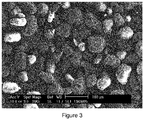
Figure 3 is a scanning electron microscope image of commercially available polyamide 12 powder for selective laser sintering which is prepared by reprecipitation, for comparison with the present invention (Figures 1 and 2 ). - The present invention will be further illustrated by the following specific examples, but it should be understood that the scope of the present invention is not limited thereto.
- In the following examples, the particle size and particle size distribution of the obtained polyolefin resin powders were characterized using a laser particle size analyzer (Mastersizer 2000, Malvern, UK).
- 100 parts by weight of homopolypropylene resin (isotacticity 95%, melt index (210°C, 2.16 kg) 30 g/10 min, solubility parameter 16.7 MPa1/2) and 1000 parts by weight of n-hexane (solubility parameter 14.9 MPa1/2) were placed in an autoclave, and 0.2 parts by weight of calcium oxide was added and mixed. A high-purity nitrogen gas was charged to 0.2 MPa; then the autoclave was heated up to 130°C, and held at this temperature for 60 minutes; thereafter, the autoclave was cooled down to 90°C at a rate of 1.0°C/min with cooling water, and held at this temperature for 60 minutes; further, the autoclave was cooled down to room temperature at a rate of 1.0°C/min. In the resulting solid-liquid mixture, were added 0.25 parts by weight of antioxidant 1010 and 0.25 parts by weight of antioxidant 168 as well as 0.5 parts by weight of calcium stearate, and thereafter the material was subjected to centrifugal separation and vacuum drying to obtain a polypropylene resin powder suitable for selective laser sintering. The particle size and particle size distribution of the obtained polypropylene resin powder were listed in Table 1.
- 100 parts by weight of homopolypropylene resin (isotacticity 97%, melt index (210°C, 2.16 kg) 50 g/10 min, solubility parameter 16.7 MPa1/2) and 800 parts by weight of n-hexane (solubility parameter 14.9 MPa1/2) were placed in an autoclave, and 0.4 parts by weight of calcium oxide was added and mixed. A high-purity nitrogen gas was charged to 0.3 MPa; then the autoclave was heated up to 140°C, and held at this temperature for 30 minutes; thereafter, the autoclave was cooled down to 85°C at a rate of 1.0°C/min with cooling water, and held at this temperature for 60 minutes; further, the autoclave was cooled down to 20°C at a rate of 1.0°C/min, and held at this temperature for 60 minutes. In the resulting solid-liquid mixture, were added 0.25 parts by weight of antioxidant 1010 and 0.25 parts by weight of antioxidant 168 as well as 1 part by weight of zinc stearate, and thereafter the material was subjected to centrifugal separation and vacuum drying to obtain a polypropylene resin powder suitable for selective laser sintering. The particle size and particle size distribution of the obtained polypropylene resin powder were listed in Table 1.
- 100 parts by weight of homopolypropylene resin (isotacticity 96%, melt index (210°C, 2.16 kg) 50 g/10 min, solubility parameter 16.7 MPa1/2) and 1200 parts by weight of n-hexane (solubility parameter 14.9 MPa1/2) were placed in an autoclave, and 0.8 parts by weight of calcium oxide was added and mixed. A high-purity nitrogen gas was charged to 0.1 MPa; then the autoclave was heated up to 120°C, and held at this temperature for 90 minutes; thereafter, the autoclave was cooled down to room temperature at a rate of 0.1°C/min. In the resulting solid-liquid mixture, were added 0.1 parts by weight of antioxidant 1010 and 0.1 parts by weight of antioxidant 168 as well as 0.75 parts by weight of nano-silica, and thereafter the material was subjected to centrifugal separation and vacuum drying to obtain a polypropylene resin powder suitable for selective laser sintering. The particle size and particle size distribution of the obtained polypropylene resin powder were listed in Table 1.
- 100 parts by weight of homopolypropylene resin (isotacticity 96%, melt index (210°C, 2.16 kg) 80 g/10 min, solubility parameter 16.7 MPa1/2) and 1200 parts by weight of n-hexane (solubility parameter 14.9 MPa1/2) were placed in an autoclave, and 0.3 parts by weight of kaolin was added and mixed. A high-purity nitrogen gas was charged to 0.1 MPa; then the autoclave was heated up to 120°C, and held at this temperature for 90 minutes; thereafter, the autoclave was cooled down to 85°C at a rate of 0.5°C/min with cooling water, and held at this temperature for 60 minutes; further, the autoclave was cooled down to room temperature at a rate of 0.1°C/min, and held at this temperature for 60 minutes. In the resulting solid-liquid mixture, were added 0.3 parts by weight of antioxidant 1010 and 0.3 parts by weight of antioxidant 168 as well as 0.9 parts by weight of nano-zinc oxide, and thereafter the material was subjected to centrifugal separation and vacuum drying to obtain a polypropylene resin powder suitable for selective laser sintering. The particle size and particle size distribution of the obtained polypropylene resin powder were listed in Table 1.
- 100 parts by weight of homopolypropylene resin (isotacticity 96%, melt index (210°C, 2.16 kg) 60 g/10 min, solubility parameter 16.7 MPa1/2) and 1000 parts by weight of n-hexane (solubility parameter 14.9 MPa1/2) were placed in an autoclave, and 0.5 parts by weight of kaolin was added and mixed. A high-purity nitrogen gas was charged to 0.3 MPa; then the autoclave was heated up to 140°C, and held at this temperature for 30 minutes; thereafter, the autoclave was cooled down to 30°C at a rate of 0.5°C/min with cooling water, and held at this temperature for 30 minutes. In the resulting solid-liquid mixture, were added 0.2 parts by weight of antioxidant 1010 and 0.2 parts by weight of antioxidant 168 as well as 0.6 parts by weight of nano-calcium carbonate, and thereafter the material was subjected to centrifugal separation and vacuum drying to obtain a polypropylene resin powder suitable for selective laser sintering. The particle size and particle size distribution of the obtained polypropylene resin powder were listed in Table 1.
- 100 parts by weight of homopolypropylene resin (isotacticity 95%, melt index (190°C, 2.16 kg) 40 g/10 min, solubility parameter 16.7 MPa1/2) and 1200 parts by weight of n-heptane (solubility parameter 15.2 MPa1/2) were placed in an autoclave, and 0.9 parts by weight of kaolin was added and mixed. A high-purity nitrogen gas was charged to 0.2 MPa; then the autoclave was heated up to 120°C, and held at this temperature for 90 minutes; thereafter, the autoclave was cooled down to 80°C at a rate of 0.5°C/min with cooling water, and held at this temperature for 90 minutes; further, the autoclave was cooled down to room temperature at a rate of 0.2°C/min. In the resulting solid-liquid mixture, were added 0.15 parts by weight of antioxidant 1010 and 0.15 parts by weight of antioxidant 168 as well as 0.8 parts by weight of sodium stearate, and thereafter the material was subjected to centrifugal separation and vacuum drying to obtain a polypropylene resin powder suitable for selective laser sintering. The particle size and particle size distribution of the obtained polypropylene resin powder were listed in Table 1.
- 100 parts by weight of homopolypropylene resin (isotacticity 95%, melt index (190°C, 2.16 kg) 40 g/10 min, solubility parameter 16.7 MPa1/2) and 1200 parts by weight of cyclohexane (solubility parameter 16.6 MPa1/2) were placed in an autoclave, and 0.2 parts by weight of silica was added and mixed. A high-purity nitrogen gas was charged to 0.2 MPa; then the autoclave was heated up to 120°C, and held at this temperature for 90 minutes; thereafter, the autoclave was cooled down to 80°C at a rate of 0.5°C/min with cooling water, and held at this temperature for 90 minutes; further, the autoclave was cooled down to room temperature at a rate of 0.2°C/min. In the resulting solid-liquid mixture, were added 0.15 parts by weight of antioxidant 1010 and 0.15 parts by weight of antioxidant 168 as well as 0.8 parts by weight of sodium stearate, and thereafter the material was subjected to centrifugal separation and vacuum drying to obtain a polypropylene resin powder suitable for selective laser sintering. The particle size and particle size distribution of the obtained polypropylene resin powder were listed in Table 1.
- 100 parts by weight of homopolypropylene resin (isotacticity 95%, melt index (190°C, 2.16 kg) 40 g/10 min, solubility parameter 16.7 MPa1/2) and 1200 parts by weight of 2,2,3-trimethylbutane (solubility parameter 15.7 MPa1/2) were placed in an autoclave, and 0.3 parts by weight of kaolin was added and mixed. A high-purity nitrogen gas was charged to 0.2 MPa; then the autoclave was heated up to 120°C, and held at this temperature for 90 minutes; thereafter, the autoclave was cooled down to 80°C at a rate of 0.5°C/min with cooling water, and held at this temperature for 90 minutes; further, the autoclave was cooled down to room temperature at a rate of 0.2°C/min. In the resulting solid-liquid mixture, were added 0.15 parts by weight of antioxidant 1010 and 0.15 parts by weight of antioxidant 168 as well as 0.8 parts by weight of sodium stearate, and thereafter the material was subjected to centrifugal separation and vacuum drying to obtain a polypropylene resin powder suitable for selective laser sintering. The particle size and particle size distribution of the obtained polypropylene resin powder were listed in Table 1.
- 100 parts by weight of atactic polypropylene resin (isotacticity 93.9%, melt index (210°C, 2.16 kg) 35 g/10 min, solubility parameter 16.7 MPa1/2) and 1000 parts by weight of n-hexane (solubility parameter 14.9 MPa1/2) were placed in an autoclave, and 0.2 parts by weight of silica was added and mixed. A high-purity nitrogen gas was charged to 0.2 MPa; then the autoclave was heated up to 120°C, and held at this temperature for 60 minutes; thereafter, the autoclave was cooled down to 80°C at a rate of 1.0°C/min with cooling water, and held at this temperature for 60 minutes; further, the autoclave was cooled down to room temperature at a rate of 1.0°C/min. In the resulting solid-liquid mixture, were added 0.25 parts by weight of antioxidant 1010 and 0.25 parts by weight of antioxidant 168 as well as 0.5 parts by weight of calcium stearate, and thereafter the material was subjected to centrifugal separation and vacuum drying to obtain an atactic polypropylene resin powder suitable for selective laser sintering. The particle size and particle size distribution of the obtained polypropylene resin powder were listed in Table 1.
- 100 parts by weight of atactic polypropylene resin (isotacticity 94.1%, melt index (210°C, 2.16 kg) 55 g/10 min, solubility parameter 16.7 MPa1/2) and 800 parts by weight of n-hexane (solubility parameter 14.9 MPa1/2) were placed in an autoclave, and 0.4 parts by weight of silica was added and mixed. A high-purity nitrogen gas was charged to 0.3 MPa; then the autoclave was heated up to 130°C, and held at this temperature for 30 minutes; thereafter, the autoclave was cooled down to 75°C at a rate of 1.0°C/min with cooling water, and held at this temperature for 60 minutes; further, the autoclave was cooled down to 20°C at a rate of 1.0°C/min, and held at this temperature for 60 minutes. In the resulting solid-liquid mixture, were added 0.25 parts by weight of antioxidant 1010 and 0.25 parts by weight of antioxidant 168 as well as 1 part by weight of zinc stearate, and thereafter the material was subjected to centrifugal separation and vacuum drying to obtain an atactic polypropylene resin powder suitable for selective laser sintering. The particle size and particle size distribution of the obtained polypropylene resin powder were listed in Table 1.
- 100 parts by weight of atactic polypropylene resin (isotacticity 92.6%, melt index (210°C, 2.16 kg) 70 g/10 min, solubility parameter 16.7 MPa1/2) and 1200 parts by weight of n-hexane (solubility parameter 14.9 MPa1/2) were placed in an autoclave, and 0.8 parts by weight of silica was added and mixed. A high-purity nitrogen gas was charged to 0.1 MPa; then the autoclave was heated up to 110°C, and held at this temperature for 90 minutes; thereafter, the autoclave was cooled down to room temperature at a rate of 0.1°C/min. In the resulting solid-liquid mixture, were added 0.1 parts by weight of antioxidant 1010 and 0.1 parts by weight of antioxidant 168 as well as 0.75 parts by weight of nano-silica, and thereafter the material was subjected to centrifugal separation and vacuum drying to obtain an atactic polypropylene resin powder suitable for selective laser sintering. The particle size and particle size distribution of the obtained polypropylene resin powder were listed in Table 1.
- 100 parts by weight of atactic polypropylene resin (isotacticity 93.2%, melt index (210°C, 2.16 kg) 60 g/10 min, solubility parameter 16.7 MPa1/2) and 1200 parts by weight of n-hexane (solubility parameter 14.9 MPa1/2) were placed in an autoclave, and 0.3 parts by weight of kaolin was added and mixed. A high-purity nitrogen gas was charged to 0.1 MPa; then the autoclave was heated up to 110°C, and held at this temperature for 90 minutes; thereafter, the autoclave was cooled down to 75°C at a rate of 0.5°C/min with cooling water, and held at this temperature for 60 minutes; further, the autoclave was cooled down to room temperature at a rate of 0.1°C/min, and held at this temperature for 60 minutes. In the resulting solid-liquid mixture, were added 0.3 parts by weight of antioxidant 1010 and 0.3 parts by weight of antioxidant 168 as well as 0.9 parts by weight of nano-zinc oxide, and thereafter the material was subjected to centrifugal separation and vacuum drying to obtain an atactic polypropylene resin powder suitable for selective laser sintering. The particle size and particle size distribution of the obtained polypropylene resin powder were listed in Table 1.
- 100 parts by weight of atactic polypropylene resin (isotacticity 94%, melt index (210°C, 2.16 kg) 65 g/10 min, solubility parameter 16.7 MPa1/2) and 1000 parts by weight of n-hexane (solubility parameter 14.9 MPa1/2) were placed in an autoclave, and 0.5 parts by weight of kaolin was added and mixed. A high-purity nitrogen gas was charged to 0.3 MPa; then the autoclave was heated up to 110°C, and held at this temperature for 30 minutes; thereafter, the autoclave was cooled down to 30°C at a rate of 0.5°C/min with cooling water, and held at this temperature for 30 minutes. In the resulting solid-liquid mixture, were added 0.2 parts by weight of antioxidant 1010 and 0.2 parts by weight of antioxidant 168 as well as 0.6 parts by weight of nano-calcium carbonate, and thereafter the material was subjected to centrifugal separation and vacuum drying to obtain an atactic polypropylene resin powder suitable for selective laser sintering. The particle size and particle size distribution of the obtained polypropylene resin powder were listed in Table 1.
- 100 parts by weight of atactic polypropylene resin (isotacticity 93.5%, melt index (210°C, 2.16 kg) 40 g/10 min, solubility parameter 16.7 MPa1/2) and 1200 parts by weight of n-heptane (solubility parameter 15.2 MPa1/2) were placed in an autoclave, and 0.9 parts by weight of kaolin was added and mixed. A high-purity nitrogen gas was charged to 0.2 MPa; then the autoclave was heated up to 110°C, and held at this temperature for 90 minutes; thereafter, the autoclave was cooled down to 70°C at a rate of 0.5°C/min with cooling water, and held at this temperature for 90 minutes; further, the autoclave was cooled down to room temperature at a rate of 0.2°C/min. In the resulting solid-liquid mixture, were added 0.15 parts by weight of antioxidant 1010 and 0.15 parts by weight of antioxidant 168 as well as 0.8 parts by weight of sodium stearate, and thereafter the material was subjected to centrifugal separation and vacuum drying to obtain an atactic polypropylene resin powder suitable for selective laser sintering. The particle size and particle size distribution of the obtained polypropylene resin powder were listed in Table 1.
- 100 parts by weight of atactic polypropylene resin (isotacticity 93.5%, melt index (210°C, 2.16 kg) 40 g/10 min, solubility parameter 16.7 MPa1/2) and 1200 parts by weight of n-pentane (solubility parameter 14.4 MPa1/2) were placed in an autoclave, and 0.2 parts by weight of silica was added and mixed. A high-purity nitrogen gas was charged to 0.2 MPa; then the autoclave was heated up to 110°C, and held at this temperature for 90 minutes; thereafter, the autoclave was cooled down to 70°C at a rate of 0.5°C/min with cooling water, and held at this temperature for 90 minutes; further, the autoclave was cooled down to room temperature at a rate of 0.2°C/min. In the resulting solid-liquid mixture, were added 0.15 parts by weight of antioxidant 1010 and 0.15 parts by weight of antioxidant 168 as well as 0.8 parts by weight of sodium stearate, and thereafter the material was subjected to centrifugal separation and vacuum drying to obtain an atactic polypropylene resin powder suitable for selective laser sintering. The particle size and particle size distribution of the obtained polypropylene resin powder were listed in Table 1.
- 100 parts by weight of atactic polypropylene resin (isotacticity 93.5%, melt index (210°C, 2.16 kg) 40 g/10 min, solubility parameter 16.7 MPa1/2) and 1200 parts by weight of n-octane (solubility parameter 15.0 MPa1/2) were placed in an autoclave, and 0.3 parts by weight of kaolin was added and mixed. A high-purity nitrogen gas was charged to 0.2 MPa; then the autoclave was heated up to 110°C, and held at this temperature for 90 minutes; thereafter, the autoclave was cooled down to 70°C at a rate of 0.5°C/min with cooling water, and held at this temperature for 90 minutes; further, the autoclave was cooled down to room temperature at a rate of 0.2°C/min. In the resulting solid-liquid mixture, were added 0.15 parts by weight of antioxidant 1010 and 0.15 parts by weight of antioxidant 168 as well as 0.8 parts by weight of sodium stearate, and thereafter the material was subjected to centrifugal separation and vacuum drying to obtain an atactic polypropylene resin powder suitable for selective laser sintering. The particle size and particle size distribution of the obtained polypropylene resin powder were listed in Table 1.
- 100 parts by weight of homopolypropylene resin (isotacticity 95%, melt index (210°C, 2.16 kg) 35 g/10 min, solubility parameter 16.7 MPa1/2) and 1000 parts by weight of n-hexane (solubility parameter 14.9 MPa1/2) were placed in an autoclave, and 0.2 parts by weight of calcium oxide was added and mixed. A high-purity nitrogen gas was charged to 0.2 MPa; then the autoclave was heated up to 130°C, and held at this temperature for 60 minutes; thereafter, the autoclave was cooled down to 90°C at a rate of 1.0°C/min with cooling water, and held at this temperature for 60 minutes; further, the autoclave was cooled down to room temperature at a rate of 1.0°C/min. In the resulting solid-liquid mixture, were added 0.25 parts by weight of antioxidant 1010 and 0.25 parts by weight of antioxidant 168 as well as 0.5 parts by weight of calcium stearate and 0.5 parts by weight of single walled carbon nanotubes, and thereafter the material was subjected to centrifugal separation and vacuum drying to obtain a polypropylene resin powder suitable for selective laser sintering. The particle size and particle size distribution of the obtained polypropylene resin powder were listed in Table 1.
- 100 parts by weight of homopolypropylene resin (isotacticity 96%, melt index (210°C, 2.16 kg) 45 g/10 min, solubility parameter 16.7 MPa1/2) and 1200 parts by weight of n-hexane (solubility parameter 14.9 MPa1/2) were placed in an autoclave, and 0.3 parts by weight of kaolin was added and mixed. A high-purity nitrogen gas was charged to 0.1 MPa; then the autoclave was heated up to 120°C, and held at this temperature for 90 minutes; thereafter, the autoclave was cooled down to room temperature at a rate of 0.1°C/min. In the resulting solid-liquid mixture, were added 0.1 parts by weight of antioxidant 1010 and 0.1 parts by weight of antioxidant 168, 0.75 parts by weight of nano-silica and 0.5 parts by weight of silver-zirconium phosphate antibacterial agent, and thereafter the material was subjected to centrifugal separation and vacuum drying to obtain a polypropylene resin powder suitable for selective laser sintering. The particle size and particle size distribution of the obtained polypropylene resin powder were listed in Table 1.
- 100 parts by weight of atactic polypropylene resin (isotacticity 93.9%, melt index (210°C, 2.16 kg) 35 g/10 min, solubility parameter 16.7 MPa1/2) and 1000 parts by weight of n-hexane (solubility parameter 14.9 MPa1/2) were placed in an autoclave, and 0.2 parts by weight of silica was added and mixed. A high-purity nitrogen gas was charged to 0.2 MPa; then the autoclave was heated up to 120°C, and held at this temperature for 60 minutes; thereafter, the autoclave was cooled down to 80°C at a rate of 1.0°C/min with cooling water, and held at this temperature for 60 minutes; further, the autoclave was cooled down to room temperature at a rate of 1.0°C/min. In the resulting solid-liquid mixture, were added 0.25 parts by weight of antioxidant 1010 and 0.25 parts by weight of antioxidant 168, 0.5 parts by weight of calcium stearate and 25 parts by weight of ultra-short glass fibers with a diameter of 10 µm and a length of 250 µm, and thereafter the material was subjected to centrifugal separation and vacuum drying to obtain an atactic polypropylene resin powder suitable for selective laser sintering. The particle size and particle size distribution of the obtained polypropylene resin powder were listed in Table 1.
- 100 parts by weight of polyethylene resin (density 0.950 g/cm3, melt index (190°C, 2.16 kg) 40 g/10 min, solubility parameter 17.0 MPa1/2) and 1000 parts by weight of n-hexane (solubility parameter 14.9 MPa1/2) were placed in an autoclave. A high-purity nitrogen gas was charged to 0.2 MPa; then the autoclave was heated up to 110°C, and held at this temperature for 60 minutes; thereafter, the autoclave was cooled down to 70°C at a rate of 1.0°C/min with cooling water, and held at this temperature for 60 minutes; further, the autoclave was cooled down to room temperature at a rate of 1.0°C/min. In the resulting solid-liquid mixture, were added 0.25 parts by weight of antioxidant 1010 and 0.25 parts by weight of antioxidant 168 as well as 0.5 parts by weight of calcium stearate, and thereafter the material was subjected to centrifugal separation and vacuum drying to obtain a polyethylene resin powder suitable for selective laser sintering. The particle size and particle size distribution of the obtained polyethylene resin powder were listed in Table 1.
- 100 parts by weight of polyethylene resin (density 0.960 g/cm3, melt index (190°C, 2.16 kg) 60 g/10 min, solubility parameter 17.0 MPa1/2) and 800 parts by weight of n-hexane (solubility parameter 14.9 MPa1/2) were placed in an autoclave. A high-purity nitrogen gas was charged to 0.3 MPa; then the autoclave was heated up to 120°C, and held at this temperature for 30 minutes; thereafter, the autoclave was cooled down to 65°C at a rate of 1.0°C/min with cooling water, and held at this temperature for 60 minutes; further, the autoclave was cooled down to 20°C at a rate of 1.0°C/min, and held at this temperature for 60 minutes. In the resulting solid-liquid mixture, were added 0.25 parts by weight of antioxidant 1010 and 0.25 parts by weight of antioxidant 168 as well as 1 part by weight of zinc stearate, and thereafter the material was subjected to centrifugal separation and vacuum drying to obtain a polyethylene resin powder suitable for selective laser sintering. The particle size and particle size distribution of the obtained polyethylene resin powder were listed in Table 1.
- 100 parts by weight of polyethylene resin (density 0.970 g/cm3, melt index (190°C, 2.16 kg) 50 g/10 min, solubility parameter 17.0 MPa1/2) and 1200 parts by weight of n-hexane (solubility parameter 14.9 MPa1/2) were placed in an autoclave. A high-purity nitrogen gas was charged to 0.1 MPa; then the autoclave was heated up to 100°C, and held at this temperature for 90 minutes; thereafter, the autoclave was cooled down to room temperature at a rate of 0.1°C/min. In the resulting solid-liquid mixture, were added 0.1 parts by weight of antioxidant 1010 and 0.1 parts by weight of antioxidant 168 as well as 0.75 parts by weight of nano-silica and thereafter the material was subjected to centrifugal separation and vacuum drying to obtain a polyethylene resin powder suitable for selective laser sintering. The particle size and particle size distribution of the obtained polyethylene resin powder were listed in Table 1.
- 100 parts by weight of polyethylene resin (density 0.954 g/cm3, melt index (190°C, 2.16 kg) 70 g/10 min, solubility parameter 17.0 MPa1/2) and 1200 parts by weight of n-hexane (solubility parameter 14.9 MPa1/2) were placed in an autoclave. A high-purity nitrogen gas was charged to 0.1 MPa; then the autoclave was heated up to 100°C, and held at this temperature for 90 minutes; thereafter, the autoclave was cooled down to 65°C at a rate of 0.5°C/min with cooling water, and held at this temperature for 60 minutes; further, the autoclave was cooled down to room temperature at a rate of 0.1°C/min and held at this temperature for 60 minutes. In the resulting solid-liquid mixture, were added 0.3 parts by weight of antioxidant 1010 and 0.3 parts by weight of antioxidant 168 as well as 0.9 parts by weight of nano-zinc oxide, and thereafter the material was subjected to centrifugal separation and vacuum drying to obtain a polyethylene resin powder suitable for selective laser sintering. The particle size and particle size distribution of the obtained polyethylene resin powder were listed in Table 1.
- 100 parts by weight of polyethylene resin (density 0.948 g/cm3, melt index (190°C, 2.16 kg) 65 g/10 min, solubility parameter 17.0 MPa1/2) and 1000 parts by weight of n-hexane (solubility parameter 14.9 MPa1/2) were placed in an autoclave. A high-purity nitrogen gas was charged to 0.3 MPa; then the autoclave was heated up to 100°C, and held at this temperature for 30 minutes; thereafter, the autoclave was cooled down to 30°C at a rate of 0.5°C/min with cooling water, and held at this temperature for 30 minutes. In the resulting solid-liquid mixture, were added 0.2 parts by weight of antioxidant 1010 and 0.2 parts by weight of antioxidant 168 as well as 0.6 parts by weight of nano-calcium carbonate, and thereafter the material was subjected to centrifugal separation and vacuum drying to obtain a polyethylene resin powder suitable for selective laser sintering. The particle size and particle size distribution of the obtained polyethylene resin powder were listed in Table 1.
- 100 parts by weight of polyethylene resin (density 0.962 g/cm3, melt index (190°C, 2.16 kg) 40 g/10 min, solubility parameter 17.0 MPa1/2) and 1200 parts by weight of n-heptane (solubility parameter 15.2 MPa1/2) were placed in an autoclave. A high-purity nitrogen gas was charged to 0.2 MPa; then the autoclave was heated up to 100°C, and held at this temperature for 90 minutes; thereafter, the autoclave was cooled down to 60°C at a rate of 0.5°C/min with cooling water, and held at this temperature for 90 minutes; further, the autoclave was cooled down to room temperature at a rate of 0.2°C/min. In the resulting solid-liquid mixture, were added 0.15 parts by weight of antioxidant 1010 and 0.15 parts by weight of antioxidant 168 as well as 0.8 parts by weight of sodium stearate, and thereafter the material was subjected to centrifugal separation and vacuum drying to obtain a polyethylene resin powder suitable for selective laser sintering. The particle size and particle size distribution of the obtained polyethylene resin powder were listed in Table 1.
- 100 parts by weight of polyethylene resin (density 0.950 g/cm3, melt index (190°C, 2.16 kg) 40 g/10 min, solubility parameter 17.0 MPa1/2) and 1000 parts by weight of cyclohexane (solubility parameter 16.6 MPa1/2) were placed in an autoclave. A high-purity nitrogen gas was charged to 0.2 MPa; then the autoclave was heated up to 110°C, and held at this temperature for 60 minutes; thereafter, the autoclave was cooled down to 70°C at a rate of 1.0°C/min with cooling water, and held at this temperature for 60 minutes; further, the autoclave was cooled down to room temperature at a rate of 1.0°C/min. In the resulting solid-liquid mixture, were added 0.25 parts by weight of antioxidant 1010 and 0.25 parts by weight of antioxidant 168 as well as 0.5 parts by weight of calcium stearate, and thereafter the material was subjected to centrifugal separation and vacuum drying to obtain a polyethylene resin powder suitable for selective laser sintering. The particle size and particle size distribution of the obtained polyethylene resin powder were listed in Table 1.
- 100 parts by weight of polyethylene resin (density 0.950 g/cm3, melt index (190°C, 2.16 kg) 40 g/10 min, solubility parameter 17.0 MPa1/2) and 1000 parts by weight of 2,2,3-trimethylbutane (solubility parameter 15.7 MPa1/2) were placed in an autoclave. A high-purity nitrogen gas was charged to 0.2 MPa; then the autoclave was heated up to 110°C, and held at this temperature for 60 minutes; thereafter, the autoclave was cooled down to 70°C at a rate of 1.0°C/min with cooling water, and held at this temperature for 60 minutes; further, the autoclave was cooled down to room temperature at a rate of 1.0°C/min. In the resulting solid-liquid mixture, were added 0.25 parts by weight of antioxidant 1010 and 0.25 parts by weight of antioxidant 168 as well as 0.5 parts by weight of calcium stearate, and thereafter the material was subjected to centrifugal separation and vacuum drying to obtain a polyethylene resin powder suitable for selective laser sintering. The particle size and particle size distribution of the obtained polyethylene resin powder were listed in Table 1.
- 100 parts by weight of polyethylene resin (density 0.930 g/cm3, melt index (190°C, 2.16 kg) 30 g/10 min, solubility parameter 17.0 MPa1/2) and 1000 parts by weight of n-hexane (solubility parameter 14.9 MPa1/2) were placed in an autoclave. A high-purity nitrogen gas was charged to 0.2 MPa; then the autoclave was heated up to 100°C, and held at this temperature for 60 minutes; thereafter, the autoclave was cooled down to 60°C at a rate of 1.0°C/min with cooling water, and held at this temperature for 60 minutes; further, the autoclave was cooled down to room temperature at a rate of 1.0°C/min. In the resulting solid-liquid mixture, were added 0.25 parts by weight of antioxidant 1010 and 0.25 parts by weight of antioxidant 168 as well as 0.5 parts by weight of calcium stearate, and thereafter the material was subjected to centrifugal separation and vacuum drying to obtain a polyethylene resin powder suitable for selective laser sintering. The particle size and particle size distribution of the obtained polyethylene resin powder were listed in Table 1.
- 100 parts by weight of polyethylene resin (density 0.927 g/cm3, melt index (190°C, 2.16 kg) 70 g/10 min, solubility parameter 17.0 MPa1/2) and 800 parts by weight of n-hexane (solubility parameter 14.9 MPa1/2) were placed in an autoclave. A high-purity nitrogen gas was charged to 0.3 MPa; then the autoclave was heated up to 110°C, and held at this temperature for 30 minutes; thereafter, the autoclave was cooled down to 55°C at a rate of 1.0°C/min with cooling water, and held at this temperature for 60 minutes; further, the autoclave was cooled down to 20°C at a rate of 1.0°C/min, and held at this temperature for 60 minutes. In the resulting solid-liquid mixture, were added 0.25 parts by weight of antioxidant 1010 and 0.25 parts by weight of antioxidant 168 as well as 1 part by weight of zinc stearate, and thereafter the material was subjected to centrifugal separation and vacuum drying to obtain a polyethylene resin powder suitable for selective laser sintering. The particle size and particle size distribution of the obtained polyethylene resin powder were listed in Table 1.
- 100 parts by weight of polyethylene resin (density 0.920 g/cm3, melt index (190°C, 2.16 kg) 50 g/10 min, solubility parameter 17.0 MPa1/2) and 1200 parts by weight of n-hexane (solubility parameter 14.9 MPa1/2) were placed in an autoclave. A high-purity nitrogen gas was charged to 0.1 MPa; then the autoclave was heated up to 90°C, and held at this temperature for 90 minutes; thereafter, the autoclave was cooled down to room temperature at a rate of 0.1°C/min. In the resulting solid-liquid mixture, were added 0.1 parts by weight of antioxidant 1010 and 0.1 parts by weight of antioxidant 168 as well as 0.75 parts by weight of nano-silica, and thereafter the material was subjected to centrifugal separation and vacuum drying to obtain a polyethylene resin powder suitable for selective laser sintering. The particle size and particle size distribution of the obtained polyethylene resin powder were listed in Table 1.
- 100 parts by weight of polyethylene resin (density 0.915 g/cm3, melt index (190°C, 2.16 kg) 40 g/10 min, solubility parameter 17.0 MPa1/2) and 1200 parts by weight of n-hexane (solubility parameter 14.9 MPa1/2) were placed in an autoclave. A high-purity nitrogen gas was charged to 0.1 MPa; then the autoclave was heated up to 90°C, and held at this temperature for 90 minutes; thereafter, the autoclave was cooled down to 55°C at a rate of 0.5°C/min with cooling water, and held at this temperature for 60 minutes; further, the autoclave was cooled down to room temperature at a rate of 0.1°C/min, and held at this temperature for 60 minutes. In the resulting solid-liquid mixture, were added 0.3 parts by weight of antioxidant 1010 and 0.3 parts by weight of antioxidant 168 as well as 0.9 parts by weight of nano-zinc oxide, and thereafter the material was subjected to centrifugal separation and vacuum drying to obtain a polyethylene resin powder suitable for selective laser sintering. The particle size and particle size distribution of the obtained polyethylene resin powder were listed in Table 1.
- 100 parts by weight of polyethylene resin (density 0.935 g/cm3, melt index (190°C, 2.16 kg) 60 g/10 min, solubility parameter 17.0 MPa1/2) and 1000 parts by weight of n-hexane (solubility parameter 14.9 MPa1/2) were placed in an autoclave. A high-purity nitrogen gas was charged to 0.3 MPa; then the autoclave was heated up to 90°C, and held at this temperature for 30 minutes; thereafter, the autoclave was cooled down to 30°C at a rate of 0.5°C/min with cooling water, and held at this temperature for 30 minutes. In the resulting solid-liquid mixture, were added 0.2 parts by weight of antioxidant 1010 and 0.2 parts by weight of antioxidant 168 as well as 0.6 parts by weight of nano-calcium carbonate, and thereafter the material was subjected to centrifugal separation and vacuum drying to obtain a polyethylene resin powder suitable for selective laser sintering. The particle size and particle size distribution of the obtained polyethylene resin powder were listed in Table 1.
- 100 parts by weight of polyethylene resin (density 0.924 g/cm3, melt index (190°C, 2.16 kg) 45 g/10 min, solubility parameter 17.0 MPa1/2) and 1200 parts by weight of n-heptane (solubility parameter 15.2 MPa1/2) were placed in an autoclave. A high-purity nitrogen gas was charged to 0.2 MPa; then the autoclave was heated up to 90°C, and held at this temperature for 90 minutes; thereafter, the autoclave was cooled down to 50°C at a rate of 0.5°C/min with cooling water, and held at this temperature for 90 minutes; further, the autoclave was cooled down to room temperature at a rate of 0.2°C/min. In the resulting solid-liquid mixture, were added 0.15 parts by weight of antioxidant 1010 and 0.15 parts by weight of antioxidant 168 as well as 0.8 parts by weight of sodium stearate, and thereafter the material was subjected to centrifugal separation and vacuum drying to obtain a polyethylene resin powder suitable for selective laser sintering. The particle size and particle size distribution of the obtained polyethylene resin powder were listed in Table 1.
- 100 parts by weight of polyethylene resin (density 0.930 g/cm3, melt index (190°C, 2.16 kg) 30 g/10 min, solubility parameter 17.0 MPa1/2) and 1000 parts by weight of n-pentane (solubility parameter 14.4 MPa1/2) were placed in an autoclave. A high-purity nitrogen gas was charged to 0.2 MPa; then the autoclave was heated up to 100°C, and held at this temperature for 60 minutes; thereafter, the autoclave was cooled down to 60°C at a rate of 1.0°C/min with cooling water, and held at this temperature for 60 minutes; further, the autoclave was cooled down to room temperature at a rate of 1.0°C/min. In the resulting solid-liquid mixture, were added 0.25 parts by weight of antioxidant 1010 and 0.25 parts by weight of antioxidant 168 as well as 0.5 parts by weight of calcium stearate, and thereafter the material was subjected to centrifugal separation and vacuum drying to obtain a polyethylene resin powder suitable for selective laser sintering. The particle size and particle size distribution of the obtained polyethylene resin powder were listed in Table 1.
- 100 parts by weight of polyethylene resin (density 0.930 g/cm3, melt index (190°C, 2.16 kg) 30 g/10 min, solubility parameter 17.0 MPa1/2) and 1000 parts by weight of n-octane (solubility parameter 15.4 MPa1/2) were placed in an autoclave. A high-purity nitrogen gas was charged to 0.2 MPa; then the autoclave was heated up to 100°C, and held at this temperature for 60 minutes; thereafter, the autoclave was cooled down to 60°C at a rate of 1.0°C/min with cooling water, and held at this temperature for 60 minutes; further, the autoclave was cooled down to room temperature at a rate of 1.0°C/min. In the resulting solid-liquid mixture, were added 0.25 parts by weight of antioxidant 1010 and 0.25 parts by weight of antioxidant 168 as well as 0.5 parts by weight of calcium stearate, and thereafter the material was subjected to centrifugal separation and vacuum drying to obtain a polyethylene resin powder suitable for selective laser sintering. The particle size and particle size distribution of the obtained polyethylene resin powder were listed in Table 1.
- 100 parts by weight of polyethylene resin (density 0.950 g/cm3, melt index (190°C, 2.16 kg) 35 g/10 min, solubility parameter 17.0 MPa1/2) and 1000 parts by weight of n-hexane (solubility parameter 14.9 MPa1/2) were placed in an autoclave. A high-purity nitrogen gas was charged to 0.2 MPa; then the autoclave was heated up to 110°C, and held at this temperature for 60 minutes; thereafter, the autoclave was cooled down to 70°C at a rate of 1.0°C/min with cooling water, and held at this temperature for 60 minutes; further, the autoclave was cooled down to room temperature at a rate of 1.0°C/min. In the resulting solid-liquid mixture, were added 0.25 parts by weight of antioxidant 1010 and 0.25 parts by weight of antioxidant 168, 0.5 parts by weight of calcium stearate, 2.5 parts by weight of conductive carbon black as well as 0.1 parts by weight of carbon nanotubes, and thereafter the material was subjected to centrifugal separation and vacuum drying to obtain a polyethylene resin powder suitable for selective laser sintering. The particle size and particle size distribution of the obtained polyethylene resin powder were listed in Table 1.
- 100 parts by weight of polyethylene resin (density 0.948 g/cm3, melt index (190°C, 2.16 kg) 60 g/10 min, solubility parameter 17.0 MPa1/2) and 1000 parts by weight of n-hexane (solubility parameter 14.9 MPa1/2) were placed in an autoclave. A high-purity nitrogen gas was charged to 0.3 MPa; then the autoclave was heated up to 100°C, and held at this temperature for 30 minutes; thereafter, the autoclave was cooled down to 30°C at a rate of 0.5°C/min with cooling water, and held at this temperature for 30 minutes. In the resulting solid-liquid mixture, were added 0.2 parts by weight of antioxidant 1010 and 0.2 parts by weight of antioxidant 168, 0.6 parts by weight of nano-calcium carbonate as well as 0.05 parts by weight of zinc pyrithione, and thereafter the material was subjected to centrifugal separation and vacuum drying to obtain a polyethylene resin powder suitable for selective laser sintering. The particle size and particle size distribution of the obtained polyethylene resin powder were listed in Table 1.
- 100 parts by weight of polyethylene resin (density 0.924 g/cm3, melt index (190°C, 2.16 kg) 40 g/10 min, solubility parameter 17.0 MPa1/2) and 1200 parts by weight of n-heptane (solubility parameter 15.2 MPa1/2) were placed in an autoclave. A high-purity nitrogen gas was charged to 0.2 MPa; then the autoclave was heated up to 90°C, and held at this temperature for 90 minutes; thereafter, the autoclave was cooled down to 50°C at a rate of 0.5°C/min with cooling water, and held at this temperature for 90 minutes; further, the autoclave was cooled down to room temperature at a rate of 0.2°C/min. In the resulting solid-liquid mixture, were added 0.15 parts by weight of antioxidant 1010 and 0.15 parts by weight of antioxidant 168, 0.8 parts by weight of sodium stearate as well as 50 parts by weight of ultra-short glass fibers with a diameter of 5 µm and a length of 150 µm, and thereafter the material was subjected to centrifugal separation and vacuum drying to obtain a polyethylene resin powder suitable for selective laser sintering. The particle size and particle size distribution of the obtained polyethylene resin powder were listed in Table 1.
Table 1 Example Particle size (µm) D10 (µm) D50 (µm) D90 (µm) Bulk density (g/cm3) Example 1 35∼120 53 86 105 0.45 Example 2 40∼130 55 94 118 0.41 Example 3 30∼107 47 65 88 0.49 Example 4 35∼130 52 78 108 0.45 Example 5 30∼110 45 71 98 0.52 Example 6 43∼137 55 85 113 0.42 Example 7 45∼132 55 90 108 0.46 Example 8 45∼130 52 81 104 0.44 Example 9 35∼125 52 84 102 0.48 Example 10 40∼120 58 81 97 0.45 Example 11 25∼130 41 61 107 0.55 Example 12 40∼135 55 86 109 0.44 Example 13 30∼150 48 103 138 0.38 Example 14 45∼120 58 80 95 0.42 Example 15 42∼130 58 80 115 0.42 Example 16 45∼127 64 85 115 0.44 Example 17 45∼135 49 84 122 0.43 Example 18 42∼125 56 82 105 0.44 Example 19 40∼130 50 84 108 0.42 Example 20 45∼135 59 90 112 0.44 Example 21 40∼130 55 94 115 0.45 Example 22 30∼127 48 75 101 0.57 Example 23 35∼130 50 89 110 0.50 Example 24 35∼120 49 71 95 0.52 Example 25 40∼130 56 85 106 0.47 Example 26 42∼130 58 80 115 0.44 Example 27 45∼127 64 85 115 0.45 Example 28 35∼115 45 71 92 0.56 Example 29 50∼130 61 91 115 0.40 Example 30 30∼100 46 66 85 0.54 Example 31 35∼120 52 79 100 0.50 Example 32 50∼150 69 97 120 0.37 Example 33 45∼130 67 96 114 0.43 Example 34 45∼132 55 90 108 0.43 Example 35 45∼130 52 81 104 0.46 Example 36 30∼110 46 74 90 0.52 Example 37 50∼130 65 88 115 0.48 Example 38 45∼120 58 85 110 0.41 - Example 1 was repeated except that nucleating agent calcium oxide was not used. Since there was no nucleating agent in this example, molten polypropylene had less nucleating points during crystallization and thus spherulite size was larger. The finally obtained polypropylene powder particles for laser sintering had a larger particle size, ranging from 70 to 150 µm, with D10 = 92 µm, D50 = 113 µm, and D90 = 132 µm. Although the obtained polypropylene resin powder could satisfy the basic requirements of laser sintering process, it had a greater fraction of particles with larger size than that of Example 1.
- Example 1 was repeated except that no antioxidant was used. Since there was no antioxidant in this example, the obtained polypropylene powder tended to be degraded and yellowing upon heating when used for laser sintering. Although the obtained polypropylene resin powder could satisfy the basic requirements of laser sintering process, the mechanical properties of the finished printed product were inadequate compared with Example 1.
- Example 1 was repeated except that no release agent was used. Since there was no release agent in this example, the obtained polypropylene powder tended to agglomerate in a small quantity, and had a slightly poorer flowability compared with Example 1. Although the obtained polypropylene resin powder could satisfy the basic requirements of laser sintering process, the finished printed product had a slightly worse surface smoothness.
- Example 20 was repeated except that no antioxidant was used. Since there was no antioxidant in this embodiment, the obtained polyethylene powder tended to be cross-linked upon heating when used for laser sintering compared with Example 20. Although the obtained polyethylene resin powder could satisfy the basic requirements of laser sintering process, the finished printed product was prone to shrink.
- Example 20 was repeated except that no release agent was used. Since there was no release agent in this example, the obtained polyethylene powder tended to agglomerate in a small quantity, and had a slightly poorer flowability compared with Example 20. Although the obtained polyethylene resin powder could satisfy the basic requirements of laser sintering process, the finished printed product had a slightly worse surface smoothness.
- Example 20 was repeated except that the release agent and the antioxidant were not used. Since there were neither release agent nor antioxidant in this example, the obtained polyethylene powder tended to be cross-linked upon heating when used for laser sintering, and tended to agglomerate in a small quantity, and had a slightly poorer flowability compared with Example 20. Although the obtained polyethylene resin powder could satisfy the basic requirements of laser sintering process, the finished printed product was prone to shrink and had a slightly worse surface smoothness.
- Example 1 was repeated except that xylene solvent (solubility parameter 18.2 MPa1/2) was used instead of n-hexane solvent. Since the xylene solvent used in this comparative example was a good solvent for polypropylene, the polypropylene, after dissolved, had a very slow crystallization rate upon cooling. In the same experimental time as that in Example 1, the particle size of the obtained polypropylene powder particles for laser sintering was too small and the particle size distribution was worse (the particle size ranging from 10 to 55 µm, D10 = 15 µm, D50 = 24 µm, D90 = 49 µm). The obtained polypropylene resin powder could not satisfactorily meet the requirements of laser sintering process.
- Example 1 was repeated except that toluene solvent (solubility parameter 18.4 MPa1/2) was used instead of n-hexane solvent. Since the toluene solvent used in this comparative example was a good solvent for polypropylene, the polypropylene, after dissolved, had a very slow crystallization rate upon cooling. In the same experimental time as that in Example 1, the particle size of the obtained polypropylene powder particles for laser sintering was too small and the particle size distribution was worse (the particle size ranging from 16 to 52 µm, D10 = 25 µm, D50 = 34 µm, D90 = 40 µm). The obtained polypropylene resin powder could not satisfactorily meet the requirements of laser sintering process.
- The above examples and comparative examples illustrate that the polyolefin resin powder obtained according to the method of the present invention has good oxidation resistance, good powder flowability, moderate size, suitable bulk density, well-proportioned particle shape and uniform particle size distribution, which is suitable for selective laser sintering to prepare various molded products. With the selective laser sintering method provided by the present invention, polyolefin molded products having regular shape, smooth surface and good mechanical properties can be prepared.
- Although the present invention has been described in detail, modifications within the spirit and scope of the present invention will be apparent to those skilled in the art. In addition, it should be understood that various aspects of the present invention described herein, various parts of different embodiments, and various features listed may be combined or totally or partially interchanged. In the respective embodiments described above, those embodiments that refer to another specific embodiment can be combined with other embodiments as appropriate, as will be understood by those skilled in the art. Moreover, those skilled in the art will understand that the foregoing description is by way of example only and is not intended to limit the present invention.
Claims (16)
- A method for preparing a polyolefin resin powder, containing the following steps:a) heat dissolving a polyolefin resin in an organic solvent having a solubility parameter less than or equal to the solubility parameter of the polyolefin resin to obtain a polyolefin resin solution;b) cooling the polyolefin resin solution to precipitate a solid, thereby obtaining a solid-liquid mixture;c) optionally adding an adjuvant to the solid-liquid mixture and mixing;d) conducting solid-liquid separation and drying to obtain a polyolefin resin powder suitable for selective laser sintering;wherein the difference between the solubility parameters of the organic solvent and of the polyolefin resin is within 0-20% of the solubility parameter of the polyolefin resin.
- The method according to claim 1, which is characterized in that, in step a), the polyolefin resin is at least one selected from the group consisting of polypropylene and polyethylene resins, preferably at least one selected from the group consisting of homopolypropylene resin and atactic polypropylene resin.
- The method according to claim 1 or 2, which is characterized in that the homopolypropylene resin and the atactic polypropylene resin have a melt index, measured at 210°C and a load of 2.16 kg, of 20-100 g/10 min, preferably 30-80 g/10 min; the polyethylene resin has a melt index, measured at 190°C and a load of 2.16 kg, of 20-100 g/10 min, preferably 30-80 g/10 min.
- The method according to any one of claims 1 to 3, which is characterized in that the organic solvent is used in an amount of 600-1200 parts by weight, preferably 800-1000 parts by weight, based on 100 parts by weight of the polyolefin resin.
- The method according to any one of claims 1 to 4, which is characterized in that the organic solvent is selected from C5-C12 alkanes, preferably C5-C9 alkanes, more preferably at least one selected from the group consisting of n-pentane, isopentane, n-hexane, 2-methylpentane, 3-methylpentane, 2,2-dimethylbutane, 2,3-dimethylbutane, cyclohexane, n-heptane, 2-methylhexane, 3-methylhexane, 2,2-dimethylpentane, 2,3-dimethylpentane, 2,4-dimethylpentane, 3,3-dimethylpentane, 3-ethylpentane, 2,2,3-trimethylbutane, n-octane, and n-nonane, and most preferably n-hexane, n-heptane and/or n-octane.
- The method according to any one of claims 1 to 5, which is characterized in that, in step a), the polyolefin resin is heated to a temperature of 60-200°C, e.g., 70-190°C or 80-160°C; and preferably the polyolefin resin solution is held at the heating temperature for 30-90 minutes.
- The method according to any one of claims 1 to 6, which is characterized in that, in step b), the polyolefin resin solution is cooled down to a target temperature at an average cooling rate of 0.1°C/min to 1°C/min, and is held for 30-90 minutes at the target temperature which is 10-30°C.
- The method according to any one of claims 1 to 7, which is characterized in that, in step b), the polyolefin resin solution is cooled to a target temperature via one or more intermediate temperatures and held for 30-90 minutes at said intermediate temperatures which are in the range of 40-100°C or 50-90°C.
- The method according to any one of claims 1 to 8, which is characterized in that a nucleating agent is added in step a), which is preferably at least one selected from the group consisting of silica, calcium oxide, calcium carbonate, barium sulfate, hydrotalcite, hydrotalcite, carbon black, kaolin and mica.
- The method according to claim 9, which is characterized in that the nucleating agent is used in an amount of 0.01-2 parts by weight, preferably 0.05-1 parts by weight, and more preferably 0.1-0.5 parts by weight, based on 100 parts by weight of the polyolefin resin.
- The method according to any one of claims 1 to 10, which is characterized in that the adjuvant in step c) is selected from antioxidants, powder release agents, antistatic agents, antibacterial agents and/or glass fiber reinforcements, preferably antioxidants and/or powder release agents.
- The method according to claim 11, which is characterized in that the antioxidant is selected from antioxidant 1010 and/or antioxidant 168 which is preferably used in an amount of 0.1-0.5 parts by weight, more preferably 0.2-0.4 parts by weight, based on 100 parts by weight of the polyolefin resin.
- The method according to claim 11, which is characterized in that the powder release agent is at least one selected from an alkali or alkaline earth metal based on alkane monocarboxylic or dimer acids, a nano-oxide and a nano-metal salt, preferably at least one selected from the group consisting of sodium stearate, potassium stearate, zinc stearate, calcium stearate, lead stearate, silica, titanium dioxide, aluminum oxide, zinc oxide, zirconium oxide, calcium carbonate and barium sulfate; and the powder release agent is used in an amount of 0.01-10 parts by weight, preferably 0.1-5 parts by weight, and more preferably 0.5-1 parts by weight, based on 100 parts by weight of the polyolefin resin.
- A polyolefin resin powder prepared by the method according to any one of claims 1 to 13, which is characterized in that the powder particles are spherical and/or spheroidal, and have a particle size of 25-150 µm, and a particle size distribution D10 = 43-69 µm, D50 = 61-103 µm, and D90 = 85-138 µm.
- A selective laser sintering method, in which a polyolefin resin powder prepared by the method according to any one of claims 1 to 13 is used as a powder raw material for sintering.
- Use of a polyolefin resin powder prepared by the method according to any one of claims 1 to 13 in a method of manufacturing a three-dimensional object, in particular a method in which a three-dimensional object is manufactured using selective laser sintering.
Applications Claiming Priority (3)
| Application Number | Priority Date | Filing Date | Title |
|---|---|---|---|
| CN201510665024.3A CN106589418A (en) | 2015-10-13 | 2015-10-13 | Polypropylene resin powder for selective laser sintering as well as preparation method and application thereof |
| CN201510750235.7A CN106674550A (en) | 2015-11-06 | 2015-11-06 | Polyethylene resin powder used for selective laser sintering and preparation method and application thereof |
| PCT/CN2016/079396 WO2017063351A1 (en) | 2015-10-13 | 2016-04-15 | Polyolefin resin powder for selective laser sintering and preparation method therefor |
Publications (3)
| Publication Number | Publication Date |
|---|---|
| EP3363849A1 true EP3363849A1 (en) | 2018-08-22 |
| EP3363849A4 EP3363849A4 (en) | 2019-06-26 |
| EP3363849B1 EP3363849B1 (en) | 2020-04-29 |
Family
ID=58517034
Family Applications (1)
| Application Number | Title | Priority Date | Filing Date |
|---|---|---|---|
| EP16854740.4A Active EP3363849B1 (en) | 2015-10-13 | 2016-04-15 | Polyolefin resin powder for selective laser sintering and preparation method therefor |
Country Status (5)
| Country | Link |
|---|---|
| US (1) | US10920025B2 (en) |
| EP (1) | EP3363849B1 (en) |
| JP (1) | JP6903052B2 (en) |
| ES (1) | ES2794673T3 (en) |
| WO (1) | WO2017063351A1 (en) |
Cited By (4)
| Publication number | Priority date | Publication date | Assignee | Title |
|---|---|---|---|---|
| WO2020049020A3 (en) * | 2018-09-04 | 2020-05-14 | Karl Leibinger Medizintechnik Gmbh & Co. Kg | Laser-sintered filter, method for producing the filter, and method for ensuring fluid flow |
| WO2020164728A1 (en) * | 2019-02-15 | 2020-08-20 | Robert Bosch Gmbh | Particles for selective laser sintering, process of producing the particles and their use |
| DE102020119683A1 (en) | 2020-06-25 | 2021-12-30 | Rehau Ag + Co | Process for manufacturing a component using additive manufacturing |
| RU2816001C1 (en) * | 2022-09-30 | 2024-03-25 | Публичное акционерное общество "СИБУР Холдинг" | Polypropylene composition for producing articles by 3d printing, method for production thereof, use thereof and article made therefrom |
Families Citing this family (18)
| Publication number | Priority date | Publication date | Assignee | Title |
|---|---|---|---|---|
| JP7272276B2 (en) * | 2017-12-15 | 2023-05-12 | 住友電気工業株式会社 | Insulating resin composition, insulating material, insulated wire and cable |
| JP7319276B2 (en) * | 2017-12-22 | 2023-08-01 | ブラスケム アメリカ インコーポレイテッド | Methods of three-dimensional printing and resulting porous structure articles |
| EP3727802B1 (en) * | 2018-03-21 | 2025-12-10 | Peridot Print LLC | Three-dimensional printing |
| US11613646B2 (en) | 2018-03-21 | 2023-03-28 | Hewlett-Packard Development Company, L.P. | Material for three-dimensional printing comprising specific polypropylene block copolymer |
| US11548216B2 (en) | 2018-03-21 | 2023-01-10 | Hewlett-Packard Development Company, L.P. | Three-dimensional printing |
| JP7172134B2 (en) * | 2018-05-23 | 2022-11-16 | コニカミノルタ株式会社 | POWDER MATERIAL AND METHOD FOR MANUFACTURING 3D PRODUCT USING THE SAME |
| CN108659351A (en) * | 2018-06-21 | 2018-10-16 | 安徽鸿森塑业有限公司 | A kind of preparation method of low odor polypropylene master batch |
| JP7279506B2 (en) * | 2019-05-17 | 2023-05-23 | 株式会社リコー | THERMOPLASTIC RESIN POWDER, RESIN POWDER FOR 3D MODELING, 3D PRODUCT MANUFACTURING APPARATUS, AND 3D MODEL MANUFACTURING METHOD |
| JP2020189965A (en) * | 2019-05-17 | 2020-11-26 | 株式会社リコー | Resin powder, resin powder for three-dimensional molding, three-dimensional molding, method for producing three-dimensional molding, and device for producing three-dimensional molding |
| US20200362142A1 (en) * | 2019-05-17 | 2020-11-19 | Akira Saito | Thermoplastic resin powder, resin powder, resin powder for producing three-dimensional object, three-dimensional object, three-dimensional object producing apparatus, and three-dimensional object producing method |
| CN112080042B (en) * | 2019-06-12 | 2022-02-18 | 中国石油化工股份有限公司 | Auxiliary agent composition and preparation method thereof, linear low-density polyethylene composition and preparation method thereof, and polyethylene casting packaging film |
| JP7354433B2 (en) * | 2019-10-11 | 2023-10-02 | エルエックス・ハウシス・リミテッド | Polypropylene particles, this manufacturing method, bipolar plates manufactured using the same, and redox flow batteries containing the same |
| US11731349B2 (en) * | 2020-10-15 | 2023-08-22 | Xerox Corporation | Thermoplastic particulates comprising a carboxylic acid-based sintering aid and additive manufacturing therewith |
| US11975482B2 (en) * | 2020-11-03 | 2024-05-07 | Eos Of North America, Inc. | Pretreated material for laser sintering |
| GB202105587D0 (en) * | 2021-04-19 | 2021-06-02 | Pdr Flow Ltd | 3D printing process |
| CN115678145B (en) * | 2022-09-29 | 2024-02-27 | 神华(北京)新材料科技有限公司 | High fluidity powder materials and preparation methods and applications thereof |
| CN115636959B (en) * | 2022-11-03 | 2025-11-07 | 贵州省材料产业技术研究院 | Spherical polymer powder material for selective laser sintering and preparation method thereof |
| WO2026030699A1 (en) * | 2024-08-02 | 2026-02-05 | Dow Global Technologies Llc | Salts of dimer acid as polymer processing aid for polyethylene |
Family Cites Families (23)
| Publication number | Priority date | Publication date | Assignee | Title |
|---|---|---|---|---|
| FR2265802A1 (en) * | 1974-03-26 | 1975-10-24 | Hercules Inc | |
| DE2635302A1 (en) | 1975-08-06 | 1977-02-17 | Exxon Research Engineering Co | Thermoplastic polymer powder mfr. - by cooling heated polymer soln. under autogenous pressure with moderate stirring |
| JPS6416806A (en) | 1987-07-09 | 1989-01-20 | Japan Synthetic Rubber Co Ltd | Production of polypropylene |
| US5527877A (en) * | 1992-11-23 | 1996-06-18 | Dtm Corporation | Sinterable semi-crystalline powder and near-fully dense article formed therewith |
| DE69602037T2 (en) * | 1995-01-13 | 1999-09-23 | Mitsui Chemicals, Inc. | Syndiotactic polypropylene resin composition |
| US5733497A (en) * | 1995-03-31 | 1998-03-31 | Dtm Corporation | Selective laser sintering with composite plastic material |
| ATE530331T1 (en) * | 2003-05-21 | 2011-11-15 | Z Corp | THERMOPLASTIC POWDER MATERIAL SYSTEM FOR APPEARANCE MODELS OF 3D PRINTING SYSTEMS |
| DE102004024440B4 (en) * | 2004-05-14 | 2020-06-25 | Evonik Operations Gmbh | Polymer powder with polyamide, use in a shaping process and molded body made from this polymer powder |
| JP4846425B2 (en) * | 2005-04-20 | 2011-12-28 | トライアル株式会社 | Microsphere used in powder sintering additive manufacturing method, manufacturing method thereof, powder sintering additive manufacturing method, and manufacturing method thereof |
| CN101138651B (en) | 2007-09-14 | 2012-04-18 | 华中科技大学 | Method of preparing organization bracket performing selectivity laser sintering by using macromolecule microsphere |
| JP2010247348A (en) * | 2009-04-10 | 2010-11-04 | Atect Corp | Method for manufacturing static mixer |
| JP5626952B2 (en) | 2009-10-02 | 2014-11-19 | 東邦チタニウム株式会社 | Method for producing polypropylene fine particles |
| CN102140246A (en) | 2010-12-21 | 2011-08-03 | 湖南华曙高科技有限责任公司 | Method for preparing nylon powder for selective laser sintering |
| CN102399371B (en) | 2011-10-17 | 2015-11-04 | 湖南华曙高科技有限责任公司 | A kind of polyamide powder preparation method for selective laser sintering |
| DE102012205908A1 (en) | 2012-04-11 | 2013-10-17 | Evonik Industries Ag | Polymer powder with adapted melting behavior |
| CN103467823B (en) * | 2013-09-18 | 2016-01-20 | 张兴华 | A kind of preparation method of thermoplastics spheroidal particle |
| CN105849185A (en) * | 2013-11-26 | 2016-08-10 | 科腾聚合物美国有限责任公司 | Laser sintering powder, laser sintering article, and a method of making a laser sintering article |
| CN103992560B (en) * | 2014-04-30 | 2016-08-24 | 中国科学院化学研究所 | A kind of polypropylene heterophasic copolymer resin of high rubber content that can be used for 3D printing and its preparation method and application |
| CN103980608B (en) | 2014-04-30 | 2015-07-08 | 中国科学院化学研究所 | Polypropylene nanocomposite material capable of being used for 3D printing, and preparation method and application thereof |
| CN103980401B (en) | 2014-04-30 | 2016-02-24 | 中国科学院化学研究所 | A kind of nanometer particle/polypropylene random copolymers compound resin and its preparation method and application that can be used for 3D and print |
| CN103951971B (en) | 2014-05-12 | 2016-07-06 | 湖南华曙高科技有限责任公司 | A kind of carbon fiber-reinforced resin dusty material for selective laser sintering |
| CN104031319B (en) * | 2014-06-30 | 2016-08-24 | 广东银禧科技股份有限公司 | The preparation of selective laser sintering polypropylene powder powder material and application process |
| CN104497323B (en) | 2014-12-17 | 2017-02-22 | 湖南华曙高科技有限责任公司 | Preparation method of nylon powder for selective laser sintering |
-
2016
- 2016-04-15 EP EP16854740.4A patent/EP3363849B1/en active Active
- 2016-04-15 JP JP2018519486A patent/JP6903052B2/en active Active
- 2016-04-15 WO PCT/CN2016/079396 patent/WO2017063351A1/en not_active Ceased
- 2016-04-15 US US15/768,429 patent/US10920025B2/en active Active
- 2016-04-15 ES ES16854740T patent/ES2794673T3/en active Active
Cited By (4)
| Publication number | Priority date | Publication date | Assignee | Title |
|---|---|---|---|---|
| WO2020049020A3 (en) * | 2018-09-04 | 2020-05-14 | Karl Leibinger Medizintechnik Gmbh & Co. Kg | Laser-sintered filter, method for producing the filter, and method for ensuring fluid flow |
| WO2020164728A1 (en) * | 2019-02-15 | 2020-08-20 | Robert Bosch Gmbh | Particles for selective laser sintering, process of producing the particles and their use |
| DE102020119683A1 (en) | 2020-06-25 | 2021-12-30 | Rehau Ag + Co | Process for manufacturing a component using additive manufacturing |
| RU2816001C1 (en) * | 2022-09-30 | 2024-03-25 | Публичное акционерное общество "СИБУР Холдинг" | Polypropylene composition for producing articles by 3d printing, method for production thereof, use thereof and article made therefrom |
Also Published As
| Publication number | Publication date |
|---|---|
| US10920025B2 (en) | 2021-02-16 |
| ES2794673T3 (en) | 2020-11-18 |
| EP3363849A4 (en) | 2019-06-26 |
| JP2018534398A (en) | 2018-11-22 |
| US20180355122A1 (en) | 2018-12-13 |
| WO2017063351A1 (en) | 2017-04-20 |
| JP6903052B2 (en) | 2021-07-14 |
| EP3363849B1 (en) | 2020-04-29 |
Similar Documents
| Publication | Publication Date | Title |
|---|---|---|
| EP3363849B1 (en) | Polyolefin resin powder for selective laser sintering and preparation method therefor | |
| US10787546B2 (en) | Aliphatic polyester resin powder suitable for selective laser sintering and its preparation method | |
| CN103980609B (en) | Alloy And Preparation Method and application in a kind of polypropylene containing nanoparticle that can be used for 3D printing | |
| CN105462244B (en) | A preparation method of carbon fiber reinforced nylon composite micropowder for selective laser sintering | |
| CN103980401B (en) | A kind of nanometer particle/polypropylene random copolymers compound resin and its preparation method and application that can be used for 3D and print | |
| JP2016135729A (en) | Boron nitride aggregated particle, and method for producing the same, composition containing the same, and molding containing the same | |
| US20180244890A1 (en) | Thermally conductive composites | |
| CN103946312A (en) | Composites containing conductive nanofillers | |
| CN103980608A (en) | Polypropylene nanocomposite material capable of being used for 3D printing, and preparation method and application thereof | |
| CN111117070A (en) | High-flow flame-retardant PP base material for LFT-D process and low-dielectric low-stress halogen-free flame-retardant polypropylene composite material | |
| KR20210157386A (en) | Method for preparing poly ether ketone ketone and poly ether ketone ketone therefrom | |
| EP3983456B1 (en) | Polypropylene-based particles for additive manufacturing | |
| KR101923465B1 (en) | High strength polymer composite comprising carbon nanotubes | |
| KR101758531B1 (en) | Copper-ferrous alloy powder and method for manufacturing the same | |
| KR101604251B1 (en) | Metal powder havig good fluidity and method for producing the same | |
| CN109181085A (en) | A kind of low-shrink polypropylene thick-walled product reinforced plastics masterbatch and preparation method | |
| US20130230737A1 (en) | Copper nanowire preparation methods and compositions | |
| Yang et al. | Crystallization behaviors and properties of poly (arylene ether nitrile) nanocomposites induced by aluminum oxide and multi-walled carbon nanotubes | |
| CN106674552A (en) | Polyformaldehyde resin powder used for selective laser sintering and preparation and application thereof | |
| CN114213767B (en) | A kind of polypropylene composite material and its preparation method and application | |
| Celebi et al. | Influence of zinc oxide on thermoplastic elastomer‐based composites: Synthesis, processing, structural, and thermal characterization | |
| CN106633543A (en) | Nanometer TiO2-modified polytrifluoroethylene and preparation method thereof | |
| WO2024083686A1 (en) | Electrically conductive polymer composition, process for preparation and moulding, and articles made thereof | |
| KR100436401B1 (en) | Manufacturing method of high heat-resistance dispersion strengthened aluminum alloys | |
| CN113004622A (en) | Polypropylene powder for selective laser sintering 3D printing and preparation method thereof |
Legal Events
| Date | Code | Title | Description |
|---|---|---|---|
| STAA | Information on the status of an ep patent application or granted ep patent |
Free format text: STATUS: THE INTERNATIONAL PUBLICATION HAS BEEN MADE |
|
| PUAI | Public reference made under article 153(3) epc to a published international application that has entered the european phase |
Free format text: ORIGINAL CODE: 0009012 |
|
| STAA | Information on the status of an ep patent application or granted ep patent |
Free format text: STATUS: REQUEST FOR EXAMINATION WAS MADE |
|
| 17P | Request for examination filed |
Effective date: 20180426 |
|
| AK | Designated contracting states |
Kind code of ref document: A1 Designated state(s): AL AT BE BG CH CY CZ DE DK EE ES FI FR GB GR HR HU IE IS IT LI LT LU LV MC MK MT NL NO PL PT RO RS SE SI SK SM TR |
|
| AX | Request for extension of the european patent |
Extension state: BA ME |
|
| DAV | Request for validation of the european patent (deleted) | ||
| DAX | Request for extension of the european patent (deleted) | ||
| A4 | Supplementary search report drawn up and despatched |
Effective date: 20190527 |
|
| RIC1 | Information provided on ipc code assigned before grant |
Ipc: C08K 3/34 20060101ALI20190521BHEP Ipc: C08K 3/36 20060101ALI20190521BHEP Ipc: B29K 105/00 20060101ALI20190521BHEP Ipc: C08K 3/22 20060101ALI20190521BHEP Ipc: C08F 6/12 20060101ALI20190521BHEP Ipc: B22F 3/105 20060101ALI20190521BHEP Ipc: C08F 110/02 20060101ALI20190521BHEP Ipc: B29K 23/00 20060101ALI20190521BHEP Ipc: C08L 23/12 20060101ALI20190521BHEP Ipc: B29B 13/02 20060101ALI20190521BHEP Ipc: B33Y 70/00 20150101ALI20190521BHEP Ipc: C08F 110/06 20060101ALI20190521BHEP Ipc: C08J 3/14 20060101AFI20190521BHEP |
|
| REG | Reference to a national code |
Ref country code: DE Ref legal event code: R079 Ref document number: 602016035378 Country of ref document: DE Free format text: PREVIOUS MAIN CLASS: C08J0003140000 Ipc: C08F0006120000 |
|
| GRAP | Despatch of communication of intention to grant a patent |
Free format text: ORIGINAL CODE: EPIDOSNIGR1 |
|
| STAA | Information on the status of an ep patent application or granted ep patent |
Free format text: STATUS: GRANT OF PATENT IS INTENDED |
|
| RIC1 | Information provided on ipc code assigned before grant |
Ipc: C08K 3/22 20060101ALI20200114BHEP Ipc: B29B 13/06 20060101ALI20200114BHEP Ipc: C08J 3/14 20060101ALI20200114BHEP Ipc: B29B 13/04 20060101ALI20200114BHEP Ipc: C08F 6/12 20060101AFI20200114BHEP Ipc: B29B 9/12 20060101ALI20200114BHEP Ipc: B29K 23/00 20060101ALI20200114BHEP Ipc: B22F 1/00 20060101ALI20200114BHEP Ipc: C08F 110/06 20060101ALI20200114BHEP Ipc: B29B 9/10 20060101ALI20200114BHEP Ipc: C08K 3/34 20060101ALI20200114BHEP Ipc: B22F 3/105 20060101ALI20200114BHEP Ipc: B33Y 70/00 20200101ALI20200114BHEP Ipc: B29B 13/02 20060101ALI20200114BHEP Ipc: C08F 110/02 20060101ALI20200114BHEP Ipc: C08L 23/12 20060101ALI20200114BHEP Ipc: B29B 13/00 20060101ALI20200114BHEP Ipc: C08K 3/36 20060101ALI20200114BHEP Ipc: B29K 105/00 20060101ALI20200114BHEP |
|
| INTG | Intention to grant announced |
Effective date: 20200205 |
|
| GRAS | Grant fee paid |
Free format text: ORIGINAL CODE: EPIDOSNIGR3 |
|
| GRAA | (expected) grant |
Free format text: ORIGINAL CODE: 0009210 |
|
| STAA | Information on the status of an ep patent application or granted ep patent |
Free format text: STATUS: THE PATENT HAS BEEN GRANTED |
|
| AK | Designated contracting states |
Kind code of ref document: B1 Designated state(s): AL AT BE BG CH CY CZ DE DK EE ES FI FR GB GR HR HU IE IS IT LI LT LU LV MC MK MT NL NO PL PT RO RS SE SI SK SM TR |
|
| REG | Reference to a national code |
Ref country code: GB Ref legal event code: FG4D |
|
| REG | Reference to a national code |
Ref country code: CH Ref legal event code: EP |
|
| REG | Reference to a national code |
Ref country code: AT Ref legal event code: REF Ref document number: 1263163 Country of ref document: AT Kind code of ref document: T Effective date: 20200515 |
|
| REG | Reference to a national code |
Ref country code: DE Ref legal event code: R096 Ref document number: 602016035378 Country of ref document: DE |
|
| REG | Reference to a national code |
Ref country code: IE Ref legal event code: FG4D |
|
| REG | Reference to a national code |
Ref country code: CH Ref legal event code: NV Representative=s name: VALIPAT S.A. C/O BOVARD SA NEUCHATEL, CH |
|
| REG | Reference to a national code |
Ref country code: NL Ref legal event code: FP |
|
| REG | Reference to a national code |
Ref country code: SE Ref legal event code: TRGR |
|
| REG | Reference to a national code |
Ref country code: LT Ref legal event code: MG4D |
|
| PG25 | Lapsed in a contracting state [announced via postgrant information from national office to epo] |
Ref country code: GR Free format text: LAPSE BECAUSE OF FAILURE TO SUBMIT A TRANSLATION OF THE DESCRIPTION OR TO PAY THE FEE WITHIN THE PRESCRIBED TIME-LIMIT Effective date: 20200730 Ref country code: PT Free format text: LAPSE BECAUSE OF FAILURE TO SUBMIT A TRANSLATION OF THE DESCRIPTION OR TO PAY THE FEE WITHIN THE PRESCRIBED TIME-LIMIT Effective date: 20200831 Ref country code: IS Free format text: LAPSE BECAUSE OF FAILURE TO SUBMIT A TRANSLATION OF THE DESCRIPTION OR TO PAY THE FEE WITHIN THE PRESCRIBED TIME-LIMIT Effective date: 20200829 Ref country code: FI Free format text: LAPSE BECAUSE OF FAILURE TO SUBMIT A TRANSLATION OF THE DESCRIPTION OR TO PAY THE FEE WITHIN THE PRESCRIBED TIME-LIMIT Effective date: 20200429 Ref country code: NO Free format text: LAPSE BECAUSE OF FAILURE TO SUBMIT A TRANSLATION OF THE DESCRIPTION OR TO PAY THE FEE WITHIN THE PRESCRIBED TIME-LIMIT Effective date: 20200729 Ref country code: LT Free format text: LAPSE BECAUSE OF FAILURE TO SUBMIT A TRANSLATION OF THE DESCRIPTION OR TO PAY THE FEE WITHIN THE PRESCRIBED TIME-LIMIT Effective date: 20200429 |
|
| REG | Reference to a national code |
Ref country code: ES Ref legal event code: FG2A Ref document number: 2794673 Country of ref document: ES Kind code of ref document: T3 Effective date: 20201118 |
|
| PG25 | Lapsed in a contracting state [announced via postgrant information from national office to epo] |
Ref country code: RS Free format text: LAPSE BECAUSE OF FAILURE TO SUBMIT A TRANSLATION OF THE DESCRIPTION OR TO PAY THE FEE WITHIN THE PRESCRIBED TIME-LIMIT Effective date: 20200429 Ref country code: LV Free format text: LAPSE BECAUSE OF FAILURE TO SUBMIT A TRANSLATION OF THE DESCRIPTION OR TO PAY THE FEE WITHIN THE PRESCRIBED TIME-LIMIT Effective date: 20200429 Ref country code: BG Free format text: LAPSE BECAUSE OF FAILURE TO SUBMIT A TRANSLATION OF THE DESCRIPTION OR TO PAY THE FEE WITHIN THE PRESCRIBED TIME-LIMIT Effective date: 20200729 Ref country code: HR Free format text: LAPSE BECAUSE OF FAILURE TO SUBMIT A TRANSLATION OF THE DESCRIPTION OR TO PAY THE FEE WITHIN THE PRESCRIBED TIME-LIMIT Effective date: 20200429 |
|
| PG25 | Lapsed in a contracting state [announced via postgrant information from national office to epo] |
Ref country code: AL Free format text: LAPSE BECAUSE OF FAILURE TO SUBMIT A TRANSLATION OF THE DESCRIPTION OR TO PAY THE FEE WITHIN THE PRESCRIBED TIME-LIMIT Effective date: 20200429 |
|
| PG25 | Lapsed in a contracting state [announced via postgrant information from national office to epo] |
Ref country code: RO Free format text: LAPSE BECAUSE OF FAILURE TO SUBMIT A TRANSLATION OF THE DESCRIPTION OR TO PAY THE FEE WITHIN THE PRESCRIBED TIME-LIMIT Effective date: 20200429 Ref country code: EE Free format text: LAPSE BECAUSE OF FAILURE TO SUBMIT A TRANSLATION OF THE DESCRIPTION OR TO PAY THE FEE WITHIN THE PRESCRIBED TIME-LIMIT Effective date: 20200429 Ref country code: SM Free format text: LAPSE BECAUSE OF FAILURE TO SUBMIT A TRANSLATION OF THE DESCRIPTION OR TO PAY THE FEE WITHIN THE PRESCRIBED TIME-LIMIT Effective date: 20200429 Ref country code: DK Free format text: LAPSE BECAUSE OF FAILURE TO SUBMIT A TRANSLATION OF THE DESCRIPTION OR TO PAY THE FEE WITHIN THE PRESCRIBED TIME-LIMIT Effective date: 20200429 Ref country code: CZ Free format text: LAPSE BECAUSE OF FAILURE TO SUBMIT A TRANSLATION OF THE DESCRIPTION OR TO PAY THE FEE WITHIN THE PRESCRIBED TIME-LIMIT Effective date: 20200429 |
|
| REG | Reference to a national code |
Ref country code: DE Ref legal event code: R097 Ref document number: 602016035378 Country of ref document: DE |
|
| PG25 | Lapsed in a contracting state [announced via postgrant information from national office to epo] |
Ref country code: SK Free format text: LAPSE BECAUSE OF FAILURE TO SUBMIT A TRANSLATION OF THE DESCRIPTION OR TO PAY THE FEE WITHIN THE PRESCRIBED TIME-LIMIT Effective date: 20200429 Ref country code: PL Free format text: LAPSE BECAUSE OF FAILURE TO SUBMIT A TRANSLATION OF THE DESCRIPTION OR TO PAY THE FEE WITHIN THE PRESCRIBED TIME-LIMIT Effective date: 20200429 |
|
| PLBE | No opposition filed within time limit |
Free format text: ORIGINAL CODE: 0009261 |
|
| STAA | Information on the status of an ep patent application or granted ep patent |
Free format text: STATUS: NO OPPOSITION FILED WITHIN TIME LIMIT |
|
| 26N | No opposition filed |
Effective date: 20210201 |
|
| REG | Reference to a national code |
Ref country code: AT Ref legal event code: UEP Ref document number: 1263163 Country of ref document: AT Kind code of ref document: T Effective date: 20200429 |
|
| PG25 | Lapsed in a contracting state [announced via postgrant information from national office to epo] |
Ref country code: SI Free format text: LAPSE BECAUSE OF FAILURE TO SUBMIT A TRANSLATION OF THE DESCRIPTION OR TO PAY THE FEE WITHIN THE PRESCRIBED TIME-LIMIT Effective date: 20200429 |
|
| PG25 | Lapsed in a contracting state [announced via postgrant information from national office to epo] |
Ref country code: MC Free format text: LAPSE BECAUSE OF FAILURE TO SUBMIT A TRANSLATION OF THE DESCRIPTION OR TO PAY THE FEE WITHIN THE PRESCRIBED TIME-LIMIT Effective date: 20200429 |
|
| PG25 | Lapsed in a contracting state [announced via postgrant information from national office to epo] |
Ref country code: LU Free format text: LAPSE BECAUSE OF NON-PAYMENT OF DUE FEES Effective date: 20210415 |
|
| PG25 | Lapsed in a contracting state [announced via postgrant information from national office to epo] |
Ref country code: IE Free format text: LAPSE BECAUSE OF NON-PAYMENT OF DUE FEES Effective date: 20210415 |
|
| P01 | Opt-out of the competence of the unified patent court (upc) registered |
Effective date: 20230502 |
|
| PG25 | Lapsed in a contracting state [announced via postgrant information from national office to epo] |
Ref country code: CY Free format text: LAPSE BECAUSE OF FAILURE TO SUBMIT A TRANSLATION OF THE DESCRIPTION OR TO PAY THE FEE WITHIN THE PRESCRIBED TIME-LIMIT Effective date: 20200429 |
|
| PG25 | Lapsed in a contracting state [announced via postgrant information from national office to epo] |
Ref country code: HU Free format text: LAPSE BECAUSE OF FAILURE TO SUBMIT A TRANSLATION OF THE DESCRIPTION OR TO PAY THE FEE WITHIN THE PRESCRIBED TIME-LIMIT; INVALID AB INITIO Effective date: 20160415 |
|
| PG25 | Lapsed in a contracting state [announced via postgrant information from national office to epo] |
Ref country code: MK Free format text: LAPSE BECAUSE OF FAILURE TO SUBMIT A TRANSLATION OF THE DESCRIPTION OR TO PAY THE FEE WITHIN THE PRESCRIBED TIME-LIMIT Effective date: 20200429 |
|
| PG25 | Lapsed in a contracting state [announced via postgrant information from national office to epo] |
Ref country code: TR Free format text: LAPSE BECAUSE OF FAILURE TO SUBMIT A TRANSLATION OF THE DESCRIPTION OR TO PAY THE FEE WITHIN THE PRESCRIBED TIME-LIMIT Effective date: 20200429 |
|
| PG25 | Lapsed in a contracting state [announced via postgrant information from national office to epo] |
Ref country code: MT Free format text: LAPSE BECAUSE OF FAILURE TO SUBMIT A TRANSLATION OF THE DESCRIPTION OR TO PAY THE FEE WITHIN THE PRESCRIBED TIME-LIMIT Effective date: 20200429 |
|
| PGFP | Annual fee paid to national office [announced via postgrant information from national office to epo] |
Ref country code: SE Payment date: 20260327 Year of fee payment: 11 |
|
| PGFP | Annual fee paid to national office [announced via postgrant information from national office to epo] |
Ref country code: GB Payment date: 20260323 Year of fee payment: 11 |
|
| PGFP | Annual fee paid to national office [announced via postgrant information from national office to epo] |
Ref country code: BE Payment date: 20260323 Year of fee payment: 11 |
|
| PGFP | Annual fee paid to national office [announced via postgrant information from national office to epo] |
Ref country code: NL Payment date: 20260327 Year of fee payment: 11 |
|
| PGFP | Annual fee paid to national office [announced via postgrant information from national office to epo] |
Ref country code: FR Payment date: 20260323 Year of fee payment: 11 |
|
| REG | Reference to a national code |
Ref country code: CH Ref legal event code: U11 Free format text: ST27 STATUS EVENT CODE: U-0-0-U10-U11 (AS PROVIDED BY THE NATIONAL OFFICE) Effective date: 20260501 |
|
| PGFP | Annual fee paid to national office [announced via postgrant information from national office to epo] |
Ref country code: ES Payment date: 20260518 Year of fee payment: 11 |
|
| PGFP | Annual fee paid to national office [announced via postgrant information from national office to epo] |
Ref country code: IT Payment date: 20260326 Year of fee payment: 11 |
|
| PGFP | Annual fee paid to national office [announced via postgrant information from national office to epo] |
Ref country code: DE Payment date: 20260320 Year of fee payment: 11 |
|
| PGFP | Annual fee paid to national office [announced via postgrant information from national office to epo] |
Ref country code: AT Payment date: 20260325 Year of fee payment: 11 |
|
| PGFP | Annual fee paid to national office [announced via postgrant information from national office to epo] |
Ref country code: CH Payment date: 20260501 Year of fee payment: 11 |