EP3357990A1 - Adhesive - Google Patents
Adhesive Download PDFInfo
- Publication number
- EP3357990A1 EP3357990A1 EP16851753.0A EP16851753A EP3357990A1 EP 3357990 A1 EP3357990 A1 EP 3357990A1 EP 16851753 A EP16851753 A EP 16851753A EP 3357990 A1 EP3357990 A1 EP 3357990A1
- Authority
- EP
- European Patent Office
- Prior art keywords
- mol
- reactive diluent
- adhesive
- weight
- modified polyvinyl
- Prior art date
- Legal status (The legal status is an assumption and is not a legal conclusion. Google has not performed a legal analysis and makes no representation as to the accuracy of the status listed.)
- Granted
Links
Images
Classifications
-
- C—CHEMISTRY; METALLURGY
- C09—DYES; PAINTS; POLISHES; NATURAL RESINS; ADHESIVES; COMPOSITIONS NOT OTHERWISE PROVIDED FOR; APPLICATIONS OF MATERIALS NOT OTHERWISE PROVIDED FOR
- C09J—ADHESIVES; NON-MECHANICAL ASPECTS OF ADHESIVE PROCESSES IN GENERAL; ADHESIVE PROCESSES NOT PROVIDED FOR ELSEWHERE; USE OF MATERIALS AS ADHESIVES
- C09J129/00—Adhesives based on homopolymers or copolymers of compounds having one or more unsaturated aliphatic radicals, each having only one carbon-to-carbon double bond, and at least one being terminated by an alcohol, ether, aldehydo, ketonic, acetal, or ketal radical; Adhesives based on hydrolysed polymers of esters of unsaturated alcohols with saturated carboxylic acids; Adhesives based on derivatives of such polymers
- C09J129/14—Homopolymers or copolymers of acetals or ketals obtained by polymerisation of unsaturated acetals or ketals or by after-treatment of polymers of unsaturated alcohols
-
- C—CHEMISTRY; METALLURGY
- C08—ORGANIC MACROMOLECULAR COMPOUNDS; THEIR PREPARATION OR CHEMICAL WORKING-UP; COMPOSITIONS BASED THEREON
- C08F—MACROMOLECULAR COMPOUNDS OBTAINED BY REACTIONS ONLY INVOLVING CARBON-TO-CARBON UNSATURATED BONDS
- C08F16/00—Homopolymers and copolymers of compounds having one or more unsaturated aliphatic radicals, each having only one carbon-to-carbon double bond, and at least one being terminated by an alcohol, ether, aldehydo, ketonic, acetal or ketal radical
- C08F16/38—Homopolymers and copolymers of compounds having one or more unsaturated aliphatic radicals, each having only one carbon-to-carbon double bond, and at least one being terminated by an alcohol, ether, aldehydo, ketonic, acetal or ketal radical by an acetal or ketal radical
-
- C—CHEMISTRY; METALLURGY
- C08—ORGANIC MACROMOLECULAR COMPOUNDS; THEIR PREPARATION OR CHEMICAL WORKING-UP; COMPOSITIONS BASED THEREON
- C08F—MACROMOLECULAR COMPOUNDS OBTAINED BY REACTIONS ONLY INVOLVING CARBON-TO-CARBON UNSATURATED BONDS
- C08F2/00—Processes of polymerisation
- C08F2/44—Polymerisation in the presence of compounding ingredients, e.g. plasticisers, dyestuffs, fillers
-
- C—CHEMISTRY; METALLURGY
- C08—ORGANIC MACROMOLECULAR COMPOUNDS; THEIR PREPARATION OR CHEMICAL WORKING-UP; COMPOSITIONS BASED THEREON
- C08F—MACROMOLECULAR COMPOUNDS OBTAINED BY REACTIONS ONLY INVOLVING CARBON-TO-CARBON UNSATURATED BONDS
- C08F8/00—Chemical modification by after-treatment
- C08F8/28—Condensation with aldehydes or ketones
-
- C—CHEMISTRY; METALLURGY
- C08—ORGANIC MACROMOLECULAR COMPOUNDS; THEIR PREPARATION OR CHEMICAL WORKING-UP; COMPOSITIONS BASED THEREON
- C08F—MACROMOLECULAR COMPOUNDS OBTAINED BY REACTIONS ONLY INVOLVING CARBON-TO-CARBON UNSATURATED BONDS
- C08F8/00—Chemical modification by after-treatment
- C08F8/48—Isomerisation; Cyclisation
-
- C—CHEMISTRY; METALLURGY
- C08—ORGANIC MACROMOLECULAR COMPOUNDS; THEIR PREPARATION OR CHEMICAL WORKING-UP; COMPOSITIONS BASED THEREON
- C08J—WORKING-UP; GENERAL PROCESSES OF COMPOUNDING; AFTER-TREATMENT NOT COVERED BY SUBCLASSES C08B, C08C, C08F, C08G or C08H
- C08J3/00—Processes of treating or compounding macromolecular substances
- C08J3/24—Crosslinking, e.g. vulcanising, of macromolecules
-
- C—CHEMISTRY; METALLURGY
- C09—DYES; PAINTS; POLISHES; NATURAL RESINS; ADHESIVES; COMPOSITIONS NOT OTHERWISE PROVIDED FOR; APPLICATIONS OF MATERIALS NOT OTHERWISE PROVIDED FOR
- C09J—ADHESIVES; NON-MECHANICAL ASPECTS OF ADHESIVE PROCESSES IN GENERAL; ADHESIVE PROCESSES NOT PROVIDED FOR ELSEWHERE; USE OF MATERIALS AS ADHESIVES
- C09J11/00—Features of adhesives not provided for in group C09J9/00, e.g. additives
- C09J11/02—Non-macromolecular additives
- C09J11/06—Non-macromolecular additives organic
-
- C—CHEMISTRY; METALLURGY
- C09—DYES; PAINTS; POLISHES; NATURAL RESINS; ADHESIVES; COMPOSITIONS NOT OTHERWISE PROVIDED FOR; APPLICATIONS OF MATERIALS NOT OTHERWISE PROVIDED FOR
- C09J—ADHESIVES; NON-MECHANICAL ASPECTS OF ADHESIVE PROCESSES IN GENERAL; ADHESIVE PROCESSES NOT PROVIDED FOR ELSEWHERE; USE OF MATERIALS AS ADHESIVES
- C09J133/00—Adhesives based on homopolymers or copolymers of compounds having one or more unsaturated aliphatic radicals, each having only one carbon-to-carbon double bond, and at least one being terminated by only one carboxyl radical, or of salts, anhydrides, esters, amides, imides, or nitriles thereof; Adhesives based on derivatives of such polymers
- C09J133/04—Homopolymers or copolymers of esters
- C09J133/06—Homopolymers or copolymers of esters of esters containing only carbon, hydrogen and oxygen, the oxygen atom being present only as part of the carboxyl radical
- C09J133/10—Homopolymers or copolymers of methacrylic acid esters
- C09J133/12—Homopolymers or copolymers of methyl methacrylate
-
- C—CHEMISTRY; METALLURGY
- C09—DYES; PAINTS; POLISHES; NATURAL RESINS; ADHESIVES; COMPOSITIONS NOT OTHERWISE PROVIDED FOR; APPLICATIONS OF MATERIALS NOT OTHERWISE PROVIDED FOR
- C09J—ADHESIVES; NON-MECHANICAL ASPECTS OF ADHESIVE PROCESSES IN GENERAL; ADHESIVE PROCESSES NOT PROVIDED FOR ELSEWHERE; USE OF MATERIALS AS ADHESIVES
- C09J163/00—Adhesives based on epoxy resins; Adhesives based on derivatives of epoxy resins
-
- C—CHEMISTRY; METALLURGY
- C09—DYES; PAINTS; POLISHES; NATURAL RESINS; ADHESIVES; COMPOSITIONS NOT OTHERWISE PROVIDED FOR; APPLICATIONS OF MATERIALS NOT OTHERWISE PROVIDED FOR
- C09J—ADHESIVES; NON-MECHANICAL ASPECTS OF ADHESIVE PROCESSES IN GENERAL; ADHESIVE PROCESSES NOT PROVIDED FOR ELSEWHERE; USE OF MATERIALS AS ADHESIVES
- C09J4/00—Adhesives based on organic non-macromolecular compounds having at least one polymerisable carbon-to-carbon unsaturated bond ; adhesives, based on monomers of macromolecular compounds of groups C09J183/00 - C09J183/16
- C09J4/06—Organic non-macromolecular compounds having at least one polymerisable carbon-to-carbon unsaturated bond in combination with a macromolecular compound other than an unsaturated polymer of groups C09J159/00 - C09J187/00
-
- C—CHEMISTRY; METALLURGY
- C08—ORGANIC MACROMOLECULAR COMPOUNDS; THEIR PREPARATION OR CHEMICAL WORKING-UP; COMPOSITIONS BASED THEREON
- C08F—MACROMOLECULAR COMPOUNDS OBTAINED BY REACTIONS ONLY INVOLVING CARBON-TO-CARBON UNSATURATED BONDS
- C08F216/00—Copolymers of compounds having one or more unsaturated aliphatic radicals, each having only one carbon-to-carbon double bond, and at least one being terminated by an alcohol, ether, aldehydo, ketonic, acetal or ketal radical
- C08F216/02—Copolymers of compounds having one or more unsaturated aliphatic radicals, each having only one carbon-to-carbon double bond, and at least one being terminated by an alcohol, ether, aldehydo, ketonic, acetal or ketal radical by an alcohol radical
- C08F216/04—Acyclic compounds
- C08F216/06—Polyvinyl alcohol ; Vinyl alcohol
-
- C—CHEMISTRY; METALLURGY
- C08—ORGANIC MACROMOLECULAR COMPOUNDS; THEIR PREPARATION OR CHEMICAL WORKING-UP; COMPOSITIONS BASED THEREON
- C08F—MACROMOLECULAR COMPOUNDS OBTAINED BY REACTIONS ONLY INVOLVING CARBON-TO-CARBON UNSATURATED BONDS
- C08F216/00—Copolymers of compounds having one or more unsaturated aliphatic radicals, each having only one carbon-to-carbon double bond, and at least one being terminated by an alcohol, ether, aldehydo, ketonic, acetal or ketal radical
- C08F216/38—Copolymers of compounds having one or more unsaturated aliphatic radicals, each having only one carbon-to-carbon double bond, and at least one being terminated by an alcohol, ether, aldehydo, ketonic, acetal or ketal radical by an acetal or ketal radical
-
- C—CHEMISTRY; METALLURGY
- C08—ORGANIC MACROMOLECULAR COMPOUNDS; THEIR PREPARATION OR CHEMICAL WORKING-UP; COMPOSITIONS BASED THEREON
- C08F—MACROMOLECULAR COMPOUNDS OBTAINED BY REACTIONS ONLY INVOLVING CARBON-TO-CARBON UNSATURATED BONDS
- C08F2810/00—Chemical modification of a polymer
- C08F2810/20—Chemical modification of a polymer leading to a crosslinking, either explicitly or inherently
-
- C—CHEMISTRY; METALLURGY
- C08—ORGANIC MACROMOLECULAR COMPOUNDS; THEIR PREPARATION OR CHEMICAL WORKING-UP; COMPOSITIONS BASED THEREON
- C08J—WORKING-UP; GENERAL PROCESSES OF COMPOUNDING; AFTER-TREATMENT NOT COVERED BY SUBCLASSES C08B, C08C, C08F, C08G or C08H
- C08J2329/00—Characterised by the use of homopolymers or copolymers of compounds having one or more unsaturated aliphatic radicals, each having only one carbon-to-carbon double bond, and at least one being terminated by an alcohol, ether, aldehydo, ketonic, acetal, or ketal radical; Hydrolysed polymers of esters of unsaturated alcohols with saturated carboxylic acids; Derivatives of such polymer
- C08J2329/14—Homopolymers or copolymers of acetals or ketals obtained by polymerisation of unsaturated acetals or ketals or by after-treatment of polymers of unsaturated alcohols
Definitions
- the present invention relates to an adhesive that has excellent adhesiveness to both organic materials (particularly, polycarbonate, acrylic, and nylon) and inorganic materials, is capable of exhibiting excellent transparency and toughness, and also has excellent handleability.
- Polyvinyl acetal is a resin synthesized from polyvinyl alcohol as a raw material.
- Polyvinyl acetal has excellent adhesiveness to inorganic materials such as glass and metal because of the presence of the acetyl group, hydroxy group, and acetal group in the side chains, and also exhibits excellent transparency and toughness. Additionally, the resin physical properties of polyvinyl acetal can be changed by changing the ratio of the side chain groups. Owing to these characteristics, polyvinyl acetal is used in a wide range of applications, including interlayer films for automotive laminated glass and ceramic green sheets.
- polyvinyl acetal disadvantageously has poor handleability as an adhesive, as it is solid at a normal temperature of around 23°C and needs to be heated and softened for adhesion.
- polyvinyl acetal in the form of a solution in an organic solvent has been considered. However, this requires a step of removing the organic solvent, and some of the organic solvent may disadvantageously remain even after the removing step.
- Patent Literature 1 JP H07-331187 A
- the present invention aims to provide an adhesive that has excellent adhesiveness to both organic materials (particularly, polycarbonate, acrylic, and nylon) and inorganic materials, is capable of exhibiting excellent transparency and toughness, and also has excellent handleability.
- the present invention includes an adhesive containing a modified polyvinyl acetal having an imine structure, a reactive diluent, and a polymerization initiator.
- the present inventors made intensive studies to find out that an adhesive containing a modified polyvinyl acetal having an imine structure together with a reactive diluent and a polymerization initiator can be in a liquid (sol) state at normal temperature (23°C) and thus have excellent handleability, and that reacting the reactive diluent to cause crosslinking and curing reactions allows the adhesive to exhibit excellent adhesiveness to both organic materials and inorganic materials.
- the inventors thus completed the present invention. It is to be noted that the reactive diluent after the reaction is less likely to bleed out.
- the adhesive of the present invention contains a modified polyvinyl acetal having an imine structure.
- modified polyvinyl acetal having an imine structure contains a constitutional unit having an imine structure. Combining such a modified polyvinyl acetal with a reactive diluent and a polymerization initiator allows the adhesive of the present invention to exhibit excellent adhesiveness to both organic materials and inorganic materials.
- constitutional unit having an imine structure examples include a constitutional unit represented by Formula (1) below.
- R 1 represents a single bond or an alkylene group and R 2 represents a group having an imine structure.
- R 1 when R 1 is an alkylene group, the lower limit of the carbon number of the alkylene group is preferably 1 and the upper limit thereof is preferably 12. When the carbon number of the alkylene group is greater than 12, optimal strength may not be achieved. When R 1 is an alkylene group, the upper limit of the carbon number of the alkylene group is more preferably 5.
- R 1 when R 1 is an alkylene group, examples of the alkylene group include linear alkylene groups such as methylene, dimethylene (ethylene), trimethylene (n-propylene), tetramethylene (n-butylene), pentamethylene, hexamethylene, octamethylene, and decamethylene groups, branched alkylene groups such as methylmethylene, methylethylene, 1-methylpentylene, and 1,4-dimethylbutylene groups, and cyclic alkylene groups such as cyclopropylene, cyclobutylene, and cyclohexylene groups.
- linear alkyl groups such as methylene, dimethylene (ethylene), trimethylene (n-propylene), and tetramethylene (n-butylene) groups are preferred, and methylene and dimethylene (ethylene) groups are more preferred.
- R 2 examples include a functional group represented by Formula (2) below.
- R 3 represents a hydrogen atom or a C1-C18 hydrocarbon group and R 4 represents a C1-C18 hydrocarbon group.
- hydrocarbon group examples include saturated hydrocarbon groups, unsaturated hydrocarbon groups, and aromatic hydrocarbon groups.
- the hydrocarbon group may consist only of a saturated hydrocarbon group, an unsaturated hydrocarbon group, or an aromatic hydrocarbon group, or may include two or more thereof.
- saturated hydrocarbon groups include methyl, ethyl, n-propyl, isopropyl, n-butyl, iso-butyl, sec-butyl, tert-butyl, pentyl, hexyl, heptyl, 2-ethylhexyl, octyl, nonyl, decyl, undecyl, dodecyl, tridecyl, tetradecyl, pentadecyl, and octadecyl groups.
- methyl, ethyl, and n-propyl groups are preferred.
- aromatic hydrocarbon groups examples include phenyl, toluyl, xylyl, t-butylphenyl, and benzyl groups.
- R 1 is a single bond
- R 3 is a hydrogen atom
- R 4 is a methyl or ethyl group.
- the lower limit of the amount of the constitutional unit having an imine structure is preferably 0.1 mol% and the upper limit thereof is preferably 20 mol%.
- the adhesive can exhibit sufficient adhesiveness to both organic materials and inorganic materials.
- the modified polyvinyl acetal can be easily produced by acetalization described later.
- the lower limit of the amount of the constitutional unit having an imine structure is more preferably 1.0 mol% and the upper limit thereof is more preferably 15 mol%.
- the modified polyvinyl acetal may further contain a constitutional unit having an amino group or an amide structure.
- the presence of the amino group or the amide structure enables formation of a crosslinking structure between the modified polyvinyl acetal with the reactive diluent.
- the amino group or the amide structure is preferably in the side chain.
- the amino group or the amide structure may be directly bonded to carbon constituting the main chain of the modified polyvinyl acetal or bonded via a linking group such as an alkylene group.
- the amino group may be a primary amine or a secondary amine.
- the amino group is preferably -NH 2 .
- the constitutional unit having an amino group preferably has a structure represented by Formula (3) below.
- the constitutional unit having an amide group preferably has a structure represented by Formula (4) below.
- R 5 represents a hydrogen atom or a C1-C10 hydrocarbon group.
- hydrocarbon group examples include alkyl, alkenyl, cycloalkyl, and cycloalkenyl groups.
- the lower limit of the amount of the constitutional unit having an amino group or an amide structure is preferably 0.1 mol% and the upper limit thereof is preferably 20 mol%.
- the amount of the constitutional unit having an amino group or an amide structure is within this range, desired effects can be achieved.
- the lower limit of the amount of the constitutional unit having an amino group or an amide structure is more preferably 0.5 mol%, and the upper limit thereof is more preferably 10 mol%.
- the degree of acetalization of the modified polyvinyl acetal is not limited.
- the lower limit thereof is preferably 60 mol% and the upper limit thereof is preferably 90 mol%.
- the modified polyvinyl acetal has excellent compatibility with the reactive diluent, and the resulting adhesive can have excellent handleability.
- the modified polyvinyl acetal can be easily precipitated in the synthesis process by a precipitation method.
- the lower limit of the degree of acetalization is more preferably 65 mol% and the upper limit thereof is more preferably 85 mol%.
- the degree of acetalization of the modified polyvinyl acetal is a value in percentage of the mole fraction (mol%) obtained by dividing the amount of ethylene groups to which acetal groups are bonded by the total amount of ethylene groups of the main chain.
- the degree of acetalization can be determined by measuring the acetyl group content and the vinyl alcohol content (content rate of hydroxy groups) by the method in conformity with JIS K6728 "Testing methods for polyvinyl butyral", calculating the mole fractions based on the measurement results, and subtracting the acetyl group content and the vinyl alcohol content from 100 mol%.
- the hydroxy group content of the modified polyvinyl acetal is not limited.
- the lower limit thereof is preferably 15 mol% and the upper limit thereof is preferably 35 mol%. When the hydroxy group content is within this range, higher adhesiveness can be exhibited.
- the lower limit of the hydroxy group content is more preferably 17 mol% and the upper limit thereof is more preferably 25 mol%.
- the hydroxy group content of the modified polyvinyl acetal is a value in percentage of the mole fraction (mol%) obtained by dividing the amount of ethylene groups to which hydroxy groups are bonded by the total amount of ethylene groups of the main chain.
- the amount of ethylene groups to which hydroxy groups are bonded can be determined, for example, by the method in conformity with JIS K6728 "Testing methods for polyvinyl butyral".
- the acetyl group content of the modified polyvinyl acetal is not limited.
- the lower limit thereof is preferably 0.0001 mol% and the upper limit thereof is preferably 15 mol%.
- the lower limit of the acetyl group content is more preferably 0.01 mol% and the upper limit thereof is more preferably 10 mol%.
- the lower limit is still more preferably 0.1 mol% and the upper limit is still more preferably 5 mol%.
- the acetyl group content of the modified polyvinyl acetal is a value in percentage of the mole fraction (mol%) obtained by subtracting the amount of ethylene groups to which acetal groups are bonded and the amount of ethylene groups to which hydroxy groups are bonded from the total amount of ethylene groups of the main chain and then dividing the obtained value by the total amount of ethylene groups of the main chain.
- the amount of ethylene groups to which acetal groups are bonded can be determined, for example, in conformity with JIS K6728 "Testing methods for polyvinyl butyral".
- the degree of polymerization of the modified polyvinyl acetal is not limited.
- the lower limit thereof is preferably 100 and the upper limit thereof is preferably 4,500.
- the lower limit of the degree of polymerization is more preferably 150 and the upper limit thereof is more preferably 4,000.
- the modified polyvinyl acetal may be prepared by, for example, a method including copolymerizing a monomer having the imine structure and vinyl acetate to give polyvinyl acetate, saponifying the polyvinyl acetate to give polyvinyl alcohol, and acetalizing the polyvinyl alcohol by a conventionally known method.
- the modified polyvinyl acetal may be prepared by a method including acetalizing polyvinyl alcohol containing a constitutional unit having an amino group or an amide structure by a conventionally known method to introduce an imine structure.
- the modified polyvinyl acetal may be prepared by a method including modifying polyvinyl alcohol containing a constitutional unit having an amino group or an amide structure to give modified polyvinyl alcohol having an imine structure and acetalizing the modified polyvinyl alcohol by a conventionally known method.
- unmodified polyvinyl acetal may be modified to introduce an imine structure.
- Preferred among these is a method including acetalizing polyvinyl alcohol containing a constitutional unit having an amino group or an amide structure by a conventionally known method to introduce an imine structure.
- the imine structure can be easily introduced by adding excess amounts of an aldehyde and an acid catalyst for acetalization.
- the constitutional unit having an amino group or an amide structure and the constitutional unit having an imine structure can be confirmed by, for example, checking the spectrum of the amino group (around 1600 cm -1 ) by FT-IR or the spectrum of the imine structure (160 to 170 ppm) by 13 C-NMR.
- the acetalization may be conducted by a known method. Preferably, it is conducted in an aqueous solvent, a mixed solvent containing water and an organic solvent compatible with water, or an organic solvent.
- organic solvent compatible with water examples include alcohol organic solvents.
- organic solvent examples include alcohol organic solvents such as methanol, ethanol, n-propanol, isopropanol, n-butanol, and tert-butanol, aromatic organic solvents such as xylene, toluene, ethylbenzene, and methyl benzoate, aliphatic ester solvents such as methyl acetate, ethyl acetate, butyl acetate, methyl propionate, ethyl propionate, methyl butyrate, ethyl butyrate, methyl acetoacetate, and ethyl acetoacetate, ketone solvents such as acetone, methyl ethyl ketone, methyl isobutyl ketone, cyclohexanone, methylcyclohexanone, benzophenone, and acetophenone, lower paraffin solvents such as hexane, pentane, octane, a
- solvents may be used alone, or two or more solvents may be used in combination. Particularly preferred among these are ethanol, n-propanol, isopropanol, and tetrahydrofuran from the viewpoint of resin solubility and ease in purification.
- the acetalization is preferably conducted in the presence of an acid catalyst.
- Any acid catalyst may be used.
- Examples thereof include hydrogen halides such as hydrochloric acid, mineral acids such as nitric acid, sulfuric acid, and phosphoric acid, carboxylic acids such as formic acid, acetic acid, and propionic acid, and sulfonic acids such as methanesulfonic acid, ethanesulfonic acid, benzenesulfonic acid, and paratoluenesulfonic acid.
- These acid catalysts may be used alone, or two or more of the compounds may be used in combination.
- hydrochloric acid, nitric acid, and sulfuric acid are preferred, with hydrochloric acid being particularly preferred.
- an imine structure can be easily introduced by adding the acid catalyst in an amount of 1.0% by weight or more of the total amount, for example.
- the aldehyde to be used for acetalization may be an aldehyde having a C1-C10 acyclic aliphatic group, a C1-C10 cycloaliphatic group, or a C1-C10 aromatic group, for example. These aldehydes may be conventionally known aldehydes.
- the aldehyde to be used for acetalization reaction is not limited.
- Examples thereof include aliphatic aldehydes such as formaldehyde, acetaldehyde, propionaldehyde, n-butyraldehyde, isobutyraldehyde, n-valeraldehyde, n-hexylaldehyde, 2-ethylbutyraldehyde, 2-ethylhexylaldehyde, n-heptylaldehyde, n-octylaldehyde, n-nonylaldehyde, and n-decylaldehyde and aromatic aldehydes such as benzaldehyde, cinnamaldehyde, 2-methylbenzaldehyde, 3-methylbenzaldehyde, 4-methylbenzaldehyde, p-hydroxybenzaldehyde, m-hydroxybenzaldehyde, phenylacetaldehyde, and ⁇ -phenyl
- aldehydes may be used alone or in combination of two or more thereof.
- Preferred among the aldehydes are butyraldehyde, 2-ethylhexylaldehyde, and n-nonylaldehyde, which are excellent in acetalization reactivity and have a sufficient internal plasticizing effect on the resulting resin to give good flexibility thereto.
- Butyraldehyde is more preferred.
- the amount of the aldehyde to be added can be appropriately determined according to the target degree of acetalization of the modified polyvinyl acetal.
- the amount of the aldehyde relative to 100 mol% of the polyvinyl alcohol is 60 to 95 mol%, preferably 70 to 90 mol%, advantageously the acetalization reaction is efficiently performed and unreacted aldehyde is easily removed.
- the adhesive of the present invention contains a reactive diluent.
- the reactive diluent as used herein means an agent which is compatible with the modified polyvinyl acetal and capable of turning the polyvinyl acetal into a liquid (sol), and whose molecules react with each other to be crosslinked and cured.
- Examples of the reactive diluent include (meth)acrylic reactive diluents such as (meth)acrylic monomers and (meth)acrylic oligomers, and epoxy reactive diluents such as epoxy monomers and epoxy oligomers. These reactive diluents may be used alone or in combination of two or more thereof.
- the (meth)acrylic monomer used may be a monofunctional, bifunctional, or tri- or higher functional (meth)acrylic monomer.
- Examples of the monofunctional (meth)acrylic monomer include methyl (meth)acrylate, ethyl (meth)acrylate, propyl (meth)acrylate, butyl (meth)acrylate, 2-hydroxyethyl (meth)acrylate, diethylene glycol monoethyl ether (meth)acrylate, isobornyl (meth)acrylate, 3-methoxybutyl (meth)acrylate, 2-acryloyloxyethyl-2-hydroxypropyl phthalate, and 2-methacryloyloxyethyl-2-hydroxylpropyl phthalate.
- bifunctional (meth)acrylic monomer examples include ethylene glycol di(meth)acrylate, diethylene glycol di(meth)acrylate, tetraethylene glycol di(meth)acrylate, 1,6-hexanediol dimethacrylate, 1,9-nonanediol diacrylate, polytetramethylene glycol di(meth)acrylate, neopentyl glycol di(meth)acrylate, 1,3-butylene glycol di(meth)acrylate, and 2,2-bis[4-(methacryloxyethoxy)phenyl]propane di(meth)acrylate.
- tri- or higher functional (meth)acrylic monomer examples include trimethylolpropane triacrylate, pentaerythritol triacrylate, pentaerythritol trimethacrylate, pentaerythritol tetramethacrylate, dipentaerythritol pentaacrylate, dipentaerythritol hexaacrylate, tri(2-acryloyloxy ethyl)phosphate, tetramethyrolmethane tri(meth)acrylate, tetramethylol propane tetra(meth)acrylate, triallyl isocyanurate, and derivatives thereof.
- the above (meth)acrylic monomers may be used alone or in combination of two or more thereof.
- (meth)acrylic monomers as they are particularly excellent in compatibility with the modified polyvinyl acetal. More specifically, preferred are methyl (meth)acrylate, ethyl (meth)acrylate, propyl (meth)acrylate, butyl (meth)acrylate, 2-hydroxyethyl (meth)acrylate, glycidyl (meth)acrylate, and urethane (meth)acrylate.
- Examples of the (meth)acrylic oligomers include those including a plurality of the (meth)acrylic monomers bonded to each other.
- a (meth)acrylic oligomer prepared from the acrylic monomer because such an oligomer is particularly excellent in compatibility with the polyvinyl acetal.
- epoxy monomers examples include: glycidyl ester epoxy monomers of bisphenol A type, bisphenol F type, bisphenol AD type, bromine-containing bisphenol A type, phenol novolac type, cresol novolac type, polyphenol type, linear aliphatic type, butadiene type, urethane type and the like; aliphatic glycidyl ester epoxy monomers such as glycidyl hexahydrophthalate, dimer glycidyl ester, aromatic type, cycloaliphatic type and like epoxy monomers; methyl-substituted epoxy monomers of bisphenol type, ester type, high-molecular-weight ether ester type, ether ester type, brominated type, novolac type, and the like; heterocyclic epoxy monomers; glycidyl amine epoxy monomers such as triglycidyl isocyanurate and tetraglycidyl diaminodiphenyl methane; linear aliphatic epoxy
- Examples of the epoxy oligomers include those including a plurality of the epoxy monomers bonded to each other. Preferred among these are epoxy oligomers prepared from the epoxy monomers.
- the amount of the reactive diluent in the adhesive of the present invention is not limited.
- the lower limit thereof is preferably 60 parts by weight relative to 100 parts by weight of the modified polyvinyl acetal and the upper limit thereof is preferably 5,000 parts by weight.
- the lower limit of the amount of the reactive diluent is more preferably 70 parts by weight and the upper limit thereof is more preferably 3,000 parts by weight.
- the lower limit is still more preferably 80 parts by weight and the upper limit is still more preferably 2,000 parts by weight.
- the lower limit is further preferably 90 parts by weight and the upper limit is further preferably 1,500 parts by weight.
- the upper limit is particularly preferably 1,000 parts by weight.
- the upper limit is most preferably 300 parts by weight.
- the polymerization initiator may be appropriately selected according to the type of the reactive diluent and the type of the trigger for crosslinking and curing of the reactive diluent.
- a thermal polymerization initiator is used, and when light is selected as the trigger, a photopolymerization initiator is used.
- examples of usable polymerization initiators include: thermal polymerization initiators such as monoacylphosphine oxide compounds including 2,6-dimethylbenzoyldiphenylphosphine oxide, 2,4,6-trimethylbenzoyldiphenylphosphine oxide, 2,6-dichlorobenzoyldiphenylphosphine oxide, and 2,6-dimethoxybenzoyldiphenylphosphine oxide, bisacylphosphine oxide compounds including bis(2,6-dimethoxybenzoyl)-2,4,4-trimethylpentylphosphine oxide, bis(2,6-dimethylbenzoyl)-2,4,4-trimethylpentylphosphine oxide, bis(2,6-dimethylbenzoyl)-2,4,4-trimethylpentylphosphine oxide, bis(2,4,6-trimethylbenzoyl)
- examples of usable polymerization initiators include: thermal polymerization initiators such as imidazoles, quaternary ammonium salts, phosphorous compounds, amines, phosphines, phosphonium salts, bicyclic amidines and salts thereof, acid anhydrides, novolac phenolic resins obtainable by condensation reaction of phenol, cresol, xylenol, resorcin, or the like with formaldehyde, polymercapto resins such as liquid polymercaptan and polysulfide, and amides; and photopolymerization initiators containing a compound containing a combination of a cation such as diphenyliodonium, 4-methoxydiphenyliodonium, bis(4-methylphenyl)iodonium, bis(4-tert-butylphenyl)iodonium, bis(dodecylpheny
- thermal polymerization initiators such as imidazoles, quaternary am
- These polymerization initiators may be used alone or in combination of two or more thereof.
- the amount of the polymerization initiator in the adhesive of the present invention is not limited.
- the lower limit of the amount of the polymerization initiator relative to 100 parts by weight of the reactive diluent is preferably 0.01 parts by weight and the upper limit thereof is preferably 10 parts by weight.
- the lower limit is more preferably 0.1 parts by weight and the upper limit is more preferably 5 parts by weight.
- the lower limit relative to 100 parts by weight of the reactive diluent is preferably 1 part by weight and the upper limit is preferably 300 parts by weight.
- the lower limit is more preferably 10 parts by weight and the upper limit is more preferably 150 parts by weight.
- the amount of the polymerization initiator is within this range, the reactive diluent can sufficiently react, so that the adhesive exhibit high adhesiveness to organic materials and inorganic materials. In addition, the polymerization initiator remaining after the reaction is less likely to bleed out.
- the adhesive of the present invention may further contain a plasticizer.
- the plasticizer is not limited, and may be a conventionally known plasticizer used with polyvinyl acetal.
- the plasticizer include organic acid ester plasticizers such as monobasic organic acid esters and polybasic organic acid esters, and phosphoric acid plasticizers such as organophosphate plasticizers and organophosphite plasticizers. Preferred among these are organic acid ester plasticizers. These plasticizers may be used alone or in combination of two or more thereof.
- the plasticizer is preferably a liquid plasticizer.
- the monobasic organic acid ester is not particularly limited, and examples thereof include glycol esters obtainable by reaction between a monobasic organic acid (e.g., butyric acid, isobutyric acid, caproic acid, 2-ethylbutyric acid, heptanoic acid, n-octylic acid, 2-ethylhexylic acid, pelargonic acid (n-nonylic acid), decylic acid) and a glycol (e.g., triethylene glycol, tetraethylene glycol, tripropylene glycol).
- a monobasic organic acid e.g., butyric acid, isobutyric acid, caproic acid, 2-ethylbutyric acid, heptanoic acid, n-octylic acid, 2-ethylhexylic acid, pelargonic acid (n-nonylic acid), decylic acid
- a glycol e.g., triethylene glycol,
- the polybasic organic acid ester is not particularly limited, and examples thereof include ester compounds obtainable by reaction between a polybasic organic acid (e.g., adipic acid, sebacic acid, azelaic acid) and a C4-C8 linear or branched alcohol.
- a polybasic organic acid e.g., adipic acid, sebacic acid, azelaic acid
- C4-C8 linear or branched alcohol e.g., adipic acid, sebacic acid, azelaic acid
- the organic acid ester plasticizer is preferably a diester plasticizer represented by the following formula.
- the use of the diester plasticizer improves filling properties when the adhesive of the present invention is used for bonding and filling between a touch panel and another component or between transparent conductive films included in a touch panel in production of a personal digital assistant, for example.
- R 6 and R 7 each represent a C5-C10 (preferably C6-C10) organic group
- R 8 represents an ethylene, isopropylene, or n-propylene group
- p represents an integer of 3 to 10.
- organic acid ester plasticizer examples include triethylene glycol-di-2-ethylbutyrate, triethylene glycol-di-2-ethylhexanoate, triethylene glycol dicaprylate, triethylene glycol-di-n-octanoate, triethylene glycol-di-n-heptanoate, tetraethylene glycol-di-n-heptanoate, tetraethylene glycol-di-2-ethylhexanoate, dibutyl sebacate, dioctyl azelate, dibutyl carbitol adipate, ethylene glycol-di-2-ethyl butyrate, 1,3-propylene glycol-di-2-ethyl butyrate, 1,4-butylene glycol-di-2-ethylbutyrate, diethylene glycol-di-2-ethylbutyrate, diethylene glycol-di-2-ethylhexano
- the organophosphate plasticizers are not particularly limited, and examples thereof include tributoxyethyl phosphate, isodecylphenyl phosphate, and triisopropyl phosphate.
- plasticizers preferred is at least one selected from the group consisting of dihexyl adipate (DHA), triethylene glycol-di-2-ethylhexanoate (3GO), tetraethylene glycol-di-2-ethylhexanoate (4GO), triethylene glycol-di-2-ethylbutyrate (3GH), tetraethylene glycol-di-2-ethylbutyrate (4GH), tetraethylene glycol-di-n-heptanoate (4G7), and triethylene glycol-di-n-heptanoate (3G7).
- DHA dihexyl adipate
- 3GO triethylene glycol-di-2-ethylhexanoate
- 4GO tetraethylene glycol-di-2-ethylhexanoate
- 4GH triethylene glycol-di-2-ethylbutyrate
- 4GH tetraethylene glycol-di-2-eth
- triethylene glycol-di-2-ethyl butyrate (3GH) triethylene glycol-di-n-heptanoate (3G7)
- triethylene glycol-di-2-ethylhexanoate (3GO) triethylene glycol-di-2-ethylhexanoate
- the adhesive of the present invention may contain known additives such as adhesion modifiers, tackifiers, emulsifiers, softeners, microparticles, fillers, pigments, dyes, silane coupling agents, antioxidants, surfactants, and waxes, if necessary.
- the lower limit of the viscosity at 25°C of the adhesive of the present invention as measured in conformity with JIS Z 8803:2011 with a rotational digital viscometer is preferably 10 mPa ⁇ s and the upper limit thereof is preferably 20 Pa ⁇ s.
- a rotational digital viscometer e.g., Brookfield Engineering Laboratories, Inc., model "DV-II+Pro”
- the lower limit of the viscosity at 25°C is more preferably 0.1 Pa ⁇ s and the upper limit thereof is more preferably 10 Pa ⁇ s.
- the reactive diluent can be reacted to be crosslinked and cured.
- the adhesive in bonding can be in a liquid (sol) state at room temperature to exhibit high handleability, and reacting the reactive diluent to cause crosslink and curing reactions allows the adhesive to exhibit high adhesiveness to organic materials and inorganic materials.
- the reaction of the reactive diluent to cause crosslinking and curing reactions can prevent the reactive diluent from bleeding out.
- any method may be used to react the reactive diluent to cause crosslinking and curing reactions.
- the trigger is heat, a method including heating may be used.
- the trigger is light, a method including irradiation with light using an ultraviolet light irradiation device such as an ultra-high pressure mercury lamp may be used.
- the temperature in heating and the wavelength and illuminance in irradiation with light may be appropriately determined according to factors such as the types of the reactive diluent and polymerization initiator.
- the adhesive of the present invention may be produced by any method.
- the adhesive may be produced by a method including mixing the modified polyvinyl acetal, the reactive diluent, the polymerization initiator, and if necessary, additives.
- the present invention provides an adhesive that has excellent adhesiveness to both organic materials (particularly, polycarbonate, acrylic, and nylon) and inorganic materials, is capable of exhibiting excellent transparency and toughness, and also has excellent handleability.
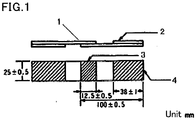
- Fig. 1 is a schematic view illustrating a specimen used for testing the tensile lap-shear strength of adhesive in examples.
- Polyvinyl alcohol (240 g) with a degree of polymerization of 600, a degree of saponification of 99 mol%, and 1.7 mol% of a constitutional unit having an amino group (-NH 2 ) represented by Formula (3) above was added to 1,800 g of pure water. The mixture was stirred at 90°C for about two hours to dissolve the polyvinyl alcohol. The solution was cooled to 40°C, followed by the addition of 170 g of 35% by weight hydrochloric acid and 275 g of n-butyraldehyde. The solution temperature was maintained at 40°C to allow acetalization reaction to proceed, whereby the reaction product was precipitated.
- the obtained modified polyvinyl butyral 1 was dissolved into dimethyl sulfoxide (DMSO-d 6 ) and analyzed by 13 C-NMR (nuclear magnetic resonance) spectroscopy.
- the analysis showed that the degree of butyralization was 77.5 mol%, the hydroxy group content was 20.0 mol%, the acetyl group content was 0.4 mol%, and the amount of the constitutional unit having an imine structure represented by Formula (5) below (R 3 is hydrogen and R 4 is an n-butyl group) was 1.7 mol%.
- Polyvinyl alcohol 250 g with a degree of polymerization of 600, a degree of saponification of 99 mol%, and 8.3 mol% of a constitutional unit having an amino group (-NH 2 ) represented by Formula (3) above was added to 1,800 g of pure water. The mixture was stirred at 90°C for about two hours to dissolve the polyvinyl alcohol. The solution was cooled to 40°C, followed by the addition of 170 g of 35% by weight hydrochloric acid and 150 g of n-butyraldehyde. The solution temperature was maintained at 40°C to allow acetalization reaction to proceed, whereby the reaction product was precipitated.
- the obtained modified polyvinyl butyral 2 was dissolved into dimethylsulfoxide (DMSO-d 6 ) and analyzed by 13 C-NMR (nuclear magnetic resonance) spectroscopy.
- the analysis showed that the degree of butyralization was 70.0 mol%, the hydroxy group content was 20.9 mol%, the acetyl group content was 0.3 mol%, and the amount of the constitutional unit having an imine structure represented by Formula (5) above (R 3 is hydrogen and R 4 is an n-butyl group) was 8.3 mol%.
- Polyvinyl alcohol (250 g) with a degree of polymerization of 200, a degree of saponification of 99 mol%, and 1.7 mol% of a constitutional unit having an amino group (-NH 2 ) represented by Formula (3) above was added to 1,800 g of pure water. The mixture was stirred at 90°C for about two hours to dissolve the polyvinyl alcohol. The solution was cooled to 40°C, followed by the addition of 170 g of 35% by weight hydrochloric acid and 120 g of n-butyraldehyde. The solution temperature was maintained at 40°C to allow acetalization reaction to proceed, whereby the reaction product was precipitated.
- the obtained modified polyvinyl butyral 3 was dissolved into dimethylsulfoxide (DMSO-d 6 ) and analyzed by 13 C-NMR (nuclear magnetic resonance) spectroscopy.
- the analysis showed that the degree of butyralization was 77.5 mol%, the hydroxy group content was 20.0 mol%, the acetyl group content was 0.4 mol%, and the amount of the constitutional unit having an imine structure represented by Formula (5) above (R 3 is hydrogen and R 4 is an n-butyl group) was 1.7 mol%.
- Polyvinyl alcohol (240 g) with a degree of polymerization of 1,200, a degree of saponification of 99 mol%, and 1.7 mol% of a constitutional unit having an amino group (-NH 2 ) represented by Formula (3) above was added to 1,800 g of pure water. The mixture was stirred at 90°C for about two hours to dissolve the polyvinyl alcohol. The solution was cooled to 40°C, followed by the addition of 170 g of 35% by weight hydrochloric acid and 275 g of n-butyraldehyde. The solution temperature was maintained at 40°C to allow acetalization reaction to proceed, whereby the reaction product was precipitated.
- the obtained modified polyvinyl butyral 4 was dissolved into dimethylsulfoxide (DMSO-d 6 ) and analyzed by 13 C-NMR (nuclear magnetic resonance) spectroscopy.
- the analysis showed that the degree of butyralization was 77.5 mol%, the hydroxy group content was 20.0 mol%, the acetyl group content was 0.4 mol%, and the amount of the constitutional unit having an imine structure represented by Formula (5) above (R 3 is hydrogen and R 4 is an n-butyl group) was 1.7 mol%.
- Polyvinyl alcohol 250 g with a degree of polymerization of 650 and a degree of saponification of 99 mol% was added to 1,800 g of pure water. The mixture was stirred at 90°C for about two hours to dissolve the polyvinyl alcohol. The solution was cooled to 40°C, followed by the addition of 170 g of 35% by weight hydrochloric acid and 275 g of n-butyraldehyde. The solution temperature was maintained at 40°C to allow acetalization reaction to proceed, whereby the reaction product was precipitated.
- the obtained polyvinyl butyral was dissolved into dimethylsulfoxide (DMSO-d 6 ) and analyzed by 13 C-NMR (nuclear magnetic resonance) spectroscopy. The analysis showed that the degree of acetalization was 65.0 mol%, the hydroxy group content was 34.0 mol%, and the acetyl group content was 1.0 mol%.
- a (meth)acrylic reactive diluent (30% by weight of methyl methacrylate, 40% by weight of ethyl acrylate, and 30% by weight of 2-hydroxyethyl acrylate) as a reactive diluent, followed by sufficient stirring and mixing.
- Vacuum deaeration treatment was then performed using a vacuum-type deaeration device (Thinky Corporation, AV-310) at 1,200 rpm and 1.0 kPa for three minutes to give a mixed composition.
- the mixed composition was sufficiently blended with a perester compound (NOF Corporation, Perbutyl 355) as a thermal polymerization initiator in an amount of 5.0 parts by weight relative to 100 parts by weight of the reactive diluent, whereby an adhesive was obtained.
- the obtained adhesive was in a liquid (sol) state at room temperature.
- An adhesive was obtained in the same manner as in Example 1 except that the type of the modified polyvinyl butyral, the amount of the reactive diluent, and the like were as shown in Table 1.
- the obtained adhesive was in a liquid (sol) state at room temperature.
- This mixed composition was cooled to 23°C, followed by the addition of 25 parts by weight of 2,4-diamino-6-[2'-undecylimidazolyl-(1')]-ethyl-s-triazine (Shikoku Chemicals Corporation, C11Z-A) as a thermal polymerization initiator, and further followed by sufficient stirring and mixing to give an adhesive.
- the obtained adhesive was in a liquid (sol) state at room temperature.
- An adhesive was obtained in the same manner as in Example 3 except that the type of the modified polyvinyl butyral, the amount of the reactive diluent, and the like were as shown in Table 1.
- the obtained adhesive was in a liquid (sol) state at room temperature.
- Specimens as shown in Fig. 1 were prepared in conformity with the method for testing tensile lap-shear strength of adhesive specified in JIS K 6850.
- the substrates as the evaluation subjects were glass, aluminum, SUS, polycarbonate (PC), acrylic, and nylon.
- the adhesive was applied to bond the substrates and heated in an oven at 130°C for 30 minutes to be cured. Thereafter, the tensile lap-shear strength was measured using a Tensilon universal material tester (A & D Company, Limited, RTC-1350A).
- Table 1 shows that the adhesives of Examples 1 to 4, each prepared using a modified polyvinyl butyral having an imine structure, exhibit excellent adhesiveness both when the adherends are inorganic materials (i.e., glass, aluminum, and SUS) and when the adherends are organic materials (i.e., polycarbonate (PC), acrylic, and nylon) as compared with the adhesives of Comparative Examples 1 and 2, each prepared from polyvinyl butyral.
- PC polycarbonate
- Comparative Examples 1 and 2 each prepared from polyvinyl butyral.
- Table 1 also shows that in the case where the modified polyvinyl acetal having an imine structure contains a large amount a constitutional unit having an imine structure, the adhesive tends to have high adhesiveness particularly when the adherends are inorganic materials.
- a (meth)acrylic reactive diluent (30% by weight of methyl methacrylate, 40% by weight of ethyl acrylate, and 30% by weight of 2-hydroxyethyl acrylate) as a reactive diluent, followed by sufficient stirring and mixing.
- Vacuum deaeration treatment was then performed using a vacuum-type deaeration device (Thinky Corporation, AV-310) at 1,200 rpm and 1.0 kPa for three minutes to give a mixed composition.
- the mixed composition was sufficiently blended with a perester compound (NOF Corporation, Perbutyl 355) as a thermal polymerization initiator in an amount of 5.0 parts by weight relative to 100 parts by weight of the reactive diluent, whereby an adhesive was obtained.
- the obtained adhesive was in a liquid (sol) state at room temperature.
- An adhesive was obtained in the same manner as in Example 5 except that the type of the modified polyvinyl butyral was as shown in Table 2.
- the obtained adhesive was in a liquid (sol) state at room temperature.
- This mixed composition was cooled to 23°C, followed by the addition of 25 parts by weight of 2,4-diamino-6-[2'-undecylimidazolyl-(1')]-ethyl-s-triazine (Shikoku Chemicals Corporation, C11Z-A) as a thermal polymerization initiator, and further followed by sufficient stirring and mixing to give an adhesive.
- the obtained adhesive was in a liquid (sol) state at room temperature.
- An adhesive was obtained in the same manner as in Example 8 except that the type of the modified polyvinyl butyral was as shown in Table 2.
- the obtained adhesive was in a liquid (sol) state at room temperature.
- the adhesives obtained in the examples and comparative examples were evaluated concerning the adhesiveness to various materials by the above method.
- Table 2 indicates that adhesives within the scope of these examples can exhibit excellent adhesiveness both when the adherends are inorganic materials and when the adherends are organic materials regardless of the degree of polymerization of the modified polyvinyl butyral having an imine structure.
- a (meth)acrylic reactive diluent (30% by weight of methyl methacrylate, 40% by weight of ethyl acrylate, and 30% by weight of 2-hydroxyethyl acrylate) as a reactive diluent, followed by sufficient stirring and mixing.
- Vacuum deaeration treatment was then performed using a vacuum-type deaeration device (Thinky Corporation, AV-310) at 1,200 rpm and 1.0 kPa for three minutes to give a mixed composition.
- the mixed composition was sufficiently blended with a perester compound (NOF Corporation, Perbutyl 355) as a thermal polymerization initiator in an amount of 3.0 parts by weight, whereby an adhesive was obtained.
- the obtained adhesive was in a liquid (sol) state at room temperature.
- An adhesive was obtained in the same manner as in Example 11 except that the type of the modified polyvinyl butyral, the amount of the reactive diluent, and the like were as shown in Table 3.
- the obtained adhesive was in a liquid (sol) state at room temperature.
- This mixed composition was cooled to 23°C, followed by the addition of 15 parts by weight of 2,4-diamino-6-[2'-undecylimidazolyl-(1')]-ethyl-s-triazine (Shikoku Chemicals Corporation, C11Z-A) as a thermal polymerization initiator, and further followed by sufficient stirring and mixing to give an adhesive.
- the obtained adhesive was in a liquid (sol) state at room temperature.
- An adhesive was obtained in the same manner as in Example 29 except that the type of the modified polyvinyl butyral, the amount of the reactive diluent, and the like were as shown in Table 4.
- the obtained adhesive was in a liquid (sol) state at room temperature.
- the adhesives obtained in the examples and comparative examples were evaluated concerning the adhesiveness to various materials by the above method.
- Tables 3 and 4 indicate that even in the case where the amounts of the reactive diluent and polymerization initiator are changed, adhesives within the scope of these examples can exhibit adhesiveness both when the adherends are inorganic material and when the adherend are organic materials.
- the tables indicate that the adhesiveness tends to decrease as the amounts of the reactive diluent and polymerization initiator are increased. This is presumably because as the amounts of the reactive diluent and polymerization initiator are increased, the amount of the modified polyvinyl acetal having an imine structure is relatively decreased, which in turn results in a decrease in the amount of the constitutional unit having an imine structure.
- the present invention provides an adhesive that has excellent adhesiveness to both organic materials (particularly, polycarbonate, acrylic, and nylon) and inorganic materials, is capable of exhibiting excellent transparency and toughness, and also has excellent handleability.
Landscapes
- Chemical & Material Sciences (AREA)
- Organic Chemistry (AREA)
- Health & Medical Sciences (AREA)
- Chemical Kinetics & Catalysis (AREA)
- Medicinal Chemistry (AREA)
- Polymers & Plastics (AREA)
- General Chemical & Material Sciences (AREA)
- Adhesives Or Adhesive Processes (AREA)
- Addition Polymer Or Copolymer, Post-Treatments, Or Chemical Modifications (AREA)
- Compositions Of Macromolecular Compounds (AREA)
- Medicines Containing Antibodies Or Antigens For Use As Internal Diagnostic Agents (AREA)
- Acyclic And Carbocyclic Compounds In Medicinal Compositions (AREA)
Abstract
Description
- The present invention relates to an adhesive that has excellent adhesiveness to both organic materials (particularly, polycarbonate, acrylic, and nylon) and inorganic materials, is capable of exhibiting excellent transparency and toughness, and also has excellent handleability.
- Polyvinyl acetal is a resin synthesized from polyvinyl alcohol as a raw material. Polyvinyl acetal has excellent adhesiveness to inorganic materials such as glass and metal because of the presence of the acetyl group, hydroxy group, and acetal group in the side chains, and also exhibits excellent transparency and toughness. Additionally, the resin physical properties of polyvinyl acetal can be changed by changing the ratio of the side chain groups. Owing to these characteristics, polyvinyl acetal is used in a wide range of applications, including interlayer films for automotive laminated glass and ceramic green sheets.
- Attempts have been made to develop adhesives taking advantage of the excellent toughness of polyvinyl acetal (e.g., Patent Literature 1). Unfortunately, adhesives containing polyvinyl acetal are poor in adhesiveness to organic materials such as polycarbonate, acrylic, and nylon. Although there are many adhesives having excellent adhesiveness to organic materials, such as epoxy adhesives, there is yet no adhesive having excellent adhesiveness not only to organic materials but also to inorganic materials such as metal.
- In addition, polyvinyl acetal disadvantageously has poor handleability as an adhesive, as it is solid at a normal temperature of around 23°C and needs to be heated and softened for adhesion. To overcome the situation, use of polyvinyl acetal in the form of a solution in an organic solvent has been considered. However, this requires a step of removing the organic solvent, and some of the organic solvent may disadvantageously remain even after the removing step.
- Patent Literature 1:
JP H07-331187 A - In view of the situation, the present invention aims to provide an adhesive that has excellent adhesiveness to both organic materials (particularly, polycarbonate, acrylic, and nylon) and inorganic materials, is capable of exhibiting excellent transparency and toughness, and also has excellent handleability.
- The present invention includes an adhesive containing a modified polyvinyl acetal having an imine structure, a reactive diluent, and a polymerization initiator.
- The present invention will be described in detail below.
- The present inventors made intensive studies to find out that an adhesive containing a modified polyvinyl acetal having an imine structure together with a reactive diluent and a polymerization initiator can be in a liquid (sol) state at normal temperature (23°C) and thus have excellent handleability, and that reacting the reactive diluent to cause crosslinking and curing reactions allows the adhesive to exhibit excellent adhesiveness to both organic materials and inorganic materials. The inventors thus completed the present invention. It is to be noted that the reactive diluent after the reaction is less likely to bleed out.
- The adhesive of the present invention contains a modified polyvinyl acetal having an imine structure.
- The modified polyvinyl acetal having an imine structure (hereinafter, also referred to simply as a "modified polyvinyl acetal") contains a constitutional unit having an imine structure. Combining such a modified polyvinyl acetal with a reactive diluent and a polymerization initiator allows the adhesive of the present invention to exhibit excellent adhesiveness to both organic materials and inorganic materials.
- The imine structure as used herein means a structure having a C=N bond.
- Examples of the constitutional unit having an imine structure include a constitutional unit represented by Formula (1) below.

- In Formula (1), R1 represents a single bond or an alkylene group and R2 represents a group having an imine structure.
- In Formula (1), when R1 is an alkylene group, the lower limit of the carbon number of the alkylene group is preferably 1 and the upper limit thereof is preferably 12. When the carbon number of the alkylene group is greater than 12, optimal strength may not be achieved. When R1 is an alkylene group, the upper limit of the carbon number of the alkylene group is more preferably 5.
- In Formula (1), when R1 is an alkylene group, examples of the alkylene group include linear alkylene groups such as methylene, dimethylene (ethylene), trimethylene (n-propylene), tetramethylene (n-butylene), pentamethylene, hexamethylene, octamethylene, and decamethylene groups, branched alkylene groups such as methylmethylene, methylethylene, 1-methylpentylene, and 1,4-dimethylbutylene groups, and cyclic alkylene groups such as cyclopropylene, cyclobutylene, and cyclohexylene groups. In particular, linear alkyl groups such as methylene, dimethylene (ethylene), trimethylene (n-propylene), and tetramethylene (n-butylene) groups are preferred, and methylene and dimethylene (ethylene) groups are more preferred.
- Examples of R2 include a functional group represented by Formula (2) below.

- In Formula (2), R3 represents a hydrogen atom or a C1-C18 hydrocarbon group and R4 represents a C1-C18 hydrocarbon group.
- Examples of the hydrocarbon group include saturated hydrocarbon groups, unsaturated hydrocarbon groups, and aromatic hydrocarbon groups. The hydrocarbon group may consist only of a saturated hydrocarbon group, an unsaturated hydrocarbon group, or an aromatic hydrocarbon group, or may include two or more thereof.
- Examples of the saturated hydrocarbon groups include methyl, ethyl, n-propyl, isopropyl, n-butyl, iso-butyl, sec-butyl, tert-butyl, pentyl, hexyl, heptyl, 2-ethylhexyl, octyl, nonyl, decyl, undecyl, dodecyl, tridecyl, tetradecyl, pentadecyl, and octadecyl groups. In particular, methyl, ethyl, and n-propyl groups are preferred.
- Examples of the aromatic hydrocarbon groups include phenyl, toluyl, xylyl, t-butylphenyl, and benzyl groups.
- In the constitutional unit having an imine structure in the modified polyvinyl acetal, preferably R1 is a single bond, R3 is a hydrogen atom, and R4 is a methyl or ethyl group.
- In the modified polyvinyl acetal, the lower limit of the amount of the constitutional unit having an imine structure is preferably 0.1 mol% and the upper limit thereof is preferably 20 mol%.
- When the amount of the constitutional unit having an imine structure is within this range, the adhesive can exhibit sufficient adhesiveness to both organic materials and inorganic materials. In addition, the modified polyvinyl acetal can be easily produced by acetalization described later. The lower limit of the amount of the constitutional unit having an imine structure is more preferably 1.0 mol% and the upper limit thereof is more preferably 15 mol%.
- The modified polyvinyl acetal may further contain a constitutional unit having an amino group or an amide structure. The presence of the amino group or the amide structure enables formation of a crosslinking structure between the modified polyvinyl acetal with the reactive diluent. In particular, the amino group or the amide structure is preferably in the side chain. The amino group or the amide structure may be directly bonded to carbon constituting the main chain of the modified polyvinyl acetal or bonded via a linking group such as an alkylene group. The amino group may be a primary amine or a secondary amine.
- The amino group is preferably -NH2.
- The amide structure herein means a structure having - C(=O)-NH-.
- The constitutional unit having an amino group preferably has a structure represented by Formula (3) below. The constitutional unit having an amide group preferably has a structure represented by Formula (4) below.

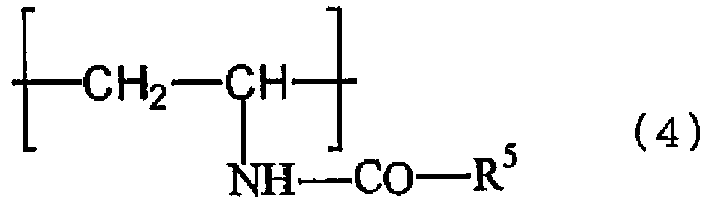
- In Formula (4), R5 represents a hydrogen atom or a C1-C10 hydrocarbon group.
- Examples of the hydrocarbon group include alkyl, alkenyl, cycloalkyl, and cycloalkenyl groups.
- When the modified polyvinyl acetal contains the constitutional unit having an amino group or an amide structure, the lower limit of the amount of the constitutional unit having an amino group or an amide structure is preferably 0.1 mol% and the upper limit thereof is preferably 20 mol%. When the amount of the constitutional unit having an amino group or an amide structure is within this range, desired effects can be achieved. The lower limit of the amount of the constitutional unit having an amino group or an amide structure is more preferably 0.5 mol%, and the upper limit thereof is more preferably 10 mol%.
- The degree of acetalization of the modified polyvinyl acetal is not limited. The lower limit thereof is preferably 60 mol% and the upper limit thereof is preferably 90 mol%. When the degree of acetalization is within this range, the modified polyvinyl acetal has excellent compatibility with the reactive diluent, and the resulting adhesive can have excellent handleability. In addition, the modified polyvinyl acetal can be easily precipitated in the synthesis process by a precipitation method. The lower limit of the degree of acetalization is more preferably 65 mol% and the upper limit thereof is more preferably 85 mol%.
- The degree of acetalization of the modified polyvinyl acetal is a value in percentage of the mole fraction (mol%) obtained by dividing the amount of ethylene groups to which acetal groups are bonded by the total amount of ethylene groups of the main chain. The degree of acetalization can be determined by measuring the acetyl group content and the vinyl alcohol content (content rate of hydroxy groups) by the method in conformity with JIS K6728 "Testing methods for polyvinyl butyral", calculating the mole fractions based on the measurement results, and subtracting the acetyl group content and the vinyl alcohol content from 100 mol%.
- The hydroxy group content of the modified polyvinyl acetal is not limited. The lower limit thereof is preferably 15 mol% and the upper limit thereof is preferably 35 mol%. When the hydroxy group content is within this range, higher adhesiveness can be exhibited. The lower limit of the hydroxy group content is more preferably 17 mol% and the upper limit thereof is more preferably 25 mol%.
- The hydroxy group content of the modified polyvinyl acetal is a value in percentage of the mole fraction (mol%) obtained by dividing the amount of ethylene groups to which hydroxy groups are bonded by the total amount of ethylene groups of the main chain. The amount of ethylene groups to which hydroxy groups are bonded can be determined, for example, by the method in conformity with JIS K6728 "Testing methods for polyvinyl butyral".
- The acetyl group content of the modified polyvinyl acetal is not limited. The lower limit thereof is preferably 0.0001 mol% and the upper limit thereof is preferably 15 mol%. The lower limit of the acetyl group content is more preferably 0.01 mol% and the upper limit thereof is more preferably 10 mol%. The lower limit is still more preferably 0.1 mol% and the upper limit is still more preferably 5 mol%.
- The acetyl group content of the modified polyvinyl acetal is a value in percentage of the mole fraction (mol%) obtained by subtracting the amount of ethylene groups to which acetal groups are bonded and the amount of ethylene groups to which hydroxy groups are bonded from the total amount of ethylene groups of the main chain and then dividing the obtained value by the total amount of ethylene groups of the main chain. The amount of ethylene groups to which acetal groups are bonded can be determined, for example, in conformity with JIS K6728 "Testing methods for polyvinyl butyral".
- The degree of polymerization of the modified polyvinyl acetal is not limited. The lower limit thereof is preferably 100 and the upper limit thereof is preferably 4,500. When the degree of polymerization of the modified polyvinyl acetal is within this range, an adhesive that has high adhesiveness and has excellent handleability at normal temperature can be obtained. The lower limit of the degree of polymerization is more preferably 150 and the upper limit thereof is more preferably 4,000.
- The modified polyvinyl acetal may be prepared by, for example, a method including copolymerizing a monomer having the imine structure and vinyl acetate to give polyvinyl acetate, saponifying the polyvinyl acetate to give polyvinyl alcohol, and acetalizing the polyvinyl alcohol by a conventionally known method. Alternatively, the modified polyvinyl acetal may be prepared by a method including acetalizing polyvinyl alcohol containing a constitutional unit having an amino group or an amide structure by a conventionally known method to introduce an imine structure. Alternatively, the modified polyvinyl acetal may be prepared by a method including modifying polyvinyl alcohol containing a constitutional unit having an amino group or an amide structure to give modified polyvinyl alcohol having an imine structure and acetalizing the modified polyvinyl alcohol by a conventionally known method. Alternatively, unmodified polyvinyl acetal may be modified to introduce an imine structure.
- Preferred among these is a method including acetalizing polyvinyl alcohol containing a constitutional unit having an amino group or an amide structure by a conventionally known method to introduce an imine structure. In the case of using such a method, the imine structure can be easily introduced by adding excess amounts of an aldehyde and an acid catalyst for acetalization.
- In the case of using such a method, the constitutional unit having an amino group or an amide structure and the constitutional unit having an imine structure can be confirmed by, for example, checking the spectrum of the amino group (around 1600 cm-1) by FT-IR or the spectrum of the imine structure (160 to 170 ppm) by 13C-NMR.
- The acetalization may be conducted by a known method. Preferably, it is conducted in an aqueous solvent, a mixed solvent containing water and an organic solvent compatible with water, or an organic solvent.
- Examples of the organic solvent compatible with water include alcohol organic solvents.
- Examples of the organic solvent include alcohol organic solvents such as methanol, ethanol, n-propanol, isopropanol, n-butanol, and tert-butanol, aromatic organic solvents such as xylene, toluene, ethylbenzene, and methyl benzoate, aliphatic ester solvents such as methyl acetate, ethyl acetate, butyl acetate, methyl propionate, ethyl propionate, methyl butyrate, ethyl butyrate, methyl acetoacetate, and ethyl acetoacetate, ketone solvents such as acetone, methyl ethyl ketone, methyl isobutyl ketone, cyclohexanone, methylcyclohexanone, benzophenone, and acetophenone, lower paraffin solvents such as hexane, pentane, octane, cyclohexane, and decane, ether solvents such as diethyl ether, tetrahydrofuran, ethylene glycol dimethyl ether, ethylene glycol diethyl ether, and propylene glycol diethyl ether, amide solvents such as N,N-dimethylformamide, N,N-dimethylacetamide, N-methylpyrrolidone, and acetanilide, and amine solvents such as aqueous ammonia, trimethylamine, triethylamine, n-butylamine, di-n-butylamine, tri-n-butylamine, aniline, N-methylaniline, N,N-dimethylaniline, and pyridine. These solvents may be used alone, or two or more solvents may be used in combination. Particularly preferred among these are ethanol, n-propanol, isopropanol, and tetrahydrofuran from the viewpoint of resin solubility and ease in purification.
- The acetalization is preferably conducted in the presence of an acid catalyst.
- Any acid catalyst may be used. Examples thereof include hydrogen halides such as hydrochloric acid, mineral acids such as nitric acid, sulfuric acid, and phosphoric acid, carboxylic acids such as formic acid, acetic acid, and propionic acid, and sulfonic acids such as methanesulfonic acid, ethanesulfonic acid, benzenesulfonic acid, and paratoluenesulfonic acid. These acid catalysts may be used alone, or two or more of the compounds may be used in combination. In particular, hydrochloric acid, nitric acid, and sulfuric acid are preferred, with hydrochloric acid being particularly preferred.
- In the method including acetalizing polyvinyl alcohol containing a constitutional unit having an amino group or an amide structure to introduce an imine structure, an imine structure can be easily introduced by adding the acid catalyst in an amount of 1.0% by weight or more of the total amount, for example.
- The aldehyde to be used for acetalization may be an aldehyde having a C1-C10 acyclic aliphatic group, a C1-C10 cycloaliphatic group, or a C1-C10 aromatic group, for example. These aldehydes may be conventionally known aldehydes. The aldehyde to be used for acetalization reaction is not limited. Examples thereof include aliphatic aldehydes such as formaldehyde, acetaldehyde, propionaldehyde, n-butyraldehyde, isobutyraldehyde, n-valeraldehyde, n-hexylaldehyde, 2-ethylbutyraldehyde, 2-ethylhexylaldehyde, n-heptylaldehyde, n-octylaldehyde, n-nonylaldehyde, and n-decylaldehyde and aromatic aldehydes such as benzaldehyde, cinnamaldehyde, 2-methylbenzaldehyde, 3-methylbenzaldehyde, 4-methylbenzaldehyde, p-hydroxybenzaldehyde, m-hydroxybenzaldehyde, phenylacetaldehyde, and β-phenylpropionaldehyde. These aldehydes may be used alone or in combination of two or more thereof. Preferred among the aldehydes are butyraldehyde, 2-ethylhexylaldehyde, and n-nonylaldehyde, which are excellent in acetalization reactivity and have a sufficient internal plasticizing effect on the resulting resin to give good flexibility thereto. Butyraldehyde is more preferred.
- The amount of the aldehyde to be added can be appropriately determined according to the target degree of acetalization of the modified polyvinyl acetal. In particular, when the amount of the aldehyde relative to 100 mol% of the polyvinyl alcohol is 60 to 95 mol%, preferably 70 to 90 mol%, advantageously the acetalization reaction is efficiently performed and unreacted aldehyde is easily removed.
- The adhesive of the present invention contains a reactive diluent.
- The reactive diluent as used herein means an agent which is compatible with the modified polyvinyl acetal and capable of turning the polyvinyl acetal into a liquid (sol), and whose molecules react with each other to be crosslinked and cured.
- Examples of the reactive diluent include (meth)acrylic reactive diluents such as (meth)acrylic monomers and (meth)acrylic oligomers, and epoxy reactive diluents such as epoxy monomers and epoxy oligomers. These reactive diluents may be used alone or in combination of two or more thereof.
- The (meth)acrylic monomer used may be a monofunctional, bifunctional, or tri- or higher functional (meth)acrylic monomer. Examples of the monofunctional (meth)acrylic monomer include methyl (meth)acrylate, ethyl (meth)acrylate, propyl (meth)acrylate, butyl (meth)acrylate, 2-hydroxyethyl (meth)acrylate, diethylene glycol monoethyl ether (meth)acrylate, isobornyl (meth)acrylate, 3-methoxybutyl (meth)acrylate, 2-acryloyloxyethyl-2-hydroxypropyl phthalate, and 2-methacryloyloxyethyl-2-hydroxylpropyl phthalate.
- Examples of the bifunctional (meth)acrylic monomer include ethylene glycol di(meth)acrylate, diethylene glycol di(meth)acrylate, tetraethylene glycol di(meth)acrylate, 1,6-hexanediol dimethacrylate, 1,9-nonanediol diacrylate, polytetramethylene glycol di(meth)acrylate, neopentyl glycol di(meth)acrylate, 1,3-butylene glycol di(meth)acrylate, and 2,2-bis[4-(methacryloxyethoxy)phenyl]propane di(meth)acrylate.
- Examples of the tri- or higher functional (meth)acrylic monomer include trimethylolpropane triacrylate, pentaerythritol triacrylate, pentaerythritol trimethacrylate, pentaerythritol tetramethacrylate, dipentaerythritol pentaacrylate, dipentaerythritol hexaacrylate, tri(2-acryloyloxy ethyl)phosphate, tetramethyrolmethane tri(meth)acrylate, tetramethylol propane tetra(meth)acrylate, triallyl isocyanurate, and derivatives thereof.
- The above (meth)acrylic monomers may be used alone or in combination of two or more thereof. In particular, preferred are (meth)acrylic monomers as they are particularly excellent in compatibility with the modified polyvinyl acetal. More specifically, preferred are methyl (meth)acrylate, ethyl (meth)acrylate, propyl (meth)acrylate, butyl (meth)acrylate, 2-hydroxyethyl (meth)acrylate, glycidyl (meth)acrylate, and urethane (meth)acrylate.
- Examples of the (meth)acrylic oligomers include those including a plurality of the (meth)acrylic monomers bonded to each other. In particular, preferred is a (meth)acrylic oligomer prepared from the acrylic monomer because such an oligomer is particularly excellent in compatibility with the polyvinyl acetal.
- Examples of the epoxy monomers include: glycidyl ester epoxy monomers of bisphenol A type, bisphenol F type, bisphenol AD type, bromine-containing bisphenol A type, phenol novolac type, cresol novolac type, polyphenol type, linear aliphatic type, butadiene type, urethane type and the like; aliphatic glycidyl ester epoxy monomers such as glycidyl hexahydrophthalate, dimer glycidyl ester, aromatic type, cycloaliphatic type and like epoxy monomers; methyl-substituted epoxy monomers of bisphenol type, ester type, high-molecular-weight ether ester type, ether ester type, brominated type, novolac type, and the like; heterocyclic epoxy monomers; glycidyl amine epoxy monomers such as triglycidyl isocyanurate and tetraglycidyl diaminodiphenyl methane; linear aliphatic epoxy monomers such as epoxylated polybutadiene and epoxy soybean oil; cycloaliphatic epoxy monomers; naphthalene novolac-type epoxy monomers; and diglycidyl oxynaphthalene epoxy monomers.
- Examples of the epoxy oligomers include those including a plurality of the epoxy monomers bonded to each other. Preferred among these are epoxy oligomers prepared from the epoxy monomers.
- The amount of the reactive diluent in the adhesive of the present invention is not limited. The lower limit thereof is preferably 60 parts by weight relative to 100 parts by weight of the modified polyvinyl acetal and the upper limit thereof is preferably 5,000 parts by weight. When the amount of the reactive diluent is within this range, the resulting adhesive can have excellent handleability at room temperature and particularly excellent adhesiveness to organic materials and inorganic materials. The lower limit of the amount of the reactive diluent is more preferably 70 parts by weight and the upper limit thereof is more preferably 3,000 parts by weight. The lower limit is still more preferably 80 parts by weight and the upper limit is still more preferably 2,000 parts by weight. The lower limit is further preferably 90 parts by weight and the upper limit is further preferably 1,500 parts by weight. The upper limit is particularly preferably 1,000 parts by weight. The upper limit is most preferably 300 parts by weight.
- The polymerization initiator may be appropriately selected according to the type of the reactive diluent and the type of the trigger for crosslinking and curing of the reactive diluent. When heat is selected as the trigger, a thermal polymerization initiator is used, and when light is selected as the trigger, a photopolymerization initiator is used. When immediate curing is required and the reactive diluent is a (meth)acrylic reactive diluent, examples of usable polymerization initiators include: thermal polymerization initiators such as monoacylphosphine oxide compounds including 2,6-dimethylbenzoyldiphenylphosphine oxide, 2,4,6-trimethylbenzoyldiphenylphosphine oxide, 2,6-dichlorobenzoyldiphenylphosphine oxide, and 2,6-dimethoxybenzoyldiphenylphosphine oxide, bisacylphosphine oxide compounds including bis(2,6-dimethoxybenzoyl)-2,4,4-trimethylpentylphosphine oxide, bis(2,6-dimethylbenzoyl)-2,4,4-trimethylpentylphosphine oxide, bis(2,6-dimethylbenzoyl)-2,4,4-trimethylpentylphosphine oxide, bis(2,4,6-trimethylbenzoyl)-2,4,4-trimethylpentylphosphine oxide, bis(2,6-dichlorobenzoyl)-2,4,4-trimethylpentylphosphine oxide, bis(2,4,6-trimethylbenzoyl)-phenylphosphine oxide, and bis(2,4,6-trimethoxybenzoyl)-phenylphosphine oxide, benzophenol, acetophenone, 4,4'-dichlorobenzophenone, methylphenyl glyoxylate, thioxanthone, 2,4-dimethylthioxanthone, 2-methylthioxanthone, 2-chlorothioxanthone, diisopropylthioxanthone, 2,4-diethylthioxanthone, 2,4-dichlorothioxanthone, 2-isopropylthioxanthone, bis(η5-2,4-cyclopentadien-1-yl)-bis(2,6-difluoro-3-(1H-pyrrol-1-yl)-phenyl)titanium, 3,3',4,4'-tetra(t-butylperoxycarbonyl)benzophenone, camphorquinone, dibenzosuberone, 2-ethylanthraquinone, 4',4"-diethylisophthalophenone, 9,10-phenanthrenequinone, 1-phenyl-1,2-propanedione-2-ethoxycarbonyl oxime, benzophenone, methyl ortho-benzoylbenzoate, ortho-benzoylbenzoic acid, 4-benzoyl-4'-methyldiphenyl sulfide, 2,2-dimethoxy-1,2-diphenylethan-1-one, 2-benzyl-2-dimethylamino-1-(4-morpholinophenyl)-butanone-1,2-methyl-1-[4-(methylthio)phenyl]-2-morpholinopropan-1-one, 1-hydroxycyclohexyl-phenyl-ketone, 1-[4-(2-hydroxyethoxy)-phenyl]-2-hydroxy-2-methyl-1-propan-1-one, 2-hydroxy-2-methyl-1-phenylpropan-1-one, 4-phenylbenzophenone, hydroxybenzophenone, 3,3'-dimethyl-4-methoxybenzophenone, benzoin, benzoin ethyl ether, benzoin isopropyl ether, benzoin isobutyl ether, 4-phenoxydichloroacetophenone, 4-t-butyl-dichloroacetophenone, 4-t-butyl-trichloroacetophenone, diethoxyacetophenone, 1-(4-isopropylphenyl)-2-hydroxy-2-methylpropan-1-one, 1-(4-dodecylphenyl)-2-hydroxy-2-methylpropan-1-one, 4-(2-hydroxyethoxy)-phenyl(2-hydroxy-2-propyl)ketone, bis(4-n-decanylphenyl)iodonium hexafluorophosphate, bis(a-n-dodecanylphenyl)iodonium hexafluoroantimonate, bis(4-tert-butylphenyl)iodonium bis(perfluorobutanesulfonyl)imide, bis(4-t-butylphenyl)iodonium hexafluorophosphate, diphenyliodonium hexafluoroarsenate, diphenyliodonium trifluoromethanesulfonate, 2-(3,4-dimethoxystyryl)-4,6-bis(trichloromethyl)-1,3,5-triazine, 2-[2-(furan-2-yl)vinyl]-4,6-bis(trichloromethyl)-1,3,5-triazine, 4-isopropyl-4'-methyldiphenyliodonium tetrakis(pentafluorophenyl)borate, 2-(4-methoxyphenyl)-4,6-bis(trichloromethyl)-1,3,5-triazine, triphenylsulfonium tetrafluoroborate, tri-p-tolylsulfonium hexafluorophosphate, tri-p-tolylsulfonium trifluoromethanesulfonate, nifedipine, 2,5-dimethylhexane-2,5-dihydroperoxide, 2,5-dimethyl-2,5-di(t-butylperoxy)hexane-3-di-t-butyl peroxide, t-butyl cumyl peroxide, 2,5-dimethyl-2,5-di(t-butylperoxy)hexane, dicumyl peroxide, α,α'-bis(t-butylperoxyisopropyl)benzene, n-butyl-4,4-bis(t-butylperoxy)valerate, 2,2-bis(t-butylperoxy)butane, t-butyl peroxy-3,5,5-trimethylhexanoate, 1,1-bis(t-butylperoxy)cyclohexane, 1,1-bis(t-butylperoxy)-3,3,5-trimethylcyclohexane, t-butyl peroxybenzoate, benzoyl peroxide, t-butyl peroxyacetate, methyl ethyl ketone peroxide, 2,5-dimethyl-2,5-bis(t-butylperoxy)-3,3,5-trimethylcyclohexane, 1,1-bis(t-butylperoxy)cyclohexane, methyl ethyl ketone peroxide, 2,5-dimethylhexyl-2,5-bisperoxybenzoate, t-butyl hydroperoxide, p-menthane hydroperoxide, p-chlorobenzoyl peroxide, t-hexyl peroxypivalate, hydroxyheptyl peroxide, chlorohexanone peroxide, octanoyl peroxide, decanoyl peroxide, lauroyl peroxide, cumyl peroxyoctoate, succinic acid peroxide, acetyl peroxide, t-butylperoxy(2-ethylhexanoate), m-toluoyl peroxide, t-butyl peroxyisobutyrate, and 2,4-dichlorobenzoyl peroxide; and photopolymerization initiators such as persulfates, organic peroxides, and azo compounds.
- For example, when the reactive diluent is an epoxy reactive diluent, examples of usable polymerization initiators include: thermal polymerization initiators such as imidazoles, quaternary ammonium salts, phosphorous compounds, amines, phosphines, phosphonium salts, bicyclic amidines and salts thereof, acid anhydrides, novolac phenolic resins obtainable by condensation reaction of phenol, cresol, xylenol, resorcin, or the like with formaldehyde, polymercapto resins such as liquid polymercaptan and polysulfide, and amides; and photopolymerization initiators containing a compound containing a combination of a cation such as diphenyliodonium, 4-methoxydiphenyliodonium, bis(4-methylphenyl)iodonium, bis(4-tert-butylphenyl)iodonium, bis(dodecylphenyl)iodonium, diphenyl-4-thiophenoxyphenylsulfonium, bis[4-(diphenylsulfonio)-phenyl]sulfide, bis[4-(di(4-(2-hydroxyethyl)phenyl)sulfonio)-phenyl]sulfide, or η5-2,4-(cyclopentadiphenyl) [1,2,3,4,5,6-η-(methylethyl)benzene]-iron (1+) and an anion such as tetrafluoroborate, hexafluorophosphate, triphenyl hexafluorophosphate, or hexafluoroarsenate.
- These polymerization initiators may be used alone or in combination of two or more thereof.
- The amount of the polymerization initiator in the adhesive of the present invention is not limited. For example, when a (meth)acrylic reactive diluent and a thermal polymerization initiator are used, the lower limit of the amount of the polymerization initiator relative to 100 parts by weight of the reactive diluent is preferably 0.01 parts by weight and the upper limit thereof is preferably 10 parts by weight. The lower limit is more preferably 0.1 parts by weight and the upper limit is more preferably 5 parts by weight. When, for example, an epoxy reactive diluent and a thermal polymerization initiator are used, the lower limit relative to 100 parts by weight of the reactive diluent is preferably 1 part by weight and the upper limit is preferably 300 parts by weight. The lower limit is more preferably 10 parts by weight and the upper limit is more preferably 150 parts by weight. When the amount of the polymerization initiator is within this range, the reactive diluent can sufficiently react, so that the adhesive exhibit high adhesiveness to organic materials and inorganic materials. In addition, the polymerization initiator remaining after the reaction is less likely to bleed out.
- The adhesive of the present invention may further contain a plasticizer.
- The plasticizer is not limited, and may be a conventionally known plasticizer used with polyvinyl acetal. Examples of the plasticizer include organic acid ester plasticizers such as monobasic organic acid esters and polybasic organic acid esters, and phosphoric acid plasticizers such as organophosphate plasticizers and organophosphite plasticizers. Preferred among these are organic acid ester plasticizers. These plasticizers may be used alone or in combination of two or more thereof. The plasticizer is preferably a liquid plasticizer.
- The monobasic organic acid ester is not particularly limited, and examples thereof include glycol esters obtainable by reaction between a monobasic organic acid (e.g., butyric acid, isobutyric acid, caproic acid, 2-ethylbutyric acid, heptanoic acid, n-octylic acid, 2-ethylhexylic acid, pelargonic acid (n-nonylic acid), decylic acid) and a glycol (e.g., triethylene glycol, tetraethylene glycol, tripropylene glycol).
- The polybasic organic acid ester is not particularly limited, and examples thereof include ester compounds obtainable by reaction between a polybasic organic acid (e.g., adipic acid, sebacic acid, azelaic acid) and a C4-C8 linear or branched alcohol.
- The organic acid ester plasticizer is preferably a diester plasticizer represented by the following formula. The use of the diester plasticizer improves filling properties when the adhesive of the present invention is used for bonding and filling between a touch panel and another component or between transparent conductive films included in a touch panel in production of a personal digital assistant, for example.
R6-CO-(-R8)p-CO-R7
- In the formula, R6 and R7 each represent a C5-C10 (preferably C6-C10) organic group, R8 represents an ethylene, isopropylene, or n-propylene group, and p represents an integer of 3 to 10.
- Specific examples of the organic acid ester plasticizer include triethylene glycol-di-2-ethylbutyrate, triethylene glycol-di-2-ethylhexanoate, triethylene glycol dicaprylate, triethylene glycol-di-n-octanoate, triethylene glycol-di-n-heptanoate, tetraethylene glycol-di-n-heptanoate, tetraethylene glycol-di-2-ethylhexanoate, dibutyl sebacate, dioctyl azelate, dibutyl carbitol adipate, ethylene glycol-di-2-ethyl butyrate, 1,3-propylene glycol-di-2-ethyl butyrate, 1,4-butylene glycol-di-2-ethylbutyrate, diethylene glycol-di-2-ethylbutyrate, diethylene glycol-di-2-ethylhexanoate, dipropylene glycol-di-2-ethylbutyrate, triethylene glycol-di-2-ethylpentanoate, tetraethylene glycol-di-2-ethylbutyrate, diethylene glycol dicaprylate, dihexyl adipate, dioctyl adipate, hexylcyclohexyl adipate, diisononyl adipate, heptylnonyl adipate, oil-modified alkyd sebacate, mixtures of phosphate esters and adipic acid esters, and mixed type adipic acid esters prepared from a C4-C9 alkyl alcohol and a C4-C9 cyclic alcohol.
- The organophosphate plasticizers are not particularly limited, and examples thereof include tributoxyethyl phosphate, isodecylphenyl phosphate, and triisopropyl phosphate.
- Among the plasticizers, preferred is at least one selected from the group consisting of dihexyl adipate (DHA), triethylene glycol-di-2-ethylhexanoate (3GO), tetraethylene glycol-di-2-ethylhexanoate (4GO), triethylene glycol-di-2-ethylbutyrate (3GH), tetraethylene glycol-di-2-ethylbutyrate (4GH), tetraethylene glycol-di-n-heptanoate (4G7), and triethylene glycol-di-n-heptanoate (3G7). More preferred are triethylene glycol-di-2-ethyl butyrate (3GH), triethylene glycol-di-n-heptanoate (3G7), and triethylene glycol-di-2-ethylhexanoate (3GO), and still more preferred is triethylene glycol-di-2-ethylhexanoate (3GO).
- The adhesive of the present invention may contain known additives such as adhesion modifiers, tackifiers, emulsifiers, softeners, microparticles, fillers, pigments, dyes, silane coupling agents, antioxidants, surfactants, and waxes, if necessary.
- The lower limit of the viscosity at 25°C of the adhesive of the present invention as measured in conformity with JIS Z 8803:2011 with a rotational digital viscometer (e.g., Brookfield Engineering Laboratories, Inc., model "DV-II+Pro") is preferably 10 mPa·s and the upper limit thereof is preferably 20 Pa·s. When the viscosity at 25°C is within this range, the adhesive has excellent handleability at room temperature. The lower limit of the viscosity at 25°C is more preferably 0.1 Pa·s and the upper limit thereof is more preferably 10 Pa·s.
- In the adhesive of the present invention, the reactive diluent can be reacted to be crosslinked and cured. Thus, the adhesive in bonding can be in a liquid (sol) state at room temperature to exhibit high handleability, and reacting the reactive diluent to cause crosslink and curing reactions allows the adhesive to exhibit high adhesiveness to organic materials and inorganic materials. The reaction of the reactive diluent to cause crosslinking and curing reactions can prevent the reactive diluent from bleeding out.
- Any method may be used to react the reactive diluent to cause crosslinking and curing reactions. When the trigger is heat, a method including heating may be used. When the trigger is light, a method including irradiation with light using an ultraviolet light irradiation device such as an ultra-high pressure mercury lamp may be used.
- The temperature in heating and the wavelength and illuminance in irradiation with light may be appropriately determined according to factors such as the types of the reactive diluent and polymerization initiator.
- The adhesive of the present invention may be produced by any method. For example, the adhesive may be produced by a method including mixing the modified polyvinyl acetal, the reactive diluent, the polymerization initiator, and if necessary, additives.
- The present invention provides an adhesive that has excellent adhesiveness to both organic materials (particularly, polycarbonate, acrylic, and nylon) and inorganic materials, is capable of exhibiting excellent transparency and toughness, and also has excellent handleability.
-
Fig. 1 is a schematic view illustrating a specimen used for testing the tensile lap-shear strength of adhesive in examples. - Embodiments of the present invention will be specifically described in the following with reference to, but not limited to, examples.
- Polyvinyl alcohol (240 g) with a degree of polymerization of 600, a degree of saponification of 99 mol%, and 1.7 mol% of a constitutional unit having an amino group (-NH2) represented by Formula (3) above was added to 1,800 g of pure water. The mixture was stirred at 90°C for about two hours to dissolve the polyvinyl alcohol. The solution was cooled to 40°C, followed by the addition of 170 g of 35% by weight hydrochloric acid and 275 g of n-butyraldehyde. The solution temperature was maintained at 40°C to allow acetalization reaction to proceed, whereby the reaction product was precipitated.
- Thereafter, the solution temperature was maintained at 40°C for three hours to complete the reaction. Neutralization, water washing, and drying were conducted by conventional methods to give powder of a modified
polyvinyl butyral 1. - The obtained modified
polyvinyl butyral 1 was dissolved into dimethyl sulfoxide (DMSO-d6) and analyzed by 13C-NMR (nuclear magnetic resonance) spectroscopy. The analysis showed that the degree of butyralization was 77.5 mol%, the hydroxy group content was 20.0 mol%, the acetyl group content was 0.4 mol%, and the amount of the constitutional unit having an imine structure represented by Formula (5) below (R3 is hydrogen and R4 is an n-butyl group) was 1.7 mol%.
- Polyvinyl alcohol (250 g) with a degree of polymerization of 600, a degree of saponification of 99 mol%, and 8.3 mol% of a constitutional unit having an amino group (-NH2) represented by Formula (3) above was added to 1,800 g of pure water. The mixture was stirred at 90°C for about two hours to dissolve the polyvinyl alcohol. The solution was cooled to 40°C, followed by the addition of 170 g of 35% by weight hydrochloric acid and 150 g of n-butyraldehyde. The solution temperature was maintained at 40°C to allow acetalization reaction to proceed, whereby the reaction product was precipitated.
- Thereafter, the solution temperature was maintained at 40°C for three hours to complete the reaction. Neutralization, water washing, and drying were conducted by conventional methods to give powder of a modified
polyvinyl butyral 2. - The obtained modified
polyvinyl butyral 2 was dissolved into dimethylsulfoxide (DMSO-d6) and analyzed by 13C-NMR (nuclear magnetic resonance) spectroscopy. The analysis showed that the degree of butyralization was 70.0 mol%, the hydroxy group content was 20.9 mol%, the acetyl group content was 0.3 mol%, and the amount of the constitutional unit having an imine structure represented by Formula (5) above (R3 is hydrogen and R4 is an n-butyl group) was 8.3 mol%. - Polyvinyl alcohol (250 g) with a degree of polymerization of 200, a degree of saponification of 99 mol%, and 1.7 mol% of a constitutional unit having an amino group (-NH2) represented by Formula (3) above was added to 1,800 g of pure water. The mixture was stirred at 90°C for about two hours to dissolve the polyvinyl alcohol. The solution was cooled to 40°C, followed by the addition of 170 g of 35% by weight hydrochloric acid and 120 g of n-butyraldehyde. The solution temperature was maintained at 40°C to allow acetalization reaction to proceed, whereby the reaction product was precipitated.
- Thereafter, the solution temperature was maintained at 40°C for three hours to complete the reaction. Neutralization, water washing, and drying were conducted by conventional methods to give powder of a modified
polyvinyl butyral 3. - The obtained modified
polyvinyl butyral 3 was dissolved into dimethylsulfoxide (DMSO-d6) and analyzed by 13C-NMR (nuclear magnetic resonance) spectroscopy. The analysis showed that the degree of butyralization was 77.5 mol%, the hydroxy group content was 20.0 mol%, the acetyl group content was 0.4 mol%, and the amount of the constitutional unit having an imine structure represented by Formula (5) above (R3 is hydrogen and R4 is an n-butyl group) was 1.7 mol%. - Polyvinyl alcohol (240 g) with a degree of polymerization of 1,200, a degree of saponification of 99 mol%, and 1.7 mol% of a constitutional unit having an amino group (-NH2) represented by Formula (3) above was added to 1,800 g of pure water. The mixture was stirred at 90°C for about two hours to dissolve the polyvinyl alcohol. The solution was cooled to 40°C, followed by the addition of 170 g of 35% by weight hydrochloric acid and 275 g of n-butyraldehyde. The solution temperature was maintained at 40°C to allow acetalization reaction to proceed, whereby the reaction product was precipitated.
- Thereafter, the solution temperature was maintained at 40°C for three hours to complete the reaction. Neutralization, water washing, and drying were conducted by conventional methods to give powder of a modified
polyvinyl butyral 4. - The obtained modified
polyvinyl butyral 4 was dissolved into dimethylsulfoxide (DMSO-d6) and analyzed by 13C-NMR (nuclear magnetic resonance) spectroscopy. The analysis showed that the degree of butyralization was 77.5 mol%, the hydroxy group content was 20.0 mol%, the acetyl group content was 0.4 mol%, and the amount of the constitutional unit having an imine structure represented by Formula (5) above (R3 is hydrogen and R4 is an n-butyl group) was 1.7 mol%. - Polyvinyl alcohol (250 g) with a degree of polymerization of 650 and a degree of saponification of 99 mol% was added to 1,800 g of pure water. The mixture was stirred at 90°C for about two hours to dissolve the polyvinyl alcohol. The solution was cooled to 40°C, followed by the addition of 170 g of 35% by weight hydrochloric acid and 275 g of n-butyraldehyde. The solution temperature was maintained at 40°C to allow acetalization reaction to proceed, whereby the reaction product was precipitated.
- Thereafter, the solution temperature was maintained at 40°C for three hours to complete the reaction. Neutralization, water washing, and drying were conducted by conventional methods to give powder of a polyvinyl butyral.
- The obtained polyvinyl butyral was dissolved into dimethylsulfoxide (DMSO-d6) and analyzed by 13C-NMR (nuclear magnetic resonance) spectroscopy. The analysis showed that the degree of acetalization was 65.0 mol%, the hydroxy group content was 34.0 mol%, and the acetyl group content was 1.0 mol%.
- To 100 parts by weight of the modified
polyvinyl butyral 2 was added 100 parts by weight of a (meth)acrylic reactive diluent (30% by weight of methyl methacrylate, 40% by weight of ethyl acrylate, and 30% by weight of 2-hydroxyethyl acrylate) as a reactive diluent, followed by sufficient stirring and mixing. Vacuum deaeration treatment was then performed using a vacuum-type deaeration device (Thinky Corporation, AV-310) at 1,200 rpm and 1.0 kPa for three minutes to give a mixed composition. The mixed composition was sufficiently blended with a perester compound (NOF Corporation, Perbutyl 355) as a thermal polymerization initiator in an amount of 5.0 parts by weight relative to 100 parts by weight of the reactive diluent, whereby an adhesive was obtained. The obtained adhesive was in a liquid (sol) state at room temperature. - An adhesive was obtained in the same manner as in Example 1 except that the type of the modified polyvinyl butyral, the amount of the reactive diluent, and the like were as shown in Table 1. The obtained adhesive was in a liquid (sol) state at room temperature.
- To 100 parts by weight of the modified
polyvinyl butyral 2 was added 100 parts by weight of a bisphenol A epoxy monomer (Mitsubishi Chemical Corporation, jER828) as a reactive diluent, followed by heating and dissolving. Vacuum deaeration treatment was then performed using a vacuum-type deaeration device (Thinky Corporation, AV-310) at 1,200 rpm and 1.0 kPa for three minutes to give a mixed composition. This mixed composition was cooled to 23°C, followed by the addition of 25 parts by weight of 2,4-diamino-6-[2'-undecylimidazolyl-(1')]-ethyl-s-triazine (Shikoku Chemicals Corporation, C11Z-A) as a thermal polymerization initiator, and further followed by sufficient stirring and mixing to give an adhesive. The obtained adhesive was in a liquid (sol) state at room temperature. - An adhesive was obtained in the same manner as in Example 3 except that the type of the modified polyvinyl butyral, the amount of the reactive diluent, and the like were as shown in Table 1. The obtained adhesive was in a liquid (sol) state at room temperature.
- The adhesives obtained in the examples and comparative examples were evaluated by the following method.
- The results are shown in Table 1.
- Specimens as shown in
Fig. 1 were prepared in conformity with the method for testing tensile lap-shear strength of adhesive specified in JIS K 6850. The substrates as the evaluation subjects were glass, aluminum, SUS, polycarbonate (PC), acrylic, and nylon. The adhesive was applied to bond the substrates and heated in an oven at 130°C for 30 minutes to be cured. Thereafter, the tensile lap-shear strength was measured using a Tensilon universal material tester (A & D Company, Limited, RTC-1350A).[Table 1] (Modified) polyvinyl acetal Reactive diluent (parts by weight) Polymerization initiator (parts by weight) Tensile lap-shear strength (MPa) Degree of polymerization Degree of acetalization (mol%) Acetyl group content (mol%) Hydroxy group content (mol%) Imine modification content (mol%) (Meth) acrylic reactive diluent Epoxy reactive diluent Perester polymerization initiator Imidazole polymerization initiator Glass Aluminum SUS PC Acrylic Nylon Example 1 600 70.0 0.3 20.9 8.3 100 - 5.0 - 512 45.3 40.3 7.7 8.7 10.2 Example 2 600 77.5 0.4 20.0 1.7 100 - 5.0 - 43.0 38.0 35.4 7.6 8.2 9.1 Comparative Example 1 650 65.0 1.0 34.0 - 100 - 5.0 - 13.6 15.0 13.4 2.5 1.5 1.8 Example 3 600 70.0 0.3 20.9 8.3 - 100 - 25 53.0 35.7 27.3 3.4 4.0 13.3 Example 4 600 77.5 0.4 20.0 1.7 - 100 - 25 480 33.2 27.2 3.3 3.9 13.2 Comparative Example 2 650 65.0 1.0 34.0 - - 100 - 25 13.6 8.6 7.1 2.8 1.0 3.4 - Table 1 shows that the adhesives of Examples 1 to 4, each prepared using a modified polyvinyl butyral having an imine structure, exhibit excellent adhesiveness both when the adherends are inorganic materials (i.e., glass, aluminum, and SUS) and when the adherends are organic materials (i.e., polycarbonate (PC), acrylic, and nylon) as compared with the adhesives of Comparative Examples 1 and 2, each prepared from polyvinyl butyral. This indicates that the adhesives of Examples 1 to 4 are usable for a wide range of adherends. Table 1 also shows that in the case where the modified polyvinyl acetal having an imine structure contains a large amount a constitutional unit having an imine structure, the adhesive tends to have high adhesiveness particularly when the adherends are inorganic materials.
- To 100 parts by weight of the modified
polyvinyl butyral 3 was added 100 parts by weight of a (meth)acrylic reactive diluent (30% by weight of methyl methacrylate, 40% by weight of ethyl acrylate, and 30% by weight of 2-hydroxyethyl acrylate) as a reactive diluent, followed by sufficient stirring and mixing. Vacuum deaeration treatment was then performed using a vacuum-type deaeration device (Thinky Corporation, AV-310) at 1,200 rpm and 1.0 kPa for three minutes to give a mixed composition. The mixed composition was sufficiently blended with a perester compound (NOF Corporation, Perbutyl 355) as a thermal polymerization initiator in an amount of 5.0 parts by weight relative to 100 parts by weight of the reactive diluent, whereby an adhesive was obtained. The obtained adhesive was in a liquid (sol) state at room temperature. - An adhesive was obtained in the same manner as in Example 5 except that the type of the modified polyvinyl butyral was as shown in Table 2. The obtained adhesive was in a liquid (sol) state at room temperature.
- To 100 parts by weight of the modified
polyvinyl butyral 3 was added 100 parts by weight of a bisphenol A epoxy monomer (Mitsubishi Chemical Corporation, jER828) as a reactive diluent, followed by heating and dissolving. Vacuum deaeration treatment was then performed using a vacuum-type deaeration device (Thinky Corporation, AV-310) at 1,200 rpm and 1.0 kPa for three minutes to give a mixed composition. This mixed composition was cooled to 23°C, followed by the addition of 25 parts by weight of 2,4-diamino-6-[2'-undecylimidazolyl-(1')]-ethyl-s-triazine (Shikoku Chemicals Corporation, C11Z-A) as a thermal polymerization initiator, and further followed by sufficient stirring and mixing to give an adhesive. The obtained adhesive was in a liquid (sol) state at room temperature. - An adhesive was obtained in the same manner as in Example 8 except that the type of the modified polyvinyl butyral was as shown in Table 2. The obtained adhesive was in a liquid (sol) state at room temperature.
- The adhesives obtained in the examples and comparative examples were evaluated concerning the adhesiveness to various materials by the above method.
- The results are shown in Table 2.
[Table 2] (Modified) polyvinyl acetal Reactive diluent (parts by weight) Polymerization initiator (parts by weight) Tensile lap-shear strength (MPa) Degree of polymerization Degree of acetalisation (mol%) Acetyl group content (mol%) Hydroxy group content (mol%) Imine modification content (mol%) (Meth) acrylic reactive diluent Epoxy reactive diluent Perester polymerization initiator Imidazole polymerization initiator Glass Aluminum SUS PC Acrylic Nylon Example 5 200 77.5 0.4 20.0 1.7 100 - 5.0 - 42.0 34.0 32.1 7.5 8.0 8.9 Example 6 600 77.5 0.4 20.0 1.7 100 - 5.0 - 43.0 38.0 35.4 7.6 8.2 9.1 Example 7 1200 77.5 0.4 20.0 1.7 100 - 5.0 - 44.1 38.2 35.5 7.7 8.2 9.1 Example 8 200 77.5 0.4 20.0 1.7 - 100 - 25 47.7 33.1 27.0 3.3 3.9 13.2 Example 9 600 77.5 0.4 20.0 1.7 - 100 - 25 48.0 33.2 27.2 3.3 3.9 13.2 Example 10 1200 77.5 0.4 20.0 1.7 - 100 - 25 48.0 33.3 272 3.4 4.0 13.3 - Table 2 indicates that adhesives within the scope of these examples can exhibit excellent adhesiveness both when the adherends are inorganic materials and when the adherends are organic materials regardless of the degree of polymerization of the modified polyvinyl butyral having an imine structure.
- To 100 parts by weight of the modified
polyvinyl butyral 1 was added 60 parts by weight of a (meth)acrylic reactive diluent (30% by weight of methyl methacrylate, 40% by weight of ethyl acrylate, and 30% by weight of 2-hydroxyethyl acrylate) as a reactive diluent, followed by sufficient stirring and mixing. Vacuum deaeration treatment was then performed using a vacuum-type deaeration device (Thinky Corporation, AV-310) at 1,200 rpm and 1.0 kPa for three minutes to give a mixed composition. The mixed composition was sufficiently blended with a perester compound (NOF Corporation, Perbutyl 355) as a thermal polymerization initiator in an amount of 3.0 parts by weight, whereby an adhesive was obtained. The obtained adhesive was in a liquid (sol) state at room temperature. - An adhesive was obtained in the same manner as in Example 11 except that the type of the modified polyvinyl butyral, the amount of the reactive diluent, and the like were as shown in Table 3. The obtained adhesive was in a liquid (sol) state at room temperature.
- To 100 parts by weight of the modified
polyvinyl butyral 1 was added 60 parts by weight of a bisphenol A epoxy monomer (Mitsubishi Chemical Corporation, jER828) as a reactive diluent, followed by heating and dissolving. Vacuum deaeration treatment was then performed using a vacuum-type deaeration device (Thinky Corporation, AV-310) at 1,200 rpm and 1.0 kPa for three minutes to give a mixed composition. This mixed composition was cooled to 23°C, followed by the addition of 15 parts by weight of 2,4-diamino-6-[2'-undecylimidazolyl-(1')]-ethyl-s-triazine (Shikoku Chemicals Corporation, C11Z-A) as a thermal polymerization initiator, and further followed by sufficient stirring and mixing to give an adhesive. The obtained adhesive was in a liquid (sol) state at room temperature. - An adhesive was obtained in the same manner as in Example 29 except that the type of the modified polyvinyl butyral, the amount of the reactive diluent, and the like were as shown in Table 4. The obtained adhesive was in a liquid (sol) state at room temperature.
- The adhesives obtained in the examples and comparative examples were evaluated concerning the adhesiveness to various materials by the above method.
- The results are shown in Tables 3 and 4.
[Table 3] (Modified) polyvinyl acetal Reactive diluent (parts by weight) Polymerization initiator (parts by weight) Tensile lap-shear strength (MPa) Degree of polymerization Degree of acetalization (mol%) Acetyl group content (mol%) Hydroxy group content (mol%) Imine modification content (mol%) (Meth) acrylic reactive diluent Epoxy reactive diluent Perester polymerization initiator Imidazole polymerization initiator Glass Aluminum SUS PC Acrylic Nylon Example 11 600 77.5 0.4 20.0 1.7 60 - 3.0 - 26.3 4.4 7.8 9.8 8.5 5.4 Example 12 600 77.5 0.4 20.0 1.7 100 - 5.0 - 43.0 38.0 35.4 7.6 8.2 9.1 Example 13 600 77.5 0.4 20.0 1.7 150 - 7.5 - 22.9 22.9 19.8 6.6 7.0 8.7 Example 14 600 77.5 0.4 20.0 1.7 300 - 15.0 - 20.5 20.7 18.2 6.2 6.1 8.0 Example 15 600 77.5 0.4 20.0 1.7 900 - 45.0 - 19.3 19.2 17.1 4.4 5.2 6.4 Example 16 600 77.5 0.4 20.0 1.7 1500 - 75.0 - 14.1 15.8 15.2 4.0 3.8 4.1 Example 17 600 77.5 0.4 20.0 1.7 2000 - 125.0 - 13.9 15.5 14.9 3.9 3.6 3.8 Example 18 600 77.5 0.4 20.0 1.7 3000 - 150.0 - 13.7 15.3 14.1 3.6 32 3.0 Example 19 600 77.5 0.4 20.0 1.7 10000 - 500.0 - 13.7 15.2 13.3 3.0 2.8 2.6 Example 20 600 70.0 0.3 20.9 8.3 60 - 3.0 - 27.9 6.8 8.5 100 8.7 5.8 Example 21 600 70.0 0.3 20.9 8.3 100 - 5.0 - 51.2 45.3 40.3 7.7 8.7 10.2 Example 22 600 70.0 0.3 20.9 8.3 150 - 7.5 - 36.3 32.4 20.2 6.8 7.5 9.2 Example 23 600 70.0 0.3 20.9 8.3 300 - 15.0 - 20.7 21.0 18.5 6.3 6.2 8.1 Example 24 600 70.0 0.3 20.9 8.3 900 - 45.0 - 19.4 19.2 18.0 4.6 6.1 6.8 Example 25 600 70.0 0.3 20.9 8.3 1500 - 75.0 - 18.4 19.1 17.7 4.4 6.0 6.5 Example 26 600 70.0 0.3 20.9 8.3 2000 - 125.0 - 18.0 18.8 17.4 4.2 5.6 6.1 Example 27 600 70.0 0.3 20.9 8.3 3000 - 150.0 - 14.1 15.6 14.8 3.7 3.3 3.4 Example 28 600 70.0 0.3 20.9 8.3 10000 - 500.0 - 13.8 15.3 14.2 3.1 3.0 2.9 [Table 4] (Modified) polyvinyl acetal Reactive diluent (parts by weight) Polymerization initiator (parts by weight) Tensile lap-shear strength (MPa) Degree of polymerization Degree of acetalization (mol%) Acetyl group content (mol%) Hydroxy group content (mol%) Imine modification content (mol%) (Meth) acrylic reactive diluent Epoxy reactive diluent Perester polymerization initiator Imidazole polymerization initiator Glass Aluminum SUS PC Acrylic Nylon Example 29 600 77.5 0.4 20.0 1.7 - 60 - 15 26.0 4.5 7.9 9.8 8.5 5.4 Example 30 600 77.5 0.4 20.0 1.7 - 100 - 25 48.0 33.2 27.2 3.3 3.9 13.2 Example 31 600 77.5 0.4 20.0 1.7 - 150 - 37.5 39.4 24.0 20.8 2.8 3.5 12.9 Example 32 600 77.5 0.4 20.0 1.7 - 300 - 75 33.1 20.2 18.1 2.6 3.3 12.5 Example 33 600 77.5 0.4 20.0 1.7 - 900 - 225 31.1 18.2 17.8 2.4 3.1 12.1 Example 34 600 77.5 0.4 20.0 1.7 - 1500 - 375 23.0 15.8 152 2.4 3.1 12.0 Example 35 600 77.5 0.4 20.0 1.7 - 2000 - 625 13.9 15.5 14.9 2.2 3.0 10.9 Example 36 600 77.5 0.4 20.0 1.7 - 3000 - 750 13.8 10.5 12.9 2.1 3.0 10.8 Example 37 600 77.5 0.4 20.0 1.7 - 10000 - 2500 13.8 9.4 9.3 2.0 2.9 9.9 Example 38 600 70.0 0.3 20.9 8.3 - 60 - 15 26.1 4.6 8.0 9.8 8.5 5.5 Example 39 600 70.0 0.3 20.9 8.3 - 100 - 25 53.0 35.7 27.3 3.4 4.0 13.3 Example 40 600 70.0 0.3 20.9 8.3 - 150 - 37.5 49.0 30.8 24.5 2.9 3.8 12.8 Example 41 600 70.0 0.3 20.9 8.3 - 300 - 75 40.2 27.8 20.1 2.7 3.5 12.6 Example 42 600 70.0 0.3 20.9 8.3 - 900 - 225 34.5 22.3 19.9 2.6 3.4 12.5 Example 43 600 70.0 0.3 20.9 8.3 - 1500 - 375 31.0 22.1 19.9 2.6 3.3 12.5 Example 44 600 70.0 0.3 20.9 8.3 - 2000 - 625 30.2 21.5 19.8 2.2 3.3 12.3 Example 45 600 70.0 0.3 20.9 8.3 - 3000 - 750 29.8 16.8 19.6 2.2 3.3 12.1 Example 46 600 70.0 0.3 20.9 8.3 - 10000 - 2500 14.2 15.9 16.6 2.1 3.1 10.8 - Tables 3 and 4 indicate that even in the case where the amounts of the reactive diluent and polymerization initiator are changed, adhesives within the scope of these examples can exhibit adhesiveness both when the adherends are inorganic material and when the adherend are organic materials. Here, the tables indicate that the adhesiveness tends to decrease as the amounts of the reactive diluent and polymerization initiator are increased. This is presumably because as the amounts of the reactive diluent and polymerization initiator are increased, the amount of the modified polyvinyl acetal having an imine structure is relatively decreased, which in turn results in a decrease in the amount of the constitutional unit having an imine structure.
- The present invention provides an adhesive that has excellent adhesiveness to both organic materials (particularly, polycarbonate, acrylic, and nylon) and inorganic materials, is capable of exhibiting excellent transparency and toughness, and also has excellent handleability.
-
- 1 Substrate
- 2 Support (of the same thickness and material as the substrate)
- 3 Bonding portion
- 4 Grip
Claims (3)
- An adhesive comprising:a modified polyvinyl acetal having an imine structure;a reactive diluent; anda polymerization initiator.
- The adhesive according to claim 1,
wherein the reactive diluent is a (meth)acrylic reactive diluent or an epoxy reactive diluent. - The adhesive according to claim 1 or 2,
wherein the amount of the reactive diluent relative to 100 parts by weight of the modified polyvinyl acetal having an imine structure is 60 to 5,000 parts by weight.
Applications Claiming Priority (3)
| Application Number | Priority Date | Filing Date | Title |
|---|---|---|---|
| JP2015195000 | 2015-09-30 | ||
| JP2015210814 | 2015-10-27 | ||
| PCT/JP2016/078836 WO2017057582A1 (en) | 2015-09-30 | 2016-09-29 | Adhesive |
Publications (3)
| Publication Number | Publication Date |
|---|---|
| EP3357990A1 true EP3357990A1 (en) | 2018-08-08 |
| EP3357990A4 EP3357990A4 (en) | 2019-05-08 |
| EP3357990B1 EP3357990B1 (en) | 2020-03-04 |
Family
ID=58423802
Family Applications (1)
| Application Number | Title | Priority Date | Filing Date |
|---|---|---|---|
| EP16851753.0A Active EP3357990B1 (en) | 2015-09-30 | 2016-09-29 | Adhesive |
Country Status (7)
| Country | Link |
|---|---|
| US (1) | US20180273813A1 (en) |
| EP (1) | EP3357990B1 (en) |
| JP (1) | JP6698547B2 (en) |
| KR (1) | KR102468449B1 (en) |
| CN (1) | CN107849415B (en) |
| TW (2) | TWI776794B (en) |
| WO (1) | WO2017057582A1 (en) |
Families Citing this family (3)
| Publication number | Priority date | Publication date | Assignee | Title |
|---|---|---|---|---|
| JP2017137389A (en) * | 2016-02-02 | 2017-08-10 | 積水化学工業株式会社 | Epoxy adhesive composition |
| KR20200140788A (en) * | 2018-04-12 | 2020-12-16 | 세키스이가가쿠 고교가부시키가이샤 | glue |
| CN113912402B (en) * | 2021-09-08 | 2022-08-05 | 潮州三环(集团)股份有限公司 | Binder for ceramic green bodies |
Family Cites Families (13)
| Publication number | Priority date | Publication date | Assignee | Title |
|---|---|---|---|---|
| JPS6030331B2 (en) * | 1979-04-16 | 1985-07-16 | 積水化学工業株式会社 | thermosetting resin composition |
| US4463128A (en) * | 1983-05-09 | 1984-07-31 | W. R. Grace & Co. | Reactive plastisol dispersion |
| JPH04320476A (en) * | 1991-04-18 | 1992-11-11 | Sekisui Chem Co Ltd | Adhesive composition |
| JP3052735B2 (en) | 1994-06-10 | 2000-06-19 | 株式会社スリーボンド | Adhesive composition for preventing loosening of screw members |
| JPH11199846A (en) * | 1998-01-06 | 1999-07-27 | Bridgestone Corp | Adhesive composition |
| US6555617B1 (en) * | 1999-07-29 | 2003-04-29 | Mitsubishi Chemical Corporation | Composition of cyclic anhydride modified polyvinyl acetal and curable resin and laminated products |
| JP2001098165A (en) * | 1999-07-29 | 2001-04-10 | Mitsubishi Chemicals Corp | Curable resin composition |
| JP2001254058A (en) * | 2000-01-06 | 2001-09-18 | Sumitomo Bakelite Co Ltd | Anisometric conductive adhesive |
| CN102153936A (en) * | 2011-04-18 | 2011-08-17 | 中国人民武装警察部队学院 | Multicomponent phenolic resin fire-retardant paint composition |
| JP5820216B2 (en) * | 2011-09-28 | 2015-11-24 | 積水化学工業株式会社 | Hardener composition, insulating adhesive layer resin composition, and method for producing hardener composition |
| EP3053890B1 (en) * | 2013-09-30 | 2018-03-07 | Sekisui Chemical Co., Ltd. | Intermediate film for laminated glass, and laminated glass |
| JP6427450B2 (en) * | 2014-03-31 | 2018-11-21 | 積水化学工業株式会社 | Modified polyvinyl acetal resin |
| CN104319420B (en) * | 2014-10-28 | 2017-01-25 | 北京科技大学 | Preparation method and application of polyvinyl acetal-based gel polymer electrolyte |
-
2016
- 2016-09-29 CN CN201680045148.4A patent/CN107849415B/en active Active
- 2016-09-29 KR KR1020177034298A patent/KR102468449B1/en active Active
- 2016-09-29 US US15/763,292 patent/US20180273813A1/en not_active Abandoned
- 2016-09-29 EP EP16851753.0A patent/EP3357990B1/en active Active
- 2016-09-29 JP JP2016562602A patent/JP6698547B2/en active Active
- 2016-09-29 WO PCT/JP2016/078836 patent/WO2017057582A1/en not_active Ceased
- 2016-09-30 TW TW105131468A patent/TWI776794B/en active
- 2016-09-30 TW TW110115355A patent/TW202130771A/en unknown
Also Published As
| Publication number | Publication date |
|---|---|
| TW202130771A (en) | 2021-08-16 |
| KR20180062981A (en) | 2018-06-11 |
| EP3357990A4 (en) | 2019-05-08 |
| CN107849415B (en) | 2020-11-06 |
| WO2017057582A1 (en) | 2017-04-06 |
| JPWO2017057582A1 (en) | 2018-07-19 |
| CN107849415A (en) | 2018-03-27 |
| KR102468449B1 (en) | 2022-11-17 |
| TWI776794B (en) | 2022-09-11 |
| JP6698547B2 (en) | 2020-05-27 |
| US20180273813A1 (en) | 2018-09-27 |
| EP3357990B1 (en) | 2020-03-04 |
| TW201730311A (en) | 2017-09-01 |
Similar Documents
| Publication | Publication Date | Title |
|---|---|---|
| EP3357990B1 (en) | Adhesive | |
| TWI706986B (en) | Interlayer filling material for touch panel and touch panel laminate | |
| EP3778694B1 (en) | Epoxy resin composition | |
| EP3360925B1 (en) | Polyvinyl acetal resin composition, adhesive sheet, and method for producing adhesive sheet | |
| JP6780937B2 (en) | Adhesives for fixing small areas and adhesives for portable electronic devices | |
| JP6622600B2 (en) | Adhesive for indirect wear of different materials, adhesive for vehicle structural material, and adhesive for building structural material | |
| JP6780939B2 (en) | Impact-resistant adhesives and aircraft adhesives | |
| TW201726791A (en) | Interlayer filling material for touch panel and touch panel laminate | |
| JP2020180306A (en) | Impact-resistant adhesive and adhesive for aircraft | |
| JP2017137376A (en) | High elastic adhesive and key sheet adhesive | |
| JP2020180307A (en) | Adhesive for micro domain fixing and adhesive for portable electronic device | |
| JP7463101B2 (en) | glue | |
| CN112585214A (en) | epoxy resin composition | |
| TWI890908B (en) | Silicone resin composition, molded body, laminated body and method for producing molded body | |
| JP2017137389A (en) | Epoxy adhesive composition | |
| JP6582774B2 (en) | Curable resin composition for release sheet, process substrate using the same, and method for protecting substrate | |
| CN119220212A (en) | A UV-heat dual-curing adhesive and its preparation method and application |
Legal Events
| Date | Code | Title | Description |
|---|---|---|---|
| STAA | Information on the status of an ep patent application or granted ep patent |
Free format text: STATUS: THE INTERNATIONAL PUBLICATION HAS BEEN MADE |
|
| PUAI | Public reference made under article 153(3) epc to a published international application that has entered the european phase |
Free format text: ORIGINAL CODE: 0009012 |
|
| STAA | Information on the status of an ep patent application or granted ep patent |
Free format text: STATUS: REQUEST FOR EXAMINATION WAS MADE |
|
| 17P | Request for examination filed |
Effective date: 20180427 |
|
| AK | Designated contracting states |
Kind code of ref document: A1 Designated state(s): AL AT BE BG CH CY CZ DE DK EE ES FI FR GB GR HR HU IE IS IT LI LT LU LV MC MK MT NL NO PL PT RO RS SE SI SK SM TR |
|
| AX | Request for extension of the european patent |
Extension state: BA ME |
|
| DAV | Request for validation of the european patent (deleted) | ||
| DAX | Request for extension of the european patent (deleted) | ||
| A4 | Supplementary search report drawn up and despatched |
Effective date: 20190408 |
|
| RIC1 | Information provided on ipc code assigned before grant |
Ipc: C08F 2/44 20060101ALI20190402BHEP Ipc: C09J 163/00 20060101ALI20190402BHEP Ipc: C09J 11/06 20060101ALI20190402BHEP Ipc: C09J 129/14 20060101AFI20190402BHEP Ipc: C08F 8/28 20060101ALI20190402BHEP Ipc: C09J 4/06 20060101ALI20190402BHEP |
|
| GRAP | Despatch of communication of intention to grant a patent |
Free format text: ORIGINAL CODE: EPIDOSNIGR1 |
|
| STAA | Information on the status of an ep patent application or granted ep patent |
Free format text: STATUS: GRANT OF PATENT IS INTENDED |
|
| INTG | Intention to grant announced |
Effective date: 20191128 |
|
| GRAS | Grant fee paid |
Free format text: ORIGINAL CODE: EPIDOSNIGR3 |
|
| GRAA | (expected) grant |
Free format text: ORIGINAL CODE: 0009210 |
|
| STAA | Information on the status of an ep patent application or granted ep patent |
Free format text: STATUS: THE PATENT HAS BEEN GRANTED |
|
| AK | Designated contracting states |
Kind code of ref document: B1 Designated state(s): AL AT BE BG CH CY CZ DE DK EE ES FI FR GB GR HR HU IE IS IT LI LT LU LV MC MK MT NL NO PL PT RO RS SE SI SK SM TR |
|
| REG | Reference to a national code |
Ref country code: GB Ref legal event code: FG4D |
|
| REG | Reference to a national code |
Ref country code: CH Ref legal event code: EP Ref country code: CH Ref legal event code: NV Representative=s name: BOVARD AG PATENT- UND MARKENANWAELTE, CH |
|
| REG | Reference to a national code |
Ref country code: AT Ref legal event code: REF Ref document number: 1240342 Country of ref document: AT Kind code of ref document: T Effective date: 20200315 |
|
| REG | Reference to a national code |
Ref country code: DE Ref legal event code: R096 Ref document number: 602016031273 Country of ref document: DE |
|
| REG | Reference to a national code |
Ref country code: IE Ref legal event code: FG4D |
|
| PG25 | Lapsed in a contracting state [announced via postgrant information from national office to epo] |
Ref country code: RS Free format text: LAPSE BECAUSE OF FAILURE TO SUBMIT A TRANSLATION OF THE DESCRIPTION OR TO PAY THE FEE WITHIN THE PRESCRIBED TIME-LIMIT Effective date: 20200304 Ref country code: NO Free format text: LAPSE BECAUSE OF FAILURE TO SUBMIT A TRANSLATION OF THE DESCRIPTION OR TO PAY THE FEE WITHIN THE PRESCRIBED TIME-LIMIT Effective date: 20200604 Ref country code: FI Free format text: LAPSE BECAUSE OF FAILURE TO SUBMIT A TRANSLATION OF THE DESCRIPTION OR TO PAY THE FEE WITHIN THE PRESCRIBED TIME-LIMIT Effective date: 20200304 |
|
| REG | Reference to a national code |
Ref country code: NL Ref legal event code: MP Effective date: 20200304 |
|
| PG25 | Lapsed in a contracting state [announced via postgrant information from national office to epo] |
Ref country code: LV Free format text: LAPSE BECAUSE OF FAILURE TO SUBMIT A TRANSLATION OF THE DESCRIPTION OR TO PAY THE FEE WITHIN THE PRESCRIBED TIME-LIMIT Effective date: 20200304 Ref country code: SE Free format text: LAPSE BECAUSE OF FAILURE TO SUBMIT A TRANSLATION OF THE DESCRIPTION OR TO PAY THE FEE WITHIN THE PRESCRIBED TIME-LIMIT Effective date: 20200304 Ref country code: GR Free format text: LAPSE BECAUSE OF FAILURE TO SUBMIT A TRANSLATION OF THE DESCRIPTION OR TO PAY THE FEE WITHIN THE PRESCRIBED TIME-LIMIT Effective date: 20200605 Ref country code: HR Free format text: LAPSE BECAUSE OF FAILURE TO SUBMIT A TRANSLATION OF THE DESCRIPTION OR TO PAY THE FEE WITHIN THE PRESCRIBED TIME-LIMIT Effective date: 20200304 Ref country code: BG Free format text: LAPSE BECAUSE OF FAILURE TO SUBMIT A TRANSLATION OF THE DESCRIPTION OR TO PAY THE FEE WITHIN THE PRESCRIBED TIME-LIMIT Effective date: 20200604 |
|
| REG | Reference to a national code |
Ref country code: LT Ref legal event code: MG4D |
|
| PG25 | Lapsed in a contracting state [announced via postgrant information from national office to epo] |
Ref country code: NL Free format text: LAPSE BECAUSE OF FAILURE TO SUBMIT A TRANSLATION OF THE DESCRIPTION OR TO PAY THE FEE WITHIN THE PRESCRIBED TIME-LIMIT Effective date: 20200304 |
|
| PG25 | Lapsed in a contracting state [announced via postgrant information from national office to epo] |
Ref country code: IS Free format text: LAPSE BECAUSE OF FAILURE TO SUBMIT A TRANSLATION OF THE DESCRIPTION OR TO PAY THE FEE WITHIN THE PRESCRIBED TIME-LIMIT Effective date: 20200704 Ref country code: RO Free format text: LAPSE BECAUSE OF FAILURE TO SUBMIT A TRANSLATION OF THE DESCRIPTION OR TO PAY THE FEE WITHIN THE PRESCRIBED TIME-LIMIT Effective date: 20200304 Ref country code: SK Free format text: LAPSE BECAUSE OF FAILURE TO SUBMIT A TRANSLATION OF THE DESCRIPTION OR TO PAY THE FEE WITHIN THE PRESCRIBED TIME-LIMIT Effective date: 20200304 Ref country code: LT Free format text: LAPSE BECAUSE OF FAILURE TO SUBMIT A TRANSLATION OF THE DESCRIPTION OR TO PAY THE FEE WITHIN THE PRESCRIBED TIME-LIMIT Effective date: 20200304 Ref country code: ES Free format text: LAPSE BECAUSE OF FAILURE TO SUBMIT A TRANSLATION OF THE DESCRIPTION OR TO PAY THE FEE WITHIN THE PRESCRIBED TIME-LIMIT Effective date: 20200304 Ref country code: CZ Free format text: LAPSE BECAUSE OF FAILURE TO SUBMIT A TRANSLATION OF THE DESCRIPTION OR TO PAY THE FEE WITHIN THE PRESCRIBED TIME-LIMIT Effective date: 20200304 Ref country code: SM Free format text: LAPSE BECAUSE OF FAILURE TO SUBMIT A TRANSLATION OF THE DESCRIPTION OR TO PAY THE FEE WITHIN THE PRESCRIBED TIME-LIMIT Effective date: 20200304 Ref country code: PT Free format text: LAPSE BECAUSE OF FAILURE TO SUBMIT A TRANSLATION OF THE DESCRIPTION OR TO PAY THE FEE WITHIN THE PRESCRIBED TIME-LIMIT Effective date: 20200729 Ref country code: EE Free format text: LAPSE BECAUSE OF FAILURE TO SUBMIT A TRANSLATION OF THE DESCRIPTION OR TO PAY THE FEE WITHIN THE PRESCRIBED TIME-LIMIT Effective date: 20200304 |
|
| REG | Reference to a national code |
Ref country code: AT Ref legal event code: MK05 Ref document number: 1240342 Country of ref document: AT Kind code of ref document: T Effective date: 20200304 |
|
| REG | Reference to a national code |
Ref country code: DE Ref legal event code: R097 Ref document number: 602016031273 Country of ref document: DE |
|
| PLBE | No opposition filed within time limit |
Free format text: ORIGINAL CODE: 0009261 |
|
| STAA | Information on the status of an ep patent application or granted ep patent |
Free format text: STATUS: NO OPPOSITION FILED WITHIN TIME LIMIT |
|
| PG25 | Lapsed in a contracting state [announced via postgrant information from national office to epo] |
Ref country code: DK Free format text: LAPSE BECAUSE OF FAILURE TO SUBMIT A TRANSLATION OF THE DESCRIPTION OR TO PAY THE FEE WITHIN THE PRESCRIBED TIME-LIMIT Effective date: 20200304 Ref country code: AT Free format text: LAPSE BECAUSE OF FAILURE TO SUBMIT A TRANSLATION OF THE DESCRIPTION OR TO PAY THE FEE WITHIN THE PRESCRIBED TIME-LIMIT Effective date: 20200304 Ref country code: IT Free format text: LAPSE BECAUSE OF FAILURE TO SUBMIT A TRANSLATION OF THE DESCRIPTION OR TO PAY THE FEE WITHIN THE PRESCRIBED TIME-LIMIT Effective date: 20200304 |
|
| 26N | No opposition filed |
Effective date: 20201207 |
|
| PG25 | Lapsed in a contracting state [announced via postgrant information from national office to epo] |
Ref country code: PL Free format text: LAPSE BECAUSE OF FAILURE TO SUBMIT A TRANSLATION OF THE DESCRIPTION OR TO PAY THE FEE WITHIN THE PRESCRIBED TIME-LIMIT Effective date: 20200304 Ref country code: SI Free format text: LAPSE BECAUSE OF FAILURE TO SUBMIT A TRANSLATION OF THE DESCRIPTION OR TO PAY THE FEE WITHIN THE PRESCRIBED TIME-LIMIT Effective date: 20200304 |
|
| GBPC | Gb: european patent ceased through non-payment of renewal fee |
Effective date: 20200929 |
|
| REG | Reference to a national code |
Ref country code: BE Ref legal event code: MM Effective date: 20200930 |
|
| PG25 | Lapsed in a contracting state [announced via postgrant information from national office to epo] |
Ref country code: LU Free format text: LAPSE BECAUSE OF NON-PAYMENT OF DUE FEES Effective date: 20200929 |
|
| PG25 | Lapsed in a contracting state [announced via postgrant information from national office to epo] |
Ref country code: FR Free format text: LAPSE BECAUSE OF NON-PAYMENT OF DUE FEES Effective date: 20200930 |
|
| PG25 | Lapsed in a contracting state [announced via postgrant information from national office to epo] |
Ref country code: GB Free format text: LAPSE BECAUSE OF NON-PAYMENT OF DUE FEES Effective date: 20200929 Ref country code: IE Free format text: LAPSE BECAUSE OF NON-PAYMENT OF DUE FEES Effective date: 20200929 Ref country code: BE Free format text: LAPSE BECAUSE OF NON-PAYMENT OF DUE FEES Effective date: 20200930 |
|
| PG25 | Lapsed in a contracting state [announced via postgrant information from national office to epo] |
Ref country code: TR Free format text: LAPSE BECAUSE OF FAILURE TO SUBMIT A TRANSLATION OF THE DESCRIPTION OR TO PAY THE FEE WITHIN THE PRESCRIBED TIME-LIMIT Effective date: 20200304 Ref country code: MT Free format text: LAPSE BECAUSE OF FAILURE TO SUBMIT A TRANSLATION OF THE DESCRIPTION OR TO PAY THE FEE WITHIN THE PRESCRIBED TIME-LIMIT Effective date: 20200304 Ref country code: CY Free format text: LAPSE BECAUSE OF FAILURE TO SUBMIT A TRANSLATION OF THE DESCRIPTION OR TO PAY THE FEE WITHIN THE PRESCRIBED TIME-LIMIT Effective date: 20200304 |
|
| PG25 | Lapsed in a contracting state [announced via postgrant information from national office to epo] |
Ref country code: MK Free format text: LAPSE BECAUSE OF FAILURE TO SUBMIT A TRANSLATION OF THE DESCRIPTION OR TO PAY THE FEE WITHIN THE PRESCRIBED TIME-LIMIT Effective date: 20200304 Ref country code: MC Free format text: LAPSE BECAUSE OF FAILURE TO SUBMIT A TRANSLATION OF THE DESCRIPTION OR TO PAY THE FEE WITHIN THE PRESCRIBED TIME-LIMIT Effective date: 20200304 Ref country code: AL Free format text: LAPSE BECAUSE OF FAILURE TO SUBMIT A TRANSLATION OF THE DESCRIPTION OR TO PAY THE FEE WITHIN THE PRESCRIBED TIME-LIMIT Effective date: 20200304 |
|
| REG | Reference to a national code |
Ref country code: DE Ref legal event code: R082 Ref document number: 602016031273 Country of ref document: DE Representative=s name: CBDL PATENTANWAELTE GBR, DE Ref country code: DE Ref legal event code: R082 Ref document number: 602016031273 Country of ref document: DE Representative=s name: CBDL PATENTANWAELTE EGBR, DE |
|
| P01 | Opt-out of the competence of the unified patent court (upc) registered |
Effective date: 20230522 |
|
| PGFP | Annual fee paid to national office [announced via postgrant information from national office to epo] |
Ref country code: CH Payment date: 20241001 Year of fee payment: 9 |
|
| PGFP | Annual fee paid to national office [announced via postgrant information from national office to epo] |
Ref country code: DE Payment date: 20250805 Year of fee payment: 10 |
|
| REG | Reference to a national code |
Ref country code: CH Ref legal event code: H13 Free format text: ST27 STATUS EVENT CODE: U-0-0-H10-H13 (AS PROVIDED BY THE NATIONAL OFFICE) Effective date: 20260504 |