EP3355787B1 - Device, system and method for extracting physiological information - Google Patents
Device, system and method for extracting physiological information Download PDFInfo
- Publication number
- EP3355787B1 EP3355787B1 EP16770522.7A EP16770522A EP3355787B1 EP 3355787 B1 EP3355787 B1 EP 3355787B1 EP 16770522 A EP16770522 A EP 16770522A EP 3355787 B1 EP3355787 B1 EP 3355787B1
- Authority
- EP
- European Patent Office
- Prior art keywords
- pulse signal
- signature
- pulse
- vector
- quality indicator
- Prior art date
- Legal status (The legal status is an assumption and is not a legal conclusion. Google has not performed a legal analysis and makes no representation as to the accuracy of the status listed.)
- Active
Links
Images

Classifications
-
- A—HUMAN NECESSITIES
- A61—MEDICAL OR VETERINARY SCIENCE; HYGIENE
- A61B—DIAGNOSIS; SURGERY; IDENTIFICATION
- A61B5/00—Measuring for diagnostic purposes; Identification of persons
- A61B5/72—Signal processing specially adapted for physiological signals or for diagnostic purposes
- A61B5/7271—Specific aspects of physiological measurement analysis
- A61B5/7278—Artificial waveform generation or derivation, e.g. synthesizing signals from measured signals
-
- A—HUMAN NECESSITIES
- A61—MEDICAL OR VETERINARY SCIENCE; HYGIENE
- A61B—DIAGNOSIS; SURGERY; IDENTIFICATION
- A61B5/00—Measuring for diagnostic purposes; Identification of persons
- A61B5/72—Signal processing specially adapted for physiological signals or for diagnostic purposes
- A61B5/7203—Signal processing specially adapted for physiological signals or for diagnostic purposes for noise prevention, reduction or removal
- A61B5/7207—Signal processing specially adapted for physiological signals or for diagnostic purposes for noise prevention, reduction or removal of noise induced by motion artifacts
-
- A—HUMAN NECESSITIES
- A61—MEDICAL OR VETERINARY SCIENCE; HYGIENE
- A61B—DIAGNOSIS; SURGERY; IDENTIFICATION
- A61B5/00—Measuring for diagnostic purposes; Identification of persons
- A61B5/01—Measuring temperature of body parts ; Diagnostic temperature sensing, e.g. for malignant or inflamed tissue
-
- A—HUMAN NECESSITIES
- A61—MEDICAL OR VETERINARY SCIENCE; HYGIENE
- A61B—DIAGNOSIS; SURGERY; IDENTIFICATION
- A61B5/00—Measuring for diagnostic purposes; Identification of persons
- A61B5/02—Detecting, measuring or recording for evaluating the cardiovascular system, e.g. pulse, heart rate, blood pressure or blood flow
- A61B5/021—Measuring pressure in heart or blood vessels
-
- A—HUMAN NECESSITIES
- A61—MEDICAL OR VETERINARY SCIENCE; HYGIENE
- A61B—DIAGNOSIS; SURGERY; IDENTIFICATION
- A61B5/00—Measuring for diagnostic purposes; Identification of persons
- A61B5/02—Detecting, measuring or recording for evaluating the cardiovascular system, e.g. pulse, heart rate, blood pressure or blood flow
- A61B5/024—Measuring pulse rate or heart rate
- A61B5/02405—Determining heart rate variability
-
- A—HUMAN NECESSITIES
- A61—MEDICAL OR VETERINARY SCIENCE; HYGIENE
- A61B—DIAGNOSIS; SURGERY; IDENTIFICATION
- A61B5/00—Measuring for diagnostic purposes; Identification of persons
- A61B5/02—Detecting, measuring or recording for evaluating the cardiovascular system, e.g. pulse, heart rate, blood pressure or blood flow
- A61B5/024—Measuring pulse rate or heart rate
- A61B5/02416—Measuring pulse rate or heart rate using photoplethysmograph signals, e.g. generated by infrared radiation
-
- A—HUMAN NECESSITIES
- A61—MEDICAL OR VETERINARY SCIENCE; HYGIENE
- A61B—DIAGNOSIS; SURGERY; IDENTIFICATION
- A61B5/00—Measuring for diagnostic purposes; Identification of persons
- A61B5/08—Measuring devices for evaluating the respiratory organs
- A61B5/0816—Measuring devices for examining respiratory frequency
-
- A—HUMAN NECESSITIES
- A61—MEDICAL OR VETERINARY SCIENCE; HYGIENE
- A61B—DIAGNOSIS; SURGERY; IDENTIFICATION
- A61B5/00—Measuring for diagnostic purposes; Identification of persons
- A61B5/145—Measuring characteristics of blood in vivo, e.g. gas concentration or pH-value ; Measuring characteristics of body fluids or tissues, e.g. interstitial fluid or cerebral tissue
- A61B5/14532—Measuring characteristics of blood in vivo, e.g. gas concentration or pH-value ; Measuring characteristics of body fluids or tissues, e.g. interstitial fluid or cerebral tissue for measuring glucose, e.g. by tissue impedance measurement
-
- A—HUMAN NECESSITIES
- A61—MEDICAL OR VETERINARY SCIENCE; HYGIENE
- A61B—DIAGNOSIS; SURGERY; IDENTIFICATION
- A61B5/00—Measuring for diagnostic purposes; Identification of persons
- A61B5/145—Measuring characteristics of blood in vivo, e.g. gas concentration or pH-value ; Measuring characteristics of body fluids or tissues, e.g. interstitial fluid or cerebral tissue
- A61B5/1455—Measuring characteristics of blood in vivo, e.g. gas concentration or pH-value ; Measuring characteristics of body fluids or tissues, e.g. interstitial fluid or cerebral tissue using optical sensors, e.g. spectral photometrical oximeters
- A61B5/14551—Measuring characteristics of blood in vivo, e.g. gas concentration or pH-value ; Measuring characteristics of body fluids or tissues, e.g. interstitial fluid or cerebral tissue using optical sensors, e.g. spectral photometrical oximeters for measuring blood gases
-
- A—HUMAN NECESSITIES
- A61—MEDICAL OR VETERINARY SCIENCE; HYGIENE
- A61B—DIAGNOSIS; SURGERY; IDENTIFICATION
- A61B5/00—Measuring for diagnostic purposes; Identification of persons
- A61B5/72—Signal processing specially adapted for physiological signals or for diagnostic purposes
- A61B5/7221—Determining signal validity, reliability or quality
-
- A—HUMAN NECESSITIES
- A61—MEDICAL OR VETERINARY SCIENCE; HYGIENE
- A61B—DIAGNOSIS; SURGERY; IDENTIFICATION
- A61B5/00—Measuring for diagnostic purposes; Identification of persons
- A61B5/74—Details of notification to user or communication with user or patient; User input means
- A61B5/742—Details of notification to user or communication with user or patient; User input means using visual displays
-
- A—HUMAN NECESSITIES
- A61—MEDICAL OR VETERINARY SCIENCE; HYGIENE
- A61B—DIAGNOSIS; SURGERY; IDENTIFICATION
- A61B5/00—Measuring for diagnostic purposes; Identification of persons
- A61B5/0059—Measuring for diagnostic purposes; Identification of persons using light, e.g. diagnosis by transillumination, diascopy, fluorescence
- A61B5/0075—Measuring for diagnostic purposes; Identification of persons using light, e.g. diagnosis by transillumination, diascopy, fluorescence by spectroscopy, i.e. measuring spectra, e.g. Raman spectroscopy, infrared absorption spectroscopy
Definitions
- the present invention relates to a device, system and method for extracting physiological information indicative of at least one vital sign of a subject from detected electromagnetic radiation transmitted through or reflected from a subject, such as a person or animal.
- Vital signs of a person for example the heart rate (HR), the respiration rate (RR) or the arterial blood oxygen saturation, serve as indicators of the current state of a person and as powerful predictors of serious medical events. For this reason, vital signs are extensively monitored in inpatient and outpatient care settings, at home or in further health, leisure and fitness settings.
- HR heart rate
- RR respiration rate
- RR arterial blood oxygen saturation
- Plethysmography generally refers to the measurement of volume changes of an organ or a body part and in particular to the detection of volume changes due to a cardio-vascular pulse wave traveling through the body of a subject with every heartbeat.
- Photoplethysmography is an optical measurement technique that evaluates a time-variant change of light reflectance or transmission of an area or volume of interest.
- PPG is based on the principle that blood absorbs light more than surrounding tissue, so variations in blood volume with every heart beat affect transmission or reflectance correspondingly.
- a PPG waveform can comprise information attributable to further physiological phenomena such as the respiration.
- a typical pulse oximeter comprises a red LED and an infrared LED as light sources and one photodiode for detecting light that has been transmitted through patient tissue.
- Commercially available pulse oximeters quickly switch between measurements at a red and an infrared wavelength and thereby measure the transmittance of the same area or volume of tissue at two different wavelengths. This is referred to as time-division-multiplexing.
- the transmittance over time at each wavelength gives the PPG waveforms for red and infrared wavelengths.
- contact PPG is regarded as a basically non-invasive technique, contact PPG measurement is often experienced as being unpleasant and obtrusive, since the pulse oximeter is directly attached to the subject and any cables limit the freedom to move and might hinder a workflow.
- remote PPG remote PPG
- camera rPPG device also called camera rPPG device herein
- Remote PPG utilizes light sources or, in general radiation sources, disposed remotely from the subject of interest.
- a detector e.g., a camera or a photo detector, can be disposed remotely from the subject of interest. Therefore, remote photoplethysmographic systems and devices are considered unobtrusive and well suited for medical as well as non-medical everyday applications.
- remote PPG devices typically achieve a lower signal-to-noise ratio.
- Verkruysse et al. "Remote plethysmographic imaging using ambient light", Optics Express, 16(26), 22 December 2008, pp. 21434-21445 demonstrates that photoplethysmographic signals can be measured remotely using ambient light and a conventional consumer level video camera, using red, green and blue color channels.
- the system comprises a monochrome CMOS-camera and a light source with LEDs of three different wavelengths.
- the camera sequentially acquires three movies of the subject at the three different wavelengths.
- the pulse rate can be determined from a movie at a single wavelength, whereas at least two movies at different wavelengths are required for determining the oxygen saturation.
- the measurements are performed in a darkroom, using only one wavelength at a time.
- vital signs can be measured, which are revealed by minute light absorption changes in the skin caused by the pulsating blood volume, i.e. by periodic color changes of the human skin induced by the blood volume pulse.
- SNR signal-to-noise ratio
- Video Health Monitoring (heart rate, respiration rate, SpO2, actigraphy, delirium etc.) is a promising emerging field. Its inherent unobtrusiveness has distinct advantages for patients with fragile skin, or in need of long-term vital signs monitoring, such as NICU patients, patients with extensive burns, or COPD patients who have to be monitored at home during sleep. In other settings such as in a general ward or emergency room, the comfort of contactless monitoring is still an attractive feature.
- many challenges have to be overcome, in particular designing the system to be robust to movements of the patient is currently one of the main challenges. Further, it is desired to have reliable measurements in case of low pulsatility (e.g. for neonates, at low temperatures). In general, the known methods become unreliable with low SNR, which shall be improved.
- a major problem with known methods is their sensitivity for subject motion and low SNR.
- the reason for this is that the vital signs manifest themselves as small color variations of the skin that are detected by the camera or contact sensor.
- Subject motion leads easily to much larger variations in the detected signals and recovering the vital sign from these distorted signals is the main issue in the known methods.
- a device for extracting physiological information indicative of at least one vital sign of a subject comprising:
- a system for extracting physiological information indicative of at least one vital sign of a subject from detected electromagnetic radiation transmitted through or reflected from a subject comprising:
- a computer program which comprises program code means for causing a computer to perform the steps of the method disclosed herein when said computer program is carried out on a computer as well as a non-transitory computer-readable recording medium that stores therein a computer program product, which, when executed by a processor, causes the method disclosed herein to be performed.
- the known SpO2 measurement uses a ratio of the PPG amplitude in red and IR. Particularly the red PPG signal is very small. With the known method, the amplitude of the red PPG signal is overestimated because it includes noise. In contrast, the device and method according to the present invention do not measure the amplitude, but rather the signature (e.g. a P bv vector) that gives the best SNR. Even if this SNR is low, it can still be measured as the best (using a lower limit to the SNR that can be dealt with).
- the signature e.g. a P bv vector
- a PPG signal results from variations of the blood volume in the skin.
- the variations give a characteristic pulsatility "signature” when viewed in different spectral components of the reflected/transmitted light.
- This "signature” is basically resulting as the contrast (difference) of the absorption spectra of the blood and that of the blood-less skin tissue.
- the detector e.g. a camera or sensor, has a discrete number of color channels, each sensing a particular part of the light spectrum, then the relative pulsatilities in these channels can be arranged in a "signature vector”, also referred to as the "normalized blood-volume vector", P bv . It has been shown in G. de Haan and A.
- predetermined index element having a set orientation indicative of a reference physiological information Details of the P bv method and the use of the normalized blood volume vector (called "predetermined index element having a set orientation indicative of a reference physiological information") have also been described in US 2013/271591 A1 .
- quality indicator values are computed for the pulse signals computed from the detection signals (also called color signals or color channels) using different signature vectors, said quality indicator values indicating a characteristic of the respective pulse signal, and that physiological information indicative of at least one vital sign is derived from the signature vector that results in the pulse signal with the best quality indicator value and/or from said pulse signal, i.e. the pulse signal with the best quality indicator value.
- vital signs like for example SpO2, CO, CO2, and bilirubin are preferably derived from said determined signature vector.
- the pulse signal with the best quality indicator value itself is also an interesting vital sign that the proposed device can output.
- the pulse-rate, interbeat interval, or heart-rate variability can be derived from said pulse signal. This pulse signal is more robust in case of varying SpO2 than a pulse signal obtained with a fixed signature vector.
- the approach proposed by the present invention may also be understood as a quality guided walk along a defined line in color space, where the line depends on the choice of optical filters (wavelengths).
- the signature vector is dynamically adapted in the color space to further reduce the influence of motion in each specific measurement.
- said pulse signal computation unit is configured to use a fixed set of different signature vectors and said processing unit is configured to filter the time sequence of signature vectors that resulted in the pulse signal with the best quality indicator value to obtain a filtered signature vector from which the physiological information is derived, wherein said time sequence of signature vectors is obtained from pulse signals and quality indicators computed for successive time windows of said at least two detection signals.
- the set of different signature vectors is fixed, i.e. each signature vector corresponds to a discrete vital signs value, e.g. a SpO2 value (in a range between 60% and 100%, e.g. covered by 10 signature vectors).
- the filtered signature vector (having an increased resolution, e.g. SpO2 resolution) is used to derive the output vital sign, using the fact that the signature vector one-on-one corresponds to vital signs value, e.g. an SpO2 value.
- the device further comprises a signature adaptation unit for adapting one or more of the different signature vectors in a direction that depends on which pulse signal yields the best quality indicator value.
- a signature value is adapted (i.e. updated) in a direction (e.g. an update value is increased or decreased) that depends on which pulse signal (computed using one of the signature values) yields the best quality indicator value.
- a recursive/iterative option is used according to this embodiment.
- the set of signature vectors may contain only two signature vectors, but more is possible.
- this embodiment provides an adaptation scheme of the signature vector in a PPG sensor as disclosed in the above cited paper of de Haan and van Leest such that the signature automatically converges to the correct signature vector.
- the signature vector carries all relevant information concerning the composition of the blood (e.g. of SpO2, CO, CO2, bilirubin).
- the recursive/iterative option may be extended with a fixed signature vector that is always tested.
- the set may thus contain two adapted signature vectors, and e.g. one up to three fixed signature vectors that may speed up recovery if the recursive approach got "off-track", e.g. by excessive noise.
- said signature adaptation unit is configured to use a reference signature vector to obtain at least two signature vectors based on said quality indicator values and wherein said pulse signal computation unit is configured to compute said pulse signals from said detection signals for said at least two signature vectors, wherein a ratio between a pulse signal and said at least two detection signals is determined by the corresponding signature vector.
- the reference signature vector is preferably fixed and predetermined. It may e.g. be measured once for a given configuration (camera, light-source) on a healthy individual (i.e. with a healthy SpO2 around 97%). It is also possible to use a phantom for this.
- the phantom can be a computer monitor displaying a surface with the color variations typically seen in healthy skin.
- the reference signature vector does not have to correspond though to the signature vector of a healthy individual. It is also possible to take a vector that corresponds to another SpO2 value, e.g. of 80%. As long as the reference signature vector is within the range that may occur (between 70% and 100% SpO2), it may serve as an initial estimate and the method according to the present invention will converge towards the actual signature value of the subject monitored.
- said signature adaptation unit is configured to adapt a reference normalized blood volume pulse vector as reference signature vector to obtain the at least two signature vectors.
- said quality indicator computation unit is configured to compute the spectrum of normalized pulse signals, in particular over a sliding time window, and to use an amplitude of the highest peak in a range, in particular of typical pulse frequencies, as the quality indicator for said pulse signal.
- said quality indicator computation unit is configured to compute pulse signals in a sliding time window and to define an amplitude of the highest peak in the range of the pulse frequencies of the spectrum, divided by the energy over the full frequency range (which may also be the range of possible pulse frequencies), as the quality indicator for said pulse signal.
- the signature adaptation unit may be configured to compare said quality indicator values to increase or decrease a counter depending on the sign of the comparison and to use the counter value together with a predetermined update vector and the reference signature vector to compute the at least two signature vectors.
- the update vector is generally predetermined. For instance, if a signature vector describing the relative pulsatilities in the detection signals for 100% SpO2 is used as P bv 2 and from that the signature vector P bv 3 for e.g. 80% SpO2 is subtracted, a fraction of this difference vector may be used as update vector.
- the pulse signal computation unit may further be configured to add noise to one or more of the said at least two detection signals, in particular to one or more normalized and DC-free detection signals before computing said pulse signals therefrom.
- Adding some noise to the color channels improves the performance, in particular in case the skin area is large and there is little observation or motion-induced noise.
- the advantageous effect is that the estimation of all the vital signs actually profits from noise (e.g. motion) as the optimal signature is clearest in the presence of a disturbance.
- noise e.g. motion
- almost all signature vectors (P bv S) may lead to a clean pulse signal so that it may become hard to find the optimum.
- 1 and x ⁇ ⁇ 1, 2 ⁇ . It shall be noted here that the weights and the P bv s are different for the two pulse signals obtained from the same detection signals C n .
- the proposed device may further comprise a control signal computation unit for computing a control signal from said quality indicator values, wherein said signature adaptation unit is configured to adapt said reference signature vector based on said control signal to obtain at least two signature vectors.
- the control signal can e.g. be +1 or -1 (e.g. to increase or decrease a counter), depending which of the two signature vectors is best.
- the sign should be selected such that the process converges towards the correct estimate.
- said signature adaptation unit is preferably configured to compute the at least two signature vectors by adding update vectors (CS - 1). U and (CS + 1). U to the reference signature vector, wherein said control signal computation unit is configured to increase the control signal CS in case the quality indicator value of the second pulse signal is larger than the quality indicator value of the first pulse signal and vice versa.
- the detector of the proposed system may be configured in different ways, in particular to detect detection signals at different wavelengths, preferably depending on the kind of application and the system configuration. In preferred embodiment it is configured to derive detection signals at wavelengths around 650nm, 810nm and 900nm, or at wavelengths around 760nm, 800nm and 840nm, or at wavelengths around 475nm, 550nm and 650nm, or at wavelengths around 650nm and 800nm, or at wavelengths around 660nm, 760nm, 800nm and 840nm.
- each detection signal comprises wavelength-dependent reflection or transmission information in a different wavelength channel, which means that the different 'wavelength channels' have a different sensitivity for wavelengths. Hence, they can be sensitive for the same wavelengths, but then the relative sensitivities should be different.
- optical filters which may be used for sensing, may be (partially) overlapping, but should be different.
- the at least two signal channels are selected from a wavelength interval between 300nm and 1000nm, in particular represent the wavelength portions corresponding to red, green and blue light.
- This is particularly used when the PPG signals are obtained from image signals acquired by a (e.g. conventional) video camera and when the above mentioned principles of remote PPG are used for deriving one or more vital signs.
- infrared light may also be used in addition or instead of another color channel. For instance, for night-time applications one or more infrared wavelengths may be used in addition or alternatively.
- the interaction of electromagnetic radiation, in particular light, with biological tissue is complex and includes the (optical) processes of (multiple) scattering, backscattering, absorption, transmission and (diffuse) reflection.
- the term "reflect” as used in the context of the present invention is not to be construed as limited to specular reflection but comprises the afore-mentioned types of interaction of electromagnetic radiation, in particular light, with tissue and any combinations thereof.
- vitamin sign refers to a physiological parameter of a subject (i.e. a living being) and derivative parameters.
- the term “vital sign” comprises blood volume pulse signal, heart rate (HR) (sometimes also called pulse rate), heart rate variability (pulse rate variability), pulsatility strength, perfusion, perfusion indicator, perfusion variability, Traube Hering Mayer waves, respiratory rate (RR), skin temperature, blood pressure, a concentration of a substance in blood and/or tissue, such as (arterial) blood oxygen saturation or glucose level.
- HR heart rate
- RR heart rate variability
- pulsatility strength perfusion
- perfusion indicator perfusion variability
- RR respiratory rate
- skin temperature blood pressure
- a concentration of a substance in blood and/or tissue such as (arterial) blood oxygen saturation or glucose level.
- RR respiratory rate
- skin temperature e.g. shape may say something about partial arterial blockage (e.g. shape obtained from PPG signals of the hand gets more sinusoidal when applying a blood-pressure cuff on
- vitamin sign information as used in the context of the present invention comprises the one or more measured vital signs as defined above. Furthermore, it comprises data referring to a physiological parameter, corresponding waveform traces or data referring to a physiological parameter of a time that can serve for subsequent analysis.
- a skin pixel area means an area comprising one skin pixel or a group of adjacent skin pixels, i.e. a data signal may be derived for a single pixel or a group of skin pixels.
- the detector for detecting electromagnetic radiation transmitted through or reflected from a skin region of a subject and for deriving detection data from the detected electromagnetic radiation may be implemented in various ways.
- the detector comprises a plethysmography sensor configured for being mounted to a skin portion of the subject for acquiring photoplethysmography signals.
- a sensor may e.g. be an optical plethysmography sensor mounted to a finger or earlobe or a sensor arranged within a wristband or wristwatch.
- the detector may comprise an imaging unit for acquiring a sequence of image frames of the subject over time, from which photoplethysmography signals can be derived using the principle of remote PPG.
- the data stream may thus comprise a sequence of image frames or, more precisely, a series of image frames comprising spectral information. For instance, RGB-images comprising color information can be utilized. However, also frames representing infrared (IR) and red (R) information can form the sequence of frames.
- the image frames can represent the observed subject and further elements.
- the present invention achieves motion robust SpO2 measurements with a Vital Signs Camera, but also results in an improved motion robust pulse signal, an improved pulse rate, possibly an improved serum bilirubin, CO2 and CO estimation (essentially all PPG-based information can be made more robust). Finally, the invention is equally suitable to improve motion robustness of contact oximeters.
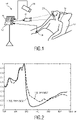
- Fig. 1 shows a schematic diagram of a system 10 according to the present invention including a device 12 for extracting physiological information indicative of at least one vital sign of a subject 14 from detected electromagnetic radiation transmitted through or reflected from a subject.
- the subject 14 in this example a patient, lies in a bed 16, e.g. in a hospital or other healthcare facility, but may also be a neonate or premature infant, e.g. lying in an incubator, or person at home or in a different environment.
- a detector for detecting electromagnetic radiation transmitted through or reflected from a subject which may alternatively (which is preferred) or together be used.
- two different embodiments of the detector are shown and will be explained below.
- Both embodiments of the detector are configured for deriving at least two detection signals from the detected electromagnetic radiation, wherein each detection signal comprises wavelength-dependent reflection or transmission information in a different wavelength channel.
- optical filters used are preferably different, but can be overlapping. It is sufficient if their wavelength-dependent transmission is different.
- the detector comprises a camera 18 (also referred to as imaging unit, or as camera-based or remote PPG sensor) including a suitable photosensor for (remotely and unobtrusively) capturing image frames of the subject 14, in particular for acquiring a sequence of image frames of the subject 14 over time, from which photoplethysmography signals can be derived.
- the image frames captured by the camera 18 may particularly correspond to a video sequence captured by means of an analog or digital photosensor, e.g. in a (digital) camera.
- a camera 18 usually includes a photosensor, such as a CMOS or CCD sensor, which may also operate in a specific spectral range (visible, IR) or provide information for different spectral ranges.
- the camera 18 may provide an analog or digital signal.
- the image frames include a plurality of image pixels having associated pixel values. Particularly, the image frames include pixels representing light intensity values captured with different photosensitive elements of a photosensor. These photosensitive elements may be sensitive in a specific spectral range (i.e. representing a specific color).
- the image frames include at least some image pixels being representative of a skin portion of the subject. Thereby, an image pixel may correspond to one photosensitive element of a photodetector and its (analog or digital) output or may be determined based on a combination (e.g. through binning) of a plurality of the photosensitive elements.
- the detector comprises one or more optical photoplethysmography sensor(s) 19 (also referred to as contact PPG sensor(s)) configured for being mounted to a skin portion of the subject 14 for acquiring photoplethysmography signals.
- the PPG sensor(s) 19 may e.g. be designed in the form of a finger-clip for measuring the blood oxygen saturation or a heart rate sensor for measuring the heart rate, just to name a few of all the possible embodiments.
- the system 10 may further optionally comprises a light source 22 (also called illumination source), such as a lamp, for illuminating a region of interest 24, such as the skin of the patient's face (e.g. part of the cheek or forehead), with light, for instance in a predetermined wavelength range or ranges (e.g. in the red, green and/or infrared wavelength range(s)).
- a region of interest 24 such as the skin of the patient's face (e.g. part of the cheek or forehead), with light, for instance in a predetermined wavelength range or ranges (e.g. in the red, green and/or infrared wavelength range(s)).
- a predetermined wavelength range or ranges e.g. in the red, green and/or infrared wavelength range(s)
- the light reflected from said region of interest 24 in response to said illumination is detected by the camera 18.
- no dedicated light source is provided, but ambient light is used for illumination of the subject 14. From the reflected light only light in a desired wavelength ranges
- the device 12 is further connected to an interface 20 for displaying the determined information and/or for providing medical personnel with an interface to change settings of the device 12, the camera 18, the PPG sensor(s) 19, the light source 22 and/or any other parameter of the system 10.
- an interface 20 may comprise different displays, buttons, touchscreens, keyboards or other human machine interface means.
- a system 10 as illustrated in Fig. 1 may, e.g., be located in a hospital, healthcare facility, elderly care facility or the like. Apart from the monitoring of patients, the present invention may also be applied in other fields such as neonate monitoring, general surveillance applications, security monitoring or so-called live style environments, such as fitness equipment, a wearable, a handheld device like a smartphone, or the like.
- the uni- or bidirectional communication between the device 12, the camera 18, the PPG sensor(s) 19 and the interface 20 may work via a wireless or wired communication interface.
- Other embodiments of the present invention may include a device 12, which is not provided standalone, but integrated into the camera 18 or the interface 20.
- the beating of the heart causes pressure variations in the arteries as the heart pumps blood against the resistance of the vascular bed. Since the arteries are elastic, their diameter changes in sync with the pressure variations. These diameter changes occur even in the smaller vessels of the skin, where the blood volume variations cause a changing absorption of the light.
- the precise blood volume pulse vector depends on the color filters of the camera, the spectrum of the light and the skin-reflectance, as the model shows. In practice the vector turns out to be remarkably stable though given a set of wavelength channels (the vector will be different in the infrared compared to RGB-based vector).
- the relative reflectance of the skin, in the red, green and blue channel under white illumination does not depend much on the skin-type. This is likely because the absorption spectra of the blood-free skin is dominated by the melanin absorption. Although a higher melanin concentration can increase the absolute absorption considerably, the relative absorption in the different wavelengths remains the same. This implies an increase of melanin darkens the skin, but hardly changes the normalized color of the skin. Consequently, also the normalized blood volume pulse P bv is quite stable under white illumination. In the infrared wavelengths the influence of melanin is further reduced as its maximum absorption occurs for short wavelengths (UV-light) and decreases for longer wavelengths.
- the stable character of P bv can be used to distinguish color variations caused by blood volume change from variations due to alternative causes, i.e. the stable P bv can be used as a "signature" of blood volume change to distinguish their color variations.
- the known relative pulsatilities of the color channels P bv can thus be used to discriminate between the pulse-signal and distortions.
- the operator ⁇ corresponds to the mean.
- the noise and the PPG signal may be separated into two independent signals built as a linear combination of two color channels. One combination approximated a clean PPG signal, the other contained noise due to motion. As an optimization criterion the energy in the pulse signal may be minimized.
- a linear combination of the three color channels may be used to obtain the pulse signal.
- the ICA or the PCA may be used to find this linear combination. Since it is a priori unknown which weighted color signal is the pulse signal all of them used the periodic nature of the pulse signal as the selection criterion.
- the P BV method generally obtains the mixing coefficients using the blood volume pulse vector as basically described in US 2013/271591 A1 and the above cited paper of de Haan and van Leest. The best results are obtained if the band-passed filtered versions of R n , G n and B n are used. According to this method the known direction of P bv is used to discriminate between the pulse signal and distortions. This not only removes the assumption (of earlier methods) that the pulse is the only periodic component in the video, but also eliminates assumptions on the orientation of the distortion signals. To this end, it is assumed as before that the pulse signal is built as a linear combination of normalized color signals.
- P bv the characteristic wavelength dependency of the PPG signal, as reflected in the normalized blood volume pulse, P bv , can be used to estimate the pulse signal from the time-sequential RGB pixel data averaged over the skin area. This algorithm is referred to as the P bv method.
- a pulse signal S1, S2 results as a weighted sum of the at least two detection signals C n . Since all detection signals C n contain the pulse and different levels of (common) noise, the weighting (of the detection signals to obtain the pulse signal) can lead to a pure noise-free pulse. This is why ICA and PCA can be used to separate noise and pulse. According to the present invention this is done differently.
- the relative strength (defined by the signature vector (e.g. P bv vector), which contains these relative pulsatilities) of the pulse is known in all detection signals C n (which is true if the desired vital sign information, e.g. the SpO2, were known, which is not the case since this is the parameter that is searched for). If the weights are chosen correctly, the correlation of the resulting pulse with the individual detection signals C n are exactly these relative strengths of the pulse in detection signals C n . Now, if the vital sign information (e.g. the SpO2) is wrong or unknown, the result will be a pulse signal with a relatively poor SNR (i.e. a poor quality indicator). By choosing the signature vector (e.g. P bv vector) such that it gives the best SNR (i.e. the best quality indicator), the algorithm provides that it gets closer to knowing the correct vital sign information (e.g. the SpO2).
- the signature vector e.g. P bv vector
- the absorption spectrum of blood depends on the oxygen saturation.
- a detection unit such as a camera or contact sensor, samples this spectrum, e.g. around 650nm, 810nm and 900nm, the signature vector Pbv has 3 components, and they depend on the SpO2. This is exploited according to the present invention.
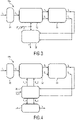
- Fig. 3 shows a more detailed schematic illustration of a first embodiment 12a of the device 12 according to the present invention.
- the device 12a comprises an input interface 30 for obtaining at least two detection signals C n derived from detected electromagnetic radiation transmitted through or reflected from a skin region of the subject 14.
- the data stream of detection data i.e. the detection signals C n
- the data stream of detection data is e.g. provided by the camera 18 and/or one or more PPG sensor(s) 19, wherein each detection signal comprises wavelength-dependent reflection or transmission information in a different wavelength channel.
- a pulse signal computation unit 32 computes at least two pulse signals S 1 , S 2 from said at least two detection signals C n using different signature vectors P bv 1, P bv 2, in particular normalized blood-volume vectors (P bv ), for the computation of each pulse signal. This step is explained in detail in the above cited paper of de Haan and van Leest or in M. van Gastel, S. Stuijk and G. de Haan, "Motion robust remote-PPG in infrared", IEEE, Tr. On Biomedical Engineering, 2015, DOI: 10.1109/TBME.2015.2390261 ,
- the different signature vectors P bv 1, P bv 2 used for the computation of each pulse signal provide an expected relative strength of the pulse signal S 1 , S 2 in the at least two detection signals C n .
- the computation of a pulse signal S 1 , S 2 involves a weighted combination of the at least two detection signals C n using weights selected such that the resulting pulse signal S 1 , S 2 correlates with the original detection signals C n as indicated by the respective signature vector P bv 1, P bv 2.
- a quality indicator computation unit 34 computes quality indicator values Q 1 , Q 2 for said pulse signals S 1 , S 2 indicating a characteristic of the respective pulse signal.
- a processing unit 38 derives physiological information V indicative of at least one vital sign from the signature vector that results in the pulse signal with the best quality indicator value Q 1 , Q 2 .
- the processing unit 38 can determine the physiological information V, e.g. a vital sign of the subject such as the subject's SpO2 value, since it is determined by the signature vector that gives the best quality pulse signal.
- the processing unit 38 can compute the pulse rate or the inter-beat-interval, the heart rate variability, or another characteristic of the pulse signal with the best quality indicator value Q as the vital sign.
- the "best" quality indicator value shall be understood as the value that indicates which pulse signal has the best quality. Depending on the chosen definition, this may be e.g. the lowest or the highest value of the quality indicator. Generally, various metrics can be used as quality indicators indicating a characteristic of the respective pulse signal. In one embodiment the signal-to-noise-ratio (SNR) (i.e. the height of the highest peak in a normalized spectrum) is used.
- SNR signal-to-noise-ratio
- the SNR may be computed for all regions, but also the correlation between the different pulse signals (similarity matrix) may be used to determine together with the local SNRs a weighted mean pulse with a "weighted” SNR that is used as the "quality" indicator to decide which signature vector is the best.
- the various units of the device 12 may be comprised in one or multiple digital or analog processors depending on how and where the invention is applied.
- the different units may completely or partly be implemented in software and carried out on a personal computer connected to one or more detectors. Some or all of the required functionality may also be implemented in hardware, e.g. in an application specific integrated circuit (ASIC) or in a field programmable gate array (FPGA).
- ASIC application specific integrated circuit
- FPGA field programmable gate array
- the pulse signal computation unit 32 uses a fixed set of different signature vectors P bv 1, P bv 2 and the processing unit 38 filters the time sequence of signature vectors that resulted in the pulse signal with the best quality indicator value Q1, Q2 to obtain a filtered signature vector from which the physiological information is derived.
- the fixed set of signature vectors P bv 1, P bv 2 cover the range of the vital sign to be measured. For instance, for SpO2, it may provide signature vectors corresponding to SpO2 values in a range between 60% and 100%. They are the same for every subject and may be stored indeed in a look-up table.
- the above described processing is done over a time window, e.g. 10 seconds, of detection signals in each wavelength channel.
- This window is then sliding, i.e. the next measurement is again from a 10 seconds window, registered somewhat later in time.
- every window yields an (e.g. SpO2) estimate (which is defined by the found "best" signature vector), and the succession of measurement results (signature vectors) gives a time sequence of measurements that can be (temporally) filtered in order to obtain a smoother and higher resolution measurement.
- quality indicator values are computed for only two fixed signature vectors. The relation between the two quality indicator values can then directly be translated into an SpO2 value.
- quality indicator values are computed for a broad range of signatures vectors suitable for the entire range of SpO2 values.
- the best signature vector stands out immediately, meaning that this implementation can react to SpO2 changes without delay as it does not have to converge to it recursively.
- Fig. 4 shows a schematic diagram of a second embodiment 12b of a device 12 according to the present invention.
- a signature adaptation unit 36 is additionally provided for (iteratively / recursively) adapting one or more of the different signature vectors Pbv1, Pbv2 in a direction that depends on which pulse signal yields the best quality indicator value.
- the signature adaptation unit 36 is preferably configured to use a (predetermined) reference signature vector P bv 0 to obtain at least two signature vectors P bv 1, P bv 2 based on said quality indicator values Q1, Q2.
- the pulse signal computation unit 32 is preferably configured to compute said pulse signals S 1 , S 2 from said detection signal C n for said at least two signature vectors P bv 1, P bv 2 such that a pulse signal correlates with said at least two detection signals in a ratio determined by the corresponding signature vector.
- This ratio is defined by the above equation (1). It shows that the inner product (or correlation) of pulse signal S with each of the (normalized and DC-free) color channels in C n equals a multiple (arbitrary value k) times the signature vector P Bv . So the weights W are computed to realize this particular correlation ratio. This computation is shown in the above equation (2).
- the pulse signal Since the quality of this pulse signal depends on the correctness of the chosen signature vector P bv , the pulse signal is computed for two (or more) different signature vectors P bv 1 and P bv 2. Consequently, the quality of the resulting pulse signal is judged.
- This can e.g. be achieved by computing the normalized (e.g. divided by the standard deviation) pulse signal over a time window, transforming it to the Fourier domain and defining a quality metric (i.e. quality indicator) as the amplitude of the highest peak in the range of the pulse frequencies. The higher this peak, the higher is the quality of the corresponding pulse signal considered.
- Two quality measures Q1 and Q2 are thus available, reflecting the quality of S1 and S2 respectively, which are used to adapt the signature vectors P bv 1 and P bv 2, used in the next time window. This can be done in a sliding window fashion, where the window shifts over one sample per computation cycle, but it is equally possible to slide the window faster, e.g. over 5 samples.
- An example window size is 200 samples for a sampling frequency of 20Hz.
- the quality of the resulting pulse signal may be judged by transforming it to the Fourier domain and defining a quality metric Q as the amplitude of the highest peak in the range of the pulse frequencies divided by the energy over the full frequency range (possibly excluding the peak). The higher this ratio, the higher is the quality of the pulse signal considered.
- the quality indicators Q1 and Q2 are compared and their sign increases/decreases a counter.
- the desired physiological information e.g. SpO2
- the desired physiological information is mostly determined by the value of the counter that determines P bv 1 and P bv 2, i.e. either P bv 1 or P bv 2 can be used and both are derived from the counter value.
- P bv 0 was selected as [0.2 0.6 0.8] T (reflecting the relative pulsatilities of 660nm, 800nm, and 840nm, respectively) and the update vector U was selected as [0.01 0 -0.0036] T , which clearly shows that it is expected that the pulsatility of the 660nm varies most, that of 840nm about a factor of 3 less and in the opposite direction, while the pulsatility of the 800nm channel is expected not to depend on SpO2.
- This noise preferably has a broad spectrum, or can be periodic but with a frequency outside the pulse-rate band.
- the quality indicator value calculation will be helped, as it computes the value of the highest frequency peak in the pulse-rate band of the normalized pulse signal (e.g. normalized by dividing over standard deviation of the pulse signal in a time window).
- the signature vector (P bv ), with which the best quality pulse signal can be computed provides (in its coefficients) the relative pulsatilities of the different wavelength channels (C n ).
- the optimal signature vector depends on the various substances in the blood (gasses like O2, CO2, CO, but also a substance like bilirubin). This is because these substances influence the absorption spectrum of the blood (e.g. the color of blood changes depending on oxygenation level). If an initial P vb vector is taken that corresponds e.g. to a healthy situation, like 100% oxygen saturation, then the update vector (in case it is aimed at estimation of the SpO2 value; it is different if bilirubin or CO, etc.
- just a single update can be made, and then the processing time window can be shifted to do the next single update.
- This is the recursive option. Since the SpO2 value does not change rapidly, this recursive approach is efficient, and reaches convergence after a couple of seconds.
- the oscillations can be removed with a low pass filter to obtain a more accurate measurement.
- the filtering allows a relative large update (fast convergence) with large oscillation, which because of the temporal low-pass filtering does not sacrifice accuracy.
- this parallel system will also likely hesitate between two (or more) optimal P bv s (certainly if the sampling is very sparse) and again a temporal low-pass filter may eliminate the noise from this hesitation and thus provide an increased accuracy compared to the sparse sampling.
- a robust pulse signal measurement has been implemented with a detector sampling the spectrum around 650nm, 810nm and 900nm.
- 760nm, 800nm and 840nm are used.
- more suitable for bilirubin detection 475nm, 550nm and 650nm may be used.
- the embodiments have been described with the assumption to determine SpO2.
- the invention can also be applied for determining other physiological information, such as bilirubin, CO or CO2.
- the absorption curves (as function of wavelength) of blood with different fractions of bilirubin, CO or CO2 differ from the curves for different values of SpO2.
- the update vector has to be a different one (the initial vector may be the one of 97% SpO2 (with 0% bilirubin, 0% CO, 0% CO2), but the proposed method generally tracks only one variable fraction (O2, CO, CO2 or bilirubin) assuming the other fractions to be known and stable).
- more wavelength channels are necessary to disambiguate the measurement.
- the device according to the present invention has been implemented and tested for a person who holds his breath during a period of time to induce an SpO2 dip.
- the resulting SpO2 value obtained with this method is shown in Fig. 5.
- Fig. 5A shows how the blood volume pulse vector evolves during the experiment (with relative pulsatilities of 660nm (curve 40), 810nm (curve 41) and 840nm (curve 42).
- Fig. 5B shows the resulting SpO2 estimate 50 derived from the count value that adapts the test signatures P bv 1 and P bv 2. The SpO2 dip during breath holding is clearly perceived.
- the present invention can be applied in the field of health care, e.g. unobtrusive remote patient monitoring, general surveillances, security monitoring and so-called lifestyle environments, such as fitness equipment, or the like. Applications may include monitoring of oxygen saturation (pulse oximetry), heart rate, blood pressure, cardiac output, changes of blood perfusion, assessment of autonomic functions, and detection of peripheral vascular diseases.
- the present invention can e.g. be used for rapid and reliable pulse detection of a critical patient, for instance during automated CPR (cardiopulmonary resuscitation).
- the system can be used for monitoring of vital signs of neonates as well.
- the present invention improves the SNR considerably for near stationary subjects and consequently leads to a more accurate beat-to-beat measurement.
- the present invention presents a device (and a corresponding method) for extracting physiological information indicative of at least one vital sign of a subject, said device comprising:
- a computer program may be stored/distributed on a suitable medium, such as an optical storage medium or a solid-state medium supplied together with or as part of other hardware, but may also be distributed in other forms, such as via the Internet or other wired or wireless telecommunication systems.
- a suitable medium such as an optical storage medium or a solid-state medium supplied together with or as part of other hardware, but may also be distributed in other forms, such as via the Internet or other wired or wireless telecommunication systems.
Landscapes
- Health & Medical Sciences (AREA)
- Life Sciences & Earth Sciences (AREA)
- Engineering & Computer Science (AREA)
- Physics & Mathematics (AREA)
- General Health & Medical Sciences (AREA)
- Public Health (AREA)
- Pathology (AREA)
- Veterinary Medicine (AREA)
- Biomedical Technology (AREA)
- Heart & Thoracic Surgery (AREA)
- Medical Informatics (AREA)
- Molecular Biology (AREA)
- Surgery (AREA)
- Animal Behavior & Ethology (AREA)
- Biophysics (AREA)
- Physiology (AREA)
- Cardiology (AREA)
- Signal Processing (AREA)
- Psychiatry (AREA)
- Artificial Intelligence (AREA)
- Computer Vision & Pattern Recognition (AREA)
- Optics & Photonics (AREA)
- Pulmonology (AREA)
- Spectroscopy & Molecular Physics (AREA)
- Vascular Medicine (AREA)
- Emergency Medicine (AREA)
- Measuring Pulse, Heart Rate, Blood Pressure Or Blood Flow (AREA)
- Measurement Of The Respiration, Hearing Ability, Form, And Blood Characteristics Of Living Organisms (AREA)
Applications Claiming Priority (3)
| Application Number | Priority Date | Filing Date | Title |
|---|---|---|---|
| US201562234440P | 2015-09-29 | 2015-09-29 | |
| EP15187416 | 2015-09-29 | ||
| PCT/EP2016/072864 WO2017055218A1 (en) | 2015-09-29 | 2016-09-26 | Device, system and method for extracting physiological information |
Publications (2)
| Publication Number | Publication Date |
|---|---|
| EP3355787A1 EP3355787A1 (en) | 2018-08-08 |
| EP3355787B1 true EP3355787B1 (en) | 2022-06-08 |
Family
ID=54249363
Family Applications (1)
| Application Number | Title | Priority Date | Filing Date |
|---|---|---|---|
| EP16770522.7A Active EP3355787B1 (en) | 2015-09-29 | 2016-09-26 | Device, system and method for extracting physiological information |
Country Status (5)
| Country | Link |
|---|---|
| US (1) | US10646167B2 (enExample) |
| EP (1) | EP3355787B1 (enExample) |
| JP (1) | JP2018534968A (enExample) |
| CN (1) | CN108366759B (enExample) |
| WO (1) | WO2017055218A1 (enExample) |
Families Citing this family (31)
| Publication number | Priority date | Publication date | Assignee | Title |
|---|---|---|---|---|
| US12226188B2 (en) | 2012-12-31 | 2025-02-18 | Omni Medsci, Inc. | Active illumination and time-of-flight camera system to evaluate facial blood flow, eye movements and physiological parameters |
| US12484787B2 (en) | 2012-12-31 | 2025-12-02 | Omni Medsci, Inc. | Measurements using camera imaging tissue comprising skin or the hand |
| US12193790B2 (en) | 2012-12-31 | 2025-01-14 | Omni Medsci, Inc. | Wearable devices comprising semiconductor diode light sources with improved signal-to-noise ratio |
| US12502080B2 (en) | 2012-12-31 | 2025-12-23 | Omni Medsci, Inc. | Camera based wearable devices with artificial intelligence assistants |
| US10660526B2 (en) | 2012-12-31 | 2020-05-26 | Omni Medsci, Inc. | Near-infrared time-of-flight imaging using laser diodes with Bragg reflectors |
| WO2017148807A1 (en) | 2016-03-01 | 2017-09-08 | Koninklijke Philips N.V. | Device, system and method for determining a vital sign of a subject |
| US10335045B2 (en) | 2016-06-24 | 2019-07-02 | Universita Degli Studi Di Trento | Self-adaptive matrix completion for heart rate estimation from face videos under realistic conditions |
| CN116269261B (zh) * | 2016-12-01 | 2025-10-28 | 松下知识产权经营株式会社 | 生物体信息处理方法及生物体信息处理系统 |
| KR101994788B1 (ko) * | 2017-04-21 | 2019-07-01 | 조선대학교 산학협력단 | 광전용적맥파를 이용한 뇌혈관 질환 및 협착 분석 장치 및 방법 |
| CO2017008062A1 (es) * | 2017-08-10 | 2019-03-08 | Univ De La Sabana | Dispositivo de evaluación y retroalimentación de calidad de compresiones torácicas durante resucitación cardiopulmonar |
| EP3479754A1 (en) * | 2017-11-01 | 2019-05-08 | Koninklijke Philips N.V. | Device, system and method for determining at least one vital sign of a subject |
| EP3485813A1 (en) * | 2017-11-16 | 2019-05-22 | Koninklijke Philips N.V. | System and method for sensing physiological parameters |
| EP3545821A1 (en) | 2018-03-27 | 2019-10-02 | Koninklijke Philips N.V. | Device, system and method for extracting physiological information indicative of at least one vital sign of a subject |
| EP3583888A1 (en) * | 2018-06-19 | 2019-12-25 | Koninklijke Philips N.V. | Device, system and method for image segmentation of an image of a scene including a subject |
| KR102640331B1 (ko) * | 2018-10-19 | 2024-02-26 | 삼성전자주식회사 | 생체정보 추정 장치 및 방법과, 생체정보 추정 지원 장치 |
| US10696305B2 (en) | 2018-11-15 | 2020-06-30 | XMotors.ai Inc. | Apparatus and method for measuring physiological information of living subject in vehicle |
| CN109711073B (zh) * | 2018-12-29 | 2022-11-22 | 广东工业大学 | 一种基于稀疏表示的心肺音混叠信号盲源分离方法 |
| EP3698704A1 (en) * | 2019-02-20 | 2020-08-26 | Koninklijke Philips N.V. | Device, system and method for determining physiological information |
| JP7174359B2 (ja) * | 2019-03-29 | 2022-11-17 | 株式会社アイシン | 脈波検出装置、及び脈波検出プログラム |
| TWI750504B (zh) * | 2019-08-29 | 2021-12-21 | 鉅怡智慧股份有限公司 | 活體偵測的方法及相關裝置 |
| JP7282897B2 (ja) * | 2019-09-05 | 2023-05-29 | 株式会社日立国際電気 | 脈拍数推定方法、装置およびシステム |
| CN110755055A (zh) * | 2019-10-18 | 2020-02-07 | 上海掌门科技有限公司 | 一种用于确定脉搏波形的波形评价信息的方法与设备 |
| TWI761739B (zh) * | 2019-12-10 | 2022-04-21 | 緯創資通股份有限公司 | 活體臉部辨識系統與方法 |
| US20210345897A1 (en) * | 2020-05-06 | 2021-11-11 | Elite HRV, Inc. | Heart Rate Variability Composite Scoring and Analysis |
| CN111568425B (zh) * | 2020-06-08 | 2021-08-03 | 北京大学 | 一种非接触式的多人呼吸检测方法 |
| EP3991638A1 (en) * | 2020-10-29 | 2022-05-04 | CSEM Centre Suisse d'Electronique et de Microtechnique SA - Recherche et Développement | Method for determining a physiological parameter using a ppg signal with reduced influence of venous pulsatility |
| US12076141B2 (en) | 2021-02-26 | 2024-09-03 | Covidien Lp | System and method for digitally calibrating a medical sensor |
| EP4075776B1 (en) * | 2021-04-12 | 2023-11-01 | Nokia Technologies Oy | Mapping pulse propagation |
| CN113750375A (zh) * | 2021-08-13 | 2021-12-07 | 台州恩泽医疗中心(集团) | 一种基于cli的肿瘤放疗实时监测同步采集装置 |
| US12458295B2 (en) | 2021-10-01 | 2025-11-04 | Covidien Lp | System and method for correcting for errors dependent upon spectral characteristics of tissue |
| CN114869260B (zh) * | 2022-05-27 | 2026-02-13 | 浙江工业大学 | 一种面向压缩视频的心率检测方法 |
Citations (1)
| Publication number | Priority date | Publication date | Assignee | Title |
|---|---|---|---|---|
| US20140275825A1 (en) * | 2013-03-15 | 2014-09-18 | Covidien Lp | Methods and systems for light signal control in a physiological monitor |
Family Cites Families (17)
| Publication number | Priority date | Publication date | Assignee | Title |
|---|---|---|---|---|
| US7629969B2 (en) * | 1996-08-12 | 2009-12-08 | Tyco Electronics Corporation | Acoustic condition sensor employing a plurality of mutually non-orthogonal waves |
| US6282467B1 (en) * | 1997-10-14 | 2001-08-28 | The Boeing Company | Three-axis inertial attitude determination for spinning spacecraft |
| US7089927B2 (en) * | 2002-10-23 | 2006-08-15 | New York University | System and method for guidance of anesthesia, analgesia and amnesia |
| WO2007144880A2 (en) | 2006-06-13 | 2007-12-21 | Elfi-Tech Ltd. | System and method for measurement of biological parameters of a subject |
| JP2008237377A (ja) * | 2007-03-26 | 2008-10-09 | Som Japan:Kk | 自己組織化マップを利用した健康診断システム上での被験者の位置の経年データの移動から被験者の疾病の種類を予測するシステムの構築。 |
| EP2162843A1 (en) * | 2007-06-07 | 2010-03-17 | Mentis Cura ehf. | System and a method for generating a quantitative measure reflecting the severity of a medical condition |
| CN102046076A (zh) * | 2008-04-03 | 2011-05-04 | Kai医药公司 | 非接触式生理运动传感器及其使用方法 |
| EP2429643B1 (en) * | 2009-04-30 | 2017-08-23 | Medtronic, Inc. | Patient state detection based on support vector machine based algorithm |
| US8620591B2 (en) * | 2010-01-14 | 2013-12-31 | Venture Gain LLC | Multivariate residual-based health index for human health monitoring |
| TR201910715T4 (tr) * | 2011-01-05 | 2019-08-21 | Koninklijke Philips Nv | Karakteristik sinyallerden bilgiyi ekstrakte etmek için cihaz ve yöntem. |
| CN103503024B (zh) * | 2011-04-14 | 2016-10-05 | 皇家飞利浦有限公司 | 用于从特征信号提取信息的设备和方法 |
| MX2014002199A (es) * | 2011-09-02 | 2014-05-30 | Koninkl Philips Nv | Camara para generar una señal biometrica de un ser vivo. |
| US8880576B2 (en) * | 2011-09-23 | 2014-11-04 | Nellcor Puritan Bennett Ireland | Systems and methods for determining respiration information from a photoplethysmograph |
| RU2655443C2 (ru) * | 2012-12-14 | 2018-05-28 | Конинклейке Филипс Н.В. | Система и способ обнаружения значимых аритмических событий посредством фотоплетизмограммы(ppg) и акселерометра |
| CN104887198A (zh) * | 2014-03-06 | 2015-09-09 | 中国科学院沈阳自动化研究所 | 基于人体生理信号多参数融合的疼痛定量分析系统及方法 |
| CN104063645B (zh) * | 2014-07-01 | 2017-08-04 | 清华大学深圳研究生院 | 一种基于心电信号动态自更新样本的身份识别方法 |
| EP3261524B1 (en) * | 2015-02-25 | 2021-04-21 | Spry Health, Inc. | Systems and methods for non-invasive blood pressure measurement |
-
2016
- 2016-09-26 CN CN201680069147.3A patent/CN108366759B/zh active Active
- 2016-09-26 EP EP16770522.7A patent/EP3355787B1/en active Active
- 2016-09-26 WO PCT/EP2016/072864 patent/WO2017055218A1/en not_active Ceased
- 2016-09-26 JP JP2018516180A patent/JP2018534968A/ja active Pending
- 2016-09-29 US US15/279,474 patent/US10646167B2/en active Active
Patent Citations (1)
| Publication number | Priority date | Publication date | Assignee | Title |
|---|---|---|---|---|
| US20140275825A1 (en) * | 2013-03-15 | 2014-09-18 | Covidien Lp | Methods and systems for light signal control in a physiological monitor |
Non-Patent Citations (3)
| Title |
|---|
| DE HAAN G ET AL: "Improved motion robustness of remote-PPG by using the blood volume pulse signature", PHYSIOLOGICAL MEASUREMENT, INSTITUTE OF PHYSICS PUBLISHING, BRISTOL, GB, vol. 35, no. 9, 27 August 2014 (2014-08-27), pages 1913 - 1926, XP020269523, ISSN: 0967-3334, [retrieved on 20140827], DOI: 10.1088/0967-3334/35/9/1913 * |
| LUIS F. CORRAL MARTINEZ ET AL: "<title>Optimal wavelength selection for noncontact reflection photoplethysmography</title>", BIOMEDICAL PHOTONICS AND OPTOELECTRONIC IMAGING : 8 - 10 NOVEMBER 2000, BEIJING, CHINA, vol. 8011, 15 August 2011 (2011-08-15), Bellingham, Wash., US, pages 801191 - 801191-7, XP055262353, ISBN: 978-1-62841-832-3, DOI: 10.1117/12.903190 * |
| WANG WENJIN ET AL: "Exploiting Spatial Redundancy of Image Sensor for Motion Robust rPPG", IEEE TRANSACTIONS ON BIOMEDICAL ENGINEERING, IEEE, USA, vol. 62, no. 2, 1 February 2015 (2015-02-01), pages 415 - 425, XP011570468, ISSN: 0018-9294, [retrieved on 20150116], DOI: 10.1109/TBME.2014.2356291 * |
Also Published As
| Publication number | Publication date |
|---|---|
| US10646167B2 (en) | 2020-05-12 |
| EP3355787A1 (en) | 2018-08-08 |
| JP2018534968A (ja) | 2018-11-29 |
| WO2017055218A1 (en) | 2017-04-06 |
| US20170086755A1 (en) | 2017-03-30 |
| CN108366759B (zh) | 2022-04-19 |
| CN108366759A (zh) | 2018-08-03 |
Similar Documents
| Publication | Publication Date | Title |
|---|---|---|
| US10646167B2 (en) | Device, system and method for extracting physiological information | |
| US12064269B2 (en) | Device, system and method for generating a photoplethysmographic image carrying vital sign information of a subject | |
| EP2988662B1 (en) | System and method for extracting physiological information | |
| JP6654700B2 (ja) | 被検体の生命兆候情報を判断するための装置、システム、および作動方法 | |
| US10478078B2 (en) | Device and method for determining vital signs of a subject | |
| EP3104767B1 (en) | Device, system and method for determining vital signs of a subject based on reflected and transmitted light | |
| EP3479754A1 (en) | Device, system and method for determining at least one vital sign of a subject | |
| CN113498326B (zh) | 用于确定生理信息的设备、系统和方法 | |
| EP3422931B1 (en) | Device, system and method for determining a vital sign of a subject | |
| EP3773154B1 (en) | Device, system and method for extracting physiological information indicative of at least one vital sign of a subject | |
| EP3517034A1 (en) | Device, system and method for determining at least one vital sign of a subject |
Legal Events
| Date | Code | Title | Description |
|---|---|---|---|
| STAA | Information on the status of an ep patent application or granted ep patent |
Free format text: STATUS: UNKNOWN |
|
| STAA | Information on the status of an ep patent application or granted ep patent |
Free format text: STATUS: THE INTERNATIONAL PUBLICATION HAS BEEN MADE |
|
| PUAI | Public reference made under article 153(3) epc to a published international application that has entered the european phase |
Free format text: ORIGINAL CODE: 0009012 |
|
| STAA | Information on the status of an ep patent application or granted ep patent |
Free format text: STATUS: REQUEST FOR EXAMINATION WAS MADE |
|
| 17P | Request for examination filed |
Effective date: 20180430 |
|
| AK | Designated contracting states |
Kind code of ref document: A1 Designated state(s): AL AT BE BG CH CY CZ DE DK EE ES FI FR GB GR HR HU IE IS IT LI LT LU LV MC MK MT NL NO PL PT RO RS SE SI SK SM TR |
|
| AX | Request for extension of the european patent |
Extension state: BA ME |
|
| DAV | Request for validation of the european patent (deleted) | ||
| DAX | Request for extension of the european patent (deleted) | ||
| RAP1 | Party data changed (applicant data changed or rights of an application transferred) |
Owner name: KONINKLIJKE PHILIPS N.V. |
|
| GRAP | Despatch of communication of intention to grant a patent |
Free format text: ORIGINAL CODE: EPIDOSNIGR1 |
|
| STAA | Information on the status of an ep patent application or granted ep patent |
Free format text: STATUS: GRANT OF PATENT IS INTENDED |
|
| INTG | Intention to grant announced |
Effective date: 20220105 |
|
| GRAS | Grant fee paid |
Free format text: ORIGINAL CODE: EPIDOSNIGR3 |
|
| GRAA | (expected) grant |
Free format text: ORIGINAL CODE: 0009210 |
|
| STAA | Information on the status of an ep patent application or granted ep patent |
Free format text: STATUS: THE PATENT HAS BEEN GRANTED |
|
| AK | Designated contracting states |
Kind code of ref document: B1 Designated state(s): AL AT BE BG CH CY CZ DE DK EE ES FI FR GB GR HR HU IE IS IT LI LT LU LV MC MK MT NL NO PL PT RO RS SE SI SK SM TR |
|
| REG | Reference to a national code |
Ref country code: GB Ref legal event code: FG4D |
|
| REG | Reference to a national code |
Ref country code: AT Ref legal event code: REF Ref document number: 1496367 Country of ref document: AT Kind code of ref document: T Effective date: 20220615 Ref country code: CH Ref legal event code: EP |
|
| REG | Reference to a national code |
Ref country code: DE Ref legal event code: R096 Ref document number: 602016072705 Country of ref document: DE |
|
| REG | Reference to a national code |
Ref country code: IE Ref legal event code: FG4D |
|
| REG | Reference to a national code |
Ref country code: LT Ref legal event code: MG9D |
|
| REG | Reference to a national code |
Ref country code: NL Ref legal event code: MP Effective date: 20220608 |
|
| PG25 | Lapsed in a contracting state [announced via postgrant information from national office to epo] |
Ref country code: SE Free format text: LAPSE BECAUSE OF FAILURE TO SUBMIT A TRANSLATION OF THE DESCRIPTION OR TO PAY THE FEE WITHIN THE PRESCRIBED TIME-LIMIT Effective date: 20220608 Ref country code: NO Free format text: LAPSE BECAUSE OF FAILURE TO SUBMIT A TRANSLATION OF THE DESCRIPTION OR TO PAY THE FEE WITHIN THE PRESCRIBED TIME-LIMIT Effective date: 20220908 Ref country code: LT Free format text: LAPSE BECAUSE OF FAILURE TO SUBMIT A TRANSLATION OF THE DESCRIPTION OR TO PAY THE FEE WITHIN THE PRESCRIBED TIME-LIMIT Effective date: 20220608 Ref country code: HR Free format text: LAPSE BECAUSE OF FAILURE TO SUBMIT A TRANSLATION OF THE DESCRIPTION OR TO PAY THE FEE WITHIN THE PRESCRIBED TIME-LIMIT Effective date: 20220608 Ref country code: GR Free format text: LAPSE BECAUSE OF FAILURE TO SUBMIT A TRANSLATION OF THE DESCRIPTION OR TO PAY THE FEE WITHIN THE PRESCRIBED TIME-LIMIT Effective date: 20220909 Ref country code: FI Free format text: LAPSE BECAUSE OF FAILURE TO SUBMIT A TRANSLATION OF THE DESCRIPTION OR TO PAY THE FEE WITHIN THE PRESCRIBED TIME-LIMIT Effective date: 20220608 Ref country code: ES Free format text: LAPSE BECAUSE OF FAILURE TO SUBMIT A TRANSLATION OF THE DESCRIPTION OR TO PAY THE FEE WITHIN THE PRESCRIBED TIME-LIMIT Effective date: 20220608 Ref country code: BG Free format text: LAPSE BECAUSE OF FAILURE TO SUBMIT A TRANSLATION OF THE DESCRIPTION OR TO PAY THE FEE WITHIN THE PRESCRIBED TIME-LIMIT Effective date: 20220908 |
|
| REG | Reference to a national code |
Ref country code: AT Ref legal event code: MK05 Ref document number: 1496367 Country of ref document: AT Kind code of ref document: T Effective date: 20220608 |
|
| PG25 | Lapsed in a contracting state [announced via postgrant information from national office to epo] |
Ref country code: RS Free format text: LAPSE BECAUSE OF FAILURE TO SUBMIT A TRANSLATION OF THE DESCRIPTION OR TO PAY THE FEE WITHIN THE PRESCRIBED TIME-LIMIT Effective date: 20220608 Ref country code: LV Free format text: LAPSE BECAUSE OF FAILURE TO SUBMIT A TRANSLATION OF THE DESCRIPTION OR TO PAY THE FEE WITHIN THE PRESCRIBED TIME-LIMIT Effective date: 20220608 |
|
| PG25 | Lapsed in a contracting state [announced via postgrant information from national office to epo] |
Ref country code: NL Free format text: LAPSE BECAUSE OF FAILURE TO SUBMIT A TRANSLATION OF THE DESCRIPTION OR TO PAY THE FEE WITHIN THE PRESCRIBED TIME-LIMIT Effective date: 20220608 |
|
| PG25 | Lapsed in a contracting state [announced via postgrant information from national office to epo] |
Ref country code: SM Free format text: LAPSE BECAUSE OF FAILURE TO SUBMIT A TRANSLATION OF THE DESCRIPTION OR TO PAY THE FEE WITHIN THE PRESCRIBED TIME-LIMIT Effective date: 20220608 Ref country code: SK Free format text: LAPSE BECAUSE OF FAILURE TO SUBMIT A TRANSLATION OF THE DESCRIPTION OR TO PAY THE FEE WITHIN THE PRESCRIBED TIME-LIMIT Effective date: 20220608 Ref country code: RO Free format text: LAPSE BECAUSE OF FAILURE TO SUBMIT A TRANSLATION OF THE DESCRIPTION OR TO PAY THE FEE WITHIN THE PRESCRIBED TIME-LIMIT Effective date: 20220608 Ref country code: PT Free format text: LAPSE BECAUSE OF FAILURE TO SUBMIT A TRANSLATION OF THE DESCRIPTION OR TO PAY THE FEE WITHIN THE PRESCRIBED TIME-LIMIT Effective date: 20221010 Ref country code: EE Free format text: LAPSE BECAUSE OF FAILURE TO SUBMIT A TRANSLATION OF THE DESCRIPTION OR TO PAY THE FEE WITHIN THE PRESCRIBED TIME-LIMIT Effective date: 20220608 Ref country code: CZ Free format text: LAPSE BECAUSE OF FAILURE TO SUBMIT A TRANSLATION OF THE DESCRIPTION OR TO PAY THE FEE WITHIN THE PRESCRIBED TIME-LIMIT Effective date: 20220608 Ref country code: AT Free format text: LAPSE BECAUSE OF FAILURE TO SUBMIT A TRANSLATION OF THE DESCRIPTION OR TO PAY THE FEE WITHIN THE PRESCRIBED TIME-LIMIT Effective date: 20220608 |
|
| PG25 | Lapsed in a contracting state [announced via postgrant information from national office to epo] |
Ref country code: PL Free format text: LAPSE BECAUSE OF FAILURE TO SUBMIT A TRANSLATION OF THE DESCRIPTION OR TO PAY THE FEE WITHIN THE PRESCRIBED TIME-LIMIT Effective date: 20220608 Ref country code: IS Free format text: LAPSE BECAUSE OF FAILURE TO SUBMIT A TRANSLATION OF THE DESCRIPTION OR TO PAY THE FEE WITHIN THE PRESCRIBED TIME-LIMIT Effective date: 20221008 |
|
| REG | Reference to a national code |
Ref country code: DE Ref legal event code: R097 Ref document number: 602016072705 Country of ref document: DE |
|
| PG25 | Lapsed in a contracting state [announced via postgrant information from national office to epo] |
Ref country code: AL Free format text: LAPSE BECAUSE OF FAILURE TO SUBMIT A TRANSLATION OF THE DESCRIPTION OR TO PAY THE FEE WITHIN THE PRESCRIBED TIME-LIMIT Effective date: 20220608 |
|
| PLBE | No opposition filed within time limit |
Free format text: ORIGINAL CODE: 0009261 |
|
| STAA | Information on the status of an ep patent application or granted ep patent |
Free format text: STATUS: NO OPPOSITION FILED WITHIN TIME LIMIT |
|
| PG25 | Lapsed in a contracting state [announced via postgrant information from national office to epo] |
Ref country code: MC Free format text: LAPSE BECAUSE OF FAILURE TO SUBMIT A TRANSLATION OF THE DESCRIPTION OR TO PAY THE FEE WITHIN THE PRESCRIBED TIME-LIMIT Effective date: 20220608 Ref country code: DK Free format text: LAPSE BECAUSE OF FAILURE TO SUBMIT A TRANSLATION OF THE DESCRIPTION OR TO PAY THE FEE WITHIN THE PRESCRIBED TIME-LIMIT Effective date: 20220608 |
|
| REG | Reference to a national code |
Ref country code: CH Ref legal event code: PL |
|
| 26N | No opposition filed |
Effective date: 20230310 |
|
| REG | Reference to a national code |
Ref country code: BE Ref legal event code: MM Effective date: 20220930 |
|
| PG25 | Lapsed in a contracting state [announced via postgrant information from national office to epo] |
Ref country code: SI Free format text: LAPSE BECAUSE OF FAILURE TO SUBMIT A TRANSLATION OF THE DESCRIPTION OR TO PAY THE FEE WITHIN THE PRESCRIBED TIME-LIMIT Effective date: 20220608 |
|
| PG25 | Lapsed in a contracting state [announced via postgrant information from national office to epo] |
Ref country code: LU Free format text: LAPSE BECAUSE OF NON-PAYMENT OF DUE FEES Effective date: 20220926 |
|
| PG25 | Lapsed in a contracting state [announced via postgrant information from national office to epo] |
Ref country code: LI Free format text: LAPSE BECAUSE OF NON-PAYMENT OF DUE FEES Effective date: 20220930 Ref country code: IE Free format text: LAPSE BECAUSE OF NON-PAYMENT OF DUE FEES Effective date: 20220926 Ref country code: CH Free format text: LAPSE BECAUSE OF NON-PAYMENT OF DUE FEES Effective date: 20220930 |
|
| PG25 | Lapsed in a contracting state [announced via postgrant information from national office to epo] |
Ref country code: BE Free format text: LAPSE BECAUSE OF NON-PAYMENT OF DUE FEES Effective date: 20220930 |
|
| PG25 | Lapsed in a contracting state [announced via postgrant information from national office to epo] |
Ref country code: IT Free format text: LAPSE BECAUSE OF FAILURE TO SUBMIT A TRANSLATION OF THE DESCRIPTION OR TO PAY THE FEE WITHIN THE PRESCRIBED TIME-LIMIT Effective date: 20220608 |
|
| PG25 | Lapsed in a contracting state [announced via postgrant information from national office to epo] |
Ref country code: HU Free format text: LAPSE BECAUSE OF FAILURE TO SUBMIT A TRANSLATION OF THE DESCRIPTION OR TO PAY THE FEE WITHIN THE PRESCRIBED TIME-LIMIT; INVALID AB INITIO Effective date: 20160926 |
|
| PG25 | Lapsed in a contracting state [announced via postgrant information from national office to epo] |
Ref country code: CY Free format text: LAPSE BECAUSE OF FAILURE TO SUBMIT A TRANSLATION OF THE DESCRIPTION OR TO PAY THE FEE WITHIN THE PRESCRIBED TIME-LIMIT Effective date: 20220608 |
|
| PG25 | Lapsed in a contracting state [announced via postgrant information from national office to epo] |
Ref country code: MK Free format text: LAPSE BECAUSE OF FAILURE TO SUBMIT A TRANSLATION OF THE DESCRIPTION OR TO PAY THE FEE WITHIN THE PRESCRIBED TIME-LIMIT Effective date: 20220608 |
|
| PG25 | Lapsed in a contracting state [announced via postgrant information from national office to epo] |
Ref country code: TR Free format text: LAPSE BECAUSE OF FAILURE TO SUBMIT A TRANSLATION OF THE DESCRIPTION OR TO PAY THE FEE WITHIN THE PRESCRIBED TIME-LIMIT Effective date: 20220608 |
|
| PG25 | Lapsed in a contracting state [announced via postgrant information from national office to epo] |
Ref country code: MT Free format text: LAPSE BECAUSE OF FAILURE TO SUBMIT A TRANSLATION OF THE DESCRIPTION OR TO PAY THE FEE WITHIN THE PRESCRIBED TIME-LIMIT Effective date: 20220608 |
|
| PG25 | Lapsed in a contracting state [announced via postgrant information from national office to epo] |
Ref country code: BG Free format text: LAPSE BECAUSE OF FAILURE TO SUBMIT A TRANSLATION OF THE DESCRIPTION OR TO PAY THE FEE WITHIN THE PRESCRIBED TIME-LIMIT Effective date: 20220608 |
|
| PG25 | Lapsed in a contracting state [announced via postgrant information from national office to epo] |
Ref country code: BG Free format text: LAPSE BECAUSE OF FAILURE TO SUBMIT A TRANSLATION OF THE DESCRIPTION OR TO PAY THE FEE WITHIN THE PRESCRIBED TIME-LIMIT Effective date: 20220608 |
|
| PGFP | Annual fee paid to national office [announced via postgrant information from national office to epo] |
Ref country code: DE Payment date: 20250926 Year of fee payment: 10 |
|
| PGFP | Annual fee paid to national office [announced via postgrant information from national office to epo] |
Ref country code: GB Payment date: 20250923 Year of fee payment: 10 |
|
| PGFP | Annual fee paid to national office [announced via postgrant information from national office to epo] |
Ref country code: FR Payment date: 20250925 Year of fee payment: 10 |