EP3352286A1 - Secondary battery comprising gas-absorbing polymer - Google Patents
Secondary battery comprising gas-absorbing polymer Download PDFInfo
- Publication number
- EP3352286A1 EP3352286A1 EP17736122.7A EP17736122A EP3352286A1 EP 3352286 A1 EP3352286 A1 EP 3352286A1 EP 17736122 A EP17736122 A EP 17736122A EP 3352286 A1 EP3352286 A1 EP 3352286A1
- Authority
- EP
- European Patent Office
- Prior art keywords
- gas
- secondary battery
- absorbing polymer
- battery
- alp
- Prior art date
- Legal status (The legal status is an assumption and is not a legal conclusion. Google has not performed a legal analysis and makes no representation as to the accuracy of the status listed.)
- Granted
Links
Images


Classifications
-
- H—ELECTRICITY
- H01—ELECTRIC ELEMENTS
- H01M—PROCESSES OR MEANS, e.g. BATTERIES, FOR THE DIRECT CONVERSION OF CHEMICAL ENERGY INTO ELECTRICAL ENERGY
- H01M10/00—Secondary cells; Manufacture thereof
- H01M10/42—Methods or arrangements for servicing or maintenance of secondary cells or secondary half-cells
- H01M10/4235—Safety or regulating additives or arrangements in electrodes, separators or electrolyte
-
- B—PERFORMING OPERATIONS; TRANSPORTING
- B01—PHYSICAL OR CHEMICAL PROCESSES OR APPARATUS IN GENERAL
- B01J—CHEMICAL OR PHYSICAL PROCESSES, e.g. CATALYSIS OR COLLOID CHEMISTRY; THEIR RELEVANT APPARATUS
- B01J20/00—Solid sorbent compositions or filter aid compositions; Sorbents for chromatography; Processes for preparing, regenerating or reactivating thereof
- B01J20/22—Solid sorbent compositions or filter aid compositions; Sorbents for chromatography; Processes for preparing, regenerating or reactivating thereof comprising organic material
- B01J20/26—Synthetic macromolecular compounds
-
- H—ELECTRICITY
- H01—ELECTRIC ELEMENTS
- H01M—PROCESSES OR MEANS, e.g. BATTERIES, FOR THE DIRECT CONVERSION OF CHEMICAL ENERGY INTO ELECTRICAL ENERGY
- H01M10/00—Secondary cells; Manufacture thereof
- H01M10/05—Accumulators with non-aqueous electrolyte
- H01M10/052—Li-accumulators
-
- H—ELECTRICITY
- H01—ELECTRIC ELEMENTS
- H01M—PROCESSES OR MEANS, e.g. BATTERIES, FOR THE DIRECT CONVERSION OF CHEMICAL ENERGY INTO ELECTRICAL ENERGY
- H01M10/00—Secondary cells; Manufacture thereof
- H01M10/05—Accumulators with non-aqueous electrolyte
- H01M10/052—Li-accumulators
- H01M10/0525—Rocking-chair batteries, i.e. batteries with lithium insertion or intercalation in both electrodes; Lithium-ion batteries
-
- H—ELECTRICITY
- H01—ELECTRIC ELEMENTS
- H01M—PROCESSES OR MEANS, e.g. BATTERIES, FOR THE DIRECT CONVERSION OF CHEMICAL ENERGY INTO ELECTRICAL ENERGY
- H01M10/00—Secondary cells; Manufacture thereof
- H01M10/05—Accumulators with non-aqueous electrolyte
- H01M10/056—Accumulators with non-aqueous electrolyte characterised by the materials used as electrolytes, e.g. mixed inorganic/organic electrolytes
- H01M10/0564—Accumulators with non-aqueous electrolyte characterised by the materials used as electrolytes, e.g. mixed inorganic/organic electrolytes the electrolyte being constituted of organic materials only
- H01M10/0566—Liquid materials
- H01M10/0567—Liquid materials characterised by the additives
-
- H—ELECTRICITY
- H01—ELECTRIC ELEMENTS
- H01M—PROCESSES OR MEANS, e.g. BATTERIES, FOR THE DIRECT CONVERSION OF CHEMICAL ENERGY INTO ELECTRICAL ENERGY
- H01M10/00—Secondary cells; Manufacture thereof
- H01M10/05—Accumulators with non-aqueous electrolyte
- H01M10/058—Construction or manufacture
- H01M10/0585—Construction or manufacture of accumulators having only flat construction elements, i.e. flat positive electrodes, flat negative electrodes and flat separators
-
- H—ELECTRICITY
- H01—ELECTRIC ELEMENTS
- H01M—PROCESSES OR MEANS, e.g. BATTERIES, FOR THE DIRECT CONVERSION OF CHEMICAL ENERGY INTO ELECTRICAL ENERGY
- H01M4/00—Electrodes
- H01M4/02—Electrodes composed of, or comprising, active material
- H01M4/62—Selection of inactive substances as ingredients for active masses, e.g. binders, fillers
- H01M4/621—Binders
-
- H—ELECTRICITY
- H01—ELECTRIC ELEMENTS
- H01M—PROCESSES OR MEANS, e.g. BATTERIES, FOR THE DIRECT CONVERSION OF CHEMICAL ENERGY INTO ELECTRICAL ENERGY
- H01M50/00—Constructional details or processes of manufacture of the non-active parts of electrochemical cells other than fuel cells, e.g. hybrid cells
- H01M50/10—Primary casings; Jackets or wrappings
- H01M50/102—Primary casings; Jackets or wrappings characterised by their shape or physical structure
- H01M50/103—Primary casings; Jackets or wrappings characterised by their shape or physical structure prismatic or rectangular
-
- H—ELECTRICITY
- H01—ELECTRIC ELEMENTS
- H01M—PROCESSES OR MEANS, e.g. BATTERIES, FOR THE DIRECT CONVERSION OF CHEMICAL ENERGY INTO ELECTRICAL ENERGY
- H01M50/00—Constructional details or processes of manufacture of the non-active parts of electrochemical cells other than fuel cells, e.g. hybrid cells
- H01M50/10—Primary casings; Jackets or wrappings
- H01M50/116—Primary casings; Jackets or wrappings characterised by the material
- H01M50/117—Inorganic material
- H01M50/119—Metals
-
- H—ELECTRICITY
- H01—ELECTRIC ELEMENTS
- H01M—PROCESSES OR MEANS, e.g. BATTERIES, FOR THE DIRECT CONVERSION OF CHEMICAL ENERGY INTO ELECTRICAL ENERGY
- H01M50/00—Constructional details or processes of manufacture of the non-active parts of electrochemical cells other than fuel cells, e.g. hybrid cells
- H01M50/10—Primary casings; Jackets or wrappings
- H01M50/116—Primary casings; Jackets or wrappings characterised by the material
- H01M50/121—Organic material
-
- H—ELECTRICITY
- H01—ELECTRIC ELEMENTS
- H01M—PROCESSES OR MEANS, e.g. BATTERIES, FOR THE DIRECT CONVERSION OF CHEMICAL ENERGY INTO ELECTRICAL ENERGY
- H01M50/00—Constructional details or processes of manufacture of the non-active parts of electrochemical cells other than fuel cells, e.g. hybrid cells
- H01M50/10—Primary casings; Jackets or wrappings
- H01M50/116—Primary casings; Jackets or wrappings characterised by the material
- H01M50/124—Primary casings; Jackets or wrappings characterised by the material having a layered structure
-
- H—ELECTRICITY
- H01—ELECTRIC ELEMENTS
- H01M—PROCESSES OR MEANS, e.g. BATTERIES, FOR THE DIRECT CONVERSION OF CHEMICAL ENERGY INTO ELECTRICAL ENERGY
- H01M50/00—Constructional details or processes of manufacture of the non-active parts of electrochemical cells other than fuel cells, e.g. hybrid cells
- H01M50/10—Primary casings; Jackets or wrappings
- H01M50/116—Primary casings; Jackets or wrappings characterised by the material
- H01M50/124—Primary casings; Jackets or wrappings characterised by the material having a layered structure
- H01M50/126—Primary casings; Jackets or wrappings characterised by the material having a layered structure comprising three or more layers
- H01M50/129—Primary casings; Jackets or wrappings characterised by the material having a layered structure comprising three or more layers with two or more layers of only organic material
-
- H—ELECTRICITY
- H01—ELECTRIC ELEMENTS
- H01M—PROCESSES OR MEANS, e.g. BATTERIES, FOR THE DIRECT CONVERSION OF CHEMICAL ENERGY INTO ELECTRICAL ENERGY
- H01M50/00—Constructional details or processes of manufacture of the non-active parts of electrochemical cells other than fuel cells, e.g. hybrid cells
- H01M50/10—Primary casings; Jackets or wrappings
- H01M50/131—Primary casings; Jackets or wrappings characterised by physical properties, e.g. gas permeability, size or heat resistance
- H01M50/133—Thickness
-
- H—ELECTRICITY
- H01—ELECTRIC ELEMENTS
- H01M—PROCESSES OR MEANS, e.g. BATTERIES, FOR THE DIRECT CONVERSION OF CHEMICAL ENERGY INTO ELECTRICAL ENERGY
- H01M50/00—Constructional details or processes of manufacture of the non-active parts of electrochemical cells other than fuel cells, e.g. hybrid cells
- H01M50/20—Mountings; Secondary casings or frames; Racks, modules or packs; Suspension devices; Shock absorbers; Transport or carrying devices; Holders
- H01M50/233—Mountings; Secondary casings or frames; Racks, modules or packs; Suspension devices; Shock absorbers; Transport or carrying devices; Holders characterised by physical properties of casings or racks, e.g. dimensions
- H01M50/24—Mountings; Secondary casings or frames; Racks, modules or packs; Suspension devices; Shock absorbers; Transport or carrying devices; Holders characterised by physical properties of casings or racks, e.g. dimensions adapted for protecting batteries from their environment, e.g. from corrosion
-
- H—ELECTRICITY
- H01—ELECTRIC ELEMENTS
- H01M—PROCESSES OR MEANS, e.g. BATTERIES, FOR THE DIRECT CONVERSION OF CHEMICAL ENERGY INTO ELECTRICAL ENERGY
- H01M2200/00—Safety devices for primary or secondary batteries
-
- H—ELECTRICITY
- H01—ELECTRIC ELEMENTS
- H01M—PROCESSES OR MEANS, e.g. BATTERIES, FOR THE DIRECT CONVERSION OF CHEMICAL ENERGY INTO ELECTRICAL ENERGY
- H01M50/00—Constructional details or processes of manufacture of the non-active parts of electrochemical cells other than fuel cells, e.g. hybrid cells
- H01M50/10—Primary casings; Jackets or wrappings
- H01M50/131—Primary casings; Jackets or wrappings characterised by physical properties, e.g. gas permeability, size or heat resistance
-
- Y—GENERAL TAGGING OF NEW TECHNOLOGICAL DEVELOPMENTS; GENERAL TAGGING OF CROSS-SECTIONAL TECHNOLOGIES SPANNING OVER SEVERAL SECTIONS OF THE IPC; TECHNICAL SUBJECTS COVERED BY FORMER USPC CROSS-REFERENCE ART COLLECTIONS [XRACs] AND DIGESTS
- Y02—TECHNOLOGIES OR APPLICATIONS FOR MITIGATION OR ADAPTATION AGAINST CLIMATE CHANGE
- Y02E—REDUCTION OF GREENHOUSE GAS [GHG] EMISSIONS, RELATED TO ENERGY GENERATION, TRANSMISSION OR DISTRIBUTION
- Y02E60/00—Enabling technologies; Technologies with a potential or indirect contribution to GHG emissions mitigation
- Y02E60/10—Energy storage using batteries
-
- Y—GENERAL TAGGING OF NEW TECHNOLOGICAL DEVELOPMENTS; GENERAL TAGGING OF CROSS-SECTIONAL TECHNOLOGIES SPANNING OVER SEVERAL SECTIONS OF THE IPC; TECHNICAL SUBJECTS COVERED BY FORMER USPC CROSS-REFERENCE ART COLLECTIONS [XRACs] AND DIGESTS
- Y02—TECHNOLOGIES OR APPLICATIONS FOR MITIGATION OR ADAPTATION AGAINST CLIMATE CHANGE
- Y02P—CLIMATE CHANGE MITIGATION TECHNOLOGIES IN THE PRODUCTION OR PROCESSING OF GOODS
- Y02P70/00—Climate change mitigation technologies in the production process for final industrial or consumer products
- Y02P70/50—Manufacturing or production processes characterised by the final manufactured product
-
- Y—GENERAL TAGGING OF NEW TECHNOLOGICAL DEVELOPMENTS; GENERAL TAGGING OF CROSS-SECTIONAL TECHNOLOGIES SPANNING OVER SEVERAL SECTIONS OF THE IPC; TECHNICAL SUBJECTS COVERED BY FORMER USPC CROSS-REFERENCE ART COLLECTIONS [XRACs] AND DIGESTS
- Y02—TECHNOLOGIES OR APPLICATIONS FOR MITIGATION OR ADAPTATION AGAINST CLIMATE CHANGE
- Y02T—CLIMATE CHANGE MITIGATION TECHNOLOGIES RELATED TO TRANSPORTATION
- Y02T10/00—Road transport of goods or passengers
- Y02T10/60—Other road transportation technologies with climate change mitigation effect
- Y02T10/70—Energy storage systems for electromobility, e.g. batteries
Definitions
- the present invention relates to a secondary battery including a gas-absorbing polymer.
- a prismatic secondary battery and a pouch-type secondary battery which have a small thickness to be applicable to products such as mobile phones in terms of a battery shape
- a lithium secondary battery such as a lithium ion battery and a lithium ion polymer battery with high energy density, a high discharge voltage, and output stability in terms of a material.
- the lithium secondary battery has a drawback in terms of safety, despite all these merits. Specifically, when the lithium secondary battery reaches an abnormal operation state such as an internal short circuit, an overcharge, exposure to a high temperature, and the like after being finally sealed, a high pressure gas may be generated when an electrolyte therein is decomposed. Herein, the generated high pressure gas may cause deformation of a battery case and shorten a cycle-life of the battery, and more seriously, may cause ignition or explosion of the battery.
- an abnormal operation state such as an internal short circuit, an overcharge, exposure to a high temperature, and the like after being finally sealed
- a high pressure gas may be generated when an electrolyte therein is decomposed.
- the generated high pressure gas may cause deformation of a battery case and shorten a cycle-life of the battery, and more seriously, may cause ignition or explosion of the battery.
- An object of the present invention is to solve the problem of the conventional art and technical objects from the past.
- the inventors of this application confirmed that when a battery cell is manufactured using a battery case including a gas-absorbing polymer having an azo group which will be described below, absorption properties for a gas generated within the battery cell are improved due to a hollow structure and chemical properties of the gas-absorbing polymer, and thus explosion and ignition caused by a gas increase within the battery cell may be suppressed and battery safety is improved, and completed the present invention.
- a secondary battery according to the present invention includes an electrode assembly together with an electrolyte sealed within a battery case, and the gas-absorbing polymer having the azo group is included in a battery cell to absorb and remove gas generated within the battery.
- the secondary battery according to the present invention includes a gas-absorbing polymer capable of absorbing a gas such as carbon dioxide generated within the battery cell, and may reduce swelling caused by gas generation within a conventional battery cell and thus battery explosion and ignition, remarkably improving battery safety.
- a conventional oxide or hydroxide gas-absorbing material undergoes a side-reaction with an electrolyte, but a gas-absorbing polymer having an azo group has no reactivity with a separator or an electrode, and thus not only may the side-reaction with an electrolyte be prevented, but there may be no performance deterioration.
- the battery case may be a pouch-type case of a laminate sheet including a gas-absorbing polymer layer, or may be a prismatic can or a cylindrical battery case.
- the laminate sheet includes an external coating layer, a barrier metal layer, and a heat-fusion resin layer, and the heat-fusion resin layer is coated with a gas-absorbing polymer layer including a gas-absorbing polymer.
- the laminate sheet used in the secondary battery includes a gas-absorbing polymer layer as well as a heat-fusion resin layer for sealing the battery case in a conventional laminate sheet.
- the gas-absorbing polymer layer may include a matrix binder in addition to the gas-absorbing polymer.
- the matrix binder may be a polymer that is present in a polymer matrix to form the gas-absorbing polymer layer, and while a material of the matrix binder is not particularly limited, it may be, for example, at least one selected from epoxy-based, phenol-based, melamine-based, polyester-based, urethane-based, polyethylene terephthalate-based, and polyether urethane-based resins.
- the gas-absorbing polymer layer may be coated on all parts of the battery case, and preferably on at least one part of internal surfaces of a container contacting an electrolyte, excluding a sealing part of the battery case.
- the gas-absorbing polymer layer is formed except at the sealing part of the battery case, and thus may prevent deterioration of a sealing force and deterioration of absorption capability of gas generated inside the battery.
- a coating thickness of the gas-absorbing polymer layer may be, for example, within a range of 0.1 ⁇ m to 100 ⁇ m, and in detail, 0.5 ⁇ m to 70 ⁇ m.
- the gas-absorbing polymer layer When the coating thickness of the gas-absorbing polymer layer is smaller than 0.1 ⁇ m, the gas-absorbing polymer layer is included in a smaller amount and thus has a drawback of absorbing a smaller amount of gas, but when the coating thickness of the gas-absorbing polymer layer is larger than 100 ⁇ m, it may increase an overall thickness of the laminate sheet and thus fails to provide a compact battery cell.
- the gas-absorbing polymer may be included in the electrolyte.
- the electrolyte includes a gas-absorbing polymer, gas generated due to decomposition of an electrolyte under an abnormal situation may be immediately absorbed.
- an amount of the gas-absorbing polymer may be within a range of 0.05 % to 10 %, and in detail, 0.1 % to 5 %, based on a weight of the electrolyte.
- the gas-absorbing polymer When the gas-absorbing polymer is included in a smaller amount than 0.05 %, an amount of the gas-absorbing polymer is decreased, and thus an absorption amount of gas may be decreased, but when the gas-absorbing polymer is included in a larger amount than 10 %, ion conductivity decreases as viscosity of an electrolyte increases, and thus battery performance may be deteriorated.
- the gas-absorbing polymer may be azo-linked porous organic polymers (ALPs), which may be, for example, prepared by polymerizing at least one monomer selected from the group consisting of 1,3,5,7-tetrakis(4-aminophenyl) adamantine (TAPA), 2,6,12-triaminotriptycene (TAT), tetrakis(4-aminophenyl) methane (TAM), and 1,3,5-tris(4-aminophenyl) benzene (TAB).
- ALPs azo-linked porous organic polymers
- the gas-absorbing polymer may be polymerized by CuBr and pyridine working as a catalyst and coupling the same kind of monomers including an aniline group.
- an azo group coupling the monomers to one another and showing gas absorption properties is formed from an amino group of the monomers.
- the polymerization reaction may use toluene, THF, or chloroform as a solvent.
- a single solvent there may be a problem of a decrease in solubility of the monomers in the solvent, deterioration of a polymerization reaction and a CuBr-pyridine catalyst reaction, or a surface area decrease of the gas-absorbing polymer.
- the polymerization reaction may proceed in a mixed solvent of toluene and THF.
- the ALPs may have various shapes such as a spherical shape, a fiber shape, and a ribbon shape, and in addition, may have various particle sizes within a range of 1 nm to 800 nm, and specifically in a range of 200 nm to 700 nm, without having a particular limit regarding a particle diameter as long as they have a nanometer size.
- the particle diameter is less than 1 nm, the gas-absorbing polymer may have too small a pore size and thus not properly absorb a gas, but when the particle diameter is greater than 800 nm, the gas-absorbing polymer may have a decreased surface area and thus absorb a smaller amount of gas.
- the ALPs may have a specific surface area ranging from 850 m 2 /g to 1250 m 2 /g, specifically 900 m 2 /g to 1200 m 2 /g, and more specifically 950 m 2 /g to 1150 m 2 /g. Since the above-sized specific surface area is twice to three times as large as that of a conventional porous polymer covalently bonded with an azo group, the ALPs may interact in a larger area with a gas and thus show a much higher gas absorption rate.
- This gas-absorbing polymer may selectively absorb carbon dioxide and carbon monoxide among gasses generated inside a battery cell.
- the gas-absorbing polymer may absorb carbon dioxide and carbon monoxide that are highly generated during use of a battery cell, and thus more easily prevent a swelling phenomenon than when it absorbs one kind of gas.
- the gas-absorbing polymer shows excellent absorption regarding carbon dioxide, and thus may selectively absorb carbon dioxide alone and remove carbon dioxide that has a side-reaction with an electrolyte and resultantly prevent a vicious circle of the side-reaction of an electrolyte and gas generation.
- the carbon dioxide and carbon monoxide may be absorbed in an amount of 10 % to 30 % of a weight of the gas-absorbing polymer. Specifically, 1 g of the gas-absorbing polymer may absorb at least 236 mg of carbon dioxide and carbon monoxide at room temperature.
- This high carbon dioxide and carbon monoxide absorption force of the gas-absorbing polymer is shown due to an interaction between an azo group of the gas-absorbing polymer and molecules of carbon dioxide and carbon monoxide. Specifically, since nitrogen atoms of the azo group working as a Lewis base and carbon atoms of carbon dioxide and carbon monoxide working as Lewis acid form a strong bond, a large amount of carbon dioxide and carbon monoxide may be removed in a battery cell.
- the present invention also provides a battery pack including the lithium secondary battery as a unit battery, and a device including the battery pack as a power source.
- the battery pack may be used as a power source of a device requiring high temperature safety, long cycle characteristics, high rate characteristics, and the like
- specific examples of the device may include a mobile electronic device, a power tool obtaining power by a battery-based motor, an electric car including an electric vehicle (EV), a hybrid electric vehicle (HEV), a plug-in hybrid electric vehicle (PHEV), and the like, an electric two-wheeler including an E-bike and an E-scooter, an electric golf cart, an electricity storage system, and the like, but are not limited thereto.
- FIG. 2 is a perspective view schematically showing a pouch-type secondary battery having a gas-absorbing polymer layer according to one embodiment of the present invention.
- a pouch-type secondary battery 200 is composed of a lower case 220 including an electrode assembly container 203 and an upper case 210 sealed with the lower case 220 on the container 203, and the upper case 210 and the lower case 220 are connected with each other at a part of external circumferential surfaces 211 and 221.
- the upper case 210 and the lower case 220 are sealed through heat-fusion, and form a sealing part on the external circumferential surfaces 211 and 221 of the lower case 220.
- FIG. 3 schematically shows a partial cross-section of the battery case of FIG. 2 , which is taken along line A-A'.
- a laminate sheet 300 has a structure in which an external coating layer 310, a barrier metal layer 320, a heat-fusion resin layer 330, and a gas-absorbing polymer layer 340 including a gas-absorbing polymer 341 are sequentially formed in order from the outside.
- the heat-fusion resin layer 330 is disposed over the entire internal surface of the barrier metal layer 320
- the gas-absorbing polymer layer 340 is disposed over the entire internal surface of the heat-fusion resin layer 330.
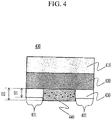
- FIG. 4 shows a vertical cross-section of a laminate sheet having a gas-absorbing polymer layer according to another embodiment of the present invention.
- a laminate sheet 400 has a structure in which an external coating layer 410 and a barrier metal layer 420 are sequentially formed, a heat-fusion resin layer 430 forms a sealing part 401 at a part of the barrier metal layer 420, and a gas-absorbing polymer layer 440 is formed at a part other than the part where the heat-fusion resin layer 430 is formed.
- the gas-absorbing polymer layer 440 is formed at the other part of the heat-fusion resin layer 430 except for a part corresponding to the sealing part 401, and thus may prevent deterioration of a sealing force without deteriorating an absorption force of gas generated inside the battery cell.
- the gas-absorbing polymer layer 440 may have the same thickness D2 as a thickness D1 of the heat-fusion resin layer 430, but in order to increase the gas absorption force, the thickness D2 of the gas-absorbing polymer layer 440 may be formed to be thicker than the thickness D1 of the heat-fusion resin layer 430.
- Remaining powders were immersed in hydrogen chloride (HCI) for 24 hours, filtered again, and respectively washed with water, sodium hydroxide (NaOH), and an ethanol aqueous solution in that order.
- the obtained powders were dried at 110 °C at 150 mTorr to prepare 70 mg of a reddish brown powder ALP-1.
- ALP-2 84 mg of a reddish brown powder ALP-2 was prepared according to the same method as Example 1, except for using 0.26 mmol (100 mg) of tetrakis(4-aminophenyl)methane (TAM) instead of the 2,6,12-triaminotriptycene (TAT) as a monomer, 0.174 mmol (25 mg) of CuBr, and 1.35 mmol (107 mg) of pyridine.
- TAM tetrakis(4-aminophenyl)methane
- TAT 2,6,12-triaminotriptycene
- 74 g of a reddish brown powder ALP-3 was prepared according to the same method as Example 1, except for using 0.2 mmol (100 mg) of 1,3,5,7-tetrakis(4-aminophenyl)adamantine (TAPA) instead of the 2,6,12-triaminotriptycene (TAT) as a monomer, 0.132 mol (19 mg) of CuBr, and 1.02 mmol (81 mg) of pyridine.
- TAPA 1,3,5,7-tetrakis(4-aminophenyl)adamantine
- TAT 2,6,12-triaminotriptycene
- ALP-4 74 g of a reddish brown powder ALP-4 was prepared according to the same method as Example 1, except for using 0.28 mmol (100 mg) of 1,3,5-tris(4-aminophenyl)benzene (TAB) instead of the 2,6,12-triaminotriptycene (TAT) as a monomer, 0.139 mmol (20 mg) of CuBr, and 1.01 mmol (80 mg) of pyridine.
- TAB 1,3,5-tris(4-aminophenyl)benzene
- TAT 2,6,12-triaminotriptycene
- Example 1 to ALP-4 according to Examples 1 to 4 were photographed with a SEM, and the results are shown in FIG. 1 .
- Example 1 ( FIG. 1A ) and Example 4 ( FIG. 1D ) exhibited a spherically-shaped particle
- Example 2 ( FIG. 1B ) exhibited a fiber-type particle
- Example 3 ( FIG. 1C ) exhibited a ribbon-type particle.
- a gas-absorbing polymer having an azo group absorbed carbon dioxide gas at at least greater than or equal to 9 times as much as methane gas, and accordingly, a large amount of carbon dioxide in gas generated inside a secondary battery cell including the gas-absorbing polymer was selectively removed.
- An electrolyte was prepared by dissolving LiPF 6 at a concentration of 1 M in a mixed solvent (EC (ethyl carbonate):PC (propylene carbonate):DEC (diethyl carbonate) of 3:2:5 (volume ratio), and the ALP-1 polymer according to Example 1 was used to form a 10 ⁇ m-thick gas-absorbing polymer layer on a part of an external surface of a barrier metal layer to obtain a laminate sheet. Subsequently, the laminate sheet was used to fabricate a battery case, and then an electrode assembly consisting of a negative electrode formed of natural graphite, a positive electrode formed of LiCoO 2 , and the electrolyte were housed in the battery case to fabricate a pouch-type secondary battery cell.
- EC ethyl carbonate
- PC propylene carbonate
- DEC diethyl carbonate
- a pouch-type secondary battery cell including ALP-2 was fabricated according to the same method as Example 1, except for forming a gas-absorbing polymer layer on a part of an external surface of a barrier metal layer on a laminate sheet by using the ALP-2.
- a pouch-type secondary battery cell including ALP-3 was fabricated according to the same method as Example 1, except for forming a gas-absorbing polymer layer on a part of an external surface of a barrier metal layer on a laminate sheet by using the ALP-3.
- a pouch-type secondary battery cell including ALP-4 was fabricated according to the same method as Example 1, except for forming a gas-absorbing polymer layer on a part of an external surface of a barrier metal layer on a laminate sheet by using the ALP-4.
- An electrolyte and an electrode assembly according to Example 5 were prepared, and then a prismatic secondary battery cell including 5 % of ALP-1 relative to a weight of the electrolyte was fabricated by injecting the ALP-1 according to Example 1 into the electrolyte.
- a secondary battery cell was fabricated according to the same method as Example 5, except for using a laminate sheet including no gas-absorbing polymer having an azo group.
- a total gas generation amount after 8 weeks was 252.64 ml, wherein an amount of carbon dioxide was 126.41 ml, an amount of carbon monoxide was 75.92 ml, and a total amount of other gases was about 50.31 ml.
- a volume increase amount of the secondary battery cells according to Examples 5 to 9 according to the present invention was in a range of 52 to 62, and a volume increase amount of the secondary battery cell according to Comparative Example 1 was 253.
- the secondary battery cell of Comparative Example 1 showed a high swelling phenomenon compared with the secondary battery cells of Examples 5 to 9. The reason is that carbon dioxide and carbon monoxide generated inside the battery cells of Examples 5 to 9 were removed by the gas-absorbing polymer, and accordingly, the battery cells were suppressed from having a volume expansion and a swelling phenomenon, but since the secondary battery cell of Comparative Example 1 included no gas-absorbing polymer and failed to remove gas such as carbon dioxide and the like, the battery cell was expanded by the same volume as that of actually generated gas. Accordingly, the secondary battery cell including a gas-absorbing polymer having an azo group was suppressed from ignition or explosion, and safety of the secondary battery cell was much increased.
- a secondary battery cell according to the present invention includes a gas-absorbing polymer having an azo group to absorb a gas generated during normal or abnormal operation of the battery cell, and thus is prevented from swelling and thus suppressed from explosion or ignition due to an internal pressure increase of the battery cell, and resultantly, safety of the battery cell may be much improved.
- the gas-absorbing polymer layer is used as an adhesive layer replacing a conventional laminate sheet or partly formed on a part of the laminate sheet, and accordingly, may prevent a thickness increase over the entire laminate sheet and thus a capacity decrease of the battery cell.
Landscapes
- Chemical & Material Sciences (AREA)
- Chemical Kinetics & Catalysis (AREA)
- Electrochemistry (AREA)
- General Chemical & Material Sciences (AREA)
- Engineering & Computer Science (AREA)
- Manufacturing & Machinery (AREA)
- Inorganic Chemistry (AREA)
- Condensed Matter Physics & Semiconductors (AREA)
- General Physics & Mathematics (AREA)
- Physics & Mathematics (AREA)
- Analytical Chemistry (AREA)
- Organic Chemistry (AREA)
- Materials Engineering (AREA)
- Secondary Cells (AREA)
- Sealing Battery Cases Or Jackets (AREA)
Abstract
Description
- This application claims priority to and the benefit of Korean Patent Application No.
10-2016-0001582 - The present invention relates to a secondary battery including a gas-absorbing polymer.
- As technology development and demand for mobile devices have increased, there has been a rapid increase in demand for batteries as energy sources, and thus a lot of research has been conducted on batteries capable of satisfying various demands.
- Representatively, there is high demand for a prismatic secondary battery and a pouch-type secondary battery which have a small thickness to be applicable to products such as mobile phones in terms of a battery shape, and there is high demand for a lithium secondary battery such as a lithium ion battery and a lithium ion polymer battery with high energy density, a high discharge voltage, and output stability in terms of a material.
- However, the lithium secondary battery has a drawback in terms of safety, despite all these merits. Specifically, when the lithium secondary battery reaches an abnormal operation state such as an internal short circuit, an overcharge, exposure to a high temperature, and the like after being finally sealed, a high pressure gas may be generated when an electrolyte therein is decomposed. Herein, the generated high pressure gas may cause deformation of a battery case and shorten a cycle-life of the battery, and more seriously, may cause ignition or explosion of the battery.
- Conventionally, in order to improve safety of a lithium secondary battery, a method of using a PTC (positive temperature coefficient), a fuse, a protective circuit under a reduced pressure, or the like, a method of including an additive for improving safety of an electrolyte or an electrode, or the like has been used, but the lithium secondary battery still has a problem of gas generation due to an abnormal reaction inside the battery under an abnormal condition or performance deterioration due to inclusion of the additive, even though the battery is provided with this equipment.
- In addition, as a conventional part functioning as a gas pocket tends to gradually disappear along with a recent increase and requirement of higher energy density, a new method for preventing ignition or explosion of a battery during gas generation therein and efficiently removing gas without deteriorating overall performance of the battery is required.
- An object of the present invention is to solve the problem of the conventional art and technical objects from the past.
- By repeating in-depth studies and various experiments ,the inventors of this application confirmed that when a battery cell is manufactured using a battery case including a gas-absorbing polymer having an azo group which will be described below, absorption properties for a gas generated within the battery cell are improved due to a hollow structure and chemical properties of the gas-absorbing polymer, and thus explosion and ignition caused by a gas increase within the battery cell may be suppressed and battery safety is improved, and completed the present invention.
- In order to achieve such a purpose, a secondary battery according to the present invention includes an electrode assembly together with an electrolyte sealed within a battery case, and the gas-absorbing polymer having the azo group is included in a battery cell to absorb and remove gas generated within the battery.
- In this way, the secondary battery according to the present invention includes a gas-absorbing polymer capable of absorbing a gas such as carbon dioxide generated within the battery cell, and may reduce swelling caused by gas generation within a conventional battery cell and thus battery explosion and ignition, remarkably improving battery safety.
- In addition, a conventional oxide or hydroxide gas-absorbing material undergoes a side-reaction with an electrolyte, but a gas-absorbing polymer having an azo group has no reactivity with a separator or an electrode, and thus not only may the side-reaction with an electrolyte be prevented, but there may be no performance deterioration.
- In one specific embodiment, the battery case may be a pouch-type case of a laminate sheet including a gas-absorbing polymer layer, or may be a prismatic can or a cylindrical battery case.
- The laminate sheet includes an external coating layer, a barrier metal layer, and a heat-fusion resin layer, and the heat-fusion resin layer is coated with a gas-absorbing polymer layer including a gas-absorbing polymer. Specifically, the laminate sheet used in the secondary battery includes a gas-absorbing polymer layer as well as a heat-fusion resin layer for sealing the battery case in a conventional laminate sheet.
- In such a structure, the gas-absorbing polymer layer may include a matrix binder in addition to the gas-absorbing polymer.
- The matrix binder may be a polymer that is present in a polymer matrix to form the gas-absorbing polymer layer, and while a material of the matrix binder is not particularly limited, it may be, for example, at least one selected from epoxy-based, phenol-based, melamine-based, polyester-based, urethane-based, polyethylene terephthalate-based, and polyether urethane-based resins.
- The gas-absorbing polymer layer may be coated on all parts of the battery case, and preferably on at least one part of internal surfaces of a container contacting an electrolyte, excluding a sealing part of the battery case. When a laminate sheet having no gas-absorbing polymer layer is used at the sealing part, the gas-absorbing polymer layer is formed except at the sealing part of the battery case, and thus may prevent deterioration of a sealing force and deterioration of absorption capability of gas generated inside the battery.
- A coating thickness of the gas-absorbing polymer layer may be, for example, within a range of 0.1 µm to 100 µm, and in detail, 0.5 µm to 70 µm.
- When the coating thickness of the gas-absorbing polymer layer is smaller than 0.1 µm, the gas-absorbing polymer layer is included in a smaller amount and thus has a drawback of absorbing a smaller amount of gas, but when the coating thickness of the gas-absorbing polymer layer is larger than 100 µm, it may increase an overall thickness of the laminate sheet and thus fails to provide a compact battery cell.
- In another specific embodiment, the gas-absorbing polymer may be included in the electrolyte. When the electrolyte includes a gas-absorbing polymer, gas generated due to decomposition of an electrolyte under an abnormal situation may be immediately absorbed.
- In this case, an amount of the gas-absorbing polymer may be within a range of 0.05 % to 10 %, and in detail, 0.1 % to 5 %, based on a weight of the electrolyte.
- When the gas-absorbing polymer is included in a smaller amount than 0.05 %, an amount of the gas-absorbing polymer is decreased, and thus an absorption amount of gas may be decreased, but when the gas-absorbing polymer is included in a larger amount than 10 %, ion conductivity decreases as viscosity of an electrolyte increases, and thus battery performance may be deteriorated.
- In one specific embodiment, the gas-absorbing polymer may be azo-linked porous organic polymers (ALPs), which may be, for example, prepared by polymerizing at least one monomer selected from the group consisting of 1,3,5,7-tetrakis(4-aminophenyl) adamantine (TAPA), 2,6,12-triaminotriptycene (TAT), tetrakis(4-aminophenyl) methane (TAM), and 1,3,5-tris(4-aminophenyl) benzene (TAB).
- Specifically, the gas-absorbing polymer may be polymerized by CuBr and pyridine working as a catalyst and coupling the same kind of monomers including an aniline group. Herein, an azo group coupling the monomers to one another and showing gas absorption properties is formed from an amino group of the monomers.
- The polymerization reaction may use toluene, THF, or chloroform as a solvent. However, when a single solvent is used, there may be a problem of a decrease in solubility of the monomers in the solvent, deterioration of a polymerization reaction and a CuBr-pyridine catalyst reaction, or a surface area decrease of the gas-absorbing polymer. Accordingly, in order to prepare the gas-absorbing polymer having a maximum surface area, the polymerization reaction may proceed in a mixed solvent of toluene and THF.
- The ALPs may have various shapes such as a spherical shape, a fiber shape, and a ribbon shape, and in addition, may have various particle sizes within a range of 1 nm to 800 nm, and specifically in a range of 200 nm to 700 nm, without having a particular limit regarding a particle diameter as long as they have a nanometer size. When the particle diameter is less than 1 nm, the gas-absorbing polymer may have too small a pore size and thus not properly absorb a gas, but when the particle diameter is greater than 800 nm, the gas-absorbing polymer may have a decreased surface area and thus absorb a smaller amount of gas.
- In addition, the ALPs may have a specific surface area ranging from 850 m2/g to 1250 m2/g, specifically 900 m2/g to 1200 m2/g, and more specifically 950 m2/g to 1150 m2/g. Since the above-sized specific surface area is twice to three times as large as that of a conventional porous polymer covalently bonded with an azo group, the ALPs may interact in a larger area with a gas and thus show a much higher gas absorption rate.
- This gas-absorbing polymer may selectively absorb carbon dioxide and carbon monoxide among gasses generated inside a battery cell. In other words, the gas-absorbing polymer may absorb carbon dioxide and carbon monoxide that are highly generated during use of a battery cell, and thus more easily prevent a swelling phenomenon than when it absorbs one kind of gas.
- Furthermore, the gas-absorbing polymer shows excellent absorption regarding carbon dioxide, and thus may selectively absorb carbon dioxide alone and remove carbon dioxide that has a side-reaction with an electrolyte and resultantly prevent a vicious circle of the side-reaction of an electrolyte and gas generation.
- The carbon dioxide and carbon monoxide may be absorbed in an amount of 10 % to 30 % of a weight of the gas-absorbing polymer. Specifically, 1 g of the gas-absorbing polymer may absorb at least 236 mg of carbon dioxide and carbon monoxide at room temperature.
- This high carbon dioxide and carbon monoxide absorption force of the gas-absorbing polymer is shown due to an interaction between an azo group of the gas-absorbing polymer and molecules of carbon dioxide and carbon monoxide. Specifically, since nitrogen atoms of the azo group working as a Lewis base and carbon atoms of carbon dioxide and carbon monoxide working as Lewis acid form a strong bond, a large amount of carbon dioxide and carbon monoxide may be removed in a battery cell.
- The present invention also provides a battery pack including the lithium secondary battery as a unit battery, and a device including the battery pack as a power source.
- Specifically, the battery pack may be used as a power source of a device requiring high temperature safety, long cycle characteristics, high rate characteristics, and the like, and specific examples of the device may include a mobile electronic device, a power tool obtaining power by a battery-based motor, an electric car including an electric vehicle (EV), a hybrid electric vehicle (HEV), a plug-in hybrid electric vehicle (PHEV), and the like, an electric two-wheeler including an E-bike and an E-scooter, an electric golf cart, an electricity storage system, and the like, but are not limited thereto.
- A structure and a manufacturing method of these devices are well known in the related art and thus are not illustrated in detail in the present specification.
-
-
FIG. 1 is an electron microscope (SEM) photograph of the gas-absorbing polymers according to Examples 1 to 4; -
FIG. 2 is a perspective view showing a pouch-type secondary battery cell having a gas-absorbing polymer layer according to one embodiment of the present invention; -
FIG. 3 is a view showing a cross-section of the pouch-type secondary battery cell ofFIG. 2 which is taken along line A-A'; and -
FIG. 4 is a vertical cross-sectional view showing a laminate sheet having a gas-absorbing polymer layer according to another exemplary embodiment of the present invention. - Hereinafter, the present invention will be described with reference to the drawings according to examples of the present invention, which are provided for better understanding of the present invention, and thus the scope of the present invention is not limited thereto.
-
FIG. 2 is a perspective view schematically showing a pouch-type secondary battery having a gas-absorbing polymer layer according to one embodiment of the present invention. - Referring to
FIG. 2 , a pouch-typesecondary battery 200 is composed of alower case 220 including anelectrode assembly container 203 and anupper case 210 sealed with thelower case 220 on thecontainer 203, and theupper case 210 and thelower case 220 are connected with each other at a part of externalcircumferential surfaces upper case 210 and thelower case 220 are sealed through heat-fusion, and form a sealing part on the externalcircumferential surfaces lower case 220. -
FIG. 3 schematically shows a partial cross-section of the battery case ofFIG. 2 , which is taken along line A-A'. - Referring to
FIG. 3 , alaminate sheet 300 has a structure in which anexternal coating layer 310, abarrier metal layer 320, a heat-fusion resin layer 330, and a gas-absorbingpolymer layer 340 including a gas-absorbingpolymer 341 are sequentially formed in order from the outside. The heat-fusion resin layer 330 is disposed over the entire internal surface of thebarrier metal layer 320, and the gas-absorbingpolymer layer 340 is disposed over the entire internal surface of the heat-fusion resin layer 330. -
FIG. 4 shows a vertical cross-section of a laminate sheet having a gas-absorbing polymer layer according to another embodiment of the present invention. - Referring to
FIG. 4 , alaminate sheet 400 has a structure in which anexternal coating layer 410 and abarrier metal layer 420 are sequentially formed, a heat-fusion resin layer 430 forms a sealingpart 401 at a part of thebarrier metal layer 420, and a gas-absorbingpolymer layer 440 is formed at a part other than the part where the heat-fusion resin layer 430 is formed. - In this way, the gas-absorbing
polymer layer 440 is formed at the other part of the heat-fusion resin layer 430 except for a part corresponding to the sealingpart 401, and thus may prevent deterioration of a sealing force without deteriorating an absorption force of gas generated inside the battery cell. - Further, the gas-absorbing
polymer layer 440 may have the same thickness D2 as a thickness D1 of the heat-fusion resin layer 430, but in order to increase the gas absorption force, the thickness D2 of the gas-absorbingpolymer layer 440 may be formed to be thicker than the thickness D1 of the heat-fusion resin layer 430. - Hereinafter, exemplary embodiments of the present invention are described.
- 0.334 mmol (100 mg) of 2,6,12-triaminotriptycene (TAT) as a monomer and 0.164 mmol (23.5 mg) of CuBr and 1.19 mmol (94 mg) of pyridine as a catalyst were added to 22 mL of a THF/toluene solvent, and the mixture was firstly stirred at room temperature for 24 hours, secondly stirred at 60 °C for 12 hours, and thirdly stirred at 80 °C for 12 hours. Subsequently, the mixed solution was filtered, washed with THF, and washed with water. Remaining powders were immersed in hydrogen chloride (HCI) for 24 hours, filtered again, and respectively washed with water, sodium hydroxide (NaOH), and an ethanol aqueous solution in that order. The obtained powders were dried at 110 °C at 150 mTorr to prepare 70 mg of a reddish brown powder ALP-1.
- 84 mg of a reddish brown powder ALP-2 was prepared according to the same method as Example 1, except for using 0.26 mmol (100 mg) of tetrakis(4-aminophenyl)methane (TAM) instead of the 2,6,12-triaminotriptycene (TAT) as a monomer, 0.174 mmol (25 mg) of CuBr, and 1.35 mmol (107 mg) of pyridine.
- 74 g of a reddish brown powder ALP-3 was prepared according to the same method as Example 1, except for using 0.2 mmol (100 mg) of 1,3,5,7-tetrakis(4-aminophenyl)adamantine (TAPA) instead of the 2,6,12-triaminotriptycene (TAT) as a monomer, 0.132 mol (19 mg) of CuBr, and 1.02 mmol (81 mg) of pyridine.
- 74 g of a reddish brown powder ALP-4 was prepared according to the same method as Example 1, except for using 0.28 mmol (100 mg) of 1,3,5-tris(4-aminophenyl)benzene (TAB) instead of the 2,6,12-triaminotriptycene (TAT) as a monomer, 0.139 mmol (20 mg) of CuBr, and 1.01 mmol (80 mg) of pyridine.
- ALP-1 to ALP-4 according to Examples 1 to 4 were photographed with a SEM, and the results are shown in
FIG. 1 . Referring toFIG. 1 , Example 1 (FIG. 1A ) and Example 4 (FIG. 1D ) exhibited a spherically-shaped particle, Example 2 (FIG. 1B ) exhibited a fiber-type particle, and Example 3 (FIG. 1C ) exhibited a ribbon-type particle. - In order to measure an absorption amount of ALP-1 to ALP-4 according to Examples 1 to 4, ALP-1 to ALP-4 according to Examples 1 to 4 were exposed to carbon dioxide gas and methane gas at 1 atm at 0 °C and at 1 atm at 25 °C, and the results are shown in Table 1.
<Table 1> CO2 absorption amount (mg/g) Methane absorption amount (mg/g) Temperature 0 °C 25 °C 0 °C 25 °C Example 1 236 143 26.0 15.0 Example 2 211 108 17.6 10.7 Example 3 166 101 17.2 9.6 Example 4 155 81 14.3 8.3 - As shown in Table 1, a gas-absorbing polymer having an azo group absorbed carbon dioxide gas at at least greater than or equal to 9 times as much as methane gas, and accordingly, a large amount of carbon dioxide in gas generated inside a secondary battery cell including the gas-absorbing polymer was selectively removed.
- An electrolyte was prepared by dissolving LiPF6 at a concentration of 1 M in a mixed solvent (EC (ethyl carbonate):PC (propylene carbonate):DEC (diethyl carbonate) of 3:2:5 (volume ratio), and the ALP-1 polymer according to Example 1 was used to form a 10 µm-thick gas-absorbing polymer layer on a part of an external surface of a barrier metal layer to obtain a laminate sheet. Subsequently, the laminate sheet was used to fabricate a battery case, and then an electrode assembly consisting of a negative electrode formed of natural graphite, a positive electrode formed of LiCoO2, and the electrolyte were housed in the battery case to fabricate a pouch-type secondary battery cell.
- A pouch-type secondary battery cell including ALP-2 was fabricated according to the same method as Example 1, except for forming a gas-absorbing polymer layer on a part of an external surface of a barrier metal layer on a laminate sheet by using the ALP-2.
- A pouch-type secondary battery cell including ALP-3 was fabricated according to the same method as Example 1, except for forming a gas-absorbing polymer layer on a part of an external surface of a barrier metal layer on a laminate sheet by using the ALP-3.
- A pouch-type secondary battery cell including ALP-4 was fabricated according to the same method as Example 1, except for forming a gas-absorbing polymer layer on a part of an external surface of a barrier metal layer on a laminate sheet by using the ALP-4.
- An electrolyte and an electrode assembly according to Example 5 were prepared, and then a prismatic secondary battery cell including 5 % of ALP-1 relative to a weight of the electrolyte was fabricated by injecting the ALP-1 according to Example 1 into the electrolyte.
- A secondary battery cell was fabricated according to the same method as Example 5, except for using a laminate sheet including no gas-absorbing polymer having an azo group.
- In order to measure a gas generation amount of a secondary battery cell, the secondary battery cell according to Comparative Example 1 was stored in a 60 °C box for 8 weeks, and the gas generation amount of the secondary battery cell was measured, and the results are shown in Table 2.
<Table 2> Stored time 2 weeks 4 weeks 8 weeks Total Total gas amount (mL) 101.1 82.3 69.2 252.6 Gas amount (mL) N2 < 0.01 1.56 1.0 < 1.67 O2 < 0.01 0.19 < 0.1 < 0.3 C3H8 0.10 0.11 < 0.1 < 0.31 C3H6 0.10 0.09 < 0.1 < 0.29 C2H6 2.53 2.58 2.6 7.71 C2H4 0.74 0.57 0.2 1.51 C2H2 0.06 0.07 < 0.1 < 0.23 CH4 11.28 11.79 13 36.07 CO2 58.62 38.79 29 126.41 CO 26.97 25.95 23 75.92 H2 0.65 0.64 0.4 1.69 - As shown in Table 2, a total gas generation amount after 8 weeks was 252.64 ml, wherein an amount of carbon dioxide was 126.41 ml, an amount of carbon monoxide was 75.92 ml, and a total amount of other gases was about 50.31 ml.
- In order to measure a volume change due to swelling, the secondary battery cells according to Examples 5 to 9 and Comparative Example 1 were stored in a 60 °C box for 8 weeks, then initial volumes and volumes after 8 weeks were measured, and a volume increase amount was calculated by subtracting the initial volume from the changed volume, and the results are shown in Table 3.
<Table 3> Volume Increase Amount (ml) Example 5 52 Example 6 55 Example 7 62 Example 8 58 Example 9 53 Comparative Example 1 253 - As shown in Table 3, a volume increase amount of the secondary battery cells according to Examples 5 to 9 according to the present invention was in a range of 52 to 62, and a volume increase amount of the secondary battery cell according to Comparative Example 1 was 253. In other words, the secondary battery cell of Comparative Example 1 showed a high swelling phenomenon compared with the secondary battery cells of Examples 5 to 9. The reason is that carbon dioxide and carbon monoxide generated inside the battery cells of Examples 5 to 9 were removed by the gas-absorbing polymer, and accordingly, the battery cells were suppressed from having a volume expansion and a swelling phenomenon, but since the secondary battery cell of Comparative Example 1 included no gas-absorbing polymer and failed to remove gas such as carbon dioxide and the like, the battery cell was expanded by the same volume as that of actually generated gas. Accordingly, the secondary battery cell including a gas-absorbing polymer having an azo group was suppressed from ignition or explosion, and safety of the secondary battery cell was much increased.
- It will be understood by those skilled in the art that various modifications and changes can be made in the scope of the present invention based on the above description.
- As described above, a secondary battery cell according to the present invention includes a gas-absorbing polymer having an azo group to absorb a gas generated during normal or abnormal operation of the battery cell, and thus is prevented from swelling and thus suppressed from explosion or ignition due to an internal pressure increase of the battery cell, and resultantly, safety of the battery cell may be much improved.
- In addition, the gas-absorbing polymer layer is used as an adhesive layer replacing a conventional laminate sheet or partly formed on a part of the laminate sheet, and accordingly, may prevent a thickness increase over the entire laminate sheet and thus a capacity decrease of the battery cell.
Claims (18)
- A secondary battery comprising
an electrode assembly sealed within a battery case together with an electrolyte, wherein a gas-absorbing polymer having an azo group is included in the battery cell to absorb and remove gas generated within the battery. - The secondary battery of claim 1, wherein the battery case is a pouch-type case of the laminate sheet or a prismatic can.
- The secondary battery of claim 2, wherein the laminate sheet includes an external coating layer, a barrier metal layer, and a heat-fusion resin layer, and the heat-fusion resin layer is coated with a gas-absorbing polymer layer including the gas-absorbing polymer.
- The secondary battery of claim 3, wherein the gas-absorbing polymer layer includes a gas-absorbing polymer and a matrix binder.
- The secondary battery of claim 4, wherein the matrix binder is composed of at least one selected from epoxy-based, phenol-based, melamine-based, polyester-based, urethane-based, polyethylene terephthalate-based, and polyether urethane-based resins.
- The secondary battery of claim 3, wherein the gas-absorbing polymer layer is coated on all parts of the battery case, and preferably on at least one part of internal surfaces of a container contacting the electrolyte, excluding a sealing part of the battery case.
- The secondary battery of claim 3, wherein a coating thickness of the gas-absorbing polymer layer is within a range of 0.1 µm to 100 µm.
- The secondary battery of claim 1, wherein the gas-absorbing polymer is included in the electrolyte.
- The secondary battery of claim 8, wherein an amount of the gas-absorbing polymer may be within a range of 0.05 % to 10 % based on a weight of the electrolyte.
- The secondary battery of claim 1, wherein the gas-absorbing polymer is an azo-linked porous organic polymer (ALP).
- The secondary battery of claim 10, wherein the ALP is prepared by polymerizing at least one monomer selected from the group consisting of 1,3,5,7-tetrakis(4-aminophenyl) adamantine (TAPA), 2,6,12-triaminotriptycene (TAT), tetrakis(4-aminophenyl) methane (TAM), or 1,3,5-tris(4-aminophenyl) benzene (TAB).
- The secondary battery of claim 10, wherein the ALP has a spherical shape, a fiber shape, or a ribbon shape.
- The secondary battery of claim 10, wherein the ALP has a particle diameter of 1 nm to 800 nm.
- The secondary battery of claim 10, wherein the ALP has a specific surface area of 850 m2/g to 1250 m2/g.
- The secondary battery of claim 1, wherein the gas-absorbing polymer selectively absorbs carbon dioxide and carbon monoxide.
- The secondary battery of claim 15, wherein an absorption amount of the carbon dioxide and carbon monoxide is 10 % to 30 % of the weight of the gas-absorbing polymer.
- A battery pack comprising the secondary battery of any one of claim 1 to claim 16.
- A device comprising the battery pack of claim 17 as a power source.
Priority Applications (1)
| Application Number | Priority Date | Filing Date | Title |
|---|---|---|---|
| PL17736122T PL3352286T3 (en) | 2016-01-06 | 2017-01-06 | Secondary battery comprising gas-absorbing polymer |
Applications Claiming Priority (2)
| Application Number | Priority Date | Filing Date | Title |
|---|---|---|---|
| KR1020160001582A KR101956334B1 (en) | 2016-01-06 | 2016-01-06 | Secondary Battery Having Gas-Adsorbing Polymer |
| PCT/KR2017/000173 WO2017119750A1 (en) | 2016-01-06 | 2017-01-06 | Secondary battery comprising gas-absorbing polymer |
Publications (3)
| Publication Number | Publication Date |
|---|---|
| EP3352286A1 true EP3352286A1 (en) | 2018-07-25 |
| EP3352286A4 EP3352286A4 (en) | 2018-09-05 |
| EP3352286B1 EP3352286B1 (en) | 2020-09-09 |
Family
ID=59273747
Family Applications (1)
| Application Number | Title | Priority Date | Filing Date |
|---|---|---|---|
| EP17736122.7A Active EP3352286B1 (en) | 2016-01-06 | 2017-01-06 | Secondary battery comprising gas-absorbing polymer |
Country Status (7)
| Country | Link |
|---|---|
| US (1) | US10727541B2 (en) |
| EP (1) | EP3352286B1 (en) |
| JP (1) | JP6575832B2 (en) |
| KR (1) | KR101956334B1 (en) |
| CN (1) | CN108352585B (en) |
| PL (1) | PL3352286T3 (en) |
| WO (1) | WO2017119750A1 (en) |
Cited By (2)
| Publication number | Priority date | Publication date | Assignee | Title |
|---|---|---|---|---|
| JP2024050631A (en) * | 2019-09-30 | 2024-04-10 | 大日本印刷株式会社 | Packaging material and packaging body for all-solid-state lithium-ion batteries |
| EP4250434A4 (en) * | 2021-10-20 | 2025-03-05 | LG Energy Solution, Ltd. | SECONDARY BATTERY COMPRISING A POUCH WITH A GAS ADSORBENT INTERPOSED THEREIN AND METHOD FOR MANUFACTURING THE SAME |
Families Citing this family (11)
| Publication number | Priority date | Publication date | Assignee | Title |
|---|---|---|---|---|
| WO2019027925A1 (en) * | 2017-07-31 | 2019-02-07 | Pellion Technologies | Electrochemical cell with getter and method of forming same |
| KR102282411B1 (en) * | 2017-08-25 | 2021-07-26 | 주식회사 엘지에너지솔루션 | Secondary battery and manufacturing method thereof |
| KR102234218B1 (en) * | 2018-01-09 | 2021-03-31 | 주식회사 엘지화학 | Battery Case Having Gas Adsorption Layer |
| JP7320049B2 (en) * | 2018-07-06 | 2023-08-02 | ハイドロ-ケベック | Glycidyl-containing polymers, polymer compositions containing them, and their use in electrochemical cells |
| CN109822998A (en) * | 2018-12-28 | 2019-05-31 | 桑顿新能源科技有限公司 | A kind of clad aluminum plastic film and preparation method thereof and battery |
| JP7071701B2 (en) * | 2019-03-11 | 2022-05-19 | トヨタ自動車株式会社 | Non-aqueous lithium-ion secondary battery |
| CN110890602A (en) * | 2019-10-24 | 2020-03-17 | 清华大学 | Battery with a battery cell |
| CN111430828A (en) * | 2020-01-17 | 2020-07-17 | 蜂巢能源科技有限公司 | Lithium ion battery |
| CN112271341A (en) * | 2020-10-23 | 2021-01-26 | 珠海冠宇动力电池有限公司 | Laminated battery core and lithium ion battery |
| KR20220063393A (en) * | 2020-11-10 | 2022-05-17 | 주식회사 엘지에너지솔루션 | Secondary battery comprising gas scavenging member |
| KR20260050687A (en) | 2024-10-08 | 2026-04-15 | 주식회사 엘지에너지솔루션 | A battery case and a secondary battery containing the same |
Family Cites Families (19)
| Publication number | Priority date | Publication date | Assignee | Title |
|---|---|---|---|---|
| US1678405A (en) * | 1924-06-03 | 1928-07-24 | Le Carbone Sa | Process for rendering gas-absorbent bodies air-tight in liquids |
| JP2000077103A (en) * | 1998-08-31 | 2000-03-14 | Hitachi Ltd | Lithium secondary batteries and equipment |
| KR100354247B1 (en) | 1999-11-18 | 2002-09-28 | 삼성에스디아이 주식회사 | Lithium secondary batteries |
| JP4529207B2 (en) | 1999-11-30 | 2010-08-25 | ソニー株式会社 | Non-aqueous electrolyte battery |
| TW571601B (en) * | 2000-05-17 | 2004-01-11 | Dynic Corp | Hygroscopic molded material |
| JP4953525B2 (en) | 2001-07-23 | 2012-06-13 | パナソニック株式会社 | Non-aqueous electrolyte secondary battery and manufacturing method thereof |
| US7041412B2 (en) * | 2001-07-23 | 2006-05-09 | Matsushita Electric Industrial Co., Ltd. | Non-aqueous electrolyte secondary battery |
| JP3975923B2 (en) | 2003-01-20 | 2007-09-12 | ソニー株式会社 | Non-aqueous electrolyte battery |
| KR101123061B1 (en) * | 2006-10-23 | 2012-03-15 | 주식회사 엘지화학 | Secondary Battery of Improved Safety |
| KR101132169B1 (en) * | 2008-04-02 | 2012-04-05 | 주식회사 엘지화학 | Laminate Sheet for Battery Case and Lithium Secondary Battery Employed with the Same |
| KR20120042752A (en) | 2010-04-28 | 2012-05-03 | 파나소닉 주식회사 | Secondary battery |
| JP2011249269A (en) * | 2010-05-31 | 2011-12-08 | Panasonic Corp | Laminate battery |
| JP2012204131A (en) | 2011-03-25 | 2012-10-22 | Kurita Water Ind Ltd | Removal material of carbon monoxide in jet gas from secondary battery |
| CN103682431A (en) * | 2012-09-21 | 2014-03-26 | 海洋王照明科技股份有限公司 | Gel polymer electrolyte and preparation method thereof, and electrochemical power source and application thereof |
| CN102872703A (en) * | 2012-10-03 | 2013-01-16 | 黄立维 | Device and process for purifying harmful gas through combining gas-liquid absorption with micro-electrolysis |
| KR101453390B1 (en) | 2013-01-07 | 2014-10-22 | 한국과학기술원 | Azo Bridged Porous Covalent Organic Polymers and Method for Preparing the Same |
| WO2015119307A1 (en) | 2014-02-04 | 2015-08-13 | 주식회사 코캄 | Lithium secondary battery module and lithium secondary battery pack with improved safety |
| KR20150126129A (en) | 2014-05-02 | 2015-11-11 | 주식회사 엘지화학 | Secondary Battery Case of Improved Stability and Secondary Battery Comprising the Same |
| KR20150108040A (en) | 2015-09-11 | 2015-09-24 | 주식회사 코캄 | Separator for lithium secondary battery and lithium secondary battery including the same |
-
2016
- 2016-01-06 KR KR1020160001582A patent/KR101956334B1/en active Active
-
2017
- 2017-01-06 CN CN201780003874.4A patent/CN108352585B/en active Active
- 2017-01-06 JP JP2018516727A patent/JP6575832B2/en active Active
- 2017-01-06 PL PL17736122T patent/PL3352286T3/en unknown
- 2017-01-06 EP EP17736122.7A patent/EP3352286B1/en active Active
- 2017-01-06 WO PCT/KR2017/000173 patent/WO2017119750A1/en not_active Ceased
- 2017-01-06 US US15/770,963 patent/US10727541B2/en active Active
Cited By (2)
| Publication number | Priority date | Publication date | Assignee | Title |
|---|---|---|---|---|
| JP2024050631A (en) * | 2019-09-30 | 2024-04-10 | 大日本印刷株式会社 | Packaging material and packaging body for all-solid-state lithium-ion batteries |
| EP4250434A4 (en) * | 2021-10-20 | 2025-03-05 | LG Energy Solution, Ltd. | SECONDARY BATTERY COMPRISING A POUCH WITH A GAS ADSORBENT INTERPOSED THEREIN AND METHOD FOR MANUFACTURING THE SAME |
Also Published As
| Publication number | Publication date |
|---|---|
| JP2018530878A (en) | 2018-10-18 |
| EP3352286B1 (en) | 2020-09-09 |
| WO2017119750A1 (en) | 2017-07-13 |
| CN108352585B (en) | 2021-05-25 |
| EP3352286A4 (en) | 2018-09-05 |
| US10727541B2 (en) | 2020-07-28 |
| US20190252737A1 (en) | 2019-08-15 |
| JP6575832B2 (en) | 2019-09-18 |
| CN108352585A (en) | 2018-07-31 |
| KR101956334B1 (en) | 2019-03-08 |
| KR20170082328A (en) | 2017-07-14 |
| PL3352286T3 (en) | 2020-12-14 |
Similar Documents
| Publication | Publication Date | Title |
|---|---|---|
| EP3352286B1 (en) | Secondary battery comprising gas-absorbing polymer | |
| EP0997960B1 (en) | Nonaqueous electrolyte secondary battery | |
| JP5394239B2 (en) | Gel polymer electrolyte and electrochemical device provided with the same | |
| KR101649260B1 (en) | Nonaqueous secondary battery and electronic device | |
| KR101294688B1 (en) | Non-aqueous secondary battery | |
| EP2874207B1 (en) | Negative electrode for secondary battery, and secondary battery comprising same | |
| EP2706605B1 (en) | Electrode assembly having a novel structure and secondary battery using same | |
| JP2020537309A (en) | Lithium metal secondary battery and battery module containing it | |
| EP3945625A1 (en) | Lithium secondary battery and method of fabricating the same | |
| EP4134408A1 (en) | Swelling tape for secondary battery and cylindrical secondary battery comprising same | |
| CN105580167A (en) | Electrode for lithium ion secondary batteries, and lithium ion secondary battery | |
| EP4207359A1 (en) | Positive electrode and lithium secondary battery comprising same | |
| US20150155106A1 (en) | Agent for forming electrode protection film | |
| KR20220017748A (en) | Anode active material and lithium seceondary battery | |
| JP6061066B2 (en) | Electrochemical capacitor | |
| KR20170027403A (en) | Secondary Battery Comprising Binder having High Swelling Ratio | |
| KR101748640B1 (en) | An organic-inoranic composite porous layer, a seperatator and an electrode structure comprising the same | |
| US12401092B2 (en) | Separator for electrochemical device and electrochemical device comprising same | |
| EP4503244A1 (en) | Secondary battery | |
| KR102311809B1 (en) | Separator and electrochemical device comprising the same | |
| KR20170024955A (en) | Negative Electrode Having Cured Binder for Secondary Battery and Lithium Secondary Battery Comprising the Same | |
| EP4303944A1 (en) | Positive electrode slurry, positive electrode sheet, and secondary battery comprising positive electrode sheet | |
| EP4407736A1 (en) | Method for activating lithium secondary battery | |
| EP4280313A1 (en) | Positive electrode paste, positive electrode sheet, secondary battery comprising said positive electrode sheet, and battery module | |
| KR20230119437A (en) | LiMoP coated cathode active material and Lithium battery comprising thereof |
Legal Events
| Date | Code | Title | Description |
|---|---|---|---|
| STAA | Information on the status of an ep patent application or granted ep patent |
Free format text: STATUS: THE INTERNATIONAL PUBLICATION HAS BEEN MADE |
|
| PUAI | Public reference made under article 153(3) epc to a published international application that has entered the european phase |
Free format text: ORIGINAL CODE: 0009012 |
|
| STAA | Information on the status of an ep patent application or granted ep patent |
Free format text: STATUS: REQUEST FOR EXAMINATION WAS MADE |
|
| 17P | Request for examination filed |
Effective date: 20180416 |
|
| AK | Designated contracting states |
Kind code of ref document: A1 Designated state(s): AL AT BE BG CH CY CZ DE DK EE ES FI FR GB GR HR HU IE IS IT LI LT LU LV MC MK MT NL NO PL PT RO RS SE SI SK SM TR |
|
| AX | Request for extension of the european patent |
Extension state: BA ME |
|
| A4 | Supplementary search report drawn up and despatched |
Effective date: 20180806 |
|
| RIC1 | Information provided on ipc code assigned before grant |
Ipc: H01M 2/02 20060101ALI20180727BHEP Ipc: H01M 10/42 20060101AFI20180727BHEP Ipc: B01J 20/26 20060101ALI20180727BHEP Ipc: H01M 10/052 20100101ALI20180727BHEP Ipc: H01M 10/0567 20100101ALI20180727BHEP Ipc: H01M 10/0585 20100101ALI20180727BHEP Ipc: H01M 2/10 20060101ALI20180727BHEP Ipc: H01M 10/52 20060101ALI20180727BHEP |
|
| DAV | Request for validation of the european patent (deleted) | ||
| DAX | Request for extension of the european patent (deleted) | ||
| STAA | Information on the status of an ep patent application or granted ep patent |
Free format text: STATUS: EXAMINATION IS IN PROGRESS |
|
| 17Q | First examination report despatched |
Effective date: 20191108 |
|
| GRAP | Despatch of communication of intention to grant a patent |
Free format text: ORIGINAL CODE: EPIDOSNIGR1 |
|
| STAA | Information on the status of an ep patent application or granted ep patent |
Free format text: STATUS: GRANT OF PATENT IS INTENDED |
|
| INTG | Intention to grant announced |
Effective date: 20200507 |
|
| GRAS | Grant fee paid |
Free format text: ORIGINAL CODE: EPIDOSNIGR3 |
|
| GRAA | (expected) grant |
Free format text: ORIGINAL CODE: 0009210 |
|
| STAA | Information on the status of an ep patent application or granted ep patent |
Free format text: STATUS: THE PATENT HAS BEEN GRANTED |
|
| AK | Designated contracting states |
Kind code of ref document: B1 Designated state(s): AL AT BE BG CH CY CZ DE DK EE ES FI FR GB GR HR HU IE IS IT LI LT LU LV MC MK MT NL NO PL PT RO RS SE SI SK SM TR |
|
| REG | Reference to a national code |
Ref country code: GB Ref legal event code: FG4D |
|
| REG | Reference to a national code |
Ref country code: AT Ref legal event code: REF Ref document number: 1312699 Country of ref document: AT Kind code of ref document: T Effective date: 20200915 Ref country code: CH Ref legal event code: EP |
|
| REG | Reference to a national code |
Ref country code: IE Ref legal event code: FG4D |
|
| REG | Reference to a national code |
Ref country code: DE Ref legal event code: R096 Ref document number: 602017023323 Country of ref document: DE |
|
| REG | Reference to a national code |
Ref country code: LT Ref legal event code: MG4D |
|
| PG25 | Lapsed in a contracting state [announced via postgrant information from national office to epo] |
Ref country code: SE Free format text: LAPSE BECAUSE OF FAILURE TO SUBMIT A TRANSLATION OF THE DESCRIPTION OR TO PAY THE FEE WITHIN THE PRESCRIBED TIME-LIMIT Effective date: 20200909 Ref country code: FI Free format text: LAPSE BECAUSE OF FAILURE TO SUBMIT A TRANSLATION OF THE DESCRIPTION OR TO PAY THE FEE WITHIN THE PRESCRIBED TIME-LIMIT Effective date: 20200909 Ref country code: GR Free format text: LAPSE BECAUSE OF FAILURE TO SUBMIT A TRANSLATION OF THE DESCRIPTION OR TO PAY THE FEE WITHIN THE PRESCRIBED TIME-LIMIT Effective date: 20201210 Ref country code: LT Free format text: LAPSE BECAUSE OF FAILURE TO SUBMIT A TRANSLATION OF THE DESCRIPTION OR TO PAY THE FEE WITHIN THE PRESCRIBED TIME-LIMIT Effective date: 20200909 Ref country code: HR Free format text: LAPSE BECAUSE OF FAILURE TO SUBMIT A TRANSLATION OF THE DESCRIPTION OR TO PAY THE FEE WITHIN THE PRESCRIBED TIME-LIMIT Effective date: 20200909 Ref country code: BG Free format text: LAPSE BECAUSE OF FAILURE TO SUBMIT A TRANSLATION OF THE DESCRIPTION OR TO PAY THE FEE WITHIN THE PRESCRIBED TIME-LIMIT Effective date: 20201209 Ref country code: NO Free format text: LAPSE BECAUSE OF FAILURE TO SUBMIT A TRANSLATION OF THE DESCRIPTION OR TO PAY THE FEE WITHIN THE PRESCRIBED TIME-LIMIT Effective date: 20201209 |
|
| REG | Reference to a national code |
Ref country code: AT Ref legal event code: MK05 Ref document number: 1312699 Country of ref document: AT Kind code of ref document: T Effective date: 20200909 |
|
| REG | Reference to a national code |
Ref country code: NL Ref legal event code: MP Effective date: 20200909 |
|
| PG25 | Lapsed in a contracting state [announced via postgrant information from national office to epo] |
Ref country code: RS Free format text: LAPSE BECAUSE OF FAILURE TO SUBMIT A TRANSLATION OF THE DESCRIPTION OR TO PAY THE FEE WITHIN THE PRESCRIBED TIME-LIMIT Effective date: 20200909 Ref country code: LV Free format text: LAPSE BECAUSE OF FAILURE TO SUBMIT A TRANSLATION OF THE DESCRIPTION OR TO PAY THE FEE WITHIN THE PRESCRIBED TIME-LIMIT Effective date: 20200909 |
|
| PG25 | Lapsed in a contracting state [announced via postgrant information from national office to epo] |
Ref country code: RO Free format text: LAPSE BECAUSE OF FAILURE TO SUBMIT A TRANSLATION OF THE DESCRIPTION OR TO PAY THE FEE WITHIN THE PRESCRIBED TIME-LIMIT Effective date: 20200909 Ref country code: PT Free format text: LAPSE BECAUSE OF FAILURE TO SUBMIT A TRANSLATION OF THE DESCRIPTION OR TO PAY THE FEE WITHIN THE PRESCRIBED TIME-LIMIT Effective date: 20210111 Ref country code: CZ Free format text: LAPSE BECAUSE OF FAILURE TO SUBMIT A TRANSLATION OF THE DESCRIPTION OR TO PAY THE FEE WITHIN THE PRESCRIBED TIME-LIMIT Effective date: 20200909 Ref country code: SM Free format text: LAPSE BECAUSE OF FAILURE TO SUBMIT A TRANSLATION OF THE DESCRIPTION OR TO PAY THE FEE WITHIN THE PRESCRIBED TIME-LIMIT Effective date: 20200909 Ref country code: EE Free format text: LAPSE BECAUSE OF FAILURE TO SUBMIT A TRANSLATION OF THE DESCRIPTION OR TO PAY THE FEE WITHIN THE PRESCRIBED TIME-LIMIT Effective date: 20200909 |
|
| PG25 | Lapsed in a contracting state [announced via postgrant information from national office to epo] |
Ref country code: IS Free format text: LAPSE BECAUSE OF FAILURE TO SUBMIT A TRANSLATION OF THE DESCRIPTION OR TO PAY THE FEE WITHIN THE PRESCRIBED TIME-LIMIT Effective date: 20210109 Ref country code: AT Free format text: LAPSE BECAUSE OF FAILURE TO SUBMIT A TRANSLATION OF THE DESCRIPTION OR TO PAY THE FEE WITHIN THE PRESCRIBED TIME-LIMIT Effective date: 20200909 Ref country code: AL Free format text: LAPSE BECAUSE OF FAILURE TO SUBMIT A TRANSLATION OF THE DESCRIPTION OR TO PAY THE FEE WITHIN THE PRESCRIBED TIME-LIMIT Effective date: 20200909 Ref country code: ES Free format text: LAPSE BECAUSE OF FAILURE TO SUBMIT A TRANSLATION OF THE DESCRIPTION OR TO PAY THE FEE WITHIN THE PRESCRIBED TIME-LIMIT Effective date: 20200909 |
|
| REG | Reference to a national code |
Ref country code: DE Ref legal event code: R097 Ref document number: 602017023323 Country of ref document: DE |
|
| PG25 | Lapsed in a contracting state [announced via postgrant information from national office to epo] |
Ref country code: SK Free format text: LAPSE BECAUSE OF FAILURE TO SUBMIT A TRANSLATION OF THE DESCRIPTION OR TO PAY THE FEE WITHIN THE PRESCRIBED TIME-LIMIT Effective date: 20200909 |
|
| PLBE | No opposition filed within time limit |
Free format text: ORIGINAL CODE: 0009261 |
|
| STAA | Information on the status of an ep patent application or granted ep patent |
Free format text: STATUS: NO OPPOSITION FILED WITHIN TIME LIMIT |
|
| 26N | No opposition filed |
Effective date: 20210610 |
|
| PG25 | Lapsed in a contracting state [announced via postgrant information from national office to epo] |
Ref country code: MC Free format text: LAPSE BECAUSE OF FAILURE TO SUBMIT A TRANSLATION OF THE DESCRIPTION OR TO PAY THE FEE WITHIN THE PRESCRIBED TIME-LIMIT Effective date: 20200909 Ref country code: DK Free format text: LAPSE BECAUSE OF FAILURE TO SUBMIT A TRANSLATION OF THE DESCRIPTION OR TO PAY THE FEE WITHIN THE PRESCRIBED TIME-LIMIT Effective date: 20200909 Ref country code: SI Free format text: LAPSE BECAUSE OF FAILURE TO SUBMIT A TRANSLATION OF THE DESCRIPTION OR TO PAY THE FEE WITHIN THE PRESCRIBED TIME-LIMIT Effective date: 20200909 |
|
| REG | Reference to a national code |
Ref country code: CH Ref legal event code: PL |
|
| PG25 | Lapsed in a contracting state [announced via postgrant information from national office to epo] |
Ref country code: LU Free format text: LAPSE BECAUSE OF NON-PAYMENT OF DUE FEES Effective date: 20210106 |
|
| REG | Reference to a national code |
Ref country code: BE Ref legal event code: MM Effective date: 20210131 |
|
| PG25 | Lapsed in a contracting state [announced via postgrant information from national office to epo] |
Ref country code: IT Free format text: LAPSE BECAUSE OF FAILURE TO SUBMIT A TRANSLATION OF THE DESCRIPTION OR TO PAY THE FEE WITHIN THE PRESCRIBED TIME-LIMIT Effective date: 20200909 |
|
| PG25 | Lapsed in a contracting state [announced via postgrant information from national office to epo] |
Ref country code: LI Free format text: LAPSE BECAUSE OF NON-PAYMENT OF DUE FEES Effective date: 20210131 Ref country code: CH Free format text: LAPSE BECAUSE OF NON-PAYMENT OF DUE FEES Effective date: 20210131 |
|
| PG25 | Lapsed in a contracting state [announced via postgrant information from national office to epo] |
Ref country code: IE Free format text: LAPSE BECAUSE OF NON-PAYMENT OF DUE FEES Effective date: 20210106 |
|
| PG25 | Lapsed in a contracting state [announced via postgrant information from national office to epo] |
Ref country code: BE Free format text: LAPSE BECAUSE OF NON-PAYMENT OF DUE FEES Effective date: 20210131 |
|
| REG | Reference to a national code |
Ref country code: DE Ref legal event code: R081 Ref document number: 602017023323 Country of ref document: DE Owner name: LG ENERGY SOLUTION, LTD., KR Free format text: FORMER OWNER: LG CHEM. LTD., SEOUL, KR |
|
| P01 | Opt-out of the competence of the unified patent court (upc) registered |
Effective date: 20230408 |
|
| PG25 | Lapsed in a contracting state [announced via postgrant information from national office to epo] |
Ref country code: NL Free format text: LAPSE BECAUSE OF NON-PAYMENT OF DUE FEES Effective date: 20200923 Ref country code: CY Free format text: LAPSE BECAUSE OF FAILURE TO SUBMIT A TRANSLATION OF THE DESCRIPTION OR TO PAY THE FEE WITHIN THE PRESCRIBED TIME-LIMIT Effective date: 20200909 |
|
| PG25 | Lapsed in a contracting state [announced via postgrant information from national office to epo] |
Ref country code: HU Free format text: LAPSE BECAUSE OF FAILURE TO SUBMIT A TRANSLATION OF THE DESCRIPTION OR TO PAY THE FEE WITHIN THE PRESCRIBED TIME-LIMIT; INVALID AB INITIO Effective date: 20170106 |
|
| REG | Reference to a national code |
Ref country code: GB Ref legal event code: 732E Free format text: REGISTERED BETWEEN 20230824 AND 20230831 |
|
| PG25 | Lapsed in a contracting state [announced via postgrant information from national office to epo] |
Ref country code: MK Free format text: LAPSE BECAUSE OF FAILURE TO SUBMIT A TRANSLATION OF THE DESCRIPTION OR TO PAY THE FEE WITHIN THE PRESCRIBED TIME-LIMIT Effective date: 20200909 |
|
| PG25 | Lapsed in a contracting state [announced via postgrant information from national office to epo] |
Ref country code: MT Free format text: LAPSE BECAUSE OF FAILURE TO SUBMIT A TRANSLATION OF THE DESCRIPTION OR TO PAY THE FEE WITHIN THE PRESCRIBED TIME-LIMIT Effective date: 20200909 |
|
| PG25 | Lapsed in a contracting state [announced via postgrant information from national office to epo] |
Ref country code: TR Free format text: LAPSE BECAUSE OF FAILURE TO SUBMIT A TRANSLATION OF THE DESCRIPTION OR TO PAY THE FEE WITHIN THE PRESCRIBED TIME-LIMIT Effective date: 20200909 |
|
| PGFP | Annual fee paid to national office [announced via postgrant information from national office to epo] |
Ref country code: GB Payment date: 20251222 Year of fee payment: 10 |
|
| PGFP | Annual fee paid to national office [announced via postgrant information from national office to epo] |
Ref country code: FR Payment date: 20251223 Year of fee payment: 10 |
|
| PGFP | Annual fee paid to national office [announced via postgrant information from national office to epo] |
Ref country code: PL Payment date: 20251223 Year of fee payment: 10 |
|
| PGFP | Annual fee paid to national office [announced via postgrant information from national office to epo] |
Ref country code: DE Payment date: 20251222 Year of fee payment: 10 |