EP3344374B1 - Dispositif de production d'énergie par gradient de salinité à travers des membranes nano-fluidiques à base d'oxyde de titane - Google Patents
Dispositif de production d'énergie par gradient de salinité à travers des membranes nano-fluidiques à base d'oxyde de titane Download PDFInfo
- Publication number
- EP3344374B1 EP3344374B1 EP16766247.7A EP16766247A EP3344374B1 EP 3344374 B1 EP3344374 B1 EP 3344374B1 EP 16766247 A EP16766247 A EP 16766247A EP 3344374 B1 EP3344374 B1 EP 3344374B1
- Authority
- EP
- European Patent Office
- Prior art keywords
- membrane
- nano
- nanochannels
- concentration
- titanium oxide
- Prior art date
- Legal status (The legal status is an assumption and is not a legal conclusion. Google has not performed a legal analysis and makes no representation as to the accuracy of the status listed.)
- Active
Links
Images
Classifications
-
- B—PERFORMING OPERATIONS; TRANSPORTING
- B01—PHYSICAL OR CHEMICAL PROCESSES OR APPARATUS IN GENERAL
- B01D—SEPARATION
- B01D61/00—Processes of separation using semi-permeable membranes, e.g. dialysis, osmosis or ultrafiltration; Apparatus, accessories or auxiliary operations specially adapted therefor
- B01D61/002—Forward osmosis or direct osmosis
- B01D61/0022—Apparatus therefor
-
- B—PERFORMING OPERATIONS; TRANSPORTING
- B01—PHYSICAL OR CHEMICAL PROCESSES OR APPARATUS IN GENERAL
- B01D—SEPARATION
- B01D61/00—Processes of separation using semi-permeable membranes, e.g. dialysis, osmosis or ultrafiltration; Apparatus, accessories or auxiliary operations specially adapted therefor
- B01D61/002—Forward osmosis or direct osmosis
- B01D61/0021—Forward osmosis or direct osmosis comprising multiple forward osmosis steps
-
- B—PERFORMING OPERATIONS; TRANSPORTING
- B01—PHYSICAL OR CHEMICAL PROCESSES OR APPARATUS IN GENERAL
- B01D—SEPARATION
- B01D67/00—Processes specially adapted for manufacturing semi-permeable membranes for separation processes or apparatus
- B01D67/0039—Inorganic membrane manufacture
- B01D67/0053—Inorganic membrane manufacture by inducing porosity into non porous precursor membranes
- B01D67/006—Inorganic membrane manufacture by inducing porosity into non porous precursor membranes by elimination of segments of the precursor, e.g. nucleation-track membranes, lithography or laser methods
- B01D67/0065—Inorganic membrane manufacture by inducing porosity into non porous precursor membranes by elimination of segments of the precursor, e.g. nucleation-track membranes, lithography or laser methods by anodic oxidation
-
- B—PERFORMING OPERATIONS; TRANSPORTING
- B01—PHYSICAL OR CHEMICAL PROCESSES OR APPARATUS IN GENERAL
- B01D—SEPARATION
- B01D71/00—Semi-permeable membranes for separation processes or apparatus characterised by the material; Manufacturing processes specially adapted therefor
- B01D71/02—Inorganic material
- B01D71/022—Metals
- B01D71/0221—Group 4 or 5 metals
-
- B—PERFORMING OPERATIONS; TRANSPORTING
- B01—PHYSICAL OR CHEMICAL PROCESSES OR APPARATUS IN GENERAL
- B01D—SEPARATION
- B01D71/00—Semi-permeable membranes for separation processes or apparatus characterised by the material; Manufacturing processes specially adapted therefor
- B01D71/02—Inorganic material
- B01D71/024—Oxides
-
- F—MECHANICAL ENGINEERING; LIGHTING; HEATING; WEAPONS; BLASTING
- F03—MACHINES OR ENGINES FOR LIQUIDS; WIND, SPRING, OR WEIGHT MOTORS; PRODUCING MECHANICAL POWER OR A REACTIVE PROPULSIVE THRUST, NOT OTHERWISE PROVIDED FOR
- F03G—SPRING, WEIGHT, INERTIA OR LIKE MOTORS; MECHANICAL-POWER PRODUCING DEVICES OR MECHANISMS, NOT OTHERWISE PROVIDED FOR OR USING ENERGY SOURCES NOT OTHERWISE PROVIDED FOR
- F03G7/00—Mechanical-power-producing mechanisms, not otherwise provided for or using energy sources not otherwise provided for
- F03G7/008—Mechanical-power-producing mechanisms, not otherwise provided for or using energy sources not otherwise provided for characterised by the actuating element
- F03G7/012—Electro-chemical actuators
- F03G7/0121—Electroactive polymers
-
- F—MECHANICAL ENGINEERING; LIGHTING; HEATING; WEAPONS; BLASTING
- F03—MACHINES OR ENGINES FOR LIQUIDS; WIND, SPRING, OR WEIGHT MOTORS; PRODUCING MECHANICAL POWER OR A REACTIVE PROPULSIVE THRUST, NOT OTHERWISE PROVIDED FOR
- F03G—SPRING, WEIGHT, INERTIA OR LIKE MOTORS; MECHANICAL-POWER PRODUCING DEVICES OR MECHANISMS, NOT OTHERWISE PROVIDED FOR OR USING ENERGY SOURCES NOT OTHERWISE PROVIDED FOR
- F03G7/00—Mechanical-power-producing mechanisms, not otherwise provided for or using energy sources not otherwise provided for
- F03G7/008—Mechanical-power-producing mechanisms, not otherwise provided for or using energy sources not otherwise provided for characterised by the actuating element
- F03G7/015—Actuators using the difference in osmotic pressure between fluids
-
- H—ELECTRICITY
- H01—ELECTRIC ELEMENTS
- H01M—PROCESSES OR MEANS, e.g. BATTERIES, FOR THE DIRECT CONVERSION OF CHEMICAL ENERGY INTO ELECTRICAL ENERGY
- H01M8/00—Fuel cells; Manufacture thereof
- H01M8/22—Fuel cells in which the fuel is based on materials comprising carbon or oxygen or hydrogen and other elements; Fuel cells in which the fuel is based on materials comprising only elements other than carbon, oxygen or hydrogen
- H01M8/227—Dialytic cells or batteries; Reverse electrodialysis cells or batteries
-
- Y—GENERAL TAGGING OF NEW TECHNOLOGICAL DEVELOPMENTS; GENERAL TAGGING OF CROSS-SECTIONAL TECHNOLOGIES SPANNING OVER SEVERAL SECTIONS OF THE IPC; TECHNICAL SUBJECTS COVERED BY FORMER USPC CROSS-REFERENCE ART COLLECTIONS [XRACs] AND DIGESTS
- Y02—TECHNOLOGIES OR APPLICATIONS FOR MITIGATION OR ADAPTATION AGAINST CLIMATE CHANGE
- Y02E—REDUCTION OF GREENHOUSE GAS [GHG] EMISSIONS, RELATED TO ENERGY GENERATION, TRANSMISSION OR DISTRIBUTION
- Y02E10/00—Energy generation through renewable energy sources
- Y02E10/30—Energy from the sea, e.g. using wave energy or salinity gradient
-
- Y—GENERAL TAGGING OF NEW TECHNOLOGICAL DEVELOPMENTS; GENERAL TAGGING OF CROSS-SECTIONAL TECHNOLOGIES SPANNING OVER SEVERAL SECTIONS OF THE IPC; TECHNICAL SUBJECTS COVERED BY FORMER USPC CROSS-REFERENCE ART COLLECTIONS [XRACs] AND DIGESTS
- Y02—TECHNOLOGIES OR APPLICATIONS FOR MITIGATION OR ADAPTATION AGAINST CLIMATE CHANGE
- Y02E—REDUCTION OF GREENHOUSE GAS [GHG] EMISSIONS, RELATED TO ENERGY GENERATION, TRANSMISSION OR DISTRIBUTION
- Y02E60/00—Enabling technologies; Technologies with a potential or indirect contribution to GHG emissions mitigation
- Y02E60/30—Hydrogen technology
- Y02E60/50—Fuel cells
-
- Y—GENERAL TAGGING OF NEW TECHNOLOGICAL DEVELOPMENTS; GENERAL TAGGING OF CROSS-SECTIONAL TECHNOLOGIES SPANNING OVER SEVERAL SECTIONS OF THE IPC; TECHNICAL SUBJECTS COVERED BY FORMER USPC CROSS-REFERENCE ART COLLECTIONS [XRACs] AND DIGESTS
- Y02—TECHNOLOGIES OR APPLICATIONS FOR MITIGATION OR ADAPTATION AGAINST CLIMATE CHANGE
- Y02P—CLIMATE CHANGE MITIGATION TECHNOLOGIES IN THE PRODUCTION OR PROCESSING OF GOODS
- Y02P70/00—Climate change mitigation technologies in the production process for final industrial or consumer products
- Y02P70/50—Manufacturing or production processes characterised by the final manufactured product
Definitions
- the subject of the invention is a device for the production of electrical energy by salinity gradient through a nano-fluidic membrane based on titanium oxide.
- the invention also relates to a method for producing energy using such a device.
- Salinity gradient energy production is one of the renewable energy sources with the greatest potential on a planetary scale.
- the delayed osmotic pressure (PRO) pathway implements so-called semi-permeable membranes allowing water molecules to pass selectively in order to generate an osmotic overpressure on the side of the most concentrated salt solution.
- This overpressure makes it possible to mechanically rotate a hydro-turbine by the flow thus generated, to produce electricity.
- Energy production is indirectly linked to the salinity gradient, since it is done mechanically through a hydro-turbine.
- the membranes used for the PRO are specific so-called semi-permeable membranes. These membranes only allow water molecules to pass without passing ions from dissolved salts. To allow this selectivity, they necessarily have a controlled porosity with pore diameters of the order of a few angstroms and are generally organic membranes based on polyamide derivatives or cellulose acetate. Despite a great deal of work and research on the optimization of these membranes dedicated to PRO, their low permeability, their sensitivity to fouling and the energy losses linked to the mechanical implementation of the turbines limit the production of energy. to a few watts per m 2 of membrane. Currently, the cost of these membranes reduced to the quantity of energy produced slows down the development of this technology.
- Reverse electrodialysis is an electrochemical pathway based on the Donnan potential through so-called "permselective" ion exchange membranes.
- the device consists of an alternation of cells in which the most concentrated electrolyte solution and the least concentrated solution circulate. These cells are alternately separated by anion exchange membranes and cation exchange membranes. At the ends of these stacks of cells are positioned electrodes which collect the electric current generated by the overall ion flux.
- the fouling of the membranes, the accumulation of charges on the surface of these membranes, their low permeability as well as the need to regenerate them penalize the overall economic balance of this technology.
- the production of energy brought back to the surface of the membrane does not exceed a few watts per m 2 .
- Kang Byeong Dong et al Numerical study on energy harvesting from concentration gradient by reverse electrodialysis in anodic alumina nanopores, vol.86, p.525-538, 2015 , describes devices comprising alumina nanopore membranes.
- the present invention proposes to provide an effective solution for producing electrical energy by salinity gradient in terms of the energy power produced and the cost of producing the membranes.
- the inventors have discovered that the use of a membrane comprising nano-channels of which at least a part of their internal surface is essentially made up of at least one titanium oxide, in a device for production of energy by salinity gradient, makes it possible to obtain an energy production per square meter of membrane which is of the order of kW/m 2 , while reducing the cost of production of the membranes.
- the use of such membranes also makes it possible to facilitate the development on a larger scale of a device for producing energy by salinity gradient and to reduce the cost thereof.
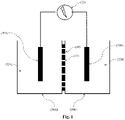
- the Figure 1 schematically represents an example of an electrical energy production device according to the present invention, comprising two tanks 20A and 20B, respectively tank A and tank B, separated by a membrane 10.
- Each of the two tanks contains an electrolytic solution 22A and 22B of concentration respective C A and C B in the same solute, in which soaks an electrode 30A and 30B.
- the two electrodes 30A and 30B are connected to a device making it possible to capture then supply the electrical energy generated.
- Each reservoir A and B can be any device or natural environment, open or closed, capable of containing a liquid.
- the concentrations C A and C B in the same solute of the electrolytic solutions 22A and 22B are necessarily different.
- C B is less than C A , which leads to a circulation of solute ions from reservoir A to reservoir B.
- the membrane 10, called the “nano-fluidic” membrane, separating the two reservoirs A and B comprises at least one nano-channel 11 arranged to allow the diffusion of electrolytes from one reservoir to the other through the said nano-channel(s). .
- diffusion will take place from reservoir A to reservoir B.
- Said nano-channel(s) 11 have an average cross-section enabling both water molecules and solute ions to circulate.
- the morphology of these nano-channels promotes good diffusion of the solution through the membrane.
- at least part of the internal surface of the nano-channel(s) essentially consists of at least one titanium oxide (TiO 2 ).
- the electrodes 30A and 30B can be partially or entirely immersed in the solutions 22A and 22B. It is also possible to provide for the electrodes to take the form of at least part of a wall of the reservoirs.
- the device (32) makes it possible to capture then supply the electrical energy spontaneously generated by the potential differential existing between the two electrodes 30A and 30B. It can consist of simple cables connecting a battery, a bulb or any other form of electrical consumer.
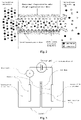
- the Figure 2 illustrates the phenomenon of diffusio-osmosis of an NaCl solution on the scale of a negatively charged nano-channel on the surface and generating an ionically unbalanced flux under the influence of the surface charge of the materials at the origin of the current electric.
- the Figure 3 illustrates the device of examples 1 and 2 making it possible to measure the electric current and the electric power generated per m 2 of a nanofluidic membrane comprising a nano-channel whose internal surface is made of TiO 2 .
- the electrical energy is generated thanks to the difference in the concentrations C A and C B in the same solute of the electrolytic solutions which causes the mobility of the electrolytes by diffusion-osmosis of the most concentrated solution towards the least concentrated solution, through the nano-channels of the membrane and under the influence of their surface properties.
- one of the key points of the present invention is based on the nature, morphology and density of the nano-channels in the membrane according to the invention, in particular of the internal wall of said nano-channels.
- the choice of the material constituting the inner wall of the nano-channels is crucial because, depending on the nature of the material and its surface charge in an aqueous medium, the energy generated will be more or less significant.
- the electrolytic solution moving from one reservoir to another will be more or less electrically charged, since ionically unbalanced under the influence of the surface charge of the material.
- the more the electrolytic solution moving from one reservoir to the other is ionically unbalanced and the greater the difference in concentration between the two reservoirs, the greater the energy production.
- the inventors have discovered that the nano-channels, the internal wall of which consists essentially of titanium oxide, generate a very strong ionic imbalance in the electrolytic solution circulating between the two reservoirs, and therefore generates an energy particularly high electrical voltage between the two electrodes.
- titanium oxide is meant any type of metallic titanium oxide, namely titanium (II) oxide of formula TiO as well as the corresponding non-stechiometric forms of compositions between TiO 0.7 and TiO 1.3 , titanium (IV) oxide or titanium dioxide, as well as mixtures thereof. These titanium oxides can be in different solid forms polymorphs, in particular in amorphous form or else in crystalline form. In the case of titanium dioxide (TiO 2 ), the crystalline form of the rutile or anatase type will mainly be used, the anatase form however being preferred.
- the internal surface of the nano-channels can comprise one or more section(s) essentially consisting of an oxide of titanium or that the entire internal surface consists essentially of at least one titanium oxide.
- Said section(s) may be regular or irregular, intermittent or non-intermittent and/or in the form of one layer or multiple layers.
- the total internal surface of the nano-channels consists essentially of at least one titanium oxide.
- titanium oxide essentially consisting of titanium oxide, is meant, within the meaning of the present invention, consisting of titanium oxide and minority element(s) such as impurities.
- the inventors are of the opinion that, given their nature, their size and their physico-chemical properties, in particular their surface charge density of the order of 0.1 to 1 C /cm 2 , the nano-channels of titanium oxide, in particular titanium oxide, promote the passage of ions of charges opposite to their surface charge by a nanofluidic phenomenon of diffusio-osmosis generated by the salinity gradient.
- the Figure 2 illustrates in longitudinal section, the diffusion-osmosis phenomenon on the scale of a nano-channel. In particular, it represents the differentiated movement of Na + cations and Cl - anions from a concentrated NaCl solution to a dilute NaCl solution at the negatively charged surface of a TiO 2 nano-channel.
- the membrane according to the invention will create a globally electrically charged ion flux since it is unbalanced between anions and cations under the effect of surface charges.
- At least part of the internal surface of the nano-channels consists essentially of a titanium oxide, in particular in the form of TiO 2 .
- the nano-channels consist entirely of titanium oxide.
- the physicochemical properties of titanium oxide can generally be modulated and amplified by doping or functionalization, that is to say by introducing, at the surface or in the heart of the titanium network, metallic chemical elements such as iron, silver, vanadium, gold, platinum, niobium, tungsten or non-metallic such as nitrogen, sulfur, carbon, hydrogen, boron, phosphorus or different compounds chemicals from the family of silanes, amines or other organics, preferably in small quantities, such as of the order of a few percent by mass.
- metallic chemical elements such as iron, silver, vanadium, gold, platinum, niobium, tungsten or non-metallic such as nitrogen, sulfur, carbon, hydrogen, boron, phosphorus or different compounds chemicals from the family of silanes, amines or other organics, preferably in small quantities, such as of the order of a few percent by mass.
- the titanium oxide is doped by introducing, at the surface or at the heart of its crystal lattice, metallic chemical elements such as iron, silver, vanadium, gold, platinum, niobium, tungsten, or non-metallic such as nitrogen, sulfur, carbon, hydrogen, boron, phosphorus, or different chemical compounds such as silanes or amines, preferably in an amount of between 0.5 and 10% by mass and more preferably between 1 and 5% by mass.
- metallic chemical elements such as iron, silver, vanadium, gold, platinum, niobium, tungsten, or non-metallic such as nitrogen, sulfur, carbon, hydrogen, boron, phosphorus, or different chemical compounds such as silanes or amines, preferably in an amount of between 0.5 and 10% by mass and more preferably between 1 and 5% by mass.
- the choice of the material constituting the internal wall of the nano-channels also influences the industrialization of the membranes according to the invention.
- the membranes comprising nano-channels based on titanium are relatively easy to produce and inexpensive, compared to the membranes of boron nitride or based on carbon, boron and nitrogen described in the prior art.
- a membrane comprising nano-channels whose internal surface consists essentially of titanium oxide can be obtained directly by anodizing a titanium sheet ( cf.
- Said membranes can also be supported by a nanoporous or pierced mechanical support on which the titanium is deposited.
- said membranes can be composed of a flexible polymer membrane on which is deposited a layer of TiO 2 .
- the morphology of the nano-channels also influences the yield of electrical energy generated. Indeed, the average section of the nano-channels as well as their specific and regular crossing morphology favor the good diffusion of the solution through the membrane.
- the membrane according to the invention is clearly distinguished from the semi-permeable or ion exchange membranes of the prior art, by its nano-channels potentially allowing both water molecules and ions to circulate, since each of the nano- channels has a section greater than the size of these molecules.
- the nano-channels have an average diameter of between 1 and 500 nm, in particular between 10 and 100 nm.
- mean diameter is meant, in the context of the present invention, the mean internal diameter of the nano-channel.
- the nano-channel can have a nanotubular morphology, asymmetrical of the conical type, in a neck, or with a perforated base.
- the average diameter corresponds to the internal diameter of the circular section.
- the nano-channel has an asymmetrical morphology of conical type, neck, or with perforated base, or has an oval or irregular section, the average diameter corresponds to the average of the smallest and of the largest internal diameter.
- the average diameter of the nano-channels is measured by means known to those skilled in the art.
- the average diameter can be measured by scanning electron microscopy or transmission electron microscopy.
- the nano-channels present on the membrane have homogeneous diameters.
- the average diameter will correspond to the average of the average diameters of all the nano-channels.
- the nano-channels have a nanotubular morphology, asymmetrical of the conical type, neck, or with perforated base, preferably said nano-channels have an asymmetrical morphology of the conical type.
- the nano-channels have an asymmetrical morphology of the conical type, in a neck, or with a perforated base, the thinnest diameter of the nano-channels is then oriented towards the side of the reservoir containing the solution with the least concentration of dissolved solutes, this is that is, in our case, to tank B.
- said nano-channels have a length to average diameter ratio of less than 1000, in particular less than 100.
- the length of the nano-channels is also measured by means known to those skilled in the art; for example, by scanning electron microscopy or transmission electron microscopy.
- the density of nano-channels per unit area of membrane is greater than 10 5 nano-channels per cm 2 of membrane, in particular greater than 10 8 nano-channels per cm 2 of membrane. membrane.
- the density of nano-channels per unit area of membrane is measured by means known to those skilled in the art, such as by scanning electron microscopy or scanning ion microscopy. The higher the density of nano-channels per unit area of membrane, the greater the yield of electrical energy generated per unit area of membrane.
- the reservoirs A and B of the device according to the invention each contain an electrolytic solution (22A and 22B) of respective concentration C A and C B in the same solute, C B being less than C A .
- the concentration gradient could also be obtained by temperature gradient between the two reservoirs by playing on the solubility of the salt as a function of the temperature.
- the concentration ratio Rc (Rc being equal to the ratio of the concentration of the most concentrated solution/the concentration of the least concentrated solution) may be between 1 and 10 9 .
- the concentration ratio C A /C B is greater than 1 and less than or equal to 10 9 , advantageously greater than 10 and less than or equal to 10 5 .
- Electrolyte solutions are aqueous solutions comprising electrolytes.
- the electrolytes may be of any chemical nature insofar as they dissolve in the solution in the form of charged ions.
- these ions will come from dissolved salts such as NaCl, KCL, CaCl 2 and MgCl 2 .
- the electrolyte solutions can be synthetic solutions; natural solutions, such as fresh water from lakes or rivers, underground water, brackish water, sea water; industrial produced water, petroleum produced water or biological solutions.
- said electrolytic solutions are aqueous solutions comprising a solute chosen from alkali halides or alkaline-earth halides, preferably chosen from NaCl, KCl, CaCl 2 and MgCl 2 , more preferably the solute is NaCl.
- the pH of the solutions is adjusted according to the isoelectric point of the internal surface of the nano-channels.
- the pH of the solutions can be adjusted to a value between (pH iso +1) and 14, more favorably between the values (pH iso +2) and 12.
- the pH of the solutions can be adjusted to a value between 0 and (pH iso -1) more favorably between 1 and (pH iso -2).
- pH iso means the pH of the isoelectric point of the material constituting the internal surface of the nano-channels.
- the iso pH is measured by methods known to those skilled in the art, in particular by the acid/base potentiometric titration method
- a pH gradient may also be established between the two reservoirs, the difference in pH between the two solutions will be greater than 1, preferably greater than 2.
- Each of the reservoirs A and B of the device according to the invention also comprises an electrode (30A and 30B) arranged so as to come into contact with the electrolytic solution (22A and 22B).
- Electrolytic solution 22A and 22B
- Different types of electrodes can be used for recovering the electric potential or current developed between the two reservoirs. All types of electrodes capable of collecting the flow of Na + or Cl - ions can be used, and preferably electrodes composed of silver and silver chloride (Ag/AgCl), carbon and platinum (C/Pt- ), Carbon (C-), Graphite or even Iron complexes of the [Fe(CN)6] 4- /[Fe(CN)6] 3- type.
- the electrodes can be partially or completely immersed in the electrolyte solutions. Provision could also be made for the electrodes to take the form of at least part of a wall of the reservoirs. These electrodes are connected together to a device (32) making it possible to capture then supply the electrical energy spontaneously generated by the potential differential existing between them. These electrodes can in particular be connected by simple cables connecting a battery, a bulb or any other form of electrical consumer.
- the device thus described makes it possible to harvest the electrical energy resulting from the charged ion flux crossing the nano-fluidic membrane.
- the device in a particular mode of the invention, provision could be made for the device to comprise N reservoirs (20) and N-1 membranes (10), N being an integer, in particular between 3 and 100, in particular between 3 and In this device, the reservoirs and the membranes are as defined above.
- the assembly will therefore consist of alternating reservoirs containing alternately a concentrated electrolytic solution and a less concentrated electrolytic solution, separated from each other by membranes.
- Example 1 Preparation of a device according to the invention comprising a nano-fluidic membrane based on amorphous titanium oxide - Measurement of the electric current obtained
- the nano-fluidic membrane based on amorphous titanium oxide was obtained at 130°C using the ALD (Atomic Layer deposition) method by depositing a thickness of 5 nm of TiO 2 : amorphous titanium oxide was thus deposited on a nanotubular support in nano-melamine comprising a nano-channel and consisting of 16 bi-layers of Al 2 O 3 and ZnO on SiN to obtain a good grip and a good surface condition previously perforated to the desired diameter of 110nm.
- ALD Atomic Layer deposition
- the membrane thus obtained comprises a nano-channel based on amorphous titanium oxide, with an internal diameter of 100 nanometers and a length of 200 nanometers.
- the isoelectric point of the membrane has been identified at a pH of the order of 6.5.
- This device consists of two independent reservoirs, each containing a solution of potassium chloride (KCl) dissolved at different concentrations between 1 mM and 1M, making it possible to define the concentration gradient Rc of 1, 10, 100 and 1000 between the two reservoirs.
- KCl potassium chloride
- the two reservoirs are separated by the nano-tubular membrane based on amorphous titanium oxide obtained in step 1.
- Ag/AgCl electrodes are used to measure the electric current produced through the titanium oxide nano-tubular membrane.
- an ammeter and a current generator making it possible to impose a potential difference are positioned in series between the two electrodes.
- the Figure 3 represents this device.
- Example 2 Preparation of a device according to the invention comprising a nano-fluidic membrane based on titanium oxide in anatase form - Measurement of the electric current obtained
- the nano-fluidic membrane based on amorphous titanium oxide was obtained at 130°C using the ALD (Atomic Layer deposition) method by depositing a thickness of 5 nm of TiO 2 : amorphous titanium oxide was thus deposited on a nanotubular support in nano-melamine comprising a nano-channel and consisting of 16 bi-layers of Al 2 O 3 and ZnO on SiN to obtain a good grip and a good surface condition previously perforated to the desired diameter of 110nm.
- ALD Atomic Layer deposition
- the membrane thus obtained was annealed at 500° C. for 2 hours in air to crystallize the titanium oxide in its anatase form.
- This membrane then comprises a nano-channel based on titanium oxide in anatase form of nanotubular morphology, with an internal diameter of 100 nanometers and a length of 200 nanometers.
- the isoelectric point of the membrane has been identified at a pH of the order of 4.
- the device used is in all respects similar to the device of Example 1 using the nano-fluidic membrane based on titanium oxide in anatase form.
- Pmax I osm 2 /4G.
- the maximum powers of energy produced per m 2 for each concentration gradient and pH are shown in Table 6.
- the powers measured are again clearly superior to the state of the art to reach values exceeding 5 kW/m 2 .
Landscapes
- Chemical & Material Sciences (AREA)
- Engineering & Computer Science (AREA)
- Chemical Kinetics & Catalysis (AREA)
- Water Supply & Treatment (AREA)
- Combustion & Propulsion (AREA)
- Inorganic Chemistry (AREA)
- Manufacturing & Machinery (AREA)
- Analytical Chemistry (AREA)
- Mechanical Engineering (AREA)
- General Engineering & Computer Science (AREA)
- Optics & Photonics (AREA)
- Physics & Mathematics (AREA)
- Life Sciences & Earth Sciences (AREA)
- Sustainable Development (AREA)
- Sustainable Energy (AREA)
- Electrochemistry (AREA)
- General Chemical & Material Sciences (AREA)
- Separation Using Semi-Permeable Membranes (AREA)
- Inorganic Compounds Of Heavy Metals (AREA)
- Hybrid Cells (AREA)
- Physical Or Chemical Processes And Apparatus (AREA)
- Conductive Materials (AREA)
Applications Claiming Priority (2)
| Application Number | Priority Date | Filing Date | Title |
|---|---|---|---|
| EP15306346 | 2015-09-02 | ||
| PCT/EP2016/070683 WO2017037213A1 (fr) | 2015-09-02 | 2016-09-02 | Dispositif de production d'energie par gradient de salinite a travers des membranes nano-fluidiques a base d'oxyde de titane |
Publications (2)
| Publication Number | Publication Date |
|---|---|
| EP3344374A1 EP3344374A1 (fr) | 2018-07-11 |
| EP3344374B1 true EP3344374B1 (fr) | 2022-08-10 |
Family
ID=54266499
Family Applications (1)
| Application Number | Title | Priority Date | Filing Date |
|---|---|---|---|
| EP16766247.7A Active EP3344374B1 (fr) | 2015-09-02 | 2016-09-02 | Dispositif de production d'énergie par gradient de salinité à travers des membranes nano-fluidiques à base d'oxyde de titane |
Country Status (13)
| Country | Link |
|---|---|
| US (2) | US10960354B2 (enExample) |
| EP (1) | EP3344374B1 (enExample) |
| JP (1) | JP6808724B2 (enExample) |
| KR (1) | KR102585417B1 (enExample) |
| CN (1) | CN108367242B (enExample) |
| AU (1) | AU2016313787B2 (enExample) |
| BR (1) | BR112018004030B1 (enExample) |
| CA (1) | CA2997169C (enExample) |
| ES (1) | ES2927118T3 (enExample) |
| IL (1) | IL257817B2 (enExample) |
| SA (1) | SA518391050B1 (enExample) |
| WO (1) | WO2017037213A1 (enExample) |
| ZA (1) | ZA201802018B (enExample) |
Families Citing this family (18)
| Publication number | Priority date | Publication date | Assignee | Title |
|---|---|---|---|---|
| EP3263896A1 (en) * | 2016-06-28 | 2018-01-03 | Ecole Polytechnique Fédérale de Lausanne (EPFL) | Osmotic power generator |
| WO2021038588A1 (en) * | 2019-08-23 | 2021-03-04 | INDIAN INSTITUTE OF TECHNOLOGY MADRAS (IIT Madras) | Osmotic power generation system |
| CN110601600A (zh) * | 2019-09-29 | 2019-12-20 | 东南大学 | 超薄氮化硅纳米孔膜在反向电渗析发电中的应用及装置 |
| US11031620B1 (en) * | 2019-12-04 | 2021-06-08 | King Abdullah University Of Science And Technology | Osmotic energy conversion with MXene lamellar membrane-based system and method |
| EP3862069A1 (en) * | 2020-02-06 | 2021-08-11 | Centre National de la Recherche Scientifique | Reverse electro-osmotic filtration system and uses thereof |
| FR3110459B1 (fr) | 2020-05-20 | 2023-01-13 | Sweetch Energy | Dispositif de production d’energie par gradient de salinite à travers une membrane à base de fibres de cellulose reticulées |
| FR3110460B1 (fr) | 2020-05-20 | 2022-05-13 | Sweetch Energy | Membrane composite à conduction sélective d’ions |
| KR102361075B1 (ko) | 2020-05-27 | 2022-02-11 | 연세대학교 산학협력단 | 에너지 수확 장치 |
| US20230268531A1 (en) * | 2020-06-26 | 2023-08-24 | Technion Research & Development Foundation Limited | High-temperature anion-exchange membrane fuel cell |
| FR3117888B1 (fr) | 2020-12-17 | 2023-08-25 | Sweetch Energy | Dispositif de production d’energie par gradient de salinite comprenant des electrodes d’un textile de charbon actif |
| CN113758977B (zh) * | 2021-08-20 | 2023-03-24 | 浙江大学 | 一种基于LDHs的阴离子选择性膜的营养液离子浓度检测方法 |
| CN113690475B (zh) * | 2021-08-30 | 2024-01-05 | 北京工业大学 | 一种柔性浓差电池及其制备方法 |
| FR3129297B1 (fr) | 2021-11-25 | 2025-10-24 | Sweetch Energy | Dispositif de production d’energie par gradient de salinite à travers une membrane à base de fibres de chitosan reticulées |
| KR102681547B1 (ko) | 2021-11-30 | 2024-07-05 | 연세대학교 산학협력단 | 질석 기반 적층막의 부분 열팽창을 이용한 이온 다이오드 제작법 및 이를 이용한 염분차 발전 시스템 |
| FR3145448B1 (fr) | 2023-01-26 | 2025-03-07 | Sweetch Energy | Dispositif de production d’energie par gradient de salinite comprenant un textile de charbon actif |
| EP4629271A1 (en) * | 2024-04-03 | 2025-10-08 | Georg-August-Universität Göttingen Stiftung Öffentlichen Rechts | Voltage generator comprising a plurality of nanochannels |
| FR3168529A1 (fr) | 2024-11-18 | 2026-05-22 | Sweetch Energy | Dispositif utilisant un separateur polymerique poreux possedant des groupements fonctionnels charges et formant un reseau tridimensionnel continu |
| FR3168693A1 (fr) | 2024-11-18 | 2026-05-22 | Sweetch Energy | Dispositif utilisant un separateur polymerique poreux possedant des groupements fonctionnels charges et formant un reseau tridimensionnel continu |
Family Cites Families (10)
| Publication number | Priority date | Publication date | Assignee | Title |
|---|---|---|---|---|
| US3906250A (en) | 1973-07-03 | 1975-09-16 | Univ Ben Gurion | Method and apparatus for generating power utilizing pressure-retarded-osmosis |
| IL51541A (en) | 1977-02-25 | 1979-05-31 | Univ Ben Gurion | Method and apparatus for generating power utilizing pressuure retarded osmosis |
| US4287276A (en) * | 1979-06-08 | 1981-09-01 | W. R. Grace & Co. | Alkaline battery with separator of high surface area |
| US7641997B2 (en) * | 2004-09-23 | 2010-01-05 | Ut-Battelle Llc | Design and synthesis of guest-host nanostructures to enhance ionic conductivity across nanocomposite membranes |
| EP1943374A2 (en) * | 2005-09-09 | 2008-07-16 | University of Nevada, Reno | Preparation of nano-tubular titania substrate with oxygen vacancies and their use in photo-electrolysis of water |
| CN101635532B (zh) * | 2009-08-25 | 2011-04-20 | 北京大学 | 将以离子浓度梯度形式储藏的自由能转化为电能的方法 |
| CN102771007B (zh) * | 2010-01-28 | 2014-12-10 | 三菱电机株式会社 | 电力储存器件单元及其制造方法、保管方法以及蓄电器件 |
| FR2958288B1 (fr) * | 2010-04-01 | 2012-10-05 | Saint Gobain Ct Recherches | Materiau a pores tubulaires |
| US20120094192A1 (en) * | 2010-10-14 | 2012-04-19 | Ut-Battelle, Llc | Composite nanowire compositions and methods of synthesis |
| FR2996780B1 (fr) * | 2012-10-16 | 2014-12-19 | Univ Claude Bernard Lyon | Procede et dispositif de production d'energie |
-
2016
- 2016-09-02 IL IL257817A patent/IL257817B2/en unknown
- 2016-09-02 CN CN201680056227.5A patent/CN108367242B/zh active Active
- 2016-09-02 KR KR1020187009146A patent/KR102585417B1/ko active Active
- 2016-09-02 US US15/756,693 patent/US10960354B2/en active Active
- 2016-09-02 WO PCT/EP2016/070683 patent/WO2017037213A1/fr not_active Ceased
- 2016-09-02 ES ES16766247T patent/ES2927118T3/es active Active
- 2016-09-02 AU AU2016313787A patent/AU2016313787B2/en active Active
- 2016-09-02 BR BR112018004030-4A patent/BR112018004030B1/pt active IP Right Grant
- 2016-09-02 JP JP2018512317A patent/JP6808724B2/ja active Active
- 2016-09-02 CA CA2997169A patent/CA2997169C/fr active Active
- 2016-09-02 EP EP16766247.7A patent/EP3344374B1/fr active Active
-
2018
- 2018-03-01 SA SA518391050A patent/SA518391050B1/ar unknown
- 2018-03-27 ZA ZA2018/02018A patent/ZA201802018B/en unknown
-
2021
- 2021-02-24 US US17/184,333 patent/US11571659B2/en active Active
Also Published As
| Publication number | Publication date |
|---|---|
| KR20180057640A (ko) | 2018-05-30 |
| CA2997169A1 (fr) | 2017-03-09 |
| KR102585417B1 (ko) | 2023-10-05 |
| US11571659B2 (en) | 2023-02-07 |
| BR112018004030B1 (pt) | 2023-03-07 |
| CN108367242A (zh) | 2018-08-03 |
| ES2927118T3 (es) | 2022-11-02 |
| JP2018530866A (ja) | 2018-10-18 |
| AU2016313787B2 (en) | 2021-08-19 |
| ZA201802018B (en) | 2023-12-20 |
| AU2016313787A1 (en) | 2018-04-12 |
| US20180353906A1 (en) | 2018-12-13 |
| WO2017037213A1 (fr) | 2017-03-09 |
| JP6808724B2 (ja) | 2021-01-06 |
| CA2997169C (fr) | 2023-05-16 |
| US10960354B2 (en) | 2021-03-30 |
| SA518391050B1 (ar) | 2022-10-27 |
| IL257817A (en) | 2018-04-30 |
| US20210178326A1 (en) | 2021-06-17 |
| EP3344374A1 (fr) | 2018-07-11 |
| BR112018004030A2 (enExample) | 2018-10-02 |
| IL257817B2 (en) | 2023-04-01 |
| IL257817B (en) | 2022-12-01 |
| CN108367242B (zh) | 2021-07-06 |
Similar Documents
| Publication | Publication Date | Title |
|---|---|---|
| WO2017037213A1 (fr) | Dispositif de production d'energie par gradient de salinite a travers des membranes nano-fluidiques a base d'oxyde de titane | |
| Pakulski et al. | Atom‐thick membranes for water purification and blue energy harvesting | |
| Sapkota et al. | High permeability sub-nanometre sieve composite MoS2 membranes | |
| EP2909477B1 (fr) | Procede et dispositif de production d'energie | |
| US20200070094A1 (en) | Apparatus and method for three-dimensional photo-electrodialysis | |
| EP3891101B1 (fr) | Dispositif électrochimique de purification d'un fluide, notamment d'eaux usees | |
| Wang et al. | Corn stalk-derived carbon quantum dots with abundant amino groups as a selective-layer modifier for enhancing chlorine resistance of membranes | |
| CA3184154A1 (fr) | Dispositif de production d'energie par gradient de salinite a travers une membrane a base de fibres de cellulose reticulees | |
| EP2763786A1 (fr) | Dispositif comprenant un matériau composite présentant des nanotubes soumis à un champ électrique et ses utilisations | |
| KR101295001B1 (ko) | 해수 전해질을 이용하는 광전기화학적 수소제조장치 | |
| CN115209976B (zh) | 反电渗过滤系统及其用途 | |
| Pan et al. | Sulfonated nickel phthalocyanine redox flow cell for high-performance electrochemical water desalination | |
| CN120752082A (zh) | 利用通过非对称膜的纳米流体输运的反向电渗过滤 | |
| EP3743195A1 (fr) | Procédé et dispositif de capture et/ou de libération d'espèces anioniques assisté par électrolyse | |
| CA3204183A1 (fr) | Dispositif de production d'energie par gradient de salinite comprenant des electrodes d'un textile de charbon actif | |
| Hu et al. | Architectured Nanomembranes | |
| FR2999554A1 (fr) | Procede et dispositif de production d'hydrogene pur sous pression par permeation a travers une membrane metallique en contact avec une solution liquide protique | |
| Wang et al. | Preparation and electrocatalytic properties of polyoxometalate-based multilayer films electrode | |
| HK40017863A (en) | Apparatus and method for three-dimensional photo-electrodialysis |
Legal Events
| Date | Code | Title | Description |
|---|---|---|---|
| STAA | Information on the status of an ep patent application or granted ep patent |
Free format text: STATUS: UNKNOWN |
|
| STAA | Information on the status of an ep patent application or granted ep patent |
Free format text: STATUS: THE INTERNATIONAL PUBLICATION HAS BEEN MADE |
|
| PUAI | Public reference made under article 153(3) epc to a published international application that has entered the european phase |
Free format text: ORIGINAL CODE: 0009012 |
|
| STAA | Information on the status of an ep patent application or granted ep patent |
Free format text: STATUS: REQUEST FOR EXAMINATION WAS MADE |
|
| 17P | Request for examination filed |
Effective date: 20180330 |
|
| AK | Designated contracting states |
Kind code of ref document: A1 Designated state(s): AL AT BE BG CH CY CZ DE DK EE ES FI FR GB GR HR HU IE IS IT LI LT LU LV MC MK MT NL NO PL PT RO RS SE SI SK SM TR |
|
| AX | Request for extension of the european patent |
Extension state: BA ME |
|
| DAV | Request for validation of the european patent (deleted) | ||
| DAX | Request for extension of the european patent (deleted) | ||
| GRAP | Despatch of communication of intention to grant a patent |
Free format text: ORIGINAL CODE: EPIDOSNIGR1 |
|
| STAA | Information on the status of an ep patent application or granted ep patent |
Free format text: STATUS: GRANT OF PATENT IS INTENDED |
|
| INTG | Intention to grant announced |
Effective date: 20220112 |
|
| GRAJ | Information related to disapproval of communication of intention to grant by the applicant or resumption of examination proceedings by the epo deleted |
Free format text: ORIGINAL CODE: EPIDOSDIGR1 |
|
| STAA | Information on the status of an ep patent application or granted ep patent |
Free format text: STATUS: REQUEST FOR EXAMINATION WAS MADE |
|
| RAP3 | Party data changed (applicant data changed or rights of an application transferred) |
Owner name: CENTRE NATIONAL DE LA RECHERCHE SCIENTIFIQUE (CNRS) Owner name: SWEETCH ENERGY |
|
| INTC | Intention to grant announced (deleted) | ||
| GRAP | Despatch of communication of intention to grant a patent |
Free format text: ORIGINAL CODE: EPIDOSNIGR1 |
|
| STAA | Information on the status of an ep patent application or granted ep patent |
Free format text: STATUS: GRANT OF PATENT IS INTENDED |
|
| GRAS | Grant fee paid |
Free format text: ORIGINAL CODE: EPIDOSNIGR3 |
|
| GRAA | (expected) grant |
Free format text: ORIGINAL CODE: 0009210 |
|
| STAA | Information on the status of an ep patent application or granted ep patent |
Free format text: STATUS: THE PATENT HAS BEEN GRANTED |
|
| INTG | Intention to grant announced |
Effective date: 20220623 |
|
| AK | Designated contracting states |
Kind code of ref document: B1 Designated state(s): AL AT BE BG CH CY CZ DE DK EE ES FI FR GB GR HR HU IE IS IT LI LT LU LV MC MK MT NL NO PL PT RO RS SE SI SK SM TR |
|
| REG | Reference to a national code |
Ref country code: AT Ref legal event code: REF Ref document number: 1510072 Country of ref document: AT Kind code of ref document: T Effective date: 20220815 Ref country code: CH Ref legal event code: EP |
|
| REG | Reference to a national code |
Ref country code: IE Ref legal event code: FG4D Free format text: LANGUAGE OF EP DOCUMENT: FRENCH |
|
| REG | Reference to a national code |
Ref country code: DE Ref legal event code: R096 Ref document number: 602016074154 Country of ref document: DE |
|
| REG | Reference to a national code |
Ref country code: ES Ref legal event code: FG2A Ref document number: 2927118 Country of ref document: ES Kind code of ref document: T3 Effective date: 20221102 |
|
| REG | Reference to a national code |
Ref country code: LT Ref legal event code: MG9D |
|
| PG25 | Lapsed in a contracting state [announced via postgrant information from national office to epo] |
Ref country code: SE Free format text: LAPSE BECAUSE OF FAILURE TO SUBMIT A TRANSLATION OF THE DESCRIPTION OR TO PAY THE FEE WITHIN THE PRESCRIBED TIME-LIMIT Effective date: 20220810 Ref country code: RS Free format text: LAPSE BECAUSE OF FAILURE TO SUBMIT A TRANSLATION OF THE DESCRIPTION OR TO PAY THE FEE WITHIN THE PRESCRIBED TIME-LIMIT Effective date: 20220810 Ref country code: PT Free format text: LAPSE BECAUSE OF FAILURE TO SUBMIT A TRANSLATION OF THE DESCRIPTION OR TO PAY THE FEE WITHIN THE PRESCRIBED TIME-LIMIT Effective date: 20221212 Ref country code: NO Free format text: LAPSE BECAUSE OF FAILURE TO SUBMIT A TRANSLATION OF THE DESCRIPTION OR TO PAY THE FEE WITHIN THE PRESCRIBED TIME-LIMIT Effective date: 20221110 Ref country code: NL Free format text: LAPSE BECAUSE OF FAILURE TO SUBMIT A TRANSLATION OF THE DESCRIPTION OR TO PAY THE FEE WITHIN THE PRESCRIBED TIME-LIMIT Effective date: 20220810 Ref country code: LV Free format text: LAPSE BECAUSE OF FAILURE TO SUBMIT A TRANSLATION OF THE DESCRIPTION OR TO PAY THE FEE WITHIN THE PRESCRIBED TIME-LIMIT Effective date: 20220810 Ref country code: LT Free format text: LAPSE BECAUSE OF FAILURE TO SUBMIT A TRANSLATION OF THE DESCRIPTION OR TO PAY THE FEE WITHIN THE PRESCRIBED TIME-LIMIT Effective date: 20220810 Ref country code: FI Free format text: LAPSE BECAUSE OF FAILURE TO SUBMIT A TRANSLATION OF THE DESCRIPTION OR TO PAY THE FEE WITHIN THE PRESCRIBED TIME-LIMIT Effective date: 20220810 |
|
| REG | Reference to a national code |
Ref country code: AT Ref legal event code: MK05 Ref document number: 1510072 Country of ref document: AT Kind code of ref document: T Effective date: 20220810 |
|
| PG25 | Lapsed in a contracting state [announced via postgrant information from national office to epo] |
Ref country code: PL Free format text: LAPSE BECAUSE OF FAILURE TO SUBMIT A TRANSLATION OF THE DESCRIPTION OR TO PAY THE FEE WITHIN THE PRESCRIBED TIME-LIMIT Effective date: 20220810 Ref country code: IS Free format text: LAPSE BECAUSE OF FAILURE TO SUBMIT A TRANSLATION OF THE DESCRIPTION OR TO PAY THE FEE WITHIN THE PRESCRIBED TIME-LIMIT Effective date: 20221210 Ref country code: HR Free format text: LAPSE BECAUSE OF FAILURE TO SUBMIT A TRANSLATION OF THE DESCRIPTION OR TO PAY THE FEE WITHIN THE PRESCRIBED TIME-LIMIT Effective date: 20220810 Ref country code: GR Free format text: LAPSE BECAUSE OF FAILURE TO SUBMIT A TRANSLATION OF THE DESCRIPTION OR TO PAY THE FEE WITHIN THE PRESCRIBED TIME-LIMIT Effective date: 20221111 |
|
| REG | Reference to a national code |
Ref country code: DE Ref legal event code: R119 Ref document number: 602016074154 Country of ref document: DE |
|
| PG25 | Lapsed in a contracting state [announced via postgrant information from national office to epo] |
Ref country code: SM Free format text: LAPSE BECAUSE OF FAILURE TO SUBMIT A TRANSLATION OF THE DESCRIPTION OR TO PAY THE FEE WITHIN THE PRESCRIBED TIME-LIMIT Effective date: 20220810 Ref country code: RO Free format text: LAPSE BECAUSE OF FAILURE TO SUBMIT A TRANSLATION OF THE DESCRIPTION OR TO PAY THE FEE WITHIN THE PRESCRIBED TIME-LIMIT Effective date: 20220810 Ref country code: DK Free format text: LAPSE BECAUSE OF FAILURE TO SUBMIT A TRANSLATION OF THE DESCRIPTION OR TO PAY THE FEE WITHIN THE PRESCRIBED TIME-LIMIT Effective date: 20220810 Ref country code: CZ Free format text: LAPSE BECAUSE OF FAILURE TO SUBMIT A TRANSLATION OF THE DESCRIPTION OR TO PAY THE FEE WITHIN THE PRESCRIBED TIME-LIMIT Effective date: 20220810 Ref country code: AT Free format text: LAPSE BECAUSE OF FAILURE TO SUBMIT A TRANSLATION OF THE DESCRIPTION OR TO PAY THE FEE WITHIN THE PRESCRIBED TIME-LIMIT Effective date: 20220810 |
|
| REG | Reference to a national code |
Ref country code: CH Ref legal event code: PL |
|
| REG | Reference to a national code |
Ref country code: BE Ref legal event code: MM Effective date: 20220930 |
|
| PG25 | Lapsed in a contracting state [announced via postgrant information from national office to epo] |
Ref country code: SK Free format text: LAPSE BECAUSE OF FAILURE TO SUBMIT A TRANSLATION OF THE DESCRIPTION OR TO PAY THE FEE WITHIN THE PRESCRIBED TIME-LIMIT Effective date: 20220810 Ref country code: MC Free format text: LAPSE BECAUSE OF FAILURE TO SUBMIT A TRANSLATION OF THE DESCRIPTION OR TO PAY THE FEE WITHIN THE PRESCRIBED TIME-LIMIT Effective date: 20220810 Ref country code: EE Free format text: LAPSE BECAUSE OF FAILURE TO SUBMIT A TRANSLATION OF THE DESCRIPTION OR TO PAY THE FEE WITHIN THE PRESCRIBED TIME-LIMIT Effective date: 20220810 |
|
| PLBE | No opposition filed within time limit |
Free format text: ORIGINAL CODE: 0009261 |
|
| STAA | Information on the status of an ep patent application or granted ep patent |
Free format text: STATUS: NO OPPOSITION FILED WITHIN TIME LIMIT |
|
| PG25 | Lapsed in a contracting state [announced via postgrant information from national office to epo] |
Ref country code: LU Free format text: LAPSE BECAUSE OF NON-PAYMENT OF DUE FEES Effective date: 20220902 Ref country code: AL Free format text: LAPSE BECAUSE OF FAILURE TO SUBMIT A TRANSLATION OF THE DESCRIPTION OR TO PAY THE FEE WITHIN THE PRESCRIBED TIME-LIMIT Effective date: 20220810 |
|
| 26N | No opposition filed |
Effective date: 20230511 |
|
| GBPC | Gb: european patent ceased through non-payment of renewal fee |
Effective date: 20221110 |
|
| PG25 | Lapsed in a contracting state [announced via postgrant information from national office to epo] |
Ref country code: LI Free format text: LAPSE BECAUSE OF NON-PAYMENT OF DUE FEES Effective date: 20220930 Ref country code: IE Free format text: LAPSE BECAUSE OF NON-PAYMENT OF DUE FEES Effective date: 20220902 Ref country code: DE Free format text: LAPSE BECAUSE OF NON-PAYMENT OF DUE FEES Effective date: 20230401 Ref country code: CH Free format text: LAPSE BECAUSE OF NON-PAYMENT OF DUE FEES Effective date: 20220930 |
|
| PG25 | Lapsed in a contracting state [announced via postgrant information from national office to epo] |
Ref country code: SI Free format text: LAPSE BECAUSE OF FAILURE TO SUBMIT A TRANSLATION OF THE DESCRIPTION OR TO PAY THE FEE WITHIN THE PRESCRIBED TIME-LIMIT Effective date: 20220810 |
|
| PG25 | Lapsed in a contracting state [announced via postgrant information from national office to epo] |
Ref country code: BE Free format text: LAPSE BECAUSE OF NON-PAYMENT OF DUE FEES Effective date: 20220930 |
|
| PG25 | Lapsed in a contracting state [announced via postgrant information from national office to epo] |
Ref country code: GB Free format text: LAPSE BECAUSE OF NON-PAYMENT OF DUE FEES Effective date: 20221110 |
|
| PG25 | Lapsed in a contracting state [announced via postgrant information from national office to epo] |
Ref country code: HU Free format text: LAPSE BECAUSE OF FAILURE TO SUBMIT A TRANSLATION OF THE DESCRIPTION OR TO PAY THE FEE WITHIN THE PRESCRIBED TIME-LIMIT; INVALID AB INITIO Effective date: 20160902 |
|
| PG25 | Lapsed in a contracting state [announced via postgrant information from national office to epo] |
Ref country code: CY Free format text: LAPSE BECAUSE OF FAILURE TO SUBMIT A TRANSLATION OF THE DESCRIPTION OR TO PAY THE FEE WITHIN THE PRESCRIBED TIME-LIMIT Effective date: 20220810 |
|
| PG25 | Lapsed in a contracting state [announced via postgrant information from national office to epo] |
Ref country code: MK Free format text: LAPSE BECAUSE OF FAILURE TO SUBMIT A TRANSLATION OF THE DESCRIPTION OR TO PAY THE FEE WITHIN THE PRESCRIBED TIME-LIMIT Effective date: 20220810 |
|
| PG25 | Lapsed in a contracting state [announced via postgrant information from national office to epo] |
Ref country code: TR Free format text: LAPSE BECAUSE OF FAILURE TO SUBMIT A TRANSLATION OF THE DESCRIPTION OR TO PAY THE FEE WITHIN THE PRESCRIBED TIME-LIMIT Effective date: 20220810 |
|
| PG25 | Lapsed in a contracting state [announced via postgrant information from national office to epo] |
Ref country code: BG Free format text: LAPSE BECAUSE OF FAILURE TO SUBMIT A TRANSLATION OF THE DESCRIPTION OR TO PAY THE FEE WITHIN THE PRESCRIBED TIME-LIMIT Effective date: 20220810 |
|
| PG25 | Lapsed in a contracting state [announced via postgrant information from national office to epo] |
Ref country code: MT Free format text: LAPSE BECAUSE OF FAILURE TO SUBMIT A TRANSLATION OF THE DESCRIPTION OR TO PAY THE FEE WITHIN THE PRESCRIBED TIME-LIMIT Effective date: 20220810 |
|
| PGFP | Annual fee paid to national office [announced via postgrant information from national office to epo] |
Ref country code: IT Payment date: 20250909 Year of fee payment: 10 |
|
| PGFP | Annual fee paid to national office [announced via postgrant information from national office to epo] |
Ref country code: FR Payment date: 20250812 Year of fee payment: 10 |
|
| PGFP | Annual fee paid to national office [announced via postgrant information from national office to epo] |
Ref country code: ES Payment date: 20251015 Year of fee payment: 10 |