EP3332593B1 - Allocating resources for wireless sidelink direct communications - Google Patents
Allocating resources for wireless sidelink direct communications Download PDFInfo
- Publication number
- EP3332593B1 EP3332593B1 EP16835692.1A EP16835692A EP3332593B1 EP 3332593 B1 EP3332593 B1 EP 3332593B1 EP 16835692 A EP16835692 A EP 16835692A EP 3332593 B1 EP3332593 B1 EP 3332593B1
- Authority
- EP
- European Patent Office
- Prior art keywords
- resource
- pool
- resource pool
- sidelink
- wireless terminal
- Prior art date
- Legal status (The legal status is an assumption and is not a legal conclusion. Google has not performed a legal analysis and makes no representation as to the accuracy of the status listed.)
- Active
Links
Images





Classifications
-
- H—ELECTRICITY
- H04—ELECTRIC COMMUNICATION TECHNIQUE
- H04W—WIRELESS COMMUNICATION NETWORKS
- H04W72/00—Local resource management
- H04W72/02—Selection of wireless resources by user or terminal
-
- H—ELECTRICITY
- H04—ELECTRIC COMMUNICATION TECHNIQUE
- H04W—WIRELESS COMMUNICATION NETWORKS
- H04W76/00—Connection management
- H04W76/30—Connection release
- H04W76/34—Selective release of ongoing connections
- H04W76/36—Selective release of ongoing connections for reassigning the resources associated with the released connections
-
- H—ELECTRICITY
- H04—ELECTRIC COMMUNICATION TECHNIQUE
- H04W—WIRELESS COMMUNICATION NETWORKS
- H04W76/00—Connection management
- H04W76/10—Connection setup
- H04W76/14—Direct-mode setup
Definitions
- the technology relates to wireless communications, and particularly to allocating or granting radio resources for wireless sidelink direct communications, also called device-to-device (D2D) communications.
- D2D device-to-device
- WAN wide area network
- Cellular communication When two user equipment terminals (e.g., mobile communication devices) of a cellular network or other telecommunication system communicate with each other, their data path typically goes through the operator network.
- the data path through the network may include base stations and/or gateways. If the devices are in close proximity with each other, their data path may be routed locally through a local base station.
- communications between a network node such as a base station and a wireless terminal is known as "wide area network" ("WAN") or "Cellular communication".
- Telecommunications systems may use or enable sidelink direct communication, in which two or more user equipment terminals directly communicate with one another.
- Sidelink direct communication is also sometimes referred to as device-to-device (D2D) communication.
- D2D device-to-device
- voice and/or data traffic (referred to herein as "communication signals") from one user equipment terminal to one or more other user equipment terminals may not be communicated through a base station or other network control device of a telecommunication system.
- WO 2015/095586 A1 discloses methods and systems for management of device-to-device communication resources.
- a base station assigns a first set of device-to-device (D2D) communication resources to a first D2D group and assigns a second set of D2D communication resources to a second D2D group.
- the D2D communication resources of the first set are different from the D2D communication resources of the second set.
- the first set of D2D communication resources and the second set of D2D communication resources are subsets of reserved D2D communication resources which are a subset of defined uplink communication resources defined by a communication specification for uplink communication between the D2D UE devices and a base station where the reserved D2D communication resources not used for uplink transmission to the base station.
- WO 2015/096719 A1 discloses a D2D resource allocation method, and data transmission method and device, the D2D resource allocation method comprising: determining a D2D resource configuration corresponding to the quality of service (QoS) level of a D2D service; and transmitting to a user equipment (UE) the information of the D2D resource configuration corresponding to the service quality level of the D2D service.
- the D2D data transmission method comprises: according to the received information of the D2D resource configuration corresponding to the service quality level of the D2D service, selecting a transmission resource for the D2D service to be transmitted; and transmitting the data of the D2D service over the selected transmission resource.
- the D2D service transmission requirement is considered in allocating and selecting D2D resources, thus further improving the system D2D resource allocation efficiency without affecting the D2D service transmission requirement.
- Proposal 1 If SA2 respond that there will be priorities associated with each group: Each resource pool signaled by RRC may include associated priority level(s) and if included then the UE shall select the resource pool associated with the priority level assigned to the group; Proposal 2: If SA2 respond that there will not be priorities associated with each group: Each resource pool signaled by RRC may include associated applicable access class(es) (at least high 11-15 or low 0-9) and if included then the UE shall select the resource pool associated with its access class.
- sidelink direct communication may refer to a mode of communication between or among wireless terminals that operate on a cellular network or other telecommunications system in which the communication from one wireless terminal to another wireless terminal does not pass through a centralized base station or other device in the cellular network or other telecommunications system.
- the “sidelink direct communication” encompasses one or both of sidelink signaling or control information and sidelink data.
- sidelink direct may also be shortened to "sidelink”, abbreviated as "SL”, and as such "sidelink” is used herein to refer to sidelink direct.
- sidelink direct communication e.g., sidelink communication
- D2D device-to-device
- sidelink direct communication may be used in lieu of sidelink direct communication. Therefore, it is to be understood that herein the terms “sidelink direct”, ⁇ sidelink” (SL), “ProSe” and “device-to-device (D2D)” may be interchangeable and synonymous.
- sidelink direct communications differs from “WAN” or “Cellular communication” which is or involves communication between the base station and the wireless terminal.
- Communication data is sent using communication signals and can include voice communications or data communications intended for consumption by a user of a wireless terminal.
- Communication signals may be transmitted directly from a first wireless terminal to a second wireless terminal via sidelink direct communication.
- all, some, or none of the control signaling related to the SL packet transmission may be managed or generated by the underlying core network or base station.
- a receiver user equipment terminal may relay communication data traffic between a transmitter user equipment terminal and one or more additional receiver user equipment terminals.
- core network can refer to a device, group of devices, or sub-system in a telecommunication network that provides services to users of the telecommunications network. Examples of services provided by a core network include aggregation, authentication, call switching, service invocation, gateways to other networks, etc.
- wireless terminal can refer to any electronic device used to communicate voice and/or data via a telecommunications system, such as (but not limited to) a cellular network.
- a telecommunications system such as (but not limited to) a cellular network.
- Other terminology used to refer to wireless terminals and non-limiting examples of such devices can include user equipment terminal("UE", mobile station, mobile device, access terminal, subscriber station, mobile terminal, remote station, user terminal, terminal, subscriber unit, cellular phones, smart phones, personal digital assistants ("PDAs”), laptop computers, netbooks, e-readers, wireless modems, etc.
- PDAs personal digital assistants
- the term "access node”, “node”, or “base station” can refer to any device or group of devices that facilitates wireless communication or otherwise provides an interface between a wireless terminal and a telecommunications system.
- a non-limiting example of a base station can include, in the 3GPP specification, a Node B ("NB"), an enhanced Node B (“eNB”), a home eNB (“HeNB”) or some other similar terminology.
- NB Node B
- eNB enhanced Node B
- HeNB home eNB
- An access point may be an electronic device that provides access for wireless terminal to a data network, such as (but not limited to) a Local Area Network (“LAN”), Wide Area Network (“WAN”), the Internet, etc.
- LAN Local Area Network
- WAN Wide Area Network
- the Internet etc.
- telecommunication system or “communications system” can refer to any network of devices used to transmit information.
- a non-limiting example of a telecommunication system is a cellular network or other wireless communication system.
- the term "cellular network” can refer to a network distributed over cells, each cell served by at least one fixed-location transceiver, such as a base station.
- a “cell” may be any communication channel that is specified by standardization or regulatory bodies to be used for International Mobile Telecommunications-Advanced ("IMTAdvanced"). All or a subset of the cell may be adopted by 3GPP as licensed bands (e.g., frequency band) to be used for communication between a base station, such as a Node B, and a UE terminal.
- a cellular network using licensed frequency bands can include configured cells. Configured cells can include cells of which a UE terminal is aware and in which it is allowed by a base station to transmit or receive information.
- SL signal or “SL signals” includes channels, reference signals, and synchronization signals for SL communication and/or discovery.
- SL communication e.g., sidelink direct communication
- SL communication can be used in networks implemented according to any suitable telecommunications standard.
- a non-limiting example of such as standard is the 3rd Generation Partnership Project ("3GPP") Long Term Evolution (“LTE").
- 3GPP 3rd Generation Partnership Project
- LTE Long Term Evolution
- the 3GPP standard is a collaboration agreement that aims to define globally applicable technical specifications and technical reports for present and future generation wireless communication systems.
- the 3GPP may define specifications for next generation mobile networks, systems, and devices.
- the 3GPP LTE is the name given to a project to improve the Universal Mobile Telecommunications System (“UMTS”) mobile phone or device standard to cope with future requirements.
- UMTS Universal Mobile Telecommunications System
- UMTS has been modified to provide support and specification for the Evolved Universal Terrestrial Radio Access (“E-UTRA”) and Evolved Universal Terrestrial Radio Access Network (“E-UTRAN”).
- E-UTRAN is another non-limiting example of a telecommunications standard with which SL communication may be used.
- An aspect of the 3GPP work pertains to functionality to allow sidelink direct communication to enable Proximity Services (ProSe) for public safety and, certain non-public safety requirements (See, e.g., RP-122009).
- D2D device-to-device
- sidelink direct communication e.g., sidelink direct communication
- the wireless terminal For the Scheduled resource allocation mode (e.g., Mode 1) the wireless terminal (UE) needs to be RRC_CONNECTED in order to transmit data.
- the wireless terminal requests transmission resources from the base station (e.g., an eNodeB also known as "eNB").
- the eNB schedules transmission resources for transmission of Sidelink Control and data.
- the wireless terminal sends a scheduling request (D-SR or Random Access) to the eNB followed by a ProSe BSR (buffer status report).
- D-SR scheduling request
- ProSe BSR buffer status report
- the eNB can determine that the wireless terminal has data for a ProSe Direct Communication transmission and can estimate the resources needed for transmission.
- the eNB can then schedule transmission resources for ProSe Direct Communication using a configured sidelink radio network temporary identifier (SL-RNTI).
- SL-RNTI sidelink radio network temporary identifier
- the wireless terminal In the UE autonomous resource selection mode, also known as Mode 2, the wireless terminal (UE) on its own selects resources from resource pools and performs transport format selection to transmit sidelink control and data. If the wireless terminal is out of coverage for ProSe Direct Communication it can only use the UE autonomous resource selection mode.
- Mode 2 the wireless terminal (UE) on its own selects resources from resource pools and performs transport format selection to transmit sidelink control and data. If the wireless terminal is out of coverage for ProSe Direct Communication it can only use the UE autonomous resource selection mode.
- the wireless terminal has three ways to obtain resource pool information: (1) Broadcast information (through System Information Block (SIB) 18 message). This example embodiment is not according to the invention and is present for illustration purposes only. (2) Dedicated RRC signaling (through an RRCConnectionReconfiguration message) (3) Pre-configured information. The wireless terminal then randomly selects resources for transmission from the resource pool indicated by one of the above resource allocation methods.
- SIB System Information Block
- the wireless terminal may use scheduled resource allocation or UE autonomous resource selection as per eNB configuration. If the wireless terminal is in coverage for ProSe Direct Communication the wireless terminal may use only the resource allocation mode indicated by eNB configuration unless one of several specified exceptional cases occurs.
- the allocation of resources is from among one or more resource pools. Discussed below are resource pool allocation techniques for sidelink control followed by resource pool allocation for sidelink data.
- the resource pool used for reception and the resource pool used for transmission are both pre-configured.
- the resource pool used for reception is configured by the eNB via radio resource control (RRC), in broadcast signaling.
- RRC radio resource control
- the resource pools used for transmission are configured as follows: (1) the resource pool used for transmission is configured by the eNB via RRC, in dedicated or broadcast signalling, if UE autonomous resource selection is used; (2) the resource pool used for transmission is configured by the eNB via RRC, in dedicated signalling if scheduled resource allocation is used. Regarding (2), the eNB schedules the specific resource(s) for Sidelink Control transmission within the configured reception pool.
- all wireless terminals should be configured with reception resource pools for Sidelink Control which are the union of the resource pools used for transmission of Sidelink Control in the serving cell and neighbor cells and transmission of Sidelink Control for out of coverage.
- the resource pool used for reception and the resource pool used for transmission are both pre-configured.
- the resource pools used for transmission and reception are configured by the eNB via RRC, in dedicated or broadcast signalling, if UE autonomous resource selection is used. There is no resource pool for transmission if scheduled resource allocation is used.
- the wireless terminal when a wireless terminal is in the UE autonomous resource selection mode the wireless terminal is provided with resource pool information.
- the resource pool information may be provided in three ways: (1) Broadcast information (through System Information Block (SIB) 18 message). This example embodiment is not according to the invention and is present for illustration purposes only. (2) Dedicated RRC signaling (through an RRCConnectionReconfiguration message) (3) Pre-configured information.
- the resource pool information typically comprises a list of resource pools, with each resource pool in turn typically comprising plural resources.
- the wireless terminal When needing resources in the UE autonomous resource selection mode, the wireless terminal first selects a resource pool (a "selected resource pool") from plural possible resource pools listed in the resource pool information.
- the selected resource pool is a first resource pool listed in the resource pool information provided to the wireless terminal.
- the resource pool chosen from the list of the resource pool information is on the basis of priority (e.g., service priority) when resource pools are differentiated in terms of priority (e.g., quality of service). Then, after the resource pool is selected, the wireless terminal randomly selects, from the selected resource pool, a resource for use in the sidelink direct communication.
- random resource selection without any resource pool access control introduces a potential of resource usage collision.
- the potential of resource usage collision arises from the fact that the wireless terminal may not have real time resource pool occupation information. In other words, the wireless terminal may not have real time information about utilization of resources of the resource pool by other wireless terminals. Such particularly occurs when the wireless terminal obtains the resource pool information through SIB 18 or pre-configuration.
- the eNB should have the real time resource pool occupation information and may instruct the wireless terminal with the real time resource pool usage information.
- random selection of a radio resource from a selected resource pool may result in selection by the wireless terminal of a resource already in use, e.g., in use by another wireless terminal for a sidelink direct communication.
- the wireless terminal when needing resources in the UE autonomous resource selection mode, the wireless terminal first selects a resource pool (a "selected resource pool") from plural possible resource pools listed in the resource pool information. Wireless terminals use the pool of resources indicated by the first entry of the resource pool information they receive.
- the first entry of the received resource pool information e.g., the first entry of the information element (IE) carrying the resource pool information
- the first entry of the received resource pool information is used as the selected resource pool regardless of whether the wireless terminal obtains the resource pool information from dedicated signaling, SIB, or pre-configuration.
- This technique of always using the first entry of the received resource pool information is herein also referred to as "common resource pool access".
- the probability of collision is lessened if the wireless terminals needing sidelink direct resources do not all automatically select the first resource pool listed in the resource pool information.
- Mission Critical Push To Talk MCPTT
- 3GPP Release 13 3GPP Release 13
- MCPTT Mission Critical Push To Talk
- Guaranteed transmission means that the MCPTT wireless terminal always be afforded resources, e.g., always be afforded resources for sidelink direct communications and thus not be denied resources by reason of collision.
- the information element (IE) which contains system information related to sidelink, SystemInformationBlockType18, may indicate E-UTRAN supports the SidelinkLTE information procedure and may contain sidelink direct communication related resource configuration information as shown in Listing 1.
- commRxPool may indicate the resources by which the UE is allowed to receive sidelink direct communication while in RRC_IDLE and while in RRC_CONNECTED.
- commSyncConfig may indicate the configuration by which the UE is allowed to receive and transmit synchronisation information.
- E-UTRAN may configure commSyncConfig including txParameters when configuring UEs by dedicated signalling to transmit synchronisation information.
- commTxPoolExceptional may indicate the resources by which the UE is allowed to transmit sidelink direct communication in exceptional conditions.
- commTxPoolNormalCommon may indicate the resources by which the UE is allowed to transmit sidelink direct communication while in RRC_IDLE or when in RRC_CONNECTED while transmitting sidelink
- the UE may follow the procedure shown in Listing 2.
- the information element (IE) which is included in a UE-dedicated message, SL-CommConfig, may specify the dedicated configuration information for sidelink direct communication as shown in Listing 3. In particular it may concern the transmission resource configuration for direct communication on the primary frequency.
- commTxPoolNormalDedicated may indicate a pool of transmission resources the UE is allowed to use while in RRC_CONNECTED.
- commTxConfig may indicate a pool of resources for SC when E-UTRAN schedules Tx resources (i.e. when indices included in DCI format 5 indicate the actual data resources).
- Mcs may indicate the Modulation and Coding Scheme. If not configured, the selection of Modulation and Coding Scheme may be up to UE implementation.
- Scheduled may indicate the configuration for the case E-UTRAN schedules the transmission resources based on sidelink specific BSR from the UE.
- ue-Selected may indicate the configuration for the case the UE selects the transmission resources from a pool of resources configured by E-UTRAN.
- the IE SL-CommResourcePool may specify the configuration information for an individual pool of resources for sidelink direct communication.
- the IE may cover the configuration of both the sidelink control information and the data as shown in Listing 4.
- sc-Period may indicate the period over which resources allocated in a cell for SC, scheduled and UE selected data transmissions occur. Value in number of subframes. Value sf40 may correspond to 40 subframes, sf80 may correspond to 80 subframes and so on.
- E-UTRAN may configure values sf40, sf80, sf160 and sf320 for FDD and for TDD config 1 to 5, values sf70, sf140 and sf280 for TDD config 0, and finally values sf60, sf120 and sf240 for TDD config 6.
- syncConfigIndex may indicate the synchronisation configuration that is associated with a reception pool, by means of an index to the corresponding entry of commSyncConfig in SystemInformationBlockType18.
- tdd Config may be TDD configuration associated with the reception pool of the cell indicated by syncConfigIndex.
- Absence of the field may indicate the same duplex mode as the cell providing this field and the same UL/DL configuration as indicated by subframeAssignment in SystemInformationBlockType1 in case of TDD.
- trpt-Subset may indicate the subset of T-RPT available. It may consist of a bitmap which is used to indicate the set of available 'k' values to be used for sidelink direct communication. If T-RPT subset configuration is not signaled or preconfigured then UE may assume the whole T-RPT set is available.
- the field Tx which may be conditionally present, may be mandatory present when included in commTxPoolNormalDedicated, commTxPoolNormalCommon or commTxPoolExceptional. Otherwise the field may be not present.
- pre-configured sidelink parameters may be described as in Listing 6. Upper layers are assumed to provide a set of pre-configured parameters that are valid at the current UE location if any.
- the IE SL-Preconfiguration may include the sidelink pre-configured parameters as shown in Listing 7.
- carrierFreq may indicate the carrier frequency for sidelink operation. In case of FDD it may be uplink carrier frequency and the corresponding downlink frequency can be determined from the default TX-RX frequency separation.
- preconfigComm may indicate a list of a number of individual resource pools. The same set of pools may be used for reception and transmission of sidelink direct communication.
- syncRefDiffHyst may be Hysteresis when evaluating a synchronization reference UE (SyncRef UE) using relative comparison.
- Value dB0 may correspond to 0 dB, dB3 to 3 dB and so on, value dBinf may correspond to infinite dB.
- syncRejMinHyst may be Hysteresis when evaluating a SyncRef UE using absolute comparison.
- Value dB0 may correspond to 0 dB, dB3 to 3 dB and so
- Fig. 1 shows an example communications system 20 which is generally generic to embodiments described herein.
- a radio access node 22 communicates over a first air or radio interface 24 (such as the Uu interface, for example) with first wireless terminal 26 1 .
- the node 22 comprises node processor 30 and node transmitter 32.
- the first wireless terminal 26 1 comprises terminal processor 40 and terminal transceiver 42.
- the terminal transceiver 42 typically comprises terminal transmitter section 44 and terminal receiver section 46.
- the terminal transmitter section 44 may comprise terminal transmitter circuitry and may be known as "transmitter" ("TX"); the terminal receiver section 46 may comprise terminal receiver circuitry and may be known as "receiver" ("RX").
- the technology disclosed herein provides techniques for allocating radio resources for use in sidelink direct (SL) communications
- the "sidelink direct communication” encompasses one or both of sidelink signaling or control information and sidelink data.
- An example sidelink direct communication may occur, for example, between first wireless terminal 26 1 and second wireless terminal 26 2 , as indicated by arrow 48 of Fig. 1 .
- the first wireless terminal 26 1 and second wireless terminal 26 2 may communicate over a second radio interface 49, which may also be known as the PC5 interface.
- the PC5 interface is described in 3GPP TS 23.303, 3GPP TS 23.303 V12.0.0 (2014-02); 3rd Generation Partnership Project, Technical Specification Group Services and System Aspects; Proximity-based services (ProSe); Stage 2; Release 12 .
- the terminal processor 40 includes sidelink direct (SLD) logic 50.
- the SLD logic 50 comprises instructions stored on non-transitory media which, when executed, enable first wireless terminal 26 1 to perform applications germane to sidelink direct communications, including selecting and/or utilizing radio resources for the transmitting and/or receiving of sidelink direct communications, such as sidelink direct signaling and sidelink direct data.
- the terminal processor 40 may perform operations of the first wireless terminal 26 1 other than those involved in sidelink direct communications, such as operations pertaining to transmitting and receiving other types of communications and executing applications stored in memory of the first wireless terminal 26 1 .
- node 22 and first wireless terminal 26 1 communicate with each other across radio interface 24 using a radio resource.
- first wireless terminal 26 1 and second wireless terminal 26 2 communicate across radio interface 49 using a radio resource (i.e., another radio resource).
- radio resource is a time-frequency unit that can carry information across a radio interface, e.g., either signal information or data information.
- An example of a radio resource occurs in the context of a "frame" of information that is typically formatted and prepared by a node such as node 22, e.g., by a scheduler of node 22.
- LTE Long Term Evolution
- a frame which may have both downlink portion(s) and uplink portion(s), is communicated between the base station and the wireless terminal.
- Each LTE frame may comprise plural subframes.
- a 10 ms frame consists of ten one millisecond subframes.
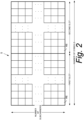
- a representative, sample depiction of a subframe S according to an example implementation is shown in Fig. 2 .
- each LTE subframe is divided into two slots (so that there are thus 20 slots in a frame).
- the transmitted signal in each slot is described by a resource grid comprised of resource elements (RE).
- Each column of the two dimensional grid of Fig. 2 represents a symbol (e.g., an OFDM symbol on downlink (DL) from node to wireless terminal; an SC-FDMA symbol in an uplink (UL) frame from wireless terminal to node).
- Each row of the grid of Fig. 2 represents a subcarrier.
- a resource element (RE) is the smallest time-frequency unit for downlink transmission in the subframe S. That is, one symbol on one sub-carrier in the sub-frame comprises a resource element (RE) which is uniquely defined by an index pair ( k , l ) in a slot (where k and l are the indices in the frequency and time domain, respectively). In other words, one symbol on one sub-carrier is a resource element (RE). Each symbol comprises a number of subcarriers in the frequency domain, depending on the channel bandwidth and configuration.
- the smallest time-frequency resource supported by the standard today is a set of plural subcarriers and plural symbols (e.g., plural resource elements (RE)) and is called a resource block (RB).
- a resource block may comprise, for example, 84 resource elements, i.e., 12 subcarriers and 7 symbols, in case of normal cyclic prefix.
- Fig. 2 serves only as an example a radio resource and of a technique of formatting of information that is to be transmitted over a radio or air interface. It should be understood that “frame” and “subframe” are not to be limited by the specific description of Fig. 2 .
- a user equipment comprises a processor and a memory in electronic communication with the processor. Instructions stored in the memory are executable to receive a configuration of first resource pools, and to perform a sidelink communication using the first resource pools.
- the first resource pools consist of second resource pools and additional resource pools, and the second resource pools are available for UEs for which the additional resource pools are not available.
- a method in a user equipment (UE) comprises receiving a configuration of first resource pools; and performing a sidelink communication using the first resource pools. In the method the first resource pools consist of second resource pools and additional resource pools, and the second resource pools are available for UEs for which the additional resource pools are not available
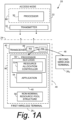
- the terminal processor 40 is shown as comprising resource allocation controller 52.
- resource allocation controller 52 may comprise or be subsumed in terminal processor 40, and particularly may comprise or be subsumed in SLD logic 50. Accordingly, resource allocation controller 52 is also known as resource allocation processor 52, or simply "processor".
- the resource allocation controller 52 may take the form of a controller 52A described herein in correspondence to the various collision avoidance techniques.
- Fig. 1 shows terminal processor 40 as executing instructions of an application 54.
- the instructions comprising application 54 are stored in non-transitory memory and, when executed, may invoke, initiate, or otherwise participate in sidelink direct communications.
- collision avoidance is facilitated by method and apparatus which provide a non-nominal resource pool structure which is configured to facilitate quality of service (QoS) requirements.
- QoS quality of service
- the resource structure provided by the technology disclosed herein and known as the non-nominal resource pool structure has finer granularity than the number of resource pools specified by a nominal resource pool quantity parameter.
- a certain set of pre-configured parameters which set is valid at the current location of a wireless terminal, is to be provided to a wireless terminal engaging in the UE autonomous resource selection mode.
- the set of pre-configured parameters may be provided by upper layers, e.g., by an application such as application 54 executed by the wireless terminal that is above the Access Stratum (AS) layers of sidelink direct application (e.g., SLD logic 50) executed by the wireless terminal.
- AS Access Stratum
- SLD logic 50 sidelink direct application
- “Upper layer” normally refers to NAS (Non Access Stratum) layers, e.g., above RRC layers in terms of control plane, which means the transparent signaling transfer between UE and core network (without AS layer communications via eNB).
- a nominal resource pool quantity parameter in the form of an integer which specifies a predetermined number of resource pools included in the resource pool information provided to the wireless terminal.
- the nominal resource pool quantity parameter is said to be “nominal” in the sense that it is specified by a particular industry standard document, or particular version/release of an industry standard document.
- the resource pools specified by the nominal resource pool quantity parameter are referred to herein as "nominal resource pools”.
- An example of the nominal resource pool quantity parameter is the parameter maxSL-TxPool-r12.
- the parameter maxSL-TxPool-r12 has the integer value "4", so that there are four nominal resource pools comprising the resource pool information
- a resource pool structure i.e., a non-nominal resource pool structure, which is different from that specified by the nominal resource pool quantity parameter.
- the information about the non-nominal resource pool structure is generically referred to herein as a "non-nominal pool quantity parameter".
- Fig. 1A depicts such aspect of the technology, showing resource allocation controller 52A as accessing non-nominal resource pool structure 56.
- the non-nominal resource pool structure 56 may be stored in a memory device, such as a random access memory (RAM), cache memory, or read only memory (ROM), for example.
- RAM random access memory
- ROM read only memory
- Fig. 3 shows basic, representative acts or steps comprising a method of operating a wireless terminal which uses non-nominal resource pool structure 56.
- the method of Fig. 3 involves executing, on processor circuitry of the wireless terminal (e.g., terminal processor 40 including resource allocation controller 52A), sidelink direct instructions stored on non-transitory media configured to perform a sidelink direct communication with another wireless terminal.
- the acts of Fig. 3 comprise act 3-1 and act 3-2.
- Act 3-1 comprises receiving a non-nominal pool quantity parameter which specifies a greater number of graduations of pooled resources than is defined by a nominal resource pool quantity parameter.
- “resource” means “radio resource” (e.g., time and frequency resources), and “pooled resources” means “pooled radio resources”.
- Act 3-2 comprises, in conjunction with execution of the sidelink direct instructions, the processor circuitry selecting a resource for use in the sidelink direct communication from a resource pool structure at least partially configured (e.g., at least partially defined) by the non-nominal
- the processor circuitry of terminal processor 40 (e.g., SLD logic 50 including resource allocation controller 52) is configured, in conjunction with performance of a sidelink direct communication with another wireless terminal, (1) to receive a non-nominal pool quantity parameter which specifies a greater number of graduations of pooled radio resources than is defined by a nominal resource pool quantity parameter; and, (2) to select a resource for use in the sidelink direct communication from a resource pool structure at least partially configured by the non-nominal pool quantity parameter.
- the terminal transmitter circuitry 44 is configured to use the selected resource in the sidelink direct communication.
- the technology disclosed herein comprises receipt and use of a sub-pool quantity parameter as the non-nominal pool quantity parameter.
- the sub-pool quantity parameter specifies a number of sub-pools which comprises one or more, and preferably each, of the nominal pools.
- the sub-pool quantity parameter is used in conjunction with the nominal resource pool quantity parameter to at least partially configure or define a resource pool structure different than that indicated by the resource pool quantity parameter alone.
- Fig. 4A illustrates pool information 60 which comprises nominal resource pool quantity parameter 62 and sub-pool quantity parameter 64.
- Fig. 4B shows an example non-nominal resource pool structure 56A configured in accordance with the pool information of the type of Fig. 4A , for an example scenario in which the nominal resource pool quantity parameter 62 has a value of "4" and the sub-pool quantity parameter 64 has a value of "3".
- the number "4" may be used for the nominal resource pool quantity parameter 62. But, it is conceivable that such number may change and thus the nominal resource pool quantity parameter 62 is not so limited.
- the value of the sub-pool quantity parameter 64 is not limited to "3", but may be a greater or lesser amount.
- the sub-pool quantity parameter 64 may apply for all resource pools, e.g., each of the resource pools may have the same number of sub-pools, or there may be a different sub-pool quantity parameter 64 for different resource pools, such as a different sub-pool quantity parameter 64 for each resource pool.
- Fig. 3A shows example, representative acts or steps that may be performed by the wireless terminal of Fig. 1A upon receipt and use of a sub-pool quantity parameter as the non-nominal pool quantity parameter.
- Act 3A-1 comprises receiving a sub-pool quantity parameter as the non-nominal pool quantity parameter.
- the sub-pool quantity parameter specifies a number of sub-pools which comprise one or more of nominal resource pools available for resource selection as defined by a nominal resource pool quantity parameter.
- Act 3A-2 comprises the processor circuitry, on the basis of priority of the sidelink direct communication and in conjunction with execution of the sidelink direct instructions, selecting a resource for use in the sidelink direct communication from a resource pool structure at least partially configured (e.g., at least partially defined) by the sub-pool quantity parameter.
- the resource pool structure may be at least partially configured by the nominal resource pool quantity parameter and the sub-pool quantity parameter.
- the method of Fig. 3A may further comprise receiving the sub-pool quantity parameter from an application (such as application 54) executing on the processor at a higher layer than the sidelink direct instructions.
- an application such as application 54
- the processor circuitry of terminal processor 40 (e.g., SLD logic 50 including resource allocation controller 52) is configured: (1) to receive a sub-pool quantity parameter as the non-nominal pool quantity parameter (the sub-pool quantity parameter specifying a number of sub-pools which comprise one or more of nominal resource pools available for resource selection as defined by a nominal resource pool quantity parameter); and (2) on the basis of priority of the sidelink direct communication and in conjunction with execution of the sidelink direct instructions, to select a resource for use in the sidelink direct communication from a resource pool structure at least partially configured by the sub-pool quantity parameter
- the technology disclosed herein comprises receipt and use of an override pool quantity parameter which specifies a number of pools which replaces a number of pools indicated by the nominal resource pool quantity parameter.
- the override pool quantity parameter may specify, for embodiments or releases subsequent to an earlier specification or earlier release, a greater number of resource pools available for sidelink direct communication than was specified in the earlier specification or earlier release.
- the parameter maxSL-TxPool-r12 may have the integer value "4" and the override pool quantity parameter may have an integer value of "16", or another integer greater than "4".
- the override pool quantity parameter may either replace or include the nominal resource pool quantity parameter in a communication received from a higher layer.
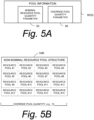
- Fig. 5A illustrates pool information 60(5) which comprises nominal resource pool quantity parameter 62 and override pool quantity parameter 66.
- Fig. 5B shows an example non-nominal resource pool structure 56B configured in accordance with the pool information of the type of Fig. 5A , for an example scenario in which the nominal resource pool quantity parameter 62 has a value of "4" and the override pool quantity parameter 66 has a value of "16".
- the number "4" may be used for the nominal resource pool quantity parameter 62. It is conceivable that such number may change and thus the nominal resource pool quantity parameter 62 is not so limited.
- the value of the override pool quantity parameter 66 is not limited to "16", but may be a greater or lesser amount.
- Fig. 3B shows example, representative acts or steps that may be performed by the wireless terminal of Fig. 1A upon receipt and use of an override pool quantity parameter 66 as the non-nominal pool quantity parameter.
- Act 3B-1 comprises receiving an override pool quantity parameter 66 as the non-nominal pool quantity parameter.
- Act 3B-2 comprises, on the basis of priority of the sidelink direct communication and in conjunction with execution of the sidelink direct instructions, the processor circuitry selecting a resource for use in the sidelink direct communication from a resource pool structure at least partially configured (e.g., at least partially defined) by the override pool quantity parameter rather than by a nominal resource pool quantity parameter.
- the processor circuitry of terminal processor 40 (e.g., SLD logic 50 including resource allocation controller 52) is configured: (1) to receive an override pool quantity parameter as the non-nominal pool quantity parameter (the override pool quantity parameter specifying a number resource pools available for resource selection); and (2) on the basis of priority of the sidelink direct communication and in conjunction with execution of the sidelink direct instructions, to select a resource for use in the sidelink direct communication from a resource pool structure at least partially configured by the override pool quantity parameter rather than by a nominal resource pool quantity parameter.
- SLD logic 50 including resource allocation controller 52 the processor circuitry of terminal processor 40 is configured: (1) to receive an override pool quantity parameter as the non-nominal pool quantity parameter (the override pool quantity parameter specifying a number resource pools available for resource selection); and (2) on the basis of priority of the sidelink direct communication and in conjunction with execution of the sidelink direct instructions, to select a resource for use in the sidelink direct communication from a resource pool structure at least partially configured by the override pool quantity parameter rather than by
- the technology disclosed herein comprises receipt and use of both an override pool quantity parameter and a sub-pool quantity parameter.
- the sub-pool quantity parameter specifies a number of sub-pools which comprises one or more, and preferably each, of the pools specified by the override pool quantity parameter.
- Fig. 6A illustrates pool information 60(6) which comprises nominal resource pool quantity parameter 62, sub-pool quantity parameter 64, and override pool quantity parameter 66.
- Fig. 6B shows an example non-nominal resource pool structure 56C configured in accordance with the pool information of the type of Fig.
- the values for Fig. 6B are not limited to those shown, but may be a greater or lesser amount.
- the nominal resource pool quantity parameter is "maxSL-TxPool-r12" and has a value of "4", in an example embodiment and mode of the technology disclosed herein, and when resource pool allocation/access is associated with the priority, any of the following techniques may be utilized:
- Fig. 1B shows an example embodiment and mode wherein terminal processor 40 of first wireless terminal 26 1 wherein resource allocation controller 52B comprises discriminate resource selection logic 70.
- the discriminate resource selection logic 70 thus comprises or is subsumed by terminal processor 40, and may also be referred to as "processor” or "processor circuitry”.
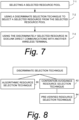
- Fig. 7 shows example, representative acts or steps that may be performed by the wireless terminal of Fig. 1B in a generic method of discriminate resource selection.
- the method of Fig. 7 may be executed on processor circuitry of first wireless terminal 26 1 , e.g., on terminal processor 40 including discriminate resource selection logic 70 by executing instructions stored on non-transitory media.
- the basic acts of Fig. 7 comprising such execution are shown as act 7-1 through act 7-3.
- Act 7-1 comprises selecting a selected resource pool.
- Act 7-2 comprises using a discriminate selection technique (rather than random selection) to select a selected resource from the selected resource pool.
- Act 7-3 comprises using the discriminately selected resource in conjunction with sidelink direct communications with another wireless terminal.
- the terminal processor 40 including discriminate resource selection logic 70 is configured to: (1) select a selected resource pool; and (2) use a discriminate selection technique to select a selected resource from the selected resource pool.
- the terminal transmitter circuitry 44 is configured to use the selected resource in conjunction with sidelink direct communications with another wireless terminal.
- Fig. 8 Different example embodiment and modes of discriminate resource selection are illustrated in tree form in Fig. 8 . Such examples, each discussed separately below, include contention avoidance resource selection 82; pre-verified resource selection 84; and algorithmic resource selection 86.
- One example embodiment and mode of discriminate resource selection comprises contention avoidance resource selection (see contention avoidance resource selection 82 in Fig. 8 ).
- the wireless terminal selects resources within the selected resource pool according to a contention-based access method.
- the contention-based access method may be able to detect congestion/collision. Examples of such contention-based access methods include some "listen before talk" access methods, e.g., Randomized RPT selection (RRPT) and Carrier Sense Multiple Access with Collision Avoidance (CSMA/SA). It should be noted that methods such as CSMA may require receiver response in order to detect collision.
- the discriminate resource selection technique including but not limited to the contention avoidance resource selection technique described herein is utilized to select a resource from a priority-associated resource pool, the technique is also referred to herein as "modified priority-based resource pool access”.
- the technique is also known as a pre-verified resource selection technique (see pre-verified resource selection 84 in Fig. 8 ) .
- the wireless terminal after selection of a resource pool the wireless terminal tentatively selects an initial candidate resource within the selected resource pool.
- the tentative selection of initial candidate resource may be a random selection, but unlike the prior art the initial candidate resource is not immediately used for sidelink direct communications. Rather, the wireless terminal sends out signaling, e.g., polling, to determine whether the initial candidate resource is in use in proximity to the wireless terminal, and if in use to optionally determine the priority of such existing use. Other wireless terminals polled or queried during the investigation for the candidate resource should respond or acknowledge if the resource is in use, or at least acknowledge that the candidate resource is idle from their perspective.
- signaling e.g., polling
- the wireless terminal may use the initial candidate resource as the definitively selected resource for the sidelink direct communications. But if the investigation/polling indicates that the candidate resource is congested or encumbered, then the wireless terminal may choose another resource to serve as the candidate resource, and may repeat the investigation/polling with respect to the second/another candidate resource, and so on until a definitive resource can be selected for the sidelink direct communications. Thus, selection of the resource using the contention based access method is not random, but rather the selection of resource results from pre-verified availability of the candidate resource.
- the particular resource of the selected resource pool which is evaluated for contention avoidance may be randomly selected for evaluation, but unlike a random resource selection mode (such as the common resource pool access) the evaluated resource is not selected for use in sidelink direct communications until after the resource has been qualified as acceptable, e.g., according to congestion/collision avoidance criteria.
- a random resource selection mode such as the common resource pool access
- the contention avoidance resource selection modes and embodiments there is a discrimination based on a characteristic of the resource (e.g., lack of congestion).
- Another example embodiment and mode of discriminate resource selection comprises algorithmic resource selection (see algorithmic resource selection 86 in Fig. 8 ).
- algorithmic resource selection employs some type of non-random or pseudo-random algorithm to select one of the resources of the selected pool.
- the wireless terminal may select the third resource of the selected resource pool, or alternatively the fifth resource of the selected resource pool.
- the algorithmic resource selection technique may hop to another resource member of the resource pool, e.g., by incrementing by a particular constant.
- the wireless terminal may increment a resource pointer by (for example) the number three, so that the sixth resource member of the selected resource pool will next be chosen.
- the discriminate resource selection technique including but not limited to the contention avoidance resource selection technique
- the technique is also referred to herein as "modified priority-based resource pool access”.
- the priority-based resource pool access and modified priority-based resource pool access methods may apply to none, or one, or some, or all of the cases, which are the cases in which the wireless terminal is either in the common case or in the exceptional case, where resource pools are indicated by dedicated signaling, or pre-configuration.
- a wireless terminal capable of sidelink direct communication that is configured by upper layers to transmit sidelink direct communication and has related data to be transmitted acts in the following way:
- the wireless terminal acts in the following way:
- Collision avoidance as implemented in techniques such as those described above is intended to avoid resource pre-emption.
- Resource pre-emption generally is implemented only when collision occurs or is likely to occur. So typically pre-emption should be performed as a last step for resource access, since pre-emption signifies that collision cannot be avoided or has unacceptable probability not being able to be avoided if some resource access has to be guaranteed.
- a high priority sidelink direct communication is able to pre-empt resources used for transmission by a low priority sidelink direct communication.
- the wireless terminal performs resource pre-emption with respect to resources utilized by the wireless terminal or another wireless terminal for sidelink direct communication, e.g., performs pre-emption with respect to resources selected by the wireless terminal in the UE autonomous resource selection mode.
- Pre-emption is an act of terminating on-going calls in order to free up resources for a higher priority call request.
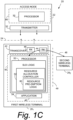
- Fig. 1C shows an example embodiment and mode of terminal processor 40 of first wireless terminal 26 1 wherein resource allocation controller 52B comprises resource pre-emption logic 80.
- the resource pre-emption logic 80 thus comprises or is subsumed by terminal processor 40, and may also be referred to as "processor” or “processor circuitry”. As used herein, pre-emption may occur on a per transmission basis.
- This example embodiment is not according to the invention and is present for illustration purposes only.
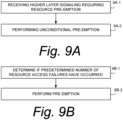
- Fig. 9A and Fig. 9B show example, representative acts or steps that may be performed by the wireless terminal of Fig. 1C in alternate generic methods of a pre-emptive resource selection technique.
- the method of Fig. 9A and/or of Fig. 9B may be executed on processor circuitry of first wireless terminal 26 1 , e.g., on terminal processor 40 including resource pre-emption logic 80 by executing instructions stored on non-transitory media.
- the basic acts of Fig. 9A comprising such execution are shown as act 9-1 and act 9-2.
- This example embodiment is not according to the invention and is present for illustration purposes only.
- Act 9A-1 comprises the processor receiving higher layer signaling which requires that resource pre-emption be performed, e.g., the pre-emption be performed essentially unconditionally.
- Act 9A-2 comprises the processor executing the pre-emption, e.g., allocating a particular resource for use in the sidelink direct transmission. Fig. 9A thus essentially involves unconditional pre-emption in response to high layer requirements.
- Fig. 9B shows an alternate method wherein pre-emption is performed after a failure of some specified number of attempts of resource access, e.g., making a determination that a resource should be pre-empted after finding that the resource or some resources or all resources are occupied.
- Act 9B-1 thus comprises the processor making a determination that a predetermined number of attempts to use a one or more candidate resources has failed (e.g., the one or more candidate resources were already in use/occupied). If the determination of act 9B-1 is positive, as act 9B-2 the processor pre-empts a candidate resource for the sidelink direct transmission.
- the number of failures may be any integer, including "1" (which would mean that once finding a collision, e.g., upon an initial detection of collision, the pre-emption is performed right away).
- the predetermined number may be greater than one, e.g., more than one such attempts, or even set to a high number that may require checking of all or almost all of the resources.
- the method of Fig. 9B , and the predetermined number may be dependent on a service requirement, e.g., whether the transmission requires immediate resource access, or can tolerate some delay..
- a wireless terminal participating in a sidelink direct communication obtains one or more indicators or flags which reflect or specify pre-emption posture of the sidelink direct communication.
- Such flags or indicators are generically referred to herein as "pre-emption posture indicators”.
- the flags or indicators which reflect or specify pre-emption posture of the sidelink direct communication are preferably based on pre-emption priority of the communication.
- One such indicator or flag is a Pre-emption Capability Indicator (PCI) which defines or indicates whether the transmission of a specified priority can pre-empt resources from a transmission with lower priority.
- PCI Pre-emption Capability Indicator
- PVI Pre-emption Vulnerability Indicator
- PCI Pre-emption Capability Indicator
- the pre-emption posture indicator may be obtained by the wireless terminal from various sources.
- the pre-emption posture indicator may be obtained from upper layers (e.g., an upper layer application 54) associated with priority information.
- the pre-emption posture indicator may be associated with and/or included with (e.g., comprise) resource pool information (e.g., pool information 60), and as such may be obtained in similar manner as the resource pool information (e.g., via dedicated signaling, SIB 18, or pre-configuration). That is, both Pre-emption Capability Indicator (PCI) and Pre-emption Vulnerability Indicator (PVI) may be obtained from one or both of the following alternatives: (A) upper layers associated with priority information; and (B) association with resource pool information so as to be obtained by the same ways as resource pool information indications, which are dedicated signalling, SIB 18, and pre-configuration.
- PCI Pre-emption Capability Indicator
- PVI Pre-emption Vulnerability Indicator
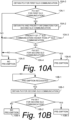
- Fig. 10A shows representative example acts or steps that may be performed by a wireless terminal having a higher priority actively seeking to pre-empt resources of a second sidelink direct communication for use in a first sidelink direct communication.
- Act 10A-0 comprises the wireless terminal which is actively seeking pre-emption obtaining the Pre-emption Capability Indicator (PCI) for a first sidelink direct communication.
- Act 10A-1 comprises the active wireless terminal checking whether the Pre-emption Capability Indicator (PCI) for the first sidelink direct communication is set to indicate that the active wireless terminal has offensive pre-emption capability for the first sidelink direct communication.
- PCI Pre-emption Capability Indicator
- act 10A-2 the active wireless terminal obtains the Pre-emption Vulnerability Indicator (PVI) and the priority information for the second sidelink direct communication (which may be communication of the same wireless terminal or another wireless terminal).
- Act 10A-3 comprises the active wireless terminal determining whether the priority of the first SLD communication, e.g., the priority of the SLD communication for which the wireless terminal is actively seeking to pre-empt resources, is higher than the priority of the second sidelink direct communication.
- Act 10A-3 comprises the active wireless terminal determining whether the Pre-emption Vulnerability Indicator (PVI) for the second sidelink direct communication is set to indicate that the second sidelink direct communication is vulnerable.
- PVI Pre-emption Vulnerability Indicator
- act 10A-5 If any one of the determinations of act 10A-1, act 10A-3, or act 10A-4 is negative, no pre-emption occurs (act 10A-5). But if the priority of the first SLD communication is higher than the priority of the second sidelink direct communication and if the Pre-emption Vulnerability Indicator (PVI) for the second communication is set, as act 10A-6 the active wireless terminal pre-empts the sought sidelink direct radio resource.
- PVI Pre-emption Vulnerability Indicator
- Fig. 10B shows representative example acts or steps that may be performed by a second (passive) wireless terminal which is being requested by an active wireless terminal (e.g., another wireless terminal actively seeking to pre-empt resources) to relinquish a contested resource of a second sidelink direct communication currently in use for a second sidelink direct communication.
- Act 10B-0 comprises the second (passive) wireless terminal ascertaining that a pre-emption request has been received from active wireless terminal which is actively seeking pre-emption.
- the active wireless terminal has determined that its Pre-emption Capability Indicator (PCI) is set as a pre-requisite for making the active pre-emption request.
- PCI Pre-emption Capability Indicator
- Act 10B-1 comprises the second wireless terminal obtaining its Pre-emption Vulnerability Indicator (PVI).
- Act 10B-2 comprises the second wireless terminal checking whether its Pre-emption Vulnerability Indicator (PVI) is set (the Pre-emption Vulnerability Indicator (PVI) being set indicates vulnerability of the second wireless terminal to a pre-emption request from a wireless terminal whose Pre-emption Capability Indicator (PCI) is set). If it is determined as act 10B-2 that the Pre-emption Vulnerability Indicator (PVI) is set, as act 10B-3 the second wireless terminal relinquishes the sought sidelink direct resource as the pre-emption is successful.
- PVI Pre-emption Vulnerability Indicator
- act 10B-4 the second wireless terminal retains use of the sought sidelink direct resource as the pre-emption is not successful.
- This example embodiment is not according to the invention and is present for illustration purposes only.
- the eNB controls the pre-emption if the network is congested. On the other hand, if the wireless terminal is in Mode 2 transmission with resource pool indicated by SIB 18 or pre-configuration, or if the wireless terminal uses the exceptional case resource pool for transmission, the wireless terminal controls the pre-emption by itself.
- Pre-emption including but not limited to the pre-emption features of the technology disclosed herein, may be used in (1) in conjunction with the discriminate resource selection mode/techniques described above (including the modified priority-based resource pool access method) or (2) in conjunction with either the common resource pool access method or the priority-based resource pool access method, as described separately below.
- the wireless terminal is able to detect collision.
- the higher priority communication/transmission which requires transmission resources with valid Pre-emption Capability Indicator (PCI) flag
- PCI Pre-emption Capability Indicator
- PVI Pre-emption Vulnerability Indicator
- the wireless terminal performs random access to the selected resource pool without collision detection. Ordinarily there would not be a resource collision problem if the two wireless terminals are far remote from one another but use the same resources for transmission.
- a wireless terminal once a wireless terminal has taken (e.g., allocated) a resource, that wireless terminal should notify other wireless terminals in its proximity as to which resources in which resource pool are taken/allocated, by which priority level wireless terminals the resources are taken/allocated. Then the higher priority wireless terminal can decide whether the higher priority wireless terminal should perform pre-emption.
- the notification of allocation/use of resources for use in a sidelink direct communication may be accomplished in several different ways.
- the notification of allocation/use of resources for use in a sidelink direct communication may also be referred to as "resource occupation status".
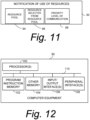
- a notification of allocation/use of resources 92 may be provided using bits, fields, or information elements (IEs) of signaling channels.
- a first field of the notification may comprise an indication or identification (94) of the resource pool from which the resource was selected; a second field of the notification may comprise an indication or identification (96) of the particular resource selected from the resource pool; and a third field may comprise an indication (98) of a priority level of the communication (or of the wireless terminal transmitting the communication).
- the notification may be accomplished in using signaling channels.
- the resource occupation situation may be notified either through reserved bits in the Physical Sidelink Broadcast Channel (PSBCH), or new signalling bits in the Physical Sidelink Control Channel (PSCCH), or even attached bits to data transmission in the Physical Sidelink Shared Channel (PSSCH).
- PSBCH Physical Sidelink Broadcast Channel
- PSCCH Physical Sidelink Control Channel
- PSSCH Physical Sidelink Shared Channel
- all wireless terminals should provide notification of resource occupation information once they take these resources.
- the high priority wireless terminals can know the occupation situation of resource pools which they can access in order to make a pre-emption decision.
- first wireless terminal 26 1 framed by broken line are, in an example embodiment, implemented by electronic machinery 90.
- Fig. 12 shows an example of such electronic machinery, as comprising one or more processors 100, program instruction memory 102; other memory 104 (e.g., RAM, cache, etc.); input/output interfaces 106; peripheral interfaces 108; support circuits 109; and busses 110 for communication between the aforementioned units.
- the memory 104 may be one or more of readily available memory such as random access memory (RAM), read only memory (ROM), floppy disk, hard disk, flash memory or any other form of digital storage, local or remote, and is preferably of non-volatile nature.
- RAM random access memory
- ROM read only memory
- floppy disk hard disk
- flash memory any other form of digital storage, local or remote, and is preferably of non-volatile nature.
- the support circuits 109 are coupled to the processors 100 for supporting the processor in a conventional manner. These circuits include cache, power supplies, clock circuits, input/output circuitry and subsystems, and the like.
- the processes and methods of the disclosed embodiments may be discussed as being implemented as a software routine, some of the method steps that are disclosed therein may be performed in hardware as well as by a processor running software. As such, the embodiments may be implemented in software as executed upon a computer system, in hardware as an application specific integrated circuit or other type of hardware implementation, or a combination of software and hardware.
- the software routines of the disclosed embodiments are capable of being executed on any computer operating system, and is capable of being performed using any CPU architecture.
- the functional blocks may include or encompass, without limitation, digital signal processor (DSP) hardware, reduced instruction set processor, hardware (e.g., digital or analog) circuitry including but not limited to application specific integrated circuit(s) [ASIC], and/or field programmable gate array(s) (FPGA(s)), and (where appropriate) state machines capable of performing such functions.
- DSP digital signal processor
- ASIC application specific integrated circuit
- FPGA field programmable gate array
- each functional block or various features of the base station device and the terminal device (the video decoder and the video encoder) used in each of the aforementioned embodiments may be implemented or executed by a circuitry, which is typically an integrated circuit or a plurality of integrated circuits.
- the circuitry designed to execute the functions described in the present specification may comprise a general-purpose processor, a digital signal processor (DSP), an application specific or general application integrated circuit (ASIC), a field programmable gate array signal (FPGA), or other programmable logic devices, discrete gates or transistor logic, or a discrete hardware component, or a combination thereof.
- the general-purpose processor may be a microprocessor, or alternatively, the processor may be a conventional processor, a controller, a microcontroller or a state machine.
- the general-purpose processor or each circuit described above may be configured by a digital circuit or may be configured by an analogue circuit. Further, when a technology of making into an integrated circuit superseding integrated circuits at the present time appears due to advancement of a semiconductor technology, the integrated circuit by this technology is also able to be used.
- a computer is generally understood to comprise one or more processors or one or more controllers, and the terms computer and processor and controller may be employed interchangeably herein.
- the functions may be provided by a single dedicated computer or processor or controller, by a single shared computer or processor or controller, or by a plurality of individual computers or processors or controllers, some of which may be shared or distributed.
- processor or “controller” shall also be construed to refer to other hardware capable of performing such functions and/or executing software, such as the example hardware recited above.
- Nodes that communicate using the air interface also have suitable radio communications circuitry.
- the technology can additionally be considered to be embodied entirely within any form of computer-readable memory, such as solid-state memory, magnetic disk, or optical disk containing an appropriate set of computer instructions that would cause a processor to carry out the techniques described herein.
- D2D device-to-device
- SA Terminology Previous Terminology New Terminology Schedule assignment
- PSCCH Physical Sidelink Control Channel PD2DSCH Physical Sidelink Control Channel
- PSBCH Physical Sidelink Control Channel
- D2DSS D2D synchronization signals
- SLSS Segment Synchronization Signals
- PSSCH Physical Sidelink Shared Channel
- PSDCH Physical Sidelink Discovery Channel
Landscapes
- Engineering & Computer Science (AREA)
- Computer Networks & Wireless Communication (AREA)
- Signal Processing (AREA)
- Mobile Radio Communication Systems (AREA)
Applications Claiming Priority (3)
| Application Number | Priority Date | Filing Date | Title |
|---|---|---|---|
| US201562202642P | 2015-08-07 | 2015-08-07 | |
| US15/228,579 US10616864B2 (en) | 2015-08-07 | 2016-08-04 | Allocating resources for wireless sidelink direct communications |
| PCT/US2016/045763 WO2017027375A1 (en) | 2015-08-07 | 2016-08-05 | Allocating resources for wireless sidelink direct communications |
Publications (3)
| Publication Number | Publication Date |
|---|---|
| EP3332593A1 EP3332593A1 (en) | 2018-06-13 |
| EP3332593A4 EP3332593A4 (en) | 2019-04-03 |
| EP3332593B1 true EP3332593B1 (en) | 2023-10-04 |
Family
ID=57984398
Family Applications (1)
| Application Number | Title | Priority Date | Filing Date |
|---|---|---|---|
| EP16835692.1A Active EP3332593B1 (en) | 2015-08-07 | 2016-08-05 | Allocating resources for wireless sidelink direct communications |
Country Status (6)
| Country | Link |
|---|---|
| US (1) | US10616864B2 (enExample) |
| EP (1) | EP3332593B1 (enExample) |
| JP (1) | JP6746624B2 (enExample) |
| CN (1) | CN108141847B (enExample) |
| AU (1) | AU2016307444B2 (enExample) |
| WO (1) | WO2017027375A1 (enExample) |
Families Citing this family (86)
| Publication number | Priority date | Publication date | Assignee | Title |
|---|---|---|---|---|
| EP3402268B1 (en) * | 2016-01-27 | 2020-05-13 | Huawei Technologies Co., Ltd. | Communication method, network side device and terminal |
| WO2017222351A1 (ko) * | 2016-06-24 | 2017-12-28 | 엘지전자 주식회사 | 무선 통신 시스템에서 v2x 통신을 위한 신호 전송 방법 및 이를 위한 장치 |
| EP3273634A1 (en) * | 2016-07-18 | 2018-01-24 | Panasonic Intellectual Property Corporation of America | Improved support of quality of service for v2x transmissions |
| EP3484224B1 (en) | 2016-08-09 | 2023-09-27 | Huawei Technologies Co., Ltd. | Method, device, and system for v2x message transmission |
| JP6828810B2 (ja) * | 2016-09-26 | 2021-02-10 | 日本電気株式会社 | デバイスツーデバイス通信技術分野のための方法およびシステム |
| CN108633049B (zh) * | 2017-03-24 | 2021-09-28 | 中兴通讯股份有限公司 | 一种资源选择方法及装置、资源配置方法及装置 |
| WO2018201414A1 (zh) * | 2017-05-04 | 2018-11-08 | 华为技术有限公司 | 一种配置传输资源的方法、装置及系统 |
| CN108810906A (zh) * | 2017-05-04 | 2018-11-13 | 株式会社Ntt都科摩 | 资源配置和调度方法、基站以及用户设备 |
| US20200170002A1 (en) * | 2017-07-25 | 2020-05-28 | Lg Electronics Inc. | Method and apparatus for performing sidelink transmissions on multiple carriers in wireless communication system |
| CN110710295B (zh) * | 2017-08-02 | 2021-01-22 | Oppo广东移动通信有限公司 | 设备对设备通信的方法、终端设备和网络设备 |
| KR102554390B1 (ko) * | 2017-09-20 | 2023-07-11 | 삼성전자주식회사 | 무선 통신 시스템에서 제어 정보 송수신 방법 및 장치 |
| WO2019066706A1 (en) * | 2017-09-28 | 2019-04-04 | Telefonaktiebolaget Lm Ericsson (Publ) | METHODS, WIRELESS COMMUNICATION DEVICES AND NETWORK NODES FOR ASSISTING THE ALLOCATION OF LATERAL BINDING RESOURCES |
| KR102437628B1 (ko) | 2017-11-15 | 2022-08-30 | 삼성전자주식회사 | 무선 통신 시스템에서 무선 자원을 결정하기 위한 장치 및 방법 |
| WO2019098662A1 (ko) | 2017-11-15 | 2019-05-23 | 삼성전자 주식회사 | 무선 통신 시스템에서 무선 자원을 결정하기 위한 장치 및 방법 |
| WO2019095261A1 (en) * | 2017-11-17 | 2019-05-23 | Telefonaktiebolaget Lm Ericsson (Publ) | Methods and devices for group communication |
| CN111492708B (zh) * | 2018-02-14 | 2021-11-19 | Oppo广东移动通信有限公司 | 用户设备及其无线通信方法 |
| ES2993167T3 (en) | 2018-03-16 | 2024-12-23 | Huawei Tech Co Ltd | Devices and methods for d2d communication |
| MX2020010474A (es) | 2018-04-05 | 2021-01-08 | Ericsson Telefon Ab L M | Informacion de control de enlace lateral de varias etapas. |
| CN110381463B (zh) * | 2018-04-12 | 2021-02-26 | 维沃移动通信有限公司 | 一种旁链路信息的传输方法及设备 |
| US11672035B2 (en) * | 2018-06-14 | 2023-06-06 | Lg Electronics Inc. | Method and apparatus for performing sidelink communication by UE in NR V2X |
| JP7401515B2 (ja) | 2018-07-05 | 2023-12-19 | オッポ広東移動通信有限公司 | 車両ネットワークにおけるデータ伝送方法及び端末デバイス |
| EP3800954B1 (en) | 2018-07-05 | 2026-04-29 | Guangdong Oppo Mobile Telecommunications Corp., Ltd. | Method for transmitting data in internet of vehicles, and terminal device |
| US12047937B2 (en) | 2018-07-19 | 2024-07-23 | Ntt Docomo, Inc. | User device and base station device |
| EP3815441B1 (en) | 2018-08-02 | 2023-12-27 | Guangdong Oppo Mobile Telecommunications Corp., Ltd. | Method and apparatus for performing radio resource selection and contention indication in wireless communication system |
| US11457431B2 (en) * | 2018-08-03 | 2022-09-27 | FG Innovation Company Limited | Sidelink radio resource allocation |
| TW202008828A (zh) * | 2018-08-03 | 2020-02-16 | 大陸商Oppo廣東移動通信有限公司 | 資源配置的方法和終端設備 |
| CN110831192B (zh) | 2018-08-10 | 2024-07-19 | 华为技术有限公司 | 侧行通信方法、终端设备和网络设备 |
| WO2020060024A1 (ko) * | 2018-09-20 | 2020-03-26 | 엘지전자 주식회사 | Nr v2x에서 사이드링크 통신을 위한 자원 풀을 결정하는 방법 및 장치 |
| CN110944352B (zh) * | 2018-09-25 | 2022-11-01 | 维沃移动通信有限公司 | 一种旁链路的链路失败检测方法及终端 |
| CN110958692B (zh) * | 2018-09-26 | 2021-12-28 | 维沃移动通信有限公司 | 副链路传输资源的选择方法、配置方法及设备 |
| CN110958691B (zh) | 2018-09-26 | 2022-10-18 | 维沃移动通信有限公司 | 资源池配置方法、使用方法及配置设备、终端 |
| CN110958704B (zh) * | 2018-09-26 | 2022-02-22 | 维沃移动通信有限公司 | 一种资源调度方法和装置 |
| US12167367B2 (en) | 2018-09-27 | 2024-12-10 | Apple Inc. | Resource allocation and configuration for broadcast and unicast operation over sidelink for NR V2X |
| CN110958098B (zh) | 2018-09-27 | 2021-03-30 | 华为技术有限公司 | 配置旁链路资源的方法和装置 |
| CN110972278B (zh) * | 2018-09-28 | 2022-05-06 | 大唐移动通信设备有限公司 | 一种资源选择方法、装置、终端及存储介质 |
| CN112840714A (zh) * | 2018-10-26 | 2021-05-25 | Oppo广东移动通信有限公司 | 一种接入控制方法、终端及存储介质 |
| WO2020088756A1 (en) * | 2018-10-31 | 2020-05-07 | Huawei Technologies Co., Ltd. | Communication devices and methods for providing uplink and sidelink resource reservation schemes |
| WO2020034428A1 (en) * | 2018-11-01 | 2020-02-20 | Zte Corporation | Sidelink logical channel and resource configurations |
| CN111132224B (zh) * | 2018-11-01 | 2021-12-14 | 维沃移动通信有限公司 | sidelink的连接控制方法、终端及网络侧设备 |
| WO2020119723A1 (en) * | 2018-12-14 | 2020-06-18 | FG Innovation Company Limited | Methods and apparatuses for collision control of sidelink communications in wireless communication systems |
| US11388733B2 (en) * | 2018-12-20 | 2022-07-12 | Asustek Computer Inc. | Method and apparatus for handling sidelink feedback collision in a wireless communication system |
| CN111263410B (zh) * | 2018-12-28 | 2022-07-08 | 维沃移动通信有限公司 | 一种资源预留方法及设备 |
| KR102814698B1 (ko) * | 2019-01-10 | 2025-05-29 | 삼성전자주식회사 | 무선 통신 시스템에서 단말 간 직접 통신을 위한 전송 자원을 할당하는 장치 및 방법 |
| US12245084B2 (en) * | 2019-01-10 | 2025-03-04 | Lenovo (Beijing) Limited | Method and apparatus for pre-emption of a sidelink resource |
| KR102751100B1 (ko) * | 2019-01-16 | 2025-01-08 | 삼성전자 주식회사 | 차세대 이동 통신 시스템에서 차량 통신을 지원하기 위한 라디오 링크 모니터링 수행 방법 및 장치 |
| WO2020034610A1 (en) * | 2019-02-15 | 2020-02-20 | Zte Corporation | Resource configuration and selection for device-to-device links |
| US11497025B2 (en) * | 2019-03-20 | 2022-11-08 | Lenovo (Singapore) Pte. Ltd. | Multiple resource allocation mode configurations |
| WO2020197645A1 (en) * | 2019-03-28 | 2020-10-01 | Convida Wireless, Llc | Apparatus, system, method, and computer-readable medium for performing control to handle inter-ue prioritization for nr v2x |
| CN111757377B (zh) * | 2019-03-28 | 2022-05-31 | 大唐移动通信设备有限公司 | 一种直通链路监测方法和终端 |
| US11356212B2 (en) * | 2019-04-05 | 2022-06-07 | Kt Corporation | Method and apparatus for transmitting and receiving sidelink HARQ feedback information |
| CN111866795A (zh) * | 2019-04-30 | 2020-10-30 | 华为技术有限公司 | 通信方法及装置 |
| KR102551652B1 (ko) | 2019-07-03 | 2023-07-04 | 오피노 엘엘씨 | 무선 통신 시스템에서 사이드링크에 대한 구역 관리 및 하이브리드 자동 반복 요청 |
| CN112218263B (zh) * | 2019-07-12 | 2022-05-13 | 华为技术有限公司 | 一种数据处理的方法、装置和系统 |
| CN111278050B (zh) * | 2019-07-24 | 2021-11-02 | 维沃移动通信有限公司 | 一种资源配置方法、信息传输方法及相关设备 |
| CN110602795B (zh) * | 2019-07-31 | 2023-01-06 | 中国信息通信研究院 | 一种信道传输方法和装置 |
| KR102956116B1 (ko) * | 2019-08-08 | 2026-04-22 | 지티이 코포레이션 | 피드백 채널 할당 및 송신 방법 및 디바이스 |
| CN114503713B (zh) * | 2019-08-09 | 2025-04-29 | Tcl通讯科技(成都)有限公司 | 侧链通信中的抢占 |
| CN112398602A (zh) * | 2019-08-12 | 2021-02-23 | 夏普株式会社 | 由用户设备执行的方法以及用户设备 |
| CN118199833A (zh) * | 2019-08-15 | 2024-06-14 | 欧芬诺有限责任公司 | 用于侧链路传输的抢占指示和无线电资源选择 |
| EP4018747B1 (en) * | 2019-08-20 | 2025-04-23 | QUALCOMM Incorporated | Preemption indication for sidelink |
| WO2021041619A1 (en) * | 2019-08-27 | 2021-03-04 | Convida Wireless, Llc | Nr v2x mobility |
| WO2021042317A1 (en) * | 2019-09-05 | 2021-03-11 | Qualcomm Incorporated | Radio resource preemption for full-duplex |
| CN115665871B (zh) | 2019-09-06 | 2026-03-17 | 上海朗帛通信技术有限公司 | 一种被用于无线通信的节点中的方法和装置 |
| US11523389B2 (en) | 2019-09-27 | 2022-12-06 | Electronics And Telecommunications Research Institute | Communication resource allocation method in synchronized wireless distributed communication system, and apparatus therefor |
| KR102955351B1 (ko) * | 2019-09-29 | 2026-04-22 | 애플 인크. | 듀얼-모드 사이드링크 동작 |
| CN114586464B (zh) * | 2019-10-03 | 2026-03-31 | 欧芬诺有限责任公司 | 无线装置的侧链路配置 |
| WO2021087807A1 (en) * | 2019-11-06 | 2021-05-14 | Lenovo (Beijing) Limited | Method and apparatus for pre-empting a resource |
| CN112822777B (zh) * | 2019-11-18 | 2023-05-05 | 维沃移动通信有限公司 | 一种资源选择方法及终端 |
| CN114557087A (zh) * | 2019-11-20 | 2022-05-27 | Oppo广东移动通信有限公司 | 资源抢占侧行链路通信 |
| WO2021134283A1 (zh) * | 2019-12-30 | 2021-07-08 | Oppo广东移动通信有限公司 | 选择资源的方法及设备 |
| JP7656592B2 (ja) | 2020-02-11 | 2025-04-03 | オッポ広東移動通信有限公司 | 時間領域リソースの決定方法及び装置、端末機器 |
| US11737057B2 (en) * | 2020-03-02 | 2023-08-22 | Qualcomm Incorporated | Techniques for updating preempted or cancelled resources in wireless communications |
| CN115278885B (zh) | 2020-04-08 | 2024-01-09 | Oppo广东移动通信有限公司 | 一种时域资源的确定方法及装置、终端设备 |
| US12452838B2 (en) * | 2020-04-10 | 2025-10-21 | Qualcomm Incorporated | Techniques for using physical resource blocks (PRBS) in a sidelink resource pool |
| CN113517964B (zh) * | 2020-04-10 | 2025-07-22 | 维沃移动通信有限公司 | 传输旁链路资源指示信息的方法、通信设备及存储介质 |
| CN113518436A (zh) * | 2020-04-10 | 2021-10-19 | 索尼公司 | 电子设备、通信方法和存储介质 |
| CN115699959A (zh) * | 2020-04-14 | 2023-02-03 | 日本电气株式会社 | 用于通信的方法、终端设备和计算机可读介质 |
| US12058687B2 (en) | 2020-05-13 | 2024-08-06 | Qualcomm Incorporated | Alternative communication resources for configured grants |
| EP4135435B1 (en) * | 2020-05-15 | 2024-12-11 | LG Electronics Inc. | Method and device for reselecting sidelink transmission resource in nr v2x |
| WO2022021244A1 (zh) * | 2020-07-30 | 2022-02-03 | 华为技术有限公司 | 一种通信方法及装置 |
| US11974294B2 (en) * | 2020-09-18 | 2024-04-30 | Qualcomm Incorporated | Preemption for sidelink communications |
| WO2022133826A1 (zh) * | 2020-12-23 | 2022-06-30 | 北京小米移动软件有限公司 | 资源选择方法、资源选择装置及存储介质 |
| CN118338428A (zh) * | 2021-03-19 | 2024-07-12 | 上海朗帛通信技术有限公司 | 一种被用于无线通信的节点中的方法和装置 |
| CN115190612B (zh) * | 2021-04-06 | 2026-02-06 | 华为技术有限公司 | 一种处理资源重叠的方法及装置 |
| JP2024178480A (ja) * | 2021-11-10 | 2024-12-25 | 株式会社Nttドコモ | 端末及び通信方法 |
| CN121569566A (zh) * | 2023-05-31 | 2026-02-24 | 诺基亚通信(上海)股份有限公司 | 抢占操作 |
Family Cites Families (18)
| Publication number | Priority date | Publication date | Assignee | Title |
|---|---|---|---|---|
| US8885507B2 (en) * | 2009-12-11 | 2014-11-11 | Nokia Corporation | Method, apparatus and computer program product for allocating resources in wireless communication network |
| CN103843444A (zh) * | 2011-05-25 | 2014-06-04 | 美国博通公司 | 用于d2d通信的资源分配 |
| EP2557889B1 (en) * | 2011-08-12 | 2019-07-17 | BlackBerry Limited | Simplified ue + enb messaging |
| JP6328561B2 (ja) | 2012-01-09 | 2018-05-23 | ノキア ソリューションズ アンド ネットワークス オサケユキチュア | アップリンクでの制御信号に関する通信リソース割当 |
| US10039110B2 (en) * | 2013-10-31 | 2018-07-31 | Telfonaktiebolaget Lm Ericsson (Publ) | Methods and apparatuses for device-to-device communication |
| US9992782B2 (en) | 2013-12-20 | 2018-06-05 | Kyocera Corporation | Device-to-device (D2D) subframe with cell identifier |
| CN104754748B (zh) * | 2013-12-27 | 2019-02-26 | 电信科学技术研究院 | 一种d2d资源分配方法、数据传输方法及装置 |
| EP3100573B1 (en) * | 2014-01-29 | 2019-03-13 | Interdigital Patent Holdings, Inc. | Resource selection for device to device discovery or communication |
| TWI571153B (zh) | 2014-01-31 | 2017-02-11 | 財團法人資訊工業策進會 | 用於一無線通訊系統之基地台及裝置對裝置使用者裝置 |
| CN106233668B (zh) | 2014-03-18 | 2019-11-05 | 夏普株式会社 | 设备到设备通信装置和方法 |
| CN106575994B (zh) | 2014-03-18 | 2020-12-11 | 夏普株式会社 | 无线接入节点及其方法、无线终端及其方法 |
| WO2015142895A1 (en) | 2014-03-18 | 2015-09-24 | Sharp Laboratories Of America, Inc. | Device-to device communications apparatus and methods |
| JP6483154B2 (ja) | 2014-05-01 | 2019-03-13 | シャープ株式会社 | デバイス・ツー・デバイス通信装置および方法 |
| EP3141038B1 (en) | 2014-05-08 | 2020-07-22 | Sharp Kabushiki Kaisha | Device-to device communications apparatus and methods |
| EP3162141B1 (en) | 2014-06-27 | 2022-05-04 | Sharp Kabushiki Kaisha | Resource pool access for device to device communications |
| US20170171690A1 (en) * | 2014-07-20 | 2017-06-15 | Lg Electronics Inc. | Method for terminal-condition-based d2d communication, and apparatus therefor in wireless communication system |
| US10334644B2 (en) * | 2014-11-07 | 2019-06-25 | Sk Telecom Co., Ltd. | Apparatus and method for transmitting device to device communication channel in wireless communication system |
| TWI596975B (zh) * | 2015-01-27 | 2017-08-21 | Lg電子股份有限公司 | 在無線通訊系統中由使用者設備執行的傳輸d2d發現信號之方法以及使用該方法的使用者設備 |
-
2016
- 2016-08-04 US US15/228,579 patent/US10616864B2/en active Active
- 2016-08-05 AU AU2016307444A patent/AU2016307444B2/en active Active
- 2016-08-05 EP EP16835692.1A patent/EP3332593B1/en active Active
- 2016-08-05 CN CN201680042906.7A patent/CN108141847B/zh active Active
- 2016-08-05 JP JP2017567418A patent/JP6746624B2/ja active Active
- 2016-08-05 WO PCT/US2016/045763 patent/WO2017027375A1/en not_active Ceased
Also Published As
| Publication number | Publication date |
|---|---|
| JP6746624B2 (ja) | 2020-08-26 |
| JP2018522478A (ja) | 2018-08-09 |
| AU2016307444B2 (en) | 2020-07-09 |
| EP3332593A4 (en) | 2019-04-03 |
| AU2016307444A1 (en) | 2018-02-15 |
| CN108141847B (zh) | 2022-04-19 |
| US10616864B2 (en) | 2020-04-07 |
| CN108141847A (zh) | 2018-06-08 |
| EP3332593A1 (en) | 2018-06-13 |
| WO2017027375A1 (en) | 2017-02-16 |
| US20170041902A1 (en) | 2017-02-09 |
Similar Documents
| Publication | Publication Date | Title |
|---|---|---|
| US10616864B2 (en) | Allocating resources for wireless sidelink direct communications | |
| RU2758590C2 (ru) | Сообщения управления радиоресурсом (rrc) для расширенного запроса диспетчеризации | |
| CN110268783B (zh) | 利用无线通信网络中的短传输时间间隔的方法及装置 | |
| US20240349265A1 (en) | Communication method and apparatus | |
| US12133253B2 (en) | User equipment and base station | |
| US11006447B2 (en) | Random access for NR | |
| KR20220071247A (ko) | 반복을 통한 구성 ul | |
| WO2017193403A1 (zh) | 调度方法、设备和系统 | |
| EP3751911A1 (en) | Transceiver device and scheduling device | |
| US12133246B2 (en) | Communication method and apparatus | |
| EP3836659B1 (en) | Information transmission method, communication device and network device | |
| CN113647182A (zh) | 无线通信的方法和设备 | |
| CN108271213B (zh) | 通信控制方法、非授权传输方法及装置 | |
| US20250227726A1 (en) | Communication method, apparatus, and system | |
| CN112188637B (zh) | 无线通信方法、用户设备和网络设备 | |
| CN114340007A (zh) | 发现信号和物理下行共享信道复用发送、接收方法和设备 | |
| US8903433B2 (en) | Paging method and apparatus considering carrier aggregation environment in mobile communication system | |
| US20250331020A1 (en) | Resource allocation method and apparatus | |
| CN115769631A (zh) | 抢占中的周期性资源预留技术 | |
| KR20250096809A (ko) | 자원 선택 방법 및 장치 | |
| WO2026058757A1 (ja) | 通信装置、無線通信システム、制御方法及びプログラム | |
| CN120034983A (zh) | 接入方法、装置及相关设备 |
Legal Events
| Date | Code | Title | Description |
|---|---|---|---|
| STAA | Information on the status of an ep patent application or granted ep patent |
Free format text: STATUS: THE INTERNATIONAL PUBLICATION HAS BEEN MADE |
|
| PUAI | Public reference made under article 153(3) epc to a published international application that has entered the european phase |
Free format text: ORIGINAL CODE: 0009012 |
|
| STAA | Information on the status of an ep patent application or granted ep patent |
Free format text: STATUS: REQUEST FOR EXAMINATION WAS MADE |
|
| 17P | Request for examination filed |
Effective date: 20180125 |
|
| AK | Designated contracting states |
Kind code of ref document: A1 Designated state(s): AL AT BE BG CH CY CZ DE DK EE ES FI FR GB GR HR HU IE IS IT LI LT LU LV MC MK MT NL NO PL PT RO RS SE SI SK SM TR |
|
| AX | Request for extension of the european patent |
Extension state: BA ME |
|
| DAV | Request for validation of the european patent (deleted) | ||
| DAX | Request for extension of the european patent (deleted) | ||
| A4 | Supplementary search report drawn up and despatched |
Effective date: 20190304 |
|
| RIC1 | Information provided on ipc code assigned before grant |
Ipc: H04W 72/02 20090101AFI20190226BHEP Ipc: H04W 76/14 20180101ALN20190226BHEP Ipc: H04W 76/36 20180101ALI20190226BHEP |
|
| STAA | Information on the status of an ep patent application or granted ep patent |
Free format text: STATUS: EXAMINATION IS IN PROGRESS |
|
| 17Q | First examination report despatched |
Effective date: 20191129 |
|
| REG | Reference to a national code |
Ref country code: DE Ref legal event code: R079 Free format text: PREVIOUS MAIN CLASS: H04W0072040000 Ipc: H04W0072020000 Ref country code: DE Ref legal event code: R079 Ref document number: 602016083240 Country of ref document: DE Free format text: PREVIOUS MAIN CLASS: H04W0072040000 Ipc: H04W0072020000 |
|
| GRAP | Despatch of communication of intention to grant a patent |
Free format text: ORIGINAL CODE: EPIDOSNIGR1 |
|
| STAA | Information on the status of an ep patent application or granted ep patent |
Free format text: STATUS: GRANT OF PATENT IS INTENDED |
|
| RIC1 | Information provided on ipc code assigned before grant |
Ipc: H04W 76/14 20180101ALN20230203BHEP Ipc: H04W 76/36 20180101ALI20230203BHEP Ipc: H04W 72/02 20090101AFI20230203BHEP |
|
| INTG | Intention to grant announced |
Effective date: 20230227 |
|
| GRAS | Grant fee paid |
Free format text: ORIGINAL CODE: EPIDOSNIGR3 |
|
| GRAA | (expected) grant |
Free format text: ORIGINAL CODE: 0009210 |
|
| STAA | Information on the status of an ep patent application or granted ep patent |
Free format text: STATUS: THE PATENT HAS BEEN GRANTED |
|
| AK | Designated contracting states |
Kind code of ref document: B1 Designated state(s): AL AT BE BG CH CY CZ DE DK EE ES FI FR GB GR HR HU IE IS IT LI LT LU LV MC MK MT NL NO PL PT RO RS SE SI SK SM TR |
|
| REG | Reference to a national code |
Ref country code: GB Ref legal event code: FG4D |
|
| REG | Reference to a national code |
Ref country code: CH Ref legal event code: EP |
|
| REG | Reference to a national code |
Ref country code: IE Ref legal event code: FG4D |
|
| REG | Reference to a national code |
Ref country code: DE Ref legal event code: R096 Ref document number: 602016083240 Country of ref document: DE |
|
| REG | Reference to a national code |
Ref country code: LT Ref legal event code: MG9D |
|
| REG | Reference to a national code |
Ref country code: NL Ref legal event code: MP Effective date: 20231004 |
|
| REG | Reference to a national code |
Ref country code: AT Ref legal event code: MK05 Ref document number: 1619150 Country of ref document: AT Kind code of ref document: T Effective date: 20231004 |
|
| PG25 | Lapsed in a contracting state [announced via postgrant information from national office to epo] |
Ref country code: NL Free format text: LAPSE BECAUSE OF FAILURE TO SUBMIT A TRANSLATION OF THE DESCRIPTION OR TO PAY THE FEE WITHIN THE PRESCRIBED TIME-LIMIT Effective date: 20231004 |
|
| PG25 | Lapsed in a contracting state [announced via postgrant information from national office to epo] |
Ref country code: GR Free format text: LAPSE BECAUSE OF FAILURE TO SUBMIT A TRANSLATION OF THE DESCRIPTION OR TO PAY THE FEE WITHIN THE PRESCRIBED TIME-LIMIT Effective date: 20240105 |
|
| PG25 | Lapsed in a contracting state [announced via postgrant information from national office to epo] |
Ref country code: IS Free format text: LAPSE BECAUSE OF FAILURE TO SUBMIT A TRANSLATION OF THE DESCRIPTION OR TO PAY THE FEE WITHIN THE PRESCRIBED TIME-LIMIT Effective date: 20240204 |
|
| PG25 | Lapsed in a contracting state [announced via postgrant information from national office to epo] |
Ref country code: LT Free format text: LAPSE BECAUSE OF FAILURE TO SUBMIT A TRANSLATION OF THE DESCRIPTION OR TO PAY THE FEE WITHIN THE PRESCRIBED TIME-LIMIT Effective date: 20231004 |
|
| PG25 | Lapsed in a contracting state [announced via postgrant information from national office to epo] |
Ref country code: AT Free format text: LAPSE BECAUSE OF FAILURE TO SUBMIT A TRANSLATION OF THE DESCRIPTION OR TO PAY THE FEE WITHIN THE PRESCRIBED TIME-LIMIT Effective date: 20231004 |
|
| PG25 | Lapsed in a contracting state [announced via postgrant information from national office to epo] |
Ref country code: ES Free format text: LAPSE BECAUSE OF FAILURE TO SUBMIT A TRANSLATION OF THE DESCRIPTION OR TO PAY THE FEE WITHIN THE PRESCRIBED TIME-LIMIT Effective date: 20231004 |
|
| PG25 | Lapsed in a contracting state [announced via postgrant information from national office to epo] |
Ref country code: LT Free format text: LAPSE BECAUSE OF FAILURE TO SUBMIT A TRANSLATION OF THE DESCRIPTION OR TO PAY THE FEE WITHIN THE PRESCRIBED TIME-LIMIT Effective date: 20231004 Ref country code: IS Free format text: LAPSE BECAUSE OF FAILURE TO SUBMIT A TRANSLATION OF THE DESCRIPTION OR TO PAY THE FEE WITHIN THE PRESCRIBED TIME-LIMIT Effective date: 20240204 Ref country code: GR Free format text: LAPSE BECAUSE OF FAILURE TO SUBMIT A TRANSLATION OF THE DESCRIPTION OR TO PAY THE FEE WITHIN THE PRESCRIBED TIME-LIMIT Effective date: 20240105 Ref country code: ES Free format text: LAPSE BECAUSE OF FAILURE TO SUBMIT A TRANSLATION OF THE DESCRIPTION OR TO PAY THE FEE WITHIN THE PRESCRIBED TIME-LIMIT Effective date: 20231004 Ref country code: BG Free format text: LAPSE BECAUSE OF FAILURE TO SUBMIT A TRANSLATION OF THE DESCRIPTION OR TO PAY THE FEE WITHIN THE PRESCRIBED TIME-LIMIT Effective date: 20240104 Ref country code: AT Free format text: LAPSE BECAUSE OF FAILURE TO SUBMIT A TRANSLATION OF THE DESCRIPTION OR TO PAY THE FEE WITHIN THE PRESCRIBED TIME-LIMIT Effective date: 20231004 Ref country code: PT Free format text: LAPSE BECAUSE OF FAILURE TO SUBMIT A TRANSLATION OF THE DESCRIPTION OR TO PAY THE FEE WITHIN THE PRESCRIBED TIME-LIMIT Effective date: 20240205 |
|
| PG25 | Lapsed in a contracting state [announced via postgrant information from national office to epo] |
Ref country code: SE Free format text: LAPSE BECAUSE OF FAILURE TO SUBMIT A TRANSLATION OF THE DESCRIPTION OR TO PAY THE FEE WITHIN THE PRESCRIBED TIME-LIMIT Effective date: 20231004 Ref country code: RS Free format text: LAPSE BECAUSE OF FAILURE TO SUBMIT A TRANSLATION OF THE DESCRIPTION OR TO PAY THE FEE WITHIN THE PRESCRIBED TIME-LIMIT Effective date: 20231004 Ref country code: PL Free format text: LAPSE BECAUSE OF FAILURE TO SUBMIT A TRANSLATION OF THE DESCRIPTION OR TO PAY THE FEE WITHIN THE PRESCRIBED TIME-LIMIT Effective date: 20231004 Ref country code: NO Free format text: LAPSE BECAUSE OF FAILURE TO SUBMIT A TRANSLATION OF THE DESCRIPTION OR TO PAY THE FEE WITHIN THE PRESCRIBED TIME-LIMIT Effective date: 20240104 Ref country code: LV Free format text: LAPSE BECAUSE OF FAILURE TO SUBMIT A TRANSLATION OF THE DESCRIPTION OR TO PAY THE FEE WITHIN THE PRESCRIBED TIME-LIMIT Effective date: 20231004 Ref country code: HR Free format text: LAPSE BECAUSE OF FAILURE TO SUBMIT A TRANSLATION OF THE DESCRIPTION OR TO PAY THE FEE WITHIN THE PRESCRIBED TIME-LIMIT Effective date: 20231004 |
|
| REG | Reference to a national code |
Ref country code: DE Ref legal event code: R097 Ref document number: 602016083240 Country of ref document: DE |
|
| PG25 | Lapsed in a contracting state [announced via postgrant information from national office to epo] |
Ref country code: DK Free format text: LAPSE BECAUSE OF FAILURE TO SUBMIT A TRANSLATION OF THE DESCRIPTION OR TO PAY THE FEE WITHIN THE PRESCRIBED TIME-LIMIT Effective date: 20231004 |
|
| PG25 | Lapsed in a contracting state [announced via postgrant information from national office to epo] |
Ref country code: CZ Free format text: LAPSE BECAUSE OF FAILURE TO SUBMIT A TRANSLATION OF THE DESCRIPTION OR TO PAY THE FEE WITHIN THE PRESCRIBED TIME-LIMIT Effective date: 20231004 |
|
| PG25 | Lapsed in a contracting state [announced via postgrant information from national office to epo] |
Ref country code: SK Free format text: LAPSE BECAUSE OF FAILURE TO SUBMIT A TRANSLATION OF THE DESCRIPTION OR TO PAY THE FEE WITHIN THE PRESCRIBED TIME-LIMIT Effective date: 20231004 |
|
| PG25 | Lapsed in a contracting state [announced via postgrant information from national office to epo] |
Ref country code: SM Free format text: LAPSE BECAUSE OF FAILURE TO SUBMIT A TRANSLATION OF THE DESCRIPTION OR TO PAY THE FEE WITHIN THE PRESCRIBED TIME-LIMIT Effective date: 20231004 Ref country code: SK Free format text: LAPSE BECAUSE OF FAILURE TO SUBMIT A TRANSLATION OF THE DESCRIPTION OR TO PAY THE FEE WITHIN THE PRESCRIBED TIME-LIMIT Effective date: 20231004 Ref country code: RO Free format text: LAPSE BECAUSE OF FAILURE TO SUBMIT A TRANSLATION OF THE DESCRIPTION OR TO PAY THE FEE WITHIN THE PRESCRIBED TIME-LIMIT Effective date: 20231004 Ref country code: IT Free format text: LAPSE BECAUSE OF FAILURE TO SUBMIT A TRANSLATION OF THE DESCRIPTION OR TO PAY THE FEE WITHIN THE PRESCRIBED TIME-LIMIT Effective date: 20231004 Ref country code: EE Free format text: LAPSE BECAUSE OF FAILURE TO SUBMIT A TRANSLATION OF THE DESCRIPTION OR TO PAY THE FEE WITHIN THE PRESCRIBED TIME-LIMIT Effective date: 20231004 Ref country code: DK Free format text: LAPSE BECAUSE OF FAILURE TO SUBMIT A TRANSLATION OF THE DESCRIPTION OR TO PAY THE FEE WITHIN THE PRESCRIBED TIME-LIMIT Effective date: 20231004 Ref country code: CZ Free format text: LAPSE BECAUSE OF FAILURE TO SUBMIT A TRANSLATION OF THE DESCRIPTION OR TO PAY THE FEE WITHIN THE PRESCRIBED TIME-LIMIT Effective date: 20231004 |
|
| PLBE | No opposition filed within time limit |
Free format text: ORIGINAL CODE: 0009261 |
|
| STAA | Information on the status of an ep patent application or granted ep patent |
Free format text: STATUS: NO OPPOSITION FILED WITHIN TIME LIMIT |
|
| 26N | No opposition filed |
Effective date: 20240705 |
|
| PG25 | Lapsed in a contracting state [announced via postgrant information from national office to epo] |
Ref country code: SI Free format text: LAPSE BECAUSE OF FAILURE TO SUBMIT A TRANSLATION OF THE DESCRIPTION OR TO PAY THE FEE WITHIN THE PRESCRIBED TIME-LIMIT Effective date: 20231004 |
|
| PG25 | Lapsed in a contracting state [announced via postgrant information from national office to epo] |
Ref country code: SI Free format text: LAPSE BECAUSE OF FAILURE TO SUBMIT A TRANSLATION OF THE DESCRIPTION OR TO PAY THE FEE WITHIN THE PRESCRIBED TIME-LIMIT Effective date: 20231004 |
|
| REG | Reference to a national code |
Ref country code: CH Ref legal event code: PL |
|
| PG25 | Lapsed in a contracting state [announced via postgrant information from national office to epo] |
Ref country code: LU Free format text: LAPSE BECAUSE OF NON-PAYMENT OF DUE FEES Effective date: 20240805 |
|
| PG25 | Lapsed in a contracting state [announced via postgrant information from national office to epo] |
Ref country code: MC Free format text: LAPSE BECAUSE OF FAILURE TO SUBMIT A TRANSLATION OF THE DESCRIPTION OR TO PAY THE FEE WITHIN THE PRESCRIBED TIME-LIMIT Effective date: 20231004 Ref country code: CH Free format text: LAPSE BECAUSE OF NON-PAYMENT OF DUE FEES Effective date: 20240831 |
|
| REG | Reference to a national code |
Ref country code: BE Ref legal event code: MM Effective date: 20240831 |
|
| PG25 | Lapsed in a contracting state [announced via postgrant information from national office to epo] |
Ref country code: BE Free format text: LAPSE BECAUSE OF NON-PAYMENT OF DUE FEES Effective date: 20240831 |
|
| PG25 | Lapsed in a contracting state [announced via postgrant information from national office to epo] |
Ref country code: IE Free format text: LAPSE BECAUSE OF NON-PAYMENT OF DUE FEES Effective date: 20240805 |
|
| PG25 | Lapsed in a contracting state [announced via postgrant information from national office to epo] |
Ref country code: FI Free format text: LAPSE BECAUSE OF FAILURE TO SUBMIT A TRANSLATION OF THE DESCRIPTION OR TO PAY THE FEE WITHIN THE PRESCRIBED TIME-LIMIT Effective date: 20231004 |
|
| PGFP | Annual fee paid to national office [announced via postgrant information from national office to epo] |
Ref country code: DE Payment date: 20250820 Year of fee payment: 10 |
|
| PGFP | Annual fee paid to national office [announced via postgrant information from national office to epo] |
Ref country code: GB Payment date: 20250821 Year of fee payment: 10 |
|
| PGFP | Annual fee paid to national office [announced via postgrant information from national office to epo] |
Ref country code: FR Payment date: 20250828 Year of fee payment: 10 |
|
| PG25 | Lapsed in a contracting state [announced via postgrant information from national office to epo] |
Ref country code: CY Free format text: LAPSE BECAUSE OF FAILURE TO SUBMIT A TRANSLATION OF THE DESCRIPTION OR TO PAY THE FEE WITHIN THE PRESCRIBED TIME-LIMIT; INVALID AB INITIO Effective date: 20160805 |
|
| PG25 | Lapsed in a contracting state [announced via postgrant information from national office to epo] |
Ref country code: HU Free format text: LAPSE BECAUSE OF FAILURE TO SUBMIT A TRANSLATION OF THE DESCRIPTION OR TO PAY THE FEE WITHIN THE PRESCRIBED TIME-LIMIT; INVALID AB INITIO Effective date: 20160805 |
|
| PG25 | Lapsed in a contracting state [announced via postgrant information from national office to epo] |
Ref country code: TR Free format text: LAPSE BECAUSE OF FAILURE TO SUBMIT A TRANSLATION OF THE DESCRIPTION OR TO PAY THE FEE WITHIN THE PRESCRIBED TIME-LIMIT Effective date: 20231004 |