EP3330342B1 - Heterocyclic compound and organic light emitting diode using same - Google Patents
Heterocyclic compound and organic light emitting diode using same Download PDFInfo
- Publication number
- EP3330342B1 EP3330342B1 EP16830828.6A EP16830828A EP3330342B1 EP 3330342 B1 EP3330342 B1 EP 3330342B1 EP 16830828 A EP16830828 A EP 16830828A EP 3330342 B1 EP3330342 B1 EP 3330342B1
- Authority
- EP
- European Patent Office
- Prior art keywords
- group
- substituted
- unsubstituted
- compound
- light emitting
- Prior art date
- Legal status (The legal status is an assumption and is not a legal conclusion. Google has not performed a legal analysis and makes no representation as to the accuracy of the status listed.)
- Active
Links
- 0 CC(*)c(cc1)cc2c1c1ccc3-c4ccccc4*c3c1[n]2N Chemical compound CC(*)c(cc1)cc2c1c1ccc3-c4ccccc4*c3c1[n]2N 0.000 description 13
- GPGIIKKUKINTGW-UHFFFAOYSA-N Brc1nc(-c2ccccc2)cc(-c2ccccc2)n1 Chemical compound Brc1nc(-c2ccccc2)cc(-c2ccccc2)n1 GPGIIKKUKINTGW-UHFFFAOYSA-N 0.000 description 2
- NHPLZKLZMVMDIP-UHFFFAOYSA-N CC(C)(c(cccc1)c1-c1c2)c1cc1c2c2cc(-c3cc(-c4nc(-c5ccccc5)nc(-c5ccccc5)n4)c4[s]c5ccccc5c4c3)ccc2[n]1-c1ccccc1 Chemical compound CC(C)(c(cccc1)c1-c1c2)c1cc1c2c2cc(-c3cc(-c4nc(-c5ccccc5)nc(-c5ccccc5)n4)c4[s]c5ccccc5c4c3)ccc2[n]1-c1ccccc1 NHPLZKLZMVMDIP-UHFFFAOYSA-N 0.000 description 2
- BYDMGWHTARYHKO-UHFFFAOYSA-N Brc1cc(-c2nc(-c3ccccc3)cc(-c3ccccc3)n2)ccc1 Chemical compound Brc1cc(-c2nc(-c3ccccc3)cc(-c3ccccc3)n2)ccc1 BYDMGWHTARYHKO-UHFFFAOYSA-N 0.000 description 1
- HNZUKQQNZRMNGS-UHFFFAOYSA-N Brc1cc(-c2nc(-c3ccccc3)nc(-c3ccccc3)n2)ccc1 Chemical compound Brc1cc(-c2nc(-c3ccccc3)nc(-c3ccccc3)n2)ccc1 HNZUKQQNZRMNGS-UHFFFAOYSA-N 0.000 description 1
- GAZQVDPKWSFXMR-UHFFFAOYSA-N C(Cc1ccc2)C(c(cc3-c(cc4)ccc4-c4ccccc4)cc4c3[s]c3ccccc43)c3ccccc3-c1c2-c(cc1)cc2c1c1ccccc1[n]2-c1ccccc1 Chemical compound C(Cc1ccc2)C(c(cc3-c(cc4)ccc4-c4ccccc4)cc4c3[s]c3ccccc43)c3ccccc3-c1c2-c(cc1)cc2c1c1ccccc1[n]2-c1ccccc1 GAZQVDPKWSFXMR-UHFFFAOYSA-N 0.000 description 1
- FFIBTMFVVMWKQF-UHFFFAOYSA-N C(Cc1ccccc1)C(c1c-2cccc1)c1c-2c(-c(cc2)cc3c2c2ccccc2[n]3-c(cc2-c3ccccc3)cc3c2[s]c2ccccc32)ccc1 Chemical compound C(Cc1ccccc1)C(c1c-2cccc1)c1c-2c(-c(cc2)cc3c2c2ccccc2[n]3-c(cc2-c3ccccc3)cc3c2[s]c2ccccc32)ccc1 FFIBTMFVVMWKQF-UHFFFAOYSA-N 0.000 description 1
- PHEOFFXUXAIKDH-UHFFFAOYSA-N C(Cc1ccccc1)C(c1c-2cccc1)c1c-2c(-c2ccc(c3ccccc3[n]3-c(cc4-c5cccc(-c6ccccc6)c5)cc5c4[s]c4ccccc54)c3c2)ccc1 Chemical compound C(Cc1ccccc1)C(c1c-2cccc1)c1c-2c(-c2ccc(c3ccccc3[n]3-c(cc4-c5cccc(-c6ccccc6)c5)cc5c4[s]c4ccccc54)c3c2)ccc1 PHEOFFXUXAIKDH-UHFFFAOYSA-N 0.000 description 1
- MIRMMWVSMYMIRD-CLTKARDFSA-N C/C=C\c(c1ccccc11)c(C=C)[n]1S Chemical compound C/C=C\c(c1ccccc11)c(C=C)[n]1S MIRMMWVSMYMIRD-CLTKARDFSA-N 0.000 description 1
- SLIAHEFGEOKMLT-UHFFFAOYSA-N CC(C)(c(cccc1)c1-c1c2)c1cc([n](c1c3)-c4cc(-c5nc(-c6ccccc6)nc(-c6ccccc6)n5)c5[s]c6ccccc6c5c4)c2c1ccc3-c1ccccc1 Chemical compound CC(C)(c(cccc1)c1-c1c2)c1cc([n](c1c3)-c4cc(-c5nc(-c6ccccc6)nc(-c6ccccc6)n5)c5[s]c6ccccc6c5c4)c2c1ccc3-c1ccccc1 SLIAHEFGEOKMLT-UHFFFAOYSA-N 0.000 description 1
- FKJGLIVYPISRAL-UHFFFAOYSA-N CC(C)(c(cccc1)c1-c1c2)c1cc1c2c2cc(-c(cc3)ccc3-c(cc3-c4nc(-c5ccccc5)nc(-c5ccccc5)n4)cc4c3[s]c3ccccc43)ccc2[n]1-c1ccccc1 Chemical compound CC(C)(c(cccc1)c1-c1c2)c1cc1c2c2cc(-c(cc3)ccc3-c(cc3-c4nc(-c5ccccc5)nc(-c5ccccc5)n4)cc4c3[s]c3ccccc43)ccc2[n]1-c1ccccc1 FKJGLIVYPISRAL-UHFFFAOYSA-N 0.000 description 1
- HLMVPWGQOUDLTL-UHFFFAOYSA-N CC(C)(c(cccc1)c1-c1ccc2c3ccccc33)c1c2[n]3-c(cc1-c2nc(-c3ccccc3)nc(-c3ccccc3)n2)cc2c1[s]c1ccccc21 Chemical compound CC(C)(c(cccc1)c1-c1ccc2c3ccccc33)c1c2[n]3-c(cc1-c2nc(-c3ccccc3)nc(-c3ccccc3)n2)cc2c1[s]c1ccccc21 HLMVPWGQOUDLTL-UHFFFAOYSA-N 0.000 description 1
- HRAQKBXMAFHGMB-UHFFFAOYSA-N CC(C)(c1ccccc1-c1c2)c1cc(c1c3cccc1)c2[n]3-c(cc1-c2nc(-c3ccccc3)c(cccc3)c3n2)cc2c1[s]c1ccccc21 Chemical compound CC(C)(c1ccccc1-c1c2)c1cc(c1c3cccc1)c2[n]3-c(cc1-c2nc(-c3ccccc3)c(cccc3)c3n2)cc2c1[s]c1ccccc21 HRAQKBXMAFHGMB-UHFFFAOYSA-N 0.000 description 1
- NLFRCMSOSBKSQV-UHFFFAOYSA-N CC(C)(c1ccccc1-c1c2)c1cc1c2c(ccc(-c2ccccc2)c2)c2[n]1-c(cc1-c2nc(-c3ccccc3)cc(-c3ccccc3)n2)cc2c1[s]c1ccccc21 Chemical compound CC(C)(c1ccccc1-c1c2)c1cc1c2c(ccc(-c2ccccc2)c2)c2[n]1-c(cc1-c2nc(-c3ccccc3)cc(-c3ccccc3)n2)cc2c1[s]c1ccccc21 NLFRCMSOSBKSQV-UHFFFAOYSA-N 0.000 description 1
- TURNHOUEKNWJJY-UHFFFAOYSA-N CC(C)(c1ccccc1-c1c2)c1cc1c2c(cccc2)c2[n]1-c(cc1-c2cccc(-c3nc(-c4ccccc4)nc(-c4ccccc4)n3)c2)cc2c1[s]c1ccccc21 Chemical compound CC(C)(c1ccccc1-c1c2)c1cc1c2c(cccc2)c2[n]1-c(cc1-c2cccc(-c3nc(-c4ccccc4)nc(-c4ccccc4)n3)c2)cc2c1[s]c1ccccc21 TURNHOUEKNWJJY-UHFFFAOYSA-N 0.000 description 1
- AGDLVYVOWMKJNZ-UHFFFAOYSA-N CC(C)(c1ccccc1-c1c2)c1cc1c2c(cccc2)c2[n]1-c(cc1-c2nc(-c3ccccc3)nc(-c3ccccc3)n2)cc2c1[s]c1ccccc21 Chemical compound CC(C)(c1ccccc1-c1c2)c1cc1c2c(cccc2)c2[n]1-c(cc1-c2nc(-c3ccccc3)nc(-c3ccccc3)n2)cc2c1[s]c1ccccc21 AGDLVYVOWMKJNZ-UHFFFAOYSA-N 0.000 description 1
- XCTSBIHMKJOFGB-UHFFFAOYSA-N CC(C)(c1ccccc1-c1c2)c1cc1c2c2ccccc2[n]1-c(cc1-c(cc2)ccc2-c2nc(-c3ccccc3)nc(-c3ccccc3)n2)cc2c1[s]c1ccccc21 Chemical compound CC(C)(c1ccccc1-c1c2)c1cc1c2c2ccccc2[n]1-c(cc1-c(cc2)ccc2-c2nc(-c3ccccc3)nc(-c3ccccc3)n2)cc2c1[s]c1ccccc21 XCTSBIHMKJOFGB-UHFFFAOYSA-N 0.000 description 1
- QFCDEFNLTVGXSI-UHFFFAOYSA-N CC(C)(c1ccccc1-c1c2)c1cc1c2c2ccccc2[n]1-c(cc1-c2c(cccc3)c3nc(-c3ccccc3)n2)cc2c1[s]c1ccccc21 Chemical compound CC(C)(c1ccccc1-c1c2)c1cc1c2c2ccccc2[n]1-c(cc1-c2c(cccc3)c3nc(-c3ccccc3)n2)cc2c1[s]c1ccccc21 QFCDEFNLTVGXSI-UHFFFAOYSA-N 0.000 description 1
- CHLPFLNLTYHOMJ-UHFFFAOYSA-N CC(C)(c1ccccc1-c1c2)c1cc1c2c2ccccc2[n]1-c(cc1-c2cccc(-c3nc4ccccc4[n]3-c3ccccc3)c2)cc2c1[s]c1ccccc21 Chemical compound CC(C)(c1ccccc1-c1c2)c1cc1c2c2ccccc2[n]1-c(cc1-c2cccc(-c3nc4ccccc4[n]3-c3ccccc3)c2)cc2c1[s]c1ccccc21 CHLPFLNLTYHOMJ-UHFFFAOYSA-N 0.000 description 1
- LJRBIOXLYZVMBH-UHFFFAOYSA-N CC(C)(c1ccccc1-c1c2)c1cc1c2c2ccccc2[n]1-c(cc1-c2nc(-c3ccccc3)nc(-c3ccccc3)c2)cc2c1[s]c1ccccc21 Chemical compound CC(C)(c1ccccc1-c1c2)c1cc1c2c2ccccc2[n]1-c(cc1-c2nc(-c3ccccc3)nc(-c3ccccc3)c2)cc2c1[s]c1ccccc21 LJRBIOXLYZVMBH-UHFFFAOYSA-N 0.000 description 1
- AAIIDRDZHUYTDY-IZHYLOQSSA-N CC(C=CCC1)=C1c(cc1)c(/C=C\c(cc2C3=NC(c4ccccc4)=NC(c4ccccc4)=C4C3CC4)cc3c2[s]c2ccccc32)c2c1[o]c1c2cccc1 Chemical compound CC(C=CCC1)=C1c(cc1)c(/C=C\c(cc2C3=NC(c4ccccc4)=NC(c4ccccc4)=C4C3CC4)cc3c2[s]c2ccccc32)c2c1[o]c1c2cccc1 AAIIDRDZHUYTDY-IZHYLOQSSA-N 0.000 description 1
- GJMVUENGUCPJML-UHFFFAOYSA-N CC1(C)c(c(c2c3cccc2)c(cc2)[n]3-c(cc3-c4nc(-c5ccccc5)nc(-c5ccccc5)n4)cc4c3[s]c3ccccc43)c2-c2c1cccc2 Chemical compound CC1(C)c(c(c2c3cccc2)c(cc2)[n]3-c(cc3-c4nc(-c5ccccc5)nc(-c5ccccc5)n4)cc4c3[s]c3ccccc43)c2-c2c1cccc2 GJMVUENGUCPJML-UHFFFAOYSA-N 0.000 description 1
- WUSFYGCBSJCHEG-UHFFFAOYSA-N CC1(C)c(cc(c(c(cc2)c3cc2-c(cccc2)c2-c(cc2-c4nc(-c5ccccc5)nc(-c5ccccc5)n4)cc4c2[s]c2ccccc42)c2)[n]3-c3ccccc3)c2-c2c1cccc2 Chemical compound CC1(C)c(cc(c(c(cc2)c3cc2-c(cccc2)c2-c(cc2-c4nc(-c5ccccc5)nc(-c5ccccc5)n4)cc4c2[s]c2ccccc42)c2)[n]3-c3ccccc3)c2-c2c1cccc2 WUSFYGCBSJCHEG-UHFFFAOYSA-N 0.000 description 1
- ABHVOUWVRPNMFW-UHFFFAOYSA-N CC1(C)c(cc(c(c2c3cccc2)c2)[n]3-c(cc3)ccc3-c(cc3-c4nc(-c5ccccc5)nc(-c5ccccc5)n4)cc4c3[s]c3ccccc43)c2-c2ccccc12 Chemical compound CC1(C)c(cc(c(c2c3cccc2)c2)[n]3-c(cc3)ccc3-c(cc3-c4nc(-c5ccccc5)nc(-c5ccccc5)n4)cc4c3[s]c3ccccc43)c2-c2ccccc12 ABHVOUWVRPNMFW-UHFFFAOYSA-N 0.000 description 1
- GAMDQQBAWRJOOP-UHFFFAOYSA-N CC1(C)c(cc(c(cccc2)c2[n]2-c(cc3-c4nc(-c5ccccc5)nc(-c5ccccc5)n4)cc4c3[s]c3ccccc43)c2c2)c2-c2ccccc12 Chemical compound CC1(C)c(cc(c(cccc2)c2[n]2-c(cc3-c4nc(-c5ccccc5)nc(-c5ccccc5)n4)cc4c3[s]c3ccccc43)c2c2)c2-c2ccccc12 GAMDQQBAWRJOOP-UHFFFAOYSA-N 0.000 description 1
- DYSIRCBJLYKLTO-UHFFFAOYSA-N CC1(C)c2cc(-c3cc(-[n]4c5cccc(-c(cc6)cc(c7c8cccc7)c6[n]8-c6ccccc6)c5c5ccccc45)cc4c3[s]c3c4cccc3)ccc2-c2ccccc12 Chemical compound CC1(C)c2cc(-c3cc(-[n]4c5cccc(-c(cc6)cc(c7c8cccc7)c6[n]8-c6ccccc6)c5c5ccccc45)cc4c3[s]c3c4cccc3)ccc2-c2ccccc12 DYSIRCBJLYKLTO-UHFFFAOYSA-N 0.000 description 1
- RBKBGHILCITYCR-UHFFFAOYSA-N CC1(C)c2ccc(c3ccccc3[n]3-c4cc(-c5nc(-c6ccccc6)nc(-c6ccccc6)n5)c5[s]c6ccccc6c5c4)c3c2-c2c1cccc2 Chemical compound CC1(C)c2ccc(c3ccccc3[n]3-c4cc(-c5nc(-c6ccccc6)nc(-c6ccccc6)n5)c5[s]c6ccccc6c5c4)c3c2-c2c1cccc2 RBKBGHILCITYCR-UHFFFAOYSA-N 0.000 description 1
- MHQSIDGMOSTSIZ-UHFFFAOYSA-N CC1(C)c2cccc(-c3cc(-[n]4c(cc(cc5)-c(cc6c7c8cccc7)ccc6[n]8-c6ccccc6)c5c5c4cccc5)cc4c3[s]c3ccccc43)c2-c2ccccc12 Chemical compound CC1(C)c2cccc(-c3cc(-[n]4c(cc(cc5)-c(cc6c7c8cccc7)ccc6[n]8-c6ccccc6)c5c5c4cccc5)cc4c3[s]c3ccccc43)c2-c2ccccc12 MHQSIDGMOSTSIZ-UHFFFAOYSA-N 0.000 description 1
- RIIWRDRYKIECMC-BPWINESKSA-N C[C@H](CC1=CC=CCC11)c(c(C[n+]2c(-c3ccccc3)nc(-c3ccccc3)[n-]2)c2)c1c(C1C(C)(C)C1)c2-[n](c(cccc1)c1c1c2)c1cc(C1)c2-c2c1cccc2 Chemical compound C[C@H](CC1=CC=CCC11)c(c(C[n+]2c(-c3ccccc3)nc(-c3ccccc3)[n-]2)c2)c1c(C1C(C)(C)C1)c2-[n](c(cccc1)c1c1c2)c1cc(C1)c2-c2c1cccc2 RIIWRDRYKIECMC-BPWINESKSA-N 0.000 description 1
- HIWNHTNXMFHHTE-TVPBMERNSA-N C[C@H]1c2ccccc2-c2cc(-c3cc(C(CCc4ccc5)c6ccccc6-c4c5-c(cc4)cc(c5c6cccc5)c4[n]6-c4ccccc4)cc4c3[s]c3c4cccc3)ccc2C1 Chemical compound C[C@H]1c2ccccc2-c2cc(-c3cc(C(CCc4ccc5)c6ccccc6-c4c5-c(cc4)cc(c5c6cccc5)c4[n]6-c4ccccc4)cc4c3[s]c3c4cccc3)ccc2C1 HIWNHTNXMFHHTE-TVPBMERNSA-N 0.000 description 1
- GLVDSTVYOFXBKT-UHFFFAOYSA-N Clc1cc(-c2ccccc2)nc2c1cccc2 Chemical compound Clc1cc(-c2ccccc2)nc2c1cccc2 GLVDSTVYOFXBKT-UHFFFAOYSA-N 0.000 description 1
- CDNXSESAGYSMGZ-UHFFFAOYSA-N [O-][N+](c1cccc(-c2nc(-c3cc(-[n]4c5ccccc5c5c4cccc5)cc4c3[s]c3ccccc43)nc(-c3ccccc3)c2)c1)=O Chemical compound [O-][N+](c1cccc(-c2nc(-c3cc(-[n]4c5ccccc5c5c4cccc5)cc4c3[s]c3ccccc43)nc(-c3ccccc3)c2)c1)=O CDNXSESAGYSMGZ-UHFFFAOYSA-N 0.000 description 1
- VCPKYFYDEIKCOJ-UHFFFAOYSA-N c(cc1)cc(c2ccccc22)c1[n]2-c1cc(-c2nc3c4ncccc4ccc3cc2)c2[s]c3ccccc3c2c1 Chemical compound c(cc1)cc(c2ccccc22)c1[n]2-c1cc(-c2nc3c4ncccc4ccc3cc2)c2[s]c3ccccc3c2c1 VCPKYFYDEIKCOJ-UHFFFAOYSA-N 0.000 description 1
- VAOADPOOYRPCNB-UHFFFAOYSA-N c(cc1)ccc1-[n](c(cccc1)c1c1c2)c1ccc2-c(cc1)cc2c1c(cccc1)c1[n]2-c(cc1-c2ccc3[o]c(cccc4)c4c3c2)cc2c1[s]c1c2cccc1 Chemical compound c(cc1)ccc1-[n](c(cccc1)c1c1c2)c1ccc2-c(cc1)cc2c1c(cccc1)c1[n]2-c(cc1-c2ccc3[o]c(cccc4)c4c3c2)cc2c1[s]c1c2cccc1 VAOADPOOYRPCNB-UHFFFAOYSA-N 0.000 description 1
- MCJIQSMDUMCELH-UHFFFAOYSA-N c(cc1)ccc1-[n](c1ccccc1c1c2)c1ccc2-c(cc1)cc2c1c(cccc1)c1[n]2-c(cc1-c2c3[o]c(cccc4)c4c3ccc2)cc2c1[s]c1ccccc21 Chemical compound c(cc1)ccc1-[n](c1ccccc1c1c2)c1ccc2-c(cc1)cc2c1c(cccc1)c1[n]2-c(cc1-c2c3[o]c(cccc4)c4c3ccc2)cc2c1[s]c1ccccc21 MCJIQSMDUMCELH-UHFFFAOYSA-N 0.000 description 1
- SAFNIWOSEOIXMW-UHFFFAOYSA-N c(cc1)ccc1-[n]1c2cc(-c3c(c4ccccc4[n]4-c(cc5-c6c7[s]c(cccc8)c8c7ccc6)cc6c5[s]c5ccccc65)c4ccc3)ccc2c2ccccc12 Chemical compound c(cc1)ccc1-[n]1c2cc(-c3c(c4ccccc4[n]4-c(cc5-c6c7[s]c(cccc8)c8c7ccc6)cc6c5[s]c5ccccc65)c4ccc3)ccc2c2ccccc12 SAFNIWOSEOIXMW-UHFFFAOYSA-N 0.000 description 1
- YAGPZNNSRLZMLN-UHFFFAOYSA-N c(cc1)ccc1-c(cc1)ccc1-c1c(cccc2)c2nc(-c2cc(-[n]3c4ccccc4c4c3cccc4)cc3c2[s]c2ccccc32)n1 Chemical compound c(cc1)ccc1-c(cc1)ccc1-c1c(cccc2)c2nc(-c2cc(-[n]3c4ccccc4c4c3cccc4)cc3c2[s]c2ccccc32)n1 YAGPZNNSRLZMLN-UHFFFAOYSA-N 0.000 description 1
- MYDPBFDNFXAPIG-UHFFFAOYSA-N c(cc1)ccc1-c(cc1)ccc1-c1c(cccc2)c2nc(-c2cc(-c3cc(-[n]4c(cccc5)c5c5c4cccc5)cc4c3[s]c3ccccc43)ccc2)n1 Chemical compound c(cc1)ccc1-c(cc1)ccc1-c1c(cccc2)c2nc(-c2cc(-c3cc(-[n]4c(cccc5)c5c5c4cccc5)cc4c3[s]c3ccccc43)ccc2)n1 MYDPBFDNFXAPIG-UHFFFAOYSA-N 0.000 description 1
- HWWZMVPLIAAGNV-UHFFFAOYSA-N c(cc1)ccc1-c(cc12)ccc1c1c3[o]c(cccc4)c4c3ccc1[n]2-c(cc1-c(cc2)ccc2-c2nc(-c3ccccc3)nc(-c3ccccc3)n2)cc2c1[s]c1ccccc21 Chemical compound c(cc1)ccc1-c(cc12)ccc1c1c3[o]c(cccc4)c4c3ccc1[n]2-c(cc1-c(cc2)ccc2-c2nc(-c3ccccc3)nc(-c3ccccc3)n2)cc2c1[s]c1ccccc21 HWWZMVPLIAAGNV-UHFFFAOYSA-N 0.000 description 1
- YIUBZEIYNXSXDQ-UHFFFAOYSA-N c(cc1)ccc1-c1c(cccc2)c2nc(-c2cc(-c3cc(-[n]4c(cccc5)c5c5c4cccc5)cc4c3[s]c3ccccc43)ccc2)n1 Chemical compound c(cc1)ccc1-c1c(cccc2)c2nc(-c2cc(-c3cc(-[n]4c(cccc5)c5c5c4cccc5)cc4c3[s]c3ccccc43)ccc2)n1 YIUBZEIYNXSXDQ-UHFFFAOYSA-N 0.000 description 1
- JHQLBYLYOFTDRQ-UHFFFAOYSA-N c(cc1)ccc1-c1cc(-[n]2c3cccc(-c4ccc(c5ccccc5[n]5-c6ccccc6)c5c4)c3c3ccccc23)cc2c1[s]c1ccccc21 Chemical compound c(cc1)ccc1-c1cc(-[n]2c3cccc(-c4ccc(c5ccccc5[n]5-c6ccccc6)c5c4)c3c3ccccc23)cc2c1[s]c1ccccc21 JHQLBYLYOFTDRQ-UHFFFAOYSA-N 0.000 description 1
- ICPKVSGZJPJUQW-UHFFFAOYSA-N c(cc1)ccc1-c1cc(-c2cc(-[n]3c4cccc(-c(cc5)cc6c5c(cccc5)c5[n]6-c5ccccc5)c4c4ccccc34)cc3c2[s]c2ccccc32)ccc1 Chemical compound c(cc1)ccc1-c1cc(-c2cc(-[n]3c4cccc(-c(cc5)cc6c5c(cccc5)c5[n]6-c5ccccc5)c4c4ccccc34)cc3c2[s]c2ccccc32)ccc1 ICPKVSGZJPJUQW-UHFFFAOYSA-N 0.000 description 1
- DLGSRPBZHZWUGO-UHFFFAOYSA-N c(cc1)ccc1-c1cc(-c2cc(-c3cc(-[n]4c5ccccc5c5c4cccc5)cc4c3[s]c3ccccc43)ccc2)nc(-c2ccccc2)n1 Chemical compound c(cc1)ccc1-c1cc(-c2cc(-c3cc(-[n]4c5ccccc5c5c4cccc5)cc4c3[s]c3ccccc43)ccc2)nc(-c2ccccc2)n1 DLGSRPBZHZWUGO-UHFFFAOYSA-N 0.000 description 1
- MHRGQKLBTZRVKQ-UHFFFAOYSA-N c(cc1)ccc1-c1cc(-c2ccccc2)nc(-c(cc2)ccc2-c2c3[s]c4ccccc4c3cc(-[n](c3c4cccc3)c(cc3)c4c4c3c(cccc3)c3[o]4)c2)n1 Chemical compound c(cc1)ccc1-c1cc(-c2ccccc2)nc(-c(cc2)ccc2-c2c3[s]c4ccccc4c3cc(-[n](c3c4cccc3)c(cc3)c4c4c3c(cccc3)c3[o]4)c2)n1 MHRGQKLBTZRVKQ-UHFFFAOYSA-N 0.000 description 1
- ADEIVQWGGRTLRU-UHFFFAOYSA-N c(cc1)ccc1-c1cc(-c2ccccc2)nc(-c2cc(-[n]3c4ccccc4c4c3cccc4)cc3c2[s]c2ccccc32)n1 Chemical compound c(cc1)ccc1-c1cc(-c2ccccc2)nc(-c2cc(-[n]3c4ccccc4c4c3cccc4)cc3c2[s]c2ccccc32)n1 ADEIVQWGGRTLRU-UHFFFAOYSA-N 0.000 description 1
- VABPMXXYQQSQOU-UHFFFAOYSA-N c(cc1)ccc1-c1cc(-c2ccccc2)nc(-c2cc(-c3c4[s]c5ccccc5c4cc(-[n]4c5ccc(c(cccc6)c6[o]6)c6c5c5c4cccc5)c3)ccc2)n1 Chemical compound c(cc1)ccc1-c1cc(-c2ccccc2)nc(-c2cc(-c3c4[s]c5ccccc5c4cc(-[n]4c5ccc(c(cccc6)c6[o]6)c6c5c5c4cccc5)c3)ccc2)n1 VABPMXXYQQSQOU-UHFFFAOYSA-N 0.000 description 1
- SSRXFCFZRQCPBD-UHFFFAOYSA-N c(cc1)ccc1-c1cc(-c2ccccc2)nc(-c2cc(-c3cc(-[n]4c5ccccc5c5c4cccc5)cc4c3[s]c3ccccc43)ccc2)n1 Chemical compound c(cc1)ccc1-c1cc(-c2ccccc2)nc(-c2cc(-c3cc(-[n]4c5ccccc5c5c4cccc5)cc4c3[s]c3ccccc43)ccc2)n1 SSRXFCFZRQCPBD-UHFFFAOYSA-N 0.000 description 1
- DJBCTUPGQWWCHC-UHFFFAOYSA-N c(cc1)ccc1-c1cc(-c2nc(-c3cc(-[n]4c(cc(c5ccccc5[o]5)c5c5)c5c5c4cccc5)cc4c3[s]c3c4cccc3)nc(-c3ccccc3)n2)ccc1 Chemical compound c(cc1)ccc1-c1cc(-c2nc(-c3cc(-[n]4c(cc(c5ccccc5[o]5)c5c5)c5c5c4cccc5)cc4c3[s]c3c4cccc3)nc(-c3ccccc3)n2)ccc1 DJBCTUPGQWWCHC-UHFFFAOYSA-N 0.000 description 1
- HPXMTZVWWMZRJW-UHFFFAOYSA-N c(cc1)ccc1-c1cc(-c2nc(-c3cc(-c4cc(-[n]5c6ccccc6c6c5cccc6)cc5c4[s]c4ccccc54)ccc3)nc(-c3ccccc3)c2)ccc1 Chemical compound c(cc1)ccc1-c1cc(-c2nc(-c3cc(-c4cc(-[n]5c6ccccc6c6c5cccc6)cc5c4[s]c4ccccc54)ccc3)nc(-c3ccccc3)c2)ccc1 HPXMTZVWWMZRJW-UHFFFAOYSA-N 0.000 description 1
- IVUKFXFEJSGNJH-UHFFFAOYSA-N c(cc1)ccc1-c1cccc(-c2nc(-c3cc(-[n]4c(c5c(cc6)[o]c7c5cccc7)c6c5c4cccc5)cc4c3[s]c3ccccc43)nc(-c3ccccc3)n2)c1 Chemical compound c(cc1)ccc1-c1cccc(-c2nc(-c3cc(-[n]4c(c5c(cc6)[o]c7c5cccc7)c6c5c4cccc5)cc4c3[s]c3ccccc43)nc(-c3ccccc3)n2)c1 IVUKFXFEJSGNJH-UHFFFAOYSA-N 0.000 description 1
- YUCZUUVSSMDEIX-UHFFFAOYSA-N c(cc1)ccc1-c1cccc(-c2nc(-c3cc(-[n]4c(c5c(cc6)c(cccc7)c7[o]5)c6c5ccccc45)cc4c3[s]c3ccccc43)nc(-c3ccccc3)n2)c1 Chemical compound c(cc1)ccc1-c1cccc(-c2nc(-c3cc(-[n]4c(c5c(cc6)c(cccc7)c7[o]5)c6c5ccccc45)cc4c3[s]c3ccccc43)nc(-c3ccccc3)n2)c1 YUCZUUVSSMDEIX-UHFFFAOYSA-N 0.000 description 1
- YQIAVGQZRLMSFD-UHFFFAOYSA-N c(cc1)ccc1-c1cccc(-c2nc(-c3cc(-[n]4c5ccccc5c5c4cccc5)cc4c3[s]c3ccccc43)nc(-c3ccccc3)c2)c1 Chemical compound c(cc1)ccc1-c1cccc(-c2nc(-c3cc(-[n]4c5ccccc5c5c4cccc5)cc4c3[s]c3ccccc43)nc(-c3ccccc3)c2)c1 YQIAVGQZRLMSFD-UHFFFAOYSA-N 0.000 description 1
- XQFZDNLRHWOTPD-UHFFFAOYSA-N c(cc1)ccc1-c1nc(-c2c3[s]c4ccccc4c3cc(-c3cc(-[n]4c5ccccc5c5c4cccc5)cc(-[n]4c5ccccc5c5c4cccc5)c3)c2)nc(-c2ccccc2)c1 Chemical compound c(cc1)ccc1-c1nc(-c2c3[s]c4ccccc4c3cc(-c3cc(-[n]4c5ccccc5c5c4cccc5)cc(-[n]4c5ccccc5c5c4cccc5)c3)c2)nc(-c2ccccc2)c1 XQFZDNLRHWOTPD-UHFFFAOYSA-N 0.000 description 1
- CJOYYVOTDIPMLN-UHFFFAOYSA-N c(cc1)ccc1-c1nc(-c2cc(-[n]3c(cccc4)c4c4c3cccc4)cc3c2[s]c2ccccc32)ccc1 Chemical compound c(cc1)ccc1-c1nc(-c2cc(-[n]3c(cccc4)c4c4c3cccc4)cc3c2[s]c2ccccc32)ccc1 CJOYYVOTDIPMLN-UHFFFAOYSA-N 0.000 description 1
- GKTYVJRGWDYEKS-UHFFFAOYSA-N c(cc1)ccc1-c1nc(-c2cccc(-c3cc(-[n]4c5ccc(c(cccc6)c6[o]6)c6c5c5ccccc45)cc4c3[s]c3ccccc43)c2)nc(-c2ccccc2)n1 Chemical compound c(cc1)ccc1-c1nc(-c2cccc(-c3cc(-[n]4c5ccc(c(cccc6)c6[o]6)c6c5c5ccccc45)cc4c3[s]c3ccccc43)c2)nc(-c2ccccc2)n1 GKTYVJRGWDYEKS-UHFFFAOYSA-N 0.000 description 1
- UHTLOHPPRKEZGD-UHFFFAOYSA-N c(cc1)ccc1-c1nc(-c2ccccc2)nc(-c(cc2)ccc2-c2cc(-[n]3c4ccccc4c4c3cccc4)cc3c2[s]c2ccccc32)n1 Chemical compound c(cc1)ccc1-c1nc(-c2ccccc2)nc(-c(cc2)ccc2-c2cc(-[n]3c4ccccc4c4c3cccc4)cc3c2[s]c2ccccc32)n1 UHTLOHPPRKEZGD-UHFFFAOYSA-N 0.000 description 1
- YWTUXNFIIDWJEC-UHFFFAOYSA-N c(cc1)ccc1-c1nc(-c2ccccc2)nc(-c2c3[s]c4ccccc4c3cc(-[n](c(cccc3)c3c3c4)c3cc3c4c(cccc4)c4[s]3)c2)n1 Chemical compound c(cc1)ccc1-c1nc(-c2ccccc2)nc(-c2c3[s]c4ccccc4c3cc(-[n](c(cccc3)c3c3c4)c3cc3c4c(cccc4)c4[s]3)c2)n1 YWTUXNFIIDWJEC-UHFFFAOYSA-N 0.000 description 1
- OSCBFIBAEDCDES-UHFFFAOYSA-N c(cc1)ccc1-c1nc(-c2ccccc2)nc(-c2c3[s]c4ccccc4c3cc(-[n]3c(c4c(cc5)[o]c6c4cccc6)c5c4ccccc34)c2)n1 Chemical compound c(cc1)ccc1-c1nc(-c2ccccc2)nc(-c2c3[s]c4ccccc4c3cc(-[n]3c(c4c(cc5)[o]c6c4cccc6)c5c4ccccc34)c2)n1 OSCBFIBAEDCDES-UHFFFAOYSA-N 0.000 description 1
- HVELORZCMKIEOG-UHFFFAOYSA-N c(cc1)ccc1-c1nc(-c2ccccc2)nc(-c2c3[s]c4ccccc4c3cc(-[n]3c4ccc(c(cccc5)c5[s]5)c5c4c4c3cccc4)c2)n1 Chemical compound c(cc1)ccc1-c1nc(-c2ccccc2)nc(-c2c3[s]c4ccccc4c3cc(-[n]3c4ccc(c(cccc5)c5[s]5)c5c4c4c3cccc4)c2)n1 HVELORZCMKIEOG-UHFFFAOYSA-N 0.000 description 1
- DKZTVRRBHGVXCQ-UHFFFAOYSA-N c(cc1)ccc1-c1nc(-c2ccccc2)nc(-c2c3[s]c4ccccc4c3cc(-c(cc3)ccc3-c(cc3c4c5cccc4)ccc3[n]5-c3ccccc3)c2)n1 Chemical compound c(cc1)ccc1-c1nc(-c2ccccc2)nc(-c2c3[s]c4ccccc4c3cc(-c(cc3)ccc3-c(cc3c4c5cccc4)ccc3[n]5-c3ccccc3)c2)n1 DKZTVRRBHGVXCQ-UHFFFAOYSA-N 0.000 description 1
- GDFJUBXGHNBYNR-UHFFFAOYSA-N c(cc1)ccc1-c1nc(-c2ccccc2)nc(-c2cc(-[n](c(cccc3)c3c3c4)c3cc3c4c4ccccc4[o]3)cc3c2[s]c2ccccc32)n1 Chemical compound c(cc1)ccc1-c1nc(-c2ccccc2)nc(-c2cc(-[n](c(cccc3)c3c3c4)c3cc3c4c4ccccc4[o]3)cc3c2[s]c2ccccc32)n1 GDFJUBXGHNBYNR-UHFFFAOYSA-N 0.000 description 1
- BSHJJDKRPKTTQO-UHFFFAOYSA-N c(cc1)ccc1-c1nc(-c2ccccc2)nc(-c2cc(-[n](c(cccc3)c3c3ccc4c5c6cccc5)c3c4[n]6-c3ccccc3)cc3c2[s]c2ccccc32)n1 Chemical compound c(cc1)ccc1-c1nc(-c2ccccc2)nc(-c2cc(-[n](c(cccc3)c3c3ccc4c5c6cccc5)c3c4[n]6-c3ccccc3)cc3c2[s]c2ccccc32)n1 BSHJJDKRPKTTQO-UHFFFAOYSA-N 0.000 description 1
- PPSAGVHLRDONQP-UHFFFAOYSA-N c(cc1)ccc1-c1nc(-c2ccccc2)nc(-c2cc(-[n](c3ccccc33)c(cc4)c3c3c4c4ccccc4[o]3)cc3c2[s]c2ccccc32)n1 Chemical compound c(cc1)ccc1-c1nc(-c2ccccc2)nc(-c2cc(-[n](c3ccccc33)c(cc4)c3c3c4c4ccccc4[o]3)cc3c2[s]c2ccccc32)n1 PPSAGVHLRDONQP-UHFFFAOYSA-N 0.000 description 1
- OEDINDQMKPLEFZ-UHFFFAOYSA-N c(cc1)ccc1-c1nc(-c2ccccc2)nc(-c2cc(-[n]3c(c4c(cc5)[s]c6c4cccc6)c5c4ccccc34)cc3c2[s]c2ccccc32)n1 Chemical compound c(cc1)ccc1-c1nc(-c2ccccc2)nc(-c2cc(-[n]3c(c4c(cc5)[s]c6c4cccc6)c5c4ccccc34)cc3c2[s]c2ccccc32)n1 OEDINDQMKPLEFZ-UHFFFAOYSA-N 0.000 description 1
- CBVZKLNMBBJNAQ-UHFFFAOYSA-N c(cc1)ccc1-c1nc(-c2ccccc2)nc(-c2cc(-[n]3c(c4c(cc5)c(cccc6)c6[o]4)c5c4c3cccc4)cc3c2[s]c2ccccc32)n1 Chemical compound c(cc1)ccc1-c1nc(-c2ccccc2)nc(-c2cc(-[n]3c(c4c(cc5)c(cccc6)c6[o]4)c5c4c3cccc4)cc3c2[s]c2ccccc32)n1 CBVZKLNMBBJNAQ-UHFFFAOYSA-N 0.000 description 1
- PYTAURFKWPDRFO-UHFFFAOYSA-N c(cc1)ccc1-c1nc(-c2ccccc2)nc(-c2cc(-[n]3c(cc(c4ccccc4[o]4)c4c4)c4c4ccccc34)cc3c2[s]c2ccccc32)n1 Chemical compound c(cc1)ccc1-c1nc(-c2ccccc2)nc(-c2cc(-[n]3c(cc(c4ccccc4[o]4)c4c4)c4c4ccccc34)cc3c2[s]c2ccccc32)n1 PYTAURFKWPDRFO-UHFFFAOYSA-N 0.000 description 1
- GEUBQRMNNZFQJQ-UHFFFAOYSA-N c(cc1)ccc1-c1nc(-c2ccccc2)nc(-c2cc(-c(cc3)ccc3-[n](c(cccc3)c3c3c4)c3cc3c4c(cccc4)c4[n]3-c3ccccc3)cc3c2[s]c2ccccc32)n1 Chemical compound c(cc1)ccc1-c1nc(-c2ccccc2)nc(-c2cc(-c(cc3)ccc3-[n](c(cccc3)c3c3c4)c3cc3c4c(cccc4)c4[n]3-c3ccccc3)cc3c2[s]c2ccccc32)n1 GEUBQRMNNZFQJQ-UHFFFAOYSA-N 0.000 description 1
- GRDAXLBIKTZQKK-UHFFFAOYSA-N c(cc1)ccc1-c1nc(-c2ccccc2)nc(-c2cc(-c(cccc3)c3-[n](c3ccccc33)c(cc4)c3c3c4c(cccc4)c4[s]3)cc3c2[s]c2ccccc32)n1 Chemical compound c(cc1)ccc1-c1nc(-c2ccccc2)nc(-c2cc(-c(cccc3)c3-[n](c3ccccc33)c(cc4)c3c3c4c(cccc4)c4[s]3)cc3c2[s]c2ccccc32)n1 GRDAXLBIKTZQKK-UHFFFAOYSA-N 0.000 description 1
- XTDHDDZSWAUISI-UHFFFAOYSA-N c(cc1)ccc1-c1nc(-c2ccccc2)nc(-c2cc(-c(cccc3)c3-[n](c3ccccc3c3c4)c3cc3c4c(cccc4)c4[n]3-c3ccccc3)cc3c2[s]c2ccccc32)n1 Chemical compound c(cc1)ccc1-c1nc(-c2ccccc2)nc(-c2cc(-c(cccc3)c3-[n](c3ccccc3c3c4)c3cc3c4c(cccc4)c4[n]3-c3ccccc3)cc3c2[s]c2ccccc32)n1 XTDHDDZSWAUISI-UHFFFAOYSA-N 0.000 description 1
- ABCDCXMAFJKIJQ-UHFFFAOYSA-N c(cc1)ccc1-c1nc(-c2ccccc2)nc(-c2cc(-c(cccc3)c3-c(cc3)cc([n](c4c5)-c6ccccc6)c3c4cc(c3c4cccc3)c5[n]4-c3ccccc3)cc3c2[s]c2ccccc32)n1 Chemical compound c(cc1)ccc1-c1nc(-c2ccccc2)nc(-c2cc(-c(cccc3)c3-c(cc3)cc([n](c4c5)-c6ccccc6)c3c4cc(c3c4cccc3)c5[n]4-c3ccccc3)cc3c2[s]c2ccccc32)n1 ABCDCXMAFJKIJQ-UHFFFAOYSA-N 0.000 description 1
- CNEAMLKZPHVJEP-UHFFFAOYSA-N c(cc1)ccc1-c1nc(-c2ccccc2)nc(-c2cc(-c3c4[s]c5ccccc5c4cc(-[n]4c5ccccc5c5c4cccc5)c3)ccc2)n1 Chemical compound c(cc1)ccc1-c1nc(-c2ccccc2)nc(-c2cc(-c3c4[s]c5ccccc5c4cc(-[n]4c5ccccc5c5c4cccc5)c3)ccc2)n1 CNEAMLKZPHVJEP-UHFFFAOYSA-N 0.000 description 1
- TWHJELHZNDQKFH-UHFFFAOYSA-N c(cc1)ccc1-c1nc(-c2ccccc2)nc(-c2cc(-c3cccc(-c(cc4)cc([n](c5c6)-c7ccccc7)c4c5cc(c4c5cccc4)c6[n]5-c4ccccc4)c3)cc3c2[s]c2ccccc32)n1 Chemical compound c(cc1)ccc1-c1nc(-c2ccccc2)nc(-c2cc(-c3cccc(-c(cc4)cc([n](c5c6)-c7ccccc7)c4c5cc(c4c5cccc4)c6[n]5-c4ccccc4)c3)cc3c2[s]c2ccccc32)n1 TWHJELHZNDQKFH-UHFFFAOYSA-N 0.000 description 1
- LSEVIETZOYUGCB-UHFFFAOYSA-N c(cc1c2c3)ccc1[nH]c2cc1c3[o]c2ccccc12 Chemical compound c(cc1c2c3)ccc1[nH]c2cc1c3[o]c2ccccc12 LSEVIETZOYUGCB-UHFFFAOYSA-N 0.000 description 1
Images












Classifications
-
- C—CHEMISTRY; METALLURGY
- C07—ORGANIC CHEMISTRY
- C07D—HETEROCYCLIC COMPOUNDS
- C07D409/00—Heterocyclic compounds containing two or more hetero rings, at least one ring having sulfur atoms as the only ring hetero atoms
- C07D409/14—Heterocyclic compounds containing two or more hetero rings, at least one ring having sulfur atoms as the only ring hetero atoms containing three or more hetero rings
-
- C—CHEMISTRY; METALLURGY
- C07—ORGANIC CHEMISTRY
- C07D—HETEROCYCLIC COMPOUNDS
- C07D209/00—Heterocyclic compounds containing five-membered rings, condensed with other rings, with one nitrogen atom as the only ring hetero atom
- C07D209/56—Ring systems containing three or more rings
- C07D209/80—[b, c]- or [b, d]-condensed
- C07D209/82—Carbazoles; Hydrogenated carbazoles
-
- C—CHEMISTRY; METALLURGY
- C07—ORGANIC CHEMISTRY
- C07D—HETEROCYCLIC COMPOUNDS
- C07D333/00—Heterocyclic compounds containing five-membered rings having one sulfur atom as the only ring hetero atom
- C07D333/50—Heterocyclic compounds containing five-membered rings having one sulfur atom as the only ring hetero atom condensed with carbocyclic rings or ring systems
- C07D333/76—Dibenzothiophenes
-
- C—CHEMISTRY; METALLURGY
- C07—ORGANIC CHEMISTRY
- C07D—HETEROCYCLIC COMPOUNDS
- C07D487/00—Heterocyclic compounds containing nitrogen atoms as the only ring hetero atoms in the condensed system, not provided for by groups C07D451/00 - C07D477/00
- C07D487/02—Heterocyclic compounds containing nitrogen atoms as the only ring hetero atoms in the condensed system, not provided for by groups C07D451/00 - C07D477/00 in which the condensed system contains two hetero rings
- C07D487/04—Ortho-condensed systems
-
- C—CHEMISTRY; METALLURGY
- C07—ORGANIC CHEMISTRY
- C07D—HETEROCYCLIC COMPOUNDS
- C07D491/00—Heterocyclic compounds containing in the condensed ring system both one or more rings having oxygen atoms as the only ring hetero atoms and one or more rings having nitrogen atoms as the only ring hetero atoms, not provided for by groups C07D451/00 - C07D459/00, C07D463/00, C07D477/00 or C07D489/00
- C07D491/02—Heterocyclic compounds containing in the condensed ring system both one or more rings having oxygen atoms as the only ring hetero atoms and one or more rings having nitrogen atoms as the only ring hetero atoms, not provided for by groups C07D451/00 - C07D459/00, C07D463/00, C07D477/00 or C07D489/00 in which the condensed system contains two hetero rings
- C07D491/04—Ortho-condensed systems
-
- C—CHEMISTRY; METALLURGY
- C07—ORGANIC CHEMISTRY
- C07D—HETEROCYCLIC COMPOUNDS
- C07D495/00—Heterocyclic compounds containing in the condensed system at least one hetero ring having sulfur atoms as the only ring hetero atoms
- C07D495/02—Heterocyclic compounds containing in the condensed system at least one hetero ring having sulfur atoms as the only ring hetero atoms in which the condensed system contains two hetero rings
- C07D495/04—Ortho-condensed systems
-
- C—CHEMISTRY; METALLURGY
- C09—DYES; PAINTS; POLISHES; NATURAL RESINS; ADHESIVES; COMPOSITIONS NOT OTHERWISE PROVIDED FOR; APPLICATIONS OF MATERIALS NOT OTHERWISE PROVIDED FOR
- C09K—MATERIALS FOR MISCELLANEOUS APPLICATIONS, NOT PROVIDED FOR ELSEWHERE
- C09K11/00—Luminescent materials, e.g. electroluminescent or chemiluminescent
- C09K11/02—Use of particular materials as binders, particle coatings or suspension media therefor
- C09K11/025—Use of particular materials as binders, particle coatings or suspension media therefor non-luminescent particle coatings or suspension media
-
- C—CHEMISTRY; METALLURGY
- C09—DYES; PAINTS; POLISHES; NATURAL RESINS; ADHESIVES; COMPOSITIONS NOT OTHERWISE PROVIDED FOR; APPLICATIONS OF MATERIALS NOT OTHERWISE PROVIDED FOR
- C09K—MATERIALS FOR MISCELLANEOUS APPLICATIONS, NOT PROVIDED FOR ELSEWHERE
- C09K11/00—Luminescent materials, e.g. electroluminescent or chemiluminescent
- C09K11/06—Luminescent materials, e.g. electroluminescent or chemiluminescent containing organic luminescent materials
-
- H—ELECTRICITY
- H10—SEMICONDUCTOR DEVICES; ELECTRIC SOLID-STATE DEVICES NOT OTHERWISE PROVIDED FOR
- H10K—ORGANIC ELECTRIC SOLID-STATE DEVICES
- H10K50/00—Organic light-emitting devices
-
- H—ELECTRICITY
- H10—SEMICONDUCTOR DEVICES; ELECTRIC SOLID-STATE DEVICES NOT OTHERWISE PROVIDED FOR
- H10K—ORGANIC ELECTRIC SOLID-STATE DEVICES
- H10K50/00—Organic light-emitting devices
- H10K50/10—OLEDs or polymer light-emitting diodes [PLED]
- H10K50/11—OLEDs or polymer light-emitting diodes [PLED] characterised by the electroluminescent [EL] layers
-
- H—ELECTRICITY
- H10—SEMICONDUCTOR DEVICES; ELECTRIC SOLID-STATE DEVICES NOT OTHERWISE PROVIDED FOR
- H10K—ORGANIC ELECTRIC SOLID-STATE DEVICES
- H10K85/00—Organic materials used in the body or electrodes of devices covered by this subclass
- H10K85/60—Organic compounds having low molecular weight
- H10K85/649—Aromatic compounds comprising a hetero atom
- H10K85/654—Aromatic compounds comprising a hetero atom comprising only nitrogen as heteroatom
-
- H—ELECTRICITY
- H10—SEMICONDUCTOR DEVICES; ELECTRIC SOLID-STATE DEVICES NOT OTHERWISE PROVIDED FOR
- H10K—ORGANIC ELECTRIC SOLID-STATE DEVICES
- H10K85/00—Organic materials used in the body or electrodes of devices covered by this subclass
- H10K85/60—Organic compounds having low molecular weight
- H10K85/649—Aromatic compounds comprising a hetero atom
- H10K85/657—Polycyclic condensed heteroaromatic hydrocarbons
-
- H—ELECTRICITY
- H10—SEMICONDUCTOR DEVICES; ELECTRIC SOLID-STATE DEVICES NOT OTHERWISE PROVIDED FOR
- H10K—ORGANIC ELECTRIC SOLID-STATE DEVICES
- H10K85/00—Organic materials used in the body or electrodes of devices covered by this subclass
- H10K85/60—Organic compounds having low molecular weight
- H10K85/649—Aromatic compounds comprising a hetero atom
- H10K85/657—Polycyclic condensed heteroaromatic hydrocarbons
- H10K85/6572—Polycyclic condensed heteroaromatic hydrocarbons comprising only nitrogen in the heteroaromatic polycondensed ring system, e.g. phenanthroline or carbazole
-
- H—ELECTRICITY
- H10—SEMICONDUCTOR DEVICES; ELECTRIC SOLID-STATE DEVICES NOT OTHERWISE PROVIDED FOR
- H10K—ORGANIC ELECTRIC SOLID-STATE DEVICES
- H10K85/00—Organic materials used in the body or electrodes of devices covered by this subclass
- H10K85/60—Organic compounds having low molecular weight
- H10K85/649—Aromatic compounds comprising a hetero atom
- H10K85/657—Polycyclic condensed heteroaromatic hydrocarbons
- H10K85/6576—Polycyclic condensed heteroaromatic hydrocarbons comprising only sulfur in the heteroaromatic polycondensed ring system, e.g. benzothiophene
-
- H—ELECTRICITY
- H10—SEMICONDUCTOR DEVICES; ELECTRIC SOLID-STATE DEVICES NOT OTHERWISE PROVIDED FOR
- H10K—ORGANIC ELECTRIC SOLID-STATE DEVICES
- H10K99/00—Subject matter not provided for in other groups of this subclass
-
- C—CHEMISTRY; METALLURGY
- C09—DYES; PAINTS; POLISHES; NATURAL RESINS; ADHESIVES; COMPOSITIONS NOT OTHERWISE PROVIDED FOR; APPLICATIONS OF MATERIALS NOT OTHERWISE PROVIDED FOR
- C09K—MATERIALS FOR MISCELLANEOUS APPLICATIONS, NOT PROVIDED FOR ELSEWHERE
- C09K2211/00—Chemical nature of organic luminescent or tenebrescent compounds
- C09K2211/10—Non-macromolecular compounds
- C09K2211/1003—Carbocyclic compounds
- C09K2211/1007—Non-condensed systems
-
- C—CHEMISTRY; METALLURGY
- C09—DYES; PAINTS; POLISHES; NATURAL RESINS; ADHESIVES; COMPOSITIONS NOT OTHERWISE PROVIDED FOR; APPLICATIONS OF MATERIALS NOT OTHERWISE PROVIDED FOR
- C09K—MATERIALS FOR MISCELLANEOUS APPLICATIONS, NOT PROVIDED FOR ELSEWHERE
- C09K2211/00—Chemical nature of organic luminescent or tenebrescent compounds
- C09K2211/10—Non-macromolecular compounds
- C09K2211/1018—Heterocyclic compounds
- C09K2211/1025—Heterocyclic compounds characterised by ligands
- C09K2211/1029—Heterocyclic compounds characterised by ligands containing one nitrogen atom as the heteroatom
-
- C—CHEMISTRY; METALLURGY
- C09—DYES; PAINTS; POLISHES; NATURAL RESINS; ADHESIVES; COMPOSITIONS NOT OTHERWISE PROVIDED FOR; APPLICATIONS OF MATERIALS NOT OTHERWISE PROVIDED FOR
- C09K—MATERIALS FOR MISCELLANEOUS APPLICATIONS, NOT PROVIDED FOR ELSEWHERE
- C09K2211/00—Chemical nature of organic luminescent or tenebrescent compounds
- C09K2211/10—Non-macromolecular compounds
- C09K2211/1018—Heterocyclic compounds
- C09K2211/1025—Heterocyclic compounds characterised by ligands
- C09K2211/1044—Heterocyclic compounds characterised by ligands containing two nitrogen atoms as heteroatoms
-
- C—CHEMISTRY; METALLURGY
- C09—DYES; PAINTS; POLISHES; NATURAL RESINS; ADHESIVES; COMPOSITIONS NOT OTHERWISE PROVIDED FOR; APPLICATIONS OF MATERIALS NOT OTHERWISE PROVIDED FOR
- C09K—MATERIALS FOR MISCELLANEOUS APPLICATIONS, NOT PROVIDED FOR ELSEWHERE
- C09K2211/00—Chemical nature of organic luminescent or tenebrescent compounds
- C09K2211/10—Non-macromolecular compounds
- C09K2211/1018—Heterocyclic compounds
- C09K2211/1025—Heterocyclic compounds characterised by ligands
- C09K2211/1059—Heterocyclic compounds characterised by ligands containing three nitrogen atoms as heteroatoms
-
- C—CHEMISTRY; METALLURGY
- C09—DYES; PAINTS; POLISHES; NATURAL RESINS; ADHESIVES; COMPOSITIONS NOT OTHERWISE PROVIDED FOR; APPLICATIONS OF MATERIALS NOT OTHERWISE PROVIDED FOR
- C09K—MATERIALS FOR MISCELLANEOUS APPLICATIONS, NOT PROVIDED FOR ELSEWHERE
- C09K2211/00—Chemical nature of organic luminescent or tenebrescent compounds
- C09K2211/10—Non-macromolecular compounds
- C09K2211/1018—Heterocyclic compounds
- C09K2211/1025—Heterocyclic compounds characterised by ligands
- C09K2211/1092—Heterocyclic compounds characterised by ligands containing sulfur as the only heteroatom
-
- H—ELECTRICITY
- H10—SEMICONDUCTOR DEVICES; ELECTRIC SOLID-STATE DEVICES NOT OTHERWISE PROVIDED FOR
- H10K—ORGANIC ELECTRIC SOLID-STATE DEVICES
- H10K2101/00—Properties of the organic materials covered by group H10K85/00
- H10K2101/10—Triplet emission
-
- H—ELECTRICITY
- H10—SEMICONDUCTOR DEVICES; ELECTRIC SOLID-STATE DEVICES NOT OTHERWISE PROVIDED FOR
- H10K—ORGANIC ELECTRIC SOLID-STATE DEVICES
- H10K2101/00—Properties of the organic materials covered by group H10K85/00
- H10K2101/30—Highest occupied molecular orbital [HOMO], lowest unoccupied molecular orbital [LUMO] or Fermi energy values
-
- H—ELECTRICITY
- H10—SEMICONDUCTOR DEVICES; ELECTRIC SOLID-STATE DEVICES NOT OTHERWISE PROVIDED FOR
- H10K—ORGANIC ELECTRIC SOLID-STATE DEVICES
- H10K85/00—Organic materials used in the body or electrodes of devices covered by this subclass
- H10K85/30—Coordination compounds
- H10K85/321—Metal complexes comprising a group IIIA element, e.g. Tris (8-hydroxyquinoline) gallium [Gaq3]
- H10K85/324—Metal complexes comprising a group IIIA element, e.g. Tris (8-hydroxyquinoline) gallium [Gaq3] comprising aluminium, e.g. Alq3
-
- H—ELECTRICITY
- H10—SEMICONDUCTOR DEVICES; ELECTRIC SOLID-STATE DEVICES NOT OTHERWISE PROVIDED FOR
- H10K—ORGANIC ELECTRIC SOLID-STATE DEVICES
- H10K85/00—Organic materials used in the body or electrodes of devices covered by this subclass
- H10K85/30—Coordination compounds
- H10K85/341—Transition metal complexes, e.g. Ru(II)polypyridine complexes
- H10K85/342—Transition metal complexes, e.g. Ru(II)polypyridine complexes comprising iridium
Definitions
- the present application relates to a hetero-cyclic compound and an organic light emitting device using the same.
- An electroluminescence device is a kind of self-emitting type display device, and has an advantage in that the viewing angle is wide, the contrast is excellent, and the response speed is fast.
- An organic light emitting device has a structure in which an organic thin film is disposed between two electrodes. When a voltage is applied to an organic light emitting device having the structure, electrons and holes injected from the two electrodes combine with each other in an organic thin film to make a pair, and then, emit light while being extinguished.
- the organic thin film may be composed of a single layer or multi layers, if necessary.
- a material for the organic thin film may have a light emitting function, if necessary.
- the material for the organic thin film it is also possible to use a compound, which may itself constitute a light emitting layer alone, or it is also possible to use a compound, which may serve as a host or a dopant of a host-dopant-based light emitting layer.
- a compound for the organic thin film it is also possible to use a compound, which may perform a function such as hole injection, hole transport, electron blocking, hole blocking, electron transport or electron injection.
- US 2015/0179958 A1 discloses an organic electroluminescent element configured to have at least one organic layer including a light emitting layer interposed between a positive electrode and a negative electrode, in which the light emitting layer contains an iridium complex compound, and the maximum emission wavelength of the iridium complex compound is 470 nm or less.
- EP 3 257 850 A1 discloses aromatic heterocyclic derivatives providing an organic electroluminescent element that uses the derivatives. The aromatic heterocyclic derivative is characterized by having a specific structure which includes a carbazole ring.
- an organic light emitting device comprising a compound having a chemical structure, which may satisfy conditions required for a material which is available for the organic light emitting device, for example, appropriate energy levels, electrochemical stability, and thermal stability, and may perform various functions required for the organic light emitting device according to the substituent.
- the present application provides a hetero-cyclic compound of claim 1 represented by any one of the following compounds:
- an organic light emitting device comprising a positive electrode, a negative electrode, and one or more organic material layers provided between the positive electrode and the negative electrode, in which one or more layers of the organic material layers comprise the hetero-cyclic compound represented above.
- composition for an organic material layer of an organic light emitting device which comprises both the hetero-cyclic compound represented by Chemical Formula 1 and a compound represented by the following Chemical Formula 2: in Chemical Formulae 1 and 2,
- a hetero-cyclic compound according to the present application may be used as a material for an organic material layer of an organic light emitting device.
- the hetero-cyclic compound may be used as a material for a hole injection layer, a hole transport layer, a light emitting layer, an electron transport layer, an electron injection layer, and a charge generation layer in an organic light emitting device.
- the hetero-cyclic compound may be used as a material for an electron transport layer, a hole transport layer, or a light emitting layer of the organic light emitting device.
- the driving voltage of the device may be lowered, the light efficiency of the device may be improved, and the lifetime characteristics of the device may be improved by the thermal stability of the compound.
- the hetero-cyclic compound represented by Chemical Formula 1 and the compound represented by chemical Formula 2 may be used simultaneously as a material for a light emitting layer of an organic light emitting device.
- the driving voltage of the device may be lowered, the light efficiency of the device may be improved, and the lifetime characteristics of the device may be improved by the thermal stability of the compound.
- a hetero-cyclic compound used according to claim 8the present application is represented by Chemical Formula 1. More specifically, the hetero-cyclic compound represented by Chemical Formula 1 may be used as a material for an organic material layer of an organic light emitting device by the structural characteristics of the core structure and the substituent as described above.
- Chemical Formula 3 may be represented by any one of the following Chemical Formulae.
- XI to X6 are the same as or different from each other, and each independently NR, S, O, or CR'R",
- Chemical Formula 4 may be represented by any one of the following Chemical Formulae.
- X7 and X8 are the same as or different from each other, and each independently NR, S, O, or CR'R",
- Chemical Formula 1 may be represented by any one of the following Chemical Formulae 5 to 10.
- R1 to R6 of Chemical Formula 1 may be each independently hydrogen or deuterium.
- R8 to R18 may be each independently hydrogen; deuterium; a substituted or unsubstituted C 6 to C 60 aryl group; or a substituted or unsubstituted C 2 to C 60 heteroaryl group.
- R, R', and R" of Chemical Formula 1 are the same as or different from each other, and each independently hydrogen; a substituted or unsubstituted C 1 to C 60 alkyl group; or a substituted or unsubstituted C 6 to C 60 aryl group.
- composition for an organic material layer of an organic light emitting device comprises both the hetero-cyclic compound represented by Chemical Formula 1 and the compound represented by Chemical Formula 2.
- Chemical Formula 2 may be represented by any one of the following Chemical Formulae 11 to 22.
- R1' to R4' may be each the same as or different from each other.
- R1' to R4' of Chemical Formula 2 may be each independently hydrogen or deuterium.
- Ar1' of Chemical Formula 2 may be a substituted or unsubstituted C 6 to C 60 aryl group; a substituted or unsubstituted C 2 to C 60 heteroaryl group including S; or a substituted or unsubstituted C 2 to C 60 heteroaryl group including O.
- Ar1' of Chemical Formula 2 may be a phenyl group, a biphenyl group, a naphthyl group, a fluorene group in which an alkyl group is substituted, a dibenzothiophene group, or a dibenzofuran group.
- Ar2' of Chemical Formula 2 may be a substituted or unsubstituted C 6 to C 60 aryl group.
- Ar2' of Chemical Formula 2 may be a phenyl group.
- the substituent to which two or more substituents are linked may be a biphenyl group. That is, the biphenyl group may also be an aryl group, and may be interpreted as a substituent to which two phenyl groups are linked.
- the additional substituents may also be additionally substituted.
- R, R', and R" are the same as or different from each other, and each independently hydrogen; deuterium; -CN; a substituted or unsubstituted C 1 to C 60 alkyl group; a substituted or unsubstituted C 3 to C 60 cycloalkyl group; a substituted or unsubstituted C 6 to C 60 aryl group; or a substituted or unsubstituted C 2 to C 60 heteroaryl group.
- substitution means that a hydrogen atom bonded to a carbon atom of a compound is changed into another substituent, and a position to be substituted is not limited as long as the position is a position at which the hydrogen atom is substituted, that is, a position at which the substituent may be substituted, and when two or more are substituted, the two or more substituents may be the same as or different from each other.
- the halogen may be fluorine, chlorine, bromine or iodine.
- the alkyl group includes a straight-chain or branched-chain having 1 to 60 carbon atoms, and may be additionally substituted with another substituent.
- the number of carbon atoms of the alkyl group may be 1 to 60, specifically 1 to 40, and more specifically 1 to 20.
- Specific examples thereof include a methyl group, an ethyl group, a propyl group, an n-propyl group, an isopropyl group, a butyl group, an n-butyl group, an isobutyl group, a tert-butyl group, a sec-butyl group, a 1-methyl-butyl group, a 1-ethyl-butyl group, a pentyl group, an n-pentyl gorup, an isopentyl group, a neopentyl group, a tert-pentyl group, a hexyl group, an n-hexyl group, a 1-methylpentyl group, a 2-methylpentyl group, a 4-methyl-2-pentyl group, a 3,3-dimethylbutyl group, a 2-ethylbutyl group, a heptyl group, an n-heptyl group
- the alkenyl group includes a straight-chain or branched-chain having 2 to 60 carbon atoms, and may be additionally substituted with another substituent.
- the number of carbon atoms of the alkenyl group may be 2 to 60, specifically 2 to 40, and more specifically 2 to 20.
- Specific examples thereof include a vinyl group, a 1-propenyl group, an isopropenyl group, a 1-butenyl group, a 2-butenyl group, a 3-butenyl group, a 1-pentenyl group, a 2-pentenyl group, a 3-pentenyl group, a 3-methyl-1-butenyl group, a 1,3-butadienyl group, an allyl group, a 1-phenylvinyl-1-yl group, a 2-phenylvinyl-1-yl group, a 2,2-diphenylvinyl-1-yl group, a 2-phenyl-2-(naphthyl-1-yl)vinyl-1-yl group, a 2,2-bis(diphenyl-1-yl)vinyl-1-yl group, a stilbenyl group, and a styrenyl group.
- the alkynyl group includes a straight-chain or branched-chain having 2 to 60 carbon atoms, and may be additionally substituted with another substituent.
- the number of carbon atoms of the alkynyl group may be 2 to 60, specifically 2 to 40, and more specifically 2 to 20.
- the cycloalkyl group includes a monocycle or polycycle having 3 to 60 carbon atoms, and may be additionally substituted with another substituent.
- the polycycle means a group in which a cycloalkyl group is directly linked to or fused with another cyclic group.
- another cyclic group may also be a cycloalkyl group, but may also be another kind of cyclic group, for example, a heterocycloalkyl group, an aryl group, and a heteroaryl group.
- the number of carbon atoms of the cycloalkyl group may be 3 to 60, specifically 3 to 40, and more specifically 5 to 20.
- cyclopropyl group examples include a cyclopropyl group, a cyclobutyl group, a cyclopentyl group, a 3-methylcyclopentyl group, a 2,3-dimethylcyclopentyl group, a cyclohexyl group, a 3-methylcyclohexyl group, a 4-methylcyclohexyl group, a 2,3-dimethylcyclohexyl group, a 3,4,5-trimethylcyclohexyl group, a 4-tert-butylcyclohexyl group, a cycloheptyl group, and a cyclooctyl group.
- the heterocycloalkyl group includes O, S, Se, N, or Si as a heteroatom, includes a monocycle or polycycle having 2 to 60 carbon atoms, and may be additionally substituted with another substituent.
- the polycycle means a group in which a heterocycloalkyl group is directly linked to or fused with another cyclic group.
- another cyclic group may also be a heterocycloalkyl group, but may also be another kind of cyclic group, for example, a cycloalkyl group, an aryl group, and a heteroaryl group.
- the number of carbon atoms of the heterocycloalkyl group may be 2 to 60, specifically 2 to 40, and more specifically 3 to 20.
- the aryl group includes a monocycle or polycycle having 6 to 60 carbon atoms, and may be additionally substituted with another substituent.
- the polycycle means a group in which an aryl group is directly linked to or fused with another cyclic group.
- another cyclic group may also be an aryl group, but may also be another kind of cyclic group, for example, a cycloalkyl group, a heterocycloalkyl group, and a heteroaryl group.
- the aryl group includes a spiro group.
- the number of carbon atoms of the aryl group may be 6 to 60, specifically 6 to 40, and more specifically 6 to 25.
- the aryl group include a phenyl group, a biphenyl group, a triphenyl group, a naphthyl group, an anthryl group, a chrysenyl group, a phenanthrenyl group, a perylenyl group, a fluoranthenyl group, a triphenylenyl group, a phenalenyl group, a pyrenyl group, a tetracenyl group, a pentacenyl group, a fluorenyl group, an indenyl group, an acenaphthylenyl group, a benzofluorenyl group, a spirobifluorenyl group, a 2,3-dihydro-1H-indenyl group, and a fused cyclic group thereof.
- the spiro group is a group including a spiro structure, and may have 15 to 60 carbon atoms.
- the spiro group may include a structure in which a 2,3-dihydro-1H-indene group or a cyclohexane group is spiro-bonded to a fluorenyl group.
- the following spiro group may include any one of the groups of the following structural formulae.
- the heteroaryl group includes S, O, Se, N, or Si as a heteroatom, includes a monocycle or polycycle having 2 to 60 carbon atoms, and may be additionally substituted with another substituent.
- the polycycle means a group in which a heteroaryl group is directly linked to or fused with another cyclic group.
- another cyclic group may also be a heteroaryl group, but may also be another kind of cyclic group, for example, a cycloalkyl group, a heterocycloalkyl group, and an aryl group.
- the number of carbon atoms of the heteroaryl group may be 2 to 60, specifically 2 to 40, and more specifically 3 to 25.
- heteroaryl group examples include a pyridyl group, a pyrrolyl group, a pyrimidyl group, a pyridazinyl group, a furanyl group, a thiophene group, an imidazolyl group, a pyrazolyl group, an oxazolyl group, an isoxazolyl group, a thiazolyl group, an isothiazolyl group, a triazolyl group, a furazanyl group, an oxadiazolyl group, a thiadiazolyl group, a dithiazolyl group, a tetrazolyl group, a pyranyl group, a thiopyranyl group, a diazinyl group, an oxazinyl group, a thiazinyl group, a dioxinyl group, a triazinyl group, a tetrazinyl group, a te
- the amine group may be selected from the group consisting of a monoalkylamine group; a monoarylamine group; a monoheteroarylamine group; -NH 2 ; a dialkylamine group; a diarylamine group; a diheteroarylamine group; an alkylarylamine group; an alkylheteroarylamine group; and an arylheteroarylamine group, and the number of carbon atoms thereof is for instance preferably 1 to 30.
- the amine group include a methylamine group, a dimethylamine group, an ethylamine group, a diethylamine group, a phenylamine group, a naphthylamine group, a biphenylamine group, a dibiphenylamine group, an anthracenylamine group, a 9-methyl-anthracenylamine group, a diphenylamine group, a phenylnaphthylamine group, a ditolylamine group, a phenyltolylamine group, a triphenylamine group, a biphenylnaphthylamine group, a phenylbiphenylamine group, a biphenylfluorenylamine group, a phenyltriphenylenylamine group, and a biphenyltriphenylenylamine group.
- the arylene group means that there are two bonding positions in an aryl group, that is, a divalent group.
- the above-described description on the aryl group may be applied, except that the arylene groups are each a divalent group.
- the heteroarylene group means that there are two bonding positions in a heteroaryl group, that is, a divalent group. The above-described description on the heteroaryl group may be applied, except that these are each a divalent group.
- Chemical Formula 1 may be represented by any one of the following compounds.
- Chemical Formula 2 may be represented by any one of the following compounds.
- the hetero-cyclic compound has a high glass transition temperature (Tg) and thus has excellent thermal stability.
- Tg glass transition temperature
- the increase in thermal stability becomes an important factor which provides driving stability to a device.
- the hetero-cyclic compound according to an exemplary embodiment of the present application may be prepared by a multi-step chemical reaction. Some intermediate compounds are first prepared, and a compound of Chemical Formula 1 or 2 may be prepared from the intermediate compounds. More specifically, the hetero-cyclic compound according to an exemplary embodiment of the present application may be prepared based on the Preparation Examples to be described below.
- composition for an organic material layer of an organic light emitting device which comprises both the hetero-cyclic compound represented by Chemical Formula 1 and the compound represented by Chemical Formula 2.
- the weight ratio of the hetero-cyclic compound represented by Chemical Formula 1 : the compound represented by Chemical Formula 2 in the composition may be 1 : 10 to 10 : 1, 1 : 8 to 8 : 1, 1 : 5 to 5 : 1, and 1 : 2 to 2 : 1, but is not limited thereto.
- the composition may be used when an organic material for an organic light emitting device is formed, and particularly, may be more preferably used when a host of a light emitting layer is formed.
- the composition is in a form in which two or more compounds are simply mixed, materials in a powder state may also be mixed before an organic material layer of an organic light emitting device is formed, and it is possible to mix compounds in a liquid state at a temperature which is equal to or more than a suitable temperature.
- the composition is in a solid state at a temperature which is equal to or less than the melting point of each material, and may be maintained as a liquid if the temperature is adjusted.
- Another exemplary embodiment of the present application provides an organic light emitting device comprising the hetero-cyclic compound represented above.
- the organic light emitting device comprises a positive electrode, a negative electrode, and one or more organic material layers provided between the positive electrode and the negative electrode, in which one or more layers of the organic material layers comprise the hetero-cyclic compound represented by Chemical Formula 1 and the compound represented by Chemical Formula 2.
- the organic light emitting device may be manufactured by typical methods and materials for manufacturing an organic light emitting device, except that the one or more organic material layers are formed by using the hetero-cyclic compound represented by Chemical Formula 1 and the hetero-cyclic compound represented by Chemical Formula 2, which are described above.
- the compound represented by Chemical Formula 1 and the hetero-cyclic compound represented by Chemical Formula 2 may be formed as an organic material layer by not only a vacuum deposition method, but also a solution application method when an organic light emitting device is manufactured.
- the solution application method means spin coating, dip coating, inkjet printing, screen printing, a spray method, and roll coating, but is not limited thereto.
- the organic light emitting device comprises a positive electrode, a negative electrode, and one or more organic material layers provided between the positive electrode and the negative electrode, in which one or more of the organic material layers comprise the hetero-cyclic compound represented in claim 1.
- the organic light emitting device comprises a positive electrode, a negative electrode, and an one or more organic material layers provided between the positive electrode and the negative electrode, in which one or more layers of the organic material layers comprise the heterocyclic compound represented by Chemical Formula 1 and the hetero-cyclic compound represented by Chemical Formula 2.
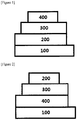
- FIGS. 1 to 3 exemplify the stacking sequence of the electrodes and the organic material layers of the organic light emitting device according to an exemplary embodiment of the present application.
- the scope of the present application is not intended to be limited by these drawings, and the structure of the organic light emitting device known in the art may also be applied to the present application.
- an organic light emitting device in which a positive electrode 200, an organic material layer 300, and a negative electrode 400 are sequentially stacked on a substrate 100 is illustrated.
- the organic light emitting device is not limited only to such a structure, and as in FIG. 2 , an organic light emitting device in which a negative electrode, an organic material layer, and a positive electrode are sequentially stacked on a substrate may also be implemented.
- FIG. 3 exemplifies a case where an organic material layer is a multilayer.
- An organic light emitting device according to FIG. 3 comprises a hole injection layer 301, a hole transport layer 302, a light emitting layer 303, a hole blocking layer 304, an electron transport layer 305, and an electron injection layer 306.
- the scope of the present application is not limited by the stacking structure as described above, and if necessary, the other layers except for the light emitting layer may be omitted, and another necessary functional layer may be further added.
- the organic light emitting device according to the present specification may be manufactured by materials and methods known in the art, except that one or more layers in the organic material layers comprise the hetero-cyclic compound represented in claim 1, or comprise both the hetero-cyclic compound represented by Chemical Formula 1 and the hetero-cyclic compound represented by Chemical Formula 2.
- the hetero-cyclic compound represented by Chemical Formula 1 may alone constitute one or more layers of the organic material layers of the organic light emitting device. However, the hetero-cyclic compound represented by Chemical Formula 1 may be mixed with another material, if necessary, to constitute an organic material layer.
- the hetero-cyclic compound represented by Chemical Formula 1 may be used as a material for an electron transport layer, a hole blocking layer, or a light emitting layer in the organic light emitting device.
- the hetero-cyclic compound represented by Chemical Formula 1 may be used as a material for an electron transport layer, a hole transport layer, or a light emitting layer of the organic light emitting device.
- the hetero-cyclic compound represented by Chemical Formula 1 may be used as a material for a light emitting layer in the organic light emitting device.
- the hetero-cyclic compound represented by Chemical Formula 1 may be used as a material for a phosphorescent host of a light emitting layer in the organic light emitting device.
- organic material layer comprising the hetero-cyclic compound represented by Chemical Formula 1 and the hetero-cyclic compound represented by Chemical Formula 2 may additionally comprise another material, if necessary.
- the hetero-cyclic compound represented by Chemical Formula 1 and the heterocyclic compound represented by chemical Formula 2 may be used as a material for a charge generation layer in the organic light emitting device.
- the hetero-cyclic compound represented by Chemical Formula 1 and the heterocyclic compound represented by chemical Formula 2 may be used as a material for an electron transport layer, a hole blocking layer, and a light emitting layer in the organic light emitting device.
- the hetero-cyclic compound represented by Chemical Formula 1 and the hetero-cyclic compound represented by Chemical Formula 2 may be used as a material for an electron transport layer, a hole transport layer, or a light emitting layer of the organic light emitting device.
- hetero-cyclic compound represented by Chemical Formula 1 and the compound represented by chemical Formula 2 may be used as a material for a light emitting layer in the organic light emitting device.
- the hetero-cyclic compound represented by Chemical Formula 1 and the compound represented by chemical Formula 2 may be used as a material for a phosphorescent host of a light emitting layer in the organic light emitting device.
- materials other than the hetero-cyclic compound of Chemical Formula 1 and the hetero-cyclic compound of Chemical Formula 2 will be exemplified below, but these materials are provided only for exemplification and are not for limiting the scope of the present application, and may be replaced with materials publicly known in the art.
- the positive electrode materials having a relatively high work function may be used, and a transparent conductive oxide, a metal or a conductive polymer may be used.
- the positive electrode material include: a metal, such as vanadium, chromium, copper, zinc, and gold, or alloys thereof; a metal oxide, such as zinc oxide, indium oxide, indium tin oxide (ITO), and indium zinc oxide (IZO); a combination of metal and oxide, such as ZnO:Al or SnO 2 :Sb; a polymer, such as poly(3-methyl compound), poly[3,4-(ethylene-1,2-dioxy)compound] (PEDOT), polypyrrole, and polyaniline, but are not limited thereto.
- a metal such as vanadium, chromium, copper, zinc, and gold, or alloys thereof
- a metal oxide such as zinc oxide, indium oxide, indium tin oxide (ITO), and indium zinc oxide (IZO)
- IZO indium zinc oxide
- the negative electrode materials having a relatively low work function may be used, and a metal, a metal oxide, or a conductive polymer may be used.
- the negative electrode material include: a metal, such as magnesium, calcium, sodium, potassium, titanium, indium, yttrium, lithium, gadolinium, aluminum, silver, tin, and lead, or alloys thereof; a multi-layered structural material, such as LiF/Al or LiO 2 /Al, but are not limited thereto.
- a hole injection material a publicly-known hole injection material may also be used, and it is possible to use, for example, a phthalocyanine compound such as copper phthalocyanine disclosed in US Patent No. 4,356,429 or starburst-type amine derivatives described in the document [ Advanced Material, 6, p.677 (1994 )], for example, tris(4-carbazoyl-9-ylphenyl)amine (TCTA), 4,4',4"-tris[phenyl(m-tolyl)amino]triphenylamine (m-MTDATA), 1,3,5-tris[4-(3-methylphenylphenylamino)phenyl]benzene (m-MTDAPB), polyaniline/dodecylbenzenesulfonic acid or poly(3,4-ethylenedioxythiophene)/poly(4-styrenesulfonate), which is a soluble conductive polymer, polyaniline/camphor sulfonic acid
- a pyrazoline derivative an arylamine-based derivative, a stilbene derivative, and a triphenyldiamine derivative may be used, and a low-molecular weight or polymer material may also be used.
- an oxadiazole derivative anthraquinodimethane and a derivative thereof, benzoquinone and a derivative thereof, naphthoquinone and a derivative thereof, anthraquinone and a derivative thereof, tetracyanoanthraquinodimethane and a derivative thereof, a fluorenone derivative, diphenyldicyanoethylene and a derivative thereof, a diphenoquinone derivative, a metal complex of 8-hydroxyquinoline and a derivative thereof, and a low-molecular weight material and a polymer material may also be used.
- LiF is representatively used in the art, but the present application is not limited thereto.
- a red, green, or blue light emitting material may be used, and if necessary, two or more light emitting materials may be mixed and used. In this case, two or more light emitting materials are deposited or used as an individual supply source, or pre-mixed to be deposited and used as one supply source. Further, as the light emitting material, a fluorescent material may also be used, but a phosphorescent material may also be used. As the light emitting material, it is also possible to use alone a material which emits light by combining holes and electrons each injected from the positive electrode and the negative electrode, but materials in which a host material and a dopant material work together to emit light may also be used.
- hosts of the light emitting material When hosts of the light emitting material are mixed and used, the same series hosts may also be mixed and used, and different series hosts may also be mixed and used. For example, two or more materials selected from n-type host materials or p-type host materials may be used as a host material for a light emitting layer.
- the organic light emitting device may be a top emission type, a bottom emission type, or a dual emission type according to the material to be used.
- the hetero-cyclic compound according to an exemplary embodiment of the present application may be operated by a principle which is similar to the principle applied to an organic light emitting device, even in an organic electronic device including an organic solar cell, an organic photoconductor, and an organic transistor.
- Target Compound A was prepared and synthesized in the same manner as in the preparation in Preparation Example 1, except that Intermediate A in the following Table 1 was used instead of 9H-carbazole, and Intermediate B in the following Table 1 was used instead of 2-chloro-4,6-diphenyl-1,3,5-triazine in Preparation Example 1. [Table 1] Compound No.
- Target Compound B was prepared and synthesized in the same manner as in the preparation in Preparation Example 2, except that Intermediate C in the following Table 2 was used instead of (9-phenyl-9H-carbazol-3-yl)boronic acid, and Intermediate D in the following Table 2 was used instead of 2-chloro-4,6-diphenyl-1,3,5-triazine in Preparation Example 2.
- Intermediate C in the following Table 2 was used instead of (9-phenyl-9H-carbazol-3-yl)boronic acid, and Intermediate D in the following Table 2 was used instead of 2-chloro-4,6-diphenyl-1,3,5-triazine in Preparation Example 2.
- Compound No. Intermediate C Intermediate D Target Compound B Total yield 1-80 34% 1-95 35% 1-114 37% 1-139 36% 1-140 38% 1-155 40% 1-156 39% 1-157 39% 1-158 37% 1-160 36% 1-162 37% 1-163 33% 1-164 34% 1-165 36% 1-170 37% 1-172 33% 1-174 38%
- Target Compound 2-3 (83%) was obtained by performing the preparation in the same manner as in the preparation of Compound 2-2, except that 4-iodo-1,1'-biphenyl was used instead of iodobenzene in the preparation of Compound 2-2.
- Compound 2-7 was obtained by using 2-bromo-9,9-dimethyl-9H-fluorene instead of iodobenzene in the preparation of Compound 2-2 (yield 69%).
- Compound 2-9 was obtained by using 2-bromodibenzo[b,d]thiophene instead of iodobenzene in the prepration of Compound 2-2 (yield 72%).
- Table 21 shows NMR values
- Tables 22 and 23 show measured values by field desorption mass spectrometry (FD-MS).
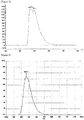
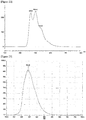
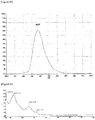
- FIG. 4 illustrates a measurement graph of LTPL of Compound 1-2 at a wavelength of 363 nm.
- FIG. 5 illustrates a measurement graph of PL of Compound 1-2 at a wavelength of 238 nm.
- FIG. 6 illustrates a UV absorption spectrum of Compound 1-2.
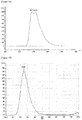
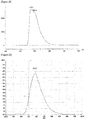
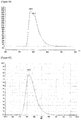
- FIG. 7 illustrates a measurement graph of LTPL of Compound 1-11 at a wavelength of 339 nm.
- FIG. 8 illustrates a measurement graph of PL of Compound 1-11 at a wavelength of 234 nm.
- FIG. 9 illustrates a UV absorption spectrum of Compound 1-11.
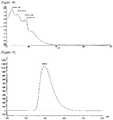
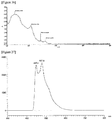
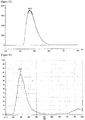
- FIG. 10 illustrates a measurement graph of LTPL of Compound 1-23 at a wavelength of 241 nm.
- FIG. 11 illustrates a measurement graph of PL of Compound 1-23 at a wavelength of 241 nm.
- FIG. 12 illustrates a UV absorption spectrum of Compound 1-23.
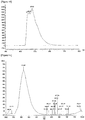
- FIG. 13 illustrates a measurement graph of LTPL of Compound 1-27 at a wavelength of 340 nm.
- FIG. 14 illustrates a measurement graph of PL of Compound 1-27 at a wavelength of 241 nm.
- FIG. 15 illustrates a UV absorption spectrum of Compound 1-27.
- FIG. 16 illustrates a measurement graph of LTPL of Compound 1-33 at a wavelength of 291 nm.
- FIG. 17 illustrates a measurement graph of PL of Compound 1-33 at a wavelength of 239 nm.
- FIG. 18 illustrates a UV absorption spectrum of Compound 1-33.
- FIG. 19 illustrates a measurement graph of LTPL of Compound 1-39 at a wavelength of 259 nm.
- FIG. 20 illustrates a measurement graph of PL of Compound 1-39 at a wavelength of 259 nm.
- FIG. 21 illustrates a UV absorption spectrum of Compound 1-39.
- FIG. 22 illustrates a measurement graph of LTPL of Compound 1-41 at a wavelength of 260 nm.
- FIG. 23 illustrates a measurement graph of PL of Compound 1-41 at a wavelength of 260 nm.
- FIG. 24 illustrates a UV absorption spectrum of Compound 1-41.
- FIG. 25 illustrates a measurement graph of LTPL of Compound 1-65 at a wavelength of 361 nm.
- FIG. 26 illustrates a measurement graph of PL of Compound 1-65 at a wavelength of 235 nm.
- FIG. 27 illustrates a UV absorption spectrum of Compound 1-65.
- FIG. 28 illustrates a measurement graph of LTPL of Compound 1-66 at a wavelength of 360 nm.
- FIG. 29 illustrates a measurement graph of PL of Compound 1-66 at a wavelength of 307 nm.
- FIG. 30 illustrates a UV absorption spectrum of Compound 1-66.
- FIG. 31 illustrates a measurement graph of LTPL of Compound 1-67 at a wavelength of 361 nm.
- FIG. 32 illustrates a measurement graph of PL of Compound 1-67 at a wavelength of 266 nm.
- FIG. 33 illustrates a UV absorption spectrum of Compound 1-67.
- FIG. 34 illustrates a measurement graph of LTPL of Compound 1-69 at a wavelength of 344 nm.
- FIG. 35 illustrates a measurement graph of PL of Compound 1-69 at a wavelength of 308 nm.
- FIG. 36 illustrates a UV absorption spectrum of Compound 1-69.
- FIG. 37 illustrates a measurement graph of LTPL of Compound 1-70 at a wavelength of 344 nm.
- FIG. 38 illustrates a measurement graph of PL of Compound 1-70 at a wavelength of 267 nm.
- FIG. 39 illustrates a UV absorption spectrum of Compound 1-70.
- FIG. 40 illustrates a measurement graph of LTPL of Compound 1-71 at a wavelength of 344 nm.
- FIG. 41 illustrates a measurement graph of PL of Compound 1-71 at a wavelength of 241 nm.
- FIG. 42 illustrates a UV absorption spectrum of Compound 1-71.
- FIG. 43 illustrates a measurement graph of LTPL of Compound 1-78 at a wavelength of 361 nm.
- FIG. 44 illustrates a measurement graph of PL of Compound 1-78 at a wavelength of 263 nm.
- FIG. 45 illustrates a UV absorption spectrum of Compound 1-78.
- FIG. 46 illustrates a measurement graph of LTPL of Compound 1-82 at a wavelength of 344 nm.
- FIG. 47 illustrates a measurement graph of PL of Compound 1-82 at a wavelength of 307 nm.
- FIG. 48 illustrates a UV absorption spectrum of Compound 1-82.
- FIG. 49 illustrates a measurement graph of LTPL of Compound 1-84 at a wavelength of 363 nm.
- FIG. 50 illustrates a measurement graph of PL of Compound 1-84 at a wavelength of 298 nm.
- FIG. 51 illustrates a UV absorption spectrum of Compound 1-84.
- FIG. 52 illustrates a measurement graph of LTPL of Compound 1-99 at a wavelength of 355 nm.
- FIG. 53 illustrates a measurement graph of PL of Compound 1-99 at a wavelength of 355 nm.
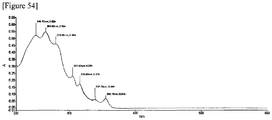
- FIG. 54 illustrates a UV absorption spectrum of Compound 1-99.
- the glass substrate was ultrasonically washed with a solvent such as acetone, methanol, and isopropyl alcohol, dried and then was subjected to UVO treatment for 5 minutes by using UV in a UV washing machine. Thereafter, the substrate was transferred to a plasma washing machine (PT), and then was subjected to plasma treatment in a vacuum state for an ITO work function and in order to remove a residual film, and was transferred to a thermal deposition equipment for organic deposition.
- PT plasma washing machine
- the hole injection layer 4,4',4"-tris[2-naphthyl(phenyl)amino]triphenylamine (2-TNATA) and the hole transport layer N,N'-di(1-naphthyl)-N,N'-diphenyl-(1,1'-biphenyl)-4,4'-diamine (NPB) were formed on the ITO transparent electrode (positive electrode).
- a light emitting layer was thermally vacuum deposited thereon as follows.
- the light emitting layer was deposited to have a thickness of 400 ⁇ by using a compound described in the following Table 24 as a host and tris(2-phenylpyridine)iridium (Ir(ppy) 3 ) as a green phosphorescent dopant to dope the host with Ir(ppy) 3 in an amount of 7%.
- BCP as a hole blocking layer was deposited to have a thickness of 60 ⁇
- Alq 3 as an electron transport layer was deposited to have a thickness of 200 ⁇ thereon.
- an organic electroluminescence device was manufactured by depositing lithium fluoride (LiF) to have a thickness of 10 ⁇ on the electron transport layer to form an electron injection layer, and then depositing an aluminum (Al) negative electrode to have a thickness of 1,200 ⁇ on the electron injection layer to form a negative electrode.
- LiF lithium fluoride
- Al aluminum
- electroluminescence (EL) characteristics were measured by M7000 manufactured by McScience Inc., and based on the measurement result thereof, T 90 was measured by a lifetime measurement equipment (M6000) manufactured by McScience Inc. when the reference brightness was 6,000 cd/m 2 . Characteristics of the organic electroluminescence device of the present invention are as shown in the following Table 24.
- the organic electroluminescence device using a light emitting layer material of the organic electroluminescence device of the present invention had a low driving voltage, an enhanced light emitting efficiency, and a significantly improved lifetime compared to those in Comparative Examples 1 to 7.
- the glass substrate was ultrasonically washed with a solvent such as acetone, methanol, and isopropyl alcohol, dried and then was subjected to UVO treatment for 5 minutes by using UV in a UV washing machine. Thereafter, the substrate was transferred to a plasma washing machine (PT), and then was subjected to plasma treatment in a vacuum state for an ITO work function and in order to remove a residual film, and was transferred to a thermal deposition equipment for organic deposition.
- PT plasma washing machine
- the hole injection layer 4,4',4"-tris[2-naphthyl(phenyl)amino]triphenylamine (2-TNATA) and the hole transport layer N,N'-di(1-naphthyl)-N,N'-diphenyl-(1,1'-biphenyl)-4,4'-diamine (NPB) were formed on the ITO transparent electrode (positive electrode).
- a light emitting layer was thermally vacuum deposited thereon as follows.
- the light emitting layer was deposited to have a thickness of 400 ⁇ by using a compound described in Chemical Formula 1 and a compound described in Chemical Formula 2 as hosts from the individual supply source, and was deposited by doping the host with Ir(ppy) 3 as a green phosphorescent dopant in an amount of 7%.
- BCP as a hole blocking layer was deposited to have a thickness of 60 ⁇
- Alq 3 as an electron transport layer was deposited to have a thickness of 200 ⁇ thereon.
- an organic electroluminescence device was manufactured by depositing lithium fluoride (LiF) to have a thickness of 10 ⁇ on the electron transport layer to form an electron injection layer, and then depositing an aluminum (Al) negative electrode to have a thickness of 1,200 ⁇ on the electron injection layer to form a negative electrode.
- LiF lithium fluoride
- Al aluminum
- the glass substrate was ultrasonically washed with a solvent such as acetone, methanol, and isopropyl alcohol, dried and then was subjected to UVO treatment for 5 minutes by using UV in a UV washing machine. Thereafter, the substrate was transferred to a plasma washing machine (PT), and then was subjected to plasma treatment in a vacuum state for an ITO work function and in order to remove a residual film, and was transferred to a thermal deposition equipment for organic deposition.
- PT plasma washing machine
- the hole injection layer 4,4',4"-tris[2-naphthyl(phenyl)amino]triphenylamine (2-TNATA) and the hole transport layer N,N'-di(1-naphthyl)-N,N'-diphenyl-(1,1'-biphenyl)-4,4'-diamine (NPB) were formed on the ITO transparent electrode (positive electrode).
- a light emitting layer was thermally vacuum deposited thereon as follows.
- the light emitting layer was deposited to have a thickness of 400 ⁇ by pre-mixing a compound described in Chemical Formula 1 and a compound described in Chemical Formula 2 as hosts, and then was deposited from one supply source by doping the host with Ir(ppy) 3 as a green phosphorescent dopant in an amount of 7%.
- BCP as a hole blocking layer was deposited to have a thickness of 60 ⁇
- Alq 3 as an electron transport layer was deposited to have a thickness of 200 ⁇ thereon.
- an organic electroluminescence device was manufactured by depositing lithium fluoride (LiF) to have a thickness of 10 ⁇ on the electron transport layer to form an electron injection layer, and then depositing an aluminum (Al) negative electrode to have a thickness of 1,200 ⁇ on the electron injection layer to form a negative electrode.
- LiF lithium fluoride
- Al aluminum
- electroluminescence (EL) characteristics were measured by M7000 manufactured by McScience Inc., and based on the measurement result thereof, T 90 was measured by a lifetime measurement equipment (M6000) manufactured by McScience Inc. when the reference brightness was 6,000 cd/m 2 .
- Table 25 is an example in which the two host compounds in Experimental Example 2 were simultaneously deposited by using an individual supply source
- Table 26 is an example in which the two light emitting compounds in Experimental Example 3 were pre-mixed, and then deposited by using one supply source
- Table 27 is an example in which the single host material in Experimental Exmaple 2 was applied.
- the organic light emitting device of the present invention comprises a light emitting layer which uses a host and a phosphorescent dopant, and the host is composed of a host compound (p-n type) in which two or more compounds are mixed, and as a result, the organic light emitting device of the present invention has better lifetime characteristics than an organic light emitting device including a host compound composed of a single compound in the related art.
- the p-n type host of the present invention has an advantage in that the ratio of the host may be adjusted to increase the light emitting characteristics, and the advantage is a result which can be achieved by appropriately combining a P host having a good hole mobility and an n host having a good electron mobility.
- the light emitting host composed of plural species of compounds was deposited by pre-mixing mixtures, and then forming the host by one deposition supply source.
- the uniformity and thin film characteristics of the thin film may be improved, the process procedures may be simplified, the costs may be reduced, and a device in which the efficiency and lifetime have been improved may be formed.
Landscapes
- Chemical & Material Sciences (AREA)
- Organic Chemistry (AREA)
- Engineering & Computer Science (AREA)
- Materials Engineering (AREA)
- Physics & Mathematics (AREA)
- Spectroscopy & Molecular Physics (AREA)
- Optics & Photonics (AREA)
- Electroluminescent Light Sources (AREA)
- Nitrogen Condensed Heterocyclic Rings (AREA)
- Plural Heterocyclic Compounds (AREA)
- Heterocyclic Carbon Compounds Containing A Hetero Ring Having Oxygen Or Sulfur (AREA)
Description
- The present application relates to a hetero-cyclic compound and an organic light emitting device using the same.
- An electroluminescence device is a kind of self-emitting type display device, and has an advantage in that the viewing angle is wide, the contrast is excellent, and the response speed is fast.
- An organic light emitting device has a structure in which an organic thin film is disposed between two electrodes. When a voltage is applied to an organic light emitting device having the structure, electrons and holes injected from the two electrodes combine with each other in an organic thin film to make a pair, and then, emit light while being extinguished. The organic thin film may be composed of a single layer or multi layers, if necessary.
- A material for the organic thin film may have a light emitting function, if necessary. For example, as the material for the organic thin film, it is also possible to use a compound, which may itself constitute a light emitting layer alone, or it is also possible to use a compound, which may serve as a host or a dopant of a host-dopant-based light emitting layer. In addition, as a material for the organic thin film, it is also possible to use a compound, which may perform a function such as hole injection, hole transport, electron blocking, hole blocking, electron transport or electron injection.
- In order to improve the performance, lifetime, or efficiency of the organic light emitting device, there is a continuous need for developing a material for an organic thin film.
US 2015/0179958 A1 discloses an organic electroluminescent element configured to have at least one organic layer including a light emitting layer interposed between a positive electrode and a negative electrode, in which the light emitting layer contains an iridium complex compound, and the maximum emission wavelength of the iridium complex compound is 470 nm or less.
EP 3 257 850 A1 discloses aromatic heterocyclic derivatives providing an organic electroluminescent element that uses the derivatives. The aromatic heterocyclic derivative is characterized by having a specific structure which includes a carbazole ring. - It is necessary to perform studies on an organic light emitting device comprising a compound having a chemical structure, which may satisfy conditions required for a material which is available for the organic light emitting device, for example, appropriate energy levels, electrochemical stability, and thermal stability, and may perform various functions required for the organic light emitting device according to the substituent.
- The present application provides a hetero-cyclic compound of
claim 1 represented by any one of the following compounds:


- Further, another embodiment of the present application provides an organic light emitting device comprising a positive electrode, a negative electrode, and one or more organic material layers provided between the positive electrode and the negative electrode, in which one or more layers of the organic material layers comprise the hetero-cyclic compound represented above.
- In addition, still another embodiment of the present application provides a composition for an organic material layer of an organic light emitting device, which comprises both the hetero-cyclic compound represented by Chemical Formula 1 and a compound represented by the following Chemical Formula 2:



- L1 and L2 are the same as or different from each other, and each independently a direct bond or a substituted or unsubstituted C6 to C25 arylene group,
- Ar1 is selected from the group consisting of a substituted or unsubstituted pyridyl group; a substituted or unsubstituted pyrimidyl group; a substituted or unsubstituted triazinyl group; a substituted or unsubstituted quinolyl group; a substituted or unsubstituted quinazolinyl group; a substituted or unsubstituted phenanthrolinyl group; and a substituted or unsubstituted benzimidazolinyl group,
- Ar2 is represented by any one of the following Chemical Formulae 3 and 4,


- Y1 to Y4 are the same as or different from each other, and each independently a substituted or unsubstituted C6 to C60 aromatic hydrocarbon ring; or a substituted or unsubstituted C2 to C60 aromatic hetero ring,
- R1 to R6 are hydrogen,
- R7 is selected from the group consisting of hydrogen; deuterium; a halogen group; - CN; a substituted or unsubstituted C1 to C60 alkyl group; a substituted or unsubstituted C2 to C60 alkenyl group; a substituted or unsubstituted C2 to C60 alkynyl group; a substituted or unsubstituted C1 to C60 alkoxy group; a substituted or unsubstituted C3 to C60 cycloalkyl group; a substituted or unsubstituted C2 to C60 heterocycloalkyl group; a substituted or unsubstituted C6 to C60 aryl group; a substituted or unsubstituted C2 to C60 heteroaryl group; -SiRR'R"; -P(=O)RR'; and an amine group which is unsubstituted or substituted with a C1 to C20 alkyl group, a substituted or unsubstituted C6 to C60 aryl group, or a C2 to C60 heteroaryl group, or two or more adjacent groups combine with each other to form a substituted or unsubstituted aliphatic or aromatic hydrocarbon ring,
- L1' is a direct bond or a substituted or unsubstituted C6 to C60 arylene group,
- Ar1' is a substituted or unsubstituted C6 to C60 aryl group; or a substituted or unsubstituted C2 to C60 heteroaryl group including at least one of S and O,
- Ar2' is a substituted or unsubstituted C6 to C25 aryl group
- R, R', and R" are the same as or different from each other, and each independently hydrogen; deuterium; -CN; a substituted or unsubstituted C1 to C60 alkyl group; a substituted or unsubstituted C3 to C60 cycloalkyl group; a substituted or unsubstituted C6 to C60 aryl group; or a substituted or unsubstituted C2 to C60 heteroaryl group,
- m', p' and q' are each independently an integer of 0 and
- n' is an integer of 0.
- Further embodiments are disclosed in the dependent claims.
- A hetero-cyclic compound according to the present application may be used as a material for an organic material layer of an organic light emitting device. The hetero-cyclic compound may be used as a material for a hole injection layer, a hole transport layer, a light emitting layer, an electron transport layer, an electron injection layer, and a charge generation layer in an organic light emitting device. In particular, the hetero-cyclic compound may be used as a material for an electron transport layer, a hole transport layer, or a light emitting layer of the organic light emitting device. In addition, when the hetero-
cyclic compound 1 is used for the organic light emitting device, the driving voltage of the device may be lowered, the light efficiency of the device may be improved, and the lifetime characteristics of the device may be improved by the thermal stability of the compound. - Furthermore, the hetero-cyclic compound represented by Chemical Formula 1 and the compound represented by
chemical Formula 2 may be used simultaneously as a material for a light emitting layer of an organic light emitting device. In addition, when the hetero-cyclic compound represented by Chemical Formula 1 and the hetero-cyclic compound represented by Chemical Formula 2 are simultaneously used for the organic light emitting device, the driving voltage of the device may be lowered, the light efficiency of the device may be improved, and the lifetime characteristics of the device may be improved by the thermal stability of the compound. -
-
FIGS. 1 to 3 each are views schematically illustrating a stacking structure of an organic light emitting device according to an exemplary embodiment of the present application. -
FIG. 4 illustrates a measurement graph of LTPL of Compound 1-2 at a wavelength of 363 nm. -
FIG. 5 illustrates a measurement graph of PL of Compound 1-2 at a wavelength of 238 nm. -
FIG. 6 illustrates a UV absorption spectrum of Compound 1-2. -
FIG. 7 illustrates a measurement graph of LTPL of Compound 1-11 at a wavelength of 339 nm. -
FIG. 8 illustrates a measurement graph of PL of Compound 1-11 at a wavelength of 234 nm. -
FIG. 9 illustrates a UV absorption spectrum of Compound 1-11. -
FIG. 10 illustrates a measurement graph of LTPL of Compound 1-23 at a wavelength of 241 nm. -
FIG. 11 illustrates a measurement graph of PL of Compound 1-23 at a wavelength of 241 nm. -
FIG. 12 illustrates a UV absorption spectrum of Compound 1-23. -
FIG. 13 illustrates a measurement graph of LTPL of Compound 1-27 at a wavelength of 340 nm. -
FIG. 14 illustrates a measurement graph of PL of Compound 1-27 at a wavelength of 241 nm. -
FIG. 15 illustrates a UV absorption spectrum of Compound 1-27. -
FIG. 16 illustrates a measurement graph of LTPL of Compound 1-33 at a wavelength of 291 nm. -
FIG. 17 illustrates a measurement graph of PL of Compound 1-33 at a wavelength of 239 nm. -
FIG. 18 illustrates a UV absorption spectrum of Compound 1-33. -
FIG. 19 illustrates a measurement graph of LTPL of Compound 1-39 at a wavelength of 259 nm. -
FIG. 20 illustrates a measurement graph of PL of Compound 1-39 at a wavelength of 259 nm. -
FIG. 21 illustrates a UV absorption spectrum of Compound 1-39. -
FIG. 22 illustrates a measurement graph of LTPL of Compound 1-41 at a wavelength of 260 nm. -
FIG. 23 illustrates a measurement graph of PL of Compound 1-41 at a wavelength of 260 nm. -
FIG. 24 illustrates a UV absorption spectrum of Compound 1-41. -
FIG. 25 illustrates a measurement graph of LTPL of Compound 1-65 at a wavelength of 361 nm. -
FIG. 26 illustrates a measurement graph of PL of Compound 1-65 at a wavelength of 235 nm. -
FIG. 27 illustrates a UV absorption spectrum of Compound 1-65. -
FIG. 28 illustrates a measurement graph of LTPL of Compound 1-66 at a wavelength of 360 nm. -
FIG. 29 illustrates a measurement graph of PL of Compound 1-66 at a wavelength of 307 nm. -
FIG. 30 illustrates a UV absorption spectrum of Compound 1-66. -
FIG. 31 illustrates a measurement graph of LTPL of Compound 1-67 at a wavelength of 361 nm. -
FIG. 32 illustrates a measurement graph of PL of Compound 1-67 at a wavelength of 266 nm. -
FIG. 33 illustrates a UV absorption spectrum of Compound 1-67. -
FIG. 34 illustrates a measurement graph of LTPL of Compound 1-69 at a wavelength of 344 nm. -
FIG. 35 illustrates a measurement graph of PL of Compound 1-69 at a wavelength of 308 nm. -
FIG. 36 illustrates a UV absorption spectrum of Compound 1-69. -
FIG. 37 illustrates a measurement graph of LTPL of Compound 1-70 at a wavelength of 344 nm. -
FIG. 38 illustrates a measurement graph of PL of Compound 1-70 at a wavelength of 267 nm. -
FIG. 39 illustrates a UV absorption spectrum of Compound 1-70. -
FIG. 40 illustrates a measurement graph of LTPL of Compound 1-71 at a wavelength of 344 nm. -
FIG. 41 illustrates a measurement graph of PL of Compound 1-71 at a wavelength of 241 nm. -
FIG. 42 illustrates a UV absorption spectrum of Compound 1-71. -
FIG. 43 illustrates a measurement graph of LTPL of Compound 1-78 at a wavelength of 361 nm. -
FIG. 44 illustrates a measurement graph of PL of Compound 1-78 at a wavelength of 263 nm. -
FIG. 45 illustrates a UV absorption spectrum of Compound 1-78. -
FIG. 46 illustrates a measurement graph of LTPL of Compound 1-82 at a wavelength of 344 nm. -
FIG. 47 illustrates a measurement graph of PL of Compound 1-82 at a wavelength of 307 nm. -
FIG. 48 illustrates a UV absorption spectrum of Compound 1-82. -
FIG. 49 illustrates a measurement graph of LTPL of Compound 1-84 at a wavelength of 363 nm. -
FIG. 50 illustrates a measurement graph of PL of Compound 1-84 at a wavelength of 298 nm. -
FIG. 51 illustrates a UV absorption spectrum of Compound 1-84. -
FIG. 52 illustrates a measurement graph of LTPL of Compound 1-99 at a wavelength of 355 nm. -
FIG. 53 illustrates a measurement graph of PL of Compound 1-99 at a wavelength of 355 nm. -
FIG. 54 illustrates a UV absorption spectrum of Compound 1-99. -
- 100:
- Substrate
- 200:
- Positive electrode
- 300:
- Organic material layer
- 301:
- Hole injection layer
- 302:
- Hole transport layer
- 303:
- Light emitting layer
- 304:
- Hole blocking layer
- 305:
- Electron transport layer
- 306:
- Electron injection layer
- 400:
- Negative electrode
- Hereinafter, the present application will be described in detail.
- A hetero-cyclic compound used according to claim 8the present application is represented by
Chemical Formula 1. More specifically, the hetero-cyclic compound represented byChemical Formula 1 may be used as a material for an organic material layer of an organic light emitting device by the structural characteristics of the core structure and the substituent as described above. - In
Chemical Formulae Chemical Formula 1. - According to an exemplary embodiment of the present application,
Chemical Formula 3 may be represented by any one of the following Chemical Formulae.


- In the structural formulae, XI to X6 are the same as or different from each other, and each independently NR, S, O, or CR'R",
- R8 to R14 are the same as or different from each other, and each independently selected from the group consisting of hydrogen; deuterium; a halogen group; -CN; a substituted or unsubstituted C1 to C60 alkyl group; a substituted or unsubstituted C2 to C60 alkenyl group; a substituted or unsubstituted C2 to C60 alkynyl group; a substituted or unsubstituted C1 to C60 alkoxy group; a substituted or unsubstituted C3 to C60 cycloalkyl group; a substituted or unsubstituted C2 to C60 heterocycloalkyl group; a substituted or unsubstituted C6 to C60 aryl group; a substituted or unsubstituted C2 to C60 heteroaryl group; - SiRR'R"; -P(=O)RR'; and an amine group which is unsubstituted or substituted with a C1 to C20 alkyl group, a substituted or unsubstituted C6 to C60 aryl group, or a C2 to C60 heteroaryl group, or two or more adjacent groups combine with each other to form a substituted or unsubstituted aliphatic or aromatic hydrocarbon ring,
- R, R', and R" are the same as or different from each other, and each independently hydrogen; deuterium; -CN; a substituted or unsubstituted C1 to C60 alkyl group; a substituted or unsubstituted C3 to C60 cycloalkyl group; a substituted or unsubstituted C6 to C60 aryl group; or a substituted or unsubstituted C2 to C60 heteroaryl group, and
- m is an integer of 0 to 8, and n, o, p, q, r, and s are each independently an integer of 0 to 6.
- According to an exemplary embodiment of the present application,
Chemical Formula 4 may be represented by any one of the following Chemical Formulae.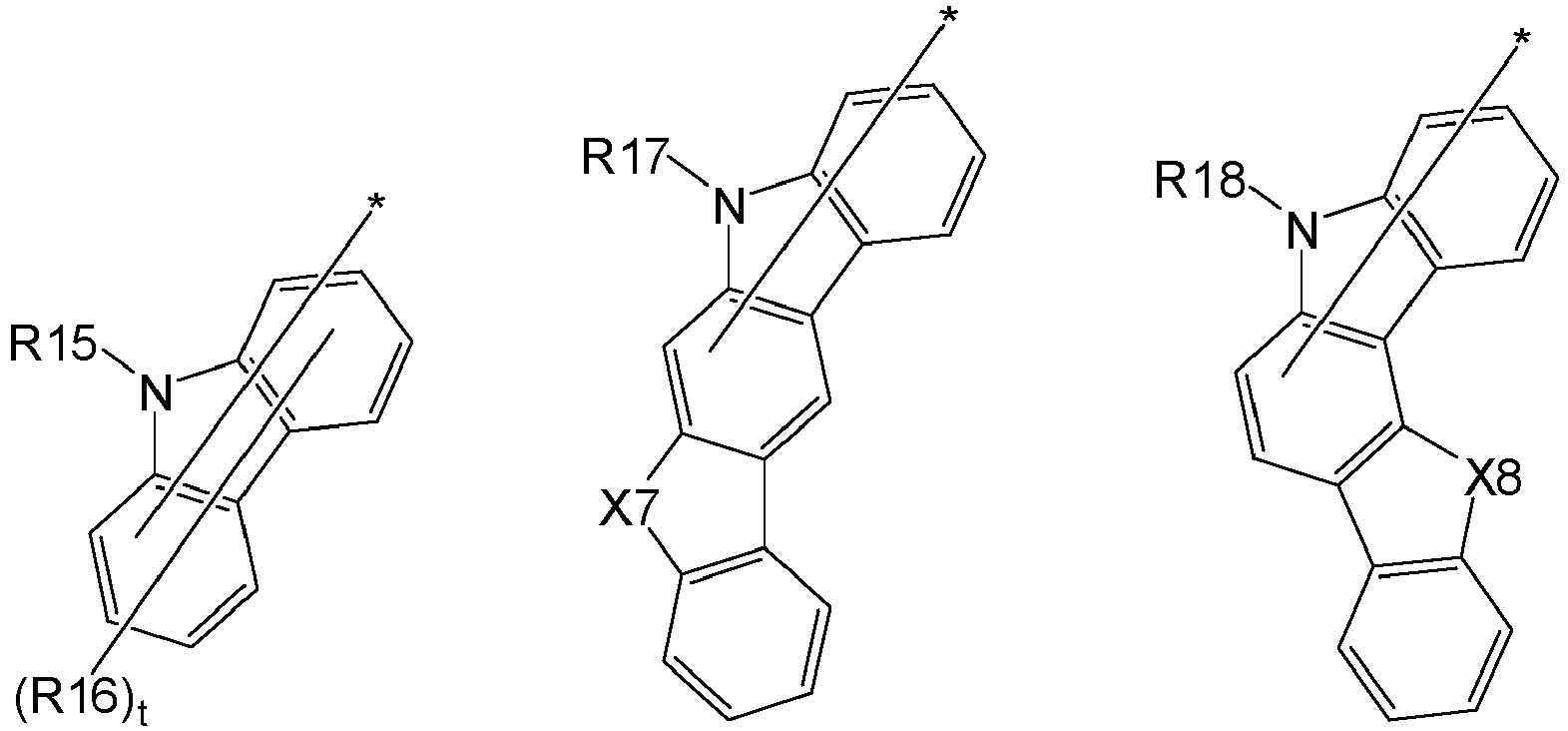
- In the structural formulae, X7 and X8 are the same as or different from each other, and each independently NR, S, O, or CR'R",
- R15 to R18 are the same as or different from each other, and each independently selected from the group consisting of hydrogen; deuterium; a halogen group; -CN; a substituted or unsubstituted C1 to C60 alkyl group; a substituted or unsubstituted C2 to C60 alkenyl group; a substituted or unsubstituted C2 to C60 alkynyl group; a substituted or unsubstituted C1 to C60 alkoxy group; a substituted or unsubstituted C3 to C60 cycloalkyl group; a substituted or unsubstituted C2 to C60 heterocycloalkyl group; a substituted or unsubstituted C6 to C60 aryl group; a substituted or unsubstituted C2 to C60 heteroaryl group;-SiRR'R"; -P(=O)RR'; and an amine group which is unsubstituted or substituted with a C1 to C20 alkyl group, a substituted or unsubstituted C6 to C60 aryl group, or a C2 to C60 heteroaryl group, or two or more adjacent groups combine with each other to form a substituted or unsubstituted aliphatic or aromatic hydrocarbon ring,
- R, R', and R" are the same as or different from each other, and each independently hydrogen; deuterium; -CN; a substituted or unsubstituted C1 to C60 alkyl group; a substituted or unsubstituted C3 to C60 cycloalkyl group; a substituted or unsubstituted C6 to C60 aryl group; or a substituted or unsubstituted C2 to C60 heteroaryl group, and
- t is an integer of 0 to 7.
- According to an exemplary embodiment of the present specification,
Chemical Formula 1 may be represented by any one of the followingChemical Formulae 5 to 10.


- In
Chemical Formulae 5 to 10, the definitions of R1 to R6, R8, R9, R12, R13, R16, L1, Ar1, X1, X4, X5, m, n, q, r, and t are the same as those inChemical Formula 1 and the structural formulae. - In an exemplary embodiment of the present application, R1 to R6 of
Chemical Formula 1 may be each independently hydrogen or deuterium. - In an exemplary embodiment of the present application, R8 to R18 may be each independently hydrogen; deuterium; a substituted or unsubstituted C6 to C60 aryl group; or a substituted or unsubstituted C2 to C60 heteroaryl group.
- In an exemplary embodiment of the present application, R, R', and R" of
Chemical Formula 1 are the same as or different from each other, and each independently hydrogen; a substituted or unsubstituted C1 to C60 alkyl group; or a substituted or unsubstituted C6 to C60 aryl group. - Further, the composition for an organic material layer of an organic light emitting device according to the present application comprises both the hetero-cyclic compound represented by
Chemical Formula 1 and the compound represented byChemical Formula 2. - According to an exemplary embodiment of the present application,
Chemical Formula 2 may be represented by any one of the followingChemical Formulae 11 to 22.


- In
Chemical Formulae 11 to 22, the definitions of L1', Ar1', Ar2', R1' to R4', m', n', p', and q' are the same as those inChemical Formula 2. - In an exemplary embodiment of the present application, when m', n', p', and q' of
Chemical Formula 2 are each independently 2 or more, two or more R1' to R4' may be each the same as or different from each other. - In an exemplary embodiment of the present application, R1' to R4' of
Chemical Formula 2 may be each independently hydrogen or deuterium. - In an exemplary embodiment of the present application, Ar1' of
Chemical Formula 2 may be a substituted or unsubstituted C6 to C60 aryl group; a substituted or unsubstituted C2 to C60 heteroaryl group including S; or a substituted or unsubstituted C2 to C60 heteroaryl group including O. - In an exemplary embodiment of the present application, Ar1' of
Chemical Formula 2 may be a phenyl group, a biphenyl group, a naphthyl group, a fluorene group in which an alkyl group is substituted, a dibenzothiophene group, or a dibenzofuran group. - In an exemplary embodiment of the present application, Ar2' of
Chemical Formula 2 may be a substituted or unsubstituted C6 to C60 aryl group. - In an exemplary embodiment of the present application, Ar2' of
Chemical Formula 2 may be a phenyl group. - In the present application, the substituents of
Chemical Formulae - In the present specification, "substituted or unsubstituted" means being unsubstituted or substituted with one or more substituents selected from the group consisting of deuterium; a halogen group; -CN; a C1 to C60 alkyl group; a C2 to C60 alkenyl group; a C2 to C60 alkynyl group; a C3 to C60 cycloalkyl group; a C2 to C60 heterocycloalkyl group; a C6 to C60 aryl group; a C2 to C60 heteroaryl group; -SiRR'R"; -P(=O)RR'; a C1 to C20 alkylamine group; a C6 to C60 arylamine group; and a C2 to C60 heteroarylamine group, being unsubstituted or substituted with a substituent to which two or more substituents among the substituents are linked, or being unsubstituted or substituted with a substituent to which two or more substituents selected among the substituents are linked. For example, "the substituent to which two or more substituents are linked" may be a biphenyl group. That is, the biphenyl group may also be an aryl group, and may be interpreted as a substituent to which two phenyl groups are linked. The additional substituents may also be additionally substituted. R, R', and R" are the same as or different from each other, and each independently hydrogen; deuterium; -CN; a substituted or unsubstituted C1 to C60 alkyl group; a substituted or unsubstituted C3 to C60 cycloalkyl group; a substituted or unsubstituted C6 to C60 aryl group; or a substituted or unsubstituted C2 to C60 heteroaryl group.
- According to an exemplary embodiment of the present specification, the "substituted or unsubstituted" is unsubstituted or substituted with one or more substituents selected from the group consisting of deuterium, a halogen group, -CN, SiRR'R", P(=O)RR', a C1 to C20 straight-chained or branch-chained alkyl group, a C6 to C60 aryl group, and a C2 to C60 heteroaryl group, and
R, R', and R" are the same as or different from each other, and each independently hydrogen; deuterium; -CN; a C1 to C60 alkyl group which is unsubstituted or substituted with deuterium, a halogen group, -CN, a C1 to C20 alkyl group, a C6 to C60 aryl group, and a C2 to C60 heteroaryl group; a C3 to C60 cycloalkyl group which is unsubstituted or substituted with deuterium, halogen, -CN, a C1 to C20 alkyl group, a C6 to C60 aryl group, and a C2 to C60 heteroaryl group; a C6 to C60 aryl group which is unsubstituted or substituted with deuterium, halogen, -CN, a C1 to C20 alkyl group, a C6 to C60 aryl group, and a C2 to C60 heteroaryl group; or a C2 to C60 heteroaryl group which is unsubstituted or substituted with deuterium, halogen, -CN, a C1 to C20 alkyl group, a C6 to C60 aryl group, and a C2 to C60 heteroaryl group. - The term "substitution" means that a hydrogen atom bonded to a carbon atom of a compound is changed into another substituent, and a position to be substituted is not limited as long as the position is a position at which the hydrogen atom is substituted, that is, a position at which the substituent may be substituted, and when two or more are substituted, the two or more substituents may be the same as or different from each other.
- In the present specification, the halogen may be fluorine, chlorine, bromine or iodine.
- In the present specification, the alkyl group includes a straight-chain or branched-chain having 1 to 60 carbon atoms, and may be additionally substituted with another substituent. The number of carbon atoms of the alkyl group may be 1 to 60, specifically 1 to 40, and more specifically 1 to 20. Specific examples thereof include a methyl group, an ethyl group, a propyl group, an n-propyl group, an isopropyl group, a butyl group, an n-butyl group, an isobutyl group, a tert-butyl group, a sec-butyl group, a 1-methyl-butyl group, a 1-ethyl-butyl group, a pentyl group, an n-pentyl gorup, an isopentyl group, a neopentyl group, a tert-pentyl group, a hexyl group, an n-hexyl group, a 1-methylpentyl group, a 2-methylpentyl group, a 4-methyl-2-pentyl group, a 3,3-dimethylbutyl group, a 2-ethylbutyl group, a heptyl group, an n-heptyl group, a 1-methylhexyl group, a cyclopentylmethyl group, a cyclohexylmethyl group, an octyl group, an n-octyl group, a tert-octyl group, a 1-methylheptyl group, a 2-ethylhexyl group, a 2-propylpentyl group, an n-nonyl group, a 2,2-dimethylheptyl group, a 1-ethyl-propyl group, a 1,1-dimethyl-propyl group, an isohexyl group, a 2-methylpentyl group, a 4-methylhexyl group, and a 5-methylhexyl group.
- In the present specification, the alkenyl group includes a straight-chain or branched-chain having 2 to 60 carbon atoms, and may be additionally substituted with another substituent. The number of carbon atoms of the alkenyl group may be 2 to 60, specifically 2 to 40, and more specifically 2 to 20. Specific examples thereof include a vinyl group, a 1-propenyl group, an isopropenyl group, a 1-butenyl group, a 2-butenyl group, a 3-butenyl group, a 1-pentenyl group, a 2-pentenyl group, a 3-pentenyl group, a 3-methyl-1-butenyl group, a 1,3-butadienyl group, an allyl group, a 1-phenylvinyl-1-yl group, a 2-phenylvinyl-1-yl group, a 2,2-diphenylvinyl-1-yl group, a 2-phenyl-2-(naphthyl-1-yl)vinyl-1-yl group, a 2,2-bis(diphenyl-1-yl)vinyl-1-yl group, a stilbenyl group, and a styrenyl group.
- In the present specification, the alkynyl group includes a straight-chain or branched-chain having 2 to 60 carbon atoms, and may be additionally substituted with another substituent. The number of carbon atoms of the alkynyl group may be 2 to 60, specifically 2 to 40, and more specifically 2 to 20.
- In the present specification, the cycloalkyl group includes a monocycle or polycycle having 3 to 60 carbon atoms, and may be additionally substituted with another substituent. Here, the polycycle means a group in which a cycloalkyl group is directly linked to or fused with another cyclic group. Here, another cyclic group may also be a cycloalkyl group, but may also be another kind of cyclic group, for example, a heterocycloalkyl group, an aryl group, and a heteroaryl group. The number of carbon atoms of the cycloalkyl group may be 3 to 60, specifically 3 to 40, and more specifically 5 to 20. Specific examples thereof include a cyclopropyl group, a cyclobutyl group, a cyclopentyl group, a 3-methylcyclopentyl group, a 2,3-dimethylcyclopentyl group, a cyclohexyl group, a 3-methylcyclohexyl group, a 4-methylcyclohexyl group, a 2,3-dimethylcyclohexyl group, a 3,4,5-trimethylcyclohexyl group, a 4-tert-butylcyclohexyl group, a cycloheptyl group, and a cyclooctyl group.
- In the present specification, the heterocycloalkyl group includes O, S, Se, N, or Si as a heteroatom, includes a monocycle or polycycle having 2 to 60 carbon atoms, and may be additionally substituted with another substituent. Here, the polycycle means a group in which a heterocycloalkyl group is directly linked to or fused with another cyclic group. Here, another cyclic group may also be a heterocycloalkyl group, but may also be another kind of cyclic group, for example, a cycloalkyl group, an aryl group, and a heteroaryl group. The number of carbon atoms of the heterocycloalkyl group may be 2 to 60, specifically 2 to 40, and more specifically 3 to 20.
- In the present specification, the aryl group includes a monocycle or polycycle having 6 to 60 carbon atoms, and may be additionally substituted with another substituent. Here, the polycycle means a group in which an aryl group is directly linked to or fused with another cyclic group. Here, another cyclic group may also be an aryl group, but may also be another kind of cyclic group, for example, a cycloalkyl group, a heterocycloalkyl group, and a heteroaryl group. The aryl group includes a spiro group. The number of carbon atoms of the aryl group may be 6 to 60, specifically 6 to 40, and more specifically 6 to 25. Specific examples of the aryl group include a phenyl group, a biphenyl group, a triphenyl group, a naphthyl group, an anthryl group, a chrysenyl group, a phenanthrenyl group, a perylenyl group, a fluoranthenyl group, a triphenylenyl group, a phenalenyl group, a pyrenyl group, a tetracenyl group, a pentacenyl group, a fluorenyl group, an indenyl group, an acenaphthylenyl group, a benzofluorenyl group, a spirobifluorenyl group, a 2,3-dihydro-1H-indenyl group, and a fused cyclic group thereof.
- In the present specification, the spiro group is a group including a spiro structure, and may have 15 to 60 carbon atoms. For example, the spiro group may include a structure in which a 2,3-dihydro-1H-indene group or a cyclohexane group is spiro-bonded to a fluorenyl group. Specifically, the following spiro group may include any one of the groups of the following structural formulae.

- In the present specification, the heteroaryl group includes S, O, Se, N, or Si as a heteroatom, includes a monocycle or polycycle having 2 to 60 carbon atoms, and may be additionally substituted with another substituent. Here, the polycycle means a group in which a heteroaryl group is directly linked to or fused with another cyclic group. Here, another cyclic group may also be a heteroaryl group, but may also be another kind of cyclic group, for example, a cycloalkyl group, a heterocycloalkyl group, and an aryl group. The number of carbon atoms of the heteroaryl group may be 2 to 60, specifically 2 to 40, and more specifically 3 to 25. Specific examples of the heteroaryl group include a pyridyl group, a pyrrolyl group, a pyrimidyl group, a pyridazinyl group, a furanyl group, a thiophene group, an imidazolyl group, a pyrazolyl group, an oxazolyl group, an isoxazolyl group, a thiazolyl group, an isothiazolyl group, a triazolyl group, a furazanyl group, an oxadiazolyl group, a thiadiazolyl group, a dithiazolyl group, a tetrazolyl group, a pyranyl group, a thiopyranyl group, a diazinyl group, an oxazinyl group, a thiazinyl group, a dioxinyl group, a triazinyl group, a tetrazinyl group, a quinolyl group, an isoquinolyl group, a quinazolinyl group, an isoquinazolinyl group, a quinozolilyl group, a naphthyridyl group, an acridinyl group, a phenanthridinyl group, an imidazopyridinyl group, a diaza naphthalenyl group, a triazaindene group, an indolyl group, an indolizinyl group, a benzothiazolyl group, a benzoxazolyl group, a benzimidazolyl group, a benzothiophene group, a benzofuran group, a dibenzothiophene group, a dibenzofuran group, a carbazolyl group, a benzocarbazolyl group, a dibenzocarbazolyl group, a phenazinyl group, a dibenzosilole group, spirobi (dibenzosilole), a dihydrophenazinyl group, a phenoxazinyl group, a phenanthridyl group, an imidazopyridinyl group, a thienyl group, an indolo[2,3-a]carbazolyl group, an indolo[2,3-b]carbazolyl group, an indolinyl group, a 10,11-dihydro-dibenzo[b,f]azepin group, a 9,10-dihydroacridinyl group, a phenanthrazinyl group, a phenothiazinyl group, a phthalazinyl group, a naphthylidinyl group, a phenanthrolinyl group, a benzo[c][1,2,5]thiadiazolyl group, a 5,10-dihydrodibenzo[b,e][1,4]azasilinyl, a pyrazolo[1,5-c]quinazolinyl group, a pyrido[1,2-b]indazolyl group, a pyrido[1,2-a]imidazo[1,2-e]indolinyl group, and a 5,11-dihydroindeno[1,2-b]carbazolyl group.
- In the present specification, the amine group may be selected from the group consisting of a monoalkylamine group; a monoarylamine group; a monoheteroarylamine group; -NH2; a dialkylamine group; a diarylamine group; a diheteroarylamine group; an alkylarylamine group; an alkylheteroarylamine group; and an arylheteroarylamine group, and the number of carbon atoms thereof is for instance preferably 1 to 30. Specific examples of the amine group include a methylamine group, a dimethylamine group, an ethylamine group, a diethylamine group, a phenylamine group, a naphthylamine group, a biphenylamine group, a dibiphenylamine group, an anthracenylamine group, a 9-methyl-anthracenylamine group, a diphenylamine group, a phenylnaphthylamine group, a ditolylamine group, a phenyltolylamine group, a triphenylamine group, a biphenylnaphthylamine group, a phenylbiphenylamine group, a biphenylfluorenylamine group, a phenyltriphenylenylamine group, and a biphenyltriphenylenylamine group.
- In the present specification, the arylene group means that there are two bonding positions in an aryl group, that is, a divalent group. The above-described description on the aryl group may be applied, except that the arylene groups are each a divalent group. Further, the heteroarylene group means that there are two bonding positions in a heteroaryl group, that is, a divalent group. The above-described description on the heteroaryl group may be applied, except that these are each a divalent group.
- According to an exemplary embodiment of the present application,
Chemical Formula 1 may be represented by any one of the following compounds.


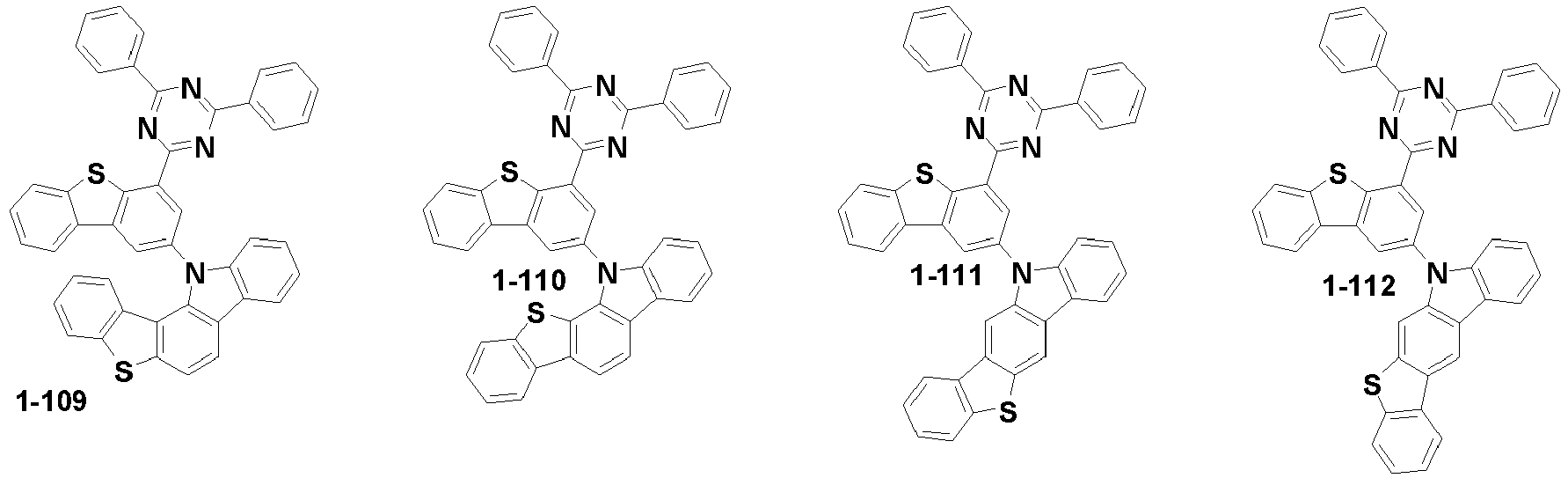


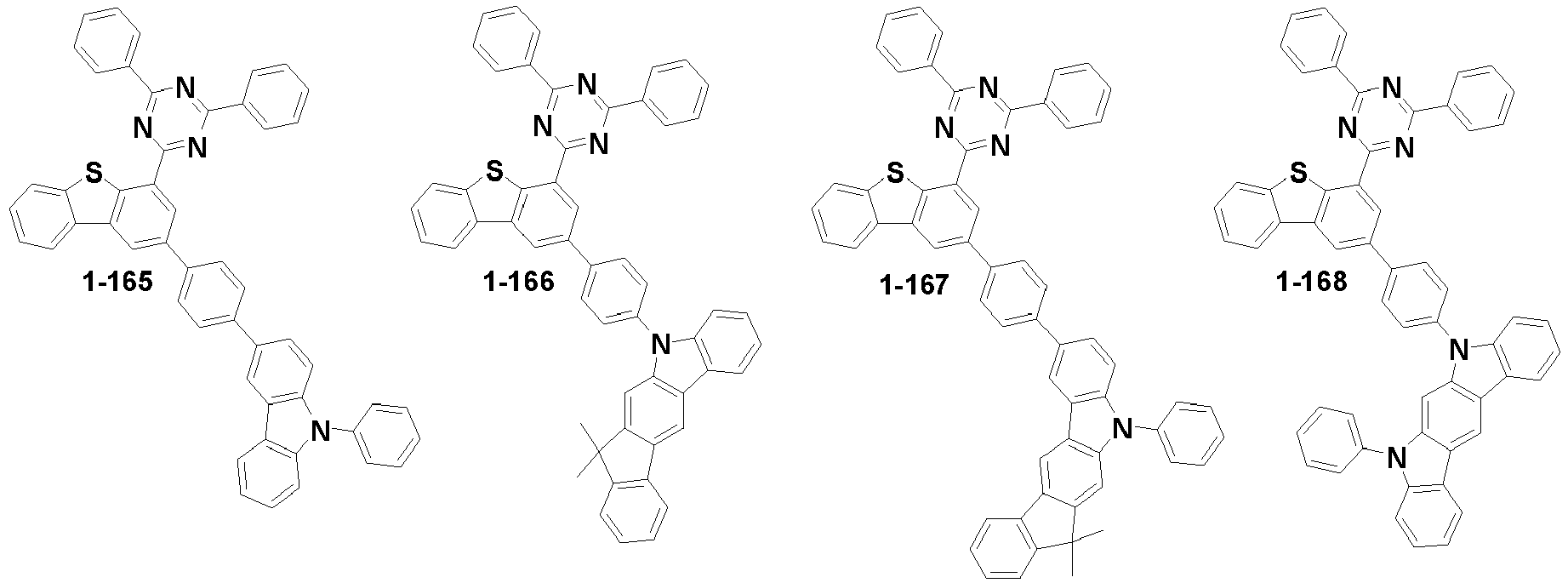


- According to an exemplary embodiment of the present application,
Chemical Formula 2 may be represented by any one of the following compounds.


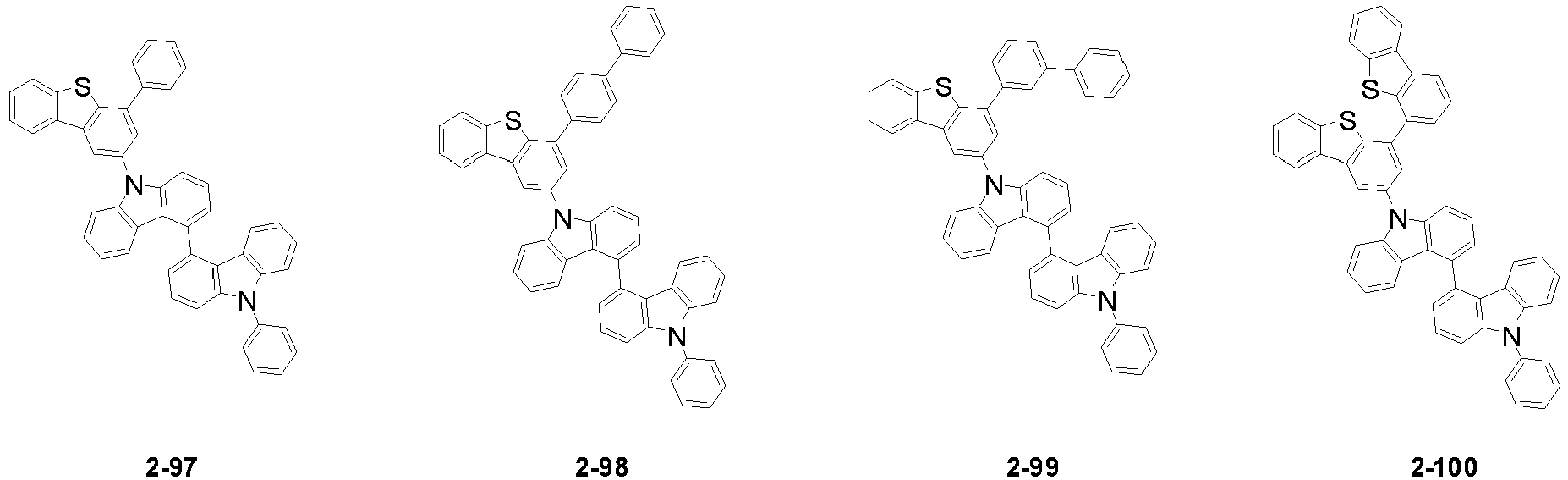

- Further, it is possible to synthesize a compound having inherent characteristics of a substituent introduced by introducing various substituents into the structures of
Chemical Formulae - In addition, it is possible to finely adjust an energy band gap by introducing various substituents into the structures of
Chemical Formulae - Meanwhile, the hetero-cyclic compound has a high glass transition temperature (Tg) and thus has excellent thermal stability. The increase in thermal stability becomes an important factor which provides driving stability to a device.
- The hetero-cyclic compound according to an exemplary embodiment of the present application may be prepared by a multi-step chemical reaction. Some intermediate compounds are first prepared, and a compound of
Chemical Formula - Furthermore, another exemplary embodiment of the present application provides a composition for an organic material layer of an organic light emitting device, which comprises both the hetero-cyclic compound represented by
Chemical Formula 1 and the compound represented byChemical Formula 2. - The specific contents on the hetero-cyclic compound represented by
Chemical Formula 1 and the compound represented byChemical Formula 2 are the same as those described above. - The weight ratio of the hetero-cyclic compound represented by Chemical Formula 1 : the compound represented by
Chemical Formula 2 in the composition may be 1 : 10 to 10 : 1, 1 : 8 to 8 : 1, 1 : 5 to 5 : 1, and 1 : 2 to 2 : 1, but is not limited thereto. - The composition may be used when an organic material for an organic light emitting device is formed, and particularly, may be more preferably used when a host of a light emitting layer is formed.
- The composition is in a form in which two or more compounds are simply mixed, materials in a powder state may also be mixed before an organic material layer of an organic light emitting device is formed, and it is possible to mix compounds in a liquid state at a temperature which is equal to or more than a suitable temperature. The composition is in a solid state at a temperature which is equal to or less than the melting point of each material, and may be maintained as a liquid if the temperature is adjusted.
- Another exemplary embodiment of the present application provides an organic light emitting device comprising the hetero-cyclic compound represented above.
- Further, the organic light emitting device according to an exemplary embodiment of the present application comprises a positive electrode, a negative electrode, and one or more organic material layers provided between the positive electrode and the negative electrode, in which one or more layers of the organic material layers comprise the hetero-cyclic compound represented by
Chemical Formula 1 and the compound represented byChemical Formula 2. - The organic light emitting device according to an exemplary embodiment of the present application may be manufactured by typical methods and materials for manufacturing an organic light emitting device, except that the one or more organic material layers are formed by using the hetero-cyclic compound represented by
Chemical Formula 1 and the hetero-cyclic compound represented byChemical Formula 2, which are described above. - The compound represented by
Chemical Formula 1 and the hetero-cyclic compound represented byChemical Formula 2 may be formed as an organic material layer by not only a vacuum deposition method, but also a solution application method when an organic light emitting device is manufactured. Here, the solution application method means spin coating, dip coating, inkjet printing, screen printing, a spray method, and roll coating, but is not limited thereto. - Specifically, the organic light emitting device according to the present application comprises a positive electrode, a negative electrode, and one or more organic material layers provided between the positive electrode and the negative electrode, in which one or more of the organic material layers comprise the hetero-cyclic compound represented in
claim 1. - Further, the organic light emitting device according to an exemplary embodiment of the present application comprises a positive electrode, a negative electrode, and an one or more organic material layers provided between the positive electrode and the negative electrode, in which one or more layers of the organic material layers comprise the heterocyclic compound represented by
Chemical Formula 1 and the hetero-cyclic compound represented byChemical Formula 2. -
FIGS. 1 to 3 exemplify the stacking sequence of the electrodes and the organic material layers of the organic light emitting device according to an exemplary embodiment of the present application. However, the scope of the present application is not intended to be limited by these drawings, and the structure of the organic light emitting device known in the art may also be applied to the present application. - According to
FIG. 1 , an organic light emitting device in which apositive electrode 200, anorganic material layer 300, and anegative electrode 400 are sequentially stacked on asubstrate 100 is illustrated. However, the organic light emitting device is not limited only to such a structure, and as inFIG. 2 , an organic light emitting device in which a negative electrode, an organic material layer, and a positive electrode are sequentially stacked on a substrate may also be implemented. -
FIG. 3 exemplifies a case where an organic material layer is a multilayer. An organic light emitting device according toFIG. 3 comprises ahole injection layer 301, ahole transport layer 302, alight emitting layer 303, ahole blocking layer 304, anelectron transport layer 305, and anelectron injection layer 306. However, the scope of the present application is not limited by the stacking structure as described above, and if necessary, the other layers except for the light emitting layer may be omitted, and another necessary functional layer may be further added. - The organic light emitting device according to the present specification may be manufactured by materials and methods known in the art, except that one or more layers in the organic material layers comprise the hetero-cyclic compound represented in
claim 1, or comprise both the hetero-cyclic compound represented byChemical Formula 1 and the hetero-cyclic compound represented byChemical Formula 2. - The hetero-cyclic compound represented by
Chemical Formula 1 may alone constitute one or more layers of the organic material layers of the organic light emitting device. However, the hetero-cyclic compound represented byChemical Formula 1 may be mixed with another material, if necessary, to constitute an organic material layer. - The hetero-cyclic compound represented by
Chemical Formula 1 may be used as a material for an electron transport layer, a hole blocking layer, or a light emitting layer in the organic light emitting device. As an example, the hetero-cyclic compound represented byChemical Formula 1 may be used as a material for an electron transport layer, a hole transport layer, or a light emitting layer of the organic light emitting device. - Furthermore, the hetero-cyclic compound represented by
Chemical Formula 1 may be used as a material for a light emitting layer in the organic light emitting device. As an example, the hetero-cyclic compound represented byChemical Formula 1 may be used as a material for a phosphorescent host of a light emitting layer in the organic light emitting device. - Further, the organic material layer comprising the hetero-cyclic compound represented by
Chemical Formula 1 and the hetero-cyclic compound represented byChemical Formula 2 may additionally comprise another material, if necessary. - The hetero-cyclic compound represented by
Chemical Formula 1 and the heterocyclic compound represented bychemical Formula 2 may be used as a material for a charge generation layer in the organic light emitting device. - The hetero-cyclic compound represented by
Chemical Formula 1 and the heterocyclic compound represented bychemical Formula 2 may be used as a material for an electron transport layer, a hole blocking layer, and a light emitting layer in the organic light emitting device. As an example, the hetero-cyclic compound represented byChemical Formula 1 and the hetero-cyclic compound represented byChemical Formula 2 may be used as a material for an electron transport layer, a hole transport layer, or a light emitting layer of the organic light emitting device. - Furthermore, the hetero-cyclic compound represented by
Chemical Formula 1 and the compound represented bychemical Formula 2 may be used as a material for a light emitting layer in the organic light emitting device. As an example, the hetero-cyclic compound represented byChemical Formula 1 and the compound represented bychemical Formula 2 may be used as a material for a phosphorescent host of a light emitting layer in the organic light emitting device. - In the organic light emitting device according to an exemplary embodiment of the present application, materials other than the hetero-cyclic compound of
Chemical Formula 1 and the hetero-cyclic compound ofChemical Formula 2 will be exemplified below, but these materials are provided only for exemplification and are not for limiting the scope of the present application, and may be replaced with materials publicly known in the art. - As a material for the positive electrode, materials having a relatively high work function may be used, and a transparent conductive oxide, a metal or a conductive polymer may be used. Specific examples of the positive electrode material include: a metal, such as vanadium, chromium, copper, zinc, and gold, or alloys thereof; a metal oxide, such as zinc oxide, indium oxide, indium tin oxide (ITO), and indium zinc oxide (IZO); a combination of metal and oxide, such as ZnO:Al or SnO2:Sb; a polymer, such as poly(3-methyl compound), poly[3,4-(ethylene-1,2-dioxy)compound] (PEDOT), polypyrrole, and polyaniline, but are not limited thereto.
- As a material for the negative electrode, materials having a relatively low work function may be used, and a metal, a metal oxide, or a conductive polymer may be used. Specific examples of the negative electrode material include: a metal, such as magnesium, calcium, sodium, potassium, titanium, indium, yttrium, lithium, gadolinium, aluminum, silver, tin, and lead, or alloys thereof; a multi-layered structural material, such as LiF/Al or LiO2/Al, but are not limited thereto.
- As a hole injection material, a publicly-known hole injection material may also be used, and it is possible to use, for example, a phthalocyanine compound such as copper phthalocyanine disclosed in
US Patent No. 4,356,429 or starburst-type amine derivatives described in the document [Advanced Material, 6, p.677 (1994)], for example, tris(4-carbazoyl-9-ylphenyl)amine (TCTA), 4,4',4"-tris[phenyl(m-tolyl)amino]triphenylamine (m-MTDATA), 1,3,5-tris[4-(3-methylphenylphenylamino)phenyl]benzene (m-MTDAPB), polyaniline/dodecylbenzenesulfonic acid or poly(3,4-ethylenedioxythiophene)/poly(4-styrenesulfonate), which is a soluble conductive polymer, polyaniline/camphor sulfonic acid or polyaniline/poly(4-styrene-sulfonate). - As the hole transport material, a pyrazoline derivative, an arylamine-based derivative, a stilbene derivative, and a triphenyldiamine derivative may be used, and a low-molecular weight or polymer material may also be used.
- As the electron transport material, it is possible to use an oxadiazole derivative, anthraquinodimethane and a derivative thereof, benzoquinone and a derivative thereof, naphthoquinone and a derivative thereof, anthraquinone and a derivative thereof, tetracyanoanthraquinodimethane and a derivative thereof, a fluorenone derivative, diphenyldicyanoethylene and a derivative thereof, a diphenoquinone derivative, a metal complex of 8-hydroxyquinoline and a derivative thereof, and a low-molecular weight material and a polymer material may also be used.
- As the electron injection material, for example, LiF is representatively used in the art, but the present application is not limited thereto.
- As the light emitting material, a red, green, or blue light emitting material may be used, and if necessary, two or more light emitting materials may be mixed and used. In this case, two or more light emitting materials are deposited or used as an individual supply source, or pre-mixed to be deposited and used as one supply source. Further, as the light emitting material, a fluorescent material may also be used, but a phosphorescent material may also be used. As the light emitting material, it is also possible to use alone a material which emits light by combining holes and electrons each injected from the positive electrode and the negative electrode, but materials in which a host material and a dopant material work together to emit light may also be used.
- When hosts of the light emitting material are mixed and used, the same series hosts may also be mixed and used, and different series hosts may also be mixed and used. For example, two or more materials selected from n-type host materials or p-type host materials may be used as a host material for a light emitting layer.
- The organic light emitting device according to an exemplary embodiment of the present application may be a top emission type, a bottom emission type, or a dual emission type according to the material to be used.
- The hetero-cyclic compound according to an exemplary embodiment of the present application may be operated by a principle which is similar to the principle applied to an organic light emitting device, even in an organic electronic device including an organic solar cell, an organic photoconductor, and an organic transistor.
- Hereinafter, the present specificastion will be described in more detail through the Examples, but these Examples are provided only for exemplifying the present application, and are not intended to limit the scope of the present application.
-

- 5.0 g (19.0 mM) of 2-bromodibenzo[b,d]thiophene, 2.6 g (15.8 mM) of 9H-carbazole, 3.0 g (15.8 mM) of CuI, 1.9 mL (15.8 mM) of trans-1,2-diaminocyclohexane, and 3.3 g (31.6 mM) of K3PO4 were dissolved in 100 mL of 1,4-oxane, and then the resulting solution was refluxed for 24 hours. After the reaction was completed, distilled water and DCM were added thereto at room temperature, extraction was performed, the organic layer was dried over MgSO4, and then the solvent was removed by a rotary evaporator. The reactant was purified by column chromatography (DCM : Hex = 1 : 3) and recrystallized with methanol to obtain 4.7 g (85%) of Target Compound 1-11-2.
- 7.4 mL (18.6 mM) of 2.5 M n-BuLi was added dropwise to a mixed solution containing 5 g (14.3 mM) of Compound 1-11-2 and 100 mL of THF at -78°C, and the resulting mixture was stirred at room temperature for 1 hour. 4.8 mL (42.9 mM) of trimethyl borate (B(OMe)3) was added dropwise to the reaction mixture, and the resulting mixture was stirred at room temperature for 2 hours. After the reaction was completed, distilled water and DCM were added thereto at room temperature, extraction was performed, the organic layer was dried over MgSO4, and then the solvent was removed by a rotary evaporator. The reactant was purified by column chromatography (DCM : MeOH = 100 : 3) and recrystallized with DCM to obtain 3.9 g (70%) of Target Compound 1-11-1.
- 7.5 g (19.0 mM) of Compound 1-11-1, 5.1 g (19.0 mM) of 2-chloro-4,6-diphenyl-1,3,5-triazine, 1.1 g (0.95 mM) of Pd(PPh3)4, and 5.2 g (38.0 mM) of K2CO3 were dissolved in 100/20/20 mL of toluene/EtOH/H2O, and then the resulting solution was refluxed for 12 hours. After the reaction was completed, distilled water and DCM were added thereto at room temperature, extraction was performed, the organic layer was dried over MgSO4, and then the solvent was removed by a rotary evaporator. The reactant was purified by column chromatography (DCM : Hex = 1 : 3) and recrystallized with methanol to obtain 7.7 g (70%) of Target Compound 1-11.
- Target Compound A was prepared and synthesized in the same manner as in the preparation in Preparation Example 1, except that Intermediate A in the following Table 1 was used instead of 9H-carbazole, and Intermediate B in the following Table 1 was used instead of 2-chloro-4,6-diphenyl-1,3,5-triazine in Preparation Example 1.
[Table 1] Compound No. Intermediate A Intermediate B Target Compound A Total yield 1-2 


41% 1-12 

42% 1-17 

43% 1-23 

46% 1-27 

45% 1-33 

43% 1-36 

41% 1-39 


48% 1-40 

49% 1-41 

47% 1-42 

45% 1-46 


48% 1-65 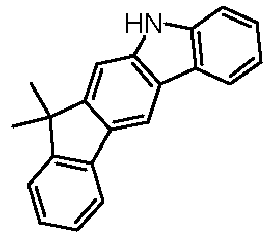


44% 1-66 

46% 1-67 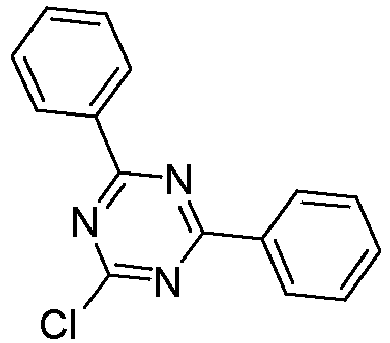

47% 1-68 

44% 1-69 

46% 1-70 

44% 1-71 

43% 1-72 

42% 1-76 


45% 1-77 

46% 1-78 

47% 1-79 

48% 1-82 


49% 1-83 

43% 1-84 

44% 1-85 

45% 1-86 

43% 1-91 


46% 1-92 
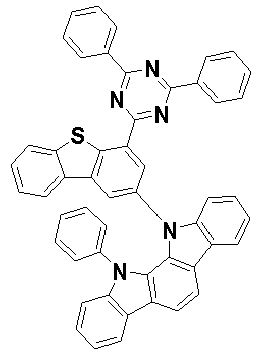
47% 1-93 

47% 1-94 

44% 1-96 


46% 1-98 

43% 1-99 

43% 1-100 

42% 1-109 


41% 1-110 

42% 1-111 

42% 1-112 

45% 1-113 

45% 1-117 
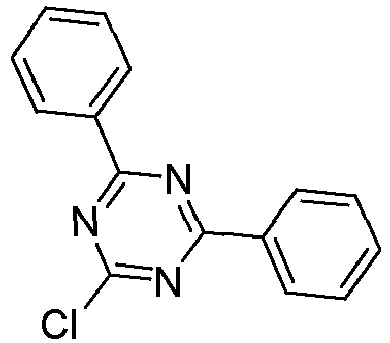

46% 1-118 

49% 1-119 

46% 1-125 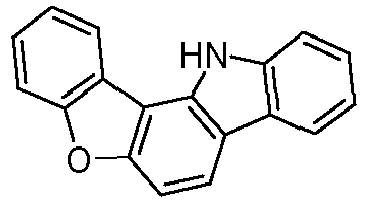


43% 1-126 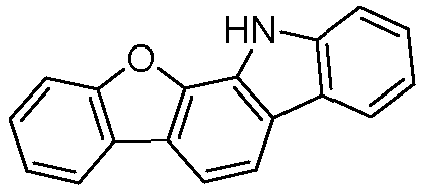

44% 1-127 

45% 1-128 

42% 1-138 


47% 1-176 


48% 1-177 

49% 1-178 

44% 1-179 

44% 1-180 

43% 1-181 

46% -

- 5.0 g (19.0 mM) of 2-bromodibenzo[b,d]thiophene, 5.5 g (19.0 mM) of (9-phenyl-9H-carbazol-3-yl)boronic acid, 1.1 g (0.95 mM) of Pd(PPh3)4, and 5.2 g (38.0 mM) of K2CO3 were dissolved in 100/20/20 mL of toluene/EtOH/H2O, and then the resulting solution was refluxed for 12 hours. After the reaction was completed, distilled water and DCM were added thereto at room temperature, extraction was performed, the organic layer was dried over MgSO4, and then the solvent was removed by a rotary evaporator. The reactant was purified by column chromatography (DCM : Hex = 1 : 3) and recrystallized with hexane to obtain 5.7 g (70%) of Target Compound 1-64-2.
- 7.4 mL (18.6 mM) of 2.5 M n-BuLi was added dropwise to a mixed solution containing 6.1 g (14.3 mM) of Compound 1-64-2 and 100 mL of THF at -78°C, and the resulting mixture was stirred at room temperature for 1 hour. 4.8 mL (42.9 mM) of trimethyl borate (B(OMe)3) was added dropwise to the reaction mixture, and the resulting mixture was stirred at room temperature for 2 hours. After the reaction was completed, distilled water and DCM were added thereto at room temperature, extraction was performed, the organic layer was dried over MgSO4, and then the solvent was removed by a rotary evaporator. The reactant was purified by column chromatography (DCM : MeOH = 100 : 3) and recrystallized with DCM to obtain 4.7 g (70%) of Target Compound 1-64-1.
- 8.9 g (19.0 mM) of Compound 1-64-1, 5.1 g (19.0 mM) of 2-chloro-4,6-diphenyl-1,3,5-triazine, 1.1 g (0.95 mM) of Pd(PPh3)4, and 5.2 g (38.0 mM) of K2CO3 were dissolved in 100/20/20 mL of toluene/EtOH/H2O, and then the resulting solution was refluxed for 12 hours. After the reaction was completed, distilled water and DCM were added thereto at room temperature, extraction was performed, the organic layer was dried over MgSO4, and then the solvent was removed by a rotary evaporator. The reactant was purified by column chromatography (DCM : Hex = 1 : 3) and recrystallized with methanol to obtain 8.7 g (70%) of Target Compound 1-64.
- Target Compound B was prepared and synthesized in the same manner as in the preparation in Preparation Example 2, except that Intermediate C in the following Table 2 was used instead of (9-phenyl-9H-carbazol-3-yl)boronic acid, and Intermediate D in the following Table 2 was used instead of 2-chloro-4,6-diphenyl-1,3,5-triazine in Preparation Example 2.
[Table 2] Compound No. Intermediate C Intermediate D Target Compound B Total yield 1-80 


34% 1-95 

35% 1-114 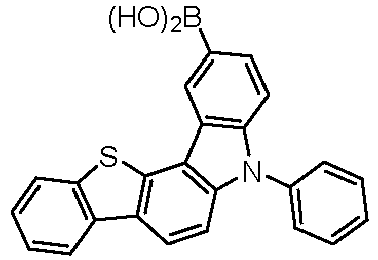

37% 1-139 


36% 1-140 


38% 1-155 


40% 1-156 

39% 1-157 
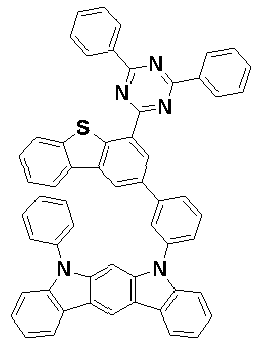
39% 1-158 

37% 1-160 

36% 1-162 

37% 1-163 
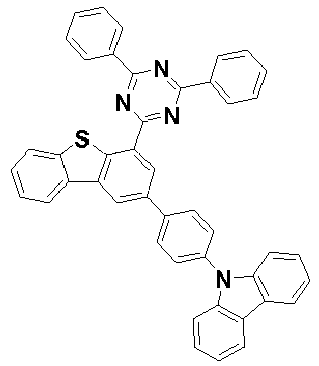
33% 1-164 

34% 1-165 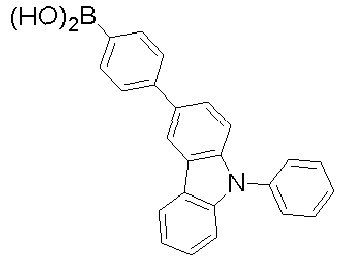

36% 1-170 

37% 1-172 

33% 1-174 


38% -

- 4.2 g (15.8 mM) of 2-bromodibenzo[b,d]thiophene, 6.5 g (15.8 mM) of 9-phenyl-9H,9'H-3,3'-bicarbazole, 3.0 g (15.8 mM) of CuI, 1.9 mL (15.8 mM) of trans-1,2-diaminocyclohexane, and 3.3 g (31.6 mM) of K3PO4 were dissolved in 100 mL of 1,4-oxane, and then the resulting solution was refluxed for 24 hours. After the reaction was completed, distilled water and DCM were added thereto at room temperature, extraction was performed, the organic layer was dried over MgSO4, and then the solvent was removed by a rotary evaporator. The reactant was purified by column chromatography (DCM : Hex = 1 : 3) and recrystallized with methanol to obtain 7.9 g (85%) of Target Compound 2-2-2.
- 7.4 mL (18.6 mmol) of 2.5 M n-BuLi was added dropwise to a mixed solution containing 8.4 g (14.3 mmol) of Compound 2-2-1 and 100 mL of THF at -78°C, and the resulting mixture was stirred at room temperature for 1 hour. 4.8 mL (42.9 mmol) of trimethyl borate was added dropwise to the reaction mixture, and the resulting mixture was stirred at room temperature for 2 hours. After the reaction was completed, distilled water and DCM were added thereto at room temperature, extraction was performed, the organic layer was dried over MgSO4, and then the solvent was removed by a rotary evaporator. The reactant was purified by column chromatography (DCM : MeOH = 100 : 3) and recrystallized with DCM to obtain 3.9 g (70%) of Target Compound 2-2-1.
- 6.7 g (10.5 mM) of Compound 2-2-1, 2.1 g (10.5 mM) of iodobenzene, 606 mg (0.52 mM) of Pd(PPh3)4, and 2.9 g (21.0 mM) of K2CO3 were dissolved in 100/20/20 mL of toluene/EtOH/H2O, and then the resulting solution was refluxed for 12 hours. After the reaction was completed, distilled water and DCM were added thereto at room temperature, extraction was performed, the organic layer was dried over MgSO4, and then the solvent was removed by a rotary evaporator. The reactant was purified by column chromatography (DCM : Hex = 1 : 3) and recrystallized with methanol to obtain 4.9 g (70%) of Target Compound 2-2.
- Target Compound 2-3 (83%) was obtained by performing the preparation in the same manner as in the preparation of Compound 2-2, except that 4-iodo-1,1'-biphenyl was used instead of iodobenzene in the preparation of Compound 2-2.
-

- 88.0 mL (157.8 mM) of 1.8 M LDA was added dropwise to a mixed solution containing 30.0 g (121.4 mM) of 2-bromodibenzofuran and 300 mL of THF at -78°C, and the resulting mixture was stirred at room temperature for 1 hour. 11.0 g (42.9 mmol) of iodine was put into the reaction mixture, and the resulting mixture was stirred at room temperature for 2 hours. After the reaction was completed, distilled water and DCM were added thereto at room temperature, extraction was performed, the organic layer was dried over MgSO4, and then the solvent was removed by a rotary evaporator. The reactant was purified by column chromatography (DCM) and recrystallized with MeOH to obtain 23.1 g (51%) of Target Compound ref 2-2.
- 3.9 g (10.5 mM) of Compound ref 2-2, 1.3 g (10.5 mM) of phenylboronic acid, 606 mg (0.52 mM) of Pd(PPh3)4, and 2.9 g (21.0 mM) of K2CO3 were dissolved in 100/20/20 mL of toluene/EtOH/H2O, and then the resulting solution was refluxed for 12 hours. After the reaction was completed, distilled water and DCM were added thereto at room temperature, extraction was performed, the organic layer was dried over MgSO4, and then the solvent was removed by a rotary evaporator. The reactant was purified by column chromatography (DCM : Hex = 1 : 3) and recrystallized with methanol to obtain 2.4 g (70%) of Target Compound ref 2-1.
- 5.1 g (15.8 mM) of Compound ref 2-1, 6.5 g (15.8 mM) of 9-phenyl-9H,9'H-3,3'-bicarbazole, 3.0 g (15.8 mM) of CuI, 1.9 mL (15.8 mM) of trans-1,2-diaminocyclohexane, and 3.3 g (31.6 mM) of K3PO4 were dissolved in 100 mL of 1,4-oxane, and then the resulting solution was refluxed for 24 hours. After the reaction was completed, distilled water and DCM were added thereto at room temperature, extraction was performed, the organic layer was dried over MgSO4, and then the solvent was removed by a rotary evaporator. The reactant was purified by column chromatography (DCM : Hex = 1 : 3) and recrystallized with methanol to obtain 8.7 g (85%) of
Target Compound ref 2. -
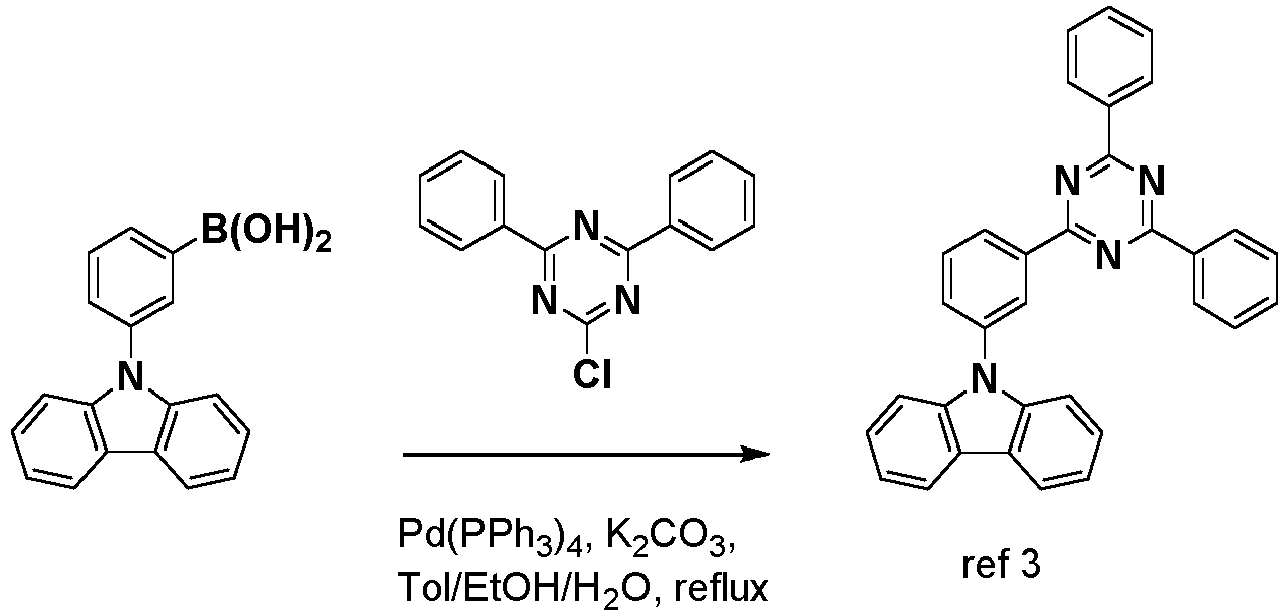
- 5.5 g (19.0 mmol) of (3-(9H-carbazol-9-yl)phenyl)boronic acid, 5.1 g (19.0 mM) of 2-chloro-4,6-diphenyl-1,3,5-triazine, 1.1 g (0.95 mM) of Pd(PPh3)4, and 5.2 g (38.0 mM) of K2CO3 were dissolved in 100/20/20 mL of toluene/ethanol/H2O, and then the resulting solution was refluxed for 12 hours. After the reaction was completed, distilled water and DCM were added thereto at room temperature, extraction was performed, the organic layer was dried over MgSO4, and then the solvent was removed by a rotary evaporator. The reactant was purified by column chromatography (DCM : Hex = 1 : 3) and recrystallized with methanol to obtain 6.3 g (70%) of
Target Compound ref 3. - Compound 2-7 was obtained by using 2-bromo-9,9-dimethyl-9H-fluorene instead of iodobenzene in the preparation of Compound 2-2 (yield 69%).
- Compound 2-9 was obtained by using 2-bromodibenzo[b,d]thiophene instead of iodobenzene in the prepration of Compound 2-2 (yield 72%).
- Compound 2-11 was obtained by using 2-bromodibenzo[b,d]furan instead of iodobenzene in the prepration of Compound 2-2 (yield 68%).
-

- 5.5 g (19.0 mmol) of (3-(9H-carbazol-9-yl)phenyl)boronic acid, 5.1 g (19.0 mM) of 2-chloro-4,6-diphenyl-1,3,5-triazine, 1.1 g (0.95 mM) of Pd(PPh3)4, and 5.2 g (38.0 mM) of K2CO3 were dissolved in 100/20/20 mL of toluene/ethanol/H2O, and then the resulting solution was refluxed for 12 hours. After the reaction was completed, distilled water and DCM were added thereto at room temperature, extraction was performed, the organic layer was dried over MgSO4, and then the solvent was removed by a rotary evaporator. The reactant was purified by column chromatography (DCM : Hex = 1 : 3) and recrystallized with methanol to obtain 6.3 g (70%) of
Compound ref 4. -
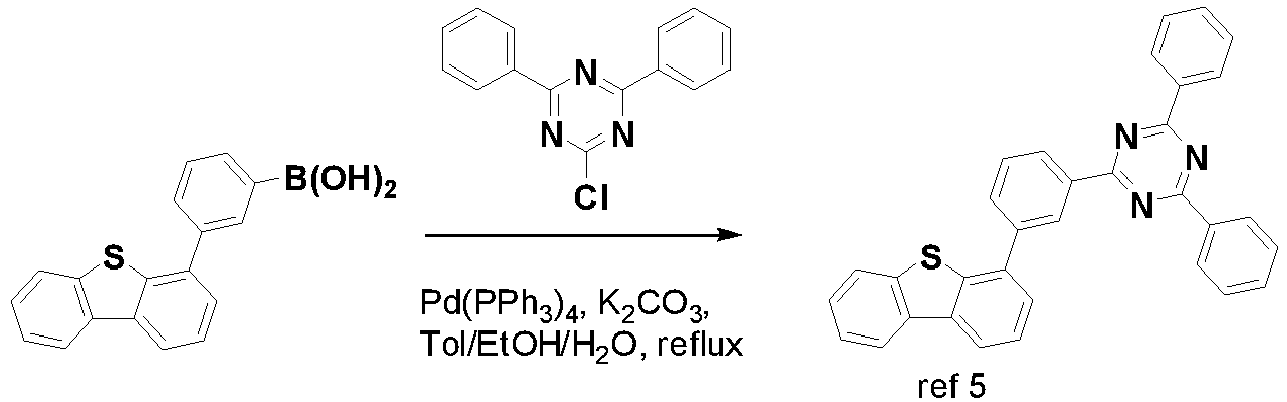
- 5.8 g (19.0 mM) of (3-(dibenzo[b,d]thiophene-4-yl)phenyl)boronic acid, 5.1 g (19.0 mM) of 2-chloro-4,6-diphenyl-1,3,5-triazine, 1.1 g (0.95 mM) of Pd(PPh3)4, and 5.2 g (38.0 mM) of K2CO3 were dissolved in 100/20/20 mL of toluene/ ethanol/H2O, and then the resulting solution was refluxed for 12 hours. After the reaction was completed, distilled water and DCM were added thereto at room temperature, extraction was performed, the organic layer was dried over MgSO4, and then the solvent was removed by a rotary evaporator. The reactant was purified by column chromatography (DCM : Hex = 1 : 3) and recrystallized with methanol to obtain 6.5 g (70%) of
Compound ref 5. -

- 11.4 mL (22.8 mM) of 2.0 M lithium diisopropylamine was added dropwise to a mixed solution containing 4.7 g (19.0 mM) of 2-bromodibenzo[b,d]furan and 100 mL of THF at -78°C, and the resulting mixture was stirred at -78°C for 1 hour. 4.8 mL (42.9 mM) of trimethyl borate was added dropwise to the reaction mixture, and the resulting mixture was stirred at room temperature for 2 hours. After the reaction was completed, distilled water and DCM were added thereto at room temperature, extraction was performed, the organic layer was dried over MgSO4, and then the solvent was removed by a rotary evaporator. The reactant was purified by column chromatography (DCM : MeOH = 100 : 3) and recrystallized with DCM to obtain 3.9 g (70%) of Compound ref 6-2.
- 5.5 g (19.0 mM) of Compound ref 6-2, 5.9 g (19.0 mM) of 2-bromo-4,6-diphenylpyrimidine, 1.1 g (0.95 mM) of Pd(PPh3)4, and 5.2 g (38.0 mM) of K2CO3 were dissolved in 100/20/20 mL of toluene/ ethanol/H2O, and then the resulting solution was refluxed for 12 hours. After the reaction was completed, distilled water and DCM were added thereto at room temperature, extraction was performed, the organic layer was dried over MgSO4, and then the solvent was removed by a rotary evaporator. The reactant was purified by column chromatography (DCM : Hex = 1 : 3) and recrystallized with hexane to obtain 6.3 g (70%) of Compound ref 6-1.
- 9.1 g (19.0 mM) of Compound ref 6-1, 4.5 g (15.8 mM) of 7,7-dimethyl-5,7-dihydroindeno[2,1-b]carbazole, 3.0 g (15.8 mM) of CuI, 1.9 mL (15.8 mM) of trans-1,2-diaminocyclohexane, and 3.3 g (31.6 mM) of K3PO4 were dissolved in 100 mL of 1,4-oxane, and then the resulting solution was refluxed for 24 hours. After the reaction was completed, distilled water and DCM were added thereto at room temperature, extraction was performed, the organic layer was dried over MgSO4, and then the solvent was removed by a rotary evaporator. The reactant was purified by column chromatography (DCM : Hex = 1 : 3) and recrystallized with methanol to obtain 9.1 g (85%) of
Compound ref 6. -

- 5.0 g (19.0 mM) of 4-bromodibenzo[b,d]thiophene, 2.6 g (15.8 mM) of 9H-carbazole, 3.0 g (15.8 mM) of CuI, 1.9 mL (15.8 mM) of trans-1,2-diaminocyclohexane, and 3.3 g (31.6 mM) of K3PO4 were dissolved in 100 mL of 1,4-oxane, and then the resulting solution was refluxed for 24 hours. After the reaction was completed, distilled water and DCM were added thereto at room temperature, extraction was performed, the organic layer was dried over MgSO4, and then the solvent was removed by a rotary evaporator. The reactant was purified by column chromatography (DCM : Hex = 1 : 3) and recrystallized with methanol to obtain 4.7 g (85%) of Compound ref 7-2.
- 7.4 mL (18.6 mM) of 2.5 M n-BuLi was added dropwise to a mixed solution containing 5.0 g (14.3 mM) of Compound ref 7-2 and 100 mL of THF at -78°C, and the resulting mixture was stirred at room temperature for 1 hour. 4.8 mL (42.9 mM) of trimethyl borate was added dropwise to the reaction mixture, and the resulting mixture was stirred at room temperature for 2 hours. After the reaction was completed, distilled water and DCM were added thereto at room temperature, extraction was performed, the organic layer was dried over MgSO4, and then the solvent was removed by a rotary evaporator. The reactant was purified by column chromatography (DCM : MeOH = 100 : 3) and recrystallized with DCM to obtain 3.9 g (70%) of Target Compound ref 7-1.
- 7.5 g (19.0 mM) of Compound ref 7-1, 5.1 g (19.0 mM) of 2-chloro-4,6-diphenyl-1,3,5-triazine, 1.1 g (0.95 mM) of Pd(PPh3)4, and 5.2 g (38.0 mM) of K2CO3 were dissolved in 100/20/20 mL of toluene/ethanol/H2O, and then the resulting solution was refluxed for 12 hours. After the reaction was completed, distilled water and DCM were added thereto at room temperature, extraction was performed, the organic layer was dried over MgSO4, and then the solvent was removed by a rotary evaporator. The reactant was purified by column chromatography (DCM : Hex = 1 : 3) and recrystallized with methanol to obtain 7.7 g (70%) of Compound ref 7.
-

- 5.0 g (19.0 mM) of 2-bromodibenzo[b,d]thiophene, 4.5 g (15.8 mM) of 7,7-dimethyl-5,7-dihydroindeno[2,1-b]carbazole, 3.0 g (15.8 mM) of CuI, 1.9 mL (15.8 mM) of trans-1,2-diaminocyclohexane, and 3.3 g (31.6 mM) of K3PO4 were dissolved in 100 mL of 1,4-oxane, and then the resulting solution was refluxed for 24 hours. After the reaction was completed, distilled water and DCM were added thereto at room temperature, extraction was performed, the organic layer was dried over MgSO4, and then the solvent was removed by a rotary evaporator. The reactant was purified by column chromatography (DCM : Hex = 1 : 3) and recrystallized with methanol to obtain 7.3 g (85%) of
Compound ref 8. -

- 4.2 g (15.8 mM) of 2-bromodibenzo[b,d]thiophene, 6.5 g (15.8 mM) of 9-phenyl-9H,9'H-3,3'-bicarbazole, 3.0 g (15.8 mM) of CuI, 1.9 mL (15.8 mM) of trans-1,2-diaminocyclohexane, and 3.3 g (31.6 mM) of K3PO4 were dissolved in 100 mL of 1,4-oxane, and then the resulting solution was refluxed for 24 hours. After the reaction was completed, distilled water and DCM were added thereto at room temperature, extraction was performed, the organic layer was dried over MgSO4, and then the solvent was removed by a rotary evaporator. The reactant was purified by column chromatography (DCM : Hex = 1 : 3) and recrystallized with methanol to obtain 7.9 g (85%) of Compound ref 9.
- Compounds were prepared in the same manner as in the Preparation Examples, and the synthesis confirmation results thereof are shown in Tables 3 to 23.
[Table 3] HOMO = -5.5-(Eox(Compound 1-2)-Eox(NPB))(eV) Band gap= 1240/UV absorption edge(404nm)(eV) Eox HOMO Band gap LUMO NPB 0.81 Compound 1-2 1.45 -6.14 3.07 -3.07 [Table 4] HOMO = -5.5-(Eox(Compound 1-11)-Eox(NPB))(eV) Band gap= 1240/UV absorption edge(432nm)(eV) Eox HOMO Band gap LUMO NPB 0.80 Compound 1-11 1.48 -6.18 2.87 -3.31 [Table 5] HOMO = -5.5-(Eox(Compound 1-23)-Eox(NPB))(eV) Band gap= 1240/UV absorption edge(367nm)(eV) Eox HOMO Band gap LUMO NPB 0.82 Compound 1-23 1.38 -6.06 3.38 -2.68 [Table 6] HOMO = -5.5-(Eox(Compound 1-27)-Eox(NPB))(eV) Band gap= 1240/UV absorption edge(369nm)(eV) Eox HOMO Band gap LUMO NPB 0.80 Compound 1-27 1.37 -6.07 3.36 -2.71 [Table 7] HOMO = -5.5-(Eox(Compound 1-33)-Eox(NPB))(eV) Band gap= 1240/UV absorption edge(378nm)(eV) Eox HOMO Band gap LUMO NPB 0.83 Compound 1-33 1.45 -6.11 3.28 -3.82 [Table 8] HOMO = -5.5-(Eox(Compound 1-39)-Eox(NPB))(eV) Band gap= 1240/UV absorption edge(433nm)(eV) Eox HOMO Band gap LUMO NPB 0.76 Compound 1-39 1.41 -6.15 2.86 -3.29 [Table 9] HOMO = -5.5-(Eox(Compound 1-41)-Eox(NPB))(eV) Band gap= 1240/UV absorption edge(366nm)(eV) Eox HOMO Band gap LUMO NPB 0.78 Compound 1-41 1.40 -6.12 3.39 -2.73 [Table 10] HOMO = -5.5-(Eox(Compound 1-65)-Eox(NPB))(eV) Band gap= 1240/UV absorption edge(416nm)(eV) Eox HOMO Band gap LUMO NPB 0.79 Compound 1-65 1.22 -5.93 2.98 -2.95 [Table 11] HOMO = -5.5-(Eox(Compound 1-66)-Eox(NPB))(eV) Band gap= 1240/UV absorption edge(425nm)(eV) Eox HOMO Band gap LUMO NPB 0.77 Compound 1-66 1.19 -5.93 2.92 -3.01 [Table 12] HOMO = -5.5-(Eox(Compound 1-67)-Eox(NPB))(eV) Band gap= 1240/UV absorption edge(452nm)(eV) Eox HOMO Band gap LUMO NPB 0.76 Compound 1-67 1.16 -5.89 2.74 -3.15 [Table 13] HOMO = -5.5-(Eox(Compound 1-69)-Eox(NPB))(eV) Band gap= 1240/UV absorption edge(371nm)(eV) Eox HOMO Band gap LUMO NPB 0.78 Compound 1-69 1.13 -5.86 3.34 -2.52 [Table 14] HOMO = -5.5-(Eox(Compound 1-70)-Eox(NPB))(eV) Band gap= 1240/UV absorption edge(371nm)(eV) Eox HOMO Band gap LUMO NPB 0.76 Compound 1-70 1.14 -5.88 3.34 -2.54 [Table 15] HOMO = -5.5-(Eox(Compound 1-71)-Eox(NPB))(eV) Band gap= 1240/UV absorption edge(371nm)(eV) Eox HOMO Band gap LUMO NPB 0.77 Compound 1-71 1.15 -5.88 3.34 -2.54 [Table 16] HOMO = -5.5-(Eox(Compound 1-78)-Eox(NPB))(eV) Band gap= 1240/UV absorption edge(438nm)(eV) Eox HOMO Band gap LUMO NPB 0.78 Compound 1-78 1.30 -6.02 2.83 -3.19 [Table 17] HOMO = -5.5-(Eox(Compound 1-82)-Eox(NPB))(eV) Band gap= 1240/UV absorption edge(426nm)(eV) Eox HOMO Band gap LUMO NPB 0.78 Compound 1-82 1.09 -5.81 2.91 -2.90 [Table 18] HOMO = -5.5-(Eox(Compound 1-84)-Eox(NPB))(eV) Band gap= 1240/UV absorption edge(463nm)(eV) Eox HOMO Band gap LUMO NPB 0.77 Compound 1-84 1.08 -5.80 2.68 -3.12 [Table 19] HOMO = -5.5-(Eox(Compound 1-99)-Eox(NPB))(eV) Band gap= 1240/UV absorption edge(364nm)(eV) Eox HOMO Band gap LUMO NPB 0.83 Compound 1-99 1.36 -6.03 3.41 -2.62 [Table 20] Td(signal value: 95%) Tg Compound 1-2 442.04 °C - Compound 1-11 426.38 °C - Compound 1-23 473.62°C 141.91°C Compound 1-27 464.07°C - Compound 1-33 478.83°C 153.06°C Compound 1-39 460.32°C 151.88°C Compound 1-41 484.24°C 157.88°C Compound 1-65 467.84°C 179.13°C Compound 1-66 463.00 °C 179.38 °C Compound 1-67 461.79 °C 185.05 °C Compound 1-69 492.45 °C 179.99 °C Compound 1-70 482.96 °C 185.05 °C Compound 1-71 461.10 °C 169.72 °C Compound 1-78 462.82 °C 180.63 °C Compound 1-82 495.17 °C - Compound 1-84 492.52 °C 188.83 °C Compound 1-99 523.67 °C 176.50 °C [Table 21] Compound 1H NMR(CDCl3, 200Mz) 1-2 δ = 9.26(1H, d), 8.51(1H, d), 8.41∼8.39(4H, m), 8.23(2H, d), 8.18(1H, d), 8.13(1H, s), 8.06(1H, d), 7.62∼7.43(12H, m), 7.34(2H, t) 1-11 δ = 9.32(1H, d), 8.90∼8.88(4H, m), 8.61(1H, d), 8.25(2H, d), 8.21(1H, d), 8.12(1H, d), 7.65∼7.45(12H, m), 7.37(2H, t) 1-12 δ = 8.55(1H, d), 8.45∼8.36(4H, m), 8.19(1H, d), 7.93∼8.00(4H, m), 7.73∼7.77(4H, m), 7.35∼7.6l(l2H, m), 7.20∼7.20(2H, m) 1-17 δ = 8.55(1H, d), 8.45(1H, d), 8.30(2H, d), 7.90∼8.12(6H, m), 7.78(1H, t), 7.47∼7.69(10H, m), 7.25∼7.33(3H, m) 1-23 δ = 8.55(1H, d), 8.45∼8.38(2H, m), 8.23∼8.19(2H, m), 8.00∼7.93(8H, m), 7.77∼7.73(2H, m), 7.58∼7.49(11H, m), 7.35(1H, t), 7.20∼7.16(2H, m) 1-27 δ = 9.27(1H, s), 8.89(1H, d), 8.79(4H, m), 8.41(1H, d), 8.21(3H, m), 8.05(1H, d), 7.93(1H, d), 7.87(1H, d), 7.77(1H, t), 7.64∼7.46(12H, m), 7.32(2H, t) 1-33 δ = 8.92(2H, d), 8.36(1H, d), 8.32(4H, m), 8.21∼8.16(3H, m), 8.07(1H, s), 8.01(2H, d), 7.94(1H, d), 7.61∼7.44(12H, m), 7.32(2H, t) 1-36 δ = 8.55(1H, d), 8.45(1H, d), 8.36(4H, d), 8.19(1H, d), 8.00∼7.93(5H, m), 7.77(1H, s), 7.58∼7.49(10H, m), 7.35(1H, t), 7.25∼7.16(4H, m) 1-39 δ = 9.35(1H, s), 8.90(4H, d), 8.64(1H, s), 8.30∼8.20(3H, m), 8.13(1H, d), 7.71(1H, s), 7.66∼7.45(14H, m), 7.38∼7.33(3H, m) 1-40 δ = 9.38(1H, s), 9.24(1H, s), 8.87(3H, d), 8.64(1H, s), 8.30∼8.21(3H, m), 8.08(1H, d), 7.90(1H, d), 7.80(2H, d), 7.72∼7.32(19H, d) 1-41 δ = 9.30(1H, s), 8.90(1H, d), 8.80(4H, d), 8.43(1H, s), 8.26∼8.20(3H, m), 8.03(1H, d), 7.93(1H, d), 7.87(1H, s), 7.77(1H, t), 7.72(1H, s), 7.67(1H, d), 7.60∼7.47(11H, m), 7.41∼7.29(4H, m) 1-42 δ = 8.55(1H, d), 8.45(1H, d), 8.36∼8.31(5H, m), 8.00∼7.91(6H, m), 7.77∼7.74(4H, m), 7.56∼7.35(12H, m), 7.25(2H, d), 7.16(1H, t) 1-46 δ = 8.62(1H, d), 8.45(1H, d), 8.36∼8.31(5H, m), 8.22(1H, m), 8.00(1H, s), 7.93∼7.91(2H, m), 7.77∼7.74(7H, m), 7.50∼7.41(14H, m) 1-64 δ = 8.55(1H, d), 8.45(1H, d), 8.36(4H, d), 8.22(1H, s), 7.99∼7.89(5H, m), 7.77(1H, d), 7.62∼7.49(13H, m), 7.35(1H, t), 7.16(1H, t) 1-65 δ = 9.33(1H, d), 8.59(1H, d), 8.53(1H, s), 8.42(4H, m), 8.28(1H, d), 8.22(1H, d), 8.15(1H, s), 8.09(1H, d), 7.90(1H, d), 7.59∼7.51(10H, m), 7.50∼7.34(4H, m), 7.17(1H, m), 1.53∼1.50(6H, d) 1-66 δ = 8.96(2H, d), 8.60(1H, s), 8.53(1H, s), 8.46(1H, s), 8.29∼8.23(4H, m), 8.19(1H, s), 8.10(1H, d), 7.90(1H, d), 7.66∼7.59(4H, m), 7.56∼7.51(4H, m), 7.47∼7.38(6H, m), 7.31(1H, m), 1.53∼1.50(6H, d) 1-67 δ = 9.39(1H, s), 8.90(4H, d), 8.68(1H, s), 8.54(1H, s), 8.30(1H, d), 8.25(1H, d), 8.15(1H, d), 7.91(1H, d), 7.64∼7.52(10H, m), 7.47∼7.35(4H, m), 7.29(1H, t), 1.53∼1.50(6H, d) 1-68 δ = 8.55(1H, d), 8.45(1H, d), 8.24(1H, d), 7.94∼7.88(3H, m), 7.80∼7.74(4H, m), 7.57∼7.49(7H, m), 7.38∼7.33(3H, m), 7.24∼7.16(4H, m), 7.05(1H, m), 1.69(6H, s) 1-69 δ = 9.26(1H, s), 8.84(1H, d), 8.49(1H, s), 8.43(1H, s), 8.31(4H, m), 8.25∼8.20(2H, m), 8.07(1H, s), 7.95(2H, t), 7.88(2H, s), 7.73(1H, t), 7.55(10H, m), 7.45∼7.28(5H, m), 1.53∼1.50(6H, d) 1-70 δ = 9.26(1H, s), 8.84(1H, d), 8.49(1H, s), 8.43(1H, s), 8.31(4H, m), 8.25∼8.20(2H, m), 8.07(1H, s), 7.71(1H, t), 7.55(10H, m), 7.45∼7.28(5H, m), 1.53∼1.50(6H, d) 1-71 δ = 8.54(1H, s), 8.33(1H, s), 8.30(1H, d), 8.15(1H, d), 7.96(1H, d), 7.89(4H, t), 7.78(1H, s), 7.59∼7.50(3H, m), 7.44∼7.25(11H, m), 7.23∼7.14(4H, m), 6.85(1H, t), 1.53∼1.50(6H, d) 1-72 δ = 8.55(1H, d), 8.45(1H, d), 8.24∼8.23(2H, m), 8.00∼7.88(10H, m), 7.77∼7.74(2H, m), 7.56∼7.49(10H, m), 7.38∼7.35(2H, m), 7.25(2H, d), 7.16(1H, t), 1.69(6H, s) 1-78 δ = 9.36 (1H, s), 8.89(2H, d), 8.64(1H, s), 8.27∼8.21(3H, m), 8.13 (1H, d), 7.79(1H, s), 7.67∼7.50(9H, m), 7.47∼7.35(4H, m), 7.30∼7.17(2H, m), 1.69(6H, s) 1-82 δ = 9.31(1H, s), 8.92(1H, s), 8.57(1H, s), 8.43(4H, m), 8.35(1H, d), 8.31(1H, d), 8.18(2H, m), 8.05(1H, d), 7.63∼7.47(11H, m), 7.45∼7.28(7H, m), 7.20(1H, m) 1-83 δ = 8.55(1H, d), 8.45(1H, d), 8.35(2H, d), 8.23∼8.19(2H, m), 8.00∼7.93(5H, m), 7.77(1H, s), 7.62∼7.49(16H, m), 7.40∼7.35(2H, m), 7.20∼7.16(2H, m) 1-84 δ = 9.39(1H, s), 8.92(1H, s), 8.90(4H, m), 8.62(1H, s), 8.37∼8.33(2H, m), 8.19(1H, d), 8.11(1H, d), 7.67∼7.47(11H, m), 7.45∼7.28(7H, m), 7.30(2H, m), 7.20(1H, m) 1-93 δ = 8.55(1H, d), 8.45(1H, d), 8.28(4H,d), 8.12(1H, d), 7.90∼7.98(3H, m), 7.29∼7.69(21H, m) 1-96 δ = 8.55(1H, d), 8.45(2H, m), 8.23(1H, s), 7.90∼8.08(5H, m), 7.79(4H, d), 7.69(1H, s), 7.25∼7.52(13H, m) 1-98 δ = 8.55(1H, d), 8.45(1H, d), 8.36(4H, d), 8.05∼7.93(5H, m), 7.77(1H, s), 7.56∼7.49(10H, m), 7.35∼7.33(2H, m), 7.16(1H, t) 1-99 δ = 9.25(1H, s), 8.85(1H, d), 8.45(1H, s), 8.38(1H, d), 8.32(4H, m), 8.22(3H, m), 8.07(1H, s), 8.00(2H, t), 7.94(2H, m), 7.76∼7.66(3H, m), 7.66∼7.47(12H, m) 1-100 δ = 8.55(1H, d), 8.45(2H, m), 8.28(4H, d), 8.24(1H, d), 7.90∼8.05(5H, m), 7.69∼7.70(2H, m), 7.23∼7.57(15H, m) 1-110 9.31(1H, s), 9.29(1H, s), 8.81(4H, d), 8.30∼8.58(7H, m), 7.30∼7.79(13H, m) 1-117 δ = 8.55(1H, d), 8.45(1H, d), 8.28(4H, d), 7.89∼7.94(5H, m), 7.66∼7.69(2H, m), 7.25∼7.52(12H, m), 7.13(1H, d) 1-119 δ = 8.57(1H, d), 8.46(1H, d), 8.28(4H, d), 8.24(1H, d), 7.89∼7.98(5H, m), 7.66∼7.70(3H, m), 7.25∼7.57(14H, m), 7.13(1H, d) 1-126 δ = 8.56(1H, d), 8.45(1H, d), 8.28(4H, d), 7.89∼7.98(5H, m), 7.66∼7.69(2H, m), 7.25∼7.53(13H, m) 1-163 δ = 8.55(1H, d), 8.45(1H, d), 8.36(4H, d), 8.22∼8.19(2H, m), 7.99∼7.91(8H, m), 7.58∼7.49(10H, m), 7.35(1H, t), 7.20∼7.16(2H, m) 1-170 δ = 8.55(1H, d), 8.45(2H, m), 8.28(4H, d), 7.94∼8.05(5H, m), 7.75∼7.79(3H, m), 7.68(2H, d), 7.25∼7.53(13H, m) 1-172 δ = 8.57(1H, d), 8.45(1H, d), 8.28(4H, d), 7.89∼7.98(5H, m), 7.66∼7.79(6H, m), 7.25∼7.52(12H, m) 1-176 δ = 8.58(1H, d), 8.45(1H, d), 8.16(1H, d), 7.79∼7.94(9H, m), 7.25∼7.69(12H, m) 1-177 δ = 8.55(1H, d), 8.45∼8.46(2H, m), 8.16(1H, d), 7.83∼8.05(9H, m), 7.69(1H, s), 7.25∼7.58(11H, m) 1-178 δ = 8.55(1H, d), 8.45(1H, d), 8.09∼8.16(2H, m), 7.79∼7.98(7H, m), 7.24∼7.69(13H, m), 1.72(6H, s) 1-179 δ = 8.57(1H, d), 8.47(1H, d), 8.09∼8.16(3H, m), 7.79∼7.98(7H, m), 7.69(1H, s), 7.24∼7.61(12H, m), 1.72(6H, s) 1-180 δ = 8.54(1H, d), 8.44∼8.46(2H, m), 8.16(1H, d), 7.79∼8.05(9H, m), 7.69(1H, s), 7.25∼7.60(11H, m) 1-181 δ = 8.55(1H, d), 8.45(1H, d), 8.16(1H, d), 7.79∼7.98(9H, m), 7.25∼7.69(13H, m) 2-2 δ = 8.55(1H, d), 8.45(1H, d), 8.30(1H, d), 8.19(1H, d), 8.13(1H, d), 8.00∼7.89(6H, m), 7.77(2H, m), 7.62∼7.35(15H, m), 7.20∼7.16(2H, m) 2-3 δ = 8.55(1H, d), 8.45(1H, d), 8.30(1H, d), 8.19(1H, d), 8.13(1H, d), 8.00∼7.89(6H, m), 7.77(4H, m), 7.62∼7.41(13H, m), 7.25∼7.16(6H, m) 2-7 δ = 8.55 (1H, d), 8.45 (1H, d), 8.30 (1H, d), 8.19∼8.09 (3H, m), 8.00∼7.89 (8H, m), 7.78∼7.77 (3H, m), 7.62∼7.49 (10H, m), 7.38∼7.16 (5H, m), 1.69 (6H, s) 2-9 δ = 8.55 (1H, d), 8.45 (2H, d), 8.30 (1H, d), 8.19∼8.12 (4H, m), 8.00∼7.89 (8H, m), 7.77 (2H, m), 7.62∼7.49 (11H, m), 7.35 (1H, t), 7.21∼7.16 (2H, m) 2-11 δ = 8.55 (1H, d), 8.45 (1H, d), 8.30 (1H, d), 8.19 (1H, d), 8.13 (1H, d), 8.00∼7.77 (12H, m), 7.62∼7.31 (13H, m), 7.20∼7.16 (2H, m) [Table 22] Compound FD-MS Compound FD-MS 1-2 m/z= 579.18 (C40H25N3S=579.72) 1-11 m/z= 580.17 (C39H24N4S=580. 71) 1-12 m/z= 656.20 (C45H28N4S=656.81) 1-17 m/z= 552.17 (C39H24N2S=552.69) 1-23 m/z= 655.21 (C46H29N3S=655.81) 1-27 m/z= 656.20 (C45H28N4S=656.80) 1-33 m/z= 655.21 (C46H29N3S=655.81) 1-36 m/z= 656.20 (C45H28N4S=656.80) 1-39 m/z= 656.20 (C45H28N4S=656.80) 1-40 m/z= 732.23 (C51H32N4S=732.90) 1-41 m/z= 732.23 (C51H32N4S=732.89) 1-42 m/z= 732.23 (C51H32N4S=732.89) 1-46 m/z= 732.23 (C51H32N4S=732.89) 1-64 m/z= 656.20 (C45H28N4S=656.80) 1-65 m/z= 695.24 (C49H33N3S=695.87) 1-66 m/z= 695.24 (C49H33N3S=695.87) 1-67 m/z= 696.23 (C48H32N4S=696.86) 1-68 m/z= 669.22 (C47H31N3S=669.83) 1-69 m/z= 771.27 (C55H37N3S=771.97) 1-70 m/z= 772.27 (C54H36N4S=772 .96) 1-71 m/z= 733.26 (C52H35N3S=733.93) 1-72 m/z= 772.27 (C54H36N4S=772 .96) 1-78 m/z= 696.23 (C48H32N4S=696.86) 1-82 m/z= 744.23 (C52H32N4S=744.90) 1-83 m/z= 744.23 (C52H32N4S=744.90) 1-84 m/z= 745.23 (C51H31N5S=745.89) 1-93 m/z= 745.23 (C51H31N5S=745.89) 1-96 m/z= 685.16 (C46H27N3S2=685.86) 1-98 m/z= 686.16 (C45H26N4S2=686.84) 1-99 m/z= 761.20 (C51H31N3S2=761.95) 1-100 m/z= 762.19 (C51H30N4S2=762.94) 1-110 m/z= 686.16 (C45H26N4S2=686.84) 1-117 m/z= 670.18 (C45H26N4OS=670.78) 1-119 m/z= 746.21 (C51H30N4OS=746.88) 1-126 m/z= 670.18 (C45H26N4OS=670.78) 1-163 m/z= 656.80 (C45H28N4S=656.20) 1-170 m/z= 762.19 (C51H30N4S2=762.94) 1-172 m/z= 746.21 (C51H30N4OS=746.88) 1-176 m/z= 643.17 (C44H25N3OS=643.75) 1-177 m/z= 659.15 (C44H25N3S2=659.82) 1-178 m/z= 669.22 (C47H31N3S=669.83) 1-179 m/z= 669.22 (C47H31N3S=669.83) 1-180 m/z= 659.15 (C44H25N3S2=659.82) 1-181 m/z= 643.17 (C44H25N3OS=643.75) [Table 23] Compound FD-Mass Compound FD-Mass 2-1 m/z= 742.94(C54H34N2S=742.24) 2-2 m/z= 666.84(C48H30N2S=666.21) 2-3 m/z= 742.94(C54H34N2S=742.24) 2-4 m/z= 742.94(C54H34N2S=742.24) 2-5 m/z= 716.90(C52H32N2S=716.23) 2-6 m/z= 716.90(C52H32N2S=716.23) 2-7 m/z= 783.00(C57H38N2S=782.28) 2-8 m/z= 783.00(C57H38N2S=782.28) 2-9 m/z= 772.98(C54H32N2S2=772.20) 2-10 m/z= 772.98(C54H32N2S2=772.20) 2-11 m/z= 756.92(C54H32N2OS=756.22) 2-12 m/z= 756.92(C54H32N2OS=756.22) 2-13 m/z= 666.84(C48H30N2S=666.21) 2-14 m/z= 742.94(C54H34N2S=742.24) 2-15 m/z= 742.94(C54H34N2S=742.24) 2-16 m/z= 716.90(C52H32N2S=716.23) 2-17 m/z= 716.90(C52H32N2S=716.23) 2-18 m/z= 783.00(C57H38N2S=782.28) 2-19 m/z= 783.00(C57H38N2S=782.28) 2-20 m/z= 772.98(C54H32N2S2=772.20) 2-21 m/z= 756.92(C54H32N2OS=756.22) 2-22 m/z= 756.92(C54H32N2OS=756.22) 2-23 m/z= 772.98(C54H32N2S2=772.20) 2-24 m/z= 666.84(C48H30N2S=666.21) 2-25 m/z= 742.94(C54H34N2S=742.24) 2-26 m/z= 742.94(C54H34N2S=742.24) 2-27 m/z= 783.00(C57H38N2S=782.28) 2-28 m/z= 772.98(C54H32N2S2=772.20) 2-29 m/z= 756.92(C54H32N2OS=756.22) 2-30 m/z= 772.98(C54H32N2S2=772.20) 2-31 m/z= 783.00(C57H38N2S=782.28) 2-32 m/z= 756.92(C54H32N2OS=756.22) 2-33 m/z= 666.84(C48H30N2S=666.21) 2-34 m/z= 742.94(C54H34N2S=742.24) 2-35 m/z= 742.94(C54H34N2S=742.24) 2-36 m/z= 772.98(C54H32N2S2=772.20) 2-37 m/z= 756.92(C54H32N2OS=756.22) 2-38 m/z= 772.98(C54H32N2S2=772.20) 2-39 m/z= 783.00(C57H38N2S=782.28) 2-40 m/z= 756.92(C54H32N2OS=756.22) 2-41 m/z= 666.84(C48H30N2S=666.21) 2-42 m/z= 742.94(C54H34N2S=742.24) 2-43 m/z= 742.94(C54H34N2S=742.24) 2-44 m/z= 772.98(C54H32N2S2=772.20) 2-45 m/z= 756.92(C54H32N2OS=756.22) 2-46 m/z= 772.98(C54H32N2S2=772.20) 2-47 m/z= 783.00(C57H38N2S=782.28) 2-48 m/z= 756.92(C54H32N2OS=756.22) 2-49 m/z= 666.84(C48H30N2S=666.21) 2-50 m/z= 742.94(C54H34N2S=742.24) 2-51 m/z= 742.94(C54H34N2S=742.24) 2-52 m/z= 772.98(C54H32N2S2=772.20) 2-53 m/z= 756.92(C54H32N2OS=756.22) 2-54 m/z= 772.98(C54H32N2S2=772.20) 2-55 m/z= 783.00(C57H38N2S=782.28) 2-56 m/z= 756.92(C54H32N2OS=756.22) 2-57 m/z= 666.84(C48H30N2S=666.21) 2-58 m/z= 742.94(C54H34N2S=742.24) 2-59 m/z= 742.94(C54H34N2S=742.24) 2-60 m/z= 772.98(C54H32N2S2=772.20) 2-61 m/z= 756.92(C54H32N2OS=756.22) 2-62 m/z= 772.98(C54H32N2S2=772.20) 2-63 m/z= 783.00(C57H38N2S=782.28) 2-64 m/z= 756.92(C54H32N2OS=756.22) 2-65 m/z= 666.84(C48H30N2S=666.21) 2-66 m/z= 742.94(C54H34N2S=742.24) 2-67 m/z= 742.94(C54H34N2S=742.24) 2-68 m/z= 772.98(C54H32N2S2=772.20) 2-69 m/z= 756.92(C54H32N2OS=756.22) 2-70 m/z= 772.98(C54H32N2S2=772.20) 2-71 m/z= 783.00(C57H38N2S=782.28) 2-72 m/z= 756.92(C54H32N2OS=756.22) 2-73 m/z= 666.84(C48H30N2S=666.21) 2-74 m/z= 742.94(C54H34N2S=742.24) 2-75 m/z= 742.94(C54H34N2S=742.24) 2-76 m/z= 772.98(C54H32N2S2=772.20) 2-77 m/z= 756.92(C54H32N2OS=756.22) 2-78 m/z= 772.98(C54H32N2S2=772.20) 2-79 m/z= 783.00(C57H38N2S=782.28) 2-80 m/z= 756.92(C54H32N2OS=756.22) 2-81 m/z= 666.84(C48H30N2S=666.21) 2-82 m/z= 742.94(C54H34N2S=742.24) 2-83 m/z= 742.94(C54H34N2S=742.24) 2-84 m/z= 772.98(C54H32N2S2=772.20) 2-85 m/z= 756.92(C54H32N2OS=756.22) 2-86 m/z= 772.98(C54H32N2S2=772.20) 2-87 m/z= 783.00(C57H38N2S=782.28) 2-88 m/z= 756.92(C54H32N2OS=756.22) 2-89 m/z= 666.84(C48H30N2S=666.21) 2-90 m/z= 742.94(C54H34N2S=742.24) 2-91 m/z= 742.94(C54H34N2S=742.24) 2-92 m/z= 772.98(C54H32N2S2=772.20) 2-93 m/z= 756.92(C54H32N2OS=756.22) 2-94 m/z= 772.98(C54H32N2S2=772.20) 2-95 m/z= 783.00(C57H38N2S=782.28) 2-96 m/z= 756.92(C54H32N2OS=756.22) 2-97 m/z= 666.84(C48H30N2S=666.21) 2-98 m/z= 742.94(C54H34N2S=742.24) 2-99 m/z= 742.94(C54H34N2S=742.24) 2-100 m/z= 772.98(C54H32N2S2=772.20) 2-101 m/z= 756.92(C54H32N2OS=756.22) 2-102 m/z= 772.98(C54H32N2S2=772.20) 2-103 m/z= 783.00(C57H38N2S=782.28) 2-104 m/z= 756.92(C54H32N2OS=756.22) - Table 21 shows NMR values, and Tables 22 and 23 show measured values by field desorption mass spectrometry (FD-MS).
-
FIG. 4 illustrates a measurement graph of LTPL of Compound 1-2 at a wavelength of 363 nm. -
FIG. 5 illustrates a measurement graph of PL of Compound 1-2 at a wavelength of 238 nm. -
FIG. 6 illustrates a UV absorption spectrum of Compound 1-2. -
FIG. 7 illustrates a measurement graph of LTPL of Compound 1-11 at a wavelength of 339 nm. -
FIG. 8 illustrates a measurement graph of PL of Compound 1-11 at a wavelength of 234 nm. -
FIG. 9 illustrates a UV absorption spectrum of Compound 1-11. -
FIG. 10 illustrates a measurement graph of LTPL of Compound 1-23 at a wavelength of 241 nm. -
FIG. 11 illustrates a measurement graph of PL of Compound 1-23 at a wavelength of 241 nm. -
FIG. 12 illustrates a UV absorption spectrum of Compound 1-23. -
FIG. 13 illustrates a measurement graph of LTPL of Compound 1-27 at a wavelength of 340 nm. -
FIG. 14 illustrates a measurement graph of PL of Compound 1-27 at a wavelength of 241 nm. -
FIG. 15 illustrates a UV absorption spectrum of Compound 1-27. -
FIG. 16 illustrates a measurement graph of LTPL of Compound 1-33 at a wavelength of 291 nm. -
FIG. 17 illustrates a measurement graph of PL of Compound 1-33 at a wavelength of 239 nm. -
FIG. 18 illustrates a UV absorption spectrum of Compound 1-33. -
FIG. 19 illustrates a measurement graph of LTPL of Compound 1-39 at a wavelength of 259 nm. -
FIG. 20 illustrates a measurement graph of PL of Compound 1-39 at a wavelength of 259 nm. -
FIG. 21 illustrates a UV absorption spectrum of Compound 1-39. -
FIG. 22 illustrates a measurement graph of LTPL of Compound 1-41 at a wavelength of 260 nm. -
FIG. 23 illustrates a measurement graph of PL of Compound 1-41 at a wavelength of 260 nm. -
FIG. 24 illustrates a UV absorption spectrum of Compound 1-41. -
FIG. 25 illustrates a measurement graph of LTPL of Compound 1-65 at a wavelength of 361 nm. -
FIG. 26 illustrates a measurement graph of PL of Compound 1-65 at a wavelength of 235 nm. -
FIG. 27 illustrates a UV absorption spectrum of Compound 1-65. -
FIG. 28 illustrates a measurement graph of LTPL of Compound 1-66 at a wavelength of 360 nm. -
FIG. 29 illustrates a measurement graph of PL of Compound 1-66 at a wavelength of 307 nm. -
FIG. 30 illustrates a UV absorption spectrum of Compound 1-66. -
FIG. 31 illustrates a measurement graph of LTPL of Compound 1-67 at a wavelength of 361 nm. -
FIG. 32 illustrates a measurement graph of PL of Compound 1-67 at a wavelength of 266 nm. -
FIG. 33 illustrates a UV absorption spectrum of Compound 1-67. -
FIG. 34 illustrates a measurement graph of LTPL of Compound 1-69 at a wavelength of 344 nm. -
FIG. 35 illustrates a measurement graph of PL of Compound 1-69 at a wavelength of 308 nm. -
FIG. 36 illustrates a UV absorption spectrum of Compound 1-69. -
FIG. 37 illustrates a measurement graph of LTPL of Compound 1-70 at a wavelength of 344 nm. -
FIG. 38 illustrates a measurement graph of PL of Compound 1-70 at a wavelength of 267 nm. -
FIG. 39 illustrates a UV absorption spectrum of Compound 1-70. -
FIG. 40 illustrates a measurement graph of LTPL of Compound 1-71 at a wavelength of 344 nm. -
FIG. 41 illustrates a measurement graph of PL of Compound 1-71 at a wavelength of 241 nm. -
FIG. 42 illustrates a UV absorption spectrum of Compound 1-71. -
FIG. 43 illustrates a measurement graph of LTPL of Compound 1-78 at a wavelength of 361 nm. -
FIG. 44 illustrates a measurement graph of PL of Compound 1-78 at a wavelength of 263 nm. -
FIG. 45 illustrates a UV absorption spectrum of Compound 1-78. -
FIG. 46 illustrates a measurement graph of LTPL of Compound 1-82 at a wavelength of 344 nm. -
FIG. 47 illustrates a measurement graph of PL of Compound 1-82 at a wavelength of 307 nm. -
FIG. 48 illustrates a UV absorption spectrum of Compound 1-82. -
FIG. 49 illustrates a measurement graph of LTPL of Compound 1-84 at a wavelength of 363 nm. -
FIG. 50 illustrates a measurement graph of PL of Compound 1-84 at a wavelength of 298 nm. -
FIG. 51 illustrates a UV absorption spectrum of Compound 1-84. -
FIG. 52 illustrates a measurement graph of LTPL of Compound 1-99 at a wavelength of 355 nm. -
FIG. 53 illustrates a measurement graph of PL of Compound 1-99 at a wavelength of 355 nm. -
FIG. 54 illustrates a UV absorption spectrum of Compound 1-99. - A glass substrate, in which ITO was thinly coated to have a thickness of 1,500 Å, was ultrasonically washed with distilled water. When the washing with distilled water is finished, the glass substrate was ultrasonically washed with a solvent such as acetone, methanol, and isopropyl alcohol, dried and then was subjected to UVO treatment for 5 minutes by using UV in a UV washing machine. Thereafter, the substrate was transferred to a plasma washing machine (PT), and then was subjected to plasma treatment in a vacuum state for an ITO work function and in order to remove a residual film, and was transferred to a thermal deposition equipment for organic deposition.
- As the common layers, the
hole injection layer - A light emitting layer was thermally vacuum deposited thereon as follows. The light emitting layer was deposited to have a thickness of 400 Å by using a compound described in the following Table 24 as a host and tris(2-phenylpyridine)iridium (Ir(ppy)3) as a green phosphorescent dopant to dope the host with Ir(ppy)3 in an amount of 7%. Thereafter, BCP as a hole blocking layer was deposited to have a thickness of 60 Å, and Alq3 as an electron transport layer was deposited to have a thickness of 200 Å thereon. Finally, an organic electroluminescence device was manufactured by depositing lithium fluoride (LiF) to have a thickness of 10 Å on the electron transport layer to form an electron injection layer, and then depositing an aluminum (Al) negative electrode to have a thickness of 1,200 Å on the electron injection layer to form a negative electrode.
- Meanwhile, all the organic compounds required for manufacturing an OLED device were subjected to vacuum sublimed purification under 10-6 to 10-8 torr for each material, and used for the manufacture of OLED.
- For the organic electroluminescence device manufactured as described above, electroluminescence (EL) characteristics were measured by M7000 manufactured by McScience Inc., and based on the measurement result thereof, T90 was measured by a lifetime measurement equipment (M6000) manufactured by McScience Inc. when the reference brightness was 6,000 cd/m2. Characteristics of the organic electroluminescence device of the present invention are as shown in the following Table 24.
[Table 24] Compound Driving voltage (V) Efficiency (cd/A) Color coordinate (x, y) Lifetime (T90) Example 1 1-2 4.05 67.2 (0.294, 0.654) 142 Example 2 1-11 3.90 68.9 (0.293, 0.653) 151 Example 3 1-17 3.82 60.5 (0.283, 0.643) 186 Example 4 1-23 4.39 64.1 (0.296, 0.654) 123 Example 5 1-27 4.19 66.1 (0.297, 0.653) 133 Example 6 1-33 4.40 63.2 (0.305, 0.654) 120 Example 7 1-39 3.88 69.9 (0.296, 0.652) 154 Example 8 1-41 4.11 76.6 (0.296, 0.675) 137 Example 9 1-64 4.00 75.6 (0.296, 0.674) 134 Example 10 1-65 3.83 68.3 (0.272, 0.683) 149 Example 11 1-66 4.02 67.1 (0.293, 0.654) 145 Example 12 1-67 3.80 70.2 (0.284, 0.682) 160 Example 13 1-69 4.26 65.4 (0.295, 0.693) 127 Example 14 1-70 4.39 67.0 (0.296, 0.701) 140 Example 15 1-71 4.25 64.7 (0.295, 0.675) 130 Example 16 1-76 4.22 68.7 (0.294, 0.676) 133 Example 17 1-77 3.91 75.5 (0.280, 0.678) 148 Example 18 1-78 3.81 72.5 (0.281,0.679) 158 Example 19 1-79 3.96 67.2 (0.273, 0.688) 137 Example 20 1-80 3.79 73.1 (0.295, 0.659) 169 Example 21 1-82 3.91 68.2 (0.274, 0.684) 147 Example 22 1-84 3.70 70.1 (0.293, 0.656) 156 Example 23 1-85 3.99 69.2 (0.273, 0.687) 147 Example 24 1-86 3.71 78.1 (0.295, 0.658) 170 Example 25 1-91 3.98 61.2 (0.274, 0.683) 158 Example 26 1-92 3.73 76.1 (0.293, 0.655) 159 Example 27 1-93 3.81 67.6 (0.286, 0.650) 137 Example 28 1-94 4.20 66.7 (0.293, 0.664) 152 Example 29 1-95 3.90 79.2 (0.294, 0.662) 199 Example 30 1-96 3.79 69.3 (0.272, 0.683) 149 Example 31 1-98 3.71 65.3 (0.271, 0.681) 179 Example 32 1-99 4.23 62.7 (0.293, 0.654) 145 Example 33 1-100 3.93 74.2 (0.294, 0.652) 190 Example 34 1-109 3.82 69.4 (0.301, 0.693) 187 Example 35 1-110 4.12 64.4 (0.302, 0.693) 227 Example 36 1-111 3.88 68.9 (0.286, 0.685) 177 Example 37 1-112 3.93 64.9 (0.272, 0.673) 169 Example 38 1-113 4.25 67.7 (0.293, 0.654) 195 Example 39 1-114 3.11 70.2 (0.314, 0.692) 178 Example 40 1-117 3.80 67.5 (0.276, 0.651) 190 Example 41 1-118 3.79 69.3 (0.272, 0.683) 149 Example 42 1-119 4.29 65.1 (0.285, 0.695) 180 Example 43 1-125 3.73 67.0 (0.276, 0.689) 190 Example 44 1-126 4.09 72.5 (0.301, 0.685) 198 Example 45 1-127 3.81 67.6 (0.286, 0.650) 137 Example 46 1-128 3.91 68.2 (0.274, 0.684) 147 Example 47 1-138 3.70 70.1 (0.293, 0.656) 156 Example 48 1-139 4.11 76.6 (0.296, 0.675) 137 Example 49 1-140 4.00 75.6 (0.296, 0.674) 134 Example 50 1-155 3.83 68.3 (0.272, 0.683) 149 Example 51 1-156 4.05 67.2 (0.294, 0.654) 142 Example 52 1-157 3.90 68.9 (0.293, 0.653) 151 Example 53 1-158 3.82 60.5 (0.283, 0.643) 186 Example 54 1-160 3.73 67.0 (0.276, 0.689) 190 Example 55 1-162 3.71 78.1 (0.295, 0.658) 170 Example 56 1-164 3.78 68.9 (0.286, 0.685) 177 Example 57 1-165 4.29 65.1 (0.285, 0.695) 180 Example 58 1-170 4.21 68.2 (0.294, 0.644) 217 Example 59 1-172 3.81 70.1 (0.313, 0.706) 186 Example 60 1-174 3.73 67.0 (0.276, 0.689) 190 Example 61 1-176 3.78 68.9 (0.286, 0.685) 177 Example 62 1-177 3.83 64.9 (0.272, 0.673) 169 Example 63 1-178 4.25 67.7 (0.293, 0.654) 195 Example 64 1-179 3.81 70.2 (0.314, 0.692) 178 Example 65 1-180 3.89 65.4 (0.295, 0.693) 167 Example 66 1-181 3.73 67.0 (0.276, 0.689) 190 Comparative Example 1 CBP 5.23 41.1 (0.285, 0.681) 50 Comparative Example 2 ref 4 4.82 58.8 (0.294, 0.654) 55 Comparative Example 3 ref 5 4.20 62.3 (0.284, 0.695) 31 Comparative Example 4 ref 6 4.66 61.2 (0.296, 0.676) 80 Comparative Example 5 ref 7 4.10 59.7 (0.276, 0.684) 82 Comparative Example 6 ref 8 4.92 52.2 (0.286, 0.644) 65 Comparative Example 7 ref 9 4.91 56.3 (0.286, 0.644) 73 - As can be seen from the results in Table 24, the organic electroluminescence device using a light emitting layer material of the organic electroluminescence device of the present invention had a low driving voltage, an enhanced light emitting efficiency, and a significantly improved lifetime compared to those in Comparative Examples 1 to 7.
- Meanwhile, when phenylene is positioned between carbazole and triazine as in Comparative Example 2, the lifetime is reduced because electrons in the LUMO region fail to be stabilized. Further, when there is no carbazole as in Comparative Example 3, the hole mobility deteriorates, and the equilibrium between holes and electrons in the light emitting layer collapses, thereby leading to a decrease in lifetime. In addition, in the case of a compound including dibenzofuran as in Comparative Example 4, the lifetime is reduced because electrons in the LUMO region fail to be stabilized. Furthermore, when a substituent is bonded to the 2nd and 6th positions of dibenzothiophene as in
Comparative Exmaple 5, the equilibrium between holes and electrons in the light emitting layer collapses, thereby leading to a decrease in lifetime. Further, as in Comparative Examples 6 and 7, when a heteroaryl group including at least one N is not bonded to the position of Ar1 ofChemical Formula 1 of the present invention, the equilibrium between holes and electrons collapses because there is no substituent which stabilizes electrons, and as a result, a result of reducing the efficiency or lifetime is obtained. - A glass substrate, in which ITO was thinly coated to have a thickness of 1,500 Å, was ultrasonically washed with distilled water. When the washing with distilled water is finished, the glass substrate was ultrasonically washed with a solvent such as acetone, methanol, and isopropyl alcohol, dried and then was subjected to UVO treatment for 5 minutes by using UV in a UV washing machine. Thereafter, the substrate was transferred to a plasma washing machine (PT), and then was subjected to plasma treatment in a vacuum state for an ITO work function and in order to remove a residual film, and was transferred to a thermal deposition equipment for organic deposition.
- As the common layers, the
hole injection layer - A light emitting layer was thermally vacuum deposited thereon as follows. The light emitting layer was deposited to have a thickness of 400 Å by using a compound described in
Chemical Formula 1 and a compound described inChemical Formula 2 as hosts from the individual supply source, and was deposited by doping the host with Ir(ppy)3 as a green phosphorescent dopant in an amount of 7%. Thereafter, BCP as a hole blocking layer was deposited to have a thickness of 60 Å, and Alq3 as an electron transport layer was deposited to have a thickness of 200 Å thereon. Finally, an organic electroluminescence device was manufactured by depositing lithium fluoride (LiF) to have a thickness of 10 Å on the electron transport layer to form an electron injection layer, and then depositing an aluminum (Al) negative electrode to have a thickness of 1,200 Å on the electron injection layer to form a negative electrode. - Meanwhile, all the organic compounds required for manufacturing an OLED device were subjected to vacuum sublimed purification under 10-6 to 10-8 torr for each material, and used for the manufacture of OLED.
- A glass substrate, in which ITO was thinly coated to have a thickness of 1,500 Å, was ultrasonically washed with distilled water. When the washing with distilled water is finished, the glass substrate was ultrasonically washed with a solvent such as acetone, methanol, and isopropyl alcohol, dried and then was subjected to UVO treatment for 5 minutes by using UV in a UV washing machine. Thereafter, the substrate was transferred to a plasma washing machine (PT), and then was subjected to plasma treatment in a vacuum state for an ITO work function and in order to remove a residual film, and was transferred to a thermal deposition equipment for organic deposition.
- As the common layers, the
hole injection layer - A light emitting layer was thermally vacuum deposited thereon as follows. The light emitting layer was deposited to have a thickness of 400 Å by pre-mixing a compound described in
Chemical Formula 1 and a compound described inChemical Formula 2 as hosts, and then was deposited from one supply source by doping the host with Ir(ppy)3 as a green phosphorescent dopant in an amount of 7%. Thereafter, BCP as a hole blocking layer was deposited to have a thickness of 60 Å, and Alq3 as an electron transport layer was deposited to have a thickness of 200 Å thereon. Finally, an organic electroluminescence device was manufactured by depositing lithium fluoride (LiF) to have a thickness of 10 Å on the electron transport layer to form an electron injection layer, and then depositing an aluminum (Al) negative electrode to have a thickness of 1,200 Å on the electron injection layer to form a negative electrode. - Meanwhile, all the organic compounds required for manufacturing an OLED device were subjected to vacuum sublimed purification under 10-6 to 10-8 torr for each material, and used for the manufacture of OLED.
- The driving voltages and light emitting efficiencies of the organic electroluminescence devices according to Experimental Examples 2 and 3 are as follows.
- For the organic electroluminescence device manufactured as described above, electroluminescence (EL) characteristics were measured by M7000 manufactured by McScience Inc., and based on the measurement result thereof, T90 was measured by a lifetime measurement equipment (M6000) manufactured by McScience Inc. when the reference brightness was 6,000 cd/m2.
- Characteristics of the organic electroluminescence device of the present invention are as shown in the following Tables 25 to 27. For reference, Table 25 is an example in which the two host compounds in Experimental Example 2 were simultaneously deposited by using an individual supply source, Table 26 is an example in which the two light emitting compounds in Experimental Example 3 were pre-mixed, and then deposited by using one supply source, and Table 27 is an example in which the single host material in
Experimental Exmaple 2 was applied.


[Table 25] Light emitting layer compound Mixture weight ratio Driving voltage (V) Efficiency (cd/A) Color coordinate (x, y) Lifetime (T90) Example 67 1-39 : 2-2 1 : 8 4.74 53.2 (0.251, 0.714) 201 Example 68 1 : 5 4.72 58.2 (0.241, 0.711) 224 Example 69 1 : 2 4.33 77.2 (0.236, 0.717) 384 Example 70 1 : 1 4.42 76.8 (0.247, 0.727) 321 Example 71 2 : 1 4.62 70.2 (0.233, 0.714) 280 Example 72 5 : 1 4.37 69.3 (0.243, 0.714) 178 Example 73 8 : 1 4.24 69.0 (0.267, 0.712) 164 Example 74 1-39 : 2-3 1 : 2 4.37 73.2 (0.241, 0.711) 373 Example 75 1 : 1 4.48 72.8 (0.257, 0.729) 319 Example 76 2 : 1 4.63 71.2 (0.231, 0.714) 271 Example 77 1-40 : 2-2 1 : 2 4.36 76.2 (0.241,0.711) 381 Example 78 1 : 1 4.49 74.8 (0.247, 0.727) 323 Example 79 2 : 1 4.64 72.1 (0.253, 0.694) 290 Example 80 1-40 : 2-3 1 : 2 4.34 72.2 (0.241,0.711) 331 Example 81 1 : 1 4.41 70.8 (0.241, 0.714) 291 Example 82 2 : 1 4.61 70.2 (0.231,0.711) 259 Example 83 1-67 : 2-2 1 : 2 4.34 77.2 (0.246, 0.717) 379 Example 84 1 : 1 4.41 76.7 (0.251,0.714) 311 Example 85 2 : 1 4.66 73.1 (0.241,0.711) 279 Example 86 1-67 : 2-3 1 : 2 4.44 76.2 (0.246, 0.697) 340 Example 87 1 : 1 4.51 75.7 (0.247, 0.727) 311 Example 88 2 : 1 4.96 73.2 (0.223, 0.714) 262 Example 89 1-46 : 2-2 1 : 2 4.46 71.2 (0.261, 0.711) 301 Example 90 1 : 1 4.59 70.7 (0.241,0.711) 289 Example 91 2 : 1 4.61 69.1 (0.256, 0.717) 261 Example 92 1-46 : 2-3 1 : 2 4.41 70.8 (0.221, 0.691) 291 Example 93 1 : 1 4.53 69.3 (0.247, 0.727) 269 Example 94 2 : 1 4.59 68.2 (0.243, 0.714) 252 Example 95 1-41 : 2-2 1 : 2 4.46 70.8 (0.267, 0.712) 296 Example 96 1 : 1 4.60 70.4 (0.241, 0.721) 284 Example 97 2 : 1 4.61 68.8 (0.252, 0.737) 255 Example 98 1-41 : 2-3 1 : 2 4.41 69.3 (0.221, 0.691) 285 Example 99 1 : 1 4.53 68.8 (0.247, 0.687) 261 Example 100 2 : 1 4.61 67.2 (0.242, 0.714) 247 Comparative Example 8 Ref 3 : 2-2 1 : 2 4.31 65.2 (0.251, 0.711) 210 Comparative Example 9 1 : 1 4.63 63.3 (0.266, 0.707) 192 Comparative Example 10 2 : 1 4.79 61.1 (0.241, 0.691) 182 Comparative Example 11 Ref 3 : 2-3 1 : 2 4.31 64.7 (0.231,0.721) 199 Comparative Example 12 1 : 1 4.63 62.3 (0.266, 0.687) 189 Comparative Example 13 2 : 1 4.79 61.2 (0.241,0.711) 172 Comparative Example 14 1-39: Ref 1 1 : 2 4.33 70.3 (0.246, 0.717) 182 Comparative Example 15 1 : 1 4.42 69.6 (0.247, 0.727) 179 Comparative Example 16 2 : 1 4.62 68.1 (0.253, 0.694) 162 Comparative Example 17 1-39 : Ref 2 1 : 2 4.32 69.7 (0.243, 0.714) 178 Comparative Example 18 1 : 1 4.44 68.3 (0.241,0.711) 174 Comparative Example 19 2 : 1 4.45 66.2 (0.241,0.711) 159 Comparative Example 20 1-40 : Ref 1 1 : 2 4.36 69.7 (0.241,0.691) 177 Comparative Example 21 1 : 1 4.49 69.1 (0.257, 0.727) 171 Comparative Example 22 2 : 1 4.64 68.3 (0.243, 0.714) 167 Comparative Example 23 1-40 : Ref 2 1 : 2 4.44 68.8 (0.241, 0.714) 166 Comparative Example 24 1 : 1 4.45 67.9 (0.241,0.711) 165 Comparative Example 25 2 : 1 4.36 66.6 (0.246, 0.697) 161 Comparative Example 26 1-67: Ref 1 1 : 2 4.46 69.3 (0.266,0.717) 185 Comparative Example 27 1 : 1 4.59 69.2 (0.241, 0.714) 179 Comparative Example 28 2 : 1 4.61 68.1 (0.241,0.711) 171 Comparative Example 29 1-67 : Ref 2 1 : 2 4.41 68.6 (0.247, 0.727) 183 Comparative Example 30 1 : 1 4.53 67.2 (0.223, 0.694) 175 Comparative Example 31 2 : 1 4.59 66.1 (0.241, 0.714) 161 Comparative Example 32 1-46: Ref 1 1 : 2 4.46 69.3 (0.241,0.711) 180 Comparative Example 33 1 : 1 4.59 68.2 (0.251, 0.691) 177 Comparative Example 34 2 : 1 4.61 67.1 (0.246, 0.717) 163 Comparative Example 35 1-46 : Ref 2 1 : 2 4.61 68.2 (0.251, 0.711) 172 Comparative Example 36 1 : 1 4.41 66.4 (0.247, 0.727) 168 Comparative Example 37 2 : 1 4.53 65.1 (0.243, 0.694) 161 Comparative Example 38 1-41 : Ref 1 1 : 2 4.47 69.1 (0.241, 0.721) 175 Comparative Example 39 1 : 1 4.44 67.9 (0.251, 0.693) 172 Comparative Example 40 2 : 1 4.63 67.0 (0.246, 0.711) 158 Comparative Example 41 1-41 : Ref 2 1 : 2 4.61 67.7 (0.251, 0.721) 167 Comparative Example 42 1 : 1 4.35 66.1 (0.237, 0.737) 163 Comparative Example 43 2 : 1 4.56 64.7 (0.243, 0.699) 155 [Table 26] Light emitting layer compound Mixture weight ratio Driving voltage (V) Efficiency (cd/A) Color coordinate (x, y) Lifetime (T90) Example 101 1-39 : 2-2 1 : 8 4.72 53.7 (0.253,0.714) 234 Example 102 1 : 5 4.68 58.9 (0.241,0.691) 252 Example 103 1 : 2 4.33 77.2 (0.256,0.717) 513 Example 104 1 : 1 4.42 76.8 (0.247, 0.727) 451 Example 105 2 : 1 4.62 70.2 (0.243, 0.714) 413 Example 106 5 : 1 4.37 69.3 (0.257, 0.737) 286 Example 107 8 : 1 4.24 69.0 (0.243, 0.732) 262 Example 108 1-39 : 2-3 1 : 2 4.37 73.2 (0.241, 0.691) 401 Example 109 1 : 1 4.48 72.8 (0.257, 0.729) 449 Example 110 2 : 1 4.63 71.2 (0.241, 0.714) 401 Example 111 1-40 : 2-2 1 : 2 4.36 76.2 (0.241, 0.711) 507 Example 112 1 : 1 4.49 74.8 (0.247, 0.727) 453 Example 113 2 : 1 4.64 72.1 (0.233, 0.714) 423 Example 114 1-40 : 2-3 1 : 2 4.34 72.2 (0.241, 0.691) 461 Example 115 1 : 1 4.41 70.8 (0.241, 0.714) 423 Example 116 2 : 1 4.61 70.2 (0.231, 0.711) 381 Example 117 1-67 : 2-2 1 : 2 4.34 77.2 (0.246, 0.717) 503 Example 118 1 : 1 4.41 76.7 (0.241, 0.694) 440 Example 119 2 : 1 4.66 73.1 (0.231, 0.711) 409 Example 120 1-67 : 2-3 1 : 2 4.44 76.2 (0.246, 0.717) 470 Example 121 1 : 1 4.51 75.7 (0.247, 0.727) 455 Example 122 2 : 1 4.96 73.2 (0.253, 0.714) 396 Example 123 1-46 : 2-2 1 : 2 4.46 71.2 (0.241, 0.691) 430 Example 124 1 : 1 4.59 70.7 (0.241, 0.711) 413 Example 125 2 : 1 4.61 69.1 (0.236, 0.717) 396 Example 126 1-46 : 2-3 1 : 2 4.41 70.8 (0.241, 0.711) 421 Example 127 1 : 1 4.53 69.3 (0.257, 0.727) 393 Example 128 2 : 1 4.59 68.2 (0.243, 0.694) 382 Example 129 1-41 : 1 : 2 4.46 70.7 (0.241, 0.693) 425 Example 130 2-2 1 : 1 4.62 70.2 (0.241, 0.721) 408 Example 131 2 : 1 4.65 68.8 (0.236,0.717) 391 Example 132 1-41 : 2-3 1 : 2 4.41 70.2 (0.241,0.711) 415 Example 133 1 : 1 4.55 69.0 (0.257, 0.737) 387 Example 134 2 : 1 4.60 67.9 (0.243, 0.732) 377 Example 135 1-39 : 2-7 1:2 4.32 70.2 (0.263, 0.704) 425 Example 136 1:1 4.46 72.5 (0.251, 0.683) 386 Example 137 1-39 : 2-9 1:2 4.42 65.4 (0.271,0.701) 395 Example 138 1:1 4.63 67.2 (0.266, 0.697) 369 Example 139 1-39 : 2-11 1:2 4.72 67.5 (0.271,0.705) 415 Example 140 1:1 4.85 69.4 (0.267,0.682) 387 Example 141 1-46 : 2-7 1:2 4.46 64.2 (0.263, 0.662) 432 Example 142 1:1 4.69 65.5 (0.253, 0.672) 385 Comparative Example 44 Ref 3 : 2-2 1 : 2 4.31 65.2 (0.241,0.711) 250 Comparative Example 45 1 : 1 4.63 63.3 (0.256, 0.697) 241 Comparative Example 46 2 : 1 4.79 61.1 (0.241, 0.711) 234 Comparative Example 47 Ref 3 : 2-3 1 : 2 4.31 64.7 (0.231,0.711) 243 Comparative Example 48 1 : 1 4.63 62.3 (0.246, 0.717) 233 Comparative Example 49 2 : 1 4.79 61.2 (0.251, 0.691) 220 Comparative Example 50 1-39: Ref 1 1 : 2 4.33 70.3 (0.246, 0.717) 249 Comparative Example 51 1 : 1 4.42 69.6 (0.247, 0.727) 229 Comparative Example 52 2 : 1 4.62 68.1 (0.243, 0.694) 221 Comparative Example 53 1-39 : Ref 2 1 : 2 4.32 69.7 (0.233, 0.714) 231 Comparative Example 54 1 : 1 4.44 68.3 (0.241,0.711) 221 Comparative Example 55 2 : 1 4.45 66.2 (0.241,0.691) 213 Comparative Example 56 1-40 : Ref 1 1 : 2 4.36 69.7 (0.231,0.711) 235 Comparative Example 57 1 : 1 4.49 69.1 (0.247, 0.727) 220 Comparative Example 58 2 : 1 4.64 68.3 (0.243, 0.714) 210 Comparative Example 59 1-40 : Ref 2 1 : 2 4.44 68.8 (0.251,0.694) 234 Comparative Example 60 1 : 1 4.45 67.9 (0.241,0.711) 221 Comparative Example 61 2 : 1 4.36 66.6 (0.246, 0.717) 215 Comparative Example 62 1-67 : Ref 1 1 : 2 4.46 69.3 (0.236, 0.697) 229 Comparative Example 63 1 : 1 4.59 69.2 (0.241, 0.714) 215 Comparative Example 64 2 : 1 4.61 68.1 (0.251, 0.711) 210 Comparative Example 65 1-67 : Ref 2 1 : 2 4.41 68.6 (0.247, 0.727) 245 Comparative Example 66 1 : 1 4.53 67.2 (0.243, 0.694) 234 Comparative Example 67 2 : 1 4.59 66.1 (0.241, 0.714) 229 Comparative Example 68 1-46 : Ref 1 1 : 2 4.46 69.3 (0.251, 0.711) 241 Comparative Example 69 1 : 1 4.59 68.2 (0.241,0.691) 235 Comparative Example 70 2 : 1 4.61 67.1 (0.246, 0.717) 221 Comparative Example 71 1-46 : Ref 2 1 : 2 4.61 68.2 (0.241,0.711) 231 Comparative Example 72 1 : 1 4.41 66.4 (0.237, 0.727) 227 Comparative Example 73 2 : 1 4.53 65.1 (0.243, 0.714) 219 Comparative Example 74 1-41 : Ref 1 1 : 2 4.49 69.0 (0.221,0.721) 236 Comparative Example 75 1 : 1 4.62 67.9 (0.231, 0.621) 230 Comparative Example 76 2 : 1 4.63 66.6 (0.256, 0.727) 216 Comparative Example 77 1-41 : Ref 2 1 : 2 4.64 67.7 (0.251, 0.731) 225 Comparative Example 78 1 : 1 4.43 66.0 (0.257, 0.697) 222 Comparative Example 79 2 : 1 4.55 64.7 (0.243, 0.694) 214 [Table 27] Light emitting layer compound Driving voltage (V) Efficiency (cd/A) Color coordinate (x, y) Lifetime (T90) Comparative Example 80 2-2 4.75 51.2 (0.254, 0.724) 121 Comparative Example 81 2-3 4.83 50.9 (0.233, 0.703) 112 Comparative Example 82 Ref 1 4.83 52.4 (0.258, 0.727) 95 Comparative Example 83 Ref 2 4.93 51.5 (0.247, 0.737) 83 Comparative Example 84 Ref 3 4.81 55.9 (0.246, 0.727) 104 - The organic light emitting device of the present invention comprises a light emitting layer which uses a host and a phosphorescent dopant, and the host is composed of a host compound (p-n type) in which two or more compounds are mixed, and as a result, the organic light emitting device of the present invention has better lifetime characteristics than an organic light emitting device including a host compound composed of a single compound in the related art.
- In particular, the p-n type host of the present invention has an advantage in that the ratio of the host may be adjusted to increase the light emitting characteristics, and the advantage is a result which can be achieved by appropriately combining a P host having a good hole mobility and an n host having a good electron mobility.
- Further, in the present invention, the light emitting host composed of plural species of compounds was deposited by pre-mixing mixtures, and then forming the host by one deposition supply source. In this case, since the deposition is not conducted several times, the uniformity and thin film characteristics of the thin film may be improved, the process procedures may be simplified, the costs may be reduced, and a device in which the efficiency and lifetime have been improved may be formed.
Claims (9)
- A hetero-cyclic compound represented by any one of the following compounds:
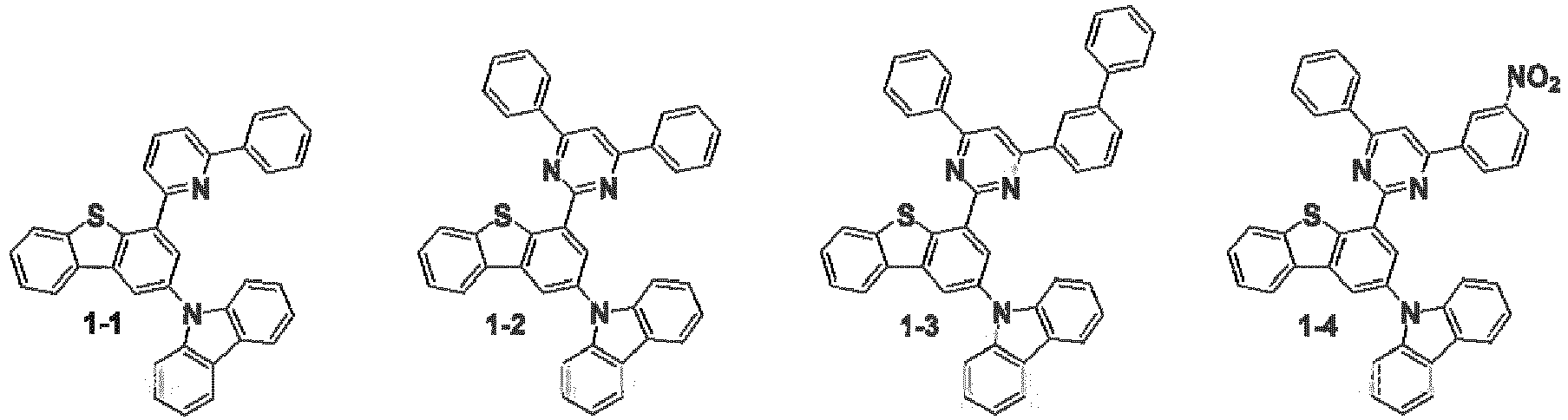


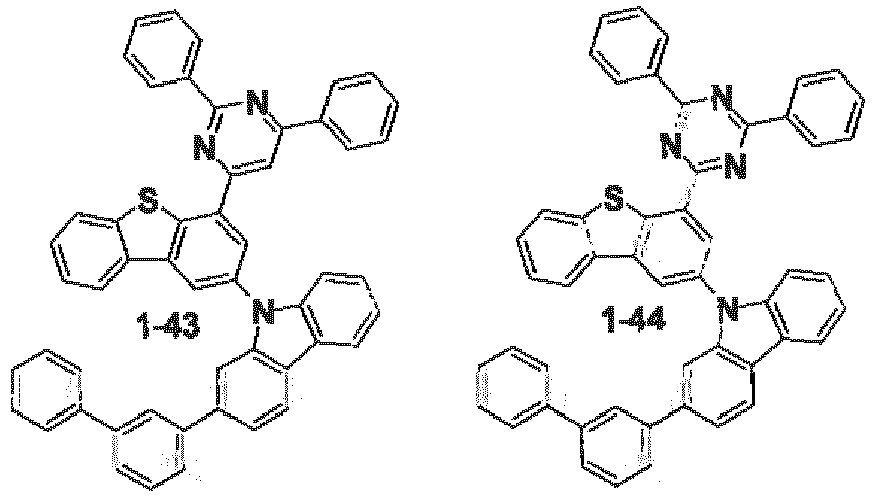


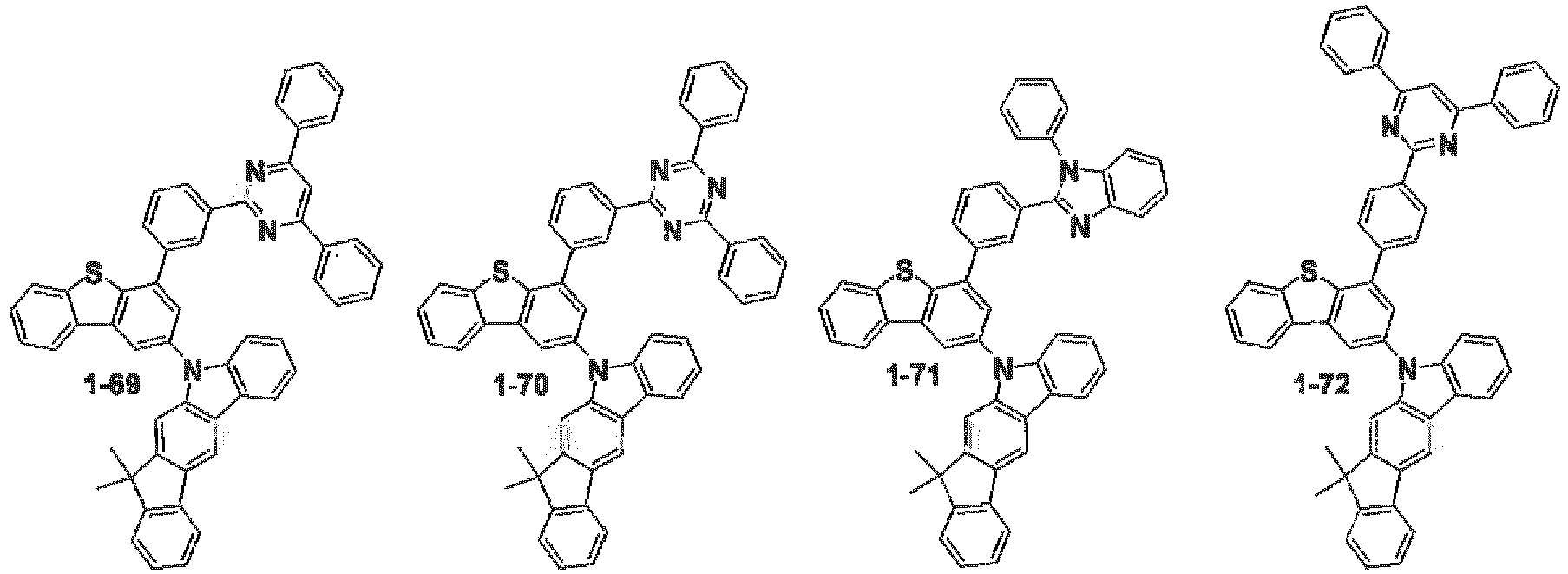


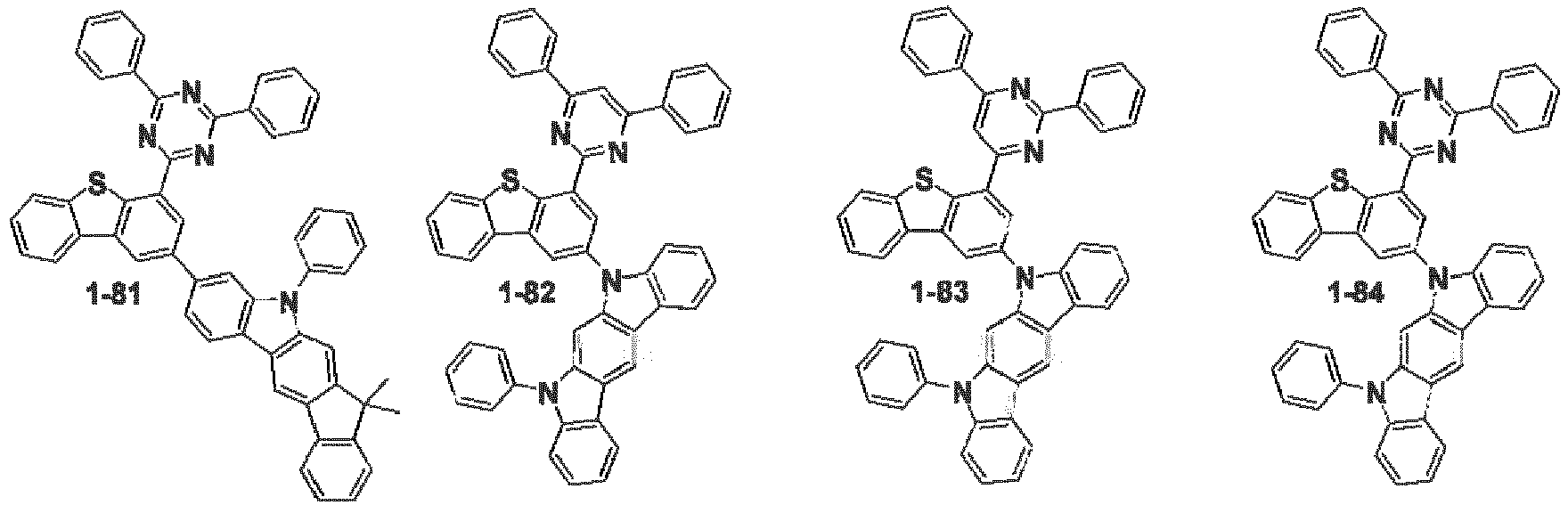


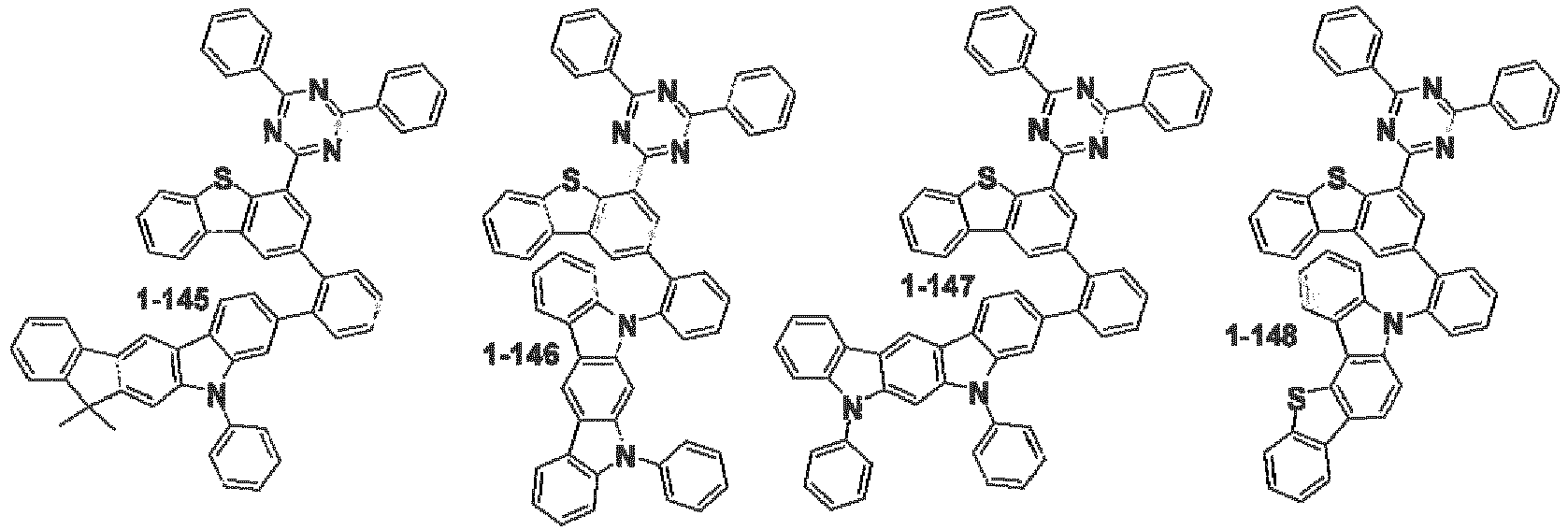

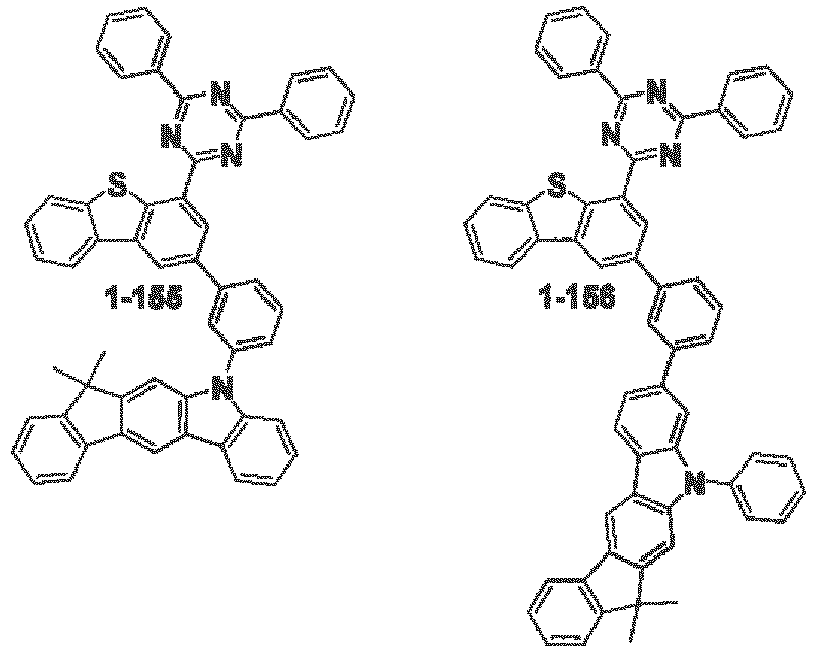


- An organic light emitting device comprising:a positive electrode;a negative electrode; andone or more organic material layers provided between the positive electrode and the negative electrode,wherein one or more layers of the organic material layers comprise the hetero-cyclic compound of claim 1.
- The organic light emitting device of claim 2, wherein the organic material layer comprise at least one layer of a hole blocking layer, an electron injection layer, and an electron transport layer, a hole injection layer, a hole transport layer, and a layer which injects and transports holes simultaneously, and at least one layer of the hole blocking layer, the electron injection layer, and the electron transport layer, a hole injection layer, a hole transport layer, and a layer which injects and transports holes simultaneously comprises the hetero-cyclic compound.
- The organic light emitting device of claim 2, wherein the organic material layer comprises a light emitting layer, and the light emitting layer comprises the hetero-cyclic compound.
- The organic light emitting device of claim 2, wherein the organic material layer comprising the hetero-cyclic compound further comprises a compound represented by the following Chemical Formula 2:
 R1' to R4' are the same as or different from each other, and each independently selected from the group consisting of hydrogen; deuterium; a halogen group; -CN; a substituted or unsubstituted C1 to C60 alkyl group; a substituted or unsubstituted C2 to C60 alkenyl group; a substituted or unsubstituted C2 to C60 alkynyl group; a substituted or unsubstituted C1 to C60 alkoxy group; a substituted or unsubstituted C3 to C60 cycloalkyl group; a substituted or unsubstituted C2 to C60 heterocycloalkyl group; a substituted or unsubstituted C6 to C60 aryl group; a substituted or unsubstituted C2 to C60 heteroaryl group; -SiRR'R"; -P(=O)RR'; and an amine group which is unsubstituted or substituted with a C1 to C20 alkyl group, a substituted or unsubstituted C6 to C60 aryl group, or a C2 to C60 heteroaryl group, or two or more adjacent groups combine with each other to form a substituted or unsubstituted aliphatic or aromatic hydrocarbon ring,L1' is a direct bond or a substituted or unsubstituted C6 to C60 arylene group,Ar1' is a substituted or unsubstituted C6 to C60 aryl group; or a substituted or unsubstituted C2 to C60 heteroaryl group including at least one of S and O,Ar2' is a substituted or unsubstituted C6 to C25 aryl group,R, R', and R" are the same as or different from each other, and each independently hydrogen; deuterium; -CN; a substituted or unsubstituted C1 to C60 alkyl group; a substituted or unsubstituted C3 to C60 cycloalkyl group; a substituted or unsubstituted C6 to C60 aryl group; or a substituted or unsubstituted C2 to C60 heteroaryl group, and m', p' and q' are each independently an integer of 0, andn' is an integer of 0.
 - The organic light emitting device of claim 5, wherein Chemical Formula 2 is represented by any one of the following Chemical Formulae 11 to 22:


- The organic light emitting device of claim 5, wherein Chemical Formula 2 is represented by any one of the following compounds:


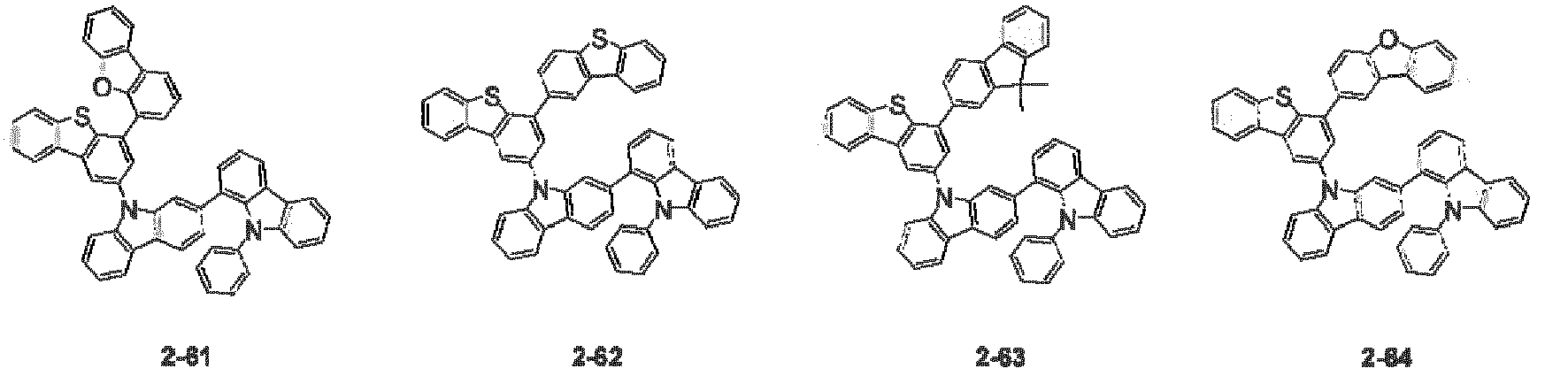


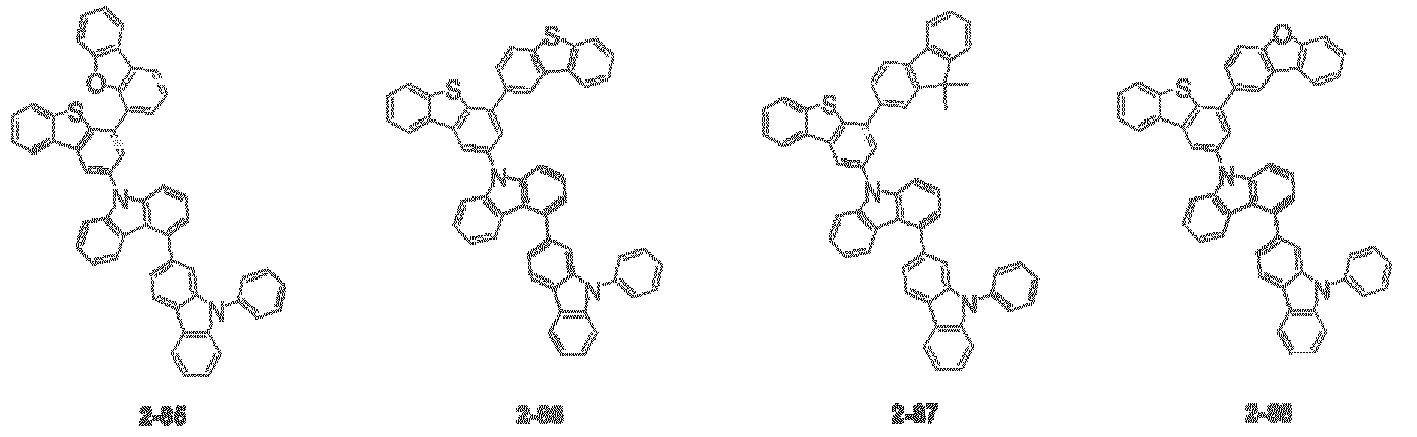


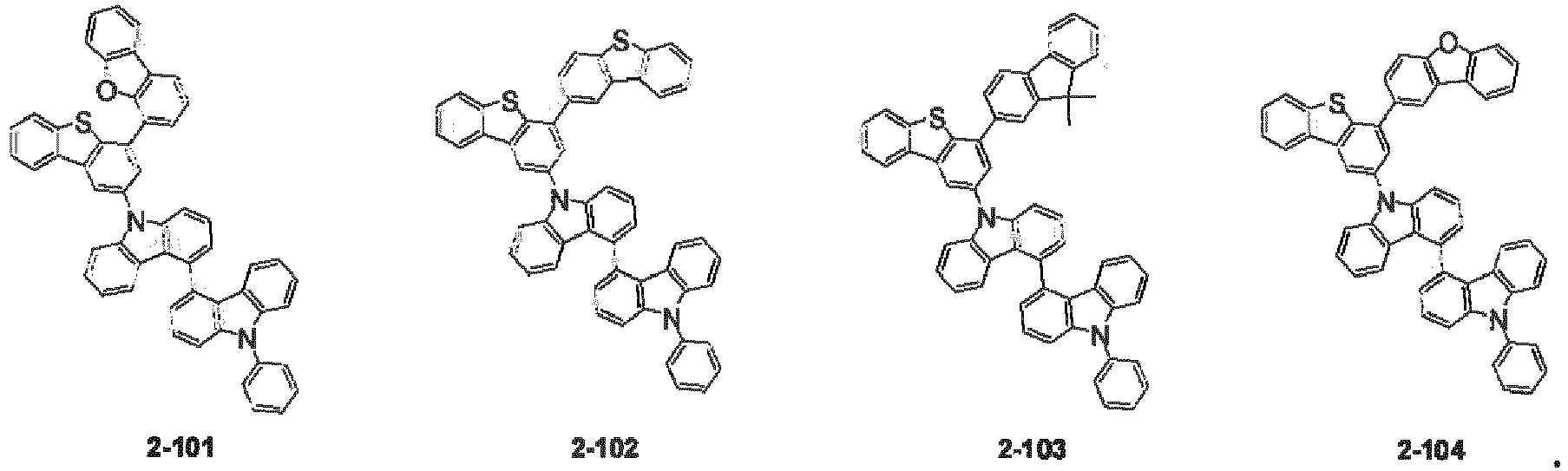
- A composition for an organic material layer of an organic light emitting device, comprising:
both a hetero-cyclic compound represented by the following Chemical Formula 1 and a compound represented by the following Chemical Formula 2:

 L1 and L2 are the same as or different from each other, and each independently a direct bond or a substituted or unsubstituted C6 to C25 arylene group,Ar1 is selected from the group consisting of a substituted or unsubstituted pyridyl group; a substituted or unsubstituted pyrimidyl group; a substituted or unsubstituted triazinyl group; a substituted or unsubstituted quinolyl group; a substituted or unsubstituted quinazolinyl group; a substituted or unsubstituted phenanthrolinyl group; and a substituted or unsubstituted benzeimidazolinyl group,Ar2 is represented by any one of the following Chemical Formulae 3 and 4,
 Y1 to Y4 are the same as or different from each other, and each independently a substituted or unsubstituted C6 to C60 aromatic hydrocarbon ring; or a substituted or unsubstituted C2 to C60 aromatic hetero ring,R1 to R6 are hydrogen,R7 is selected from the group consisting of hydrogen; deuterium; a halogen group; - CN; a substituted or unsubstituted C1 to C60 alkyl group; a substituted or unsubstituted C2 to C60 alkenyl group; a substituted or unsubstituted C2 to C60 alkynyl group; a substituted or unsubstituted C1 to C60 alkoxy group; a substituted or unsubstituted C3 to C60 cycloalkyl group; a substituted or unsubstituted C2 to C60 heterocycloalkyl group; a substituted or unsubstituted C6 to C60 aryl group; a substituted or unsubstituted C2 to C60 heteroaryl group; -SiRR'R"; -P(=O)RR'; and an amine group which is unsubstituted or substituted with a C1 to C20 alkyl group, a substituted or unsubstituted C6 to C60 aryl group, or a C2 to C60 heteroaryl group, or two or more adjacent groups combine with each other to form a substituted or unsubstituted aliphatic or aromatic hydrocarbon ring,L1' is a direct bond or a substituted or unsubstituted C6 to C60 arylene group,Ar1' is a substituted or unsubstituted C6 to C60 aryl group; or a substituted or unsubstituted C2 to C60 heteroaryl group including at least one of S and O,Ar2' is a substituted or unsubstituted C6 to C25 aryl groupR, R', and R" are the same as or different from each other, and each independently hydrogen; deuterium; -CN; a substituted or unsubstituted C1 to C60 alkyl group; a substituted or unsubstituted C3 to C60 cycloalkyl group; a substituted or unsubstituted C6 to C60 aryl group; or a substituted or unsubstituted C2 to C60 heteroaryl group,m', p' and q' are each independently an integer of 0 andn' is an integer of 0.
 - The composition for the organic material layer of the organic light emitting device of claim 10, wherein a weight ratio of the hetero-cyclic compound represented by Chemical Formula 1 : the compound represented by Chemical Formula 2 in the composition is 1 : 10 to 10:1.
Applications Claiming Priority (4)
| Application Number | Priority Date | Filing Date | Title |
|---|---|---|---|
| KR20150106063 | 2015-07-27 | ||
| KR1020160057665A KR101805686B1 (en) | 2015-07-27 | 2016-05-11 | Hetero-cyclic compound and organic light emitting device using the same |
| KR1020160059084A KR101739024B1 (en) | 2015-07-27 | 2016-05-13 | Organic light emitting device and composition for organic layer of organic light emitting device |
| PCT/KR2016/008189 WO2017018795A2 (en) | 2015-07-27 | 2016-07-27 | Heterocyclic compound and organic light emitting diode using same |
Publications (3)
| Publication Number | Publication Date |
|---|---|
| EP3330342A2 EP3330342A2 (en) | 2018-06-06 |
| EP3330342A4 EP3330342A4 (en) | 2019-02-20 |
| EP3330342B1 true EP3330342B1 (en) | 2021-09-15 |
Family
ID=58108986
Family Applications (1)
| Application Number | Title | Priority Date | Filing Date |
|---|---|---|---|
| EP16830828.6A Active EP3330342B1 (en) | 2015-07-27 | 2016-07-27 | Heterocyclic compound and organic light emitting diode using same |
Country Status (6)
| Country | Link |
|---|---|
| US (1) | US10381577B2 (en) |
| EP (1) | EP3330342B1 (en) |
| JP (1) | JP6577133B2 (en) |
| KR (2) | KR101805686B1 (en) |
| CN (1) | CN107922837B (en) |
| TW (1) | TWI653234B (en) |
Families Citing this family (33)
| Publication number | Priority date | Publication date | Assignee | Title |
|---|---|---|---|---|
| CN107922359A (en) * | 2015-07-30 | 2018-04-17 | 默克专利有限公司 | Material for organic electroluminescence device |
| KR101915716B1 (en) * | 2016-12-20 | 2018-11-08 | 희성소재 (주) | Organic light emitting device and composition for organic layer of organic light emitting device |
| KR101943428B1 (en) | 2017-03-24 | 2019-01-30 | 엘티소재주식회사 | Organic light emitting device and composition for organic layer of organic light emitting device |
| KR102017790B1 (en) | 2017-04-13 | 2019-09-03 | 주식회사 엘지화학 | Novel hetero-cyclic compound and organic light emitting device comprising the same |
| KR102146792B1 (en) | 2017-08-01 | 2020-08-21 | 삼성에스디아이 주식회사 | Compound for organic optoelectronic device, and organic optoelectronic device and display device |
| KR102139859B1 (en) | 2017-08-02 | 2020-07-30 | 주식회사 엘지화학 | Hetero-cyclic compound and organic light emitting device comprising the same |
| JP2019036697A (en) | 2017-08-21 | 2019-03-07 | 出光興産株式会社 | Organic electroluminescent element, electronic device, composition, material for organic electroluminescent device, and composition film |
| CN109535138B (en) * | 2017-09-22 | 2021-03-12 | 北京绿人科技有限责任公司 | Triazine compound containing deuterated phenyl, application thereof and organic electroluminescent device |
| CN108424411A (en) * | 2017-09-30 | 2018-08-21 | 北京绿人科技有限责任公司 | Triaizine compounds and its application with symmetrical structure and organic electroluminescence device |
| KR102072923B1 (en) * | 2017-11-03 | 2020-02-10 | 주식회사 엘지화학 | Compound and organic light-emitting device comprising the same |
| WO2019088751A1 (en) * | 2017-11-03 | 2019-05-09 | 주식회사 엘지화학 | Compound and organic light emitting device comprising same |
| EP3502108A1 (en) | 2017-12-20 | 2019-06-26 | Samsung Electronics Co., Ltd. | Condensed cyclic compound, composition including the condensed cyclic compound, and organic light-emitting device including the composition |
| JP7145608B2 (en) * | 2017-12-20 | 2022-10-03 | 三星電子株式会社 | Compound for organic electroluminescence device, liquid composition, ink composition, thin film, and organic electroluminescence device |
| KR102322698B1 (en) | 2018-06-22 | 2021-11-09 | 엘티소재주식회사 | Heterocyclic compound, organic light emitting device comprising the same, composition for organic layer of organic light emitting device and method for manufacturing organic light emitting device |
| KR102262696B1 (en) * | 2018-07-09 | 2021-06-09 | 주식회사 엘지화학 | Compound and organic light emitting device comprising the same |
| US12250879B2 (en) | 2018-09-21 | 2025-03-11 | Lg Chem, Ltd. | Heterocyclic compound and organic light emitting device comprising the same |
| CN111247649B (en) * | 2018-09-28 | 2023-10-13 | Lt素材株式会社 | Heterocyclic compound and organic light-emitting device containing the same |
| KR102805746B1 (en) | 2018-12-05 | 2025-05-14 | 솔브레인 주식회사 | Compound and organic light emitting device comprising the same |
| KR102290359B1 (en) * | 2018-12-11 | 2021-08-19 | 엘티소재주식회사 | Heterocyclic compound, organic light emitting device comprising the same, manufacturing method of the same and composition for organic layer of organic light emitting device |
| KR102703802B1 (en) * | 2018-12-17 | 2024-09-05 | 솔루스첨단소재 주식회사 | Organic compound and organic electroluminescent device using the same |
| KR102312963B1 (en) * | 2018-12-26 | 2021-10-14 | 엘티소재주식회사 | Compound, composition and organic optoelectronic device and display device |
| KR102702683B1 (en) * | 2018-12-28 | 2024-09-03 | 엘지디스플레이 주식회사 | Organic light emitting diode and organic light emitting device including the same |
| CN111384299B (en) * | 2018-12-29 | 2024-02-09 | 固安鼎材科技有限公司 | Organic light-emitting diode and preparation method thereof |
| KR102956394B1 (en) | 2019-01-23 | 2026-04-23 | 솔브레인 주식회사 | Compound and organic light emitting device comprising the same |
| WO2020175779A1 (en) * | 2019-02-28 | 2020-09-03 | 주식회사 엘지화학 | Novel compound and organic light emitting device using same |
| KR102288990B1 (en) * | 2019-02-28 | 2021-08-11 | 주식회사 엘지화학 | Novel compound and organic light emitting device comprising the same |
| CN113015734B (en) * | 2019-03-25 | 2023-10-31 | 株式会社Lg化学 | Heterocyclic compounds and organic light-emitting devices containing the same |
| KR102143580B1 (en) | 2019-08-23 | 2020-08-12 | 엘티소재주식회사 | Organic light emitting device, manufacturing method of the same and composition for organic layer of organic light emitting device |
| CN111018847A (en) * | 2019-10-31 | 2020-04-17 | 陕西莱特光电材料股份有限公司 | Nitrogen-containing compound, electronic component, and electronic device |
| JP2023500759A (en) * | 2019-11-21 | 2023-01-11 | エルティー・マテリアルズ・カンパニー・リミテッド | Heterocyclic compound, organic light-emitting device containing the same, composition for organic layer of organic light-emitting device, and method for manufacturing organic light-emitting device |
| CN114846010A (en) * | 2019-12-30 | 2022-08-02 | Lt素材株式会社 | Heterocyclic compound, organic light-emitting device comprising same, method for producing same, and composition for organic layer |
| KR102713662B1 (en) * | 2020-06-26 | 2024-10-10 | 엘티소재주식회사 | Compound and organic light emitting device including the same |
| US12546012B2 (en) * | 2020-10-30 | 2026-02-10 | Nippon Steel Corporation | Zn-plated hot stamped product |
Family Cites Families (21)
| Publication number | Priority date | Publication date | Assignee | Title |
|---|---|---|---|---|
| US4356429A (en) | 1980-07-17 | 1982-10-26 | Eastman Kodak Company | Organic electroluminescent cell |
| JP2009267255A (en) | 2008-04-28 | 2009-11-12 | Idemitsu Kosan Co Ltd | Material for organic electroluminescent element and organic electroluminescent element using the material |
| WO2011004639A1 (en) * | 2009-07-07 | 2011-01-13 | コニカミノルタホールディングス株式会社 | Organic electroluminescent element, novel compound, lighting device and display device |
| KR20110112098A (en) | 2010-04-06 | 2011-10-12 | 다우어드밴스드디스플레이머티리얼 유한회사 | Novel organic light emitting compound and organic electroluminescent device employing the same |
| US8227801B2 (en) | 2010-04-26 | 2012-07-24 | Universal Display Corporation | Bicarbzole containing compounds for OLEDs |
| JP5708176B2 (en) | 2011-04-13 | 2015-04-30 | コニカミノルタ株式会社 | ORGANIC ELECTROLUMINESCENT ELEMENT MATERIAL, ORGANIC ELECTROLUMINESCENT ELEMENT, DISPLAY DEVICE AND LIGHTING DEVICE |
| JP5862079B2 (en) | 2011-07-06 | 2016-02-16 | コニカミノルタ株式会社 | Organic electroluminescence element, display device and lighting device |
| JP5978843B2 (en) * | 2012-02-02 | 2016-08-24 | コニカミノルタ株式会社 | Iridium complex compound, organic electroluminescence device material, organic electroluminescence device, lighting device and display device |
| WO2013168534A1 (en) * | 2012-05-09 | 2013-11-14 | コニカミノルタ株式会社 | Organic electroluminescence element, production method for organic electroluminescence element, display device, and illumination device |
| WO2014024668A1 (en) * | 2012-08-07 | 2014-02-13 | コニカミノルタ株式会社 | Organic electroluminescent element, lighting device and display device |
| KR101578475B1 (en) | 2012-08-27 | 2015-12-21 | 덕산네오룩스 주식회사 | Compound Containing Dibenzothiophene, Arylamine Derivatives And Organic Electronic Element Using The Same, Terminal Thereof |
| EP2930762B1 (en) | 2012-12-10 | 2020-09-16 | Konica Minolta, Inc. | Material for organic electroluminescent element, organic electroluminescent element, illumination device, and display device |
| KR101499102B1 (en) * | 2013-04-11 | 2015-03-05 | (주)피엔에이치테크 | Novel compound for organic electroluminescent device and organic electroluminescent device comprising the same |
| WO2014167610A1 (en) * | 2013-04-12 | 2014-10-16 | ロート製薬株式会社 | Composition for contact lens, and contact lens package using same |
| US9761807B2 (en) * | 2013-07-15 | 2017-09-12 | Universal Display Corporation | Organic light emitting diode materials |
| JP2014017494A (en) * | 2013-08-15 | 2014-01-30 | Konica Minolta Inc | Organic electroluminescent element, and display device and illuminating device including the element |
| JP6265787B2 (en) * | 2014-03-07 | 2018-01-24 | 前田建設工業株式会社 | Device for calculating compaction characteristics of fresh concrete |
| EP2991128B1 (en) | 2014-08-29 | 2017-04-12 | Samsung Electronics Co., Ltd. | Organic light-emitting device |
| US10741772B2 (en) | 2014-08-29 | 2020-08-11 | Samsung Electronics Co., Ltd. | Organic light-emitting device |
| JP5831654B1 (en) * | 2015-02-13 | 2015-12-09 | コニカミノルタ株式会社 | Aromatic heterocycle derivative, organic electroluminescence device using the same, illumination device and display device |
| KR101693744B1 (en) | 2016-05-11 | 2017-02-06 | 희성소재 (주) | Hetero-cyclic compound and organic light emitting device using the same |
-
2016
- 2016-05-11 KR KR1020160057665A patent/KR101805686B1/en active Active
- 2016-05-13 KR KR1020160059084A patent/KR101739024B1/en active Active
- 2016-07-27 EP EP16830828.6A patent/EP3330342B1/en active Active
- 2016-07-27 US US15/321,397 patent/US10381577B2/en active Active
- 2016-07-27 JP JP2018504172A patent/JP6577133B2/en active Active
- 2016-07-27 TW TW105123776A patent/TWI653234B/en active
- 2016-07-27 CN CN201680048392.6A patent/CN107922837B/en active Active
Also Published As
| Publication number | Publication date |
|---|---|
| EP3330342A4 (en) | 2019-02-20 |
| US20170213988A1 (en) | 2017-07-27 |
| KR101805686B1 (en) | 2017-12-07 |
| TWI653234B (en) | 2019-03-11 |
| KR101739024B1 (en) | 2017-05-24 |
| CN107922837B (en) | 2021-02-26 |
| JP6577133B2 (en) | 2019-09-18 |
| TW201708212A (en) | 2017-03-01 |
| US10381577B2 (en) | 2019-08-13 |
| KR20170013153A (en) | 2017-02-06 |
| JP2018522898A (en) | 2018-08-16 |
| KR20170013152A (en) | 2017-02-06 |
| EP3330342A2 (en) | 2018-06-06 |
| CN107922837A (en) | 2018-04-17 |
Similar Documents
| Publication | Publication Date | Title |
|---|---|---|
| EP3330342A2 (en) | Heterocyclic compound and organic light emitting diode using same | |
| EP3561891B1 (en) | Organic light emitting element and composition for organic material layer of organic light emitting element | |
| KR102768679B1 (en) | Organic light emitting device, composition for organic layer of organic light emitting device and manufacturing method of organic light emitting device | |
| EP3604296B1 (en) | Organic light emitting element and composition for organic material layer in organic light emitting element | |
| EP3611173B1 (en) | Organic light emitting element and composition for organic material layer in organic light emitting element | |
| KR101964097B1 (en) | Organic light emitting device | |
| EP4190779A1 (en) | Heterocyclic compound, organic light-emitting device comprising same, and composition for organic layer of organic light-emitting device | |
| EP3392246A1 (en) | Heterocyclic compound and organic light emitting element using same | |
| EP3243820B1 (en) | Hetero-cyclic compound and organic light emitting device using the same | |
| EP4032876A1 (en) | Heterocyclic compound and organic light-emitting device comprising same | |
| EP4056566A1 (en) | Heterocyclic compound, organic light-emitting device comprising same, composition for organic material layer of organic light-emitting device, and method for manufacturing organic light-emitting device | |
| EP3483146B1 (en) | Heterocyclic compound and organic light emitting device using same | |
| KR20180071609A (en) | Hetero-cyclic compound and organic light emitting device using the same | |
| EP4148057B1 (en) | Benzofurocarbazole compound and organic light emitting device | |
| KR102140189B1 (en) | Hetero-cyclic compound and organic light emitting device using the same | |
| US20250287838A1 (en) | Heterocyclic compound, organic light-emitting element comprising same, and composition for organic material layer | |
| KR102900160B1 (en) | Heterocyclic compound, organic light emitting device comprising same and composition for organic layer | |
| KR102467479B1 (en) | Heterocyclic compound, organic light emitting device comprising same and and composition for organic layer of organic light emitting device | |
| EP4682224A1 (en) | Heterocyclic compound, organic light emitting device comprising the same and composition for organic material layer | |
| KR20250075184A (en) | Compound, organic light emitting device and composition for organic material layer of organic light emitting device | |
| TW202340176A (en) | Heterocyclic compound, organic light emitting device comprising same and composition for organic material layer of organic light emitting device | |
| KR20220063432A (en) | Organic light emitting device and composition for organic layer of organic light emitting device |
Legal Events
| Date | Code | Title | Description |
|---|---|---|---|
| STAA | Information on the status of an ep patent application or granted ep patent |
Free format text: STATUS: THE INTERNATIONAL PUBLICATION HAS BEEN MADE |
|
| PUAI | Public reference made under article 153(3) epc to a published international application that has entered the european phase |
Free format text: ORIGINAL CODE: 0009012 |
|
| STAA | Information on the status of an ep patent application or granted ep patent |
Free format text: STATUS: REQUEST FOR EXAMINATION WAS MADE |
|
| 17P | Request for examination filed |
Effective date: 20180123 |
|
| AK | Designated contracting states |
Kind code of ref document: A2 Designated state(s): AL AT BE BG CH CY CZ DE DK EE ES FI FR GB GR HR HU IE IS IT LI LT LU LV MC MK MT NL NO PL PT RO RS SE SI SK SM TR |
|
| AX | Request for extension of the european patent |
Extension state: BA ME |
|
| RIN1 | Information on inventor provided before grant (corrected) |
Inventor name: OH, HAN-KOOK Inventor name: CHOI, DAE-HYUK Inventor name: CHOI, JIN-SEOK Inventor name: LEE, YUN-JI Inventor name: PARK, GEON-YU Inventor name: MA, JAE-YEOL Inventor name: LEE, JOO-DONG Inventor name: KIM, DONG-JUN |
|
| DAV | Request for validation of the european patent (deleted) | ||
| DAX | Request for extension of the european patent (deleted) | ||
| A4 | Supplementary search report drawn up and despatched |
Effective date: 20190117 |
|
| RIC1 | Information provided on ipc code assigned before grant |
Ipc: C07D 409/14 20060101ALI20190111BHEP Ipc: C07D 491/04 20060101ALI20190111BHEP Ipc: C07D 333/76 20060101ALI20190111BHEP Ipc: H01L 51/00 20060101ALI20190111BHEP Ipc: C07D 209/82 20060101ALI20190111BHEP Ipc: C09K 11/06 20060101AFI20190111BHEP Ipc: C07D 495/04 20060101ALI20190111BHEP Ipc: C07D 487/04 20060101ALI20190111BHEP |
|
| TPAC | Observations filed by third parties |
Free format text: ORIGINAL CODE: EPIDOSNTIPA |
|
| STAA | Information on the status of an ep patent application or granted ep patent |
Free format text: STATUS: EXAMINATION IS IN PROGRESS |
|
| 17Q | First examination report despatched |
Effective date: 20200103 |
|
| RAP1 | Party data changed (applicant data changed or rights of an application transferred) |
Owner name: LT MATERIALS CO., LTD. |
|
| REG | Reference to a national code |
Ref country code: DE Ref legal event code: R079 Ref document number: 602016063817 Country of ref document: DE Free format text: PREVIOUS MAIN CLASS: C09K0011060000 Ipc: C07D0409140000 |
|
| GRAP | Despatch of communication of intention to grant a patent |
Free format text: ORIGINAL CODE: EPIDOSNIGR1 |
|
| STAA | Information on the status of an ep patent application or granted ep patent |
Free format text: STATUS: GRANT OF PATENT IS INTENDED |
|
| RIC1 | Information provided on ipc code assigned before grant |
Ipc: H01L 51/00 20060101ALI20210528BHEP Ipc: C09K 11/06 20060101ALI20210528BHEP Ipc: C07D 495/04 20060101ALI20210528BHEP Ipc: C07D 491/04 20060101ALI20210528BHEP Ipc: C07D 487/04 20060101ALI20210528BHEP Ipc: C07D 409/14 20060101AFI20210528BHEP |
|
| INTG | Intention to grant announced |
Effective date: 20210707 |
|
| GRAS | Grant fee paid |
Free format text: ORIGINAL CODE: EPIDOSNIGR3 |
|
| GRAA | (expected) grant |
Free format text: ORIGINAL CODE: 0009210 |
|
| STAA | Information on the status of an ep patent application or granted ep patent |
Free format text: STATUS: THE PATENT HAS BEEN GRANTED |
|
| AK | Designated contracting states |
Kind code of ref document: B1 Designated state(s): AL AT BE BG CH CY CZ DE DK EE ES FI FR GB GR HR HU IE IS IT LI LT LU LV MC MK MT NL NO PL PT RO RS SE SI SK SM TR |
|
| REG | Reference to a national code |
Ref country code: CH Ref legal event code: EP |
|
| REG | Reference to a national code |
Ref country code: DE Ref legal event code: R096 Ref document number: 602016063817 Country of ref document: DE |
|
| REG | Reference to a national code |
Ref country code: IE Ref legal event code: FG4D |
|
| REG | Reference to a national code |
Ref country code: AT Ref legal event code: REF Ref document number: 1430453 Country of ref document: AT Kind code of ref document: T Effective date: 20211015 |
|
| REG | Reference to a national code |
Ref country code: LT Ref legal event code: MG9D |
|
| REG | Reference to a national code |
Ref country code: NL Ref legal event code: MP Effective date: 20210915 |
|
| PG25 | Lapsed in a contracting state [announced via postgrant information from national office to epo] |
Ref country code: RS Free format text: LAPSE BECAUSE OF FAILURE TO SUBMIT A TRANSLATION OF THE DESCRIPTION OR TO PAY THE FEE WITHIN THE PRESCRIBED TIME-LIMIT Effective date: 20210915 Ref country code: SE Free format text: LAPSE BECAUSE OF FAILURE TO SUBMIT A TRANSLATION OF THE DESCRIPTION OR TO PAY THE FEE WITHIN THE PRESCRIBED TIME-LIMIT Effective date: 20210915 Ref country code: LT Free format text: LAPSE BECAUSE OF FAILURE TO SUBMIT A TRANSLATION OF THE DESCRIPTION OR TO PAY THE FEE WITHIN THE PRESCRIBED TIME-LIMIT Effective date: 20210915 Ref country code: BG Free format text: LAPSE BECAUSE OF FAILURE TO SUBMIT A TRANSLATION OF THE DESCRIPTION OR TO PAY THE FEE WITHIN THE PRESCRIBED TIME-LIMIT Effective date: 20211215 Ref country code: NO Free format text: LAPSE BECAUSE OF FAILURE TO SUBMIT A TRANSLATION OF THE DESCRIPTION OR TO PAY THE FEE WITHIN THE PRESCRIBED TIME-LIMIT Effective date: 20211215 Ref country code: HR Free format text: LAPSE BECAUSE OF FAILURE TO SUBMIT A TRANSLATION OF THE DESCRIPTION OR TO PAY THE FEE WITHIN THE PRESCRIBED TIME-LIMIT Effective date: 20210915 Ref country code: FI Free format text: LAPSE BECAUSE OF FAILURE TO SUBMIT A TRANSLATION OF THE DESCRIPTION OR TO PAY THE FEE WITHIN THE PRESCRIBED TIME-LIMIT Effective date: 20210915 |
|
| REG | Reference to a national code |
Ref country code: AT Ref legal event code: MK05 Ref document number: 1430453 Country of ref document: AT Kind code of ref document: T Effective date: 20210915 |
|
| PG25 | Lapsed in a contracting state [announced via postgrant information from national office to epo] |
Ref country code: LV Free format text: LAPSE BECAUSE OF FAILURE TO SUBMIT A TRANSLATION OF THE DESCRIPTION OR TO PAY THE FEE WITHIN THE PRESCRIBED TIME-LIMIT Effective date: 20210915 Ref country code: GR Free format text: LAPSE BECAUSE OF FAILURE TO SUBMIT A TRANSLATION OF THE DESCRIPTION OR TO PAY THE FEE WITHIN THE PRESCRIBED TIME-LIMIT Effective date: 20211216 |
|
| PG25 | Lapsed in a contracting state [announced via postgrant information from national office to epo] |
Ref country code: AT Free format text: LAPSE BECAUSE OF FAILURE TO SUBMIT A TRANSLATION OF THE DESCRIPTION OR TO PAY THE FEE WITHIN THE PRESCRIBED TIME-LIMIT Effective date: 20210915 |
|
| PG25 | Lapsed in a contracting state [announced via postgrant information from national office to epo] |
Ref country code: IS Free format text: LAPSE BECAUSE OF FAILURE TO SUBMIT A TRANSLATION OF THE DESCRIPTION OR TO PAY THE FEE WITHIN THE PRESCRIBED TIME-LIMIT Effective date: 20220115 Ref country code: SM Free format text: LAPSE BECAUSE OF FAILURE TO SUBMIT A TRANSLATION OF THE DESCRIPTION OR TO PAY THE FEE WITHIN THE PRESCRIBED TIME-LIMIT Effective date: 20210915 Ref country code: SK Free format text: LAPSE BECAUSE OF FAILURE TO SUBMIT A TRANSLATION OF THE DESCRIPTION OR TO PAY THE FEE WITHIN THE PRESCRIBED TIME-LIMIT Effective date: 20210915 Ref country code: RO Free format text: LAPSE BECAUSE OF FAILURE TO SUBMIT A TRANSLATION OF THE DESCRIPTION OR TO PAY THE FEE WITHIN THE PRESCRIBED TIME-LIMIT Effective date: 20210915 Ref country code: PT Free format text: LAPSE BECAUSE OF FAILURE TO SUBMIT A TRANSLATION OF THE DESCRIPTION OR TO PAY THE FEE WITHIN THE PRESCRIBED TIME-LIMIT Effective date: 20220117 Ref country code: PL Free format text: LAPSE BECAUSE OF FAILURE TO SUBMIT A TRANSLATION OF THE DESCRIPTION OR TO PAY THE FEE WITHIN THE PRESCRIBED TIME-LIMIT Effective date: 20210915 Ref country code: NL Free format text: LAPSE BECAUSE OF FAILURE TO SUBMIT A TRANSLATION OF THE DESCRIPTION OR TO PAY THE FEE WITHIN THE PRESCRIBED TIME-LIMIT Effective date: 20210915 Ref country code: ES Free format text: LAPSE BECAUSE OF FAILURE TO SUBMIT A TRANSLATION OF THE DESCRIPTION OR TO PAY THE FEE WITHIN THE PRESCRIBED TIME-LIMIT Effective date: 20210915 Ref country code: EE Free format text: LAPSE BECAUSE OF FAILURE TO SUBMIT A TRANSLATION OF THE DESCRIPTION OR TO PAY THE FEE WITHIN THE PRESCRIBED TIME-LIMIT Effective date: 20210915 Ref country code: CZ Free format text: LAPSE BECAUSE OF FAILURE TO SUBMIT A TRANSLATION OF THE DESCRIPTION OR TO PAY THE FEE WITHIN THE PRESCRIBED TIME-LIMIT Effective date: 20210915 Ref country code: AL Free format text: LAPSE BECAUSE OF FAILURE TO SUBMIT A TRANSLATION OF THE DESCRIPTION OR TO PAY THE FEE WITHIN THE PRESCRIBED TIME-LIMIT Effective date: 20210915 |
|
| REG | Reference to a national code |
Ref country code: DE Ref legal event code: R097 Ref document number: 602016063817 Country of ref document: DE |
|
| PLBE | No opposition filed within time limit |
Free format text: ORIGINAL CODE: 0009261 |
|
| STAA | Information on the status of an ep patent application or granted ep patent |
Free format text: STATUS: NO OPPOSITION FILED WITHIN TIME LIMIT |
|
| PG25 | Lapsed in a contracting state [announced via postgrant information from national office to epo] |
Ref country code: DK Free format text: LAPSE BECAUSE OF FAILURE TO SUBMIT A TRANSLATION OF THE DESCRIPTION OR TO PAY THE FEE WITHIN THE PRESCRIBED TIME-LIMIT Effective date: 20210915 |
|
| 26N | No opposition filed |
Effective date: 20220616 |
|
| PG25 | Lapsed in a contracting state [announced via postgrant information from national office to epo] |
Ref country code: SI Free format text: LAPSE BECAUSE OF FAILURE TO SUBMIT A TRANSLATION OF THE DESCRIPTION OR TO PAY THE FEE WITHIN THE PRESCRIBED TIME-LIMIT Effective date: 20210915 |
|
| PG25 | Lapsed in a contracting state [announced via postgrant information from national office to epo] |
Ref country code: IT Free format text: LAPSE BECAUSE OF FAILURE TO SUBMIT A TRANSLATION OF THE DESCRIPTION OR TO PAY THE FEE WITHIN THE PRESCRIBED TIME-LIMIT Effective date: 20210915 |
|
| PG25 | Lapsed in a contracting state [announced via postgrant information from national office to epo] |
Ref country code: MC Free format text: LAPSE BECAUSE OF FAILURE TO SUBMIT A TRANSLATION OF THE DESCRIPTION OR TO PAY THE FEE WITHIN THE PRESCRIBED TIME-LIMIT Effective date: 20210915 |
|
| REG | Reference to a national code |
Ref country code: CH Ref legal event code: PL |
|
| GBPC | Gb: european patent ceased through non-payment of renewal fee |
Effective date: 20220727 |
|
| REG | Reference to a national code |
Ref country code: BE Ref legal event code: MM Effective date: 20220731 |
|
| PG25 | Lapsed in a contracting state [announced via postgrant information from national office to epo] |
Ref country code: LU Free format text: LAPSE BECAUSE OF NON-PAYMENT OF DUE FEES Effective date: 20220727 Ref country code: LI Free format text: LAPSE BECAUSE OF NON-PAYMENT OF DUE FEES Effective date: 20220731 Ref country code: CH Free format text: LAPSE BECAUSE OF NON-PAYMENT OF DUE FEES Effective date: 20220731 |
|
| PG25 | Lapsed in a contracting state [announced via postgrant information from national office to epo] |
Ref country code: GB Free format text: LAPSE BECAUSE OF NON-PAYMENT OF DUE FEES Effective date: 20220727 Ref country code: BE Free format text: LAPSE BECAUSE OF NON-PAYMENT OF DUE FEES Effective date: 20220731 |
|
| P01 | Opt-out of the competence of the unified patent court (upc) registered |
Effective date: 20230530 |
|
| PG25 | Lapsed in a contracting state [announced via postgrant information from national office to epo] |
Ref country code: IE Free format text: LAPSE BECAUSE OF NON-PAYMENT OF DUE FEES Effective date: 20220727 |
|
| PG25 | Lapsed in a contracting state [announced via postgrant information from national office to epo] |
Ref country code: HU Free format text: LAPSE BECAUSE OF FAILURE TO SUBMIT A TRANSLATION OF THE DESCRIPTION OR TO PAY THE FEE WITHIN THE PRESCRIBED TIME-LIMIT; INVALID AB INITIO Effective date: 20160727 |
|
| PG25 | Lapsed in a contracting state [announced via postgrant information from national office to epo] |
Ref country code: MK Free format text: LAPSE BECAUSE OF FAILURE TO SUBMIT A TRANSLATION OF THE DESCRIPTION OR TO PAY THE FEE WITHIN THE PRESCRIBED TIME-LIMIT Effective date: 20210915 Ref country code: CY Free format text: LAPSE BECAUSE OF FAILURE TO SUBMIT A TRANSLATION OF THE DESCRIPTION OR TO PAY THE FEE WITHIN THE PRESCRIBED TIME-LIMIT Effective date: 20210915 |
|
| PG25 | Lapsed in a contracting state [announced via postgrant information from national office to epo] |
Ref country code: MT Free format text: LAPSE BECAUSE OF FAILURE TO SUBMIT A TRANSLATION OF THE DESCRIPTION OR TO PAY THE FEE WITHIN THE PRESCRIBED TIME-LIMIT Effective date: 20210915 |
|
| PGFP | Annual fee paid to national office [announced via postgrant information from national office to epo] |
Ref country code: FR Payment date: 20250610 Year of fee payment: 10 |
|
| PGFP | Annual fee paid to national office [announced via postgrant information from national office to epo] |
Ref country code: DE Payment date: 20250604 Year of fee payment: 10 |
|
| PG25 | Lapsed in a contracting state [announced via postgrant information from national office to epo] |
Ref country code: TR Free format text: LAPSE BECAUSE OF FAILURE TO SUBMIT A TRANSLATION OF THE DESCRIPTION OR TO PAY THE FEE WITHIN THE PRESCRIBED TIME-LIMIT Effective date: 20210915 |