EP3329255B1 - Verfahren zur erkennung von oxidierenden spezies - Google Patents
Verfahren zur erkennung von oxidierenden spezies Download PDFInfo
- Publication number
- EP3329255B1 EP3329255B1 EP16744775.4A EP16744775A EP3329255B1 EP 3329255 B1 EP3329255 B1 EP 3329255B1 EP 16744775 A EP16744775 A EP 16744775A EP 3329255 B1 EP3329255 B1 EP 3329255B1
- Authority
- EP
- European Patent Office
- Prior art keywords
- agent
- photoluminescent
- oxidizing species
- sample
- nanoparticles
- Prior art date
- Legal status (The legal status is an assumption and is not a legal conclusion. Google has not performed a legal analysis and makes no representation as to the accuracy of the status listed.)
- Not-in-force
Links
Images



Classifications
-
- G—PHYSICS
- G01—MEASURING; TESTING
- G01N—INVESTIGATING OR ANALYSING MATERIALS BY DETERMINING THEIR CHEMICAL OR PHYSICAL PROPERTIES
- G01N33/00—Investigating or analysing materials by specific methods not covered by groups G01N1/00 - G01N31/00
- G01N33/48—Biological material, e.g. blood, urine; Haemocytometers
- G01N33/50—Chemical analysis of biological material, e.g. blood, urine; Testing involving biospecific ligand binding methods; Immunological testing
- G01N33/58—Chemical analysis of biological material, e.g. blood, urine; Testing involving biospecific ligand binding methods; Immunological testing involving labelled substances
- G01N33/582—Chemical analysis of biological material, e.g. blood, urine; Testing involving biospecific ligand binding methods; Immunological testing involving labelled substances with fluorescent label
-
- G—PHYSICS
- G01—MEASURING; TESTING
- G01N—INVESTIGATING OR ANALYSING MATERIALS BY DETERMINING THEIR CHEMICAL OR PHYSICAL PROPERTIES
- G01N21/00—Investigating or analysing materials by the use of optical means, i.e. using sub-millimetre waves, infrared, visible or ultraviolet light
- G01N21/62—Systems in which the material investigated is excited whereby it emits light or causes a change in wavelength of the incident light
- G01N21/63—Systems in which the material investigated is excited whereby it emits light or causes a change in wavelength of the incident light optically excited
- G01N21/64—Fluorescence; Phosphorescence
- G01N21/6428—Measuring fluorescence of fluorescent products of reactions or of fluorochrome labelled reactive substances, e.g. measuring quenching effects, using measuring "optrodes"
-
- G—PHYSICS
- G01—MEASURING; TESTING
- G01N—INVESTIGATING OR ANALYSING MATERIALS BY DETERMINING THEIR CHEMICAL OR PHYSICAL PROPERTIES
- G01N21/00—Investigating or analysing materials by the use of optical means, i.e. using sub-millimetre waves, infrared, visible or ultraviolet light
- G01N21/62—Systems in which the material investigated is excited whereby it emits light or causes a change in wavelength of the incident light
- G01N21/63—Systems in which the material investigated is excited whereby it emits light or causes a change in wavelength of the incident light optically excited
- G01N21/64—Fluorescence; Phosphorescence
- G01N21/645—Specially adapted constructive features of fluorimeters
- G01N21/6456—Spatial resolved fluorescence measurements; Imaging
- G01N21/6458—Fluorescence microscopy
-
- G—PHYSICS
- G01—MEASURING; TESTING
- G01N—INVESTIGATING OR ANALYSING MATERIALS BY DETERMINING THEIR CHEMICAL OR PHYSICAL PROPERTIES
- G01N21/00—Investigating or analysing materials by the use of optical means, i.e. using sub-millimetre waves, infrared, visible or ultraviolet light
- G01N21/62—Systems in which the material investigated is excited whereby it emits light or causes a change in wavelength of the incident light
- G01N21/63—Systems in which the material investigated is excited whereby it emits light or causes a change in wavelength of the incident light optically excited
- G01N21/64—Fluorescence; Phosphorescence
- G01N21/6489—Photoluminescence of semiconductors
-
- G—PHYSICS
- G01—MEASURING; TESTING
- G01N—INVESTIGATING OR ANALYSING MATERIALS BY DETERMINING THEIR CHEMICAL OR PHYSICAL PROPERTIES
- G01N33/00—Investigating or analysing materials by specific methods not covered by groups G01N1/00 - G01N31/00
- G01N33/48—Biological material, e.g. blood, urine; Haemocytometers
- G01N33/50—Chemical analysis of biological material, e.g. blood, urine; Testing involving biospecific ligand binding methods; Immunological testing
- G01N33/5005—Chemical analysis of biological material, e.g. blood, urine; Testing involving biospecific ligand binding methods; Immunological testing involving human or animal cells
- G01N33/5008—Chemical analysis of biological material, e.g. blood, urine; Testing involving biospecific ligand binding methods; Immunological testing involving human or animal cells for testing or evaluating the effect of chemical or biological compounds, e.g. drugs, cosmetics
- G01N33/502—Chemical analysis of biological material, e.g. blood, urine; Testing involving biospecific ligand binding methods; Immunological testing involving human or animal cells for testing or evaluating the effect of chemical or biological compounds, e.g. drugs, cosmetics for testing non-proliferative effects
- G01N33/5038—Chemical analysis of biological material, e.g. blood, urine; Testing involving biospecific ligand binding methods; Immunological testing involving human or animal cells for testing or evaluating the effect of chemical or biological compounds, e.g. drugs, cosmetics for testing non-proliferative effects involving detection of metabolites per se
-
- G—PHYSICS
- G01—MEASURING; TESTING
- G01N—INVESTIGATING OR ANALYSING MATERIALS BY DETERMINING THEIR CHEMICAL OR PHYSICAL PROPERTIES
- G01N33/00—Investigating or analysing materials by specific methods not covered by groups G01N1/00 - G01N31/00
- G01N33/48—Biological material, e.g. blood, urine; Haemocytometers
- G01N33/50—Chemical analysis of biological material, e.g. blood, urine; Testing involving biospecific ligand binding methods; Immunological testing
- G01N33/5005—Chemical analysis of biological material, e.g. blood, urine; Testing involving biospecific ligand binding methods; Immunological testing involving human or animal cells
- G01N33/5091—Chemical analysis of biological material, e.g. blood, urine; Testing involving biospecific ligand binding methods; Immunological testing involving human or animal cells for testing the pathological state of an organism
-
- G—PHYSICS
- G01—MEASURING; TESTING
- G01N—INVESTIGATING OR ANALYSING MATERIALS BY DETERMINING THEIR CHEMICAL OR PHYSICAL PROPERTIES
- G01N2458/00—Labels used in chemical analysis of biological material
- G01N2458/30—Electrochemically active labels
-
- G—PHYSICS
- G01—MEASURING; TESTING
- G01N—INVESTIGATING OR ANALYSING MATERIALS BY DETERMINING THEIR CHEMICAL OR PHYSICAL PROPERTIES
- G01N2458/00—Labels used in chemical analysis of biological material
- G01N2458/40—Rare earth chelates
-
- G—PHYSICS
- G01—MEASURING; TESTING
- G01N—INVESTIGATING OR ANALYSING MATERIALS BY DETERMINING THEIR CHEMICAL OR PHYSICAL PROPERTIES
- G01N2800/00—Detection or diagnosis of diseases
- G01N2800/70—Mechanisms involved in disease identification
- G01N2800/7004—Stress
- G01N2800/7009—Oxidative stress
Definitions
- the invention relates to a method useful for the analysis of oxidizing species and to a system for detecting oxidizing species, suitable for carrying out this method.
- the more particularly targeted oxidizing species are in particular cellular messengers involved in various signaling pathways. Their regulation is essential in immune reactions and in pathologies such as certain cancers, cardiovascular diseases or neurodegenerative diseases. It is therefore particularly advantageous to have available effective methods for determining the presence, quantifying this presence and the time course of the concentration of oxidizing species in a sample to be tested, in particular in a biological sample.
- Requirement FR-A-2 980 847 thus presents, by way of example, an explosives detection method based on the detection of oxidizing species.
- organic fluorescent agent or fluorophore
- DiChlorofluorescein is an example of such an organic fluorescent agent, the fluorescence of which is enhanced in the presence of an oxidant, which can be used in a living medium.
- a fluorescent protein as a fluorescent agent, in particular in a genetically modified organism.
- cpYFP, HyPer (1,2 and 3) or roGFP are known examples of such a fluorescent protein.
- these agents can be specific to certain oxidizing species only, present a long response time or have a restricted detection range, for example with a saturation at 500 nmol.L -1 for the most efficient of the Hyper proteins, Hyper3, incompatible with certain applications, in particular biological applications. Bilan et al., ACS Chem. Biol 2013 showed, however, that these fluorescent proteins could be used for the detection of oxidizing species in living cells, but without obtaining a measurement of the absolute concentration of oxidants.
- the method described in this article requires determining the light intensity of the nanoparticles and the derivative with respect to time of this signal. The determination of this derivative requires several successive measurements of the light intensity, which limits the temporal resolution of such a method to approximately 30 s.
- the aim of the present invention is to provide a method for detecting oxidizing species which does not have the drawbacks of the methods known in the art prior.
- the invention aims to propose a method which is compatible with volume measurement and / or has better temporal resolution and which according to a preferred variant does not require the generation in situ of an oxidizable species.
- the expression “analysis of oxidizing species” covers the detection aspect or else qualitative characterization of the presence or absence of oxidizing species and also the assay aspect or else quantitative characterization of oxidizing species.
- optical active agent means an agent suitable for emitting photons following excitation by photons, optionally of different wavelengths.
- the proposed method is based on the simultaneous measurement of the emission intensity of a first photoluminescent agent and of a second optically active agent, the emission intensity of at least one of the two agents varying in depending on the presence of oxidizing species. Simultaneous double measurement is possible by choosing agents with different emission wavelengths. The inventors have demonstrated that, moreover, this double measurement makes it possible to carry out volume measurements on a macroscopic or microscopic sample with better temporal resolution, as will be explained in more detail later.
- the first wavelength corresponds to an emission wavelength representative of the oxidized form or of the reduced form of the first photoluminescent agent.
- the second wavelength corresponds to a specific emission wavelength of the second optically active agent and, where appropriate, representative of its reduced or oxidized form.
- the first luminescence wavelength is representative of an oxidized form of the first photoluminescent agent. Consequently, the presence of oxidizing species will be sanctioned by the visualization of an increased light intensity at this wavelength.
- the first luminescent agent is used in combination with an optically active agent, the light intensity of which does not vary with the concentration of oxidizing species.
- the light intensity specific to the optically active agent can be used directly as a standard value to sanction an increase or not in the light intensity specific to the first luminescent agent, an increase being indicative of the presence of at least one oxidizing species.
- This embodiment based on the association of the first luminescent agent with a second optically active agent is particularly advantageous for an analysis in a macroscopic volume and in particular in a non-surface environment, for example a liquid volume or in a sample thickness.
- the first luminescent agent is used in combination with an optically active agent whose light intensity of said second designated wavelength also varies as a function of the concentration of oxidizing species. but with an evolution opposite to that manifested by the first luminescent agent. Nanoparticles of both types are observed individually, for example after deposition on a surface or internalization in a cell.
- the second wavelength specific to the optically active agent is representative of the form reduced of this agent.
- the amount of oxidizing species in the sample can be determined by reading on a standard sheet the value corresponding to the pair of light intensities measured in step iii).
- This standard sheet is a sheet preestablished by means of measurements carried out with samples with a known quantity of oxidizing species, preferably under conditions identical to those of the study of the sample, these identical conditions including in particular at least one of the test solvent, pH and temperature.
- This embodiment based on the association of the first luminescent agent with a second optically active agent with variable light intensity is particularly advantageous insofar as it allows access from a single measurement of the light intensity pair representative of the first and second agents, and therefore rapidly, limited only by the acquisition rate of the recording device, and what is more reliable, to a quantitative value of the concentration of oxidizing species in the sample to be analyzed.
- the method according to the invention uses, as the first photoluminescent agent, nanoparticles of A x Eu 1-x (VO 4 ) y (PO 4 ) (1-y) , in particular of A x Eu 1-x VO 4 , where A is one of Y, Gd and La, 0 ⁇ x ⁇ 1 and 0 ⁇ y ⁇ 1 in which the element europium is at least partially in a reduced state and therefore of degree of oxidation II.
- the corresponding nanoparticles are advantageously directly oxidizable as opposed to to nanoparticles of A x Eu 1-x (VO 4 ) y (PO 4 ) (1-y) , called oxides, because containing the element Eu only in an oxidation state III.
- a method according to the invention is particularly useful for the analysis, in particular the detection and / or the assay of oxidizing species in a sample.
- a method according to the invention can be implemented to study the ecological impact of discharges of oxidants from industrial cleaning and bleaching processes. It can also allow the detection of oxidizing species in the vapor phase for the detection of explosives.
- a method according to the invention is very particularly advantageous for the characterization of reactive oxidizing species, called ROS, falling within the field of living organisms.
- the application describes the use of a method according to the invention for diagnostic purposes, in particular of physiological disorders, pathological or not, associated with a non-physiologically acceptable expression of one or more reactive oxidizing species.
- the present invention thus relates to the use of a method according to the invention for purposes of ex-vivo or in vitro diagnosis , in particular of disorders. physiological, pathological or not, associated with a non-physiologically acceptable expression of one or more reactive oxidizing species.
- reactive oxidizing species are essential and involved in a large number of biological functions, mainly signal transduction, neurotransmission, smooth muscle relaxation, platelet aggregation, modulation of blood pressure, control of the system. immune system, regulation of cell growth, synthesis of many biological molecules, inflammation and the metabolism of xenobiotics.
- ROO nitrogen monoxide
- NO 2 nitrogen dioxide
- non-radical species such as hydrogen peroxide (H 2 O 2 ), singlet oxygen ( 1 O 2) ), hypochlorous acid (HOCl), peroxynitrite anion (ONOO - ), peroxynitrous acid (ONOOH), nitrosoperoxycarbonate anion (ONOOCO 2 - ), nitronium cation (NO 2 + ) and trioxide nitrogen (N 2 O 3 ) for example.
- physiological disorders result, such as the oxidation of biological molecules such as certain proteins for example.
- the characterization of a quantity which does not conform to the usual physiological quantities can be an index of the manifestation of a metabolic dysfunction or of a pathological state of the inflammation type, for example.
- a method according to the invention can make it possible to effectively measure the quantity of one or more oxidizing species in a biological sample and to sanction from the measurement carried out whether the concentration of these species is or not physiologically acceptable.
- a biological sample can in particular be, for example, a living organism, or biological tissues, in particular isolated from any living organism ( ex vivo or fixed tissues), cells, or else a solution containing in particular biological molecules.
- the method is effective on a volume scale makes it possible to implement it at the level of an in vivo biological target or of an extract of tissues or of biological fluid.
- the method according to the invention is advantageously carried out on a volume sample and is compatible with use in vivo, ex-vivo and in vitro.
- a measurement using a cell containing the sample to be analyzed.
- the two agents are introduced therein in solution, excited by specific sources and the light intensity associated with each is collected on two photomultipliers.
- the analysis of a tissue can be carried out by injection of the mixture of nanoparticles and detection with spectral separation on a macroscope.
- the method according to the invention is implemented for ex-vivo use for diagnostic purposes, in particular physiological disorders, pathological or not, associated with a non-physiologically acceptable expression of one or more reactive oxidizing species.
- the present invention relates to the use, ex-vivo or in vitro, of a method according to the invention for purposes of screening the efficacy of an active agent with regard to a disorder, pathological or not, and associated with an overexpression of one or more reactive oxidizing species (ROS).
- ROS reactive oxidizing species
- a method according to the invention can be implemented to analyze the amount of oxidizing species in a biological sample obtained from a patient treated with a therapeutic active agent and to assess the value of the measurement thus obtained by comparison with a reference value.
- a reference value representative for example of a biological sample from the same patient but before treatment.
- This type of screening can also be carried out on an experimental scale to test in the laboratory a panel of potential active agents, the effectiveness of which can be sanctioned via the assay of oxidizing species, evaluated in their presence and absence.
- the method for detecting oxidizing species 10 comprises a first step 12 of bringing the sample into contact with a first photoluminescent agent and a second optically active agent.
- optically active agent an agent suitable for emitting photons following excitation by photons, optionally of different wavelengths.
- a photoluminescent agent is such an optically active agent.
- a second harmonic generation agent is also an optically active agent within the meaning of the present application.
- An example of such a second harmonic generating agent is, for example, particles of KTP - for potassium titanyl phosphate (KTiOPO 4 ).
- the second optically active agent is a second photoluminescent agent. Unless otherwise stated, what is described for the second agent, which is photoluminescent, also applies in the case where this second agent is optically active, in particular an agent for generating the second harmonic.
- the first photoluminescent agent comprises nanoparticles doped with rare earths.
- nanoparticles are meant here particles with a diameter of the order of one nanometer, in particular greater than 1 nm and / or less than 500 nm.
- diameter is meant here the largest dimension of the nanoparticle.
- the second agent, photoluminescent also comprises nanoparticles doped with rare earths.
- the first and second photoluminescent agents exhibit distinct luminescence wavelengths. In other words, there is at least a first wavelength at which only light emitted by the first photoluminescent agent is detectable and at least a second wavelength, distinct from the first, at which only light emitted. by the second agent can be detected.
- the photoluminescent agents are preferably chosen such that their line widths are sufficiently small to be spectrally separated. This allows easier detection of the emissions of the first and second photoluminescent agents. To further facilitate this detection and for greater precision, photoluminescent agents are chosen whose maximum emission wavelengths are distinct and detection is carried out at these maximum emission wavelengths.
- the first photoluminescent agent is chosen such that the intensity of its luminescence emitted at the detected wavelength (hereinafter abbreviated as its luminescence) varies with the quantity of oxidizing species in the presence of which it is found. .
- the luminous intensity of the luminescence of the first photoluminescent agent increases with the quantity of oxidizing species in the presence of which it is found.
- the photoluminescent agents can be deposited so as to obtain a low surface density on or in a sample, which can for example be received on a glass slide.
- low surface density is meant a surface density of less than 1 ⁇ m -2 .
- the photoluminescent agent (s) considered in the methods according to the invention can also advantageously be directly introduced into a volume sample, for example a volume of liquid sample or into the bulk of a sample.
- the first photoluminescent agent advantageously comprises nanoparticles of A x Eu 1-x (VO 4 ) y (PO 4 ) (1-y) , where A is one of Y and Gd and La, 0 ⁇ x ⁇ 1 and 0 ⁇ y ⁇ 1.
- the first photoluminescent agent is formed by nanoparticles of Gd 0.6 Eu 0.4 VO 4 .
- these nanoparticles are reduced, prior to their bringing into contact with the sample to be analyzed.
- the reduced nanoparticles of such a first photoluminescent agent can in particular be obtained during a previous step 14 consisting in reducing nanoparticles to obtain the first photoluminescent agent.
- the nanoparticles of A x Eu 1-x (VO 4 ) y (PO 4 ) (1-y) are, prior to their bringing into contact with the sample to be analyzed, reduced by physical means. , in particular by laser excitation.
- the nanoparticles when they are brought into contact with the sample to be analyzed, already contain europium in an Eu 2+ form.
- Eu 2+ form For example, in the case of the implementation of particles of Gd 0.6 Eu 0.4 VO 4 , the Eu 3+ ions of the particles can be reversibly reduced to Eu 2+ ions in step 14 of the process of l 'invention.
- this reduced species of the nanoparticles of A x Eu 1-x (VO 4 ) y (PO 4 ) (1-y) can also be generated in situ, that is to say in the sample at assay, for example by photoreduction of nanoparticles of A x Eu 1-x (VO 4 ) y (PO 4 ) (1-y) in which the Eu species is essentially in the Eu 3+ form.
- This embodiment is in particular described in Casanova et al., Nat Nanotech (2009 ).
- the variant embodiment consisting in using nanoparticles, of Gd 0.6 Eu 0.4 VO 4 for example, already incorporating Eu in reduced form as starting reagent, is preferred for its efficiency and its efficiency. simplicity.
- This variant allows in in addition to not affecting the integrity of biological cells if present in the sample to be assayed.
- the nanoparticles of A x Eu 1-x (VO 4 ) y (PO 4 ) (1-y) are, prior to their bringing into contact with the sample to be analyzed, reduced chemically. , using a reducing agent.
- This chemical reduction sub-step can be followed by a subsequent sub-step, consisting of washing the reduced nanoparticles, to remove the excess reducing agent.
- the particles are diluted in a solution containing a reducing agent, then centrifuged, then dispersed again in a fresh solution without reducing agent (pure water for example), thus allowing successive washings.
- the reducing agent used can in particular be NaBH4.
- a last step can then consist in washing the reduced nanoparticles, to remove the excess reducing agent.
- the nanoparticles of Gd 0.6 Eu 0.4 VO 4 can be reversibly reduced with sodium borohydride (NaBH4) in step 14.
- NaBH4 sodium borohydride
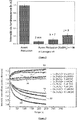
- the figure 2 shows the comparison between the luminescence levels of a solution of nanoparticles of Gd 0.6 Eu 0.4 VO 4 under laser illumination of wavelength 466 nm, before, immediately, 7 h and 2 days after treatment with 1M of NaBH4.
- the particles obtained following reduction by a chemical agent are capable of detecting oxidizing species, for example H 2 O 2 , in a similar way to the detection of H 2 O 2 by particles containing Eu 3+ ions. previously reduced to Eu 2+ following laser excitation.
- the second optically active and preferably photoluminescent agent is itself chosen such that its luminescence (or the light intensity of its luminescence) is constant or, preferably, also varies with the amount of oxidizing species.
- the luminescence intensity of the second optically active agent in particular photoluminescent, is substantially constant in the presence of oxidizing species.
- This variant of the method also makes it possible to detect the presence of oxidizing species in a sample tested.
- the luminescence intensity of the second optically active agent varies as a function of the quantity of oxidizing species, in a direction opposite to the variation in luminescence. observed at said first designated length of the first photoluminescent agent.
- the luminescence of the second photoluminescent agent decreases with the amount of oxidizing species, in the presence of which it is found.
- the second photoluminescent agent can consist of a solution containing nanoparticles of YAG: Ce and / or LaPO 4 : Ce.
- the second photoluminescent agent is formed by nanoparticles of YAG: Ce.
- the figure 3 illustrates curves 50-56 and 58-64 of response in emission intensity of particles of Gd 0.5 Eu0 0.4 VO 4 reduced and of YAG: Ce, respectively, in an oxidizing medium of known concentration of hydrogen peroxide, equal concentration at 0 ⁇ M, 5 ⁇ M, 10 ⁇ M and 50 ⁇ M, respectively.
- Each 50-64 curve is the average of traces of approximately 10 nanoparticles detected individually.
- the method for determining the presence of oxidizing species 10 continues with a step 16, consisting in exciting the first and second photoluminescent agents in the sample.
- the sample can be subjected to a double light excitation, in particular by laser.
- this double excitation of the sample can for example be carried out at the wavelengths of 396 nm (for Gd 0.6 Eu0 0.4 VO 4 ) and 488 nm (for YAG: Ce), respectively by means of a laser diode and an Argon laser.
- the method for detecting oxidizing species 10 then continues with a step 18 consisting in measuring the light intensity emitted by the sample at at least a first wavelength corresponding to a luminescence wavelength of the first. photoluminescent agent, and at at least a second wavelength, corresponding to a luminescent wavelength of the second photoluminescent agent, the first and second wavelengths being distinct.
- the light intensity emitted by the sample is measured at the two luminescence wavelengths of Eu 3+ and Ce 3+ , namely 617 nm and 550 nm, respectively.
- the presence of oxidizing species in the sample causes, for example, the oxidation of the Eu 2+ and Ce 3+ ions to Eu 3+ and Ce 4+ ions, respectively.
- the second agent has a constant luminescence whatever the concentration of oxidizing species to be analyzed
- its assigned light signal can be used directly as a reference scale.
- this signal makes it possible to demonstrate either a modification of the light intensity of the or of one of the wavelengths representative of the oxidized form or of the reduced form of the first photoluminescent agent, or a lack of variability of this intensity.
- a change in light intensity is representative of the presence of oxidizing species.
- a lack of variability in this light intensity is indicative of the absence of oxidizing species within the sample to be analyzed.
- the method comprises a step 20 of comparing the measured light intensities, at the scale of the individual nanoparticle, of the luminescence of each of the photoluminescent agents with standard values, in order to determine a quantity of species. oxidants in the test sample.
- This step is especially necessary in the case where the light intensity of the second photoluminescent agent also changes with the quantity of oxidizing species in the sample to be analyzed.
- the amount of oxidizing species can in particular be a concentration of oxidizing species in the sample tested.
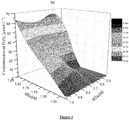
- This web 30 can in particular be obtained at least partially from the curves 50-64 of the figure 3 .
- the two photoluminescent agents having an opposite response in luminescence depending on the quantity of oxidizing species, each pair of curves 50-64 corresponding to the same concentration of oxidizing species, makes it possible to determine a point of the web 30
- the web 30 can be interpolated from the set of data from curves 50-64 where a pair of normalized light intensities uniquely corresponds to a concentration of oxidizing species.
- the standard values can come from a table or from a calculation software, which can also, from measured points, interpolate a concentration of oxidizing species, of a couple of measured intensities. .
- the light intensity measured at the luminescence wavelengths of the Eu 3+ and Ce 3+ ions therefore makes it possible to determine a point of the web 30, corresponding to a single concentration of oxidizing species present in the sample tested.
- the uniqueness of this concentration is ensured by the distinct and monotonic variations in the luminescence intensity of the photoluminescent agents as a function of the quantity of oxidizing species with which they are present.
- the method for detecting oxidizing species in accordance with the invention is therefore particularly advantageous for quickly and relatively simply determining a quantity of oxidizing species in a sample from a - double - measurement of light intensity.
- This method allows ratiometric measurement.
- the luminescence of the first photoluminescent agent varies as a function of the amount of oxidizing species, but the light intensity emitted by the second optically active agent is substantially constant regardless of the concentration of oxidizing species, it may be advantageous to use the ratio between the emission intensities of the first and second agents to determine the concentration of oxidizing species.
- the method is also particularly suitable for detecting reactive oxidizing species (or ROS) in volume. Indeed, such detection does not depend either on the concentration of photoluminescent agents, or on the volume of the sample probed.
- the method can in particular be implemented to monitor the production of oxidizing species in living tissues (taken ex vivo or in vivo ) .
- ROS are known to be produced abnormally in pathologies such as certain cancers, neurodegenerative and cardiovascular diseases.
- the method described can therefore complement the numerous studies carried out in this field and thus help to respond to the public health issues raised by these pathologies.
- Oxidizing species detectable by the method include, but are not limited to, H 2 O 2 , NO and ClO.
- the method makes it possible to determine an absolute concentration of oxidizing species in the sample. It has better spatial and temporal resolution than the known methods. It does not cause a side reaction and is biocompatible. It can be used to assay oxidizing species in biological cells or tissues, but also to detect and / or assay oxidizing species in solution of biological molecules.
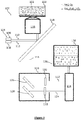
- the method 10, described above, can in particular be implemented by means of a system 100 for determining the presence of oxidizing species as illustrated in figure 1 .
- the system for determining the presence of oxidizing species in a sample 102 first of all comprises a laser illumination device 104 formed here of two laser sources 106, 108 distinct, suitable for emitting beams at wavelengths distinct.
- the photoluminescent agents are Gd 0.6 Eu0 0.4 VO 4 and YAG: Ce
- the first laser source 106 is adapted to emit a first laser beam 110 at a wavelength of 488 nm
- the second laser source 18 emits a second laser beam 112 with a wavelength of 396 nm.
- the system 100 then comprises a dichroic mirror 114 to combine the first and second laser beams 110, 112, and guide them towards an optical objective 116 adapted to focus the laser beams 110, 112 on an area of the sample 102 to be tested.
- This zone can for example correspond to an area of a few mm 2 .
- the sample 102 can be placed on or in a sample support 103.
- this sample support 103 takes the form of a closed volume for prevent dispersion of sample 102 to be tested.
- the sample holder 103 may also take the form of a cuvette or cuvette, in particular in the case where the sample 102 is in the form of a solution.
- the first and second laser beams 110, 112 excite the first and second photoluminescent agents in the sample 102.
- the photoluminescent agents respond to the excitation of one of the two laser beams, preferably selectively (that is to say exclusively to one or the other), by emitting in two ranges of different wavelengths.
- two ranges of different wavelengths is meant two ranges of wavelengths comprising at least one wavelength not included in the other range of wavelengths.
- the particles of YAG: Ce respond to the excitation of the first laser beam at 488 nm, in emitting at a first wavelength of 550 nm.
- the reduced particles of Gd 0.6 EuO 0.4 VO 4 respond to the excitation of the second laser beam at 396 nm by emitting at a second wavelength of 617 nm.
- the objective 116 makes it possible to focus the emission of the two luminescent agents 118 including the two response wavelengths of the photoluminescent agents towards a spectral splitter 120, possibly via the dichroic mirror 114 which it passes through.
- the dichroic filter 114 then plays the role of a separator blade functionally interposed between the laser sources 106, 108 and the sample 102, on the one hand, and between the sample 102 and the spectral splitter 120, on the other hand, by reflecting laser sources and by being transparent to the emission of luminescent agents.
- the objective is integrated into an optical device, in particular a microscope, functionally interposed between the sample 102 and the spectral splitter 120.
- This microscope can in particular be a fluorescence microscope, preferably with a wide field, a macroscope or a stereomicroscope.
- the spectral splitter 120 makes it possible to obtain, from a single input beam 118, two output images 122, 124 filtered at two different wavelengths, here the response wavelengths of the photoluminescent agents in contact. with the sample 102. In other words, the spectral splitter 120 makes it possible to filter the emissions of the photoluminescent agents according to distinct wavelengths and thus form two distinct filtered images of the sample 102 to be tested.
- the spectral splitter 120 here comprises a dichroic mirror 126.
- First 130 and second 132 filters of respective wavelengths corresponding to the response wavelengths of the photoluminescent agents are placed respectively on the path of the beam 122 reflected by the dichroic mirror 126 and on the path of the beam 124 passing through the dichroic mirror 126. This makes it possible to spatially separate the beams of different wavelengths for detection on two separate sensors or on two distinct regions of a single sensor, such as a camera 134.
- the system 100 further comprises means for determining the light intensity associated with the two filtered images.
- these means comprise a camera 134, for example an EMCCD camera (for “Electron Multiplying Charge Coupled Device”) connected to a recorder, for example a computer, to detect the two filtered images, each over a respective region 136, 138, corresponding to the response of each of the two photoluminescent agents.
- a camera 134 for example an EMCCD camera (for “Electron Multiplying Charge Coupled Device”) connected to a recorder, for example a computer, to detect the two filtered images, each over a respective region 136, 138, corresponding to the response of each of the two photoluminescent agents.
- the means for determining the light intensity used include two photo-detectors at different wavelengths, in particular of the photomultiplier or photodiodes type. These photo-detectors make it possible to measure the total light intensity coming from the whole of the illuminated sample without spatial resolution.
- the system 100 makes it possible to simultaneously and individually detect each type of particle.
- the particles can furthermore be individually detected and locate spatially, due to the low surface density of the sample.
- the monitoring at the scale of each single particle of these two luminescence emissions and their evolutions allows a quantitative measurement, local (in particular with a localization precision of 40 nm) and resolved in time, with an acquisition rate. of the order of 100 ms, in particular 33 ms, of the oxidizing species in the sample. The temporal resolution of the measurement is in fact then given by the acquisition rate of the camera 134.
- the powers of the excitation lasers can also be modulated to change the range of concentrations of oxidizing species detected.
- the method and the system for detecting oxidizing species can thus in particular be implemented in numerous applications, such as the detection of ROS in inflammations or certain tumors.
- mammalian cells were prepared. To do this, vascular smooth muscle cells of mice (primary culture) were cultured in RPMI (for "Roswell Park Memorial Institute” medium) containing 10% fetal calf serum and antibiotics, in this case penicillin. and some streptomycin. When the confluence reaches 80%, the cells are removed and placed on glass coverslips. In the present case, 1.5x10 4 cells are typically placed on a glass coverslip. The cells are then cultured on the coverslips for forty-eight hours in the complete culture medium, then in a serum-free medium for twenty-four hours.
- RPMI for "Roswell Park Memorial Institute” medium
- antibiotics in this case penicillin. and some streptomycin.
- 1.5x10 4 cells are typically placed on a glass coverslip.
- the cells are then cultured on the coverslips for forty-eight hours in the complete culture medium, then in a serum-free medium for twenty-four hours.
- a stable colloidal solution of Gd 0.4 EuO 0.6 VO 4 with a concentration substantially equal to 1 mM is prepared.
- the solution is then centrifuged for five minutes under an acceleration of 5000 g in order to precipitate the particles.
- the supernatant is removed and the pellet is suspended again in an aqueous solution of sodium borohydrate (NaBH4) at a concentration of 1 M.
- NaBH4 sodium borohydrate
- the reaction of NaBH4 with the particles and with the water produces hydrogen in the form of bubbles. Care is therefore taken not to confine the reaction medium.
- the solution is centrifuged again, five minutes, under an acceleration of 5000 g.
- the supernatant is removed and the pellet is suspended again in distilled water.
- the washing operation is repeated twice in order to remove any residual reducing ions.
- a stable solution of YAG: Ce (4%) of about 1 mM is prepared, having water as the main solvent.
- These particles are synthesized by the glycothermal route in the form of dispersions in ethanol. Washing cycles are carried out: the necessary centrifugations can be carried out for 5 minutes under an acceleration of 5000 g then the particles are again suspended in the solvent chosen for the measurements, water in the case described here.
- a coverslip containing cells loaded with nanoparticles is then deposited on a sample holder and 1 ml of buffered physiological medium (HBSS / 1 mM HEPES) is added.
- the cells are then observed transmitting white light, as shown in figure 6 , and under illumination dual (laser sources at 488 nm and 396 nm), as shown in figure 7 .
- a cell is chosen having an adequate morphology, that is to say a living and adherent cell.
- the initial medium is replaced by a physiological medium containing 270 nM endothelin-1 (ET-1) and the luminescence of individual nanoparticles is observed for several minutes on a full-field sensor (EM-CCD camera ImageEM, Hamamatsu).
- E-1 endothelin-1
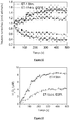
- the figure 8 illustrates the response curves 200, 202 corresponding to the particles based on Eu and Ce, respectively. There is an increase in the light intensity of the Eu-based particles and a decrease in the light intensity of the Ce-based particles.
- the figure 10 illustrates another example of use of the method according to the invention, in which the sample to be analyzed is contained in a tank.
- Vascular smooth muscle cells line the wall of blood vessels. Their stimulation by a powerful vasoconstrictor such as endothelin-1 (ET-1) produces their contraction and induces an increase in blood pressure. The process of cell signaling responsible for such a response is known to induce the production of hydrogen peroxide (oxidizing species).
- EGFR Epidermal Growth Factor Receptor
- membrane receptors are also known for their participation in this process.
- their contribution and in particular their effect on the production of oxidants are unknown to date. This is due to the inexistence of quantitative detection methods and fast enough to characterize this phenomenon.
- Example 2 the same protocol as Example 1 was followed, namely the culture of vascular smooth muscle cells, the preparation of the suspension of YAG particles: Ce and Gd 0.4 EuO 0.6 VO 4 reduced, and l incubation of the cultured cells with the suspension.
- Example 1 The presence of these particles was observed by fluorescence microscopy and spectral doubling, as indicated in Example 1 ( Figure 11 ).
- GdVO 4 chemically pre-reduced Eu and YAG: Ce
- the second optically active agent can consist of any type of photostable agent, such as semiconductor nanocrystals, for example.
- the particles can be functionalized and coupled to one or more biomolecules of interest, in particular for the purpose of targeting either specific cell compartments in the case of measurements at the cellular level, or specific cell types, for example cancer cells, in the case of measurements at tissue level or in vivo (in living organisms).
- the biologically active molecules are targeting molecules, that is to say molecules which will allow the specific targeting of the particle according to the invention to an organ, a body fluid (for example blood), a cell type (eg platelets, lymphocytes, monocytes, tumor cells, ...) or a cell compartment.
- this specific targeting can be accomplished using antibodies, monoclonal or polyclonal, or protein or polypeptide ligands of cell receptors.
- the following receptor / ligand pairs may be mentioned: TGF / TGFR, EGF / EGFR, TNF ⁇ / TNFR, interferon / interferon receptor, interleukin / interleukin receptor, GMCSF / receptor to GMCSF, MSCF / receptor to MSCF, and GCSF / receptor to GCSF.
- ligands mention may also be made of toxin fragments or detoxified toxins and their cellular receptors.
- these will be chosen according to the antigen or antigens against which the antibody is directed.
- the biologically active molecule (s) are stealth agents, such as polyethylene glycol (PEG) or dextran, in order to make the particles stealthy in the organism and thus increase their circulation time in the blood.
- stealth agents such as polyethylene glycol (PEG) or dextran
- the particles according to the invention can be functionalized by targeting molecules and stealth molecules as defined above.
- the biologically active molecules can be attached to the surface of the particle or, where appropriate, to the preparation layer, directly or through a layer bearing functional groups, by covalent bonding. or non-covalent.
- the attachment of these biologically active molecules is carried out by conventional techniques of oxidation, halogenation, alkylation, acylation, addition, substitution or amidation of the surface of the particle, of the preparation layer and / or of the layer bearing groups. functional, with biologically active molecules.
- the preparation layer is applied directly to the particle, either by covalent bonding or by absorption.
- This preparation layer can be hydrophilic or hydrophobic. In a particular embodiment, this preparation layer is amorphous.
- an occultation device in particular mechanical or electronic, means for determining the light intensity, which can be selectively activated, this approach consists in not detecting, after an excitation laser pulse of the first and second agents, than the photons emitted after a determined time. This determined time can be chosen so as not to detect the photons originating from other emitters, for example by autofluorescence, and to detect only photons emitted by the YVO 4 : Eu nanoparticles.
Landscapes
- Health & Medical Sciences (AREA)
- Life Sciences & Earth Sciences (AREA)
- Immunology (AREA)
- Chemical & Material Sciences (AREA)
- Engineering & Computer Science (AREA)
- Physics & Mathematics (AREA)
- Biochemistry (AREA)
- Pathology (AREA)
- General Physics & Mathematics (AREA)
- General Health & Medical Sciences (AREA)
- Analytical Chemistry (AREA)
- Biomedical Technology (AREA)
- Molecular Biology (AREA)
- Urology & Nephrology (AREA)
- Hematology (AREA)
- Nuclear Medicine, Radiotherapy & Molecular Imaging (AREA)
- Food Science & Technology (AREA)
- Medicinal Chemistry (AREA)
- Biotechnology (AREA)
- Microbiology (AREA)
- Cell Biology (AREA)
- Tropical Medicine & Parasitology (AREA)
- Chemical Kinetics & Catalysis (AREA)
- Optics & Photonics (AREA)
- Toxicology (AREA)
- Bioinformatics & Cheminformatics (AREA)
- Physiology (AREA)
- Investigating, Analyzing Materials By Fluorescence Or Luminescence (AREA)
- Investigating Or Analysing Materials By The Use Of Chemical Reactions (AREA)
- Investigating Or Analysing Biological Materials (AREA)
Claims (13)
- Verfahren zur Analyse von oxidierenden Spezies in einer Probe, insbesondere in einer biologischen Probe, umfassend die in Folgendem bestehenden Schritte:i) Inkontaktbringen (12) der Probe mit einem photolumineszenten ersten Mittel und einem optisch aktiven zweiten Mittel, wobei mindestens das photolumineszente erste Mittel Nanopartikel beinhaltet, die mit seltenen Erden dotiert und oxidierbar sind, wobei- die Lumineszenz des photolumineszenten ersten Mittels bei mindestens einer ersten Wellenlänge mit der Menge von oxidierenden Spezies variiert und- das von dem optisch aktiven zweiten Mittel emittierte Signal bei mindestens einer zweiten Wellenlänge, die von der ersten Wellenlänge verschieden ist,mit der Menge von oxidierenden Spezies konstant ist oder
mit der Menge von oxidierenden Spezies in eine zur Lumineszenz des photolumineszenten ersten Mittels entgegengesetzte Richtung variiert,ii) Anregen (16) des photolumineszenten ersten Mittels und des optisch aktiven zweiten Mittels in der Probe,iii) Messen (18) der Lichtintensität der Probe bei mindestens der ersten Wellenlänge und mindestens der zweiten Wellenlänge undiv) Beurteilen des Vorkommens und/oder der Menge von einer oder mehreren oxidierenden Spezies durch Interpretieren (20) der gemessenen Lichtintensitäten und gegebenenfalls in Bezug auf Eichwerte. - Verfahren nach Anspruch 1, bei dem im Schritt iv) eine Menge von oxidierenden Spezies in der Probe durch Ablesen (20) des Werts, der dem im Schritt iii) gemessenen Lichtintensitätenpaar entspricht, auf einer Eichfläche (30) bestimmt wird, wobei die Eichfläche insbesondere eine Fläche (30) ist, die zuvor mittels Messungen erstellt wurde, die mit Proben mit einer bekannten Menge von oxidierenden Spezies ausgeführt wurden.
- Verfahren nach einem der Ansprüche 1 und 2, bei dem die Lichtintensität der Lumineszenz des photolumineszenten ersten Mittels mit der Menge von oxidierenden Spezies zunimmt.
- Verfahren nach einem der Ansprüche 1 bis 3, bei dem die Emissionslichtintensität des optisch aktiven zweiten Mittels mit der Menge von oxidierenden Spezies im Wesentlichen konstant ist.
- Verfahren nach einem der Ansprüche 1 bis 4, bei dem das optisch aktive zweite Mittel photolumineszent ist und bevorzugt Nanopartikel von LaPO4:Eu, LaPO4:Er, LaPO4:Nd, LaPO4:Tb, LaF3:TR, NaYF4:Yb, NaYF4:Er, CdSe/ZnS, CdTe/ZnS, KTP und/oder BaTiO3 beinhaltet.
- Verfahren nach einem der Ansprüche 1 bis 3, bei dem die Emissionslichtintensität des optisch aktiven zweiten Mittels mit der Menge von oxidierenden Spezies abnimmt.
- Verfahren nach einem der Ansprüche 1 bis 3 und 6, bei dem die erste Wellenlänge für die oxidierte Form des photolumineszenten ersten Mittels repräsentativ ist und die zweite Wellenlänge für die reduzierte Form des optisch aktiven und bevorzugt photolumineszenten Mittels repräsentativ ist.
- Verfahren nach einem der Ansprüche 1 bis 3 und 6 oder 7, bei dem das optisch aktive zweite Mittel photolumineszent ist und bevorzugt Nanopartikel von YAG:Ce, LaPO4:Ce beinhaltet.
- Verfahren nach einem der vorhergehenden Ansprüche, bei dem das photolumineszente erste Mittel mindestens teilweise reduzierte Nanopartikel von AxEu1-x(VO4)y(PO4)(1-y), insbesondere von AxEu1-xVO4, beinhaltet, wobei A eines unter Y, Gd und La, 0 ≤ x ≤ 1 und 0 ≤ y ≤ 1 ist.
- Verfahren nach dem vorhergehenden Anspruch, umfassend vor dem Schritt i) einen Schritt a), der darin besteht, Nanopartikel zu reduzieren (14), um das photolumineszente erste Mittel zu erhalten, wobei die Reduktion insbesondere auf chemischem Weg mithilfe eines reduzierenden Mittels ausgeführt wird, wobei der Schritt a) bevorzugt nach der Reduktion auf chemischem Weg einen Teilschritt umfasst, der darin besteht, die reduzierten Nanopartikel zu waschen, um den Überschuss von reduzierendem Mittel zu beseitigen, wobei das reduzierende Mittel insbesondere NaBH4 beinhaltet.
- Verfahren nach einem der vorhergehenden Ansprüche, bei dem die Partikel ferner an ein oder mehrere funktionalisierte Biomoleküle und/oder Biomoleküle von allgemein bekanntem Interesse gekoppelt sind, die unter Zielmolekülen und Tarnmitteln gewählt sind.
- Ex-vivo- oder In-vitro-Verwendung eines Verfahrens nach einem der Ansprüche 1 bis 11 zu Zwecken der Diagnose, insbesondere von physiologischen Störungen, die pathologisch sind oder nicht und die mit einer nicht physiologisch akzeptablen Expression von einer oder mehreren reaktiven oxidierenden Spezies (ROS) assoziiert sind.
- Ex-vivo- oder In-vitro-Verwendung eines Verfahrens nach einem der Ansprüche 1 bis 11 zu Zwecken des Screenings der Wirksamkeit eines Wirkstoffs bei einer Störung, die pathologisch ist oder nicht und die mit einer Überexpression von einer oder mehreren reaktiven oxidierenden Spezies (ROS) assoziiert ist.
Applications Claiming Priority (2)
| Application Number | Priority Date | Filing Date | Title |
|---|---|---|---|
| FR1557275A FR3039649B1 (fr) | 2015-07-29 | 2015-07-29 | Procede de detection d'especes oxydantes |
| PCT/EP2016/068096 WO2017017233A1 (fr) | 2015-07-29 | 2016-07-28 | Procede de detection d'especes oxydantes |
Publications (2)
| Publication Number | Publication Date |
|---|---|
| EP3329255A1 EP3329255A1 (de) | 2018-06-06 |
| EP3329255B1 true EP3329255B1 (de) | 2020-11-25 |
Family
ID=54366343
Family Applications (1)
| Application Number | Title | Priority Date | Filing Date |
|---|---|---|---|
| EP16744775.4A Not-in-force EP3329255B1 (de) | 2015-07-29 | 2016-07-28 | Verfahren zur erkennung von oxidierenden spezies |
Country Status (5)
| Country | Link |
|---|---|
| US (1) | US10788497B2 (de) |
| EP (1) | EP3329255B1 (de) |
| JP (1) | JP6865732B2 (de) |
| FR (1) | FR3039649B1 (de) |
| WO (1) | WO2017017233A1 (de) |
Families Citing this family (4)
| Publication number | Priority date | Publication date | Assignee | Title |
|---|---|---|---|---|
| US10788426B2 (en) * | 2017-06-16 | 2020-09-29 | University Of Kentucky Research Foundation | Detection of hydroperoxides using chemically-stimulated luminescence from structured compound semiconductors |
| US10794830B2 (en) * | 2017-06-16 | 2020-10-06 | University Of Kentucky Research Foundation | Detection of organic free radicals and reactive oxygen substances using chemically-stimulated luminescence from structured compound semiconductors |
| FR3084165B1 (fr) * | 2018-07-18 | 2020-07-10 | Ecole Polytechnique | Test a diffusion capillaire mettant en œuvre des nanoparticules inorganiques photoluminescentes |
| CN118883512B (zh) * | 2024-09-27 | 2024-12-27 | 生态环境部华南环境科学研究所(生态环境部生态环境应急研究所) | 体外模拟pm2.5健康效应的活性氧自由基浓度检测方法 |
Family Cites Families (9)
| Publication number | Priority date | Publication date | Assignee | Title |
|---|---|---|---|---|
| JPH08320292A (ja) * | 1995-05-25 | 1996-12-03 | Olympus Optical Co Ltd | 蛍光観察方法および装置 |
| JP3708368B2 (ja) * | 1999-05-31 | 2005-10-19 | 独立行政法人科学技術振興機構 | 皮膚の活性酸素の測定方法 |
| JP4401897B2 (ja) * | 2004-08-19 | 2010-01-20 | 独立行政法人理化学研究所 | レシオイメージング装置 |
| CA2660558A1 (en) * | 2006-08-14 | 2008-02-21 | Mayo Foundation For Medical Education And Research | Rare earth nanoparticles |
| US8465985B2 (en) * | 2007-03-01 | 2013-06-18 | The University Of Tokyo | Fluorescent probe |
| FR2930031A1 (fr) * | 2008-04-14 | 2009-10-16 | Centre Nat Rech Scient | Dispositif et procede d'analyse exaltee d'un echantillon de particules. |
| JP2010242059A (ja) * | 2009-03-18 | 2010-10-28 | Tokyo Institute Of Technology | 蛍光粒子およびその製造方法 |
| ES2520190T3 (es) * | 2009-10-01 | 2014-11-11 | Sicpa Holding Sa | Composiciones en partículas que tienen múltiples respuestas a radiación de excitación |
| US10124072B2 (en) * | 2013-09-18 | 2018-11-13 | Caliper Life Sciences, Inc. | In-vivo reactive species imaging |
-
2015
- 2015-07-29 FR FR1557275A patent/FR3039649B1/fr not_active Expired - Fee Related
-
2016
- 2016-07-28 JP JP2018503565A patent/JP6865732B2/ja not_active Expired - Fee Related
- 2016-07-28 WO PCT/EP2016/068096 patent/WO2017017233A1/fr not_active Ceased
- 2016-07-28 EP EP16744775.4A patent/EP3329255B1/de not_active Not-in-force
- 2016-07-28 US US15/747,888 patent/US10788497B2/en not_active Expired - Fee Related
Non-Patent Citations (2)
| Title |
|---|
| ALOK D. WESSEL ET AL: "The Mechanical Properties of Early Drosophila Embryos Measured by High-Speed Video Microrheology", BIOPHYSICAL JOURNAL, vol. 108, no. 8, 1 April 2015 (2015-04-01), AMSTERDAM, NL, pages 1899 - 1907, XP055536186, ISSN: 0006-3495, DOI: 10.1016/j.bpj.2015.02.032 * |
| MAHOU PIERRE ET AL: "Multiphoton light-sheet microscopy using wavelength mixing: fast multicolor imaging of the beating Zebrafish heart with low photobleaching", PROGRESS IN BIOMEDICAL OPTICS AND IMAGING, SPIE - INTERNATIONAL SOCIETY FOR OPTICAL ENGINEERING, BELLINGHAM, WA, US, vol. 9329, 3 March 2015 (2015-03-03), pages 93290Z - 93290Z, XP060049197, ISSN: 1605-7422, ISBN: 978-1-5106-0027-0, DOI: 10.1117/12.2079176 * |
Also Published As
| Publication number | Publication date |
|---|---|
| WO2017017233A1 (fr) | 2017-02-02 |
| JP2018528414A (ja) | 2018-09-27 |
| FR3039649B1 (fr) | 2017-09-08 |
| US20180217149A1 (en) | 2018-08-02 |
| EP3329255A1 (de) | 2018-06-06 |
| FR3039649A1 (fr) | 2017-02-03 |
| JP6865732B2 (ja) | 2021-04-28 |
| US10788497B2 (en) | 2020-09-29 |
Similar Documents
| Publication | Publication Date | Title |
|---|---|---|
| Hada et al. | Folic acid functionalized gold nanoclusters for enabling targeted fluorescence imaging of human ovarian cancer cells | |
| Becker | Fluorescence lifetime imaging–techniques and applications | |
| Suhling et al. | Fluorescence lifetime imaging (Flim): Basic concepts and recent applications | |
| Bünzli | Luminescence bioimaging with lanthanide complexes | |
| EP3329255A1 (de) | Verfahren zur erkennung von oxidierenden spezies | |
| FR2466019A1 (fr) | Compositions appropriees pour l'examen de tissus et/ou de liquides biologiques et son procede d'utilisation | |
| EP1849413B1 (de) | Verfahren der optischen Fluoreszenzbildgebung biologischer Gewebe, insbesondere zur Bestimmung von Interessengebieten für die Gewebeanalyse durch Tomographie | |
| FR3069927A1 (fr) | Procede de detection ultra-sensible a l'aide de particules photoluminescentes | |
| Yakovlev et al. | Wrapping nanocrystals with an amphiphilic polymer preloaded with fixed amounts of fluorophore generates FRET-based nanoprobes with a controlled donor/acceptor ratio | |
| WO2013124544A1 (fr) | Procede de normalisation de la luminescence emise par un milieu de mesure. | |
| EP3824286A1 (de) | Prüfung der kapillarwirkung unter verwendung von photolumineszenten anorganischen nanopartikeln | |
| Urayama et al. | Fluorescence lifetime imaging microscopy of endogenous biological fluorescence | |
| CN114813699B (zh) | 一种量子增强的拉曼光谱关联检测装置 | |
| US20180172588A1 (en) | Bleaching of Dyes in Luminescent Detection | |
| Herman et al. | Lifetime-based imaging | |
| EP2488854B1 (de) | Bildgebungsverfahren und -system unter verwendung von substratfunktionalisierung | |
| Becker | Fluorescence lifetime imaging techniques: time-correlated single-photon counting | |
| RU2780954C1 (ru) | Способ применения фикобилипротеинов в качестве оптических сенсоров локальной температуры в живых клетках и тканях | |
| EP3317650B1 (de) | Ausbleichen von farbstoffen bei der erfassung von lumineszenz | |
| Cosentino et al. | Analysis of Membrane‐Protein Complexes by Single‐Molecule Methods | |
| Zhao | Quantitative Multiplexed Biomarker Profiling for Breast Cancer Diagnostics Using FLIM and Phasor Analysis | |
| WO2005080945A9 (en) | Method for avoiding bleaching when using fluorescence correlation spectroscopy | |
| Alexandru-Milentie et al. | Intrinsic Photoluminescence of Solid-State Gold Nanoclusters: Towards Fluorescence Lifetime Imaging of Tissue-Like Phantoms Under Two-Photon Near-Infrared Excitation | |
| Lu | Optically Activated Delayed Fluorescence Anisotropy: A new Approach for Macromolecular Size Determination | |
| Zhang | Study on gold nanoparticles for biological applications |
Legal Events
| Date | Code | Title | Description |
|---|---|---|---|
| STAA | Information on the status of an ep patent application or granted ep patent |
Free format text: STATUS: THE INTERNATIONAL PUBLICATION HAS BEEN MADE |
|
| PUAI | Public reference made under article 153(3) epc to a published international application that has entered the european phase |
Free format text: ORIGINAL CODE: 0009012 |
|
| STAA | Information on the status of an ep patent application or granted ep patent |
Free format text: STATUS: REQUEST FOR EXAMINATION WAS MADE |
|
| 17P | Request for examination filed |
Effective date: 20180228 |
|
| AK | Designated contracting states |
Kind code of ref document: A1 Designated state(s): AL AT BE BG CH CY CZ DE DK EE ES FI FR GB GR HR HU IE IS IT LI LT LU LV MC MK MT NL NO PL PT RO RS SE SI SK SM TR |
|
| AX | Request for extension of the european patent |
Extension state: BA ME |
|
| DAV | Request for validation of the european patent (deleted) | ||
| DAX | Request for extension of the european patent (deleted) | ||
| STAA | Information on the status of an ep patent application or granted ep patent |
Free format text: STATUS: EXAMINATION IS IN PROGRESS |
|
| 17Q | First examination report despatched |
Effective date: 20190103 |
|
| REG | Reference to a national code |
Ref country code: DE Ref legal event code: R079 Ref document number: 602016048570 Country of ref document: DE Free format text: PREVIOUS MAIN CLASS: G01N0021630000 Ipc: G01N0021640000 |
|
| GRAP | Despatch of communication of intention to grant a patent |
Free format text: ORIGINAL CODE: EPIDOSNIGR1 |
|
| STAA | Information on the status of an ep patent application or granted ep patent |
Free format text: STATUS: GRANT OF PATENT IS INTENDED |
|
| RIC1 | Information provided on ipc code assigned before grant |
Ipc: G01N 21/63 20060101ALI20200623BHEP Ipc: G01N 33/58 20060101ALI20200623BHEP Ipc: G01N 21/64 20060101AFI20200623BHEP |
|
| INTG | Intention to grant announced |
Effective date: 20200709 |
|
| GRAS | Grant fee paid |
Free format text: ORIGINAL CODE: EPIDOSNIGR3 |
|
| GRAA | (expected) grant |
Free format text: ORIGINAL CODE: 0009210 |
|
| STAA | Information on the status of an ep patent application or granted ep patent |
Free format text: STATUS: THE PATENT HAS BEEN GRANTED |
|
| AK | Designated contracting states |
Kind code of ref document: B1 Designated state(s): AL AT BE BG CH CY CZ DE DK EE ES FI FR GB GR HR HU IE IS IT LI LT LU LV MC MK MT NL NO PL PT RO RS SE SI SK SM TR |
|
| REG | Reference to a national code |
Ref country code: GB Ref legal event code: FG4D Free format text: NOT ENGLISH |
|
| REG | Reference to a national code |
Ref country code: CH Ref legal event code: EP |
|
| REG | Reference to a national code |
Ref country code: AT Ref legal event code: REF Ref document number: 1338897 Country of ref document: AT Kind code of ref document: T Effective date: 20201215 |
|
| REG | Reference to a national code |
Ref country code: DE Ref legal event code: R096 Ref document number: 602016048570 Country of ref document: DE |
|
| REG | Reference to a national code |
Ref country code: IE Ref legal event code: FG4D Free format text: LANGUAGE OF EP DOCUMENT: FRENCH |
|
| REG | Reference to a national code |
Ref country code: AT Ref legal event code: MK05 Ref document number: 1338897 Country of ref document: AT Kind code of ref document: T Effective date: 20201125 |
|
| REG | Reference to a national code |
Ref country code: NL Ref legal event code: MP Effective date: 20201125 |
|
| PG25 | Lapsed in a contracting state [announced via postgrant information from national office to epo] |
Ref country code: NO Free format text: LAPSE BECAUSE OF FAILURE TO SUBMIT A TRANSLATION OF THE DESCRIPTION OR TO PAY THE FEE WITHIN THE PRESCRIBED TIME-LIMIT Effective date: 20210225 Ref country code: PT Free format text: LAPSE BECAUSE OF FAILURE TO SUBMIT A TRANSLATION OF THE DESCRIPTION OR TO PAY THE FEE WITHIN THE PRESCRIBED TIME-LIMIT Effective date: 20210325 Ref country code: RS Free format text: LAPSE BECAUSE OF FAILURE TO SUBMIT A TRANSLATION OF THE DESCRIPTION OR TO PAY THE FEE WITHIN THE PRESCRIBED TIME-LIMIT Effective date: 20201125 Ref country code: FI Free format text: LAPSE BECAUSE OF FAILURE TO SUBMIT A TRANSLATION OF THE DESCRIPTION OR TO PAY THE FEE WITHIN THE PRESCRIBED TIME-LIMIT Effective date: 20201125 Ref country code: GR Free format text: LAPSE BECAUSE OF FAILURE TO SUBMIT A TRANSLATION OF THE DESCRIPTION OR TO PAY THE FEE WITHIN THE PRESCRIBED TIME-LIMIT Effective date: 20210226 |
|
| PG25 | Lapsed in a contracting state [announced via postgrant information from national office to epo] |
Ref country code: SE Free format text: LAPSE BECAUSE OF FAILURE TO SUBMIT A TRANSLATION OF THE DESCRIPTION OR TO PAY THE FEE WITHIN THE PRESCRIBED TIME-LIMIT Effective date: 20201125 Ref country code: AT Free format text: LAPSE BECAUSE OF FAILURE TO SUBMIT A TRANSLATION OF THE DESCRIPTION OR TO PAY THE FEE WITHIN THE PRESCRIBED TIME-LIMIT Effective date: 20201125 Ref country code: BG Free format text: LAPSE BECAUSE OF FAILURE TO SUBMIT A TRANSLATION OF THE DESCRIPTION OR TO PAY THE FEE WITHIN THE PRESCRIBED TIME-LIMIT Effective date: 20210225 Ref country code: LV Free format text: LAPSE BECAUSE OF FAILURE TO SUBMIT A TRANSLATION OF THE DESCRIPTION OR TO PAY THE FEE WITHIN THE PRESCRIBED TIME-LIMIT Effective date: 20201125 Ref country code: IS Free format text: LAPSE BECAUSE OF FAILURE TO SUBMIT A TRANSLATION OF THE DESCRIPTION OR TO PAY THE FEE WITHIN THE PRESCRIBED TIME-LIMIT Effective date: 20210325 Ref country code: PL Free format text: LAPSE BECAUSE OF FAILURE TO SUBMIT A TRANSLATION OF THE DESCRIPTION OR TO PAY THE FEE WITHIN THE PRESCRIBED TIME-LIMIT Effective date: 20201125 |
|
| REG | Reference to a national code |
Ref country code: LT Ref legal event code: MG9D |
|
| PG25 | Lapsed in a contracting state [announced via postgrant information from national office to epo] |
Ref country code: HR Free format text: LAPSE BECAUSE OF FAILURE TO SUBMIT A TRANSLATION OF THE DESCRIPTION OR TO PAY THE FEE WITHIN THE PRESCRIBED TIME-LIMIT Effective date: 20201125 |
|
| PG25 | Lapsed in a contracting state [announced via postgrant information from national office to epo] |
Ref country code: RO Free format text: LAPSE BECAUSE OF FAILURE TO SUBMIT A TRANSLATION OF THE DESCRIPTION OR TO PAY THE FEE WITHIN THE PRESCRIBED TIME-LIMIT Effective date: 20201125 Ref country code: SK Free format text: LAPSE BECAUSE OF FAILURE TO SUBMIT A TRANSLATION OF THE DESCRIPTION OR TO PAY THE FEE WITHIN THE PRESCRIBED TIME-LIMIT Effective date: 20201125 Ref country code: CZ Free format text: LAPSE BECAUSE OF FAILURE TO SUBMIT A TRANSLATION OF THE DESCRIPTION OR TO PAY THE FEE WITHIN THE PRESCRIBED TIME-LIMIT Effective date: 20201125 Ref country code: EE Free format text: LAPSE BECAUSE OF FAILURE TO SUBMIT A TRANSLATION OF THE DESCRIPTION OR TO PAY THE FEE WITHIN THE PRESCRIBED TIME-LIMIT Effective date: 20201125 Ref country code: LT Free format text: LAPSE BECAUSE OF FAILURE TO SUBMIT A TRANSLATION OF THE DESCRIPTION OR TO PAY THE FEE WITHIN THE PRESCRIBED TIME-LIMIT Effective date: 20201125 Ref country code: SM Free format text: LAPSE BECAUSE OF FAILURE TO SUBMIT A TRANSLATION OF THE DESCRIPTION OR TO PAY THE FEE WITHIN THE PRESCRIBED TIME-LIMIT Effective date: 20201125 |
|
| REG | Reference to a national code |
Ref country code: DE Ref legal event code: R097 Ref document number: 602016048570 Country of ref document: DE |
|
| PG25 | Lapsed in a contracting state [announced via postgrant information from national office to epo] |
Ref country code: DK Free format text: LAPSE BECAUSE OF FAILURE TO SUBMIT A TRANSLATION OF THE DESCRIPTION OR TO PAY THE FEE WITHIN THE PRESCRIBED TIME-LIMIT Effective date: 20201125 |
|
| PLBE | No opposition filed within time limit |
Free format text: ORIGINAL CODE: 0009261 |
|
| STAA | Information on the status of an ep patent application or granted ep patent |
Free format text: STATUS: NO OPPOSITION FILED WITHIN TIME LIMIT |
|
| PG25 | Lapsed in a contracting state [announced via postgrant information from national office to epo] |
Ref country code: IT Free format text: LAPSE BECAUSE OF FAILURE TO SUBMIT A TRANSLATION OF THE DESCRIPTION OR TO PAY THE FEE WITHIN THE PRESCRIBED TIME-LIMIT Effective date: 20201125 Ref country code: AL Free format text: LAPSE BECAUSE OF FAILURE TO SUBMIT A TRANSLATION OF THE DESCRIPTION OR TO PAY THE FEE WITHIN THE PRESCRIBED TIME-LIMIT Effective date: 20201125 Ref country code: NL Free format text: LAPSE BECAUSE OF FAILURE TO SUBMIT A TRANSLATION OF THE DESCRIPTION OR TO PAY THE FEE WITHIN THE PRESCRIBED TIME-LIMIT Effective date: 20201125 |
|
| 26N | No opposition filed |
Effective date: 20210826 |
|
| PG25 | Lapsed in a contracting state [announced via postgrant information from national office to epo] |
Ref country code: SI Free format text: LAPSE BECAUSE OF FAILURE TO SUBMIT A TRANSLATION OF THE DESCRIPTION OR TO PAY THE FEE WITHIN THE PRESCRIBED TIME-LIMIT Effective date: 20201125 |
|
| PG25 | Lapsed in a contracting state [announced via postgrant information from national office to epo] |
Ref country code: ES Free format text: LAPSE BECAUSE OF FAILURE TO SUBMIT A TRANSLATION OF THE DESCRIPTION OR TO PAY THE FEE WITHIN THE PRESCRIBED TIME-LIMIT Effective date: 20201125 |
|
| REG | Reference to a national code |
Ref country code: CH Ref legal event code: PL |
|
| PG25 | Lapsed in a contracting state [announced via postgrant information from national office to epo] |
Ref country code: MC Free format text: LAPSE BECAUSE OF FAILURE TO SUBMIT A TRANSLATION OF THE DESCRIPTION OR TO PAY THE FEE WITHIN THE PRESCRIBED TIME-LIMIT Effective date: 20201125 |
|
| REG | Reference to a national code |
Ref country code: BE Ref legal event code: MM Effective date: 20210731 |
|
| PG25 | Lapsed in a contracting state [announced via postgrant information from national office to epo] |
Ref country code: LI Free format text: LAPSE BECAUSE OF NON-PAYMENT OF DUE FEES Effective date: 20210731 Ref country code: CH Free format text: LAPSE BECAUSE OF NON-PAYMENT OF DUE FEES Effective date: 20210731 |
|
| PG25 | Lapsed in a contracting state [announced via postgrant information from national office to epo] |
Ref country code: IS Free format text: LAPSE BECAUSE OF FAILURE TO SUBMIT A TRANSLATION OF THE DESCRIPTION OR TO PAY THE FEE WITHIN THE PRESCRIBED TIME-LIMIT Effective date: 20210325 Ref country code: LU Free format text: LAPSE BECAUSE OF NON-PAYMENT OF DUE FEES Effective date: 20210728 |
|
| PG25 | Lapsed in a contracting state [announced via postgrant information from national office to epo] |
Ref country code: IE Free format text: LAPSE BECAUSE OF NON-PAYMENT OF DUE FEES Effective date: 20210728 Ref country code: BE Free format text: LAPSE BECAUSE OF NON-PAYMENT OF DUE FEES Effective date: 20210731 |
|
| PGFP | Annual fee paid to national office [announced via postgrant information from national office to epo] |
Ref country code: GB Payment date: 20220621 Year of fee payment: 7 |
|
| PGFP | Annual fee paid to national office [announced via postgrant information from national office to epo] |
Ref country code: DE Payment date: 20220621 Year of fee payment: 7 |
|
| PGFP | Annual fee paid to national office [announced via postgrant information from national office to epo] |
Ref country code: FR Payment date: 20220727 Year of fee payment: 7 |
|
| PG25 | Lapsed in a contracting state [announced via postgrant information from national office to epo] |
Ref country code: HU Free format text: LAPSE BECAUSE OF FAILURE TO SUBMIT A TRANSLATION OF THE DESCRIPTION OR TO PAY THE FEE WITHIN THE PRESCRIBED TIME-LIMIT; INVALID AB INITIO Effective date: 20160728 |
|
| PG25 | Lapsed in a contracting state [announced via postgrant information from national office to epo] |
Ref country code: CY Free format text: LAPSE BECAUSE OF FAILURE TO SUBMIT A TRANSLATION OF THE DESCRIPTION OR TO PAY THE FEE WITHIN THE PRESCRIBED TIME-LIMIT Effective date: 20201125 |
|
| REG | Reference to a national code |
Ref country code: DE Ref legal event code: R119 Ref document number: 602016048570 Country of ref document: DE |
|
| GBPC | Gb: european patent ceased through non-payment of renewal fee |
Effective date: 20230728 |
|
| PG25 | Lapsed in a contracting state [announced via postgrant information from national office to epo] |
Ref country code: MK Free format text: LAPSE BECAUSE OF FAILURE TO SUBMIT A TRANSLATION OF THE DESCRIPTION OR TO PAY THE FEE WITHIN THE PRESCRIBED TIME-LIMIT Effective date: 20201125 Ref country code: DE Free format text: LAPSE BECAUSE OF NON-PAYMENT OF DUE FEES Effective date: 20240201 Ref country code: GB Free format text: LAPSE BECAUSE OF NON-PAYMENT OF DUE FEES Effective date: 20230728 |
|
| PG25 | Lapsed in a contracting state [announced via postgrant information from national office to epo] |
Ref country code: FR Free format text: LAPSE BECAUSE OF NON-PAYMENT OF DUE FEES Effective date: 20230731 |
|
| PG25 | Lapsed in a contracting state [announced via postgrant information from national office to epo] |
Ref country code: MT Free format text: LAPSE BECAUSE OF FAILURE TO SUBMIT A TRANSLATION OF THE DESCRIPTION OR TO PAY THE FEE WITHIN THE PRESCRIBED TIME-LIMIT Effective date: 20201125 |
|
| PG25 | Lapsed in a contracting state [announced via postgrant information from national office to epo] |
Ref country code: TR Free format text: LAPSE BECAUSE OF FAILURE TO SUBMIT A TRANSLATION OF THE DESCRIPTION OR TO PAY THE FEE WITHIN THE PRESCRIBED TIME-LIMIT Effective date: 20201125 |