EP3321250A1 - Elektrochemisches verfahren zur herstellung von arylalkylcarbonaten und diarylcarbonaten - Google Patents
Elektrochemisches verfahren zur herstellung von arylalkylcarbonaten und diarylcarbonaten Download PDFInfo
- Publication number
- EP3321250A1 EP3321250A1 EP16198768.0A EP16198768A EP3321250A1 EP 3321250 A1 EP3321250 A1 EP 3321250A1 EP 16198768 A EP16198768 A EP 16198768A EP 3321250 A1 EP3321250 A1 EP 3321250A1
- Authority
- EP
- European Patent Office
- Prior art keywords
- radical
- formula
- tert
- reaction
- alkyl
- Prior art date
- Legal status (The legal status is an assumption and is not a legal conclusion. Google has not performed a legal analysis and makes no representation as to the accuracy of the status listed.)
- Ceased
Links
- GCNKXWGHDWIREH-UHFFFAOYSA-N C1=[IH](c2cc3ccccc3cc2)N1 Chemical compound C1=[IH](c2cc3ccccc3cc2)N1 GCNKXWGHDWIREH-UHFFFAOYSA-N 0.000 description 1
- PPUYAVHDQHURBO-UHFFFAOYSA-N CCOC(Oc1c(C)cc(C)cc1C)=O Chemical compound CCOC(Oc1c(C)cc(C)cc1C)=O PPUYAVHDQHURBO-UHFFFAOYSA-N 0.000 description 1
Classifications
-
- C—CHEMISTRY; METALLURGY
- C25—ELECTROLYTIC OR ELECTROPHORETIC PROCESSES; APPARATUS THEREFOR
- C25B—ELECTROLYTIC OR ELECTROPHORETIC PROCESSES FOR THE PRODUCTION OF COMPOUNDS OR NON-METALS; APPARATUS THEREFOR
- C25B3/00—Electrolytic production of organic compounds
- C25B3/20—Processes
- C25B3/23—Oxidation
-
- C—CHEMISTRY; METALLURGY
- C07—ORGANIC CHEMISTRY
- C07C—ACYCLIC OR CARBOCYCLIC COMPOUNDS
- C07C69/00—Esters of carboxylic acids; Esters of carbonic or haloformic acids
- C07C69/96—Esters of carbonic or haloformic acids
-
- C—CHEMISTRY; METALLURGY
- C25—ELECTROLYTIC OR ELECTROPHORETIC PROCESSES; APPARATUS THEREFOR
- C25B—ELECTROLYTIC OR ELECTROPHORETIC PROCESSES FOR THE PRODUCTION OF COMPOUNDS OR NON-METALS; APPARATUS THEREFOR
- C25B11/00—Electrodes; Manufacture thereof not otherwise provided for
- C25B11/04—Electrodes; Manufacture thereof not otherwise provided for characterised by the material
- C25B11/042—Electrodes formed of a single material
- C25B11/043—Carbon, e.g. diamond or graphene
-
- C—CHEMISTRY; METALLURGY
- C25—ELECTROLYTIC OR ELECTROPHORETIC PROCESSES; APPARATUS THEREFOR
- C25B—ELECTROLYTIC OR ELECTROPHORETIC PROCESSES FOR THE PRODUCTION OF COMPOUNDS OR NON-METALS; APPARATUS THEREFOR
- C25B11/00—Electrodes; Manufacture thereof not otherwise provided for
- C25B11/04—Electrodes; Manufacture thereof not otherwise provided for characterised by the material
- C25B11/051—Electrodes formed of electrocatalysts on a substrate or carrier
- C25B11/055—Electrodes formed of electrocatalysts on a substrate or carrier characterised by the substrate or carrier material
- C25B11/057—Electrodes formed of electrocatalysts on a substrate or carrier characterised by the substrate or carrier material consisting of a single element or compound
- C25B11/061—Metal or alloy
-
- C—CHEMISTRY; METALLURGY
- C25—ELECTROLYTIC OR ELECTROPHORETIC PROCESSES; APPARATUS THEREFOR
- C25B—ELECTROLYTIC OR ELECTROPHORETIC PROCESSES FOR THE PRODUCTION OF COMPOUNDS OR NON-METALS; APPARATUS THEREFOR
- C25B3/00—Electrolytic production of organic compounds
- C25B3/01—Products
- C25B3/03—Acyclic or carbocyclic hydrocarbons
-
- C—CHEMISTRY; METALLURGY
- C25—ELECTROLYTIC OR ELECTROPHORETIC PROCESSES; APPARATUS THEREFOR
- C25B—ELECTROLYTIC OR ELECTROPHORETIC PROCESSES FOR THE PRODUCTION OF COMPOUNDS OR NON-METALS; APPARATUS THEREFOR
- C25B3/00—Electrolytic production of organic compounds
- C25B3/01—Products
- C25B3/07—Oxygen containing compounds
-
- C—CHEMISTRY; METALLURGY
- C25—ELECTROLYTIC OR ELECTROPHORETIC PROCESSES; APPARATUS THEREFOR
- C25B—ELECTROLYTIC OR ELECTROPHORETIC PROCESSES FOR THE PRODUCTION OF COMPOUNDS OR NON-METALS; APPARATUS THEREFOR
- C25B3/00—Electrolytic production of organic compounds
- C25B3/20—Processes
- C25B3/25—Reduction
- C25B3/26—Reduction of carbon dioxide
Definitions
- the invention relates to an electrochemical process for the preparation of arylalkyl carbonates and diaryl carbonates
- the invention is based on electrochemical processes known per se for the preparation of diaryl carbonates.
- Arylalkyl carbonates and diaryl carbonates are important precursors in the production of polycarbonates.
- diaryl carbonates used in the melt transesterification process for aromatic polycarbonates for example by the phase boundary process
- the preparation of the diaryl carbonate is carried out by the reaction of phenol with a carbonyl dihalide (eg phosgene), which is prepared starting from carbon monoxide.
- a carbonyl dihalide eg phosgene
- the preparation of diaryl carbonates can also be carried out via an oxidative carbonylation.
- phenol is reacted directly with carbon monoxide as the carbonylating reagent ( Journal of Molecular Catalysis A: Chemical, 1999, 139, 109-119 ).
- the oxidative carbonylation of phenol is also known as an electrochemical variant described in J. Phys. Chem. C, 2012, 116, 10607-10616 . ACS Catal., 2013, 3, 389-392 and Res. Chem. Intermed., 2015, 41, 9497-9508 ,
- the oxidative carbonylation for the preparation of diaryl carbonates has hitherto not been applied industrially.
- carbon dioxide is available as a waste product in many chemical processes and can therefore be regarded as a sustainable raw material. It is also advantageous that carbon dioxide is easier to handle as non-combustible gas than carbon monoxide.
- the use of expensive palladium-based catalysts is disadvantageous, especially if the palladium is present as a homogeneous catalyst and has to be separated from the product.
- the use of carbon dioxide as a precursor is preferable to the use of carbon monoxide.
- the object of the present invention is to develop a process in which, inter alia, carbon dioxide is used as a precursor for the preparation of arylalkyl carbonates and diaryl carbonates.
- carbon dioxide is used as a precursor for the preparation of arylalkyl carbonates and diaryl carbonates.
- not so many synthesis steps should be required here as in the prior art.
- the object is achieved according to the invention by reacting an aromatic compound with a carbonate directly anodically, if appropriate in the presence of an aprotic solvent.
- the carbonate used can be prepared directly from carbon dioxide in a preliminary stage.
- the invention relates to a process for the electrochemical preparation of arylalkylcarbonates and diarylcarbonates, characterized in that compounds of the formula (1) Anodic with an aromatic compound of the formula (2) where the radical R 1 is an alkyl radical, preferably a radical from the series: C 1 - to C 6 -alkyl, particularly preferably methyl, ethyl or tert-butyl, or cycloalkyl, preferably cyclohexyl, or an aryl radical, preferably tert-butylphenyl, cumylphenyl, naphthyl or phenyl, particularly preferably a phenyl radical and the radicals R 2 , R 3 and R 4 independently of one another are hydrogen or an alkyl radical, preferably a radical from the series C 1 - to C 6 -alkyl, tert-butyl or cycloalkyl, particularly preferably cyclohexyl, or with an aromatic compound of the formula (3) or with an aromatic
- Suitable counterions to the anions of the formula (1) are typically cationic quaternary ammonium compounds, in particular tetraalkylammonium, preferably tetrabutylammonium.
- a preferred method is therefore characterized in that the compounds of the formula (1) are used as salts with cationic quaternary ammonium compounds, in particular tetraalkylammonium, preferably tetrabutylammonium as counterions.
- Preferred starting compounds of the formula (1) are those selected from the series: especially preferred in the series: and
- Particularly preferred starting compounds of the formula (2) are those selected from the series: especially preferred of the formulas:
- Another object of the invention is the use of available from the new process arylalkyl or diaryl carbonates for the production of polycarbonates.
- reaction equation of the new electrochemical production process is the example of the implementation of shown schematically:
- the hydrogen evolution from acidic solution serves:
- the new anodic electrochemical reaction is preferably carried out at a current density in the range of 0.5 to 100 mA / cm 2 and at a temperature in the range of 10 to 80 ° C.
- boron-doped diamond electrodes which are connected as the anode, can preferably be used to carry out the novel process.
- the advantage of the boron-doped diamond electrode is that it is chemically very stable under anodic conditions, and in particular is very resistant to radical intermediates in the electrochemical reaction.
- Diamond electrodes which are in principle particularly suitable for the new method, are characterized in that an electrically conductive diamond layer, which may be boron-doped, is applied to a suitable electrically conductive carrier material.
- the most commonly used method of making such electrodes is the hot filament chemical vapor deposition (HFCVD) technique to produce active and stable boron-doped diamond electrodes.
- HFCVD hot filament chemical vapor deposition
- a carbon source eg methane
- hydrogen Hydrogen radicals formed under these process conditions allow the formation of methyl radicals, which ultimately precipitate as diamond on a support material [M.
- the anodic reaction is carried out on a boron-doped diamond electrode as anode, in which the boron-doped diamond layer is applied to different base materials.
- a boron-doped diamond electrode as anode, in which the boron-doped diamond layer is applied to different base materials.
- titanium, silicon or niobium can preferably be used as carrier material for the diamond layer.
- Particularly preferred carrier material is silicon.
- Other carrier materials on which the diamond layer adheres and forms a dense layer can in principle be used.
- the electrically conductive support for producing the boron-doped diamond layer may basically be a mesh, fleece, foam, woven fabric, braid or expanded metal.
- a carrier in the form of an expanded metal is used.
- the carrier may be single-layered or multi-layered.
- a multilayer carrier may be constructed of two or more superposed nets, nonwovens, foams, woven, braided or expanded metals.
- the nets, nonwovens, foams, woven fabrics, braids or expanded metals can be different. You can e.g. be different thickness or different porous or have a different mesh size.
- Two or more nets, nonwovens, foams, wovens, braids or expanded metals may e.g. be interconnected by sintering or welding.
- a boron-doped diamond electrode is used, which is constructed on a support based on at least one material selected from the following series: tantalum, silicon and niobium, preferably silicon.
- a further preferred embodiment of the novel process is characterized in that the compounds of the formula in which the radical R 1 is an alkyl radical, preferably a radical from the series: C 1 - to C 6 - alkyl, or cycloalkyl, preferably cyclohexyl, or an aryl radical, preferably tert-butylphenyl, cumylphenyl, naphthyl or phenyl, starting from the corresponding alcohol R 1 OH are generated by a reaction upstream of the anodic reaction with carbon dioxide at a cathode electrochemically.
- the radical R 1 is an alkyl radical, preferably a radical from the series: C 1 - to C 6 - alkyl, or cycloalkyl, preferably cyclohexyl, or an aryl radical, preferably tert-butylphenyl, cumylphenyl, naphthyl or phenyl, starting from the corresponding alcohol R 1 OH are generated by a reaction
- the preferred alcohol R 1 OH is an alcohol from the series: methanol, ethanol, n-propanol, n-butanol, tert-butanol, n-pentanol, n-hexanol, cyclohexanol, tert-butylphenol, cumylphenol, Napththol or phenol used.
- reaction for the cathodic formation of a monoalkyl carbonate can in principle be carried out in an analogous manner as described by way of example in Tetrahedron Letters, 1997, p. 20 3565-3568, the addition of an alkylating reagent described therein being omitted:
- a solution of Et 4 NClO 4 (0.1 mol / l) in acetonitrile is saturated with CO 2 .
- the CO 2 is cathodically reacted on a copper or platinum electrode at an electrode potential of -2.1 V (against calomel electrode for reference) with a charge of 2 F per mole of alcohol later used at room temperature in split Cell.
- the reaction mixture is purged with nitrogen and the corresponding alcohol is added and stirred for 90 minutes at room temperature.
- the cathode reaction to form a monoalkyl carbonate is basically in Novel Trends in Electroorganic Synthesis, 3rd, Kurashiki, Japan, Sept. 24-27, 1997 (1998), 193-196 described.
- the upstream cathodic reaction takes place in particular in acetonitrile as solvent, but can also be carried out in other aprotic solvents such as DMF, DMSO, 1,2-dimethoxyethane or N-methyl-2-pyrrolidone.
- the upstream cathodic reaction can be carried out in particular at a current density in the range of 2 to 100 mA / cm 2 and a temperature in the range of 10 to 80 ° C.
- the invention also provides the use of the arylalkyl carbonates and diaryl carbonates obtained from the process according to the invention for the preparation of polycarbonates by the melt transesterification process.
- the transesterification reaction can be described by way of example according to the following equation:
- the EP 2650278 describes a process for the preparation of diaryl carbonates for the production of polycarbonate, wherein an arylalkyl carbonate is prepared as an intermediate.
- a variant of the method according to the invention provides a direct access to arylalkyl carbonates, which according to the in the EP 2650278 described method for the preparation of diaryl carbonates can be used. In this case, a disproportionation reaction takes place in which dialkyl carbonates and diaryl carbonates are formed. The resulting dialkyl can be reacted with the appropriate aryl alcohol again in arylalkyl carbonate, wherein alkyl alcohols are released.
- Such processes are known to the person skilled in the art and are described in detail, for example, in US Pat EP1837328 ,
- Chain terminators and branching agents are known from the literature. Some are for example in the DE-A 38 33 953 described.
- chain terminators are phenol or alkylphenols, in particular phenol, p-tert-butylphenol, iso-octylphenol, cumylphenol, their chlorocarbonic acid esters or acid chlorides of monocarboxylic acids or mixtures of these chain terminators.
- Preferred chain terminators are phenol, cumyl-phenol, isooctylphenol, para-tert-butylphenol.
- branching compounds are aromatic or aliphatic compounds having more than three, preferably three or four hydroxy groups.
- Particularly suitable examples with three or more than three phenolic hydroxyl groups are phloroglucinol, 4,6-dimethyl-2,4,6-tri- (4-hydroxyphenyl) -heptene-2, 4,6-dimethyl-2,4,6- tri- (4-hydroxyphenyl) heptane, 1,3,5-tri- (4-hydroxyphenyl) -benzene, 1,1,1-tri- (4-hydroxyphenyl) -ethane, tri- (4-hydroxyphenyl) - phenyl-methane, 2,2-bis [4,4-bis (4-hydroxyphenyl) -cyclohexyl] -propane, 2,4-bis (4-hydroxyphenyl-isopropyl) -phenol, tetra (4-hydroxyphenyl )-methane.
- trifunctional compounds suitable as branching agents are 2,4-dihydroxybenzoic acid, trimesic acid, cyanuric chloride and 3,3-bis (3-methyl-4-hydroxyphenyl) -2-oxo-2,3-dihydroindole.
- Particularly preferred branching agents are 3,3-bis (3-methyl-4-hydroxyphenyl) -2-oxo-2,3-dihydro-indole and 1,1,1-tri- (4-hydroxyphenyl) -ethane.
- the optionally used branching agents in a concentration of 0.05 to 2 mol%, based on the bisphenols used, can be used together with the bisphenols.
- reaction components for the transesterification, the bisphenols and the diaryl carbonates are free of alkali and alkaline earth ions, with amounts of less than 0.1 ppm of alkali and alkaline earth metal ions can be tolerated.
- Such pure bisphenols or diaryl carbonates are obtainable by recrystallizing, washing or distilling the bisphenols or diaryl carbonates.
- the content of alkali metal and alkaline earth metal ions in both the bisphenol and the diaryl carbonate should be ⁇ 0.1 ppm.
- the transesterification reaction of the bisphenol and the diaryl carbonate in the melt is preferably carried out in two stages.
- the melting of the bisphenol and the diaryl carbonate takes place at temperatures of 80-250 ° C., preferably 100-230 ° C., more preferably 120-190 ° C. under normal pressure in 0-5 hours, preferably 0.25-3 Hours instead.
- the catalyst After addition of the catalyst by applying vacuum (up to 2 mm Hg) and increasing the temperature (up to 260 ° C) by distilling off the monophenol, the oligocarbonate from the bisphenol and the diaryl carbonate is prepared.
- the oligocarbonate thus prepared has an average molecular weight Mw (determined by measuring the relative solution viscosity in dichloromethane or in mixtures of equal amounts by weight of phenol / o-dichlorobenzene, calibrated by light scattering) in the range from 2000 to 18,000, preferably from 4,000 to 15,000.
- Mw average molecular weight
- the polycarbonate In the second stage, in the polycondensation by further increasing the temperature to 250 - 320 ° C, preferably 270 - 295 ° C and a pressure of ⁇ 2 mm Hg produced the polycarbonate. In this case, the remainder of monophenols is recovered. There may be low losses of monophenols ⁇ 5%, preferably ⁇ 2%, more preferably ⁇ 1%, caused by end groups in the polycarbonate and residual monophenol in the polycarbonate. These losses must be compensated by appropriate amounts of monophenol for the preparation of the diaryl carbonate.
- Suitable catalysts in the sense of the melt transesterification process are all inorganic or organic basic compounds, for example lithium, sodium, potassium, cesium, calcium, barium, magnesium, hydroxides, carbonates, halides, phenolates, diphenolates, fluorides, acetates, phosphates, hydrogen phosphates, boronates, nitrogen and phosphorus bases such as tetramethylammonium hydroxide, tetramethylammonium acetate, tetramethylammonium fluoride, tetramethylammonium tetraphenylboranate, tetraphenylphosphonium fluoride, Tetra-phenylphosphonium tetraphenylboranate, dimethyldiphenylammonium hydroxide, tetraethylammonium hydroxide, DBU, DBN or guanidine systems such as 1,5,7-triazabicyclo- [4,4,0] -dec-5-ene, 7-phenyl
- These catalysts are used in particular in amounts of 10 ⁇ -2> to 10 ⁇ -8> mol, based on 1 mol of bisphenol.
- the catalysts can also be used in combination (two or more) with each other.
- alkali / alkaline earth metal catalysts When using alkali / alkaline earth metal catalysts, it may be advantageous to add the alkali / alkaline earth metal catalysts at a later time (e.g., after the oligocarbonate synthesis in the second stage polycondensation).
- the addition of the alkali / alkaline earth metal catalyst may e.g. as a solid or as a solution in water, phenol, oligocarbonate or polycarbonate.
- the reaction of the bisphenol and the diaryl carbonate with the polycarbonate can be carried out batchwise or preferably continuously in the melt transesterification process, for example in stirred vessels, thin-layer evaporators, falling-film evaporators, stirred tank cascades, extruders, kneaders, simple disk reactors and high-viscosity disk reactors.
- the aromatic polycarbonates obtainable from the melt transesterification process should in particular have average weight molecular weights Mw of 18,000 to 80,000, preferably 19,000 to 50,000, determined by measuring the rel. Solution viscosity in dichloromethane or in mixtures of equal amounts by weight of phenol / o-dichlorobenzene, calibrated by light scattering.
- GC Gas chromatographic analyzes
- GCMS Gas chromatographic mass spectra
- the NMR spectroscopic investigations were carried out on multicore resonance spectrometers of the type AV II 400 from Bruker, Analytical Messtechnik, Weg. The solvents used are indicated in each case. All 1 H and 13 C spectra were calibrated according to the residual content of non-deuterated solvent according to the NMR Solvent Data Chart from Cambridge Isotopes Laboratories, USA. The assignment of the 1 H and 13 C signals was carried out, if necessary, using H, H-COZY, H, C-HSQC and H, C-HMBC spectra. The chemical shifts are given as ⁇ values in ppm. The NMR spectra were evaluated using the program MestReNova (Version: v10.0.1-14719).
- the cell contents are separated in a separatory funnel between 50 ml of water and 50 ml of ethyl acetate.
- the organic phase is washed twice with 50 ml of water, dried with sodium sulfate and the solvent removed under reduced pressure on a rotary evaporator.
- the crude product obtained was purified by preparative HPLC on a C18 column (KNAUER Scientific Equipment GmbH, Germany, Eurospher II, pore size: 100 ⁇ , particle size: 5 ⁇ m, length: 250 mm, diameter: 30 mm).
- Method: Flow 20 ml / min, eluent is acetonitrile (A) and water 95% / acetonitrile 5% / phosphoric acid (1 ml to 1000 ml) (B), 0-40 min 15% A + 85% B, 40-120 min 100% A.
- Step 1 manufacturing from Tetrabutylammoniummethylcarbonat
Landscapes
- Chemical & Material Sciences (AREA)
- Organic Chemistry (AREA)
- Engineering & Computer Science (AREA)
- Chemical Kinetics & Catalysis (AREA)
- Electrochemistry (AREA)
- Materials Engineering (AREA)
- Metallurgy (AREA)
- Organic Low-Molecular-Weight Compounds And Preparation Thereof (AREA)
- Polyesters Or Polycarbonates (AREA)
- Electrodes For Compound Or Non-Metal Manufacture (AREA)
- Electrolytic Production Of Non-Metals, Compounds, Apparatuses Therefor (AREA)
Abstract
Es wird ein Verfahren zur elektrochemischen Herstellung von Arylalkylcarbonaten und Diarylcarbonaten beschrieben, bei dem aromatische Verbindungen anodisch mit Carbonaten umgesetzt werden sowie deren Verwendung zur Herstellung von Polycarbonat.
Description
- Die Erfindung betrifft ein elektrochemisches Verfahren zur Herstellung von Arylalkylcarbonaten und Diarylcarbonaten
- Die Erfindung geht aus von an sich bekannten elektrochemischen Verfahren zur Herstellung von Diarylcarbonaten.
- Arylalkylcarbonate und Diarylcarbonate sind wichtige Vorstufen bei der Herstellung von Polycarbonaten.
- Die Herstellung aromatischer Polycarbonate nach dem Schmelzumesterungsverfahren ist bekannt und beispielsweise beschrieben in "Schnell", Chemistry and Physics of Polycarbonates, Polymer Reviews, Vol. 9, Interscience Publishers, New York, London, Sydney 1964, in D.C. Prevorsek, B.T. Debona and Y. Kersten, Corporate Research Center, Allied Chemical Corporation, Moristown, New Jersey 07960, "Synthesis of Poly(ester)carbonate Copolymers" in Journal of Polymer Science, Polymer Chemistry Edition, Vol. 19, 75-90 (1980), in D. Freitag, U. Grigo, P.R. Müller, N. Nouvertne, BAYER AG, "Polycarbonates" in Encyclopedia of Polymer Science and Engineering, Vol. 11, Second Edition, 1988, Seiten 648-718 und schließlich in Dres. U. Grigo, K. Kircher und P.R. Müller "Polycarbonate" in Becker/Braun, Kunststoff-Handbuch, Band 3/1, Polycarbonate, Polyacetale, Polyester, Celluloseester, Carl Hanser Verlag München, Wien 1992, Seiten 117-299.
- Die Herstellung der in dem Schmelzumesterungsverfahren für aromatische Polycarbonate eingesetzten Diarylcarbonate, z.B. durch den Phasengrenzflächenprozess, ist prinzipiell in der Literatur beschrieben, siehe z.B. in Chemistry and Physics of Polycarbonates, Polymer Reviews, H. Schnell, Vol. 9, John Wiley and Sons, Inc. (1964), S. 50/51. Die Darstellung des Diarylcarbonates erfolgt hierbei durch die Umsetzung von Phenol mit einem Carbonyldihalogenid (z.B. Phosgen), welches ausgehend von Kohlenmonoxid hergestellt wird.
- Die Darstellung von Diarylcarbonaten kann ebenfalls über eine oxidative Carbonylierung erfolgen. Hierbei wird Phenol direkt mit Kohlenmonoxid als Carbonylierungsreagenz umgesetzt (Journal of Molecular Catalysis A: Chemical, 1999, 139, 109-119). Die oxidative Carbonylierung von Phenol ist auch als elektrochemische Variante bekannt, beschrieben in J. Phys. Chem. C, 2012, 116, 10607-10616, ACS Catal., 2013, 3, 389-392 und Res. Chem. Intermed., 2015, 41, 9497-9508. Bei der chemischen und auch der elektrochemischen oxidativen Carbonylierung zur Darstellung von Diarylcarbonaten ist die Notwendigkeit des Einsatzes von teuren Palladium-basierten Katalysatoren von großem Nachteil. Die oxidative Carbonylierung zur Darstellung von Diarylcarbonaten wird bisher nicht industriell angewandt.
- Allgemein ist der Einsatz von Kohlenmonoxid bei den hier beschriebenen Verfahren ein Nachteil, da dieses überwiegend aus fossilen Rohstoffen hergestellt wird und daher kein nachhaltiger Rohstoff ist. Des Weiteren erfordert dessen Verwendung auch besondere Sicherheitsmaßnahmen.
- Es wäre vorteilhafter, Kohlendioxid als alternativen Rohstoff für die Polymerproduktion zu verwenden. Auf diese Weise könnte man fossile Rohstoffe ersetzen und das Treibhausgas Kohlendioxid wieder in den Stoffkreislauf zurückführen, was allgemein auch als Schließen des Kohlenstoffkreislaufes bezeichnet wird. Insgesamt ließe sich so der Kohlendioxid-Fußabdruck verringern, was einen Beitrag zu weltweiten Klimaschutzzielen liefern würde. Kohlendioxid steht als Abfallprodukt in vielen chemischen Prozessen zur Verfügung und kann somit als nachhaltiger Rohstoff betrachtet werden. Ebenfalls vorteilhaft ist, dass Kohlendioxid als nicht brennbares Gas einfacher als Kohlenmonoxid zu handhaben ist.
- Für die Darstellung von Arylalkylcarbonaten und Diarylcarbonaten wird Kohlendioxid als Rohstoff bereits industriell eingesetzt, beschrieben in Green Chemistry, 2003, 5, 497-507. Ein großer Nachteil hierbei ist, dass für die darin beschriebene Synthese zahlreiche Syntheseschritte erforderlich sind: Ausgehend von Ethylenoxid, welches aus Ethylen hergestellt wird, erhält man zunächst nach Umsetzung mit Kohlendioxid Ethylencarbonat. Ethylencarbonat wird dann mit Methanol zu Dimethylcarbonat umgeestert. Anschließend erfolgt eine weitere Umesterung mit Phenol zum Arylalkylcarbonat, welches in einer letzten Reaktion mit Phenol zum Diarylcarbonat disproportioniert wird.
- Daher ist es eine Aufgabe der Erfindung, eine Synthese mit Kohlendioxid als Rohstoff zu entwickeln, bei der weniger Syntheseschritte erforderlich sind. Die Schwierigkeit in der Nutzbarmachung von Kohlendioxid als Rohstoff ist, dass es reaktionsträge und energiearm ist. Es bedarf also einer Energiezufuhr, um Kohlendioxid in eine höherwertige Chemikalie umzuwandeln, die wieder in den Stoffkreislauf zurückgeführt werden kann. Damit auch der Kohlendioxid-Fußabdruck verringert werden kann, sollte die zusätzlich zugeführte Energie wiederum möglichst wenig Kohlendioxid-Emissionen verursachen. Dazu eignet sich beispielsweise elektrischer Strom, welcher in Form von Strom aus erneuerbarer Energieerzeugung mit geringen Kohlendioxid-Emissionen zur Verfügung steht. Es ist also besondere Aufgabe der Erfindung, ein elektrochemisches Verfahren zu entwickeln, bei der Strom direkt als Energiequelle eingesetzt werden kann, und bei dem Kohlendioxid als Vorprodukt eingesetzt werden kann.
- Als nächstliegender Stand der Technik wird hier ein elektrochemisches Verfahren zur Herstellung von Diarylcarbonaten angesehen, bei dem Kohlenmonoxid als Carbonylierungsquelle eingesetzt wird. Gemäß J. Phys. Chem. C, 2012, 116, 10607-10616 erfolgt die elektrokatalytische Umsetzung an einem Palladiumkatalysator bestehend aus Nanopartikeln < 2 nm. Um die katalytische Aktivität des Palladiumkatalysators zu erhöhen hat die gleiche Arbeitsgruppe in nachfolgenden Arbeiten nur noch homogene Palladiumkomplexe verwendet, beschrieben in ACS Catal., 2013, 3, 389-392, Res. Chem. Intermed., 2015, 41, 9497-9508 und Catal. Sci. Technol., 2016, 6, 6002-6010.
- Wie bereits oben beschrieben ist hier der Einsatz von teuren Palladium-basierten Katalysatoren von Nachteil, insbesondere wenn das Palladium als homogener Katalysator vorliegt und vom Produkt abgetrennt werden muss. Außerdem ist wie oben beschrieben die Nutzung von Kohlendioxid als Vorprodukt der Nutzung von Kohlenmonoxid vorzuziehen.
- Die Aufgabe der vorliegenden Erfindung besteht darin, ein Verfahren zu entwickeln, bei dem unter anderem Kohlendioxid als Vorprodukt zur Herstellung von Arylalkylcarbonaten und Diarylcarbonaten eingesetzt wird. Hierbei sollten insbesondere nicht so viele Syntheseschritte erforderlich sein wie nach dem Stand der Technik.
- Spezielle Aufgabe der Erfindung ist es, ein alternatives elektrochemisches Verfahren zur Herstellung von Arylalkylcarbonaten und Diarylcarbonaten bereitzustellen, bei dem unter anderem Kohlendioxid als Vorprodukt eingesetzt wird.
- Die Aufgabe wird erfindungsgemäß dadurch gelöst, dass eine aromatische Verbindung mit einem Carbonat direkt anodisch gegebenenfalls in Anwesenheit eines aprotischen Lösungsmittels umgesetzt wird. Das eingesetzte Carbonat kann direkt aus Kohlendioxid in einer Vorstufe hergestellt werden.
- Gegenstand der Erfindung ist ein Verfahren zur elektrochemischen Herstellung von Arylalkylcarbonaten und Diarylcarbonaten, dadurch gekennzeichnet, dass Verbindungen der Formel (1)


oder mit einer aromatischen Verbindung der Formel (3)

- Geeignete Gegenionen zu den Anionen der Formel (1) sind typischerweise kationische quartäre Ammoniumverbindungen, insbesondere Tetraalkylammonium, bevorzugt Tetrabutylammonium.
- Ein bevorzugtes Verfahren ist daher dadurch gekennzeichnet, dass die Verbindungen der Formel (1) als Salze mit kationischen quartären Ammoniumverbindungen, insbesondere Tetraalkylammonium, bevorzugt Tetrabutylammonium als Gegenionen eingesetzt werden.
- Bevorzugte Ausgangsverbindungen der Formel (1) sind solche ausgewählt aus der Reihe:


- Besonders bevorzugte Ausgangsverbindungen der Formel (2) sind solche ausgewählt aus der Reihe:


- Besonders bevorzugt sind anodische Umsetzungen von
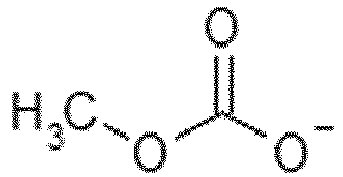


- Besonders bevorzugt sind auch anodische Umsetzungen von
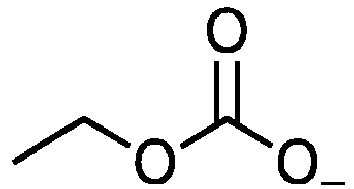


- Besonders bevorzugt sind auch die Umsetzung von


- Weiterer Gegenstand der Erfindung ist die Verwendung der aus dem neuen Verfahren erhältlichen Arylalkylcarbonate oder Diarylcarbonate zur Herstellung von Polycarbonaten.
- Die Reaktionsgleichung des neuen elektrochemischen Herstellungsverfahrens sei am Beispiel der Umsetzung von

- Anodenreaktion:

- Als Kathodenreaktion dient beispielsweise die Wasserstoffentwicklung aus saurer Lösung:

- Die neue anodische elektrochemische Reaktion wird bevorzugt bei einer Stromdichte im Bereich von 0,5 - 100 mA/cm2 und bei einer Temperatur im Bereich von 10 - 80°C durchgeführt.
- Zur Durchführung des neuen Verfahrens können bevorzugt handelsübliche Bor-dotierte Diamantelektroden eingesetzt werden, die als Anode geschaltet werden. Der Vorteil der Bor-dotierten Diamantelektrode besteht darin, dass sie unter anodischen Bedingungen chemisch sehr stabil ist, und insbesondere gegenüber radikalischen Zwischenstufen bei der elektrochemischen Umsetzung sehr beständig ist.
- Diamantelektroden, die grundsätzlich für das neue Verfahren besonders geeignet sind, sind dadurch gekennzeichnet, dass eine elektrisch leitfähige Diamantschicht, die Bor-dotiert sein kann, auf einem geeigneten elektrisch leitenden Trägermaterial aufgebracht wird. Das meist angewandte Verfahren zur Herstellung solcher Elektroden ist die "Hot filament chemical vapor deposition"-Technik (HFCVD), um aktive und stabile Bor-dotierte Diamant-Elektroden herzustellen. Bei vermindertem Druck (Größenordnung 10 mbar) und hoher lokaler Temperatur (> 2000 °C), die durch Heizdrähte erzeugt wird, wird eine Kohlenstoffquelle (z.B. Methan) und Wasserstoff eingesetzt. Unter diesen Prozessbedingungen gebildete Wasserstoffradikale ermöglichen die Bildung von Methylradikalen, welche sich letztendlich als Diamant auf einem Trägermaterial abscheiden [M. Rüffer, "Diamond electrodes - properties, fabrication, applications," Vortrag auf ACHEMA 2015, Frankfurt am Main, 2015]. Für die elektrochemische Verwendung bedarf es leitfähiger Elektroden, weshalb die Diamantschicht im Herstellungsprozess mit Bor dotiert wird. Für die Bordotierung wird auf geringe Konzentrationen an Diborane, Trimethylboran, Bortrioxid oder Borate zurückgegriffen [L. Pan und D. Kanja, Diamond: Electronic Properties and Applications, Kluwer AcademicPublishers: Boston, 1995]. Gängig ist auch, einen zusätzlichen Wasserstoffgasstrom durch eine Methanol/Bortrioxid Lösung (mit definiertem C/B-Verhältnis) zu führen [E. Brillas und C. A. Martinez-Huitle, Synthetic Diamond Films: Preparation, Electrochemistry, Characterization and Applications, John Wiley & Sons, 2001]. In einer bevorzugten Ausführung der Erfindung wird die anodische Reaktion an einer Bor-dotierten Diamantelektrode als Anode durchgeführt, bei der die Bor-dotierte Diamantschicht auf verschiedenen Basismaterialien aufgebracht ist. So können unabhängig voneinander bevorzugt Titan, Silizium oder Niob als Trägermaterial für die Diamantschicht eingesetzt werden. Besonders bevorzugtes Trägermaterial ist Silizium. Auch andere Trägermaterialen, auf denen die Diamantschicht haftet und eine dichte Schicht bildet, können grundsätzlich eingesetzt werden.
- Der elektrisch leitende Träger zur Herstellung der Bor-dotierten Diamantschicht kann grundsätzlich ein Netz, Vlies, Schaum, Gewebe, Geflecht oder Streckmetall sein. Bevorzugt wird ein Träger in Form eines Streckmetalls eingesetzt. Der Träger kann einlagig oder mehrlagig sein. Ein mehrlagiger Träger kann aus zwei oder mehreren übereinander angeordneten Netzen, Vliesen, Schäumen, Geweben, Geflechten oder Streckmetallen aufgebaut sein. Die Netze, Vliese, Schäume, Gewebe, Geflechte oder Streckmetalle können dabei unterschiedlich sein. Sie können z.B. unterschiedlich dick oder unterschiedlich porös sein oder eine unterschiedliche Maschenweite aufweisen. Zwei oder mehrere Netze, Vliese, Schäume, Gewebe, Geflechte oder Streckmetalle können z.B. durch Sintern oder Schweißen miteinander verbunden sein.
- In einem bevorzugten Verfahren wird eine Bor-dotierte Diamantelektrode eingesetzt, die auf einem Träger basierend auf mindestens einem Material ausgewählt aus der Reihe: Tantal, Silizium und Niob, bevorzugt Silizium aufgebaut ist.
- Eine weitere bevorzugte Ausführung des neuen Verfahrens ist dadurch gekennzeichnet, dass die Verbindungen der Formel

- Bevorzugt wird in der vorgelagerten kathodischen Reaktion als Alkohol R1OH ein Alkohol aus der Reihe: Methanol, Ethanol, n-Propanol, n-Butanol, tert-Butanol, n-Pentanol, n-Hexanol, Cyclohexanol, Tert-Butylphenol, Cumylphenol, Napththol oder Phenol eingesetzt.
- Die Reaktion zur kathodischen Bildung eines Monoalkylcarbonates kann grundsätzlich in analoger Weise wie beispielhaft in Tetrahedron Letters, 1997, 20. 3565-3568 beschrieben durchgeführt werden, wobei die dort beschriebene Zugabe eines Alkylierungsreagenzes wegfällt:
- Hierbei wird beispielsweise eine Lösung von Et4NClO4 (0,1 mol/l) in Acetonitril mit CO2 gesättigt. Unter kontinuierlicher CO2-Zufuh wird das CO2 kathodisch an einer Kupfer- oder Platinelektrode umgesetzt bei einem Elektrodenpotential von -2,1 V (gegen Kalomelelektrode als Referenz) mit einer Ladung von 2 F pro Mol des später eingesetzten Alkohols bei Raumtemperatur in geteilter Zelle. Danach wird die Reaktionsmischung mit Stickstoff gespült und der entsprechende Alkohol zugegeben und 90 Minuten bei Raumtemperatur gerührt.
- Die Kathodenreaktion zur Bildung eines Monoalkylcarbonates ist grundsätzlich in Novel Trends in Electroorganic Synthesis, [Papers presented at the International Symposium on Electroorganic Synthesis], 3rd, Kurashiki, Japan, Sept. 24-27, 1997 (1998), 193-196 beschrieben.
- Es handelt sich hierbei um eine komplexe Abfolge von mehreren Reaktionen, die hier exemplarisch am Beispiel von Methanol gezeigt sei:




- Die vorgelagerte kathodische Reaktion nach der bevorzugten Ausführung findet insbesondere in Acetonitril als Lösungsmittel statt, kann aber auch in anderen aprotischen Lösungsmitteln wie DMF, DMSO, 1,2-Dimethoxyethane oder N-methyl-2-pyrrolidon durchgeführt werden. Die vorgelagerte kathodische Reaktion kann insbesondere bei einer Stromdichte im Bereich von 2 - 100 mA/cm2 und einer Temperatur im Bereich von 10 - 80°C durchgeführt werden.
- Gegenstand der Erfindung ist auch die Verwendung der Arylalkylcarbonate und Diarylcarbonate erhalten aus dem erfindungsgemäßen Verfahren zur Herstellung von Polycarbonaten nach dem Schmelze-Umesterungsverfahren.
- Die Umesterungsreaktion kann beispielhaft nach folgender Gleichung beschrieben werden:

- Im Folgenden werden bevorzugte weitere Einsatzstoffe und Verfahrensvarianten des an sich bekannten Schmelze-Umesterungsverfahrens zur Herstellung von Polycarbonaten genannt, die für die Umsetzung der aus dem erfindungsgemäßen Verfahren erhältlichen Arylalkylcarbonate und Diarylcarbonate Verwendung finden können.
-
- Die
EP 2650278 beschreibt ein Verfahren zur Herstellung von Diarylcarbonaten für die Herstellung von Polycarbonat, wobei als Zwischenstufe ein Arylalkylcarbonat hergestellt wird. Eine Variante des erfindungsgemäßen Verfahrens liefert einen direkten Zugang zu Arylalkylcarbonaten, welche gemäß des in derEP 2650278 beschriebenen Verfahrens zur Herstellung von Diarylcarbonaten eingesetzt werden können. Es erfolgt hierbei eine Disproportionierungsreaktion, bei der Dialkylcarbonate und Diarylcarbonate entstehen. Die anfallenden Dialkylcarbonate können mit dem passenden Arylalkohol wieder in Arylalkylcarbonate umgesetzt werden, wobei Alkylalkohole freigesetzt werden. Solche Prozesse sind dem Fachmann bekannt und zum Beispiel ausführlich beschrieben in derEP1837328 . - In dem Schmelze-Umesterungsverfahren zur Herstellung von Polycarbonaten erhaltene Polycarbonate können durch den Einsatz geringer Mengen Kettenabbrecher und Verzweiger bewusst und kontrolliert modifiziert werden. Geeignete Kettenabbrecher und Verzweiger sind literaturbekannt. Einige sind beispielsweise in der
DE-A 38 33 953 beschrieben. Bevorzugt eingesetzte Kettenabbrecher sind Phenol oder Alkylphenole, insbesondere Phenol, p-tert.Butylphenol, iso-Octylphenol, Cumylphenol, deren Chlorkohlensäureester oder Säurechloride von Monocarbonsäuren bzw. Gemischen aus diesen Kettenabbrechern. Bevorzugte Kettenabbrecher sind Phenol, Cumyl-phenol, Isooctylphenol, para-tert.-Butylphenol. - Beispiele für als Verzweiger geeignete Verbindungen sind aromatische oder aliphatische Verbindungen mit mehr als drei, bevorzugt drei oder vier Hydroxygruppen. Besonders geeignete Beispiele mit drei oder mehr als drei phenolischen Hydroxylgruppen sind Phloroglucin, 4,6-Dimethyl-2,4,6-tri-(4-hydroxyphenyl)-hepten-2, 4,6-Dimethyl-2,4,6-tri-(4-hydroxyphenyl)-heptan, 1,3,5-Tri-(4-hydroxyphenyl)-benzol, 1,1,1-Tri-(4-hydroxyphenyl)-ethan, Tri-(4-hydroxyphenyl)-phenyl-methan, 2,2-Bis-[4,4-bis-(4-hydroxyphenyl)-cyclohexyl]-propan, 2,4-Bis-(4-hydroxyphenyl-isopropyl)-phenol, Tetra-(4-hydroxyphenyl)-methan.
- Beispiele für sonstige als Verzweiger geeignete trifunktionelle Verbindungen sind 2,4-Dihydroxy-benzoesäure, Trimesinsäure, Cyanurchlorid und 3,3-Bis-(3-methyl-4-hydroxyphenyl)-2-oxo-2,3-dihydroindol.
- Besonders bevorzugte Verzweiger sind 3,3-Bis-(3-methyl-4-hydroxyphenyl)-2-oxo-2,3-dihydro-indol und 1,1,1-Tri-(4-hydroxyphenyl)-ethan.
- Die gegebenenfalls mitzuverwendenden Verzweiger in einer Konentration von 0,05 bis 2 Mol-%, bezogen auf eingesetzte Bisphenole, können mit den Bisphenolen zusammen eingesetzt werden.
- Es ist darauf zu achten, dass die Reaktionskomponenten für die Umesterung, die Bisphenole und die Diarylcarbonate, frei von Alkali- und Erdalkaliionen sind, wobei Mengen von kleiner 0,1 ppm an Alkali- und Erdalkaliionen toleriert werden können. Derart reine Bisphenole bzw. Diarylcarbonate sind erhältlich, indem man die Bisphenole bzw. Diarylcarbonate umkristallisiert, wäscht oder destilliert. Beim nachgeschalteten Umesterungsverfahren soll der Gehalt an Alkali- und Erdalkalimetallionen sowohl im Bisphenol als auch im Diarylcarbonat einen Wert von < 0,1 ppm betragen.
- Die Umesterungsreaktion des Bisphenols und des Diarylcarbonats in der Schmelze wird bevorzugt in zwei Stufen durchgeführt. In der ersten Stufe findet das Aufschmelzen des Bisphenols und des Diarylcarbonats bei Temperaturen von 80 - 250°C, bevorzugt 100 - 230°C, besonders bevorzugt 120 - 190°C unter normalem Druck in 0 - 5 Stunden, bevorzugt 0,25 - 3 Stunden statt. Nach Zugabe des Katalysators wird durch Anlegen von Vakuum (bis zu 2 mm Hg) und Erhöhung der Temperatur (auf bis zu 260°C) durch Abdestillieren des Monophenols das Oligocarbonat aus dem Bisphenol und dem Diarylcarbonat hergestellt. Das so hergestellte Oligocarbonat hat eine mittlere Gewichtsmolmasse Mw (ermittelt durch Messung der rel. Lösungsviskosität in Dichlormethan oder in Mischungen gleicher Gewichtsmengen Phenol / o-Dichlorbenzol, geeicht durch Lichtstreuung) im Bereich von 2000 bis 18 000, bevorzugt von 4 000 bis 15 000. Hierbei wird die Hauptmenge an Monophenol (80 %) aus dem Prozess wiedergewonnen.
- In der zweiten Stufe wird bei der Polykondensation durch weiteres Erhöhen der Temperatur auf 250 - 320°C, bevorzugt 270 - 295°C und einem Druck von < 2 mm Hg das Polycarbonat hergestellt. Hierbei wird der Rest an Monophenolen zurückgewonnen. Es können geringe Verluste an Monophenolen < 5 %, bevorzugt < 2 %, besonders bevorzugt < 1 % auftreten, verursacht durch Endruppen im Polycarbonat und Restmonophenol im Polycarbonat. Diese Verluste müssen durch entsprechende Mengen an Monophenol für die Herstellung des Diarylcarbonats ausgeglichen werden.
- Geeignete Katalysatoren im Sinne des Schmelze-Umesterungsverfahrens sind alle anorganischen oder organischen basischen Verbindungen beispielsweise Lithium-, Natrium-, Kalium-, Cäsium-, Calcium-, Barium-, Magnesium-, -hydroxide, -carbonate, -halogenide, -phenolate, -diphenolate, - fluoride, -acetate, -phosphate, -hydrogenphosphate, -boranate, Stickstoff- und Phosphorbasen wie beispielsweise Tetramethylammoniumhydroxid, Tetramethylammoniumacetat, Tetramethylammoniumfluorid, Tetramethylammoniumtetraphenylboranat, Tetraphenylphosphoniumfluorid, Tetra-phenylphosphoniumtetraphenylboranat, Dimethyldiphenylammoniumhydoxid, Tetraethylammoniumhydroxid, DBU, DBN oder Guanidinsysteme wie beispielsweise das 1,5,7-Triazabicyclo-[4,4,0]-dec-5-en, 7-Phenyl-1,5,7-triazabicyclo-[4,4,0]-dec-5-en, 7-Methyl-1,5,7-triazabicyclo-[4,4,0]-dec-5-en, 7,7'-Hexylidendi-1,5,7-triazabi-cyclo-[4,4,0]-dec-5-en, 7,7'-Decylidendi-1,5,7-triazabicyclo-[4,4,0]-dec-5-en, 7,7'-Dodecyliden-di-1,5,7-tri-aza-bicyclo-[4,4,0]-dec-5-en oder Phosphazene wie bei-spielsweise die Phosphazen-Base P1-t-Oct = tert.-Octyl-imino-tris-(dimethylamino)-phosphoran, Phosphazen-Base P1-t-Butyl = tert.-Butyl-imino-tris-(dimethylamino)-phosphoran, BEMP = 2-tert.-Butylimino-2-diethylamino-1,3-dimethyl-perhydro-1,3,2-diaza-2-phos-phoran.
- Diese Katalysatoren werden insbesondere in Mengen von 10<-2> bis 10<-8> Mol, bezogen auf 1 Mol Bisphenol, eingesetzt.
- Die Katalysatoren können auch in Kombination (zwei oder mehrere) miteinander eingesetzt werden.
- Beim Einsatz von Alkali-/Erdalkali-Metallkatalysatoren kann es vorteilhaft sein, die Alkali-/ Erdalkali-Metallkatalysatoren zu einem späteren Zeitpunkt (z.B. nach der Oligocarbonatsynthese bei der Polykondensation in der zweiten Stufe) zuzusetzen. Die Zugabe des Alkali-/Erdalkali-Metallkatalysators kann z.B. als Feststoff oder als Lösung in Wasser, Phenol, Oligocarbonat oder Polycarbonat erfolgen.
- Die Mitverwendung von Alkali- bzw. Erdalkali-Metallkatalysatoren widerspricht nicht der vorstehend erwähnten Forderung nach Reinheit der Reaktionspartner.
- Die Reaktion des Bisphenols und des Diarylcarbonats zum Polycarbonat kann beim Schmelze-Umesterungsverfahren diskontinuierlich oder bevorzugt kontinuierlich durchgeführt werden, beispielsweise in Rührkesseln, Dünnschichtverdampfern, Fallflmverdampfern, Rührkesselkaskaden, Extrudern, Knetern, einfachen Scheibenreaktoren und Hochviskosscheibenreaktoren.
- Die aromatischen Polycarbonate erhältlich aus dem Schmelze-Umesterungsverfahren sollen insbesondere mittlere Gewichtsmolmassen Mw von 18000 bis 80000 vorzugsweise 19000 bis 50000 haben, ermittelt durch Messung der rel. Lösungsviskosität in Dichlormethan oder in Mischungen gleicher Gewichtsmengen Phenol / o-Dichlorbenzol, geeicht durch Lichtstreuung.
- Es ist vorteilhaft, die aus dem Schmelze-Umesterungsverfahren des Bisphenols und des Diarylcarbonats zum Polycarbonat abgespaltenen und isolierten Monophenole vor dem Einsatz in die Diarylcarbonatsynthese aufzureinigen. Die Rohmonophenole, die beim Umesterungsprozeß isoliert werden, können je nach Umesterungsbedingungen und Destillationsbedingungen u.a. mit Diarylcarbonaten, dem Bisphenol, Salicylsäure, Isopropenylphenol, Phenoxybenzoesäurephenylester, Xanthon, dem Hydroxymonoarylcarbonat verunreinigt sein. Die Reinigung kann nach den üblichen Reinigungsverfahren, also z. B. Destillation oder Umkristallisation erfolgen. Die Reinheit der Monophenole liegt dann bei > 99 %, bevorzugt bei > 99,8 %, besonders bevorzugt bei > 99,95 %
- Die Erfindung wird nachfolgend durch die Beispiele, welche jedoch keine Beschränkung der Erfindung darstellen, näher erläutert.
- Gaschromatographische Untersuchungen (GC) erfolgten mit Hilfe des Gaschromatographen GC-2010 der Firma Shimadzu, Japan. Die Wechselwirkung der Probe mit der stationären Phase erfolgt in einer Quarzkapillarsäule ZB-5MSi der Firma Phenomenex, USA (Länge: 30 m; Innendurchmesser: 0,25 mm; Filmdicke der kovalent gebundenen stationären Phase: 0,25 µm; Vorsäule: 5 m, Trägergas: Wasserstoff; Injektortemperatur: 250 °C; Detektortemperatur: 310 °C; Programm: Methode "hart": 50 °C Starttemperatur für 1 min, Heizrate: 15 °C/min, 290 °C Endtemperatur für 8 min) gemessen. Gaschromatographische Massenspektren (GCMS) wurden mit Hilfe des Gaschromatographen GC-2010 kombiniert mit dem Massendetektor GCMS-QP2010 der Firma Shimadzu, Japan aufgenommen. Es wird an einer Quarzkapillarsäule ZB-5MSi der Firma Phenomenex, USA (Länge: 30 m; Innendurchmesser: 0,25 mm; Filmdicke der kovalent gebundenen stationären Phase: 0,25 µm; Vorsäule: 5 m, Trägergas: Helium; Injektortemperatur: 250 °C; Detektortemperatur: 300 °C; Programm: Methode "hart": 50 °C Starttemperatur für 1 min, Heizrate: 15 °C/min, 290 °C Endtemperatur für 8 min; GCMS: Temperatur der Ionenquelle: 200 °C) gemessen.
- Die NMR-spektroskopischen Untersuchungen wurden an Multikernresonanzspektrometern des Typs AV II 400 der Firma Bruker, Analytische Messtechnik, Karlsruhe, durchgeführt. Die verwendeten Lösungsmittel sind jeweils angegeben. Alle 1H- und 13C-Spektren wurden gemäß dem Restgehalt an nicht deuteriertem Lösungsmittel nach der NMR Solvent Data Chart der Fa. Cambridge Isotopes Laboratories, USA, kalibriert. Die Zuordnung der 1H- und 13C-Signale erfolgte falls notwendig mit Hilfe von H,H-COSY, H,C-HSQC und H,C-HMBC-Spektren. Die chemischen Verschiebungen sind als δ-Werte in ppm angegeben. Die Auswertung der NMR-Spektren erfolgte mit dem Programm MestReNova (Version: v10.0.1-14719). Für die Multiplizitäten der NMR-Signale wurden folgende Abkürzungen verwendet: s (Singulett), bs (breites Singulett), d (Dublett), t (Triplett), q (Quartett), m (Multiplett), sowie alle denkbaren Kombinationen dieser Abkürzungen. Alle Kopplungskonstanten J wurden mit der Anzahl der eingeschlossenen Bindungen in Hertz (Hz) angegeben.
-

- Die Synthese erfolgte in Anlehnung an die Vorschrift von Feroci et al. (J. Org. Chem. 2002, 67, 8287-8289). 29,3 g einer 21%igen methanolischen Tetrabutylammoniummethanolat-Lösung (6,16 g, 22,50 mmol) werden unter Argon in einem Einhalskolben vorgelegt und mit einem Gaseinleitungsrohr versehen. Durch zwei Gaswaschflaschen wird unter Rühren 4 Stunden Kohlendioxid-Gas eingeleitet. Nach beendeter Einleitung wird das Lösemittel unter vermindertem Druck entfernt. Der zähe Feststoff enthält noch Methanol, welches an einer Kugelrohrdestillationsvorrichtung im Hochvakuum bei Raumtemperatur entfernt wird. Der entstehende weiße Feststoff wird unter Hochvakuum getrocknet und unter Argon gelagert. Es werden 5,2 g (16,40 mmol) farbloser Feststoff erhalten. Die Ausbeute bezogen auf die Stoffmenge des eingesetzten Tetrabutylammoniummethanolats betrug 73%.
1H-NMR (400 MHz, CDCl3): δ (ppm) = 3.50 (s, 3H, H-6), 3.39-3.28 (m, 8H, H-1), 1.66-1.58 (m, 8H, H-2), 1.42 (h, J = 7.3 Hz, 8H, H-3), 0.98 (t, J = 7.3 Hz, 12H, H-4).
13C-NMR (101 MHz, CDCl3): δ (ppm) = 158.27 (C-5), 58.72 (C-1), 52.12 (C-6), 23.98 (C-2), 19.67 (C-3), 13.61 (C-4). -

- In einer ungeteilten 5 ml Teflonzelle werden 1 mmol des Mesitylens mit 3,5 mmol Tetrabutylammoniummethylcarbonat gelöst in 5 ml Acetonitril gegeben und an einer Bor-dotierten DiamantElektrode (DIACHEM®, 15 µm Diamantschicht auf Silizium-Trägermaterial, CONDIAS GmbH, Itzehoe, Deutschland)) anodisch umgesetzt. Als Gegenelektrode dient eine Platin-Kathode. Der Elektrodenabstand beträgt 0,5 cm. Die Elektrolyse erfolgt galvanostatisch mit einer Stromdichte von 2,0 mA/cm2 und einer Ladungsmenge von 3,5 F bei Raumtemperatur (20°C) und Atmosphärendruck (1 atm). Nach Ende der Elektrolyse wird der Zellinhalt in einem Scheidetrichter zwischen 50 ml Wasser und 50 ml Ethylacetat separiert. Die organische Phase wird zweimal mit 50 ml Wasser gewaschen, mit Natriumsulfat getrocknet und das Lösungsmittel unter vermindertem Druck am Rotationsverdampfer entfernt.
- Das erhaltene Rohprodukt wurde per präparativer HPLC an einer C18 Säule (KNAUER Wissenschaftliche Geräte GmbH, Deutschland, Eurospher II, Porengroße: 100 Å, Partikelgröße: 5 µm, Länge: 250 mm, Durchmesser: 30 mm) gereinigt. Methode: Flow 20 ml/min, Eluent ist Acetonitril (A) und Wasser 95%/Acetonitril 5%/Phosphorsäure (1 ml auf 1000 ml) (B), 0-40 min 15% A + 85% B, 40-120 min 100% A.
- Es wurden 10 mg Produkt (0,05 mmol) als farblose Flüssigkeit erhalten. Die Ausbeute bezogen auf die Stoffmenge des eingesetzten Mesitylens betrug 5%.
- Die Charakterisierung mit NMR ergab folgendes:
- 1H-NMR (400 MHz, CDCl3): δ (ppm) = 6.87 (s, 2H, H-3), 3.91 (s, 3H, H-8), 2.27 (s, 3H, H-6), 2.16 (s, 6H, H-5).
- 13C-NMR (101 MHz, CDCl3): δ (ppm) = 153.76 (C-7), 146.15 (C-1), 135.59 (C-4), 129.66 (C-2), 129.32 (C-3), 55.49 (C-8), 20.75 (C-6), 15.93 (C-5).
- MS (EI, GCMS): m/z 194 [M]+, 150 [M - 3 CH3]+, 135 [M - CO2CH3]+, 119 [M-CO3CH3]+.
- Die Herstellung von Tetrabutylammoniummethylcarbonat als Vorstufe erfolgt wie in Beispiel 1 unter Schritt 1 beschrieben.
-
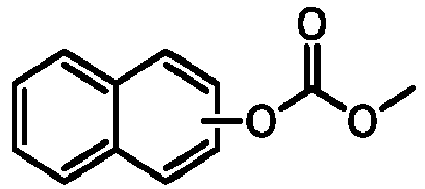
- In einer ungeteilten 5 ml Teflonzelle werden 1,0 mmol des Naphthalins mit 3,5 mmol Tetrabutylammoniummethylcarbonat gelöst in 5 ml Acetonitril gegeben und an einer Bor-dotierten DiamantElektrode (DIACHEM®, 15 µm Diamantschicht auf Silizium-Trägermaterial, CONDIAS GmbH, Itzehoe, Deutschland) anodisch umgesetzt. Als Gegenelektrode dient eine Platin-Kathode. Der Elektrodenabstand beträgt 0,5 cm. Die Elektrolyse erfolgt galvanostatisch mit einer Stromdichte von 2,0 mA/cm2 und einer Ladungsmenge von 2 F bei Raumtemperatur (20°C) und Atmosphärendruck (1 atm). Die Analyse der Reaktionsmischung erfolgte mittels GC-MS.
MS (EI, GCMS): m/z 208 [M]+, 135 [M - CO2CH2CH3]+, 119 [M - CO3CH2CH3]+. -

- Die Synthese erfolgte in Anlehnung an die Vorschrift von Feroci et al. (J. Org. Chem. 2002, 67, 8287-8289). 20 ml einer 37,6%igen ethanolischen Tetrabutylammoniumethanolat-Lösung (7,52 g, 26,15 mmol) werden unter Argon in einem Einhalskolben vorgelegt und mit einem Gaseinleitungsrohr versehen. Durch zwei Gaswaschflaschen wird unter Rühren 4 Stunden Kohlendioxid-Gas eingeleitet. Nach beendeter Einleitung wird das Lösemittel unter vermindertem Druck entfernt. Der zähe Feststoff enthält noch Methanol, welches an einer Kugelrohrdestillationsvorrichtung im Hochvakuum bei Raumtemperatur entfernt wird. Der entstehende weiße Feststoff wird am Hochvakuum getrocknet und unter Argon gelagert. Es werden 3,7 g (11,12 mmol) farbloser Feststoff erhalten. Die Ausbeute bezogen auf die Stoffmenge des eingesetzten Tetrabutylammoniumethanolats betrug 43%.
1H-NMR (400 MHz, CDCl3): δ (ppm) = 3.90 (q, J = 7.1 Hz, 3H, H-6), 3.39-3.31 (m, 8H, H-1), 1.70-1.57 (m, 8H, H-2), 1.41 (h, J = 7.4 Hz, 8H, H-3), 1.15 (t, J = 7.1 Hz, 3H, H-7), 0.97 (t, J = 7.3 Hz, 12H, H-4).
13C-NMR (101 MHz, CDCl3): δ (ppm) = 157.91 (C-5), 59.73 (C-7), 58.77 (C-1), 24.04 (C-2), 19.71 (C-3), 15.60 (C-7), 13.64 (C-4). -

- In einer ungeteilten 5 ml Teflonzelle werden 1,0 mmol des Mesitylens mit 3,5 mmol Tetrabutylammoniumethylcarbonat gelöst in 5 ml Acetonitril gegeben und an einer Bor-dotierten DiamantElektrode (DIACHEM®, 15 µm Diamantschicht auf Silizium-Trägermaterial, CONDIAS GmbH, Itzehoe, Deutschland) anodisch umgesetzt. Als Gegenelektrode dient eine Platin-Kathode. Der Elektrodenabstand beträgt 0,5 cm. Die Elektrolyse erfolgt galvanostatisch mit einer Stromdichte von 2,0 mA/cm2 und einer Ladungsmenge von 2 F bei Raumtemperatur (20°C) und Atmosphärendruck (1 atm). Die Analyse der Reaktionsmischung erfolgte mittels GC-MS.
MS (EI, GCMS): m/z 208 [M]+, 135 [M - CO2CH2CH3]+, 119 [M - CO3CH2CH3]+.
Claims (10)
- Verfahren zur elektrochemischen Herstellung von Arylalkylcarbonaten und Diaryl carbonaten, dadurch gekennzeichnet, dass Verbindungen der Formel


- Verfahren nach Anspruch 1, dadurch gekennzeichnet, dass die anodische Reaktion an einer Bor-dotierten Diamantelektrode als Anode durchgeführt wird.
- Verfahren nach einem der Ansprüche 1 oder 2, dadurch gekennzeichnet, dass als Lösungsmittel Acetonitril, oder eine Mischung von Acetonitril mit anderen Lösungsmittel insbesondere einem Lösungsmittel ausgewählt aus Dimethylformamid und Dimethylsulfoxid verwendet wird.
- Verfahren nach einem der Ansprüche 1 bis 3, dadurch gekennzeichnet, dass der Rest R1 in der Verbindung der Formel (1) ein Methylrest, Ethylrest oder ein Phenylrest, bevorzugt ein Methylrest oder Ethylrest ist.
- Verfahren nach einem der Ansprüche 1 bis 4, dadurch gekennzeichnet, dass die Reste R2, R3 und R4 in der Verbindung der Formel (2) unabhängig voneinander Wasserstoff oder Methyl, bevorzugt Wasserstoff bedeuten.
- Verfahren nach einem der Ansprüche 1 bis 5, dadurch gekennzeichnet, dass die neue anodische elektrochemische Reaktion bei einer Stromdichte im Bereich von 0,5 - 100 mA/cm2 und bei einer Temperatur im Bereich von 10 - 80°C durchgeführt wird.
- Verfahren nach einem der Ansprüche 1 bis 6, dadurch gekennzeichnet, dass die Verbindungen der Formel (1) als Salze eingesetzt werden mit kationischen quartären Ammoniumverbindungen, insbesondere Tetraalkylammonium, bevorzugt Tetrabutylammonium als Gegenionen.
- Verfahren nach einem der Ansprüche 1 bis 7, dadurch gekennzeichnet, dass die Verbindungen der Formel (1)

- Verfahren nach Anspruch 8, dadurch gekennzeichnet, dass in der vorgelagerten kathodischen Reaktion als Alkohol R1OH ein Alkohol aus der Reihe: Methanol, Ethanol, n-Propanol, n-Butanol, tert-Butanol, n-Pentanol, n-Hexanol, Cyclohexanol, Tert-Butylphenol, Cumylphenol, Napththol oder Phenol eingesetzt wird.
- Verwendung der Arylalkylcarbonate und Diarylcarbonate erhalten aus dem Verfahren gemäß einem der Ansprüche 1 bis 9 zur Herstellung von Polycarbonaten nach dem Schmelze-Umesterungsverfahren.
Priority Applications (8)
| Application Number | Priority Date | Filing Date | Title |
|---|---|---|---|
| EP16198768.0A EP3321250A1 (de) | 2016-11-15 | 2016-11-15 | Elektrochemisches verfahren zur herstellung von arylalkylcarbonaten und diarylcarbonaten |
| ES17801651T ES2882510T3 (es) | 2016-11-15 | 2017-11-10 | Procedimiento electroquímico para la preparación de carbonatos de arilalquilo y carbonatos de diarilo |
| JP2019525795A JP7037559B2 (ja) | 2016-11-15 | 2017-11-10 | アリールアルキルカーボネートおよびジアリールカーボネートを調製するための電気化学的方法 |
| EP17801651.5A EP3541778B1 (de) | 2016-11-15 | 2017-11-10 | Elektrochemisches verfahren zur herstellung von arylalkylcarbonaten und diarylcarbonaten |
| CN201780070941.4A CN109937197B (zh) | 2016-11-15 | 2017-11-10 | 用于制备碳酸芳基烷基酯和碳酸二芳基酯的电化学法 |
| KR1020197013452A KR102468537B1 (ko) | 2016-11-15 | 2017-11-10 | 아릴 알킬 카르보네이트 및 디아릴 카르보네이트를 제조하기 위한 전기화학적 방법 |
| PCT/EP2017/078907 WO2018091370A1 (de) | 2016-11-15 | 2017-11-10 | Elektrochemisches verfahren zur herstellung von arylalkylcarbonaten und diarylcarbonaten |
| TW106139094A TW201831730A (zh) | 2016-11-15 | 2017-11-13 | 製備芳基烷基碳酸酯及二芳基碳酸酯之電化學方法 |
Applications Claiming Priority (1)
| Application Number | Priority Date | Filing Date | Title |
|---|---|---|---|
| EP16198768.0A EP3321250A1 (de) | 2016-11-15 | 2016-11-15 | Elektrochemisches verfahren zur herstellung von arylalkylcarbonaten und diarylcarbonaten |
Publications (1)
| Publication Number | Publication Date |
|---|---|
| EP3321250A1 true EP3321250A1 (de) | 2018-05-16 |
Family
ID=57326227
Family Applications (2)
| Application Number | Title | Priority Date | Filing Date |
|---|---|---|---|
| EP16198768.0A Ceased EP3321250A1 (de) | 2016-11-15 | 2016-11-15 | Elektrochemisches verfahren zur herstellung von arylalkylcarbonaten und diarylcarbonaten |
| EP17801651.5A Active EP3541778B1 (de) | 2016-11-15 | 2017-11-10 | Elektrochemisches verfahren zur herstellung von arylalkylcarbonaten und diarylcarbonaten |
Family Applications After (1)
| Application Number | Title | Priority Date | Filing Date |
|---|---|---|---|
| EP17801651.5A Active EP3541778B1 (de) | 2016-11-15 | 2017-11-10 | Elektrochemisches verfahren zur herstellung von arylalkylcarbonaten und diarylcarbonaten |
Country Status (7)
| Country | Link |
|---|---|
| EP (2) | EP3321250A1 (de) |
| JP (1) | JP7037559B2 (de) |
| KR (1) | KR102468537B1 (de) |
| CN (1) | CN109937197B (de) |
| ES (1) | ES2882510T3 (de) |
| TW (1) | TW201831730A (de) |
| WO (1) | WO2018091370A1 (de) |
Cited By (2)
| Publication number | Priority date | Publication date | Assignee | Title |
|---|---|---|---|---|
| JP2022508992A (ja) * | 2018-09-25 | 2022-01-20 | 積水化学工業株式会社 | 合成方法及び合成システム |
| CN115161671A (zh) * | 2022-07-08 | 2022-10-11 | 江西师范大学 | 一种精准区域选择性烯烃芳基化的电化学合成方法 |
Families Citing this family (1)
| Publication number | Priority date | Publication date | Assignee | Title |
|---|---|---|---|---|
| JP7120098B2 (ja) | 2019-03-19 | 2022-08-17 | 新東工業株式会社 | テトラヒドロほう酸塩の製造装置、及びテトラヒドロほう酸塩の製造方法 |
Citations (3)
| Publication number | Priority date | Publication date | Assignee | Title |
|---|---|---|---|---|
| DE3833953A1 (de) | 1988-10-06 | 1990-04-19 | Bayer Ag | Mischungen von speziellen, neuen polycarbonaten mit anderen thermoplasten oder mit elastomeren |
| EP1837328A1 (de) | 2004-12-24 | 2007-09-26 | Asahi Kasei Chemicals Corporation | Verfahren zur herstellung von aromatischem carbonat |
| EP2650278A1 (de) | 2012-04-11 | 2013-10-16 | Bayer MaterialScience AG | Verfahren zur Herstellung von Diarylcarbonaten aus Dialkylcarbonaten |
Family Cites Families (4)
| Publication number | Priority date | Publication date | Assignee | Title |
|---|---|---|---|---|
| DE19911746A1 (de) | 1999-03-16 | 2000-09-21 | Basf Ag | Diamantelektroden |
| JP2012153909A (ja) | 2009-08-31 | 2012-08-16 | Tokyo Institute Of Technology | 炭酸ジエステルの製造方法 |
| CN102586799A (zh) * | 2011-01-04 | 2012-07-18 | 索尼公司 | 电解制备碳酸酯的方法 |
| CN104379814A (zh) | 2012-06-15 | 2015-02-25 | 巴斯夫欧洲公司 | 在亲核试剂存在下进行有机基质的阳极氧化 |
-
2016
- 2016-11-15 EP EP16198768.0A patent/EP3321250A1/de not_active Ceased
-
2017
- 2017-11-10 EP EP17801651.5A patent/EP3541778B1/de active Active
- 2017-11-10 KR KR1020197013452A patent/KR102468537B1/ko active Active
- 2017-11-10 ES ES17801651T patent/ES2882510T3/es active Active
- 2017-11-10 WO PCT/EP2017/078907 patent/WO2018091370A1/de not_active Ceased
- 2017-11-10 CN CN201780070941.4A patent/CN109937197B/zh active Active
- 2017-11-10 JP JP2019525795A patent/JP7037559B2/ja active Active
- 2017-11-13 TW TW106139094A patent/TW201831730A/zh unknown
Patent Citations (3)
| Publication number | Priority date | Publication date | Assignee | Title |
|---|---|---|---|---|
| DE3833953A1 (de) | 1988-10-06 | 1990-04-19 | Bayer Ag | Mischungen von speziellen, neuen polycarbonaten mit anderen thermoplasten oder mit elastomeren |
| EP1837328A1 (de) | 2004-12-24 | 2007-09-26 | Asahi Kasei Chemicals Corporation | Verfahren zur herstellung von aromatischem carbonat |
| EP2650278A1 (de) | 2012-04-11 | 2013-10-16 | Bayer MaterialScience AG | Verfahren zur Herstellung von Diarylcarbonaten aus Dialkylcarbonaten |
Non-Patent Citations (19)
| Title |
|---|
| ACS CATAL., vol. 3, 2013, pages 389 - 392 |
| CATAL. SCI. TECHNOL., vol. 6, 2016, pages 6002 - 6010 |
| D. FREITAG; U. GRIGO; P.R. MÜLLER; N. NOUVERTNE: "Encyclopedia of Polymer Science and Engineering", vol. 11, 1988, article "Polycarbonates", pages: 648 - 718 |
| D.C. PREVORSEK; B.T. DEBONA; Y. KERSTEN: "Synthesis of Poly(ester)carbonate Copolymer", JOURNAL OF POLYMER SCIENCE, POLYMER CHEMISTRY EDITION, vol. 19, 1980, pages 75 - 90, XP009008105, DOI: doi:10.1002/pol.1980.170180109 |
| DRES. U. GRIGO; K. KIRCHER; P.R. MÜLLER: "Kunststoff-Handbuch", vol. 3/1, 1992, CARL HANSER VERLAG, article "Polycarbonate", pages: 117 - 299 |
| E. BRILLAS; C. A. MARTINEZ-HUITLE: "Synthetic Diamond Films: Preparation, Electrochemistry, Characterization and Applications", 2001, JOHN WILEY & SONS |
| FEROCI ET AL., J. ORG. CHEM., vol. 67, 2002, pages 8287 - 8289 |
| GREEN CHEMISTRY, vol. 5, 2003, pages 497 - 507 |
| H. SCHNELL: "Chemistry and Physics of Polycarbonates, Polymer Reviews", vol. 9, 1964, JOHN WILEY AND SONS, INC., pages: 50,51 |
| J. PHYS. CHEM. C, vol. 116, 2012, pages 10607 - 10616 |
| JOURNAL OF MOLECULAR CATALYSIS A: CHEMICAL, vol. 139, 1999, pages 109 - 119 |
| L. PAN; D. KANJA: "Diamond: Electronic Properties and Applications", 1995, KLUWER ACADEMICPUBLISHERS: BOSTON |
| M. RÜFFER: "Diamond electrodes - properties, fabrication, applications", 2015, VORTRAG AUF ACHEMA |
| NOVEL TRENDS IN ELECTROORGANIC SYNTHESIS, 27 September 1998 (1998-09-27), pages 193 - 196 |
| RES. CHEM. INTERMED., vol. 41, 2015, pages 9497 - 9508 |
| SCHNELL: "Polymer Reviews", vol. 9, 1964, INTERSCIENCE PUBLISHERS, article "Chemistry and Physics of Polycarbonates" |
| SHINSUKE FUKUOKA ET AL: "A novel non-phosgene polycarbonate production process using by-product CO 2 as starting material", GREEN CHEMISTRY, vol. 5, no. 5, 2003, GB, pages 497 - 507, XP055331614, ISSN: 1463-9262, DOI: 10.1039/B304963A * |
| TETRAHEDRON LETTERS, vol. 20, 1997, pages 3565 - 3568 |
| TORU MURAYAMA ET AL: "Phosgene-Free Method for Diphenyl Carbonate Synthesis at the Pd 0 /Ketjenblack Anode", JOURNAL OF PHYSICAL CHEMISTRY C, vol. 116, no. 19, 17 May 2012 (2012-05-17), US, pages 10607 - 10616, XP055331612, ISSN: 1932-7447, DOI: 10.1021/jp300809s * |
Cited By (3)
| Publication number | Priority date | Publication date | Assignee | Title |
|---|---|---|---|---|
| JP2022508992A (ja) * | 2018-09-25 | 2022-01-20 | 積水化学工業株式会社 | 合成方法及び合成システム |
| US12320023B2 (en) | 2018-09-25 | 2025-06-03 | Sekisui Chemical Co., Ltd. | Synthetic method and synthetic system |
| CN115161671A (zh) * | 2022-07-08 | 2022-10-11 | 江西师范大学 | 一种精准区域选择性烯烃芳基化的电化学合成方法 |
Also Published As
| Publication number | Publication date |
|---|---|
| EP3541778B1 (de) | 2021-05-19 |
| ES2882510T3 (es) | 2021-12-02 |
| KR102468537B1 (ko) | 2022-11-18 |
| CN109937197A (zh) | 2019-06-25 |
| CN109937197B (zh) | 2022-05-03 |
| KR20190084969A (ko) | 2019-07-17 |
| EP3541778A1 (de) | 2019-09-25 |
| TW201831730A (zh) | 2018-09-01 |
| JP2020503432A (ja) | 2020-01-30 |
| JP7037559B2 (ja) | 2022-03-16 |
| WO2018091370A1 (de) | 2018-05-24 |
Similar Documents
| Publication | Publication Date | Title |
|---|---|---|
| EP0025937B1 (de) | Thermoplastische Polycarbonate, Verfahren zu ihrer Herstellung, Bis-halogen-kohlensäureester von Hexahydro-furo(3,2-b) furan-3,6-diolen, sowie Polycarbonatmassen | |
| EP0993481B1 (de) | Verfahren zur herstellung von verzweigten polycarbonaten | |
| EP1894914B1 (de) | Verfahren zur Herstellung von Diarylcarbonat | |
| EP2894242B1 (de) | Gastverbindungsumhüllender polymer-metall-komplexkristall, verfahren zur herstellung davon, verfahren zur herstellung einer kristallstrukturanalyseprobe und verfahren zur bestimmung molekularer strukturen einer organischen verbindung | |
| US12320023B2 (en) | Synthetic method and synthetic system | |
| EP3541778B1 (de) | Elektrochemisches verfahren zur herstellung von arylalkylcarbonaten und diarylcarbonaten | |
| EP2371806B1 (de) | Verfahren zur Herstellung von Diarylcarbonaten und Polycarbonaten | |
| DE2950136A1 (de) | Verfahren zur herstellung von polycarbonaten | |
| DE102013203865A1 (de) | Elektrochemische Kupplung zweier Phenole, welche sich in ihrem Oxidationspotential unterscheiden | |
| EP0033089A2 (de) | Heterocyclisch-aromatische Oligocarbonate, ihre Herstellung, ihre Verwendung zur Herstellung von hochmolekularen, heterocyclisch-aromatischen Copolycarbonaten, diese Copolycarbonate sowie Abmischungen dieser Copolycarbonate mit anderen Thermoplasten | |
| EP2272890A1 (de) | Verfahren zur Herstellung von Polycarbonat | |
| EP4077469B1 (de) | Verfahren zur herstellung eines polyestercarbonats | |
| EP2041336B1 (de) | Elektrochemische herstellung sterisch gehinderter amine | |
| DE19609057A1 (de) | Verfahren zur Herstellung von Diarylcarbonaten und den daraus erhältlichen Polycarbonaten | |
| Mkumbuzi et al. | Synthesis and structures of zinc and cadmium bis (dithiophosphonate) complexes | |
| EP3837237B1 (de) | Verfahren zur herstellung eines cycloaliphatischen diesters | |
| DE102013203866A1 (de) | Elektrochemische Kupplung eines Phenols mit einem Naphthol | |
| DE69713560T2 (de) | Verfahren zur Herstellung von Polycarbonat | |
| WO2001005869A1 (de) | Oligomere bischlorkohlensäureester aus ausgewählten cycloaliphatischen bisphenolen und anderen bisphenolen | |
| EP2750798B1 (de) | Katalysatoren für die herstellung von carbonaten aus epoxiden und co2 | |
| EP3623414A1 (de) | Selenhaltige copolycarbonate | |
| DE4411668C2 (de) | Verfahren zur Herstellung von Kohlensäureestern | |
| EP0827948A1 (de) | Gemische cyclischer Oligocarbonate, ihre Herstellung und Verwendung | |
| DE112024001861T5 (de) | Polycarbonat-polyorganosiloxan-copolymer, harzzusammensetzung und formartikel daraus | |
| DE102023114630A1 (de) | Umesterungskatalysatoren, herstellungsverfahren von polycarbonatdiolen, und polycarbonatdiole |
Legal Events
| Date | Code | Title | Description |
|---|---|---|---|
| PUAI | Public reference made under article 153(3) epc to a published international application that has entered the european phase |
Free format text: ORIGINAL CODE: 0009012 |
|
| AK | Designated contracting states |
Kind code of ref document: A1 Designated state(s): AL AT BE BG CH CY CZ DE DK EE ES FI FR GB GR HR HU IE IS IT LI LT LU LV MC MK MT NL NO PL PT RO RS SE SI SK SM TR |
|
| AX | Request for extension of the european patent |
Extension state: BA ME |
|
| 18R | Application refused |
Effective date: 20180616 |