EP3320331B1 - Materialidentifikationsverfahren - Google Patents
Materialidentifikationsverfahren Download PDFInfo
- Publication number
- EP3320331B1 EP3320331B1 EP16747830.4A EP16747830A EP3320331B1 EP 3320331 B1 EP3320331 B1 EP 3320331B1 EP 16747830 A EP16747830 A EP 16747830A EP 3320331 B1 EP3320331 B1 EP 3320331B1
- Authority
- EP
- European Patent Office
- Prior art keywords
- calibration
- cal
- vector
- spectrum
- parameters
- Prior art date
- Legal status (The legal status is an assumption and is not a legal conclusion. Google has not performed a legal analysis and makes no representation as to the accuracy of the status listed.)
- Active
Links
Images


Classifications
-
- G—PHYSICS
- G01—MEASURING; TESTING
- G01N—INVESTIGATING OR ANALYSING MATERIALS BY DETERMINING THEIR CHEMICAL OR PHYSICAL PROPERTIES
- G01N23/00—Investigating or analysing materials by the use of wave or particle radiation, e.g. X-rays or neutrons, not covered by groups G01N3/00 – G01N17/00, G01N21/00 or G01N22/00
- G01N23/02—Investigating or analysing materials by the use of wave or particle radiation, e.g. X-rays or neutrons, not covered by groups G01N3/00 – G01N17/00, G01N21/00 or G01N22/00 by transmitting the radiation through the material
- G01N23/06—Investigating or analysing materials by the use of wave or particle radiation, e.g. X-rays or neutrons, not covered by groups G01N3/00 – G01N17/00, G01N21/00 or G01N22/00 by transmitting the radiation through the material and measuring the absorption
- G01N23/083—Investigating or analysing materials by the use of wave or particle radiation, e.g. X-rays or neutrons, not covered by groups G01N3/00 – G01N17/00, G01N21/00 or G01N22/00 by transmitting the radiation through the material and measuring the absorption the radiation being X-rays
- G01N23/087—Investigating or analysing materials by the use of wave or particle radiation, e.g. X-rays or neutrons, not covered by groups G01N3/00 – G01N17/00, G01N21/00 or G01N22/00 by transmitting the radiation through the material and measuring the absorption the radiation being X-rays using polyenergetic X-rays
-
- G—PHYSICS
- G01—MEASURING; TESTING
- G01N—INVESTIGATING OR ANALYSING MATERIALS BY DETERMINING THEIR CHEMICAL OR PHYSICAL PROPERTIES
- G01N2223/00—Investigating materials by wave or particle radiation
- G01N2223/03—Investigating materials by wave or particle radiation by transmission
- G01N2223/04—Investigating materials by wave or particle radiation by transmission and measuring absorption
-
- G—PHYSICS
- G01—MEASURING; TESTING
- G01N—INVESTIGATING OR ANALYSING MATERIALS BY DETERMINING THEIR CHEMICAL OR PHYSICAL PROPERTIES
- G01N2223/00—Investigating materials by wave or particle radiation
- G01N2223/20—Sources of radiation
- G01N2223/206—Sources of radiation sources operating at different energy levels
-
- G—PHYSICS
- G01—MEASURING; TESTING
- G01N—INVESTIGATING OR ANALYSING MATERIALS BY DETERMINING THEIR CHEMICAL OR PHYSICAL PROPERTIES
- G01N2223/00—Investigating materials by wave or particle radiation
- G01N2223/30—Accessories, mechanical or electrical features
- G01N2223/345—Accessories, mechanical or electrical features mathematical transformations on beams or signals, e.g. Fourier
-
- G—PHYSICS
- G01—MEASURING; TESTING
- G01N—INVESTIGATING OR ANALYSING MATERIALS BY DETERMINING THEIR CHEMICAL OR PHYSICAL PROPERTIES
- G01N2223/00—Investigating materials by wave or particle radiation
- G01N2223/40—Imaging
- G01N2223/426—Imaging image comparing, unknown with known substance
Definitions
- the technical field of the invention is the identification of a material by irradiation using electromagnetic ionizing radiation, followed by a spectrometric analysis of the radiation transmitted by the irradiated material. More precisely, the invention is an analysis method implementing a combination of measured spectrometric data, followed by a projection of the combined data using previously determined projection vectors.
- Determining the nature of materials by irradiation using X-rays is a common technique, practiced for decades. We do not count the number of industrial systems based on the irradiation of an object by X-rays, and analysis of the radiation transmitted by the object, the latter being interposed between an X-ray source and a detector. Such systems are used daily, for example in baggage screening at airports.
- the patent EP2510338 describes a method for determining the nature of a material, and its thickness, on the basis of a spectrum of X radiation transmitted by said material. Coefficients ( ⁇ 1 .... ⁇ n ), called attenuation or transmission coefficients, are calculated on the basis of the spectrum.
- a calibration database is also available, carried out on different calibration samples, the nature and thickness of each calibration sample being known. For a material of the same type, there are several calibration samples of different thicknesses. Thus, each calibration sample corresponds to a pair (nature of the material; thickness), to which we associate coefficients ⁇ 1 u , v , ... ⁇ not u , v , the exponents u and ⁇ respectively denoting the nature of the material constituting the calibration sample as well as its thickness.
- Such an estimate can be established by applying a likelihood function to the spectrum of the X radiation transmitted by the material analyzed.
- the likelihood function is established beforehand, using calibration measurements, using calibration materials, the atomic number and thickness of which are known.
- the effective atomic number of the material analyzed can in particular be obtained by implementing an algorithm of the maximum likelihood type, the effective atomic number and the thickness being those maximizing the likelihood function.
- the documents WANG XIAOLAN ET AL "Material separation in x-ray CT with energy resolved photon-counting detectors", MEDICAL PHYSICS, vol. 38, no.
- the inventors have sought to improve the methods described above, by proposing a more precise evaluation of the nature of the material, making it possible to establish an estimate of the nature of the material, independently of its thickness.
- step iv) making it possible to obtain a plurality of projected data, each projected data resulting from the projection of the parameter vector according to a projection vector.
- step v) consisting in classifying the material according to one of said classes of material.
- a material class can correspond to a particular material or to a group of materials.
- Step iv) may include the projection of said vector of parameters into an arrival space, each projection vector then forming a base, called the arrival base, of said arrival space.
- the number of vectors forming said base of arrival can in particular be strictly less than the number of classes of materials.
- the transmission spectrum is normalized, term for term, by a spectrum of the incident radiation, the latter being representative of the energy distribution of said incident radiation.
- the transmission spectrum comprises N channels, the number P of parameters of the set of parameters being strictly less than N, and preferably less than N / 2 or even N / 4. Typically, the number P of parameters is less than 50, or even less than 30, or even less than 20. P may for example be between 2 and 20.
- each projection vector is determined by linear discriminant analysis, carried out by considering each calibration vector.
- a projection vector can be an eigenvector of said third matrix.
- the linear discriminant analysis makes it possible to obtain an optimal discrimination of the projected data, according to the different classes considered.
- Another object of the invention is an information recording medium, readable by computer, comprising instructions for the execution of a method described above and in the remainder of the description.
- the figure 1 represents an embodiment of a device 1 implementing a method according to the invention.
- An irradiation source 11 emits ionizing electromagnetic radiation 12, called incident radiation, towards a sample 10 comprising a material to be identified.
- the term ionizing electromagnetic radiation designates electromagnetic radiation with an energy greater than 1 keV, and preferably less than 100 MeV.
- the energy range of ionizing radiation can be between 1 keV and 5 MeV, but it most often extends between 1keV and 150 keV or 300 keV.
- the ionizing radiation can be X or ⁇ radiation.
- the source of ionizing radiation is polyenergetic, the incident radiation being emitted over an energy range generally extending over several tens or even hundreds of keV. These include an X-ray emitting tube.
- the thickness of the sample 10 is between a few mm and a few cm, or even tens of cm. It is typically less than 30 cm, or even 50 cm.
- the sample 10 transmits part of the incident radiation 12 to a spectrometric detector 16.
- the incident radiation can undergo, in the sample, various interactions, for example a photoelectric effect, a Compton inelastic scattering, or even a creation effect. of pairs when the energy of the incident radiation allows it.
- the sample transmits radiation 14, called transmitted radiation, to a spectrometric detector 16.
- the spectrometric detector 16 is able to detect the transmitted radiation 14 and to form a spectrum. energy from the radiation 14 thus detected.
- the transmitted radiation 14 comprises a plurality of X photons whose energy is between a minimum energy E min and a maximum energy E max .
- the detector 16 detects photons constituting this radiation and generates, for each photon detected, an electronic pulse whose amplitude depends on the energy of the photon. More precisely, the amplitude is proportional to the energy lost by the photon in the detector, the latter depending on the energy of this photon.
- This detector 16 comprises an electronic spectrometry circuit 18, able to record the amplitude of each pulse generated during an acquisition period T, and to establish a histogram of the amplitude of the pulses formed during this acquisition period.
- Such a spectrum Sp is represented on the figure 2 , which represents a spectrum of the radiation 14 transmitted by polyethylene samples, the thickness k of which varies between 2 cm and 12 cm.
- an energy spectrum represents, for a plurality of channels, a number of photons detected per channel, each channel corresponding to an energy range.
- Each channel can be identified by an index n such as 1 ⁇ n ⁇ N, the number of channels N being greater than or equal to 2.
- Each channel E n is assigned the number of pulses Sp ( E n ) whose energy is included in the range E n and E n + ⁇ E n .
- E n ⁇ E n + 1 .
- Att (E n ) -In [TR (E n )].
- the input data of which is the spectrum Sp of the radiation transmitted by the material, called the transmission spectrum, knowing that this method applies to any spectral function implementing this spectrum, and in particular to the spectral transmission or attenuation functions as defined above.
- the processor is a microprocessor connected to a programmable memory 22 in which is stored a sequence of instructions for performing the measurements. spectra processing and calculation operations described in this description. These instructions can be saved on a recording medium readable by the processor, such as hard disk, CDROM or other type of memory.
- the processor can be linked to a display unit 24, for example a screen.
- the first step 100 is a step of irradiating the sample using the X photon generator tube.
- the second step 200 is an acquisition step, consisting in acquiring, by means of the spectrometric detector 16, a transmission spectrum Sp of a sample 10, comprising a material whose nature it is desired to determine.
- This step is implemented simultaneously with the first step 100.
- This spectrum Sp carries information as to the nature of the material examined, but this information is disseminated over the N energy channels E 1 ... E n . ..E N according to which the spectrum is defined.
- a transmission spectrum Sp can be represented by a number P of parameters ( x 1 , ..., x P ), with, preferably, 2 ⁇ P ⁇ 20, and P ⁇ N.
- These 9 parameters define a point M, representative of the transmission spectrum Sp, in a space ⁇ called the starting space.
- the base B of this starting space ⁇ is formed by base vectors (v 1 .... v P ) respectively associated with each parameter, so that the projection of the point M on each of these base vectors corresponds to the value of the parameter to which this base vector is associated.
- the parameters ( x 1 , ..., x P ) represent the coordinates point M in the starting space ⁇ . They also correspond to the coordinates of a vector V M , associated with the point M, of dimension (P, 1) and comprising the coordinates ( x 1 , ..., x P ) of the point M.
- This vector V M is called vector parameters, because it gathers parameters representative of the transmission spectrum Sp.
- the fourth step 400 is a projection step, during which the vector of parameters V M is projected according to at least one projection vector w i , so as to allow classification of this point in a class representing a given material. This also corresponds to a projection of the point M along said projection vector.
- an objective of the method is to determine the nature of a material by classifying it in a predetermined class of materials.
- These projection vectors are defined during a calibration phase of the method described below, in connection with steps 100 'to 400' represented on the figure 3 . They define a base of an arrival space ⁇ '.
- These projection vectors are stored in a memory 22 connected to the processor 20.
- the projection according to each of the projection vectors amounts to determining the coordinates (y 1 , ...., y W ) of the vector of parameters V M in the arrival space ⁇ ', these coordinates allowing a classification of the point in l 'one of the C classes of materials.
- Each coordinate y w represents a classification parameter.
- classification parameter is meant a parameter on the basis of which the classification is carried out.
- the number W of projection vectors is less than or equal to P.
- the number W of projection vectors is equal to the number C of classes minus one, but it can also be less.
- the fifth step 500 is a classification step, making it possible to assign a class C j to the material analyzed, this class being representative of the nature of this material, or of a group of materials. It is determined as a function of the classification parameters ( y 1 , ...., Y W ), constituting the coordinates of the vector of parameters V M , ⁇ ' in the arrival space ⁇ '.
- This step is classic, and amounts to identifying, in the arrival space ⁇ ', the class to which the vector of parameters V M belongs, ⁇ ' representing the spectrum Sp in this space.
- the nature of the material analyzed is then considered to be that of the material associated with this class.
- the identification of the closest class can be carried out by calculating a distance between the vector of parameters and a vector representing the center of each class, this distance being able to be weighted by a dispersion term specific to each class. This type of operation is well known to those skilled in the art.
- the number of class C is equal to 6, each class C j , 1 ⁇ j ⁇ 6 respectively representing TNT (acronym for Trinitrotoluene), Polyethylene, PMMA (Methyl methacrylate), PTFE (Polytetrafluoroethylene) , water and nylon.
- Projection step 400 requires the use of at least one projection vector w i , or a set of projection vectors ( w 1 ... w i ... w w ).
- projection vectors are defined during a learning phase, carried out prior to the projection, and comprising the steps 100 'to 400', represented on the figure 3 , and described below.
- the first step 100 ′ of the learning phase aims to determine a plurality of calibration samples, the nature of which is known and is representative of the materials that one wishes to identify subsequently.
- 24 calibration samples were used Cal j k , each calibration sample Cal j k being of nature j, corresponding to a class C j , and of thickness k, the latter being expressed in cm.
- the second step 200 ′ of the learning phase is a step of determining a plurality of calibration spectra, for example 20 calibration spectra.
- Sp Cal j k the for each calibration sample Cal j k .
- Each calibration spectrum Sp Cal j k the corresponds to the realization l of a calibration spectrum relating to the calibration sample Cal j k of nature j and thickness k.
- l is an integer greater than or equal to 1. In this example, 1 ⁇ l ⁇ 20.
- each calibration spectrum is affected by a noise, which can be modeled by a Poissonian noise.
- each class is associated with a particular material. It is however possible that a class is associated with a mixture of materials, or with materials of the same group, for example materials considered as harmless, or potentially dangerous, or even very dangerous.
- the third step 300 ′ of the learning phase is a step of reducing the number of variables, or reduction of dimensionality, in which one determines, from each calibration spectrum Sp Cal j k the , P calibration parameters x 1 j , k , the , ... . , x P j , k , the representative of this spectrum. It will be understood that these parameters are identical to those described in connection with step 300.
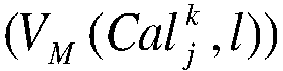
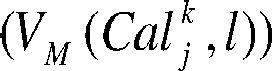
- each calibration spectrum Sp Cal j k the can be represented by a point M Cal j k the , whose coordinates are x 1 j , k , the , ... . , x P j , k , the , these coordinates also constituting the terms of a calibration vector V M Cal j k the .
- the fourth step 400 ′ consists in determining W projection vectors w 1, .... , w w , with W ⁇ C-1, allowing to obtain an optimal classification of each calibration spectrum Sp Cal j k the .
- Optimal classification means that a maximum number of calibration spectra Sp Cal j k the are classified in class C j corresponding to the nature j of the calibration sample.
- LDA Linear Discrimination Analysis, meaning linear discriminant analysis
- dimensionality for example the decomposition into principal components (or PCA: Principal Component Analysis).
- the figure 5 is an example representing two classes C 1 and C 2 , represented in a starting space ⁇ in two dimensions. Each class includes a population represented by dots, forming two ovoid sets.
- the main axis PA, determined by PCA, as well as the Fisher discriminating axis FA, determined by LDA, have also been represented.
- the population of each class is projected onto the main axis PA, an overlap range ⁇ PA / FA is observed, in which certain points of classes C 1 and C 2 overlap after projection. This projection therefore does not allow a clear separation between the two classes.
- the projected points of each class do not overlap and are distant by a distance ⁇ PA / FA that is not zero, attesting to a correct separation between the two classes.
- the arrival space ⁇ ', of dimension 1 corresponds to the axis FA.
- This criterion can be a so-called Fisher discriminating criterion, as defined below.
- Such a discriminating criterion makes it possible to define a projection vector, defining a discriminating axis, so that the data projected along this axis are used as classification parameters.
- the inter-class or intra-class dispersions mentioned above are determined using the calibration vectors V M Cal j k the associated with calibration materials Cal j k of different j classes.
- m j be the vector of dimension (P, 1), representing the mean of the calibration vectors V M Cal j k the associated with the same class C j .
- the projection vector w 1 can be the eigenvector associated with the eigenvalue whose absolute value is the highest, the vectors w i of lower indices being respectively associated with the eigenvalues whose absolute value is less and less high .
- each projection vector w i is such that the eigenvalue associated with it has an absolute value greater than that associated with the projection vector w i + 1 , with 1 ⁇ i ⁇ W-1.
- the projection vectors defined during step 400 ′ are stored in memory 22, to be used during projection step 400 when determining an unknown material.
- This step of determining the projection vectors w 1 , .... , w W requires the inversion of the matrix ⁇ intra .
- the dimensionality reduction step 300 ′ is important when the number N of channels of the calibration spectra is greater than 10 or 20, which is generally the case. Indeed, if the matrix ⁇ intra was determined directly from the calibration spectra Cal j k the , of dimension (N, 1), it would probably not be invertible, due to the value too high by N. Step 300 ′ then makes it possible to use a reduced number of P parameters. The dimensionality reduction therefore allows the definition of the projection vectors w i .
- a first test was carried out by projecting the calibration spectra Sp Cal j k the established during step 200 '. During this first test, the previously described steps 200 to 400 are carried out, based on these calibration spectra.
- the figure 6 represent each point M Cal j k the , representative of a calibration spectrum, in a plane defined by the first two projection vectors w 1 and w 2 .
- each point M Cal j k the of the same class of material j is grouped together with the other points of the same class, corresponding to a thickness k and / or a different realization l.
- each class C j appears well grouped.
- a single projection according to a single projection vector, in this case w 1, can make it possible to perform a correct classification.
- test spectra Sp Test j k each spectrum corresponding to a material of nature j and thickness k. These test spectra are simulated. It is considered that each simulation corresponds to an implementation of the step 200 of acquiring a spectrum.
- step 400 making it possible to obtain the coordinates (y 1 , ...., y c -1 ) representing each spectrum according to the projection vectors w 1 , .. . , w c -1 obtained using the calibration spectra.
- the figure 7 represent each point M Test j k , representative of each spectrum Sp Test j k , in a plane defined by the projection vectors w 1 , w 2 .
- each spectrum is correctly classified.
- the projection according to the first projection vector w 1 allowing a classification parameter to be determined y 1 , j k , allows a more reliable classification than a projection according to the second projection vector w 2 , giving rise to a classification parameter y 2 , j k .
- Test spectra Sp Test j k were moreover treated using the methods, previously mentioned, respectively described in the patent applications WO2015091083 and FR1555438 previously mentioned. Thus, an estimate of the effective atomic number Z eff and an estimate of the equivalent thickness L PE in a reference material of the polyethylene type were obtained.
- the figure 8 represents points representative of each of these spectra in a plane whose abscissa axis represents the estimate of the effective atomic number Zeff and whose ordinate axis represents the equivalent thickness L PE of polyethylene multiplied by the density of polyethylene.
- the performance of each classification is estimated by calculating an indicator DP j , j , representing the discriminating power of a method for discriminating two different classes j and j '.
- the invention makes it possible to achieve a more reliable classification.
- the invention can be implemented in the field of non-destructive testing of materials, in particular baggage testing.
Landscapes
- Health & Medical Sciences (AREA)
- Toxicology (AREA)
- Physics & Mathematics (AREA)
- Life Sciences & Earth Sciences (AREA)
- Chemical & Material Sciences (AREA)
- Analytical Chemistry (AREA)
- Biochemistry (AREA)
- General Health & Medical Sciences (AREA)
- General Physics & Mathematics (AREA)
- Immunology (AREA)
- Pathology (AREA)
- Analysing Materials By The Use Of Radiation (AREA)
Claims (11)
- Verfahren zur Klassifizierung eines Materials, welches die folgenden Schritte umfasst:i) Bestrahlung einer Probe (10), die das Material enthält, mithilfe einer ionisierenden elektromagnetischen Strahlung (12), einfallende Strahlung genannt, die von einer Strahlungsquelle (11) erzeugt wird;ii) Detektion einer von der Probe übertragenen Strahlung (14) mithilfe eines spektrometrischen Detektors (16), wobei die Probe (10) zwischen der Strahlungsquelle (11) und dem spektrometrischen Detektor (16) angeordnet ist, und Erfassung eines Spektrums (Sp) der so detektierten Strahlung, Übertragungsspektrum genannt, das für die Energieverteilung der übertragenen Strahlung (14) repräsentativ ist, wobei das Spektrum eine Anzahl von Kanälen (N) aufweist und eine Menge von detektierten Photonen pro Kanal darstellt, wobei jeder Kanal einem Energiebereich entspricht;iii) Bestimmung einer Menge von Parametern (x 1,...,xp ) aus dem Übertragungsspektrum (Sp), wobei diese Menge von Parametern die Koordinaten eines Parametervektors (VM), der das Übertragungsspektrum (Sp) repräsentiert, in einem Ausgangsraum (ξ) bildet, wobei die Anzahl von Parametern (P) der Menge von Parametern streng kleiner als die Anzahl von Kanälen (N) des Übertragungsspektrums ist;iv) Projektion des Parametervektors (VM) gemäß wenigstens einem Projektionsvektor (w 1,...,wW ), um wenigstens ein projiziertes Datenelement (y 1,...,yW ) zu erhalten, wobei jedes projizierte Datenelement aus der Projektion des Parametervektors (VM) gemäß einem Projektionsvektor resultiert;v) Klassifizierung eines Materials in Abhängigkeit von jedem projizierten Datenelement (y 1,..., yW ) , wobei das Verfahren dadurch gekennzeichnet ist, dass jeder Projektionsvektor (wi) im Verlauf einer Lernphase bestimmt wird, die mithilfe von Kalibrationsmaterialien
 - die Gewinnung von Kalibrationsspektren
 - die Bestimmung einer Menge von Kalibrationsparametern


 - wobei wenigstens ein Projektionsvektor (wi) bestimmt wird, indem aus jedem Kalibrationsvektor
 ∘ einem ersten Term (Σ inter ), der für eine Interklassenstreuung repräsentativ ist;∘ einem zweiten Term (Σ intra ), der für eine Intraklassenstreuung repräsentativ ist.
 - Verfahren nach Anspruch 1, wobei man über eine vorbestimmte Anzahl (C) von Klassen von Materialien verfügt, wobei Schritt v) darin besteht, das Material gemäß einer dieser Materialklassen zu klassifizieren.
- Verfahren nach Anspruch 2, wobei Schritt iv) die Projektion des Parametervektors (VM) in einen Ankunftsraum (ξ') umfasst, wobei die Projektionsvektoren dann eine Basis (w 1,..., wW ), Ankunftsbasis genannt, dieses Ankunftsraums bilden.
- Verfahren nach Anspruch 3, wobei die Anzahl der Vektoren, welche die Ankunftsbasis bilden, streng kleiner als die Anzahl (C) der Klassen von Materialien ist.
- Verfahren nach einem der vorhergehenden Ansprüche, wobei das Übertragungsspektrum (Sp) Term für Term durch ein Spektrum (Sp0) der einfallenden Strahlung normiert wird, wobei dieses Letztere für die Energieverteilung der einfallenden Strahlung repräsentativ ist.
- Verfahren nach einem der vorhergehenden Ansprüche, wobei die Anzahl der Parameter (P) kleiner als die durch 2 dividierte Anzahl der Kanäle (N/2) ist.
- Verfahren nach einem der vorhergehenden Ansprüche, wobei, wenn das Übertragungsspektrum (Sp) auf einer Vielzahl von Kanälen definiert ist, wenigstens ein Parameter (xp ) enthält:- eine Angabe des Kanals des Übertragungsspektrums, der die maximale Anzahl detektierter Photonen aufweist;- oder ein Verhältnis zwischen den Inhalten von zwei verschiedenen Kanälen;- oder eine Änderungsrate zwischen den Inhalten von zwei verschiedenen Kanälen.
- Verfahren nach einem der vorhergehenden Ansprüche, wobei wenigstens ein Projektionsvektor (wi) erhalten wird, indem aus jedem Kalibrationsvektor
 - eine erste Matrix (Σ inter ), die für eine Interklassenstreuung repräsentativ ist,- eine zweite Matrix (Σ intra ), die für eine Intraklassenstreuung repräsentativ ist,- eine dritte Matrix (Σ), die von einem Matrixprodukt einer inversen Matrix der zweiten Matrix mit der ersten Matrix gebildet wird,wobei der Projektionsvektor ein Eigenvektor der dritten Matrix ist.
 - Verfahren nach einem der vorhergehenden Ansprüche, wobei jeder Projektionsvektor (wi) durch lineare Diskriminanzanalyse bestimmt wird, indem jeder Kalibrationsvektor

- Vorrichtung zur Charakterisierung des in einer Probe (10) enthaltenen Materials, welche umfasst:- eine Strahlungsquelle (11), die geeignet ist, eine ionisierende elektromagnetische Strahlung (12), einfallende Strahlung genannt, in Richtung der Probe (10) auszusenden,- einen spektrometrischen Detektor (16), der geeignet ist, eine von der Probe (10) übertragene Strahlung (14) zu detektieren, wenn die Probe (10), die gegenüber der einfallenden Strahlung (12) exponiert ist, zwischen der Strahlungsquelle und dem spektrometrischen Detektor angeordnet ist,- wobei die Vorrichtung dadurch gekennzeichnet ist, dass sie einen Prozessor (20) aufweist, der geeignet ist, Daten zu empfangen, die von dem spektrometrischen Detektor gemessen wurden, und der dafür ausgelegt ist, die Schritte der Datenverarbeitung des Verfahrens durchzuführen, das Gegenstand eines der Ansprüche 1 bis 9 ist, wobei der Prozessor mit einem Speicher (22) verbunden ist, in welchem wenigstens ein Projektionsvektor (w 1,...,wW ) gespeichert wird.
- Informationsaufzeichnungsmedium, welches Anweisungen zur Ausführung der Schritte der Datenverarbeitung eines Verfahrens nach einem der Ansprüche 1 bis 9 umfasst, wobei diese Anweisungen von einem Prozessor (20) ausführbar sind.
Applications Claiming Priority (2)
| Application Number | Priority Date | Filing Date | Title |
|---|---|---|---|
| FR1556461A FR3038722B1 (fr) | 2015-07-08 | 2015-07-08 | Procede d’identification d’un materiau |
| PCT/FR2016/051720 WO2017006059A1 (fr) | 2015-07-08 | 2016-07-07 | Procédé d'identification d'un matériau |
Publications (2)
| Publication Number | Publication Date |
|---|---|
| EP3320331A1 EP3320331A1 (de) | 2018-05-16 |
| EP3320331B1 true EP3320331B1 (de) | 2021-10-20 |
Family
ID=54329721
Family Applications (1)
| Application Number | Title | Priority Date | Filing Date |
|---|---|---|---|
| EP16747830.4A Active EP3320331B1 (de) | 2015-07-08 | 2016-07-07 | Materialidentifikationsverfahren |
Country Status (5)
| Country | Link |
|---|---|
| US (1) | US10564113B2 (de) |
| EP (1) | EP3320331B1 (de) |
| ES (1) | ES2901791T3 (de) |
| FR (1) | FR3038722B1 (de) |
| WO (1) | WO2017006059A1 (de) |
Families Citing this family (3)
| Publication number | Priority date | Publication date | Assignee | Title |
|---|---|---|---|---|
| EP3465180B1 (de) * | 2016-05-30 | 2025-10-15 | Southern Innovation International Pty Ltd | Verfahren zur materialcharakterisierung |
| FR3067461B1 (fr) * | 2017-06-07 | 2023-02-24 | Multix Sa | Procede de determination de proprietes physiques d'un echantillon |
| JP7436745B2 (ja) * | 2021-02-26 | 2024-02-22 | 株式会社日立製作所 | 材料検査支援装置、方法およびプログラム |
Family Cites Families (3)
| Publication number | Priority date | Publication date | Assignee | Title |
|---|---|---|---|---|
| FR2705786B1 (fr) * | 1993-05-28 | 1995-08-25 | Schlumberger Ind Sa | Procédé et dispositif pour la reconnaissance de matériaux déterminés dans la composition d'un objet. |
| US6118850A (en) * | 1997-02-28 | 2000-09-12 | Rutgers, The State University | Analysis methods for energy dispersive X-ray diffraction patterns |
| US6266390B1 (en) | 1998-09-21 | 2001-07-24 | Spectramet, Llc | High speed materials sorting using x-ray fluorescence |
-
2015
- 2015-07-08 FR FR1556461A patent/FR3038722B1/fr not_active Expired - Fee Related
-
2016
- 2016-07-07 EP EP16747830.4A patent/EP3320331B1/de active Active
- 2016-07-07 US US15/742,191 patent/US10564113B2/en active Active
- 2016-07-07 WO PCT/FR2016/051720 patent/WO2017006059A1/fr not_active Ceased
- 2016-07-07 ES ES16747830T patent/ES2901791T3/es active Active
Non-Patent Citations (2)
| Title |
|---|
| ALESSIO ADAM M ET AL: "Quantitative material characterization from multi-energy photon counting CT", MEDICAL PHYSICS, AIP, MELVILLE, NY, US, vol. 40, no. 3, 28 February 2013 (2013-02-28), pages 31108 - 31108, XP012171013, ISSN: 0094-2405, [retrieved on 20130228], DOI: 10.1118/1.4790692 * |
| WANG XIAOLAN ET AL: "Material separation in x-ray CT with energy resolved photon-counting detectors", MEDICAL PHYSICS, AIP, MELVILLE, NY, US, vol. 38, no. 3, 24 February 2011 (2011-02-24), pages 1534 - 1546, XP012145145, ISSN: 0094-2405, DOI: 10.1118/1.3553401 * |
Also Published As
| Publication number | Publication date |
|---|---|
| US10564113B2 (en) | 2020-02-18 |
| US20180195981A1 (en) | 2018-07-12 |
| FR3038722B1 (fr) | 2019-06-14 |
| WO2017006059A1 (fr) | 2017-01-12 |
| EP3320331A1 (de) | 2018-05-16 |
| FR3038722A1 (fr) | 2017-01-13 |
| ES2901791T3 (es) | 2022-03-23 |
Similar Documents
| Publication | Publication Date | Title |
|---|---|---|
| EP3185003B1 (de) | Analyseverfahren eines objekts durch röntgenbeugung | |
| Baer et al. | Role of consistent terminology in XPS reproducibility | |
| FR2961904A1 (fr) | Procede d'identification de materiaux a partir de radiographies x multi energies | |
| EP3274863A1 (de) | Verfahren und vorrichtung zur detektion von radioaktiven elementen | |
| Mantovani et al. | Relativistic Fe Kα line study in Seyfert 1 galaxies observed with Suzaku | |
| FR3038722B1 (fr) | Procede d’identification d’un materiau | |
| EP3185002B1 (de) | Verfahren zur kalibrierung eines röntgenbeugungsanalysesystems | |
| EP3153888B1 (de) | Verfahren zur korrektur eines spektrums | |
| EP2930540A1 (de) | Verfahren zur linearisierung der abschwächungsmesswerte, die über einen spektrometrischen messsensor aufgenommen werden | |
| EP2726815B1 (de) | Verfahren und vorrichtung zum identifizieren eines materials durch spektralanalyse von elektromagnetischem strahlungsdurchgang durch dieses material | |
| EP3385757B1 (de) | Verarbeitungsverfahren eines mit einem detektor gemessenen spektrums einer strahlung | |
| FR2968403A1 (fr) | Procede d'extraction d'un spectre de diffusion premier | |
| CN1624463B (zh) | 用于分析塑料的x射线分析仪 | |
| EP3588067B1 (de) | Charakterisierungsverfahren eines objekts durch spektralbildgebungsverfahren | |
| EP3210045B1 (de) | Verfahren zur identifizierung eines isotops, programm zur identifizierung eines isotops und vorrichtung zur identifizierung von isotopen | |
| FR2983974A1 (fr) | Equipement d'analyse de la composition des nucleides et methode d'analyse de la composition des nucleides | |
| EP1853898B1 (de) | Verfahren und system zur physikochemischen analyse mittels lasergepulster ablation | |
| EP2769209B1 (de) | Verfahren und vorrichtung zur charakterisierung eines materials durch streuung einer elektromagnetischen strahlung | |
| Leatherland et al. | Assessing the expanded capacity of modern μ-XRF SDD systems for forensic analysis through an interlaboratory study: Part I—Electrical tapes | |
| EP3237932B1 (de) | Verfahren zur kalibrierung eines detektors für ionisierende strahlung und zugehörige vorrichtung | |
| FR3092667A1 (fr) | Procédé de détermination de la composition d’un objet à identifier et dispositif de détermination de la composition d’un objet à identifier | |
| CN119470494A (zh) | 一种基于双能辐射的材料识别方法、系统及介质 | |
| FR3002636A1 (fr) | Procede de mesure de la densite de courant electrique par diffusions d'ions | |
| WO2016102861A1 (fr) | Procédé d'estimation de spectres de rayonnement x d'objets superposés |
Legal Events
| Date | Code | Title | Description |
|---|---|---|---|
| STAA | Information on the status of an ep patent application or granted ep patent |
Free format text: STATUS: THE INTERNATIONAL PUBLICATION HAS BEEN MADE |
|
| PUAI | Public reference made under article 153(3) epc to a published international application that has entered the european phase |
Free format text: ORIGINAL CODE: 0009012 |
|
| STAA | Information on the status of an ep patent application or granted ep patent |
Free format text: STATUS: REQUEST FOR EXAMINATION WAS MADE |
|
| 17P | Request for examination filed |
Effective date: 20180104 |
|
| AK | Designated contracting states |
Kind code of ref document: A1 Designated state(s): AL AT BE BG CH CY CZ DE DK EE ES FI FR GB GR HR HU IE IS IT LI LT LU LV MC MK MT NL NO PL PT RO RS SE SI SK SM TR |
|
| AX | Request for extension of the european patent |
Extension state: BA ME |
|
| DAV | Request for validation of the european patent (deleted) | ||
| DAX | Request for extension of the european patent (deleted) | ||
| STAA | Information on the status of an ep patent application or granted ep patent |
Free format text: STATUS: EXAMINATION IS IN PROGRESS |
|
| 17Q | First examination report despatched |
Effective date: 20191016 |
|
| GRAP | Despatch of communication of intention to grant a patent |
Free format text: ORIGINAL CODE: EPIDOSNIGR1 |
|
| STAA | Information on the status of an ep patent application or granted ep patent |
Free format text: STATUS: GRANT OF PATENT IS INTENDED |
|
| INTG | Intention to grant announced |
Effective date: 20210512 |
|
| GRAS | Grant fee paid |
Free format text: ORIGINAL CODE: EPIDOSNIGR3 |
|
| GRAA | (expected) grant |
Free format text: ORIGINAL CODE: 0009210 |
|
| STAA | Information on the status of an ep patent application or granted ep patent |
Free format text: STATUS: THE PATENT HAS BEEN GRANTED |
|
| AK | Designated contracting states |
Kind code of ref document: B1 Designated state(s): AL AT BE BG CH CY CZ DE DK EE ES FI FR GB GR HR HU IE IS IT LI LT LU LV MC MK MT NL NO PL PT RO RS SE SI SK SM TR |
|
| REG | Reference to a national code |
Ref country code: GB Ref legal event code: FG4D Free format text: NOT ENGLISH |
|
| REG | Reference to a national code |
Ref country code: CH Ref legal event code: EP |
|
| REG | Reference to a national code |
Ref country code: IE Ref legal event code: FG4D Free format text: LANGUAGE OF EP DOCUMENT: FRENCH |
|
| REG | Reference to a national code |
Ref country code: DE Ref legal event code: R096 Ref document number: 602016065126 Country of ref document: DE |
|
| REG | Reference to a national code |
Ref country code: AT Ref legal event code: REF Ref document number: 1440343 Country of ref document: AT Kind code of ref document: T Effective date: 20211115 |
|
| REG | Reference to a national code |
Ref country code: NL Ref legal event code: FP |
|
| REG | Reference to a national code |
Ref country code: LT Ref legal event code: MG9D |
|
| REG | Reference to a national code |
Ref country code: ES Ref legal event code: FG2A Ref document number: 2901791 Country of ref document: ES Kind code of ref document: T3 Effective date: 20220323 |
|
| PG25 | Lapsed in a contracting state [announced via postgrant information from national office to epo] |
Ref country code: RS Free format text: LAPSE BECAUSE OF FAILURE TO SUBMIT A TRANSLATION OF THE DESCRIPTION OR TO PAY THE FEE WITHIN THE PRESCRIBED TIME-LIMIT Effective date: 20211020 Ref country code: LT Free format text: LAPSE BECAUSE OF FAILURE TO SUBMIT A TRANSLATION OF THE DESCRIPTION OR TO PAY THE FEE WITHIN THE PRESCRIBED TIME-LIMIT Effective date: 20211020 Ref country code: FI Free format text: LAPSE BECAUSE OF FAILURE TO SUBMIT A TRANSLATION OF THE DESCRIPTION OR TO PAY THE FEE WITHIN THE PRESCRIBED TIME-LIMIT Effective date: 20211020 Ref country code: BG Free format text: LAPSE BECAUSE OF FAILURE TO SUBMIT A TRANSLATION OF THE DESCRIPTION OR TO PAY THE FEE WITHIN THE PRESCRIBED TIME-LIMIT Effective date: 20220120 |
|
| PG25 | Lapsed in a contracting state [announced via postgrant information from national office to epo] |
Ref country code: IS Free format text: LAPSE BECAUSE OF FAILURE TO SUBMIT A TRANSLATION OF THE DESCRIPTION OR TO PAY THE FEE WITHIN THE PRESCRIBED TIME-LIMIT Effective date: 20220220 Ref country code: SE Free format text: LAPSE BECAUSE OF FAILURE TO SUBMIT A TRANSLATION OF THE DESCRIPTION OR TO PAY THE FEE WITHIN THE PRESCRIBED TIME-LIMIT Effective date: 20211020 Ref country code: PT Free format text: LAPSE BECAUSE OF FAILURE TO SUBMIT A TRANSLATION OF THE DESCRIPTION OR TO PAY THE FEE WITHIN THE PRESCRIBED TIME-LIMIT Effective date: 20220221 Ref country code: PL Free format text: LAPSE BECAUSE OF FAILURE TO SUBMIT A TRANSLATION OF THE DESCRIPTION OR TO PAY THE FEE WITHIN THE PRESCRIBED TIME-LIMIT Effective date: 20211020 Ref country code: NO Free format text: LAPSE BECAUSE OF FAILURE TO SUBMIT A TRANSLATION OF THE DESCRIPTION OR TO PAY THE FEE WITHIN THE PRESCRIBED TIME-LIMIT Effective date: 20220120 Ref country code: LV Free format text: LAPSE BECAUSE OF FAILURE TO SUBMIT A TRANSLATION OF THE DESCRIPTION OR TO PAY THE FEE WITHIN THE PRESCRIBED TIME-LIMIT Effective date: 20211020 Ref country code: HR Free format text: LAPSE BECAUSE OF FAILURE TO SUBMIT A TRANSLATION OF THE DESCRIPTION OR TO PAY THE FEE WITHIN THE PRESCRIBED TIME-LIMIT Effective date: 20211020 Ref country code: GR Free format text: LAPSE BECAUSE OF FAILURE TO SUBMIT A TRANSLATION OF THE DESCRIPTION OR TO PAY THE FEE WITHIN THE PRESCRIBED TIME-LIMIT Effective date: 20220121 |
|
| REG | Reference to a national code |
Ref country code: DE Ref legal event code: R097 Ref document number: 602016065126 Country of ref document: DE |
|
| PG25 | Lapsed in a contracting state [announced via postgrant information from national office to epo] |
Ref country code: SM Free format text: LAPSE BECAUSE OF FAILURE TO SUBMIT A TRANSLATION OF THE DESCRIPTION OR TO PAY THE FEE WITHIN THE PRESCRIBED TIME-LIMIT Effective date: 20211020 Ref country code: SK Free format text: LAPSE BECAUSE OF FAILURE TO SUBMIT A TRANSLATION OF THE DESCRIPTION OR TO PAY THE FEE WITHIN THE PRESCRIBED TIME-LIMIT Effective date: 20211020 Ref country code: RO Free format text: LAPSE BECAUSE OF FAILURE TO SUBMIT A TRANSLATION OF THE DESCRIPTION OR TO PAY THE FEE WITHIN THE PRESCRIBED TIME-LIMIT Effective date: 20211020 Ref country code: EE Free format text: LAPSE BECAUSE OF FAILURE TO SUBMIT A TRANSLATION OF THE DESCRIPTION OR TO PAY THE FEE WITHIN THE PRESCRIBED TIME-LIMIT Effective date: 20211020 Ref country code: DK Free format text: LAPSE BECAUSE OF FAILURE TO SUBMIT A TRANSLATION OF THE DESCRIPTION OR TO PAY THE FEE WITHIN THE PRESCRIBED TIME-LIMIT Effective date: 20211020 Ref country code: CZ Free format text: LAPSE BECAUSE OF FAILURE TO SUBMIT A TRANSLATION OF THE DESCRIPTION OR TO PAY THE FEE WITHIN THE PRESCRIBED TIME-LIMIT Effective date: 20211020 |
|
| PLBE | No opposition filed within time limit |
Free format text: ORIGINAL CODE: 0009261 |
|
| STAA | Information on the status of an ep patent application or granted ep patent |
Free format text: STATUS: NO OPPOSITION FILED WITHIN TIME LIMIT |
|
| 26N | No opposition filed |
Effective date: 20220721 |
|
| PG25 | Lapsed in a contracting state [announced via postgrant information from national office to epo] |
Ref country code: AL Free format text: LAPSE BECAUSE OF FAILURE TO SUBMIT A TRANSLATION OF THE DESCRIPTION OR TO PAY THE FEE WITHIN THE PRESCRIBED TIME-LIMIT Effective date: 20211020 |
|
| PG25 | Lapsed in a contracting state [announced via postgrant information from national office to epo] |
Ref country code: SI Free format text: LAPSE BECAUSE OF FAILURE TO SUBMIT A TRANSLATION OF THE DESCRIPTION OR TO PAY THE FEE WITHIN THE PRESCRIBED TIME-LIMIT Effective date: 20211020 |
|
| PG25 | Lapsed in a contracting state [announced via postgrant information from national office to epo] |
Ref country code: MC Free format text: LAPSE BECAUSE OF FAILURE TO SUBMIT A TRANSLATION OF THE DESCRIPTION OR TO PAY THE FEE WITHIN THE PRESCRIBED TIME-LIMIT Effective date: 20211020 |
|
| REG | Reference to a national code |
Ref country code: AT Ref legal event code: UEP Ref document number: 1440343 Country of ref document: AT Kind code of ref document: T Effective date: 20211020 |
|
| REG | Reference to a national code |
Ref country code: BE Ref legal event code: MM Effective date: 20220731 |
|
| PG25 | Lapsed in a contracting state [announced via postgrant information from national office to epo] |
Ref country code: LU Free format text: LAPSE BECAUSE OF NON-PAYMENT OF DUE FEES Effective date: 20220707 |
|
| PG25 | Lapsed in a contracting state [announced via postgrant information from national office to epo] |
Ref country code: IT Free format text: LAPSE BECAUSE OF FAILURE TO SUBMIT A TRANSLATION OF THE DESCRIPTION OR TO PAY THE FEE WITHIN THE PRESCRIBED TIME-LIMIT Effective date: 20211020 Ref country code: BE Free format text: LAPSE BECAUSE OF NON-PAYMENT OF DUE FEES Effective date: 20220731 |
|
| PG25 | Lapsed in a contracting state [announced via postgrant information from national office to epo] |
Ref country code: IE Free format text: LAPSE BECAUSE OF NON-PAYMENT OF DUE FEES Effective date: 20220707 |
|
| PG25 | Lapsed in a contracting state [announced via postgrant information from national office to epo] |
Ref country code: HU Free format text: LAPSE BECAUSE OF FAILURE TO SUBMIT A TRANSLATION OF THE DESCRIPTION OR TO PAY THE FEE WITHIN THE PRESCRIBED TIME-LIMIT; INVALID AB INITIO Effective date: 20160707 |
|
| PG25 | Lapsed in a contracting state [announced via postgrant information from national office to epo] |
Ref country code: MK Free format text: LAPSE BECAUSE OF FAILURE TO SUBMIT A TRANSLATION OF THE DESCRIPTION OR TO PAY THE FEE WITHIN THE PRESCRIBED TIME-LIMIT Effective date: 20211020 Ref country code: CY Free format text: LAPSE BECAUSE OF FAILURE TO SUBMIT A TRANSLATION OF THE DESCRIPTION OR TO PAY THE FEE WITHIN THE PRESCRIBED TIME-LIMIT Effective date: 20211020 |
|
| PG25 | Lapsed in a contracting state [announced via postgrant information from national office to epo] |
Ref country code: TR Free format text: LAPSE BECAUSE OF FAILURE TO SUBMIT A TRANSLATION OF THE DESCRIPTION OR TO PAY THE FEE WITHIN THE PRESCRIBED TIME-LIMIT Effective date: 20211020 |
|
| PG25 | Lapsed in a contracting state [announced via postgrant information from national office to epo] |
Ref country code: MT Free format text: LAPSE BECAUSE OF FAILURE TO SUBMIT A TRANSLATION OF THE DESCRIPTION OR TO PAY THE FEE WITHIN THE PRESCRIBED TIME-LIMIT Effective date: 20211020 |
|
| PGFP | Annual fee paid to national office [announced via postgrant information from national office to epo] |
Ref country code: NL Payment date: 20250723 Year of fee payment: 10 |
|
| PGFP | Annual fee paid to national office [announced via postgrant information from national office to epo] |
Ref country code: ES Payment date: 20250819 Year of fee payment: 10 |
|
| PGFP | Annual fee paid to national office [announced via postgrant information from national office to epo] |
Ref country code: DE Payment date: 20250722 Year of fee payment: 10 |
|
| PGFP | Annual fee paid to national office [announced via postgrant information from national office to epo] |
Ref country code: GB Payment date: 20250724 Year of fee payment: 10 |
|
| PGFP | Annual fee paid to national office [announced via postgrant information from national office to epo] |
Ref country code: FR Payment date: 20250722 Year of fee payment: 10 Ref country code: AT Payment date: 20250721 Year of fee payment: 10 |
|
| PGFP | Annual fee paid to national office [announced via postgrant information from national office to epo] |
Ref country code: CH Payment date: 20250801 Year of fee payment: 10 |
|
| REG | Reference to a national code |
Ref country code: CH Ref legal event code: U11 Free format text: ST27 STATUS EVENT CODE: U-0-0-U10-U11 (AS PROVIDED BY THE NATIONAL OFFICE) Effective date: 20260801 |