EP3316680B2 - Système et procédé d'identification d'animaux individuels sur la base d'images du dos - Google Patents
Système et procédé d'identification d'animaux individuels sur la base d'images du dos Download PDFInfo
- Publication number
- EP3316680B2 EP3316680B2 EP16734324.3A EP16734324A EP3316680B2 EP 3316680 B2 EP3316680 B2 EP 3316680B2 EP 16734324 A EP16734324 A EP 16734324A EP 3316680 B2 EP3316680 B2 EP 3316680B2
- Authority
- EP
- European Patent Office
- Prior art keywords
- animal
- image
- images
- livestock
- identity
- Prior art date
- Legal status (The legal status is an assumption and is not a legal conclusion. Google has not performed a legal analysis and makes no representation as to the accuracy of the status listed.)
- Active
Links
Images


Classifications
-
- G—PHYSICS
- G06—COMPUTING OR CALCULATING; COUNTING
- G06T—IMAGE DATA PROCESSING OR GENERATION, IN GENERAL
- G06T7/00—Image analysis
- G06T7/60—Analysis of geometric attributes
- G06T7/62—Analysis of geometric attributes of area, perimeter, diameter or volume
-
- A—HUMAN NECESSITIES
- A01—AGRICULTURE; FORESTRY; ANIMAL HUSBANDRY; HUNTING; TRAPPING; FISHING
- A01K—ANIMAL HUSBANDRY; AVICULTURE; APICULTURE; PISCICULTURE; FISHING; REARING OR BREEDING ANIMALS, NOT OTHERWISE PROVIDED FOR; NEW BREEDS OF ANIMALS
- A01K5/00—Feeding devices for stock or game ; Feeding wagons; Feeding stacks
- A01K5/02—Automatic devices
-
- G—PHYSICS
- G06—COMPUTING OR CALCULATING; COUNTING
- G06V—IMAGE OR VIDEO RECOGNITION OR UNDERSTANDING
- G06V20/00—Scenes; Scene-specific elements
- G06V20/60—Type of objects
- G06V20/64—Three-dimensional objects
-
- A—HUMAN NECESSITIES
- A01—AGRICULTURE; FORESTRY; ANIMAL HUSBANDRY; HUNTING; TRAPPING; FISHING
- A01K—ANIMAL HUSBANDRY; AVICULTURE; APICULTURE; PISCICULTURE; FISHING; REARING OR BREEDING ANIMALS, NOT OTHERWISE PROVIDED FOR; NEW BREEDS OF ANIMALS
- A01K11/00—Marking of animals
-
- A—HUMAN NECESSITIES
- A01—AGRICULTURE; FORESTRY; ANIMAL HUSBANDRY; HUNTING; TRAPPING; FISHING
- A01K—ANIMAL HUSBANDRY; AVICULTURE; APICULTURE; PISCICULTURE; FISHING; REARING OR BREEDING ANIMALS, NOT OTHERWISE PROVIDED FOR; NEW BREEDS OF ANIMALS
- A01K11/00—Marking of animals
- A01K11/006—Automatic identification systems for animals, e.g. electronic devices, transponders for animals
-
- A—HUMAN NECESSITIES
- A01—AGRICULTURE; FORESTRY; ANIMAL HUSBANDRY; HUNTING; TRAPPING; FISHING
- A01K—ANIMAL HUSBANDRY; AVICULTURE; APICULTURE; PISCICULTURE; FISHING; REARING OR BREEDING ANIMALS, NOT OTHERWISE PROVIDED FOR; NEW BREEDS OF ANIMALS
- A01K29/00—Other apparatus for animal husbandry
-
- G—PHYSICS
- G06—COMPUTING OR CALCULATING; COUNTING
- G06V—IMAGE OR VIDEO RECOGNITION OR UNDERSTANDING
- G06V10/00—Arrangements for image or video recognition or understanding
- G06V10/40—Extraction of image or video features
- G06V10/46—Descriptors for shape, contour or point-related descriptors, e.g. scale invariant feature transform [SIFT] or bags of words [BoW]; Salient regional features
-
- G—PHYSICS
- G06—COMPUTING OR CALCULATING; COUNTING
- G06V—IMAGE OR VIDEO RECOGNITION OR UNDERSTANDING
- G06V10/00—Arrangements for image or video recognition or understanding
- G06V10/70—Arrangements for image or video recognition or understanding using pattern recognition or machine learning
- G06V10/74—Image or video pattern matching; Proximity measures in feature spaces
- G06V10/75—Organisation of the matching processes, e.g. simultaneous or sequential comparisons of image or video features; Coarse-fine approaches, e.g. multi-scale approaches; using context analysis; Selection of dictionaries
- G06V10/751—Comparing pixel values or logical combinations thereof, or feature values having positional relevance, e.g. template matching
-
- G—PHYSICS
- G06—COMPUTING OR CALCULATING; COUNTING
- G06V—IMAGE OR VIDEO RECOGNITION OR UNDERSTANDING
- G06V40/00—Recognition of biometric, human-related or animal-related patterns in image or video data
- G06V40/10—Human or animal bodies, e.g. vehicle occupants or pedestrians; Body parts, e.g. hands
-
- G—PHYSICS
- G06—COMPUTING OR CALCULATING; COUNTING
- G06V—IMAGE OR VIDEO RECOGNITION OR UNDERSTANDING
- G06V40/00—Recognition of biometric, human-related or animal-related patterns in image or video data
- G06V40/10—Human or animal bodies, e.g. vehicle occupants or pedestrians; Body parts, e.g. hands
- G06V40/103—Static body considered as a whole, e.g. static pedestrian or occupant recognition
-
- G—PHYSICS
- G06—COMPUTING OR CALCULATING; COUNTING
- G06T—IMAGE DATA PROCESSING OR GENERATION, IN GENERAL
- G06T2207/00—Indexing scheme for image analysis or image enhancement
- G06T2207/10—Image acquisition modality
- G06T2207/10028—Range image; Depth image; 3D point clouds
Definitions
- the present disclosure relates to a system and a method for identification of individual animals based on images, such as 3D-images, of the animals, especially of cattle and cows.
- Identification of individuals of livestock animals such as pigs, cattle and cows is usually performed by systems such as non-electronic identification tags e.g. ear notching, ear tags, number tags in neck chains and electronic identification where the most common include electronic ear tags, microchips, and electronic collars.
- non-electronic identification tags e.g. ear notching, ear tags, number tags in neck chains and electronic identification where the most common include electronic ear tags, microchips, and electronic collars.
- Cow health and wellness can be increased by having the cows in loose-housing system where the cows can move around and thus strengthen the bones and muscles. In these loose-housing system it can be difficult to determine the feed intake for each cow as an estimation of feed intake must be correlated to the individual cow.
- WO 95/28807 ('Three-dimensional phenotypic measuring system for animals', Pheno Imaging Inc.) describes a three-dimensional phenotypic measuring system for animals such as dairy cows.
- the system uses a large number of modulated laser light beams from a laser camera to measure approximately 100 points per square inch of the animal. Each laser beam measures intensity, horizontal, vertical, and depth dimensions, and by combining the measurements, the system composes a very accurate three-dimensional image of the animal.
- the system calculates the desired phenotypic measurements for conformation of the animal by combining measurements of selected points on the animal.
- the system then stores the measurements for each animal in a computer data base for later use.
- the system also stores a light intensity image of the animal's markings which is compared to other stored images.
- the system makes pictures of side views of the animals and is used for grading the animals.
- the system can scan the data bank for each new animal to ensure that the same animal is not processed more than once.
- EP 2027770 ('Method and apparatus for the automatic grading of condition of livestock', Icerobotics Limited) describes a method of and apparatus for grading a characteristic of an animal.
- the animal is guided to a detection area whereupon an image of the back of the animal is captured.
- the identity of the animal is furthermore established when the animal is in the detection area.
- the identity is determined by means of reading an identification mark located on the animal.
- Analysis of the image identifies anatomical points and determines angles at these points. The angles are then used to calculate a grading for a characteristic of the animal.
- An embodiment is presented for automating the determination of body score condition in dairy cows using seven angles determined at three anatomical points from an image over the back of the cow.
- identification of an individual animal is easy if it is possible to have access to the identification mark which is attached to each animal. But many animals live in a loose-housing system where access to each animal's identification mark is not possible at any given time. Further, the animals may be located in an open-air field. In both situations it is impossible to monitor each individual animal if the identification mark cannot be accessed.
- the presently disclosed invention therefore relates to a method for determining the identity of an individual animal from the topology of the back of the animal as defined in the claims.
- the present inventors have realized that each animal has unique characteristics associated with the natural configuration, appearance, topology and/or contours of the back of the animal.
- the inventors have furthermore realized that these characteristics can be extracted from one or more images showing at least a part of the back of an animal.
- animals can be identified from an image of the back of said animal if a previous, and preferably substantially recent image, exists of the same animal, by comparing these images, such as by extracting corresponding features of the images that can be compared.
- images of the back of the animals makes it possible to identify and monitor animals from above, e.g. based on camera systems mounted in the ceiling of a barn / stable or from an airborne camera system, e.g. airborne by means of a drone.
- Airborne camera systems can furthermore be applied for identifying and monitoring animals in an open-air field.
- the animal can be identified if e.g. predefined characteristics in the image matches predefined characteristics of a previous (reference) image of the same animal.
- a correspondence between two or more images of the same animal can therefore be established because the anatomy of the back of an animal is unique to each animal, at least in a herd or population of animals with only a limited number of animals.
- the previous (reference) image may furthermore be associated with the identity of the animal, e.g. with the identity of the animal corresponding to the identification mark of the animal.
- the extracted data is compared with reference data extracted from at least one reference image of a back of an identified animal, where the information of the identity of the identified animal may be connected to the at least one reference image. Further, based on the comparison, it can be determined whether the un-identified animal corresponds to the identified animal.
- the steps of comparing the extracted data with reference data and determining whether the un-identified animal corresponds to an identified animal may be repeated for a plurality of reference images of a plurality of identified animals until a match is obtained and the un-identified animal has been identified.
- the extracted data may also be matched or compared against a database of predefined (anatomical) characteristics, the database e.g. comprising predefined characteristics of each animal in the population or herd of animals that need to be distinguished and a set of predefined characteristics may be associated with exactly one animal of known identity. Once a match between sets of predefined characteristics is obtained the un-identified animal is identified.
- the present disclosure further relates to a method for determining the identity of an individual animal in a population of animals with known identity, the method comprising the steps of:
- the system and method as herein disclosed can therefore determine the individual animal based on the anatomy of the back of an animal, whereby it is possible to estimate the intake of e.g. roughage by combining the invention described herein with the system for determining feed consumption as described in e.g. WO 2014/166498 ('System for determining feed consumption of at least one animal', Viking Genetics FMBA) where an image system is used to assess the amount of feed consumed by each identified animal by determining the reduction of feed in subsequent images of the feeding area in front of each identified animal.
- Comparing extracted data from at least one image with extracted data from a previous (reference) image may be performed by any method possible to compare data and may be based on any data directly extracted from the images or from any data calculated on the basis of the images.
- Vectors may be calculated, scores may be determined such as principal components (PC scores) for a principal component analysis and these may be included in the comparing process and/or used to perform further calculation such as a dot product and the comparing is then performed from the calculated product.
- PC scores principal components
- Animals may be any animal species, race or group and may e.g. be selected from the group of cattle, cows, dairy cows, bulls, calves, pigs, sows, boars, castrated males, piglets, horses, sheep, goats, deer.
- Reference data may be extracted from at least one (reference) image acquired of the back of each of the animals in the population of animals.
- a reference image of an animal may be obtained by concurrently determining the identity of the animal by reading an identification marker attached to said animal.
- At least one reference image of the back of an identified animal may for example be obtained by
- the at least one reference image of the back of an identified animal may be obtained frequently, such as each day, but may be determined due to the type of animals to identify. Relatively short time span of e.g. one or two days may be important when identifying dairy cows.
- the method may be based on images and reference images which are topographic images of the back of the animals, such images may be obtained as 3D images.
- the present disclosure also relates to an animal identification system for determining the identity of an individual animal among a population of animals with known identity, the system may comprise
- the system may further comprise a reference imaging unit for providing one or more reference images of an animal in the population of animals, said reference imaging unit comprising
- the system may further be configured to associate the determined identity of the animal with said at least one image acquired by said camera(s) and optionally store said at least one image as a reference image.
- the preselected animal may be seen as un-identified because at the time of image acquisition the system may not know the animal's identity.
- the identity of the preselected animal is not unknown per se, because it has previously been identified and reference data, possibly comprising characteristics of the animal's anatomy, exists such that the preselected animal can be automatically identified shortly after image acquisition.
- the reference data may be based / extracted from one or more previous images of the preselected animal.
- the processing unit may be part of a computing device and images, extracted data, reference images, and/or reference data may be exchanged with a database which may be part of the animal identification system or the system may have access to the database.
- the imaging system may comprise one or more cameras.
- the animal identification system may be configured such that at least some of said cameras are arranged such that they are located above the animals to be identified in order to be able to image the back of the animals.
- the cameras may be in a fixed location but may be configured such that the field of view can be varied in order to image different areas.
- the presently disclosed animal identification system may also be part of an airborne system as previously indicated.
- a further embodiment of the animal identification system not according to the invention relates to a system for determining the identity of an individual animal from the natural appearance and/or topology of the back of said animal, the system may comprise
- the obtained images of the back of the animals are 3D images and which can be obtained by any suitable camera system capable of providing 3D images, such a system may be based on e.g. range cameras, stereo cameras, time-of-flight cameras.
- the method and system may be used not only for determining the identity of animals but also for e.g. determining the amount of feed consumed by an animal. Images of feed located in front of an eating animal may be analyzed by similar methods as described herein for animal identification to determine the amount of feed consumption.
- the invention makes it possible to determine feed consumption of individual animals and store such information in a database, e.g. in connection with that animal's file. Also grading conditions or health conditions may be monitored with the system described herein and such information may also be stored in the animal's file making it possible to follow an animal's development and/or optimize its production, e.g. milk production, by controlling the type and amount of feed consumption.
- the systems disclosed herein may be configured to carry out any of the herein disclosed methods.
- the invention relates to a method and system for determining the identity of an individual animal according to claims 1, 2, 12 and 13, respectively. Further limitations are specified in the dependent claims.
- An aspect of the present invention relates to a method for determining the identity of an individual animal from the anatomy and/or topology of the back of the animal as described above.
- the data to compare is obtained from corresponding features of the back of the animals.
- the data to compare is extracted from features of the back of animals.
- Such features are based on the anatomy and/or topology of the back of the animal.
- Natural features may include any feature described herein as well as any marks in the skin such as scratches, scars etc.
- Preferably natural features do not include permanent ID-tags applied to the animal by human, such as brands or identification numbers applied by e.g. freeze branding, hot branding or tattooing.
- the identity of an animal may be an identification number, a name or code used to uniquely identify the animal, e.g. in the population, in a region, country and/or globally.
- An 'identified animal' is therefore an animal with an identity.
- An 'un-identified animal' as used herein means an animal in respect of which at a certain point of time no identity is connected to an image of the back of the animal and where the identity may be an identification number of the animal.
- An un-identified animal is preferably an animal belonging to a population of identified animals, e.g. each animal having an identification number, this population may be a herd of e.g. cows or cattle or other animals described elsewhere herein.
- animals may change status between identified and un-identified animal and back again within a very short time. The change of status of an animal may occur when an animal walks through a corral or shed and at least one new image of the back of the animal is obtained.
- data extracted from this at least one image has been compared with data extracted from at least one reference image and a match is found the animal changes status from un-identified to identified.
- An un-identified animal may thus also be denoted as an animal to be identified.
- An image of an un-identified animal is preferably obtained at a location where it is not easy or impossible to register an ID tag of the animal unambiguously simultaneously with obtaining the image.
- a location may be in a field where the distance from an electronic ID tag to an antenna capable of registering IDs is too large for registering and/or a non-electronic ID tag cannot be viewed by an imaging means due to too long distance and/or the tags position at the animal makes it impossible to view the ID tag.
- the location may also be where animals are too close to each other to register an individual ID which for certain can be connected to an image of the animals back taken substantially at the same time where the animal ID is registered.
- Such a location may also be a field or a loose-housing system, e.g. a loose-housing system for cows, such as a feeding area for cows in loose-housing systems.
- the term 'the back of an animal' as used herein as 'back of an un-identified animal' or 'back of an identified animal' is a reference to the anatomical part of the animal containing the spinal column, i.e. the dorsum.
- the term 'the back of an animal' as used herein is not intended to refer to the hind or rear of the animal, e.g. the part of the cow comprising its hind legs, as might be viewed from one side of from behind the animal.
- the at least one image and the at least one reference image are obtained from above the animal e.g. directly from above or from an angle above the animal. Images and reference images taken from above an animal may together with the back also include the head and neck of the animal and these parts of the animals may also be used to compare an image with at least one reference image.
- the present invention is based on the realization that the back of an animal can be used as a unique anatomical characteristic. Hence, by acquiring one or more images of at least a part of the back and extracting data relating to the anatomy and/or topology of the back, the animal can be identified by comparing to previously referenced characteristics.
- An image of the back an animal as used herein should therefore comprise sufficient information such that relevant characteristics of the anatomy and/or topology of the back can be extracted from the image.
- at least a part of the spinal column is therefore included in the image.
- an image of the back of an animal includes the spinal column from the tail head along and at least to the point where the neck begins.
- the beginning of the neck may be defined by a 'neck point' which is the location between the body of the animal and the head where the body thickness is less than a predetermined part of the widest width of the animal, for cows and cattle the 'neck point' may be where the neck is less than 38% of the widest width of the animal.
- the 'neck point' for cows is illustrated in Fig. 7 as the area including the left end points of the curves illustrated along the back of the cow.
- the position of at least one shoulder-blade (scapula) is included when obtaining an image of the back of an animal.
- An image of the back of an animal preferably also includes at least the upper 10, 15 or 20 cm of at least one side of the animal, where this distance is calculated from any highest point along the spinal column and downward, hereby the spinal column and a virtual lower line e.g. 15 cm below the spinal column would have similar contours (be parallel).
- an image of the back should preferably include at least the spinal column from the tail head to the neck and at least 15 cm below the spinal column on at least one side of the cow/cattle.
- the ideal situation is to obtain the at least one image substantially directly above the animal, where the image can include the spinal column and the area on both sides of the spinal column which is visible from above
- the image can include the spinal column and the area on both sides of the spinal column which is visible from above
- the area on one side of the spinal column can be partly or fully blocked by the higher lying spinal column in the field of view in the image(s), for example if the imaging system is not located high enough relative to the corresponding animals.
- the missing data may be calculated such that the corresponding data from one side of the spinal column is mirrored to the other side of the spinal column to obtain an entire set of data of the back of the animal.
- Such an 'entire set of data' should be understood as the term 'image' as used herein i.e. an 'image' may be data obtained from an image obtained without mirroring any data or it may be data obtained from an image obtained with mirroring some data.
- an image of an animal may be obtained including the spinal column and the area on just one side e.g.
- this image may be turned into an 'entire set of data' by mirroring the data from the left side to the right side of the animal before using the image (i.e. the entire set of data) to determine the identification of the animal as described herein.
- Mirroring data from one side of the back of an animal to the other side of the back of the animal may be performed for any images obtained, such as images obtained at an angle of less than ⁇ 90° where the starting position is the location of the longitudinal direction of the spinal column.
- the step of mirroring data may be performed when the processing of data registers missing information, such that the missing information may be obtained by mirroring the corresponding data from the other side of the spinal column.
- Mirroring is not necessary if enough information is contained in the image such that sufficient data relating to anatomical and/or topological characteristics of the back can be extracted from the image in order to identify the animal.
- the data obtained from an image may also include data related to the neck and/or to the head. Such data may however be used for other purposes than for determining the identity of the animal, e.g. for determining the location of the nose. When determining the location of the nose this may correspond to the fact the animal is eating and from where the animal is eating, such information may be correlated to information determining the feed intake. Thus by identifying the nose of an eating animal this corresponds to identify the location of a virtual feeding trough from where the feed intake may be determined.
- compare images should be understood as comparing data extracted from the images.
- One or more reference images of the back of an animal may be obtained at least once a month, such as at least every third week.
- at least one reference 3D image of the back of an identified animal is obtained at least every second week or at least once a week.
- a reference image is obtained at least twice a week, such as at least three times a week e.g. at least four times a week, such as at least five times a week.
- at least one reference image of an animal is obtained at least every second day, more preferable at least one reference image of an animal is obtained at least once a day, such as twice a day, e.g. three times a day.
- an interval between obtaining at least one reference images of the back of an animal For determination of an interval between obtaining at least one reference images of the back of an animal, possible changes of the anatomy and/or topology of the back should be considered.
- the interval between obtaining subsequent reference images should be short enough to register changes of the anatomy and/or topology of the back for the individual animal and still be capable of identifying the animal based on images of the back.
- the interval in time between obtaining reference images is preferably shorter than for fattening cattle.
- the purpose of identifying an un-identified animal should be considered when determining a time interval between obtaining reference images. Such purposes are described elsewhere herein and may be related to a request for information of e.g. physiological status, stature, health, fitness etc.
- a reference image of an animal can be obtained at a location where it is known that the animal has to pass at least one time a day if this is the determined interval between obtaining reference images. Such a location can be at the entry or exit from the milking area if the animal is in a group of dairy cows. A location for obtaining a reference image may also be at a drinking trough, at a drive way, drink station or another place where the animal most likely will be or pass every day or frequently.
- the suitable time and longest acceptable time i.e. the interval between obtaining two reference images of a single animal may also be determined due to characteristics of the animal, these characteristics may be race, breed, age, matureness, health etc.
- the interval may also be determined due to the purpose of controlling the animal and the purpose of identifying the animal.
- the purpose of controlling the animal can be for the production of milk, meat, young (e.g. piglets) or semen or it may be for other purposes such as conservation or presentation in e.g. ZOOs or use for competitions e.g. horse race and show jumping.
- Each purpose for keeping the animal may affect the animal shape including the back anatomy or back topology differently and with different speed.
- An animal kept for milk production may have a negative energy balance and is usually getting thinner rather quickly during the period with milking and therefore a short interval between obtaining reference images may be recommended, whereas an animal kept for meat production although increasing its size does not change anatomy or topology of the back as fast as a dairy cow and for the animal kept for meat production it may only be necessary to obtain a reference image once a month or once every second week. Other factors may also have an influence on the anatomy and/or topology of the back of the animal such as the health.
- a reference image and/or reference data of an animal is an image of (the back of) and animal or data, e.g. anatomical characteristics, corresponding to the animal where the identity of the animal is known, i.e. if the image is stored in a database the identity of the animal is associated / connected with the image and data associated with the image comprises information of the identity of the animal.
- the identification number of the identified animal and the at least one image of the back of the identified animal can subsequently be stored together in a database, the image hereby being a reference image.
- Data can also be extracted from the image to provide reference data of the identified animal and reference data can be stored, e.g. in a database. Storing the reference data only instead of the actual images is more efficient in terms of storage space.
- Providing the identification number of an animal and providing at least one image of the back of this animal may be done simultaneously or shortly after each other in any order. Shortly may mean within less than 60 seconds, such as less than 30 seconds, e.g. less than 15 seconds, e.g. less than 10 seconds, such as less than 5 seconds, e.g. less than 1 second, such as less than 0.5 second.
- the identification number of the animal is obtained and at least one image of the back of the same animal is obtained and these are stored together this is a reference image of an identified animal, i.e. the animal's identification and the anatomy and/or topography of its back is known or may become known when obtaining and processing data from the at least one image and these data may be stored together with the animal-ID in a database.
- the identification number of an animal may be obtained by any known method e.g. based on an electronic tag, such as electronic ear tag, an electronic tag in a collar or a microchip beneath the skin. Also non-electronic tags are possible.
- this may trigger a system to providing at least one image of the back of this identified animal.
- the reference image of the back of an identified animal may also be obtained shortly after the identification number of the identified animal has been provided.
- a reference image and/or the ID of the animal may also be obtained manually where the ID number is entered into a system by a human and/or a human may trigger a camera to obtain at least one image of the back of an animal with the ID number that is or is to be entered into the system.
- any animal image, or extracted data thereof, acquired as described herein may become a reference image, because once an identification of the animal in the image is provided according to the herein disclosed method there is an association / connection between the image of the animal and the identity of the animal in the image.
- At least one reference image may be obtained of the back of this animal.
- the at least one reference image may initially be considered an image of an unknown animal and tested in the system to make sure no match is obtained between this image and the reference images in the database. If a match is found between the at least one image of the new animal and the reference images in the databases the number of features used to compare images and reference images should preferably be increased until no match is obtained based on the image of the new animal. Afterwards the at least one image of the new animal can be considered a reference image or a group of reference images. For each animal a number of reference images may be stored.
- reference images may be e.g. the latest 2, 3, 4, 5, 6, 7, 8, 9 or 10 reference images obtained for each animal or it may be averages of data extracted from reference images obtained the latest e.g. 2, 3, 4, 5, 6, 7, 8, 9 or 10 times the animal has been subjected to recording reference images.
- each one of at least one image of an un-identified animal may be compared to at least one reference image of a number of animals.
- An identity of an animal may be determined by comparing a number of images of the back of this animal with a number of reference images of animals e.g. in a herd and the identity may be determined to be the match with reference images obtained most times. If e.g. 10 images of an un-identified animal are compared to reference images and 8 of these images match at least one reference image of animal A and the remaining 2 images match at least one reference image of animal B the un-identified animal may be determined to be animal A.
- the number of images of the back of an un-identified animal which should be compared with at least one reference image of a number of identified animals may be at least 5, such as at least 10, e.g. at least 15, such as at least 20, e.g. at least 25, such as at least 30, e.g. at least 35, such as at least 40, e.g. at least 45, such as at least 50, e.g. at least 75, such as at least 100.
- the number of images of the back of an un-identified animal which should be compared with at least one reference image of a number of identified animals is about 5, such as about 10, e.g. about 15, such as about 20, more preferably as about 10, e.g. about 15.
- the image and the reference image may be topographic images of the back of the animals, such that both are 3D images.
- 3D images may be turned into layers of 3D images, hereby the image and reference image each may be multiple layers of 3D-images each including a number of pixels corresponding to the size (length and width wise) of the animal and the number of layers corresponding to the height of the animal.
- the at least one obtained image is compared with the at least one reference image by comparing data in respect of at least one feature obtained from the at least one image with a data in respect of at least one corresponding feature obtained from the at least one reference image.
- the at least one feature used for comparing at least one image with at least one reference image may be values of the area of multiple layers of said 3D-image.
- the at least one feature may also be values selected from the group of: topographic profile of the animal, the height of the animal, the broadness of the animal, contour line or height profile along the backbone of the animal, the length of the back, contour plots for different heights of the animal, size of cavities, depth of cavities, the distance between two pre-selected points or features at the animal, angles between lines determined between pre-determined points or features of the animal, vertical height profile(s) at different pre-selected points.
- Example 2 Examples of the use of data extracted from images are described in Example 2, one or more of these data types may be used together with any other data types mentioned herein as well as with more types of data extracted directly from the images or calculated from data extracted from the images and the type and number of data may be determined due to the number of animals and due to the animal species and/or race in a herd.
- Height of the animal may be the average height of the contour line along the backbone or it may be the height at the legs e.g. the average height at the legs or it may be the height at the tail head.
- the length of the back may be determined as the length in a height of 90% the total height of the animal e.g. for an animal with maximum height of 165 cm the length of the back is determined at the height of 148.5 cm.
- a broadness of the animal may be determined as the broadness between two pre-selected points.
- a contour line length along the backbone may be determined as the distance from the neck to the tail head.
- a vertical height profile may be determined along the length of the backbone.
- Example 2 % of height at 166-170 cm, % of height at 161-165 cm, % of height at 156-160 cm, % of height at 151-155 cm, % of height at 146-150 cm etc to obtain a group of areas for the animal.
- the described height may be amended due to the actual height of an animal to be identified of an identified animal. Examples of contour plots are given in Example 2.
- a 'mask' may include the animal's back and optionally also the neck and the head of the animal.
- a 'mask' of an animal's back is data describing the topology of the animal's back and may be visualized as shown in Fig. 5 .
- Pre-selected points can be selected from the group of right hip, left hip, right shoulder, left shoulder, tail head, neck, (1) left forerib, (2) left short rib start, (3) left hook start, (4) left hook anterior midpoint; (5) left hook, (6) left hook posterior midpoint, (7) left hook end, (8) left thurl, (9) left pin, (10) left tail head nadir, (11) left tail head junction, (12) tail, (13) right tail head junction, (14) right tail head nadir, (15) right pin, (16) right thurl, (17) right hook end, (18) right hook posterior midpoint, (19) right hook, (20) right hook anterior midpoint, (21) right hook start, (22) right short rib start, and (23) right forerib.
- the indicated numbers correspond to numbers in Fig 2 .
- the location of these points and/or their height e.g. above floor level may by itself be data for comparison of images however, more preferably these points are used for calculating distances to each other, for calculating angles between different lines between different points, for determining location of longitudinal and/or vertical height profiles etc.
- the features to use when comparing at least one image with at least one reference image may be any feature which is measurable and/or detectable.
- the feature is a natural characteristic of the animal such as a part of the phenotype of the animal, although also wounds and/or scars may be used as a feature.
- the feature is preferably not a mark applied to the animal by human such as a brand e.g. an ID brand.
- Phenotype features include the features mentioned above and can also be skin colors, color pattern, location of cavities, depth of cavities and/or areas of cavities.
- comparing the at least one feature or data obtained from at least one image this may be performed as a sequential identification procedure sequentially comparing a single feature of an un-identified animal with a corresponding feature of identified animals.
- This procedure is continued with other features until a match of the un-identified animal with a single identified animal is obtained.
- the final match of the un-identified animal with a single identified animal indicates that the un-identified animal corresponds to the identified animal and hereby the un-identified animal is identified.
- Comparing of the image with the reference image may also be performed by comparing feature vectors obtained from the at least one image with corresponding feature vectors obtained from the at least one reference image.
- a feature vector may be based on at least two of the features described herein.
- this may also be performed by calculation of a value for each picture where this value is determined from a number of data.
- the value may be a dot product between vectors e.g. as described in Example 2.
- the at least one image and the reference image of the back of animals may be obtained within an angle of between 0 and 50 degree above the animal, where 0 is in a direction straight above the central part of the back of the animal such as straight above the backbone of the animal.
- the angle is between 0 and 40°, more preferably between 0 and 30°.
- the system may automatically correlate for the deformation within the images and/or the comparing of at least one image may be performed with at least one reference image obtained from substantially same angle measured according to any line drawn through the animal.
- substantially same angle may be a deviation of ⁇ 5°, such as ⁇ 4° e.g. ⁇ 3°.
- ⁇ 2° most preferred is a deviation of ⁇ 1°.
- the at least one reference image of the back of an un-identified animal is preferably obtained with only one animal present in an area covered by a reference imaging unit providing at least one reference image of the back of the animal.
- a triggering mechanism can be located close to the reference imaging unit.
- the triggering mechanism may be located such that when an animal is activating the triggering mechanism the mechanism is actuated and sends a signal to the reference imaging unit to collect at least one image of the back of the animal.
- a detector could be mounted on a gate which is triggered when the cow contacts the gate.
- the at least one image of the back of an un-identified animal may be obtained with one or more animals present in an area covered by an imaging unit for obtaining images of the back of at least one un-identified animal.
- the system is preferably capable of distinguishing different animals from each other in one image i.e. when an image covers more than one animal each of these animals can preferably be identified.
- the method as described herein may be used for identifying any kind of animal.
- the animal is selected from the group of cattle, cows, dairy cows, bulls, calves, pigs, sows, boars, castrated male pigs, piglets, horses, sheep, goats, deer.
- the animal may also be one or more animals living in a ZOO, a park or in the nature.
- Such animals may be elephants, monkeys, giraffes, hippopotamus, rhinoceros, wolfs, foxes, bears, tigers, lions, cheetahs, pandas, leopards, tapirs, llamas, camels, reindeers, okapis, antelopes, gnus.
- the method of identifying an animal can be used to check whether the identified animal is still among the population or it may be dead.
- the method can also be used to further analysis as described herein such as to estimate the health or wellness of the animal or be combined with other methods to estimate the feed intake of the animal, such as a system for determining feed consumption of at least one animal as described in WO 2014/166498 .
- Registered health conditions may be used to evaluate different conditions such as:
- Another aspect of the present disclosure relates to a system for determining the identity of an individual animal from the anatomy and/or topology of the back of the animal, the system comprises
- the image obtained by the system may be a 3D image and also the reference image may be a 3D image and thus a reference 3D image.
- the imaging unit of the system may comprise at least two cameras. These two cameras may be located at any distances from each other making it possible to cover areas of interest. Preferably the at least two cameras are located at mutual distances of within 15 M, such as within 10 M, e.g. within 5 M from each other for simultaneously obtaining at least one image by each camera of the back of at least one un-identified animal, where the at least two cameras are connection to the database for transmission of data from the cameras to the database and where the database constructs at least one 3D image of the animal based on the images from the at least two cameras.
- the at least one camera of the reference imaging unit and of the imaging unit may each be one or more cameras selected from the group of range cameras, stereo cameras, time-of-flight cameras.
- the reference imaging unit and the imaging unit comprises cameras of equal type.
- the reference imaging unit and/or the imaging unit may comprise at least one range camera with a depth sensor and a 2D camera, such as a RGB camera.
- the reference imaging unit and/or the imaging unit may also comprise at least a time-of-flight camera.
- Preferably the reference imaging unit and the imaging unit of the system are configured for acquiring topographic images.
- the system may be set up such that the camera of the reference imaging unit is activated to obtain an image of the animals back when an animal is close to the identity determining device and the identity of the animal has been registered.
- a triggering mechanism as described elsewhere may be a part of the system.
- the system may also comprise ID tags.
- ID tags may be connected to animals to be identified.
- ID tags may be visual and/or electronic ID tags.
- Electronic ID tags may be electronic ear tags and/or electronic ID tags attached to an animal such as in a collar.
- a single animal may be marked with one or more ID tags such as at least one visual ID tag and/or at least one electronic ID tag.
- An example is at least one visual ear ID tag combined with at least one electronic ID tag in a collar.
- Another example is at least one visual ear ID tag combined with at least one electronic ear ID.
- the system may also comprise identity determining device such as a camera suitable to obtain images of visual ID tags.
- the identity determining device may also comprise an ID reader capable of registering an animal identity based on electronic identity markers located in or at an animal.
- the system comprises a database which may store multiple reference images of a single animal.
- the database may store multiple reference images of a single animal from each day. Such reference images may be obtained with different time interval during a period of a day, two days, three days, four days, five days, six days, a week or at longer intervals.
- the time between obtaining reference images of an animal may be determined such that each time the animal is in an area of an identity determining device the system determines the identity of the animal and obtain at least one reference image of the back of the animal.
- the system may store reference images and/or other images of an animal e.g. for the animal's entire lifetime or for the time the animal is kept at the location, e.g. at the farm where the images are obtained. Images may also be stored for much longer time and may be used as statistical data for different purposes, such as evaluation of feed types, feeding methods and breeding, e.g. value of specific crossings or values of specific male animals.
- the system as described herein may also be used for monitoring individual animals, such as in relation to health status and risk of illness. Such monitoring may be based on any changes of the body observed, e.g. from day to day or by comparing data obtained from a number of days, such as two days, three days or more.
- the system may automatically monitor each animal in a population and certain threshold values based on changes in the registered information may be included in the system, such that an alarm or information note is created by the system when an animal's body change too much within a specified time period.
- the database stores at least reference images of a single animal for at least one month, such as at least two months, such as at least half a year, e.g. at least one year.
- the database stores at least reference images of a single animal until this animal is no longer within the animal population or no longer present e.g. due to being sold or dead.
- the system comprises processing means which may select features from the at least one image and the at least one reference images before comparing these features. Examples of types of features are described elsewhere herein.
- the processing means of the system may compare features from at least one image with features from at least one reference image by any known comparing method.
- the processing means may use a method where predefined feature vectors of an animal for preselected distances calculated from the ground or floor are compared.
- the processing means may determine and compare areas of layers of 3D-images. Such areas may be part of feature vectors or may constitute features for e.g. sequential comparing at least one image with at least one reference image.
- these images may be obtained within a short period of time such as within less than 20 seconds, e.g. within less than 10 seconds, such as within less than 5 seconds, e.g. within less than 3 seconds, such as within less than 2 seconds.
- a feature may be established based on a single image or may be an average based on two or more images of the series.
- these features may be established from one or more images from series of an identified animal and in a manner as described for images of un-identified animals.
- Areas of layers of an animal may be determined for layers with a pre-selected plane distance.
- a pre-selected plane distance may be about 8 cm, such as about 7 cm, e.g. about 5 cm, such as about 4 cm, e.g. about 3 cm relative to a predefined fix point.
- a pre-selected plane distance is about 5 cm.
- the processing means can make a calculation of the area of an animal such as the area of the back at horizontal planes with mutual distances of the pre-selected plane distance e.g. 5 cm.
- Such areas of layers may constitute features for comparing at least one image with at least one reference image.
- Areas of layers may also be used to determine percentage of an animal above a preselected level. Different areas of the animal back determined at pre-selected plane distances and calculated as percentages relative to a preselected level may constitute features for comparing at least one image with at least one reference image.
- a pre-selected level may be 135 cm above ground level and at this level the area of a horizontal plane of the animal back is calculated.
- a pre-selected plane distance may be 5 cm and the area at these levels i.e. at 140 cm, 145 cm, 150 cm, 155 cm etc above ground level can be determined.
- the areas can be converted into percentages in respect of the area at the pre-selected level i.e. in this example at 135 cm, and these percentages may constitute features for comparing at least one image with at least one reference image.
- Determining features to be used when comparing at least one image with at least one reference image may be based on plane areas as described above and may be performed for pre-selected distances calculated from the ground or floor. Such pre-selected distances can be selected due to the height of the animal species, animal race and/or animal type which should be identified.
- a pre-selected distance for animals with at maximum height of e.g. 180 cm may be 140 to 180 cm and can be combined with a pre-selected plane distance of e.g. 5 cm such that areas of animals or the back of animals are determined for distances of 140 cm, 145 cm, 150 cm, 155 cm, 160 cm, 165 cm, 170 cm, 175 cm and 180 cm above ground level.
- Such areas may be used as exact numbers and/or as percentage of the area at a pre-selected level e.g. 140 cm above ground level and may hereby be used as features for comparing at least one image with at least one reference image.
- the planes can be assumed to be a ground level for determining the volume of the animal back above this ground level i.e. volume of the animal above different heights of the animal,.
- Each plane e.g. 120 cm, 125 cm, 130 cm etc. above ground level may thus have its own ground level and for each of these ground levels the volume above this ground level can be determined.
- One or more of these volumes can be used as a feature for comparing at least one image with at least one reference image.
- the planes for determining volumes of animal backs above the planes may be selected due to the maximum or average height and/or size of the animal species, race, type etc. to be identified.
- Reference images may be acquired at a location where the cows are well positioned relative to a 3D camera under which each cow in the flock passes one or more times per day. At this location each cow's RFID tag is read such that cow ID and 3D images can be paired. Over time a large library with images of all cows is built up. This library of images can be used for identifying cows from images of the cows' back acquired at other locations at the farm. The library can also be used to follow the health status of each cow over time.
- the process of determining the identity of an animal may be performed sequential e.g. by first comparing coarse or overall features obtained from the image and reference images and hereby sorting out the reference images which do not meet the overall features. Second comparison may be performed based other less overall and/or more specific features obtained from the image and reference images.
- a third, fourth etc comparison of at least one feature obtained from at least one image may be compared with at least one corresponding feature obtained from at least one reference image until a match is obtained between the at least one image and the at least one reference image where the at least one reference image are images of a single animal.
- An example of performing a sequential determination of an animal may comprise comparing features determined in at least one image with the corresponding features determined in at least one reference image:
- a feature vector may thus comprise at least one feature from each feature group and such feature vectors may be compared to determine the identity of an animal.
- comparing feature vectors and un-identified animal may have a feature vector of [Q, U, V, W, X, Y, Z] and assuming that only two possibilities exist within each feature group a comparison of feature vectors may be performed as indicated below, where only a limited number of the possible feature combinations are shown in feature vectors:
- the un-identified animal is animal No. 5.
- the 1 st comparison based on feature Q will match to animal No. 1, 2, 3, 4 and 5, which are used for the next comparison.
- 2 nd comparison based on feature U will match to animal No. 4 and 5, and of these the 3 rd comparison based on feature V will match with only animal No. 5.
- the system of the invention may by itself be used for obtaining different kind of information for identified animals, the system may also be extended to provide further information which can be stored together with the identity of an identified animal identified according to the method as described herein.
- the comparison may also be performed by using a neural network implemented as a deep learning system.
- Neural Networks and deep learning processes are known by experts in the art of image processing. For example: A cow and its orientation in the image can be found using template matching techniques, which are also known in the art. Once an unknown cow appears in the image, features such as height, color patterns, length of back, height contour of back bone, distances between preselected points, cavities, areas at various heights and volumes above these areas may be calculated. A supervised or unsupervised neural network that has been trained on a large number of reference images from each cow in the flock can then be applied. The trained neural network can then identify the unknown cow by comparing the unknown cow with the library images of all cows.
- the system may comprise means for determining feed consumption of at least one of said animal.
- Such means may comprise
- the feeding area imaging unit may be the imaging unit for obtaining at least one image of the back of at least one un-identified animal such that the imaging unit obtains images of the back of at least one un-identified animal as well as of a feeding area and where at least one un-identified animal is capable of eating feed from the feeding area.
- the at least one image covers the back of at least one un-identified animal together with a feeding area in front of this un-identified animal.
- the system may determine feed consumption from at least two images of the same feeding area and where the feed reduction is calculated as the difference of feed volume within a feeding area established from the at least two images.
- the imaging unit of the system may be configured for continuously imaging at least a part of a feeding area. It is also possible to have an imaging unit which is configured for imaging an area including a feeding area at predefined and/or selected time points.
- the at least one camera of the system may be pivotable around at least one axis making it possible to adjust the at least one camera in different directions to obtain at least one image of at least one animal or of at least one animal and the feeding area in front of the at least one animal.
- the system may also comprise at least one camera rail and/or camera wire for positioning the at least one camera relative to at least one animal and/or a feeding area in front of the at least one animal.
- Rails and/or wires may be suspended or stretched above an area where the animals to be identified stay and this may be an indoor area and/or an outdoor area.
- the system may also comprise at least one drone, the drone being connected to at least one camera and said drone being capable of flying above at least one animal to let the at least one camera obtain at least one picture of the at least one animal.
- the at least one camera on the drone may be fixed or pivotable.
- a pivotable camera may be turned due to input from camera position means obtaining information regarding location of animals.
- Information of location of animals may be based on signals from at least one electronic ID tag at an animal and/or may be based on signals obtained from an infrared camera capable of detecting live animals.
- a drone may be used inside a shed or stable shielding animals and/or may be used outside at areas where animals to be identified can be located such as in the field and/or in an enclosure.
- a drone may be used for obtaining images of un-identified animals and at other times it may be used for obtaining reference images of animals by also obtaining information from the animal from at least one electronic ID tag.
- a drone when used outside together with the invention described herein may be used for different purposes such as identification of e.g. dairy cows in grassing systems, for determining the health status of an animal, etc.
- Fig. 1 illustrates eating cows in a cowshed (1) in which a system of the present invention is installed.
- Cameras (4) mounted above the cows (3) obtain images of the back of the cows and forward these images to a database and processing unit (6).
- the cows are marked by ID-tags such as ear-tags (5), however, if the cows are walking freely in the stable it may not be possible to identify the cows from the ID-tags.
- the system may be configured to obtain images of the back of the cows as well as the feed (2) in front of the cows. From the obtained images it is possible to identify each cow and estimate the amount of feed intake for each of these cows.
- Fig. 2 illustrates examples of different pre-selected points at the back of a cow. Such preselected points can be used to extract further information from the images, such as lengths between different points, angles of lines between different points etc.
- Fig. 3 illustrates examples of data or features established in respect of the back of an animal, here the back of a cow.
- the data or features indicated are:
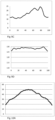
- Fig. 4 illustrates the height profile along the backbone of two cows from the tail head (left part of graph) to the neck (right part of the graph) of a cow which is slightly higher than 1.6 M ( Fig. 4A ) and a cow which is about 1.7 M ( Fig. 4B ).
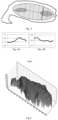
- Fig. 5 illustrates a Mesa Imaging 3D reconstruction of the part of a cow with a height above 90 cM from floor level.
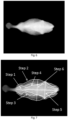
- Fig. 6 illustrates the back of a cow.
- Fig. 7 illustrates the back of the cow of Fig 6 with indications of some data/features which can be used in the analysis.
- the steps 1-6 are further explained in Example 2 and represent:
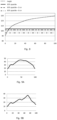
- Fig. 8 illustrates area determination based on rescaled data obtained from the part of a cow with a height above 90 cM from the floor.
- the areas beneath the graphs (and e.g. above 90 cM-line) can be determined.
- Fig. 9 and 10 illustrate different thickness profiles and height profiles at predetermined heights of two cows.
- the left end of the graph corresponds to the neck region and the right end of the graph corresponds to the tail region.
- Fig. 11 illustrates a transversal height profile of a cow at the position where the cow was thickest (measured above 90 cm from the floor).
- the data is rescaled to 40 pixels.
- X-axis indicates pixels, Y-axis indicates cm from the floor.
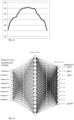
- Fig. 12 illustrates determination of a cow based on neural network, such as a deep learning system. A number of features from a cow to be identified are entered into the system and an output is obtained with estimated and ranked likelihood of different matches.
- neural network such as a deep learning system.
- the method was developed by testing whether a number of Jersey and Holstein cows could be determined/identified from each other based on images of their backs.
- 3-D images of cow's backs were provided.
- the system for obtaining images included a 3D camera (Swiss Ranger 4500 from Mesa Imaging, Switzerland, which is an IP 67 camera suitable for rooms with dust and moisture).
- 3D camera Swiss Ranger 4500 from Mesa Imaging, Switzerland, which is an IP 67 camera suitable for rooms with dust and moisture.
- Basler black-and-white industrial cameras were mounted. The cameras were mounted 4.5 meter above the floor level. The distance from the camera to the upper part of the back of the cows was about 2.7-3 meter depending on the height of the cows.
- Fig 4 illustrates further features which can be used when identifying animals.
- the figure illustrates a contour line along the backbone.
- the position of the backbone is illustrated in Fig. 7 .
- Fig 4A Height profile in the longitudinal direction of the cow along the backbone of a low cow.
- Fig 4B Height profile in the longitudinal direction of the cow along the backbone of a heigher.
- Both the length of the backbone as well as the height profile along the backbones can be used as features when identifying animals such as cows as explained in Example 2.
- about 6 images of each cow were obtained with about 1 second between each exposure.
- Analysis of each image as outlined above and comparison of data obtained from the images for each cow and between cows clearly showed much less variation for the images of one cow than between different cows.
- the identification method was further tested in another experiment with dairy cows of the Jersey race.
- 3-D images of cow's backs were provided with a system included a 3D TOF (time-of-flight) camera (Swiss Ranger 4500 from Mesa Imaging, Switzerland).
- 3D TOF time-of-flight
- Basler black-and-white industrial cameras were used.
- the three cameras were connected to a computer making it possible to store and analyze images.
- the 3D camera was located 3.2 M above the floor at the entrance to the milking station and where the corridor has a width of about 1 M.
- an ID-reader was located to obtain a signal from the ear tag each time a cow passed the ID-reader.
- a trigger signal was sent to the computer each time a cow passed the ID-reader.
- the trigger signal prompted the computer to store one image from each of the three cameras with 0.5 sec between the exposures.
- the ID-reader also stored the ID of the cow obtained from the ear tag, and these ID's were only used to verify the developed identification method based solely on the images of the cow's back.
- the two black-and-white cameras were only used to obtain images to see the cows and the environment to check if something seemed to be strange. The images from the black-and white cameras were not used for the identification process.
- Fig 5 is a Mesa Imaging 3D reconstruction of the part of a cow with a height above 90 cM from floor level. The same data of the cow is shown in a 3D contour plot of height in Fig 6 . For each 3D image obtained the images were analyzed in different steps to obtain data and PCA-scores to calculate a vector for each cow. Fig 7 indicates from where at the cow's back the data was obtained. The steps in the analysis are described below and indicated in Fig 7 :
- steps 2a 90 cM height
- 2c 80 % quantile height
- 4 80 % quantile height minus 2 cM
- Such thickness profiles have different lengths between cows as the length of the cows differs and therefore the thickness profile of each cow was rescaled to a fixed length of 100 pixels.
- the longitudinal height profile of step 1 was rescaled to a fixed length of 100 pixels.
- the transversal height profile of step 6 was rescaled to a fixed length of 40 pixels.
- PCA principal component analysis
- the sequence of numbers i.e. the PC scores for a cow to be identified was compared to the average feature PC of each of the cows in the herd.
- a cow was identified when the average feature PC for this cow resembled an average feature PC calculated for one cow more than it resembled average feature PCs calculated for the other cows in the herd.
- the calculation was performed by creating the dot product between each average vector X k for each cow 'k' in the herd and the vector X u for the un-identified cow i.e.
- the shown model for analysis is very simple and over fitting is nearly unlikely.
- the model can be extended and improved ongoing as more pictures are obtained for each cow. It is also simple to identify deficient images and avoid the use of these for identification of a cow or when extending the calculation of an average vector for each of the cows.
- the analysis as described in example 2 was performed for about 5 images for each cow representing in total 27 cows, in total 137 images.
- the images representing one cow were obtained at different times of the day and at different days.
- Of the 137 images 116 were immediately correctly connected to the right cow when using 9 scores for features of item a) and 7 scores for each of the features indicated under item b) to f) in the list above.
- the identification of all of the cows were correct. Extending the analysis to be based on more features obtained from the images and/or from features obtained from more than one image of a cow where the images are obtained e.g. with a very short time span e.g. of 0.1- 1 e.g. 0.5 seconds would make sure the correct identification is performed.
Landscapes
- Engineering & Computer Science (AREA)
- Life Sciences & Earth Sciences (AREA)
- Environmental Sciences (AREA)
- Physics & Mathematics (AREA)
- Theoretical Computer Science (AREA)
- General Physics & Mathematics (AREA)
- Multimedia (AREA)
- Animal Husbandry (AREA)
- Biodiversity & Conservation Biology (AREA)
- Birds (AREA)
- Computer Vision & Pattern Recognition (AREA)
- Human Computer Interaction (AREA)
- Zoology (AREA)
- Geometry (AREA)
- Artificial Intelligence (AREA)
- Health & Medical Sciences (AREA)
- Computing Systems (AREA)
- Databases & Information Systems (AREA)
- Evolutionary Computation (AREA)
- General Health & Medical Sciences (AREA)
- Medical Informatics (AREA)
- Software Systems (AREA)
- Image Analysis (AREA)
- Measurement Of The Respiration, Hearing Ability, Form, And Blood Characteristics Of Living Organisms (AREA)
- Collating Specific Patterns (AREA)
Claims (16)
- Procédé de détermination de l'identité d'un animal d'élevage individuel dans une population d'animaux d'élevage d'identité connue, le procédé comprenant les étapes :- d'acquisition d'au moins une image 3D du dos d'un animal d'élevage présélectionné, et au moins une partie d'une zone d'alimentation dans la zone d'alimentation de l'animal, et- d'extraction de données de ladite au moins une image 3D concernant l'anatomie du dos et/ou la topologie du dos de l'animal d'élevage présélectionné, le procédé étant caractérisé parla comparaison et/ou la mise en correspondance desdites données extraites par rapport à des données de référence correspondant à l'anatomie du dos et/ou de la topologie du dos des animaux d'élevage d'identité connue, identifiant ainsi l'animal d'élevage présélectionné, dans lequel au moins une référence d'image 3D du dos d'un animal identifié est obtenu au moins toutes les deux semaines lorsqu'un animal passe un emplacement d'image 3D de référence lorsqu'un numéro d'identification dudit animal est associé avec au moins une image 3D de référence du dos dudit animal, dans lequel l'au moins une image 3D de référence est acquise séparément de l'au moins une image 3D acquise dans la zone d'alimentation.
- Procédé de détermination de l'identité d'un animal individuel dans une population d'animaux d'identité connue, le procédé comprenant les étapes :- d'acquisition d'au moins une image 3D du dos d'un animal présélectionné au moyen d'un système de caméra aéroporté, et- d'extraction des données de ladite au moins une image 3D concernant l'anatomie du dos et/ou la topologie du dos de l'animal présélectionné, et- de comparaison et/ou de mise en correspondance desdites données extraites par rapport aux données de référence correspondant à l'anatomie du dos et/ou de la topologie du dos des animaux d'identité connue, identifiant ainsi l'animal présélectionné,dans lequel au moins une image de référence 3D du dos d'un animal identifié est obtenue au moins toutes les deux semaines sur la base d'au moins l'une des images 3D du dos de l'animal présélectionné qui a été précédemment acquise.
- Procédé selon la revendication 1, dans lequel ledit animal d'élevage est choisi dans le groupe des animaux d'élevage et/ou dans le groupe des bovins, des vaches, des vaches laitières, des taureaux, des veaux, des porcs, des truies, des sangliers, des mâles castrés, des porcelets, des chevaux, des moutons, des chèvres, des cerfs et/ou dans lequel ladite population d'animaux d'élevage est une population d'animaux d'élevage du même type, de la même espèce et/ou race choisie dans le groupe des bovins, des vaches, des vaches laitières, des taureaux, des veaux, des porcs, des truies, des sangliers, des mâles castrés, des porcelets, des chevaux, des moutons, des chèvres, des cerfs.
- Procédé selon l'une quelconque des revendications précédentes, dans lequel les données extraites et les données de référence comprennent des valeurs choisies dans le groupe des profils topographiques des animaux d'élevage.
- Procédé selon la revendication 4, dans lequel les profils topographiques sont choisis dans le groupe : de la hauteur de l'animal d'élevage, de la largeur de l'animal d'élevage, de la ligne de contour le long de la colonne vertébrale de l'animal d'élevage, de la longueur du dos, des tracés de contour pour différentes hauteurs de l'animal d'élevage, du volume de l'animal d'élevage au-dessus de différentes hauteurs de l'animal d'élevage, de la taille des cavités, de la profondeur des cavités, de la distance entre deux points présélectionnés sur l'animal d'élevage, lesdits points présélectionnés pouvant être choisis dans le groupe de la hanche droite, de la hanche gauche, de l'épaule droite, de l'épaule gauche, de la base de la queue, du cou, (1) des côtes avant gauche, (2) du départ des côtes courtes gauches, (3) du départ de l'os de la hanche gauche, (4) du point milieu antérieur de l'os de la hanche gauche ; (5) de l'os de la hanche gauche, (6) du point milieu postérieur de l'os de la hanche gauche, (7) de l'extrémité de l'os de la hanche gauche, (8) de l'articulation de la cuisse gauche, (9) de la cheville gauche, (10) du point gauche le plus bas de la base de la queue, (11) de la jonction gauche de la base de la queue, (12) de la queue, (13) de la jonction droite de la base de la queue, (14) du point droit le plus bas de la base de la queue, (15) de la cheville droite, (16) de l'articulation de la cuisse droite, (17) de l'extrémité de l'os de la hanche droite, (18) du point milieu postérieur de l'os de la hanche droite, (19) de l'os de la hanche droite, (20) du point milieu antérieur de l'os de la hanche droite, (21) du départ de l'os de la hanche droite, (22) du départ des côtes courtes droites (23).
- Procédé selon l'une quelconque des revendications précédentes, dans lequel les données extraites et les données de référence comprennent au moins une caractéristique et/ou au moins un vecteur de caractéristique, se rapportant de préférence à un élément caractéristique du dos de l'animal d'élevage.
- Procédé selon l'une quelconque des revendications précédentes, dans lequel lesdites données de référence sont extraites d'au moins une image 3D de référence acquise du dos de chacun des animaux d'élevage dans la population d'animaux d'élevage, ladite au moins une image 3D de référence d'un animal d'élevage étant de préférence obtenue en déterminant simultanément l'identité de l'animal d'élevage en lisant un marqueur d'identification (5) attaché audit animal d'élevage.
- Procédé selon l'une quelconque des revendications précédentes, dans lequel ladite image 3D et/ou ladite image 3D de référence est une image topographique du dos des animaux d'élevage, telle que plusieurs couches d'images 3D.
- Procédé selon la revendication 8, dans lequel les données extraites et les données de référence comprennent au moins une caractéristique et/ou au moins un vecteur de caractéristique basé sur des valeurs de la zone de plusieurs couches de ladite image 3D.
- Procédé selon l'une quelconque des revendications précédentes, dans lequel les données extraites et les données de référence comprennent au moins un vecteur de caractéristique pour des distances présélectionnées calculées à partir de la distance du terrain ou du sol supportant les animaux d'élevage, lesdites distances présélectionnées étant de préférence comprises entre 70 et 180 cm.
- Procédé selon l'une quelconque des revendications précédentes, comprenant en outre l'étape de détermination de la consommation alimentaire dudit animal d'élevage présélectionné identifié.
- Système de détermination de l'identité d'un animal d'élevage individuel parmi une population d'animaux d'élevage d'identité connue, le système comprenant- une première unité d'imagerie configurée pour l'acquisition d'au moins une image 3D du dos d'un animal d'élevage présélectionné, une unité de traitement (6) configurée pour- l'extraction de données de ladite au moins une image 3D concernant l'anatomie du dos et/ou la topologie du dos de l'animal d'élevage présélectionné, et- la comparaison et/ou la mise en correspondance desdites données extraites par rapport à des données de référence correspondant à l'anatomie du dos et/ou la topologie du dos de chacun des animaux d'élevage d'identité connue, identifiant ainsi l'animal d'élevage présélectionné, et- une unité d'imagerie de référence différente et/ou séparée de la première unité d'imagerie pour fournir une ou plusieurs images 3D de référence d'un animal dans la population d'animaux, ladite unité d'imagerie de référence comprenant- au moins un dispositif déterminant l'identité configuré pour déterminer l'identité dudit animal, et- au moins une caméra de référence configurée pour acquérir au moins une image de référence 3D du dos dudit animal,dans lequel le système est configuré pour associer l'identité déterminée de l'animal avec ladite au moins une image 3D de référence acquise par le(s)dite(s) caméra(s) de référence et éventuellement stocker ladite au moins une image en tant qu'image 3D de référence, et dans lequel le système est configuré de sorte qu'au moins une image de référence 3D du dos d'un animal identifié est obtenu au moins toutes les deux semaines.
- Système de détermination de l'identité d'un animal individuel parmi une population d'animaux d'identité connue, le système comprenant- une unité d'imagerie aéroportée configurée pour acquérir au moins une image 3D du dos d'un animal présélectionné, et- une première unité de traitement (6) configurée pour- l'extraction des données de ladite au moins une image 3D concernant l'anatomie du dos et/ou la topologie du dos de l'animal présélectionné, et- la comparaison et ou la mise en correspondance desdites données extraites avec les données de référence correspondant à l'anatomie du dos et/ou la topologie du dos de chacun des animaux d'identité connue, identifiant ainsi l'animal présélectionné, dans lequel le système est configuré de sorte qu'au moins une image 3D de référence du dos d'un animal identifié est obtenue au moins toutes les deux semaines basée sur au moins une des images 3D du dos de l'animal présélectionné qui a été précédemment acquise.
- Système selon l'une quelconque des revendications précédentes 12 à 13, dans lequel le système d'imagerie et/ou ladite unité d'imagerie de référence comprend une ou plusieurs caméras (4) choisies dans le groupe des caméras télémétriques, des caméras stéréo, des caméras à temps de vol, par exemple une caméra télémétrique comprenant un capteur de profondeur et une caméra 2D, par exemple une caméra RGB.
- Système selon l'une quelconque des revendications précédentes 13 à 14, dans lequel ladite unité d'imagerie de référence est configurée pour acquérir au moins une image 3D de référence du dos d'un animal d'élevage, lorsque l'identité dudit animal d'élevage a été déterminée par ledit au moins un dispositif de détermination d'identité, et/ou
dans lequel ladite unité d'imagerie de référence est configurée pour acquérir au moins une image 3D de référence du dos d'un animal d'élevage et/ou pour déterminer l'identité d'un animal d'élevage lorsque ledit animal d'élevage se trouve à une distance prédéfinie dudit dispositif de détermination d'identité. - Système selon l'une quelconque des revendications précédentes 12 à 15, comprenant en outre une unité d'imagerie de zone d'alimentation configurée pour acquérir des images, par exemple des images 3D, d'une zone d'alimentation devant l'animal d'élevage présélectionné identifié.
Priority Applications (2)
| Application Number | Priority Date | Filing Date | Title |
|---|---|---|---|
| SI201630512T SI3316680T2 (sl) | 2015-07-01 | 2016-06-30 | Sistem in metoda identifikacije posameznih živali na podlagi slik zadnje strani |
| PL16734324.3T PL3316680T5 (pl) | 2015-07-01 | 2016-06-30 | System i metoda identyfikowania pojedynczych zwierząt na podstawie obrazów grzbietów |
Applications Claiming Priority (2)
| Application Number | Priority Date | Filing Date | Title |
|---|---|---|---|
| EP15174783 | 2015-07-01 | ||
| PCT/EP2016/065241 WO2017001538A1 (fr) | 2015-07-01 | 2016-06-30 | Système et procédé d'identification d'animaux individuels en se basant sur des images de l'arrière de l'animal |
Publications (3)
| Publication Number | Publication Date |
|---|---|
| EP3316680A1 EP3316680A1 (fr) | 2018-05-09 |
| EP3316680B1 EP3316680B1 (fr) | 2019-08-14 |
| EP3316680B2 true EP3316680B2 (fr) | 2023-08-09 |
Family
ID=53524612
Family Applications (1)
| Application Number | Title | Priority Date | Filing Date |
|---|---|---|---|
| EP16734324.3A Active EP3316680B2 (fr) | 2015-07-01 | 2016-06-30 | Système et procédé d'identification d'animaux individuels sur la base d'images du dos |
Country Status (21)
| Country | Link |
|---|---|
| US (3) | US11080522B2 (fr) |
| EP (1) | EP3316680B2 (fr) |
| JP (1) | JP6824199B2 (fr) |
| CN (1) | CN107820616A (fr) |
| AU (2) | AU2016286295B2 (fr) |
| BR (1) | BR112018000046B1 (fr) |
| CA (1) | CA2989258C (fr) |
| CL (1) | CL2017003461A1 (fr) |
| DK (1) | DK3316680T4 (fr) |
| EA (1) | EA033347B9 (fr) |
| ES (1) | ES2761702T5 (fr) |
| FI (1) | FI3316680T4 (fr) |
| IL (1) | IL256406B (fr) |
| LT (1) | LT3316680T (fr) |
| MX (1) | MX382802B (fr) |
| NZ (1) | NZ738150A (fr) |
| PL (1) | PL3316680T5 (fr) |
| PT (1) | PT3316680T (fr) |
| SI (1) | SI3316680T2 (fr) |
| UA (1) | UA124378C2 (fr) |
| WO (1) | WO2017001538A1 (fr) |
Families Citing this family (84)
| Publication number | Priority date | Publication date | Assignee | Title |
|---|---|---|---|---|
| PL3122173T5 (pl) | 2014-03-26 | 2024-08-05 | Scr Engineers Ltd | System lokalizacji żywego inwentarza |
| US11071279B2 (en) | 2014-09-05 | 2021-07-27 | Intervet Inc. | Method and system for tracking health in animal populations |
| US10986817B2 (en) | 2014-09-05 | 2021-04-27 | Intervet Inc. | Method and system for tracking health in animal populations |
| LT3316680T (lt) | 2015-07-01 | 2019-12-10 | Viking Genetics Fmba | Atskirų gyvūnų atpažinimo sistema ir būdas pagal nugaros vaizdus |
| US11166436B2 (en) * | 2016-04-28 | 2021-11-09 | Osaka University | Health condition estimation device |
| CA3066458A1 (fr) * | 2017-06-08 | 2018-12-13 | Wildlife Protection Management, Inc. | Systeme de controle pour animal |
| CN107992903A (zh) * | 2017-09-20 | 2018-05-04 | 翔创科技(北京)有限公司 | 牲畜身份识别方法、装置、存储介质和电子设备 |
| NL2020025B1 (nl) * | 2017-12-06 | 2019-06-18 | Lely Patent Nv | Veevoedersysteem |
| US11832584B2 (en) | 2018-04-22 | 2023-12-05 | Vence, Corp. | Livestock management system and method |
| CN111988991B (zh) * | 2018-04-26 | 2023-09-15 | 豪夫迈·罗氏有限公司 | 用于追踪动物种群中的动物的方法和系统 |
| CN108764045B (zh) * | 2018-04-26 | 2019-11-26 | 平安科技(深圳)有限公司 | 牲畜识别方法、装置及存储介质 |
| EP3574751A1 (fr) * | 2018-05-28 | 2019-12-04 | Bayer Animal Health GmbH | Appareil de gestion de mouches |
| WO2020003310A1 (fr) * | 2018-06-25 | 2020-01-02 | Farmsee Ltd. | Surveillance du bétail dans un enclos agricole |
| FR3086837B1 (fr) | 2018-10-03 | 2021-06-18 | Allflex Europe | Pince pour la manipulation d’un dispositif d’identification d’un animal et/ou de prelevement d’un tissu d’un animal comprenant des moyens de maintien a moyens d’actionnement deportes |
| WO2020076225A1 (fr) * | 2018-10-10 | 2020-04-16 | Delaval Holding Ab | Identification d'un animal à l'aide des techniques de vision |
| SE1800191A1 (en) * | 2018-10-10 | 2019-07-03 | Delaval Holding Ab | A self-learning animal identification algorithm |
| EP3863398A4 (fr) | 2018-10-10 | 2022-06-22 | SCR Engineers Ltd | Procédé et dispositif de tarissement de bétail |
| HUE061538T2 (hu) * | 2018-10-17 | 2023-07-28 | Groupe Ro Main Inc | Állatállomány monitorozása |
| CN111079470B (zh) * | 2018-10-18 | 2023-08-22 | 杭州海康威视数字技术股份有限公司 | 人脸活体检测的方法和装置 |
| US11109576B2 (en) | 2018-11-16 | 2021-09-07 | International Business Machines Corporation | Livestock management |
| CN109583254A (zh) * | 2018-11-16 | 2019-04-05 | 北京中竞鸽体育文化发展有限公司 | 运动物体识别方法、装置及存储介质 |
| CN109583400A (zh) * | 2018-12-05 | 2019-04-05 | 成都牧云慧视科技有限公司 | 一种用于牲畜身份无干预自动登记并识别的方法 |
| MX2021009164A (es) * | 2019-02-01 | 2021-08-24 | Nestle Sa | Dispositivos y metodos de recomendacion de alimento para mascotas. |
| EP3920691A4 (fr) * | 2019-02-05 | 2022-10-26 | Wisconsin Alumni Research Foundation | Surveillance d'alimentation basée sur la vision artificielle et procédé associé |
| BR112021015541A2 (pt) | 2019-02-08 | 2022-01-11 | Allflex Australia Pty Ltd | Leitor de etiqueta eletrônica de animal |
| WO2020160588A1 (fr) | 2019-02-08 | 2020-08-13 | Allflex Australia Pty Ltd | Détermination de l'emplacement d'un animal |
| WO2020160589A1 (fr) | 2019-02-08 | 2020-08-13 | Allflex Australia Pty Ltd | Synchronisation de lecteur d'étiquette d'identification d'animal électronique |
| DE202019101581U1 (de) * | 2019-02-19 | 2019-06-14 | ZIFFEREINS Beteiligungs-GmbH | Anordnung zum Erfassen von in der Wildnis befindlichen Objekten |
| TWI714057B (zh) * | 2019-04-17 | 2020-12-21 | 國立臺灣大學 | 產乳動物採食分析系統與方法 |
| US20220215502A1 (en) * | 2019-05-14 | 2022-07-07 | Delaval Holding Ab | System and method for providing a decision basis for controlling a robotic arm, computer program and nonvolatile data carrier |
| EP3756458A1 (fr) * | 2019-06-26 | 2020-12-30 | Viking Genetics FmbA | Détermination du poids d'un animal sur la base de l'imagerie 3d |
| US11393088B2 (en) * | 2019-06-27 | 2022-07-19 | Nutech Ventures | Animal detection based on detection and association of parts |
| CN110795987B (zh) * | 2019-07-30 | 2023-12-22 | 重庆渝通合数字科技有限公司 | 猪脸识别方法和装置 |
| CN110569735A (zh) * | 2019-08-13 | 2019-12-13 | 中国农业大学 | 一种基于奶牛背部体况的分析方法及装置 |
| US12374080B2 (en) | 2019-08-16 | 2025-07-29 | Stephanie Sujin CHOI | Method for clustering and identifying animals based on the shapes, relative positions and other features of body parts |
| CN114730491A (zh) * | 2019-08-21 | 2022-07-08 | 戴里迈斯特公司 | 确定动物畜群中动物的身份的方法和装置 |
| CN110569759B (zh) * | 2019-08-26 | 2020-11-03 | 王睿琪 | 一种获取个体进食数据的方法、系统、服务端及前端 |
| CN115210005B (zh) | 2019-08-28 | 2024-04-23 | Scr工程有限公司 | 流体分析设备 |
| US10628756B1 (en) | 2019-09-12 | 2020-04-21 | Performance Livestock Analytics, Inc. | Livestock and feedlot data collection and processing using UHF-band interrogation of radio frequency identification tags |
| FR3101435B1 (fr) * | 2019-09-30 | 2021-10-29 | Uwinloc | système d’aide à l’orientation d’une antenne d’une balise au regard d’une position cible |
| CN110796043B (zh) * | 2019-10-16 | 2021-04-30 | 北京海益同展信息科技有限公司 | 容器检测、饲喂检测方法、装置及饲喂系统 |
| CN110762031B (zh) * | 2019-10-23 | 2020-08-14 | 台州辉腾泵业有限公司 | 基于数据定量控制的水泵驱动装置 |
| CN111080697B (zh) * | 2019-10-29 | 2024-04-09 | 京东科技信息技术有限公司 | 检测目标对象方向的方法、装置、计算机设备和存储介质 |
| CN111222475B (zh) * | 2020-01-09 | 2023-05-26 | 洛阳语音云创新研究院 | 猪咬尾检测方法、装置及存储介质 |
| CN112450119A (zh) * | 2020-03-04 | 2021-03-09 | 丰疆智能科技股份有限公司 | 牛体健康状态评估系统和评估方法以及牛体按摩装置 |
| CN111523017B (zh) * | 2020-04-29 | 2023-03-31 | 重庆大学 | 一种实验动物信息管理系统及实验动物个体身份区分方法 |
| IL275518B (en) | 2020-06-18 | 2021-10-31 | Scr Eng Ltd | Animal tag |
| USD990063S1 (en) | 2020-06-18 | 2023-06-20 | S.C.R. (Engineers) Limited | Animal ear tag |
| USD990062S1 (en) | 2020-06-18 | 2023-06-20 | S.C.R. (Engineers) Limited | Animal ear tag |
| EP4171213A1 (fr) | 2020-06-25 | 2023-05-03 | Signify Holding B.V. | Système de détection pour déterminer un paramètre d'un groupe d'animaux |
| EP3933766B1 (fr) * | 2020-06-30 | 2023-06-07 | Cattle Eye Ltd | Système et procédé de surveillance du bétail |
| IL275812B (en) | 2020-07-01 | 2022-01-01 | Scr Eng Ltd | System and method for placing devices |
| CN112132026B (zh) * | 2020-09-22 | 2024-07-05 | 深圳赛安特技术服务有限公司 | 动物识别方法及装置 |
| US11602132B2 (en) * | 2020-10-06 | 2023-03-14 | Sixgill, LLC | System and method of counting livestock |
| CN112189588B (zh) * | 2020-10-10 | 2022-04-05 | 东北农业大学 | 一种奶牛图像信息收集处理方法及系统 |
| AU2021359652A1 (en) | 2020-10-14 | 2023-06-22 | One Cup Productions Ltd. | Animal visual identification, tracking, monitoring and assessment systems and methods thereof |
| RU2754095C1 (ru) * | 2020-10-29 | 2021-08-26 | Федеральное государственное бюджетное учреждение науки Институт проблем управления им. В.А. Трапезникова Российской академии наук | Методика подготовки наборов фотографий для машинного анализа для персональной идентификации животных по морде |
| JP7610203B2 (ja) * | 2020-11-20 | 2025-01-08 | ダイワ通信株式会社 | 野生動物監視システム、野生動物監視方法、及びプログラム |
| WO2022113062A1 (fr) | 2020-11-25 | 2022-06-02 | Scr Engineers Ltd. | Système et procédé de pistage d'individus d'une population animale |
| JP7634829B2 (ja) * | 2020-12-21 | 2025-02-25 | 株式会社リヴァンプ | 情報処理装置、情報処理方法及びプログラム |
| IL280374B2 (en) | 2021-01-24 | 2023-11-01 | Scr Eng Ltd | System and method for controlling animal marking |
| CA206747S (en) | 2021-04-08 | 2024-12-30 | Chevillot Sas | Tag applicator for animals |
| CA206812S (en) | 2021-04-08 | 2023-04-11 | Chevillot Sas | Tag applicator for animals |
| US20240212845A1 (en) * | 2021-04-27 | 2024-06-27 | Sports Data Labs, Inc. | Animal data-based identification and recognition system and method |
| JP7621615B2 (ja) * | 2021-05-12 | 2025-01-27 | 国立大学法人 宮崎大学 | 家畜画像出力装置、学習装置、家畜識別装置、家畜画像出力システム、家畜画像出力方法、およびプログラム |
| WO2022271067A1 (fr) * | 2021-06-23 | 2022-12-29 | Delaval Holding Ab | Procédé et dispositif de commande pour surveiller le comportement alimentaire d'animaux |
| KR102372107B1 (ko) * | 2021-09-16 | 2022-03-10 | 주식회사 일루베이션 | 영상기반의 모돈 분만 알림 시스템 |
| PL4187505T3 (pl) * | 2021-11-26 | 2025-03-24 | Cattle Eye Ltd | Sposób oraz system do identyfikacji zwierząt |
| CN114463729A (zh) * | 2021-12-13 | 2022-05-10 | 浙江大华技术股份有限公司 | 一种奶牛识别方法及装置 |
| JP2023089568A (ja) * | 2021-12-16 | 2023-06-28 | 国立大学法人 宮崎大学 | 個体管理システム、個体管理方法及びプログラム |
| CN119053998A (zh) | 2022-03-25 | 2024-11-29 | 维京遗传学Fmba | 用于检测牛跛行的系统和方法 |
| JP2025515456A (ja) * | 2022-04-22 | 2025-05-15 | 406・ボバイン・インコーポレイテッド | 個体動物識別のシステムおよび方法 |
| US12402596B2 (en) | 2022-05-03 | 2025-09-02 | S.C.R. (Engineers) Limited | Milk channel and feed inlet coupled thereto, and system and method for conserving wash fluid in a washing process for cleaning a milkmeter system |
| CN115063834A (zh) * | 2022-05-27 | 2022-09-16 | 深圳掌脉联合生物技术有限公司 | 一种基于掌静脉和掌动脉的身份识别方法、装置及系统 |
| EP4365797A4 (fr) * | 2022-09-16 | 2025-04-16 | Intflow Inc. | Dispositif et procédé de gestion de stock de bétail basée sur une image |
| WO2024084354A1 (fr) * | 2022-10-21 | 2024-04-25 | Lely Patent N.V. | Système d'élevage d'animaux |
| NL2033368B1 (en) * | 2022-10-21 | 2024-05-08 | Lely Patent Nv | Animal husbandry system |
| CN115721296B (zh) * | 2022-11-25 | 2024-09-13 | 中科北纬(北京)科技有限公司 | 一种基于PaddleDetection的野生动物识别系统 |
| WO2025068550A1 (fr) | 2023-09-28 | 2025-04-03 | Viking Genetics Fmba | Système et procédé de détermination d'au moins un paramètre corporel d'un individu bovin par imagerie à distance |
| WO2025101110A1 (fr) | 2023-11-10 | 2025-05-15 | Delaval Holding Ab | Dispositif de commande pour sélectionner une identité d'animal unique, procédé mis en œuvre par ordinateur, programme informatique et porteuse de données non volatile |
| WO2025101109A1 (fr) | 2023-11-10 | 2025-05-15 | Delaval Holding Ab | Dispositif de commande pour sélectionner une identité d'animal unique, procédé mis en œuvre par ordinateur, programme informatique et support de données non volatile |
| WO2025101108A1 (fr) | 2023-11-10 | 2025-05-15 | Delaval Holding Ab | Dispositif de commande pour un agencement de traite automatique, procédé mis en œuvre par ordinateur, programme informatique et support de données non volatil |
| WO2025101107A1 (fr) | 2023-11-10 | 2025-05-15 | Delaval Holding Ab | Dispositif de commande pour un agencement de traite automatique, procédé mis en œuvre par ordinateur, programme informatique et support de données non volatil |
| SE547410C2 (en) * | 2024-05-02 | 2025-09-16 | Delaval Holding Ab | System for Identifying Animals, Computer-Implemented Method, Computer Program and Non-Volatile Data Carrier |
Citations (1)
| Publication number | Priority date | Publication date | Assignee | Title |
|---|---|---|---|---|
| US20100246970A1 (en) † | 2007-07-31 | 2010-09-30 | Andreas Springer | Device and a method for providing information about animals when walking through an animal passage |
Family Cites Families (40)
| Publication number | Priority date | Publication date | Assignee | Title |
|---|---|---|---|---|
| US4881953A (en) | 1988-09-15 | 1989-11-21 | Union Carbide Corporation | Prevention of membrane degradation |
| US5249709A (en) | 1989-10-16 | 1993-10-05 | Plas-Pak Industries, Inc. | Cartridge system for dispensing predetermined ratios of semi-liquid materials |
| US5412420A (en) | 1992-10-26 | 1995-05-02 | Pheno Imaging, Inc. | Three-dimensional phenotypic measuring system for animals |
| DE4420254A1 (de) * | 1994-06-10 | 1995-01-26 | Jochen Stehr | Rindererkennung |
| AU773798B2 (en) | 1999-09-02 | 2004-06-10 | Kristoffer Larsen Innovation A/S | Method for controlling breeding of free-range animals |
| AUPQ603800A0 (en) | 2000-03-03 | 2000-03-30 | ID+Plus Pty Ltd | Method and apparatus for livestock identification |
| US6678413B1 (en) * | 2000-11-24 | 2004-01-13 | Yiqing Liang | System and method for object identification and behavior characterization using video analysis |
| JP3803750B2 (ja) | 2002-02-22 | 2006-08-02 | 防衛庁技術研究本部長 | 体積計測方法及び体積計測プログラム |
| US7399220B2 (en) | 2002-08-02 | 2008-07-15 | Kriesel Marshall S | Apparatus and methods for the volumetric and dimensional measurement of livestock |
| DE10239674A1 (de) | 2002-08-26 | 2004-03-11 | Hölscher & Leuschner GmbH & Co | Verfahren zur Überwachung von Mastschweinen auf Vermarktungsreife |
| AU2003285161A1 (en) | 2002-11-08 | 2004-06-03 | Data Flow / Alaska, Inc. | System for uniquely identifying subjects from a target population |
| EP2263448A3 (fr) | 2004-03-30 | 2012-07-18 | DeLaval Holding AB | Agencement et procédé pour déterminer les positions des mamelons d'un animal à traire |
| KR100601957B1 (ko) * | 2004-07-07 | 2006-07-14 | 삼성전자주식회사 | 얼굴 인식을 위한 영상간 대응 결정 방법 및 장치, 이를이루기위한 영상 보정 방법 및 장치 |
| US7497894B2 (en) | 2005-04-19 | 2009-03-03 | Generon Igs, Inc. | Portable air separation/air dehydration system |
| US7578871B2 (en) | 2005-05-25 | 2009-08-25 | Generon Igs, Inc. | Gas separation membrane with partial surfactant coating |
| US7517388B2 (en) | 2006-05-15 | 2009-04-14 | Generon Igs, Inc. | Air separation membrane module with variable sweep stream |
| US7662333B2 (en) | 2006-08-14 | 2010-02-16 | Generon Igs, Inc. | Vacuum-assisted potting of fiber module tubesheets |
| GB0716333D0 (en) * | 2007-08-22 | 2007-10-03 | White Spark Holdings Ltd | Method and apparatus for the automatic grading of condition of livestock |
| US20090205584A1 (en) * | 2008-02-19 | 2009-08-20 | Masin Joseph V | Combined phone number and country code identifiers for ISO 11784/85 compatible transponders |
| GB0813782D0 (en) | 2008-07-28 | 2008-09-03 | Delaval Holding Ab | Animal installation with height measurement device |
| JP5519693B2 (ja) | 2008-12-03 | 2014-06-11 | デラヴァル ホルディング アーベー | 動物の身体の状態のスコアを決定するための装置及び方法 |
| DE202009008268U1 (de) | 2009-06-10 | 2010-11-04 | Big Dutchman Pig Equipment Gmbh | Optische gestützte Nutztierortungsvorrichtung |
| JP2011177116A (ja) | 2010-03-02 | 2011-09-15 | Mitsubishi Electric Corp | 動物用耳標rfidタグ及びその製造方法 |
| AU2010219406B2 (en) * | 2010-05-19 | 2013-01-24 | Plf Agritech Pty Ltd | Image analysis for making animal measurements |
| JP5756967B2 (ja) | 2011-03-30 | 2015-07-29 | 国立研究開発法人農業・食品産業技術総合研究機構 | 乳牛の健康状態管理方法及び管理システム |
| US20140140575A1 (en) * | 2012-11-19 | 2014-05-22 | Mace Wolf | Image capture with privacy protection |
| WO2014083433A2 (fr) * | 2012-12-02 | 2014-06-05 | Agricam Ab | Systèmes et procédés pour prédire le résultat d'un état d'un sujet |
| TW201435749A (zh) * | 2013-03-01 | 2014-09-16 | ting-chang Huang | 動物標記晶片及其資料處理系統 |
| ES2843528T3 (es) | 2013-04-10 | 2021-07-19 | Viking Genetics Fmba | Sistema para determinar el consumo de pienso de al menos un animal |
| KR101527801B1 (ko) | 2013-05-22 | 2015-06-11 | 주식회사 아이싸이랩 | 동물들의 코무늬를 이용한 동물 개체 인식 장치 및 방법 |
| US20160125276A1 (en) * | 2013-06-04 | 2016-05-05 | Clic RWeight ,LLC | Methods and systems for marking animals |
| CN103514422B (zh) * | 2013-08-29 | 2016-03-16 | 广西慧云信息技术有限公司 | 一种基于身份识别的采食异常预警方法 |
| US10430942B2 (en) * | 2013-10-01 | 2019-10-01 | University Of Kentucky Research Foundation | Image analysis for predicting body weight in humans |
| US9757763B2 (en) | 2013-10-31 | 2017-09-12 | Nordson Corporation | Side by side cartridge assemblies and related methods |
| JP6291927B2 (ja) * | 2014-03-13 | 2018-03-14 | 富士通株式会社 | 特定方法、特定プログラム、特定装置および特定システム |
| US9084411B1 (en) | 2014-04-10 | 2015-07-21 | Animal Biotech Llc | Livestock identification system and method |
| KR102333463B1 (ko) * | 2014-07-02 | 2021-12-03 | 한미약품 주식회사 | 리바록사반을 포함하는 경구 투여용 약학 조성물 및 이의 제조방법 |
| KR101676643B1 (ko) * | 2014-10-16 | 2016-11-29 | 렉스젠(주) | 가축 관리 시스템 및 그 방법 |
| US10027179B1 (en) * | 2015-04-30 | 2018-07-17 | University Of South Florida | Continuous wireless powering of moving biological sensors |
| LT3316680T (lt) | 2015-07-01 | 2019-12-10 | Viking Genetics Fmba | Atskirų gyvūnų atpažinimo sistema ir būdas pagal nugaros vaizdus |
-
2016
- 2016-06-30 LT LT16734324T patent/LT3316680T/lt unknown
- 2016-06-30 JP JP2017568210A patent/JP6824199B2/ja active Active
- 2016-06-30 EP EP16734324.3A patent/EP3316680B2/fr active Active
- 2016-06-30 UA UAA201800540A patent/UA124378C2/uk unknown
- 2016-06-30 ES ES16734324T patent/ES2761702T5/es active Active
- 2016-06-30 US US15/738,823 patent/US11080522B2/en active Active
- 2016-06-30 NZ NZ738150A patent/NZ738150A/en unknown
- 2016-06-30 PT PT167343243T patent/PT3316680T/pt unknown
- 2016-06-30 EA EA201890099A patent/EA033347B9/ru unknown
- 2016-06-30 CA CA2989258A patent/CA2989258C/fr active Active
- 2016-06-30 MX MX2017016878A patent/MX382802B/es unknown
- 2016-06-30 AU AU2016286295A patent/AU2016286295B2/en active Active
- 2016-06-30 FI FIEP16734324.3T patent/FI3316680T4/fi active
- 2016-06-30 WO PCT/EP2016/065241 patent/WO2017001538A1/fr not_active Ceased
- 2016-06-30 PL PL16734324.3T patent/PL3316680T5/pl unknown
- 2016-06-30 DK DK16734324.3T patent/DK3316680T4/da active
- 2016-06-30 SI SI201630512T patent/SI3316680T2/sl unknown
- 2016-06-30 BR BR112018000046-9A patent/BR112018000046B1/pt active IP Right Grant
- 2016-06-30 CN CN201680039011.8A patent/CN107820616A/zh active Pending
-
2017
- 2017-12-19 IL IL256406A patent/IL256406B/en active IP Right Grant
- 2017-12-28 CL CL2017003461A patent/CL2017003461A1/es unknown
-
2019
- 2019-12-20 AU AU2019283978A patent/AU2019283978B2/en active Active
-
2021
- 2021-06-09 US US17/343,208 patent/US11832595B2/en active Active
-
2023
- 2023-10-24 US US18/493,297 patent/US20240206427A1/en active Pending
Patent Citations (1)
| Publication number | Priority date | Publication date | Assignee | Title |
|---|---|---|---|---|
| US20100246970A1 (en) † | 2007-07-31 | 2010-09-30 | Andreas Springer | Device and a method for providing information about animals when walking through an animal passage |
Also Published As
Similar Documents
| Publication | Publication Date | Title |
|---|---|---|
| US11832595B2 (en) | System and method for identification of individual animals based on images of the back | |
| Bewley et al. | Potential for estimation of body condition scores in dairy cattle from digital images | |
| EP3261581B1 (fr) | Procédé amélioré et appareil associé pour la détermination du score d'état corporel, du poids corporel et de l'état de fertilité | |
| US8538126B2 (en) | Method and apparatus for the automatic grading of condition of livestock | |
| CN114051377B (zh) | 基于3d成像的动物体重测定 | |
| Pallottino et al. | Comparison between manual and stereovision body traits measurements of Lipizzan horses | |
| Chapa et al. | Use of a real-time location system to detect cows in distinct functional areas within a barn | |
| CN119053998A (zh) | 用于检测牛跛行的系统和方法 | |
| BR102019004750A2 (pt) | Sistema de monitoramento de animais e determinação do acabamento e musculosidade a partir da aquisição de imagens voluntárias pré-abate do animal | |
| WO2018186796A1 (fr) | Procédé et système de classification d'une carcasse d'animal | |
| ES2807724T3 (es) | Método mejorado y aparato relevante para la determinación de la puntuación de la condición corporal, el peso corporal y el estado de fertilidad | |
| CN117915861A (zh) | 检测动物发情以用于授精 |
Legal Events
| Date | Code | Title | Description |
|---|---|---|---|
| STAA | Information on the status of an ep patent application or granted ep patent |
Free format text: STATUS: THE INTERNATIONAL PUBLICATION HAS BEEN MADE |
|
| PUAI | Public reference made under article 153(3) epc to a published international application that has entered the european phase |
Free format text: ORIGINAL CODE: 0009012 |
|
| STAA | Information on the status of an ep patent application or granted ep patent |
Free format text: STATUS: REQUEST FOR EXAMINATION WAS MADE |
|
| 17P | Request for examination filed |
Effective date: 20180131 |
|
| AK | Designated contracting states |
Kind code of ref document: A1 Designated state(s): AL AT BE BG CH CY CZ DE DK EE ES FI FR GB GR HR HU IE IS IT LI LT LU LV MC MK MT NL NO PL PT RO RS SE SI SK SM TR |
|
| AX | Request for extension of the european patent |
Extension state: BA ME |
|
| DAV | Request for validation of the european patent (deleted) | ||
| DAX | Request for extension of the european patent (deleted) | ||
| GRAP | Despatch of communication of intention to grant a patent |
Free format text: ORIGINAL CODE: EPIDOSNIGR1 |
|
| STAA | Information on the status of an ep patent application or granted ep patent |
Free format text: STATUS: GRANT OF PATENT IS INTENDED |
|
| INTG | Intention to grant announced |
Effective date: 20190326 |
|
| GRAS | Grant fee paid |
Free format text: ORIGINAL CODE: EPIDOSNIGR3 |
|
| GRAA | (expected) grant |
Free format text: ORIGINAL CODE: 0009210 |
|
| STAA | Information on the status of an ep patent application or granted ep patent |
Free format text: STATUS: THE PATENT HAS BEEN GRANTED |
|
| AK | Designated contracting states |
Kind code of ref document: B1 Designated state(s): AL AT BE BG CH CY CZ DE DK EE ES FI FR GB GR HR HU IE IS IT LI LT LU LV MC MK MT NL NO PL PT RO RS SE SI SK SM TR |
|
| REG | Reference to a national code |
Ref country code: GB Ref legal event code: FG4D |
|
| REG | Reference to a national code |
Ref country code: AT Ref legal event code: REF Ref document number: 1165921 Country of ref document: AT Kind code of ref document: T Effective date: 20190815 Ref country code: CH Ref legal event code: EP |
|
| REG | Reference to a national code |
Ref country code: IE Ref legal event code: FG4D |
|
| REG | Reference to a national code |
Ref country code: DE Ref legal event code: R096 Ref document number: 602016018619 Country of ref document: DE |
|
| REG | Reference to a national code |
Ref country code: CH Ref legal event code: NV Representative=s name: STOLMAR AND PARTNER INTELLECTUAL PROPERTY S.A., CH |
|
| REG | Reference to a national code |
Ref country code: DK Ref legal event code: T3 Effective date: 20191114 |
|
| REG | Reference to a national code |
Ref country code: SE Ref legal event code: TRGR |
|
| REG | Reference to a national code |
Ref country code: NL Ref legal event code: FP |
|
| REG | Reference to a national code |
Ref country code: PT Ref legal event code: SC4A Ref document number: 3316680 Country of ref document: PT Date of ref document: 20191219 Kind code of ref document: T Free format text: AVAILABILITY OF NATIONAL TRANSLATION Effective date: 20191213 |
|
| REG | Reference to a national code |
Ref country code: NO Ref legal event code: T2 Effective date: 20190814 |
|
| PG25 | Lapsed in a contracting state [announced via postgrant information from national office to epo] |
Ref country code: BG Free format text: LAPSE BECAUSE OF FAILURE TO SUBMIT A TRANSLATION OF THE DESCRIPTION OR TO PAY THE FEE WITHIN THE PRESCRIBED TIME-LIMIT Effective date: 20191114 Ref country code: HR Free format text: LAPSE BECAUSE OF FAILURE TO SUBMIT A TRANSLATION OF THE DESCRIPTION OR TO PAY THE FEE WITHIN THE PRESCRIBED TIME-LIMIT Effective date: 20190814 |
|
| PG25 | Lapsed in a contracting state [announced via postgrant information from national office to epo] |
Ref country code: GR Free format text: LAPSE BECAUSE OF FAILURE TO SUBMIT A TRANSLATION OF THE DESCRIPTION OR TO PAY THE FEE WITHIN THE PRESCRIBED TIME-LIMIT Effective date: 20191115 Ref country code: AL Free format text: LAPSE BECAUSE OF FAILURE TO SUBMIT A TRANSLATION OF THE DESCRIPTION OR TO PAY THE FEE WITHIN THE PRESCRIBED TIME-LIMIT Effective date: 20190814 Ref country code: RS Free format text: LAPSE BECAUSE OF FAILURE TO SUBMIT A TRANSLATION OF THE DESCRIPTION OR TO PAY THE FEE WITHIN THE PRESCRIBED TIME-LIMIT Effective date: 20190814 |
|
| REG | Reference to a national code |
Ref country code: SK Ref legal event code: T3 Ref document number: E 33026 Country of ref document: SK |
|
| REG | Reference to a national code |
Ref country code: EE Ref legal event code: FG4A Ref document number: E018488 Country of ref document: EE Effective date: 20191213 |
|
| PG25 | Lapsed in a contracting state [announced via postgrant information from national office to epo] |
Ref country code: RO Free format text: LAPSE BECAUSE OF FAILURE TO SUBMIT A TRANSLATION OF THE DESCRIPTION OR TO PAY THE FEE WITHIN THE PRESCRIBED TIME-LIMIT Effective date: 20190814 |
|
| REG | Reference to a national code |
Ref country code: DE Ref legal event code: R026 Ref document number: 602016018619 Country of ref document: DE |
|
| PLBI | Opposition filed |
Free format text: ORIGINAL CODE: 0009260 |
|
| REG | Reference to a national code |
Ref country code: ES Ref legal event code: FG2A Ref document number: 2761702 Country of ref document: ES Kind code of ref document: T3 Effective date: 20200520 |
|
| PLBI | Opposition filed |
Free format text: ORIGINAL CODE: 0009260 |
|
| PG25 | Lapsed in a contracting state [announced via postgrant information from national office to epo] |
Ref country code: SM Free format text: LAPSE BECAUSE OF FAILURE TO SUBMIT A TRANSLATION OF THE DESCRIPTION OR TO PAY THE FEE WITHIN THE PRESCRIBED TIME-LIMIT Effective date: 20190814 |
|
| REG | Reference to a national code |
Ref country code: FI Ref legal event code: MDE Opponent name: OCTROOIBUREAU VAN DER LELY N.V. Ref country code: FI Ref legal event code: MDE Opponent name: HANNA MOORE & CURLEY LIMITED |
|
| 26 | Opposition filed |
Opponent name: OCTROOIBUREAU VAN DER LELY N.V. Effective date: 20200514 |
|
| PLAX | Notice of opposition and request to file observation + time limit sent |
Free format text: ORIGINAL CODE: EPIDOSNOBS2 |
|
| REG | Reference to a national code |
Ref country code: FI Ref legal event code: MDE Opponent name: OCTROOIBUREAU VAN DER LELY N.V. Ref country code: FI Ref legal event code: MDE Opponent name: HANNA MOORE & CURLEY LIMITED |
|
| 26 | Opposition filed |
Opponent name: HANNA MOORE & CURLEY LIMITED Effective date: 20200514 |
|
| PLBB | Reply of patent proprietor to notice(s) of opposition received |
Free format text: ORIGINAL CODE: EPIDOSNOBS3 |
|
| PG25 | Lapsed in a contracting state [announced via postgrant information from national office to epo] |
Ref country code: MC Free format text: LAPSE BECAUSE OF FAILURE TO SUBMIT A TRANSLATION OF THE DESCRIPTION OR TO PAY THE FEE WITHIN THE PRESCRIBED TIME-LIMIT Effective date: 20190814 |
|
| PG25 | Lapsed in a contracting state [announced via postgrant information from national office to epo] |
Ref country code: LU Free format text: LAPSE BECAUSE OF NON-PAYMENT OF DUE FEES Effective date: 20200630 |
|
| PLAB | Opposition data, opponent's data or that of the opponent's representative modified |
Free format text: ORIGINAL CODE: 0009299OPPO |
|
| R26 | Opposition filed (corrected) |
Opponent name: HANNA MOORE & CURLEY LIMITED Effective date: 20200514 |
|
| REG | Reference to a national code |
Ref country code: AT Ref legal event code: UEP Ref document number: 1165921 Country of ref document: AT Kind code of ref document: T Effective date: 20190814 |
|
| PG25 | Lapsed in a contracting state [announced via postgrant information from national office to epo] |
Ref country code: MT Free format text: LAPSE BECAUSE OF FAILURE TO SUBMIT A TRANSLATION OF THE DESCRIPTION OR TO PAY THE FEE WITHIN THE PRESCRIBED TIME-LIMIT Effective date: 20190814 Ref country code: CY Free format text: LAPSE BECAUSE OF FAILURE TO SUBMIT A TRANSLATION OF THE DESCRIPTION OR TO PAY THE FEE WITHIN THE PRESCRIBED TIME-LIMIT Effective date: 20190814 |
|
| PG25 | Lapsed in a contracting state [announced via postgrant information from national office to epo] |
Ref country code: MK Free format text: LAPSE BECAUSE OF FAILURE TO SUBMIT A TRANSLATION OF THE DESCRIPTION OR TO PAY THE FEE WITHIN THE PRESCRIBED TIME-LIMIT Effective date: 20190814 |
|
| APBM | Appeal reference recorded |
Free format text: ORIGINAL CODE: EPIDOSNREFNO |
|
| APBP | Date of receipt of notice of appeal recorded |
Free format text: ORIGINAL CODE: EPIDOSNNOA2O |
|
| APAH | Appeal reference modified |
Free format text: ORIGINAL CODE: EPIDOSCREFNO |
|
| APBM | Appeal reference recorded |
Free format text: ORIGINAL CODE: EPIDOSNREFNO |
|
| APBP | Date of receipt of notice of appeal recorded |
Free format text: ORIGINAL CODE: EPIDOSNNOA2O |
|
| APAW | Appeal reference deleted |
Free format text: ORIGINAL CODE: EPIDOSDREFNO |
|
| APBU | Appeal procedure closed |
Free format text: ORIGINAL CODE: EPIDOSNNOA9O |
|
| P01 | Opt-out of the competence of the unified patent court (upc) registered |
Effective date: 20230525 |
|
| PUAH | Patent maintained in amended form |
Free format text: ORIGINAL CODE: 0009272 |
|
| STAA | Information on the status of an ep patent application or granted ep patent |
Free format text: STATUS: PATENT MAINTAINED AS AMENDED |
|
| 27A | Patent maintained in amended form |
Effective date: 20230809 |
|
| AK | Designated contracting states |
Kind code of ref document: B2 Designated state(s): AL AT BE BG CH CY CZ DE DK EE ES FI FR GB GR HR HU IE IS IT LI LT LU LV MC MK MT NL NO PL PT RO RS SE SI SK SM TR |
|
| REG | Reference to a national code |
Ref country code: DE Ref legal event code: R102 Ref document number: 602016018619 Country of ref document: DE |
|
| REG | Reference to a national code |
Ref country code: NL Ref legal event code: FP |
|
| REG | Reference to a national code |
Ref country code: DK Ref legal event code: T4 Effective date: 20231020 |
|
| REG | Reference to a national code |
Ref country code: SE Ref legal event code: RPEO |
|
| REG | Reference to a national code |
Ref country code: EE Ref legal event code: LD4A Ref document number: E018488 Country of ref document: EE |
|
| REG | Reference to a national code |
Ref country code: NO Ref legal event code: T2 Effective date: 20190814 |
|
| REG | Reference to a national code |
Ref country code: SK Ref legal event code: T5 Ref document number: E 33026 Country of ref document: SK |
|
| REG | Reference to a national code |
Ref country code: ES Ref legal event code: DC2A Ref document number: 2761702 Country of ref document: ES Kind code of ref document: T5 Effective date: 20240222 |
|
| PGFP | Annual fee paid to national office [announced via postgrant information from national office to epo] |
Ref country code: NL Payment date: 20250520 Year of fee payment: 10 |
|
| PGFP | Annual fee paid to national office [announced via postgrant information from national office to epo] |
Ref country code: FI Payment date: 20250520 Year of fee payment: 10 |
|
| PGFP | Annual fee paid to national office [announced via postgrant information from national office to epo] |
Ref country code: PL Payment date: 20250521 Year of fee payment: 10 Ref country code: DE Payment date: 20250520 Year of fee payment: 10 |
|
| PGFP | Annual fee paid to national office [announced via postgrant information from national office to epo] |
Ref country code: GB Payment date: 20250616 Year of fee payment: 10 Ref country code: DK Payment date: 20250623 Year of fee payment: 10 |
|
| PGFP | Annual fee paid to national office [announced via postgrant information from national office to epo] |
Ref country code: LT Payment date: 20250520 Year of fee payment: 10 |
|
| PGFP | Annual fee paid to national office [announced via postgrant information from national office to epo] |
Ref country code: IS Payment date: 20250526 Year of fee payment: 10 Ref country code: NO Payment date: 20250617 Year of fee payment: 10 |
|
| PGFP | Annual fee paid to national office [announced via postgrant information from national office to epo] |
Ref country code: BE Payment date: 20250520 Year of fee payment: 10 Ref country code: IT Payment date: 20250521 Year of fee payment: 10 |
|
| PGFP | Annual fee paid to national office [announced via postgrant information from national office to epo] |
Ref country code: LV Payment date: 20250520 Year of fee payment: 10 Ref country code: PT Payment date: 20250521 Year of fee payment: 10 |
|
| PGFP | Annual fee paid to national office [announced via postgrant information from national office to epo] |
Ref country code: EE Payment date: 20250526 Year of fee payment: 10 Ref country code: FR Payment date: 20250616 Year of fee payment: 10 |
|
| PGFP | Annual fee paid to national office [announced via postgrant information from national office to epo] |
Ref country code: AT Payment date: 20250520 Year of fee payment: 10 |
|
| PGFP | Annual fee paid to national office [announced via postgrant information from national office to epo] |
Ref country code: TR Payment date: 20250523 Year of fee payment: 10 Ref country code: SK Payment date: 20250529 Year of fee payment: 10 |
|
| PGFP | Annual fee paid to national office [announced via postgrant information from national office to epo] |
Ref country code: CZ Payment date: 20250522 Year of fee payment: 10 |
|
| PGFP | Annual fee paid to national office [announced via postgrant information from national office to epo] |
Ref country code: IE Payment date: 20250616 Year of fee payment: 10 |
|
| PGFP | Annual fee paid to national office [announced via postgrant information from national office to epo] |
Ref country code: SI Payment date: 20250520 Year of fee payment: 10 Ref country code: SE Payment date: 20250616 Year of fee payment: 10 |
|
| PGFP | Annual fee paid to national office [announced via postgrant information from national office to epo] |
Ref country code: ES Payment date: 20250708 Year of fee payment: 10 |
|
| PGFP | Annual fee paid to national office [announced via postgrant information from national office to epo] |
Ref country code: CH Payment date: 20250701 Year of fee payment: 10 |