EP3309766A1 - Parking lot mapping system - Google Patents
Parking lot mapping system Download PDFInfo
- Publication number
- EP3309766A1 EP3309766A1 EP16807203.1A EP16807203A EP3309766A1 EP 3309766 A1 EP3309766 A1 EP 3309766A1 EP 16807203 A EP16807203 A EP 16807203A EP 3309766 A1 EP3309766 A1 EP 3309766A1
- Authority
- EP
- European Patent Office
- Prior art keywords
- vehicle
- parking lot
- parking
- mapping system
- controller
- Prior art date
- Legal status (The legal status is an assumption and is not a legal conclusion. Google has not performed a legal analysis and makes no representation as to the accuracy of the status listed.)
- Granted
Links
Images



Classifications
-
- G—PHYSICS
- G08—SIGNALLING
- G08G—TRAFFIC CONTROL SYSTEMS
- G08G1/00—Traffic control systems for road vehicles
- G08G1/14—Traffic control systems for road vehicles indicating individual free spaces in parking areas
- G08G1/141—Traffic control systems for road vehicles indicating individual free spaces in parking areas with means giving the indication of available parking spaces
- G08G1/143—Traffic control systems for road vehicles indicating individual free spaces in parking areas with means giving the indication of available parking spaces inside the vehicles
-
- G—PHYSICS
- G08—SIGNALLING
- G08G—TRAFFIC CONTROL SYSTEMS
- G08G1/00—Traffic control systems for road vehicles
- G08G1/14—Traffic control systems for road vehicles indicating individual free spaces in parking areas
-
- B—PERFORMING OPERATIONS; TRANSPORTING
- B60—VEHICLES IN GENERAL
- B60W—CONJOINT CONTROL OF VEHICLE SUB-UNITS OF DIFFERENT TYPE OR DIFFERENT FUNCTION; CONTROL SYSTEMS SPECIALLY ADAPTED FOR HYBRID VEHICLES; ROAD VEHICLE DRIVE CONTROL SYSTEMS FOR PURPOSES NOT RELATED TO THE CONTROL OF A PARTICULAR SUB-UNIT
- B60W40/00—Estimation or calculation of non-directly measurable driving parameters for road vehicle drive control systems not related to the control of a particular sub unit, e.g. by using mathematical models
- B60W40/10—Estimation or calculation of non-directly measurable driving parameters for road vehicle drive control systems not related to the control of a particular sub unit, e.g. by using mathematical models related to vehicle motion
-
- G—PHYSICS
- G01—MEASURING; TESTING
- G01C—MEASURING DISTANCES, LEVELS OR BEARINGS; SURVEYING; NAVIGATION; GYROSCOPIC INSTRUMENTS; PHOTOGRAMMETRY OR VIDEOGRAMMETRY
- G01C21/00—Navigation; Navigational instruments not provided for in groups G01C1/00 - G01C19/00
- G01C21/26—Navigation; Navigational instruments not provided for in groups G01C1/00 - G01C19/00 specially adapted for navigation in a road network
- G01C21/34—Route searching; Route guidance
- G01C21/36—Input/output arrangements for on-board computers
- G01C21/3679—Retrieval, searching and output of POI information, e.g. hotels, restaurants, shops, filling stations, parking facilities
- G01C21/3685—Retrieval, searching and output of POI information, e.g. hotels, restaurants, shops, filling stations, parking facilities the POI's being parking facilities
-
- G—PHYSICS
- G01—MEASURING; TESTING
- G01C—MEASURING DISTANCES, LEVELS OR BEARINGS; SURVEYING; NAVIGATION; GYROSCOPIC INSTRUMENTS; PHOTOGRAMMETRY OR VIDEOGRAMMETRY
- G01C21/00—Navigation; Navigational instruments not provided for in groups G01C1/00 - G01C19/00
- G01C21/38—Electronic maps specially adapted for navigation; Updating thereof
- G01C21/3804—Creation or updating of map data
- G01C21/3833—Creation or updating of map data characterised by the source of data
- G01C21/3841—Data obtained from two or more sources, e.g. probe vehicles
-
- G—PHYSICS
- G06—COMPUTING OR CALCULATING; COUNTING
- G06V—IMAGE OR VIDEO RECOGNITION OR UNDERSTANDING
- G06V20/00—Scenes; Scene-specific elements
- G06V20/50—Context or environment of the image
- G06V20/56—Context or environment of the image exterior to a vehicle by using sensors mounted on the vehicle
-
- G—PHYSICS
- G06—COMPUTING OR CALCULATING; COUNTING
- G06V—IMAGE OR VIDEO RECOGNITION OR UNDERSTANDING
- G06V20/00—Scenes; Scene-specific elements
- G06V20/50—Context or environment of the image
- G06V20/56—Context or environment of the image exterior to a vehicle by using sensors mounted on the vehicle
- G06V20/58—Recognition of moving objects or obstacles, e.g. vehicles or pedestrians; Recognition of traffic objects, e.g. traffic signs, traffic lights or roads
-
- G—PHYSICS
- G08—SIGNALLING
- G08G—TRAFFIC CONTROL SYSTEMS
- G08G1/00—Traffic control systems for road vehicles
- G08G1/01—Detecting movement of traffic to be counted or controlled
- G08G1/0104—Measuring and analyzing of parameters relative to traffic conditions
- G08G1/0108—Measuring and analyzing of parameters relative to traffic conditions based on the source of data
- G08G1/0112—Measuring and analyzing of parameters relative to traffic conditions based on the source of data from the vehicle, e.g. floating car data [FCD]
-
- G—PHYSICS
- G08—SIGNALLING
- G08G—TRAFFIC CONTROL SYSTEMS
- G08G1/00—Traffic control systems for road vehicles
- G08G1/01—Detecting movement of traffic to be counted or controlled
- G08G1/0104—Measuring and analyzing of parameters relative to traffic conditions
- G08G1/0125—Traffic data processing
- G08G1/0129—Traffic data processing for creating historical data or processing based on historical data
-
- G—PHYSICS
- G08—SIGNALLING
- G08G—TRAFFIC CONTROL SYSTEMS
- G08G1/00—Traffic control systems for road vehicles
- G08G1/01—Detecting movement of traffic to be counted or controlled
- G08G1/0104—Measuring and analyzing of parameters relative to traffic conditions
- G08G1/0137—Measuring and analyzing of parameters relative to traffic conditions for specific applications
- G08G1/0141—Measuring and analyzing of parameters relative to traffic conditions for specific applications for traffic information dissemination
-
- G—PHYSICS
- G08—SIGNALLING
- G08G—TRAFFIC CONTROL SYSTEMS
- G08G1/00—Traffic control systems for road vehicles
- G08G1/09—Arrangements for giving variable traffic instructions
- G08G1/0962—Arrangements for giving variable traffic instructions having an indicator mounted inside the vehicle, e.g. giving voice messages
-
- G—PHYSICS
- G08—SIGNALLING
- G08G—TRAFFIC CONTROL SYSTEMS
- G08G1/00—Traffic control systems for road vehicles
- G08G1/09—Arrangements for giving variable traffic instructions
- G08G1/0962—Arrangements for giving variable traffic instructions having an indicator mounted inside the vehicle, e.g. giving voice messages
- G08G1/0967—Systems involving transmission of highway information, e.g. weather, speed limits
-
- G—PHYSICS
- G08—SIGNALLING
- G08G—TRAFFIC CONTROL SYSTEMS
- G08G1/00—Traffic control systems for road vehicles
- G08G1/09—Arrangements for giving variable traffic instructions
- G08G1/0962—Arrangements for giving variable traffic instructions having an indicator mounted inside the vehicle, e.g. giving voice messages
- G08G1/0968—Systems involving transmission of navigation instructions to the vehicle
- G08G1/096805—Systems involving transmission of navigation instructions to the vehicle where the transmitted instructions are used to compute a route
- G08G1/096811—Systems involving transmission of navigation instructions to the vehicle where the transmitted instructions are used to compute a route where the route is computed offboard
-
- G—PHYSICS
- G08—SIGNALLING
- G08G—TRAFFIC CONTROL SYSTEMS
- G08G1/00—Traffic control systems for road vehicles
- G08G1/14—Traffic control systems for road vehicles indicating individual free spaces in parking areas
- G08G1/145—Traffic control systems for road vehicles indicating individual free spaces in parking areas where the indication depends on the parking areas
- G08G1/148—Management of a network of parking areas
-
- H—ELECTRICITY
- H04—ELECTRIC COMMUNICATION TECHNIQUE
- H04W—WIRELESS COMMUNICATION NETWORKS
- H04W84/00—Network topologies
- H04W84/005—Moving wireless networks
-
- H—ELECTRICITY
- H04—ELECTRIC COMMUNICATION TECHNIQUE
- H04W—WIRELESS COMMUNICATION NETWORKS
- H04W84/00—Network topologies
- H04W84/18—Self-organising networks, e.g. ad-hoc networks or sensor networks
Definitions
- the present invention generally relates to a parking lot mapping system. More specifically, the present invention relates to a parking lot mapping system that accumulates vehicle position information for mapping parking lots.
- Map data for many parking lots is incomplete or non-existent. Specifically, data regarding parking lot routes is generally nonexistent, and parking lots can frequently change configurations and routes due to the frequently private nature of their ownership and management. Moreover, parking lots can have a significant amount of travel routes and vehicles access areas.
- one aspect of the present disclosure is to provide a parking lot mapping system, comprising a receiver, a storage device and a controller.
- the receiver is configured to receive data transmitted from a plurality of vehicles, the data including a parking event and a position of each vehicle of the plurality of vehicles.
- the storage device is configured to store the data received by the receiver.
- the controller is programmed to determine that each vehicle of the plurality of vehicles is in a parking lot based on the parking event and to calculate a parking lot route based on accumulation of the data including the position of each vehicle of the plurality of vehicles.
- a parking lot mapping system comprising a location system, a controller, and a transmitter.
- the location system is configured to determine a position of a vehicle.
- the controller is on board the vehicle and is programmed to determine that the vehicle is in a parking lot based on a parking event.
- the transmitter is on board the vehicle, and is configured to transmit data including the parking event and the position of the vehicle, so as to cause a remote controller to calculate a parking lot route based the data transmitted, including the position of the vehicle.
- a parking lot mapping system comprising a location system, a transmitter, a receiver, a storage device, and a controller.
- the location system is configured to determine a position of a vehicle.
- the transmitter is on board the vehicle, and is configured to transmit data including a detected parking event and the position of the vehicle.
- the receiver is configured to receive the data transmitted from the vehicle.
- the storage device is configured to store the data received by the receiver.
- the controller is programmed to determine that the vehicle is in a parking lot based on the parking event and to calculate a parking lot route based on the data including the position of each vehicle of the plurality of vehicles.
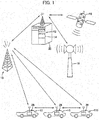
- Fig. 1 illustrates a plurality of vehicles 10 that can communicate with a parking lot mapping system 12 according to a disclosed embodiment that is disposed on a remote server 14.
- the parking lot mapping system 12 communicates with vehicles 10 and is configured to map a parking lot PL ( Fig. 7 ). That is, the parking lot mapping system 12 maps parking spots PS and parking routes PR1 and PR2, as illustrated in Fig. 7 .
- the vehicles 10 and the remote server 14 can communicate with a two-way wireless communications network.
- the two-way wireless communications network can include one or more global navigation satellites (GPS (global positioning system) satellite 16), and one or more terrestrial units, such as roadside (terrestrial) units 18 (two are shown), and a base station or external server 20 that can include the remote server 14.
- GPS global positioning system
- the remote server can be located separately from the base station 20, and can be located in any suitable place.
- the GPS satellites 16 and the roadside units 18 send and receive signals to and from the vehicle 10 and the remote server 14.
- the base station 20 sends and receives signals to and from the vehicle 10 and the remote server 14 via a network of the roadside units 18, or any other suitable two-way wireless communications network.
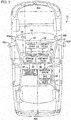
- a parking lot mapping system 12 and the vehicle 10 is illustrated in accordance with one embodiment.
- the parking lot mapping system 12 is disposed entirely at the remote server 14; however the parking lot mapping system 12 can incorporate aspects of the systems of the vehicle 10.
- the remote server 14 can include a remote server side controller 22, a storage device 24 and a remote server side receiver/transmitter 26.
- the vehicle 10 can include a vehicle side controller 28, a navigation system 30, storage device(s) 34 and a vehicle side receiver/transmitter 36.
- the vehicle 10 can include a display
- the remote server 14 can use any of the vehicle components to facilitate the mapping of the parking lot PL.
- the vehicle side controller 28 of the vehicle 10 can be used in addition to or in place of the remote server side controller 22 to perform the calculations and make the determinations described herein.
- Both remote server side controller 22 and vehicle side controller 28 preferably include a microcomputer with a control program that controls the components of the remote server 14 or the vehicle 10, as discussed below.
- the remote server side controller 22 and the vehicle side controller 28 include other conventional components such as an input interface circuit, an output interface circuit, and storage device(s) such as a ROM (Read Only Memory) device and a RAM (Random Access Memory) device.
- the microcomputer of the remote server side controller 22 and the vehicle side controller 28 can be at least programmed to be capable of controlling the parking lot mapping system 12 in accordance with the flow chart of Fig. 6 discussed below.
- the microcomputer of the vehicle side controller 28 is programmed to control one or more of the storage device 34, the navigation system 30, the display, and the vehicle side receiver/transmitter 36, and to make determinations or decisions, as discussed herein.
- the remote server side controller 22 is programmed to control one or more of the storage devices 24 and the remote server side receiver/transmitter 26 and to communicate with the systems of the vehicle 10 to control or activate any of the appropriate systems.
- the memory circuits for the remote server side controller 22 and the vehicle side controller 28 store processing results and control programs, such as those described herein for the remote server 14 and the vehicle 10.
- the remote server side controller 22 and the vehicle side controller 28 are operatively coupled to the systems described herein in a conventional manner, as well as other electrical systems in the vehicle 10 or remote server 14.
- the vehicle side controller 28 is operatively coupled to systems, such the turn signals, windshield wipers, lights and any other suitable systems. Such a connection enables the vehicle side controller 28 to monitor and control any of these systems as desired.
- the internal RAM of the remote server side controller 22 and the vehicle side controller 28 stores statuses of operational flags and various control data.
- the internal ROM of the remote server side controller 22 and the vehicle side controller 28 stores the information for various operations.
- the remote server side controller 22 and the vehicle side controller 28 are capable of selectively controlling any of the components described herein in accordance with the control program.
- remote server side controller 22 and the vehicle side controller 28 can be any combination of hardware and software that will carry out the functions of the present invention.
- the remote server side controller 22 and the vehicle side controller 28 can communicate with the other components of the parking lot mapping system 12 discussed herein via, for example a controller area network (CAN) bus or in any other suitable manner as understood in the art.
- CAN controller area network
- the vehicle side controller 28 can include or be in communication with user input devices 38.
- the user input devices 38 can include, for example, a human-machine interface (HMI) which enables a user (e.g., the driver and/or passenger) to interact with the vehicle side controller 28, as understood in the art and discussed herein.
- HMI human-machine interface
- the vehicle side controller 28 can further include or be in communication with one or more storage devices 34 which can store information as discussed herein.
- the storage devices 34 can store parking event data and vehicle position data for transmission to the remote server 14. Such data can be transmitted continuously or substantially continuously or at any desired interval, or can be stored and transmitted at a later time determined by the controller or requested by the remote server 14.
- the vehicle side controller 28 in this example includes or is in communication with a vehicle navigation system 30.
- the vehicle navigation system 30 includes, for example, a communication device 40, such as a GPS communication device that communicates with the GPS satellites 16.
- the communication device 40 can also communicate with one or more terrestrial units 18 and a base station 20 or external server to obtain location information.
- the vehicle navigation system 30 in this example includes or is in communication with a storage device 41 that can store vehicle information, such as previous vehicle route information, location information, or other vehicle information that the GPS is capable of generating, in addition to map data and other location related data as understood in the art.
- the storage device 41 can be in addition to or work in conjunction with the storage device 34.
- storage devices 34 and 41 can be the same storage device or combined into one storage device. Moreover, the storage devices 34 and 41 can be disposed in position in the vehicle 10, and not necessarily in the navigation system 30 and the vehicle side controller 28.
- the vehicle side controller 28 in this example further includes or is in communication with a display.
- the display displays, for example, navigation information which indicates the location of the vehicle 10 with respect to a map as understood in the art.
- the display can also display warning signals or information related to remote vehicles in the vicinity of the vehicle 10 that may be of interest to the driver of the vehicle 10.
- vehicle 10 is equipped with a sensor that can generate or capture vehicle environment information.
- vehicle environment information can be any information or data related to the vehicle 10, including but not limited to, images of the internal environment, images of the external environment, or information related to characteristics of the vehicle 10 (e.g., vehicle speed, direction, yaw, acceleration, trajectory, heading, vehicle contact warning status, or any other parameter).
- the sensor can be equipped with at least one imaging device such as a high-speed camera.
- the vehicle 10 includes a front imaging device 44a, a rear imaging device 44b, a driver side (or left) imaging device 44c and a passenger side (or right) imaging device 44d.
- the imaging devices 44a-44d are positioned on the vehicle 10 to capture real time images (or information) to provide 360 degree field of view imaging about the entire exterior perimeter of the vehicle 10. Any vehicle information generated by the imaging devices 44a-44d can be stored in the storage device 34 for future review or inspection, as desired.
- a vehicle 10 enters a parking lot PL the vehicle 10 stores or transmits location data.
- the vehicle 10 then performs a parking event indicating that the vehicle 10 is in a parking lot PL.
- the parking event can be any one or more of a suitable event that determines that the vehicle 10 is or has been parked.
- a parking event can be at least one of gear shifting, vehicle stopping for a predetermined time, vehicle starting, vehicle stopping, and a location of the vehicle while parked, or any other suitable event.
- the parking event and the location information can be transmitted to the remote server 14 via the vehicle side receiver/transmitter 36 at a suitable time.
- the remote server 14 includes the remote server side controller 22, the storage device 24 and the remote server side receiver/transmitter 26.
- the remote server 14, via the remote server side receiver/transmitter 26, receives data transmitted from vehicle 10, the data including a parking event (i.e., the event that determines that a vehicle is or has been parked) and the position of the vehicle 10.
- the storage device 24 then stores this data.
- the remote server side controller 22 is programmed to determine that each vehicle 10 of a plurality of vehicles is in a parking lot PL based on a parking event and calculates a parking lot route (e.g., PR1 and/or PR2) based on accumulation of the data including the individual positions of a plurality of vehicles 10.
- the parking event is at least one of gear shifting, vehicle stopping for a predetermined time, vehicle starting, vehicle stopping, and a location of the vehicle while parked.
- the parking lot mapping system 12 is capable of obtaining route information for path planning in a parking lot PL.
- Path planning generally refers to finding a path that allows a vehicle to reach a specific parking spot. That is, the parking lot mapping system 12 determines which route (e.g., PR1 or PR2) on which to travel to park the vehicle 10 in one of the designated parking spots PS.
- the parking lot mapping system 12 infers feasible routes to a specific parking spot based on previously driven vehicle information collected from previous vehicles 10 accessing areas of a parking lot. Accordingly, the parking lot mapping system 12 generates maps of the most used public areas of a parking lot PL.
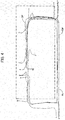
- the remote server 14 As shown in Fig. 4 , as a vehicle 10 enters a parking lot PL, data is transmitted to the remote server 14.
- the remote server 14 accumulates the driving paths DP of a plurality of vehicles 10 that enter the parking lot PL.
- the parking lot data can be the vehicle position as determined by the vehicle navigation system 30 or determined in any other suitable manner (e.g. dead reckoning performed by the controller). That is, the remote server side receiver/transmitter 26 is configured to receive navigation (i.e., GPS data) from the vehicle 10.
- the remote server side controller 22 is capable of determining whether the vehicle 10 has entered or exited a parking lot PL.
- the parking event can be one or more of gear shifting, vehicle stopping for a predetermined time, vehicle starting, vehicle stopping, and a location of the vehicle while parked, or any other suitable event.
- the parking event for a vehicle 10 entering a parking lot PL can be gear shifting from drive to park, the vehicle 10 coming to a stop for a significant time, and/or the vehicle 10 being switched off.
- the parking event for a vehicle 10 exiting the parking lot PL can be gear shifting from park to drive or reverse, the vehicle 10 starting moving from a period of inactivity, and/or the vehicle 10 being switched on.
- the vehicle side controller 28 can preprocess the required data and transmit it to the remote server 14 via the vehicle side receiver/transmitter 36.
- the relevant data are vehicle position and/or raw GPS data at 1Hz, and vehicle control inputs, steering angle, pedal position, brake pressure and/or shift position at 10Hz.
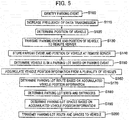
- the remote server side controller 22 first identifies a parking event in S100.
- the driver i.e., user of the parking lot mapping system
- the parking event can be determined by either remote server side controller 22 or vehicle side controller 28. That is, the vehicle side controller 28 may determine a parking event has occurred, thus determining that the parking event data should be sent to the remote server 14.
- the vehicle 10 may simply transmit data to the remote server 14, and the remote server side controller 22 of the remote server 14 may determine that a parking event has occurred.
- the vehicle side controller 28 in the vehicle can increase the frequency at which data is transmitted through the transmitter in S110.
- the remote server side controller 22 may request that the vehicle 10 increase the frequency at which data is transmitted through the vehicle side receiver/transmitter 36.
- the determination to increase the frequency at which data is transmitted can either be made by the vehicle side controller 28 on board the vehicle 10 or the remote server side controller 22 at the remote server 14.
- the vehicle navigation system 30 (or the vehicle side controller 28) then determines the position of the vehicle 10 in S120.
- the parking event or the information that a parking event occurred and the vehicle position is transmitted to the remote server 14, via the vehicle side receiver/transmitter 36 and the remote server side receiver/transmitter 26 in S130.
- the remote server side controller 22 can determine the vehicle position based on the GPS data.
- the remote server 14 stores the parking event and the position of the vehicle 10 in the storage device 24 at the remote server 14 in S140.
- the remote server side controller 22 determines that the vehicle 10 is in a parking lot based on the parking event in S150.
- the remote server 14 accumulates position information from vehicle 10 as the vehicle 10 moves through the parking lot PL in S160.
- the remote server 14 can accumulate position information from a plurality of vehicles 10 that move through the parking lot PL.
- the remote server side controller 22 can then determine a parking lot route PR1 and/or PR2 based on the accumulated vehicle position information in S170.
- the remote server side controller 22 can determine the parking lot exits and entrances ( Fig. 7 ) based on vehicle position before or after the parking event in S180. For example, when the parking event is a parking event for a vehicle 10 entering a parking lot, the remote server side controller 22 can determine that when the vehicle 10 left a mapped road or other area, the vehicle 10 entered the parking lot PL. In one embodiment, the remote server side receiver/transmitter 26 receives data transmitted before the parking event. Conversely, when the parking event is a parking event for a vehicle 10 exiting a parking lot PL, the remote server side controller 22 can determine that once the vehicle 10 enters a mapped road or other area, the vehicle 10 has exited the parking lot PL.
- the remote server side receiver/transmitter 26 receives data transmitted after the parking event. Further, the remote server side controller 22 can determine parking lot spaces PS based on the position of a vehicle 10 or the accumulated data of a plurality of vehicles 10 in S 190.
- the parking lot PL is determined based on one or more of the parking events. For example, when a vehicle 10 is shifted from drive to park and the vehicle 10 is turned off, the remote server side controller 22 determines that the vehicle 10 is positioned within a parking spot PS. The size of the parking spots PS can be calculated or inferred based on the known size of the vehicle 10. Once the remote server side controller 22 maps the parking lot PL, the parking lot information can be transmitted back to the vehicle 10 in S200. The parking lot mapping can be continually updated by the data received from the vehicles 10, and the navigation system 30 of one of the vehicles 10 can be continually updated with the most up to date parking lot information.
- the remote server side controller 22 when mapping the parking lot PL, can divide the parking lot area into a grid like structure. Based on the data received from vehicles 10, the remote server side controller 22 can analyze each location within the grid with direction vector and parked location, then determine each location with probabilistic representation p. In other words, the accumulation of data from the vehicles 10 in the parking lot PL will enable the controller to determine the probability of whether each grid area is a route, a parking spot or an off limits/non-traversable area. Moreover, the accumulation of data from the vehicles 10 in the parking lot PL will enable the remote server side controller 22 to determine the direction of each route PR1 and PR2.
- the remote server side controller 22 can determine the direction of routes PR1 and PR2, and whether certain routes are one directional or bi-directional.
- the remote server side controller 22 is programmed to determine a parking lot route probability and/or a parking spot probability p based on a predetermined quantity of data including the positions of a plurality of vehicles 10 in particular probabilistic spaces over time.
- the degree of probability can vary. For example, areas that have a high probability of being a parking space PS or have being a route (PR1 or PR2) are shown in bold line. Areas that have a low probability of being a parking space PS or have being a route (PR1 or PR2) are shown in dotted line. Areas that have an average or midlevel probability of being a parking space PS or have being a route (PR1 or PR2) are shown in normal line. Such a probability can be determined based on the frequency data indicates a vehicle 10 is in that area. For example, some vehicles may traverse areas or park in areas that are not designated for such use. Such areas may be designated as low probability. On the other hand, areas that are frequently traversed or in which vehicles are frequently parked would be indicated with a high probability
- the remote server side controller 22 can determine the size of the parking spaces PS, the distance the vehicle 10 should travel from the parking spots PS and the distance the vehicle 10 should travel from the routes PR1 and PR2 that have vehicles traveling in the opposite direction.
- the remote server side controller 22 can map the parking lot PL, as shown in Fig. 7 .
- the parking lot PL is mapped with two entrance points, an exit point and a plurality of parking spots.
- the vehicle 10 can also have the sensors, as discussed herein.
- the present parking lot mapping system 12 can be used in conjunction with such sensors to enable the vehicle 10 to travel through the parking lot PL with or without driver assistance.
- the parking lot mapping system 12 transmits the parking lot map to the vehicle 10.
- the vehicle 10 then can use this information to autonomously move the vehicle 10 through the parking lot PL based on the calculated position of the routes PR1 and PR2 and parking spots PS and the direction of the routes.
- the vehicle 10 may also supplement the mapped parking lot PL, with data obtained through or detected by the sensors to determine the location of obstacles (e.g., remote vehicles, pedestrians or other stationary objects), and stopping areas.
- obstacles e.g., remote vehicles, pedestrians or other stationary objects
- the present invention is not limited to mapping parking lots and may be used to map other areas.
- the parking lot map system can be used to map personal parking areas and driveways or other non-road locations.
- the GPS system and the display device are conventional components that are well known in the art. Since the GPS system and the display device are well known in the art, these structures will not be discussed or illustrated in detail herein. Rather, it will be apparent to those skilled in the art from this disclosure that the components can be any type of structure and/or programming that can be used to carry out the present invention.
- the parking lot mapping system 12 described herein maps areas otherwise not mapped in vehicle navigation systems, and updates the configuration of the parking lots in real time to establish an up to date parking lot map.
- Such a system increases the reliability and efficiency of route referencing and autonomous guidance for vehicle occupants, pedestrians and the general public.
- detect as used herein to describe an operation or function carried out by a component, a section, a device or the like includes a component, a section, a device or the like that does not require physical detection, but rather includes determining, measuring, modeling, predicting or computing or the like to carry out the operation or function.
Landscapes
- Engineering & Computer Science (AREA)
- Physics & Mathematics (AREA)
- General Physics & Mathematics (AREA)
- Radar, Positioning & Navigation (AREA)
- Remote Sensing (AREA)
- Chemical & Material Sciences (AREA)
- Analytical Chemistry (AREA)
- Automation & Control Theory (AREA)
- Computer Networks & Wireless Communication (AREA)
- Signal Processing (AREA)
- Multimedia (AREA)
- Theoretical Computer Science (AREA)
- Atmospheric Sciences (AREA)
- Life Sciences & Earth Sciences (AREA)
- Transportation (AREA)
- Mechanical Engineering (AREA)
- Mathematical Physics (AREA)
- Traffic Control Systems (AREA)
- Navigation (AREA)
Abstract
Description
- The present invention generally relates to a parking lot mapping system. More specifically, the present invention relates to a parking lot mapping system that accumulates vehicle position information for mapping parking lots.
- Vehicle navigation systems rely on map data for vehicle path planning. Map data for many parking lots is incomplete or non-existent. Specifically, data regarding parking lot routes is generally nonexistent, and parking lots can frequently change configurations and routes due to the frequently private nature of their ownership and management. Moreover, parking lots can have a significant amount of travel routes and vehicles access areas.
- It has been discovered that increasing path planning in parking lots is possible by accumulating vehicle position data and information. In view of the state of the known technology, one aspect of the present disclosure is to provide a parking lot mapping system, comprising a receiver, a storage device and a controller. The receiver is configured to receive data transmitted from a plurality of vehicles, the data including a parking event and a position of each vehicle of the plurality of vehicles. The storage device is configured to store the data received by the receiver. The controller is programmed to determine that each vehicle of the plurality of vehicles is in a parking lot based on the parking event and to calculate a parking lot route based on accumulation of the data including the position of each vehicle of the plurality of vehicles.
- Another aspect of the present disclosure provides a parking lot mapping system, comprising a location system, a controller, and a transmitter. The location system is configured to determine a position of a vehicle. The controller is on board the vehicle and is programmed to determine that the vehicle is in a parking lot based on a parking event. The transmitter is on board the vehicle, and is configured to transmit data including the parking event and the position of the vehicle, so as to cause a remote controller to calculate a parking lot route based the data transmitted, including the position of the vehicle.
- Another aspect of the present disclosure provides a parking lot mapping system, comprising a location system, a transmitter, a receiver, a storage device, and a controller. The location system is configured to determine a position of a vehicle. The transmitter is on board the vehicle, and is configured to transmit data including a detected parking event and the position of the vehicle. The receiver is configured to receive the data transmitted from the vehicle. The storage device is configured to store the data received by the receiver. The controller is programmed to determine that the vehicle is in a parking lot based on the parking event and to calculate a parking lot route based on the data including the position of each vehicle of the plurality of vehicles.
- Referring now to the attached drawings which form a part of this original disclosure:
-
Fig. 1 is a block diagram illustrating an example of a vehicle equipped with a parking lot mapping system according to embodiments disclosed herein in relation to a remote server and components of a wireless communication network; -
Fig. 2 is a block diagram of an exemplary component of a vehicle equipped with a parking lot mapping system according to embodiments disclosed herein; -
Fig. 3 is a block diagram of exemplary components of a parking lot mapping system according to embodiments disclosed herein; -
Fig. 4 is a schematic view of a parking lot with vehicle route data; -
Fig. 5 is a flowchart illustrating an example of operations performed by the parking lot mapping system according to embodiments disclosed herein; -
Fig. 6 is a schematic view of a controller of the parking lot mapping system according to embodiments disclosed herein that determines probabilities of parking lot routes and parking areas; and -
Fig. 7 is a schematic view of a parking lot mapped by the parking lot mapping system according to embodiments disclosed herein. - Selected embodiments will now be explained with reference to the drawings. It will be apparent to those skilled in the art from this disclosure that the following descriptions of the embodiments are provided for illustration only and not for the purpose of limiting the invention as defined by the appended claims and their equivalents.
-
Fig. 1 illustrates a plurality ofvehicles 10 that can communicate with a parkinglot mapping system 12 according to a disclosed embodiment that is disposed on aremote server 14. The parkinglot mapping system 12 communicates withvehicles 10 and is configured to map a parking lot PL (Fig. 7 ). That is, the parkinglot mapping system 12 maps parking spots PS and parking routes PR1 and PR2, as illustrated inFig. 7 . - The
vehicles 10 and theremote server 14 can communicate with a two-way wireless communications network. As seen inFig. 1 , for example, the two-way wireless communications network can include one or more global navigation satellites (GPS (global positioning system) satellite 16), and one or more terrestrial units, such as roadside (terrestrial) units 18 (two are shown), and a base station orexternal server 20 that can include theremote server 14. It is noted that the remote server can be located separately from thebase station 20, and can be located in any suitable place. TheGPS satellites 16 and theroadside units 18 send and receive signals to and from thevehicle 10 and theremote server 14. Thebase station 20 sends and receives signals to and from thevehicle 10 and theremote server 14 via a network of theroadside units 18, or any other suitable two-way wireless communications network. - Referring initially to
Figs. 2 and3 , a parkinglot mapping system 12 and thevehicle 10 is illustrated in accordance with one embodiment. Preferably, the parkinglot mapping system 12 is disposed entirely at theremote server 14; however the parkinglot mapping system 12 can incorporate aspects of the systems of thevehicle 10. As shown inFig. 3 , theremote server 14 can include a remoteserver side controller 22, astorage device 24 and a remote server side receiver/transmitter 26. Additionally, as illustrated inFig. 2 , thevehicle 10 can include avehicle side controller 28, anavigation system 30, storage device(s) 34 and a vehicle side receiver/transmitter 36. Also thevehicle 10 can include a display Theremote server 14 can use any of the vehicle components to facilitate the mapping of the parking lot PL. For example, in one embodiment, thevehicle side controller 28 of thevehicle 10 can be used in addition to or in place of the remoteserver side controller 22 to perform the calculations and make the determinations described herein. - Both remote
server side controller 22 andvehicle side controller 28 preferably include a microcomputer with a control program that controls the components of theremote server 14 or thevehicle 10, as discussed below. The remoteserver side controller 22 and thevehicle side controller 28 include other conventional components such as an input interface circuit, an output interface circuit, and storage device(s) such as a ROM (Read Only Memory) device and a RAM (Random Access Memory) device. The microcomputer of the remoteserver side controller 22 and thevehicle side controller 28 can be at least programmed to be capable of controlling the parkinglot mapping system 12 in accordance with the flow chart ofFig. 6 discussed below. The microcomputer of thevehicle side controller 28 is programmed to control one or more of thestorage device 34, thenavigation system 30, the display, and the vehicle side receiver/transmitter 36, and to make determinations or decisions, as discussed herein. Further, the remoteserver side controller 22 is programmed to control one or more of thestorage devices 24 and the remote server side receiver/transmitter 26 and to communicate with the systems of thevehicle 10 to control or activate any of the appropriate systems. The memory circuits for the remoteserver side controller 22 and thevehicle side controller 28 store processing results and control programs, such as those described herein for theremote server 14 and thevehicle 10. The remoteserver side controller 22 and thevehicle side controller 28 are operatively coupled to the systems described herein in a conventional manner, as well as other electrical systems in thevehicle 10 orremote server 14. For example, in thevehicle 10 thevehicle side controller 28 is operatively coupled to systems, such the turn signals, windshield wipers, lights and any other suitable systems. Such a connection enables thevehicle side controller 28 to monitor and control any of these systems as desired. The internal RAM of the remoteserver side controller 22 and thevehicle side controller 28 stores statuses of operational flags and various control data. The internal ROM of the remoteserver side controller 22 and thevehicle side controller 28 stores the information for various operations. The remoteserver side controller 22 and thevehicle side controller 28 are capable of selectively controlling any of the components described herein in accordance with the control program. It will be apparent to those skilled in the art from this disclosure that the precise structures and algorithms for the remoteserver side controller 22 and thevehicle side controller 28 can be any combination of hardware and software that will carry out the functions of the present invention. Furthermore, the remoteserver side controller 22 and thevehicle side controller 28 can communicate with the other components of the parkinglot mapping system 12 discussed herein via, for example a controller area network (CAN) bus or in any other suitable manner as understood in the art. - The
vehicle side controller 28 can include or be in communication withuser input devices 38. Theuser input devices 38 can include, for example, a human-machine interface (HMI) which enables a user (e.g., the driver and/or passenger) to interact with thevehicle side controller 28, as understood in the art and discussed herein. Thevehicle side controller 28 can further include or be in communication with one ormore storage devices 34 which can store information as discussed herein. For example, thestorage devices 34 can store parking event data and vehicle position data for transmission to theremote server 14. Such data can be transmitted continuously or substantially continuously or at any desired interval, or can be stored and transmitted at a later time determined by the controller or requested by theremote server 14. - As further shown in
Figure 2 , thevehicle side controller 28 in this example includes or is in communication with avehicle navigation system 30. Thevehicle navigation system 30 includes, for example, acommunication device 40, such as a GPS communication device that communicates with theGPS satellites 16. Thecommunication device 40 can also communicate with one or moreterrestrial units 18 and abase station 20 or external server to obtain location information. Furthermore, thevehicle navigation system 30 in this example includes or is in communication with astorage device 41 that can store vehicle information, such as previous vehicle route information, location information, or other vehicle information that the GPS is capable of generating, in addition to map data and other location related data as understood in the art. Thestorage device 41 can be in addition to or work in conjunction with thestorage device 34. It is noted that is not necessary to have two storage devices, andstorage devices storage devices vehicle 10, and not necessarily in thenavigation system 30 and thevehicle side controller 28. - The
vehicle side controller 28 in this example further includes or is in communication with a display. The display displays, for example, navigation information which indicates the location of thevehicle 10 with respect to a map as understood in the art. The display can also display warning signals or information related to remote vehicles in the vicinity of thevehicle 10 that may be of interest to the driver of thevehicle 10. - In addition, the
vehicle 10 is equipped with a sensor that can generate or capture vehicle environment information. The vehicle environment information can be any information or data related to thevehicle 10, including but not limited to, images of the internal environment, images of the external environment, or information related to characteristics of the vehicle 10 (e.g., vehicle speed, direction, yaw, acceleration, trajectory, heading, vehicle contact warning status, or any other parameter). - The sensor can be equipped with at least one imaging device such as a high-speed camera. In this example, the
vehicle 10 includes a front imaging device 44a, a rear imaging device 44b, a driver side (or left) imaging device 44c and a passenger side (or right) imaging device 44d. The imaging devices 44a-44d are positioned on thevehicle 10 to capture real time images (or information) to provide 360 degree field of view imaging about the entire exterior perimeter of thevehicle 10. Any vehicle information generated by the imaging devices 44a-44d can be stored in thestorage device 34 for future review or inspection, as desired. - Accordingly, as a
vehicle 10 enters a parking lot PL thevehicle 10 stores or transmits location data. Thevehicle 10 then performs a parking event indicating that thevehicle 10 is in a parking lot PL. The parking event can be any one or more of a suitable event that determines that thevehicle 10 is or has been parked. For example, a parking event can be at least one of gear shifting, vehicle stopping for a predetermined time, vehicle starting, vehicle stopping, and a location of the vehicle while parked, or any other suitable event. The parking event and the location information can be transmitted to theremote server 14 via the vehicle side receiver/transmitter 36 at a suitable time. - As shown in
Fig. 3 , theremote server 14 includes the remoteserver side controller 22, thestorage device 24 and the remote server side receiver/transmitter 26. Theremote server 14, via the remote server side receiver/transmitter 26, receives data transmitted fromvehicle 10, the data including a parking event (i.e., the event that determines that a vehicle is or has been parked) and the position of thevehicle 10. Thestorage device 24 then stores this data. - Thus, in operation, the remote
server side controller 22 is programmed to determine that eachvehicle 10 of a plurality of vehicles is in a parking lot PL based on a parking event and calculates a parking lot route (e.g., PR1 and/or PR2) based on accumulation of the data including the individual positions of a plurality ofvehicles 10. As stated above, the parking event is at least one of gear shifting, vehicle stopping for a predetermined time, vehicle starting, vehicle stopping, and a location of the vehicle while parked. - In one embodiment, the parking
lot mapping system 12 is capable of obtaining route information for path planning in a parking lot PL. Path planning generally refers to finding a path that allows a vehicle to reach a specific parking spot. That is, the parkinglot mapping system 12 determines which route (e.g., PR1 or PR2) on which to travel to park thevehicle 10 in one of the designated parking spots PS. In this embodiment, the parkinglot mapping system 12 infers feasible routes to a specific parking spot based on previously driven vehicle information collected fromprevious vehicles 10 accessing areas of a parking lot. Accordingly, the parkinglot mapping system 12 generates maps of the most used public areas of a parking lot PL. - As shown in
Fig. 4 , as avehicle 10 enters a parking lot PL, data is transmitted to theremote server 14. Theremote server 14 accumulates the driving paths DP of a plurality ofvehicles 10 that enter the parking lot PL. The parking lot data can be the vehicle position as determined by thevehicle navigation system 30 or determined in any other suitable manner (e.g. dead reckoning performed by the controller). That is, the remote server side receiver/transmitter 26 is configured to receive navigation (i.e., GPS data) from thevehicle 10. Moreover, based on a parking event, the remoteserver side controller 22 is capable of determining whether thevehicle 10 has entered or exited a parking lot PL. InFig. 4 , the exit pathways are shown in a dotted line, while the entrance pathways or parking pathways are shown in solid line. As stated above, the parking event can be one or more of gear shifting, vehicle stopping for a predetermined time, vehicle starting, vehicle stopping, and a location of the vehicle while parked, or any other suitable event. For example, the parking event for avehicle 10 entering a parking lot PL can be gear shifting from drive to park, thevehicle 10 coming to a stop for a significant time, and/or thevehicle 10 being switched off. Additionally, the parking event for avehicle 10 exiting the parking lot PL can be gear shifting from park to drive or reverse, thevehicle 10 starting moving from a period of inactivity, and/or thevehicle 10 being switched on. - Once a parking event occurs on board the
vehicle 10, thevehicle side controller 28 can preprocess the required data and transmit it to theremote server 14 via the vehicle side receiver/transmitter 36. In one embodiment, the relevant data are vehicle position and/or raw GPS data at 1Hz, and vehicle control inputs, steering angle, pedal position, brake pressure and/or shift position at 10Hz. - Accordingly, as shown in
Fig. 5 , the remoteserver side controller 22 first identifies a parking event in S100. Alternatively, the driver (i.e., user of the parking lot mapping system) of thevehicle 10 may request parking lot mapping. It is noted that the parking event can be determined by either remoteserver side controller 22 orvehicle side controller 28. That is, thevehicle side controller 28 may determine a parking event has occurred, thus determining that the parking event data should be sent to theremote server 14. Alternatively, thevehicle 10 may simply transmit data to theremote server 14, and the remoteserver side controller 22 of theremote server 14 may determine that a parking event has occurred. Once the parking event is identified, thevehicle side controller 28 in the vehicle can increase the frequency at which data is transmitted through the transmitter in S110. Alternatively, the remoteserver side controller 22 may request that thevehicle 10 increase the frequency at which data is transmitted through the vehicle side receiver/transmitter 36. In other words, the determination to increase the frequency at which data is transmitted can either be made by thevehicle side controller 28 on board thevehicle 10 or the remoteserver side controller 22 at theremote server 14. The vehicle navigation system 30 (or the vehicle side controller 28) then determines the position of thevehicle 10 in S120. The parking event or the information that a parking event occurred and the vehicle position is transmitted to theremote server 14, via the vehicle side receiver/transmitter 36 and the remote server side receiver/transmitter 26 in S130. Alternatively, once the navigation system data is transmitted to theremote server 14, the remoteserver side controller 22 can determine the vehicle position based on the GPS data. - The
remote server 14 stores the parking event and the position of thevehicle 10 in thestorage device 24 at theremote server 14 in S140. The remoteserver side controller 22 determines that thevehicle 10 is in a parking lot based on the parking event in S150. Theremote server 14 accumulates position information fromvehicle 10 as thevehicle 10 moves through the parking lot PL in S160. Moreover, theremote server 14 can accumulate position information from a plurality ofvehicles 10 that move through the parking lot PL. The remoteserver side controller 22 can then determine a parking lot route PR1 and/or PR2 based on the accumulated vehicle position information in S170. - Further, the remote
server side controller 22 can determine the parking lot exits and entrances (Fig. 7 ) based on vehicle position before or after the parking event in S180. For example, when the parking event is a parking event for avehicle 10 entering a parking lot, the remoteserver side controller 22 can determine that when thevehicle 10 left a mapped road or other area, thevehicle 10 entered the parking lot PL. In one embodiment, the remote server side receiver/transmitter 26 receives data transmitted before the parking event. Conversely, when the parking event is a parking event for avehicle 10 exiting a parking lot PL, the remoteserver side controller 22 can determine that once thevehicle 10 enters a mapped road or other area, thevehicle 10 has exited the parking lot PL. In one embodiment, the remote server side receiver/transmitter 26 receives data transmitted after the parking event. Further, the remoteserver side controller 22 can determine parking lot spaces PS based on the position of avehicle 10 or the accumulated data of a plurality ofvehicles 10 in S 190. - In one embodiment, the parking lot PL is determined based on one or more of the parking events. For example, when a
vehicle 10 is shifted from drive to park and thevehicle 10 is turned off, the remoteserver side controller 22 determines that thevehicle 10 is positioned within a parking spot PS. The size of the parking spots PS can be calculated or inferred based on the known size of thevehicle 10. Once the remoteserver side controller 22 maps the parking lot PL, the parking lot information can be transmitted back to thevehicle 10 in S200. The parking lot mapping can be continually updated by the data received from thevehicles 10, and thenavigation system 30 of one of thevehicles 10 can be continually updated with the most up to date parking lot information. - As shown in
Fig. 6 , in one embodiment, when mapping the parking lot PL, the remoteserver side controller 22 can divide the parking lot area into a grid like structure. Based on the data received fromvehicles 10, the remoteserver side controller 22 can analyze each location within the grid with direction vector and parked location, then determine each location with probabilistic representation p. In other words, the accumulation of data from thevehicles 10 in the parking lot PL will enable the controller to determine the probability of whether each grid area is a route, a parking spot or an off limits/non-traversable area. Moreover, the accumulation of data from thevehicles 10 in the parking lot PL will enable the remoteserver side controller 22 to determine the direction of each route PR1 and PR2. That is, as avehicle 10 moves through the parking lot PL and continually transmits location, the remoteserver side controller 22 can determine the direction of routes PR1 and PR2, and whether certain routes are one directional or bi-directional. In one embodiment, the remoteserver side controller 22 is programmed to determine a parking lot route probability and/or a parking spot probability p based on a predetermined quantity of data including the positions of a plurality ofvehicles 10 in particular probabilistic spaces over time. - As shown in
Fig. 6 , the degree of probability can vary. For example, areas that have a high probability of being a parking space PS or have being a route (PR1 or PR2) are shown in bold line. Areas that have a low probability of being a parking space PS or have being a route (PR1 or PR2) are shown in dotted line. Areas that have an average or midlevel probability of being a parking space PS or have being a route (PR1 or PR2) are shown in normal line. Such a probability can be determined based on the frequency data indicates avehicle 10 is in that area. For example, some vehicles may traverse areas or park in areas that are not designated for such use. Such areas may be designated as low probability. On the other hand, areas that are frequently traversed or in which vehicles are frequently parked would be indicated with a high probability - Further, the remote
server side controller 22 can determine the size of the parking spaces PS, the distance thevehicle 10 should travel from the parking spots PS and the distance thevehicle 10 should travel from the routes PR1 and PR2 that have vehicles traveling in the opposite direction. - Once the remote
server side controller 22 determines the probability of whether each grid area is a route, a parking spot or an "off limits/non-traversable" area, the remoteserver side controller 22 can map the parking lot PL, as shown inFig. 7 . In this embodiment, the parking lot PL is mapped with two entrance points, an exit point and a plurality of parking spots. - It should be understood that the
vehicle 10 can also have the sensors, as discussed herein. The present parkinglot mapping system 12 can be used in conjunction with such sensors to enable thevehicle 10 to travel through the parking lot PL with or without driver assistance. For example, in one embodiment, the parkinglot mapping system 12 transmits the parking lot map to thevehicle 10. Thevehicle 10 then can use this information to autonomously move thevehicle 10 through the parking lot PL based on the calculated position of the routes PR1 and PR2 and parking spots PS and the direction of the routes. Moreover, thevehicle 10 may also supplement the mapped parking lot PL, with data obtained through or detected by the sensors to determine the location of obstacles (e.g., remote vehicles, pedestrians or other stationary objects), and stopping areas. - The present invention is not limited to mapping parking lots and may be used to map other areas. For example, it is conceived that the parking lot map system can be used to map personal parking areas and driveways or other non-road locations.
- The GPS system and the display device are conventional components that are well known in the art. Since the GPS system and the display device are well known in the art, these structures will not be discussed or illustrated in detail herein. Rather, it will be apparent to those skilled in the art from this disclosure that the components can be any type of structure and/or programming that can be used to carry out the present invention.
- Accordingly, the parking
lot mapping system 12 described herein maps areas otherwise not mapped in vehicle navigation systems, and updates the configuration of the parking lots in real time to establish an up to date parking lot map. Such a system increases the reliability and efficiency of route referencing and autonomous guidance for vehicle occupants, pedestrians and the general public. - In understanding the scope of the present invention, the term "comprising" and its derivatives, as used herein, are intended to be open ended terms that specify the presence of the stated features, elements, components, groups, integers, and/or steps, but do not exclude the presence of other unstated features, elements, components, groups, integers and/or steps. The foregoing also applies to words having similar meanings such as the terms, "including", "having" and their derivatives. Also, the terms "part," or "section" when used in the singular can have the dual meaning of a single part or a plurality of parts. Also as used herein to describe the above embodiments, the following directional terms "rearward", "above", "downward", "vertical", "horizontal", "below" and "transverse" as well as any other similar directional terms refer to those directions of a vehicle equipped with the parking lot mapping system. Accordingly, these terms, as utilized to describe the present invention should be interpreted relative to a vehicle equipped with the parking lot mapping system.
- The term "detect" as used herein to describe an operation or function carried out by a component, a section, a device or the like includes a component, a section, a device or the like that does not require physical detection, but rather includes determining, measuring, modeling, predicting or computing or the like to carry out the operation or function.
- The term "configured" as used herein to describe a component, section or part of a device includes hardware and/or software that is constructed and/or programmed to carry out the desired function.
- The terms of degree such as "about" as used herein mean a reasonable amount of deviation of the modified term such that the end result is not significantly changed.
- While only selected embodiments have been chosen to illustrate the present invention, it will be apparent to those skilled in the art from this disclosure that various changes and modifications can be made herein without departing from the scope of the invention as defined in the appended claims. For example, the size, shape, location or orientation of the various components can be changed as needed and/or desired. Components that are shown directly connected or contacting each other can have intermediate structures disposed between them. The functions of one element can be performed by two, and vice versa. The structures and functions of one embodiment can be adopted in another embodiment. It is not necessary for all advantages to be present in a particular embodiment at the same time. Every feature which is unique from the prior art, alone or in combination with other features, also should be considered a separate description of further inventions by the applicant, including the structural and/or functional concepts embodied by such features. Thus, the foregoing descriptions of the embodiments according to the present invention are provided for illustration only, and not for the purpose of limiting the invention as defined by the appended claims and their equivalents.
- The present application is based on United States Patent Application No.
14/736747 filed on June 11, 2015
Claims (20)
- A parking lot mapping system, comprising:a receiver configured to receive data transmitted from a plurality of vehicles, the data including a parking event and a position of each vehicle of the plurality of vehicles;a storage device configured to store the data received by the receiver; anda controller programmed to determine that each vehicle of the plurality of vehicles is in a parking lot based on the parking event and to calculate a parking lot route based on accumulation of the data including the position of each vehicle of the plurality of vehicles.
- The parking lot mapping system according to claim 1, whereinthe receiver is configured to receive the data transmitted from the plurality of vehicles, the position of each vehicle being one position of a plurality of positions of each vehicle within the parking lot at a given time, andthe controller is programmed to calculate the parking lot route based on the accumulation of the data including the plurality of positions of each vehicle within the parking lot.
- The parking lot mapping system according to claim 1, whereinthe parking event is at least one of gear shifting, vehicle stopping for a predetermined time, vehicle starting, vehicle stopping, and a location of the vehicle while parked.
- The parking lot mapping system according to claim 1, whereinthe receiver is configured to receive data transmitted before the parking event.
- The parking lot mapping system according to claim 4, whereinthe controller is programmed to determine a parking lot entrance based on the data transmitted before the parking event.
- The parking lot mapping system according to claim 1, whereinthe receiver is configured to receive data transmitted after the parking event.
- The parking lot mapping system according to claim 6, whereinthe controller is programmed to determine a parking lot exit based on the data transmitted after the parking event.
- The parking lot mapping system according to claim 1, whereinthe receiver is configured to receive global positioning system data from the vehicle, andthe controller is configured to determine the position of the vehicle based on the global positioning system data.
- The parking lot mapping system according to claim 1, whereinthe controller is programmed to determine a directional flow of traffic in the parking lot.
- The parking lot mapping system according to claim 1, whereinthe controller is programmed to determine a parking lot route probability based on a predetermined quantity of data including the position of each vehicle of the plurality of vehicles.
- The parking lot mapping system according to claim 1, whereinthe controller is configured to determine the location of parking spots based on the position of each vehicle of the plurality of vehicles and the parking event.
- The parking lot mapping system according to claim 11, further comprisinga transmitter configured to transmit the parking lot route and the location of the parking spots determined by the controller to at least one vehicle of the plurality of vehicles.
- A parking lot mapping system, comprising:a location system configured to determine a position of a vehicle;a controller on board a vehicle, and being programmed to determine that the vehicle is in a parking lot based on a parking event; anda transmitter on board the vehicle, the transmitter being configured to transmit data including the parking event and the position of the vehicle, so as to cause a remote controller to calculate a parking lot route based the data transmitted, including the position of the vehicle.
- The parking lot mapping system according to claim 13, whereinthe controller on board a vehicle is programmed to increase a frequency of the data transmitted by the transmitter when the controller on board the vehicle determines the vehicle is in the parking lot.
- The parking lot mapping system according to claim 13, whereinthe parking event is at least one of gear shifting, vehicle stopping for a predetermined time, vehicle starting, vehicle stopping, and a location of the vehicle while parked.
- The parking lot mapping system according to claim 13, whereinthe receiver is configured to receive data transmitted before the parking event.
- The parking lot mapping system according to claim 16, whereinthe controller is programmed to determine a parking lot entrance based on the data transmitted before the parking event.
- The parking lot mapping system according to claim 13, whereina receiver is configured to receive data transmitted after the parking event.
- The parking lot mapping system according to claim 18, whereinthe controller is programmed to determine a parking lot exit based on the data transmitted after the parking event.
- A parking lot mapping system, comprising:a location system configured to determine a position of a vehicle;a transmitter on board the vehicle, the transmitter configured to transmit data including a detected parking event and the position of the vehicle;a receiver configured to receive the data transmitted from the vehicle;a storage device configured to store the data received by the receiver; anda controller programmed to determine that the vehicle is in a parking lot based on the parking event and to calculate a parking lot route based on the data including the position of each vehicle of the plurality of vehicles.
Applications Claiming Priority (2)
| Application Number | Priority Date | Filing Date | Title |
|---|---|---|---|
| US14/736,747 US10096248B2 (en) | 2015-06-11 | 2015-06-11 | Parking lot mapping system |
| PCT/JP2016/062080 WO2016199496A1 (en) | 2015-06-11 | 2016-04-15 | Parking lot mapping system |
Publications (3)
| Publication Number | Publication Date |
|---|---|
| EP3309766A1 true EP3309766A1 (en) | 2018-04-18 |
| EP3309766A4 EP3309766A4 (en) | 2018-06-20 |
| EP3309766B1 EP3309766B1 (en) | 2019-07-10 |
Family
ID=57503856
Family Applications (1)
| Application Number | Title | Priority Date | Filing Date |
|---|---|---|---|
| EP16807203.1A Active EP3309766B1 (en) | 2015-06-11 | 2016-04-15 | Parking lot mapping system |
Country Status (9)
| Country | Link |
|---|---|
| US (2) | US10096248B2 (en) |
| EP (1) | EP3309766B1 (en) |
| JP (1) | JP6443545B2 (en) |
| KR (1) | KR101989733B1 (en) |
| CN (1) | CN107710302A (en) |
| CA (1) | CA2988690C (en) |
| MX (1) | MX370228B (en) |
| RU (1) | RU2668361C1 (en) |
| WO (1) | WO2016199496A1 (en) |
Cited By (1)
| Publication number | Priority date | Publication date | Assignee | Title |
|---|---|---|---|---|
| CN1052240C (en) * | 1989-09-28 | 2000-05-10 | 艾伯特实验室 | Process for preparing inhibitors of postinfective viral proteases |
Families Citing this family (37)
| Publication number | Priority date | Publication date | Assignee | Title |
|---|---|---|---|---|
| JP6354542B2 (en) * | 2014-11-26 | 2018-07-11 | 株式会社デンソー | Automatic vehicle driving system |
| US10012986B2 (en) * | 2016-08-19 | 2018-07-03 | Dura Operating, Llc | Method for autonomously parking a motor vehicle for head-in, tail-in, and parallel parking spots |
| US10338586B2 (en) * | 2016-08-19 | 2019-07-02 | Dura Operating, Llc | Method for controlling autonomous valet system pathing for a motor vehicle |
| US10802450B2 (en) * | 2016-09-08 | 2020-10-13 | Mentor Graphics Corporation | Sensor event detection and fusion |
| US11067996B2 (en) | 2016-09-08 | 2021-07-20 | Siemens Industry Software Inc. | Event-driven region of interest management |
| EP3550538B1 (en) * | 2016-11-30 | 2025-01-01 | Pioneer Corporation | Information processing apparatus, information processing method, and program |
| US10372132B2 (en) * | 2016-12-12 | 2019-08-06 | Apple Inc. | Guidance of autonomous vehicles in destination vicinities using intent signals |
| DE102017204455A1 (en) * | 2017-03-17 | 2018-09-20 | Audi Ag | Method for collecting information about the availability of parking spaces |
| US10801860B2 (en) * | 2017-06-14 | 2020-10-13 | Here Global B.V. | Mapping system and method for identifying a parking lot from probe data |
| DE102017210112A1 (en) * | 2017-06-16 | 2018-12-20 | Robert Bosch Gmbh | Method and system for performing a calibration of a sensor |
| KR102440507B1 (en) * | 2017-11-03 | 2022-09-06 | 현대자동차주식회사 | How to provide parking information for autonomous parking |
| SE541634C2 (en) * | 2018-03-06 | 2019-11-19 | Scania Cv Ab | Method and control arrangement for identification of parking areas |
| US10373494B1 (en) * | 2018-05-09 | 2019-08-06 | Here Global B.V. | Method and apparatus for estimating a parking event based on device signal observations |
| CN109754636B (en) * | 2018-05-16 | 2021-03-02 | 启迪云控(北京)科技有限公司 | Parking space cooperative sensing identification and parking assistance method and device |
| US11231280B2 (en) * | 2018-07-06 | 2022-01-25 | Inrix Inc. | Probabilistic parking routes |
| CN110312337A (en) * | 2018-11-01 | 2019-10-08 | 安徽世林照明股份有限公司 | It is a kind of based on the underground garage of Internet of Things Intelligent energy-saving LED lamp illumination system |
| RU2749650C1 (en) | 2018-12-21 | 2021-06-16 | Общество С Ограниченной Ответственностью "Яндекс" | Method and server for generating parking recommendations displayed on an electronic device |
| JP2020147248A (en) * | 2019-03-15 | 2020-09-17 | トヨタ自動車株式会社 | Vehicle control system |
| JP2020166719A (en) * | 2019-03-29 | 2020-10-08 | 本田技研工業株式会社 | Parking lot management equipment, parking lot management methods, and programs |
| JP7188249B2 (en) * | 2019-04-11 | 2022-12-13 | トヨタ自動車株式会社 | Parking lot management device, parking lot management method and parking lot management program |
| CN111907516B (en) * | 2019-05-09 | 2022-05-31 | 广州汽车集团股份有限公司 | Full-automatic parking method and system |
| US10713943B1 (en) * | 2019-05-16 | 2020-07-14 | Here Global B.V. | Method and apparatus for detecting a vehicle parking, stopping, or standing location |
| EP3786585B1 (en) * | 2019-08-30 | 2023-02-22 | Ningbo Geely Automobile Research & Development Co. Ltd. | Method and system for updating of routes within parking area |
| CN110779533B (en) * | 2019-09-16 | 2022-04-12 | 腾讯科技(深圳)有限公司 | Navigation method, system and electronic device |
| CN110956846B (en) * | 2019-12-11 | 2021-06-25 | 济宁市众帮来袭信息科技有限公司 | A parking service method, device, system and storage medium |
| GB201918932D0 (en) * | 2019-12-20 | 2020-02-05 | Tomtom Traffic Bv | Methods of generating and transmitting positional data |
| KR102778274B1 (en) * | 2019-12-26 | 2025-03-11 | 현대자동차주식회사 | Apparatus and method for contorlling driving of vehicle |
| US11409292B2 (en) * | 2020-03-24 | 2022-08-09 | Here Global B.V. | Method, apparatus, and computer program product for generating a map of road links of a parking lot |
| US11443465B2 (en) | 2020-03-24 | 2022-09-13 | Here Global B.V. | Method, apparatus, and computer program product for generating turn paths through an intersection |
| US11420649B2 (en) | 2020-03-24 | 2022-08-23 | Here Global B.V. | Method, apparatus, and computer program product for generating turn paths through an intersection |
| US11624629B2 (en) * | 2020-03-24 | 2023-04-11 | Here Global B.V. | Method, apparatus, and computer program product for generating parking lot geometry |
| CN112836003A (en) * | 2021-02-04 | 2021-05-25 | 广州小鹏自动驾驶科技有限公司 | A map processing method and device |
| EP4059815B1 (en) | 2021-03-19 | 2025-07-30 | Ford Global Technologies, LLC | Method of providing driver assistance in a vehicle, and park assist system |
| US20240288277A1 (en) * | 2021-07-13 | 2024-08-29 | Honda Motor Co., Ltd. | Parking lot information analysis device and parking lot information analysis method |
| US20240210512A1 (en) * | 2022-12-27 | 2024-06-27 | Honda Motor Co., Ltd. | Management apparatus and management method |
| CN116153083B (en) * | 2023-04-20 | 2023-10-17 | 江铃汽车股份有限公司 | Vehicle calling method and system applied to underground parking garage |
| CN119832168A (en) * | 2025-03-17 | 2025-04-15 | 成都宜泊信息科技有限公司 | Indoor parking lot mapping method, system, equipment and medium based on artificial intelligence |
Family Cites Families (21)
| Publication number | Priority date | Publication date | Assignee | Title |
|---|---|---|---|---|
| JP3557776B2 (en) | 1996-03-08 | 2004-08-25 | 日産自動車株式会社 | Route guidance device for vehicles |
| JP2002333334A (en) | 2001-05-08 | 2002-11-22 | Pioneer Electronic Corp | Car navigation device |
| JP2004009833A (en) | 2002-06-05 | 2004-01-15 | Nissan Motor Co Ltd | Operation status recording device |
| JP2006293876A (en) * | 2005-04-14 | 2006-10-26 | Hitachi Ltd | Traffic information collecting device and in-vehicle device |
| JP4178154B2 (en) * | 2005-08-30 | 2008-11-12 | 松下電器産業株式会社 | Parking position search support device, method and program |
| JP4568782B2 (en) * | 2006-03-07 | 2010-10-27 | パイオニア株式会社 | Location registration device, navigation device, route search device, location registration method, location registration program, and recording medium |
| US8073617B2 (en) | 2006-12-27 | 2011-12-06 | Aisin Aw Co., Ltd. | Map information generating systems, methods, and programs |
| JP2009069059A (en) * | 2007-09-14 | 2009-04-02 | Fujitsu Ten Ltd | Device, system, and method for guiding in parking lot |
| EP2218063A1 (en) | 2007-11-06 | 2010-08-18 | Tele Atlas North America, Inc. | Method and system for the use of probe data from multiple vehicles to detect real world changes for use in updating a map |
| KR20110026433A (en) * | 2008-06-25 | 2011-03-15 | 톰톰 인터내셔날 비.브이. | Navigation device and method for detecting parking facilities |
| US8504512B2 (en) | 2009-12-02 | 2013-08-06 | Microsoft Corporation | Identifying geospatial patterns from device data |
| WO2012019628A1 (en) | 2010-08-12 | 2012-02-16 | Tomtom Germany Gmbh & Co. Kg | Parking lot detection using probe data |
| KR20120018005A (en) * | 2010-08-20 | 2012-02-29 | 한국전자통신연구원 | Parking management service method and apparatus, client terminal and server for parking management service |
| CN102254431B (en) * | 2011-06-14 | 2014-05-21 | 上海雷腾软件有限公司 | Vehicle position data acquiring and processing method and system |
| US8847791B1 (en) * | 2011-12-08 | 2014-09-30 | Google Inc. | Systems and methods for determining parking difficulty of segments of a geographic area |
| CN202748949U (en) * | 2012-07-02 | 2013-02-20 | 杭州海康威视系统技术有限公司 | Vehicle-positioning system in parking lot |
| CN103900553A (en) * | 2012-12-25 | 2014-07-02 | 上海博泰悦臻电子设备制造有限公司 | Regional map recording method and system |
| JP6044335B2 (en) | 2012-12-27 | 2016-12-14 | 日産自動車株式会社 | Parking assistance device, parking assistance system, and parking assistance method |
| US9177475B2 (en) * | 2013-11-04 | 2015-11-03 | Volkswagen Ag | Driver behavior based parking availability prediction system and method |
| CN103763741B (en) * | 2013-11-13 | 2018-05-22 | 雷振山 | A kind of intelligent parking lot wireless communications method and system |
| CN104575079B (en) * | 2014-08-12 | 2017-07-14 | 深圳市旺龙软件技术有限公司 | Vehicle positioning method and car searching method in a kind of parking lot |
-
2015
- 2015-06-11 US US14/736,747 patent/US10096248B2/en active Active
-
2016
- 2016-04-15 JP JP2017523141A patent/JP6443545B2/en active Active
- 2016-04-15 KR KR1020177036037A patent/KR101989733B1/en not_active Expired - Fee Related
- 2016-04-15 CN CN201680033930.4A patent/CN107710302A/en active Pending
- 2016-04-15 RU RU2018100343A patent/RU2668361C1/en active
- 2016-04-15 WO PCT/JP2016/062080 patent/WO2016199496A1/en not_active Ceased
- 2016-04-15 CA CA2988690A patent/CA2988690C/en active Active
- 2016-04-15 EP EP16807203.1A patent/EP3309766B1/en active Active
- 2016-04-15 MX MX2017016010A patent/MX370228B/en active IP Right Grant
-
2018
- 2018-08-31 US US16/119,120 patent/US10650680B2/en active Active
Cited By (1)
| Publication number | Priority date | Publication date | Assignee | Title |
|---|---|---|---|---|
| CN1052240C (en) * | 1989-09-28 | 2000-05-10 | 艾伯特实验室 | Process for preparing inhibitors of postinfective viral proteases |
Also Published As
| Publication number | Publication date |
|---|---|
| RU2668361C1 (en) | 2018-09-28 |
| US10650680B2 (en) | 2020-05-12 |
| US10096248B2 (en) | 2018-10-09 |
| KR101989733B1 (en) | 2019-09-30 |
| CA2988690A1 (en) | 2016-12-15 |
| US20180374351A1 (en) | 2018-12-27 |
| BR112017026678A2 (en) | 2018-08-14 |
| JP6443545B2 (en) | 2018-12-26 |
| CN107710302A (en) | 2018-02-16 |
| MX2017016010A (en) | 2018-04-20 |
| JPWO2016199496A1 (en) | 2018-04-05 |
| KR20180008642A (en) | 2018-01-24 |
| US20160364985A1 (en) | 2016-12-15 |
| EP3309766A4 (en) | 2018-06-20 |
| CA2988690C (en) | 2019-06-18 |
| WO2016199496A1 (en) | 2016-12-15 |
| MX370228B (en) | 2019-12-06 |
| EP3309766B1 (en) | 2019-07-10 |
Similar Documents
| Publication | Publication Date | Title |
|---|---|---|
| US10650680B2 (en) | Parking lot mapping system | |
| CN113313933B (en) | Lane-based routing system for an autonomous vehicle | |
| CN113195342B (en) | Steering angle calibration | |
| JP6893140B2 (en) | Control devices, control methods, control programs and control systems | |
| US11458958B2 (en) | Dispatch support method and device | |
| KR101901024B1 (en) | Map update determination system | |
| CN114761300B (en) | Driving control method and driving control device | |
| US20170337810A1 (en) | Traffic condition estimation apparatus, vehicle control system, route guidance apparatus, traffic condition estimation method, and traffic condition estimation program | |
| US9558408B2 (en) | Traffic signal prediction | |
| US9494935B2 (en) | Remote operation of autonomous vehicle in unexpected environment | |
| US12106582B2 (en) | Vehicle travel control apparatus | |
| JP7190393B2 (en) | Vehicle control device, vehicle management device, vehicle control method, and program | |
| US20150106010A1 (en) | Aerial data for vehicle navigation | |
| US9026356B2 (en) | Vehicle navigation system and method | |
| JP2019185293A (en) | Vehicle remote control method and vehicle remote control device | |
| CN115454036B (en) | Remote operation delegation system, remote operation delegation method and storage medium | |
| JPWO2018142566A1 (en) | Passing gate determination device, vehicle control system, passing gate determination method, and program | |
| EP3914492B1 (en) | A parking-trajectory generation method combined with offline and online solutions | |
| CN114248798A (en) | Improving passenger boarding and disembarking of autonomous vehicles using weather information | |
| US20240151544A1 (en) | Speed Reasoning in the Presence of Uncertainty When Pulling Over | |
| JP7048833B1 (en) | Vehicle control devices, vehicle control methods, and programs | |
| US12594960B2 (en) | Navigational constraint control system | |
| JP2025011917A (en) | Automatic parking control device | |
| JP7548085B2 (en) | Remote function selection device | |
| BR112017026678B1 (en) | PARKING MAPPING SYSTEM |
Legal Events
| Date | Code | Title | Description |
|---|---|---|---|
| STAA | Information on the status of an ep patent application or granted ep patent |
Free format text: STATUS: THE INTERNATIONAL PUBLICATION HAS BEEN MADE |
|
| PUAI | Public reference made under article 153(3) epc to a published international application that has entered the european phase |
Free format text: ORIGINAL CODE: 0009012 |
|
| STAA | Information on the status of an ep patent application or granted ep patent |
Free format text: STATUS: REQUEST FOR EXAMINATION WAS MADE |
|
| 17P | Request for examination filed |
Effective date: 20180105 |
|
| AK | Designated contracting states |
Kind code of ref document: A1 Designated state(s): AL AT BE BG CH CY CZ DE DK EE ES FI FR GB GR HR HU IE IS IT LI LT LU LV MC MK MT NL NO PL PT RO RS SE SI SK SM TR |
|
| AX | Request for extension of the european patent |
Extension state: BA ME |
|
| A4 | Supplementary search report drawn up and despatched |
Effective date: 20180523 |
|
| RIC1 | Information provided on ipc code assigned before grant |
Ipc: G08G 1/14 20060101AFI20180515BHEP |
|
| DAV | Request for validation of the european patent (deleted) | ||
| DAX | Request for extension of the european patent (deleted) | ||
| GRAP | Despatch of communication of intention to grant a patent |
Free format text: ORIGINAL CODE: EPIDOSNIGR1 |
|
| STAA | Information on the status of an ep patent application or granted ep patent |
Free format text: STATUS: GRANT OF PATENT IS INTENDED |
|
| INTG | Intention to grant announced |
Effective date: 20190319 |
|
| RIN1 | Information on inventor provided before grant (corrected) |
Inventor name: KOJO, NAOKI Inventor name: PENNA, MAURO DELLA Inventor name: SAITO, DAISUKE |
|
| GRAS | Grant fee paid |
Free format text: ORIGINAL CODE: EPIDOSNIGR3 |
|
| GRAA | (expected) grant |
Free format text: ORIGINAL CODE: 0009210 |
|
| STAA | Information on the status of an ep patent application or granted ep patent |
Free format text: STATUS: THE PATENT HAS BEEN GRANTED |
|
| AK | Designated contracting states |
Kind code of ref document: B1 Designated state(s): AL AT BE BG CH CY CZ DE DK EE ES FI FR GB GR HR HU IE IS IT LI LT LU LV MC MK MT NL NO PL PT RO RS SE SI SK SM TR |
|
| REG | Reference to a national code |
Ref country code: GB Ref legal event code: FG4D |
|
| REG | Reference to a national code |
Ref country code: CH Ref legal event code: EP Ref country code: AT Ref legal event code: REF Ref document number: 1154380 Country of ref document: AT Kind code of ref document: T Effective date: 20190715 |
|
| REG | Reference to a national code |
Ref country code: DE Ref legal event code: R096 Ref document number: 602016016823 Country of ref document: DE |
|
| REG | Reference to a national code |
Ref country code: IE Ref legal event code: FG4D |
|
| REG | Reference to a national code |
Ref country code: NL Ref legal event code: MP Effective date: 20190710 |
|
| REG | Reference to a national code |
Ref country code: LT Ref legal event code: MG4D |
|
| REG | Reference to a national code |
Ref country code: AT Ref legal event code: MK05 Ref document number: 1154380 Country of ref document: AT Kind code of ref document: T Effective date: 20190710 |
|
| PG25 | Lapsed in a contracting state [announced via postgrant information from national office to epo] |
Ref country code: BG Free format text: LAPSE BECAUSE OF FAILURE TO SUBMIT A TRANSLATION OF THE DESCRIPTION OR TO PAY THE FEE WITHIN THE PRESCRIBED TIME-LIMIT Effective date: 20191010 Ref country code: AT Free format text: LAPSE BECAUSE OF FAILURE TO SUBMIT A TRANSLATION OF THE DESCRIPTION OR TO PAY THE FEE WITHIN THE PRESCRIBED TIME-LIMIT Effective date: 20190710 Ref country code: PT Free format text: LAPSE BECAUSE OF FAILURE TO SUBMIT A TRANSLATION OF THE DESCRIPTION OR TO PAY THE FEE WITHIN THE PRESCRIBED TIME-LIMIT Effective date: 20191111 Ref country code: NL Free format text: LAPSE BECAUSE OF FAILURE TO SUBMIT A TRANSLATION OF THE DESCRIPTION OR TO PAY THE FEE WITHIN THE PRESCRIBED TIME-LIMIT Effective date: 20190710 Ref country code: SE Free format text: LAPSE BECAUSE OF FAILURE TO SUBMIT A TRANSLATION OF THE DESCRIPTION OR TO PAY THE FEE WITHIN THE PRESCRIBED TIME-LIMIT Effective date: 20190710 Ref country code: NO Free format text: LAPSE BECAUSE OF FAILURE TO SUBMIT A TRANSLATION OF THE DESCRIPTION OR TO PAY THE FEE WITHIN THE PRESCRIBED TIME-LIMIT Effective date: 20191010 Ref country code: FI Free format text: LAPSE BECAUSE OF FAILURE TO SUBMIT A TRANSLATION OF THE DESCRIPTION OR TO PAY THE FEE WITHIN THE PRESCRIBED TIME-LIMIT Effective date: 20190710 Ref country code: HR Free format text: LAPSE BECAUSE OF FAILURE TO SUBMIT A TRANSLATION OF THE DESCRIPTION OR TO PAY THE FEE WITHIN THE PRESCRIBED TIME-LIMIT Effective date: 20190710 Ref country code: LT Free format text: LAPSE BECAUSE OF FAILURE TO SUBMIT A TRANSLATION OF THE DESCRIPTION OR TO PAY THE FEE WITHIN THE PRESCRIBED TIME-LIMIT Effective date: 20190710 |
|
| PG25 | Lapsed in a contracting state [announced via postgrant information from national office to epo] |
Ref country code: LV Free format text: LAPSE BECAUSE OF FAILURE TO SUBMIT A TRANSLATION OF THE DESCRIPTION OR TO PAY THE FEE WITHIN THE PRESCRIBED TIME-LIMIT Effective date: 20190710 Ref country code: ES Free format text: LAPSE BECAUSE OF FAILURE TO SUBMIT A TRANSLATION OF THE DESCRIPTION OR TO PAY THE FEE WITHIN THE PRESCRIBED TIME-LIMIT Effective date: 20190710 Ref country code: GR Free format text: LAPSE BECAUSE OF FAILURE TO SUBMIT A TRANSLATION OF THE DESCRIPTION OR TO PAY THE FEE WITHIN THE PRESCRIBED TIME-LIMIT Effective date: 20191011 Ref country code: IS Free format text: LAPSE BECAUSE OF FAILURE TO SUBMIT A TRANSLATION OF THE DESCRIPTION OR TO PAY THE FEE WITHIN THE PRESCRIBED TIME-LIMIT Effective date: 20191110 Ref country code: RS Free format text: LAPSE BECAUSE OF FAILURE TO SUBMIT A TRANSLATION OF THE DESCRIPTION OR TO PAY THE FEE WITHIN THE PRESCRIBED TIME-LIMIT Effective date: 20190710 Ref country code: AL Free format text: LAPSE BECAUSE OF FAILURE TO SUBMIT A TRANSLATION OF THE DESCRIPTION OR TO PAY THE FEE WITHIN THE PRESCRIBED TIME-LIMIT Effective date: 20190710 |
|
| PG25 | Lapsed in a contracting state [announced via postgrant information from national office to epo] |
Ref country code: TR Free format text: LAPSE BECAUSE OF FAILURE TO SUBMIT A TRANSLATION OF THE DESCRIPTION OR TO PAY THE FEE WITHIN THE PRESCRIBED TIME-LIMIT Effective date: 20190710 |
|
| PG25 | Lapsed in a contracting state [announced via postgrant information from national office to epo] |
Ref country code: PL Free format text: LAPSE BECAUSE OF FAILURE TO SUBMIT A TRANSLATION OF THE DESCRIPTION OR TO PAY THE FEE WITHIN THE PRESCRIBED TIME-LIMIT Effective date: 20190710 Ref country code: DK Free format text: LAPSE BECAUSE OF FAILURE TO SUBMIT A TRANSLATION OF THE DESCRIPTION OR TO PAY THE FEE WITHIN THE PRESCRIBED TIME-LIMIT Effective date: 20190710 Ref country code: RO Free format text: LAPSE BECAUSE OF FAILURE TO SUBMIT A TRANSLATION OF THE DESCRIPTION OR TO PAY THE FEE WITHIN THE PRESCRIBED TIME-LIMIT Effective date: 20190710 Ref country code: IT Free format text: LAPSE BECAUSE OF FAILURE TO SUBMIT A TRANSLATION OF THE DESCRIPTION OR TO PAY THE FEE WITHIN THE PRESCRIBED TIME-LIMIT Effective date: 20190710 Ref country code: EE Free format text: LAPSE BECAUSE OF FAILURE TO SUBMIT A TRANSLATION OF THE DESCRIPTION OR TO PAY THE FEE WITHIN THE PRESCRIBED TIME-LIMIT Effective date: 20190710 |
|
| PG25 | Lapsed in a contracting state [announced via postgrant information from national office to epo] |
Ref country code: CZ Free format text: LAPSE BECAUSE OF FAILURE TO SUBMIT A TRANSLATION OF THE DESCRIPTION OR TO PAY THE FEE WITHIN THE PRESCRIBED TIME-LIMIT Effective date: 20190710 Ref country code: SK Free format text: LAPSE BECAUSE OF FAILURE TO SUBMIT A TRANSLATION OF THE DESCRIPTION OR TO PAY THE FEE WITHIN THE PRESCRIBED TIME-LIMIT Effective date: 20190710 Ref country code: SM Free format text: LAPSE BECAUSE OF FAILURE TO SUBMIT A TRANSLATION OF THE DESCRIPTION OR TO PAY THE FEE WITHIN THE PRESCRIBED TIME-LIMIT Effective date: 20190710 Ref country code: IS Free format text: LAPSE BECAUSE OF FAILURE TO SUBMIT A TRANSLATION OF THE DESCRIPTION OR TO PAY THE FEE WITHIN THE PRESCRIBED TIME-LIMIT Effective date: 20200224 |
|
| REG | Reference to a national code |
Ref country code: DE Ref legal event code: R097 Ref document number: 602016016823 Country of ref document: DE |
|
| PLBE | No opposition filed within time limit |
Free format text: ORIGINAL CODE: 0009261 |
|
| STAA | Information on the status of an ep patent application or granted ep patent |
Free format text: STATUS: NO OPPOSITION FILED WITHIN TIME LIMIT |
|
| PG2D | Information on lapse in contracting state deleted |
Ref country code: IS |
|
| 26N | No opposition filed |
Effective date: 20200603 |
|
| PG25 | Lapsed in a contracting state [announced via postgrant information from national office to epo] |
Ref country code: SI Free format text: LAPSE BECAUSE OF FAILURE TO SUBMIT A TRANSLATION OF THE DESCRIPTION OR TO PAY THE FEE WITHIN THE PRESCRIBED TIME-LIMIT Effective date: 20190710 |
|
| PG25 | Lapsed in a contracting state [announced via postgrant information from national office to epo] |
Ref country code: MC Free format text: LAPSE BECAUSE OF FAILURE TO SUBMIT A TRANSLATION OF THE DESCRIPTION OR TO PAY THE FEE WITHIN THE PRESCRIBED TIME-LIMIT Effective date: 20190710 |
|
| REG | Reference to a national code |
Ref country code: CH Ref legal event code: PL |
|
| PG25 | Lapsed in a contracting state [announced via postgrant information from national office to epo] |
Ref country code: LU Free format text: LAPSE BECAUSE OF NON-PAYMENT OF DUE FEES Effective date: 20200415 Ref country code: CH Free format text: LAPSE BECAUSE OF NON-PAYMENT OF DUE FEES Effective date: 20200430 Ref country code: LI Free format text: LAPSE BECAUSE OF NON-PAYMENT OF DUE FEES Effective date: 20200430 |
|
| REG | Reference to a national code |
Ref country code: BE Ref legal event code: MM Effective date: 20200430 |
|
| PG25 | Lapsed in a contracting state [announced via postgrant information from national office to epo] |
Ref country code: BE Free format text: LAPSE BECAUSE OF NON-PAYMENT OF DUE FEES Effective date: 20200430 |
|
| PG25 | Lapsed in a contracting state [announced via postgrant information from national office to epo] |
Ref country code: IE Free format text: LAPSE BECAUSE OF NON-PAYMENT OF DUE FEES Effective date: 20200415 |
|
| PG25 | Lapsed in a contracting state [announced via postgrant information from national office to epo] |
Ref country code: MT Free format text: LAPSE BECAUSE OF FAILURE TO SUBMIT A TRANSLATION OF THE DESCRIPTION OR TO PAY THE FEE WITHIN THE PRESCRIBED TIME-LIMIT Effective date: 20190710 Ref country code: CY Free format text: LAPSE BECAUSE OF FAILURE TO SUBMIT A TRANSLATION OF THE DESCRIPTION OR TO PAY THE FEE WITHIN THE PRESCRIBED TIME-LIMIT Effective date: 20190710 |
|
| PG25 | Lapsed in a contracting state [announced via postgrant information from national office to epo] |
Ref country code: MK Free format text: LAPSE BECAUSE OF FAILURE TO SUBMIT A TRANSLATION OF THE DESCRIPTION OR TO PAY THE FEE WITHIN THE PRESCRIBED TIME-LIMIT Effective date: 20190710 |
|
| PGFP | Annual fee paid to national office [announced via postgrant information from national office to epo] |
Ref country code: DE Payment date: 20250319 Year of fee payment: 10 |
|
| PGFP | Annual fee paid to national office [announced via postgrant information from national office to epo] |
Ref country code: GB Payment date: 20260319 Year of fee payment: 11 |
|
| PGFP | Annual fee paid to national office [announced via postgrant information from national office to epo] |
Ref country code: FR Payment date: 20260320 Year of fee payment: 11 |