EP3307402B1 - Mehrdimensionale mobilisierung der lumbal-, becken- und hüftgelenke - Google Patents
Mehrdimensionale mobilisierung der lumbal-, becken- und hüftgelenke Download PDFInfo
- Publication number
- EP3307402B1 EP3307402B1 EP16808035.6A EP16808035A EP3307402B1 EP 3307402 B1 EP3307402 B1 EP 3307402B1 EP 16808035 A EP16808035 A EP 16808035A EP 3307402 B1 EP3307402 B1 EP 3307402B1
- Authority
- EP
- European Patent Office
- Prior art keywords
- generally
- inches
- subject
- pelvic
- pain
- Prior art date
- Legal status (The legal status is an assumption and is not a legal conclusion. Google has not performed a legal analysis and makes no representation as to the accuracy of the status listed.)
- Active
Links
Images




Classifications
-
- A—HUMAN NECESSITIES
- A63—SPORTS; GAMES; AMUSEMENTS
- A63B—APPARATUS FOR PHYSICAL TRAINING, GYMNASTICS, SWIMMING, CLIMBING, OR FENCING; BALL GAMES; TRAINING EQUIPMENT
- A63B26/00—Exercising apparatus not covered by groups A63B1/00 - A63B25/00
-
- A—HUMAN NECESSITIES
- A61—MEDICAL OR VETERINARY SCIENCE; HYGIENE
- A61H—PHYSICAL THERAPY APPARATUS, e.g. DEVICES FOR LOCATING OR STIMULATING REFLEX POINTS IN THE BODY; ARTIFICIAL RESPIRATION; MASSAGE; BATHING DEVICES FOR SPECIAL THERAPEUTIC OR HYGIENIC PURPOSES OR SPECIFIC PARTS OF THE BODY
- A61H1/00—Apparatus for passive exercising; Vibrating apparatus; Chiropractic devices, e.g. body impacting devices, external devices for briefly extending or aligning unbroken bones
- A61H1/02—Stretching or bending or torsioning apparatus for exercising
- A61H1/0237—Stretching or bending or torsioning apparatus for exercising for the lower limbs
- A61H1/0244—Hip
-
- A—HUMAN NECESSITIES
- A61—MEDICAL OR VETERINARY SCIENCE; HYGIENE
- A61H—PHYSICAL THERAPY APPARATUS, e.g. DEVICES FOR LOCATING OR STIMULATING REFLEX POINTS IN THE BODY; ARTIFICIAL RESPIRATION; MASSAGE; BATHING DEVICES FOR SPECIAL THERAPEUTIC OR HYGIENIC PURPOSES OR SPECIFIC PARTS OF THE BODY
- A61H1/00—Apparatus for passive exercising; Vibrating apparatus; Chiropractic devices, e.g. body impacting devices, external devices for briefly extending or aligning unbroken bones
- A61H1/005—Moveable platforms, e.g. vibrating or oscillating platforms for standing, sitting, laying or leaning
-
- A—HUMAN NECESSITIES
- A61—MEDICAL OR VETERINARY SCIENCE; HYGIENE
- A61H—PHYSICAL THERAPY APPARATUS, e.g. DEVICES FOR LOCATING OR STIMULATING REFLEX POINTS IN THE BODY; ARTIFICIAL RESPIRATION; MASSAGE; BATHING DEVICES FOR SPECIAL THERAPEUTIC OR HYGIENIC PURPOSES OR SPECIFIC PARTS OF THE BODY
- A61H1/00—Apparatus for passive exercising; Vibrating apparatus; Chiropractic devices, e.g. body impacting devices, external devices for briefly extending or aligning unbroken bones
- A61H1/02—Stretching or bending or torsioning apparatus for exercising
- A61H1/0292—Stretching or bending or torsioning apparatus for exercising for the spinal column
-
- A—HUMAN NECESSITIES
- A63—SPORTS; GAMES; AMUSEMENTS
- A63B—APPARATUS FOR PHYSICAL TRAINING, GYMNASTICS, SWIMMING, CLIMBING, OR FENCING; BALL GAMES; TRAINING EQUIPMENT
- A63B21/00—Exercising apparatus for developing or strengthening the muscles or joints of the body by working against a counterforce, with or without measuring devices
- A63B21/40—Interfaces with the user related to strength training; Details thereof
- A63B21/4027—Specific exercise interfaces
- A63B21/4033—Handles, pedals, bars or platforms
-
- A—HUMAN NECESSITIES
- A63—SPORTS; GAMES; AMUSEMENTS
- A63B—APPARATUS FOR PHYSICAL TRAINING, GYMNASTICS, SWIMMING, CLIMBING, OR FENCING; BALL GAMES; TRAINING EQUIPMENT
- A63B22/00—Exercising apparatus specially adapted for conditioning the cardio-vascular system, for training agility or co-ordination of movements
- A63B22/18—Exercising apparatus specially adapted for conditioning the cardio-vascular system, for training agility or co-ordination of movements with elements, i.e. platforms, having a circulating, nutating or rotating movement, generated by oscillating movement of the user, e.g. platforms wobbling on a centrally arranged spherical support
-
- A—HUMAN NECESSITIES
- A63—SPORTS; GAMES; AMUSEMENTS
- A63B—APPARATUS FOR PHYSICAL TRAINING, GYMNASTICS, SWIMMING, CLIMBING, OR FENCING; BALL GAMES; TRAINING EQUIPMENT
- A63B23/00—Exercising apparatus specially adapted for particular parts of the body
- A63B23/02—Exercising apparatus specially adapted for particular parts of the body for the abdomen, the spinal column or the torso muscles related to shoulders (e.g. chest muscles)
- A63B23/0233—Muscles of the back, e.g. by an extension of the body against a resistance, reverse crunch
- A63B23/0238—Spinal column
-
- A—HUMAN NECESSITIES
- A63—SPORTS; GAMES; AMUSEMENTS
- A63B—APPARATUS FOR PHYSICAL TRAINING, GYMNASTICS, SWIMMING, CLIMBING, OR FENCING; BALL GAMES; TRAINING EQUIPMENT
- A63B23/00—Exercising apparatus specially adapted for particular parts of the body
- A63B23/035—Exercising apparatus specially adapted for particular parts of the body for limbs, i.e. upper or lower limbs, e.g. simultaneously
- A63B23/04—Exercising apparatus specially adapted for particular parts of the body for limbs, i.e. upper or lower limbs, e.g. simultaneously for lower limbs
- A63B23/0482—Exercising apparatus specially adapted for particular parts of the body for limbs, i.e. upper or lower limbs, e.g. simultaneously for lower limbs primarily by articulating the hip joints
-
- A—HUMAN NECESSITIES
- A61—MEDICAL OR VETERINARY SCIENCE; HYGIENE
- A61H—PHYSICAL THERAPY APPARATUS, e.g. DEVICES FOR LOCATING OR STIMULATING REFLEX POINTS IN THE BODY; ARTIFICIAL RESPIRATION; MASSAGE; BATHING DEVICES FOR SPECIAL THERAPEUTIC OR HYGIENIC PURPOSES OR SPECIFIC PARTS OF THE BODY
- A61H2201/00—Characteristics of apparatus not provided for in the preceding codes
- A61H2201/12—Driving means
- A61H2201/1253—Driving means driven by a human being, e.g. hand driven
-
- A—HUMAN NECESSITIES
- A61—MEDICAL OR VETERINARY SCIENCE; HYGIENE
- A61H—PHYSICAL THERAPY APPARATUS, e.g. DEVICES FOR LOCATING OR STIMULATING REFLEX POINTS IN THE BODY; ARTIFICIAL RESPIRATION; MASSAGE; BATHING DEVICES FOR SPECIAL THERAPEUTIC OR HYGIENIC PURPOSES OR SPECIFIC PARTS OF THE BODY
- A61H2201/00—Characteristics of apparatus not provided for in the preceding codes
- A61H2201/16—Physical interface with patient
- A61H2201/1602—Physical interface with patient kind of interface, e.g. head rest, knee support or lumbar support
- A61H2201/1628—Pelvis
-
- A—HUMAN NECESSITIES
- A61—MEDICAL OR VETERINARY SCIENCE; HYGIENE
- A61H—PHYSICAL THERAPY APPARATUS, e.g. DEVICES FOR LOCATING OR STIMULATING REFLEX POINTS IN THE BODY; ARTIFICIAL RESPIRATION; MASSAGE; BATHING DEVICES FOR SPECIAL THERAPEUTIC OR HYGIENIC PURPOSES OR SPECIFIC PARTS OF THE BODY
- A61H2201/00—Characteristics of apparatus not provided for in the preceding codes
- A61H2201/16—Physical interface with patient
- A61H2201/1657—Movement of interface, i.e. force application means
- A61H2201/1661—Wobbling interface, e.g. Stewart platform or Hexapod
-
- A—HUMAN NECESSITIES
- A61—MEDICAL OR VETERINARY SCIENCE; HYGIENE
- A61H—PHYSICAL THERAPY APPARATUS, e.g. DEVICES FOR LOCATING OR STIMULATING REFLEX POINTS IN THE BODY; ARTIFICIAL RESPIRATION; MASSAGE; BATHING DEVICES FOR SPECIAL THERAPEUTIC OR HYGIENIC PURPOSES OR SPECIFIC PARTS OF THE BODY
- A61H2203/00—Additional characteristics concerning the patient
- A61H2203/04—Position of the patient
- A61H2203/0425—Sitting on the buttocks
-
- A—HUMAN NECESSITIES
- A61—MEDICAL OR VETERINARY SCIENCE; HYGIENE
- A61H—PHYSICAL THERAPY APPARATUS, e.g. DEVICES FOR LOCATING OR STIMULATING REFLEX POINTS IN THE BODY; ARTIFICIAL RESPIRATION; MASSAGE; BATHING DEVICES FOR SPECIAL THERAPEUTIC OR HYGIENIC PURPOSES OR SPECIFIC PARTS OF THE BODY
- A61H2203/00—Additional characteristics concerning the patient
- A61H2203/04—Position of the patient
- A61H2203/0443—Position of the patient substantially horizontal
- A61H2203/0456—Supine
-
- A—HUMAN NECESSITIES
- A63—SPORTS; GAMES; AMUSEMENTS
- A63B—APPARATUS FOR PHYSICAL TRAINING, GYMNASTICS, SWIMMING, CLIMBING, OR FENCING; BALL GAMES; TRAINING EQUIPMENT
- A63B23/00—Exercising apparatus specially adapted for particular parts of the body
- A63B2023/006—Exercising apparatus specially adapted for particular parts of the body for stretching exercises
-
- A—HUMAN NECESSITIES
- A63—SPORTS; GAMES; AMUSEMENTS
- A63B—APPARATUS FOR PHYSICAL TRAINING, GYMNASTICS, SWIMMING, CLIMBING, OR FENCING; BALL GAMES; TRAINING EQUIPMENT
- A63B71/00—Games or sports accessories not covered in groups A63B1/00 - A63B69/00
- A63B71/06—Indicating or scoring devices for games or players, or for other sports activities
- A63B2071/0694—Visual indication, e.g. Indicia
-
- A—HUMAN NECESSITIES
- A63—SPORTS; GAMES; AMUSEMENTS
- A63B—APPARATUS FOR PHYSICAL TRAINING, GYMNASTICS, SWIMMING, CLIMBING, OR FENCING; BALL GAMES; TRAINING EQUIPMENT
- A63B2208/00—Characteristics or parameters related to the user or player
- A63B2208/02—Characteristics or parameters related to the user or player posture
- A63B2208/0228—Sitting on the buttocks
-
- A—HUMAN NECESSITIES
- A63—SPORTS; GAMES; AMUSEMENTS
- A63B—APPARATUS FOR PHYSICAL TRAINING, GYMNASTICS, SWIMMING, CLIMBING, OR FENCING; BALL GAMES; TRAINING EQUIPMENT
- A63B2208/00—Characteristics or parameters related to the user or player
- A63B2208/02—Characteristics or parameters related to the user or player posture
- A63B2208/0242—Lying down
- A63B2208/0247—Lying down with legs in a kneeled 90/90 position
-
- A—HUMAN NECESSITIES
- A63—SPORTS; GAMES; AMUSEMENTS
- A63B—APPARATUS FOR PHYSICAL TRAINING, GYMNASTICS, SWIMMING, CLIMBING, OR FENCING; BALL GAMES; TRAINING EQUIPMENT
- A63B2208/00—Characteristics or parameters related to the user or player
- A63B2208/02—Characteristics or parameters related to the user or player posture
- A63B2208/0242—Lying down
- A63B2208/0252—Lying down supine
-
- A—HUMAN NECESSITIES
- A63—SPORTS; GAMES; AMUSEMENTS
- A63B—APPARATUS FOR PHYSICAL TRAINING, GYMNASTICS, SWIMMING, CLIMBING, OR FENCING; BALL GAMES; TRAINING EQUIPMENT
- A63B2208/00—Characteristics or parameters related to the user or player
- A63B2208/02—Characteristics or parameters related to the user or player posture
- A63B2208/0242—Lying down
- A63B2208/0257—Lying down prone
-
- A—HUMAN NECESSITIES
- A63—SPORTS; GAMES; AMUSEMENTS
- A63B—APPARATUS FOR PHYSICAL TRAINING, GYMNASTICS, SWIMMING, CLIMBING, OR FENCING; BALL GAMES; TRAINING EQUIPMENT
- A63B2208/00—Characteristics or parameters related to the user or player
- A63B2208/02—Characteristics or parameters related to the user or player posture
- A63B2208/0242—Lying down
- A63B2208/0266—Lying down on the side
Definitions
- This invention generally relates to a device for improving a person's physical well-being and flexibility, and for physical rehabilitation, physical therapy, and sports medicine equipment designed for mobilization of lumbar, pelvic, and hip joints.
- a sedentary lifestyle decreases the mobility of a person's lumbar, pelvic, and hip joints, which often leads to extraordinarily painful and physically debilitating chronic conditions of the lumbar, pelvis, and hips, including but not limited to Sciatica, Scoliosis, Sacroiliac Joint Dysfunction, Spinal Stenosis, Sacroiliitis, Piriformis Syndrome, Spondyloysis, Spondylolesthesis, and Greater Trochanteric Pain Syndrome (also known Astrochanteric Bursitis). Some of these conditions may also be brought on by other causes, such as traumatic injury, arthritis, and pregnancy. Typically, these chronic conditions are treated with medications, acupuncture, chiropractic manipulation, and physical therapy regimes that have been less than optimal in curing or even alleviating these conditions.
- US Patent No. 8,678,985 discloses a balance training and exercise device with a rigid, shallow concave disc having an upper concave surface and a lower convex surface, such that the upper concave surface is adapted to accommodate a user's feet or knees and the lower convex surface is adapted to contact the ground. Both the upper surface and lower surface can be modified to include ridges, bumps, channels, and similar modifications. It further discloses other prior balance and exercise devices, including a stability ball (a large spherical ball made of burst resistant material) and a semicircular stability ball (a circular rigid, non-deformable platform attached on one side to a semispherical portion made of burst resistant material) for use with hands, feet, and knees.
- a stability ball a large spherical ball made of burst resistant material
- a semicircular stability ball a circular rigid, non-deformable platform attached on one side to a semispherical portion made of burst resistant material
- US Patent No. 4,848,742 discloses an exercise apparatus upon which the user rests his or her hips and feet while lying on a flat surface such as a floor. It provides means by which a user can pull or push using hands and feet while the user oscillates, rocks, or rotates his or her body to stretch or relax the user's back muscles.
- US Patent No. 5,887,951 discloses an orthopedic device intended to be contacted by the lower pelvic region of a seated user, the device principally involving a foundation member comprising a central bowl portion serving to receive the lower pelvic region of the seated user.
- PT Board which contains a swivel base to allow for 360 degrees of movement as well as side-to-side or front-to-back movement and varying degrees in between.
- Sacro Wedgy sells a product called Back Aid Sacro Stabilizer, which is a contoured wedge to stabilize the sacrum in its normal position of balance.
- Core Products sells a product called Core 930 Adult Pelvic Sacral Block, which is a foam, positioning wedge.
- VacuPractor sells a product called back Pain Relief Device, which is a stretching board to decompress the spine and stretch surrounding muscles.
- Known techniques for mobilizing the pelvic girdle include spinal and hip extension, spinal and hip flexion, lumbar flexion also known as anterior pelvic tilt (which increases lumbar lordosis), lumbar extension also known as posterior pelvic tilt (which decreases lumbar lordosis), lateral pelvic tilt (which drops one iliac crest below the other), internal and external hip rotation (which rotates around an axis or center), nutation of the sacroiliac joint (which causes sacral flexion), and counter-nutation of the sacroiliac joint (which causes sacral extension).
- Supported Setu Bandha Sarvangasana is a spinal and hip extension whereby an individual lies on a flat surface, places his or her feet of the flat surface, and elevates his or her hips so that a rectangular foam or wood yoga block is placed on the floor under the individual to provide support to the individual's elevated hips.
- the present invention relates to a device for multidimensional mobilization of lumbar, pelvic, and hip joints as defined in claim 1, the device comprising a generally concave upper surface connected to a generally convex lower surface with a peripheral edge, wherein the generally concave upper surface has a recess to cradle a sacrum, characterised in that the generally upper concave surface (1110) of the device (1100) is approximately 15 cm (6 inches) in overall diameter (i) having a recess (1130) that is generally ovate-trapezoidal in contour with a top base arc length (ii) of about 11 cm (4.5 inches), with an opposite bottom base arc length (iii) of about 3.8 cm (1.5 inches), with left and right side arc lengths (iv) connecting the top and bottom base arcs of about 10 cm (4 inches), with a distance (v) between the top base arc and bottom base arc is about 13 cm (5 inches), and with a depth (vi) of the indentation of the recess of
- the inventor of the present application has recognized that there is a need for natural pain relief of lumbar, pelvic, and hip joints.
- FIGS. 1 to 4 illustrate a portable device for multidimensional mobilization of lumbar, pelvic, and hip joints in accordance with a first non-limiting arrangement of the present disclosure.
- the device 100 has a generally concave upper surface 110 connected to a generally convex lower surface 120 .
- the generally concave upper surface has a recess 130 to cradle a sacrum, which is bilaterally symmetrical and elliptical, ovate, triangular, or trapezoidal in contour.
- the contour of the recess can be either elliptical, ovate, triangular, trapezoidal, or a combination of these contours.
- the recess is an indentation with a greater degree of concavity than the surrounding topography of the generally concave upper surface.
- the generally convex lower surface is designed for contact with the ground or other generally flat surface.
- the device can be constructed of a single or multiple materials, including rubber, plastic, and/or wood. It is preferable for the outer surface of the device to have non-slip or non-skid properties, which can be achieved by the selection of materials, by the surface treatment of the materials selected, and/or coating of the outer surface with a non-slip or non-skid composition.
- the upper and lower surfaces of the device are generally non-deformable so as to control the degree of motion of the user.
- the upper and lower surfaces of the device may be of unitary construction, or in the alternative may be constructed separately and connected together.
- the device may be solid or hollow, so long as the device is generally non-deformable. Circumferential around the device is a peripheral edge 150 and/or optional sidewall.
- the overall height of the first non-limiting embodiment when the convex lower surface is in contact with the floor is generally between about 4.6 cm (1.8 inches) to about 6.4 cm (2.5 inches).
- the overall height of the device of other non-limiting alternative embodiments of the invention can vary widely from about 1.9 cm (0.75 inches) to about 7.6 cm (3.0 inches).
- indicia 160 such as numbers, letters, and/or symbols are graphically depicted on the upper surface, peripheral edge, and/or optional sidewall of the device to provide the user with a frame of reference for positioning and/or utilizing the device.
- numbers of a clock are graphically depicted on the upper surface, peripheral edge, and/or optional sidewall of the device to simulate the face of a clock in order to provide the user with a frame of reference for positioning and/or utilizing the device.
- letters and arrows of a compass are graphically depicted on the upper surface, peripheral edge, and/or optional sidewall of the device to provide the user with a frame of reference for positioning and/or utilizing the device.
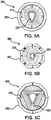
- a recess to cradle the sacrum within the general concavity of the upper surface is a recess to cradle the sacrum, which is illustrated by way of examples in the illustrations of the devices 200, 300, 400 shown in FIGS. 5A to 5C .
- the recess 230, 330, 430 provides the user with greater control of the device when performing all of the motions.
- the recess 230 of the generally concave upper surface 210 has a generally ovate contour, like for example the longitudinal section of an egg.
- FIG. 5A the recess 230 of the generally concave upper surface 210 has a generally ovate contour, like for example the longitudinal section of an egg.
- the recess 330 of the generally concave upper surface 310 has a generally elliptical contour.
- the recess of the generally concave upper surface has a generally triangular contour, preferably wherein the triangle's base angles are approximately congruent to each other so that a generally isosceles triangle contour is formed.
- the recess 430 of the generally concave upper surface 410 has a generally trapezoidal contour, like for example a trapezoid having two parallel base line segments and two non-parallel side line segments.
- each of the trapezoid base angles are approximately congruent so that a generally isosceles trapezoid is formed.
- the recess of the generally concave upper surface has a generally ovate contour and a generally trapezoidal contour, like for example a trapezoid having four generally convex arcs so that the otherwise parallel base line segments and non-parallel side line segments curve outwardly.
- the upper surface is recessed in three-dimension to form an indentation in the center of the recess having an increased depth. The slope of the indentation of the recess from the generally concave upper surface to the depth of the recess may be gradual or extreme so as to cradle the sacrum.
- the peripheral edge 250, 350, 450 of the device 200, 300, 400 in accordance with non-limiting alternative arrangements of the disclosure may be smooth (as shown in FIG. 5A ) or may have sides (as shown in FIG. 5B with 8 sides and as shown in FIG. 5C with 12 sides).
- the convex lower surface may be half a sphere in overall shape, such that cross sections of the half sphere are spherical and either completely smooth or have a preset pattern of ridges, grooves, or planar strips.
- the half semicircular sphere may be a half spherical polyhedron having a number of regions formed by the pre-set pattern of ridges, grooves, or planar portions.
- the pre-set pattern of ridges, grooves, or planar portions form an even number of regions, most preferably four, six, eight, or twelve regions.
- the pre-set pattern of ridges, grooves, or planar portions converge at the nadir of the half spherical polyhedron.
- the preset pattern of ridges, grooves, or planar portions do not converge at the nadir of the half spherical polyhedron such that the nadir is smooth.
- the convex lower surface 120 is spherical and smooth.
- the overall shape of the convex lower surface may be semicircular with either high or low degree of curvature.
- the contour of the lower surface is illustrated by way of examples in FIGS. 6A to 6C .
- the peripheral edge 550 of the device 500 is round and the generally convex lower surface 520 is spherical with a pre-set pattern of planar strips 570 radially extending from near the nadir 590 of the lower surface to near the lip 540 .
- the peripheral edge 650 of the device 600 is twelve-sided.
- the convex lower surface 620 of the device 600 has a pre-set pattern of grooves 670 radially extending from near the nadir 690 of the lower surface to the lip 640 .
- the peripheral edge 750 of the device 700 is round and the generally convex lower surface 720 is spherical with a pre-set pattern of radially extending ridges 770 that extend from near the nadir 790 of the lower surface to near the lip 740 .
- the convex lower surface also has a pre-set pattern of concentric ridges 775 .
- the concentric ridges, grooves, or planer strips may or may not overlap with the radially extending ridges, grooves, or planar strips.
- three of the four concentric ridges 775 overlap with the radially extending ridges 770 and one of the concentric ridges does not overlap with any of the radially extending ridges 775 .
- the concentric ridges, grooves, and planar strips denote changes in degree of curvature of the convex lower surface of the device so that a user will feel a crossing of a threshold while moving in a particular direction over the ridge, groove, or planar strip.
- the circumferential ridge, groove, or planar strip also assists the user in maintaining the same degree of tilt on rotation.
- the upper surface and the lower surface are connected in such a manner as to limit the pelvic tilt when in use to between about 25 to about 30 degrees in any direction of movement of the pelvis from a neutral position.
- the diameter of the upper surface is greater than the diameter of the lower surface, creating a lip such that the dimension of the lip relative to the upper surface and the lower surface is used to predetermine the maximum degree of tilt of the device.
- the peripheral edge of the device may form an acute or an obtuse curvature, or may be generally planar forming a sidewall as illustrated by way of examples shown in FIGS. 7A to 7C .
- the peripheral edge 850 has an acute curvature between the generally concave upper surface 810 and the lip 840 of the device 800.
- the lower surface 820 has a radially extending ridges, grooves or planar strips 870 that extend from near the nadir 890 to the lip 840 forming regions 880 as well as a smooth nadir region.
- FIG. 7A the peripheral edge 850 has an acute curvature between the generally concave upper surface 810 and the lip 840 of the device 800.
- the lower surface 820 has a radially extending ridges, grooves or planar strips 870 that extend from near the nadir 890 to the lip 840 forming regions 880 as well as a smooth nadir region.
- the peripheral edge 950 has an obtuse curvature between the generally concave upper surface 910 and the lip 940 of the device 900.
- the lower surface 920 has a radially extending ridges, grooves, or planar strips 970 that extend from the nadir 990 to the lip 940 forming regions 980.
- the peripheral edge is a planar sidewall 1050 between the generally concave upper surface 1010 and the lip 1040 of the device 1000.
- the lower surface 1020 has a radially extending ridges, grooves, or planar strips 1070 that extend from near the nadir 1090 to the lip 1040 forming regions 1080 as well as a smooth nadir region.
- the lower surface 1020 has four concentric ridges, grooves, or planar strips 1075 that overlap with the radially extending ridges, grooves, or planar strips 1070 to form regions 1085 .
- the generally upper concave surface 1110 of the device 1100 is approximately 15 cm (6 inches) in overall diameter i having a recess 1130 that is generally ovate-trapezoidal in contour with a top base arc length ii of about 11.4 cm (4.5 inches), with an opposite bottom base arc length iii of about 3.8 cm (1.5 inches), with left and right side arc lengths iv connecting the top and bottom base arcs of about 10 cm (4 inches), with a distance v between the top base arc and bottom base arc is about 13 cm (5 inches), and with a depth vi of the indentation of the recess of about 1.9 cm (3 ⁇ 4 inches) to about 3.2 cm (1 1 ⁇ 4 inches).
- straps may be attached to the device, preferably attached to the peripheral edge or sidewall of the device, for wearing the device in the appropriate location on the user.
- the device is inserted and fixed inside of a pouch with straps for wearing the device.
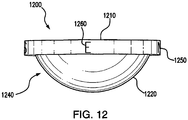
- the device 1200 illustrated in FIGS. 9 to 12 has a generally concave upper surface 1210 , a generally convex lower surface 1220 , and a recess 1230 in the generally concave upper surface 1210 to cradle a sacrum.
- the top base arc and the bottom base arc of the recess 1230 extend to the peripheral edge 1250 of the device 1200 .
- the generally concave upper surface 1210 , the recess 1230 , and the peripheral sidewall 1250 all have indicia 1260. As also shown in FIG.
- the device 1200 has indicia 1260 on the generally concave upper surface 1210 and in the recess 1230 representing the numbers of a face of a clock and has indicia 1260 on the peripheral edge 1250 of the device 1200 representing directions of a compass.
- the device allows tilting, rocking, swaying, rotation, oscillation, and a variety of combinations of multidimensional movements, including nutation or counter-nutation of the sacroiliac joint.
- the following are examples of exercise regimens using the device illustrated in FIG. 1 .
- the subject should first consult a physician or other health care professional.
- the subject Before starting any of the exercises described below, the subject should get ready by first lying down on his or her back on a flat surface with feet flat and knees bent for about 1 to about 2 minutes to relax the pelvic region. Then, before placing the device between the subject's sacrum and the floor, the subject should slowly lift his or her pelvis about 1 to about 3 inches up from the flat surface about 5 to about 10 times. Once the device is in position, the subject should again relax the pelvic region for about 1 to about 2 minutes in a neutral position.
- the subject lies flat with the subject's back on the floor, with the subject's feet flat on floor, and with the subject's knees elevated.
- the subject's feet are generally hip/shoulder width apart.
- Subject places the device illustrated in FIG. 1 under the subject's sacrum, such that the recess in the upper surface cradle's the subject's sacrum and the convex lower surface of the device is in contact with the floor. Since the device of FIG. 1 also contains the optional design feature of having numbers of the face of a clock on the peripheral edge of the device, the device should be oriented in a manner such that the 12 o'clock is oriented under the subject's sacrum in a direction pointing towards the subject's head.
- the subject Before the subject begins a series of alternating movements, the subject must get set by letting go of all tension in the subject's neck, shoulders, and back. This allows for a priming stretch of the pelvic and hip joints as well as the surrounding muscles.
- the subject is now ready to go to perform the following exercises using a device in accordance with the present invention.
- the number of repetitions, body proportions, and length of practice may vary for each person depending on affected side, location of a tight spot, physical condition, age, gender, and degree of pain.
- the goal is to perform all of these exercises within a pain free range of motion, with the expectation that the pain free range of motion will increase until the subject is completely pain free.
- Anterior Pelvic Tilt From the initial elevated position, the subject performs an anterior pelvic tilt. The subject stretches the lower back, pelvis, and hips in a direction that increases lumbar lordosis. Spinal, lumbar, hip extension, and nutation of the sacroiliac joint occurs during the anterior pelvic tilt. This anterior pelvic tilt stretch represents a significant improvement over all known methods because the subject can increase the lumbar lordosis to a higher degree than if the subject started from a position of lying flat. Further, in order to achieve the same or similar degree of lumbar lordosis without the use of the device illustrated in FIG.
- the subject would have had to engage muscles to lift the pelvic girdle, which contra muscle activation limits the benefits the anterior pelvic tilt more than if the subject used the device illustrated in FIG. 1 . After the initial anterior pelvic tilt is performed, the subject then returns to the neutral position.
- Posterior Pelvic Tilt From the neutral position resting on the device illustrated in FIG. 1 , the subject performs a posterior pelvic tilt. Spinal, lumbar, hip flexion, and counter-nutation of the sacroiliac joint occurs during this posterior pelvic tilt. The subject stretches the lower back, pelvis, and hips in a direction that decreases lumbar lordosis. In a similar way, this posterior pelvic tilt stretch represents a significant improvement over all know methods for the same reasons. After the initial posterior pelvic tilt is performed, the subject returns to the neutral position.
- the subject would then alternate between anterior and posterior pelvic tilts. After 10 to 20 repetitions, the subject would move on to left and right lateral pelvic tilts.
- Pelvic and Hip Rotation Imagining that the axis of rotation extends through the subject's belly button through the center of the device illustrated in FIG. 1 , for example, to the floor, the subject would first stretch in any initial direction (anterior, posterior, lateral left, or lateral right pelvic tilt), and then rotate the subject's pelvis and hips in a circular manner around the center of rotation.
- This pelvic and hip rotation represents a significant improvement over all known methods because the rotation is performed at a higher degree than if the subject were lying on a flat surface.
- the subject does not need to engage contra muscles to lift the pelvis and hips as the rotation is performed.
- the subject would alternate in clockwise and counterclockwise directions of rotation. After 10-20 repetitions in alternating directions, the subject returns to the neutral position. From the neutral position, the subject would move on to perform segmented rotations or diagonal pelvic tilts.
- Segmented Rotation is performed by the subject in the same manner as a pelvic and hip rotation described above, except that the subject rotates the hips for only a portion of the full rotation. So, for example, an alternating segmented rotation may alternate in clockwise and counterclockwise directions of rotation for only one half of a full rotation. In another alternative, an alternating segmented rotation may alternate in clockwise and counterclockwise directions of rotation for only one quarter of a full rotation. This will focus the stretch in a particular region.
- Diagonal Pelvic Tilts In the same manner as described for anterior and posterior pelvic tilts and for left and right lateral pelvic tilts, the subject would stretch in a 1 to 7, 5 to 11, 2 to 8, and 10 to 4 pattern. Using as a guide the numbers of a clock as graphically depicted on the peripheral edge of the device illustrated in FIG. 1 , for example, the subject would stretch in a direction from the neutral position in the direction of 1 o'clock and alternate with a stretch in a direction of 7 o'clock, and so forth. Spinal, lumbar, and hip extension and flexion occurs during diagonal pelvic tilts.
- Subject 1 suffered from chronic Spinal Stenosis, Sciatica, Spondylolysis (L4-L5), and Spondylolesthesis (L4-L5) with chronic pain (level 8) in the groin, buttock, and radiating into the left leg, and used known methods of stretching (20 lateral tilts, 20 anterior and posterior tilts, 20 pelvic and hip rotations, 20 diagonal tilts (1-7 directions), 20 segmented rotations (between positions 12-3 and between positions 6-9)) on a flat surface daily for a one month period of time for the first trial.
- Subject 1 reported a pain level of 8 at the start of the first trial and reported a pain level of 4 at the end of the first trial 30 days later. At the start of the first trial, Subject 1 reported taking on average six 200 mg tablets of Ibuprofen per day. At the end of the first trial 30 days later, Subject 1 reported taking on average three 200 mg tablets of Ibuprofen per day. One month after concluding the first trial, Subject 1 reported a pain level of 8 and reported taking on average six 200 mg tablets of Ibuprofen per day. ( See Table 1 below.)
- Subject 1 used the device illustrated in FIG. 1 daily for a one month period of time using the methods of stretching (20 lateral tilts, 20 anterior and posterior tilts, 20 pelvic and hip rotations, 20 diagonal tilts (1-7 directions), 20 segmented rotations (between positions 12-3 and between positions 6-9)) on a flat surface in accordance with the present invention for the second trial.
- Subject 1 reported a pain level of 8 at the start of the second trial and reported a pain level of 0 at the end of the second trial 30 days later. At the start of the second trial, Subject 1 reported taking on average six 200 mg tablets of Ibuprofen per day. At the end of the second trial, Subject 1 reported taking no pain medication. Surprisingly, Subject 1 reported a pain level of 0 and reported taking no pain medication over the next 4 months after concluding the second trial. ( See Table 1 below.)
Landscapes
- Health & Medical Sciences (AREA)
- Physical Education & Sports Medicine (AREA)
- General Health & Medical Sciences (AREA)
- Orthopedic Medicine & Surgery (AREA)
- Life Sciences & Earth Sciences (AREA)
- Neurology (AREA)
- Biomedical Technology (AREA)
- Engineering & Computer Science (AREA)
- Public Health (AREA)
- Veterinary Medicine (AREA)
- Animal Behavior & Ethology (AREA)
- Rehabilitation Therapy (AREA)
- Pain & Pain Management (AREA)
- Epidemiology (AREA)
- Biophysics (AREA)
- Cardiology (AREA)
- Vascular Medicine (AREA)
- Pulmonology (AREA)
- Orthopedics, Nursing, And Contraception (AREA)
Claims (13)
- Vorrichtung (1100) zur multidimensionalen Mobilisierung der Lumbal-, Becken- und Hüftgelenke, umfassend eine allgemein konkave obere Fläche (1110), die mit einer allgemein konvexen unteren Fläche verbunden ist, mit einem Umfangsrand (1150), wobei die allgemein konkave obere Fläche eine Ausnehmung (1130) zum Halten eines Kreuzbeins aufweist,
dadurch gekennzeichnet, dass die allgemein obere konkave Fläche (1110) der Vorrichtung (1100) ungefähr 15 cm (6 Zoll) Gesamtdurchmesser (i) aufweist, wobei die Ausnehmung (1130) allgemein eiförmig-trapezförmig konturiert ist mit einer oberen Basisbogenlänge (ii) von etwa 11 cm (4,5 Zoll), mit einer gegenüberliegenden unteren Basisbogenlänge (iii) von etwa 3,8 cm (1,5 Zoll), wobei linke und rechte Seitenbogenlängen (iv) die oberen und unteren Basisbögen von etwa 10 cm (4 Zoll) verbinden, mit einem Abstand (v) zwischen dem oberen Basisbogen und unteren Basisbogen von etwa 13 cm (5 Zoll) und mit einer Tiefe (vi) der Einkerbung der Ausnehmung von 1,9 cm (¾ Zoll) bis 3,2 cm (1¼ Zoll). - Vorrichtung nach Anspruch 1, wobei die Vorrichtung aus einem oder mehreren Materialien besteht, die ausgewählt sind aus der Gruppe bestehend aus Gummi, Kunststoff und Holz.
- Vorrichtung nach Anspruch 2, wobei die allgemein konkave obere Fläche und die allgemein konvexe untere Fläche aus verschiedenen Materialien bestehen.
- Vorrichtung nach Anspruch 1, ferner umfassend eine Lippe, die zwischen der allgemein konkaven oberen Fläche und der allgemein konvexen unteren Fläche gebildet ist.
- Vorrichtung nach Anspruch 4, wobei die Lippe den Neigungsgrad der Vorrichtung von einer neutralen Position, wenn die allgemein konkave obere Fläche in einer Position im Wesentlichen parallel zu dem Boden oder einer anderen ebenen Fläche ist, bis zwischen etwa 25 Grad bis etwa 30 Grad Neigung begrenzt, wenn die allgemein konkave obere Fläche etwa 25 Grad bis etwa 30 Grad in Bezug auf den Boden oder die andere ebene Fläche geneigt ist.
- Vorrichtung nach Anspruch 1, wobei die konvexe untere Fläche ein vordefiniertes Muster von Graten, Nuten oder planaren Abschnitten aufweist.
- Vorrichtung nach Anspruch 6, wobei das vorgewählte Muster von Graten, Nuten oder planaren Abschnitten allgemein abstandsgleich ist und ein halbkugelförmiges Polyeder mit zwölf Bereichen bildet.
- Vorrichtung nach Anspruch 7, wobei die Grate, Nuten oder planaren Abschnitte am Nadir des halbkugelförmigen Polyeders konvergieren.
- Vorrichtung nach Anspruch 1, ferner umfassend Zeichen auf der oberen Fläche.
- Vorrichtung nach Anspruch 9, wobei das Zeichen Markierungen umfasst, die ausgewählt sind aus den Gruppen bestehend aus Ziffern eines Ziffernblatts, Buchstaben eines Kompasses und Richtungspfeilen eines Kompasses.
- Vorrichtung nach Anspruch 1, ferner umfassend eine Seitenwand um den Umfang der allgemein konkaven oberen Fläche.
- Vorrichtung nach Anspruch 11, ferner umfassend Zeichen auf der Seitenwand.
- Vorrichtung nach Anspruch 12, wobei das Zeichen Markierungen umfasst, die ausgewählt sind aus den Gruppen bestehend aus Ziffern eines Ziffernblatts, Buchstaben eines Kompasses und Richtungspfeilen eines Kompasses.
Applications Claiming Priority (2)
| Application Number | Priority Date | Filing Date | Title |
|---|---|---|---|
| US14/737,829 US20160361603A1 (en) | 2015-06-12 | 2015-06-12 | Multidimensional Mobilization of Lumbar, Pelvic, and Hip Joints |
| PCT/US2016/034923 WO2016200636A1 (en) | 2015-06-12 | 2016-05-30 | Multidimensional mobilization of lumbar, pelvic and hip joints |
Publications (3)
| Publication Number | Publication Date |
|---|---|
| EP3307402A1 EP3307402A1 (de) | 2018-04-18 |
| EP3307402A4 EP3307402A4 (de) | 2019-02-27 |
| EP3307402B1 true EP3307402B1 (de) | 2021-12-15 |
Family
ID=57504137
Family Applications (1)
| Application Number | Title | Priority Date | Filing Date |
|---|---|---|---|
| EP16808035.6A Active EP3307402B1 (de) | 2015-06-12 | 2016-05-30 | Mehrdimensionale mobilisierung der lumbal-, becken- und hüftgelenke |
Country Status (5)
| Country | Link |
|---|---|
| US (5) | US20160361603A1 (de) |
| EP (1) | EP3307402B1 (de) |
| AU (2) | AU2016274333A1 (de) |
| CA (1) | CA2988955A1 (de) |
| WO (1) | WO2016200636A1 (de) |
Families Citing this family (14)
| Publication number | Priority date | Publication date | Assignee | Title |
|---|---|---|---|---|
| US20160361603A1 (en) * | 2015-06-12 | 2016-12-15 | Iana Blinova | Multidimensional Mobilization of Lumbar, Pelvic, and Hip Joints |
| IT201600083098A1 (it) * | 2016-08-05 | 2018-02-05 | Leonardo Osti | Dispositivo posturale dinamico |
| DE102016123528A1 (de) * | 2016-12-06 | 2018-06-07 | Strobel & Walter GmbH | Trainingsgerät zur Durchführung von Gleichgewichts-, Meditations- und/oder Yogaübungen |
| US11458352B2 (en) * | 2017-01-17 | 2022-10-04 | Jody Cohan-French | Ergonomic hand and wrist support device for yoga |
| USD870828S1 (en) * | 2018-09-27 | 2019-12-24 | Jay Dicharry | Adjustable balance and stability training board |
| JP1641437S (de) * | 2018-10-05 | 2019-09-17 | ||
| USD897458S1 (en) * | 2019-03-14 | 2020-09-29 | Strong Friend Inc. | Indoor exercising apparatus |
| USD886922S1 (en) * | 2019-03-14 | 2020-06-09 | Strong Friend Inc. | Balance board |
| CA3071359A1 (en) * | 2020-02-06 | 2021-08-06 | Jana Danielson | Pelvic floor pain relief device |
| USD955486S1 (en) * | 2020-06-24 | 2022-06-21 | Hangzhou Virtual And Reality Technology Co., LTD. | Omnidirectional walking simulator |
| USD1014669S1 (en) * | 2021-04-06 | 2024-02-13 | GameFit LLC | Exercise device |
| AU2021209307A1 (en) * | 2021-07-29 | 2023-02-16 | Oov Ip Pty Ltd | A Posture Device |
| US11826035B2 (en) | 2022-04-26 | 2023-11-28 | Pain Relief Technology, LLC | Treatment device for sacroiliac joint hypomobility |
| USD1073827S1 (en) * | 2023-02-21 | 2025-05-06 | Yes4All Ip Holdings Llc | Balance board |
Family Cites Families (37)
| Publication number | Priority date | Publication date | Assignee | Title |
|---|---|---|---|---|
| US2930430A (en) | 1956-12-11 | 1960-03-29 | Martin William E | Multiple tilt chair, chaise lounge or hammock |
| US3451672A (en) | 1966-11-03 | 1969-06-24 | Blazon Inc | Amusement and physical fitness device |
| CA1256467A (en) * | 1986-07-08 | 1989-06-27 | Dennis J. Colonello | Apparatus for use in exercising the abdominal muscles |
| US4756067A (en) * | 1986-07-31 | 1988-07-12 | Westinghouse Electric Corp. | Manual replacement of old split-pin assemblies by new split-pin assemblies |
| US4848742A (en) | 1988-04-11 | 1989-07-18 | Lindley William L | Lumbar stretch rocker |
| US5070865A (en) * | 1989-03-02 | 1991-12-10 | John Iams | Soft tissue support system |
| USD343877S (en) * | 1992-07-30 | 1994-02-01 | Sam Yin | Multi-purpose physical exerciser |
| US5337427A (en) | 1992-08-18 | 1994-08-16 | Pagano Anthony M | Birthing board |
| US5702333A (en) | 1995-03-29 | 1997-12-30 | Waldron; David W. | Method of safely stretching and strengthening the lumbar spine and lumbar muscles |
| US5887951A (en) * | 1995-09-15 | 1999-03-30 | Willingham; W. Preston | Orthopedic seating orthosis for correcting posture and restricting gluteal spreading |
| JPH09135921A (ja) * | 1995-11-16 | 1997-05-27 | Nihonkai Service:Kk | 身体の運動補助具 |
| US5630778A (en) * | 1995-11-21 | 1997-05-20 | Ab-Cam, L.L.C. | Abdominal exercise apparatus and method |
| US7335085B2 (en) | 1999-10-13 | 2008-02-26 | Lyman Daniel F | Entertainment and stress relief disk |
| GB2355664A (en) * | 1999-10-29 | 2001-05-02 | David Andrew Penton | Lower back support |
| US20030148865A1 (en) | 2002-02-07 | 2003-08-07 | Handshoe Ron P. | Apparatus and method for muscle strengthening and rehabilitation |
| US20040229731A1 (en) * | 2003-05-05 | 2004-11-18 | Mitchell Debby F. | Exercise mat with printed indicia thereon |
| US7216388B2 (en) * | 2003-07-28 | 2007-05-15 | Aspen Seating, Llc | Contoured seat cushion and method for offloading pressure from skeletal bone prominences and encouraging proper postural alignment |
| US20060097555A1 (en) * | 2004-10-18 | 2006-05-11 | Meleger Alec L | Rehabilitation apparatus for lumbosacral spine |
| US20070117698A1 (en) * | 2005-11-03 | 2007-05-24 | Trent Adamson | Therapeutic device |
| US7374517B2 (en) * | 2005-11-16 | 2008-05-20 | Ricky Poole Lockett | Portable therapeutic seat exercise apparatus and method |
| US8678985B2 (en) | 2006-08-10 | 2014-03-25 | E. Michael Mattox | Balance training and exercise device |
| TWM314633U (en) * | 2006-09-13 | 2007-07-01 | Jin-Chiou Huang | Balance exercise device with adjustable level structure |
| US7695407B2 (en) | 2006-10-24 | 2010-04-13 | Elwood Bernard Miller | Exercise apparatus |
| HU227206B1 (hu) * | 2006-12-21 | 2010-11-29 | 4Drops Bt | Mozgás- és koordinációfejlesztõ játékeszköz |
| US20090143205A1 (en) * | 2007-11-16 | 2009-06-04 | Henner Jahns | Compact and light multi-exercise device providing hyperextension and instability in all directions |
| DE202008002484U1 (de) | 2008-02-22 | 2008-04-24 | Gebr. Obermaier Ohg | Balancevorrichtung |
| GB2458190A (en) * | 2008-03-14 | 2009-09-16 | Jennifer Thorpe | Rocking exercise device |
| US8840531B2 (en) | 2008-09-18 | 2014-09-23 | Kenn Viselman | Adjustable exercise training tool |
| WO2010085707A1 (en) * | 2009-01-23 | 2010-07-29 | William Preston Willingham | Method and apparatus for dynamically correcting posture |
| KR200445958Y1 (ko) | 2009-03-09 | 2009-09-14 | 김기수 | 다목적 운동기구 |
| US8827881B2 (en) * | 2010-04-23 | 2014-09-09 | Mark Marino | Exercise device, method of use, and method of treating an individual |
| GB201117550D0 (en) * | 2011-10-11 | 2011-11-23 | Henson Timothy G | Exercise machine |
| WO2013153685A1 (ja) * | 2012-04-13 | 2013-10-17 | 株式会社Mtg | 運動補助具 |
| US9220944B2 (en) | 2013-02-12 | 2015-12-29 | Balance Designs, Inc. | Apparatus for exercise and balance training |
| US20160361603A1 (en) * | 2015-06-12 | 2016-12-15 | Iana Blinova | Multidimensional Mobilization of Lumbar, Pelvic, and Hip Joints |
| WO2019191657A1 (en) * | 2018-03-30 | 2019-10-03 | Backjoy Orthotics, Llc | Posture seat |
| AU2021209307A1 (en) * | 2021-07-29 | 2023-02-16 | Oov Ip Pty Ltd | A Posture Device |
-
2015
- 2015-06-12 US US14/737,829 patent/US20160361603A1/en not_active Abandoned
-
2016
- 2016-05-30 AU AU2016274333A patent/AU2016274333A1/en not_active Abandoned
- 2016-05-30 EP EP16808035.6A patent/EP3307402B1/de active Active
- 2016-05-30 CA CA2988955A patent/CA2988955A1/en active Pending
- 2016-05-30 WO PCT/US2016/034923 patent/WO2016200636A1/en not_active Ceased
-
2018
- 2018-02-02 US US15/887,803 patent/US20180154217A1/en not_active Abandoned
-
2019
- 2019-09-01 US US16/558,118 patent/US11045689B2/en active Active
-
2021
- 2021-06-12 US US17/346,228 patent/US20210299521A1/en not_active Abandoned
- 2021-07-15 AU AU2021205072A patent/AU2021205072B2/en active Active
-
2024
- 2024-07-21 US US18/779,008 patent/US20240367008A1/en active Pending
Non-Patent Citations (1)
| Title |
|---|
| None * |
Also Published As
| Publication number | Publication date |
|---|---|
| US20190381357A1 (en) | 2019-12-19 |
| AU2021205072B2 (en) | 2023-08-03 |
| US20160361603A1 (en) | 2016-12-15 |
| US20180154217A1 (en) | 2018-06-07 |
| AU2021205072A1 (en) | 2021-08-12 |
| US11045689B2 (en) | 2021-06-29 |
| US20210299521A1 (en) | 2021-09-30 |
| AU2016274333A1 (en) | 2018-01-04 |
| EP3307402A4 (de) | 2019-02-27 |
| CA2988955A1 (en) | 2016-12-15 |
| US20240367008A1 (en) | 2024-11-07 |
| EP3307402A1 (de) | 2018-04-18 |
| WO2016200636A1 (en) | 2016-12-15 |
Similar Documents
| Publication | Publication Date | Title |
|---|---|---|
| AU2021205072B2 (en) | Multidimensional mobilization of lumbar, pelvic and hip joints | |
| US10960263B2 (en) | Systems and methods for providing ergonomic exercise chairs | |
| US6419650B1 (en) | Device for providing accupressure back massage | |
| US6305040B1 (en) | Acupressure pillow apparatus and method | |
| US5474513A (en) | Therapeutic exercise apparatus | |
| US20050165450A1 (en) | Passive back extensor device to treat trigger point - back pain | |
| AU2012271911A1 (en) | Method and apparatus for lower back pain relief | |
| US8328701B2 (en) | Exercise platform | |
| US10857061B2 (en) | Neck treatment device | |
| US5772686A (en) | Pelvic retroverter | |
| US20060097555A1 (en) | Rehabilitation apparatus for lumbosacral spine | |
| US20150305966A1 (en) | Three-In-One Therapeutic System With Fully Magnetic, Plastic, & Combined Magnetic/Plastic Stationary Spheres | |
| JP3106889U (ja) | 整体器具 | |
| US8827881B2 (en) | Exercise device, method of use, and method of treating an individual | |
| RU2361565C1 (ru) | Ортопедический матрац | |
| JP2004194795A (ja) | 運動器具 | |
| JP2003325698A (ja) | 腰部回動用具 | |
| KR102830942B1 (ko) | 멀티롤러 지압기구 | |
| RU211542U1 (ru) | Устройство для массажа | |
| CN213760377U (zh) | 基于腰腹肌力不足群体的腰椎l4、l5病变前保健装置 | |
| KR102710176B1 (ko) | 친환경 소재로 제조된 척추 교정 및 전신 지압을 위한 지압기 | |
| WO2001030297A1 (en) | Back manipulator | |
| KR20150003651U (ko) | 척추재활 및 척추근육 강화 운동기구 | |
| CA2410704A1 (en) | Spinal cord exercise ball | |
| KR200211136Y1 (ko) | 안마기 |
Legal Events
| Date | Code | Title | Description |
|---|---|---|---|
| STAA | Information on the status of an ep patent application or granted ep patent |
Free format text: STATUS: THE INTERNATIONAL PUBLICATION HAS BEEN MADE |
|
| PUAI | Public reference made under article 153(3) epc to a published international application that has entered the european phase |
Free format text: ORIGINAL CODE: 0009012 |
|
| STAA | Information on the status of an ep patent application or granted ep patent |
Free format text: STATUS: REQUEST FOR EXAMINATION WAS MADE |
|
| 17P | Request for examination filed |
Effective date: 20171207 |
|
| AK | Designated contracting states |
Kind code of ref document: A1 Designated state(s): AL AT BE BG CH CY CZ DE DK EE ES FI FR GB GR HR HU IE IS IT LI LT LU LV MC MK MT NL NO PL PT RO RS SE SI SK SM TR |
|
| AX | Request for extension of the european patent |
Extension state: BA ME |
|
| DAV | Request for validation of the european patent (deleted) | ||
| DAX | Request for extension of the european patent (deleted) | ||
| A4 | Supplementary search report drawn up and despatched |
Effective date: 20190125 |
|
| RIC1 | Information provided on ipc code assigned before grant |
Ipc: A63B 23/02 20060101AFI20190121BHEP Ipc: A61H 1/02 20060101ALI20190121BHEP Ipc: A63B 22/18 20060101ALI20190121BHEP Ipc: A63B 22/16 20060101ALI20190121BHEP Ipc: A63B 23/04 20060101ALI20190121BHEP Ipc: A61H 1/00 20060101ALI20190121BHEP |
|
| STAA | Information on the status of an ep patent application or granted ep patent |
Free format text: STATUS: EXAMINATION IS IN PROGRESS |
|
| 17Q | First examination report despatched |
Effective date: 20200122 |
|
| RIC1 | Information provided on ipc code assigned before grant |
Ipc: A63B 23/02 20060101AFI20210517BHEP Ipc: A63B 23/04 20060101ALI20210517BHEP Ipc: A63B 22/18 20060101ALI20210517BHEP Ipc: A61H 1/02 20060101ALI20210517BHEP Ipc: A61H 1/00 20060101ALI20210517BHEP Ipc: A63B 22/16 20060101ALI20210517BHEP Ipc: A63B 21/00 20060101ALI20210517BHEP Ipc: A63B 23/00 20060101ALN20210517BHEP Ipc: A63B 71/06 20060101ALN20210517BHEP |
|
| GRAP | Despatch of communication of intention to grant a patent |
Free format text: ORIGINAL CODE: EPIDOSNIGR1 |
|
| STAA | Information on the status of an ep patent application or granted ep patent |
Free format text: STATUS: GRANT OF PATENT IS INTENDED |
|
| INTG | Intention to grant announced |
Effective date: 20210625 |
|
| GRAS | Grant fee paid |
Free format text: ORIGINAL CODE: EPIDOSNIGR3 |
|
| GRAA | (expected) grant |
Free format text: ORIGINAL CODE: 0009210 |
|
| STAA | Information on the status of an ep patent application or granted ep patent |
Free format text: STATUS: THE PATENT HAS BEEN GRANTED |
|
| AK | Designated contracting states |
Kind code of ref document: B1 Designated state(s): AL AT BE BG CH CY CZ DE DK EE ES FI FR GB GR HR HU IE IS IT LI LT LU LV MC MK MT NL NO PL PT RO RS SE SI SK SM TR |
|
| REG | Reference to a national code |
Ref country code: GB Ref legal event code: FG4D Ref country code: CH Ref legal event code: EP |
|
| REG | Reference to a national code |
Ref country code: IE Ref legal event code: FG4D Ref country code: DE Ref legal event code: R096 Ref document number: 602016067441 Country of ref document: DE |
|
| REG | Reference to a national code |
Ref country code: AT Ref legal event code: REF Ref document number: 1455035 Country of ref document: AT Kind code of ref document: T Effective date: 20220115 |
|
| REG | Reference to a national code |
Ref country code: LT Ref legal event code: MG9D |
|
| REG | Reference to a national code |
Ref country code: NL Ref legal event code: MP Effective date: 20211215 |
|
| PG25 | Lapsed in a contracting state [announced via postgrant information from national office to epo] |
Ref country code: RS Free format text: LAPSE BECAUSE OF FAILURE TO SUBMIT A TRANSLATION OF THE DESCRIPTION OR TO PAY THE FEE WITHIN THE PRESCRIBED TIME-LIMIT Effective date: 20211215 Ref country code: LT Free format text: LAPSE BECAUSE OF FAILURE TO SUBMIT A TRANSLATION OF THE DESCRIPTION OR TO PAY THE FEE WITHIN THE PRESCRIBED TIME-LIMIT Effective date: 20211215 Ref country code: FI Free format text: LAPSE BECAUSE OF FAILURE TO SUBMIT A TRANSLATION OF THE DESCRIPTION OR TO PAY THE FEE WITHIN THE PRESCRIBED TIME-LIMIT Effective date: 20211215 Ref country code: BG Free format text: LAPSE BECAUSE OF FAILURE TO SUBMIT A TRANSLATION OF THE DESCRIPTION OR TO PAY THE FEE WITHIN THE PRESCRIBED TIME-LIMIT Effective date: 20220315 |
|
| REG | Reference to a national code |
Ref country code: AT Ref legal event code: MK05 Ref document number: 1455035 Country of ref document: AT Kind code of ref document: T Effective date: 20211215 |
|
| PG25 | Lapsed in a contracting state [announced via postgrant information from national office to epo] |
Ref country code: SE Free format text: LAPSE BECAUSE OF FAILURE TO SUBMIT A TRANSLATION OF THE DESCRIPTION OR TO PAY THE FEE WITHIN THE PRESCRIBED TIME-LIMIT Effective date: 20211215 Ref country code: NO Free format text: LAPSE BECAUSE OF FAILURE TO SUBMIT A TRANSLATION OF THE DESCRIPTION OR TO PAY THE FEE WITHIN THE PRESCRIBED TIME-LIMIT Effective date: 20220315 Ref country code: LV Free format text: LAPSE BECAUSE OF FAILURE TO SUBMIT A TRANSLATION OF THE DESCRIPTION OR TO PAY THE FEE WITHIN THE PRESCRIBED TIME-LIMIT Effective date: 20211215 Ref country code: HR Free format text: LAPSE BECAUSE OF FAILURE TO SUBMIT A TRANSLATION OF THE DESCRIPTION OR TO PAY THE FEE WITHIN THE PRESCRIBED TIME-LIMIT Effective date: 20211215 Ref country code: GR Free format text: LAPSE BECAUSE OF FAILURE TO SUBMIT A TRANSLATION OF THE DESCRIPTION OR TO PAY THE FEE WITHIN THE PRESCRIBED TIME-LIMIT Effective date: 20220316 |
|
| PG25 | Lapsed in a contracting state [announced via postgrant information from national office to epo] |
Ref country code: NL Free format text: LAPSE BECAUSE OF FAILURE TO SUBMIT A TRANSLATION OF THE DESCRIPTION OR TO PAY THE FEE WITHIN THE PRESCRIBED TIME-LIMIT Effective date: 20211215 |
|
| PG25 | Lapsed in a contracting state [announced via postgrant information from national office to epo] |
Ref country code: SM Free format text: LAPSE BECAUSE OF FAILURE TO SUBMIT A TRANSLATION OF THE DESCRIPTION OR TO PAY THE FEE WITHIN THE PRESCRIBED TIME-LIMIT Effective date: 20211215 Ref country code: SK Free format text: LAPSE BECAUSE OF FAILURE TO SUBMIT A TRANSLATION OF THE DESCRIPTION OR TO PAY THE FEE WITHIN THE PRESCRIBED TIME-LIMIT Effective date: 20211215 Ref country code: RO Free format text: LAPSE BECAUSE OF FAILURE TO SUBMIT A TRANSLATION OF THE DESCRIPTION OR TO PAY THE FEE WITHIN THE PRESCRIBED TIME-LIMIT Effective date: 20211215 Ref country code: PT Free format text: LAPSE BECAUSE OF FAILURE TO SUBMIT A TRANSLATION OF THE DESCRIPTION OR TO PAY THE FEE WITHIN THE PRESCRIBED TIME-LIMIT Effective date: 20220418 Ref country code: ES Free format text: LAPSE BECAUSE OF FAILURE TO SUBMIT A TRANSLATION OF THE DESCRIPTION OR TO PAY THE FEE WITHIN THE PRESCRIBED TIME-LIMIT Effective date: 20211215 Ref country code: EE Free format text: LAPSE BECAUSE OF FAILURE TO SUBMIT A TRANSLATION OF THE DESCRIPTION OR TO PAY THE FEE WITHIN THE PRESCRIBED TIME-LIMIT Effective date: 20211215 Ref country code: CZ Free format text: LAPSE BECAUSE OF FAILURE TO SUBMIT A TRANSLATION OF THE DESCRIPTION OR TO PAY THE FEE WITHIN THE PRESCRIBED TIME-LIMIT Effective date: 20211215 |
|
| PG25 | Lapsed in a contracting state [announced via postgrant information from national office to epo] |
Ref country code: PL Free format text: LAPSE BECAUSE OF FAILURE TO SUBMIT A TRANSLATION OF THE DESCRIPTION OR TO PAY THE FEE WITHIN THE PRESCRIBED TIME-LIMIT Effective date: 20211215 Ref country code: AT Free format text: LAPSE BECAUSE OF FAILURE TO SUBMIT A TRANSLATION OF THE DESCRIPTION OR TO PAY THE FEE WITHIN THE PRESCRIBED TIME-LIMIT Effective date: 20211215 |
|
| REG | Reference to a national code |
Ref country code: DE Ref legal event code: R097 Ref document number: 602016067441 Country of ref document: DE |
|
| PG25 | Lapsed in a contracting state [announced via postgrant information from national office to epo] |
Ref country code: IS Free format text: LAPSE BECAUSE OF FAILURE TO SUBMIT A TRANSLATION OF THE DESCRIPTION OR TO PAY THE FEE WITHIN THE PRESCRIBED TIME-LIMIT Effective date: 20220415 |
|
| PLBE | No opposition filed within time limit |
Free format text: ORIGINAL CODE: 0009261 |
|
| STAA | Information on the status of an ep patent application or granted ep patent |
Free format text: STATUS: NO OPPOSITION FILED WITHIN TIME LIMIT |
|
| PG25 | Lapsed in a contracting state [announced via postgrant information from national office to epo] |
Ref country code: DK Free format text: LAPSE BECAUSE OF FAILURE TO SUBMIT A TRANSLATION OF THE DESCRIPTION OR TO PAY THE FEE WITHIN THE PRESCRIBED TIME-LIMIT Effective date: 20211215 Ref country code: AL Free format text: LAPSE BECAUSE OF FAILURE TO SUBMIT A TRANSLATION OF THE DESCRIPTION OR TO PAY THE FEE WITHIN THE PRESCRIBED TIME-LIMIT Effective date: 20211215 |
|
| 26N | No opposition filed |
Effective date: 20220916 |
|
| PG25 | Lapsed in a contracting state [announced via postgrant information from national office to epo] |
Ref country code: SI Free format text: LAPSE BECAUSE OF FAILURE TO SUBMIT A TRANSLATION OF THE DESCRIPTION OR TO PAY THE FEE WITHIN THE PRESCRIBED TIME-LIMIT Effective date: 20211215 |
|
| REG | Reference to a national code |
Ref country code: CH Ref legal event code: PL |
|
| REG | Reference to a national code |
Ref country code: BE Ref legal event code: MM Effective date: 20220531 |
|
| PG25 | Lapsed in a contracting state [announced via postgrant information from national office to epo] |
Ref country code: MC Free format text: LAPSE BECAUSE OF FAILURE TO SUBMIT A TRANSLATION OF THE DESCRIPTION OR TO PAY THE FEE WITHIN THE PRESCRIBED TIME-LIMIT Effective date: 20211215 Ref country code: LU Free format text: LAPSE BECAUSE OF NON-PAYMENT OF DUE FEES Effective date: 20220530 Ref country code: LI Free format text: LAPSE BECAUSE OF NON-PAYMENT OF DUE FEES Effective date: 20220531 Ref country code: CH Free format text: LAPSE BECAUSE OF NON-PAYMENT OF DUE FEES Effective date: 20220531 |
|
| PG25 | Lapsed in a contracting state [announced via postgrant information from national office to epo] |
Ref country code: IE Free format text: LAPSE BECAUSE OF NON-PAYMENT OF DUE FEES Effective date: 20220530 Ref country code: FR Free format text: LAPSE BECAUSE OF NON-PAYMENT OF DUE FEES Effective date: 20220531 |
|
| PG25 | Lapsed in a contracting state [announced via postgrant information from national office to epo] |
Ref country code: IT Free format text: LAPSE BECAUSE OF FAILURE TO SUBMIT A TRANSLATION OF THE DESCRIPTION OR TO PAY THE FEE WITHIN THE PRESCRIBED TIME-LIMIT Effective date: 20211215 Ref country code: BE Free format text: LAPSE BECAUSE OF NON-PAYMENT OF DUE FEES Effective date: 20220531 |
|
| P01 | Opt-out of the competence of the unified patent court (upc) registered |
Effective date: 20230602 |
|
| P02 | Opt-out of the competence of the unified patent court (upc) changed |
Effective date: 20230619 |
|
| PG25 | Lapsed in a contracting state [announced via postgrant information from national office to epo] |
Ref country code: HU Free format text: LAPSE BECAUSE OF FAILURE TO SUBMIT A TRANSLATION OF THE DESCRIPTION OR TO PAY THE FEE WITHIN THE PRESCRIBED TIME-LIMIT; INVALID AB INITIO Effective date: 20160530 |
|
| PG25 | Lapsed in a contracting state [announced via postgrant information from national office to epo] |
Ref country code: MK Free format text: LAPSE BECAUSE OF FAILURE TO SUBMIT A TRANSLATION OF THE DESCRIPTION OR TO PAY THE FEE WITHIN THE PRESCRIBED TIME-LIMIT Effective date: 20211215 Ref country code: CY Free format text: LAPSE BECAUSE OF FAILURE TO SUBMIT A TRANSLATION OF THE DESCRIPTION OR TO PAY THE FEE WITHIN THE PRESCRIBED TIME-LIMIT Effective date: 20211215 |
|
| PG25 | Lapsed in a contracting state [announced via postgrant information from national office to epo] |
Ref country code: MT Free format text: LAPSE BECAUSE OF FAILURE TO SUBMIT A TRANSLATION OF THE DESCRIPTION OR TO PAY THE FEE WITHIN THE PRESCRIBED TIME-LIMIT Effective date: 20211215 |
|
| PGFP | Annual fee paid to national office [announced via postgrant information from national office to epo] |
Ref country code: DE Payment date: 20250514 Year of fee payment: 10 |
|
| PGFP | Annual fee paid to national office [announced via postgrant information from national office to epo] |
Ref country code: GB Payment date: 20250511 Year of fee payment: 10 |
|
| PG25 | Lapsed in a contracting state [announced via postgrant information from national office to epo] |
Ref country code: TR Free format text: LAPSE BECAUSE OF FAILURE TO SUBMIT A TRANSLATION OF THE DESCRIPTION OR TO PAY THE FEE WITHIN THE PRESCRIBED TIME-LIMIT Effective date: 20211215 |