EP3305740A1 - Dispersant composition for hydraulic composition for centrifugal molding - Google Patents
Dispersant composition for hydraulic composition for centrifugal molding Download PDFInfo
- Publication number
- EP3305740A1 EP3305740A1 EP16807174.4A EP16807174A EP3305740A1 EP 3305740 A1 EP3305740 A1 EP 3305740A1 EP 16807174 A EP16807174 A EP 16807174A EP 3305740 A1 EP3305740 A1 EP 3305740A1
- Authority
- EP
- European Patent Office
- Prior art keywords
- less
- mass
- hydraulic
- composition
- group
- Prior art date
- Legal status (The legal status is an assumption and is not a legal conclusion. Google has not performed a legal analysis and makes no representation as to the accuracy of the status listed.)
- Withdrawn
Links
- 239000000203 mixture Substances 0.000 title claims abstract description 1216
- 239000002270 dispersing agent Substances 0.000 title claims abstract description 370
- 238000000465 moulding Methods 0.000 title claims abstract description 141
- 239000000843 powder Substances 0.000 claims abstract description 295
- 150000001875 compounds Chemical class 0.000 claims abstract description 231
- 125000003118 aryl group Chemical group 0.000 claims abstract description 110
- XLYOFNOQVPJJNP-UHFFFAOYSA-N water Substances O XLYOFNOQVPJJNP-UHFFFAOYSA-N 0.000 claims description 212
- 238000004519 manufacturing process Methods 0.000 claims description 165
- OKTJSMMVPCPJKN-UHFFFAOYSA-N Carbon Chemical compound [C] OKTJSMMVPCPJKN-UHFFFAOYSA-N 0.000 claims description 130
- 229910052799 carbon Inorganic materials 0.000 claims description 130
- 238000002156 mixing Methods 0.000 claims description 121
- 125000000217 alkyl group Chemical group 0.000 claims description 118
- 125000004435 hydrogen atom Chemical group [H]* 0.000 claims description 113
- 238000000034 method Methods 0.000 claims description 104
- 239000000178 monomer Substances 0.000 claims description 71
- 125000005529 alkyleneoxy group Chemical group 0.000 claims description 39
- 238000011049 filling Methods 0.000 claims description 30
- 229920001577 copolymer Polymers 0.000 claims description 25
- 239000002253 acid Substances 0.000 claims description 17
- 125000001183 hydrocarbyl group Chemical group 0.000 claims 8
- 239000000047 product Substances 0.000 description 315
- 238000001723 curing Methods 0.000 description 201
- 238000011161 development Methods 0.000 description 147
- 125000003342 alkenyl group Chemical group 0.000 description 100
- -1 polyoxyethylene Polymers 0.000 description 93
- 125000001997 phenyl group Chemical group [H]C1=C([H])C([H])=C(*)C([H])=C1[H] 0.000 description 89
- 239000004568 cement Substances 0.000 description 83
- 150000002430 hydrocarbons Chemical class 0.000 description 69
- 125000003107 substituted aryl group Chemical group 0.000 description 69
- 125000001931 aliphatic group Chemical group 0.000 description 58
- 125000001424 substituent group Chemical group 0.000 description 57
- 239000004567 concrete Substances 0.000 description 54
- 229920003171 Poly (ethylene oxide) Polymers 0.000 description 51
- 230000000052 comparative effect Effects 0.000 description 47
- 239000004570 mortar (masonry) Substances 0.000 description 47
- 125000001624 naphthyl group Chemical group 0.000 description 40
- 125000001117 oleyl group Chemical group [H]C([*])([H])C([H])([H])C([H])([H])C([H])([H])C([H])([H])C([H])([H])C([H])([H])C([H])([H])/C([H])=C([H])\C([H])([H])C([H])([H])C([H])([H])C([H])([H])C([H])([H])C([H])([H])C([H])([H])C([H])([H])[H] 0.000 description 35
- 125000004079 stearyl group Chemical group [H]C([*])([H])C([H])([H])C([H])([H])C([H])([H])C([H])([H])C([H])([H])C([H])([H])C([H])([H])C([H])([H])C([H])([H])C([H])([H])C([H])([H])C([H])([H])C([H])([H])C([H])([H])C([H])([H])C([H])([H])C([H])([H])[H] 0.000 description 35
- 125000003438 dodecyl group Chemical group [H]C([H])([H])C([H])([H])C([H])([H])C([H])([H])C([H])([H])C([H])([H])C([H])([H])C([H])([H])C([H])([H])C([H])([H])C([H])([H])C([H])([H])* 0.000 description 33
- 125000001421 myristyl group Chemical group [H]C([*])([H])C([H])([H])C([H])([H])C([H])([H])C([H])([H])C([H])([H])C([H])([H])C([H])([H])C([H])([H])C([H])([H])C([H])([H])C([H])([H])C([H])([H])C([H])([H])[H] 0.000 description 33
- 125000000913 palmityl group Chemical group [H]C([*])([H])C([H])([H])C([H])([H])C([H])([H])C([H])([H])C([H])([H])C([H])([H])C([H])([H])C([H])([H])C([H])([H])C([H])([H])C([H])([H])C([H])([H])C([H])([H])C([H])([H])C([H])([H])[H] 0.000 description 33
- 239000007787 solid Substances 0.000 description 26
- 230000001965 increasing effect Effects 0.000 description 24
- 239000003795 chemical substances by application Substances 0.000 description 23
- WSFSSNUMVMOOMR-UHFFFAOYSA-N formaldehyde Substances O=C WSFSSNUMVMOOMR-UHFFFAOYSA-N 0.000 description 23
- NVVZQXQBYZPMLJ-UHFFFAOYSA-N formaldehyde;naphthalene-1-sulfonic acid Chemical compound O=C.C1=CC=C2C(S(=O)(=O)O)=CC=CC2=C1 NVVZQXQBYZPMLJ-UHFFFAOYSA-N 0.000 description 23
- 230000006872 improvement Effects 0.000 description 23
- VYPSYNLAJGMNEJ-UHFFFAOYSA-N Silicium dioxide Chemical compound O=[Si]=O VYPSYNLAJGMNEJ-UHFFFAOYSA-N 0.000 description 22
- 125000002511 behenyl group Chemical group [H]C([*])([H])C([H])([H])C([H])([H])C([H])([H])C([H])([H])C([H])([H])C([H])([H])C([H])([H])C([H])([H])C([H])([H])C([H])([H])C([H])([H])C([H])([H])C([H])([H])C([H])([H])C([H])([H])C([H])([H])C([H])([H])C([H])([H])C([H])([H])C([H])([H])C([H])([H])[H] 0.000 description 22
- 150000003839 salts Chemical class 0.000 description 22
- 238000009472 formulation Methods 0.000 description 20
- 239000007788 liquid Substances 0.000 description 18
- FFJCNSLCJOQHKM-CLFAGFIQSA-N (z)-1-[(z)-octadec-9-enoxy]octadec-9-ene Chemical compound CCCCCCCC\C=C/CCCCCCCCOCCCCCCCC\C=C/CCCCCCCC FFJCNSLCJOQHKM-CLFAGFIQSA-N 0.000 description 16
- 239000004576 sand Substances 0.000 description 16
- UFWIBTONFRDIAS-UHFFFAOYSA-N Naphthalene Chemical compound C1=CC=CC2=CC=CC=C21 UFWIBTONFRDIAS-UHFFFAOYSA-N 0.000 description 15
- RTZKZFJDLAIYFH-UHFFFAOYSA-N ether Substances CCOCC RTZKZFJDLAIYFH-UHFFFAOYSA-N 0.000 description 14
- 125000001797 benzyl group Chemical group [H]C1=C([H])C([H])=C(C([H])=C1[H])C([H])([H])* 0.000 description 13
- 238000004898 kneading Methods 0.000 description 13
- 229910001413 alkali metal ion Inorganic materials 0.000 description 12
- 125000004432 carbon atom Chemical group C* 0.000 description 12
- 239000007864 aqueous solution Substances 0.000 description 11
- 125000003710 aryl alkyl group Chemical group 0.000 description 11
- 125000002704 decyl group Chemical group [H]C([H])([H])C([H])([H])C([H])([H])C([H])([H])C([H])([H])C([H])([H])C([H])([H])C([H])([H])C([H])([H])C([H])([H])* 0.000 description 11
- 239000010881 fly ash Substances 0.000 description 11
- 150000002148 esters Chemical class 0.000 description 10
- 238000005227 gel permeation chromatography Methods 0.000 description 10
- 125000002496 methyl group Chemical group [H]C([H])([H])* 0.000 description 10
- 239000002893 slag Substances 0.000 description 10
- QGZKDVFQNNGYKY-UHFFFAOYSA-O Ammonium Chemical compound [NH4+] QGZKDVFQNNGYKY-UHFFFAOYSA-O 0.000 description 9
- BFNBIHQBYMNNAN-UHFFFAOYSA-N ammonium sulfate Chemical compound N.N.OS(O)(=O)=O BFNBIHQBYMNNAN-UHFFFAOYSA-N 0.000 description 9
- 229910052921 ammonium sulfate Inorganic materials 0.000 description 9
- 235000011130 ammonium sulphate Nutrition 0.000 description 9
- 150000002500 ions Chemical class 0.000 description 9
- IAYPIBMASNFSPL-UHFFFAOYSA-N Ethylene oxide Chemical group C1CO1 IAYPIBMASNFSPL-UHFFFAOYSA-N 0.000 description 8
- 125000004429 atom Chemical group 0.000 description 8
- PSZYNBSKGUBXEH-UHFFFAOYSA-M naphthalene-1-sulfonate Chemical compound C1=CC=C2C(S(=O)(=O)[O-])=CC=CC2=C1 PSZYNBSKGUBXEH-UHFFFAOYSA-M 0.000 description 8
- 239000000126 substance Substances 0.000 description 8
- 238000005056 compaction Methods 0.000 description 7
- 230000003247 decreasing effect Effects 0.000 description 7
- 239000000463 material Substances 0.000 description 7
- 230000009467 reduction Effects 0.000 description 7
- 159000000000 sodium salts Chemical class 0.000 description 7
- 238000012360 testing method Methods 0.000 description 7
- VTYYLEPIZMXCLO-UHFFFAOYSA-L Calcium carbonate Chemical compound [Ca+2].[O-]C([O-])=O VTYYLEPIZMXCLO-UHFFFAOYSA-L 0.000 description 6
- 239000002518 antifoaming agent Substances 0.000 description 6
- 238000006703 hydration reaction Methods 0.000 description 6
- 239000002202 Polyethylene glycol Substances 0.000 description 5
- 239000011398 Portland cement Substances 0.000 description 5
- 238000001816 cooling Methods 0.000 description 5
- XDSGMUJLZDSCPA-UHFFFAOYSA-N diazanium;phenoxybenzene;sulfate Chemical class [NH4+].[NH4+].[O-]S([O-])(=O)=O.C=1C=CC=CC=1OC1=CC=CC=C1 XDSGMUJLZDSCPA-UHFFFAOYSA-N 0.000 description 5
- 238000005187 foaming Methods 0.000 description 5
- 230000036571 hydration Effects 0.000 description 5
- 239000002245 particle Substances 0.000 description 5
- 229920001223 polyethylene glycol Polymers 0.000 description 5
- 230000008569 process Effects 0.000 description 5
- 239000004575 stone Substances 0.000 description 5
- HMUNWXXNJPVALC-UHFFFAOYSA-N 1-[4-[2-(2,3-dihydro-1H-inden-2-ylamino)pyrimidin-5-yl]piperazin-1-yl]-2-(2,4,6,7-tetrahydrotriazolo[4,5-c]pyridin-5-yl)ethanone Chemical compound C1C(CC2=CC=CC=C12)NC1=NC=C(C=N1)N1CCN(CC1)C(CN1CC2=C(CC1)NN=N2)=O HMUNWXXNJPVALC-UHFFFAOYSA-N 0.000 description 4
- 239000004215 Carbon black (E152) Substances 0.000 description 4
- 235000008733 Citrus aurantifolia Nutrition 0.000 description 4
- 229910000863 Ferronickel Inorganic materials 0.000 description 4
- 229920000877 Melamine resin Polymers 0.000 description 4
- REYJJPSVUYRZGE-UHFFFAOYSA-N Octadecylamine Chemical compound CCCCCCCCCCCCCCCCCCN REYJJPSVUYRZGE-UHFFFAOYSA-N 0.000 description 4
- ISWSIDIOOBJBQZ-UHFFFAOYSA-N Phenol Chemical compound OC1=CC=CC=C1 ISWSIDIOOBJBQZ-UHFFFAOYSA-N 0.000 description 4
- NPYPAHLBTDXSSS-UHFFFAOYSA-N Potassium ion Chemical compound [K+] NPYPAHLBTDXSSS-UHFFFAOYSA-N 0.000 description 4
- FKNQFGJONOIPTF-UHFFFAOYSA-N Sodium cation Chemical compound [Na+] FKNQFGJONOIPTF-UHFFFAOYSA-N 0.000 description 4
- QAOWNCQODCNURD-UHFFFAOYSA-N Sulfuric acid Chemical compound OS(O)(=O)=O QAOWNCQODCNURD-UHFFFAOYSA-N 0.000 description 4
- 235000011941 Tilia x europaea Nutrition 0.000 description 4
- 229910001420 alkaline earth metal ion Inorganic materials 0.000 description 4
- 125000005210 alkyl ammonium group Chemical group 0.000 description 4
- 230000008859 change Effects 0.000 description 4
- 239000002738 chelating agent Substances 0.000 description 4
- 239000003638 chemical reducing agent Substances 0.000 description 4
- 238000006482 condensation reaction Methods 0.000 description 4
- 239000000470 constituent Substances 0.000 description 4
- USIUVYZYUHIAEV-UHFFFAOYSA-N diphenyl ether Chemical class C=1C=CC=CC=1OC1=CC=CC=C1 USIUVYZYUHIAEV-UHFFFAOYSA-N 0.000 description 4
- 230000001747 exhibiting effect Effects 0.000 description 4
- 229930195733 hydrocarbon Natural products 0.000 description 4
- GPRLSGONYQIRFK-UHFFFAOYSA-N hydron Chemical compound [H+] GPRLSGONYQIRFK-UHFFFAOYSA-N 0.000 description 4
- 239000004571 lime Substances 0.000 description 4
- JDSHMPZPIAZGSV-UHFFFAOYSA-N melamine Chemical compound NC1=NC(N)=NC(N)=N1 JDSHMPZPIAZGSV-UHFFFAOYSA-N 0.000 description 4
- 229920001467 poly(styrenesulfonates) Polymers 0.000 description 4
- 229910001414 potassium ion Inorganic materials 0.000 description 4
- 239000002994 raw material Substances 0.000 description 4
- 229910001415 sodium ion Inorganic materials 0.000 description 4
- 229940006186 sodium polystyrene sulfonate Drugs 0.000 description 4
- 238000004078 waterproofing Methods 0.000 description 4
- JYEUMXHLPRZUAT-UHFFFAOYSA-N 1,2,3-triazine Chemical group C1=CN=NN=C1 JYEUMXHLPRZUAT-UHFFFAOYSA-N 0.000 description 3
- JQMFQLVAJGZSQS-UHFFFAOYSA-N 2-[4-[2-(2,3-dihydro-1H-inden-2-ylamino)pyrimidin-5-yl]piperazin-1-yl]-N-(2-oxo-3H-1,3-benzoxazol-6-yl)acetamide Chemical compound C1C(CC2=CC=CC=C12)NC1=NC=C(C=N1)N1CCN(CC1)CC(=O)NC1=CC2=C(NC(O2)=O)C=C1 JQMFQLVAJGZSQS-UHFFFAOYSA-N 0.000 description 3
- CONKBQPVFMXDOV-QHCPKHFHSA-N 6-[(5S)-5-[[4-[2-(2,3-dihydro-1H-inden-2-ylamino)pyrimidin-5-yl]piperazin-1-yl]methyl]-2-oxo-1,3-oxazolidin-3-yl]-3H-1,3-benzoxazol-2-one Chemical compound C1C(CC2=CC=CC=C12)NC1=NC=C(C=N1)N1CCN(CC1)C[C@H]1CN(C(O1)=O)C1=CC2=C(NC(O2)=O)C=C1 CONKBQPVFMXDOV-QHCPKHFHSA-N 0.000 description 3
- DFGKGUXTPFWHIX-UHFFFAOYSA-N 6-[2-[4-[2-(2,3-dihydro-1H-inden-2-ylamino)pyrimidin-5-yl]piperazin-1-yl]acetyl]-3H-1,3-benzoxazol-2-one Chemical compound C1C(CC2=CC=CC=C12)NC1=NC=C(C=N1)N1CCN(CC1)CC(=O)C1=CC2=C(NC(O2)=O)C=C1 DFGKGUXTPFWHIX-UHFFFAOYSA-N 0.000 description 3
- WEVYAHXRMPXWCK-UHFFFAOYSA-N Acetonitrile Chemical compound CC#N WEVYAHXRMPXWCK-UHFFFAOYSA-N 0.000 description 3
- 230000009471 action Effects 0.000 description 3
- 239000000654 additive Substances 0.000 description 3
- 230000000996 additive effect Effects 0.000 description 3
- 150000003973 alkyl amines Chemical class 0.000 description 3
- 150000008064 anhydrides Chemical class 0.000 description 3
- 229910000019 calcium carbonate Inorganic materials 0.000 description 3
- 238000013461 design Methods 0.000 description 3
- 238000001514 detection method Methods 0.000 description 3
- AOLMPVPUFVWGPN-UHFFFAOYSA-N diazanium;1-dodecoxydodecane;sulfate Chemical compound [NH4+].[NH4+].[O-]S([O-])(=O)=O.CCCCCCCCCCCCOCCCCCCCCCCCC AOLMPVPUFVWGPN-UHFFFAOYSA-N 0.000 description 3
- 238000001035 drying Methods 0.000 description 3
- 239000003480 eluent Substances 0.000 description 3
- 230000002708 enhancing effect Effects 0.000 description 3
- 238000011156 evaluation Methods 0.000 description 3
- 239000010440 gypsum Substances 0.000 description 3
- 229910052602 gypsum Inorganic materials 0.000 description 3
- 238000013007 heat curing Methods 0.000 description 3
- 230000003993 interaction Effects 0.000 description 3
- 238000005259 measurement Methods 0.000 description 3
- 125000000956 methoxy group Chemical group [H]C([H])([H])O* 0.000 description 3
- 239000002736 nonionic surfactant Substances 0.000 description 3
- 230000000704 physical effect Effects 0.000 description 3
- 238000000926 separation method Methods 0.000 description 3
- 239000010802 sludge Substances 0.000 description 3
- VTLYHLREPCPDKX-UHFFFAOYSA-N 1,2-dichloro-3-(2,3-dichlorophenyl)benzene Chemical compound ClC1=CC=CC(C=2C(=C(Cl)C=CC=2)Cl)=C1Cl VTLYHLREPCPDKX-UHFFFAOYSA-N 0.000 description 2
- OHVLMTFVQDZYHP-UHFFFAOYSA-N 1-(2,4,6,7-tetrahydrotriazolo[4,5-c]pyridin-5-yl)-2-[4-[2-[[3-(trifluoromethoxy)phenyl]methylamino]pyrimidin-5-yl]piperazin-1-yl]ethanone Chemical compound N1N=NC=2CN(CCC=21)C(CN1CCN(CC1)C=1C=NC(=NC=1)NCC1=CC(=CC=C1)OC(F)(F)F)=O OHVLMTFVQDZYHP-UHFFFAOYSA-N 0.000 description 2
- KZEVSDGEBAJOTK-UHFFFAOYSA-N 1-(2,4,6,7-tetrahydrotriazolo[4,5-c]pyridin-5-yl)-2-[5-[2-[[3-(trifluoromethoxy)phenyl]methylamino]pyrimidin-5-yl]-1,3,4-oxadiazol-2-yl]ethanone Chemical compound N1N=NC=2CN(CCC=21)C(CC=1OC(=NN=1)C=1C=NC(=NC=1)NCC1=CC(=CC=C1)OC(F)(F)F)=O KZEVSDGEBAJOTK-UHFFFAOYSA-N 0.000 description 2
- QPUYECUOLPXSFR-UHFFFAOYSA-N 1-methylnaphthalene Chemical compound C1=CC=C2C(C)=CC=CC2=C1 QPUYECUOLPXSFR-UHFFFAOYSA-N 0.000 description 2
- LDXJRKWFNNFDSA-UHFFFAOYSA-N 2-(2,4,6,7-tetrahydrotriazolo[4,5-c]pyridin-5-yl)-1-[4-[2-[[3-(trifluoromethoxy)phenyl]methylamino]pyrimidin-5-yl]piperazin-1-yl]ethanone Chemical compound C1CN(CC2=NNN=C21)CC(=O)N3CCN(CC3)C4=CN=C(N=C4)NCC5=CC(=CC=C5)OC(F)(F)F LDXJRKWFNNFDSA-UHFFFAOYSA-N 0.000 description 2
- WZFUQSJFWNHZHM-UHFFFAOYSA-N 2-[4-[2-(2,3-dihydro-1H-inden-2-ylamino)pyrimidin-5-yl]piperazin-1-yl]-1-(2,4,6,7-tetrahydrotriazolo[4,5-c]pyridin-5-yl)ethanone Chemical compound C1C(CC2=CC=CC=C12)NC1=NC=C(C=N1)N1CCN(CC1)CC(=O)N1CC2=C(CC1)NN=N2 WZFUQSJFWNHZHM-UHFFFAOYSA-N 0.000 description 2
- IHCCLXNEEPMSIO-UHFFFAOYSA-N 2-[4-[2-(2,3-dihydro-1H-inden-2-ylamino)pyrimidin-5-yl]piperidin-1-yl]-1-(2,4,6,7-tetrahydrotriazolo[4,5-c]pyridin-5-yl)ethanone Chemical compound C1C(CC2=CC=CC=C12)NC1=NC=C(C=N1)C1CCN(CC1)CC(=O)N1CC2=C(CC1)NN=N2 IHCCLXNEEPMSIO-UHFFFAOYSA-N 0.000 description 2
- YJLUBHOZZTYQIP-UHFFFAOYSA-N 2-[5-[2-(2,3-dihydro-1H-inden-2-ylamino)pyrimidin-5-yl]-1,3,4-oxadiazol-2-yl]-1-(2,4,6,7-tetrahydrotriazolo[4,5-c]pyridin-5-yl)ethanone Chemical compound C1C(CC2=CC=CC=C12)NC1=NC=C(C=N1)C1=NN=C(O1)CC(=O)N1CC2=C(CC1)NN=N2 YJLUBHOZZTYQIP-UHFFFAOYSA-N 0.000 description 2
- AGBXYHCHUYARJY-UHFFFAOYSA-N 2-phenylethenesulfonic acid Chemical compound OS(=O)(=O)C=CC1=CC=CC=C1 AGBXYHCHUYARJY-UHFFFAOYSA-N 0.000 description 2
- HVBSAKJJOYLTQU-UHFFFAOYSA-N 4-aminobenzenesulfonic acid Chemical compound NC1=CC=C(S(O)(=O)=O)C=C1 HVBSAKJJOYLTQU-UHFFFAOYSA-N 0.000 description 2
- WTFUTSCZYYCBAY-SXBRIOAWSA-N 6-[(E)-C-[[4-[2-(2,3-dihydro-1H-inden-2-ylamino)pyrimidin-5-yl]piperazin-1-yl]methyl]-N-hydroxycarbonimidoyl]-3H-1,3-benzoxazol-2-one Chemical compound C1C(CC2=CC=CC=C12)NC1=NC=C(C=N1)N1CCN(CC1)C/C(=N/O)/C1=CC2=C(NC(O2)=O)C=C1 WTFUTSCZYYCBAY-SXBRIOAWSA-N 0.000 description 2
- LLQHSBBZNDXTIV-UHFFFAOYSA-N 6-[5-[[4-[2-(2,3-dihydro-1H-inden-2-ylamino)pyrimidin-5-yl]piperazin-1-yl]methyl]-4,5-dihydro-1,2-oxazol-3-yl]-3H-1,3-benzoxazol-2-one Chemical compound C1C(CC2=CC=CC=C12)NC1=NC=C(C=N1)N1CCN(CC1)CC1CC(=NO1)C1=CC2=C(NC(O2)=O)C=C1 LLQHSBBZNDXTIV-UHFFFAOYSA-N 0.000 description 2
- 239000004604 Blowing Agent Substances 0.000 description 2
- PEDCQBHIVMGVHV-UHFFFAOYSA-N Glycerine Chemical compound OCC(O)CO PEDCQBHIVMGVHV-UHFFFAOYSA-N 0.000 description 2
- 238000005481 NMR spectroscopy Methods 0.000 description 2
- VMHLLURERBWHNL-UHFFFAOYSA-M Sodium acetate Chemical compound [Na+].CC([O-])=O VMHLLURERBWHNL-UHFFFAOYSA-M 0.000 description 2
- QAOWNCQODCNURD-UHFFFAOYSA-L Sulfate Chemical compound [O-]S([O-])(=O)=O QAOWNCQODCNURD-UHFFFAOYSA-L 0.000 description 2
- 229910052783 alkali metal Inorganic materials 0.000 description 2
- 150000001340 alkali metals Chemical class 0.000 description 2
- 229910052784 alkaline earth metal Inorganic materials 0.000 description 2
- 150000001342 alkaline earth metals Chemical class 0.000 description 2
- 125000005907 alkyl ester group Chemical group 0.000 description 2
- 150000005215 alkyl ethers Chemical class 0.000 description 2
- 239000003945 anionic surfactant Substances 0.000 description 2
- MWPLVEDNUUSJAV-UHFFFAOYSA-N anthracene Chemical compound C1=CC=CC2=CC3=CC=CC=C3C=C21 MWPLVEDNUUSJAV-UHFFFAOYSA-N 0.000 description 2
- 239000004599 antimicrobial Substances 0.000 description 2
- 239000006227 byproduct Substances 0.000 description 2
- JHLNERQLKQQLRZ-UHFFFAOYSA-N calcium silicate Chemical compound [Ca+2].[Ca+2].[O-][Si]([O-])([O-])[O-] JHLNERQLKQQLRZ-UHFFFAOYSA-N 0.000 description 2
- 229910052918 calcium silicate Inorganic materials 0.000 description 2
- 235000012241 calcium silicate Nutrition 0.000 description 2
- 239000000701 coagulant Substances 0.000 description 2
- 238000010276 construction Methods 0.000 description 2
- 238000005336 cracking Methods 0.000 description 2
- VWXVMLWNUIEIFH-UHFFFAOYSA-N diazanium 1-octadecoxyoctadecane sulfate Chemical compound S(=O)(=O)([O-])[O-].C(CCCCCCCCCCCCCCCCC)OCCCCCCCCCCCCCCCCCC.[NH4+].[NH4+] VWXVMLWNUIEIFH-UHFFFAOYSA-N 0.000 description 2
- 238000007599 discharging Methods 0.000 description 2
- 230000000694 effects Effects 0.000 description 2
- 239000004088 foaming agent Substances 0.000 description 2
- 238000007710 freezing Methods 0.000 description 2
- 230000008014 freezing Effects 0.000 description 2
- 239000011440 grout Substances 0.000 description 2
- 229920005610 lignin Polymers 0.000 description 2
- WSFSSNUMVMOOMR-NJFSPNSNSA-N methanone Chemical compound O=[14CH2] WSFSSNUMVMOOMR-NJFSPNSNSA-N 0.000 description 2
- 238000006386 neutralization reaction Methods 0.000 description 2
- 239000011505 plaster Substances 0.000 description 2
- 238000002360 preparation method Methods 0.000 description 2
- 239000011819 refractory material Substances 0.000 description 2
- 238000001226 reprecipitation Methods 0.000 description 2
- 230000004044 response Effects 0.000 description 2
- 239000011435 rock Substances 0.000 description 2
- 229910021487 silica fume Inorganic materials 0.000 description 2
- 239000000377 silicon dioxide Substances 0.000 description 2
- 239000002002 slurry Substances 0.000 description 2
- 238000001179 sorption measurement Methods 0.000 description 2
- 238000005728 strengthening Methods 0.000 description 2
- 238000010998 test method Methods 0.000 description 2
- 239000000080 wetting agent Substances 0.000 description 2
- URGSMJLDEFDWNX-UHFFFAOYSA-N 1-butylnaphthalene Chemical compound C1=CC=C2C(CCCC)=CC=CC2=C1 URGSMJLDEFDWNX-UHFFFAOYSA-N 0.000 description 1
- ZMXIYERNXPIYFR-UHFFFAOYSA-N 1-ethylnaphthalene Chemical compound C1=CC=C2C(CC)=CC=CC2=C1 ZMXIYERNXPIYFR-UHFFFAOYSA-N 0.000 description 1
- LNETULKMXZVUST-UHFFFAOYSA-N 1-naphthoic acid Chemical compound C1=CC=C2C(C(=O)O)=CC=CC2=C1 LNETULKMXZVUST-UHFFFAOYSA-N 0.000 description 1
- KJCVRFUGPWSIIH-UHFFFAOYSA-N 1-naphthol Chemical compound C1=CC=C2C(O)=CC=CC2=C1 KJCVRFUGPWSIIH-UHFFFAOYSA-N 0.000 description 1
- HBXWUCXDUUJDRB-UHFFFAOYSA-N 1-octadecoxyoctadecane Chemical compound CCCCCCCCCCCCCCCCCCOCCCCCCCCCCCCCCCCCC HBXWUCXDUUJDRB-UHFFFAOYSA-N 0.000 description 1
- WHRZCXAVMTUTDD-UHFFFAOYSA-N 1h-furo[2,3-d]pyrimidin-2-one Chemical compound N1C(=O)N=C2OC=CC2=C1 WHRZCXAVMTUTDD-UHFFFAOYSA-N 0.000 description 1
- OAYXUHPQHDHDDZ-UHFFFAOYSA-N 2-(2-butoxyethoxy)ethanol Chemical compound CCCCOCCOCCO OAYXUHPQHDHDDZ-UHFFFAOYSA-N 0.000 description 1
- SMZOUWXMTYCWNB-UHFFFAOYSA-N 2-(2-methoxy-5-methylphenyl)ethanamine Chemical compound COC1=CC=C(C)C=C1CCN SMZOUWXMTYCWNB-UHFFFAOYSA-N 0.000 description 1
- SBASXUCJHJRPEV-UHFFFAOYSA-N 2-(2-methoxyethoxy)ethanol Chemical compound COCCOCCO SBASXUCJHJRPEV-UHFFFAOYSA-N 0.000 description 1
- NIXOWILDQLNWCW-UHFFFAOYSA-N 2-Propenoic acid Natural products OC(=O)C=C NIXOWILDQLNWCW-UHFFFAOYSA-N 0.000 description 1
- SXAMGRAIZSSWIH-UHFFFAOYSA-N 2-[3-[2-(2,3-dihydro-1H-inden-2-ylamino)pyrimidin-5-yl]-1,2,4-oxadiazol-5-yl]-1-(2,4,6,7-tetrahydrotriazolo[4,5-c]pyridin-5-yl)ethanone Chemical compound C1C(CC2=CC=CC=C12)NC1=NC=C(C=N1)C1=NOC(=N1)CC(=O)N1CC2=C(CC1)NN=N2 SXAMGRAIZSSWIH-UHFFFAOYSA-N 0.000 description 1
- QTWJRLJHJPIABL-UHFFFAOYSA-N 2-methylphenol;3-methylphenol;4-methylphenol Chemical compound CC1=CC=C(O)C=C1.CC1=CC=CC(O)=C1.CC1=CC=CC=C1O QTWJRLJHJPIABL-UHFFFAOYSA-N 0.000 description 1
- NIXOWILDQLNWCW-UHFFFAOYSA-M Acrylate Chemical compound [O-]C(=O)C=C NIXOWILDQLNWCW-UHFFFAOYSA-M 0.000 description 1
- WOBHKFSMXKNTIM-UHFFFAOYSA-N Hydroxyethyl methacrylate Chemical compound CC(=C)C(=O)OCCO WOBHKFSMXKNTIM-UHFFFAOYSA-N 0.000 description 1
- 235000006173 Larrea tridentata Nutrition 0.000 description 1
- 244000073231 Larrea tridentata Species 0.000 description 1
- CERQOIWHTDAKMF-UHFFFAOYSA-M Methacrylate Chemical compound CC(=C)C([O-])=O CERQOIWHTDAKMF-UHFFFAOYSA-M 0.000 description 1
- CERQOIWHTDAKMF-UHFFFAOYSA-N Methacrylic acid Chemical compound CC(=C)C(O)=O CERQOIWHTDAKMF-UHFFFAOYSA-N 0.000 description 1
- NEAPKZHDYMQZCB-UHFFFAOYSA-N N-[2-[4-[2-(2,3-dihydro-1H-inden-2-ylamino)pyrimidin-5-yl]piperazin-1-yl]ethyl]-2-oxo-3H-1,3-benzoxazole-6-carboxamide Chemical compound C1CN(CCN1CCNC(=O)C2=CC3=C(C=C2)NC(=O)O3)C4=CN=C(N=C4)NC5CC6=CC=CC=C6C5 NEAPKZHDYMQZCB-UHFFFAOYSA-N 0.000 description 1
- XERGZLOSXVGAIQ-UHFFFAOYSA-N S(=O)(=O)([O-])[O-].C(CCCCC)OCC.[NH4+].[NH4+] Chemical compound S(=O)(=O)([O-])[O-].C(CCCCC)OCC.[NH4+].[NH4+] XERGZLOSXVGAIQ-UHFFFAOYSA-N 0.000 description 1
- XSQUKJJJFZCRTK-UHFFFAOYSA-N Urea Chemical compound NC(N)=O XSQUKJJJFZCRTK-UHFFFAOYSA-N 0.000 description 1
- 230000001133 acceleration Effects 0.000 description 1
- 230000002378 acidificating effect Effects 0.000 description 1
- 150000003863 ammonium salts Chemical class 0.000 description 1
- 125000005577 anthracene group Chemical group 0.000 description 1
- 238000013459 approach Methods 0.000 description 1
- 150000001491 aromatic compounds Chemical class 0.000 description 1
- 238000009412 basement excavation Methods 0.000 description 1
- 235000015278 beef Nutrition 0.000 description 1
- RJTJVVYSTUQWNI-UHFFFAOYSA-N beta-ethyl naphthalene Natural products C1=CC=CC2=CC(CC)=CC=C21 RJTJVVYSTUQWNI-UHFFFAOYSA-N 0.000 description 1
- 230000015572 biosynthetic process Effects 0.000 description 1
- 239000004202 carbamide Substances 0.000 description 1
- 150000001732 carboxylic acid derivatives Chemical class 0.000 description 1
- 239000000306 component Substances 0.000 description 1
- 238000007334 copolymerization reaction Methods 0.000 description 1
- 238000005260 corrosion Methods 0.000 description 1
- 230000007797 corrosion Effects 0.000 description 1
- 229960002126 creosote Drugs 0.000 description 1
- 229930003836 cresol Natural products 0.000 description 1
- 238000005520 cutting process Methods 0.000 description 1
- 230000003111 delayed effect Effects 0.000 description 1
- 230000002542 deteriorative effect Effects 0.000 description 1
- WBVBJWXXKAFNSI-UHFFFAOYSA-N diazanium 1-decoxydecane sulfate Chemical compound [NH4+].[NH4+].[O-]S([O-])(=O)=O.CCCCCCCCCCOCCCCCCCCCC WBVBJWXXKAFNSI-UHFFFAOYSA-N 0.000 description 1
- 238000002036 drum drying Methods 0.000 description 1
- 238000001914 filtration Methods 0.000 description 1
- RRDQTXGFURAKDI-UHFFFAOYSA-N formaldehyde;naphthalene-2-sulfonic acid Chemical compound O=C.C1=CC=CC2=CC(S(=O)(=O)O)=CC=C21 RRDQTXGFURAKDI-UHFFFAOYSA-N 0.000 description 1
- 238000004108 freeze drying Methods 0.000 description 1
- 125000000524 functional group Chemical group 0.000 description 1
- 235000011187 glycerol Nutrition 0.000 description 1
- 238000010438 heat treatment Methods 0.000 description 1
- 238000009434 installation Methods 0.000 description 1
- 230000007246 mechanism Effects 0.000 description 1
- 229910052751 metal Inorganic materials 0.000 description 1
- 239000002184 metal Substances 0.000 description 1
- 229920003145 methacrylic acid copolymer Polymers 0.000 description 1
- CRVGTESFCCXCTH-UHFFFAOYSA-N methyl diethanolamine Chemical compound OCCN(C)CCO CRVGTESFCCXCTH-UHFFFAOYSA-N 0.000 description 1
- 230000004048 modification Effects 0.000 description 1
- 238000012986 modification Methods 0.000 description 1
- PSZYNBSKGUBXEH-UHFFFAOYSA-N naphthalene-1-sulfonic acid Chemical compound C1=CC=C2C(S(=O)(=O)O)=CC=CC2=C1 PSZYNBSKGUBXEH-UHFFFAOYSA-N 0.000 description 1
- 230000003472 neutralizing effect Effects 0.000 description 1
- 239000003921 oil Substances 0.000 description 1
- 150000002894 organic compounds Chemical class 0.000 description 1
- 230000003647 oxidation Effects 0.000 description 1
- 238000007254 oxidation reaction Methods 0.000 description 1
- 125000006353 oxyethylene group Chemical group 0.000 description 1
- 239000008363 phosphate buffer Substances 0.000 description 1
- 229920000233 poly(alkylene oxides) Polymers 0.000 description 1
- 229920000259 polyoxyethylene lauryl ether Polymers 0.000 description 1
- 239000011148 porous material Substances 0.000 description 1
- 230000000717 retained effect Effects 0.000 description 1
- 230000000630 rising effect Effects 0.000 description 1
- 238000005204 segregation Methods 0.000 description 1
- 238000010008 shearing Methods 0.000 description 1
- 238000004904 shortening Methods 0.000 description 1
- HLWRUJAIJJEZDL-UHFFFAOYSA-M sodium;2-[2-[bis(carboxymethyl)amino]ethyl-(carboxymethyl)amino]acetate Chemical compound [Na+].OC(=O)CN(CC(O)=O)CCN(CC(O)=O)CC([O-])=O HLWRUJAIJJEZDL-UHFFFAOYSA-M 0.000 description 1
- HIEHAIZHJZLEPQ-UHFFFAOYSA-M sodium;naphthalene-1-sulfonate Chemical compound [Na+].C1=CC=C2C(S(=O)(=O)[O-])=CC=CC2=C1 HIEHAIZHJZLEPQ-UHFFFAOYSA-M 0.000 description 1
- 238000001694 spray drying Methods 0.000 description 1
- 238000003860 storage Methods 0.000 description 1
- 238000006467 substitution reaction Methods 0.000 description 1
- 150000005846 sugar alcohols Polymers 0.000 description 1
- 229950000244 sulfanilic acid Drugs 0.000 description 1
- 239000004094 surface-active agent Substances 0.000 description 1
- 238000003786 synthesis reaction Methods 0.000 description 1
- 239000003760 tallow Substances 0.000 description 1
- 239000002699 waste material Substances 0.000 description 1
Classifications
-
- C—CHEMISTRY; METALLURGY
- C04—CEMENTS; CONCRETE; ARTIFICIAL STONE; CERAMICS; REFRACTORIES
- C04B—LIME, MAGNESIA; SLAG; CEMENTS; COMPOSITIONS THEREOF, e.g. MORTARS, CONCRETE OR LIKE BUILDING MATERIALS; ARTIFICIAL STONE; CERAMICS; REFRACTORIES; TREATMENT OF NATURAL STONE
- C04B24/00—Use of organic materials as active ingredients for mortars, concrete or artificial stone, e.g. plasticisers
- C04B24/16—Sulfur-containing compounds
- C04B24/20—Sulfonated aromatic compounds
- C04B24/22—Condensation or polymerisation products thereof
- C04B24/226—Sulfonated naphtalene-formaldehyde condensation products
-
- B—PERFORMING OPERATIONS; TRANSPORTING
- B28—WORKING CEMENT, CLAY, OR STONE
- B28B—SHAPING CLAY OR OTHER CERAMIC COMPOSITIONS; SHAPING SLAG; SHAPING MIXTURES CONTAINING CEMENTITIOUS MATERIAL, e.g. PLASTER
- B28B1/00—Producing shaped prefabricated articles from the material
- B28B1/20—Producing shaped prefabricated articles from the material by centrifugal or rotational casting
-
- B—PERFORMING OPERATIONS; TRANSPORTING
- B28—WORKING CEMENT, CLAY, OR STONE
- B28B—SHAPING CLAY OR OTHER CERAMIC COMPOSITIONS; SHAPING SLAG; SHAPING MIXTURES CONTAINING CEMENTITIOUS MATERIAL, e.g. PLASTER
- B28B7/00—Moulds; Cores; Mandrels
- B28B7/40—Moulds; Cores; Mandrels characterised by means for modifying the properties of the moulding material
- B28B7/42—Moulds; Cores; Mandrels characterised by means for modifying the properties of the moulding material for heating or cooling, e.g. steam jackets, by means of treating agents acting directly on the moulding material
-
- C—CHEMISTRY; METALLURGY
- C04—CEMENTS; CONCRETE; ARTIFICIAL STONE; CERAMICS; REFRACTORIES
- C04B—LIME, MAGNESIA; SLAG; CEMENTS; COMPOSITIONS THEREOF, e.g. MORTARS, CONCRETE OR LIKE BUILDING MATERIALS; ARTIFICIAL STONE; CERAMICS; REFRACTORIES; TREATMENT OF NATURAL STONE
- C04B24/00—Use of organic materials as active ingredients for mortars, concrete or artificial stone, e.g. plasticisers
- C04B24/24—Macromolecular compounds
- C04B24/28—Macromolecular compounds obtained otherwise than by reactions only involving carbon-to-carbon unsaturated bonds
- C04B24/32—Polyethers, e.g. alkylphenol polyglycolether
-
- C—CHEMISTRY; METALLURGY
- C04—CEMENTS; CONCRETE; ARTIFICIAL STONE; CERAMICS; REFRACTORIES
- C04B—LIME, MAGNESIA; SLAG; CEMENTS; COMPOSITIONS THEREOF, e.g. MORTARS, CONCRETE OR LIKE BUILDING MATERIALS; ARTIFICIAL STONE; CERAMICS; REFRACTORIES; TREATMENT OF NATURAL STONE
- C04B28/00—Compositions of mortars, concrete or artificial stone, containing inorganic binders or the reaction product of an inorganic and an organic binder, e.g. polycarboxylate cements
- C04B28/02—Compositions of mortars, concrete or artificial stone, containing inorganic binders or the reaction product of an inorganic and an organic binder, e.g. polycarboxylate cements containing hydraulic cements other than calcium sulfates
-
- C—CHEMISTRY; METALLURGY
- C04—CEMENTS; CONCRETE; ARTIFICIAL STONE; CERAMICS; REFRACTORIES
- C04B—LIME, MAGNESIA; SLAG; CEMENTS; COMPOSITIONS THEREOF, e.g. MORTARS, CONCRETE OR LIKE BUILDING MATERIALS; ARTIFICIAL STONE; CERAMICS; REFRACTORIES; TREATMENT OF NATURAL STONE
- C04B28/00—Compositions of mortars, concrete or artificial stone, containing inorganic binders or the reaction product of an inorganic and an organic binder, e.g. polycarboxylate cements
- C04B28/02—Compositions of mortars, concrete or artificial stone, containing inorganic binders or the reaction product of an inorganic and an organic binder, e.g. polycarboxylate cements containing hydraulic cements other than calcium sulfates
- C04B28/04—Portland cements
-
- C—CHEMISTRY; METALLURGY
- C04—CEMENTS; CONCRETE; ARTIFICIAL STONE; CERAMICS; REFRACTORIES
- C04B—LIME, MAGNESIA; SLAG; CEMENTS; COMPOSITIONS THEREOF, e.g. MORTARS, CONCRETE OR LIKE BUILDING MATERIALS; ARTIFICIAL STONE; CERAMICS; REFRACTORIES; TREATMENT OF NATURAL STONE
- C04B40/00—Processes, in general, for influencing or modifying the properties of mortars, concrete or artificial stone compositions, e.g. their setting or hardening ability
- C04B40/0028—Aspects relating to the mixing step of the mortar preparation
- C04B40/0039—Premixtures of ingredients
-
- C—CHEMISTRY; METALLURGY
- C04—CEMENTS; CONCRETE; ARTIFICIAL STONE; CERAMICS; REFRACTORIES
- C04B—LIME, MAGNESIA; SLAG; CEMENTS; COMPOSITIONS THEREOF, e.g. MORTARS, CONCRETE OR LIKE BUILDING MATERIALS; ARTIFICIAL STONE; CERAMICS; REFRACTORIES; TREATMENT OF NATURAL STONE
- C04B2103/00—Function or property of ingredients for mortars, concrete or artificial stone
- C04B2103/40—Surface-active agents, dispersants
- C04B2103/408—Dispersants
-
- C—CHEMISTRY; METALLURGY
- C04—CEMENTS; CONCRETE; ARTIFICIAL STONE; CERAMICS; REFRACTORIES
- C04B—LIME, MAGNESIA; SLAG; CEMENTS; COMPOSITIONS THEREOF, e.g. MORTARS, CONCRETE OR LIKE BUILDING MATERIALS; ARTIFICIAL STONE; CERAMICS; REFRACTORIES; TREATMENT OF NATURAL STONE
- C04B2111/00—Mortars, concrete or artificial stone or mixtures to prepare them, characterised by specific function, property or use
- C04B2111/56—Compositions suited for fabrication of pipes, e.g. by centrifugal casting, or for coating concrete pipes
Definitions
- the present invention relates to a dispersant composition for hydraulic compositions for centrifugal molding, a hydraulic composition for centrifugal molding, a dispersant composition for hydraulic compositions for steam curing, a hydraulic composition for steam curing, and a method for producing a hardened product of a hydraulic composition.
- the present invention relates to use of a predetermined composition as a dispersant for hydraulic compositions for centrifugal molding or a dispersant for hydraulic compositions for steam curing.
- the present invention relates to use of other predetermined composition as a hydraulic composition for centrifugal molding.
- the present invention relates to use of other predetermined composition as a hydraulic composition for steam curing.
- Dispersants for hydraulic compositions are chemical admixtures, and used for dispersing cement particles, thereby reducing a unit water quantity necessary for achieving a required slump and enhancing workability and the like of a hydraulic composition.
- examples of conventionally-known dispersants include naphthalene-based dispersants such as a formaldehyde naphthalenesulfonate condensate, polycarboxylic acid-based dispersants such as a copolymer of a carboxylic acid and a monomer having an alkylene glycol chain, and melamine-based dispersants such as a melaminesulfonic acid-formaldehyde condensate.
- dispersants for hydraulic powders composed of an aromatic ring-containing high-molecular compound, such as naphthalene-based dispersants are characterized in that they have smaller fluctuations in exhibiting the fluidity in response to changes of materials or temperatures, and a hydraulic composition produced therefrom has a relatively low viscosity and they are easy to use in manufacturing a hydraulic composition.
- Dispersants for hydraulic powders composed of an aromatic ring-containing high-molecular compound, such as naphthalene-based dispersants are characterized in that they have smaller fluctuations in exhibiting the fluidity in response to changes of materials or temperatures, and a hydraulic composition produced therefrom has a relatively low viscosity and they are easy to use in manufacturing a hydraulic composition.
- they are suitable for centrifugal molding as they have a good centrifugal moldability (without sludge or rock pockets).
- JP-A 61-281054 describes a concrete chemical admixture, which contains a cement dispersant and a specific nonionic surfactant at a predetermined weight ratio.
- JP-A 2003-165755 describes a workability-improving agent for improving workability of a cement composition, which contains a specific polyalkylene oxide derivative and/or a specific hydrocarbon derivative. JP-A 2003-165755 also describes a cement water-reducing agent containing the workability-improving agent and a water-reducing agent.
- JP-A 60-011255 describes a slurry, which is composed of water and a hydraulic composition containing a ⁇ naphthalenesulfonic acid formaldehyde condensate and a nonionic surfactant having an oxyethylene chain.
- JP-A 55-023047 describes a cement additive, which is composed of a formalin condensate of a metal salt of naphthalenesulfonate and a polyoxyethylene-based compound.
- JP-A 48-028525 describes a method for manufacturing a concrete product, which includes molding a desired concrete product with concrete additionally containing an anionic surfactant, and performing atmospheric pressure steam curing of the molded product.
- JP-A 50-150724 describes a cement chemical admixture, which contains an anionic surfactant of sulfuric ester type and a polyoxyalkylene- or polyhydric alcohol-based nonionic surfactant.
- a centrifugal molding method is known as a method for producing a hollow cylindrical concrete molded product such as tubes, piles and poles among concrete molded products.
- This centrifugal molding method is a method, which includes feeding kneaded concrete materials into a mold and compacting concrete while pushing against an inner surface of the mold by a centrifugal force generated by rotating the mold at a high speed.
- Concrete piles include a construction pile used as a foundation pillar for a structure. Construction piles are required to have a higher strength along with the tendency toward great sizes and high-rises of structures, and in recent years, high strength piles having a concrete design strength of greater than 100 N/mm 2 come into existence. Then, from now on, it is considered that molded products having a further higher strength, such as molded products having a concrete design strength of greater than 123 N/mm 2 may be demanded.
- the present invention provides a dispersant composition for hydraulic compositions, which enables to obtain a hydraulic composition that provides a high-strength hardened product by centrifugally molding and has an excellent moldability.
- steam curing is widely used as an accelerated curing method.
- precast structure members have been manufactured for high strength building components.
- One of main purposes of this steam curing is to accelerate hardening and enhance a use frequency of a mold per unit period, for example, per one day.
- Possible measures to shorten a period for reuse of a mold include shortening a preparatory period (presteaming period) and curing at a high temperature, but an inappropriate curing condition may significantly deteriorate the durability of concrete.
- the present invention provides a dispersant composition for hydraulic compositions, which provides a high-strength hardened product by steam curing and can enhance the frequency of use of a mold per unit period, for example, per one day.
- the present invention relates to a dispersant composition for hydraulic compositions for centrifugal molding, which includes:
- the present invention relates to a hydraulic composition for centrifugal molding, which includes the dispersant composition for hydraulic compositions for centrifugal molding of the above-described present invention, a hydraulic powder, an aggregate and water, wherein a ratio of water/hydraulic powder is 10 mass% or more and 25 mass% or less.
- the present invention relates to a dispersant composition for hydraulic compositions for steam curing, which includes:
- the present invention relates to a hydraulic composition for steam curing, which includes: the dispersant composition for hydraulic compositions for steam curing of the above-described present invention, a hydraulic powder, an aggregate and water, wherein a ratio of water/hydraulic powder is 10 mass% or more and 53 mass% or less, and a total content of (A) and (B) is 0.25 parts by mass or more and 10 parts by mass or less relative to 100 parts by mass of the hydraulic powder.
- the present invention relates to a method for producing a hardened product of a hydraulic composition, which includes the following steps.
- the present invention relates to a method for producing a hardened product of a hydraulic composition, which includes the following steps.
- the present invention relates to a method for producing a hardened product of a hydraulic composition, which includes the following steps.
- the present invention relates to a method for producing a hardened product of a hydraulic composition, which includes the following steps.
- the present invention relates to a method for producing a hardened product of a hydraulic composition, which includes the following steps.
- the present invention relates to a method for producing a hardened product of a hydraulic composition, which includes the following steps.
- component (A) a dispersant for hydraulic powders composed of a high-molecular compound containing an aromatic ring is referred to as component (A).
- compounds represented by the above general formula (B1), compounds represented by the above general formula (B2), compounds represented by the above general formula (B3), and compounds represented by the above general formula (B4) are referred to as compound (B1), compound (B2), compound (B3) and compound (B4), respectively.
- component (B) compound (B1), compound (B2), compound (B3) and compound (B4) are collectively referred to as component (B).
- component (C) a polycarboxylic acid-based copolymer is referred to as component (C).
- the present invention provides a dispersant composition for hydraulic compositions, which enables to obtain a hydraulic composition that provides a high-strength hardened product by centrifugal molding and has an excellent moldability.
- the dispersant composition for hydraulic compositions of the present invention is for a hydraulic composition for centrifugal molding or a hydraulic composition for steam curing.
- a dispersant composition for hydraulic compositions refers to, unless otherwise specified, both or one of the dispersant composition for hydraulic compositions for centrifugal molding of the present invention and the dispersant composition for hydraulic compositions for steam curing of the present invention.
- the matters pertaining to the dispersant composition for hydraulic compositions for centrifugal molding of the present invention are applicable to the dispersant composition for hydraulic compositions for steam curing of the present invention.
- the matters pertaining to the dispersant composition for hydraulic compositions for steam curing of the present invention are applicable to the dispersant composition for hydraulic compositions for centrifugal molding of the present invention.
- component (A) and a specific compound of component (B) enables the control of an adsorption rate (efficient cement adsorption), and thereby enhancement of water-reduction (lowering of an amount to be added) and lowering of delay are achieved. It is speculated that the lowering of an amount to be added and the lowering of delay increase hydration active points of cement, so that the effect of strength enhancement can be imparted.
- Component (A) is a dispersant for hydraulic powders composed of an aromatic ring-containing high-molecular compound.
- an aromatic ring exemplified are a benzene ring, a naphthalene ring, an anthracene ring, and a triazine ring.
- Component (A) is preferably a dispersant for hydraulic powders composed of a high-molecular compound having an aromatic ring-containing monomer unit.
- aromatic ring-containing monomer unit exemplified are one or more monomer units selected from a benzene ring-containing monomer unit, a naphthalene ring-containing monomer unit and a triazine ring-containing monomer unit.
- component (A) is preferably a dispersant for hydraulic powders composed of a high-molecular compound having a naphthalene ring-containing monomer unit.
- component (A) more preferably include formaldehyde naphthalenesulfonate condensates or salts thereof.
- Formaldehyde naphthalenesulfonate condensates or salts thereof are a condensate of naphthalenesulfonic acid and formaldehyde or salts thereof.
- a formaldehyde naphthalenesulfonate condensate may be co-condensated with an aromatic compound capable of co-condensating with a naphthalenesulfonate, as a monomer, for example, methylnaphthalene, ethylnaphthalene, butylnaphthalene, hydroxynaphthalene, naphthalene carboxylic acid, anthracene, phenol, cresol, creosote oil, tar, melamine, urea, sulfanilic acid and/or derivatives thereof as long as it does not impair the performance.
- an aromatic compound capable of co-condensating with a naphthalenesulfonate as a monomer, for example, methylnaphthalene, ethylnaphthalene, butylnaphthalene, hydroxynaphthalene, naphthalene carboxylic acid, anthracen
- formaldehyde naphthalenesulfonate condensates or salts thereof to be used include commercially available products such as Mighty 150, Demol N, Demol RN, Demol MS, Demol SN-B, and Demol SS-L (all manufactured by Kao Corporation) ; and Cellflow 120, Lavelin FD-40, and Lavelin FM-45 (all manufactured by DKS Co., Ltd.).
- the formaldehyde naphthalenesulfonate condensate or the salt thereof has, from the viewpoint of the centrifugal moldability and/or the strength development of a hardened product and the viewpoint of fluidity enhancement of a hydraulic composition, a weight average molecular weight of preferably 200,000 or less, more preferably 100,000 or less, further preferably 80,000 or less, further more preferably 50,000 or less, and further more preferably 30,000 or less.
- the formaldehyde naphthalenesulfonate condensate or the salt thereof has, from the viewpoint of the centrifugal moldability and/or the strength development of a hardened product and the viewpoint of fluidity enhancement of a hydraulic composition, a weight average molecular weight of preferably 1,000 or more, more preferably 3,000 or more, further preferably 4,000 or more, and further more preferably 5,000 or more.
- the formaldehyde naphthalenesulfonate condensate may be in an acidic state or a neutralized product.
- the molecular weight of a formaldehyde naphthalenesulfonate condensate or a salt thereof can be measured using a gel permeation chromatography (GPC) under the following conditions.
- a method for manufacturing a formaldehyde naphthalenesulfonate condensate or a salt thereof includes, for example, a method for obtaining a condensate by condensation reaction of a naphthalenesulfonate with formaldehyde.
- the condensate may be neutralized. Further, a water insoluble substance generated as a by-product of neutralization may be removed.
- 1.2 to 1.4 mol of sulfuric acid is used relative to 1 mol of naphthalene and reacted with each other for 2 to 5 hours at 150°C to 165°C, so that a sulfonated product is obtained.
- aqueous solution of the obtained condensate has a high acidity.
- water and a neutralizer are added to the obtained condensate and they may be subjected to neutralizing process at 80°C to 95°C. It is preferred that the 1.0 to 1.1 molar equivalent of neutralizer be added to the naphthalenesulfonate and unreacted sulfuric acid.
- aqueous solution of a water soluble salt of formaldehyde naphthalenesulfonate condensate is obtained.
- This aqueous solution can be used as-is as an aqueous solution of component (A).
- the aqueous solution is dried and powdered, and a powdered salt of formaldehyde naphthalenesulfonate condensate can be obtained, and this may be used as component (A) .
- Drying and reduction to powder can be conducted by spray drying, drum drying, freeze-drying or the like.
- component (A) examples include, in addition to a formaldehyde naphthalenesulfonate condensate or a salt thereof, a phenol-based dispersant, a lignin-based dispersant, melamine-based dispersant and a styrene sulfonate-based dispersant.
- Compound (B1) is compounds represented by the above general formula (B1).
- R 11 is a hydrocarbon group having a carbon number of 4 or more and 27 or less. This hydrocarbon group includes a substituent-containing hydrocarbon group.
- a substituent mentioned in the present specification is an atom or an atomic group, which is introduced instead of a hydrogen atom in a most basic organic compound (KAGAKU JITEN (Chemistry Dictionary), 1st edition, 7th issue, Tokyo Kagaku Dojin Kabushiki Kaisha, April 1, 2003 ).
- a substituent-containing hydrocarbon may be a derivative of the hydrocarbon.
- a derivative is a compound, wherein when a certain hydrocarbon is considered as a parent body, a modification that does not largely change a structure or properties of the parent body, such as introduction of a functional group, oxidation, reduction or atom substitution, is made.
- hydrocarbon groups of R 11 include an alkyl group, an alkenyl group, an aralkyl group, an aryl group, and an aryl group having a substituent (hereinafter, referred to as substituted aryl group).
- the hydrocarbon group of R 11 is preferably a group selected from an alkyl group, an alkenyl group and a substituted aryl group, and more preferably a group selected from an alkenyl group and a substituted aryl group.
- the alkyl group of R 11 is preferably an aliphatic alkyl group, and more preferably a linear aliphatic alkyl group.
- the alkenyl group of R 11 is preferably an aliphatic alkenyl group, and more preferably a linear aliphatic alkenyl group.
- the substituted aryl group of R 11 is an aryl group wherein a hydrogen atom of an aromatic ring is substituted by a substituent, and examples thereof include an aryl group wherein a hydrogen atom of an aromatic ring is substituted by a hydrocarbon group.
- the carbon number of the substituted aryl group including a substituent is 4 or more and 27 or less.
- Examples of the substituted aryl group include aryl groups wherein one, two or three hydrogen atoms of an aromatic ring are substituted by a substituent such as a hydrocarbon group.
- the aryl group for the substituted aryl group is preferably a phenyl group.
- Examples of the substituted aryl group include a substituted aryl group having a carbon number of 13 or more and 27 or less.
- Examples of the substituent for the substituted aryl group include a hydrocarbon group having a carbon number of 1 or more and 10 or less.
- Examples of the substituted aryl group include groups selected from an alkyl group-substituted phenyl group having a carbon number of preferably 1 or more and further preferably 2 or more, and preferably 10 or less and further preferably 8 or less; a benzyl group-substituted phenyl group; and a styrenated phenyl group.
- the substituted aryl group exemplified is a group selected from a benzyl group-substituted phenyl group and a styrenated phenyl group.
- the substituted aryl group is preferably a group selected from a monobenzyl phenyl group, a dibenzyl phenyl group, a tribenzyl phenyl group, a monostyrenated phenyl group, and a distyrenated phenyl group; more preferably a group selected from a tribenzyl phenyl group and a distyrenated phenyl group.
- R 11 is preferably an alkyl group.
- R 11 is preferably an alkenyl group.
- R 11 is preferably a substituted aryl group.
- the carbon number of R 11 is, from the viewpoint of the centrifugal moldability and/or the strength development of a hardened product after centrifugal molding, preferably 8 or more, more preferably 12 or more, and further preferably 16 or more; and preferably 22 or less, more preferably 20 or less, and further preferably 18 or less.
- R 11 include groups selected from a hydrocarbon group having a carbon number of preferably 8 or more, further preferably 10 or more, and further more preferably 16 or more; and preferably 22 or less, and further preferably 20 or less; and a hydrocarbon group wherein a hydrogen atom thereof is substituted by a substituent.
- R 11 include groups selected from an alkyl group or an alkenyl group having a carbon number of preferably 8 or more, further preferably 10 or more, further more preferably 16 or more, and preferably 22 or less, and further preferably 20 or less, and a group wherein a hydrogen atom of the alkyl or alkenyl group is substituted by a substituent.
- R 11 include groups selected from:
- R 11 is preferably a substituted aryl group and more preferably a distyrenated phenyl group.
- hydrocarbon groups of R 11 include, as described above, an alkyl group, an alkenyl group, an aralkyl group, an aryl group, and an aryl group having a substituent (hereinafter, referred to as substituted aryl group).
- the hydrocarbon group of R 11 is preferably a group selected from an alkyl group, an alkenyl group and a substituted aryl group, and more preferably a group selected from an alkenyl group and a substituted aryl group.
- the alkenyl group of R 11 is preferably an aliphatic alkenyl group, and more preferably a linear aliphatic alkenyl group.
- the substituted aryl group of R 11 is an aryl group wherein a hydrogen atom of an aromatic ring is substituted by a substituent, and examples thereof include an aryl group wherein a hydrogen atom of an aromatic ring is substituted by a hydrocarbon group.
- the carbon number of the substituted aryl group including a substituent is 4 or more and 27 or less.
- Examples of the substituted aryl group include aryl groups wherein one, two or three hydrogen atoms of an aromatic ring are substituted by a substituent such as a hydrocarbon group.
- the aryl group for the substituted aryl group is preferably a phenyl group.
- Examples of the substituted aryl group include a substituted aryl group having a carbon number of 13 or more and 27 or less.
- Examples of the substituent for the substituted aryl group include a hydrocarbon group having a carbon number of 1 or more and 10 or less.
- Examples of the substituted aryl group include groups selected from an alkyl group-substituted phenyl group having a carbon number of preferably 1 or more and further preferably 2 or more, and preferably 10 or less and further preferably 8 or less; a benzyl group-substituted phenyl group; and a styrenated phenyl group.
- the substituted aryl group exemplified is a group selected from a benzyl group-substituted phenyl group and a styrenated phenyl group.
- the substituted aryl group is preferably a group selected from a monobenzyl phenyl group, a dibenzyl phenyl group, a tribenzyl phenyl group, a monostyrenated phenyl group, and a distyrenated phenyl group; more preferably a group selected from a tribenzyl phenyl group and a distyrenated phenyl group.
- R 11 is preferably an alkenyl group.
- R 11 is preferably a substituted aryl group.
- the carbon number of R 11 is, from the viewpoint of the strength development of a hardened product after steam curing, preferably 8 or more, more preferably 12 or more, and further preferably 16 or more; and preferably 22 or less.
- R 11 include groups selected from an alkyl group or an alkenyl group having a carbon number of preferably 8 or more, further preferably 10 or more, further more preferably 16 or more, and preferably 22 or less, and further preferably 20 or less, and a group wherein a hydrogen atom of the alkyl or alkenyl group is substituted by a substituent.
- R 11 include groups selected from:
- R 11 is preferably a substituted aryl group, and more preferably a group selected from a tribenzyl phenyl group and a distyrenated phenyl group.
- R 11 include groups selected from a decyl group, a lauryl group, a myristyl group, a palmityl group, a stearyl group, a behenyl group, an isostearyl group, an oleyl group, a tribenzyl phenyl group, and a distyrenated phenyl group; preferably groups selected from a lauryl group, a myristyl group, a palmityl group, a stearyl group, a behenyl group, an isostearyl group, an oleyl group, a tribenzyl phenyl group, and a distyrenated phenyl group; more preferably groups selected from a lauryl group, a myristyl group, a palmityl group, a stearyl group, an oleyl group, a tribenzyl phenyl group, and a distyrenated phenyl group; and further
- These groups are preferred from the viewpoint of the strength development of a hardened product after steam curing and the viewpoint of the fluidity improvement. Further, these groups are preferred from the viewpoint of the centrifugal moldability and/or the strength development of a hardened product after centrifugal molding.
- AO represents an alkyleneoxy group having a carbon number of 2 or more and 4 or less, and from the viewpoint of the centrifugal moldability and/or the strength development of a hardened product, preferably one or more groups selected from an alkyleneoxy group having a carbon number of 2 and an alkyleneoxy group having a carbon number of 3. From the viewpoint of the centrifugal moldability and/or the strength development of a hardened product, AO preferably includes an alkyleneoxy group having a carbon number of 2.
- n 1 represents an average number of moles of added AO, and from the viewpoint of the centrifugal moldability and/or the strength development of a hardened product and the viewpoint of the cement dispersibility, it is 1 or more and 200 or less.
- n 1 is, from the viewpoint of the centrifugal moldability and/or the strength development of a hardened product after centrifugal molding and the viewpoint of the fluidity improvement, preferably 10 or more, more preferably 20 or more; and from the viewpoint of the likelihood of interaction with component (A) and the economic viewpoint and the viewpoint of the centrifugal moldability and/or the strength development of a hardened product after centrifugal molding, preferably 60 or less and more preferably 40 or less.
- n 1 is, from the viewpoint of the strength development of a hardened product after steam curing, preferably 10 or more, more preferably 15 or more, and further preferably 25 or more; and preferably 65 or less, more preferably 50 or less, further preferably 40 or less, and further more preferably 35 or less.
- n 1 is, from the viewpoint of the strength development of a hardened product after steam curing, preferably 5 or more, more preferably 8 or more, and further preferably 9 or more; and preferably 65 or less, more preferably 50 or less, further preferably 40 or less, further more preferably 35 or less, further more preferably 25 or less, further more preferably 20 or less, and further more preferably 12 or less.
- n 1 is, from the viewpoint of the strength development of a hardened product after steam curing, preferably 15 or more, and more preferably 20 or more; and preferably 55 or less, and more preferably 30 or less.
- M is a counter ion, and examples thereof include ions selected from a hydrogen ion, an alkali metal ion, an alkaline earth metal ion (1/2 atom) and an ammonium ion.
- M is preferably an ammonium ion.
- M is preferably an alkali metal ion, more preferably an alkali metal ion selected from a sodium ion and a potassium ion.
- Examples of the compound (B1) include polyoxyethylene alkenyl ether sulfuric esters such as polyoxyethylene oleyl ether sulfuric ester, or salts thereof; and polyoxyethylene substituted aryl ether sulfuric esters such as polyoxyethylene distyrenated phenyl ether sulfuric ester, or salts thereof.
- Compound (B2) is compounds represented by the above general formula (B2).
- R 21 is a hydrocarbon group having a carbon number of 4 or more and 27 or less. This hydrocarbon group includes a substituent-containing hydrocarbon group. Substituents therefor are as mentioned for compound (B1) .
- hydrocarbon groups of R 21 include an alkyl group, an alkenyl group, an aralkyl group, an aryl group, and an aryl group having a substituent (hereinafter, referred to as substituted aryl group). From the viewpoint of the centrifugal moldability and/or the strength development of a hardened product after centrifugal molding, the hydrocarbon group of R 21 is preferably a group selected from an alkyl group and an alkenyl group.
- the alkyl group of R 21 is preferably an aliphatic alkyl group, and more preferably a linear aliphatic alkyl group.
- the alkenyl group of R 21 is preferably an aliphatic alkenyl group, and more preferably a linear aliphatic alkenyl group.
- the substituted aryl group of R 21 is an aryl group wherein a hydrogen atom of an aromatic ring is substituted by a substituent, and examples thereof include an aryl group wherein a hydrogen atom of an aromatic ring is substituted by a hydrocarbon group.
- the carbon number of the substituted aryl group including a substituent is 4 or more and 27 or less.
- Examples of the substituted aryl group include aryl groups wherein one, two or three hydrogen atoms of an aromatic ring are substituted by a substituent such as a hydrocarbon group.
- the aryl group for the substituted aryl group is preferably a phenyl group.
- Examples of the substituted aryl group include a substituted aryl group having a carbon number of 13 or more and 27 or less.
- Examples of the substituent for the substituted aryl group include a hydrocarbon group having a carbon number of 1 or more and 10 or less.
- Examples of the substituted aryl group include groups selected from an alkyl group-substituted phenyl group having a carbon number of preferably 1 or more and further preferably 2 or more, and preferably 10 or less and further preferably 8 or less; a benzyl group-substituted phenyl group; and a styrenated phenyl group.
- the substituted aryl group exemplified is a group selected from a benzyl group-substituted phenyl group and a styrenated phenyl group.
- the substituted aryl group is preferably a group selected from a monobenzyl phenyl group, a dibenzyl phenyl group, a tribenzyl phenyl group, a monostyrenated phenyl group, and a distyrenated phenyl group; more preferably a group selected from a tribenzyl phenyl group and a distyrenated phenyl group.
- R 21 is preferably an alkyl group.
- R 21 is preferably an alkenyl group.
- the carbon number of R 21 is, from the viewpoint of the centrifugal moldability and/or the strength development of a hardened product after centrifugal molding and the viewpoint of the dispersibility improvement, preferably 8 or more, more preferably 12 or more, and further preferably 16 or more; and preferably 22 or less, more preferably 20 or less, and further preferably 18 or less.
- R 21 include groups selected from a hydrocarbon group having a carbon number of preferably 10 or more and further preferably 12 or more, and preferably 22 or less and further preferably 20 or less; and a hydrocarbon group wherein a hydrogen atom thereof is substituted by a substituent.
- R 21 include groups selected from an alkyl group or an alkenyl group having a carbon number of preferably 10 or more and further preferably 12 or more, and preferably 22 or less and further preferably 20 or less; a group wherein a hydrogen atom of the alkyl or alkenyl group is substituted by a substituent; and a phenyl group substituted by a hydrocarbon group.
- R 21 include groups selected from:
- R 21 include groups selected from a decyl group, a lauryl group, a myristyl group, a palmityl group, a stearyl group, a behenyl group, an isostearyl group, and an oleyl group; from the viewpoint of the centrifugal moldability and/or the strength development of a hardened product after centrifugal molding and the viewpoint of the fluidity improvement, preferably groups selected from a lauryl group, a myristyl group, a palmityl group, a stearyl group, a behenyl group, an isostearyl group, and an oleyl group; and more preferably groups selected from a lauryl group, a myristyl group, a palmityl group, a stearyl group, and an oleyl group.
- hydrocarbon groups of R 21 include, as described above, an alkyl group, an alkenyl group, an aralkyl group, an aryl group, and an aryl group having a substituent (hereinafter, referred to as substituted aryl group). From the viewpoint of the strength development of a hardened product after steam curing, the hydrocarbon group of R 21 is preferably a group selected from a substituted aryl group and an alkenyl group.
- the substituted aryl group of R 21 is an aryl group substituted by a hydrocarbon group, and examples thereof include a substituted aryl group having a carbon number of 13 or more and 27 or less.
- the substituted aryl group of R 21 is an aryl group wherein a hydrogen atom of an aromatic ring is substituted by a substituent, and examples thereof include an aryl group wherein a hydrogen atom of an aromatic ring is substituted by a hydrocarbon group.
- the carbon number of the substituted aryl group including a substituent is 4 or more and 27 or less.
- Examples of the substituted aryl group include aryl groups wherein one, two or three hydrogen atoms of an aromatic ring are substituted by a substituent such as a hydrocarbon group.
- the aryl group for the substituted aryl group is preferably a phenyl group.
- Examples of the substituted aryl group include a substituted aryl group having a carbon number of 13 or more and 27 or less.
- Examples of the substituent for the substituted aryl group include a hydrocarbon group having a carbon number of 1 or more and 10 or less.
- Examples of the substituted aryl group include groups selected from an alkyl group-substituted phenyl group having a carbon number of preferably 1 or more and further preferably 2 or more, and preferably 10 or less and further preferably 8 or less; a benzyl group-substituted phenyl group; and a styrenated phenyl group.
- the substituted aryl group exemplified is a group selected from a benzyl group-substituted phenyl group and a styrenated phenyl group.
- the substituted aryl group is preferably a group selected from a monobenzyl phenyl group, a dibenzyl phenyl group, a tribenzyl phenyl group, a monostyrenated phenyl group, and a distyrenated phenyl group; more preferably a group selected from a tribenzyl phenyl group and a distyrenated phenyl group.
- R 21 is preferably a substituted aryl group.
- R 21 is preferably an alkenyl group.
- the substituted aryl group of R 21 is preferably a distyrenated phenyl group.
- the alkenyl group of R 21 is preferably an aliphatic alkenyl group, and more preferably a linear aliphatic alkenyl group.
- the carbon number of R 21 is, from the viewpoint of the strength development of a hardened product after steam curing and the viewpoint of the dispersibility improvement, preferably 8 or more, more preferably 12 or more, and further preferably 16 or more; and preferably 22 or less.
- R 21 include groups selected from a hydrocarbon group having a carbon number of preferably 10 or more and more preferably 12 or more, and preferably 22 or less; and a hydrocarbon group wherein a hydrogen atom thereof is substituted by a substituent.
- R 21 include groups selected from an alkenyl group having a carbon number of preferably 10 or more and more preferably 12 or more, and preferably 22 or less ; a group wherein a hydrogen atom of the alkenyl group is substituted by a substituent; and a substituted aryl group, preferably a hydrocarbon-substituted phenyl group.
- R 21 examples include groups selected from an alkenyl group, preferably an aliphatic alkenyl group, and more preferably a linear aliphatic alkenyl group, having a carbon number of preferably 10 or less, further preferably 12 or more, and further more preferably 16 or more; and preferably 22 or less, and further preferably 20 or less.
- the substituted aryl group is preferably a distyrenated phenyl group.
- R 21 include groups selected from a decyl group, a lauryl group, a myristyl group, a palmityl group, a stearyl group, a behenyl group, an isostearyl group, an oleyl group and a distyrenated phenyl group; and from the viewpoint of the strength development of a hardened product after steam curing and the viewpoint of the fluidity improvement, preferably groups selected from a lauryl group, a myristyl group, a palmityl group, a stearyl group, a behenyl group, an isostearyl group, an oleyl group and a distyrenated phenyl group; and more preferably groups selected from a lauryl group, a myristyl group, a palmityl group, a stearyl group, oleyl group and a distyrenated phenyl group.
- X represents O or COO, preferably 0.
- AO represents an alkyleneoxy group having a carbon number of 2 or more and 4 or less, and from the viewpoint of the centrifugal moldability and/or the strength development of a hardened product, preferably one or more groups selected from an alkyleneoxy group having a carbon number of 2 and an alkyleneoxy group having a carbon number of 3. From the viewpoint of the centrifugal moldability and/or the strength development of a hardened product, AO preferably includes an alkyleneoxy group having a carbon number of 2.
- n 2 represents an average number of moles of added AO, and from the viewpoint of the centrifugal moldability and/or the strength development of a hardened product and the viewpoint of the cement dispersibility, it is 1 or more and 200 or less.
- n 2 is, from the viewpoint of the centrifugal moldability and/or the strength development of a hardened product and the viewpoint of the fluidity improvement, preferably 10 or more, more preferably 20 or more; and from the viewpoint of the likelihood of interaction with component (A) and the economic viewpoint and the viewpoint of the centrifugal moldability and/or the strength development of a hardened product, preferably 60 or less and more preferably 40 or less.
- n 2 is, from the viewpoint of the strength development of a hardened product after steam curing, preferably 10 or more, and preferably 25 or less and more preferably 15 or less.
- n 2 is, from the viewpoint of the strength development of a hardened product after steam curing, preferably 1 or more and preferably 5 or less.
- n 2 is, from the viewpoint of the strength development of a hardened product after steam curing, preferably 5 or more, more preferably 8 or more, and further preferably 10 or more; and preferably 65 or less, more preferably 50 or less, further preferably 40 or less, further more preferably 35 or less, further more preferably 25 or less, and further more preferably 15 or less.
- R 22 is a hydrogen atom or an alkyl group having a carbon number of 1 or more and 3 or less, and preferably a hydrogen atom.
- Examples of the compound (B2) include polyoxyethylene alkyl ethers such as polyoxyethylene 2-ethyl hexyl ether, polyoxyethylene decyl ether, polyoxyethylene lauryl ether and polyoxyethylene oleyl ether, and polyoxyethylene alkenyl ethers. Further, examples thereof include polyoxyethylene alkyl esters such as polyoxyethylene monostearate. Further, examples thereof include polyoxyethylene substituted aryl ethers such as polyoxyethylene distyrenated phenyl ether.
- Compound (B3) is compounds represented by the above general formula (B3).
- R 31 is a hydrocarbon group having a carbon number of 4 or more and 27 or less. This hydrocarbon group includes a substituent-containing hydrocarbon group. Substituents therefor are as mentioned for compound (B1).
- hydrocarbon groups of R 31 include an alkyl group, an alkenyl group, an aralkyl group, an aryl group, and an aryl group having a substituent (hereinafter, referred to as substituted aryl group).
- substituted aryl group examples include aryl groups wherein one, two or three hydrogen atoms of an aromatic ring are substituted. From the viewpoint of the centrifugal moldability and/or the strength development of a hardened product, the hydrocarbon group of R 31 is preferably a group selected from an alkyl group and an alkenyl group.
- the alkyl group of R 31 is preferably an aliphatic alkyl group, more preferably a linear aliphatic alkyl group.
- the alkenyl group of R 31 is preferably an aliphatic alkenyl group, more preferably a linear aliphatic alkenyl group.
- R 31 is preferably an alkyl group.
- R 31 is preferably an alkenyl group.
- the carbon number of R 31 is selected from preferably 8 or more, more preferably 12 or more, and further preferably 16 or more; and preferably 22 or less, more preferably 20 or less, and further preferably 18 or less.
- R 31 include groups selected from a hydrocarbon group having a carbon number of preferably 10 or more and more preferably 12 or more, and preferably 27 or less, more preferably 26 or less, and further preferably 24 or less; and a hydrocarbon group wherein a hydrogen atom thereof is substituted by a substituent.
- R 31 include groups selected from an alkyl group or an alkenyl group having a carbon number of preferably 10 or more, more preferably 12 or more, and preferably 27 or less, more preferably 26 or less, further preferably 24 or less; and a group wherein a hydrogen atom of the alkyl or alkenyl group is substituted by a substituent.
- R 31 include groups selected from:
- examples of R 31 include groups selected from a decyl group, a lauryl group, a myristyl group, a palmityl group, a stearyl group, a behenyl group, an isostearyl group and an oleyl group; and from the viewpoint of the centrifugal moldability and the strength development of a hardened product and the viewpoint of the fluidity improvement, preferred is a group selected from a lauryl group, a myristyl group, a palmityl group, a stearyl group, a behenyl group, an isostearyl group, and an oleyl group; and more preferred is a group selected from a lauryl group, a myristyl group, a palmityl group, a stearyl group and an oleyl group.
- AO represents an alkyleneoxy group having a carbon number of 2 or more and 4 or less, and from the viewpoint of the centrifugal moldability and/or the strength development of a hardened product, preferably one or more groups selected from an alkyleneoxy group having a carbon number of 2 and an alkyleneoxy group having a carbon number of 3. From the viewpoint of the centrifugal moldability and/or the strength development of a hardened product, AO preferably includes an alkyleneoxy group having a carbon number of 2.
- n 3 and n4 are the same or different, and each represents an average number of moles of added AO and is 0 or more. From the viewpoint of the centrifugal moldability and/or the strength development of a hardened product and the viewpoint of the cement dispersibility, the total of n 3 and n 4 is 1 or more, preferably 10 or more, more preferably 20 or more; and from the economic viewpoint, 200 or less, preferably 60 or less and more preferably 40 or less.
- R 32 and R 33 are the same or different, and each represents a hydrogen atom or an alkyl group having a carbon number of 1 or more and 3 or less.
- R 32 and R 33 are each preferably a hydrogen atom from the viewpoint of the centrifugal moldability and/or the strength development of a hardened product.
- Examples of the compound (B3) include polyoxyalkylene alkylamine such as polyoxyethylene alkylamine.
- Compound (B4) is compounds represented by the above general formula (B4).
- R 41 is a hydrocarbon group having a carbon number of 4 or more and 27 or less. This hydrocarbon group includes a substituent-containing hydrocarbon group. Substituents therefor are as mentioned for compound (B1).
- hydrocarbon groups of R 41 include an alkyl group, an alkenyl group, an aralkyl group, an aryl group, and an aryl group having a substituent (hereinafter, referred to as substituted aryl group).
- substituted aryl group examples include aryl groups wherein one, two or three hydrogen atoms of an aromatic ring are substituted. From the viewpoint of the centrifugal moldability and/or the strength development of a hardened product, the hydrocarbon group of R 41 is preferably a group selected from an alkyl group and an alkenyl group.
- the alkyl group of R 41 is preferably an aliphatic alkyl group, and more preferably a linear aliphatic alkyl group.
- the alkenyl group of R 41 is preferably an aliphatic alkenyl group, and more preferably a linear aliphatic alkenyl group.
- R 41 is preferably an alkyl group.
- R 41 is preferably an alkenyl group.
- the carbon number of R 41 is, from the viewpoint of the centrifugal moldability and/or the strength development of a hardened product, preferably 8 or more, more preferably 12 or more, and further preferably 16 or more; and preferably 22 or less, more preferably 20 or less, and further preferably 18 or less.
- R 41 examples include groups selected from a hydrocarbon group having a carbon number of preferably 10 or more, more preferably 12 or more, and preferably 27 or less, more preferably 26 or less, and further preferably 24 or less; and a hydrocarbon group wherein a hydrogen atom thereof is substituted by a substituent.
- R 41 examples include groups selected from an alkyl group or an alkenyl group having a carbon number of preferably 10 or more, more preferably 12 or more, and preferably 27 or less, more preferably 26 or less, further preferably 24 or less; and a group wherein a hydrogen atom of the alkyl or alkenyl group is substituted by a substituent.
- R 41 examples include groups selected from:
- R 41 include groups selected from a decyl group, a lauryl group, a myristyl group, a palmityl group, a stearyl group, a behenyl group, an isostearyl group, and an oleyl group; from the viewpoint of the strength development of a hardened product and the viewpoint of the fluidity improvement, preferably groups selected from a lauryl group, a myristyl group, a palmityl group, a stearyl group, a behenyl group, an isostearyl group, and an oleyl group; and more preferably groups selected from a lauryl group, a myristyl group, a palmityl group, a stearyl group, and an oleyl group.
- AO represents an alkyleneoxy group having a carbon number of 2 or more and 4 or less, and from the viewpoint of the centrifugal moldability and/or the strength development of a hardened product, preferably one or more groups selected from an alkyleneoxy group having a carbon number of 2 and an alkyleneoxy group having a carbon number of 3. From the viewpoint of the centrifugal moldability and/or the strength development of a hardened product, AO preferably includes an alkyleneoxy group having a carbon number of 2.
- Y 1 and Y 2 are the same or different, and each represents a hydrogen atom or SO 3 M, and at least one of Y 1 and Y 2 is SO 3 M.
- M is a counter ion, and examples thereof include a hydrogen ion, an alkali metal ion, an alkaline earth metal ion (1/2 atom) and an ammonium ion. From the viewpoint of the centrifugal moldability and/or the strength development of a hardened product and the viewpoint of ease of manufacturing a compound, M is preferably an ammonium ion.
- M is preferably an alkali metal ion, more preferably an alkali metal ion selected from a sodium ion and a potassium ion.
- n 5 and n 6 are the same or different; each represents an average number of moles of added AO and is 0 or more.
- Y 1 is a hydrogen atom
- Y 2 is a hydrogen atom.
- the total of n 5 and n 6 is 1 or more, preferably 20 or more, and more preferably 50 or more; from the viewpoint of the centrifugal moldability and/or the strength development of a hardened product and the economic viewpoint, 200 or less, preferably 150 or less, more preferably 100 or less.
- n 5 and n 6 do not become 0 simultaneously. Therefore, compound (B4) has at least one of (AO) n5 -SO 3 M and (AO) n6 -SO 3 M.
- Examples of compound (B4) include sulfuric esters of aliphatic amine alkylene adduct such as beef tallow amine ethylene oxide adduct sulfuric ester.
- Component (B) may be one or more compounds belonging to compound (B1), compound (B2), compound (B3) and compound (B4).
- component (B) is preferably one or more compounds selected from compound (B1), compound (B2) and compound (B3) .
- component (B) is one or more compounds selected from compound (B1).
- the dispersant composition for hydraulic compositions of the present invention contains, from the viewpoint of the centrifugal moldability and/or the strength development of a hardened product, one or more compounds selected from compound (B1), compound (B2) and compound (B3); and further preferably contains one or more compounds selected from compound (B1).
- the dispersant composition for hydraulic compositions of the present invention contains, in a solid content thereof, component (A) in an amount of preferably 1 mass% or more, more preferably 3 mass% or more, and further preferably 5 mass% or more; and preferably 99 mass% or less, more preferably 97 mass% or less, and further preferably 95 mass% or less.
- the solid content refers to components other than water.
- the dispersant composition for hydraulic compositions of the present invention contains, in the solid content thereof, component (B) in an amount of preferably 2 mass% or more, more preferably 5 mass% or more, and further preferably 7 mass% or more; and preferably 90 mass% or less, more preferably 80 mass% or less, and further preferably 70 mass% or less.
- the dispersant composition for hydraulic compositions of the present invention has a content ratio of component (B) of preferably 1 mass% or more and 60 mass% or less, relative to the total content of component (A) and component (B). This ratio is obtained by [content of component (B) / [content of component (A) + content of component (B)] ⁇ 100 (mass%) . Hereinafter, this ratio is also expressed as (B)/[(A) + (B)].
- (B)/[(A) + (B)] is more preferably 3 mass% or more, further preferably 5 mass% or more, further more preferably 10 mass% or more, and further more preferably 20 mass%; and more preferably 50% or less, further preferably 40 mass% or less, and further more preferably 30 mass% or less.
- (B)/[(A) + (B)] is 1 mass% or more and 60 mass% or less.
- (B)/[(A) + (B)] may be calculated based on a mixing amount of component (A) and a mixing amount of component (B) used in producing the dispersant composition for hydraulic compositions of the present invention.
- (B)/[(A) + (B)] is preferably 7 mass% or more, and more preferably 15 mass% or more; and preferably 55 mass% or less, more preferably 45 mass% or less, further preferably 35 mass% or less, and further more preferably 25 mass% or less.
- (B)/[(A) + (B)] is preferably 7 mass% or more and 15 mass% or less.
- the dispersant composition for hydraulic compositions of the present invention has a molar ratio of the total amount of component (B) of preferably 0.2% or more and 50% or less, relative to the naphthalene ring-containing monomer unit in component (A).
- the molar ratio is preferably 0.5% or more, more preferably 0.8% or more, further preferably 1.5% or more, and further more preferably 5% or more; and preferably 45% or less, more preferably 30% or less, further preferably 20% or less, further more preferably 15% or less, further more preferably 10% or less, and further more preferably 8% or less.
- the molar ratio is preferably 1.5% or more, and more preferably 2% or more; and preferably 7% or less, more preferably 6% or less, further preferably 5% or less, further more preferably 4.5% or less, and further more preferably 3% or less.
- the molar ratio is preferably 1.5% or more, more preferably 3% or more, further preferably 4% or more, and further more preferably 6.5% or more; and preferably 9% or less, and more preferably 8% or less.
- the molar ratio is preferably 0.5% or more, more preferably 1% or more, further preferably 2% or more, further more preferably 3.5% or more, and further preferably 5% or more; and preferably 45% or less, more preferably 40% or less, further preferably 25% or less, further more preferably 15% or less, and further more preferably 10% or less.
- the molar ratio is preferably 0.3% or more, more preferably 0.5% or more, and further preferably 1.5% or more; and preferably 7% or less, more preferably 6% or less, and further preferably 3% or less.
- the dispersant composition for hydraulic compositions of the present invention has a molar ratio of the total amount of component (B) of preferably 16.1% or more and 50% or less, more preferably 30.1% or more, relative to the naphthalene ring-containing monomer unit in component (A) .
- a naphthalene ring-containing monomer unit is a monomer unit formed by dehydration-condensation reaction of a naphthalenesulfonate or a salt thereof with formaldehyde.
- the component (A) is a sodium salt of a formaldehyde naphthalenesulfonate condensate
- the total amount (mol) of naphthalene ring-containing monomer units in the compound is calculated by the following equation.
- a sodium salt of a formaldehyde naphthalenesulfonate condensate is expressed as NSF.
- Total amount mol of naphthalene ring ⁇ containing monomer units in NSF total amount of mass of naphthalene ring ⁇ containing monomer units in NSF / molecular weight of naphthalene ring ⁇ containing monomer unit in NSF
- the total amount of mass of naphthalene ring-containing monomer units in the component (A) is a total mass of the compound.
- the total amount of mass of naphthalene ring-containing monomer units in the component (A) is a mass obtained by subtracting, from the total mass of the compound, masses of monomer units derived from the naphthalene ring-free other monomer and formaldehyde.
- the mass of monomer units derived from the naphthalene ring-free other monomers may be calculated from a fed amount at the time of synthesis, or may be calculated by use of a common analytical device such as a nuclear magnetic resonance spectroscope, which can determine a copolymerization mass ratio.
- the molecular weight of the naphthalene ring-containing monomer unit in the component (A) is determined as a numeral value obtained by subtracting the molecular weight of water (18.0) or a by-product of condensation reaction from the sum of the molecular weight (230.2) of sodium naphthalenesulfonate and the molecular weight (30.0) of formaldehyde, that is 242.2.
- the molar ratio of the total amount of the component (B) to the naphthalene ring-containing monomer unit in the component (A) can be determined by: separating the component (A) from the component (B) by a common method such as a reprecipitation method or a liquid separation method; and measuring a mass ratio for calculation.
- the structures of the components (A) and (B) in the dispersant composition for hydraulic compositions may be analyzed by: separating the component (A) from the component (B) by a common method such as a reprecipitation method or a liquid separation method; and analyzing by use of a common analytical apparatus such as a nuclear magnetic resonance spectroscope or a liquid chromatograph.
- a common method such as a reprecipitation method or a liquid separation method
- a common analytical apparatus such as a nuclear magnetic resonance spectroscope or a liquid chromatograph.
- the dispersant composition for hydraulic compositions of the present invention may contain (C) a polycarboxylic acid-based copolymer (hereinafter, referred to as component (C)).
- component (C) examples include a copolymer containing a monomer (C1) represented by the following general formula (C1) and a monomer represented by the following general formula (C2) as constituent monomers.
- R 11c is preferably a hydrogen atom.
- R 12c is preferably a methyl group.
- R 13c is preferably a hydrogen atom.
- X 1 is preferably a methyl group.
- AO is preferably an ethyleneoxy group. AO preferably contains an ethyleneoxy group.
- n' is an average number of moles of added AO and is 1 or more and 300 or less. From the viewpoint of the centrifugal moldability and/or the strength development of a hardened product after centrifugal molding, n' is preferably 100 or more and more preferably 110 or more; and preferably 200 or less and more preferably 150 or less.
- n' is preferably 5 or more, more preferably 20 or more, and further preferably 40 or more; and preferably 200 or less, more preferably 150 or less, further preferably 100 or less, further more preferably 80 or less, and further more preferably 50 or less.
- p is preferably 0.
- R 21c is preferably a hydrogen atom.
- R 22c is preferably a methyl group.
- R 23c is preferably a hydrogen atom.
- (CH 2 ) r COOM 2 may form an anhydride with COOM 1 or other (CH 2 ) r COOM 2 , and in that case, and M 1 or M 2 is not present in those groups.
- M 1 and M 2 in the general formula (C2) may be the same or different and each is preferably a hydrogen atom.
- r of (CH 2 ) r COOM 2 in the general formula (C2) is preferably 1.
- the copolymer (C) may have a total amount of the monomer (C1) and the monomer (C2) in the constituent monomers of 90 mass% or more, preferably 92 mass% or more, and more preferably 95 mass% or more; and 100 mass% or less.
- the total amount may be 100 mass%.
- the ratio of the monomer (C2) relative to the total of the monomers (C1) and (C2) in the copolymer (C) is preferably 80 mol% or more and more preferably 90 mol%; and preferably 98 mol% or less and more preferably 97 mol% or less.
- the ratio of the monomer (C2) relative to the total of the monomers (C1) and (C2) in the copolymer (C) is preferably 60 mol% or more and more preferably 75 mol% or more; and preferably 90 mol% or less, more preferably 80 mol% or less, and further preferably 77 mol% or less.
- the copolymer (C) has a weight average molecular weight of preferably 10000 or more and more preferably 15000 or more; and preferably 100000 or less, more preferably 70000 or less, and further preferably 45000 or less.
- the weight average molecular weight is measured by a gel permeation chromatography (GPC) under the following conditions.
- the dispersant composition for hydraulic compositions of the present invention contains component (C)
- the dispersant composition for hydraulic compositions of the present invention contains, in the solid content thereof, component (C) in an amount of preferably 1 mass% or more, more preferably 3 mass% or more, and further preferably 5 mass% or more; and preferably 30 mass% or less, more preferably 20 mass% or less, and further preferably 15 mass% or less.
- the dispersant composition for hydraulic compositions of the present invention may contain a component such as a conventional cement dispersant, a water-soluble high-molecular compound, an air entraining agent, a cement wetting agent, an expansive additive, a waterproofing agent, a retarder, a set accelerating agent, a viscous agent, a coagulant, a drying shrinkage reducing agent, a strength enhancement agent, a hardening accelerator, an antiseptic agent and an antifoaming agent (excluding those corresponding to component (A), component (B) or component (C)).
- a component such as a conventional cement dispersant, a water-soluble high-molecular compound, an air entraining agent, a cement wetting agent, an expansive additive, a waterproofing agent, a retarder, a set accelerating agent, a viscous agent, a coagulant, a drying shrinkage reducing agent, a strength enhancement agent, a hardening accelerator, an antiseptic agent and an antifoaming
- the dispersant composition for hydraulic compositions of the present invention may be in the form of either a liquid or a solid.
- the dispersant composition for hydraulic compositions of the present invention is in the form of a liquid, it preferably contains water.
- the content of the water in the composition is, from the viewpoint of the centrifugal moldability and/or the strength development of a hardened product; and the viewpoint of workability at the time of preparing the hydraulic composition, preferably 10 mass% or more, more preferably 30 mass% or more, and further preferably 50 mass% or more; and from the viewpoint of the centrifugal moldability and/or the strength development of a hardened product; and the viewpoint of improving the fluidity of a hydraulic composition, preferably 90 mass% or less, and more preferably 70 mass% or less.
- the content of component (A) in the composition is, from the viewpoint of the centrifugal moldability and/or the strength development of a hardened product and the viewpoint of improving the fluidity of the hydraulic composition, preferably 1 mass% or more, more preferably 4 mass% or more, and further preferably 7 mass% or more; and preferably 50 mass% or less, more preferably 32 mass% or less, and further preferably 27 mass% or less.
- the content of component (B) in the composition is, from the viewpoint of the centrifugal moldability and/or the strength development of a hardened product and the viewpoint of improving the fluidity of the hydraulic composition, preferably 1 mass% or more, more preferably 4 mass% or more, and further preferably 7 mass% or more; and preferably 60 mass% or less, more preferably 50 mass% or less, and further preferably 32 mass% or less.
- the total content of components (A) and (B) in the composition is, from the viewpoint of the centrifugal moldability and/or the strength development of a hardened product and the viewpoint of improving the fluidity of the hydraulic composition, preferably 10 mass% or more, more preferably 20 mass% or more, and further preferably 30 mass% or more; and preferably 90 mass% or less, more preferably 70 mass% or less, and further preferably 50 mass% or less.
- component (B) allows an aromatic ring of component (A) and an alkyl group of component (B) to interact with each other. Then, it is inferred that the interaction between components (A) and (C) is curbed, and thereby combined use of components (A) and (C) becomes possible for the first time.
- the mass ratio between components (C) and (A), (C) / (A), is from the viewpoint of the centrifugal moldability and/or the strength development of a hardened product and the viewpoint of improving the fluidity of the hydraulic composition, preferably 0/100 or more, more preferably over 0/100, further preferably 0.05/99.95 or more, further more preferably 0.1/99.9 or more, and further more preferably 1/99 or more; and preferably 50/50 or less, more preferably 30/70 or less, and further preferably 10/90 or less.
- Over 0/100 signifies that component (C) is over zero relative to 100 of component (A) (the same applies hereinafter).
- the total content of components (A) and (C) in the composition is, from the viewpoint of the centrifugal moldability and/or the strength development of a hardened product and the viewpoint of improving the fluidity of the hydraulic composition, preferably 1 mass% or more, more preferably 4 mass% or more, and further preferably 7 mass% or more; and preferably 50 mass% or less, more preferably 32 mass% or less, and further preferably 27 mass% or less.
- the dispersant composition for hydraulic compositions of the present invention may be produced by, for example, mixing components (A), (B) and (C) by means of any method.
- the present invention provides a hydraulic composition for centrifugal molding, which contains the dispersant composition for hydraulic compositions for centrifugal molding of the present invention, a hydraulic powder, an aggregate and water, wherein a water/hydraulic powder ratio is 10 mass% or more and 25 mass% or less.
- the present invention provides a hydraulic composition for centrifugal molding, which contains component (A), component (B), a hydraulic powder, an aggregate and water, wherein a water/hydraulic powder ratio is 10 mass% or more and 25 mass% or less.
- the present invention provides a hydraulic composition for steam curing, which contains the dispersant composition for hydraulic compositions for steam curing of the present invention, a hydraulic powder, an aggregate, and water, wherein a water/hydraulic powder ratio is 10 mass% or more and 53 mass% or less, and a total content of (A) and (B) is 0.25 parts by mass or more and 10 parts by mass or less relative to 100 parts by mass of the hydraulic powder.
- the present invention provides a hydraulic composition for steam curing, which contains component (A), component (B), a hydraulic powder, an aggregate and water, wherein a water/hydraulic powder ratio is 10 mass% or more and 53 mass% or less, a content ratio of (B) is 1 mass% or more and 60 mass% or less relative to a total content of (A) and (B), and the total content of (A) and (B) is 0.25 parts by mass or more and 10 parts by mass or less relative to 100 parts by mass of the hydraulic powder.
- a hydraulic composition refers to both or one of the hydraulic composition for centrifugal molding of the present invention and the hydraulic composition for steam curing of the present invention.
- the hydraulic composition for centrifugal molding of the present invention refers to the above two embodiments of the hydraulic composition for centrifugal molding of the present invention.
- the hydraulic composition for steam curing of the present invention refers to the above two embodiments of the hydraulic composition for steam curing of the present invention.
- the present invention imparts a high yield value of an aromatic ring-based dispersant and further provides a considerable improvement to the dispersibility (almost equivalent to the viscosity), and thereby the hydraulic composition itself has an improved slurry property and becomes more useful for centrifugal molding.
- the hydraulic composition for steam curing is heated by steam, a property of a shorter time period for setting and hardening (reduction of a necessary presteaming period) is required.
- the present invention considerably reduces a necessary addition amount of dispersant and thereby, the setting speed of the hydraulic composition itself is improved and becomes more useful for steam curing.
- the hydraulic powder used for the hydraulic composition of the present invention is a powder having a physical property, which enables the powder to be hardened by hydration, and examples thereof include cement and gypsum.
- the hydraulic powder is preferably cement, and more preferably cement such as ordinary portland cement, belite cement, moderate heat cement, early strength cement, ultra early strength cement, and sulfate resisting cement. Further, it may be blast furnace slag cement, fly ash cement, silica fume cement or the like, which is prepared by adding, to cement or the like, a powder having a pozzolanic action and/or potential hydraulicity such as blast furnace slag, fly ash and silica fume, or stone powder (calcium carbonate powder).
- the hydraulic composition for centrifugal molding of the present invention has a water/hydraulic powder ratio of 10 mass% or more, more preferably 11 mass% or more, further preferably 12 mass% or more, further more preferably 15 mass%, and further more preferably 17 mass% or more; and preferably 25 mass% or less, preferably 24 mass% or less, more preferably 23 mass% or less, further preferably 22 mass% or less, and further more preferably 20 mass% or less.
- the hydraulic composition for steam curing of the present invention has a water/hydraulic powder ratio of 10 mass% or more, preferably 18 mass% or more, preferably 20 mass% or more, more preferably 25 mass% or more, and further preferably 30 mass% or more; and 53 mass% or less, preferably 45 mass% or less, more preferably 40 mass% or less, and further preferably 35 mass% or less.
- the water/hydraulic powder ratio is a mass percentage (mass%) of water and a hydraulic powder in a hydraulic composition, and it is calculated by a mass of water / a mass of hydraulic powder ⁇ 100.
- the water/hydraulic powder ratio is calculated based on an amount of water and an amount of powder having a physical property of hardening by hydration.
- the powder having a physical property of hardening by hydration contains powders selected from a powder having a pozzolanic action, a powder having potential hydraulicity, and a stone powder (calcium carbonate powder), their amounts are added to the amount of the hydraulic powder in the present invention.
- an amount of the admixture is also added to the amount of the hydraulic powder. This is applicable to the mass part mentioned hereafter, which relates to a mass of the hydraulic powder.
- components (A) and (B) used in the hydraulic composition of the present invention are the same as those mentioned for the dispersant composition for hydraulic compositions of the present invention.
- (B)/[(A) + (B)] is also applicable to the hydraulic composition, but this ratio may be calculated based on the content of component (A) and the content of component (B) in the hydraulic composition. Further, the ratio may be calculated based on the mixing amount of component (A) and the mixing amount of component (B) in producing the hydraulic composition.
- (B)/[(A) + (B)] is 1 mass% or more and 60 mass% or less.
- the hydraulic composition for centrifugal molding of the present invention contains component (A) in an amount of preferably 0.001 parts by mass or more, more preferably 0.01 parts by mass or more, further preferably 0.1 parts by mass or more, further more preferably 0.4 parts by mass or more, and further more preferably 0.6 parts by mass or more; and preferably 10 parts by mass or less, more preferably 5 parts by mass or less, further preferably 3 parts by mass or less, further preferably 2 parts by mass or less, and further more preferably 1 part by mass or less, relative to 100 parts by mass of the hydraulic powder.
- the hydraulic composition for centrifugal molding of the present invention contains component (B) in an amount of preferably 0.0001 parts by mass or more, more preferably 0.001 parts by mass or more, further preferably 0.01 parts by mass or more, further more preferably 0.03 parts by mass or more, and further more preferably 0.05 parts by mass or more; and preferably 10 parts by mass or less, more preferably 5 parts by mass or less, further preferably 1 part by mass or less, further preferably 0.5 parts by mass or less, and further more preferably 0.35 parts by mass or less, relative to 100 parts by mass of the hydraulic powder.
- the hydraulic composition for steam curing of the present invention contains component (A) in an amount of preferably 0.15 parts by mass or more, more preferably 0.2 parts by mass or more, further preferably 0.3 parts by mass or more, and further more preferably 0.5 parts by mass or more; and preferably 9.9 parts by mass or less, more preferably 5 parts by mass or less, further preferably 2 parts by mass or less, and further more preferably 1 part by mass or less, relative to 100 parts by mass of the hydraulic powder.
- the hydraulic composition for steam curing of the present invention contains component (B) in an amount of preferably 0.0025 parts by mass or more, more preferably 0.01 parts by mass or more, further preferably 0.03 parts by mass or more, and further more preferably 0.05 parts by mass or more; and preferably 6 parts by mass or less, more preferably 2 parts by mass or less, further preferably 1 part by mass or less, further more preferably 0.5 parts by mass or less, and further more preferably 0.2 parts by mass or less, relative to 100 parts by mass of the hydraulic powder.
- the hydraulic composition of the present invention contains components (A) and (B) in total in an amount of preferably 0.1 parts by mass or more, more preferably 0.5 parts by mass or more, further preferably 0.7 parts by mas or more; and preferably 10 parts by mass or less, more preferably 5 parts by mass or less, and further preferably 2 parts by mass or less, relative to 100 parts by mass of the hydraulic powder.
- This content is preferable for the hydraulic composition for centrifugal molding of the present invention.
- the hydraulic composition for steam curing of the present invention contains components (A) and (B) in total in an amount of 0.25 parts by mass or more, preferably 0.4 parts by mass or more, and more preferably 0.6 parts by mass or more; and 10 parts by mass or less, preferably 5 parts by mass or less, and more preferably 2 parts by mass or less, relative to 100 parts by mass of the hydraulic powder, relative to 100 parts by mass of the hydraulic powder.
- the hydraulic composition of the present invention may contain component (C), a polycarboxylic acid-based copolymer.
- component (C) a polycarboxylic acid-based copolymer.
- Specific examples and preferred embodiments of (C) used in the hydraulic composition of the present invention are the same as those mentioned for the dispersant composition for hydraulic compositions of the present invention.
- the hydraulic composition of the present invention contains component (C), it contains component (C), from the viewpoint of the centrifugal moldability and/or the strength development of a hardened product, in an amount of preferably 0.01 parts by mass or more, and more preferably 0.05 parts by mass or more; and preferably 2 parts by mass or less, more preferably 1 part by mass or less, further preferably 0.5 parts by mass or less, and further more preferably 0.3 parts by mass or less, relative to 100 parts by mass of the hydraulic powder.
- the hydraulic composition of the present invention contains component (C), it contains component (C), from the viewpoint of the demolding property and the strength development of a hardened product, in an amount of preferably 0.001 parts by mass or more, and more preferably 0.01 parts by mass or more; and preferably 0.5 parts by mass or less, more preferably 0.2 parts by mass or less, and further preferably 0.1 parts by mass or less, relative to 100 parts by mass of the hydraulic powder.
- the hydraulic composition of the present invention has a mass ratio of component (C) to component (A), (C)/(A), of preferably 0/100 or more, more preferably over 0/100, further preferably 0.05/99.95 or more, further more preferably 0.1/99.9 or more, and further more preferably 1/99 or more; and preferably 50/50 or less, more preferably 30/70 or less, and further preferably 10/90 or less.
- the hydraulic composition of the present invention preferably contains an aggregate.
- the aggregate include aggregates selected from fine aggregates and coarse aggregates.
- the fine aggregate those defined in No. 2311 of JIS A0203-2014 are exemplified.
- the fine aggregate include river sand, land sand, pit sand, sea sand, lime sand, silica sand and crushed sand thereof, blast furnace slag fine aggregate, ferronickel slag fine aggregate, light-weight fine aggregate (artificial and natural), and recycled fine aggregate.
- the coarse aggregate those defined in No. 2312 of JIS A0203-2014 are exemplified.
- Examples of the coarse aggregate include river gravel, land gravel, pit gravel, sea gravel, lime gravel, crushed stone thereof, blast furnace slag coarse aggregate, ferronickel slag coarse aggregate, light-weight coarse aggregate (artificial and natural), and recycled coarse aggregate.
- Different types of fine aggregate and coarse aggregate may be mixed and used, or a single type thereof may be used.
- the bulk volume pertaining to the amount of coarse aggregate to be used is preferably 50% or more, more preferably 55% or more, and further preferably 60% or more; and preferably 100% or less, more preferably 90% or less, and further preferably 80% or less, from the viewpoint of exhibiting the strength of the hydraulic composition, reducing the amount of the hydraulic powder to be used such as cement, and improving the filling property into molds and the like.
- the bulk volume is a ratio of volume (including voids) of coarse aggregate in 1 m 3 of concrete.
- the amount of fine aggregate to be used is preferably 500 kg/m 3 or more, more preferably 600 kg/m 3 or more, and further preferably 700 kg/m 3 ; and preferably 1000 kg/m 3 or less, and more preferably 900 kg/m 3 , from the viewpoint of improving the filling property into molds and the like.
- the amount of fine aggregate to be used is preferably 800 kg/m 3 or more, more preferably 900 kg/m 3 or more, and further preferably 1000 kg/m 3 or more; and preferably 2000 kg/m 3 or less, more preferably 1800 kg/m 3 or less, and further preferably 1700 kg/m 3 or less.
- hydraulic composition concrete and the like are exemplified. Especially, concrete using cement is preferred.
- the hydraulic composition of the present invention is useful in any field for self-leveling, refractories, plaster, light-weight or heavy-weight concrete, AE, repairing, prepacking, tremies, foundation improvement, grout and cold weather.
- the hydraulic composition of the present invention may contain an early strengthening agent such as glycerin and N-methyldiethanolamine, or a chelating agent such as ethylenediaminetetraacetic acid sodium salt.
- an early strengthening agent such as glycerin and N-methyldiethanolamine
- a chelating agent such as ethylenediaminetetraacetic acid sodium salt.
- the content of the chelating agent is preferably 0.1 parts by mass or less relative to 100 parts by mass of the hydraulic powder.
- the hydraulic composition of the present invention may further contain other component.
- other component examples thereof include an AE agent, a retarder, a foaming agent, a viscous agent, a blowing agent, a waterproofing agent, and a fluidizing agent.
- the present invention provides a method for producing a dispersant composition for hydraulic compositions, which includes mixing components (A) and (B). Specific examples and preferred embodiments of components (A) and (B) used in the method for producing a dispersant composition for hydraulic compositions of the present invention are the same as those mentioned for the dispersant composition for hydraulic compositions of the present invention.
- a dispersant composition for hydraulic compositions containing components (A), (B) and (C) can be produced by mixing components (A), (B) and (C). Specific examples and preferred embodiments of component (C) are the same as those mentioned for the dispersant composition for hydraulic compositions of the present invention.
- a mass ratio of component (C) to component (A), (C)/(A), is preferably 0/100 or more, more preferably over 0/100, further preferably 0.05/99.95 or more, further more preferably 0.1/99.9 or more, and further more preferably 1/99 or more; and preferably 50/50 or less, more preferably 30/70 or less, and further preferably 10/90 or less.
- components (A) and (C) are used so that a total content of components (A) and (C) in the composition is preferably 1 mass% or more, more preferably 4 mass% or more, and further preferably 7 mass% or more; and preferably 50 mass% or less, more preferably 32 mass% or less, further preferably 27 mass% or less.
- the method of the present invention for producing a dispersant composition for hydraulic compositions is suitable as a method for producing a dispersant composition for hydraulic compositions of the present invention.
- (B)/[(A) + (B)] is 1 mass% or more and 60 mass% or less. That is, in producing a dispersant composition for hydraulic compositions for steam curing of the present invention, components (A) and (B) are mixed so that the mixing amount of (B) relative to the total mixing amount of (A) and (B) is 1 mass% or more and 60 mass% or less. For the production method, a content of each component is read as a mixing amount thereof, and (B)/[(A) + (B)] is calculated. In producing the dispersant composition for hydraulic compositions for steam curing of the present invention, a preferred range of (B)/[(A) + (B)] is the same as the range mentioned for the dispersant composition for hydraulic compositions of the present invention.
- a method for producing a dispersant composition for hydraulic compositions which contains component (A), component (B) and water.
- mixing component (A), component (B) and water may be conducted by any method as long as the performance is not deteriorated.
- Usable are, for example, a method including mixing an aqueous solution of component (A) heated to a freezing point or higher of component (B), and component (B) by a stirrer, and a method including dissolving components (A) and (B) in water, respectively, and mixing an aqueous solution of component (A) and an aqueous solution of component (B) with each other.
- the present invention provides a method for producing a hydraulic composition, which includes mixing a hydraulic powder, an aggregate, water, component (A) and component (B) with one another.
- This production method produces a hydraulic composition containing a hydraulic powder, an aggregate, water, component (A) and component (B).
- the present invention provides a method for producing a hydraulic composition, which includes mixing a hydraulic powder, an aggregate, water, component (A), component (B) and component (C).
- This production method produces a hydraulic composition containing a hydraulic powder, an aggregate, water, component (A), component (B) and component (C).
- components (A) and (B) used for the methods for producing a hydraulic composition of the present invention are the same as those mentioned for the dispersant composition for hydraulic compositions of the present invention.
- (B)/[(A) + (B)] is also applicable, but this ratio may be calculated based on the amount of component (A) and the amount of component (B) used for mixing.
- (B) / [(A) + (B)] is 1 mass% or more and 60 mass% or less.
- components (A) and (B) are mixed so that a ratio of a mixing amount of (B) is 1 mass% or more and 60 mass% or less relative to a total mixing amount of (A) and (B).
- (B) / [(A) + (B)] is calculated while the content of each component is read as the mixing amount.
- a preferable range of (B)/[(A) + (B)] is the same as the range mentioned for the dispersant composition for hydraulic compositions of the present invention.
- hydraulic powder used for the methods for producing a hydraulic composition of the present invention are the same as those mentioned for the hydraulic composition of the present invention.
- the hydraulic powder is used so that a ratio of water/hydraulic powder is in the range mentioned for the hydraulic composition of the present invention.
- the hydraulic powder is mixed so that a ratio of water/hydraulic powder is 10 mass% or more and 53 mass% or less.
- component (C) used for the methods for producing a hydraulic composition of the present invention are the same as those mentioned for the dispersant composition for hydraulic compositions of the present invention.
- component (A) may be mixed, relative to 100 parts by mass of the hydraulic powder, in an amount selected from 0.001 parts by mass or more, 0.01 parts by mass or more, 0.1 parts by mass or more, 0.15 parts by mass or more, 0.2 parts by mass or more, 0.3 parts by mass or more, 0.4 parts by mass or more, 0.47 parts by mass or more, 0.5 parts by mass or more, or 0.6 parts by mass or more; and 10 parts by mass or less, 9.9 parts by mass or less, 5 parts by mass or less, 2 parts by mass or less, 1 part by mass or less, 0.9 parts by mass or less, 0.6 parts by mass or less, or 0.52 parts by mass or less.
- component (A) is preferably mixed so as to be contained in the same amount as that of component (A) in the hydraulic composition for centrifugal molding of the present invention.
- component (A) is preferably mixed so as to be contained in the same amount as that of component (A) in the hydraulic composition for steam curing of the present invention.
- component (B) may be mixed, relative to 100 parts by mass of the hydraulic powder, in an amount selected from 0.0001 parts by mass or more, 0.001 parts by mass or more, 0.0025 parts by mass or more, 0.01 parts by mass or more, 0.03 parts by mass or more, 0.05 parts by mass or more, and 0.06 parts by mass or more; and 10 parts by mass or less, 6 parts by mass or less, 5 parts by mass or less, 2 parts by mass or less, 1 part by mass or less, further preferably 0.5 parts by mass or less, further more preferably 0.35 parts by mass or less, and 0.2 parts by mass or less.
- component (B) is preferably mixed so as to be contained in the same amount as that of component (B) in the hydraulic composition for centrifugal molding of the present invention.
- component (B) is preferably mixed so as to be contained in the same amount as that of component (B) in the hydraulic composition for steam curing of the present invention.
- component (A) is mixed, relative to 100 parts by mass of the hydraulic powder, in an amount of preferably 0.001 parts by mass or more, more preferably 0.01 parts by mass or more, further preferably 0.1 parts by mass or more, further more preferably 0.4 parts by mass or more, and further more preferably 0.6 parts by mass or more; and preferably 10 parts by mass or less, more preferably 5 parts by mass or less, further preferably 3 parts by mass or less, further preferably 2 parts by mass or less, and further more preferably 1 part by mass or less.
- component (B) is preferably mixed, relative to 100 parts by mass of the hydraulic powder, in an amount of preferably 0.0001 parts by mass or more, more preferably 0.001 parts by mass or more, further preferably 0.01 parts by mass or more, further more preferably 0.03 parts by mass or more, and further more preferably 0.05 parts by mass or more; and preferably 10 parts by mass or less, more preferably 5 parts by mass or less, further preferably 1 part by mass or less, further preferably 0.5 parts by mass or less, and further more preferably 0.35 parts by mass or less.
- components (A) and (B) are mixed in total, relative to 100 parts by mass of the hydraulic powder, in an amount of preferably 0.1 parts by mass or more, more preferably 0.5 parts by mass or more, and further preferably 0.7 parts by mass or more; and preferably 10 parts by mass or less, more preferably 5 parts by mass or less, and further preferably 2 parts by mass or less.
- component (A) is mixed, relative to 100 parts by mass of the hydraulic powder, in an amount of preferably 0.15 parts by mass or more, more preferably 0.2 parts by mass or more, further preferably 0.3 parts by mass or more, and further more preferably 0.5 parts by mass or more; and preferably 9.9 parts by mass or less, more preferably 5 parts by mass or less, further preferably 2 parts by mass or less, and further more preferably 1 part by mass or less.
- component (B) is mixed, relative to 100 parts by mass of the hydraulic powder, in an amount of preferably 0.0025 parts by mass or more, more preferably 0.01 parts by mass or more, further preferably 0.03 parts by mass or more, and further more preferably 0.05 parts by mass or more; and preferably 6 parts by mass or less, more preferably 2 parts by mass or less, further preferably 1 part by mass or less, further more preferably 0.5 parts by mass or less, and further more preferably 0.2 parts by mass or less.
- components (A) and (B) are mixed in total, relative to 100 parts by mass of the hydraulic powder, in an amount of 0.25 parts by mass or more, preferably 0.4 parts by mass or more, and more preferably 0.6 parts by mass or more; and 10 parts by mass or less, preferably 5 parts by mass or less, and more preferably 2 parts by mass or less.
- component (C) is used in the method for producing a hydraulic composition of the present invention, from the viewpoint of the centrifugal moldability and/or the strength development of a hardened product, component (C) is mixed, relative to 100 parts by mass of the hydraulic powder, in an amount of preferably 0.001 parts by mass or more, more preferably 0.01 parts by mass or more, further preferably 0.05 parts by mass or more; and preferably 2 parts by mass or less, more preferably 1 part by mass or less, further preferably 0.5 parts by mass or less, and further preferably 0.3 parts by mass or less.
- components (A) and (C) are used so that a mass ratio of component (C) to component (A), (C)/(A), is preferably 0/100 or more, more preferably over 0/100, further preferably 0.05/99.95 or more, further more preferably 0.1/99.9 or more, and further more preferably 1/99 or more; and preferably 50/50 or less, more preferably 30/70 or less, and further preferably 10/90 or less.
- components (A) and (B) in total are mixed, relative to 100 parts by mass of the hydraulic powder, in an amount of preferably 0.1 parts by mass or more, more preferably 0.5 parts by mass or more, and further preferably 0.7 parts by mass or more; and preferably 10 parts by mass or less, more preferably 5 parts by mass or less, further preferably 2 parts by mass or less, and further preferably 1 part by mass or less.
- This mixing amount is preferable for producing a hydraulic composition for centrifugal molding of the present invention.
- components (A) and (B) in total are mixed, relative to 100 parts by mass of the hydraulic powder, in an amount of 0.25 parts by mass or more, preferably 0.4 parts by mass or more, and more preferably 0.6 parts by mass or more; and 10 parts by mass or less, preferably 5 parts by mass or less, and more preferably 2 parts by mass or less.
- a hydraulic composition of the present invention from the viewpoint of smoothly mixing components (A) and (B), and a hydraulic powder such as cement, it is preferable to mix components (A) and (B) with water in advance, and mix with a hydraulic powder.
- a dispersant composition for hydraulic compositions of the present invention which contains water.
- a method for producing a hydraulic composition of the present invention preferred is a method of mixing a hydraulic powder such as cement with a dispersant composition for hydraulic compositions of the present invention.
- the dispersant composition for hydraulic compositions of the present invention may be in the form of powder or liquid, and added to the hydraulic powder so that components (A) and (B), further component (C) are contained in the above-described amounts.
- the dispersant composition for hydraulic compositions of the present invention is mixed, relative to 100 parts by mass of the hydraulic powder, in an amount of preferably 0.1 parts by mass or more, preferably 0.2 parts by mass or more, further preferably 0.3 parts by mass or more, and further more preferably 0.5 parts by mass or more; and preferably 2 parts by mass or less, more preferably 1.5 parts by mass or less, and further preferably 1.2 parts by mass or less.
- the hydraulic powder, water, component (A), component (B), and a component to be used if necessary, may be mixed by a mixer such as a mortar mixer and a biaxial pug mill.
- the mixing is performed for preferably 1 minute or more, and more preferably 2 minutes or more; and preferably 5 minutes or less and more preferably 3 minutes or less.
- the materials or agents, and the amounts thereof explained for the hydraulic composition are applicable.
- An obtained hydraulic composition is further filled into a mold, cured and hardened.
- the mold exemplified are molds for buildings, molds for concrete products and others.
- a method for filling in a mold exemplified are: a method for pouring directly from a mixer; a method for sending a hydraulic composition by pressure by means of a pump and introducing into a mold; and others.
- heat-curing may be applied, thereby causing accelerated hardening.
- keeping a hydraulic composition at a temperature of 40°C or higher and 90°C or lower enables hardening thereof to be accelerated.
- the present invention provides a method for producing a hardened product of a hydraulic composition, which includes the following steps.
- the present invention provides a method for producing a hardened product of a hydraulic composition, which includes the following steps.
- the present invention provides a method for producing a hardened product of a hydraulic composition, which includes the following steps.
- the above three production methods perform centrifugal molding, and these three production methods are hereinafter referred to as a first group of methods for producing a hardened product.
- the present invention provides a method for producing a hardened product of a hydraulic composition, which includes the following steps.
- the present invention provides a method for producing a hardened product of a hydraulic composition, which includes the following steps.
- the present invention provides a method for producing a hardened product of a hydraulic composition, which includes the following steps.
- the above three production methods perform steam curing, and these three production methods are hereinafter referred to as a second group of methods for producing a hardened product.
- components (A) and (B) used for the methods for producing a hardened product of a hydraulic composition of the present invention are the same as those described for the dispersant composition for hydraulic compositions of the present invention.
- (B)/[(A) + (B)] is applicable, but this ratio may be calculated based on the amount of component (A) and the amount of component (B) used for mixing. That is, (B) / [(A) + (B)] in the method for producing a hardened product of a hydraulic composition is calculated while the content of each component is read as the mixing amount.
- hydraulic powder used for the methods for producing a hardened product of a hydraulic composition of the present invention are the same as those described for the hydraulic composition of the present invention.
- component (C) used for the methods for producing a hardened product of a hydraulic composition of the present invention are the same as those described for the dispersant composition for hydraulic compositions of the present invention.
- the first group of methods for producing a hardened product of the present invention preferably includes the following step 5, in addition to steps 1 to 4.
- Step 5 steam curing, in the mold, the hydraulic composition set in step 4.
- the first group of methods for producing a hardened product of the present invention can include the following step 6, in addition to steps 1 to 5.
- Step 6 cooling the hydraulic composition after step 5 and demolding from the mold.
- the first group of methods for producing a hardened product of the present invention can include the following step 7, in addition to steps 1 to 6.
- Step 7 curing a hardened product of a hydraulic composition obtained in step 6 at ordinary temperature and normal pressure.
- step 1 of the first group of methods for producing a hardened product a method for adding a mixture containing water and the dispersant composition for hydraulic compositions for centrifugal molding of the present invention to an aggregate and a hydraulic powder and mixing is preferable in that it enables easy and uniform mixing even in producing a hydraulic composition.
- step 1 is a process of preparing a hydraulic composition by mixing a hydraulic powder and an aggregate, adding and kneading a mixture containing water and the dispersant composition for hydraulic compositions for centrifugal molding of the present invention so that the above-described mixing amounts are satisfied.
- components (A) and (B), and further component (C) may be separately added to and mixed with water, a hydraulic powder and an aggregate.
- step 1 a preferable range of kneading amounts of water and the dispersant composition for hydraulic compositions for centrifugal molding of the present invention relative to the hydraulic powder is the same as the preferable range for the content of each component in the hydraulic composition of the present invention.
- step 1 from the viewpoint of the centrifugal moldability and/or the strength development of a hardened product, prepared is a hydraulic composition having a ratio of water/hydraulic powder of 10 mass% or more, preferably 11 mass% or more, more preferably 15 mass% or more, and further preferably 17 mass% or more; and 25 mass% or less, preferably 24 mass% or less, more preferably 23 mass% or less, and further preferably 22 mass% or less.
- the hydraulic powder is mixed so that the water/hydraulic powder ratio falls within this range.
- a method for filling the hydraulic composition obtained in step 1 into a mold includes a method, which includes discharging the kneaded hydraulic composition from kneading means, and manually injecting into a mold and leveling.
- step 3 of the first group of methods for producing a hardened product the hydraulic composition filled into the mold is compacted by applying a centrifugal force . At that time, it is preferable to change a centrifugal force at least once.
- the hydraulic composition may be compacted by applying a centrifugal force that changes in stages. That is, in step 3, the hydraulic composition is compacted by changing the centrifugal force at least once; further, by applying the centrifugal force that changes in stages; and further, by applying the centrifugal force that increases in stages.
- the hydraulic composition filled into the mold is compacted preferably by a centrifugal force of 0.5 G or more.
- the centrifugal force for centrifugal molding is preferably 0.5 G or more; and 30 G or less, and more preferably 25 G or less. From the viewpoint of the energy cost reduction and the moldability, it is preferable to maintain, for one minute or more, the centrifugal force in the range of 15 G or more, and 30 G or less, further 25 G or less (also referred as high centrifugal force).
- a centrifugal force of, for example, 0.5 G or more and 30 G or less is applied for, preferably 5 minutes or more, more preferably 7 minutes or more, and further preferably 9 minutes or more; and preferably 40 minutes or less.
- compaction with a high centrifugal force maintained at 20 G or more is conducted for preferably 1 minute or more, more preferably 3 minutes or more, and further preferably 5 minutes or more; and preferably 15 minutes or less.
- a centrifugal force of 0.5 G or more and 30 G or less is applied for preferably 5 minutes or more, more preferably 7 minutes or more, and further preferably 9 minute or more; and preferably 40 minutes or less, and thereby the hydraulic composition can be compacted.
- compaction with a centrifugal force maintained at 20 G or more may be conducted for preferably 1 minute or more, more preferably 3 minutes or more, and further preferably 5 minutes or more; and preferably 15 minutes or less.
- the compaction with a centrifugal force may be conducted by dividing into stages, and the centrifugal force G is preferably increased in stages from the viewpoint of the moldability. It can be conducted under the step-by-step conditions indicated below until a desired centrifugal force is applied.
- the hydraulic composition in step 3 under the conditions: (1) the first speed as the first stage wherein a centrifugal force of 0.5 G or more and less than 2 G is applied for over 0 minute and 15 minutes or less; (2) the second speed as the second stage wherein a centrifugal force of 2G or more and less than 5 G is applied for over 0 minute and 15 minutes or less; (3) the third speed as the third stage wherein a centrifugal force of 5G or more and less than 10 G is applied for over 0 minute and 15 minutes or less; (4) the fourth speed as the fourth stage wherein a centrifugal force of 10 G or more and less than 20 G is applied for over 0 minute and 15 minutes or less; and (5) the fifth speed as the fifth stage wherein a centrifugal force of 20 G or more and 30 G or less is applied for over 0 minute and 15 minutes or less.
- Step 4 of the first group of methods for producing a hardened product is for setting the hydraulic composition obtained in step 3. Specifically, atmospheric curing is conducted for 3 to 4 hours after kneading.
- Step 5 of the first group of methods for producing a hardened product is for steam curing the hardened hydraulic composition obtained in step 4 in the mold.
- it is preferable to conduct steam curing at 40°C or higher and 90°C or lower, and more preferably to conduct steam curing at 60°C or higher and 90°C or lower.
- step 5 it is preferable to conduct steam curing after precuring is conducted.
- precuring is conducted wherein the ambient temperature of the mold having the hydraulic composition filled therein (hereinafter, referred to as ambient temperature) is room temperature, preferably 10°C or higher and 40°C or lower, and the mold is allowed to stand for 1 hour or more and 4 hours or less, and thereafter, steam curing may be conducted at the ambient temperature of 40°C or higher and 90°C or lower, further 60°C or higher and 90°C or lower.
- the precuring is conducted as "presteaming" in the below-described Examples and Comparative Examples.
- the precuring is conducted preferably for 1 hour or more.
- step 5 and step 6 may be conducted in succession under the control of a series of temperatures.
- the period for steam curing may be: (1) a temperature rising period, during which the temperature is increased to a predetermined temperature; (2) a period in which a predetermined temperature is kept for a certain period of time; and (3) a temperature falling period after a predetermined temperature is kept for a certain period of time.
- Specific steam curing conditions in the first group of methods for producing a hardened product are that, as step 5, the ambient temperature for the mold is increased to 60°C or higher and 85°C or lower by a rate of temperature rise of 10°C or higher and 30°C or lower per hour, the increased temperature is kept for 2 hours or more and 8 hours or less, and then, as step 6, the temperature is decreased to room temperature, for example, 20°C by a rate of temperature drop of 5°C or higher and 20°C or lower per hour, and the molded body is demolded.
- the rate of temperature rise is preferably 20°C or lower per hour from the viewpoint of suppressing a strength reduction of a hardened product due to cracking.
- One example of preferable conditions is that the mold having the hydraulic composition filled therein is allowed to stand at the ambient temperature being room temperature, for example, 10°C or higher and 30°C or lower for 3 hours (precuring), the ambient temperature is increased to 70°C or higher and 90°C or lower by a rate of temperature rise of 20°C per hour, the increased temperature of 70°C or higher and 90°C or lower is kept for 2 hours or more and 6 hours or less, the ambient temperature is decreased to room temperature, for example, 20°C by a rate of temperature drop of 10°C per hour (step 5), the mold is allowed to stand at the temperature for 20 hours or more and 30 hours or less, and then the molded body is demolded (step 6).
- the ambient temperature being room temperature, for example, 10°C or higher and 30°C or lower for 3 hours (precuring)
- the ambient temperature is increased to 70°C or higher and 90°C or lower by a rate of temperature rise of 20°C per hour
- autoclave curing at about 180°C may also be conducted.
- Step 7 of the first group of methods for producing a hardened product is for curing a hardened product obtained in step 6 at ordinary temperature and normal pressure. Specifically, the hardened product is stored at 20°C under an atmospheric pressure.
- the first group of methods for producing a hardened product of the present invention exemplified is a method for producing a hardened product of a hydraulic composition, which includes steps 1 to 6, wherein the period from the start of preparation of the hydraulic composition to the demolding in step 6 is 8 hours or more and 30 hours or less.
- the start of preparing the hydraulic composition is the timing when the hydraulic composition and water are in contact with each other for the first time.
- a mass ratio of component (C) to component (A), (C)/(A), is preferably 0/100 or more, more preferably over 0/100, further preferably 0.05/99.95 or more, further more preferably 0.1/99.9 or more, further more preferably 1/99 or more; and preferably 50/50 or less, more preferably 30/70 or less, and further preferably 10/90 or less.
- a hardened product of a hydraulic composition obtained by the first group of methods for producing a hardened product of the present invention can be used as a centrifugally-molded concrete product, specific examples of which include a pile, a pole, and Hume pipe.
- a hardened product of a hydraulic composition obtained by the first group of methods for producing a hardened product of the present invention is excellent in initial strength, and generates a decreased amount of sludge at the time of production, thereby reducing the amount of waste products at a production site of the product.
- the product is excellent in compacting, and thus the product has less unevenness on the inner surface and the end surface, is excellent in surface appearance, and has a smooth inner surface of the product, thereby avoiding failures during pile driving and failures of a cutting device during pile installation by inner excavation.
- step 1' can be carried out in the same manner as for step 1 of the first group of methods for producing a hardened product of the present invention.
- a preferable embodiment of step 1' can be selected from preferable embodiments of step 1.
- the hydraulic composition prepared in step 1' has properties suitable for steam curing. Specifically, it is a hydraulic composition wherein a water/hydraulic powder ratio is 10 mass% or more and 53 mass% or less, and the total content of components (A) and (B) is 0.25 parts by mass or more and 10 parts by mass or less relative to 100 parts by mass of the hydraulic powder.
- components (A) and (B), and further component (C) may be separately added to and mixed with water, a hydraulic powder and an aggregate.
- step 1' components (A) and (B) are mixed so that a ratio of the mixing amount of component (B) relative to the total mixing amount of components (A) and (B), that is (B) / [(A) + (B)], is 1 mass% or more and 60 mass% or less, and the total mixing amount of components (A) and (B) is 0.25 parts by mass or more and 10 parts by mass or less relative to 100 parts by mass of the hydraulic powder.
- a preferable range of (B)/[(A) +(B)] in step 1' is the same as the range described for the dispersant composition for hydraulic compositions of the present invention.
- the hydraulic composition is prepared so that a ratio of water/hydraulic powder is 10 mass% or more, preferably 18 mass% or more, preferably 20 mass% or more, more preferably 25 mass% or more, further preferably 30 mass% or more, and 53 mass% or less, preferably 45 mass% or less, more preferably 40 mass% or less, and further preferably 35 mass% or less.
- the hydraulic powder is mixed so that the ratio of water/hydraulic powder falls within this range.
- step 2' can be carried out in the same manner as for step 2 of the first group of methods for producing a hardened product of the present invention.
- a mold used in step 2' has properties suitable for steam curing.
- step 5' in the second group of methods for producing a hardened product of the present invention, steam curing of step 5' can be carried out in the same manner as for step 5 of the first group of methods for producing a hardened product of the present invention.
- specific conditions for presteaming, temperature rise, temperature keeping, or temperature drop may be changed.
- steam curing in step 5' is carried out preferably so that, for example, a temperature of 10°C or higher and 40°C or lower is kept for 0.2 hours or more and 4 hours or less, the ambient temperature is increased by a rate of temperature rise of 20°C or higher and 100°C or lower per hour, and the increased temperature of 50°C or higher and 70°C or lower is maintained for 2 hours or more.
- the precuring of steam curing in step 5' in the second group of methods for producing a hardened product of the present invention is carried out at preferably 10°C or higher and 40°C or lower, for preferably 0.2 hours or more, and more preferably 0.3 hours or more; and 4 hours or less, more preferably 3.5 hours or less, further preferably 2.5 hours or less, and further more preferably 0.7 hours or less.
- the precuring of steam curing in step 5' in the second group of methods for producing a hardened product of the present invention is carried out at preferably 10°C or higher and 40°C or lower, for preferably 0.2 hours or more, more preferably 0.3 hours or more, further preferably 0.5 hours or more, further more preferably 0.7 hours or more, and further more preferably 1.5 hours or more; and preferably 4 hours or less, more preferably 3 hours or less, and further preferably 2.5 hours or less.
- the second group of methods for producing a hardened product of the present invention may include the following step 6'.
- Step 6' cooling the hydraulic composition after step 5' and demolding from the mold.
- step 6' may be carried out in the same manner as for step 6 of the first group of methods for producing a hardened product of the present invention.
- the second group of methods for producing a hardened product of the present invention may include the following step 7'.
- Step 7' curing the hardened product of a hydraulic composition obtained in step 6' at ordinary temperature and normal pressure.
- step 7' can be carried out in the same manner as for step 7 of the first group of methods for producing a hardened product of the present invention.
- a mass ratio of component (C) to component (A), (C)/ (A), is preferably 0/100 or more, more preferably over 0/100, further preferably 0.05/99.95 or more, further more preferably 0.1/99.9 or more, and further more preferably 1/99 or more; and preferably 50/50 or less, more preferably 30/70 or less, and further preferably 10/90 or less.
- a hardened product of a hydraulic composition obtained by the second group of methods for producing a hardened product of the present invention can be used as large-sized concrete products.
- concrete products selected from a curtain wall, a box culvert and an L-shaped retaining wall.
- a curtain wall is a product for constructing, for example, a building or a wall; and a box culvert and an L-shaped retaining wall are a product for constructing, for example, a waterway or a road.
- the present invention discloses use of a composition containing components (A) and (B) as a dispersant for hydraulic composition for centrifugal molding.
- the present invention discloses use of, as a dispersant for hydraulic composition for steam curing, a composition containing components (A) and (B), wherein a content ratio of (B) relative to a total content of (A) and (B) is 1 mass% or more and 60 mass% or less.
- the present invention discloses use of, as a hydraulic composition for centrifugal molding, a composition containing a dispersant composition for hydraulic compositions for centrifugal molding of the present invention, a hydraulic powder, an aggregate and water, wherein a ratio of water/hydraulic powder is 10 mass% or more and 25 mass% or less.
- the present invention discloses use of, as a hydraulic composition for centrifugal molding, a composition containing component (A), component (B), a hydraulic powder, an aggregate and water, wherein a ratio of water/hydraulic powder is 10 mass% or more and 25 mass% or less.
- the present invention discloses use of, as a hydraulic composition for steam curing, a composition containing a dispersant composition for hydraulic compositions for steam curing of the present invention, a hydraulic powder, an aggregate and water, wherein a ratio of water/hydraulic powder is 10 mass% or more and 53 mass% or less, and a total content of components (A) and (B) is 0.25 parts by mass or more and 10 parts by mass or less relative to 100 parts by mass of the hydraulic powder.
- the present invention discloses use of, as a hydraulic composition for steam curing, a composition containing component (A), component (B), a hydraulic powder, an aggregate and water, wherein a ratio of water/hydraulic powder is 10 mass% or more and 53 mass% or less, a content ratio of component (B) relative to the total content of components (A) and (B) is 1 mass% or more and 60 mass% or less, and the total content of components (A) and (B) is 0.25 parts by mass or more and 10 parts by mass or less relative to 100 parts by mass of the hydraulic powder.
- the present invention discloses a composition containing components (A) and (B), which is used for a dispersant for a hydraulic composition for centrifugal molding.
- the present invention discloses a composition, used for a dispersant for a hydraulic composition for steam curing, containing components (A) and (B), wherein a content ratio of component (B) relative to a total content of components (A) and (B) is 1 mass% or more and 60 mass% or less.
- the present invention discloses a composition, used for a hydraulic composition for centrifugal molding, containing the dispersant composition for hydraulic compositions for centrifugal molding of the present invention, a hydraulic powder, an aggregate and water, wherein a ratio of water/hydraulic powder is 10 mass% or more and 25 mass% or less.
- the present invention discloses a composition, used for a hydraulic composition for centrifugal molding, containing component (A), component (B), a hydraulic powder, an aggregate and water, wherein a ratio of water/hydraulic powder is 10 mass% or more and 25 mass% or less.
- the present invention discloses a composition, used for a hydraulic composition for steam curing, containing the dispersant composition for hydraulic compositions for steam curing of the present invention, a hydraulic powder, an aggregate and water, wherein a ratio of water/hydraulic powder is 10 mass% or more and 53 mass% or less, and a total content of components (A) and (B) is 0.25 parts by mass or more and 10 parts by mass or less relative to 100 parts by mass of the hydraulic powder.
- the present invention discloses a composition, used for a hydraulic composition for steam curing, containing component (A), component (B), a hydraulic powder, an aggregate and water, wherein a ratio of water/hydraulic powder is 10 mass% or more and 53 mass% or less, a content ratio of component (B) relative a total content of components (A) and (B) is 1 mass% or more and 60 mass% or less, and the total content of components (A) and (B) is 0.25 parts by mass or more and 10 parts by mass or less relative to 100 parts by mass of the hydraulic powder.
- Table 1 Concrete formulation is shown in Table 1.
- W/(C+P) is a ratio of water/hydraulic powder.
- W in Table 1 contains a component selected from components (A) to (C) used in Table 2, and the amounts of these components are very small relative to concrete formulation. Thus, they are incorporated into the amount of W, and then, W/(C+P) was calculated.
- Components (A) to (C) in Table 2 are as follows.
- This NSF was prepared based on Example of JP-A 48-11737 .
- Numbers in parentheses for components (B) indicate an average number of moles of added ethylene oxide (the same applies to the following Examples and Comparative Examples).
- This PCE was prepared based on Production Example 12 of JP-A 8-12397 .
- Dispersant compositions containing components (A), (B) and (C) and water were prepared to satisfy their added amounts in Table 2.
- a dispersant composition was added to water (W) as a material for concrete formulation in Table 1, and kneaded with other materials for concrete formulation by a biaxial pug mill for 4 minutes, thereby preparing concrete for centrifugal molding.
- the added amount is equal to a mixing amount of each component (the same applies to the following Examples and Comparative Examples).
- the hardened product was measured for the thickness (mm) of concrete at 4 positions of each of the upper and lower parts thereof (8 positions in total), and evaluated according to the following standard.
- a compressive area was obtained from an average of thicknesses of the hardened product, which was used for evaluation of moldability.
- the same hardened product was used to measure a compressive stress thereof 7 days after the kneading in accordance with JIS A 1108.
- the added amount is an added amount of each component in terms of solid content relative to 100 parts by mass of the total of cement (C) and high strength admixture (P).
- the total added amount is an added amount of the total of components (A), (B) and (C) in terms of solid content relative to 100 parts by mass of the total of cement (C) and high strength admixture (P) .
- (B)/[(A)+(B)] is a ratio (mass%) of a content of component (B) relative to the total content of components (A) and (B) in the dispersant composition (the same applies to the following Examples and Comparative Examples).
- a molar ratio of (B)/naphthalene ring is a molar ratio (%) of the total amount of component (B) relative to a naphthalene ring-containing monomer unit in component (A) (the same applies to the following Examples and Comparative Examples).
- W in Table 3 contains components selected from components (A) and (B) used in Tables 5 and 6, and amounts of these components were very small relative to mortar formulation. Thus, they are incorporated into the amount of W and W/C was calculated.
- Components (A) and (B) in Tables 5 and 6 are as follows.
- This NSF was prepared based on Example of JP-A 48-11737 .
- B'-1 is a comparative compound of component (B), but included in Table 4 for convenience.
- Dispersant compositions containing components (A) and (B) and water were prepared to satisfy their added amounts in Tables 5 and 6. Temperatures of raw materials for mortar formulation and the temperature of working environment (room temperature) were both set to 30°C.
- a cement (C) and a fine aggregate (S) were fed and dry-mixed for 10 seconds at a low speed rotation (63 rpm) of the mortar mixer, and the mixing water (W) was added.
- the mixing water (W) contained a dispersant composition and an antifoaming agent. Then, the mixture was subjected to main kneading for 120 seconds at a low speed rotation (63 rpm) of the mortar mixer, so that a mortar was prepared.
- Foamlex 797 (manufactured by Nicca Chemical Co., Ltd.) was added in an amount of 3 mass% relative to component (B).
- Mortar obtained by kneading was filled into a mold with an inner diameter of 50 mm ⁇ a height of 100 mm, hardened by a production method including steam curing, and the strength of the hardened product of the obtained mortar was tested in accordance with JIS A 1108 "Method of test for compressive strength of concrete.”
- a presteaming period is a period from addition of mixing water (W) to a mortar mixer at the setting temperature (30°C for this case) to the start of temperature rise for steam curing.
- the presteaming was carried out by filling a hydraulic composition into a mold and allowing the mortar-filled mold to stand at the setting temperature (30°C for this case). The same applies to the following Examples and Comparative Examples.
- thermo-hygrostat manufactured by Espec Corporation.
- Temperature rise for steam curing was conducted for 0.5 hours from 30°C to 70°C, which were setting temperatures for the thermo-hygrostat. Next, steam curing was conducted for 3.5 hours at a constant temperature of 70°C, which was a setting temperature for the thermo-hygrostat. Temperature drop for steam curing was conducted for 0.5 hours from 70°C to 30°C, which were setting temperatures for the thermo-hygrostat. After the setting temperature of the thermo-hygrostat reached 30°C, the hardened product was demolded and, immediately, the strength thereof was measured.
- the added amount is an added amount of each component in terms of solid content relative to 100 parts by mass of cement (C).
- the total added amount is an added amount of the total of components (A) and (B) in terms of solid content relative to 100 parts by mass of cement (C).
- the compressive strength ratio is a relative value when the compressive strength of Comparative Example 2-1 was taken as 100%.
- the added amount is an added amount of each component in terms of solid content relative to 100 parts by mass of cement (C).
- the total added amount is an added amount of the total of components (A) and (B) in terms of solid content relative to 100 parts by mass of cement (C).
- the compressive strength ratio is a relative value regarding each W/C, when the compressive strength of Comparative Example or Test Example 3-1 was taken as 100%.
- Mortar was prepared in the same manner as in Example 2 by changing the types of cement as shown in Table 9, and the fluidity and the strength were evaluated.
- temperature of raw materials for mortar formulation, temperatures of working environment, and temperatures at the start of temperature rise and at the end of temperature drop for steam curing were changed to 20°C. Results are shown in Table 9.
- the added amount is an added amount of each component in terms of solid content relative to 100 parts by mass of cement (C).
- the total added amount is an added amount of the total of components (A) and (B) in terms of solid content relative to 100 parts by mass of cement (C).
- the compressive strength ratio is a relative value regarding each cement, when the compressive strength of Comparative Example was taken as 100%.
- Mortar was prepared in the same manner as in Example 2 by changing the mortar formulation as shown in Table 10 and also changing the presteaming period and the period up to demolding as shown in Tables 11 and 12; and the fluidity and the strength right after demolding (indicated as "Right after demolding" in the tables) were evaluated. Results are shown in Tables 11 and 12. In Table 11, the strength exhibited 28 days later (indicated as "28 days later” in the table) is also shown. The period up to demolding is a period from the addition of mixing water (W) to the removal of the hardened product from the mold.
- W mixing water
- 28-day strength is a strength measured 28 days after the addition of mixing water (W) after the process including demolding 24 hours after the addition of the mixing water (W) and curing in water in a constant-temperature water bath at 30°C. In the case of "no steam" in the table, curing was conducted at the setting temperature (30°C) from the addition of mixing water (W) to the strength measurement (24 hours later).
- the added amount is an added amount of each component in terms of solid content relative to 100 parts by mass of cement (C).
- the total added amount is an added amount of the total of components (A) and (B) in terms of solid content relative to 100 parts by mass of cement (C).
- the compressive strength ratio is a relative value regarding each presteaming period, when the compressive strength of Comparative Example was taken as 100%.
- Mortar was prepared in the same manner as in Example 2 by replacing a portion of cement in the mortar formulation of Example 2 with fly ash, and the fluidity and the strength were evaluated. Replacement rates with fly ash are shown in Table 13.
- FA is an abbreviation for fly ash. As fly ash, fly ash original powder from China was used. Results are shown in Table 14.
- the added amount is an added amount of each component in terms of solid content relative to 100 parts by mass of cement (C).
- the total added amount is an added amount of the total of components (A) and (B) in terms of solid content relative to 100 parts by mass of cement (C).
- the compressive strength ratio is a relative value regarding each fly ash replacement rate, when the compressive strength of Comparative Example was taken as 100%.
- W in Table 15 contains none of components selected from components (A), (B) and (C) used in Table 17.
- Components (A), (B) and (C) in Table 17 are as follows.
- This NSF was prepared based on Example of JP-A 48-11737 .
- Components (B) shown in Table 16 were used.
- Temperatures of raw materials for mortar formulation and the temperature of working environment (room temperature) were both set to 30°C.
- a cement (C) and a fine aggregate (S) were fed and dry-mixed for 10 seconds at a low speed rotation (63 rpm) of the mortar mixer, and the mixing water (W) containing components (A), (B) and (C), an antifoaming agent, and water (W) at 30°C was added. Then, the mixture was subjected to main kneading for 180 seconds at a low speed rotation (63 rpm) of the mortar mixer, so that a mortar was prepared.
- Foamlex 797 (manufactured by Nicca Chemical Co., Ltd.) was added in an amount of 3 mass% relative to component (B).
- components (A) to (C) were added in total in an amount of 0.60 parts by mass relative to 100 parts by mass of cement.
- the mortar was hardened by a production method including steam curing, and the strength of the hardened product of the obtained mortar was tested in accordance with JIS A 1108 "Method of test for compressive strength of concrete.”
- thermo-hygrostat manufactured by Espec Corporation.
- Temperature rise for steam curing was conducted for 45 minutes from 30°C to 75°C, which were setting temperatures for the thermo-hygrostat. Steam curing was conducted for 2.5 hours at a constant temperature of 75°C, which was a setting temperature for the thermo-hygrostat. Temperature drop for steam curing was conducted for 45 minutes from 75°C to 30°C, which were setting temperatures for the thermo-hygrostat. Immediately after the setting temperature of the thermo-hygrostat reached 30°C, the strength was measured.
- the added amount is an added amount of each component in terms of solid content relative to 100 parts by mass of cement (C).
- the total added amount is an added amount of the total of components (A), (B) and (C) in terms of solid content relative to 100 parts by mass of cement (C).
- the compressive strength ratio is a relative value when the compressive strength of Comparative Example 7-1 was taken as 100%.
- the added amount is an added amount of each component in terms of solid content relative to 100 parts by mass of cement (C).
- the total added amount is an added amount of the total of components (A) and (B) in terms of solid content relative to 100 parts by mass of cement (C).
Landscapes
- Chemical & Material Sciences (AREA)
- Engineering & Computer Science (AREA)
- Ceramic Engineering (AREA)
- Materials Engineering (AREA)
- Structural Engineering (AREA)
- Organic Chemistry (AREA)
- Chemical Kinetics & Catalysis (AREA)
- Mechanical Engineering (AREA)
- Manufacturing & Machinery (AREA)
- Inorganic Chemistry (AREA)
- Curing Cements, Concrete, And Artificial Stone (AREA)
- Health & Medical Sciences (AREA)
- Toxicology (AREA)
- Compositions Of Macromolecular Compounds (AREA)
- Emulsifying, Dispersing, Foam-Producing Or Wetting Agents (AREA)
Abstract
Description
- The present invention relates to a dispersant composition for hydraulic compositions for centrifugal molding, a hydraulic composition for centrifugal molding, a dispersant composition for hydraulic compositions for steam curing, a hydraulic composition for steam curing, and a method for producing a hardened product of a hydraulic composition.
- Further, the present invention relates to use of a predetermined composition as a dispersant for hydraulic compositions for centrifugal molding or a dispersant for hydraulic compositions for steam curing.
- Further, the present invention relates to use of other predetermined composition as a hydraulic composition for centrifugal molding.
- Further, the present invention relates to use of other predetermined composition as a hydraulic composition for steam curing.
- Dispersants for hydraulic compositions are chemical admixtures, and used for dispersing cement particles, thereby reducing a unit water quantity necessary for achieving a required slump and enhancing workability and the like of a hydraulic composition. Examples of conventionally-known dispersants include naphthalene-based dispersants such as a formaldehyde naphthalenesulfonate condensate, polycarboxylic acid-based dispersants such as a copolymer of a carboxylic acid and a monomer having an alkylene glycol chain, and melamine-based dispersants such as a melaminesulfonic acid-formaldehyde condensate.
- Compared to polycarboxylic acid-based dispersants, dispersants for hydraulic powders composed of an aromatic ring-containing high-molecular compound, such as naphthalene-based dispersants, are characterized in that they have smaller fluctuations in exhibiting the fluidity in response to changes of materials or temperatures, and a hydraulic composition produced therefrom has a relatively low viscosity and they are easy to use in manufacturing a hydraulic composition.
- Dispersants for hydraulic powders composed of an aromatic ring-containing high-molecular compound, such as naphthalene-based dispersants, are characterized in that they have smaller fluctuations in exhibiting the fluidity in response to changes of materials or temperatures, and a hydraulic composition produced therefrom has a relatively low viscosity and they are easy to use in manufacturing a hydraulic composition. In particular, they are suitable for centrifugal molding as they have a good centrifugal moldability (without sludge or rock pockets).
-
JP-A 61-281054 -
JP-A 2003-165755 JP-A 2003-165755 -
JP-A 60-011255 -
JP-A 55-023047 -
JP-A 48-028525 - Meanwhile, use of a surfactant as a cement chemical admixture has been conventionally proposed.
JP-A 50-150724 - A centrifugal molding method is known as a method for producing a hollow cylindrical concrete molded product such as tubes, piles and poles among concrete molded products. This centrifugal molding method is a method, which includes feeding kneaded concrete materials into a mold and compacting concrete while pushing against an inner surface of the mold by a centrifugal force generated by rotating the mold at a high speed.
- Generally in Japan, when producing concrete piles of which a high strength is required, a high strength admixture is added to concrete and steam curing is conducted to ensure the strength that allows shipping in seven days from kneading.
- Concrete piles include a construction pile used as a foundation pillar for a structure. Construction piles are required to have a higher strength along with the tendency toward great sizes and high-rises of structures, and in recent years, high strength piles having a concrete design strength of greater than 100 N/mm2 come into existence. Then, from now on, it is considered that molded products having a further higher strength, such as molded products having a concrete design strength of greater than 123 N/mm2 may be demanded.
- However, in the case of a molded product having a concrete design strength of greater than 123 N/mm2, even when an amount to be added of a dispersant for hydraulic powders composed of an aromatic ring-containing high-molecular compound is increased, the strength improvement for a centrifugally-molded product reaches a level of saturation.
- In addition, when an amount to be added of a dispersant for hydraulic powders composed of an aromatic ring-containing high-molecular compound is increased, an unhardened hydraulic composition is in a highly dispersed state; and if such hydraulic composition is used for centrifugal molding, a considerable volume of sludge is generated, resulting in a deteriorated surface property of a hardened product.
- The present invention provides a dispersant composition for hydraulic compositions, which enables to obtain a hydraulic composition that provides a high-strength hardened product by centrifugally molding and has an excellent moldability.
- Among concrete molded products, for producing large-sized civil engineering concrete products such as a box culvert, an L-shaped retaining wall or a segment; or small-sized concrete products such as a side ditch, a floor board, or a block, in general, steam curing is widely used as an accelerated curing method. Further, in recent years, from the viewpoint of the durability or the economic efficiency, precast structure members have been manufactured for high strength building components. One of main purposes of this steam curing is to accelerate hardening and enhance a use frequency of a mold per unit period, for example, per one day. Possible measures to shorten a period for reuse of a mold include shortening a preparatory period (presteaming period) and curing at a high temperature, but an inappropriate curing condition may significantly deteriorate the durability of concrete.
- For large-sized civil engineering concrete products and precast structure members for building, of which a high strength is required, it is necessary to add a larger amount of dispersant for hydraulic powders composed of an aromatic ring-containing high-molecular compound, and a hydration reaction of cement is delayed. This requires a longer presteaming period in steam curing method, and it is considered undesirable for the viewpoint of increasing a use frequency of a mold. In order to solve this problem, reduction of the period by curing at a high temperature may be considered, but this may cause fine cracks on the surface or the inner part of concrete, or generate a change of fine pore structure, considerably deteriorating the durability.
- The present invention provides a dispersant composition for hydraulic compositions, which provides a high-strength hardened product by steam curing and can enhance the frequency of use of a mold per unit period, for example, per one day.
- The present invention relates to a dispersant composition for hydraulic compositions for centrifugal molding, which includes:
- (A) a dispersant for hydraulic powders composed of an aromatic ring-containing high-molecular compound; and
- (B) one or more compounds selected from compounds represented by the following general formula (B1), compounds represented by the following general formula (B2), compounds represented by the following general formula (B3) and compounds represented by the general formula (B4),
- R11, R21, R31 and R41 each independently represent a hydrocarbon group having a carbon number of 4 or more and 27 or less;
- R22 represents a hydrogen atom or an alkyl group having a carbon number of 1 or more and 3 or less;
- R32 and R33 are the same or different, and each represents a hydrogen atom or an alkyl group having a carbon number of 1 or more and 3 or less;
- X represents O or COO;
- AO represents an alkyleneoxy group having a carbon number of 2 or more and 4 or less;
- n1 represents an average number of moles of added AO and is 1 or more and 200 or less;
- n2 represents an average number of moles of added AO and is 1 or more and 200 or less;
- n3 and n4 are the same or different, and each represents an average number of moles of added AO and is 0 or more, and the total of n3 and n4 is 1 or more and 200 or less;
- Y1 and Y2 are the same or different, and each represents a hydrogen atom or SO3M, and at least one of Y1 and Y2 is SO3M;
- n5 and n6 are the same or different; each represents an average number of moles of added AO and is 0 or more; the total of n5 and n6 is 1 or more and 200 or less; when n5 is 0, Y1 is a hydrogen atom; and when n6 is 0, Y2 is a hydrogen atom; and
- M is a counter ion.
- Further, the present invention relates to a hydraulic composition for centrifugal molding, which includes the dispersant composition for hydraulic compositions for centrifugal molding of the above-described present invention, a hydraulic powder, an aggregate and water, wherein a ratio of water/hydraulic powder is 10 mass% or more and 25 mass% or less.
- Furthermore, the present invention relates to a dispersant composition for hydraulic compositions for steam curing, which includes:
- (A) a dispersant for hydraulic powders composed of an aromatic ring-containing high-molecular compound; and
- (B) one or more compounds selected from compounds represented by the following general formula (B1), compounds represented by the following general formula (B2), compounds represented by the following general formula (B3) and compounds represented by the general formula (B4),
- R11, R21, R31 and R41 each independently represent a hydrocarbon group having a carbon number of 4 or more and 27 or less;
- R22 represents a hydrogen atom or an alkyl group having a carbon number of 1 or more and 3 or less;
- R32 and R33 are the same or different, and each represents a hydrogen atom or an alkyl group having a carbon number of 1 or more and 3 or less;
- X represents O or COO;
- AO represents an alkyleneoxy group having a carbon number of 2 or more and 4 or less;
- n1 represents an average number of moles of added AO and is 1 or more and 200 or less;
- n2 represents an average number of moles of added AO and is 1 or more and 200 or less;
- n3 and n4 are the same or different, and each represents an average number of moles of added AO and is 0 or more, and the total of n3 and n4 is 1 or more and 200 or less;
- Y1 and Y2 are the same or different, and each represents a hydrogen atom or SO3M, and at least one of Y1 and Y2 is SO3M;
- n5 and n6 are the same or different; each represents an average number of moles of added AO and is 0 or more; the total of n5 and n6 is 1 or more and 200 or less; when n5 is 0, Y1 is a hydrogen atom; and when n6 is 0, Y2 is a hydrogen atom; and
- M is a counter ion.
- Further, the present invention relates to a hydraulic composition for steam curing, which includes: the dispersant composition for hydraulic compositions for steam curing of the above-described present invention, a hydraulic powder, an aggregate and water, wherein a ratio of water/hydraulic powder is 10 mass% or more and 53 mass% or less, and a total content of (A) and (B) is 0.25 parts by mass or more and 10 parts by mass or less relative to 100 parts by mass of the hydraulic powder.
- Moreover, the present invention relates to a method for producing a hardened product of a hydraulic composition, which includes the following steps.
- Step 1: mixing water, a hydraulic powder, an aggregate and the dispersant composition for hydraulic compositions for centrifugal molding of the above-described present invention to prepare a hydraulic composition having a water/hydraulic powder ratio of 10 mass% or more and 25 mass% or less.
- Step 2: filling the hydraulic composition obtained in step 1 into a mold.
- Step 3: compacting the hydraulic composition filled into the mold in step 2 by applying a centrifugal force.
- Step 4: setting, in the mold, the hydraulic composition compacted in step 3.
- Further, the present invention relates to a method for producing a hardened product of a hydraulic composition, which includes the following steps.
- Step 1' : mixing water, a hydraulic powder, an aggregate and the dispersant composition for hydraulic compositions for steam curing of the above-described present invention to prepare a hydraulic composition having a water/hydraulic powder ratio of 10 mass% or more and 53 mass% or less, wherein the dispersant composition for hydraulic compositions for steam curing is mixed so that a ratio of a mixing amount of (B) is 1 mass% or more and 60 mass% or less relative to a total mixing amount of (A) and (B) and the total mixing amount of (A) and (B) is 0.25 parts by mass or more and 10 parts by mass or less relative to 100 parts by mass of the hydraulic powder.
- Step 2': filling the hydraulic composition obtained in step 1' into a mold.
- Step 5': steam-curing, in the mold, the hydraulic composition filled into the mold in step 2'.
- Further, the present invention relates to a method for producing a hardened product of a hydraulic composition, which includes the following steps.
- Step 1: mixing water, a hydraulic powder, the following (A), the following (B) and an aggregate to prepare a hydraulic composition for centrifugal molding having a water/hydraulic powder ratio of 10 mass% or more and 25 mass% or less.
- Step 2: filling the hydraulic composition obtained in step 1 into a mold.
- Step 3: compacting the hydraulic composition filled into the mold in step 2 by applying a centrifugal force. Step 4: setting, in the mold, the hydraulic composition compacted in step 3.
- (A) a dispersant for hydraulic powders composed of an aromatic ring-containing high-molecular compound; and
- (B) one or more compounds selected from compounds represented by the following general formula (B1), compounds represented by the following general formula (B2), compounds represented by the following general formula (B3) and compounds represented by the general formula (B4).
- Further, the present invention relates to a method for producing a hardened product of a hydraulic composition, which includes the following steps.
- Step 1' : mixing water, a hydraulic powder, the following (A), the following (B) and an aggregate to prepare a hydraulic composition for steam curing having a water/hydraulic powder ratio of 10 mass% or more and 53 mass% or less, wherein (A) and (B) are mixed so that a ratio of a mixing amount of (B) is 1 mass% or more and 60 mass% or less relative to a total mixing amount of (A) and (B) and the total mixing amount of (A) and (B) is 0.25 parts by mass or more and 10 parts by mass or less relative to 100 parts by mass of the hydraulic powder.
- Step 2': filling the hydraulic composition obtained in step 1' into a mold.
- Step 5': steam-curing, in the mold, the hydraulic composition filled into the mold in step 2'.
- (A) a dispersant for hydraulic powders composed of an aromatic ring-containing high-molecular compound; and
- (B) one or more compounds selected from compounds represented by the following general formula (B1), compounds represented by the following general formula (B2), compounds represented by the following general formula (B3) and compounds represented by the general formula (B4).
- Further, the present invention relates to a method for producing a hardened product of a hydraulic composition, which includes the following steps.
- Step 1: mixing water, a hydraulic powder, the following (A), the following (B), the following (C) and an aggregate to prepare a hydraulic composition having a water/hydraulic powder ratio of 10 mass% or more and 25 mass% or less.
- Step 2: filling the hydraulic composition obtained in step 1 into a mold.
- Step 3: compacting the hydraulic composition filled into the mold in step 2 by applying a centrifugal force.
- Step 4: setting, in the mold, the hydraulic composition compacted in step 3.
- (A) a dispersant for hydraulic powders composed of an aromatic ring-containing high-molecular compound;
- (B) one or more compounds selected from compounds represented by the following general formula (B1), compounds represented by the following general formula (B2), compounds represented by the following general formula (B3) and compounds represented by the general formula (B4); and
- (C) a polycarboxylic acid-based copolymer.
- Further, the present invention relates to a method for producing a hardened product of a hydraulic composition, which includes the following steps.
- Step 1': mixing water, a hydraulic powder, the following (A), the following (B), the following (C) and an aggregate to prepare a hydraulic composition having a water/hydraulic powder ratio of 10 mass% or more and 53 mass% or less, wherein (A) and (B) are mixed so that a ratio of a mixing amount of (B) is 1 mass% or more and 60 mass% or less relative to a total mixing amount of (A) and (B) and the total mixing amount of (A) and (B) is 0.25 parts by mass or more and 10 parts by mass or less relative to 100 parts by mass of the hydraulic powder.
- Step 2': filling the hydraulic composition obtained in step 1' into a mold.
- Step 5': steam-curing, in the mold, the hydraulic composition filled into the mold in step 2'.
- (A) a dispersant for hydraulic powders composed of an aromatic ring-containing high-molecular compound;
- (B) one or more compounds selected from compounds represented by the following general formula (B1), compounds represented by the following general formula (B2), compounds represented by the following general formula (B3) and compounds represented by the general formula (B4); and
- (C) a polycarboxylic acid-based copolymer.
- Hereinafter, (A) a dispersant for hydraulic powders composed of a high-molecular compound containing an aromatic ring is referred to as component (A).
- Further, compounds represented by the above general formula (B1), compounds represented by the above general formula (B2), compounds represented by the above general formula (B3), and compounds represented by the above general formula (B4) are referred to as compound (B1), compound (B2), compound (B3) and compound (B4), respectively.
- Further, compound (B1), compound (B2), compound (B3) and compound (B4) are collectively referred to as component (B).
- Further, (C) a polycarboxylic acid-based copolymer is referred to as component (C).
- The present invention provides a dispersant composition for hydraulic compositions, which enables to obtain a hydraulic composition that provides a high-strength hardened product by centrifugal molding and has an excellent moldability. The dispersant composition for hydraulic compositions of the present invention is for a hydraulic composition for centrifugal molding or a hydraulic composition for steam curing.
- Hereinafter, the dispersant composition for hydraulic compositions for centrifugal molding of the present invention and the dispersant composition for hydraulic compositions for steam curing of the present invention are explained collectively as a dispersant composition for hydraulic compositions. In the following descriptions, a dispersant composition for hydraulic compositions refers to, unless otherwise specified, both or one of the dispersant composition for hydraulic compositions for centrifugal molding of the present invention and the dispersant composition for hydraulic compositions for steam curing of the present invention.
- The matters pertaining to the dispersant composition for hydraulic compositions for centrifugal molding of the present invention are applicable to the dispersant composition for hydraulic compositions for steam curing of the present invention.
- The matters pertaining to the dispersant composition for hydraulic compositions for steam curing of the present invention are applicable to the dispersant composition for hydraulic compositions for centrifugal molding of the present invention.
- A mechanism for exhibiting effects of the present invention is unknown, but assumed as follows.
- A dispersant for hydraulic powders composed of an aromatic ring-containing high-molecular compound like a naphthalene-based dispersant, which is component (A) of the present invention, has an electrostatic repulsion, and has a much more excellent centrifugal moldability than a dispersant having a strong steric repulsion.
- In the present invention, combined use of component (A) and a specific compound of component (B) enables the control of an adsorption rate (efficient cement adsorption), and thereby enhancement of water-reduction (lowering of an amount to be added) and lowering of delay are achieved. It is speculated that the lowering of an amount to be added and the lowering of delay increase hydration active points of cement, so that the effect of strength enhancement can be imparted.
- When the water/hydraulic powder ratio is low, the ionic strength is high. Thus, in general, the dispersivity of component (A) to the hydraulic powder is less likely to develop. However, in the present invention, it is believed that the above-described approach including enhancing of water-reduction and lowering of delay enables a tremendous performance improvement.
- Component (A) is a dispersant for hydraulic powders composed of an aromatic ring-containing high-molecular compound. As an aromatic ring, exemplified are a benzene ring, a naphthalene ring, an anthracene ring, and a triazine ring.
- Component (A) is preferably a dispersant for hydraulic powders composed of a high-molecular compound having an aromatic ring-containing monomer unit.
- As the aromatic ring-containing monomer unit, exemplified are one or more monomer units selected from a benzene ring-containing monomer unit, a naphthalene ring-containing monomer unit and a triazine ring-containing monomer unit.
- From the viewpoint of the centrifugal moldability and/or the strength development of a hardened product, component (A) is preferably a dispersant for hydraulic powders composed of a high-molecular compound having a naphthalene ring-containing monomer unit.
- Examples of component (A) more preferably include formaldehyde naphthalenesulfonate condensates or salts thereof. Formaldehyde naphthalenesulfonate condensates or salts thereof are a condensate of naphthalenesulfonic acid and formaldehyde or salts thereof. A formaldehyde naphthalenesulfonate condensate may be co-condensated with an aromatic compound capable of co-condensating with a naphthalenesulfonate, as a monomer, for example, methylnaphthalene, ethylnaphthalene, butylnaphthalene, hydroxynaphthalene, naphthalene carboxylic acid, anthracene, phenol, cresol, creosote oil, tar, melamine, urea, sulfanilic acid and/or derivatives thereof as long as it does not impair the performance.
- Examples of formaldehyde naphthalenesulfonate condensates or salts thereof to be used include commercially available products such as Mighty 150, Demol N, Demol RN, Demol MS, Demol SN-B, and Demol SS-L (all manufactured by Kao Corporation) ; and Cellflow 120, Lavelin FD-40, and Lavelin FM-45 (all manufactured by DKS Co., Ltd.).
- The formaldehyde naphthalenesulfonate condensate or the salt thereof has, from the viewpoint of the centrifugal moldability and/or the strength development of a hardened product and the viewpoint of fluidity enhancement of a hydraulic composition, a weight average molecular weight of preferably 200,000 or less, more preferably 100,000 or less, further preferably 80,000 or less, further more preferably 50,000 or less, and further more preferably 30,000 or less. The formaldehyde naphthalenesulfonate condensate or the salt thereof has, from the viewpoint of the centrifugal moldability and/or the strength development of a hardened product and the viewpoint of fluidity enhancement of a hydraulic composition, a weight average molecular weight of preferably 1,000 or more, more preferably 3,000 or more, further preferably 4,000 or more, and further more preferably 5,000 or more. The formaldehyde naphthalenesulfonate condensate may be in an acidic state or a neutralized product.
- The molecular weight of a formaldehyde naphthalenesulfonate condensate or a salt thereof can be measured using a gel permeation chromatography (GPC) under the following conditions.
-
- Column: G4000SWXL + G2000SWXL (Tosoh Corporation)
- Eluent: 30 mM CH3COONa/CH3CN = 6/4
- Flow rate: 0.7 ml/min
- Detection: UV 280 nm
- Sample size: 0.2 mg/ml
- Standard substance: in terms of sodium polystyrene sulfonate (monodispersed sodium polystyrene sulfonate: molecular weight, 206, 1800, 4000, 8000, 18000, 35000, 88000, 780000) manufactured by Nishio Kogyo Kabushiki Kaisha
- Detector: UV-8020 (Tosoh Corporation)
- A method for manufacturing a formaldehyde naphthalenesulfonate condensate or a salt thereof includes, for example, a method for obtaining a condensate by condensation reaction of a naphthalenesulfonate with formaldehyde. The condensate may be neutralized. Further, a water insoluble substance generated as a by-product of neutralization may be removed. Specifically, in order to obtain a naphthalenesulfonate, 1.2 to 1.4 mol of sulfuric acid is used relative to 1 mol of naphthalene and reacted with each other for 2 to 5 hours at 150°C to 165°C, so that a sulfonated product is obtained. Next, formalin is added dropwise at 85°C to 95°C for 3 to 6 hours to provide 0.95 to 0.99 mol of formaldehyde relative to 1 mol of the sulfonated product, and condensation reaction is conducted at 95°C to 105°C after the dropwise addition. Further, an aqueous solution of the obtained condensate has a high acidity. Thus, from the viewpoint of preventing metallic corrosion of a storage tank or the like, water and a neutralizer are added to the obtained condensate and they may be subjected to neutralizing process at 80°C to 95°C. It is preferred that the 1.0 to 1.1 molar equivalent of neutralizer be added to the naphthalenesulfonate and unreacted sulfuric acid. Further, as a method for removing a water insoluble product generated by neutralization, separation by filtration is preferred. Through these processes, an aqueous solution of a water soluble salt of formaldehyde naphthalenesulfonate condensate is obtained. This aqueous solution can be used as-is as an aqueous solution of component (A). Further, if needed, the aqueous solution is dried and powdered, and a powdered salt of formaldehyde naphthalenesulfonate condensate can be obtained, and this may be used as component (A) .
- Drying and reduction to powder can be conducted by spray drying, drum drying, freeze-drying or the like.
- Examples of component (A) include, in addition to a formaldehyde naphthalenesulfonate condensate or a salt thereof, a phenol-based dispersant, a lignin-based dispersant, melamine-based dispersant and a styrene sulfonate-based dispersant.
- Compound (B1) is compounds represented by the above general formula (B1).
- In the general formula (B1), R11 is a hydrocarbon group having a carbon number of 4 or more and 27 or less. This hydrocarbon group includes a substituent-containing hydrocarbon group.
- A substituent mentioned in the present specification is an atom or an atomic group, which is introduced instead of a hydrogen atom in a most basic organic compound (KAGAKU JITEN (Chemistry Dictionary), 1st edition, 7th issue, Tokyo Kagaku Dojin Kabushiki Kaisha, April 1, 2003). A substituent-containing hydrocarbon may be a derivative of the hydrocarbon. A derivative is a compound, wherein when a certain hydrocarbon is considered as a parent body, a modification that does not largely change a structure or properties of the parent body, such as introduction of a functional group, oxidation, reduction or atom substitution, is made.
- Examples of hydrocarbon groups of R11 include an alkyl group, an alkenyl group, an aralkyl group, an aryl group, and an aryl group having a substituent (hereinafter, referred to as substituted aryl group). From the viewpoint of the centrifugal moldability and/or the strength development of a hardened product after centrifugal molding, the hydrocarbon group of R11 is preferably a group selected from an alkyl group, an alkenyl group and a substituted aryl group, and more preferably a group selected from an alkenyl group and a substituted aryl group.
- From the viewpoint of the centrifugal moldability and/or the strength development of a hardened product after centrifugal molding, the alkyl group of R11 is preferably an aliphatic alkyl group, and more preferably a linear aliphatic alkyl group.
- From the viewpoint of the centrifugal moldability and/or the strength development of a hardened product after centrifugal molding, the alkenyl group of R11 is preferably an aliphatic alkenyl group, and more preferably a linear aliphatic alkenyl group.
- The substituted aryl group of R11 is an aryl group wherein a hydrogen atom of an aromatic ring is substituted by a substituent, and examples thereof include an aryl group wherein a hydrogen atom of an aromatic ring is substituted by a hydrocarbon group. The carbon number of the substituted aryl group including a substituent is 4 or more and 27 or less. Examples of the substituted aryl group include aryl groups wherein one, two or three hydrogen atoms of an aromatic ring are substituted by a substituent such as a hydrocarbon group. The aryl group for the substituted aryl group is preferably a phenyl group. Examples of the substituted aryl group include a substituted aryl group having a carbon number of 13 or more and 27 or less. Examples of the substituent for the substituted aryl group include a hydrocarbon group having a carbon number of 1 or more and 10 or less.
- Examples of the substituted aryl group include groups selected from an alkyl group-substituted phenyl group having a carbon number of preferably 1 or more and further preferably 2 or more, and preferably 10 or less and further preferably 8 or less; a benzyl group-substituted phenyl group; and a styrenated phenyl group. As the substituted aryl group, exemplified is a group selected from a benzyl group-substituted phenyl group and a styrenated phenyl group.
- The substituted aryl group is preferably a group selected from a monobenzyl phenyl group, a dibenzyl phenyl group, a tribenzyl phenyl group, a monostyrenated phenyl group, and a distyrenated phenyl group; more preferably a group selected from a tribenzyl phenyl group and a distyrenated phenyl group.
- From the viewpoint of the centrifugal moldability and/or the strength development of a hardened product after centrifugal molding and the economic viewpoint, R11 is preferably an alkyl group.
- From the viewpoint of the centrifugal moldability and/or the strength development of a hardened product after centrifugal molding and the viewpoint of the easy solubility in water, R11 is preferably an alkenyl group.
- From the viewpoint of the centrifugal moldability and/or the strength development of a hardened product after centrifugal molding and the viewpoint of preventing foaming of a hydraulic composition, R11 is preferably a substituted aryl group.
- The carbon number of R11 is, from the viewpoint of the centrifugal moldability and/or the strength development of a hardened product after centrifugal molding, preferably 8 or more, more preferably 12 or more, and further preferably 16 or more; and preferably 22 or less, more preferably 20 or less, and further preferably 18 or less.
- From the viewpoint of the centrifugal moldability and/or the strength development of a hardened product after centrifugal molding, specific examples of R11 include groups selected from a hydrocarbon group having a carbon number of preferably 8 or more, further preferably 10 or more, and further more preferably 16 or more; and preferably 22 or less, and further preferably 20 or less; and a hydrocarbon group wherein a hydrogen atom thereof is substituted by a substituent.
- From the viewpoint of the centrifugal moldability and/or the strength development of a hardened product after centrifugal molding, other specific examples of R11 include groups selected from an alkyl group or an alkenyl group having a carbon number of preferably 8 or more, further preferably 10 or more, further more preferably 16 or more, and preferably 22 or less, and further preferably 20 or less, and a group wherein a hydrogen atom of the alkyl or alkenyl group is substituted by a substituent.
- From the viewpoint of the centrifugal moldability and/or the strength development of a hardened product after centrifugal molding, other specific examples of R11 include groups selected from:
- an alkyl group, preferably an aliphatic alkyl group, and more preferably a linear aliphatic alkyl group, having a carbon number of preferably 8 or more, further preferably 10 or more and further more preferably 16 or more, and preferably 22 or less and further preferably 20 or less; and
- an alkenyl group, preferably an aliphatic alkenyl group, and more preferably a linear aliphatic alkenyl group, having a carbon number of preferably 8 or more, further preferably 10 or more and further more preferably 16 or more, and preferably 22 or less and further preferably 20 or less.
- From the viewpoint of the centrifugal moldability and/or the strength development of a hardened product after centrifugal molding and the viewpoint of preventing foaming of a hydraulic composition, R11 is preferably a substituted aryl group and more preferably a distyrenated phenyl group.
- Examples of hydrocarbon groups of R11 include, as described above, an alkyl group, an alkenyl group, an aralkyl group, an aryl group, and an aryl group having a substituent (hereinafter, referred to as substituted aryl group). From the viewpoint of the strength development of a hardened product after steam curing, the hydrocarbon group of R11 is preferably a group selected from an alkyl group, an alkenyl group and a substituted aryl group, and more preferably a group selected from an alkenyl group and a substituted aryl group.
- From the viewpoint of the strength development of a hardened product after steam curing, the alkenyl group of R11 is preferably an aliphatic alkenyl group, and more preferably a linear aliphatic alkenyl group.
- The substituted aryl group of R11 is an aryl group wherein a hydrogen atom of an aromatic ring is substituted by a substituent, and examples thereof include an aryl group wherein a hydrogen atom of an aromatic ring is substituted by a hydrocarbon group. The carbon number of the substituted aryl group including a substituent is 4 or more and 27 or less. Examples of the substituted aryl group include aryl groups wherein one, two or three hydrogen atoms of an aromatic ring are substituted by a substituent such as a hydrocarbon group. The aryl group for the substituted aryl group is preferably a phenyl group. Examples of the substituted aryl group include a substituted aryl group having a carbon number of 13 or more and 27 or less. Examples of the substituent for the substituted aryl group include a hydrocarbon group having a carbon number of 1 or more and 10 or less.
- Examples of the substituted aryl group include groups selected from an alkyl group-substituted phenyl group having a carbon number of preferably 1 or more and further preferably 2 or more, and preferably 10 or less and further preferably 8 or less; a benzyl group-substituted phenyl group; and a styrenated phenyl group. As the substituted aryl group, exemplified is a group selected from a benzyl group-substituted phenyl group and a styrenated phenyl group.
- The substituted aryl group is preferably a group selected from a monobenzyl phenyl group, a dibenzyl phenyl group, a tribenzyl phenyl group, a monostyrenated phenyl group, and a distyrenated phenyl group; more preferably a group selected from a tribenzyl phenyl group and a distyrenated phenyl group.
- From the viewpoint of the strength development of a hardened product after steam curing and the viewpoint of the easy solubility in water, R11 is preferably an alkenyl group.
- From the viewpoint of the strength development of a hardened product after steam curing and the viewpoint of preventing foaming of a hydraulic composition, R11 is preferably a substituted aryl group.
- The carbon number of R11 is, from the viewpoint of the strength development of a hardened product after steam curing, preferably 8 or more, more preferably 12 or more, and further preferably 16 or more; and preferably 22 or less.
- From the viewpoint of the strength development of a hardened product after steam curing, specific examples of R11 include groups selected from an alkyl group or an alkenyl group having a carbon number of preferably 8 or more, further preferably 10 or more, further more preferably 16 or more, and preferably 22 or less, and further preferably 20 or less, and a group wherein a hydrogen atom of the alkyl or alkenyl group is substituted by a substituent.
- From the viewpoint of the strength development of a hardened product after steam curing, other specific examples of R11 include groups selected from:
- an alkyl group, preferably an aliphatic alkyl group, and more preferably a linear aliphatic alkyl group, having a carbon number of preferably 8 or more, further preferably 10 or more and further more preferably 16 or more, and preferably 22 or less and further preferably 20 or less; and
- an alkenyl group, preferably an aliphatic alkenyl group, and more preferably a linear aliphatic alkenyl group, having a carbon number of preferably 8 or more, further preferably 10 or more and further more preferably 16 or more, and preferably 22 or less and further preferably 20 or less.
- Further, from the viewpoint of the strength development of a hardened product after steam curing and the viewpoint of preventing foaming of a hydraulic composition, R11 is preferably a substituted aryl group, and more preferably a group selected from a tribenzyl phenyl group and a distyrenated phenyl group.
- More specific examples of R11 include groups selected from a decyl group, a lauryl group, a myristyl group, a palmityl group, a stearyl group, a behenyl group, an isostearyl group, an oleyl group, a tribenzyl phenyl group, and a distyrenated phenyl group; preferably groups selected from a lauryl group, a myristyl group, a palmityl group, a stearyl group, a behenyl group, an isostearyl group, an oleyl group, a tribenzyl phenyl group, and a distyrenated phenyl group; more preferably groups selected from a lauryl group, a myristyl group, a palmityl group, a stearyl group, an oleyl group, a tribenzyl phenyl group, and a distyrenated phenyl group; and further more preferably groups selected from an oleyl group, a stearyl group, a distyrenated phenyl group and a tribenzyl phenyl group. These groups are preferred from the viewpoint of the strength development of a hardened product after steam curing and the viewpoint of the fluidity improvement. Further, these groups are preferred from the viewpoint of the centrifugal moldability and/or the strength development of a hardened product after centrifugal molding.
- In the general formula (B1), AO represents an alkyleneoxy group having a carbon number of 2 or more and 4 or less, and from the viewpoint of the centrifugal moldability and/or the strength development of a hardened product, preferably one or more groups selected from an alkyleneoxy group having a carbon number of 2 and an alkyleneoxy group having a carbon number of 3. From the viewpoint of the centrifugal moldability and/or the strength development of a hardened product, AO preferably includes an alkyleneoxy group having a carbon number of 2.
- In the general formula (B1), n1 represents an average number of moles of added AO, and from the viewpoint of the centrifugal moldability and/or the strength development of a hardened product and the viewpoint of the cement dispersibility, it is 1 or more and 200 or less. n1 is, from the viewpoint of the centrifugal moldability and/or the strength development of a hardened product after centrifugal molding and the viewpoint of the fluidity improvement, preferably 10 or more, more preferably 20 or more; and from the viewpoint of the likelihood of interaction with component (A) and the economic viewpoint and the viewpoint of the centrifugal moldability and/or the strength development of a hardened product after centrifugal molding, preferably 60 or less and more preferably 40 or less.
- When R11 is a substituted aryl group, n1 is, from the viewpoint of the strength development of a hardened product after steam curing, preferably 10 or more, more preferably 15 or more, and further preferably 25 or more; and preferably 65 or less, more preferably 50 or less, further preferably 40 or less, and further more preferably 35 or less.
- When R11 is an alkenyl group, n1 is, from the viewpoint of the strength development of a hardened product after steam curing, preferably 5 or more, more preferably 8 or more, and further preferably 9 or more; and preferably 65 or less, more preferably 50 or less, further preferably 40 or less, further more preferably 35 or less, further more preferably 25 or less, further more preferably 20 or less, and further more preferably 12 or less.
- When R11 is an alkyl group, n1 is, from the viewpoint of the strength development of a hardened product after steam curing, preferably 15 or more, and more preferably 20 or more; and preferably 55 or less, and more preferably 30 or less.
- In the general formula (B1), M is a counter ion, and examples thereof include ions selected from a hydrogen ion, an alkali metal ion, an alkaline earth metal ion (1/2 atom) and an ammonium ion.
- From the viewpoint of the centrifugal moldability and/or the strength development of a hardened product and the viewpoint of ease of manufacturing a compound, M is preferably an ammonium ion.
- From the viewpoint of the centrifugal moldability and/or the strength development of a hardened product and the viewpoint of the offensive smell of a compound, M is preferably an alkali metal ion, more preferably an alkali metal ion selected from a sodium ion and a potassium ion.
- Examples of the compound (B1) include polyoxyethylene alkenyl ether sulfuric esters such as polyoxyethylene oleyl ether sulfuric ester, or salts thereof; and polyoxyethylene substituted aryl ether sulfuric esters such as polyoxyethylene distyrenated phenyl ether sulfuric ester, or salts thereof.
- Compound (B2) is compounds represented by the above general formula (B2).
- In the general formula (B2), R21 is a hydrocarbon group having a carbon number of 4 or more and 27 or less. This hydrocarbon group includes a substituent-containing hydrocarbon group. Substituents therefor are as mentioned for compound (B1) .
- Examples of hydrocarbon groups of R21 include an alkyl group, an alkenyl group, an aralkyl group, an aryl group, and an aryl group having a substituent (hereinafter, referred to as substituted aryl group). From the viewpoint of the centrifugal moldability and/or the strength development of a hardened product after centrifugal molding, the hydrocarbon group of R21 is preferably a group selected from an alkyl group and an alkenyl group.
- From the viewpoint of the centrifugal moldability and/or the strength development of a hardened product after centrifugal molding, the alkyl group of R21 is preferably an aliphatic alkyl group, and more preferably a linear aliphatic alkyl group.
- From the viewpoint of the centrifugal moldability and/or the strength development of a hardened product after centrifugal molding, the alkenyl group of R21 is preferably an aliphatic alkenyl group, and more preferably a linear aliphatic alkenyl group.
- The substituted aryl group of R21 is an aryl group wherein a hydrogen atom of an aromatic ring is substituted by a substituent, and examples thereof include an aryl group wherein a hydrogen atom of an aromatic ring is substituted by a hydrocarbon group. The carbon number of the substituted aryl group including a substituent is 4 or more and 27 or less. Examples of the substituted aryl group include aryl groups wherein one, two or three hydrogen atoms of an aromatic ring are substituted by a substituent such as a hydrocarbon group. The aryl group for the substituted aryl group is preferably a phenyl group. Examples of the substituted aryl group include a substituted aryl group having a carbon number of 13 or more and 27 or less. Examples of the substituent for the substituted aryl group include a hydrocarbon group having a carbon number of 1 or more and 10 or less.
- Examples of the substituted aryl group include groups selected from an alkyl group-substituted phenyl group having a carbon number of preferably 1 or more and further preferably 2 or more, and preferably 10 or less and further preferably 8 or less; a benzyl group-substituted phenyl group; and a styrenated phenyl group. As the substituted aryl group, exemplified is a group selected from a benzyl group-substituted phenyl group and a styrenated phenyl group.
- The substituted aryl group is preferably a group selected from a monobenzyl phenyl group, a dibenzyl phenyl group, a tribenzyl phenyl group, a monostyrenated phenyl group, and a distyrenated phenyl group; more preferably a group selected from a tribenzyl phenyl group and a distyrenated phenyl group.
- From the viewpoint of the centrifugal moldability and/or the strength development of a hardened product after centrifugal molding and the economic viewpoint, R21 is preferably an alkyl group.
- From the viewpoint of the centrifugal moldability and/or the strength development of a hardened product after centrifugal molding and the viewpoint of the easy solubility in water, R21 is preferably an alkenyl group.
- The carbon number of R21 is, from the viewpoint of the centrifugal moldability and/or the strength development of a hardened product after centrifugal molding and the viewpoint of the dispersibility improvement, preferably 8 or more, more preferably 12 or more, and further preferably 16 or more; and preferably 22 or less, more preferably 20 or less, and further preferably 18 or less.
- From the viewpoint of the centrifugal moldability and/or the strength development of a hardened product after centrifugal molding, specific examples of R21 include groups selected from a hydrocarbon group having a carbon number of preferably 10 or more and further preferably 12 or more, and preferably 22 or less and further preferably 20 or less; and a hydrocarbon group wherein a hydrogen atom thereof is substituted by a substituent.
- From the viewpoint of the centrifugal moldability and/or the strength development of a hardened product after centrifugal molding, other specific examples of R21 include groups selected from an alkyl group or an alkenyl group having a carbon number of preferably 10 or more and further preferably 12 or more, and preferably 22 or less and further preferably 20 or less; a group wherein a hydrogen atom of the alkyl or alkenyl group is substituted by a substituent; and a phenyl group substituted by a hydrocarbon group.
- From the viewpoint of the centrifugal moldability and/or the strength development of a hardened product after centrifugal molding, other specific examples of R21 include groups selected from:
- an alkyl group, preferably an aliphatic alkyl group, and more preferably a linear aliphatic alkyl group, having a carbon number of preferably 10 or more and further preferably 12 or more, and preferably 22 or less and further preferably 20 or less; and
- an alkenyl group, preferably an aliphatic alkenyl group, and more preferably a linear aliphatic alkenyl group, having a carbon number of preferably 10 or more and further preferably 12 or more, and preferably 22 or less and further preferably 20 or less. Further, other specific examples of R21 include groups selected from a phenyl group substituted by an alkyl group having a carbon number of preferably 1 or more and further preferably 2 or more, and preferably 10 or less and further preferably 8 or less; a benzyl group-substituted phenyl group; and a styrenated phenyl group.
- More specific examples of R21 include groups selected from a decyl group, a lauryl group, a myristyl group, a palmityl group, a stearyl group, a behenyl group, an isostearyl group, and an oleyl group; from the viewpoint of the centrifugal moldability and/or the strength development of a hardened product after centrifugal molding and the viewpoint of the fluidity improvement, preferably groups selected from a lauryl group, a myristyl group, a palmityl group, a stearyl group, a behenyl group, an isostearyl group, and an oleyl group; and more preferably groups selected from a lauryl group, a myristyl group, a palmityl group, a stearyl group, and an oleyl group.
- Examples of hydrocarbon groups of R21 include, as described above, an alkyl group, an alkenyl group, an aralkyl group, an aryl group, and an aryl group having a substituent (hereinafter, referred to as substituted aryl group). From the viewpoint of the strength development of a hardened product after steam curing, the hydrocarbon group of R21 is preferably a group selected from a substituted aryl group and an alkenyl group.
- The substituted aryl group of R21 is an aryl group substituted by a hydrocarbon group, and examples thereof include a substituted aryl group having a carbon number of 13 or more and 27 or less.
- The substituted aryl group of R21 is an aryl group wherein a hydrogen atom of an aromatic ring is substituted by a substituent, and examples thereof include an aryl group wherein a hydrogen atom of an aromatic ring is substituted by a hydrocarbon group. The carbon number of the substituted aryl group including a substituent is 4 or more and 27 or less. Examples of the substituted aryl group include aryl groups wherein one, two or three hydrogen atoms of an aromatic ring are substituted by a substituent such as a hydrocarbon group. The aryl group for the substituted aryl group is preferably a phenyl group. Examples of the substituted aryl group include a substituted aryl group having a carbon number of 13 or more and 27 or less. Examples of the substituent for the substituted aryl group include a hydrocarbon group having a carbon number of 1 or more and 10 or less.
- Examples of the substituted aryl group include groups selected from an alkyl group-substituted phenyl group having a carbon number of preferably 1 or more and further preferably 2 or more, and preferably 10 or less and further preferably 8 or less; a benzyl group-substituted phenyl group; and a styrenated phenyl group. As the substituted aryl group, exemplified is a group selected from a benzyl group-substituted phenyl group and a styrenated phenyl group.
- The substituted aryl group is preferably a group selected from a monobenzyl phenyl group, a dibenzyl phenyl group, a tribenzyl phenyl group, a monostyrenated phenyl group, and a distyrenated phenyl group; more preferably a group selected from a tribenzyl phenyl group and a distyrenated phenyl group.
- From the viewpoint of the strength development of a hardened product after steam curing and the viewpoint of preventing foaming of a hydraulic composition, R21 is preferably a substituted aryl group.
- From the viewpoint of the strength development of a hardened product after steam curing and the viewpoint of the easy solubility in water, R21 is preferably an alkenyl group.
- From the viewpoint of the strength development of a hardened product after steam curing, the substituted aryl group of R21 is preferably a distyrenated phenyl group.
- From the viewpoint of the strength development of a hardened product after steam curing, the alkenyl group of R21 is preferably an aliphatic alkenyl group, and more preferably a linear aliphatic alkenyl group.
- The carbon number of R21 is, from the viewpoint of the strength development of a hardened product after steam curing and the viewpoint of the dispersibility improvement, preferably 8 or more, more preferably 12 or more, and further preferably 16 or more; and preferably 22 or less.
- From the viewpoint of the strength development of a hardened product after steam curing and the viewpoint of the dispersibility improvement, specific examples of R21 include groups selected from a hydrocarbon group having a carbon number of preferably 10 or more and more preferably 12 or more, and preferably 22 or less; and a hydrocarbon group wherein a hydrogen atom thereof is substituted by a substituent.
- From the viewpoint of the strength development of a hardened product after steam curing, other specific examples of R21 include groups selected from an alkenyl group having a carbon number of preferably 10 or more and more preferably 12 or more, and preferably 22 or less ; a group wherein a hydrogen atom of the alkenyl group is substituted by a substituent; and a substituted aryl group, preferably a hydrocarbon-substituted phenyl group.
- From the viewpoint of the strength development of a hardened product after steam curing, other specific examples of R21 include groups selected from an alkenyl group, preferably an aliphatic alkenyl group, and more preferably a linear aliphatic alkenyl group, having a carbon number of preferably 10 or less, further preferably 12 or more, and further more preferably 16 or more; and preferably 22 or less, and further preferably 20 or less. Further, the substituted aryl group is preferably a distyrenated phenyl group.
- More specific examples of R21 include groups selected from a decyl group, a lauryl group, a myristyl group, a palmityl group, a stearyl group, a behenyl group, an isostearyl group, an oleyl group and a distyrenated phenyl group; and from the viewpoint of the strength development of a hardened product after steam curing and the viewpoint of the fluidity improvement, preferably groups selected from a lauryl group, a myristyl group, a palmityl group, a stearyl group, a behenyl group, an isostearyl group, an oleyl group and a distyrenated phenyl group; and more preferably groups selected from a lauryl group, a myristyl group, a palmityl group, a stearyl group, oleyl group and a distyrenated phenyl group.
- In the general formula (B2), X represents O or COO, preferably 0.
- In the general formula (B2), AO represents an alkyleneoxy group having a carbon number of 2 or more and 4 or less, and from the viewpoint of the centrifugal moldability and/or the strength development of a hardened product, preferably one or more groups selected from an alkyleneoxy group having a carbon number of 2 and an alkyleneoxy group having a carbon number of 3. From the viewpoint of the centrifugal moldability and/or the strength development of a hardened product, AO preferably includes an alkyleneoxy group having a carbon number of 2.
- In the general formula (B2), n2 represents an average number of moles of added AO, and from the viewpoint of the centrifugal moldability and/or the strength development of a hardened product and the viewpoint of the cement dispersibility, it is 1 or more and 200 or less. n2 is, from the viewpoint of the centrifugal moldability and/or the strength development of a hardened product and the viewpoint of the fluidity improvement, preferably 10 or more, more preferably 20 or more; and from the viewpoint of the likelihood of interaction with component (A) and the economic viewpoint and the viewpoint of the centrifugal moldability and/or the strength development of a hardened product, preferably 60 or less and more preferably 40 or less.
- When R21 is a substituted aryl group, n2 is, from the viewpoint of the strength development of a hardened product after steam curing, preferably 10 or more, and preferably 25 or less and more preferably 15 or less.
- When R21 is an alkyl group, n2 is, from the viewpoint of the strength development of a hardened product after steam curing, preferably 1 or more and preferably 5 or less.
- When R21 is an alkenyl group, n2 is, from the viewpoint of the strength development of a hardened product after steam curing, preferably 5 or more, more preferably 8 or more, and further preferably 10 or more; and preferably 65 or less, more preferably 50 or less, further preferably 40 or less, further more preferably 35 or less, further more preferably 25 or less, and further more preferably 15 or less.
- In the general formula (B2), R22 is a hydrogen atom or an alkyl group having a carbon number of 1 or more and 3 or less, and preferably a hydrogen atom.
- Examples of the compound (B2) include polyoxyethylene alkyl ethers such as polyoxyethylene 2-ethyl hexyl ether, polyoxyethylene decyl ether, polyoxyethylene lauryl ether and polyoxyethylene oleyl ether, and polyoxyethylene alkenyl ethers. Further, examples thereof include polyoxyethylene alkyl esters such as polyoxyethylene monostearate. Further, examples thereof include polyoxyethylene substituted aryl ethers such as polyoxyethylene distyrenated phenyl ether.
- Compound (B3) is compounds represented by the above general formula (B3).
- In the general formula (B3), R31 is a hydrocarbon group having a carbon number of 4 or more and 27 or less. This hydrocarbon group includes a substituent-containing hydrocarbon group. Substituents therefor are as mentioned for compound (B1).
- Examples of hydrocarbon groups of R31 include an alkyl group, an alkenyl group, an aralkyl group, an aryl group, and an aryl group having a substituent (hereinafter, referred to as substituted aryl group). Examples of the substituted aryl group include aryl groups wherein one, two or three hydrogen atoms of an aromatic ring are substituted. From the viewpoint of the centrifugal moldability and/or the strength development of a hardened product, the hydrocarbon group of R31 is preferably a group selected from an alkyl group and an alkenyl group.
- From the viewpoint of the centrifugal moldability and/or the strength development of a hardened product, the alkyl group of R31 is preferably an aliphatic alkyl group, more preferably a linear aliphatic alkyl group.
- From the viewpoint of the centrifugal moldability and/or the strength development of a hardened product, the alkenyl group of R31 is preferably an aliphatic alkenyl group, more preferably a linear aliphatic alkenyl group.
- From the viewpoint of the centrifugal moldability and/or the strength development of a hardened product and the economic viewpoint, R31 is preferably an alkyl group.
- From the viewpoint of the centrifugal moldability and/or the strength development of a hardened product and the viewpoint of easy solubility in water, R31 is preferably an alkenyl group.
- From the viewpoint of the centrifugal moldability and/or the strength development of a hardened product, the carbon number of R31 is selected from preferably 8 or more, more preferably 12 or more, and further preferably 16 or more; and preferably 22 or less, more preferably 20 or less, and further preferably 18 or less.
- From the viewpoint of the centrifugal moldability and/or the strength development of a hardened product, specific examples of R31 include groups selected from a hydrocarbon group having a carbon number of preferably 10 or more and more preferably 12 or more, and preferably 27 or less, more preferably 26 or less, and further preferably 24 or less; and a hydrocarbon group wherein a hydrogen atom thereof is substituted by a substituent.
- From the viewpoint of the centrifugal moldability and/or the strength development of a hardened product, other specific examples of R31 include groups selected from an alkyl group or an alkenyl group having a carbon number of preferably 10 or more, more preferably 12 or more, and preferably 27 or less, more preferably 26 or less, further preferably 24 or less; and a group wherein a hydrogen atom of the alkyl or alkenyl group is substituted by a substituent.
- From the viewpoint of the centrifugal moldability and/or the strength development of a hardened product, other specific examples of R31 include groups selected from:
- an alkyl group, preferably an aliphatic alkyl group, and more preferably a linear aliphatic alkyl group, having a carbon number of preferably 10 or more and more preferably 12 or more, and preferably 27 or less, more preferably 26 or less and further preferably 24 or less; and
- an alkenyl group, preferably an aliphatic alkenyl group, and more preferably a linear aliphatic alkenyl group, having a carbon number of preferably 10 or more and more preferably 12 or more, and preferably 27 or less, more preferably 26 or less and further preferably 24 or less.
- More specifically, examples of R31 include groups selected from a decyl group, a lauryl group, a myristyl group, a palmityl group, a stearyl group, a behenyl group, an isostearyl group and an oleyl group; and from the viewpoint of the centrifugal moldability and the strength development of a hardened product and the viewpoint of the fluidity improvement, preferred is a group selected from a lauryl group, a myristyl group, a palmityl group, a stearyl group, a behenyl group, an isostearyl group, and an oleyl group; and more preferred is a group selected from a lauryl group, a myristyl group, a palmityl group, a stearyl group and an oleyl group.
- In the general formula (B3), AO represents an alkyleneoxy group having a carbon number of 2 or more and 4 or less, and from the viewpoint of the centrifugal moldability and/or the strength development of a hardened product, preferably one or more groups selected from an alkyleneoxy group having a carbon number of 2 and an alkyleneoxy group having a carbon number of 3. From the viewpoint of the centrifugal moldability and/or the strength development of a hardened product, AO preferably includes an alkyleneoxy group having a carbon number of 2.
- In the general formula (B3), n3 and n4 are the same or different, and each represents an average number of moles of added AO and is 0 or more. From the viewpoint of the centrifugal moldability and/or the strength development of a hardened product and the viewpoint of the cement dispersibility, the total of n3 and n4 is 1 or more, preferably 10 or more, more preferably 20 or more; and from the economic viewpoint, 200 or less, preferably 60 or less and more preferably 40 or less.
- In the general formula (B3), R32 and R33 are the same or different, and each represents a hydrogen atom or an alkyl group having a carbon number of 1 or more and 3 or less. R32 and R33 are each preferably a hydrogen atom from the viewpoint of the centrifugal moldability and/or the strength development of a hardened product.
- Examples of the compound (B3) include polyoxyalkylene alkylamine such as polyoxyethylene alkylamine.
- Compound (B4) is compounds represented by the above general formula (B4).
- In the general formula (B4), R41 is a hydrocarbon group having a carbon number of 4 or more and 27 or less. This hydrocarbon group includes a substituent-containing hydrocarbon group. Substituents therefor are as mentioned for compound (B1).
- Examples of hydrocarbon groups of R41 include an alkyl group, an alkenyl group, an aralkyl group, an aryl group, and an aryl group having a substituent (hereinafter, referred to as substituted aryl group). Examples of the substituted aryl group include aryl groups wherein one, two or three hydrogen atoms of an aromatic ring are substituted. From the viewpoint of the centrifugal moldability and/or the strength development of a hardened product, the hydrocarbon group of R41 is preferably a group selected from an alkyl group and an alkenyl group.
- From the viewpoint of the centrifugal moldability and/or the strength development of a hardened product, the alkyl group of R41 is preferably an aliphatic alkyl group, and more preferably a linear aliphatic alkyl group.
- From the viewpoint of the centrifugal moldability and/or the strength development of a hardened product, the alkenyl group of R41 is preferably an aliphatic alkenyl group, and more preferably a linear aliphatic alkenyl group.
- From the viewpoint of the centrifugal moldability and/or the strength development of a hardened product and the economic viewpoint, R41 is preferably an alkyl group.
- From the viewpoint of the centrifugal moldability and/or the strength development of a hardened product and the viewpoint of easy solubility in water, R41 is preferably an alkenyl group.
- The carbon number of R41 is, from the viewpoint of the centrifugal moldability and/or the strength development of a hardened product, preferably 8 or more, more preferably 12 or more, and further preferably 16 or more; and preferably 22 or less, more preferably 20 or less, and further preferably 18 or less.
- From the viewpoint of the centrifugal moldability and/or the strength development of a hardened product, specific examples of R41 include groups selected from a hydrocarbon group having a carbon number of preferably 10 or more, more preferably 12 or more, and preferably 27 or less, more preferably 26 or less, and further preferably 24 or less; and a hydrocarbon group wherein a hydrogen atom thereof is substituted by a substituent.
- From the viewpoint of the centrifugal moldability and/or the strength development of a hardened product, other specific examples of R41 include groups selected from an alkyl group or an alkenyl group having a carbon number of preferably 10 or more, more preferably 12 or more, and preferably 27 or less, more preferably 26 or less, further preferably 24 or less; and a group wherein a hydrogen atom of the alkyl or alkenyl group is substituted by a substituent.
- From the viewpoint of the centrifugal moldability and/or the strength development of a hardened product, other specific examples of R41 include groups selected from:
- an alkyl group, preferably an aliphatic alkyl group, and more preferably a linear aliphatic alkyl group, having a carbon number of preferably 10 or more, and more preferably 12 or more, and preferably 27 or less, more preferably 26 or less, and further preferably 24 or less; and
- an alkenyl group, preferably an aliphatic alkenyl group, and more preferably a linear aliphatic alkenyl group, having a carbon number of preferably 10 or more, and more preferably 12 or more, and preferably 27 or less, more preferably 26 or less, and further preferably 24 or less.
- More specific examples of R41 include groups selected from a decyl group, a lauryl group, a myristyl group, a palmityl group, a stearyl group, a behenyl group, an isostearyl group, and an oleyl group; from the viewpoint of the strength development of a hardened product and the viewpoint of the fluidity improvement, preferably groups selected from a lauryl group, a myristyl group, a palmityl group, a stearyl group, a behenyl group, an isostearyl group, and an oleyl group; and more preferably groups selected from a lauryl group, a myristyl group, a palmityl group, a stearyl group, and an oleyl group.
- In the general formula (B4), AO represents an alkyleneoxy group having a carbon number of 2 or more and 4 or less, and from the viewpoint of the centrifugal moldability and/or the strength development of a hardened product, preferably one or more groups selected from an alkyleneoxy group having a carbon number of 2 and an alkyleneoxy group having a carbon number of 3. From the viewpoint of the centrifugal moldability and/or the strength development of a hardened product, AO preferably includes an alkyleneoxy group having a carbon number of 2.
- In the general formula (B4), Y1 and Y2 are the same or different, and each represents a hydrogen atom or SO3M, and at least one of Y1 and Y2 is SO3M. M is a counter ion, and examples thereof include a hydrogen ion, an alkali metal ion, an alkaline earth metal ion (1/2 atom) and an ammonium ion. From the viewpoint of the centrifugal moldability and/or the strength development of a hardened product and the viewpoint of ease of manufacturing a compound, M is preferably an ammonium ion. From the viewpoint of the centrifugal moldability and/or the strength development of a hardened product and the viewpoint of the offensive smell of a compound, M is preferably an alkali metal ion, more preferably an alkali metal ion selected from a sodium ion and a potassium ion.
- In the general formula (B4), n5 and n6 are the same or different; each represents an average number of moles of added AO and is 0 or more. When n5 is 0, Y1 is a hydrogen atom; and when n6 is 0, Y2 is a hydrogen atom. From the viewpoint of the centrifugal moldability and/or the strength development of a hardened product and the viewpoint of the cement dispersibility, the total of n5 and n6 is 1 or more, preferably 20 or more, and more preferably 50 or more; from the viewpoint of the centrifugal moldability and/or the strength development of a hardened product and the economic viewpoint, 200 or less, preferably 150 or less, more preferably 100 or less. n5 and n6 do not become 0 simultaneously. Therefore, compound (B4) has at least one of (AO)n5-SO3M and (AO)n6-SO3M.
- Examples of compound (B4) include sulfuric esters of aliphatic amine alkylene adduct such as beef tallow amine ethylene oxide adduct sulfuric ester.
- Component (B) may be one or more compounds belonging to compound (B1), compound (B2), compound (B3) and compound (B4).
- From the viewpoint of the centrifugal moldability and/or the strength development of a hardened product, component (B) is preferably one or more compounds selected from compound (B1), compound (B2) and compound (B3) .
- From the viewpoint of the centrifugal moldability and/or the strength development of a hardened product, component (B) is one or more compounds selected from compound (B1).
- The dispersant composition for hydraulic compositions of the present invention contains, from the viewpoint of the centrifugal moldability and/or the strength development of a hardened product, one or more compounds selected from compound (B1), compound (B2) and compound (B3); and further preferably contains one or more compounds selected from compound (B1).
- From the viewpoint of the centrifugal moldability and the strength development of a hardened product after centrifugal molding and steam curing, the dispersant composition for hydraulic compositions of the present invention contains, in a solid content thereof, component (A) in an amount of preferably 1 mass% or more, more preferably 3 mass% or more, and further preferably 5 mass% or more; and preferably 99 mass% or less, more preferably 97 mass% or less, and further preferably 95 mass% or less.
- Note that regarding the dispersant composition for hydraulic compositions, the solid content refers to components other than water.
- From the viewpoint of the centrifugal moldability and/or the strength development of a hardened product, the dispersant composition for hydraulic compositions of the present invention contains, in the solid content thereof, component (B) in an amount of preferably 2 mass% or more, more preferably 5 mass% or more, and further preferably 7 mass% or more; and preferably 90 mass% or less, more preferably 80 mass% or less, and further preferably 70 mass% or less.
- From the viewpoint of the centrifugal moldability and/or the strength development of a hardened product after centrifugal molding, and the viewpoint of the strength development of a hardened product after steam curing, the dispersant composition for hydraulic compositions of the present invention has a content ratio of component (B) of preferably 1 mass% or more and 60 mass% or less, relative to the total content of component (A) and component (B). This ratio is obtained by [content of component (B) / [content of component (A) + content of component (B)] × 100 (mass%) . Hereinafter, this ratio is also expressed as (B)/[(A) + (B)]. From the viewpoints of the centrifugal moldability and/or the strength development of a hardened product after centrifugal molding, and the strength development of a hardened product after steam curing, (B)/[(A) + (B)] is more preferably 3 mass% or more, further preferably 5 mass% or more, further more preferably 10 mass% or more, and further more preferably 20 mass%; and more preferably 50% or less, further preferably 40 mass% or less, and further more preferably 30 mass% or less. In the dispersant composition for hydraulic compositions for steam curing of the present invention, (B)/[(A) + (B)] is 1 mass% or more and 60 mass% or less. (B)/[(A) + (B)] may be calculated based on a mixing amount of component (A) and a mixing amount of component (B) used in producing the dispersant composition for hydraulic compositions of the present invention.
- From the viewpoint of the strength development of a hardened product after steam curing, when R11 is a hydrocarbon group having a carbon number of 16 or more and 20 or less, (B)/[(A) + (B)] is preferably 7 mass% or more, and more preferably 15 mass% or more; and preferably 55 mass% or less, more preferably 45 mass% or less, further preferably 35 mass% or less, and further more preferably 25 mass% or less. From the viewpoint of the strength development of a hardened product after steam curing, when R11 is a hydrocarbon group having a carbon number of 6 or more and 10 or less, (B)/[(A) + (B)] is preferably 7 mass% or more and 15 mass% or less.
- In the case that component (A) is a high-molecular compound having a naphthalene ring-containing monomer unit, from the viewpoint of the centrifugal moldability and/or the strength development of a hardened product after centrifugal molding and the viewpoint of the strength development after steam curing, the dispersant composition for hydraulic compositions of the present invention has a molar ratio of the total amount of component (B) of preferably 0.2% or more and 50% or less, relative to the naphthalene ring-containing monomer unit in component (A). From the same viewpoints, the molar ratio is preferably 0.5% or more, more preferably 0.8% or more, further preferably 1.5% or more, and further more preferably 5% or more; and preferably 45% or less, more preferably 30% or less, further preferably 20% or less, further more preferably 15% or less, further more preferably 10% or less, and further more preferably 8% or less.
- When R11 is aralkyl, the molar ratio is preferably 1.5% or more, and more preferably 2% or more; and preferably 7% or less, more preferably 6% or less, further preferably 5% or less, further more preferably 4.5% or less, and further more preferably 3% or less.
- When R11 is alkenyl, the molar ratio is preferably 1.5% or more, more preferably 3% or more, further preferably 4% or more, and further more preferably 6.5% or more; and preferably 9% or less, and more preferably 8% or less.
- When R11 is an alkyl group having a carbon number of 16 or more and 18 or less, the molar ratio is preferably 0.5% or more, more preferably 1% or more, further preferably 2% or more, further more preferably 3.5% or more, and further preferably 5% or more; and preferably 45% or less, more preferably 40% or less, further preferably 25% or less, further more preferably 15% or less, and further more preferably 10% or less.
- When R11 is an alkyl group having a carbon number of 6 or more and 10 or less, the molar ratio is preferably 0.3% or more, more preferably 0.5% or more, and further preferably 1.5% or more; and preferably 7% or less, more preferably 6% or less, and further preferably 3% or less.
- Further, from the viewpoint of improving the kneadability of concrete, the dispersant composition for hydraulic compositions of the present invention has a molar ratio of the total amount of component (B) of preferably 16.1% or more and 50% or less, more preferably 30.1% or more, relative to the naphthalene ring-containing monomer unit in component (A) .
- It should be noted that the molar ratio of the total amount of component (B) relative to the naphthalene ring-containing monomer unit in component (A) is calculated based on the total amount of the naphthalene ring-containing monomer unit in component (A) and the total amount of component (B). Specifically, it is calculated by the following equation.

- In the case that the component (A) is a formaldehyde naphthalenesulfonate condensate or a salt thereof, a naphthalene ring-containing monomer unit is a monomer unit formed by dehydration-condensation reaction of a naphthalenesulfonate or a salt thereof with formaldehyde. In the case that the component (A) is a sodium salt of a formaldehyde naphthalenesulfonate condensate, the total amount (mol) of naphthalene ring-containing monomer units in the compound is calculated by the following equation. In the equation, a sodium salt of a formaldehyde naphthalenesulfonate condensate is expressed as NSF.

- In the case that the component (A) is a condensate of a naphthalenesulfonate or a salt thereof and formaldehyde, the total amount of mass of naphthalene ring-containing monomer units in the component (A) is a total mass of the compound.
- Further, in the case that the component (A) is a condensate of a naphthalenesulfonate or a salt thereof, formaldehyde and other monomer free of a naphthalene ring, the total amount of mass of naphthalene ring-containing monomer units in the component (A) is a mass obtained by subtracting, from the total mass of the compound, masses of monomer units derived from the naphthalene ring-free other monomer and formaldehyde.
- The mass of monomer units derived from the naphthalene ring-free other monomers may be calculated from a fed amount at the time of synthesis, or may be calculated by use of a common analytical device such as a nuclear magnetic resonance spectroscope, which can determine a copolymerization mass ratio.
- Further, in the case that the component (A) is a sodium salt of a formaldehyde naphthalenesulfonate condensate, the molecular weight of the naphthalene ring-containing monomer unit in the component (A) is determined as a numeral value obtained by subtracting the molecular weight of water (18.0) or a by-product of condensation reaction from the sum of the molecular weight (230.2) of sodium naphthalenesulfonate and the molecular weight (30.0) of formaldehyde, that is 242.2.
- In the dispersant composition for hydraulic compositions of the present invention, in the case that, for example, the component (A) is a sodium salt of a formaldehyde naphthalenesulfonate condensate and the component (B) is an ammonium salt of a polyoxyethylene alkylether sulfonate, the molar ratio of the total amount of the component (B) to the naphthalene ring-containing monomer unit in the component (A) can be determined by: separating the component (A) from the component (B) by a common method such as a reprecipitation method or a liquid separation method; and measuring a mass ratio for calculation.
- Further, the structures of the components (A) and (B) in the dispersant composition for hydraulic compositions may be analyzed by: separating the component (A) from the component (B) by a common method such as a reprecipitation method or a liquid separation method; and analyzing by use of a common analytical apparatus such as a nuclear magnetic resonance spectroscope or a liquid chromatograph.
- From the viewpoint of the centrifugal moldability and/or the strength development of a hardened product; the viewpoint of further enhancing the water-reducing property and the fluidity retentivity; and the viewpoint of the strength development of a hardened product after steam curing, the dispersant composition for hydraulic compositions of the present invention may contain (C) a polycarboxylic acid-based copolymer (hereinafter, referred to as component (C)).
- Examples of component (C) include a copolymer containing a monomer (C1) represented by the following general formula (C1) and a monomer represented by the following general formula (C2) as constituent monomers.

- R11c and R12c may be the same or different, and they are a hydrogen atom or a methyl group;
- R13c is a hydrogen atom or -COO(AO)n'X1;
- X1 is an alkyl group having a carbon number of 1 or more and 4 or less;
- AO is a group selected from an ethyleneoxy group and a propyleneoxy group;
- n' is an average number of moles of added AO and is 1 or more and 300 or less; and
- p is 0 or more and 2 or less.
- R21c, R22c and R23c may be the same or different, and they are a hydrogen atom, a methyl group or (CH2)rCOOM2, (CH2)rCOOM2 may form an anhydride with COOM1 or other (CH2)rCOOM2, and in that case, and M1 or M2 is not present in those groups;
- M1 and M2 may be the same or different, and they are a hydrogen atom, an alkali metal, an alkaline earth metal (1/2 atom), an ammonium group, an alkylammonium group or a substituted alkylammonium group; and
- r is 0 or more and 2 or less.
- In the general formula (C1), R11c is preferably a hydrogen atom.
- In the general formula (C1), R12c is preferably a methyl group.
- In the general formula (C1), R13c is preferably a hydrogen atom.
- In the general formula (C1), X1 is preferably a methyl group.
- In the general formula (C1), AO is preferably an ethyleneoxy group. AO preferably contains an ethyleneoxy group.
- In the general formula (C1), n' is an average number of moles of added AO and is 1 or more and 300 or less. From the viewpoint of the centrifugal moldability and/or the strength development of a hardened product after centrifugal molding, n' is preferably 100 or more and more preferably 110 or more; and preferably 200 or less and more preferably 150 or less.
- Further, from the viewpoint of the strength development of a hardened product after steam curing, n' is preferably 5 or more, more preferably 20 or more, and further preferably 40 or more; and preferably 200 or less, more preferably 150 or less, further preferably 100 or less, further more preferably 80 or less, and further more preferably 50 or less.
- In the general formula (C1), p is preferably 0.
- In the general formula (C2), R21c is preferably a hydrogen atom.
- In the general formula (C2), R22c is preferably a methyl group.
- In the general formula (C2), R23c is preferably a hydrogen atom.
- (CH2)rCOOM2 may form an anhydride with COOM1 or other (CH2)rCOOM2, and in that case, and M1 or M2 is not present in those groups.
- Regarding the copolymer (I), M1 and M2 in the general formula (C2) may be the same or different and each is preferably a hydrogen atom.
- r of (CH2)rCOOM2 in the general formula (C2) is preferably 1.
- From the viewpoint of the centrifugal moldability and/or the strength development of a hardened product, the copolymer (C) may have a total amount of the monomer (C1) and the monomer (C2) in the constituent monomers of 90 mass% or more, preferably 92 mass% or more, and more preferably 95 mass% or more; and 100 mass% or less. The total amount may be 100 mass%.
- From the viewpoint of the centrifugal moldability and/or the strength development of a hardened product, the ratio of the monomer (C2) relative to the total of the monomers (C1) and (C2) in the copolymer (C) is preferably 80 mol% or more and more preferably 90 mol%; and preferably 98 mol% or less and more preferably 97 mol% or less.
- From the viewpoint of the strength development of a hardened product after steam curing, the ratio of the monomer (C2) relative to the total of the monomers (C1) and (C2) in the copolymer (C) is preferably 60 mol% or more and more preferably 75 mol% or more; and preferably 90 mol% or less, more preferably 80 mol% or less, and further preferably 77 mol% or less.
- The copolymer (C) has a weight average molecular weight of preferably 10000 or more and more preferably 15000 or more; and preferably 100000 or less, more preferably 70000 or less, and further preferably 45000 or less. The weight average molecular weight is measured by a gel permeation chromatography (GPC) under the following conditions.
-
- Device: GPC (HLC-8320GPC) (manufactured by Tosoh Corporation)
- Column: G4000PWXL + G2500PWXL (manufactured by Tosoh Corporation)
- Eluent: 0.2 M phosphate buffer/CH3CN = 9/1
- Flow rate: 1.0 mL/min
- Column Temp.: 40°C
- Detection: RI
- Sample size: 0.2 mg/mL
- Standard substance: in terms of polyethylene glycol (monodispersed polyethylene glycol: molecular weight: 87500, 250000, 145000, 46000, 24000)
- When the dispersant composition for hydraulic compositions of the present invention contains component (C), the dispersant composition for hydraulic compositions of the present invention contains, in the solid content thereof, component (C) in an amount of preferably 1 mass% or more, more preferably 3 mass% or more, and further preferably 5 mass% or more; and preferably 30 mass% or less, more preferably 20 mass% or less, and further preferably 15 mass% or less.
- The dispersant composition for hydraulic compositions of the present invention may contain a component such as a conventional cement dispersant, a water-soluble high-molecular compound, an air entraining agent, a cement wetting agent, an expansive additive, a waterproofing agent, a retarder, a set accelerating agent, a viscous agent, a coagulant, a drying shrinkage reducing agent, a strength enhancement agent, a hardening accelerator, an antiseptic agent and an antifoaming agent (excluding those corresponding to component (A), component (B) or component (C)).
- The dispersant composition for hydraulic compositions of the present invention may be in the form of either a liquid or a solid. In the case that the dispersant composition for hydraulic compositions of the present invention is in the form of a liquid, it preferably contains water.
- When the dispersant composition for hydraulic compositions is in the form of a liquid containing water, the content of the water in the composition is, from the viewpoint of the centrifugal moldability and/or the strength development of a hardened product; and the viewpoint of workability at the time of preparing the hydraulic composition, preferably 10 mass% or more, more preferably 30 mass% or more, and further preferably 50 mass% or more; and from the viewpoint of the centrifugal moldability and/or the strength development of a hardened product; and the viewpoint of improving the fluidity of a hydraulic composition, preferably 90 mass% or less, and more preferably 70 mass% or less.
- When the dispersant composition for hydraulic compositions is in the form of a liquid containing water, the content of component (A) in the composition is, from the viewpoint of the centrifugal moldability and/or the strength development of a hardened product and the viewpoint of improving the fluidity of the hydraulic composition, preferably 1 mass% or more, more preferably 4 mass% or more, and further preferably 7 mass% or more; and preferably 50 mass% or less, more preferably 32 mass% or less, and further preferably 27 mass% or less.
- When the dispersant composition for hydraulic compositions is in the form of a liquid containing water, the content of component (B) in the composition is, from the viewpoint of the centrifugal moldability and/or the strength development of a hardened product and the viewpoint of improving the fluidity of the hydraulic composition, preferably 1 mass% or more, more preferably 4 mass% or more, and further preferably 7 mass% or more; and preferably 60 mass% or less, more preferably 50 mass% or less, and further preferably 32 mass% or less.
- When the dispersant composition for hydraulic compositions is in the form of a liquid containing water, the total content of components (A) and (B) in the composition is, from the viewpoint of the centrifugal moldability and/or the strength development of a hardened product and the viewpoint of improving the fluidity of the hydraulic composition, preferably 10 mass% or more, more preferably 20 mass% or more, and further preferably 30 mass% or more; and preferably 90 mass% or less, more preferably 70 mass% or less, and further preferably 50 mass% or less.
- Conventionally, mixed use of components (A) and (C) does not exhibit a sufficient effect.
- It is speculated that this is because an aromatic ring and a polyalkyleneoxy group are interacted with each other and their dispersing forces are countered with each other; since both components are a high-molecular compound, a pseudo increase of molecular weight raises the viscosity and causes a large decrease of the mobility thereby to reduce the dispersibility. However, in the present invention, it is speculated that combined use of component (B) allows an aromatic ring of component (A) and an alkyl group of component (B) to interact with each other. Then, it is inferred that the interaction between components (A) and (C) is curbed, and thereby combined use of components (A) and (C) becomes possible for the first time.
- When the dispersant composition for hydraulic compositions is in the form of a liquid containing water, the mass ratio between components (C) and (A), (C) / (A), is from the viewpoint of the centrifugal moldability and/or the strength development of a hardened product and the viewpoint of improving the fluidity of the hydraulic composition, preferably 0/100 or more, more preferably over 0/100, further preferably 0.05/99.95 or more, further more preferably 0.1/99.9 or more, and further more preferably 1/99 or more; and preferably 50/50 or less, more preferably 30/70 or less, and further preferably 10/90 or less. Over 0/100 signifies that component (C) is over zero relative to 100 of component (A) (the same applies hereinafter).
- When the dispersant composition for hydraulic compositions is in the form of a liquid containing water, the total content of components (A) and (C) in the composition is, from the viewpoint of the centrifugal moldability and/or the strength development of a hardened product and the viewpoint of improving the fluidity of the hydraulic composition, preferably 1 mass% or more, more preferably 4 mass% or more, and further preferably 7 mass% or more; and preferably 50 mass% or less, more preferably 32 mass% or less, and further preferably 27 mass% or less.
- The dispersant composition for hydraulic compositions of the present invention may be produced by, for example, mixing components (A), (B) and (C) by means of any method.
- The present invention provides a hydraulic composition for centrifugal molding, which contains the dispersant composition for hydraulic compositions for centrifugal molding of the present invention, a hydraulic powder, an aggregate and water, wherein a water/hydraulic powder ratio is 10 mass% or more and 25 mass% or less.
- Further, the present invention provides a hydraulic composition for centrifugal molding, which contains component (A), component (B), a hydraulic powder, an aggregate and water, wherein a water/hydraulic powder ratio is 10 mass% or more and 25 mass% or less.
- Further, the present invention provides a hydraulic composition for steam curing, which contains the dispersant composition for hydraulic compositions for steam curing of the present invention, a hydraulic powder, an aggregate, and water, wherein a water/hydraulic powder ratio is 10 mass% or more and 53 mass% or less, and a total content of (A) and (B) is 0.25 parts by mass or more and 10 parts by mass or less relative to 100 parts by mass of the hydraulic powder.
- Further, the present invention provides a hydraulic composition for steam curing, which contains component (A), component (B), a hydraulic powder, an aggregate and water, wherein a water/hydraulic powder ratio is 10 mass% or more and 53 mass% or less, a content ratio of (B) is 1 mass% or more and 60 mass% or less relative to a total content of (A) and (B), and the total content of (A) and (B) is 0.25 parts by mass or more and 10 parts by mass or less relative to 100 parts by mass of the hydraulic powder.
- Hereafter, these four hydraulic compositions are explained collectively as a hydraulic composition. In the following description, a hydraulic composition refers to both or one of the hydraulic composition for centrifugal molding of the present invention and the hydraulic composition for steam curing of the present invention. The hydraulic composition for centrifugal molding of the present invention refers to the above two embodiments of the hydraulic composition for centrifugal molding of the present invention. Further, the hydraulic composition for steam curing of the present invention refers to the above two embodiments of the hydraulic composition for steam curing of the present invention.
- The matters pertaining to the hydraulic composition for centrifugal molding are applicable to the hydraulic composition for steam curing of the present invention.
- The matters pertaining to the hydraulic composition for steam curing are applicable to the hydraulic composition for centrifugal molding of the present invention.
- Since a load is applied to the hydraulic composition for centrifugal molding by a centrifugal force, the properties for a high yield value (equivalent to a stress to start movement) and a low shearing stress (equivalent to a stress necessary to reach a certain speed since the start of movement) are required for a unhardened composition such as fresh concrete. The present invention imparts a high yield value of an aromatic ring-based dispersant and further provides a considerable improvement to the dispersibility (almost equivalent to the viscosity), and thereby the hydraulic composition itself has an improved slurry property and becomes more useful for centrifugal molding.
- Meanwhile, since the hydraulic composition for steam curing is heated by steam, a property of a shorter time period for setting and hardening (reduction of a necessary presteaming period) is required. The present invention considerably reduces a necessary addition amount of dispersant and thereby, the setting speed of the hydraulic composition itself is improved and becomes more useful for steam curing.
- The hydraulic powder used for the hydraulic composition of the present invention is a powder having a physical property, which enables the powder to be hardened by hydration, and examples thereof include cement and gypsum. The hydraulic powder is preferably cement, and more preferably cement such as ordinary portland cement, belite cement, moderate heat cement, early strength cement, ultra early strength cement, and sulfate resisting cement. Further, it may be blast furnace slag cement, fly ash cement, silica fume cement or the like, which is prepared by adding, to cement or the like, a powder having a pozzolanic action and/or potential hydraulicity such as blast furnace slag, fly ash and silica fume, or stone powder (calcium carbonate powder).
- From the viewpoint of the centrifugal moldability and/or the strength development of a hardened product, the hydraulic composition for centrifugal molding of the present invention has a water/hydraulic powder ratio of 10 mass% or more, more preferably 11 mass% or more, further preferably 12 mass% or more, further more preferably 15 mass%, and further more preferably 17 mass% or more; and preferably 25 mass% or less, preferably 24 mass% or less, more preferably 23 mass% or less, further preferably 22 mass% or less, and further more preferably 20 mass% or less.
- Further, from the viewpoint of the demolding property and the strength development improvement of a concrete product, the hydraulic composition for steam curing of the present invention has a water/hydraulic powder ratio of 10 mass% or more, preferably 18 mass% or more, preferably 20 mass% or more, more preferably 25 mass% or more, and further preferably 30 mass% or more; and 53 mass% or less, preferably 45 mass% or less, more preferably 40 mass% or less, and further preferably 35 mass% or less.
- Herein, the water/hydraulic powder ratio is a mass percentage (mass%) of water and a hydraulic powder in a hydraulic composition, and it is calculated by a mass of water / a mass of hydraulic powder × 100. The water/hydraulic powder ratio is calculated based on an amount of water and an amount of powder having a physical property of hardening by hydration. When the powder having a physical property of hardening by hydration contains powders selected from a powder having a pozzolanic action, a powder having potential hydraulicity, and a stone powder (calcium carbonate powder), their amounts are added to the amount of the hydraulic powder in the present invention. Further, when the powder having a property of hardening by hydration contains a high strength admixture, an amount of the admixture is also added to the amount of the hydraulic powder. This is applicable to the mass part mentioned hereafter, which relates to a mass of the hydraulic powder.
- Specific examples and preferred embodiments of components (A) and (B) used in the hydraulic composition of the present invention are the same as those mentioned for the dispersant composition for hydraulic compositions of the present invention. (B)/[(A) + (B)] is also applicable to the hydraulic composition, but this ratio may be calculated based on the content of component (A) and the content of component (B) in the hydraulic composition. Further, the ratio may be calculated based on the mixing amount of component (A) and the mixing amount of component (B) in producing the hydraulic composition. For the hydraulic composition for steam curing of the present invention, (B)/[(A) + (B)] is 1 mass% or more and 60 mass% or less.
- From the viewpoint of the centrifugal moldability and/or the strength development of a hardened product, the hydraulic composition for centrifugal molding of the present invention contains component (A) in an amount of preferably 0.001 parts by mass or more, more preferably 0.01 parts by mass or more, further preferably 0.1 parts by mass or more, further more preferably 0.4 parts by mass or more, and further more preferably 0.6 parts by mass or more; and preferably 10 parts by mass or less, more preferably 5 parts by mass or less, further preferably 3 parts by mass or less, further preferably 2 parts by mass or less, and further more preferably 1 part by mass or less, relative to 100 parts by mass of the hydraulic powder.
- From the viewpoint of the centrifugal moldability and/or the strength development of a hardened product, the hydraulic composition for centrifugal molding of the present invention contains component (B) in an amount of preferably 0.0001 parts by mass or more, more preferably 0.001 parts by mass or more, further preferably 0.01 parts by mass or more, further more preferably 0.03 parts by mass or more, and further more preferably 0.05 parts by mass or more; and preferably 10 parts by mass or less, more preferably 5 parts by mass or less, further preferably 1 part by mass or less, further preferably 0.5 parts by mass or less, and further more preferably 0.35 parts by mass or less, relative to 100 parts by mass of the hydraulic powder.
- From the viewpoint of the demolding property and the strength development improvement, the hydraulic composition for steam curing of the present invention contains component (A) in an amount of preferably 0.15 parts by mass or more, more preferably 0.2 parts by mass or more, further preferably 0.3 parts by mass or more, and further more preferably 0.5 parts by mass or more; and preferably 9.9 parts by mass or less, more preferably 5 parts by mass or less, further preferably 2 parts by mass or less, and further more preferably 1 part by mass or less, relative to 100 parts by mass of the hydraulic powder.
- From the viewpoint of the demolding property and the strength development improvement, the hydraulic composition for steam curing of the present invention contains component (B) in an amount of preferably 0.0025 parts by mass or more, more preferably 0.01 parts by mass or more, further preferably 0.03 parts by mass or more, and further more preferably 0.05 parts by mass or more; and preferably 6 parts by mass or less, more preferably 2 parts by mass or less, further preferably 1 part by mass or less, further more preferably 0.5 parts by mass or less, and further more preferably 0.2 parts by mass or less, relative to 100 parts by mass of the hydraulic powder.
- From the viewpoint of the centrifugal moldability and/or the strength development of a hardened product after centrifugal molding, the hydraulic composition of the present invention contains components (A) and (B) in total in an amount of preferably 0.1 parts by mass or more, more preferably 0.5 parts by mass or more, further preferably 0.7 parts by mas or more; and preferably 10 parts by mass or less, more preferably 5 parts by mass or less, and further preferably 2 parts by mass or less, relative to 100 parts by mass of the hydraulic powder. This content is preferable for the hydraulic composition for centrifugal molding of the present invention.
- From the viewpoint of the demolding property and the strength development of a hardened product, the hydraulic composition for steam curing of the present invention contains components (A) and (B) in total in an amount of 0.25 parts by mass or more, preferably 0.4 parts by mass or more, and more preferably 0.6 parts by mass or more; and 10 parts by mass or less, preferably 5 parts by mass or less, and more preferably 2 parts by mass or less, relative to 100 parts by mass of the hydraulic powder, relative to 100 parts by mass of the hydraulic powder.
- The hydraulic composition of the present invention may contain component (C), a polycarboxylic acid-based copolymer. Specific examples and preferred embodiments of (C) used in the hydraulic composition of the present invention are the same as those mentioned for the dispersant composition for hydraulic compositions of the present invention.
- When the hydraulic composition of the present invention contains component (C), it contains component (C), from the viewpoint of the centrifugal moldability and/or the strength development of a hardened product, in an amount of preferably 0.01 parts by mass or more, and more preferably 0.05 parts by mass or more; and preferably 2 parts by mass or less, more preferably 1 part by mass or less, further preferably 0.5 parts by mass or less, and further more preferably 0.3 parts by mass or less, relative to 100 parts by mass of the hydraulic powder.
- Further, when the hydraulic composition of the present invention contains component (C), it contains component (C), from the viewpoint of the demolding property and the strength development of a hardened product, in an amount of preferably 0.001 parts by mass or more, and more preferably 0.01 parts by mass or more; and preferably 0.5 parts by mass or less, more preferably 0.2 parts by mass or less, and further preferably 0.1 parts by mass or less, relative to 100 parts by mass of the hydraulic powder.
- From the viewpoint of the centrifugal moldability and/or the strength development of a hardened product and the viewpoint of improving the fluidity of a hydraulic composition, the hydraulic composition of the present invention has a mass ratio of component (C) to component (A), (C)/(A), of preferably 0/100 or more, more preferably over 0/100, further preferably 0.05/99.95 or more, further more preferably 0.1/99.9 or more, and further more preferably 1/99 or more; and preferably 50/50 or less, more preferably 30/70 or less, and further preferably 10/90 or less.
- The hydraulic composition of the present invention preferably contains an aggregate. Examples of the aggregate include aggregates selected from fine aggregates and coarse aggregates. As the fine aggregate, those defined in No. 2311 of JIS A0203-2014 are exemplified. Examples of the fine aggregate include river sand, land sand, pit sand, sea sand, lime sand, silica sand and crushed sand thereof, blast furnace slag fine aggregate, ferronickel slag fine aggregate, light-weight fine aggregate (artificial and natural), and recycled fine aggregate. Further, as the coarse aggregate, those defined in No. 2312 of JIS A0203-2014 are exemplified. Examples of the coarse aggregate include river gravel, land gravel, pit gravel, sea gravel, lime gravel, crushed stone thereof, blast furnace slag coarse aggregate, ferronickel slag coarse aggregate, light-weight coarse aggregate (artificial and natural), and recycled coarse aggregate. Different types of fine aggregate and coarse aggregate may be mixed and used, or a single type thereof may be used.
- In the case that the hydraulic composition is concrete, the bulk volume pertaining to the amount of coarse aggregate to be used is preferably 50% or more, more preferably 55% or more, and further preferably 60% or more; and preferably 100% or less, more preferably 90% or less, and further preferably 80% or less, from the viewpoint of exhibiting the strength of the hydraulic composition, reducing the amount of the hydraulic powder to be used such as cement, and improving the filling property into molds and the like. The bulk volume is a ratio of volume (including voids) of coarse aggregate in 1 m3 of concrete.
- Further, in the case that the hydraulic composition is concrete, the amount of fine aggregate to be used is preferably 500 kg/m3 or more, more preferably 600 kg/m3 or more, and further preferably 700 kg/m3; and preferably 1000 kg/m3 or less, and more preferably 900 kg/m3, from the viewpoint of improving the filling property into molds and the like.
- In the case that the hydraulic composition is mortar, the amount of fine aggregate to be used is preferably 800 kg/m3 or more, more preferably 900 kg/m3 or more, and further preferably 1000 kg/m3 or more; and preferably 2000 kg/m3 or less, more preferably 1800 kg/m3 or less, and further preferably 1700 kg/m3 or less.
- As the hydraulic composition, concrete and the like are exemplified. Especially, concrete using cement is preferred. The hydraulic composition of the present invention is useful in any field for self-leveling, refractories, plaster, light-weight or heavy-weight concrete, AE, repairing, prepacking, tremies, foundation improvement, grout and cold weather.
- The hydraulic composition of the present invention may contain an early strengthening agent such as glycerin and N-methyldiethanolamine, or a chelating agent such as ethylenediaminetetraacetic acid sodium salt. From the viewpoint of the strength development after steam curing, the content of the chelating agent is preferably 0.1 parts by mass or less relative to 100 parts by mass of the hydraulic powder.
- The hydraulic composition of the present invention may further contain other component. Examples thereof include an AE agent, a retarder, a foaming agent, a viscous agent, a blowing agent, a waterproofing agent, and a fluidizing agent.
- The present invention provides a method for producing a dispersant composition for hydraulic compositions, which includes mixing components (A) and (B). Specific examples and preferred embodiments of components (A) and (B) used in the method for producing a dispersant composition for hydraulic compositions of the present invention are the same as those mentioned for the dispersant composition for hydraulic compositions of the present invention.
- Further, a dispersant composition for hydraulic compositions containing components (A), (B) and (C) can be produced by mixing components (A), (B) and (C). Specific examples and preferred embodiments of component (C) are the same as those mentioned for the dispersant composition for hydraulic compositions of the present invention.
- In producing a liquid dispersant composition for hydraulic compositions containing water, from the viewpoint of the centrifugal moldability and/or the strength development of a hardened product and the viewpoint of improving the fluidity of a hydraulic composition, a mass ratio of component (C) to component (A), (C)/(A), is preferably 0/100 or more, more preferably over 0/100, further preferably 0.05/99.95 or more, further more preferably 0.1/99.9 or more, and further more preferably 1/99 or more; and preferably 50/50 or less, more preferably 30/70 or less, and further preferably 10/90 or less.
- In producing a liquid dispersant composition for hydraulic compositions containing water, from the viewpoint of the centrifugal moldability and/or the strength development of a hardened product and the viewpoint of improving the fluidity of a hydraulic composition, components (A) and (C) are used so that a total content of components (A) and (C) in the composition is preferably 1 mass% or more, more preferably 4 mass% or more, and further preferably 7 mass% or more; and preferably 50 mass% or less, more preferably 32 mass% or less, further preferably 27 mass% or less.
- The matters described for the dispersant composition for hydraulic compositions of the present invention are appropriately applicable to the method of the present invention for producing a dispersant composition for hydraulic composition.
- The method of the present invention for producing a dispersant composition for hydraulic compositions is suitable as a method for producing a dispersant composition for hydraulic compositions of the present invention.
- In producing a dispersant composition for hydraulic compositions for steam curing of the present invention, (B)/[(A) + (B)] is 1 mass% or more and 60 mass% or less. That is, in producing a dispersant composition for hydraulic compositions for steam curing of the present invention, components (A) and (B) are mixed so that the mixing amount of (B) relative to the total mixing amount of (A) and (B) is 1 mass% or more and 60 mass% or less. For the production method, a content of each component is read as a mixing amount thereof, and (B)/[(A) + (B)] is calculated. In producing the dispersant composition for hydraulic compositions for steam curing of the present invention, a preferred range of (B)/[(A) + (B)] is the same as the range mentioned for the dispersant composition for hydraulic compositions of the present invention.
- As the method of the present invention for producing a dispersant composition for hydraulic compositions, exemplified is a method for producing a dispersant composition for hydraulic compositions, which contains component (A), component (B) and water. In this case, mixing component (A), component (B) and water may be conducted by any method as long as the performance is not deteriorated. Usable are, for example, a method including mixing an aqueous solution of component (A) heated to a freezing point or higher of component (B), and component (B) by a stirrer, and a method including dissolving components (A) and (B) in water, respectively, and mixing an aqueous solution of component (A) and an aqueous solution of component (B) with each other.
- The present invention provides a method for producing a hydraulic composition, which includes mixing a hydraulic powder, an aggregate, water, component (A) and component (B) with one another. This production method produces a hydraulic composition containing a hydraulic powder, an aggregate, water, component (A) and component (B).
- Further, the present invention provides a method for producing a hydraulic composition, which includes mixing a hydraulic powder, an aggregate, water, component (A), component (B) and component (C). This production method produces a hydraulic composition containing a hydraulic powder, an aggregate, water, component (A), component (B) and component (C).
- These production methods produce the hydraulic composition for centrifugal molding of the present invention or the hydraulic composition for steam curing of the present invention.
- Specific examples and preferred embodiments of components (A) and (B) used for the methods for producing a hydraulic composition of the present invention are the same as those mentioned for the dispersant composition for hydraulic compositions of the present invention. To the method for producing a hydraulic composition, (B)/[(A) + (B)] is also applicable, but this ratio may be calculated based on the amount of component (A) and the amount of component (B) used for mixing. In the case of producing a hydraulic composition for steam curing of the present invention, (B) / [(A) + (B)] is 1 mass% or more and 60 mass% or less. That is, in the case of producing a hydraulic composition for steam curing of the present invention, components (A) and (B) are mixed so that a ratio of a mixing amount of (B) is 1 mass% or more and 60 mass% or less relative to a total mixing amount of (A) and (B). In the production method, (B) / [(A) + (B)] is calculated while the content of each component is read as the mixing amount. In the case of producing a hydraulic composition for steam curing of the present invention, a preferable range of (B)/[(A) + (B)] is the same as the range mentioned for the dispersant composition for hydraulic compositions of the present invention.
- Further, specific examples and preferred embodiments of the hydraulic powder used for the methods for producing a hydraulic composition of the present invention are the same as those mentioned for the hydraulic composition of the present invention. The hydraulic powder is used so that a ratio of water/hydraulic powder is in the range mentioned for the hydraulic composition of the present invention. In the case of producing the dispersant composition for hydraulic compositions for steam curing of the present invention, the hydraulic powder is mixed so that a ratio of water/hydraulic powder is 10 mass% or more and 53 mass% or less.
- Further, specific examples and preferred embodiments of the aggregate used for the methods for producing a hydraulic composition of the present invention are the same as those mentioned for the hydraulic composition of the present invention. In addition, the amount to be used of aggregate is the same as those mentioned for the hydraulic composition of the present invention.
- Further, specific examples and preferred embodiments of component (C) used for the methods for producing a hydraulic composition of the present invention are the same as those mentioned for the dispersant composition for hydraulic compositions of the present invention.
- The matters described for the dispersant composition for hydraulic compositions and the hydraulic composition of the present invention are appropriately applicable to the method of the present invention for producing hydraulic compositions.
- In the method for producing a hydraulic composition of the present invention, from the viewpoint of the centrifugal moldability and/or the strength development of a hardened product, component (A) may be mixed, relative to 100 parts by mass of the hydraulic powder, in an amount selected from 0.001 parts by mass or more, 0.01 parts by mass or more, 0.1 parts by mass or more, 0.15 parts by mass or more, 0.2 parts by mass or more, 0.3 parts by mass or more, 0.4 parts by mass or more, 0.47 parts by mass or more, 0.5 parts by mass or more, or 0.6 parts by mass or more; and 10 parts by mass or less, 9.9 parts by mass or less, 5 parts by mass or less, 2 parts by mass or less, 1 part by mass or less, 0.9 parts by mass or less, 0.6 parts by mass or less, or 0.52 parts by mass or less. In the case of producing a hydraulic composition for centrifugal molding, component (A) is preferably mixed so as to be contained in the same amount as that of component (A) in the hydraulic composition for centrifugal molding of the present invention. In the case of producing a hydraulic composition for steam curing, component (A) is preferably mixed so as to be contained in the same amount as that of component (A) in the hydraulic composition for steam curing of the present invention.
- In the method for producing a hydraulic composition of the present invention, from the viewpoint of the centrifugal moldability and/or the strength development of a hardened product, component (B) may be mixed, relative to 100 parts by mass of the hydraulic powder, in an amount selected from 0.0001 parts by mass or more, 0.001 parts by mass or more, 0.0025 parts by mass or more, 0.01 parts by mass or more, 0.03 parts by mass or more, 0.05 parts by mass or more, and 0.06 parts by mass or more; and 10 parts by mass or less, 6 parts by mass or less, 5 parts by mass or less, 2 parts by mass or less, 1 part by mass or less, further preferably 0.5 parts by mass or less, further more preferably 0.35 parts by mass or less, and 0.2 parts by mass or less. In the case of producing a hydraulic composition for centrifugal molding, component (B) is preferably mixed so as to be contained in the same amount as that of component (B) in the hydraulic composition for centrifugal molding of the present invention. In the case of producing a hydraulic composition for steam curing, component (B) is preferably mixed so as to be contained in the same amount as that of component (B) in the hydraulic composition for steam curing of the present invention.
- More specifically, in the case of producing a hydraulic composition for centrifugal molding, from the viewpoint of the centrifugal moldability and/or the strength development of a hardened product, component (A) is mixed, relative to 100 parts by mass of the hydraulic powder, in an amount of preferably 0.001 parts by mass or more, more preferably 0.01 parts by mass or more, further preferably 0.1 parts by mass or more, further more preferably 0.4 parts by mass or more, and further more preferably 0.6 parts by mass or more; and preferably 10 parts by mass or less, more preferably 5 parts by mass or less, further preferably 3 parts by mass or less, further preferably 2 parts by mass or less, and further more preferably 1 part by mass or less.
- Further, in the case of producing a hydraulic composition for centrifugal molding, from the viewpoint of the centrifugal moldability and/or the strength development of a hardened product, component (B) is preferably mixed, relative to 100 parts by mass of the hydraulic powder, in an amount of preferably 0.0001 parts by mass or more, more preferably 0.001 parts by mass or more, further preferably 0.01 parts by mass or more, further more preferably 0.03 parts by mass or more, and further more preferably 0.05 parts by mass or more; and preferably 10 parts by mass or less, more preferably 5 parts by mass or less, further preferably 1 part by mass or less, further preferably 0.5 parts by mass or less, and further more preferably 0.35 parts by mass or less.
- Further, in the case of producing a hydraulic composition for centrifugal molding, from the viewpoint of the centrifugal moldability and/or the strength development of a hardened product after centrifugal molding, components (A) and (B) are mixed in total, relative to 100 parts by mass of the hydraulic powder, in an amount of preferably 0.1 parts by mass or more, more preferably 0.5 parts by mass or more, and further preferably 0.7 parts by mass or more; and preferably 10 parts by mass or less, more preferably 5 parts by mass or less, and further preferably 2 parts by mass or less.
- Further, in the case of producing a hydraulic composition for steam curing, from the viewpoint of the demolding property and the strength development improvement, component (A) is mixed, relative to 100 parts by mass of the hydraulic powder, in an amount of preferably 0.15 parts by mass or more, more preferably 0.2 parts by mass or more, further preferably 0.3 parts by mass or more, and further more preferably 0.5 parts by mass or more; and preferably 9.9 parts by mass or less, more preferably 5 parts by mass or less, further preferably 2 parts by mass or less, and further more preferably 1 part by mass or less.
- Further, in the case of producing a hydraulic composition for steam curing, from the viewpoint of the demolding property and the strength development improvement, component (B) is mixed, relative to 100 parts by mass of the hydraulic powder, in an amount of preferably 0.0025 parts by mass or more, more preferably 0.01 parts by mass or more, further preferably 0.03 parts by mass or more, and further more preferably 0.05 parts by mass or more; and preferably 6 parts by mass or less, more preferably 2 parts by mass or less, further preferably 1 part by mass or less, further more preferably 0.5 parts by mass or less, and further more preferably 0.2 parts by mass or less.
- Further, in the case of producing a hydraulic composition for steam curing, from the viewpoint of the demolding property and the strength development of a hardened product, components (A) and (B) are mixed in total, relative to 100 parts by mass of the hydraulic powder, in an amount of 0.25 parts by mass or more, preferably 0.4 parts by mass or more, and more preferably 0.6 parts by mass or more; and 10 parts by mass or less, preferably 5 parts by mass or less, and more preferably 2 parts by mass or less.
- When component (C) is used in the method for producing a hydraulic composition of the present invention, from the viewpoint of the centrifugal moldability and/or the strength development of a hardened product, component (C) is mixed, relative to 100 parts by mass of the hydraulic powder, in an amount of preferably 0.001 parts by mass or more, more preferably 0.01 parts by mass or more, further preferably 0.05 parts by mass or more; and preferably 2 parts by mass or less, more preferably 1 part by mass or less, further preferably 0.5 parts by mass or less, and further preferably 0.3 parts by mass or less.
- In the method for producing a hydraulic composition of the present invention, from the viewpoint of the centrifugal moldability and/or the strength development of a hardened product and the viewpoint of improving the fluidity of a hydraulic composition, components (A) and (C) are used so that a mass ratio of component (C) to component (A), (C)/(A), is preferably 0/100 or more, more preferably over 0/100, further preferably 0.05/99.95 or more, further more preferably 0.1/99.9 or more, and further more preferably 1/99 or more; and preferably 50/50 or less, more preferably 30/70 or less, and further preferably 10/90 or less.
- In the method for producing a hydraulic composition of the present invention, from the viewpoint of the centrifugal moldability and/or the strength development of a hardened product after centrifugal molding, components (A) and (B) in total are mixed, relative to 100 parts by mass of the hydraulic powder, in an amount of preferably 0.1 parts by mass or more, more preferably 0.5 parts by mass or more, and further preferably 0.7 parts by mass or more; and preferably 10 parts by mass or less, more preferably 5 parts by mass or less, further preferably 2 parts by mass or less, and further preferably 1 part by mass or less. This mixing amount is preferable for producing a hydraulic composition for centrifugal molding of the present invention.
- In the case of producing a hydraulic composition for steam curing by the method of the present invention for producing a hydraulic composition, from the viewpoint of increasing a use frequency of a mold by a prompt development of strength, components (A) and (B) in total are mixed, relative to 100 parts by mass of the hydraulic powder, in an amount of 0.25 parts by mass or more, preferably 0.4 parts by mass or more, and more preferably 0.6 parts by mass or more; and 10 parts by mass or less, preferably 5 parts by mass or less, and more preferably 2 parts by mass or less.
- In the method for producing a hydraulic composition of the present invention, from the viewpoint of smoothly mixing components (A) and (B), and a hydraulic powder such as cement, it is preferable to mix components (A) and (B) with water in advance, and mix with a hydraulic powder. For the method for producing a hydraulic composition of the present invention, usable is a dispersant composition for hydraulic compositions of the present invention, which contains water.
- Further, in the method for producing a hydraulic composition of the present invention, preferred is a method of mixing a hydraulic powder such as cement with a dispersant composition for hydraulic compositions of the present invention. The dispersant composition for hydraulic compositions of the present invention may be in the form of powder or liquid, and added to the hydraulic powder so that components (A) and (B), further component (C) are contained in the above-described amounts.
- Specifically, the dispersant composition for hydraulic compositions of the present invention is mixed, relative to 100 parts by mass of the hydraulic powder, in an amount of preferably 0.1 parts by mass or more, preferably 0.2 parts by mass or more, further preferably 0.3 parts by mass or more, and further more preferably 0.5 parts by mass or more; and preferably 2 parts by mass or less, more preferably 1.5 parts by mass or less, and further preferably 1.2 parts by mass or less.
- The hydraulic powder, water, component (A), component (B), and a component to be used if necessary, may be mixed by a mixer such as a mortar mixer and a biaxial pug mill.
- In addition, the mixing is performed for preferably 1 minute or more, and more preferably 2 minutes or more; and preferably 5 minutes or less and more preferably 3 minutes or less. In preparing the hydraulic composition, the materials or agents, and the amounts thereof explained for the hydraulic composition are applicable.
- An obtained hydraulic composition is further filled into a mold, cured and hardened. As the mold, exemplified are molds for buildings, molds for concrete products and others. As a method for filling in a mold, exemplified are: a method for pouring directly from a mixer; a method for sending a hydraulic composition by pressure by means of a pump and introducing into a mold; and others.
- For acceleration of hardening in curing a hydraulic composition, heat-curing may be applied, thereby causing accelerated hardening. For the heat-curing, keeping a hydraulic composition at a temperature of 40°C or higher and 90°C or lower enables hardening thereof to be accelerated.
- The present invention provides a method for producing a hardened product of a hydraulic composition, which includes the following steps.
- Step 1: mixing water, a hydraulic powder, an aggregate and the above dispersant composition for hydraulic compositions for centrifugal molding of the present invention to prepare a hydraulic composition having a water/hydraulic powder ratio of 10 mass% or more and 25 mass% or less.
- Step 2: filling the hydraulic composition obtained in step 1 into a mold.
- Step 3: compacting the hydraulic composition filled into the mold in step 2 by applying a centrifugal force.
- Step 4: setting, in the mold, the hydraulic composition compacted in step 3.
- Further, the present invention provides a method for producing a hardened product of a hydraulic composition, which includes the following steps.
- Step 1: mixing water, a hydraulic powder, the following (A), the following (B) and an aggregate to prepare a hydraulic composition for centrifugal molding having a water/hydraulic powder ratio of 10 mass% or more and 25 mass% or less.
- Step 2: filling the hydraulic composition obtained in step 1 into a mold.
- Step 3: compacting the hydraulic composition filled into the mold in step 2 by applying a centrifugal force.
- Step 4: setting, in the mold, the hydraulic composition compacted in step 3.
- (A) a dispersant for hydraulic powders composed of an aromatic ring-containing high-molecular compound; and
- (B) one or more compounds selected from compounds represented by the above general formula (B1), compounds represented by the above general formula (B2), compounds represented by the above general formula (B3) and compounds represented by the above general formula (B4) .
- Further, the present invention provides a method for producing a hardened product of a hydraulic composition, which includes the following steps.
- Step 1: mixing water, a hydraulic powder, the following (A), the following (B), the following (C) and an aggregate to prepare a hydraulic composition having a water/hydraulic powder ratio of 10 mass% or more and 25 mass% or less.
- Step 2: filling the hydraulic composition obtained in step 1 into a mold.
- Step 3: compacting the hydraulic composition filled into the mold in step 2 by applying a centrifugal force.
- Step 4: setting, in the mold, the hydraulic composition compacted in step 3.
- (A): a dispersant for hydraulic powders composed of an aromatic ring-containing high-molecular compound.
- (B) one or more compounds selected from compounds represented by the above general formula (B1), compounds represented by the above general formula (B2), compounds represented by the above general formula (B3) and compounds represented by the above general formula (B4) .
- (C): a polycarboxylic acid-based copolymer.
- The above three production methods perform centrifugal molding, and these three production methods are hereinafter referred to as a first group of methods for producing a hardened product.
- The present invention provides a method for producing a hardened product of a hydraulic composition, which includes the following steps.
- Step 1': mixing water, a hydraulic powder, an aggregate and the above dispersant composition for hydraulic compositions for steam curing of the present to prepare a hydraulic composition having a water/hydraulic powder ratio of 10 mass% or more and 53 mass% or less, wherein the dispersant composition for hydraulic compositions for steam curing is mixed so that a ratio of a mixing amount of (B) is 1 mass% or more and 60 mass% or less relative to a total mixing amount of (A) and (B) and the total mixing amount of (A) and (B) is 0.25 parts by mass or more and 10 parts by mass or less relative to 100 parts by mass of the hydraulic powder.
- Step 2': filling the hydraulic composition obtained in step 1' into a mold.
- Step 5': steam curing, in the mold, the hydraulic composition filled into the mold in step 2'.
- Further, the present invention provides a method for producing a hardened product of a hydraulic composition, which includes the following steps.
- Step 1': mixing water, a hydraulic powder, the following (A), the following (B) and an aggregate to prepare a hydraulic composition for steam curing having a water/hydraulic powder ratio of 10 mass% or more and 53 mass% or less, wherein (A) and (B) are mixed so that a ratio of a mixing amount of (B) is 1 mass% or more and 60 mass% or less relative to a total mixing amount of (A) and (B) and the total mixing amount of (A) and (B) is 0.25 parts by mass or more and 10 parts by mass or less relative to 100 parts by mass of the hydraulic powder.
- Step 2': filling the hydraulic composition obtained in step 1' into a mold.
- Step 5': steam curing, in the mold, the hydraulic composition filled into the mold in step 2'.
- (A): a dispersant for hydraulic powders composed of an aromatic ring-containing high-molecular compound.
- (B) one or more compounds selected from compounds represented by the above general formula (B1), compounds represented by the above general formula (B2), compounds represented by the above general formula (B3) and compounds represented by the above general formula (B4) .
- Further, the present invention provides a method for producing a hardened product of a hydraulic composition, which includes the following steps.
- Step 1': mixing water, a hydraulic powder, the following (A), the following (B), the following (C) and an aggregate to prepare a hydraulic composition having a water/hydraulic powder ratio of 10 mass% or more and 53 mass% or less, wherein (A) and (B) are mixed so that a ratio of a mixing amount of (B) is 1 mass% or more and 60 mass% or less relative to a total mixing amount of (A) and (B) and the total mixing amount of (A) and (B) is 0.25 parts by mass or more and 10 parts by mass or less relative to 100 parts by mass of the hydraulic powder.
- Step 2': filling the hydraulic composition obtained in step 1' into a mold.
- Step 5': steam curing, in the mold, the hydraulic composition filled into the mold in step 2'.
- (A): a dispersant for hydraulic powders composed of an aromatic ring-containing high-molecular compound.
- (B) one or more compounds selected from compounds represented by the above general formula (B1), compounds represented by the above general formula (B2), compounds represented by the above general formula (B3) and compounds represented by the above general formula (B4) .
- (C): a polycarboxylic acid-based copolymer.
- The above three production methods perform steam curing, and these three production methods are hereinafter referred to as a second group of methods for producing a hardened product.
- Specific examples and preferred embodiments of components (A) and (B) used for the methods for producing a hardened product of a hydraulic composition of the present invention are the same as those described for the dispersant composition for hydraulic compositions of the present invention. To the methods for producing a hardened product of a hydraulic composition, (B)/[(A) + (B)] is applicable, but this ratio may be calculated based on the amount of component (A) and the amount of component (B) used for mixing. That is, (B) / [(A) + (B)] in the method for producing a hardened product of a hydraulic composition is calculated while the content of each component is read as the mixing amount.
- Further, specific examples and preferred embodiments of the hydraulic powder used for the methods for producing a hardened product of a hydraulic composition of the present invention are the same as those described for the hydraulic composition of the present invention.
- Further, specific examples and preferred embodiments of the aggregate used for the methods for producing a hardened product of a hydraulic composition of the present invention are the same as those described for the hydraulic composition of the present invention.
- Further, specific examples and preferred embodiments of component (C) used for the methods for producing a hardened product of a hydraulic composition of the present invention are the same as those described for the dispersant composition for hydraulic compositions of the present invention.
- The matters described for the dispersant composition for hydraulic compositions, the hydraulic composition, and the method for producing a hydraulic composition of the present invention are appropriately applicable to the method of the present invention for producing a hardened product of a hydraulic composition.
- The first group of methods for producing a hardened product of the present invention preferably includes the following step 5, in addition to steps 1 to 4.
Step 5: steam curing, in the mold, the hydraulic composition set in step 4. - The first group of methods for producing a hardened product of the present invention can include the following step 6, in addition to steps 1 to 5.
Step 6: cooling the hydraulic composition after step 5 and demolding from the mold. - The first group of methods for producing a hardened product of the present invention can include the following step 7, in addition to steps 1 to 6.
Step 7: curing a hardened product of a hydraulic composition obtained in step 6 at ordinary temperature and normal pressure. - In step 1 of the first group of methods for producing a hardened product, a method for adding a mixture containing water and the dispersant composition for hydraulic compositions for centrifugal molding of the present invention to an aggregate and a hydraulic powder and mixing is preferable in that it enables easy and uniform mixing even in producing a hydraulic composition.
- Specific method for step 1 is a process of preparing a hydraulic composition by mixing a hydraulic powder and an aggregate, adding and kneading a mixture containing water and the dispersant composition for hydraulic compositions for centrifugal molding of the present invention so that the above-described mixing amounts are satisfied.
- If the dispersant composition for hydraulic compositions for centrifugal molding of the present invention is not used in step 1 of the first group of methods for producing a hardened product, components (A) and (B), and further component (C) may be separately added to and mixed with water, a hydraulic powder and an aggregate.
- In step 1, a preferable range of kneading amounts of water and the dispersant composition for hydraulic compositions for centrifugal molding of the present invention relative to the hydraulic powder is the same as the preferable range for the content of each component in the hydraulic composition of the present invention.
- In step 1, from the viewpoint of the centrifugal moldability and/or the strength development of a hardened product, prepared is a hydraulic composition having a ratio of water/hydraulic powder of 10 mass% or more, preferably 11 mass% or more, more preferably 15 mass% or more, and further preferably 17 mass% or more; and 25 mass% or less, preferably 24 mass% or less, more preferably 23 mass% or less, and further preferably 22 mass% or less. In step 1, the hydraulic powder is mixed so that the water/hydraulic powder ratio falls within this range.
- In step 2 of the first group of methods for producing a hardened product, a method for filling the hydraulic composition obtained in step 1 into a mold includes a method, which includes discharging the kneaded hydraulic composition from kneading means, and manually injecting into a mold and leveling.
- In step 3 of the first group of methods for producing a hardened product, the hydraulic composition filled into the mold is compacted by applying a centrifugal force . At that time, it is preferable to change a centrifugal force at least once. In step 3, the hydraulic composition may be compacted by applying a centrifugal force that changes in stages. That is, in step 3, the hydraulic composition is compacted by changing the centrifugal force at least once; further, by applying the centrifugal force that changes in stages; and further, by applying the centrifugal force that increases in stages.
- In step 3, the hydraulic composition filled into the mold is compacted preferably by a centrifugal force of 0.5 G or more. The centrifugal force for centrifugal molding is preferably 0.5 G or more; and 30 G or less, and more preferably 25 G or less. From the viewpoint of the energy cost reduction and the moldability, it is preferable to maintain, for one minute or more, the centrifugal force in the range of 15 G or more, and 30 G or less, further 25 G or less (also referred as high centrifugal force).
- For compaction with a centrifugal force, a centrifugal force of, for example, 0.5 G or more and 30 G or less is applied for, preferably 5 minutes or more, more preferably 7 minutes or more, and further preferably 9 minutes or more; and preferably 40 minutes or less. From the viewpoint of smoothening a molded body by compaction, compaction with a high centrifugal force maintained at 20 G or more, for example, is conducted for preferably 1 minute or more, more preferably 3 minutes or more, and further preferably 5 minutes or more; and preferably 15 minutes or less. That is, in step 3, a centrifugal force of 0.5 G or more and 30 G or less is applied for preferably 5 minutes or more, more preferably 7 minutes or more, and further preferably 9 minute or more; and preferably 40 minutes or less, and thereby the hydraulic composition can be compacted. Further, in step 3, compaction with a centrifugal force maintained at 20 G or more may be conducted for preferably 1 minute or more, more preferably 3 minutes or more, and further preferably 5 minutes or more; and preferably 15 minutes or less.
- The compaction with a centrifugal force may be conducted by dividing into stages, and the centrifugal force G is preferably increased in stages from the viewpoint of the moldability. It can be conducted under the step-by-step conditions indicated below until a desired centrifugal force is applied. For example, in the case of five stages, it is preferable to compact the hydraulic composition in step 3 under the conditions: (1) the first speed as the first stage wherein a centrifugal force of 0.5 G or more and less than 2 G is applied for over 0 minute and 15 minutes or less; (2) the second speed as the second stage wherein a centrifugal force of 2G or more and less than 5 G is applied for over 0 minute and 15 minutes or less; (3) the third speed as the third stage wherein a centrifugal force of 5G or more and less than 10 G is applied for over 0 minute and 15 minutes or less; (4) the fourth speed as the fourth stage wherein a centrifugal force of 10 G or more and less than 20 G is applied for over 0 minute and 15 minutes or less; and (5) the fifth speed as the fifth stage wherein a centrifugal force of 20 G or more and 30 G or less is applied for over 0 minute and 15 minutes or less.
- Step 4 of the first group of methods for producing a hardened product is for setting the hydraulic composition obtained in step 3. Specifically, atmospheric curing is conducted for 3 to 4 hours after kneading.
- Step 5 of the first group of methods for producing a hardened product is for steam curing the hardened hydraulic composition obtained in step 4 in the mold. In step 5, it is preferable to conduct steam curing at 40°C or higher and 90°C or lower, and more preferably to conduct steam curing at 60°C or higher and 90°C or lower.
- Further, in step 5, it is preferable to conduct steam curing after precuring is conducted. For example, precuring is conducted wherein the ambient temperature of the mold having the hydraulic composition filled therein (hereinafter, referred to as ambient temperature) is room temperature, preferably 10°C or higher and 40°C or lower, and the mold is allowed to stand for 1 hour or more and 4 hours or less, and thereafter, steam curing may be conducted at the ambient temperature of 40°C or higher and 90°C or lower, further 60°C or higher and 90°C or lower.
- The precuring is conducted as "presteaming" in the below-described Examples and Comparative Examples.
- From the viewpoint of suppressing a strength reduction of a hardened product due to cracking, the precuring is conducted preferably for 1 hour or more.
- Further, when the first group of methods for producing a hardened product includes step 6, step 5 and step 6 may be conducted in succession under the control of a series of temperatures.
- Steam curing is conducted in a state where water vapor is applied around the mold having the hydraulic composition filled therein while a predetermined temperature is kept for a certain period of time. After application of water vapor, the period for steam curing may be: (1) a temperature rising period, during which the temperature is increased to a predetermined temperature; (2) a period in which a predetermined temperature is kept for a certain period of time; and (3) a temperature falling period after a predetermined temperature is kept for a certain period of time.
- Specific steam curing conditions in the first group of methods for producing a hardened product are that, as step 5, the ambient temperature for the mold is increased to 60°C or higher and 85°C or lower by a rate of temperature rise of 10°C or higher and 30°C or lower per hour, the increased temperature is kept for 2 hours or more and 8 hours or less, and then, as step 6, the temperature is decreased to room temperature, for example, 20°C by a rate of temperature drop of 5°C or higher and 20°C or lower per hour, and the molded body is demolded.
- The rate of temperature rise is preferably 20°C or lower per hour from the viewpoint of suppressing a strength reduction of a hardened product due to cracking.
- One example of preferable conditions is that the mold having the hydraulic composition filled therein is allowed to stand at the ambient temperature being room temperature, for example, 10°C or higher and 30°C or lower for 3 hours (precuring), the ambient temperature is increased to 70°C or higher and 90°C or lower by a rate of temperature rise of 20°C per hour, the increased temperature of 70°C or higher and 90°C or lower is kept for 2 hours or more and 6 hours or less, the ambient temperature is decreased to room temperature, for example, 20°C by a rate of temperature drop of 10°C per hour (step 5), the mold is allowed to stand at the temperature for 20 hours or more and 30 hours or less, and then the molded body is demolded (step 6).
- Further, autoclave curing at about 180°C may also be conducted.
- Step 7 of the first group of methods for producing a hardened product is for curing a hardened product obtained in step 6 at ordinary temperature and normal pressure. Specifically, the hardened product is stored at 20°C under an atmospheric pressure.
- As the first group of methods for producing a hardened product of the present invention, exemplified is a method for producing a hardened product of a hydraulic composition, which includes steps 1 to 6, wherein the period from the start of preparation of the hydraulic composition to the demolding in step 6 is 8 hours or more and 30 hours or less. In the above, the start of preparing the hydraulic composition is the timing when the hydraulic composition and water are in contact with each other for the first time.
- In the first group of methods for producing a hardened product of the present invention, a mass ratio of component (C) to component (A), (C)/(A), is preferably 0/100 or more, more preferably over 0/100, further preferably 0.05/99.95 or more, further more preferably 0.1/99.9 or more, further more preferably 1/99 or more; and preferably 50/50 or less, more preferably 30/70 or less, and further preferably 10/90 or less.
- A hardened product of a hydraulic composition obtained by the first group of methods for producing a hardened product of the present invention can be used as a centrifugally-molded concrete product, specific examples of which include a pile, a pole, and Hume pipe. A hardened product of a hydraulic composition obtained by the first group of methods for producing a hardened product of the present invention is excellent in initial strength, and generates a decreased amount of sludge at the time of production, thereby reducing the amount of waste products at a production site of the product. Furthermore, it is excellent in compacting, and thus the product has less unevenness on the inner surface and the end surface, is excellent in surface appearance, and has a smooth inner surface of the product, thereby avoiding failures during pile driving and failures of a cutting device during pile installation by inner excavation.
- In the second group of methods for producing a hardened product of the present invention, step 1' can be carried out in the same manner as for step 1 of the first group of methods for producing a hardened product of the present invention.
- A preferable embodiment of step 1' can be selected from preferable embodiments of step 1. However, the hydraulic composition prepared in step 1' has properties suitable for steam curing. Specifically, it is a hydraulic composition wherein a water/hydraulic powder ratio is 10 mass% or more and 53 mass% or less, and the total content of components (A) and (B) is 0.25 parts by mass or more and 10 parts by mass or less relative to 100 parts by mass of the hydraulic powder.
- If the dispersant composition for hydraulic composition for steam curing of the present invention is not used in step 1' of the second group of methods for producing a hardened product, components (A) and (B), and further component (C) may be separately added to and mixed with water, a hydraulic powder and an aggregate.
- In step 1' , components (A) and (B) are mixed so that a ratio of the mixing amount of component (B) relative to the total mixing amount of components (A) and (B), that is (B) / [(A) + (B)], is 1 mass% or more and 60 mass% or less, and the total mixing amount of components (A) and (B) is 0.25 parts by mass or more and 10 parts by mass or less relative to 100 parts by mass of the hydraulic powder. A preferable range of (B)/[(A) +(B)] in step 1' is the same as the range described for the dispersant composition for hydraulic compositions of the present invention.
- Further, in step 1', from the viewpoint of the demolding property and the strength development improvement of a concrete product, the hydraulic composition is prepared so that a ratio of water/hydraulic powder is 10 mass% or more, preferably 18 mass% or more, preferably 20 mass% or more, more preferably 25 mass% or more, further preferably 30 mass% or more, and 53 mass% or less, preferably 45 mass% or less, more preferably 40 mass% or less, and further preferably 35 mass% or less. In step 1', the hydraulic powder is mixed so that the ratio of water/hydraulic powder falls within this range.
- In the second group of methods for producing a hardened product of the present invention, step 2' can be carried out in the same manner as for step 2 of the first group of methods for producing a hardened product of the present invention. A mold used in step 2' has properties suitable for steam curing.
- In the second group of methods for producing a hardened product of the present invention, steam curing of step 5' can be carried out in the same manner as for step 5 of the first group of methods for producing a hardened product of the present invention. However, specific conditions for presteaming, temperature rise, temperature keeping, or temperature drop may be changed.
- In the second group of methods for producing a hardened product of the present invention, steam curing in step 5' is carried out preferably so that, for example, a temperature of 10°C or higher and 40°C or lower is kept for 0.2 hours or more and 4 hours or less, the ambient temperature is increased by a rate of temperature rise of 20°C or higher and 100°C or lower per hour, and the increased temperature of 50°C or higher and 70°C or lower is maintained for 2 hours or more.
- When (B)/[(A) + in step 1' is 3 mass% or more and 7 mass% or less, the precuring of steam curing in step 5' in the second group of methods for producing a hardened product of the present invention is carried out at preferably 10°C or higher and 40°C or lower, for preferably 0.2 hours or more, and more preferably 0.3 hours or more; and 4 hours or less, more preferably 3.5 hours or less, further preferably 2.5 hours or less, and further more preferably 0.7 hours or less.
- Further, when (B) / [(A) + in step 1' is 15 mass% or more and 25 mass% or less, the precuring of steam curing in step 5' in the second group of methods for producing a hardened product of the present invention is carried out at preferably 10°C or higher and 40°C or lower, for preferably 0.2 hours or more, more preferably 0.3 hours or more, further preferably 0.5 hours or more, further more preferably 0.7 hours or more, and further more preferably 1.5 hours or more; and preferably 4 hours or less, more preferably 3 hours or less, and further preferably 2.5 hours or less.
- The second group of methods for producing a hardened product of the present invention may include the following step 6'.
Step 6': cooling the hydraulic composition after step 5' and demolding from the mold. - In the second group of methods for producing a hardened product of the present invention, step 6' may be carried out in the same manner as for step 6 of the first group of methods for producing a hardened product of the present invention.
- The second group of methods for producing a hardened product of the present invention may include the following step 7'.
Step 7': curing the hardened product of a hydraulic composition obtained in step 6' at ordinary temperature and normal pressure. - In the second group of methods for producing a hardened product of the present invention, step 7' can be carried out in the same manner as for step 7 of the first group of methods for producing a hardened product of the present invention.
- In the second group of methods for producing a hardened product of the present invention, a mass ratio of component (C) to component (A), (C)/ (A), is preferably 0/100 or more, more preferably over 0/100, further preferably 0.05/99.95 or more, further more preferably 0.1/99.9 or more, and further more preferably 1/99 or more; and preferably 50/50 or less, more preferably 30/70 or less, and further preferably 10/90 or less.
- A hardened product of a hydraulic composition obtained by the second group of methods for producing a hardened product of the present invention can be used as large-sized concrete products. Specifically, exemplified are concrete products selected from a curtain wall, a box culvert and an L-shaped retaining wall. A curtain wall is a product for constructing, for example, a building or a wall; and a box culvert and an L-shaped retaining wall are a product for constructing, for example, a waterway or a road.
- In addition to the above, the present invention discloses use of a composition containing components (A) and (B) as a dispersant for hydraulic composition for centrifugal molding.
- Further, the present invention discloses use of, as a dispersant for hydraulic composition for steam curing, a composition containing components (A) and (B), wherein a content ratio of (B) relative to a total content of (A) and (B) is 1 mass% or more and 60 mass% or less.
- The present invention discloses use of, as a hydraulic composition for centrifugal molding, a composition containing a dispersant composition for hydraulic compositions for centrifugal molding of the present invention, a hydraulic powder, an aggregate and water, wherein a ratio of water/hydraulic powder is 10 mass% or more and 25 mass% or less.
- Further, the present invention discloses use of, as a hydraulic composition for centrifugal molding, a composition containing component (A), component (B), a hydraulic powder, an aggregate and water, wherein a ratio of water/hydraulic powder is 10 mass% or more and 25 mass% or less.
- Further, the present invention discloses use of, as a hydraulic composition for steam curing, a composition containing a dispersant composition for hydraulic compositions for steam curing of the present invention, a hydraulic powder, an aggregate and water, wherein a ratio of water/hydraulic powder is 10 mass% or more and 53 mass% or less, and a total content of components (A) and (B) is 0.25 parts by mass or more and 10 parts by mass or less relative to 100 parts by mass of the hydraulic powder.
- Further, the present invention discloses use of, as a hydraulic composition for steam curing, a composition containing component (A), component (B), a hydraulic powder, an aggregate and water, wherein a ratio of water/hydraulic powder is 10 mass% or more and 53 mass% or less, a content ratio of component (B) relative to the total content of components (A) and (B) is 1 mass% or more and 60 mass% or less, and the total content of components (A) and (B) is 0.25 parts by mass or more and 10 parts by mass or less relative to 100 parts by mass of the hydraulic powder.
- The matters described for the dispersant composition for hydraulic compositions, the hydraulic composition, the method for producing a dispersant composition for hydraulic compositions, the method for producing a hydraulic composition, and the method for producing a hardened product of a hydraulic composition of the present invention are appropriately applicable to these uses.
- Further, the present invention discloses a composition containing components (A) and (B), which is used for a dispersant for a hydraulic composition for centrifugal molding.
- Further, the present invention discloses a composition, used for a dispersant for a hydraulic composition for steam curing, containing components (A) and (B), wherein a content ratio of component (B) relative to a total content of components (A) and (B) is 1 mass% or more and 60 mass% or less.
- Further, the present invention discloses a composition, used for a hydraulic composition for centrifugal molding, containing the dispersant composition for hydraulic compositions for centrifugal molding of the present invention, a hydraulic powder, an aggregate and water, wherein a ratio of water/hydraulic powder is 10 mass% or more and 25 mass% or less.
- Further, the present invention discloses a composition, used for a hydraulic composition for centrifugal molding, containing component (A), component (B), a hydraulic powder, an aggregate and water, wherein a ratio of water/hydraulic powder is 10 mass% or more and 25 mass% or less.
- Further, the present invention discloses a composition, used for a hydraulic composition for steam curing, containing the dispersant composition for hydraulic compositions for steam curing of the present invention, a hydraulic powder, an aggregate and water, wherein a ratio of water/hydraulic powder is 10 mass% or more and 53 mass% or less, and a total content of components (A) and (B) is 0.25 parts by mass or more and 10 parts by mass or less relative to 100 parts by mass of the hydraulic powder.
- Further, the present invention discloses a composition, used for a hydraulic composition for steam curing, containing component (A), component (B), a hydraulic powder, an aggregate and water, wherein a ratio of water/hydraulic powder is 10 mass% or more and 53 mass% or less, a content ratio of component (B) relative a total content of components (A) and (B) is 1 mass% or more and 60 mass% or less, and the total content of components (A) and (B) is 0.25 parts by mass or more and 10 parts by mass or less relative to 100 parts by mass of the hydraulic powder.
- The matters described for the dispersant composition for hydraulic compositions, the hydraulic composition, the method for producing a dispersant composition for hydraulic compositions, the method for producing a hydraulic composition, and the method for producing a hardened product of a hydraulic composition of the present invention are appropriately applicable to these compositions.
- Hereinafter, embodiments of the present invention are exemplified. The matters described for the dispersant composition for hydraulic compositions, the hydraulic composition, the method for producing a dispersant composition for hydraulic compositions, the method for producing a hydraulic composition, and the method for producing a hardened product of a hydraulic composition of the present invention are appropriately applicable to these embodiments.
-
- <1> A dispersant composition for hydraulic compositions for centrifugal molding, containing:
- (A) a dispersant for hydraulic powders composed of an aromatic ring-containing high-molecular compound; and
- (B) one or more compounds selected from compounds represented by the following general formula (B1), compounds represented by the following general formula (B2), compounds represented by the following general formula (B3) and compounds represented by the general formula (B4) (hereinafter, referred to as compound (B4)),

- R11, R21, R31 and R41 each independently represent a hydrocarbon group having a carbon number of 4 or more and 27 or less;
- R22 represents a hydrogen atom or an alkyl group having a carbon number of 1 or more and 3 or less;
- R32 and R33 are the same or different, and each represents a hydrogen atom or an alkyl group having a carbon number of 1 or more and 3 or less;
- X represents O or COO;
- AO represents an alkyleneoxy group having a carbon number of 2 or more and 4 or less;
- n1 represents an average number of moles of added AO and is 1 or more and 200 or less;
- n2 represents an average number of moles of added AO and is 1 or more and 200 or less;
- n3 and n4 are the same or different, and each represents an average number of moles of added AO and is 0 or more, and the total of n3 and n4 is 1 or more and 200 or less;
- Y1 and Y2 are the same or different, and each represents a hydrogen atom or SO3M, and at least one of Y1 and Y2 is SO3M;
- n5 and n6 are the same or different; each represents an average number of moles of added AO and is 0 or more; the total of n5 and n6 is 1 or more and 200 or less; when n5 is 0, Y1 is a hydrogen atom; and when n6 is 0, Y2 is a hydrogen atom; and
- M is a counter ion.
- <2> A dispersant composition for hydraulic compositions for steam curing, containing components (A) and (B), wherein a content ratio of (B) is 1 mass% or more and 60 mass% or less relative to a total content of (A) and (B).
- <3> The dispersant composition for hydraulic compositions described in <1> or <2>, wherein component (A) is a dispersant for hydraulic powders composed of a high-molecular compound having an aromatic ring-containing monomer unit.
The dispersant composition for hydraulic compositions signifies a dispersant composition for hydraulic compositions for centrifugal molding or a dispersant composition for hydraulic compositions for steam curing, and this applies hereinafter. - <4> The dispersant composition for hydraulic compositions described in any of <1> to <3>, wherein the aromatic ring-containing monomer unit of component (A) is one or more monomer units selected from a benzene ring-containing monomer unit, a naphthalene ring-containing monomer unit and a triazine ring-containing monomer unit.
- <5> The dispersant composition for hydraulic compositions described in any of <1> to <4>, wherein component (A) is a dispersant for hydraulic powders composed of a high-molecular compound having a naphthalene ring-containing monomer unit.
- <6> The dispersant composition for hydraulic compositions described in <5>, wherein component (A) is a formaldehyde naphthalenesulfonate condensate or a salt thereof.
- <7> The dispersant composition for hydraulic compositions described in <6>,
wherein the formaldehyde naphthalenesulfonate condensate or the salt thereof has a weight average molecular weight, measured by a gel permeation chromatography (GPC) under the following conditions, of preferably 200,000 or less, more preferably 100,000 or less, further preferably 80,000 or less, further more preferably 50,000 or less, and further more preferably 30,000 or less; and preferably 1,000 or more, more preferably 3,000 or more, further preferably 4,000 or more, and further more preferably 5,000 or more.
[GPC condition]- Column: G4000SWXL + G2000SWXL (Tosoh Corporation)
- Eluent: 30 mM CH3COONa/CH3CN = 6/4
- Flow rate: 0.7 ml/min
- Detection: UV 280 nm
- Sample size: 0.2 mg/ml
- Standard substance: in terms of sodium polystyrene sulfonate (monodispersed sodium polystyrene sulfonate: molecular weight, 206, 1800, 4000, 8000, 18000, 35000, 88000, 780000) manufactured by Nishio Kogyo Kabushiki Kaisha
- Detector: UV-8020 (Tosoh Corporation)
- <8> The dispersant composition for hydraulic compositions described in any of <1> to <4>, wherein component (A) is one or more dispersants for hydraulic compositions selected from a phenol-based dispersant, a lignin-based dispersant, a melamine-based dispersant and a styrene sulfonate-based dispersant.
- <9> The dispersant composition for hydraulic compositions described in any of <1> to <8>, wherein the hydrocarbon group of R11 in the general formula (B1) is a group selected from an alkyl group, an alkenyl group, an aralkyl group, an aryl group, and an aryl group having a substituent.
- <10> The dispersant composition for hydraulic compositions described in any of <1> to <9>, wherein the hydrocarbon group of R11 in the general formula (B1) is a group selected from an alkyl group, an alkenyl group and an aryl group having a substituent, preferably a group selected from an alkenyl group and an aryl group having a substituent.
- <11> The dispersant composition for hydraulic compositions described in <10>, wherein the alkyl group is an aliphatic alkyl group, preferably a linear aliphatic alkyl group.
- <12> The dispersant composition for hydraulic compositions described in <10>, wherein the alkenyl group is an aliphatic alkenyl group, preferably a linear aliphatic alkenyl group.
- <13> The dispersant composition for hydraulic compositions described in <10>, wherein the aryl group having a substituent is: (1) an aryl group wherein a hydrogen atom of an aromatic ring is substituted by a hydrocarbon group; further, (2) an aryl group wherein one, two or three hydrogen atoms of an aromatic ring are substituted by a hydrocarbon group; further, (3) a group selected from an alkyl group-substituted phenyl group having a carbon number of preferably 1 or more and further preferably 2 or more, and preferably 10 or less and further preferably 8 or less, a benzyl group-substituted phenyl group and a styrenated phenyl group; and further, (4) a group selected from a benzyl group-substituted phenyl group and a styrenated phenyl group.
- <14> The dispersant composition for hydraulic compositions described in <10>, wherein R11 in the general formula (B1) is an alkyl group.
- <15> The dispersant composition for hydraulic compositions described in <10>, wherein R11 in the general formula (B1) is an alkenyl group.
- <16> The dispersant composition for hydraulic compositions described in <10>, wherein R11 in the general formula (B1) is an aryl group having a substituent.
- <17> The dispersant composition for hydraulic compositions described in any of <1> to <16>, wherein the carbon number of R11 in the general formula (B1) is preferably 8 or more, more preferably 12 or more, and further preferably 16 or more; and preferably 22 or less, more preferably 20 or less, and further preferably 18 or less.
- <18> The dispersant composition for hydraulic compositions described in any of <1> to <17>, wherein R11 in the general formula (B1) is a group selected from a decyl group, a lauryl group, a myristyl group, a palmityl group, a stearyl group, a behenyl group, an isostearyl group, and an oleyl group; preferably a group selected from a lauryl group, a myristyl group, a palmityl group, a stearyl group, a behenyl group, an isostearyl group, and an oleyl group; and more preferably a group selected from a lauryl group, a myristyl group, a palmityl group, a stearyl group, and an oleyl group.
- <19> The dispersant composition for hydraulic compositions described in any of <1> to <17>, wherein R11 in the general formula (B1) is a group selected from a decyl group, a lauryl group, a myristyl group, a palmityl group, a stearyl group, a behenyl group, an isostearyl group, an oleyl group, a tribenzyl phenyl group, and a distyrenated phenyl group; preferably a group selected from a lauryl group, a myristyl group, a palmityl group, a stearyl group, a behenyl group, an isostearyl group, an oleyl group, a tribenzyl phenyl group, and a distyrenated phenyl group; more preferably a group selected from a lauryl group, a myristyl group, a palmityl group, a stearyl group, an oleyl group, a tribenzyl phenyl group, and a distyrenated phenyl group; and further more preferably a group selected from an oleyl group, a stearyl group, a distyrenated phenyl group, and a tribenzyl phenyl group.
- <20> The dispersant composition for hydraulic compositions described in any of <1> to <19>, wherein AO in the general formula (B1) is one or more groups selected from an alkyleneoxy group having 2 carbon atoms and an alkyleneoxy group having 3 carbon atoms, or AO includes an alkyleneoxy group having 2 carbon atoms.
- <21> The dispersant composition for hydraulic compositions described in any of <1> to <20>, wherein n1 in the general formula (B1) is preferably 10 or more, and more preferably 20 or more; and preferably 60 or less, and more preferably 40 or less.
- <22> The dispersant composition for hydraulic compositions described in any of <1> to <21>, wherein R11 in the general formula (B1) is an aryl group having a substituent and n1 is preferably 10 or more, more preferably 15 or more, and further preferably 25 or more; and preferably 65 or less, more preferably 50 or less, further preferably 40 or less, and further more preferably 35 or less.
- <23> The dispersant composition for hydraulic compositions described in any of <1> to <21>, wherein R11 in the general formula (B1) is an alkenyl group and n1 is preferably 5 or more, more preferably 8 or more, and further preferably 9 or more; and preferably 65 or less, more preferably 50 or less, further preferably 40 or less, further more preferably 35 or less, further more preferably 25 or less, further more preferably 20 or less, and further more preferably 12 or less.
- <24> The dispersant composition for hydraulic compositions described in any of <1> to <21>, wherein R11 in the general formula (B1) is an alkyl group and n1 is preferably 15 or more, and more preferably 20 or more; and preferably 55 or less, and more preferably 30 or less .
- <25> The dispersant composition for hydraulic compositions described in any of <1> to <24>, wherein M in the general formula (B1) is an ion selected from a hydrogen ion, an alkali metal ion, an alkaline earth metal ion (1/2 atom) and an ammonium ion.
- <26> The dispersant composition for hydraulic compositions described in <25>, wherein M in the general formula (B1) is an ammonium ion.
- <27> The dispersant composition for hydraulic compositions described in <25>, wherein M in the general formula (B1) is an alkali metal ion, preferably an alkali metal ion selected from a sodium ion and a potassium ion.
- <28> The dispersant composition for hydraulic compositions described in any of <1> to <27>, wherein compound (B1) is one or more compounds selected from polyoxyethylene alkenyl ether sulfuric esters or salts thereof, and polyoxyethylene substituted aryl ether sulfuric esters or salts thereof.
- <29> The dispersant composition for hydraulic compositions described in any of <1> to <22>, wherein the hydrocarbon group of R21 in the general formula (B2) is an alkyl group, an alkenyl group, an aralkyl group, an aryl group, and an aryl group having a substituent.
- <30> The dispersant composition for hydraulic compositions described in <29>, wherein the hydrocarbon group of R21 in the general formula (B2) is a group selected from an alkyl group, an alkenyl group, and an aryl group having a substituent, and preferably a group selected from an alkenyl group and an aryl group having a substituent.
- <31> The dispersant composition for hydraulic compositions described in <30>, wherein the alkyl group is an aliphatic alkyl group, preferably a linear aliphatic alkyl group.
- <32> The dispersant composition for hydraulic compositions described in <30>, wherein the alkenyl group is an aliphatic alkenyl group, preferably a linear aliphatic alkenyl group.
- <33> The dispersant composition for hydraulic compositions described in <30>, wherein the aryl group having a substituent is: (1) an aryl group wherein a hydrogen atom of an aromatic ring is substituted by a hydrocarbon group; further, (2) an aryl group wherein one, two or three hydrogen atoms of an aromatic ring are substituted by a hydrocarbon group; further, (3) a group selected from an alkyl group-substituted phenyl group having a carbon number of preferably 1 or more and further preferably 2 or more, and preferably 10 or less and further preferably 8 or less, a benzyl group-substituted phenyl group and a styrenated phenyl group; and further, (4) a group selected from a benzyl group-substituted phenyl group and a styrenated phenyl group.
- <34> The dispersant composition for hydraulic compositions described in <30>, wherein R21 in the general formula (B2) is an alkyl group.
- <35> The dispersant composition for hydraulic compositions described in <30>, wherein R21 in the general formula (B2) is an alkenyl group.
- <36> The dispersant composition for hydraulic compositions described in <30>, wherein R21 in the general formula (B2) is an aryl group having a substituent.
- <37> The dispersant composition for hydraulic compositions described in any of <1> to <36>, wherein the carbon number of R21 in the general formula (B2) is preferably 8 or more, more preferably 12 or more, and further preferably 16 or more; and preferably 22 or less, more preferably 20 or less, and further preferably 18 or less.
- <38> The dispersant composition for hydraulic compositions described in any of <1> to <37>, wherein R21 in the general formula (B2) is a group selected from a decyl group, a lauryl group, a myristyl group, a palmityl group, a stearyl group, a behenyl group, an isostearyl group, and an oleyl group; preferably a group selected from a lauryl group, a myristyl group, a palmityl group, a stearyl group, a behenyl group, an isostearyl group, and an oleyl group; and more preferably a group selected from a lauryl group, a myristyl group, a palmityl group, a stearyl group, and an oleyl group.
- <39> The dispersant composition for hydraulic compositions described in any of <1> to <37>, wherein R21 in the general formula (B2) is a group selected from a decyl group, a lauryl group, a myristyl group, a palmityl group, a stearyl group, a behenyl group, an isostearyl group, an oleyl group, and a distyrenated phenyl group; preferably a group selected from a lauryl group, a myristyl group, a palmityl group, a stearyl group, a behenyl group, an isostearyl group, an oleyl group, and a distyrenated phenyl group; more preferably a group selected from a lauryl group, a myristyl group, a palmityl group, a stearyl group, an oleyl group, and a distyrenated phenyl group.
- <40> The dispersant composition for hydraulic compositions described in any of <1> to <39>, wherein X in the general formula (B2) is O.
- <41> The dispersant composition for hydraulic compositions described in any of <1> to <40>, wherein AO in the general formula (B2) is one or more groups selected from an alkyleneoxy group having 2 carbon atoms and an alkyleneoxy group having 3 carbon atoms, or AO includes an alkyleneoxy group having 2 carbon atoms.
- <42> The dispersant composition for hydraulic compositions described in any of <1> to <41>, wherein n2 in the general formula (B2) is preferably 10 or more, and more preferably 20 or more; and preferably 60 or less, and more preferably 40 or less.
- <43> The dispersant composition for hydraulic compositions described in any of <1> to <41>, wherein R21 in the general formula (B2) is an aryl group having a substituent and n2 is preferably 10 or more; and preferably 25 or less, and more preferably 15 or less.
- <44> The dispersant composition for hydraulic compositions described in any of <1> to <41>, wherein R21 in the general formula (B2) is an alkyl group and n2 is preferably 1 or more; and preferably 5 or less.
The dispersant composition for hydraulic compositions described in any of <1> to <41>, wherein R21 in the general formula (B2) is an alkenyl group and n2 is preferably 5 or more, more preferably 8 or more, and further preferably 10 or more; and preferably 65 or less, more preferably 50 or less, further preferably 40 or less, further more preferably 35 or less, further more preferably 25 or less, and further more preferably 15 or less. - <46> The dispersant composition for hydraulic compositions described in any of <1> to <45>, wherein R22 in the general formula (B2) is a hydrogen atom.
- <47> The dispersant composition for hydraulic compositions described in any of <1> to <46>, wherein compound (B2) is one or more compounds selected from a polyoxyethylene alkyl ether, a polyoxyethylene alkenyl ether, a polyoxyethylene alkyl ester and a polyoxyethylene substituted aryl ether.
- <48> The dispersant composition for hydraulic compositions described in any of <1> to <47>, wherein the hydrocarbon group of R31 in the general formula (B3) is a group selected from an alkyl group, an alkenyl group, an aralkyl group, an aryl group and an aryl group having a substituent.
- <49> The dispersant composition for hydraulic compositions described in <48>, wherein the hydrocarbon group of R31 in the general formula (B3) is a group selected from an alkyl group and an alkenyl group.
- <50> The dispersant composition for hydraulic compositions described in <48>, wherein the alkyl group is an aliphatic alkyl group, preferably a linear aliphatic alkyl group.
- <51> The dispersant composition for hydraulic compositions described in <48>, wherein the alkenyl group is an aliphatic alkenyl group, preferably a linear aliphatic alkenyl group.
- <52> The dispersant composition for hydraulic compositions described in <48>, wherein R31 in the general formula (B3) is an alkyl group.
- <53> The dispersant composition for hydraulic compositions described in <48>, wherein R31 in the general formula (B3) is an alkenyl group.
- <54> The dispersant composition for hydraulic compositions described in any of <1> to <53>, wherein the carbon number of R31 in the general formula (B3) is preferably 8 or more, more preferably 12 or more, and further preferably 16 or more; and preferably 22 or less, more preferably 20 or less, and further preferably 18 or less.
- <55> The dispersant composition for hydraulic compositions described in any of <1> to <54>, wherein R31 in the general formula (B3) is a group selected from a decyl group, a lauryl group, a myristyl group, a palmityl group, a stearyl group, a behenyl group, an isostearyl group and an oleyl group; preferably a group selected from a lauryl group, a myristyl group, a palmityl group, a stearyl group, a behenyl group, an isostearyl group, and an oleyl group; and more preferably a group selected from a lauryl group, a myristyl group, a palmityl group, a stearyl group, and an oleyl group.
- <56> The dispersant composition for hydraulic compositions described in any of <1> to <55>, wherein AO in the general formula (B3) is one or more groups selected from an alkyleneoxy group having 2 carbon atoms and an alkyleneoxy group having 3 carbon atoms, or AO includes an alkyleneoxy group having 2 carbon atoms.
- <57> The dispersant composition for hydraulic compositions described in any of <1> to <56>, wherein the total of n3 and n4 in the general formula (B3) is preferably 10 or more, and more preferably 20 or more; and preferably 60 or less and more preferably 40 or less.
- <58> The dispersant composition for hydraulic compositions described in any of <1> to <57>, wherein R32 and R33 in the general formula (B3) are each a hydrogen atom.
- <59> The dispersant composition for hydraulic compositions described in any of <1> to <58>, wherein compound (B3) is one or more compounds selected from polyoxyalkylene alkylamines.
- <60> The dispersant composition for hydraulic compositions described in any of <1> to <59>, wherein the hydrocarbon group of R41 in the general formula (B4) is a group selected from an alkyl group, an alkenyl group, an aralkyl group, an aryl group, and an aryl group having a substituent.
- <61> The dispersant composition for hydraulic compositions described in <60>, wherein the hydrocarbon group of R41 in the general formula (B4) is a group selected from an alkyl group and an alkenyl group.
- <62> The dispersant composition for hydraulic compositions described in <61>, wherein the alkyl group is an aliphatic alkyl group, preferably a linear aliphatic alkyl group.
- <63> The dispersant composition for hydraulic compositions described in <61>, wherein the alkenyl group is an aliphatic alkenyl group, preferably a linear aliphatic alkenyl group.
- <64> The dispersant composition for hydraulic compositions described in <61>, wherein R41 in the general formula (B4) is an alkyl group.
- <65> The dispersant composition for hydraulic compositions described in <61>, wherein R41 in the general formula (B4) is an alkenyl group.
- <66> The dispersant composition for hydraulic compositions described in any of <1> to <65>, wherein the carbon number of R41 in the general formula (B4) is preferably 8 or more, more preferably 12 or more, and further preferably 16 or more; and preferably 22 or less, more preferably 20 or less, and further preferably 18 or less.
- <67> The dispersant composition for hydraulic compositions described in any of <1> to <66>, wherein R41 in the general formula (B4) is a group selected from a decyl group, a lauryl group, a myristyl group, a palmityl group, a stearyl group, a behenyl group, an isostearyl group, and an oleyl group; preferably a group selected from a lauryl group, a myristyl group, a palmityl group, a stearyl group, a behenyl group, an isostearyl group, and an oleyl group; and more preferably a group selected from a lauryl group, a myristyl group, a palmityl group, a stearyl group, and an oleyl group.
- <68> The dispersant composition for hydraulic compositions described in any of <1> to <67>, wherein AO in the general formula (B4) is one or more groups selected from an alkyleneoxy group having 2 carbon atoms and an alkyleneoxy group having 3 carbon atoms, or AO includes an alkyleneoxy group having 2 carbon atoms.
- <69> The dispersant composition for hydraulic compositions described in any of <1> to <68>, wherein Y1 and Y2 in the general formula (B4) are the same or different, each represents a hydrogen atom or SO3M, and at least one of Y1 and Y2 is SO3M, and wherein M is a counter ion, and is an ion selected from a hydrogen ion, an alkali metal ion, an alkaline earth metal ion (1/2 atom) and an ammonium ion.
- <70> The dispersant composition for hydraulic compositions described in any of <1> to <69>, wherein M of SO3M is an ammonium ion.
- <71> The dispersant composition for hydraulic compositions described in any of <1> to <69>, wherein M of SO3M is an alkali metal ion, preferably an alkali metal ion selected from a sodium ion and a potassium ion.
- <72> The dispersant composition for hydraulic compositions described in any of <1> to <71>, wherein the total of n5 and n6 in the general formula (B4) is preferably 20 or more, and more preferably 50 or more; and preferably 150 or less, more preferably 100 or less.
- <73> The dispersant composition for hydraulic compositions described in any of <1> to <72>, wherein compound (B4) is one or more compounds selected from sulfuric esters of aliphatic amine alkylene adduct.
- <74> The dispersant composition for hydraulic compositions described in any of <1> to <73>, wherein component (B) is one or more compounds belonging to compound (B1), compound (B2), compound (B3), and compound (B4).
- <75> The dispersant composition for hydraulic compositions described in any of <1> to <74>, wherein component (B) is one or more compounds selected from compound (B1), compound (B2) and compound (B3).
- <76> The dispersant composition for hydraulic compositions described in any of <1> to <75>, wherein component (B) is one or more compounds selected from compound (B1).
- <77> The dispersant composition for hydraulic compositions described in any of <1> to <75>, wherein, as component (B), one or more compounds selected from compound (B1), compound (B2) and compound (B3), and further one or more compounds selected from compound (B1) are contained.
- <78> The dispersant composition for hydraulic compositions described in any of <1> to <77>, wherein the dispersant composition for hydraulic compositions contains, in a solid content thereof, component (A) in an amount of preferably 1 mass% or more, more preferably 3 mass% or more, and further preferably 5 mass% or more; and preferably 99 mass% or less, more preferably 97 mass% or less, and further preferably 95 mass% or less.
- <79> The dispersant composition for hydraulic compositions described in any of <1> to <78>, wherein the dispersant composition for hydraulic compositions contains, in the solid content thereof, component (B) in an amount of preferably 2 mass% or more, more preferably 5 mass% or more, and further preferably 7 mass% or more; and preferably 90 mass% or less, more preferably 80 mass% or less, and further preferably 70 mass% or less.
- <80> The dispersant composition for hydraulic compositions described in any of <1> to <79>, wherein a content ratio of component (B) is preferably 3 mass% or more, more preferably 5 mass% or more, further preferably 10 mass% or more, and further more preferably 20 mass%; and preferably 60 mass% or less, more preferably 50 mass% or less, further preferably 40 mass% or less, and further more preferably 30 mass% or less, relative to the total content of component (A) and component (B) .
- <81> The dispersant composition for hydraulic compositions described in any of <1> to <80>, wherein component (A) is a high-molecular compound having a naphthalene ring-containing monomer unit and a molar ratio of the total amount of component (B) relative to the naphthalene ring-containing monomer unit in component (A) is preferably 0.2% or more, more preferably 0.5% or more, further preferably 0.8% or more, further more preferably 1.5% or more, and further more preferably 5% or more; and preferably 50% or less, more preferably 45% or less, further preferably 30% or less, further more preferably 20% or less, further more preferably 15% or less, further more preferably 10% or less, and further more preferably 8% or less (note that those reciting <8> are excluded).
- <82> The dispersant composition for hydraulic compositions described in any of <1> to <80>, wherein component (A) is a high-molecular compound having a naphthalene ring-containing monomer unit and a molar ratio of the total amount of component (B) relative to the naphthalene ring-containing monomer unit in component (A) is preferably 16.1% or more, more preferably 30.1% or more; and 50% or less (note that those reciting <8> are excluded).
- <83> The dispersant composition for hydraulic compositions described in any of <1> to <80>, wherein component (A) is a high-molecular compound having a naphthalene ring-containing monomer unit, component (B) is a compound wherein R11 in the general formula (B) is an aryl group having a substituent, and a molar ratio of the total amount of component (B) relative to the naphthalene ring-containing monomer unit in component (A) is preferably 1.5% or more, and more preferably 2% or more; and preferably 7% or less, more preferably 6% or less, further preferably 5% or less, further more preferably 4.5% or less, and further more preferably 3% or less (note that those reciting <8> are excluded).
- <84> The dispersant composition for hydraulic compositions described in any of <1> to <80>, wherein component (A) is a high-molecular compound having a naphthalene ring-containing monomer unit, component (B) is a compound wherein R11 in the general formula (B) is an alkenyl group, and a molar ratio of the total amount of component (B) relative to the naphthalene ring-containing monomer unit in component (A) is preferably 1.5% or more, more preferably 3% or more, further preferably 4% or more, and further more preferably 6.5% or more; and preferably 9% or less, and more preferably 8% or less (note that those reciting <8> are excluded).
- <85> The dispersant composition for hydraulic compositions described in any of <1> to <80>, wherein component (A) is a high-molecular compound having a naphthalene ring-containing monomer unit, component (B) is a compound wherein R11 in the general formula (B) is an alkyl group having a carbon number of 16 or more and 18 or less, and a molar ratio of the total amount of component (B) relative to the naphthalene ring-containing monomer unit in component (A) is preferably 0.5% or more, more preferably 1% or more, further preferably 2% or more, further more preferably 3.5% or more, and further more preferably 5% or more; and preferably 45% or less, more preferably 40% or less, further preferably 25% or less, further more preferably 15% or less, and further more preferably 10% or less (note that those reciting <8> are excluded).
- <86> The dispersant composition for hydraulic compositions described in any of <1> to <80>, wherein component (A) is a high-molecular compound having a naphthalene ring-containing monomer unit, component (B) is a compound wherein R11 in the general formula (B) is an alkyl group having a carbon number of 6 or more and 10 or less, and a molar ratio of the total amount of component (B) relative to the naphthalene ring-containing monomer unit in component (A) is preferably 0.3% or more, more preferably 0.5% or more, and further preferably 1.5% or more; and preferably 7% or less, more preferably 6% or less and further preferably 3% or less (note that those reciting <8> are excluded) .
- <87> The dispersant composition for hydraulic compositions described in any of <1> to <86>, containing (C) a polycarboxylic acid-based copolymer (hereinafter, referred to as component (C)).
- <88> The dispersant composition for hydraulic compositions described in <87>, wherein component (C) is a copolymer containing a monomer (C1) represented by the following general formula (C1) and a monomer represented by the following general formula (C2) as constituent monomers (hereinafter, referred to copolymer (C)).

- R11c and R12c may be the same or different, and they are a hydrogen atom or a methyl group;
- R13c is a hydrogen atom or -COO(AO)n'X1;
- X1 is an alkyl group having a carbon number of 1 or more and 4 or less;
- AO is a group selected from an ethyleneoxy group and a propyleneoxy group;
- n' is an average number of moles of added AO and is 1 or more and 300 or less; and
- p is 0 or more and 2 or less.

- R21c, R22c and R23c may be the same or different, and they are a hydrogen atom, a methyl group or (CH2)rCOOM2, (CH2)rCOOM2 may form an anhydride with COOM1 or other (CH2)rCOOM2, and in that case, and M1 or M2 is not present in those groups;
- M1 and M2 may be the same or different, and they are a hydrogen atom, an alkali metal, an alkaline earth metal (1/2 atom), an alkylammonium group or a substituted alkylammonium group; and
- r is 0 or more and 2 or less.
- <89> The dispersant composition for hydraulic compositions described in <88>, wherein R11c in the general formula (C1) is a hydrogen atom.
- <90> The dispersant composition for hydraulic compositions described in <88> or <89>, wherein R12c in the general formula (C1) is a methyl group.
- <91> The dispersant composition for hydraulic compositions described in any of <88> to <90>, wherein R13c in the general formula (C1) is a hydrogen atom.
- <92> The dispersant composition for hydraulic compositions described in any of <88> to <91>, wherein X1 in the general formula (C1) is a methyl group.
- <93> The dispersant composition for hydraulic compositions described in any of <88> to <92>, wherein AO in the general formula (C1) is an ethyleneoxy group or AO contains an ethyleneoxy group.
- <94> The dispersant composition for hydraulic compositions described in any of <88> to <93>, wherein n' in the general formula (C1) is preferably 100 or more, and more preferably 110 or more; and preferably 200 or less, and more preferably 150 or less.
- <95> The dispersant composition for hydraulic compositions described in any of <88> to <93>, wherein n' in the general formula (C1) is preferably 5 or more, more preferably 20 or more, and further preferably 40 or more; and preferably 200 or less, more preferably 150 or less, further preferably 100 or less, further more preferably 80 or less, and further more preferably 50 or less.
- <96> The dispersant composition for hydraulic compositions described in any of <88> to <95>, wherein p in the general formula (C1) is 0.
- <97> The dispersant composition for hydraulic compositions described in any of <88> to <96>, wherein R21c in the general formula (C2) is a hydrogen atom.
- <98> The dispersant composition for hydraulic compositions described in any of <88> to <97>, wherein R22c in the general formula (C2) is a methyl group.
- <99> The dispersant composition for hydraulic compositions described in any of <88> to <98>, wherein R23c in the general formula (C2) is a hydrogen atom.
- <100> The dispersant composition for hydraulic compositions described in any of <88> to <99>, wherein M1 and M2 in the general formula (C2) are each a hydrogen atom.
- <101> The dispersant composition for hydraulic compositions described in any of <88> to <100>, wherein r of (CH2)rCOOM2 in the general formula (C2) is 1.
- <102> The dispersant composition for hydraulic compositions described in any of <88> to <101>, wherein the total amount of monomers (C1) and (C2) among the constituent monomers of the copolymer (C) is 90 mass% or more, preferably 92 mass% or more, and more preferably 95 mass% or more; and 100 mass% or less, or equivalent to 100 mass%.
- <103> The dispersant composition for hydraulic compositions described in any of <88> to <102>, wherein a ratio of monomer (C2) relative to the total of monomers (C1) and (C2) in copolymer (C) is preferably 80 mol% or more and more preferably 90 mol% or more; and preferably 98 mol% or less and more preferably 97 mol% or less.
- <104> The dispersant composition for hydraulic compositions described in any of <88> to <102>, wherein a ratio of monomer (C2) relative to the total of monomers (C1) and (C2) in copolymer (C) is preferably 60 mol% or more and more preferably 75 mol% or more; and preferably 90 mol% or less, more preferably 80 mol% or less, and further preferably 77 mol% or less.
- <105> The dispersant composition for hydraulic compositions described in any of <87> to <104>, wherein the dispersant composition for hydraulic compositions contains, in the solid content thereof, component (C) in an amount of preferably 1 mass% or more, more preferably 3 mass% or more, and further preferably 5 mass% or more; and preferably 30 mass% or less, more preferably 20 mass% or less, and further preferably 15 mass% or less.
- <106> The dispersant composition for hydraulic compositions described in any of <87> to <105>, wherein the mass ratio of component (C) to component (A), (C) / (A), is preferably 0/100 or more, more preferably over 0/100, further preferably 0.05/99.95 or more, further more preferably 0.1/99.9 or more, and further more preferably 1/99 or more; and preferably 50/50 or less, more preferably 30/70 or less, and further preferably 10/90 or less.
- <107> The dispersant composition for hydraulic compositions described in any of <87> to <106>, wherein the total content of components (A) and (C) in the composition is preferably 1 mass% or more, more preferably 4 mass% or more, and further preferably 7 mass% or more; and preferably 50 mass% or less, more preferably 32 mass% or less, and further preferably 27 mass% or less .
- <108> The dispersant composition for hydraulic compositions described in any of <1> to <107>, containing cement dispersant, a water-soluble high-molecular compound, an air entraining agent, a cement wetting agent, an expansive additive, a waterproofing agent, a retarder, a set accelerating agent, a viscous agent, a coagulant, a drying shrinkage reducing agent, a strength enhancement agent, a hardening accelerator, an antiseptic agent and an antifoaming agent (excluding those corresponding to component (A), component (B) or component (C)).
- <109> The dispersant composition for hydraulic compositions described in any of <1> to <108>, wherein the composition is in the form of a liquid or a solid.
- <110> The dispersant composition for hydraulic compositions described in any of <1> to <109>, wherein the composition is in the form of a liquid and contains water.
- <111> The dispersant composition for hydraulic compositions described in <110>, wherein the content of water in the composition is preferably 10 mass% or more, more preferably 30 mass% or more, and further preferably 50 mass% or more; and preferably 90 mass% or less, and more preferably 70 mass% or less.
- <112> The dispersant composition for hydraulic compositions described in <110> or <111>, wherein the content of component (A) in the composition is preferably 1 mass% or more, more preferably 4 mass% or more, and further preferably 7 mass% or more; and preferably 50 mass% or less, more preferably 32 mass% or less, and further preferably 27 mass% or less.
- <113> The dispersant composition for hydraulic compositions described in any of <110> to <112>, wherein the content of component (B) in the composition is preferably 1 mass% or more, more preferably 4 mass% or more, and further preferably 7 mass% or more; and preferably 60 mass% or less, more preferably 50 mass% or less, and further preferably 32 mass% or less.
- <114> The dispersant composition for hydraulic compositions described in any of <110> to <113>, wherein the total content of components (A) and (B) in the composition is preferably 10 mass% or more, more preferably 20 mass% or more, and further preferably 30 mass% or more; and preferably 90 mass% or less, more preferably 70 mass% or less, and further preferably 50 mass% or less.
- <115> A hydraulic composition for centrifugal molding, containing the dispersant composition for hydraulic compositions described in any of the above <1> to <114>, a hydraulic powder, an aggregate, and water, wherein a ratio of water/hydraulic powder is 10 mass% or more and 25 mass% or less.
- <116> A hydraulic composition for centrifugal molding, containing component (A), component (B), a hydraulic powder, an aggregate and water, wherein a ratio of water/hydraulic powder is 10 mass% or more and 25 mass% or less.
- <117> The hydraulic composition for centrifugal molding described in <115> or <116>, wherein a ratio of water/hydraulic powder is 10 mass% or more, preferably 12 mass% or more, more preferably 15 mass% or more; and 25 mass% or less, preferably 20 mass% or less.
- <118> The hydraulic composition for centrifugal molding described in any of <115> to <117>, wherein the composition contains component (A) in an amount of preferably 0.001 parts by mass or more, more preferably 0.01 parts by mass or more, further preferably 0.1 parts by mass or more, further more preferably 0.4 parts by mass or more, and further more preferably 0.6 parts by mass or more; and preferably 10 parts by mass or less, more preferably 5 parts by mass or less, further preferably 3 parts by mass or less, further preferably 2 parts by mass or less, and further more preferably 1 part by mass or less, relative to 100 parts by mass of the hydraulic powder.
- <119> The hydraulic composition for centrifugal molding described in any of <115> to <118>, wherein the composition contains component (B) in an amount of preferably 0.0001 parts by mass or more, more preferably 0.001 parts by mass or more, further preferably 0.01 parts by mass or more, further more preferably 0.03 parts by mass or more, and further more preferably 0.05 parts by mass or more; and preferably 10 parts by mass or less, more preferably 5 parts by mass or less, further preferably 1 part by mass or less, further preferably 0.5 parts by mass or less, and further more preferably 0.35 parts by mass or less, relative to 100 parts by mass of the hydraulic powder.
- <120> The hydraulic composition for centrifugal molding described in any of <115> to <119>, wherein the composition contains components (A) and (B) in total in an amount of preferably 0.1 parts by mass or more, more preferably 0.5 parts by mass or more, and further preferably 0.7 parts by mas or more; and preferably 10 parts by mass or less, more preferably 5 parts by mass or less, and further preferably 2 parts by mass or less, relative to 100 parts by mass of the hydraulic powder.
- <121> A hydraulic composition for steam curing, containing the dispersant composition for hydraulic compositions described in any of <1> to <114>, a hydraulic powder, an aggregate and water, wherein a ratio of water/hydraulic powder is 10 mass% or more and 53 mass% or less, and a total content of (A) and (B) is 0.25 parts by mass or more and 10 parts by mass or less relative to 100 parts by mass of the hydraulic powder.
- <122> A hydraulic composition for steam curing, containing component (A), component (B), a hydraulic powder, an aggregate and water, wherein a ratio of water/hydraulic powder is 10 mass% or more and 53 mass% or less; a content ratio of component (B) relative to a total content of components (A) and (B) is 1 mass% or more, preferably 3 mass% or more, more preferably 5 mass% or more, further preferably 10 mass% or more, and further more preferably 20 mass%; and 60 mass% or less, preferably 50 mass% or less, more preferably 40 mass% or less, further preferably 30 mass% or less; and the total content of components (A) and (B) is 0.25 parts by mass or more and 10 parts by mass or less relative to 100 parts by mass of the hydraulic powder.
- <123> The hydraulic composition for steam curing described in <121> or <122>, wherein a ratio of water/hydraulic powder is preferably 20 mass% or more, more preferably 25 mass% or more, and further preferably 30 mass% or more; and preferably 45 mass% or less, more preferably 40 mass% or less, and further preferably 35 mass% or less.
- <124> The hydraulic composition for steam curing described in any of <121> to <123>, wherein the composition contains component (A) in an amount of preferably 0.15 parts by mass or more, more preferably 0.2 parts by mass or more, further preferably 0.3 parts by mass or more, and further more preferably 0.5 parts by mass or more; and preferably 9.9 parts by mass or less, more preferably 5 parts by mass or less, further preferably 2 parts by mass or less, and further more preferably 1 part by mass or less, relative to 100 parts by mass of the hydraulic powder.
- <125> The hydraulic composition for steam curing described in any of <121> to <124>, wherein the composition contains component (B) in an amount of preferably 0.0025 parts by mass or more, more preferably 0.01 parts by mass or more, further preferably 0.03 parts by mass or more, and further more preferably 0.05 parts by mass or more; and preferably 6 parts by mass or less, more preferably 2 parts by mass or less, further preferably 1 part by mass or less, further more preferably 0.5 parts by mass or less, and further more preferably 0.2 parts by mass or less, relative to 100 parts by mass of the hydraulic powder.
- <126> The hydraulic composition for steam curing described in any of <121> to <125>, wherein the composition contains components (A) and (B) in total in an amount of 0.25 parts by mass or more, more preferably 0.4 parts by mass or more, and further preferably 0.6 parts by mass or more; and 10 parts by mass or less, preferably 5 parts by mass or less, and more preferably 2 parts by mass or less relative to 100 parts by mass of the hydraulic powder.
- <127> The hydraulic composition described in any of <115> to <126>, wherein the hydraulic powder is a hydraulic powder selected from cement and gypsum; preferably cement; more preferably cement selected from ordinary portland cement, belite cement, moderate heat cement, early strength cement, ultra early strength cement, and sulfate resisting cement; or cement prepared by adding, to cement, a powder having a pozzolanic action and/or potential hydraulicity, or cement prepared by adding a calcium carbonate powder to cement.
The hydraulic composition used herein signifies a hydraulic composition for centrifugal molding or a hydraulic composition for steam curing, and the same applies hereinafter. - <128> The hydraulic composition described in any of <115> to <127>, containing component (C), a polycarboxylic acid-based copolymer.
- <129> The hydraulic composition described in <128>, wherein the composition contains component (C) in an amount of preferably 0.01 parts by mass or more, and more preferably 0.05 parts by mass or more; and preferably 2 parts by mass or less, more preferably 1 part by mass or less, further preferably 0.5 parts by mass or less, further more preferably 0.3 parts by mass or less relative to 100 parts by mass of the hydraulic powder.
- <130> The hydraulic composition described in <128> or <129>, wherein the composition contains component (C) in an amount of preferably 0.001 parts by mass or more, and more preferably 0.01 parts by mass or more; and preferably 0.5 parts by mass or less, more preferably 0.2 parts by mass or less, and further preferably 0.1 parts by mass or less relative to 100 parts by mass of the hydraulic powder.
- <131> The hydraulic composition described in any of <128> to <130>, wherein a mass ratio of component (C) to component (A), (C) / (A), is preferably 0/100 or more, more preferably over 0/100, further preferably 0.05/99.95, further more preferably 0.1/99.9 or more, and further more preferably 1/99 or more; and preferably 50/50 or less, more preferably 30/70 or less, and further preferably 10/90 or less.
- <132> The hydraulic composition described in any of <115> to <131>, wherein the aggregate is selected from a fine aggregate and a coarse aggregate.
- <133> The hydraulic composition described in <132>, wherein the fine aggregate is a fine aggregate defined in No. 2311 of JIS A0203-2014, and further a fine aggregate selected from river sand, land sand, pit sand, sea sand, lime sand, silica sand and crushed sand thereof, blast furnace slag fine aggregate, ferronickel slag fine aggregate, light-weight fine aggregate (artificial and natural), and recycled fine aggregate.
- <134> The hydraulic composition described in <132> or <133>, wherein the coarse aggregate is a coarse aggregate defined in No. 2312 of JIS A0203-2014, and further a coarse aggregate selected from river gravel, land gravel, pit gravel, sea gravel, lime gravel, crushed stone thereof, blast furnace slag coarse aggregate, ferronickel slag coarse aggregate, light-weight coarse aggregate (artificial and natural), and recycled coarse aggregate.
- <135> The hydraulic composition described in any of <115> to <134>, wherein the hydraulic composition is concrete, and the amount to be used of the coarse aggregate is, in terms of the bulk volume, preferably 50% or more, more preferably 55% or more, and further preferably 60% or more; and preferably 100% or less, more preferably 90% or less, and further preferably 80% or less.
- <136> The hydraulic composition described in <135>, wherein the amount to be used of fine aggregate is preferably 500 kg/m3 or more, more preferably 600 kg/m3 or more, and further preferably 700 kg/m3; and preferably 1000 kg/m3 or less, and more preferably 900 kg/m3.
- <137> The hydraulic composition described in <135> or <136>, wherein the composition is concrete using cement.
- <138> The hydraulic composition described in any of <115> to <133>, wherein the hydraulic composition is mortar, and the amount to be used of fine aggregate is preferably 800 kg/m3 or more, more preferably 900 kg/m3 or more, and further preferably 1000 kg/m3 or more; and preferably 2000 kg/m3 or less, more preferably 1800 kg/m3 or less, and further preferably 1700 kg/m3 or less.
- <139> The hydraulic composition described in any of <115> to <138>, wherein the composition is for self-leveling, refractories, plaster, light-weight or heavy-weight concrete, AE, repairing, prepacking, tremies, foundation improvement, grout and cold weather.
- <140> The hydraulic composition described in any of <115> to <139>, wherein the composition contains one or more components selected from an AE agent, a retarder, a foaming agent, a viscous agent, a blowing agent, a waterproofing agent, and a fluidizing agent (excluding those corresponding to component (A), component (B) or component (C)).
- <141> The hydraulic composition described in any of <115> to <140>, wherein the composition contains one or more selected from an early strengthening agent and a chelating agent.
- <142> The hydraulic composition described in any of <115> to <141>, wherein the content of the chelating agent is 0.1 parts by mass or less relative to 100 parts by mass of the hydraulic powder.
The matters described for the dispersant composition for hydraulic compositions of the above <1> to <114> are applicable to these hydraulic compositions. - <143> A method for producing a dispersant composition for hydraulic compositions, which includes mixing components (A) and (B).
The dispersant composition for hydraulic compositions used herein signifies a dispersant composition for hydraulic compositions for centrifugal molding or a dispersant composition for hydraulic compositions for steam curing, and the same applies hereinafter. - <144> A method for producing a dispersant composition for hydraulic compositions, which includes mixing components (A), (B) and (C).
- <145> The method for producing a dispersant composition for hydraulic compositions described in <144>, wherein the dispersant composition for hydraulic compositions contains water, and a mass ratio of component (C) to component (A), (C) / (A), is preferably 0/100or more, more preferably over 0/100, further preferably 0.05/99.95 or more, further more preferably 0.1/99.9 or more, and further more preferably 1/99 or more; and preferably 50/50 or less, more preferably 30/70 or less, and further preferably 10/90 or less.
- <146> The method for producing a dispersant composition for hydraulic compositions described in <144> or <145>, wherein the dispersant composition for hydraulic compositions contains water, and components (A) and (C) are used so that a total content of components (A) and (C) in the composition is preferably 1 mass% or more, more preferably 4 mass% or more, and further preferably 7 mass% or more; and preferably 50 mass% or less, more preferably 32 mass% or less, and further preferably 27 mass% or less.
- <147> The method for producing a dispersant composition for hydraulic compositions described in <143> to <146>, wherein the dispersant composition for hydraulic compositions described in any of <1> to <114> is produced.
- <148> The method for producing a dispersant composition for hydraulic compositions described in <143> to <147>, wherein a dispersant composition for hydraulic compositions containing component (A), component (B) and water is produced.
- <149> The method for producing a dispersant composition for hydraulic compositions described in <143> to <148>, wherein the method includes mixing an aqueous solution of component (A) heated to a freezing point or higher of component (B), and component (B) by a stirrer.
- <150> The method for producing a dispersant composition for hydraulic compositions described in <143> to <148>, wherein the method includes dissolving components (A) and (B) in water, respectively, and mixing an aqueous solution of component (A) and an aqueous solution of component (B).
- <151> The method for producing a dispersant composition for hydraulic compositions described in <143> to <150>, wherein the dispersant composition for hydraulic compositions is a dispersant composition for hydraulic compositions for centrifugal molding.
- <152> The method for producing a dispersant composition for hydraulic compositions described in <143> to <150>, wherein the dispersant composition for hydraulic compositions is a dispersant composition for hydraulic compositions for steam curing, and components (A) and (B) are mixed so that a ratio of a mixing amount of (B) relative to a total mixing amount of (A) and (B) is 1 mass% ormore, preferably 3 mass% or more, more preferably 5 mass% or more, further preferably 10 mass% or more, and further more preferably 20 mass%; and 60 mass% or less, preferably 50 mass% or less, more preferably 40 mass% or less, and further preferably 30 mass% or less.
The matters described for the dispersant composition for hydraulic compositions of the above <1> to <114> and the hydraulic composition of the above <115> to <142> are appropriately applicable to these methods for producing a dispersant composition for hydraulic compositions. - <153> A method for producing a hydraulic composition, which includes mixing a hydraulic powder, an aggregate, water, component (A) and component (B).
The hydraulic composition used herein signifies a hydraulic composition for centrifugal molding or a hydraulic composition for steam curing, and the same applies hereinafter. - <154> A method for producing a hydraulic composition, which includes mixing a hydraulic powder, an aggregate, water, component (A), component (B), and component (C) .
- <155> The method for producing a hydraulic composition described in <154>, wherein component (C) is mixed in an amount of preferably 0.001 parts by mass or more, more preferably 0.01 parts by mass or more, and further preferably 0.05 parts by mass or more; and preferably 2 parts by mass or less, more preferably 1 part by mass or less, further preferably 0.5 parts by mass or less, and further more preferably 0.3 parts by mass or less relative to 100 parts by mass of the hydraulic powder.
- <156> The method for producing a hydraulic composition described in <154> or <155>, wherein a mass ratio of component (C) to component (A), (C)/(A), is preferably 0/100 or more, more preferably over 0/100, further preferably 0.05/99.95 or more, further more preferably 0.1/99.9 or more, and further more preferably 1/99 or more; and preferably 50/50 or less, more preferably 30/70 or less, and further preferably 10/90 or less.
- <157> The method for producing a hydraulic composition described in any of <153> to <156>, wherein component (A) is mixed, relative to 100 parts by mass of the hydraulic powder, in an amount selected from 0.001 parts by mass or more, 0.01 parts by mass or more, 0.1 parts by mass or more, 0.15 parts by mass or more, 0.2 parts by mass or more, 0.3 parts by mass or more, 0.4 parts by mass or more, 0.47 parts by mass or more, 0.5 parts by mass or more, or 0.6 parts by mass or more; and 10 parts by mass or less, 9.9 parts by mass or less, 5 parts by mass or less, 2 parts by mass or less, 1 part by mass or less, 0.9 parts by mass or less, 0.6 parts by mass or less, or 0.52 parts by mass or less.
- <158> The method for producing a hydraulic composition described in any of <153> to <157>, wherein component (B) is mixed, relative to 100 parts by mass of the hydraulic powder, in an amount selected from 0.0001 parts by mass or more, 0.001 parts by mass or more, 0.0025 parts by mass or more, 0.01 parts by mass or more, 0.03 parts by mass or more, 0.05 parts by mass or more, or 0.06 parts by mass or more; and 10 parts by mass or less, 6 parts by mass or less, 5 parts by mass or less, 2 parts by mass or less, 1 part by mass or less, further preferably 0.5 parts by mass or less, further more preferably 0.35 parts by mass or less, or 0.2 parts by mass or less.
- <159> The method for producing a hydraulic composition described in any of <153> to <158>, wherein components (A) and (B) are mixed in total, relative to 100 parts by mass of the hydraulic powder, in an amount of preferably 0.1 parts by mass or more, more preferably 0.5 parts by mass or more, and further preferably 0.7 parts by mass or more; and preferably 10 parts by mass or less, more preferably 5 parts by mass or less, and further preferably 2 parts by mass or less.
- <160> The method for producing a hydraulic composition described in any of <153> to <159>, wherein the method includes mixing components (A) and (B) with water in advance, and mixing with a hydraulic powder.
- <161> The method for producing a hydraulic composition described in any of <153> to <160>, wherein the method includes mixing a hydraulic powder and the dispersant composition for hydraulic compositions described in any of <1> to <114>.
- <162> The method for producing a hydraulic composition described in <161>, wherein the dispersant composition for hydraulic compositions is in the form of a liquid or a solid.
- <163> The method for producing a hydraulic composition described in <161> or <162>, wherein the dispersant composition for hydraulic compositions is a water-containing liquid.
- <164> The method for producing a hydraulic composition described in any of <161> to <163>, wherein the dispersant composition for hydraulic compositions is mixed, relative to 100 parts by mass of the hydraulic powder, in an amount of preferably 0.1 parts by mass or more, more preferably 0.2 parts by mass or more, further preferably 0.3 parts by mass or more, and further more preferably 0.5 parts by mass or more; and preferably 2 parts by mass or less, more preferably 1.5 parts by mass or less, and further preferably 1.2 parts by mass or less .
- <165> The method for producing a hydraulic composition described in any of <153> to <164>, wherein the obtained hydraulic composition is further filled into a mold, cured and hardened.
- <166> The method for producing a hydraulic composition described in <165>, wherein the mold is a mold for a building or a mold for a concrete product.
- <167> The method for producing a hydraulic composition described in <165> or <166>, wherein the hydraulic composition is filled into a mold by a method for pouring the hydraulic composition directly from a mixer or a method for sending the hydraulic composition by pressure by means of a pump and introducing it into a mold.
- <168> The method for producing a hydraulic composition described in any of <165> to <167>, wherein the hydraulic composition is cured by heating, and further the hydraulic composition is kept at a temperature of 40°C or higher and 90°C or lower for heat-curing.
- <169> The method for producing a hydraulic composition described in any of <153> to <168>, wherein the hydraulic composition is a hydraulic composition for centrifugal molding, and component (A) is mixed, relative to 100 parts by mass of the hydraulic powder, in an amount of preferably 0.001 parts by mass or more, more preferably 0.01 parts by mass or more, further preferably 0.1 parts by mass or more, further more preferably 0.4 parts by mass or more, and further more preferably 0.6 parts by mass or more; and preferably 10 parts by mass or less, more preferably 5 parts by mass or less, further preferably 3 parts by mass or less, further preferably 2 parts by mass or less, and further more preferably 1 part by mass or less.
- <170> The method for producing a hydraulic composition described in any of <153> to <169>, wherein the hydraulic composition is a hydraulic composition for centrifugal molding, and component (B) is mixed, relative to 100 parts by mass of the hydraulic powder, in an amount of preferably 0.0001 parts by mass or more, more preferably 0.001 parts by mass or more, further preferably 0.01 parts by mass or more, further more preferably 0.03 parts by mass or more, and further more preferably 0.05 parts by mass or more; and preferably 10 parts by mass or less, more preferably 5 parts by mass or less, further preferably 1 part by mass or less, further preferably 0.5 parts by mass or less, and further more preferably 0.35 parts by mass or less.
- <171> The method for producing a hydraulic composition described in any of <153> to <170>, wherein the hydraulic composition is a hydraulic composition for centrifugal molding, a ratio of water/hydraulic powder in the hydraulic composition is 10 mass% or more and 25 mass% or less, and components (A) and (B) are mixed in total, relative to 100 parts by mass of the hydraulic powder, in an amount of preferably 0.1 parts by mass or more, more preferably 0.5 parts by mass or more, and further preferably 0.7 parts by mass or more; and preferably 10 parts by mass or less, more preferably 5 parts by mass or less, and further preferably 2 parts by mass or less.
- <172> The method for producing a hydraulic composition described in any of <153> to <168>, wherein the hydraulic composition is a hydraulic composition for steam curing, a ratio of water/hydraulic powder in the hydraulic composition is 10 mass% or more and 53 mass% or less, and components (A) and (B) are mixed so that a mixing amount of (B) relative to a total mixing amount of (A) and (B) is 1 mass% or more, preferably 3 mass% or more, more preferably 5 mass% or more, further preferably 10 mass% or more, and further more preferably 20 mass%; and 60 mass% or less, preferably 50 mass% or less, more preferably 40 mass% or less, and further preferably 30 mass% or less.
- <173> The method for producing a hydraulic composition described in any of <153> to <168> and <172>, wherein the hydraulic composition is a hydraulic composition for steam curing, a ratio of water/hydraulic powder in the hydraulic composition is 10 mass% or more and 53 mass% or less, and component (A) is mixed, relative to 100 parts by mass of the hydraulic powder, in an amount of preferably 0.15 parts by mass or more, more preferably 0.2 parts by mass or more, further preferably 0.3 parts by mass or more, and further more preferably 0.5 parts by mass or more; and preferably 9.9 parts by mass or less, more preferably 5 parts by mass or less, further preferably 2 parts by mass or less, and further more preferably 1 part by mass or less.
- <174> The method for producing a hydraulic composition described in any of <153> to <168>, <172> and <173>, wherein the hydraulic composition is a hydraulic composition for steam curing, a ratio of water/hydraulic powder in the hydraulic composition is 10 mass% or more and 53 mass% or less, and component (B) is mixed, relative to 100 parts by mass of the hydraulic powder, in an amount of preferably 0.0025 parts by mass or more, more preferably 0.01 parts by mass or more, further preferably 0.03 parts by mass or more, and further more preferably 0.05 parts by mass or more; and preferably 6 parts by mass or less, more preferably 2 parts by mass or less, further preferably 1 part by mass or less, further more preferably 0.5 parts by mass or less, and further more preferably 0.2 parts by mass or less.
- <175> The method for producing a hydraulic composition described in any of <153> to <168> and <171> to <174>, wherein the hydraulic composition is a hydraulic composition for steam curing, a ratio of water/hydraulic powder in the hydraulic composition is 10 mass% or more and 53 mass% or less, and components (A) and (B) are mixed in total, relative to 100 parts by mass of the hydraulic powder, in an amount of 0.25 parts by mass or more, preferably 0.4 parts by mass or more, and more preferably 0.6 parts by mass or more; and 10 parts by mass or less, preferably 5 parts by mass or less, and more preferably 2 parts by mass or less.
The matters described for the dispersant composition for hydraulic compositions of the above <1> to <114>, the hydraulic composition of the above <115> to <142>, and the method for producing a dispersant composition for hydraulic compositions of the above <143> to <152> are appropriately applicable to these methods for producing a hydraulic composition. - <176> A method for producing a hardened product of a hydraulic composition, which includes the following steps.
- Step 1: mixing water, a hydraulic powder, an aggregate and the dispersant composition for hydraulic compositions for centrifugal molding described in any of those of <1> to <114> describing the dispersant compositions for hydraulic compositions for centrifugal molding to prepare a hydraulic composition having a water/hydraulic powder ratio of 10 mass% or more and 25 mass% or less.
- Step 2: filling the hydraulic composition obtained in step 1 into a mold.
- Step 3: compacting the hydraulic composition filled into the mold in step 2 by applying a centrifugal force.
- Step 4: setting, in the mold, the hydraulic composition compacted in step 3.
- <177> A method for producing a hardened product of a hydraulic composition, which includes the following steps.
- Step 1: mixing water, a hydraulic powder, component (A), component (B) and an aggregate to prepare a hydraulic composition for centrifugal molding.
- Step 2: filling the hydraulic composition obtained in step 1 into a mold.
- Step 3: compacting the hydraulic composition filled into the mold in step 2 by applying a centrifugal force.
- Step 4: setting, in the mold, the hydraulic composition compacted in step 3.
- <178> A method for producing a hardened product of a hydraulic composition, which includes the following steps.
- Step 1: mixing water, a hydraulic powder, component (A), component (B), component (C) and an aggregate to prepare a hydraulic composition having a water/hydraulic powder ratio of 10 mass% or more and 25 mass% or less.
- Step 2: filling the hydraulic composition obtained in step 1 into a mold.
- Step 3 : compacting the hydraulic composition filled into the mold in step 2 by applying a centrifugal force.
- Step 4: setting, in the mold, the hydraulic composition compacted in step 3.
- <179> The method for producing a hardened product of a hydraulic composition described in any of <176> to <178>, wherein step 1 is to add, to an aggregate and a hydraulic powder, and mix a mixture containing water and the dispersant composition for hydraulic compositions for centrifugal molding; or a mixture containing water and components (A) and (B).
- <180> The method for producing a hardened product of a hydraulic composition described in any of <176> to <179>, wherein step 1 is a process of preparing a hydraulic composition by mixing a hydraulic powder and an aggregate, adding and kneading a mixture containing water and the dispersant composition for hydraulic compositions for centrifugal molding or a mixture containing water and components (A) and (B).
- <181> The method for producing a hardened product of a hydraulic composition described in any of <176> to <180>, wherein step 1 is to prepare a hydraulic composition having a water/hydraulic powder ratio of 10 mass% or more, preferably 11 mass% or more, more preferably 12 mass% or more, further preferably 15 mass% or more, and further more preferably 17 mass% or more; and 25 mass% or less, preferably 24 mass% or less, more preferably 23 mass% or less, further preferably 22 mass% or less, and further more preferably 20 mass% or less.
- <182> The method for producing a hardened product of a hydraulic composition described in any of <176> to <181>, wherein, in step 3, the centrifugal force is changed at least once for compacting the hydraulic composition, and further the hydraulic composition is compacted by applying gradually changing centrifugal forces.
- <183> The method for producing a hardened product of a hydraulic composition described in any of <176> to <182>, wherein, in step 3, the hydraulic composition filled into the mold is compacted by a centrifugal force of 0.5 G or more.
- <184> The method for producing a hardened product of a hydraulic composition described in any of <176> to <183>, wherein, in step 3, the centrifugal forces for centrifugal molding is preferably 0.5 G or more and 30 G or less, more preferably 25 G or less.
- <185> The method for producing a hardened product of a hydraulic composition described in any of <176> to <184>, wherein, in step 3, the centrifugal force is maintained within the range of 15 G or more and 30 G or less, further 25 G or less for 1 minute or more.
- <186> The method for producing a hardened product of a hydraulic composition described in any of <176> to <185>, wherein, in step 3, the hydraulic composition is compacted by applying a centrifugal force of 0.5 G or more and 30 G or less for preferably 5 minutes or more, more preferably 7 minutes of more, and further preferably 9 minutes or more; and preferably 40 minutes or less.
- <187> The method for producing a hardened product of a hydraulic composition described in any of <176> to <186>, wherein, in step 3, the compaction with a centrifugal force maintained at 20 G or more is carried out for preferably 1 minute or more, more preferably 3 minutes or more, and further preferably 5 minutes or more; and preferably 15 minutes or less.
- <188> The method for producing a hardened product of a hydraulic composition described in any of <176> to <187>, wherein, in step 3, the compaction with a centrifugal force is carried out by a method of increasing in stages the centrifugal force G.
- <189> The method for producing a hardened product of a hydraulic composition described in <188>, wherein the hydraulic composition is compacted in step 3 under the conditions: (1) a first speed as the first stage wherein a centrifugal force of 0.5 G or more and less than 2 G is applied for over 0 minute and 15 minutes or less; (2) a second speed as the second stage wherein a centrifugal force of 2G or more and less than 5 G is applied for over 0 minute and 15 minutes or less; (3) a third speed as the third stage wherein a centrifugal force of 5G or more and less than 10 G is applied for over 0 minute and 15 minutes or less; (4) a fourth speed as the fourth stage wherein a centrifugal force of 10 G or more and less than 20 G is applied for over 0 minute and 15 minutes or less; and (5) a fifth speed as the fifth stage wherein a centrifugal force of 20 G or more and 30 G or less is applied for over 0 minute and 15 minutes or less.
- <190> The method for producing a hardened product of a hydraulic composition described in any of <176> to <189>, wherein, in step 4, the hydraulic composition obtained in step 3 is subjected to atmospheric curing for 3 to 4 hours after kneading.
- <191> The method for producing a hardened product of a hydraulic composition described in any of <176> to <190>, which includes the following step 5 after step 4. Step 5: steam curing, in the mold, the hydraulic composition set in step 4.
- <192> The method for producing a hardened product of a hydraulic composition described in <191>, wherein, in step 5, steam curing is carried out at 40°C or higher, and preferably 60°C or higher; and 90°C or lower.
- <193> The method for producing a hardened product of a hydraulic composition described in <191> or <192>, wherein, in step 5, precuring is conducted to allow to stand at 10°C or higher and 40°C or lower for 1 hour or more and 4 hours or less, and then steam curing is conducted at 60°C or higher and 90°C or lower.
- <194> The method for producing a hardened product of a hydraulic composition described in any of <191> to <193>, which includes the following step 6 after step 5. Step 6: cooling the hydraulic composition after step 5 and demolding from the mold.
- <195> The method for producing a hardened product of a hydraulic composition described in <194>, wherein the method includes step 6, and steps 5 and 6 are conducted in succession under the control of a series of temperatures.
- <196> The method for producing a hardened product of a hydraulic composition described in <194> or <195>, wherein, in step 5, the ambient temperature for the mold is increased to 60°C or higher and 85°C or lower by a rate of temperature rise of 10°C or higher and 30°C or lower per hour, the increased temperature is kept for 2 hours or more and 8 hours or less, and then, in step 6, the temperature is decreased to room temperature, for example, 20°C by a rate of temperature drop of 5°C or higher and 20°C or lower per hour, and the molded body is demolded.
- <197> The method for producing a hardened product of a hydraulic composition described in any of <194> to <196>, wherein, in step 5, the mold having the hydraulic composition filled therein is allowed to stand at an ambient temperature of 10°C or higher and 30 °C or lower for 3 hours, the ambient temperature is increased to 70°C or higher and 90 °C or lower by a rate of temperature rise of 20°C per hour, the increased temperature of 70°C or higher and 90°C or lower is kept for 2 hours or more and 6 hours or less, the ambient temperature is decreased to room temperature, for example, 20°C by a rate of temperature drop of 10°C per hour, the mold is allowed to stand at the temperature for 20 hours or more and 30 hours or less, and then the molded body is demolded.
- <198> The method for producing a hardened product of a hydraulic composition described in any of <194> to <197>, wherein autoclave curing is conducted at about 180°C.
- <199> The method for producing a hardened product of a hydraulic composition described in any of <194> to <198>, wherein the method includes steps 1 to 6 and the period from the start of preparation of the hydraulic composition to the demolding in step 6 is 8 hours or more and 30 hours or less.
- <200> The method for producing a hardened product of a hydraulic composition described in any of <194> to <199>, which includes the following step 7 after step 6. Step 7: curing the hardened product of a hydraulic composition obtained in step 6 at ordinary temperature and normal pressure.
- <201> The method for producing a hardened product of a hydraulic composition described in <200>, wherein, in step 7, the hardened product of a hydraulic composition obtained in step 6 is stored at 20°C under an atmospheric pressure.
- <202> The method for producing a hardened product of a hydraulic composition described in any of <176> to <201>, wherein the obtained hardened product of a hydraulic composition is a centrifugally molded concrete product, further a centrifugally molded concrete product selected from piles, poles, and Hume pipes.
- <203> A method for producing a hardened product of a hydraulic composition, which includes the following steps.
- Step 1': mixing water, a hydraulic powder, an aggregate and a dispersant composition for hydraulic compositions for steam curing described in any of those of <2> to <114> describing the dispersant compositions for hydraulic compositions for steam curing to prepare a hydraulic composition having a water/hydraulic powder ratio of 10 mass% or more and 53 mass% or less, wherein the dispersant composition for hydraulic compositions for steam curing is mixed so that a ratio of a mixing amount of (B) is 1 mass% or more and 60 mass% or less relative to a total mixing amount of (A) and (B) and the total mixing amount of (A) and (B) is 0.25 parts by mass or more and 10 parts by mass or less relative to 100 parts by mass of the hydraulic powder.
- Step 2': filling the hydraulic composition obtained in step 1' into a mold.
- Step 5': steam curing, in the mold, the hydraulic composition filled into the mold in step 2'.
- <204> A method for producing a hardened product of a hydraulic composition, which includes the following steps.
- Step 1' : mixing water, a hydraulic powder, component (A), component (B) and an aggregate to prepare a hydraulic composition for steam curing having a water/hydraulic powder ratio of 10 mass% or more and 53 mass% or less, wherein (A) and (B) are mixed so that a ratio of a mixing amount of (B) is 1 mass% or more and 60 mass% or less relative to a total mixing amount of (A) and (B) and the total mixing amount of (A) and (B) is 0.25 parts by mass or more and 10 parts by mass or less relative to 100 parts by mass of the hydraulic powder.
- Step 2': filling the hydraulic composition obtained in step 1' into a mold.
- Step 5': steam curing, in the mold, the hydraulic composition filled into the mold in step 2'.
- <205> A method for producing a hardened product of a hydraulic composition, which includes the following steps.
- Step 1' : mixing water, a hydraulic powder, component (A), component (B), component (C) and an aggregate to prepare a hydraulic composition having a water/hydraulic powder ratio of 10 mass% or more and 53 mass% or less, wherein (A) and (B) are mixed so that a ratio of a mixing amount of (B) is 1 mass% or more and 60 mass% or less relative to a total mixing amount of (A) and (B) and the total amount of (A) and (B) is 0.25 parts by mass or more and 10 parts by mass or less relative to 100 parts by mass of the hydraulic powder.
- Step 2': filling the hydraulic composition obtained in step 1' into a mold
- Step 5': steam curing, in the mold, the hydraulic composition filled into the mold in step 2'.
- <206> The method for producing a hardened product of a hydraulic composition described in any of <203> to <205>, wherein, in step 1', a mixture containing water and the dispersant composition for hydraulic compositions for steam curing or a mixture containing water and components (A) and (B) is added to and mixed with an aggregate and a hydraulic powder.
- <207> The method for producing a hardened product of a hydraulic composition described in any of <203> to <206>, wherein, in step 1', the hydraulic composition is prepared by mixing a hydraulic powder and an aggregate, adding and kneading a mixture containing water and the dispersant composition for hydraulic compositions for steam curing or a mixture containing water and components (A) and (B) .
- <208> The method for producing a hardened product of a hydraulic composition described in any of <203> to <207>, wherein, in step 1', the hydraulic composition is prepared so that a water/hydraulic powder ratio is 10 mass% or more, preferably 18 mass% or more, preferably 20 mass% or more, more preferably 25 mass% or more, and further preferably 30 mass% or more; and 53 mass% or less, preferably 45 mass% or less, more preferably 40 mass% or less, and further preferably 35 mass% or less.
- <209> The method for producing a hardened product of a hydraulic composition described in any of <203> to <208>, wherein, in step 5', steam curing is carried out at 40°C, and preferably 60°C or higher, and 90°C or lower.
- <210> The method for producing a hardened product of a hydraulic composition described in any of <203> to <209>, wherein, in step 5', precuring is conducted to allow to stand at 10°C or higher and 40°C or lower for 0.2 hours or more and 4 hours or less, the ambient temperature is increased by a rate of temperature rise of 20°C or higher and 100°C or lower per hour, and steam curing is conducted while the increased temperature of 50°C or higher and 70°C or lower is kept for 2 hours or more.
- <211> The method for producing a hardened product of a hydraulic composition described in any of <203> to <210>, wherein the ratio of mixing amount of component (B) relative to the total mixing amount of components (A) and (B) in step 1' is 3 mass% or more and 7 mass% or less; and the precuring of steam curing in step 5' is conducted at 10°C or higher and 40°C or lower for preferably 0.2 hours or more, and more preferably 0.3 hours or more; and preferably 4 hours or less, more preferably 3.5 hours or less, further preferably 2.5 hours or less, and further more preferably 0.7 hours or less.
- <212> The method for producing a hardened product of a hydraulic composition described in any of <203> to <210>, wherein the ratio of mixing amount of component (B) relative to the total mixing amount of components (A) and (B) in step 1' is 15 mass% or more and 25 mass% or less; and the precuring of steam curing in step 5' is conducted at 10°C or higher and 40°C or lower for preferably 0.2 hours or more, more preferably 0.3 hours or more, further preferably 0.5 hours or more, further more preferably 0.7 or more, and further more preferably 1.5 hours or more; and preferably 4 hours or less, more preferably 3 hours or less, and further preferably 2.5 hours or less.
- <213> The method for producing a hardened product of a hydraulic composition described in any of <203> to <212>, wherein the obtained hardened product of a hydraulic composition is a concrete product selected from a curtain wall, a box culvert and an L-shaped retaining wall.
- <214> The method for producing a hardened product of a hydraulic composition described in any of <203> to <213>, which includes the following step 6' after step 5'. Step 6':cooling the hydraulic composition after step 5 and demolding from the mold.
- <215> The method for producing a hardened product of a hydraulic composition described in <214>, wherein the method includes step 6', and steps 5' and 6' are conducted in succession under the control of a series of temperatures.
- <216> The method for producing a hardened product of a hydraulic composition described in <214> or <215>, wherein, in step 5', the ambient temperature for the mold is increased by a rate of temperature rise of 10°C or higher and 30°C or lower per hour, the increased temperature is kept for 2 hours or more and 8 hours or less, and then, in step 6', the temperature is decreased to room temperature, for example, 20°C by a rate of temperature drop of 5°C or higher and 20°C or lower per hour, and the molded body is demolded.
- <217> The method for producing a hardened product of a hydraulic composition described in any of <214> to <216>, wherein, in step 5', the mold having the hydraulic composition filled therein is allowed to stand at an ambient temperature of 10°C or higher and 30°C or lower for 3 hours, the ambient temperature is increased to 70 °C or higher and 90 °C or lower by a rate of temperature rise of 20°C per hour, the increased temperature of 70°C or higher and 90 °C or lower is kept for 2 hours or more and 6 hours or less, the ambient temperature is decreased to room temperature, for example, 20°C by a rate of temperature drop of 10°C per hour, the mold is allowed to stand at the temperature for 20 hours or more and 30 hours or less, and then the molded body is demolded.
- <218> The method for producing a hardened product of a hydraulic composition described in any of <214> to <217>, wherein autoclave curing is conducted at about 180°C.
- <219> The method for producing a hardened product of a hydraulic composition described in any of <214> to <218>, which includes the following step 7' after step 6'. Step 7': curing the hardened product of a hydraulic composition obtained in step 6' at ordinary temperature and normal pressure.
- <220> The method for producing a hardened product of a hydraulic composition described in <219>, wherein, in step 7', the hardened product obtained in step 6' is stored at 20°C under an atmospheric pressure.
- <221> The method for producing a hardened product of a hydraulic composition described in any of <176> to <220>, wherein, in step 2 or step 2', a method for filling the hydraulic composition obtained in step 1 or step 1' into a mold is a method for discharging the kneaded hydraulic composition from kneading means, and manually injecting into a mold and leveling.
- <222> The method for producing a hardened product of a hydraulic composition described in any of <176> to <221>, wherein components (A) and (C) are used so that a mass ratio of component (C) and component (A), (C)/(A), is preferably 0/100 or more, more preferably over 0/100, further preferably 0.05/99.95 or more, further more preferably 0.1/99.9 or more, and further more preferably 1/99 or more; and preferably 50/50 or less, more preferably 30/70 or less, and further preferably 10/90 or less.
The matters described for the dispersant composition hydraulic compositions of the above <1> to <114>, the hydraulic composition of the above <115> to <142>, the method for producing a dispersant composition for hydraulic compositions of the above <143> to <152>, and the method for producing a hydraulic composition of the above <153> to <175> are appropriately applicable to the method for producing a hardened product of a hydraulic composition. - <223> Use of a composition containing components (A) and (B), preferably the dispersant composition for hydraulic compositions described in any of the above <1> to <114>, as a dispersant for hydraulic compositions for centrifugal molding.
- <224> Use of a composition, preferably the dispersant composition for hydraulic compositions described in any of the above <1> to <114>, as a dispersant for hydraulic compositions for steam curing, wherein the composition contains components (A) and (B) and a content ratio of (B) relative to a total content of (A) and (B) is 1 mass% or more and 60 mass% or less.
- <225> Use of a composition, as a hydraulic composition for centrifugal molding, wherein the composition contains the dispersant composition for hydraulic compositions described in any of the above <1> to <114>, a hydraulic powder, an aggregate and water, and the a water/hydraulic powder ratio is 10 mass% or more and 25 mass% or less.
- <226> Use of a composition, as a hydraulic composition for centrifugal molding, wherein the composition contains component (A), component (B), a hydraulic powder, an aggregate and water, and a water/hydraulic powder ratio is 10 mass% or more and 25 mass% or less.
- <227> Use of a composition, as a hydraulic composition for steam curing, wherein the composition contains the dispersant composition for hydraulic compositions described in any of the above <1> to <114>, a hydraulic powder, an aggregate and water, and a water/hydraulic powder ratio is 10 mass% or more and 53 mass% or less and a total content of components (A) and (B) is 0.25 parts by mass or more and 10 parts by mass or less relative to 100 parts by mass of the hydraulic powder.
- <228> Use of a composition, as a hydraulic composition for steam curing, wherein the composition contains component (A), component (B), a hydraulic powder, an aggregate and water, a water/hydraulic powder ratio is 10 mass% or more and 53 mass% or less, a content ratio of (B) relative to a total content of (A) and (B) is 1 mass% or more and 60 mass% or less, and the total content of (A) and (B) is 0.25 parts by mass or more and 10 parts by mass or less relative to 100 parts by mass of the hydraulic powder.
The matters described for the dispersant composition for hydraulic compositions of the above <1> to <114>, the hydraulic composition of the above <115> to <142>, the method for producing a dispersant composition for hydraulic compositions of the above <143> to <152>, the method for producing a hydraulic composition of the above <153> to <175>, and the method for producing a hardened product of a hydraulic composition of the above <176> to <222> are appropriately applicable to these uses. - <229> A composition for use in a dispersant for hydraulic compositions for centrifugal molding, the composition containing components (A) and (B), preferably the dispersant composition for hydraulic compositions described in any of the above <1> to <114>.
- <230> A composition for use in a dispersant for hydraulic compositions for steam curing, the composition containing components (A) and (B), wherein a content ratio of (B) relative to a total content of (A) and (B) is 1 mass% or more and 60 mass% or less, preferably the dispersant composition for hydraulic compositions described in any of the above <1> to <114>.
- <231> A composition for use in a hydraulic composition for centrifugal molding, the composition containing the dispersant composition for hydraulic compositions of the above <1> to <114>, a hydraulic powder, an aggregate and water, wherein a water/hydraulic powder ratio is 10 mass% or more and 25 mass% or less, preferably the hydraulic composition described in any of the above <115> to <142>.
- <232> A composition for use in a hydraulic composition for centrifugal molding, the composition containing component (A), component (B), a hydraulic powder, an aggregate and water, wherein a water/hydraulic powder ratio is 10 mass% or more and 25 mass% or less, preferably the hydraulic composition described in any of <115> to <142>.
- <233> A composition for use in a hydraulic composition for steam curing, the composition containing the dispersant composition for hydraulic compositions of the above <1> to <114>, a hydraulic powder, an aggregate and water, wherein a water/hydraulic powder ratio is 10 mass% or more and 53 mass% or less, and a total content of components (A) and (B) is 0.25 parts by mass or more and 10 parts by mass or less relative to 100 parts by mass of the hydraulic powder, preferably the hydraulic composition described in any of <114> to <142>.
- <234> A composition for use in a hydraulic composition for steam curing, the composition containing component (A), component (B), a hydraulic powder, an aggregate and water, wherein a water/hydraulic powder ratio is 10 mass% or more and 53 mass% or less, a content ratio of (B) relative to a total content of (A) and (B) is 1 mass% or more and 60 mass% or less, and the total content of (A) and (B) is 0.25 parts by mass or more and 10 parts by mass or less relative to 100 parts by mass of the hydraulic powder, preferably the hydraulic composition described in any of <115> to <142>.
- The matters described for the dispersant composition for hydraulic compositions of the above <1> to <114>, the hydraulic composition of the above <115> to <142>, the method for producing a dispersant composition for hydraulic compositions of the above <143> to <152>, the method for producing a hydraulic composition of the above <153> to <175>, and the method for producing a hardened product of a hydraulic composition of the above <176> to <222> are appropriately applicable to these compositions.
- Concrete formulation is shown in Table 1. In Table 1, W/(C+P) is a ratio of water/hydraulic powder.
[Table 1] W/(C+P) (mass%) Unit amount (kg/m3) W C P S G 18.7 125 600 65 595 1100 - Components in the table are as follows.
- W: water from public water supply system in Wakayama
- C: early strength portland cement (mixture of two types: early strength portland cement manufactured by Taiheiyo Cement Corporation/ early strength portland cement manufactured by Sumitomo Osaka Cement Co., Ltd = 1/1, mass ratio), density: 3.14 g/cm3
- P: high-strength admixture (gypsum based)
- S: fine aggregate, crushed sand
- G: coarse aggregate, crushed stone
- W in Table 1 contains a component selected from components (A) to (C) used in Table 2, and the amounts of these components are very small relative to concrete formulation. Thus, they are incorporated into the amount of W, and then, W/(C+P) was calculated.
- Components (A) to (C) in Table 2 are as follows.
-
- NSF: sodium salt of a formaldehyde naphthalenesulfonate condensate, weight average molecular weight: 15000
- This NSF was prepared based on Example of
JP-A 48-11737 -
- AES (30): polyoxyethylene (30) oleyl ether ammonium sulfate
- AES (60): polyoxyethylene (60) oleyl ether ammonium sulfate
- AE (30): polyoxyethylene (30) oleyl ether
- AE (60): polyoxyethylene (60) oleyl ether
- Amite (20): polyoxyethylene (20) stearyl amine ether
- Numbers in parentheses for components (B) indicate an average number of moles of added ethylene oxide (the same applies to the following Examples and Comparative Examples).
-
- PCE: copolymer of methacrylic acid/methoxy polyethylene glycol monomethacrylate (average number of moles of added ethylene oxide of 120) = 95/5 (molar ratio), weight average molecular weight: 20000
- This PCE was prepared based on Production Example 12 of
JP-A 8-12397 - Dispersant compositions containing components (A), (B) and (C) and water were prepared to satisfy their added amounts in Table 2. A dispersant composition was added to water (W) as a material for concrete formulation in Table 1, and kneaded with other materials for concrete formulation by a biaxial pug mill for 4 minutes, thereby preparing concrete for centrifugal molding. The added amount is equal to a mixing amount of each component (the same applies to the following Examples and Comparative Examples).
- 15 kg of concrete for centrifugal molding was placed in a centrifugal molding mold (inner diameter: 20 cm × height: 30 cm), and centrifugally compacted by the first speed of 1 G for 3 minutes, the second speed of 3 G for 3 minutes, the third speed of 9 G for 2 minutes, and the fourth speed of 25 G for 3 minutes. Thereafter, steam curing including presteaming at 20°C for 3 hours; temperature rise of 20°C per hour; keeping at 70°C for 6 hours; and then cooling, was conducted.
- After being demolded, the hardened product was measured for the thickness (mm) of concrete at 4 positions of each of the upper and lower parts thereof (8 positions in total), and evaluated according to the following standard.
- AA: The difference between the maximum value and the minimum value of the thickness at the 8 positions was less than 3 mm
- A: The difference between the maximum value and the minimum value of the thickness at the 8 positions was 3 mm or more and 5 mm or less (in a state where the paste layer on the inner surface was soft and accumulated in a small amount on the lower part)
- C: The difference between the maximum value and the minimum value of the thickness at the 8 positions was over 5 mm (in a state where the shape of the product was not able to be retained due to considerable droop or rock pocket)
- A compressive area was obtained from an average of thicknesses of the hardened product, which was used for evaluation of moldability. The same hardened product was used to measure a compressive stress thereof 7 days after the kneading in accordance with JIS A 1108. A compressive strength was calculated by the equation, compressive strength = compressive stress/compressive area. The evaluation on compressive strength was not conducted on some of Comparative Examples having "C" for moldability evaluation.
- Results thereof are shown in Table 2.

- In Table 2, the added amount is an added amount of each component in terms of solid content relative to 100 parts by mass of the total of cement (C) and high strength admixture (P).
- Further, in Table 2, the total added amount is an added amount of the total of components (A), (B) and (C) in terms of solid content relative to 100 parts by mass of the total of cement (C) and high strength admixture (P) .
- Further, in Table 2, (B)/[(A)+(B)] is a ratio (mass%) of a content of component (B) relative to the total content of components (A) and (B) in the dispersant composition (the same applies to the following Examples and Comparative Examples).
- Further, in Table 2, a molar ratio of (B)/naphthalene ring is a molar ratio (%) of the total amount of component (B) relative to a naphthalene ring-containing monomer unit in component (A) (the same applies to the following Examples and Comparative Examples).
- From results of Table 2, it is understood that combined use of components (A) and (B) of the present invention provides a good centrifugal moldability and an improvement in the strength of the hardened product after centrifugal molding.
- Mortar formulation is shown in Table 3.
[Table 3] W/C (mass%) Unit amount (g/batch) W C S 35 140 400 700 - Components in the table are as follows.
- W: water from public water supply system in Wakayama
- C: "PCB-40" manufactured by Nghi Son Cement Corporation (Vietnam)
- S: fine aggregate (pit sand from Joyo area, particles having a particle size of 3.5 mm or more were removed)
- W in Table 3 contains components selected from components (A) and (B) used in Tables 5 and 6, and amounts of these components were very small relative to mortar formulation. Thus, they are incorporated into the amount of W and W/C was calculated.
- Components (A) and (B) in Tables 5 and 6 are as follows.
-
- NSF: sodium salt of a formaldehyde naphthalenesulfonate condensate, weight average molecular weight: 15000
- This NSF was prepared based on Example of
JP-A 48-11737 - Components (B) shown in Table 4 were used. B'-1 is a comparative compound of component (B), but included in Table 4 for convenience.
- Dispersant compositions containing components (A) and (B) and water were prepared to satisfy their added amounts in Tables 5 and 6. Temperatures of raw materials for mortar formulation and the temperature of working environment (room temperature) were both set to 30°C.
- Into a mortar mixer (universal mixing stirrer, model: 5DM-03-y manufactured by Dalton Corporation), a cement (C) and a fine aggregate (S) were fed and dry-mixed for 10 seconds at a low speed rotation (63 rpm) of the mortar mixer, and the mixing water (W) was added. The mixing water (W) contained a dispersant composition and an antifoaming agent. Then, the mixture was subjected to main kneading for 120 seconds at a low speed rotation (63 rpm) of the mortar mixer, so that a mortar was prepared.
- As the antifoaming agent, Foamlex 797 (manufactured by Nicca Chemical Co., Ltd.) was added in an amount of 3 mass% relative to component (B).
- In accordance with the test method of JIS R 5201, the flow of the prepared mortar was measured. Added amounts of components (A) and (B) were adjusted so that the mortar flow was 180 to 200 mm.
- Mortar obtained by kneading was filled into a mold with an inner diameter of 50 mm × a height of 100 mm, hardened by a production method including steam curing, and the strength of the hardened product of the obtained mortar was tested in accordance with JIS A 1108 "Method of test for compressive strength of concrete."
- In obtaining a hardened product, steam curing was conducted after presteaming was conducted for a predetermined period shown in Tables 5 and 6. A presteaming period is a period from addition of mixing water (W) to a mortar mixer at the setting temperature (30°C for this case) to the start of temperature rise for steam curing. The presteaming was carried out by filling a hydraulic composition into a mold and allowing the mortar-filled mold to stand at the setting temperature (30°C for this case). The same applies to the following Examples and Comparative Examples.
- Steam curing was carried out at a humidity setting of 100% by use of a thermo-hygrostat "PR-3J" manufactured by Espec Corporation.
- Temperature rise for steam curing was conducted for 0.5 hours from 30°C to 70°C, which were setting temperatures for the thermo-hygrostat. Next, steam curing was conducted for 3.5 hours at a constant temperature of 70°C, which was a setting temperature for the thermo-hygrostat. Temperature drop for steam curing was conducted for 0.5 hours from 70°C to 30°C, which were setting temperatures for the thermo-hygrostat. After the setting temperature of the thermo-hygrostat reached 30°C, the hardened product was demolded and, immediately, the strength thereof was measured.
[Table 4] Component (B) Mark Type Carbon No.* B-1 Polyoxyethylene (7) oleyl ether 18 B-2 Polyoxyethylene (9) oleyl ether 18 B-3 Polyoxyethylene (13.5) oleyl ether 18 B-4 Polyoxyethylene (30) oleyl ether 18 B-5 Polyoxyethylene (60) oleyl ether 18 B-6 Polyoxyethylene (7) oleyl ether ammonium sulfate 18 B-7 Polyoxyethylene (9) oleyl ether ammonium sulfate 18 B-8 Polyoxyethylene (13.5) oleyl ether ammonium sulfate 18 B-9 Polyoxyethylene (30) oleyl ether ammonium sulfate 18 B-10 Polyoxyethylene (60) oleyl ether ammonium sulfate 18 B-11 Polyoxyethylene (11) stearyl ether ammonium sulfate 18 B-12 Polyoxyethylene (50) stearyl ether ammonium sulfate 18 B-13 Polyoxyethylene (20) stearyl amine ether ammonium sulfate 18 B-14 Polyoxyethylene (100) stearyl amine ether ammonium sulfate 18 B-15 Polyoxyethylene (4) lauryl ether ammonium sulfate 12 B-16 Polyoxyethylene (23) lauryl ether ammonium sulfate 12 B-17 Polyoxyethylene (5) decyl ether ammonium sulfate 10 B-18 Polyoxyethylene (11) 2-ethyl hexyl ether ammonium sulfate 8 B-19 Polyoxyethylene (13) distyrenated phenyl ether ammonium sulfate 22 B-20 Polyoxyethylene (19) distyrenated phenyl ether ammonium sulfate 22 B-21 Polyoxyethytene (30) distyrenated phenyl ether ammonium sulfate 22 B-22 Polyoxyethylene (64) distyrenated phenyl ether ammonium sulfate 22 B-23 Polyoxyethylene (14) tribenzyl phenyl ether ammonium sulfate 27 B-24 Polyoxyethylene (13) distyrenated phenyl ether 22 B-25 Polyoxyethylene (19) distyrenated phenyl ether 22 B-26 Butyl diglycol 4 B'-1 Methyl diglycol 1 * Carbon number: carbon number of R11, R21, R31 or R41 in general formulas (B1) to (B4) 
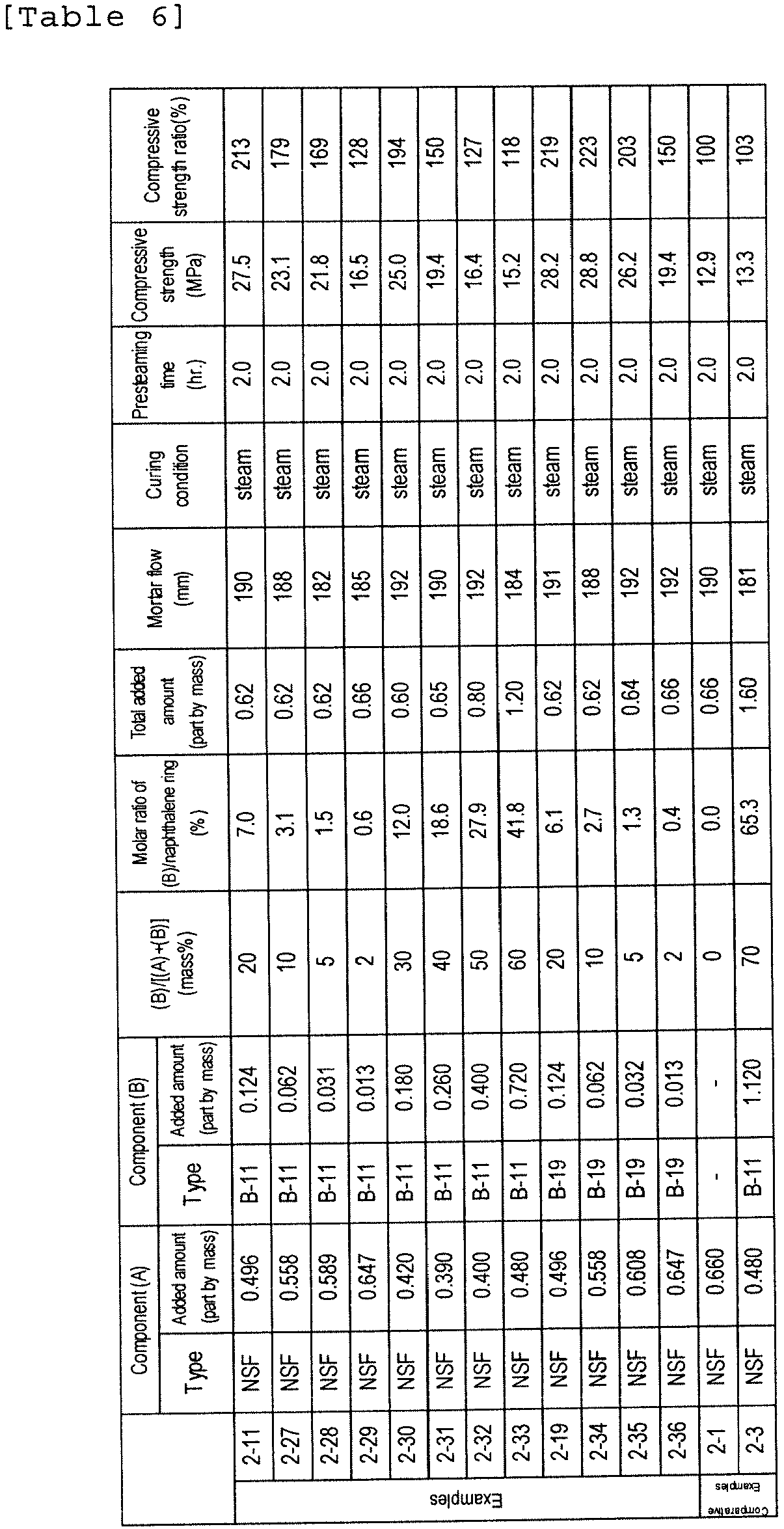
- In Tables 5 and 6, the added amount is an added amount of each component in terms of solid content relative to 100 parts by mass of cement (C).
- Further, in Tables 5 and 6, the total added amount is an added amount of the total of components (A) and (B) in terms of solid content relative to 100 parts by mass of cement (C).
- Further, in Tables 5 and 6, the compressive strength ratio is a relative value when the compressive strength of Comparative Example 2-1 was taken as 100%.
- Mortar was prepared in the same manner as in Example 2 by changing the mortar formulation as shown in Table 7, and the fluidity and the strength were evaluated. Results are shown in Table 8.
[Table 7] W/C (mass%) Unit amount (g/batch) W C S 35 140 400 700 40 160 400 700 45 180 400 700 50 200 400 700 55 220 400 700 [Table 8] W/C (mass%) Component (A) Component (B) (B)/[(A)+(B)] (mass%) Molar ratio of (B)/naphthalene ring (%) Total added amount (part by mass) Mortar flow (mm) Curing condition Presteaming time (hr.) Compressive strength (MPa) Compressive strength ratio(%) Type Added amount (part by mass) Type Added amount (part by mass) Comparative Example 2-1 35 NSF 0.660 - - 0 0.0 0.66 190 steam 2.0 12.9 100 Example 2-28 35 NSF 0.589 B-11 0.031 5 1.5 0.62 182 steam 2.0 21.8 169 Example 2-34 35 NSF 0.558 B-19 0.062 10 2.7 0.62 188 steam 2.0 28.8 223 Comparative Example 3-1 40 NSF 0.560 - - 0 0.0 0.56 192 steam 2.0 12.6 100 Example 3-1 40 NSF 0.513 B-11 0.027 5 1.5 0.54 188 steam 2.0 17.6 140 Example 3-2 40 NSF 0.486 B-19 0.054 10 2.7 0.54 185 steam 2.0 19.2 152 Comparative 3-2 45 NSF 0.440 - - 0 0.0 0.44 191 steam 2.0 12.5 100 Example 3-3 45 NSF 0.399 B-11 0.021 5 1.5 0.42 193 steam 2.0 14.2 114 Example 3-4 45 NSF 0.378 B-19 0.042 10 2.7 0.42 192 steam 2.0 15.1 121 Comparative Example 3-3 50 NSF 0.280 - - 0 0.0 0.28 185 steam 2.0 11.8 100 Example 3-5 50 NSF B-11 0.013 5 1.5 0.27 187 steam 2.0 12.6 107 Example 3-6 50 NSF 0.243 B-19 0.027 10 2.7 0.27 189 steam 2.0 12.8 108 Test Example 3-1 55 NSF 0.220 - - 0 0.0 0.22 185 steam 2.0 10.4 100 Test Example 3-2 55 NSF 0.209 B-11 0.011 5 1.5 0.22 190 steam 2.0 10.4 100 Test Example 3-3 55 NSF 0.198 B-19 0.022 10 2.7 0.22 192 steam 2.0 10.4 100 Test Example 3-4 55 NSF 0.176 B-19 0.044 10 6.1 0.22 198 steam 2.0 10.3 99 - In Table 8, the added amount is an added amount of each component in terms of solid content relative to 100 parts by mass of cement (C).
- Further, in Table 8, the total added amount is an added amount of the total of components (A) and (B) in terms of solid content relative to 100 parts by mass of cement (C).
- Further, in Table 8, the compressive strength ratio is a relative value regarding each W/C, when the compressive strength of Comparative Example or Test Example 3-1 was taken as 100%.
- When W/C was 55 mass%, the total added amount of components (A) and (B) for obtaining a predetermined mortar flow was 0.22 parts by mass. In this case, even combined use of components (A) and (B) did not change the compressive strength in comparison with the case where only component (A) was added. In addition, for mortar formulation with W/C being 55 mass%, when components (A) and (B) were added in total in amount of 0.27 parts by mass, material segregation was generated and fine aggregates (sand) were settled in the lower layer of the hardened product. This prevented accurate measurement.
- Meanwhile, when W/C was 35 mass%, 45 mass% or 50 mass%, the total added amount of components (A) and (B) to provide a predetermined mortar flow had to be 0.25 parts by mass or more. In this case, it is understood that combined use of components (A) and (B) increased the compressive strength. In addition, for mortar formulation with W/C being 35 mass%, when components (A) and (B) were added in total in an amount of 0.22 parts by mass, no fluidity was developed and a hardened product for strength measurement could not be produced.
- Mortar was prepared in the same manner as in Example 2 by changing the types of cement as shown in Table 9, and the fluidity and the strength were evaluated. In some examples, temperature of raw materials for mortar formulation, temperatures of working environment, and temperatures at the start of temperature rise and at the end of temperature drop for steam curing were changed to 20°C. Results are shown in Table 9.
[Table 9] Type of cement Temp.* (°C) Component (A) Component (B) (B)/[(A)+(B)] (mass%) Molar ratio of (B)/naphthalene ring (%) Total added amount (part by mass) Mortar flow (mm) Curing condition presteaming time (hr.) Compressive strength (MPa) Compressive strength ratio (%) Type Added amount (part by mass) Type Added amount (part by mass) Comparative Example 4-1 Thai 30 NSF 0.440 - - 0 0.0 0.44 192 steam 2.0 22.1 100 Example 4-1 Thai 30 NSF 0.418 B-11 0.022 5 1.5 0.44 191 steam 2.0 28.3 128 Comparative Example 4-2 Vietnam 30 NSF 0.540 - - 0 0.0 0.54 188 steam 2.0 13.2 100 Example 4-2 Vietnam 30 NSF 0.513 B-11 0.027 5 1.5 0.54 192 steam 2.0 18.3 139 Comparative Example 4-3 Malaysia 30 NSF 0.570 - - 0 0.0 0.57 186 steam 2.0 16.4 100 Example 4-3 Malaysia 30 NSF 0.523 B-11 0.027 5 1.5 0.55 188 steam 2.0 22.1 135 Comparative Example 4-4 Indonesia 30 NSF 0.600 - - 0 0.0 0.60 195 steam 2.0 14.3 100 Example 4-4 Indonesia 30 NSF 0.551 B-11 0.029 5 1.5 0.58 193 steam 2.0 23.7 166 Comparative Example 2-1 Vietnam 30 NSF 0.660 - - 0 0.0 0.66 190 steam 2.0 12.9 100 Example 2-28 Vietnam 30 NSF 0.589 B-11 0.031 5 1.5 0.62 182 steam 2.0 21.8 169 Comparative Example 4-5 China 20 NSF 0.800 - - 0 0.0 0.80 188 steam 2.0 10.1 100 Example 4-5 China 20 NSF 0.798 B-11 0.042 5 1.5 0.84 192 steam 2.0 22.9 227 * Temperature: temperatures of raw materials for mortar formulation and working environments (room temperature) - Types of cement in Table 9 are described below.
- Cement of Vietnam: "PCB-40" manufactured by Nghi Son Cement Corporation
- Cement of Thai: "Type 1" manufactured by The Siam Cement Public Company Ltd.
- Cement of Malaysia: "OPC" manufactured by Lafarge Malaysia Berhad
- Cement of Indonesia: "OPC" manufactured by PT Semen Indonesia (persero) Tbk
- Cement of China: "52.5" manufactured by Anhui Conch Cement Company Limited
- In Table 9, the added amount is an added amount of each component in terms of solid content relative to 100 parts by mass of cement (C).
- Further, in Table 9, the total added amount is an added amount of the total of components (A) and (B) in terms of solid content relative to 100 parts by mass of cement (C).
- Further, in Table 9, the compressive strength ratio is a relative value regarding each cement, when the compressive strength of Comparative Example was taken as 100%.
- Mortar was prepared in the same manner as in Example 2 by changing the mortar formulation as shown in Table 10 and also changing the presteaming period and the period up to demolding as shown in Tables 11 and 12; and the fluidity and the strength right after demolding (indicated as "Right after demolding" in the tables) were evaluated. Results are shown in Tables 11 and 12. In Table 11, the strength exhibited 28 days later (indicated as "28 days later" in the table) is also shown. The period up to demolding is a period from the addition of mixing water (W) to the removal of the hardened product from the mold. Further, 28-day strength is a strength measured 28 days after the addition of mixing water (W) after the process including demolding 24 hours after the addition of the mixing water (W) and curing in water in a constant-temperature water bath at 30°C. In the case of "no steam" in the table, curing was conducted at the setting temperature (30°C) from the addition of mixing water (W) to the strength measurement (24 hours later).
[Table 10] W/C (mass%) Unit amount (g/batch) W C S 35 140 400 700 [Table 11] W/C (mass%) Component(A) Component(B) (B)/[(A)+B)] (mass%) Molar ratio of (B)/naphthalene ring (%) Total added amount (part by mass) Mortar flow (mm) Curing condition Presteaming time (hr) Time till demolding (hr.) Compressive strength Type Added amount (part by mass) Type Added amount (part by mass) Right after demolding 28 days later Measured value (MPa) Com pressive strength ratio (%) Measured value (MPa) Compressive strength ratio (%) Comparative Example 5-1 35 NSF 0.660 - - 0 0.0 0.66 190 steam 3.0 7.0 21.7 100 37.1 100 Example 5-1 35 NSF 0.589 B-11 0.031 5 1.5 0.62 182 steam 3.0 7.0 33.1 153 64.0 173 Comparative Example 2-1 35 NSF 0.660 - - 0 0.0 0.66 190 steam 2.0 6.0 12.9 100 27.5 100 Example 2-28 35 NSF 0.589 B-11 0.031 5 1.5 0.62 182 steam 2.0 6.0 21.8 169 41.8 152 Comparative Example 5-2 35 NSF 0.660 - - 0 0.0 0.66 190 steam 1.0 5.0 9.7 100 32.9 100 Example 5-2 35 NSF 0.589 B-11 0.031 5 1.5 0.62 182 steam 1.0 5.0 16.3 168 37.3 113 Comparative Example 5-3 35 NSF 0.660 - - 0 0.0 0.66 190 steam 0.5 4.5 8.7 100 37.9 100 Example 5-3 35 NSF 0.589 B-11 0.031 5 1.5 0.62 182 steam 0.5 4.5 15.8 182 40.1 106 Comparative Example 5-4 35 NSF 0.660 - - 0 0.0 0.66 190 no steam (24) 24.0 28.4 100 72.1 100 Comparative Example 5-5 35 NSF 0.589 B-11 0.031 5 1.5 0.62 182 no steam (24) 24.0 29.6 104 75.2 104 [Table 12] W/C (mass%) Component (A) Component (B) (B)/[(A)+(B)] (mass%) Molar ratio of (B)/naphthalene ring (%) Total added amount (part by mass) Mortar flow (mm) Curing condition Presteaming time (hr.) Time till demolding (hr.) Compressive strength (right after demolding) (MPa) Compressive strength ratio (%) Type Added amount (part by mass) Type Added amount (part by mass) Comparative Example 5-1 35 NSF 0.660 - - 0 0.0 0.66 190 steam 3.0 7.0 21.7 100 Example 5-5 35 NSF 0.496 B-11 0.124 20 7.0 0.62 182 steam 3.0 7.0 35.4 163 Comparative Example 2-1 35 NSF 0.660 - - 0 0.0 0.66 190 steam 2.0 6.0 12.9 100 Example 5-6 35 NSF 0.496 B-11 0.124 20 7.0 0.62 190 steam 2.0 6.0 27.5 213 Comparative Example 5-2 35 NSF 0.660 - - 0 0.0 0.66 190 steam 1.0 5.0 9.7 100 Example 5-7 35 NSF 0.496 B-11 0.124 20 7.0 0.62 182 steam 1.0 5.0 17.6 181 Comparative Example 5-3 35 NSF 0.660 - - 0 0.0 0.66 190 steam 0.5 4.5 8.7 100 Example 5-8 35 NSF 0.496 B-11 0.124 20 7.0 0.62 182 steam 0.5 4.5 15.6 179 Comparative Example 5-4 35 NSF 0.660 - - 0 0.0 0.66 190 no steam (24) 24.0 28.4 100 Example 5-6 35 NSF 0.496 B-11 0.124 20 7.0 0.62 182 no steam (24) 24.0 29.4 104 - In Tables 11 and 12, the added amount is an added amount of each component in terms of solid content relative to 100 parts by mass of cement (C).
- Further, in Tables 11 and 12, the total added amount is an added amount of the total of components (A) and (B) in terms of solid content relative to 100 parts by mass of cement (C).
- Further, in Tables 11 and 12, the compressive strength ratio is a relative value regarding each presteaming period, when the compressive strength of Comparative Example was taken as 100%.
- It is understood that, in the case of no steam curing, addition of components (A) and (B) in predetermined amounts hardly changes the compressive strength while in the case of steam curing, addition of components (A) and (B) in predetermined amounts increases the compressive strength. The same is true in the compressive strength after 28 days. In general, it is common knowledge to those skilled in the art that, when steam curing is conducted, 28-day strength is reduced in comparison with a case where steam curing is not conducted.
- Mortar was prepared in the same manner as in Example 2 by replacing a portion of cement in the mortar formulation of Example 2 with fly ash, and the fluidity and the strength were evaluated. Replacement rates with fly ash are shown in Table 13. In Table 13, FA is an abbreviation for fly ash. As fly ash, fly ash original powder from China was used. Results are shown in Table 14.
[Table 13] Fly ash replacement ratio (%) W/(C+FA) (mass%) Unit amount (g/batch) W C FA S 0 35 140 400 0 700 10 35 140 360 40 700 20 35 140 320 80 700 [Table 14] Fly ash replacement ratio (%) Component (A) Component (B) (B)/[(A)+(B)] (mass%) Molar ratio of (B)/naphthalene ring (%) Total added amount (part by mass) Mortar flow (mm) Curing condition presteaming time (hr.) Compressive strength (MPa) Compressive strength ratio (%) Type Added amount (part by mass) Type Added amount (part by mass) Comparative Example 6-1 0 NSF 0.600 - - 0 0.0 0.60 180 steam 2.0 16.5 100 Example 6-1 0 NSF 0.570 B-19 0.030 5 1.3 0.60 188 steam 2.0 26.8 162 Comparative Example 6-2 10 NSF 0.600 - - 0 0.0 0.60 166 steam 2.0 14.9 100 Example 6-2 10 NSF 0.570 B-19 0.030 5 1.3 0.60 176 steam 2.0 19.6 132 Comparative Example 6-3 20 NSF 0.600 - - 0 0.0 0.60 173 steam 2.0 12.2 100 Example 6-3 20 NSF 0.570 B-19 0.030 5 1.3 0.60 173 steam 2.0 14.5 119 - In Table 14, the added amount is an added amount of each component in terms of solid content relative to 100 parts by mass of cement (C).
- Further, in Table 14, the total added amount is an added amount of the total of components (A) and (B) in terms of solid content relative to 100 parts by mass of cement (C).
- Further, in Table 14, the compressive strength ratio is a relative value regarding each fly ash replacement rate, when the compressive strength of Comparative Example was taken as 100%.
- From the results of Table 14, it is understood that even when a portion of cement is replaced with fly ash, the present invention enables the strength improvement.
- Mortar formulation is shown in Table 15.
[Table 15] W/C (mass%) Unit amount (g/batch) W C S 23.8 142.8 600 857 - Components in the table are as follows.
- W: water from public water supply system in Wakayama
- C: "PCT-40" manufactured by Nghi Son Cement Corporation (Vietnam)
- S: fine aggregate (pit sand from Joyo area, particles having a particle size of 3.5 mm or more were removed)
- W in Table 15 contains none of components selected from components (A), (B) and (C) used in Table 17.
- Components (A), (B) and (C) in Table 17 are as follows.
-
- NSF: sodium salt of a formaldehyde naphthalenesulfonate condensate, weight average molecular weight: 15000
- This NSF was prepared based on Example of
JP-A 48-11737 - Components (B) shown in Table 16 were used.
-
- PCE (A) : polycarboxylic acid-based dispersant, AQUPOL MAR502(S) manufactured by AK Chemtech Co., Ltd.
- PCE (B): methacrylic acid/methoxy polyethylene glycol (23) methacrylate = 73/27 (molar ratio), prepared based on Production Example 11 of
JP-A 8-12397 - PCE (C) : acrylic acid/methoxy polyethylene glycol (23) acrylate = 77/23 (molar ratio), prepared based on Production Example 11 of
JP-A 8-12397 - PCE (D) : polycarboxylic acid-based dispersant, AQUALOC HW-80 manufactured by Nippon Shokubai Co., Ltd.
- Temperatures of raw materials for mortar formulation and the temperature of working environment (room temperature) were both set to 30°C.
- Into a mortar mixer (universal mixing stirrer, model: 5DM-03-y manufactured by Dalton Corporation), a cement (C) and a fine aggregate (S) were fed and dry-mixed for 10 seconds at a low speed rotation (63 rpm) of the mortar mixer, and the mixing water (W) containing components (A), (B) and (C), an antifoaming agent, and water (W) at 30°C was added. Then, the mixture was subjected to main kneading for 180 seconds at a low speed rotation (63 rpm) of the mortar mixer, so that a mortar was prepared.
- As the antifoaming agent, Foamlex 797 (manufactured by Nicca Chemical Co., Ltd.) was added in an amount of 3 mass% relative to component (B).
- In accordance with the test method of JIS R 5201, the flow of the prepared mortar was measured. Results are shown in Table 17.
- In Examples, components (A) to (C) were added in total in an amount of 0.60 parts by mass relative to 100 parts by mass of cement.
- The mortar was hardened by a production method including steam curing, and the strength of the hardened product of the obtained mortar was tested in accordance with JIS A 1108 "Method of test for compressive strength of concrete."
- Steam curing for obtaining the hardened product was conducted after a predetermined period of presteaming. The presteaming was conducted at 30°C for 3 hours.
- Steam curing was carried out at a humidity setting of 100% by use of a thermo-hygrostat "PR-3J" manufactured by Espec Corporation.
- Temperature rise for steam curing was conducted for 45 minutes from 30°C to 75°C, which were setting temperatures for the thermo-hygrostat. Steam curing was conducted for 2.5 hours at a constant temperature of 75°C, which was a setting temperature for the thermo-hygrostat. Temperature drop for steam curing was conducted for 45 minutes from 75°C to 30°C, which were setting temperatures for the thermo-hygrostat. Immediately after the setting temperature of the thermo-hygrostat reached 30°C, the strength was measured.
[Table 16] Component (B) Mark Type Carbon No.* B-27 Polyoxyethylene (50) stearyl ether 18 B-28 Polyoxyethylene (19) lauryl ether ammonium sulfate 12 B-29 Polyoxyethylene (20) stearyl amine ether 18 
- In Table 17, the added amount is an added amount of each component in terms of solid content relative to 100 parts by mass of cement (C).
- Further, in Table 17, the total added amount is an added amount of the total of components (A), (B) and (C) in terms of solid content relative to 100 parts by mass of cement (C).
- Further, in Table 17, the compressive strength ratio is a relative value when the compressive strength of Comparative Example 7-1 was taken as 100%.
- When NSF as component (A) and PCE as component (C) are used in combination, the viscosity increases if component (B) is not added. Therefore, as shown in Comparative Example 7-2, even combined use of components (A) and (C) did not develop the fluidity of the hydraulic composition without component (B).
- Concrete for centrifugal molding was prepared in the same manner as in Example 1 according to the concrete formulation of Table 18 by using components (A) and (B) in Table 19, and the moldability for centrifugal molding and the compressive strength were evaluated in the same manner as in Example 1. Results are shown in Table 19.
[Table 18] W/(C+P) (mass%) Unit amount (kg/m3) W C P S G 18.7 125 600 65 595 1100 
- In Table 19, the added amount is an added amount of each component in terms of solid content relative to 100 parts by mass of cement (C).
- Further, in Table 19, the total added amount is an added amount of the total of components (A) and (B) in terms of solid content relative to 100 parts by mass of cement (C).


Claims (26)
- A dispersant composition for hydraulic compositions for centrifugal molding, comprising:(A) a dispersant for hydraulic powders composed of an aromatic ring-containing high-molecular compound; and(B) one or more compounds selected from compounds represented by the following general formula (B1), compounds represented by the following general formula (B2), compounds represented by the following general formula (B3) and compounds represented by the following general formula (B4),
 R11, R21, R31 and R41 each independently represent a hydrocarbon group having a carbon number of 4 or more and 27 or less;R22 represents a hydrogen atom or an alkyl group having a carbon number of 1 or more and 3 or less;R32 and R33 are the same or different, and each represents a hydrogen atom or an alkyl group having a carbon number of 1 or more and 3 or less;X represents O or COO;AO represents an alkyleneoxy group having a carbon number of 2 or more and 4 or less;n1 represents an average number of moles of added AO and is 1 or more and 200 or less;n2 represents an average number of moles of added AO and is 1 or more and 200 or less;n3 and n4 are the same or different, and each represents an average number of moles of added AO and is 0 or more, and the total of n3 and n4 is 1 or more and 200 or less;Y1 and Y2 are the same or different, and each represents a hydrogen atom or SO3M, and at least one of Y1 and Y2 is SO3M;n5 and n6 are the same or different; each represents an average number of moles of added AO and is 0 or more; the total of n5 and n6 is 1 or more and 200 or less; when n5 is 0, Y1 is a hydrogen atom; and when n6 is 0, Y2 is a hydrogen atom; andM is a counter ion.
 - The dispersant composition for hydraulic compositions for centrifugal molding according to Claim 1, wherein (A) is a dispersant for hydraulic powders composed of a high-molecular compound having an aromatic ring-containing monomer unit.
- The dispersant composition for hydraulic compositions for centrifugal molding according to Claim 1 or 2, wherein a content ratio of (B) is 3 mass% or more and 60 mass% or less relative to a total content of (A) and (B).
- The dispersant composition for hydraulic compositions for centrifugal molding according to any one of Claims 1 to 3, further comprising (C) a polycarboxylic acid-based copolymer.
- A hydraulic composition for centrifugal molding comprising the dispersant composition for hydraulic compositions for centrifugal molding according to any one of Claims 1 to 4, a hydraulic powder, an aggregate and water, wherein a ratio of water/hydraulic powder is 10 mass% or more and 25 mass% or less.
- The hydraulic composition for centrifugal molding according to Claim 5, wherein (A) is contained in an amount of 0.001 parts by mass or more and 10 parts by mass or less relative to 100 parts by mass of the hydraulic powder.
- The hydraulic composition for centrifugal molding according to Claim 5 or 6, wherein (B) is contained in an amount of 0.0001 parts by mass or more and 10 parts by mass or less relative to 100 parts by mass of the hydraulic powder.
- A dispersant composition for hydraulic compositions for steam curing, comprising:(A) a dispersant for hydraulic powders composed of an aromatic ring-containing high-molecular compound; and(B) one or more compounds selected from compounds represented by the following general formula (B1), compounds represented by the following general formula (B2), compounds represented by the following general formula (B3) and compounds represented by the following general formula (B4),wherein a content ratio of (B) is 1 mass% or more and 60 mass% or less relative to a total content of (A) and (B),
 R11, R21, R31 and R41 each independently represent a hydrocarbon group having a carbon number of 4 or more and 27 or less;R22 represents a hydrogen atom or an alkyl group having a carbon number of 1 or more and 3 or less;R32 and R33 are the same or different, and each represents a hydrogen atom or an alkyl group having a carbon number of 1 or more and 3 or less;X represents O or COO;AO represents an alkyleneoxy group having a carbon number of 2 or more and 4 or less;n1 represents an average number of moles of added AO and is 1 or more and 200 or less;n2 represents an average number of moles of added AO and is 1 or more and 200 or less;n3 and n4 are the same or different, and each represents an average number of moles of added AO and is 0 or more, and the total of n3 and n4 is 1 or more and 200 or less;Y1 and Y2 are the same or different, and each represents a hydrogen atom or SO3M, and at least one of Y1 and Y2 is SO3M;n5 and n6 are the same or different; each represents an average number of moles of added AO and is 0 or more; the total of n5 and n6 is 1 or more and 200 or less; when n5 is 0, Y1 is a hydrogen atom; and when n6 is 0, Y2 is a hydrogen atom; andM is a counter ion.
 - The dispersant composition for hydraulic compositions for steam curing according to Claim 8, wherein (A) is a dispersant for hydraulic powders composed of a high-molecular compound having an aromatic ring-containing monomer unit.
- The dispersant composition for hydraulic compositions for steam curing according to Claim 8 or 9, further comprising (C) a polycarboxylic acid-based copolymer.
- A hydraulic composition for steam curing comprising the dispersant composition for hydraulic compositions for steam curing according to any one of Claims 8 to 10, a hydraulic powder, an aggregate and water, wherein a ratio of water/hydraulic powder is 10 mass% or more and 53 mass% or less, and a total content of (A) and (B) is 0.25 parts by mass or more and 10 parts by mass or less relative to 100 parts by mass of the hydraulic powder.
- The hydraulic composition for steam curing according to Claim 11, wherein (A) is contained in an amount of 0.15 parts by mass or more and 9.9 parts by mass or less relative to 100 parts by mass of the hydraulic powder.
- The hydraulic composition for steam curing according to Claim 11 or 12, wherein (B) is contained in an amount of 0.0025 parts by mass or more and 6 parts by mass or less relative to 100 parts by mass of the hydraulic powder.
- A method for producing a hardened product of a hydraulic composition, the method comprising the steps of :step 1: mixing water, a hydraulic powder, an aggregate and the dispersant composition for hydraulic compositions for centrifugal molding according to any one of Claims 1 to 4 to prepare a hydraulic composition having a water/hydraulic powder ratio of 10 mass% or more and 25 mass% or less;step 2: filling the hydraulic composition obtained in step 1 into a mold;step 3: compacting the hydraulic composition filled into the mold in step 2 by applying a centrifugal force; andstep 4: setting, in the mold, the hydraulic composition compacted in step 3.
- The method for producing a hardened product of a hydraulic composition according to Claim 14, comprising the following step 5 after step 4,
step 5: steam curing, in the mold, the hydraulic composition set in step 4. - A method for producing a hardened product of a hydraulic composition, the method comprising the steps of :step 1': mixing water, a hydraulic powder, an aggregate and the dispersant composition for hydraulic compositions for steam curing according to any one of Claims 8 to 10 to prepare a hydraulic composition having a water/hydraulic powder ratio of 10 mass% or more and 53 mass% or less, wherein the dispersant composition for hydraulic compositions for steam curing is mixed so that a ratio of a mixing amount of (B) is 1 mass% or more and 60 mass% or less relative to a total mixing amount of (A) and (B) and the total mixing amount of (A) and (B) is 0.25 parts by mass or more and 10 parts by mass or less relative to 100 parts by mass of the hydraulic powder;step 2': filling the hydraulic composition obtained in step 1' into a mold; andstep 5': steam curing, in the mold, the hydraulic composition filled into the mold in step 2'.
- A method for producing a hardened product of a hydraulic composition, the method comprising the steps of:step 1: mixing water, a hydraulic powder, the following (A), the following (B) and an aggregate to prepare a hydraulic composition for centrifugal molding having a water/hydraulic powder ratio of 10 mass% or more and 25 mass% or less;step 2: filling the hydraulic composition obtained in step 1 into a mold;step 3: compacting the hydraulic composition filled into the mold in step 2 by applying a centrifugal force; andstep 4: setting, in the mold, the hydraulic composition compacted in step 3,(A) a dispersant for hydraulic powders composed of an aromatic ring-containing high-molecular compound; and(B) one or more compounds selected from compounds represented by the following general formula (B1), compounds represented by the following general formula (B2), compounds represented by the following general formula (B3) and compounds represented by the following general formula (B4),
 R11, R21, R31 and R41 each independently represent a hydrocarbon group having a carbon number of 4 or more and 27 or less;R22 represents a hydrogen atom or an alkyl group having a carbon number of 1 or more and 3 or less;R32 and R33 are the same or different, and each represents a hydrogen atom or an alkyl group having a carbon number of 1 or more and 3 or less;X represents O or COO;AO represents an alkyleneoxy group having a carbon number of 2 or more and 4 or less;n1 represents an average number of moles of added AO and is 1 or more and 200 or less;n2 represents an average number of moles of added AO and is 1 or more and 200 or less;n3 and n4 are the same or different, and each represents an average number of moles of added AO and is 0 or more, and the total of n3 and n4 is 1 or more and 200 or less;Y1 and Y2 are the same or different, and each represents a hydrogen atom or SO3M, and at least one of Y1 and Y2 is SO3M;n5 and n6 are the same or different; each represents an average number of moles of added AO and is 0 or more; the total of n5 and n6 is 1 or more and 200 or less; when n5 is 0, Y1 is a hydrogen atom; and when n6 is 0, Y2 is a hydrogen atom; andM is a counter ion.
 - The method for producing a hardened product of a hydraulic composition according to Claim 17, comprising the following step 5 after step 4,
step 5: steam curing, in the mold, the hydraulic composition set in step 4. - A method for producing a hardened product of a hydraulic composition, the method comprising the steps of:step 1': mixing water, a hydraulic powder, the following (A), the following (B) and an aggregate to prepare a hydraulic composition for steam curing having a water/hydraulic powder ratio of 10 mass% or more and 53 mass% or less, wherein (A) and (B) are mixed so that a ratio of a mixing amount of (B) is 1 mass% or more and 60 mass% or less relative to a total mixing amount of (A) and (B) and the total mixing amount of (A) and (B) is 0.25 parts by mass or more and 10 parts by mass or less relative to 100 parts by mass of the hydraulic powder;step 2': filling the hydraulic composition obtained in step 1' into a mold; andstep 5': steam curing, in the mold, the hydraulic composition filled into the mold in step 2'(A) a dispersant for hydraulic powders composed of an aromatic ring-containing high-molecular compound; and(B) one or more compounds selected from compounds represented by the following general formula (B1), compounds represented by the following general formula (B2), compounds represented by the following general formula (B3) and compounds represented by the following general formula (B4),
 R11, R21, R31 and R41 each independently represent a hydrocarbon group having a carbon number of 4 or more and 27 or less;R22 represents a hydrogen atom or an alkyl group having a carbon number of 1 or more and 3 or less;R32 and R33 are the same or different, and each represents a hydrogen atom or an alkyl group having a carbon number of 1 or more and 3 or less;X represents O or COO;AO represents an alkyleneoxy group having a carbon number of 2 or more and 4 or less;n1 represents an average number of moles of added AO and is 1 or more and 200 or less;n2 represents an average number of moles of added AO and is 1 or more and 200 or less;n3 and n4 are the same or different, and each represents an average number of moles of added AO and is 0 or more, and the total of n3 and n4 is 1 or more and 200 or less;Y1 and Y2 are the same or different, and each represents a hydrogen atom or SO3M, and at least one of Y1 and Y2 is SO3M;n5 and n6 are the same or different; each represents an average number of moles of added AO and is 0 or more; the total of n5 and n6 is 1 or more and 200 or less; when n5 is 0, Y1 is a hydrogen atom; and when n6 is 0, Y2 is a hydrogen atom; andM is a counter ion.
 - A method for producing a hardened product of a hydraulic composition, the method comprising the steps of:step 1: mixing water, a hydraulic powder, the following (A), the following (B), the following (C) and an aggregate to prepare a hydraulic composition having a water/hydraulic powder ratio of 10 mass% or more and 25 mass% or less;step 2: filling the hydraulic composition obtained in step 1 into a mold;step 3: compacting the hydraulic composition filled into the mold in step 2 by applying a centrifugal force; andstep 4: setting, in the mold, the hydraulic composition compacted in step 3,(A) a dispersant for hydraulic powders composed of an aromatic ring-containing high-molecular compound; and(B) one or more compounds selected from compounds represented by the following general formula (B1), compounds represented by the following general formula (B2), compounds represented by the following general formula (B3) and compounds represented by the following general formula (B4),
 R11, R21, R31 and R41 each independently represent a hydrocarbon group having a carbon number of 4 or more and 27 or less;R22 represents a hydrogen atom or an alkyl group having a carbon number of 1 or more and 3 or less;R32 and R33 are the same or different, and each represents a hydrogen atom or an alkyl group having a carbon number of 1 or more and 3 or less;X represents O or COO;AO represents an alkyleneoxy group having a carbon number of 2 or more and 4 or less;n1 represents an average number of moles of added AO and is 1 or more and 200 or less;n2 represents an average number of moles of added AO and is 1 or more and 200 or less;n3 and n4 are the same or different, and each represents an average number of moles of added AO and is 0 or more, and the total of n3 and n4 is 1 or more and 200 or less;Y1 and Y2 are the same or different, and each represents a hydrogen atom or SO3M, and at least one of Y1 and Y2 is SO3M;n5 and n6 are the same or different; each represents an average number of moles of added AO and is 0 or more; the total of n5 and n6 is 1 or more and 200 or less; when n5 is 0, Y1 is a hydrogen atom; and when n6 is 0, Y2 is a hydrogen atom; andM is a counter ion; and(C): a polycarboxylic acid-based copolymer.
 - The method for producing a hardened product of a hydraulic composition according to Claim 20, comprising the following step 5 after step 4,
step 5: steam curing, in the mold, the hydraulic composition set in step 4. - A method for producing a hardened product of a hydraulic composition, the method comprising the steps of:step 1' : mixing water, a hydraulic powder, the following (A), the following (B), the following (C) and an aggregate to prepare a hydraulic composition having a water/hydraulic powder ratio of 10 mass% or more and 53 mass% or less, wherein (A) and (B) are mixed so that a ratio of a mixing amount of (B) is 1 mass% or more and 60 mass% or less relative to a total mixing amount of (A) and (B) and the total mixing amount of (A) and (B) is 0.25 parts by mass or more and 10 parts by mass or less relative to 100 parts by mass of the hydraulic powder;step 2': filling the hydraulic composition obtained in step 1' into a mold; andstep 5': steam curing, in the mold, the hydraulic composition filled into the mold in step 2',(A) a dispersant for hydraulic powders composed of an aromatic ring-containing high-molecular compound; and(B) one or more compounds selected from compounds represented by the following general formula (B1), compounds represented by the following general formula (B2), compounds represented by the following general formula (B3) and compounds represented by the following general formula (B4),
 R11, R21, R31 and R41 each independently represent a hydrocarbon group having a carbon number of 4 or more and 27 or less;R22 represents a hydrogen atom or an alkyl group having a carbon number of 1 or more and 3 or less;R32 and R33 are the same or different, and each represents a hydrogen atom or an alkyl group having a carbon number of 1 or more and 3 or less;X represents O or COO;AO represents an alkyleneoxy group having a carbon number of 2 or more and 4 or less;n1 represents an average number of moles of added AO and is 1 or more and 200 or less;n2 represents an average number of moles of added AO and is 1 or more and 200 or less;n3 and n4 are the same or different, and each represents an average number of moles of added AO and is 0 or more, and the total of n3 and n4 is 1 or more and 200 or less;Y1 and Y2 are the same or different, and each represents a hydrogen atom or SO3M, and at least one of Y1 and Y2 is SO3M;n5 and n6 are the same or different; each represents an average number of moles of added AO and is 0 or more; the total of n5 and n6 is 1 or more and 200 or less; when n5 is 0, Y1 is a hydrogen atom; and when n6 is 0, Y2 is a hydrogen atom; andM is a counter ion; and(C): a polycarboxylic acid-based copolymer.
 - Use of a composition as a dispersant for hydraulic compositions for centrifugal molding, the composition comprising:(A) a dispersant for hydraulic powders composed of an aromatic ring-containing high-molecular compound; and(B) one or more compounds selected from compounds represented by the following general formula (B1), compounds represented by the following general formula (B2), compounds represented by the following general formula (B3) and compounds represented by the following general formula (B4),
 R11, R21, R31 and R41 each independently represent a hydrocarbon group having a carbon number of 4 or more and 27 or less;R22 represents a hydrogen atom or an alkyl group having a carbon number of 1 or more and 3 or less;R32 and R33 are the same or different, and each represents a hydrogen atom or an alkyl group having a carbon number of 1 or more and 3 or less;X represents O or COO;AO represents an alkyleneoxy group having a carbon number of 2 or more and 4 or less;n1 represents an average number of moles of added AO and is 1 or more and 200 or less;n2 represents an average number of moles of added AO and is 1 or more and 200 or less;n3 and n4 are the same or different, and each represents an average number of moles of added AO and is 0 or more, and the total of n3 and n4 is 1 or more and 200 or less;Y1 and Y2 are the same or different, and each represents a hydrogen atom or SO3M, and at least one of Y1 and Y2 is SO3M;n5 and n6 are the same or different; each represents an average number of moles of added AO and is 0 or more; the total of n5 and n6 is 1 or more and 200 or less; when n5 is 0, Y1 is a hydrogen atom; and when n6 is 0, Y2 is a hydrogen atom; andM is a counter ion.
 - Use of a composition as a dispersant for hydraulic compositions for steam curing, the composition comprising:(A) a dispersant for hydraulic powders composed of an aromatic ring-containing high-molecular compound; and(B) one or more compounds selected from compounds represented by the following general formula (B1), compounds represented by the following general formula (B2), compounds represented by the following general formula (B3) and compounds represented by the following general formula (B4),wherein a content ratio of (B) is 1 mass% or more and 60 mass% or less relative to a total content of (A) and (B),
 R11, R21, R31 and R41 each independently represent a hydrocarbon group having a carbon number of 4 or more and 27 or less;R22 represents a hydrogen atom or an alkyl group having a carbon number of 1 or more and 3 or less;R32 and R33 are the same or different, and each represents a hydrogen atom or an alkyl group having a carbon number of 1 or more and 3 or less;X represents O or COO;AO represents an alkyleneoxy group having a carbon number of 2 or more and 4 or less;n1 represents an average number of moles of added AO and is 1 or more and 200 or less;n2 represents an average number of moles of added AO and is 1 or more and 200 or less;n3 and n4 are the same or different, and each represents an average number of moles of added AO and is 0 or more, and the total of n3 and n4 is 1 or more and 200 or less;Y1 and Y2 are the same or different, and each represents a hydrogen atom or SO3M, and at least one of Y1 and Y2 is SO3M;n5 and n6 are the same or different; each represents an average number of moles of added AO and is 0 or more; the total of n5 and n6 is 1 or more and 200 or less; when n5 is 0, Y1 is a hydrogen atom; and when n6 is 0, Y2 is a hydrogen atom; andM is a counter ion.
 - Use of a composition as a hydraulic composition for centrifugal molding, the composition comprising a dispersant composition for hydraulic compositions for centrifugal molding according to any one of Claims 1 to 4, a hydraulic powder, an aggregate and water, wherein a water/hydraulic powder ratio is 10 mass% or more and 25 mass% or less.
- Use of a composition as a hydraulic composition for steam curing, the composition comprising a dispersant composition for hydraulic compositions for steam curing according to any one of Claims 8 to 10, a hydraulic powder, an aggregate and water, wherein a water/hydraulic powder ratio is 10 mass% or more and 53 mass% or less and a total content of (A) and (B) is 0.25 parts by mass or more and 10 parts by mass or less relative to 100 parts by mass of the hydraulic powder.
Applications Claiming Priority (2)
| Application Number | Priority Date | Filing Date | Title |
|---|---|---|---|
| JP2015115692 | 2015-06-08 | ||
| PCT/JP2016/058145 WO2016199467A1 (en) | 2015-06-08 | 2016-03-15 | Dispersant composition for hydraulic composition for centrifugal molding |
Publications (2)
| Publication Number | Publication Date |
|---|---|
| EP3305740A1 true EP3305740A1 (en) | 2018-04-11 |
| EP3305740A4 EP3305740A4 (en) | 2019-01-16 |
Family
ID=57503668
Family Applications (1)
| Application Number | Title | Priority Date | Filing Date |
|---|---|---|---|
| EP16807174.4A Withdrawn EP3305740A4 (en) | 2015-06-08 | 2016-03-15 | Dispersant composition for hydraulic composition for centrifugal molding |
Country Status (7)
| Country | Link |
|---|---|
| US (1) | US10800702B2 (en) |
| EP (1) | EP3305740A4 (en) |
| JP (1) | JP6171037B2 (en) |
| CN (1) | CN107614457A (en) |
| MY (1) | MY182707A (en) |
| SG (1) | SG11201709250UA (en) |
| WO (1) | WO2016199467A1 (en) |
Families Citing this family (5)
| Publication number | Priority date | Publication date | Assignee | Title |
|---|---|---|---|---|
| US20210308900A1 (en) * | 2018-08-09 | 2021-10-07 | Teehnion R&D Foundation Ltd. | Thin shaped structural elements and novel method of making same |
| US11370705B2 (en) * | 2018-09-26 | 2022-06-28 | NOVOREACH Technologies LLC | Composition and method for making geopolymer tubes |
| JP6963540B2 (en) * | 2018-10-25 | 2021-11-10 | 花王株式会社 | Dispersant composition for water-hardening composition for centrifugal molding or vibration molding |
| JP6713518B2 (en) * | 2018-11-09 | 2020-06-24 | 花王株式会社 | Dispersant composition for hydraulic composition |
| WO2021206086A1 (en) * | 2020-04-09 | 2021-10-14 | 株式会社ヤクルト本社 | Malva sylvestris fermentation product and use thereof |
Family Cites Families (24)
| Publication number | Priority date | Publication date | Assignee | Title |
|---|---|---|---|---|
| JPS4628525Y1 (en) | 1968-04-18 | 1971-10-02 | ||
| JPS50150724A (en) | 1974-05-24 | 1975-12-03 | ||
| JPS5523047A (en) | 1978-08-07 | 1980-02-19 | Asahi Chemical Ind | Fluid hydraulic composition slurry |
| JPS6011255A (en) * | 1983-06-24 | 1985-01-21 | 出光石油化学株式会社 | Cement additive |
| JPS61197456A (en) * | 1985-02-22 | 1986-09-01 | 日本ゼオン株式会社 | Admixing agent composition for cement |
| JPS61281054A (en) | 1985-06-05 | 1986-12-11 | 花王株式会社 | Concrete admixing agent |
| JPH0641385B2 (en) | 1985-06-27 | 1994-06-01 | 出光石油化学株式会社 | Cement additive |
| JPH0570199A (en) * | 1991-09-13 | 1993-03-23 | Kao Corp | Cement admixture for promoting centrifugal compaction |
| JP3093105B2 (en) | 1994-06-30 | 2000-10-03 | 花王株式会社 | Self-compacting concrete admixture |
| JP3865820B2 (en) * | 1996-06-04 | 2007-01-10 | 花王株式会社 | Admixture for concrete |
| JPH1160312A (en) * | 1997-08-12 | 1999-03-02 | Kawasaki Steel Corp | Method for producing cement composition for centrifugal force molding and centrifugal force molded body |
| JP4294259B2 (en) | 2001-09-19 | 2009-07-08 | Basfポゾリス株式会社 | Workability improver for cement composition and cement water reducing agent containing the same |
| EP1433768B1 (en) * | 2002-12-18 | 2005-08-31 | Hydroment GmbH | Pore-forming additive for concrete |
| US20060293417A1 (en) | 2005-06-16 | 2006-12-28 | Kao Corporation | Hydraulic composition dispersant |
| CN1880260A (en) * | 2005-06-16 | 2006-12-20 | 花王株式会社 | Dispersant for hydraulic composition |
| JP2007261119A (en) * | 2006-03-29 | 2007-10-11 | Milcon:Kk | Method for producing concrete molded body and concrete molded body |
| JP5536387B2 (en) * | 2008-07-25 | 2014-07-02 | 花王株式会社 | Method for producing centrifugally formed concrete products |
| CN101863079B (en) * | 2010-06-11 | 2012-01-04 | 深圳市同成新材料科技有限公司 | Method for manufacturing prestressed concrete tubular pile |
| JP5647902B2 (en) * | 2011-01-07 | 2015-01-07 | 花王株式会社 | Method for producing centrifugally formed concrete products |
| JP6147055B2 (en) * | 2012-10-09 | 2017-06-14 | 松本油脂製薬株式会社 | Shrinkage reducing agent for cement and cement composition |
| JP6176959B2 (en) * | 2013-03-22 | 2017-08-09 | 松本油脂製薬株式会社 | Shrinkage reducing agent for cement and cement composition |
| CN107108356B (en) | 2015-03-17 | 2021-02-05 | 花王株式会社 | Dispersant composition for hydraulic composition |
| MY177847A (en) | 2015-03-17 | 2020-09-23 | Kao Corp | Dispersant composition for hydraulic composition |
| MY182024A (en) | 2015-03-31 | 2021-01-18 | Kao Corp | Dispersant composition for hydraulic composition |
-
2016
- 2016-03-15 WO PCT/JP2016/058145 patent/WO2016199467A1/en not_active Ceased
- 2016-03-15 EP EP16807174.4A patent/EP3305740A4/en not_active Withdrawn
- 2016-03-15 JP JP2016050428A patent/JP6171037B2/en active Active
- 2016-03-15 SG SG11201709250UA patent/SG11201709250UA/en unknown
- 2016-03-15 MY MYPI2017704665A patent/MY182707A/en unknown
- 2016-03-15 US US15/580,367 patent/US10800702B2/en active Active
- 2016-03-15 CN CN201680028187.3A patent/CN107614457A/en active Pending
Also Published As
| Publication number | Publication date |
|---|---|
| JP2017001935A (en) | 2017-01-05 |
| JP6171037B2 (en) | 2017-07-26 |
| CN107614457A (en) | 2018-01-19 |
| WO2016199467A1 (en) | 2016-12-15 |
| SG11201709250UA (en) | 2017-12-28 |
| MY182707A (en) | 2021-02-03 |
| US20180162775A1 (en) | 2018-06-14 |
| US10800702B2 (en) | 2020-10-13 |
| EP3305740A4 (en) | 2019-01-16 |
Similar Documents
| Publication | Publication Date | Title |
|---|---|---|
| EP2520553B1 (en) | Hardening accelerator for hydraulic composition | |
| US10800702B2 (en) | Dispersant composition for hydraulic compositions for centrifugal molding | |
| EP2867181B1 (en) | Hydraulic composition | |
| EP3272721B1 (en) | Dispersant composition for hydraulic compositions | |
| US10322968B2 (en) | Dispersant composition for hydraulic composition | |
| JP6713518B2 (en) | Dispersant composition for hydraulic composition | |
| JP6054736B2 (en) | Hydraulic composition | |
| US10322967B2 (en) | Dispersant composition for hydraulic composition | |
| JP6482034B2 (en) | Hydraulic composition for centrifugal molding | |
| JP6416837B2 (en) | Hydraulic composition for centrifugal molding | |
| JP6741635B2 (en) | Hydraulic composition for centrifugal molding | |
| JP7037170B2 (en) | Additives for hydraulic compositions | |
| JP7725193B2 (en) | Dispersant composition for hydraulic compositions for centrifugal molding | |
| WO2019116693A1 (en) | Hydraulic composition additive, and method for preparing hydraulic composition | |
| JP2017114703A (en) | Surface aesthetics improver composition for hydraulic composition | |
| JP2025088819A (en) | cavity filling material | |
| JP2022032663A (en) | Admixture for hydraulic composition |
Legal Events
| Date | Code | Title | Description |
|---|---|---|---|
| STAA | Information on the status of an ep patent application or granted ep patent |
Free format text: STATUS: THE INTERNATIONAL PUBLICATION HAS BEEN MADE |
|
| PUAI | Public reference made under article 153(3) epc to a published international application that has entered the european phase |
Free format text: ORIGINAL CODE: 0009012 |
|
| STAA | Information on the status of an ep patent application or granted ep patent |
Free format text: STATUS: REQUEST FOR EXAMINATION WAS MADE |
|
| 17P | Request for examination filed |
Effective date: 20171123 |
|
| AK | Designated contracting states |
Kind code of ref document: A1 Designated state(s): AL AT BE BG CH CY CZ DE DK EE ES FI FR GB GR HR HU IE IS IT LI LT LU LV MC MK MT NL NO PL PT RO RS SE SI SK SM TR |
|
| AX | Request for extension of the european patent |
Extension state: BA ME |
|
| DAV | Request for validation of the european patent (deleted) | ||
| DAX | Request for extension of the european patent (deleted) | ||
| A4 | Supplementary search report drawn up and despatched |
Effective date: 20181214 |
|
| RIC1 | Information provided on ipc code assigned before grant |
Ipc: C04B 103/40 20060101ALI20181210BHEP Ipc: C04B 28/02 20060101ALI20181210BHEP Ipc: C04B 40/00 20060101ALI20181210BHEP Ipc: C04B 24/04 20060101ALI20181210BHEP Ipc: B28B 1/20 20060101AFI20181210BHEP |
|
| STAA | Information on the status of an ep patent application or granted ep patent |
Free format text: STATUS: EXAMINATION IS IN PROGRESS |
|
| 17Q | First examination report despatched |
Effective date: 20210817 |
|
| STAA | Information on the status of an ep patent application or granted ep patent |
Free format text: STATUS: THE APPLICATION HAS BEEN WITHDRAWN |
|
| 18W | Application withdrawn |
Effective date: 20210910 |