EP3305279A1 - Ultraviolet radiation absorbing polymer composition - Google Patents
Ultraviolet radiation absorbing polymer composition Download PDFInfo
- Publication number
- EP3305279A1 EP3305279A1 EP17195014.0A EP17195014A EP3305279A1 EP 3305279 A1 EP3305279 A1 EP 3305279A1 EP 17195014 A EP17195014 A EP 17195014A EP 3305279 A1 EP3305279 A1 EP 3305279A1
- Authority
- EP
- European Patent Office
- Prior art keywords
- acid
- hydroxy
- composition according
- benzotriazol
- dimethylethyl
- Prior art date
- Legal status (The legal status is an assumption and is not a legal conclusion. Google has not performed a legal analysis and makes no representation as to the accuracy of the status listed.)
- Granted
Links
Classifications
-
- A—HUMAN NECESSITIES
- A61—MEDICAL OR VETERINARY SCIENCE; HYGIENE
- A61K—PREPARATIONS FOR MEDICAL, DENTAL OR TOILETRY PURPOSES
- A61K8/00—Cosmetics or similar toiletry preparations
- A61K8/18—Cosmetics or similar toiletry preparations characterised by the composition
- A61K8/30—Cosmetics or similar toiletry preparations characterised by the composition containing organic compounds
- A61K8/49—Cosmetics or similar toiletry preparations characterised by the composition containing organic compounds containing heterocyclic compounds
- A61K8/494—Cosmetics or similar toiletry preparations characterised by the composition containing organic compounds containing heterocyclic compounds with more than one nitrogen as the only hetero atom
- A61K8/496—Triazoles or their condensed derivatives, e.g. benzotriazoles
-
- A—HUMAN NECESSITIES
- A61—MEDICAL OR VETERINARY SCIENCE; HYGIENE
- A61K—PREPARATIONS FOR MEDICAL, DENTAL OR TOILETRY PURPOSES
- A61K8/00—Cosmetics or similar toiletry preparations
- A61K8/18—Cosmetics or similar toiletry preparations characterised by the composition
- A61K8/30—Cosmetics or similar toiletry preparations characterised by the composition containing organic compounds
- A61K8/49—Cosmetics or similar toiletry preparations characterised by the composition containing organic compounds containing heterocyclic compounds
-
- B—PERFORMING OPERATIONS; TRANSPORTING
- B32—LAYERED PRODUCTS
- B32B—LAYERED PRODUCTS, i.e. PRODUCTS BUILT-UP OF STRATA OF FLAT OR NON-FLAT, e.g. CELLULAR OR HONEYCOMB, FORM
- B32B27/00—Layered products comprising a layer of synthetic resin
- B32B27/28—Layered products comprising a layer of synthetic resin comprising synthetic resins not wholly covered by any one of the sub-groups B32B27/30 - B32B27/42
- B32B27/285—Layered products comprising a layer of synthetic resin comprising synthetic resins not wholly covered by any one of the sub-groups B32B27/30 - B32B27/42 comprising polyethers
-
- C—CHEMISTRY; METALLURGY
- C08—ORGANIC MACROMOLECULAR COMPOUNDS; THEIR PREPARATION OR CHEMICAL WORKING-UP; COMPOSITIONS BASED THEREON
- C08L—COMPOSITIONS OF MACROMOLECULAR COMPOUNDS
- C08L71/00—Compositions of polyethers obtained by reactions forming an ether link in the main chain; Compositions of derivatives of such polymers
- C08L71/02—Polyalkylene oxides
-
- A—HUMAN NECESSITIES
- A61—MEDICAL OR VETERINARY SCIENCE; HYGIENE
- A61K—PREPARATIONS FOR MEDICAL, DENTAL OR TOILETRY PURPOSES
- A61K8/00—Cosmetics or similar toiletry preparations
- A61K8/18—Cosmetics or similar toiletry preparations characterised by the composition
- A61K8/30—Cosmetics or similar toiletry preparations characterised by the composition containing organic compounds
- A61K8/33—Cosmetics or similar toiletry preparations characterised by the composition containing organic compounds containing oxygen
- A61K8/37—Esters of carboxylic acids
-
- A—HUMAN NECESSITIES
- A61—MEDICAL OR VETERINARY SCIENCE; HYGIENE
- A61K—PREPARATIONS FOR MEDICAL, DENTAL OR TOILETRY PURPOSES
- A61K8/00—Cosmetics or similar toiletry preparations
- A61K8/18—Cosmetics or similar toiletry preparations characterised by the composition
- A61K8/30—Cosmetics or similar toiletry preparations characterised by the composition containing organic compounds
- A61K8/49—Cosmetics or similar toiletry preparations characterised by the composition containing organic compounds containing heterocyclic compounds
- A61K8/494—Cosmetics or similar toiletry preparations characterised by the composition containing organic compounds containing heterocyclic compounds with more than one nitrogen as the only hetero atom
- A61K8/4966—Triazines or their condensed derivatives
-
- A—HUMAN NECESSITIES
- A61—MEDICAL OR VETERINARY SCIENCE; HYGIENE
- A61K—PREPARATIONS FOR MEDICAL, DENTAL OR TOILETRY PURPOSES
- A61K8/00—Cosmetics or similar toiletry preparations
- A61K8/18—Cosmetics or similar toiletry preparations characterised by the composition
- A61K8/72—Cosmetics or similar toiletry preparations characterised by the composition containing organic macromolecular compounds
-
- A—HUMAN NECESSITIES
- A61—MEDICAL OR VETERINARY SCIENCE; HYGIENE
- A61K—PREPARATIONS FOR MEDICAL, DENTAL OR TOILETRY PURPOSES
- A61K8/00—Cosmetics or similar toiletry preparations
- A61K8/18—Cosmetics or similar toiletry preparations characterised by the composition
- A61K8/72—Cosmetics or similar toiletry preparations characterised by the composition containing organic macromolecular compounds
- A61K8/84—Cosmetics or similar toiletry preparations characterised by the composition containing organic macromolecular compounds obtained by reactions otherwise than those involving only carbon-carbon unsaturated bonds
- A61K8/86—Polyethers
-
- A—HUMAN NECESSITIES
- A61—MEDICAL OR VETERINARY SCIENCE; HYGIENE
- A61Q—SPECIFIC USE OF COSMETICS OR SIMILAR TOILETRY PREPARATIONS
- A61Q17/00—Barrier preparations; Preparations brought into direct contact with the skin for affording protection against external influences, e.g. sunlight, X-rays or other harmful rays, corrosive materials, bacteria or insect stings
- A61Q17/04—Topical preparations for affording protection against sunlight or other radiation; Topical sun tanning preparations
-
- A—HUMAN NECESSITIES
- A61—MEDICAL OR VETERINARY SCIENCE; HYGIENE
- A61Q—SPECIFIC USE OF COSMETICS OR SIMILAR TOILETRY PREPARATIONS
- A61Q19/00—Preparations for care of the skin
-
- C—CHEMISTRY; METALLURGY
- C07—ORGANIC CHEMISTRY
- C07C—ACYCLIC OR CARBOCYCLIC COMPOUNDS
- C07C69/00—Esters of carboxylic acids; Esters of carbonic or haloformic acids
- C07C69/66—Esters of carboxylic acids having esterified carboxylic groups bound to acyclic carbon atoms and having any of the groups OH, O—metal, —CHO, keto, ether, acyloxy, groups, groups, or in the acid moiety
-
- C—CHEMISTRY; METALLURGY
- C08—ORGANIC MACROMOLECULAR COMPOUNDS; THEIR PREPARATION OR CHEMICAL WORKING-UP; COMPOSITIONS BASED THEREON
- C08G—MACROMOLECULAR COMPOUNDS OBTAINED OTHERWISE THAN BY REACTIONS ONLY INVOLVING UNSATURATED CARBON-TO-CARBON BONDS
- C08G65/00—Macromolecular compounds obtained by reactions forming an ether link in the main chain of the macromolecule
- C08G65/02—Macromolecular compounds obtained by reactions forming an ether link in the main chain of the macromolecule from cyclic ethers by opening of the heterocyclic ring
- C08G65/26—Macromolecular compounds obtained by reactions forming an ether link in the main chain of the macromolecule from cyclic ethers by opening of the heterocyclic ring from cyclic ethers and other compounds
- C08G65/2618—Macromolecular compounds obtained by reactions forming an ether link in the main chain of the macromolecule from cyclic ethers by opening of the heterocyclic ring from cyclic ethers and other compounds the other compounds containing nitrogen
- C08G65/2621—Macromolecular compounds obtained by reactions forming an ether link in the main chain of the macromolecule from cyclic ethers by opening of the heterocyclic ring from cyclic ethers and other compounds the other compounds containing nitrogen containing amine groups
- C08G65/263—Macromolecular compounds obtained by reactions forming an ether link in the main chain of the macromolecule from cyclic ethers by opening of the heterocyclic ring from cyclic ethers and other compounds the other compounds containing nitrogen containing amine groups containing heterocyclic amine groups
-
- C—CHEMISTRY; METALLURGY
- C08—ORGANIC MACROMOLECULAR COMPOUNDS; THEIR PREPARATION OR CHEMICAL WORKING-UP; COMPOSITIONS BASED THEREON
- C08G—MACROMOLECULAR COMPOUNDS OBTAINED OTHERWISE THAN BY REACTIONS ONLY INVOLVING UNSATURATED CARBON-TO-CARBON BONDS
- C08G65/00—Macromolecular compounds obtained by reactions forming an ether link in the main chain of the macromolecule
- C08G65/02—Macromolecular compounds obtained by reactions forming an ether link in the main chain of the macromolecule from cyclic ethers by opening of the heterocyclic ring
- C08G65/32—Polymers modified by chemical after-treatment
- C08G65/329—Polymers modified by chemical after-treatment with organic compounds
- C08G65/331—Polymers modified by chemical after-treatment with organic compounds containing oxygen
- C08G65/332—Polymers modified by chemical after-treatment with organic compounds containing oxygen containing carboxyl groups, or halides, or esters thereof
-
- C—CHEMISTRY; METALLURGY
- C08—ORGANIC MACROMOLECULAR COMPOUNDS; THEIR PREPARATION OR CHEMICAL WORKING-UP; COMPOSITIONS BASED THEREON
- C08G—MACROMOLECULAR COMPOUNDS OBTAINED OTHERWISE THAN BY REACTIONS ONLY INVOLVING UNSATURATED CARBON-TO-CARBON BONDS
- C08G65/00—Macromolecular compounds obtained by reactions forming an ether link in the main chain of the macromolecule
- C08G65/02—Macromolecular compounds obtained by reactions forming an ether link in the main chain of the macromolecule from cyclic ethers by opening of the heterocyclic ring
- C08G65/32—Polymers modified by chemical after-treatment
- C08G65/329—Polymers modified by chemical after-treatment with organic compounds
- C08G65/331—Polymers modified by chemical after-treatment with organic compounds containing oxygen
- C08G65/332—Polymers modified by chemical after-treatment with organic compounds containing oxygen containing carboxyl groups, or halides, or esters thereof
- C08G65/3324—Polymers modified by chemical after-treatment with organic compounds containing oxygen containing carboxyl groups, or halides, or esters thereof cyclic
- C08G65/3326—Polymers modified by chemical after-treatment with organic compounds containing oxygen containing carboxyl groups, or halides, or esters thereof cyclic aromatic
-
- C—CHEMISTRY; METALLURGY
- C08—ORGANIC MACROMOLECULAR COMPOUNDS; THEIR PREPARATION OR CHEMICAL WORKING-UP; COMPOSITIONS BASED THEREON
- C08G—MACROMOLECULAR COMPOUNDS OBTAINED OTHERWISE THAN BY REACTIONS ONLY INVOLVING UNSATURATED CARBON-TO-CARBON BONDS
- C08G65/00—Macromolecular compounds obtained by reactions forming an ether link in the main chain of the macromolecule
- C08G65/02—Macromolecular compounds obtained by reactions forming an ether link in the main chain of the macromolecule from cyclic ethers by opening of the heterocyclic ring
- C08G65/32—Polymers modified by chemical after-treatment
- C08G65/329—Polymers modified by chemical after-treatment with organic compounds
- C08G65/333—Polymers modified by chemical after-treatment with organic compounds containing nitrogen
-
- C—CHEMISTRY; METALLURGY
- C08—ORGANIC MACROMOLECULAR COMPOUNDS; THEIR PREPARATION OR CHEMICAL WORKING-UP; COMPOSITIONS BASED THEREON
- C08G—MACROMOLECULAR COMPOUNDS OBTAINED OTHERWISE THAN BY REACTIONS ONLY INVOLVING UNSATURATED CARBON-TO-CARBON BONDS
- C08G65/00—Macromolecular compounds obtained by reactions forming an ether link in the main chain of the macromolecule
- C08G65/02—Macromolecular compounds obtained by reactions forming an ether link in the main chain of the macromolecule from cyclic ethers by opening of the heterocyclic ring
- C08G65/32—Polymers modified by chemical after-treatment
- C08G65/329—Polymers modified by chemical after-treatment with organic compounds
- C08G65/333—Polymers modified by chemical after-treatment with organic compounds containing nitrogen
- C08G65/33303—Polymers modified by chemical after-treatment with organic compounds containing nitrogen containing amino group
- C08G65/33317—Polymers modified by chemical after-treatment with organic compounds containing nitrogen containing amino group heterocyclic
-
- C—CHEMISTRY; METALLURGY
- C08—ORGANIC MACROMOLECULAR COMPOUNDS; THEIR PREPARATION OR CHEMICAL WORKING-UP; COMPOSITIONS BASED THEREON
- C08G—MACROMOLECULAR COMPOUNDS OBTAINED OTHERWISE THAN BY REACTIONS ONLY INVOLVING UNSATURATED CARBON-TO-CARBON BONDS
- C08G65/00—Macromolecular compounds obtained by reactions forming an ether link in the main chain of the macromolecule
- C08G65/02—Macromolecular compounds obtained by reactions forming an ether link in the main chain of the macromolecule from cyclic ethers by opening of the heterocyclic ring
- C08G65/32—Polymers modified by chemical after-treatment
- C08G65/329—Polymers modified by chemical after-treatment with organic compounds
- C08G65/333—Polymers modified by chemical after-treatment with organic compounds containing nitrogen
- C08G65/33396—Polymers modified by chemical after-treatment with organic compounds containing nitrogen having oxygen in addition to nitrogen
-
- C—CHEMISTRY; METALLURGY
- C08—ORGANIC MACROMOLECULAR COMPOUNDS; THEIR PREPARATION OR CHEMICAL WORKING-UP; COMPOSITIONS BASED THEREON
- C08K—Use of inorganic or non-macromolecular organic substances as compounding ingredients
- C08K3/00—Use of inorganic substances as compounding ingredients
- C08K3/01—Use of inorganic substances as compounding ingredients characterized by their specific function
- C08K3/014—Stabilisers against oxidation, heat, light or ozone
-
- C—CHEMISTRY; METALLURGY
- C08—ORGANIC MACROMOLECULAR COMPOUNDS; THEIR PREPARATION OR CHEMICAL WORKING-UP; COMPOSITIONS BASED THEREON
- C08K—Use of inorganic or non-macromolecular organic substances as compounding ingredients
- C08K3/00—Use of inorganic substances as compounding ingredients
- C08K3/02—Elements
- C08K3/08—Metals
-
- C—CHEMISTRY; METALLURGY
- C08—ORGANIC MACROMOLECULAR COMPOUNDS; THEIR PREPARATION OR CHEMICAL WORKING-UP; COMPOSITIONS BASED THEREON
- C08K—Use of inorganic or non-macromolecular organic substances as compounding ingredients
- C08K5/00—Use of organic ingredients
- C08K5/04—Oxygen-containing compounds
- C08K5/05—Alcohols; Metal alcoholates
-
- C—CHEMISTRY; METALLURGY
- C08—ORGANIC MACROMOLECULAR COMPOUNDS; THEIR PREPARATION OR CHEMICAL WORKING-UP; COMPOSITIONS BASED THEREON
- C08K—Use of inorganic or non-macromolecular organic substances as compounding ingredients
- C08K5/00—Use of organic ingredients
- C08K5/04—Oxygen-containing compounds
- C08K5/10—Esters; Ether-esters
-
- C—CHEMISTRY; METALLURGY
- C08—ORGANIC MACROMOLECULAR COMPOUNDS; THEIR PREPARATION OR CHEMICAL WORKING-UP; COMPOSITIONS BASED THEREON
- C08K—Use of inorganic or non-macromolecular organic substances as compounding ingredients
- C08K5/00—Use of organic ingredients
- C08K5/16—Nitrogen-containing compounds
- C08K5/34—Heterocyclic compounds having nitrogen in the ring
- C08K5/3467—Heterocyclic compounds having nitrogen in the ring having more than two nitrogen atoms in the ring
- C08K5/3472—Five-membered rings
- C08K5/3475—Five-membered rings condensed with carbocyclic rings
-
- B—PERFORMING OPERATIONS; TRANSPORTING
- B29—WORKING OF PLASTICS; WORKING OF SUBSTANCES IN A PLASTIC STATE IN GENERAL
- B29C—SHAPING OR JOINING OF PLASTICS; SHAPING OF MATERIAL IN A PLASTIC STATE, NOT OTHERWISE PROVIDED FOR; AFTER-TREATMENT OF THE SHAPED PRODUCTS, e.g. REPAIRING
- B29C64/00—Additive manufacturing, i.e. manufacturing of three-dimensional [3D] objects by additive deposition, additive agglomeration or additive layering, e.g. by 3D printing, stereolithography or selective laser sintering
- B29C64/10—Processes of additive manufacturing
- B29C64/171—Processes of additive manufacturing specially adapted for manufacturing multiple 3D objects
-
- B—PERFORMING OPERATIONS; TRANSPORTING
- B32—LAYERED PRODUCTS
- B32B—LAYERED PRODUCTS, i.e. PRODUCTS BUILT-UP OF STRATA OF FLAT OR NON-FLAT, e.g. CELLULAR OR HONEYCOMB, FORM
- B32B2307/00—Properties of the layers or laminate
- B32B2307/40—Properties of the layers or laminate having particular optical properties
-
- C—CHEMISTRY; METALLURGY
- C08—ORGANIC MACROMOLECULAR COMPOUNDS; THEIR PREPARATION OR CHEMICAL WORKING-UP; COMPOSITIONS BASED THEREON
- C08K—Use of inorganic or non-macromolecular organic substances as compounding ingredients
- C08K2201/00—Specific properties of additives
-
- C—CHEMISTRY; METALLURGY
- C08—ORGANIC MACROMOLECULAR COMPOUNDS; THEIR PREPARATION OR CHEMICAL WORKING-UP; COMPOSITIONS BASED THEREON
- C08K—Use of inorganic or non-macromolecular organic substances as compounding ingredients
- C08K2201/00—Specific properties of additives
- C08K2201/002—Physical properties
-
- C—CHEMISTRY; METALLURGY
- C08—ORGANIC MACROMOLECULAR COMPOUNDS; THEIR PREPARATION OR CHEMICAL WORKING-UP; COMPOSITIONS BASED THEREON
- C08K—Use of inorganic or non-macromolecular organic substances as compounding ingredients
- C08K2201/00—Specific properties of additives
- C08K2201/011—Nanostructured additives
-
- C—CHEMISTRY; METALLURGY
- C08—ORGANIC MACROMOLECULAR COMPOUNDS; THEIR PREPARATION OR CHEMICAL WORKING-UP; COMPOSITIONS BASED THEREON
- C08K—Use of inorganic or non-macromolecular organic substances as compounding ingredients
- C08K5/00—Use of organic ingredients
- C08K5/0008—Organic ingredients according to more than one of the "one dot" groups of C08K5/01 - C08K5/59
- C08K5/005—Stabilisers against oxidation, heat, light, ozone
-
- C—CHEMISTRY; METALLURGY
- C08—ORGANIC MACROMOLECULAR COMPOUNDS; THEIR PREPARATION OR CHEMICAL WORKING-UP; COMPOSITIONS BASED THEREON
- C08K—Use of inorganic or non-macromolecular organic substances as compounding ingredients
- C08K5/00—Use of organic ingredients
- C08K5/04—Oxygen-containing compounds
- C08K5/13—Phenols; Phenolates
- C08K5/134—Phenols containing ester groups
-
- C—CHEMISTRY; METALLURGY
- C08—ORGANIC MACROMOLECULAR COMPOUNDS; THEIR PREPARATION OR CHEMICAL WORKING-UP; COMPOSITIONS BASED THEREON
- C08K—Use of inorganic or non-macromolecular organic substances as compounding ingredients
- C08K5/00—Use of organic ingredients
- C08K5/16—Nitrogen-containing compounds
- C08K5/17—Amines; Quaternary ammonium compounds
- C08K5/18—Amines; Quaternary ammonium compounds with aromatically bound amino groups
-
- C—CHEMISTRY; METALLURGY
- C08—ORGANIC MACROMOLECULAR COMPOUNDS; THEIR PREPARATION OR CHEMICAL WORKING-UP; COMPOSITIONS BASED THEREON
- C08L—COMPOSITIONS OF MACROMOLECULAR COMPOUNDS
- C08L2205/00—Polymer mixtures characterised by other features
- C08L2205/02—Polymer mixtures characterised by other features containing two or more polymers of the same C08L -group
-
- C—CHEMISTRY; METALLURGY
- C08—ORGANIC MACROMOLECULAR COMPOUNDS; THEIR PREPARATION OR CHEMICAL WORKING-UP; COMPOSITIONS BASED THEREON
- C08L—COMPOSITIONS OF MACROMOLECULAR COMPOUNDS
- C08L23/00—Compositions of homopolymers or copolymers of unsaturated aliphatic hydrocarbons having only one carbon-to-carbon double bond; Compositions of derivatives of such polymers
- C08L23/02—Compositions of homopolymers or copolymers of unsaturated aliphatic hydrocarbons having only one carbon-to-carbon double bond; Compositions of derivatives of such polymers not modified by chemical after-treatment
- C08L23/18—Homopolymers or copolymers of hydrocarbons having four or more carbon atoms
- C08L23/24—Homopolymers or copolymers of hydrocarbons having four or more carbon atoms having ten or more carbon atoms
-
- G—PHYSICS
- G02—OPTICS
- G02F—OPTICAL DEVICES OR ARRANGEMENTS FOR THE CONTROL OF LIGHT BY MODIFICATION OF THE OPTICAL PROPERTIES OF THE MEDIA OF THE ELEMENTS INVOLVED THEREIN; NON-LINEAR OPTICS; FREQUENCY-CHANGING OF LIGHT; OPTICAL LOGIC ELEMENTS; OPTICAL ANALOGUE/DIGITAL CONVERTERS
- G02F1/00—Devices or arrangements for the control of the intensity, colour, phase, polarisation or direction of light arriving from an independent light source, e.g. switching, gating or modulating; Non-linear optics
- G02F1/0009—Materials therefor
- G02F1/0063—Optical properties, e.g. absorption, reflection or birefringence
Definitions
- the present invention relates to an ultraviolet radiation absorbing polymer composition
- an ultraviolet radiation absorbing polymer composition comprising the polymer compound of formula wherein n and m, independently from each other, are a number from 0 to 20; and wherein at least one of m and n is ⁇ 1.
- the polymer compound of formula (3) represents a UV absorbing polyether that absorbs radiation in wavelengths between 290 and 400 nm.
- the UV absorbing polyether has a weight average molecular weight (M), which may be suitable for reducing or preventing the chromophore from absorbing through the skin.
- M weight average molecular weight
- a suitable molecular weight for the UV absorbing polyether is M > 500.
- M is in the range of about 500 to about 50,000.
- the M is in the range of about 1,000 to about 20,000, such as from about 1,000 to about 10,000.
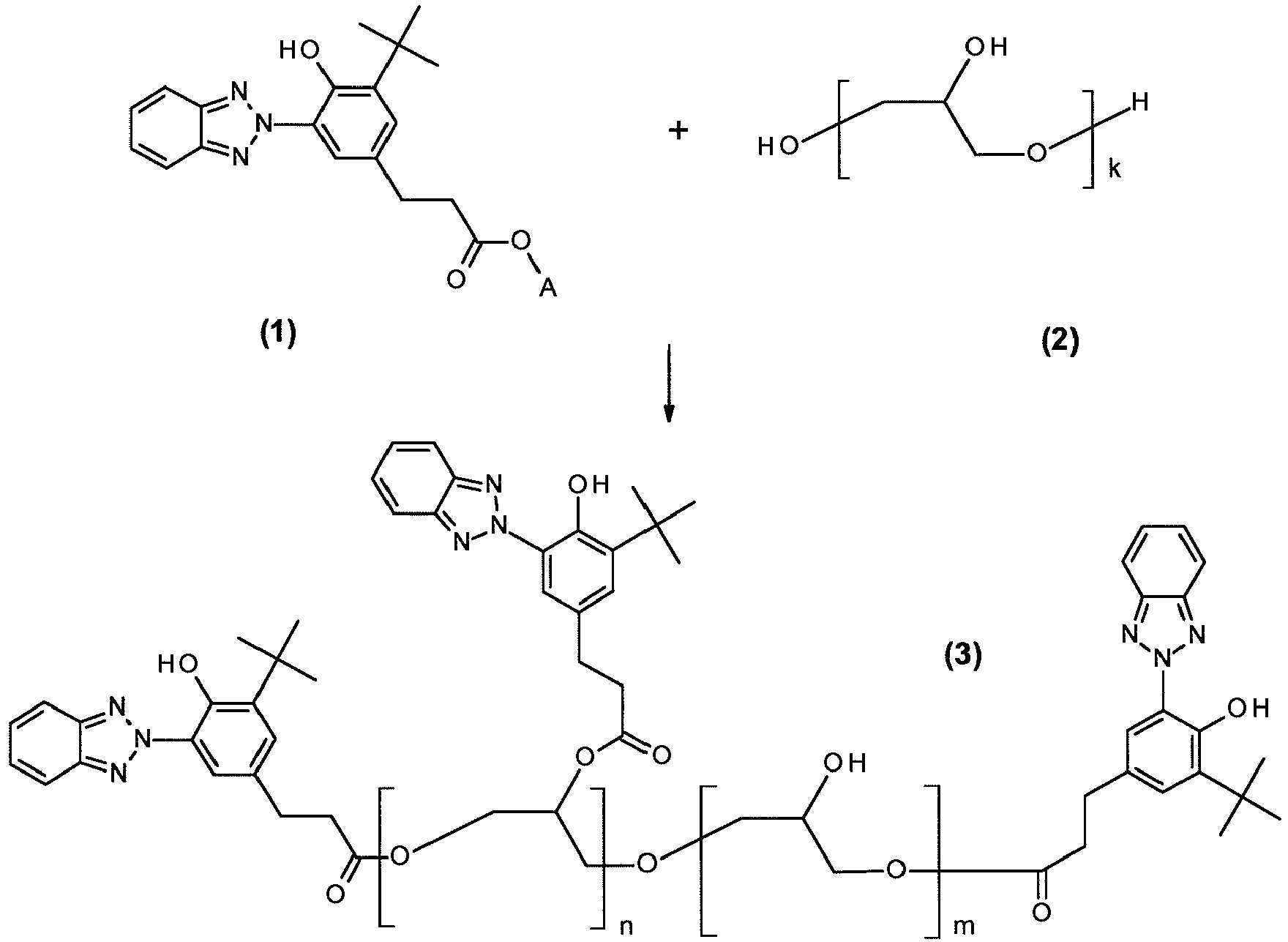
- the ultraviolet radiation absorbing polymer composition according to the present invention comprising the polymer compound of formula (3) is carried out in an esterification / transesterification including the steps of reacting a polyglycerol intermediate (2) with a benzotriazole UV-chromophore (1) comprising a complementary functional group A to form the polymer compound (3) according to the following reaction scheme: wherein
- the benzotriazole derivatives according to formula (1) represent the UV chromophore moiety of the present ultraviolet radiation absorbing composition.
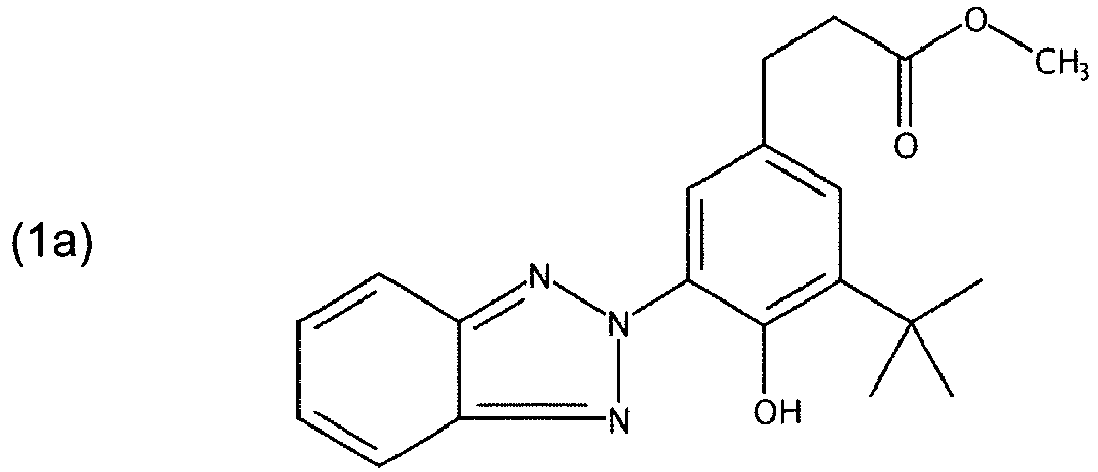
- Most preferred compounds are Benzenepropanoic acid, 3-(2H-benzotriazol-2-yl)-5-(1,1-dimethylethyl)-4-hydroxy-, methyl ester corresponding to formula (CAS Registry Number 84268-33-7); and Polyglycerol (CAS Registry Number 25618-55-7; 1, 2, 3- Propanetriol, homopolymer) corresponding to formula (2) is known as a versatile building block for sustainable cosmetic raw materials ( Wenk, H. H.; Meyer, J.; SOFW Journal, 2009, volume 135, issue 8, pages 25-30 ).
- Polyglycerol is an ether linked homopolymer of glycerol, which is available in different degrees of polymerization, where higher polymers are associated with increasing hydrophilicity and molecular weight. Although the idealized structure of polyglycerol - a 1,3-linked, linear polymer is rather simple, the reality is much more complex. Polyglycerols are mixtures of a number of structures, which are defined by oligomer distribution, degree of branching, and amount of cyclic structures. Even products with the same average molecular weight may differ significantly in their properties.
- the oligomerization of glycerol is a consecutive reaction, and complete conversion of glycerol favors formation of high molecular-weight glycerol oligo- and polymers.
- polyglycerol can be sketched as (2a) HOCH 2 -CHOH-CH 2 -O-[CH 2 -CHOH-CH 2 -O] n -CH 2 -CHOH-CH 2 OH.
- Beside linear polyglycerol cyclic oligomers can be formed by further condensation (Diglycerin und hoehere Oligomere des Glycerins als Synthesebausteine, Jakobson, G., Fette, Seifen Anstrichstoff, 1986, volume 88, pages 101-106 ).
- the hydroxyl number of polyglycerol decreases (diglycerol comprises 4, triglycerol 5, tetraglycerol 6 etc. hydroxy groups).
- the glycerol-based composition is fractionated to produce the desired distribution of glycerol polymers and a desired hydroxyl value.
- Preferred catalysts for the preparation of polyglycerin are K 2 CO 3 , Li 2 CO 3 , Na 2 CO 3 , KOH, NaOH, CH 3 ONa, Ca(OH) 2 , LiOH, MgCO 3 , MgO, CaO, CaCO 3 , ZnO, CsOH, Cs 2 CO 3 , NaHCO 3 , CsHCO 3 , SrO and BaO.
- the reaction is preferably carried out between 230 and 260°C.
- the ultraviolet radiation absorbing polymer composition according to the present invention is composed of a complex combination of different molecules (complex reaction product).
- formula (3a) representing a polymeric UV absorber according to the present invention based on a polyglycerol backbone containing 5 glycerol units (examples without limitation): (3a)
- the glycerol backbone typically consists mainly of 3 to 10 glycerol units, whereby the hydroxyl groups of the glycerol backbone are covalently linked to the benzotriazole UV chromophore. It might be reasonably assumed that primary hydroxyl groups (terminal units) react faster than secondary hydroxyl groups, which are less reactive for derivatization. Therefore, some secondary hydroxyl groups remain unreacted.
- the glycerol backbone consists of primarily linear and unbranched structure units. Branched isomers and higher molecular fractions including more than 10 glycerol units can be present. Minor components e.g. Benzotriazole conjugates of cyclic glycerol oligomers (examples without limitation):
- the polymer composition comprising the compound of formula (3) is characterized as follows:
- the water or alcohol which is formed during the reaction is removed by distillation during the esterification / transesterification reaction.
- esterification / transesterification is carried out at a temperature of 160-270°C, more preferably at a temperature of 190-260°C.
- esterification/transesterification is carried out without any additional solvent.
- esterification/transesterification is carried out without additional esterification/transesterification catalysts.
- esterification/transesterification is carried out under intermittent or constant vacuum of less than 250 mbar, more preferably of less than 100 mbar.
- esterification / transesterification is carried out at a temperature of 190-260 °C for at least 26h.
- the polyglycerol contains less than 5% of glycerol or linear and cyclic diglycerols.
- the hydroxyl value of polyglycerol is in the range between 700 and 1100, more preferably between 750 and 900.
- the UV chromophore is benzenepropanoic acid, 3-(2H-benzotriazol-2-yl)-5-(1, 1-dimethylethyl)-4-hydroxy- corresponding to formula (1b).
- the UV chromophore is Benzenepropanoic acid, 3-(2H-benzotriazol-2-yl)-5-(1,1-dimethylethyl)-4-hydroxy-methyl ester corresponding to formula (1a).
- the final reaction product is used without further purification.
- the ultraviolet radiation absorbing polymer composition comprising the polymer compound of formula (3) may be obtained in an esterification / transesterification reaction which method comprises the steps of reacting a polyglycerol intermediate (2) with a benzotriazole UV-chromophore (1) comprising a complementary functional group A to form the polymer compound (3) according to the following reaction scheme: wherein
- Ultraviolet radiation absorbing polymer compositions comprising the polymer compound of formula (3) according to the present invention are especially useful as sunscreen actives for the protection of organic materials that are sensitive to ultraviolet light, especially human and animal skin and hair, against the action of UV radiation. Such UV filters are therefore suitable as light-protective agents in cosmetic and pharmaceutical applications.
- the present invention therefore relates to a cosmetic composition
- a cosmetic composition comprising the ultraviolet absorbing polymer composition comprising the polymer compound of formula (3).
- a typical cosmetic or pharmaceutical composition according to the present invention comprises from 0.1 to 50 % by weight, preferably from 0.5 to 20 % by weight, based on the total weight of the composition, of the ultraviolet radiation absorbing polymer composition comprising the polymer compound of formula (3) according to the present invention and a cosmetically tolerable adjuvant.
- the cosmetic composition according to the present invention can be prepared by physically mixing the ultraviolet radiation absorbing polymer composition with the adjuvant using customary methods, for example by simply stirring together the individual components, especially by making use of the dissolution properties of already known cosmetic UV absorbers, for example Ethylhexyl Methoxycinnamate.
- the UV absorbers can be used, for example, without further treatment.
- the cosmetic composition according to the present invention can be used as a radical scavenger by reducing significantly the number of UV- induced free radicals in skin when applied in a suitable cosmetic carrier.
- the cosmetic composition may comprise, in addition to the ultraviolet radiation absorbing polymer composition according to the present invention, one or more further UV protective agents.
- the present invention relates to a cosmetic composition comprising a UV filter combination of
- Tinosorb S Bis-Ethylhexyloxyphenol Methoxyphenyl Triazine encapsulated in a polymer matrix (b 20 ) is described in IP.com Journal (2009), 9(1 B), 17 (Tinosorb S Aqua, BASF).
- UV filters Methylene Bis-Benzotriazolyl Tetramethylbutylphenol, (b 14 ) Tris-Biphenyl Triazine and (b 15 ) (2- ⁇ 4-[2-(4-Diethylamino-2-hydroxy-benzoyl)-benzoyl]-piperazine-1-carbonyl ⁇ -phenyl)-(4-diethylamino-2-hydroxy-phenyl)-methanone are present in the cosmetic or pharmaceutical composition in their micronized state.
- Benzylidene malonates (b 17 ) preferably correspond to formula wherein
- Benzylidene malonates (b 17 ) and their use as UV filter in sunscreens are disclosed in detail in WO2010/136360 and WO2011/003774 .
- the cosmetic composition according to the present invention may comprise, in addition to the UV absorber combination according to the invention, one or more further UV protective agents of the following substance classes:
- Table 3 Suitable UV filter substances and adjuvants which can be additionally used with the UV absorber Phenylene Bis-Diphenyltriazine according to the present invention Chemical Name CAS No.
- Helioguard 365 from Milbelle AG, isolated mycosporine like amino acids from the red alga porphyra umbilicalis (INCl: Porphyra Umbilicalis) that are encapsulated into liposomes) alpha-lipoic-acid as described in DE 10229995 synthetic organic polymers as described in EP 1 371 358 , [0033]-[0041] phyllosilicates as described in EP 1371357 [0034]-[0037] silica compounds as described in EP1371356 , [0033]-[0041] inorganic particles as described in DE10138496 [0043]-[0055] latex particles as described in DE10138496 [0027]-[0040] 1H-Benzimidazole-4,6-disulfonic acid, 2,2'-(1,4-phenylene)bis-, disodium salt; Bisimidazylate (Neo Heliopan APC) 180898-37-7 Di-2-ethy
- compositions according to the present invention represent water- and oil-containing emulsions (e.g. W/O, O/W, O/W/O and W/O/W emulsions or microemulsions) they contain, for example, from 0.1 to 30 % by weight, preferably from 0.1 to 15 % by weight and especially from 0.5 to 10 % by weight, based on the total weight of the composition, of the ultraviolet radiation absorbing polymer compound of formula (3), from 1 to 60 % by weight, especially from 5 to 50 % by weight and preferably from 10 to 35 % by weight, based on the total weight of the composition, of at least one oil component, from 0 to 30 % by weight, especially from 1 to 30 % by weight and preferably from 4 to 20 % by weight, based on the total weight of the composition, of at least one emulsifier, from 10 to 90 % by weight, especially from 30 to 90 % by weight, based on the total weight of the composition, of water, and from 0 to 88
- Suitable oil components of oil-containing compositions are for example Guerbet alcohols based on fatty alcohols having from 6 to 18, preferably from 8 to 10, carbon atoms, esters of linear C 6 -C 24 fatty acids with linear C 3 -C 24 alcohols, esters of branched C 6 -C 13 carboxylic acids with linear C 6 -C 24 fatty alcohols, esters of linear C 6 -C 24 fatty acids with branched alcohols, especially 2-ethylhexanol, esters of hydroxycarboxylic acids with linear or branched C 6 -C 22 fatty alcohols, especially dioctyl malates, esters of linear and/or branched fatty acids with polyhydric alcohols (for example propylene glycol, dimer diol or trimer triol) and/or Guerbet alcohols, trigly
- Finsolv® TN linear or branched, symmetric or asymmetric dialkyl ethers having a total of from 12 to 36 carbon atoms, especially from 12 to 24 carbon atoms, for example din-octyl ether, di-n-decyl ether, di-n-nonyl ether, di-n-undecyl ether, di-n-dodecyl ether, n-hexyl n-octyl ether, n-octyl n-decyl ether, n-decyl n-undecyl ether, n-undecyl n-dodecyl ether, n-hexyl n-undecyl ether, di-tert-butyl ether, diisopentyl ether, di-3-ethyldecyl ether, tert-butyl n-octyl ether, isopenty
- That group of substances comprises the esterification products of fatty acids having from 8 to 24 carbon atoms, for example caproic acid, caprylic acid, 2-ethylhexanoic acid, capric acid, lauric acid, isotridecanoic acid, myristic acid, palmitic acid, palmitoleic acid, stearic acid, isostearic acid, oleic acid, elaidic acid, petroselinic acid, linoleic acid, linolenic acid, elaeostearic acid, arachidic acid, gadoleic acid, behenic acid and erucic acid and technical-grade mixtures thereof (obtained, for example, in the pressure removal of natural fats and oils, in the reduction of aldehydes from Roelen's oxosynthesis or in the dimerisation of unsaturated fatty acids) with alcohols, for example iso
- isopropyl myristate isononanoic acid C 16 -C 18 alkyl esters
- stearic acid 2-ethylhexyl ester cetyl oleate
- glycerol tricaprylate coconut fatty alcohol caprinate/caprylate
- n-butyl stearate isopropyl myristate, isononanoic acid C 16 -C 18 alkyl esters, stearic acid 2-ethylhexyl ester, cetyl oleate, glycerol tricaprylate, coconut fatty alcohol caprinate/caprylate and n-butyl stearate.
- dicarboxylic acid esters such as di-n-butyl adipate, di(2-ethylhexyl) adipate, di(2-ethylhexyl) succinate and diisotridecyl acetate
- diol esters such as ethylene glycol dioleate, ethylene glycol diisotridecanoate, propylene glycol di(2-ethylhexanoate), propylene glycol diisostearate, propylene glycol dipelargonate, butanediol diisostearate and neopentyl glycol dicaprylate.
- Preferred mono- or poly-ols are ethanol, isopropanol, propylene glycol, hexylene glycol, glycerol and sorbitol. It is also possible to use di- and/or trivalent metal salts (alkaline earth metal, Al 3+ inter alia ) of one or more alkyl carboxylic acids.
- the oil components can be used in an amount of, for example, from 1 to 60 % by weight, especially from 5 to 50 % by weight and preferably from 10 to 35 % by weight, based on the total weight of the composition.
- Any conventionally emulsifier can be used for the cosmetic composition according to the present invention.
- Suitable emulsifiers are for example, non-ionic surfactants from the following groups:
- the addition products of ethylene oxide and/or of propylene oxide with fatty alcohols, fatty acids, alkylphenols, glycerol mono- and di-esters and also sorbitan mono- and di-esters of fatty acids, or with castor oil, are known, commercially available products. They are usually homologue mixtures, the average degree of alkoxylation of which corresponds to the ratio of the amounts of ethylene oxide and/or propylene oxide and substrate with which the addition reaction is carried out.
- C 12 -C 18 fatty acid mono- and di-esters of addition products of ethylene oxide with glycerol are known, for example, from DE-A-2 024 051 as fat-restoring substances for cosmetic preparations.
- C 8 -C 18 Alkyl-mono- and -oligo-glycosides their preparation and their use are known from the prior art. They are prepared especially by reacting glucose or oligosaccharides with primary alcohols having from 8 to 18 carbon atoms.
- Suitable glycoside radicals include monoglycosides in which a cyclic sugar radical is glycosidically bonded to the fatty alcohol and also oligomeric glycosides having a degree of oligomerisation of up to preferably about 8. The degree of oligomerisation is a statistical average value based on a homologue distribution customary for such technical-grade products.
- zwitterionic surfactants denotes especially surface-active compounds that carry at least one quaternary ammonium group and at least one carboxylate and/or sulfonate group in the molecule.
- Zwitterionic surfactants that are especially suitable are the so-called betaines, such as N-alkyl-N,N-dimethylammonium glycinates, for example cocoalkyl-dimethylammonium glycinate, N-acylaminopropyl-N,N-dimethylammonium glycinates, for example cocoacylaminopropyldimethylammonium glycinate, and 2-alkyl-3-carboxymethyl-3-hydroxyethylimidazolines each having from 8 to 18 carbon atoms in the alkyl or acyl group and also cocoacylaminoethylhydroxyethylcarboxymethylglycinate.
- betaines such as N-alkyl-N,N-dimethylammonium glycinates, for example cocoalkyl-dimethylammonium glycinate, N-acylaminopropyl-N,N-dimethylammonium glycinates, for example
- ampholytic surfactants are to be understood as meaning especially those which, in addition to containing a C 8 -C 18 -alkyl or -acyl group, contain at least one free amino group and at least one -COOH or -SO 3 H group in the molecule and are capable of forming internal salts.
- ampholytic surfactants include N-alkylglycines, N-alkylpropionic acids, N-alkylaminobutyric acids, N-alkyliminodipropionic acids, N-hydroxyethyl-N-alkylamidopropylglycines, N-alkyltaurines, N-alkylsarcosines, 2-alkylaminopropionic acids and alkylaminoacetic acids, each having approximately from 8 to 18 carbon atoms in the alkyl group.
- Ampholytic surfactants to which special preference is given are N-cocoalkylaminopropionate, cocoacylaminoethylaminopropionate and C 12 -C 18 acylsarcosine.
- ampholytic emulsifiers there also come into consideration quaternary emulsifiers, special preference is given to those of the esterquat type, preferably methyl-quaternised di-fatty acid triethanolamine ester salts.
- Non-ionic emulsifiers are preferred, preferably ethoxylated fatty alcohols having from 8 to 22 carbon atoms and from 4 to 30 EO units.
- the emulsifiers may be used in an amount of, for example, from 1 to 30 % by weight, especially from 4 to 20 % by weight and preferably from 5 to 10 % by weight, based on the total weight of the composition. It is, however, also possible in principle to dispense with the use of emulsifiers.
- compositions according to the invention may in addition contain, as further adjuvants and additives, mild surfactants, super-fatting agents, pearlescent waxes, consistency regulators, thickeners, polymers, silicone compounds, fats, waxes, stabilisers, biogenic active ingredients, deodorising active ingredients, anti-dandruff agents, film formers, swelling agents, antioxidants, hydrotropic agents, preservatives, insect repellents, self-tanning agents, solubilizers, perfume oils, colorants, bacteria-inhibiting agents and the like.
- mild surfactants super-fatting agents
- pearlescent waxes consistency regulators, thickeners, polymers, silicone compounds, fats, waxes, stabilisers, biogenic active ingredients, deodorising active ingredients, anti-dandruff agents, film formers, swelling agents, antioxidants, hydrotropic agents, preservatives, insect repellents, self-tanning agents, solubilizers, perfume oils, colorants, bacteria-inhibiting agents and the like.
- Substances suitable for use as super-fatting agents are, for example, lanolin and lecithin and also polyethoxylated or acrylated lanolin and lecithin derivatives, polyol fatty acid esters, monoglycerides and fatty acid alkanolamides, the latter simultaneously acting as foam stabilisers.
- Suitable mild surfactants include fatty alcohol polyglycol ether sulfates, monoglyceride sulfates, mono- and/or di-alkyl sulfosuccinates, fatty acid isethionates, fatty acid sarcosinates, fatty acid taurides, fatty acid glutamates, ⁇ -olefin sulfonates, ether carboxylic acids, alkyl oligoglucosides, fatty acid glucamides, alkylamidobetaines and/or protein fatty acid condensation products, the latter preferably being based on wheat proteins.
- Suitable pearlescent are for example: alkylene glycol esters, especially ethylene glycol distearate; fatty acid alkanolamides, especially coco fatty acid diethanolamide; partial glycerides, especially stearic acid monoglyceride; esters of polyvalent, unsubstituted or hydroxy-substituted carboxylic acids with fatty alcohols having from 6 to 22 carbon atoms, especially long-chained esters of tartaric acid; fatty substances, for example fatty alcohols, fatty ketones, fatty aldehydes, fatty ethers and fatty carbonates, which in total have at least 24 carbon atoms, especially laurone and distearyl ether; fatty acids, such as stearic acid, hydroxystearic acid or behenic acid, ring-opening products of olefin epoxides having from 12 to 22 carbon atoms with fatty alcohols having from 12 to 22 carbon atoms and/or polyols having from 2 to 15
- Suitable consistency regulators are especially fatty alcohols or hydroxy fatty alcohols having from 12 to 22 carbon atoms and preferably from 16 to 18 carbon atoms, and in addition partial glycerides, fatty acids and hydroxy fatty acids. Preference is given to a combination of such substances with alkyl-oligoglucosides and/or fatty acid N-methylglucamides of identical chain length and/or polyglycerol poly-12-hydroxystearates.
- Suitable thickeners include, for example, Aerosil types (hydrophilic silicic acids), polysaccharides, especially xanthan gum, guar-guar, agar-agar, alginates and Tyloses, carboxymethyl cellulose and hydroxymethyl cellulose, also relatively high molecular weight polyethylene glycol mono- and di-esters of fatty acids, polyacrylates (e.g.
- surfactants for example ethoxylated fatty acid glycerides, esters of fatty acids with polyols, for example pentaerythritol or trimethylolpropane, fatty alcohol ethoxylates with restricted homologue distribution and alkyl-oligoglucosides as well as electrolytes, such as sodium chloride or ammonium chloride.
- Suitable cationic polymers are, for example, cationic cellulose derivatives, for example a quarternised hydroxymethyl cellulose obtainable under the name Polymer JR 400® from Amerchol, cationic starch, copolymers of diallylammonium salts and acrylamides, quaternised vinylpyrrolidone/vinyl imidazole polymers, for example Luviquat® (BASF), condensation products of polyglycols and amines, quaternised collagen polypeptides, for example lauryldimonium hydroxypropyl hydrolyzed collagen (Lamequat®L/Grünau), quaternised wheat polypeptides, polyethyleneimine, cationic silicone polymers, for example amidomethicones, copolymers of adipic acid and dimethylaminohydroxypropyldiethylenetriamine (Cartaretin®/Sandoz), copolymers of acrylic acid with dimethyldiallylammonium chloride (Merquat® 550
- Suitable anionic, zwitterionic, amphoteric and non-ionic polymers are for example, vinyl acetate/crotonic acid copolymers, vinylpyrrolidone/vinyl acrylate copolymers, vinyl acetate/butyl maleate/isobornyl acrylate copolymers, methyl vinyl ether/maleic anhydride copolymers and esters thereof, uncrosslinked polyacrylic acids and polyacrylic acids crosslinked with polyols, acrylamidopropyltrimethylammonium chloride/- acrylate copolymers, octyl acrylamide/methyl methacrylate/tert-butylaminoethyl methacrylate/2-hydroxypropyl methacrylate copolymers, polyvinylpyrrolidone, vinylpyrrolidone/vinyl acetate copolymers, vinylpyrrolidone/dimethylaminoethyl methacrylate/vinyl caprolactam terpol
- Suitable silicone compounds are, for example, dimethylpolysiloxanes, methylphenylpolysiloxanes, cyclic silicones, and also amino-, fatty acid-, alcohol-, polyether-, epoxy-, fluorine-, glycoside- and/or alkyl-modified silicone compounds, which at room temperature may be in either liquid or resinous form.
- simethicones which are mixtures of dimethicones having an average chain length of from 200 to 300 dimethylsiloxane units with hydrogenated silicates.
- Typical examples of fats are glycerides, and as waxes there come into consideration, inter alia, beeswax, carnauba wax, candelilla wax, montan wax, paraffin wax, hydrogenated castor oils and fatty acid esters or microwaxes solid at room temperature optionally in combination with hydrophilic waxes, e.g. cetylstearyl alcohol or partial glycerides.
- hydrophilic waxes e.g. cetylstearyl alcohol or partial glycerides.
- Metal salts of fatty acids for example magnesium, aluminium and/or zinc stearate or ricinoleate, may be used as stabilizers.
- Biogenic active ingredients are for example, tocopherol, tocopherol acetate, tocopherol palmitate, ascorbic acid, deoxyribonucleic acid, retinol, bisabolol, allantoin, phytantriol, panthenol, AHA acids, amino acids, ceramides, pseudoceramides, essential oils, plant extracts and vitamin complexes.
- Suitable deodorizing active ingredients are for example, antiperspirants like aluminium chlorohydrates (see J. Soc. Cosm. Chem. 24, 281 (1973 )). Aluminium chlorohydrate corresponding to formula Al 2 (OH) 5 Cl x 2.5 H 2 O, known and commercially available under the trade mark Locron® of Hoechst AG, Frankfurt (FRG), is especially preferred (see J. Pharm. Pharmacol. 26, 531 (1975 )). Beside the chlorohydrates, it is also possible to use aluminium hydroxy-acetates and acidic aluminium/zirconium salts. Esterase inhibitors may be added as further deodorising active ingredients.
- Such inhibitors are preferably trialkyl citrates, such as trimethyl citrate, tripropyl citrate, triisopropyl citrate, tributyl citrate and especially triethyl citrate (Hydagen® CAT, Henkel KGaA, Düsseldorf/FRG), which inhibit enzyme activity and hence reduce odour formation.
- trialkyl citrates such as trimethyl citrate, tripropyl citrate, triisopropyl citrate, tributyl citrate and especially triethyl citrate (Hydagen® CAT, Henkel KGaA, Düsseldorf/FRG), which inhibit enzyme activity and hence reduce odour formation.
- esterase inhibitors are sterol sulfates or phosphates, for example lanosterol, cholesterol, campesterol, stigmasterol and sitosterol sulfate or phosphate, dicarboxylic acids and esters thereof, for example glutaric acid, glutaric acid monoethyl ester, glutaric acid diethyl ester, adipic acid, adipic acid monoethyl ester, adipic acid diethyl ester, malonic acid and malonic acid diethyl ester and hydroxycarboxylic acids and esters thereof, for example citric acid, malic acid, tartaric acid or tartaric acid diethyl ester.
- dicarboxylic acids and esters thereof for example glutaric acid, glutaric acid monoethyl ester, glutaric acid diethyl ester, adipic acid, adipic acid monoethyl ester, adipic acid diethyl ester, malonic acid and malonic
- Antibacterial active ingredients that influence the microbial flora and kill, or inhibit the growth of, sweat-decomposing bacteria can likewise be present in the preparations (especially in stick preparations). Examples include chitosan, phenoxyethanol and chlorhexidine gluconate. 5-Chloro-2-(2,4-dichlorophenoxy)-phenol (Irgasan®, BASF has also proved especially effective.
- Suitable anti-dandruff agents are for example, climbazole, octopirox and zinc pyrithione.
- Customary film formers include, for example, chitosan, microcrystalline chitosan, quaternised chitosan, polyvinylpyrrolidone, vinylpyrrolidone/vinyl acetate copolymers, polymers of quaternary cellulose derivatives containing a high proportion of acrylic acid, collagen, hyaluronic acid and salts thereof and similar compounds.
- Suitable swelling agents for aqueous phases are montmorillonites, clay mineral substances, Pemulen and also alkyl-modified types of Carbopol (Goodrich). Further suitable polymers and swelling agents can be found in the review by R. Lochhead in Cosm. Toil. 108, 95 (1993 ).
- antioxidants are amino acids (e.g. glycine, histidine, tyrosine, tryptophan) and derivatives thereof, imidazoles (e.g. urocanic acid) and derivatives thereof, peptides, such as D,L-carnosine, D-carnosine, L-carnosine and derivatives thereof (e.g. anserine), carotinoids, carotenes (e.g.
- ⁇ -carotene, ⁇ -carotene, lycopene) and derivatives thereof chlorogenic acid and derivatives thereof, lipoic acid and derivatives thereof (e.g. dihydrolipoic acid), aurothioglycose, propylthiouracil and other thiols (e.g.
- thioredoxin glutathione, cysteine, cystine, cystamine and the glycosyl, N-acetyl, methyl, ethyl, propyl, amyl, butyl, lauryl, palmitoyl, oleyl, ⁇ -linoleyl, cholesteryl and glyceryl esters thereof) and also salts thereof, dilauryl thiodipropionate, distearyl thiodipropionate, thiodipropionic acid and derivatives thereof (esters, ethers, peptides, lipids, nucleotides, nucleosides and salts) and also sulfoximine compounds (e.g.
- buthionine sulfoximines homocysteine sulfoximine, buthionine sulfones, penta-, hexa-, hepta-thionine sulfoximine
- very small tolerable amounts e.g. from pmol to ⁇ mol/kg
- metal chelating agents e.g. ⁇ -hydroxy fatty acids, palmitic acid, phytic acid, lactoferrin
- ⁇ -hydroxy acids e.g.
- citric acid citric acid, lactic acid, malic acid
- humic acid bile acid, bile extracts, bilirubin, biliverdin, EDTA, EGTA and derivatives thereof
- unsaturated fatty acids and derivatives thereof e.g. ⁇ -linolenic acid, linoleic acid, oleic acid
- folic acid and derivatives thereof ubiquinone and ubiquinol and derivatives thereof
- vitamin C and derivatives e.g. ascorbyl palmitate, magnesium ascorbyl phosphate, ascorbyl acetate
- tocopherols and derivatives e.g. vitamin E acetate
- vitamin A and derivatives e.g.
- vitamin A palmitate and also coniferyl benzoate of benzoin resin, rutinic acid and derivatives thereof, ⁇ -glycosylrutin, ferulic acid, furfurylidene glucitol, carnosine, butyl hydroxytoluene, butyl hydroxyanisole, resinous nordihydroguaiaretic acid, nordihydroguaiaretic acid, trihydroxybutyrophenone, uric acid and derivatives thereof, mannose and derivatives thereof, superoxide dismutase, N-[3-(3,5-di-tert-butyl-4-hydroxyphenyl)propionyl]sulfanilic acid (and salts thereof, for example the sodium salts), zinc and derivatives thereof (e.g.
- ZnO, ZnSO 4 selenium and derivatives thereof (e.g. selenium methionine), stilbene and derivatives thereof (e.g. stilbene oxide, trans-stilbene oxide) and the derivatives suitable according to the invention (salts, esters, ethers, sugars, nucleotides, nucleosides, peptides and lipids) of those mentioned active ingredients.
- HALS "Hindered Amine Light Stabilizers" compounds may also be mentioned.
- the amount of antioxidants present is usually from 0.001 to 30 % by weight, preferably from 0.01 to 3 % by weight, based on the weight of the cosmetic composition according to the present invention.
- hydrotropic agents for example ethanol, isopropyl alcohol or polyols.
- Suitable polyols for that purpose comprise preferably from 2 to 15 carbon atoms and at least two hydroxy groups.
- the polyols may also contain further functional groups, especially amino groups, and/or may be modified with nitrogen. Typical examples are as follows:
- Suitable preservatives include, for example, phenoxyethanol, formaldehyde solution, Parabens, pentanediol or sorbic acid and the further substance classes listed in Schedule 6, Parts A and B of the Cosmetics Regulations.
- Suitable perfume oils are mixtures of natural and/or synthetic aromatic substances.
- Representatives of natural aromatic substances are, for example, extracts from blossom (lilies, lavender, roses, jasmine, neroli, ylang-ylang), from stems and leaves (geranium, patchouli, petitgrain), from fruit (aniseed, coriander, carraway, juniper), from fruit peel (bergamot, lemons, oranges), from roots (mace, angelica, celery, cardamom, costus, iris, calmus), from wood (pinewood, sandalwood, guaiacum wood, cedarwood, rosewood), from herbs and grasses (tarragon, lemon grass, sage, thyme), from needles and twigs (spruce, pine, Scots pine, mountain pine), from resins and balsams (galbanum, elemi, benzoin, myrrh, olibanum, opoponax).
- Animal raw materials also come into
- Aromatic substance compounds of the ester type are, for example, benzyl acetate, phenoxy-ethyl isobutyrate, p-tert-butylcyclohexyl acetate, linalyl acetate, dimethyl-benzylcarbinyl acetate, phenylethyl acetate, linalyl benzoate, benzyl formate, ethylmethylphenyl glycinate, allylcyclohexyl propionate, styrallyl propionate and benzyl salicylate.
- the ethers include, for example, benzyl ethyl ether;
- the aldehydes include, for example, the linear alkanals having from 8 to 18 hydrocarbon atoms, citral, citronellal, citronellyl oxyacetaldehyde, cyclamen aldehyde, hydroxycitronellal, lilial and bourgeonal;
- the ketones include, for example, the ionones, ⁇ -isomethylionone and methyl cedryl ketone;
- the alcohols include, for example, anethol, citronellol, eugenol, isoeugenol, geraniol, linalool, phenyl ethyl alcohol and terpinol; and
- the hydrocarbons include mainly the terpenes and balsams.
- Ethereal oils of relatively low volatility which are chiefly used as aroma components, are also suitable as perfume oils, e.g. sage oil, camomile oil, clove oil, melissa oil, oil of cinnamon leaves, lime blossom oil, juniper berry oil, vetiver oil, olibanum oil, galbanum oil, labolanum oil and lavandin oil.
- bacteria-inhibiting agents are preservatives that have a specific action against gram-positive bacteria, such as 2,4,4'-trichloro-2'-hydroxydiphenyl ether, chlorhexidine (1,6-di(4-chlorophenyl-biguanido)hexane) or TCC (3,4,4'-trichlorocarbanilide).
- a large number of aromatic substances and ethereal oils also have antimicrobial properties. Typical examples are the active ingredients eugenol, menthol and thymol in clove oil, mint oil and thyme oil.
- a natural deodorizing agent of interest is the terpene alcohol farnesol (3,7,11-trimethyl-2,6,10-dodecatrien-1-ol), which is present in lime blossom oil. Glycerol monolaurate has also proved to be a bacteriostatic agent.
- the amount of the additional bacteria-inhibiting agents present is usually from 0.1 to 2 % by weight, based on the solids content of the cosmetic composition according to the present invention.
- the cosmetic compositions according to the present invention may furthermore contain as adjuvants anti-foams, such as silicones, structurants, such as maleic acid, solubilizers, such as ethylene glycol, propylene glycol, glycerol or diethylene glycol, opacifiers, such as latex, styrene/PVP or styrene/acrylamide copolymers, complexing agents, such as EDTA, NTA, ⁇ -alaninediacetic acid or phosphonic acids, propellants, such as propane/butane mixtures, N 2 O, dimethyl ether, CO 2 , N 2 or air, so-called coupler and developer components as oxidation dye precursors, thioglycolic acid and derivatives thereof, thiolactic acid, cysteamine, thiomalic acid or ⁇ -mercaptoethanesulfonic acid as reducing agents or hydrogen peroxide, potassium bromate or sodium bromate as oxidizing agents.
- Insect repellents are for example, N,N-diethyl-m-toluamide, 1,2-pentanediol or insect repellent 3535.
- Suitable self-tanning agents are dihydroxyacetone, erythrulose or mixtures of dihydroxyacetone and erythrulose.
- Cosmetic formulations according to the invention are contained in a wide variety of cosmetic preparations, especially the following preparations:
- the final formulations may exist in a wide variety of presentation forms, for example:
- Important cosmetic compositions for the skin are light-protective preparations, such as sun milks, lotions, creams, oils, sunblocks or tropicals, pretanning preparations or after-sun preparations, also skin-tanning preparations, for example self-tanning creams.
- light-protective preparations such as sun milks, lotions, creams, oils, sunblocks or tropicals
- pretanning preparations or after-sun preparations also skin-tanning preparations, for example self-tanning creams.
- sun protection creams, sun protection lotions, sun protection oils, sun protection milks and sun protection preparations in the form of a spray are particularly interested.
- compositions for the hair are the above-mentioned preparations for hair treatment, especially hair-washing preparations in the form of shampoos, hair conditioners, hair-care preparations, e.g. pretreatment preparations, hair tonics, styling creams, styling gels, pomades, hair rinses, treatment packs, intensive hair treatments, hair-straightening preparations, liquid hair-setting preparations, hair foams and hairsprays.
- hair-washing preparations in the form of shampoos are special interest.
- a shampoo has, for example, the following composition:
- hair-cosmetic formulations may be used:
- Calibration The quantification is carried by means of a single point calibration. About 10mg of acid ester is weighted in a 100ml brown volumetric flask and filled up with tetrahydrofurane. The sample is dissolved in an ultrasonic bath for about 5 min and the solution is analyzed. This solution is diluted 1:10 with THF.
- 100 mg of the ultraviolet radiation absorbing composition is dissolved in 100 ml of a solvent mixture (70 parts THF / 30 parts 0.1 N NaOH) and 2-3 drops of water are added. The sample must be completely dissolved, otherwise a few drops of water have to be added. The mixture is heated at 50°C for 2 h in a drying cabinet. After cooling to room temperature, 1 ml of this solution is transferred to a 100 ml volumetric flask and filled up with THF. The content of 3-(2H-benzotriazol-2-yl)-5-(1,1-dimethylethyl)-4-hydroxy-benzenepropanoic acid is analyzed by HPLC.
- the amount of chromophore is calculated as w/w% of 3-(2H-benzotriazol-2-yl)-5-(1,1-dimethylethyl)-4-hydroxy-benzene-propanoic acid.
- the amount of covalentely bound chromophore is determined as follows:
- test solutions About 25 mg of sample is weighed with a precision balance into a 100.0 ml (Vs) volumetric flask. It is filled up to the mark with 1.4-dioxane. 10.0 ml (V) of this solution is diluted to 100.0 ml (Vf) with 1.4-dioxane. The absorbance of this solution is measured between 290 and 450 nm.
- T g glass transition temperature
- DSC 822e Differential Scanning Calorimeter
- MX5 Mettler Toledo
- the oven is nitrogen-purged.
- 3-7mg sample is charged with the micro scale into an aluminium crucible.
- the crucible is closed hermetically with an aluminium cover. Two crucibles are prepared per sample. The prepared crucible is put in the DSC equipment and the method is started as described below.
- First scan -30°C to 200°C, 10°C/min heating rate
- Second scan Cool to -30°C with -10°C/min cooling rate
- Third scan -30°C to 200°C, 10°C/min heating rate The third scan is used for the determination of the glass transition temperature. The mean of the glass transition temperature is calculated.
- ICP-AES Inductively Coupled Plasma Atomic Emission Spectrometry
- the sample preparation is done by pressurized wet digestion in PTFE vessels: About 200 mg of the sample is treated with 3ml HNO 3 at a temperature of about 150 °C for six hours and cooled down to room temperature. The obtained solution is diluted with deionized water to an end volume of 20 ml and directly measured by ICP-AES.
- the calibration is done by external standard method with commercially available elemental standard solutions.
- a typical apparatus a Varian Vista Pro ICP-AES or Agilent 5100 ICP-AES spectrometer can be used.
- Polyglycerol is prepared as described in WO 2002 036534 , US 2002 0058781 and US 6620904 .
- CaO or Ca(OH) 2 is used as catalyst.
- Glycerol, diglycerol and other low molecular fractions are removed from the reaction product e.g. by short path distillation in order to achieve a specific quality.
- polyglycerol yellow to brown material; very high viscosity at room temperature, hydroxyl-value 800-1000, water content ⁇ 0.2%, glycerol and diglycerols ⁇ 5.5% (determined by GC after derivatization with a silylating agent).
- Example A1 Transesterification product of 3-(2H-benzotriazol-2-yl)-5-(1,1-dimethylethyl)-4-hydroxy-benzenepropanoic acid with polyglycerol
- 3-(2H-benzotriazol-2-yl)-5-(1,1-dimethylethyl)-4-hydroxy-benzene-propanoic acid (605.8 g) is charged into a glass reactor equipped with nitrogen inlet, dephlegmator (120°C) and agitation. The temperature is set to 227°C in order to melt the 3-(2H-benzotriazol-2-yl)-5-(1,1-dimethylethyl)-4-hydroxy-benzene-propanoic acid.
- Example A2 Ultraviolet radiation absorbing composition: Transesterification product of 3-(2H-benzotriazol-2-yl)-5-(1,1-dimethylethyl)-4-hydroxy-benzenepropanoic acid methyl ester with polyglycerol
- 3-(2H-benzotriazol-2-yl)-5-(1,1-dimethylethyl)-4-hydroxy-benzene-propanoic acid methyl ester (630.9 g) is charged into a glass reactor equipped with nitrogen inlet, dephlegmator (120°C) and agitation. The temperature is set to 227°C in order to melt the 3-(2H-benzotriazol-2-yl)-5-(1,1-dimethylethyl)-4-hydroxy-benzene-propanoic acid methyl ester.
- Example A3 Ultraviolet radiation absorbing composition: Transesterification product of 3-(2H-benzotriazol-2-yl)-5-(1,1-dimethylethyl)-4-hydroxy-benzenepropanoic acid methyl ester with polyglycerol
- 3-(2H-benzotriazol-2-yl)-5-(1,1-dimethylethyl)-4-hydroxy-benzene-propanoic acid methyl ester (630.84g, 1.785mol) is charged into a glass reactor equipped with nitrogen inlet, dephlegmator (120°C) and agitation. The temperature is set to 197°C in order to melt the 3-(2H-benzotriazol-2-yl)-5-(1,1-dimethylethyl)-4-hydroxy-benzenepropanoic acid methyl ester.
- Example A4 Ultraviolet radiation absorbing composition: Transesterification product of 3-(2H-benzotriazol-2-yl)-5-(1,1-dimethylethyl)-4-hydroxy-benzenepropanoic acid methyl ester with polyglycerol
- a 100 ml glass flask is placed in an agitating heating block and polyglycerol (2.9 g) is transferred into the flask.
- 3-(2H-benzotriazol-2-yl)-5-(1,1-dimethylethyl)-4-hydroxybenzene-propanoic acid methyl ester (8.8 g, 25 mmol) and tin-(II)-2-ethylhexanoate (0.029 g, 0.072 mmol) is added.
- the mixture is melted and heated up to 195°C under a nitrogen flow. Thereafter the apparatus is slowly evacuated to a pressure of 5 mbar.
- the reaction mixture is stirred vigorously under vacuum at 195°C for approx.
- Example A5 Ultraviolet radiation absorbing composition: Transesterification product of 3-(2H-benzotriazol-2-yl)-5-(1,1-dimethylethyl)-4-hydroxy-benzenepropanoic acid methyl ester with polyglycerol
- 3-(2H-benzotriazol-2-yl)-5-(1,1-dimethylethyl)-4-hydroxy-benzene-propanoic acid methyl ester (1000.0 g) is charged into a glass reactor equipped with nitrogen inlet, dephlegmator (120°C) and agitation. The temperature is set to 191 °C in order to melt the 3-(2H-benzotriazol-2-yl)-5-(1,1-dimethylethyl)-4-hydroxy-benzene-propanoic acid methyl ester.
- Example A6 Ultraviolet radiation absorbing composition: Transesterification product of 3-(2H-benzotriazol-2-yl)-5-(1,1-dimethylethyl)-4-hydroxy-benzenepropanoic acid methyl ester with polyglycerol
- 3-(2H-benzotriazol-2-yl)-5-(1,1-dimethylethyl)-4-hydroxy-benzene-propanoic acid methyl ester (306.0 kg) is charged into a glass-lined steel reactor equipped with argon inlet, dephlegmator (120°C) and agitation. The temperature is set to 195°C in order to melt the 3-(2H-benzotriazol-2-yl)-5-(1,1-dimethylethyl)-4-hydroxy-benzene-propanoic acid methyl ester.
Landscapes
- Health & Medical Sciences (AREA)
- Life Sciences & Earth Sciences (AREA)
- Chemical & Material Sciences (AREA)
- Veterinary Medicine (AREA)
- Public Health (AREA)
- General Health & Medical Sciences (AREA)
- Animal Behavior & Ethology (AREA)
- Organic Chemistry (AREA)
- Epidemiology (AREA)
- Birds (AREA)
- Polymers & Plastics (AREA)
- Medicinal Chemistry (AREA)
- Chemical Kinetics & Catalysis (AREA)
- General Chemical & Material Sciences (AREA)
- Dermatology (AREA)
- Emergency Medicine (AREA)
- Cosmetics (AREA)
- Compositions Of Macromolecular Compounds (AREA)
- Addition Polymer Or Copolymer, Post-Treatments, Or Chemical Modifications (AREA)
- Polyethers (AREA)
- Silicon Polymers (AREA)
Abstract
Description
- This application claims priority of the benefits of
U.S. Provisional Application Serial No. 62/404,246 filed October 5, 2016 - The present invention relates to an ultraviolet radiation absorbing polymer composition comprising the polymer compound of formula
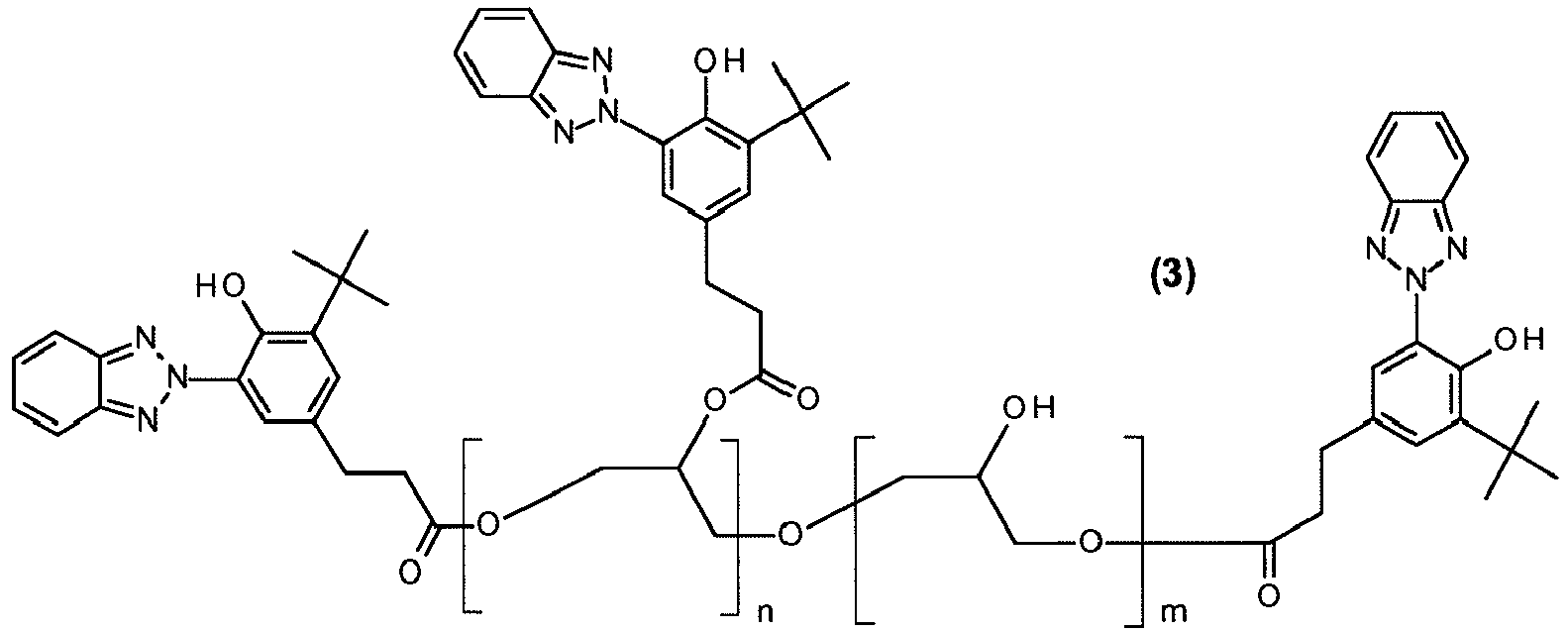
- The polymer compound of formula (3) represents a UV absorbing polyether that absorbs radiation in wavelengths between 290 and 400 nm. The UV absorbing polyether has a weight average molecular weight (M), which may be suitable for reducing or preventing the chromophore from absorbing through the skin. According to one embodiment, a suitable molecular weight for the UV absorbing polyether is M > 500. In one embodiment, M is in the range of about 500 to about 50,000. In another embodiment, the M is in the range of about 1,000 to about 20,000, such as from about 1,000 to about 10,000.
- The ultraviolet radiation absorbing polymer composition according to the present invention comprising the polymer compound of formula (3) is carried out in an esterification / transesterification including the steps of reacting a polyglycerol intermediate (2) with a benzotriazole UV-chromophore (1) comprising a complementary functional group A to form the polymer compound (3) according to the following reaction scheme:

- A
- is hydrogen; or C1-C8 alkyl; and
- k
- is a number from 1 to 20; and
- n and m,
- independently from each other, are a number from 0 to 20; wherein at least one of m and n is ≥ 1.
- The benzotriazole derivatives according to formula (1) represent the UV chromophore moiety of the present ultraviolet radiation absorbing composition.
- Most preferred compounds are Benzenepropanoic acid, 3-(2H-benzotriazol-2-yl)-5-(1,1-dimethylethyl)-4-hydroxy-, methyl ester corresponding to formula
Polyglycerol (CAS Registry Number 25618-55-7; 1, 2, 3- Propanetriol, homopolymer) corresponding to formula (2) is known as a versatile building block for sustainable cosmetic raw materials (Wenk, H. H.; Meyer, J.; SOFW Journal, 2009, volume 135, issue 8, pages 25-30). - Polyglycerol is an ether linked homopolymer of glycerol, which is available in different degrees of polymerization, where higher polymers are associated with increasing hydrophilicity and molecular weight. Although the idealized structure of polyglycerol - a 1,3-linked, linear polymer is rather simple, the reality is much more complex. Polyglycerols are mixtures of a number of structures, which are defined by oligomer distribution, degree of branching, and amount of cyclic structures. Even products with the same average molecular weight may differ significantly in their properties.
- The oligomerization of glycerol is a consecutive reaction, and complete conversion of glycerol favors formation of high molecular-weight glycerol oligo- and polymers.
- The general structural formula for polyglycerol can be sketched as
(2a) HOCH2-CHOH-CH2-O-[CH2-CHOH-CH2-O]n-CH2-CHOH-CH2OH.
wherein - n = 0 results in diglycerol,
- n = 1 in triglycerol, n = 2 in tetraglycerol etc., including branched isomers formed by reaction of secondary hydroxyls.
- Beside linear polyglycerol cyclic oligomers can be formed by further condensation (Diglycerin und hoehere Oligomere des Glycerins als Synthesebausteine, Jakobson, G., Fette, Seifen Anstrichmittel, 1986, volume 88, pages 101-106).
- With increase of molecular weight the hydroxyl number of polyglycerol decreases (diglycerol comprises 4, triglycerol 5, tetraglycerol 6 etc. hydroxy groups). In some embodiments, the glycerol-based composition is fractionated to produce the desired distribution of glycerol polymers and a desired hydroxyl value.
- Detailed synthesis procedures for the preparation of polyglycerol are described in
WO2011098315 ,WO2015122770 ,WO2002036534 ,US20020058781 ,US6620904 andWO2007092407 . - Preferred catalysts for the preparation of polyglycerin are K2CO3, Li2CO3, Na2CO3, KOH, NaOH, CH3ONa, Ca(OH)2, LiOH, MgCO3, MgO, CaO, CaCO3, ZnO, CsOH, Cs2CO3, NaHCO3, CsHCO3, SrO and BaO.
- The reaction is preferably carried out between 230 and 260°C.
- Benzenepropanoic acid, 3-(2H-benzotriazol-2-yl)-5-(1, 1-dimethylethyl)-4- hydroxy-corresponding to formula

- The ultraviolet radiation absorbing polymer composition according to the present invention is composed of a complex combination of different molecules (complex reaction product).
- This is further illustrated in formula (3a) representing a polymeric UV absorber according to the present invention based on a polyglycerol backbone containing 5 glycerol units (examples without limitation):
(3a) 
- The glycerol backbone typically consists mainly of 3 to 10 glycerol units, whereby the hydroxyl groups of the glycerol backbone are covalently linked to the benzotriazole UV chromophore. It might be reasonably assumed that primary hydroxyl groups (terminal units) react faster than secondary hydroxyl groups, which are less reactive for derivatization. Therefore, some secondary hydroxyl groups remain unreacted. The glycerol backbone consists of primarily linear and unbranched structure units. Branched isomers and higher molecular fractions including more than 10 glycerol units can be present.
Minor components e.g. Benzotriazole conjugates of cyclic glycerol oligomers (examples without limitation):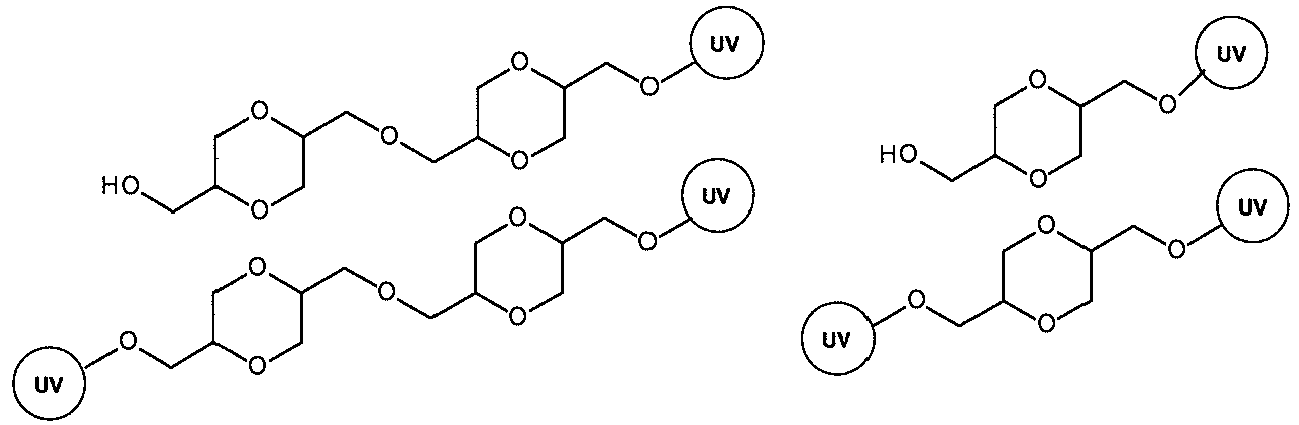


- The polymer composition comprising the compound of formula (3) is characterized as follows:
- MW distribution:
- Mn >500 Da, Mw > 1200 Da (GPC ,calibrated on polystyrene)
- Benzenepropanoic acid, 3-(2H-benzotriazol-2-yl)-5-(1,1- dimethylethyl)-4-hydroxy- , methyl ester:
- ≤ 1.0% (HPLC)
- Benzenepropanoic acid, 3-(2H- benzotriazol-2-yl)-5-(1,1-dimethylethyl)-4- hydroxy-: ≤ 1.0 % (HPLC)
- Sum of concentration of Benzenepropanoic acid, 3-(2H-benzotriazol-2-yl)- 5-(1,1-dimethylethyl)-4-hydroxy-,methyl ester and Benzenepropanoic acid, 3-(2H-benzotriazol-2-yl)-5-(1,1-dimethylethyl)-4-hydroxy-:
- ≤1.0% (HPLC)
-
- E 1% 1cm (344nm): > 310
- Amount of bound chromophores: >70%
- Tg (°C): > 50 (DSC)
- The characterization of the polymer composition is carried out according to the chapter "Methods" below.
- Residual catalyst from transesterification reaction (Tin-II-ethyl hexanoate) < 700 ppm or essentially free of Sn (IPC)
Solubility in Cetiol B: >30% Solubility in Cetiol AB: >30% - In a preferred method the water or alcohol which is formed during the reaction is removed by distillation during the esterification / transesterification reaction.
- In a further preferred method the esterification / transesterification is carried out at a temperature of 160-270°C, more preferably at a temperature of 190-260°C.
- In a further preferred method the esterification/transesterification is carried out without any additional solvent.
- In a further preferred method the esterification/transesterification is carried out without additional esterification/transesterification catalysts.
- In a further preferred method the esterification/transesterification is carried out under intermittent or constant vacuum of less than 250 mbar, more preferably of less than 100 mbar.
- In a further preferred method of the present invention the esterification / transesterification is carried out at a temperature of 190-260 °C for at least 26h.
- In a further preferred method the polyglycerol contains less than 5% of glycerol or linear and cyclic diglycerols.
- In a further preferred method the hydroxyl value of polyglycerol is in the range between 700 and 1100, more preferably between 750 and 900.
- In a further preferred method the UV chromophore is benzenepropanoic acid, 3-(2H-benzotriazol-2-yl)-5-(1, 1-dimethylethyl)-4-hydroxy- corresponding to formula (1b).
- In a further preferred method the UV chromophore is Benzenepropanoic acid, 3-(2H-benzotriazol-2-yl)-5-(1,1-dimethylethyl)-4-hydroxy-methyl ester corresponding to formula (1a).
- In a further preferred method the final reaction product is used without further purification.
- In a further preferred method 1 part of polyglycerol is reacted with 2.8 - 3.2 parts of Benzene propanoic acid, 3-(2H-benzotriazol-2-yl)-5-(1,1-dimethylethyl)-4-hydroxymethyl ester corresponding to formula (1a).
- In another preferred method 1 part of polyglycerol is reacted with 2.8 - 3.2 parts of Benzene propanoic acid, 3-(2H-benzotriazol-2-yl)-5-(1, 1-dimethylethyl)-4-hydroxy corresponding to formula (1 b).
- The ultraviolet radiation absorbing polymer composition comprising the polymer compound of formula (3) may be obtained in an esterification / transesterification reaction which method comprises the steps of reacting a polyglycerol intermediate (2) with a benzotriazole UV-chromophore (1) comprising a complementary functional group A to form the polymer compound (3) according to the following reaction scheme:
- A
- is hydrogen; or C1-C8alkyl;
- k
- is a number from 1 to 20; and
- n and m,
- independently from each other are a number from 0 to 20; wherein at least one of m and n is ≥ 1.
- Ultraviolet radiation absorbing polymer compositions comprising the polymer compound of formula (3) according to the present invention are especially useful as sunscreen actives for the protection of organic materials that are sensitive to ultraviolet light, especially human and animal skin and hair, against the action of UV radiation. Such UV filters are therefore suitable as light-protective agents in cosmetic and pharmaceutical applications.
- The present invention therefore relates to a cosmetic composition comprising the ultraviolet absorbing polymer composition comprising the polymer compound of formula (3).
- A typical cosmetic or pharmaceutical composition according to the present invention comprises from 0.1 to 50 % by weight, preferably from 0.5 to 20 % by weight, based on the total weight of the composition, of the ultraviolet radiation absorbing polymer composition comprising the polymer compound of formula (3) according to the present invention and a cosmetically tolerable adjuvant.
- The cosmetic composition according to the present invention can be prepared by physically mixing the ultraviolet radiation absorbing polymer composition with the adjuvant using customary methods, for example by simply stirring together the individual components, especially by making use of the dissolution properties of already known cosmetic UV absorbers, for example Ethylhexyl Methoxycinnamate. The UV absorbers can be used, for example, without further treatment.
- In addition to other properties, the cosmetic composition according to the present invention can be used as a radical scavenger by reducing significantly the number of UV- induced free radicals in skin when applied in a suitable cosmetic carrier.
- The cosmetic composition may comprise, in addition to the ultraviolet radiation absorbing polymer composition according to the present invention, one or more further UV protective agents.
- Therefore, the present invention relates to a cosmetic composition comprising a UV filter combination of
- (a) the ultraviolet radiation absorbing polymer composition comprising the polymer compound of formula (3); and
- (b) UV filters selected from
- (b1) an aqueous dispersion of 5,6,5',6'-tetraphenyl-3,3'-(1,4-Phenylene)bis(1,2,4-Triazine) corresponding to the formula

- (b2) Bis-Ethylhexyloxyphenol Methoxyphenyl Triazine;
- (b3) Butyl Methoxydibenzoylmethane;
- (b5) Diethylhexyl Butamido Triazone;
- (b5) Ethylhexyl Triazone;
- (b6) Diethylamino Hydroxy Benzoyl Hexyl Benzoate;
- (b7) Ethylhexyl Methoxycinnamate;
- (b8) Ethylhexyl Salicylate;
- (b9) Homosalate;
- (b10) Octocrylene;
- (b11) Methylene Bis-Benzotriazolyl Tetramethylbutylphenol;
- (b12) Phenylbenzimidazole Sulfonic Acid;
- (b13) Titanium Dioxide;
- (b14) Tris-Biphenyl Triazine;
- (b15) (2-{4-[2-(4-Diethylamino-2-hydroxy-benzoyl)-benzoyl]-piperazine-1-carbonyl}-phenyl)-(4-diethylamino-2-hydroxy-phenyl)-methanone;
- (b16) BBDAPT; Benzoic acid, 4,4'-[[6-[[3-[1,3,3,3-tetramethyl-1-[(trimethylsilyl)oxy]-1 disiloxanyl]propyl]amino]-1,3,5-triazine-2,4-diyl]diimino]bis-, dibutyl ester;
- (b17) benzylidene malonates;
- (b18) merocyanine derivatives;
- (b19) Bis(butylbenzoate) diaminotriazine aminopropylsiloxane;
- (b20) Bis-Ethylhexyloxyphenol Methoxyphenyl Triazine) encapsulated in a polymer matrix;
- (b21) 2-(2H-Benzotriazol-2-yl)-6-[(2-ethylhexyloxy)methyl]-4-methylphenol;
- (b22) 2-Propenoic acid, 3-(4-methoxyphenyl)-, 2-methylphenyl ester; and
- (b23) Zinc Oxide,
- (b1) an aqueous dispersion of 5,6,5',6'-tetraphenyl-3,3'-(1,4-Phenylene)bis(1,2,4-Triazine) corresponding to the formula
- Tinosorb S, Bis-Ethylhexyloxyphenol Methoxyphenyl Triazine encapsulated in a polymer matrix (b20) is described in IP.com Journal (2009), 9(1 B), 17 (Tinosorb S Aqua, BASF).
- 2-(2H-Benzotriazol-2-yl)-6-[(2-ethylhexyloxy)methyl]-4-methylphenol (b21) corresponds to formula

- 2-Propenoic acid, 3-(4-methoxyphenyl)-, 2-methylphenyl ester (b22) corresponds to formula

- Preferably the UV filters (b11) Methylene Bis-Benzotriazolyl Tetramethylbutylphenol, (b14) Tris-Biphenyl Triazine and (b15) (2-{4-[2-(4-Diethylamino-2-hydroxy-benzoyl)-benzoyl]-piperazine-1-carbonyl}-phenyl)-(4-diethylamino-2-hydroxy-phenyl)-methanone are present in the cosmetic or pharmaceutical composition in their micronized state.
- The Benzylidene malonates (b17) preferably correspond to formula
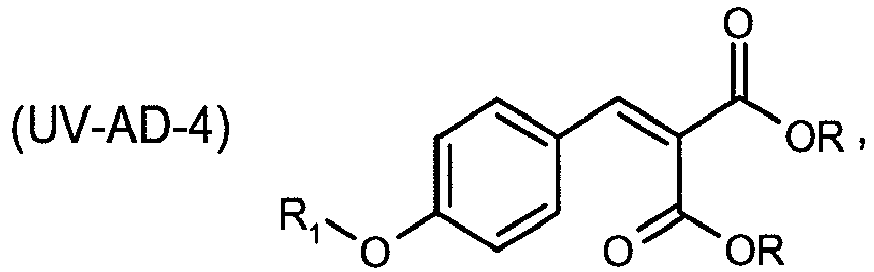
- R1 is methyl; ethyl; propyl; or n-butyl;
- if R1 is methyl, then
- R is tert. butyl;
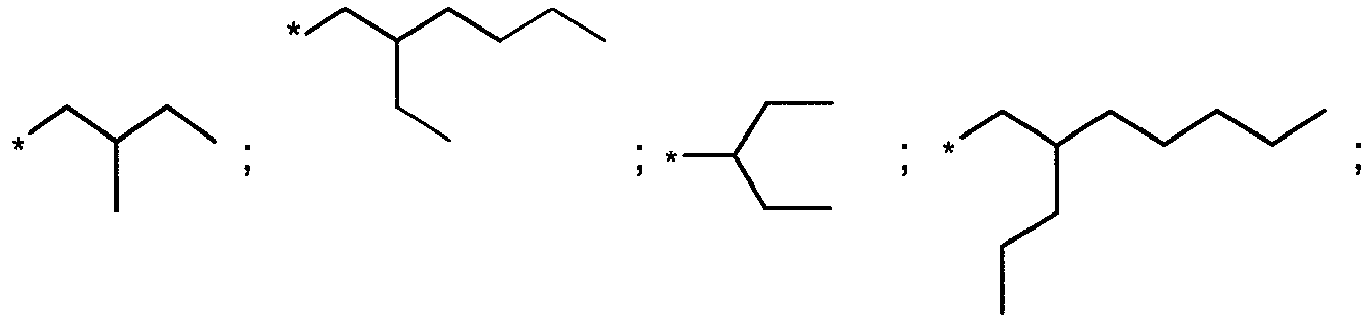


- R2 and R3, independently from each other are hydrogen; or methyl;
- R4 is methyl; ethyl; or n-propyl;
- R5 and R6 independently from each other are hydrogen; or C1-C3alkyl;
- if R1 is ethyl; propyl; or n-butyl, then
- R is isopropyl.
- Most preferred benzylidene malonates (b17) are the compound of formula


- The Benzylidene malonates (b17) and their use as UV filter in sunscreens are disclosed in detail in
WO2010/136360 andWO2011/003774 . - The cosmetic composition according to the present invention may comprise, in addition to the UV absorber combination according to the invention, one or more further UV protective agents of the following substance classes:
- p-aminobenzoic acid derivatives, salicylic acid derivatives, benzophenone derivatives, 3-imidazol-4-yl acrylic acid and esters; benzofuran derivatives, polymeric UV absorbers, camphor derivatives, encapsulated UV absorbers, and 4,4-diphenyl-1,3-butadiene derivatives.
- Special preference is given to the light-protective agents indicated in the following Table 3:
Table 3: Suitable UV filter substances and adjuvants which can be additionally used with the UV absorber Phenylene Bis-Diphenyltriazine according to the present invention Chemical Name CAS No. (+/-)-1,7,7-trimethyl-3-[(4-methylphenyl)methylene]bicyclo-[2.2.1]heptan-2-one; p-methyl benzylidene camphor 36861-47-9 1,7,7-trimethyl-3-(phenylmethylene)bicyclo[2.2.1]heptan-2-one; benzylidene camphor 15087-24-8 (2-Hydroxy-4-methoxyphenyl)(4-methylphenyl)methanone 1641-17-4 2,4-dihydroxybenzophenone 131-56-6 2,2',4,4'-tetrahydroxybenzophenone 131-55-5 2-Hydroxy-4-methoxy benzophenone; 131-57-7 2,2'-dihydroxy-4,4'-dimethoxybenzophenone 131-54-4 2,2'-Dihydroxy-4-methoxybenzophenone 131-53-3 Alpha-(2-oxoborn-3-ylidene)toluene-4-sulphonic acid and its salts (Mexoryl SL) 56039-58-8 Methyl N,N,N-trimethyl-4-[(4,7,7-trimethyl-3-oxobicyclo[2,2,1]hept-2-ylidene)methyl]anilinium sulphate (Mexoryl SO) 52793-97-2 Isopentyl p-methoxycinnamate; isoamyl methoxy cinnamate 71617-10-2 Menthyl-o-aminobenzoate 134-09-8 Menthyl salicylate 89-46-3 4- aminobenzoic acid 150-13-0 Benzoic acid, 4-amino-, ethyl ester, polymer with oxirane 113010-52-9 2-Propenamide, N-[[4-[(4,7,7-trimethyl-3-oxobicyclo[2.2.1]hept-2-ylidene)methyl]phenyl]methyl]-, homopolymer 147897-12-9 Triethanolamine salicylate 2174-16-5 3, 3'-(1,4-phenylenedimethylene)bis[7, 7-dimethyl-2-oxo-bicyclo[2.2.1]heptane-1 methanesulfonic acid] (Cibafast H) 90457-82-2 Zinc oxide (primary particle size 20-100 nm) For example Zinc oxide NDM, Zinc oxide Z-Cote HP1, Nanox Zinc oxide 1314-13-2 Benzoic acid, 4,4'-[[6-[[4-[[(1,1-dimethylethyl)amino]carbonyl]-phenyl]amino]1,3,5-triazine-2,4-diyl]diimino]bis-, bis(2-ethylhexyl)ester; diethylhexyl butamido triazone (Uvasorb HEB) 154702-15-5 Phenol, 2-(2H-benzotriazol-2-yl)-4-methyl-6-[2-methyl-3-[1,3,3,3-tetramethyl-1-[(trimethylsilyl)oxy]disiloxanyl]propyl]-; drometrizole trisiloxane (Mexoryl XL) 155633-54-8 Dimethicodiethylbenzalmalonate; Polysilicone 15 (Parsol SLX) 207574-74-1 Benzenesulfonic acid, 3-(2H-benzotriazol-2-yl)-4-hydroxy-5-(1-methylpropyl)-, monosodium salt (Tinogard HS) 92484-48-5 1-Dodecanaminium, N-[3-[[4-(dimethylamino)benzoyl]amino]-propyl]N,N-dimethyl-, salt with 4-methylbenzenesulfonic acid (1:1) (Escalol HP610) 156679-41-3 1-Propanaminium, N,N,N-trimethyl-3-[(1-oxo-3-phenyl-2-propenyl)amino]-, chloride 177190-98-6 1H-Benzimidazole-4,6-disulfonic acid, 2,2'-(1,4-phenylene)bis- 170864-82-1 1,3,5-Triazine, 2,4,6-tris(4-methoxyphenyl)- 7753-12-0 1,3,5-Triazine, 2,4,6-tris[4-[(2-ethylhexyl)oxy]phenyl]- 208114-14-1 1-Propanaminium, 3-[[3-[3-(2H-benzotriazol-2-yl)-5-(1,1-dimethylethyl)-4-hydroxyphenyl]-1-oxopropyl]amino]-N,N-diethyl-N-methyl-, methyl sulfate (salt) 340964-15-0 2-Propenoic acid, 3-(1H-imidazol-4-yl)- 104-98-3 Benzoic acid, 2-hydroxy-, [4-(1-methylethyl)phenyl]methyl ester 94134-93-7 1,2,3-Propanetriol, 1-(4-aminobenzoate) (Glyceryl PABA) 136-44-7 Benzeneacetic acid, 3,4-dimethoxy-a-oxo- 4732-70-1 2-Propenoic acid, 2-cyano-3,3-diphenyl-, ethyl ester 5232-99-5 Anthralinic acid, p-menth-3-yl ester 134-09-8 2,2'-bis(1,4-phenylene)-1H-benzimidazole-4,6-disulphonic acid mono sodium salt or Disodium phenyl dibenzimidazole tetrasulfonate (Neo Heliopan AP) 349580-12-7 sterols (cholesterol, lanosterol, phytosterols), as described in WO0341675 mycosporines and/or mycosporine-like amino acids as described in WO2002039974 , e.g. Helioguard 365 from Milbelle AG, isolated mycosporine like amino acids from the red alga porphyra umbilicalis (INCl: Porphyra Umbilicalis) that are encapsulated into liposomes)alpha-lipoic-acid as described in DE 10229995 synthetic organic polymers as described in EP 1 371 358 , [0033]-[0041]phyllosilicates as described in EP 1371357 [0034]-[0037]silica compounds as described in EP1371356 , [0033]-[0041]inorganic particles as described in DE10138496 [0043]-[0055]latex particles as described in DE10138496 [0027]-[0040]1H-Benzimidazole-4,6-disulfonic acid, 2,2'-(1,4-phenylene)bis-, disodium salt; Bisimidazylate (Neo Heliopan APC) 180898-37-7 Di-2-ethylhexyl-3,5-dimethoxy-4-hydroxy-benzalmalonate (Oxynex ST, EMD Chemicals, as described in US 20040247536 )Z-COTE® MAX: Zinc Oxide (and) Diphenyl Capryl Methicone Z-COTE HP1: Zinc Oxide (and) Triethoxycaprylylsilane 1,3,5-Triazine-2,4,6-triamine, N2,N4-bis[4-[5-(1,1-dimethylpropyl)-2-benzoxazolyl]phenyl]-N6-(2-ethylhexyl)-(Uvasorb K2A) 288254-16-0 1,1-[(2,2'-Dimethylpropoxy)carbonyl]-4,4-diphenyl-1,3-butadiene 363602-15-7 UV filter capsules containing an organic sunscreen as described in DE102007035567 orWO 2009012871 - If the composition according to the present invention represent water- and oil-containing emulsions (e.g. W/O, O/W, O/W/O and W/O/W emulsions or microemulsions) they contain, for example, from 0.1 to 30 % by weight, preferably from 0.1 to 15 % by weight and especially from 0.5 to 10 % by weight, based on the total weight of the composition, of the ultraviolet radiation absorbing polymer compound of formula (3), from 1 to 60 % by weight, especially from 5 to 50 % by weight and preferably from 10 to 35 % by weight, based on the total weight of the composition, of at least one oil component, from 0 to 30 % by weight, especially from 1 to 30 % by weight and preferably from 4 to 20 % by weight, based on the total weight of the composition, of at least one emulsifier, from 10 to 90 % by weight, especially from 30 to 90 % by weight, based on the total weight of the composition, of water, and from 0 to 88.9 % by weight, especially from 1 to 50 % by weight, of further cosmetically tolerable adjuvants.
- Suitable oil components of oil-containing compositions (e.g. oils, W/O, O/W, O/W/O and W/O/W emulsions or microemulsions) are for example Guerbet alcohols based on fatty alcohols having from 6 to 18, preferably from 8 to 10, carbon atoms, esters of linear C6-C24 fatty acids with linear C3-C24 alcohols, esters of branched C6-C13carboxylic acids with linear C6-C24 fatty alcohols, esters of linear C6-C24 fatty acids with branched alcohols, especially 2-ethylhexanol, esters of hydroxycarboxylic acids with linear or branched C6-C22 fatty alcohols, especially dioctyl malates, esters of linear and/or branched fatty acids with polyhydric alcohols (for example propylene glycol, dimer diol or trimer triol) and/or Guerbet alcohols, triglycerides based on C6-C10 fatty acids, liquid mono-/di-/tri-glyceride mixtures based on C6-C18 fatty acids, esters of C6-C24 fatty alcohols and/or Guerbet alcohols with aromatic carboxylic acids, especially benzoic acid, esters of C2-C12dicarboxylic acids with linear or branched alcohols having from 1 to 22 carbon atoms or polyols having from 2 to 10 carbon atoms and from 2 to 6 hydroxy groups, vegetable oils (such as sunflower oil, olive oil, soybean oil, rapeseed oil, almond oil, jojoba oil, orange oil, wheat germ oil, peach kernel oil and the liquid components of coconut oil), branched primary alcohols, substituted cyclohexanes, linear and branched C6-C22 fatty alcohol carbonates, Guerbet carbonates, esters of benzoic acid with linear and/or branched C6-C22alcohols (e.g. Finsolv® TN), linear or branched, symmetric or asymmetric dialkyl ethers having a total of from 12 to 36 carbon atoms, especially from 12 to 24 carbon atoms, for example din-octyl ether, di-n-decyl ether, di-n-nonyl ether, di-n-undecyl ether, di-n-dodecyl ether, n-hexyl n-octyl ether, n-octyl n-decyl ether, n-decyl n-undecyl ether, n-undecyl n-dodecyl ether, n-hexyl n-undecyl ether, di-tert-butyl ether, diisopentyl ether, di-3-ethyldecyl ether, tert-butyl n-octyl ether, isopentyl n-octyl ether and 2-methyl pentyl-n-octyl ether; ring-opening products of epoxidised fatty acid esters with polyols, silicone oils and/or aliphatic or naphthenic hydrocarbons. Also of importance are monoesters of fatty acids with alcohols having from 3 to 24 carbon atoms. That group of substances comprises the esterification products of fatty acids having from 8 to 24 carbon atoms, for example caproic acid, caprylic acid, 2-ethylhexanoic acid, capric acid, lauric acid, isotridecanoic acid, myristic acid, palmitic acid, palmitoleic acid, stearic acid, isostearic acid, oleic acid, elaidic acid, petroselinic acid, linoleic acid, linolenic acid, elaeostearic acid, arachidic acid, gadoleic acid, behenic acid and erucic acid and technical-grade mixtures thereof (obtained, for example, in the pressure removal of natural fats and oils, in the reduction of aldehydes from Roelen's oxosynthesis or in the dimerisation of unsaturated fatty acids) with alcohols, for example isopropyl alcohol, caproic alcohol, capryl alcohol, 2-ethylhexyl alcohol, capric alcohol, lauryl alcohol, isotridecyl alcohol, myristyl alcohol, cetyl alcohol, palmoleyl alcohol, stearyl alcohol, isostearyl alcohol, oleyl alcohol, elaidyl alcohol, petroselinyl alcohol, linoyl alcohol, linolenyl alcohol, elaeostearyl alcohol, arachidyl alcohol, gadoleyl alcohol, behenyl alcohol, erucyl alcohol and brassidyl alcohol and technical-grade mixtures thereof (obtained, for example, in the high-pressure hydrogenation of technical-grade methyl esters based on fats and oils or aldehydes from Roelen's oxosynthesis and as monomer fractions in the dimerisation of unsaturated fatty alcohols). Of special importance are isopropyl myristate, isononanoic acid C16-C18alkyl esters, stearic acid 2-ethylhexyl ester, cetyl oleate, glycerol tricaprylate, coconut fatty alcohol caprinate/caprylate and n-butyl stearate. Further oil components that can be used are dicarboxylic acid esters, such as di-n-butyl adipate, di(2-ethylhexyl) adipate, di(2-ethylhexyl) succinate and diisotridecyl acetate, and also diol esters, such as ethylene glycol dioleate, ethylene glycol diisotridecanoate, propylene glycol di(2-ethylhexanoate), propylene glycol diisostearate, propylene glycol dipelargonate, butanediol diisostearate and neopentyl glycol dicaprylate. Preferred mono- or poly-ols are ethanol, isopropanol, propylene glycol, hexylene glycol, glycerol and sorbitol. It is also possible to use di- and/or trivalent metal salts (alkaline earth metal, Al3+ inter alia) of one or more alkyl carboxylic acids.
- The oil components can be used in an amount of, for example, from 1 to 60 % by weight, especially from 5 to 50 % by weight and preferably from 10 to 35 % by weight, based on the total weight of the composition.
- Any conventionally emulsifier can be used for the cosmetic composition according to the present invention.
- Suitable emulsifiers are for example, non-ionic surfactants from the following groups:
- addition products of from 2 to 30 mol of ethylene oxide and/or from 0 to 5 mol of propylene oxide with linear fatty alcohols having from 8 to 22 carbon atoms, with fatty acids having from 12 to 22 carbon atoms and with alkylphenols having from 8 to 15 carbon atoms in the alkyl group, for example ceteareth-20 or ceteareth-12;
- C12-C22 fatty acid mono- and di-esters of addition products of from 1 to 30 mol of ethylene oxide with polyols having from 3 to 6 carbon atoms, especially with glycerol;
- glycerol mono- and di-esters and sorbitan mono- and di-esters of saturated and unsaturated fatty acids having from 6 to 22 carbon atoms and ethylene oxide addition products thereof, for example glyceryl stearates, glyceryl isostearates, glyceryl oleates, sorbitan oleates or sorbitan sesquioleates;
- C8-C22alkyl-mono- and -oligo-glycosides and ethoxylated analogues thereof, degrees of oligomerisation of from 1.1 to 5, especially from 1.2 to 1.4, being preferred, and glucose being preferred as the sugar component;
- addition products of from 2 to 60 mol, especially from 15 to 60 mol, of ethylene oxide with castor oil and/or hydrogenated castor oil;
- polyol esters and especially polyglycerol esters, for example diisostearoyl polyglyceryl-3-diisostearates, polyglyceryl-3-diisostearates, triglyceryl diisostearates, polyglyceryl-2-sesquiisostearates or polyglyceryl dimerates. Mixtures of compounds from a plurality of those substance classes are also suitable;
- partial esters based on linear, branched, unsaturated or saturated C6-C22 fatty acids, ricinoleic acid and also 12-hydroxystearic acid and on glycerol, polyglycerol, pentaerythritol, dipentaerythritol, sugar alcohols (e.g. sorbitol), alkyl glucosides (e.g. methyl glucoside, butyl glucoside, lauryl glucoside) and also polyglucosides (e.g. cellulose), for example polyglyceryl-2-dihydroxystearates or polyglyceryl-2-diricinoleates;
- mono-, di- and tri-alkylphosphates and also mono-, di- and/or tri-PEG-alkylphosphates and salts thereof;
- wool wax alcohols;
- one or more ethoxylated esters of natural derivatives, for example polyethoxylated esters of hydrogenated castor oil;
- silicone oil emulsifiers, for example silicone polyol;
- polysiloxane/polyalkyl/polyether copolymers and corresponding derivatives, for example cetyl dimethicone copolyol;
- mixed esters of pentaerythritol, fatty acids, citric acid and fatty alcohol (see
DE-A-1 165 574 ) and/or mixed esters of fatty acids having from 6 to 22 carbon atoms, methylglucose and polyols, preferably glycerol or polyglycerol, for example polyglyceryl-3-glucose distearates, polyglyceryl-3-glucose dioleates, methyl glucose dioleates or dicocoyl pentaerythryl distearyl citrates; and also - polyalkylene glycols.
- The addition products of ethylene oxide and/or of propylene oxide with fatty alcohols, fatty acids, alkylphenols, glycerol mono- and di-esters and also sorbitan mono- and di-esters of fatty acids, or with castor oil, are known, commercially available products. They are usually homologue mixtures, the average degree of alkoxylation of which corresponds to the ratio of the amounts of ethylene oxide and/or propylene oxide and substrate with which the addition reaction is carried out. C12-C18 fatty acid mono- and di-esters of addition products of ethylene oxide with glycerol are known, for example, from
DE-A-2 024 051 as fat-restoring substances for cosmetic preparations. - C8-C18 Alkyl-mono- and -oligo-glycosides, their preparation and their use are known from the prior art. They are prepared especially by reacting glucose or oligosaccharides with primary alcohols having from 8 to 18 carbon atoms. Suitable glycoside radicals include monoglycosides in which a cyclic sugar radical is glycosidically bonded to the fatty alcohol and also oligomeric glycosides having a degree of oligomerisation of up to preferably about 8. The degree of oligomerisation is a statistical average value based on a homologue distribution customary for such technical-grade products.
- It is also possible to use zwitterionic surfactants as emulsifiers. The term "zwitterionic surfactants" denotes especially surface-active compounds that carry at least one quaternary ammonium group and at least one carboxylate and/or sulfonate group in the molecule. Zwitterionic surfactants that are especially suitable are the so-called betaines, such as N-alkyl-N,N-dimethylammonium glycinates, for example cocoalkyl-dimethylammonium glycinate, N-acylaminopropyl-N,N-dimethylammonium glycinates, for example cocoacylaminopropyldimethylammonium glycinate, and 2-alkyl-3-carboxymethyl-3-hydroxyethylimidazolines each having from 8 to 18 carbon atoms in the alkyl or acyl group and also cocoacylaminoethylhydroxyethylcarboxymethylglycinate. Special preference is given to the fatty acid amide derivative known by the CTFA name cocamidopropyl betaine. Likewise suitable as emulsifiers are ampholytic surfactants. Ampholytic surfactants are to be understood as meaning especially those which, in addition to containing a C8-C18-alkyl or -acyl group, contain at least one free amino group and at least one -COOH or -SO3H group in the molecule and are capable of forming internal salts. Examples of suitable ampholytic surfactants include N-alkylglycines, N-alkylpropionic acids, N-alkylaminobutyric acids, N-alkyliminodipropionic acids, N-hydroxyethyl-N-alkylamidopropylglycines, N-alkyltaurines, N-alkylsarcosines, 2-alkylaminopropionic acids and alkylaminoacetic acids, each having approximately from 8 to 18 carbon atoms in the alkyl group.
- Ampholytic surfactants to which special preference is given are N-cocoalkylaminopropionate, cocoacylaminoethylaminopropionate and C12-C18acylsarcosine. In addition to the ampholytic emulsifiers there also come into consideration quaternary emulsifiers, special preference is given to those of the esterquat type, preferably methyl-quaternised di-fatty acid triethanolamine ester salts.
- Non-ionic emulsifiers are preferred, preferably ethoxylated fatty alcohols having from 8 to 22 carbon atoms and from 4 to 30 EO units.
- The emulsifiers may be used in an amount of, for example, from 1 to 30 % by weight, especially from 4 to 20 % by weight and preferably from 5 to 10 % by weight, based on the total weight of the composition. It is, however, also possible in principle to dispense with the use of emulsifiers.
- The compositions according to the invention, for example creams, gels, lotions, alcoholic and aqueous/alcoholic solutions, emulsions, wax/fat compositions, stick preparations, powders or ointments, may in addition contain, as further adjuvants and additives, mild surfactants, super-fatting agents, pearlescent waxes, consistency regulators, thickeners, polymers, silicone compounds, fats, waxes, stabilisers, biogenic active ingredients, deodorising active ingredients, anti-dandruff agents, film formers, swelling agents, antioxidants, hydrotropic agents, preservatives, insect repellents, self-tanning agents, solubilizers, perfume oils, colorants, bacteria-inhibiting agents and the like.
- Substances suitable for use as super-fatting agents are, for example, lanolin and lecithin and also polyethoxylated or acrylated lanolin and lecithin derivatives, polyol fatty acid esters, monoglycerides and fatty acid alkanolamides, the latter simultaneously acting as foam stabilisers.
- Examples of suitable mild surfactants, that is to say surfactants especially well tolerated by the skin, include fatty alcohol polyglycol ether sulfates, monoglyceride sulfates, mono- and/or di-alkyl sulfosuccinates, fatty acid isethionates, fatty acid sarcosinates, fatty acid taurides, fatty acid glutamates, α-olefin sulfonates, ether carboxylic acids, alkyl oligoglucosides, fatty acid glucamides, alkylamidobetaines and/or protein fatty acid condensation products, the latter preferably being based on wheat proteins.
- Suitable pearlescent are for example: alkylene glycol esters, especially ethylene glycol distearate; fatty acid alkanolamides, especially coco fatty acid diethanolamide; partial glycerides, especially stearic acid monoglyceride; esters of polyvalent, unsubstituted or hydroxy-substituted carboxylic acids with fatty alcohols having from 6 to 22 carbon atoms, especially long-chained esters of tartaric acid; fatty substances, for example fatty alcohols, fatty ketones, fatty aldehydes, fatty ethers and fatty carbonates, which in total have at least 24 carbon atoms, especially laurone and distearyl ether; fatty acids, such as stearic acid, hydroxystearic acid or behenic acid, ring-opening products of olefin epoxides having from 12 to 22 carbon atoms with fatty alcohols having from 12 to 22 carbon atoms and/or polyols having from 2 to 15 carbon atoms and from 2 to 10 hydroxy groups, and mixtures thereof.
- Suitable consistency regulators are especially fatty alcohols or hydroxy fatty alcohols having from 12 to 22 carbon atoms and preferably from 16 to 18 carbon atoms, and in addition partial glycerides, fatty acids and hydroxy fatty acids. Preference is given to a combination of such substances with alkyl-oligoglucosides and/or fatty acid N-methylglucamides of identical chain length and/or polyglycerol poly-12-hydroxystearates. Suitable thickeners include, for example, Aerosil types (hydrophilic silicic acids), polysaccharides, especially xanthan gum, guar-guar, agar-agar, alginates and Tyloses, carboxymethyl cellulose and hydroxymethyl cellulose, also relatively high molecular weight polyethylene glycol mono- and di-esters of fatty acids, polyacrylates (e.g. Carbopol® from Goodrich or Synthalen® from Sigma), polyacrylamides, polyvinyl alcohol and polyvinylpyrrolidone, surfactants, for example ethoxylated fatty acid glycerides, esters of fatty acids with polyols, for example pentaerythritol or trimethylolpropane, fatty alcohol ethoxylates with restricted homologue distribution and alkyl-oligoglucosides as well as electrolytes, such as sodium chloride or ammonium chloride.
- Suitable cationic polymers are, for example, cationic cellulose derivatives, for example a quarternised hydroxymethyl cellulose obtainable under the name Polymer JR 400® from Amerchol, cationic starch, copolymers of diallylammonium salts and acrylamides, quaternised vinylpyrrolidone/vinyl imidazole polymers, for example Luviquat® (BASF), condensation products of polyglycols and amines, quaternised collagen polypeptides, for example lauryldimonium hydroxypropyl hydrolyzed collagen (Lamequat®L/Grünau), quaternised wheat polypeptides, polyethyleneimine, cationic silicone polymers, for example amidomethicones, copolymers of adipic acid and dimethylaminohydroxypropyldiethylenetriamine (Cartaretin®/Sandoz), copolymers of acrylic acid with dimethyldiallylammonium chloride (Merquat® 550/Chemviron), polyaminopolyamides, as described, for example, in
FR-A-2 252 840 - Suitable anionic, zwitterionic, amphoteric and non-ionic polymers are for example, vinyl acetate/crotonic acid copolymers, vinylpyrrolidone/vinyl acrylate copolymers, vinyl acetate/butyl maleate/isobornyl acrylate copolymers, methyl vinyl ether/maleic anhydride copolymers and esters thereof, uncrosslinked polyacrylic acids and polyacrylic acids crosslinked with polyols, acrylamidopropyltrimethylammonium chloride/- acrylate copolymers, octyl acrylamide/methyl methacrylate/tert-butylaminoethyl methacrylate/2-hydroxypropyl methacrylate copolymers, polyvinylpyrrolidone, vinylpyrrolidone/vinyl acetate copolymers, vinylpyrrolidone/dimethylaminoethyl methacrylate/vinyl caprolactam terpolymers and also optionally derivatised cellulose ethers and silicones.
- Suitable silicone compounds are, for example, dimethylpolysiloxanes, methylphenylpolysiloxanes, cyclic silicones, and also amino-, fatty acid-, alcohol-, polyether-, epoxy-, fluorine-, glycoside- and/or alkyl-modified silicone compounds, which at room temperature may be in either liquid or resinous form. Also suitable are simethicones, which are mixtures of dimethicones having an average chain length of from 200 to 300 dimethylsiloxane units with hydrogenated silicates. A detailed survey by Todd et al. of suitable volatile silicones may in addition be found in Cosm. Toil. 91, 27 (1976).
- Typical examples of fats are glycerides, and as waxes there come into consideration, inter alia, beeswax, carnauba wax, candelilla wax, montan wax, paraffin wax, hydrogenated castor oils and fatty acid esters or microwaxes solid at room temperature optionally in combination with hydrophilic waxes, e.g. cetylstearyl alcohol or partial glycerides. Metal salts of fatty acids, for example magnesium, aluminium and/or zinc stearate or ricinoleate, may be used as stabilizers.
- Biogenic active ingredients are for example, tocopherol, tocopherol acetate, tocopherol palmitate, ascorbic acid, deoxyribonucleic acid, retinol, bisabolol, allantoin, phytantriol, panthenol, AHA acids, amino acids, ceramides, pseudoceramides, essential oils, plant extracts and vitamin complexes.
- Suitable deodorizing active ingredients are for example, antiperspirants like aluminium chlorohydrates (see J. Soc. Cosm. Chem. 24, 281 (1973)). Aluminium chlorohydrate corresponding to formula Al2(OH)5Cl x 2.5 H2O, known and commercially available under the trade mark Locron® of Hoechst AG, Frankfurt (FRG), is especially preferred (see J. Pharm. Pharmacol. 26, 531 (1975)). Beside the chlorohydrates, it is also possible to use aluminium hydroxy-acetates and acidic aluminium/zirconium salts. Esterase inhibitors may be added as further deodorising active ingredients. Such inhibitors are preferably trialkyl citrates, such as trimethyl citrate, tripropyl citrate, triisopropyl citrate, tributyl citrate and especially triethyl citrate (Hydagen® CAT, Henkel KGaA, Düsseldorf/FRG), which inhibit enzyme activity and hence reduce odour formation. Further suitable esterase inhibitors are sterol sulfates or phosphates, for example lanosterol, cholesterol, campesterol, stigmasterol and sitosterol sulfate or phosphate, dicarboxylic acids and esters thereof, for example glutaric acid, glutaric acid monoethyl ester, glutaric acid diethyl ester, adipic acid, adipic acid monoethyl ester, adipic acid diethyl ester, malonic acid and malonic acid diethyl ester and hydroxycarboxylic acids and esters thereof, for example citric acid, malic acid, tartaric acid or tartaric acid diethyl ester. Antibacterial active ingredients that influence the microbial flora and kill, or inhibit the growth of, sweat-decomposing bacteria can likewise be present in the preparations (especially in stick preparations). Examples include chitosan, phenoxyethanol and chlorhexidine gluconate. 5-Chloro-2-(2,4-dichlorophenoxy)-phenol (Irgasan®, BASF has also proved especially effective.
- Suitable anti-dandruff agents are for example, climbazole, octopirox and zinc pyrithione. Customary film formers include, for example, chitosan, microcrystalline chitosan, quaternised chitosan, polyvinylpyrrolidone, vinylpyrrolidone/vinyl acetate copolymers, polymers of quaternary cellulose derivatives containing a high proportion of acrylic acid, collagen, hyaluronic acid and salts thereof and similar compounds. Suitable swelling agents for aqueous phases are montmorillonites, clay mineral substances, Pemulen and also alkyl-modified types of Carbopol (Goodrich). Further suitable polymers and swelling agents can be found in the review by R. Lochhead in Cosm. Toil. 108, 95 (1993).
- In addition to the primary light-protective substances it is also possible to use secondary light-protective substances of the antioxidant type which interrupt the photochemical reaction chain triggered when UV radiation penetrates the skin or hair. Typical examples of such antioxidants are amino acids (e.g. glycine, histidine, tyrosine, tryptophan) and derivatives thereof, imidazoles (e.g. urocanic acid) and derivatives thereof, peptides, such as D,L-carnosine, D-carnosine, L-carnosine and derivatives thereof (e.g. anserine), carotinoids, carotenes (e.g. α-carotene, β-carotene, lycopene) and derivatives thereof, chlorogenic acid and derivatives thereof, lipoic acid and derivatives thereof (e.g. dihydrolipoic acid), aurothioglycose, propylthiouracil and other thiols (e.g. thioredoxin, glutathione, cysteine, cystine, cystamine and the glycosyl, N-acetyl, methyl, ethyl, propyl, amyl, butyl, lauryl, palmitoyl, oleyl, γ-linoleyl, cholesteryl and glyceryl esters thereof) and also salts thereof, dilauryl thiodipropionate, distearyl thiodipropionate, thiodipropionic acid and derivatives thereof (esters, ethers, peptides, lipids, nucleotides, nucleosides and salts) and also sulfoximine compounds (e.g. buthionine sulfoximines, homocysteine sulfoximine, buthionine sulfones, penta-, hexa-, hepta-thionine sulfoximine) in very small tolerable amounts (e.g. from pmol to µmol/kg), also (metal) chelating agents (e.g. α-hydroxy fatty acids, palmitic acid, phytic acid, lactoferrin), α-hydroxy acids (e.g. citric acid, lactic acid, malic acid), humic acid, bile acid, bile extracts, bilirubin, biliverdin, EDTA, EGTA and derivatives thereof, unsaturated fatty acids and derivatives thereof (e.g. γ-linolenic acid, linoleic acid, oleic acid), folic acid and derivatives thereof, ubiquinone and ubiquinol and derivatives thereof, vitamin C and derivatives (e.g. ascorbyl palmitate, magnesium ascorbyl phosphate, ascorbyl acetate), tocopherols and derivatives (e.g. vitamin E acetate), vitamin A and derivatives (e.g. vitamin A palmitate) and also coniferyl benzoate of benzoin resin, rutinic acid and derivatives thereof, α-glycosylrutin, ferulic acid, furfurylidene glucitol, carnosine, butyl hydroxytoluene, butyl hydroxyanisole, resinous nordihydroguaiaretic acid, nordihydroguaiaretic acid, trihydroxybutyrophenone, uric acid and derivatives thereof, mannose and derivatives thereof, superoxide dismutase, N-[3-(3,5-di-tert-butyl-4-hydroxyphenyl)propionyl]sulfanilic acid (and salts thereof, for example the sodium salts), zinc and derivatives thereof (e.g. ZnO, ZnSO4), selenium and derivatives thereof (e.g. selenium methionine), stilbene and derivatives thereof (e.g. stilbene oxide, trans-stilbene oxide) and the derivatives suitable according to the invention (salts, esters, ethers, sugars, nucleotides, nucleosides, peptides and lipids) of those mentioned active ingredients. HALS (="Hindered Amine Light Stabilizers") compounds may also be mentioned. The amount of antioxidants present is usually from 0.001 to 30 % by weight, preferably from 0.01 to 3 % by weight, based on the weight of the cosmetic composition according to the present invention.
- For improvement of the flow behavior it is also possible to employ hydrotropic agents, for example ethanol, isopropyl alcohol or polyols. Suitable polyols for that purpose comprise preferably from 2 to 15 carbon atoms and at least two hydroxy groups.
- The polyols may also contain further functional groups, especially amino groups, and/or may be modified with nitrogen. Typical examples are as follows:
- glycerol;
- alkylene glycols, for example ethylene glycol, diethylene glycol, propylene glycol, butylene glycol, hexylene glycol and also polyethylene glycols having an average molecular weight of from 100 to 1000 dalton;
- technical oligoglycerol mixtures having an intrinsic degree of condensation of from 1.5 to 10, for example technical diglycerol mixtures having a diglycerol content of from 40 to 50 % by weight;
- methylol compounds, such as, especially, trimethylolethane, trimethylolpropane, trimethyl-olbutane, pentaerythritol and dipentaerythritol;
- lower alkyl-glucosides, especially those having from 1 to 8 carbon atoms in the alkyl radical, for example methyl and butyl glucoside;
- sugar alcohols having from 5 to 12 carbon atoms, for example sorbitol or mannitol;
- sugars having from 5 to 12 carbon atoms, for example glucose or saccharose;
- amino sugars, for example glucamine;
- dialcohol amines, such as diethanolamine or 2-amino-1,3-propanediol.
- Suitable preservatives include, for example, phenoxyethanol, formaldehyde solution, Parabens, pentanediol or sorbic acid and the further substance classes listed in Schedule 6, Parts A and B of the Cosmetics Regulations.
- Suitable perfume oils are mixtures of natural and/or synthetic aromatic substances. Representatives of natural aromatic substances are, for example, extracts from blossom (lilies, lavender, roses, jasmine, neroli, ylang-ylang), from stems and leaves (geranium, patchouli, petitgrain), from fruit (aniseed, coriander, carraway, juniper), from fruit peel (bergamot, lemons, oranges), from roots (mace, angelica, celery, cardamom, costus, iris, calmus), from wood (pinewood, sandalwood, guaiacum wood, cedarwood, rosewood), from herbs and grasses (tarragon, lemon grass, sage, thyme), from needles and twigs (spruce, pine, Scots pine, mountain pine), from resins and balsams (galbanum, elemi, benzoin, myrrh, olibanum, opoponax). Animal raw materials also come into consideration, for example civet and castoreum. Typical synthetic aromatic substances are, for example, products of the ester, ether, aldehyde, ketone, alcohol or hydrocarbon type.
- Aromatic substance compounds of the ester type are, for example, benzyl acetate, phenoxy-ethyl isobutyrate, p-tert-butylcyclohexyl acetate, linalyl acetate, dimethyl-benzylcarbinyl acetate, phenylethyl acetate, linalyl benzoate, benzyl formate, ethylmethylphenyl glycinate, allylcyclohexyl propionate, styrallyl propionate and benzyl salicylate. The ethers include, for example, benzyl ethyl ether; the aldehydes include, for example, the linear alkanals having from 8 to 18 hydrocarbon atoms, citral, citronellal, citronellyl oxyacetaldehyde, cyclamen aldehyde, hydroxycitronellal, lilial and bourgeonal; the ketones include, for example, the ionones, α-isomethylionone and methyl cedryl ketone; the alcohols include, for example, anethol, citronellol, eugenol, isoeugenol, geraniol, linalool, phenyl ethyl alcohol and terpinol; and the hydrocarbons include mainly the terpenes and balsams. It is preferable, however, to use mixtures of various aromatic substances that together produce an attractive scent. Ethereal oils of relatively low volatility, which are chiefly used as aroma components, are also suitable as perfume oils, e.g. sage oil, camomile oil, clove oil, melissa oil, oil of cinnamon leaves, lime blossom oil, juniper berry oil, vetiver oil, olibanum oil, galbanum oil, labolanum oil and lavandin oil. Preference is given to the use of bergamot oil, di-hydromyrcenol, lilial, lyral, citronellol, phenyl ethyl alcohol, α-hexyl cinnamaldehyde, geraniol, benzyl acetone, cyclamen aldehyde, linalool, boisambrene forte, ambroxan, indole, hedione, sandelice, lemon oil, tangerine oil, orange oil, allyl amyl glycolate, cyclovertal, lavandin oil, muscatel sage oil, β-damascone, bourbon geranium oil, cyclohexyl salicylate, vertofix coeur, iso-E-Super, Fixolide NP, evernyl, iraldein gamma, phenylacetic acid, geranyl acetate, benzyl acetate, rose oxide, romillat, irotyl and floramat alone or in admixture with one another.
- As colourants the substances that are suitable and permitted for cosmetic purposes, as compiled, for example, in the publication "Kosmetische Färbemittel" of the Farbstoffkommission der Deutschen Forschungsgemeinschaft, Verlag Chemie, Weinheim, 1984, pages 81 to 106 may be used. The colourants are usually used in concentrations of from 0.001 to 0.1 % by weight, based on the total mixture.
- Typical examples of bacteria-inhibiting agents are preservatives that have a specific action against gram-positive bacteria, such as 2,4,4'-trichloro-2'-hydroxydiphenyl ether, chlorhexidine (1,6-di(4-chlorophenyl-biguanido)hexane) or TCC (3,4,4'-trichlorocarbanilide).
- A large number of aromatic substances and ethereal oils also have antimicrobial properties. Typical examples are the active ingredients eugenol, menthol and thymol in clove oil, mint oil and thyme oil. A natural deodorizing agent of interest is the terpene alcohol farnesol (3,7,11-trimethyl-2,6,10-dodecatrien-1-ol), which is present in lime blossom oil. Glycerol monolaurate has also proved to be a bacteriostatic agent. The amount of the additional bacteria-inhibiting agents present is usually from 0.1 to 2 % by weight, based on the solids content of the cosmetic composition according to the present invention.
- The cosmetic compositions according to the present invention may furthermore contain as adjuvants anti-foams, such as silicones, structurants, such as maleic acid, solubilizers, such as ethylene glycol, propylene glycol, glycerol or diethylene glycol, opacifiers, such as latex, styrene/PVP or styrene/acrylamide copolymers, complexing agents, such as EDTA, NTA, β-alaninediacetic acid or phosphonic acids, propellants, such as propane/butane mixtures, N2O, dimethyl ether, CO2, N2 or air, so-called coupler and developer components as oxidation dye precursors, thioglycolic acid and derivatives thereof, thiolactic acid, cysteamine, thiomalic acid or α-mercaptoethanesulfonic acid as reducing agents or hydrogen peroxide, potassium bromate or sodium bromate as oxidizing agents.
- Insect repellents are for example, N,N-diethyl-m-toluamide, 1,2-pentanediol or insect repellent 3535.
- Suitable self-tanning agents are dihydroxyacetone, erythrulose or mixtures of dihydroxyacetone and erythrulose.
- Cosmetic formulations according to the invention are contained in a wide variety of cosmetic preparations, especially the following preparations:
- skin-care preparations, e.g. skin-washing and cleansing preparations in the form of tablet-form or liquid soaps, synthetic detergents or washing pastes,
- bath preparations, e.g. liquid (foam baths, milks, shower preparations) or solid bath preparations, e.g. bath cubes and bath salts;
- skin-care preparations, e.g. skin emulsions, multi-emulsions or skin oils;
- cosmetic personal care preparations, e.g. facial make-up in the form of day creams or powder creams, face powder (loose or pressed), rouge or cream make-up, eye-care preparations, e.g. eye shadow preparations, mascara, eyeliner, eye creams or eye-fix creams; lip-care preparations, e.g. lipsticks, lip gloss, lip contour pencils, nail-care preparations, such as nail varnish, nail varnish removers, nail hardeners or cuticle removers;
- foot-care preparations, e.g. foot baths, foot powders, foot creams or foot balsams, special deodorants and antiperspirants or callus-removing preparations;
- light-protective preparations, such as sun milks, lotions, creams or oils, sunblocks or tropicals, pre-tanning preparations or after-sun preparations;
- skin-tanning preparations, e.g. self-tanning creams;
- depigmenting preparations, e.g. preparations for bleaching the skin or skin-lightening preparations;
- insect-repellents, e.g. insect-repellent oils, lotions, sprays or sticks;
- deodorants, such as deodorant sprays, pump-action sprays, deodorant gels, sticks or roll-ons;
- antiperspirants, e.g. antiperspirant sticks, creams or roll-ons;
- preparations for cleansing and caring for blemished skin, e.g. synthetic detergents (solid or liquid), peeling or scrub preparations or peeling masks;
- hair-removal preparations in chemical form (depilation), e.g. hair-removing powders, liquid hair-removing preparations, cream- or paste-form hair-removing preparations, hair-removing preparations in gel form or aerosol foams;
- shaving preparations, e.g. shaving soap, foaming shaving creams, non-foaming shaving creams, foams and gels, preshave preparations for dry shaving, aftershaves or aftershave lotions;
- fragrance preparations, e.g. fragrances (eau de Cologne, eau de toilette, eau de parfum, parfum de toilette, parfume), parfume oils or parfume creams;
- cosmetic hair-treatment preparations, e.g. hair-washing preparations in the form of shampoos and conditioners, hair-care preparations, e.g. pretreatment preparations, hair tonics, styling creams, styling gels, pomades, hair rinses, treatment packs, intensive hair treatments, hair-structuring preparations, e.g. hair-waving preparations for permanent waves (hot wave, mild wave, cold wave), hair-straightening preparations, liquid hair-setting preparations, hair foams, hairsprays, bleaching preparations, e.g. hydrogen peroxide solutions, lightening shampoos, bleaching creams, bleaching powders, bleaching pastes or oils, temporary, semi-permanent or permanent hair colourants, preparations containing self-oxidising dyes, or natural hair colourants, such as henna or camomile.
- The final formulations may exist in a wide variety of presentation forms, for example:
- in the form of liquid preparations as a W/O, O/W, O/W/O, W/O/W or PIT emulsion and all kinds of microemulsions,
- in the form of a gel,
- in the form of an oil, a cream, milk or lotion,
- in the form of a powder, a lacquer, a tablet or make-up,
- in the form of a stick,
- in the form of a spray (spray with propellant gas or pump-action spray) or an aerosol,
- in the form of a foam, or
- in the form of a paste.
- Important cosmetic compositions for the skin are light-protective preparations, such as sun milks, lotions, creams, oils, sunblocks or tropicals, pretanning preparations or after-sun preparations, also skin-tanning preparations, for example self-tanning creams. Of particular interest are sun protection creams, sun protection lotions, sun protection oils, sun protection milks and sun protection preparations in the form of a spray.
- Important cosmetic compositions for the hair are the above-mentioned preparations for hair treatment, especially hair-washing preparations in the form of shampoos, hair conditioners, hair-care preparations, e.g. pretreatment preparations, hair tonics, styling creams, styling gels, pomades, hair rinses, treatment packs, intensive hair treatments, hair-straightening preparations, liquid hair-setting preparations, hair foams and hairsprays. Of special interest are hair-washing preparations in the form of shampoos.
- A shampoo has, for example, the following composition:
- 0.01 to 5 % by weight of a UV absorber composition according to the invention,
- 12.0 % by weight of sodium laureth-2-sulfate,
- 4.0 % by weight of cocamidopropyl betaine,
- 3.0 % by weight of sodium chloride, and
- water ad 100 %.
- Especially the following hair-cosmetic formulations may be used:
- a1) spontaneously emulsifying stock formulation, consisting of the UV absorber according to the invention, PEG-6-C10oxoalcohol and sorbitan sesquioleate, to which water and any desired quaternary ammonium compound, for example 4 % minkamidopropyl-dimethyl-2-hydroxyethylammonium chloride or Quaternium 80 is added;
- a2) spontaneously emulsifying stock formulation consisting of the UV absorber according to the invention, tributyl citrate and PEG-20-sorbitan monooleate, to which water and any desired quaternary ammonium compound, for example 4 % minkamidopropyl-dimethyl-2-hydroxyethylammonium chloride or Quaternium 80 is added;
- b) Quat-doped solutions of the UV absorber according to the invention in butyltriglycol and tributyl citrate;
- c) mixtures or solutions of the UV absorber according to the invention with n-alkylpyrrolidone.
- The following examples are illustrative of the principles and practice of the present invention, although not limited thereto.
- Determination of 3-(2H-benzotriazol-2-yl)-5-(1,1-dimethylethyl)-4-hydroxybenzenepropanoic acid and 3-(2H-benzotriazol-2-yl)-5-(1,1-dimethylethyl)-4-hydroxybenzenepropanoic acid methyl ester by HPLC
- Operation range: The concentration of both compounds can be determined from 0.02% - 10% w/w%.
- Solvents: Water HPLC-quality, acetonitrile HPLC-quality, tetrahydrofurane HPLC-quality, tetrabutyl ammonium hydrogensulfate (TBAHS) HPLC-quality
- Column: Eclipse XDB C8 4.6*150mm 5µm
- Mobile phase A: Water - acetonitrile 9:1 +TBAHS 2g/l
- Mobile phase B: Acetonitrile - tetrahydrofurane 1:1
- Flow: 1.1 ml/min
- Injection volume: 10µl
- Oven temperature: 50°C
- Detection wavelength: 302 nm
- Calibration: The quantification is carried by means of a single point calibration. About 10mg of acid ester is weighted in a 100ml brown volumetric flask and filled up with tetrahydrofurane. The sample is dissolved in an ultrasonic bath for about 5 min and the solution is analyzed. This solution is diluted 1:10 with THF.
- 100 mg of the ultraviolet radiation absorbing composition is dissolved in 100 ml of a solvent mixture (70 parts THF / 30 parts 0.1 N NaOH) and 2-3 drops of water are added. The sample must be completely dissolved, otherwise a few drops of water have to be added. The mixture is heated at 50°C for 2 h in a drying cabinet. After cooling to room temperature, 1 ml of this solution is transferred to a 100 ml volumetric flask and filled up with THF. The content of 3-(2H-benzotriazol-2-yl)-5-(1,1-dimethylethyl)-4-hydroxy-benzenepropanoic acid is analyzed by HPLC.
- The amount of chromophore is calculated as w/w% of 3-(2H-benzotriazol-2-yl)-5-(1,1-dimethylethyl)-4-hydroxy-benzene-propanoic acid.
- The amount of covalentely bound chromophore is determined as follows:
- HPLC analysis of the reaction product (determination of the unbound chromophore)
Compound % 3-(2H-benzotriazol-2-yl)-5-(1,1-dimethylethyl)-4-hydroxy-benzene-propanoic acid methyl ester A 3-(2H-benzotriazol-2-yl)-5-(1,1-dimethylethyl)-4-hydroxy-benzene-propanoic acid E Sum S - HPLC analysis of the completely hydrolyzed reaction product (determination of the unbound and bound chromophore)
Compound % 3-(2H-benzotriazol-2-yl)-5-(1,1-dimethylethyl)-4-hydroxy-benzenepropanoic acid C - Amount of covalentely bound chromophore T (%):

- Determination of E (1%/1cm) at 343nm by UV spectroscopy:
- Spectrophotometer Lamda 950S (or equivalent)
- Cell Type: Quarz, 10 mm
- Reference: 1.4-dioxane
- Temperature: ca.25°C
- Solvent: 1.4-dioxane, spectrophotometric grade
- Preparation of the test solutions: About 25 mg of sample is weighed with a precision balance into a 100.0 ml (Vs) volumetric flask. It is filled up to the mark with 1.4-dioxane. 10.0 ml (V) of this solution is diluted to 100.0 ml (Vf) with 1.4-dioxane. The absorbance of this solution is measured between 290 and 450 nm.
- Calculation of E (1%/1cm):
- Weighing w = in mg
- Total volume of stock solution Vs
- Used volume of stock solution V
- Final volume of solution Vf
- Cell d = 10 mm
- Wavelength maximum λ = 343nm
- Measured absorbance at 343 nm A

- Determination of methanol by headspace GC-MS
- Standard: Methanol
- Solvents: 1,3-Dimethyl-2-imidazolidinone = DMI
- Autosampler: Agilent G 1888 Headspace
- Temperature: Oven: 100°C loop: 110°C transfer Line: 130°C
- Shaking: High
- Pressure (psi): Carrier: 17.8 Vial: 13.0
- Timing (minutes) Vial Equil.: 30.0
- Pressure: 3.00
- Loop Fill: 0.20
- Loop Equil.: 0.05
- Inject: 1.00
- Gas Chromatograph: Agilent 6890
- Injection technique: Split, 30ml He/min.
- Column: DB-VRX, film thickness 1.4µm, 60 m x 0.25mm
- Carrier gas: He, 1.0ml / min
- Temperatures: Injector: 220°C
- Oven: 2 min 50°C // 10°C/min to 260°C // isothermal 15min
- Detector: Agilent 5973 Inert Mass Selective detector
- EM Volts: 1718
- Solvent Delay: 0.00; detector off: 15.0min
- SIM Modus: Component Ions, methanol 31
- A standard calibration curve is generated by plotting the concentration of methanol vs. the peak area obtained.

- y
- = peak area
- m
- = slope
- x
- = concentration of methanol (mg/100ml)
- b
- = y intercept
-
- Method: Gel Permeation Chromatography with RI-Detection
- Standards: EasiVial GPC/SEC Calibration Standards PSS Part.No:
PL2010-0201 - Solvents: Tetrahydrofurane HPLC quality, diethanolamine puriss p.a.
- Apparatus: Malvern Viscotek with RI-Detector
- Chromatography conditions:
- Column1: PSS SDV 100 000 A, 8X300mm, 5u
- Column2: PSS SDV 1000 A, 8x300mm, 5u
- Oven temperature: 40°C
- Mobile Phase: Tetrahydrofurane + 3.7g/L DEA
- Flow: 1.0 ml/min
- Sample concentration: approx. 2mg/ml in the same solvent mixture as the mobile phase.
- Calibration: Conventional calibration homopolymeres. Polystyrene reference samples.
- Spectral color measurement with Lange, LICO 300; 30% solution of the ultraviolet radiation absorbing composition in dibutyl adipate (Cetiol B).
- Determination of the glass transition temperature (Tg) by DSC
Differential Scanning Calorimeter (DSC 822e, Mettler Toledo), 40µl aluminium crucible, micro scale (MX5, Mettler Toledo). The oven is nitrogen-purged. Procedure: 3-7mg sample is charged with the micro scale into an aluminium crucible. The crucible is closed hermetically with an aluminium cover. Two crucibles are prepared per sample. The prepared crucible is put in the DSC equipment and the method is started as described below.
First scan: -30°C to 200°C, 10°C/min heating rate
Second scan: Cool to -30°C with -10°C/min cooling rate
Third scan: -30°C to 200°C, 10°C/min heating rate
The third scan is used for the determination of the glass transition temperature. The mean of the glass transition temperature is calculated. - The sample preparation is done by pressurized wet digestion in PTFE vessels: About 200 mg of the sample is treated with 3ml HNO3 at a temperature of about 150 °C for six hours and cooled down to room temperature. The obtained solution is diluted with deionized water to an end volume of 20 ml and directly measured by ICP-AES.
- The calibration is done by external standard method with commercially available elemental standard solutions. As a typical apparatus a Varian Vista Pro ICP-AES or Agilent 5100 ICP-AES spectrometer can be used.
- Specific wavelengths for evaluation: Sn, 189.924 nm for the quantitative evaluation as well as 133, 138, 143, 146 and 284 nm to check possible interferences.
- 800mg of pulverized UV filter is suspended in 1200mg solvent in a glass container. A magnetic stirring bar is added. The container is closed and stirred over night at room temperature (20-30°C). It has always to be checked that the stirrer does not stick to the glass container. Specification: clear or slightly turbid solution Cosmetic solvents: Dicaprylyl carbonate (Cetiol CC, BASF), C12-15 alkyl benzoate (Cetiol AB, BASF), Dibutyl adipate (Cetiol B, BASF)
- Polyglycerol is prepared as described in
WO 2002 036534 ,US 2002 0058781 andUS 6620904 . CaO or Ca(OH)2 is used as catalyst. Glycerol, diglycerol and other low molecular fractions are removed from the reaction product e.g. by short path distillation in order to achieve a specific quality. - Properties of polyglycerol: yellow to brown material; very high viscosity at room temperature, hydroxyl-value 800-1000, water content < 0.2%, glycerol and diglycerols < 5.5% (determined by GC after derivatization with a silylating agent).
- 3-(2H-benzotriazol-2-yl)-5-(1,1-dimethylethyl)-4-hydroxy-benzene-propanoic acid (605.8 g) is charged into a glass reactor equipped with nitrogen inlet, dephlegmator (120°C) and agitation. The temperature is set to 227°C in order to melt the 3-(2H-benzotriazol-2-yl)-5-(1,1-dimethylethyl)-4-hydroxy-benzene-propanoic acid. As soon as the 3-(2H-benzotriazol-2-yl)-5-(1,1-dimethylethyl)-4-hydroxy-benzene-propanoic acid is completely melted, tin-(II)-2-ethylhexanoate (0.48 g) is added and the reactor is evacuated to 860 mbar. Molten polyglycerol (207.1 g) is charged within 1 h, while maintaining a reaction temperature of 220-225°C and a pressure of 30 mbar. Methanol is distilled of. Thereafter the vacuum is reduced gradually to 5-8 mbar at 225°C and the reaction mass is stirred for 16-18 h, until the total concentration of 3-(2H-benzotriazol-2-yl)-5-(1,1-dimethylethyl)-4-hydroxy-benzene-propanoic acid methyl ester and 3-(2H-benzotriazol-2-yl)-5-(1,1-dimethylethyl)-4-hydroxy-benzene-propanoic acid is below 1.0%. The composition of the reaction mixture is monitored by HPLC. After cooling down to ambient temperature, the UV-absorbing polymer composition (756.3 g) is obtained as a yellow to amber glassy solid.
HPLC (unbound chromophore) Compound % 3-(2H-benzotriazol-2-yl)-5-(1,1-dimethylethyl)-4-hydroxy-benzene-propanoic acid methyl ester 3-(2H-benzotriazol-2-yl)-5-(1,1-dimethylethyl)-4-hydroxy-benzene-propanoic acid Sum <1% Solubility Solvent % C12-15 alkyl benzoate >40 Dibutyl adipate >40 Dicaprylyl carbonate >40 - 3-(2H-benzotriazol-2-yl)-5-(1,1-dimethylethyl)-4-hydroxy-benzene-propanoic acid methyl ester (630.9 g) is charged into a glass reactor equipped with nitrogen inlet, dephlegmator (120°C) and agitation. The temperature is set to 227°C in order to melt the 3-(2H-benzotriazol-2-yl)-5-(1,1-dimethylethyl)-4-hydroxy-benzene-propanoic acid methyl ester. As soon as the 3-(2H-benzotriazol-2-yl)-5-(1,1-dimethylethyl)-4-hydroxybenzene-propanoic acid methyl ester is completely melted, tin-(II)-2-ethylhexanoate (0.48 g) is added and the reactor is evacuated to 860 mbar. Molten polyglycerol (206.9 g) is charged within 1 h, while maintaining a reaction temperature of 220-225°C and a pressure of 30 mbar. Methanol is distilled of. Thereafter the vacuum is reduced gradually to 5-8 mbar at 225°C and the reaction mass is stirred for 16-18 h, until the total concentration of 3-(2H-benzotriazol-2-yl)-5-(1,1-dimethylethyl)-4-hydroxybenzene-propanoic acid methyl ester and 3-(2H-benzotriazol-2-yl)-5-(1,1-dimethylethyl)-4-hydroxy-benzene-propanoic acid is below 1.0%. The composition of the reaction mixture is monitored by HPLC. After cooling down to ambient temperature, the UV-absorbing polymer composition (750.3 g) is obtained as a yellow to amber glassy solid.
HPLC (unbound chromophore) Compound % 3-(2H-benzotriazol-2-yl)-5-(1,1-dimethylethyl)-4-hydroxy-benzene-propanoic acid methyl ester 0.2 3-(2H-benzotriazol-2-yl)-5-(1,1-dimethylethyl)-4-hydroxy-benzene-propanoic acid 0.6 Sum 0.8 UV Solubility GPC Wavelength (nm) E (1%, 1cm) Solvent % 344 336 C12-15 alkyl benzoate >40 Peak RV - (ml) 18.4 Dibutyl adipate >40 Mn - (Daltons) 872 Dicaprylyl carbonate >40 Mw - (Daltons) 1577 Mz - (Daltons) 2370 Mp - (Daltons) 1341 Mw / Mn 1.80 - 3-(2H-benzotriazol-2-yl)-5-(1,1-dimethylethyl)-4-hydroxy-benzene-propanoic acid methyl ester (630.84g, 1.785mol) is charged into a glass reactor equipped with nitrogen inlet, dephlegmator (120°C) and agitation. The temperature is set to 197°C in order to melt the 3-(2H-benzotriazol-2-yl)-5-(1,1-dimethylethyl)-4-hydroxy-benzenepropanoic acid methyl ester. As soon as the 3-(2H-benzotriazol-2-yl)-5-(1,1-dimethylethyl)-4-hydroxy-benzene-propanoic acid methyl ester is completely melted, tin-(II)-2-ethylhexanoate (0.47g, 1.2mmol) is added and the reactor is evacuated to 850 mbar. Molten polyglycerol (206.3 g) is charged within 1 h, while maintaining a reaction temperature of 185-190 °C. Methanol is distilled of. Thereafter the vacuum is reduced gradually to 5-8 mbar at 197°C and the reaction mass is stirred for 48h, until the total concentration of 3-(2H-benzotriazol-2-yl)-5-(1,1-dimethylethyl)-4-hydroxybenzene-propanoic acid methyl ester and 3-(2H-benzotriazol-2-yl)-5-(1,1-dimethylethyl)-4-hydroxy-benzene-propanoic acid is below 1.0%. The composition of the reaction mixture is monitored by HPLC. After cooling down to ambient temperature, the UV-absorbing polymer composition (748.5 g) is obtained as a yellow to amber glassy solid.
HPLC (unbound chromophore) Compound % 3-(2H-benzotriazol-2-yl)-5-(1,1-dimethylethyl)-4-hydroxy-benzene-propanoic acid methyl ester 0.1 3-(2H-benzotriazol-2-yl)-5-(1,1-dimethylethyl)-4-hydroxy-benzene-propanoic acid 0.5 Sum 0.6 UV Solubility GPC Wavelength (nm) E (1%, 1cm) Solvent % Peak RV - (ml) 18.16 300 346 C12-15 alkyl benzoate >40 Mn - (Daltons) 911 320 284 Dibutyl adipate >40 Mw - (Daltons) 1584 340 342 Dicaprylyl carbonate >40 Mz - (Daltons) 2277 360 263 Mp - (Daltons) 1383 380 70 Mw / Mn 1.74 400 1 344 345 343 345 303 351 - A 100 ml glass flask is placed in an agitating heating block and polyglycerol (2.9 g) is transferred into the flask. 3-(2H-benzotriazol-2-yl)-5-(1,1-dimethylethyl)-4-hydroxybenzene-propanoic acid methyl ester (8.8 g, 25 mmol) and tin-(II)-2-ethylhexanoate (0.029 g, 0.072 mmol) is added. The mixture is melted and heated up to 195°C under a nitrogen flow. Thereafter the apparatus is slowly evacuated to a pressure of 5 mbar. The reaction mixture is stirred vigorously under vacuum at 195°C for approx. 16h and at 250°C for approx. 24h. After cooling down to ambient temperature, the UV-absorbing polymer composition (10.3 g) is obtained as a brown glassy solid.
HPLC (unbound chromophore) Compound % 3-(2H-benzotriazol-2-yl)-5-(1,1-dimethylethyl)-4-hydroxy-benzene-propanoic acid methyl ester 0 3-(2H-benzotriazol-2-yl)-5-(1,1-dimethylethyl)-4-hydroxy-benzene-propanoic acid 1.0 Sum 1.0 Solubility GPC Solvent % Peak RV - (ml) 18.1 C12-15 alkyl benzoate >40 Mn - (Daltons) 1679 Dibutyl adipate >40 Mw - (Daltons) 3160 Dicaprylyl carbonate >40 Mz - (Daltons) 5669 Mp - (Daltons) 1738 Mw / Mn 1.88 - 3-(2H-benzotriazol-2-yl)-5-(1,1-dimethylethyl)-4-hydroxy-benzene-propanoic acid methyl ester (1000.0 g) is charged into a glass reactor equipped with nitrogen inlet, dephlegmator (120°C) and agitation. The temperature is set to 191 °C in order to melt the 3-(2H-benzotriazol-2-yl)-5-(1,1-dimethylethyl)-4-hydroxy-benzene-propanoic acid methyl ester. As soon as the 3-(2H-benzotriazol-2-yl)-5-(1,1-dimethylethyl)-4-hydroxybenzene-propanoic acid methyl ester is completely melted, the reactor is evacuated to 850 mbar. Molten polyglycerol (325.7 g) is charged within 1 h, while maintaining a reaction temperature of 185-190 °C. Methanol is distilled of. Thereafter the vacuum is reduced gradually to 5-8 mbar at 197°C and the reaction mass is stirred for 44h, until the total concentration of 3-(2H-benzotriazol-2-yl)-5-(1,1-dimethylethyl)-4-hydroxybenzene-propanoic acid methyl ester and 3-(2H-benzotriazol-2-yl)-5-(1,1-dimethylethyl)-4-hydroxy-benzene-propanoic acid is below 1.0%. The composition of the reaction mixture is monitored by HPLC. After cooling down to ambient temperature, the UV-absorbing polymer composition (1200 g) is obtained as a yellow to amber glassy solid.
HPLC (unbound chromophore) Compound % 3-(2H-benzotriazol-2-yl)-5-(1,1-dimethylethyl)-4-hydroxy-benzene-propanoic acid methyl ester 0.25 3-(2H-benzotriazol-2-yl)-5-(1,1-dimethylethyl)-4-hydroxy-benzene-propanoic acid 0.5 Sum 0.75 UV Solubility GPC Wavelength (nm) E (1%, 1cm) Solvent % 300 354 C12-15 alkyl benzoate >40 Peak RV - (ml) 18.3 320 292 Dibutyl adipate >40 Mn - (Daltons) 899 340 351 Dicaprylyl carbonate >40 Mw - (Daltons) 1573 360 269 Mz - (Daltons) 2300 380 73 Mp - (Daltons) 1354 400 4 Mw / Mn 1.75 344 354 344 354 303 359 - 3-(2H-benzotriazol-2-yl)-5-(1,1-dimethylethyl)-4-hydroxy-benzene-propanoic acid methyl ester (306.0 kg) is charged into a glass-lined steel reactor equipped with argon inlet, dephlegmator (120°C) and agitation. The temperature is set to 195°C in order to melt the 3-(2H-benzotriazol-2-yl)-5-(1,1-dimethylethyl)-4-hydroxy-benzene-propanoic acid methyl ester. As soon as the 3-(2H-benzotriazol-2-yl)-5-(1,1-dimethylethyl)-4-hydroxy-benzene-propanoic acid methyl ester is completely melted, the reactor is evacuated to 850 mbar and tin-(II)-2-ethylhexanoate (20.0 kg) is added. Molten polyglycerol (105.0 kg) is charged within 1-2 h, while maintaining a reaction temperature of 185-190 °C. Methanol is distilled of. Thereafter the vacuum is reduced gradually to 5-8 mbar at 195°C and the reaction mass is stirred for 72h until the total concentration of 3-(2H-benzotriazol-2-yl)-5-(1,1-dimethylethyl)-4-hydroxy-benzenepropanoic acid methyl ester and 3-(2H-benzotriazol-2-yl)-5-(1,1-dimethylethyl)-4-hydroxy-benzene-propanoic acid is below 1.0%. The composition of the reaction mixture is monitored by HPLC. After cooling down to ambient temperature, the UV-absorbing polymer composition (384 kg) is obtained as a yellow to amber glassy solid.
HPLC analysis of the reaction product (unbound chromophore) Compound % 3-(2H-benzotriazol-2-yl)-5-(1,1-dimethylethyl)-4-hydroxy-benzenepropanoic acid methyl ester 0.1 3-(2H-benzotriazol-2-yl)-5-(1,1-dimethylethyl)-4-hydroxy-benzenepropanoic acid 0.5 Sum 0.6 HPLC analysis of the completely hydrolyzed reaction product Compound % 3-(2H-benzotriazol-2-yl)-5-(1,1-dimethylethyl)-4-hydroxy-benzenepropanoic acid 75.8 - 75.8% - 0.6% = 75.2 % (chromophore, determined as 3-(2H-benzotriazol-2-yl)-5-(1,1-dimethylethyl)-4-hydroxy-benzene-propanoic acid).
UV Solubility in cosmetic solvents GPC E 1%, 1cm (λ=344nm) 331 Solvent % Methanol (ppm) 6 C12-15 alkyl benzoate >40 Peak RV - (ml) 18.2 Tg (°C) 51.2 Dibutyl adipate >40 Mn - (Daltons) 756 Sn (ppm) 150 Dicaprylyl carbonate >40 Mw - (Daltons) 1464 Gardner color scale 6.2 Mz - (Daltons) 2153 Mp - (Daltons) 1320 Mw / Mn 1.94 - A non-exhaustive list of aspects of the invention is provided in the following numbered clauses.
- 1. Ultraviolet radiation absorbing polymer composition comprising a polymer compound of the formula

- 2. The composition according to clause 1, wherein the polymer compound has an average molecular weight (M) greater than 500.
- 3. The composition according to clause 1, wherein the polymer compound has a UV absorption (E 1%, 1cm) at 344nm of at least 300.
- 4. The composition according to clause 1, wherein the composition additionally comprises at least one component selected from the group consisting of benzenepropanoic acid, 3-(2H-benzotriazol-2-yl)-5-(1,1-dimethylethyl)-4-hydroxy-,methyl ester, benzenepropanoic acid, 3-(2H-benzotriazol-2-yl)-5-(1, 1-dimethylethyl)-4- hydroxy-, methanol and tin.
- 5. The composition according to clause 4 comprising at least 1.1% of benzenepropanoic acid, 3-(2H-benzotriazol-2-yl)-5-(1,1-dimethylethyl)-4-hydroxy-,methyl ester.
- 6. The composition according to clause 4 comprising at least 1.1% benzenepropanoic acid, 3-(2H-benzotriazol-2-yl)-5-(1, 1-dimethylethyl)-4- hydroxy-.
- 7. The composition according to clause 4 comprising at least 1.5% of a combination of benzenepropanoic acid, 3-(2H-benzotriazol-2-yl)-5-(1, 1-dimethylethyl)-4- hydroxy- and 3-(2H-benzotriazol-2-yl)-5-(1,1-dimethylethyl)-4-hydroxy-,methyl ester.
- 8. The composition according to clause 4 comprising at least 700 ppm tin.
- 9. The composition according to clause 1 essentially free of tin.
- 10. The composition according to clause 4 comprising at least 3000 ppm methanol.
- 11. The composition according to clause 1 having a Gardner Value of 1-8.
- 12. The composition according to clause 1 having a solubility in hexanedioic acid, 1,6-dibutyl ester greater than 30%.
- 13. The composition according to clause 1 having a solubility in C12-15-alkyl benzoate ester greater than 30%.
- 14. The composition according to any of clause 1 to 13, wherein the amount of covalently bound chromophores is > 70% by weight.
- 15. The composition according to clause 1 having a nitrogen content of 9-11 %.
- 16. A cosmetic composition comprising the ultraviolet radiation absorbing polymer composition of clause 1.
- 17. The cosmetic composition according to clause 16, comprising from 0.1 to 50 % by weight, based on the total weight of the composition, of the ultraviolet radiation absorbing polymer composition and a cosmetically tolerable adjuvant.
- 18. The cosmetic composition according to clause 16 or 17 further comprising a UV filter selected from the group consisting of:
- (1) an aqueous dispersion of 5,6,5',6'-tetraphenyl-3,3'-(1,4-Phenylene)bis(1,2,4-Triazine) corresponding to the formula

- (2) Bis-Ethylhexyloxyphenol Methoxyphenyl Triazine;
- (3) Butyl Methoxydibenzoylmethane;
- (4) Diethylhexyl Butamido Triazone;
- (5) Ethylhexyl Triazone;
- (6) Diethylamino Hydroxy Benzoyl Hexyl Benzoate;
- (7) Ethylhexyl Methoxycinnamate;
- (8) Ethylhexyl Salicylate;
- (9) Homosalate;
- (10) Octocrylene;
- (11) Methylene Bis-Benzotriazolyl Tetramethylbutylphenol;
- (12) Phenylbenzimidazole Sulfonic Acid;
- (13) Titanium Dioxide;
- (14) Tris-Biphenyl Triazine; and
- (15) (2-{4-[2-(4-Diethylamino-2-hydroxy-benzoyl)-benzoyl]-piperazine-1-carbonyl}-phenyl)-(4-diethylamino-2-hydroxy-phenyl)-methanone;
- (16) BBDAPT; Benzoic acid, 4,4'-[[6-[[3-[1,3,3,3-tetramethyl-1-[(trimethylsilyl)oxy]-1 disiloxanyl]propyl]amino]-1,3,5-triazine-2,4-diyl]diimino]bis-, dibutyl ester;
- (17) benzylidene malonates;
- (18) merocyanine derivatives;
- (19) Bis(butylbenzoate) diaminotriazine aminopropylsiloxane;
- (20) Bis-Ethylhexyloxyphenol Methoxyphenyl Triazine) encapsulated in a polymer matrix;
- (21) 2-(2H-Benzotriazol-2-yl)-6-[(2-ethylhexyloxy)methyl]-4-methylphenol;
- (22) 2-Propenoic acid, 3-(4-methoxyphenyl)-, 2-methylphenyl ester; and
- (23) Zinc oxide;
- (1) an aqueous dispersion of 5,6,5',6'-tetraphenyl-3,3'-(1,4-Phenylene)bis(1,2,4-Triazine) corresponding to the formula
wherein said composition also contains a pharmaceutically or cosmetically acceptable excipient.
| Gradient | Time [min] | A [%] | B [%] |
| 0 | 50 | 50 | |
| 15 | 2 | 98 | |
| 20 | 2 | 98 | |
| 21 | 50 | 50 | |
| Post Time | 5 |

Claims (18)
- Ultraviolet radiation absorbing polymer composition comprising a polymer compound of the formula

- The composition according to claim 1, wherein the polymer compound has a weight average molecular weight (M) greater than 500.
- The composition according to claim 1 or claim 2, wherein the polymer compound has a UV absorption (E 1 %, 1 cm) at 344nm of at least 300.
- The composition according to any of the preceding claims, wherein the composition additionally comprises at least one component selected from the group consisting of benzenepropanoic acid, 3-(2H-benzotriazol-2-yl)-5-(1,1-dimethylethyl)-4-hydroxy-,methyl ester, benzenepropanoic acid, 3-(2H-benzotriazol-2-yl)-5-(1, 1-dimethylethyl)-4-hydroxy-, methanol and tin.
- The composition according to claim 4 comprising at least 1.1% by weight of benzenepropanoic acid, 3-(2H-benzotriazol-2-yl)-5-(1,1-dimethylethyl)-4-hydroxy-,methyl ester.
- The composition according to claim 4 comprising at least 1.1% by weight benzenepropanoic acid, 3-(2H-benzotriazol-2-yl)-5-(1, 1-dimethylethyl)-4- hydroxy-.
- The composition according to claim 4 comprising at least 1.5% by weight of a combination of benzenepropanoic acid, 3-(2H-benzotriazol-2-yl)-5-(1, 1-dimethylethyl)-4- hydroxy- and 3-(2H-benzotriazol-2-yl)-5-(1,1-dimethylethyl)-4-hydroxy-,methyl ester.
- The composition according to claim 4 comprising at least 700 ppm tin.
- The composition according to any of claims 1-3 essentially free of tin.
- The composition according to claim 4 comprising at least 3000 ppm methanol.
- The composition according to any of the preceding claims having a Gardner Value of 1-8.
- The composition according to any of the preceding claims having a solubility in hexanedioic acid, 1,6-dibutyl ester greater than 30%.
- The composition according to any of the preceding claims having a solubility in C12-15-alkyl benzoate ester greater than 30%.
- The composition according to any of the preceding claims, wherein the amount of covalently bound chromophores is > 70% by weight.
- The composition according to any of the preceding claims having a nitrogen content of 9-11 %.
- A cosmetic composition comprising the ultraviolet radiation absorbing polymer composition of any of the preceding claims.
- The cosmetic composition according to claim 16, comprising from 0.1 to 50 % by weight, based on the total weight of the composition, of the ultraviolet radiation absorbing polymer composition and a cosmetically tolerable adjuvant.
- The cosmetic composition according to claim 16 or 17 further comprising a UV filter selected from the group consisting of:(1) an aqueous dispersion of 5,6,5',6'-tetraphenyl-3,3'-(1,4-Phenylene)bis(1,2,4-Triazine) corresponding to the formula
 (2) Bis-Ethylhexyloxyphenol Methoxyphenyl Triazine;(3) Butyl Methoxydibenzoylmethane;(4) Diethylhexyl Butamido Triazone;(5) Ethylhexyl Triazone;(6) Diethylamino Hydroxy Benzoyl Hexyl Benzoate;(7) Ethylhexyl Methoxycinnamate;(8) Ethylhexyl Salicylate;(9) Homosalate;(10) Octocrylene;(11) Methylene Bis-Benzotriazolyl Tetramethylbutylphenol;(12) Phenylbenzimidazole Sulfonic Acid;(13) Titanium Dioxide;(14) Tris-Biphenyl Triazine; and(15) (2-{4-[2-(4-Diethylamino-2-hydroxy-benzoyl)-benzoyl]-piperazine-1-carbonyl}-phenyl)-(4-diethylamino-2-hydroxy-phenyl)-methanone;(16) BBDAPT; Benzoic acid, 4,4'-[[6-[[3-[1,3,3,3-tetramethyl-1-[(trimethylsilyl)oxy]-1 disiloxanyl]propyl]amino]-1,3,5-triazine-2,4-diyl]diimino]bis-, dibutyl ester;(17) benzylidene malonates;(18) merocyanine derivatives;(19) Bis(butylbenzoate) diaminotriazine aminopropylsiloxane;(20) Bis-Ethylhexyloxyphenol Methoxyphenyl Triazine) encapsulated in a polymer matrix;(21) 2-(2H-Benzotriazol-2-yl)-6-[(2-ethylhexyloxy)methyl]-4-methylphenol;(22) 2-Propenoic acid, 3-(4-methoxyphenyl)-, 2-methylphenyl ester; and(23) Zinc oxide;wherein said composition also contains a pharmaceutically or cosmetically acceptable excipient.
Applications Claiming Priority (1)
| Application Number | Priority Date | Filing Date | Title |
|---|---|---|---|
| US201662404246P | 2016-10-05 | 2016-10-05 |
Publications (2)
| Publication Number | Publication Date |
|---|---|
| EP3305279A1 true EP3305279A1 (en) | 2018-04-11 |
| EP3305279B1 EP3305279B1 (en) | 2021-04-07 |
Family
ID=60185977
Family Applications (1)
| Application Number | Title | Priority Date | Filing Date |
|---|---|---|---|
| EP17195014.0A Active EP3305279B1 (en) | 2016-10-05 | 2017-10-05 | Ultraviolet radiation absorbing polymer composition |
Country Status (11)
| Country | Link |
|---|---|
| US (2) | US10596087B2 (en) |
| EP (1) | EP3305279B1 (en) |
| JP (1) | JP7076975B2 (en) |
| KR (1) | KR102458376B1 (en) |
| CN (1) | CN107913194B (en) |
| AU (1) | AU2017225106B2 (en) |
| BR (1) | BR102017021319B1 (en) |
| CA (1) | CA2981377C (en) |
| ES (1) | ES2871778T3 (en) |
| IL (1) | IL254220B (en) |
| RU (1) | RU2764196C2 (en) |
Cited By (3)
| Publication number | Priority date | Publication date | Assignee | Title |
|---|---|---|---|---|
| FR3095757A1 (en) * | 2019-05-10 | 2020-11-13 | Pierre Fabre Dermo-Cosmetique | PHOTOPROTECTOR SYSTEM CONSISTING OF 4 SOLAR FILTERS |
| EP3775021A1 (en) * | 2018-04-04 | 2021-02-17 | Basf Se | Use of an ultraviolet radiation absorbing polymer composition (uvrap) as an uv absorbing agent in a coating for non-living and non-keratinous materials |
| US11981793B2 (en) | 2018-04-04 | 2024-05-14 | Basf Se | Use of an ultraviolet radiation absorbing composition as a light stabilizer for a shaped artificial polymer article |
Families Citing this family (5)
| Publication number | Priority date | Publication date | Assignee | Title |
|---|---|---|---|---|
| TW202034890A (en) * | 2018-09-14 | 2020-10-01 | 日商資生堂股份有限公司 | Water-in-oil type skin external composition |
| CN110437364B (en) * | 2019-06-17 | 2021-11-23 | 百肽德医药生物科技(广东)有限公司 | Polymers having UV-absorbing properties and their use in cosmetics |
| JP7789659B2 (en) * | 2019-08-18 | 2025-12-22 | ピーエムアイディージー リミテッド ライアビリティ カンパニー | Compositions and methods for sunscreen compounds |
| KR102388776B1 (en) * | 2021-08-03 | 2022-04-20 | 한국화학연구원 | Novel polyether polyol and aqueous dispersion assistant comprising the same, and aqueous coating composition comprising the same |
| WO2024253837A1 (en) | 2023-06-06 | 2024-12-12 | Kenvue Brands Llc | Low penetration sunscreen compositions |
Citations (12)
| Publication number | Priority date | Publication date | Assignee | Title |
|---|---|---|---|---|
| DE1165574B (en) | 1960-08-08 | 1964-03-19 | Dehydag Gmbh | Process for the production of mixed esters used as emulsifiers for ointment bases |
| DE2024051A1 (en) | 1970-05-16 | 1971-12-09 | Henkel & Cie GmbH, 4000 Dusseldorf Holthausen | Cosmetic preparations, in particular cosmetic cleaning agents, with a content of refatting agents |
| FR2252840A1 (en) | 1973-11-30 | 1975-06-27 | Oreal | |
| WO2002036534A2 (en) | 2000-11-06 | 2002-05-10 | Lonza Inc. | Processes for preparing linear polyglycerols and polyglycerol esters |
| WO2007092407A2 (en) | 2006-02-06 | 2007-08-16 | Cargill, Incorporated | Process for preparing polyglycerol and mixed ethers |
| WO2010136360A2 (en) | 2009-05-29 | 2010-12-02 | Basf Se | Benzylidene malonates |
| WO2011003774A2 (en) | 2009-07-07 | 2011-01-13 | Basf Se | Uv filter combinations comprising benzylidene malonates |
| WO2011098315A1 (en) | 2010-02-12 | 2011-08-18 | Evonik Goldschmidt Gmbh | New polyglycerol esters and their use |
| US20140004063A1 (en) * | 2012-06-28 | 2014-01-02 | Johnson & Johnson Consumer Companies, Inc. | Sunscreen compositions containing an ultraviolet radiation-absorbing polymer |
| EP2876126A1 (en) * | 2013-11-25 | 2015-05-27 | Basf Se | A stabilizer mixture |
| EP2886101A1 (en) * | 2013-12-18 | 2015-06-24 | Johnson & Johnson Consumer Companies, Inc. | Sunscreen compositions containing an ultraviolet radiation-absorbing polymer |
| WO2015122770A1 (en) | 2014-02-13 | 2015-08-20 | Clariant International Ltd. | Preparation of polyglycerols |
Family Cites Families (141)
| Publication number | Priority date | Publication date | Assignee | Title |
|---|---|---|---|---|
| US4107290A (en) | 1972-06-29 | 1978-08-15 | L'oreal | Anti-solar polymers, method of making the same and cosmetic compositions containing the same |
| US4322522A (en) | 1980-07-08 | 1982-03-30 | Akzona Incorporated | Polyester/polyether segmented copolymers stabilized against degradation by UV light via copolymerization with analogs of 2,2,6,6-tetramethylpiperidine derivatives |
| DE3028503A1 (en) | 1980-07-26 | 1982-02-25 | Basf Ag | POLYALKOXYCARBINOLZIMTSAEESESTER, METHOD FOR THE PRODUCTION THEREOF AND THE LIGHTING PROTECTION CONTAINING THEM |
| US4528311A (en) | 1983-07-11 | 1985-07-09 | Iolab Corporation | Ultraviolet absorbing polymers comprising 2-hydroxy-5-acrylyloxyphenyl-2H-benzotriazoles |
| JPS6099186A (en) | 1983-11-04 | 1985-06-03 | Pola Chem Ind Inc | High molecular weight ultraviolet absorber and cosmetic containing the same |
| FR2596400B1 (en) | 1986-03-28 | 1988-08-26 | Oreal | NEW POLYMERS CAPABLE OF ABSORBING ULTRAVIOLET RADIATION, THEIR PREPARATION AND THEIR APPLICATION, PARTICULARLY IN COSMETOLOGY |
| US5138089A (en) | 1986-06-27 | 1992-08-11 | The Procter & Gamble Company | Chromophores, sunscreen compositions and methods for preventing sunburn |
| US4897259A (en) | 1986-12-04 | 1990-01-30 | Bristol-Myers Company | High oil phase pharmaceutical vehicles and sunscreen compositions having waterproof sun protection factors |
| US5157091A (en) | 1987-10-07 | 1992-10-20 | Murahara Masataka | Ultraviolet-absorbing polymer material and photoetching process |
| US5166234A (en) | 1988-05-19 | 1992-11-24 | E. I. Du Pont De Nemours And Company | Bisurea light stabilizer for organic polymers |
| US5041281A (en) | 1989-03-16 | 1991-08-20 | Amway Corporation | Oil in water emulsion sunscreen composition |
| JP2883107B2 (en) | 1989-07-10 | 1999-04-19 | 塩野義製薬株式会社 | UV absorbing skin protective composition |
| US5057594A (en) | 1989-08-17 | 1991-10-15 | Eastman Kodak Company | Ultraviolet light-absorbing compounds and sunscreen formulations and polymeric materials containing such compounds or residues thereof |
| US5039782A (en) | 1990-12-11 | 1991-08-13 | Lever Brothers Company, Division Of Conopco, Inc. | Polymeric whitening agent |
| JPH04288010A (en) | 1991-03-15 | 1992-10-13 | Max Fuakutaa Kk | Cosmetic |
| US5229104A (en) | 1991-04-29 | 1993-07-20 | Richardson-Vicks Inc. | Artificial tanning compositions containing positively charged paucilamellar vesicles |
| US5426210A (en) | 1991-05-09 | 1995-06-20 | Shiseido Co., Ltd. | Adduct of cinnamic acid and glycerin, ultraviolet absorbent and external preparation for skin |
| US5243021A (en) | 1991-07-17 | 1993-09-07 | Lever Brothers Company, Division Of Conopco, Inc. | Water-dispersible copolymer containing UVA and UVB light-absorbing monomers |
| US5134223A (en) | 1991-07-17 | 1992-07-28 | Lever Brothers Company, Division Of Conopco, Inc. | Water dispersible or water soluble copolymer containing UV-absorbing monomer |
| FR2680684B1 (en) | 1991-08-29 | 1993-11-12 | Oreal | COSMETIC FILTERING COMPOSITION COMPRISING A METAL OXIDE NANOPIGMENT AND A FILTERED POLYMER. |
| FR2680683B1 (en) | 1991-08-29 | 1993-11-12 | Oreal | COSMETIC FILTERING COMPOSITION CONTAINING A HYDROCARBON STRUCTURED FILTER POLYMER AND A FILTERED SILICONE. |
| WO1993022413A1 (en) | 1992-04-23 | 1993-11-11 | Unilever Plc | Compositions comprising water-dispersible copolymer containing uva and uvb light-absorbing monomers |
| US5250652A (en) | 1992-07-30 | 1993-10-05 | Lever Brothers Company, Division Of Conopco, Inc. | High loading water-dispersible UVA and/or UVB light-absorbing copolymer |
| JP2757099B2 (en) * | 1992-10-26 | 1998-05-25 | 富士写真フイルム株式会社 | Thermal development color photosensitive material |
| WO2001008647A1 (en) | 1998-07-21 | 2001-02-08 | Biophysica, Inc. | Sunblocking polymers and their novel formulations |
| US5487885A (en) | 1992-12-21 | 1996-01-30 | Biophysica, Inc. | Sunblocking polymers and their formulation |
| US6123928A (en) | 1992-12-21 | 2000-09-26 | Biophysica, Inc. | Sunblocking polymers and their novel formulations |
| US5459222A (en) | 1993-06-04 | 1995-10-17 | Ciba-Geigy Corporation | UV-absorbing polyurethanes and polyesters |
| US5399371A (en) | 1993-06-17 | 1995-03-21 | Henkel Corporation | Low calorie substitute for an edible oil |
| GB9403451D0 (en) | 1994-02-23 | 1994-04-13 | Ciba Geigy Ag | Sunscreen compositions |
| DE4412081B4 (en) | 1994-04-08 | 2006-10-19 | IFAC Institut für angewandte Colloidtechnologie GmbH & Co. KG | Polyglycerol ester-based emulsifier and sunscreen emulsion containing the same |
| US5505935A (en) | 1994-05-09 | 1996-04-09 | Elizabeth Arden Company, Division Of Conopco, Inc. | Sunscreen compositions |
| US5543083A (en) | 1994-07-26 | 1996-08-06 | The Procter & Gamble Company | Fatty amine derivatives of butylated hydroxy toluene for the protection of surfaces from physical and chemical degradation |
| DE69525217T2 (en) | 1994-10-14 | 2002-10-24 | Hoffmann La Roche | Light-stable cosmetic sunscreens |
| ZA964872B (en) | 1995-06-08 | 1997-12-08 | Johnson & Johnson Consumer | Sunscreen compositions. |
| KR100236388B1 (en) | 1995-11-28 | 1999-12-15 | 성재갑 | Novel uv-light screening polymers and their preparation method |
| DE19634399A1 (en) | 1996-08-26 | 1998-03-05 | Basf Ag | Cosmetic with polymer-bound benzophenone chromophores |
| DE19634401A1 (en) | 1996-08-26 | 1998-03-05 | Basf Ag | Cosmetic with polymer-bound benzophenone chromophores |
| CA2241645A1 (en) | 1997-07-14 | 1999-01-14 | F. Hoffmann-La Roche Ag | Light-screening agents |
| DE19734445A1 (en) | 1997-08-08 | 1999-02-11 | Basf Ag | Lipophilic polymeric UV absorber |
| FR2775434B1 (en) | 1998-02-27 | 2000-05-19 | Oreal | COSMETIC COMPOSITIONS FOR PHOTOPROTECTION OF THE SKIN AND / OR THE HAIR BASED ON A SYNERGISTIC MIXTURE OF FILTERS AND USES |
| US6306939B1 (en) | 1998-06-22 | 2001-10-23 | Ciba Specialty Chemicals Corporation | Poly-trisaryl-1,3,5-Triazine carbamate ultraviolet light absorbers |
| DE19834819A1 (en) | 1998-08-01 | 2000-02-03 | Beiersdorf Ag | Emulsifier-free finely dispersed systems of the oil-in-water and water-in-oil type |
| DE19834820A1 (en) | 1998-08-01 | 2000-02-03 | Beiersdorf Ag | Emulsifier-free finely dispersed systems of the oil-in-water and water-in-oil type |
| DE19842730A1 (en) | 1998-09-18 | 2000-03-23 | Beiersdorf Ag | Emulsifier-free finely dispersed systems of the oil-in-water and water-in-oil type |
| DE19842787A1 (en) | 1998-09-18 | 2000-03-23 | Beiersdorf Ag | Emulsifier-free finely dispersed systems of the oil-in-water and water-in-oil type |
| DE19842786A1 (en) | 1998-09-18 | 2000-03-23 | Beiersdorf Ag | Pickering emulsions useful as bases for cosmetic or dermatological compositions, containing low viscosity oil to improve feeling and tolerance of skin |
| DE69938738D1 (en) | 1998-12-10 | 2008-06-26 | Color Access Inc | COMPOSITION WITH IMPROVED LIGHT PROTECTION AND METHOD FOR USE THEREOF |
| US6191199B1 (en) | 1999-05-03 | 2001-02-20 | Ciba Speciatly Chemicals Corporation | Stabilized adhesive compositions containing highly soluble, high extinction photostable hydroxyphenyl-s-triazine UV absorbers and laminated articles derived therefrom |
| FR2793139B1 (en) | 1999-05-06 | 2001-06-29 | Oreal | COMPOSITION CONTAINING AT LEAST ONE BICYCLIC AROMATIC COMPOUND AND AT LEAST ONE LIPOPHILIC SUN FILTER, AND USES THEREOF |
| NO20002309L (en) | 1999-05-12 | 2000-11-13 | Hoffmann La Roche | Photo-stable cosmetic light-shielding compositions |
| KR100755766B1 (en) | 1999-06-28 | 2007-09-05 | 닛뽕세이까가부시끼가이샤 | Oil materials comprising dimerdiol ester and cosmetics comprising the ester |
| US6413393B1 (en) | 1999-07-07 | 2002-07-02 | Minimed, Inc. | Sensor including UV-absorbing polymer and method of manufacture |
| EP1068866A3 (en) | 1999-07-12 | 2004-03-17 | Ciba SC Holding AG | Use of mixtures of micropigments for prevening tannig and to induce skin and hair lightening |
| AU6433400A (en) | 1999-07-13 | 2001-01-30 | Pharmasol Gmbh | Uv radiation reflecting or absorbing agents, protecting against harmful uv radiation and reinforcing the natural skin barrier |
| EP1200039B1 (en) | 1999-07-20 | 2006-06-07 | Beiersdorf AG | Emulsifier-free finely dispersed water-in-oil-type systems |
| JP2001288064A (en) | 2000-04-10 | 2001-10-16 | Kao Corp | Cosmetics |
| WO2001079314A1 (en) | 2000-04-13 | 2001-10-25 | Sanyo Chemical Industries, Ltd. | Crosslinked polymer, process for producing the same, absorbent structure, and absorbent article |
| FR2811554B1 (en) | 2000-07-12 | 2002-09-13 | Oreal | COMPOSITION COMPRISING AT LEAST ONE UV FILTER AND A NON-SUBSTITUTED FLAVYLIUM SALT IN POSITION 3 FOR SKIN COLORING AND USES THEREOF |
| EP1339700B1 (en) | 2000-09-20 | 2007-11-21 | Ciba SC Holding AG | Process for the preparation of benzotriazoles |
| DE10046927A1 (en) | 2000-09-21 | 2002-04-25 | Basf Ag | Colored aqueous polymer dispersion |
| DE10053375C1 (en) | 2000-10-27 | 2002-01-24 | Lohmann Therapie Syst Lts | Transdermal therapeutic system with light-sensitive agent in polymer matrix and backing, useful for therapy with e.g. nicotine, nifedipine, lacidipine, gestagen, vitamin B 12 or antibiotic, contains colorless ultraviolet absorber |
| US6867250B1 (en) | 2000-10-30 | 2005-03-15 | Cytec Technology Corp. | Non-yellowing ortho-dialkyl aryl substituted triazine ultraviolet light absorbers |
| FR2816834B1 (en) | 2000-11-20 | 2005-06-24 | Oreal | KERATINIC FIBER TREATMENT COMPOSITION CONSISTING OF A CATIONIC ASSOCIATIVE POLYURETHANE POLYMER AND A PROTECTIVE OR CONDITIONER |
| FR2824266B1 (en) | 2001-05-04 | 2005-11-18 | Oreal | COSMETIC COMPOSITION FOR CARE OR MAKE-UP OF KERATIN MATERIALS COMPRISING AN ESTER WITH AROMATIC GROUP AND A PHOTOPROTECTIVE AGENT AND USES |
| US7097828B2 (en) | 2001-06-29 | 2006-08-29 | Schering-Plough Healthcare Products, Inc. | Sunscreen formulations containing waterborne polyurethane polymers |
| US7264795B2 (en) | 2001-07-31 | 2007-09-04 | Merck Patent Gesellschaft | Sunscreen composition |
| JP2003063932A (en) | 2001-08-24 | 2003-03-05 | Catalysts & Chem Ind Co Ltd | Improved inorganic minute particle for cosmetics and cosmetics using the same |
| KR100437224B1 (en) | 2001-08-29 | 2004-06-23 | 주식회사 태평양 | UV-scattering inorganic/polymer composite particles and process for preparing the same |
| FR2832060B1 (en) | 2001-11-09 | 2004-07-09 | Oreal | COMPOSITION CONTAINING AN AMINO ACID N-ACYL ESTER AND A POLYAMIDE-STRUCTURED UV FILTER |
| DE10163256A1 (en) | 2001-12-21 | 2003-07-10 | Henkel Kgaa | Surface modified zinc oxide for the production of nanoparticulate dispersions |
| US7854925B2 (en) | 2002-04-04 | 2010-12-21 | Akzo Nobel N.V. | Use of solubilized, anionic polyurethanes in skin care compositions |
| US20050008598A1 (en) | 2003-07-11 | 2005-01-13 | Shaoxiang Lu | Cosmetic compositions comprising a structuring agent, silicone powder and swelling agent |
| US7608252B2 (en) | 2002-07-19 | 2009-10-27 | The Gillette Company | Shave gel composition containing polyglyceryl ester surfactant |
| US6899866B2 (en) | 2002-09-06 | 2005-05-31 | Cph Innovations Corporation | Photostabilization of a sunscreen composition with a combination of an α-cyano-β, β-diphenylacrylate compound and a dialkyl naphithalate |
| US6800274B2 (en) | 2002-09-17 | 2004-10-05 | The C.P. Hall Company | Photostabilizers, UV absorbers, and methods of photostabilizing a sunscreen composition |
| US20040096406A1 (en) | 2002-09-30 | 2004-05-20 | L'oreal | Composition containing ascorbic acid compound and screening agent, method of use |
| US7153494B2 (en) | 2002-10-21 | 2006-12-26 | L'oreal | Dibenzoylmethane sunscreen compositions photostabilized with amphiphilic block copolymers |
| US7008618B1 (en) | 2002-11-08 | 2006-03-07 | Nalco Company | Water soluble monomers and polymers for protecting substrates from ultraviolet light |
| US7087692B2 (en) | 2002-11-27 | 2006-08-08 | Galaxy Surfactants Ltd | Salt and heat sensitive, substantive UV-absorbing polymers |
| US20040126339A1 (en) | 2002-12-31 | 2004-07-01 | Roszell James A. | Sunscreen composition and methods for manufacturing and using a sunscreen composition |
| JP2006519227A (en) | 2003-02-26 | 2006-08-24 | フジ フォト フィルム ビー.ブイ. | Cosmetic UV screen composition and amino-butadiene based UV-absorbing composite therefor |
| US6905674B2 (en) | 2003-04-14 | 2005-06-14 | L'oreal | Aqueous photoprotective compositions comprising acrylamido-2-methylpropanesulfonic acid polymers and 4,4-diarylbutadiene UV-A sunscreens |
| US20040223925A1 (en) | 2003-04-14 | 2004-11-11 | L'oreal | Water-in-oil photoprotective emulsions comprising polyolefinic surfactants and 4,4-diarylbutadiene UV-A sunscreens |
| US6902722B2 (en) | 2003-04-14 | 2005-06-07 | L'oreal | Aqueous antisun/sunscreen compositions comprising amphiphilic 2-acrylamidomethylpropanesulfonic acid polymers and water-soluble silicones |
| EP1682078A1 (en) | 2003-08-07 | 2006-07-26 | The Procter & Gamble Company | Personal care compositions |
| US20050036961A1 (en) | 2003-08-13 | 2005-02-17 | Societe L'oreals S.A. | Aesthetically and SPF improved UV-sunscreens comprising glass microspheres |
| US8609784B2 (en) | 2003-09-04 | 2013-12-17 | Nalco Company | Water-soluble polyaminoamides as sunscreen agents |
| US6887400B1 (en) | 2003-10-30 | 2005-05-03 | Nalco Company | Water-soluble polyaminoamides comprising 1,3-diimines as sunscreen agents |
| US7534420B2 (en) | 2004-02-25 | 2009-05-19 | Hallstar Innovations Corp. | Compounds derived from polyanhydride resins with film-forming, UV-absorbing, and photostablizing properties, compositions containing same, and methods of using the same |
| EP1742606A1 (en) | 2004-03-24 | 2007-01-17 | Showa Denko K.K. | Oil-in-water emulsified composition, and external preparation for skin and cosmetics using the composition |
| CN1937999B (en) | 2004-03-25 | 2012-02-22 | 帝斯曼知识产权资产管理有限公司 | UV absorbing chromophores covalently bonded to hyperbranched polymers |
| FR2867970B1 (en) | 2004-03-25 | 2006-05-05 | Oreal | COMPOSITION COMPRISING A MONOMERIC COMPOUND WITH OPTICAL EFFECT AND PROCESS EMPLOYING THE SAME |
| DE102004018510A1 (en) | 2004-04-14 | 2005-11-03 | Goldschmidt Gmbh | Improved solubilizers / solvents for organic UV filters |
| WO2006048159A1 (en) | 2004-11-02 | 2006-05-11 | Dsm Ip Assets B.V. | Additive for uv-sunscreen preparations |
| JP2006265389A (en) | 2005-03-24 | 2006-10-05 | Nippon Zeon Co Ltd | Ultraviolet absorber, method for producing the same, resin composition, and molded article |
| CA2612674C (en) | 2005-06-20 | 2013-06-25 | Playtex Products, Inc. | Non-irritating cosmetic or dermatological compositions |
| JP2007126530A (en) | 2005-11-02 | 2007-05-24 | Taisei Fine Chemical Co Ltd | Non-aqueous liquid composition having ultraviolet absorbing ability |
| US20070134174A1 (en) | 2005-11-03 | 2007-06-14 | Christopher Irwin | Personal care composition |
| WO2007066309A2 (en) | 2005-12-08 | 2007-06-14 | L'oreal | Cosmetic composition comprising an ester of dimerdilinoleic acid and of polyol(s) and a semi-crystalline polymer |
| WO2007081209A1 (en) | 2006-01-12 | 2007-07-19 | Fujifilm Manufacturing Europe B.V. | Uv-absorbing polymers consisting of gelatin and aminobutadiene |
| US20070264216A1 (en) | 2006-05-11 | 2007-11-15 | Mcentire Edward Enns | Water resistant sunscreen formulas with sulfopolyesters and phosphate ester surfactants |
| US20080050320A1 (en) | 2006-08-23 | 2008-02-28 | Ariel Haskel | Skin care compositions containing a hydrophobic material and related methods |
| JP5137503B2 (en) | 2006-09-15 | 2013-02-06 | 株式会社日本触媒 | UV-cutting agent for cosmetics and cosmetics using the same |
| WO2008056678A1 (en) | 2006-11-10 | 2008-05-15 | Nippon Shokubai Co., Ltd. | Water-dispersed ultraviolet-absorbing polymer composition |
| KR20090127193A (en) | 2007-04-05 | 2009-12-09 | 바스프 에스이 | Sunscreens and personal care compositions comprising the optional copolymer |
| US20120093753A1 (en) | 2007-06-29 | 2012-04-19 | Fevola Michael J | Cationic polyglyceryl compositions and compounds |
| US8986665B2 (en) | 2007-06-29 | 2015-03-24 | Johnson & Johnson Consumer Companies, Inc. | Cationic polyglyceryl compositions and compounds |
| FR2918563B1 (en) | 2007-07-12 | 2009-12-04 | Oreal | AQUEOUS FLUID PHOTOPROTECTIVE COMPOSITION BASED ON A POLYAMIDE POLYMER WITH TERTIARY AMIDE TERMINATION. |
| WO2009016046A2 (en) | 2007-07-27 | 2009-02-05 | Basf Se | Sunless tanning compositions comprising substituted polyamine compounds |
| WO2009029931A2 (en) | 2007-08-31 | 2009-03-05 | Playtex Products, Inc. | Sunless tanning composition with photostabilized sunscreen |
| US8454941B2 (en) | 2007-09-19 | 2013-06-04 | Symrise Ag | O/W-emulsifiers, O/W-emulsions and methods of manufacture thereof |
| WO2009040917A1 (en) | 2007-09-27 | 2009-04-02 | Lead Chemical Co. , Ltd. | Ultraviolet absorber |
| JP5270134B2 (en) | 2007-11-12 | 2013-08-21 | 株式会社コーセー | Ultraviolet absorber water dispersion composition |
| FR2924930A1 (en) | 2007-12-18 | 2009-06-19 | Oreal | OIL-IN-WATER PHOTOPROTECTIVE EMULSIONS FLUIDS CONTAINING GEMINE SURFACTANTS AND A RETICULATED COPOLYMER OF METHACRYLIC ACID AND C1-C4 ALKYL ACRYLATE; PROCESS FOR THE PREPARATION OF THESE EMULSIONS |
| JP5312922B2 (en) | 2007-12-19 | 2013-10-09 | ロート製薬株式会社 | Organic UV absorber encapsulated microcapsules |
| US7989572B2 (en) | 2008-01-17 | 2011-08-02 | Eastman Chemical Company | Polyvinyl ultraviolet light absorbers for personal care |
| JP5402063B2 (en) | 2008-03-13 | 2014-01-29 | 信越化学工業株式会社 | Cosmetics |
| EP2105124A1 (en) | 2008-03-26 | 2009-09-30 | Bayer MaterialScience AG | Sunscreen compositions |
| US20090258230A1 (en) | 2008-04-11 | 2009-10-15 | Kobo Products, Inc. | Porous and/or hollow material containing uv attenuating nanoparticles, method of production and use |
| US8003132B2 (en) | 2008-06-30 | 2011-08-23 | Johnson & Johnson Consumer Companies, Inc. | Compositions comprising an ultraviolet radiation-absorbing polymer |
| US20100129303A1 (en) | 2008-10-17 | 2010-05-27 | Dueva-Koganov Olga V | Sunscreen and personal care compositions comprising a random terpolymer |
| FR2938767B1 (en) | 2008-11-25 | 2012-06-08 | Oreal | PHOTOPROTECTIVE COMPOSITION CONTAINING GELIFYING STARCH AND POLYAMIDE PARTICLES |
| US9044623B2 (en) | 2009-01-27 | 2015-06-02 | Isp Investments Inc. | Polymer-bound UV absorbers in personal care compositions |
| CN102348378A (en) | 2009-03-13 | 2012-02-08 | 巴斯夫欧洲公司 | Compositions comprising pesticides and benzotriazole UV absorbers |
| US8540976B2 (en) | 2009-04-01 | 2013-09-24 | University Of Florida Research Foundation, Inc. | Poly (non-conjugated diene) based sunscreens |
| EP2490665B1 (en) | 2009-10-22 | 2016-09-07 | L'Oréal | Photoprotective compositions and films, and a preparation method |
| KR101778627B1 (en) | 2009-11-02 | 2017-09-26 | 인올렉스 인베스트먼트 코포레이션 | Uv absorbing complex polyester polymers, compositions containing uv absorbing complex polyester polymers, and related methods |
| EP2509577B1 (en) | 2009-12-09 | 2014-08-27 | DSM IP Assets B.V. | Novel compounds |
| WO2011070077A2 (en) | 2009-12-09 | 2011-06-16 | Dsm Ip Assets B.V. | Novel compound |
| JP2013513572A (en) | 2009-12-09 | 2013-04-22 | ディーエスエム アイピー アセッツ ビー.ブイ. | New compounds |
| US8951508B2 (en) | 2009-12-09 | 2015-02-10 | Dsm Ip Assets B.V. | Compound |
| CN102656208A (en) | 2009-12-09 | 2012-09-05 | 帝斯曼知识产权资产管理有限公司 | UV-absorbing dendritic polyethers prepared by polymerization of oxetanes |
| EP2509578B1 (en) | 2009-12-09 | 2014-09-03 | DSM IP Assets B.V. | Novel compounds |
| DE102009059104A1 (en) | 2009-12-18 | 2011-06-22 | Johannes-Gutenberg-Universität Mainz, 55122 | Functional branched polyether copolymers and process for their preparation |
| US8475774B2 (en) | 2010-02-08 | 2013-07-02 | Johnson & Johnson Consumer Companies, Inc. | Sunscreen compositions comprising an ultraviolet radiation-absorbing polymer |
| US8455418B2 (en) | 2010-11-15 | 2013-06-04 | Johnson & Johnson Consumer Companies, Inc. | Polyglyceryl compounds comprising a methyl glucoside or sorbitan remnant and compositions containing same |
| WO2012129722A1 (en) | 2011-03-29 | 2012-10-04 | L'oréal | Solid cosmetic composition in the form of oil-in-water emulsion |
| FR2983065B1 (en) | 2011-11-25 | 2014-06-27 | Oreal | TINTED EMULSION |
| US9255180B2 (en) | 2012-06-28 | 2016-02-09 | Johnson & Johnson Consumer Inc. | Ultraviolet radiation absorbing polyethers |
| US20190175468A1 (en) | 2016-06-16 | 2019-06-13 | Johnson & Johnson Consumer Inc. | Sunscreen compositions containing a combination of a linear ultraviolet radiation-absorbing polyether and other ultraviolet-screening compounds |
-
2017
- 2017-08-25 US US15/686,382 patent/US10596087B2/en active Active
- 2017-08-30 IL IL254220A patent/IL254220B/en unknown
- 2017-09-08 AU AU2017225106A patent/AU2017225106B2/en active Active
- 2017-09-28 RU RU2017133694A patent/RU2764196C2/en active
- 2017-09-28 CN CN201710897644.9A patent/CN107913194B/en active Active
- 2017-09-29 KR KR1020170127356A patent/KR102458376B1/en active Active
- 2017-10-04 JP JP2017194087A patent/JP7076975B2/en active Active
- 2017-10-04 BR BR102017021319-6A patent/BR102017021319B1/en active IP Right Grant
- 2017-10-04 CA CA2981377A patent/CA2981377C/en active Active
- 2017-10-05 EP EP17195014.0A patent/EP3305279B1/en active Active
- 2017-10-05 ES ES17195014T patent/ES2871778T3/en active Active
-
2020
- 2020-01-24 US US16/751,834 patent/US10874597B2/en active Active
Patent Citations (14)
| Publication number | Priority date | Publication date | Assignee | Title |
|---|---|---|---|---|
| DE1165574B (en) | 1960-08-08 | 1964-03-19 | Dehydag Gmbh | Process for the production of mixed esters used as emulsifiers for ointment bases |
| DE2024051A1 (en) | 1970-05-16 | 1971-12-09 | Henkel & Cie GmbH, 4000 Dusseldorf Holthausen | Cosmetic preparations, in particular cosmetic cleaning agents, with a content of refatting agents |
| FR2252840A1 (en) | 1973-11-30 | 1975-06-27 | Oreal | |
| WO2002036534A2 (en) | 2000-11-06 | 2002-05-10 | Lonza Inc. | Processes for preparing linear polyglycerols and polyglycerol esters |
| US20020058781A1 (en) | 2000-11-06 | 2002-05-16 | Lemke Daniel Wayne | Processes for preparing linear polyglycerols and polyglycerol esters |
| US6620904B2 (en) | 2000-11-06 | 2003-09-16 | Lonza Inc. | Processes for preparing linear polyglycerols and polyglycerol esters |
| WO2007092407A2 (en) | 2006-02-06 | 2007-08-16 | Cargill, Incorporated | Process for preparing polyglycerol and mixed ethers |
| WO2010136360A2 (en) | 2009-05-29 | 2010-12-02 | Basf Se | Benzylidene malonates |
| WO2011003774A2 (en) | 2009-07-07 | 2011-01-13 | Basf Se | Uv filter combinations comprising benzylidene malonates |
| WO2011098315A1 (en) | 2010-02-12 | 2011-08-18 | Evonik Goldschmidt Gmbh | New polyglycerol esters and their use |
| US20140004063A1 (en) * | 2012-06-28 | 2014-01-02 | Johnson & Johnson Consumer Companies, Inc. | Sunscreen compositions containing an ultraviolet radiation-absorbing polymer |
| EP2876126A1 (en) * | 2013-11-25 | 2015-05-27 | Basf Se | A stabilizer mixture |
| EP2886101A1 (en) * | 2013-12-18 | 2015-06-24 | Johnson & Johnson Consumer Companies, Inc. | Sunscreen compositions containing an ultraviolet radiation-absorbing polymer |
| WO2015122770A1 (en) | 2014-02-13 | 2015-08-20 | Clariant International Ltd. | Preparation of polyglycerols |
Non-Patent Citations (8)
| Title |
|---|
| "Farbstoffkommission der Deutschen Forschungsgemeinschaft", 1984, VERLAG CHEMIE, article "Kosmetische Farbemittel", pages: 81 - 106 |
| IM SONG-HEE, ET AL.: "Analysis of Polymeric UV Absorber Tinuvin 213 using LDI-TOFMS: solvent effect in sample preparation", BULL. KOREAN CHEM.SOC., vol. 32, no. 6, 20 June 2011 (2011-06-20), pages 2093 - 2096, XP002776302, DOI: 10.5012/bkcs.2011.32.6.2093 * |
| J. PHARM. PHARMACOL., vol. 26, 1975, pages 531 |
| J. SOC. COSM. CHEM., vol. 24, 1973, pages 281 |
| JAKOBSON, G.: "Diglycerin und hoehere Oligomere des Glycerins als Synthesebausteine", FETTE, SEIFEN ANSTRICHMITTEL, vol. 88, 1986, pages 101 - 106, XP009007208 |
| R. LOCHHEAD, COSM. TOIL., vol. 108, 1993, pages 95 |
| TODD ET AL.: "suitable volatile silicones may in addition be found", COSM. TOIL., vol. 91, 1976, pages 27 |
| WENK, H. H.; MEYER, J., SOFW JOURNAL, vol. 135, no. 8, 2009, pages 25 - 30 |
Cited By (6)
| Publication number | Priority date | Publication date | Assignee | Title |
|---|---|---|---|---|
| EP3775021A1 (en) * | 2018-04-04 | 2021-02-17 | Basf Se | Use of an ultraviolet radiation absorbing polymer composition (uvrap) as an uv absorbing agent in a coating for non-living and non-keratinous materials |
| US11773277B2 (en) | 2018-04-04 | 2023-10-03 | Basf Se | Use of an ultraviolet radiation absorbing polymer composition (UVRAP) as an UV absorbing agent in a coating for non-living and non-keratinous materials |
| US11981793B2 (en) | 2018-04-04 | 2024-05-14 | Basf Se | Use of an ultraviolet radiation absorbing composition as a light stabilizer for a shaped artificial polymer article |
| FR3095757A1 (en) * | 2019-05-10 | 2020-11-13 | Pierre Fabre Dermo-Cosmetique | PHOTOPROTECTOR SYSTEM CONSISTING OF 4 SOLAR FILTERS |
| WO2020229425A1 (en) * | 2019-05-10 | 2020-11-19 | Pierre Fabre Dermo-Cosmetique | Photoprotective system consisting of 4 sunscreens |
| KR20220006086A (en) * | 2019-05-10 | 2022-01-14 | 삐에르화브르데르모-코스메띠끄 | Light protection system consisting of 4 types of sunscreen |
Also Published As
| Publication number | Publication date |
|---|---|
| BR102017021319B1 (en) | 2022-12-20 |
| US10596087B2 (en) | 2020-03-24 |
| IL254220A0 (en) | 2017-10-31 |
| CN107913194B (en) | 2022-06-28 |
| CA2981377A1 (en) | 2018-04-05 |
| IL254220B (en) | 2021-12-01 |
| CN107913194A (en) | 2018-04-17 |
| BR102017021319A8 (en) | 2022-07-26 |
| RU2017133694A3 (en) | 2020-12-18 |
| RU2764196C2 (en) | 2022-01-14 |
| RU2017133694A (en) | 2019-03-29 |
| BR102017021319A2 (en) | 2018-07-17 |
| ES2871778T3 (en) | 2021-11-02 |
| KR20180037906A (en) | 2018-04-13 |
| EP3305279B1 (en) | 2021-04-07 |
| US20180092819A1 (en) | 2018-04-05 |
| JP7076975B2 (en) | 2022-05-30 |
| JP2018080158A (en) | 2018-05-24 |
| US20200155432A1 (en) | 2020-05-21 |
| US10874597B2 (en) | 2020-12-29 |
| AU2017225106B2 (en) | 2022-09-08 |
| KR102458376B1 (en) | 2022-10-25 |
| AU2017225106A1 (en) | 2018-04-19 |
| CA2981377C (en) | 2024-02-27 |
Similar Documents
| Publication | Publication Date | Title |
|---|---|---|
| US10874597B2 (en) | Ultraviolet radiation absorbing polymer composition | |
| EP3523350B1 (en) | Ultraviolet radiation absorbing polymer composition | |
| EP3128993B1 (en) | Mixtures of cosmetic uv absorbers | |
| US20080260667A1 (en) | Use of halogenated hydroxydiphenyl ether compounds for the treatment of the skin | |
| EP3556748A1 (en) | Hydroxyphenyl-triazine uv absorbers | |
| EP3191075B1 (en) | Mixtures of cosmetic uv absorbers | |
| EP2629749B1 (en) | Use of silane and siloxane bis(biphenyl)triazine derivatives as uv absorbers | |
| EP2616041B1 (en) | Use of specific bis(biphenyl)triazine derivatives and mixtures thereof as uv absorbers | |
| US20190209451A1 (en) | Solubilizing agents for uv filters in cosmetic formulations |
Legal Events
| Date | Code | Title | Description |
|---|---|---|---|
| PUAI | Public reference made under article 153(3) epc to a published international application that has entered the european phase |
Free format text: ORIGINAL CODE: 0009012 |
|
| STAA | Information on the status of an ep patent application or granted ep patent |
Free format text: STATUS: THE APPLICATION HAS BEEN PUBLISHED |
|
| AK | Designated contracting states |
Kind code of ref document: A1 Designated state(s): AL AT BE BG CH CY CZ DE DK EE ES FI FR GB GR HR HU IE IS IT LI LT LU LV MC MK MT NL NO PL PT RO RS SE SI SK SM TR |
|
| AX | Request for extension of the european patent |
Extension state: BA ME |
|
| STAA | Information on the status of an ep patent application or granted ep patent |
Free format text: STATUS: REQUEST FOR EXAMINATION WAS MADE |
|
| 17P | Request for examination filed |
Effective date: 20181009 |
|
| RBV | Designated contracting states (corrected) |
Designated state(s): AL AT BE BG CH CY CZ DE DK EE ES FI FR GB GR HR HU IE IS IT LI LT LU LV MC MK MT NL NO PL PT RO RS SE SI SK SM TR |
|
| STAA | Information on the status of an ep patent application or granted ep patent |
Free format text: STATUS: EXAMINATION IS IN PROGRESS |
|
| 17Q | First examination report despatched |
Effective date: 20191114 |
|
| GRAP | Despatch of communication of intention to grant a patent |
Free format text: ORIGINAL CODE: EPIDOSNIGR1 |
|
| STAA | Information on the status of an ep patent application or granted ep patent |
Free format text: STATUS: GRANT OF PATENT IS INTENDED |
|
| INTG | Intention to grant announced |
Effective date: 20201123 |
|
| GRAS | Grant fee paid |
Free format text: ORIGINAL CODE: EPIDOSNIGR3 |
|
| GRAA | (expected) grant |
Free format text: ORIGINAL CODE: 0009210 |
|
| STAA | Information on the status of an ep patent application or granted ep patent |
Free format text: STATUS: THE PATENT HAS BEEN GRANTED |
|
| AK | Designated contracting states |
Kind code of ref document: B1 Designated state(s): AL AT BE BG CH CY CZ DE DK EE ES FI FR GB GR HR HU IE IS IT LI LT LU LV MC MK MT NL NO PL PT RO RS SE SI SK SM TR |
|
| REG | Reference to a national code |
Ref country code: GB Ref legal event code: FG4D |
|
| REG | Reference to a national code |
Ref country code: AT Ref legal event code: REF Ref document number: 1378743 Country of ref document: AT Kind code of ref document: T Effective date: 20210415 Ref country code: CH Ref legal event code: EP |
|
| REG | Reference to a national code |
Ref country code: DE Ref legal event code: R096 Ref document number: 602017036064 Country of ref document: DE |
|
| REG | Reference to a national code |
Ref country code: IE Ref legal event code: FG4D |
|
| REG | Reference to a national code |
Ref country code: GR Ref legal event code: EP Ref document number: 20210401459 Country of ref document: GR Effective date: 20210709 |
|
| REG | Reference to a national code |
Ref country code: LT Ref legal event code: MG9D |
|
| REG | Reference to a national code |
Ref country code: NL Ref legal event code: MP Effective date: 20210407 Ref country code: AT Ref legal event code: MK05 Ref document number: 1378743 Country of ref document: AT Kind code of ref document: T Effective date: 20210407 |
|
| PG25 | Lapsed in a contracting state [announced via postgrant information from national office to epo] |
Ref country code: FI Free format text: LAPSE BECAUSE OF FAILURE TO SUBMIT A TRANSLATION OF THE DESCRIPTION OR TO PAY THE FEE WITHIN THE PRESCRIBED TIME-LIMIT Effective date: 20210407 Ref country code: LT Free format text: LAPSE BECAUSE OF FAILURE TO SUBMIT A TRANSLATION OF THE DESCRIPTION OR TO PAY THE FEE WITHIN THE PRESCRIBED TIME-LIMIT Effective date: 20210407 Ref country code: NL Free format text: LAPSE BECAUSE OF FAILURE TO SUBMIT A TRANSLATION OF THE DESCRIPTION OR TO PAY THE FEE WITHIN THE PRESCRIBED TIME-LIMIT Effective date: 20210407 Ref country code: BG Free format text: LAPSE BECAUSE OF FAILURE TO SUBMIT A TRANSLATION OF THE DESCRIPTION OR TO PAY THE FEE WITHIN THE PRESCRIBED TIME-LIMIT Effective date: 20210707 Ref country code: AT Free format text: LAPSE BECAUSE OF FAILURE TO SUBMIT A TRANSLATION OF THE DESCRIPTION OR TO PAY THE FEE WITHIN THE PRESCRIBED TIME-LIMIT Effective date: 20210407 Ref country code: HR Free format text: LAPSE BECAUSE OF FAILURE TO SUBMIT A TRANSLATION OF THE DESCRIPTION OR TO PAY THE FEE WITHIN THE PRESCRIBED TIME-LIMIT Effective date: 20210407 |
|
| REG | Reference to a national code |
Ref country code: ES Ref legal event code: FG2A Ref document number: 2871778 Country of ref document: ES Kind code of ref document: T3 Effective date: 20211102 |
|
| PG25 | Lapsed in a contracting state [announced via postgrant information from national office to epo] |
Ref country code: LV Free format text: LAPSE BECAUSE OF FAILURE TO SUBMIT A TRANSLATION OF THE DESCRIPTION OR TO PAY THE FEE WITHIN THE PRESCRIBED TIME-LIMIT Effective date: 20210407 Ref country code: IS Free format text: LAPSE BECAUSE OF FAILURE TO SUBMIT A TRANSLATION OF THE DESCRIPTION OR TO PAY THE FEE WITHIN THE PRESCRIBED TIME-LIMIT Effective date: 20210807 Ref country code: NO Free format text: LAPSE BECAUSE OF FAILURE TO SUBMIT A TRANSLATION OF THE DESCRIPTION OR TO PAY THE FEE WITHIN THE PRESCRIBED TIME-LIMIT Effective date: 20210707 Ref country code: PT Free format text: LAPSE BECAUSE OF FAILURE TO SUBMIT A TRANSLATION OF THE DESCRIPTION OR TO PAY THE FEE WITHIN THE PRESCRIBED TIME-LIMIT Effective date: 20210809 Ref country code: PL Free format text: LAPSE BECAUSE OF FAILURE TO SUBMIT A TRANSLATION OF THE DESCRIPTION OR TO PAY THE FEE WITHIN THE PRESCRIBED TIME-LIMIT Effective date: 20210407 Ref country code: RS Free format text: LAPSE BECAUSE OF FAILURE TO SUBMIT A TRANSLATION OF THE DESCRIPTION OR TO PAY THE FEE WITHIN THE PRESCRIBED TIME-LIMIT Effective date: 20210407 Ref country code: SE Free format text: LAPSE BECAUSE OF FAILURE TO SUBMIT A TRANSLATION OF THE DESCRIPTION OR TO PAY THE FEE WITHIN THE PRESCRIBED TIME-LIMIT Effective date: 20210407 |
|
| REG | Reference to a national code |
Ref country code: DE Ref legal event code: R097 Ref document number: 602017036064 Country of ref document: DE |
|
| PG25 | Lapsed in a contracting state [announced via postgrant information from national office to epo] |
Ref country code: SM Free format text: LAPSE BECAUSE OF FAILURE TO SUBMIT A TRANSLATION OF THE DESCRIPTION OR TO PAY THE FEE WITHIN THE PRESCRIBED TIME-LIMIT Effective date: 20210407 Ref country code: SK Free format text: LAPSE BECAUSE OF FAILURE TO SUBMIT A TRANSLATION OF THE DESCRIPTION OR TO PAY THE FEE WITHIN THE PRESCRIBED TIME-LIMIT Effective date: 20210407 Ref country code: DK Free format text: LAPSE BECAUSE OF FAILURE TO SUBMIT A TRANSLATION OF THE DESCRIPTION OR TO PAY THE FEE WITHIN THE PRESCRIBED TIME-LIMIT Effective date: 20210407 Ref country code: EE Free format text: LAPSE BECAUSE OF FAILURE TO SUBMIT A TRANSLATION OF THE DESCRIPTION OR TO PAY THE FEE WITHIN THE PRESCRIBED TIME-LIMIT Effective date: 20210407 Ref country code: CZ Free format text: LAPSE BECAUSE OF FAILURE TO SUBMIT A TRANSLATION OF THE DESCRIPTION OR TO PAY THE FEE WITHIN THE PRESCRIBED TIME-LIMIT Effective date: 20210407 Ref country code: RO Free format text: LAPSE BECAUSE OF FAILURE TO SUBMIT A TRANSLATION OF THE DESCRIPTION OR TO PAY THE FEE WITHIN THE PRESCRIBED TIME-LIMIT Effective date: 20210407 |
|
| PLBE | No opposition filed within time limit |
Free format text: ORIGINAL CODE: 0009261 |
|
| STAA | Information on the status of an ep patent application or granted ep patent |
Free format text: STATUS: NO OPPOSITION FILED WITHIN TIME LIMIT |
|
| 26N | No opposition filed |
Effective date: 20220110 |
|
| REG | Reference to a national code |
Ref country code: GB Ref legal event code: 732E Free format text: REGISTERED BETWEEN 20220428 AND 20220504 |
|
| REG | Reference to a national code |
Ref country code: CH Ref legal event code: PL |
|
| PG25 | Lapsed in a contracting state [announced via postgrant information from national office to epo] |
Ref country code: IS Free format text: LAPSE BECAUSE OF FAILURE TO SUBMIT A TRANSLATION OF THE DESCRIPTION OR TO PAY THE FEE WITHIN THE PRESCRIBED TIME-LIMIT Effective date: 20210807 Ref country code: AL Free format text: LAPSE BECAUSE OF FAILURE TO SUBMIT A TRANSLATION OF THE DESCRIPTION OR TO PAY THE FEE WITHIN THE PRESCRIBED TIME-LIMIT Effective date: 20210407 |
|
| REG | Reference to a national code |
Ref country code: GB Ref legal event code: 732E Free format text: REGISTERED BETWEEN 20220505 AND 20220512 |
|
| REG | Reference to a national code |
Ref country code: GB Ref legal event code: 732E Free format text: REGISTERED BETWEEN 20220513 AND 20220518 |
|
| REG | Reference to a national code |
Ref country code: BE Ref legal event code: MM Effective date: 20211031 |
|
| PG25 | Lapsed in a contracting state [announced via postgrant information from national office to epo] |
Ref country code: MC Free format text: LAPSE BECAUSE OF FAILURE TO SUBMIT A TRANSLATION OF THE DESCRIPTION OR TO PAY THE FEE WITHIN THE PRESCRIBED TIME-LIMIT Effective date: 20210407 |
|
| PG25 | Lapsed in a contracting state [announced via postgrant information from national office to epo] |
Ref country code: LU Free format text: LAPSE BECAUSE OF NON-PAYMENT OF DUE FEES Effective date: 20211005 Ref country code: BE Free format text: LAPSE BECAUSE OF NON-PAYMENT OF DUE FEES Effective date: 20211031 |
|
| PG25 | Lapsed in a contracting state [announced via postgrant information from national office to epo] |
Ref country code: LI Free format text: LAPSE BECAUSE OF NON-PAYMENT OF DUE FEES Effective date: 20211031 Ref country code: CH Free format text: LAPSE BECAUSE OF NON-PAYMENT OF DUE FEES Effective date: 20211031 |
|
| PG25 | Lapsed in a contracting state [announced via postgrant information from national office to epo] |
Ref country code: FR Free format text: LAPSE BECAUSE OF NON-PAYMENT OF DUE FEES Effective date: 20211031 |
|
| PG25 | Lapsed in a contracting state [announced via postgrant information from national office to epo] |
Ref country code: IE Free format text: LAPSE BECAUSE OF NON-PAYMENT OF DUE FEES Effective date: 20211005 |
|
| REG | Reference to a national code |
Ref country code: DE Ref legal event code: R081 Ref document number: 602017036064 Country of ref document: DE Owner name: JOHNSON & JOHNSON CONSUMER INC., SKILLMAN, US Free format text: FORMER OWNER: CHENANGO TWO LLC, SKILLMAN, NJ, US Ref country code: DE Ref legal event code: R081 Ref document number: 602017036064 Country of ref document: DE Owner name: JOHNSON & JOHNSON CONSUMER INC., SKILLMAN, US Free format text: FORMER OWNER: CURRAHEE HOLDING COMPANY INC., SKILLMAN, NJ, US Ref country code: DE Ref legal event code: R081 Ref document number: 602017036064 Country of ref document: DE Owner name: JOHNSON & JOHNSON CONSUMER INC., SKILLMAN, US Free format text: FORMER OWNER: CHENANGO ZERO LLC, SKILLMAN, NJ, US Ref country code: DE Ref legal event code: R081 Ref document number: 602017036064 Country of ref document: DE Owner name: JOHNSON & JOHNSON CONSUMER INC., SKILLMAN, US Free format text: FORMER OWNER: JOHNSON & JOHNSON CONSUMER INC., SKILLMAN, N.J., US Ref country code: DE Ref legal event code: R081 Ref document number: 602017036064 Country of ref document: DE Owner name: KENVUE BRANDS LLC, SUMMIT, US Free format text: FORMER OWNER: CHENANGO TWO LLC, SKILLMAN, NJ, US Ref country code: DE Ref legal event code: R081 Ref document number: 602017036064 Country of ref document: DE Owner name: KENVUE BRANDS LLC, SUMMIT, US Free format text: FORMER OWNER: CURRAHEE HOLDING COMPANY INC., SKILLMAN, NJ, US Ref country code: DE Ref legal event code: R081 Ref document number: 602017036064 Country of ref document: DE Owner name: KENVUE BRANDS LLC, SUMMIT, US Free format text: FORMER OWNER: CHENANGO ZERO LLC, SKILLMAN, NJ, US Ref country code: DE Ref legal event code: R081 Ref document number: 602017036064 Country of ref document: DE Owner name: KENVUE BRANDS LLC, SUMMIT, US Free format text: FORMER OWNER: JOHNSON & JOHNSON CONSUMER INC., SKILLMAN, N.J., US Ref country code: DE Ref legal event code: R081 Ref document number: 602017036064 Country of ref document: DE Owner name: JOHNSON & JOHNSON CONSUMER INC., WILMINGTON, US Free format text: FORMER OWNER: CHENANGO TWO LLC, SKILLMAN, NJ, US Ref country code: DE Ref legal event code: R081 Ref document number: 602017036064 Country of ref document: DE Owner name: JOHNSON & JOHNSON CONSUMER INC., WILMINGTON, US Free format text: FORMER OWNER: CURRAHEE HOLDING COMPANY INC., SKILLMAN, NJ, US Ref country code: DE Ref legal event code: R081 Ref document number: 602017036064 Country of ref document: DE Owner name: JOHNSON & JOHNSON CONSUMER INC., WILMINGTON, US Free format text: FORMER OWNER: CHENANGO ZERO LLC, SKILLMAN, NJ, US Ref country code: DE Ref legal event code: R081 Ref document number: 602017036064 Country of ref document: DE Owner name: JOHNSON & JOHNSON CONSUMER INC., WILMINGTON, US Free format text: FORMER OWNER: JOHNSON & JOHNSON CONSUMER INC., SKILLMAN, N.J., US |
|
| REG | Reference to a national code |
Ref country code: GB Ref legal event code: 732E Free format text: REGISTERED BETWEEN 20230406 AND 20230412 |
|
| REG | Reference to a national code |
Ref country code: GB Ref legal event code: 732E Free format text: REGISTERED BETWEEN 20230413 AND 20230419 |
|
| PG25 | Lapsed in a contracting state [announced via postgrant information from national office to epo] |
Ref country code: HU Free format text: LAPSE BECAUSE OF FAILURE TO SUBMIT A TRANSLATION OF THE DESCRIPTION OR TO PAY THE FEE WITHIN THE PRESCRIBED TIME-LIMIT; INVALID AB INITIO Effective date: 20171005 |
|
| P01 | Opt-out of the competence of the unified patent court (upc) registered |
Effective date: 20230524 |
|
| PG25 | Lapsed in a contracting state [announced via postgrant information from national office to epo] |
Ref country code: CY Free format text: LAPSE BECAUSE OF FAILURE TO SUBMIT A TRANSLATION OF THE DESCRIPTION OR TO PAY THE FEE WITHIN THE PRESCRIBED TIME-LIMIT Effective date: 20210407 |
|
| REG | Reference to a national code |
Ref country code: DE Ref legal event code: R081 Ref document number: 602017036064 Country of ref document: DE Owner name: KENVUE BRANDS LLC, SUMMIT, US Free format text: FORMER OWNER: JOHNSON & JOHNSON CONSUMER INC. (N.D.GES.D. STAATES NEVADA), SKILLMAN, NJ, US Ref country code: DE Ref legal event code: R081 Ref document number: 602017036064 Country of ref document: DE Owner name: KENVUE BRANDS LLC, SUMMIT, US Free format text: FORMER OWNER: JOHNSON & JOHNSON CONSUMER INC., SKILLMAN, NJ, US Ref country code: DE Ref legal event code: R081 Ref document number: 602017036064 Country of ref document: DE Owner name: JOHNSON & JOHNSON CONSUMER INC., WILMINGTON, US Free format text: FORMER OWNER: JOHNSON & JOHNSON CONSUMER INC. (N.D.GES.D. STAATES NEVADA), SKILLMAN, NJ, US Ref country code: DE Ref legal event code: R081 Ref document number: 602017036064 Country of ref document: DE Owner name: JOHNSON & JOHNSON CONSUMER INC., WILMINGTON, US Free format text: FORMER OWNER: JOHNSON & JOHNSON CONSUMER INC., SKILLMAN, NJ, US |
|
| PG25 | Lapsed in a contracting state [announced via postgrant information from national office to epo] |
Ref country code: MK Free format text: LAPSE BECAUSE OF FAILURE TO SUBMIT A TRANSLATION OF THE DESCRIPTION OR TO PAY THE FEE WITHIN THE PRESCRIBED TIME-LIMIT Effective date: 20210407 |
|
| PG25 | Lapsed in a contracting state [announced via postgrant information from national office to epo] |
Ref country code: TR Free format text: LAPSE BECAUSE OF FAILURE TO SUBMIT A TRANSLATION OF THE DESCRIPTION OR TO PAY THE FEE WITHIN THE PRESCRIBED TIME-LIMIT Effective date: 20210407 |
|
| REG | Reference to a national code |
Ref country code: ES Ref legal event code: PC2A Owner name: JOHNSON & JOHNSON CONSUMER INC Effective date: 20240829 |
|
| PG25 | Lapsed in a contracting state [announced via postgrant information from national office to epo] |
Ref country code: MT Free format text: LAPSE BECAUSE OF FAILURE TO SUBMIT A TRANSLATION OF THE DESCRIPTION OR TO PAY THE FEE WITHIN THE PRESCRIBED TIME-LIMIT Effective date: 20210407 |
|
| REG | Reference to a national code |
Ref country code: DE Ref legal event code: R081 Ref document number: 602017036064 Country of ref document: DE Owner name: KENVUE BRANDS LLC, SUMMIT, US Free format text: FORMER OWNER: JOHNSON & JOHNSON CONSUMER INC., WILMINGTON, DE, US |
|
| PGFP | Annual fee paid to national office [announced via postgrant information from national office to epo] |
Ref country code: GR Payment date: 20250911 Year of fee payment: 9 |
|
| PGFP | Annual fee paid to national office [announced via postgrant information from national office to epo] |
Ref country code: IT Payment date: 20250922 Year of fee payment: 9 |
|
| PGFP | Annual fee paid to national office [announced via postgrant information from national office to epo] |
Ref country code: GB Payment date: 20250828 Year of fee payment: 9 |
|
| PGFP | Annual fee paid to national office [announced via postgrant information from national office to epo] |
Ref country code: DE Payment date: 20250902 Year of fee payment: 9 |
|
| PGFP | Annual fee paid to national office [announced via postgrant information from national office to epo] |
Ref country code: ES Payment date: 20251105 Year of fee payment: 9 |