EP3304277B1 - Low latency screen mirroring - Google Patents
Low latency screen mirroring Download PDFInfo
- Publication number
- EP3304277B1 EP3304277B1 EP16724833.5A EP16724833A EP3304277B1 EP 3304277 B1 EP3304277 B1 EP 3304277B1 EP 16724833 A EP16724833 A EP 16724833A EP 3304277 B1 EP3304277 B1 EP 3304277B1
- Authority
- EP
- European Patent Office
- Prior art keywords
- frame
- frames
- graphics
- graphics domain
- source device
- Prior art date
- Legal status (The legal status is an assumption and is not a legal conclusion. Google has not performed a legal analysis and makes no representation as to the accuracy of the status listed.)
- Active
Links
Images


Classifications
-
- G—PHYSICS
- G06—COMPUTING OR CALCULATING; COUNTING
- G06F—ELECTRIC DIGITAL DATA PROCESSING
- G06F3/00—Input arrangements for transferring data to be processed into a form capable of being handled by the computer; Output arrangements for transferring data from processing unit to output unit, e.g. interface arrangements
- G06F3/14—Digital output to display device ; Cooperation and interconnection of the display device with other functional units
- G06F3/1454—Digital output to display device ; Cooperation and interconnection of the display device with other functional units involving copying of the display data of a local workstation or window to a remote workstation or window so that an actual copy of the data is displayed simultaneously on two or more displays, e.g. teledisplay
-
- G—PHYSICS
- G06—COMPUTING OR CALCULATING; COUNTING
- G06F—ELECTRIC DIGITAL DATA PROCESSING
- G06F9/00—Arrangements for program control, e.g. control units
- G06F9/06—Arrangements for program control, e.g. control units using stored programs, i.e. using an internal store of processing equipment to receive or retain programs
- G06F9/44—Arrangements for executing specific programs
- G06F9/451—Execution arrangements for user interfaces
- G06F9/452—Remote windowing, e.g. X-Window System, desktop virtualisation
-
- G—PHYSICS
- G06—COMPUTING OR CALCULATING; COUNTING
- G06T—IMAGE DATA PROCESSING OR GENERATION, IN GENERAL
- G06T1/00—General purpose image data processing
- G06T1/20—Processor architectures; Processor configuration, e.g. pipelining
-
- G—PHYSICS
- G09—EDUCATION; CRYPTOGRAPHY; DISPLAY; ADVERTISING; SEALS
- G09G—ARRANGEMENTS OR CIRCUITS FOR CONTROL OF INDICATING DEVICES USING STATIC MEANS TO PRESENT VARIABLE INFORMATION
- G09G5/00—Control arrangements or circuits for visual indicators common to cathode-ray tube indicators and other visual indicators
- G09G5/003—Details of a display terminal, the details relating to the control arrangement of the display terminal and to the interfaces thereto
- G09G5/006—Details of the interface to the display terminal
-
- G—PHYSICS
- G09—EDUCATION; CRYPTOGRAPHY; DISPLAY; ADVERTISING; SEALS
- G09G—ARRANGEMENTS OR CIRCUITS FOR CONTROL OF INDICATING DEVICES USING STATIC MEANS TO PRESENT VARIABLE INFORMATION
- G09G5/00—Control arrangements or circuits for visual indicators common to cathode-ray tube indicators and other visual indicators
- G09G5/12—Synchronisation between the display unit and other units, e.g. other display units, video-disc players
-
- G—PHYSICS
- G09—EDUCATION; CRYPTOGRAPHY; DISPLAY; ADVERTISING; SEALS
- G09G—ARRANGEMENTS OR CIRCUITS FOR CONTROL OF INDICATING DEVICES USING STATIC MEANS TO PRESENT VARIABLE INFORMATION
- G09G2310/00—Command of the display device
- G09G2310/08—Details of timing specific for flat panels, other than clock recovery
-
- G—PHYSICS
- G09—EDUCATION; CRYPTOGRAPHY; DISPLAY; ADVERTISING; SEALS
- G09G—ARRANGEMENTS OR CIRCUITS FOR CONTROL OF INDICATING DEVICES USING STATIC MEANS TO PRESENT VARIABLE INFORMATION
- G09G2340/00—Aspects of display data processing
- G09G2340/02—Handling of images in compressed format, e.g. JPEG, MPEG
-
- G—PHYSICS
- G09—EDUCATION; CRYPTOGRAPHY; DISPLAY; ADVERTISING; SEALS
- G09G—ARRANGEMENTS OR CIRCUITS FOR CONTROL OF INDICATING DEVICES USING STATIC MEANS TO PRESENT VARIABLE INFORMATION
- G09G2350/00—Solving problems of bandwidth in display systems
-
- G—PHYSICS
- G09—EDUCATION; CRYPTOGRAPHY; DISPLAY; ADVERTISING; SEALS
- G09G—ARRANGEMENTS OR CIRCUITS FOR CONTROL OF INDICATING DEVICES USING STATIC MEANS TO PRESENT VARIABLE INFORMATION
- G09G2370/00—Aspects of data communication
- G09G2370/16—Use of wireless transmission of display information
-
- H—ELECTRICITY
- H04—ELECTRIC COMMUNICATION TECHNIQUE
- H04L—TRANSMISSION OF DIGITAL INFORMATION, e.g. TELEGRAPHIC COMMUNICATION
- H04L69/00—Network arrangements, protocols or services independent of the application payload and not provided for in the other groups of this subclass
- H04L69/04—Protocols for data compression, e.g. ROHC
Definitions
- the technology discussed below relates generally to streaming video or screen content data from a source device to a sink device with low latency.
- a user desires to wirelessly display content, such as video, audio, and/or graphics content, from one electronic device on another electronic device.
- content such as video, audio, and/or graphics content
- a first wireless device “source device” may provide content via a wireless link to a second wireless device “sink device” where the content can be played back or displayed.
- the content may be played back at both a local display of the source device and at a display of the sink device simultaneously, also known as display or screen mirroring.
- a source device can take advantage of better display and/or audio capabilities of a sink device (e.g., a digital television, projector, audio/video receiver, high-resolution display, etc.) to display content that is initially stored in, or streamed to, the source device.
- a sink device e.g., a digital television, projector, audio/video receiver, high-resolution display, etc.
- a graphics renderer may receive a graphics command stream where the graphic command stream contains graphical information renderable as a graphical image. The graphics renderer may process the received graphics command stream to generate a processed graphics stream where the processed graphics stream contains equivalent graphical information to the graphical information contained in the graphics command stream.
- a source redirector may encode the processed graphics stream to generate a formatted graphics stream.
- a source protocol stack may send the formatted graphics stream to a target graphics component.
- a target redirector may receive and decode the formatted graphics stream. The target redirector may process the decoded formatted graphics stream to generate a target graphics command stream where the target command stream contains equivalent graphical information contained in the formatted graphics stream.
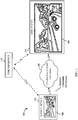
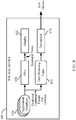
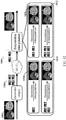
- FIG. 1 a diagram of an example wireless display system 100 in accordance with one or more techniques of the disclosure is illustrated.
- the wireless display system 100 utilize an adaptive compression pipeline to facilitate wireless transmission of graphics domain frames containing graphics commands from a source device 102 to a sink device 104 over a wireless communications channel 106.
- the adaptive compression pipeline is configured to reduce the latency of the transmission. While various aspects of this disclosure are illustrated with a wireless display system utilizing a wireless communications channel, the concepts are not limited to a wireless communications channel and may be implemented with non-wireless communications channels.
- the source device 102 may be an electronic device configured to transmit screen content data 108 (e.g., video and audio/visual media) to a sink device 104 over a communications channel 106.
- screen content data 108 e.g., video and audio/visual media
- Examples of a source device 102 include, but are not limited to devices such as smartphones or other mobile handsets, tablet computers, laptop computers, e-readers, digital video recorders (DVRs), desktop computers, wearable computing devices (e.g., smart watches, smart glasses, and the like), and/or other communication/computing device that communicates, at least partially, through wireless communications.
- the sink device 104 may be an electronic device adapted to receive the screen content data 108 (e.g., streaming video or audio/visual media) conveyed or transmitted over the communications channel 106 from the source device 102.
- Examples of a sink device 104 may include, but are not limited to devices such as smartphones or other mobile handsets, tablet computers, laptop computers, e-readers, digital video recorders (DVRs), desktop computers, wearable computing devices (e.g., smart watches, smart glasses, and the like), televisions, monitors, and/or other communication/computing device with a visual display and with wireless communications capabilities.
- the wireless communications channel 106 may include one or more channels capable of propagating communicative signals between the source device 102 and the sink device 104.
- the communications channel 106 may be a wireless communications channel.
- the wireless communications channel 106 may be implemented in radio frequency communications in one or more frequency bands, such as the 2.4 GHz band, 5 GHz band, 60 GHz band, or other licensed/unlicensed frequency bands.
- the communications channel 106 may comply with one or more sets of standards, protocols, or technologies such as wireless universal serial bus (WUSB) (as promoted by the Wireless USB Promoter Group), Wi-Fi (as promoted by the Wi-Fi Alliance), WiGig (as promoted by the Wireless Gigabit Alliance), and/or the Institute of Electrical and Electronics Engineers (IEEE) 802.11 set of standards (e.g., 802.11, 802.11a, 802.11b, 802.11g, 802.11n, 802.11ac, 802.11ad, 802.11mc, etc.), as well as one or more other standards, protocols, or technologies.
- WUSB wireless universal serial bus
- Wi-Fi as promoted by the Wi-Fi Alliance
- WiGig as promoted by the Wireless Gigabit Alliance
- IEEE Institute of Electrical and Electronics Engineers 802.11 set of standards (e.g., 802.11, 802.11a, 802.11b, 802.11g, 802.11n, 802.11ac, 802.11ad, 802.11
- the frequency bands used such as the 2.4 GHz, 5 GHz, and 60 GHz bands, may be defined for purposes of this disclosure as they are understood in light of the standards of Wi-Fi, WiGig, any one or more IEEE 802.11 protocols, or other applicable standards or protocols.
- the source device 102 may have screen content data 108 to be conveyed.
- the source device 102 can convey or transmit the screen content data 108 (e.g., video) via the wireless communications channel 106 to the sink device 104, which may display a corresponding screen content data 109.
- the source device 102 and sink device 104 may be time-synchronized to a time reference 110 such that the screen content data 108, 109 may be displayed on both devices in a time synchronized fashion (e.g., simultaneously displayed).
- a "graphics domain" transmission method may be used by the source device 102 to stream the screen content data 108 as deconstructed graphics domain frames to the sink device 104.
- Graphics domain transmissions may be accomplished by capturing the screen content data 108 (e.g., video) at the source device (e.g., at an input of a GPU of the source device 102) in the form of graphics command tokens (e.g., OpenGL commands) and/or texture elements, and conveying the command tokens and texture elements to the sink device 104 via the communications channel 106.
- graphics command tokens e.g., OpenGL commands
- OpenGL Open Graphics Library
- API application programming interface
- OpenGL implementations provide libraries that implement the API defined by the specification, which is maintained by the OpenGL Architectural Review Board.
- a command token is a group of bytes or data corresponding to one OpenGL command.
- the sink device 104 e.g., a GPU at the sink device 104 may render the command tokens and texture elements into display able frames, and output the rendered frames on a display of the sink device 104. Texture elements may be mapped onto the corresponding surfaces of objects in the rendered image. Texture elements can add various details to the objects such as lighting effects, colors, textures, patterns, etc.
- This "graphics domain" transmission method may be referred to as a graphics offloading method in this disclosure.
- a frame containing graphic command tokens is called a graphics domain frame that is different from a displayable frame or rendered frame containing rendered graphics or images.
- a rendered image or frame contains the data of each pixel of the image to be displayed.
- Non-limiting examples of rendered graphics are raster graphics and bitmapped graphics.
- a rendered frame is a data structure representing a plurality of pixels viewable via a display, monitor, or other display medium.
- the sink device 104 receives the graphic command tokens and texture elements, and performs a series of computation and/or mathematical approximation to render a finalized image (e.g., displayable frame) based on received graphics command tokens.
- the entire image's spatial, textural, and/or lighting information are combined to determine the color value of each pixel in the displayed image.
- Graphics domain transmission methods are different from rendered image transmissions in several aspects.
- the sink device 104 can employ the graphics command tokens (e.g., tokens of OpenGL commands) and texture elements to render the graphics domain frame at a higher resolution with similar quality.
- graphics command tokens e.g., tokens of OpenGL commands
- texture elements e.g., texture elements that render the graphics domain frame at a higher resolution with similar quality.
- Another example includes the ability to send a texture element that may be used in multiple frames, enabling the source device 102 to send the texture element a single time to be employed by the sink device 104 to render several different frames.
- the graphics domain transmission method may utilize an adaptive compression pipeline (e.g., a graphics compression pipeline) at the source device 102.
- the adaptive compression pipeline receives and processes graphics commands (graphics domain frames), and may store the commands for future processing or execute the commands immediately. Examples of the adaptive compression pipeline will be described in detail below.
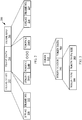
- FIG. 2 a block diagram is depicted, illustrating an example of a graphics domain frame 200 that may be output by the source device 102 to stream screen content data 108 (e.g., video or audio/visual media) to the sink device 104 using a graphics domain transmission method, according to at least one example of the present disclosure.
- the graphics domain frame 200 can include a frame start field 202, a frame data field 204, and a frame end field 206.
- the graphics domain frame 200 may be an OpenGL command frame.
- the frame start field 202 may include a start flag 208 and a frame number field 212.
- the frame start field 202 may indicate the beginning of a graphics domain frame 200 (e.g., within a data stream or transmission).
- the frame number field 212 may indicate a sequence number of the graphics domain frame 200.
- the value of the frame number field 212 may increment for subsequent frames. For instance, the value of the frame number field 212 may be f for a current frame and f + 1 for a next frame (e.g., f is a non-negative integer).
- the frame data field 204 may include one or more graphics command tokens 214A-214N (collectively, "tokens 214"). Each of the tokens 214 may correspond to a particular token of a graphics command. Further details of one example of a token of the tokens 214 are provided below with reference to FIG. 3 .
- the frame end field 206 may include an end flag 216 and a frame number field 220.
- the end flag 216 may indicate the beginning of the frame end field 206 (e.g., within a data stream).
- the frame number field 220 may indicate a sequence number of the command frame 200.
- the frame number fields 212 and 220 may have the same frame number such that the receiver may determine the frame number by looking at either or both fields.
- FIG. 3 is a diagram illustrating further details of one example of a graphics command token, in accordance with one or more aspects of this disclosure.
- the token 214 may include a token header field 302 and a token data field 304.
- the token header field 302 may indicate one or more characteristics of the token 214. In some examples, the token header field 302 may have a fixed length, such as 12 bytes or any other suitable length.
- the token header field 302 may include a token type field 306 and a token data size field 308.
- the token type field 306 may indicate which graphics command among a set of graphics commands corresponds to the token 214. That is, the token type field 306 may indicate which graphics command the token 214 is a token of.
- the token data size field 308 may indicate a size of the token data field 304 (e.g., in bytes).
- the token data field 304 may indicate one or more arguments or data for the token 214. For instance, if the graphics command type indicated by the token type field 306 takes two arguments, the token data field 304 may include the data for the two arguments.
- the token data field 304 may also include a timestamp (e.g., a presentation timestamp) indicating a specific time that the corresponding frame will be displayed.
- graphics domain transmissions enable the source device 102 to transmit graphics command tokens (e.g., OpenGL command tokens) and texture elements, where the same texture elements may be used in one or more frames.
- graphics command tokens e.g., OpenGL command tokens
- texture elements may be relatively large in size, compared to the graphics command tokens. The relatively large size of the texture elements can result in peaks of data that are transmitted by the source device 102.
- FIG. 4 is a graph illustrating graphics domain frame sizes over time when performing screen sharing or mirroring for a certain application.
- the application may be a video game, video streaming, slideshow, and the like.
- a peak 402 at the beginning of around 19 Megabytes (MB) of data that is transmitted when the game is initiated.
- This may include several texture elements, such as the background of the game and different objects used for rendering the frames in the game. These texture elements typically need to be available at the sink device 104 before it can start displaying the game.
- Other data peaks 404 and 406 also can occur during other times of the game.
- the other graphics domain frames may be relatively small in size.
- the relatively large frames at the data peaks may result in delays in transmissions. For example, assuming an available bandwidth or bit-rate is 200 Megabits per second (Mbps), there would be a significant delay between the data transmitted by the source device 102 and the data received by the sink device 104.
- the above-described delay between the data transmitted at the source device 102 and the data arriving at the sink device 104 may cause a latency between the video or images displayed at the source device and that of the sink device. Such delay will be referred to as screen mirroring latency in this specification. Undesirably long screen mirroring latency can adversely affect certain applications such as highly interactive applications and video gaming for example.
- a source device is configured to offload graphics rendering to a sink device utilizing an adaptive compression pipeline that can perform screen mirroring with zero or a small (e.g., non-perceptible) screen-to-screen latency.
- a small or non-perceptible screen-to-screen latency may be 5 milliseconds or less.
- Screen-to-screen latency (or display-to-display latency) refers to the latency or time delay between a frame displayed on the source device and the corresponding frame displayed on the sink device.
- the adaptive compression pipeline may be configured to selectively utilize various compression tools or techniques to reduce screen-to-screen latency. Examples of these compression tools include scalable texture streaming, frame-based prediction, frame dropping, and lossless and/or lossy compression techniques. The application of these compression tools and techniques will be described in more detail below.
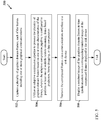
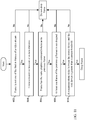
- FIGs. 5 and 6 are flow charts illustrating a screen mirroring method 500 utilizing an adaptive compression pipeline in accordance with aspects of the present disclosure.
- the screen mirroring method 500 may be performed by a source device illustrated in any of FIGs. 1 , 7 , and/or 8, or any suitable apparatus.
- the source device captures a plurality of graphics domain frames of screen content data or video data.
- one or more applications e.g., applications modules 620 of FIG. 6
- the source device may generate one or more graphical command tokens (e.g., OpenGL command tokens) and textures.
- These graphical command tokens maybe stored and/or grouped into one or more graphics domain frames for further processing.
- each captured frame includes one or more graphics command tokens and/or textures.
- the screen content data may be the video data 108 of FIG. 1 or any suitable streaming media data.
- the source device may utilize a data streaming module 610 to capture a graphics domain frame by retaining, transmitting, conveying, and/or storing the corresponding graphics command tokens and/or textures of the frame at the input of a GPU (e.g., GPU 608 of FIGs. 7 and 8 ) of the source device.
- the captured graphics domain frames may be stored at a memory storage (e.g., storage medium 606 of FIG. 7 ) for further processing.
- the source device utilizes an adaptive compression pipeline to process or compress the plurality of graphics domain frames based on one or more characteristics of the frames.
- the source device may implement the adaptive compression pipeline shown in FIG. 6 .
- the adaptive compression pipeline may process or compress the frames by at least one of scalable texture streaming, frame-based prediction, frame dropping, and/or lossy/lossless data compression.
- the source device may utilize a data streaming logic 624 (see FIG. 8 ) to determine the characteristics of the frames.
- the characteristics include frame number, frame length, differences and/or similarities of data between adjacent frames, presence of textures, number of command tokens contained in a frame, and presentation timestamp.
- the source device may compress the frames utilizing scalable texture streaming (block 514), frame-based prediction (block 516), frame dropping (block 518), or lossy/lossless data compression (block 520).
- scalable texture streaming block 514
- frame-based prediction block 516
- frame dropping block 518
- lossy/lossless data compression block 520
- the source device transmits the compressed graphics domain frames via a communications interface to a sink device.
- the sink device may be the sink device 104 of FIG. 1 or any suitable apparatus.
- the source device may utilize a transmitter 614 ( FIGs. 7 and 8 ) to transmit the compressed frames.
- the compressed frames may be loaded into a buffer of the transmitter 614, and processed (e.g., digital-to-analog conversion, modulation and frequency conversion) into a suitable signal for transmission through a wireless communications channel.
- the source device displays a rendered image of the graphics domain frames in time synchronization with a corresponding rendered image of the compressed frames displayed at the sink device.
- the rendered images are considered time synchronized when the time lag between the displayed images is within a predetermined threshold (e.g., 5 milliseconds or less).
- the rendered images may be displayed simultaneously.
- the source device may render the graphics domain frames utilizing a GPU 608 ( FIG. 8 ) and displays the rendered image on a display 622 ( FIG. 8 ).
- the source device and the sink device may be synchronized in time to a common time reference such that both devices can display the desired image at substantially the same time, for example, according to the presentation timestamp of the frames.
- the described adaptive compression pipeline enables the graphics domain frames (i.e., frames including command tokens) to be compressed and transmitted through the communications channel in less time relative to uncompressed frames. Therefore, screen mirroring latency may be reduced.
- the reduced latency of the graphics pipeline facilitates the synchronized display of the graphics domain frames on both the source device and the sink device without perceptible delay between the devices.
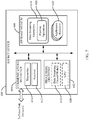
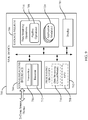
- FIG. 7 is a block diagram illustrating select components of a source device 600 according to an aspect of the disclosure.
- the source device 600 includes processing circuitry 602 operatively coupled to or placed in electrical communications with a communications interface 604 and a storage medium 606.
- the processing circuitry 602 includes circuitry arranged to obtain, process and/or send data, control data access and storage, issue commands, and control other desired operations.
- the processing circuitry 602 may include circuitry adapted to implement desired programming provided by appropriate media, and/or circuitry adapted to perform one or more functions and processes described in this disclosure, for example, in FIGs. 5 , 6 , and 8-13 .
- the processing circuitry 602 may be implemented as one or more processors, one or more controllers, and/or other structure configured to execute executable software, programming, codes, and/or execute specific functions.
- Examples of the processing circuitry 602 may include a general purpose processor, a digital signal processor (DSP), an application specific integrated circuit (ASIC), a field programmable gate array (FPGA) or other programmable logic component, discrete gate or transistor logic, discrete hardware components, or any combination thereof designed to perform the functions described herein.
- DSP digital signal processor
- ASIC application specific integrated circuit
- FPGA field programmable gate array
- a general purpose processor may include a microprocessor, as well as any conventional processor, controller, microcontroller, or state machine.
- the processing circuitry 602 may also be implemented as a combination of computing components, such as a combination of a DSP and a microprocessor, a number of microprocessors, one or more microprocessors in conjunction with a DSP core, an ASIC and a microprocessor, or any other number of varying configurations. These examples of the processing circuitry 602 are for illustration and other suitable configurations within the scope of the present disclosure are also contemplated.
- the processing circuitry 602 can include circuitry adapted for processing data, including the execution of programming or code, which may be stored on the storage medium 606.
- programming shall be construed broadly to include without limitation instructions, instruction sets, code, code segments, program code, programs, subprograms, software modules, applications, software applications, software packages, routines, subroutines, objects, executables, threads of execution, procedures, functions, etc., whether referred to as software, firmware, middleware, microcode, hardware description language, or otherwise.
- the processing circuitry 602 may include a graphics processing unit (GPU) 608 and/or a video data streaming circuit or module 610.
- the GPU 608 generally includes circuitry and/or programming (e.g., programming stored on the storage medium 606) adapted for processing graphics data and rendering frames of graphics or screen content data based on one or more graphics command tokens one and/or texture elements for display by a user interface, screen, monitor, or an output device.
- the data streaming circuit/module 610 may include circuitry and/or programming (e.g., programming stored on the storage medium 606) adapted to stream video data or screen content data in the form of graphics command tokens and texture elements to a sink device.
- the data streaming circuit/module 610 may encapsulate the one or more graphics command tokens and/or textures in a command frame, such as the graphics domain frame 200 of FIG. 2 .
- the data streaming circuit/module 610 may capture the graphics command tokens and/or texture elements at an input of the GPU 608 or other graphic processing circuitry.
- the data streaming circuit/module 610 may implement an adaptive compression pipeline configured to compress graphics command frames utilizing one or more of scalable texture streaming, frame-based prediction, frame dropping, and/or lossy/lossless data compression, based on the characteristics of the frames, as described in more detail herein below.
- reference to circuitry and/or programming associated with the source device 600 and the processes performed may be generally referred to as logic (e.g., logic gates and/or data structure logic).
- the communications interface 604 is configured to facilitate wireless communications of the source device 600.
- the communications interface 604 may include circuitry and/or programming adapted to facilitate the communications of information bi-directionally with respect to one or more sink devices.
- the communications interface 604 may be coupled to one or more antennas (not shown), and includes wireless transceiver circuitry, including at least one receiver 612 (e.g., one or more receiver chains) and/or at least one transmitter 614 (e.g., one or more transmitter chains).
- the communications interface 604 may include suitable transmitters and receivers for wired communications (e.g., Universal Serial Bus (USB), Ethernet, PCI Express, Thunderbolt, etc.)
- the storage medium 606 may represent one or more processor-readable devices for storing programming, such as processor executable code or instructions (e.g., software, firmware), electronic data, databases, or other digital information.
- the storage medium 606 may also be used for storing data (e.g., screen content data, scalable streaming flag, frames) that is manipulated or processed by the processing circuitry 602 when executing programming or code such as compression pipeline operations 618.
- the storage medium 606 may be any available media that can be accessed by a general purpose or special purpose processor, including portable or fixed storage devices, optical storage devices, and various other mediums capable of storing, containing and/or carrying programming or code.
- the storage medium 606 may include a processor-readable non-transitory storage medium such as a magnetic storage device (e.g., hard disk, floppy disk, magnetic strip), an optical storage medium (e.g., compact disk (CD), digital versatile disk (DVD)), a smart card, a flash memory device (e.g., card, stick, key drive), random access memory (RAM), read only memory (ROM), programmable ROM (PROM), erasable PROM (EPROM), electrically erasable PROM (EEPROM), a register, a removable disk, and/or other mediums for storing programming, as well as any combination thereof.
- a processor-readable non-transitory storage medium such as a magnetic storage device (e.g., hard disk, floppy disk, magnetic strip), an optical storage medium (e.g., compact disk (CD), digital versatile disk (DVD)), a smart card, a flash memory device (e.g., card, stick, key drive), random access memory (RAM), read only memory (ROM
- the storage medium 606 may be coupled to the processing circuitry 602 such that at least some of the processing circuitry 602 can read information from, and write information to, the storage medium 606. That is, the storage medium 606 can be coupled to the processing circuitry 602 so that the storage medium 606 is at least accessible by the processing circuitry 602, including examples where the storage medium 606 is integral to the processing circuitry 602 and/or examples where the storage medium 606 is separate from the processing circuitry 602 (e.g., resident in the source device 600, external to the source device 600, distributed across multiple entities).
- the storage medium 606 may include programming or code stored thereon. Such programming, when executed by the processing circuitry 602, can cause the processing circuitry 602 to perform one or more of the various functions and/or process steps described herein for example in FIGs. 1 , 5 , 6 , and 10-13 .
- the storage medium 606 may include data streaming operations 616.
- the data streaming operations 616 are adapted to cause the processing circuitry 602 to stream screen content data (e.g., video data) in the form of graphics domain frames containing graphics command tokens and texture elements to a sink device via the communications interface 604.
- the data streaming operations 616 may include compression pipeline operations 618 adapted to cause the processing circuitry 602 to adaptively compress the frames containing graphics command tokens and textures based on one or more characteristics of the frames, utilizing one or more of scalable texture streaming, frame-based prediction, frame dropping, or lossy/lossless data compression, as described in more detail herein below.
- the storage medium 606 may also include data that are generated or utilized by the data streaming operations. For example, the storage medium 606 may have a scalable streaming flag for indicating whether or not scalable streaming should be applied to the frame.
- the storage medium 606 may also include application modules 620 which may each represent an application provided by an entity that manufactures the source device 600, programming operating on the source device 600, and/or an application developed by a third-party for use with the source device 600.
- application modules 620 may include applications for gaming, shopping, travel routing, maps, audio and/or video presentation, word processing, spreadsheets, voice and/or calls, weather, etc.
- One or more application modules 620 may include or generate texture elements (textures) associated with the application modules and the applications.
- a gaming application of the application modules 620 entails the slicing of falling fruit (e.g., watermelons, avocados, pineapples, etc.)
- texture elements associated with the gaming application that may include a graphical representation of each type of fruit, as well as backgrounds. Such texture elements may be stored in different color spaces and with different bit depths of their corresponding color channels.
- the processing circuitry 602 is adapted to perform (independently or in conjunction with the storage medium 606) any or all of the processes, functions, steps and/or routines for any or all of the source devices described herein.
- the term "adapted" or “configured” in relation to the processing circuitry 602 may refer to the processing circuitry 602 being one or more of configured, employed, implemented, and/or programmed (in conjunction with the storage medium 606) to perform a particular process, function, step and/or routine according to various features described herein, for example, in FIGs. 5 , 6 , and 10-13 .
- FIG. 8 is a block diagram illustrating an example data flow within the source device 600 according to one aspect of the present disclosure.
- the source device 600 may be the same as the source device of FIG. 7 .
- one or more of the application modules 620 of the source device 600 may output graphics domain frames containing graphics command tokens and textures, e.g., to the GPU 608.
- the GPU 608 may render these frames and output the rendered video or images to a display 622 or an output device.
- the GPU 608 may not render the graphics domain frames, but stream them to a sink device.
- a data streaming logic 624 may capture the graphics domain frames at an input of the GPU 608.
- the captured frames may be stored at the storage medium 606 or buffered in the data streaming logic 624.
- the data streaming logic 624 may compress the graphics domain frames utilizing an adaptive compression pipeline implemented to perform at least one of scalable texture streaming, frame-based prediction, frame dropping, and/or lossy/lossless data compression, based on the characteristics of the frames.
- the compressed frames are output to the transmitter 614.
- the data streaming logic 624 may generate compressed graphics command tokens and textures associated with a plurality of frames making up a sequence of frames.
- the transmitter 614 can output the compressed frames containing graphics command tokens and textures to a sink device (e.g., sink device 700 of FIG. 9 ).
- FIG. 9 is a block diagram illustrating select components of a sink device 700 configured to perform screen mirroring in accordance with an aspect of the disclosure.
- the sink device 700 includes processing circuitry 702 operatively coupled to or placed in electrical communications with a communications interface 704 and a storage medium 706.
- the processing circuitry 702 includes circuitry arranged to obtain, process, transmit and/or receive data, control data access and storage, issue commands, and control other desired operations.
- the processing circuitry 702 may include circuitry adapted to implement desired programming provided by appropriate media, and/or circuitry adapted to perform one or more functions described in this disclosure, for example, in FIGs. 1 and 14 .
- Some components of the sink device 700 are similar to those of the source device 600, and redundant description will be omitted for brevity.
- the processing circuitry 702 may include a graphics processing unit (GPU) 708 and/or a data streaming circuit or module 710.
- the GPU 708 generally includes circuitry and/or programming (e.g., programming stored on the storage medium 706) adapted for processing graphics data and rendering graphics domain frames of video data or screen content data based on one or more graphics command tokens and texture elements for display by a display 711 or output device.
- the data streaming circuit/module 710 may include circuitry and/or programming (e.g., programming stored on the storage medium 706) adapted to receive graphics domain frames (e.g., frames 200 of FIG. 2 ) containing graphics command tokens and/or textures from a source device (e.g., source device 600).
- the data streaming circuit/module 710 may provide the graphics domain frames containing graphics command tokens and/or textures to a GPU 708, which renders the frames to be displayed by the display 711.
- the data streaming circuit/module 710 may include circuitry configured to drop one or more frames based on the frames' presentation timestamp.
- the communications interface 704 is configured to facilitate wireless communications with a source device.
- the communications interface 704 may include circuitry and/or programming adapted to facilitate the communications of information bi-directionally with respect to one or more source devices 600.
- the communications interface 704 may be coupled to one or more antennas (not shown), and includes wireless transceiver circuitry, including at least one receiver 712 (e.g., one or more receiver chains) and/or at least one transmitter 714 (e.g., one or more transmitter chains).
- the storage medium 706 may represent one or more processor-readable devices for storing programming, such as processor executable code or instructions (e.g., software, firmware), electronic data, databases, or other digital information.
- the storage medium 706 may also be used for storing data (e.g., graphics domain frames received from a source device) that is manipulated by the processing circuitry 702 when executing programming or code.
- the storage medium 706 may be any available media that can be accessed by a general purpose or special purpose processor, including portable or fixed storage devices, optical storage devices, and various other mediums capable of storing, containing and/or carrying programming or code.
- the storage medium 706 may include a processor-readable non-transitory storage medium such as a magnetic storage device (e.g., hard disk, floppy disk, magnetic strip), an optical storage medium (e.g., compact disk (CD), digital versatile disk (DVD)), a smart card, a flash memory device (e.g., card, stick, key drive), random access memory (RAM), read only memory (ROM), programmable ROM (PROM), erasable PROM (EPROM), electrically erasable PROM (EEPROM), a register, a removable disk, and/or other mediums for storing programming, as well as any combination thereof.
- a processor-readable non-transitory storage medium such as a magnetic storage device (e.g., hard disk, floppy disk, magnetic strip), an optical storage medium (e.g., compact disk (CD), digital versatile disk (DVD)), a smart card, a flash memory device (e.g., card, stick, key drive), random access memory (RAM), read only memory (ROM
- the storage medium 706 may include programming stored thereon. Such programming, when executed by the processing circuitry 702, can cause the processing circuitry 702 to perform one or more of the various functions and/or process steps described herein.
- the storage medium 706 may include data streaming operations 716.
- the data streaming operations 716 are adapted to cause the processing circuitry 702 to receive stream video data or screen content data in the form of frames containing graphics command tokens and texture elements from a source device via the communications interface 704.
- the storage medium 706 may also include application modules 720 which may each represent an application provided by an entity that manufactures the sink device 700, programming operating on the sink device 700, and/or an application developed by a third-party for use with the sink device 700.
- application modules 720 may include applications for gaming, shopping, travel routing, maps, audio and/or video presentation, word processing, spreadsheets, voice and/or calls, weather, etc.
- the processing circuitry 702 is adapted to perform (independently or in conjunction with the storage medium 706) any or all of the processes, functions, steps and/or routines for any or all of the sink devices described herein.
- the term "adapted" or “configured” in relation to the processing circuitry 702 may refer to the processing circuitry 702 being one or more of configured, employed, implemented, and/or programmed (in conjunction with the storage medium 706) to perform a particular process, function, step and/or routine according to various features described herein, for example, in FIG. 14 .
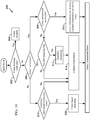
- FIG. 10 is a diagram illustrating an adaptive compression pipeline 800 in accordance with some aspects of the disclosure.
- This adaptive compression pipeline 800 may be implemented at a source device illustrated in any of FIGs. 1 , 7 , and 8 or any suitable apparatus.
- the source device 600 may be configured to utilize the adaptive compression pipeline 800 to process or compress graphics domain frames (at block 504) while performing the screen mirroring method 500 of FIG. 5 .
- the adaptive compression pipeline 800 can adaptively compress or reduce the size of the frame utilizing various compression tools or techniques so that the frame may be transmitted to a sink device in less time to reduce latency of the transmission.
- the source device may utilize its processing circuitry 602 to determine whether or not frame dropping is applied to the frame. If the frame meets certain criteria, the frame may be dropped at block 804. When a frame is dropped, it is not streamed or transmitted to the sink device, but it may still be rendered and/or displayed at the source device. Referring to FIG. 11 , a frame may be dropped if all or some of the following conditions are met.
- it is determined whether or not the frame is one of the first m frames of a video stream. In one example, the value of m may be equal to 2 or more, or any suitable value.
- textures may provide the detail, surface texture or color of the surface of an object in the rendered frames.
- the frame has the same graphics command tokens as its previous frame. For example, a frame no. f may have the same graphics command tokens as frame no. f + 1.
- the source device may determine the delay by comparing the presentation timestamp of the current frame that will be sent against the current system time on the source device. This provides a good heuristic for the screen-to-screen delay calculation when the transmission delay is taken into account.
- the frame when all conditions of FIG. 11 are met, the frame may be dropped; otherwise, the frame is not dropped. In some examples, when only some conditions of FIG. 11 are met, the frame may be dropped.
- the conditions of FIG. 11 may be checked in any orders in sequence and/or in parallel, not limited to the particular order shown in the figure. In some aspects of the disclosure, some of the conditions may be omitted, and other conditions may be added. More information on frame dropping may be found in a copending patent application no. 14/589,481 filed with the United States Patent and Trademark Office on January 5, 2015.
- the source device may utilize its processing circuitry 602 to determine whether or not the graphics domain frame has textures. If the frame has textures, the source device proceeds to decision block 808; otherwise, the source device proceeds to decision block 818.
- the source device may utilize its processing circuitry 602 to decide whether or not to apply lossy data compression to the frame containing textures.
- the source device may utilize its processing circuitry 602 to apply lossy compression to the data of the frame corresponding to textures, and lossless compression to the other data of the frame. For example, the source device may compress the textures using a lossy JPEG (Joint Photographic Experts Group) format.
- JPEG Joint Photographic Experts Group
- a pixel may be represented by three channels for red, green, and blue (RGB) and one alpha channel.
- the alpha channel specifies transparency, which defines how a pixel's R, G, and B colors are merged with another pixel when the two are overlaid, one on top of the other.
- the source device separates an RGB image (RGB channels) of a frame from an alpha channel, and compresses the RGB image as a JPEG image.
- the compressed JPEG image size may be represented in 23 bits. The source device may selectively compress the alpha channel based on the alpha channel's content.
- the source device may transmit a frame including an alpha flag with a value of 0 (or a predetermined value) to the sink device, but not sending the alpha channel data. If the alpha channel contains not all ones (i.e., ones and zeros data), the source device may compress the alpha channel to a JPEG grayscale image and transmit the frame including the JPEG grayscale image and an alpha flag with a value of 1 (or a predetermined value) to the sink device.
- the source device may utilize its processing circuitry 602 to decide whether or not to apply scalable texture streaming based on a scalable streaming flag maintained by the source device.
- the scalable streaming flag may be set based on the communications bandwidth between the source device and the sink device, and/or any feedback provided by the sink device. For example, when the bandwidth is below a certain threshold, the source device may enable scalable texture streaming. In one example, when rendering quality at the sink device is unsatisfactory (e.g., excessive rendering artifacts), the source device may disable scalable texture streaming.
- An example of scalable texture streaming will be described below in FIG. 12 .
- the source device may utilize its processing circuitry 602 to perform scalable texture streaming in accordance with one aspect of the disclosure.
- the source device may divide a frame 1002 into a number of small stages 1004 or layers. Each of the small stages 1004 is smaller than the original frame 1002 in data size. Then the source device transmits the small stages 1004 separately in sequence to the sink device via a communications channel (e.g., Wi-Fi channel, cellular connection).
- the sink device may reconstruct or render a low quality image or frame 1006 of the original frame 1002 based on the first stage received. For example, the low quality image 1006 may have lower resolution than the original frame.
- Later stages provide refinement bits or data to the sink device such that progressively better quality images (e.g., images 1008 and 1010) may be constructed.
- the sink device may apply successive interpolation to the stages to generate the images.
- the quality of a frame 1012 constructed with all the stages may approach or have substantially the same image quality of the original frame 1002.
- the source device may utilize its processing circuitry 602 to apply lossless compression to the data (e.g., command tokens) of the graphics domain frame containing no textures when the scalable streaming flag is not set.
- lossless data compression techniques such as zlib, LZ4, and LZO (Lempel-Ziv-Oberhumer) may be used. While applying data compression may reduce transmission latency by streaming smaller frames, performing data compression may increase processing time. Therefore, the source device may selectively apply compression (e.g., zlib, LZ4, and LZO) based on a number of criteria such as the channel bandwidth and processing time of performing compression. In general, the source device may select to apply data compression if it can reduce the overall latency while taking into account of the processing time of performing compression and the transmission time of the compressed frame.
- the source device may utilize its processing circuitry 602 to decide whether or not to perform frame-based prediction based on the length of the graphics domain frame.
- the source device may utilize its processing circuitry 602 to perform frame-based prediction to compress or reduce the size of the current frame at block 820.
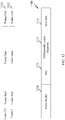
- FIG. 13 is a diagram illustrating frame-based prediction on two consecutive frames 1102 and 1104 (frames f and frames f + 1) that have the same length.
- the locations that the two frames contain different data may be byte locations 70, 71, 72, 80, 113, 114, 158, 159, 160, 161, and 188.
- the source device may differentially encode these locations as 70, 1, 1, 8, 33, 1, 44, 1, 1, 1, and 27.
- other encoding schemes may be used.
- the source device may encode the differential locations (i.e., same locations of the frames having different data) using any suitable coding schemes.
- the source device may encode the differential locations using exponential-Golomb coding.
- the encoded differential locations become 0000001000110 (i.e., location 70), 1, 1, 0001000, 00000100001, 1, and so on.
- the source device transmits a frame 1106 ( FIG. 13 ) with the coded differential locations and the new/different data of these locations to the sink device.
- the graphics domain frame structure 1106 includes a frame header 1108, a size field 1110, a differentially coded locations field 1112, and a new data field 1114.
- the frame header 1108 marks the beginning of the frame and indicates application of frame compression (e.g., frame-based prediction) applied to this frame.
- the size field 1110 indicates the size of the coded locations. In one specific example, the size of the size field 1110 may be two bytes (2B). The coded locations themselves may be variable in length. These two bytes help the decoder of the sink device to parse the number of bytes containing the differentially coded locations.
- the differentially coded locations field 1112 indicates the locations where the frame contains new data (i.e., different data).
- the new data field 1114 provides the values of the new data. Accordingly, the sink device may construct the frame f+1 based on the previous frame f and the frame 1106, which contains the locations of the different/new data.
- the frame 1106 may have a smaller size or length than the frame f + 1 1104 such that the transmission latency may be reduced.
- the source device may perform lossless compression on the frame at block 816 as described above.
- the graphic command frame compression tools and techniques illustrated in FIGs. 10-13 are not exhaustive. In some aspects of the disclosure, a source device may not implement some of these frame compression tools, and may include other suitable frame compression tools within the scope of the present disclosure.
- the source device and the sink device may be synchronized to a global clock source (e.g., time reference 110 of FIG. 1 ) such that the devices can regulate and control the time a particular frame is rendered and/or displayed on a display or screen.
- the sink device may derive the time from the data received from the source device.
- non-perceptible latency screen mirroring may have a latency less than 5 milliseconds or a latency that a human viewer cannot perceive a noticeable delay between the images displayed by the source and sink devices.
- the source device and the sink device may be synchronized to a suitable clock source using the Network Time Protocol (NTP).
- NTP Network Time Protocol
- the source device and the sink device may be synchronized to a clock source using the Timing Synchronization Function (TSF) from the same Wi-Fi network to which both devices are connected to.
- TSF Timing Synchronization Function
- the audio component may be captured early on the source side at the application layer.
- the global clock source may be based on NTP, TSF, or Wi-Fi.
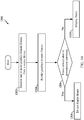
- FIG. 14 is a flow chart illustrating a sink side frame dropping method 1200 in accordance with an aspect of the disclosure.
- the sink side frame dropping method 1200 may be performed by the sink device 700 of FIG. 9 or any suitable apparatus.
- the sink device may utilize its communications interface 704 ( FIG. 9 ) to receive one or more graphics domain frames from a source device (e.g., source device 102 of FIG. 1 ).
- a source device e.g., source device 102 of FIG. 1
- each of the frames may include one more graphics command tokens and/or textures similar to the frame 200 illustrated in FIG. 2 .
- the frames may be compressed at the source device by an adaptive compression pipeline similar to that described in FIGs. 6 and 10 .
- the adaptive compression pipeline can be configured to compress or process the frames using scalable texture streaming, frame-based prediction, frame dropping, or lossy/lossless data compression as described above in FIGs. 10-13 .
- the sink device renders the graphics domain frames for display for example utilizing its processing circuitry 602 and/or GPU 608 ( FIG. 7 ).
- the sink device does not display this frame at block 1208; otherwise, the sink device displays the frame at block 1210.
- the sink device may still execute the graphics commands of the dropped frame for example by its GPU.
- FIGs. 1-14 may be rearranged and/or combined into a single component, step, feature or function or embodied in several components, steps, or functions. Additional elements, components, steps, and/or functions may also be added or not utilized without departing from the present disclosure.
- the apparatus, devices and/or components illustrated in FIGs. 1 , 7 , 8 , and/or 9 may be configured to perform or employ one or more of the methods, features, parameters, and/or steps described in FIGs. 1 , 5 , 6 and/or 10-14.
- the novel algorithms and procedures described herein may also be efficiently implemented in software and/or embedded in hardware, or a combination thereof.
Landscapes
- Engineering & Computer Science (AREA)
- Theoretical Computer Science (AREA)
- Physics & Mathematics (AREA)
- General Physics & Mathematics (AREA)
- Human Computer Interaction (AREA)
- General Engineering & Computer Science (AREA)
- Computer Hardware Design (AREA)
- Software Systems (AREA)
- Computer Security & Cryptography (AREA)
- Computer Networks & Wireless Communication (AREA)
- Signal Processing (AREA)
- Multimedia (AREA)
- Image Generation (AREA)
- Compression Or Coding Systems Of Tv Signals (AREA)
- Two-Way Televisions, Distribution Of Moving Picture Or The Like (AREA)
- Controls And Circuits For Display Device (AREA)
Applications Claiming Priority (3)
| Application Number | Priority Date | Filing Date | Title |
|---|---|---|---|
| US201562167765P | 2015-05-28 | 2015-05-28 | |
| US14/958,336 US10255021B2 (en) | 2015-05-28 | 2015-12-03 | Low latency screen mirroring |
| PCT/US2016/032530 WO2016191136A1 (en) | 2015-05-28 | 2016-05-13 | Low latency screen mirroring |
Publications (2)
| Publication Number | Publication Date |
|---|---|
| EP3304277A1 EP3304277A1 (en) | 2018-04-11 |
| EP3304277B1 true EP3304277B1 (en) | 2021-03-17 |
Family
ID=56072479
Family Applications (1)
| Application Number | Title | Priority Date | Filing Date |
|---|---|---|---|
| EP16724833.5A Active EP3304277B1 (en) | 2015-05-28 | 2016-05-13 | Low latency screen mirroring |
Country Status (10)
| Country | Link |
|---|---|
| US (1) | US10255021B2 (enExample) |
| EP (1) | EP3304277B1 (enExample) |
| JP (1) | JP6595006B2 (enExample) |
| KR (1) | KR102043962B1 (enExample) |
| CN (1) | CN107660280B (enExample) |
| BR (1) | BR112017025374A2 (enExample) |
| CA (1) | CA2983447A1 (enExample) |
| ES (1) | ES2869979T3 (enExample) |
| TW (1) | TW201710883A (enExample) |
| WO (1) | WO2016191136A1 (enExample) |
Families Citing this family (22)
| Publication number | Priority date | Publication date | Assignee | Title |
|---|---|---|---|---|
| US20170124043A1 (en) | 2015-11-02 | 2017-05-04 | Microsoft Technology Licensing, Llc | Sound associated with cells in spreadsheets |
| US9990350B2 (en) * | 2015-11-02 | 2018-06-05 | Microsoft Technology Licensing, Llc | Videos associated with cells in spreadsheets |
| US10510317B2 (en) | 2016-06-03 | 2019-12-17 | Apple Inc. | Controlling display performance with target presentation times |
| US10726604B2 (en) | 2016-06-03 | 2020-07-28 | Apple Inc. | Controlling display performance using display statistics and feedback |
| CA2942257C (en) * | 2016-09-19 | 2022-09-06 | Pleora Technologies Inc. | Methods and systems for balancing compression ratio with processing latency |
| US10895954B2 (en) * | 2017-06-02 | 2021-01-19 | Apple Inc. | Providing a graphical canvas for handwritten input |
| US10719286B2 (en) * | 2018-03-29 | 2020-07-21 | Microsoft Technology Licensing, Llc | Mechanism to present in an atomic manner a single buffer that covers multiple displays |
| US11957975B2 (en) * | 2018-05-24 | 2024-04-16 | Microsoft Technology Licensing, Llc | Dead reckoning and latency improvement in 3D game streaming scenario |
| CN108810554B (zh) * | 2018-06-15 | 2021-06-22 | 腾讯科技(深圳)有限公司 | 虚拟场景的场景图像传输方法、计算机设备及存储介质 |
| CN112335244B (zh) * | 2018-06-28 | 2022-12-23 | 苹果公司 | 基于优先级的视频编码和传输 |
| US11451788B2 (en) | 2018-06-28 | 2022-09-20 | Apple Inc. | Rate control for low latency video encoding and transmission |
| EP3815368A1 (en) | 2018-06-28 | 2021-05-05 | Apple Inc. | Video encoding system |
| KR102884545B1 (ko) | 2019-09-25 | 2025-11-11 | 삼성전자주식회사 | 끊김 없이 이미지를 표시하는 전자 장치 및 그의 동작 방법 |
| US11308648B2 (en) | 2020-09-23 | 2022-04-19 | Advanced Micro Devices, Inc. | Compressing texture data on a per-channel basis |
| CN114327312B (zh) * | 2020-09-25 | 2023-10-20 | 华为技术有限公司 | 投屏控制方法和装置 |
| TWI778604B (zh) * | 2021-04-29 | 2022-09-21 | 大陸商北京集創北方科技股份有限公司 | 幀顯示信號同步方法、顯示裝置及資訊處理裝置 |
| CN113556595B (zh) * | 2021-06-16 | 2023-06-06 | 珠海全志科技股份有限公司 | 基于Miracast的回放方法及装置 |
| KR20230046801A (ko) * | 2021-09-30 | 2023-04-06 | 삼성전자주식회사 | 디스플레이 장치 및 그 동작 방법 |
| TWI783729B (zh) * | 2021-10-14 | 2022-11-11 | 財團法人資訊工業策進會 | 分散式資料傳輸容錯系統及其動態資源調整方法 |
| US11706497B1 (en) * | 2022-02-11 | 2023-07-18 | Microsoft Technology Licensing, Llc | Ultra-low latency video streaming |
| US11736552B1 (en) | 2022-09-21 | 2023-08-22 | Microsoft Technology Licensing, Llc | Sender based adaptive bit rate control |
| US12519850B2 (en) | 2024-02-29 | 2026-01-06 | Microsoft Technology Licensing, Llc | Peer-to-peer ultra-low latency streaming of real-time media |
Family Cites Families (21)
| Publication number | Priority date | Publication date | Assignee | Title |
|---|---|---|---|---|
| JP3339284B2 (ja) | 1996-01-29 | 2002-10-28 | 三菱電機株式会社 | 大画面表示方式 |
| JP4010617B2 (ja) * | 1997-12-03 | 2007-11-21 | 株式会社東芝 | 画像復号化装置及び画像復号化方法 |
| JPH11340938A (ja) * | 1998-05-28 | 1999-12-10 | Sony Corp | データ多重化装置及び方法 |
| JP2002051336A (ja) * | 2001-06-15 | 2002-02-15 | Sharp Corp | 画像符号化装置及び画像復号装置 |
| KR20060059769A (ko) * | 2004-11-29 | 2006-06-02 | 엘지전자 주식회사 | 영상신호의 엔코딩시에 베이스 레이어 픽처의 벡터를이용하기 위한 미세정보를 코딩하는 방법과 그 미세정보를이용하는 디코딩 방법 |
| US8386628B1 (en) * | 2005-05-23 | 2013-02-26 | Glance Networks, Inc. | Method and apparatus for reducing the amount of information that must be transmitted to slower viewers over a remote viewing session |
| US7548657B2 (en) * | 2005-06-25 | 2009-06-16 | General Electric Company | Adaptive video compression of graphical user interfaces using application metadata |
| US8890874B2 (en) * | 2007-12-14 | 2014-11-18 | Microsoft Corporation | Changing visual content communication |
| US8350863B2 (en) * | 2008-01-27 | 2013-01-08 | Citrix Systems, Inc. | Methods and systems for improving resource utilization by delaying rendering of three dimensional graphics |
| US8582902B2 (en) * | 2008-09-23 | 2013-11-12 | Telefonaktiebolaget Lm Ericsson (Publ) | Pixel block processing |
| US8886206B2 (en) * | 2009-05-01 | 2014-11-11 | Digimarc Corporation | Methods and systems for content processing |
| US8171154B2 (en) | 2009-09-29 | 2012-05-01 | Net Power And Light, Inc. | Method and system for low-latency transfer protocol |
| US9525998B2 (en) | 2012-01-06 | 2016-12-20 | Qualcomm Incorporated | Wireless display with multiscreen service |
| KR101918040B1 (ko) | 2012-02-20 | 2019-01-29 | 삼성전자주식회사 | 스크린 미러링 방법 및 그 장치 |
| US9307225B2 (en) * | 2012-10-25 | 2016-04-05 | Citrix Systems, Inc. | Adaptive stereoscopic 3D streaming |
| US9257148B2 (en) * | 2013-03-15 | 2016-02-09 | JBF Interlude 2009 LTD | System and method for synchronization of selectably presentable media streams |
| US20140333640A1 (en) * | 2013-05-13 | 2014-11-13 | Qnx Software Systems Limited | System and method for forwarding a graphics command stream |
| EP2804094A1 (en) | 2013-05-13 | 2014-11-19 | 2236008 Ontario Inc. | A system and method for forwarding a graphics command stream |
| KR102133531B1 (ko) | 2013-08-23 | 2020-07-13 | 삼성전자주식회사 | 컨텐츠 재생 방법 및 그에 따른 단말, 그에 따른 시스템 |
| KR102071579B1 (ko) | 2013-09-02 | 2020-01-30 | 삼성전자주식회사 | 화면 미러링을 이용한 서비스 제공 방법 및 그 장치 |
| US9412332B2 (en) | 2013-12-20 | 2016-08-09 | Blackberry Limited | Method for wirelessly transmitting content from a source device to a sink device |
-
2015
- 2015-12-03 US US14/958,336 patent/US10255021B2/en active Active
-
2016
- 2016-05-13 KR KR1020177034173A patent/KR102043962B1/ko not_active Expired - Fee Related
- 2016-05-13 TW TW105114952A patent/TW201710883A/zh unknown
- 2016-05-13 WO PCT/US2016/032530 patent/WO2016191136A1/en not_active Ceased
- 2016-05-13 ES ES16724833T patent/ES2869979T3/es active Active
- 2016-05-13 CA CA2983447A patent/CA2983447A1/en not_active Abandoned
- 2016-05-13 EP EP16724833.5A patent/EP3304277B1/en active Active
- 2016-05-13 JP JP2017561281A patent/JP6595006B2/ja active Active
- 2016-05-13 CN CN201680030464.4A patent/CN107660280B/zh active Active
- 2016-05-13 BR BR112017025374A patent/BR112017025374A2/pt not_active Application Discontinuation
Non-Patent Citations (1)
| Title |
|---|
| None * |
Also Published As
| Publication number | Publication date |
|---|---|
| TW201710883A (zh) | 2017-03-16 |
| JP6595006B2 (ja) | 2019-10-23 |
| EP3304277A1 (en) | 2018-04-11 |
| CN107660280B (zh) | 2020-10-23 |
| JP2018523356A (ja) | 2018-08-16 |
| ES2869979T3 (es) | 2021-10-26 |
| KR20180013921A (ko) | 2018-02-07 |
| US10255021B2 (en) | 2019-04-09 |
| KR102043962B1 (ko) | 2019-11-12 |
| CN107660280A (zh) | 2018-02-02 |
| US20160350056A1 (en) | 2016-12-01 |
| CA2983447A1 (en) | 2016-12-01 |
| WO2016191136A1 (en) | 2016-12-01 |
| BR112017025374A2 (pt) | 2018-08-07 |
Similar Documents
| Publication | Publication Date | Title |
|---|---|---|
| US10255021B2 (en) | Low latency screen mirroring | |
| US10951914B2 (en) | Reliable large group of pictures (GOP) file streaming to wireless displays | |
| TWI811706B (zh) | 用於編碼及解碼視訊資料的方法、設備及系統 | |
| JP2018523356A5 (enExample) | ||
| WO2016148823A1 (en) | Static frame image quality improvement for sink displays | |
| TW201836353A (zh) | 用以編碼和解碼視頻資料之方法、設備及系統 | |
| US20170026439A1 (en) | Devices and methods for facilitating video and graphics streams in remote display applications | |
| EP2892233A1 (en) | Fitting RGB and transparency information into 24 bits of just RGB | |
| TWI487366B (zh) | 用於無線hd1.1規範中的圖形模式壓縮的位元流語法 | |
| US9432556B2 (en) | Devices and methods for facilitating frame dropping in remote display applications | |
| EP2312859A2 (en) | Method and system for communicating 3D video via a wireless communication link | |
| US12574552B2 (en) | Systems and methods for data partitioning in video encoding | |
| US20240422358A1 (en) | Systems and methods for streaming extensions for video encoding | |
| CN114339263A (zh) | 一种针对视频数据的无损处理方法 | |
| US12425611B2 (en) | Server and control method thereof | |
| US11871003B2 (en) | Systems and methods of rate control for multiple pass video encoding | |
| US20200365098A1 (en) | Packing of subpixel rendered data for display stream compression |
Legal Events
| Date | Code | Title | Description |
|---|---|---|---|
| STAA | Information on the status of an ep patent application or granted ep patent |
Free format text: STATUS: THE INTERNATIONAL PUBLICATION HAS BEEN MADE |
|
| PUAI | Public reference made under article 153(3) epc to a published international application that has entered the european phase |
Free format text: ORIGINAL CODE: 0009012 |
|
| STAA | Information on the status of an ep patent application or granted ep patent |
Free format text: STATUS: REQUEST FOR EXAMINATION WAS MADE |
|
| 17P | Request for examination filed |
Effective date: 20171025 |
|
| AK | Designated contracting states |
Kind code of ref document: A1 Designated state(s): AL AT BE BG CH CY CZ DE DK EE ES FI FR GB GR HR HU IE IS IT LI LT LU LV MC MK MT NL NO PL PT RO RS SE SI SK SM TR |
|
| AX | Request for extension of the european patent |
Extension state: BA ME |
|
| DAV | Request for validation of the european patent (deleted) | ||
| DAX | Request for extension of the european patent (deleted) | ||
| STAA | Information on the status of an ep patent application or granted ep patent |
Free format text: STATUS: EXAMINATION IS IN PROGRESS |
|
| 17Q | First examination report despatched |
Effective date: 20191024 |
|
| GRAP | Despatch of communication of intention to grant a patent |
Free format text: ORIGINAL CODE: EPIDOSNIGR1 |
|
| STAA | Information on the status of an ep patent application or granted ep patent |
Free format text: STATUS: GRANT OF PATENT IS INTENDED |
|
| INTG | Intention to grant announced |
Effective date: 20201006 |
|
| GRAS | Grant fee paid |
Free format text: ORIGINAL CODE: EPIDOSNIGR3 |
|
| GRAA | (expected) grant |
Free format text: ORIGINAL CODE: 0009210 |
|
| STAA | Information on the status of an ep patent application or granted ep patent |
Free format text: STATUS: THE PATENT HAS BEEN GRANTED |
|
| AK | Designated contracting states |
Kind code of ref document: B1 Designated state(s): AL AT BE BG CH CY CZ DE DK EE ES FI FR GB GR HR HU IE IS IT LI LT LU LV MC MK MT NL NO PL PT RO RS SE SI SK SM TR |
|
| REG | Reference to a national code |
Ref country code: GB Ref legal event code: FG4D |
|
| REG | Reference to a national code |
Ref country code: CH Ref legal event code: EP Ref country code: CH Ref legal event code: NV Representative=s name: MAUCHER JENKINS PATENTANWAELTE AND RECHTSANWAELT, DE |
|
| REG | Reference to a national code |
Ref country code: DE Ref legal event code: R096 Ref document number: 602016054396 Country of ref document: DE |
|
| REG | Reference to a national code |
Ref country code: IE Ref legal event code: FG4D |
|
| REG | Reference to a national code |
Ref country code: AT Ref legal event code: REF Ref document number: 1372869 Country of ref document: AT Kind code of ref document: T Effective date: 20210415 |
|
| REG | Reference to a national code |
Ref country code: NL Ref legal event code: FP |
|
| REG | Reference to a national code |
Ref country code: SE Ref legal event code: TRGR |
|
| REG | Reference to a national code |
Ref country code: NO Ref legal event code: T2 Effective date: 20210317 |
|
| REG | Reference to a national code |
Ref country code: LT Ref legal event code: MG9D |
|
| PG25 | Lapsed in a contracting state [announced via postgrant information from national office to epo] |
Ref country code: FI Free format text: LAPSE BECAUSE OF FAILURE TO SUBMIT A TRANSLATION OF THE DESCRIPTION OR TO PAY THE FEE WITHIN THE PRESCRIBED TIME-LIMIT Effective date: 20210317 Ref country code: HR Free format text: LAPSE BECAUSE OF FAILURE TO SUBMIT A TRANSLATION OF THE DESCRIPTION OR TO PAY THE FEE WITHIN THE PRESCRIBED TIME-LIMIT Effective date: 20210317 Ref country code: GR Free format text: LAPSE BECAUSE OF FAILURE TO SUBMIT A TRANSLATION OF THE DESCRIPTION OR TO PAY THE FEE WITHIN THE PRESCRIBED TIME-LIMIT Effective date: 20210618 Ref country code: BG Free format text: LAPSE BECAUSE OF FAILURE TO SUBMIT A TRANSLATION OF THE DESCRIPTION OR TO PAY THE FEE WITHIN THE PRESCRIBED TIME-LIMIT Effective date: 20210617 |
|
| REG | Reference to a national code |
Ref country code: AT Ref legal event code: MK05 Ref document number: 1372869 Country of ref document: AT Kind code of ref document: T Effective date: 20210317 |
|
| PG25 | Lapsed in a contracting state [announced via postgrant information from national office to epo] |
Ref country code: LV Free format text: LAPSE BECAUSE OF FAILURE TO SUBMIT A TRANSLATION OF THE DESCRIPTION OR TO PAY THE FEE WITHIN THE PRESCRIBED TIME-LIMIT Effective date: 20210317 Ref country code: RS Free format text: LAPSE BECAUSE OF FAILURE TO SUBMIT A TRANSLATION OF THE DESCRIPTION OR TO PAY THE FEE WITHIN THE PRESCRIBED TIME-LIMIT Effective date: 20210317 |
|
| REG | Reference to a national code |
Ref country code: ES Ref legal event code: FG2A Ref document number: 2869979 Country of ref document: ES Kind code of ref document: T3 Effective date: 20211026 |
|
| PG25 | Lapsed in a contracting state [announced via postgrant information from national office to epo] |
Ref country code: LT Free format text: LAPSE BECAUSE OF FAILURE TO SUBMIT A TRANSLATION OF THE DESCRIPTION OR TO PAY THE FEE WITHIN THE PRESCRIBED TIME-LIMIT Effective date: 20210317 Ref country code: EE Free format text: LAPSE BECAUSE OF FAILURE TO SUBMIT A TRANSLATION OF THE DESCRIPTION OR TO PAY THE FEE WITHIN THE PRESCRIBED TIME-LIMIT Effective date: 20210317 Ref country code: CZ Free format text: LAPSE BECAUSE OF FAILURE TO SUBMIT A TRANSLATION OF THE DESCRIPTION OR TO PAY THE FEE WITHIN THE PRESCRIBED TIME-LIMIT Effective date: 20210317 Ref country code: AT Free format text: LAPSE BECAUSE OF FAILURE TO SUBMIT A TRANSLATION OF THE DESCRIPTION OR TO PAY THE FEE WITHIN THE PRESCRIBED TIME-LIMIT Effective date: 20210317 Ref country code: SM Free format text: LAPSE BECAUSE OF FAILURE TO SUBMIT A TRANSLATION OF THE DESCRIPTION OR TO PAY THE FEE WITHIN THE PRESCRIBED TIME-LIMIT Effective date: 20210317 |
|
| PG25 | Lapsed in a contracting state [announced via postgrant information from national office to epo] |
Ref country code: IS Free format text: LAPSE BECAUSE OF FAILURE TO SUBMIT A TRANSLATION OF THE DESCRIPTION OR TO PAY THE FEE WITHIN THE PRESCRIBED TIME-LIMIT Effective date: 20210717 Ref country code: PT Free format text: LAPSE BECAUSE OF FAILURE TO SUBMIT A TRANSLATION OF THE DESCRIPTION OR TO PAY THE FEE WITHIN THE PRESCRIBED TIME-LIMIT Effective date: 20210719 Ref country code: PL Free format text: LAPSE BECAUSE OF FAILURE TO SUBMIT A TRANSLATION OF THE DESCRIPTION OR TO PAY THE FEE WITHIN THE PRESCRIBED TIME-LIMIT Effective date: 20210317 Ref country code: RO Free format text: LAPSE BECAUSE OF FAILURE TO SUBMIT A TRANSLATION OF THE DESCRIPTION OR TO PAY THE FEE WITHIN THE PRESCRIBED TIME-LIMIT Effective date: 20210317 Ref country code: SK Free format text: LAPSE BECAUSE OF FAILURE TO SUBMIT A TRANSLATION OF THE DESCRIPTION OR TO PAY THE FEE WITHIN THE PRESCRIBED TIME-LIMIT Effective date: 20210317 |
|
| REG | Reference to a national code |
Ref country code: DE Ref legal event code: R097 Ref document number: 602016054396 Country of ref document: DE |
|
| PLBE | No opposition filed within time limit |
Free format text: ORIGINAL CODE: 0009261 |
|
| STAA | Information on the status of an ep patent application or granted ep patent |
Free format text: STATUS: NO OPPOSITION FILED WITHIN TIME LIMIT |
|
| PG25 | Lapsed in a contracting state [announced via postgrant information from national office to epo] |
Ref country code: DK Free format text: LAPSE BECAUSE OF FAILURE TO SUBMIT A TRANSLATION OF THE DESCRIPTION OR TO PAY THE FEE WITHIN THE PRESCRIBED TIME-LIMIT Effective date: 20210317 Ref country code: AL Free format text: LAPSE BECAUSE OF FAILURE TO SUBMIT A TRANSLATION OF THE DESCRIPTION OR TO PAY THE FEE WITHIN THE PRESCRIBED TIME-LIMIT Effective date: 20210317 Ref country code: LU Free format text: LAPSE BECAUSE OF NON-PAYMENT OF DUE FEES Effective date: 20210513 Ref country code: MC Free format text: LAPSE BECAUSE OF FAILURE TO SUBMIT A TRANSLATION OF THE DESCRIPTION OR TO PAY THE FEE WITHIN THE PRESCRIBED TIME-LIMIT Effective date: 20210317 |
|
| REG | Reference to a national code |
Ref country code: BE Ref legal event code: MM Effective date: 20210531 |
|
| 26N | No opposition filed |
Effective date: 20211220 |
|
| PG25 | Lapsed in a contracting state [announced via postgrant information from national office to epo] |
Ref country code: SI Free format text: LAPSE BECAUSE OF FAILURE TO SUBMIT A TRANSLATION OF THE DESCRIPTION OR TO PAY THE FEE WITHIN THE PRESCRIBED TIME-LIMIT Effective date: 20210317 |
|
| PG25 | Lapsed in a contracting state [announced via postgrant information from national office to epo] |
Ref country code: IT Free format text: LAPSE BECAUSE OF FAILURE TO SUBMIT A TRANSLATION OF THE DESCRIPTION OR TO PAY THE FEE WITHIN THE PRESCRIBED TIME-LIMIT Effective date: 20210317 Ref country code: IE Free format text: LAPSE BECAUSE OF NON-PAYMENT OF DUE FEES Effective date: 20210513 |
|
| PG25 | Lapsed in a contracting state [announced via postgrant information from national office to epo] |
Ref country code: IS Free format text: LAPSE BECAUSE OF FAILURE TO SUBMIT A TRANSLATION OF THE DESCRIPTION OR TO PAY THE FEE WITHIN THE PRESCRIBED TIME-LIMIT Effective date: 20210717 |
|
| PG25 | Lapsed in a contracting state [announced via postgrant information from national office to epo] |
Ref country code: BE Free format text: LAPSE BECAUSE OF NON-PAYMENT OF DUE FEES Effective date: 20210531 |
|
| PG25 | Lapsed in a contracting state [announced via postgrant information from national office to epo] |
Ref country code: HU Free format text: LAPSE BECAUSE OF FAILURE TO SUBMIT A TRANSLATION OF THE DESCRIPTION OR TO PAY THE FEE WITHIN THE PRESCRIBED TIME-LIMIT; INVALID AB INITIO Effective date: 20160513 |
|
| PG25 | Lapsed in a contracting state [announced via postgrant information from national office to epo] |
Ref country code: CY Free format text: LAPSE BECAUSE OF FAILURE TO SUBMIT A TRANSLATION OF THE DESCRIPTION OR TO PAY THE FEE WITHIN THE PRESCRIBED TIME-LIMIT Effective date: 20210317 |
|
| PG25 | Lapsed in a contracting state [announced via postgrant information from national office to epo] |
Ref country code: MK Free format text: LAPSE BECAUSE OF FAILURE TO SUBMIT A TRANSLATION OF THE DESCRIPTION OR TO PAY THE FEE WITHIN THE PRESCRIBED TIME-LIMIT Effective date: 20210317 |
|
| PG25 | Lapsed in a contracting state [announced via postgrant information from national office to epo] |
Ref country code: TR Free format text: LAPSE BECAUSE OF FAILURE TO SUBMIT A TRANSLATION OF THE DESCRIPTION OR TO PAY THE FEE WITHIN THE PRESCRIBED TIME-LIMIT Effective date: 20210317 |
|
| PG25 | Lapsed in a contracting state [announced via postgrant information from national office to epo] |
Ref country code: MT Free format text: LAPSE BECAUSE OF FAILURE TO SUBMIT A TRANSLATION OF THE DESCRIPTION OR TO PAY THE FEE WITHIN THE PRESCRIBED TIME-LIMIT Effective date: 20210317 |
|
| PGFP | Annual fee paid to national office [announced via postgrant information from national office to epo] |
Ref country code: SE Payment date: 20250311 Year of fee payment: 10 |
|
| PGFP | Annual fee paid to national office [announced via postgrant information from national office to epo] |
Ref country code: NO Payment date: 20250425 Year of fee payment: 10 |
|
| PGFP | Annual fee paid to national office [announced via postgrant information from national office to epo] |
Ref country code: CH Payment date: 20250601 Year of fee payment: 10 |
|
| PGFP | Annual fee paid to national office [announced via postgrant information from national office to epo] |
Ref country code: GB Payment date: 20260320 Year of fee payment: 11 |
|
| PGFP | Annual fee paid to national office [announced via postgrant information from national office to epo] |
Ref country code: NL Payment date: 20260413 Year of fee payment: 11 |
|
| PGFP | Annual fee paid to national office [announced via postgrant information from national office to epo] |
Ref country code: ES Payment date: 20260602 Year of fee payment: 11 |
|
| PGFP | Annual fee paid to national office [announced via postgrant information from national office to epo] |
Ref country code: DE Payment date: 20260414 Year of fee payment: 11 |
|
| PGFP | Annual fee paid to national office [announced via postgrant information from national office to epo] |
Ref country code: FR Payment date: 20260409 Year of fee payment: 11 |