EP3300161A1 - Charging control method and apparatus for wearable electronic device, and smart watch - Google Patents
Charging control method and apparatus for wearable electronic device, and smart watch Download PDFInfo
- Publication number
- EP3300161A1 EP3300161A1 EP16872105.8A EP16872105A EP3300161A1 EP 3300161 A1 EP3300161 A1 EP 3300161A1 EP 16872105 A EP16872105 A EP 16872105A EP 3300161 A1 EP3300161 A1 EP 3300161A1
- Authority
- EP
- European Patent Office
- Prior art keywords
- value
- current
- electronic device
- wearable electronic
- controlling
- Prior art date
- Legal status (The legal status is an assumption and is not a legal conclusion. Google has not performed a legal analysis and makes no representation as to the accuracy of the status listed.)
- Granted
Links
Images


Classifications
-
- H—ELECTRICITY
- H01—ELECTRIC ELEMENTS
- H01M—PROCESSES OR MEANS, e.g. BATTERIES, FOR THE DIRECT CONVERSION OF CHEMICAL ENERGY INTO ELECTRICAL ENERGY
- H01M10/00—Secondary cells; Manufacture thereof
- H01M10/42—Methods or arrangements for servicing or maintenance of secondary cells or secondary half-cells
- H01M10/44—Methods for charging or discharging
-
- G—PHYSICS
- G04—HOROLOGY
- G04G—ELECTRONIC TIME-PIECES
- G04G19/00—Electric power supply circuits specially adapted for use in electronic time-pieces
- G04G19/02—Conversion or regulation of current or voltage
- G04G19/06—Regulation
-
- H—ELECTRICITY
- H01—ELECTRIC ELEMENTS
- H01M—PROCESSES OR MEANS, e.g. BATTERIES, FOR THE DIRECT CONVERSION OF CHEMICAL ENERGY INTO ELECTRICAL ENERGY
- H01M10/00—Secondary cells; Manufacture thereof
- H01M10/05—Accumulators with non-aqueous electrolyte
- H01M10/052—Li-accumulators
- H01M10/0525—Rocking-chair batteries, i.e. batteries with lithium insertion or intercalation in both electrodes; Lithium-ion batteries
-
- H—ELECTRICITY
- H01—ELECTRIC ELEMENTS
- H01M—PROCESSES OR MEANS, e.g. BATTERIES, FOR THE DIRECT CONVERSION OF CHEMICAL ENERGY INTO ELECTRICAL ENERGY
- H01M10/00—Secondary cells; Manufacture thereof
- H01M10/42—Methods or arrangements for servicing or maintenance of secondary cells or secondary half-cells
- H01M10/425—Structural combination with electronic components, e.g. electronic circuits integrated to the outside of the casing
- H01M10/4257—Smart batteries, e.g. electronic circuits inside the housing of the cells or batteries
-
- H—ELECTRICITY
- H01—ELECTRIC ELEMENTS
- H01M—PROCESSES OR MEANS, e.g. BATTERIES, FOR THE DIRECT CONVERSION OF CHEMICAL ENERGY INTO ELECTRICAL ENERGY
- H01M10/00—Secondary cells; Manufacture thereof
- H01M10/42—Methods or arrangements for servicing or maintenance of secondary cells or secondary half-cells
- H01M10/44—Methods for charging or discharging
- H01M10/443—Methods for charging or discharging in response to temperature
-
- H—ELECTRICITY
- H01—ELECTRIC ELEMENTS
- H01M—PROCESSES OR MEANS, e.g. BATTERIES, FOR THE DIRECT CONVERSION OF CHEMICAL ENERGY INTO ELECTRICAL ENERGY
- H01M10/00—Secondary cells; Manufacture thereof
- H01M10/42—Methods or arrangements for servicing or maintenance of secondary cells or secondary half-cells
- H01M10/44—Methods for charging or discharging
- H01M10/448—End of discharge regulating measures
-
- H—ELECTRICITY
- H01—ELECTRIC ELEMENTS
- H01M—PROCESSES OR MEANS, e.g. BATTERIES, FOR THE DIRECT CONVERSION OF CHEMICAL ENERGY INTO ELECTRICAL ENERGY
- H01M10/00—Secondary cells; Manufacture thereof
- H01M10/60—Heating or cooling; Temperature control
- H01M10/62—Heating or cooling; Temperature control specially adapted for specific applications
- H01M10/623—Portable devices, e.g. mobile telephones, cameras or pacemakers
-
- H—ELECTRICITY
- H02—GENERATION; CONVERSION OR DISTRIBUTION OF ELECTRIC POWER
- H02J—ELECTRIC POWER NETWORKS; CIRCUIT ARRANGEMENTS OR SYSTEMS FOR SUPPLYING OR DISTRIBUTING ELECTRIC POWER; SYSTEMS FOR STORING ELECTRIC ENERGY
- H02J50/00—Circuit arrangements or systems for wireless supply or distribution of electric power
- H02J50/005—Mechanical details of housing or structure aiming to accommodate the power transfer means, e.g. mechanical integration of coils, antennas or transducers into emitting or receiving devices
-
- H—ELECTRICITY
- H02—GENERATION; CONVERSION OR DISTRIBUTION OF ELECTRIC POWER
- H02J—ELECTRIC POWER NETWORKS; CIRCUIT ARRANGEMENTS OR SYSTEMS FOR SUPPLYING OR DISTRIBUTING ELECTRIC POWER; SYSTEMS FOR STORING ELECTRIC ENERGY
- H02J50/00—Circuit arrangements or systems for wireless supply or distribution of electric power
- H02J50/10—Circuit arrangements or systems for wireless supply or distribution of electric power using inductive coupling
-
- H—ELECTRICITY
- H02—GENERATION; CONVERSION OR DISTRIBUTION OF ELECTRIC POWER
- H02J—ELECTRIC POWER NETWORKS; CIRCUIT ARRANGEMENTS OR SYSTEMS FOR SUPPLYING OR DISTRIBUTING ELECTRIC POWER; SYSTEMS FOR STORING ELECTRIC ENERGY
- H02J7/00—Circuit arrangements for charging or discharging batteries or for supplying loads from batteries
- H02J7/02—Circuit arrangements for charging or discharging batteries or for supplying loads from batteries for charging batteries from AC mains by converters
- H02J7/04—Regulation of charging current or voltage
-
- H—ELECTRICITY
- H02—GENERATION; CONVERSION OR DISTRIBUTION OF ELECTRIC POWER
- H02J—ELECTRIC POWER NETWORKS; CIRCUIT ARRANGEMENTS OR SYSTEMS FOR SUPPLYING OR DISTRIBUTING ELECTRIC POWER; SYSTEMS FOR STORING ELECTRIC ENERGY
- H02J7/00—Circuit arrangements for charging or discharging batteries or for supplying loads from batteries
- H02J7/60—Circuit arrangements for charging or discharging batteries or for supplying loads from batteries including safety or protection arrangements
- H02J7/65—Circuit arrangements for charging or discharging batteries or for supplying loads from batteries including safety or protection arrangements against overtemperature
-
- H—ELECTRICITY
- H02—GENERATION; CONVERSION OR DISTRIBUTION OF ELECTRIC POWER
- H02J—ELECTRIC POWER NETWORKS; CIRCUIT ARRANGEMENTS OR SYSTEMS FOR SUPPLYING OR DISTRIBUTING ELECTRIC POWER; SYSTEMS FOR STORING ELECTRIC ENERGY
- H02J7/00—Circuit arrangements for charging or discharging batteries or for supplying loads from batteries
- H02J7/60—Circuit arrangements for charging or discharging batteries or for supplying loads from batteries including safety or protection arrangements
- H02J7/663—Circuit arrangements for charging or discharging batteries or for supplying loads from batteries including safety or protection arrangements using battery or load disconnect circuits
-
- H—ELECTRICITY
- H02—GENERATION; CONVERSION OR DISTRIBUTION OF ELECTRIC POWER
- H02J—ELECTRIC POWER NETWORKS; CIRCUIT ARRANGEMENTS OR SYSTEMS FOR SUPPLYING OR DISTRIBUTING ELECTRIC POWER; SYSTEMS FOR STORING ELECTRIC ENERGY
- H02J7/00—Circuit arrangements for charging or discharging batteries or for supplying loads from batteries
- H02J7/60—Circuit arrangements for charging or discharging batteries or for supplying loads from batteries including safety or protection arrangements
- H02J7/685—Circuit arrangements for charging or discharging batteries or for supplying loads from batteries including safety or protection arrangements using connection detecting circuits
-
- H—ELECTRICITY
- H02—GENERATION; CONVERSION OR DISTRIBUTION OF ELECTRIC POWER
- H02J—ELECTRIC POWER NETWORKS; CIRCUIT ARRANGEMENTS OR SYSTEMS FOR SUPPLYING OR DISTRIBUTING ELECTRIC POWER; SYSTEMS FOR STORING ELECTRIC ENERGY
- H02J7/00—Circuit arrangements for charging or discharging batteries or for supplying loads from batteries
- H02J7/70—Circuit arrangements for charging or discharging batteries or for supplying loads from batteries characterised by the mechanical construction
-
- H—ELECTRICITY
- H02—GENERATION; CONVERSION OR DISTRIBUTION OF ELECTRIC POWER
- H02J—ELECTRIC POWER NETWORKS; CIRCUIT ARRANGEMENTS OR SYSTEMS FOR SUPPLYING OR DISTRIBUTING ELECTRIC POWER; SYSTEMS FOR STORING ELECTRIC ENERGY
- H02J7/00—Circuit arrangements for charging or discharging batteries or for supplying loads from batteries
- H02J7/80—Circuit arrangements for charging or discharging batteries or for supplying loads from batteries including monitoring or indicating arrangements
-
- H—ELECTRICITY
- H02—GENERATION; CONVERSION OR DISTRIBUTION OF ELECTRIC POWER
- H02J—ELECTRIC POWER NETWORKS; CIRCUIT ARRANGEMENTS OR SYSTEMS FOR SUPPLYING OR DISTRIBUTING ELECTRIC POWER; SYSTEMS FOR STORING ELECTRIC ENERGY
- H02J7/00—Circuit arrangements for charging or discharging batteries or for supplying loads from batteries
- H02J7/90—Regulation of charging or discharging current or voltage
- H02J7/933—Regulation of charging or discharging current or voltage the cycle being controlled or terminated in response to electric parameters
-
- H—ELECTRICITY
- H02—GENERATION; CONVERSION OR DISTRIBUTION OF ELECTRIC POWER
- H02J—ELECTRIC POWER NETWORKS; CIRCUIT ARRANGEMENTS OR SYSTEMS FOR SUPPLYING OR DISTRIBUTING ELECTRIC POWER; SYSTEMS FOR STORING ELECTRIC ENERGY
- H02J7/00—Circuit arrangements for charging or discharging batteries or for supplying loads from batteries
- H02J7/90—Regulation of charging or discharging current or voltage
- H02J7/971—Regulation of charging or discharging current or voltage the charge cycle being controlled or terminated in response to non-electric parameters
- H02J7/975—Regulation of charging or discharging current or voltage the charge cycle being controlled or terminated in response to non-electric parameters in response to temperature
-
- H—ELECTRICITY
- H02—GENERATION; CONVERSION OR DISTRIBUTION OF ELECTRIC POWER
- H02J—ELECTRIC POWER NETWORKS; CIRCUIT ARRANGEMENTS OR SYSTEMS FOR SUPPLYING OR DISTRIBUTING ELECTRIC POWER; SYSTEMS FOR STORING ELECTRIC ENERGY
- H02J7/00—Circuit arrangements for charging or discharging batteries or for supplying loads from batteries
- H02J7/90—Regulation of charging or discharging current or voltage
- H02J7/971—Regulation of charging or discharging current or voltage the charge cycle being controlled or terminated in response to non-electric parameters
- H02J7/975—Regulation of charging or discharging current or voltage the charge cycle being controlled or terminated in response to non-electric parameters in response to temperature
- H02J7/977—Regulation of charging or discharging current or voltage the charge cycle being controlled or terminated in response to non-electric parameters in response to temperature of the battery
-
- G—PHYSICS
- G04—HOROLOGY
- G04G—ELECTRONIC TIME-PIECES
- G04G9/00—Visual time or date indication means
- G04G9/0064—Visual time or date indication means in which functions not related to time can be displayed
- G04G9/007—Visual time or date indication means in which functions not related to time can be displayed combined with a calculator or computing means
-
- H—ELECTRICITY
- H01—ELECTRIC ELEMENTS
- H01M—PROCESSES OR MEANS, e.g. BATTERIES, FOR THE DIRECT CONVERSION OF CHEMICAL ENERGY INTO ELECTRICAL ENERGY
- H01M2220/00—Batteries for particular applications
- H01M2220/30—Batteries in portable systems, e.g. mobile phone, laptop
-
- H—ELECTRICITY
- H02—GENERATION; CONVERSION OR DISTRIBUTION OF ELECTRIC POWER
- H02J—ELECTRIC POWER NETWORKS; CIRCUIT ARRANGEMENTS OR SYSTEMS FOR SUPPLYING OR DISTRIBUTING ELECTRIC POWER; SYSTEMS FOR STORING ELECTRIC ENERGY
- H02J2105/00—Networks for supplying or distributing electric power characterised by their spatial reach or by the load
- H02J2105/40—Networks for supplying or distributing electric power characterised by their spatial reach or by the load characterised by the loads connecting to the networks or being supplied by the networks
- H02J2105/44—Portable electronic devices
-
- Y—GENERAL TAGGING OF NEW TECHNOLOGICAL DEVELOPMENTS; GENERAL TAGGING OF CROSS-SECTIONAL TECHNOLOGIES SPANNING OVER SEVERAL SECTIONS OF THE IPC; TECHNICAL SUBJECTS COVERED BY FORMER USPC CROSS-REFERENCE ART COLLECTIONS [XRACs] AND DIGESTS
- Y02—TECHNOLOGIES OR APPLICATIONS FOR MITIGATION OR ADAPTATION AGAINST CLIMATE CHANGE
- Y02E—REDUCTION OF GREENHOUSE GAS [GHG] EMISSIONS, RELATED TO ENERGY GENERATION, TRANSMISSION OR DISTRIBUTION
- Y02E60/00—Enabling technologies; Technologies with a potential or indirect contribution to GHG emissions mitigation
- Y02E60/10—Energy storage using batteries
Definitions
- the present disclosure relates to the technical field of wearable electronic devices, and specifically to a charging control method and apparatus for a wearable electronic device, and a smart watch.
- the wireless charging technology in the field of consumer electronics is mainly on the basis of the WPC (Qi) Standard.
- Qi is a "wireless charging” standard presented by Wireless Power Consortium (for short, WPC), which is the globally first standardization organization that promotes wireless charging technology, and possesses two main characteristics of convenience and versatility.
- the Qi Standard employs "electromagnetic induction technology".
- the charging efficiency of the wireless charging method on the basis of the "electromagnetic induction technology” has a positive correlation with the power of the devices.
- Wearable electronic devices for example smart watches
- the charging efficiency is relatively low.
- the low charging efficiency results in the following problem when the wireless charging technology is applied in smart watches: the charging temperature is too high, and heat is generated when charging.
- too high temperature will affect the battery life, and on the other hand, because wearable devices directly contact with skin, too high temperature scalds skin, or makes the wearer uncomfortable, which causes poor user experience, and thus reduces the user stickiness to the products.
- a traditional solution regarding the problem such as employing techniques of heat conduction, heat dissipation and so on, results in increasing cost and is hard to spread.
- Another traditional solution such as temporarily stopping the charging when the charging temperature is too high, will cause the problem of too long charging duration, prolonging the overall charging duration, which also results in poor user experience.
- the present disclosure provides a charging control method and apparatus for a wearable electronic device, and a smart watch, which solves the problem that in the process of wireless charging of wearable devices, heating results in too high temperature, and also avoids the problems of too long charging duration and high cost caused by traditional means for reducing the temperature.
- a charging control method for a wearable electronic device comprising:
- a charging control apparatus for a wearable electronic device comprising:
- a smart watch wherein the smart watch is provided with the above charging control apparatus for a wearable electronic device, and the apparatus for controlling charging causes a temperature value of the smart watch when being charged in a wireless mode to be within a set temperature range.
- the technical solutions of the embodiments of the present disclosure preset the temperature range, and when the value of the charging current of the wearable electronic device rises to the preset constant-current charging current value, in real time monitor the temperature of the wearable electronic device, and according to the difference of the judgment results of the temperature value, employ different controlling measures.
- the solution realizes the cooling by reducing the charging current.
- the solution has lower cost, and is suitable for large-scale production.
- the solution in real time monitors the temperature value, and when the temperature is less than or equal to the temperature range, restores the current of the wearable electronic device, which enables to quickly charge the apparatus and shortens the charging duration.
- the solution prolongs the battery life, thereby improving the user experience, and meanwhile realizing quick charging at near room temperature.
- the technical concept of the present disclosure is: regarding the problems of the prior art, the embodiments of the present disclosure propose a solution of preventing too high temperature when charging and meanwhile ensuring quick charging.
- the method in real time monitors the temperature when the wearable electronic device is being charged (mainly to reach the preset constant-current charging current value), obtains the temperature value, and employs current controlling measures, so that the temperature value is maintained within the temperature range, wherein when the temperature value is higher than the temperature range, the embodiment reduces the value of the charging current of the wearable electronic device, and when the temperature value is below the temperature range, the embodiment increases the value of the charging current.
- Such a manner does not need to extra add heat conduction elements or heat dissipation elements, which saves the cost.
- the technical solutions of the embodiments of the present disclosure do not generate too high temperature when charging, which does not affect the wearing comfort ability and the skin health of the user, do not need to stop the charging, and avoid the problem of overall too long charging duration that is caused by pausing charging to reduce the temperature in traditional solutions.
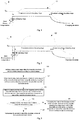
- Fig. 1 is the schematic diagram of the charging curve of a lithium battery at room temperature.
- Fig. 2 is the schematic diagram of the charging curve of a lithium battery at relatively high environment temperature or in an environment of poor heat dissipation.
- the vertical coordinate represents temperature
- the horizontal ordinate represents charging duration.
- the vertical coordinate T usl is the upper limit value of the temperature that is tolerable by human body
- the vertical coordinate T lsl is the temperature lower limit value that can ensure quick charging efficiency
- the temperature upper limit value and the temperature lower limit value define the temperature range.
- the charging process of the lithium battery of the wearable electronic device may be divided into generally four stages: trickle charging (low voltage precharging), constant-current charging (CC), constant-voltage charging (CV) and charging terminating.
- the constant-current charging (CC) is the high current stage of the four charging stages, in which the battery temperature rises very quickly.
- the typical charging duration-temperature curve at room temperature is as shown in Fig. 1 , and the temperature in charging is within a reasonable range.
- the curve 11 in Fig. 1 is the illustrative temperature curve when a lithium battery is being charged.
- the safety precautions for common charging processes are not perfect, and when the temperature is too high, as shown in Fig.
- the highest point of the temperature curve 22 has already exceeded the temperature upper limit value T usl that is tolerable by human body. At this time, if the high current charging is continuously maintained, it is possible to scald the user, and even cause dangers such as battery burning and explosion. In addition, the high temperature charging condition for a long term will shorten the battery life, and affect the endurance power of the battery of wearable electronic devices.
- Fig. 3 is the flow chart of a charging control method for a wearable electronic device of an embodiment of the present disclosure.
- the charging control method for a wearable electronic device comprises the following steps:
- the temperature range by presetting the temperature range according to the usage demands of the user, it means that according to the different requirements of the users on the efficiency of quick charging of wearable electronic devices and the difference in the genders of the users (for example, the user is a male/female), different temperature ranges are set, to satisfy the personalization demands of the users.
- the temperature upper limit value takes a value within the range of 40-60 ⁇
- the temperature lower limit value takes a value within the range of 35-45 °C.
- the temperature range is 37°C-52°C.
- the implementation process of the charging control method for a wearable electronic device of the present embodiment will be specifically described by taking the example that the wearable electronic devices is a smart watch. It can be understood that, the application range of the technical solutions of the embodiments of the present disclosure is not limited to smart watch, and may also be a smart wristband or other wearable electronic devices. This type of electronic devices generally possesses the following characteristics: small power, wearability, and contacting with human skin when charging.
- Fig. 4 is the schematic flow chart of the charging control method for a wearable electronic device provided by another embodiment of the present disclosure. As shown in Fig. 4 , the flow starts, and executes the following Step S401 to Step S411.
- the wirelessly receiving coil built-in in the smart watch is turned on, and use the wirelessly receiving coil to generate a charging current for charging the smart watch.
- the initial charging stage of the smart watch is the trickle charging stage, which is the low voltage precharging, wherein the current is relatively small, and the temperature at the time is not too high, so measures for reducing the temperature are not required.
- Step S402 acquiring the real time temperature value of the battery of the smart watch, and after acquiring the real time temperature value, entering Step S403.
- the temperature value of the battery of the smart watch is obtained.
- Step S403 judging whether the acquired present temperature value is higher than the upper limit value T usl of the preset temperature range.
- Step S401 If not, it returns to Step S401, maintains the present value of the charging current, and continues to perform charging according to the preset constant-current charging current value. If yes, it changes the value of the charging current of the wearable electronic device; that is, when the present temperature value of the wearable electronic device is higher than the upper limit value of the temperature range, controls to reduce all at once or reduce progressively for multiple times the value of the charging current of the wearable electronic device. In the present embodiment, if the temperature value is higher than the upper limit value of the preset temperature range, execute Step S404.
- CI current reducing controlling coefficient
- the current reducing controlling instruction is sent to a processing chip that controls the wirelessly receiving coil, to cause the processing chip to reduce a voltage numerical value of a current and power pin, thereby reducing the value of the charging current of the smart watch.
- the current reducing controlling instruction can also be sent to the power supply side, and the electromagnetic wave signal of the wirelessly emitting coil is controlled by the power supply side, thereby reducing the value of the charging current of the smart watch, which is not limited.
- the conventional wireless charging technology is realized mainly by using the electromagnetic induction principle; that is, using the energy coupling, between the wirelessly emitting coil (which can generate a magnetic field) in the electricity charger and the wirelessly receiving coil that is correspondingly provided in the smart watch, to realize the transfer of energy.
- the current reducing controlling of the smart watch may specifically be implemented by a processing chip in the smart watch for controlling the wirelessly receiving coil, and may also be implemented by controlling the power supply side of the wirelessly emitting coil.
- the lower limit value of the temperature range is set to serve as a suspending point for a reducing operation in the operation of reducing the value of the charging current in multiple-level current reducing controlling. That is, when it is monitored that the real time temperature value is less than or equal to the temperature lower limit value of the set temperature range, the operation of reducing the value of the charging current is stopped, so as to restore to an appropriate current value, and complete the charging as soon as possible.
- the relation between the temperature condition and the time condition in Step S405 is logical sum. That is, when the time condition is satisfied (the duration reaches the preset present duration threshold), further judge whether the temperature condition is satisfied, and if the temperature condition is also satisfied (that is, the temperature value is less than or equal to the lower limit value of the temperature range), control to increase the value of the charging current, so as to increase the temperature value.
- the controlling to increase the value of the charging current may be increasing the present value of the charging current to the preset constant-current charging current value, which can ensure the charging efficiency of quick charging. If the temperature condition is not satisfied, that is, the temperature value is higher than the lower limit value of the temperature range, control to continue to reduce the present value of the charging current, that is, execute Step S406.
- Step S407 judging whether the present temperature value is less than or equal to the lower limit value of the temperature range and whether the timer is not time-out; and if yes, returning to Step S401, and controlling to increase the present value of the charging current of the smart watch to the preset constant-current charging current value Ice; and if not, entering Step S408.
- Step S408 generate the current reducing controlling instruction that is used in the next level, and execute this current reducing controlling instruction, to further reduce the value of the charging current of the smart watch.
- the content of the current reducing controlling instruction is to set the value of the charging current to be equal to the product value of the constant-current charging current value Ice and the preset minimum value of the current reducing controlling coefficient C lowest .
- Step S409 judging whether the temperature value is less than or equal to the lower limit value of the temperature range and whether the timer is not time-out; and if not, entering Step S410.
- Step S409 the means for controlling the current reducing by using the minimum value of the current reducing controlling coefficient is illustrated.
- whether to turn off the wirelessly receiving coil may also be determined by counting the time number of current reducing, and by using the result of the comparison between the current reducing time number and a preset current reducing time number threshold. Continuously taking the content of Fig. 4 as an example, the present embodiment performs three times of current reducing, which are in Steps S404, S406 and S408. After the current reducing of Step S408 is executed, it may be judged in Step S409 whether the accumulated current reducing time number is equal to the preset current reducing time number threshold; and if yes, execute Step S410.
- Step S410 turning off the wirelessly receiving coil, and stopping the charging; and entering Step S411.
- Step S411 judging whether the temperature value is less than or equal to the lower limit value of the temperature range and whether the timer is not time-out; and if yes, executing Step S401; and if not, executing Step S410.
- the temperature value is already higher than the lower limit value of the temperature range, continue to turn off the wirelessly receiving coil, and maintain the charging stopping state, and the result of the comparison between the temperature value and the lower limit value of the temperature range is judged in real time, and when the temperature value falls back to the lower limit value of the temperature range, turn on the wirelessly receiving coil, and continues the charging.
- Step S401 comprises the two substeps of turning on the wirelessly receiving coil and setting the value of the charging current to be equal to the preset constant-current charging current value.
- it is required to judge whether the wirelessly receiving coil is to be turned on according to the circumstance. For example, in Step S405, if it is determined that the temperature value is less than or equal to the lower limit value of the preset temperature range and the timer is not time-out, it only needs to control to increase the value of the charging current, and set the present value of the charging current to be the constant-current charging current value, and does not need to turn on the wirelessly receiving coil again.
- Step S411 because Step S410 was executed previously and the wirelessly receiving coil was turned off, if in Step S411 it is determined that the temperature value is less than or equal to the lower limit value of the temperature range and the timer is not time-out, it needs to turn on the wirelessly receiving coil again, receives the charging current again, and increases the value of the charging current to the preset constant-current charging current value.
- Fig. 5 is the schematic diagram of the charging curve of a lithium battery at relatively high environment temperature or in an environment of poor heat dissipation provided by another embodiment of the present disclosure. Referring to Fig. 5 , in the present embodiment, the case wherein the value of the charging current of the wearable electronic device is controlled to be reduced all at once is illustrated.
- the level current reducing controlling coefficient for present use is a current reducing controlling coefficient C1 of a first level (C1 is a numerical value that is less than 1), and a current reducing controlling instruction for present use is generated according to the current reducing controlling coefficient C1 of the first level (setting a product value of the current reducing controlling coefficient of the first level and the preset constant-current charging current value in the current reducing controlling instruction for the present use, to indicate that the value of the charging current after current reduction of the present level is this product value); and send this current reducing controlling instruction to a processing chip that controls the wirelessly receiving coil, to cause the processing chip to reduce a voltage numerical value of a current and power pin, thereby reducing the value of the charging current of the wearable electronic device.
- C1 is a numerical value that is less than 1
- a current reducing controlling instruction for present use is generated according to the current reducing controlling coefficient C1 of the first level (setting a product value of the current reducing controlling coefficient of the first level and the preset constant-current charging current value in
- the method further comprises setting a duration threshold, timing from the time point when the value of the charging current of the wearable electronic device is reduced, to obtain a present current reducing duration; and if when the present current reducing duration is equal to the preset present duration threshold, the temperature value that is in real time monitored is still within the temperature range, according to a current reducing controlling coefficient of a next level that is used in a next level, generating a current reducing controlling instruction of a next level, and controlling to continue to reduce the value of the charging current of the wearable electronic device.
- the effect of setting the duration threshold is to reduce the temperature within a set duration window, and the duration threshold can be set according to the demands of practical applications.
- the duration may be set to be relatively short, and accordingly if the temperature does not fall to the preset condition within a short duration, further cooling measures may be employed (that is, selecting a current reducing controlling parameter of a next level, and generating a current reducing controlling instruction of a next level).
- the duration threshold may be set to be relatively long, which can shorten the charging duration.
- Fig. 6 is the schematic diagram of the charging curve of a lithium battery at relatively high environment temperature or in an environment of poor heat dissipation provided by another embodiment of the present disclosure. If, after the current reducing controlling measure of a first level is employed, the temperature of the smart watch is still not less than or equal to the lower limit value of the temperature range, and the preset timer time is already time-out, further current reducing controlling measures are employed, to further reduce the value of the charging current of the smart watch, and thus reduce the temperature value. In the present embodiment, the case wherein when current reducing controlling means of two levels are employed to cool, the current reducing controlling means of two levels have a progressive relation, is illustrated.
- the current reducing controlling measure of a first level may be omitted.
- Fig. 7 is the schematic diagram of the charging curve of a lithium battery at relatively high environment temperature or in an environment of poor heat dissipation provided by another embodiment of the present disclosure.
- the case wherein when three levels of current reducing controlling means are employed to cool, the three levels of current reducing controlling means have a progressive relation, is illustrated. It can be understood that, if, after one level or two levels of current reducing controlling are employed, the temperature value of the lithium battery of the smart watch has already fallen to be less than or equal to the lower limit value of the temperature range when the duration reaches the present set duration threshold, the second or third level of current reducing controlling measure may be omitted.
- the temperature value is still higher than the lower limit value T lsl of the temperature range, that indicates that the effect caused by the means of reducing the temperature is not obvious, and it may be considered to set the value of the charging current of the lithium battery of the smart watch to be the preset minimum value of current, wherein the preset minimum value of current is preferably the value of the charging current of the trickle charging stage. Accordingly, the temperature value can be reduced as quick as possible.
- the value ranges of the current reducing controlling coefficient C1 and the current reducing controlling coefficient C2 are preferably 0.1-0.5.
- the duration that is set by the first timer, the duration that is set by the second timer and the duration that is set by the third timer individually correspond to the electricity current reducing controlling instruction of each level, and the durations that are set by the three timers may be the same or different.
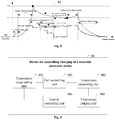
- Fig. 8 is the schematic diagram of the charging curve of a lithium battery at relatively high environment temperature or in an environment of poor heat dissipation provided by another embodiment of the present disclosure.
- the first three levels of current reducing controlling measures of the present embodiment are the same as the three levels of current reducing controlling instruction of the third embodiment, which can be seen in the description on the above third embodiment, and will not be in detail described here.
- the present embodiment emphatically describes the controlling means for the case wherein after the three levels of current reducing controlling means are employed, within the duration that is set by the third timer, the temperature value is still higher than the lower limit value of the temperature range.
- the duration of the current reducing is counted from the time point when the third level of current reducing measure starts to be executed, and if when the present current reducing duration is equal to the preset present duration threshold (that is, the duration that is set by the fourth timer), the temperature value that is in real time monitored is still within the temperature range, the wirelessly receiving coil of the smart watch is controlled to be turned off, and stop the charging, to wait for the temperature to fall back.
- the preset present duration threshold that is, the duration that is set by the fourth timer
- the temperature value is monitored in real time, and judge whether the temperature value that is monitored is less than or equal to the lower limit value of the temperature range within the duration that is set by the fourth timer; and if yes, turn on the wirelessly receiving coil again; and if not, continue to turn off the wirelessly receiving coil, and stop the charging, and continues to judge the result of the comparison between the temperature that is monitored and the lower limit value of the temperature range.
- the method further comprises: setting a current reducing time number threshold or setting a lowest value of the charging current, and when reducing the value of the charging current of the smart watch by using multiple-level progression, accumulating the current reducing time number, and when the accumulated time number reaches the set current reducing time number threshold, controlling to turn off the wirelessly receiving coil of the wearable electronic device, and stopping the charging, to wait for the temperature to fall back.
- the current reducing time number threshold is set to be three. In the present embodiment, each time the current reducing is performed once, the counted time number is added by 1 to accumulate.
- the set current reducing time number threshold is reached only after accumulatively three times of current reducing, so it may take no account of the preset duration and judge only according to the single condition whether the temperature value is less than or equal to the temperature lower limit value, and if the temperature value that is monitored is still higher than the lower limit value, the wirelessly receiving coil is turned off directly, and stop the charging.
- control to turn off the wirelessly receiving coil of the smart watch if controlling to reduce progressively for multiple times the value of the charging current of the smart watch, if the present value of the charging current is not greater than the lowest value of the charging current, and the temperature value that is in real time monitored is still within the temperature range.
- Fig. 9 is the structural block diagram of a charging control apparatus for a wearable electronic device of an embodiment of the present disclosure.
- the apparatus 90 for controlling charging of a wearable electronic device of the present embodiment comprises:
- the temperature monitoring unit 903 is specifically for collecting in real time a voltage value of a thermistor that is electrically connected to a battery of the wearable electronic device; and calculating out a present resistance value of the thermistor according to the voltage value of the thermistor, and according to a correspondence relation between the resistance value and the temperature, obtaining the temperature value of the battery of the wearable electronic device.
- the temperature range setting unit 901 is for setting the temperature range to be the range between a set temperature upper limit value and a set temperature lower limit value;
- the current controlling unit 905 is specifically for when the temperature value of the wearable electronic device is higher than the upper limit value of the temperature range, controlling to reduce all at once or reduce progressively for multiple times the value of the charging current of the wearable electronic device, so that the temperature value monitored in real time is less than or equal to the temperature lower limit value; and, when the temperature value of the wearable electronic device is less than or equal to the lower limit value of the temperature range, controlling to increase the value of the charging current of the wearable electronic device.
- the current controlling unit 905 is specifically for setting one or more level current reducing controlling coefficients, and generating a current reducing controlling instruction for present use according to a corresponding level current reducing controlling coefficient; and sending the current reducing controlling instruction to a processing chip that controls the wirelessly receiving coil, to cause the processing chip to reduce a voltage numerical value of a current and power pin, thereby reducing the value of the charging current of the wearable electronic device.
- the current controlling unit 905 is specifically for according to a level current reducing controlling coefficient for present use, generating the present current reducing controlling instruction;
- the apparatus 90 for controlling charging of a wearable electronic device further comprises: a duration threshold setting unit, for setting a duration threshold; and the current controlling unit 905 is for controlling to reduce the value of the charging current of the wearable electronic device according to the present current reducing controlling instruction, so that the wearable electronic device is charged according to the current value that has been reduced; timing from the time point when the value of the charging current of the wearable electronic device is reduced, to obtain a present current reducing duration; and if when the present current reducing duration is equal to the preset present duration threshold, the temperature value that is in real time monitored by the temperature monitoring unit 903 is still within the temperature range, the current controlling unit 905, according to a current reducing controlling coefficient of a next level that is used in a next level, generates a current reducing controlling instruction of a next level, and controls to continue to reduce the value of the charging current of the wearable electronic device.
- a duration threshold setting unit for setting a duration threshold
- the current controlling unit 905 is for controlling to reduce the value of the charging current of
- the current controlling unit 905 is further for if when the present current reducing duration is equal to the preset present duration threshold, the temperature value that is in real time monitored by the temperature monitoring unit 903 is still within the temperature range, the current controlling unit 905, controlling to turn off the wirelessly receiving coil of the wearable electronic device; in an embodiment of the present disclosure, the apparatus 90 for controlling charging of a wearable electronic device further comprises: a current reducing time number threshold setting unit for setting a current reducing time number threshold or a lowest value of the charging current setting unit for setting a lowest value of the charging current, the current controlling unit 905 is for, if controlling to reduce progressively for multiple times the value of the charging current of the wearable electronic device, accumulating the current reducing time number, and if the accumulated current reducing time number reaches the current reducing time number threshold that is set by the current reducing time number threshold setting unit, and the temperature value that is in real time monitored by the temperature monitoring unit 903 is still within the temperature range, controlling to turn off the wirelessly receiving
- the current controlling unit 905 is specifically for setting a current reducing controlling coefficient of a first level, wherein the current reducing controlling coefficient of a first level is a numerical value that is less than 1; and the generating a current reducing controlling instruction for present use according to a corresponding level current reducing controlling coefficient comprises: when the level current reducing controlling coefficient for present use is the current reducing controlling coefficient of the first level, setting a product value of the current reducing controlling coefficient of the first level and the set constant-current charging current value, in the current reducing controlling instruction for present use, to indicate that the value of the charging current after current reduction of the present level is the product value; or, the current controlling unit 905 is specifically for setting a current reducing controlling coefficient of a first level and a current reducing controlling coefficient of a second level, wherein the current reducing controlling coefficient of the first level and the current reducing controlling coefficient of the second level are both numerical values that are less than 1; and the according to a current reducing controlling coefficient of a next level that is used in
- the apparatus for controlling charging of a wearable electronic device of the present embodiment is corresponding to the charging control method for a wearable electronic device of the above embodiments, and the implementation steps of the apparatuscharging control apparatus for a wearable electronic device of the present embodiment may be specifically seen in the description on the portion of the above charging control method for a wearable electronic device, and will not be in detail described here.
- still another embodiment of the present disclosure further provides a smart watch, wherein the smart watch is provided with the apparatuscharging control apparatus for a wearable electronic device of the above embodiment of the present disclosure, and the apparatus for controlling charging causes a temperature value of the smart watch when being charged in a wireless mode to be within a set temperature range. Because the temperature of the smart watch in wireless charging is controlled within the set temperature range, thereby the user usage experience is enhanced and the competitive power of the smart watch is greatly increased.
- the technical solutions of the embodiments of the present disclosure set the temperature range, and when the value of the charging current of the wearable electronic device rises to the set constant-current charging current value, according to the temperature value of the wearable electronic device that is in real time monitored and the result of the comparison between the temperature value and the temperature range, employ corresponding current controlling measures.
- the technical solutions reduce the temperature by reducing the charging current.
- the solution has lower cost, and is suitable for large-scale applications.
- the solution in real time monitors the temperature value, and when the temperature is less than or equal to the temperature range, restores the current of the wearable electronic device, which enables the apparatus to quickly charge and shortens the charging duration.
- the solution prolongs the battery life, and meanwhile realizes quick charging at near room temperature, thereby improving the user experience.
Landscapes
- Engineering & Computer Science (AREA)
- Power Engineering (AREA)
- Chemical & Material Sciences (AREA)
- Manufacturing & Machinery (AREA)
- Chemical Kinetics & Catalysis (AREA)
- Electrochemistry (AREA)
- General Chemical & Material Sciences (AREA)
- Physics & Mathematics (AREA)
- Computer Networks & Wireless Communication (AREA)
- General Physics & Mathematics (AREA)
- Microelectronics & Electronic Packaging (AREA)
- Materials Engineering (AREA)
- Life Sciences & Earth Sciences (AREA)
- Biophysics (AREA)
- Mathematical Physics (AREA)
- Theoretical Computer Science (AREA)
- Charge And Discharge Circuits For Batteries Or The Like (AREA)
- Secondary Cells (AREA)
Abstract
Description
- The present disclosure relates to the technical field of wearable electronic devices, and specifically to a charging control method and apparatus for a wearable electronic device, and a smart watch.
- The wireless charging technology in the field of consumer electronics is mainly on the basis of the WPC (Qi) Standard. Qi is a "wireless charging" standard presented by Wireless Power Consortium (for short, WPC), which is the globally first standardization organization that promotes wireless charging technology, and possesses two main characteristics of convenience and versatility. The Qi Standard employs "electromagnetic induction technology". The charging efficiency of the wireless charging method on the basis of the "electromagnetic induction technology" has a positive correlation with the power of the devices. Wearable electronic devices (for example smart watches), because of the generally relatively small battery capacities limited by device sizes, have small powers, which results in that when smart watches are wirelessly charged, the charging efficiency is relatively low. The low charging efficiency results in the following problem when the wireless charging technology is applied in smart watches: the charging temperature is too high, and heat is generated when charging.
- On one hand, too high temperature will affect the battery life, and on the other hand, because wearable devices directly contact with skin, too high temperature scalds skin, or makes the wearer uncomfortable, which causes poor user experience, and thus reduces the user stickiness to the products.
- A traditional solution regarding the problem, such as employing techniques of heat conduction, heat dissipation and so on, results in increasing cost and is hard to spread. Another traditional solution, such as temporarily stopping the charging when the charging temperature is too high, will cause the problem of too long charging duration, prolonging the overall charging duration, which also results in poor user experience.
- In order to solve the above problems, the present disclosure provides a charging control method and apparatus for a wearable electronic device, and a smart watch, which solves the problem that in the process of wireless charging of wearable devices, heating results in too high temperature, and also avoids the problems of too long charging duration and high cost caused by traditional means for reducing the temperature.
- According to an aspect of the present disclosure, there is provided a charging control method for a wearable electronic device, the method comprising:
- setting a temperature range when the wearable electronic device is being charged according to a user demand;
- when the charging starts, turning on a wirelessly receiving coil of the wearable electronic device, and using the wirelessly receiving coil to generate a charging current for charging the wearable electronic device;
- when it is monitored that a value of the charging current of the wearable electronic device rises to a set constant-current charging current value, acquiring in real time a temperature value of the wearable electronic device; and
- judging whether the temperature value is within the temperature range; and if yes, maintaining the present value of the charging current of the wearable electronic device; and if not, changing the value of the charging current of the wearable electronic device, and thus changing the temperature value of the wearable electronic device, so that the temperature value of the wearable electronic device is within the temperature range.
- According to another aspect of the present disclosure, there is provided a charging control apparatus for a wearable electronic device, the apparatus comprising:
- a temperature range setting unit, for setting a temperature range when the wearable electronic device is being charged according to a user demand;
- a coil controlling unit, for when the charging starts, turning on a wirelessly receiving coil of the wearable electronic device, and using the wirelessly receiving coil to generate a charging current for charging the wearable electronic device;
- a temperature monitoring unit, for when it is monitored that a value of the charging current of the wearable electronic device rises to a set constant-current charging current value, acquiring in real time a temperature value of the wearable electronic device;
- a temperature judging unit, for judging whether the temperature value is within the temperature range; and
- a current controlling unit, for according to a judgment result of the temperature judging unit, maintaining the present value of the charging current of the wearable electronic device; or, changing the value of the charging current of the wearable electronic device, and thus changing the temperature value of the wearable electronic device, so that the temperature value of the wearable electronic device is within the temperature range.
- According to still another aspect of the present disclosure, there is provided a smart watch, wherein the smart watch is provided with the above charging control apparatus for a wearable electronic device, and the apparatus for controlling charging causes a temperature value of the smart watch when being charged in a wireless mode to be within a set temperature range.
- The advantageous effects of the technical solutions of the present disclosure are: the technical solutions of the embodiments of the present disclosure preset the temperature range, and when the value of the charging current of the wearable electronic device rises to the preset constant-current charging current value, in real time monitor the temperature of the wearable electronic device, and according to the difference of the judgment results of the temperature value, employ different controlling measures. In especial when the temperature value of the wearable device exceeds the temperature range, the solution realizes the cooling by reducing the charging current. Compared with the traditional solution of adding heat conduction elements, the solution has lower cost, and is suitable for large-scale production. In addition, the solution in real time monitors the temperature value, and when the temperature is less than or equal to the temperature range, restores the current of the wearable electronic device, which enables to quickly charge the apparatus and shortens the charging duration. Compared with the conventional cooling solution of temporarily stopping the charging, the solution prolongs the battery life, thereby improving the user experience, and meanwhile realizing quick charging at near room temperature.
-
-
Fig. 1 is the schematic diagram of the charging curve of a lithium battery at room temperature; -
Fig. 2 is the schematic diagram of the charging curve of a lithium battery at relatively high environment temperature or in an environment of poor heat dissipation; -
Fig. 3 is the flow chart of a charging control method for a wearable electronic device of an embodiment of the present disclosure; -
Fig. 4 is the schematic flow chart of the charging control method for a wearable electronic device provided by another embodiment of the present disclosure; -
Fig. 5 is the schematic diagram of the charging curve of a lithium battery at relatively high environment temperature or in an environment of poor heat dissipation provided by another embodiment of the present disclosure; -
Fig. 6 is the schematic diagram of the charging curve of a lithium battery at relatively high environment temperature or in an environment of poor heat dissipation provided by another embodiment of the present disclosure; -
Fig. 7 is the schematic diagram of the charging curve of a lithium battery at relatively high environment temperature or in an environment of poor heat dissipation provided by another embodiment of the present disclosure; -
Fig. 8 is the schematic diagram of the charging curve of a lithium battery at relatively high environment temperature or in an environment of poor heat dissipation provided by another embodiment of the present disclosure; and -
Fig. 9 is the structural block diagram of a charging control apparatus for a wearable electronic device of an embodiment of the present disclosure. - The technical concept of the present disclosure is: regarding the problems of the prior art, the embodiments of the present disclosure propose a solution of preventing too high temperature when charging and meanwhile ensuring quick charging. The method in real time monitors the temperature when the wearable electronic device is being charged (mainly to reach the preset constant-current charging current value), obtains the temperature value, and employs current controlling measures, so that the temperature value is maintained within the temperature range, wherein when the temperature value is higher than the temperature range, the embodiment reduces the value of the charging current of the wearable electronic device, and when the temperature value is below the temperature range, the embodiment increases the value of the charging current. Such a manner does not need to extra add heat conduction elements or heat dissipation elements, which saves the cost. What is more important is that, the technical solutions of the embodiments of the present disclosure do not generate too high temperature when charging, which does not affect the wearing comfort ability and the skin health of the user, do not need to stop the charging, and avoid the problem of overall too long charging duration that is caused by pausing charging to reduce the temperature in traditional solutions.
-
Fig. 1 is the schematic diagram of the charging curve of a lithium battery at room temperature.Fig. 2 is the schematic diagram of the charging curve of a lithium battery at relatively high environment temperature or in an environment of poor heat dissipation. Referring toFig. 1 and Fig. 2 , the vertical coordinate represents temperature, and the horizontal ordinate represents charging duration. InFig. 1 , the vertical coordinate Tusl is the upper limit value of the temperature that is tolerable by human body, and the vertical coordinate Tlsl is the temperature lower limit value that can ensure quick charging efficiency, and the temperature upper limit value and the temperature lower limit value define the temperature range. The charging process of the lithium battery of the wearable electronic device may be divided into generally four stages: trickle charging (low voltage precharging), constant-current charging (CC), constant-voltage charging (CV) and charging terminating. The constant-current charging (CC) is the high current stage of the four charging stages, in which the battery temperature rises very quickly. The typical charging duration-temperature curve at room temperature is as shown inFig. 1 , and the temperature in charging is within a reasonable range. Thecurve 11 inFig. 1 is the illustrative temperature curve when a lithium battery is being charged. The safety precautions for common charging processes are not perfect, and when the temperature is too high, as shown inFig. 2 , as the prolong of the charging duration, the highest point of thetemperature curve 22 has already exceeded the temperature upper limit value Tusl that is tolerable by human body. At this time, if the high current charging is continuously maintained, it is possible to scald the user, and even cause dangers such as battery burning and explosion. In addition, the high temperature charging condition for a long term will shorten the battery life, and affect the endurance power of the battery of wearable electronic devices. - In order to solve the problem that appears in
Fig. 2 , the embodiments of the present disclosure provide a charging control method for a wearable electronic device.Fig. 3 is the flow chart of a charging control method for a wearable electronic device of an embodiment of the present disclosure. Referring toFig. 3 , the charging control method for a wearable electronic device comprises the following steps: - Step S31, setting a temperature range when the wearable electronic device is being charged according to a user demand;
- Step S32, when the charging starts, turning on a wirelessly receiving coil of the wearable electronic device, and using the wirelessly receiving coil to generate a charging current for charging the wearable electronic device;
- Step S33, when it is monitored that a value of the charging current of the wearable electronic device rises to a preset constant-current charging current value, acquiring in real time a temperature value of the wearable electronic device; and
- Step S34, judging whether the temperature value is within the temperature range; and if yes, executing Step S35, and maintaining the present value of the charging current of the wearable electronic device; and if not, executing Step S36, changing the value of the charging current of the wearable electronic device, and thus changing the temperature value of the wearable electronic device, so that the temperature value of the wearable electronic device is within the temperature range.
- It can be known from the method shown in
Fig. 3 that, the technical solutions of the present embodiment, in the process of the wireless charging of the wearable electronic device, when it is monitored that a value of the charging current of the wearable electronic device rises to a preset constant-current charging current value, acquire in real time a temperature value of the wearable electronic device, employ different controlling means according to the difference of the temperature value, so that when the wearable electronic device is being charged, the temperature is always within the preset temperature range, which accordingly avoids the problems of battery damage and affecting the wearing comfortability of the user that are caused by too high temperature, and avoids the problem of overall too long charging duration that is caused by the cooling technique of pausing charging, thereby increases the user usage experience and the competitive power of the products. - Specifically, by presetting the temperature range according to the usage demands of the user, it means that according to the different requirements of the users on the efficiency of quick charging of wearable electronic devices and the difference in the genders of the users (for example, the user is a male/female), different temperature ranges are set, to satisfy the personalization demands of the users. For example, according to the temperatures that are tolerable by human body, the temperature upper limit value takes a value within the range of 40-60□, and the temperature lower limit value takes a value within the range of 35-45 °C. For example, the temperature range is 37°C-52°C.
- The implementation process of the charging control method for a wearable electronic device of the present embodiment will be specifically described by taking the example that the wearable electronic devices is a smart watch. It can be understood that, the application range of the technical solutions of the embodiments of the present disclosure is not limited to smart watch, and may also be a smart wristband or other wearable electronic devices. This type of electronic devices generally possesses the following characteristics: small power, wearability, and contacting with human skin when charging.
-
Fig. 4 is the schematic flow chart of the charging control method for a wearable electronic device provided by another embodiment of the present disclosure. As shown inFig. 4 , the flow starts, and executes the following Step S401 to Step S411. - Step S401, turning on the wirelessly receiving coil, the value of the charging current rising, and reaching the preset constant-current charging current value (I=Icc), and entering Step S402.
- When the smart watch needs wireless charging, the wirelessly receiving coil built-in in the smart watch is turned on, and use the wirelessly receiving coil to generate a charging current for charging the smart watch. The initial charging stage of the smart watch is the trickle charging stage, which is the low voltage precharging, wherein the current is relatively small, and the temperature at the time is not too high, so measures for reducing the temperature are not required. When the value of the charging current of the battery of the smart watch rises to the constant-current charging current value that is preset by the constant-current charging stage (that is, I=Icc), start executing the corresponding operation of controlling to reduce the charging current according to the change of the temperature value.
- Step S402, acquiring the real time temperature value of the battery of the smart watch, and after acquiring the real time temperature value, entering Step S403.
- Specifically, by collecting in real time the voltage value of a thermistor that is electrically connected to the battery of the smart watch, calculating out a present resistance value of the thermistor according to the voltage value of the thermistor, and according to a correspondence relation between the resistance value and the temperature, the temperature value of the battery of the smart watch is obtained.
- Step S403, judging whether the acquired present temperature value is higher than the upper limit value Tusl of the preset temperature range.
- If not, it returns to Step S401, maintains the present value of the charging current, and continues to perform charging according to the preset constant-current charging current value. If yes, it changes the value of the charging current of the wearable electronic device; that is, when the present temperature value of the wearable electronic device is higher than the upper limit value of the temperature range, controls to reduce all at once or reduce progressively for multiple times the value of the charging current of the wearable electronic device. In the present embodiment, if the temperature value is higher than the upper limit value of the preset temperature range, execute Step S404.
- Step S404, selecting the current reducing controlling coefficient (CI), generating the current reducing controlling instruction (I=ICC*C1) for present use, and reducing the value of the charging current; and after the value of the charging current is reduced, entering Step S405.
- In the present embodiment, the current reducing controlling instruction is sent to a processing chip that controls the wirelessly receiving coil, to cause the processing chip to reduce a voltage numerical value of a current and power pin, thereby reducing the value of the charging current of the smart watch. In other embodiments of the present disclosure, the current reducing controlling instruction can also be sent to the power supply side, and the electromagnetic wave signal of the wirelessly emitting coil is controlled by the power supply side, thereby reducing the value of the charging current of the smart watch, which is not limited.
- The conventional wireless charging technology is realized mainly by using the electromagnetic induction principle; that is, using the energy coupling, between the wirelessly emitting coil (which can generate a magnetic field) in the electricity charger and the wirelessly receiving coil that is correspondingly provided in the smart watch, to realize the transfer of energy. On the basis of that, in the present embodiment, the current reducing controlling of the smart watch may specifically be implemented by a processing chip in the smart watch for controlling the wirelessly receiving coil, and may also be implemented by controlling the power supply side of the wirelessly emitting coil.
- Step S405, judging whether the temperature value is less than or equal to the lower limit value of the temperature range and whether the timer is time-out; and if yes, returning to Step S401, controlling to increase the value of the charging current of the smart watch to the preset constant-current charging current Ice; and if not, executing Step S406, selecting current reducing controlling coefficients (C1 and C2) for the next level, generating the current reducing controlling instruction that is used in a next level (I=C2*C1*ICC), and further reducing the value of the charging current.
- It should be noted that, in the embodiments of the present disclosure the lower limit value of the temperature range is set to serve as a suspending point for a reducing operation in the operation of reducing the value of the charging current in multiple-level current reducing controlling. That is, when it is monitored that the real time temperature value is less than or equal to the temperature lower limit value of the set temperature range, the operation of reducing the value of the charging current is stopped, so as to restore to an appropriate current value, and complete the charging as soon as possible.
- It should be noted that, the relation between the temperature condition and the time condition in Step S405 is logical sum. That is, when the time condition is satisfied (the duration reaches the preset present duration threshold), further judge whether the temperature condition is satisfied, and if the temperature condition is also satisfied (that is, the temperature value is less than or equal to the lower limit value of the temperature range), control to increase the value of the charging current, so as to increase the temperature value. Here, the controlling to increase the value of the charging current may be increasing the present value of the charging current to the preset constant-current charging current value, which can ensure the charging efficiency of quick charging. If the temperature condition is not satisfied, that is, the temperature value is higher than the lower limit value of the temperature range, control to continue to reduce the present value of the charging current, that is, execute Step S406.
- Step S406, selecting current reducing controlling coefficients (C1 and C2) of a next level, generating the current reducing controlling instruction that is used in a next level (I=C2*C1*ICC), and reducing the value of the charging current; and after the value of the charging current is reduced, entering Step S407.
- Step S407, judging whether the present temperature value is less than or equal to the lower limit value of the temperature range and whether the timer is not time-out; and if yes, returning to Step S401, and controlling to increase the present value of the charging current of the smart watch to the preset constant-current charging current value Ice; and if not, entering Step S408.
- In Step S407, the result of the comparison, between the temperature value of the lithium battery acquired in real time after the current reduction of Step S406 and the temperature lower limit value, is judged, and if the temperature value is less than or equal to the lower limit value TIsl of the preset temperature range and the timer is not time-out, control to increase the value of the charging current of the lithium battery to the preset constant-current charging current value, that is, making I=Icc. If the temperature value is higher than the lower limit value TIsl of the preset temperature range and the timer is already time-out, execute Step S408.
- Step S408, selecting the current reducing controlling coefficient, generating the current reducing controlling instruction that is used in the next level (I=ICC*Clowest), and reducing the value of the charging current, and after the value of the charging current is reduced, entering Step S409.
- In Step S408, generate the current reducing controlling instruction that is used in the next level, and execute this current reducing controlling instruction, to further reduce the value of the charging current of the smart watch. Specifically, in the present step, the content of the current reducing controlling instruction is to set the value of the charging current to be equal to the product value of the constant-current charging current value Ice and the preset minimum value of the current reducing controlling coefficient Clowest.
- Step S409, judging whether the temperature value is less than or equal to the lower limit value of the temperature range and whether the timer is not time-out; and if not, entering Step S410.
- In Step S409, the result of the comparison, between the temperature value of the lithium battery acquired in real time after the current reduction of Step S408 and the temperature lower limit value, is judged, and if the temperature value is less than or equal to the lower limit value TIsl of the preset temperature range and the timer is not time-out, return to Step S401, control to increase the charging current of the smart watch to the preset constant-current charging current value I=ICC, and continue the charging. If the temperature value is higher than the lower limit value TIsl of the preset temperature range and the timer is already time-out, execute Step S410, control to turn off the wirelessly receiving coil, and stop the charging.
- It should be noted that, in the present embodiment, only the means for controlling the current reducing by using the minimum value of the current reducing controlling coefficient is illustrated. In other embodiments, whether to turn off the wirelessly receiving coil may also be determined by counting the time number of current reducing, and by using the result of the comparison between the current reducing time number and a preset current reducing time number threshold. Continuously taking the content of
Fig. 4 as an example, the present embodiment performs three times of current reducing, which are in Steps S404, S406 and S408. After the current reducing of Step S408 is executed, it may be judged in Step S409 whether the accumulated current reducing time number is equal to the preset current reducing time number threshold; and if yes, execute Step S410. - Step S410, turning off the wirelessly receiving coil, and stopping the charging; and entering Step S411.
- Step S411, judging whether the temperature value is less than or equal to the lower limit value of the temperature range and whether the timer is not time-out; and if yes, executing Step S401; and if not, executing Step S410.
- In Step S411, it judges whether the present temperature value of the lithium battery of the smart watch after the charging is stopped is less than or equal to the lower limit value of the temperature range, and if the temperature value is already less than or equal to the lower limit value of the temperature range, control to turn on the wirelessly receiving coil again, increase the value of the charging current of the smart watch to the preset constant-current charging current value I=ICC, and continue the charging, to complete the charging process as soon as possible. If the temperature value is already higher than the lower limit value of the temperature range, continue to turn off the wirelessly receiving coil, and maintain the charging stopping state, and the result of the comparison between the temperature value and the lower limit value of the temperature range is judged in real time, and when the temperature value falls back to the lower limit value of the temperature range, turn on the wirelessly receiving coil, and continues the charging.
- It should be noted that, Step S401 comprises the two substeps of turning on the wirelessly receiving coil and setting the value of the charging current to be equal to the preset constant-current charging current value. In practical applications it is required to judge whether the wirelessly receiving coil is to be turned on according to the circumstance. For example, in Step S405, if it is determined that the temperature value is less than or equal to the lower limit value of the preset temperature range and the timer is not time-out, it only needs to control to increase the value of the charging current, and set the present value of the charging current to be the constant-current charging current value, and does not need to turn on the wirelessly receiving coil again. However, in Step S411, because Step S410 was executed previously and the wirelessly receiving coil was turned off, if in Step S411 it is determined that the temperature value is less than or equal to the lower limit value of the temperature range and the timer is not time-out, it needs to turn on the wirelessly receiving coil again, receives the charging current again, and increases the value of the charging current to the preset constant-current charging current value.
-
Fig. 5 is the schematic diagram of the charging curve of a lithium battery at relatively high environment temperature or in an environment of poor heat dissipation provided by another embodiment of the present disclosure. Referring toFig. 5 , in the present embodiment, the case wherein the value of the charging current of the wearable electronic device is controlled to be reduced all at once is illustrated. Specifically, the level current reducing controlling coefficient for present use is a current reducing controlling coefficient C1 of a first level (C1 is a numerical value that is less than 1), and a current reducing controlling instruction for present use is generated according to the current reducing controlling coefficient C1 of the first level (setting a product value of the current reducing controlling coefficient of the first level and the preset constant-current charging current value in the current reducing controlling instruction for the present use, to indicate that the value of the charging current after current reduction of the present level is this product value); and send this current reducing controlling instruction to a processing chip that controls the wirelessly receiving coil, to cause the processing chip to reduce a voltage numerical value of a current and power pin, thereby reducing the value of the charging current of the wearable electronic device. - Referring to the curve 55 of the battery temperature varying with time in
Fig. 5 , after one time of current reducing is employed, the temperature of the battery of the smart watch falls back to around the lower limit value of the temperature range, and under the effect of the current reducing measures, the temperature of the battery of the smart watch increases accidently. However, it is not required to employ the measures for reducing the charging current and reduce the temperature so long as the upper limit value of the preset temperature range is not exceeded, which can ensure the quick charging and save the charging time. - In the present embodiment, the method further comprises setting a duration threshold, timing from the time point when the value of the charging current of the wearable electronic device is reduced, to obtain a present current reducing duration; and if when the present current reducing duration is equal to the preset present duration threshold, the temperature value that is in real time monitored is still within the temperature range, according to a current reducing controlling coefficient of a next level that is used in a next level, generating a current reducing controlling instruction of a next level, and controlling to continue to reduce the value of the charging current of the wearable electronic device.
- The effect of setting the duration threshold is to reduce the temperature within a set duration window, and the duration threshold can be set according to the demands of practical applications. For example, in environments that are relatively sensitive to temperature, the duration may be set to be relatively short, and accordingly if the temperature does not fall to the preset condition within a short duration, further cooling measures may be employed (that is, selecting a current reducing controlling parameter of a next level, and generating a current reducing controlling instruction of a next level). When the operations are in environments that are not sensitive to temperature, the duration threshold may be set to be relatively long, which can shorten the charging duration.
-
Fig. 6 is the schematic diagram of the charging curve of a lithium battery at relatively high environment temperature or in an environment of poor heat dissipation provided by another embodiment of the present disclosure. If, after the current reducing controlling measure of a first level is employed, the temperature of the smart watch is still not less than or equal to the lower limit value of the temperature range, and the preset timer time is already time-out, further current reducing controlling measures are employed, to further reduce the value of the charging current of the smart watch, and thus reduce the temperature value. In the present embodiment, the case wherein when current reducing controlling means of two levels are employed to cool, the current reducing controlling means of two levels have a progressive relation, is illustrated. It can be understood that, if, after the current reducing controlling measure of a first level is employed, the temperature value of the lithium battery of the smart watch has already fallen to be less than or equal to the lower limit value of the temperature range when the duration reaches the present set duration threshold, the current reducing controlling measure of a second level may be omitted. - Specifically, referring to the
curve 66 of the battery temperature varying with time inFig. 6 , when the value of the charging current of the smart watch reaches the set constant-current charging current value, that is, I=ICC, according to the current reducing controlling coefficient of a first level, control to generate the current reducing controlling instruction of a first level (that is, set the charging current to be I=ICC*C1), and, according to the result of the monitoring of the prsent temperature, if the present temperature value is still relatively high (for example, not less than or equal to the lower limit value of the temperature range), select the current reducing controlling coefficient of a next level (C2, C2 is less than 1), control to generate the current reducing controlling instruction of a next level (that is, set the charging current I=ICC*C1*C2), and send the current reducing controlling instruction to a processing chip that controls the wirelessly receiving coil, to cause the processing chip to reduce a voltage numerical value of a current and power pin, thereby reducing the value of the charging current of the wearable electronic device, and thus reducing the temperature of the smart watch, to prevent the adverse outcomes caused by too high temperature. - As shown in
Fig. 6 , after two levels of processively descending current reducing, the temperature curve of the smart watch has already presented an overall downward trend, and no longer approaches the upper limit value Tusl of the temperature range. Accordingly, current reducing controlling measures may be not taken further, to ensure the charging efficiency and save the charging time. -
Fig. 7 is the schematic diagram of the charging curve of a lithium battery at relatively high environment temperature or in an environment of poor heat dissipation provided by another embodiment of the present disclosure. In the present embodiment, the case wherein when three levels of current reducing controlling means are employed to cool, the three levels of current reducing controlling means have a progressive relation, is illustrated. It can be understood that, if, after one level or two levels of current reducing controlling are employed, the temperature value of the lithium battery of the smart watch has already fallen to be less than or equal to the lower limit value of the temperature range when the duration reaches the present set duration threshold, the second or third level of current reducing controlling measure may be omitted. - Referring to the
curve 77 of the battery temperature varying with time inFig. 7 , when the lithium battery of the smart watch is in the trickle charging stage, the temperature is relatively low, and when the value of the charging current of the lithium battery of the smart watch rises to the set constant-current charging current value, that is, I=Icc, the temperature rises very quickly. Here, according to the temperature value that is in real time monitored, a current reducing controlling coefficient of a first level (that is, C1) is selected, the current reducing controlling instruction of a first level (that is, make I=ICC*C1) is generated according to the current reducing controlling coefficient of a first level, and the current reducing controlling instruction is sent to a processing chip that controls the wirelessly receiving coil, to cause the processing chip to reduce a voltage numerical value of a current and power pin, thereby reducing the value of the charging current of the smart watch. - As shown by the
curve 77 inFig. 7 , if, after the first level of current reducing within the duration that is set by the first timer, the temperature value of the lithium battery that is in real time collected is still relatively high (for example, higher than the lower limit value of the temperature range), a current reducing controlling coefficient of a next level (C2, C2 is less than 1) is selected, control to generate the current reducing controlling instruction of a next level (that is, set the charging current I=ICC*C1*C2) according to the current reducing controlling coefficients of a next level C1 and C2, and the current reducing controlling instruction is sent to a processing chip that controls the wirelessly receiving coil, to cause the processing chip to reduce a voltage numerical value of a current and power pin, thereby reducing the value of the charging current of the wearable electronic device, and thus reducing the temperature of the smart watch. - If, after the two levels of current reducing within the duration that is set by the second timer, the temperature value that is in real time collected is still relatively high (for example higher than the lower limit value of the temperature range), the current reducing controlling coefficient of a next level (Ciowest) is selected, and control to generate the current reducing controlling instruction of a next level (that is, set the charging current I=ICC*Clowest) according to the current reducing controlling coefficient of a next level Ciowest, and the current reducing controlling instruction is sent to a processing chip that controls the wirelessly receiving coil, to cause the processing chip to reduce a voltage numerical value of a current and power pin, thereby reducing the value of the charging current of the smart watch to the predetermined minimum value.
- Here, it should be noted that, after the current reducing wherein the current reducing controlling instructions are individually generated according to the current reducing controlling coefficient of a first level and the current reducing controlling coefficient of a second level, if the temperature value is still higher than the lower limit value Tlsl of the temperature range, that indicates that the effect caused by the means of reducing the temperature is not obvious, and it may be considered to set the value of the charging current of the lithium battery of the smart watch to be the preset minimum value of current, wherein the preset minimum value of current is preferably the value of the charging current of the trickle charging stage. Accordingly, the temperature value can be reduced as quick as possible.
- After controlling to generate the current reducing controlling instruction (that is, setting the charging current I=ICC*Clowest) of a next level, and performing current reducing according to the current reducing controlling coefficient Clowest of a next level, within the duration that is preset by the third timer, judge whether the temperature value monitored in real time is less than or equal to the lower limit value of the temperature range, and if, within the duration that is preset by the third timer, the temperature value is less than or equal to the lower limit value of the temperature range, control to increase the value of the charging current of the lithium battery of the smart watch, and continues the charging.
- It should be noted that, in the present embodiment, the value ranges of the current reducing controlling coefficient C1 and the current reducing controlling coefficient C2 are preferably 0.1-0.5. The duration that is set by the first timer, the duration that is set by the second timer and the duration that is set by the third timer individually correspond to the electricity current reducing controlling instruction of each level, and the durations that are set by the three timers may be the same or different.
-
Fig. 8 is the schematic diagram of the charging curve of a lithium battery at relatively high environment temperature or in an environment of poor heat dissipation provided by another embodiment of the present disclosure. In the present embodiment, the case wherein when four levels of current reducing controlling means are employed to cool, the four levels of current reducing controlling means have a progressive relation, is illustrated. It can be understood that, if, after one level, two levels or three levels of current reducing controlling are employed, the temperature value of the lithium battery of the smart watch has already fallen to be less than or equal to the lower limit value of the temperature range when the duration reaches the present set duration threshold, the second, the third or the forth level of current reducing controlling measure may be omitted. - Referring to the
curve 88 of the battery temperature varying with time inFig. 8 , it should be noted that, the first three levels of current reducing controlling measures of the present embodiment are the same as the three levels of current reducing controlling instruction of the third embodiment, which can be seen in the description on the above third embodiment, and will not be in detail described here. - The present embodiment emphatically describes the controlling means for the case wherein after the three levels of current reducing controlling means are employed, within the duration that is set by the third timer, the temperature value is still higher than the lower limit value of the temperature range.
- Specially, referring to
Fig. 8 , the duration of the current reducing is counted from the time point when the third level of current reducing measure starts to be executed, and if when the present current reducing duration is equal to the preset present duration threshold (that is, the duration that is set by the fourth timer), the temperature value that is in real time monitored is still within the temperature range, the wirelessly receiving coil of the smart watch is controlled to be turned off, and stop the charging, to wait for the temperature to fall back. The temperature value is monitored in real time, and judge whether the temperature value that is monitored is less than or equal to the lower limit value of the temperature range within the duration that is set by the fourth timer; and if yes, turn on the wirelessly receiving coil again; and if not, continue to turn off the wirelessly receiving coil, and stop the charging, and continues to judge the result of the comparison between the temperature that is monitored and the lower limit value of the temperature range. - In the present embodiment, the method further comprises: setting a current reducing time number threshold or setting a lowest value of the charging current, and when reducing the value of the charging current of the smart watch by using multiple-level progression, accumulating the current reducing time number, and when the accumulated time number reaches the set current reducing time number threshold, controlling to turn off the wirelessly receiving coil of the wearable electronic device, and stopping the charging, to wait for the temperature to fall back. For example, the current reducing time number threshold is set to be three. In the present embodiment, each time the current reducing is performed once, the counted time number is added by 1 to accumulate. It can be seen that, in the present embodiment, the set current reducing time number threshold is reached only after accumulatively three times of current reducing, so it may take no account of the preset duration and judge only according to the single condition whether the temperature value is less than or equal to the temperature lower limit value, and if the temperature value that is monitored is still higher than the lower limit value, the wirelessly receiving coil is turned off directly, and stop the charging. Alternatively, if controlling to reduce progressively for multiple times the value of the charging current of the smart watch, if the present value of the charging current is not greater than the lowest value of the charging current, and the temperature value that is in real time monitored is still within the temperature range, control to turn off the wirelessly receiving coil of the smart watch.
-
Fig. 9 is the structural block diagram of a charging control apparatus for a wearable electronic device of an embodiment of the present disclosure. Referring toFig. 9 , theapparatus 90 for controlling charging of a wearable electronic device of the present embodiment comprises: - a temperature
range setting unit 901, for setting a temperature range when the wearable electronic device is being charged according to a user demand; - a
coil controlling unit 902, for when the charging starts, turning on a wirelessly receiving coil of the wearable electronic device, and using the wirelessly receiving coil to generate a charging current for charging the wearable electronic device; - a
temperature monitoring unit 903, for when it is monitored that a value of the charging current of the wearable electronic device rises to a preset constant-current charging current value, acquiring in real time a temperature value of the wearable electronic device; - a
temperature judging unit 904, for judging whether the temperature value is within the temperature range; and - a
current controlling unit 905, for according to a judgment result of the temperature judging unit, maintaining the present value of the charging current of the wearable electronic device; or, changing the value of the charging current of the wearable electronic device, and thus changing the temperature value of the wearable electronic device, so that the temperature value of the wearable electronic device is within the temperature range. - In an embodiment of the present disclosure, the
temperature monitoring unit 903 is specifically for collecting in real time a voltage value of a thermistor that is electrically connected to a battery of the wearable electronic device; and calculating out a present resistance value of the thermistor according to the voltage value of the thermistor, and according to a correspondence relation between the resistance value and the temperature, obtaining the temperature value of the battery of the wearable electronic device. - In an embodiment of the present disclosure, the temperature
range setting unit 901 is for setting the temperature range to be the range between a set temperature upper limit value and a set temperature lower limit value;
thecurrent controlling unit 905 is specifically for when the temperature value of the wearable electronic device is higher than the upper limit value of the temperature range, controlling to reduce all at once or reduce progressively for multiple times the value of the charging current of the wearable electronic device, so that the temperature value monitored in real time is less than or equal to the temperature lower limit value; and, when the temperature value of the wearable electronic device is less than or equal to the lower limit value of the temperature range, controlling to increase the value of the charging current of the wearable electronic device. - In an embodiment of the present disclosure, the
current controlling unit 905 is specifically for setting one or more level current reducing controlling coefficients, and generating a current reducing controlling instruction for present use according to a corresponding level current reducing controlling coefficient; and sending the current reducing controlling instruction to a processing chip that controls the wirelessly receiving coil, to cause the processing chip to reduce a voltage numerical value of a current and power pin, thereby reducing the value of the charging current of the wearable electronic device. - In an embodiment of the present disclosure, the
current controlling unit 905 is specifically for according to a level current reducing controlling coefficient for present use, generating the present current reducing controlling instruction; - In an embodiment of the present disclosure, the
apparatus 90 for controlling charging of a wearable electronic device further comprises: a duration threshold setting unit, for setting a duration threshold; and thecurrent controlling unit 905 is for controlling to reduce the value of the charging current of the wearable electronic device according to the present current reducing controlling instruction, so that the wearable electronic device is charged according to the current value that has been reduced; timing from the time point when the value of the charging current of the wearable electronic device is reduced, to obtain a present current reducing duration; and if when the present current reducing duration is equal to the preset present duration threshold, the temperature value that is in real time monitored by thetemperature monitoring unit 903 is still within the temperature range, thecurrent controlling unit 905, according to a current reducing controlling coefficient of a next level that is used in a next level, generates a current reducing controlling instruction of a next level, and controls to continue to reduce the value of the charging current of the wearable electronic device. - In an embodiment of the present disclosure, the
current controlling unit 905 is further for if when the present current reducing duration is equal to the preset present duration threshold, the temperature value that is in real time monitored by thetemperature monitoring unit 903 is still within the temperature range, thecurrent controlling unit 905, controlling to turn off the wirelessly receiving coil of the wearable electronic device; in an embodiment of the present disclosure, theapparatus 90 for controlling charging of a wearable electronic device further comprises: a current reducing time number threshold setting unit for setting a current reducing time number threshold or a lowest value of the charging current setting unit for setting a lowest value of the charging current,
thecurrent controlling unit 905 is for, if controlling to reduce progressively for multiple times the value of the charging current of the wearable electronic device, accumulating the current reducing time number, and if the accumulated current reducing time number reaches the current reducing time number threshold that is set by the current reducing time number threshold setting unit, and the temperature value that is in real time monitored by thetemperature monitoring unit 903 is still within the temperature range, controlling to turn off the wirelessly receiving coil of the wearable electronic device; or thecurrent controlling unit 905 is for, if controlling to reduce progressively for multiple times the value of the charging current of the wearable electronic device, if the present value of the charging current is not greater than the lowest value of the charging current, and the temperature value that is in real time monitored by thetemperature monitoring unit 903 is still within the temperature range, controlling to turn off the wirelessly receiving coil of the wearable electronic device. - In an embodiment of the present disclosure, the current controlling unit 905 is specifically for setting a current reducing controlling coefficient of a first level, wherein the current reducing controlling coefficient of a first level is a numerical value that is less than 1; and the generating a current reducing controlling instruction for present use according to a corresponding level current reducing controlling coefficient comprises: when the level current reducing controlling coefficient for present use is the current reducing controlling coefficient of the first level, setting a product value of the current reducing controlling coefficient of the first level and the set constant-current charging current value, in the current reducing controlling instruction for present use, to indicate that the value of the charging current after current reduction of the present level is the product value; or, the current controlling unit 905 is specifically for setting a current reducing controlling coefficient of a first level and a current reducing controlling coefficient of a second level, wherein the current reducing controlling coefficient of the first level and the current reducing controlling coefficient of the second level are both numerical values that are less than 1; and the according to a current reducing controlling coefficient of a next level that is used in a next level, generating a current reducing controlling instruction of a next level comprises: when the current reducing controlling coefficient of the next level that is used in the next level comprises the current reducing controlling coefficient of the first level and the current reducing controlling coefficient of the second level, setting a product value of the current reducing controlling coefficient of the second level and the current reducing controlling coefficient of the first level and the set constant-current charging current value, in the current reducing controlling instruction of the next level, to indicate that the value of the charging current after current reduction of the next level is the product value.
- It should be noted that, the apparatus for controlling charging of a wearable electronic device of the present embodiment is corresponding to the charging control method for a wearable electronic device of the above embodiments, and the implementation steps of the apparatuscharging control apparatus for a wearable electronic device of the present embodiment may be specifically seen in the description on the portion of the above charging control method for a wearable electronic device, and will not be in detail described here.
- Furthermore, still another embodiment of the present disclosure further provides a smart watch, wherein the smart watch is provided with the apparatuscharging control apparatus for a wearable electronic device of the above embodiment of the present disclosure, and the apparatus for controlling charging causes a temperature value of the smart watch when being charged in a wireless mode to be within a set temperature range. Because the temperature of the smart watch in wireless charging is controlled within the set temperature range, thereby the user usage experience is enhanced and the competitive power of the smart watch is greatly increased.
- In conclusion, it can be known that, the technical solutions of the embodiments of the present disclosure set the temperature range, and when the value of the charging current of the wearable electronic device rises to the set constant-current charging current value, according to the temperature value of the wearable electronic device that is in real time monitored and the result of the comparison between the temperature value and the temperature range, employ corresponding current controlling measures. In especial when the temperature value exceeds the temperature range, the technical solutions reduce the temperature by reducing the charging current. Compared with the traditional solution of adding heat conduction elements, the solution has lower cost, and is suitable for large-scale applications.
- In addition, the solution in real time monitors the temperature value, and when the temperature is less than or equal to the temperature range, restores the current of the wearable electronic device, which enables the apparatus to quickly charge and shortens the charging duration. Compared with the conventional cooling solution of temporarily stopping the charging, the solution prolongs the battery life, and meanwhile realizes quick charging at near room temperature, thereby improving the user experience.
- The above descriptions are merely preferable embodiments of the present disclosure, and are not limiting the protection scope of the present disclosure. Any modifications, equivalent substitutions or improvements that are made within the spirit and principle of the present disclosure are all included in the protection scope of the present disclosure.
Claims (15)
- A charging control method for a wearable electronic device, characterized in that the method comprises:setting a temperature range when the wearable electronic device is being charged according to a user demand;when the charging starts, turning on a wirelessly receiving coil of the wearable electronic device, and using the wirelessly receiving coil to generate a charging current for charging the wearable electronic device;when it is monitored that a value of the charging current of the wearable electronic device rises to a set constant-current charging current value, acquiring in real time a temperature value of the wearable electronic device; andjudging whether the temperature value is within the temperature range; and if yes, maintaining the present value of the charging current of the wearable electronic device; and if not, changing the value of the charging current of the wearable electronic device, and thus changing the temperature value of the wearable electronic device, so that the temperature value of the wearable electronic device is within the temperature range.
- The method according to claim 1, characterized in that the acquiring in real time a temperature value of the wearable electronic device comprises:collecting in real time a voltage value of a thermistor that is electrically connected to a battery of the wearable electronic device; andcalculating out a present resistance value of the thermistor according to the voltage value of the thermistor, and according to a correspondence relation between the resistance value and the temperature, obtaining the temperature value of the battery of the wearable electronic device.
- The method according to claim 1, characterized in that the temperature range is the range between a set temperature upper limit value and a set temperature lower limit value, and the changing the value of the charging current of the wearable electronic device comprises:when the temperature value of the wearable electronic device is higher than the upper limit value of the temperature range, controlling to reduce all at once or reduce progressively for multiple times the value of the charging current of the wearable electronic device, so that the temperature value monitored in real time is less than or equal to the temperature lower limit value; andwhen the temperature value of the wearable electronic device is less than or equal to the lower limit value of the temperature range, controlling to increase the value of the charging current of the wearable electronic device.
- The method according to claim 3, characterized in that the controlling to reduce all at once or reduce progressively for multiple times the value of the charging current of the wearable electronic device comprises:setting one or more level current reducing controlling coefficients, and generating a current reducing controlling instruction for present use according to a corresponding level current reducing controlling coefficient; andsending the current reducing controlling instruction to a processing chip that controls the wirelessly receiving coil, to cause the processing chip to reduce a voltage numerical value of a current and power pin, thereby reducing the value of the charging current of the wearable electronic device.
- The method according to claim 4, characterized in that the generating a current reducing controlling instruction for present use according to a corresponding level current reducing controlling coefficient comprises: according to a level current reducing controlling coefficient for present use, generating the present current reducing controlling instruction;
the method further comprises setting a duration threshold; and
the controlling to reduce all at once or reduce progressively for multiple times the value of the charging current of the wearable electronic device, so that the temperature value monitored in real time is less than or equal to the temperature lower limit value comprises:controlling to reduce the value of the charging current of the wearable electronic device according to the present current reducing controlling instruction, so that the wearable electronic device is charged according to the current value that has been reduced;timing from the time point when the value of the charging current of the wearable electronic device is reduced, to obtain a present current reducing duration; andif when the present current reducing duration is equal to the preset duration threshold, the temperature value monitored in real time is still within the temperature range, according to current reducing controlling coefficient of a next level that are used in a next level, generating a current reducing controlling instruction of a next level, and controlling to continue to reduce the value of the charging current of the wearable electronic device. - The method according to claim 5, characterized in that the controlling to reduce all at once or reduce progressively for multiple times the value of the charging current of the wearable electronic device, so that the temperature value monitored in real time is less than or equal to the temperature lower limit value further comprises: if when the present current reducing duration is equal to the preset duration threshold, the temperature value monitored in real time is still within the temperature range, then controlling to turn off a wirelessly receiving coil of the wearable electronic device; and
the method further comprises: setting a current reducing time number threshold or setting a lowest value of the charging current; and
if controlling to reduce progressively for multiple times the value of the charging current of the wearable electronic device, accumulating the current reducing time number, and if the accumulated current reducing time number reaches the preset current reducing time number threshold, and the temperature value monitored in real time is still within the temperature range, controlling to turn off the wirelessly receiving coil of the wearable electronic device; or if controlling to reduce progressively for multiple times the value of the charging current of the wearable electronic device, if the present value of the charging current is not greater than the lowest value of the charging current, and the temperature value monitored in real time is still within the temperature range, controlling to turn off the wirelessly receiving coil of the wearable electronic device. - The method according to claim 6, characterized in that
the setting one or more level current reducing controlling coefficients comprises: setting a current reducing controlling coefficient of a first level, wherein the current reducing controlling coefficient of the first level is a numerical value that is less than 1;
the generating a current reducing controlling instruction for present use according to a corresponding level current reducing controlling coefficient comprises:when the level current reducing controlling coefficient for present use is the current reducing controlling coefficient of the first level, setting a product value of the current reducing controlling coefficient of the first level and the set constant-current charging current value in the current reducing controlling instruction for present use, to indicate that the value of the charging current after the current reduction of the present level is the product value; or,the setting one or more level current reducing controlling coefficients comprises: setting a current reducing controlling coefficient of a first level and a current reducing controlling coefficient of a second level, wherein the current reducing controlling coefficient of the first level and the current reducing controlling coefficient of the second level are both numerical values that are less than 1; andthe according to current reducing controlling coefficients of a next level that are used in a next level, generating a current reducing controlling instruction of a next level comprises:when the current reducing controlling coefficients of a next level that are used in a next level comprises the current reducing controlling coefficient of the first level and the current reducing controlling coefficient of the second level, setting a product value of the current reducing controlling coefficient of the second level and the current reducing controlling coefficient of the first level and the set constant-current charging current value, in the current reducing controlling instruction of a next level, to indicate that the value of the charging current after the current reduction of the next level is the product value. - A charging control apparatus for a wearable electronic device, characterized in that the apparatus comprises:a temperature range setting unit, for setting a temperature range when the wearable electronic device is being charged according to a user demand;a coil controlling unit, for when the charging starts, turning on a wirelessly receiving coil of the wearable electronic device, and using the wirelessly receiving coil to generate a charging current for charging the wearable electronic device;a temperature monitoring unit, for when it is monitored that a value of the charging current of the wearable electronic device rises to a set constant-current charging current value, acquiring in real time a temperature value of the wearable electronic device;a temperature judging unit, for judging whether the temperature value is within the temperature range; anda current controlling unit, for according to a judgment result of the temperature judging unit, maintaining the present value of the charging current of the wearable electronic device; or, changing the value of the charging current of the wearable electronic device, and thus changing the temperature value of the wearable electronic device, so that the temperature value of the wearable electronic device is within the temperature range.
- The apparatus according to claim 8, characterized in that the temperature monitoring unit is specifically for collecting in real time a voltage value of a thermistor that is electrically connected to a battery of the wearable electronic device; and calculating out a present resistance value of the thermistor according to the voltage value of the thermistor, and according to a correspondence relation between the resistance value and the temperature, obtaining the temperature value of the battery of the wearable electronic device.
- The apparatus according to claim 8, characterized in that the temperature range is the range between a set temperature upper limit value and a set temperature lower limit value; and
the current controlling unit is specifically for when the temperature value of the wearable electronic device is higher than the upper limit value of the temperature range, controlling to reduce all at once or reduce progressively for multiple times the value of the charging current of the wearable electronic device, so that the temperature value monitored in real time is less than or equal to the temperature lower limit value; and, when the temperature value of the wearable electronic device is less than or equal to the lower limit value of the temperature range, controlling to increase the value of the charging current of the wearable electronic device. - The apparatus according to claim 10, characterized in that the current controlling unit is specifically for setting one or more level current reducing controlling coefficients, and generating a current reducing controlling instruction for present use according to a corresponding level current reducing controlling coefficient; and
sending the current reducing controlling instruction to a processing chip that controls the wirelessly receiving coil, to cause the processing chip to reduce a voltage numerical value of a current and power pin, thereby reducing the value of the charging current of the wearable electronic device. - The apparatus according to claim 11, characterized in that the current controlling unit is for, according to a level current reducing controlling coefficient for present use, generating the present current reducing controlling instruction; and
the apparatus further comprises: a duration threshold setting unit, for setting a duration threshold; and
the current controlling unit is for, controlling to reduce the value of the charging current of the wearable electronic device according to the present current reducing controlling instruction, so that the wearable electronic device is charged according to the current value that has been reduced;
timing from the time point when the value of the electricity charging current of the wearable electronic device is reduced, to obtain a present current reducing duration; and
if when the present current reducing duration is equal to the duration threshold that is preset by the duration threshold setting unit, the temperature value that is in real time monitored by the temperature monitoring unit is still within the temperature range, according to current reducing controlling coefficients of a next level that are used in a next level, generating a current reducing controlling instruction of a next level, and controlling to continue to reduce the value of the charging current of the wearable electronic device. - The apparatus according to claim 12, characterized in that the current controlling unit is further for, if when the present current reducing duration is equal to the present duration threshold that is preset by the duration threshold setting unit, the temperature value that is in real time monitored by the temperature monitoring unit is still within the temperature range, controlling to turn off the wirelessly receiving coil of the wearable electronic device;
the apparatus further comprises: a current reducing time number threshold setting unit for setting a current reducing time number threshold or a lowest value of the charging current setting unit for setting a lowest value of the charging current; and
the current controlling unit is for if controlling to reduce progressively for multiple times the value of the charging current of the wearable electronic device, accumulating the current reducing time number, and if the accumulated current reducing time number reaches the current reducing time number threshold that is set by the current reducing time number threshold setting unit, and the temperature value that is in real time monitored by the temperature monitoring unit is still within the temperature range, controlling to turn off the wirelessly receiving coil of the wearable electronic device; or the current controlling unit is for if controlling to reduce progressively for multiple times the value of the charging current of the wearable electronic device, if the present value of the charging current is not greater than the lowest value of the charging current that is set by the lowest value of the charging current setting unit, and the temperature value that is in real time monitored by the temperature monitoring unit is still within the temperature range, controlling to turn off the wirelessly receiving coil of the wearable electronic device. - The apparatus according to claim 13, characterized in that the setting one or more level current reducing controlling coefficients comprises: setting a current reducing controlling coefficient of a first level, wherein the current reducing controlling coefficient of a first level is a numerical value that is less than 1;
the generating a current reducing controlling instruction for present use according to a corresponding level current reducing controlling coefficient comprises:when the level current reducing controlling coefficient for present use is the current reducing controlling coefficient of a first level, setting a product value of the current reducing controlling coefficient of a first level and the preset constant-current charging current value in the current reducing controlling instruction for present use, to indicate that the value of the charging current after current reduction of the present level is the product value;the setting one or more level current reducing controlling coefficients comprises: setting a current reducing controlling coefficient of a first level and a current reducing controlling coefficient of a second level, wherein the current reducing controlling coefficient of a first level and the current reducing controlling coefficient of a second level are both numerical values that are less than 1; andthe according to current reducing controlling coefficients of a next level that are used in a next level, generating a current reducing controlling instruction of a next level comprises:when the current reducing controlling coefficients of a next level that are used in a next level comprises the current reducing controlling coefficient of a first level and the current reducing controlling coefficient of a second level, setting a product value of the current reducing controlling coefficient of the second level and the current reducing controlling coefficient of the first level and the set constant-current charging current value, in the current reducing controlling instruction of a next level, to indicate that the value of the charging current after current reduction of the next level is the product value. - A smart watch, characterized in that the smart watch is provided with the charging control apparatus for a wearable electronic device according to any one of claims 8-14, and the apparatus for controlling charging enables a temperature value of the smart watch when being charged in a wireless mode to be within a preset temperature range.
Applications Claiming Priority (2)
| Application Number | Priority Date | Filing Date | Title |
|---|---|---|---|
| CN201510907791.0A CN105552988B (en) | 2015-12-09 | 2015-12-09 | Charging control method and device of wearable electronic equipment and smart watch |
| PCT/CN2016/089983 WO2017096906A1 (en) | 2015-12-09 | 2016-07-14 | Charging control method and apparatus for wearable electronic device, and smart watch |
Publications (3)
| Publication Number | Publication Date |
|---|---|
| EP3300161A1 true EP3300161A1 (en) | 2018-03-28 |
| EP3300161A4 EP3300161A4 (en) | 2018-06-13 |
| EP3300161B1 EP3300161B1 (en) | 2020-12-30 |
Family
ID=55831999
Family Applications (1)
| Application Number | Title | Priority Date | Filing Date |
|---|---|---|---|
| EP16872105.8A Active EP3300161B1 (en) | 2015-12-09 | 2016-07-14 | Charging control method and apparatus for wearable electronic device, and smart watch |
Country Status (7)
| Country | Link |
|---|---|
| US (1) | US10511184B2 (en) |
| EP (1) | EP3300161B1 (en) |
| JP (1) | JP6532548B2 (en) |
| KR (1) | KR101999493B1 (en) |
| CN (1) | CN105552988B (en) |
| DK (1) | DK3300161T3 (en) |
| WO (1) | WO2017096906A1 (en) |
Cited By (2)
| Publication number | Priority date | Publication date | Assignee | Title |
|---|---|---|---|---|
| TWI692169B (en) * | 2018-08-17 | 2020-04-21 | 群光電能科技股份有限公司 | Charging device and its operating method |
| EP3813223A1 (en) * | 2019-10-23 | 2021-04-28 | Beijing Xiaomi Mobile Software Co., Ltd. | Charging control method, device and storage medium |
Families Citing this family (42)
| Publication number | Priority date | Publication date | Assignee | Title |
|---|---|---|---|---|
| CN105552988B (en) | 2015-12-09 | 2018-07-03 | 歌尔股份有限公司 | Charging control method and device of wearable electronic equipment and smart watch |
| CN105826982B (en) * | 2016-05-11 | 2018-07-17 | Tcl移动通信科技(宁波)有限公司 | A kind of charge control method and system of mobile terminal |
| CN105896666A (en) * | 2016-05-19 | 2016-08-24 | 北京小米移动软件有限公司 | Charging method and device of terminal and terminal |
| CN105977563A (en) * | 2016-06-28 | 2016-09-28 | 努比亚技术有限公司 | Charging method, charging equipment and terminal |
| CN106356928B (en) * | 2016-09-20 | 2019-08-20 | Tcl通讯(宁波)有限公司 | A kind of double cell mobile terminal and its wireless charging system |
| CN106340925B (en) * | 2016-09-29 | 2019-04-16 | Oppo广东移动通信有限公司 | A charging control method, device and terminal |
| CN106549460A (en) * | 2016-12-29 | 2017-03-29 | 上海掌门科技有限公司 | A kind of electronic equipment wireless charging temperature-controlled process and system |
| WO2018125894A1 (en) * | 2016-12-29 | 2018-07-05 | Witricity Corporation | Wireless power transmission system having power control |
| US10707672B2 (en) * | 2017-05-04 | 2020-07-07 | Intel Corporation | Methods and apparatus for battery current monitoring |
| CN107959085B (en) * | 2017-11-13 | 2020-07-24 | 河南森源电气股份有限公司 | Temperature adjusting method and system of battery energy storage equipment |
| CN108628217B (en) * | 2018-05-30 | 2022-03-11 | 努比亚技术有限公司 | Wearable device power consumption control method, wearable device and computer-readable storage medium |
| CN110673667B (en) * | 2018-07-03 | 2021-12-21 | 郑州宇通客车股份有限公司 | Intelligent temperature control method and device for vehicle charging connecting device |
| CN109038758A (en) * | 2018-09-05 | 2018-12-18 | 广东小天才科技有限公司 | Intelligent watch and charging device thereof |
| CN109066933B (en) * | 2018-09-11 | 2021-09-21 | 上海润欣科技股份有限公司 | Wireless charging method and device for network camera |
| JP7010191B2 (en) * | 2018-10-23 | 2022-02-10 | トヨタ自動車株式会社 | Secondary battery system and charge control method for secondary batteries |
| CN109634347B (en) * | 2018-10-25 | 2021-01-08 | 惠州Tcl移动通信有限公司 | Method for preventing wearable device from overheating, wearable device and storage device |
| WO2020097917A1 (en) * | 2018-11-16 | 2020-05-22 | 深圳市欢太科技有限公司 | Charging method and apparatus, mobile terminal, and computer-readable storage medium |
| WO2020133081A1 (en) * | 2018-12-27 | 2020-07-02 | Oppo广东移动通信有限公司 | Charging method and apparatus, device to be charged, storage medium, and chip system |
| KR102709346B1 (en) * | 2019-01-22 | 2024-09-23 | 주식회사 엘지에너지솔루션 | Battery device and charging method thereof |
| CN110190349B (en) * | 2019-04-30 | 2022-09-27 | 蜂巢能源科技有限公司 | Multi-stage temperature control discharging method, device and system for battery |
| CN110162158A (en) * | 2019-05-28 | 2019-08-23 | 努比亚技术有限公司 | Charge radiating circuit, method, wearable device and computer readable storage medium |
| US10687182B1 (en) * | 2019-05-31 | 2020-06-16 | Apple Inc. | Accessory device texting enhancements |
| TWI707521B (en) * | 2019-07-01 | 2020-10-11 | 飛宏科技股份有限公司 | Intelligence ac to dc maximum power charging management method of a battery charger |
| CN112865207B (en) * | 2019-11-28 | 2024-06-04 | 北京小米移动软件有限公司 | Charging control method and device, mobile terminal and storage medium |
| CN110729800B (en) * | 2019-11-28 | 2021-06-29 | Oppo广东移动通信有限公司 | A charging control method, device, storage medium and terminal device |
| CN110943512B (en) * | 2019-11-29 | 2021-06-01 | 歌尔科技有限公司 | Wireless charging method and system and electronic equipment |
| CN111244565A (en) * | 2020-01-19 | 2020-06-05 | 威海安屯尼智能电子科技有限公司 | Charging method and charger for prolonging service life of lithium ion battery and preventing accumulation of polar plates |
| CN111538390B (en) * | 2020-03-27 | 2022-09-27 | 努比亚技术有限公司 | Method for controlling terminal temperature, terminal and computer readable storage medium |
| CN113497469B (en) * | 2020-04-01 | 2026-01-23 | 威马智慧出行科技(上海)有限公司 | Charging method, device, equipment, system and storage medium |
| CN111655000B (en) | 2020-05-29 | 2022-11-18 | 维沃移动通信有限公司 | Electronic equipment heat dissipation method and device and storage medium |
| US11637441B2 (en) | 2020-11-02 | 2023-04-25 | Aira, Inc. | Thermal regulation for wireless charging pad |
| CN112713325A (en) * | 2021-01-28 | 2021-04-27 | 格力博(江苏)股份有限公司 | Charging method and charging equipment |
| CN115207991A (en) * | 2021-04-09 | 2022-10-18 | 广东小天才科技有限公司 | Charging method of wearable device, wearable device and storage medium |
| KR20220151381A (en) * | 2021-05-06 | 2022-11-15 | 삼성전자주식회사 | Electronic device, wearable device, and system including electronic device and wearable device |
| WO2023277300A1 (en) * | 2021-06-28 | 2023-01-05 | 삼성전자 주식회사 | Charging method based on thermal control, and electronic device therefor |
| EP4280416A4 (en) * | 2021-06-28 | 2024-11-20 | Samsung Electronics Co., Ltd. | CHARGING METHOD BASED ON THERMAL CONTROL AND ELECTRONIC DEVICE THEREFOR |
| AU2022309839A1 (en) * | 2021-07-12 | 2024-01-04 | Baxter Healthcare Sa | Systems for multi-level thermal management of electronic devices |
| KR20230024553A (en) * | 2021-08-12 | 2023-02-21 | 삼성전자주식회사 | Electronic device for battery charging based on internal temperature |
| CN114865733A (en) * | 2022-04-15 | 2022-08-05 | 合肥龙旗智能科技有限公司 | Charging control method, device, equipment and medium for wearable electronic equipment |
| CN116054298B (en) * | 2022-06-13 | 2023-10-20 | 荣耀终端有限公司 | Charging method and electronic device |
| DE102023111390A1 (en) | 2023-05-03 | 2024-11-07 | Wacker Neuson Produktion GmbH & Co. KG | Electric battery and battery charging system with cooling mode |
| CN118487352B (en) * | 2024-07-09 | 2024-10-01 | 深圳市美富达电子有限公司 | Wireless charging method and device for intelligent equipment, vehicle and medium |
Family Cites Families (23)
| Publication number | Priority date | Publication date | Assignee | Title |
|---|---|---|---|---|
| DE2616297C2 (en) * | 1975-04-17 | 1984-10-31 | The Johns Hopkins University, Baltimore, Md. | Rechargeable electrical body tissue stimulator |
| JPH11176491A (en) | 1997-10-07 | 1999-07-02 | Seiko Instruments Inc | Electronic device charging system |
| JP2005245078A (en) * | 2004-02-25 | 2005-09-08 | Citizen Watch Co Ltd | Electromagnetic induction charging circuit |
| WO2009031639A1 (en) * | 2007-09-06 | 2009-03-12 | Showa Denko K.K. | Non-contact charge type accumulator |
| JP4660523B2 (en) | 2007-09-19 | 2011-03-30 | レノボ・シンガポール・プライベート・リミテッド | Charging system that controls charging at the surface temperature of the battery cell |
| JP5064244B2 (en) | 2008-01-10 | 2012-10-31 | ヤマハモーターエレクトロニクス株式会社 | Fast charging method and charger used therefor |
| JP5749393B2 (en) * | 2012-03-12 | 2015-07-15 | パナソニックヘルスケアホールディングス株式会社 | Biological information measuring device charging device and biological information measuring device charged thereby |
| US9225190B2 (en) | 2012-09-07 | 2015-12-29 | Manufacturers And Traders Trust Company | Implant current controlled battery charging based on temperature |
| JP6185228B2 (en) | 2012-10-16 | 2017-08-23 | ローム株式会社 | Power reception control circuit, wireless power receiving device control method, electronic device |
| TWM456517U (en) * | 2012-12-24 | 2013-07-01 | Hon Hai Prec Ind Co Ltd | Electronic wrist watch having wireless charging function |
| CN103135440B (en) * | 2013-02-25 | 2015-04-22 | 无锡威峰科技有限公司 | Bluetooth smart watch |
| CN103812199B (en) * | 2014-03-05 | 2017-03-01 | 联想(北京)有限公司 | Charge control method and charge control apparatus |
| CN103872732B (en) * | 2014-03-14 | 2018-04-20 | 努比亚技术有限公司 | Mobile terminal and its charge control method |
| CN103855772B (en) * | 2014-03-18 | 2016-12-14 | 努比亚技术有限公司 | Mobile terminal and charge control method thereof |
| CN104052138B (en) * | 2014-05-28 | 2017-07-11 | 惠州Tcl移动通信有限公司 | The control method of temperature when a kind of intelligent mobile terminal and its charging |
| US10002709B2 (en) | 2014-05-30 | 2018-06-19 | Corning Incorporated | Wireless charging device for an electronic device |
| US9678547B1 (en) * | 2014-09-12 | 2017-06-13 | Verily Life Sciences Llc | Performing a power cycle reset in response to a change in charging power applied to an electronic device |
| KR101503221B1 (en) * | 2014-10-06 | 2015-03-17 | (주)디아이디 | Double spiral antenna module for resonance type of wireless charge of wearable device |
| US9929584B2 (en) * | 2014-10-30 | 2018-03-27 | Boston Scientific Neuromodulation Corporation | External charging coil assembly for charging a medical device |
| CN104868530B (en) * | 2015-04-30 | 2018-04-27 | 青岛歌尔声学科技有限公司 | A kind of wearable electronic and its charging method and device |
| CN104901436A (en) * | 2015-06-03 | 2015-09-09 | 北京有感科技有限责任公司 | Wireless charging circuit, wireless charging device and wireless charging method |
| CN105552988B (en) | 2015-12-09 | 2018-07-03 | 歌尔股份有限公司 | Charging control method and device of wearable electronic equipment and smart watch |
| US10216236B1 (en) * | 2017-08-31 | 2019-02-26 | Snap Inc. | Systems and methods for temperature management in wearable devices |
-
2015
- 2015-12-09 CN CN201510907791.0A patent/CN105552988B/en active Active
-
2016
- 2016-07-14 JP JP2017565773A patent/JP6532548B2/en active Active
- 2016-07-14 US US15/540,973 patent/US10511184B2/en active Active
- 2016-07-14 DK DK16872105.8T patent/DK3300161T3/en active
- 2016-07-14 KR KR1020187001651A patent/KR101999493B1/en active Active
- 2016-07-14 EP EP16872105.8A patent/EP3300161B1/en active Active
- 2016-07-14 WO PCT/CN2016/089983 patent/WO2017096906A1/en not_active Ceased
Cited By (3)
| Publication number | Priority date | Publication date | Assignee | Title |
|---|---|---|---|---|
| TWI692169B (en) * | 2018-08-17 | 2020-04-21 | 群光電能科技股份有限公司 | Charging device and its operating method |
| EP3813223A1 (en) * | 2019-10-23 | 2021-04-28 | Beijing Xiaomi Mobile Software Co., Ltd. | Charging control method, device and storage medium |
| US11563243B2 (en) | 2019-10-23 | 2023-01-24 | Beijing Xiaomi Mobile Software Co., Ltd. | Charging control method, device and storage medium |
Also Published As
| Publication number | Publication date |
|---|---|
| EP3300161A4 (en) | 2018-06-13 |
| US20170366035A1 (en) | 2017-12-21 |
| JP2018523958A (en) | 2018-08-23 |
| CN105552988A (en) | 2016-05-04 |
| KR101999493B1 (en) | 2019-10-01 |
| CN105552988B (en) | 2018-07-03 |
| US10511184B2 (en) | 2019-12-17 |
| KR20180019202A (en) | 2018-02-23 |
| WO2017096906A1 (en) | 2017-06-15 |
| DK3300161T3 (en) | 2021-02-15 |
| EP3300161B1 (en) | 2020-12-30 |
| JP6532548B2 (en) | 2019-06-19 |
Similar Documents
| Publication | Publication Date | Title |
|---|---|---|
| EP3300161B1 (en) | Charging control method and apparatus for wearable electronic device, and smart watch | |
| US9312712B2 (en) | Method and system for controlling charging parameters of a battery using a plurality of temperature ranges and counters and parameter sets | |
| EP3046211B1 (en) | Battery charger and method of charging a battery | |
| CN102761666B (en) | Cell phone and temperature control method of cell phone | |
| CN104776547B (en) | Control method, terminal and the air conditioner of air conditioner | |
| CN109643902B (en) | Power supply apparatus, electronic device receiving power, and control method thereof | |
| CN107925239B (en) | Battery pack charging control device and method | |
| CN110854939B (en) | Method for charging double batteries, electronic device and storage medium | |
| US11075536B2 (en) | Power providing device, electronic device for receiving power, and method for controlling the same | |
| JP2012023847A (en) | Rechargeable electrical apparatus | |
| WO2012139778A4 (en) | Improvements in electrical connections | |
| CN112737009B (en) | A kind of intelligent charging method and its mobile terminal for realizing intelligent charging | |
| CN117223188A (en) | Includes battery pack charger with programmable power levels | |
| CN103812199A (en) | Charging control method and charging control equipment | |
| WO2017063446A1 (en) | Charging method, mobile terminal, and storage medium | |
| CN106959628A (en) | A kind of method and terminal for realizing heating control | |
| CN106549460A (en) | A kind of electronic equipment wireless charging temperature-controlled process and system | |
| CN111711238A (en) | Charging control method, electronic device, and computer-readable storage medium | |
| CN109256835A (en) | A kind of charge control method of mobile terminal, storage medium and mobile terminal | |
| TW201611463A (en) | Charging device and charging method | |
| KR101658866B1 (en) | Apparatus and method for managing battery pack | |
| CN111613846A (en) | Battery charging method, handheld terminal and readable storage medium | |
| CN210092930U (en) | Charger for testing internal resistance of single battery | |
| CN103247919A (en) | Automatic power-off device based on machine vision | |
| CN120150287A (en) | Charging control method, charging control circuit and electronic equipment |
Legal Events
| Date | Code | Title | Description |
|---|---|---|---|
| STAA | Information on the status of an ep patent application or granted ep patent |
Free format text: STATUS: THE INTERNATIONAL PUBLICATION HAS BEEN MADE |
|
| PUAI | Public reference made under article 153(3) epc to a published international application that has entered the european phase |
Free format text: ORIGINAL CODE: 0009012 |
|
| STAA | Information on the status of an ep patent application or granted ep patent |
Free format text: STATUS: REQUEST FOR EXAMINATION WAS MADE |
|
| 17P | Request for examination filed |
Effective date: 20171221 |
|
| AK | Designated contracting states |
Kind code of ref document: A1 Designated state(s): AL AT BE BG CH CY CZ DE DK EE ES FI FR GB GR HR HU IE IS IT LI LT LU LV MC MK MT NL NO PL PT RO RS SE SI SK SM TR |
|
| AX | Request for extension of the european patent |
Extension state: BA ME |
|
| A4 | Supplementary search report drawn up and despatched |
Effective date: 20180511 |
|
| RIC1 | Information provided on ipc code assigned before grant |
Ipc: H02J 50/10 20160101ALI20180504BHEP Ipc: H02J 7/02 20160101ALI20180504BHEP Ipc: H01M 10/623 20140101ALI20180504BHEP Ipc: H02J 7/00 20060101ALI20180504BHEP Ipc: H01M 10/44 20060101AFI20180504BHEP Ipc: H01M 10/0525 20100101ALI20180504BHEP Ipc: H02J 7/04 20060101ALI20180504BHEP Ipc: H01M 10/613 20140101ALI20180504BHEP Ipc: H01M 10/42 20060101ALI20180504BHEP Ipc: G04G 19/06 20060101ALI20180504BHEP |
|
| STAA | Information on the status of an ep patent application or granted ep patent |
Free format text: STATUS: EXAMINATION IS IN PROGRESS |
|
| 17Q | First examination report despatched |
Effective date: 20180711 |
|
| DAV | Request for validation of the european patent (deleted) | ||
| DAX | Request for extension of the european patent (deleted) | ||
| GRAP | Despatch of communication of intention to grant a patent |
Free format text: ORIGINAL CODE: EPIDOSNIGR1 |
|
| STAA | Information on the status of an ep patent application or granted ep patent |
Free format text: STATUS: GRANT OF PATENT IS INTENDED |
|
| INTG | Intention to grant announced |
Effective date: 20200923 |
|
| GRAS | Grant fee paid |
Free format text: ORIGINAL CODE: EPIDOSNIGR3 |
|
| GRAA | (expected) grant |
Free format text: ORIGINAL CODE: 0009210 |
|
| STAA | Information on the status of an ep patent application or granted ep patent |
Free format text: STATUS: THE PATENT HAS BEEN GRANTED |
|
| AK | Designated contracting states |
Kind code of ref document: B1 Designated state(s): AL AT BE BG CH CY CZ DE DK EE ES FI FR GB GR HR HU IE IS IT LI LT LU LV MC MK MT NL NO PL PT RO RS SE SI SK SM TR |
|
| REG | Reference to a national code |
Ref country code: GB Ref legal event code: FG4D |
|
| REG | Reference to a national code |
Ref country code: AT Ref legal event code: REF Ref document number: 1350851 Country of ref document: AT Kind code of ref document: T Effective date: 20210115 |
|
| REG | Reference to a national code |
Ref country code: DE Ref legal event code: R096 Ref document number: 602016050811 Country of ref document: DE |
|
| REG | Reference to a national code |
Ref country code: IE Ref legal event code: FG4D |
|
| REG | Reference to a national code |
Ref country code: DK Ref legal event code: T3 Effective date: 20210208 |
|
| PG25 | Lapsed in a contracting state [announced via postgrant information from national office to epo] |
Ref country code: NO Free format text: LAPSE BECAUSE OF FAILURE TO SUBMIT A TRANSLATION OF THE DESCRIPTION OR TO PAY THE FEE WITHIN THE PRESCRIBED TIME-LIMIT Effective date: 20210330 Ref country code: RS Free format text: LAPSE BECAUSE OF FAILURE TO SUBMIT A TRANSLATION OF THE DESCRIPTION OR TO PAY THE FEE WITHIN THE PRESCRIBED TIME-LIMIT Effective date: 20201230 Ref country code: FI Free format text: LAPSE BECAUSE OF FAILURE TO SUBMIT A TRANSLATION OF THE DESCRIPTION OR TO PAY THE FEE WITHIN THE PRESCRIBED TIME-LIMIT Effective date: 20201230 Ref country code: GR Free format text: LAPSE BECAUSE OF FAILURE TO SUBMIT A TRANSLATION OF THE DESCRIPTION OR TO PAY THE FEE WITHIN THE PRESCRIBED TIME-LIMIT Effective date: 20210331 |
|
| REG | Reference to a national code |
Ref country code: AT Ref legal event code: MK05 Ref document number: 1350851 Country of ref document: AT Kind code of ref document: T Effective date: 20201230 |
|
| PG25 | Lapsed in a contracting state [announced via postgrant information from national office to epo] |
Ref country code: SE Free format text: LAPSE BECAUSE OF FAILURE TO SUBMIT A TRANSLATION OF THE DESCRIPTION OR TO PAY THE FEE WITHIN THE PRESCRIBED TIME-LIMIT Effective date: 20201230 Ref country code: BG Free format text: LAPSE BECAUSE OF FAILURE TO SUBMIT A TRANSLATION OF THE DESCRIPTION OR TO PAY THE FEE WITHIN THE PRESCRIBED TIME-LIMIT Effective date: 20210330 Ref country code: LV Free format text: LAPSE BECAUSE OF FAILURE TO SUBMIT A TRANSLATION OF THE DESCRIPTION OR TO PAY THE FEE WITHIN THE PRESCRIBED TIME-LIMIT Effective date: 20201230 |
|
| REG | Reference to a national code |
Ref country code: NL Ref legal event code: MP Effective date: 20201230 |
|
| PG25 | Lapsed in a contracting state [announced via postgrant information from national office to epo] |
Ref country code: HR Free format text: LAPSE BECAUSE OF FAILURE TO SUBMIT A TRANSLATION OF THE DESCRIPTION OR TO PAY THE FEE WITHIN THE PRESCRIBED TIME-LIMIT Effective date: 20201230 |
|
| REG | Reference to a national code |
Ref country code: LT Ref legal event code: MG9D |
|
| PG25 | Lapsed in a contracting state [announced via postgrant information from national office to epo] |
Ref country code: LT Free format text: LAPSE BECAUSE OF FAILURE TO SUBMIT A TRANSLATION OF THE DESCRIPTION OR TO PAY THE FEE WITHIN THE PRESCRIBED TIME-LIMIT Effective date: 20201230 Ref country code: CZ Free format text: LAPSE BECAUSE OF FAILURE TO SUBMIT A TRANSLATION OF THE DESCRIPTION OR TO PAY THE FEE WITHIN THE PRESCRIBED TIME-LIMIT Effective date: 20201230 Ref country code: EE Free format text: LAPSE BECAUSE OF FAILURE TO SUBMIT A TRANSLATION OF THE DESCRIPTION OR TO PAY THE FEE WITHIN THE PRESCRIBED TIME-LIMIT Effective date: 20201230 Ref country code: SK Free format text: LAPSE BECAUSE OF FAILURE TO SUBMIT A TRANSLATION OF THE DESCRIPTION OR TO PAY THE FEE WITHIN THE PRESCRIBED TIME-LIMIT Effective date: 20201230 Ref country code: PT Free format text: LAPSE BECAUSE OF FAILURE TO SUBMIT A TRANSLATION OF THE DESCRIPTION OR TO PAY THE FEE WITHIN THE PRESCRIBED TIME-LIMIT Effective date: 20210430 Ref country code: RO Free format text: LAPSE BECAUSE OF FAILURE TO SUBMIT A TRANSLATION OF THE DESCRIPTION OR TO PAY THE FEE WITHIN THE PRESCRIBED TIME-LIMIT Effective date: 20201230 |
|
| PG25 | Lapsed in a contracting state [announced via postgrant information from national office to epo] |
Ref country code: AT Free format text: LAPSE BECAUSE OF FAILURE TO SUBMIT A TRANSLATION OF THE DESCRIPTION OR TO PAY THE FEE WITHIN THE PRESCRIBED TIME-LIMIT Effective date: 20201230 Ref country code: PL Free format text: LAPSE BECAUSE OF FAILURE TO SUBMIT A TRANSLATION OF THE DESCRIPTION OR TO PAY THE FEE WITHIN THE PRESCRIBED TIME-LIMIT Effective date: 20201230 |
|
| PG25 | Lapsed in a contracting state [announced via postgrant information from national office to epo] |
Ref country code: IS Free format text: LAPSE BECAUSE OF FAILURE TO SUBMIT A TRANSLATION OF THE DESCRIPTION OR TO PAY THE FEE WITHIN THE PRESCRIBED TIME-LIMIT Effective date: 20210430 |
|
| REG | Reference to a national code |
Ref country code: DE Ref legal event code: R097 Ref document number: 602016050811 Country of ref document: DE |
|
| PG25 | Lapsed in a contracting state [announced via postgrant information from national office to epo] |
Ref country code: IT Free format text: LAPSE BECAUSE OF FAILURE TO SUBMIT A TRANSLATION OF THE DESCRIPTION OR TO PAY THE FEE WITHIN THE PRESCRIBED TIME-LIMIT Effective date: 20201230 Ref country code: AL Free format text: LAPSE BECAUSE OF FAILURE TO SUBMIT A TRANSLATION OF THE DESCRIPTION OR TO PAY THE FEE WITHIN THE PRESCRIBED TIME-LIMIT Effective date: 20201230 |
|
| PLBE | No opposition filed within time limit |
Free format text: ORIGINAL CODE: 0009261 |
|
| STAA | Information on the status of an ep patent application or granted ep patent |
Free format text: STATUS: NO OPPOSITION FILED WITHIN TIME LIMIT |
|
| 26N | No opposition filed |
Effective date: 20211001 |
|
| PG25 | Lapsed in a contracting state [announced via postgrant information from national office to epo] |
Ref country code: ES Free format text: LAPSE BECAUSE OF FAILURE TO SUBMIT A TRANSLATION OF THE DESCRIPTION OR TO PAY THE FEE WITHIN THE PRESCRIBED TIME-LIMIT Effective date: 20201230 |
|
| PG25 | Lapsed in a contracting state [announced via postgrant information from national office to epo] |
Ref country code: SI Free format text: LAPSE BECAUSE OF FAILURE TO SUBMIT A TRANSLATION OF THE DESCRIPTION OR TO PAY THE FEE WITHIN THE PRESCRIBED TIME-LIMIT Effective date: 20201230 |
|
| REG | Reference to a national code |
Ref country code: CH Ref legal event code: PL |
|
| PG25 | Lapsed in a contracting state [announced via postgrant information from national office to epo] |
Ref country code: MC Free format text: LAPSE BECAUSE OF FAILURE TO SUBMIT A TRANSLATION OF THE DESCRIPTION OR TO PAY THE FEE WITHIN THE PRESCRIBED TIME-LIMIT Effective date: 20201230 |
|
| REG | Reference to a national code |
Ref country code: BE Ref legal event code: MM Effective date: 20210731 |
|
| PG25 | Lapsed in a contracting state [announced via postgrant information from national office to epo] |
Ref country code: LI Free format text: LAPSE BECAUSE OF NON-PAYMENT OF DUE FEES Effective date: 20210731 Ref country code: CH Free format text: LAPSE BECAUSE OF NON-PAYMENT OF DUE FEES Effective date: 20210731 |
|
| PG25 | Lapsed in a contracting state [announced via postgrant information from national office to epo] |
Ref country code: IS Free format text: LAPSE BECAUSE OF FAILURE TO SUBMIT A TRANSLATION OF THE DESCRIPTION OR TO PAY THE FEE WITHIN THE PRESCRIBED TIME-LIMIT Effective date: 20210430 Ref country code: LU Free format text: LAPSE BECAUSE OF NON-PAYMENT OF DUE FEES Effective date: 20210714 |
|
| PG25 | Lapsed in a contracting state [announced via postgrant information from national office to epo] |
Ref country code: IE Free format text: LAPSE BECAUSE OF NON-PAYMENT OF DUE FEES Effective date: 20210714 Ref country code: BE Free format text: LAPSE BECAUSE OF NON-PAYMENT OF DUE FEES Effective date: 20210731 |
|
| PG25 | Lapsed in a contracting state [announced via postgrant information from national office to epo] |
Ref country code: HU Free format text: LAPSE BECAUSE OF FAILURE TO SUBMIT A TRANSLATION OF THE DESCRIPTION OR TO PAY THE FEE WITHIN THE PRESCRIBED TIME-LIMIT; INVALID AB INITIO Effective date: 20160714 |
|
| PG25 | Lapsed in a contracting state [announced via postgrant information from national office to epo] |
Ref country code: NL Free format text: LAPSE BECAUSE OF NON-PAYMENT OF DUE FEES Effective date: 20201230 Ref country code: CY Free format text: LAPSE BECAUSE OF FAILURE TO SUBMIT A TRANSLATION OF THE DESCRIPTION OR TO PAY THE FEE WITHIN THE PRESCRIBED TIME-LIMIT Effective date: 20201230 |
|
| PG25 | Lapsed in a contracting state [announced via postgrant information from national office to epo] |
Ref country code: SM Free format text: LAPSE BECAUSE OF FAILURE TO SUBMIT A TRANSLATION OF THE DESCRIPTION OR TO PAY THE FEE WITHIN THE PRESCRIBED TIME-LIMIT Effective date: 20201230 |
|
| PG25 | Lapsed in a contracting state [announced via postgrant information from national office to epo] |
Ref country code: MK Free format text: LAPSE BECAUSE OF FAILURE TO SUBMIT A TRANSLATION OF THE DESCRIPTION OR TO PAY THE FEE WITHIN THE PRESCRIBED TIME-LIMIT Effective date: 20201230 |
|
| PG25 | Lapsed in a contracting state [announced via postgrant information from national office to epo] |
Ref country code: TR Free format text: LAPSE BECAUSE OF FAILURE TO SUBMIT A TRANSLATION OF THE DESCRIPTION OR TO PAY THE FEE WITHIN THE PRESCRIBED TIME-LIMIT Effective date: 20201230 |
|
| PG25 | Lapsed in a contracting state [announced via postgrant information from national office to epo] |
Ref country code: MT Free format text: LAPSE BECAUSE OF FAILURE TO SUBMIT A TRANSLATION OF THE DESCRIPTION OR TO PAY THE FEE WITHIN THE PRESCRIBED TIME-LIMIT Effective date: 20201230 |
|
| PGFP | Annual fee paid to national office [announced via postgrant information from national office to epo] |
Ref country code: DK Payment date: 20250627 Year of fee payment: 10 |
|
| PGFP | Annual fee paid to national office [announced via postgrant information from national office to epo] |
Ref country code: DE Payment date: 20250711 Year of fee payment: 10 |
|
| PGFP | Annual fee paid to national office [announced via postgrant information from national office to epo] |
Ref country code: GB Payment date: 20250723 Year of fee payment: 10 |
|
| PGFP | Annual fee paid to national office [announced via postgrant information from national office to epo] |
Ref country code: FR Payment date: 20250730 Year of fee payment: 10 |