EP3295300B1 - System and method for determining concurrency factors for dispatch size of parallel processor kernels - Google Patents
System and method for determining concurrency factors for dispatch size of parallel processor kernels Download PDFInfo
- Publication number
- EP3295300B1 EP3295300B1 EP16793114.6A EP16793114A EP3295300B1 EP 3295300 B1 EP3295300 B1 EP 3295300B1 EP 16793114 A EP16793114 A EP 16793114A EP 3295300 B1 EP3295300 B1 EP 3295300B1
- Authority
- EP
- European Patent Office
- Prior art keywords
- kernel
- mini
- kernels
- workgroups
- parallel processor
- Prior art date
- Legal status (The legal status is an assumption and is not a legal conclusion. Google has not performed a legal analysis and makes no representation as to the accuracy of the status listed.)
- Active
Links
Images
Classifications
-
- G—PHYSICS
- G06—COMPUTING OR CALCULATING; COUNTING
- G06F—ELECTRIC DIGITAL DATA PROCESSING
- G06F9/00—Arrangements for program control, e.g. control units
- G06F9/06—Arrangements for program control, e.g. control units using stored programs, i.e. using an internal store of processing equipment to receive or retain programs
- G06F9/44—Arrangements for executing specific programs
- G06F9/445—Program loading or initiating
- G06F9/44505—Configuring for program initiating, e.g. using registry, configuration files
-
- G—PHYSICS
- G06—COMPUTING OR CALCULATING; COUNTING
- G06F—ELECTRIC DIGITAL DATA PROCESSING
- G06F9/00—Arrangements for program control, e.g. control units
- G06F9/06—Arrangements for program control, e.g. control units using stored programs, i.e. using an internal store of processing equipment to receive or retain programs
- G06F9/46—Multiprogramming arrangements
- G06F9/54—Interprogram communication
- G06F9/545—Interprogram communication where tasks reside in different layers, e.g. user- and kernel-space
-
- G—PHYSICS
- G06—COMPUTING OR CALCULATING; COUNTING
- G06F—ELECTRIC DIGITAL DATA PROCESSING
- G06F11/00—Error detection; Error correction; Monitoring
- G06F11/30—Monitoring
- G06F11/34—Recording or statistical evaluation of computer activity, e.g. of down time, of input/output operation ; Recording or statistical evaluation of user activity, e.g. usability assessment
- G06F11/3404—Recording or statistical evaluation of computer activity, e.g. of down time, of input/output operation ; Recording or statistical evaluation of user activity, e.g. usability assessment for parallel or distributed programming
-
- G—PHYSICS
- G06—COMPUTING OR CALCULATING; COUNTING
- G06F—ELECTRIC DIGITAL DATA PROCESSING
- G06F11/00—Error detection; Error correction; Monitoring
- G06F11/30—Monitoring
- G06F11/34—Recording or statistical evaluation of computer activity, e.g. of down time, of input/output operation ; Recording or statistical evaluation of user activity, e.g. usability assessment
- G06F11/3409—Recording or statistical evaluation of computer activity, e.g. of down time, of input/output operation ; Recording or statistical evaluation of user activity, e.g. usability assessment for performance assessment
- G06F11/3433—Recording or statistical evaluation of computer activity, e.g. of down time, of input/output operation ; Recording or statistical evaluation of user activity, e.g. usability assessment for performance assessment for load management
-
- G—PHYSICS
- G06—COMPUTING OR CALCULATING; COUNTING
- G06F—ELECTRIC DIGITAL DATA PROCESSING
- G06F11/00—Error detection; Error correction; Monitoring
- G06F11/30—Monitoring
- G06F11/34—Recording or statistical evaluation of computer activity, e.g. of down time, of input/output operation ; Recording or statistical evaluation of user activity, e.g. usability assessment
- G06F11/3466—Performance evaluation by tracing or monitoring
-
- G—PHYSICS
- G06—COMPUTING OR CALCULATING; COUNTING
- G06F—ELECTRIC DIGITAL DATA PROCESSING
- G06F9/00—Arrangements for program control, e.g. control units
- G06F9/06—Arrangements for program control, e.g. control units using stored programs, i.e. using an internal store of processing equipment to receive or retain programs
- G06F9/46—Multiprogramming arrangements
- G06F9/48—Program initiating; Program switching, e.g. by interrupt
- G06F9/4806—Task transfer initiation or dispatching
- G06F9/4843—Task transfer initiation or dispatching by program, e.g. task dispatcher, supervisor, operating system
- G06F9/4881—Scheduling strategies for dispatcher, e.g. round robin, multi-level priority queues
-
- G—PHYSICS
- G06—COMPUTING OR CALCULATING; COUNTING
- G06F—ELECTRIC DIGITAL DATA PROCESSING
- G06F9/00—Arrangements for program control, e.g. control units
- G06F9/06—Arrangements for program control, e.g. control units using stored programs, i.e. using an internal store of processing equipment to receive or retain programs
- G06F9/46—Multiprogramming arrangements
- G06F9/48—Program initiating; Program switching, e.g. by interrupt
- G06F9/4806—Task transfer initiation or dispatching
- G06F9/4843—Task transfer initiation or dispatching by program, e.g. task dispatcher, supervisor, operating system
- G06F9/4881—Scheduling strategies for dispatcher, e.g. round robin, multi-level priority queues
- G06F9/4893—Scheduling strategies for dispatcher, e.g. round robin, multi-level priority queues taking into account power or heat criteria
-
- Y—GENERAL TAGGING OF NEW TECHNOLOGICAL DEVELOPMENTS; GENERAL TAGGING OF CROSS-SECTIONAL TECHNOLOGIES SPANNING OVER SEVERAL SECTIONS OF THE IPC; TECHNICAL SUBJECTS COVERED BY FORMER USPC CROSS-REFERENCE ART COLLECTIONS [XRACs] AND DIGESTS
- Y02—TECHNOLOGIES OR APPLICATIONS FOR MITIGATION OR ADAPTATION AGAINST CLIMATE CHANGE
- Y02D—CLIMATE CHANGE MITIGATION TECHNOLOGIES IN INFORMATION AND COMMUNICATION TECHNOLOGIES [ICT], I.E. INFORMATION AND COMMUNICATION TECHNOLOGIES AIMING AT THE REDUCTION OF THEIR OWN ENERGY USE
- Y02D10/00—Energy efficient computing, e.g. low power processors, power management or thermal management
Definitions
- the present invention is generally directed to parallel processors, and in particular, to execution of applications on parallel processors.
- GPUs graphics processing units
- SIMD single-instruction-multiple-data
- a kernel is a program, or a portion of a program, containing multiple threads, that executes on a computing device.
- the multiple threads may be bundled into one or more workgroups, which are also known as threadblocks and other names.
- Publication US 2013/0160016 discloses a system and method embodiments for optimally allocating compute kernels to different types of processors, such as CPUs and GPUs, in a heterogeneous computer system. These include comparing a kernel profile of a compute kernel to respective processor profiles of a plurality of processors in a heterogeneous computer system, selecting at least one processor from the plurality of processors based upon the comparing, and scheduling the compute kernel for execution in the selected at least one processor.
- Kernels that are executed in parallel processors include a number of workgroups.
- Workgroups are software elements of a kernel and can be executed concurrently and/or in series. These workgroups are often executed in a pre-determined order when the kernel is executed.
- the maximum number of workgroups dispatched concurrently may depend on register file resource limits and a maximum number of wavefronts per compute-unit (CU) limit. However this does not take into account application characteristics and requirements such as memory access rates and branch divergence. Executing as many workgroups concurrently as is allowed by a system's resources may not result in the best performance or best energy efficiency due to contention for limited resources, such as memory and control flow divergence.
- the kernel could be run as 128 sequential mini-kernels, each mini-kernel containing one workgroup. Alternatively, the kernel could be run as 64 sequential mini-kernels, each mini-kernel containing two workgroups executing concurrently. Alternatively, the kernel could be run as 32 sequential mini-kernels, each mini-kernel containing four workgroups executing concurrently. Alternatively, the kernel could be run as one mini-kernel containing 128 workgroups executing concurrently. The latter alternative is the same as the execution of the kernel itself.
- the number of workgroups executing concurrently in a mini-kernel may be called a concurrency factor of that mini-kernel.
- the concurrency factor of each mini-kernel is 1.
- the concurrency factor of each mini-kernel is 4. And so on.
- a kernel, or a portion of a kernel can be run as sequences of mini-kernels, each mini-kernel in a given sequence having a common concurrency factor.
- a kernel, or a portion of a kernel may be run repeatedly, each repetition being run as a sequence of mini-kernels with a common concurrency factor, the common concurrency factor changing with each repetition.
- the common concurrency factor in each repetition could be a power of 2.
- a kernel with 128 workgroups could be run as sequences of mini-kernels such that the common currency factor in one sequence is 1, in another 2, in another 4, and so on, with respective common concurrency factors for other sequences of 8, 16, 32, 64, and 128.
- each mini-kernel contains the same number of workgroups - i.e., all of the mini-kernels have a common concurrency factor - but this is not necessary and should not be considered limiting.
- a kernel may be partitioned into sequences of mini-kernels having varying numbers of workgroups, with the sum of the numbers of workgroups being the total number of workgroups in the kernel. For example, a kernel having a total of 128 workgroups could be run as three sequentially executed mini-kernels containing, respectively, 50 workgroups, 40 workgroups, and 38 workgroups.
- the kernel could be run as a sequence of three mini-kernels having respective concurrency factors 50, 40, and 38.
- the same kernel could be run as two sequentially executed mini-kernels containing, respectively, 92 workgroups and 36 workgroups.
- a kernel, or a portion of a kernel can be run repeatedly, each repetition being run as a sequence of mini-kernels having various concurrency factors. Given a total number of workgroups in a kernel and a concurrency factor for each mini-kernel in a sequence of mini-kernels, as described hereinbefore, there may still be many ways to construct such a mini-kernel.
- a 128-workgroup kernel run as 32 sequential mini-kernels each with concurrency factor 4
- all such possibilities may be tried.
- a subset of the total number of possible partitions may be tried, the subset being chosen based on one or more additional criteria.
- the totality of workgroups in a kernel may be imagined to be distributed in an abstract mathematical space of one, two, three, or more dimensions.
- Each workgroup may be designated, or indexed, by a set of coordinates along axes of the space.
- each mini-kernel may contain only workgroups that are contiguous, or adjacent, in the space.
- each mini-kernel may contain only workgroups that are contiguous, or adjacent, in the space.
- the workgroups may be indexed with the numbers 1, 2, 3,...15, and visualized as arrayed along a straight line - i.e. a single axis.
- this kernel it is desired to partition this kernel into four mini-kernels containing, respectively, three, six, two, and four workgroups.
- the three-workgroup mini-kernel may contain workgroups indexed 1, 2, and 3. It may contain workgroups indexed 7, 8, and 9. It may not, however, contain workgroups indexed 1, 2, and 7 since these workgroups are not all contiguous. Similarly it may not contain workgroups 7, 8, and 11, or 7, 9, and 11.
- all mini-kernels must have the same number of workgroups, the number of possible partitions to try may become very small. For example, consider a one-dimensional kernel of 15 workgroups partitioned into three mini-kernels each having five workgroups, and in addition the workgroups in each mini-kernel must be contiguous.
- a method for selecting one or more concurrency factors for a kernel in an application running on a parallel processor to achieve a desired performance may proceed as follows.
- the kernel, or at least a portion of kernel may be run repeatedly. Each repetition may be run as a distinct sequence of mini-kernels, each mini-kernel having a concurrency factor that indicates a number of concurrently executing workgroups.
- a performance measure may be determined for each such sequence of mini-kernels.
- a particular sequence is chosen that achieves a desired performance of the kernel.
- the kernel is executed with the particular sequence of mini-kernels.
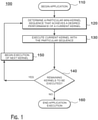
- FIG. 1 is an overview of an embodiment of a method of determining concurrency factors for an application running on a parallel processor such as a GPU.
- the method begins at 110.
- a particular sequence of mini-kernels is determined for that current kernel 120, as described below, for example. That current kernel is executed with the determined particular sequence of mini-kernels 130.
- a check is performed to determine whether or not there are remaining kernels to be executed to complete execution of the application 140. If there are remaining kernels to be executed, a new application kernel is invoked and its execution begins 150. The method returns to 120 and a new particular sequence of mini-kernels is determined for this next kernel.
- the loop between 120-130-140-150-120 repeats until the check at 140 reveals no remaining kernels to be executed. In that case, execution of the application ends 160.
- a result of the application execution may be provided to a user by an output device, which may include, for example a visual display device.
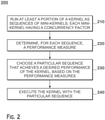
- FIG. 2 shows details of an embodiment of a method of determining a particular sequence of mini-kernels for a kernel.
- a current kernel in the application execution, or at least a portion of the kernel is run as sequences of mini-kernels, each mini-kernel having a concurrency factor 210.
- the concurrency factor of each mini-kernel may be independent of the concurrency factor of all other mini-kernels.
- a performance measure which in some implementations may be based on a combination of performance measures, is determined 220.
- performance measures include at least one of an execution time, such as a kernel execution time or an application execution time; a temperature; an energy dissipation rate; a power efficiency; an energy efficiency; reliability, as measured by, for example, a soft error rate; a measure of contention for resources, such as memory; or a compute-unit sensitivity.
- Compute-unit sensitivity may be defined as a change in a performance measure divided by a corresponding change in a number of compute-units executing.
- Compute unit sensitivity may be determined based on at least one of: compute behavior, memory behavior, one or more runtime statistics, or number of workgroups executing.
- compute-unit sensitivity may be modelled as a linear function of at least one of compute behavior, memory behavior, one or more runtime statistics, or number of workgroups executing. Coefficients in this linear function may be constants determined by a regression model on performance statistics and compute-unit sensitivity for known kernels.
- the predicted compute-unit sensitivity may be compared against thresholds to determine if concurrency is HIGH, MEDIUM or LOW. Depending on this classification, a maximum number of workgroups to execute concurrently can be determined. In variations, other concurrency categories are possible.
- a particular sequence is chosen that achieves a desired performance of the kernel, based on the performance measures of all the tried sequences 230.
- the kernel is executed with the particular sequence 240.
- Examples of achieving a desired performance include one or more of minimizing an execution time, such as a kernel execution time or an application execution time; maintaining a processor, or a system containing a processor, within a thermal limit, such as limiting a temperature or an energy dissipation rate; maximizing reliability of a processor or a system containing a processor; maximizing an energy efficiency and maximizing a power efficiency.
- Maximizing reliability may include minimizing a rate of occurrence of soft errors.
- Another example of achieving a desired performance includes minimizing contention among workgroups for use of a memory, such as a cache memory.
- any subset of the aforementioned examples achieved simultaneously may be selected as achieving a desired performance.
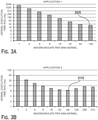
- FIGS. 3A and 3B respectively show two examples, not to be construed as limiting, of determining concurrency factors for a kernel of an application running on a parallel processor.
- the results shown here are actual experimental results obtained by running two different applications on a GPU.
- FIG. 3A shows results for one application, labeled Application 1, while FIG. 3B shows similar results for a different application, labeled Application 2.
- at least a portion of a kernel of the respective application is run as sequences of mini-kernels in which the mini-kernels in each sequence all have the same number of workgroups, i.e. the same concurrency factor.
- each vertical bar along the vertical axes indicates a performance measure - in this example a kernel execution time - obtained with a sequence having a common concurrency factor indicated by the corresponding number on the horizontal axes.
- achieving a desired performance includes minimizing a kernel execution time.
- a minimum kernel execution time a desired performance
- a common concurrency factor is at a maximum examined value, namely 128, as indicated at 305.
- a desired performance is obtained with a concurrency factor of 64, as indicated at 310.
- desired performance is obtained with a concurrency factor less than the maximum examined concurrency factor of 512.
- contention among these workgroups for resources increases. This contention tends to increase execution time.
- some number such as 64 in this example, the effect of contention dominates the effect of concurrency, and execution time increases with increasing concurrency factor.
- a particular mini-kernel sequence that achieves a desired performance may be determined with every kernel invocation during the running of the application, as the application's parallelism demands change over time. This may be achieved by performing the running of at least a portion of the kernel 210, the determining of a performance measure 220, the choosing of a particular sequence that achieves a desired performance 230, and the executing of the kernel with the particular sequence 240, all of these performed whenever a new application kernel is invoked during the running of the application. As non-limiting examples, this would be the case for a graph algorithm or irregular application.
- the chosen particular sequence may remain constant during execution of the kernel.
- An alternative embodiment may include performing the running of at least a portion of the kernel 210, the determining 220, the choosing 230, and the executing 240, all performed dynamically during the executing of a kernel, in response to a changing computational environment.
- the chosen particular mini-kernel sequence used as execution of a kernel could be changed during kernel execution based on performance statistics and kernel phase changes.
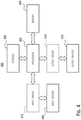
- FIG. 4 is a block diagram of an example device or system 400 in which one or more disclosed embodiments may be implemented.
- System 400 may include, for example, a computer, a gaming device, a handheld device, a set-top box, a television, a mobile phone, or a tablet computer.
- System 400 includes a processor 402; a memory 404; a storage 406; one or more input devices 408; and one or more output devices 410, configured to provide a result of the execution of the application.
- Output devices 410 may include a visual display.
- System 400 may also optionally include an input driver 412 and an output driver 414. It is understood that system 400 may include additional components not shown in FIG. 4 .
- the processor 402 may include a central processing unit (CPU), a graphics processing unit (GPU), a CPU and GPU located on the same die, or one or more processor cores, wherein each processor core may be a CPU or a GPU.
- the memory 404 may be located on the same die as the processor 402, or may be located separately from the processor 402.
- the memory 404 may include a volatile or non-volatile memory, for example, random access memory (RAM), dynamic RAM, or a cache.
- the storage 406 may include a fixed or removable storage, for example, a hard disk drive, a solid state drive, an optical disk, or a flash drive.
- the input devices 108 may include a keyboard, a keypad, a touch screen, a touch pad, a detector, a microphone, an accelerometer, a gyroscope, a biometric scanner, or a network connection (e.g., a wireless local area network card for transmission and/or reception of wireless IEEE 802 signals).
- the output devices 410 may include a display, a speaker, a printer, a haptic feedback device, one or more lights, an antenna, or a network connection (e.g., a wireless local area network card for transmission and/or reception of wireless IEEE 802 signals).
- the input driver 412 communicates with the processor 402 and the input devices 408, and permits the processor 402 to receive input from the input devices 408.
- the output driver 414 communicates with the processor 402 and the output devices 410, and permits the processor 402 to send output to the output devices 410. It is noted that the input driver 412 and the output driver 414 are optional components, and that the device 400 will operate in the same manner if the input driver 412 and the output driver 414 are not present.
- System 400 may be configured to determine concurrency factors for a kernel in an application by implementing one or more embodiments of a method described hereinbefore.
- Parallel processor 402 may be configured to execute the application as one or more kernels.
- Memory 404 or storage 406 may be configured to exchange information with parallel processor 402, to store the application, and to load the application into the parallel processor 402.
- Parallel processor 402 may be configured to run at least a portion of the kernel as sequences of mini-kernels, each mini-kernel comprising a number of concurrently executing workgroups, the number being defined as a concurrency factor of the mini-kernel; determine a performance measure for each sequence of mini-kernels; choose from the sequences a particular sequence that achieves a desired performance of the kernel, based on the performance measures; and execute the kernel with the particular sequence.
- Parallel processor 402 may be configured to perform the aforementioned running of at least a portion of the kernel, determining, choosing, and executing whenever a new application kernel is invoked during the running of the application.
- Parallel processor 402 may be configured to perform the running of at least a portion of the kernel, the determining, the choosing, and the executing dynamically during the running of the application.
- Parallel processor 402 may be configured to choose a particular sequence that achieves a desired performance of the kernel by at least one of: minimizing an execution time, maintaining the system within a thermal limit, maximizing at least one of a power efficiency or an energy efficiency, maximizing reliability of the system, and minimizing contention among workgroups for use of the first memory or for use of the second memory or for use of both memories.
- Parallel processor 402 may be configured to determine a compute-unit sensitivity as the performance measure.
- Parallel processor 402 may be configured to determine the compute-unit sensitivity based on at least one of compute behavior, memory behavior, one or more runtime statistics, or number of workgroups executing.
- Parallel processor 402 may be configured to determine a compute-unit sensitivity as a linear function of at least one of compute behavior, memory behavior, one or more runtime statistics, or number of workgroups executing.
- Parallel processor 402 may be configured to run at least a portion of the kernel as sequences of mini-kernels comprising concurrently executing workgroups that are contiguous.
- Parallel processor 402 may be configured to run at least a portion of the kernel as sequences of mini-kernels, wherein all mini-kernels in at least one of the sequences have a common concurrency factor.
- the common concurrency factor may be a power of 2.
- processors include, by way of example, a general purpose processor, a special purpose processor, a conventional processor, a digital signal processor (DSP), a plurality of microprocessors, one or more microprocessors in association with a DSP core, a controller, a microcontroller, Application Specific Integrated Circuits (ASICs), Field Programmable Gate Arrays (FPGAs) circuits, any other type of integrated circuit (IC), and/or a state machine.
- DSP digital signal processor
- ASICs Application Specific Integrated Circuits
- FPGAs Field Programmable Gate Arrays
- Such processors may be manufactured by configuring a manufacturing process using the results of processed hardware description language (HDL) instructions and other intermediary data including netlists (such instructions capable of being stored on a computer readable media). The results of such processing may be maskworks that are then used in a semiconductor manufacturing process to manufacture a processor which implements aspects of the present invention.
- HDL hardware description language
- ROM read only memory
- RAM random access memory
- register cache memory
- semiconductor memory devices magnetic media such as internal hard disks and removable disks, magneto-optical media, and optical media such as CD-ROM disks, and digital versatile disks (DVDs).
Landscapes
- Engineering & Computer Science (AREA)
- Theoretical Computer Science (AREA)
- Software Systems (AREA)
- General Engineering & Computer Science (AREA)
- Physics & Mathematics (AREA)
- General Physics & Mathematics (AREA)
- Computer Hardware Design (AREA)
- Quality & Reliability (AREA)
- Debugging And Monitoring (AREA)
- Multi Processors (AREA)
Applications Claiming Priority (2)
| Application Number | Priority Date | Filing Date | Title |
|---|---|---|---|
| US14/710,879 US9965343B2 (en) | 2015-05-13 | 2015-05-13 | System and method for determining concurrency factors for dispatch size of parallel processor kernels |
| PCT/US2016/023560 WO2016182636A1 (en) | 2015-05-13 | 2016-03-22 | System and method for determining concurrency factors for dispatch size of parallel processor kernels |
Publications (3)
| Publication Number | Publication Date |
|---|---|
| EP3295300A1 EP3295300A1 (en) | 2018-03-21 |
| EP3295300A4 EP3295300A4 (en) | 2019-01-09 |
| EP3295300B1 true EP3295300B1 (en) | 2022-03-23 |
Family
ID=57248294
Family Applications (1)
| Application Number | Title | Priority Date | Filing Date |
|---|---|---|---|
| EP16793114.6A Active EP3295300B1 (en) | 2015-05-13 | 2016-03-22 | System and method for determining concurrency factors for dispatch size of parallel processor kernels |
Country Status (6)
| Country | Link |
|---|---|
| US (1) | US9965343B2 (enExample) |
| EP (1) | EP3295300B1 (enExample) |
| JP (1) | JP6659724B2 (enExample) |
| KR (1) | KR102548402B1 (enExample) |
| CN (1) | CN107580698B (enExample) |
| WO (1) | WO2016182636A1 (enExample) |
Families Citing this family (8)
| Publication number | Priority date | Publication date | Assignee | Title |
|---|---|---|---|---|
| US10324730B2 (en) * | 2016-03-24 | 2019-06-18 | Mediatek, Inc. | Memory shuffle engine for efficient work execution in a parallel computing system |
| US20180115496A1 (en) * | 2016-10-21 | 2018-04-26 | Advanced Micro Devices, Inc. | Mechanisms to improve data locality for distributed gpus |
| US10558499B2 (en) * | 2017-10-26 | 2020-02-11 | Advanced Micro Devices, Inc. | Wave creation control with dynamic resource allocation |
| US12405790B2 (en) * | 2019-06-28 | 2025-09-02 | Advanced Micro Devices, Inc. | Compute unit sorting for reduced divergence |
| US11900123B2 (en) * | 2019-12-13 | 2024-02-13 | Advanced Micro Devices, Inc. | Marker-based processor instruction grouping |
| US11809902B2 (en) * | 2020-09-24 | 2023-11-07 | Advanced Micro Devices, Inc. | Fine-grained conditional dispatching |
| US20220334845A1 (en) * | 2021-04-15 | 2022-10-20 | Nvidia Corporation | Launching code concurrently |
| US20240220315A1 (en) * | 2022-12-30 | 2024-07-04 | Advanced Micro Devices, Inc. | Dynamic control of work scheduling |
Family Cites Families (15)
| Publication number | Priority date | Publication date | Assignee | Title |
|---|---|---|---|---|
| US6516310B2 (en) * | 1999-12-07 | 2003-02-04 | Sybase, Inc. | System and methodology for join enumeration in a memory-constrained environment |
| US8136104B2 (en) | 2006-06-20 | 2012-03-13 | Google Inc. | Systems and methods for determining compute kernels for an application in a parallel-processing computer system |
| US8375368B2 (en) * | 2006-06-20 | 2013-02-12 | Google Inc. | Systems and methods for profiling an application running on a parallel-processing computer system |
| US9354944B2 (en) * | 2009-07-27 | 2016-05-31 | Advanced Micro Devices, Inc. | Mapping processing logic having data-parallel threads across processors |
| CN102023844B (zh) * | 2009-09-18 | 2014-04-09 | 深圳中微电科技有限公司 | 并行处理器及其线程处理方法 |
| KR101079697B1 (ko) * | 2009-10-05 | 2011-11-03 | 주식회사 글로벌미디어테크 | 범용 그래픽 처리장치의 병렬 프로세서를 이용한 고속 영상 처리 방법 |
| US8250404B2 (en) * | 2009-12-31 | 2012-08-21 | International Business Machines Corporation | Process integrity of work items in a multiple processor system |
| US8782645B2 (en) * | 2011-05-11 | 2014-07-15 | Advanced Micro Devices, Inc. | Automatic load balancing for heterogeneous cores |
| US9092267B2 (en) * | 2011-06-20 | 2015-07-28 | Qualcomm Incorporated | Memory sharing in graphics processing unit |
| US20120331278A1 (en) | 2011-06-23 | 2012-12-27 | Mauricio Breternitz | Branch removal by data shuffling |
| US8707314B2 (en) * | 2011-12-16 | 2014-04-22 | Advanced Micro Devices, Inc. | Scheduling compute kernel workgroups to heterogeneous processors based on historical processor execution times and utilizations |
| US9823927B2 (en) * | 2012-11-30 | 2017-11-21 | Intel Corporation | Range selection for data parallel programming environments |
| CN105027089B (zh) * | 2013-03-14 | 2018-05-22 | 英特尔公司 | 内核功能性检查器 |
| US9772864B2 (en) * | 2013-04-16 | 2017-09-26 | Arm Limited | Methods of and apparatus for multidimensional indexing in microprocessor systems |
| US10297073B2 (en) * | 2016-02-25 | 2019-05-21 | Intel Corporation | Method and apparatus for in-place construction of left-balanced and complete point K-D trees |
-
2015
- 2015-05-13 US US14/710,879 patent/US9965343B2/en active Active
-
2016
- 2016-03-22 KR KR1020177033219A patent/KR102548402B1/ko active Active
- 2016-03-22 JP JP2017554900A patent/JP6659724B2/ja active Active
- 2016-03-22 CN CN201680026495.2A patent/CN107580698B/zh active Active
- 2016-03-22 WO PCT/US2016/023560 patent/WO2016182636A1/en not_active Ceased
- 2016-03-22 EP EP16793114.6A patent/EP3295300B1/en active Active
Non-Patent Citations (1)
| Title |
|---|
| None * |
Also Published As
| Publication number | Publication date |
|---|---|
| US9965343B2 (en) | 2018-05-08 |
| EP3295300A1 (en) | 2018-03-21 |
| EP3295300A4 (en) | 2019-01-09 |
| KR102548402B1 (ko) | 2023-06-27 |
| WO2016182636A1 (en) | 2016-11-17 |
| CN107580698A (zh) | 2018-01-12 |
| KR20180011096A (ko) | 2018-01-31 |
| CN107580698B (zh) | 2019-08-23 |
| US20160335143A1 (en) | 2016-11-17 |
| JP6659724B2 (ja) | 2020-03-04 |
| JP2018514869A (ja) | 2018-06-07 |
Similar Documents
| Publication | Publication Date | Title |
|---|---|---|
| EP3295300B1 (en) | System and method for determining concurrency factors for dispatch size of parallel processor kernels | |
| US9697176B2 (en) | Efficient sparse matrix-vector multiplication on parallel processors | |
| JP6977239B2 (ja) | 行列乗算器 | |
| US10572225B1 (en) | Circuit arrangements and methods for performing multiply-and-accumulate operations | |
| KR20130116166A (ko) | 멀티-코어 프로세서용 멀티스레드 애플리케이션-인지 메모리 스케줄링 기법 | |
| CN111488205A (zh) | 面向异构硬件架构的调度方法和调度系统 | |
| Motamedi et al. | Fast and energy-efficient cnn inference on iot devices | |
| KR102616212B1 (ko) | 다수의 컴퓨팅 코어들상의 데이터 드라이브 스케줄러 | |
| CN104615584B (zh) | 面向gpdsp的大规模三角线性方程组求解向量化计算的方法 | |
| Chu et al. | Efficient algorithm design of optimizing spmv on gpu | |
| KR20240063137A (ko) | 하드웨어 가속기 최적화형 그룹 컨볼루션 기반 신경망 모델 | |
| EP4383084A1 (en) | Memory device and operating method thereof | |
| US12321733B2 (en) | Apparatus and method with neural network computation scheduling | |
| CN119597414A (zh) | 算子的调度方法、装置、设备、存储介质及程序产品 | |
| CN115129369B (zh) | 命令分发方法、命令分发器、芯片以及电子设备 | |
| CN116954850A (zh) | 计算任务调度方法、装置、片上系统和存储介质 | |
| Oryspayev et al. | Performance analysis of distributed symmetric sparse matrix vector multiplication algorithm for multi‐core architectures | |
| KR101473955B1 (ko) | Qr분해 연산 방법 및 기록매체 | |
| CN113362878A (zh) | 用于存储器内计算的方法和用于计算的系统 | |
| EP4579532A1 (en) | Memory device with address generator and operating method thereof | |
| Fattah et al. | sTiles: An Accelerated Computational Framework for Sparse Factorizations of Structured Matrices | |
| Oh et al. | Convolutional neural network accelerator with reconfigurable dataflow | |
| US20240232581A9 (en) | Method and apparatus with transformer model training | |
| Zheng et al. | Scaling Up Parallel Computation of Tiled QR Factorizations by a Distributed Scheduling Runtime System and Analytical Modeling | |
| CN119271584A (zh) | 用于处理多线程访存请求的方法、访存控制单元及相应处理器 |
Legal Events
| Date | Code | Title | Description |
|---|---|---|---|
| STAA | Information on the status of an ep patent application or granted ep patent |
Free format text: STATUS: THE INTERNATIONAL PUBLICATION HAS BEEN MADE |
|
| PUAI | Public reference made under article 153(3) epc to a published international application that has entered the european phase |
Free format text: ORIGINAL CODE: 0009012 |
|
| STAA | Information on the status of an ep patent application or granted ep patent |
Free format text: STATUS: REQUEST FOR EXAMINATION WAS MADE |
|
| 17P | Request for examination filed |
Effective date: 20171113 |
|
| AK | Designated contracting states |
Kind code of ref document: A1 Designated state(s): AL AT BE BG CH CY CZ DE DK EE ES FI FR GB GR HR HU IE IS IT LI LT LU LV MC MK MT NL NO PL PT RO RS SE SI SK SM TR |
|
| AX | Request for extension of the european patent |
Extension state: BA ME |
|
| RAP1 | Party data changed (applicant data changed or rights of an application transferred) |
Owner name: ADVANCED MICRO DEVICES, INC. |
|
| RAP1 | Party data changed (applicant data changed or rights of an application transferred) |
Owner name: ADVANCED MICRO DEVICES, INC. |
|
| RIN1 | Information on inventor provided before grant (corrected) |
Inventor name: PAUL, INDRANI Inventor name: SEN, RATHIJIT Inventor name: HUANG, WEI |
|
| DAV | Request for validation of the european patent (deleted) | ||
| DAX | Request for extension of the european patent (deleted) | ||
| A4 | Supplementary search report drawn up and despatched |
Effective date: 20181206 |
|
| RIC1 | Information provided on ipc code assigned before grant |
Ipc: G06F 9/48 20060101ALI20181130BHEP Ipc: G06F 9/38 20180101AFI20181130BHEP Ipc: G06F 15/80 20060101ALI20181130BHEP Ipc: G06F 9/445 20180101ALI20181130BHEP Ipc: G06F 11/34 20060101ALI20181130BHEP Ipc: G06F 9/50 20060101ALI20181130BHEP Ipc: G06F 15/173 20060101ALI20181130BHEP |
|
| STAA | Information on the status of an ep patent application or granted ep patent |
Free format text: STATUS: EXAMINATION IS IN PROGRESS |
|
| 17Q | First examination report despatched |
Effective date: 20200506 |
|
| GRAP | Despatch of communication of intention to grant a patent |
Free format text: ORIGINAL CODE: EPIDOSNIGR1 |
|
| STAA | Information on the status of an ep patent application or granted ep patent |
Free format text: STATUS: GRANT OF PATENT IS INTENDED |
|
| INTG | Intention to grant announced |
Effective date: 20211103 |
|
| GRAS | Grant fee paid |
Free format text: ORIGINAL CODE: EPIDOSNIGR3 |
|
| GRAA | (expected) grant |
Free format text: ORIGINAL CODE: 0009210 |
|
| STAA | Information on the status of an ep patent application or granted ep patent |
Free format text: STATUS: THE PATENT HAS BEEN GRANTED |
|
| AK | Designated contracting states |
Kind code of ref document: B1 Designated state(s): AL AT BE BG CH CY CZ DE DK EE ES FI FR GB GR HR HU IE IS IT LI LT LU LV MC MK MT NL NO PL PT RO RS SE SI SK SM TR |
|
| REG | Reference to a national code |
Ref country code: GB Ref legal event code: FG4D |
|
| REG | Reference to a national code |
Ref country code: CH Ref legal event code: EP |
|
| REG | Reference to a national code |
Ref country code: DE Ref legal event code: R096 Ref document number: 602016070304 Country of ref document: DE |
|
| REG | Reference to a national code |
Ref country code: IE Ref legal event code: FG4D |
|
| REG | Reference to a national code |
Ref country code: AT Ref legal event code: REF Ref document number: 1477928 Country of ref document: AT Kind code of ref document: T Effective date: 20220415 |
|
| REG | Reference to a national code |
Ref country code: LT Ref legal event code: MG9D |
|
| REG | Reference to a national code |
Ref country code: NL Ref legal event code: MP Effective date: 20220323 |
|
| PG25 | Lapsed in a contracting state [announced via postgrant information from national office to epo] |
Ref country code: SE Free format text: LAPSE BECAUSE OF FAILURE TO SUBMIT A TRANSLATION OF THE DESCRIPTION OR TO PAY THE FEE WITHIN THE PRESCRIBED TIME-LIMIT Effective date: 20220323 Ref country code: RS Free format text: LAPSE BECAUSE OF FAILURE TO SUBMIT A TRANSLATION OF THE DESCRIPTION OR TO PAY THE FEE WITHIN THE PRESCRIBED TIME-LIMIT Effective date: 20220323 Ref country code: NO Free format text: LAPSE BECAUSE OF FAILURE TO SUBMIT A TRANSLATION OF THE DESCRIPTION OR TO PAY THE FEE WITHIN THE PRESCRIBED TIME-LIMIT Effective date: 20220623 Ref country code: LT Free format text: LAPSE BECAUSE OF FAILURE TO SUBMIT A TRANSLATION OF THE DESCRIPTION OR TO PAY THE FEE WITHIN THE PRESCRIBED TIME-LIMIT Effective date: 20220323 Ref country code: HR Free format text: LAPSE BECAUSE OF FAILURE TO SUBMIT A TRANSLATION OF THE DESCRIPTION OR TO PAY THE FEE WITHIN THE PRESCRIBED TIME-LIMIT Effective date: 20220323 Ref country code: BG Free format text: LAPSE BECAUSE OF FAILURE TO SUBMIT A TRANSLATION OF THE DESCRIPTION OR TO PAY THE FEE WITHIN THE PRESCRIBED TIME-LIMIT Effective date: 20220623 |
|
| REG | Reference to a national code |
Ref country code: AT Ref legal event code: MK05 Ref document number: 1477928 Country of ref document: AT Kind code of ref document: T Effective date: 20220323 |
|
| PG25 | Lapsed in a contracting state [announced via postgrant information from national office to epo] |
Ref country code: LV Free format text: LAPSE BECAUSE OF FAILURE TO SUBMIT A TRANSLATION OF THE DESCRIPTION OR TO PAY THE FEE WITHIN THE PRESCRIBED TIME-LIMIT Effective date: 20220323 Ref country code: GR Free format text: LAPSE BECAUSE OF FAILURE TO SUBMIT A TRANSLATION OF THE DESCRIPTION OR TO PAY THE FEE WITHIN THE PRESCRIBED TIME-LIMIT Effective date: 20220624 Ref country code: FI Free format text: LAPSE BECAUSE OF FAILURE TO SUBMIT A TRANSLATION OF THE DESCRIPTION OR TO PAY THE FEE WITHIN THE PRESCRIBED TIME-LIMIT Effective date: 20220323 |
|
| PG25 | Lapsed in a contracting state [announced via postgrant information from national office to epo] |
Ref country code: NL Free format text: LAPSE BECAUSE OF FAILURE TO SUBMIT A TRANSLATION OF THE DESCRIPTION OR TO PAY THE FEE WITHIN THE PRESCRIBED TIME-LIMIT Effective date: 20220323 |
|
| PG25 | Lapsed in a contracting state [announced via postgrant information from national office to epo] |
Ref country code: SM Free format text: LAPSE BECAUSE OF FAILURE TO SUBMIT A TRANSLATION OF THE DESCRIPTION OR TO PAY THE FEE WITHIN THE PRESCRIBED TIME-LIMIT Effective date: 20220323 Ref country code: SK Free format text: LAPSE BECAUSE OF FAILURE TO SUBMIT A TRANSLATION OF THE DESCRIPTION OR TO PAY THE FEE WITHIN THE PRESCRIBED TIME-LIMIT Effective date: 20220323 Ref country code: RO Free format text: LAPSE BECAUSE OF FAILURE TO SUBMIT A TRANSLATION OF THE DESCRIPTION OR TO PAY THE FEE WITHIN THE PRESCRIBED TIME-LIMIT Effective date: 20220323 Ref country code: PT Free format text: LAPSE BECAUSE OF FAILURE TO SUBMIT A TRANSLATION OF THE DESCRIPTION OR TO PAY THE FEE WITHIN THE PRESCRIBED TIME-LIMIT Effective date: 20220725 Ref country code: ES Free format text: LAPSE BECAUSE OF FAILURE TO SUBMIT A TRANSLATION OF THE DESCRIPTION OR TO PAY THE FEE WITHIN THE PRESCRIBED TIME-LIMIT Effective date: 20220323 Ref country code: EE Free format text: LAPSE BECAUSE OF FAILURE TO SUBMIT A TRANSLATION OF THE DESCRIPTION OR TO PAY THE FEE WITHIN THE PRESCRIBED TIME-LIMIT Effective date: 20220323 Ref country code: CZ Free format text: LAPSE BECAUSE OF FAILURE TO SUBMIT A TRANSLATION OF THE DESCRIPTION OR TO PAY THE FEE WITHIN THE PRESCRIBED TIME-LIMIT Effective date: 20220323 Ref country code: AT Free format text: LAPSE BECAUSE OF FAILURE TO SUBMIT A TRANSLATION OF THE DESCRIPTION OR TO PAY THE FEE WITHIN THE PRESCRIBED TIME-LIMIT Effective date: 20220323 |
|
| PG25 | Lapsed in a contracting state [announced via postgrant information from national office to epo] |
Ref country code: PL Free format text: LAPSE BECAUSE OF FAILURE TO SUBMIT A TRANSLATION OF THE DESCRIPTION OR TO PAY THE FEE WITHIN THE PRESCRIBED TIME-LIMIT Effective date: 20220323 Ref country code: IS Free format text: LAPSE BECAUSE OF FAILURE TO SUBMIT A TRANSLATION OF THE DESCRIPTION OR TO PAY THE FEE WITHIN THE PRESCRIBED TIME-LIMIT Effective date: 20220723 Ref country code: AL Free format text: LAPSE BECAUSE OF FAILURE TO SUBMIT A TRANSLATION OF THE DESCRIPTION OR TO PAY THE FEE WITHIN THE PRESCRIBED TIME-LIMIT Effective date: 20220323 |
|
| REG | Reference to a national code |
Ref country code: DE Ref legal event code: R097 Ref document number: 602016070304 Country of ref document: DE |
|
| PLBE | No opposition filed within time limit |
Free format text: ORIGINAL CODE: 0009261 |
|
| STAA | Information on the status of an ep patent application or granted ep patent |
Free format text: STATUS: NO OPPOSITION FILED WITHIN TIME LIMIT |
|
| PG25 | Lapsed in a contracting state [announced via postgrant information from national office to epo] |
Ref country code: DK Free format text: LAPSE BECAUSE OF FAILURE TO SUBMIT A TRANSLATION OF THE DESCRIPTION OR TO PAY THE FEE WITHIN THE PRESCRIBED TIME-LIMIT Effective date: 20220323 |
|
| 26N | No opposition filed |
Effective date: 20230102 |
|
| PG25 | Lapsed in a contracting state [announced via postgrant information from national office to epo] |
Ref country code: SI Free format text: LAPSE BECAUSE OF FAILURE TO SUBMIT A TRANSLATION OF THE DESCRIPTION OR TO PAY THE FEE WITHIN THE PRESCRIBED TIME-LIMIT Effective date: 20220323 |
|
| P01 | Opt-out of the competence of the unified patent court (upc) registered |
Effective date: 20230530 |
|
| PG25 | Lapsed in a contracting state [announced via postgrant information from national office to epo] |
Ref country code: IT Free format text: LAPSE BECAUSE OF FAILURE TO SUBMIT A TRANSLATION OF THE DESCRIPTION OR TO PAY THE FEE WITHIN THE PRESCRIBED TIME-LIMIT Effective date: 20220323 |
|
| PG25 | Lapsed in a contracting state [announced via postgrant information from national office to epo] |
Ref country code: MC Free format text: LAPSE BECAUSE OF FAILURE TO SUBMIT A TRANSLATION OF THE DESCRIPTION OR TO PAY THE FEE WITHIN THE PRESCRIBED TIME-LIMIT Effective date: 20220323 |
|
| REG | Reference to a national code |
Ref country code: CH Ref legal event code: PL |
|
| REG | Reference to a national code |
Ref country code: BE Ref legal event code: MM Effective date: 20230331 |
|
| PG25 | Lapsed in a contracting state [announced via postgrant information from national office to epo] |
Ref country code: LU Free format text: LAPSE BECAUSE OF NON-PAYMENT OF DUE FEES Effective date: 20230322 |
|
| REG | Reference to a national code |
Ref country code: IE Ref legal event code: MM4A |
|
| PG25 | Lapsed in a contracting state [announced via postgrant information from national office to epo] |
Ref country code: LI Free format text: LAPSE BECAUSE OF NON-PAYMENT OF DUE FEES Effective date: 20230331 Ref country code: IE Free format text: LAPSE BECAUSE OF NON-PAYMENT OF DUE FEES Effective date: 20230322 Ref country code: FR Free format text: LAPSE BECAUSE OF NON-PAYMENT OF DUE FEES Effective date: 20230331 Ref country code: CH Free format text: LAPSE BECAUSE OF NON-PAYMENT OF DUE FEES Effective date: 20230331 |
|
| PG25 | Lapsed in a contracting state [announced via postgrant information from national office to epo] |
Ref country code: BE Free format text: LAPSE BECAUSE OF NON-PAYMENT OF DUE FEES Effective date: 20230331 |
|
| PGFP | Annual fee paid to national office [announced via postgrant information from national office to epo] |
Ref country code: DE Payment date: 20250221 Year of fee payment: 10 |
|
| PGFP | Annual fee paid to national office [announced via postgrant information from national office to epo] |
Ref country code: GB Payment date: 20250311 Year of fee payment: 10 |
|
| PG25 | Lapsed in a contracting state [announced via postgrant information from national office to epo] |
Ref country code: CY Free format text: LAPSE BECAUSE OF FAILURE TO SUBMIT A TRANSLATION OF THE DESCRIPTION OR TO PAY THE FEE WITHIN THE PRESCRIBED TIME-LIMIT; INVALID AB INITIO Effective date: 20160322 |
|
| PG25 | Lapsed in a contracting state [announced via postgrant information from national office to epo] |
Ref country code: HU Free format text: LAPSE BECAUSE OF FAILURE TO SUBMIT A TRANSLATION OF THE DESCRIPTION OR TO PAY THE FEE WITHIN THE PRESCRIBED TIME-LIMIT; INVALID AB INITIO Effective date: 20160322 |
|
| PG25 | Lapsed in a contracting state [announced via postgrant information from national office to epo] |
Ref country code: TR Free format text: LAPSE BECAUSE OF FAILURE TO SUBMIT A TRANSLATION OF THE DESCRIPTION OR TO PAY THE FEE WITHIN THE PRESCRIBED TIME-LIMIT Effective date: 20220323 |