EP3293240B1 - Mittel mit anti-ice-nukleierungsaktivität - Google Patents
Mittel mit anti-ice-nukleierungsaktivität Download PDFInfo
- Publication number
- EP3293240B1 EP3293240B1 EP16789562.2A EP16789562A EP3293240B1 EP 3293240 B1 EP3293240 B1 EP 3293240B1 EP 16789562 A EP16789562 A EP 16789562A EP 3293240 B1 EP3293240 B1 EP 3293240B1
- Authority
- EP
- European Patent Office
- Prior art keywords
- tyr
- tyrosine
- ice nucleation
- amino acid
- peptide
- Prior art date
- Legal status (The legal status is an assumption and is not a legal conclusion. Google has not performed a legal analysis and makes no representation as to the accuracy of the status listed.)
- Active
Links
Images






Classifications
-
- A—HUMAN NECESSITIES
- A23—FOODS OR FOODSTUFFS; TREATMENT THEREOF, NOT COVERED BY OTHER CLASSES
- A23B—PRESERVATION OF FOODS, FOODSTUFFS OR NON-ALCOHOLIC BEVERAGES; CHEMICAL RIPENING OF FRUIT OR VEGETABLES
- A23B2/00—Preservation of foods or foodstuffs, in general
- A23B2/80—Freezing; Subsequent thawing; Cooling
- A23B2/85—Freezing; Subsequent thawing; Cooling with addition of or treatment with chemicals
-
- C—CHEMISTRY; METALLURGY
- C07—ORGANIC CHEMISTRY
- C07K—PEPTIDES
- C07K5/00—Peptides containing up to four amino acids in a fully defined sequence; Derivatives thereof
- C07K5/04—Peptides containing up to four amino acids in a fully defined sequence; Derivatives thereof containing only normal peptide links
- C07K5/06—Dipeptides
- C07K5/06008—Dipeptides with the first amino acid being neutral
- C07K5/06078—Dipeptides with the first amino acid being neutral and aromatic or cycloaliphatic
-
- C—CHEMISTRY; METALLURGY
- C07—ORGANIC CHEMISTRY
- C07K—PEPTIDES
- C07K5/00—Peptides containing up to four amino acids in a fully defined sequence; Derivatives thereof
- C07K5/04—Peptides containing up to four amino acids in a fully defined sequence; Derivatives thereof containing only normal peptide links
- C07K5/08—Tripeptides
- C07K5/0802—Tripeptides with the first amino acid being neutral
- C07K5/0804—Tripeptides with the first amino acid being neutral and aliphatic
- C07K5/081—Tripeptides with the first amino acid being neutral and aliphatic the side chain containing O or S as heteroatoms, e.g. Cys, Ser
-
- C—CHEMISTRY; METALLURGY
- C07—ORGANIC CHEMISTRY
- C07K—PEPTIDES
- C07K5/00—Peptides containing up to four amino acids in a fully defined sequence; Derivatives thereof
- C07K5/04—Peptides containing up to four amino acids in a fully defined sequence; Derivatives thereof containing only normal peptide links
- C07K5/08—Tripeptides
- C07K5/0802—Tripeptides with the first amino acid being neutral
- C07K5/0812—Tripeptides with the first amino acid being neutral and aromatic or cycloaliphatic
-
- C—CHEMISTRY; METALLURGY
- C07—ORGANIC CHEMISTRY
- C07K—PEPTIDES
- C07K5/00—Peptides containing up to four amino acids in a fully defined sequence; Derivatives thereof
- C07K5/04—Peptides containing up to four amino acids in a fully defined sequence; Derivatives thereof containing only normal peptide links
- C07K5/10—Tetrapeptides
- C07K5/1002—Tetrapeptides with the first amino acid being neutral
- C07K5/1005—Tetrapeptides with the first amino acid being neutral and aliphatic
- C07K5/1013—Tetrapeptides with the first amino acid being neutral and aliphatic the side chain containing O or S as heteroatoms, e.g. Cys, Ser
-
- C—CHEMISTRY; METALLURGY
- C07—ORGANIC CHEMISTRY
- C07K—PEPTIDES
- C07K5/00—Peptides containing up to four amino acids in a fully defined sequence; Derivatives thereof
- C07K5/04—Peptides containing up to four amino acids in a fully defined sequence; Derivatives thereof containing only normal peptide links
- C07K5/10—Tetrapeptides
- C07K5/1002—Tetrapeptides with the first amino acid being neutral
- C07K5/1016—Tetrapeptides with the first amino acid being neutral and aromatic or cycloaliphatic
-
- C—CHEMISTRY; METALLURGY
- C07—ORGANIC CHEMISTRY
- C07K—PEPTIDES
- C07K7/00—Peptides having 5 to 20 amino acids in a fully defined sequence; Derivatives thereof
- C07K7/04—Linear peptides containing only normal peptide links
- C07K7/06—Linear peptides containing only normal peptide links having 5 to 11 amino acids
-
- C—CHEMISTRY; METALLURGY
- C09—DYES; PAINTS; POLISHES; NATURAL RESINS; ADHESIVES; COMPOSITIONS NOT OTHERWISE PROVIDED FOR; APPLICATIONS OF MATERIALS NOT OTHERWISE PROVIDED FOR
- C09D—COATING COMPOSITIONS, e.g. PAINTS, VARNISHES OR LACQUERS; FILLING PASTES; CHEMICAL PAINT OR INK REMOVERS; INKS; CORRECTING FLUIDS; WOODSTAINS; PASTES OR SOLIDS FOR COLOURING OR PRINTING; USE OF MATERIALS THEREFOR
- C09D201/00—Coating compositions based on unspecified macromolecular compounds
-
- C—CHEMISTRY; METALLURGY
- C09—DYES; PAINTS; POLISHES; NATURAL RESINS; ADHESIVES; COMPOSITIONS NOT OTHERWISE PROVIDED FOR; APPLICATIONS OF MATERIALS NOT OTHERWISE PROVIDED FOR
- C09D—COATING COMPOSITIONS, e.g. PAINTS, VARNISHES OR LACQUERS; FILLING PASTES; CHEMICAL PAINT OR INK REMOVERS; INKS; CORRECTING FLUIDS; WOODSTAINS; PASTES OR SOLIDS FOR COLOURING OR PRINTING; USE OF MATERIALS THEREFOR
- C09D7/00—Features of coating compositions, not provided for in group C09D5/00; Processes for incorporating ingredients in coating compositions
- C09D7/40—Additives
-
- C—CHEMISTRY; METALLURGY
- C09—DYES; PAINTS; POLISHES; NATURAL RESINS; ADHESIVES; COMPOSITIONS NOT OTHERWISE PROVIDED FOR; APPLICATIONS OF MATERIALS NOT OTHERWISE PROVIDED FOR
- C09K—MATERIALS FOR MISCELLANEOUS APPLICATIONS, NOT PROVIDED FOR ELSEWHERE
- C09K3/00—Materials not provided for elsewhere
-
- C—CHEMISTRY; METALLURGY
- C09—DYES; PAINTS; POLISHES; NATURAL RESINS; ADHESIVES; COMPOSITIONS NOT OTHERWISE PROVIDED FOR; APPLICATIONS OF MATERIALS NOT OTHERWISE PROVIDED FOR
- C09K—MATERIALS FOR MISCELLANEOUS APPLICATIONS, NOT PROVIDED FOR ELSEWHERE
- C09K3/00—Materials not provided for elsewhere
- C09K3/18—Materials not provided for elsewhere for application to surfaces to minimize adherence of ice, mist or water thereto; Thawing or antifreeze materials for application to surfaces
-
- C—CHEMISTRY; METALLURGY
- C09—DYES; PAINTS; POLISHES; NATURAL RESINS; ADHESIVES; COMPOSITIONS NOT OTHERWISE PROVIDED FOR; APPLICATIONS OF MATERIALS NOT OTHERWISE PROVIDED FOR
- C09K—MATERIALS FOR MISCELLANEOUS APPLICATIONS, NOT PROVIDED FOR ELSEWHERE
- C09K5/00—Heat-transfer, heat-exchange or heat-storage materials, e.g. refrigerants; Materials for the production of heat or cold by chemical reactions other than by combustion
- C09K5/08—Materials not undergoing a change of physical state when used
- C09K5/10—Liquid materials
Definitions
- the present invention relates to an anti-ice nucleation activator, an antifreeze liquid, and a coating solution for preventing frost damage.
- the present invention further relates to a method for improving the anti-ice nucleation activity of a biological material, and a method for preserving a biological material.
- ice nucleation active substances include bacteria of the Pseudomonas genus, silver iodide, and the like.
- pure water contains no foreign substances; therefore, ice nucleation does not occur.
- pure water may not solidify (solidification). This is generally called "supercooling phenomenon.”
- anti-ice nucleation activators which promote the supercooling phenomenon.
- the anti-ice nucleation activators are capable of forming water that does not freeze even at a temperature under the freezing point. As a result, expansion upon freezing does not occur, which allows cells of plants or animals to be preserved without being destroyed. Even if it is frozen once, only fine ice nuclei are formed, resulting in the occurrence of fine ice crystal formation. Thus, the application of anti-ice nucleation activators to the fields of food, biomaterials (organ preservation), etc., is expected.
- NPL Non-Patent Literature 1
- high-molecular-weight compounds such as polysaccharide from Bacillus thuringiensis (see NPL 2), have been reported to exhibit anti-ice nucleation activity.
- anti-ice nucleation activators exhibit anti-ice nucleation activity towards bacteria, such as Pseudomonas fluorescens , which is an ice nucleation active substance, they exhibit low anti-ice nucleation activity towards silver iodide. Moreover, due to safety issues, the use of the anti-ice nucleation activators was difficult in the fields of food, biomaterials, etc.
- An object of the present invention is to provide an anti-ice nucleation activator, an antifreeze liquid, and a coating solution for preventing frost damage, that exhibit anti-ice nucleation activity widely towards ice nucleation active substances; and that are applicable to the fields of food, biological materials, environment, etc.
- Another object of the present invention is to provide a method for improving the anti-ice nucleation activity of a biological material, and a method for preserving a biological material.
- the present inventors conducted extensive research, and found that a tyrosine peptide, as well as a complex composed of one or more tyrosine peptides and a polymer, are capable of achieving the above objects.
- the inventors conducted further research based on these findings. The present invention has thus been accomplished.
- the present invention provides the following anti-ice nucleation activator, antifreeze liquid, coating solution for preventing frost damage, and the like.
- the present invention provides an anti-ice nucleation activator, antifreeze liquid, and coating solution for preventing frost damage that exhibit anti-ice nucleation activity widely towards ice nucleation active substances, and that are applicable to the fields of food, biological materials, environment, etc.
- the use of the anti-ice nucleation activator of the present invention is expected to enable long-term, low-temperature preservation of food, biological materials, etc.
- the anti-ice nucleation activator of the present invention comprises a tyrosine peptide, or a complex composed of one or more of the tyrosine peptides and a polymer, wherein the one or more of the tyrosine peptides are bound to the polymer.
- the term “comprise/contain” encompasses the concepts of "comprise,” “contain,” “consist essentially of,” and “consist of.”
- a tyrosine peptide is a compound that has a tyrosine-tyrosine (Tyr-Tyr) structure.
- the tyrosine peptide refers to a compound of di- to pentatyrosine peptide.
- Such a tyrosine peptide is represented by Formula (1) : (X) p -[Tyr] n -(Y) q (1) wherein X, Y, n, p, and q are as defined above.
- the [Tyr] refers to a tyrosine residue ([H 2 N-CH(-CH 2 C 6 H 4 -4-OH)-COOH], [H 2 N-CH(-CH 2 C 6 H 4 -4-OH)-CO], [HN-CH(-CH 2 C 6 H 4 -4-OH)-COOH], or [HN-CH(-CH 2 C 6 H 4 -4-OH)-CO]), and the tyrosine in these tyrosine residues may be, for example, L-tyrosine or D-tyrosine.
- the tyrosine is preferably L-tyrosine, which is a naturally occurring amino acid.
- n represents an integer of 2 to 5, more preferably an integer of 2 to 4, and particular preferably an integer of 2 or 3.
- [Tyr] 2 in which n is 2, represents a structure [Tyr-Tyr], i.e., a structure [H 2 N-CH(-CH 2 C 6 H 4 -4-OH)-CO-NH-CH(-CH 2 C 6 H 4 -4-OH)-COOH], [H 2 N-CH(-CH 2 C 6 H 4 -4-OH)-CO-NH-CH(-CH 2 C 6 H 4 -4-OH)-CO], [HN-CH(-CH 2 C 6 H 4 -4-OH)-CO-NH-CH(-CH 2 C 6 H 4 -4-OH)-COOH], or [HN-CH(-CH 2 C 6 H 4 -4-OH)-CO-NH-CH(-CH 2 C 6 H 4 -4-OH)-CO].
- [Tyr] 3 in which n is 3, represents a structure [Tyr-Tyr-Tyr], i.e., a structure [H 2 N-CH(-CH 2 C 6 H 4 -4-OH)-CO-NH-CH(-CH 2 C 6 H 4 -4-OH)-CO-NH-CH(-CH 2 C 6 H 4 -4-OH)-COOH], [H 2 N-CH(-CH 2 C 6 H 4 -4-OH)-CO-NH-CH(-CH 2 C 6 H 4 -4-OH)-CO-NH-CH(-CH 2 C 6 H 4 -4-OH)-CO], [HN-CH(-CH 2 C 6 H 4 -4-OH)-CO-NH-CH(-CH 2 C 6 H 4 -4-OH)-CO-NH-CH(-CH 2 C 6 H 4 -4-OH)-COOH], or [HN-CH(-CH 2 C 6 H 4 -4-OH)-CO-NH-CH(-CH 2 C 6 H 4 -4
- [Tyr] 4 in which n is 4, represents a structure [Tyr-Tyr-Tyr-Tyr], i.e., a structure [H 2 N-CH(-CH 2 C 6 H 4 -4-OH)-CO-NH-CH(-CH 2 C 6 H 4 -4-OH)-CO-NH-CH(-CH 2 C 6 H 4 -4-OH)-COOH], [H 2 N-CH(-CH 2 C 6 H 4 -4-OH)-CO-NH-CH(-CH 2 C 6 H 4 -4-OH)-CO-NH-CH(-CH 2 C 6 H 4 -4-OH)-CO-NH-CH(-CH 2 C 6 H 4 -4-OH)-CO] [HN-CH(-CH 2 C 6 H 4 -4-OH)-CO-NH-CH(-CH 2 C 6 H 4 -4-OH)-CO-NH-CH(-CH 2 C 6 H 4 -4-OH)-CO-NH-CH(-CH 2 C 6 H 4 -4
- [Tyr] 5 in which n is 5, represents a structure [Tyr-Tyr-Tyr-Tyr-Tyr], i.e., a structure [H 2 N-CH(-CH 2 C 6 H 4 -4-OH)-CO-NH-CH(-CH 2 C 6 H 4 -4-OH)-CO-NH-CH(-CH 2 C 6 H 4 -4-OH)-CO-NH-CH(-CH 2 C 6 H 4 -4-OH)-CO-NH-CH(-CH 2 C 6 H 4 -4-OH)-COOH], [H 2 N-CH(-CH 2 C 6 H 4 -4-OH)-CO-NH-CH(-CH 2 C 6 H 4 -4-OH)-CO-NH-CH(-CH 2 C 6 H 4 -4-OH)-CO-NH-CH(-CH 2 C 6 H 4 -4-OH)-CO-NH-CH(-CH 2 C 6 H 4 -4-OH)-CO] [HN-CH(-CH 2 C 6
- p represents an integer of 0 to 4
- q represents an integer of 0 to 4, with the proviso that p + q does not exceed 4.
- p represents an integer of 2 to 4
- the two to four amino acid residues represented by (X) p may be identical or different.
- q is an integer of 2 to 4
- the two to four amino acid residues represented by (Y) q may be identical or different.
- the amino acid residue represented by (X) p refers to a group (H 2 N-CHR-CO) in which the hydroxyl group (OH) has been removed from the C-terminus of an amino acid.
- R represents the side chain of the amino acid.
- the amino acid residues refer to a group (H 2 N-CHR-CO) in which the hydroxyl group (OH) has been removed from the C-terminus of an amino acid, or a group (HN-CHR-CO) in which the hydroxyl group (OH) has been removed from the C-terminus of an amino acid while the hydrogen atom has been removed from the N-terminus.
- (X) 2 - in which p is 2, represents the structure (X-X)-, i.e., the structure (amino acid residue-amino acid residue)-.
- X is Ser (serine)
- (Ser-Ser)- represents [H 2 N-CH(-CH 2 OH)-CO-NH-CH(-CH 2 OH)-CO]-.
- (X) 3 - in which p is 3, represents the structure (X-X-X)-.
- X is Ser (serine)
- (Ser-Ser-Ser)- represents [H 2 N-CH(-CH 2 OH)-CO-NH-CH(-CH 2 OH)-CO-NH-CH(-CH 2 OH)-CO]-.
- (X) 4 - in which p is 4, represents the structure (X-X-X-X)-.
- X is Ser (serine)
- (Ser-Ser-Ser-Ser)- represents [H 2 N-CH(-CH 2 OH)-CO-NH-CH(-CH 2 OH)-CO-NH-CH(-CH 2 OH)-CO-NH-CH(-CH 2 OH)-CO]-.
- the amino acid residue represented by (Y) q refers to a group (HN-CHR-COOH) in which the hydrogen atom (H) has been removed from the N-terminus of an amino acid.
- R represents the side chain of the amino acid.
- the amino acid residues refer to a group (HN-CHR-COOH) in which the hydrogen atom (H) has been removed from the N-terminus of an amino acid, or a group (HN-CHR-CO) in which the hydroxyl group (OH) has been removed from the C-terminus of an amino acid while the hydrogen atom has been removed from the N-terminus.
- -(Y) 2 in which q is 2, represents the structure -(Y-Y), i.e., the structure -(amino acid residue-amino acid residue).
- Y Thr (threonine)
- -(Thr-Thr) represents -[HN-CH(-CH(CH 3 )OH)-CO-NH-CH(-CH(CH 3 )OH)-COOH].
- -(Y) 3 in which q is 3, represents the structure -(Y-Y-Y).
- Y is Thr (threonine)
- -(Thr-Thr-Thr) represents -[HN-CH(-CH(CH 3 )OH)-CO-HN-CH(-CH(CH 3 )OH)-CO-NH-CH(-CH(CH 3 )OH)-COOH].
- -(Y) 4 in which q is 4, represents the structure -(Y-Y-Y-Y).
- Y is Thr (threonine)
- -(Thr-Thr-Thr-Thr) represents -[HN-CH(-CH(CH 3 )OH)-CO-HN-CH(-CH(CH 3 )OH)-CO-HN-CH(-CH(CH 3 )OH)-CO-NH-CH(-CH(CH 3 )OH)-COOH].
- amino acids in the "amino acid residues” include naturally occurring amino acids and non-naturally occurring amino acids. That is, the amino acid in an amino acid residue may be an L-amino acid, a D-amino acid, or a mixture thereof.
- the types of amino acids are not particularly limited as long as it is a compound that contains an amino group and a carboxyl group. Examples include ⁇ -amino acids, ⁇ -amino acids, ⁇ -amino acids, and ⁇ -amino acids, with naturally occurring ⁇ -amino acids being preferable, and ⁇ -amino acids that contain a hydroxyl group in the amino acid side chain being more preferable.
- Naturally occurring amino acids include glycine, L-alanine, L-valine, L-leucine, L-isoleucine, L-serine, L-threonine, L-aspartic acid, L-glutamine acid, L-asparagine, L-glutamine, L-lysine, L-arginine, L-cystine, L-methionine, L-phenylalanine, L-tyrosine, L-proline, L-tryptophan, L-histidine, and L-proline.
- preferable naturally occurring amino acids include compounds that contain a hydroxyl group in the amino acid side chain, such as L-serine, L-threonine, and L-tyrosine, with L-tyrosine being more preferable.
- Non-naturally occurring amino acids refer to all amino acids other than the above 20 types of naturally occurring amino acids, which constitute naturally occurring proteins. Specific examples include (1) a non-naturally occurring amino acid in which an atom of a naturally occurring amino acid is replaced with another substance, (2) an optical isomer or a regioisomer of the side chain of a naturally occurring amino acid, (3) a non-naturally occurring amino acid in which a substituent is introduced to the side chain of a naturally occurring amino acid, and (4) a non-naturally occurring amino acid in which the side chain of a naturally occurring amino acid is substituted to allow modification of the hydrophobicity, reactivity, a charge state, molecular size, an ability to form a hydrogen bond, etc.
- the tyrosine peptide or the amino acid may be a tyrosine peptide derivative or an amino acid derivative in which the backbone or side chain of a tyrosine peptide or amino acid is chemically or biologically (enzymatically) modified.
- modifications include, but are not limited to, functional group introduction (transformations), such as alkylation, acylation (more specifically, acetylation), hydroxylation, esterification, halogenation, amination, and amidation. Specific tyrosine peptide derivatives are described later.
- amino acids as used in this specification are in accordance with the rules of the IUPAC-IUB ( IUPAC-IUB Communication on Biological Nomenclature, Eur. J. Biochem., 138, 9 (1984 )) and "Guidelines for the preparation of specifications which contain nucleotide and/or amino acid sequence" (Japanese Patent Office), and those conventionally used in the related field.
- L-form is referred to unless otherwise specified.
- amino acids that are present in various amino acid sequences mentioned in this specification are specified by well-known three-letter or one-letter abbreviations (see Table 1).
- Table 1 Codes Amino acids Codes Amino acids Three letters One letter Three letters One letter Ala A Alanine Met M Methionine Gly G Glycine Leu L Leucine Asp D Aspartic acid Ile I Isoleucine Glu E Glutamic acid Tyr Y Tyrosine Asn N Asparagine Phe F Phenylalanine Gln Q Glutamine His H Histidine Ser S Serine Lys K Lysine Thr T Threonine Arg R Arginine Pro P Proline Trp W Tryptophan Val V Valine Cys C Cysteine
- Tyr-Tyr is a compound [H 2 N-CH(-CH 2 C 6 H 4 )-CO-NH-CH(-CH 2 C 6 H 4 )-COOH], in which tyrosines are condensed to form a peptide bond between the carboxylic acid of one tyrosine and the amino acid of another tyrosine.
- a dimer of tyrosine (hereinafter sometimes referred to as a "tyrosine dimer”) is not only a peptide consisting of the amino acid sequence Tyr-Tyr, but also a compound in which a further amino acid residue or amino acid residues are bound to one end or both ends of Tyr-Tyr.
- a tyrosine dimer compound encompasses a tyrosine dimer, and a compound in which an amino acid residue or amino acid residues are bound to a tyrosine dimer.
- Examples of tyrosine dimer compounds include compounds represented by Formula (2): (X) p -[Tyr-Tyr]-(Y) q (2) wherein X and Y are identical or different, and each represents an amino acid residue, p represents an integer of 0 to 4, and q represents an integer of 0 to 4, with the proviso that p + q does not exceed 4.
- p is 2 to 4
- two to four amino acid residues represented by (X) p may be identical or different
- two to four amino acid residues represented by (Y) q may be identical or different.
- tyrosine dimer compounds include Tyr-Tyr, Ser-Tyr-Tyr, Tyr-Tyr-Ser, Ser-Tyr-Tyr-Ser, Phe-Tyr-Tyr, Tyr-Tyr-Phe, Phe-Tyr-Tyr-Phe, Thr-Tyr-Tyr, Tyr-Tyr-Thr, Thr-Tyr-Tyr-Thr, Phe-Ser-Tyr-Tyr, Ser-Tyr-Tyr-Phe, Tyr-Tyr-Ser-Phe, Tyr-Tyr-Ser-Tyr-Tyr,
- tyrosine dimer compounds include Tyr-Tyr and a tyrosine dimer compound in which a hydroxyl-containing amino acid residue is bound to a tyrosine dimer, with Tyr-Tyr, Ser-Tyr-Tyr, Tyr-Tyr-Ser, Thr-Tyr-Tyr, and Tyr-Tyr-Thr being more preferable.
- tyrosine peptides examples include tyrosine trimer compounds, tyrosine tetramer compounds, tyrosine pentamer compounds, and tyrosine hexamer compounds, in addition to the tyrosine dimer compounds described above.
- the tyrosine trimer compound encompasses, in addition to Tyr-Tyr-Tyr, a compound in which a further amino acid residue or amino acid residues are bound to both ends or one end of Tyr-Tyr-Tyr.
- a tyrosine trimer compound encompasses a tyrosine trimer and a compound in which an amino acid residue or amino acid residues are bound to a tyrosine trimer.
- Examples of tyrosine trimer compounds include compounds represented by Formula (3): (X) p -[Tyr-Tyr-Tyr]-(Y) q (3) wherein X and Y are identical or different, and each represents an amino acid residue, p represents an integer of 0 to 3, and q represents an integer of 0 to 3, with the proviso that p + q does not exceed 3.
- p is 2 or 3
- two or three amino acid residues represented by (X) p may be identical or different.
- q two or three amino acid residues represented by (Y) q may be identical or different.
- tyrosine trimer compounds include Tyr-Tyr-Tyr, Ser-Tyr-Tyr-Tyr, Tyr-Tyr-Tyr-Ser, Ser-Tyr-Tyr-Tyr-Ser, Phe-Tyr-Tyr-Tyr, Tyr-Tyr-Tyr-Phe, Phe-Tyr-Tyr-Tyr-Phe, Thr-Tyr-Tyr-Tyr, Tyr-Tyr-Tyr-Thr, Thr-Tyr-Tyr-Tyr-Thr, Phe-Ser-Tyr-Tyr-Tyr, Ser-Tyr-Tyr-Tyr-Phe, Tyr-Tyr-Tyr-Ser-Phe, Phe-Ser-Tyr-Tyr-Tyr-Ser-Phe, and the like.
- tyrosine trimer compounds include Tyr-Tyr-Tyr and a tyrosine trimer compound in which a hydroxyl-containing amino acid residue is bound to a tyrosine trimer, with Tyr-Tyr-Tyr being more preferable.
- the tyrosine tetramer compound encompasses, in addition to Tyr-Tyr-Tyr-Tyr, a compound in which a further amino acid residue or amino acid residues are bound to both ends or one end of Tyr-Tyr-Tyr-Tyr.
- the tyrosine tetramer compound encompasses a tyrosine tetramer and a compound in which an amino acid residue or amino acid residues are bound to a tyrosine tetramer.
- Examples of tyrosine tetramer compounds include compounds represented by Formula (4): (X) p -[Tyr-Tyr-Tyr-Tyr]-(Y) q (4) wherein X and Y are identical or different, and each represents an amino acid residue, p represents an integer of 0 to 2, and q represents an integer of 0 to 2, with the proviso that p + q does not exceed 2.
- p two amino acid residues represented by (X) p may be identical or different.
- q two amino acid residues represented by (Y) q may be identical or different.
- tyrosine tetramer compounds include Tyr-Tyr-Tyr-Tyr, Ser-Tyr-Tyr-Tyr-Tyr, Tyr-Tyr-Tyr-Tyr-Ser, Ser-Tyr-Tyr-Tyr-Tyr-Ser, Phe-Tyr-Tyr-Tyr-Tyr, Tyr-Tyr-Tyr-Tyr-Phe, Phe-Tyr-Tyr-Tyr-Tyr-Phe, Thr-Tyr-Tyr-Tyr-Tyr, Tyr-Tyr-Tyr-Tyr-Thr, Thr-Tyr-Tyr-Tyr-Tyr-Thr, Phe-Ser-Tyr-Tyr-Tyr-Tyr-Tyr, Ser-Tyr-Tyr-Tyr-Tyr-Phe, Tyr-Tyr-Tyr-T
- the tyrosine pentamer compound encompasses, in addition to Tyr-Tyr-Tyr-Tyr, a compound in which a further amino acid residue or amino acid residues are bound to both ends or one end of Tyr-Tyr-Tyr-Tyr-Tyr.
- the tyrosine pentamer compound encompasses a tyrosine pentamer and a compound in which an amino acid residue or amino acid residues are bound to a tyrosine pentamer.
- Examples of tyrosine pentamer compounds include compounds represented by Formula (5): (X) p -[Tyr-Tyr-Tyr-Tyr]-(Y) q (5) wherein X and Y are identical or different, and each represents an amino acid residue, p represents an integer of 0 to 1, and q represents an integer of 0 to 1, with the proviso that p + q does not exceed 1.
- tyrosine pentamer compounds include Tyr-Tyr-Tyr-Tyr-Tyr, Ser-Tyr-Tyr-Tyr-Tyr, Tyr-Tyr-Tyr-Tyr-Ser, Ser-Tyr-Tyr-Tyr-Tyr-Tyr-Ser, Phe-Tyr-Tyr-Tyr-Tyr-Tyr, Tyr-Tyr-Tyr-Tyr-Tyr-Phe, Phe-Tyr-Tyr-Tyr-Tyr-Tyr-Phe, Thr-Tyr-Tyr-Tyr-Tyr-Tyr-Tyr, Tyr-Tyr-Tyr-Tyr-Thr, Thr-Tyr-Tyr-Tyr-Tyr-Tyr-Thr, Thr-Tyr-Tyr-Tyr-Tyr-Tyr-Thr, Phe
- a tyrosine peptide in which n is 2 to 4 is preferable, a tyrosine peptide in which n is 2 or 3 is more preferable, a tyrosine peptide in which n is 2 or 3, p is 0 or 1, and q is 0 or 1 is still more preferable, and a tyrosine peptide (a tyrosine trimer, Tyr-Tyr-Tyr) in which n is 3, p is 0, and q is 0 is particularly preferable.
- the tyrosine peptide encompasses the tyrosine dimer compounds, tyrosine trimer compounds, tyrosine tetramer compounds, and tyrosine pentamer compounds mentioned above, as well as compounds that have a chemical structure similar to these compounds (the tyrosine peptide derivatives mentioned above).
- tyrosine peptide derivatives include compounds in which hydrogen of a tyrosine peptide (e.g., the hydrogen atom of an amino group; the hydrogen atom of the hydroxyl group in the tyrosine side chain) is functionalized, i.e., alkylated, acylated (more specifically, acetylated etc.), esterified, halogenated, or amidated; regioisomers with hydroxy at a different position (m-tyrosine, o-tyrosine); and the like.
- hydrogen of a tyrosine peptide e.g., the hydrogen atom of an amino group; the hydrogen atom of the hydroxyl group in the tyrosine side chain
- tyrosine peptide derivatives are a compound in which hydrogen of tyrosine peptide is replaced by C 1-6 alkyl; a compound in which hydrogen of tyrosine peptide is replaced by C 3-8 cycloalkyl; and a compound in which hydrogen of tyrosine peptide is replaced by aryl.
- alkyl examples include, but are not particularly limited to, C 1-6 linear alkyl and C 3-6 branched alkyl groups. Specific examples include methyl, ethyl, n-propyl, isopropyl, n-butyl, isobutyl, s-butyl, t-butyl, n-pentyl, 2-methylbutyl, 1-methylbutyl, neopentyl, 1,2-dimethylpropyl, 1,1-dimethylpropyl, n-hexyl, 4-methylpentyl, 3-methylpentyl, 2-methylpentyl, 1-methylpentyl, 3,3-dimethylbutyl, 2,3-dimethylbutyl, 1,3-dimethylbutyl, 2,2-dimethylbutyl, 1,2-dimethylbutyl, 1,1-dimethylbutyl, 2-ethylbutyl, 1-ethylbutyl, 1,1,2-trimethylpropyl,
- the alkyl is preferably C 1-6 linear alkyl, and more preferably methyl, ethyl, and n-butyl.
- the alkyl may have 1 to 6 substituents, such as halogen (e.g., fluorine, chlorine, bromine, and iodine), cyano, nitro, cycloalkyl (e.g., cyclopropyl, cyclobutyl, cyclopentyl, and cyclohexyl), and aryl (e.g., phenyl and naphthyl).
- n- means normal
- s- means secondary (sec-)
- t- means tertiary (tert-).
- cycloalkyl examples include, but are not particularly limited to, C 3-8 cycloalkyl groups. Specific examples include cyclopropyl, cyclobutyl, cyclopentyl, cyclohexyl, cycloheptyl, cyclooctyl, and the like.
- the cycloalkyl is preferably C 3-7 cycloalkyl, more preferably C 5-7 cycloalkyl, and particularly preferably cyclohexyl.
- the cycloalkyl may have 1 to 6 substituents, such as halogen (e.g., fluorine, chlorine, bromine, and iodine), cyano, nitro, alkyl (e.g., C 1-6 alkyl), and aryl (e.g., phenyl and naphthyl).
- substituents such as halogen (e.g., fluorine, chlorine, bromine, and iodine), cyano, nitro, alkyl (e.g., C 1-6 alkyl), and aryl (e.g., phenyl and naphthyl).
- aryl examples include, but are not particularly limited to, monocyclic aryl and aryl having two or more cyclic rings. Specific examples include phenyl, naphthyl, anthranyl, phenanthryl, and the like.
- the aryl is preferably monocyclic aryl or aryl having two cyclic rings, and more preferably phenyl.
- the aryl may have 1 to 6 substituents, such as halogen (e.g., fluorine, chlorine, bromine, and iodine), cyano, nitro, alkyl (e.g., C 1-6 alkyl), cycloalkyl (e.g., cyclopropyl, cyclobutyl, cyclopentyl, and cyclohexyl), and aryl (e.g., phenyl and naphthyl).
- substituents such as halogen (e.g., fluorine, chlorine, bromine, and iodine), cyano, nitro, alkyl (e.g., C 1-6 alkyl), cycloalkyl (e.g., cyclopropyl, cyclobutyl, cyclopentyl, and cyclohexyl), and aryl (e.g., phenyl and naphthyl).
- halogen e.g.
- the tyrosine peptides may be used alone, or in a combination of two or more.
- tyrosine peptides For the tyrosine peptides, commercially available products may be used. If there are no commercially available products, tyrosine peptides may be produced in accordance with a known production method. For example, a compound in which the amino group (-NH 2 ) of tyrosine is converted into dimethylamino (-NMe 2 ) may be produced by reacting adenine and a methylating agent (e.g., methyl iodide).
- a methylating agent e.g., methyl iodide
- the complex of the present invention is composed of one or more tyrosine peptides and a polymer, and the one or more of the tyrosine peptides are bound to this polymer.
- the tyrosine peptide may be bound to any of the backbone, a side chain, and an end of the polymer.
- the polymer is not limited as long as the tyrosine peptide can bind.
- a compound containing a group to which a peptide can bind e.g., a carboxyl group and an amino group
- a compound containing a group to which a peptide can bind e.g., a carboxyl group and an amino group
- polymers include polyethylene, polypropylene, polybutadiene, polytetrafluoroethylene, polyglycolic acid, polylactic acid, polyester, polyamide, polyethylene glycol, polyalkylene glycol, polyether, polyetheretherketone, polyethersulfone, polyurethane, polysulfone, polyamine, polyurea, polyimide, polyacrylic acid, polymethacrylic acid, polymethyl acrylate, polymethylmethacrylate, polyacrylonitrile, polystyrene, polyvinyl alcohol, polyvinyl chloride, polyvinylidene chloride, poly 4-vinylpyridine, cellulose, amylose, amylopectin, and the like. Of these, poly 4-vinylpyridine, polyacrylic acid, and polymethacrylic acid are preferable.
- the average molecular weight of the polymer is, but not limited to, for example, within a range of 1,000 to 100,000.
- the average molecular weight as used herein may be either a number average molecular weight or a weight average molecular weight, and these average molecular weights can be measured by gel permeation chromatography (GPC) or the like.
- the tyrosine peptide and the polymer may be arbitrarily bound to each other by using a known method.
- a polymerization initiator such as 4,4'-azobis(4-cyanovaleric acid) (ACVA)
- ACVA 4,4'-azobis(4-cyanovaleric acid)
- the crosslinking agent is not particularly limited as long as it is a divalent crosslinking agent, which is capable of binding a tyrosine peptide to a polymer.
- the polymer contains a carboxyl group or an amino group, the polymer can bind to a tyrosine peptide by forming a peptide bond.
- the tyrosine peptide to be bound to a polymer is not limited as long as it is a tyrosine peptide described above.
- a tyrosine peptide in which either X or Y represents 3 or 4 residues (i.e., p or q is 3 or 4) be bound to a polymer via the residues.
- X and Y are not particularly limited, and are each preferably glycine.
- the tyrosine peptides When two or more tyrosine peptides are bound per molecule of the polymer, the tyrosine peptides may be of a single kind or a combination of two or more kinds. A single kind or a combination of two or more kinds of complexes may also be used.
- the anti-ice nucleation activator of the present invention is not limited to a solid.
- the anti-ice nucleation activator of the present invention may be in the form of either a liquid or a solid.
- the anti-ice nucleation activator of the present invention is a solid
- the solid may be used as an anti-ice nucleation activator by bringing the solid into contact with a biological material (e.g., food (e.g., edible seafood; plants, such as vegetables; edible meat, such as beef, pork, and chicken; protein-modified processed products, such as tofu and yogurt; and beverages) and biomaterials (e.g., cells (tissue) of plants or animals; human or animal blood; and human or animal organs or a portion thereof)) so as to be dissolved in moisture of the biological material.
- a biological material e.g., food (e.g., edible seafood; plants, such as vegetables; edible meat, such as beef, pork, and chicken; protein-modified processed products, such as tofu and yogurt; and beverages
- biomaterials e.g., cells (tissue) of plants or animals; human or animal blood; and human or animal organs or a portion thereof
- the anti-ice nucleation activator of the present invention may further comprise other components.
- other components include, but are not particularly limited to, known anti-ice nucleation activators (e.g., the anti-ice nucleation activator disclosed in JP2010-121052A ), water, ethanol, and the like.
- the dosage form is not particularly limited.
- examples of the dosage form include solutions, suspensions, emulsions, tablets, capsules, granules, powders, creams, ointments, and the like.
- the antifreeze liquid of the present invention comprises the tyrosine peptide or the complex (anti-ice nucleation activator) composed of one or more of the tyrosine peptides and a polymer.
- An antifreeze liquid refers to a liquid that does not freeze at the freezing point (0°C) of ice.
- the amount of the tyrosine peptide or the complex (anti-ice nucleation activator) contained in the antifreeze liquid is not particularly limited, and is usually within a range of 0.001 to 100 mg/mL, and preferably within a range of 0.1 to 10 mg/mL.
- the amount of the tyrosine peptide contained in the antifreeze liquid is not particularly limited, and is usually within a range of 0.001 to 100 mM, and preferably within a range of 0.1 to 10 mM.
- the water may be pure water or tap water.
- the water may contain an ice nucleation active substance.
- ice nucleation active substances include, but are not particularly limited to, Pseudomonas bacteria, silver iodide, fluoren-9-one, phenazine, metaldehyde, and the like. Of these, preferable ice nucleation active substances are Pseudomonas syringae , Pseudomonas fluorescens , and silver iodide.
- a single kind or a combination of two or more kinds of ice nucleation active substances may be contained in the anti-ice nucleation activity composition.
- the amount of the ice nucleation active substance contained in the antifreeze liquid is not particularly limited, and is usually within a range of 0.001 to 100 mg/mL, and preferably within a range of 0.1 to 10 mg/mL.
- the weight ratio of the anti-ice nucleation activator to the ice nucleation active substance in the antifreeze liquid is usually 1:10 to 1:200, preferably 1:10 to 1:100, and more preferably 1:10 to 1:20.
- a biological material e.g., food (e.g., edible seafood; plants, such as vegetables; edible meat, such as beef, pork, and chicken; protein-modified processed products, such as tofu and yogurt; and beverages) and biomaterials (e.g., cells (tissue) of plants or animals, and human or animal organs or a portion thereof)
- food e.g., edible seafood; plants, such as vegetables; edible meat, such as beef, pork, and chicken; protein-modified processed products, such as tofu and yogurt; and beverages
- biomaterials e.g., cells (tissue) of plants or animals, and human or animal organs or a portion thereof
- long-term, low-temperature preservation is possible usually at a temperature of 0°C or lower, in particular within a temperature range of about 0°C to -15°C, without the biological material being frozen (destroyed); or, even when it is frozen once, long-term, low-temperature preservation is possible since only fine ice nucleation is formed,
- the method for improving the anti-ice nucleation activity of a biological material of the present invention comprises the step of bringing the above anti-ice nucleation activator (supercooling accelerator) or antifreeze liquid into contact with a biological material.
- the biological materials are the same as the biological materials described above in sections 1 and 2.
- Contact means that the anti-ice nucleation activator (supercooling accelerator), when it is a solid, is brought into contact with (e.g., uniformly sprinkled on) a biological material.
- the anti-ice nucleation activator is thereby dissolved in moisture of the biological material to exert the anti-ice nucleation activity.
- the anti-ice nucleation activator (supercooling accelerator) in a liquid form and the antifreeze liquid may be used as an anti-ice nucleation activator for the biological material by bringing the liquid into contact with (e.g., sprayed or dropped on) the biological material.
- the method for improving the anti-ice nucleation activity of food of the present invention comprises the step of bringing the anti-ice nucleation activator (supercooling accelerator) or antifreeze liquid into contact with food.
- the food is the same as the food described above in sections 1 and 2.
- the meaning of contact is as described above in section 3.
- the method for preserving a biological material of the present invention comprises the step of bringing the anti-ice nucleation activator (supercooling accelerator) or antifreeze liquid into contact with a biological material.
- the biological material is as described above in sections 1 and 2.
- the meaning of contact is as described above in section 3.
- the method for preserving food of the present invention comprises the step of bringing the anti-ice nucleation activator (supercooling accelerator) or antifreeze liquid into contact with food.
- the food is the same as the food described above in sections 1 and 2.
- the meaning of contact is as described above in section 3.
- the anti-ice nucleation activator (supercooling accelerator) or antifreeze liquid of the present invention is widely applicable to food fields (e.g., quality preservatives for food and beverages (food preservatives and beverage preservatives)); medical fields (e.g., cell preservatives, blood preservatives, and organ preservatives); cosmetic fields; environmental fields (e.g., coating compositions, agents for preventing frost damage, and frost adhesion inhibitors); and the like.
- food fields e.g., quality preservatives for food and beverages (food preservatives and beverage preservatives)
- medical fields e.g., cell preservatives, blood preservatives, and organ preservatives
- cosmetic fields e.g., coating compositions, agents for preventing frost damage, and frost adhesion inhibitors
- the anti-ice nucleation activator of the present invention may be added to a solution so as to be used as an antifreeze liquid.
- This antifreeze liquid may be used as a food preservation solution, a beverage preservation solution, a cell preservation solution, an organ preservation solution, a solution for preventing frost damage, a solution for inhibiting frost adhesion, and the like.
- the complex (supercooling accelerator) composed of one or more tyrosine peptides and a polymer can be adsorption-immobilized on an object such as glass, metal, and resin via its polymer moiety, and is thus particularly effective as a component of a coating solution for preventing frost damage or for inhibiting frost adhesion.
- Examples of food and beverages for which the quality preservative (food preservative (food preservation solution) and beverage preservative (beverage preservation solution)) of the present invention can be used include, but are not limited to, perishable food, such as vegetables, fish, and meat (e.g., chicken, pork, and beef); beverages, such as juice; processed food, such as tofu and Koya-tofu (freeze-dried tofu); and the like.
- the use of the quality preservative of the present invention enables preservation of food and beverages.
- the food or beverages are imported, exported, or transported, it is possible to convert the cryopreservation into supercooling preservation, which makes it possible to reduce electric power etc.
- the cells for which the cell preservative (cell preservation solution) of the present invention can be used are not particularly limited, as long as they are cells of plants or animals. Examples include human cells, sperm, ovum, and the like.
- cell preservative cell preservation solution
- the blood for which the blood preservative (blood preservation solution) of the present invention can be used is not particularly limited, as long as it is the blood of a human or an animal (excluding a human). Examples include whole blood, plasma, serum, and the like.
- the blood preservative (blood preservation solution) of the present invention may also be used for blood constituents, such as white blood cells, red blood cells, plasma, and thrombocytes.
- organs for which the organ preservative (organ preservation solution) of the present invention can be used are not particularly limited, as long as they are organs of a human or an animal (excluding a human), or a portion thereof.
- the organ preservative (organ preservation solution) of the present invention may be used as a preservation solution for an organ taken at the time of an organ transplantation; a preservation solution for long-term preservation of an organ; and the like.
- the agent for preventing frost damage (solution for preventing frost damage) of the present invention can be used as a computer or car engine coolant; a frost adhesion inhibitor for freezers, etc.; an antifog agent for car windows; an agent for preventing dew condensation in tunnels; and the like.
- the anti-ice nucleation activator or antifreeze liquid of the present invention may be used after mixing with a coating composition or the like.
- the target such as metal or resin coated with a coating composition containing the anti-ice nucleation activator of the present invention is prevented from frost damage or frost adhesion.
- MALDI-Tof mass spectrometry was performed on a KRATOS AXIMA-CFR (Shimadzu Corporation).
- Fmoc-Tyr(tBu)-Alko-PEG Resin (0.917 g, 0.220 mmol) was swollen for 30 minutes with a 25% DMSO/DMF solution. Thereafter, a step of replacing the solvent in the resin with a large amount of DMF for 1 minute, and removing DMF (hereinafter referred to as "the replacing step") was repeated three times, and subsequently the Fmoc group was removed from the Fmoc-Tyr(tBu)-Alko-PEG Resin using a 20% PPD/DMF solution. Using the obtained Tyr(tBu)-Alko-PEG Resin, the replacing step that uses DMF for 1 minute was performed 3 times, and sequentially the replacing step that uses methanol for 1 minute was performed 3 times.
- the replacing step that uses DMF for 1 minute was performed 3 times, and sequentially the replacing step that uses methanol for 1 minute was performed 3 times to thus obtain Fmoc-Tyr(tBu)-Tyr(tBu)-Alko-PEG Resin.
- TNBS sodium trinitrobenzene sulfonic acid
- TFA 9 mL
- ultra-pure water Merck KGaA
- a deprotection reaction and a cleavage reaction were performed.
- 50 mL of diethyl ether was added to the obtained reaction solution to obtain a tyrosine dimer-resin mixture (precipitate).
- a large amount of TFA was added to the filtrate, and dissolved tyrosine dimer was collected, followed by vacuum concentration.
- the Fmoc-Tyr(tBu)-Tyr(tBu)-Alko-PEG Resin obtained in Production Example 1 was repeatedly subjected to the method described in Production Example 1, and Tyr(tBu)-Tyr(tBu)-Alko-PEG Resin and Fmoc-Tyr(tBu)-OH (3.0 eq) were subjected to a condensation reaction to obtain Fmoc-Tyr(tBu)-Tyr(tBu)-Tyr(tBu)-Alko-PEG Resin. Thereafter, a tyrosine trimer, i.e., the target product, was obtained in accordance with a purification method similar to that described in Production Example 1.
- the Fmoc-Tyr(tBu)-Tyr(tBu)-Tyr(tBu)-Alko-PEG Resin obtained in Production Example 2 was repeatedly subjected to the method described in Production Example 1, and Tyr(tBu)-Tyr(tBu)-Tyr(tBu)-Alko-PEG Resin and Fmoc-Tyr(tBu)-OH (3.0 eq) were subjected to a condensation reaction to obtain Fmoc-Tyr(tBu)-Tyr(tBu)-Tyr(tBu)-Tyr(tBu)-Alko-PEG Resin.
- tyrosine tetramer SEQ ID NO: 1
- the target product was obtained in accordance with a purification method similar to that described in Production Example 1.
- the HPLC analysis confirmed that this compound exhibited a single peak.
- the Fmoc-Tyr(tBu)-Tyr(tBu)-Tyr(tBu)-Tyr(tBu)-Alko-PEG Resin obtained in Production Example 3 was repeatedly subjected to the method described in Production Example 1, and Tyr(tBu)-Tyr(tBu)-Tyr(tBu)-Tyr(tBu)-Alko-PEG Resin and Fmoc-Tyr(tBu)-OH (3.0 eq) were subjected to a condensation reaction to obtain Fmoc-Tyr(tBu)-Tyr(tBu)-Tyr(tBu)-Tyr(tBu)-Tyr(tBu)-Alko-PEG Resin.
- An aqueous solution was prepared by dissolving the tyrosine dimer (Tyr-Tyr) obtained in Production Example 1 in ultra-pure water (Milli-Q (trademark) ultra-pure water purification system, Merck KGaA) to a concentration of 2.0 mM.
- Each aqueous solution was produced in a manner similar to that described in Example 1, except that the anti-ice nucleation activators shown in Table 2 (the tyrosine peptides of Production Examples 2 to 4) were used in place of the tyrosine dimer.
- aqueous solution was produced in a manner similar to that described in Example 1, except that tyrosine (Tyr, Wako Pure Chemical Industries, Ltd.) was used in place of the tyrosine dimer.
- Test Example 1 Evaluation of Anti-Ice Nucleation Active Performance (Supercooling Acceleration Performance)
- the anti-ice nucleation active performance (supercooling acceleration performance) of the anti-ice nucleation activators comprising the tyrosine peptides (Examples 1 to 4) and the anti-ice nucleation activator comprising tyrosine (Comparative Example 1) as shown in Table 2 below was evaluated according to the following method.
- Each sample for evaluation was prepared by mixing 100 ⁇ L of the aqueous solutions of Examples 1 to 4 and Comparative Example 1 with 900 ⁇ L of the aqueous solution in which silver iodide was dissolved.
- a blank sample was prepared by mixing 100 ⁇ L of ultra-pure water with 900 ⁇ L of the aqueous solution in which silver iodide was dissolved.
- the droplet-freezing temperature of each sample was referred to as SampleT 50
- the droplet-freezing temperature of the blank sample was referred to as BlankT 50
- Table 2 below and Fig. 2 show the evaluation results of the anti-ice nucleation activators of Examples 1 to 4 and Comparative Example 1. The results are average values of the results of the test performed three times.
- Table 2 Anti-ice nucleation activator comprising tyrosine peptide Anti-ice nucleation activity level (°C)
- Example 1 Tyrosine dimer 2.6
- Example 2 Tyrosine trimer 10.1
- Example 3 Tyrosine tetramer 1.8
- the anti-ice nucleation activity level of all of the anti-ice nucleation activators of Examples 1 to 4 was higher than 0, indicating that they exerted the anti-ice nucleation activity.
- Example 2 Of the anti-ice nucleation activators of Examples 1 to 4, the tyrosine trimer (Example 2) achieved the highest anti-ice nucleation activity level, showing the most excellent anti-ice nucleation activity. Next, Test Example 2 was conducted to analyze the effect of concentration of tyrosine trimer.
- Aqueous solutions were prepared by dissolving tyrosine trimer in ultra-pure water to a concentration of 0.1 mM (Example 5), 0.2 mM (Example 6), 0.5 mM (Example 7), 1.0 mM (Example 8), 5.0 mM (Example 9), and 10.0 mM (Example 10).
- Each sample for evaluation was prepared by mixing 100 ⁇ L of the aqueous solutions of Examples 2 and 5 to 10 with 900 ⁇ L of the aqueous solution in which silver iodide was dissolved.
- a blank sample was prepared by mixing 100 ⁇ L of ultra-pure water with 900 ⁇ L of the aqueous solution in which silver iodide was dissolved.
- the anti-ice nucleation active performance was measured by using the droplet-freezing method of Vali as described in Test Example 1.
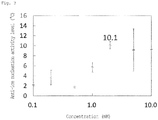
- Table 3 below and Fig. 3 show the evaluation results regarding the anti-ice nucleation activators of Examples 2 and 5 to 10. The results are average values of the results of the test performed three times.
- Table 3 Tyrosine trimer concentration (mM) Anti-ice nucleation activity level (°C)
- Example 5 0.1 2.3
- Example 6 0.2 3.7
- Example 8 1.0 5.7
- Example 2 2.0 10.1
- Example 9 5.0 9.2
- Example 10 10.0 9.2
- the tyrosine trimer exhibited anti-ice nucleation active performance at all of the concentration levels within the range of 0.1 to 10.0 mM (Examples 2 and 5 to 10).
- the anti-ice nucleation activity level at a tyrosine trimer concentration of 2.0 mM (1.0 mg/mL) (Example 2) was most excellent (10.1°C).
- the anti-ice nucleation active performance of mono-amino acid and tri-peptide other than tyrosine trimer was analyzed.
- the anti-ice nucleation activity test was performed in a manner similar to the method described in Test Example 1, except that a phenylalanine trimer (Phe-Phe-Phe, Funakoshi Co., Ltd., Comparative Example 3), a serine trimer (Ser-Ser-Ser, Funakoshi Co., Ltd., Comparative Example 5), or a threonine trimer (Thr-Thr-Thr, Funakoshi Co., Ltd., Comparative Example 7) was used in place of the tyrosine trimer.
- a phenylalanine trimer Phe-Phe-Phe, Funakoshi Co., Ltd., Comparative Example 3
- a serine trimer Ser-Ser-Ser, Funakoshi Co., Ltd., Comparative Example 5
- a threonine trimer Thr-Thr-Thr, Funakoshi Co., Ltd., Comparative Example 7
- the anti-ice nucleation activity test was performed in a manner similar to the method described in Test Example 1, except that tyrosine (Tyr, Wako Pure Chemical Industries, Ltd., Comparative Example 2), phenylalanine (Phe, Wako Pure Chemical Industries, Ltd., Comparative Example 4), serine (Ser, Wako Pure Chemical Industries, Ltd., Comparative Example 6), or threonine (Thr, Wako Pure Chemical Industries, Ltd., Comparative Example 8) was used in place of the tyrosine trimer.
- Table 4 below and Fig. 4 show the results. The results are average values of the results of the test performed three times.
- Table 4 Anti-ice nucleation activator Anti-ice nucleation activity level (°C)
- Example 2 Tyrosine trimer 10.1 Comparative Example 2 Tyrosine 0.3 Comparative Example 3
- Comparative Example 4 Phenylalanine 0.5
- Comparative Example 6 Serine 0.1 Comparative Example 7 Threonine trimer -0.3 Comparative Example 8 Threonine 0.1
- the tyrosine trimer (Example 2) achieved a significantly improved anti-ice nucleation activity level, compared to the tyrosine (Comparative Example 2).
- the phenylalanine trimer (Comparative Example 3), the serine trimer (Comparative Example 5), and the threonine trimer (Comparative Example 7) achieved no improvement in the anti-ice nucleation activity level, compared to the phenylalanine, serine, and threonine (Comparative Examples 4, 6, and 8).
- Example 1 A sample for evaluation of Example 1 was prepared in a manner similar to that described in Test Example 1, except that Pseudomonas fluorescens , which is the Pseudomonas bacterium, was used in place of silver iodide, which is an ice nucleation active substance.
- the anti-ice nucleation active performance (supercooling acceleration performance) was measured by using a test method similar to that described in Test Example 1. According to the results, the tyrosine trimer-containing anti-ice nucleation activator also showed anti-ice nucleation active performance (1.9°C) towards Pseudomonas fluorescens as well, in addition to silver iodide.
- Fig. 5 shows the results. The results are average values of the results of the test performed three times.
- Test Example 5 Anti-Ice Nucleation Activity Test With Respect to Biological Material (Beef Liver)
- the anti-ice nucleation active performance was measured by using a method similar to the droplet-freezing method of Vali described in Test Example 1. The results are average values of the results of the test performed three times.
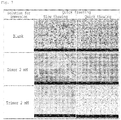
- Silken tofu (1.5 mm (length) x 1.5 mm (width) x 1.5 mm (height)) was immersed in the solution of Comparative Example 9 (water, blank) or Example 1 (tyrosine dimer) overnight. Thereafter, the tofu was taken out of the solution, the moisture was wiped off, and then the tofu was wrapped with wrap (plastic wrap). The tofu wrapped in plastic wrap was immersed in liquid nitrogen to be quickly frozen. The frozen tofu was then slowly thawed (warmed at 25°C) or quickly thawed (warmed at 60°C).
- Fig. 6 shows the state of cavities in the tofu after thawing (photographs) with the breaking load (N) of the tofu. The breaking load (N) of tofu was measured by a creep meter (RE2-33005C, Yamaden, Co., Ltd.).
- Fig. 7 shows the state (SEM photographs) of the tofu after thawing.
- SEM photographs were taken by SEM (scanning microscope) (S-3000N, Hitachi, Ltd.). The white bar in the SEM photograph represents 100 ⁇ m.
- Example 1 tyrosine dimer
- Example 2 tyrosine trimer
- FIG. 8 is SEM photographs showing the states of the frozen tofu. The white bar in each SEM photograph represents 100 ⁇ m.
- Example 2 tyrosine trimer
- thermocouple thermometer (Horiba) was inserted in tofu, and the temperature was measured every 20 seconds in a freezer at -20°C. A cooling curve was then obtained based on the relationship between the temperature (°C) and the cooling time (in seconds) ( Fig. 9 ). Table 5 below and Fig. 9 show the temperature at which the tofu began to freeze (freezing onset temperature), the temperature at which the tofu was completely frozen, and the time taken for the tofu to be completely frozen.
- the temperature at which the tofu began to freeze and the temperature at which the tofu was completely frozen were lower, and the time taken for the tofu to be completely frozen was longer, than the tofu that did not contain an anti-ice nucleation activator (Comparative Example 9).
- Fmoc-Tyr(tBu)-Alko-PEG Resin (0.200 mmol, 0.870 g) was placed in a column, and DMF as a reaction solvent was added to the column, followed by stirring for 1 minute. This procedure was repeated 3 times. Next, methanol was added to the column, and the mixture was stirred for 1 minute, followed by washing. This procedure was repeated 3 times. Next, 25% DMSO/DMF was added to the column, and the mixture was stirred for 30 minutes to thus allow the mixture to be swollen. Thirty minutes later, DMF was added to perform stirring for 1 minute, and this procedure was repeated 3 times.
- the ACVA-GGGYYY-Alko-PEG-Resin with which the initiator was condensed was added to DMF, a necessary amount of monomer 4-vinylpyridine (4-VP) (Wako Pure Chemical Industries, Ltd.), based on 1 equivalent amount of the peptide, was added thereto, and polymerization was performed in a water bath at 70°C under a nitrogen atmosphere while changing the polymerization time. After polymerization, the resulting product was placed into a column and washed with DMF and methanol, followed by drying under reduced pressure.
- 4-VP 4-vinylpyridine
- a mixed solution of 0.5 mL of purified water and 9.5 mL of TFA was stirred in an ice bath for 10 minutes.
- the resulting mixed solution was taken out of the ice bath and added to the synthesized hybrid polymer, followed by stirring in a sample tube for 100 minutes.
- diethyl ether was added thereto, and the resulting mixture was stirred in an ice bath for 10 minutes and crystallized.
- the precipitate was filtered off by suction and washed with diethyl ether.
- the precipitate was dissolved in 10% acetic acid and dialyzed. When a white precipitate was observed in the dialysis membrane, the solution was placed in a pear-shaped flask and lyophilized to obtain a target product.
- P4VP-YYY was synthesized in a manner similar to the method described in Production Example 5, except that H-YYY-Alko-PEG-Resin was used in place of H-GGGYYY-Alko-PEG-Resin.
- ACVA was dissolved in DMF (a reaction solvent), a necessary amount of monomer 4-VP, based on 1 equivalent amount of ACVA, was added thereto, and polymerization was performed at 70°C under a nitrogen atmosphere.
- the precipitate deposited with the addition of water was washed under suction filtration, dissolved in 10% acetic acid, and dialyzed. When a white precipitate was observed in the dialysis membrane, the solution was placed in a pear-shaped flask and lyophilized to obtain a target product.
- Table 6 below shows the molecular weight of the compounds obtained in Production Examples 5 to 7. In the Test Examples below, the compounds shown in Table 6 were used, unless otherwise specified. Table 6 Mn Mw Molecular weight distribution P4VP 21,000 30,000 1.5 P4VP-GGGYYY 23,000 36,000 1.6 P4VP-YYY 21,000 32,000 1.5 Mn: Number average molecular weight Mw: Weight average molecular weight
- Each cover glass was then washed with ultra-pure water and methanol, and placed in each well of a well plate, followed by drying under reduced pressure overnight.
- the sample P4VP-GGGYYY (Mw: 36000, 46000, or 54000) to be adsorption-immobilized on the cover glass surface was dissolved in 10% acetic acid to a concentration of 1 mmol/L. Five hundred microliters of the resulting solution was dropped on each cover glass that was placed in each well of the well plate and dried under reduced pressure, for immersion overnight. One day later, the solution was sucked up, and the inside of each well of the well plate was washed with ultra-pure water 3 times. Subsequently, drying was performed again under reduced pressure.
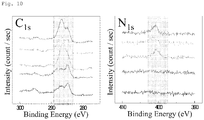
- cover glass surface was analyzed using X-ray photoelectron spectroscopy (ESCA-3400HSE, Shimazu Corporation).
- ESA-3400HSE X-ray photoelectron spectroscopy
- two different types of cover glasses were used: a cover glass subjected to only piranha treatment; and a cover glass immersed in a solution obtained by dissolving, in 10% acetic acid, GGGYYY in place of P4VP-GGGYYY.
- Fig. 10 shows the results.
- An aqueous solution was prepared by dissolving P4VP-GGGYYY (Example 11) or glycine trimer (GGG) (Comparative Example 10) in ultra-pure water to a concentration of 1.0 mg/mL.
- the anti-ice nucleation active performance of the complex in the aqueous solution was analyzed.
- Each sample for evaluation was prepared by mixing 100 ⁇ L of the aqueous solutions of Examples 2 and 11 and Comparative Example 10 with 900 ⁇ L of the aqueous solution in which silver iodide was dissolved.
- a blank sample was prepared by mixing 100 ⁇ L of ultra-pure water with 900 ⁇ L of the aqueous solution in which silver iodide was dissolved.
- the anti-ice nucleation active performance was measured by using the droplet-freezing method of Vali as described in Test Example 1.
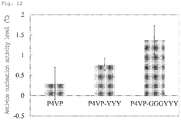
- Fig. 11 shows the evaluation results regarding the anti-ice nucleation activators of Examples 2 and 11 and Comparative Example 10. The results are average values of the results of the test performed three times.
- P4VP-YYYY (Example 12) or P4VP (Comparative Example 11), in place of P4VP-GGGYYY, was immobilized on the cover glass surface in a manner similar to the method described in Test Example 8.
- P4VP-GGGYYY achieved the most excellent anti-ice nucleation active performance. This indicates that a longer peptide extending from the glass surface achieves a greater activity.
- the anti-ice nucleation activator of the present invention is widely applicable to food fields (e.g., quality preservatives for food, beverages, etc.); medical fields (e.g., cell preservatives, blood preservatives, and organ preservatives); cosmetic fields; environmental fields (e.g., coating compositions, agents for preventing frost damage, frost adhesion inhibitors); and the like.
- food fields e.g., quality preservatives for food, beverages, etc.
- medical fields e.g., cell preservatives, blood preservatives, and organ preservatives
- cosmetic fields e.g., cosmetic fields
- environmental fields e.g., coating compositions, agents for preventing frost damage, frost adhesion inhibitors
Landscapes
- Chemical & Material Sciences (AREA)
- Organic Chemistry (AREA)
- Life Sciences & Earth Sciences (AREA)
- Engineering & Computer Science (AREA)
- Genetics & Genomics (AREA)
- Health & Medical Sciences (AREA)
- Medicinal Chemistry (AREA)
- Molecular Biology (AREA)
- Proteomics, Peptides & Aminoacids (AREA)
- Biophysics (AREA)
- Biochemistry (AREA)
- General Health & Medical Sciences (AREA)
- Materials Engineering (AREA)
- Wood Science & Technology (AREA)
- Combustion & Propulsion (AREA)
- Chemical Kinetics & Catalysis (AREA)
- Thermal Sciences (AREA)
- Physics & Mathematics (AREA)
- Zoology (AREA)
- Food Science & Technology (AREA)
- Polymers & Plastics (AREA)
- Peptides Or Proteins (AREA)
- Freezing, Cooling And Drying Of Foods (AREA)
- Medicines That Contain Protein Lipid Enzymes And Other Medicines (AREA)
- General Chemical & Material Sciences (AREA)
Claims (7)
- Verwendung eines Tyrosinpeptids, dargestellt durch Formel (I):
(X)p-[Tyr]n-(Y)q (1)
worin X und Y identisch oder verschieden sind und jeweils einen Aminrest darstellen,n eine ganze Zahl von 2 bis 5 darstellt,p eine ganze Zahl von 0 bis 4 darstellt undq eine ganze Zahl von 0 bis 4 darstellt,mit der Maßgabe, dass p + q nicht größer ist als 4,wobei, wenn p eine ganze Zahl von 2 bis 4 darstellt, zwei bis vier Aminosäurereste, die durch (X)p dargestellt werden, identisch oder verschieden sein können, und,wenn q eine ganze Zahl von 2 bis 4 darstellt, zwei bis vier Aminosäurereste, die durch (Y)q dargestellt werden, identisch oder verschieden sein können; odereines Komplexes, der aus einem oder mehreren der Tyrosinpeptide und einem Polymer besteht, wobei der eine oder die mehreren der Tyrosinpeptide an dem Polymer gebunden ist/sind,als einen Nukleierungsaktivator mit Gefrierschutz gegen Eisbildung. - Verwendung nach Anspruch 1, wobei n eine ganze Zahl von 2 bis 4 darstellt.
- Verwendung nach Anspruch 1 oder 2, wobei n 2 oder 3 darstellt, p 0 oder 1 darstellt und q 0 oder 1 darstellt.
- Verwendung einer Zusammensetzung, umfassend das Tyrosinpeptid, wie in einem der Ansprüche 1 bis 3 festgelegt, sowie Wasser als Gefrierschutzflüssigkeit.
- Verwendung einer Beschichtungslösung, umfassend den Komplex, wie unter Anspruch 1 festgelegt, als ein Mittel gegen Frostschäden.
- Verfahren zum Verbessern der Anti-Eiskristallkeimbildungsaktivität eines biologischen Materials, wobei das Verfahren den Schritt umfasst, den Anti-Eiskristallkeimbildungsaktivator nach einem der Ansprüche 1 bis 3 mit einem biologischen Material in Kontakt zu bringen.
- Verfahren zum Konservieren eines biologischen Materials in vitro, wobei das Verfahren den Schritt umfasst, den Nukleierungsaktivator mit Gefrierschutz gegen Eisbildung, wie in einem des Ansprüche 1 bis 3 definiert, mit einem biologischen Material zu bringen.
Applications Claiming Priority (2)
| Application Number | Priority Date | Filing Date | Title |
|---|---|---|---|
| JP2015095251 | 2015-05-07 | ||
| PCT/JP2016/063595 WO2016178426A1 (ja) | 2015-05-07 | 2016-05-02 | 抗氷核活性剤 |
Publications (3)
| Publication Number | Publication Date |
|---|---|
| EP3293240A1 EP3293240A1 (de) | 2018-03-14 |
| EP3293240A4 EP3293240A4 (de) | 2018-09-26 |
| EP3293240B1 true EP3293240B1 (de) | 2020-04-08 |
Family
ID=57217731
Family Applications (1)
| Application Number | Title | Priority Date | Filing Date |
|---|---|---|---|
| EP16789562.2A Active EP3293240B1 (de) | 2015-05-07 | 2016-05-02 | Mittel mit anti-ice-nukleierungsaktivität |
Country Status (4)
| Country | Link |
|---|---|
| US (1) | US20180153194A1 (de) |
| EP (1) | EP3293240B1 (de) |
| JP (1) | JP6704143B2 (de) |
| WO (1) | WO2016178426A1 (de) |
Families Citing this family (4)
| Publication number | Priority date | Publication date | Assignee | Title |
|---|---|---|---|---|
| KR102274195B1 (ko) * | 2019-12-04 | 2021-07-08 | 고려대학교 산학협력단 | 자기 조립 화합물을 포함하는 항-동결 조성물 |
| JP7660840B2 (ja) * | 2021-05-31 | 2025-04-14 | 富士電機株式会社 | 防霜用塗料 |
| JPWO2023008380A1 (de) * | 2021-07-26 | 2023-02-02 | ||
| JP2023177059A (ja) * | 2022-06-01 | 2023-12-13 | 学校法人 関西大学 | 抗氷核ペプチド |
Family Cites Families (9)
| Publication number | Priority date | Publication date | Assignee | Title |
|---|---|---|---|---|
| CA2056434A1 (en) * | 1989-05-10 | 1990-11-11 | Gareth J. Warren | Antifreeze polypeptides |
| AU4308601A (en) * | 1999-11-30 | 2001-06-18 | 21St Century Medicine, Inc. | Prevention of ice nucleation by polyglycerol |
| JP2003250572A (ja) * | 2002-03-04 | 2003-09-09 | National Institute Of Advanced Industrial & Technology | ワカサギ由来抗凍結タンパク質、その回収方法、及びその用途 |
| WO2008033100A1 (en) * | 2006-09-11 | 2008-03-20 | Agency For Science, Technology And Research | Method of predicting protein allergenicity using a support vector machine |
| JP2010285359A (ja) * | 2009-06-09 | 2010-12-24 | Kaneka Corp | 植物由来氷結晶化阻害剤 |
| US20130165626A1 (en) * | 2010-04-30 | 2013-06-27 | Joichi Fukuoka | Antifreeze protein |
| WO2012023486A1 (ja) * | 2010-08-16 | 2012-02-23 | 株式会社カネカ | 氷結晶化阻害タンパク質 |
| EP2682402A4 (de) * | 2011-03-04 | 2014-09-03 | Kaneka Corp | Aus pflanzensamen gewonnener eiskristallisationshemmer |
| JP6423998B2 (ja) * | 2013-08-19 | 2018-11-14 | 学校法人 関西大学 | 過冷却促進剤、及び、過冷却促進剤の製造方法 |
-
2016
- 2016-05-02 EP EP16789562.2A patent/EP3293240B1/de active Active
- 2016-05-02 JP JP2017516618A patent/JP6704143B2/ja active Active
- 2016-05-02 US US15/571,761 patent/US20180153194A1/en not_active Abandoned
- 2016-05-02 WO PCT/JP2016/063595 patent/WO2016178426A1/ja not_active Ceased
Non-Patent Citations (1)
| Title |
|---|
| None * |
Also Published As
| Publication number | Publication date |
|---|---|
| JP6704143B2 (ja) | 2020-06-03 |
| JPWO2016178426A1 (ja) | 2018-03-01 |
| US20180153194A1 (en) | 2018-06-07 |
| EP3293240A4 (de) | 2018-09-26 |
| EP3293240A1 (de) | 2018-03-14 |
| WO2016178426A1 (ja) | 2016-11-10 |
Similar Documents
| Publication | Publication Date | Title |
|---|---|---|
| CN108347916B (zh) | 一种减少冰晶形成的组合物及其方法 | |
| EP3293240B1 (de) | Mittel mit anti-ice-nukleierungsaktivität | |
| EP1923398B1 (de) | Verfahren zur Herstellung eines Polypeptids | |
| CN110730786B (zh) | 类肽聚合物及使用方法 | |
| EP1817329B1 (de) | Gem-difluorierte c-glykopeptide, deren herstellung und deren verwendung zur konservierung von biologischen materialien und/oder in der kryochirurgie | |
| JP6664738B2 (ja) | 生体材料保護用ペプチド | |
| Yamamoto et al. | Mechanisms for the spontaneous formation of covalently linked polymers of the terminal membranolytic complement protein (C9). | |
| US20100068692A1 (en) | Antifreeze glycoprotein analogues and uses thereof | |
| AU2018202618A1 (en) | Protransduzin B, a gene transfer enhancer | |
| WO2025175178A1 (en) | Antifreeze glycopolypeptides | |
| EP2959912B1 (de) | Wundheilender wirkstoff | |
| FI56830C (fi) | Foerfarande foer framstaellning av asparaginylgrupper innehaollande biologiskt aktiva polypeptider | |
| CN115400258B (zh) | 一种基于氨基酸的水性液体、其制备方法及应用 | |
| JP2023177059A (ja) | 抗氷核ペプチド | |
| JP7162310B2 (ja) | 自己組織化化合物を含む抗凍結組成物 | |
| CN103275186B (zh) | 具有肾脏保护作用的多肽及其应用 | |
| Deleray | The Design, Synthesis, and Characterization of Biomimetic Antifreeze Glycopolypeptides for Use in Cryopreservation | |
| EP4727356A2 (de) | Synthetische gefrierschutzglycoproteine mit eisbindender wirkung | |
| US20200344998A1 (en) | Pegylated antifreeze proteins and methods of making and using the same | |
| WO2009146885A2 (en) | Lipidated antibacterial peptides | |
| WO1996028466A1 (en) | Peptides inhibiting phospholipase c | |
| WO2018224816A1 (en) | Recrystallization inhibitor | |
| WO2021154703A1 (en) | Compositions including antimicrobial polymer-peptide conjugates and uses thereof | |
| HK1258922B (zh) | 一种减少冰晶形成的组合物及其方法 | |
| Gong | Libraries and Learning Services |
Legal Events
| Date | Code | Title | Description |
|---|---|---|---|
| STAA | Information on the status of an ep patent application or granted ep patent |
Free format text: STATUS: THE INTERNATIONAL PUBLICATION HAS BEEN MADE |
|
| PUAI | Public reference made under article 153(3) epc to a published international application that has entered the european phase |
Free format text: ORIGINAL CODE: 0009012 |
|
| STAA | Information on the status of an ep patent application or granted ep patent |
Free format text: STATUS: REQUEST FOR EXAMINATION WAS MADE |
|
| 17P | Request for examination filed |
Effective date: 20171124 |
|
| AK | Designated contracting states |
Kind code of ref document: A1 Designated state(s): AL AT BE BG CH CY CZ DE DK EE ES FI FR GB GR HR HU IE IS IT LI LT LU LV MC MK MT NL NO PL PT RO RS SE SI SK SM TR |
|
| AX | Request for extension of the european patent |
Extension state: BA ME |
|
| DAV | Request for validation of the european patent (deleted) | ||
| DAX | Request for extension of the european patent (deleted) | ||
| A4 | Supplementary search report drawn up and despatched |
Effective date: 20180823 |
|
| RIC1 | Information provided on ipc code assigned before grant |
Ipc: C09D 201/00 20060101ALI20180817BHEP Ipc: C07K 5/065 20060101ALI20180817BHEP Ipc: C09K 5/10 20060101ALI20180817BHEP Ipc: C07K 5/087 20060101ALI20180817BHEP Ipc: A23L 3/37 20060101ALI20180817BHEP Ipc: C07K 5/107 20060101ALI20180817BHEP Ipc: C07K 7/06 20060101ALI20180817BHEP Ipc: C09K 3/00 20060101AFI20180817BHEP |
|
| RIC1 | Information provided on ipc code assigned before grant |
Ipc: A23L 3/37 20060101ALI20180817BHEP Ipc: C07K 7/06 20060101ALI20180817BHEP Ipc: C09K 3/00 20060101AFI20180817BHEP Ipc: C07K 5/087 20060101ALI20180817BHEP Ipc: C09K 5/10 20060101ALI20180817BHEP Ipc: C07K 5/107 20060101ALI20180817BHEP Ipc: C09D 201/00 20060101ALI20180817BHEP Ipc: C07K 5/065 20060101ALI20180817BHEP |
|
| RIC1 | Information provided on ipc code assigned before grant |
Ipc: C09K 3/00 20060101AFI20190802BHEP Ipc: C07K 5/107 20060101ALI20190802BHEP Ipc: C09K 5/10 20060101ALI20190802BHEP Ipc: C07K 7/06 20060101ALI20190802BHEP Ipc: A23L 3/37 20060101ALI20190802BHEP Ipc: C09D 201/00 20060101ALI20190802BHEP Ipc: C07K 5/087 20060101ALI20190802BHEP Ipc: C07K 5/065 20060101ALI20190802BHEP |
|
| GRAJ | Information related to disapproval of communication of intention to grant by the applicant or resumption of examination proceedings by the epo deleted |
Free format text: ORIGINAL CODE: EPIDOSDIGR1 |
|
| STAA | Information on the status of an ep patent application or granted ep patent |
Free format text: STATUS: GRANT OF PATENT IS INTENDED |
|
| GRAP | Despatch of communication of intention to grant a patent |
Free format text: ORIGINAL CODE: EPIDOSNIGR1 |
|
| INTG | Intention to grant announced |
Effective date: 20191017 |
|
| RIN1 | Information on inventor provided before grant (corrected) |
Inventor name: KAWAHARA, HIDEHISA Inventor name: HIRANO, YOSHIAKI |
|
| GRAS | Grant fee paid |
Free format text: ORIGINAL CODE: EPIDOSNIGR3 |
|
| GRAA | (expected) grant |
Free format text: ORIGINAL CODE: 0009210 |
|
| STAA | Information on the status of an ep patent application or granted ep patent |
Free format text: STATUS: THE PATENT HAS BEEN GRANTED |
|
| AK | Designated contracting states |
Kind code of ref document: B1 Designated state(s): AL AT BE BG CH CY CZ DE DK EE ES FI FR GB GR HR HU IE IS IT LI LT LU LV MC MK MT NL NO PL PT RO RS SE SI SK SM TR |
|
| RAP1 | Party data changed (applicant data changed or rights of an application transferred) |
Owner name: THE SCHOOL CORPORATION KANSAI UNIVERSITY Owner name: SHIN NIPPON YAKUGYO CO., LTD. |
|
| REG | Reference to a national code |
Ref country code: CH Ref legal event code: EP Ref country code: AT Ref legal event code: REF Ref document number: 1254363 Country of ref document: AT Kind code of ref document: T Effective date: 20200415 |
|
| REG | Reference to a national code |
Ref country code: DE Ref legal event code: R096 Ref document number: 602016033698 Country of ref document: DE |
|
| REG | Reference to a national code |
Ref country code: IE Ref legal event code: FG4D |
|
| REG | Reference to a national code |
Ref country code: NL Ref legal event code: MP Effective date: 20200408 |
|
| REG | Reference to a national code |
Ref country code: LT Ref legal event code: MG4D |
|
| PG25 | Lapsed in a contracting state [announced via postgrant information from national office to epo] |
Ref country code: GR Free format text: LAPSE BECAUSE OF FAILURE TO SUBMIT A TRANSLATION OF THE DESCRIPTION OR TO PAY THE FEE WITHIN THE PRESCRIBED TIME-LIMIT Effective date: 20200709 Ref country code: FI Free format text: LAPSE BECAUSE OF FAILURE TO SUBMIT A TRANSLATION OF THE DESCRIPTION OR TO PAY THE FEE WITHIN THE PRESCRIBED TIME-LIMIT Effective date: 20200408 Ref country code: LT Free format text: LAPSE BECAUSE OF FAILURE TO SUBMIT A TRANSLATION OF THE DESCRIPTION OR TO PAY THE FEE WITHIN THE PRESCRIBED TIME-LIMIT Effective date: 20200408 Ref country code: PT Free format text: LAPSE BECAUSE OF FAILURE TO SUBMIT A TRANSLATION OF THE DESCRIPTION OR TO PAY THE FEE WITHIN THE PRESCRIBED TIME-LIMIT Effective date: 20200817 Ref country code: NO Free format text: LAPSE BECAUSE OF FAILURE TO SUBMIT A TRANSLATION OF THE DESCRIPTION OR TO PAY THE FEE WITHIN THE PRESCRIBED TIME-LIMIT Effective date: 20200708 Ref country code: SE Free format text: LAPSE BECAUSE OF FAILURE TO SUBMIT A TRANSLATION OF THE DESCRIPTION OR TO PAY THE FEE WITHIN THE PRESCRIBED TIME-LIMIT Effective date: 20200408 Ref country code: IS Free format text: LAPSE BECAUSE OF FAILURE TO SUBMIT A TRANSLATION OF THE DESCRIPTION OR TO PAY THE FEE WITHIN THE PRESCRIBED TIME-LIMIT Effective date: 20200808 Ref country code: NL Free format text: LAPSE BECAUSE OF FAILURE TO SUBMIT A TRANSLATION OF THE DESCRIPTION OR TO PAY THE FEE WITHIN THE PRESCRIBED TIME-LIMIT Effective date: 20200408 |
|
| REG | Reference to a national code |
Ref country code: AT Ref legal event code: MK05 Ref document number: 1254363 Country of ref document: AT Kind code of ref document: T Effective date: 20200408 |
|
| PG25 | Lapsed in a contracting state [announced via postgrant information from national office to epo] |
Ref country code: HR Free format text: LAPSE BECAUSE OF FAILURE TO SUBMIT A TRANSLATION OF THE DESCRIPTION OR TO PAY THE FEE WITHIN THE PRESCRIBED TIME-LIMIT Effective date: 20200408 Ref country code: RS Free format text: LAPSE BECAUSE OF FAILURE TO SUBMIT A TRANSLATION OF THE DESCRIPTION OR TO PAY THE FEE WITHIN THE PRESCRIBED TIME-LIMIT Effective date: 20200408 Ref country code: BG Free format text: LAPSE BECAUSE OF FAILURE TO SUBMIT A TRANSLATION OF THE DESCRIPTION OR TO PAY THE FEE WITHIN THE PRESCRIBED TIME-LIMIT Effective date: 20200708 Ref country code: LV Free format text: LAPSE BECAUSE OF FAILURE TO SUBMIT A TRANSLATION OF THE DESCRIPTION OR TO PAY THE FEE WITHIN THE PRESCRIBED TIME-LIMIT Effective date: 20200408 |
|
| PG25 | Lapsed in a contracting state [announced via postgrant information from national office to epo] |
Ref country code: AL Free format text: LAPSE BECAUSE OF FAILURE TO SUBMIT A TRANSLATION OF THE DESCRIPTION OR TO PAY THE FEE WITHIN THE PRESCRIBED TIME-LIMIT Effective date: 20200408 |
|
| REG | Reference to a national code |
Ref country code: DE Ref legal event code: R097 Ref document number: 602016033698 Country of ref document: DE |
|
| PG25 | Lapsed in a contracting state [announced via postgrant information from national office to epo] |
Ref country code: ES Free format text: LAPSE BECAUSE OF FAILURE TO SUBMIT A TRANSLATION OF THE DESCRIPTION OR TO PAY THE FEE WITHIN THE PRESCRIBED TIME-LIMIT Effective date: 20200408 Ref country code: MC Free format text: LAPSE BECAUSE OF FAILURE TO SUBMIT A TRANSLATION OF THE DESCRIPTION OR TO PAY THE FEE WITHIN THE PRESCRIBED TIME-LIMIT Effective date: 20200408 Ref country code: DK Free format text: LAPSE BECAUSE OF FAILURE TO SUBMIT A TRANSLATION OF THE DESCRIPTION OR TO PAY THE FEE WITHIN THE PRESCRIBED TIME-LIMIT Effective date: 20200408 Ref country code: EE Free format text: LAPSE BECAUSE OF FAILURE TO SUBMIT A TRANSLATION OF THE DESCRIPTION OR TO PAY THE FEE WITHIN THE PRESCRIBED TIME-LIMIT Effective date: 20200408 Ref country code: LI Free format text: LAPSE BECAUSE OF NON-PAYMENT OF DUE FEES Effective date: 20200531 Ref country code: CH Free format text: LAPSE BECAUSE OF NON-PAYMENT OF DUE FEES Effective date: 20200531 Ref country code: SM Free format text: LAPSE BECAUSE OF FAILURE TO SUBMIT A TRANSLATION OF THE DESCRIPTION OR TO PAY THE FEE WITHIN THE PRESCRIBED TIME-LIMIT Effective date: 20200408 Ref country code: IT Free format text: LAPSE BECAUSE OF FAILURE TO SUBMIT A TRANSLATION OF THE DESCRIPTION OR TO PAY THE FEE WITHIN THE PRESCRIBED TIME-LIMIT Effective date: 20200408 Ref country code: AT Free format text: LAPSE BECAUSE OF FAILURE TO SUBMIT A TRANSLATION OF THE DESCRIPTION OR TO PAY THE FEE WITHIN THE PRESCRIBED TIME-LIMIT Effective date: 20200408 Ref country code: RO Free format text: LAPSE BECAUSE OF FAILURE TO SUBMIT A TRANSLATION OF THE DESCRIPTION OR TO PAY THE FEE WITHIN THE PRESCRIBED TIME-LIMIT Effective date: 20200408 Ref country code: CZ Free format text: LAPSE BECAUSE OF FAILURE TO SUBMIT A TRANSLATION OF THE DESCRIPTION OR TO PAY THE FEE WITHIN THE PRESCRIBED TIME-LIMIT Effective date: 20200408 |
|
| PLBE | No opposition filed within time limit |
Free format text: ORIGINAL CODE: 0009261 |
|
| STAA | Information on the status of an ep patent application or granted ep patent |
Free format text: STATUS: NO OPPOSITION FILED WITHIN TIME LIMIT |
|
| PG25 | Lapsed in a contracting state [announced via postgrant information from national office to epo] |
Ref country code: PL Free format text: LAPSE BECAUSE OF FAILURE TO SUBMIT A TRANSLATION OF THE DESCRIPTION OR TO PAY THE FEE WITHIN THE PRESCRIBED TIME-LIMIT Effective date: 20200408 Ref country code: SK Free format text: LAPSE BECAUSE OF FAILURE TO SUBMIT A TRANSLATION OF THE DESCRIPTION OR TO PAY THE FEE WITHIN THE PRESCRIBED TIME-LIMIT Effective date: 20200408 |
|
| 26N | No opposition filed |
Effective date: 20210112 |
|
| REG | Reference to a national code |
Ref country code: BE Ref legal event code: MM Effective date: 20200531 |
|
| PG25 | Lapsed in a contracting state [announced via postgrant information from national office to epo] |
Ref country code: LU Free format text: LAPSE BECAUSE OF NON-PAYMENT OF DUE FEES Effective date: 20200502 |
|
| PG25 | Lapsed in a contracting state [announced via postgrant information from national office to epo] |
Ref country code: IE Free format text: LAPSE BECAUSE OF NON-PAYMENT OF DUE FEES Effective date: 20200502 Ref country code: FR Free format text: LAPSE BECAUSE OF NON-PAYMENT OF DUE FEES Effective date: 20200608 |
|
| PG25 | Lapsed in a contracting state [announced via postgrant information from national office to epo] |
Ref country code: SI Free format text: LAPSE BECAUSE OF FAILURE TO SUBMIT A TRANSLATION OF THE DESCRIPTION OR TO PAY THE FEE WITHIN THE PRESCRIBED TIME-LIMIT Effective date: 20200408 Ref country code: BE Free format text: LAPSE BECAUSE OF NON-PAYMENT OF DUE FEES Effective date: 20200531 |
|
| PG25 | Lapsed in a contracting state [announced via postgrant information from national office to epo] |
Ref country code: TR Free format text: LAPSE BECAUSE OF FAILURE TO SUBMIT A TRANSLATION OF THE DESCRIPTION OR TO PAY THE FEE WITHIN THE PRESCRIBED TIME-LIMIT Effective date: 20200408 Ref country code: MT Free format text: LAPSE BECAUSE OF FAILURE TO SUBMIT A TRANSLATION OF THE DESCRIPTION OR TO PAY THE FEE WITHIN THE PRESCRIBED TIME-LIMIT Effective date: 20200408 Ref country code: CY Free format text: LAPSE BECAUSE OF FAILURE TO SUBMIT A TRANSLATION OF THE DESCRIPTION OR TO PAY THE FEE WITHIN THE PRESCRIBED TIME-LIMIT Effective date: 20200408 |
|
| PG25 | Lapsed in a contracting state [announced via postgrant information from national office to epo] |
Ref country code: MK Free format text: LAPSE BECAUSE OF FAILURE TO SUBMIT A TRANSLATION OF THE DESCRIPTION OR TO PAY THE FEE WITHIN THE PRESCRIBED TIME-LIMIT Effective date: 20200408 |
|
| PGFP | Annual fee paid to national office [announced via postgrant information from national office to epo] |
Ref country code: DE Payment date: 20250408 Year of fee payment: 10 |
|
| PGFP | Annual fee paid to national office [announced via postgrant information from national office to epo] |
Ref country code: GB Payment date: 20260325 Year of fee payment: 11 |