EP3284488A1 - Apparatus for topical negative pressure therapy - Google Patents
Apparatus for topical negative pressure therapy Download PDFInfo
- Publication number
- EP3284488A1 EP3284488A1 EP17186349.1A EP17186349A EP3284488A1 EP 3284488 A1 EP3284488 A1 EP 3284488A1 EP 17186349 A EP17186349 A EP 17186349A EP 3284488 A1 EP3284488 A1 EP 3284488A1
- Authority
- EP
- European Patent Office
- Prior art keywords
- wound
- air bleed
- port member
- conduit
- clause
- Prior art date
- Legal status (The legal status is an assumption and is not a legal conclusion. Google has not performed a legal analysis and makes no representation as to the accuracy of the status listed.)
- Granted
Links
Images


Classifications
-
- A—HUMAN NECESSITIES
- A61—MEDICAL OR VETERINARY SCIENCE; HYGIENE
- A61M—DEVICES FOR INTRODUCING MEDIA INTO, OR ONTO, THE BODY; DEVICES FOR TRANSDUCING BODY MEDIA OR FOR TAKING MEDIA FROM THE BODY; DEVICES FOR PRODUCING OR ENDING SLEEP OR STUPOR
- A61M27/00—Drainage appliance for wounds or the like, i.e. wound drains, implanted drains
-
- A—HUMAN NECESSITIES
- A61—MEDICAL OR VETERINARY SCIENCE; HYGIENE
- A61M—DEVICES FOR INTRODUCING MEDIA INTO, OR ONTO, THE BODY; DEVICES FOR TRANSDUCING BODY MEDIA OR FOR TAKING MEDIA FROM THE BODY; DEVICES FOR PRODUCING OR ENDING SLEEP OR STUPOR
- A61M1/00—Suction or pumping devices for medical purposes; Devices for carrying-off, for treatment of, or for carrying-over, body-liquids; Drainage systems
- A61M1/84—Drainage tubes; Aspiration tips
- A61M1/85—Drainage tubes; Aspiration tips with gas or fluid supply means, e.g. for supplying rinsing fluids or anticoagulants
-
- A—HUMAN NECESSITIES
- A61—MEDICAL OR VETERINARY SCIENCE; HYGIENE
- A61M—DEVICES FOR INTRODUCING MEDIA INTO, OR ONTO, THE BODY; DEVICES FOR TRANSDUCING BODY MEDIA OR FOR TAKING MEDIA FROM THE BODY; DEVICES FOR PRODUCING OR ENDING SLEEP OR STUPOR
- A61M1/00—Suction or pumping devices for medical purposes; Devices for carrying-off, for treatment of, or for carrying-over, body-liquids; Drainage systems
- A61M1/84—Drainage tubes; Aspiration tips
- A61M1/86—Connectors between drainage tube and handpiece, e.g. drainage tubes detachable from handpiece
-
- A—HUMAN NECESSITIES
- A61—MEDICAL OR VETERINARY SCIENCE; HYGIENE
- A61M—DEVICES FOR INTRODUCING MEDIA INTO, OR ONTO, THE BODY; DEVICES FOR TRANSDUCING BODY MEDIA OR FOR TAKING MEDIA FROM THE BODY; DEVICES FOR PRODUCING OR ENDING SLEEP OR STUPOR
- A61M1/00—Suction or pumping devices for medical purposes; Devices for carrying-off, for treatment of, or for carrying-over, body-liquids; Drainage systems
- A61M1/90—Negative pressure wound therapy devices, i.e. devices for applying suction to a wound to promote healing, e.g. including a vacuum dressing
-
- A—HUMAN NECESSITIES
- A61—MEDICAL OR VETERINARY SCIENCE; HYGIENE
- A61M—DEVICES FOR INTRODUCING MEDIA INTO, OR ONTO, THE BODY; DEVICES FOR TRANSDUCING BODY MEDIA OR FOR TAKING MEDIA FROM THE BODY; DEVICES FOR PRODUCING OR ENDING SLEEP OR STUPOR
- A61M1/00—Suction or pumping devices for medical purposes; Devices for carrying-off, for treatment of, or for carrying-over, body-liquids; Drainage systems
- A61M1/90—Negative pressure wound therapy devices, i.e. devices for applying suction to a wound to promote healing, e.g. including a vacuum dressing
- A61M1/91—Suction aspects of the dressing
- A61M1/912—Connectors between dressing and drainage tube
-
- A—HUMAN NECESSITIES
- A61—MEDICAL OR VETERINARY SCIENCE; HYGIENE
- A61M—DEVICES FOR INTRODUCING MEDIA INTO, OR ONTO, THE BODY; DEVICES FOR TRANSDUCING BODY MEDIA OR FOR TAKING MEDIA FROM THE BODY; DEVICES FOR PRODUCING OR ENDING SLEEP OR STUPOR
- A61M1/00—Suction or pumping devices for medical purposes; Devices for carrying-off, for treatment of, or for carrying-over, body-liquids; Drainage systems
- A61M1/90—Negative pressure wound therapy devices, i.e. devices for applying suction to a wound to promote healing, e.g. including a vacuum dressing
- A61M1/91—Suction aspects of the dressing
- A61M1/915—Constructional details of the pressure distribution manifold
-
- A—HUMAN NECESSITIES
- A61—MEDICAL OR VETERINARY SCIENCE; HYGIENE
- A61M—DEVICES FOR INTRODUCING MEDIA INTO, OR ONTO, THE BODY; DEVICES FOR TRANSDUCING BODY MEDIA OR FOR TAKING MEDIA FROM THE BODY; DEVICES FOR PRODUCING OR ENDING SLEEP OR STUPOR
- A61M1/00—Suction or pumping devices for medical purposes; Devices for carrying-off, for treatment of, or for carrying-over, body-liquids; Drainage systems
- A61M1/90—Negative pressure wound therapy devices, i.e. devices for applying suction to a wound to promote healing, e.g. including a vacuum dressing
- A61M1/96—Suction control thereof
- A61M1/964—Suction control thereof having venting means on or near the dressing
-
- A—HUMAN NECESSITIES
- A61—MEDICAL OR VETERINARY SCIENCE; HYGIENE
- A61M—DEVICES FOR INTRODUCING MEDIA INTO, OR ONTO, THE BODY; DEVICES FOR TRANSDUCING BODY MEDIA OR FOR TAKING MEDIA FROM THE BODY; DEVICES FOR PRODUCING OR ENDING SLEEP OR STUPOR
- A61M1/00—Suction or pumping devices for medical purposes; Devices for carrying-off, for treatment of, or for carrying-over, body-liquids; Drainage systems
- A61M1/90—Negative pressure wound therapy devices, i.e. devices for applying suction to a wound to promote healing, e.g. including a vacuum dressing
- A61M1/96—Suction control thereof
- A61M1/962—Suction control thereof having pumping means on the suction site, e.g. miniature pump on dressing or dressing capable of exerting suction
Definitions
- the present invention relates to topical negative pressure (TNP) therapy particularly, though not exclusively, to the control of negative pressure within a wound dressing.
- TNP topical negative pressure
- TNP therapy has assumed great importance in recent years due to the beneficial effects of TNP therapy on a healing wound and also because of the accelerated healing which TNP therapy provides.
- Apparatus for TNP therapy ranges from extremely complex apparatus only really suitable for use in a specialised hospital environment to much smaller and simpler, portable apparatus which may be used by an individual patient at home or at work.
- the basic principle of TNP therapy is to create a closed cavity over the wound itself by means of a thin, flexible sealing film adhered to the patient's sound skin surrounding the wound; admitting one end of an aspirant conduit into the closed cavity, the conduit being sealed to the flexible film, for example; and connecting a distal end of the aspirant conduit to a vacuum source such as an electrically driven vacuum pump, for example, to create a pressure lower than the surrounding ambient atmospheric pressure within the wound cavity.
- a vacuum source such as an electrically driven vacuum pump
- TNP therapy may be applied by a diverse range of apparatus.
- the more complex apparatus tends to be used on larger, more serious wounds which require a more intensive and varied treatments by TNP therapy. Examples of apparatus useful in the context of treatment of such larger wounds are given below.
- this invention describes the treatment of a wound by the application of topical negative pressure (TNP) therapy for aspirating the wound together with the further provision of additional fluid for irrigating and/or cleansing the wound, which fluid, comprising both wound exudates and irrigation fluid, is then drawn off by the aspiration means and circulated through means for separating the beneficial materials therein from deleterious materials.
- TNP topical negative pressure
- the materials which are beneficial to wound healing are recirculated through the wound dressing and those materials deleterious to wound healing are discarded to a waste collection bag or vessel.
- the above apparatus and methods are generally only applicable to a patient when hospitalised as the apparatus is complex, needing people having specialist knowledge in how to operate and maintain the apparatus, and also relatively heavy and bulky, not being adapted for easy mobility outside of a hospital environment by a patient, for example.
- the seal over and around the wound may be very good, it is easy to create a vacuum in the wound cavity which does not decay quickly due to leaks, and therefore, very little or no flow through the aspirant conduit may result and whilst the vacuum is there over the wound, the wound exudate may not be being transported away to a waste canister, for example, and may be stagnating at the wound itself, this being especially so at low levels of negative pressure relative to atmospheric pressure.
- One important feature of TNP therapy is that the wound exudate fluid is desirably transported away from the wound site. Failure to achieve this efficiently may result in increased risk of infection and in the worst cases may result in back flow of wound exudate into the wound cavity.
- the wound is large or small the fact is that clinicians strive to seal the wound as well as they possibly can so as to prevent bacteria from causing infection. Larger wounds generate greater volumes of fluid and, are therefore, susceptible to filling the wound cavity with fluid. Furthermore, it is possible for the aspiration conduit to fill with exudate fluid resulting in a pressure differential between the wound and the vacuum source due to the viscous drag of the exudate and the height differential between wound and vacuum source.
- apparatus for the provision of TNP therapy to a wound comprising: a sealing membrane for covering a wound to form a wound cavity in use; an aspirant conduit having one end thereof operably associated with the wound cavity, in use; vacuum means provided at a distal end of the aspirant conduit for applying a vacuum to the wound cavity when in use; and, air bleed means in fluid communication with the wound cavity when in use.
- vacuum means a pressure less than ambient atmospheric pressure.
- the air bleed means may be switchable in that the air bleed may be turned on and off as desired.
- the air bleed means may be provided by a second conduit having one end in communication with the wound cavity and having a filter associated with the conduit and a clamp or valve which enables the filter to admit air from the surrounding atmosphere to the wound cavity under the influence of the vacuum in the wound cavity.
- Air flow into the conduit may be controlled by the clamp on the conduit or on/off valve controlled by the user/patient or a clinician.
- An air bleed may be admitted when, for example, the patient observes that the aspirant tube appears to be full of exudate but which is not moving. Opening of the conduit to ambient air then induces a fluid flow in the conduit to expel the exudate into a waste canister, for example, associated with particular TNP apparatus in use.
- the air bleed means may provide a maximum flow rate at 200 mmHg below atmospheric of up to 1 l/min into the system.
- the flow rate may be a maximum of 0.5 l/min. More preferably the flow rate may be a maximum of 0.2 l/min. More preferably still, a maximum flow rate of 0.05 l/min may be provided into the system.
- the overriding factor is to achieve a flow rate consistent with the wound not drying out as may happen if the incoming flow rate of bleed air is too high.
- Control of bleed rate may be achieved by control of the area of the filter through which bleed air may be admitted.
- the air bleed means may be associated with the sealing drape in which an aperture may be formed to permit the attachment of an air bleed port thereto.
- an air bleed port may have a filter portion or aperture through which ambient air is drawn into the wound cavity by the vacuum.
- Such an air bleed port may be permanently open to ambient atmosphere but, due to the contained filter portion, may restrict the rate of flow of air into the wound cavity or aspirant conduit to a low rate due to the size of the filter pores. In effect such an air bleed port substitutes for leakage of air into a TNP dressing which normally occurs with larger wounds.
- Suitable air bleed ports may be manufactured from soft plastics material mouldings so as not to cause trauma to a patient if lain upon. They may be provided during manufacture with a layer of adhesive thereon and suitable protective layer of siliconised paper until needed for use.
- Such air bleed ports may be sealed off with suitable sealing tape so as to be able to check for leaks in the dressing and/or act as an on/off facility.
- An air bleed provision may be provided by a second conduit plugged into a suitable grommet sandwiched between two adhesive drape or sealing membrane layers for example as described in our co-pending International patent application, PCT/US2007/ 074374 , based on GB0712735.0 , of common ownership herewith and the content of which are included herein by reference.
- Suitable filters may be 0.2 or 0.1 or 0.02 micron filters, for example, which also have the added advantage in that they may also prevent expulsion of bacteria to atmosphere in the reverse direction if for any reason this might occur.
- An advantage of the present invention is that use of a filter element of predetermined pore size and area permits close control of a desired low flow rate of ambient air into the wound cavity, the filter element itself also preventing ingress of potentially harmful bacteria.
- conventional valves are insufficiently sensitive to control at the low flow rates required and also do not stop harmful bacterial from entering the wound.
- an air bleed port such as that described above may be provided with the drape or sealing membrane material during manufacture thereof, the air bleed port being adhered or welded to the drape or flexible sealing membrane.
- the rate of bleed air flow into the dressing and wound cavity is controlled solely by the characteristics of the filter with respect to its pore size and area exposed to ambient atmosphere.
- an air bleed port member for use with a topical negative pressure dressing.
- a method of providing topical negative pressure therapy to a wound comprising the steps of: providing a sealing membrane for covering a wound to form a wound cavity; providing an aspirant conduit having one end thereof operably associated with the wound cavity; providing vacuum means provided at a distal end of the aspirant conduit for applying a vacuum to the wound cavity; and, air bleed means in fluid communication with the wound cavity.
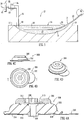
- FIG. 1 shows a schematic cross section through a wound 10 to which is applied apparatus 12 according to the present invention for administering TNP therapy to the wound.
- the wound 10 has a sealing membrane 14 covering it and sealed to sound flesh 16 around the border of the wound so as to define a wound cavity 17.
- An aspirant conduit 18 is provided, the conduit having a perforated drain portion 20 and a single lumen portion 22 attached thereto and which is sealed to the dressing at 24 where it passes through.
- the distal end of the conduit 18 is connected to a suitable vacuum pump 26.
- the dressing is provided with a second, short conduit portion 30 which accesses the wound cavity 17 through the membrane 14 and sealed thereto at 32.
- the conduit 30 is provided with a pinch clamp 34 which enables the soft plastics material of the conduit 30 to be either closed or open for flow.
- a small plastics material housing 36 having an air inlet 38 an air outlet 40 and in between a filter element 42.
- air entering the inlet 38 must flow through the filter element 42 in order to flow through the outlet 40 and through the conduit 30.
- Fig 1 which is meant to represent a small area wound such a wound filler may not be necessary if the sealing membrane is sufficiently taught not to contact the wound surface under the applied vacuum..
- the vacuum pump In operation the vacuum pump is turned on and a vacuum is created in the wound cavity 17. If the wound cavity is well sealed with no or very little leakage, wound exudate fluid may not be transported along the conduit portion 22 to a waste receptacle (not shown) associated with the vacuum pump 26 since there is little or no air/fluid flow along the conduit 22. In this event the pinch clamp 34 may be opened so that an air bleed is admitted through the filter element 42 into the wound cavity 17 thus stimulating a fluid flow through the wound cavity 17 and through the conduit 22 towards the pump 26 so keeping the conduit 22 unblocked and free flowing. The pinch clamp 34 has no effect on the flow rate of the air bleed, merely controlling whether there is or is not flow through the conduit 30, all flow control being decided by the pore size and area of the filter element 42.
- the filter 42 is a 0.2 micron pore size, antimicrobial filter
- the pinch clamp may be left open so that the conduit 30 is permanently open in the event that the wound cavity is particularly well sealed so providing a constant air bleed whilst the vacuum pump 26 is running.
- FIG 2 shows a schematic cross section of a dressing 100 for use with the apparatus according to the present invention and comprises a sealing membrane portion 102 and a conduit portion 104 having a filter housing 106 and having a filter 108 therein.
- the dressing 100 may be manufactured as an entity, the conduit portion 104 being attached by an adhesive layer 112 to a membrane member 114 at a flange portion 110 associated with the conduit portion 104.
- the lower face 116 of the adhesive layer 112 is protected in known manner by a layer of protective siliconised paper 118.
- the membrane 114 covers the wound being adhered to sound flesh at the border thereof by the adhesive layer 112.
- the conduit 104 may optionally be provided with a pinch clamp, for example, as in the embodiment shown in Figure 1 and for the same purpose.
- FIG 3 shows a conduit 200 of the type shown in Figures 1 and 2 but plugged into a grommet member 202.
- the grommet member has two curved faces 204,206 which meet at tapered edges 208, 210.
- This assembly of conduit 200 and grommet is incorporated into a dressing by the grommet member being sandwiched between two layers 212, 214 of thin, flexible adhesively coated membrane material where adhesive coated faces of the membrane material (not shown) face each other and adhere to the faces 204, 206 as discussed in our co-pending International patent application, PCT/US2007/074374 , mentioned above and of common ownership herewith.
- Other embodiments of grommets from PCT/US2007/074374 may also be utilised.
- Figure 4 shows various views of an air bleed port member 300 for attachment to a sealing membrane (not shown).
- Figure 4A shows a cross section through the port member;
- Figure 4B shows a plan view of the port member;
- Figure 4C shows a view in elevation;
- Figure 4D shows a perspective view of the port member 300.
- the port member 300 comprises a moulded body portion 302 having a centrally disposed aperture 304 therethrough; an upper cap portion 306 having air ports 308 therethrough; and, a filter element member 310 sandwiched between the body portion and the cap portion.
- the cap portion 306 also has a circular recess 312 in fluid communication with the air ports 308, the filter element 310 being exposed to the area of the recess 312.
- the bottom face 314 of the body portion has a layer of adhesive 316 thereon and which is protected prior to use with protective paper layer 318 which is removed before use by means of a protruding finger tab 320.
- a hole (not shown) is made in the membrane (not shown) covering the wound commensurate with the size of the aperture 304, the protective paper layer 318 us removed and the air bleed port 300 adhered to the upper surface of the sealing membrane with the hole in the membrane and the aperture 304 in communication with each other.
- the air bleed port 300 may be provided as part of a dressing membrane with the port 300 and membrane adhered or welded (in the latter case there is no adhesive layer 316) together during manufacture.
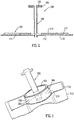
- Figure 5 shows a wound 500 having therein a porous, resiliently compressible wound filling element 502 such as a polyurethane foam material, for example, cut to conform generally to the wound shape and size.
- the wound 500 is covered with a self-adhesive flexible sealing membrane 504 similar to that shown in Figure 1 and which is adhered to sound flesh 506 surrounding the wound 500.
- the membrane 504 has an aperture 508 formed therein and over which is adhered an air bleed port 510.
- the port 510 has a domed shape 512 having an aperture 514 in a flanged base portion 516, the aperture 514 being made coincident with the aperture 508 in the membrane 504.
- the port 510 has a socket portion 520 to receive an aspirant conduit 522 which is connected to a vacuum pump 524 and an intervening waste canister (not shown).
- the socket portion 520 receives the end of the aspirant conduit 522 to an extent which leaves uncovered an air bleed hole 528 which has a surrounding recess 530 into which is adhered a filter element 532.
- the wound surface 500, membrane 504 and air bleed port 510 form between them a sealed cavity 534.
- the vacuum pump 524 In operation the vacuum pump 524 generates a predetermined vacuum level in the cavity 534 which causes the membrane 504 to be pushed down onto the porous, resiliently compressible wound filling element 502 by the ambient excess air pressure and the apertures 508, 514 to come into direct contact with the top surface of the resiliently compressible foam material 502 thus aspirating wound exudate which permeates through the wound filling element 502 to the waste canister (not shown). Whilst the wound exudate is being aspirated, the air bleed hole 528 and filter 532 permit a continuous controlled rate air bleed into the conduit 522 preventing the aspiration of wound exudate from stagnating. If, for any reason, it is desired to stop the air bleed then this can be terminated by the simple expedient of placing a piece of non-porous adhesive tape over the hole and filter 532.
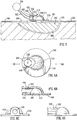
- Figure 6 shows the air bleed port 510 of Fig. 5.
- Fig. 6A shows a top plan view of the port;
- Fig. 6B shows a cross section on the line 6B-6B of Fig. 6A;
- Fig. 6C shows a view looking in the direction of arrow 6B on the left of Fig. 6A;
- Fig. 6D shows a side view in elevation.
- the air bleed port 510 is generally of domed circular form having a hollow domed portion 512 and a socket portion 520 having a passage 540 leading into the hollow portion 542.
- the port comprises a flat flange portion 516 having an adhesive layer 544 to adhere to a flexible sealing membrane and the adhesive layer being protected before use by a layer of siliconised paper (not shown) in known manner.
- the lower face of the flange portion 516 has an aperture 514 therein exposing the hollow portion 542.
- the socket portion receives an aspirant conduit, in use, as described with reference to Fig. 5 and also has an air bleed hole 528 lying in the centre of recessed portion 530 which receives a filter member as shown in Fig. 5 .
- the pore size of the filter member and, to an extent the size of the hole 528 control the rate of air bleed into the aspirant conduit at the desired pressure in the wound cavity 534 (see Fig. 5 ).
- the port 510 may be moulded from a soft plastics material such as polyurethane or polypropylene, for example.
- the port described with reference to Fig. 6 may be adhered to a sealing membrane as described above or adhered or welded thereto in a pre-prepared sealing membrane and port unit.
- An important advantage of the port according to the embodiment of Fig. 6 is that it is particularly easy to apply to a wound in that the self adhesive membrane material merely needs adhering to sound flesh after first having placed a wound filling element in the wound, an aperture made in the membrane and the port adhered thereto (or a pre formed port/membrane applied to the wound and an aspirant conduit plugged into the socket portion 520. There is no need to seal the aspirant conduit to the sealing membrane and the number of steps for making a TNP therapy dressing is significantly reduced.
- Figure 7 shows an air bleed port 600 which may also be used with the dressing described with reference to Fig. 5 .
- Fig. 7A shows a top plan view of the port;
- Fig. 7B shows a cross section on the line 7B-7B of Fig. 7A;
- Fig 7C shows a side view in elevation of the port of Fig. 7A;
- Fig. 7D shows an underside plan view of the port of Fig. 7A;
- Fig. 7E shows a perspective view of the port;
- Fig. 7F shows a view of the port in the direction of arrow 7B on the left of Fig.7A .
- the port 600 is of generally circular form having a flange portion 602, a shallow domed body portion 604 lying within the flange periphery and a socket portion 606.
- the shallow domed body portion 604 is not hollow but has a number of splayed unequal length finger-like indentations 608 formed in the upper surface thereof as an aid to stiffness.
- the indentations extend almost through the thickness of the domed portion save for a predetermined thickness of material 610 remaining on the underside.
- On the underside the spaces between the indentations create a space 612 in which vacuum may exist and wound exudate collect to be aspirated away by an associated aspirant conduit (not shown) connected to the socket portion 606 in the same manner as with the port of Fig. 6 .
- the socket portion 606 has a passage 614 therethrough leading to an aperture 616 which connects with a cooperating aperture, in use, in a sealing membrane.
- the socket portion has an air bleed hole 620 and a recessed portion 622 to receive a filter element (not shown) in the same manner as the port of Fig. 6 .
- the aspirant conduit is only inserted into the passage 614 up to the air bleed hole 620 so as not to block it.
- This port also adheres to the sealing membrane surface or may be pre-prepared by adhering or welding the port thereto as a unit.
- the port member 600 may be provided with a protector layer of siliconised paper or PE film (not shown) to be removed by the user immediately before application to a flexible sealing membrane (not shown).
- the port of Fig. 7 operates in the same manner as the port of Fig. 6 whereby the vacuum in the wound cavity cause the sealing membrane and port to be pushed down by excess ambient air pressure onto a porous and resiliently compressible wound filling element to provide a direct path for wound exudate to the aspirant conduit as shown and described with reference to Fig. 5 .
- Figure 8 shows an air bleed port 700 which is generally suitable for use with the type of wound dressing as shown in Figure 1 .
- Fig. 8A shows a perspective view of the port;
- Fig. 8B shows cross section in elevation of the port of Fig. 8A;
- Fig. 8C shows a view in elevation of the port of Fig. 8A along the line 8C;
- Fig.8D shows a top plan view of the port of Fig. 8A;
- Fig.8E shows a cross section similar to that of Fig. 8B but with a portion of aspirant conduit inserted.
- the port 700 comprises an annular base flange portion 702 having a generally cylindrical wall portion 704 thereon.
- An angled tubular aspirant conduit receiving neck portion 706 supported on a bellows portion 708 is provided at the top of the wall portion 704.
- the wall portion 704 is provided with an air bleed hole 710 and a surrounding recess 712 to receive a filter element (not shown) as with other embodiments described above.
- the port 700 is moulded from a soft, flexible plastics material, the bellows portion 708 allowing the neck portion 706 to move and flex easily when an aspirant conduit 714 (see Fig. 8E ) is in place.
- the port 700 may be used with the type of dressing shown in Fig. 1 where the aspirant conduit extends into the wound cavity 716 created between the wound bed and the sealing membrane 718.
- the end 720 of the conduit 714 may be associated with any desired item within the wound cavity such as a porous wound filling element whilst the other end 722 of the conduit 714 is connected to a waste canister and vacuum means (both not shown).
- the lower face 724 of the flange portion 702 is provided with an adhesive layer (not shown) to adhere to the sealing membrane 718 which has an aperture to coincide with an opening 730 in the annular base portion 702.
- the tubular neck portion 706 has an internal diameter to seal with the outer surface of the aspirant conduit 714.
- the wound cavity is evacuated to a desired pressure via the conduit 714 whilst a small but continuous air bleed through the hole 710 and filter in the recess 712 prevents wound exudate from stagnating due to a no-flow condition in the aspirant conduit 714.
- the flexible bellows portion 708 maintains the conduit 714 spaced-apart from the air bleed hole 710 thus preventing the hole from becoming blocked by the conduit surface due to the vacuum in the wound cavity
- the port 700 may be provided as a unit with a flexible sealing membrane by being adhered or welded thereto.
- FIG. 9 A further embodiment of an air bleed port member is shown in Figure 9 .
- the air bleed port member 800 comprises a patch of filter membrane 802 shown in Fig. 9B as circular (although it does not need to be round and could, for example, be rectangular) and having an annular layer of adhesive 804 applied to the outer periphery thereof, the adhesive being protected prior to use by protector papers 806.
- the adhesive layer prevents air bleed through that portion of the element which is coated with the adhesive. Therefore, by controlling the area of the filter membrane portion 810 coated with adhesive, the air bleed rate may be controlled through the uncoated portion 808 to an accurate level at a given pressure within a wound dressing.
- patches of filter membrane of a given size may be pre-coated with adhesive annuluses of varying widths or area allowing the user/clinician to choose the appropriate air bleed rate at the intended pressure.
- Air bleed ports may be sterile packaged having an air bleed rate and associated pressure or pressure range printed thereon.
- the air bleed port member of Fig. 9 may alternatively be pre-adhered or welded to a larger substrate layer of flexible sealing membrane as with other embodiments described above.
- the area of the filter membrane within the weld bead periphery would determine the air bleed flow rate.
- a range of air bleed port members welded to flexible sealing membranes may be prepared having different air bleed flow rates, the flexible sealing membrane having an aperture formed therein below the filter membrane portion through which air bleed occurs.
- the adhesive layer outside of the weld periphery may or may not be present.
Landscapes
- Health & Medical Sciences (AREA)
- Heart & Thoracic Surgery (AREA)
- Animal Behavior & Ethology (AREA)
- General Health & Medical Sciences (AREA)
- Anesthesiology (AREA)
- Biomedical Technology (AREA)
- Hematology (AREA)
- Life Sciences & Earth Sciences (AREA)
- Veterinary Medicine (AREA)
- Engineering & Computer Science (AREA)
- Public Health (AREA)
- Vascular Medicine (AREA)
- Surgery (AREA)
- Otolaryngology (AREA)
- Oral & Maxillofacial Surgery (AREA)
- Pulmonology (AREA)
- Media Introduction/Drainage Providing Device (AREA)
- External Artificial Organs (AREA)
Abstract
Description
- The present invention relates to topical negative pressure (TNP) therapy particularly, though not exclusively, to the control of negative pressure within a wound dressing.
- TNP therapy has assumed great importance in recent years due to the beneficial effects of TNP therapy on a healing wound and also because of the accelerated healing which TNP therapy provides.
- Apparatus for TNP therapy ranges from extremely complex apparatus only really suitable for use in a specialised hospital environment to much smaller and simpler, portable apparatus which may be used by an individual patient at home or at work.
- The basic principle of TNP therapy is to create a closed cavity over the wound itself by means of a thin, flexible sealing film adhered to the patient's sound skin surrounding the wound; admitting one end of an aspirant conduit into the closed cavity, the conduit being sealed to the flexible film, for example; and connecting a distal end of the aspirant conduit to a vacuum source such as an electrically driven vacuum pump, for example, to create a pressure lower than the surrounding ambient atmospheric pressure within the wound cavity. As is known to the skilled person the lower pressure creates many beneficial therapeutic effects on the wound including increased blood flow to the wound and faster granulation of tissue, for example.
- As noted above TNP therapy may be applied by a diverse range of apparatus. However, in general terms the more complex apparatus tends to be used on larger, more serious wounds which require a more intensive and varied treatments by TNP therapy. Examples of apparatus useful in the context of treatment of such larger wounds are given below.
- In our co-pending International patent application,
WO 2004/037334 , apparatus, a wound dressing and a method for aspirating, irrigating and cleansing wounds are described. In very general terms, this invention describes the treatment of a wound by the application of topical negative pressure (TNP) therapy for aspirating the wound together with the further provision of additional fluid for irrigating and/or cleansing the wound, which fluid, comprising both wound exudates and irrigation fluid, is then drawn off by the aspiration means and circulated through means for separating the beneficial materials therein from deleterious materials. The materials which are beneficial to wound healing are recirculated through the wound dressing and those materials deleterious to wound healing are discarded to a waste collection bag or vessel. - In our co-pending International patent application,
WO 2005/04670 WO 2004/037334 with regard to the aspiration, irrigation and cleansing of the wound, however, it further includes the important additional step of providing heating means to control the temperature of that beneficial material being returned to the wound site/dressing so that it is at an optimum temperature, for example, to have the most efficacious therapeutic effect on the wound. - In our co-pending International patent application,
WO 2005/105180 , apparatus and a method for the aspiration, irrigation and/or cleansing of wounds are described. Again, in very general terms, this document describes similar apparatus to the two previously mentioned documents hereinabove but with the additional step of providing means for the supply and application of physiologically active agents to the wound site/dressing to promote wound healing. - The content of the above references is included herein by reference.
- However, the above apparatus and methods are generally only applicable to a patient when hospitalised as the apparatus is complex, needing people having specialist knowledge in how to operate and maintain the apparatus, and also relatively heavy and bulky, not being adapted for easy mobility outside of a hospital environment by a patient, for example.
- Whilst the above examples are mainly relevant to the treatment of larger wounds, there is also a need for the treatment of relatively small wounds where the patient may otherwise be fit and mobile and require treatment outside of a clinical setting such as at home or at their workplace but where the provision of TNP therapy is desirable but nevertheless need to provide controlled conditions in the wound cavity. An example of a suitable apparatus is described in our co-pending UK patent application,
GB0712736.8 - An unexpected problem with smaller wounds of relatively low surface area is that they are relatively easy to seal in that they generally may have a relatively large area of sound flesh surrounding them and hence have large sealing borders therearound for the sealing film or drape to seal with and which tends to mitigate against inward air leaks from this area of the dressing. Secondly, even though the sealing films, which are well known to those skilled in the art, tend to be semi-permeable membrane type materials which allow to an extent the passage of gas such as air and water vapour, they do so only to a limited extent which is defined or measured in mass flow per unit area, Thus, since the area of the sealing film above the wound is relatively small, the amount of permitted gaseous flow is small. Because the seal over and around the wound may be very good, it is easy to create a vacuum in the wound cavity which does not decay quickly due to leaks, and therefore, very little or no flow through the aspirant conduit may result and whilst the vacuum is there over the wound, the wound exudate may not be being transported away to a waste canister, for example, and may be stagnating at the wound itself, this being especially so at low levels of negative pressure relative to atmospheric pressure. One important feature of TNP therapy is that the wound exudate fluid is desirably transported away from the wound site. Failure to achieve this efficiently may result in increased risk of infection and in the worst cases may result in back flow of wound exudate into the wound cavity.
- However, whether the wound is large or small the fact is that clinicians strive to seal the wound as well as they possibly can so as to prevent bacteria from causing infection. Larger wounds generate greater volumes of fluid and, are therefore, susceptible to filling the wound cavity with fluid. Furthermore, it is possible for the aspiration conduit to fill with exudate fluid resulting in a pressure differential between the wound and the vacuum source due to the viscous drag of the exudate and the height differential between wound and vacuum source.
- It is an object of the present invention to mitigate such problems especially, but not exclusively, in portable TNP therapy apparatus and to provide apparatus and a method where reliable flow of wound exudate away from the wound is promoted.
- According to a first aspect of the present invention there is provided apparatus for the provision of TNP therapy to a wound, the apparatus comprising: a sealing membrane for covering a wound to form a wound cavity in use; an aspirant conduit having one end thereof operably associated with the wound cavity, in use; vacuum means provided at a distal end of the aspirant conduit for applying a vacuum to the wound cavity when in use; and, air bleed means in fluid communication with the wound cavity when in use.
- In this specification the term "vacuum" means a pressure less than ambient atmospheric pressure.
- The air bleed means may be switchable in that the air bleed may be turned on and off as desired. In this regard the air bleed means may be provided by a second conduit having one end in communication with the wound cavity and having a filter associated with the conduit and a clamp or valve which enables the filter to admit air from the surrounding atmosphere to the wound cavity under the influence of the vacuum in the wound cavity. Air flow into the conduit may be controlled by the clamp on the conduit or on/off valve controlled by the user/patient or a clinician. An air bleed may be admitted when, for example, the patient observes that the aspirant tube appears to be full of exudate but which is not moving. Opening of the conduit to ambient air then induces a fluid flow in the conduit to expel the exudate into a waste canister, for example, associated with particular TNP apparatus in use.
- The air bleed means may provide a maximum flow rate at 200 mmHg below atmospheric of up to 1 l/min into the system. Preferably, the flow rate may be a maximum of 0.5 l/min. More preferably the flow rate may be a maximum of 0.2 l/min. More preferably still, a maximum flow rate of 0.05 l/min may be provided into the system. The overriding factor is to achieve a flow rate consistent with the wound not drying out as may happen if the incoming flow rate of bleed air is too high.
- Control of bleed rate may be achieved by control of the area of the filter through which bleed air may be admitted.
- Use of a filter is both desirable and advantageous in minimising the risk of pathogens from being admitted to the wound cavity by the air bleed.
- The use of a regulator on the second conduit described above may also be employed to achieve a constant but controlled rate of inward air bleed.
- Alternatively, the air bleed means may be associated with the sealing drape in which an aperture may be formed to permit the attachment of an air bleed port thereto. Such an air bleed port may have a filter portion or aperture through which ambient air is drawn into the wound cavity by the vacuum. Such an air bleed port may be permanently open to ambient atmosphere but, due to the contained filter portion, may restrict the rate of flow of air into the wound cavity or aspirant conduit to a low rate due to the size of the filter pores. In effect such an air bleed port substitutes for leakage of air into a TNP dressing which normally occurs with larger wounds. Suitable air bleed ports may be manufactured from soft plastics material mouldings so as not to cause trauma to a patient if lain upon. They may be provided during manufacture with a layer of adhesive thereon and suitable protective layer of siliconised paper until needed for use.
- Such air bleed ports may be sealed off with suitable sealing tape so as to be able to check for leaks in the dressing and/or act as an on/off facility.
- An air bleed provision may be provided by a second conduit plugged into a suitable grommet sandwiched between two adhesive drape or sealing membrane layers for example as described in our co-pending International patent application,
PCT/US2007/ 074374 , based onGB0712735.0 - Suitable filters may be 0.2 or 0.1 or 0.02 micron filters, for example, which also have the added advantage in that they may also prevent expulsion of bacteria to atmosphere in the reverse direction if for any reason this might occur.
- An advantage of the present invention is that use of a filter element of predetermined pore size and area permits close control of a desired low flow rate of ambient air into the wound cavity, the filter element itself also preventing ingress of potentially harmful bacteria. In contrast, conventional valves are insufficiently sensitive to control at the low flow rates required and also do not stop harmful bacterial from entering the wound.
- In some embodiments of the present invention an air bleed port such as that described above may be provided with the drape or sealing membrane material during manufacture thereof, the air bleed port being adhered or welded to the drape or flexible sealing membrane.
- In all embodiments of the present invention the rate of bleed air flow into the dressing and wound cavity is controlled solely by the characteristics of the filter with respect to its pore size and area exposed to ambient atmosphere.
- According to a second aspect of the present invention there is provided an air bleed port member for use with a topical negative pressure dressing.
- According to a third aspect of the present invention there is provided a method of providing topical negative pressure therapy to a wound, the method comprising the steps of: providing a sealing membrane for covering a wound to form a wound cavity; providing an aspirant conduit having one end thereof operably associated with the wound cavity; providing vacuum means provided at a distal end of the aspirant conduit for applying a vacuum to the wound cavity; and, air bleed means in fluid communication with the wound cavity.
- In order that the present invention may be more fully understood, examples will now be described by way of illustration only with reference to the accompanying drawings, of which:
-
Figure 1 shows a schematic cross section through a wound to which TNP therapy is being applied and also showing schematically one embodiment of the present invention; -
Figure 2 shows across section through a schematic embodiment of a sealing membrane having an air bleed conduit and filter therewith; and -
Figure 3 shows a perspective view of a grommet for use in apparatus employing some embodiments of the present invention; -
Figures 4A to 4D which show various views of an embodiment of an air bleed port for attachment to a sealing membrane; -
Figure 5 shows a schematic cross section through a second wound having an alternative air bleed port member attached to the sealing membrane; -
Figures 6A to 6D show various views and a cross section s of the air bleed port shown inFigure 5 ; -
Figures 7A to 7D show various views and a cross section of a further alternative air bleed port for use with the dressing shown inFigure 5 ; -
Figures 8A to 8D show various views and a cross section through an alternative air bleed port suitable for the dressing shown inFigure 1 ; and -
Figures 9A and 9B which show a cross section and plan view, respectively of a further embodiment of a port member according to the present invention. - Referring now to the drawings and where the same features are designated by common reference numerals.
-
Figure 1 shows a schematic cross section through awound 10 to which is appliedapparatus 12 according to the present invention for administering TNP therapy to the wound. Thewound 10 has a sealingmembrane 14 covering it and sealed to soundflesh 16 around the border of the wound so as to define awound cavity 17. Anaspirant conduit 18 is provided, the conduit having aperforated drain portion 20 and asingle lumen portion 22 attached thereto and which is sealed to the dressing at 24 where it passes through. The distal end of theconduit 18 is connected to asuitable vacuum pump 26. The dressing is provided with a second,short conduit portion 30 which accesses thewound cavity 17 through themembrane 14 and sealed thereto at 32. Theconduit 30 is provided with apinch clamp 34 which enables the soft plastics material of theconduit 30 to be either closed or open for flow. At the end of theconduit 30 is a smallplastics material housing 36 having anair inlet 38 anair outlet 40 and in between afilter element 42. Thus, air entering theinlet 38 must flow through thefilter element 42 in order to flow through theoutlet 40 and through theconduit 30. Optionally, there may be a layer of porous, compression resistant wound filler (not shown) adjacent thewound surface 10 to prevent the sealingmembrane 14 from being pulled down onto the wound surface by the applied vacuum and thereby preventing flow of wound exudate to the aspirantdrain conduit portion 20 from the whole area of the wound. However, inFig 1 which is meant to represent a small area wound such a wound filler may not be necessary if the sealing membrane is sufficiently taught not to contact the wound surface under the applied vacuum.. - In operation the vacuum pump is turned on and a vacuum is created in the
wound cavity 17. If the wound cavity is well sealed with no or very little leakage, wound exudate fluid may not be transported along theconduit portion 22 to a waste receptacle (not shown) associated with thevacuum pump 26 since there is little or no air/fluid flow along theconduit 22. In this event thepinch clamp 34 may be opened so that an air bleed is admitted through thefilter element 42 into thewound cavity 17 thus stimulating a fluid flow through thewound cavity 17 and through theconduit 22 towards thepump 26 so keeping theconduit 22 unblocked and free flowing. Thepinch clamp 34 has no effect on the flow rate of the air bleed, merely controlling whether there is or is not flow through theconduit 30, all flow control being decided by the pore size and area of thefilter element 42. - In this instance the
filter 42 is a 0.2 micron pore size, antimicrobial filter - The pinch clamp may be left open so that the
conduit 30 is permanently open in the event that the wound cavity is particularly well sealed so providing a constant air bleed whilst thevacuum pump 26 is running. -
Figure 2 shows a schematic cross section of a dressing 100 for use with the apparatus according to the present invention and comprises a sealingmembrane portion 102 and aconduit portion 104 having afilter housing 106 and having afilter 108 therein. The dressing 100 may be manufactured as an entity, theconduit portion 104 being attached by anadhesive layer 112 to amembrane member 114 at aflange portion 110 associated with theconduit portion 104. Thelower face 116 of theadhesive layer 112 is protected in known manner by a layer of protectivesiliconised paper 118. In this dressing portion themembrane 114 covers the wound being adhered to sound flesh at the border thereof by theadhesive layer 112. Theconduit 104 may optionally be provided with a pinch clamp, for example, as in the embodiment shown inFigure 1 and for the same purpose. -
Figure 3 shows aconduit 200 of the type shown inFigures 1 and2 but plugged into agrommet member 202. The grommet member has two curved faces 204,206 which meet attapered edges conduit 200 and grommet is incorporated into a dressing by the grommet member being sandwiched between twolayers faces 204, 206 as discussed in our co-pending International patent application,PCT/US2007/074374 , mentioned above and of common ownership herewith. Other embodiments of grommets fromPCT/US2007/074374 may also be utilised. -
Figure 4 shows various views of an airbleed port member 300 for attachment to a sealing membrane (not shown).Figure 4A shows a cross section through the port member;Figure 4B shows a plan view of the port member;Figure 4C shows a view in elevation; and,Figure 4D shows a perspective view of theport member 300. Theport member 300 comprises a mouldedbody portion 302 having a centrally disposedaperture 304 therethrough; anupper cap portion 306 havingair ports 308 therethrough; and, afilter element member 310 sandwiched between the body portion and the cap portion. Thecap portion 306 also has acircular recess 312 in fluid communication with theair ports 308, thefilter element 310 being exposed to the area of therecess 312. Thebottom face 314 of the body portion has a layer of adhesive 316 thereon and which is protected prior to use withprotective paper layer 318 which is removed before use by means of aprotruding finger tab 320. - To use the air bleed port member, a hole (not shown) is made in the membrane (not shown) covering the wound commensurate with the size of the
aperture 304, theprotective paper layer 318 us removed and theair bleed port 300 adhered to the upper surface of the sealing membrane with the hole in the membrane and theaperture 304 in communication with each other. - In a preferred construction the
air bleed port 300 may be provided as part of a dressing membrane with theport 300 and membrane adhered or welded (in the latter case there is no adhesive layer 316) together during manufacture. -
Figure 5 shows awound 500 having therein a porous, resiliently compressiblewound filling element 502 such as a polyurethane foam material, for example, cut to conform generally to the wound shape and size. Thewound 500 is covered with a self-adhesiveflexible sealing membrane 504 similar to that shown inFigure 1 and which is adhered to soundflesh 506 surrounding thewound 500. Themembrane 504 has an aperture 508 formed therein and over which is adhered anair bleed port 510. Theport 510 has adomed shape 512 having anaperture 514 in aflanged base portion 516, theaperture 514 being made coincident with the aperture 508 in themembrane 504. Theport 510 has asocket portion 520 to receive anaspirant conduit 522 which is connected to avacuum pump 524 and an intervening waste canister (not shown). Thesocket portion 520 receives the end of theaspirant conduit 522 to an extent which leaves uncovered anair bleed hole 528 which has asurrounding recess 530 into which is adhered afilter element 532. Thewound surface 500,membrane 504 andair bleed port 510 form between them a sealedcavity 534. - In operation the
vacuum pump 524 generates a predetermined vacuum level in thecavity 534 which causes themembrane 504 to be pushed down onto the porous, resiliently compressiblewound filling element 502 by the ambient excess air pressure and theapertures 508, 514 to come into direct contact with the top surface of the resilientlycompressible foam material 502 thus aspirating wound exudate which permeates through thewound filling element 502 to the waste canister (not shown). Whilst the wound exudate is being aspirated, theair bleed hole 528 and filter 532 permit a continuous controlled rate air bleed into theconduit 522 preventing the aspiration of wound exudate from stagnating. If, for any reason, it is desired to stop the air bleed then this can be terminated by the simple expedient of placing a piece of non-porous adhesive tape over the hole andfilter 532. -
Figure 6 shows theair bleed port 510 ofFig. 5. Fig. 6A shows a top plan view of the port;Fig. 6B shows a cross section on theline 6B-6B ofFig. 6A; Fig. 6C shows a view looking in the direction ofarrow 6B on the left ofFig. 6A; and Fig. 6D shows a side view in elevation. Theair bleed port 510 is generally of domed circular form having a hollowdomed portion 512 and asocket portion 520 having apassage 540 leading into thehollow portion 542. The port comprises aflat flange portion 516 having anadhesive layer 544 to adhere to a flexible sealing membrane and the adhesive layer being protected before use by a layer of siliconised paper (not shown) in known manner. The lower face of theflange portion 516 has anaperture 514 therein exposing thehollow portion 542. The socket portion receives an aspirant conduit, in use, as described with reference toFig. 5 and also has anair bleed hole 528 lying in the centre of recessedportion 530 which receives a filter member as shown inFig. 5 . The pore size of the filter member and, to an extent the size of thehole 528 control the rate of air bleed into the aspirant conduit at the desired pressure in the wound cavity 534 (seeFig. 5 ). Theport 510 may be moulded from a soft plastics material such as polyurethane or polypropylene, for example. - The port described with reference to
Fig. 6 may be adhered to a sealing membrane as described above or adhered or welded thereto in a pre-prepared sealing membrane and port unit. - An important advantage of the port according to the embodiment of
Fig. 6 is that it is particularly easy to apply to a wound in that the self adhesive membrane material merely needs adhering to sound flesh after first having placed a wound filling element in the wound, an aperture made in the membrane and the port adhered thereto (or a pre formed port/membrane applied to the wound and an aspirant conduit plugged into thesocket portion 520. There is no need to seal the aspirant conduit to the sealing membrane and the number of steps for making a TNP therapy dressing is significantly reduced. -
Figure 7 shows anair bleed port 600 which may also be used with the dressing described with reference toFig. 5 .Fig. 7A shows a top plan view of the port;Fig. 7B shows a cross section on theline 7B-7B ofFig. 7A; Fig 7C shows a side view in elevation of the port ofFig. 7A; Fig. 7D shows an underside plan view of the port ofFig. 7A; Fig. 7E shows a perspective view of the port; and,Fig. 7F shows a view of the port in the direction ofarrow 7B on the left ofFig.7A . Theport 600 is of generally circular form having aflange portion 602, a shallowdomed body portion 604 lying within the flange periphery and asocket portion 606. The shallowdomed body portion 604 is not hollow but has a number of splayed unequal length finger-like indentations 608 formed in the upper surface thereof as an aid to stiffness. The indentations extend almost through the thickness of the domed portion save for a predetermined thickness ofmaterial 610 remaining on the underside. On the underside the spaces between the indentations create aspace 612 in which vacuum may exist and wound exudate collect to be aspirated away by an associated aspirant conduit (not shown) connected to thesocket portion 606 in the same manner as with the port ofFig. 6 . Thesocket portion 606 has apassage 614 therethrough leading to anaperture 616 which connects with a cooperating aperture, in use, in a sealing membrane. The socket portion has anair bleed hole 620 and a recessedportion 622 to receive a filter element (not shown) in the same manner as the port ofFig. 6 . As withFig. 6 , the aspirant conduit is only inserted into thepassage 614 up to theair bleed hole 620 so as not to block it. - This port also adheres to the sealing membrane surface or may be pre-prepared by adhering or welding the port thereto as a unit. Where the
port member 600 has a layer of adhesive on the underside offlange portion 602 it may be provided with a protector layer of siliconised paper or PE film (not shown) to be removed by the user immediately before application to a flexible sealing membrane (not shown). - In use the port of
Fig. 7 operates in the same manner as the port ofFig. 6 whereby the vacuum in the wound cavity cause the sealing membrane and port to be pushed down by excess ambient air pressure onto a porous and resiliently compressible wound filling element to provide a direct path for wound exudate to the aspirant conduit as shown and described with reference toFig. 5 . - Although resiliently compressible wound filling elements have been described above it is only necessary for the wound filling element to remain porous when the maximum desired vacuum is applied and it is not necessary that it also be resiliently compressible. The air bleed port of
Fig. 7 has the same advantages as does the port ofFigure 6 . -
Figure 8 shows anair bleed port 700 which is generally suitable for use with the type of wound dressing as shown inFigure 1 .Fig. 8A shows a perspective view of the port;Fig. 8B shows cross section in elevation of the port ofFig. 8A; Fig. 8C shows a view in elevation of the port ofFig. 8A along the line 8C;Fig.8D shows a top plan view of the port ofFig. 8A; and, Fig.8E shows a cross section similar to that ofFig. 8B but with a portion of aspirant conduit inserted. Theport 700 comprises an annularbase flange portion 702 having a generallycylindrical wall portion 704 thereon. An angled tubular aspirant conduit receivingneck portion 706 supported on abellows portion 708 is provided at the top of thewall portion 704. Thewall portion 704 is provided with anair bleed hole 710 and asurrounding recess 712 to receive a filter element (not shown) as with other embodiments described above. Theport 700 is moulded from a soft, flexible plastics material, thebellows portion 708 allowing theneck portion 706 to move and flex easily when an aspirant conduit 714 (seeFig. 8E ) is in place. Theport 700 may be used with the type of dressing shown inFig. 1 where the aspirant conduit extends into thewound cavity 716 created between the wound bed and the sealingmembrane 718. Theend 720 of theconduit 714 may be associated with any desired item within the wound cavity such as a porous wound filling element whilst theother end 722 of theconduit 714 is connected to a waste canister and vacuum means (both not shown). Thelower face 724 of theflange portion 702 is provided with an adhesive layer (not shown) to adhere to the sealingmembrane 718 which has an aperture to coincide with anopening 730 in theannular base portion 702. Thetubular neck portion 706 has an internal diameter to seal with the outer surface of theaspirant conduit 714. - In operation the wound cavity is evacuated to a desired pressure via the
conduit 714 whilst a small but continuous air bleed through thehole 710 and filter in therecess 712 prevents wound exudate from stagnating due to a no-flow condition in theaspirant conduit 714. The flexible bellowsportion 708 maintains theconduit 714 spaced-apart from theair bleed hole 710 thus preventing the hole from becoming blocked by the conduit surface due to the vacuum in the wound cavity - As with previous embodiments the
port 700 may be provided as a unit with a flexible sealing membrane by being adhered or welded thereto. - A further embodiment of an air bleed port member is shown in
Figure 9 . The airbleed port member 800 comprises a patch offilter membrane 802 shown inFig. 9B as circular (although it does not need to be round and could, for example, be rectangular) and having an annular layer of adhesive 804 applied to the outer periphery thereof, the adhesive being protected prior to use byprotector papers 806. The adhesive layer prevents air bleed through that portion of the element which is coated with the adhesive. Therefore, by controlling the area of thefilter membrane portion 810 coated with adhesive, the air bleed rate may be controlled through theuncoated portion 808 to an accurate level at a given pressure within a wound dressing. Thus, patches of filter membrane of a given size may be pre-coated with adhesive annuluses of varying widths or area allowing the user/clinician to choose the appropriate air bleed rate at the intended pressure. - Air bleed ports may be sterile packaged having an air bleed rate and associated pressure or pressure range printed thereon.
- The air bleed port member of
Fig. 9 may alternatively be pre-adhered or welded to a larger substrate layer of flexible sealing membrane as with other embodiments described above. - In the case of the port of
Fig.9 being welded to a flexible sealing membrane, the area of the filter membrane within the weld bead periphery would determine the air bleed flow rate. Thus, a range of air bleed port members welded to flexible sealing membranes may be prepared having different air bleed flow rates, the flexible sealing membrane having an aperture formed therein below the filter membrane portion through which air bleed occurs. In the case of the port being welded to a flexible sealing membrane the adhesive layer outside of the weld periphery may or may not be present. - Embodiments of the invention are further described with reference to the following numbered clauses:
- Clause 1. Apparatus for the provision of topical negative pressure therapy to a wound, the apparatus comprising: a sealing membrane for covering a wound to form a wound cavity; an aspirant conduit having one end thereof capable of being operably associated, in use, with the wound cavity; vacuum means provided at a distal end of the aspirant conduit for applying a vacuum to the wound cavity when in use; and, air bleed means in fluid communication with the wound cavity when in use.
- Clause 2. Apparatus according to clause 1 wherein the air bleed means is switchable in that the air bleed may be turned on and off.
- Clause 3. Apparatus according to clause 1 or clause 2 wherein the air bleed means is provided by a second conduit having one end in communication with the wound cavity when in use and air bleed means in a distal end of the second conduit.
- Clause 4. Apparatus according to any one preceding clause where the air bleed means is a filter element having predetermined pore size.
- Clause 5. Apparatus according to clause 4 wherein the filter element has a predetermined area accessible to the ambient atmosphere.
- Clause 6. Apparatus according to any one of clauses 3 to 5 wherein the aspirant conduit is provided with on/off clamp or valve means.
- Clause 7. Apparatus according to clause 1 wherein the air bleed means is in the form of an air bleed port member associated with the sealing membrane.
- Clause 8. Apparatus according to clause 7 wherein the air bleed port is adhered to the sealing membrane and in use is capable of communicating with the wound cavity through an aperture in the membrane.
- Clause 9. Apparatus according to either clause 7 or clause 8 wherein the bleed port contains a filter element through which air bleed occurs.
-
Clause 10. Apparatus according to any one of clause 7 to 9 wherein the sealing membrane and air bleed port are manufactured as an entity. - Clause 11. Apparatus according to any one preceding clause from 4 to 6, 9 and 10 wherein the filter has a pore size of 0.2 microns.
-
Clause 12. Apparatus according to clause 11 wherein the filter element is microbial. - Clause 13. Apparatus according to any one preceding clause wherein the air bleed flow rate is less than 0.5 l/min.
-
Clause 14. Apparatus according to clause 13 wherein the air bleed flow rate is less than 0.2 l/min. - Clause 15. Apparatus according to clause 13 wherein the flow rate is less than 0.05 l/min.
-
Clause 16. Apparatus according to any one of preceding clauses 7 to 15 wherein the filter is retained in a recess in the air bleed port. -
Clause 17. Apparatus according to clause 7 wherein the recess has an air bleed hole therein covered by the filter element. -
Clause 18. Apparatus according to any one preceding clause from 7 to 17 wherein the air bleed port has provision to receive the aspirant conduit. - Clause 19. Apparatus according to
clause 18 wherein the aspirant conduit extends through the air bleed port member into the wound cavity, in use. -
Clause 20. Apparatus according toclause 18 wherein the aspirant conduit terminates at the air bleed port member whilst permitting an air bleed into the wound cavity, in use. - Clause 21. An air bleed port member for a topical negative pressure dressing, The port comprising a base portion, a body portion, a socket portion for receiving an aspirant conduit, and air bleed hole and provision associated with the air bleed hole to receive a filter element to cover the air bleed hole.
-
Clause 22. A port member according to clause 21 wherein the base member is adapted to be attached to a flexible sealing membrane in a dressing. - Clause 23. A port member according to either
clause 21 or 22 wherein the socket portion is adapted to receive an aspirant conduit passing completely therethrough. -
Clause 24. A port member according to eitherclause 21 or 22 wherein the socket portion is adapted to receive an aspirant conduit terminating within the socket portion. - Clause 25. A port member according to any one preceding clause from 21 to 24 wherein the base member has an aperture therein for communicating with a sealed wound cavity, in use.
-
Clause 26. A port member according to clause 25 wherein the aperture, in use, directly receives aspirated wound exudate. - Clause 27. A method of providing topical negative pressure therapy to a wound, the method comprising the steps of: providing a sealing membrane for covering a wound to form a wound cavity; providing an aspirant conduit having one end thereof operably associated with the wound cavity; providing vacuum means provided at a distal end of the aspirant conduit for applying a vacuum to the wound cavity; and, air bleed means in fluid communication with the wound cavity
- Clause 28. A method according to clause 27 wherein the air bleed means is a filter in and air bleed port provided in the sealing membrane
- Clause 29. A method according to either clause 27 or clause 28 wherein the air bleed flow rate is controlled to be less than 1l/min.
-
Clause 30. A method according to clause 29 wherein the flow rate is controlled to be less than 0.5 l/min. - Clause 31. A method according to clause 29 wherein the flow rate is controlled to be less than 0.2 l/min.
-
Clause 32. A method according to clause 29 wherein the flow rate is controlled to be less than 0.05 l/min. - Clause 33. A method according to any one preceding clause from 27 to 32 wherein the air bleed flow rate is controlled to arte at which drying out of the wound is prevented.
-
Clause 34. An air bleed port member, the port member comprising a portion of filter material, the filter material being partially coated with adhesive to adhere to a larger substrate layer in use. - Clause 35. An air bleed port member according to
clause 34 wherein an area of the filter material through which air may bleed in use is controlled by the area covered by adhesive. -
Clause 36. An air bleed port member according to eitherclause 34 or 35 wherein the portion of filter material is circular. - Clause 37. An air bleed port member according to
clause 36 wherein the adhesive is applied as an annulus around the periphery thereof. -
Clause 38. An air bleed port member according to clause 37 wherein the annulus is of pre-determined area. - Clause 39. An air bleed port member comprising a portion of filter material welded to a flexible sealing membrane, an area of air bleed flow being determined by the area within a closed weld bead.
- Throughout the description and claims of this specification, the words "comprise" and "contain" and variations of the words, for example "comprising" and "comprises", means "including but not limited to", and is not intended to (and does not) exclude other moieties, additives, components, integers or steps.
- Throughout the description and claims of this specification, the singular encompasses the plural unless the context otherwise requires. In particular, where the indefinite article is used, the specification is to be understood as contemplating plurality as well as singularity, unless the context requires otherwise.
- Features, integers, characteristics, compounds, chemical moieties or groups described in conjunction with a particular aspect, embodiment or example of the invention are to be understood to be applicable to any other aspect, embodiment or example described herein unless incompatible therewith.
Claims (11)
- An air bleed port member (510) for use with a topical negative pressure wound dressing, the port member (510) comprising:a body portion;a flanged base portion (516);a socket portion (520) for receiving an aspirant conduit (522);an air bleed hole (528); anda filter element (532);wherein the filter element (532) is configured to control the rate of air bleed flow into the topical negative pressure dressing; andcharacterized in thatthe port member (510) further comprises a domed shape and an aperture (514) located in the flanged base portion (516) wherein said aperture (514) is configured to be made coincident with an aperture formed in a sealing membrane covering the wound.
- A port member according to claim 1, wherein the base portion is adapted to be attached to a flexible sealing membrane of a topical negative pressure wound dressing.
- A port member according to claim 2, wherein the base portion comprises an adhesive layer for adhering the port member to the flexible sealing membrane.
- A port member according to claim 3, wherein the adhesive layer is protected before use by a layer of siliconized paper or PE film.
- A port member according to any preceding claim, wherein the aperture, in use, directly receives aspirated wound exudate.
- A port member according to any preceding claim, wherein the air bleed hole and the filter are configured to permit a continuous controlled rate of air bleed into the aspirant conduit.
- A port member according to any preceding claim, wherein the filter element has a predetermined pore size for preventing the ingress of harmful bacteria.
- A port member according to any preceding claim, wherein the socket portion is configured to receive an end of the aspirant conduit to an extent that leaves the air bleed hole uncovered and wherein the air bleed hole has a surrounding recess into which the air filter element is adhered.
- A topical negative pressure wound dressing in combination with an air bleed port member according to any of claims 1 to 8.
- A topical negative pressure dressing according to claim 9, wherein said dressing comprises a flexible sealing membrane to cover the wound.
- Apparatus for the provision of topical negative pressure therapy to a wound, the apparatus comprising: a sealing membrane for covering a wound to form a wound cavity; an aspirant conduit having one end thereof capable of being operably associated, in use, with the wound cavity; vacuum means provided at a distal end of the aspirant conduit for applying a vacuum to the wound cavity when in use; and an air bleed port member according to claim 1.
Applications Claiming Priority (3)
| Application Number | Priority Date | Filing Date | Title |
|---|---|---|---|
| GBGB0723872.8A GB0723872D0 (en) | 2007-12-06 | 2007-12-06 | Apparatus for topical negative pressure therapy |
| EP08858332.3A EP2231218B1 (en) | 2007-12-06 | 2008-11-26 | Apparatus for topical negative pressure therapy |
| PCT/GB2008/051118 WO2009071933A2 (en) | 2007-12-06 | 2008-11-26 | Apparatus for topical negative pressure therapy |
Related Parent Applications (2)
| Application Number | Title | Priority Date | Filing Date |
|---|---|---|---|
| EP08858332.3A Division EP2231218B1 (en) | 2007-12-06 | 2008-11-26 | Apparatus for topical negative pressure therapy |
| EP08858332.3A Division-Into EP2231218B1 (en) | 2007-12-06 | 2008-11-26 | Apparatus for topical negative pressure therapy |
Publications (3)
| Publication Number | Publication Date |
|---|---|
| EP3284488A1 true EP3284488A1 (en) | 2018-02-21 |
| EP3284488B1 EP3284488B1 (en) | 2019-06-26 |
| EP3284488B8 EP3284488B8 (en) | 2019-08-07 |
Family
ID=38983086
Family Applications (2)
| Application Number | Title | Priority Date | Filing Date |
|---|---|---|---|
| EP17186349.1A Active EP3284488B8 (en) | 2007-12-06 | 2008-11-26 | Apparatus for topical negative pressure therapy |
| EP08858332.3A Revoked EP2231218B1 (en) | 2007-12-06 | 2008-11-26 | Apparatus for topical negative pressure therapy |
Family Applications After (1)
| Application Number | Title | Priority Date | Filing Date |
|---|---|---|---|
| EP08858332.3A Revoked EP2231218B1 (en) | 2007-12-06 | 2008-11-26 | Apparatus for topical negative pressure therapy |
Country Status (8)
| Country | Link |
|---|---|
| US (7) | US8734410B2 (en) |
| EP (2) | EP3284488B8 (en) |
| JP (3) | JP2011505888A (en) |
| AU (2) | AU2008332915B2 (en) |
| CA (1) | CA2706169C (en) |
| GB (1) | GB0723872D0 (en) |
| WO (1) | WO2009071933A2 (en) |
| ZA (1) | ZA201003284B (en) |
Families Citing this family (70)
| Publication number | Priority date | Publication date | Assignee | Title |
|---|---|---|---|---|
| JP4864979B2 (en) * | 2005-12-06 | 2012-02-01 | ケーシーアイ ライセンシング インク | System for removing and isolating wound exudates |
| GB0723872D0 (en) * | 2007-12-06 | 2008-01-16 | Smith & Nephew | Apparatus for topical negative pressure therapy |
| GB0723875D0 (en) | 2007-12-06 | 2008-01-16 | Smith & Nephew | Wound management |
| US8298200B2 (en) | 2009-06-01 | 2012-10-30 | Tyco Healthcare Group Lp | System for providing continual drainage in negative pressure wound therapy |
| US9033942B2 (en) | 2008-03-07 | 2015-05-19 | Smith & Nephew, Inc. | Wound dressing port and associated wound dressing |
| US8021347B2 (en) | 2008-07-21 | 2011-09-20 | Tyco Healthcare Group Lp | Thin film wound dressing |
| US8162907B2 (en) | 2009-01-20 | 2012-04-24 | Tyco Healthcare Group Lp | Method and apparatus for bridging from a dressing in negative pressure wound therapy |
| GB0902816D0 (en) | 2009-02-19 | 2009-04-08 | Smith & Nephew | Fluid communication path |
| US20100324516A1 (en) | 2009-06-18 | 2010-12-23 | Tyco Healthcare Group Lp | Apparatus for Vacuum Bridging and/or Exudate Collection |
| EP2515961B1 (en) | 2009-12-22 | 2019-04-17 | Smith & Nephew, Inc. | Apparatuses for negative pressure wound therapy |
| US8430867B2 (en) * | 2010-03-12 | 2013-04-30 | Kci Licensing, Inc. | Reduced-pressure dressing connection pads, systems, and methods |
| US9061095B2 (en) | 2010-04-27 | 2015-06-23 | Smith & Nephew Plc | Wound dressing and method of use |
| USRE48117E1 (en) | 2010-05-07 | 2020-07-28 | Smith & Nephew, Inc. | Apparatuses and methods for negative pressure wound therapy |
| US9199013B2 (en) * | 2010-06-16 | 2015-12-01 | Simex Medizintechnik Gmbh | Device for wound treatment and a wound covering bandage or dressing |
| USD714433S1 (en) | 2010-12-22 | 2014-09-30 | Smith & Nephew, Inc. | Suction adapter |
| RU2016111981A (en) | 2010-12-22 | 2018-11-27 | Смит Энд Нефью, Инк. | DEVICE AND METHOD FOR TREATING RAS WITH NEGATIVE PRESSURE |
| US9421132B2 (en) | 2011-02-04 | 2016-08-23 | University Of Massachusetts | Negative pressure wound closure device |
| RU2756986C2 (en) | 2011-02-04 | 2021-10-08 | Юниверсити Оф Массачусетс | Wound closure device with the creation of negative pressure |
| EP2717935B1 (en) * | 2011-06-07 | 2016-12-07 | BSN medical GmbH | Wound-covering article with preparation for attachment of a vacuum device |
| DE102011052735A1 (en) | 2011-08-16 | 2013-02-21 | Asskea Gmbh | Medical drainage tube for treatment of wounds by low pressure produced by medical suction apparatus, has filter which communicates with air inlet opening formed in connection unit, and closure stopper for closing air inlet opening |
| US9078990B1 (en) * | 2012-02-03 | 2015-07-14 | Andrew Thomas Obst | Devices and methods for treatment of fistulas and complex wounds |
| EP2636417B1 (en) * | 2012-03-05 | 2017-04-26 | Lohmann & Rauscher GmbH | Wound treatment assembly and covering device for same |
| CN104661601B (en) | 2012-05-22 | 2018-06-22 | 史密夫及内修公开有限公司 | Apparatus and method for wound therapy |
| EP2852419B1 (en) | 2012-05-22 | 2019-11-20 | Smith & Nephew plc | Wound closure device |
| BR112014029100A2 (en) | 2012-05-23 | 2017-06-27 | Smith & Nephew | negative pressure wound therapy apparatus and methods |
| WO2013175309A1 (en) | 2012-05-24 | 2013-11-28 | Smith & Nephew Plc | Devices and methods for treating and closing wounds with negative pressure |
| EP2872085A1 (en) | 2012-07-16 | 2015-05-20 | Smith&Nephew, Inc. | Negative pressure wound closure device |
| AU2013298198B2 (en) | 2012-08-01 | 2017-05-11 | Smith & Nephew Plc | Wound dressing |
| BR112015002154A2 (en) | 2012-08-01 | 2017-07-04 | Smith & Nephew | wound dressing |
| DE102012108248B3 (en) | 2012-09-05 | 2013-10-31 | Asskea Gmbh | Medical drainage tube |
| USD738487S1 (en) | 2013-01-28 | 2015-09-08 | Molnlycke Health Care Ab | Suction device for negative pressure therapy |
| CA2902776C (en) | 2013-03-13 | 2023-03-07 | Smith & Nephew Inc. | Wound treatment apparatus and use thereof |
| WO2014158526A1 (en) * | 2013-03-14 | 2014-10-02 | Kci Licensing, Inc. | Negative pressure therapy with dynamic profile capability |
| EP2968015B1 (en) | 2013-03-14 | 2018-05-16 | Smith & Nephew PLC | Compressible wound fillers and systems and methods of use in treating wounds with negative pressure |
| US10493184B2 (en) | 2013-03-15 | 2019-12-03 | Smith & Nephew Plc | Wound dressing and method of treatment |
| CN105188795B (en) | 2013-05-10 | 2018-07-31 | 史密夫及内修公开有限公司 | For rinsing and the fluid connection of suction wound |
| JP6723917B2 (en) | 2013-10-21 | 2020-07-15 | スミス アンド ネフュー インコーポレイテッド | Negative pressure wound closure device |
| US10201642B2 (en) | 2014-01-21 | 2019-02-12 | Smith & Nephew Plc | Collapsible dressing for negative pressure wound treatment |
| CA2946828A1 (en) * | 2014-03-14 | 2015-09-17 | Nitric Solutions, Inc. | Treating diseases using nitric oxide releasing solutions |
| RU2675936C2 (en) * | 2014-05-28 | 2018-12-25 | Колопласт А/С | Stoma plates |
| US10470918B2 (en) * | 2014-05-28 | 2019-11-12 | Coloplast A/S | Ostomy wafer |
| WO2016069890A1 (en) * | 2014-10-29 | 2016-05-06 | Shakam LLC | Negative pressure wound therapy dressing and drainage apparatus and system |
| WO2016073419A1 (en) * | 2014-11-03 | 2016-05-12 | Fistula Solution Corporation | Containment devices for treatment of intestinal fistulas and complex wounds |
| US11426302B2 (en) * | 2014-11-03 | 2022-08-30 | Fistula Solution Corporation | Containment devices for treatment of intestinal fistulas and complex wounds |
| US11376357B2 (en) | 2015-02-17 | 2022-07-05 | Sommetrics, Inc. | Medical pump filtration device, and methods of manufacture and use thereof |
| EP3270835B1 (en) * | 2015-03-16 | 2019-05-08 | Coloplast A/S | Ostomy device |
| EP4209201A1 (en) | 2015-04-29 | 2023-07-12 | Smith & Nephew, Inc. | Negative pressure wound closure device |
| US10076594B2 (en) | 2015-05-18 | 2018-09-18 | Smith & Nephew Plc | Fluidic connector for negative pressure wound therapy |
| KR101685509B1 (en) * | 2015-06-15 | 2016-12-13 | (주)시지바이오 | Method for checking drain tube and recalculation volume of wound |
| USD809122S1 (en) * | 2015-06-25 | 2018-01-30 | Moris Topaz | Medical apparatus |
| PE20180755A1 (en) * | 2015-07-29 | 2018-05-03 | Innovative Therapies Inc | WOUND THERAPY DEVICE PRESSURE MONITORING AND CONTROL SYSTEM |
| US10575991B2 (en) | 2015-12-15 | 2020-03-03 | University Of Massachusetts | Negative pressure wound closure devices and methods |
| US10814049B2 (en) | 2015-12-15 | 2020-10-27 | University Of Massachusetts | Negative pressure wound closure devices and methods |
| PL236992B1 (en) * | 2016-12-01 | 2021-03-08 | Kossak Tomasz | Dressing for stemming the massive bleeding |
| AU201716716S (en) | 2017-05-11 | 2017-11-21 | MAƒA¶LNLYCKE HEALTH CARE AB | Wound dressings |
| US11547611B2 (en) * | 2017-09-22 | 2023-01-10 | Kci Licensing, Inc. | Wound dressings and systems with high-flow therapeutic gas sources for topical wound therapy and related methods |
| JP1603611S (en) * | 2017-09-29 | 2018-05-14 | ||
| GB201718014D0 (en) | 2017-11-01 | 2017-12-13 | Smith & Nephew | Dressing for negative pressure wound therapy with filter |
| EP3720518B1 (en) | 2017-12-06 | 2024-09-04 | Cornell University | Manually-operated negative pressure wound therapy (npwt) bandage with improved pump efficiency, automatic pressure indicator and automatic pressure limiter |
| US10624794B2 (en) | 2018-02-12 | 2020-04-21 | Healyx Labs, Inc. | Negative pressure wound therapy systems, devices, and methods |
| WO2019175674A2 (en) | 2018-03-13 | 2019-09-19 | Regev Gilly | Nitric oxide releasing compositions |
| GB201811449D0 (en) | 2018-07-12 | 2018-08-29 | Smith & Nephew | Apparatuses and methods for negative pressure wound therapy |
| US12070545B2 (en) * | 2018-07-16 | 2024-08-27 | Solventum Intellectual Properties Company | Wound therapy system with conduit blockage detection |
| WO2020124038A1 (en) | 2018-12-13 | 2020-06-18 | University Of Massachusetts | Negative pressure wound closure devices and methods |
| US11207097B2 (en) | 2019-02-13 | 2021-12-28 | Andrew Thomas Obst | Fluid management device for medical tubes and drainage incisions |
| US11523932B2 (en) | 2019-06-26 | 2022-12-13 | Andrew Thomas Obst | Enteric fistula, rectovaginal fistula, and ostomy effluent containment system, and devices and methods thereof |
| GB202000574D0 (en) | 2020-01-15 | 2020-02-26 | Smith & Nephew | Fluidic connectors for negative pressure wound therapy |
| USD951428S1 (en) * | 2020-05-11 | 2022-05-10 | Xiamen Suneetek Medical Equipment Co., Ltd. | Suction disk for negative pressure wound therapy |
| AU2024226798A1 (en) | 2023-02-21 | 2025-09-04 | Osteal Therapeutics, Inc. | Methods of local irrigation for treating fungal infections |
| CN119701127B (en) * | 2025-02-28 | 2025-06-03 | 四川省肿瘤医院 | Postoperative wound irrigator and use method thereof |
Citations (5)
| Publication number | Priority date | Publication date | Assignee | Title |
|---|---|---|---|---|
| WO2003045492A1 (en) * | 2001-11-27 | 2003-06-05 | Hill-Rom Services, Inc. | Vacuum therapy and cleansing dressing for wounds |
| WO2007013049A1 (en) * | 2005-07-24 | 2007-02-01 | Carmeli Adahan | Wound closure and drainage system |
| US20070179460A1 (en) * | 2006-02-01 | 2007-08-02 | Carmeli Adahan | Suctioning system, method and kit |
| WO2007087810A2 (en) * | 2006-02-02 | 2007-08-09 | Coloplast A/S | A suction method and a wound suction system |
| US20070219532A1 (en) * | 2005-07-14 | 2007-09-20 | Boehringer Technologies, Lp | Pump system for negative pressure wound therapy |
Family Cites Families (291)
| Publication number | Priority date | Publication date | Assignee | Title |
|---|---|---|---|---|
| US7017A (en) * | 1850-01-15 | Brick-pbess | ||
| US7021A (en) * | 1850-01-15 | Substitute for the clevis | ||
| FR1163907A (en) | 1956-10-25 | 1958-10-02 | Skin care devices | |
| US3382867A (en) * | 1965-03-22 | 1968-05-14 | Ruby L. Reaves | Body portion developing device with combined vacuum and vibrating means |
| US3568675A (en) | 1968-08-30 | 1971-03-09 | Clyde B Harvey | Fistula and penetrating wound dressing |
| US3943734A (en) | 1969-02-26 | 1976-03-16 | Vepa Ag | Apparatus for the continuous treatment of textile material |
| US3633567A (en) * | 1969-08-11 | 1972-01-11 | Survival Technology | Pneumatically actuated pressure dressing |
| US3902484A (en) * | 1972-02-07 | 1975-09-02 | Kimberly Clark Co | Disposable surgical drape |
| US4135515A (en) * | 1975-12-03 | 1979-01-23 | Health Technology Laboratories, Inc. | Medical/surgical suction equipment |
| US4306558A (en) * | 1980-02-08 | 1981-12-22 | Bioresearch Inc. | Portable liquid collection device |
| US4487606A (en) | 1983-01-31 | 1984-12-11 | Becton, Dickinson And Company | Suction canister with shut-off valve and smoke filter |
| JPS6180018A (en) | 1984-09-28 | 1986-04-23 | Yamatake Honeywell Co Ltd | Color detecting apparatus |
| JPS6240578Y2 (en) | 1984-10-31 | 1987-10-17 | ||
| US4605399A (en) | 1984-12-04 | 1986-08-12 | Complex, Inc. | Transdermal infusion device |
| US4822743A (en) * | 1984-12-13 | 1989-04-18 | Lockheed Corporation | Method and cloth for detecting leaks in closed bodies |
| US4710165A (en) * | 1985-09-16 | 1987-12-01 | Mcneil Charles B | Wearable, variable rate suction/collection device |
| ES8800028A1 (en) * | 1986-06-25 | 1987-11-01 | Fuchelman Sa | Contour type electrosurgical dispersive electrode. |
| GB2199498B (en) * | 1987-01-06 | 1990-07-04 | John Garth Jessamine | Surgical isolation drapes |
| US4988342A (en) * | 1987-03-02 | 1991-01-29 | Atrium Medical Corporation | Improved fluid recovery system |
| US4921492A (en) | 1988-05-31 | 1990-05-01 | Laser Technologies Group, Inc. | End effector for surgical plume evacuator |
| US5088483A (en) | 1988-11-04 | 1992-02-18 | Minnesota Mining And Manufacturing Co. | Adhesive frame bandage |
| US4869271A (en) * | 1988-12-16 | 1989-09-26 | Kimberly-Clark Corporation | Bi-lateral surgical drape |
| US4969880A (en) * | 1989-04-03 | 1990-11-13 | Zamierowski David S | Wound dressing and treatment method |
| US5527293A (en) | 1989-04-03 | 1996-06-18 | Kinetic Concepts, Inc. | Fastening system and method |
| US5100396A (en) | 1989-04-03 | 1992-03-31 | Zamierowski David S | Fluidic connection system and method |
| US5261893A (en) | 1989-04-03 | 1993-11-16 | Zamierowski David S | Fastening system and method |
| US5106362A (en) | 1989-04-13 | 1992-04-21 | The Kendall Company | Vented absorbent dressing |
| US5056510A (en) | 1989-04-13 | 1991-10-15 | The Kendall Company | Vented wound dressing |
| DE3935818A1 (en) | 1989-10-27 | 1991-05-02 | Wolfgang Dr Neher | Washing appts. for infected wound - consists of cap fitted with nozzle for spraying cleansing solution |
| US5218212A (en) * | 1989-11-24 | 1993-06-08 | Mitsubishi Denki Kabushiki Kaisha | Device for optically detecting a chemical change in fluid |
| JPH0739177Y2 (en) * | 1990-03-20 | 1995-09-06 | 矢崎総業株式会社 | Hinge coupling lid in synthetic resin housing |
| US5386835A (en) * | 1990-03-30 | 1995-02-07 | Elphick; Kevin J. | Barrier means |
| US5183763A (en) * | 1990-06-06 | 1993-02-02 | Southwest Research Institute | Composition and method for detecting vapor and liquid reactants |
| US5160315A (en) | 1991-04-05 | 1992-11-03 | Minnesota Mining And Manufacturing Company | Combined adhesive strip and transparent dressing delivery system |
| US5358492A (en) | 1991-05-02 | 1994-10-25 | Feibus Miriam H | Woven surgical drain and method of making |
| US5180375A (en) | 1991-05-02 | 1993-01-19 | Feibus Miriam H | Woven surgical drain and woven surgical sponge |
| US7198046B1 (en) | 1991-11-14 | 2007-04-03 | Wake Forest University Health Sciences | Wound treatment employing reduced pressure |
| US5636643A (en) * | 1991-11-14 | 1997-06-10 | Wake Forest University | Wound treatment employing reduced pressure |
| US5645081A (en) | 1991-11-14 | 1997-07-08 | Wake Forest University | Method of treating tissue damage and apparatus for same |
| US5279550A (en) * | 1991-12-19 | 1994-01-18 | Gish Biomedical, Inc. | Orthopedic autotransfusion system |
| US5678564A (en) | 1992-08-07 | 1997-10-21 | Bristol Myers Squibb | Liquid removal system |
| US5354268A (en) | 1992-11-04 | 1994-10-11 | Medical Instrument Development Laboratories, Inc. | Methods and apparatus for control of vacuum and pressure for surgical procedures |
| CA2114290C (en) | 1993-01-27 | 2006-01-10 | Nagabushanam Totakura | Post-surgical anti-adhesion device |
| US5370610A (en) * | 1993-02-09 | 1994-12-06 | Reynolds; James R. | Surgical drainage tube system |
| DE4306478A1 (en) | 1993-03-02 | 1994-09-08 | Wolfgang Dr Wagner | Drainage device, in particular pleural drainage device, and drainage method |
| DK0690706T3 (en) | 1993-03-22 | 2001-01-08 | Minnesota Mining & Mfg | Bandages that come with a windowless frame, as well as methods for making them |
| US6685682B1 (en) | 1993-03-22 | 2004-02-03 | 3M Innovative Properties Company | Carrier delivered dressing and method of manufacture |
| CA2127173A1 (en) | 1993-07-20 | 1995-01-21 | Frank S. Castellana | Medical dressing with semi-peripheral delivery system and methods therefor |
| US5466229A (en) | 1993-08-06 | 1995-11-14 | Davstar, Inc. | Fluid collection system |
| CA2132657C (en) | 1993-10-05 | 2005-12-06 | Marjory A. Kadash | Trimmable wound dressing |
| CA2186163A1 (en) | 1994-03-23 | 1995-09-28 | Owen L. Johns | Dressings |
| US6500112B1 (en) * | 1994-03-30 | 2002-12-31 | Brava, Llc | Vacuum dome with supporting rim and rim cushion |
| US5701917A (en) | 1994-03-30 | 1997-12-30 | Khouri Biomedical Research, Inc. | Method and apparatus for promoting soft tissue enlargement and wound healing |
| US5383476A (en) * | 1994-05-24 | 1995-01-24 | Peimer; Clayton | Surgical drape for surgery on an extremity |
| US5449347A (en) | 1994-07-05 | 1995-09-12 | The United States Of America As Represented By The Secretary Of The Air Force | Patient transport, plural power source suction apparatus |
| DK1219311T3 (en) | 1994-08-22 | 2004-08-30 | Kci Licensing Inc | Container |
| DK0777604T3 (en) | 1994-09-13 | 2003-10-06 | Ds Smith Uk Ltd | Fluid container valve assembly, which valve assembly is intended for connecting conduits |
| DE4433450A1 (en) * | 1994-09-20 | 1996-03-21 | Wim Dr Med Fleischmann | Device for sealing a wound area |
| US6093160A (en) | 1994-11-21 | 2000-07-25 | Augustine Medical, Inc. | Flexible non-contact wound treatment device |
| US5817145A (en) | 1994-11-21 | 1998-10-06 | Augustine Medical, Inc. | Wound treatment device |
| US5599333A (en) * | 1994-12-29 | 1997-02-04 | Zimmer, Inc. | Suction adapter |
| US5753285A (en) * | 1995-02-16 | 1998-05-19 | Horan; Thomas J. | Method for determining bacteria contamination in food package |
| US6070455A (en) * | 1995-07-21 | 2000-06-06 | Bright Solutions, Inc. | Leak detection additives |
| US6070454A (en) * | 1995-07-21 | 2000-06-06 | Bright Solutions, Inc. | Leak detection additives for use in heating, ventilating, refrigeration, and air conditioning systems |
| US5704905A (en) * | 1995-10-10 | 1998-01-06 | Jensen; Ole R. | Wound dressing having film-backed hydrocolloid-containing adhesive layer with linear depressions |
| GB9523253D0 (en) | 1995-11-14 | 1996-01-17 | Mediscus Prod Ltd | Portable wound treatment apparatus |
| CA2259370C (en) * | 1996-07-02 | 2007-10-23 | Minnesota Mining And Manufacturing Company | Medical adhesive composite and package |
| US5735833A (en) * | 1996-12-11 | 1998-04-07 | Bristol-Myers Squibb Co. | Lavage tip |
| US5816252A (en) * | 1997-04-29 | 1998-10-06 | O.R. Solutions, Inc. | Surgical drape leak detection method and apparatus |
| US7759538B2 (en) | 1997-05-27 | 2010-07-20 | Wilhelm Fleischmann | Process and device for application of active substances to a wound surface |
| NL1006457C2 (en) | 1997-07-03 | 1999-01-05 | Polymedics N V | Drainage system to be used with an open wound, element used for applying a drainage pipe or hose and method for applying the drainage system. |
| IL129002A (en) * | 1997-07-16 | 2005-09-25 | Us Gov Health & Human Serv | Food quality indicator device |
| GB9719520D0 (en) | 1997-09-12 | 1997-11-19 | Kci Medical Ltd | Surgical drape and suction heads for wound treatment |
| US5979226A (en) * | 1998-02-05 | 1999-11-09 | Bright Solutions, Inc. | Leak detection additives for oil or fuel systems |
| US6071267A (en) * | 1998-02-06 | 2000-06-06 | Kinetic Concepts, Inc. | Medical patient fluid management interface system and method |
| US6458109B1 (en) * | 1998-08-07 | 2002-10-01 | Hill-Rom Services, Inc. | Wound treatment apparatus |
| DE19844355A1 (en) | 1998-09-28 | 2000-04-06 | Rainer E Sachse | Adhesive wound dressing of flexible, membrane like material penetrable by air comprises integrated device which drains wound secretions or produces reduced pressure, or can be connected to an external suction system |
| GB9822341D0 (en) | 1998-10-13 | 1998-12-09 | Kci Medical Ltd | Negative pressure therapy using wall suction |
| ES2241335T3 (en) | 1998-11-06 | 2005-10-16 | Kci Licensing, Inc. | RECEPTACLE FOR COOLING PATIENTS. |
| US7709694B2 (en) * | 1998-12-08 | 2010-05-04 | Quick-Med Technologies, Inc. | Materials with covalently-bonded, nonleachable, polymeric antimicrobial surfaces |
| EP2255837B2 (en) | 1999-04-09 | 2020-07-29 | KCI Licensing, Inc. | Process for making a porous pad for use in a wound therapy device |
| US6695823B1 (en) * | 1999-04-09 | 2004-02-24 | Kci Licensing, Inc. | Wound therapy device |
| GB9909301D0 (en) | 1999-04-22 | 1999-06-16 | Kci Medical Ltd | Wound treatment apparatus employing reduced pressure |
| GB9926538D0 (en) | 1999-11-09 | 2000-01-12 | Kci Medical Ltd | Multi-lumen connector |
| US6764462B2 (en) * | 2000-11-29 | 2004-07-20 | Hill-Rom Services Inc. | Wound treatment apparatus |
| US6824533B2 (en) | 2000-11-29 | 2004-11-30 | Hill-Rom Services, Inc. | Wound treatment apparatus |
| US6800074B2 (en) | 1999-11-29 | 2004-10-05 | Hill-Rom Services, Inc. | Wound treatment apparatus |
| USD430674S (en) | 2000-01-07 | 2000-09-05 | 3M Innovative Properties Company | Adhesive bandage |
| GB0011202D0 (en) | 2000-05-09 | 2000-06-28 | Kci Licensing Inc | Abdominal wound dressing |
| US6685681B2 (en) | 2000-11-29 | 2004-02-03 | Hill-Rom Services, Inc. | Vacuum therapy and cleansing dressing for wounds |
| US7700819B2 (en) * | 2001-02-16 | 2010-04-20 | Kci Licensing, Inc. | Biocompatible wound dressing |
| US7070584B2 (en) | 2001-02-20 | 2006-07-04 | Kci Licensing, Inc. | Biocompatible wound dressing |
| US7108683B2 (en) | 2001-04-30 | 2006-09-19 | Kci Licensing, Inc | Wound therapy and tissue management system and method with fluid differentiation |
| US7645269B2 (en) | 2001-04-30 | 2010-01-12 | Kci Licensing, Inc. | Gradient wound treatment system and method |
| EP1406567B1 (en) | 2001-07-12 | 2010-04-28 | KCI Medical Resources | Control of vacuum rate of change |
| US7858679B2 (en) * | 2001-07-20 | 2010-12-28 | Northwestern University | Polymeric compositions and related methods of use |
| US7004915B2 (en) * | 2001-08-24 | 2006-02-28 | Kci Licensing, Inc. | Negative pressure assisted tissue treatment system |
| GB0121444D0 (en) * | 2001-09-05 | 2001-10-24 | Univ Strathclyde | Sensor |
| US20030093041A1 (en) | 2001-10-11 | 2003-05-15 | Risk James R. | Waste container for negative pressure therapy |
| US7347210B2 (en) * | 2001-10-22 | 2008-03-25 | O.R. Solutions, Inc. | Surgical drape with conductor and method of detecting fluid and leaks in thermal treatment system Basins |
| US7418966B2 (en) * | 2001-10-22 | 2008-09-02 | O. R. Solutions, Inc. | Surgical drape and method of detecting fluid and leaks in thermal treatment system basins |
| US7854230B2 (en) * | 2001-10-22 | 2010-12-21 | O.R. Solutions, Inc. | Heated medical instrument stand with surgical drape and method of detecting fluid and leaks in the stand tray |
| US7959860B2 (en) * | 2001-10-22 | 2011-06-14 | Faries Jr Durward I | System and method of detecting fluid and leaks in thermal treatment system basins |
| USD515701S1 (en) | 2001-11-06 | 2006-02-21 | Stephen Horhota | Adhesive patch |
| US6648862B2 (en) * | 2001-11-20 | 2003-11-18 | Spheric Products, Ltd. | Personally portable vacuum desiccator |
| CA2468912A1 (en) | 2001-12-26 | 2003-07-17 | Hill-Rom Services, Inc. | Vented vacuum bandage and method |
| EP1476217B1 (en) | 2001-12-26 | 2008-03-05 | Hill-Rom Services, Inc. | Vacuum bandage packing |
| US7338482B2 (en) | 2002-02-28 | 2008-03-04 | Hill-Rom Services, Inc. | External catheter access to vacuum bandage |
| AU2002359824A1 (en) | 2002-04-10 | 2003-10-27 | Hill-Rom Services, Inc. | Access openings in vacuum bandage |
| US20030212357A1 (en) * | 2002-05-10 | 2003-11-13 | Pace Edgar Alan | Method and apparatus for treating wounds with oxygen and reduced pressure |
| JP4558481B2 (en) | 2002-05-31 | 2010-10-06 | ケーシーアイ メディカル リソーシーズ | Wound treatment device |
| JP2005536275A (en) | 2002-08-21 | 2005-12-02 | ヒル−ロム サービシズ,インコーポレイテッド | Wound packing to prevent wound closure |
| US7846141B2 (en) | 2002-09-03 | 2010-12-07 | Bluesky Medical Group Incorporated | Reduced pressure treatment system |
| US20110250626A1 (en) * | 2002-09-09 | 2011-10-13 | Reactive Surfaces, Ltd. | Visual Assays for Coatings Incorporating Bioactive Enzymes for Catalytic Functions |
| US20100233146A1 (en) * | 2002-09-09 | 2010-09-16 | Reactive Surfaces, Ltd. | Coatings and Surface Treatments Having Active Enzymes and Peptides |
| US20090238811A1 (en) * | 2002-09-09 | 2009-09-24 | Mcdaniel C Steven | Enzymatic Antimicrobial and Antifouling Coatings and Polymeric Materials |
| US7520872B2 (en) | 2002-09-13 | 2009-04-21 | Neogen Technologies, Inc. | Closed wound drainage system |
| US7625362B2 (en) * | 2003-09-16 | 2009-12-01 | Boehringer Technologies, L.P. | Apparatus and method for suction-assisted wound healing |
| GB0224986D0 (en) | 2002-10-28 | 2002-12-04 | Smith & Nephew | Apparatus |
| US6960190B2 (en) * | 2002-12-18 | 2005-11-01 | Amvex Corporation | Vacuum regulator and method |
| US6951553B2 (en) | 2002-12-31 | 2005-10-04 | Kci Licensing, Inc | Tissue closure treatment system and method with externally-applied patient interface |
| WO2004060148A2 (en) | 2002-12-31 | 2004-07-22 | Kci Licensing, Inc. | Tissue closure treatment system and method with externally-applied patient interface |
| US7976519B2 (en) | 2002-12-31 | 2011-07-12 | Kci Licensing, Inc. | Externally-applied patient interface system and method |
| US7326735B2 (en) | 2003-04-30 | 2008-02-05 | Parnell Laboratories (Aust) Pty Limited | Formulations for anaesthetic use |
| US7011364B2 (en) | 2003-07-09 | 2006-03-14 | J.F. Meskill Enterprises, L.L.C. | Table with folding legs |
| EP1660000B1 (en) | 2003-08-08 | 2012-10-10 | The Seaberg Company, Inc. | Friction reducing devices |
| US7942866B2 (en) | 2003-08-28 | 2011-05-17 | Boehringer Technologies, L.P. | Device for treating a wound |
| US7531711B2 (en) | 2003-09-17 | 2009-05-12 | Ossur Hf | Wound dressing and method for manufacturing the same |
| GB0518825D0 (en) | 2005-09-15 | 2005-10-26 | Smith & Nephew | Apparatus with actives from tissue - sai |
| GB0409443D0 (en) | 2004-04-28 | 2004-06-02 | Smith & Nephew | Apparatus |
| GB0325126D0 (en) | 2003-10-28 | 2003-12-03 | Smith & Nephew | Apparatus with heat |
| GB0518826D0 (en) | 2005-09-15 | 2005-10-26 | Smith & Nephew | Apparatus with actives from tissue - exudialysis |
| GB0325120D0 (en) | 2003-10-28 | 2003-12-03 | Smith & Nephew | Apparatus with actives |
| GB0325129D0 (en) * | 2003-10-28 | 2003-12-03 | Smith & Nephew | Apparatus in situ |
| GB0325130D0 (en) | 2003-10-28 | 2003-12-03 | Smith & Nephew | Apparatus with scaffold |
| US20050112772A1 (en) * | 2003-11-20 | 2005-05-26 | Farone William A. | Measurement of oxidation-reduction potential of a solution |
| ATE509646T1 (en) | 2003-12-22 | 2011-06-15 | Medela Holding Ag | DRAINAGE APPARATUS AND METHOD |
| US7128735B2 (en) * | 2004-01-02 | 2006-10-31 | Richard Scott Weston | Reduced pressure wound treatment appliance |
| US8157775B2 (en) * | 2004-03-10 | 2012-04-17 | Haemonetics Corporation | Postoperative fluid monitoring and alert system |
| US7909805B2 (en) | 2004-04-05 | 2011-03-22 | Bluesky Medical Group Incorporated | Flexible reduced pressure treatment appliance |
| US8062272B2 (en) | 2004-05-21 | 2011-11-22 | Bluesky Medical Group Incorporated | Flexible reduced pressure treatment appliance |
| US10058642B2 (en) | 2004-04-05 | 2018-08-28 | Bluesky Medical Group Incorporated | Reduced pressure treatment system |
| US7776028B2 (en) | 2004-04-05 | 2010-08-17 | Bluesky Medical Group Incorporated | Adjustable overlay reduced pressure wound treatment system |
| US7708724B2 (en) | 2004-04-05 | 2010-05-04 | Blue Sky Medical Group Incorporated | Reduced pressure wound cupping treatment system |
| US7951124B2 (en) | 2004-04-13 | 2011-05-31 | Boehringer Technologies, Lp | Growth stimulating wound dressing with improved contact surfaces |
| GB0409446D0 (en) | 2004-04-28 | 2004-06-02 | Smith & Nephew | Apparatus |
| GB0508528D0 (en) | 2005-04-27 | 2005-06-01 | Smith & Nephew | SAI with macrostress |
| GB0508529D0 (en) | 2005-04-27 | 2005-06-01 | Smith & Nephew | Sai with microstress |
| GB0424046D0 (en) | 2004-10-29 | 2004-12-01 | Smith & Nephew | Apparatus |
| GB0508531D0 (en) | 2005-04-27 | 2005-06-01 | Smith & Nephew | Sai with ultrasound |
| US7753894B2 (en) | 2004-04-27 | 2010-07-13 | Smith & Nephew Plc | Wound cleansing apparatus with stress |
| GB0409291D0 (en) | 2004-04-27 | 2004-06-02 | Smith & Nephew | Apparatus with stress |
| GB0409444D0 (en) | 2004-04-28 | 2004-06-02 | Smith & Nephew | Apparatus |
| JP2005334188A (en) | 2004-05-26 | 2005-12-08 | Able Corp | Injured tissue treatment device and pad therefor |
| US7943380B2 (en) * | 2004-06-02 | 2011-05-17 | Bright Solutions, Inc. | Leak detection materials and methods |
| GB2415382A (en) | 2004-06-21 | 2005-12-28 | Johnson & Johnson Medical Ltd | Wound dressings for vacuum therapy |
| MY139135A (en) * | 2004-06-30 | 2009-08-28 | Uni Charm Corp | Disposable wearing article |
| EP1625885A1 (en) | 2004-08-11 | 2006-02-15 | Vlaamse Instelling Voor Technologisch Onderzoek (Vito) | Integrated permeate channel membrane |
| US7485112B2 (en) | 2004-11-08 | 2009-02-03 | Boehringer Technologies, L.P. | Tube attachment device for wound treatment |
| DE202004018245U1 (en) | 2004-11-24 | 2005-07-07 | Riesinger, Birgit | Drainage device for treating wounds using reduced pressure has absorption body with layer(s) of textile section enriched with super-absorbents enclosed by liquid transmissive sleeve; absorbed wound secretions remain in absorption body |
| DE102005007016A1 (en) | 2005-02-15 | 2006-08-24 | Fleischmann, Wilhelm, Dr.med. | Device for the treatment of wounds |
| US8067662B2 (en) | 2009-04-01 | 2011-11-29 | Aalnex, Inc. | Systems and methods for wound protection and exudate management |
| AU2006269112A1 (en) | 2005-07-08 | 2007-01-18 | Coloplast A/S | An access port |
| US7438705B2 (en) * | 2005-07-14 | 2008-10-21 | Boehringer Technologies, L.P. | System for treating a wound with suction and method detecting loss of suction |
| WO2007013064A1 (en) | 2005-07-24 | 2007-02-01 | Carmeli Adahan | Suctioning system, method and kit |
| WO2007016590A2 (en) | 2005-07-29 | 2007-02-08 | Diadexus, Inc. | Ovr232v3 antibody compositions and methods of use |
| US7608066B2 (en) | 2005-08-08 | 2009-10-27 | Innovative Therapies, Inc. | Wound irrigation device pressure monitoring and control system |
| US8148666B2 (en) * | 2005-09-01 | 2012-04-03 | Patented Medical Solutions, Llc | Method and apparatus for protecting sterile drapes in surgical thermal treatment systems |
| JP2009506878A (en) | 2005-09-07 | 2009-02-19 | タイコ ヘルスケア グループ リミテッド パートナーシップ | Self-contained wound care with micropump |
| JP4864979B2 (en) | 2005-12-06 | 2012-02-01 | ケーシーアイ ライセンシング インク | System for removing and isolating wound exudates |
| US7863495B2 (en) * | 2006-01-12 | 2011-01-04 | Aalnex, Inc. | Dressing substrate |
| US7605299B2 (en) * | 2005-12-23 | 2009-10-20 | Biosara Corporation | Wound guard bandage |
| DE202006007877U1 (en) | 2006-01-25 | 2006-07-27 | Riesinger, Birgit | Prefabricated wound dressing with superabsorber |
| EP1984060A4 (en) * | 2006-01-31 | 2011-04-06 | Earigate Inc | Irrigation device |
| CN102430158B (en) | 2006-02-06 | 2014-09-10 | 凯希特许有限公司 | Systems and methods for improved connection to wound dressings in conjunction with reduced pressure wound treatment systems |
| US7816577B2 (en) | 2006-02-13 | 2010-10-19 | Aalnex, Inc. | Wound shield |
| US8398603B2 (en) * | 2006-02-28 | 2013-03-19 | Coloplast A/S | Leak sensor |
| US8029498B2 (en) | 2006-03-14 | 2011-10-04 | Kci Licensing Inc. | System for percutaneously administering reduced pressure treatment using balloon dissection |
| JP4943497B2 (en) | 2006-03-14 | 2012-05-30 | ケーシーアイ ライセンシング インコーポレイテッド | System and method for purging a decompression device during decompression tissue treatment |
| US8002313B2 (en) * | 2006-04-25 | 2011-08-23 | Kci Licensing, Inc. | Inline swivel connection for multi-lumen tubing |
| US7779625B2 (en) | 2006-05-11 | 2010-08-24 | Kalypto Medical, Inc. | Device and method for wound therapy |
| WO2007143179A2 (en) | 2006-06-02 | 2007-12-13 | Bengtson Bradley P | Assemblies, systems, and methods for vacuum assisted internal drainage during wound healing |
| US7999145B2 (en) * | 2006-07-05 | 2011-08-16 | Nicolas Kairinos | Orthopaedic pin isolator |
| SE0601536L (en) | 2006-07-11 | 2008-01-12 | Moelnlycke Health Care Ab | Coil connection |
| US7686785B2 (en) | 2006-07-13 | 2010-03-30 | Boehringer Laboratories, Incorporated | Medical suction control with isolation characteristics |
| EP2046412A1 (en) | 2006-07-24 | 2009-04-15 | Coloplast A/S | Canister, suction device and system for vacuum treatment securing a fixed treatment pressure |
| GB0712735D0 (en) * | 2006-07-26 | 2007-08-08 | Smith & Nephew | Dressing |
| EP1884223A1 (en) | 2006-08-04 | 2008-02-06 | IP Randwyck B.V. | Wound-stimulating unit |
| EP2068798A4 (en) | 2006-08-30 | 2009-12-16 | Southeastern Medical Technolog | Methods, compositions and apparatuses to treat wounds with pressures altered from atmospheric |
| US8652086B2 (en) | 2006-09-08 | 2014-02-18 | Abbott Medical Optics Inc. | Systems and methods for power and flow rate control |
| US8061360B2 (en) * | 2006-09-19 | 2011-11-22 | Kci Licensing, Inc. | System and method for locating fluid leaks at a drape of a reduced pressure delivery system |
| US7876546B2 (en) * | 2006-09-19 | 2011-01-25 | Kci Licensing Inc. | Component module for a reduced pressure treatment system |
| US8366690B2 (en) | 2006-09-19 | 2013-02-05 | Kci Licensing, Inc. | System and method for determining a fill status of a canister of fluid in a reduced pressure treatment system |
| MX2009003284A (en) | 2006-09-26 | 2010-02-09 | Boehringer Technologies Lp | Pump system for negative pressure wound therapy. |
| CA2604623C (en) | 2006-09-28 | 2018-10-30 | Tyco Healthcare Group Lp | Portable wound therapy system |
| SE0602064L (en) | 2006-10-03 | 2008-04-04 | Moelnlycke Health Care Ab | Wound dressing with pressure distributing hose inlet |
| US20080243096A1 (en) | 2006-10-05 | 2008-10-02 | Paul Svedman | Device For Active Treatment and Regeneration of Tissues Such as Wounds |
| US8287507B2 (en) | 2006-10-13 | 2012-10-16 | Kci Licensing, Inc. | Reduced pressure indicator for a reduced pressure source |
| EP2081618B1 (en) | 2006-10-13 | 2016-01-06 | Bluesky Medical Group Inc. | Improved control circuit and apparatus for negative pressure wound treatment |
| US7849729B2 (en) * | 2006-12-22 | 2010-12-14 | The Boeing Company | Leak detection in vacuum bags |
| MX2009008397A (en) * | 2007-02-09 | 2009-10-28 | Kci Licensing Inc | System and method for managing reduced pressure at a tissue site. |
| US8267908B2 (en) | 2007-02-09 | 2012-09-18 | Kci Licensing, Inc. | Delivery tube, system, and method for storing liquid from a tissue site |
| CN101600465B (en) | 2007-02-09 | 2013-01-23 | 凯希特许有限公司 | Apparatus and method for administering reduced pressure treatment to a tissue site |
| CN103284843B (en) | 2007-02-09 | 2015-01-28 | 凯希特许有限公司 | Breathable interface system for topical reduced pressure |
| US8083712B2 (en) | 2007-03-20 | 2011-12-27 | Neogen Technologies, Inc. | Flat-hose assembly for wound drainage system |
| DE102008020553A1 (en) | 2007-04-29 | 2008-10-30 | Iskia Gmbh & Co.Kg | Flat drainage for wound treatment |
| CA2687406A1 (en) * | 2007-05-07 | 2008-11-13 | Carmeli Adahan | Suction system |
| JP5634863B2 (en) | 2007-05-22 | 2014-12-03 | メデラ ホールディング アーゲー | Drainage pump unit |
| SE531259C2 (en) | 2007-06-27 | 2009-02-03 | Moelnlycke Health Care Ab | Device for treating reduced pressure ulcers |
| GB0715210D0 (en) | 2007-08-06 | 2007-09-12 | Smith & Nephew | Apparatus |
| GB0715211D0 (en) | 2007-08-06 | 2007-09-12 | Smith & Nephew | Apparatus |
| GB0715259D0 (en) | 2007-08-06 | 2007-09-12 | Smith & Nephew | Canister status determination |
| GB0712736D0 (en) * | 2007-07-02 | 2007-08-08 | Smith & Nephew | Apparatus |
| US8707766B2 (en) * | 2010-04-21 | 2014-04-29 | The Boeing Company | Leak detection in vacuum bags |
| DE102007055565B3 (en) | 2007-11-20 | 2009-04-16 | Aloys F. Dornbracht Gmbh & Co. Kg | Device for concealed fixing of sanitary elements |
| JP5613566B2 (en) * | 2007-11-21 | 2014-10-22 | スミス アンド ネフュー ピーエルシーSmith & Nephew Public Limited Company | Wound dressing |
| CN104382691B (en) * | 2007-11-21 | 2018-08-31 | 史密夫及内修公开有限公司 | wound dressing |
| GB0722820D0 (en) | 2007-11-21 | 2008-01-02 | Smith & Nephew | Vacuum assisted wound dressing |
| WO2009068665A1 (en) | 2007-11-30 | 2009-06-04 | Coloplast A/S | Tube assembly for use in a wound drainage system |
| GB0723872D0 (en) * | 2007-12-06 | 2008-01-16 | Smith & Nephew | Apparatus for topical negative pressure therapy |
| US8377017B2 (en) | 2008-01-03 | 2013-02-19 | Kci Licensing, Inc. | Low-profile reduced pressure treatment system |
| WO2009086580A1 (en) | 2008-01-07 | 2009-07-16 | Cerulean Medical Pty Ltd | Negative pressure treatment device |
| JP5645669B2 (en) | 2008-01-08 | 2014-12-24 | ブルースカイ・メディカル・グループ・インコーポレーテッド | Persistent variable negative pressure wound therapy and its control |
| US8449508B2 (en) | 2008-03-05 | 2013-05-28 | Kci Licensing, Inc. | Dressing and method for applying reduced pressure to and collecting and storing fluid from a tissue site |
| EP2361641B2 (en) | 2008-03-05 | 2021-11-03 | KCI Licensing, Inc. | Dressing for applying reduced pressure to and collecting and storing fluid from a tissue site |
| US9033942B2 (en) | 2008-03-07 | 2015-05-19 | Smith & Nephew, Inc. | Wound dressing port and associated wound dressing |
| US8298200B2 (en) * | 2009-06-01 | 2012-10-30 | Tyco Healthcare Group Lp | System for providing continual drainage in negative pressure wound therapy |
| US8021347B2 (en) | 2008-07-21 | 2011-09-20 | Tyco Healthcare Group Lp | Thin film wound dressing |
| US8152785B2 (en) * | 2008-03-13 | 2012-04-10 | Tyco Healthcare Group Lp | Vacuum port for vacuum wound therapy |
| CA2723364A1 (en) | 2008-04-01 | 2009-11-12 | Ohio Medical Corporation | Wound treatment system |
| JP2011516167A (en) * | 2008-04-04 | 2011-05-26 | スリーエム イノベイティブ プロパティズ カンパニー | Wound dressing with micropump |
| SE533170C2 (en) | 2008-04-09 | 2010-07-13 | Moelnlycke Health Care Ab | Device for treating wounds with suppression |
| JP5290405B2 (en) | 2008-05-13 | 2013-09-18 | ケーシーアイ ライセンシング インコーポレイテッド | Catheter / filament type device and method for treating wounds under the skin surface |
| KR101567619B1 (en) | 2008-05-21 | 2015-11-10 | 모리스 토파즈 | Wound healing device |
| JP2011521708A (en) | 2008-05-27 | 2011-07-28 | カリプト メディカル インコーポレーション | Negative pressure trauma treatment device |
| EP3115034B1 (en) | 2008-05-30 | 2020-05-06 | KCI Licensing, Inc. | Reduced-pressure, linear wound closing bolsters and systems |
| JP5406283B2 (en) | 2008-05-30 | 2014-02-05 | ケーシーアイ ライセンシング インコーポレイテッド | Decompression / compression system and device for curved body parts |
| EP2288879B1 (en) * | 2008-06-04 | 2018-01-24 | G Patel | A monitoring system based on etching of metals |
| US20140154808A1 (en) * | 2012-12-03 | 2014-06-05 | Gordhanbhai N. Patel | Monitoring system based on etching of metals |
| US8460698B2 (en) | 2008-08-01 | 2013-06-11 | Milliken & Company | Composite article suitable for use as a wound dressing |
| AU2009279525B2 (en) | 2008-08-08 | 2015-04-09 | Smith & Nephew Inc. | Wound dressing of continuous fibers |
| WO2010033769A1 (en) | 2008-09-18 | 2010-03-25 | Kci Licensing, Inc. | A system and method for delivering reduced pressure to subcutaneous tissue |
| MX2011002864A (en) | 2008-09-18 | 2011-04-26 | Kci Licensing Inc | Laminar dressings, systems, and methods for applying reduced pressure at a tissue site. |
| JP5318957B2 (en) | 2008-09-18 | 2013-10-16 | ケーシーアイ ライセンシング インコーポレイテッド | Therapeutic delivery system and method |
| GB0817796D0 (en) * | 2008-09-29 | 2008-11-05 | Convatec Inc | wound dressing |
| US8158844B2 (en) * | 2008-10-08 | 2012-04-17 | Kci Licensing, Inc. | Limited-access, reduced-pressure systems and methods |
| CN103948977B (en) | 2008-10-29 | 2016-12-07 | 凯希特许有限公司 | Reduce pressure deep tissue closure system and method |
| RU2011114002A (en) | 2008-11-14 | 2012-12-20 | КейСиАй ЛАЙСЕНЗИНГ, ИНК. | FLUID POCKET, SYSTEM AND METHOD FOR STORING A FLUID FROM A FABRIC SECTION |
| MX2011005192A (en) | 2008-11-19 | 2011-06-01 | Kci Licensing Inc | Dynamic, reduced-pressure treatment systems and methods. |
| US20100137775A1 (en) | 2008-11-25 | 2010-06-03 | Spiracur Inc. | Device for delivery of reduced pressure to body surfaces |
| BRPI0918682A2 (en) * | 2008-12-31 | 2016-07-05 | 3M Innovative Properties Co | chemical indicator compositions, chemical indicator and methods for determining the effectiveness of a steam sterilization process and for manufacturing a chemical indicator |
| US8864728B2 (en) | 2008-12-31 | 2014-10-21 | Kci Licensing, Inc. | Multi-conduit manifolds, systems, and methods for applying reduced pressure to a subcutaneous tissue site |
| CA2745192C (en) | 2008-12-31 | 2017-04-11 | Kci Licensing, Inc. | Sleeves, manifolds, systems, and methods for applying reduced pressure to a subcutaneous tissue site |
| US8162907B2 (en) | 2009-01-20 | 2012-04-24 | Tyco Healthcare Group Lp | Method and apparatus for bridging from a dressing in negative pressure wound therapy |
| GB0902816D0 (en) * | 2009-02-19 | 2009-04-08 | Smith & Nephew | Fluid communication path |
| SE533841C2 (en) * | 2009-06-15 | 2011-02-01 | Moelnlycke Health Care Ab | Wound dressing with high fluid handling capacity |
| US8211073B2 (en) * | 2009-06-17 | 2012-07-03 | Hollister Incorporated | Ostomy faceplate having moldable adhesive wafer with diminishing surface undulations |
| US20100324516A1 (en) | 2009-06-18 | 2010-12-23 | Tyco Healthcare Group Lp | Apparatus for Vacuum Bridging and/or Exudate Collection |
| EP2451414B1 (en) * | 2009-07-07 | 2014-08-13 | Coloplast A/S | An ostomy appliance with a leakage indicator |
| US20110015619A1 (en) * | 2009-07-16 | 2011-01-20 | Pal Svedman | Wound dressings for negative pressure therapy in deep wounds and method of using |
| US8529526B2 (en) | 2009-10-20 | 2013-09-10 | Kci Licensing, Inc. | Dressing reduced-pressure indicators, systems, and methods |
| EP2515961B1 (en) | 2009-12-22 | 2019-04-17 | Smith & Nephew, Inc. | Apparatuses for negative pressure wound therapy |
| DE102009060596A1 (en) | 2009-12-23 | 2011-06-30 | Paul Hartmann Aktiengesellschaft, 89522 | Connection device for use in the vacuum treatment of wounds |
| CH702752A1 (en) | 2010-02-16 | 2011-08-31 | Medela Holding Ag | Coupling part of a drainage tube unit. |
| US8430867B2 (en) * | 2010-03-12 | 2013-04-30 | Kci Licensing, Inc. | Reduced-pressure dressing connection pads, systems, and methods |
| US8814842B2 (en) | 2010-03-16 | 2014-08-26 | Kci Licensing, Inc. | Delivery-and-fluid-storage bridges for use with reduced-pressure systems |
| US9427506B2 (en) * | 2010-03-31 | 2016-08-30 | Kci Licensing, Inc. | System and method for locating fluid leaks at a drape using sensing techniques |
| US9061095B2 (en) | 2010-04-27 | 2015-06-23 | Smith & Nephew Plc | Wound dressing and method of use |
| US8721581B2 (en) * | 2010-06-04 | 2014-05-13 | Christine Lydie Zolli | Capsule friendly tips for phacoemulsification and for irrigation / aspiration |
| WO2013022498A1 (en) | 2011-04-12 | 2013-02-14 | Kci Licensing, Inc. | Reduced-pressure dressings, systems, and methods with evaporative devices |
| GB201108229D0 (en) * | 2011-05-17 | 2011-06-29 | Smith & Nephew | Tissue healing |
| CA2836660C (en) | 2011-05-27 | 2020-05-19 | Kci Licensing, Inc. | Systems and methods for delivering fluid to a wound therapy dressing |
| TW201249489A (en) | 2011-06-01 | 2012-12-16 | Suzric Entpr Co Ltd | Wound drainage equipment, conduit, connector and wound cover |
| US10076592B2 (en) | 2011-06-23 | 2018-09-18 | Medela Holding Ag | System for aspirating fluids from a body using negative pressure |
| US8758328B2 (en) | 2011-07-26 | 2014-06-24 | Kci Licensing, Inc. | Systems and methods for treating a tissue site with reduced pressure involving a reduced-pressure interface having a cutting element |
| DE102011108726A1 (en) | 2011-07-26 | 2013-01-31 | Paul Hartmann Ag | Connection device for use in the vacuum treatment of wounds |
| US8992510B2 (en) | 2011-08-03 | 2015-03-31 | Kci Licensing, Inc. | Reduced-pressure wound dressings |
| WO2013039622A2 (en) * | 2011-09-14 | 2013-03-21 | Kci Licensing, Inc. | Reduced-pressure systems and methods employing a leak-detection member |
| WO2013043972A1 (en) | 2011-09-23 | 2013-03-28 | Avery Dennison Corporation | Negative pressure wound therapy apparatus including a fluid port and methods |
| US10695471B2 (en) | 2012-02-13 | 2020-06-30 | Phase One Health, Llc | Wound dressing apparatus |
| PL2628500T3 (en) | 2012-02-16 | 2014-10-31 | Lohmann & Rauscher Gmbh | Wound treatment assembly |
| EP2636417B1 (en) | 2012-03-05 | 2017-04-26 | Lohmann & Rauscher GmbH | Wound treatment assembly and covering device for same |
| BR112014029100A2 (en) * | 2012-05-23 | 2017-06-27 | Smith & Nephew | negative pressure wound therapy apparatus and methods |
| EP2895213B8 (en) | 2012-09-12 | 2017-08-30 | KCI Licensing, Inc. | Systems for collecting exudates in reduced-pressure therapy |
| US8734419B2 (en) * | 2012-09-14 | 2014-05-27 | The Natural Baby Company, LLC | Cloth training diaper |
| WO2014052549A1 (en) * | 2012-09-26 | 2014-04-03 | The Procter & Gamble Company | Liquid activated color change ink and methods of use |
| US9744278B2 (en) | 2012-10-25 | 2017-08-29 | Kci Licensing, Inc. | Wound connection pad with pneumatic connection confirmation ability |
| WO2014158526A1 (en) | 2013-03-14 | 2014-10-02 | Kci Licensing, Inc. | Negative pressure therapy with dynamic profile capability |
| GB201313721D0 (en) * | 2013-07-31 | 2013-09-11 | Univ Ulster | Leak detection sensor for a stoma pouch and a process for making same |
| FR3009188B1 (en) | 2013-08-05 | 2017-02-17 | Urgo Lab | INTERFACE BANDING APPLICATOR DEVICE |
| CN106659590B (en) * | 2014-06-18 | 2020-08-21 | 史密夫及内修公开有限公司 | Wound dressing |
-
2007
- 2007-12-06 GB GBGB0723872.8A patent/GB0723872D0/en not_active Ceased
-
2008
- 2008-11-26 EP EP17186349.1A patent/EP3284488B8/en active Active
- 2008-11-26 EP EP08858332.3A patent/EP2231218B1/en not_active Revoked
- 2008-11-26 US US12/746,458 patent/US8734410B2/en active Active
- 2008-11-26 JP JP2010536536A patent/JP2011505888A/en active Pending
- 2008-11-26 WO PCT/GB2008/051118 patent/WO2009071933A2/en not_active Ceased
- 2008-11-26 AU AU2008332915A patent/AU2008332915B2/en active Active
- 2008-11-26 CA CA2706169A patent/CA2706169C/en active Active
-
2010
- 2010-05-10 ZA ZA2010/03284A patent/ZA201003284B/en unknown
-
2013
- 2013-08-14 JP JP2013168494A patent/JP5674881B2/en active Active
-
2014
- 2014-05-01 US US14/267,721 patent/US9801985B2/en active Active
- 2014-08-06 AU AU2014210592A patent/AU2014210592B2/en not_active Ceased
- 2014-08-21 JP JP2014168316A patent/JP6138734B2/en active Active
-
2017
- 2017-10-30 US US15/797,899 patent/US10561769B2/en active Active
-
2020
- 2020-02-14 US US16/791,985 patent/US11433176B2/en active Active
-
2022
- 2022-09-02 US US17/929,496 patent/US11717655B2/en active Active
-
2023
- 2023-07-10 US US18/220,159 patent/US12064579B2/en active Active
-
2024
- 2024-08-19 US US18/808,929 patent/US20250001143A1/en active Pending
Patent Citations (5)
| Publication number | Priority date | Publication date | Assignee | Title |
|---|---|---|---|---|
| WO2003045492A1 (en) * | 2001-11-27 | 2003-06-05 | Hill-Rom Services, Inc. | Vacuum therapy and cleansing dressing for wounds |
| US20070219532A1 (en) * | 2005-07-14 | 2007-09-20 | Boehringer Technologies, Lp | Pump system for negative pressure wound therapy |
| WO2007013049A1 (en) * | 2005-07-24 | 2007-02-01 | Carmeli Adahan | Wound closure and drainage system |
| US20070179460A1 (en) * | 2006-02-01 | 2007-08-02 | Carmeli Adahan | Suctioning system, method and kit |
| WO2007087810A2 (en) * | 2006-02-02 | 2007-08-09 | Coloplast A/S | A suction method and a wound suction system |
Also Published As
| Publication number | Publication date |
|---|---|
| US20200268950A1 (en) | 2020-08-27 |
| US11717655B2 (en) | 2023-08-08 |
| US8734410B2 (en) | 2014-05-27 |
| JP2014223549A (en) | 2014-12-04 |
| AU2014210592B2 (en) | 2015-11-26 |
| US20230020747A1 (en) | 2023-01-19 |
| ZA201003284B (en) | 2011-03-30 |
| US20180126051A1 (en) | 2018-05-10 |
| EP3284488B1 (en) | 2019-06-26 |
| AU2008332915A1 (en) | 2009-06-11 |
| CA2706169A1 (en) | 2009-06-11 |
| JP5674881B2 (en) | 2015-02-25 |
| WO2009071933A3 (en) | 2009-08-06 |
| AU2014210592A1 (en) | 2014-08-28 |
| US20250001143A1 (en) | 2025-01-02 |
| JP6138734B2 (en) | 2017-05-31 |
| CA2706169C (en) | 2016-06-14 |
| EP2231218B1 (en) | 2017-10-04 |
| US12064579B2 (en) | 2024-08-20 |
| JP2011505888A (en) | 2011-03-03 |
| EP2231218A2 (en) | 2010-09-29 |
| AU2008332915B2 (en) | 2014-05-08 |
| GB0723872D0 (en) | 2008-01-16 |
| US20140330225A1 (en) | 2014-11-06 |
| EP3284488B8 (en) | 2019-08-07 |
| US9801985B2 (en) | 2017-10-31 |
| WO2009071933A2 (en) | 2009-06-11 |
| US20230347118A1 (en) | 2023-11-02 |
| US11433176B2 (en) | 2022-09-06 |
| US10561769B2 (en) | 2020-02-18 |
| US20100262095A1 (en) | 2010-10-14 |
| JP2014012187A (en) | 2014-01-23 |
Similar Documents
| Publication | Publication Date | Title |
|---|---|---|
| US12064579B2 (en) | Apparatus for topical negative pressure therapy | |
| US20230103651A1 (en) | System for providing wound dressing port and associated wound dressing | |
| US12622814B2 (en) | Leak-resistant bandage systems and methods with hydrophilic foam wound insert for fluid-instillation and/or negative-pressure wound therapies | |
| US11992601B2 (en) | System for providing continual drainage in negative pressure wound therapy | |
| US9017302B2 (en) | Thin film wound dressing | |
| CN102046120B (en) | Medical dressings with valve and kits containing same | |
| US8246591B2 (en) | Flanged connector for wound therapy | |
| CN101536950A (en) | Wound dressing port and related wound dressing |
Legal Events
| Date | Code | Title | Description |
|---|---|---|---|
| PUAI | Public reference made under article 153(3) epc to a published international application that has entered the european phase |
Free format text: ORIGINAL CODE: 0009012 |
|
| STAA | Information on the status of an ep patent application or granted ep patent |
Free format text: STATUS: THE APPLICATION HAS BEEN PUBLISHED |
|
| AC | Divisional application: reference to earlier application |
Ref document number: 2231218 Country of ref document: EP Kind code of ref document: P |
|
| AK | Designated contracting states |
Kind code of ref document: A1 Designated state(s): AT BE BG CH CY CZ DE DK EE ES FI FR GB GR HR HU IE IS IT LI LT LU LV MC MT NL NO PL PT RO SE SI SK TR |
|
| STAA | Information on the status of an ep patent application or granted ep patent |
Free format text: STATUS: REQUEST FOR EXAMINATION WAS MADE |
|
| 17P | Request for examination filed |
Effective date: 20180821 |
|
| RBV | Designated contracting states (corrected) |
Designated state(s): AT BE BG CH CY CZ DE DK EE ES FI FR GB GR HR HU IE IS IT LI LT LU LV MC MT NL NO PL PT RO SE SI SK TR |
|
| GRAP | Despatch of communication of intention to grant a patent |
Free format text: ORIGINAL CODE: EPIDOSNIGR1 |
|
| STAA | Information on the status of an ep patent application or granted ep patent |
Free format text: STATUS: GRANT OF PATENT IS INTENDED |
|
| INTG | Intention to grant announced |
Effective date: 20181205 |
|
| RIN1 | Information on inventor provided before grant (corrected) |
Inventor name: HALL, KRISTIAN Inventor name: HARTWELL, EDWARD, YERBURY |
|
| GRAJ | Information related to disapproval of communication of intention to grant by the applicant or resumption of examination proceedings by the epo deleted |
Free format text: ORIGINAL CODE: EPIDOSDIGR1 |
|
| STAA | Information on the status of an ep patent application or granted ep patent |
Free format text: STATUS: REQUEST FOR EXAMINATION WAS MADE |
|
| GRAR | Information related to intention to grant a patent recorded |
Free format text: ORIGINAL CODE: EPIDOSNIGR71 |
|
| GRAS | Grant fee paid |
Free format text: ORIGINAL CODE: EPIDOSNIGR3 |
|
| STAA | Information on the status of an ep patent application or granted ep patent |
Free format text: STATUS: GRANT OF PATENT IS INTENDED |
|
| INTC | Intention to grant announced (deleted) | ||
| GRAA | (expected) grant |
Free format text: ORIGINAL CODE: 0009210 |
|
| STAA | Information on the status of an ep patent application or granted ep patent |
Free format text: STATUS: THE PATENT HAS BEEN GRANTED |
|
| AC | Divisional application: reference to earlier application |
Ref document number: 2231218 Country of ref document: EP Kind code of ref document: P |
|
| AK | Designated contracting states |
Kind code of ref document: B1 Designated state(s): AT BE BG CH CY CZ DE DK EE ES FI FR GB GR HR HU IE IS IT LI LT LU LV MC MT NL NO PL PT RO SE SI SK TR |
|
| INTG | Intention to grant announced |
Effective date: 20190521 |
|
| REG | Reference to a national code |
Ref country code: GB Ref legal event code: FG4D |
|
| REG | Reference to a national code |
Ref country code: CH Ref legal event code: EP |
|
| REG | Reference to a national code |
Ref country code: DE Ref legal event code: R096 Ref document number: 602008060557 Country of ref document: DE |
|
| REG | Reference to a national code |
Ref country code: CH Ref legal event code: PK Free format text: BERICHTIGUNG B8 Ref country code: AT Ref legal event code: REF Ref document number: 1147562 Country of ref document: AT Kind code of ref document: T Effective date: 20190715 |
|
| RAP2 | Party data changed (patent owner data changed or rights of a patent transferred) |
Owner name: SMITH & NEPHEW PLC |
|
| REG | Reference to a national code |
Ref country code: IE Ref legal event code: FG4D |
|
| REG | Reference to a national code |
Ref country code: NL Ref legal event code: FP |
|
| PG25 | Lapsed in a contracting state [announced via postgrant information from national office to epo] |
Ref country code: SE Free format text: LAPSE BECAUSE OF FAILURE TO SUBMIT A TRANSLATION OF THE DESCRIPTION OR TO PAY THE FEE WITHIN THE PRESCRIBED TIME-LIMIT Effective date: 20190626 Ref country code: HR Free format text: LAPSE BECAUSE OF FAILURE TO SUBMIT A TRANSLATION OF THE DESCRIPTION OR TO PAY THE FEE WITHIN THE PRESCRIBED TIME-LIMIT Effective date: 20190626 Ref country code: LT Free format text: LAPSE BECAUSE OF FAILURE TO SUBMIT A TRANSLATION OF THE DESCRIPTION OR TO PAY THE FEE WITHIN THE PRESCRIBED TIME-LIMIT Effective date: 20190626 Ref country code: NO Free format text: LAPSE BECAUSE OF FAILURE TO SUBMIT A TRANSLATION OF THE DESCRIPTION OR TO PAY THE FEE WITHIN THE PRESCRIBED TIME-LIMIT Effective date: 20190926 Ref country code: FI Free format text: LAPSE BECAUSE OF FAILURE TO SUBMIT A TRANSLATION OF THE DESCRIPTION OR TO PAY THE FEE WITHIN THE PRESCRIBED TIME-LIMIT Effective date: 20190626 |
|
| REG | Reference to a national code |
Ref country code: LT Ref legal event code: MG4D |
|
| PG25 | Lapsed in a contracting state [announced via postgrant information from national office to epo] |
Ref country code: BG Free format text: LAPSE BECAUSE OF FAILURE TO SUBMIT A TRANSLATION OF THE DESCRIPTION OR TO PAY THE FEE WITHIN THE PRESCRIBED TIME-LIMIT Effective date: 20190926 Ref country code: GR Free format text: LAPSE BECAUSE OF FAILURE TO SUBMIT A TRANSLATION OF THE DESCRIPTION OR TO PAY THE FEE WITHIN THE PRESCRIBED TIME-LIMIT Effective date: 20190927 Ref country code: LV Free format text: LAPSE BECAUSE OF FAILURE TO SUBMIT A TRANSLATION OF THE DESCRIPTION OR TO PAY THE FEE WITHIN THE PRESCRIBED TIME-LIMIT Effective date: 20190626 |
|
| REG | Reference to a national code |
Ref country code: AT Ref legal event code: MK05 Ref document number: 1147562 Country of ref document: AT Kind code of ref document: T Effective date: 20190626 |
|
| PG25 | Lapsed in a contracting state [announced via postgrant information from national office to epo] |
Ref country code: PT Free format text: LAPSE BECAUSE OF FAILURE TO SUBMIT A TRANSLATION OF THE DESCRIPTION OR TO PAY THE FEE WITHIN THE PRESCRIBED TIME-LIMIT Effective date: 20191028 Ref country code: SK Free format text: LAPSE BECAUSE OF FAILURE TO SUBMIT A TRANSLATION OF THE DESCRIPTION OR TO PAY THE FEE WITHIN THE PRESCRIBED TIME-LIMIT Effective date: 20190626 Ref country code: RO Free format text: LAPSE BECAUSE OF FAILURE TO SUBMIT A TRANSLATION OF THE DESCRIPTION OR TO PAY THE FEE WITHIN THE PRESCRIBED TIME-LIMIT Effective date: 20190626 Ref country code: CZ Free format text: LAPSE BECAUSE OF FAILURE TO SUBMIT A TRANSLATION OF THE DESCRIPTION OR TO PAY THE FEE WITHIN THE PRESCRIBED TIME-LIMIT Effective date: 20190626 Ref country code: EE Free format text: LAPSE BECAUSE OF FAILURE TO SUBMIT A TRANSLATION OF THE DESCRIPTION OR TO PAY THE FEE WITHIN THE PRESCRIBED TIME-LIMIT Effective date: 20190626 Ref country code: AT Free format text: LAPSE BECAUSE OF FAILURE TO SUBMIT A TRANSLATION OF THE DESCRIPTION OR TO PAY THE FEE WITHIN THE PRESCRIBED TIME-LIMIT Effective date: 20190626 |
|
| PG25 | Lapsed in a contracting state [announced via postgrant information from national office to epo] |
Ref country code: IS Free format text: LAPSE BECAUSE OF FAILURE TO SUBMIT A TRANSLATION OF THE DESCRIPTION OR TO PAY THE FEE WITHIN THE PRESCRIBED TIME-LIMIT Effective date: 20191026 Ref country code: ES Free format text: LAPSE BECAUSE OF FAILURE TO SUBMIT A TRANSLATION OF THE DESCRIPTION OR TO PAY THE FEE WITHIN THE PRESCRIBED TIME-LIMIT Effective date: 20190626 Ref country code: IT Free format text: LAPSE BECAUSE OF FAILURE TO SUBMIT A TRANSLATION OF THE DESCRIPTION OR TO PAY THE FEE WITHIN THE PRESCRIBED TIME-LIMIT Effective date: 20190626 |
|
| PG25 | Lapsed in a contracting state [announced via postgrant information from national office to epo] |
Ref country code: TR Free format text: LAPSE BECAUSE OF FAILURE TO SUBMIT A TRANSLATION OF THE DESCRIPTION OR TO PAY THE FEE WITHIN THE PRESCRIBED TIME-LIMIT Effective date: 20190626 |
|
| PG25 | Lapsed in a contracting state [announced via postgrant information from national office to epo] |
Ref country code: DK Free format text: LAPSE BECAUSE OF FAILURE TO SUBMIT A TRANSLATION OF THE DESCRIPTION OR TO PAY THE FEE WITHIN THE PRESCRIBED TIME-LIMIT Effective date: 20190626 Ref country code: PL Free format text: LAPSE BECAUSE OF FAILURE TO SUBMIT A TRANSLATION OF THE DESCRIPTION OR TO PAY THE FEE WITHIN THE PRESCRIBED TIME-LIMIT Effective date: 20190626 |
|
| PG25 | Lapsed in a contracting state [announced via postgrant information from national office to epo] |
Ref country code: IS Free format text: LAPSE BECAUSE OF FAILURE TO SUBMIT A TRANSLATION OF THE DESCRIPTION OR TO PAY THE FEE WITHIN THE PRESCRIBED TIME-LIMIT Effective date: 20200224 |
|
| REG | Reference to a national code |
Ref country code: DE Ref legal event code: R097 Ref document number: 602008060557 Country of ref document: DE |
|
| REG | Reference to a national code |
Ref country code: CH Ref legal event code: PL |
|
| PLBE | No opposition filed within time limit |
Free format text: ORIGINAL CODE: 0009261 |
|
| STAA | Information on the status of an ep patent application or granted ep patent |
Free format text: STATUS: NO OPPOSITION FILED WITHIN TIME LIMIT |
|
| PG2D | Information on lapse in contracting state deleted |
Ref country code: IS |
|
| PG25 | Lapsed in a contracting state [announced via postgrant information from national office to epo] |
Ref country code: LU Free format text: LAPSE BECAUSE OF NON-PAYMENT OF DUE FEES Effective date: 20191126 Ref country code: LI Free format text: LAPSE BECAUSE OF NON-PAYMENT OF DUE FEES Effective date: 20191130 Ref country code: MC Free format text: LAPSE BECAUSE OF FAILURE TO SUBMIT A TRANSLATION OF THE DESCRIPTION OR TO PAY THE FEE WITHIN THE PRESCRIBED TIME-LIMIT Effective date: 20190626 Ref country code: CH Free format text: LAPSE BECAUSE OF NON-PAYMENT OF DUE FEES Effective date: 20191130 |
|
| 26N | No opposition filed |
Effective date: 20200603 |
|
| REG | Reference to a national code |
Ref country code: BE Ref legal event code: MM Effective date: 20191130 |
|
| PG25 | Lapsed in a contracting state [announced via postgrant information from national office to epo] |
Ref country code: SI Free format text: LAPSE BECAUSE OF FAILURE TO SUBMIT A TRANSLATION OF THE DESCRIPTION OR TO PAY THE FEE WITHIN THE PRESCRIBED TIME-LIMIT Effective date: 20190626 |
|
| PG25 | Lapsed in a contracting state [announced via postgrant information from national office to epo] |
Ref country code: BE Free format text: LAPSE BECAUSE OF NON-PAYMENT OF DUE FEES Effective date: 20191130 |
|
| PGFP | Annual fee paid to national office [announced via postgrant information from national office to epo] |
Ref country code: NL Payment date: 20201113 Year of fee payment: 13 |
|
| PGFP | Annual fee paid to national office [announced via postgrant information from national office to epo] |
Ref country code: DE Payment date: 20201110 Year of fee payment: 13 Ref country code: FR Payment date: 20201013 Year of fee payment: 13 Ref country code: IE Payment date: 20201110 Year of fee payment: 13 |
|
| PG25 | Lapsed in a contracting state [announced via postgrant information from national office to epo] |
Ref country code: CY Free format text: LAPSE BECAUSE OF FAILURE TO SUBMIT A TRANSLATION OF THE DESCRIPTION OR TO PAY THE FEE WITHIN THE PRESCRIBED TIME-LIMIT Effective date: 20190626 |
|
| PG25 | Lapsed in a contracting state [announced via postgrant information from national office to epo] |
Ref country code: HU Free format text: LAPSE BECAUSE OF FAILURE TO SUBMIT A TRANSLATION OF THE DESCRIPTION OR TO PAY THE FEE WITHIN THE PRESCRIBED TIME-LIMIT; INVALID AB INITIO Effective date: 20081126 Ref country code: MT Free format text: LAPSE BECAUSE OF FAILURE TO SUBMIT A TRANSLATION OF THE DESCRIPTION OR TO PAY THE FEE WITHIN THE PRESCRIBED TIME-LIMIT Effective date: 20190626 |
|
| REG | Reference to a national code |
Ref country code: DE Ref legal event code: R119 Ref document number: 602008060557 Country of ref document: DE |
|
| REG | Reference to a national code |
Ref country code: NL Ref legal event code: MM Effective date: 20211201 |
|
| PG25 | Lapsed in a contracting state [announced via postgrant information from national office to epo] |
Ref country code: NL Free format text: LAPSE BECAUSE OF NON-PAYMENT OF DUE FEES Effective date: 20211201 |
|
| PG25 | Lapsed in a contracting state [announced via postgrant information from national office to epo] |
Ref country code: IE Free format text: LAPSE BECAUSE OF NON-PAYMENT OF DUE FEES Effective date: 20211126 Ref country code: DE Free format text: LAPSE BECAUSE OF NON-PAYMENT OF DUE FEES Effective date: 20220601 |
|
| PG25 | Lapsed in a contracting state [announced via postgrant information from national office to epo] |
Ref country code: FR Free format text: LAPSE BECAUSE OF NON-PAYMENT OF DUE FEES Effective date: 20211130 |
|
| P01 | Opt-out of the competence of the unified patent court (upc) registered |
Effective date: 20230517 |
|
| PGFP | Annual fee paid to national office [announced via postgrant information from national office to epo] |
Ref country code: GB Payment date: 20251001 Year of fee payment: 18 |