EP3277722B1 - Antibodies to canine interleukin-4 receptor alpha - Google Patents
Antibodies to canine interleukin-4 receptor alpha Download PDFInfo
- Publication number
- EP3277722B1 EP3277722B1 EP16713465.9A EP16713465A EP3277722B1 EP 3277722 B1 EP3277722 B1 EP 3277722B1 EP 16713465 A EP16713465 A EP 16713465A EP 3277722 B1 EP3277722 B1 EP 3277722B1
- Authority
- EP
- European Patent Office
- Prior art keywords
- seq
- amino acid
- canine
- variant
- acid sequence
- Prior art date
- Legal status (The legal status is an assumption and is not a legal conclusion. Google has not performed a legal analysis and makes no representation as to the accuracy of the status listed.)
- Active
Links
Images
Classifications
-
- C—CHEMISTRY; METALLURGY
- C07—ORGANIC CHEMISTRY
- C07K—PEPTIDES
- C07K16/00—Immunoglobulins [IG], e.g. monoclonal or polyclonal antibodies
- C07K16/18—Immunoglobulins [IG], e.g. monoclonal or polyclonal antibodies against material from animals or humans
- C07K16/28—Immunoglobulins [IG], e.g. monoclonal or polyclonal antibodies against material from animals or humans against receptors, cell surface antigens or cell surface determinants
- C07K16/2866—Immunoglobulins [IG], e.g. monoclonal or polyclonal antibodies against material from animals or humans against receptors, cell surface antigens or cell surface determinants against receptors for cytokines, lymphokines, interferons
-
- A—HUMAN NECESSITIES
- A61—MEDICAL OR VETERINARY SCIENCE; HYGIENE
- A61K—PREPARATIONS FOR MEDICAL, DENTAL OR TOILETRY PURPOSES
- A61K39/00—Medicinal preparations containing antigens or antibodies
- A61K39/395—Antibodies; Immunoglobulins; Immune serum, e.g. antilymphocytic serum
- A61K39/39533—Antibodies; Immunoglobulins; Immune serum, e.g. antilymphocytic serum against materials from animals
- A61K39/3955—Antibodies; Immunoglobulins; Immune serum, e.g. antilymphocytic serum against materials from animals against proteinaceous materials, e.g. enzymes, hormones, lymphokines
-
- A—HUMAN NECESSITIES
- A61—MEDICAL OR VETERINARY SCIENCE; HYGIENE
- A61P—SPECIFIC THERAPEUTIC ACTIVITY OF CHEMICAL COMPOUNDS OR MEDICINAL PREPARATIONS
- A61P11/00—Drugs for disorders of the respiratory system
- A61P11/06—Antiasthmatics
-
- A—HUMAN NECESSITIES
- A61—MEDICAL OR VETERINARY SCIENCE; HYGIENE
- A61P—SPECIFIC THERAPEUTIC ACTIVITY OF CHEMICAL COMPOUNDS OR MEDICINAL PREPARATIONS
- A61P17/00—Drugs for dermatological disorders
-
- A—HUMAN NECESSITIES
- A61—MEDICAL OR VETERINARY SCIENCE; HYGIENE
- A61P—SPECIFIC THERAPEUTIC ACTIVITY OF CHEMICAL COMPOUNDS OR MEDICINAL PREPARATIONS
- A61P29/00—Non-central analgesic, antipyretic or antiinflammatory agents, e.g. antirheumatic agents; Non-steroidal antiinflammatory drugs [NSAID]
-
- A—HUMAN NECESSITIES
- A61—MEDICAL OR VETERINARY SCIENCE; HYGIENE
- A61P—SPECIFIC THERAPEUTIC ACTIVITY OF CHEMICAL COMPOUNDS OR MEDICINAL PREPARATIONS
- A61P37/00—Drugs for immunological or allergic disorders
-
- A—HUMAN NECESSITIES
- A61—MEDICAL OR VETERINARY SCIENCE; HYGIENE
- A61P—SPECIFIC THERAPEUTIC ACTIVITY OF CHEMICAL COMPOUNDS OR MEDICINAL PREPARATIONS
- A61P37/00—Drugs for immunological or allergic disorders
- A61P37/02—Immunomodulators
- A61P37/06—Immunosuppressants, e.g. drugs for graft rejection
-
- A—HUMAN NECESSITIES
- A61—MEDICAL OR VETERINARY SCIENCE; HYGIENE
- A61P—SPECIFIC THERAPEUTIC ACTIVITY OF CHEMICAL COMPOUNDS OR MEDICINAL PREPARATIONS
- A61P37/00—Drugs for immunological or allergic disorders
- A61P37/08—Antiallergic agents
-
- A—HUMAN NECESSITIES
- A61—MEDICAL OR VETERINARY SCIENCE; HYGIENE
- A61P—SPECIFIC THERAPEUTIC ACTIVITY OF CHEMICAL COMPOUNDS OR MEDICINAL PREPARATIONS
- A61P43/00—Drugs for specific purposes, not provided for in groups A61P1/00-A61P41/00
-
- C—CHEMISTRY; METALLURGY
- C12—BIOCHEMISTRY; BEER; SPIRITS; WINE; VINEGAR; MICROBIOLOGY; ENZYMOLOGY; MUTATION OR GENETIC ENGINEERING
- C12N—MICROORGANISMS OR ENZYMES; COMPOSITIONS THEREOF; PROPAGATING, PRESERVING, OR MAINTAINING MICROORGANISMS; MUTATION OR GENETIC ENGINEERING; CULTURE MEDIA
- C12N15/00—Mutation or genetic engineering; DNA or RNA concerning genetic engineering, vectors, e.g. plasmids, or their isolation, preparation or purification; Use of hosts therefor
- C12N15/09—Recombinant DNA-technology
- C12N15/63—Introduction of foreign genetic material using vectors; Vectors; Use of hosts therefor; Regulation of expression
-
- A—HUMAN NECESSITIES
- A61—MEDICAL OR VETERINARY SCIENCE; HYGIENE
- A61K—PREPARATIONS FOR MEDICAL, DENTAL OR TOILETRY PURPOSES
- A61K39/00—Medicinal preparations containing antigens or antibodies
- A61K2039/505—Medicinal preparations containing antigens or antibodies comprising antibodies
-
- C—CHEMISTRY; METALLURGY
- C07—ORGANIC CHEMISTRY
- C07K—PEPTIDES
- C07K2317/00—Immunoglobulins specific features
- C07K2317/20—Immunoglobulins specific features characterized by taxonomic origin
- C07K2317/24—Immunoglobulins specific features characterized by taxonomic origin containing regions, domains or residues from different species, e.g. chimeric, humanized or veneered
-
- C—CHEMISTRY; METALLURGY
- C07—ORGANIC CHEMISTRY
- C07K—PEPTIDES
- C07K2317/00—Immunoglobulins specific features
- C07K2317/30—Immunoglobulins specific features characterized by aspects of specificity or valency
- C07K2317/33—Crossreactivity, e.g. for species or epitope, or lack of said crossreactivity
-
- C—CHEMISTRY; METALLURGY
- C07—ORGANIC CHEMISTRY
- C07K—PEPTIDES
- C07K2317/00—Immunoglobulins specific features
- C07K2317/30—Immunoglobulins specific features characterized by aspects of specificity or valency
- C07K2317/34—Identification of a linear epitope shorter than 20 amino acid residues or of a conformational epitope defined by amino acid residues
-
- C—CHEMISTRY; METALLURGY
- C07—ORGANIC CHEMISTRY
- C07K—PEPTIDES
- C07K2317/00—Immunoglobulins specific features
- C07K2317/50—Immunoglobulins specific features characterized by immunoglobulin fragments
- C07K2317/52—Constant or Fc region; Isotype
- C07K2317/53—Hinge
-
- C—CHEMISTRY; METALLURGY
- C07—ORGANIC CHEMISTRY
- C07K—PEPTIDES
- C07K2317/00—Immunoglobulins specific features
- C07K2317/50—Immunoglobulins specific features characterized by immunoglobulin fragments
- C07K2317/56—Immunoglobulins specific features characterized by immunoglobulin fragments variable (Fv) region, i.e. VH and/or VL
- C07K2317/565—Complementarity determining region [CDR]
-
- C—CHEMISTRY; METALLURGY
- C07—ORGANIC CHEMISTRY
- C07K—PEPTIDES
- C07K2317/00—Immunoglobulins specific features
- C07K2317/70—Immunoglobulins specific features characterized by effect upon binding to a cell or to an antigen
- C07K2317/71—Decreased effector function due to an Fc-modification
-
- C—CHEMISTRY; METALLURGY
- C07—ORGANIC CHEMISTRY
- C07K—PEPTIDES
- C07K2317/00—Immunoglobulins specific features
- C07K2317/70—Immunoglobulins specific features characterized by effect upon binding to a cell or to an antigen
- C07K2317/76—Antagonist effect on antigen, e.g. neutralization or inhibition of binding
-
- C—CHEMISTRY; METALLURGY
- C07—ORGANIC CHEMISTRY
- C07K—PEPTIDES
- C07K2317/00—Immunoglobulins specific features
- C07K2317/90—Immunoglobulins specific features characterized by (pharmaco)kinetic aspects or by stability of the immunoglobulin
- C07K2317/92—Affinity (KD), association rate (Ka), dissociation rate (Kd) or EC50 value
Definitions
- the present invention relates to antibodies to canine IL-4 receptor alpha that have specific sequences and a high binding affinity for canine IL-4 receptor alpha, that can block the binding of canine IL-4 to canine IL-4 receptor alpha.
- the present invention further describes unique epitopes that bind to the antibodies to canine IL-4 receptor alpha.
- the present invention also relates to use of the antibodies and the epitopes of the present invention in the treatment of atopic dermatis in dogs.
- the immune system comprises a network of resident and recirculating specialized cells that function collaboratively to protect the host against infectious diseases and cancer.
- the ability of the immune system to perform this function depends to a large extent on the biological activities of a group of proteins secreted by leukocytes and collectively referred to as interleukins.
- interleukins are two important molecules identified as interleukin-4 (IL-4) and interleukin-13 (IL-13).
- IL-4 and IL-13 are two closely related proteins that can be secreted by many cell types including CD4 + Th2 cells, natural killer T cells (NKT), macrophages, mast cells, and basophils.
- IL-4 and IL-13 display many overlapping functions and are critical to the development of T cell-dependent humoral immune responses.
- IL-4 binds with high affinity to two receptors i.e., type-I and type-II IL-4 receptors.
- the type I IL-4 receptor consists of the IL-4 receptor ⁇ chain and the common ⁇ C chain, which is also part of the receptor for several other interleukins including IL-2, IL-7, IL-9, and IL-15.
- the Type II IL-4 receptor consists of the IL-4 receptor ⁇ chain and the IL-13 receptor ⁇ 1 chain.
- IL-13 binds to the type-II IL-4 receptor, and to a unique receptor designated IL-13 receptor ⁇ 2. The binding of IL-13 to the IL-13 receptor ⁇ 2 does not transduce a signal and this receptor is also secreted in a soluble form. Accordingly the IL-13 receptor ⁇ 2 has often been referred to as a decoy receptor.
- the genes encoding the IL-4 protein from various species have been cloned and expressed in bacterial and mammalian cells.
- the cDNA encoding human IL-4 shows that the mature human IL-4 is a secreted polypeptide of 129 amino acids with a predicted molecular weight of 15 Kd [ Yokota et al., Proc Natl Acad Sci USA. 83(16): 5894-5898 (1986 )].
- the cDNA encoding the canine IL-4 protein has also been identified and shown to encode a 132 amino acid polypeptide that shares 40% identity with human IL-4 [ van der Kaaij et al., Immunogenetics 49:142-143(1999 )].
- the genes encoding the human and mouse IL-4 receptor ⁇ chains have been cloned and expressed in a variety of host systems.
- the cDNA encoding the human IL-4 receptor ⁇ chain has been described by Galizzi et al., [International Immunology 2(7):669-675 (1990 )] and the cDNA encoding the murine IL-4 receptor ⁇ chain has been described by Mosley et al., [Cell, 59(2):335-348 (1989 )].
- the cDNA for human IL-4 receptor ⁇ chain encodes for 825 amino acid residues including a 24 amino acid residue signal sequence.
- the murine protein is 15 amino acid residues shorter than the human receptor, both proteins are closely related with an overall sequence identity of 50% at the amino acid level.
- IL-13 also stimulates mucus secretion and promotes airway remodeling by stimulating goblet cell hyperplasia, deposition of collagen, and proliferation of airway smooth muscle cells.
- the present invention relates to caninized anti-canine interleukin-4 receptor alpha (IL-4R ⁇ ) antibodies that have a high binding affinity for canine IL-4R ⁇ and also have the ability to block the binding of canine IL-4 and subsequently inhibit the signaling from canine IL-4.
- the anti-canine interleukin-4 receptor alpha (IL-4R ⁇ ) antibodies also have the ability to block the binding of canine IL-13 to the type-I or type II IL-4 receptors and subsequently inhibit the signaling from both canine IL-4 and IL-13.
- such anti-canine IL-4R ⁇ antibodies are murine anti-canine IL-4R ⁇ antibodies.
- the present invention relates to the complementary determining regions (CDRs) comprised by these antibodies and the combination of these CDRs (e.g., obtained from murine anti-canine IL-4R ⁇ antibodies) into canine frames to form caninized anti-canine IL-4R ⁇ antibodies.
- CDRs complementary determining regions
- the present invention also relates to use of such antibodies in the treatment of conditions such as atopic dermatitis and/or other adverse conditions due to the downstream effects of the signaling from the binding of canine IL-4 and/or canine IL-13 to the type-I and/or type II IL-4 receptors.
- the present invention describes unique sets of CDRs from fourteen (14) exemplified murine anti-canine IL-4R ⁇ antibodies.
- the 14 exemplified murine anti-canine IL-4R ⁇ antibodies have unique sets of CDRs, i.e., three light chain CDRs: CDR light 1 (CDRL1), CDR light 2 (CDRL2), and CDR light 3 (CDRL3) and three heavy chain CDRs CDR heavy 1 (CDRH1), CDR heavy 2 (CDRH2) and CDR heavy 3 (CDRH3).
- CDRL1 CDR light 1
- CDRL2 CDR light 2
- CDRL3 CDR light 3
- CDR heavy 1 CDR heavy 1
- CDRH2 CDR heavy 2
- CDRH3 CDR heavy 3
- the amino acid sequences of the six CDRs from 14 exemplified murine anti-canine IL-4R ⁇ antibodies are described, as well as conservatively modified variants of these CDRs, and variants that comprise (e.g., share) the same canonical structure and/or bind to one or more (e.g., 1 to 4, or more) amino acid residues of canine IL-4R ⁇ that are comprised by an epitope of canine IL-4R ⁇ .
- the present invention provides a caninized antibody or caninized antigen binding fragment thereof that binds IL-4R ⁇ with specificity comprising a light chain complementary determining region 1 (CDRL1) that comprises the amino acid sequence of SEQ ID NO: 131, and a light chain complementary determining region 2 (CDRL2) comprising the amino acid sequence of SEQ ID NO: 60, and a light chain complementary determining region 3 (CDRL3) comprising the amino acid sequence of SEQ ID NO: 138, and a heavy chain complementary determining region 1 (CDRH1) in which the CDRH1 comprises the amino acid sequence of SEQ ID NO: 142, and a heavy chain complementary determining region 2 (CDRH2) comprising the amino acid sequence of SEQ ID NO: 147, and a heavy chain complementary determining region 3 (CDRH3) comprising the amino acid sequence of SEQ ID NO: 152, and wherein the caninized antibody or caninized antigen binding fragment comprises a heavy chain and a light chain combination selected from the group consisting of a heavy chain
- VL CDR1 light chain complementary determining region 1
- VL CDR2 light chain complementary determining region 2
- VL CDR2 comprising the amino acid sequence of SEQ ID NO: 56, SEQ ID NO: 57, SEQ ID NO: 58, SEQ ID NO: 59, SEQ ID NO: 60, SEQ ID NO: 61, SEQ ID NO: 62, SEQ ID NO: 63, SEQ ID NO: 64, SEQ ID NO: 132, SEQ ID NO: 133, or SEQ ID NO: 134
- a caninized antibody or antigen binding fragment thereof comprises one or more of the heavy chain complementary determining region 1 (VH CDR1) with an amino acid sequence of SEQ ID NO: 74, SEQ ID NO: 75, SEQ ID NO: 76, SEQ ID NO: 77, SEQ ID NO: 78, SEQ ID NO: 79, SEQ ID NO: 80, SEQ ID NO: 81, SEQ ID NO: 82, SEQ ID NO: 140, SEQ ID NO: 141, SEQ ID NO: 142, or SEQ ID NO: 143.
- VH CDR1 heavy chain complementary determining region 1
- a heavy chain complementary determining region 2 (VH CDR2) is disclosed that comprises an amino acid sequence of SEQ ID NO: 83, SEQ ID NO: 84, SEQ ID NO: 85, SEQ ID NO: 86, SEQ ID NO: 87, SEQ ID NO: 88, SEQ ID NO: 89, SEQ ID NO: 90, SEQ ID NO: 91, SEQ ID NO: 144, SEQ ID NO: 145, SEQ ID NO: 146, SEQ ID NO: 147, or SEQ ID NO: 148.
- VH CDR3 A heavy chain complementary determining region 3 (VH CDR3) is disclosed that comprises an amino acid sequence of SEQ ID NO: 92, SEQ ID NO: 93, SEQ ID NO: 94, SEQ ID NO: 95, SEQ ID NO: 96, SEQ ID NO: 97, SEQ ID NO: 98, SEQ ID NO: 99, SEQ ID NO: 100, SEQ ID NO: 149, SEQ ID NO: 150, SEQ ID NO: 151, SEQ ID NO: 152, or SEQ ID NO: 153.
- a caninized antibody or antigen binding fragment thereof comprises both a VH CDR1 comprising an amino acid sequence of SEQ ID NO: 74, SEQ ID NO: 75, SEQ ID NO: 76, SEQ ID NO: 77, SEQ ID NO: 78, SEQ ID NO: 79, SEQ ID NO: 80, SEQ ID NO: 81, SEQ ID NO: 82, SEQ ID NO: 140, SEQ ID NO: 141, SEQ ID NO: 142, or SEQ ID NO: 143 and a VH CDR2 comprising an amino acid sequence of SEQ ID NO: 83, SEQ ID NO: 84, SEQ ID NO: 85, SEQ ID NO: 86, SEQ ID NO: 87, SEQ ID NO: 88, SEQ ID NO: 89, SEQ ID NO: 90, SEQ ID NO: 91, SEQ ID NO: 144, SEQ ID NO: 145, SEQ ID NO: 146, SEQ ID NO: 147, or SEQ
- Another caninized antibody or antigen binding fragment thereof comprises both a VH CDR1 comprising an amino acid sequence of SEQ ID NO: 74, SEQ ID NO: 75, SEQ ID NO: 76, SEQ ID NO: 77, SEQ ID NO: 78, SEQ ID NO: 79, SEQ ID NO: 80, SEQ ID NO: 81, SEQ ID NO: 82, SEQ ID NO: 140, SEQ ID NO: 141, SEQ ID NO: 142, or SEQ ID NO: 143, and a VH CDR3 comprising an amino acid sequence of SEQ ID NO: 92, SEQ ID NO: 93, SEQ ID NO: 94, SEQ ID NO: 95, SEQ ID NO: 96, SEQ ID NO: 97, SEQ ID NO: 98, SEQ ID NO: 99, or SEQ ID NO: 100, SEQ ID NO: 149, SEQ ID NO: 150, SEQ ID NO: 151, SEQ ID NO: 152, or SEQ ID NO:
- Another caninized antibody or antigen binding fragment thereof comprises both a VH CDR2 comprising an amino acid sequence of SEQ ID NO: 83, SEQ ID NO: 84, SEQ ID NO: 85, SEQ ID NO: 86, SEQ ID NO: 87, SEQ ID NO: 88, SEQ ID NO: 89, SEQ ID NO: 90, SEQ ID NO: 91, SEQ ID NO: 144, SEQ ID NO: 145, SEQ ID NO: 146, SEQ ID NO: 147, or SEQ ID NO: 148 and a VH CDR3 comprising an amino acid sequence of SEQ ID NO: 92, SEQ ID NO: 93, SEQ ID NO: 94, SEQ ID NO: 95, SEQ ID NO: 96, SEQ ID NO: 97, SEQ ID NO: 98, SEQ ID NO: 99, or SEQ ID NO: 100, SEQ ID NO: 149, SEQ ID NO: 150, SEQ ID NO: 151, SEQ ID NO: 152
- VH CDR1 comprising an amino acid sequence of SEQ ID NO: 74, SEQ ID NO: 75, SEQ ID NO: 76, SEQ ID NO: 77, SEQ ID NO: 78, SEQ ID NO: 79, SEQ ID NO: 80, SEQ ID NO: 81, SEQ ID NO: 82, SEQ ID NO: 140, SEQ ID NO: 141, SEQ ID NO: 142, or SEQ ID NO: 143,
- a VH CDR2 comprising an amino acid sequence of SEQ ID NO: 83, SEQ ID NO: 84, SEQ ID NO: 85, SEQ ID NO: 86, SEQ ID NO: 87, SEQ ID NO: 88, SEQ ID NO: 89, SEQ ID NO: 90, SEQ ID NO: 91, SEQ ID NO: 144, SEQ ID NO: 145, SEQ ID NO: 146, SEQ ID NO: 147, or SEQ ID NO
- a caninized antibody or antigen binding fragment that also comprises a light chain complementary determining region 1 (VL CDR1) comprising an amino acid sequence of SEQ ID NO: 47, SEQ ID NO: 48, SEQ ID NO: 49, SEQ ID NO: 50, SEQ ID NO: 51, SEQ ID NO: 52, SEQ ID NO: 53, SEQ ID NO: 54, SEQ ID NO: 55, SEQ ID NO: 129, SEQ ID NO: 130, or SEQ ID NO: 131.
- VL CDR1 light chain complementary determining region 1
- VL CDR2 comprises an amino acid sequence of SEQ ID NO: 56, SEQ ID NO: 57, SEQ ID NO: 58, SEQ ID NO: 59, SEQ ID NO: 60, SEQ ID NO: 61, SEQ ID NO: 62, SEQ ID NO: 63, SEQ ID NO: 64, SEQ ID NO: 132, SEQ ID NO: 133, or SEQ ID NO: 134.
- VL CDR3 comprises an amino acid sequence of SEQ ID NO: 65, SEQ ID NO: 66, SEQ ID NO: 67, SEQ ID NO: 68, SEQ ID NO: 69, SEQ ID NO: 70, SEQ ID NO: 71, SEQ ID NO: 72, SEQ ID NO: 73, SEQ ID NO: 135, SEQ ID NO: 136, SEQ ID NO: 137, SEQ ID NO: 138, or SEQ ID NO: 139.
- a caninized antibody or antigen binding fragment thereof comprises both a VL CDR1 comprising an amino acid sequence of SEQ ID NO: 47, SEQ ID NO: 48, SEQ ID NO: 49, SEQ ID NO: 50, SEQ ID NO: 51, SEQ ID NO: 52, SEQ ID NO: 53, SEQ ID NO: 54, SEQ ID NO: 55, SEQ ID NO: 129, SEQ ID NO: 130, or SEQ ID NO: 131 and a VL CDR2 comprising an amino acid sequence of SEQ ID NO: 56, SEQ ID NO: 57, SEQ ID NO: 58, SEQ ID NO: 59, SEQ ID NO: 60, SEQ ID NO: 61, SEQ ID NO: 62, SEQ ID NO: 63, SEQ ID NO: 64, SEQ ID NO: 132, SEQ ID NO: 133, or SEQ ID NO: 134.
- a caninized antibody or antigen binding fragment thereof comprises both a VL CDR1 comprising an amino acid sequence of SEQ ID NO: 47, SEQ ID NO: 48, SEQ ID NO: 49, SEQ ID NO: 50, SEQ ID NO: 51, SEQ ID NO: 52, SEQ ID NO: 53, SEQ ID NO: 54, SEQ ID NO: 55, SEQ ID NO: 129, SEQ ID NO: 130, or SEQ ID NO: 131 and a VL CDR3 comprising an amino acid sequence of SEQ ID NO: 65, SEQ ID NO: 66, SEQ ID NO: 67, SEQ ID NO: 68, SEQ ID NO: 69, SEQ ID NO: 70, SEQ ID NO: 71, SEQ ID NO: 72, SEQ ID NO: 73, SEQ ID NO: 135, SEQ ID NO: 136, SEQ ID NO: 137, SEQ ID NO: 138, or SEQ ID NO: 139.
- a caninized antibody or antigen binding fragment thereof comprises both a VL CDR2 comprising an amino acid sequence of SEQ ID NO: 56, SEQ ID NO: 57, SEQ ID NO: 58, SEQ ID NO: 59, SEQ ID NO: 60, SEQ ID NO: 61, SEQ ID NO: 62, SEQ ID NO: 63, SEQ ID NO: 64, SEQ ID NO: 132, SEQ ID NO: 133, or SEQ ID NO: 134 and a VL CDR3 comprising an amino acid sequence of SEQ ID NO: 65, SEQ ID NO: 66, SEQ ID NO: 67, SEQ ID NO: 68, SEQ ID NO: 69, SEQ ID NO: 70, SEQ ID NO: 71, SEQ ID NO: 72, SEQ ID NO: 73, SEQ ID NO: 135, SEQ ID NO: 136, SEQ ID NO: 137, SEQ ID NO: 138, or SEQ ID NO: 139.
- a caninized antibody or antigen binding fragment thereof comprises a VL CDR1 comprising an amino acid sequence of SEQ ID NO: 47, SEQ ID NO: 48, SEQ ID NO: 49, SEQ ID NO: 50, SEQ ID NO: 51, SEQ ID NO: 52, SEQ ID NO: 53, SEQ ID NO: 54, SEQ ID NO: 55, SEQ ID NO: 129, SEQ ID NO: 130, or SEQ ID NO: 131, a VL CDR2 comprising an amino acid sequence of SEQ ID NO: 56, SEQ ID NO: 57, SEQ ID NO: 58, SEQ ID NO: 59, SEQ ID NO: 60, SEQ ID NO: 61, SEQ ID NO: 62, SEQ ID NO: 63, SEQ ID NO: 64, SEQ ID NO: 132, SEQ ID NO: 133, or SEQ ID NO: 134, and a VL CDR3 comprising an amino acid sequence of SEQ ID NO: 65, SEQ ID NO: 47, SEQ ID
- the caninized anti-canine IL-4R ⁇ antibody as disclosed herein may comprise complementary determining regions (CDRs) in which the CDRs have canonical structures of: H1-1, H2-3A, and H3-12, respectively for CDR1, CDR2, and CDR3 of the heavy chain, i.e., CDR1 of the heavy chain has the canonical structure class 1, CDR2 of the heavy chain has the canonical structure class 3A, and CDR3 of the heavy chain has the canonical structure class 12.
- the CDRs for the corresponding light chains as disclosed herein may have canonical structures of: L1-1, L2-1, and L3-1, respectively for CDR1, CDR2, and CDR3 of the light chain.
- a caninized anti-canine IL-4R ⁇ antibody that further comprises complementary determining regions (CDRs) in which the CDRs have canonical structures of: H1-1, H2-2B, and H3-15, respectively for CDR1, CDR2, and CDR3 of the heavy chain.
- CDRs for the corresponding light chains are described that have canonical structures of: L1-4, L2-1, and L3-1, respectively for CDR1, CDR2, and CDR3 of the light chain.
- a caninized anti-canine IL-4R ⁇ antibody that further comprises complementary determining regions (CDRs) in which the CDRs have canonical structures of: H1-1, H2-1, and H3-15, respectively for CDR1, CDR2, and CDR3 of the heavy chain.
- CDRs for the corresponding light chains are described that have canonical structures of: L1-3, L2-1, and L3-1, respectively for CDR1, CDR2, and CDR3 of the light chain.
- the caninized anti-canine IL-4R ⁇ antibody further comprises complementary determining regions (CDRs) in which the CDRs have canonical structures of: H1-1, H2-1, and H3-13, respectively for CDR1, CDR2, and CDR3 of the heavy chain.
- CDRs for the corresponding light chains have canonical structures of: L1-1, L2-1, and L3-1, respectively for CDR1, CDR2, and CDR3 of the light chain.
- the caninized anti-canine IL-4R ⁇ antibody further comprises complementary determining regions (CDRs) in which the CDRs have canonical structures of: H1-1, H2-2A, and H3-6, respectively for CDR1, CDR2, and CDR3 of the heavy chain.
- CDRs for the corresponding light chains have canonical structures of: L1-2A, L2-1, and L3-1, respectively for CDR1, CDR2, and CDR3 of the light chain.
- the caninized anti-canine IL-4R ⁇ antibody further comprises complementary determining regions (CDRs) in which the CDRs have canonical structures of: H1-1, H2-2A, and H3-10, respectively for CDR1, CDR2, and CDR3 of the heavy chain.
- CDRs for the corresponding light chains have canonical structures of: L1-6, L2-1, and L3-1, respectively for CDR1, CDR2, and CDR3 of the light chain.
- the caninized anti-canine IL-4R ⁇ antibody further comprises complementary determining regions (CDRs) in which the CDRs have canonical structures of: H1-1, H2-3A, and H3-9, respectively for CDR1, CDR2, and CDR3 of the heavy chain.
- CDRs for the corresponding light chains have canonical structures of: L1-3, L2-1, and L3-3, respectively for CDR1, CDR2, and CDR3 of the light chain.
- the present invention also provides an isolated caninized antibody or antigen binding fragment thereof that specifically binds IL-4R ⁇ comprising a canine IgG heavy chain and a canine kappa or lambda light chain.
- the canine kappa or lambda light chain that comprises three light chain complementary determining regions (CDRs): CDR light 1 (CDRL1), CDR light 2 (CDRL2), and CDR light 3 (CDRL3); and the canine IgG heavy chain comprises three heavy chain CDRs: CDR heavy 1 (CDRH1), CDR heavy 2 (CDRH2) and CDR heavy 3 (CDRH3) is obtained from the murine anti-canine IL-4R ⁇ antibodies
- the caninized antibodies and antigen binding fragments thereof of the present invention bind canine IL-4R ⁇ and block the binding of canine IL-4R ⁇ to canine IL-4.
- CDRL1 comprises the amino acid sequence of SEQ ID NO: 47, a variant of SEQ ID NO: 47, a conservatively modified variant of SEQ ID NO: 47, a variant of SEQ ID NO: 47 that comprises the canonical structure class of 1, SEQ ID NO: 48, a variant of SEQ ID NO: 48, a conservatively modified variant of SEQ ID NO: 48, a variant of SEQ ID NO: 48 that comprises the canonical structure class of 2A, SEQ ID NO: 49, a variant of SEQ ID NO: 49, a conservatively modified variant of SEQ ID NO: 49, a variant of SEQ ID NO: 49 that comprises the canonical structure class of 4, SEQ ID NO: 50, a variant of SEQ ID NO: 50, a conservatively modified variant of SEQ ID NO: 50, a variant of SEQ ID NO: 50 that comprises the canonical structure class of 3, SEQ ID NO: 51, a variant of SEQ ID NO: 51, a
- Caninized antibodies and antigen binding fragments thereof are disclosed wherein theCDRL2 comprises the amino acid sequence of SEQ ID NO: 56, a variant of SEQ ID NO: 56, a conservatively modified variant of SEQ ID NO: 56, a variant of SEQ ID NO: 56 that comprises the canonical structure class of 1, SEQ ID NO: 57, a variant of SEQ ID NO: 57, a conservatively modified variant of SEQ ID NO: 57, a variant of SEQ ID NO: 57 that comprises the canonical structure class of 1, SEQ ID NO: 58, a variant of SEQ ID NO: 58, a conservatively modified variant of SEQ ID NO: 58, a variant of SEQ ID NO: 58 that comprises the canonical structure class of 1, SEQ ID NO: 59, a variant of SEQ ID NO: 59, a conservatively modified variant of SEQ ID NO: 59, a variant of SEQ ID NO: 59 that comprises the canonical structure class of 1, a variant of SEQ ID NO:
- Caninized antibodies and antigen binding fragments thereof are disclosed wherein the corresponding CDRH1 comprises the amino acid sequence of SEQ ID NO: 74, a variant of SEQ ID NO: 74, a conservatively modified variant of SEQ ID NO: 74, a variant of SEQ ID NO: 74 that comprises the canonical structure class of 1, SEQ ID NO: 75, a variant of SEQ ID NO: 75, a conservatively modified variant of SEQ ID NO: 75, a variant of SEQ ID NO: 75 that comprises the canonical structure class of 1, SEQ ID NO: 76, a variant of SEQ ID NO: 76, a conservatively modified variant of SEQ ID NO: 76, or a variant of SEQ ID NO: 76 that comprises the canonical structure class of 1, SEQ ID NO: 77, a variant of SEQ ID NO: 77, a conservatively modified variant of SEQ ID NO: 77, or a variant of SEQ ID NO: 77 that comprises the canonical structure class of 1, SEQ ID NO
- Caninized antibodies and antigen binding fragments thereof are disclosed wherein the corresponding CDRH2 comprises the amino acid sequence of SEQ ID NO: 83, a variant of SEQ ID NO: 83, a conservatively modified variant of SEQ ID NO: 83, a variant of SEQ ID NO: 83 that comprises the canonical structure class of 3A, SEQ ID NO: 84, a variant of SEQ ID NO: 84, a conservatively modified variant of SEQ ID NO: 84, a variant of SEQ ID NO: 84 that comprises the canonical structure class of 2A, SEQ ID NO: 85, a variant of SEQ ID NO: 85, a conservatively modified variant of SEQ ID NO: 85, or a variant of SEQ ID NO: 85 that comprises the canonical structure class of 2B, SEQ ID NO: 86, a variant of SEQ ID NO: 86, a conservatively modified variant of SEQ ID NO: 86, SEQ ID NO: 87, a variant of SEQ ID NO: 87,
- Caninized antibodies and antigen binding fragments thereof are disclosed wherein the corresponding CDRH3 comprises the amino acid sequence of SEQ ID NO: 92, a variant of SEQ ID NO: 92, a conservatively modified variant of SEQ ID NO: 92, a variant of SEQ ID NO: 92 that comprises the canonical structure class of 12, SEQ ID NO: 93, a variant of SEQ ID NO: 93, a conservatively modified variant of SEQ ID NO: 93, a variant of SEQ ID NO: 93 that comprises the canonical structure class of 7, SEQ ID NO: 94, a variant of SEQ ID NO: 94, a conservatively modified variant of SEQ ID NO: 94, or a variant of SEQ ID NO: 94 that comprises the canonical structure class of 15, SEQ ID NO: 95, a variant of SEQ ID NO: 95, a conservatively modified variant of SEQ ID NO: 95, or a variant of SEQ ID NO: 95 that comprises the canonical structure class of 11, SEQ ID NO
- the CDRL1 comprises the amino acid sequence of SEQ ID NO: 47, a variant of SEQ ID NO: 47, a conservatively modified variant of SEQ ID NO: 47, or a variant of SEQ ID NO: 47 that comprises the canonical structure class of 1
- the CDRL2 comprises the amino acid sequence of SEQ ID NO: 56, a variant of SEQ ID NO: 56, a conservatively modified variant of SEQ ID NO: 56, or a variant of SEQ ID NO: 56 that comprises the canonical structure class of 1
- the CDRL3 comprises the amino acid sequence of SEQ ID NO: 65, a variant of SEQ ID NO: 65, a conservatively modified variant of SEQ ID NO: 65, or a variant of SEQ ID NO: 65 that comprises the canonical structure class of 1
- the CDRH1 comprises the amino acid sequence of SEQ ID NO: 74, a variant of SEQ ID NO: 74, a conservatively modified variant of SEQ ID NO: 74, or
- the CDRL1 comprises the amino acid sequence of SEQ ID NO: 48, a variant of SEQ ID NO: 48, a conservatively modified variant of SEQ ID NO: 48, or a variant of SEQ ID NO: 48 that comprises the canonical structure class of 2A
- the CDRL2 comprises the amino acid sequence of SEQ ID NO: 57, a variant of SEQ ID NO: 57, a conservatively modified variant of SEQ ID NO: 57, or a variant of SEQ ID NO: 57 that comprises the canonical structure class of 1
- the CDRL3 comprises the amino acid sequence of SEQ ID NO: 66, a variant of SEQ ID NO: 66, a conservatively modified variant of SEQ ID NO: 66, or a variant of SEQ ID NO: 66 that comprises the canonical structure class of 1
- the CDRH1 comprises the amino acid sequence of SEQ ID NO: 75, a variant of SEQ ID NO: 75, a conservatively modified variant of SEQ ID NO:
- the CDRL1 comprises the amino acid sequence of SEQ ID NO: 49, a variant of SEQ ID NO: 49, a conservatively modified variant of SEQ ID NO: 49, or a variant of SEQ ID NO: 49 that comprises the canonical structure class of 4
- the CDRL2 comprises the amino acid sequence of SEQ ID NO: 58, a variant of SEQ ID NO: 58, a conservatively modified variant of SEQ ID NO: 58, or a variant of SEQ ID NO: 58 that comprises the canonical structure class of 4
- the CDRL3 comprises the amino acid sequence of SEQ ID NO: 67, a variant of SEQ ID NO: 67, a conservatively modified variant of SEQ ID NO: 67, or a variant of SEQ ID NO: 67 that comprises the canonical structure class of 1
- the CDRH1 comprises the amino acid sequence of SEQ ID NO: 76, a variant of SEQ ID NO: 76, a conservatively modified variant of SEQ
- the CDRL1 comprises the amino acid sequence of SEQ ID NO: 51, a variant of SEQ ID NO: 51, a conservatively modified variant of SEQ ID NO: 51, or a variant of SEQ ID NO: 51 that comprises the canonical structure class of 3
- the CDRL2 comprises the amino acid sequence of SEQ ID NO: 60, a variant of SEQ ID NO: 60, a conservatively modified variant of SEQ ID NO: 60, or a variant of SEQ ID NO: 60 that comprises the canonical structure class of 1
- the CDRL3 comprises the amino acid sequence of SEQ ID NO: 69, a variant of SEQ ID NO: 69, a conservatively modified variant of SEQ ID NO: 69, or a variant of SEQ ID NO: 69 that comprises the canonical structure class of 1
- the CDRH1 comprises the amino acid sequence of SEQ ID NO: 78, a variant of SEQ ID NO: 78, a conservatively modified variant of SEQ ID NO:
- the CDRL1 comprises the amino acid sequence of SEQ ID NO: 53, a variant of SEQ ID NO: 53, a conservatively modified variant of SEQ ID NO: 53, or a variant of SEQ ID NO: 53 that comprises the canonical structure class of 6
- the CDRL2 comprises the amino acid sequence of SEQ ID NO: 62, a variant of SEQ ID NO: 62, a conservatively modified variant of SEQ ID NO: 62, or a variant of SEQ ID NO: 62 that comprises the canonical structure class of 1
- the CDRL3 comprises the amino acid sequence of SEQ ID NO: 71, a variant of SEQ ID NO: 71, a conservatively modified variant of SEQ ID NO: 71, or a variant of SEQ ID NO: 71 that comprises the canonical structure class of 1
- the CDRH1 comprises the amino acid sequence of SEQ ID NO: 80, a variant of SEQ ID NO: 80, a conservatively modified variant of SEQ ID NO:
- the antibody when the antibody (or antigen binding fragment thereof) binds canine interleukin-4 receptor ⁇ (IL-4R ⁇ ) the antibody binds to at least one amino acid residue, preferably two to five amino acid residues, and/or more preferably three to eight amino acid residues or more within the amino acid sequence of SEQ ID NO: 157, or SEQ ID NO: 158, or within both SEQ ID NO: 157 and SEQ ID NO: 158.
- IL-4R ⁇ canine interleukin-4 receptor ⁇
- the CDRL1 comprises the amino acid sequence of SEQ ID NO: 55, a variant of SEQ ID NO: 55, a conservatively modified variant of SEQ ID NO: 55, or a variant of SEQ ID NO: 55 that comprises the canonical structure class of 2A
- the CDRL2 comprises the amino acid sequence of SEQ ID NO: 64, a variant of SEQ ID NO: 64, a conservatively modified variant of SEQ ID NO: 64, or a variant of SEQ ID NO: 64 that comprises the canonical structure class of 1
- the CDRL3 comprises the amino acid sequence of SEQ ID NO: 73, a variant of SEQ ID NO: 73, a conservatively modified variant of SEQ ID NO: 73, or a variant of SEQ ID NO: 73 that comprises the canonical structure class of 1
- the CDRH1 comprises the amino acid sequence of SEQ ID NO: 82, a variant of SEQ ID NO: 82, a conservatively modified variant of SEQ ID NO:
- the antibody when the antibody (or antigen binding fragment thereof) binds canine interleukin-4 receptor ⁇ (IL-4R ⁇ ) the antibody binds to at least one amino acid residue, preferably two to five amino acid residues, and/or more preferably three to eight amino acid residues or more within the amino acid sequence of SEQ ID NO: 127, or SEQ ID NO: 128, or within both SEQ ID NO: 127 and SEQ ID NO: 128.
- IL-4R ⁇ canine interleukin-4 receptor ⁇
- the antibody when the antibody (or antigen binding fragment thereof) binds canine interleukin-4 receptor ⁇ (IL-4R ⁇ ) the antibody binds to at least one amino acid residue, preferably two to five amino acid residues, and/or more preferably three to eight amino acid residues or more within the amino acid sequence of SEQ ID NO: 158, or SEQ ID NO: 162, or within both SEQ ID NO: 158 and SEQ ID NO: 162.
- IL-4R ⁇ canine interleukin-4 receptor ⁇
- the CDRL1 comprises the amino acid sequence of SEQ ID NO: 129, a variant of SEQ ID NO: 129, a conservatively modified variant of SEQ ID NO: 129, or a variant of SEQ ID NO: 129 that comprises the canonical structure class of 6
- the CDRL2 comprises the amino acid sequence of SEQ ID NO: 134, a variant of SEQ ID NO: 134, a conservatively modified variant of SEQ ID NO: 134, or a variant of SEQ ID NO: 134 that comprises the canonical structure class of 1
- the CDRL3 comprises the amino acid sequence of SEQ ID NO: 137, a variant of SEQ ID NO: 137, a conservatively modified variant of SEQ ID NO: 137, or a variant of SEQ ID NO: 137 that comprises the canonical structure class of 1
- the CDRH1 comprises the amino acid sequence of SEQ ID NO: 140, a variant of SEQ ID NO: 140, a conservatively modified variant of
- the antibody when the antibody (or antigen binding fragment thereof) binds canine interleukin-4 receptor ⁇ (IL-4R ⁇ ) the antibody binds to at least one amino acid residue, preferably two to five amino acid residues, and/or more preferably three to eight amino acid residues or more within the amino acid sequence of SEQ ID NO: 125 or SEQ ID NO: 126, or within both SEQ ID NO: 125 and SEQ ID NO: 126.
- IL-4R ⁇ canine interleukin-4 receptor ⁇
- the CDRL1 comprises the amino acid sequence of SEQ ID NO: 131,; the CDRL2 comprises the amino acid sequence of SEQ ID NO: 60,; the CDRL3 comprises the amino acid sequence of SEQ ID NO: 138, ; the CDRH1 comprises the amino acid sequence of SEQ ID NO: 142,; the CDRH2 comprises the amino acid sequence of SEQ ID NO: 147, ; the CDRH3 comprises the amino acid sequence of SEQ ID NO: 152,.
- the CDRL1 comprises the amino acid sequence of a variant of SEQ ID NO: 131, a conservatively modified variant of SEQ ID NO: 131, or a variant of SEQ ID NO: 131 that comprises the canonical structure class of 3
- the CDRL2 comprises the amino acid sequence of a variant of SEQ ID NO: 60, a conservatively modified variant of SEQ ID NO: 60, or a variant of SEQ ID NO: 60 that comprises the canonical structure class of 1
- the CDRL3 comprises the amino acid sequence of a variant of SEQ ID NO: 138, a conservatively modified variant of SEQ ID NO: 138, or a variant of SEQ ID NO: 138 that comprises the canonical structure class of 3
- the CDRH1 comprises the amino acid sequence of a variant of SEQ ID NO: 142, a conservatively modified variant of SEQ ID NO: 142, or a variant of SEQ ID NO: 142 that comprises the canonical structure class of 1
- the CDRL3 comprises the amino acid sequence of a
- the CDRL1 comprises the amino acid sequence of SEQ ID NO: 129, a variant of SEQ ID NO: 129, a conservatively modified variant of SEQ ID NO: 129, or a variant of SEQ ID NO: 129 that comprises the canonical structure class of 6
- the CDRL2 comprises the amino acid sequence of SEQ ID NO: 132, a variant of SEQ ID NO: 132, a conservatively modified variant of SEQ ID NO: 132, or a variant of SEQ ID NO: 132 that comprises the canonical structure class of 1
- the CDRL3 comprises the amino acid sequence of SEQ ID NO: 139, a variant of SEQ ID NO: 139, a conservatively modified variant of SEQ ID NO: 139, or a variant of SEQ ID NO: 139 that comprises the canonical structure class of 1
- the CDRH1 comprises the amino acid sequence of SEQ ID NO: 143, a variant of SEQ ID NO: 143, a conservatively modified
- the present invention includes antibodies and antigen binding fragments thereof that bind canine interleukin-4 receptor alpha (IL-4R ⁇ ) with specificity.
- the antibodies and antigen binding fragments thereof bind canine IL-4R ⁇ and block the binding of canine IL-4R ⁇ to canine IL-4 and/or IL-13.
- the isolated mammalian antibodies or antigen binding fragments thereof are caninized antibodies or caninized antigen binding fragments thereof.
- the isolated caninized antibodies or caninized antigen binding fragments thereof can be murine antibodies or murine antigen binding fragments thereof.
- the caninized antibody or antigen binding fragment thereof according to the invention may comprise a heavy chain that comprises the amino acid sequence of SEQ ID NO: 164. It is further described that the heavy chain may be encoded by the nucleotide sequence of SEQ ID NO: 163.
- the caninized antibody or antigen binding fragment thereof according to the invention may comprise a heavy chain that comprises the amino acid sequence of SEQ ID NO: 166. It is further described that the heavy chain may be encoded by the nucleotide sequence of SEQ ID NO: 165.
- the caninized antibody or antigen binding fragment thereof according to the invention may comprise a heavy chain that comprises the amino acid sequence of SEQ ID NO: 168.
- the present invention further provides antibodies comprising a combination of such heavy chains and light chains.
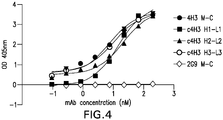
- the heavy chain comprises the amino acid sequence of SEQ ID NO: 164 and the light chain comprises the amino acid sequence of SEQ ID NO: 170. It is further described that the heavy chain is encoded by the nucleotide sequence of SEQ ID NO: 163 and the light chain is encoded by the nucleotide sequence of SEQ ID NO: 169.
- the heavy chain comprises the amino acid sequence of SEQ ID NO: 166 and the light chain comprises the amino acid sequence of SEQ ID NO: 172.
- the heavy chain is encoded by the nucleotide sequence of SEQ ID NO: 165 and the light chain is encoded by the nucleotide sequence of SEQ ID NO: 171.
- the heavy chain comprises the amino acid sequence of SEQ ID NO: 168 and the light chain comprises the amino acid sequence of SEQ ID NO: 174.
- the heavy chain is encoded by the nucleotide sequence of SEQ ID NO: 167 and the light chain is encoded by the nucleotide sequence of SEQ ID NO: 173.
- the antibody or antigen binding fragment thereof binds canine IL-4R ⁇ and blocks the binding of canine IL-4R ⁇ to canine interleukin-4.
- the caninized antibodies or caninized antigen binding fragments thereof bind to canine IL-4R ⁇ with a dissociation constant of 1 X 10 -8 M to 1 X 10 -11 M. In yet more particular embodiments the caninized antibodies or caninized antigen binding fragments thereof bind to canine IL-4Rawith a dissociation constant of 1 X 10 -8 M to 1 X 10 -10 M.
- the present invention also provides caninized antibodies or caninized antigen binding fragments thereof that bind to canine IL-4R ⁇ with an on rate (k on ) that is greater than 1 X 10 7 M -1 s -1 .
- peptides including isolated antigenic peptides are described that consist of 80 or fewer amino acid residues that comprise the amino acid sequence of SEQ ID NO: 125, or SEQ ID NO: 126, or SEQ ID NO: 127, or SEQ ID NO: 128, or SEQ ID NO: 154, or SEQ ID NO: 155, or SEQ ID NO: 156, or SEQ ID NO: 157, or SEQ ID NO: 158, or SEQ ID NO: 159, or SEQ ID NO: 160, or SEQ ID NO: 161, or SEQ ID NO: 162.
- peptides including isolated antigenic peptides
- antigenic peptides including isolated peptides
- the fusion protein comprises any of the aforesaid antigenic peptides and glutathione S-transferase. In yet other descriptions, the fusion protein comprises any of the aforesaid antigenic peptides and thioredoxin. In still other descriptions the fusion protein comprises any of the aforesaid antigenic peptides and Gro EL. In yet other descriptions the fusion protein comprises any of the aforesaid antigenic peptides and NusA.
- Activity of a molecule may describe or refer to the binding of the molecule to a ligand or to a receptor, to catalytic activity; to the ability to stimulate gene expression or cell signaling, differentiation, or maturation; to antigenic activity, to the modulation of activities of other molecules, and the like.
- Activity of a molecule may also refer to activity in modulating or maintaining cell-to-cell interactions, e.g., adhesion, or activity in maintaining a structure of a cell, e.g., cell membranes or cytoskeleton.
- Activity can also mean specific activity, e.g., [catalytic activity]/[mg protein], or [immunological activity]/[mg protein], concentration in a biological compartment, or the like.
- Activity may refer to modulation of components of the innate or the adaptive immune systems.
- the cytokines IL-4 and IL-13 have been implicated in the pathogenesis of a variety of allergic diseases in humans and animals, including asthma and atopic dermatitis. Because the IL-4 receptor ⁇ chain is a requisite receptor for the signaling from either of these cytokines, the present invention describes the generation and characterization of monoclonal antibodies that block the binding of canine IL-4 and canine IL-13 to IL-4R ⁇ and thereby inhibits the signaling from both canine IL-4 and IL-13. These antibodies therefore have utility in treatment of atopic dermatitis and other diseases in companion animals as disclosed herein.
- a biological function of canine IL-4R ⁇ may be having, for example, an epitope in the extracellular domain that is specifically bound by an antibody of the instant disclosure.
- the antibody, or binding compound derived from the antigen-binding site of an antibody, of the contemplated method binds to its antigen, or a variant or mutein thereof, with an affinity that is at least two-fold greater, preferably at least ten-times greater, more preferably at least 20-times greater, and most preferably at least 100-times greater than the affinity with any other antigen.
- an antibody is said to bind specifically to a polypeptide comprising a given antigen sequence (in this case a portion of the amino acid sequence of canine IL-4R ⁇ ) if it binds to polypeptides comprising the portion of the amino acid sequence of canine IL-4R ⁇ , but does not bind to other canine proteins lacking that portion of the sequence of canine IL-4R ⁇ .
- a polypeptide comprising canine IL-4R ⁇ may bind to a FLAG®-tagged form of canine IL-4R ⁇ , but will not bind to other FLAG®-tagged canine proteins.
- An antibody, or binding compound derived from the antigen-binding site of an antibody binds to its canine antigen, or a variant or mutein thereof, "with specificity" when it has an affinity for that canine antigen or a variant or mutein thereof which is at least ten-times greater, more preferably at least 20-times greater, and even more preferably at least 100-times greater than its affinity for any other canine antigen tested.
- antibody fragment or “antigen binding fragment” refers to antigen binding fragments of antibodies, i.e. antibody fragments that retain the ability to bind specifically to the antigen bound by the full-length antibody, e.g. fragments that retain one or more CDR regions.
- antigen binding fragments include, but are not limited to, Fab, Fab', F(ab') 2 , and Fv fragments; diabodies; linear antibodies; single-chain antibody molecules, e.g., sc-Fv; nanobodies and multispecific antibodies formed from antibody fragments.
- a “Fab fragment” is comprised of one light chain and the C H 1 and variable regions of one heavy chain.
- the heavy chain of a Fab molecule cannot form a disulfide bond with another heavy chain molecule.
- a “Fab fragment” can be the product of papain cleavage of an antibody.
- a "Fab' fragment” contains one light chain and a portion or fragment of one heavy chain that contains the V H domain and the C H 1 domain and also the region between the C H 1 and C H 2 domains, such that an interchain disulfide bond can be formed between the two heavy chains of two Fab' fragments to form a F(ab') 2 molecule.
- the "Fv region” comprises the variable regions from both the heavy and light chains, but lacks the constant regions.
- a "domain antibody” is an immunologically functional immunoglobulin fragment containing only the variable region of a heavy chain or the variable region of a light chain.
- two or more V H regions are covalently joined with a peptide linker to create a bivalent domain antibody.
- the two V H regions of a bivalent domain antibody may target the same or different antigens.
- bivalent antibody comprises two antigen binding sites. In some instances, the two binding sites have the same antigen specificities. However, bivalent antibodies may be bispecific (see below).
- isolated antibody refers to the purification status and in such context means the molecule is substantially free of other biological molecules such as nucleic acids, proteins, lipids, carbohydrates, or other material such as cellular debris and growth media. Generally, the term “isolated” is not intended to refer to a complete absence of such material or to an absence of water, buffers, or salts, unless they are present in amounts that substantially interfere with experimental or therapeutic use of the binding compound as described herein.
- the term "caninized antibody” refers to forms of antibodies that contain sequences from both canine and non-canine (e.g., murine) antibodies.
- the caninized antibody will comprise substantially all of at least one or more typically, two variable domains in which all or substantially all of the hypervariable loops correspond to those of a non-canine immunoglobulin (e.g ., comprising 6 murine anti-canine IL-4R ⁇ CDRs as exemplified below), and all or substantially all of the framework (FR) regions (and typically all or substantially all of the remaining frame) are those of a canine immunoglobulin sequence.
- a non-canine immunoglobulin e.g ., comprising 6 murine anti-canine IL-4R ⁇ CDRs as exemplified below
- all or substantially all of the framework (FR) regions are those of a canine immunoglobulin sequence.
- hypervariable region refers to the amino acid residues of an antibody that are responsible for antigen-binding.
- the hypervariable region comprises amino acid residues from a "complementarity determining region” or "CDR" (i.e. CDRL1, CDRL2 and CDRL3 in the light chain variable domain and CDRH1, CDRH2 and CDRH3 in the heavy chain variable domain).
- CDR complementarity determining region
- IgG-B can be purified using protein A, but has high level of ADCC activity.
- IgG-A binds weakly to protein A, but displays undesirable ADCC activity.
- IgG-C nor IgG-D can be purified on protein A columns, although IgG-D display no ADCC activity. (IgG-C has considerable ADCC activity).
- One way the present invention overcomes this difficulty is by providing mutant canine IgG-B antibodies specific to IL-4R ⁇ ; such antibodies lack effector functions such as ADCC and can be easily of purified using industry standard protein A chromatography.
- Isolated nucleic acid molecules "comprising" specified nucleic acid sequences may include, in addition to the specified sequences, coding sequences for up to ten or even up to twenty or more other proteins or portions or fragments thereof, or may include operably linked regulatory sequences that control expression of the coding region of the recited nucleic acid sequences, and/or may include vector sequences.
- a nucleic acid is "operably linked" when it is placed into a functional relationship with another nucleic acid sequence.
- DNA for a presequence or secretory leader is operably linked to DNA for a polypeptide if it is expressed as a preprotein that participates in the secretion of the polypeptide;
- a promoter or enhancer is operably linked to a coding sequence if it affects the transcription of the sequence; or
- a ribosome binding site is operably linked to a coding sequence if it is positioned so as to facilitate translation.
- "operably linked” means that the DNA sequences being linked are contiguous, and, in the case of a secretory leader, contiguous and in reading phase. However, enhancers do not have to be contiguous. Linking is accomplished by ligation at convenient restriction sites. If such sites do not exist, the synthetic oligonucleotide adaptors or linkers are used in accordance with conventional practice.
- germline sequence refers to a sequence of unrearranged immunoglobulin DNA sequences. Any suitable source of unrearranged immunoglobulin sequences may be used.
- Human germline sequences may be obtained, for example, from JOINSOLVER® germline databases on the website for the National Institute of Arthritis and Musculoskeletal and Skin Diseases of the United States National Institutes of Health.
- Mouse germline sequences may be obtained, for example, as described in Giudicelli et al. [Nucleic Acids Res. 33:D256-D261 (2005 )].
- the present invention provides isolated murine anti-canine IL-4R ⁇ and/or caninized murine anti-canine IL-4R ⁇ antibodies or antigen binding fragments thereof that bind to canine IL-4R ⁇ and block the binding of canine IL-4 and canine IL-13 to the type-I or type II IL-4 receptors.
- the antibody or antigen binding fragment thereof that binds canine IL-4R ⁇ can comprise six of the complementarity determining regions (CDRs) of the murine anti-canine antibody as described herein.
- CDRs complementarity determining regions
- tThe isolated antibody or antigen-binding fragment thereof that binds canine IL-4R ⁇ comprises a canine antibody kappa light chain comprising a murine light chain CDR-1, CDR-2 and/or CDR-3 and a canine antibody heavy chain IgG comprising a murine heavy chain CDR-1, CDR-2 and/or CDR-3.
- nucleic acids that encode immunoglobulin polypeptides comprising amino acid sequences that are at least about 70% similar, preferably at least about 80% similar, more preferably at least about 90% similar and most preferably at least about 95% similar (e.g., 95%, 96%, 97%, 98%, 99%, 100%) to any of the reference amino acid sequences when the comparison is performed with a BLAST algorithm, wherein the parameters of the algorithm are selected to give the largest match between the respective sequences over the entire length of the respective reference sequences.
- B LAST ALGORITHMS Altschul, S.F., et al., J. Mol. Biol. 215:403-410 (1990 ); Gish, W., et al., Nature Genet. 3:266-272 (1993 ); Madden, T.L., et al.,Meth. Enzymol. 266:131-141(1996 ); Altschul, S.F., et al., Nucleic Acids Res. 25:3389-3402 (1997 ); Zhang, J., et al, Genome Res. 7:649-656 (1997 ); Wootton, J.C., et a/., Comput.
- Imaging techniques include SPECT imaging (single photon emission computed tomography) or PET imaging (positron emission tomography).
- Labels include e.g ., iodine-123 ( 123 I) and technetium-99m ( 99m Tc), e.g., in conjunction with SPECT imaging or 11 C, 13 N, 15 O or 18 F, e.g., in conjunction with PET imaging or Indium-111 [ See e.g., Gordon et al., International Rev. Neurobiol. 67:385-440 (2005 )].
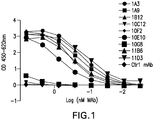
- cross-blocking antibodies and antigen-binding fragments thereof discussed herein can be identified based on their ability to cross-compete with the antibodies disclosed herein (on the basis of the CDRs as provided below in Example 5), i.e., 1A3, 1A9, 1B12, 10C12, 10F2, 10E10, 10G8, and/or 11D3; or more particularly, 11B6 and/or 6C12; and even more particularly 4D8, 4H3, 2E2, and/or 11H2, in standard binding assays (e.g ., BIACore®, ELISA, as exemplified below, or flow cytometry).
- standard binding assays e.g ., BIACore®, ELISA, as exemplified below, or flow cytometry.
- standard ELISA assays can be used in which a recombinant canine IL-4R ⁇ protein is immobilized on the plate, one of the antibodies is fluorescently labeled and the ability of non-labeled antibodies to compete off the binding of the labeled antibody is evaluated.
- BIAcore® analysis can be used to assess the ability of the antibodies to cross-compete.
- the kit can also include a device for performing such administration.
- the kit can include one or more hypodermic needles or other injection devices as discussed above.
- the kit can also include a package insert including information concerning the pharmaceutical compositions and dosage forms in the kit. Generally, such information aids pet owners and veterinarians in using the enclosed pharmaceutical compositions and dosage forms effectively and safely.
- an antibody or specific binding agent disclosed herein can be provided in a kit, i.e., a packaged combination of reagents in predetermined amounts with instructions for performing the diagnostic or detection assay.
- the kit will include substrates and cofactors required by the enzyme (e.g., a substrate precursor which provides the detectable chromophore or fluorophore).
- substrates and cofactors required by the enzyme e.g., a substrate precursor which provides the detectable chromophore or fluorophore.
- other additives may be included such as stabilizers, buffers (e.g., a block buffer or lysis buffer) and the like.
- the relative amounts of the various reagents may be varied widely to provide for concentrations in solution of the reagents which substantially optimize the sensitivity of the assay.
- the reagents may be provided as dry powders, usually lyophilized, including excipients which on dissolution will provide a reagent solution having the appropriate concentration.
- Epitope mapping can be carried out using polyclonal or monoclonal antibodies and several methods are employed for epitope identification depending on the suspected nature of the epitope (i.e., linear versus conformational). Mapping linear epitopes is more straightforward and relatively, easier to perform. For this purpose, commercial services for linear epitope mapping often employ peptide scanning. In this case, an overlapping set of short peptide sequences of the target protein are chemically synthesized and tested for their ability to bind antibodies of interest. The strategy is rapid, high-throughput, and relatively inexpensive to perform.
- EPITOPE SEQUENCE 4D8 125 SAELRLSYQLD 126 FQPSKHVKPRT 1 11H2 127 AGQQLL WSGSFQPSKHVKPRT 1 128 TLKSGASYS 2 4H3 154 EDSVCVCSMPI 3 155 MWTNPYPTENHL 156 AS TLKSG 2 11B6 157 WSGSFQPSKHVKPR 1 158 VYNVTYMGPTLR 2E2 159 VLHEPSCFSDYISTSVCQ 160 ENR EDSVCVCSMPI 3 161 KSGASYS ARVRAW 2 6C12 158 VYNVTYMGPTLR 162 YYEPWEQHLP 1,2,3 identify three individual groups of epitopes arising from three portions of the antigen.
- the DNA sequence that encodes the heavy and light chains of canine IgG were determined.
- the DNA and protein sequence of the canine heavy and light chains are known in the art and can be obtained by searching of the NCBI gene and protein databases.
- IgG subtypes IgG-A, IgG-B, IgG-C, and IgG-D, and two types of light chains, i.e., kappa and lambda.
- the overall process of producing caninized heavy and light chains that can be mixed in different combinations to produce caninized anti-canine IL-4 receptor alpha mAbs involves the following scheme:
Landscapes
- Health & Medical Sciences (AREA)
- Chemical & Material Sciences (AREA)
- Organic Chemistry (AREA)
- Life Sciences & Earth Sciences (AREA)
- Medicinal Chemistry (AREA)
- General Health & Medical Sciences (AREA)
- Immunology (AREA)
- Engineering & Computer Science (AREA)
- Bioinformatics & Cheminformatics (AREA)
- Pharmacology & Pharmacy (AREA)
- Animal Behavior & Ethology (AREA)
- Public Health (AREA)
- Veterinary Medicine (AREA)
- General Chemical & Material Sciences (AREA)
- Nuclear Medicine, Radiotherapy & Molecular Imaging (AREA)
- Chemical Kinetics & Catalysis (AREA)
- Genetics & Genomics (AREA)
- Pulmonology (AREA)
- Biophysics (AREA)
- Molecular Biology (AREA)
- Biochemistry (AREA)
- Proteomics, Peptides & Aminoacids (AREA)
- Rheumatology (AREA)
- Pain & Pain Management (AREA)
- Biomedical Technology (AREA)
- Dermatology (AREA)
- Zoology (AREA)
- Microbiology (AREA)
- Wood Science & Technology (AREA)
- General Engineering & Computer Science (AREA)
- Biotechnology (AREA)
- Epidemiology (AREA)
- Physics & Mathematics (AREA)
- Transplantation (AREA)
- Plant Pathology (AREA)
- Mycology (AREA)
- Endocrinology (AREA)
- Peptides Or Proteins (AREA)
- Medicines Containing Antibodies Or Antigens For Use As Internal Diagnostic Agents (AREA)
- Medicines That Contain Protein Lipid Enzymes And Other Medicines (AREA)
Priority Applications (1)
| Application Number | Priority Date | Filing Date | Title |
|---|---|---|---|
| EP21184631.6A EP3954710A3 (en) | 2015-04-02 | 2016-04-01 | Antibodies to canine interleukin-4 receptor alpha |
Applications Claiming Priority (4)
| Application Number | Priority Date | Filing Date | Title |
|---|---|---|---|
| US201562142108P | 2015-04-02 | 2015-04-02 | |
| US201562269486P | 2015-12-18 | 2015-12-18 | |
| US201662310250P | 2016-03-18 | 2016-03-18 | |
| PCT/EP2016/057256 WO2016156588A1 (en) | 2015-04-02 | 2016-04-01 | Antibodies to canine interleukin-4 receptor alpha |
Related Child Applications (2)
| Application Number | Title | Priority Date | Filing Date |
|---|---|---|---|
| EP21184631.6A Division-Into EP3954710A3 (en) | 2015-04-02 | 2016-04-01 | Antibodies to canine interleukin-4 receptor alpha |
| EP21184631.6A Division EP3954710A3 (en) | 2015-04-02 | 2016-04-01 | Antibodies to canine interleukin-4 receptor alpha |
Publications (2)
| Publication Number | Publication Date |
|---|---|
| EP3277722A1 EP3277722A1 (en) | 2018-02-07 |
| EP3277722B1 true EP3277722B1 (en) | 2021-08-18 |
Family
ID=55646606
Family Applications (2)
| Application Number | Title | Priority Date | Filing Date |
|---|---|---|---|
| EP16713465.9A Active EP3277722B1 (en) | 2015-04-02 | 2016-04-01 | Antibodies to canine interleukin-4 receptor alpha |
| EP21184631.6A Pending EP3954710A3 (en) | 2015-04-02 | 2016-04-01 | Antibodies to canine interleukin-4 receptor alpha |
Family Applications After (1)
| Application Number | Title | Priority Date | Filing Date |
|---|---|---|---|
| EP21184631.6A Pending EP3954710A3 (en) | 2015-04-02 | 2016-04-01 | Antibodies to canine interleukin-4 receptor alpha |
Country Status (12)
| Country | Link |
|---|---|
| US (3) | US10858437B2 (enExample) |
| EP (2) | EP3277722B1 (enExample) |
| JP (4) | JP6938383B2 (enExample) |
| CN (2) | CN113861294B (enExample) |
| AU (1) | AU2016239858B2 (enExample) |
| CA (3) | CA2980087A1 (enExample) |
| DK (1) | DK3277722T3 (enExample) |
| ES (1) | ES2893148T3 (enExample) |
| HK (1) | HK1250514A1 (enExample) |
| PT (1) | PT3277722T (enExample) |
| RU (1) | RU2736732C2 (enExample) |
| WO (1) | WO2016156588A1 (enExample) |
Families Citing this family (29)
| Publication number | Priority date | Publication date | Assignee | Title |
|---|---|---|---|---|
| WO2014100853A1 (en) | 2012-12-28 | 2014-07-03 | Cellestis Limited | A cell mediated immune response assay |
| CA2980087A1 (en) * | 2015-04-02 | 2016-10-06 | Intervet International B.V. | Antibodies to canine interleukin-4 receptor alpha |
| ES3014160T3 (en) * | 2015-12-18 | 2025-04-21 | Intervet Int Bv | Caninized human antibodies to human and canine il-4r alpha |
| US11091556B2 (en) | 2015-12-18 | 2021-08-17 | Intervet Inc. | Caninized human antibodies to human IL-4R alpha |
| WO2018089300A1 (en) * | 2016-11-10 | 2018-05-17 | Merck Sharp & Dohme Corp. | Ilt3 ligand |
| US11970526B2 (en) | 2017-04-21 | 2024-04-30 | Elanco Us Inc. | IL4/IL13 receptor molecule for veterinary use |
| WO2020038454A1 (zh) * | 2018-08-24 | 2020-02-27 | 江苏恒瑞医药股份有限公司 | 结合人il-4r的抗体、其抗原结合片段及其医药用途 |
| CN110872349A (zh) | 2018-09-04 | 2020-03-10 | 三生国健药业(上海)股份有限公司 | 结合人il-4r的抗体、其制备方法和用途 |
| MX2021002971A (es) * | 2018-09-14 | 2021-05-12 | Kindred Biosciences Inc | Anticuerpos del receptor anti-interleucina 4 para uso veterinario. |
| GB2578867A (en) * | 2018-10-09 | 2020-06-03 | Genome Res Ltd | Animal models and therapeutic molecules |
| CA3125067A1 (en) * | 2018-12-27 | 2020-07-02 | Akeso Biopharma, Inc. | Antibody against human il-4ra and use thereof |
| WO2020243616A1 (en) * | 2019-05-31 | 2020-12-03 | Seattle Children's Hospital D/B/A Seattle Children's Research Institute | E-cadherin activating antibodies and uses thereof |
| JP7695228B2 (ja) * | 2019-07-15 | 2025-06-18 | インターベット インターナショナル ベー. フェー. | ヒト及びイヌctla-4に対するイヌ化抗体 |
| MX2022001247A (es) | 2019-08-05 | 2022-04-25 | Regeneron Pharma | Metodos para tratar dermatitis atopica mediante la administracion de un antagonista il-4r. |
| AU2020407853A1 (en) * | 2019-12-20 | 2022-06-09 | Intervet International B.V. | Antibodies to canine interleukin-4 receptor alpha |
| JP7875803B2 (ja) | 2019-12-20 | 2026-06-18 | インターベット インターナショナル ベー. フェー. | アトピー性皮膚炎を処置するための二重特異性イヌ化抗体 |
| KR20220155336A (ko) * | 2020-03-18 | 2022-11-22 | 킨드레드 바이오사이언시스, 인코포레이티드 | 수의학적 용도를 위한 항-il4 수용체 항체 |
| MX2023004439A (es) | 2020-10-15 | 2023-05-08 | Intervet Int Bv | Anticuerpos caninizados contra el receptor alfa de la interleucina-31 canina. |
| US20250325630A1 (en) | 2021-08-20 | 2025-10-23 | Intervet Inc. | Homodimer fusion proteins for treating atopic dermatitis |
| CN113817055B (zh) * | 2021-10-27 | 2023-04-18 | 福州迈新生物技术开发有限公司 | 抗Actin蛋白单克隆抗体、细胞系及其应用 |
| CN115856291B (zh) * | 2022-07-26 | 2025-06-27 | 中国检验检疫科学研究院 | 一种检测施马伦贝格病毒的单克隆抗体、试纸条及制备方法 |
| JP2026502203A (ja) | 2022-12-27 | 2026-01-21 | インベテックス インコーポレイテッド | 新生仔fc受容体(fcrn)との改変された結合を伴うポリペプチド及び使用方法 |
| US20260234262A1 (en) | 2023-01-20 | 2026-08-13 | Invetx, Inc. | Bispecific binding agents for use in companion animals |
| CN120897928A (zh) | 2023-02-13 | 2025-11-04 | 英特维特国际股份有限公司 | 针对犬il-4的犬抗体 |
| US20260234236A1 (en) | 2023-02-13 | 2026-08-13 | Intervet Inc. | Canine antibodies to canine il-13 |
| WO2025114614A1 (en) | 2023-11-30 | 2025-06-05 | Vetoquinol Sa | Anti-canine interleukine-4-receptor alpha (il-4rα) antibodies and the uses thereof |
| WO2026125321A1 (en) | 2024-12-10 | 2026-06-18 | Intervet International B.V. | Caninized il31rα antibodies with an extended half life |
| WO2026125320A1 (en) | 2024-12-10 | 2026-06-18 | Intervet International B.V. | Caninized il31rα antibodies with an extended half life |
| WO2026125322A1 (en) | 2024-12-10 | 2026-06-18 | Intervet International B.V. | CANINIZED IL31Rα ANTIBODIES WITH AN EXTENDED HALF LIFE |
Family Cites Families (51)
| Publication number | Priority date | Publication date | Assignee | Title |
|---|---|---|---|---|
| US4447233A (en) | 1981-04-10 | 1984-05-08 | Parker-Hannifin Corporation | Medication infusion pump |
| US4439196A (en) | 1982-03-18 | 1984-03-27 | Merck & Co., Inc. | Osmotic drug delivery system |
| US4447224A (en) | 1982-09-20 | 1984-05-08 | Infusaid Corporation | Variable flow implantable infusion apparatus |
| US4487603A (en) | 1982-11-26 | 1984-12-11 | Cordis Corporation | Implantable microinfusion pump system |
| US4816567A (en) | 1983-04-08 | 1989-03-28 | Genentech, Inc. | Recombinant immunoglobin preparations |
| US4596556A (en) | 1985-03-25 | 1986-06-24 | Bioject, Inc. | Hypodermic injection apparatus |
| CA1319120C (en) | 1985-04-01 | 1993-06-15 | John Henry Kenten | Transformed myeloma cell-line and a process for the expression of a gene coding for a eukaryotic polypeptide employing same |
| GB8601597D0 (en) | 1986-01-23 | 1986-02-26 | Wilson R H | Nucleotide sequences |
| US4946778A (en) | 1987-09-21 | 1990-08-07 | Genex Corporation | Single polypeptide chain binding molecules |
| US5260203A (en) | 1986-09-02 | 1993-11-09 | Enzon, Inc. | Single polypeptide chain binding molecules |
| WO1988001649A1 (en) | 1986-09-02 | 1988-03-10 | Genex Corporation | Single polypeptide chain binding molecules |
| US4790824A (en) | 1987-06-19 | 1988-12-13 | Bioject, Inc. | Non-invasive hypodermic injection device |
| US4941880A (en) | 1987-06-19 | 1990-07-17 | Bioject, Inc. | Pre-filled ampule and non-invasive hypodermic injection device assembly |
| GB8717430D0 (en) | 1987-07-23 | 1987-08-26 | Celltech Ltd | Recombinant dna product |
| GB8808015D0 (en) | 1988-04-06 | 1988-05-05 | Ritter M A | Chemical compounds |
| AU643427B2 (en) | 1988-10-31 | 1993-11-18 | Immunex Corporation | Interleukin-4 receptors |
| DE3920358A1 (de) | 1989-06-22 | 1991-01-17 | Behringwerke Ag | Bispezifische und oligospezifische, mono- und oligovalente antikoerperkonstrukte, ihre herstellung und verwendung |
| US5064413A (en) | 1989-11-09 | 1991-11-12 | Bioject, Inc. | Needleless hypodermic injection device |
| US5312335A (en) | 1989-11-09 | 1994-05-17 | Bioject Inc. | Needleless hypodermic injection device |
| DK0617706T3 (da) | 1991-11-25 | 2001-11-12 | Enzon Inc | Multivalente antigenbindende proteiner |
| US5383851A (en) | 1992-07-24 | 1995-01-24 | Bioject Inc. | Needleless hypodermic injection device |
| DE69334308D1 (de) | 1992-08-21 | 2010-02-04 | Univ Bruxelles | Immunoglobuline ohne leichte Ketten |
| US6005079A (en) | 1992-08-21 | 1999-12-21 | Vrije Universiteit Brussels | Immunoglobulins devoid of light chains |
| AU6796094A (en) | 1993-04-29 | 1994-11-21 | Raymond Hamers | Production of antibodies or (functionalized) fragments thereof derived from heavy chain immunoglobulins of (camelidae) |
| GB9818110D0 (en) | 1998-08-19 | 1998-10-14 | Weston Medical Ltd | Needleless injectors and other devices |
| US6096002A (en) | 1998-11-18 | 2000-08-01 | Bioject, Inc. | NGAS powered self-resetting needle-less hypodermic jet injection apparatus and method |
| DK2270149T3 (en) | 1999-04-09 | 2016-05-09 | Kyowa Hakko Kirin Co Ltd | PROCEDURE TO CONTROL THE ACTIVITY OF IMMUNOLOGICAL FUNCTIONAL MOLECULE. |
| US20020002132A1 (en) | 2000-05-26 | 2002-01-03 | Pluenneke John D. | Use of interleukin-4 antagonists and compositions thereof |
| US6946292B2 (en) | 2000-10-06 | 2005-09-20 | Kyowa Hakko Kogyo Co., Ltd. | Cells producing antibody compositions with increased antibody dependent cytotoxic activity |
| US7432341B2 (en) * | 2002-10-24 | 2008-10-07 | Valo Hsj, Limited Partnership | Cytokine receptor modulators and method of modulating cytokine receptor activity |
| US7208579B2 (en) | 2003-05-30 | 2007-04-24 | The Regents Of The University Of California | IL4 receptor antagonists for horse, dog and cat |
| DK2769992T3 (da) * | 2006-10-02 | 2021-03-22 | Regeneron Pharma | Humane antistoffer med høj affinitet for human IL-4-receptor |
| US7608693B2 (en) | 2006-10-02 | 2009-10-27 | Regeneron Pharmaceuticals, Inc. | High affinity human antibodies to human IL-4 receptor |
| CA2671865C (en) | 2006-12-14 | 2017-01-10 | Schering-Plough Ltd. | Canine thymic stromal lymphopoietin protein and uses thereof |
| US8092804B2 (en) * | 2007-12-21 | 2012-01-10 | Medimmune Limited | Binding members for interleukin-4 receptor alpha (IL-4Rα)-173 |
| MX343594B (es) | 2007-12-21 | 2016-11-11 | Medimmune Ltd | Miembros de union para receptor alfa de interleucina-4 (il-4ra) - 173. |
| EP2344497B1 (en) | 2008-09-22 | 2014-03-05 | Merck Canada Inc. | Azaindole derivatives as crth2 receptor antagonists |
| US8637671B2 (en) | 2008-09-22 | 2014-01-28 | Merck Canada Inc. | Indole derivatives as CRTH2 receptor antagonists |
| AU2009316076B2 (en) | 2008-11-17 | 2015-11-19 | Kobenhavns Universitet | IL-4-derived peptides for modulation of the chronic inflammatory response and treatment of autoimmune diseases |
| RS53268B (sr) | 2009-02-24 | 2014-08-29 | Merck Canada Inc. | Derivati indola kao antagonisti crth2 receptora |
| EA022790B1 (ru) | 2009-12-17 | 2016-03-31 | Мерк Шарп Энд Домэ Корп. | Аминопиримидины в качестве syk ингибиторов |
| AU2011291462A1 (en) * | 2010-08-19 | 2013-03-14 | Zoetis Belgium S.A. | Anti-NGF antibodies and their use |
| GB201114858D0 (en) | 2011-08-29 | 2011-10-12 | Nvip Pty Ltd | Anti-nerve growth factor antibodies and methods of using the same |
| WO2013040241A1 (en) | 2011-09-13 | 2013-03-21 | Privatecore, Inc. | Software cryptoprocessor |
| RU2666630C2 (ru) | 2012-09-07 | 2018-09-11 | Ридженерон Фармасьютикалз, Инк. | Способы лечения атопического дерматита с помощью антагониста il-4r |
| TWI697334B (zh) * | 2013-06-04 | 2020-07-01 | 美商再生元醫藥公司 | 藉由投與il-4r抑制劑以治療過敏及增強過敏原-特異之免疫療法的方法 |
| TWI634900B (zh) | 2013-07-11 | 2018-09-11 | 再生元醫藥公司 | 藉由投與il-4r抑制劑治療嗜酸性食道炎的方法 |
| WO2015091910A2 (en) | 2013-12-20 | 2015-06-25 | Intervet International B.V. | Caninized antibodies |
| CA2961987A1 (en) | 2014-09-30 | 2016-04-07 | Intervet International B.V. | Pd-l1 antibodies binding canine pd-l1 |
| CA2980087A1 (en) | 2015-04-02 | 2016-10-06 | Intervet International B.V. | Antibodies to canine interleukin-4 receptor alpha |
| ES3014160T3 (en) * | 2015-12-18 | 2025-04-21 | Intervet Int Bv | Caninized human antibodies to human and canine il-4r alpha |
-
2016
- 2016-04-01 CA CA2980087A patent/CA2980087A1/en active Pending
- 2016-04-01 ES ES16713465T patent/ES2893148T3/es active Active
- 2016-04-01 CA CA3232537A patent/CA3232537A1/en active Pending
- 2016-04-01 CA CA3232651A patent/CA3232651A1/en active Pending
- 2016-04-01 DK DK16713465.9T patent/DK3277722T3/da active
- 2016-04-01 EP EP16713465.9A patent/EP3277722B1/en active Active
- 2016-04-01 WO PCT/EP2016/057256 patent/WO2016156588A1/en not_active Ceased
- 2016-04-01 PT PT16713465T patent/PT3277722T/pt unknown
- 2016-04-01 AU AU2016239858A patent/AU2016239858B2/en active Active
- 2016-04-01 HK HK18109897.5A patent/HK1250514A1/zh unknown
- 2016-04-01 US US15/562,308 patent/US10858437B2/en active Active
- 2016-04-01 CN CN202111287662.8A patent/CN113861294B/zh active Active
- 2016-04-01 EP EP21184631.6A patent/EP3954710A3/en active Pending
- 2016-04-01 RU RU2017134495A patent/RU2736732C2/ru active
- 2016-04-01 JP JP2017550875A patent/JP6938383B2/ja active Active
- 2016-04-01 CN CN201680032086.3A patent/CN107683291B/zh active Active
-
2020
- 2020-10-27 US US17/081,188 patent/US12180288B2/en active Active
-
2021
- 2021-09-01 JP JP2021142569A patent/JP7371070B2/ja active Active
-
2023
- 2023-10-18 JP JP2023179297A patent/JP7854420B2/ja active Active
-
2024
- 2024-12-12 US US18/979,510 patent/US20250179199A1/en active Pending
-
2025
- 2025-05-20 JP JP2025084438A patent/JP2025129151A/ja active Pending
Non-Patent Citations (2)
| Title |
|---|
| AL-LAZIKANI BISSAN ET AL: "Standard conformations for the canonical structures of immunoglobulins11Edited by I. A. Wilson", JOURNAL OF MOLECULAR BIOLOGY, vol. 273, no. 4, 1997, pages 927 - 948, XP085029743, ISSN: 0022-2836, DOI: 10.1006/JMBI.1997.1354 * |
| INBAL SELA-CULANG ET AL: "The Structural Basis of Antibody-Antigen Recognition", FRONTIERS IN IMMUNOLOGY, vol. 4, 8 October 2013 (2013-10-08), XP055557261, DOI: 10.3389/fimmu.2013.00302 * |
Also Published As
Similar Documents
| Publication | Publication Date | Title |
|---|---|---|
| US20250179199A1 (en) | Antibodies to canine interleukin-4 receptor alpha | |
| US20250206830A1 (en) | Caninized human antibodies to human il-4r alpha | |
| US12577310B2 (en) | Caninized antibodies to canine interleukin-31 receptor alpha | |
| US12545738B2 (en) | Canine interleukin-4 receptor alpha antibodies | |
| US11091556B2 (en) | Caninized human antibodies to human IL-4R alpha | |
| JP2024546763A (ja) | イヌインターロイキン-31受容体アルファiに対するイヌ化抗体 | |
| BR122024026201A2 (pt) | Anticorpo de mamífero isolado ou fragmento de ligação ao antígeno do mesmo, anticorpo monoclonal caninizado ou fragmento de ligação ao antígeno do mesmo, ácido nucleico isolado, vetor de expressão, célula hospedeira, composição farmacêutica e uso da mesma | |
| BR122025002522A2 (pt) | Anticorpo de mamífero isolado ou fragmento de ligação ao antígeno do mesmo, anticorpo monoclonal caninizado ou fragmento de ligação ao antígeno do mesmo, ácido nucleico isolado, vetor de expressão, célula hospedeira, composição farmacêutica e uso da mesma | |
| BR112017020915B1 (pt) | Anticorpo caninizado isolado ou fragmento de ligação ao antígeno caninizado do mesmo, ácido nucleico isolado, vetor de expressão, célula hospedeira, composição farmacêutica e uso da mesma |
Legal Events
| Date | Code | Title | Description |
|---|---|---|---|
| STAA | Information on the status of an ep patent application or granted ep patent |
Free format text: STATUS: THE INTERNATIONAL PUBLICATION HAS BEEN MADE |
|
| PUAI | Public reference made under article 153(3) epc to a published international application that has entered the european phase |
Free format text: ORIGINAL CODE: 0009012 |
|
| STAA | Information on the status of an ep patent application or granted ep patent |
Free format text: STATUS: REQUEST FOR EXAMINATION WAS MADE |
|
| 17P | Request for examination filed |
Effective date: 20171102 |
|
| AK | Designated contracting states |
Kind code of ref document: A1 Designated state(s): AL AT BE BG CH CY CZ DE DK EE ES FI FR GB GR HR HU IE IS IT LI LT LU LV MC MK MT NL NO PL PT RO RS SE SI SK SM TR |
|
| AX | Request for extension of the european patent |
Extension state: BA ME |
|
| DAV | Request for validation of the european patent (deleted) | ||
| DAX | Request for extension of the european patent (deleted) | ||
| REG | Reference to a national code |
Ref country code: HK Ref legal event code: DE Ref document number: 1250514 Country of ref document: HK |
|
| STAA | Information on the status of an ep patent application or granted ep patent |
Free format text: STATUS: EXAMINATION IS IN PROGRESS |
|
| 17Q | First examination report despatched |
Effective date: 20190411 |
|
| GRAP | Despatch of communication of intention to grant a patent |
Free format text: ORIGINAL CODE: EPIDOSNIGR1 |
|
| STAA | Information on the status of an ep patent application or granted ep patent |
Free format text: STATUS: GRANT OF PATENT IS INTENDED |
|
| INTG | Intention to grant announced |
Effective date: 20210412 |
|
| GRAS | Grant fee paid |
Free format text: ORIGINAL CODE: EPIDOSNIGR3 |
|
| GRAA | (expected) grant |
Free format text: ORIGINAL CODE: 0009210 |
|
| STAA | Information on the status of an ep patent application or granted ep patent |
Free format text: STATUS: THE PATENT HAS BEEN GRANTED |
|
| AK | Designated contracting states |
Kind code of ref document: B1 Designated state(s): AL AT BE BG CH CY CZ DE DK EE ES FI FR GB GR HR HU IE IS IT LI LT LU LV MC MK MT NL NO PL PT RO RS SE SI SK SM TR |
|
| REG | Reference to a national code |
Ref country code: GB Ref legal event code: FG4D |
|
| REG | Reference to a national code |
Ref country code: CH Ref legal event code: EP |
|
| REG | Reference to a national code |
Ref country code: DE Ref legal event code: R096 Ref document number: 602016062341 Country of ref document: DE |
|
| REG | Reference to a national code |
Ref country code: IE Ref legal event code: FG4D Ref country code: AT Ref legal event code: REF Ref document number: 1421566 Country of ref document: AT Kind code of ref document: T Effective date: 20210915 |
|
| REG | Reference to a national code |
Ref country code: PT Ref legal event code: SC4A Ref document number: 3277722 Country of ref document: PT Date of ref document: 20211006 Kind code of ref document: T Free format text: AVAILABILITY OF NATIONAL TRANSLATION Effective date: 20210929 |
|
| REG | Reference to a national code |
Ref country code: DK Ref legal event code: T3 Effective date: 20211005 |
|
| REG | Reference to a national code |
Ref country code: FI Ref legal event code: FGE |
|
| REG | Reference to a national code |
Ref country code: SE Ref legal event code: TRGR |
|
| REG | Reference to a national code |
Ref country code: NL Ref legal event code: FP |
|
| REG | Reference to a national code |
Ref country code: NO Ref legal event code: T2 Effective date: 20210818 |
|
| REG | Reference to a national code |
Ref country code: LT Ref legal event code: MG9D |
|
| REG | Reference to a national code |
Ref country code: AT Ref legal event code: MK05 Ref document number: 1421566 Country of ref document: AT Kind code of ref document: T Effective date: 20210818 |
|
| PG25 | Lapsed in a contracting state [announced via postgrant information from national office to epo] |
Ref country code: RS Free format text: LAPSE BECAUSE OF FAILURE TO SUBMIT A TRANSLATION OF THE DESCRIPTION OR TO PAY THE FEE WITHIN THE PRESCRIBED TIME-LIMIT Effective date: 20210818 Ref country code: HR Free format text: LAPSE BECAUSE OF FAILURE TO SUBMIT A TRANSLATION OF THE DESCRIPTION OR TO PAY THE FEE WITHIN THE PRESCRIBED TIME-LIMIT Effective date: 20210818 Ref country code: LT Free format text: LAPSE BECAUSE OF FAILURE TO SUBMIT A TRANSLATION OF THE DESCRIPTION OR TO PAY THE FEE WITHIN THE PRESCRIBED TIME-LIMIT Effective date: 20210818 Ref country code: AT Free format text: LAPSE BECAUSE OF FAILURE TO SUBMIT A TRANSLATION OF THE DESCRIPTION OR TO PAY THE FEE WITHIN THE PRESCRIBED TIME-LIMIT Effective date: 20210818 Ref country code: BG Free format text: LAPSE BECAUSE OF FAILURE TO SUBMIT A TRANSLATION OF THE DESCRIPTION OR TO PAY THE FEE WITHIN THE PRESCRIBED TIME-LIMIT Effective date: 20211118 |
|
| REG | Reference to a national code |
Ref country code: ES Ref legal event code: FG2A Ref document number: 2893148 Country of ref document: ES Kind code of ref document: T3 Effective date: 20220208 |
|
| PG25 | Lapsed in a contracting state [announced via postgrant information from national office to epo] |
Ref country code: PL Free format text: LAPSE BECAUSE OF FAILURE TO SUBMIT A TRANSLATION OF THE DESCRIPTION OR TO PAY THE FEE WITHIN THE PRESCRIBED TIME-LIMIT Effective date: 20210818 Ref country code: LV Free format text: LAPSE BECAUSE OF FAILURE TO SUBMIT A TRANSLATION OF THE DESCRIPTION OR TO PAY THE FEE WITHIN THE PRESCRIBED TIME-LIMIT Effective date: 20210818 Ref country code: GR Free format text: LAPSE BECAUSE OF FAILURE TO SUBMIT A TRANSLATION OF THE DESCRIPTION OR TO PAY THE FEE WITHIN THE PRESCRIBED TIME-LIMIT Effective date: 20211119 |
|
| REG | Reference to a national code |
Ref country code: DE Ref legal event code: R097 Ref document number: 602016062341 Country of ref document: DE |
|
| PG25 | Lapsed in a contracting state [announced via postgrant information from national office to epo] |
Ref country code: SM Free format text: LAPSE BECAUSE OF FAILURE TO SUBMIT A TRANSLATION OF THE DESCRIPTION OR TO PAY THE FEE WITHIN THE PRESCRIBED TIME-LIMIT Effective date: 20210818 Ref country code: SK Free format text: LAPSE BECAUSE OF FAILURE TO SUBMIT A TRANSLATION OF THE DESCRIPTION OR TO PAY THE FEE WITHIN THE PRESCRIBED TIME-LIMIT Effective date: 20210818 Ref country code: RO Free format text: LAPSE BECAUSE OF FAILURE TO SUBMIT A TRANSLATION OF THE DESCRIPTION OR TO PAY THE FEE WITHIN THE PRESCRIBED TIME-LIMIT Effective date: 20210818 Ref country code: EE Free format text: LAPSE BECAUSE OF FAILURE TO SUBMIT A TRANSLATION OF THE DESCRIPTION OR TO PAY THE FEE WITHIN THE PRESCRIBED TIME-LIMIT Effective date: 20210818 Ref country code: CZ Free format text: LAPSE BECAUSE OF FAILURE TO SUBMIT A TRANSLATION OF THE DESCRIPTION OR TO PAY THE FEE WITHIN THE PRESCRIBED TIME-LIMIT Effective date: 20210818 Ref country code: AL Free format text: LAPSE BECAUSE OF FAILURE TO SUBMIT A TRANSLATION OF THE DESCRIPTION OR TO PAY THE FEE WITHIN THE PRESCRIBED TIME-LIMIT Effective date: 20210818 |
|
| PLBE | No opposition filed within time limit |
Free format text: ORIGINAL CODE: 0009261 |
|
| STAA | Information on the status of an ep patent application or granted ep patent |
Free format text: STATUS: NO OPPOSITION FILED WITHIN TIME LIMIT |
|
| 26N | No opposition filed |
Effective date: 20220519 |
|
| PG25 | Lapsed in a contracting state [announced via postgrant information from national office to epo] |
Ref country code: SI Free format text: LAPSE BECAUSE OF FAILURE TO SUBMIT A TRANSLATION OF THE DESCRIPTION OR TO PAY THE FEE WITHIN THE PRESCRIBED TIME-LIMIT Effective date: 20210818 |
|
| PG25 | Lapsed in a contracting state [announced via postgrant information from national office to epo] |
Ref country code: MC Free format text: LAPSE BECAUSE OF FAILURE TO SUBMIT A TRANSLATION OF THE DESCRIPTION OR TO PAY THE FEE WITHIN THE PRESCRIBED TIME-LIMIT Effective date: 20210818 Ref country code: LU Free format text: LAPSE BECAUSE OF NON-PAYMENT OF DUE FEES Effective date: 20220401 |
|
| PG25 | Lapsed in a contracting state [announced via postgrant information from national office to epo] |
Ref country code: IE Free format text: LAPSE BECAUSE OF NON-PAYMENT OF DUE FEES Effective date: 20220401 |
|
| PG25 | Lapsed in a contracting state [announced via postgrant information from national office to epo] |
Ref country code: HU Free format text: LAPSE BECAUSE OF FAILURE TO SUBMIT A TRANSLATION OF THE DESCRIPTION OR TO PAY THE FEE WITHIN THE PRESCRIBED TIME-LIMIT; INVALID AB INITIO Effective date: 20160401 |
|
| PG25 | Lapsed in a contracting state [announced via postgrant information from national office to epo] |
Ref country code: MK Free format text: LAPSE BECAUSE OF FAILURE TO SUBMIT A TRANSLATION OF THE DESCRIPTION OR TO PAY THE FEE WITHIN THE PRESCRIBED TIME-LIMIT Effective date: 20210818 Ref country code: CY Free format text: LAPSE BECAUSE OF FAILURE TO SUBMIT A TRANSLATION OF THE DESCRIPTION OR TO PAY THE FEE WITHIN THE PRESCRIBED TIME-LIMIT Effective date: 20210818 |
|
| PG25 | Lapsed in a contracting state [announced via postgrant information from national office to epo] |
Ref country code: TR Free format text: LAPSE BECAUSE OF FAILURE TO SUBMIT A TRANSLATION OF THE DESCRIPTION OR TO PAY THE FEE WITHIN THE PRESCRIBED TIME-LIMIT Effective date: 20210818 |
|
| PG25 | Lapsed in a contracting state [announced via postgrant information from national office to epo] |
Ref country code: MT Free format text: LAPSE BECAUSE OF FAILURE TO SUBMIT A TRANSLATION OF THE DESCRIPTION OR TO PAY THE FEE WITHIN THE PRESCRIBED TIME-LIMIT Effective date: 20210818 |
|
| REG | Reference to a national code |
Ref country code: HK Ref legal event code: WD Ref document number: 1250514 Country of ref document: HK |
|
| PGFP | Annual fee paid to national office [announced via postgrant information from national office to epo] |
Ref country code: GB Payment date: 20260320 Year of fee payment: 11 |
|
| PGFP | Annual fee paid to national office [announced via postgrant information from national office to epo] |
Ref country code: NO Payment date: 20260326 Year of fee payment: 11 Ref country code: DK Payment date: 20260330 Year of fee payment: 11 |
|
| PGFP | Annual fee paid to national office [announced via postgrant information from national office to epo] |
Ref country code: BE Payment date: 20260324 Year of fee payment: 11 Ref country code: FI Payment date: 20260330 Year of fee payment: 11 |
|
| PGFP | Annual fee paid to national office [announced via postgrant information from national office to epo] |
Ref country code: NL Payment date: 20260323 Year of fee payment: 11 |
|
| PGFP | Annual fee paid to national office [announced via postgrant information from national office to epo] |
Ref country code: FR Payment date: 20260317 Year of fee payment: 11 |
|
| PGFP | Annual fee paid to national office [announced via postgrant information from national office to epo] |
Ref country code: PT Payment date: 20260326 Year of fee payment: 11 |
|
| REG | Reference to a national code |
Ref country code: CH Ref legal event code: U11 Free format text: ST27 STATUS EVENT CODE: U-0-0-U10-U11 (AS PROVIDED BY THE NATIONAL OFFICE) Effective date: 20260501 |
|
| PGFP | Annual fee paid to national office [announced via postgrant information from national office to epo] |
Ref country code: ES Payment date: 20260513 Year of fee payment: 11 |
|
| PGFP | Annual fee paid to national office [announced via postgrant information from national office to epo] |
Ref country code: IT Payment date: 20260413 Year of fee payment: 11 |
|
| PGFP | Annual fee paid to national office [announced via postgrant information from national office to epo] |
Ref country code: DE Payment date: 20260319 Year of fee payment: 11 |
|
| PGFP | Annual fee paid to national office [announced via postgrant information from national office to epo] |
Ref country code: SE Payment date: 20260409 Year of fee payment: 11 |
|
| PGFP | Annual fee paid to national office [announced via postgrant information from national office to epo] |
Ref country code: CH Payment date: 20260501 Year of fee payment: 11 |