EP3276484A1 - Informationsverarbeitungssystem und informationsverarbeitungsverfahren - Google Patents
Informationsverarbeitungssystem und informationsverarbeitungsverfahren Download PDFInfo
- Publication number
- EP3276484A1 EP3276484A1 EP16768103.0A EP16768103A EP3276484A1 EP 3276484 A1 EP3276484 A1 EP 3276484A1 EP 16768103 A EP16768103 A EP 16768103A EP 3276484 A1 EP3276484 A1 EP 3276484A1
- Authority
- EP
- European Patent Office
- Prior art keywords
- phrase
- mode
- unit
- information
- input
- Prior art date
- Legal status (The legal status is an assumption and is not a legal conclusion. Google has not performed a legal analysis and makes no representation as to the accuracy of the status listed.)
- Withdrawn
Links
Images








Classifications
-
- G—PHYSICS
- G06—COMPUTING OR CALCULATING; COUNTING
- G06F—ELECTRIC DIGITAL DATA PROCESSING
- G06F3/00—Input arrangements for transferring data to be processed into a form capable of being handled by the computer; Output arrangements for transferring data from processing unit to output unit, e.g. interface arrangements
- G06F3/16—Sound input; Sound output
- G06F3/167—Audio in a user interface, e.g. using voice commands for navigating, audio feedback
-
- G—PHYSICS
- G10—MUSICAL INSTRUMENTS; ACOUSTICS
- G10L—SPEECH ANALYSIS TECHNIQUES OR SPEECH SYNTHESIS; SPEECH RECOGNITION; SPEECH OR VOICE PROCESSING TECHNIQUES; SPEECH OR AUDIO CODING OR DECODING
- G10L15/00—Speech recognition
- G10L15/08—Speech classification or search
-
- G—PHYSICS
- G10—MUSICAL INSTRUMENTS; ACOUSTICS
- G10L—SPEECH ANALYSIS TECHNIQUES OR SPEECH SYNTHESIS; SPEECH RECOGNITION; SPEECH OR VOICE PROCESSING TECHNIQUES; SPEECH OR AUDIO CODING OR DECODING
- G10L15/00—Speech recognition
- G10L15/22—Procedures used during a speech recognition process, e.g. man-machine dialogue
-
- G—PHYSICS
- G10—MUSICAL INSTRUMENTS; ACOUSTICS
- G10L—SPEECH ANALYSIS TECHNIQUES OR SPEECH SYNTHESIS; SPEECH RECOGNITION; SPEECH OR VOICE PROCESSING TECHNIQUES; SPEECH OR AUDIO CODING OR DECODING
- G10L15/00—Speech recognition
- G10L15/26—Speech to text systems
-
- G—PHYSICS
- G06—COMPUTING OR CALCULATING; COUNTING
- G06F—ELECTRIC DIGITAL DATA PROCESSING
- G06F3/00—Input arrangements for transferring data to be processed into a form capable of being handled by the computer; Output arrangements for transferring data from processing unit to output unit, e.g. interface arrangements
- G06F3/01—Input arrangements or combined input and output arrangements for interaction between user and computer
- G06F3/048—Interaction techniques based on graphical user interfaces [GUI]
- G06F3/0484—Interaction techniques based on graphical user interfaces [GUI] for the control of specific functions or operations, e.g. selecting or manipulating an object, an image or a displayed text element, setting a parameter value or selecting a range
- G06F3/04842—Selection of displayed objects or displayed text elements
-
- G—PHYSICS
- G06—COMPUTING OR CALCULATING; COUNTING
- G06F—ELECTRIC DIGITAL DATA PROCESSING
- G06F3/00—Input arrangements for transferring data to be processed into a form capable of being handled by the computer; Output arrangements for transferring data from processing unit to output unit, e.g. interface arrangements
- G06F3/01—Input arrangements or combined input and output arrangements for interaction between user and computer
- G06F3/048—Interaction techniques based on graphical user interfaces [GUI]
- G06F3/0487—Interaction techniques based on graphical user interfaces [GUI] using specific features provided by the input device, e.g. functions controlled by the rotation of a mouse with dual sensing arrangements, or of the nature of the input device, e.g. tap gestures based on pressure sensed by a digitiser
- G06F3/0488—Interaction techniques based on graphical user interfaces [GUI] using specific features provided by the input device, e.g. functions controlled by the rotation of a mouse with dual sensing arrangements, or of the nature of the input device, e.g. tap gestures based on pressure sensed by a digitiser using a touch-screen or digitiser, e.g. input of commands through traced gestures
-
- G—PHYSICS
- G06—COMPUTING OR CALCULATING; COUNTING
- G06F—ELECTRIC DIGITAL DATA PROCESSING
- G06F3/00—Input arrangements for transferring data to be processed into a form capable of being handled by the computer; Output arrangements for transferring data from processing unit to output unit, e.g. interface arrangements
- G06F3/01—Input arrangements or combined input and output arrangements for interaction between user and computer
- G06F3/048—Interaction techniques based on graphical user interfaces [GUI]
- G06F3/0487—Interaction techniques based on graphical user interfaces [GUI] using specific features provided by the input device, e.g. functions controlled by the rotation of a mouse with dual sensing arrangements, or of the nature of the input device, e.g. tap gestures based on pressure sensed by a digitiser
- G06F3/0488—Interaction techniques based on graphical user interfaces [GUI] using specific features provided by the input device, e.g. functions controlled by the rotation of a mouse with dual sensing arrangements, or of the nature of the input device, e.g. tap gestures based on pressure sensed by a digitiser using a touch-screen or digitiser, e.g. input of commands through traced gestures
- G06F3/04883—Interaction techniques based on graphical user interfaces [GUI] using specific features provided by the input device, e.g. functions controlled by the rotation of a mouse with dual sensing arrangements, or of the nature of the input device, e.g. tap gestures based on pressure sensed by a digitiser using a touch-screen or digitiser, e.g. input of commands through traced gestures for inputting data by handwriting, e.g. gesture or text
-
- G—PHYSICS
- G06—COMPUTING OR CALCULATING; COUNTING
- G06F—ELECTRIC DIGITAL DATA PROCESSING
- G06F3/00—Input arrangements for transferring data to be processed into a form capable of being handled by the computer; Output arrangements for transferring data from processing unit to output unit, e.g. interface arrangements
- G06F3/01—Input arrangements or combined input and output arrangements for interaction between user and computer
- G06F3/048—Interaction techniques based on graphical user interfaces [GUI]
- G06F3/0487—Interaction techniques based on graphical user interfaces [GUI] using specific features provided by the input device, e.g. functions controlled by the rotation of a mouse with dual sensing arrangements, or of the nature of the input device, e.g. tap gestures based on pressure sensed by a digitiser
- G06F3/0488—Interaction techniques based on graphical user interfaces [GUI] using specific features provided by the input device, e.g. functions controlled by the rotation of a mouse with dual sensing arrangements, or of the nature of the input device, e.g. tap gestures based on pressure sensed by a digitiser using a touch-screen or digitiser, e.g. input of commands through traced gestures
- G06F3/04886—Interaction techniques based on graphical user interfaces [GUI] using specific features provided by the input device, e.g. functions controlled by the rotation of a mouse with dual sensing arrangements, or of the nature of the input device, e.g. tap gestures based on pressure sensed by a digitiser using a touch-screen or digitiser, e.g. input of commands through traced gestures by partitioning the display area of the touch-screen or the surface of the digitising tablet into independently controllable areas, e.g. virtual keyboards or menus
-
- G—PHYSICS
- G06—COMPUTING OR CALCULATING; COUNTING
- G06Q—INFORMATION AND COMMUNICATION TECHNOLOGY [ICT] SPECIALLY ADAPTED FOR ADMINISTRATIVE, COMMERCIAL, FINANCIAL, MANAGERIAL OR SUPERVISORY PURPOSES; SYSTEMS OR METHODS SPECIALLY ADAPTED FOR ADMINISTRATIVE, COMMERCIAL, FINANCIAL, MANAGERIAL OR SUPERVISORY PURPOSES, NOT OTHERWISE PROVIDED FOR
- G06Q10/00—Administration; Management
- G06Q10/06—Resources, workflows, human or project management; Enterprise or organisation planning; Enterprise or organisation modelling
-
- G—PHYSICS
- G06—COMPUTING OR CALCULATING; COUNTING
- G06Q—INFORMATION AND COMMUNICATION TECHNOLOGY [ICT] SPECIALLY ADAPTED FOR ADMINISTRATIVE, COMMERCIAL, FINANCIAL, MANAGERIAL OR SUPERVISORY PURPOSES; SYSTEMS OR METHODS SPECIALLY ADAPTED FOR ADMINISTRATIVE, COMMERCIAL, FINANCIAL, MANAGERIAL OR SUPERVISORY PURPOSES, NOT OTHERWISE PROVIDED FOR
- G06Q10/00—Administration; Management
- G06Q10/10—Office automation; Time management
- G06Q10/109—Time management, e.g. calendars, reminders, meetings or time accounting
-
- G—PHYSICS
- G06—COMPUTING OR CALCULATING; COUNTING
- G06Q—INFORMATION AND COMMUNICATION TECHNOLOGY [ICT] SPECIALLY ADAPTED FOR ADMINISTRATIVE, COMMERCIAL, FINANCIAL, MANAGERIAL OR SUPERVISORY PURPOSES; SYSTEMS OR METHODS SPECIALLY ADAPTED FOR ADMINISTRATIVE, COMMERCIAL, FINANCIAL, MANAGERIAL OR SUPERVISORY PURPOSES, NOT OTHERWISE PROVIDED FOR
- G06Q30/00—Commerce
- G06Q30/02—Marketing; Price estimation or determination; Fundraising
-
- G—PHYSICS
- G10—MUSICAL INSTRUMENTS; ACOUSTICS
- G10L—SPEECH ANALYSIS TECHNIQUES OR SPEECH SYNTHESIS; SPEECH RECOGNITION; SPEECH OR VOICE PROCESSING TECHNIQUES; SPEECH OR AUDIO CODING OR DECODING
- G10L15/00—Speech recognition
- G10L15/08—Speech classification or search
- G10L2015/088—Word spotting
Definitions
- the present disclosure relates to an information processing system and an information processing method.
- Patent Literature 1 JP 2012-053634A
- an information processing system including: a mode control portion configured to switch an information input mode from a character-unit input mode to a phrase-unit input mode in a case where a predetermined first trigger is detected when the character-unit input mode is executed as the information input mode.
- an information processing method including: switching, by a processor, an information input mode from a character-unit input mode to a phrase-unit input mode in a case where a predetermined first trigger is detected when the character-unit input mode is executed as the information input mode.
- FIG. 1 is a diagram illustrating a configuration example of the information processing system 10 according to an embodiment of the present disclosure.
- the information processing system 10 according to the embodiment of the present disclosure is configured to include an image input portion 110, an operation input portion 115, a sound collection portion 120, and an output portion 130.
- the information processing system 10 is capable of performing speech recognition processing on the speech uttered by a user U (hereinafter also simply referred to as "user").
- the information processing system 10 is a tablet terminal, the type of the information processing system 10 is not limited to a particular one.
- the information processing system 10 may be a smartphone or cellular phone.
- the information processing system 10 may be game consoles or the like, which will be described later.
- the terms "speech” (or voice) and “sound” are used herein as different terms.
- the image input portion 110 has a function of inputting an image.
- the image input portion 110 includes two cameras embedded in the information processing system 10.
- the number of cameras included in the image input portion 110 is not limited to the particular number as long as it is one or more.
- the position where each of one or more cameras included in the image input portion 110 is provided is also not limited to a particular position.
- one or more cameras may include a monocular camera or a stereo camera.
- the operation input portion 115 has a function of inputting an operation by the user U.
- the operation input portion 115 includes a touch panel.
- the type employed in the touch panel is not limited to a particular type, and it may be electrostatic capacitive, resistance film, infrared, or ultrasonic.
- the operation input portion 115 may be not necessarily a touch panel as long as it has a function of inputting an operation by the user U, that is, it may be a camera or a hardware button.
- the output portion 130 has a function of displaying a screen.
- the output portion 130 is arranged on top of the operation input portion 115, and the corresponding positions between the operation input portion 115 and the output portion 130 overlap with each other.
- the position where the output portion 130 is provided is not limited to a particular position.
- the output portion 130 typically may be a liquid crystal display, an organic electro-luminescence (EL) display, or the like, but may be other types of display as long as it has a function of displaying a screen.
- EL organic electro-luminescence
- the sound collection portion 120 has a function of obtaining sound information by sound collection.
- the sound collection portion 120 includes six microphones in total, that is, three microphones at the upper end of the tablet terminal and three microphones at the lower end of the tablet terminal.
- the number of microphones included in the sound collection portion 120 is not limited to a particular number as long as it is one or more.
- the position where each of one or more microphones included in the sound collection portion 120 is provided is also not limited to a particular position.
- the sound collection portion 120 including a plurality of microphones allows the arrival direction of sound to be estimated on the basis of sound information obtained through sound collection by the plurality of microphones.
- the sound collection portion 120 includes a directivity microphone the arrival direction of the sound can be estimated on the basis of the sound information obtained by the directivity microphone.
- FIG. 2 is a block diagram illustrating a functional configuration example of the information processing system 10 according to an embodiment of the present disclosure.
- the information processing system 10 according to an embodiment of the present disclosure is configured to include the image input portion 110, the operation input portion 115, the sound collection portion 120, the output portion 130, and an information processing device 140 (hereinafter also referred to as "controller 140").
- the information processing device 140 executes control of each component of the information processing system 10.
- the information processing device 140 generates information to be output from the output portion 130.
- the information processing device 140 incorporates the information, which is input by each of the image input portion 110, the operation input portion 115, and the sound collection portion 120, in the information to be output from the output portion 130.
- the information processing device 140 is configured to include an input image acquisition portion 141, a sound information acquisition portion 142, an operation detection portion 143, a mode control portion 144, a recognition control portion 145, a speech recognition portion 146, and an output control portion 147. Details of each of these functional blocks will be described later.
- the information processing device 140 may be composed of, for example, a central processing unit (CPU).
- CPU central processing unit
- this processing device can be composed of an electronic circuit.
- the mode control portion 144 switches the information input mode from the character-unit input mode to the phrase-unit input mode.
- This configuration makes it possible to switch automatically the information input mode from the character-unit input mode to the phrase-unit input mode upon detection of the first trigger, thereby allowing the user to input information more flexibly.
- the first trigger is not limited to a particular one, and may include, in one example, a predetermined speech input start trigger.
- the speech input start trigger is not limited to a particular one, and may include, in one example, a predetermined speech input start operation by the user.
- the speech input start operation is not limited to a particular one, and may be, in one example, an operation of depressing a speech input start button (e.g., an operation of depressing a speech input start operation object displayed by the output portion 130 and an operation of depressing a hardware button used to start speech input).
- the speech input start operation may be an operation of executing a predetermined speech input start command (e.g., an utterance, "speech").
- a predetermined speech input start command e.g., an utterance, "speech"
- the speech input start operation may be a predetermined speech input start gesture (e.g., swing hand up, swing hand down, motion of face (e.g., nodding and tilting the face to the left and right)).
- the speech input start operation may be a predetermined speech input start motion (e.g., swing the information processing system 10 up and swing the information processing system 10 down) given to the information processing system 10.
- the speech input start trigger may include an event in which sound information having speech likeness exceeding a threshold is acquired from the sound collection portion 120.
- a case where the speech input start trigger is a speech input start operation in particular, a case where the speech input start operation object displayed on the output portion 130 is depressed will be described as an example. In other words, when the operation detection portion 143 detects an operation of depressing the speech input start operation object, speech input is started.
- the technique of evaluating speech likeness from sound information is not limited to a particular technique.
- the technique of evaluating speech likeness from sound information it is also possible to employ the technique disclosed in Patent Literature ( JP 2010-038943A ).
- the technique of evaluating speech likeness from sound information it is also possible to employ the technique disclosed in Patent Literature ( JP 2007-328228A ).
- An example in which the mode control portion 144 evaluates speech likeness will be described herein, but a server (not illustrated) may evaluate speech likeness.
- the mode control portion 144 switches the information input mode from the phrase-unit input mode to the character-unit input mode.
- This configuration makes it possible to switch automatically the information input mode from the phrase-unit input mode to the character-unit input mode upon detection of the second trigger, thereby allowing the user to input information more flexibly.
- the second trigger is not limited to a particular one, and may include, in one example, a predetermined speech input end trigger.
- the speech input end trigger is not limited to a particular one, and may include, in one example, a predetermined speech input end operation by the user.
- the speech input end operation is not limited to a particular one, and may be, in one example, an operation of depressing a speech input end button (e.g., an operation of depressing a speech input end operation object displayed by the output portion 130 and an operation of depressing a hardware button used to end a speech input).
- the speech input end operation may be an operation of executing a predetermined speech input end command (e.g., utterance of "Qwerty").
- the speech input end operation may be a predetermined speech input end gesture (e.g., a gesture that does not overlap with the speech input start gesture among gestures listed as an example of the speech input start gesture).
- the speech input end operation may be a predetermined speech input end motion (e.g., motion that does not overlap with the speech input start motion among motions listed as an example of the speech input start motion) given to the information processing system 10.
- the speech input end trigger may include an event in which speech recognition processing is completed.
- the speech recognition processing may be completed when a predetermined time is elapsed from the start of the speech recognition processing.
- the speech recognition processing may be completed when the time during which the volume of the sound information acquired from the sound collection portion 120 falls below a predetermined threshold exceeds a predetermined duration after the start of the speech recognition processing.
- a case where the speech input end trigger is the completion of the speech recognition processing is described below as an example. In other words, when the speech recognition processing is completed, speech input is ended.
- a phrase is composed of one or more words, and the phrase is preferably delimited by units that are easy for the user to speak.
- a phrase may include a clause, or may include a group obtained by connecting a phrase or a clause in accordance with a predetermined rule.
- the predetermined rule is not limited to a particular one, and it includes a rule in which phrases before and after punctuation mark are not connected, a rule in which a prepositional phrase is necessary to connect with the previous phrase, and a rule in which a noun phrase and a verb phrase after the noun phrase are connected.
- the connection between phrases may be changed dynamically depending on the surrounding environment such as noise.
- the format of information input in each of the character-unit input mode and the phrase-unit input mode is not limited to a particular format. However, if the information to be input is short as in the case of information input in units of characters, it is conceivable that the speech recognition processing on the user-uttered speech is likely to fail and it is difficult for the user to speak. Thus, it is assumed that, when the character-unit input mode is executed as the information input mode, the output control portion 147 controls the output portion 130 so that the output portion 130 outputs the input information obtained from the operation input portion 115 in units of characters. This case will be mainly described below.
- the output control portion 147 controls the output portion 130 so that the output portion 130 may output a result of the speech recognition processing in units of phrases.
- the speech input mode is not limited to a particular mode as long as it necessitates a speech input, and it corresponds to "phrase-unit insertion mode" and "phrase-unit overwrite mode" in the example described later.
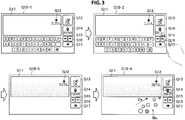
- FIG. 3 is a diagram illustrating an example of a screen displayed in each of the character-unit input mode and the phrase-unit input mode.
- the output control portion 147 causes a character-unit input screen G10-1 to be displayed.
- the character-unit input screen G10-1 includes a speech input start operation object G14 used to start a speech input and a display field G11 that is a display field of input information.
- the output control portion 147 causes the display field G11 to display the input information obtained from the operation input portion 115 (e.g., a keyboard on the character-unit input screen G10-1) in units of characters.
- the character-unit input screen G10-1 includes a delete-all operation object G12 used to delete all the information displayed in the display field G11 and a decision operation object G13 used to decide the information displayed in the display field G11.
- the character-unit input screen G10-1 includes a backward movement operation object G15, a forward movement operation object G16, and a deletion operation object G17.
- the backward movement operation object G15 is used to return the cursor position in the display field G11 to the back
- the forward movement operation object G16 is used to advance the cursor position in the display field G11 to the front
- the deletion operation object G17 is used to delete the character or word at the cursor position.
- a character-unit input screen G10-2 when the user inputs a predetermined speech input start operation (e.g., an operation to select the speech input start operation object G14) to the operation input portion 115, the operation detection portion 143 detects the speech input start operation. Then, the mode control portion 144 switches the information input mode from the character-unit input mode to the phrase-unit input mode, and the output control portion 147 causes a phrase-unit input screen G10-3 to be displayed. It is possible to input information by speech in the phrase-unit input mode, and so the user starts speaking an utterance toward the sound collection portion 120. The sound collection portion 120 obtains sound information by sound collection.
- a predetermined speech input start operation e.g., an operation to select the speech input start operation object G14
- the output control portion 147 causes a predetermined object (hereinafter referred to as "display object") Mu to be displayed.
- the display object Mu may be stationary or may have motion as shown on the screen G10-4.
- a movement direction De of the display object Mu may be determined depending on the arrival direction from a sound source of the user-uttered speech to the sound collection portion 120.
- a technique of estimating the arrival direction of the user-uttered speech is not limited to a particular technique.
- the recognition control portion 145 may estimate one arrival direction that is identical or similar to the finger direction of the user performing the operation of selecting the speech input start operation object G14 (e.g., the direction from the base to the fingertip of the finger) as the arrival direction of the user-uttered speech.
- the range of similarity may be predetermined.
- the finger direction may be acquired by analyzing the input image acquired by the input image acquisition portion 141.
- the finger direction may be acquired by analyzing the finger's shape detected by the operation detection portion 143.
- the recognition control portion 145 may estimate the arrival direction of the sound input by the sound collection portion 120 as the arrival direction of the user-uttered speech.
- the arrival direction of the sound that is initially input among the plurality of arrival directions may be estimated as the arrival direction of the user-uttered speech.
- one arrival direction that is identical or similar to the finger direction of the user performing the operation of selecting the speech input start operation object G14 may be estimated as the arrival direction of the user-uttered speech.
- the recognition control portion 145 may estimate the arrival direction of the sound that is input with the largest sound volume by the sound collection portion 120 among the plurality of arrival directions as the arrival direction of the user-uttered speech. In this way, the arrival direction of the user-uttered speech can be estimated. On the other hand, the recognition control portion 145 may acquire the sound that is input by the sound collection portion 120 from the direction other than the arrival direction of the user-uttered speech as noise.
- FIG. 3 illustrates an example in which the output control portion 147 moves the display object Mu in the arrival direction (the movement direction De) of the user-uttered speech. This makes it possible for the user to intuitively know that the speech uttered by the user itself is collected by the sound collection portion 120.
- the motion of the display object Mu is not limited to such motion.
- FIG. 3 illustrates an example in which the destination of the display object Mu is the speech input start operation object G14. However, the destination of the display object Mu is not limited to this example.
- FIG. 3 illustrates an example in which the output control portion 147 moves the circular display object Mu appearing one after another depending on the sound collection by the sound collection portion 120, but the display form of the display object Mu is not limited to this example.
- the output control portion 147 may control various parameters of the display object Mu on the basis of predetermined information (e.g., speech likeness and sound volume of sound information) corresponding to the sound information.
- the sound information used in this case may be the sound information from the arrival direction of the user-uttered speech.
- the parameter of the display object Mu may include at least one of the shape, transparency, color, size, and motion of the display object Mu.
- the recognition control portion 145 causes the speech recognition portion 146 to start the speech recognition processing on the sound information acquired by the sound information acquisition portion 142.
- the timing to start the speech recognition processing on the sound information is not limited to particular timing.
- the recognition control portion 145 may cause the speech recognition portion 146 to start the speech recognition processing on the sound information corresponding to the display object Mu after the display object Mu reaches the speech input start operation object G14.
- the speech recognition processing may be completed at the timing as described above.
- the phrase-unit input mode may include at least one of a phrase-unit insertion mode, a phrase-unit overwrite mode, and a phrase-unit replacement mode.
- a phrase-unit insertion mode a phrase-unit insertion mode
- a phrase-unit overwrite mode a phrase-unit overwrite mode
- a phrase-unit replacement mode a phrase-unit replacement mode.
- FIG. 4 is a diagram illustrated to describe an example of information input mode switching between the phrase-unit insertion mode, the phrase-unit overwrite mode, and the phrase-unit replacement mode.
- a display field G11-0 in the "character-unit input mode” is shown as an example of the display field G11 that is a display field of input information.
- the input information is displayed in units of characters.
- a display field G11-1 in the "phrase-unit insertion mode” a display field G11-2 in the “phrase-unit overwrite mode” and a display field G11-3 in the "phrase-unit replacement mode” are shown.
- the input information is displayed in units of phrases.
- the output control portion 147 inserts the information detected by the operation detection portion 143 into the position of a cursor Fc in units of characters.
- the "phrase-unit insertion mode” may be a mode in which the result of the speech recognition processing is inserted into an inter-phrase position where the cursor Fc is placed.
- the "phrase-unit overwrite mode” may be a mode in which the phrase at the position where the cursor Fc is placed is overwritten with the result of the speech recognition processing.
- the "phrase-unit replacement mode” may be a mode in which the phrase at the position where the cursor Fc is placed is replaced with a replacement candidate Rp. The replacement with the replacement candidate Rp may be performed by using a selection operation of the replacement candidate Rp as a trigger.
- the phrase to which the cursor Fc points may be highlighted.
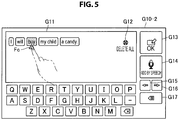
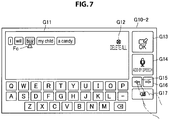
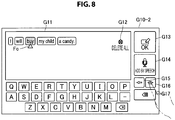
- FIGS. 5 to 8 are diagrams illustrated to describe an example of a technique of moving the position of the cursor Fc.
- the output control portion 147 may cause the cursor Fc to be moved on the phrase.
- the output control portion 147 may cause the cursor Fc to be moved to the inter-phrase position.
- the output control portion 147 may move the cursor Fc backward.
- the backward movement may be movement to an adjacent backward position.
- the cursor Fc may alternately move the position on the phrase and the inter-phrase position backward, move only the position on the phrase backward, or move only the inter-phrase position backward.
- the output control portion 147 may move the cursor Fc forward.
- the destination to forward movement may be movement to an adjacent forward position.
- the cursor Fc may alternately move the position on the phrase and the inter-phrase position forward, move only the position on the phrase forward, or move only the inter-phrase position forward.
- the example of moving the cursor Fc in units of phrases has been described. However, it is also possible to move the cursor Fc in units of characters.
- the output control portion 147 may cause the cursor Fc to be moved to the selected position.
- the output control portion 147 may cause the cursor Fc to be moved backward in units of characters.
- the output control portion 147 may cause the cursor Fc to be moved forward in units of characters.
- An example of the information input mode switching may include various examples.
- the mode control portion 144 may switch the information input mode from the "character-unit input mode" to the "phrase-unit insertion mode".
- the mode control portion 144 may switch the information input mode from the "phrase-unit insertion mode" to the "character-unit input mode”.
- the mode control portion 144 may switch the information input mode from the "phrase-unit overwrite mode” to the "character-unit input mode".
- the mode control portion 144 may switch the information input mode from the "phrase-unit replacement mode” to the "character-unit input mode”.
- the mode control portion 144 may switch the information input mode from the "phrase-unit insertion mode" to the "phrase-unit replacement mode".
- the mode control portion 144 may switch the information input mode from the "phrase-unit overwrite mode" to the "phrase-unit replacement mode”.
- the mode control portion 144 may switch the information input mode from the "phrase-unit replacement mode" to the "phrase-unit overwrite mode".
- the overwrite start trigger may be a trigger that does not overlap with the speech input end trigger among triggers listed as an example of the speech input end trigger.
- the mode control portion 144 may switch the information input mode from the "phrase-unit replacement mode" to the "phrase-unit Insertion mode".
- the insertion start trigger may be a trigger that does not overlap with the overwrite start trigger among triggers listed as an example of the overwrite start trigger.
- the mode control portion 144 may determine to switch the information input mode into any one of the "phrase-unit overwrite mode" and the "phrase-unit insertion mode” depending on whether the cursor Fc is moved to the position on the phrase or moved to the inter-phrase position.
- the overwrite start trigger and the insertion start trigger are not necessarily provided separately, and they may be used in common.
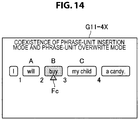
- FIG. 9 is a diagram illustrated to describe the case where the phrase-unit insertion mode and the phrase-unit overwrite mode coexist.
- a display field G11-4X is a display field of input information in a case where the cursor Fc is placed on the phrase.
- a display field G11-4Y is a display field of input information in a case where the cursor Fc is placed at the inter-phrase position.
- the output control portion 147 it is possible for the output control portion 147 to cause the cursor Fc to be moved alternately between the position on the phrase and the inter-phrase position.
- the mode control portion 144 switches the information input mode from the phrase-unit insertion mode (the display field G11-4Y) to the phrase-unit overwrite mode (the display field G11-4X).
- the mode control portion 144 switches the information input mode from the phrase-unit overwrite mode (the display field G11-4X) to the phrase-unit insertion mode (display field G11-4Y). The switching timing between the other modes is the same as the case described above.
- the phrase-unit insertion mode and the phrase-unit overwrite mode coexist, it is possible to perform the insertion in units of phrases and the overwriting in units of phrases using simple mode switching.
- the phrase-unit insertion mode and the phrase-unit overwrite mode coexist, the degree of freedom of speech input can be improved.
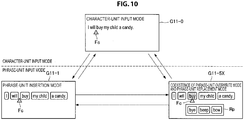
- FIG. 10 is a diagram illustrated to describe a case where the phrase-unit overwrite mode and the phrase-unit replacement mode coexist.
- a display field G11-5X is a display field of input information in the case where the phrase-unit overwrite mode and the phrase-unit replacement mode coexist.
- the phrase-unit overwrite mode and the phrase-unit replacement mode in the display field G11-5X, there may be a case where the sound information is acquired from the sound collection portion 120 in the state where the cursor Fc is placed on the phrase.
- the mode control portion 144 overwrites the phrase at the position of the cursor Fc depending on the result of the speech recognition processing on the sound information.
- the operation detection portion 143 detects an operation of selecting the replacement candidate Rp in the state where the cursor Fc is placed on the phrase.
- the mode control portion 144 replaces the selected replacement candidate Rp with the phrase at the position of the cursor Fc.
- the switching timing between other modes is the same as the case described above.
- phrase-unit overwrite mode and the phrase-unit replacement mode coexist, even when a candidate desired by the user fails to be found among the replacement candidates Rp, it is possible to overwrite a phrase by speech by performing simple switching between the information input modes.
- phrase-unit overwrite mode and the phrase-unit replacement mode coexist, it is possible to reduce time and effort of switching between the information input modes.
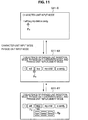
- FIG. 11 is a diagram illustrated to describe a case where the phrase-unit insertion mode, the phrase-unit overwrite mode, and the phrase-unit replacement mode coexist.
- a display field G11-6X is a display field of input information when the cursor Fc is placed at the inter-phrase position.
- a display field G11-6Y is a display field of input information when the cursor Fc is placed on the phrase. It is possible for the output control portion 147 to cause the cursor Fc to be moved alternately between the position on the phrase and the inter-phrase position.
- the mode control portion 144 switches the information input mode from the phrase-unit insertion mode (the display field G11-6X) to the phrase-unit overwrite mode and the phrase-unit replacement mode (the display field G11-6Y).
- the mode control portion 144 switches the information input mode from the phrase-unit overwrite mode and the phrase-unit replacement mode (the display field G11-6Y) to the phrase-unit insertion mode (the display field G11-6X).
- the phrase-unit overwrite mode and the phrase-unit replacement mode in the display field G11-6Y
- the mode control portion 144 overwrites the phrase at the position of the cursor Fc depending on the result of the speech recognition processing on the sound information.
- the operation detection portion 143 detects an operation of selecting the replacement candidate Rp in the state where the cursor Fc is placed on the phrase.
- the mode control portion 144 replaces the selected replacement candidate Rp with the phrase at the position of the cursor Fc.
- the switching timing between other modes is the same as the case described above.
- the phrase-unit insertion mode, the phrase-unit overwrite mode, and the phrase-unit replacement mode coexist, it is possible to insert, overwrite, and replace the phrase by performing simple switching between the information input modes.
- the phrase-unit insertion mode, the phrase-unit overwrite mode, and the phrase-unit replacement mode coexist, it is possible to further reduce time and effort of switching between the information input modes.
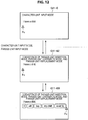
- FIG. 12 is a diagram illustrated to describe a case where the information that is input in the character-unit input mode is prevented from being converted into a phrase.
- a display field G11-6Z is a display field of input information when the switching from the character-unit input mode to the phrase-unit insertion mode is performed.
- the output control portion 147 converts the input information that is newly input into a phrase.
- FIG. 12 illustrates an example in which the phrase-unit insertion mode, the phrase-unit overwrite mode, and the phrase-unit replacement mode coexist, the relationship between the phrase-unit insertion mode, the phrase-unit overwrite mode, and the phrase-unit replacement mode is not limited to particular relationship. Thus, it may be, in one example, any of the relationship described with reference to FIGS. 9 to 11 .
- the output control portion 147 may cause the cursor Fc to be moved to the inter-phrase position or the phrase corresponding to the identification information. This makes it possible to move easily the cursor Fc.
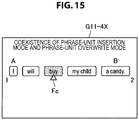
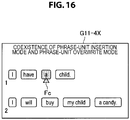
- FIGS. 13 to 16 are diagrams illustrated to describe an example of moving the cursor Fc by speech.
- the output control portion 147 may arrange "1" to "6" as the identification information corresponding to the inter-phrase position and may arrange "A" to "E” as the identification information corresponding to the phrase. In this way, the output control portion 147 may arrange identification information corresponding to all the inter-phrase position and the phrase.
- the output control portion 147 arranges "1" to "4" as the identification information corresponding to the inter-phrase position within a range from between one phase before and two phrases before from the current position of the cursor Fc to between one phase after and two phrases after from the current position of the cursor Fc.
- the output control portion 147 arranges "A" to "C” as the identification information corresponding to the phrase within the range. In this way, the output control portion 147 may arrange the identification information corresponding to the inter-phrase position and the phrase within a predetermined range by setting the current position of the cursor Fc as a reference.
- the output control portion 147 may arrange "1" and “2" as the identification information respectively corresponding to the inter-phrase position and the phrase preceding two phases before and may arrange "A" and "B” as the identification information respectively corresponding to the inter-phrase position and the phrase succeeding two phases after. In this way, the output control portion 147 may arrange the identification information corresponding to the inter-phrase position and the phrase outside the predetermined range by setting the current position of the cursor Fc as a reference.
- the output control portion 147 arranges "1" and "2" as the identification information corresponding to the position of the punctuation mark. In this way, the output control portion 147 may arrange the identification information corresponding to the delimiter between sentences (e.g., the position of the punctuation mark). In this way, if the identification information is arranged at the delimiter between sentences, it is possible for the user to move the cursor Fc to any sentence head position by speech input and to perform information input in units of phrases from the sentence head position.
- FIG. 17 is a diagram illustrating an example of presenting a part to be improved before translation to the user.
- the output control portion 147 may append a predetermined display object Lm to "do" and "that". This makes it possible for the user to change the part to which the display object Lm is appended before translation.
- FIG. 17 illustrates an example of appending the same display object Lm to "do" and “that”
- different display objects may be appended to "do” and “that”.
- the display object appended to "do” may be "specific expression of verb” or the like
- the display object appended to "that” may be a character string such as "specific expression of a noun” or the like.
- the point that improvement can be achieved before translation is not limited to this example.
- the point that improvement can be achieved before translation may be the use of Chinese character as much as possible, the correction of errors between homonyms and errors of Chinese character, the use of an expression before abbreviation without using the abbreviation, shortening the length of one sentence, and the use of proper postpositional particle.
- the output control portion 147 it is possible for the output control portion 147 to present a part that violates the above exemplary contents to the user.
- FIG. 17 illustrates the case where the phrase-unit insertion mode, the phrase-unit overwrite mode, and the phrase-unit replacement mode coexist as an example.
- the relationship between the phrase-unit insertion mode, the phrase-unit overwrite mode, and the phrase-unit replacement mode is not a particular one, and thus, in one example, it may be any of the relationship described with reference to FIGS. 9 to 11 .
- FIGS. 18 to 21 are diagrams illustrating a modified example of the system configuration of the information processing system 10.
- the output portion 130 is a television set
- the information processing device 140 is a game console
- the operation input portion 115 may be a controller for operating the game console.
- the sound collection portion 120 and the output portion 130 may be connected to the operation input portion 115.
- the image input portion 110 and the sound collection portion 120 may be connected to the information processing device 140.
- the operation input portion 115, the sound collection portion 120, and the output portion 130 may be provided in a smartphone connected to the information processing device 140.
- the sound collection portion 120 may be provided in a television set.
- FIG. 22 is a block diagram illustrating a hardware configuration example of the information processing system 10 according to an embodiment of the present disclosure.
- the CPU 901 functions as an arithmetic processing unit and a control unit, and controls the overall operation in the information processing system 10 or a part thereof in accordance with various programs recorded in the ROM 903, the RAM 905, the storage device 919, or a removable recording medium 927.
- the ROM 903 stores, for example, programs and operation parameters used by the CPU 901.
- the RAM 905 temporarily stores programs used in the execution by the CPU 901 and parameters that vary as appropriate in the execution.
- the CPU 901, the ROM 903, and the RAM 905 are connected with each other via the host bus 907 that is composed of an internal bus such as a CPU bus. Furthermore, the host bus 907 is connected to the external bus 911 such as peripheral component interconnect/interface (PCI) bus via the bridge 909.
- PCI peripheral component interconnect/interface
- the input device 915 is, for example, a device operated by a user, such as a mouse, a keyboard, a touch panel, a button, a switch, and a lever.
- the input device 915 may include a microphone for detecting user's speech.
- the input device 915 may be, for example, a remote control device using infrared rays or other radio waves, or may be an external connection device 929 such as a cellular phone conforming to the operation of the information processing system 10.
- the input device 915 includes an input control circuit that generates an input signal on the basis of the information input by the user and outputs it to the CPU 901. The user inputs various data to the information processing system 10 and instructs the information processing system 10 to perform a processing operation by operating the input device 915.
- the image capturing device 933 which will be described later, can also function as an input device by capturing the motion of the user's hand or finger, and the like.
- the pointing position may be determined depending on the motion of the hand or the orientation of the finger.
- the output device 917 is composed of a device capable of notifying visually or audibly the user of the acquired information.
- the output device 917 may be a display device such as a liquid crystal display (LCD), a plasma display panel (PDP), an organic electro-luminescence (EL) display, and a projector, a hologram display device, an audio output device such as a speaker and a headphone, as well as printer devices or the like.
- the output device 917 outputs the result obtained by the processing of the information processing system 10 as a video such as a text or an image, or outputs it as audio such as a speech or sound.
- the output device 917 may include, for example, a light for lighting up the surroundings.
- the storage device 919 is a data storage device configured as an example of a storage portion of the information processing system 10.
- the storage device 919 is composed of, for example, a magnetic storage device such as hard disk drive (HDD), a semiconductor storage device, an optical storage device, and a magneto-optical storage device.
- the storage device 919 stores programs executed by the CPU 901, various data, various types of data obtained from the outside, and the like.
- the drive 921 is a reader-writer for a removable recording medium 927 such as a magnetic disk, an optical disk, a magneto-optical disk, and a semiconductor memory, and is incorporated in the information processing system 10 or externally attached thereto.
- the drive 921 reads the information recorded on the loaded removable recording medium 927 and outputs it to the RAM 905.
- the drive 921 writes in the loaded removable recording medium 927.
- connection port 923 is a port for directly connecting the device to the information processing system 10.
- the connection port 923 may be, for example, a universal serial bus (USB) port, an IEEE 1394 port, or a small computer system interface (SCSI) port.
- the connection port 923 may be, for example, an RS-232C port, an optical audio terminal, or high-definition multimedia interface (HDMI, registered trademark) port.
- HDMI high-definition multimedia interface
- the communication device 925 is, for example, a communication interface composed of a communication device or the like, which is used to be connected to a communication network 931.
- the communication device 925 may be, for example, a communication card for wired or wireless local area network (LAN), Bluetooth (registered trademark), or wireless USB (WUSB).
- the communication device 925 may be, for example, a router for optical communication, a router for asymmetric digital subscriber line (ADSL), or a modem for various communications.
- the communication device 925 transmits and receives signals or the like using a predetermined protocol such as TCP/IP, for example, with the Internet or other communication devices.
- the communication network 931 connected to the communication device 925 is a network connected by wire or wireless, and is, for example, the Internet, home LAN, infrared communication, radio wave communication, satellite communication, or the like.
- the image capturing device 933 is a device that captures a real space and generates a captured image, by using an image sensor such as charge-coupled device (CCD) or complementary-metal-oxide semiconductor (CMOS) and various members such as a lens for controlling imaging of a subject image on the image sensor.
- the image capturing device 933 may capture a still image or a moving image.
- the sensor 935 is, for example, various sensors such as an acceleration sensor, a gyro sensor, a geomagnetic sensor, an optical sensor, and a sound sensor.
- the sensor 935 acquires information on the state of the information processing system 10 such as the attitude of the casing of the information processing system 10, and acquires information on the surrounding environment of the information processing system 10 such as brightness or noise around the information processing system 10.
- the sensor 935 may also include a GPS sensor that receives global positioning system (GPS) signals and measures the latitude, longitude, and altitude of the device.
- GPS global positioning system
- the information processing system that includes the mode control portion configured to switch the information input mode from the character-unit input mode to the phrase-unit input mode in the case where a predetermined first trigger is detected when the character-unit input mode is executed as the information input mode.
- the above description is given as to the modified example of the display form of the output portion 130, but the display form of the output portion 130 is not limited to the above example.
- the output portion 130 may be, for example, a display provided in a wearable terminal (e.g., a watch or glasses) other than the head mounted display.
- the output portion 130 may be, for example, a display provided in an in-vehicle navigation system.
- the output portion 130 may be, for example, a display used in the healthcare field.
- the output control portion 147 generates the display control information for displaying the display content on the output portion 130 and outputs the generated display control information to the output portion 130, and thus the output control portion 147 can control the output portion 130 so that the output portion 130 displays the contents to be displayed.
- the contents of the display control information may be changed appropriately in accordance with the system configuration.
- the program used to implement the information processing device 140 may be, for example, a web application.
- the display control information may be created using markup languages such as hypertext markup language (HTML), standard generalized markup language (SGML), and extensible markup language (XML).
- HTML hypertext markup language
- SGML standard generalized markup language
- XML extensible markup language
- each component is not limited to a particular position as long as the operation of the information processing system 10 described above is performed.
- the image input portion 110, the operation input portion 115, the sound collection portion 120, and the output portion 130 may be provided in a device different from a device provided with the information processing device 140, which are connected via a network.
- the information processing device 140 corresponds to, for example, a server such as a web server or a cloud server, and the image input portion 110, the operation input portion 115, the sound collection portion 120, and the output portion 130 may correspond to a client connected to the server via a network.
- all the components in the information processing device 140 are not necessarily included in the same device.
- some of the input image acquisition portion 141, the sound information acquisition portion 142, the operation detection portion 143, the mode control portion 144, the recognition control portion 145, the speech recognition portion 146, and the output control portion 147 may be provided in a device different from the information processing device 140.
- the speech recognition portion 146 may be provided in a server different from the information processing device 140 that includes the input image acquisition portion 141, the sound information acquisition portion 142, the operation detection portion 143, the recognition control portion 145, and the output control portion 147.
- present technology may also be configured as below.
Landscapes
- Engineering & Computer Science (AREA)
- Multimedia (AREA)
- Health & Medical Sciences (AREA)
- Audiology, Speech & Language Pathology (AREA)
- Human Computer Interaction (AREA)
- Physics & Mathematics (AREA)
- Acoustics & Sound (AREA)
- Computational Linguistics (AREA)
- Theoretical Computer Science (AREA)
- General Health & Medical Sciences (AREA)
- General Engineering & Computer Science (AREA)
- General Physics & Mathematics (AREA)
- User Interface Of Digital Computer (AREA)
Applications Claiming Priority (2)
| Application Number | Priority Date | Filing Date | Title |
|---|---|---|---|
| JP2015059565A JP2016181018A (ja) | 2015-03-23 | 2015-03-23 | 情報処理システムおよび情報処理方法 |
| PCT/JP2016/050905 WO2016152200A1 (ja) | 2015-03-23 | 2016-01-14 | 情報処理システムおよび情報処理方法 |
Publications (2)
| Publication Number | Publication Date |
|---|---|
| EP3276484A1 true EP3276484A1 (de) | 2018-01-31 |
| EP3276484A4 EP3276484A4 (de) | 2018-12-12 |
Family
ID=56977434
Family Applications (1)
| Application Number | Title | Priority Date | Filing Date |
|---|---|---|---|
| EP16768103.0A Withdrawn EP3276484A4 (de) | 2015-03-23 | 2016-01-14 | Informationsverarbeitungssystem und informationsverarbeitungsverfahren |
Country Status (4)
| Country | Link |
|---|---|
| US (1) | US10747499B2 (de) |
| EP (1) | EP3276484A4 (de) |
| JP (1) | JP2016181018A (de) |
| WO (1) | WO2016152200A1 (de) |
Families Citing this family (7)
| Publication number | Priority date | Publication date | Assignee | Title |
|---|---|---|---|---|
| JP6113392B1 (ja) * | 2016-10-26 | 2017-04-12 | 株式会社トヨタマップマスター | 施設検索装置、施設検索方法、コンピュータプログラム及びコンピュータプログラムを記録した記録媒体 |
| JP2018074366A (ja) * | 2016-10-28 | 2018-05-10 | 京セラ株式会社 | 電子機器、制御方法およびプログラム |
| US10468022B2 (en) * | 2017-04-03 | 2019-11-05 | Motorola Mobility Llc | Multi mode voice assistant for the hearing disabled |
| US10861463B2 (en) * | 2018-01-09 | 2020-12-08 | Sennheiser Electronic Gmbh & Co. Kg | Method for speech processing and speech processing device |
| US10863971B2 (en) * | 2018-11-30 | 2020-12-15 | Fujifilm Sonosite, Inc. | Touchless input ultrasound control |
| JP7250547B2 (ja) * | 2019-02-05 | 2023-04-03 | 本田技研工業株式会社 | エージェントシステム、情報処理装置、情報処理方法、およびプログラム |
| WO2022255502A1 (ko) * | 2021-05-31 | 2022-12-08 | 엘지전자 주식회사 | 디스플레이 장치 및 그의 동작 방법 |
Family Cites Families (13)
| Publication number | Priority date | Publication date | Assignee | Title |
|---|---|---|---|---|
| US4914704A (en) * | 1984-10-30 | 1990-04-03 | International Business Machines Corporation | Text editor for speech input |
| JP2000020092A (ja) * | 1998-06-30 | 2000-01-21 | Toshiba Corp | ディクテーション装置及びディクテーションプログラムを記録した記録媒体 |
| JP4528384B2 (ja) * | 1999-07-08 | 2010-08-18 | マイクロソフト コーポレーション | 音声入力用グラフィカル・ユーザ・インターフェースのための表示装置 |
| US6963834B2 (en) * | 2001-05-29 | 2005-11-08 | International Business Machines Corporation | Method of speech recognition using empirically determined word candidates |
| US7003457B2 (en) * | 2002-10-29 | 2006-02-21 | Nokia Corporation | Method and system for text editing in hand-held electronic device |
| JP4087400B2 (ja) | 2005-09-15 | 2008-05-21 | 株式会社東芝 | 音声対話翻訳装置、音声対話翻訳方法および音声対話翻訳プログラム |
| US9318108B2 (en) * | 2010-01-18 | 2016-04-19 | Apple Inc. | Intelligent automated assistant |
| JP5438909B2 (ja) * | 2008-03-14 | 2014-03-12 | ソニーモバイルコミュニケーションズ株式会社 | 文字入力装置、文字入力支援方法及び文字入力支援プログラム |
| US8494852B2 (en) * | 2010-01-05 | 2013-07-23 | Google Inc. | Word-level correction of speech input |
| US8782556B2 (en) * | 2010-02-12 | 2014-07-15 | Microsoft Corporation | User-centric soft keyboard predictive technologies |
| JP2014016402A (ja) * | 2012-07-06 | 2014-01-30 | Alpine Electronics Inc | 音声入力装置 |
| US8997013B2 (en) * | 2013-05-31 | 2015-03-31 | Google Inc. | Multiple graphical keyboards for continuous gesture input |
| KR20150053339A (ko) * | 2013-11-08 | 2015-05-18 | 삼성전자주식회사 | 전자 디바이스의 입력 처리 방법 및 장치 |
-
2015
- 2015-03-23 JP JP2015059565A patent/JP2016181018A/ja active Pending
-
2016
- 2016-01-14 EP EP16768103.0A patent/EP3276484A4/de not_active Withdrawn
- 2016-01-14 WO PCT/JP2016/050905 patent/WO2016152200A1/ja not_active Ceased
- 2016-01-14 US US15/558,265 patent/US10747499B2/en not_active Expired - Fee Related
Also Published As
| Publication number | Publication date |
|---|---|
| US10747499B2 (en) | 2020-08-18 |
| US20180081622A1 (en) | 2018-03-22 |
| WO2016152200A1 (ja) | 2016-09-29 |
| JP2016181018A (ja) | 2016-10-13 |
| EP3276484A4 (de) | 2018-12-12 |
Similar Documents
| Publication | Publication Date | Title |
|---|---|---|
| US10747499B2 (en) | Information processing system and information processing method | |
| US10546582B2 (en) | Information processing device, method of information processing, and program | |
| US10475439B2 (en) | Information processing system and information processing method | |
| US20190019512A1 (en) | Information processing device, method of information processing, and program | |
| US10720154B2 (en) | Information processing device and method for determining whether a state of collected sound data is suitable for speech recognition | |
| CN105518657B (zh) | 信息处理设备、信息处理方法及计算机可读记录介质 | |
| CN104205857A (zh) | 信息处理设备、信息处理方法和程序 | |
| US11189289B2 (en) | Information processing device, information processing method, and information processing system | |
| CN107004414A (zh) | 信息处理设备、信息处理方法及程序 | |
| US10540968B2 (en) | Information processing device and method of information processing | |
| WO2021159729A1 (zh) | 图像文本播报方法及其设备、电子电路和存储介质 | |
| US10522140B2 (en) | Information processing system and information processing method | |
| WO2022111458A1 (zh) | 图像拍摄方法和装置、电子设备及存储介质 | |
| EP3229128A1 (de) | Informationsverarbeitungsvorrichtung, informationsverarbeitungsverfahren und programm | |
| US20140288916A1 (en) | Method and apparatus for function control based on speech recognition | |
| WO2020045909A1 (en) | Apparatus and method for user interface framework for multi-selection and operation of non-consecutive segmented information | |
| JP2019101739A (ja) | 情報処理装置、情報処理システムおよびプログラム | |
| JP2016156877A (ja) | 情報処理装置、情報処理方法およびプログラム | |
| JP5468640B2 (ja) | 電子機器、電子機器の制御方法、電子機器の制御プログラム | |
| JP2016180778A (ja) | 情報処理システムおよび情報処理方法 | |
| US20250130633A1 (en) | Information processing apparatus, information processing method, and program | |
| JP5744252B2 (ja) | 電子機器、電子機器の制御方法、電子機器の制御プログラム | |
| JP2018084761A (ja) | 情報処理装置、情報処理システム、方法、及びプログラム | |
| KR101435477B1 (ko) | 어플리케이션 프로그램을 이용한 대화 방법 |
Legal Events
| Date | Code | Title | Description |
|---|---|---|---|
| PUAI | Public reference made under article 153(3) epc to a published international application that has entered the european phase |
Free format text: ORIGINAL CODE: 0009012 |
|
| 17P | Request for examination filed |
Effective date: 20171018 |
|
| AK | Designated contracting states |
Kind code of ref document: A1 Designated state(s): AL AT BE BG CH CY CZ DE DK EE ES FI FR GB GR HR HU IE IS IT LI LT LU LV MC MK MT NL NO PL PT RO RS SE SI SK SM TR |
|
| AX | Request for extension of the european patent |
Extension state: BA ME |
|
| DAV | Request for validation of the european patent (deleted) | ||
| DAX | Request for extension of the european patent (deleted) | ||
| A4 | Supplementary search report drawn up and despatched |
Effective date: 20181114 |
|
| RIC1 | Information provided on ipc code assigned before grant |
Ipc: G10L 15/26 20060101ALI20181108BHEP Ipc: G06F 3/0488 20130101ALN20181108BHEP Ipc: G06F 3/0484 20130101ALN20181108BHEP Ipc: G06F 3/048 20130101AFI20181108BHEP Ipc: G06F 3/16 20060101ALI20181108BHEP |
|
| STAA | Information on the status of an ep patent application or granted ep patent |
Free format text: STATUS: THE APPLICATION HAS BEEN WITHDRAWN |
|
| 18W | Application withdrawn |
Effective date: 20200617 |