EP3276013A1 - Agent for adsorption of ruthenium from aqueous solution and method for adsorption of ruthenium from aqueous solution - Google Patents
Agent for adsorption of ruthenium from aqueous solution and method for adsorption of ruthenium from aqueous solution Download PDFInfo
- Publication number
- EP3276013A1 EP3276013A1 EP16768048.7A EP16768048A EP3276013A1 EP 3276013 A1 EP3276013 A1 EP 3276013A1 EP 16768048 A EP16768048 A EP 16768048A EP 3276013 A1 EP3276013 A1 EP 3276013A1
- Authority
- EP
- European Patent Office
- Prior art keywords
- ruthenium
- adsorbent
- manganese
- oxides
- adsorbent according
- Prior art date
- Legal status (The legal status is an assumption and is not a legal conclusion. Google has not performed a legal analysis and makes no representation as to the accuracy of the status listed.)
- Withdrawn
Links
Images

Classifications
-
- C—CHEMISTRY; METALLURGY
- C22—METALLURGY; FERROUS OR NON-FERROUS ALLOYS; TREATMENT OF ALLOYS OR NON-FERROUS METALS
- C22B—PRODUCTION AND REFINING OF METALS; PRETREATMENT OF RAW MATERIALS
- C22B11/00—Obtaining noble metals
- C22B11/04—Obtaining noble metals by wet processes
- C22B11/042—Recovery of noble metals from waste materials
-
- B—PERFORMING OPERATIONS; TRANSPORTING
- B01—PHYSICAL OR CHEMICAL PROCESSES OR APPARATUS IN GENERAL
- B01J—CHEMICAL OR PHYSICAL PROCESSES, e.g. CATALYSIS OR COLLOID CHEMISTRY; THEIR RELEVANT APPARATUS
- B01J20/00—Solid sorbent compositions or filter aid compositions; Sorbents for chromatography; Processes for preparing, regenerating or reactivating thereof
- B01J20/02—Solid sorbent compositions or filter aid compositions; Sorbents for chromatography; Processes for preparing, regenerating or reactivating thereof comprising inorganic material
- B01J20/06—Solid sorbent compositions or filter aid compositions; Sorbents for chromatography; Processes for preparing, regenerating or reactivating thereof comprising inorganic material comprising oxides or hydroxides of metals not provided for in group B01J20/04
-
- B—PERFORMING OPERATIONS; TRANSPORTING
- B01—PHYSICAL OR CHEMICAL PROCESSES OR APPARATUS IN GENERAL
- B01J—CHEMICAL OR PHYSICAL PROCESSES, e.g. CATALYSIS OR COLLOID CHEMISTRY; THEIR RELEVANT APPARATUS
- B01J20/00—Solid sorbent compositions or filter aid compositions; Sorbents for chromatography; Processes for preparing, regenerating or reactivating thereof
- B01J20/28—Solid sorbent compositions or filter aid compositions; Sorbents for chromatography; Processes for preparing, regenerating or reactivating thereof characterised by their form or physical properties
- B01J20/28002—Solid sorbent compositions or filter aid compositions; Sorbents for chromatography; Processes for preparing, regenerating or reactivating thereof characterised by their form or physical properties characterised by their physical properties
- B01J20/28011—Other properties, e.g. density, crush strength
-
- B—PERFORMING OPERATIONS; TRANSPORTING
- B01—PHYSICAL OR CHEMICAL PROCESSES OR APPARATUS IN GENERAL
- B01J—CHEMICAL OR PHYSICAL PROCESSES, e.g. CATALYSIS OR COLLOID CHEMISTRY; THEIR RELEVANT APPARATUS
- B01J20/00—Solid sorbent compositions or filter aid compositions; Sorbents for chromatography; Processes for preparing, regenerating or reactivating thereof
- B01J20/28—Solid sorbent compositions or filter aid compositions; Sorbents for chromatography; Processes for preparing, regenerating or reactivating thereof characterised by their form or physical properties
- B01J20/28014—Solid sorbent compositions or filter aid compositions; Sorbents for chromatography; Processes for preparing, regenerating or reactivating thereof characterised by their form or physical properties characterised by their form
- B01J20/2803—Sorbents comprising a binder, e.g. for forming aggregated, agglomerated or granulated products
-
- B—PERFORMING OPERATIONS; TRANSPORTING
- B01—PHYSICAL OR CHEMICAL PROCESSES OR APPARATUS IN GENERAL
- B01J—CHEMICAL OR PHYSICAL PROCESSES, e.g. CATALYSIS OR COLLOID CHEMISTRY; THEIR RELEVANT APPARATUS
- B01J20/00—Solid sorbent compositions or filter aid compositions; Sorbents for chromatography; Processes for preparing, regenerating or reactivating thereof
- B01J20/28—Solid sorbent compositions or filter aid compositions; Sorbents for chromatography; Processes for preparing, regenerating or reactivating thereof characterised by their form or physical properties
- B01J20/28054—Solid sorbent compositions or filter aid compositions; Sorbents for chromatography; Processes for preparing, regenerating or reactivating thereof characterised by their form or physical properties characterised by their surface properties or porosity
- B01J20/28057—Surface area, e.g. B.E.T specific surface area
-
- C—CHEMISTRY; METALLURGY
- C01—INORGANIC CHEMISTRY
- C01G—COMPOUNDS CONTAINING METALS NOT COVERED BY SUBCLASSES C01D OR C01F
- C01G45/00—Compounds of manganese
- C01G45/02—Oxides
-
- C—CHEMISTRY; METALLURGY
- C02—TREATMENT OF WATER, WASTE WATER, SEWAGE, OR SLUDGE
- C02F—TREATMENT OF WATER, WASTE WATER, SEWAGE, OR SLUDGE
- C02F1/00—Treatment of water, waste water, or sewage
- C02F1/28—Treatment of water, waste water, or sewage by sorption
-
- C—CHEMISTRY; METALLURGY
- C02—TREATMENT OF WATER, WASTE WATER, SEWAGE, OR SLUDGE
- C02F—TREATMENT OF WATER, WASTE WATER, SEWAGE, OR SLUDGE
- C02F1/00—Treatment of water, waste water, or sewage
- C02F1/28—Treatment of water, waste water, or sewage by sorption
- C02F1/281—Treatment of water, waste water, or sewage by sorption using inorganic sorbents
-
- C—CHEMISTRY; METALLURGY
- C22—METALLURGY; FERROUS OR NON-FERROUS ALLOYS; TREATMENT OF ALLOYS OR NON-FERROUS METALS
- C22B—PRODUCTION AND REFINING OF METALS; PRETREATMENT OF RAW MATERIALS
- C22B11/00—Obtaining noble metals
-
- C—CHEMISTRY; METALLURGY
- C01—INORGANIC CHEMISTRY
- C01B—NON-METALLIC ELEMENTS; COMPOUNDS THEREOF; METALLOIDS OR COMPOUNDS THEREOF NOT COVERED BY SUBCLASS C01C
- C01B33/00—Silicon; Compounds thereof
- C01B33/113—Silicon oxides; Hydrates thereof
-
- C—CHEMISTRY; METALLURGY
- C01—INORGANIC CHEMISTRY
- C01F—COMPOUNDS OF THE METALS BERYLLIUM, MAGNESIUM, ALUMINIUM, CALCIUM, STRONTIUM, BARIUM, RADIUM, THORIUM, OR OF THE RARE-EARTH METALS
- C01F7/00—Compounds of aluminium
- C01F7/02—Aluminium oxide; Aluminium hydroxide; Aluminates
-
- C—CHEMISTRY; METALLURGY
- C01—INORGANIC CHEMISTRY
- C01G—COMPOUNDS CONTAINING METALS NOT COVERED BY SUBCLASSES C01D OR C01F
- C01G55/00—Compounds of ruthenium, rhodium, palladium, osmium, iridium, or platinum
-
- C—CHEMISTRY; METALLURGY
- C02—TREATMENT OF WATER, WASTE WATER, SEWAGE, OR SLUDGE
- C02F—TREATMENT OF WATER, WASTE WATER, SEWAGE, OR SLUDGE
- C02F2101/00—Nature of the contaminant
- C02F2101/006—Radioactive compounds
-
- C—CHEMISTRY; METALLURGY
- C02—TREATMENT OF WATER, WASTE WATER, SEWAGE, OR SLUDGE
- C02F—TREATMENT OF WATER, WASTE WATER, SEWAGE, OR SLUDGE
- C02F2101/00—Nature of the contaminant
- C02F2101/10—Inorganic compounds
- C02F2101/20—Heavy metals or heavy metal compounds
-
- G—PHYSICS
- G01—MEASURING; TESTING
- G01N—INVESTIGATING OR ANALYSING MATERIALS BY DETERMINING THEIR CHEMICAL OR PHYSICAL PROPERTIES
- G01N23/00—Investigating or analysing materials by the use of wave or particle radiation, e.g. X-rays or neutrons, not covered by groups G01N3/00 – G01N17/00, G01N21/00 or G01N22/00
- G01N23/20—Investigating or analysing materials by the use of wave or particle radiation, e.g. X-rays or neutrons, not covered by groups G01N3/00 – G01N17/00, G01N21/00 or G01N22/00 by using diffraction of the radiation by the materials, e.g. for investigating crystal structure; by using scattering of the radiation by the materials, e.g. for investigating non-crystalline materials; by using reflection of the radiation by the materials
- G01N23/20075—Investigating or analysing materials by the use of wave or particle radiation, e.g. X-rays or neutrons, not covered by groups G01N3/00 – G01N17/00, G01N21/00 or G01N22/00 by using diffraction of the radiation by the materials, e.g. for investigating crystal structure; by using scattering of the radiation by the materials, e.g. for investigating non-crystalline materials; by using reflection of the radiation by the materials by measuring interferences of X-rays, e.g. Borrmann effect
-
- Y—GENERAL TAGGING OF NEW TECHNOLOGICAL DEVELOPMENTS; GENERAL TAGGING OF CROSS-SECTIONAL TECHNOLOGIES SPANNING OVER SEVERAL SECTIONS OF THE IPC; TECHNICAL SUBJECTS COVERED BY FORMER USPC CROSS-REFERENCE ART COLLECTIONS [XRACs] AND DIGESTS
- Y02—TECHNOLOGIES OR APPLICATIONS FOR MITIGATION OR ADAPTATION AGAINST CLIMATE CHANGE
- Y02P—CLIMATE CHANGE MITIGATION TECHNOLOGIES IN THE PRODUCTION OR PROCESSING OF GOODS
- Y02P10/00—Technologies related to metal processing
- Y02P10/20—Recycling
Definitions
- the present invention relates to an adsorbent for recovering (and/or reusing) or removing ruthenium from aqueous solution thereof by adsorbing the ruthenium in the aqueous solution, which includes any form of a ruthenium cation, a ruthenium complex ion and a ruthenate ion, on the adsorbent; and relates to a method for purifying sea water or the like polluted with a radioactive element, using said adsorbent.
- radioactive elements are discharged as a result of nuclear plant accidents through subterranean routes to pollute the ocean, the removal of such pollutants is now critical.
- the radioactive elements discharged include radioactive ruthenium, and removal of the radioactive ruthenium from soil or sea water and/or purification thereof is also critical.
- ruthenium is usually present as an ion in an aqueous solution thereof and the recovery of ruthenium from or purification of ruthenium-containing water requires selective adsorption or filtration of ruthenium, or a treating agent which selectively reacts with ruthenium.
- the removal of radioactive ruthenium from and/or purification of radioactive ruthenium-containing water requires an extremely high removal performance, a simple removal apparatus, and a safe and inexpensive adsorbent and/or treating agent.
- Patent Literature 1 describes a method of heating a material, on which a noble metal such as rhodium, palladium and ruthenium are supported, to allow the noble metal to be absorbed into a material having a perovskite crystal structure.
- this method is preferable for the recovery of a useful metal from a catalyst used in the treatment of automobile exhaust gas, the method requires a heating process at 1000°C or higher, and thus it is difficult to adapt said method to applications in which a noble metal ion present in water is recovered and/or removed from the water.
- Patent Literature 2 shows a method of allowing a metal ion to be adsorbed on an ion exchange resin or a chelating resin in an aqueous solution.
- Such a method of absorbing a metal ion with an ion exchange resin or the like provides only a limited removal of ruthenium per volume of an adsorbent due to the small number of adsorption sites in the adsorbent. This drives the cost required for the adsorbent up, and thus, in cases where a large amount of ruthenium-containing water is treated, the cost for the adsorption treatment of ruthenium increases, compromising the economic desirability of such a situation.
- Patent Literature 3 shows a method of removing radioactive palladium or radioactive ruthenium from aqueous solution thereof by using a metal ferrocyanide.
- this method is preferable in that the ions in the aqueous solution can be removed, the ferrocyanide may decompose at high temperatures, generating harmful hydrogen cyanide.
- the removal efficiency is not sufficiently high, and moreover, decomposition may be caused in aqueous solutions with a high pH, allowing adsorbed radioactive ruthenium to be released and resulting in a lower removal efficiency. This complicates the management of the adsorption treatment system, and necessitate the treatment of cyanide-containing waste water, for safety.
- the target for removal is, for example, water used for washing soil polluted with a radioactive element or sea water polluted with a radioactive element
- a target usually has a low concentration of ruthenium and typically requires large scale treatment, and thus the removal of the radioactive elements requires an extremely high removal performance in a small quantity, and a reduction in cost.
- removal efficiencies e.g. for radioactive elements including strontium scattered by the explosion of a nuclear reactor, the final removal efficiency after purification must be 99% or higher or 99.9% or higher, because of the seriousness of its impact.
- Non Patent Literature 1 Another significant problem in the treatment of waste water from a nuclear reactor is the possible presence of ruthenium in various structures.
- the structure of ruthenium is believed to change depending on the type of aqueous solution with which it has come into contact during nuclear fission from radioactive uranium.
- Ruthenium may be present in various structures depending on conditions such as the temperature of the aqueous solution thereof and chemical species dissolved therein, and a high removal performance is required for respective structures.
- a reverse osmosis membrane is provided downstream of the primary treatment with an adsorbent, the achievement of a high removal efficiency of, for example, 95% or higher at the primary treatment stage will significantly reduce the load applied to the step of the expensive secondary treatment, and this situation is very preferable in terms of cost-efficiency. Accordingly, this will require an adsorbent having a removal efficiency of 95% or higher for ruthenium cations which are expected to exist at a particularly high content, and having a removal efficiency comparable thereto for other ion species such as ruthenium complex ions and ruthenate ions.
- Such an adsorbent needs to be capable of treating a large amount of water, and therefore needs to have sufficient stability for extensive treatment.
- water-insoluble materials such as metal oxides are preferred.
- Raw materials to be used need to be inexpensive, and moreover it is not preferable that their production involves the volatilization of an organic solvent, or the consumption of a massive amount of energy such as calcination at high temperature, and the process used to produce such materials should be simple.
- an adsorbent or treating agent satisfying performance requirements including 1) ability to remove various ion species and further 2) a high removal efficiency of 70% or higher, preferably 95% or higher, for ruthenium cations, as well as safety and low cost, has not yet been obtained.
- a primary object of the present invention is to provide a material capable of adsorbing ruthenium cations in an aqueous solution, and additionally capable of adsorbing ruthenium complex ions and ruthenate ions, without any complicated apparatus or energy such as high temperature.
- a further object of the present invention is to provide a material capable of adsorbing ruthenium cations in an aqueous solution with a high efficiency of 70% or more, or even 95% or more, and additionally capable of adsorbing ruthenium complex ions and ruthenate ions, without any complicated apparatus or energy such as high temperature.
- Another object of the present invention is to provide an adsorbent for ruthenium in an aqueous solution, which enables an inexpensive, safe and simple treatment, by using as the adsorbent metal oxides which are inexpensive and less likely to cause environmental pollution.
- Another object of the present invention is to provide a method enabling the adsorption of ruthenium ions in a simple and safe manner by merely soaking a material in aqueous solution containing ruthenium.
- Still another object of the present invention is to provide a method for adsorbing and removing radioactive ruthenium from water discharged from a nuclear reactor or the like to purify the water.
- the present invention relates to the following:
- the present invention relates to the following:
- the present invention can provide an adsorbent having high adsorbing performance, preferably with a removal efficiency of 70% or more, more preferably with a removal efficiency of 95% or more, for ruthenium in aqueous solution.
- adsorbent having high adsorbing performance, preferably with a removal efficiency of 70% or more, more preferably with a removal efficiency of 95% or more, for ruthenium in aqueous solution.
- the present invention is an adsorbent for ruthenium in an aqueous solution, the adsorbent comprising manganese oxides, and a method for removing ruthenium from ruthenium-containing water, for example, from sea water containing radioactive ruthenium, using said adsorbent.
- the forms of ruthenium in its aqueous solution to be adsorbed by the adsorbent according to the present invention include a ruthenium cation, a ruthenium complex ion and a ruthenate ion.
- the adsorbent according to the present invention is based on manganese oxides.
- the present invention is based on the discovery that manganese oxides have ruthenium-adsorbing properties.
- the content of manganese in the adsorbent according to the present invention, calculated as manganese dioxide, can be 50 parts by weight or more, for example, 60 parts by weight or more, 70 parts by weight or more, 80 parts by weight or more, 90 parts by weight or more, or 95 parts by weight or more, based on 100 parts by weight of the adsorbent.
- the adsorbent according to the present invention can comprise manganese in an amount, in terms of manganese dioxide, of 50 parts by weight to 100 parts by weight based on 100 parts by weight of the adsorbent. In cases where the amount of manganese is 100 parts by weight, the adsorbent according to the present invention consists only of manganese dioxide.
- the adsorbent according to the present invention can further contain at least one additional transition metal elements other than manganese.
- the at least one additional transition metal element contained in the adsorbent according to the present invention enhances the ruthenium removal efficiency of the adsorbent.
- said transition metal element include copper, iron, cobalt and zinc, among which copper is particularly preferably used; use of copper can particularly significantly enhance the ruthenium removal efficiency.
- the transition metal element can be, for example, in the form of an oxide thereof.
- manganese and the transition metal element can be present in the form of a physical mixture of manganese oxides and transition metal element oxides.
- the transition metal element is copper
- manganese and copper can be present in the form of a physical mixture of manganese oxides and copper oxides.
- the transition metal element can be present as composite oxides with manganese.
- This embodiment in which the transition metal element is present in the form of composite oxides with manganese in the adsorbent, is also preferable in terms of chemical stability, ruthenium removal efficiency, cost, etc.
- the transition metal element is copper
- the adsorbent according to the present invention comprises composite oxides of manganese and copper.
- the adsorbent according to the present invention can comprise both a physical mixture of manganese oxides and the transition metal element oxides, and composite oxides of manganese and the transition metal.
- manganese and the transition metal element can be present in the form of a physical mixture of manganese oxides and transition metal element oxides, or in the form of composite oxides of manganese and the transition metal element, or in both of the forms.
- physical mixture refers to a mixture of two or more single oxides and/or composite oxides.
- Composite oxide refers to an oxide in which two or more atoms other than oxygen are present in a single structure, and, for example, a composite oxide of manganese and copper is an oxide containing manganese and copper in a single structure.
- the adsorbent according to the present invention comprises at least one additional transition metal element other than manganese, and manganese and said transition metal element are present in the form of a physical mixture of manganese oxides and oxides of the transition metal element
- the ratio (weight ratio) of manganese oxides to additional transition metal element oxides depends on the type of the transition metal element, and can be 1:0 to 1:1.0, for example, 1:0.001 to 1:1, preferably 1:0.01 to 1:0.5, for example, 1:0.05 to 1:0.5, or 1:0.1 to 1:0.4, when the weight of manganese oxide is calculated as that of manganese dioxide and the weight of the transition metal element is calculated as that of a stable oxide of the metal (e.g. copper oxide (CuO) for copper, iron oxide (Fe 2 O 3 ) for iron).
- the weight ratio is preferably in these
- the molar ratio of manganese to transition metal element can be 1:0 to 1:1.0, for example, 1:0.001 to 1:1, preferably 1:0.01 to 1:0.5, for example, 1:0.05 to 1:0.5, or 1:0.1 to 1:0.4. From the viewpoint of prevention of the lowering of the ruthenium removal efficiency, the molar ratio is preferably in these ranges.
- the weight ratio is preferably in these ranges.
- the molar ratio of manganese to copper can be 1:0 to 1:1, for example, 1:0.001 to 1:1.
- the molar ratio is preferably in these ranges.
- the quantity of manganese oxides, the weight ratio of manganese oxides to additional transition metal oxides, and the molar ratio of manganese to additional transition metal element in a composite oxide can be determined, for example, by measuring the quantities of manganese and the additional transition metal (e.g. copper) in the adsorbent by using a high-frequency inductively coupled plasma emission spectrometer, and then appropriately converting the obtained quantities to those of manganese dioxide and the transition metal oxide (e.g. CuO), or converting to moles.
- the additional transition metal e.g. copper
- the adsorbent according to the present invention can have a specific surface area of, for example, 70 to 700m 2 /g.
- a specific surface area of 70m 2 /g or more allows the achievement of a satisfactory ruthenium removal efficiency, and a specific surface area of 700m 2 /g or less can prevent rapid adsorption which may cause heat generation or the boiling of water on contacting with water, and thus the specific surface area is preferably in the above range. If such heat generation or the boiling of water occurs, in particular in the case that a granular, shaped article is used as the adsorbent, foaming takes place, collapsing the article, and the passing amount of water to be purified and the ruthenium removal efficiency are lowered.
- the specific surface area is more preferably in the range of 100 to 500m 2 /g, for example, 125 to 450m 2 /g, and particularly preferably in the range of 150 to 400m 2 /g.
- the specific surface area can be measured through specific surface area measurement with nitrogen adsorption (BET method).
- the manganese oxides contained in the adsorbent have a particular structure, such as being amorphous, or having ⁇ -MnO 2 with a tunnel structure, or ⁇ -MnO 2 with a layered structure, a further satisfactory ruthenium removal efficiency can be achieved, and that, in contrast, the ruthenium removal efficiencies for cases using ⁇ -MnO 2 with a tunnel structure and ⁇ -MnO 2 with a spinel structure are lower than those using ⁇ -MnO 2 and of ⁇ -MnO 2 with a layered structure.
- Manganese oxide having a tunnel structure is classified with (m ⁇ n), where m is the number of linked MnO 6 octahedrons forming the horizontal side of the tunnel, and n is that of those forming the vertical side of the tunnel.
- ⁇ -MnO 2 is classified as (2 ⁇ 2), ⁇ -MnO 2 as (1 ⁇ 1), and ⁇ -MnO 2 as coexistence of (1 ⁇ 1) and (1 ⁇ 2).
- ⁇ -MnO 2 has a structure similar to that of ⁇ -MnO 2 , and includes microtwinning and many structural defects.
- the adsorbent according to the present invention comprises manganese oxides being amorphous or having a layered structure or a tunnel structure in which at least two linked MnO 6 octahedrons form each horizontal and vertical side of the tunnel.
- the structure can be confirmed from an XRD spectrum obtained in X-ray diffraction measurement with Cu-K ⁇ radiation.
- the adsorbent according to the present invention has the feature of oxidizing adsorbed ruthenium.
- the electronic state of the adsorbed ruthenium can be confirmed from an XPS spectrum obtained in X-ray photoelectron spectroscopy.
- the manganese oxides or composite oxides of manganese and the additional transition metal element in the present invention can be prepared, for example, as follows.
- a manganese oxide in the present invention can be obtained, for example, by making an aqueous solution of manganese sulfate alkaline (e.g. by mixing the solution with an aqueous solution of an alkaline compound such as sodium hydroxide, potassium carbonate and potassium hydroxide), and carrying out an oxidation treatment of the solution with potassium permanganate to form a precipitate, followed by filtering, washing and drying of the precipitate.
- an alkaline compound such as sodium hydroxide, potassium carbonate and potassium hydroxide
- a composite oxide of manganese and the additional transition metal element in the present invention can be obtained, for example, by using a method of mixing a manganese compound and a compound of the additional transition metal together to obtain an oxide thereof.
- an aqueous solution containing a manganese compound and a compound of the additional transition metal is prepared, and an alkaline aqueous solution (e.g. an aqueous solution of an alkaline compound such as sodium hydroxide, potassium carbonate and potassium hydroxide) and potassium permanganate are added to the aqueous solution, and the resulting precipitate is filtered, washed and dried, and thus a composite oxide of manganese and the additional transition metal element can be obtained.
- an alkaline aqueous solution e.g. an aqueous solution of an alkaline compound such as sodium hydroxide, potassium carbonate and potassium hydroxide
- a composite oxide of manganese and copper can be obtained through oxidation of manganese sulfate and copper sulfate in an aqueous solution thereof, by means of e.g. potassium permanganate, followed by washing and drying of resulting precipitate.
- the specific surface area can be adjusted, for example, by appropriately changing the drying temperature.
- the molar ratio of manganese to additional transition metal element can be adjusted by appropriately changing the quantities of the raw materials so that the desired ratio is achieved.
- a physical mixture of manganese oxides and additional transition metal oxides in the present invention can be prepared by mixing manganese oxides prepared as described above with oxides of the additional transition metal separately obtained or produced, or by, for example, weighing and homogeneously mixing predetermined quantities of the both powders.
- the shape of the adsorbent according to the present invention is not limited.
- the adsorbent can be used in the form of a powder. Nevertheless, the adsorbent is preferably formed into a certain shape to reduce the scattering of powder from the adsorbent, to allow an aqueous solution to easily pass through the adsorbent, to reduce pressure drop in filtration, or to mix the adsorbent homogeneously in the aqueous solution.
- the shape can be in the form of a granule, pellet, cylindrical shaped article or the like, having a particle size of about 0.1 mm to 10mm, more preferably, having a particle size of about 0.2 to 7mm.
- a shaped article such as a granule, a pellet and a cylindrical shaped article, can be produced by using a known forming method.
- the adsorbent in powder form is tightly pressed by using a high-pressure molding machine and then pulverized, and thus the adsorbent in the form of a granule can be obtained.
- the size of the granule can be appropriately adjusted through adjustment of the mesh size of a sieve.
- the particle size of the shaped article can be measured by using a particle size measurement method with an analytical sieve (in accordance with "Test methods for sieving of chemical products” in JIS K0069).
- the adsorbent powder described above can be directly formed, or mixed with a binder (binding agent) and then formed.
- a binder binding agent
- the adsorbent powder is directly formed/granulated, the surface area decreases, and as a result the adsorption activity is likely to also decrease. Contrarily, it was found that the decrease in adsorption activity can be reduced when the aforementioned powder is mixed with a certain metal oxide and/or metalloid oxide, and then formed in a shaped article. Accordingly, in the production of a shaped article, it is preferable to form the powder into a shaped article after mixing the powder with a binder. Oxides of aluminum, silicon and the like, and oxides containing both aluminum and silicon such as zeolite have the large effect of preventing a decrease in said activity, and are thus preferable for the binder. In the present invention, aluminum oxide is particularly preferable.
- the adsorbent according to the present invention can further comprise a binder, preferably an inorganic binder containing a metal element other than transition metals and/or a metalloid element.
- a metal element refers to an element of intermediate nature between metal and non-metal, and examples thereof include silicon, boron, germanium, arsenic, tin, tellurium and polonium.
- the weight ratio of manganese oxides (or a mixture of manganese oxides and oxides of the additional transition metal) to binder is 1:0 to 1:1, more preferably 1:0.01 to 1:0.7, even more preferably 1:0.03 to 1:0.3, for example, 1:0.05 to 1:0.2 (manganese oxides (or a mixture of manganese oxides and oxides of the additional transition metal):binder).
- the adsorbent according to the present invention can comprise, as necessary and in addition to manganese oxides (or a mixture of manganese oxides and oxides of the additional transition metal) and the binder, any other components which do not impair the advantageous effects of the present invention.
- the adsorbent according to the present invention can consist only of manganese oxides (or a mixture of manganese oxides and oxides of the additional transition metal) and the binder.
- the adsorbent according to the present invention which is supported on a carrier.
- carriers include, but are not limited to, nonwoven fabrics, papers, plastic sheets, and ceramic sheets.
- flexible materials, particularly nonwoven fabrics are preferable.
- Use of a flexible carrier provides good handleability in use, and allows its use as a roll, and thus the throughput per unit volume can be enhanced.
- the nonwoven fabric material may be any water-insoluble material, and examples thereof include cellulose fibers, polyester fibers and polyamide fibers.
- a method of bonding the adsorbent in powder form or the adsorbent formed into granules to the nonwoven fabric with an adhesive, or a method of coating the nonwoven fabric with the adsorbent together with a binder or the like can be used.
- the adsorbent according to the present invention can adsorb ruthenium present in an aqueous solution thereof at a high removal efficiency.
- the present invention relates to the use of an adsorbent comprising manganese in the form of its oxides to remove ruthenium from an aqueous solution thereof.
- ruthenium can be removed from ruthenium-containing water by allowing the adsorbent to adsorb ruthenium in the aqueous solution, and then optionally separating the adsorbent from the water treated with the adsorbent using a suitable known method.
- the ruthenium-containing water is contacted with the adsorbent according to the present invention for adsorption of the ruthenium present in its aqueous solution on the adsorbent.
- the present invention relates to a method for removing radioactive ruthenium from ruthenium-containing water, e.g. radioactive ruthenium-containing water, comprising contacting the ruthenium-containing water, for example, the radioactive ruthenium-containing water, with the adsorbent according to the present invention.
- the water can be purified.
- the method can further include separating the adsorbent having ruthenium adsorbed thereon from the water treated with the adsorbent.
- the aqueous solution to be treated with the adsorbent according to the present invention may be any aqueous solution containing ruthenium, and examples thereof include waste fluid discharged from the production of industrial products and/or the recycling process of industrial products, sea water polluted with a radioactive element, and water containing sodium ions, magnesium ions, calcium ions, chlorine ions and/or other ions and polluted with a radioactive element.
- Examples of applicable methods for contacting the adsorbent according to the present invention with ruthenium-containing water include soaking the adsorbent in ruthenium-containing water, for example, in which the adsorbent charged in a stand-alone tank is soaked in ruthenium-containing water, and continuously feeding ruthenium-containing water into piping, a container or a tank filled with the adsorbent using piping for feeding said water, connected to said piping, container or tank.
- a plurality of treatment tanks with the adsorbent according to the present invention may be connected together, and, for example, an ion exchange resin column may be connected downstream of the treatment tank with the adsorbent.
- a device for the measurement/detection of metal ion concentration can be provided in the vicinity of the adsorbent in each part to properly manage, e.g. the replacement of the adsorbent.
- Ruthenium-containing water can be appropriately pretreated, for example, treated with an ion exchange resin or chelating resin, before being contacted with the adsorbent according to the present invention.
- a removal efficiency for ruthenium cations of, for example, 70% or more, preferably 80% or more, more preferably 90% or more, particularly preferably 95% or more, can be achieved.
- the adsorbent with metals such as ruthenium adsorbed thereon can be recovered or reused, optionally through separation from the treated water by using a suitable known method, followed by detachment of the metals by treatment with a treating agent suitable for the metals as adsorbed species, such as an acid and an alkali, and, as necessary, concentration. Further optionally, the adsorbent with metals adsorbed thereon can be directly solidified with cement or the like and discarded.
- the method for preparing adsorbent A was as follows: 700g of manganese sulfate tetrahydrate was dissolved in 10,000g of ion-exchanged water; to this aqueous solution, a mixed aqueous solution of 400g of potassium permanganate and 230g of potassium hydroxide dissolved in 23000g of ion-exchanged water was added to give a precipitate; and the precipitate formed was filtered and washed, and the resulting cake was then dried at 120°C. Through these operations, manganese oxide in powder form was obtained. The specific surface area determined using the BET method with nitrogen gas adsorption was 360m 2 /g.
- a test solution with a pH of 2.8 to 3.2 for a ruthenium ion adsorption test was prepared as follows. Ruthenium (III) chloride n-hydrate, sodium chloride, magnesium chloride hexahydrate, calcium chloride dihydrate and hydrochloric acid were dissolved in ion-exchanged water to prepare an aqueous solution containing 10ppm of ruthenium ions, 10000ppm of sodium ions, 500ppm of magnesium ions and 500ppm of calcium ions with a pH 2.8 to 3.2.
- adsorbent A 5.0 mg of adsorbent A was added to 50mL of the test solution (ruthenium (III) chloride, pH 2.8 to 3.2) at 25°C under atmospheric pressure, and the resultant was held for 1 hour while being shaked with a shaker at 180 oscillation/min.
- the test solution ruthenium (III) chloride, pH 2.8 to 3.2
- the test solution ruthenium (III) chloride, pH 2.8 to 3.2
- the resultant was held for 1 hour while being shaked with a shaker at 180 oscillation/min.
- a 250mL plastic container with a lid was used. After the treatment, the entirety of the contents of the plastic container were transferred to a centrifuge tube, and centrifugation was performed for 5 minutes at a rotation frequency of 4000rpm, and the supernatant was then recovered. The ruthenium concentration in the supernatant thus obtained was measured, and then the ruthenium removal efficiency was calculated.
- the adsorbent powder A produced under the conditions in Example 1 was tightly pressed by using a dry high-pressure molding machine (from SINTOKOGIO, LTD., BGL0L001), and further pulverized, and the size of the pulverized product was adjusted with a 35-mesh (500 ⁇ m) sieve and a 10-mesh (2000 ⁇ m) sieve to prepare a granular adsorbent B with a particle size of 500 to 2000 ⁇ m.
- a dry high-pressure molding machine from SINTOKOGIO, LTD., BGL0L001
- the size of the pulverized product was adjusted with a 35-mesh (500 ⁇ m) sieve and a 10-mesh (2000 ⁇ m) sieve to prepare a granular adsorbent B with a particle size of 500 to 2000 ⁇ m.
- 50mg of adsorbent B was used, and the ruthenium removal efficiency was determined in the same manner as in Example 1.
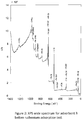
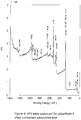
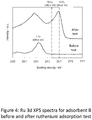
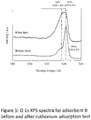
- X-ray photoelectron spectroscopy was performed for adsorbent B before and after the ruthenium adsorption test, and the wide spectrum, Ru 3d XPS spectrum and O 1s XPS spectrum were determined.
- the method for preparing adsorbent C was as follows: 900g of manganese sulfate and 780g of copper sulfate were dissolved in 2700g of ion-exchanged water; a mixed aqueous solution of 650g of potassium permanganate and 950g of potassium hydroxide dissolved in 2500g of ion-exchanged water was added to the solution, until the pH of the aqueous solution reached 6 to 7 to give a precipitate; the precipitate formed was filtered and washed, and the resulting cake was then dried at 110°C, where the molar ratio of manganese to copper contained in the oxide of manganese formed was 75:25 (Mn:Cu).
- the specific surface area measured in the BET method was 220m 2 /g, and the shape was a powder.
- the X-ray diffraction pattern in the range of 2 ⁇ 10 to 70° obtained for the adsorbent C in X-ray diffraction measurement with Cu-K ⁇ radiation included two broad peaks, which are characteristic of amorphous materials.
- Example 1 For 50ml of the test solution used in Example 1 at 25°C under the atmospheric pressure, 5.0mg of adsorbent C was used, and the ruthenium removal efficiency was determined in the same manner as in Example 1.
- the method for preparing granular adsorbent D using the powder adsorbent C in Example 3 was as follows: the powder adsorbent C was tightly pressed by using the dry high-pressure molding machine (from SINTOKOGIO, LTD., BGLOL001) used in Example 2, and further pulverized, and the size of the pulverized product was adjusted with a 35-mesh (500 ⁇ m) sieve and a 10-mesh (2000 ⁇ m) sieve to prepare granules with a particle size of 500 to 2000 ⁇ m.
- Example 1 For 50ml of the test solution used in Example 1 at 25°C under atmospheric pressure, 50mg of adsorbent D was used, and the ruthenium removal efficiency was determined in the same manner as in Example 1.
- the method for preparing adsorbent E was as follows: 700g of manganese sulfate tetrahydrate was dissolved in 10,000g of ion-exchanged water heated to 80°C; a mixed aqueous solution of 400g of potassium permanganate and 800g of potassium hydroxide dissolved in 30000g of ion-exchanged water heated to 80°C was added to the aqueous solution to give a precipitate; the precipitate formed is filtered and washed, and the resulting cake was then dried at 120°C. Through these operations, massive manganese oxide was obtained. The mass was pulverized to obtain a powder. The specific surface area determined by using the BET method with nitrogen gas adsorption was 350 m 2 /g.
- Example 1 For 50ml of the test solution used in Example 1 at 25°C under atmospheric pressure, 5.0mg of adsorbent E was used, and the ruthenium removal efficiency was determined in the same manner as in Example 1.
- the method for preparing granular adsorbent F was as follows: the massive manganese oxide obtained in the preparation process of Example 5 was pulverized, and the size of the pulverized product was adjusted with a 35-mesh (500 ⁇ m) sieve and a 10-mesh (2000 ⁇ m) sieve to prepare granules with a particle size of 500 to 2000 ⁇ m.
- Example 1 For 50ml of the test solution used in Example 1 at 25°C under the atmospheric pressure, 50mg of adsorbent F was used, and the ruthenium removal efficiency was determined in the same manner as in Example 1.
- the method for preparing adsorbent G was as follows: the powder of adsorbent A and boehmite alumina (from Sasol Limited, trade name: PURAL SB) were blended together at a weight ratio of 9:1 to prepare a mixed powder; the mixed powder was tightly pressed by using the dry high-pressure molding machine used in Example 2, and further pulverized, and the size of the pulverized product was adjusted with a 35-mesh (500 ⁇ m) sieve and a 10-mesh (2000 ⁇ m) sieve to prepare granules with a particle size of 500 to 2000 ⁇ m.
- PURAL SB boehmite alumina
- Example 1 For 50ml of the test solution used in Example 1 at 25°C under atmospheric pressure, 50mg of the adsorbent G was used, and the ruthenium removal efficiency was determined in the same manner as in Example 1.
- the method for preparing adsorbent I was as follows: 4g of potassium permanganate and 4ml of ethanol were dissolved in 400g of ion-exchanged water; the resulting aqueous solution is transferred in an autoclave (from TAIATSU TECHNO CORPORATION, TEM-D-1000M) and held for 24 hours at 150°C; a precipitate formed was filtered and washed, and the resulting cake was then dried at 350°C. Through these operations, massive manganese oxide was obtained. The mass was pulverized to obtain a powder. The specific surface area determined by using the BET method with nitrogen gas adsorption was 18m 2 /g.
- Example 1 For 50ml of the test solution used in Example 1 at 25°C under atmospheric pressure, 5.0 mg of the adsorbent I was used, and the ruthenium removal efficiency was determined in the same manner as in Example 1.
- the method for preparing adsorbent J was as follows: 2g of spinel-type lithium manganate (from Sigma-Aldrich Co., LLC., trade name: Lithium manganese oxide) was dispersed in 2,000g of 0.5mol/L aqueous solution of hydrochloric acid, and the resultant was stirred for 24 hours; the resulting precipitate was filtered and washed, and then dried under vacuum to obtain a powder.
- the specific surface area determined by using the BET method with nitrogen gas adsorption was 13m 2 /g.
- Example 1 For 50ml of the test solution used in Example 1 at 25°C under the atmospheric pressure, 5.0mg of adsorbent J was used, and the ruthenium removal efficiency was determined in the same manner as in Example 1.
- a test solution with a pH of 5.8 to 6.8 for a ruthenium ion adsorption test was prepared as follows. Ruthenium (III) chloride n-hydrate, sodium chloride, magnesium chloride hexahydrate, calcium chloride dihydrate and hydrochloric acid were dissolved in ion-exchanged water to prepare an aqueous solution containing 10ppm of ruthenium ions, 10000ppm of sodium ions, 500ppm of magnesium ions and 500ppm of calcium ion with a pH of 5.8 to 6.8.
- Example 10 For 50ml of the test solution used in Example 10 at 25°C under the atmospheric pressure, 5.0g of adsorbent C was used, and the ruthenium removal efficiency was determined in the same manner as in Example 1.
- Example 10 For 50ml of the test solution used in Example 10 at 25°C under atmospheric pressure, 5.0mg of adsorbent E was used, and the ruthenium removal efficiency was determined in the same manner as in Example 1.
- a test solution for a ruthenium complex ion adsorption test was prepared as follows. Ruthenium (III) nitrosylnitrate, sodium chloride, magnesium chloride hexahydrate, calcium chloride dihydrate and hydrochloric acid were dissolved in ion-exchanged water to prepare an aqueous solution containing 10ppm of ruthenium complex ions, 10000ppm of sodium ions, 500ppm of magnesium ions, and 500ppm of calcium ions with a pH of 2.8.
- Example 13 For 50ml of the test solution used in Example 13 at 25°C under atmospheric pressure, 5.0mg of adsorbent C was used, and the ruthenium removal efficiency was determined in the same manner as in Example 1.
- Example 13 For 50ml of the test solution used in Example 13 at 25°C under atmospheric pressure, 5.0mg of adsorbent E was used, and the ruthenium removal efficiency was determined in the same manner as in Example 1.
- a test solution for a ruthenate ion adsorption test was prepared as follows. Potassium ruthenate (VI) was dissolved in ion-exchanged water to prepare an aqueous solution containing 20ppm of ruthenate ions with a pH of 8.6.
- Example 16 For 50ml of the test solution used in Example 16 at 25°C under atmospheric pressure, 50.0mg of adsorbent C was used, and the ruthenium removal efficiency was determined in the same manner as in Example 1.
- Example 16 For 50ml of the test solution used in Example 16 at 25°C under atmospheric pressure, 50.0mg of adsorbent E was used, and the ruthenium removal efficiency was determined in the same manner as in Example 1.
- Example 1 For 50ml of the test solution used in Example 1 at 25°C under atmospheric pressure without the addition of any adsorbent, the ruthenium removal efficiency was determined in the same manner as in Example 1.
- Example 1 For 50ml of the test solution used in Example 1 at 25°C under the atmospheric pressure, 5.0mg of a reagent of manganese oxide in a powdered state (from Wako Pure Chemical Industries Ltd., trade name: manganese oxide (IV), powder, grade: Wako 1st Grade) was used (adsorbent H), and the ruthenium removal efficiency was determined in the same manner as in Example 1.
- a reagent of manganese oxide in a powdered state from Wako Pure Chemical Industries Ltd., trade name: manganese oxide (IV), powder, grade: Wako 1st Grade
- Example 10 For 50ml of the test solution used in Example 10 at 25°C under atmospheric pressure without the addition of any adsorbent, the ruthenium removal efficiency was determined in the same manner as in Example 1.
- Example 10 For 50ml of the test solution used in Example 10 at 25°C under atmospheric pressure, 5.0mg of the adsorbent H was used, and the ruthenium removal efficiency was determined in the same manner as in Example 1.
- Example 13 For 50ml of the test solution used in Example 13 at 25°C under the atmospheric pressure without addition of any adsorbent, the ruthenium removal efficiency was determined in the same manner as in Example 1.
- Example 13 For 50ml of the test solution used in Example 13 at 25°C under atmospheric pressure, 5.0mg of adsorbent H was used, and the ruthenium removal efficiency was determined in the same manner as in Example 1.
- Example 16 For 50ml of the test solution used in Example 16 at 25°C under atmospheric pressure without the addition of any adsorbent, the ruthenium removal efficiency was determined in the same manner as in Example 1.
- Example 16 For 50ml of the test solution used in Example 16 at 25°C under atmospheric pressure, 50.0mg of adsorbent H was used, and the ruthenium removal efficiency was determined in the same manner as in Example 1.
- an adsorbent comprising manganese oxide having, as the crystal structure, a tunnel structure like ⁇ -MnO 2 in which at least two linked MnO 6 octahedrons form each horizontal and vertical side of the tunnel, manganese oxide being amorphous or manganese oxide having a layered structure can remove ruthenium at a higher efficiency than manganese oxide with other structures.
- the ruthenium removal efficiencies for ruthenium complex ions using of ruthenium (III) nitrosylnitrate were lower than those for ruthenium cations in using of ruthenium (III) chloride.
- ruthenium complex ions The lower ruthenium removal efficiencies for ruthenium complex ions are presumably due to the adsorption properties of a ruthenium complex ion, as ruthenium (III) nitrosylnitrate, to the surface of an adsorbent varying depending on the type of the ligand, or because oxidation of ruthenium is less likely to occur under the influence'of the ligand.
Landscapes
- Chemical & Material Sciences (AREA)
- Organic Chemistry (AREA)
- Engineering & Computer Science (AREA)
- Analytical Chemistry (AREA)
- Chemical Kinetics & Catalysis (AREA)
- Inorganic Chemistry (AREA)
- Water Supply & Treatment (AREA)
- Life Sciences & Earth Sciences (AREA)
- Hydrology & Water Resources (AREA)
- Environmental & Geological Engineering (AREA)
- Mechanical Engineering (AREA)
- Metallurgy (AREA)
- Materials Engineering (AREA)
- Manufacturing & Machinery (AREA)
- Solid-Sorbent Or Filter-Aiding Compositions (AREA)
- Manufacture And Refinement Of Metals (AREA)
- Treatment Of Liquids With Adsorbents In General (AREA)
Abstract
Description
- The present invention relates to an adsorbent for recovering (and/or reusing) or removing ruthenium from aqueous solution thereof by adsorbing the ruthenium in the aqueous solution, which includes any form of a ruthenium cation, a ruthenium complex ion and a ruthenate ion, on the adsorbent; and relates to a method for purifying sea water or the like polluted with a radioactive element, using said adsorbent.
- In recent years, there has been an increase in demand for metal resources. Among them, demand for noble metals has also increased as noble metals are used in e.g. electronic devices and various catalysts although reserves of them are scarce and supplies are limited. Therefore, the need for them to be effectively used and recovered has increased. One noble metal, Ruthenium, has also been used for wider applications including as a material for hard disks and as a catalyst in the production of hydrogen, and it has become important to improve techniques for recovery of ruthenium from waste fluid resulting from the production of such products or from the metal-dissolving solution generated during the recycling of industrial products.
- In addition, as it is considered that radioactive elements are discharged as a result of nuclear plant accidents through subterranean routes to pollute the ocean, the removal of such pollutants is now critical. The radioactive elements discharged include radioactive ruthenium, and removal of the radioactive ruthenium from soil or sea water and/or purification thereof is also critical.
- In such situations, ruthenium is usually present as an ion in an aqueous solution thereof and the recovery of ruthenium from or purification of ruthenium-containing water requires selective adsorption or filtration of ruthenium, or a treating agent which selectively reacts with ruthenium. In particular, the removal of radioactive ruthenium from and/or purification of radioactive ruthenium-containing water requires an extremely high removal performance, a simple removal apparatus, and a safe and inexpensive adsorbent and/or treating agent.
- Many methods for recovering and/or removing noble metals including ruthenium have been previously proposed. For example,
Patent Literature 1 describes a method of heating a material, on which a noble metal such as rhodium, palladium and ruthenium are supported, to allow the noble metal to be absorbed into a material having a perovskite crystal structure. Although this method is preferable for the recovery of a useful metal from a catalyst used in the treatment of automobile exhaust gas, the method requires a heating process at 1000°C or higher, and thus it is difficult to adapt said method to applications in which a noble metal ion present in water is recovered and/or removed from the water. -
Patent Literature 2 shows a method of allowing a metal ion to be adsorbed on an ion exchange resin or a chelating resin in an aqueous solution. Such a method of absorbing a metal ion with an ion exchange resin or the like provides only a limited removal of ruthenium per volume of an adsorbent due to the small number of adsorption sites in the adsorbent. This drives the cost required for the adsorbent up, and thus, in cases where a large amount of ruthenium-containing water is treated, the cost for the adsorption treatment of ruthenium increases, compromising the economic desirability of such a situation. -
Patent Literature 3 shows a method of removing radioactive palladium or radioactive ruthenium from aqueous solution thereof by using a metal ferrocyanide. Although this method is preferable in that the ions in the aqueous solution can be removed, the ferrocyanide may decompose at high temperatures, generating harmful hydrogen cyanide. In addition, the removal efficiency is not sufficiently high, and moreover, decomposition may be caused in aqueous solutions with a high pH, allowing adsorbed radioactive ruthenium to be released and resulting in a lower removal efficiency. This complicates the management of the adsorption treatment system, and necessitate the treatment of cyanide-containing waste water, for safety. - Particularly in cases where the target for removal is, for example, water used for washing soil polluted with a radioactive element or sea water polluted with a radioactive element, such a target usually has a low concentration of ruthenium and typically requires large scale treatment, and thus the removal of the radioactive elements requires an extremely high removal performance in a small quantity, and a reduction in cost. With regards to removal efficiencies, e.g. for radioactive elements including strontium scattered by the explosion of a nuclear reactor, the final removal efficiency after purification must be 99% or higher or 99.9% or higher, because of the seriousness of its impact.
- Another significant problem in the treatment of waste water from a nuclear reactor is the possible presence of ruthenium in various structures. As shown in
Non Patent Literature 1, the structure of ruthenium is believed to change depending on the type of aqueous solution with which it has come into contact during nuclear fission from radioactive uranium. Ruthenium may be present in various structures depending on conditions such as the temperature of the aqueous solution thereof and chemical species dissolved therein, and a high removal performance is required for respective structures. - It is considered that a removal efficiency similar or comparable to that for radioactive strontium is necessary for radioactive ruthenium. Even assuming that the removal efficiency is 60% per cycle of treatment, 40% is discharged, and, for the removal of at least 99%, five or more cycles of treatment must be performed; however, this is significantly inefficient for applications in which a large amount of polluted water is treated. If a material which provides a removal efficiency of 95% or higher can be obtained, the discharge ratio after one cycle of treatment is at most 5%, and a removal efficiency of 99.75% or higher can be achieved in two cycles of treatment. Even in cases where a secondary treatment facility with e.g. a reverse osmosis membrane is provided downstream of the primary treatment with an adsorbent, the achievement of a high removal efficiency of, for example, 95% or higher at the primary treatment stage will significantly reduce the load applied to the step of the expensive secondary treatment, and this situation is very preferable in terms of cost-efficiency. Accordingly, this will require an adsorbent having a removal efficiency of 95% or higher for ruthenium cations which are expected to exist at a particularly high content, and having a removal efficiency comparable thereto for other ion species such as ruthenium complex ions and ruthenate ions.
- Such an adsorbent needs to be capable of treating a large amount of water, and therefore needs to have sufficient stability for extensive treatment. For such a material, water-insoluble materials such as metal oxides are preferred.
- In terms of safety, the use of an adsorbent or treating agent which induces environmental pollution is not preferable. Raw materials to be used need to be inexpensive, and moreover it is not preferable that their production involves the volatilization of an organic solvent, or the consumption of a massive amount of energy such as calcination at high temperature, and the process used to produce such materials should be simple.
- As described above, although there is a high demand for the replacement of conventional methods for removing or recovering ruthenium by a simple and safe method using an inexpensive adsorbent or treating agent with a high removal efficiency, an adsorbent or treating agent satisfying performance requirements including 1) ability to remove various ion species and further 2) a high removal efficiency of 70% or higher, preferably 95% or higher, for ruthenium cations, as well as safety and low cost, has not yet been obtained.
-
- Patent Literature 1:
JP5339302B2 - Patent Literature 2:
JP2013-95979A - Patent Literature 3:
JP2014-77162A - Non Patent Literature 1: Japan Atomic Energy Research Institute Report JAERI-M 9159
- A primary object of the present invention is to provide a material capable of adsorbing ruthenium cations in an aqueous solution, and additionally capable of adsorbing ruthenium complex ions and ruthenate ions, without any complicated apparatus or energy such as high temperature.
- A further object of the present invention is to provide a material capable of adsorbing ruthenium cations in an aqueous solution with a high efficiency of 70% or more, or even 95% or more, and additionally capable of adsorbing ruthenium complex ions and ruthenate ions, without any complicated apparatus or energy such as high temperature.
- Another object of the present invention is to provide an adsorbent for ruthenium in an aqueous solution, which enables an inexpensive, safe and simple treatment, by using as the adsorbent metal oxides which are inexpensive and less likely to cause environmental pollution.
- Another object of the present invention is to provide a method enabling the adsorption of ruthenium ions in a simple and safe manner by merely soaking a material in aqueous solution containing ruthenium.
- Still another object of the present invention is to provide a method for adsorbing and removing radioactive ruthenium from water discharged from a nuclear reactor or the like to purify the water.
- Other objects of the present invention will become apparent from the following description.
- In view of the circumstances described above, the present inventors conducted extensive research to solve,the drawbacks of the conventional technique, and discovered the following findings and guidelines as an idea to achieve the objects of the present invention.
- (1) The present inventors searched for a material capable of adsorbing ruthenium present in aqueous solution thereof primarily from metal oxides which are chemically stable and less likely to cause environmental pollution, and found that manganese oxides adsorb ruthenium.
- (2) In particular, a high ruthenium removal efficiency (e.g. a ruthenium removal efficiency of 70% or more) can be achieved in the case of manganese oxides having an appropriate surface area, and thus the specific surface area of the manganese oxides is preferably 70 m2/g or more.
- (3) Although an adsorbent only with manganese oxides can provide higher adsorbing performance than conventional adsorbents, it proved difficult to achieve a ruthenium removal efficiency of 90% or more, preferably 95% or more.
- (4) In view of this, the present inventors examined methods in which a metal compound other than manganese is added to allow the metal compound to coexist with the manganese, and found that the addition of a particular kind of metal significantly enhances the ruthenium removal efficiency.
- (5) It was found that the metal element to be added is preferably a transition metal, especially iron, copper, cobalt and zinc are preferred, and copper is particularly preferred.
- (6) It was also found that a high ruthenium removal efficiency can be achieved in cases where a manganese oxide is amorphous or has a layered structure or a tunnel structure in which at least two linked MnO6 octahedrons form each horizontal and vertical side of the tunnel.
- (7) The adsorbent is usually produced as a powder, but, as the powder may be scattered when handled, complicating the handling of the material, said powder should preferably be formed into a granule or the like. However, this reduces the effective surface area, thereby likely lowering the ruthenium removal efficiency. As a method for preventing such lowering in removal efficiency, the present inventors found that mixing the adsorbent powder with, for example, a aluminum oxide powder followed by forming the powder into a shaped article can prevent the aforementioned reduction in specific surface area, and thus can maintain a high ruthenium removal efficiency. This was inferred to be an effect of the porous nature of aluminum oxide to bind the adsorbent powder thereon without interfering with the adsorption of ruthenium.
- (8) Although it is unclear why the combination of appropriate specific surface area, an amorphous or appropriate structure and a particular transition metal element described above is responsible for the resulting high ruthenium removal efficiency of 95% or higher, as one possible reason for the result, the present inventors inferred that said combination results in an increase in the number of adsorption sites for ruthenium, and furthermore, that ruthenium is strongly adsorbed in association with chemical reaction, and adsorbed ruthenium is thus less likely to be detached.
- (9) When the adsorbent thus obtained was tested using ruthenium ion-containing water, a high ruthenium removal efficiency of 70% or more, preferably 95% or more, was achieved, and, in addition, the adsorbent adsorbed ruthenium complex ions and ruthenate ions, and thus the present inventors achieved the present invention.
- (10) It was found that, in the case of using manganese oxides for the adsorption treatment of aqueous solutions of ruthenium (III) having trivalent ruthenium, the ruthenium became tetravalent or higher-valent after being adsorbed on the manganese oxides. From this result, the present inventors inferred that the manganese oxide-based adsorbent strongly adsorbs ruthenium through oxidation of ruthenium, and this strong adsorption is one reason for the high ruthenium removal efficiency.
- Specifically, the present invention relates to the following:
- 1. A ruthenium adsorbent for adsorbing ruthenium from aqueous solution thereof, said adsorbent comprising manganese oxides as a primary component.
- 2. The adsorbent according to the above 1, wherein MnO2 consisting of ε-MnO2 and/or γ-MnO2 is excluded from the manganese oxides.
- 3. The adsorbent according to the above 1 or 2, wherein the aqueous solution comprises ruthenium in the form of a ruthenium cation, a ruthenium complex ion and/or a ruthenate ion.
- 4. The adsorbent according to any one of the above 1 to 3, wherein the manganese oxides have an amorphous structure and/or a layered structure and/or a tunnel structure.
- 5. The adsorbent according to any one of the above 1 to 4, wherein, in the case that the manganese oxides have a tunnel structure, the adsorbent comprises oxides of manganese having at least two linked MnO6 octahedrons forming each horizontal and vertical side of the tunnel.
- 6. The adsorbent according to any one of the above 1 to 4, wherein the manganese oxides have an amorphous structure and/or α-MnO2 and/or δ-MnO2.
- 7. The adsorbent according to any one of the above 1 to 6, wherein the manganese oxides have an amorphous structure and/or α-MnO2, and the aqueous solution comprises ruthenium in the form of a ruthenium cation.
- 8. The adsorbent according to any one of the above 1 to 7, wherein the content of manganese calculated as manganese dioxide is 50 parts by weight or more, based on 100 parts by weight of the adsorbent.
- 9. The adsorbent according to any one of the above 1 to 8, further comprising at least one additional transition metal elements other than manganese.
- 10. The adsorbent according to the above 9, wherein the transition metal element is in the form of oxides thereof.
- 11. The adsorbent according to the above 10, wherein manganese and the transition metal element are present in the form of a physical mixture of manganese oxides and oxides of the transition metal element.
- 12. The adsorbent according to the above 10, wherein manganese and the transition metal element are present in the form of composite oxides thereof.
- 13. The adsorbent according to the above 11, wherein the weight ratio of manganese oxides to transition metal oxides is 1:0.001 to 1:1, when the weight of the manganese oxides are calculated as the weight of manganese dioxide.
- 14. The adsorbent according to the above 12, wherein the molar ratio of manganese to transition metal element is 1:0.001 to 1:1.
- 15. The adsorbent according to any one of the above 9 to 14, wherein the transition metal element is selected from the group consisting of iron, cobalt, copper and zinc.
- 16. The adsorbent according to any one of the above 1 to 15, having a specific surface area of 70 to 700m2/g.
- 17. The adsorbent according to any one of the above 1 to 16, in the form of a powder.
- 18. The adsorbent according to any one of the above 1 to 16, in the form of a shaped article.
- 19. The adsorbent according to any one of the above 1 to 18, comprising an inorganic binder which comprises a metal element other than transition metals and/or a metalloid element.
- 20. The adsorbent according to the above 19, wherein the inorganic binder is aluminum oxides or silicon oxides.
- 21. Use of the adsorbent according to any one of the above 1 to 20, for removing radioactive ruthenium in water through adsorption.
- 22. Use of the adsorbent according to any one of the above 1 to 20, for recovering ruthenium from waste fluid discharged from a production line for industrial products and/or a recycling process for industrial products.
- 23. A method for removing radioactive ruthenium from radioactive ruthenium-containing water, comprising contacting the radioactive ruthenium-containing water with the adsorbent according to any one of the above 1 to 20.
- 24. A method for removing ruthenium from ruthenium-containing water, comprising contacting the water with the adsorbent according to any one of the above 1 to 20 to oxidize ruthenium, provided that ruthenate ion-containing water is excluded from the ruthenium-containing water.
- 25. The method according to the above 23 or 24, wherein the water is sea water and/or water containing a sodium ion, a magnesium ion, a calcium ion, a chlorine ion and/or other ions, polluted with a radioactive element, including radioactive ruthenium.
- In further embodiments of the present invention, the present invention relates to the following:
- 1. A ruthenium adsorbent for adsorbing ruthenium (Ru) ions from aqueous solution of ruthenium, said adsorbent comprising manganese in the form of oxides thereof.
- 2. The adsorbent according to the above 1, wherein the content of the manganese in the form of oxides thereof, calculated as manganese dioxide, is 50 parts by weight or more based on 100 parts by weight of the adsorbent.
- 3. The adsorbent according to the above 1 or 2, wherein the manganese in the form of oxides thereof is present exclusively as manganese oxides.
- 4. The adsorbent according to the above 1 or 2, further comprising at least one additional transition metal elements other than manganese.
- 5. The adsorbent according to the above 4, the transition metal element is in the form of oxides thereof.
- 6. The adsorbent according to the above 5, wherein manganese and the transition metal element are present in the form of a physical mixture of manganese oxides and transition metal element oxides.
- 7. The adsorbent according to the above 5, wherein manganese and the transition metal element are present in the form of composite oxides thereof.
- 8. The adsorbent according to the above 6, wherein the weight ratio of manganese oxides to oxides of the transition metal is 1:0.001 to 1:1, when the weight of the manganese oxides is calculated as the weight of manganese dioxide.
- 9. The adsorbent according to the above 7, wherein the molar ratio of manganese to transition metal element is 1:0.001 to 1:1.
- 10. The adsorbent according to any one of the above 4 to 9, wherein the transition metal element is selected from the group consisting of iron, cobalt, copper and zinc.
- 11. The adsorbent according to any one of the above 1 to 10, having a specific surface area of 70 to 700m2/g.
- 12. The adsorbent according to any one of the above 1 to 11, in the form of a powder.
- 13. The adsorbent according to any one of the above 1 to 11, in the form of a shaped article.
- 14. The adsorbent according to any one of the above 1 to 13, comprising an inorganic binder which comprises a metal element other than transition metals and/or a metalloid element.
- 15. The adsorbent according to the above 14, wherein the inorganic binder is aluminum oxides or silicon oxides.
- 16. Use of the adsorbent according to any one of the above 1 to 15 for removing radioactive Ru ions in water through adsorption.
- 17. Use of the adsorbent according to any one of the above 1 to 15 for recovering Ru ions from waste fluid discharged from a production line for industrial products and/or a recycling process for industrial products.
- 18. A method for removing radioactive Ru ions from radioactive Ru ion-containing water, comprising contacting the radioactive Ru ions-containing water with the adsorbent according to any one of the above 1 to 15.
- 19. The method according to the above 18, wherein the water is sea water polluted with a radioactive element including a radioactive Ru ion.
- 20. The adsorbent according to any one of the above 1 to 15, for removing radioactive Ru ions in water through adsorption.
- 21. The adsorbent according to any one of the above 1 to 15, for recovering Ru ions from waste fluid discharged from a production line for industrial products and/or a recycling process for industrial products.
- As is clear from the above description, the present invention can provide an adsorbent having high adsorbing performance, preferably with a removal efficiency of 70% or more, more preferably with a removal efficiency of 95% or more, for ruthenium in aqueous solution. By utilising the high removal efficiency, recovery of ruthenium from industrial waste water or from a recycling process, removal of radioactive ruthenium from groundwater or sea water polluted with radioactive ruthenium, and purification of said groundwater or sea water can be performed in a safe and economical manner without the need for any expensive apparatus.
-
- [
Figure 1] Figure 1 shows XRD patterns for adsorbents demonstrated in Examples 1, 3 and 5, Reference Example 1 and Examples 8 and 9. - [
Figure 2] Figure 2 shows an XPS wide spectrum for an adsorbent demonstrated in Example 2 before a ruthenium adsorption test. - [
Figure 3] Figure 3 shows an XPS wide spectrum for an adsorbent demonstrated in Example 2 after a ruthenium adsorption test. - [
Figure 4] Figure 4 showsRu 3d XPS spectra for an adsorbent demonstrated in Example 2 before and after a ruthenium adsorption test. - [
Figure 5] Figure 5 showsO 1s XPS spectra for an adsorbent demonstrated in Example 2 before and after a ruthenium adsorption test. - Specifically, the present invention is an adsorbent for ruthenium in an aqueous solution, the adsorbent comprising manganese oxides, and a method for removing ruthenium from ruthenium-containing water, for example, from sea water containing radioactive ruthenium, using said adsorbent.
- The forms of ruthenium in its aqueous solution to be adsorbed by the adsorbent according to the present invention include a ruthenium cation, a ruthenium complex ion and a ruthenate ion.
- The adsorbent according to the present invention is based on manganese oxides.
- As described above, the present invention is based on the discovery that manganese oxides have ruthenium-adsorbing properties.
- In an embodiment of the present invention, the content of manganese in the adsorbent according to the present invention, calculated as manganese dioxide, can be 50 parts by weight or more, for example, 60 parts by weight or more, 70 parts by weight or more, 80 parts by weight or more, 90 parts by weight or more, or 95 parts by weight or more, based on 100 parts by weight of the adsorbent. For example, the adsorbent according to the present invention can comprise manganese in an amount, in terms of manganese dioxide, of 50 parts by weight to 100 parts by weight based on 100 parts by weight of the adsorbent. In cases where the amount of manganese is 100 parts by weight, the adsorbent according to the present invention consists only of manganese dioxide.
- In an embodiment of the present invention, the adsorbent according to the present invention can further contain at least one additional transition metal elements other than manganese.
- In the present specification, it was also found that the at least one additional transition metal element contained in the adsorbent according to the present invention enhances the ruthenium removal efficiency of the adsorbent. Examples of said transition metal element include copper, iron, cobalt and zinc, among which copper is particularly preferably used; use of copper can particularly significantly enhance the ruthenium removal efficiency.
- The transition metal element can be, for example, in the form of an oxide thereof. In this case, manganese and the transition metal element can be present in the form of a physical mixture of manganese oxides and transition metal element oxides. In the case that the transition metal element is copper, for example, manganese and copper can be present in the form of a physical mixture of manganese oxides and copper oxides. In this way, coexistence of the additional transition metal in the form of oxides and manganese oxides in the adsorbent as a result of the mixing of the manganese oxides with the oxides of the additional transition metal is preferable in terms of chemical stability, ruthenium removal efficiency, cost, etc.
- Alternatively, the transition metal element can be present as composite oxides with manganese. This embodiment, in which the transition metal element is present in the form of composite oxides with manganese in the adsorbent, is also preferable in terms of chemical stability, ruthenium removal efficiency, cost, etc. In the case that the transition metal element is copper, for example, the adsorbent according to the present invention comprises composite oxides of manganese and copper.
- Moreover, the adsorbent according to the present invention can comprise both a physical mixture of manganese oxides and the transition metal element oxides, and composite oxides of manganese and the transition metal. In summary, in the adsorbent according to the present invention, manganese and the transition metal element can be present in the form of a physical mixture of manganese oxides and transition metal element oxides, or in the form of composite oxides of manganese and the transition metal element, or in both of the forms.
- Here, "physical mixture" refers to a mixture of two or more single oxides and/or composite oxides.
- "Composite oxide" refers to an oxide in which two or more atoms other than oxygen are present in a single structure, and, for example, a composite oxide of manganese and copper is an oxide containing manganese and copper in a single structure.
- In the case that the adsorbent according to the present invention comprises at least one additional transition metal element other than manganese, and manganese and said transition metal element are present in the form of a physical mixture of manganese oxides and oxides of the transition metal element, the ratio (weight ratio) of manganese oxides to additional transition metal element oxides (in the case that two or more transition metal elements are contained, oxides of all of them) depends on the type of the transition metal element, and can be 1:0 to 1:1.0, for example, 1:0.001 to 1:1, preferably 1:0.01 to 1:0.5, for example, 1:0.05 to 1:0.5, or 1:0.1 to 1:0.4, when the weight of manganese oxide is calculated as that of manganese dioxide and the weight of the transition metal element is calculated as that of a stable oxide of the metal (e.g. copper oxide (CuO) for copper, iron oxide (Fe2O3) for iron). From the viewpoint of prevention of the lowering of the ruthenium removal efficiency, the weight ratio is preferably in these ranges.
- In cases where the adsorbent according to the present invention comprises at least one additional transition metal element other than manganese, and manganese and the transition metal element are present in the form of composite oxides, the molar ratio of manganese to transition metal element can be 1:0 to 1:1.0, for example, 1:0.001 to 1:1, preferably 1:0.01 to 1:0.5, for example, 1:0.05 to 1:0.5, or 1:0.1 to 1:0.4. From the viewpoint of prevention of the lowering of the ruthenium removal efficiency, the molar ratio is preferably in these ranges.
- For example, in cases where the transition metal element is copper and the adsorbent according to the present invention comprises a physical mixture of manganese oxides and copper oxides, the weight ratio of manganese oxides to copper oxides (where the respective weights are calculated as those of MnO2 and CuO) can be MnO2:CuO = 1:0 to 1:1, for example, 1:0.001 to 1:1. From the viewpoint of prevention of the lowering of the ruthenium removal efficiency, the weight ratio is preferably in these ranges. In particular, the weight ratio is preferably MnO2:CuO = 1:0.01 to 1:0.5, for example, 1:0.05 to 1:0.5, more preferably MnO2:CuO = 1:0.1 to 1:0.4.
- For example, in cases where the transition metal element is copper and the adsorbent according to the present invention comprises composite oxides of manganese and copper, the molar ratio of manganese to copper can be 1:0 to 1:1, for example, 1:0.001 to 1:1. From the viewpoint of prevention of the lowering of the ruthenium removal efficiency, the molar ratio is preferably in these ranges. In particular, the molar ratio is preferably Mn:Cu = 1:0.01 to 1:0.5, for example, 1:0.05 to 1:0.5, more preferably Mn:Cu = 1:0.1 to 1:0.4.
- The quantity of manganese oxides, the weight ratio of manganese oxides to additional transition metal oxides, and the molar ratio of manganese to additional transition metal element in a composite oxide can be determined, for example, by measuring the quantities of manganese and the additional transition metal (e.g. copper) in the adsorbent by using a high-frequency inductively coupled plasma emission spectrometer, and then appropriately converting the obtained quantities to those of manganese dioxide and the transition metal oxide (e.g. CuO), or converting to moles.
- The adsorbent according to the present invention can have a specific surface area of, for example, 70 to 700m2/g. A specific surface area of 70m2/g or more allows the achievement of a satisfactory ruthenium removal efficiency, and a specific surface area of 700m2/g or less can prevent rapid adsorption which may cause heat generation or the boiling of water on contacting with water, and thus the specific surface area is preferably in the above range. If such heat generation or the boiling of water occurs, in particular in the case that a granular, shaped article is used as the adsorbent, foaming takes place, collapsing the article, and the passing amount of water to be purified and the ruthenium removal efficiency are lowered. Installation of a cooler or the like to prevent such lowering involves economically undesirable side effects including increases in the cost of equipment and energy consumption. The specific surface area is more preferably in the range of 100 to 500m2/g, for example, 125 to 450m2/g, and particularly preferably in the range of 150 to 400m2/g.
- The specific surface area can be measured through specific surface area measurement with nitrogen adsorption (BET method).
- In the present invention, it was found that, in the case that the manganese oxides contained in the adsorbent have a particular structure, such as being amorphous, or having α-MnO2 with a tunnel structure, or δ-MnO2 with a layered structure, a further satisfactory ruthenium removal efficiency can be achieved, and that, in contrast, the ruthenium removal efficiencies for cases using β-MnO2 with a tunnel structure and λ-MnO2 with a spinel structure are lower than those using α-MnO2 and of δ-MnO2 with a layered structure.
- Manganese oxide having a tunnel structure is classified with (m × n), where m is the number of linked MnO6 octahedrons forming the horizontal side of the tunnel, and n is that of those forming the vertical side of the tunnel. α-MnO2 is classified as (2 × 2), β-MnO2 as (1 × 1), and γ-MnO2 as coexistence of (1 × 1) and (1 × 2). ε-MnO2 has a structure similar to that of γ-MnO2, and includes microtwinning and many structural defects.
- Accordingly, in an embodiment of the present invention, the adsorbent according to the present invention comprises manganese oxides being amorphous or having a layered structure or a tunnel structure in which at least two linked MnO6 octahedrons form each horizontal and vertical side of the tunnel.
- The structure can be confirmed from an XRD spectrum obtained in X-ray diffraction measurement with Cu-Kα radiation.
- One reason why the structure described above is preferable, which is still under speculation, is that the number of adsorption sites for ruthenium is larger, and sites at which adsorbed ruthenium is less likely to be detached are formed.
- The adsorbent according to the present invention has the feature of oxidizing adsorbed ruthenium. The electronic state of the adsorbed ruthenium can be confirmed from an XPS spectrum obtained in X-ray photoelectron spectroscopy.
- The manganese oxides or composite oxides of manganese and the additional transition metal element in the present invention can be prepared, for example, as follows.
- A manganese oxide in the present invention can be obtained, for example, by making an aqueous solution of manganese sulfate alkaline (e.g. by mixing the solution with an aqueous solution of an alkaline compound such as sodium hydroxide, potassium carbonate and potassium hydroxide), and carrying out an oxidation treatment of the solution with potassium permanganate to form a precipitate, followed by filtering, washing and drying of the precipitate.
- A composite oxide of manganese and the additional transition metal element in the present invention can be obtained, for example, by using a method of mixing a manganese compound and a compound of the additional transition metal together to obtain an oxide thereof.
- In this method, for example, an aqueous solution containing a manganese compound and a compound of the additional transition metal is prepared, and an alkaline aqueous solution (e.g. an aqueous solution of an alkaline compound such as sodium hydroxide, potassium carbonate and potassium hydroxide) and potassium permanganate are added to the aqueous solution, and the resulting precipitate is filtered, washed and dried, and thus a composite oxide of manganese and the additional transition metal element can be obtained.
- In cases where the transition metal element is copper, for example, as demonstrated later in Examples, a composite oxide of manganese and copper can be obtained through oxidation of manganese sulfate and copper sulfate in an aqueous solution thereof, by means of e.g. potassium permanganate, followed by washing and drying of resulting precipitate.
- The specific surface area can be adjusted, for example, by appropriately changing the drying temperature. In the case of composite oxides, the molar ratio of manganese to additional transition metal element can be adjusted by appropriately changing the quantities of the raw materials so that the desired ratio is achieved.
- A physical mixture of manganese oxides and additional transition metal oxides in the present invention can be prepared by mixing manganese oxides prepared as described above with oxides of the additional transition metal separately obtained or produced, or by, for example, weighing and homogeneously mixing predetermined quantities of the both powders.
- The shape of the adsorbent according to the present invention is not limited. For example, the adsorbent can be used in the form of a powder. Nevertheless, the adsorbent is preferably formed into a certain shape to reduce the scattering of powder from the adsorbent, to allow an aqueous solution to easily pass through the adsorbent, to reduce pressure drop in filtration, or to mix the adsorbent homogeneously in the aqueous solution. For example, the shape can be in the form of a granule, pellet, cylindrical shaped article or the like, having a particle size of about 0.1 mm to 10mm, more preferably, having a particle size of about 0.2 to 7mm.
- A shaped article, such as a granule, a pellet and a cylindrical shaped article, can be produced by using a known forming method. In the production of a granule, for example, the adsorbent in powder form is tightly pressed by using a high-pressure molding machine and then pulverized, and thus the adsorbent in the form of a granule can be obtained. In this case, the size of the granule can be appropriately adjusted through adjustment of the mesh size of a sieve.
- The particle size of the shaped article can be measured by using a particle size measurement method with an analytical sieve (in accordance with "Test methods for sieving of chemical products" in JIS K0069).
- In cases where the adsorbent according to the present invention is formed into a shaped article, for example, the adsorbent powder described above can be directly formed, or mixed with a binder (binding agent) and then formed. When the adsorbent powder is directly formed/granulated, the surface area decreases, and as a result the adsorption activity is likely to also decrease. Contrarily, it was found that the decrease in adsorption activity can be reduced when the aforementioned powder is mixed with a certain metal oxide and/or metalloid oxide, and then formed in a shaped article. Accordingly, in the production of a shaped article, it is preferable to form the powder into a shaped article after mixing the powder with a binder. Oxides of aluminum, silicon and the like, and oxides containing both aluminum and silicon such as zeolite have the large effect of preventing a decrease in said activity, and are thus preferable for the binder. In the present invention, aluminum oxide is particularly preferable.
- Accordingly, in an embodiment of the present invention, the adsorbent according to the present invention can further comprise a binder, preferably an inorganic binder containing a metal element other than transition metals and/or a metalloid element. Here, "metalloid element" refers to an element of intermediate nature between metal and non-metal, and examples thereof include silicon, boron, germanium, arsenic, tin, tellurium and polonium.
- In cases where the adsorbent according to the present invention comprises a binder, the weight ratio of manganese oxides (or a mixture of manganese oxides and oxides of the additional transition metal) to binder is 1:0 to 1:1, more preferably 1:0.01 to 1:0.7, even more preferably 1:0.03 to 1:0.3, for example, 1:0.05 to 1:0.2 (manganese oxides (or a mixture of manganese oxides and oxides of the additional transition metal):binder).
- The adsorbent according to the present invention can comprise, as necessary and in addition to manganese oxides (or a mixture of manganese oxides and oxides of the additional transition metal) and the binder, any other components which do not impair the advantageous effects of the present invention.
- Alternatively, in an embodiment of the present invention, the adsorbent according to the present invention can consist only of manganese oxides (or a mixture of manganese oxides and oxides of the additional transition metal) and the binder.
- It is also preferable to use the adsorbent according to the present invention which is supported on a carrier. Examples of such carriers include, but are not limited to, nonwoven fabrics, papers, plastic sheets, and ceramic sheets. Among them, flexible materials, particularly nonwoven fabrics, are preferable. Use of a flexible carrier provides good handleability in use, and allows its use as a roll, and thus the throughput per unit volume can be enhanced. The nonwoven fabric material may be any water-insoluble material, and examples thereof include cellulose fibers, polyester fibers and polyamide fibers. To load the adsorbent on such a carrier, a method commonly used for loading various materials on various carriers can be appropriately used. For example, to load the adsorbent according to the present invention on the nonwoven fabric sheet obtained by tangling fibers, a method of bonding the adsorbent in powder form or the adsorbent formed into granules to the nonwoven fabric with an adhesive, or a method of coating the nonwoven fabric with the adsorbent together with a binder or the like can be used.
- As described above, the adsorbent according to the present invention can adsorb ruthenium present in an aqueous solution thereof at a high removal efficiency.
- Accordingly, in an embodiment of the present invention, the present invention relates to the use of an adsorbent comprising manganese in the form of its oxides to remove ruthenium from an aqueous solution thereof.
- Furthermore, with the use of the adsorbent according to the present invention, ruthenium can be removed from ruthenium-containing water by allowing the adsorbent to adsorb ruthenium in the aqueous solution, and then optionally separating the adsorbent from the water treated with the adsorbent using a suitable known method.
- In this case, the ruthenium-containing water is contacted with the adsorbent according to the present invention for adsorption of the ruthenium present in its aqueous solution on the adsorbent.
- Accordingly, in an embodiment of the present invention, the present invention relates to a method for removing radioactive ruthenium from ruthenium-containing water, e.g. radioactive ruthenium-containing water, comprising contacting the ruthenium-containing water, for example, the radioactive ruthenium-containing water, with the adsorbent according to the present invention. Through this method, the water can be purified.
- The method can further include separating the adsorbent having ruthenium adsorbed thereon from the water treated with the adsorbent.
- The aqueous solution to be treated with the adsorbent according to the present invention may be any aqueous solution containing ruthenium, and examples thereof include waste fluid discharged from the production of industrial products and/or the recycling process of industrial products, sea water polluted with a radioactive element, and water containing sodium ions, magnesium ions, calcium ions, chlorine ions and/or other ions and polluted with a radioactive element.
- Examples of applicable methods for contacting the adsorbent according to the present invention with ruthenium-containing water include soaking the adsorbent in ruthenium-containing water, for example, in which the adsorbent charged in a stand-alone tank is soaked in ruthenium-containing water, and continuously feeding ruthenium-containing water into piping, a container or a tank filled with the adsorbent using piping for feeding said water, connected to said piping, container or tank. A plurality of treatment tanks with the adsorbent according to the present invention may be connected together, and, for example, an ion exchange resin column may be connected downstream of the treatment tank with the adsorbent. A device for the measurement/detection of metal ion concentration can be provided in the vicinity of the adsorbent in each part to properly manage, e.g. the replacement of the adsorbent.
- Ruthenium-containing water can be appropriately pretreated, for example, treated with an ion exchange resin or chelating resin, before being contacted with the adsorbent according to the present invention.
- By using the adsorbent according to the present invention, a removal efficiency for ruthenium cations of, for example, 70% or more, preferably 80% or more, more preferably 90% or more, particularly preferably 95% or more, can be achieved.
- The adsorbent with metals such as ruthenium adsorbed thereon can be recovered or reused, optionally through separation from the treated water by using a suitable known method, followed by detachment of the metals by treatment with a treating agent suitable for the metals as adsorbed species, such as an acid and an alkali, and, as necessary, concentration. Further optionally, the adsorbent with metals adsorbed thereon can be directly solidified with cement or the like and discarded.
- Hereinafter, the present invention will be described with reference to Examples. However, the present invention is in no way limited to these Examples.
- Structural analysis and performance evaluation for adsorbents used in the following Examples, Comparative Examples and Reference Examples were performed according to the following methods.
- (1) Specific surface area of adsorbent: Specific surface area measurement with nitrogen adsorption (BET method) was used. The apparatus used was Macsorb Model-1210 from MOUNTECH Co., Ltd.
- (2) X-ray diffraction: Measurement was performed by using powder X-ray diffractometry with X'Pert PRO MPD from Spectris Co., Ltd.
- (3) X-ray photoelectron spectroscopy (XPS): Measurement was performed by using PHI Quantum2000 from ULVAC-PHI, Inc. In the measurement, an aluminium anode was used.
- (4) Measurement of ruthenium removal efficiency: To quantify the ruthenium concentration, a high-frequency inductively coupled plasma (ICP) emission spectrometer (from SHIMADZU Corporation, ICPS-8100) was used. Based on the values obtained, the ruthenium removal efficiency was calculated by using the following formula.

- The method for preparing adsorbent A was as follows: 700g of manganese sulfate tetrahydrate was dissolved in 10,000g of ion-exchanged water; to this aqueous solution, a mixed aqueous solution of 400g of potassium permanganate and 230g of potassium hydroxide dissolved in 23000g of ion-exchanged water was added to give a precipitate; and the precipitate formed was filtered and washed, and the resulting cake was then dried at 120°C. Through these operations, manganese oxide in powder form was obtained. The specific surface area determined using the BET method with nitrogen gas adsorption was 360m2/g. In the X-ray diffraction pattern in the range of 2θ = 10 to 70° obtained for adsorbent A in X-ray diffraction measurement with Cu-Kα radiation, only diffraction peaks indicating α-MnO2 were found. The crystallite size determined for all the diffraction peaks by using the Scherrer equation was in the range of 3 to 5nm.
- Subsequently, a test solution with a pH of 2.8 to 3.2 for a ruthenium ion adsorption test was prepared as follows. Ruthenium (III) chloride n-hydrate, sodium chloride, magnesium chloride hexahydrate, calcium chloride dihydrate and hydrochloric acid were dissolved in ion-exchanged water to prepare an aqueous solution containing 10ppm of ruthenium ions, 10000ppm of sodium ions, 500ppm of magnesium ions and 500ppm of calcium ions with a pH 2.8 to 3.2.
- 5.0 mg of adsorbent A was added to 50mL of the test solution (ruthenium (III) chloride, pH 2.8 to 3.2) at 25°C under atmospheric pressure, and the resultant was held for 1 hour while being shaked with a shaker at 180 oscillation/min. In the test, a 250mL plastic container with a lid was used. After the treatment, the entirety of the contents of the plastic container were transferred to a centrifuge tube, and centrifugation was performed for 5 minutes at a rotation frequency of 4000rpm, and the supernatant was then recovered. The ruthenium concentration in the supernatant thus obtained was measured, and then the ruthenium removal efficiency was calculated.
- The adsorbent powder A produced under the conditions in Example 1 was tightly pressed by using a dry high-pressure molding machine (from SINTOKOGIO, LTD., BGL0L001), and further pulverized, and the size of the pulverized product was adjusted with a 35-mesh (500µm) sieve and a 10-mesh (2000µm) sieve to prepare a granular adsorbent B with a particle size of 500 to 2000µm. For 50ml of the test solution used in Example 1 at 25°C under atmospheric pressure, 50mg of adsorbent B was used, and the ruthenium removal efficiency was determined in the same manner as in Example 1.
- X-ray photoelectron spectroscopy was performed for adsorbent B before and after the ruthenium adsorption test, and the wide spectrum,
Ru 3d XPS spectrum andO 1s XPS spectrum were determined. - The method for preparing adsorbent C was as follows: 900g of manganese sulfate and 780g of copper sulfate were dissolved in 2700g of ion-exchanged water; a mixed aqueous solution of 650g of potassium permanganate and 950g of potassium hydroxide dissolved in 2500g of ion-exchanged water was added to the solution, until the pH of the aqueous solution reached 6 to 7 to give a precipitate; the precipitate formed was filtered and washed, and the resulting cake was then dried at 110°C, where the molar ratio of manganese to copper contained in the oxide of manganese formed was 75:25 (Mn:Cu). The specific surface area measured in the BET method was 220m2/g, and the shape was a powder. The X-ray diffraction pattern in the range of 2θ = 10 to 70° obtained for the adsorbent C in X-ray diffraction measurement with Cu-Kα radiation included two broad peaks, which are characteristic of amorphous materials.
- For 50ml of the test solution used in Example 1 at 25°C under the atmospheric pressure, 5.0mg of adsorbent C was used, and the ruthenium removal efficiency was determined in the same manner as in Example 1.
- The method for preparing granular adsorbent D using the powder adsorbent C in Example 3 was as follows: the powder adsorbent C was tightly pressed by using the dry high-pressure molding machine (from SINTOKOGIO, LTD., BGLOL001) used in Example 2, and further pulverized, and the size of the pulverized product was adjusted with a 35-mesh (500µm) sieve and a 10-mesh (2000µm) sieve to prepare granules with a particle size of 500 to 2000µm.
- For 50ml of the test solution used in Example 1 at 25°C under atmospheric pressure, 50mg of adsorbent D was used, and the ruthenium removal efficiency was determined in the same manner as in Example 1.
- The method for preparing adsorbent E was as follows: 700g of manganese sulfate tetrahydrate was dissolved in 10,000g of ion-exchanged water heated to 80°C; a mixed aqueous solution of 400g of potassium permanganate and 800g of potassium hydroxide dissolved in 30000g of ion-exchanged water heated to 80°C was added to the aqueous solution to give a precipitate; the precipitate formed is filtered and washed, and the resulting cake was then dried at 120°C. Through these operations, massive manganese oxide was obtained. The mass was pulverized to obtain a powder. The specific surface area determined by using the BET method with nitrogen gas adsorption was 350 m2/g. In the X-ray diffraction pattern in the range of 2θ = 10 to 70° obtained for adsorbent E in X-ray diffraction measurement with Cu-Kα radiation, only diffraction peaks indicating δ-MnO2 were found.
- For 50ml of the test solution used in Example 1 at 25°C under atmospheric pressure, 5.0mg of adsorbent E was used, and the ruthenium removal efficiency was determined in the same manner as in Example 1.
- The method for preparing granular adsorbent F was as follows: the massive manganese oxide obtained in the preparation process of Example 5 was pulverized, and the size of the pulverized product was adjusted with a 35-mesh (500µm) sieve and a 10-mesh (2000µm) sieve to prepare granules with a particle size of 500 to 2000µm.
- For 50ml of the test solution used in Example 1 at 25°C under the atmospheric pressure, 50mg of adsorbent F was used, and the ruthenium removal efficiency was determined in the same manner as in Example 1.
- The method for preparing adsorbent G was as follows: the powder of adsorbent A and boehmite alumina (from Sasol Limited, trade name: PURAL SB) were blended together at a weight ratio of 9:1 to prepare a mixed powder; the mixed powder was tightly pressed by using the dry high-pressure molding machine used in Example 2, and further pulverized, and the size of the pulverized product was adjusted with a 35-mesh (500µm) sieve and a 10-mesh (2000µm) sieve to prepare granules with a particle size of 500 to 2000µm.
- For 50ml of the test solution used in Example 1 at 25°C under atmospheric pressure, 50mg of the adsorbent G was used, and the ruthenium removal efficiency was determined in the same manner as in Example 1.
- The method for preparing adsorbent I was as follows: 4g of potassium permanganate and 4ml of ethanol were dissolved in 400g of ion-exchanged water; the resulting aqueous solution is transferred in an autoclave (from TAIATSU TECHNO CORPORATION, TEM-D-1000M) and held for 24 hours at 150°C; a precipitate formed was filtered and washed, and the resulting cake was then dried at 350°C. Through these operations, massive manganese oxide was obtained. The mass was pulverized to obtain a powder. The specific surface area determined by using the BET method with nitrogen gas adsorption was 18m2/g. In the X-ray diffraction pattern in the range of 2θ = 10 to 70° obtained for the adsorbent I in X-ray diffraction measurement with Cu-Kα radiation, only diffraction peaks indicating β-MnO2 were found.
- For 50ml of the test solution used in Example 1 at 25°C under atmospheric pressure, 5.0 mg of the adsorbent I was used, and the ruthenium removal efficiency was determined in the same manner as in Example 1.
- The method for preparing adsorbent J was as follows: 2g of spinel-type lithium manganate (from Sigma-Aldrich Co., LLC., trade name: Lithium manganese oxide) was dispersed in 2,000g of 0.5mol/L aqueous solution of hydrochloric acid, and the resultant was stirred for 24 hours; the resulting precipitate was filtered and washed, and then dried under vacuum to obtain a powder. The specific surface area determined by using the BET method with nitrogen gas adsorption was 13m2/g. In the X-ray diffraction pattern in the range of 2θ = 10 to 70° obtained for the adsorbent J in X-ray diffraction measurement with Cu-Kα radiation, only diffraction peaks indicating λ-MnO2 were found.
- For 50ml of the test solution used in Example 1 at 25°C under the atmospheric pressure, 5.0mg of adsorbent J was used, and the ruthenium removal efficiency was determined in the same manner as in Example 1.
- A test solution with a pH of 5.8 to 6.8 for a ruthenium ion adsorption test was prepared as follows. Ruthenium (III) chloride n-hydrate, sodium chloride, magnesium chloride hexahydrate, calcium chloride dihydrate and hydrochloric acid were dissolved in ion-exchanged water to prepare an aqueous solution containing 10ppm of ruthenium ions, 10000ppm of sodium ions, 500ppm of magnesium ions and 500ppm of calcium ion with a pH of 5.8 to 6.8.
- For 50ml of the test solution (ruthenium (III) chloride, pH 5.8 to 6.8) at 25°C under atmospheric pressure, 5.0mg of adsorbent A was used, and the ruthenium removal efficiency was determined in the same manner as in Example 1.
- For 50ml of the test solution used in Example 10 at 25°C under the atmospheric pressure, 5.0g of adsorbent C was used, and the ruthenium removal efficiency was determined in the same manner as in Example 1.
- For 50ml of the test solution used in Example 10 at 25°C under atmospheric pressure, 5.0mg of adsorbent E was used, and the ruthenium removal efficiency was determined in the same manner as in Example 1.
- A test solution for a ruthenium complex ion adsorption test was prepared as follows. Ruthenium (III) nitrosylnitrate, sodium chloride, magnesium chloride hexahydrate, calcium chloride dihydrate and hydrochloric acid were dissolved in ion-exchanged water to prepare an aqueous solution containing 10ppm of ruthenium complex ions, 10000ppm of sodium ions, 500ppm of magnesium ions, and 500ppm of calcium ions with a pH of 2.8.
- For 50ml of the test solution (ruthenium (III) nitrosylnitrate) at 25°C under atmospheric pressure, 5.0mg of adsorbent A was used, and the ruthenium removal efficiency was determined in the same manner as in Example 1.
- For 50ml of the test solution used in Example 13 at 25°C under atmospheric pressure, 5.0mg of adsorbent C was used, and the ruthenium removal efficiency was determined in the same manner as in Example 1.
- For 50ml of the test solution used in Example 13 at 25°C under atmospheric pressure, 5.0mg of adsorbent E was used, and the ruthenium removal efficiency was determined in the same manner as in Example 1.
- A test solution for a ruthenate ion adsorption test was prepared as follows. Potassium ruthenate (VI) was dissolved in ion-exchanged water to prepare an aqueous solution containing 20ppm of ruthenate ions with a pH of 8.6.
- For 50ml of the test solution (potassium ruthenate (VI)) at 25°C under atmospheric pressure, 50.mg of adsorbent A was used, and the ruthenium removal efficiency was determined in the same manner as in Example 1.
- For 50ml of the test solution used in Example 16 at 25°C under atmospheric pressure, 50.0mg of adsorbent C was used, and the ruthenium removal efficiency was determined in the same manner as in Example 1.
- For 50ml of the test solution used in Example 16 at 25°C under atmospheric pressure, 50.0mg of adsorbent E was used, and the ruthenium removal efficiency was determined in the same manner as in Example 1.
- For 50ml of the test solution used in Example 1 at 25°C under atmospheric pressure without the addition of any adsorbent, the ruthenium removal efficiency was determined in the same manner as in Example 1.
- For 50ml of the test solution used in Example 1 at 25°C under the atmospheric pressure, 5.0mg of a reagent of manganese oxide in a powdered state (from Wako Pure Chemical Industries Ltd., trade name: manganese oxide (IV), powder, grade: Wako 1st Grade) was used (adsorbent H), and the ruthenium removal efficiency was determined in the same manner as in Example 1.
- In the XRD pattern for adsorbent H (
Figure 1 ), only diffraction peaks indicating ε-MnO2 and γ-MnO2 were found. The specific surface area measured by the BET method was 50m2/g. - For 50ml of the test solution used in Example 10 at 25°C under atmospheric pressure without the addition of any adsorbent, the ruthenium removal efficiency was determined in the same manner as in Example 1.
- For 50ml of the test solution used in Example 10 at 25°C under atmospheric pressure, 5.0mg of the adsorbent H was used, and the ruthenium removal efficiency was determined in the same manner as in Example 1.
- For 50ml of the test solution used in Example 13 at 25°C under the atmospheric pressure without addition of any adsorbent, the ruthenium removal efficiency was determined in the same manner as in Example 1.
- For 50ml of the test solution used in Example 13 at 25°C under atmospheric pressure, 5.0mg of adsorbent H was used, and the ruthenium removal efficiency was determined in the same manner as in Example 1.
- For 50ml of the test solution used in Example 16 at 25°C under atmospheric pressure without the addition of any adsorbent, the ruthenium removal efficiency was determined in the same manner as in Example 1.
- For 50ml of the test solution used in Example 16 at 25°C under atmospheric pressure, 50.0mg of adsorbent H was used, and the ruthenium removal efficiency was determined in the same manner as in Example 1.
- The measurement results for Examples 1 to 9, Comparative Example 1 and Reference Example 1 are shown in Table 1 (metals other than manganese contained in an adsorbent (powder) or a shaped adsorbent (granule) are referred to as "additional second metal").
-
Table 1: Measurement results (pH 2.8 to 3.2), aqueous solution of ruthenium (III) chloride Adsorbent Shape of adsorbent Additional second metal Oxide of Mn/oxide of additional second metal; weight ratio*1 Specific surface area (m2/g) Crystal structure Amount of adsorbent used Ruthenium removal efficiency Example 1 A powder - 100:0 360 α-MnO2 5.0mg 84% Example 2 B granule (500 to 2000µm) - 100:0 250 50mg 72% Example 3 C powder Cu 75:25 220 amorphous 5.0mg 96% Example 4 D granule (500 to 2000µm) Cu 75:25 200 50mg 98% Example 5 E powder - 100:0 350 δ-MnO2 5.0mg 83% Example 6 F granule (500 to 2000µm) - 100:0 350 50mg 99% Example 7 G granule (500 to 2000µm) Al 90:10 310 50mg 98% Comparative Example 1 - without adsorbent - none 0% Reference Example 1 H powder 50 coexistence of ε-type MnO2 and γ-type MnO2 5.0mg 19% Example 8 I powder - 100:0 18 β-MnO2 5.0 mg 7% Example 9 J powder - 13 λ-MnO2 5.0mg 21% *1 Mn/additional second metal (molar ratio), for Examples 3 and 4 - The following statements can be made from Table 1:
- 1) While the ruthenium removal efficiency of adsorbent H in Reference Example 1, with a specific surface area of 50m2/g, was 19%, the ruthenium removal efficiency of adsorbent A in Example 1, with a specific surface area of 360m2/g, was 84%, which was a significantly increased.
- 2) The reason for 1) can be recognized as being that the specific surface area being a suitable value resulted in a larger number of adsorption sites for ruthenium. For adsorbent A, being α-MnO2, in contrast to adsorbent H, consisting of ε-MnO2 and γ-MnO2, the structure itself may contribute to the increase in the number of adsorption sites for ruthenium to enhance the ruthenium removal efficiency.
- 3) The ruthenium removal efficiency of adsorbent I, being β-MnO2, in Example 8 was 7%, which was lower than, for example, that in Example 1. α-MnO2, β-MnO2, ε-MnO2 and γ-MnO2 each has a tunnel structure. Such tunnel structures are classified with (m × n), where m is the number of linked MnO6 octahedrons forming the horizontal side of the tunnel, and n is that of those forming the vertical side of the tunnel. α-MnO2 is classified as (2 × 2), β-MnO2 as (1 × 1), and γ-MnO2 as coexistence of (1 × 1) and (1 × 2). ε-MnO2 has a structure similar to that of γ-MnO2, and includes microtwinning and many structural defects. The tunnel structure in which at least two linked MnO6 octahedrons forming each horizontal and vertical side of the tunnel may contribute to the increase in the number of adsorption sites for ruthenium thereby enhancing the ruthenium removal efficiency.
- 4) The ruthenium removal efficiency of adsorbent B in Example 2, which was the granulated product of adsorbent A in powder form in Example 1, was lower than that of adsorbent A, even though the amount of use (charged amount) was larger. This is presumably because granulation results in a decrease in the frequency of contact of ruthenium with adsorption sites.
- 5) Despite the result in which the specific surface area of powder adsorbent C in Example 3, in which copper was allowed to coexist, was smaller than that of adsorbent A containing no copper, the ruthenium removal efficiency of adsorbent C was of a very high value of 96%. This indicates that adsorption of ruthenium depends not only on the specific surface area but also on the nature and number of adsorption sites. Adsorbent C is amorphous. Both the introduction of copper and the amorphous nature of adsorbent C may contribute to the enhancement of the ruthenium removal efficiency.
- 6) Moreover, in the system with 50mg of the granular adsorbent consisting of a composite oxide of manganese and copper in Example 4, no decrease in ruthenium removal efficiency from that of the system with 5mg of a powder (Example 3) was observed. This effect due to granulation is quite different from the effect in the case of adsorbent A, and is very much preferable for the achievement of the combination of simplification of material handling by virtue of granulation and a satisfactory ruthenium removal efficiency. Comparing Example 2 and Example 4 each with the same 50mg charge, granulation led to a decrease in the ruthenium removal efficiency in cases without copper, and, in contrast, in cases with copper, no decrease in the ruthenium removal efficiency was observed. Although the exact reason is unclear, it is presumably due to the fact that, for example, the copper used as additional transition metal changes a part of the surface of the adsorbent, or facilitates the contact of water to be treated with the granular adsorbent.
- 7) Powder adsorbent E in Example 5 is classified as δ-MnO2 with a layered structure. The layered structure may also contribute to the increase in the number of adsorption sites for ruthenium, enhancing the ruthenium removal efficiency.
- 8) The result for Example 7 indicates that granulation of the adsorbent mixed with aluminum oxide also provides a high ruthenium removal efficiency. While granulation of the adsorbent powder with no additive resulted in a decreased specific surface area as in Examples 1 and 2, granulation with mixing with aluminum oxide resulted in an increased specific surface area, and the high ruthenium removal efficiency is expected to reflect the increased specific surface area. Although the reason why the forming of a shaped article after mixing with aluminum oxide results in an increased surface area is unclear, it is presumably because the aluminum oxide functions as a porous binder to facilitate contact of ruthenium with adsorption sites even after granulation.
- 9) With respect to the crystal structure of the adsorbent, those having a tunnel structure like β-MnO2 in which at least two linked MnO6 octahedrons form each horizontal and vertical side of the tunnel, those which are amorphous, or those having a layered structure are preferable.
- 10) XPS wide spectra were determined for adsorbent B before and after the experiment to perform qualitative analysis (
Figures 2 and3 ). Comparison thereof revealed that, for the adsorbent after the test, aRu 3d peak with high intensity appeared at a binding energy of around 280eV, and thus ruthenium was deposited. While ruthenium (III) chloride n-hydrate was used in the test, the intensity ofCl 2p peak, observed for the adsorbent after the test, at a binding energy of around 200eV derived from chlorine, was extremely low. From this result, it can be seen that the ruthenium deposited was not ruthenium (III) chloride. The main peaks observed for the adsorbent before the test were those derived from manganese and oxygen. However, the main peaks observed for the adsorbent after the test were those derived from ruthenium and oxygen, which suggests that a ruthenium compound was deposited on the adsorbent. The ruthenium compound deposited was analyzed through determination of XPS spectra forRu 3d and O 1S (Figures 4 and5 ). TheRu 3d5/2 peaks and theO 1s peak suggest that the trivalent ruthenium used in the test was converted to oxides of tetravalent or higher-valent ruthenium such as RuO2 and RuO3, and adsorbed on the manganese oxide agent. Strong adsorption accompanied by oxidation of ruthenium may enhance the ruthenium removal efficiency. - 11) In the above Examples, Comparative Example and Reference Example, non-radioactive ruthenium was used for safety in the experiment. Since non-radioactive ruthenium has the same electronic structure and electronic characteristics as radioactive ruthenium, and ions of non-radioactive ruthenium exhibit adsorption properties similar to those of ions of radioactive ruthenium, it is believed that similar results can be obtained for radioactive ruthenium.
- The measurement results for Examples 10 to 12, Comparative Example 2 and Reference Example 2 are shown in Table 2 (metals other than manganese contained in an adsorbent are referred to as "additional second metal").
-
Table 2: Measurement results (pH 5.8 to 6.8), aqueous solution of ruthenium (III) chloride Adsorbent Shape of adsorbent Additional second metal Mn/additional second metal; mole ratio Specific surface area (m2/g) Crystal structure Amount of adsorbent used Ruthenium removal efficiency Example 10 A powder - 100:0 360 α-MnO2 5.0mg 96% Example 11 C powder Cu 75:25 220 amorphous 5.0mg 99% Example 12 E powder - 100:0 350 δ-MnO2 5.0mg 98% Comparative Example 2 - without adsorbent - none 5% Reference Example 2 H powder 50 coexistence of ε-type MnO2 and γ-type MnO2 5.0mg 83% - The following statements can be made from Table 2.
- 1) Adsorbent A in Example 10 exhibited a ruthenium removal efficiency of 96%, adsorbent C in Example 11 exhibited a ruthenium removal efficiency of 99%, and adsorbent E in Example 12 exhibited a ruthenium removal efficiency of 98%. However, the ruthenium removal efficiency of adsorbent H in Reference Example 2 was 83%. The increase in pH of the solution from 2.8-3.2 to 5.8-6.8 led to higher ruthenium removal efficiencies.
- 2) Even in cases where the pH of the solution is 5.8 to 6.8, in terms of the crystal structure of the adsorbent, those having a tunnel structure like α-MnO2 in which at least two linked MnO6 octahedrons form each horizontal and vertical side of the tunnel, those which are amorphous or those having a layered structure are preferable.
- 3) Tables 1 and 2 show the results using an aqueous solution of ruthenium (III) chloride as a test solution, and that extremely high ruthenium removal efficiencies up to 99% were achieved. Ruthenium is expected to be present as a ruthenium cation in aqueous solutions of ruthenium (III) chloride, and it is understood that the adsorbent according to the present invention exhibits extremely high removal performance for ruthenium cations.
- 4) In the above Examples, Comparative Example and Reference Example, non-radioactive ruthenium was used for safety in the experiment. Since non-radioactive ruthenium has the same electronic structure and electronic characteristics as radioactive ruthenium, and ions of non-radioactive ruthenium exhibit adsorption properties similar to those of ions of radioactive ruthenium, it is believed that similar results can be obtained for radioactive ruthenium.
- The measurement results for Examples 13 to 15, Comparative Example 3 and Reference Example 3 are shown in Table 3 (metals other than manganese contained in an adsorbent are referred to as "additional second metal").
-
Table 3: Measurement results (pH 2.8), aqueous solution of ruthenium (III) nitrosylnitrate Adsorbent Shape of adsorbent Additional second metal Mn/additional second metal; mole ratio Specific surface area (m2/g) Crystal structure Amount of adsorbent used Ruthenium removal efficiency Example 13 A powder - 100:0 360 β-MnO2 5.0mg 39% Example 14 C powder Cu 75:25 220 amorphous 5.0mg 54% Example 15 E powder - 100:0 350 δ-MnO2 5.0mg 34% Comparative Example 3 - without adsorbent - none 0% Reference Example 3 H powder 50 coexistence of ε-type MnO2 and γ-type MnO2 5.0 mg 6% - The following statements can be made from Table 3.
- 1) The adsorbent according to the present invention, especially, the adsorbent containing transition metals such as copper, as in Example 14, exhibited a ruthenium removal efficiency of about 54%. However, the ruthenium removal efficiency of adsorbent H in Reference Example 3 was 6%. Although the ruthenium removal efficiencies were somewhat lower than those for ruthenium cations in Tables 1 and 2, the results demonstrate the effectiveness of the adsorbent according to the present invention.
- 2) Adsorbent A in Example 13 exhibited a ruthenium removal efficiency of 39%, adsorbent C in Example 14 exhibited a ruthenium removal efficiency of 54%, and adsorbent E in Example 15 exhibited a ruthenium removal efficiency of 34%. However, the ruthenium removal efficiency of adsorbent H in Reference Example 3 was 6%. In terms of the crystal structure of the adsorbent, also in the case of adsorption treatment for ruthenium (III) nitrosylnitrate, adsorbents having a tunnel structure as β-MnO2 in which at least two linked MnO6 octahedrons form each horizontal and vertical side of the tunnel, those which are amorphous, and those having a layered structure are preferable.
- 3) In the above Examples, Comparative Example and Reference Example, non-radioactive ruthenium was used for safety in the experiment. Since non-radioactive ruthenium has the same electronic structure and electronic characteristics as radioactive ruthenium, and ions of non-radioactive ruthenium exhibit adsorption properties similar to those of ions of radioactive ruthenium, it is believed that the similar results can be obtained for radioactive ruthenium.
- From the results in Tables 1 to 3, it can be concluded that an adsorbent comprising manganese oxide having, as the crystal structure, a tunnel structure like β-MnO2 in which at least two linked MnO6 octahedrons form each horizontal and vertical side of the tunnel, manganese oxide being amorphous or manganese oxide having a layered structure can remove ruthenium at a higher efficiency than manganese oxide with other structures. Regardless of the type of adsorbent, the ruthenium removal efficiencies for ruthenium complex ions using of ruthenium (III) nitrosylnitrate were lower than those for ruthenium cations in using of ruthenium (III) chloride. The lower ruthenium removal efficiencies for ruthenium complex ions are presumably due to the adsorption properties of a ruthenium complex ion, as ruthenium (III) nitrosylnitrate, to the surface of an adsorbent varying depending on the type of the ligand, or because oxidation of ruthenium is less likely to occur under the influence'of the ligand.
- The measurement results for Examples 16 to 18, Comparative Example 4 and Reference Example 4 are shown in Table 4 (metals other than manganese contained in an adsorbent are referred to as "additional second metal").
-
Table 4: Measurement results (pH 8.6), aqueous solution of potassium ruthenate (VI) Adsorbent Shape of adsorbent Additional second metal Mn/additional second metal; mole ratio Specific surface area (m2/g) Crystal structure Amount of adsorbent used Ruthenium removal efficiency Example 16 A powder - 100:0 360 α-MnO2 50.0mg 79% Example 17 C powder Cu 75:25 220 amorphous 50.0mg 65% Example 18 E powder - 100:0 350 δ-MnO2 50.0 mg 70% Comparative Example 4 - without adsorbent - none 4% Reference Example 4 H powder 50 coexistence of ε-type MnO2 and γ-type MnO2 50.0mg 57% - The following statements can be made from Table 4.
- 1) Adsorbent A in Example 16 exhibited a high ruthenium removal efficiency of 79%, which indicates high capacity for practical use. Adsorbent C in Example 17 exhibited a ruthenium removal efficiency of 65%, and adsorbent E in Example 18 exhibited a ruthenium removal efficiency of 70%. However, the ruthenium removal efficiency of adsorbent H in Reference Example 4 was 57%.
- 2) The difference between the ruthenium removal efficiency of each adsorbent according to the present invention and that of adsorbent H in Table 4 was smaller than that in Tables 1 to 3.
- 3) Since the ruthenium contained in potassium ruthenate (VI) is hexavalent, the adsorbent is expected to adsorb potassium ruthenate by a different mechanism from that of the adsorption accompanied by oxidation, which is expected for ruthenium (III) chloride and ruthenium (III) nitrosylnitrate. Probably because of this, the influence of the structure of manganese oxide on the ruthenium removal efficiency for potassium ruthenate is unclear, in contrast to the cases using ruthenium (III) chloride and ruthenium (III) nitrosylnitrate. The ruthenium removal efficiency for potassium ruthenate may be higher as the specific surface area is larger.
- 4) In the above Examples, Comparative Example and Reference Example, non-radioactive ruthenium was used for safety in the experiment. Since non-radioactive ruthenium has the same electronic structure and electronic characteristics as radioactive ruthenium, and ions of non-radioactive ruthenium exhibit adsorption properties similar to those of ions of radioactive ruthenium, it is believed that similar results can be obtained for radioactive ruthenium.
Claims (24)
- A ruthenium adsorbent for adsorbing ruthenium from an aqueous solution thereof, said adsorbent comprising manganese oxides as a primary component, provided that MnO2 consisting of ε-MnO2 and/or γ-MnO2 is excluded from the manganese oxides.
- The adsorbent according to claim 1, wherein the aqueous solution comprises ruthenium in the form of a ruthenium cation, a ruthenium complex ion and/or a ruthenate ion.
- The adsorbent according to claim 1, wherein the manganese oxides have an amorphous structure and/or a layered structure and/or a tunnel structure.
- The adsorbent according to claim 3, wherein, in the case that the manganese oxides have a tunnel structure, the adsorbent comprises oxides of manganese having at least two linked MnO6 octahedrons forming each horizontal and vertical side of the tunnel.
- The adsorbent according to claim 1, wherein the manganese oxides have an amorphous structure and/or α-MnO2 and/or δ-MnO2.
- The adsorbent according to claim 1, wherein the manganese oxides have an amorphous structure and/or α-MnO2, and the aqueous solution comprises ruthenium in the form of a ruthenium cation.
- The adsorbent according to claim 1, wherein the content of manganese calculated as manganese dioxide is 50 parts by weight or more, based on 100 parts by weight of the adsorbent.
- The adsorbent according to claim 1, further comprising at least one additional transition metal elements other than manganese.
- The adsorbent according to claim 8, wherein the transition metal element is in the form of oxides thereof.
- The adsorbent according to claim 9, wherein manganese and the transition metal element are present in the form of a physical mixture of manganese oxides and oxides of the transition metal element.
- The adsorbent according to claim 9, wherein manganese and the transition metal element are present in the form of composite oxides thereof.
- The adsorbent according to claim 10, wherein the weight ratio of manganese oxides to oxides of the transition metal is 1:0.001 to 1:1, when the weight of the manganese oxides are calculated as the weight of manganese dioxide.
- The adsorbent according to claim 11, wherein the molar ratio of manganese to transition metal element is 1:0.001 to 1:1.
- The adsorbent according to claim 8, wherein the transition metal element is selected from the group consisting of iron, cobalt, copper and zinc.
- The adsorbent according to claim 1, having a specific surface area of 70 to 700m2/g.
- The adsorbent according to claim 1, in the form of a powder.
- The adsorbent according to claim 1, in the form of a shaped article.
- The adsorbent according to claim 1, comprising an inorganic binder which comprises a metal element other than transition metals and/or a metalloid element.
- The adsorbent according to claim 18, wherein the inorganic binder is aluminum oxides or silicon oxides.
- Use of the adsorbent according to claim 1, for removing radioactive ruthenium in water through adsorption.
- Use of the adsorbent according to claim 1, for recovering ruthenium from waste fluid discharged from a production line for industrial products and/or a recycling process for industrial products.
- A method for removing radioactive ruthenium from radioactive ruthenium-containing water, comprising contacting the radioactive ruthenium-containing water with the adsorbent according to claim 1.
- A method for removing ruthenium from ruthenium-containing water, comprising contacting the water with the adsorbent according to claim 1 to oxidize ruthenium, provided that ruthenate ion-containing water is excluded from the ruthenium-containing water.
- The method according to claim 22, wherein the water is sea water and/or water containing a sodium ion, a magnesium ion, a calcium ion, a chlorine ion and/or other ions, polluted with a radioactive element including radioactive ruthenium.
Applications Claiming Priority (2)
| Application Number | Priority Date | Filing Date | Title |
|---|---|---|---|
| JP2015060857 | 2015-03-24 | ||
| PCT/JP2016/001635 WO2016152141A1 (en) | 2015-03-24 | 2016-03-22 | Agent for adsorption of ruthenium from aqueous solution and method for adsorption of ruthenium from aqueous solution |
Publications (2)
| Publication Number | Publication Date |
|---|---|
| EP3276013A1 true EP3276013A1 (en) | 2018-01-31 |
| EP3276013A4 EP3276013A4 (en) | 2018-12-19 |
Family
ID=56978136
Family Applications (1)
| Application Number | Title | Priority Date | Filing Date |
|---|---|---|---|
| EP16768048.7A Withdrawn EP3276013A4 (en) | 2015-03-24 | 2016-03-22 | Agent for adsorption of ruthenium from aqueous solution and method for adsorption of ruthenium from aqueous solution |
Country Status (7)
| Country | Link |
|---|---|
| US (1) | US10449510B2 (en) |
| EP (1) | EP3276013A4 (en) |
| JP (1) | JP6671343B2 (en) |
| KR (1) | KR20170130437A (en) |
| CN (1) | CN107429315B (en) |
| CA (1) | CA2979966A1 (en) |
| WO (1) | WO2016152141A1 (en) |
Families Citing this family (8)
| Publication number | Priority date | Publication date | Assignee | Title |
|---|---|---|---|---|
| JP2017121616A (en) * | 2016-01-08 | 2017-07-13 | 日本化学工業株式会社 | Absorbent |
| CN108295804A (en) * | 2018-02-24 | 2018-07-20 | 北京师范大学 | A kind of preparation method and application of the Fe-Cu binary oxide adsorbents of removal antimony |
| CN110255588A (en) * | 2019-06-21 | 2019-09-20 | 镇江市富来尔制冷工程技术有限公司 | A kind of regeneration treating method for lithium-bromide solution in Absorption Refrigerator |
| US11735329B2 (en) * | 2019-10-15 | 2023-08-22 | Korea Atomic Energy Research Institute | Radioactive chemical waste treatment apparatus |
| CN110776044B (en) * | 2019-10-25 | 2021-11-02 | 南华大学 | A method for adsorbing uranyl ions in uranium-containing wastewater |
| WO2021112163A1 (en) * | 2019-12-06 | 2021-06-10 | 東ソー株式会社 | Layered manganese oxide molded body and method for producing same |
| CN112108124B (en) * | 2020-09-26 | 2023-03-31 | 江西师范大学 | Water body iron and manganese efficient adsorbent and optimization method thereof |
| KR102670393B1 (en) * | 2021-10-08 | 2024-05-29 | 한국지질자원연구원 | Adsorbent manufacturing and wastewater treatment method using manganese sludge from the mine drainage treatment plant |
Family Cites Families (17)
| Publication number | Priority date | Publication date | Assignee | Title |
|---|---|---|---|---|
| US4902665A (en) * | 1986-04-07 | 1990-02-20 | Iso-Clear Systems Corporation | Removal of heavy metals and heavy metal radioactive isotopes from liquids |
| EP0581290B1 (en) * | 1992-07-29 | 1999-07-07 | Tosoh Corporation | Novel manganese oxides, production thereof, and use thereof |
| JP3232790B2 (en) * | 1992-07-29 | 2001-11-26 | 東ソー株式会社 | Novel manganese oxide, its production method and its use |
| KR100231916B1 (en) * | 1993-12-28 | 1999-12-01 | 겐지 아이다 | Waste water treating catalyst and treatment of waste water using the catalyst |
| CN1639072A (en) * | 2002-07-26 | 2005-07-13 | 南方化学触媒株式会社 | Manganese compound, process for producing the same, and utilization of the same |
| WO2009107647A1 (en) | 2008-02-27 | 2009-09-03 | 独立行政法人産業技術総合研究所 | Process for the recovery of metal |
| JP2009254920A (en) | 2008-04-11 | 2009-11-05 | Tosoh Corp | Heavy metal treating agent and method of making heavy metal-contaminated matter harmless |
| JP2010058008A (en) * | 2008-09-01 | 2010-03-18 | Toda Kogyo Corp | Adsorbent |
| JP2010058007A (en) * | 2008-09-01 | 2010-03-18 | Toda Kogyo Corp | Adsorbent |
| JP2011045806A (en) * | 2009-08-25 | 2011-03-10 | Sud-Chemie Catalysts Inc | Gaseous mercury removal agent and method for removing gaseous mercury in gas including metal mercury and/or vapor |
| JP5644250B2 (en) * | 2010-08-18 | 2014-12-24 | 三菱マテリアル株式会社 | Method for recovering platinum group elements |
| JP5777494B2 (en) | 2011-11-02 | 2015-09-09 | 株式会社東芝 | Metal recovery method |
| CN102626605B (en) * | 2012-04-13 | 2014-04-23 | 天津位一新材料科技有限公司 | Material for removing radioactive elements from water and preparation and use methods thereof |
| JP6026179B2 (en) * | 2012-08-27 | 2016-11-16 | アサヒプリテック株式会社 | Ruthenium recovery method |
| JP2014077162A (en) | 2012-10-09 | 2014-05-01 | Nitto Denko Corp | Recovery member for platinum group metal from radioactive waste liquid, production method of the recovery member, recovery method for platinum group metal and processing method for radioactive waste liquid |
| CN104138740B (en) * | 2014-04-30 | 2016-08-31 | 明光市恒大棒粉厂 | A kind of compound sewage processes adsorbent |
| CN104226232A (en) * | 2014-09-19 | 2014-12-24 | 西安华陆环保设备有限公司 | Preparation method of manganese dioxide adsorbing agent |
-
2016
- 2016-03-22 EP EP16768048.7A patent/EP3276013A4/en not_active Withdrawn
- 2016-03-22 JP JP2017507501A patent/JP6671343B2/en not_active Expired - Fee Related
- 2016-03-22 WO PCT/JP2016/001635 patent/WO2016152141A1/en not_active Ceased
- 2016-03-22 CA CA2979966A patent/CA2979966A1/en not_active Abandoned
- 2016-03-22 KR KR1020177027081A patent/KR20170130437A/en not_active Withdrawn
- 2016-03-22 CN CN201680016816.0A patent/CN107429315B/en not_active Expired - Fee Related
- 2016-03-22 US US15/560,348 patent/US10449510B2/en not_active Expired - Fee Related
Also Published As
| Publication number | Publication date |
|---|---|
| WO2016152141A1 (en) | 2016-09-29 |
| CN107429315A (en) | 2017-12-01 |
| CN107429315B (en) | 2019-07-16 |
| US10449510B2 (en) | 2019-10-22 |
| US20180071712A1 (en) | 2018-03-15 |
| CA2979966A1 (en) | 2016-09-29 |
| JPWO2016152141A1 (en) | 2018-03-08 |
| KR20170130437A (en) | 2017-11-28 |
| JP6671343B2 (en) | 2020-03-25 |
| EP3276013A4 (en) | 2018-12-19 |
Similar Documents
| Publication | Publication Date | Title |
|---|---|---|
| US10449510B2 (en) | Agent for adsorption of ruthenium from aqueous solution and method for adsorption of ruthenium from aqueous solution | |
| Wang et al. | In situ N-doped carbon-coated mulberry-like cobalt manganese oxide boosting for visible light driving photocatalytic degradation of pharmaceutical pollutants | |
| Chatterjee et al. | A binary MOF of iron and copper for treating ciprofloxacin-contaminated waste water by an integrated technique of adsorption and photocatalytic degradation | |
| Cao et al. | Electroplating sludge derived zinc-ferrite catalyst for the efficient photo-Fenton degradation of dye | |
| Leiviskä et al. | Removal of vanadium from industrial wastewater using iron sorbents in batch and continuous flow pilot systems | |
| Saputra et al. | Red mud and fly ash supported Co catalysts for phenol oxidation | |
| Muhammad et al. | Coal fly ash supported Co 3 O 4 catalysts for phenol degradation using peroxymonosulfate | |
| Wang et al. | Novel multi-metal containing MnCr catalyst made from manganese slag and chromium wastewater for effective selective catalytic reduction of nitric oxide at low temperature | |
| Tan et al. | One-pot solvothermal synthesis of Zr-based MOFs with enhanced adsorption capacity for Cu2+ ions removal | |
| Zhou et al. | Effective self-purification of polynary metal electroplating wastewaters through formation of layered double hydroxides | |
| US11208338B2 (en) | Selenium removal using aluminum salt at conditioning and reaction stages to activate zero-valent iron (ZVI) in pironox process | |
| Garazhian et al. | The enhanced visible-light-induced photocatalytic activities of bimetallic Mn–Fe MOFs for the highly efficient reductive removal of Cr (vi) | |
| Yang et al. | Simultaneous chelated heavy metals removal and sludge recovery through titanium coagulation: from waste to resource | |
| Zhu et al. | Catalytic activity and mechanism of fluorinated MgO film supported on 3D nickel mesh for ozonation of gaseous toluene | |
| JP5336932B2 (en) | Water purification material, water purification method, phosphate fertilizer precursor and method for producing phosphate fertilizer precursor | |
| Han et al. | Hydrothermal temperature effect on microstructure evolution and Fenton-like catalytic performance of spinel ferrite (Mg, Ni)(Fe, Al) 2O4 synthesized from saprolitic nickel laterite | |
| Bharali et al. | Development of a hydroxyapatite-based composite: Sr-doped HAp/NiO proven to be an efficient nanocatalyst for photocatalytic degradation of organic dye and photoreduction of Cr (Vi) | |
| Alfarawati et al. | Solar photocatalytic removal of arsenic from polluted water using carbon-modified titanium oxide nanoparticles supported on activated carbon | |
| Nguyen et al. | Enhanced degradation of sulfamethoxazole in aqueous systems via peroxymonosulfate activation using Co-ZIF-67@ Fe-MIL-101 composite catalysts | |
| Maria Joseph et al. | Adsorption of molybdenum from wastewater by surface altered agricultural solid waste | |
| He et al. | A novel red mud-based Co 3 O 4–Fe 2 O 3–Co 2 AlO 4 composite as a peroxymonosulfate activator for effective degradation of lomefloxacin hydrochloride | |
| Bhowmick et al. | Efficient vanadium recovery from highly alkaline solution using Lanthanum doped Mg-Al LDH: A promising approach for sustainable resource extraction | |
| Golban et al. | Iron ions reclaiming from sludge resulted from hot-dip galvanizing process, as Mg3 Fe-layered double hydroxide used in the degradation process of organic dyes | |
| Zelekew et al. | Designing CuO/CoFeOx heterojunction catalyst for peroxymonosulfate-activated degradation of Lomefloxacin in water under visible-light | |
| Wang et al. | Tannic acid-assisted upcycling of Cu from waste printed circuit boards to an efficient peroxymonosulfate catalyst for the degradation of organic pollutants |
Legal Events
| Date | Code | Title | Description |
|---|---|---|---|
| STAA | Information on the status of an ep patent application or granted ep patent |
Free format text: STATUS: THE INTERNATIONAL PUBLICATION HAS BEEN MADE |
|
| PUAI | Public reference made under article 153(3) epc to a published international application that has entered the european phase |
Free format text: ORIGINAL CODE: 0009012 |
|
| STAA | Information on the status of an ep patent application or granted ep patent |
Free format text: STATUS: REQUEST FOR EXAMINATION WAS MADE |
|
| 17P | Request for examination filed |
Effective date: 20170914 |
|
| AK | Designated contracting states |
Kind code of ref document: A1 Designated state(s): AL AT BE BG CH CY CZ DE DK EE ES FI FR GB GR HR HU IE IS IT LI LT LU LV MC MK MT NL NO PL PT RO RS SE SI SK SM TR |
|
| AX | Request for extension of the european patent |
Extension state: BA ME |
|
| DAV | Request for validation of the european patent (deleted) | ||
| DAX | Request for extension of the european patent (deleted) | ||
| A4 | Supplementary search report drawn up and despatched |
Effective date: 20181119 |
|
| RIC1 | Information provided on ipc code assigned before grant |
Ipc: C22B 11/00 20060101AFI20181112BHEP Ipc: B01J 20/06 20060101ALI20181112BHEP Ipc: B01J 20/28 20060101ALI20181112BHEP Ipc: C02F 1/28 20060101ALI20181112BHEP |
|
| STAA | Information on the status of an ep patent application or granted ep patent |
Free format text: STATUS: EXAMINATION IS IN PROGRESS |
|
| 17Q | First examination report despatched |
Effective date: 20210322 |
|
| STAA | Information on the status of an ep patent application or granted ep patent |
Free format text: STATUS: THE APPLICATION IS DEEMED TO BE WITHDRAWN |
|
| 18D | Application deemed to be withdrawn |
Effective date: 20221001 |