EP3267693B1 - Echtzeitvideozusammenfassung - Google Patents
Echtzeitvideozusammenfassung Download PDFInfo
- Publication number
- EP3267693B1 EP3267693B1 EP17186209.7A EP17186209A EP3267693B1 EP 3267693 B1 EP3267693 B1 EP 3267693B1 EP 17186209 A EP17186209 A EP 17186209A EP 3267693 B1 EP3267693 B1 EP 3267693B1
- Authority
- EP
- European Patent Office
- Prior art keywords
- frames
- frame
- video
- coverage
- vector
- Prior art date
- Legal status (The legal status is an assumption and is not a legal conclusion. Google has not performed a legal analysis and makes no representation as to the accuracy of the status listed.)
- Active
Links
Images





Classifications
-
- G—PHYSICS
- G06—COMPUTING OR CALCULATING; COUNTING
- G06V—IMAGE OR VIDEO RECOGNITION OR UNDERSTANDING
- G06V10/00—Arrangements for image or video recognition or understanding
- G06V10/70—Arrangements for image or video recognition or understanding using pattern recognition or machine learning
- G06V10/764—Arrangements for image or video recognition or understanding using pattern recognition or machine learning using classification, e.g. of video objects
-
- G—PHYSICS
- G06—COMPUTING OR CALCULATING; COUNTING
- G06F—ELECTRIC DIGITAL DATA PROCESSING
- G06F18/00—Pattern recognition
- G06F18/20—Analysing
- G06F18/24—Classification techniques
- G06F18/241—Classification techniques relating to the classification model, e.g. parametric or non-parametric approaches
- G06F18/2413—Classification techniques relating to the classification model, e.g. parametric or non-parametric approaches based on distances to training or reference patterns
- G06F18/24133—Distances to prototypes
-
- G—PHYSICS
- G06—COMPUTING OR CALCULATING; COUNTING
- G06V—IMAGE OR VIDEO RECOGNITION OR UNDERSTANDING
- G06V20/00—Scenes; Scene-specific elements
- G06V20/40—Scenes; Scene-specific elements in video content
- G06V20/46—Extracting features or characteristics from the video content, e.g. video fingerprints, representative shots or key frames
- G06V20/47—Detecting features for summarising video content
-
- G—PHYSICS
- G11—INFORMATION STORAGE
- G11B—INFORMATION STORAGE BASED ON RELATIVE MOVEMENT BETWEEN RECORD CARRIER AND TRANSDUCER
- G11B20/00—Signal processing not specific to the method of recording or reproducing; Circuits therefor
- G11B20/10—Digital recording or reproducing
- G11B20/10527—Audio or video recording; Data buffering arrangements
-
- G—PHYSICS
- G11—INFORMATION STORAGE
- G11B—INFORMATION STORAGE BASED ON RELATIVE MOVEMENT BETWEEN RECORD CARRIER AND TRANSDUCER
- G11B27/00—Editing; Indexing; Addressing; Timing or synchronising; Monitoring; Measuring tape travel
- G11B27/02—Editing, e.g. varying the order of information signals recorded on, or reproduced from, record carriers
- G11B27/031—Electronic editing of digitised analogue information signals, e.g. audio or video signals
- G11B27/034—Electronic editing of digitised analogue information signals, e.g. audio or video signals on discs
-
- G—PHYSICS
- G11—INFORMATION STORAGE
- G11B—INFORMATION STORAGE BASED ON RELATIVE MOVEMENT BETWEEN RECORD CARRIER AND TRANSDUCER
- G11B27/00—Editing; Indexing; Addressing; Timing or synchronising; Monitoring; Measuring tape travel
- G11B27/10—Indexing; Addressing; Timing or synchronising; Measuring tape travel
- G11B27/19—Indexing; Addressing; Timing or synchronising; Measuring tape travel by using information detectable on the record carrier
- G11B27/28—Indexing; Addressing; Timing or synchronising; Measuring tape travel by using information detectable on the record carrier by using information signals recorded by the same method as the main recording
- G11B27/30—Indexing; Addressing; Timing or synchronising; Measuring tape travel by using information detectable on the record carrier by using information signals recorded by the same method as the main recording on the same track as the main recording
-
- H—ELECTRICITY
- H04—ELECTRIC COMMUNICATION TECHNIQUE
- H04N—PICTORIAL COMMUNICATION, e.g. TELEVISION
- H04N21/00—Selective content distribution, e.g. interactive television or video on demand [VOD]
- H04N21/40—Client devices specifically adapted for the reception of or interaction with content, e.g. set-top-box [STB]; Operations thereof
- H04N21/41—Structure of client; Structure of client peripherals
- H04N21/414—Specialised client platforms, e.g. receiver in car or embedded in a mobile appliance
- H04N21/41407—Specialised client platforms, e.g. receiver in car or embedded in a mobile appliance embedded in a portable device, e.g. video client on a mobile phone, PDA, laptop
-
- H—ELECTRICITY
- H04—ELECTRIC COMMUNICATION TECHNIQUE
- H04N—PICTORIAL COMMUNICATION, e.g. TELEVISION
- H04N21/00—Selective content distribution, e.g. interactive television or video on demand [VOD]
- H04N21/40—Client devices specifically adapted for the reception of or interaction with content, e.g. set-top-box [STB]; Operations thereof
- H04N21/41—Structure of client; Structure of client peripherals
- H04N21/422—Input-only peripherals, i.e. input devices connected to specially adapted client devices, e.g. global positioning system [GPS]
- H04N21/4223—Cameras
-
- H—ELECTRICITY
- H04—ELECTRIC COMMUNICATION TECHNIQUE
- H04N—PICTORIAL COMMUNICATION, e.g. TELEVISION
- H04N21/00—Selective content distribution, e.g. interactive television or video on demand [VOD]
- H04N21/40—Client devices specifically adapted for the reception of or interaction with content, e.g. set-top-box [STB]; Operations thereof
- H04N21/43—Processing of content or additional data, e.g. demultiplexing additional data from a digital video stream; Elementary client operations, e.g. monitoring of home network or synchronising decoder's clock; Client middleware
- H04N21/44—Processing of video elementary streams, e.g. splicing a video clip retrieved from local storage with an incoming video stream or rendering scenes according to encoded video stream scene graphs
- H04N21/44008—Processing of video elementary streams, e.g. splicing a video clip retrieved from local storage with an incoming video stream or rendering scenes according to encoded video stream scene graphs involving operations for analysing video streams, e.g. detecting features or characteristics in the video stream
-
- H—ELECTRICITY
- H04—ELECTRIC COMMUNICATION TECHNIQUE
- H04N—PICTORIAL COMMUNICATION, e.g. TELEVISION
- H04N21/00—Selective content distribution, e.g. interactive television or video on demand [VOD]
- H04N21/80—Generation or processing of content or additional data by content creator independently of the distribution process; Content per se
- H04N21/83—Generation or processing of protective or descriptive data associated with content; Content structuring
- H04N21/845—Structuring of content, e.g. decomposing content into time segments
- H04N21/8456—Structuring of content, e.g. decomposing content into time segments by decomposing the content in the time domain, e.g. in time segments
-
- H—ELECTRICITY
- H04—ELECTRIC COMMUNICATION TECHNIQUE
- H04N—PICTORIAL COMMUNICATION, e.g. TELEVISION
- H04N21/00—Selective content distribution, e.g. interactive television or video on demand [VOD]
- H04N21/80—Generation or processing of content or additional data by content creator independently of the distribution process; Content per se
- H04N21/85—Assembly of content; Generation of multimedia applications
- H04N21/854—Content authoring
-
- H—ELECTRICITY
- H04—ELECTRIC COMMUNICATION TECHNIQUE
- H04N—PICTORIAL COMMUNICATION, e.g. TELEVISION
- H04N21/00—Selective content distribution, e.g. interactive television or video on demand [VOD]
- H04N21/80—Generation or processing of content or additional data by content creator independently of the distribution process; Content per se
- H04N21/85—Assembly of content; Generation of multimedia applications
- H04N21/854—Content authoring
- H04N21/8549—Creating video summaries, e.g. movie trailer
-
- G—PHYSICS
- G06—COMPUTING OR CALCULATING; COUNTING
- G06V—IMAGE OR VIDEO RECOGNITION OR UNDERSTANDING
- G06V2201/00—Indexing scheme relating to image or video recognition or understanding
- G06V2201/10—Recognition assisted with metadata
-
- G—PHYSICS
- G11—INFORMATION STORAGE
- G11B—INFORMATION STORAGE BASED ON RELATIVE MOVEMENT BETWEEN RECORD CARRIER AND TRANSDUCER
- G11B20/00—Signal processing not specific to the method of recording or reproducing; Circuits therefor
- G11B20/10—Digital recording or reproducing
- G11B20/10527—Audio or video recording; Data buffering arrangements
- G11B2020/10537—Audio or video recording
Definitions
- a digital camera is a component often included in commercial electronic media device platforms. Digital cameras are now available in wearable form factors (e.g, video capture earpieces, video capture headsets, video capture eyeglasses, etc.), as well as embedded within smartphones, tablet computers, and notebook computers, etc.
- wearable form factors e.g, video capture earpieces, video capture headsets, video capture eyeglasses, etc.
- US2013336590A1 relates to the generation of a visual story board in real time in an image-capturing device including a photo sensor and a buffer, wherein a method includes the consecutively performed steps: starting the recording of a video, receiving information on an image frame of the video, comparing the information on the received image frame with information on at least one of a plurality of image frames wherein the information on the plurality of image frames has previously been stored in the buffer, storing the information on the received image frame in the buffer depending on the result of the comparison, and finishing the recording of the video.
- a list of items joined by the term "at least one of” or “one or more of” can mean any combination of the listed terms.
- the phrase "at least one of A, B or C” can mean A; B; C; A and B; A and C; B and C; or A, B and C.
- Coupled may be used to indicate that two or more elements are in direct physical, optical, or electrical contact with each other.
- Connected may be used to indicate that two or more elements are in direct physical, optical, or electrical contact with each other.
- Coupled may be used to indicated that two or more elements are in either direct or indirect (with other intervening elements between them) physical, optical, or electrical contact with each other, and/or that the two or more elements co-operate or interact with each other (e.g., as in a cause an effect relationship).
- SoC system-on-a-chip
- Implementation of the techniques and/or arrangements described herein are not restricted to particular architectures and/or computing systems, and may be implemented by any architecture and/or computing system for similar purposes.
- Various architectures employing, for example, multiple integrated circuit (IC) chips and/or packages, and/or various computing devices and/or consumer electronic (CE) devices such as set-top boxes, smartphones, etc. may implement the techniques and/or arrangements described herein.
- IC integrated circuit
- CE consumer electronic
- claimed subject matter may be practiced without such specific details.
- some material such as, for example, control structures and full software instruction sequences, may not be shown in detail in order not to obscure the material disclosed herein.
- a machine-readable medium may include any medium and/or mechanism for storing or transmitting information in a form readable by a machine (e.g., a computing device).
- a machine-readable medium may include read only memory (ROM); random access memory (RAM); magnetic disk storage media; optical storage media; flash memory devices; electrical, optical, acoustical, or other similarly non-transitory, tangible media.
- real-time captured video summarization a video stream is incrementally summarized in concurrence with generation of the stream.
- the summarization algorithm is operable without access to an entire video at any given time, instead observing it in segments sequentially over a period of time. Indeed in one exemplary embodiment where analyzed portions of a video corpus are discarded/overwritten by newly collected portions, frames included in a summary may have no analog within the surviving portion of the video corpus.
- frames newly received from a CM and frames previously assessed are candidate summary frames iteratively evaluated for saliency as the data stream is received.
- Saliency of the stream summary is maintained as the stream evolves by updating the summary to include only the most significant frames.
- saliency is determined by optimizing an objective function including terms that are indicative of both the diversity of a selection, and how representative the selection is to the processed portion of the video data corpus.
- CM camera hardware module
- a device platform including a CM and comporting with the exemplary architecture may provide video camera functionality at ultra-low power, and/or with ultra-low storage resources, and/or with ultra-low communication channel bandwidth.
- a device platform including a CM and comporting with the exemplary architecture may enhance a user's video camera experience even where processing power, and/or storage, and/or communication resources are not at a particular premium.
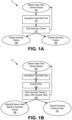
- FIG. 1A is a flow diagram illustrating a RT captured video summarization method 101, in accordance with one or more embodiment.
- Method 101 begins at operation 105 where a CM streams consecutively exposed video data frames at a frame rate (e.g., 30, 60, 120, 240, 480 fps, etc.).
- a frame rate e.g. 30, 60, 120, 240, 480 fps, etc.
- a subset of the received frames are selected as summary images representative of the video stream.
- selected summary frames are stored to a memory on the platform hosting the CM. This process continues with operations 105, 110 and 115 repeated periodically or in response to receiving a new set of frames including some predetermined number of video data frames.
- method 101 loops as hours of video data is streamed from the CM.
- hours of streaming may be summarized by a selected subset of frames ranging from a few tens of frames (e.g., 20) to many hundreds of summary frames.
- a 20 summary frames may be selected as representative of 1,000,000 or more video data frames streamed over a day on a platform including a CM operating at 30 fps.
- a circular buffer retaining streamed video data may be relatively small, much less than would be required to store all the day's streamed video data frames, as it may be continuously overwritten in sole reliance of the stored summary images.
- the platform hosting the CM may also display a representation of the stored stream summary (e.g., a set of image files) at operation 180.
- the platform hosting the CM may further transmit a representation of the stored stream summary (e.g., a set of image files) to a remote destination (e.g., a cloud server).
- a remote destination e.g., a cloud server.
- the summarization operation 115 is upstream of a video stream encoding process
- encoding engine resources and/or power is also reduced.
- a handful of image frames resulting from a day's continuous recording may serves as a valuable visual catalogue of the day's events.
- FIG. 1B is a flow diagram illustrating a RT captured video summarization method 102, in accordance with one or more embodiment.
- Method 102 includes the video streaming operation 105 and real time stream summarization operation 110 as described above.
- Method 102 further includes however a video encoding and storing operation 120 where any known A/V codec (e.g., MPEG-4, H.264 AVC, etc.) is implemented.
- A/V codec e.g., MPEG-4, H.264 AVC, etc.
- the resulting compressed representation of the video stream is stored to a memory and/or communicated of the platform hosting the CM.
- the summary frames selected at operation 110 are further stored in association with the stored video.
- the platform hosting the CM may further utilize a representation of the stored stream summary (e.g., a set of image files) at operation 185 as a set of thumbnails indicative of the stored video representation.
- the stored stream summary is utilized by the CM platform to enable a user to index through, and/or otherwise gain access to the stored video corpus at the various entry points corresponding the summary frames.
- the platform hosting the CM may further transmit the recorded video representation along with a representation of the stored stream summary (e.g., a set of image files) to a remote destination (e.g., a cloud server) where the stream summary may be similarly utilized as a thumbnail and/or index of entry points in the associated stored video.
- the real-time stream summarization method 102 utilizes the same automated summarization techniques leveraged in method 101 to enhance user experience beyond that of a conventional video streaming platform.
- FIG. 2A is a functional block diagram of a system 201 including a video data stream capture device 203 and a display device 204, and at least one of device 203, 204 include a RT video summarization system, in accordance with embodiments. Functional blocks representing alternate embodiments of the RT video summarization system are illustrated in dashed line.
- System 201 may for example perform either of the methods 101, 102 described above.
- device platform 203 includes RT video summarization system 217A between a video capture pipeline 205 and a video encoder 216.
- Video capture pipeline 205 has an output coupled to an input of a RT video summarization system 217A.
- An output of RT video summarization system 217A is coupled to an input of an encoder 216.
- An output of encoder 216 is coupled to an input of memory (storage) 220.
- An encoded representation of summary frames output from memory 220 is coupled over a wired or wireless communication channel to a display device 204, which in the exemplary embodiment is coupled to video capture device 203 through a backend server in cloud 225.
- cloud 225 is absent, with a display device 204 directly coupled to video capture device 203 over a local wired or wireless communication channel.
- display device 204 is integrated into video capture and summarization device 203 (i.e., both devices are part of the same platform).
- Decoder 226 receives an encoded frame summary from summary storage 220.
- output from decoder 226 passes through downstream image enhancement processing, such as de-noise/image enhancer 227, and on to image display pipeline 228 where one or more of the summary frames are presented on a display screen.
- the RT video summarization is implemented downstream of video encoder 216, for example as RT video summarization system 217B.
- a video stream output from video capture pipeline 205 is output to encoder 216 and the encoded stream representation is stored in memory 220.
- the encoded video stream is then decoded at decoder 226 and RT video summarization system 271B outputs summary frames that then pass through downstream image enhancement processing, such as de-noise/image enhancer 227, and through image display pipeline 228 where one or more of the summary frames are presented on a display screen.
- image enhancement processing such as de-noise/image enhancer 227
- image display pipeline 228 where one or more of the summary frames are presented on a display screen.
- FIG. 2B is a functional block diagram of a RT video data stream summarization system 217, in accordance with one or more embodiment.
- System 217 may be implemented as either RT video summarization system 217A, or 217B in FIG. 2A , for example.
- System 217 has an input coupled to an output of a streaming video pipeline 225.
- Video pipeline 225 may have any known configuration.
- video pipeline 225 includes a CM outputting video frames captured by an image sensor.
- Video data frames are received into a frame feature extractor 229 that is to extract one or more feature vector from each received frame.
- the feature vector may include features determined using any object detection technique known in the art.
- frame feature extractor 229 is to generate a feature vector comprising histograms of oriented gradient (HOG) features.
- Scoring logic 235 is coupled to an output of feature extractor 229 and is to score frames based on the feature vectors. Scoring logic 235 is to score each frame in a new set of frames received against, or with respect to, the other frames in the new set. In a further embodiment, scoring logic 235 is to score each frame in a new set of frames received further with respect to each frame that has previously been selected as a summary frame. Frame scoring logic 235 may generate scores based on one or more predetermined saliency criteria, as described further below.
- Frame selection logic 250 coupled to frame scoring logic 230 is to select a set of summary frames based on a solution to an objective (cost) function that optimizes the frame scoring for the selection.
- cost an objective
- the inventors have found that this optimization-based strategy for online video summarization, in contrast to solutions that are purely heuristic, may be advantageously based on a concrete mathematical formulation and is not critically dependent on empirical parameter/threshold values.
- frame-scoring logic 235 includes both coverage scoring logic 230 and diversity scoring logic 240.
- Coverage scoring logic 230 is to compute coverage scores based on frame feature vectors.
- a coverage score is a metric quantifying how well a given frame represents other frames to which it is compared.
- Diversity scoring logic 240 is to compute diversity scores based on the frame feature vectors.
- a diversity score is a metric quantifying how distinct a frame is from other frames to which it is compared.
- Selection logic 250 is then to solve an objective function that is dependent on both coverage and diversity scores with the solution representing, for example, the set of frames with maximum coverage and maximum diversity. As such, the selected summary should "cover" most of the video while also including the most distinct elements.
- coverage scoring logic 230 and diversity scoring logic 240 may be further combined with additional scoring logic circuitry.
- Selection logic 250 is then to solve an alternate objective function, for example following the rationale further described below in the context of the exemplary embodiment.
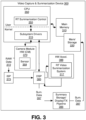
- FIG. 3 illustrates a RT video data stream capture and summarization device platform 303, in accordance with one exemplary embodiment.
- FIG. 3 further illustrates how a RT video stream summarization system, such as that introduced in FIG. 2B , may be integrated with various other components of a device platform to provide video camera summarization suitable for both high frame exposure rates and minimal storage/transmission resources.
- CM 370 further includes a camera sensor 359.
- Sensor 359 may be a QXGA, WQXGA, or QSXGA-format digital image device, for example. Camera sensor 359 may provide a color resolution of 10 bits, or more per pixel, is operable to capture continuous video frames progressively. Sensor 359 may have a pixel frequency of 170 MHz, or more. Camera sensor 359 may include an RGB Bayer color filter, an analog amplifier, an A/D converter, other components to convert incident light into a digital signal corresponding to raw image data. Sensor 359 may be controlled to operate a rolling shutter or electronic focal plane shutter process where pixels are read out progressively in a line-sequential fashion for a frame.
- sensor 350 outputs multiple consecutively exposed frames.
- CM 370 outputs at raw video data 372 associated with the consecutively exposed frames in conformance with any known streaming protocol, such as a MIPI or other protocol.
- Streamed raw video data 472 is input to ISP 375.
- ISP 375 is to receive and analyze frames of raw video data 372 during the horizontal and/or vertical blanking periods associated with CM 370.
- ISP 375 may perform one or more of noise reduction, pixel linearization, and shading compensation, for example.
- Processed video data may be buffered in a FIFO manner, for example with a circular buffer.
- DSP 385 is to fetch sets (segments) of consecutively exposed frames received into the buffer from CM 370 before new frames output by CM 370 overwrite them.
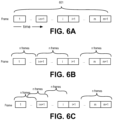
- FIG. 6A illustrates consecutively exposed frames in a video stream 601, in accordance with one or more embodiment.
- FIGS. 6B and 6C illustrate sets of frames generated from the video stream depicted in FIG. 6A , in accordance with an embodiment.
- temporally adjacent sets are non-overlapping with each set including n frames that are exclusive of any frames included in other sets.
- FIG. 6B temporally adjacent sets are non-overlapping with each set including n frames that are exclusive of any frames included in other sets.
- temporally adjacent sets are overlapping with each set including n-1 frames that are inclusive of frames included in another set.
- the stream summarization process will be iterated once for every n frames exposed by a CM.
- the stream summarization process will be iterated once for every frame exposed by the CM.
- the amount of frame redundancy between adjacent sets may be varied between the two embodiments illustrated in FIGS. 6B and 6C .
- adjacent sets are non-overlapping (e.g., FIG. 6B ).
- Segmentation of the streaming video is useful for providing some scene consistency with respect to objects in each set of frames to be analyzed by the video summarization system.
- the number of frames included in each segment is static and predetermined, with all sets of frames including n consecutive frames.
- the number of consecutive frames in each set may be controlled through subsystem drivers 315 within a kernel space of an operating system (OS) instantiated by a central processing unit (CPU) 350. Access to the number of consecutive frames may be provided though a RT summarization control parameter 355 within an application layer executing in a user space of the OS.
- DSP 385 may utilize scene/shot change detection logic in the segmentation process. Shot boundary detection algorithms attempt to detect the junction between two video shots.
- DSP 385 typically computes a difference metric (like pixel gray-level differences, statistical differences, histogram differences, or motion vectors) between every two consecutive images in a video stream and a shot boundary is assumed when the difference exceeds a pre-determined threshold.
- DSP 385 generates frame sets that include far fewer frames than a typical scene. Hence, if scene detection is utilized, each scene will be further divided in to multiple frame sets for the downstream summarization process.
- the number of frames n in each set is less than 100, advantageously less than 50, and more advantageously between 10 and 30 frames.
- Sets of frames are output to hardware accelerator 388, which in the exemplary embodiment includes fixed function logic circuitry implementing RT video summarization system 217.
- Embodiments employing fixed function logic are well suited to summarizing received video data frames at pace with a high exposure frame rate while consuming minimal power.
- any known programmable processor including DSP 385, a core of CPU 350, an execution unit of a graphics processor, or other similar vector processor, may be utilized to implement the logic of RT video summarization system 217 introduced in FIG. 2B .
- summary frames may be output from accelerator 388 back to DSP 385 for encoding as still frames.
- Encoded representations of summary frames from HW accelerator 388A are sent as stream summary frame data 397 to storage/display/transmission pipeline 395.
- stream summary frame data 397 is output to memory/storage 220 (e.g., NVR, DRAM, etc.), which may be separate or a part of a main memory 310 accessible to CPU 350.
- memory/storage 220 e.g., NVR, DRAM, etc.
- storage/display/transmission pipeline 395 is to transmit summary frame data 397 off device platform 303.
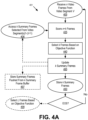
- FIG. 4A is a flow diagram further illustrating a real time (RT) captured video summarization method 401 in accordance with embodiments.
- Method 401 is performed by a RT video summarization system, and in one exemplary embodiment, is implemented by HW accelerator 388 depicted in FIG. 3 .
- Method 401 is to be performed at a rate sufficient to avoid an upstream buffer overrun condition.
- method 401 is iterated at a rate at least equal to (and advantageously greater than) the CM frame rate divided by the number of new frames (e.g., n) processed in each iteration.
- Method 401 begins with receiving a new set of n consecutively exposed video frames contained in a video segment V.
- a current stream summary comprising batch of one or more k stream summary frames is accessed.
- the stream summary frame number k is static and predetermined.
- the number of stream summary frames may be controlled, for example, through subsystem drivers 315 ( FIG. 3 ) within a kernel space of an operating system (OS) instantiated by a central processing unit (CPU) 350. Access to the number of consecutive frames may be provided through a RT summarization control parameter 355 within an application layer executing in a user space of the OS.
- the number of steam summary frames k is less than 1000, advantageously less than 100, and more advantageously between 10 and 30 frames.
- FIG. 4B illustrates a RT video summarization model 402 that is implemented by one or more embodiment of method 401.
- stream summary 465 comprises a selection of video data frames limited to a predetermined number of summary frame slots. With k slots available, k incumbent stream summary frames summarize any number of prior frame sets 471 that were exposed and processed through the summarization process earlier in time. For example, a snapshot of stream summary 465 includes incumbent frame i from set V most recently processed, incumbent frame i+j from a frame set V-3, etc.
- any number of new frame sets 472 will be exposed and processed through the summarization process later in time (e.g., beginning with set V, and ending with V + m ).
- a summarization iteration is performed where the incumbent k stream summary frames and n non-incumbent frames are the batch of candidate frames for selection through application of an objective function 466.
- one or more incumbent frame may retain a slot within stream summary 465, and one or more incumbent frame may be evicted from stream summary 465 in preference of a non-incumbent frame included in a new set (e.g., set V+1).
- each of the candidate frames ( n + k ) from operations 405 and 406 are scored at operation 435.
- Each non-incumbent frame in a new set of frames received from the CM is scored with respect to the other frames in the new set, and with respect to each incumbent frame.
- the batch including one or more summary frame is selected from the candidate frame pool including the non-incumbent and the incumbent frames.
- the objective function is solved at operation 440 to compute the reward (loss) associated with a given selection of summary frames.
- Candidate frames are selected based on the solution that optimizes the frame scoring for the selection.
- the batch of k stream summary frames is updated in response to the selection of frames made at operation 440 differing from the batch of k stream summary frames accessed at operation 406.
- Updating the stream summary at operation 495 includes adding at least each selected non-incumbent frame to the summary.
- the addition of the non-incumbent frame may entail replacing an incumbent frame flushed out of the summary in preference for the non-incumbent frame.
- updating the stream summary at operation 495 further includes adding to the stream summary a coverage score associated with each non-incumbent frame selected.
- a coverage score associated with an evicted incumbent frame may be overwritten with the coverage score associated with the newly selected frame.
- the updated batch of k summary frames is stored to memory at operation 450. If the end of stream (EOS) has not been reached, method 401 returns to operation 405 for a subsequent iteration. If the EOS has been reached, method 401 ends with the stream summary frames stored.
- EOS end of stream
- the incumbent summary frame when an incumbent summary frame is evicted due to the arrival of newer, a more informative frame, the incumbent summary frame is removed from further consideration.
- the incumbent summary frame(s) flushed at the summary update operation 495 is stored to a secondary memory (location) to potentially enhance the quality of a final video summary generated by method 401.
- Secondary storage operation 497 is illustrated in FIG. 4A with dashed line to emphasize that retention of all summary frames iteratively generated during video streaming is optional. For those embodiments where all summary frames are retained, upon reach an EOS condition, method 401 proceeds to operation 499 where a secondary selection of L summary frames is made.
- operation 499 entails solving the same objective function solved at the (primary) selection operation 440 based on the frame scores previously generated at operation 435 and the feature vector associated with each stored summary frame.
- the number of final selected frames L may be equal to, or larger than, the batch of k summary frames, and may be a configurable value in the same manner as the values of n and k.
- the secondary selection operation 499 is among the set of salient frames stored over time both to the memory slots associated with the batch of k summary frames and the those stored to secondary memory slots.
- method 401 becomes a two-tier process in which salient frames are first filtered out from video segments and final summary frames are then selected from all salient frames.
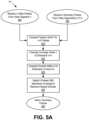
- FIG. 5A is a flow diagram illustrating a real time (RT) captured video summarization method 501, in accordance with one such embodiment.
- Method 501 is performed, for example, as part of method 401 ( FIG. 4A ).
- Method 501 begins with receiving n non-incumbent candidate video frames at operation 405, and receiving k incumbent stream summary frames at operation 406, as described above.
- a feature vector is computed for the n+k frames at operation 510.
- the feature vector may include features determined using any object detection technique known in the art.
- a feature vector comprising histograms of oriented gradient (HOG) features is generated at operation 406 for each of the n+k frames.
- feature vectors for n frames are computed at operation 406 with the feature vectors for the k summary frames, having been generated previously in an earlier iteration, fetched from memory.
- HOG oriented gradient
- Method 501 continues with operation 515 where a coverage vector c of dimension n+k is computed.
- a coverage vector c of dimension n+k is computed.
- One exemplary embodiment of operation 515 is further illustrated in FIG. 5B as method 502.
- the feature vectors for all frames of a video segment V are received at operation 511.
- Operation 516 is then iterated to compute one non-incumbent coverage score for each frame i with respect to n-1 other non-incumbent frames.
- the similarity metric utilized in method 502 may be controlled, for example, through subsystem drivers 315 ( FIG. 3 ) within a kernel space of an operating system (OS) instantiated by a central processing unit (CPU) 350. Access to the similarity metric may be further provided through a RT summarization control parameter 355 within an application layer executing in a user space of the OS. Computation of the maximum value of the similarity metric for each frame in the new frame set V advantageously limits the coverage score to a vector. At operation 517 ( FIG. 5B ), each c(i) computed at operation 516 is added or joined as a new element to the coverage vector c .
- Method 502 continues with receiving incumbent coverage scores c(k) associated with the k incumbent stream summary frames at operation 506.
- the incumbent coverage scores c(k) are fetch from memory, having been stored from prior iterations of method 501, which invoked method 502.
- the n elements of coverage vector c are joined with the k stored coverage scores c(k) so that the coverage vector c that encompasses all candidate frames (incumbent and non-incumbent).
- method 501 continues at operation 520 where a 2D diversity matrix is computed.
- the diversity matrix includes a diversity score for each frame in the newly received set V with respect to the other frames in the set and with respect to each incumbent frame.
- the diversity score is a metric indicative of distance between the feature vectors computed at operation 510.
- the diversity score is indicative of a distance between color histograms for pairings of all frames in the candidate pool.
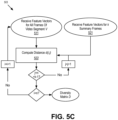
- FIG. 5C One exemplary embodiment of operation 520 is further illustrated in FIG. 5C as method 503. As shown in FIG. 5C , the feature vectors for all frames of a video segment V are again received at operation 511.
- the feature vectors for all k summary frames are received at operation 521.
- the distance metric d ij may be any known in the art, such as, but not limited to, the Euclidean, Chi-squared, and Mahalanobis distance.
- the Chi-squared distance metric has been found to be advantageous for generating diversity matrix D .
- the distance metric utilized in method 503 may be controlled, for example, through subsystem drivers 315 ( FIG. 3 ) within a kernel space of an operating system (OS) instantiated by a central processing unit (CPU) 350. Access to the distance metric may be further provided through a RT summarization control parameter 355 within an application layer executing in a user space of the OS.
- OS operating system
- CPU central processing unit
- method 501 continues at operation 530 where the batch of stream summary frames are selected for the current iteration based the coverage and diversity scores for the selection.
- One exemplary embodiment of operation 530 is further illustrated in FIG. 5D as method 504.
- Coverage vector c and diversity matrix D are received at operations 519, 524.
- optimization vector x is to identify a set of k frames with maximal coverage and maximal mutual diversity. Considering a binary vector x of dimension n+k in which element i denotes whether frame i is to be included in the stream summary.
- QP integer quadratic programming
- Equation 3 is NP-hard if integer constraints are placed on the variable vector x . Therefore, in advantageous embodiments, the integer constraints are relaxed and allowed to be continuous, where every element in the vector x is constrained to be a real number between 0 and 1. Equation 3 is then readily solvable using any known QP solver. The top k entries in the solution vector may then be set to 1 and the remainder set to 0, to reconstruct the integer solution. This optimization vector identifies the non-incumbent frames and incumbent frames to be discarded (0 valued elements) and selected as summary frames (1 valued elements).
- method 501 then ends with the storing k summary frames at operation 450.
- the corresponding coverage score is stored in association with the frame to facilitate a subsequent comparison with a next set of frames (e.g., to be read in at 506 in FIG. 5B ).
- One non-selected incumbent frame is removed/replaced in the stream summary for each non-incumbent frame selected. Any coverage score associated with the non-selected incumbent frame is also removed/replaced.
- FIG. 7 is a diagram of an exemplary ultra-low power system 700 employing a RT video data stream capture and summarization architecture, in accordance with one or more embodiment.
- System 700 may be a mobile device although system 700 is not limited to this context.
- system 700 may be incorporated into a wearable computing device, ultra-laptop computer, tablet, touch pad, handheld computer, palmtop computer, cellular telephone, smart device (e.g., smart phone, smart tablet or mobile television), mobile internet device (MID), messaging device, data communication device, and so forth.
- System 700 may also be an infrastructure device.
- system 700 may be incorporated into a large format television, set-top box, desktop computer, or other home or commercial network device.
- System 700 includes a device platform 702 that may implement all or a subset of the various streaming video camera summarization methods and any of the RT streaming video summarization systems described above in the context of FIG. 1-FIG. 6 .
- video processor 715 executes RT video summarization algorithms.
- Video processor 715 includes logic circuitry implementing RT video summarization system 217 to iteratively generate sets of video summary images synchronously with video frame data streamed from CM 370, for example as described elsewhere herein.
- one or more computer readable media may store instructions, which when executed by CPU 710 and/or video processor 715, cause the processor(s) to execute one or more RT video summarization algorithm, such as any of those described in detail above.
- One or more image data frame exposed by CM 370 may then be stored in memory 712 as streamed video summary data.
- device platform 702 is coupled to a human interface device (HID) 720.
- Platform 702 may collect raw image data with CM 370, which is processed and output to HID 720.
- a navigation controller 750 including one or more navigation features may be used to interact with, for example, device platform 702 and/or HID 720.
- HID 720 may include any television type monitor or display coupled to platform 702 via radio 718 and/or network 760.
- HID 720 may include, for example, a computer display screen, touch screen display, video monitor, television-like device, and/or a television.
- device platform 702 may display user interface 722 on HID 720. Movements of the navigation features of controller 750 may be replicated on a display (e.g., HID 720) by movements of a pointer, cursor, focus ring, or other visual indicators displayed on the display. For example, under the control of software applications 716, the navigation features located on navigation controller 750 may be mapped to virtual navigation features displayed on user interface 722.
- device platform 702 may include any combination of CM 370, chipset 705, processors 710, 715, memory/storage 712, applications 716, and/or radio 718.
- Chipset 705 may provide intercommunication among processors 710, 715, memory 712, video processor 715, applications 716, or radio 718.
- processors 710, 715 may be implemented as one or more Complex Instruction Set Computer (CISC) or Reduced Instruction Set Computer (RISC) processors; x86 instruction set compatible processors, multi-core, or any other microprocessor or central processing unit (CPU).
- CISC Complex Instruction Set Computer
- RISC Reduced Instruction Set Computer
- CPU central processing unit
- Memory 712 may be implemented as a volatile memory device such as, but not limited to, a Random Access Memory (RAM), Dynamic Random Access Memory (DRAM), or Static RAM (SRAM). Memory 712 may also be implemented as a nonvolatile storage device such as, but not limited to flash memory, battery backed-up SDRAM (synchronous DRAM), magnetic memory, phase change memory, and the like.
- RAM Random Access Memory
- DRAM Dynamic Random Access Memory
- SRAM Static RAM
- Memory 712 may also be implemented as a nonvolatile storage device such as, but not limited to flash memory, battery backed-up SDRAM (synchronous DRAM), magnetic memory, phase change memory, and the like.
- Radio 718 may include one or more radios capable of transmitting and receiving signals using various suitable wireless communications techniques. Such techniques may involve communications across one or more wireless networks.
- Example wireless networks include (but are not limited to) wireless local area networks (WLANs), wireless personal area networks (WPANs), wireless metropolitan area network (WMANs), cellular networks, and satellite networks. In communicating across such networks, radio 618 may operate in accordance with one or more applicable standards in any version.
- system 700 may be implemented as a wireless system, a wired system, or a combination of both.
- system 700 may include components and interfaces suitable for communicating over a wireless shared media, such as one or more antennas, transmitters, receivers, transceivers, amplifiers, filters, control logic, and so forth.
- An example of wireless shared media may include portions of a wireless spectrum, such as the RF spectrum and so forth.
- system 700 may include components and interfaces suitable for communicating over wired communications media, such as input/output (I/O) adapters, physical connectors to connect the I/O adapter with a corresponding wired communications medium, a network interface card (NIC), disc controller, video controller, audio controller, and the like.
- wired communications media may include a wire, cable, metal leads, printed circuit board (PCB), backplane, switch fabric, semiconductor material, twisted-pair wire, co-axial cable, fiber optics, and so forth.
- RT streaming video summarization architecture and associated summarization processes as described herein may be implemented in various hardware architectures, cell designs, or "IP cores.”
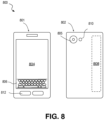
- FIG. 8 further illustrates embodiments of a mobile handset device 800 in which system 700 may be embodied.
- device 800 may be implemented as a mobile computing device having wireless capabilities.
- a mobile computing device may refer to any device having a processing system and a mobile power source or supply, such as one or more batteries, for example.
- Examples of a mobile computing device may include an ultra-laptop computer, tablet, touch pad, portable computer, handheld computer, palmtop computer, personal digital assistant (PDA), cellular telephone, combination cellular telephone/PDA, television, smart device (e.g., smartphone, tablet or smart television), mobile internet device (MID), messaging device, data communication device, and so forth.
- PDA personal digital assistant
- Examples of a mobile computing device also may include computers and/or media capture/transmission devices configured to be worn by a person, such as a wrist computer, finger computer, ring computer, eyeglass computer, belt-clip computer, arm-band computer, shoe computers, clothing computers, and other wearable computers.
- a mobile computing device may be implemented as a smart phone capable of executing computer applications, as well as voice communications and/or data communications.
- voice communications and/or data communications may be described with a mobile computing device implemented as a smart phone by way of example, it may be appreciated that other embodiments may be implemented using other wireless mobile computing devices as well. The embodiments are not limited in this context.
- mobile handset device 800 may include a housing with a front 801 and back 802.
- Device 800 includes a display 804, an input/output (I/O) device 806, and an integrated antenna 808.
- Device 800 also may include navigation features 812.
- Display 804 may include any suitable display unit for displaying information appropriate for a mobile computing device.
- I/O device 806 may include any suitable I/O device for entering information into a mobile computing device. Examples for I/O device 806 may include an alphanumeric keyboard, a numeric keypad, a touch pad, input keys, buttons, switches, microphones, speakers, voice recognition device and software, and so forth. Information also may be entered into device 800 by way of microphone (not shown), or may be digitized by a voice recognition device.
- Embodiments are not limited in this context.
- camera 805 e.g., including a lens, an aperture, and an imaging sensor
- flash 810 both of which may be components of a CM through which streaming video is exposed and output to the video summarization system as described elsewhere herein.
- Embodiments described herein may be implemented using hardware elements, software elements, or a combination of both.
- hardware elements or modules include: processors, microprocessors, circuitry, circuit elements (e.g., transistors, resistors, capacitors, inductors, and so forth), integrated circuits, application specific integrated circuits (ASIC), programmable logic devices (PLD), digital signal processors (DSP), field programmable gate array (FPGA), logic gates, registers, semiconductor device, chips, microchips, chip sets, and so forth.
- Examples of software elements or modules include: applications, computer programs, application programs, system programs, machine programs, operating system software, middleware, firmware, routines, subroutines, functions, methods, procedures, software interfaces, application programming interfaces (API), instruction sets, computing code, computer code, code segments, computer code segments, data words, values, symbols, or any combination thereof. Determining whether an embodiment is implemented using hardware elements and/or software elements may vary in accordance with any number of factors considered for the choice of design, such as, but not limited to: desired computational rate, power levels, heat tolerances, processing cycle budget, input data rates, output data rates, memory resources, data bus speeds and other design or performance constraints.
- One or more aspects of at least one embodiment may be implemented by representative instructions stored on a machine-readable storage medium. Such instructions may reside, completely or at least partially, within a main memory and/or within a processor during execution thereof by the machine, the main memory and the processor portions storing the instructions then also constituting a machine-readable storage media.
- Programmable logic circuitry may have registers, state machines, etc. configured by the processor implementing the computer readable media. Such logic circuitry, as programmed, may then be understood to be physically transformed into a system falling within the scope of the embodiments described herein. Instructions representing various logic within the processor, which when read by a machine may also cause the machine to fabricate logic adhering to the architectures described herein and/or to perform the techniques described herein. Such representations, known as cell designs, or IP cores, may be stored on a tangible, machine-readable medium and supplied to various customers or manufacturing facilities to load into the fabrication machines that actually make the logic or processor.
Landscapes
- Engineering & Computer Science (AREA)
- Multimedia (AREA)
- Signal Processing (AREA)
- Theoretical Computer Science (AREA)
- Databases & Information Systems (AREA)
- General Physics & Mathematics (AREA)
- Physics & Mathematics (AREA)
- Computer Security & Cryptography (AREA)
- General Engineering & Computer Science (AREA)
- Evolutionary Computation (AREA)
- Computer Vision & Pattern Recognition (AREA)
- Artificial Intelligence (AREA)
- Computing Systems (AREA)
- Health & Medical Sciences (AREA)
- Data Mining & Analysis (AREA)
- Software Systems (AREA)
- General Health & Medical Sciences (AREA)
- Medical Informatics (AREA)
- Life Sciences & Earth Sciences (AREA)
- Bioinformatics & Cheminformatics (AREA)
- Bioinformatics & Computational Biology (AREA)
- Evolutionary Biology (AREA)
- Television Signal Processing For Recording (AREA)
- Compression Or Coding Systems Of Tv Signals (AREA)
Claims (7)
- Ein oder mehrere nichtflüchtige computerlesbare Medien, die Anweisungen speichern, die von einem oder mehreren Prozessoren ausgeführt werden, um eine Sequenz durchzuführen, die Folgendes umfasst:Erkennen von Aufnahmebegrenzungen, um ein Video zu segmentieren, wobei jedes Segment eine Mehrzahl von Frames beinhaltet;für jeden Frame eines Satzes V von Frames in einem Segment, Bestimmen eines Satzes von Merkmalen des Frames unter Verwendung einer Objekterkennungstechnik, um für jeden Frame des Satzes von Frames einen Merkmalsvektor zu berechnen;für jeden Frame des Satzes von Frames einen Abdeckungsgrad zu bestimmen:
 wo c ein Abdeckungsvektor für den Satz von Frames V ist, wij ein Maß für die Ähnlichkeit zwischen einem Paar von Frames i und j in V ist;Verbinden des Abdeckungsvektors, c , mit Abdeckungsbewertungen eines Satzes von Frames, die zuvor aus der Mehrzahl von Frames als Zusammenfassungsframes für das Video ausgewählt wurden, so dass der Abdeckungsvektor, c, Kandidatenframes umgibt, wo die Kandidatenframes die Frames aus dem Satz von Frames und dem Satz von zuvor ausgewählten Frames sind;für jeden Frame der Kandidatenframes einen Diversitätswert wie folgt zu berechnen:
 wo D eine Diversitätsmatrix ist, dij eine Abstandsmetrik zwischen Frames i und j basierend auf den Merkmalsvektoren ist, wo sich jedes der Frames i und j in den Kandidatenframes befindet; undAuswählen von Zusammenfassungsframes aus dem Satz von Frames, V, und dem Satz von zuvor ausgewählten Frames, wobei das Auswählen basierend auf einem Optimierungsvektor x erfolgt, der Folgendes erfüllt:
 wobei xT die Transponierte von x ist, xi ∈ {0,1}∀i , mit
- Medien nach Anspruch 1, die ferner das Verwenden einer Objekterkennungstechnik für Histogramme orientierter Gradienten beinhalten.
- Verfahren, umfassend:Erkennen von Aufnahmebegrenzungen, um ein Video zu segmentieren, wobei jedes Segment eine Mehrzahl von Frames beinhaltet;für jeden Frame eines Satzes V von Frames in einem Segment, Bestimmen eines Satzes von Merkmalen des Frames unter Verwendung einer Objekterkennungstechnik, um für jeden Frame des Satzes von Frames einen Merkmalsvektor zu berechnen;für jeden Frame des Satzes von Frames einen Abdeckungsgrad zu bestimmen:
 wo c ein Abdeckungsvektor für den Satz von Frames V ist, wij ein Maß für die Ähnlichkeit zwischen einem Paar von Frames i und j in V ist;Verbinden des Abdeckungsvektors, c , mit Abdeckungsbewertungen eines Satzes von Frames, die zuvor aus der Mehrzahl von Frames als Zusammenfassungsframes für das Video ausgewählt wurden, so dass der Abdeckungsvektor, c, Kandidatenframes umgibt, wobei die Kandidatenframes die Frames aus dem Satz von Frames und dem Satz von zuvor ausgewählten Frames sind;für jeden Frame der Kandidatenframes einen Diversitätsscore zu berechnen:
 wo D eine Diversitätsmatrix ist, dij eine Abstandsmetrik zwischen Frames i und j basierend auf den Merkmalsvektoren ist, wobei sich jedes der Frames i und j in den Kandidatenframes befindet; undAuswählen von Zusammenfassungsframes aus dem Satz von Frames, V, und dem Satz von zuvor ausgewählten Frames,wobei das Auswählen basierend auf einem Optimierungsvektor x erfolgt, der Folgendes erfüllt:
 wobei xT die Transponierte von x ist, xi ∈ {0,1}∀i , mit
- Verfahren nach Anspruch 3, das ferner das Verwenden einer Objekterkennungstechnik für Histogramme orientierter Gradienten beinhaltet.
- System, umfassend:einen Prozessor;einen mit dem Prozessor gekoppelten Speicher; undeinen mit dem Prozessor gekoppelten Chipsatz,wobei der Prozessor:Aufnahmebegrenzungen erkennen soll, um das Video zu segmentieren, wobei jedes Segment eine Mehrzahl von Frames beinhaltet,für jeden aus einem Satz V von Frames in einem Segment einen Satz von Merkmalen des Frames unter Verwendung einer Objekterkennungstechnik bestimmen soll, um einen Merkmalsvektor für jeden Frame aus dem Satz von Frames zu berechnen,für jeden Frame des Satzes von Frames einen Abdeckungsgrad bestimmen soll:
 wo c ein Abdeckungsvektor für den Satz von Frames V ist, wij ein Maß für die Ähnlichkeit zwischen einem Paar von Frames i und j in V ist;Verbinden des Abdeckungsvektors, c , mit Abdeckungsbewertungen eines Satzes von Frames, die zuvor aus der Mehrzahl von Frames als Zusammenfassungsframes für das Video ausgewählt wurden, so dass der Abdeckungsvektor, c, Kandidatenframes umgibt, wo die Kandidatenframes die Frames aus dem Satz von Frames und dem Satz von zuvor ausgewählten Frames sind;für jeden Frame der Kandidatenframes eine Diversitätsbewertung zu berechnen:
 wo D eine Diversitätsmatrix ist, dij eine Abstandsmetrik zwischen Frames i und j basierend auf den Merkmalsvektoren ist, wobei sich jedes der Frames i und j in den Kandidatenframes befindet; undZusammenfassungsframes aus dem Satz von Frames V und dem Satz zuvor ausgewählter Frames auszuwählen, wobei das Auswählen auf einem Optimierungsvektor x basiert, der Folgendes erfüllt:
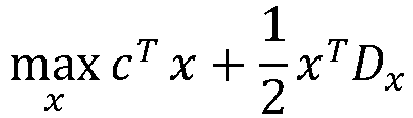 wobei xT die Transponierte von x ist, xi ∈ {0,1}∀i , mit
- System nach Anspruch 5, wobei der Prozessor eine Objekterkennungstechnik für Histogramme orientierter Gradienten verwenden soll.
- Maschinenlesbarer Speicher, der maschinenlesbare Anweisungen beinhaltet, um, wenn ausgeführt, ein Verfahren nach einem der Ansprüche 3-4 zu implementieren.
Applications Claiming Priority (3)
| Application Number | Priority Date | Filing Date | Title |
|---|---|---|---|
| US14/477,595 US9639762B2 (en) | 2014-09-04 | 2014-09-04 | Real time video summarization |
| PCT/US2015/043367 WO2016036460A1 (en) | 2014-09-04 | 2015-08-03 | Real time video summarization |
| EP15838458.6A EP3189667A4 (de) | 2014-09-04 | 2015-08-03 | Echtzeitvideozusammenfassung |
Related Parent Applications (2)
| Application Number | Title | Priority Date | Filing Date |
|---|---|---|---|
| EP15838458.6A Division EP3189667A4 (de) | 2014-09-04 | 2015-08-03 | Echtzeitvideozusammenfassung |
| EP15838458.6A Division-Into EP3189667A4 (de) | 2014-09-04 | 2015-08-03 | Echtzeitvideozusammenfassung |
Publications (2)
| Publication Number | Publication Date |
|---|---|
| EP3267693A1 EP3267693A1 (de) | 2018-01-10 |
| EP3267693B1 true EP3267693B1 (de) | 2023-05-24 |
Family
ID=55437783
Family Applications (2)
| Application Number | Title | Priority Date | Filing Date |
|---|---|---|---|
| EP15838458.6A Withdrawn EP3189667A4 (de) | 2014-09-04 | 2015-08-03 | Echtzeitvideozusammenfassung |
| EP17186209.7A Active EP3267693B1 (de) | 2014-09-04 | 2015-08-03 | Echtzeitvideozusammenfassung |
Family Applications Before (1)
| Application Number | Title | Priority Date | Filing Date |
|---|---|---|---|
| EP15838458.6A Withdrawn EP3189667A4 (de) | 2014-09-04 | 2015-08-03 | Echtzeitvideozusammenfassung |
Country Status (5)
| Country | Link |
|---|---|
| US (3) | US9639762B2 (de) |
| EP (2) | EP3189667A4 (de) |
| JP (3) | JP6472872B2 (de) |
| CN (2) | CN107529098B (de) |
| WO (1) | WO2016036460A1 (de) |
Families Citing this family (25)
| Publication number | Priority date | Publication date | Assignee | Title |
|---|---|---|---|---|
| US9639762B2 (en) * | 2014-09-04 | 2017-05-02 | Intel Corporation | Real time video summarization |
| US12401911B2 (en) | 2014-11-07 | 2025-08-26 | Duelight Llc | Systems and methods for generating a high-dynamic range (HDR) pixel stream |
| US12401912B2 (en) | 2014-11-17 | 2025-08-26 | Duelight Llc | System and method for generating a digital image |
| US9743219B2 (en) * | 2014-12-29 | 2017-08-22 | Google Inc. | Low-power wireless content communication between devices |
| US9514502B2 (en) * | 2015-01-21 | 2016-12-06 | Interra Systems Inc. | Methods and systems for detecting shot boundaries for fingerprint generation of a video |
| US12445736B2 (en) | 2015-05-01 | 2025-10-14 | Duelight Llc | Systems and methods for generating a digital image |
| US10762283B2 (en) * | 2015-11-20 | 2020-09-01 | Adobe Inc. | Multimedia document summarization |
| JP2017097536A (ja) * | 2015-11-20 | 2017-06-01 | ソニー株式会社 | 画像処理装置および方法 |
| US10229324B2 (en) * | 2015-12-24 | 2019-03-12 | Intel Corporation | Video summarization using semantic information |
| KR20170098079A (ko) * | 2016-02-19 | 2017-08-29 | 삼성전자주식회사 | 전자 장치 및 전자 장치에서의 비디오 녹화 방법 |
| CN106454347B (zh) * | 2016-09-09 | 2019-04-12 | 上海兆芯集成电路有限公司 | 帧分辨率决定方法以及使用该方法的装置 |
| US10929945B2 (en) | 2017-07-28 | 2021-02-23 | Google Llc | Image capture devices featuring intelligent use of lightweight hardware-generated statistics |
| US10452920B2 (en) * | 2017-10-31 | 2019-10-22 | Google Llc | Systems and methods for generating a summary storyboard from a plurality of image frames |
| CN108307250B (zh) * | 2018-01-23 | 2020-10-30 | 浙江大华技术股份有限公司 | 一种生成视频摘要的方法及装置 |
| CN110418156A (zh) * | 2019-08-27 | 2019-11-05 | 上海掌门科技有限公司 | 信息处理方法和装置 |
| KR102252083B1 (ko) * | 2019-10-17 | 2021-05-14 | 주식회사 지오비전 | 이벤트의 등장 객체간 관련성 파악이 용이한 비디오 서머리방법 |
| US11481563B2 (en) * | 2019-11-08 | 2022-10-25 | Adobe Inc. | Translating texts for videos based on video context |
| WO2021225472A2 (en) * | 2020-05-06 | 2021-11-11 | Huawei Technologies Co., Ltd. | Joint objects image signal processing in temporal domain |
| WO2021250009A1 (en) * | 2020-06-08 | 2021-12-16 | Mobius Labs Gmbh | Method and system for selecting highlight segments |
| CN112069952B (zh) | 2020-08-25 | 2024-10-15 | 北京小米松果电子有限公司 | 视频片段提取方法、视频片段提取装置及存储介质 |
| WO2022071951A1 (en) * | 2020-10-01 | 2022-04-07 | Google Llc | Techniques and apparatuses that implement camera manager systems capable of generating frame suggestions from a set of frames |
| US12125487B2 (en) * | 2020-10-12 | 2024-10-22 | SoundHound AI IP, LLC. | Method and system for conversation transcription with metadata |
| US12041384B2 (en) | 2021-12-28 | 2024-07-16 | Samsung Electronics Co., Ltd. | Method and home appliance device for generating time-lapse video |
| WO2023128450A1 (ko) * | 2021-12-28 | 2023-07-06 | 삼성전자 주식회사 | 타임랩스 영상 생성 방법 및 그 가전 장치 |
| US12563278B2 (en) * | 2024-06-19 | 2026-02-24 | Adobe Inc. | Systems and methods for video summarization |
Family Cites Families (48)
| Publication number | Priority date | Publication date | Assignee | Title |
|---|---|---|---|---|
| US7110454B1 (en) * | 1999-12-21 | 2006-09-19 | Siemens Corporate Research, Inc. | Integrated method for scene change detection |
| KR100762225B1 (ko) * | 2001-06-30 | 2007-10-01 | 주식회사 하이닉스반도체 | 반도체 소자의 셀 플레이트 전압 안정화 회로 |
| JP3779904B2 (ja) | 2001-10-05 | 2006-05-31 | 三菱電機株式会社 | レベルシフト回路 |
| AU2002351310A1 (en) | 2001-12-06 | 2003-06-23 | The Trustees Of Columbia University In The City Of New York | System and method for extracting text captions from video and generating video summaries |
| US7068723B2 (en) * | 2002-02-28 | 2006-06-27 | Fuji Xerox Co., Ltd. | Method for automatically producing optimal summaries of linear media |
| US7035435B2 (en) * | 2002-05-07 | 2006-04-25 | Hewlett-Packard Development Company, L.P. | Scalable video summarization and navigation system and method |
| WO2004014061A2 (en) * | 2002-08-02 | 2004-02-12 | University Of Rochester | Automatic soccer video analysis and summarization |
| KR100708337B1 (ko) * | 2003-06-27 | 2007-04-17 | 주식회사 케이티 | 퍼지 기반 oc―svm을 이용한 동영상 자동 요약 장치및 방법 |
| JP4217964B2 (ja) * | 2003-08-20 | 2009-02-04 | ソニー株式会社 | 情報信号処理装置および情報信号処理方法 |
| KR20060028307A (ko) * | 2004-09-24 | 2006-03-29 | 주식회사 케이티 | 실시간 개인형 동영상 요약 시스템 및 그의 동영상 요약정보 생성 장치 및 그 방법과 맞춤형 동영상 요약 정보제공 장치 및 그 방법 |
| US8699806B2 (en) * | 2006-04-12 | 2014-04-15 | Google Inc. | Method and apparatus for automatically summarizing video |
| JP4736985B2 (ja) * | 2006-07-14 | 2011-07-27 | ソニー株式会社 | 画像処理装置および方法、並びにプログラム |
| CN101329766B (zh) * | 2007-06-18 | 2012-05-30 | 索尼(中国)有限公司 | 运动图像分析装置、方法及系统 |
| US8200063B2 (en) | 2007-09-24 | 2012-06-12 | Fuji Xerox Co., Ltd. | System and method for video summarization |
| CN100559376C (zh) * | 2008-06-30 | 2009-11-11 | 腾讯科技(深圳)有限公司 | 生成视频摘要的方法、系统及设备 |
| CN101656877A (zh) * | 2008-08-19 | 2010-02-24 | 新奥特(北京)视频技术有限公司 | 一种改进的图片序列生成动画文件的方法 |
| US8605795B2 (en) * | 2008-09-17 | 2013-12-10 | Intel Corporation | Video editing methods and systems |
| CN101425088A (zh) * | 2008-10-24 | 2009-05-06 | 清华大学 | 基于图分割的关键帧提取方法和系统 |
| CN101404030B (zh) * | 2008-11-05 | 2011-07-20 | 中国科学院计算技术研究所 | 一种视频中周期性结构片段检测的方法及系统 |
| CN101483763A (zh) * | 2008-12-16 | 2009-07-15 | 南京大学 | 一种面向社会治安监控的数字影像处理方法及其装置 |
| KR20110032610A (ko) * | 2009-09-23 | 2011-03-30 | 삼성전자주식회사 | 장면 분할 장치 및 방법 |
| US20110286628A1 (en) * | 2010-05-14 | 2011-11-24 | Goncalves Luis F | Systems and methods for object recognition using a large database |
| US8520088B2 (en) * | 2010-05-25 | 2013-08-27 | Intellectual Ventures Fund 83 Llc | Storing a video summary as metadata |
| US20120027371A1 (en) * | 2010-07-28 | 2012-02-02 | Harris Corporation | Video summarization using video frames from different perspectives |
| JP5259670B2 (ja) | 2010-09-27 | 2013-08-07 | 株式会社東芝 | コンテンツ要約装置およびコンテンツ要約表示装置 |
| US8467610B2 (en) * | 2010-10-20 | 2013-06-18 | Eastman Kodak Company | Video summarization using sparse basis function combination |
| CN103210651B (zh) * | 2010-11-15 | 2016-11-09 | 华为技术有限公司 | 用于视频概要的方法和系统 |
| EP2649556A4 (de) * | 2010-12-09 | 2017-05-17 | Nokia Technologies Oy | Identifizierung von schlüsselframes aus videosequenzen auf der basis von begrenztem kontext |
| US20120148149A1 (en) * | 2010-12-10 | 2012-06-14 | Mrityunjay Kumar | Video key frame extraction using sparse representation |
| CN202003350U (zh) * | 2010-12-14 | 2011-10-05 | 广东鑫程电子科技有限公司 | 视频摘要系统 |
| CN102184221B (zh) * | 2011-05-06 | 2012-12-19 | 北京航空航天大学 | 一种基于用户偏好的实时视频摘要生成方法 |
| US8869198B2 (en) * | 2011-09-28 | 2014-10-21 | Vilynx, Inc. | Producing video bits for space time video summary |
| US8958645B2 (en) * | 2012-04-19 | 2015-02-17 | Canon Kabushiki Kaisha | Systems and methods for topic-specific video presentation |
| ITVI20120104A1 (it) * | 2012-05-03 | 2013-11-04 | St Microelectronics Srl | Metodo e apparato per generare in tempo reale uno storyboard visuale |
| US9430876B1 (en) | 2012-05-10 | 2016-08-30 | Aurasma Limited | Intelligent method of determining trigger items in augmented reality environments |
| CN102724485B (zh) * | 2012-06-26 | 2016-01-13 | 公安部第三研究所 | 采用双核处理器对输入视频进行结构化描述的装置和方法 |
| EP2741488A1 (de) * | 2012-12-10 | 2014-06-11 | Alcatel Lucent | Verfahren zur Extraktion der bedeutendsten Rahmen aus einem Videostrom basierend auf ästhetischen Kriterien |
| US9141866B2 (en) | 2013-01-30 | 2015-09-22 | International Business Machines Corporation | Summarizing salient events in unmanned aerial videos |
| IN2013DE00589A (de) * | 2013-02-28 | 2015-06-26 | Samsung India Electronics Pvt Ltd | |
| CN103327304B (zh) * | 2013-06-13 | 2016-04-20 | 北京林业大学 | 一种基于聚集机理的花卉生长关键帧提取系统 |
| CN103345764B (zh) * | 2013-07-12 | 2016-02-10 | 西安电子科技大学 | 一种基于对象内容的双层监控视频摘要生成方法 |
| CN103391484B (zh) * | 2013-07-12 | 2016-04-27 | 西安电子科技大学 | 一种用于双层视频摘要的轨迹最优组合方法 |
| CN103413330A (zh) * | 2013-08-30 | 2013-11-27 | 中国科学院自动化研究所 | 一种复杂场景下可靠的视频摘要生成方法 |
| CN103886089B (zh) * | 2014-03-31 | 2017-12-15 | 吴怀正 | 基于学习的行车记录视频浓缩方法 |
| CN103929685B (zh) * | 2014-04-15 | 2017-11-07 | 中国华戎控股有限公司 | 一种视频摘要生成及索引方法 |
| US9646227B2 (en) * | 2014-07-29 | 2017-05-09 | Microsoft Technology Licensing, Llc | Computerized machine learning of interesting video sections |
| US9639762B2 (en) * | 2014-09-04 | 2017-05-02 | Intel Corporation | Real time video summarization |
| GB2532194A (en) * | 2014-11-04 | 2016-05-18 | Nokia Technologies Oy | A method and an apparatus for automatic segmentation of an object |
-
2014
- 2014-09-04 US US14/477,595 patent/US9639762B2/en not_active Expired - Fee Related
-
2015
- 2015-08-03 EP EP15838458.6A patent/EP3189667A4/de not_active Withdrawn
- 2015-08-03 WO PCT/US2015/043367 patent/WO2016036460A1/en not_active Ceased
- 2015-08-03 CN CN201710754925.9A patent/CN107529098B/zh not_active Expired - Fee Related
- 2015-08-03 EP EP17186209.7A patent/EP3267693B1/de active Active
- 2015-08-03 JP JP2017512745A patent/JP6472872B2/ja not_active Expired - Fee Related
- 2015-08-03 CN CN201580041365.1A patent/CN106664467B/zh not_active Expired - Fee Related
-
2017
- 2017-04-20 US US15/492,021 patent/US20170286777A1/en not_active Abandoned
- 2017-07-28 US US15/662,815 patent/US10755105B2/en active Active
- 2017-08-16 JP JP2017157111A patent/JP2017225174A/ja active Pending
-
2019
- 2019-07-25 JP JP2019136916A patent/JP6961648B2/ja not_active Expired - Fee Related
Also Published As
| Publication number | Publication date |
|---|---|
| CN107529098A (zh) | 2017-12-29 |
| EP3267693A1 (de) | 2018-01-10 |
| US20160070963A1 (en) | 2016-03-10 |
| JP6961648B2 (ja) | 2021-11-05 |
| JP6472872B2 (ja) | 2019-02-20 |
| CN107529098B (zh) | 2021-09-03 |
| US9639762B2 (en) | 2017-05-02 |
| JP2017225174A (ja) | 2017-12-21 |
| WO2016036460A1 (en) | 2016-03-10 |
| US20170330040A1 (en) | 2017-11-16 |
| JP2019208259A (ja) | 2019-12-05 |
| EP3189667A1 (de) | 2017-07-12 |
| CN106664467A (zh) | 2017-05-10 |
| EP3189667A4 (de) | 2018-03-28 |
| JP2017526086A (ja) | 2017-09-07 |
| CN106664467B (zh) | 2019-09-17 |
| US10755105B2 (en) | 2020-08-25 |
| US20170286777A1 (en) | 2017-10-05 |
Similar Documents
| Publication | Publication Date | Title |
|---|---|---|
| US10755105B2 (en) | Real time video summarization | |
| US11676278B2 (en) | Deep learning for dense semantic segmentation in video with automated interactivity and improved temporal coherence | |
| US9390478B2 (en) | Real time skin smoothing image enhancement filter | |
| US9514523B2 (en) | Method and apparatus for filling images captured by array cameras | |
| US20160140394A1 (en) | Visual object tracking system with model validation & management | |
| EP3213256B1 (de) | Globale anpassung mehrerer bilder | |
| WO2021253148A1 (en) | Input image size switchable network for adaptive runtime efficient image classification | |
| US11838676B2 (en) | Key frame selection in burst imaging for optimized user experience | |
| US20240153033A1 (en) | Method and system of automatic content-dependent image processing algorithm selection | |
| EP4191475A1 (de) | Verfahren und system zur hocheffizienten videobildverarbeitung mit neuronalem netzwerk | |
| CN110855957B (zh) | 图像处理方法及装置、存储介质和电子设备 | |
| WO2023028908A1 (en) | Dynamic temporal normalization for deep learning in video understanding applications | |
| US10296605B2 (en) | Dictionary generation for example based image processing | |
| CN112911186A (zh) | 图像存储方法及装置、电子设备、存储介质 |
Legal Events
| Date | Code | Title | Description |
|---|---|---|---|
| PUAI | Public reference made under article 153(3) epc to a published international application that has entered the european phase |
Free format text: ORIGINAL CODE: 0009012 |
|
| STAA | Information on the status of an ep patent application or granted ep patent |
Free format text: STATUS: REQUEST FOR EXAMINATION WAS MADE |
|
| 17P | Request for examination filed |
Effective date: 20170814 |
|
| AC | Divisional application: reference to earlier application |
Ref document number: 3189667 Country of ref document: EP Kind code of ref document: P |
|
| AK | Designated contracting states |
Kind code of ref document: A1 Designated state(s): AL AT BE BG CH CY CZ DE DK EE ES FI FR GB GR HR HU IE IS IT LI LT LU LV MC MK MT NL NO PL PT RO RS SE SI SK SM TR |
|
| AX | Request for extension of the european patent |
Extension state: BA ME |
|
| STAA | Information on the status of an ep patent application or granted ep patent |
Free format text: STATUS: EXAMINATION IS IN PROGRESS |
|
| 17Q | First examination report despatched |
Effective date: 20201216 |
|
| REG | Reference to a national code |
Free format text: PREVIOUS MAIN CLASS: H04N0021422300 Ref country code: DE Ref legal event code: R079 Ref document number: 602015083705 Country of ref document: DE Free format text: PREVIOUS MAIN CLASS: H04N0021422300 Ipc: G06V0010764000 |
|
| GRAP | Despatch of communication of intention to grant a patent |
Free format text: ORIGINAL CODE: EPIDOSNIGR1 |
|
| RIC1 | Information provided on ipc code assigned before grant |
Ipc: H04N 21/8549 20110101ALI20221104BHEP Ipc: H04N 21/845 20110101ALI20221104BHEP Ipc: H04N 21/44 20110101ALI20221104BHEP Ipc: H04N 21/4223 20110101ALI20221104BHEP Ipc: H04N 21/414 20110101ALI20221104BHEP Ipc: G11B 27/034 20060101ALI20221104BHEP Ipc: G06V 20/40 20220101ALI20221104BHEP Ipc: G06V 10/764 20220101AFI20221104BHEP |
|
| STAA | Information on the status of an ep patent application or granted ep patent |
Free format text: STATUS: GRANT OF PATENT IS INTENDED |
|
| INTG | Intention to grant announced |
Effective date: 20221215 |
|
| RIN1 | Information on inventor provided before grant (corrected) |
Inventor name: RAVISHANKAR, IYER Inventor name: TICKOO, OMESH Inventor name: CHAKRABORTY, SHAYOK |
|
| GRAS | Grant fee paid |
Free format text: ORIGINAL CODE: EPIDOSNIGR3 |
|
| GRAA | (expected) grant |
Free format text: ORIGINAL CODE: 0009210 |
|
| STAA | Information on the status of an ep patent application or granted ep patent |
Free format text: STATUS: THE PATENT HAS BEEN GRANTED |
|
| AC | Divisional application: reference to earlier application |
Ref document number: 3189667 Country of ref document: EP Kind code of ref document: P |
|
| AK | Designated contracting states |
Kind code of ref document: B1 Designated state(s): AL AT BE BG CH CY CZ DE DK EE ES FI FR GB GR HR HU IE IS IT LI LT LU LV MC MK MT NL NO PL PT RO RS SE SI SK SM TR |
|
| REG | Reference to a national code |
Ref country code: GB Ref legal event code: FG4D |
|
| REG | Reference to a national code |
Ref country code: CH Ref legal event code: EP |
|
| REG | Reference to a national code |
Ref country code: DE Ref legal event code: R096 Ref document number: 602015083705 Country of ref document: DE |
|
| REG | Reference to a national code |
Ref country code: AT Ref legal event code: REF Ref document number: 1570010 Country of ref document: AT Kind code of ref document: T Effective date: 20230615 |
|
| REG | Reference to a national code |
Ref country code: IE Ref legal event code: FG4D |
|
| P01 | Opt-out of the competence of the unified patent court (upc) registered |
Effective date: 20230530 |
|
| REG | Reference to a national code |
Ref country code: NL Ref legal event code: FP |
|
| PGFP | Annual fee paid to national office [announced via postgrant information from national office to epo] |
Ref country code: NL Payment date: 20230728 Year of fee payment: 9 |
|
| REG | Reference to a national code |
Ref country code: LT Ref legal event code: MG9D |
|
| REG | Reference to a national code |
Ref country code: AT Ref legal event code: MK05 Ref document number: 1570010 Country of ref document: AT Kind code of ref document: T Effective date: 20230524 |
|
| PG25 | Lapsed in a contracting state [announced via postgrant information from national office to epo] |
Ref country code: SE Free format text: LAPSE BECAUSE OF FAILURE TO SUBMIT A TRANSLATION OF THE DESCRIPTION OR TO PAY THE FEE WITHIN THE PRESCRIBED TIME-LIMIT Effective date: 20230524 Ref country code: PT Free format text: LAPSE BECAUSE OF FAILURE TO SUBMIT A TRANSLATION OF THE DESCRIPTION OR TO PAY THE FEE WITHIN THE PRESCRIBED TIME-LIMIT Effective date: 20230925 Ref country code: NO Free format text: LAPSE BECAUSE OF FAILURE TO SUBMIT A TRANSLATION OF THE DESCRIPTION OR TO PAY THE FEE WITHIN THE PRESCRIBED TIME-LIMIT Effective date: 20230824 Ref country code: ES Free format text: LAPSE BECAUSE OF FAILURE TO SUBMIT A TRANSLATION OF THE DESCRIPTION OR TO PAY THE FEE WITHIN THE PRESCRIBED TIME-LIMIT Effective date: 20230524 Ref country code: AT Free format text: LAPSE BECAUSE OF FAILURE TO SUBMIT A TRANSLATION OF THE DESCRIPTION OR TO PAY THE FEE WITHIN THE PRESCRIBED TIME-LIMIT Effective date: 20230524 |
|
| PGFP | Annual fee paid to national office [announced via postgrant information from national office to epo] |
Ref country code: GB Payment date: 20230720 Year of fee payment: 9 |
|
| PG25 | Lapsed in a contracting state [announced via postgrant information from national office to epo] |
Ref country code: RS Free format text: LAPSE BECAUSE OF FAILURE TO SUBMIT A TRANSLATION OF THE DESCRIPTION OR TO PAY THE FEE WITHIN THE PRESCRIBED TIME-LIMIT Effective date: 20230524 Ref country code: PL Free format text: LAPSE BECAUSE OF FAILURE TO SUBMIT A TRANSLATION OF THE DESCRIPTION OR TO PAY THE FEE WITHIN THE PRESCRIBED TIME-LIMIT Effective date: 20230524 Ref country code: LV Free format text: LAPSE BECAUSE OF FAILURE TO SUBMIT A TRANSLATION OF THE DESCRIPTION OR TO PAY THE FEE WITHIN THE PRESCRIBED TIME-LIMIT Effective date: 20230524 Ref country code: LT Free format text: LAPSE BECAUSE OF FAILURE TO SUBMIT A TRANSLATION OF THE DESCRIPTION OR TO PAY THE FEE WITHIN THE PRESCRIBED TIME-LIMIT Effective date: 20230524 Ref country code: IS Free format text: LAPSE BECAUSE OF FAILURE TO SUBMIT A TRANSLATION OF THE DESCRIPTION OR TO PAY THE FEE WITHIN THE PRESCRIBED TIME-LIMIT Effective date: 20230924 Ref country code: HR Free format text: LAPSE BECAUSE OF FAILURE TO SUBMIT A TRANSLATION OF THE DESCRIPTION OR TO PAY THE FEE WITHIN THE PRESCRIBED TIME-LIMIT Effective date: 20230524 Ref country code: GR Free format text: LAPSE BECAUSE OF FAILURE TO SUBMIT A TRANSLATION OF THE DESCRIPTION OR TO PAY THE FEE WITHIN THE PRESCRIBED TIME-LIMIT Effective date: 20230825 |
|
| PGFP | Annual fee paid to national office [announced via postgrant information from national office to epo] |
Ref country code: FR Payment date: 20230721 Year of fee payment: 9 Ref country code: DE Payment date: 20230718 Year of fee payment: 9 |
|
| PG25 | Lapsed in a contracting state [announced via postgrant information from national office to epo] |
Ref country code: FI Free format text: LAPSE BECAUSE OF FAILURE TO SUBMIT A TRANSLATION OF THE DESCRIPTION OR TO PAY THE FEE WITHIN THE PRESCRIBED TIME-LIMIT Effective date: 20230524 |
|
| PG25 | Lapsed in a contracting state [announced via postgrant information from national office to epo] |
Ref country code: SK Free format text: LAPSE BECAUSE OF FAILURE TO SUBMIT A TRANSLATION OF THE DESCRIPTION OR TO PAY THE FEE WITHIN THE PRESCRIBED TIME-LIMIT Effective date: 20230524 |
|
| PG25 | Lapsed in a contracting state [announced via postgrant information from national office to epo] |
Ref country code: SM Free format text: LAPSE BECAUSE OF FAILURE TO SUBMIT A TRANSLATION OF THE DESCRIPTION OR TO PAY THE FEE WITHIN THE PRESCRIBED TIME-LIMIT Effective date: 20230524 Ref country code: SK Free format text: LAPSE BECAUSE OF FAILURE TO SUBMIT A TRANSLATION OF THE DESCRIPTION OR TO PAY THE FEE WITHIN THE PRESCRIBED TIME-LIMIT Effective date: 20230524 Ref country code: RO Free format text: LAPSE BECAUSE OF FAILURE TO SUBMIT A TRANSLATION OF THE DESCRIPTION OR TO PAY THE FEE WITHIN THE PRESCRIBED TIME-LIMIT Effective date: 20230524 Ref country code: EE Free format text: LAPSE BECAUSE OF FAILURE TO SUBMIT A TRANSLATION OF THE DESCRIPTION OR TO PAY THE FEE WITHIN THE PRESCRIBED TIME-LIMIT Effective date: 20230524 Ref country code: DK Free format text: LAPSE BECAUSE OF FAILURE TO SUBMIT A TRANSLATION OF THE DESCRIPTION OR TO PAY THE FEE WITHIN THE PRESCRIBED TIME-LIMIT Effective date: 20230524 Ref country code: CZ Free format text: LAPSE BECAUSE OF FAILURE TO SUBMIT A TRANSLATION OF THE DESCRIPTION OR TO PAY THE FEE WITHIN THE PRESCRIBED TIME-LIMIT Effective date: 20230524 |
|
| REG | Reference to a national code |
Ref country code: DE Ref legal event code: R097 Ref document number: 602015083705 Country of ref document: DE |
|
| PG25 | Lapsed in a contracting state [announced via postgrant information from national office to epo] |
Ref country code: MC Free format text: LAPSE BECAUSE OF FAILURE TO SUBMIT A TRANSLATION OF THE DESCRIPTION OR TO PAY THE FEE WITHIN THE PRESCRIBED TIME-LIMIT Effective date: 20230524 |
|
| REG | Reference to a national code |
Ref country code: CH Ref legal event code: PL |
|
| PG25 | Lapsed in a contracting state [announced via postgrant information from national office to epo] |
Ref country code: MC Free format text: LAPSE BECAUSE OF FAILURE TO SUBMIT A TRANSLATION OF THE DESCRIPTION OR TO PAY THE FEE WITHIN THE PRESCRIBED TIME-LIMIT Effective date: 20230524 |
|
| PLBE | No opposition filed within time limit |
Free format text: ORIGINAL CODE: 0009261 |
|
| STAA | Information on the status of an ep patent application or granted ep patent |
Free format text: STATUS: NO OPPOSITION FILED WITHIN TIME LIMIT |
|
| PG25 | Lapsed in a contracting state [announced via postgrant information from national office to epo] |
Ref country code: LU Free format text: LAPSE BECAUSE OF NON-PAYMENT OF DUE FEES Effective date: 20230803 |
|
| PG25 | Lapsed in a contracting state [announced via postgrant information from national office to epo] |
Ref country code: LU Free format text: LAPSE BECAUSE OF NON-PAYMENT OF DUE FEES Effective date: 20230803 Ref country code: CH Free format text: LAPSE BECAUSE OF NON-PAYMENT OF DUE FEES Effective date: 20230831 |
|
| 26N | No opposition filed |
Effective date: 20240227 |
|
| PG25 | Lapsed in a contracting state [announced via postgrant information from national office to epo] |
Ref country code: SI Free format text: LAPSE BECAUSE OF FAILURE TO SUBMIT A TRANSLATION OF THE DESCRIPTION OR TO PAY THE FEE WITHIN THE PRESCRIBED TIME-LIMIT Effective date: 20230524 |
|
| REG | Reference to a national code |
Ref country code: BE Ref legal event code: MM Effective date: 20230831 |
|
| REG | Reference to a national code |
Ref country code: IE Ref legal event code: MM4A |
|
| PG25 | Lapsed in a contracting state [announced via postgrant information from national office to epo] |
Ref country code: SI Free format text: LAPSE BECAUSE OF FAILURE TO SUBMIT A TRANSLATION OF THE DESCRIPTION OR TO PAY THE FEE WITHIN THE PRESCRIBED TIME-LIMIT Effective date: 20230524 Ref country code: IT Free format text: LAPSE BECAUSE OF FAILURE TO SUBMIT A TRANSLATION OF THE DESCRIPTION OR TO PAY THE FEE WITHIN THE PRESCRIBED TIME-LIMIT Effective date: 20230524 |
|
| PG25 | Lapsed in a contracting state [announced via postgrant information from national office to epo] |
Ref country code: IE Free format text: LAPSE BECAUSE OF NON-PAYMENT OF DUE FEES Effective date: 20230803 |
|
| PG25 | Lapsed in a contracting state [announced via postgrant information from national office to epo] |
Ref country code: IE Free format text: LAPSE BECAUSE OF NON-PAYMENT OF DUE FEES Effective date: 20230803 |
|
| PG25 | Lapsed in a contracting state [announced via postgrant information from national office to epo] |
Ref country code: BE Free format text: LAPSE BECAUSE OF NON-PAYMENT OF DUE FEES Effective date: 20230831 |
|
| PG25 | Lapsed in a contracting state [announced via postgrant information from national office to epo] |
Ref country code: BG Free format text: LAPSE BECAUSE OF FAILURE TO SUBMIT A TRANSLATION OF THE DESCRIPTION OR TO PAY THE FEE WITHIN THE PRESCRIBED TIME-LIMIT Effective date: 20230524 |
|
| PG25 | Lapsed in a contracting state [announced via postgrant information from national office to epo] |
Ref country code: BG Free format text: LAPSE BECAUSE OF FAILURE TO SUBMIT A TRANSLATION OF THE DESCRIPTION OR TO PAY THE FEE WITHIN THE PRESCRIBED TIME-LIMIT Effective date: 20230524 |
|
| REG | Reference to a national code |
Ref country code: DE Ref legal event code: R119 Ref document number: 602015083705 Country of ref document: DE |
|
| REG | Reference to a national code |
Ref country code: NL Ref legal event code: MM Effective date: 20240901 |
|
| GBPC | Gb: european patent ceased through non-payment of renewal fee |
Effective date: 20240803 |
|
| PG25 | Lapsed in a contracting state [announced via postgrant information from national office to epo] |
Ref country code: NL Free format text: LAPSE BECAUSE OF NON-PAYMENT OF DUE FEES Effective date: 20240901 |
|
| PG25 | Lapsed in a contracting state [announced via postgrant information from national office to epo] |
Ref country code: DE Free format text: LAPSE BECAUSE OF NON-PAYMENT OF DUE FEES Effective date: 20250301 |
|
| PG25 | Lapsed in a contracting state [announced via postgrant information from national office to epo] |
Ref country code: GB Free format text: LAPSE BECAUSE OF NON-PAYMENT OF DUE FEES Effective date: 20240803 |
|
| PG25 | Lapsed in a contracting state [announced via postgrant information from national office to epo] |
Ref country code: FR Free format text: LAPSE BECAUSE OF NON-PAYMENT OF DUE FEES Effective date: 20240831 |
|
| PG25 | Lapsed in a contracting state [announced via postgrant information from national office to epo] |
Ref country code: CY Free format text: LAPSE BECAUSE OF FAILURE TO SUBMIT A TRANSLATION OF THE DESCRIPTION OR TO PAY THE FEE WITHIN THE PRESCRIBED TIME-LIMIT; INVALID AB INITIO Effective date: 20150803 |
|
| PG25 | Lapsed in a contracting state [announced via postgrant information from national office to epo] |
Ref country code: HU Free format text: LAPSE BECAUSE OF FAILURE TO SUBMIT A TRANSLATION OF THE DESCRIPTION OR TO PAY THE FEE WITHIN THE PRESCRIBED TIME-LIMIT; INVALID AB INITIO Effective date: 20150803 |
|
| PG25 | Lapsed in a contracting state [announced via postgrant information from national office to epo] |
Ref country code: TR Free format text: LAPSE BECAUSE OF FAILURE TO SUBMIT A TRANSLATION OF THE DESCRIPTION OR TO PAY THE FEE WITHIN THE PRESCRIBED TIME-LIMIT Effective date: 20230524 |