EP3266914B1 - Reinforced composite fabric and method for preparing the same - Google Patents
Reinforced composite fabric and method for preparing the same Download PDFInfo
- Publication number
- EP3266914B1 EP3266914B1 EP17152774.0A EP17152774A EP3266914B1 EP 3266914 B1 EP3266914 B1 EP 3266914B1 EP 17152774 A EP17152774 A EP 17152774A EP 3266914 B1 EP3266914 B1 EP 3266914B1
- Authority
- EP
- European Patent Office
- Prior art keywords
- thermoplastic elastomeric
- hardness
- hardness thermoplastic
- low
- yarn
- Prior art date
- Legal status (The legal status is an assumption and is not a legal conclusion. Google has not performed a legal analysis and makes no representation as to the accuracy of the status listed.)
- Active
Links
Images

Classifications
-
- D—TEXTILES; PAPER
- D03—WEAVING
- D03D—WOVEN FABRICS; METHODS OF WEAVING; LOOMS
- D03D15/00—Woven fabrics characterised by the material, structure or properties of the fibres, filaments, yarns, threads or other warp or weft elements used
- D03D15/50—Woven fabrics characterised by the material, structure or properties of the fibres, filaments, yarns, threads or other warp or weft elements used characterised by the properties of the yarns or threads
-
- D—TEXTILES; PAPER
- D03—WEAVING
- D03D—WOVEN FABRICS; METHODS OF WEAVING; LOOMS
- D03D1/00—Woven fabrics designed to make specified articles
-
- D—TEXTILES; PAPER
- D03—WEAVING
- D03D—WOVEN FABRICS; METHODS OF WEAVING; LOOMS
- D03D15/00—Woven fabrics characterised by the material, structure or properties of the fibres, filaments, yarns, threads or other warp or weft elements used
- D03D15/20—Woven fabrics characterised by the material, structure or properties of the fibres, filaments, yarns, threads or other warp or weft elements used characterised by the material of the fibres or filaments constituting the yarns or threads
- D03D15/283—Woven fabrics characterised by the material, structure or properties of the fibres, filaments, yarns, threads or other warp or weft elements used characterised by the material of the fibres or filaments constituting the yarns or threads synthetic polymer-based, e.g. polyamide or polyester fibres
-
- D—TEXTILES; PAPER
- D03—WEAVING
- D03D—WOVEN FABRICS; METHODS OF WEAVING; LOOMS
- D03D15/00—Woven fabrics characterised by the material, structure or properties of the fibres, filaments, yarns, threads or other warp or weft elements used
- D03D15/50—Woven fabrics characterised by the material, structure or properties of the fibres, filaments, yarns, threads or other warp or weft elements used characterised by the properties of the yarns or threads
- D03D15/587—Woven fabrics characterised by the material, structure or properties of the fibres, filaments, yarns, threads or other warp or weft elements used characterised by the properties of the yarns or threads adhesive; fusible
-
- D—TEXTILES; PAPER
- D10—INDEXING SCHEME ASSOCIATED WITH SUBLASSES OF SECTION D, RELATING TO TEXTILES
- D10B—INDEXING SCHEME ASSOCIATED WITH SUBLASSES OF SECTION D, RELATING TO TEXTILES
- D10B2101/00—Inorganic fibres
- D10B2101/02—Inorganic fibres based on oxides or oxide ceramics, e.g. silicates
- D10B2101/06—Glass
-
- D—TEXTILES; PAPER
- D10—INDEXING SCHEME ASSOCIATED WITH SUBLASSES OF SECTION D, RELATING TO TEXTILES
- D10B—INDEXING SCHEME ASSOCIATED WITH SUBLASSES OF SECTION D, RELATING TO TEXTILES
- D10B2101/00—Inorganic fibres
- D10B2101/10—Inorganic fibres based on non-oxides other than metals
- D10B2101/12—Carbon; Pitch
-
- D—TEXTILES; PAPER
- D10—INDEXING SCHEME ASSOCIATED WITH SUBLASSES OF SECTION D, RELATING TO TEXTILES
- D10B—INDEXING SCHEME ASSOCIATED WITH SUBLASSES OF SECTION D, RELATING TO TEXTILES
- D10B2321/00—Fibres made from polymers obtained by reactions only involving carbon-to-carbon unsaturated bonds
- D10B2321/02—Fibres made from polymers obtained by reactions only involving carbon-to-carbon unsaturated bonds polyolefins
-
- D—TEXTILES; PAPER
- D10—INDEXING SCHEME ASSOCIATED WITH SUBLASSES OF SECTION D, RELATING TO TEXTILES
- D10B—INDEXING SCHEME ASSOCIATED WITH SUBLASSES OF SECTION D, RELATING TO TEXTILES
- D10B2321/00—Fibres made from polymers obtained by reactions only involving carbon-to-carbon unsaturated bonds
- D10B2321/02—Fibres made from polymers obtained by reactions only involving carbon-to-carbon unsaturated bonds polyolefins
- D10B2321/021—Fibres made from polymers obtained by reactions only involving carbon-to-carbon unsaturated bonds polyolefins polyethylene
- D10B2321/0211—Fibres made from polymers obtained by reactions only involving carbon-to-carbon unsaturated bonds polyolefins polyethylene high-strength or high-molecular-weight polyethylene, e.g. ultra-high molecular weight polyethylene [UHMWPE]
-
- D—TEXTILES; PAPER
- D10—INDEXING SCHEME ASSOCIATED WITH SUBLASSES OF SECTION D, RELATING TO TEXTILES
- D10B—INDEXING SCHEME ASSOCIATED WITH SUBLASSES OF SECTION D, RELATING TO TEXTILES
- D10B2331/00—Fibres made from polymers obtained otherwise than by reactions only involving carbon-to-carbon unsaturated bonds, e.g. polycondensation products
- D10B2331/02—Fibres made from polymers obtained otherwise than by reactions only involving carbon-to-carbon unsaturated bonds, e.g. polycondensation products polyamides
-
- D—TEXTILES; PAPER
- D10—INDEXING SCHEME ASSOCIATED WITH SUBLASSES OF SECTION D, RELATING TO TEXTILES
- D10B—INDEXING SCHEME ASSOCIATED WITH SUBLASSES OF SECTION D, RELATING TO TEXTILES
- D10B2331/00—Fibres made from polymers obtained otherwise than by reactions only involving carbon-to-carbon unsaturated bonds, e.g. polycondensation products
- D10B2331/02—Fibres made from polymers obtained otherwise than by reactions only involving carbon-to-carbon unsaturated bonds, e.g. polycondensation products polyamides
- D10B2331/021—Fibres made from polymers obtained otherwise than by reactions only involving carbon-to-carbon unsaturated bonds, e.g. polycondensation products polyamides aromatic polyamides, e.g. aramides
-
- D—TEXTILES; PAPER
- D10—INDEXING SCHEME ASSOCIATED WITH SUBLASSES OF SECTION D, RELATING TO TEXTILES
- D10B—INDEXING SCHEME ASSOCIATED WITH SUBLASSES OF SECTION D, RELATING TO TEXTILES
- D10B2331/00—Fibres made from polymers obtained otherwise than by reactions only involving carbon-to-carbon unsaturated bonds, e.g. polycondensation products
- D10B2331/10—Fibres made from polymers obtained otherwise than by reactions only involving carbon-to-carbon unsaturated bonds, e.g. polycondensation products polyurethanes
-
- D—TEXTILES; PAPER
- D10—INDEXING SCHEME ASSOCIATED WITH SUBLASSES OF SECTION D, RELATING TO TEXTILES
- D10B—INDEXING SCHEME ASSOCIATED WITH SUBLASSES OF SECTION D, RELATING TO TEXTILES
- D10B2505/00—Industrial
- D10B2505/02—Reinforcing materials; Prepregs
Definitions
- the present invention relates to textile technology, and particularly relates to a reinforced composite fabric and a method for preparing a reinforced composite fabric.
- the Europe patent publication 0101305 A2 discloses an oriented woven furniture support material which is a synthetic woven material suitable for use in furniture. Due to the development of technology, the demands for the functional textiles increase. The functional textiles have different properties and functions according to different uses.
- the Japan patent publication H04146235 A provides a woven and knit fabric having excellent crease recovery and durability. In addition to the crease recovery and durability, the mechanical strength is also an important property to the textiles.
- the Europe patent publication 0768406 A1 discloses a fiber-reinforced composite material containing reinforcing fibers and matrix fibers. In the prior arts, reinforced textiles are usually formed by adding a reinforcing agent or attaching a reinforcing film to enhance their strengths.
- reinforcing agent is more widely used between these two means.
- Common reinforcing agents include tear strength improver, rubbing fastness improver, or fabric enhancer. After the textile is immersed in a solution containing the reinforcing agent, a polymer layer is attached onto the surface of the textile, such that the strength of the textile can be enhanced.
- the concentration of the reinforcing agent needs to be lower than 5% to sustain the texture of the reinforced textile, resulting in that the reinforced effect cannot be effectively improved.
- Using the reinforcing agent to enhance the strength requires additional impregnation process and drying process, resulting in a more complicated process, longer processing time, and higher cost.
- large consumptions of water and solvent during the process cause large burdens to the environment, and thus the conventional method is not suitable for the mass production of the reinforced fabrics in the future that people pay attention to the environmental protection increasingly.
- Film lamination is also useful to reinforce the strength of the textile.
- the surface of the textile is dot-coated with a hot melt adhesive solution, and then covered with a reinforcing film to form a laminated structure. Finally, the laminated structure is hot-pressed under 200°C to 300°C to form the reinforced textile.
- the hot melt adhesive layer is aged over time and would peel from the textile, and thus lose the property of high strength.
- the solvent contained in the hot melt adhesive solution might remain in the reinforced textile made by the film lamination, thereby limiting the applicability of the reinforced textile.
- the objective of the present invention is to provide a reinforced composite fabric and a method for preparing a reinforced composite fabric which overcomes the problem of peeling of the reinforcing film and simplifies the fabrication process.
- the present invention provides a method for preparing a reinforced composite fabric including:
- thermoplastic elastomeric yarns with different hardness or different melting points are hot-pressed at a suitable temperature to allow the low-hardness thermoplastic elastomeric yarn to be partially melted and attached on the surface of the high-hardness thermoplastic elastomeric yarn, so as to obtain the reinforced composite fabric.
- the tensile strength and the impact strength are enhanced without using the hot melt adhesive solution.
- the drawbacks of aging of the hot melt adhesive layer, peeling of the reinforcing film, and residuals of the solvent are overcome. Further, the fabrication process of the reinforced fabric is simpler than the prior art.
- the hot-pressing pressure is from 0.0098 MPa to 0.98MPa.
- the hot-pressing temperature is higher than the melting point of the low-hardness thermoplastic elastomeric yarn by 10°C to 50°C.
- the hot-pressing temperature is higher than the melting point of the low-hardness thermoplastic elastomeric yarn by 10°C to 20°C. Therefore, the present invention can hot-press the fabric under a hot-pressing temperature lower than 200°C and make the low-hardness thermoplastic elastomeric yarn partially melted.
- the hot-pressing temperature can be adjusted according to the melting point of the high-hardness thermoplastic elastomeric yarn and the melting point of the low-hardness thermoplastic elastomeric yarn.
- the melting point of the low-hardness thermoplastic elastomeric yarn is from 50°C to 150°C. More preferably, the melting point of the low-hardness thermoplastic elastomeric yarn is from 70°C to 150°C. Therefore, the reinforced composite fabric is made under the lower hot-pressing temperature.
- the melting point of the high-hardness thermoplastic elastomeric yarn is from 150°C to 300°C. More preferably, the melting point of the high-hardness thermoplastic elastomeric yarn is from 160°C to 300°C. Much more preferably, the melting point of the high-hardness thermoplastic elastomeric yarn is from 180°C to 250°C.
- a shore hardness of the low-hardness thermoplastic elastomeric yarn is from 10A to 90A and a shore hardness of the high-hardness thermoplastic elastomeric yarn is from 95A to 90D.
- the method further comprises the step of twisting a high-hardness thermoplastic elastomeric fiber and a reinforcing fiber into the high-hardness thermoplastic elastomeric yarn.
- the step of twisting a high-hardness thermoplastic elastomeric fiber and a reinforcing fiber makes the high-hardness thermoplastic elastomeric yarn have the characteristic of the reinforcing fiber.
- the addition of the reinforcing fiber widens the applicability of the reinforced composite fabric and may enhance the tensile strength and the impact strength of the reinforced composite fabric.
- the reinforcing fiber is a synthetic fiber.
- the applicable synthetic fiber of the present invention includes a carbon fiber, a glass fiber, a Kevlar fiber, or a Dyneema fiber.
- a percentage of the reinforcing fiber ranges from 10 wt% to 90 wt% based on the overall weight of the high-hardness thermoplastic elastomeric yarn.
- the method further comprises the steps of melt spinning a high-hardness thermoplastic elastomeric polymer into the high-hardness thermoplastic elastomeric yarn and of melt spinning a low-hardness thermoplastic elastomeric polymer into the low-hardness thermoplastic elastomeric yarn.
- thermoplastic rubber elastomer TPR
- thermoplastic polyurethane elastomer TPU
- styrene-based thermoplastic elastomer TPS
- thermoplastic olefinic elastomer TPO
- thermoplastic vulcanizate elastomer TPV
- thermoplastic ester elastomer TPEE
- thermoplastic polyamide elastomer TPAE
- the high-hardness thermoplastic elastomeric polymer and the low-hardness thermoplastic elastomeric polymer are classified as the identical thermoplastic elastomeric polymer. Therefore, the reinforced composite fabric may have higher tensile strength and higher impact strength due to the same or better affinity between the high-hardness thermoplastic elastomeric yarn and the low-hardness thermoplastic elastomeric yarn.
- the high-hardness thermoplastic elastomeric polymer and the low-hardness thermoplastic elastomeric polymer each respectfully have a soft segment and a hard segment.
- the hardness and the melting point of the thermoplastic elastomeric polymer may be adjusted according to a ratio of the soft segment to the hard segment.
- the soft segment can be constructed by, but not limited to, butadiene rubber (BR), isoprene rubber (IR), natural rubber (NR), ethylene propylene diene monomer (EPDM), isobutylene isoprene rubber (IIR), polyisobutylene (PIB), polyethylene/polybutylene, amorphous polyethylene, polyether polyol, polyester polyol, or polyester.
- BR butadiene rubber
- IR isoprene rubber
- NR natural rubber
- EPDM ethylene propylene diene monomer
- IIR isobutylene isoprene rubber
- PIB polyisobutylene
- polyethylene/polybutylene amorphous polyethylene
- polyether polyol polyol
- polyester polyol or polyester.
- the hard segment can be constructed by, but not limited to, polystyrene (PS), polyethylene (PE), polypropylene (PP), syndiotactic 1,2-polybutadiene, trans -1,4-polyisoprene, polyurethanes (PU), diisocyanate, or polyamide (PA).
- PS polystyrene
- PE polyethylene
- PP polypropylene
- syndiotactic 1,2-polybutadiene polyurethanes
- PU polyurethanes
- diisocyanate or polyamide (PA).
- the soft segment in the polyester-polyether type of TPEE system, can be constructed by polyether and the hard segment can be constructed by aromatic crystal polyester.
- the soft segment in the polyester-polyester type of TPEE system, can be constructed by aliphatic polyester and the hard segment can be constructed by aromatic crystal polyester.
- the ratio of the soft segment to the hard segment of the high-hardness thermoplastic elastomeric polymer is from 25:75 to 50:50.
- the ratio of the soft segment to the hard segment of the low-hardness thermoplastic elastomeric polymer is from 51:49 to 80:20.
- the high-hardness thermoplastic elastomeric polymer and the low-hardness thermoplastic elastomeric polymer are both TPU.
- the ratio of the soft segment to the hard segment of the high-hardness thermoplastic elastomeric polymer is from 30:70 to 50:50.
- the ratio of the soft segment to the hard segment of the low-hardness thermoplastic elastomeric polymer is from 56:44 to 70:30.
- the high-hardness thermoplastic elastomeric polymer and the low-hardness thermoplastic elastomeric polymer are both TPEE.
- the ratio of the soft segment to the hard segment of the high-hardness thermoplastic elastomeric polymer is from 30:70 to 40:60.
- the ratio of the soft segment to the hard segment of the low-hardness thermoplastic elastomeric polymer is from 52:48 to 75:25.
- the high-hardness thermoplastic elastomeric polymer and the low-hardness thermoplastic elastomeric polymer are both TPO.
- the ratio of the soft segment to the hard segment of the high-hardness thermoplastic elastomeric polymer is from 30:70 to 40:60.
- the ratio of the soft segment to the hard segment of the low-hardness thermoplastic elastomeric polymer is from 55:45 to 75:25.
- the step of forming a high-hardness thermoplastic elastomeric yarn and a low-hardness thermoplastic elastomeric yarn into a fabric by weaving further comprises twisting the high-hardness thermoplastic elastomeric yarn and the low-hardness thermoplastic elastomeric yarn into multiple complex yarns and forming the complex yarns into the fabric.
- Each of the complex yarns comprises foresaid high-hardness thermoplastic elastomeric yarn and low-hardness thermoplastic elastomeric yarn twisted together.
- the high-hardness thermoplastic elastomeric yarn and the low-hardness thermoplastic elastomeric yarn can form the fabric by a weaving method.
- the fabrics can be, but not limited to, circular knitted fabric, knitted fabric, jersey fabric, woven fabric, plain fabric, ribbing fabric, or corrugated fabric.
- the fabrics can be formed by different weaving methods in the same process, for example, the fabric can be formed by knitted weaving in combination with woven weaving and plain weaving.
- the present invention provides a reinforced composite fabric comprising a high-hardness thermoplastic elastomeric yarn and a low-hardness thermoplastic elastomeric yarn. A part of a surface of the low-hardness thermoplastic elastomeric yarn is melted and attached on a surface of the high-hardness thermoplastic elastomeric yarn.
- the reinforced composite fabric can be made by the method mentioned above.
- the reinforced composite fabric and the method for preparing the reinforced composite fabric have advantages as follows.
- Hot-pressing the fabric woven by the high-hardness thermoplastic elastomeric yarn and the low-hardness thermoplastic elastomeric yarn allows the reinforced composite fabric to have a higher tensile strength and a higher impact strength.
- the method for preparing the reinforced composite fabric overcomes the problems to fabricate the reinforced textiles by the intensifiers impregnation and the film lamination.
- the reinforced composite fabric can be hot-pressed under a lower hot-pressing temperature.
- the reinforced composite fabric has a higher tensile strength and a higher impact strength
- the reinforced composite fabric and the method for preparing the same is provided as follows.
- thermoplastic elastomeric (abbreviated as HH-TPE) polymer used in the instant example was thermoplastic polyurethane elastomer (TPU), which had a soft segment and a hard segment at a ratio of 44:56.
- the soft segment was constructed by polyol and the hard segment was constructed by diisocyanate.
- the HH-TPE polymer having a shore hardness of 95A and a melting point of 190°C was melt spun to prepare a HH-TPE yarn (16.7tex /72F).
- a low-hardness thermoplastic elastomeric (abbreviated as LH-TPE) polymer used in the instant example was TPU and had a soft segment and a hard segment at a ratio of 65:35.
- the soft segment was constructed by polyol and the hard segment was constructed by diisocyanate.
- the LH- TPE polymer having a shore hardness of 80A and a melting point of 100°C was melt spun to prepare a LH-TPE yarn (16.7tex /72F).
- the HH-TPE yarn and the LH-TPE yarn were crossed upon each other at a ratio of 1:1 to form a woven fabric.
- the size of the woven fabric was 21 cm ⁇ 30 cm.
- the structure of the woven fabric was shown in Fig. 1 .
- the woven fabric 1A was composed of the HH-TPE yarn 2 and the LH-TPE yarn 3.
- the warp was composed of the HH-TPE yarn 2 and the LH-TPE yarn 3 at a ratio of 1:1
- the weft was composed of the HH-TPE yarn 2 and the LH-TPE yarn 3 at a ratio of 1:1. That is, the HH-TPE yarn 2 and the LH-TPE yarn 3 were staggered together in both lateral direction and vertical direction.
- the woven fabric 1A was preheated under 100°C for half an hour and hot-pressed under 110°C and a pressure of 0.098 MPa for 3 minutes. After cooling the hot-pressed woven fabric, a reinforced composite fabric was finally obtained.
- a HH-TPE yarn (16.7tex/72F) and a LH-TPE yarn (16.7tex/72F) used in the instant example were similar with those in Example 1.
- the HH-TPE yarn and the LH-TPE yarn were crossed upon each other at a ratio of 2: 1 to form a woven fabric.
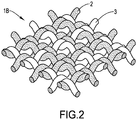
- the structure of the woven fabric was shown in Fig. 2 .
- the woven fabric 1B was composed of the HH-TPE yarn 2 and the LH-TPE yarn 3.
- the warp was composed of the HH-TPE yarn 2 and the LH-TPE yarn 3 at a ratio of 2:1
- the weft was composed of the HH-TPE yarn 2 and the LH-TPE yarn 3 at a ratio of 2:1. That is, two HH-TPE yarns 2 and one LH-TPE yarn 3 were arranged repeatedly in both lateral direction and vertical direction.
- Example 2 the woven fabric 1B was preheated and hot-pressed as described in Example 1 to form a reinforced composite fabric of Example 2.
- a HH-TPE polymer used in the instant example was thermoplastic polyether ester elastomer (TPEE), which had a soft segment and a hard segment at a ratio of 37:63.
- the soft segment was constructed by aliphatic polyester and the hard segment was constructed by aromatic crystal polyester.
- the HH-TPE polymer having a shore hardness of 72D and a melting point of 220°C was melt spun to prepare a HH-TPE yarn (16.7tex /72F).
- a LH-TPE polymer used in the instant example was TPEE, which had a soft segment and a hard segment at a ratio of 62:38.
- the soft segment was constructed by aliphatic polyester and the hard segment was constructed by aromatic crystal polyester.
- the LH-TPE polymer having a shore hardness of 30D and a melting point of 150°C was melt spun to prepare a LH-TPE yarn (16.7tex /72F).
- the HH-TPE yarn and the LH-TPE yarn were crossed upon each other at a ratio of 1:1 to form a woven fabric similarly as Example 1. Subsequently, the woven fabric was preheated and hot-pressed as described in Example 1 to form a reinforced composite fabric of Example 3. Differently, the preheating temperature to the woven fabric was 150°C and the hot-pressing temperature to the woven fabric was 170°C.
- a HH-TPE polymer used in the instant example was thermoplastic olefinic elastomer (TPO), which had a soft segment and a hard segment at a ratio of 35:65.
- the soft segment was constructed by ethylene propylene diene monomer (EPDM) and the hard segment was constructed by polypropylene (PP).
- the HH-TPE polymer having a shore hardness of 75D and a melting point of 160°C was melt spun to prepare a HH-TPE yarn (16.7tex /72F).
- a LH-TPE polymer used in the instant example was TPO, which had a soft segment and a hard segment at a ratio of 68:32.
- the soft segment was constructed by EPDM and the hard segment was constructed by PP.
- the LH-TPE polymer having a shore hardness of 56A and a melting point of 70°C was melt spun to prepare a LH-TPE yarn (16.7tex /72F).
- the HH-TPE yarn and the LH-TPE yarn were crossed upon each other at a ratio of 1:1 to form a woven fabric similarly as in Example 1.
- the woven fabric was preheated and hot-pressed as described in Example 1 to form a reinforced composite fabric of Example 4. Differently, the preheating temperature to the woven fabric was 70°C and the hot-pressing temperature to the woven fabric was 100°C.
- a HH-TPE polymer used in the instant example similarly as in Example 1 was melt spun to prepare a HH-TPE fiber (8.3tex/36F).
- the HH-TPE fiber and a polyethylene terephthalate (PET) fiber (8.3tex/36F) were twisted to form a HH-TPE yarn (16.7tex /72F).
- a LH-TPE polymer similarly as in Example 1 was melt spun to prepare a LH-TPE yarn (16.7tex /72F).
- Example 5 The HH-TPE yarn and the LH-TPE yarn were crossed upon each other at a ratio of 1:1 to form a woven fabric similarly as in Example 1. Subsequently, the woven fabric was preheated and hot-pressed as described in Example 1 to form a reinforced composite fabric of Example 5.
- a HH-TPE yarn (16.7tex /72F) and a LH-TPE yarn (16.7tex /72F) used in the instant example were similar to those in Example 1. Differently, the HH-TPE yarn and the LH-TPE yarn were knitted at a ratio of 1:1 to form a knitted fabric. Subsequently, the knitted fabric was preheated and hot-pressed as described in Example 1 to form a reinforced composite fabric of Example 6.
- a HH-TPE yarn (16.7tex /72F) and a LH-TPE yarn (16.7tex /72F) used in the instant example were similar to those in Example 5. Differently, the HH-TPE yarn and the LH-TPE yarn were knitted at a ratio of 1:1 to form a knitted fabric. Subsequently, the knitted fabric was preheated and hot-pressed as described in Example 5 to form a reinforced composite fabric of Example 7.
- a HH-TPE yarn (16.7tex /72F) used in the instant example was similar to that in Example 1.
- a LH-TPE yarn (16.7tex /72F) used in the instant example was similar to that in Example 4. Besides, the HH-TPE yarn and the LH-TPE yarn were crossed upon each other at a ratio of 1:1 to form a woven fabric.
- Example 8 the woven fabric was preheated and hot-pressed as described in Example 4 to form a reinforced composite fabric of Example 8.
- a HH-TPE polymer used in the instant comparative example similarly as in Example 1 was melt spun to prepare two identical HH-TPE yarns (16.7tex /72F). The two HH-TPE yarns were crossed upon each other to form a woven fabric similarly as in Example 1.
- the woven fabric was preheated and hot-pressed as described in Example 1.
- a woven fabric used in the instant comparative example was similar to that in Comparative Example 1.
- the woven fabric was preheated and hot-pressed as described in Example 1. Differently, the preheating temperature to the woven fabric was 190°C and the hot-pressing temperature to the woven fabric was 230°C.
- the two HH-TPE yarns were melted and formed into a piece of TPU polymer film.
- the piece of TPU polymer no longer had a texture of the woven fabric.
- the tensile strength of the fabric and the tensile strength of the reinforced composite fabric were measured according to ASTM-D142 specified by American Society for Testing and Materials (ASTM). Also, the impact strength of the fabric and the impact strength of the reinforced composite fabric were measured according to ASTM-D256 specified by ASTM.
- Table 1 the type of the HH-TPE polymers, the ratios of the soft segment to the hard segment (abbreviated as SS:HS) of the HH-TPE polymers, the shore hardness of the HH-TPE polymers, and the melting points of the HH-TPE polymers in Examples 1 to 8 (abbreviated as E1 to E8) and the type of the LH-TPE polymers, the SS:HS ratios of the LH-TPE polymers, the shore hardness of the LH-TPE polymers, and the melting points (°C) of the LH-TPE polymers in Examples 1 to 8 (abbreviated as E1 to E8).
- HH-TPE polymer LH-TPE polymer Type SS HS Hardness Melting point
- Type SS HS Hardness Melting point
- Table 2 the ratios of the HH-TPE yarn to the LH-TPE yarn (abbreviated as HH-yarn:LH-yarn) of the fabrics,
- the HH-/LH-TPE yarns can be prepared by the HH-/LH-TPE polymers with different hardness or different melting points by controlling the SS:HS ratios of the HH-/LH-TPE polymers.
- the tensile strengths and the impact strengths of the reinforced composite fabrics in Examples 1 to 8 were higher than those of the fabrics in Examples 1 to 8. Therefore, the present invention could prepare the reinforced composite fabrics with higher tensile strength and higher impact strength.
- the HH-TPE polymer and the LH-TPE polymer were classified as identical thermoplastic elastomeric polymer in Examples 1 to 7.
- the LH-TPE polymer and the HH-TPE polymer in Examples 1, 2, 5, and 8 were TPU.
- the SS:HS ratios of the LH-TPE polymer ranged from 56:44 to 70:30
- the shore hardness of the LH-TPE yarn ranged from 10A to 90A
- the melting points of the LH-TPE yarn ranged from 50°C to 150°C.
- the SS:HS ratios of the HH-TPE polymer ranged from 30:70 to 50:50
- the shore hardness of the HH-TPE yarn ranged from 95A to 90D and the melting points of the HH-TPE yarn ranged from 170°C to 300°C.
- the LH-TPE polymer and the HH-TPE polymer in Example 3 were TPEE.
- the SS:HS ratio of the LH-TPE polymer ranged from 52:48 to 75:25
- the shore hardness of the LH-TPE yarn ranged from 30D to 60D
- the melting point of the LH-TPE yarn ranged from 100°C to 180°C.
- the SS:HS ratio of the HH-TPE polymer ranged from 30:70 to 40:60
- the shore hardness of the HH-TPE yarn ranged from 65D to 80D and the melting points of the HH-TPE yarn ranged from 185°C to 280°C.
- the LH-TPE polymer and the HH-TPE polymer in Examples 4 and 8 were TPO.
- the SS:HS ratios of the LH-TPE polymer ranged from 55:45 to 75:25
- the shore hardness of the LH-TPE yarn ranged from 30A to 60A and the melting point of the LH-TPE yarn ranged from 50°C to 80°C.
- the SS:HS ratios of the HH-TPE polymer ranged from 30:70 to 40:60
- the shore hardness of the HH-TPE yarn ranged from 65A to 90A and the melting point of the HH-TPE yarn ranged from 100°C to 180°C.
- the HH-TPE polymers in Examples 1 and 8 were both TPU. Differently, the LH-TPE polymer in Example 1 was TPU but the LH-TPE polymer in Example 8 was TPO. With reference to Table 2, the tensile strength and the impact strength of the reinforced composite fabric in Example 1 were higher than those in Example 8 due to the higher affinity between the HH-TPE yarn and the LH-TPE yarn.
- the LH-TPE polymers in Examples 4 and 8 were both TPO.
- the HH-TPE polymer in Example 4 was TPO but the HH-TPE polymer in Example 8 was TPU.
- the tensile strength of the reinforced composite fabric in Example 8 was higher than that in Example 4.
- the impact strength of the reinforced composite fabric in Example 4 was higher than that in Example 8. Therefore, the reinforced composite fabric prepared by various types of HH-TPE polymers or by various types of LH-TPE polymers would have different characteristics of mechanical strengths.
- the PET fiber and the TPU fiber were twisted to form the HH-TPE yarn in Examples 5 and 7.
- the tensile strengths and the impact strengths of the reinforced composite fabrics in Examples 5 and 7 were increased.
- the tensile strength of the reinforced composite fabric in Example 5 was 52MPa; the impact strength of the reinforced composite fabric in Example 5 was 287 J/m.
- the tensile strength of the reinforced composite fabric in Example 7 was 26.2MPa; the impact strength of the reinforced composite fabric in Example 7 was 148 J/m.
- Examples 1 and 6 were respectively prepared similarly. That is, the difference between the first group and the second group was only the types of the fabrics.
- the tensile strength and the impact strength of the reinforced composite fabric made by woven fabrics were higher than those of the reinforced composite fabric made by knitted fabrics (Examples 6 and 7).
- Comparing Example 1 with Comparative Example 1 the woven fabric in Comparative Example 1 was woven by two identical HH-TPE yarns. After preheating and hot-pressing the woven fabric, the woven fabric did not form the reinforced composite fabric. With reference to Table 2, the tensile strength and the impact strength of the reinforced composite fabric in Comparative Example 1 did not increase obviously.
- Comparing Example 1 with Comparative Example 2 the woven fabric in Comparative Example 2 was woven by two identical HH-TPE yarns and the hot-pressing temperature was not higher than or equal to the melting point of the HH-TPE yarn. From the result, the woven fabric in the Comparative Example 2 not only could not form the reinforced composite fabric but also would lose the texture of the fabric. Therefore, using the HH-TPE yarn and the LH-TPE yarn and controlling the hot-pressing temperature to the fabrics in a specific range are important features to prepare the reinforced composite fabrics.
Landscapes
- Engineering & Computer Science (AREA)
- Textile Engineering (AREA)
- Woven Fabrics (AREA)
- Reinforced Plastic Materials (AREA)
Description
- The present invention relates to textile technology, and particularly relates to a reinforced composite fabric and a method for preparing a reinforced composite fabric.
- Texture is a common daily necessity widely applied in many fields. For example, the Europe patent publication
0101305 A2 discloses an oriented woven furniture support material which is a synthetic woven material suitable for use in furniture. Due to the development of technology, the demands for the functional textiles increase. The functional textiles have different properties and functions according to different uses. For example, the Japan patent publicationH04146235 A 0768406 A1 discloses a fiber-reinforced composite material containing reinforcing fibers and matrix fibers. In the prior arts, reinforced textiles are usually formed by adding a reinforcing agent or attaching a reinforcing film to enhance their strengths. - The use of reinforcing agent is more widely used between these two means. Common reinforcing agents include tear strength improver, rubbing fastness improver, or fabric enhancer. After the textile is immersed in a solution containing the reinforcing agent, a polymer layer is attached onto the surface of the textile, such that the strength of the textile can be enhanced.
- However, the concentration of the reinforcing agent needs to be lower than 5% to sustain the texture of the reinforced textile, resulting in that the reinforced effect cannot be effectively improved. Using the reinforcing agent to enhance the strength requires additional impregnation process and drying process, resulting in a more complicated process, longer processing time, and higher cost. Besides, large consumptions of water and solvent during the process cause large burdens to the environment, and thus the conventional method is not suitable for the mass production of the reinforced fabrics in the future that people pay attention to the environmental protection increasingly.
- Film lamination is also useful to reinforce the strength of the textile. The surface of the textile is dot-coated with a hot melt adhesive solution, and then covered with a reinforcing film to form a laminated structure. Finally, the laminated structure is hot-pressed under 200°C to 300°C to form the reinforced textile.
- However, the hot melt adhesive layer is aged over time and would peel from the textile, and thus lose the property of high strength. Besides, the solvent contained in the hot melt adhesive solution might remain in the reinforced textile made by the film lamination, thereby limiting the applicability of the reinforced textile.
- The objective of the present invention is to provide a reinforced composite fabric and a method for preparing a reinforced composite fabric which overcomes the problem of peeling of the reinforcing film and simplifies the fabrication process.
- In order to achieve the aforementioned objective, the present invention provides a method for preparing a reinforced composite fabric including:
- forming a high-hardness thermoplastic elastomeric yarn and a low-hardness thermoplastic elastomeric yarn into a fabric by weaving; a melting point of the low-hardness thermoplastic elastomeric yarn ranging from 50°C to 150°C;
- hot-pressing the fabric under a hot-pressing temperature (less than 200°C) and a hot-pressing pressure to form the reinforced composite fabric; the hot-pressing temperature being higher than or equal to the melting point of the low-hardness thermoplastic elastomeric yarn, and lower than a melting point of the high-hardness thermoplastic elastomeric yarn.
- In accordance with the present invention, two thermoplastic elastomeric yarns with different hardness or different melting points are hot-pressed at a suitable temperature to allow the low-hardness thermoplastic elastomeric yarn to be partially melted and attached on the surface of the high-hardness thermoplastic elastomeric yarn, so as to obtain the reinforced composite fabric. By means of the method described, the tensile strength and the impact strength are enhanced without using the hot melt adhesive solution. The drawbacks of aging of the hot melt adhesive layer, peeling of the reinforcing film, and residuals of the solvent are overcome. Further, the fabrication process of the reinforced fabric is simpler than the prior art.
- Preferably, the hot-pressing pressure is from 0.0098 MPa to 0.98MPa.
- As for the method for preparing the reinforced composite fabric, the hot-pressing temperature is higher than the melting point of the low-hardness thermoplastic elastomeric yarn by 10°C to 50°C. Preferably, the hot-pressing temperature is higher than the melting point of the low-hardness thermoplastic elastomeric yarn by 10°C to 20°C. Therefore, the present invention can hot-press the fabric under a hot-pressing temperature lower than 200°C and make the low-hardness thermoplastic elastomeric yarn partially melted.
- According to the present invention, the hot-pressing temperature can be adjusted according to the melting point of the high-hardness thermoplastic elastomeric yarn and the melting point of the low-hardness thermoplastic elastomeric yarn. Preferably, the melting point of the low-hardness thermoplastic elastomeric yarn is from 50°C to 150°C. More preferably, the melting point of the low-hardness thermoplastic elastomeric yarn is from 70°C to 150°C. Therefore, the reinforced composite fabric is made under the lower hot-pressing temperature. Besides, the melting point of the high-hardness thermoplastic elastomeric yarn is from 150°C to 300°C. More preferably, the melting point of the high-hardness thermoplastic elastomeric yarn is from 160°C to 300°C. Much more preferably, the melting point of the high-hardness thermoplastic elastomeric yarn is from 180°C to 250°C.
- According to the invention, a shore hardness of the low-hardness thermoplastic elastomeric yarn is from 10A to 90A and a shore hardness of the high-hardness thermoplastic elastomeric yarn is from 95A to 90D.
- In addition, the method further comprises the step of twisting a high-hardness thermoplastic elastomeric fiber and a reinforcing fiber into the high-hardness thermoplastic elastomeric yarn.
- The step of twisting a high-hardness thermoplastic elastomeric fiber and a reinforcing fiber makes the high-hardness thermoplastic elastomeric yarn have the characteristic of the reinforcing fiber. The addition of the reinforcing fiber widens the applicability of the reinforced composite fabric and may enhance the tensile strength and the impact strength of the reinforced composite fabric.
- Preferably, the reinforcing fiber is a synthetic fiber. Further, the applicable synthetic fiber of the present invention includes a carbon fiber, a glass fiber, a Kevlar fiber, or a Dyneema fiber. A percentage of the reinforcing fiber ranges from 10 wt% to 90 wt% based on the overall weight of the high-hardness thermoplastic elastomeric yarn.
- Preferably, the method further comprises the steps of melt spinning a high-hardness thermoplastic elastomeric polymer into the high-hardness thermoplastic elastomeric yarn and of melt spinning a low-hardness thermoplastic elastomeric polymer into the low-hardness thermoplastic elastomeric yarn. Besides, the high-hardness thermoplastic elastomeric polymer and the low-hardness thermoplastic elastomeric polymer independently are, but not limited to, thermoplastic rubber elastomer (TPR), thermoplastic polyurethane elastomer (TPU), styrene-based thermoplastic elastomer (TPS), thermoplastic olefinic elastomer (TPO), thermoplastic vulcanizate elastomer (TPV), thermoplastic ester elastomer (TPEE), or thermoplastic polyamide elastomer (TPAE).
- Preferably, the high-hardness thermoplastic elastomeric polymer and the low-hardness thermoplastic elastomeric polymer are classified as the identical thermoplastic elastomeric polymer. Therefore, the reinforced composite fabric may have higher tensile strength and higher impact strength due to the same or better affinity between the high-hardness thermoplastic elastomeric yarn and the low-hardness thermoplastic elastomeric yarn.
- The high-hardness thermoplastic elastomeric polymer and the low-hardness thermoplastic elastomeric polymer each respectfully have a soft segment and a hard segment. The hardness and the melting point of the thermoplastic elastomeric polymer may be adjusted according to a ratio of the soft segment to the hard segment.
- The soft segment can be constructed by, but not limited to, butadiene rubber (BR), isoprene rubber (IR), natural rubber (NR), ethylene propylene diene monomer (EPDM), isobutylene isoprene rubber (IIR), polyisobutylene (PIB), polyethylene/polybutylene, amorphous polyethylene, polyether polyol, polyester polyol, or polyester.
- The hard segment can be constructed by, but not limited to, polystyrene (PS), polyethylene (PE), polypropylene (PP), syndiotactic 1,2-polybutadiene, trans-1,4-polyisoprene, polyurethanes (PU), diisocyanate, or polyamide (PA).
- Moreover, in the polyester-polyether type of TPEE system, the soft segment can be constructed by polyether and the hard segment can be constructed by aromatic crystal polyester. In the polyester-polyester type of TPEE system, the soft segment can be constructed by aliphatic polyester and the hard segment can be constructed by aromatic crystal polyester.
- Preferably, the ratio of the soft segment to the hard segment of the high-hardness thermoplastic elastomeric polymer is from 25:75 to 50:50. The ratio of the soft segment to the hard segment of the low-hardness thermoplastic elastomeric polymer is from 51:49 to 80:20.
- Preferably, the high-hardness thermoplastic elastomeric polymer and the low-hardness thermoplastic elastomeric polymer are both TPU. The ratio of the soft segment to the hard segment of the high-hardness thermoplastic elastomeric polymer is from 30:70 to 50:50. The ratio of the soft segment to the hard segment of the low-hardness thermoplastic elastomeric polymer is from 56:44 to 70:30.
- Preferably, the high-hardness thermoplastic elastomeric polymer and the low-hardness thermoplastic elastomeric polymer are both TPEE. The ratio of the soft segment to the hard segment of the high-hardness thermoplastic elastomeric polymer is from 30:70 to 40:60. The ratio of the soft segment to the hard segment of the low-hardness thermoplastic elastomeric polymer is from 52:48 to 75:25.
- Preferably, the high-hardness thermoplastic elastomeric polymer and the low-hardness thermoplastic elastomeric polymer are both TPO. The ratio of the soft segment to the hard segment of the high-hardness thermoplastic elastomeric polymer is from 30:70 to 40:60. The ratio of the soft segment to the hard segment of the low-hardness thermoplastic elastomeric polymer is from 55:45 to 75:25.
- Preferably, the step of forming a high-hardness thermoplastic elastomeric yarn and a low-hardness thermoplastic elastomeric yarn into a fabric by weaving further comprises twisting the high-hardness thermoplastic elastomeric yarn and the low-hardness thermoplastic elastomeric yarn into multiple complex yarns and forming the complex yarns into the fabric. Each of the complex yarns comprises foresaid high-hardness thermoplastic elastomeric yarn and low-hardness thermoplastic elastomeric yarn twisted together.
- The high-hardness thermoplastic elastomeric yarn and the low-hardness thermoplastic elastomeric yarn can form the fabric by a weaving method. The fabrics can be, but not limited to, circular knitted fabric, knitted fabric, jersey fabric, woven fabric, plain fabric, ribbing fabric, or corrugated fabric. Besides, the fabrics can be formed by different weaving methods in the same process, for example, the fabric can be formed by knitted weaving in combination with woven weaving and plain weaving.
- Furthermore, the present invention provides a reinforced composite fabric comprising a high-hardness thermoplastic elastomeric yarn and a low-hardness thermoplastic elastomeric yarn. A part of a surface of the low-hardness thermoplastic elastomeric yarn is melted and attached on a surface of the high-hardness thermoplastic elastomeric yarn. The reinforced composite fabric can be made by the method mentioned above.
- In conclusion, the reinforced composite fabric and the method for preparing the reinforced composite fabric have advantages as follows.
- Hot-pressing the fabric woven by the high-hardness thermoplastic elastomeric yarn and the low-hardness thermoplastic elastomeric yarn allows the reinforced composite fabric to have a higher tensile strength and a higher impact strength.
- The method for preparing the reinforced composite fabric overcomes the problems to fabricate the reinforced textiles by the intensifiers impregnation and the film lamination.
- By adjusting the melting point of the low-hardness thermoplastic elastomeric yarn, the reinforced composite fabric can be hot-pressed under a lower hot-pressing temperature.
-
-
Fig. 1 is a perspective view of a reinforced woven fabric made from high-hardness thermoplastic elastomeric yarns and low-hardness thermoplastic elastomeric yarns at a ratio of 1:1; -
Fig. 2 is a perspective view of the reinforced woven fabric made from the high-hardness thermoplastic elastomeric yarns and low-hardness thermoplastic elastomeric yarns at a ratio of 2:1. - To prove that the reinforced composite fabric has a higher tensile strength and a higher impact strength, the reinforced composite fabric and the method for preparing the same is provided as follows.
- A high-hardness thermoplastic elastomeric (abbreviated as HH-TPE) polymer used in the instant example was thermoplastic polyurethane elastomer (TPU), which had a soft segment and a hard segment at a ratio of 44:56. The soft segment was constructed by polyol and the hard segment was constructed by diisocyanate. The HH-TPE polymer having a shore hardness of 95A and a melting point of 190°C was melt spun to prepare a HH-TPE yarn (16.7tex /72F).
- A low-hardness thermoplastic elastomeric (abbreviated as LH-TPE) polymer used in the instant example was TPU and had a soft segment and a hard segment at a ratio of 65:35. The soft segment was constructed by polyol and the hard segment was constructed by diisocyanate. The LH- TPE polymer having a shore hardness of 80A and a melting point of 100°C was melt spun to prepare a LH-TPE yarn (16.7tex /72F).
- The HH-TPE yarn and the LH-TPE yarn were crossed upon each other at a ratio of 1:1 to form a woven fabric. The size of the woven fabric was 21 cm × 30 cm. The structure of the woven fabric was shown in
Fig. 1 . - With reference to
Fig. 1 , the wovenfabric 1A was composed of the HH-TPE yarn 2 and the LH-TPE yarn 3. The warp was composed of the HH-TPE yarn 2 and the LH-TPE yarn 3 at a ratio of 1:1, and the weft was composed of the HH-TPE yarn 2 and the LH-TPE yarn 3 at a ratio of 1:1. That is, the HH-TPE yarn 2 and the LH-TPE yarn 3 were staggered together in both lateral direction and vertical direction. Subsequently, the wovenfabric 1A was preheated under 100°C for half an hour and hot-pressed under 110°C and a pressure of 0.098 MPa for 3 minutes. After cooling the hot-pressed woven fabric, a reinforced composite fabric was finally obtained. - A HH-TPE yarn (16.7tex/72F) and a LH-TPE yarn (16.7tex/72F) used in the instant example were similar with those in Example 1.
- Differently, the HH-TPE yarn and the LH-TPE yarn were crossed upon each other at a ratio of 2: 1 to form a woven fabric. The structure of the woven fabric was shown in
Fig. 2 . - With reference to
Fig. 2 , thewoven fabric 1B was composed of the HH-TPE yarn 2 and the LH-TPE yarn 3. The warp was composed of the HH-TPE yarn 2 and the LH-TPE yarn 3 at a ratio of 2:1, and the weft was composed of the HH-TPE yarn 2 and the LH-TPE yarn 3 at a ratio of 2:1. That is, two HH-TPE yarns 2 and one LH-TPE yarn 3 were arranged repeatedly in both lateral direction and vertical direction. - Subsequently, the
woven fabric 1B was preheated and hot-pressed as described in Example 1 to form a reinforced composite fabric of Example 2. - A HH-TPE polymer used in the instant example was thermoplastic polyether ester elastomer (TPEE), which had a soft segment and a hard segment at a ratio of 37:63. The soft segment was constructed by aliphatic polyester and the hard segment was constructed by aromatic crystal polyester. The HH-TPE polymer having a shore hardness of 72D and a melting point of 220°C was melt spun to prepare a HH-TPE yarn (16.7tex /72F).
- A LH-TPE polymer used in the instant example was TPEE, which had a soft segment and a hard segment at a ratio of 62:38. The soft segment was constructed by aliphatic polyester and the hard segment was constructed by aromatic crystal polyester. The LH-TPE polymer having a shore hardness of 30D and a melting point of 150°C was melt spun to prepare a LH-TPE yarn (16.7tex /72F).
- The HH-TPE yarn and the LH-TPE yarn were crossed upon each other at a ratio of 1:1 to form a woven fabric similarly as Example 1. Subsequently, the woven fabric was preheated and hot-pressed as described in Example 1 to form a reinforced composite fabric of Example 3. Differently, the preheating temperature to the woven fabric was 150°C and the hot-pressing temperature to the woven fabric was 170°C.
- A HH-TPE polymer used in the instant example was thermoplastic olefinic elastomer (TPO), which had a soft segment and a hard segment at a ratio of 35:65. The soft segment was constructed by ethylene propylene diene monomer (EPDM) and the hard segment was constructed by polypropylene (PP). The HH-TPE polymer having a shore hardness of 75D and a melting point of 160°C was melt spun to prepare a HH-TPE yarn (16.7tex /72F).
- A LH-TPE polymer used in the instant example was TPO, which had a soft segment and a hard segment at a ratio of 68:32. The soft segment was constructed by EPDM and the hard segment was constructed by PP. The LH-TPE polymer having a shore hardness of 56A and a melting point of 70°C was melt spun to prepare a LH-TPE yarn (16.7tex /72F).
- The HH-TPE yarn and the LH-TPE yarn were crossed upon each other at a ratio of 1:1 to form a woven fabric similarly as in Example 1. The woven fabric was preheated and hot-pressed as described in Example 1 to form a reinforced composite fabric of Example 4. Differently, the preheating temperature to the woven fabric was 70°C and the hot-pressing temperature to the woven fabric was 100°C.
- A HH-TPE polymer used in the instant example similarly as in Example 1 was melt spun to prepare a HH-TPE fiber (8.3tex/36F). The HH-TPE fiber and a polyethylene terephthalate (PET) fiber (8.3tex/36F) were twisted to form a HH-TPE yarn (16.7tex /72F).
- A LH-TPE polymer similarly as in Example 1 was melt spun to prepare a LH-TPE yarn (16.7tex /72F).
- The HH-TPE yarn and the LH-TPE yarn were crossed upon each other at a ratio of 1:1 to form a woven fabric similarly as in Example 1. Subsequently, the woven fabric was preheated and hot-pressed as described in Example 1 to form a reinforced composite fabric of Example 5.
- A HH-TPE yarn (16.7tex /72F) and a LH-TPE yarn (16.7tex /72F) used in the instant example were similar to those in Example 1. Differently, the HH-TPE yarn and the LH-TPE yarn were knitted at a ratio of 1:1 to form a knitted fabric. Subsequently, the knitted fabric was preheated and hot-pressed as described in Example 1 to form a reinforced composite fabric of Example 6.
- A HH-TPE yarn (16.7tex /72F) and a LH-TPE yarn (16.7tex /72F) used in the instant example were similar to those in Example 5. Differently, the HH-TPE yarn and the LH-TPE yarn were knitted at a ratio of 1:1 to form a knitted fabric. Subsequently, the knitted fabric was preheated and hot-pressed as described in Example 5 to form a reinforced composite fabric of Example 7.
- A HH-TPE yarn (16.7tex /72F) used in the instant example was similar to that in Example 1. A LH-TPE yarn (16.7tex /72F) used in the instant example was similar to that in Example 4. Besides, the HH-TPE yarn and the LH-TPE yarn were crossed upon each other at a ratio of 1:1 to form a woven fabric.
- Subsequently, the woven fabric was preheated and hot-pressed as described in Example 4 to form a reinforced composite fabric of Example 8.
- A HH-TPE polymer used in the instant comparative example similarly as in Example 1 was melt spun to prepare two identical HH-TPE yarns (16.7tex /72F). The two HH-TPE yarns were crossed upon each other to form a woven fabric similarly as in Example 1.
- Subsequently, the woven fabric was preheated and hot-pressed as described in Example 1.
- After hot-pressing the woven fabric, an appearance of the hot-pressed woven fabric was unchanged.
- A woven fabric used in the instant comparative example was similar to that in Comparative Example 1.
- Subsequently, the woven fabric was preheated and hot-pressed as described in Example 1. Differently, the preheating temperature to the woven fabric was 190°C and the hot-pressing temperature to the woven fabric was 230°C.
- After hot-pressing the woven fabric, the two HH-TPE yarns were melted and formed into a piece of TPU polymer film. The piece of TPU polymer no longer had a texture of the woven fabric.
- In order to clarify the differences among Examples 1 to 8, the properties of the HH-TPE polymers and the properties of the LH-TPE polymers were listed in Table 1.
- To measure the mechanical properties of the reinforced composite fabric, the tensile strength of the fabric and the tensile strength of the reinforced composite fabric were measured according to ASTM-D142 specified by American Society for Testing and Materials (ASTM). Also, the impact strength of the fabric and the impact strength of the reinforced composite fabric were measured according to ASTM-D256 specified by ASTM.
- To clarify the differences among Examples and Comparative Examples, the operating conditions and the properties of the reinforced composite fabrics in Examples 1 to 8 and in Comparative Example 1 were listed in Table 2.
Table 1: the type of the HH-TPE polymers, the ratios of the soft segment to the hard segment (abbreviated as SS:HS) of the HH-TPE polymers, the shore hardness of the HH-TPE polymers, and the melting points of the HH-TPE polymers in Examples 1 to 8 (abbreviated as E1 to E8) and the type of the LH-TPE polymers, the SS:HS ratios of the LH-TPE polymers, the shore hardness of the LH-TPE polymers, and the melting points (°C) of the LH-TPE polymers in Examples 1 to 8 (abbreviated as E1 to E8). HH-TPE polymer LH-TPE polymer Type SS:HS Hardness Melting point Type SS:HS Hardness Melting point E1 TPU 44 : 56 95A 190 TPU 65 : 35 80A 100 E2 TPU 44 : 56 95A 190 TPU 65 : 35 80A 100 E3 TPEE 37 : 63 72D 220 TPEE 62 : 38 30D 150 E4 TPO 35 : 65 75D 160 TPO 68 : 32 56A 70 E5 TPU 44 : 56 95A 190 TPU 65 : 35 80A 100 E6 TPU 44 : 56 95A 190 TPU 65 : 35 80A 100 E7 TPU 44 : 56 95A 190 TPU 65 : 35 80A 100 E8 TPU 44 : 56 95A 190 TPO 68:32 56A 70 Table 2: the ratios of the HH-TPE yarn to the LH-TPE yarn (abbreviated as HH-yarn:LH-yarn) of the fabrics, the preheating temperatures (°C) to the fabrics, the hot-pressing temperatures (°C) to the fabrics, tensile strengths (MPa) of the fabrics, tensile strengths (MPa) of the reinforced composite fabrics, impact strengths (J/m) of the fabrics, and impact strengths (J/m) of the reinforced composite fabrics in Examples 1 to 8 and Comparative Example 1 (abbreviated as E1 to E8 and C1). HH-yarn: LH-yarn Preheating temperature Hot-pressing temperature Tensile strength Impact strength Fabric Reinforced composite fabric Fabric Reinforced composite fabric E1 1 : 1 100 110 24.8 63.8 43 871 E2 2 : 1 100 110 34.3 44.4 69 556 E3 1 : 1 150 170 16.6 42.7 32 583 E4 1 : 1 70 100 10.4 23.8 83 638 E5 1 : 1 100 110 37.6 52 33 287 E6 1 : 1 100 110 12.8 36.7 24 418 E7 1 : 1 100 110 19.4 25.6 30 148 E8 1 : 1 70 100 17.9 34 63 323 C1 1 : 1 100 110 28.0 27.5 62 61 - With reference to Table 1, the HH-/LH-TPE yarns can be prepared by the HH-/LH-TPE polymers with different hardness or different melting points by controlling the SS:HS ratios of the HH-/LH-TPE polymers.
- With reference to Table 2, the tensile strengths and the impact strengths of the reinforced composite fabrics in Examples 1 to 8 were higher than those of the fabrics in Examples 1 to 8. Therefore, the present invention could prepare the reinforced composite fabrics with higher tensile strength and higher impact strength.
- In order to enhance the affinities between the HH-TPE yarn and the LH-TPE yarn, the HH-TPE polymer and the LH-TPE polymer were classified as identical thermoplastic elastomeric polymer in Examples 1 to 7.
- With reference to Table 1, the LH-TPE polymer and the HH-TPE polymer in Examples 1, 2, 5, and 8 were TPU. When the SS:HS ratios of the LH-TPE polymer ranged from 56:44 to 70:30, the shore hardness of the LH-TPE yarn ranged from 10A to 90A and the melting points of the LH-TPE yarn ranged from 50°C to 150°C. When the SS:HS ratios of the HH-TPE polymer ranged from 30:70 to 50:50, the shore hardness of the HH-TPE yarn ranged from 95A to 90D and the melting points of the HH-TPE yarn ranged from 170°C to 300°C.
- With reference to Table 1, the LH-TPE polymer and the HH-TPE polymer in Example 3 were TPEE. When the SS:HS ratio of the LH-TPE polymer ranged from 52:48 to 75:25, the shore hardness of the LH-TPE yarn ranged from 30D to 60D and the melting point of the LH-TPE yarn ranged from 100°C to 180°C. When the SS:HS ratio of the HH-TPE polymer ranged from 30:70 to 40:60, the shore hardness of the HH-TPE yarn ranged from 65D to 80D and the melting points of the HH-TPE yarn ranged from 185°C to 280°C.
- With reference to Table 1, the LH-TPE polymer and the HH-TPE polymer in Examples 4 and 8 were TPO. When the SS:HS ratios of the LH-TPE polymer ranged from 55:45 to 75:25, the shore hardness of the LH-TPE yarn ranged from 30A to 60A and the melting point of the LH-TPE yarn ranged from 50°C to 80°C. When the SS:HS ratios of the HH-TPE polymer ranged from 30:70 to 40:60, the shore hardness of the HH-TPE yarn ranged from 65A to 90A and the melting point of the HH-TPE yarn ranged from 100°C to 180°C.
- With reference to Table 2, by using identical type of the LH-TPE polymer and the HH-TPE polymer, the tensile strengths and the impact strengths of the reinforced composite fabrics in Examples 1 to 7 were enhanced after hot-pressing.
- Comparing Examples 1 with 8, the HH-TPE polymers in Examples 1 and 8 were both TPU. Differently, the LH-TPE polymer in Example 1 was TPU but the LH-TPE polymer in Example 8 was TPO. With reference to Table 2, the tensile strength and the impact strength of the reinforced composite fabric in Example 1 were higher than those in Example 8 due to the higher affinity between the HH-TPE yarn and the LH-TPE yarn.
- Comparing Examples 4 with 8, the LH-TPE polymers in Examples 4 and 8 were both TPO. Differently, the HH-TPE polymer in Example 4 was TPO but the HH-TPE polymer in Example 8 was TPU. With reference to Table 2, due to the tensile reinforcement of the TPU, the tensile strength of the reinforced composite fabric in Example 8 was higher than that in Example 4. In addition, due to the higher affinity between the HH-TPE yarn and the LH-TPE yarn, the impact strength of the reinforced composite fabric in Example 4 was higher than that in Example 8. Therefore, the reinforced composite fabric prepared by various types of HH-TPE polymers or by various types of LH-TPE polymers would have different characteristics of mechanical strengths.
- Further, other kinds of fiber could be included in the HH-TPE yarn or the LH-TPE yarn hence to form the reinforced composite fabric with different characteristics. With reference to Table 2, the PET fiber and the TPU fiber were twisted to form the HH-TPE yarn in Examples 5 and 7. The tensile strengths and the impact strengths of the reinforced composite fabrics in Examples 5 and 7 were increased. The tensile strength of the reinforced composite fabric in Example 5 was 52MPa; the impact strength of the reinforced composite fabric in Example 5 was 287 J/m. The tensile strength of the reinforced composite fabric in Example 7 was 26.2MPa; the impact strength of the reinforced composite fabric in Example 7 was 148 J/m.
- Comparing Examples 1 to 5 with Examples 6 and 7, the fabrics in Examples 1 to 5 were woven fabrics and the fabrics in Examples 6 and 7 were knitted fabrics. With reference to Table 2, no matter what fabrics were made, the tensile strengths and the impact strengths of the reinforced composite fabrics were increased after hot-pressing. Therefore, various types of fabrics were suitable for use in the method for preparing the reinforced composite fabric.
- To compare the woven fabrics with knitted fabrics, a first group (Examples 1 and 6) and a second group (Examples 5 and 7) were respectively prepared similarly. That is, the difference between the first group and the second group was only the types of the fabrics. With reference to Table 2, the tensile strength and the impact strength of the reinforced composite fabric made by woven fabrics (Examples 1 and 5) were higher than those of the reinforced composite fabric made by knitted fabrics (Examples 6 and 7).
- Comparing Example 1 with Comparative Example 1, the woven fabric in Comparative Example 1 was woven by two identical HH-TPE yarns. After preheating and hot-pressing the woven fabric, the woven fabric did not form the reinforced composite fabric. With reference to Table 2, the tensile strength and the impact strength of the reinforced composite fabric in Comparative Example 1 did not increase obviously.
- Comparing Example 1 with Comparative Example 2, the woven fabric in Comparative Example 2 was woven by two identical HH-TPE yarns and the hot-pressing temperature was not higher than or equal to the melting point of the HH-TPE yarn. From the result, the woven fabric in the Comparative Example 2 not only could not form the reinforced composite fabric but also would lose the texture of the fabric. Therefore, using the HH-TPE yarn and the LH-TPE yarn and controlling the hot-pressing temperature to the fabrics in a specific range are important features to prepare the reinforced composite fabrics.
Claims (17)
- A method for preparing a reinforced composite fabric, wherein the method comprises steps of:forming a high-hardness thermoplastic elastomeric yarn (2) and a low-hardness thermoplastic elastomeric yarn (3) into a fabric by weaving; a melting point of the low-hardness thermoplastic elastomeric yarn (3) ranging from 50°C to 150°C; a shore hardness of the low-hardness thermoplastic elastomeric yarn (3) ranging from 10A to 90A and a shore hardness of the high-hardness thermoplastic elastomeric yarn (2) ranging from 95A to 90D;hot-pressing the fabric under a hot-pressing temperature and a hot-pressing pressure to form the reinforced composite fabric; the hot-pressing temperature being higher than or equal to the melting point of the low-hardness thermoplastic elastomeric yarn (3), and lower than a melting point of the high-hardness thermoplastic elastomeric yarn (2).
- The method for preparing the reinforced composite fabric as claimed in claim 1, wherein the hot-pressing temperature is higher than the melting point of the low-hardness thermoplastic elastomeric yarn (3) by 10°C to 50°C.
- The method for preparing the reinforced composite fabric as claimed in claim 1, wherein the melting point of the high-hardness thermoplastic elastomeric yarn (2) is from 150°C to 300°C.
- The method for preparing the reinforced composite fabric as claimed in claim 1, wherein the method comprises twisting a high-hardness thermoplastic elastomeric fiber and a reinforcing fiber into the high-hardness thermoplastic elastomeric yarn (2).
- The method for preparing the reinforced composite fabric as claimed in claim 4, wherein the reinforcing fiber includes a carbon fiber, a glass fiber, a Kevlar fiber, or a Dyneema fiber; a percentage of the reinforcing fiber ranges from10 wt% to 90 wt% based on the overall weight of the high-hardness thermoplastic elastomeric yarn (2).
- The method for preparing the reinforced composite fabric as claimed in claim 1, wherein the method comprises:melt spinning a high-hardness thermoplastic elastomeric polymer into the high-hardness thermoplastic elastomeric yarn (2); andmelt spinning a low-hardness thermoplastic elastomeric polymer into the low-hardness thermoplastic elastomeric yarn (3); whereinthe high-hardness thermoplastic elastomeric polymer and the low-hardness thermoplastic elastomeric polymer independently are thermoplastic rubber elastomer, thermoplastic polyurethane elastomer, styrene-based thermoplastic elastomer, thermoplastic olefinic elastomer, thermoplastic vulcanizate elastomer, thermoplastic ester elastomer, or thermoplastic polyamide elastomer.
- The method for preparing the reinforced composite fabric as claimed in claim 2, wherein the method comprises:melt-spinning a high-hardness thermoplastic elastomeric polymer into the high-hardness thermoplastic elastomeric yarn (2); andmelt-spinning a low-hardness thermoplastic elastomeric polymer into the low-hardness thermoplastic elastomeric yarn (3); whereinthe high-hardness thermoplastic elastomeric polymer and the low-hardness thermoplastic elastomeric polymer independently are thermoplastic rubber elastomer, thermoplastic polyurethane elastomer, styrene-based thermoplastic elastomer, thermoplastic olefinic elastomer, thermoplastic vulcanizate elastomer, thermoplastic ester elastomer, or thermoplastic polyamide elastomer.
- The method for preparing the reinforced composite fabric as claimed in claim 3, wherein the method comprises:melt-spinning a high-hardness thermoplastic elastomeric polymer into the high-hardness thermoplastic elastomeric yarn (2); andmelt-spinning a low-hardness thermoplastic elastomeric polymer into the low-hardness thermoplastic elastomeric yarn (3); whereinthe high-hardness thermoplastic elastomeric polymer and the low-hardness thermoplastic elastomeric polymer independently are thermoplastic rubber elastomer, thermoplastic polyurethane elastomer, styrene-based thermoplastic elastomer, thermoplastic olefinic elastomer, thermoplastic vulcanizate elastomer, thermoplastic ester elastomer, or thermoplastic polyamide elastomer.
- The method for preparing the reinforced composite fabric as claimed in claim 6, wherein the high-hardness thermoplastic elastomeric polymer and the low-hardness thermoplastic elastomeric polymer are classified as identical thermoplastic elastomeric polymer.
- The method for preparing the reinforced composite fabric as claimed in claim 6, wherein the high-hardness thermoplastic elastomeric polymer and the low-hardness thermoplastic elastomeric polymer each respectively have a soft segment and a hard segment; a ratio of the soft segment to the hard segment of the high-hardness thermoplastic elastomeric polymer ranges from 25:75 to 50:50; a ratio of the soft segment to the hard segment of the low-hardness thermoplastic elastomeric polymer ranges from 51:49 to 80:20.
- The method for preparing the reinforced composite fabric as claimed in claim 6, wherein the high-hardness thermoplastic elastomeric polymer and the low-hardness thermoplastic elastomeric polymer are both classified as thermoplastic polyurethane elastomer; the high-hardness thermoplastic elastomeric polymer and the low-hardness thermoplastic elastomeric polymer each respectfully have a soft segment and a hard segment; a ratio of the soft segment to the hard segment of the high-hardness thermoplastic elastomeric polymer ranges from 30:70 to 50:50; a ratio of the soft segment to the hard segment of the low-hardness thermoplastic elastomeric polymer ranges from 56:44 to 70:30.
- The method for preparing the reinforced composite fabric as claimed in claim 6, wherein the high-hardness thermoplastic elastomeric polymer and the low-hardness thermoplastic elastomeric polymer are both classified as thermoplastic polyether ester elastomer; the high-hardness thermoplastic elastomeric polymer and the low-hardness thermoplastic elastomeric polymer each respectively have a soft segment and a hard segment; a ratio of the soft segment to the hard segment of the high-hardness thermoplastic elastomeric polymer ranges from 30:70 to 40:60; a ratio of the soft segment to the hard segment of the low-hardness thermoplastic elastomeric polymer ranges from 52:48 to 75:25.
- The method for preparing the reinforced composite fabric as claimed in claim 6, wherein the high-hardness thermoplastic elastomeric polymer and the low-hardness thermoplastic elastomeric polymer are both classified as thermoplastic olefinic elastomer; the high-hardness thermoplastic elastomeric polymer and the low-hardness thermoplastic elastomeric polymer each respectively have a soft segment and a hard segment; a ratio of the soft segment to the hard segment of the high-hardness thermoplastic elastomeric polymer ranges from 30:70 to 40:60; a ratio of the soft segment to the hard segment of the low-hardness thermoplastic elastomeric polymer ranges from 55:45 to 75:25.
- The method for preparing the reinforced composite fabric as claimed in claim 1, wherein the step of forming a high-hardness thermoplastic elastomeric yarn (2) and a low-hardness thermoplastic elastomeric yarn (3) into a fabric by weaving further comprises twisting the high-hardness thermoplastic elastomeric yarn (2) and the low-hardness thermoplastic elastomeric yarn (3) into multiple complex yarns and weaving the multiple complex yarns into the fabric; each of the complex yarns comprises foresaid high-hardness thermoplastic elastomeric yarn (2) and low-hardness thermoplastic elastomeric yarn (3) twisted together.
- A woven reinforced composite fabric, wherein the reinforced composite fabric comprises:
a high-hardness thermoplastic elastomeric yarn (2) and a low-hardness thermoplastic elastomeric yarn (3); a part of a surface of the low-hardness thermoplastic elastomeric yarn (3) being melted and attached on a surface of the high-hardness thermoplastic elastomeric yarn (2); a shore hardness of the low-hardness thermoplastic elastomeric yarn (3) ranging from 10A to 90A and a shore hardness of the high-hardness thermoplastic elastomeric yarn (2) ranging from 95A to 90D. - The reinforced composite fabric as claimed in claim 15, wherein the high-hardness thermoplastic elastomeric yarn (2) is twisted of a high-hardness thermoplastic elastomeric fiber and a reinforcing fiber.
- The reinforced composite fabric as claimed in claim 15, wherein the reinforced composite fabric is woven by multiple complex yarns, each of the complex yarns comprising foresaid high-hardness thermoplastic elastomeric yarn (2) and low-hardness thermoplastic elastomeric yarn (3) twisted together.
Priority Applications (4)
| Application Number | Priority Date | Filing Date | Title |
|---|---|---|---|
| EP17152774.0A EP3266914B1 (en) | 2017-01-24 | 2017-01-24 | Reinforced composite fabric and method for preparing the same |
| PL17152774T PL3266914T3 (en) | 2017-01-24 | 2017-01-24 | Reinforced composite fabric and method for preparing the same |
| ES17152774T ES2762073T3 (en) | 2017-01-24 | 2017-01-24 | Reinforced composite fabric and its manufacturing process |
| PT171527740T PT3266914T (en) | 2017-01-24 | 2017-01-24 | Reinforced composite fabric and method for preparing the same |
Applications Claiming Priority (1)
| Application Number | Priority Date | Filing Date | Title |
|---|---|---|---|
| EP17152774.0A EP3266914B1 (en) | 2017-01-24 | 2017-01-24 | Reinforced composite fabric and method for preparing the same |
Publications (2)
| Publication Number | Publication Date |
|---|---|
| EP3266914A1 EP3266914A1 (en) | 2018-01-10 |
| EP3266914B1 true EP3266914B1 (en) | 2019-11-06 |
Family
ID=58046460
Family Applications (1)
| Application Number | Title | Priority Date | Filing Date |
|---|---|---|---|
| EP17152774.0A Active EP3266914B1 (en) | 2017-01-24 | 2017-01-24 | Reinforced composite fabric and method for preparing the same |
Country Status (4)
| Country | Link |
|---|---|
| EP (1) | EP3266914B1 (en) |
| ES (1) | ES2762073T3 (en) |
| PL (1) | PL3266914T3 (en) |
| PT (1) | PT3266914T (en) |
Family Cites Families (3)
| Publication number | Priority date | Publication date | Assignee | Title |
|---|---|---|---|---|
| ES8600431A1 (en) * | 1982-08-12 | 1985-10-01 | Du Pont | Oriented woven furniture support material. |
| JPH04146235A (en) * | 1990-10-09 | 1992-05-20 | Teijin Ltd | Woven and knit fabric having excellent flexural resilience |
| DE19537703A1 (en) * | 1995-10-11 | 1997-04-17 | Hoechst Trevira Gmbh & Co Kg | High density textile fabrics made of polyester hybrid yarns, process for the production of composite materials and use of the textile fabrics |
-
2017
- 2017-01-24 PT PT171527740T patent/PT3266914T/en unknown
- 2017-01-24 ES ES17152774T patent/ES2762073T3/en active Active
- 2017-01-24 PL PL17152774T patent/PL3266914T3/en unknown
- 2017-01-24 EP EP17152774.0A patent/EP3266914B1/en active Active
Non-Patent Citations (1)
| Title |
|---|
| None * |
Also Published As
| Publication number | Publication date |
|---|---|
| PL3266914T3 (en) | 2020-05-18 |
| ES2762073T3 (en) | 2020-05-22 |
| EP3266914A1 (en) | 2018-01-10 |
| PT3266914T (en) | 2019-11-22 |
Similar Documents
| Publication | Publication Date | Title |
|---|---|---|
| KR101913812B1 (en) | Polyolefin-based artificial leather and manfacturing method thereof | |
| KR101972611B1 (en) | Elastic fabric | |
| EP1760189B1 (en) | Multilayer intermediate product for the preparation of artificial leather having a suede-like appearence and preparation method thereof | |
| US20060252322A1 (en) | Polyester filament woven fabric for air bags | |
| US3357954A (en) | Synthetic elastomeric filaments from (a) polyester diols, (b) aliphatic or cycloaliphatic diols and (c) aliphatic or cycloaliphatic diisocyanates | |
| KR20090006842A (en) | Method for producing elastomeric vinegar conjugate fibers | |
| US20160288577A1 (en) | Hybrid reinforcement | |
| KR101482874B1 (en) | Process of producing ultra-light nylon fabrics having micro-porous coating layer | |
| ES3049117T3 (en) | Vehicle tyre having a belt bandage | |
| RU190363U1 (en) | POLYESTER CARD TISSUE | |
| US20210062412A1 (en) | Suede-like artificial leather and production method thereof | |
| US11060215B2 (en) | Reinforced composite fabric and method for preparing the same | |
| EP3266914A1 (en) | Reinforced composite fabric and method for preparing the same | |
| JP6379237B2 (en) | Reinforced composite fabric and method for producing the same | |
| TWI618827B (en) | Composite reinforced fabric and preparation method thereof | |
| KR101963041B1 (en) | Knitted SUEDE and its manufacturing method | |
| CN107523920B (en) | Composite reinforced fabric and method of making the same | |
| CN106108237B (en) | A kind of resistant to bending material for sole of shoe | |
| KR101317766B1 (en) | Polyether elastomer and manufacturing method thereof | |
| JP5591039B2 (en) | Cationic dyeable conjugate fiber, method for producing the same, and fiber product including the conjugate fiber | |
| CN106117504B (en) | A kind of polyurethane elastomer material for sole of shoe | |
| JPH04146235A (en) | Woven and knit fabric having excellent flexural resilience | |
| KR20230060216A (en) | Hybrid cord for cap ply and tire comprising the same | |
| KR20230040167A (en) | Manufacturing method for tire cord having high performance and tire cord produced by the same | |
| KR102907279B1 (en) | Vitrimer Composition, Preparation Method Thereof, and Article Formed Therefrom |
Legal Events
| Date | Code | Title | Description |
|---|---|---|---|
| PUAI | Public reference made under article 153(3) epc to a published international application that has entered the european phase |
Free format text: ORIGINAL CODE: 0009012 |
|
| STAA | Information on the status of an ep patent application or granted ep patent |
Free format text: STATUS: THE APPLICATION HAS BEEN PUBLISHED |
|
| STAA | Information on the status of an ep patent application or granted ep patent |
Free format text: STATUS: REQUEST FOR EXAMINATION WAS MADE |
|
| AK | Designated contracting states |
Kind code of ref document: A1 Designated state(s): AL AT BE BG CH CY CZ DE DK EE ES FI FR GB GR HR HU IE IS IT LI LT LU LV MC MK MT NL NO PL PT RO RS SE SI SK SM TR |
|
| AX | Request for extension of the european patent |
Extension state: BA ME |
|
| 17P | Request for examination filed |
Effective date: 20171220 |
|
| RBV | Designated contracting states (corrected) |
Designated state(s): AL AT BE BG CH CY CZ DE DK EE ES FI FR GB GR HR HU IE IS IT LI LT LU LV MC MK MT NL NO PL PT RO RS SE SI SK SM TR |
|
| RIC1 | Information provided on ipc code assigned before grant |
Ipc: D03D 1/00 20060101AFI20190510BHEP Ipc: D03D 15/00 20060101ALI20190510BHEP |
|
| GRAP | Despatch of communication of intention to grant a patent |
Free format text: ORIGINAL CODE: EPIDOSNIGR1 |
|
| STAA | Information on the status of an ep patent application or granted ep patent |
Free format text: STATUS: GRANT OF PATENT IS INTENDED |
|
| INTG | Intention to grant announced |
Effective date: 20190724 |
|
| GRAS | Grant fee paid |
Free format text: ORIGINAL CODE: EPIDOSNIGR3 |
|
| GRAA | (expected) grant |
Free format text: ORIGINAL CODE: 0009210 |
|
| STAA | Information on the status of an ep patent application or granted ep patent |
Free format text: STATUS: THE PATENT HAS BEEN GRANTED |
|
| AK | Designated contracting states |
Kind code of ref document: B1 Designated state(s): AL AT BE BG CH CY CZ DE DK EE ES FI FR GB GR HR HU IE IS IT LI LT LU LV MC MK MT NL NO PL PT RO RS SE SI SK SM TR |
|
| REG | Reference to a national code |
Ref country code: GB Ref legal event code: FG4D |
|
| REG | Reference to a national code |
Ref country code: CH Ref legal event code: EP Ref country code: AT Ref legal event code: REF Ref document number: 1198845 Country of ref document: AT Kind code of ref document: T Effective date: 20191115 |
|
| REG | Reference to a national code |
Ref country code: PT Ref legal event code: SC4A Ref document number: 3266914 Country of ref document: PT Date of ref document: 20191122 Kind code of ref document: T Free format text: AVAILABILITY OF NATIONAL TRANSLATION Effective date: 20191113 |
|
| REG | Reference to a national code |
Ref country code: IE Ref legal event code: FG4D |
|
| REG | Reference to a national code |
Ref country code: DE Ref legal event code: R096 Ref document number: 602017008303 Country of ref document: DE |
|
| REG | Reference to a national code |
Ref country code: RO Ref legal event code: EPE |
|
| REG | Reference to a national code |
Ref country code: NL Ref legal event code: FP |
|
| REG | Reference to a national code |
Ref country code: LT Ref legal event code: MG4D |
|
| PG25 | Lapsed in a contracting state [announced via postgrant information from national office to epo] |
Ref country code: GR Free format text: LAPSE BECAUSE OF FAILURE TO SUBMIT A TRANSLATION OF THE DESCRIPTION OR TO PAY THE FEE WITHIN THE PRESCRIBED TIME-LIMIT Effective date: 20200207 Ref country code: FI Free format text: LAPSE BECAUSE OF FAILURE TO SUBMIT A TRANSLATION OF THE DESCRIPTION OR TO PAY THE FEE WITHIN THE PRESCRIBED TIME-LIMIT Effective date: 20191106 Ref country code: LT Free format text: LAPSE BECAUSE OF FAILURE TO SUBMIT A TRANSLATION OF THE DESCRIPTION OR TO PAY THE FEE WITHIN THE PRESCRIBED TIME-LIMIT Effective date: 20191106 Ref country code: LV Free format text: LAPSE BECAUSE OF FAILURE TO SUBMIT A TRANSLATION OF THE DESCRIPTION OR TO PAY THE FEE WITHIN THE PRESCRIBED TIME-LIMIT Effective date: 20191106 Ref country code: SE Free format text: LAPSE BECAUSE OF FAILURE TO SUBMIT A TRANSLATION OF THE DESCRIPTION OR TO PAY THE FEE WITHIN THE PRESCRIBED TIME-LIMIT Effective date: 20191106 Ref country code: NO Free format text: LAPSE BECAUSE OF FAILURE TO SUBMIT A TRANSLATION OF THE DESCRIPTION OR TO PAY THE FEE WITHIN THE PRESCRIBED TIME-LIMIT Effective date: 20200206 |
|
| PGFP | Annual fee paid to national office [announced via postgrant information from national office to epo] |
Ref country code: NL Payment date: 20200126 Year of fee payment: 4 Ref country code: RO Payment date: 20200115 Year of fee payment: 4 Ref country code: BG Payment date: 20200130 Year of fee payment: 4 |
|
| REG | Reference to a national code |
Ref country code: ES Ref legal event code: FG2A Ref document number: 2762073 Country of ref document: ES Kind code of ref document: T3 Effective date: 20200522 |
|
| PG25 | Lapsed in a contracting state [announced via postgrant information from national office to epo] |
Ref country code: IS Free format text: LAPSE BECAUSE OF FAILURE TO SUBMIT A TRANSLATION OF THE DESCRIPTION OR TO PAY THE FEE WITHIN THE PRESCRIBED TIME-LIMIT Effective date: 20200306 Ref country code: HR Free format text: LAPSE BECAUSE OF FAILURE TO SUBMIT A TRANSLATION OF THE DESCRIPTION OR TO PAY THE FEE WITHIN THE PRESCRIBED TIME-LIMIT Effective date: 20191106 Ref country code: RS Free format text: LAPSE BECAUSE OF FAILURE TO SUBMIT A TRANSLATION OF THE DESCRIPTION OR TO PAY THE FEE WITHIN THE PRESCRIBED TIME-LIMIT Effective date: 20191106 |
|
| PGFP | Annual fee paid to national office [announced via postgrant information from national office to epo] |
Ref country code: BE Payment date: 20200109 Year of fee payment: 4 Ref country code: CZ Payment date: 20200116 Year of fee payment: 4 |
|
| PG25 | Lapsed in a contracting state [announced via postgrant information from national office to epo] |
Ref country code: AL Free format text: LAPSE BECAUSE OF FAILURE TO SUBMIT A TRANSLATION OF THE DESCRIPTION OR TO PAY THE FEE WITHIN THE PRESCRIBED TIME-LIMIT Effective date: 20191106 |
|
| PGFP | Annual fee paid to national office [announced via postgrant information from national office to epo] |
Ref country code: TR Payment date: 20200106 Year of fee payment: 4 |
|
| PG25 | Lapsed in a contracting state [announced via postgrant information from national office to epo] |
Ref country code: DK Free format text: LAPSE BECAUSE OF FAILURE TO SUBMIT A TRANSLATION OF THE DESCRIPTION OR TO PAY THE FEE WITHIN THE PRESCRIBED TIME-LIMIT Effective date: 20191106 Ref country code: EE Free format text: LAPSE BECAUSE OF FAILURE TO SUBMIT A TRANSLATION OF THE DESCRIPTION OR TO PAY THE FEE WITHIN THE PRESCRIBED TIME-LIMIT Effective date: 20191106 |
|
| REG | Reference to a national code |
Ref country code: DE Ref legal event code: R097 Ref document number: 602017008303 Country of ref document: DE |
|
| PG25 | Lapsed in a contracting state [announced via postgrant information from national office to epo] |
Ref country code: MC Free format text: LAPSE BECAUSE OF FAILURE TO SUBMIT A TRANSLATION OF THE DESCRIPTION OR TO PAY THE FEE WITHIN THE PRESCRIBED TIME-LIMIT Effective date: 20191106 Ref country code: SK Free format text: LAPSE BECAUSE OF FAILURE TO SUBMIT A TRANSLATION OF THE DESCRIPTION OR TO PAY THE FEE WITHIN THE PRESCRIBED TIME-LIMIT Effective date: 20191106 Ref country code: SM Free format text: LAPSE BECAUSE OF FAILURE TO SUBMIT A TRANSLATION OF THE DESCRIPTION OR TO PAY THE FEE WITHIN THE PRESCRIBED TIME-LIMIT Effective date: 20191106 |
|
| PGFP | Annual fee paid to national office [announced via postgrant information from national office to epo] |
Ref country code: PL Payment date: 20200120 Year of fee payment: 4 |
|
| REG | Reference to a national code |
Ref country code: CH Ref legal event code: PL |
|
| PLBE | No opposition filed within time limit |
Free format text: ORIGINAL CODE: 0009261 |
|
| STAA | Information on the status of an ep patent application or granted ep patent |
Free format text: STATUS: NO OPPOSITION FILED WITHIN TIME LIMIT |
|
| 26N | No opposition filed |
Effective date: 20200807 |
|
| PG25 | Lapsed in a contracting state [announced via postgrant information from national office to epo] |
Ref country code: LU Free format text: LAPSE BECAUSE OF NON-PAYMENT OF DUE FEES Effective date: 20200124 |
|
| PG25 | Lapsed in a contracting state [announced via postgrant information from national office to epo] |
Ref country code: CH Free format text: LAPSE BECAUSE OF NON-PAYMENT OF DUE FEES Effective date: 20200131 Ref country code: LI Free format text: LAPSE BECAUSE OF NON-PAYMENT OF DUE FEES Effective date: 20200131 Ref country code: SI Free format text: LAPSE BECAUSE OF FAILURE TO SUBMIT A TRANSLATION OF THE DESCRIPTION OR TO PAY THE FEE WITHIN THE PRESCRIBED TIME-LIMIT Effective date: 20191106 |
|
| PG25 | Lapsed in a contracting state [announced via postgrant information from national office to epo] |
Ref country code: IE Free format text: LAPSE BECAUSE OF NON-PAYMENT OF DUE FEES Effective date: 20200124 |
|
| REG | Reference to a national code |
Ref country code: NL Ref legal event code: MM Effective date: 20210201 |
|
| REG | Reference to a national code |
Ref country code: BE Ref legal event code: MM Effective date: 20210131 |
|
| PG25 | Lapsed in a contracting state [announced via postgrant information from national office to epo] |
Ref country code: BG Free format text: LAPSE BECAUSE OF NON-PAYMENT OF DUE FEES Effective date: 20210731 Ref country code: NL Free format text: LAPSE BECAUSE OF NON-PAYMENT OF DUE FEES Effective date: 20210201 Ref country code: CZ Free format text: LAPSE BECAUSE OF NON-PAYMENT OF DUE FEES Effective date: 20210124 |
|
| PG25 | Lapsed in a contracting state [announced via postgrant information from national office to epo] |
Ref country code: RO Free format text: LAPSE BECAUSE OF NON-PAYMENT OF DUE FEES Effective date: 20210124 |
|
| PGFP | Annual fee paid to national office [announced via postgrant information from national office to epo] |
Ref country code: PT Payment date: 20211115 Year of fee payment: 6 |
|
| PGFP | Annual fee paid to national office [announced via postgrant information from national office to epo] |
Ref country code: FR Payment date: 20211028 Year of fee payment: 6 |
|
| PG25 | Lapsed in a contracting state [announced via postgrant information from national office to epo] |
Ref country code: MT Free format text: LAPSE BECAUSE OF FAILURE TO SUBMIT A TRANSLATION OF THE DESCRIPTION OR TO PAY THE FEE WITHIN THE PRESCRIBED TIME-LIMIT Effective date: 20191106 Ref country code: CY Free format text: LAPSE BECAUSE OF FAILURE TO SUBMIT A TRANSLATION OF THE DESCRIPTION OR TO PAY THE FEE WITHIN THE PRESCRIBED TIME-LIMIT Effective date: 20191106 |
|
| PGFP | Annual fee paid to national office [announced via postgrant information from national office to epo] |
Ref country code: IT Payment date: 20211110 Year of fee payment: 6 |
|
| PG25 | Lapsed in a contracting state [announced via postgrant information from national office to epo] |
Ref country code: MK Free format text: LAPSE BECAUSE OF FAILURE TO SUBMIT A TRANSLATION OF THE DESCRIPTION OR TO PAY THE FEE WITHIN THE PRESCRIBED TIME-LIMIT Effective date: 20191106 |
|
| PG25 | Lapsed in a contracting state [announced via postgrant information from national office to epo] |
Ref country code: BE Free format text: LAPSE BECAUSE OF NON-PAYMENT OF DUE FEES Effective date: 20210131 |
|
| REG | Reference to a national code |
Ref country code: AT Ref legal event code: UEP Ref document number: 1198845 Country of ref document: AT Kind code of ref document: T Effective date: 20191106 |
|
| PG25 | Lapsed in a contracting state [announced via postgrant information from national office to epo] |
Ref country code: PL Free format text: LAPSE BECAUSE OF NON-PAYMENT OF DUE FEES Effective date: 20210124 |
|
| REG | Reference to a national code |
Ref country code: AT Ref legal event code: MM01 Ref document number: 1198845 Country of ref document: AT Kind code of ref document: T Effective date: 20220124 |
|
| PG25 | Lapsed in a contracting state [announced via postgrant information from national office to epo] |
Ref country code: AT Free format text: LAPSE BECAUSE OF NON-PAYMENT OF DUE FEES Effective date: 20220124 |
|
| PG25 | Lapsed in a contracting state [announced via postgrant information from national office to epo] |
Ref country code: PT Free format text: LAPSE BECAUSE OF NON-PAYMENT OF DUE FEES Effective date: 20230724 |
|
| PG25 | Lapsed in a contracting state [announced via postgrant information from national office to epo] |
Ref country code: FR Free format text: LAPSE BECAUSE OF NON-PAYMENT OF DUE FEES Effective date: 20230131 |
|
| PG25 | Lapsed in a contracting state [announced via postgrant information from national office to epo] |
Ref country code: IT Free format text: LAPSE BECAUSE OF NON-PAYMENT OF DUE FEES Effective date: 20230124 |
|
| PGFP | Annual fee paid to national office [announced via postgrant information from national office to epo] |
Ref country code: GB Payment date: 20251127 Year of fee payment: 10 |
|
| PGFP | Annual fee paid to national office [announced via postgrant information from national office to epo] |
Ref country code: DE Payment date: 20251217 Year of fee payment: 10 |
|
| PG25 | Lapsed in a contracting state [announced via postgrant information from national office to epo] |
Ref country code: TR Free format text: LAPSE BECAUSE OF NON-PAYMENT OF DUE FEES Effective date: 20210124 |
|
| PGFP | Annual fee paid to national office [announced via postgrant information from national office to epo] |
Ref country code: ES Payment date: 20260430 Year of fee payment: 10 |