EP3263577A1 - Komplexe von diphenylselenonen, deren verwendung und katalyseverfahren - Google Patents
Komplexe von diphenylselenonen, deren verwendung und katalyseverfahren Download PDFInfo
- Publication number
- EP3263577A1 EP3263577A1 EP16178107.5A EP16178107A EP3263577A1 EP 3263577 A1 EP3263577 A1 EP 3263577A1 EP 16178107 A EP16178107 A EP 16178107A EP 3263577 A1 EP3263577 A1 EP 3263577A1
- Authority
- EP
- European Patent Office
- Prior art keywords
- alkyl
- aryl
- substituted
- groups
- diphenylselenone
- Prior art date
- Legal status (The legal status is an assumption and is not a legal conclusion. Google has not performed a legal analysis and makes no representation as to the accuracy of the status listed.)
- Withdrawn
Links
- NYIPJFNHDMZCPQ-UHFFFAOYSA-N phenylselenonylbenzene Chemical class C=1C=CC=CC=1[Se](=O)(=O)C1=CC=CC=C1 NYIPJFNHDMZCPQ-UHFFFAOYSA-N 0.000 title claims abstract description 77
- 238000000034 method Methods 0.000 title claims abstract description 19
- 230000003197 catalytic effect Effects 0.000 title 1
- -1 substituted Chemical class 0.000 claims description 81
- 125000000217 alkyl group Chemical group 0.000 claims description 52
- 229910052736 halogen Inorganic materials 0.000 claims description 27
- 125000001424 substituent group Chemical group 0.000 claims description 26
- PXGOKWXKJXAPGV-UHFFFAOYSA-N Fluorine Chemical compound FF PXGOKWXKJXAPGV-UHFFFAOYSA-N 0.000 claims description 24
- 239000000460 chlorine Substances 0.000 claims description 24
- ORQWTLCYLDRDHK-UHFFFAOYSA-N phenylselanylbenzene Chemical compound C=1C=CC=CC=1[Se]C1=CC=CC=C1 ORQWTLCYLDRDHK-UHFFFAOYSA-N 0.000 claims description 24
- 229910052703 rhodium Inorganic materials 0.000 claims description 22
- ZAMOUSCENKQFHK-UHFFFAOYSA-N Chlorine atom Chemical compound [Cl] ZAMOUSCENKQFHK-UHFFFAOYSA-N 0.000 claims description 21
- 125000004122 cyclic group Chemical group 0.000 claims description 21
- 239000011737 fluorine Substances 0.000 claims description 20
- 229910052731 fluorine Inorganic materials 0.000 claims description 20
- 229910052801 chlorine Inorganic materials 0.000 claims description 19
- 239000003446 ligand Substances 0.000 claims description 18
- 239000003960 organic solvent Substances 0.000 claims description 18
- 229910052741 iridium Inorganic materials 0.000 claims description 17
- 229910052751 metal Inorganic materials 0.000 claims description 17
- 239000002184 metal Substances 0.000 claims description 17
- 229910052707 ruthenium Inorganic materials 0.000 claims description 17
- 125000002252 acyl group Chemical group 0.000 claims description 16
- 125000004453 alkoxycarbonyl group Chemical group 0.000 claims description 16
- 125000004429 atom Chemical group 0.000 claims description 16
- 238000002360 preparation method Methods 0.000 claims description 16
- WKBOTKDWSSQWDR-UHFFFAOYSA-N Bromine atom Chemical compound [Br] WKBOTKDWSSQWDR-UHFFFAOYSA-N 0.000 claims description 15
- GDTBXPJZTBHREO-UHFFFAOYSA-N bromine Substances BrBr GDTBXPJZTBHREO-UHFFFAOYSA-N 0.000 claims description 15
- 229910052794 bromium Inorganic materials 0.000 claims description 15
- 125000004400 (C1-C12) alkyl group Chemical group 0.000 claims description 13
- 125000003118 aryl group Chemical group 0.000 claims description 13
- 125000003178 carboxy group Chemical group [H]OC(*)=O 0.000 claims description 13
- OOZCGWBPTPQVFX-UHFFFAOYSA-N phenylseleninylbenzene Chemical compound C=1C=CC=CC=1[Se](=O)C1=CC=CC=C1 OOZCGWBPTPQVFX-UHFFFAOYSA-N 0.000 claims description 13
- 125000001475 halogen functional group Chemical group 0.000 claims description 12
- 238000007037 hydroformylation reaction Methods 0.000 claims description 12
- 239000011541 reaction mixture Substances 0.000 claims description 11
- 150000001336 alkenes Chemical class 0.000 claims description 9
- 150000002367 halogens Chemical class 0.000 claims description 9
- 229910052783 alkali metal Inorganic materials 0.000 claims description 8
- WQYVRQLZKVEZGA-UHFFFAOYSA-N hypochlorite Chemical compound Cl[O-] WQYVRQLZKVEZGA-UHFFFAOYSA-N 0.000 claims description 8
- 239000000126 substance Substances 0.000 claims description 8
- JRZJOMJEPLMPRA-UHFFFAOYSA-N olefin Natural products CCCCCCCC=C JRZJOMJEPLMPRA-UHFFFAOYSA-N 0.000 claims description 7
- 229910052740 iodine Inorganic materials 0.000 claims description 6
- 238000006555 catalytic reaction Methods 0.000 claims description 5
- 239000012455 biphasic mixture Substances 0.000 claims description 4
- WSNMPAVSZJSIMT-UHFFFAOYSA-N COc1c(C)c2COC(=O)c2c(O)c1CC(O)C1(C)CCC(=O)O1 Chemical compound COc1c(C)c2COC(=O)c2c(O)c1CC(O)C1(C)CCC(=O)O1 WSNMPAVSZJSIMT-UHFFFAOYSA-N 0.000 claims description 3
- XLYOFNOQVPJJNP-UHFFFAOYSA-N water Substances O XLYOFNOQVPJJNP-UHFFFAOYSA-N 0.000 claims description 3
- 125000001309 chloro group Chemical group Cl* 0.000 claims description 2
- 125000001153 fluoro group Chemical group F* 0.000 claims description 2
- 125000002485 formyl group Chemical class [H]C(*)=O 0.000 claims description 2
- 238000010438 heat treatment Methods 0.000 claims description 2
- 239000010948 rhodium Substances 0.000 description 22
- YXFVVABEGXRONW-UHFFFAOYSA-N Toluene Chemical compound CC1=CC=CC=C1 YXFVVABEGXRONW-UHFFFAOYSA-N 0.000 description 19
- XEKOWRVHYACXOJ-UHFFFAOYSA-N Ethyl acetate Chemical compound CCOC(C)=O XEKOWRVHYACXOJ-UHFFFAOYSA-N 0.000 description 18
- 239000002904 solvent Substances 0.000 description 14
- 239000000543 intermediate Substances 0.000 description 13
- KWKAKUADMBZCLK-UHFFFAOYSA-N 1-octene Chemical compound CCCCCCC=C KWKAKUADMBZCLK-UHFFFAOYSA-N 0.000 description 10
- 238000003786 synthesis reaction Methods 0.000 description 10
- YMWUJEATGCHHMB-UHFFFAOYSA-N Dichloromethane Chemical compound ClCCl YMWUJEATGCHHMB-UHFFFAOYSA-N 0.000 description 9
- 230000015572 biosynthetic process Effects 0.000 description 9
- 150000004945 aromatic hydrocarbons Chemical class 0.000 description 8
- 125000002496 methyl group Chemical group [H]C([H])([H])* 0.000 description 8
- 125000004169 (C1-C6) alkyl group Chemical group 0.000 description 7
- 150000001875 compounds Chemical class 0.000 description 7
- 239000011669 selenium Substances 0.000 description 7
- QTBSBXVTEAMEQO-UHFFFAOYSA-N Acetic acid Chemical compound CC(O)=O QTBSBXVTEAMEQO-UHFFFAOYSA-N 0.000 description 6
- XKRFYHLGVUSROY-UHFFFAOYSA-N Argon Chemical compound [Ar] XKRFYHLGVUSROY-UHFFFAOYSA-N 0.000 description 6
- JRNVZBWKYDBUCA-UHFFFAOYSA-N N-chlorosuccinimide Chemical compound ClN1C(=O)CCC1=O JRNVZBWKYDBUCA-UHFFFAOYSA-N 0.000 description 6
- 238000006243 chemical reaction Methods 0.000 description 6
- 125000001495 ethyl group Chemical group [H]C([H])([H])C([H])([H])* 0.000 description 6
- 125000001972 isopentyl group Chemical group [H]C([H])([H])C([H])(C([H])([H])[H])C([H])([H])C([H])([H])* 0.000 description 6
- 125000001449 isopropyl group Chemical group [H]C([H])([H])C([H])(*)C([H])([H])[H] 0.000 description 6
- JPJALAQPGMAKDF-UHFFFAOYSA-N selenium dioxide Chemical compound O=[Se]=O JPJALAQPGMAKDF-UHFFFAOYSA-N 0.000 description 6
- 125000001973 tert-pentyl group Chemical group [H]C([H])([H])C([H])([H])C(*)(C([H])([H])[H])C([H])([H])[H] 0.000 description 6
- 229910019093 NaOCl Inorganic materials 0.000 description 5
- VLKZOEOYAKHREP-UHFFFAOYSA-N n-Hexane Chemical compound CCCCCC VLKZOEOYAKHREP-UHFFFAOYSA-N 0.000 description 5
- 230000003647 oxidation Effects 0.000 description 5
- 238000007254 oxidation reaction Methods 0.000 description 5
- 230000035484 reaction time Effects 0.000 description 5
- SUKJFIGYRHOWBL-UHFFFAOYSA-N sodium hypochlorite Chemical compound [Na+].Cl[O-] SUKJFIGYRHOWBL-UHFFFAOYSA-N 0.000 description 5
- 125000000999 tert-butyl group Chemical group [H]C([H])([H])C(*)(C([H])([H])[H])C([H])([H])[H] 0.000 description 5
- CSNNHWWHGAXBCP-UHFFFAOYSA-L Magnesium sulfate Chemical compound [Mg+2].[O-][S+2]([O-])([O-])[O-] CSNNHWWHGAXBCP-UHFFFAOYSA-L 0.000 description 4
- PCLIMKBDDGJMGD-UHFFFAOYSA-N N-bromosuccinimide Chemical compound BrN1C(=O)CCC1=O PCLIMKBDDGJMGD-UHFFFAOYSA-N 0.000 description 4
- 239000002253 acid Substances 0.000 description 4
- 239000003054 catalyst Substances 0.000 description 4
- 238000002474 experimental method Methods 0.000 description 4
- 239000007789 gas Substances 0.000 description 4
- 239000012074 organic phase Substances 0.000 description 4
- 239000011734 sodium Substances 0.000 description 4
- 239000007787 solid Substances 0.000 description 4
- 238000005160 1H NMR spectroscopy Methods 0.000 description 3
- 125000004493 2-methylbut-1-yl group Chemical group CC(C*)CC 0.000 description 3
- 125000003542 3-methylbutan-2-yl group Chemical group [H]C([H])([H])C([H])(*)C([H])(C([H])([H])[H])C([H])([H])[H] 0.000 description 3
- IMNFDUFMRHMDMM-UHFFFAOYSA-N N-Heptane Chemical compound CCCCCCC IMNFDUFMRHMDMM-UHFFFAOYSA-N 0.000 description 3
- 238000005481 NMR spectroscopy Methods 0.000 description 3
- 229910052786 argon Inorganic materials 0.000 description 3
- 239000012300 argon atmosphere Substances 0.000 description 3
- 238000004440 column chromatography Methods 0.000 description 3
- 229940125890 compound Ia Drugs 0.000 description 3
- 239000002274 desiccant Substances 0.000 description 3
- YMWUJEATGCHHMB-DICFDUPASA-N dichloromethane-d2 Chemical compound [2H]C([2H])(Cl)Cl YMWUJEATGCHHMB-DICFDUPASA-N 0.000 description 3
- 125000000959 isobutyl group Chemical group [H]C([H])([H])C([H])(C([H])([H])[H])C([H])([H])* 0.000 description 3
- 239000000203 mixture Substances 0.000 description 3
- 125000004108 n-butyl group Chemical group [H]C([H])([H])C([H])([H])C([H])([H])C([H])([H])* 0.000 description 3
- 125000000740 n-pentyl group Chemical group [H]C([H])([H])C([H])([H])C([H])([H])C([H])([H])C([H])([H])* 0.000 description 3
- 239000012071 phase Substances 0.000 description 3
- 239000000047 product Substances 0.000 description 3
- 125000001436 propyl group Chemical group [H]C([*])([H])C([H])([H])C([H])([H])[H] 0.000 description 3
- MHOVAHRLVXNVSD-UHFFFAOYSA-N rhodium atom Chemical compound [Rh] MHOVAHRLVXNVSD-UHFFFAOYSA-N 0.000 description 3
- 125000002914 sec-butyl group Chemical group [H]C([H])([H])C([H])([H])C([H])(*)C([H])([H])[H] 0.000 description 3
- 150000003464 sulfur compounds Chemical class 0.000 description 3
- YXFVVABEGXRONW-JGUCLWPXSA-N toluene-d8 Chemical compound [2H]C1=C([2H])C([2H])=C(C([2H])([2H])[2H])C([2H])=C1[2H] YXFVVABEGXRONW-JGUCLWPXSA-N 0.000 description 3
- 238000001644 13C nuclear magnetic resonance spectroscopy Methods 0.000 description 2
- WEVYAHXRMPXWCK-UHFFFAOYSA-N Acetonitrile Chemical compound CC#N WEVYAHXRMPXWCK-UHFFFAOYSA-N 0.000 description 2
- 241001120493 Arene Species 0.000 description 2
- DGAQECJNVWCQMB-PUAWFVPOSA-M Ilexoside XXIX Chemical compound C[C@@H]1CC[C@@]2(CC[C@@]3(C(=CC[C@H]4[C@]3(CC[C@@H]5[C@@]4(CC[C@@H](C5(C)C)OS(=O)(=O)[O-])C)C)[C@@H]2[C@]1(C)O)C)C(=O)O[C@H]6[C@@H]([C@H]([C@@H]([C@H](O6)CO)O)O)O.[Na+] DGAQECJNVWCQMB-PUAWFVPOSA-M 0.000 description 2
- OFBQJSOFQDEBGM-UHFFFAOYSA-N Pentane Chemical compound CCCCC OFBQJSOFQDEBGM-UHFFFAOYSA-N 0.000 description 2
- KWYUFKZDYYNOTN-UHFFFAOYSA-M Potassium hydroxide Chemical compound [OH-].[K+] KWYUFKZDYYNOTN-UHFFFAOYSA-M 0.000 description 2
- 229910006069 SO3H Inorganic materials 0.000 description 2
- BUGBHKTXTAQXES-UHFFFAOYSA-N Selenium Chemical compound [Se] BUGBHKTXTAQXES-UHFFFAOYSA-N 0.000 description 2
- CUJRVFIICFDLGR-UHFFFAOYSA-N acetylacetonate Chemical compound CC(=O)[CH-]C(C)=O CUJRVFIICFDLGR-UHFFFAOYSA-N 0.000 description 2
- 239000008346 aqueous phase Substances 0.000 description 2
- CODNYICXDISAEA-UHFFFAOYSA-N bromine monochloride Chemical compound BrCl CODNYICXDISAEA-UHFFFAOYSA-N 0.000 description 2
- 239000012018 catalyst precursor Substances 0.000 description 2
- 239000003795 chemical substances by application Substances 0.000 description 2
- 238000002845 discoloration Methods 0.000 description 2
- 238000001035 drying Methods 0.000 description 2
- 239000003480 eluent Substances 0.000 description 2
- 238000000605 extraction Methods 0.000 description 2
- 238000001914 filtration Methods 0.000 description 2
- 238000004896 high resolution mass spectrometry Methods 0.000 description 2
- 229910052739 hydrogen Inorganic materials 0.000 description 2
- 239000001257 hydrogen Substances 0.000 description 2
- 125000004435 hydrogen atom Chemical group [H]* 0.000 description 2
- PNDPGZBMCMUPRI-UHFFFAOYSA-N iodine Chemical compound II PNDPGZBMCMUPRI-UHFFFAOYSA-N 0.000 description 2
- 229910052943 magnesium sulfate Inorganic materials 0.000 description 2
- 235000019341 magnesium sulphate Nutrition 0.000 description 2
- 238000000746 purification Methods 0.000 description 2
- 238000001953 recrystallisation Methods 0.000 description 2
- 229910052711 selenium Inorganic materials 0.000 description 2
- 229940065287 selenium compound Drugs 0.000 description 2
- 150000003343 selenium compounds Chemical class 0.000 description 2
- 229910052708 sodium Inorganic materials 0.000 description 2
- 238000001228 spectrum Methods 0.000 description 2
- 238000003756 stirring Methods 0.000 description 2
- 239000000758 substrate Substances 0.000 description 2
- ILPBINAXDRFYPL-HWKANZROSA-N (E)-2-octene Chemical compound CCCCC\C=C\C ILPBINAXDRFYPL-HWKANZROSA-N 0.000 description 1
- YCTDZYMMFQCTEO-FNORWQNLSA-N (E)-3-octene Chemical compound CCCC\C=C\CC YCTDZYMMFQCTEO-FNORWQNLSA-N 0.000 description 1
- POILWHVDKZOXJZ-ONEGZZNKSA-M (E)-4-oxopent-2-en-2-olate Chemical compound C\C([O-])=C/C(C)=O POILWHVDKZOXJZ-ONEGZZNKSA-M 0.000 description 1
- 0 *c(c(*)c1*)c(*)c(*)c1S(c1c(*)c(*)c(*)c(*)c1*)(=O)=O Chemical compound *c(c(*)c1*)c(*)c(*)c1S(c1c(*)c(*)c(*)c(*)c1*)(=O)=O 0.000 description 1
- 125000005919 1,2,2-trimethylpropyl group Chemical group 0.000 description 1
- 125000005918 1,2-dimethylbutyl group Chemical group 0.000 description 1
- VYXHVRARDIDEHS-UHFFFAOYSA-N 1,5-cyclooctadiene Chemical compound C1CC=CCCC=C1 VYXHVRARDIDEHS-UHFFFAOYSA-N 0.000 description 1
- 239000004912 1,5-cyclooctadiene Substances 0.000 description 1
- 125000006218 1-ethylbutyl group Chemical group [H]C([H])([H])C([H])([H])C([H])([H])C([H])(*)C([H])([H])C([H])([H])[H] 0.000 description 1
- 238000004009 13C{1H}-NMR spectroscopy Methods 0.000 description 1
- 125000005916 2-methylpentyl group Chemical group 0.000 description 1
- 125000005917 3-methylpentyl group Chemical group 0.000 description 1
- ZCYVEMRRCGMTRW-UHFFFAOYSA-N 7553-56-2 Chemical compound [I] ZCYVEMRRCGMTRW-UHFFFAOYSA-N 0.000 description 1
- 238000004495 77Se NMR spectroscopy Methods 0.000 description 1
- CPELXLSAUQHCOX-UHFFFAOYSA-M Bromide Chemical compound [Br-] CPELXLSAUQHCOX-UHFFFAOYSA-M 0.000 description 1
- 239000004215 Carbon black (E152) Substances 0.000 description 1
- VEXZGXHMUGYJMC-UHFFFAOYSA-M Chloride anion Chemical compound [Cl-] VEXZGXHMUGYJMC-UHFFFAOYSA-M 0.000 description 1
- 101000801643 Homo sapiens Retinal-specific phospholipid-transporting ATPase ABCA4 Proteins 0.000 description 1
- 229910021578 Iron(III) chloride Inorganic materials 0.000 description 1
- KZTYYGOKRVBIMI-UHFFFAOYSA-N O=S(c1ccccc1)(c1ccccc1)=O Chemical compound O=S(c1ccccc1)(c1ccccc1)=O KZTYYGOKRVBIMI-UHFFFAOYSA-N 0.000 description 1
- 102100033617 Retinal-specific phospholipid-transporting ATPase ABCA4 Human genes 0.000 description 1
- KJTLSVCANCCWHF-UHFFFAOYSA-N Ruthenium Chemical group [Ru] KJTLSVCANCCWHF-UHFFFAOYSA-N 0.000 description 1
- 241000801924 Sena Species 0.000 description 1
- 125000005073 adamantyl group Chemical group C12(CC3CC(CC(C1)C3)C2)* 0.000 description 1
- QVGXLLKOCUKJST-UHFFFAOYSA-N atomic oxygen Chemical compound [O] QVGXLLKOCUKJST-UHFFFAOYSA-N 0.000 description 1
- AGEZXYOZHKGVCM-UHFFFAOYSA-N benzyl bromide Chemical compound BrCC1=CC=CC=C1 AGEZXYOZHKGVCM-UHFFFAOYSA-N 0.000 description 1
- 125000000484 butyl group Chemical group [H]C([*])([H])C([H])([H])C([H])([H])C([H])([H])[H] 0.000 description 1
- LTYMSROWYAPPGB-UHFFFAOYSA-N c(cc1)ccc1Sc1ccccc1 Chemical compound c(cc1)ccc1Sc1ccccc1 LTYMSROWYAPPGB-UHFFFAOYSA-N 0.000 description 1
- 125000004432 carbon atom Chemical group C* 0.000 description 1
- 238000001460 carbon-13 nuclear magnetic resonance spectrum Methods 0.000 description 1
- PBAYDYUZOSNJGU-UHFFFAOYSA-N chelidonic acid Natural products OC(=O)C1=CC(=O)C=C(C(O)=O)O1 PBAYDYUZOSNJGU-UHFFFAOYSA-N 0.000 description 1
- 239000003153 chemical reaction reagent Substances 0.000 description 1
- 238000013375 chromatographic separation Methods 0.000 description 1
- 238000004587 chromatography analysis Methods 0.000 description 1
- GUTLYIVDDKVIGB-UHFFFAOYSA-N cobalt atom Chemical group [Co] GUTLYIVDDKVIGB-UHFFFAOYSA-N 0.000 description 1
- 125000001995 cyclobutyl group Chemical group [H]C1([H])C([H])([H])C([H])(*)C1([H])[H] 0.000 description 1
- 125000000582 cycloheptyl group Chemical group [H]C1([H])C([H])([H])C([H])([H])C([H])([H])C([H])(*)C([H])([H])C1([H])[H] 0.000 description 1
- 125000000113 cyclohexyl group Chemical group [H]C1([H])C([H])([H])C([H])([H])C([H])(*)C([H])([H])C1([H])[H] 0.000 description 1
- 125000000640 cyclooctyl group Chemical group [H]C1([H])C([H])([H])C([H])([H])C([H])([H])C([H])(*)C([H])([H])C([H])([H])C1([H])[H] 0.000 description 1
- 125000001511 cyclopentyl group Chemical group [H]C1([H])C([H])([H])C([H])([H])C([H])(*)C1([H])[H] 0.000 description 1
- 125000001559 cyclopropyl group Chemical group [H]C1([H])C([H])([H])C1([H])* 0.000 description 1
- 125000002704 decyl group Chemical group [H]C([H])([H])C([H])([H])C([H])([H])C([H])([H])C([H])([H])C([H])([H])C([H])([H])C([H])([H])C([H])([H])C([H])([H])* 0.000 description 1
- 238000011161 development Methods 0.000 description 1
- IJKVHSBPTUYDLN-UHFFFAOYSA-N dihydroxy(oxo)silane Chemical compound O[Si](O)=O IJKVHSBPTUYDLN-UHFFFAOYSA-N 0.000 description 1
- YWEUIGNSBFLMFL-UHFFFAOYSA-N diphosphonate Chemical compound O=P(=O)OP(=O)=O YWEUIGNSBFLMFL-UHFFFAOYSA-N 0.000 description 1
- 238000003818 flash chromatography Methods 0.000 description 1
- 238000004817 gas chromatography Methods 0.000 description 1
- 238000007429 general method Methods 0.000 description 1
- 229930195733 hydrocarbon Natural products 0.000 description 1
- 239000013067 intermediate product Substances 0.000 description 1
- 239000011630 iodine Substances 0.000 description 1
- GKOZUEZYRPOHIO-UHFFFAOYSA-N iridium atom Chemical group [Ir] GKOZUEZYRPOHIO-UHFFFAOYSA-N 0.000 description 1
- RBTARNINKXHZNM-UHFFFAOYSA-K iron trichloride Chemical compound Cl[Fe](Cl)Cl RBTARNINKXHZNM-UHFFFAOYSA-K 0.000 description 1
- 125000004491 isohexyl group Chemical group C(CCC(C)C)* 0.000 description 1
- 238000012423 maintenance Methods 0.000 description 1
- 238000004519 manufacturing process Methods 0.000 description 1
- 238000004949 mass spectrometry Methods 0.000 description 1
- 238000001819 mass spectrum Methods 0.000 description 1
- 238000005259 measurement Methods 0.000 description 1
- 238000012986 modification Methods 0.000 description 1
- 230000004048 modification Effects 0.000 description 1
- TVMXDCGIABBOFY-UHFFFAOYSA-N n-Octanol Natural products CCCCCCCC TVMXDCGIABBOFY-UHFFFAOYSA-N 0.000 description 1
- 125000003136 n-heptyl group Chemical group [H]C([H])([H])C([H])([H])C([H])([H])C([H])([H])C([H])([H])C([H])([H])C([H])([H])* 0.000 description 1
- 125000001280 n-hexyl group Chemical group C(CCCCC)* 0.000 description 1
- 125000001971 neopentyl group Chemical group [H]C([*])([H])C(C([H])([H])[H])(C([H])([H])[H])C([H])([H])[H] 0.000 description 1
- 125000001400 nonyl group Chemical group [H]C([*])([H])C([H])([H])C([H])([H])C([H])([H])C([H])([H])C([H])([H])C([H])([H])C([H])([H])C([H])([H])[H] 0.000 description 1
- 125000002868 norbornyl group Chemical group C12(CCC(CC1)C2)* 0.000 description 1
- 150000003957 organoselenium compounds Chemical class 0.000 description 1
- 230000001590 oxidative effect Effects 0.000 description 1
- 229910052760 oxygen Inorganic materials 0.000 description 1
- 239000001301 oxygen Substances 0.000 description 1
- 239000002245 particle Substances 0.000 description 1
- 125000003538 pentan-3-yl group Chemical group [H]C([H])([H])C([H])([H])C([H])(*)C([H])([H])C([H])([H])[H] 0.000 description 1
- 239000013500 performance material Substances 0.000 description 1
- DLYUQMMRRRQYAE-UHFFFAOYSA-N phosphorus pentoxide Inorganic materials O1P(O2)(=O)OP3(=O)OP1(=O)OP2(=O)O3 DLYUQMMRRRQYAE-UHFFFAOYSA-N 0.000 description 1
- 238000007124 photooxygenation reaction Methods 0.000 description 1
- 239000011148 porous material Substances 0.000 description 1
- 238000000425 proton nuclear magnetic resonance spectrum Methods 0.000 description 1
- 238000002259 selenium-77 nuclear magnetic resonance spectrum Methods 0.000 description 1
- 150000003346 selenoethers Chemical class 0.000 description 1
- 125000000547 substituted alkyl group Chemical group 0.000 description 1
- 125000005346 substituted cycloalkyl group Chemical group 0.000 description 1
- 238000006467 substitution reaction Methods 0.000 description 1
- NHGXDBSUJJNIRV-UHFFFAOYSA-M tetrabutylammonium chloride Chemical compound [Cl-].CCCC[N+](CCCC)(CCCC)CCCC NHGXDBSUJJNIRV-UHFFFAOYSA-M 0.000 description 1
- 238000001196 time-of-flight mass spectrum Methods 0.000 description 1
- 238000010626 work up procedure Methods 0.000 description 1
- 239000011592 zinc chloride Substances 0.000 description 1
- JIAARYAFYJHUJI-UHFFFAOYSA-L zinc dichloride Chemical compound [Cl-].[Cl-].[Zn+2] JIAARYAFYJHUJI-UHFFFAOYSA-L 0.000 description 1
Classifications
-
- C—CHEMISTRY; METALLURGY
- C07—ORGANIC CHEMISTRY
- C07F—ACYCLIC, CARBOCYCLIC OR HETEROCYCLIC COMPOUNDS CONTAINING ELEMENTS OTHER THAN CARBON, HYDROGEN, HALOGEN, OXYGEN, NITROGEN, SULFUR, SELENIUM OR TELLURIUM
- C07F15/00—Compounds containing elements of Groups 8, 9, 10 or 18 of the Periodic Table
- C07F15/0006—Compounds containing elements of Groups 8, 9, 10 or 18 of the Periodic Table compounds of the platinum group
- C07F15/0073—Rhodium compounds
- C07F15/008—Rhodium compounds without a metal-carbon linkage
-
- C—CHEMISTRY; METALLURGY
- C07—ORGANIC CHEMISTRY
- C07C—ACYCLIC OR CARBOCYCLIC COMPOUNDS
- C07C391/00—Compounds containing selenium
- C07C391/02—Compounds containing selenium having selenium atoms bound to carbon atoms of six-membered aromatic rings
-
- C—CHEMISTRY; METALLURGY
- C07—ORGANIC CHEMISTRY
- C07C—ACYCLIC OR CARBOCYCLIC COMPOUNDS
- C07C45/00—Preparation of compounds having >C = O groups bound only to carbon or hydrogen atoms; Preparation of chelates of such compounds
- C07C45/49—Preparation of compounds having >C = O groups bound only to carbon or hydrogen atoms; Preparation of chelates of such compounds by reaction with carbon monoxide
- C07C45/50—Preparation of compounds having >C = O groups bound only to carbon or hydrogen atoms; Preparation of chelates of such compounds by reaction with carbon monoxide by oxo-reactions
-
- C—CHEMISTRY; METALLURGY
- C07—ORGANIC CHEMISTRY
- C07F—ACYCLIC, CARBOCYCLIC OR HETEROCYCLIC COMPOUNDS CONTAINING ELEMENTS OTHER THAN CARBON, HYDROGEN, HALOGEN, OXYGEN, NITROGEN, SULFUR, SELENIUM OR TELLURIUM
- C07F15/00—Compounds containing elements of Groups 8, 9, 10 or 18 of the Periodic Table
- C07F15/0006—Compounds containing elements of Groups 8, 9, 10 or 18 of the Periodic Table compounds of the platinum group
- C07F15/0033—Iridium compounds
- C07F15/004—Iridium compounds without a metal-carbon linkage
-
- C—CHEMISTRY; METALLURGY
- C07—ORGANIC CHEMISTRY
- C07F—ACYCLIC, CARBOCYCLIC OR HETEROCYCLIC COMPOUNDS CONTAINING ELEMENTS OTHER THAN CARBON, HYDROGEN, HALOGEN, OXYGEN, NITROGEN, SULFUR, SELENIUM OR TELLURIUM
- C07F15/00—Compounds containing elements of Groups 8, 9, 10 or 18 of the Periodic Table
- C07F15/0006—Compounds containing elements of Groups 8, 9, 10 or 18 of the Periodic Table compounds of the platinum group
- C07F15/0046—Ruthenium compounds
- C07F15/0053—Ruthenium compounds without a metal-carbon linkage
-
- C—CHEMISTRY; METALLURGY
- C07—ORGANIC CHEMISTRY
- C07F—ACYCLIC, CARBOCYCLIC OR HETEROCYCLIC COMPOUNDS CONTAINING ELEMENTS OTHER THAN CARBON, HYDROGEN, HALOGEN, OXYGEN, NITROGEN, SULFUR, SELENIUM OR TELLURIUM
- C07F15/00—Compounds containing elements of Groups 8, 9, 10 or 18 of the Periodic Table
- C07F15/06—Cobalt compounds
- C07F15/065—Cobalt compounds without a metal-carbon linkage
Definitions
- diphenylselenides can be prepared by reacting at least one first arene and optionally a second arene in the presence of selenium dioxide in the acid, especially in the presence of an acid having a pKa in the range of 0 to 5, at a defined temperature.
- an arene or a substituted arene in acetic acid can be reacted with selenium dioxide.
- a preferred temperature range is 50 to 120 ° C.
- the reaction time, ie the reaction is preferably carried out over days.
- the arenes may be substituted with hydrogen, alkyl and / or halogen.
- the resulting diphenylselenides can then be oxidized to diphenylselenoxides.
- the object of the invention was to produce a further completely new class of ligand building blocks or ligands and catalysts in order to expand the field of available ligands for the respective specific complexes in catalysis. Furthermore, the object was to provide or prepare ligands for rhodium hydroformylation catalysts. Therefore, it was also the task to provide new ligand building blocks, which are used as an intermediate to Preparation of ligands or serve as an intermediate for the preparation of complexes. An additional task was to provide ligands or ligand building blocks for targeted control of catalysis.
- the tasks are solved by Diphenylselenone which are doubly arylfunktionalformat on Selenium. Furthermore, the objects are achieved by complexes containing these diphenylselenones.
- the diphenylselenones according to the invention are selected from unsubstituted or substituted diphenylselenones of the structure I , and preferably the structures Ia, Ib, Ic, Ic1, Id and Ie, as well as from mixtures containing at least two of the aforementioned structures.
- alkyl groups are unsubstituted.
- Particularly preferred complexes include as at least one metal atom Rh, Ir, Ru, with Rh being particularly preferred.
- the complex comprises a diphenylselnone of general structure Ib:
- the complex comprises a diphenylselnone of the general structure Ic: wherein in the structure Ic R 2 , R 4 , R 7 and R 9 are each independently selected from - (C 1 -C 12 ) alkyl.
- the complex comprises a diphenylselnone of general structure Ic1:
- the complex comprises a diphenylselnone of the general structure Id:
- the complex comprises a diphenylselnone of the general structure Ie: R 2 , R 3 , R 4 , R 5 , R 6 , R 7 , R 8 and R 9 are each independently selected from -H, - (C 1 -C 12 ) -alkyl and -halo.
- diphenylselenone, diphenylselenide, diphenylselenoxide and olefin are used in this application as a generic term and thus each include thus in addition to the unsubstituted and the substituted compounds.
- the invention provides complexes comprising at least one metal atom selected from Rh, Ru, Co, Ir, in particular Rh, Ir, Ru, preferably Rh, and in which the at least one diphenylselenone of general structure I is independently selected from one of Structure Ia , Ib, Ic, Ic1 or Id.
- - (C 1 -C 12 ) -alkyl comprises straight-chain and branched alkyl groups. Preferably, these are unsubstituted straight-chain or branched - (C 1 -C 8 ) -alkyl and most preferably um - (C 1 -C 6 ) -alkyl groups.
- Examples of - (C 1 -C 12 ) -alkyl groups are, in particular methyl, ethyl, propyl, isopropyl, n-butyl, isobutyl, sec-butyl, tert -butyl, n-pentyl, 2-pentyl, 2 Methylbutyl, 3-methylbutyl, 1,2-dimethylpropyl, 1,1-dimethylpropyl, 2,2-dimethylpropyl, 1-ethylpropyl, n-hexyl, 2-hexyl, 2-methylpentyl, 3-methylpentyl, 4-methylpentyl, 1 , 1-dimethylbutyl, 1,2-dimethylbutyl, 2,2-dimethylbutyl, 1,3-dimethylbutyl, 2,3-dimethylbutyl, 3,3-dimethylbutyl, 1,1,2-trimethylpropyl, 1,2,2-trimethylpropyl , 1-ethyl
- R 1 , R 2 , R 3 , R 4 , R 5 , R 6 , R 1 , R 8 , R 9 and R 10 each independently a substituted alkyl having at least one - (C 3 -C 12 ) -Cycloalkyl group, as - (C 3 -C 12 ) cycloalkyl for the purposes of the present invention include mono-, bi- or tricyclic hydrocarbon radicals having 3 to 12, in particular 5 to 12 carbon atoms.
- cyclopropyl cyclobutyl, Cyclopentyl, cyclohexyl, cycloheptyl, cyclooctyl, cyclododecyl, cyclopentadecyl, norbornyl or adamantyl.
- An example of a substituted cycloalkyl would be menthyl.
- Particularly preferred complexes comprise at least one rhodium atom and at least one diphenylselenone of the structure I, Ia, Ib, Ic, Ic1 and / or Id, wherein preferably in the structure I R 1 , R 5 , R 6 and / or R 10 are each independently are selected from -H or - (C 1 -C 12 ) -alkyl, with alkyl linear, branched or cyclic, preferably in the structure Ia R 1 , R 5 , R 6 and / or R 10 are each the same and selected from - H or - (C 1 -C 6 ) -alkyl, branched with alkyl or cyclic.
- Particularly preferred complexes comprise at least one ruthenium atom and at least one diphenylselenone of the structure I, Ia, Ib, Ic, Ic1 and / or Id, wherein preferably in the structure I R 1 , R 5 , R 6 and / or R 10 are each independently are selected from -H or - (C 1 -C 12 ) -alkyl, with alkyl linear, branched or cyclic, preferably in the structure Ia R 1 , R 5 , R 6 and / or R 10 are each the same and selected from - H or - (C 1 -C 6 ) -alkyl, branched with alkyl or cyclic.
- Particularly preferred complexes comprise at least one cobalt atom and at least one diphenylselenone of the structure I , Ia , Ib, Ic, Ic1 and / or Id, wherein preferably in the structure I R 1 , R 5 , R 6 and / or R 10 are each independently are selected from -H or - (C 1 -C 12 ) -alkyl, with alkyl linear, branched or cyclic, preferably in the structure Ia R 1 , R 5 , R 6 and / or R 10 are each the same and selected from - H or - (C 1 -C 6 ) -alkyl, branched with alkyl or cyclic.
- Particularly preferred complexes comprise at least one iridium atom and at least one diphenylselenone of the structure I, Ia, Ib, Ic, Ic1 and / or Id, wherein preferably in the structure I R 1 , R 5 , R 6 and / or R 10 are each independently are selected from -H or - (C 1 -C 12 ) -alkyl, with alkyl linear, branched or cyclic, preferably in the structure Ia R 1 , R 5 , R 6 and / or R 10 are each the same and selected from - H or - (C 1 -C 6 ) -alkyl, branched with alkyl or cyclic.
- R 2 , R 4 , R 7 , R 9 in the structure I are each independently selected from -H, - (C 1 -C 12 ) -alkyl and -halogen and R 1 , R 3 , R 5 , R 6 , R 8 , R 10 are -H.
- R 2 , R 4 , R 7 , R 9 in the structure I are each independently selected from -H and R 1 , R 3 , R 5 , R 6 , R 8 , R 10 are each independently selected from -H , - (C 1 -C 12 ) -alkyl and -halogen.
- diphenylselenones of structure I with R 1 , R 5 , R 6 and R 10 which are preferably the same in each case and are selected from -H or - (C 1 -C 12 ) -alkyl, with alkyl linear, branched or cyclic
- alkyl is selected from methyl, ethyl, isopropyl, tert -butyl, iso-pentyl, 1,1-dimethylpropyl.
- R 2 , R 3 , R 4 , R 7 , R 8 , R 9 are -H.
- R 2 , R 4 , R 7 and R 9 is methyl or tert.
- Butyl with R 3 and R 8 are both equal to -Halogen, -H or - (C 1 -C 6 ) -alkyl, especially methyl, ethyl, isopropyl, tert -butyl, iso-pentyl, 1,1-dimethylpropyl.
- R 1 , R 5 , R 6 , R 10 are -H.
- diphenylselenones have, as R 2 , R 4 , R 7 and R 9, methyl with R 3 and R 8 both equal to -H, -H or - (C 1 -C 6 ) -alkyl, in particular methyl, ethyl, isopropyl, tert .- butyl, iso-pentyl, 1,1-dimethylpropyl.
- R 1 , R 5 , R 6 , R 10 are -H.
- R 1 , R 2 , R 3 , R 4 , R 5 , R 6 , R 7 , R 8 , R 9 and R 10 in diphenylselenones of the structure I are each independently selected from -H and - (C 1 - C 12 ) -alkyl, in particular methyl, ethyl, propyl, isopropyl, n-butyl, isobutyl, sec-butyl, tert-butyl, n-pentyl, 2-pentyl, 2-methylbutyl, 3-methylbutyl , 1,2-dimethylpropyl, 1,1-dimethylpropyl.
- R 1 , R 2 , R 3 , R 4 , R 5 , R 6 , R 7 , R 8 , R 9 and R 10 in diphenylselenones of the structure I being each independently selected from - (C 1 -C 12 ) Alkyl, in particular methyl, ethyl, propyl, isopropyl, n-butyl, isobutyl, sec-butyl, tert-butyl, n-pentyl, 2-pentyl, 2-methylbutyl, 3-methylbutyl, 1, 2-dimethylpropyl, 1,1-dimethylpropyl.
- R 1 , R 2 , R 3 , R 4 , R 5 , R 6 , R 7 , R 8 , R 9 , and R 10 in each of diphenylselenones of structure I are independently selected from -H and -halogen from chlorine, bromine, fluorine, iodine.
- R 1 , R 2 , R 3 , R 4 , R 5 , R 6 , R 7 , R 8 , R 9 and R 10 in diphenylselenones of the structure I are particularly preferably equal to -Halogen, selected from chlorine, bromine, fluorine and iodine ,
- the diphenylselenone of structure I may be present with R 2 , R 3 , R 4 , R 7 , R 8 and R 9, each of which may be independently selected from -H, - (C 1 -C 12 ) -alkyl, -halogen, with Alkyl linear, branched or cyclic, wherein the alkyl groups are each independently independently unsubstituted or, optionally, an aforementioned alkyl may be substituted by at least one - (C 3 -C 12 ) -cycloalkyl group, wherein R 1 , R 5 , R 6 and R 10 are each independently selected from - (C 1 -C 12 ) -alkyl and / or -halogen, with alkyl linear, branched or cyclic and at least one metal atom selected from Rh, Ru, Co, Ir. According to the invention it may be preferred if all alkyl groups are unsubstituted.
- the diphenylselenone of structure I may be present with R 2 , R 3 , R 4 , R 7 , R 8 and R 9, each of which may be independently selected from -H, - (C 1 -C 12 ) -alkyl, -halogen, with Alkyl linear, branched or cyclic, wherein the alkyl groups are each independently independently substituted or optionally, an aforementioned alkyl with at least one - (C 3 -C 12 ) -cycloalkyl be substituted, wherein R 1 , R 5 , R 6 and R 10 are each independently are selected from -H and / or -halogen, and at least one metal atom selected from Rh, Ru, Co, Ir. According to the invention it may be preferred if all alkyl groups are unsubstituted.
- the invention further provides an intermediate for the preparation of complexes containing at least one metal atom and the use thereof for the preparation of complexes containing at least one metal atom, where the intermediate may comprise at least one diphenylselenone of general structure I.
- R 1 , R 2 , R 3 , R 4 , R 5 , R 6 , R 7 , R 8 , R 9 , R 10 may each be independently selected from: -H, - (C 1 -C 12 ) - Alkyl, -O- (C 1 -C 12 ) -alkyl, - (C 6 -C 20 ) -aryl, -O- (C 6 -C 20 ) -aryl, -halo, -O- (C 1 -C 12 ) -alkyl-O- (C 1 -C 12 ) -alkyl, -O- (C 1 -C 12 ) -alkyl-O- (C 6 -C 20 )
- the intermediate or the diphenylselenone can have identical substitution patterns as the structure I, Ia, Ib, Ic, Ic1 or Id in the complex.
- R 3 and R 8 are preferably -O- (C 2 -C 12 ) -alkyl, preferably -O- (C 3 -C 12 ) -alkyl. Furthermore, in the intermediate R 3 and R 8 are preferably - (C 2 -C 12 ) -alkyl, preferably - (C 3 -C 12 ) -alkyl. Furthermore, in the intermediate product or in the diphenylselenone of structure I, R 3 and R 8 are preferably fluorine or bromine.
- R 1 , R 2 , R 4 , R 5 , R 6 , R 7 , R 9 , R 10 are each independently as defined above.
- Intermediate or in the diphenylselenone of structure I preferably not all radicals are simultaneously H, ie R 1 , R 2 , R 4 , R 5 , R 6 , R 7 , R 9 and R 10 are preferably not simultaneously the same as -H.
- R 1 , R 3 , R 5 , R 6 , R 8 , R 10 are preferably - (C 2 -C 12 ) -alkyl, preferably - (C 3 -C 12 ) - Alkyl and R 2 , R 4 , R 7 , R 9 , preferably -H.
- R 1 , R 2 , R 3 , R 4 , R 5 , R 6 , R 7 , R 8 , R 9 , R 10 are each independently selected from halogen, in particular from fluorine and chlorine, R 1 , R 2 , R 3 , R 4 , R 5 , R 6 , R 7 , R 8 , R 9 , R 10 are preferably fluorine or chlorine.
- the quaternary ammonium halide used is preferably (R 11 ) 4 N + Hal - , where R 11 may be - (C 1 -C 12 ) -alkyl. More preferably R 11 is n- (C 1 -C 12 ) -alkyl and Hal - is chloride (Cl - ) or bromide (Br - ).
- the use for the preparation of intermediates may be preferred for structures I having at least one radical selected from R 1 , R 5 , R 6 and R 10 equal to halogen.
- the invention further provides the use of a complex comprising at least one diphenylselenone of the general structure I in a hydroforming reaction.
- a complex may preferably be used in the process comprising at least one diphenylselenone of the structure I , Ia , Ib, Ic, Ic1 or Id or at least one corresponding diphenylselenone of the structure I , Ia , Ib, Ic, Ic1 or Id and a substance which has an aforesaid metal atom.
- Solvents for extraction and column chromatography were used in the following purities: dichloromethane (99.9%, Walter, article No. BIE 073107033), ethyl acetate (99.5%, Walter, article No. BIE 003917025) and n-hexane (95%, Walter (Baker), Item No. 8669), n-heptane (95%, Walter (Baker), Item No. 8662).
- Other solvents for extraction and column chromatography were of technical grade and were used without further purification unless otherwise stated.
- Filtrations to separate the resulting solids were carried out with a G4 frit (pore size: 10-16 microns).
- the hydroformylation was carried out in a 200 mL autoclave from Premex Reactor AG, Lengau, Switzerland, equipped with pressure maintenance, gas flow measurement, gassing stirrer and pressure pipette.
- the toluene solvent was purified with a Pure Solv MD-7 system and stored under argon.
- Substrate n-octene used as substrate ( EVONIK Industries AG, octene isomer mixture of 1-octene: 3.3%, cis + trans- 2-octene: 48.5%, cis + trans- 3-octene: 29.2%, cis + trans - Octene-4: 16.4%, skeletally isomer octene: 2.6%) was refluxed for several hours over sodium and distilled under argon.
- solutions of the catalyst precursor and of the ligand were mixed in an autoclave under an argon atmosphere.
- the initial volume of the catalyst solution was adjusted to 41.0 ml.
- Diphenylselenides of structure III can according to the European patent application EP15168377.8 getting produced. According to this process, diphenylselenides can be prepared by reacting at least one first arene and optionally a second arene in the presence of selenium dioxide in the acid, in particular in the presence of an acid having a pKa in the range from 0 to 5, for example acetic acid, at a defined temperature becomes. A preferred temperature range is 50 to 120 ° C. The reaction time, ie the reaction is preferably carried out over days. The arenes may be substituted with hydrogen, alkyl and / or halogen.
- the diphenylselenoxides of structure II can be prepared according to the indicated substitutes. 175 ⁇ L (234 mg, 1.00 mmol, 1.0 eq) of diphenylselenide III was reacted with 140 mg (1.05 mmol, 1.05 eq) of N- chlorosuccinimide. After extractive work-up, 235 mg (0.940 mmol, 94%) of the title compound I were obtained as a colorless solid.
- Syntheses of diphenylselenoxide IIa and dioxide Ia were made by oxidizing a selenide with NCS (N-chlorosuccinimide) or NBS (N-bromosuccinimide).
- NCS N-chlorosuccinimide
- NBS N-bromosuccinimide
- the NaOCl oxidation in DMF could be carried out due to the inventive modification of the process with significantly improved yields.
- Another invention Manufacturing process involves oxidation with NaOCl in a two-phase system. The products were characterized by eg 77 Se NMR.
- the organoselenous (IV) compound Ia showed an improved yield of 97.7% in the rhodium-catalyzed hydroformylation with constant formation of the n-selectivity.
- the stated object could thus be met and these complexes are suitable for use as catalysts of hydroformylation reactions.
Landscapes
- Chemical & Material Sciences (AREA)
- Organic Chemistry (AREA)
- Chemical Kinetics & Catalysis (AREA)
- Organic Low-Molecular-Weight Compounds And Preparation Thereof (AREA)
Abstract
Description
- Neue Komplexe von Diphenylselenonen, sowie deren Verwendung und Verfahren in denen die Komplexe zur Katalyse eingesetzt werden.
- Die Eignung von spezifischen Diphenylseleniden oder Diphenylselenoxiden zur Herstellung von Komplexen und deren Verwendung zur Hydroformylierung von Olefinen wurde kürzlich nachgewiesen und in noch nicht veröffentlichten Patentanmeldungen beschrieben.
- Eine Syntheseroute zur Herstellung von Diphenylselenoxiden ist nachfolgend im experimentellen Teil offenbart. Die Herstellung von Diphenylseleniden wird auch in der europäischen Patentanmeldung
EP15168377.8 - In der Hydroformylierung werden bislang in der Regel Mono- und Bisphosphite eingesetzt, die oftmals aus Biphenol-Bausteinen aufgebaut sind. Die Entwicklung neuer Liganden ist häufig durch die zur Verfügung stehenden Ligandenbausteine limitiert. So stellen Diphenylselenone eine hochinteressante Verbindungsklasse dar, die ein großes Potential in Hydroformylierungsreaktionen verspricht
- Aufgabe der Erfindung war es, eine weitere gänzlich neue Substanzklasse an Ligandenbausteinen bzw. Liganden und Katalysatoren herzustellen, um das Feld der verfügbaren Liganden für die jeweiligen spezifischen Komplexe in der Katalyse zu erweitern. Des Weiteren bestand die Aufgabe Liganden für Rhodium-Hydroformylierungskatalysatoren bereitzustellen oder herzustellen. Daher bestand auch die Aufgabe neue Ligandenbausteine bereitzustellen, die als Zwischenprodukt zur Herstellung von Liganden oder als Zwischenprodukt zur Herstellung von Komplexen dienen. Eine zusätzliche Aufgabe bestand darin Liganden oder Ligandenbausteine für eine gezielte Steuerung der Katalyse bereitzustellen.
- Gelöst werden die Aufgaben durch Diphenylselenone die am Selen zweifach Arylfunktionalisiert sind. Ferner werden die Aufgaben gelöst durch Komplexe enthaltend diese Diphenylselenone. Die erfindungsgemäßen Diphenylselenone sind ausgewählt aus unsubstituierten oder substituierten Diphenylselenonen der Struktur I, sowie vorzugsweise der Strukturen Ia, Ib, Ic, Ic1, Id und Ie, als auch aus Gemischen enthaltend mindestens zwei der vorgenannten Strukturen.
- Gegenstand der Erfindung ist ein Komplex umfassend
- mindestens ein Diphenylselenon der allgemeinen Struktur I

-CO-(C6-C20)-Aryl, -COOH, -SO3H, -CN, -N[(C1-C12)-Alkyl]2, -NO2, wobei die Alkyl- und Arylgruppen jeweils unabhängig unsubstituiert oder substituiert sein können; substituierte -(C1-C12)-Alkylgruppen und substituierte -(C6-C20)-Arylgruppen können in Abhängigkeit von ihrer Kettenlänge, einen oder mehrere Substituenten aufweisen; die Substituenten können unabhängig voneinander ausgewählt sein unter -(C3-C12)-Cycloalkyl, -(C3-C12)-Heterocycloalkyl, -(C6-C20)-Aryl, Fluor, Chlor, Brom, Cyano, Formyl, Acyl oder Alkoxycarbonyl - mindestens ein Metallatom ausgewählt aus Rh, Ru, Co, Ir.
- Erfindungsgemäß kann es bevorzugt sein, wenn alle Alkylgruppen unsubstituiert sind. Besonders bevorzugte Komplexe umfassen als mindestens ein Metallatom Rh, Ir, Ru, wobei Rh besonders bevorzugt ist.
- In einer Ausführungsform umfasst der Komplex ein Diphenylselnon der allgemeinen Struktur Ia:

- (i) worin R1, R3, R5, R6, R8 und R10 jeweils -H und R2, R4, R7 und R9 jeweils unabhängig ausgewählt sein können aus -(C1-C12)-Alkyl, mit Alkyl linear, verzweigt oder cyclisch, oder
- (ii) worin R1, R3, R5, R6, R8 und R10 jeweils ausgewählt sein können aus -(C1-C12)-Alkyl, mit Alkyl linear, verzweigt oder cyclisch, und R2, R4, R7 und R9 jeweils -H, oder
- (iii) worin R3 und R8 jeweils ausgewählt sein können aus -O-(C1-C12)-Alkyl, -O-(C6-C20)-Aryl, -O-(C1-C12)-Alkyl-O-(C1-C12)-Alkyl, -O-(C1-C12)-Alkyl-O-(C6-C20)-Aryl, -O-(C6-C20)-Aryl-O-(C1-C12)-Alkyl, -O-(C6-C20)-Aryl-O-(C6-C20)-Aryl, -OC=O-(C1-C12)-Alkyl, und -Halogen, insbesondere -O-(C2-C12)-Alkyl, bevorzugt -O-(C3-C12)-Alkyl, mit Alkyl linear, verzweigt oder cyclisch, und R1, R2, R4, R5, R6, R7, R9 und R10 jeweils -H, oder
- (iv) worin R1, R2, R3, R4, R5, R6, R7, R8, R9, R10 jeweils unabhängig voneinander ausgewählt sein können aus -Halogen, insbesondere ist Halogen Fluor oder Chlor,
- In einer Ausführungsform umfasst der Komplex ein Diphenylselnon der allgemeinen Struktur Ib:

- In einer Ausführungsform umfasst der Komplex ein Diphenylselnon der allgemeinen Struktur Ic:

- In einer Ausführungsform umfasst der Komplex ein Diphenylselnon der allgemeinen Struktur Ic1:

- In einer Ausführungsform umfasst der Komplex ein Diphenylselnon der allgemeinen Struktur Id:

- In einer Ausführungsform umfasst der Komplex ein Diphenylselnon der allgemeinen Struktur Ie:

- Die Begriffe Diphenylselenon, Diphenylselenid, Diphenylselenoxid und Olefin werden in dieser Anmeldung als Gattungsbegriff verwendet und umfassen jeweils somit neben den unsubstituierten auch die substituierten Verbindungen.
- Dabei umfassen besonders bevorzugte Komplexe nach einer Alternative mindestens ein Metallatom ausgewählt aus Rh, Ru, Co, Ir, insbesondere Rh, Ir, Ru, bevorzugt Rh, und mindestens ein Diphenylselenoxid der allgemeinen Struktur I

- a) mit R1, R3, R5, R6, R8 und R10 jeweils -H und R2, R4, R7 und R9 jeweils unabhängig ausgewählt aus -(C1-C12)-Alkyl, wobei die Alkylgruppen linear, verzweigt oder cyclisch sein können, optional sind die Alkylgruppen mit mindestens einer -(C3-C12)-Cycloalkylgruppe substituiert, oder
- b) mit R1, R3, R5, R6, R8 und R10 jeweils unabhängig ausgewählt aus -(C1-C12)-Alkyl, wobei die Alkylgruppen linear, verzweigt oder cyclisch sein können, optional sind die Alkylgruppen mit mindestens einer -(C3-C12)-Cycloalkylgruppe substituiert,
und R2, R4, R7 und R9 jeweils -H. - Nach weiteren besonderen Alternativen sind Gegenstand der Erfindung Komplexe umfassend mindestens ein Metallatom ausgewählt aus Rh, Ru, Co, Ir, insbesondere Rh, Ir, Ru, bevorzugt Rh, und in denen das mindestens eine Diphenylselenon der allgemeinen Struktur I unabhängig ausgewählt ist aus einer der Struktur la, Ib, Ic, Ic1 oder Id.
- Im Rahmen der Erfindung umfasst der Ausdruck -(C1-C12)-Alkyl geradkettige und verzweigte Alkylgruppen. Vorzugsweise handelt es sich dabei um unsubstituierte geradkettige oder verzweigte -(C1-C8)-Alkyl- und ganz bevorzugt um -(C1-C6)-Alkylgruppen. Beispiele für -(C1-C12)-Alkylgruppen sind, insbesondere Methyl, Ethyl, Propyl, Isopropyl, n-Butyl, iso-Butyl, sec.-Butyl, tert.-Butyl, n-Pentyl, 2-Pentyl, 2-Methylbutyl, 3-Methylbutyl, 1,2-Dimethylpropyl, 1,1-Dimethylpropyl, 2,2-Dimethylpropyl, 1-Ethylpropyl, n-Hexyl, 2-Hexyl, 2-Methylpentyl, 3-Methylpentyl, 4-Methylpentyl, 1,1-Dimethylbutyl, 1,2-Diemthylbutyl, 2,2-Dimethylbutyl, 1,3-Dimethylbutyl, 2,3-Dimethylbutyl, 3,3-Dimethylbutyl, 1,1,2-Trimethylpropyl, 1,2,2-Trimethylpropyl, 1-Ethylbutyl, 1-Ethyl-2-methylpropyl, n-Heptyl, 2-Heptyl, 3-Heptyl, 2-Ethylpentyl, 1-Propylbutyl, n-Octyl, 2-Ethylhexyl, 2-Propylheptyl, Nonyl-, Decyl. Halogen (Hal) umfasst Chlor, Brom, Fluor und Jod, wobei Chlor und Fluor besonders bevorzugt sind.
- Die Erläuterungen zum Ausdruck -(C1-C12)-Alkyl gelten für alle Alkylgruppen.
- Gemäß einer Ausführungsvariante können R1, R2, R3, R4, R5, R6, R1, R8, R9 und R10, die jeweils unabhängig einem substituierten Alkyl mit mindestens einer -(C3-C12)-Cycloalkylgruppe entsprechen, als -(C3-C12)-Cycloalkyl im Sinne der vorliegenden Erfindung umfassen, mono-, bi- oder tricyclische Kohlenwasserstoffreste mit 3 bis 12, insbesondere 5 bis 12 Kohlenstoffatomen. Dazu zählen Cyclopropyl-, Cyclobutyl-, Cyclopentyl-, Cyclohexyl-, Cycloheptyl-, Cyclooctyl-, Cyclododecyl-, Cyclopentadecyl-, Norbonyl- oder Adamantyl. Ein Beispiel für ein substituiertes Cycloalkyl wäre Menthyl.
- Besonders bevorzugte Komplexe umfassen mindestens ein Rhodium-Atom sowie mindestens ein Diphenylselenon der Struktur I, Ia, Ib, Ic, Ic1 und/oder Id, wobei vorzugsweise in der Struktur I R1, R5, R6 und/oder R10 jeweils unabhängig ausgewählt sind aus -H oder -(C1-C12)-Alkyl, mit Alkyl linear, verzweigt oder cyclisch, bevorzugt sind in der Struktur Ia R1, R5, R6 und/oder R10 jeweils gleich und ausgewählt aus -H oder -(C1-C6)-Alkyl, mit Alkyl verzweigt oder cyclisch.
- Besonders bevorzugte Komplexe umfassen mindestens ein Ruthenium-Atom sowie mindestens ein Diphenylselenon der Struktur I, Ia, Ib, Ic, Ic1 und/oder Id, wobei vorzugsweise in der Struktur I R1, R5, R6 und/oder R10 jeweils unabhängig ausgewählt sind aus -H oder -(C1-C12)-Alkyl, mit Alkyl linear, verzweigt oder cyclisch, bevorzugt sind in der Struktur Ia R1, R5, R6 und/oder R10 jeweils gleich und ausgewählt aus -H oder -(C1-C6)-Alkyl, mit Alkyl verzweigt oder cyclisch.
- Besonders bevorzugte Komplexe umfassen mindestens ein Kobalt-Atom sowie mindestens ein Diphenylselenon der Struktur I, Ia, Ib, Ic, Ic1 und/oder Id, wobei vorzugsweise in der Struktur I R1, R5, R6 und/oder R10 jeweils unabhängig ausgewählt sind aus -H oder -(C1-C12)-Alkyl, mit Alkyl linear, verzweigt oder cyclisch, bevorzugt sind in der Struktur Ia R1, R5, R6 und/oder R10 jeweils gleich und ausgewählt aus -H oder -(C1-C6)-Alkyl, mit Alkyl verzweigt oder cyclisch.
- Besonders bevorzugte Komplexe umfassen mindestens ein Iridium-Atom sowie mindestens ein Diphenylselenon der Struktur I, Ia, Ib, Ic, Ic1 und/oder Id, wobei vorzugsweise in der Struktur I R1, R5, R6 und/oder R10 jeweils unabhängig ausgewählt sind aus -H oder -(C1-C12)-Alkyl, mit Alkyl linear, verzweigt oder cyclisch, bevorzugt sind in der Struktur Ia R1, R5, R6 und/oder R10 jeweils gleich und ausgewählt aus -H oder -(C1-C6)-Alkyl, mit Alkyl verzweigt oder cyclisch.
- Besonders bevorzugt sind R2, R4, R7, R9 in der Struktur I jeweils unabhängig voneinander ausgewählt aus -H, -(C1-C12)-Alkyl und -Halogen und R1, R3, R5, R6, R8, R10 sind -H. Besonders bevorzugt sind R2, R4, R7, R9 in der Struktur I jeweils unabhängig voneinander ausgewählt aus -H und R1, R3, R5, R6, R8, R10 sind jeweils unabhängig ausgewählt aus -H, -(C1-C12)-Alkyl und -Halogen.
- Besonders bevorzugt sind Diphenylselenone der Struktur I mit R1, R5, R6 und R10, die vorzugsweise jeweils gleich sind und ausgewählt sind aus -H oder -(C1-C12)-Alkyl, mit Alkyl linear, verzweigt oder cyclisch, vorzugsweise ist Alkyl ausgewählt aus Methyl, Ethyl, Isopropyl, tert.-Butyl, iso-Pentyl, 1,1-Dimethylpropyl. Vorzugsweise sind R2, R3, R4, R7, R8, R9 gleich -H.
- Weitere bevorzugte Diphenylselenone weisen als R2, R4, R7 und R9 Methyl oder tert. Butyl mit R3 und R8 beide gleich -Halogen, -H oder -(C1-C6)-Alkyl, insbesondere Methyl, Ethyl, Isopropyl, tert.-Butyl, iso-Pentyl, 1,1-Dimethylpropyl. Vorzugsweise sind R1, R5, R6, R10 gleich -H.
- Weitere bevorzugte Diphenylselenone weisen als R2, R4, R7 und R9 Methyl mit R3 und R8 beide gleich -Halogen, -H oder -(C1-C6)-Alkyl, insbesondere Methyl, Ethyl, Isopropyl, tert.-Butyl, iso-Pentyl, 1,1-Dimethylpropyl. Vorzugsweise sind R1, R5, R6, R10 gleich -H.
- Besonders bevorzugt sind R1, R2, R3, R4, R5, R6, R7, R8, R9 und R10 in Diphenylselenonen der Struktur I jeweils unabhängig voneinander ausgewählt aus -H und -(C1-C12)-Alkyl, insbesondere Methyl, Ethyl, Propyl, Isopropyl, n-Butyl, iso-Butyl, sec.-Butyl, tert.-Butyl, n-Pentyl, 2-Pentyl, 2-Methylbutyl-, 3-Methylbutyl-, 1,2-Dimethylpropyl-, 1,1-Dimethylpropyl.
- Besonders bevorzugt sind R1, R2, R3, R4, R5, R6, R7, R8, R9 und R10 in Diphenylselenonen der Struktur I jeweils unabhängig voneinander ausgewählt aus -(C1-C12)-Alkyl, insbesondere Methyl, Ethyl, Propyl, Isopropyl, n-Butyl, iso-Butyl, sec.-Butyl, tert.-Butyl, n-Pentyl, 2-Pentyl, 2-Methylbutyl-, 3-Methylbutyl-, 1,2-Dimethylpropyl-, 1,1-Dimethylpropyl.
- Besonders bevorzugt sind R1, R2, R3, R4, R5, R6, R7, R8, R9, und R10 in Diphenylselenonen der Struktur I jeweils unabhängig voneinander ausgewählt aus -H und -Halogen, ausgewählt aus Chlor, Brom, Fluor, Iod.
- Besonders bevorzugt sind R1, R2, R3, R4, R5, R6, R7, R8, R9 und R10 in Diphenylselenonen der Struktur I gleich -Halogen, ausgewählt aus Chlor, Brom, Fluor und Jod.
- Das Diphenylselenon der Struktur I kann vorliegen mit R2, R3, R4, R7, R8 und R9 die jeweils unabhängig ausgewählt sein können aus -H, -(C1-C12)-Alkyl, -Halogen, mit Alkyl linear, verzweigt oder cyclisch, wobei die Alkylgruppen jeweils unabhängig unsubstituiert sind oder optional kann ein vorgenanntes Alkyl mit mindestens einer -(C3-C12)-Cycloalkylgruppe substituiert sein,
wobei R1, R5, R6 und R10 jeweils unabhängig ausgewählt sind aus -(C1-C12)-Alkyl und/oder -Halogen, mit Alkyl linear, verzweigt oder cyclisch und mindestens ein Metallatom ausgewählt aus Rh, Ru, Co, Ir. Erfindungsgemäß kann es bevorzugt sein, wenn alle Alkylgruppen unsubstituiert sind. - Das Diphenylselenon der Struktur I kann vorliegen mit R2, R3, R4, R7, R8 und R9 die jeweils unabhängig ausgewählt sein können aus -H, -(C1-C12)-Alkyl, -Halogen, mit Alkyl linear, verzweigt oder cyclisch, wobei die Alkylgruppen jeweils unabhängig unsubstituiert sind oder optional kann ein vorgenanntes Alkyl mit mindestens einer -(C3-C12)-Cycloalkylgruppe substituiert sein, wobei R1, R5, R6 und R10 jeweils unabhängig ausgewählt sind aus -H und/oder -Halogen, und mindestens ein Metallatom ausgewählt aus Rh, Ru, Co, Ir. Erfindungsgemäß kann es bevorzugt sein, wenn alle Alkylgruppen unsubstituiert sind.
- Ferner ist Gegenstand der Erfindung ein Zwischenprodukt zur Herstellung von mindestens ein Metallatom enthaltenden Komplexen sowie dessen Verwendung zur Herstellung von mindestens ein Metallatom enthaltenden Komplexen, wobei das Zwischenprodukt mindestens ein Diphenylselenon der allgemeinen Struktur I umfassen kann

- Im Zwischenprodukt oder im Diphenylselenon der Struktur I sind R3 und R8 bevorzugt -O-(C2-C12)-Alkyl, bevorzugt -O-(C3-C12)-Alkyl. Ferner sind im Zwischenprodukt R3 und R8 bevorzugt -(C2-C12)-Alkyl, bevorzugt -(C3-C12)-Alkyl. Ferner sind im Zwischenprodukt oder im Diphenylselenon der Struktur I R3 und R8 bevorzugt -Fluor oder Brom. Wobei in diesen Alternativen R1, R2, R4, R5, R6, R7 , R9, R10 jeweils unabhängig wie vorstehend definiert sind. Zwischenprodukt oder im Diphenylselenon der Struktur I sind vorzugsweise nicht alle Reste gleichzeitig gleich H, d.h. R1, R2, R4, R5, R6, R7, R9 und R10 sind vorzugsweise nicht gleichzeitig gleich -H.
- Im einem bevorzugten Zwischenprodukt oder im Diphenylselenon der Struktur I sind R1, R3, R5, R6, R8, R10 bevorzugt -(C2-C12)-Alkyl, bevorzugt -(C3-C12)-Alkyl und R2, R4, R7, R9, vorzugsweise -H.
- Im Zwischenprodukt oder im Diphenylselenon der Struktur I sind R1, R2, R3, R4, R5, R6, R7, R8, R9, R10 jeweils unabhängig ausgewählt aus Halogen, insbesondere aus Fluor und Chlor, bevorzugt sind R1, R2, R3, R4, R5, R6, R7, R8, R9, R10 gleich Fluor oder gleich Chlor.
- Gleichfalls Gegengenstand der Erfindung ist ein Verfahren zur Herstellung des Diphenylselenon der Struktur I, wie oben definiert, indem ein Diphenylselenid der allgemeinen Struktur III,

- in einem ersten aprotischen, polaren, organischen Lösemittel, in Gegenwart eines Alkalisalzes des Hypochlorids oder einem Alkalisalz des Hypobromids zu einem Reaktionsgemisch umgesetzt wird, und
- das Reaktionsgemisch mit einem zweiten organischen Lösemittel unter Ausbildung eines zweiphasigen Gemisches behandelt wird, wobei sich das Diphenylselenon der Struktur I, in dem zweiten organischen Lösemittel löst,
- Abtrennen des zweiten organischen Lösemittels enthaltend Diphenylselenon der Struktur I,
- Entfernen des zweiten organischen Lösemittels und
- Erhalten des Diphenylselenons der Struktur I.
- Gleichfalls Gegengenstand der Erfindung ist ein Verfahren zur Herstellung des Diphenylselenon der Struktur I, wie oben definiert, indem ein Diphenylselenoxid der allgemeinen Struktur II,

- in einem aprotischen, organischen Lösemittel in Gegenwart eines mit Alkyl-Gruppen funktionalisierten quartären- Ammoniumhalogenids mit einem Alkalisalz des Hypochlorids oder einem Alkalisalz des Hypobromids, zu einem Reaktionsgemisch umgesetzt wird, und
- das Reaktionsgemisch mit Wasser unter Ausbildung eines zweiphasigen Gemisches behandelt wird, wobei das Diphenylselenon der Struktur I, im aprotischen organischen Lösemittel verbleibt,
- Abtrennen des aprotischen, organischen Lösemittels enthaltend Diphenylselenon der Struktur I,
- Entfernen des aprotischen, organischen Lösemittels und
- Erhalten des Diphenylselenons der Struktur I.
- Als quartäres- Ammoniumhalogenid wird vorzugsweise (R11)4N+Hal- verwendet, wobei R11 gleich -(C1-C12)-Alkyl sein kann. Besonders bevorzugt ist R11 gleich n-(C1-C12)-Alkyl und Hal- gleich Chlorid (Cl-) oder Bromid (Br-).
- Gleichfalls Gegenstand der Erfindung ist die Verwendung eines Diphenylselenons der allgemeinen Struktur I

- a) als Ligand in einem Komplex umfassend mindestens ein Metallatom oder
- b) als Zwischenprodukt zur Herstellung von Liganden oder als Zwischenprodukt zur Herstellung von Komplexen.
- Die Verwendung zur Herstellung von Zwischenprodukten kann für Strukturen I mit mindestens einem Rest ausgewählt aus R1, R5, R6 und R10 gleich Halogen bevorzugt sein. Ferner ist Gegenstand der Erfindung die Verwendung eines Komplexes umfassend mindestens ein Diphenylselenon der allgemeinen Struktur I in einer Hydroformulierungreaktion.
- Ebenfalls Gegenstand der Erfindung ist ein Verfahren umfassend die Verfahrensschritte
- (i) Vorlegen mindestens eines Olefins,
- (ii) Zugabe eines Komplexes umfassend
- mindestens ein Diphenylselenon, welches eine allgemeine Struktur I aufweist

- mindestens ein Metallatom, das ausgewählt sein kann aus Rh, Ru, Co, Ir, und/oder
- Zugabe mindestens eines Diphenylselenons der allgemeinen Struktur I, und einer Substanz, welche ein Metallatom ausgewählt aus Rh, Ru, Co, Ir umfassen kann,
- mindestens ein Diphenylselenon, welches eine allgemeine Struktur I aufweist
- (iii) Zuführen von H2 und CO,
- (iv) Erwärmen des Reaktionsgemisches,
- Die Verfahrensschritte (i), (ii), (iii) und (iv) können alternativ in einer beliebigen Reihenfolge durchgeführt werden. Bevorzugt kann in dem Verfahren ein Komplex eingesetzt werden umfassend mindestens ein Diphenylselenon der Struktur I, Ia, Ib, Ic, Ic1 oder Id oder es können mindestens ein entsprechendes Diphenylselenon der Struktur I, Ia, Ib, Ic, Ic1 oder Id und eine Substanz, welche ein vorgenanntes Metallatom aufweist, eingesetzt werden.
- Dabei kann vorzugsweise mit den erfindungsgemäßen Verbindungen der Strukturen I, Ia, Ib, Ic, Ic1 oder Id in einer Hydroformylierung gemäß vorstehender Verwendung oder vorstehendem Verfahren eine Ausbeute von größer gleich 80 %, insbesondere 85 % und/oder eine n-Regioselektivität von größer 20 %, insbesondere größer gleich 25 % erzielt werden, wobei vorzugsweise in Struktur I R1 bis R10 jeweils unabhängig ausgewählt sind aus -H, -(C1-C12)-Alkyl und Halogen, mit Alkyl linear, verzweigt oder cyclisch sind.
- Nachfolgend wird die Erfindung näher an Beispielen erläutert, ohne die Erfindung auf die Ausführungsbeispiele zu beschränken.
- Alle Reaktionen mit feuchtigkeits- und/oder sauerstoffempfindlichen Substanzen wurden in ausgeheizten Apparaturen unter Argonatmosphäre durchgeführt. Lösungsmittel zur Extraktion und Säulenchromatographie wurden in folgenden Reinheiten verwendet: Dichlormethan (99.9%, Fa. Walter, Art.-Nr. BIE 073107033), Ethylacetat (99.5%, Fa. Walter, Art.-Nr. BIE 003917025) und n-Hexan (95%, Fa. Walter (Baker), Art.-Nr. 8669), n-Heptan (95%, Fa. Walter (Baker), Art.-Nr. 8662). Andere Lösungsmittel für Extraktion und Säulenchromatographie waren von technischer Qualität und wurden, sofern nicht anders vermerkt, ohne weitere Reinigung eingesetzt. Trockene Lösungsmittel (abs.) wurden mit einem Pure Solv MD-7 System gereinigt und unter Argonatmosphäre aufbewahrt. Benzylbromid wurde vor dem Gebrauch frisch destilliert (17 mbar/82°C). Deuterierte Lösungsmittel wurden von den angegebenen Trockenmitteln destilliert: Dichlormethan-d2 (Phosphorpentoxid), Toluol-d8 (1. KOH; 2. Natrium). Für die Synthesen wurden Chemikalien der Firmen Sigma Aldrich, Alfa Aesar, Acros Organics, Avantor Performance Materials B.V., Merck KGaA und ABCR GmbH & Co. KG verwendet. Diese wurden, sofern nicht anders vermerkt, ohne weitere Reinigung eingesetzt.
- Die Säulenchromatographie: Säulenchromatographische Trennungen wurden bei erhöhtem Druck (Flash-Chromatographie) an Silicagel 60 230-400 mesh der Firma Merck KGaA (Korngröße: 0.040-0.063 mm) durchgeführt. Die verwendeten Eluentengemische sowie die Volumenverhältnisse v/v sind in den nachfolgenden Vorschriften angegeben. Für die verwendeten Eluenten gelten folgende Abkürzungen: DCM (Dichlormethan), EE (Ethylacetat), H (n-Hexan), sowie Tol (Toluol).
- Filtration: Filtrationen zur Abtrennung von entstandenen Feststoffen wurden mit einer G4-Fritte (Porenweite: 10-16 µm) durchgeführt.
-
- 1 H-NMR-Spektroskopie: Die 1H-NMR-Spektren wurden mit dem Modell AV 300 (300 MHz) sowie mit dem Modell Fourier 300 (300 MHz) der Firma Bruker aufgenommen. Die chemischen Verschiebungen sind in Einheiten der δ-Skala angegeben. Die Restprotonensignale der Lösungsmittel (Dichlormethan-d2: δ = 5.32 ppm, Toluol-d8: δ = 7.09; 7.00; 6.98; 2.09 ppm) dienten dabei als Standard.
- 13 C-NMR-Spektroskopie: Die 13C-NMR-Spektren wurden mit den Modellen AV 300 (75 MHz) und Fourier 300 (75 MHz) der Firma Bruker aufgenommen. Als interner Standard diente das Signal des Lösungsmittels (Dichlormethan-d2: δ = 54.0 ppm, Toluol-d8: δ = 137.9; 129.2; 128.3; 125.5; 20.4 ppm), wobei die chemischen Verschiebungen den 1H-breitbandentkoppelten Spektren entnommen wurden.
- 77 Se-NMR-Spektroskopie: Die 77Se-NMR-Spektren wurden mit dem AV 300 (57 MHz) der Firma Bruker aufgenommen. Die Spektren wurden 1H-breitbandentkoppelt vermessen. Die chemischen Verschiebungen sind in ppm angegeben.
- Massen spektrometrie: EI-Massespektren wurden am Gerät Finnigan MAT95-XP der Firma Thermo Electron sowie ESI-TOF-Massespektren mit dem Modell 6210 Time-of-Flight LC/MS der Firma Agilent aufgenommen.
- Die Hydroformylierung wurde in einem mit Druckkonstanthaltung, Gasflussmessung, Begasungsrührer und Druckpipette ausgestattetem 200 mL-Autoklaven der Fa. Premex Reactor AG, Lengau, Schweiz, durchgeführt. Das als Lösungsmittel verwendete Toluol wurde mit einem Pure Solv MD-7 System gereinigt und unter Argon aufbewahrt. Das als Substrat eingesetzte Substrat n-Octen (EVONIK Industries AG, Octenisomerengemisch aus 1-Octen: 3,3 %; cis+trans-2-Octen: 48.5%; cis+trans-3-Octen: 29.2%; cis+trans-Octen-4: 16.4%; gerüstisomere Octene: 2.6%) wurde mehrere Stunden über Natrium am Rückfluss erhitzt und unter Argon destilliert.
Für die Versuche wurden im Autoklaven unter Argonatmosphäre Lösungen der Katalysatorvorstufe und des Liganden gemischt. Als Katalysatorvorstufe kam [(acac)Rh(COD)] (Umicore, acac=Acetylacetonat-Anion; COD=1,5-Cyclooctadien) zum Einsatz. Für Versuche mit einer Konzentration von 100 ppm-m Rhodium wurden 10 mL einer 4.31 mM Lösung in den Autoklaven gegeben. Anschließend wurde die einem Verhältnis L/Rh = 5:1 (bzw. 1:1) entsprechende Masse des Liganden in 10 mL Toluol gelöst und zugemischt. Durch Zugabe von weiterem Toluol wurde das Anfangsvolumen der Katalysatorlösung auf 41.0 ml eingestellt. In eine druckfeste Pipette wurde eingefüllt: n-Octen (10.70 g). Der Autoklav wurde bei einem Gesamtgasdruck (Synthesegas: Linde; H2 (99.999%): CO (99.997%) = 1:1) von 42 bar für einen Enddruck von 50 bar unter Rühren (1500 U/min) auf die jeweils angegebenen Temperaturen aufgeheizt. Nach Erreichen der Reaktionstemperatur wurde der Synthesegasdruck auf 48.5 bar für einen Enddruck von 50 bar erhöht und das Edukt mit einem in der Druckpipette eingestellten Überdruck von ca. 3 bar zugepresst. Die Reaktion wurde bei konstantem Druck von jeweils 50 bzw. 20 bar (Nachdruckregler der Fa. Bronkhorst, NL) über 4h geführt. Der Autoklav wurde nach Ablauf der Reaktionszeit auf Zimmertemperatur abgekühlt, unter Rühren entspannt und mit Argon gespült. Jeweils 1.0 mL der Reaktionsmischungen wurden unmittelbar nach Abschalten des Rührers entnommen, mit 5.0 mL Pentan verdünnt und gaschromatographisch analysiert: HP 5890 Series II plus, PONA, 50 m x 0.2 mm x 0.5 µm.
Abkürzungen: ber. = berechnet; gef. = gefunden; RT = Raumtemperatur - Die Verbindung IIa (CAS 7304-91-8) ist literaturbekannt. IIa kann hergestellt werden nach: Canadian Journal of Chemistry, 88, 906-909, 2010 oder ist erhältlich bei Alfa Aesar, 98%, CAS = 1132-39-4.

- Diphenylselenide der Struktur III können entsprechend der europäischen Patentanmeldung
EP15168377.8 - Analog der folgenden Synthesevorschrift können die Diphenylselenoxide der Struktur II gemäß den angegebenen Substituten hergestellt werden.
175 µL (234 mg, 1.00 mmol, 1.0 eq) Diphenylselenid III wurde mit 140 mg (1.05 mmol, 1.05 eq) N-Chlorsuccinimid umgesetzt. Nach extraktiver Aufarbeitung wurden 235 mg (0.940 mmol, 94%) der Titelverbindung I als farbloser Feststoff erhalten.
IR (ATR): (cm-1) = 3044; 3008; 2989; 2941; 1570; 1470; 1437; 1300; 1156; 1069; 1056; 1047; 1017; 993; 915; 850; 820; 733; 686; 611; 481; 442, 1H-NMR (300 MHz, Toluol-d8): δ (ppm) = 7.67-7.51 (m, 4H, Ar-CH); 7.16-6.87 (m, 6H, Ar-CH); 13C-NMR (75 MHz, Toluol-d8): δ (ppm) = 145.1; 130.5; 129.3; 126.0; 77Se-NMR (57 MHz, Toluol-d8): δ (ppm) = 851.0; HR-MS (ESI-TOF): ber. für C12H11OSe ([M+H]+): 250.99700, gef.: 250.99691;
ber. für C12H10OSeNa ([M+Na]+): 272.97894, gef.: 272.97888; C12H10OSe (249.99 g/mol). Die analytischen Daten stimmen mit den Literaturdaten überein. - Die Synthesen von Diphenylselenoxid IIa und -dioxid Ia erfolgte, indem ein Selenid mit NCS (N-Chlorsuccinimid) oder NBS (N-Bromsuccinimid) oxidiert wurde. Die NaOCl-Oxidation in DMF konnte aufgrund der erfindungsgemäßen Modifikation des Verfahrens mit deutlich verbesserten Ausbeuten durchgeführt werden. [Ein weiteres erfindungsgemäßes Herstellverfahren umfasst die Oxidation mit NaOCl in einem Zweiphasensystem. Die Produkte wurden mittels z.B. 77Se-NMR charakterisiert.
-

- In einem 50 mL Zweihalskolben wurden 174 µL (234 mg, 1.00 mmol 1.0 eq) Diphenylselenid IIIa in 5.0 mL DMF vorgelegt. Anschließend wurden bei RT zu der gelben Lösung 1.49 mL (2.00 mmol, 2.0 eq, 10%ig in H2O) NaOCl addiert, wobei eine Orange-Färbung mit gleichzeitiger Trübung der Lösung beobachtet wurde. Nach einer Reaktionszeit von 7 d wurden 10 mL Ethylacetat addiert und die entstandenen Phasen getrennt. Die organische Phase wurde zweimal mit je 20 mL H2O gewaschen, die wässrige Phase zweimal mit je 15 mL Ethylacetat extrahiert und die vereinigten organischen Phasen über Magnesiumsulfat getrocknet. Das Trockenmittel wurde abfiltriert und das Lösungsmittel unter vermindertem Druck entfernt. Umkristallisation in n-Hexan/CH2Cl2 (4:1) und Trocknen des Produktes für 3 h im Vakuum bei 50°C ergab 228.4 mg (0.859 mmol, 86%) der Titelverbindung Ia als farblosen Feststoff.
-

- In einem 50 mL Zweihalskolben wurden 59.0 mg (0.212 mmol, 0.416 eq) tetra-n-Butylammoniumchlorid in 2.0 mL Ethylacetat vorgelegt. Zu der farblosen Lösung wurden 127.5 mg (0.510 mmol, 1.0 eq) Seleninyldibenzen IIa bei RT zugetropft, wobei eine Verfärbung zu einer schwach lavendel-farbigen Lösung beobachtet wurde. Anschließend wurden 755 µL (1.02 mmol, 2.0 eq, 10%ig in H2O) NaOCl addiert, welches in einer hellgelben Verfärbung der Lösung resultierte. Nach einer Reaktionszeit von 3 d wurden 5.0 mL H2O addiert und die entstandenen Phasen getrennt. Die organische Phase wurde zweimal mit je 20 mL H2O gewaschen und die wässrige Phase zweimal mit je 15 mL Ethylacetat extrahiert. Die vereinigten organischen Phasen wurden über Magnesiumsulfat getrocknet. Das Trockenmittel wurde abfiltriert und das Lösungsmittel unter vermindertem Druck entfernt. Umkristallisation in n-Hexan/CH2Cl2 (4:1) und Trocknen des Produktes für 3 h im Vakuum bei 50°C ergab 125 mg (0.469 mmol, 92%) der Titelverbindung Ia als farblosen Feststoff.

- Die Synthese von Diphenylselendioxid Ia kann ebenso durch folgende Methoden realisiert werden:
- a) mit HOF·MeCN (für Selen-Verbindungen): S. Potash, S. Rozen, Eur. J. Org. Chem. 2013, 5574-5579.
- b) durch Photooxygenierung (für Selen- und Schwefelverbindungen): N. Sofikiti, C. Rabalakos, M. Stratakis, Tetrahedron Lett. 2004, 45, 1335-1337.
- c) mit FeCl3/H2O2 in Analogie zu den Schwefel-Verbindungen: G.A. Kraus, B.S. Fulton, J. Org. Chem. 1985, 50, 1784-1786.
- d) mit ZnCl2/H2O2 in Analogie zu den Schwefel-Verbindungen: J.-B. Feng, J.-L. Gong, X.-F. Wu, RSC Adv. 2014, 4, 29273-29275.
- Eine bekannte Methode zur Oxidation von Diphenylselenid III, insbesondere IIIa zur Oxidationsstufe +IV mit geringer Ausbeute stellt die Oxidation mit NaOCl in DMF dar, siehe J. Org. Chem. 1984, 2282-2284, Inorg. Chem. 2010, 49, 10680-10686.
-

Eintrag Ligand Rh [ppm] Olefin/LM p [bar] T [°C] t [h] A [%] S [%] 1 IIIa 100 n-Octen/ Toluol 50 120 4 94.3 28.5 2 IIa 100 n-Octen/ Toluol 50 120 4 89.5 28.1 3 Ia* 100 n-Octen/ Toluol 50 120 4 97.7 28.5 Erläuterungen zu Tabelle 1: p = Druck, T = Temperatur, t = Zeit, A = Ausbeute; S = n-Regioselektivität. * = erfindungsgemäße Beispiele - Bei Verwendung von Diphenylselenid IIIa konnte eine Ausbeute von 94.3% sowie eine n-Regioselektivität von 28.5% im Katalyse-Experiment erzielt werden.
- Bei Verwendung der Organoselen(II)-Verbindung IIa konnte eine Ausbeute von 89.5% in der Hydroformylierung mit n-Octenen verzeichnet werden. Dies zeigte im Vergleich zu Verbindung IIIa eine etwas verringerte Ausbeute (Vergleich: 94.3%), die n-Regioselektivität wurde annähernd beibehalten.
- Die Organoselen(IV)-Verbindung Ia zeigte in der Rhodium-katalysierten Hydroformylierung eine verbesserte Ausbeute von 97.7% bei konstanter Ausbildung der n-Selektivität. Die gestellte Aufgabe konnte somit erfüllt werden und diese Komplexe eignen sich in der Verwendung als Katalysatoren von Hydroformylierungsreaktionen.
Claims (11)
- Komplex umfassend- mindestens ein Diphenylselenon der allgemeinen Struktur I

-CO-(C6-C20)-Aryl, -COOH, -SO3H -CN, -N[(C1-C12)-Alkyl]2, -NO2, wobei die Alkyl- und Arylgruppen jeweils unabhängig unsubstituiert oder substituiert sein können; substituierte -(C1-C12)-Alkylgruppen und substituierte -(C6-C20)-Arylgruppen können in Abhängigkeit von ihrer Kettenlänge, einen oder mehrere Substituenten aufweisen; die Substituenten können unabhängig voneinander ausgewählt sein unter -(C3-C12)-Cycloalkyl, -(C3-C12)-Heterocycloalkyl, -(C6-C20)-Aryl, Fluor, Chlor, Brom, Cyano, Formyl, Acyl oder Alkoxycarbonyl- mindestens ein Metallatom ausgewählt aus Rh, Ru, Co, Ir. - Komplex nach Anspruch 1,
umfassend ein Diphenylselnon der allgemeinen Struktur Ia: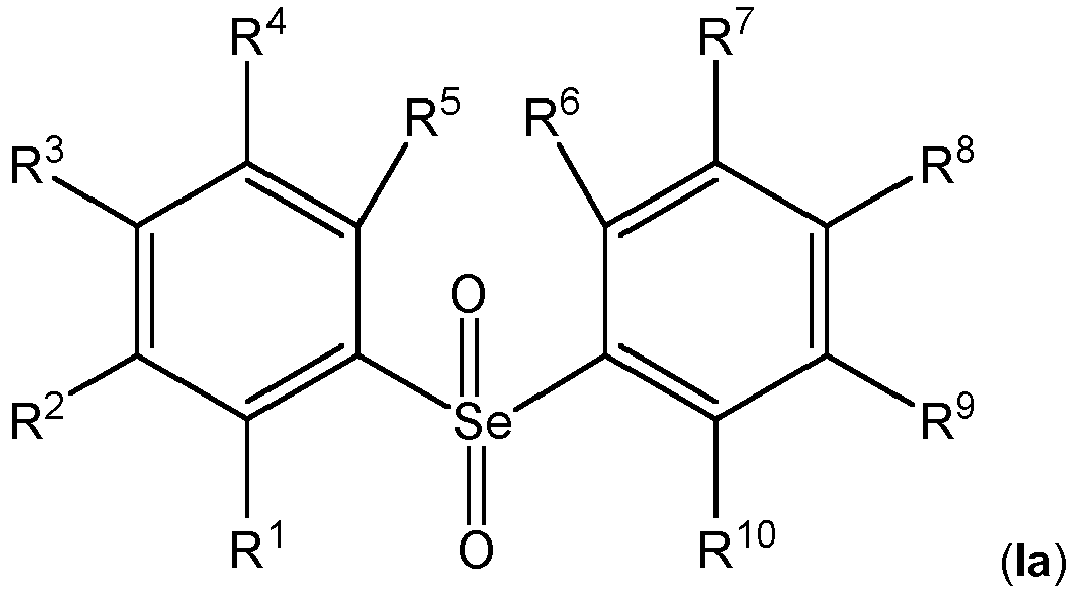 (i) worin R1, R3, R5, R6, R8 und R10 jeweils -H und R2, R4, R7 und R9 jeweils unabhängig ausgewählt sein können aus -(C1-C12)-Alkyl, mit Alkyl linear, verzweigt oder cyclisch, oder(ii) worin R1, R3, R5, R6, R8 und R10 jeweils ausgewählt sein können aus -(C1-C12)-Alkyl, mit Alkyl linear, verzweigt oder cyclisch, und R2, R4, R7 und R9 jeweils -H, oder(iii) worin R3 und R8 jeweils ausgewählt sein können aus -O-(C1-C12)-Alkyl, -O-(C6-C20)-Aryl, -O-(C1-C12)-Alkyl-O-(C1-C12)-Alkyl, -O-(C1-C12)-Alkyl-O-(C6-C20)-Aryl, -O-(C6-C20)-Aryl-O-(C1-C12)-Alkyl, -O-(C6-C20)-Aryl-O-(C6-C20)-Aryl, -OC=O-(C1-C12)-Alkyl, und -Halogen, insbesondere -O-(C2-C12)-Alkyl, bevorzugt -O-(C3-C12)-Alkyl, mit Alkyl linear, verzweigt oder cyclisch, und R1, R2, R4, R5, R6, R7, R9 und R10 jeweils -H, oder(iv) worin R1, R2, R3, R4, R5, R6, R7, R8, R9, R10 jeweils unabhängig voneinander ausgewählt sein können aus -Halogen, insbesondere ist Halogen Fluor oder Chlor,wobei in (i), (ii) (iii) oder (iv) die Alkyl- und Arylgruppen jeweils unabhängig unsubstituiert oder substituiert sein können, substituierte -(C1-C12)-Alkylgruppen und substituierte -(C6-C20)-Arylgruppen können in Abhängigkeit von ihrer Kettenlänge, einen oder mehrere Substituenten aufweisen; die Substituenten können unabhängig voneinander ausgewählt sein unter -(C3-C12)-Cycloalkyl, -(C3-C12)-Heterocycloalkyl, -(C6-C20)-Aryl, Fluor, Chlor, Cyano, Formyl, Acyl oder Alkoxycarbonyl.
 - Komplex nach Anspruch 1,
umfassend ein Diphenylselnon der allgemeinen Struktur Ib:
- Komplex nach Anspruch 1,
umfassend ein Diphenylselnon der allgemeinen Struktur Ic:
- Komplex nach Anspruch 1,
umfassend ein Diphenylselnon der allgemeinen Struktur Ic1:
- Komplex nach Anspruch 1,
umfassend ein Diphenylselnon der allgemeinen Struktur Id: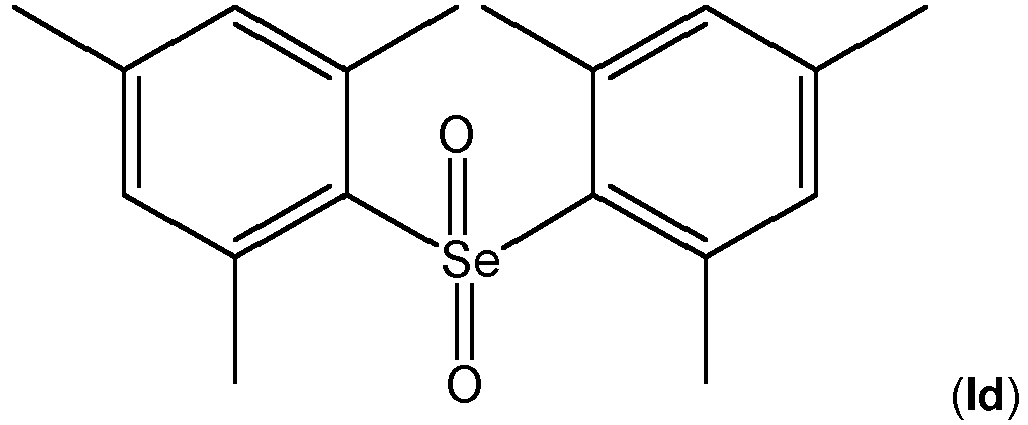
- Komplex nach Anspruch 1,
umfassend ein Diphenylselnon der allgemeinen Struktur Ie:
- Verfahren zur Herstellung des Diphenylselenon der Struktur I
nach Anspruch 1, indem ein Diphenylselenid der allgemeinen Struktur III, - in einem ersten aprotischen, polaren, organischen Lösemittel, in Gegenwart eines Alkalisalzes des Hypochlorids oder einem Alkalisalz des Hypobromids zu einem Reaktionsgemisch umgesetzt wird, und- das Reaktionsgemisch mit einem zweiten organischen Lösemittel unter Ausbildung eines zweiphasigen Gemisches behandelt wird, wobei sich das Diphenylselenon der Struktur I, in dem zweiten organischen Lösemittel löst,- Abtrennen des zweiten organischen Lösemittels enthaltend Diphenylselenon der Struktur I,- Entfernen des zweiten organischen Lösemittels und- Erhalten des Diphenylselenons der Struktur I.
 - Verfahren zur Herstellung des Diphenylselenon der Struktur I
nach Anspruch 1, indem ein Diphenylselenoxid der allgemeinen Struktur II, - in einem aprotischen, organischen Lösemittel in Gegenwart eines mit Alkyl-Gruppen funktionalisierten quartären- Ammoniumhalogenids mit einem Alkalisalz des Hypochlorids oder einem Alkalisalz des Hypobromids, zu einem Reaktionsgemisch umgesetzt wird, und- das Reaktionsgemisch mit Wasser unter Ausbildung eines zweiphasigen Gemisches behandelt wird, wobei das Diphenylselenon der Struktur I, im aprotischen organischen Lösemittel verbleibt,- Abtrennen des aprotischen, organischen Lösemittels enthaltend Diphenylselenon der Struktur I,- Entfernen des aprotischen, organischen Lösemittels und- Erhalten des Diphenylselenons der Struktur I.
 - Verwendung eines Diphenylselenons der allgemeinen Struktur I,
 a) als Ligand in einem Komplex umfassend mindestens ein Metallatom oderb) als Zwischenprodukt zur Herstellung von Liganden oder als Zwischenprodukt zur Herstellung von Metall enthaltenden Komplexen,c) zur Katalyse einer Hydroformylierungsreaktion.
 - Verfahren umfassend die Verfahrensschritte(i) Vorlegen mindestens eines Olefins,(ii) Zugabe eines Komplexes nach Anspruch 1 umfassend- mindestens ein Diphenylselenon, welches eine allgemeine Struktur I aufweist
 - mindestens ein Metallatom ausgewählt aus Rh, Ru, Co, Ir, oder- Zugabe mindestens eines Diphenylselenons der allgemeinen Struktur I, wie vorstehend beschrieben,und einer Substanz, welche ein Metallatom ausgewählt aus Rh, Ru, Co, Ir aufweist,(iii) Zuführen von H2 und CO,(iv) Erwärmen des Reaktionsgemisches,wobei das Olefin zu einem Aldehyd umgesetzt wird.
Applications Claiming Priority (3)
| Application Number | Priority Date | Filing Date | Title |
|---|---|---|---|
| DE102016211501.4A DE102016211501A1 (de) | 2016-06-27 | 2016-06-27 | Verfahren zur Herstellung heterozyklischer Selena-Phosphite durch Umsetzung von Selenodiaryl |
| DE102016211500.6A DE102016211500A1 (de) | 2016-06-27 | 2016-06-27 | Verfahren zur Herstellung heterozyklischer Selena-Phosphite |
| DE102016211499.9A DE102016211499A1 (de) | 2016-06-27 | 2016-06-27 | Verfahren zur Reduktion von Diphenylselenoxid |
Publications (1)
| Publication Number | Publication Date |
|---|---|
| EP3263577A1 true EP3263577A1 (de) | 2018-01-03 |
Family
ID=56368874
Family Applications (1)
| Application Number | Title | Priority Date | Filing Date |
|---|---|---|---|
| EP16178107.5A Withdrawn EP3263577A1 (de) | 2016-06-27 | 2016-07-06 | Komplexe von diphenylselenonen, deren verwendung und katalyseverfahren |
Country Status (1)
| Country | Link |
|---|---|
| EP (1) | EP3263577A1 (de) |
Citations (2)
| Publication number | Priority date | Publication date | Assignee | Title |
|---|---|---|---|---|
| US20020111517A1 (en) * | 2001-02-13 | 2002-08-15 | Wolfgang Ahlers | Hydroformylation catalyst comprising a complex with ligands having a structure derived from bisphenol A |
| US20020115892A1 (en) * | 2001-02-19 | 2002-08-22 | Thomas Mackewitz | Hydroformylation |
-
2016
- 2016-07-06 EP EP16178107.5A patent/EP3263577A1/de not_active Withdrawn
Patent Citations (2)
| Publication number | Priority date | Publication date | Assignee | Title |
|---|---|---|---|---|
| US20020111517A1 (en) * | 2001-02-13 | 2002-08-15 | Wolfgang Ahlers | Hydroformylation catalyst comprising a complex with ligands having a structure derived from bisphenol A |
| US20020115892A1 (en) * | 2001-02-19 | 2002-08-22 | Thomas Mackewitz | Hydroformylation |
Non-Patent Citations (10)
| Title |
|---|
| ANNE M. KELLY ET AL: "Oxygen Transfer from Organoelement Oxides to Carbon Monoxide Catalyzed by Transition Metal Carbonyls", JOURNAL OF THE AMERICAN CHEMICAL SOCIETY, vol. 119, no. 26, 1 July 1997 (1997-07-01), US, pages 6115 - 6125, XP055353221, ISSN: 0002-7863, DOI: 10.1021/ja970158s * |
| CANADIAN JOURNAL OF CHEMISTRY, vol. 88, 2010, pages 906 - 909 |
| EVGENY V. DIKAREV ET AL: "The First Coordination Complexes of Selenones: A Structural Comparison with Complexes of Sulfones +", INORGANIC CHEMISTRY, vol. 42, no. 22, 1 November 2003 (2003-11-01), EASTON, US, pages 7098 - 7105, XP055344794, ISSN: 0020-1669, DOI: 10.1021/ic0302130 * |
| G.A. KRAUS; B.S. FULTON, J. ORG. CHEM., vol. 50, 1985, pages 1784 - 1786 |
| INORG. CHEM., vol. 49, 2010, pages 10680 - 10686 |
| J. ORG. CHEM., 1984, pages 2282 - 2284 |
| J.-B. FENG; J.-L. GONG; X.-F. WU, RSC ADV., vol. 4, 2014, pages 29273 - 29275 |
| N. SOFIKITI; C. RABALAKOS; M. STRATAKIS, TETRAHEDRON LETT., vol. 45, 2004, pages 1335 - 1337 |
| PAUL MÜLLER ET AL.: "73. Ru-Catalyzed Oxidations with Iodosylbenzene Derivatives. Substituent Effects on Selectivity in Oxidation of Sulfides and Alcohols", 1 January 1983 (1983-01-01), pages 1790, XP055262738, Retrieved from the Internet <URL:http://onlinelibrary.wiley.com/store/10.1002/hlca.19830660618/asset/19830660618_ftp.pdf?v=1&t=imn65gl5&s=bed9ad0b77d4a5dc6d4879e4c7b6f79943ae4ab4> [retrieved on 20160405] * |
| S. POTASH; S. ROZEN, EUR. J. ORG. CHEM., 2013, pages 5574 - 5579 |
Similar Documents
| Publication | Publication Date | Title |
|---|---|---|
| EP3070093B1 (de) | Neue organophosphorverbindungen auf basis von anthracentriol | |
| EP3029058B1 (de) | Bisphosphite die einen unsymmetrischen biaryl-zentral-baustein aufweisen | |
| WO2016139245A1 (de) | Geschützte selenodiphenole sowie verfahren zu deren herstellung | |
| EP3263577A1 (de) | Komplexe von diphenylselenonen, deren verwendung und katalyseverfahren | |
| EP3029055B1 (de) | Monophosphite die einen unsymmetrischen Biaryl-Baustein aufweisen | |
| EP3957643B1 (de) | Neue diphosphite auf basis von cis-butendiol-1,4 | |
| EP3178830A1 (de) | Komplexe von diphenylselenoxiden, deren verwendung und katalyseverfahren | |
| EP3178829A1 (de) | Organodiarylselenoxide sowie verfahren zu deren herstellung | |
| EP3024837A2 (de) | Phosphoramiditderivate in der hydroformylierung von ungesättigten verbindungen | |
| DE102016205885A1 (de) | Komplexe von Diphenylseleniden, deren Verwendung und Katalyseverfahren | |
| WO2009153272A2 (de) | Verfahren zur iodierung von aromatischen und/oder heteroaromatischen verbindungen | |
| EP3438112B1 (de) | Liganden mit einer o-p-o-brücke zwischen zwei anthracentriolbausteinen | |
| EP3438110B1 (de) | Phosphinite mit zwei direkt am phosphor gebundenen tert.-butyl-gruppen | |
| EP3388146B1 (de) | Liganden und verfahren zur hydroformylierung unter einsatz eines 5-methyl-4,4-diphenyl-1,3,2-dioxaphospholans | |
| EP3438111B1 (de) | Phosphonite mit einer direkt am phosphor gebundenen tert.-butyl-gruppe | |
| DE102016211499A1 (de) | Verfahren zur Reduktion von Diphenylselenoxid | |
| EP3178826A1 (de) | Heterozyklische an einer hydroxyl-gruppe geschützte selena-monophosphite sowie verfahren zu deren herstellung | |
| EP3178827A1 (de) | Heterozyklische selena-biphosphite sowie verfahren zu deren herstellung | |
| EP3293191B1 (de) | Phosphite mit einem dihydroxyterphenyl | |
| EP3293189B1 (de) | Phosphite mit einem dihydroxyterphenyl und zwei phenolen | |
| WO2017088987A1 (de) | Geschützte selenodiphenole sowie verfahren zu deren herstellung | |
| EP3459960A1 (de) | Bisphosphitliganden mit dioxaphosphepin-flügelbausteinen | |
| EP3178828A1 (de) | Heterozyklische selena-phosphite sowie verfahren zu deren herstellung | |
| EP3178825A1 (de) | Heterozyklische selena-phosphite sowie verfahren zu deren herstellung | |
| EP3459959A1 (de) | Bisphosphitliganden mit butanoat-zentralbaustein |
Legal Events
| Date | Code | Title | Description |
|---|---|---|---|
| PUAI | Public reference made under article 153(3) epc to a published international application that has entered the european phase |
Free format text: ORIGINAL CODE: 0009012 |
|
| AK | Designated contracting states |
Kind code of ref document: A1 Designated state(s): AL AT BE BG CH CY CZ DE DK EE ES FI FR GB GR HR HU IE IS IT LI LT LU LV MC MK MT NL NO PL PT RO RS SE SI SK SM TR |
|
| AX | Request for extension of the european patent |
Extension state: BA ME |
|
| 17P | Request for examination filed |
Effective date: 20180116 |
|
| RBV | Designated contracting states (corrected) |
Designated state(s): AL AT BE BG CH CY CZ DE DK EE ES FI FR GB GR HR HU IE IS IT LI LT LU LV MC MK MT NL NO PL PT RO RS SE SI SK SM TR |
|
| 17Q | First examination report despatched |
Effective date: 20180507 |
|
| GRAP | Despatch of communication of intention to grant a patent |
Free format text: ORIGINAL CODE: EPIDOSNIGR1 |
|
| RIC1 | Information provided on ipc code assigned before grant |
Ipc: C07F 15/00 20060101ALI20180906BHEP Ipc: C07C 391/02 20060101AFI20180906BHEP Ipc: C07C 45/50 20060101ALI20180906BHEP Ipc: C07F 15/06 20060101ALI20180906BHEP |
|
| INTG | Intention to grant announced |
Effective date: 20181002 |
|
| RIN1 | Information on inventor provided before grant (corrected) |
Inventor name: WEILBEER, CLAUDIA Inventor name: BOERNER, ARMIN Inventor name: SELENT, DETLEF Inventor name: FRANKE, ROBERT Inventor name: DYBALLA, KATRIN MARIE |
|
| STAA | Information on the status of an ep patent application or granted ep patent |
Free format text: STATUS: THE APPLICATION IS DEEMED TO BE WITHDRAWN |
|
| 18D | Application deemed to be withdrawn |
Effective date: 20190213 |