EP3259237B1 - Ablagerungsverfahren - Google Patents
Ablagerungsverfahren Download PDFInfo
- Publication number
- EP3259237B1 EP3259237B1 EP16704900.6A EP16704900A EP3259237B1 EP 3259237 B1 EP3259237 B1 EP 3259237B1 EP 16704900 A EP16704900 A EP 16704900A EP 3259237 B1 EP3259237 B1 EP 3259237B1
- Authority
- EP
- European Patent Office
- Prior art keywords
- metal
- substrate
- precursor mixture
- oxide
- glass
- Prior art date
- Legal status (The legal status is an assumption and is not a legal conclusion. Google has not performed a legal analysis and makes no representation as to the accuracy of the status listed.)
- Active
Links
Images



Classifications
-
- C—CHEMISTRY; METALLURGY
- C23—COATING METALLIC MATERIAL; COATING MATERIAL WITH METALLIC MATERIAL; CHEMICAL SURFACE TREATMENT; DIFFUSION TREATMENT OF METALLIC MATERIAL; COATING BY VACUUM EVAPORATION, BY SPUTTERING, BY ION IMPLANTATION OR BY CHEMICAL VAPOUR DEPOSITION, IN GENERAL; INHIBITING CORROSION OF METALLIC MATERIAL OR INCRUSTATION IN GENERAL
- C23C—COATING METALLIC MATERIAL; COATING MATERIAL WITH METALLIC MATERIAL; SURFACE TREATMENT OF METALLIC MATERIAL BY DIFFUSION INTO THE SURFACE, BY CHEMICAL CONVERSION OR SUBSTITUTION; COATING BY VACUUM EVAPORATION, BY SPUTTERING, BY ION IMPLANTATION OR BY CHEMICAL VAPOUR DEPOSITION, IN GENERAL
- C23C16/00—Chemical coating by decomposition of gaseous compounds, without leaving reaction products of surface material in the coating, i.e. chemical vapour deposition [CVD] processes
- C23C16/22—Chemical coating by decomposition of gaseous compounds, without leaving reaction products of surface material in the coating, i.e. chemical vapour deposition [CVD] processes characterised by the deposition of inorganic material, other than metallic material
- C23C16/30—Deposition of compounds, mixtures or solid solutions, e.g. borides, carbides, nitrides
- C23C16/40—Oxides
-
- C—CHEMISTRY; METALLURGY
- C03—GLASS; MINERAL OR SLAG WOOL
- C03C—CHEMICAL COMPOSITION OF GLASSES, GLAZES OR VITREOUS ENAMELS; SURFACE TREATMENT OF GLASS; SURFACE TREATMENT OF FIBRES OR FILAMENTS MADE FROM GLASS, MINERALS OR SLAGS; JOINING GLASS TO GLASS OR OTHER MATERIALS
- C03C17/00—Surface treatment of glass, not in the form of fibres or filaments, by coating
- C03C17/22—Surface treatment of glass, not in the form of fibres or filaments, by coating with other inorganic material
- C03C17/23—Oxides
- C03C17/245—Oxides by deposition from the vapour phase
-
- C—CHEMISTRY; METALLURGY
- C03—GLASS; MINERAL OR SLAG WOOL
- C03C—CHEMICAL COMPOSITION OF GLASSES, GLAZES OR VITREOUS ENAMELS; SURFACE TREATMENT OF GLASS; SURFACE TREATMENT OF FIBRES OR FILAMENTS MADE FROM GLASS, MINERALS OR SLAGS; JOINING GLASS TO GLASS OR OTHER MATERIALS
- C03C17/00—Surface treatment of glass, not in the form of fibres or filaments, by coating
- C03C17/34—Surface treatment of glass, not in the form of fibres or filaments, by coating with at least two coatings having different compositions
- C03C17/3411—Surface treatment of glass, not in the form of fibres or filaments, by coating with at least two coatings having different compositions with at least two coatings of inorganic materials
- C03C17/3417—Surface treatment of glass, not in the form of fibres or filaments, by coating with at least two coatings having different compositions with at least two coatings of inorganic materials all coatings being oxide coatings
-
- C—CHEMISTRY; METALLURGY
- C23—COATING METALLIC MATERIAL; COATING MATERIAL WITH METALLIC MATERIAL; CHEMICAL SURFACE TREATMENT; DIFFUSION TREATMENT OF METALLIC MATERIAL; COATING BY VACUUM EVAPORATION, BY SPUTTERING, BY ION IMPLANTATION OR BY CHEMICAL VAPOUR DEPOSITION, IN GENERAL; INHIBITING CORROSION OF METALLIC MATERIAL OR INCRUSTATION IN GENERAL
- C23C—COATING METALLIC MATERIAL; COATING MATERIAL WITH METALLIC MATERIAL; SURFACE TREATMENT OF METALLIC MATERIAL BY DIFFUSION INTO THE SURFACE, BY CHEMICAL CONVERSION OR SUBSTITUTION; COATING BY VACUUM EVAPORATION, BY SPUTTERING, BY ION IMPLANTATION OR BY CHEMICAL VAPOUR DEPOSITION, IN GENERAL
- C23C14/00—Coating by vacuum evaporation, by sputtering or by ion implantation of the coating forming material
- C23C14/06—Coating by vacuum evaporation, by sputtering or by ion implantation of the coating forming material characterised by the coating material
- C23C14/14—Metallic material, boron or silicon
- C23C14/18—Metallic material, boron or silicon on other inorganic substrates
-
- C—CHEMISTRY; METALLURGY
- C23—COATING METALLIC MATERIAL; COATING MATERIAL WITH METALLIC MATERIAL; CHEMICAL SURFACE TREATMENT; DIFFUSION TREATMENT OF METALLIC MATERIAL; COATING BY VACUUM EVAPORATION, BY SPUTTERING, BY ION IMPLANTATION OR BY CHEMICAL VAPOUR DEPOSITION, IN GENERAL; INHIBITING CORROSION OF METALLIC MATERIAL OR INCRUSTATION IN GENERAL
- C23C—COATING METALLIC MATERIAL; COATING MATERIAL WITH METALLIC MATERIAL; SURFACE TREATMENT OF METALLIC MATERIAL BY DIFFUSION INTO THE SURFACE, BY CHEMICAL CONVERSION OR SUBSTITUTION; COATING BY VACUUM EVAPORATION, BY SPUTTERING, BY ION IMPLANTATION OR BY CHEMICAL VAPOUR DEPOSITION, IN GENERAL
- C23C16/00—Chemical coating by decomposition of gaseous compounds, without leaving reaction products of surface material in the coating, i.e. chemical vapour deposition [CVD] processes
- C23C16/22—Chemical coating by decomposition of gaseous compounds, without leaving reaction products of surface material in the coating, i.e. chemical vapour deposition [CVD] processes characterised by the deposition of inorganic material, other than metallic material
- C23C16/30—Deposition of compounds, mixtures or solid solutions, e.g. borides, carbides, nitrides
- C23C16/40—Oxides
- C23C16/407—Oxides of zinc, germanium, cadmium, indium, tin, thallium or bismuth
-
- C—CHEMISTRY; METALLURGY
- C23—COATING METALLIC MATERIAL; COATING MATERIAL WITH METALLIC MATERIAL; CHEMICAL SURFACE TREATMENT; DIFFUSION TREATMENT OF METALLIC MATERIAL; COATING BY VACUUM EVAPORATION, BY SPUTTERING, BY ION IMPLANTATION OR BY CHEMICAL VAPOUR DEPOSITION, IN GENERAL; INHIBITING CORROSION OF METALLIC MATERIAL OR INCRUSTATION IN GENERAL
- C23C—COATING METALLIC MATERIAL; COATING MATERIAL WITH METALLIC MATERIAL; SURFACE TREATMENT OF METALLIC MATERIAL BY DIFFUSION INTO THE SURFACE, BY CHEMICAL CONVERSION OR SUBSTITUTION; COATING BY VACUUM EVAPORATION, BY SPUTTERING, BY ION IMPLANTATION OR BY CHEMICAL VAPOUR DEPOSITION, IN GENERAL
- C23C16/00—Chemical coating by decomposition of gaseous compounds, without leaving reaction products of surface material in the coating, i.e. chemical vapour deposition [CVD] processes
- C23C16/44—Chemical coating by decomposition of gaseous compounds, without leaving reaction products of surface material in the coating, i.e. chemical vapour deposition [CVD] processes characterised by the method of coating
- C23C16/448—Chemical coating by decomposition of gaseous compounds, without leaving reaction products of surface material in the coating, i.e. chemical vapour deposition [CVD] processes characterised by the method of coating characterised by the method used for generating reactive gas streams, e.g. by evaporation or sublimation of precursor materials
- C23C16/4486—Chemical coating by decomposition of gaseous compounds, without leaving reaction products of surface material in the coating, i.e. chemical vapour deposition [CVD] processes characterised by the method of coating characterised by the method used for generating reactive gas streams, e.g. by evaporation or sublimation of precursor materials by producing an aerosol and subsequent evaporation of the droplets or particles
-
- C—CHEMISTRY; METALLURGY
- C03—GLASS; MINERAL OR SLAG WOOL
- C03C—CHEMICAL COMPOSITION OF GLASSES, GLAZES OR VITREOUS ENAMELS; SURFACE TREATMENT OF GLASS; SURFACE TREATMENT OF FIBRES OR FILAMENTS MADE FROM GLASS, MINERALS OR SLAGS; JOINING GLASS TO GLASS OR OTHER MATERIALS
- C03C2217/00—Coatings on glass
- C03C2217/20—Materials for coating a single layer on glass
- C03C2217/21—Oxides
- C03C2217/214—Al2O3
-
- C—CHEMISTRY; METALLURGY
- C03—GLASS; MINERAL OR SLAG WOOL
- C03C—CHEMICAL COMPOSITION OF GLASSES, GLAZES OR VITREOUS ENAMELS; SURFACE TREATMENT OF GLASS; SURFACE TREATMENT OF FIBRES OR FILAMENTS MADE FROM GLASS, MINERALS OR SLAGS; JOINING GLASS TO GLASS OR OTHER MATERIALS
- C03C2217/00—Coatings on glass
- C03C2217/20—Materials for coating a single layer on glass
- C03C2217/21—Oxides
- C03C2217/215—In2O3
-
- C—CHEMISTRY; METALLURGY
- C03—GLASS; MINERAL OR SLAG WOOL
- C03C—CHEMICAL COMPOSITION OF GLASSES, GLAZES OR VITREOUS ENAMELS; SURFACE TREATMENT OF GLASS; SURFACE TREATMENT OF FIBRES OR FILAMENTS MADE FROM GLASS, MINERALS OR SLAGS; JOINING GLASS TO GLASS OR OTHER MATERIALS
- C03C2217/00—Coatings on glass
- C03C2217/20—Materials for coating a single layer on glass
- C03C2217/21—Oxides
- C03C2217/216—ZnO
-
- C—CHEMISTRY; METALLURGY
- C03—GLASS; MINERAL OR SLAG WOOL
- C03C—CHEMICAL COMPOSITION OF GLASSES, GLAZES OR VITREOUS ENAMELS; SURFACE TREATMENT OF GLASS; SURFACE TREATMENT OF FIBRES OR FILAMENTS MADE FROM GLASS, MINERALS OR SLAGS; JOINING GLASS TO GLASS OR OTHER MATERIALS
- C03C2217/00—Coatings on glass
- C03C2217/20—Materials for coating a single layer on glass
- C03C2217/21—Oxides
- C03C2217/228—Other specific oxides
-
- C—CHEMISTRY; METALLURGY
- C03—GLASS; MINERAL OR SLAG WOOL
- C03C—CHEMICAL COMPOSITION OF GLASSES, GLAZES OR VITREOUS ENAMELS; SURFACE TREATMENT OF GLASS; SURFACE TREATMENT OF FIBRES OR FILAMENTS MADE FROM GLASS, MINERALS OR SLAGS; JOINING GLASS TO GLASS OR OTHER MATERIALS
- C03C2217/00—Coatings on glass
- C03C2217/70—Properties of coatings
-
- C—CHEMISTRY; METALLURGY
- C03—GLASS; MINERAL OR SLAG WOOL
- C03C—CHEMICAL COMPOSITION OF GLASSES, GLAZES OR VITREOUS ENAMELS; SURFACE TREATMENT OF GLASS; SURFACE TREATMENT OF FIBRES OR FILAMENTS MADE FROM GLASS, MINERALS OR SLAGS; JOINING GLASS TO GLASS OR OTHER MATERIALS
- C03C2218/00—Methods for coating glass
- C03C2218/10—Deposition methods
- C03C2218/15—Deposition methods from the vapour phase
- C03C2218/152—Deposition methods from the vapour phase by cvd
Definitions
- the present invention relates to processes for depositing metals and/or metal oxides on substrates and to substrates having metal and/or metal oxide coatings produced by such processes.
- Processes used to deposit coatings on substrate surfaces find use in many fields.
- Methods used to deposit coatings include physical vapour deposition methods such as pulsed laser deposition (PLD) and sputtering or solution based methods such as spray pyrolysis and sol-gel.
- PLD pulsed laser deposition
- solution based methods such as spray pyrolysis and sol-gel.
- US-A-2012/168,747 discloses methods for forming a mixed (e.g. InGaZnO, InZnO or HflnZnO) oxide semiconductor as a thin film and electronic devices including the oxide film using liquid coating methods and subsequent annealing.
- a mixed oxide semiconductor e.g. InGaZnO, InZnO or HflnZnO
- US-A-2010/0251,936 discloses a method of fabricating a liquid, especially by sol gel methods, for an oxide thin film for display and electronic devices which includes mixing at least two kinds of dispersoids selected from zinc, indium, gallium, tin or thallium compounds.
- CVD chemical vapour deposition
- a fluid precursor is delivered to the surface of the substrate in order to deposit the coating.
- Xian Tao et al. J. Organometallic Chem. Vol 696(13) (2011) pp 2681 to 2684 disclose silver deposition on to a silicon substrate using MOCVD and a trimethylphosphite stabilized silver (I) methanesulfonates.
- CN-A-102093430 discloses silver deposition using an organic phosphine stabilized alkyl silver disulfonate complex.
- CVD metal organic CVD
- combustion C
- plasma enhanced PE
- aerosol-assisted AA
- US-A-2008/241,423 relates to formation of non-native films on surfaces of compound semiconductor films, and more particularly relates to the preparation of III-V semiconductor surfaces for deposition and the subsequent deposition of a film by the Atomic Layer Deposition (ALD) method.
- the methods described involve exposing a III-V semiconductor surface to a triflating or trifluoroacetylating agent to terminate the III-V semiconductor surface with triflate or trifluoroacetate groups.
- Tao et. al. J. Organomet. Chem. 2011, 696, 13, p2681 discloses CVD studies of trimethylphosphite stabilised silver(I) methanesulfonates.
- CN 102093430 discloses metal-organic chemical vapour deposition (MOCVD) with phosphine-stabilized alkyl silver disulfonates.
- WO 2014/193915 discloses the use of manganese complexes for the preparation of thin films by CVD and ALD methods.
- US 2012/168747 discloses a method of forming an oxide semiconductor thin film.
- WO 2012/143707 discloses a method of depositing a nucleating layer on a surface of a substrate using an aerosol assisted deposition method.
- Tao et al. disclose disilver methanedisulphonate phosphorus complexes and hot wall MOCVD on oxidised silicon substrates at 395 °C to 450 °C.
- EP-A-2 065 364 discloses metal containing tridentate ⁇ -ketoiminates as metal containing precursors for chemical vapour deposition processes including atomic layer deposition for fabricating conformal metal containing films on substrates such as silicon for use in semiconductor fabrication.
- TCO coatings are useful, for example, as transparent electrodes in flat panel displays, solar cells and organic light emitting diodes and as low emissivity coatings on glazings.
- TCO coating materials include indium tin oxide (ITO), F-doped tin oxide and zinc oxide.
- Zinc oxide is a semiconductor material with a direct wide band gap. Thin films of nominally undoped ZnO exhibit n-type conductivity. The conductivity of zinc oxide can be increased by doping with an extrinsic dopant source, such as Al or Ga.
- An important aspect of successful CVD processes is the precursor. In the case of zinc oxide coatings, a number of zinc precursors have been investigated, with diethyl zinc often being used. Diethyl zinc is volatile and therefore generally suitable for many CVD techniques. Unfortunately, use of diethyl zinc can be problematic because it is reactive.
- WO-A-2013/136052 discloses a chemical vapour deposition process using a gaseous mixture containing an alkyl zinc compound and gaseous inorganic oxygen-containing compounds.
- US-A-2012/240,634 discloses a CVD process to produce inter alia Gadoped ZnO using a gaseous zinc-containing compound (e.g. an alkyl zinc compound), an oxygen-containing compound, and an acetonate compound.
- a gaseous zinc-containing compound e.g. an alkyl zinc compound
- an oxygen-containing compound e.g. an oxygen-containing compound
- an acetonate compound e.g. an alkyl zinc compound
- the present invention provides, a process according to the appended claims.
- the metal and/or a metal oxide may comprise a metal, a metal oxide or a mixture of metal and metal oxide.
- the process usually comprises chemical vapour deposition (CVD).
- CVD chemical vapour deposition
- the process comprises a step of at least partially atomizing the precursor mixture before delivering the precursor mixture to the surface of the substrate.
- the precursor mixture may be at least partially atomized using, for example, ultrasonic atomizers, preferably piezo ultrasonic atomizers.
- aerosol assisted CVD in combination with the use of a metal sulfonate is also advantageous because metal sulfonates are often soluble or very soluble in a wide range of solvents.
- AACVD in combination with a metal sulfonate enables consistent and efficient deposition over a wide range of temperatures without the need to apply relatively high temperatures to the precursor mixture in order to volatilise the metal sulfonate, or the need to maintain the precursor mixture at relatively high temperatures in order to ensure sufficient and consistent carry-over of the metal sulfonate to the zone of deposition of the metal oxide. Avoiding the need for relatively high temperatures is advantageous because it reduces the chance of premature reaction of the metal sulfonate or other components of the precursor mixture.
- the metal (M) may be selected from one or more of Zn, Mg, Al, Sb, Cu, Ag, Sn, and In.
- a preferred metal is Zn because this allows deposition of ZnO coatings.
- Mg is also advantageous to allow the deposition of Mg containing coatings.
- the metal sulfonate is metal trifluoromethanesulfonate (metal triflate, M(OTf) x wherein x depends on the oxidation state of M).
- M(OTf) x metal triflate
- R is CF 3 .
- the process is preferably a chemical vapour deposition (CVD) process.
- the CVD process may involve heating the precursor mixture to ensure good carry-over during the process and does not require the use of aerosol assisted CVD techniques in order to deposit good coatings.
- the process for depositing a metal and/or a metal oxide, wherein the metal sulfonate is a metal triflate is aerosol assisted CVD, that is, the process involves at least partially atomizing the precursor mixture containing the metal triflate before delivery to the surface of the substrate.
- aerosol assisted CVD that is, the process involves at least partially atomizing the precursor mixture containing the metal triflate before delivery to the surface of the substrate.
- M is Zn, Al, In, Mg, Cu and/or Ag and R is CF 3 .
- the most preferred M is Zn and R is CF 3 .
- the metal sulfonate does not contain phosphorus.
- the precursor mixture will further comprise a carrier gas.
- the most suitable carrier gas is usually nitrogen, although other carrier gases may also be suitable (e.g. Ar).
- the precursor mixture will further comprise a solvent.
- the solvent will usually comprise an oxygenated solvent, for example, a C 1 to C 4 alcohol.
- the most preferred solvent comprises methanol.
- the process may comprise an additional source of oxygen that may be an organic oxygen source (e.g. an ester in particular an ethyl carboxylate, for example, ethyl acetate) and/or oxygen gas.
- an organic oxygen source e.g. an ester in particular an ethyl carboxylate, for example, ethyl acetate
- oxygen gas e.g. oxygen gas
- the precursor mixture further comprises a source of a second metal.
- the source of a second metal may comprise a metal sulfonate (preferably a metal triflate) as discussed above. Additionally or alternatively, other metal containing precursors may be used as the source of the second metal.
- a preferred source of a second metal comprises a source of aluminium. This is advantageous, in particular, where the metal sulfonate is a zinc sulfonate because it enables the deposition of aluminium doped ZnO with generally higher conductivity than undoped ZnO.
- the precursor mixture further comprises a source of a second metal
- the process involves at least partially atomizing the precursor mixture containing the metal sulfonate and the source of the second metal before delivery to the surface of the substrate, i.e. that the process is AACVD.
- the process is AACVD.
- the source of a second metal comprises aluminium acetylacetonate.
- the molar ratio in the precursor mixture of the source of second metal to the metal of the metal sulfonate may be in the range 0.01 - 0.2 (i.e. 0.01 second metal to 1 metal of the metal sulfonate - 0.2 second metal to 1 metal of the metal sulfonate), preferably 0.02 - 0.1, more preferably 0.03 - 0.1 and most preferably 0.05 - 0.1.
- the preferred atom% (at%) of the second metal in the deposited coating is in the range 1 at% to 10 at%, preferably 2 at% to 9 at%, more preferably 5 at% to 9 at% and most preferably 6 at% to 8 at%.
- the substrate temperature will be 500 °C to 700 °C. This range of temperature is appropriate for e.g. metal, especially zinc, triflates and other metal sulfonates.
- TG thermogravimetric
- DTA differential thermal analysis
- DSC differential scanning calorimetry
- a sufficiently high temperature is advantageous because it may provide for improved properties of the metal and/or metal oxide coating.
- improved properties include improved crystallinity or structure, and/or improved optical properties (e.g. improved transmission, reflection, controlled haze) and/or electrical properties (especially sheet conductivity where e.g. the metal oxide is a TCO).
- a sufficiently high temperature is advantageous because it reduces the chance of incomplete reaction and also provides a relatively high growth rate of coatings.
- Relatively high growth rate is advantageous because it enables coatings of metal oxide of sufficient thickness to be deposited in a fixed period. This may be particularly advantageous wherein the substrate and precursor delivery apparatus are moving relative to one another (e.g. for deposition, on-line, during the float glass production process).
- the metal and/or metal oxide is deposited to a thickness in the range 400 nm to 700 nm, preferably 500 nm to 600 nm.
- the substrate comprises glass.
- the substrate may comprise a continuous ribbon of glass.
- the metal and/or metal oxide coating may be deposited during the float glass production process.
- the preferred glass substrate is soda lime silica glass.
- the surface of the glass substrate may comprise a layer (e.g. comprising silicon oxide) and the metal and/or metal oxide may be deposited on the layer.
- a layer e.g. comprising silicon oxide
- the metal and/or metal oxide may be deposited on the layer.
- Such a layer is advantageous because the layer may form a sodium blocking layer from e.g. the glass substrate and/or to modify e.g. the optical properties of the coating.
- Additional layers may be situated under the layer or the metal and/or metal oxide coating or may be deposited on the metal and/or metal oxide coating.
- the present invention enables deposition of metal and/or metal oxide coatings on a substrate surface.
- the present invention provides, in a particular aspect, process for depositing a coating comprising a metal and/or a metal oxide selected from the group consisting of zinc oxide, aluminium oxide, copper oxide, copper metal, indium oxide, and silver metal on a glass substrate, the process comprising, providing a glass substrate having a surface, providing a precursor mixture comprising a metal trifluoromethanesulfonate, wherein the metal is selected from the group consisting of zinc, aluminium, copper, indium, and silver, and delivering the precursor mixture to the surface of the substrate, wherein the surface of the substrate is at a substrate temperature sufficient to effect decomposition of the metal trifluoromethanesulfonate.
- CVD optionally aerosol assisted CVD, generally for the reasons discussed above.
- Substrates having a coating of metal and/or metal oxide deposited according to the invention find uses in many areas, for example as low emissivity glazings (where the substrate is glass), and in electrode, photovoltaic cells or other uses of e.g. electrically conducting transparent coatings e.g. wherein the metal oxide is zinc oxide.
- Metal trifluoromethanesulfonates (M(OTf) n ) were obtained from Sigma-Aldrich and aluminium acetylacetonate from Merck Millipore and used as supplied. Methanol was dried over magnesium methoxide and distilled under nitrogen. Precursor solutions were formed in glass bubblers and stirred for 10 minutes. A Liquifog ® piezo ultrasonic atomizer was used to vaporise the precursor solution. A homogeneous aerosol of the precursor solution was formed when the concentration of the ultrasonic waves ejected small droplets of precursor solution from the surface of the solution.
- N 2 carrier gas was employed to deliver the aerosol mist from the bubbler, though a brass baffle into the cold-walled, horizontal-bed CVD reactor contained within a quartz tube.
- samples were deposited using aerosol assisted chemical vapour deposition (AACVD).
- AACVD aerosol assisted chemical vapour deposition
- the reactor was fitted with a graphite block containing a Whatman cartridge heater, used to heat the glass substrate, the temperature of which was controlled and monitored using a Platinum-Rhodium thermocouple. Films were deposited onto float-glass substrates (145 mm ⁇ 45 mm ⁇ 4 mm) (obtained from NSG) having a pre-deposited 25 nm barrier layer of crystalline SiO 2 .
- a second glass plate was held 6 mm above the glass substrate in order to reduce any air turbulence and aid in producing a laminar gas flow.
- the glass substrate Prior to deposition the glass substrate was cleaned using isopropyl alcohol and acetone. After deposition, the glass substrates were allowed to cool under flowing nitrogen to below 100 °C before being removed from the apparatus. After initial investigations the optimal flow rate of N 2 and substrate temperature were determined to be 1.2 1 min -1 and 550 °C or 600 °C respectively. Deposition times varied between 30 and 35 minutes.
- TGA Thermal gravimetric analysis
- DSC differential scanning calorimetry
- X-ray diffraction (XRD) patterns were recorded on a Bruker D8 Discover X-ray diffractometer using monochromatic Cu K ⁇ 1 and Cu K ⁇ 2 radiation of wavelengths 0.154056 and 0.154439 nm respectively, emitted with a voltage of 40 kV and a current of 40mA in an intensity ratio of 2:1.
- SEM Scanning electron microscopy
- X-ray photoelectron spectroscopy (XPS) surface and depth profiling was performed using a Thermo Scientific K-Alpha XPS system using monochromatic Al K ⁇ radiation at 1486.6 eV as X-ray source. Etching was achieved using an Ar ion etch beam at 1 keV with a current of 1.55 ⁇ A. 180 levels of 30 second etching were performed. CasaXPS software was used to analyse the data with binding energies referenced to an adventitious C 1s peak at 284.8 eV.
- UV/Vis/NIR transmission spectra were recorded using a PerkinElmer Lambda 950 spectrometer in the range of 250 - 1400 nm with an air background.
- Sheet resistance measurements were recorded using the Van der Pauw method and Hall Effect measurements made to determine the mobility and free carrier concentrations of the deposited films.
- ZnO thin films were deposited from a precursor solution of Zn(OTf) 2 (0.5 g) dissolved in dry methanol (30 ml). Aluminium doping was achieved by the addition of aluminium acetylacetonate (Al(acac) 3 ) (0.022 g) to Zn(OTf) 2 (0.5 g) in methanol (30 ml).
- Example 1 transparent films of ZnO were deposited by AACVD using Zn(OTf) 2 in methanol at 600 °C on SiO 2 coated float-glass substrates, according to Scheme 1 (below).
- Example 2 Al(acac) 3 was added to the precursor solution and aluminium-doped ZnO (AZO) films were deposited also using AACVD.
- the level of Al dopant introduced was investigated by adding Al(acac) 3 in varying ratios to Zn(OTf) 2 of between 0.02 - 0.2 molar ratio. The best functional properties were observed for AZO films deposited when Al was added in an Al:Zn ratio of 0.05:1. The aluminium doping of these films was found to be 7 at%.
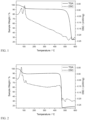
- TGA and DSC ( Figure 1 ) was performed on the Zn(OTf) 2 precursor (17 mg) between room temperature (23 °C) and 600 °C under helium. After loss of mass attributed to moisture, the mass is stable until the onset of the decomposition of Zn(OTf) 2 occurring at 500 °C. A clean decomposition in a single step is observed, predominantly between 520 - 565 °C. The calculated residual mass for ZnO from Zn(OTf) 2 is 22.4%. The observed residual mass, accounting for the initial mass loss resulting from residues is 22.7%. This is a strong indication of decomposition to ZnO. From the TGA profile it can be seen that decomposition occurs in a clean one step process to ZnO, showing the suitability of Zn(OTf) 2 as a Zn precursor.
- TGA and DSC ( Figure 2 ) was performed on Mg(OTf) 2 precursor between room temperature and 600 °C under helium. A clean decomposition in a single step is observed, predominantly between 450 - 470 °C, at a lower temperature that for zinc triflate. As for zinc triflate, it can be seen from Figure 2 that decomposition occurs in a clean one step process showing the suitability of Mg(OTf) 2 as a Mg precursor.
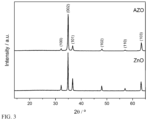
- Glancing-angle X-ray diffraction (XRD) patterns of the as-deposited films were recorded and are shown in Figure 3 .
- the reflections for the ZnO film confirm the formation of the hexagonal wurtzite crystal structure of ZnO. Significant preferred orientation was observed along the (002) plane resulting from the packing of the crystallites along the c-axis direction, perpendicular to the underlying substrate. The same crystal structure is also observed for the AZO film.
- XRD Glancing-angle X-ray diffraction
- FIG. 4 (A) and (B) are plane view images at ⁇ 10,000 magnification of ZnO and AZO respectively. The images show a film structure of rounded agglomerated particles which is indicative of a Volmer-Weber type island growth mechanism.
- Figure 4 (C) a plane view image of the AZO film at ⁇ 50,000 magnification shows in greater detail the particle cluster growth of the film. The surface morphology of the ZnO films appears not to change upon doping with Al. Cross section images of the films were also taken.
- Figure 4 (D) and (E) are cross section images at an 80° tilt at ⁇ 10,000 magnification and ⁇ 50,000 magnification respectively.
- XPS of the ZnO films deposited from Zn(OTf) 2 at 600 °C confirmed the prescence of Zn and O and were consistent with XRD that solely ZnO had been deposited. Peaks were observed for the Zn 2p 1/2 and 2p 3/2 states at 1045.3 and 1022.2 eV binding energy respectively, as expected with an intensity ratio of 1:2 and an energy gap of 23.1 eV.
- the O 1s peak in the XPS data can be fitted by a Gaussian distribution and centered at 532.0 eV as expected.
- the Al 2p 1/2 and 2p 3/2 peaks are observed at 75.1 and 74.7 eV respectively. These appear in a 1:2 ratio of intensity with an energy gap of 0.41 eV consistent with the value for Al 3+ incorporation.
- the peaks at 1045.7 and 1022.6 eV correspond to Zn 2p 1/2 and 2p 3/2 , respectively, again in the 1:2 ratio, with an energy gap of 23.1 eV.
- a depth profile for the ZnO and AZO samples were obtained.
- the argon ion etch beam was operated at 1 keV producing a beam current of 1.55 ⁇ A.
- a 30 second etch time per level was used with 180 levels of total etching.
- the spectral regions for Zn 2p, O 1s, Al 2p and C 1s were scanned as well as a survey spectrum to detect any additional elements.
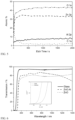
- the depth profile for AZO films deposited from Zn(OTf) 2 and Al(acac) 3 at 600 °C, shown in Figure 5 reveals the sample to be predominantly zinc oxide with an average stoichiometry of ZnO 1.2 .
- the coating was aluminium doped with an average concentration of 7 at% Al.
- the transmission characteristics of the ZnO and AZO films were investigated using UV/vis/near IR spectrometry, recorded between 250 and 1400 nm.
- the absorption edge of each deposited film shifts to higher wavelength relative to the float glass substrate, as shown in Figure 6 .
- the ZnO film has an average transparency of 79%, peaking at 80%.
- the AZO film was found to have a slightly higher average transparency at 83%, peaking at 85%.
- the AZO film has a transparency greater than the 80% in the visible light region, a value often quoted for films described as highly transparent.
- the band gap of the ZnO and AZO films were determined from the Tauc plot (inset in Figure 6 ) to be 3.7 and 3.9 eV respectively.
- the films were conductive with sheet resistances of 70 ⁇ /sq. for ZnO, decreasing to 15 ⁇ /sq. for the AZO film doped with 7 at% of Al.
- the ZnO films had a carrier concentration of 2.24 ⁇ 10 20 cm -3 , mobility value of 9.3 cm 2 (V s) -1 and resistivity of 2.86 ⁇ 10 -3 S2 cm.
- the doped AZO films had an increased carrier concentration and mobility of 3.03 ⁇ 10 20 cm -3 and 10.5 cm 2 (V s) -1 respectively resulting in a decrease in the observed resistivity to 1.96 ⁇ 10 -3 ⁇ cm.
- Indium (III) triflate was used to deposit indium oxide thin films.
- Indium oxide films were deposited from [In(OTf) 3 ] (0.25 g) in methanol (20 mL) by AACVD at a deposition temperature of 550 °C in a N 2 carrier gas (0.6 Lmin -1 ). Deposition of In 2 O 3 was confirmed using XRD, as shown in Figure 7 . The films were visually transparent and had strong adhesion.
- Copper (II) Triflate was used to deposit films.
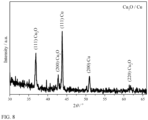
- AACVD of [Cu(OTf) 2 ] (0.5 g) in methanol (30 mL) at a deposition temperature of 550 °C in an N 2 carrier gas (1 Lmin -1 ) resulted in the deposition of a mixture of CuzO and Cu metal, as confirmed by XRD shown in Figure 8 .
- the deposition of CuzO and Cu is dependent on the deposition and post-deposition conditions employed, including presence of oxidant, amounts of oxidant and precursor in the precursor mixture and substrate temperature.
- the films exhibited good adhesion to the substrate and were deep green/orange in colour.
- Aluminium triflate was used to deposit films of alumina.
- AACVD of [Al(OTf) 3 ] (0.5 g) in methanol (30 mL) at a deposition temperature of 550 and 600 °C in N 2 carrier gas (1 Lmin -1 ) resulted in the deposition of amorphous white but transparent thin films.
- Silver triflate was used to deposit films.
- AACVD of [AgOTf] (0.5 g) in methanol (30 mL) at a deposition temperature of 550°C in an N 2 carrier gas (1 Lmin -1 ) resulted in the deposition of Ag thin films with a reflective metallic appearance.
- the metallic nature of the films was confirmed by XRD, as shown in Figure 9 .
Landscapes
- Chemical & Material Sciences (AREA)
- Organic Chemistry (AREA)
- Chemical Kinetics & Catalysis (AREA)
- Engineering & Computer Science (AREA)
- Materials Engineering (AREA)
- General Chemical & Material Sciences (AREA)
- Mechanical Engineering (AREA)
- Metallurgy (AREA)
- Inorganic Chemistry (AREA)
- Life Sciences & Earth Sciences (AREA)
- Geochemistry & Mineralogy (AREA)
- Dispersion Chemistry (AREA)
- Chemical Vapour Deposition (AREA)
- Formation Of Insulating Films (AREA)
- Surface Treatment Of Glass (AREA)
Claims (12)
- Prozess zum Abscheiden eines Metalls und/oder eines Metalloxids auf einem Glassubstrat, wobei der Prozess umfasst,Bereitstellen eines Glassubstrats, das eine Oberfläche aufweist,Bereitstellen einer Vorläufermischung, die ein Metallsulfonat umfasst,mindestens teilweises Zerstäuben der Vorläufermischung, undZuführen der Vorläufermischung zur Oberfläche des Glassubstrats, wobei sich die Oberfläche des Glassubstrats auf einer Substrattemperatur im Bereich von 500 °C bis 700 °C befindet, die ausreicht, um Zersetzung des Metallsulfonats zu bewirken, und wobei das Metallsulfonat eine Spezies der Formel M(O3SR)m ist, wobeiM ein Metall ist, R CF3 ist und m von der Oxidationsstufe von M abhängt.
- Prozess nach Anspruch 1, wobei das Metall M ausgewählt ist aus Zn, Mg, Al, Sb, Cu, Ag, Sn und In.
- Prozess nach einem der vorstehenden Ansprüche, wobei M Zn oder Mg ist.
- Prozess nach einem der vorstehenden Ansprüche, wobei die Vorläufermischung weiter ein Trägergas umfasst, und gegebenenfalls wobei die Vorläufermischung weiter ein Lösungsmittel umfasst.
- Prozess nach Anspruch 4, wobei das Lösungsmittel einen C1- bis C4-Alkohol umfasst.
- Prozess nach einem der vorstehenden Ansprüche, wobei die Vorläufermischung weiter eine zusätzliche Sauerstoffquelle umfasst.
- Prozess nach einem der vorstehenden Ansprüche, wobei die Vorläufermischung weiter eine Quelle eines zweiten Metalls umfasst, gegebenenfalls wobei die Quelle eines zweiten Metalls eine Aluminiumquelle umfasst.
- Prozess nach einem der vorstehenden Ansprüche, wobei das Substrat Natron-Kalk-Silikatglas umfasst.
- Prozess nach Anspruch 8, wobei das Substrat ein kontinuierliches Glasband umfasst.
- Prozess nach entweder Anspruch 8 oder Anspruch 9, wobei das Substrat ein kontinuierliches Glasband umfasst, das dem Floatglas-Produktionsprozess unterzogen wird.
- Prozess nach einem der Ansprüche 8 bis 10, wobei die Oberfläche des Glassubstrats eine Schicht umfasst, die Siliziumoxid umfasst, und das Metall und/oder Metalloxid auf der Siliziumoxid umfassenden Schicht abgeschieden wird.
- Prozess zum Abscheiden einer Beschichtung, die ein anorganisches Material umfasst, ausgewählt aus der Gruppe bestehend aus Zinkoxid, Aluminiumoxid, Kupferoxid, Kupfermetall, Indiumoxid und Silbermetall, auf einem Glassubstrat, wobei der Prozess nach Anspruch 1 ist und weiter umfasst:Bereitstellen eines Glassubstrats, das eine Oberfläche aufweist,Bereitstellen einer Vorläufermischung, die ein Metall-Trifluormethansulfonat umfasst, wobei das Metall ausgewählt ist aus der Gruppe bestehend aus Zink, Aluminium, Kupfer, Indium und Silber, undZuführen der Vorläufermischung zur Oberfläche des Substrats, wobei sich die Oberfläche des Substrats auf einer Substrattemperatur im Bereich von 500 °C bis 700 °C befindet, um Zersetzung des Metall-Trifluormethansulfonats zu bewirken.
Applications Claiming Priority (2)
| Application Number | Priority Date | Filing Date | Title |
|---|---|---|---|
| GB201502574A GB201502574D0 (en) | 2015-02-16 | 2015-02-16 | Depostion process |
| PCT/GB2016/050318 WO2016132100A1 (en) | 2015-02-16 | 2016-02-10 | Deposition process |
Publications (2)
| Publication Number | Publication Date |
|---|---|
| EP3259237A1 EP3259237A1 (de) | 2017-12-27 |
| EP3259237B1 true EP3259237B1 (de) | 2024-03-27 |
Family
ID=52781681
Family Applications (1)
| Application Number | Title | Priority Date | Filing Date |
|---|---|---|---|
| EP16704900.6A Active EP3259237B1 (de) | 2015-02-16 | 2016-02-10 | Ablagerungsverfahren |
Country Status (5)
| Country | Link |
|---|---|
| US (1) | US10513773B2 (de) |
| EP (1) | EP3259237B1 (de) |
| JP (1) | JP6875992B2 (de) |
| GB (1) | GB201502574D0 (de) |
| WO (1) | WO2016132100A1 (de) |
Family Cites Families (10)
| Publication number | Priority date | Publication date | Assignee | Title |
|---|---|---|---|---|
| US7763317B2 (en) | 2007-03-30 | 2010-07-27 | Intel Corporation | High K dielectric growth on metal triflate or trifluoroacetate terminated III-V semiconductor surfaces |
| KR100876947B1 (ko) | 2007-10-24 | 2009-01-07 | 연세대학교 산학협력단 | 산화물 박막을 위한 액상 제조방법 |
| US7691984B2 (en) | 2007-11-27 | 2010-04-06 | Air Products And Chemicals, Inc. | Metal complexes of tridentate β-ketoiminates |
| WO2011019516A2 (en) * | 2009-08-11 | 2011-02-17 | Baril Corporation | Microfluidic diagnostic device |
| CN102093430B (zh) * | 2010-12-28 | 2013-05-08 | 南京航空航天大学 | 有机膦稳定的烷基二磺酸银配合物及其合成方法与应用 |
| KR101260957B1 (ko) * | 2010-12-31 | 2013-05-06 | 연세대학교 산학협력단 | 산화물 박막용 조성물, 산화물 박막용 조성물 제조 방법, 산화물 박막용 조성물을 이용한 산화물 박막 및 전자소자 |
| EP2688850B1 (de) | 2011-03-23 | 2018-02-21 | Pilkington Group Limited | Verfahren zur ablagerung von zinkoxidbeschichtungen mittels cvd |
| GB201106553D0 (en) * | 2011-04-19 | 2011-06-01 | Pilkington Glass Ltd | Mthod for coating substrates |
| CN104379806B (zh) | 2012-03-16 | 2017-06-09 | 皮尔金顿集团有限公司 | 用于沉积氧化锌涂层的化学气相沉积工艺、用于形成导电玻璃制品的方法以及由此制成的涂覆玻璃制品 |
| US10155783B2 (en) | 2013-05-28 | 2018-12-18 | Merck Patent Gmbh | Manganese complexes and use thereof for preparing thin films |
-
2015
- 2015-02-16 GB GB201502574A patent/GB201502574D0/en not_active Ceased
-
2016
- 2016-02-10 JP JP2017540754A patent/JP6875992B2/ja active Active
- 2016-02-10 EP EP16704900.6A patent/EP3259237B1/de active Active
- 2016-02-10 US US15/550,464 patent/US10513773B2/en active Active
- 2016-02-10 WO PCT/GB2016/050318 patent/WO2016132100A1/en not_active Ceased
Non-Patent Citations (1)
| Title |
|---|
| XIAN TAO ET AL: "Organophosphine/phosphite stabilized disilver(i) methanedisulphonates: synthesis, solid state structures and their potential use as MOCVD precursors", DALTON TRANSACTIONS, vol. 40, no. 36, 1 January 2011 (2011-01-01), Cambridge, pages 9250, XP055276377, ISSN: 1477-9226, DOI: 10.1039/c1dt10575b * |
Also Published As
| Publication number | Publication date |
|---|---|
| WO2016132100A1 (en) | 2016-08-25 |
| EP3259237A1 (de) | 2017-12-27 |
| JP6875992B2 (ja) | 2021-05-26 |
| US10513773B2 (en) | 2019-12-24 |
| JP2018506646A (ja) | 2018-03-08 |
| US20180230594A1 (en) | 2018-08-16 |
| GB201502574D0 (en) | 2015-04-01 |
Similar Documents
| Publication | Publication Date | Title |
|---|---|---|
| US9236157B2 (en) | Transparent electrically conducting oxides | |
| Potter et al. | The effect of solvent on Al-doped ZnO thin films deposited via aerosol assisted CVD | |
| US3949146A (en) | Process for depositing transparent electrically conductive tin oxide coatings on a substrate | |
| Potter et al. | Transparent conducting oxide thin films of Si-doped ZnO prepared by aerosol assisted CVD | |
| Gandhi et al. | Effect of Mn doping on the electrical and optical properties of SnO2 thin films deposited by chemical spray pyrolysis technique | |
| Starowicz et al. | Synthesis and characterization of Al-doped ZnO and Al/F co-doped ZnO thin films prepared by atomic layer deposition | |
| Moholkar et al. | Influence of deposition temperature on morphological, optical, electrical and opto-electrical properties of highly textured nano-crystalline spray deposited CdO: Ga thin films | |
| Shewale et al. | Preparation of fluorine-doped tin oxide films at low substrate temperature by an advanced spray pyrolysis technique, and their characterization | |
| RU2542977C2 (ru) | НАНЕСЕНИЕ ЛЕГИРОВАННЫХ ПЛЕНОК ZnO НА ПОЛИМЕРНЫЕ ПОДЛОЖКИ ХИМИЧЕСКИМ ОСАЖДЕНИЕМ ИЗ ГАЗОВОЙ ФАЗЫ ПОД ВОЗДЕЙСТВИЕМ УФ | |
| Chandrasekhar et al. | Innovative and cost-effective synthesis of indium tin oxide films | |
| Chandrasekhar et al. | Electrostatic spray assisted vapour deposition of fluorine doped tin oxide | |
| US7736698B2 (en) | Method of depositing zinc oxide coatings on a substrate | |
| Zunke et al. | Structural properties of zinc oxide deposited using atmospheric pressure combustion chemical vapour deposition | |
| Juang et al. | Effect of ambient air flow on resistivity uniformity of transparent Ga-doped ZnO film deposited by atmospheric pressure plasma jet | |
| EP3259237B1 (de) | Ablagerungsverfahren | |
| Yadav et al. | A review on synthesis, fabrication, and properties of nanostructured pure and doped tin oxide films | |
| EP1735479A1 (de) | Thermochrome beschichtungen | |
| Manzi et al. | Aerosol assisted chemical vapour deposition of transparent conductive aluminum-doped zinc oxide thin films from a zinc triflate precursor | |
| IE850906L (en) | Liquid coating for producing flourine-doped tin oxide¹coating for glass. | |
| Smith et al. | Experimental survey of different precursor/solvent pairs for the deposition of tin dioxide by pyrosol | |
| GB2428689A (en) | Process for preparing transparent conducting metal oxides | |
| Frenzel et al. | Synthesis of Mg and Zn diolates and their use in metal oxide deposition | |
| KR20140046617A (ko) | 산화아연 전구체 및 이를 이용한 산화아연계 박막 증착방법 | |
| Marsh et al. | The effect of solvent on the functional properties of zinc oxide films via AACVD | |
| Chalker et al. | Atomic layer deposition of gallium-doped zinc oxide transparent conducting oxide films |
Legal Events
| Date | Code | Title | Description |
|---|---|---|---|
| STAA | Information on the status of an ep patent application or granted ep patent |
Free format text: STATUS: THE INTERNATIONAL PUBLICATION HAS BEEN MADE |
|
| PUAI | Public reference made under article 153(3) epc to a published international application that has entered the european phase |
Free format text: ORIGINAL CODE: 0009012 |
|
| STAA | Information on the status of an ep patent application or granted ep patent |
Free format text: STATUS: REQUEST FOR EXAMINATION WAS MADE |
|
| 17P | Request for examination filed |
Effective date: 20170828 |
|
| AK | Designated contracting states |
Kind code of ref document: A1 Designated state(s): AL AT BE BG CH CY CZ DE DK EE ES FI FR GB GR HR HU IE IS IT LI LT LU LV MC MK MT NL NO PL PT RO RS SE SI SK SM TR |
|
| AX | Request for extension of the european patent |
Extension state: BA ME |
|
| DAV | Request for validation of the european patent (deleted) | ||
| DAX | Request for extension of the european patent (deleted) | ||
| STAA | Information on the status of an ep patent application or granted ep patent |
Free format text: STATUS: EXAMINATION IS IN PROGRESS |
|
| 17Q | First examination report despatched |
Effective date: 20191023 |
|
| REG | Reference to a national code |
Ref country code: DE Ref legal event code: R079 Free format text: PREVIOUS MAIN CLASS: C03C0017245000 Ipc: C03C0017340000 Ref document number: 602016086530 Country of ref document: DE |
|
| GRAP | Despatch of communication of intention to grant a patent |
Free format text: ORIGINAL CODE: EPIDOSNIGR1 |
|
| STAA | Information on the status of an ep patent application or granted ep patent |
Free format text: STATUS: GRANT OF PATENT IS INTENDED |
|
| RIC1 | Information provided on ipc code assigned before grant |
Ipc: C23C 14/18 20060101ALI20230824BHEP Ipc: C23C 16/448 20060101ALI20230824BHEP Ipc: C23C 16/40 20060101ALI20230824BHEP Ipc: C03C 17/245 20060101ALI20230824BHEP Ipc: C03C 17/34 20060101AFI20230824BHEP |
|
| INTG | Intention to grant announced |
Effective date: 20230918 |
|
| GRAS | Grant fee paid |
Free format text: ORIGINAL CODE: EPIDOSNIGR3 |
|
| GRAA | (expected) grant |
Free format text: ORIGINAL CODE: 0009210 |
|
| STAA | Information on the status of an ep patent application or granted ep patent |
Free format text: STATUS: THE PATENT HAS BEEN GRANTED |
|
| AK | Designated contracting states |
Kind code of ref document: B1 Designated state(s): AL AT BE BG CH CY CZ DE DK EE ES FI FR GB GR HR HU IE IS IT LI LT LU LV MC MK MT NL NO PL PT RO RS SE SI SK SM TR |
|
| REG | Reference to a national code |
Ref country code: GB Ref legal event code: FG4D |
|
| REG | Reference to a national code |
Ref country code: CH Ref legal event code: EP |
|
| REG | Reference to a national code |
Ref country code: DE Ref legal event code: R096 Ref document number: 602016086530 Country of ref document: DE |
|
| REG | Reference to a national code |
Ref country code: IE Ref legal event code: FG4D |
|
| PG25 | Lapsed in a contracting state [announced via postgrant information from national office to epo] |
Ref country code: LT Free format text: LAPSE BECAUSE OF FAILURE TO SUBMIT A TRANSLATION OF THE DESCRIPTION OR TO PAY THE FEE WITHIN THE PRESCRIBED TIME-LIMIT Effective date: 20240327 |
|
| REG | Reference to a national code |
Ref country code: LT Ref legal event code: MG9D |
|
| PG25 | Lapsed in a contracting state [announced via postgrant information from national office to epo] |
Ref country code: GR Free format text: LAPSE BECAUSE OF FAILURE TO SUBMIT A TRANSLATION OF THE DESCRIPTION OR TO PAY THE FEE WITHIN THE PRESCRIBED TIME-LIMIT Effective date: 20240628 |
|
| PG25 | Lapsed in a contracting state [announced via postgrant information from national office to epo] |
Ref country code: RS Free format text: LAPSE BECAUSE OF FAILURE TO SUBMIT A TRANSLATION OF THE DESCRIPTION OR TO PAY THE FEE WITHIN THE PRESCRIBED TIME-LIMIT Effective date: 20240627 Ref country code: HR Free format text: LAPSE BECAUSE OF FAILURE TO SUBMIT A TRANSLATION OF THE DESCRIPTION OR TO PAY THE FEE WITHIN THE PRESCRIBED TIME-LIMIT Effective date: 20240327 |
|
| PG25 | Lapsed in a contracting state [announced via postgrant information from national office to epo] |
Ref country code: RS Free format text: LAPSE BECAUSE OF FAILURE TO SUBMIT A TRANSLATION OF THE DESCRIPTION OR TO PAY THE FEE WITHIN THE PRESCRIBED TIME-LIMIT Effective date: 20240627 Ref country code: NO Free format text: LAPSE BECAUSE OF FAILURE TO SUBMIT A TRANSLATION OF THE DESCRIPTION OR TO PAY THE FEE WITHIN THE PRESCRIBED TIME-LIMIT Effective date: 20240627 Ref country code: LT Free format text: LAPSE BECAUSE OF FAILURE TO SUBMIT A TRANSLATION OF THE DESCRIPTION OR TO PAY THE FEE WITHIN THE PRESCRIBED TIME-LIMIT Effective date: 20240327 Ref country code: HR Free format text: LAPSE BECAUSE OF FAILURE TO SUBMIT A TRANSLATION OF THE DESCRIPTION OR TO PAY THE FEE WITHIN THE PRESCRIBED TIME-LIMIT Effective date: 20240327 Ref country code: GR Free format text: LAPSE BECAUSE OF FAILURE TO SUBMIT A TRANSLATION OF THE DESCRIPTION OR TO PAY THE FEE WITHIN THE PRESCRIBED TIME-LIMIT Effective date: 20240628 Ref country code: FI Free format text: LAPSE BECAUSE OF FAILURE TO SUBMIT A TRANSLATION OF THE DESCRIPTION OR TO PAY THE FEE WITHIN THE PRESCRIBED TIME-LIMIT Effective date: 20240327 Ref country code: BG Free format text: LAPSE BECAUSE OF FAILURE TO SUBMIT A TRANSLATION OF THE DESCRIPTION OR TO PAY THE FEE WITHIN THE PRESCRIBED TIME-LIMIT Effective date: 20240327 |
|
| REG | Reference to a national code |
Ref country code: NL Ref legal event code: MP Effective date: 20240327 |
|
| P01 | Opt-out of the competence of the unified patent court (upc) registered |
Free format text: CASE NUMBER: APP_40214/2024 Effective date: 20240705 |
|
| PG25 | Lapsed in a contracting state [announced via postgrant information from national office to epo] |
Ref country code: SE Free format text: LAPSE BECAUSE OF FAILURE TO SUBMIT A TRANSLATION OF THE DESCRIPTION OR TO PAY THE FEE WITHIN THE PRESCRIBED TIME-LIMIT Effective date: 20240327 Ref country code: LV Free format text: LAPSE BECAUSE OF FAILURE TO SUBMIT A TRANSLATION OF THE DESCRIPTION OR TO PAY THE FEE WITHIN THE PRESCRIBED TIME-LIMIT Effective date: 20240327 |
|
| PG25 | Lapsed in a contracting state [announced via postgrant information from national office to epo] |
Ref country code: NL Free format text: LAPSE BECAUSE OF FAILURE TO SUBMIT A TRANSLATION OF THE DESCRIPTION OR TO PAY THE FEE WITHIN THE PRESCRIBED TIME-LIMIT Effective date: 20240327 |
|
| REG | Reference to a national code |
Ref country code: AT Ref legal event code: MK05 Ref document number: 1669778 Country of ref document: AT Kind code of ref document: T Effective date: 20240327 |
|
| PG25 | Lapsed in a contracting state [announced via postgrant information from national office to epo] |
Ref country code: NL Free format text: LAPSE BECAUSE OF FAILURE TO SUBMIT A TRANSLATION OF THE DESCRIPTION OR TO PAY THE FEE WITHIN THE PRESCRIBED TIME-LIMIT Effective date: 20240327 |
|
| PG25 | Lapsed in a contracting state [announced via postgrant information from national office to epo] |
Ref country code: IS Free format text: LAPSE BECAUSE OF FAILURE TO SUBMIT A TRANSLATION OF THE DESCRIPTION OR TO PAY THE FEE WITHIN THE PRESCRIBED TIME-LIMIT Effective date: 20240727 |
|
| PG25 | Lapsed in a contracting state [announced via postgrant information from national office to epo] |
Ref country code: PT Free format text: LAPSE BECAUSE OF FAILURE TO SUBMIT A TRANSLATION OF THE DESCRIPTION OR TO PAY THE FEE WITHIN THE PRESCRIBED TIME-LIMIT Effective date: 20240729 Ref country code: SM Free format text: LAPSE BECAUSE OF FAILURE TO SUBMIT A TRANSLATION OF THE DESCRIPTION OR TO PAY THE FEE WITHIN THE PRESCRIBED TIME-LIMIT Effective date: 20240327 |
|
| PG25 | Lapsed in a contracting state [announced via postgrant information from national office to epo] |
Ref country code: ES Free format text: LAPSE BECAUSE OF FAILURE TO SUBMIT A TRANSLATION OF THE DESCRIPTION OR TO PAY THE FEE WITHIN THE PRESCRIBED TIME-LIMIT Effective date: 20240327 |
|
| PG25 | Lapsed in a contracting state [announced via postgrant information from national office to epo] |
Ref country code: EE Free format text: LAPSE BECAUSE OF FAILURE TO SUBMIT A TRANSLATION OF THE DESCRIPTION OR TO PAY THE FEE WITHIN THE PRESCRIBED TIME-LIMIT Effective date: 20240327 Ref country code: CZ Free format text: LAPSE BECAUSE OF FAILURE TO SUBMIT A TRANSLATION OF THE DESCRIPTION OR TO PAY THE FEE WITHIN THE PRESCRIBED TIME-LIMIT Effective date: 20240327 |
|
| PG25 | Lapsed in a contracting state [announced via postgrant information from national office to epo] |
Ref country code: AT Free format text: LAPSE BECAUSE OF FAILURE TO SUBMIT A TRANSLATION OF THE DESCRIPTION OR TO PAY THE FEE WITHIN THE PRESCRIBED TIME-LIMIT Effective date: 20240327 |
|
| PG25 | Lapsed in a contracting state [announced via postgrant information from national office to epo] |
Ref country code: PL Free format text: LAPSE BECAUSE OF FAILURE TO SUBMIT A TRANSLATION OF THE DESCRIPTION OR TO PAY THE FEE WITHIN THE PRESCRIBED TIME-LIMIT Effective date: 20240327 |
|
| PG25 | Lapsed in a contracting state [announced via postgrant information from national office to epo] |
Ref country code: SK Free format text: LAPSE BECAUSE OF FAILURE TO SUBMIT A TRANSLATION OF THE DESCRIPTION OR TO PAY THE FEE WITHIN THE PRESCRIBED TIME-LIMIT Effective date: 20240327 |
|
| PG25 | Lapsed in a contracting state [announced via postgrant information from national office to epo] |
Ref country code: SM Free format text: LAPSE BECAUSE OF FAILURE TO SUBMIT A TRANSLATION OF THE DESCRIPTION OR TO PAY THE FEE WITHIN THE PRESCRIBED TIME-LIMIT Effective date: 20240327 Ref country code: SK Free format text: LAPSE BECAUSE OF FAILURE TO SUBMIT A TRANSLATION OF THE DESCRIPTION OR TO PAY THE FEE WITHIN THE PRESCRIBED TIME-LIMIT Effective date: 20240327 Ref country code: RO Free format text: LAPSE BECAUSE OF FAILURE TO SUBMIT A TRANSLATION OF THE DESCRIPTION OR TO PAY THE FEE WITHIN THE PRESCRIBED TIME-LIMIT Effective date: 20240327 Ref country code: PT Free format text: LAPSE BECAUSE OF FAILURE TO SUBMIT A TRANSLATION OF THE DESCRIPTION OR TO PAY THE FEE WITHIN THE PRESCRIBED TIME-LIMIT Effective date: 20240729 Ref country code: PL Free format text: LAPSE BECAUSE OF FAILURE TO SUBMIT A TRANSLATION OF THE DESCRIPTION OR TO PAY THE FEE WITHIN THE PRESCRIBED TIME-LIMIT Effective date: 20240327 Ref country code: IS Free format text: LAPSE BECAUSE OF FAILURE TO SUBMIT A TRANSLATION OF THE DESCRIPTION OR TO PAY THE FEE WITHIN THE PRESCRIBED TIME-LIMIT Effective date: 20240727 Ref country code: ES Free format text: LAPSE BECAUSE OF FAILURE TO SUBMIT A TRANSLATION OF THE DESCRIPTION OR TO PAY THE FEE WITHIN THE PRESCRIBED TIME-LIMIT Effective date: 20240327 Ref country code: EE Free format text: LAPSE BECAUSE OF FAILURE TO SUBMIT A TRANSLATION OF THE DESCRIPTION OR TO PAY THE FEE WITHIN THE PRESCRIBED TIME-LIMIT Effective date: 20240327 Ref country code: CZ Free format text: LAPSE BECAUSE OF FAILURE TO SUBMIT A TRANSLATION OF THE DESCRIPTION OR TO PAY THE FEE WITHIN THE PRESCRIBED TIME-LIMIT Effective date: 20240327 Ref country code: AT Free format text: LAPSE BECAUSE OF FAILURE TO SUBMIT A TRANSLATION OF THE DESCRIPTION OR TO PAY THE FEE WITHIN THE PRESCRIBED TIME-LIMIT Effective date: 20240327 |
|
| PG25 | Lapsed in a contracting state [announced via postgrant information from national office to epo] |
Ref country code: IT Free format text: LAPSE BECAUSE OF FAILURE TO SUBMIT A TRANSLATION OF THE DESCRIPTION OR TO PAY THE FEE WITHIN THE PRESCRIBED TIME-LIMIT Effective date: 20240327 |
|
| PG25 | Lapsed in a contracting state [announced via postgrant information from national office to epo] |
Ref country code: IT Free format text: LAPSE BECAUSE OF FAILURE TO SUBMIT A TRANSLATION OF THE DESCRIPTION OR TO PAY THE FEE WITHIN THE PRESCRIBED TIME-LIMIT Effective date: 20240327 |
|
| REG | Reference to a national code |
Ref country code: DE Ref legal event code: R097 Ref document number: 602016086530 Country of ref document: DE |
|
| PG25 | Lapsed in a contracting state [announced via postgrant information from national office to epo] |
Ref country code: DK Free format text: LAPSE BECAUSE OF FAILURE TO SUBMIT A TRANSLATION OF THE DESCRIPTION OR TO PAY THE FEE WITHIN THE PRESCRIBED TIME-LIMIT Effective date: 20240327 |
|
| PG25 | Lapsed in a contracting state [announced via postgrant information from national office to epo] |
Ref country code: DK Free format text: LAPSE BECAUSE OF FAILURE TO SUBMIT A TRANSLATION OF THE DESCRIPTION OR TO PAY THE FEE WITHIN THE PRESCRIBED TIME-LIMIT Effective date: 20240327 |
|
| PLBE | No opposition filed within time limit |
Free format text: ORIGINAL CODE: 0009261 |
|
| STAA | Information on the status of an ep patent application or granted ep patent |
Free format text: STATUS: NO OPPOSITION FILED WITHIN TIME LIMIT |
|
| 26N | No opposition filed |
Effective date: 20250103 |
|
| PG25 | Lapsed in a contracting state [announced via postgrant information from national office to epo] |
Ref country code: SI Free format text: LAPSE BECAUSE OF FAILURE TO SUBMIT A TRANSLATION OF THE DESCRIPTION OR TO PAY THE FEE WITHIN THE PRESCRIBED TIME-LIMIT Effective date: 20240327 |
|
| PG25 | Lapsed in a contracting state [announced via postgrant information from national office to epo] |
Ref country code: MC Free format text: LAPSE BECAUSE OF FAILURE TO SUBMIT A TRANSLATION OF THE DESCRIPTION OR TO PAY THE FEE WITHIN THE PRESCRIBED TIME-LIMIT Effective date: 20240327 |
|
| REG | Reference to a national code |
Ref country code: CH Ref legal event code: PL |
|
| PG25 | Lapsed in a contracting state [announced via postgrant information from national office to epo] |
Ref country code: LU Free format text: LAPSE BECAUSE OF NON-PAYMENT OF DUE FEES Effective date: 20250210 |
|
| PG25 | Lapsed in a contracting state [announced via postgrant information from national office to epo] |
Ref country code: CH Free format text: LAPSE BECAUSE OF NON-PAYMENT OF DUE FEES Effective date: 20250228 |
|
| REG | Reference to a national code |
Ref country code: BE Ref legal event code: MM Effective date: 20250228 |
|
| PG25 | Lapsed in a contracting state [announced via postgrant information from national office to epo] |
Ref country code: BE Free format text: LAPSE BECAUSE OF NON-PAYMENT OF DUE FEES Effective date: 20250228 |
|
| PG25 | Lapsed in a contracting state [announced via postgrant information from national office to epo] |
Ref country code: IE Free format text: LAPSE BECAUSE OF NON-PAYMENT OF DUE FEES Effective date: 20250210 |
|
| PGFP | Annual fee paid to national office [announced via postgrant information from national office to epo] |
Ref country code: GB Payment date: 20260206 Year of fee payment: 11 |
|
| PGFP | Annual fee paid to national office [announced via postgrant information from national office to epo] |
Ref country code: DE Payment date: 20260220 Year of fee payment: 11 |
|
| PGFP | Annual fee paid to national office [announced via postgrant information from national office to epo] |
Ref country code: FR Payment date: 20260224 Year of fee payment: 11 |