EP3255191A1 - Nonwoven fabric laminate, stretchable nonwoven fabric laminate, fiber product, absorbent article and hygienic mask - Google Patents
Nonwoven fabric laminate, stretchable nonwoven fabric laminate, fiber product, absorbent article and hygienic mask Download PDFInfo
- Publication number
- EP3255191A1 EP3255191A1 EP16761800.8A EP16761800A EP3255191A1 EP 3255191 A1 EP3255191 A1 EP 3255191A1 EP 16761800 A EP16761800 A EP 16761800A EP 3255191 A1 EP3255191 A1 EP 3255191A1
- Authority
- EP
- European Patent Office
- Prior art keywords
- nonwoven fabric
- multilayer nonwoven
- elastomer
- thermoplastic
- multilayer
- Prior art date
- Legal status (The legal status is an assumption and is not a legal conclusion. Google has not performed a legal analysis and makes no representation as to the accuracy of the status listed.)
- Granted
Links
Images
Classifications
-
- D—TEXTILES; PAPER
- D04—BRAIDING; LACE-MAKING; KNITTING; TRIMMINGS; NON-WOVEN FABRICS
- D04H—MAKING TEXTILE FABRICS, e.g. FROM FIBRES OR FILAMENTARY MATERIAL; FABRICS MADE BY SUCH PROCESSES OR APPARATUS, e.g. FELTS, NON-WOVEN FABRICS; COTTON-WOOL; WADDING ; NON-WOVEN FABRICS FROM STAPLE FIBRES, FILAMENTS OR YARNS, BONDED WITH AT LEAST ONE WEB-LIKE MATERIAL DURING THEIR CONSOLIDATION
- D04H3/00—Non-woven fabrics formed wholly or mainly of yarns or like filamentary material of substantial length
- D04H3/08—Non-woven fabrics formed wholly or mainly of yarns or like filamentary material of substantial length characterised by the method of strengthening or consolidating
- D04H3/16—Non-woven fabrics formed wholly or mainly of yarns or like filamentary material of substantial length characterised by the method of strengthening or consolidating with bonds between thermoplastic filaments produced in association with filament formation, e.g. immediately following extrusion
-
- A—HUMAN NECESSITIES
- A41—WEARING APPAREL
- A41D—OUTERWEAR; PROTECTIVE GARMENTS; ACCESSORIES
- A41D13/00—Professional, industrial or sporting protective garments, e.g. surgeons' gowns or garments protecting against blows or punches
- A41D13/05—Professional, industrial or sporting protective garments, e.g. surgeons' gowns or garments protecting against blows or punches protecting only a particular body part
- A41D13/11—Protective face masks, e.g. for surgical use, or for use in foul atmospheres
-
- A—HUMAN NECESSITIES
- A61—MEDICAL OR VETERINARY SCIENCE; HYGIENE
- A61F—FILTERS IMPLANTABLE INTO BLOOD VESSELS; PROSTHESES; DEVICES PROVIDING PATENCY TO, OR PREVENTING COLLAPSING OF, TUBULAR STRUCTURES OF THE BODY, e.g. STENTS; ORTHOPAEDIC, NURSING OR CONTRACEPTIVE DEVICES; FOMENTATION; TREATMENT OR PROTECTION OF EYES OR EARS; BANDAGES, DRESSINGS OR ABSORBENT PADS; FIRST-AID KITS
- A61F13/00—Bandages or dressings; Absorbent pads
- A61F13/15—Absorbent pads, e.g. sanitary towels, swabs or tampons for external or internal application to the body; Supporting or fastening means therefor; Tampon applicators
-
- A—HUMAN NECESSITIES
- A62—LIFE-SAVING; FIRE-FIGHTING
- A62B—DEVICES, APPARATUS OR METHODS FOR LIFE-SAVING
- A62B18/00—Breathing masks or helmets, e.g. affording protection against chemical agents or for use at high altitudes or incorporating a pump or compressor for reducing the inhalation effort
- A62B18/02—Masks
-
- B—PERFORMING OPERATIONS; TRANSPORTING
- B32—LAYERED PRODUCTS
- B32B—LAYERED PRODUCTS, i.e. PRODUCTS BUILT-UP OF STRATA OF FLAT OR NON-FLAT, e.g. CELLULAR OR HONEYCOMB, FORM
- B32B5/00—Layered products characterised by the non- homogeneity or physical structure, i.e. comprising a fibrous, filamentary, particulate or foam layer; Layered products characterised by having a layer differing constitutionally or physically in different parts
- B32B5/02—Layered products characterised by the non- homogeneity or physical structure, i.e. comprising a fibrous, filamentary, particulate or foam layer; Layered products characterised by having a layer differing constitutionally or physically in different parts characterised by structural features of a fibrous or filamentary layer
- B32B5/022—Non-woven fabric
-
- B—PERFORMING OPERATIONS; TRANSPORTING
- B32—LAYERED PRODUCTS
- B32B—LAYERED PRODUCTS, i.e. PRODUCTS BUILT-UP OF STRATA OF FLAT OR NON-FLAT, e.g. CELLULAR OR HONEYCOMB, FORM
- B32B5/00—Layered products characterised by the non- homogeneity or physical structure, i.e. comprising a fibrous, filamentary, particulate or foam layer; Layered products characterised by having a layer differing constitutionally or physically in different parts
- B32B5/02—Layered products characterised by the non- homogeneity or physical structure, i.e. comprising a fibrous, filamentary, particulate or foam layer; Layered products characterised by having a layer differing constitutionally or physically in different parts characterised by structural features of a fibrous or filamentary layer
- B32B5/024—Woven fabric
-
- B—PERFORMING OPERATIONS; TRANSPORTING
- B32—LAYERED PRODUCTS
- B32B—LAYERED PRODUCTS, i.e. PRODUCTS BUILT-UP OF STRATA OF FLAT OR NON-FLAT, e.g. CELLULAR OR HONEYCOMB, FORM
- B32B5/00—Layered products characterised by the non- homogeneity or physical structure, i.e. comprising a fibrous, filamentary, particulate or foam layer; Layered products characterised by having a layer differing constitutionally or physically in different parts
- B32B5/02—Layered products characterised by the non- homogeneity or physical structure, i.e. comprising a fibrous, filamentary, particulate or foam layer; Layered products characterised by having a layer differing constitutionally or physically in different parts characterised by structural features of a fibrous or filamentary layer
- B32B5/026—Knitted fabric
-
- B—PERFORMING OPERATIONS; TRANSPORTING
- B32—LAYERED PRODUCTS
- B32B—LAYERED PRODUCTS, i.e. PRODUCTS BUILT-UP OF STRATA OF FLAT OR NON-FLAT, e.g. CELLULAR OR HONEYCOMB, FORM
- B32B5/00—Layered products characterised by the non- homogeneity or physical structure, i.e. comprising a fibrous, filamentary, particulate or foam layer; Layered products characterised by having a layer differing constitutionally or physically in different parts
- B32B5/02—Layered products characterised by the non- homogeneity or physical structure, i.e. comprising a fibrous, filamentary, particulate or foam layer; Layered products characterised by having a layer differing constitutionally or physically in different parts characterised by structural features of a fibrous or filamentary layer
- B32B5/04—Layered products characterised by the non- homogeneity or physical structure, i.e. comprising a fibrous, filamentary, particulate or foam layer; Layered products characterised by having a layer differing constitutionally or physically in different parts characterised by structural features of a fibrous or filamentary layer characterised by a layer being specifically extensible by reason of its structure or arrangement, e.g. by reason of the chemical nature of the fibres or filaments
-
- B—PERFORMING OPERATIONS; TRANSPORTING
- B32—LAYERED PRODUCTS
- B32B—LAYERED PRODUCTS, i.e. PRODUCTS BUILT-UP OF STRATA OF FLAT OR NON-FLAT, e.g. CELLULAR OR HONEYCOMB, FORM
- B32B5/00—Layered products characterised by the non- homogeneity or physical structure, i.e. comprising a fibrous, filamentary, particulate or foam layer; Layered products characterised by having a layer differing constitutionally or physically in different parts
- B32B5/02—Layered products characterised by the non- homogeneity or physical structure, i.e. comprising a fibrous, filamentary, particulate or foam layer; Layered products characterised by having a layer differing constitutionally or physically in different parts characterised by structural features of a fibrous or filamentary layer
- B32B5/08—Layered products characterised by the non- homogeneity or physical structure, i.e. comprising a fibrous, filamentary, particulate or foam layer; Layered products characterised by having a layer differing constitutionally or physically in different parts characterised by structural features of a fibrous or filamentary layer the fibres or filaments of a layer being of different substances, e.g. conjugate fibres, mixture of different fibres
-
- B—PERFORMING OPERATIONS; TRANSPORTING
- B32—LAYERED PRODUCTS
- B32B—LAYERED PRODUCTS, i.e. PRODUCTS BUILT-UP OF STRATA OF FLAT OR NON-FLAT, e.g. CELLULAR OR HONEYCOMB, FORM
- B32B5/00—Layered products characterised by the non- homogeneity or physical structure, i.e. comprising a fibrous, filamentary, particulate or foam layer; Layered products characterised by having a layer differing constitutionally or physically in different parts
- B32B5/22—Layered products characterised by the non- homogeneity or physical structure, i.e. comprising a fibrous, filamentary, particulate or foam layer; Layered products characterised by having a layer differing constitutionally or physically in different parts characterised by the presence of two or more layers which are next to each other and are fibrous, filamentary, formed of particles or foamed
- B32B5/24—Layered products characterised by the non- homogeneity or physical structure, i.e. comprising a fibrous, filamentary, particulate or foam layer; Layered products characterised by having a layer differing constitutionally or physically in different parts characterised by the presence of two or more layers which are next to each other and are fibrous, filamentary, formed of particles or foamed one layer being a fibrous or filamentary layer
- B32B5/26—Layered products characterised by the non- homogeneity or physical structure, i.e. comprising a fibrous, filamentary, particulate or foam layer; Layered products characterised by having a layer differing constitutionally or physically in different parts characterised by the presence of two or more layers which are next to each other and are fibrous, filamentary, formed of particles or foamed one layer being a fibrous or filamentary layer another layer next to it also being fibrous or filamentary
-
- B—PERFORMING OPERATIONS; TRANSPORTING
- B32—LAYERED PRODUCTS
- B32B—LAYERED PRODUCTS, i.e. PRODUCTS BUILT-UP OF STRATA OF FLAT OR NON-FLAT, e.g. CELLULAR OR HONEYCOMB, FORM
- B32B5/00—Layered products characterised by the non- homogeneity or physical structure, i.e. comprising a fibrous, filamentary, particulate or foam layer; Layered products characterised by having a layer differing constitutionally or physically in different parts
- B32B5/22—Layered products characterised by the non- homogeneity or physical structure, i.e. comprising a fibrous, filamentary, particulate or foam layer; Layered products characterised by having a layer differing constitutionally or physically in different parts characterised by the presence of two or more layers which are next to each other and are fibrous, filamentary, formed of particles or foamed
- B32B5/24—Layered products characterised by the non- homogeneity or physical structure, i.e. comprising a fibrous, filamentary, particulate or foam layer; Layered products characterised by having a layer differing constitutionally or physically in different parts characterised by the presence of two or more layers which are next to each other and are fibrous, filamentary, formed of particles or foamed one layer being a fibrous or filamentary layer
- B32B5/26—Layered products characterised by the non- homogeneity or physical structure, i.e. comprising a fibrous, filamentary, particulate or foam layer; Layered products characterised by having a layer differing constitutionally or physically in different parts characterised by the presence of two or more layers which are next to each other and are fibrous, filamentary, formed of particles or foamed one layer being a fibrous or filamentary layer another layer next to it also being fibrous or filamentary
- B32B5/262—Layered products characterised by the non- homogeneity or physical structure, i.e. comprising a fibrous, filamentary, particulate or foam layer; Layered products characterised by having a layer differing constitutionally or physically in different parts characterised by the presence of two or more layers which are next to each other and are fibrous, filamentary, formed of particles or foamed one layer being a fibrous or filamentary layer another layer next to it also being fibrous or filamentary characterised by one fibrous or filamentary layer being a woven fabric layer
-
- B—PERFORMING OPERATIONS; TRANSPORTING
- B32—LAYERED PRODUCTS
- B32B—LAYERED PRODUCTS, i.e. PRODUCTS BUILT-UP OF STRATA OF FLAT OR NON-FLAT, e.g. CELLULAR OR HONEYCOMB, FORM
- B32B5/00—Layered products characterised by the non- homogeneity or physical structure, i.e. comprising a fibrous, filamentary, particulate or foam layer; Layered products characterised by having a layer differing constitutionally or physically in different parts
- B32B5/22—Layered products characterised by the non- homogeneity or physical structure, i.e. comprising a fibrous, filamentary, particulate or foam layer; Layered products characterised by having a layer differing constitutionally or physically in different parts characterised by the presence of two or more layers which are next to each other and are fibrous, filamentary, formed of particles or foamed
- B32B5/24—Layered products characterised by the non- homogeneity or physical structure, i.e. comprising a fibrous, filamentary, particulate or foam layer; Layered products characterised by having a layer differing constitutionally or physically in different parts characterised by the presence of two or more layers which are next to each other and are fibrous, filamentary, formed of particles or foamed one layer being a fibrous or filamentary layer
- B32B5/26—Layered products characterised by the non- homogeneity or physical structure, i.e. comprising a fibrous, filamentary, particulate or foam layer; Layered products characterised by having a layer differing constitutionally or physically in different parts characterised by the presence of two or more layers which are next to each other and are fibrous, filamentary, formed of particles or foamed one layer being a fibrous or filamentary layer another layer next to it also being fibrous or filamentary
- B32B5/265—Layered products characterised by the non- homogeneity or physical structure, i.e. comprising a fibrous, filamentary, particulate or foam layer; Layered products characterised by having a layer differing constitutionally or physically in different parts characterised by the presence of two or more layers which are next to each other and are fibrous, filamentary, formed of particles or foamed one layer being a fibrous or filamentary layer another layer next to it also being fibrous or filamentary characterised by one fibrous or filamentary layer being a non-woven fabric layer
- B32B5/266—Layered products characterised by the non- homogeneity or physical structure, i.e. comprising a fibrous, filamentary, particulate or foam layer; Layered products characterised by having a layer differing constitutionally or physically in different parts characterised by the presence of two or more layers which are next to each other and are fibrous, filamentary, formed of particles or foamed one layer being a fibrous or filamentary layer another layer next to it also being fibrous or filamentary characterised by one fibrous or filamentary layer being a non-woven fabric layer next to one or more non-woven fabric layers
- B32B5/267—Layered products characterised by the non- homogeneity or physical structure, i.e. comprising a fibrous, filamentary, particulate or foam layer; Layered products characterised by having a layer differing constitutionally or physically in different parts characterised by the presence of two or more layers which are next to each other and are fibrous, filamentary, formed of particles or foamed one layer being a fibrous or filamentary layer another layer next to it also being fibrous or filamentary characterised by one fibrous or filamentary layer being a non-woven fabric layer next to one or more non-woven fabric layers characterised by at least one non-woven fabric layer that is a spunbonded fabric
-
- B—PERFORMING OPERATIONS; TRANSPORTING
- B32—LAYERED PRODUCTS
- B32B—LAYERED PRODUCTS, i.e. PRODUCTS BUILT-UP OF STRATA OF FLAT OR NON-FLAT, e.g. CELLULAR OR HONEYCOMB, FORM
- B32B5/00—Layered products characterised by the non- homogeneity or physical structure, i.e. comprising a fibrous, filamentary, particulate or foam layer; Layered products characterised by having a layer differing constitutionally or physically in different parts
- B32B5/22—Layered products characterised by the non- homogeneity or physical structure, i.e. comprising a fibrous, filamentary, particulate or foam layer; Layered products characterised by having a layer differing constitutionally or physically in different parts characterised by the presence of two or more layers which are next to each other and are fibrous, filamentary, formed of particles or foamed
- B32B5/24—Layered products characterised by the non- homogeneity or physical structure, i.e. comprising a fibrous, filamentary, particulate or foam layer; Layered products characterised by having a layer differing constitutionally or physically in different parts characterised by the presence of two or more layers which are next to each other and are fibrous, filamentary, formed of particles or foamed one layer being a fibrous or filamentary layer
- B32B5/26—Layered products characterised by the non- homogeneity or physical structure, i.e. comprising a fibrous, filamentary, particulate or foam layer; Layered products characterised by having a layer differing constitutionally or physically in different parts characterised by the presence of two or more layers which are next to each other and are fibrous, filamentary, formed of particles or foamed one layer being a fibrous or filamentary layer another layer next to it also being fibrous or filamentary
- B32B5/2795—Layered products characterised by the non- homogeneity or physical structure, i.e. comprising a fibrous, filamentary, particulate or foam layer; Layered products characterised by having a layer differing constitutionally or physically in different parts characterised by the presence of two or more layers which are next to each other and are fibrous, filamentary, formed of particles or foamed one layer being a fibrous or filamentary layer another layer next to it also being fibrous or filamentary characterised by a knit fabric layer next to a woven fabric layer
-
- B—PERFORMING OPERATIONS; TRANSPORTING
- B32—LAYERED PRODUCTS
- B32B—LAYERED PRODUCTS, i.e. PRODUCTS BUILT-UP OF STRATA OF FLAT OR NON-FLAT, e.g. CELLULAR OR HONEYCOMB, FORM
- B32B7/00—Layered products characterised by the relation between layers; Layered products characterised by the relative orientation of features between layers, or by the relative values of a measurable parameter between layers, i.e. products comprising layers having different physical, chemical or physicochemical properties; Layered products characterised by the interconnection of layers
- B32B7/04—Interconnection of layers
- B32B7/12—Interconnection of layers using interposed adhesives or interposed materials with bonding properties
-
- D—TEXTILES; PAPER
- D01—NATURAL OR MAN-MADE THREADS OR FIBRES; SPINNING
- D01F—CHEMICAL FEATURES IN THE MANUFACTURE OF ARTIFICIAL FILAMENTS, THREADS, FIBRES, BRISTLES OR RIBBONS; APPARATUS SPECIALLY ADAPTED FOR THE MANUFACTURE OF CARBON FILAMENTS
- D01F6/00—Monocomponent artificial filaments or the like of synthetic polymers; Manufacture thereof
- D01F6/02—Monocomponent artificial filaments or the like of synthetic polymers; Manufacture thereof from homopolymers obtained by reactions only involving carbon-to-carbon unsaturated bonds
- D01F6/04—Monocomponent artificial filaments or the like of synthetic polymers; Manufacture thereof from homopolymers obtained by reactions only involving carbon-to-carbon unsaturated bonds from polyolefins
- D01F6/06—Monocomponent artificial filaments or the like of synthetic polymers; Manufacture thereof from homopolymers obtained by reactions only involving carbon-to-carbon unsaturated bonds from polyolefins from polypropylene
-
- D—TEXTILES; PAPER
- D04—BRAIDING; LACE-MAKING; KNITTING; TRIMMINGS; NON-WOVEN FABRICS
- D04H—MAKING TEXTILE FABRICS, e.g. FROM FIBRES OR FILAMENTARY MATERIAL; FABRICS MADE BY SUCH PROCESSES OR APPARATUS, e.g. FELTS, NON-WOVEN FABRICS; COTTON-WOOL; WADDING ; NON-WOVEN FABRICS FROM STAPLE FIBRES, FILAMENTS OR YARNS, BONDED WITH AT LEAST ONE WEB-LIKE MATERIAL DURING THEIR CONSOLIDATION
- D04H1/00—Non-woven fabrics formed wholly or mainly of staple fibres or like relatively short fibres
- D04H1/40—Non-woven fabrics formed wholly or mainly of staple fibres or like relatively short fibres from fleeces or layers composed of fibres without existing or potential cohesive properties
- D04H1/42—Non-woven fabrics formed wholly or mainly of staple fibres or like relatively short fibres from fleeces or layers composed of fibres without existing or potential cohesive properties characterised by the use of certain kinds of fibres insofar as this use has no preponderant influence on the consolidation of the fleece
- D04H1/4282—Addition polymers
- D04H1/4291—Olefin series
-
- D—TEXTILES; PAPER
- D04—BRAIDING; LACE-MAKING; KNITTING; TRIMMINGS; NON-WOVEN FABRICS
- D04H—MAKING TEXTILE FABRICS, e.g. FROM FIBRES OR FILAMENTARY MATERIAL; FABRICS MADE BY SUCH PROCESSES OR APPARATUS, e.g. FELTS, NON-WOVEN FABRICS; COTTON-WOOL; WADDING ; NON-WOVEN FABRICS FROM STAPLE FIBRES, FILAMENTS OR YARNS, BONDED WITH AT LEAST ONE WEB-LIKE MATERIAL DURING THEIR CONSOLIDATION
- D04H3/00—Non-woven fabrics formed wholly or mainly of yarns or like filamentary material of substantial length
- D04H3/005—Synthetic yarns or filaments
- D04H3/007—Addition polymers
-
- D—TEXTILES; PAPER
- D04—BRAIDING; LACE-MAKING; KNITTING; TRIMMINGS; NON-WOVEN FABRICS
- D04H—MAKING TEXTILE FABRICS, e.g. FROM FIBRES OR FILAMENTARY MATERIAL; FABRICS MADE BY SUCH PROCESSES OR APPARATUS, e.g. FELTS, NON-WOVEN FABRICS; COTTON-WOOL; WADDING ; NON-WOVEN FABRICS FROM STAPLE FIBRES, FILAMENTS OR YARNS, BONDED WITH AT LEAST ONE WEB-LIKE MATERIAL DURING THEIR CONSOLIDATION
- D04H3/00—Non-woven fabrics formed wholly or mainly of yarns or like filamentary material of substantial length
- D04H3/005—Synthetic yarns or filaments
- D04H3/009—Condensation or reaction polymers
-
- D—TEXTILES; PAPER
- D04—BRAIDING; LACE-MAKING; KNITTING; TRIMMINGS; NON-WOVEN FABRICS
- D04H—MAKING TEXTILE FABRICS, e.g. FROM FIBRES OR FILAMENTARY MATERIAL; FABRICS MADE BY SUCH PROCESSES OR APPARATUS, e.g. FELTS, NON-WOVEN FABRICS; COTTON-WOOL; WADDING ; NON-WOVEN FABRICS FROM STAPLE FIBRES, FILAMENTS OR YARNS, BONDED WITH AT LEAST ONE WEB-LIKE MATERIAL DURING THEIR CONSOLIDATION
- D04H3/00—Non-woven fabrics formed wholly or mainly of yarns or like filamentary material of substantial length
- D04H3/016—Non-woven fabrics formed wholly or mainly of yarns or like filamentary material of substantial length characterised by the fineness
-
- D—TEXTILES; PAPER
- D04—BRAIDING; LACE-MAKING; KNITTING; TRIMMINGS; NON-WOVEN FABRICS
- D04H—MAKING TEXTILE FABRICS, e.g. FROM FIBRES OR FILAMENTARY MATERIAL; FABRICS MADE BY SUCH PROCESSES OR APPARATUS, e.g. FELTS, NON-WOVEN FABRICS; COTTON-WOOL; WADDING ; NON-WOVEN FABRICS FROM STAPLE FIBRES, FILAMENTS OR YARNS, BONDED WITH AT LEAST ONE WEB-LIKE MATERIAL DURING THEIR CONSOLIDATION
- D04H3/00—Non-woven fabrics formed wholly or mainly of yarns or like filamentary material of substantial length
- D04H3/08—Non-woven fabrics formed wholly or mainly of yarns or like filamentary material of substantial length characterised by the method of strengthening or consolidating
- D04H3/14—Non-woven fabrics formed wholly or mainly of yarns or like filamentary material of substantial length characterised by the method of strengthening or consolidating with bonds between thermoplastic yarns or filaments produced by welding
- D04H3/153—Mixed yarns or filaments
-
- B—PERFORMING OPERATIONS; TRANSPORTING
- B32—LAYERED PRODUCTS
- B32B—LAYERED PRODUCTS, i.e. PRODUCTS BUILT-UP OF STRATA OF FLAT OR NON-FLAT, e.g. CELLULAR OR HONEYCOMB, FORM
- B32B2250/00—Layers arrangement
- B32B2250/20—All layers being fibrous or filamentary
-
- B—PERFORMING OPERATIONS; TRANSPORTING
- B32—LAYERED PRODUCTS
- B32B—LAYERED PRODUCTS, i.e. PRODUCTS BUILT-UP OF STRATA OF FLAT OR NON-FLAT, e.g. CELLULAR OR HONEYCOMB, FORM
- B32B2262/00—Composition or structural features of fibres which form a fibrous or filamentary layer or are present as additives
- B32B2262/02—Synthetic macromolecular fibres
- B32B2262/0253—Polyolefin fibres
-
- B—PERFORMING OPERATIONS; TRANSPORTING
- B32—LAYERED PRODUCTS
- B32B—LAYERED PRODUCTS, i.e. PRODUCTS BUILT-UP OF STRATA OF FLAT OR NON-FLAT, e.g. CELLULAR OR HONEYCOMB, FORM
- B32B2262/00—Composition or structural features of fibres which form a fibrous or filamentary layer or are present as additives
- B32B2262/02—Synthetic macromolecular fibres
- B32B2262/0261—Polyamide fibres
-
- B—PERFORMING OPERATIONS; TRANSPORTING
- B32—LAYERED PRODUCTS
- B32B—LAYERED PRODUCTS, i.e. PRODUCTS BUILT-UP OF STRATA OF FLAT OR NON-FLAT, e.g. CELLULAR OR HONEYCOMB, FORM
- B32B2262/00—Composition or structural features of fibres which form a fibrous or filamentary layer or are present as additives
- B32B2262/02—Synthetic macromolecular fibres
- B32B2262/0276—Polyester fibres
-
- B—PERFORMING OPERATIONS; TRANSPORTING
- B32—LAYERED PRODUCTS
- B32B—LAYERED PRODUCTS, i.e. PRODUCTS BUILT-UP OF STRATA OF FLAT OR NON-FLAT, e.g. CELLULAR OR HONEYCOMB, FORM
- B32B2262/00—Composition or structural features of fibres which form a fibrous or filamentary layer or are present as additives
- B32B2262/02—Synthetic macromolecular fibres
- B32B2262/0292—Polyurethane fibres
-
- B—PERFORMING OPERATIONS; TRANSPORTING
- B32—LAYERED PRODUCTS
- B32B—LAYERED PRODUCTS, i.e. PRODUCTS BUILT-UP OF STRATA OF FLAT OR NON-FLAT, e.g. CELLULAR OR HONEYCOMB, FORM
- B32B2262/00—Composition or structural features of fibres which form a fibrous or filamentary layer or are present as additives
- B32B2262/12—Conjugate fibres, e.g. core/sheath or side-by-side
-
- B—PERFORMING OPERATIONS; TRANSPORTING
- B32—LAYERED PRODUCTS
- B32B—LAYERED PRODUCTS, i.e. PRODUCTS BUILT-UP OF STRATA OF FLAT OR NON-FLAT, e.g. CELLULAR OR HONEYCOMB, FORM
- B32B2262/00—Composition or structural features of fibres which form a fibrous or filamentary layer or are present as additives
- B32B2262/12—Conjugate fibres, e.g. core/sheath or side-by-side
- B32B2262/124—Non-woven fabric
-
- B—PERFORMING OPERATIONS; TRANSPORTING
- B32—LAYERED PRODUCTS
- B32B—LAYERED PRODUCTS, i.e. PRODUCTS BUILT-UP OF STRATA OF FLAT OR NON-FLAT, e.g. CELLULAR OR HONEYCOMB, FORM
- B32B2262/00—Composition or structural features of fibres which form a fibrous or filamentary layer or are present as additives
- B32B2262/14—Mixture of at least two fibres made of different materials
-
- B—PERFORMING OPERATIONS; TRANSPORTING
- B32—LAYERED PRODUCTS
- B32B—LAYERED PRODUCTS, i.e. PRODUCTS BUILT-UP OF STRATA OF FLAT OR NON-FLAT, e.g. CELLULAR OR HONEYCOMB, FORM
- B32B2264/00—Composition or properties of particles which form a particulate layer or are present as additives
- B32B2264/02—Synthetic macromolecular particles
- B32B2264/0214—Particles made of materials belonging to B32B27/00
- B32B2264/0292—Polyurethane particles
-
- B—PERFORMING OPERATIONS; TRANSPORTING
- B32—LAYERED PRODUCTS
- B32B—LAYERED PRODUCTS, i.e. PRODUCTS BUILT-UP OF STRATA OF FLAT OR NON-FLAT, e.g. CELLULAR OR HONEYCOMB, FORM
- B32B2307/00—Properties of the layers or laminate
- B32B2307/70—Other properties
- B32B2307/718—Weight, e.g. weight per square meter
-
- B—PERFORMING OPERATIONS; TRANSPORTING
- B32—LAYERED PRODUCTS
- B32B—LAYERED PRODUCTS, i.e. PRODUCTS BUILT-UP OF STRATA OF FLAT OR NON-FLAT, e.g. CELLULAR OR HONEYCOMB, FORM
- B32B2307/00—Properties of the layers or laminate
- B32B2307/70—Other properties
- B32B2307/724—Permeability to gases, adsorption
-
- B—PERFORMING OPERATIONS; TRANSPORTING
- B32—LAYERED PRODUCTS
- B32B—LAYERED PRODUCTS, i.e. PRODUCTS BUILT-UP OF STRATA OF FLAT OR NON-FLAT, e.g. CELLULAR OR HONEYCOMB, FORM
- B32B2555/00—Personal care
- B32B2555/02—Diapers or napkins
-
- B—PERFORMING OPERATIONS; TRANSPORTING
- B32—LAYERED PRODUCTS
- B32B—LAYERED PRODUCTS, i.e. PRODUCTS BUILT-UP OF STRATA OF FLAT OR NON-FLAT, e.g. CELLULAR OR HONEYCOMB, FORM
- B32B2571/00—Protective equipment
Definitions
- the present invention relates to a multilayer nonwoven fabric, a stretchable multilayer nonwoven fabric, a fiber product, an absorbent article, and a sanitary mask.
- nonwoven fabrics are widely used in various applications because of their excellent air breathability and flexibility. For that reason, the nonwoven fabrics require various characteristics in accordance with their applications, and improvements in their characteristics.
- a method of imparting stretchability to a nonwoven fabric As a method of imparting stretchability to a nonwoven fabric, a method of using a thermoplastic elastomer as a raw material of a spunbonded nonwoven fabric (see, for example, Japanese National-Phase Publication ( JP-A) No. H07-503502 ), and a method of using a low crystalline polypropylene (see, for example, Japanese Patent Application Laid-Open ( JP-A) Nos. 2009-62667 and 2009-79341 ), and the like have been proposed.
- JP-A Japanese National-Phase Publication
- JP-A Japanese Patent Application Laid-Open
- Patent Literature 2 or 3 proposes that a highly crystalline polypropylene or a release agent is added to a low crystalline polypropylene in order to improve stickiness and the like of a spunbonded nonwoven fabric.
- International Publication No. 2012/070518 discloses a multilayer of a nonwoven fabric containing a low crystalline polypropylene and an extensible spunbonded nonwoven fabric.
- stress at extending is required to be small so that the materials can be mounted with a weak force
- stress at recovering is required to be large so as to prevent gap while being mounted. That is, in the above applications, it is required not only to decrease the value of stretch characteristics (ratio of stress at extending/stress at recovering) but also to decrease the absolute value of the stress at extending and to increase the absolute value of the stress at recovering.
- nonwoven fabrics are heat sealed and bonded together in some cases.
- a problem that sealing strength is lowered occurs in a case in which a sealing time in the heat sealing process is shortened for the purpose of speeding up the production.
- An increase in a sealing temperature causes a problem that a sealed portion becomes hard. For this reason, nonwoven fabrics capable of being heat-sealed at as low a temperature as possible are strongly required while a soft texture is maintained.
- Means for solving the above-mentioned problems includes the following embodiments.
- the present invention can provide a multilayer nonwoven fabric excellent in moldability during production, less sticky, excellent in stretchability and low-temperature heat sealability, and a stretchable multilayer nonwoven fabric, a fiber product, an absorbent article, and a sanitary mask which include the same.
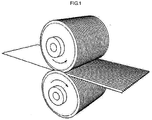
- Fig. 1 is a schematic diagram of a gear drawing device.
- constituent elements including element steps and the like
- constituent elements are not indispensable unless otherwise expressly provided or except the case in which the constituent elements are apparently indispensable in principle.
- the term “step” includes not only a separate step but also a step that cannot be clearly distinguished from other steps as long as the object of the step is achieved.
- the notation "to” expressing a numerical range indicates a range including the numerical values before and after "to”, as the minimum value and the maximum value, respectively.
- the content of each of the components in the composition refers to the total amount of the plural substances in the composition unless otherwise specified.
- the mixed fiber spunbonded nonwoven fabric is disposed on at least one surface of the elastic nonwoven fabric in the multilayer nonwoven fabric of the invention, the adhesion of the multilayer nonwoven fabric to members such as various rotating devices in an apparatus used in an embossing step and the like can be prevented, which provides excellent moldability. Since the spunbonded nonwoven fabric disposed on at least one surface of the elastic nonwoven fabric includes a specific mixed fiber, the multilayer nonwoven fabric is less sticky and excellent in stretchability. Further, the multilayer nonwoven fabric of the invention has excellent low-temperature heat sealability.
- the multilayer nonwoven fabric of the invention preferably has a structure in which at least a mixed fiber spunbonded nonwoven fabric is disposed on a surface brought into contact with rotating equipment attached to a nonwoven fabric producing apparatus, and more preferably has a structure in which a mixed fiber spunbonded nonwoven fabric is disposed on each of both surfaces of an elastic nonwoven fabric.
- the multilayer nonwoven fabric of the invention usually has a basis weight of 360 g/m 2 or less, preferably 240 g/m 2 or less, more preferably 150 g/m 2 or less, and further preferably from 120 g/m 2 to 15 g/m 2 .
- the basis weight can be measured by a method used in Examples described later.
- the compositional ratio of the elastic nonwoven fabric to the mixed fiber spunbonded nonwoven fabric may be appropriately determined according to various applications.
- the elastic nonwoven fabric : mixed fiber spunbonded nonwoven fabric (basis weight ratio) is in the range of 10 : 90 to 90 : 10, preferably in the range of 20 : 80 to 80 : 20, and more preferably in the range of 20 : 80 to 50 : 50.
- the basis weight of the elastic nonwoven fabrics (or mixed fiber spunbonded nonwoven fabrics) is the total of the basis weights of the two or more elastic nonwoven fabrics.
- the multilayer nonwoven fabric of the invention usually has residual strain of 25% or less in at least one direction, and preferably 22% or less. In a case in which the multilayer nonwoven fabric has residual strain of 25% or less in at least one direction, the multilayer nonwoven fabric has good stretchability.
- the residual strain can be measured by a method used in Examples described later.
- the multilayer nonwoven fabric of the invention usually has a maximum load elongation of 50% or more in at least one direction, and preferably 100% or more.
- the maximum load elongation can be measured by a method used in Examples described later.
- the multilayer nonwoven fabric of the invention has stress at 50% extending of preferably 1.5 N/50 mm or less, more preferably 1.3 N/50 mm or less, and further preferably 1.2 N/50 mm or less.
- Stress at 50% recovering is preferably 0.30 N/50 mm or more, more preferably 0.32 N/50 mm or more, and further preferably 0.35 N/50 mm or more.
- the stress at 50% extending and the stress at 50% recovering differ from stretch characteristics (stress at 50% extending/stress at 50% recovering), and tend to change depending on the basis weight of the multilayer nonwoven fabric, and tend to be increased as the basis weight is increased.
- the multilayer nonwoven fabric of the invention has stretch characteristics (stress at 50% extending/stress at 50% recovering) of preferably 3.0 or less, more preferably 2.9 or less, and further preferably 2.8 or less. As the value of the stretch characteristics is smaller, the stretch characteristics are more excellent. The stretch characteristics can be measured by a method used in Examples described later.
- the multilayer nonwoven fabric of the invention has low-temperature heat sealability of preferably 10 N/50 mm or more, more preferably 12 N/50 mm or more, and further preferably 15N/50 mm or more.
- the low-temperature heat sealability can be measured by a method used in Examples described later.
- the elastic nonwoven fabric constituting the multilayer nonwoven fabric of the invention contains a low crystalline polypropylene satisfying (a) to (f) described later (hereinafter also simply referred to as a low crystalline polypropylene).
- the proportion of the low crystalline polypropylene in the elastic nonwoven fabric is preferably 60% by mass or more, more preferably 70% by mass or more, and further preferably 80% by mass or more.
- the elastic nonwoven fabric examples include composite fibers such as sheath-core type composite fibers and side-by-side type composite fibers, and mixed fibers.
- the elastic nonwoven fabric may contain a resin other than the low crystalline polypropylene.
- the resin other than the low crystalline polypropylene constituting the elastic nonwoven fabric is not particularly limited, but from the viewpoint of stretch characteristics, it is preferable to use a thermoplastic elastomer.
- the thermoplastic elastomer various known thermoplastic elastomers can be used, and two or more kinds of thermoplastic elastomers may be used in combination.
- thermoplastic elastomer examples include: a styrene elastomer typified by a block copolymer composed of at least one polymer block composed of at least one aromatic vinyl compound such as styrene, which is typified by a polystyrene-polybutadiene-polystyrene block copolymer (referred to SBS), a polystyrene-polyisoprene-polystyrene block copolymer (referred to SIS), and hydrogenated products thereof, e.g., a polystyrene-polyethylene-butylene-polystyrene block copolymer (referred to SEBS) and a polystyrene-polyethylene-propylene-polystyrene block copolymer (referred to SEPS), and at least one polymer block composed of a conjugated diene compound such as butadiene or isoprene, or a hydrogenated product
- the elastic nonwoven fabric refers to a nonwoven fabric having an elastic recovering property in a case in which stress is released after drawing.
- the elastic nonwoven fabric can be produced by various known methods. Specific examples thereof include a spunbond method, a melt blow method, and a flash spinning method. Among the elastic nonwoven fabrics, a spunbonded nonwoven fabric obtained by the spunbond method or a meltblown nonwoven fabric obtained by the melt blow method is preferable.
- the elastic nonwoven fabric usually has a basis weight of 120 g/m 2 or less, preferably 80 g/m 2 or less, more preferably 50 g/m 2 or less, and further preferably from 40 g/m 2 to 2 g/m 2 .
- the fiber constituting the elastic nonwoven fabric usually has a fiber diameter of 50 ⁇ m or less, preferably 40 ⁇ m or less, and more preferably 30 ⁇ m or less.
- the low crystalline polypropylene is a polymer satisfying the following requirements (a) to (f).
- the weight-average molecular weight (Mw) is a weight-average molecular weight in terms of polystyrene measured by the gel permeation chromatography (GPC) method under the following apparatus and conditions.
- the molecular weight distribution (Mw/Mn) is a value calculated from the number average molecular weight (Mn) measured in the similar manner and the weight-average molecular weight (Mw).
- the low crystalline polypropylene further satisfy the following (g).
- the melting point (Tm-D) of the low crystalline polypropylene is 0°C or higher, the occurrence of the stickiness of the elastic nonwoven fabric is suppressed. In a case in which the melting point is 120°C or less, sufficient elastic recoverability is obtained. From this viewpoint, the melting point (Tm-D) is more preferably from 0°C to 100°C, and further preferably from 30°C to 100°C.
- the melting point (Tm-D) can be determined by using a differential scanning calorimeter (DSC-7, manufactured by Perkin Elmer), holding 10 mg of a sample at -10°C under a nitrogen atmosphere for 5 minutes, thereafter heating the sample at a temperature increase rate of 10°C/min to record a melting endothermic curve, and determining the temperature as the peak top of the peak observed on the highest temperature side of the curve.
- DSC-7 differential scanning calorimeter
- the low crystalline polypropylene can be synthesized using a homogeneous catalyst referred to as a so-called metallocene catalyst as described, for example, in International Publication No. 2003/087172 .
- the low crystalline polypropylene may contain various known additives such as an antioxidant, a heat stabilizer, a weathering stabilizer, an antistatic agent, a slip agent, an antifogging agent, a lubricant, a dye, a pigment, a natural oil, a synthetic oil, and wax as optional components while still achieving the object of the invention.
- various known additives such as an antioxidant, a heat stabilizer, a weathering stabilizer, an antistatic agent, a slip agent, an antifogging agent, a lubricant, a dye, a pigment, a natural oil, a synthetic oil, and wax as optional components while still achieving the object of the invention.
- the proportion of the long fibers of the thermoplastic elastomer (A) in the mixed fiber spunbonded nonwoven fabric is preferably 20% by mass or more, and more preferably 30% by mass or more. From the viewpoint of processability (sticky resistance), the proportion of the long fibers of the thermoplastic elastomer (A) in the mixed fiber spunbonded nonwoven fabric is preferably 70% by mass or less, and more preferably 60% by mass or less.
- the fiber diameters (average value) of the long fibers of each of the thermoplastic elastomer (A) and the thermoplastic resin (B) that form the mixed fiber spunbonded nonwoven fabric are usually 50 ⁇ m or less, preferably 40 ⁇ m or less, and more preferably 30 ⁇ m or less.
- the fiber diameter of the long fibers of the thermoplastic elastomer (A) and the fiber diameter of the long fibers of the thermoplastic resin (B) may be the same or different.
- the mixed fiber spunbonded nonwoven fabric In applications for sanitary materials such as diapers, from the viewpoint of flexibility and air breathability, the mixed fiber spunbonded nonwoven fabric generally has a basis weight of 120 g/m 2 or less, preferably 80 g/m 2 or less, more preferably 50 g/m 2 or less, and further preferably from 40 g/m 2 to 15 g/m 2 in the total multilayer.
- thermoplastic elastomer (A) various known thermoplastic elastomers can be used.
- One kind of the thermoplastic elastomers may be used alone, or two or more kinds of the thermoplastic elastomers may be used in combination.
- thermoplastic elastomer (A) examples include a styrene elastomer, a polyester elastomer, a polyamide elastomer, a thermoplastic polyurethane elastomer, a polyolefin elastomer, a vinyl chloride elastomer, and a fluorine elastomer.
- the styrene elastomer is an elastomer typified by a polystyrene-polybutadiene-polystyrene block copolymer (SBS), a polystyrene-polyisoprene-polystyrene block copolymer (SIS), and a polystyrene-polyethylene ⁇ butylene-polystyrene block copolymer (SEBS), and a polystyrene-polyethylene ⁇ propylene-polystyrene block copolymer (SEPS) which are hydrogenation products thereof.
- SBS polystyrene-polybutadiene-polystyrene block copolymer
- SIS polystyrene-polyisoprene-polystyrene block copolymer
- SEBS polystyrene-polyethylene ⁇ butylene-polystyrene block copolymer
- the styrene elastomer is a block copolymer composed of at least one polymer block composed of an aromatic vinyl compound such as styrene and at least one conjugated diene compound such as butadiene or isoprene, or a hydrogenated product thereof.
- examples of the styrene elastomer include KRATON polymer (trade name, manufactured by Shell Chemical Co.), SEPTON (trade name, manufactured by Kuraray Co., Ltd.), TUFTEC (trade name, manufactured by Asahi Chemical Industry Co., Ltd.), and LEOSTOMER (trade name, manufactured by RIKEN TECHNOS CORPORATION).
- the polyester elastomer is an elastomer typified by a block copolymer composed of a highly crystalline aromatic polyester and a noncrystalline aliphatic polyether.
- the polyester elastomer is sold under the trade names of, for example, HYTREL (trade name, manufactured by EI du Pont de Nemours and Company) and PELPRENE (trade name, manufactured by Toyobo Co., Ltd.).
- the polyamide elastomer is an elastomer typified by a block copolymer composed of crystalline polyamide having a high melting point and a noncrystalline polyether or polyester having a low glass transition temperature (Tg).
- the polyamide elastomer is sold under the trade name of PEBAX (trade name, Atofina Japan Ltd.), for example.
- thermoplastic polyurethane elastomer is an elastomer typified by a block copolymer in which a hard segment is composed of polyurethane and a soft segment is composed of a polycarbonate polyol, an ether polyol, a caprolactone polyester, or an adipate polyester and the like.
- the polyolefin elastomer is an elastomer containing a simple body such as a noncrystalline or low crystalline ethylene ⁇ -olefin random copolymer, a propylene ⁇ -olefin random copolymer, or a propylene ⁇ ethylene ⁇ -olefin random copolymer; or an elastomer as a mixture of the noncrystalline or low crystalline random copolymer with a propylene homopolymer; or an elastomer as a mixture of the noncrystalline or low crystalline random copolymer with crystalline polyolefin such as a copolymer of propylene and a small amount of an ⁇ -olefin, a high density polyethylene, and a medium density polyethylene.
- a simple body such as a noncrystalline or low crystalline ethylene ⁇ -olefin random copolymer, a propylene ⁇ -olefin random copolymer, or a propylene ⁇ ethylene ⁇ -olef
- the polyolefin elastomer is sold under the trade names of, for example, TAFMER (trade name, manufactured by Mitsui Chemicals, Inc.), Engage (trade name, manufactured by DuPont Dow Elastomers) which is an ethylene-octene copolymer, CATALLOY containing a crystalline olefin copolymer (trade name, manufactured by Montel Co., Ltd.), and Vistamaxx (trade name, manufactured by Exxon Mobil Chemical Co., Ltd.), and the like.
- TAFMER trade name, manufactured by Mitsui Chemicals, Inc.
- Engage trade name, manufactured by DuPont Dow Elastomers
- CATALLOY containing a crystalline olefin copolymer
- Vistamaxx trade name, manufactured by Exxon Mobil Chemical Co., Ltd.
- the vinyl chloride elastomer is sold under the trade names such as Leonyl (trade name, manufactured by Riken Technos Co., Ltd.), and POSMYL (trade name, manufactured by Shin-Etsu Polymer Co., Ltd.).
- thermoplastic elastomers the thermoplastic polyurethane elastomer and the polyolefin elastomer are preferable, and the thermoplastic polyurethane elastomer is more preferable from the viewpoint of stretchability and processability.
- thermoplastic polyurethane elastomers having a solidification starting temperature of 65°C or higher, preferably 75°C or higher, and most preferably 85°C or higher are preferable.
- the solidification starting temperature is preferably 195°C or lower.
- the solidification starting temperature is a value measured using a differential scanning calorimeter (DSC), and is the starting temperature of an exothermic peak derived from the solidification of the thermoplastic polyurethane elastomer occurring in a case in which the temperature of the thermoplastic polyurethane elastomer is decreased at a rate of 10°C/min after the temperature of the thermoplastic polyurethane elastomer is increased at 10°C/min to 230°C and kept at 230°C for 5 min.
- DSC differential scanning calorimeter
- the solidification starting temperature is 65°C or higher, it is possible to suppress defective molding such as fusion of fibers, filament breakage, massed resin in obtaining a mixed fiber spunbonded nonwoven fabric, and also it is possible to prevent the molded mixed fiber spunbonded nonwoven fabrics from being wound around the emboss roller in thermal emboss processing.
- the obtained mixed fiber spunbonded nonwoven fabrics have less stickiness, and are suitably used as materials that come in contact with skin such as clothes, hygiene materials, and materials of sporting goods.
- the solidification starting temperature by setting the solidification starting temperature to 195°C or lower, the molding processability can be improved.
- the solidification starting temperature of the molded fiber tends to be higher than the solidification starting temperature of the thermoplastic polyurethane elastomer used for the fiber.
- thermoplastic polyurethane elastomer In order to adjust the solidification starting temperature of the thermoplastic polyurethane elastomer to 65°C or higher, it is necessary to select a polyol, an isocyanate compound, and a chain extender each having an optimum chemical structure, which are used as raw materials for the thermoplastic polyurethane elastomer, and to adjust a hard segment amount.
- the term "hard segment amount” as used herein is a mass percent value (% by mass) determined by dividing the total mass of the isocyanate compound and the chain extender used is in the production of the thermoplastic polyurethane elastomer by the total amount of the polyol, the isocyanate compound, and the chain extender, and multiplying the resulting value by 100.
- the hard segment amount is preferably from 20% by mass to 60% by mass, more preferably from 22% by mass to 50% by mass, and further preferably from 25% by mass to 48% by mass.
- the thermoplastic polyurethane elastomer has the number of particles as components insoluble in a polar solvent of preferably 3,000,000 particles (3,000,000 particles/g) or less, more preferably 2,500,000 particles/g or less, and further preferably 2,000,000 particles/g or less with respect to 1 g of the thermoplastic polyurethane elastomer.
- the components insoluble in the polar solvent in the thermoplastic polyurethane elastomer are mainly agglomerates such as fish eye and gel occurring during the production of the thermoplastic polyurethane elastomer.
- components causing the occurrence of the components insoluble in the polar solvent include components derived from hard segment agglomerates of the thermoplastic polyurethane elastomer, components obtained by crosslinking the hard segment and/or the soft segment with an allophanate bond or a biuret bond and the like, and components produced by a chemical reaction between raw materials.
- the number of particles as the components insoluble in the polar solvent is determined by dissolving the thermoplastic polyurethane elastomer in a dimethylacetamide solvent (hereinafter abbreviated as "DMAC") and measuring the insoluble components by means of a particle size distribution measuring apparatus equipped with a 100 ⁇ m aperture utilizing a pore electrical resistance method. Using the apparatus equipped with a 100 ⁇ m aperture, the number of particles of from 2 to 60 ⁇ m can be measured in terms of uncrosslinked polystyrene.
- DMAC dimethylacetamide solvent
- thermoplastic polyurethane elastomer having a low content of the components insoluble in the polar solvent can be obtained by conducting a polymerization reaction of a polyol, an isocyanate compound, and a chain extender, followed by filtration.
- the thermoplastic polyurethane elastomer has a water content of preferably 350 ppm or less, more preferably 300 ppm or less, and further preferably 150 ppm or less.
- a total amount (a) of fusion heat determined from an endothermic peak at a peak temperature in a range of 90°C to 140°C as measured by a differential scanning calorimeter (DSC) and a total amount (b) of fusion heat determined from an endothermic peak at a peak temperature of from higher than 140°C to 220°C or lower preferably satisfy the following formula (I), more preferably satisfy the following formula (II), and further preferably satisfy the following formula (III).
- a/(a + b) means a ratio (unit: %) of the amount of fusion heat of the hard domain of the thermoplastic polyurethane elastomer.
- the ratio of the amount of fusion heat of the hard domain of the thermoplastic polyurethane elastomer is 80% or less, the strength and stretchability of the fiber, particularly the fiber and nonwoven fabric in the mixed fiber spunbonded nonwoven fabric are improved.
- the lower limit of the ratio of the amount of fusion heat of the hard domain of the thermoplastic polyurethane elastomer is preferably about 0.1%.
- the thermoplastic polyurethane elastomer preferably has a melt viscosity of 100 Pa ⁇ s to 3000 Pa ⁇ s under conditions of a temperature of 200°C and a shear rate of 100 sec -1 , more preferably from 200 Pa ⁇ s to 2000 Pa ⁇ s, and further preferably from 1000 Pa ⁇ s to 1500 Pa ⁇ s.
- the melt viscosity is a value measured by a capirograph (manufactured by Toyo Seiki Co., Ltd., nozzle length: 30 mm, diameter: 1 mm).
- thermoplastic polyurethane elastomer having such characteristics can be obtained by, for example, the production method described in JP-A No. 2004-244791 .
- the mixed fiber spunbonded nonwoven fabric molded by using the thermoplastic polyurethane elastomer is excellent in tactile sensation and therefore can be preferably used for applications that come in contact with skin such as a sanitary material.
- the thermoplastic polyurethane based elastomer hardly causes clogging of a filter that is mounted in an extruder in order to filter impurities and the like, and reduces the frequency of adjustment and maintenance for equipment, which is industrially preferable.
- noncrystalline or low crystalline polyolefin elastomers are preferable, and an ethylene ⁇ -olefin copolymer which is a copolymer of noncrystalline or low crystalline ethylene and one or more ⁇ -olefins having 3 to 20 carbon atoms such as propylene, 1-butene, 1-pentene, 1-hexene, 4-methyl-1-pentene, 1-heptene, 1-octene, and 1-decene, and a propylene ⁇ -olefin copolymer which is a copolymer of noncrystalline or low crystalline propylene and one or more ⁇ -olefins having 2 to 20 carbon atoms (excluding 3 carbon atoms) such as ethylene, 1-butene, 1-pentene, 1-hexene, 4-methyl-1-pentene, 1-heptene, 1-octene, and 1-decene are more preferable.
- an ethylene ⁇ -olefin copolymer which is a cop
- the noncrystalline or low crystalline polyolefin elastomer is, for example, a polyolefin elastomer having a degree of crystallinity of 20% or less (including 0%) as measured by X-ray diffraction.
- noncrystalline or low crystalline ethylene ⁇ -olefin copolymer examples include an ethylene ⁇ propylene random copolymer, and an ethylene ⁇ 1-butene random copolymer.
- the melt flow rate (MFR) of the ethylene ⁇ -olefin copolymer is not particularly limited as long as the ethylene ⁇ -olefin copolymer has spinnability, but MFR (ASTM D1238 190°C, load: 2160 g) and MFR (ASTM D1238 230°C, load: 2160 g) are usually in the range of from 1 g/10 min to 1000 g/10 min, preferably from 5 g/10 min to 500 g/10 min, and more preferably from 10 g/10 min to 100 g/10 min.
- noncrystalline or low crystalline propylene ⁇ -olefin copolymer examples include a propylene ⁇ ethylene random copolymer, a propylene ⁇ ethylene ⁇ 1-butene random copolymer, and a propylene ⁇ 1-butene random copolymer.
- MFR of the propylene ⁇ -olefin copolymer is not particularly limited as long as the propylene ⁇ -olefin copolymer has spinnability, but MFR (ASTM D1238 230°C, load: 2160 g) is usually from 1 g/10 min to 1000 g/10 min, preferably from 5 g/10 min to 500 g/10 min, and more preferably from 10 g/10 min to 100 g/10 min.
- the polyolefin elastomer may be a single body of a copolymer of noncrystalline or low crystalline polymer, and may also be a composition obtained by mixing a propylene homopolymer, a copolymer of propylene and a small amount of ⁇ -olefin, or crystalline polyolefin such as a high density polyethylene or a medium density polyethylene in an amount of about 1 to about 40% by mass with the noncrystalline or low crystalline polymer.
- a composition that is particularly preferable as the polyolefin elastomer is an elastomer composition containing a polypropylene resin composition containing 1 to 40% by mass of isotactic polypropylene (i) and 60 to 99% by mass of a propylene ethylene ⁇ -olefin copolymer (ii) (a copolymer of 45 to 89 mol% of propylene, 10 to 25 mol% of ethylene, and ⁇ -olefin having 4 to 20 carbon atoms, the amount of copolymerized ⁇ -olefin having 4 to 20 carbon atoms does not exceed 30 mol%).
- a polypropylene resin composition containing 1 to 40% by mass of isotactic polypropylene (i) and 60 to 99% by mass of a propylene ethylene ⁇ -olefin copolymer (ii) (a copolymer of 45 to 89 mol% of propylene, 10 to 25 mol% of ethylene, and ⁇
- thermoplastic resin (B) various known thermoplastic resins other than the thermoplastic elastomer (A) can be used, and the thermoplastic resins may be used alone, or in combination of two or more.
- the thermoplastic resin (B) is a resinous polymer different from the thermoplastic elastomer (A), and is usually a crystalline polymer having a melting point (Tm) of 100°C or higher, or a noncrystalline polymer having a glass transition temperature of 100°C or higher.
- Tm melting point
- the thermoplastic resin (B) the crystalline thermoplastic resin is preferable.
- thermoplastic resins (B) it is preferable to use a thermoplastic resin (extensible thermoplastic resin) having a maximum point elongation of 50% or more, preferably 70% or more, and more preferably 100% or more and having quite low elastic recoverability in a case of a spunbonded nonwoven fabric obtained by a known production method.
- a multilayer nonwoven fabric produced by using a mixed fiber spunbonded nonwoven fabric obtained by mixing long fibers of such a thermoplastic resin (B) with long fibers of the thermoplastic elastomer (A) can exhibit bulkiness due to drawing, and have improved tactile feeling and an extension stop function.
- the upper limit of the maximum point elongation of the spunbonded nonwoven fabric made of the thermoplastic resin (B) is not necessarily limited, but it is usually 300% or less.
- thermoplastic resin (B) examples include polyolefins which are homopolymers or copolymers of ⁇ -olefins including ethylene, propylene, 1-butene, 1-hexene, 4-methyl-1-pentene, and 1-octene, including polyolefins such as high pressure low density polyethylene, linear low density polyethylene (so-called LLDPE), high density polyethylene (so-called HDPE), polypropylene (propylene homopolymer), polypropylene random copolymer, poly 1-butene, poly 4-methyl-1-pentene, ethylene ⁇ propylene random copolymer, ethylene ⁇ 1-butene random copolymer and propylene ⁇ 1-butene random copolymer; polyesters (polyethylene terephthalate, polybutylene terephthalate, polyethylene naphthalate etc.); polyamide (nylon-6, nylon-66, polymetaxyleneadipamide, etc.); polyvinyl chloride; polyole
- thermoplastic resins (B) from the viewpoint of spinning stability during molding and drawing processability of the nonwoven fabric, polyolefin is more preferable, and high-pressure low density polyethylene, linear low density polyethylene (so-called LLDPE), high density polyethylene, and propylene polymers such as polypropylene and a polypropylene random copolymer are further preferable.
- LLDPE linear low density polyethylene
- propylene polymers such as polypropylene and a polypropylene random copolymer are further preferable.
- the propylene polymer is preferably a propylene homopolymer or a copolymer of propylene and a very small amount of one or two or more ⁇ -olefins having 2 or more carbon atoms (excluding 3 carbon atoms), and preferably 2 to 8 carbon atoms (excluding 3 carbon atoms) such as ethylene, 1-butene, 1-pentene, 1-hexene, 1-octene, and 4-methyl-1-pentene, having a melting point (Tm) of 155°C or higher, and preferably 157°C to 165°C.
- Tm melting point
- the melt flow rate (MFR: ASTMD-1238, 230°C, load: 2160 g) of the propylene polymer is not particularly limited as long as the propylene polymer can be melt-spun.
- the melt flow rate of the propylene polymer is usually 1 g/10 min to 1000 g/10 min, more preferably 5 g/10 min to 500 g/10 min, and more preferably 10 g/10 min to 100 g/10 min.
- the ratio Mw/Mn of the weight-average molecular weight (Mw) of the propylene polymer to the number average molecular weight (Mn) is usually 1.5 to 5.0.
- Mw/Mn is preferably in the range of 1.5 to 3.0 in that fibers having good spinnability and excellent fiber strength can be obtained.
- Mw and Mn can be measured by a known method using GPC (gel permeation chromatography).
- the thermoplastic resin (B) is an olefinic polymer composition obtained by adding HDPE to a propylene polymer.
- the ratio of HDPE is preferably 1% by mass to 20% by mass, more preferably 2% by mass to 15% by mass, and further preferably 4% by mass to 10% by mass based on 100% by mass of the total amount of the propylene polymer and HDPE.
- the type of HDPE to be added to the propylene polymer is not particularly limited, but HDPE usually has a density is 0.94 g/cm 3 to 0.97 g/cm 3 , preferably 0.95 g/cm 3 to 0.97 g/cm 3 , and more preferably 0.96 g/cm 3 to 0.97 g/cm 3 .
- HDPE has a melt flow rate (MFR: ASTMD-1238, 190°C, load: 2160 g), which is not particularly limited as long as it has spinnability, of usually 0.1 to 100 g/10 min, preferably 0.5 to 50 g/10 min, and more preferably 1 to 30 g/10 min from the viewpoint of exhibiting extension properties.
- good spinnability means that filament breakage is not caused and filament fusion is not caused during discharging from a spinning nozzle and during drawing.
- Various stabilizers such as a heat stabilizer and a weathering stabilizer, an antistatic agent, a slip agent, an anti-fogging agent, a lubricant, a dye, a pigment, a natural oil, a synthetic oil, and wax and the like can be added to the elastic nonwoven fabric and the mixed fiber spunbonded nonwoven fabric if necessary.
- the multilayer nonwoven fabric of the invention may have one or more layers other than the elastic nonwoven fabric and the mixed fiber spunbonded nonwoven fabric depending on applications.
- the other layer include a knitted fabric, a woven fabric, a nonwoven fabric other than the elastic nonwoven fabric and the mixed fiber spunbonded nonwoven fabric, and a film.
- a method of further stacking (adhering) another layer on the multilayer nonwoven fabric of the invention is not particularly limited, and various method such as a thermal fusion method (such as thermal embossing or ultrasonic fusion), a mechanical confounding method (such as needle punch or water jet), a method of using an adhesive (such as a hot melt adhesive or a urethane adhesive), and extrusion laminating may be employed.
- nonwoven fabrics other than the elastic nonwoven fabric and the mixed fiber spunbonded nonwoven fabric, included in the multilayer nonwoven fabric of the invention include various known nonwoven fabrics such as a spunbonded nonwoven fabric, a meltblown nonwoven fabric, a wet nonwoven fabric, a dry nonwoven fabric, a dry pulp nonwoven fabric, a flash spun nonwoven fabric, and a split non-woven fabric.
- the nonwoven fabric may be a stretchable nonwoven fabric or a nonstretchable nonwoven fabric.
- the nonstretchable nonwoven fabric refers to a nonwoven fabric which does not cause stress at recovering after extending in MD (machine direction of the nonwoven fabric, longitudinal direction) or CD (direction perpendicular to the machine direction of the nonwoven fabric, lateral direction).
- the film included in the multilayer nonwoven fabric of the invention is preferably an air breathable (moisture permeable) film from the viewpoint of maintaining air breathability and hydrophilicity which are features of the multilayer nonwoven fabric of the invention.
- the air breathable film include various known air breathable films such as a film made of moisture permeable thermoplastic elastomer (such as a polyurethane elastomer, a polyester elastomer, or a polyamide elastomer), and a porous film obtained by drawing a film made of a thermoplastic resin containing inorganic fine particles or organic fine particles to create pores in the film.
- thermoplastic resin used for the porous film polyolefins such as high pressure low density polyethylene, linear low density polyethylene (so-called LLDPE), high density polyethylene, polypropylene, a polypropylene random copolymer, and combinations thereof are preferable.
- LLDPE linear low density polyethylene
- polypropylene polypropylene random copolymer
- thermoplastic resin films made of polyethylene, polypropylene, or combinations thereof and the like may be used.
- the multilayer nonwoven fabric of the invention can be produced by a known nonwoven fabric producing method using low crystalline polypropylene as a raw material of an elastic nonwoven fabric, a thermoplastic elastomer (A) and a thermoplastic resin (B) as raw materials of a mixed fiber spunbonded nonwoven fabric, and an additive used if necessary.
- thermoplastic elastomer (A) and a thermoplastic resin (B) are melted by an extruder provided in a first-line spinning device, introduced to a spinneret (die) fitted with a large number of spinning holes (nozzles) or sheath-core spinning holes if necessary, and discharged. Thereafter, the long fibers composed of the melt-spun thermoplastic elastomer (A) and the long fibers composed of the thermoplastic resin (B) are introduced into a cooling chamber, and cooled by cooling air. The long fibers are then drawn (towed) by drawing air, and the mixed fiber spunbonded nonwoven fabric is deposited on a moving collection surface.
- the low crystalline polypropylene is melted by an extruder provided in a second-line spinning device, and introduced into spinning holes having a spinneret (die) having a large number of spinning holes (nozzles).
- the low crystalline polypropylene is discharged.
- the long fibers composed of the melt-spun low crystalline polypropylene are introduced into a cooling chamber, and cooled by cooling air.
- the long fibers are drawn (towed) by drawing air, and deposited on the mixed fiber spunbonded nonwoven fabric, thereby forming an elastic nonwoven fabric.
- a mixed fiber spunbonded nonwoven fabric may be deposited on the elastic nonwoven fabric by using a third-line spinning device.
- the melting temperatures of polymers serving as raw materials for the elastic nonwoven fabric and the mixed fiber spunbonded nonwoven fabric are not particularly limited as long as the temperatures are equal to or higher than the softening temperature or melting temperature of each polymer and lower than the thermal decomposition temperature.
- the temperature of the spinneret depends on the type of the polymer to be used.
- thermoplastic elastomer (A) a thermoplastic polyurethane elastomer or an olefin copolymer elastomer
- thermoplastic resin (B) a propylene polymer or an olefin polymer composition of a propylene polymer and HDPE
- the temperature of the spinneret is usually set to a temperature of from 180°C to 240°C, preferably from 190 to 230°C, and more preferably from 200 to 225°C.
- the temperature of the cooling air is not particularly limited as long as the polymer can be solidified, but it is usually from 5°C to 50°C, preferably from 10°C to 40°C, and more preferably from 15°C to 30°C.
- a drawing air velocity is usually in the range of from 100 m/min to 10,000 m/min, and preferably from 500 m/min to 10,000 m/min.
- the multilayer nonwoven fabric of the invention preferably has a structure in which at least a part of the elastic nonwoven fabric and at least a part of the mixed fiber spunbonded nonwoven fabric are thermally fusion bonded. At this time, at least a part of the elastic nonwoven fabric and at least a part of the mixed fiber spunbonded nonwoven fabric may be compacted with nip rolls before thermal fusion bonding.
- the method of thermal fusion bonding is not particularly limited, and it can be selected from various known methods.
- prebonding methods include a method of using means such as ultrasonic waves, thermal embossing using embossing rolls, and a method using hot air through.
- thermal embossing is preferable, and the temperature range thereof is preferably from 60°C to 115°C.
- the emboss area ratio is usually from 5% to 30%, and preferably from 5% to 20%, and the non-embossed unit area is 0.5 mm 2 or more, and preferably from 4 mm 2 to 40 mm 2 .
- the non-embossed unit area is the maximum area of a quadrangle inscribed in emboss in a non-embossed portion of minimum units surrounded by embossed portions in all directions. Examples of the shape of the mark include a circle, an ellipse, an oval, a square, a rhombus, a rectangle, a square, and continuous shapes based on these shapes.
- the stretchable multilayer nonwoven fabric of the invention is a multilayer nonwoven fabric having stretchability obtained by drawing the multilayer nonwoven fabric.
- the stretchable multilayer nonwoven fabric of the invention can be obtained by drawing the multilayer nonwoven fabric.
- the drawing method is not particularly limited, and conventionally known methods can be applied.
- the drawing method may be such that the multilayer nonwoven fabric is drawn partially or entirely.
- the drawing method may be such that the multilayer nonwoven fabric is drawn uniaxially or biaxially.
- Examples of the method of drawing the multilayer nonwoven fabric in a machine direction (MD) include a method of passing the partially fusion bonded mixed fibers through two or more pairs of nip rolls. At this time, the partially fusion bonded multilayer nonwoven fabric can be drawn by increasing the rotational speeds of the nip rolls in order in the machine direction.
- Gear drawing can also be performed using a gear drawing device shown in Fig. 1 .
- the draw ratio is preferably 50% or more, more preferably 100% or more, and further preferably 200% or more, and preferably 1000% or less, and more preferably 400% or less.
- the above draw ratio is preferably satisfied in the machine direction (MD) or a direction perpendicular thereto (CD).
- the above draw ratio is preferably satisfied in at least one of the machine direction (MD) or the direction perpendicular thereto (CD).
- the (long) fibers forming the elastic nonwoven fabric are elastically recovered, and the long fibers forming the mixed fiber spunbonded nonwoven fabric are folded without being elastically recovered.
- the multilayer nonwoven fabric exhibits bulkiness.
- the long fibers forming the mixed fiber spunbonded nonwoven fabric become thinner, the long fibers can have improved flexibility and tactile feeling, and an extension stop function.
- the fiber product of the invention includes the multilayer nonwoven fabric or the stretchable multilayer nonwoven fabric of the invention.
- the fiber product is not particularly limited, and examples thereof include absorbent articles such as disposable diapers and sanitary articles, hygiene articles such as sanitary masks, medical articles such as bandages, clothing materials, and packaging materials.
- the fiber product of the invention preferably includes the multilayer nonwoven fabric or the stretchable multilayer nonwoven fabric of the invention as an elastic member.
- test pieces of 200 mm (machine direction: MD) ⁇ 50 mm (lateral direction: CD) were sampled from a nonwoven fabric simple body or a multilayer nonwoven fabric. Three sampling points were arbitrarily selected for both MD and CD (6 points in total). Subsequently, the mass (g) of each of the sampled test pieces was measured using a scale electric balance (manufactured by Kensei Co., Ltd.). The average value of the masses of the test pieces was determined. The determined average value was converted to the mass (g) per 1 m 2 to the first decimal place to give a basis weight [g/m 2 ] of each sample.
- MD machine direction
- CD lateral direction
- Embossing rolls were run for 5 minutes in an embossing step, to confirm an adhesion state of the nonwoven fabric simple body or the multilayer nonwoven fabric occurring in a case in which the nonwoven fabric simple body or the multilayer nonwoven fabric passed through the embossing rolls.
- test pieces of 50 mm (MD) ⁇ 200 mm (CD) were sampled from the nonwoven fabric simple body or the multilayer nonwoven fabric.
- the test pieces were subjected to a tensile test using a constant speed extending type tensile tester under conditions of a chuck distance of 100 mm and a tensile speed of 100 mm/min, and the extension percentage of the test piece at the time when the load applied to the test piece became the maximum was measured.
- the average value of the five test pieces was determined and taken as maximum load elongation.
- test pieces of 250 mm (MD) ⁇ 50 mm (CD) were cut out from the nonwoven fabric simple body or the multilayer nonwoven fabric. This test piece was drawn under conditions of a chuck distance of 30 mm, a tensile speed of 30 mm/min, and a draw ratio of 100%. Thereafter, the test piece was immediately recovered to the original length at the same speed, to obtain a stretchable nonwoven fabric. At that time, the strain was measured at the time when the tensile load reached 0 gf. The average value of the five nonwoven fabrics was evaluated as residual strain (unit: %).
- test pieces of 25 mm (MD) ⁇ 200 mm (CD) were sampled from the nonwoven fabric single body or the multilayer nonwoven fabric using a universal tensile tester (IM-201 type, manufactured by Intesco Co., Ltd.). Subsequently, each of the sampled test pieces was extended by 100% under conditions of a sample width of 25 mm, a chuck distance of 100 mm, and a tensile speed of 300 mm/min, and then immediately recovered to the original length at the same speed. One cycle of this operation was further repeated, and stress in a case in which a draw ratio became 50% during extending in the second cycle was defined as stress at 50% extending.
- IM-201 type manufactured by Intesco Co., Ltd.
- Ten evaluators touched the nonwoven fabric simple body or the multilayer nonwoven fabric with their hands and evaluated the stickiness by the following criteria.
- a multilayer nonwoven fabric and a nonwoven fabric peeled off from a commercially available disposable diaper were stacked one by one, and a heat-sealed sample was produced using a heat sealer under conditions of a temperature of 90°C, a pressure of 0.3 MPa, and a time of 1 second.
- Three test pieces of 250 mm (MD) ⁇ 50 mm (CD) were sampled from the prepared sample.
- a packing tape was attached to each of both surfaces of a part of the test piece (20 mm from an end in the MD direction). Thereafter, the packing tape was manually pulled in both directions of the test piece, thereby peeling a layer of the multilayer nonwoven fabric by 100 mm.
- each peeled layer was set in a constant speed extending type tensile tester.
- a tensile test was conducted under conditions of a chuck distance of 100 mm and a tensile speed of 100 mm/min. The stress of the test piece at the time when a load applied to the test piece reached the maximum was measured. The average value of the three test pieces was evaluated as low temperature heat sealability. A case in which the test piece was firmly fixed such that the test piece was broken was defined as "material breaking".
- TPU (A-1) The physical properties of the obtained TPU (A-1) were hardness: 81, melt viscosity: 1.1, and flow starting temperature: 155°C.
- PP-1 propylene homopolymer
- PP-1 propylene homopolymer
- MFR measured at 230°C under a load of 2.16 kg in accordance with ASTM D 12308
- HDPE high density polyethylene
- Propylene and hydrogen were continuously supplied in a state where a hydrogen concentration in a gas phase portion was 8 mol% at a polymerization temperature of 70°C and the total pressure in the reactor was maintained at 0.7 MPa ⁇ G.
- the low crystalline propylene polymer thus obtained had a weight-average molecular weight (Mw) of 1.2 ⁇ 10 4 and Mw/Mn of 2. According to NMR measurement, [mmmm] was 46 mol%; [rrrr]/(1 - [mmmm]) was 0.038; [rmrm] was 2.7 mol%; and [mm] ⁇ [rr]/[mr] 2 was 1.5.
- TPU (A-1) and the thermoplastic resin composition (B-1) prepared above were independently melted using an extruder having a diameter of 75 mm and an extruder having a diameter of 50 mm. Thereafter, these melted products were melt spun according to a spunbonding method using a spunbonded nonwoven fabric molding machine having a spinneret (length in a direction perpendicular to a machine direction on a collection surface: 800 mm) in such conditions that both a resin temperature and a die temperature were 205°C; a cooling air temperature was 20°C; and a drawing air velocity was 3200 m/min to deposit a web composed of mixed long fibers containing long fibers A composed of TPU (A-1) and long fibers B composed of the thermoplastic resin composition (B-1) on the collection surface.
- a nozzle pattern in which discharge holes for TPU (A-1) and discharge holes for the thermoplastic resin composition (B-1) were alternately arranged was used as the spinneret.
- the nozzle diameter for TPU (A-1) (long fiber A) was 0.75 mm
- the nozzle diameter for the thermoplastic resin composition (B-1) (long fiber B) was 0.6 mm.
- a nozzle pitch in a longitudinal direction was 8 mm
- a nozzle pitch in a lateral direction was 11 mm.
- the ratio of the number of nozzles for the long fibers A to the number of nozzles for the long fibers B was 1 : 1.45.
- the discharge amount of one hole for the long fibers A was 0.78 g/(minute ⁇ hole), and the discharge amount of one hole for the long fibers B was 0.59 g/(minute ⁇ hole).
- a spunbonded nonwoven fabric composed of the mixed long fibers was deposited as a first layer on the collection surface.
- an elastic nonwoven fabric was deposited as a second layer on the mixed fiber spunbonded nonwoven fabric.
- the low crystalline polypropylene produced by the above method was melted using a single screw extruder having a screw diameter of 75 mm. Thereafter, the melted product was melt spun according to a spunbonding method using a spunbonded nonwoven fabric molding machine having a spinneret (die, number of holes: 808) (length in the direction perpendicular to the machine direction on the collection surface: 800 mm) under conditions where both a resin temperature and a die temperature were 215°C; a cooling air temperature was 20°C; and a drawing air-blowing speed was 3750 m/min.
- a second layer was deposited.
- the same mixed fiber spunbonded nonwoven fabric as the first layer was deposited as a third layer on the elastic nonwoven fabric by the same method as that of the first layer to prepare a three-layer deposit.
- This deposit was subjected to a thermal pressure treatment using embossing rolls (emboss area ratio: 18%, emboss temperature: 70°C) to give a multilayer nonwoven fabric which had a total basis weight of 60.0 g/m 2 , the basis weight of each of the first layer and the third layer being 20.0 g/m 2 , the basis weight of the second layer being 20.0 g/m 2 .
- the multilayer nonwoven fabric obtained as described above hardly adhered to the surface of a metal roll in an embossing step, and exhibited good moldability.
- the physical properties of the obtained multilayer nonwoven fabric were measured, and the results are shown in Table 1.
- Example 2 In the same manner as in Example 1, a web composed of mixed long fibers containing long fibers A composed of TPU (A-1) and long fibers B composed of a thermoplastic resin composition (B-1) was deposited as a first layer on a collection surface.
- each of TPU (A-1) and the low crystalline polypropylene prepared in the same manner as in Example 1 was independently melted using an extruder having a diameter of 75 mm and an extruder having a diameter of 50 mm.
- these melted products were melt spun according to a spunbonding method using a spunbonded nonwoven fabric molding machine having a spinneret (length in a direction perpendicular to a machine direction on a collection surface: 800 mm) in such conditions that both a resin temperature and a die temperature were 205°C; a cooling air temperature was 20°C; and a drawing air velocity was 3200 m/min to deposit a web (elastic nonwoven fabric) composed of mixed long fibers containing 40% by mass of long fibers composed of TPU (A-1) and 60% by mass of long fibers composed of the low crystalline polypropylene on the web composed of the mixed long fibers of the first layer.
- a spunbonding method using a spunbonded nonwoven fabric molding machine having a spinneret (length in a direction perpendicular to a machine direction on a collection surface: 800 mm) in such conditions that both a resin temperature and a die temperature were 205°C; a cooling air temperature was 20°C; and a drawing air
- An elastic nonwoven fabric of a second layer was deposited on the web composed of the mixed long fibers of the first layer as follows. Specifically, a nozzle pattern in which discharge holes for TPU (A-1) and discharge holes for the low crystalline polypropylene were alternately arranged was used as the spinneret.
- the nozzle diameter for TPU (A-1) was 0.75 mm, and the nozzle diameter for the low crystalline polypropylene was 0.6 mm.
- a nozzle pitch in a longitudinal direction was 8 mm, and a nozzle pitch in a lateral direction was 11 mm.
- the ratio of the number of nozzles for long fibers A composed of TPU (A-1) to the number of nozzles for the low crystalline polypropylene was 1 : 1.45.
- the discharge amount of one hole for the long fibers composed of TPU (A-1) was 0.60 g/(minute ⁇ hole), and the discharge amount of one hole for the long fibers composed of the low crystalline polypropylene was 0.60 g/
- the same web composed of the mixed long fibers containing the long fibers A composed of TPU (A-1) and the long fibers B composed of a thermoplastic resin composition (B-1) as that of the first layer was deposited on the elastic nonwoven fabric of the second layer in the same manner as in the first layer to obtain a three-layer deposit.
- This deposit was subjected to a thermal pressure treatment using embossing rolls (emboss area ratio: 18%, emboss temperature: 90°C) to give a multilayer nonwoven fabric which had a total basis weight of 60.0 g/m 2 , the basis weight of each of the first layer and the third layer being 20.0 g/m 2 , the basis weight of the second layer being 20.0 g/m 2 .
- the multilayer nonwoven fabric obtained as described above hardly adhered to the surface of a metal roll in an embossing step, and exhibited good moldability.
- the physical properties of the obtained multilayer nonwoven fabric were measured, and the results are shown in Table 1.
- TPU (A-1) produced by the method of Example 1 was melted using a single screw extruder having a screw diameter of 75 mm. Thereafter, the melted product was melt spun according to a spunbonding method using a spunbonded nonwoven fabric molding machine having a spinneret (length in a direction perpendicular to a machine direction on a collection surface: 800 mm) under conditions where both a resin temperature and a die temperature were 205°C; a cooling air temperature was 20°C; and a drawing air-blowing speed was 3200 m/min.
- long fibers A composed of TPU (A-1) were deposited on the collection surface.
- the low crystalline polypropylene produced in Example 1 was melted using a single screw extruder having a screw diameter of 75 mm. Thereafter, the melted product was melt spun according to a spunbonding method using a spunbonded nonwoven fabric molding machine having a spinneret (die, number of holes: 808) (length in a direction perpendicular to a machine direction on a collection surface: 800 mm) under conditions where both a resin temperature and a die temperature were 215°C; a cooling air temperature was 20°C; and a drawing air-blowing speed was 3750 m/min.
- a low crystalline polypropylene simple body nonwoven fabric was deposited on the collection surface.
- polymer IA A propylene homopolymer (hereinafter referred to as "polymer IA") having MFR (measured at 230°C under a load of 2.16 kg in accordance with ASTM D 1238) of 8.5 g/10 min, a density 0.91 g/cm 3 , and a melting point of 160°C was melted using an extruder having a diameter of 50 mm.
- a propylene homopolymer (hereinafter referred to as "polymer II") having MFR (measured in accordance with ASTM D 1238 at 230°C under a load of 2.16 kg) of 60 g/10 min, a density of 0.91 g/cm 3 , and a melting point of 160°C was independently melted using an extruder having a diameter of 75 mm.
- composite melt spinning was performed according to a spunbonding method using a spunbonded nonwoven fabric molding machine having a spinneret (die, number of holes: 2887) capable of molding a concentric sheath-core composite fiber in which the "polymer I" was a core and the "polymer II” was a sheath (length in a direction perpendicular to a machine direction on a collection surface: 800 mm) in such conditions that both a resin temperature and a die temperature were 250°C; a cooling air temperature was 20°C; and a drawing air velocity was 3750 m/min to deposit a spunbonded nonwoven fabric (sheath-core spunbonded nonwoven fabric) composed of the concentric sheath-core composite fiber having a core portion and a sheath portion at a mass ratio of 10/90 on the collection surface.
- a spunbonded nonwoven fabric spunbonded nonwoven fabric
- This deposit was subjected to a thermal pressure treatment using embossing rolls (emboss area ratio: 18%, emboss temperature: 107°C) to prepare a sheath-core spunbonded nonwoven fabric single body which had a total basis weight of 60.0 g/m 2 .
- the sheath-core spunbonded nonwoven fabric obtained as described above hardly adhered to the surface of a metal roll in an embossing step, and exhibited good moldability.
- the physical properties of the obtained sheath-core spunbonded nonwoven fabric were measured, and the results are shown in Table 1.
- TPU (A-1) and the thermoplastic resin composition (B-1) prepared in Example 1 were independently melted using an extruder having a diameter of 75 mm and an extruder having a diameter of 50 mm. Thereafter, these melted products were melt spun according to a spunbonding method using a spunbonded nonwoven fabric molding machine having a spinneret (length in a direction perpendicular to a machine direction on a collection surface: 800 mm) in such conditions that both a resin temperature and a die temperature were 205°C; a cooling air temperature was 20°C; and a drawing air velocity was 3200 m/min to deposit a web composed of mixed long fibers containing long fibers A composed of TPU (A-1) and long fibers B composed of the thermoplastic resin composition (B-1) on the collection surface.
- a nozzle pattern in which discharge holes for TPU (A-1) and discharge holes for the thermoplastic resin composition (B-1) were alternately arranged was used as the spinneret.
- the nozzle diameter for TPU (A-1) (long fiber A) was 0.75 mm
- the nozzle diameter for the thermoplastic resin composition (B-1) (long fiber B) was 0.6 mm.
- a nozzle pitch in a longitudinal direction was 8 mm
- a nozzle pitch in a lateral direction was 11 mm.
- the ratio of the number of nozzles for the long fibers A to the number of nozzles for the long fibers B was 1 : 1.45.
- the discharge amount of one hole for the long fibers A was 0.78 g/(minute ⁇ hole), and the discharge amount of one hole for the long fibers B was 0.59 g/(minute ⁇ hole).
- a deposit composed of the mixed long fibers was deposited on the collection surface. This deposit was subjected to a thermal pressure treatment using embossing rolls (emboss area ratio: 18%, emboss temperature: 107°C) to prepare a mixed fiber spunbonded nonwoven fabric which had a total basis weight of 60.0 g/m 2 .
- the mixed fiber spunbonded nonwoven fabric obtained as described above hardly adhered to the surface of a metal roll in an embossing step, and exhibited good moldability.
- the physical properties of the obtained mixed fiber spunbonded nonwoven fabric were measured, and the results are shown in Table 1.
- a sheath-core spunbonded nonwoven fabric was deposited as a first layer on a collection surface in the same manner as in Comparative Example 3 except that a basis weight was 20.0 g/m 2 .
- the low crystalline polypropylene produced by the method of Example 1 was melted using a single screw extruder having a screw diameter of 75 mm, and then melt spun according to a spunbonding method using a spunbonded nonwoven fabric molding machine having a spinneret (die, number of holes: 808) (length in a direction perpendicular to a machine direction on a collection surface: 800 mm) under conditions where both a resin temperature and a die temperature were 215°C; a cooling air temperature was 20°C; and a drawing air-blowing speed was 3750 m/min.
- an elastic nonwoven fabric having a basis weight of 20.0 g/m 2 was deposited on the sheath-core spunbonded nonwoven fabric of the first layer.
- the same sheath-core spunbonded nonwoven fabric as the first layer was deposited as a third layer on the elastic nonwoven fabric of the second layer by the same method as that of the first layer to prepare a three-layer deposit.
- This deposit was subjected to a thermal pressure treatment using embossing rolls (emboss area ratio: 18%, emboss temperature: 70°C) to give a multilayer nonwoven fabric which had a total basis weight of 60.0 g/m 2 , the basis weight of each of the sheath-core spunbonded nonwoven fabrics of the first layer and the third layer being 20.0 g/m 2 , the basis weight of the elastic nonwoven fabric of the second layer being 20.0 g/m 2 .
- the multilayer nonwoven fabric obtained as described above hardly adhered to the surface of a metal roll in an embossing step, and exhibited good moldability.
- the physical properties of the obtained multilayer nonwoven fabric were measured, and the results are shown in Table 1.
- Example 1 had unchanged stress at 50% extending and only increased stress at 50% recovering. As a result, Example 1 had low stretch characteristics (stress at 50% extending/stress at 50% recovering) to provide improved stretchability.
Landscapes
- Engineering & Computer Science (AREA)
- Textile Engineering (AREA)
- Health & Medical Sciences (AREA)
- General Health & Medical Sciences (AREA)
- Life Sciences & Earth Sciences (AREA)
- Chemical & Material Sciences (AREA)
- Chemical Kinetics & Catalysis (AREA)
- Pulmonology (AREA)
- Biomedical Technology (AREA)
- Zoology (AREA)
- Veterinary Medicine (AREA)
- Business, Economics & Management (AREA)
- Emergency Management (AREA)
- Epidemiology (AREA)
- Physical Education & Sports Medicine (AREA)
- Heart & Thoracic Surgery (AREA)
- Vascular Medicine (AREA)
- Animal Behavior & Ethology (AREA)
- Public Health (AREA)
- General Chemical & Material Sciences (AREA)
- Nonwoven Fabrics (AREA)
- Laminated Bodies (AREA)
- Absorbent Articles And Supports Therefor (AREA)
Abstract
Description
- The present invention relates to a multilayer nonwoven fabric, a stretchable multilayer nonwoven fabric, a fiber product, an absorbent article, and a sanitary mask.
- In recent years, nonwoven fabrics are widely used in various applications because of their excellent air breathability and flexibility. For that reason, the nonwoven fabrics require various characteristics in accordance with their applications, and improvements in their characteristics.
- For example, excellent waterproofness and moisture permeability are required for nonwoven fabrics which are used for hygiene materials such as disposable diapers and sanitary napkins, and for backings for poultices, and the like. In addition, stretchability and bulkiness are also required depending on the sections to which the fabrics are used.
- As a method of imparting stretchability to a nonwoven fabric, a method of using a thermoplastic elastomer as a raw material of a spunbonded nonwoven fabric (see, for example, Japanese National-Phase Publication (
JP-A) No. H07-503502 JP-A) Nos. 2009-62667 2009-79341 - Patent Literature 2 or 3 proposes that a highly crystalline polypropylene or a release agent is added to a low crystalline polypropylene in order to improve stickiness and the like of a spunbonded nonwoven fabric. International Publication No.
2012/070518 - According to the method described in
JP-A No. 2009-62667 JP-A No. 2009-79341 - In applications such as hygiene materials (such as disposable diapers and sanitary napkins), and backings for poultices, stress at extending is required to be small so that the materials can be mounted with a weak force, and stress at recovering is required to be large so as to prevent gap while being mounted. That is, in the above applications, it is required not only to decrease the value of stretch characteristics (ratio of stress at extending/stress at recovering) but also to decrease the absolute value of the stress at extending and to increase the absolute value of the stress at recovering.
- In producing processes of hygiene materials such as disposable diapers and sanitary napkins, nonwoven fabrics are heat sealed and bonded together in some cases. A problem that sealing strength is lowered occurs in a case in which a sealing time in the heat sealing process is shortened for the purpose of speeding up the production. An increase in a sealing temperature causes a problem that a sealed portion becomes hard. For this reason, nonwoven fabrics capable of being heat-sealed at as low a temperature as possible are strongly required while a soft texture is maintained.
- In view of the above-described problems, it is an object of the present invention to provide a multilayer nonwoven fabric excellent in moldability during production, less sticky, excellent in stretchability and low-temperature heat sealability, and a stretchable multilayer nonwoven fabric, a fiber product, an absorbent article, and a sanitary mask which include the same.
- Means for solving the above-mentioned problems includes the following embodiments.
- <1> A multilayer nonwoven fabric, including:
- an elastic nonwoven fabric containing a low crystalline polypropylene satisfying the following (a) to (f); and
- a mixed fiber spunbonded nonwoven fabric disposed on at least one surface of the elastic nonwoven fabric,
- wherein the mixed fiber spunbonded nonwoven fabric contains a long fiber of a thermoplastic elastomer (A) and a long fiber of a thermoplastic elastomer (B) other than the thermoplastic elastomer (A) in a ratio of 10 to 90% by mass : 90 to 10% by mass ((A) : (B), with the proviso that (A) + (B) = 100% by mass):
- (a) [mmmm] = 20 to 60 mol%;
- (b) [rrrr]/(1 - [mmmm]) ≤ 0.1;
- (c) [rmrm] > 2.5 mol%;
- (d) [mm] × [rr]/[(mr)]2 ≤ 2.0;
- (e) weight-average molecular weight (Mw) = 10,000 to 200,000; and
- (f) molecular weight distribution (Mw/Mn) < 4,
- [mmmm] is a mesopentad fraction;
- [rrrr] is a racemic pentad fraction;
- [rmrm] is a racemic meso racemic mesopentad fraction; and
- [mm], [rr] and [mr] are triad fractions.
- <2> The multilayer nonwoven fabric according to <1>, wherein a maximum point elongation of the long fiber of the thermoplastic resin (B), in a case of being formed into the spunbonded nonwoven fabric, is 50% or more.
- <3> The multilayer nonwoven fabric according to <1> or <2>, wherein the thermoplastic elastomer (A) is a thermoplastic polyurethane elastomer.
- <4> The multilayer nonwoven fabric according to <3>,
wherein:- the thermoplastic polyurethane elastomer has a solidification starting temperature of 65°C or higher as measured by a differential scanning calorimeter (DSC); and
- a number of particles of the thermoplastic polyurethane elastomer insoluble in a dimethylacetamide solvent measured by a particle size distribution measuring apparatus equipped with an aperture of 100 µm based on a pore electrical resistance method, is 3,000,000/g or less.
- <5> The multilayer nonwoven fabric according to <3> or <4>,
wherein the thermoplastic polyurethane elastomer is a thermoplastic polyurethane elastomer satisfying the following relational expression (I):
- a represents a total amount of fusion heat calculated from an endothermic peak in a range of 90°C to 140°C, as measured by DSC; and
- b represents a total amount of fusion heat calculated from an endothermic peak in a range from higher than 140°C to 220°C or lower, as measured by DSC.
- <6> The multilayer nonwoven fabric according to any one of <1> to <5>, wherein the thermoplastic resin (B) is a polyolefin.
- <7> The multilayer nonwoven fabric according to any one of <1> to <6>, wherein the thermoplastic resin (B) is a propylene polymer.
- <8> The multilayer nonwoven fabric according to any one of <1> to <7>, wherein the thermoplastic resin (B) includes 99 to 80% by mass of a propylene polymer and 1 to 20% by mass of a high-density polyethylene.
- <9> A stretchable multilayer nonwoven fabric obtained by drawing the multilayer nonwoven fabric according to any one of <1> to <8>.
- <10> A fiber product including the multilayer nonwoven fabric according to any one of <1> to <8> or the stretchable multilayer nonwoven fabric according to <9>.
- <11> An absorbent article including the multilayer nonwoven fabric according to any one of <1> to <8> or the stretchable multilayer nonwoven fabric according to <9>.
- <12> A sanitary mask including the multilayer nonwoven fabric according to any one of <1> to <8> or the stretchable multilayer nonwoven fabric according to <9>. Advantageous Effects of Invention
- The present invention can provide a multilayer nonwoven fabric excellent in moldability during production, less sticky, excellent in stretchability and low-temperature heat sealability, and a stretchable multilayer nonwoven fabric, a fiber product, an absorbent article, and a sanitary mask which include the same.
-
Fig. 1 is a schematic diagram of a gear drawing device. - Hereinafter, embodiments for carrying out the present invention will be described in detail. However, the invention is not limited to the following embodiments. In the following embodiments, constituent elements (including element steps and the like) are not indispensable unless otherwise expressly provided or except the case in which the constituent elements are apparently indispensable in principle. The same applies to numerical values and ranges of the constituent elements, and the invention is not limited thereby.
- In the present specification, the term "step" includes not only a separate step but also a step that cannot be clearly distinguished from other steps as long as the object of the step is achieved. In the present specification, the notation "to" expressing a numerical range indicates a range including the numerical values before and after "to", as the minimum value and the maximum value, respectively. In the present specification, in a case in which plural kinds of substances corresponding to components exist in the composition, the content of each of the components in the composition refers to the total amount of the plural substances in the composition unless otherwise specified.
- A multilayer nonwoven fabric of the invention includes: an elastic nonwoven fabric containing a low crystalline polypropylene satisfying the following (a) to (f) (hereinafter also simply referred to as a "low crystalline polypropylene"); and a mixed fiber spunbonded nonwoven fabric disposed on at least one surface of the elastic nonwoven fabric (hereinafter also simply referred to as a "mixed fiber spunbonded nonwoven fabric"), wherein the mixed fiber spunbonded nonwoven fabric contains a long fiber of a thermoplastic elastomer (A) and a long fiber of a thermoplastic elastomer (B) other than the thermoplastic elastomer (A) in a ratio of 10 to 90% by mass : 90 to 10% by mass ((A) : (B), with the proviso that (A) + (B) = 100% by mass):
- (a) [mmmm] = 20 to 60 mol%;
- (b) [rrrr]/(1 - [mmmm]) ≤ 0.1;
- (c) [rmrm] > 2.5 mol%;
- (d) [mm] × [rr]/[mr]2 ≤ 2.0;
- (e) weight-average molecular weight (Mw) = 10,000 to 200,000; and
- (f) molecular weight distribution (Mw/Mn) < 4,
- [mmmm] is a mesopentad fraction;
- [rrrr] is a racemic pentad fraction;
- [rmrm] is a racemic meso racemic mesopentad fraction; and
- [mm], [rr] and [mr] are triad fractions.
- Since the mixed fiber spunbonded nonwoven fabric is disposed on at least one surface of the elastic nonwoven fabric in the multilayer nonwoven fabric of the invention, the adhesion of the multilayer nonwoven fabric to members such as various rotating devices in an apparatus used in an embossing step and the like can be prevented, which provides excellent moldability. Since the spunbonded nonwoven fabric disposed on at least one surface of the elastic nonwoven fabric includes a specific mixed fiber, the multilayer nonwoven fabric is less sticky and excellent in stretchability. Further, the multilayer nonwoven fabric of the invention has excellent low-temperature heat sealability.
- The multilayer nonwoven fabric of the invention preferably has a structure in which at least a mixed fiber spunbonded nonwoven fabric is disposed on a surface brought into contact with rotating equipment attached to a nonwoven fabric producing apparatus, and more preferably has a structure in which a mixed fiber spunbonded nonwoven fabric is disposed on each of both surfaces of an elastic nonwoven fabric.
- The multilayer nonwoven fabric of the invention usually has a basis weight of 360 g/m2 or less, preferably 240 g/m2 or less, more preferably 150 g/m2 or less, and further preferably from 120 g/m2 to 15 g/m2. The basis weight can be measured by a method used in Examples described later.
- The compositional ratio of the elastic nonwoven fabric to the mixed fiber spunbonded nonwoven fabric may be appropriately determined according to various applications. Usually, the elastic nonwoven fabric : mixed fiber spunbonded nonwoven fabric (basis weight ratio) is in the range of 10 : 90 to 90 : 10, preferably in the range of 20 : 80 to 80 : 20, and more preferably in the range of 20 : 80 to 50 : 50. In a case in which two or more elastic nonwoven fabrics (or mixed fiber spunbonded nonwoven fabrics) exist, the basis weight of the elastic nonwoven fabrics (or mixed fiber spunbonded nonwoven fabrics) is the total of the basis weights of the two or more elastic nonwoven fabrics.
- The multilayer nonwoven fabric of the invention usually has residual strain of 25% or less in at least one direction, and preferably 22% or less. In a case in which the multilayer nonwoven fabric has residual strain of 25% or less in at least one direction, the multilayer nonwoven fabric has good stretchability. The residual strain can be measured by a method used in Examples described later.
- The multilayer nonwoven fabric of the invention usually has a maximum load elongation of 50% or more in at least one direction, and preferably 100% or more. The maximum load elongation can be measured by a method used in Examples described later.
- In a case in which the multilayer nonwoven fabric of the invention has a basis weight of 60 g, the multilayer nonwoven fabric has stress at 50% extending of preferably 1.5 N/50 mm or less, more preferably 1.3 N/50 mm or less, and further preferably 1.2 N/50 mm or less. Stress at 50% recovering is preferably 0.30 N/50 mm or more, more preferably 0.32 N/50 mm or more, and further preferably 0.35 N/50 mm or more. The stress at 50% extending and the stress at 50% recovering differ from stretch characteristics (stress at 50% extending/stress at 50% recovering), and tend to change depending on the basis weight of the multilayer nonwoven fabric, and tend to be increased as the basis weight is increased.
- The multilayer nonwoven fabric of the invention has stretch characteristics (stress at 50% extending/stress at 50% recovering) of preferably 3.0 or less, more preferably 2.9 or less, and further preferably 2.8 or less. As the value of the stretch characteristics is smaller, the stretch characteristics are more excellent. The stretch characteristics can be measured by a method used in Examples described later.
- The multilayer nonwoven fabric of the invention has low-temperature heat sealability of preferably 10 N/50 mm or more, more preferably 12 N/50 mm or more, and further preferably 15N/50 mm or more. The low-temperature heat sealability can be measured by a method used in Examples described later.
- The elastic nonwoven fabric constituting the multilayer nonwoven fabric of the invention contains a low crystalline polypropylene satisfying (a) to (f) described later (hereinafter also simply referred to as a low crystalline polypropylene). From the viewpoint of effectively achieving the object of the invention, the proportion of the low crystalline polypropylene in the elastic nonwoven fabric is preferably 60% by mass or more, more preferably 70% by mass or more, and further preferably 80% by mass or more.
- Examples of the form of the elastic nonwoven fabric include composite fibers such as sheath-core type composite fibers and side-by-side type composite fibers, and mixed fibers. The elastic nonwoven fabric may contain a resin other than the low crystalline polypropylene. The resin other than the low crystalline polypropylene constituting the elastic nonwoven fabric is not particularly limited, but from the viewpoint of stretch characteristics, it is preferable to use a thermoplastic elastomer. As the thermoplastic elastomer, various known thermoplastic elastomers can be used, and two or more kinds of thermoplastic elastomers may be used in combination. Examples of the thermoplastic elastomer include: a styrene elastomer typified by a block copolymer composed of at least one polymer block composed of at least one aromatic vinyl compound such as styrene, which is typified by a polystyrene-polybutadiene-polystyrene block copolymer (referred to SBS), a polystyrene-polyisoprene-polystyrene block copolymer (referred to SIS), and hydrogenated products thereof, e.g., a polystyrene-polyethylene-butylene-polystyrene block copolymer (referred to SEBS) and a polystyrene-polyethylene-propylene-polystyrene block copolymer (referred to SEPS), and at least one polymer block composed of a conjugated diene compound such as butadiene or isoprene, or a hydrogenated product thereof; a polyester elastomer typified by a block copolymer composed of a high crystalline aromatic polyester and a noncrystalline aliphatic polyether; a polyamide elastomer typified by a block copolymer composed of a crystalline polyamide having a high melting point and a noncrystalline polyether or polyester having a low glass transition temperature (Tg); a thermoplastic polyurethane elastomer (TPU) typified by a block copolymer containing a hard segment composed of polyurethane, and a soft segment composed of polycarbonate polyol, ether polyol, caprolactone polyester or adipate polyester; a polyolefin elastomer of a simple body typified by a noncrystalline or low-crystalline ethylene α-olefin random copolymer, a propylene·α-olefin random copolymer or a propylene·ethylene·α-olefin random copolymer, or a polyolefin elastomer of a mixture of the noncrystalline or low-crystalline random copolymer with a propylene homopolymer, or a polyolefin elastomer of a mixture of the noncrystalline or low-crystalline random copolymer with a crystalline polyolefin such as a copolymer of propylene and a small amount of an α-olefin, a high density polyethylene, and a middle density polyethylene; a polyvinyl chloride elastomer; and a fluorine elastomer.
- In the invention, the elastic nonwoven fabric refers to a nonwoven fabric having an elastic recovering property in a case in which stress is released after drawing.
- The elastic nonwoven fabric can be produced by various known methods. Specific examples thereof include a spunbond method, a melt blow method, and a flash spinning method. Among the elastic nonwoven fabrics, a spunbonded nonwoven fabric obtained by the spunbond method or a meltblown nonwoven fabric obtained by the melt blow method is preferable.
- The elastic nonwoven fabric usually has a basis weight of 120 g/m2 or less, preferably 80 g/m2 or less, more preferably 50 g/m2 or less, and further preferably from 40 g/m2 to 2 g/m2.
- The fiber constituting the elastic nonwoven fabric usually has a fiber diameter of 50 µm or less, preferably 40 µm or less, and more preferably 30 µm or less.
- The low crystalline polypropylene is a polymer satisfying the following requirements (a) to (f).
- (a) [mmmm] = 20 to 60 mol%:
In a case in which the mesopentad fraction [mmmm] of the low crystalline polypropylene is 20 mol% or more, the occurrence of stickiness is suppressed, and in a case in which the mesopentad fraction is 60 mol% or less, the degree of crystallinity does not become too high, so that the elastic recoverability is good. The mesopentad fraction [mmmm] is preferably from 30 to 50 mol%, and more preferably from 40 to 50 mol%.
The mesopentad fraction [mmmm], and the racemic pentad fraction [rrrr] and the racemic meso racemic mesopentad fraction [rmrm] described later are the meso fraction, the racemic fraction and the racemic meso racemic meso fraction, respectively, of pentad units in polypropylene molecule chains measured with respect to methyl group signals in a 13C-NMR spectrum in accordance with the method proposed in A. Zambelli, et al., "Macromolecules, 6, 925 (1973)". The larger the mesopentad fraction [mmmm] is, the higher the stereoregularity is. Triad fractions [mm], [rr] and [mr], which will be described later, are also calculated by the above method.
A 13C-NMR spectrum can be measured using the following apparatus under the following conditions according to the assignment of peaks proposed in A. Zambelli, et al., "Macromolecules, 8, 687 (1975)".- Apparatus: JNM-EX 400 13C-NMR apparatus, manufactured by JEOL Ltd.
- Method: Complete proton decoupling method
- Concentration: 220 mg/ml
- Solvent: 90 : 10 (by volume) mixed solvent of 1,2,4-trichlorobenzene and deuterated benzene
- Temperature: 130°C
- Pulse width: 45°
- Pulse interval: 4 seconds
- Integration: 10000 times

- S: signal intensity of methyl carbon atoms in side chains of all propylene units
- Pββ: 19.8 to 22.5ppm
- Pαβ: 18.0 to 17.5ppm
- Pαγ: 17.5 to 17.1ppm
- Γ: racemic pentad chains: 20.7 to 20.3 ppm
- m: mesopentad chains: 21.7 to 22.5 ppm
- (b)[rrrr]/(1 - [mmmm]) ≤ 0.1
The [rrrr]/[1 - mmmm] value is obtained from the above pentad fractions. This value is an index of the uniformity of regularity distribution in the low crystalline polypropylene. As this value increases, the polymer is a mixture of high-regularity polypropylene and atactic polypropylene as is the case for conventional polypropylene produced using the existing catalyst system, which causes stickiness.
In a case in which the low crystalline polypropylene has [rrrr]/(1 - [mmmm]) of 0.1 or less, the stickiness of the obtained elastic nonwoven fabric is suppressed. From such a viewpoint, [rrrr]/(1 - [mmmm]) is preferably 0.05 or less, and more preferably 0.04 or less. - (c) [rmrm] > 2.5 mol%;
- (d) [mm] × [rr]/[mr]2 ≤ 2.0;
In a case in which the racemic meso racemic meso fraction [rmrm] of the low crystalline polypropylene exceeds 2.5 mol%, the randomness of the low crystalline polypropylene is increased and the elastic recoverability of the elastic nonwoven fabric is further improved, [rmrm] is preferably 2.6 mol% or more, and more preferably 2.7 mol% or more. The upper limit thereof is usually about 10 mol%.
- (e) weight-average molecular weight (Mw) = 10,000 to 200,000; and
In a case in which the weight-average molecular weight of the low crystalline polypropylene is 10,000 or more, the low crystalline polypropylene exhibits a moderately low viscosity so as to suppress filament breakage during the production of the elastic nonwoven fabric. In a case in which the weight-average molecular weight of the low crystalline polypropylene is 200,000 or less, the low crystalline polypropylene exhibits a moderately high viscosity so as to achieve improved spinnability. This weight-average molecular weight is preferably from 30,000 to 150,000, and more preferably from 50,000 to 150,000. The measurement method of the weight-average molecular weight will be described later. - (f) molecular weight distribution (Mw/Mn) < 4,
In a case in which the molecular weight distribution (Mw/Mn) of the low crystalline polypropylene is less than 4, the occurrence of the stickiness of the elastic nonwoven fabric is suppressed. The molecular weight distribution is preferably 3 or less. - The weight-average molecular weight (Mw) is a weight-average molecular weight in terms of polystyrene measured by the gel permeation chromatography (GPC) method under the following apparatus and conditions. The molecular weight distribution (Mw/Mn) is a value calculated from the number average molecular weight (Mn) measured in the similar manner and the weight-average molecular weight (Mw).
-
- Column: TOSOGMHHR-H(S)HT
- Detector: RI detector for liquid chromatogram WATERS 150C
- [Measurement Conditions]
- Solvent: 1,2,4-trichlorobenzene
- Measurement temperature: 145°C
- Flow rate: 1.0 ml/min
- Sample concentration: 2.2 mg/ml
- Injection volume: 160 µl
- Calibration curve: UniversalCalibration
- Analysis program: HT-GPC (Ver. 1.0)
- It is preferable that the low crystalline polypropylene further satisfy the following (g).
- (g) Using a differential scanning calorimeter (DSC), the polymer is held at -10°C for 5 minutes under a nitrogen atmosphere and is thereafter heated at a temperature increasing rate of 10°C/min. The obtained melting endothermic curve shows a melting point (Tm-D) of 0°C to 120°C wherein the melting point is defined as the peak top temperature of the peak observed on the highest temperature side of the curve.
- In a case in which the melting point (Tm-D) of the low crystalline polypropylene is 0°C or higher, the occurrence of the stickiness of the elastic nonwoven fabric is suppressed. In a case in which the melting point is 120°C or less, sufficient elastic recoverability is obtained. From this viewpoint, the melting point (Tm-D) is more preferably from 0°C to 100°C, and further preferably from 30°C to 100°C.
- The melting point (Tm-D) can be determined by using a differential scanning calorimeter (DSC-7, manufactured by Perkin Elmer), holding 10 mg of a sample at -10°C under a nitrogen atmosphere for 5 minutes, thereafter heating the sample at a temperature increase rate of 10°C/min to record a melting endothermic curve, and determining the temperature as the peak top of the peak observed on the highest temperature side of the curve.
- The low crystalline polypropylene can be synthesized using a homogeneous catalyst referred to as a so-called metallocene catalyst as described, for example, in International Publication No.
2003/087172 . - The low crystalline polypropylene may contain various known additives such as an antioxidant, a heat stabilizer, a weathering stabilizer, an antistatic agent, a slip agent, an antifogging agent, a lubricant, a dye, a pigment, a natural oil, a synthetic oil, and wax as optional components while still achieving the object of the invention.
- The mixed fiber spunbonded nonwoven fabric constituting the multilayer nonwoven fabric of the invention is a mixed fiber spunbonded nonwoven fabric containing long fibers of the thermoplastic elastomer (A) and long fibers of the thermoplastic resin (B) other than (A) at a ratio of 10 to 90% by mass : 90 to 10% by mass ((A) : (B), with the proviso that (A) + (B) = 100% by mass).
- From the viewpoint of stretchability and flexibility, the proportion of the long fibers of the thermoplastic elastomer (A) in the mixed fiber spunbonded nonwoven fabric is preferably 20% by mass or more, and more preferably 30% by mass or more. From the viewpoint of processability (sticky resistance), the proportion of the long fibers of the thermoplastic elastomer (A) in the mixed fiber spunbonded nonwoven fabric is preferably 70% by mass or less, and more preferably 60% by mass or less.
- The fiber diameters (average value) of the long fibers of each of the thermoplastic elastomer (A) and the thermoplastic resin (B) that form the mixed fiber spunbonded nonwoven fabric are usually 50 µm or less, preferably 40 µm or less, and more preferably 30 µm or less. The fiber diameter of the long fibers of the thermoplastic elastomer (A) and the fiber diameter of the long fibers of the thermoplastic resin (B) may be the same or different.
- In applications for sanitary materials such as diapers, from the viewpoint of flexibility and air breathability, the mixed fiber spunbonded nonwoven fabric generally has a basis weight of 120 g/m2 or less, preferably 80 g/m2 or less, more preferably 50 g/m2 or less, and further preferably from 40 g/m2 to 15 g/m2 in the total multilayer.
- As the thermoplastic elastomer (A), various known thermoplastic elastomers can be used. One kind of the thermoplastic elastomers may be used alone, or two or more kinds of the thermoplastic elastomers may be used in combination.
- Examples of the thermoplastic elastomer (A) include a styrene elastomer, a polyester elastomer, a polyamide elastomer, a thermoplastic polyurethane elastomer, a polyolefin elastomer, a vinyl chloride elastomer, and a fluorine elastomer.
- The styrene elastomer is an elastomer typified by a polystyrene-polybutadiene-polystyrene block copolymer (SBS), a polystyrene-polyisoprene-polystyrene block copolymer (SIS), and a polystyrene-polyethylene·butylene-polystyrene block copolymer (SEBS), and a polystyrene-polyethylene·propylene-polystyrene block copolymer (SEPS) which are hydrogenation products thereof. The styrene elastomer is a block copolymer composed of at least one polymer block composed of an aromatic vinyl compound such as styrene and at least one conjugated diene compound such as butadiene or isoprene, or a hydrogenated product thereof. Examples of the styrene elastomer include KRATON polymer (trade name, manufactured by Shell Chemical Co.), SEPTON (trade name, manufactured by Kuraray Co., Ltd.), TUFTEC (trade name, manufactured by Asahi Chemical Industry Co., Ltd.), and LEOSTOMER (trade name, manufactured by RIKEN TECHNOS CORPORATION).
- The polyester elastomer is an elastomer typified by a block copolymer composed of a highly crystalline aromatic polyester and a noncrystalline aliphatic polyether. The polyester elastomer is sold under the trade names of, for example, HYTREL (trade name, manufactured by EI du Pont de Nemours and Company) and PELPRENE (trade name, manufactured by Toyobo Co., Ltd.).
- The polyamide elastomer is an elastomer typified by a block copolymer composed of crystalline polyamide having a high melting point and a noncrystalline polyether or polyester having a low glass transition temperature (Tg). The polyamide elastomer is sold under the trade name of PEBAX (trade name, Atofina Japan Ltd.), for example.
- The thermoplastic polyurethane elastomer is an elastomer typified by a block copolymer in which a hard segment is composed of polyurethane and a soft segment is composed of a polycarbonate polyol, an ether polyol, a caprolactone polyester, or an adipate polyester and the like.
- The polyolefin elastomer is an elastomer containing a simple body such as a noncrystalline or low crystalline ethylene·α-olefin random copolymer, a propylene·α-olefin random copolymer, or a propylene·ethylene·α-olefin random copolymer; or an elastomer as a mixture of the noncrystalline or low crystalline random copolymer with a propylene homopolymer; or an elastomer as a mixture of the noncrystalline or low crystalline random copolymer with crystalline polyolefin such as a copolymer of propylene and a small amount of an α-olefin, a high density polyethylene, and a medium density polyethylene. The polyolefin elastomer is sold under the trade names of, for example, TAFMER (trade name, manufactured by Mitsui Chemicals, Inc.), Engage (trade name, manufactured by DuPont Dow Elastomers) which is an ethylene-octene copolymer, CATALLOY containing a crystalline olefin copolymer (trade name, manufactured by Montel Co., Ltd.), and Vistamaxx (trade name, manufactured by Exxon Mobil Chemical Co., Ltd.), and the like.
- The vinyl chloride elastomer is sold under the trade names such as Leonyl (trade name, manufactured by Riken Technos Co., Ltd.), and POSMYL (trade name, manufactured by Shin-Etsu Polymer Co., Ltd.).
- Among these thermoplastic elastomers, the thermoplastic polyurethane elastomer and the polyolefin elastomer are preferable, and the thermoplastic polyurethane elastomer is more preferable from the viewpoint of stretchability and processability.
- Among the thermoplastic polyurethane elastomers, thermoplastic polyurethane elastomers having a solidification starting temperature of 65°C or higher, preferably 75°C or higher, and most preferably 85°C or higher are preferable. The solidification starting temperature is preferably 195°C or lower. Here, the solidification starting temperature is a value measured using a differential scanning calorimeter (DSC), and is the starting temperature of an exothermic peak derived from the solidification of the thermoplastic polyurethane elastomer occurring in a case in which the temperature of the thermoplastic polyurethane elastomer is decreased at a rate of 10°C/min after the temperature of the thermoplastic polyurethane elastomer is increased at 10°C/min to 230°C and kept at 230°C for 5 min. In a case in which the solidification starting temperature is 65°C or higher, it is possible to suppress defective molding such as fusion of fibers, filament breakage, massed resin in obtaining a mixed fiber spunbonded nonwoven fabric, and also it is possible to prevent the molded mixed fiber spunbonded nonwoven fabrics from being wound around the emboss roller in thermal emboss processing. The obtained mixed fiber spunbonded nonwoven fabrics have less stickiness, and are suitably used as materials that come in contact with skin such as clothes, hygiene materials, and materials of sporting goods. On the other hand, by setting the solidification starting temperature to 195°C or lower, the molding processability can be improved. The solidification starting temperature of the molded fiber tends to be higher than the solidification starting temperature of the thermoplastic polyurethane elastomer used for the fiber.
- In order to adjust the solidification starting temperature of the thermoplastic polyurethane elastomer to 65°C or higher, it is necessary to select a polyol, an isocyanate compound, and a chain extender each having an optimum chemical structure, which are used as raw materials for the thermoplastic polyurethane elastomer, and to adjust a hard segment amount. The term "hard segment amount" as used herein is a mass percent value (% by mass) determined by dividing the total mass of the isocyanate compound and the chain extender used is in the production of the thermoplastic polyurethane elastomer by the total amount of the polyol, the isocyanate compound, and the chain extender, and multiplying the resulting value by 100. The hard segment amount is preferably from 20% by mass to 60% by mass, more preferably from 22% by mass to 50% by mass, and further preferably from 25% by mass to 48% by mass.
- The thermoplastic polyurethane elastomer has the number of particles as components insoluble in a polar solvent of preferably 3,000,000 particles (3,000,000 particles/g) or less, more preferably 2,500,000 particles/g or less, and further preferably 2,000,000 particles/g or less with respect to 1 g of the thermoplastic polyurethane elastomer. Here, the components insoluble in the polar solvent in the thermoplastic polyurethane elastomer are mainly agglomerates such as fish eye and gel occurring during the production of the thermoplastic polyurethane elastomer. Examples of components causing the occurrence of the components insoluble in the polar solvent include components derived from hard segment agglomerates of the thermoplastic polyurethane elastomer, components obtained by crosslinking the hard segment and/or the soft segment with an allophanate bond or a biuret bond and the like, and components produced by a chemical reaction between raw materials.
- The number of particles as the components insoluble in the polar solvent is determined by dissolving the thermoplastic polyurethane elastomer in a dimethylacetamide solvent (hereinafter abbreviated as "DMAC") and measuring the insoluble components by means of a particle size distribution measuring apparatus equipped with a 100 µm aperture utilizing a pore electrical resistance method. Using the apparatus equipped with a 100 µm aperture, the number of particles of from 2 to 60 µm can be measured in terms of uncrosslinked polystyrene.
- By setting the number of particles as the components insoluble in the polar solvent to 3,000,000 particles/g or less, problems such as an increase in a distribution of a fiber diameter, and filament breakage in spinning can be further suppressed in the solidification starting temperature range of the thermoplastic polyurethane elastomer. The thermoplastic polyurethane elastomer having a low content of the components insoluble in the polar solvent can be obtained by conducting a polymerization reaction of a polyol, an isocyanate compound, and a chain extender, followed by filtration.
- From the viewpoint of suppressing mingling of bubbles into a strand or occurrence of filament breakage in the molding of nonwoven fabrics using a large-size spunbonding molding machine, the thermoplastic polyurethane elastomer has a water content of preferably 350 ppm or less, more preferably 300 ppm or less, and further preferably 150 ppm or less.
- From the viewpoint of stretchability, in the thermoplastic polyurethane elastomer, a total amount (a) of fusion heat determined from an endothermic peak at a peak temperature in a range of 90°C to 140°C as measured by a differential scanning calorimeter (DSC) and a total amount (b) of fusion heat determined from an endothermic peak at a peak temperature of from higher than 140°C to 220°C or lower preferably satisfy the following formula (I), more preferably satisfy the following formula (II), and further preferably satisfy the following formula (III).


- Here, "a/(a + b)" means a ratio (unit: %) of the amount of fusion heat of the hard domain of the thermoplastic polyurethane elastomer. In a case in which the ratio of the amount of fusion heat of the hard domain of the thermoplastic polyurethane elastomer is 80% or less, the strength and stretchability of the fiber, particularly the fiber and nonwoven fabric in the mixed fiber spunbonded nonwoven fabric are improved. In the invention, the lower limit of the ratio of the amount of fusion heat of the hard domain of the thermoplastic polyurethane elastomer is preferably about 0.1%.
- The thermoplastic polyurethane elastomer preferably has a melt viscosity of 100 Pa·s to 3000 Pa·s under conditions of a temperature of 200°C and a shear rate of 100 sec-1, more preferably from 200 Pa·s to 2000 Pa·s, and further preferably from 1000 Pa·s to 1500 Pa·s. Herein, the melt viscosity is a value measured by a capirograph (manufactured by Toyo Seiki Co., Ltd., nozzle length: 30 mm, diameter: 1 mm).
- The thermoplastic polyurethane elastomer having such characteristics can be obtained by, for example, the production method described in
JP-A No. 2004-244791 - The mixed fiber spunbonded nonwoven fabric molded by using the thermoplastic polyurethane elastomer is excellent in tactile sensation and therefore can be preferably used for applications that come in contact with skin such as a sanitary material. The thermoplastic polyurethane based elastomer hardly causes clogging of a filter that is mounted in an extruder in order to filter impurities and the like, and reduces the frequency of adjustment and maintenance for equipment, which is industrially preferable.
- Among the polyolefin elastomers, noncrystalline or low crystalline polyolefin elastomers are preferable, and an ethylene·α-olefin copolymer which is a copolymer of noncrystalline or low crystalline ethylene and one or more α-olefins having 3 to 20 carbon atoms such as propylene, 1-butene, 1-pentene, 1-hexene, 4-methyl-1-pentene, 1-heptene, 1-octene, and 1-decene, and a propylene·α-olefin copolymer which is a copolymer of noncrystalline or low crystalline propylene and one or more α-olefins having 2 to 20 carbon atoms (excluding 3 carbon atoms) such as ethylene, 1-butene, 1-pentene, 1-hexene, 4-methyl-1-pentene, 1-heptene, 1-octene, and 1-decene are more preferable. The noncrystalline or low crystalline polyolefin elastomer is, for example, a polyolefin elastomer having a degree of crystallinity of 20% or less (including 0%) as measured by X-ray diffraction.
- Specific examples of the noncrystalline or low crystalline ethylene·α-olefin copolymer include an ethylene·propylene random copolymer, and an ethylene·1-butene random copolymer. The melt flow rate (MFR) of the ethylene·α-olefin copolymer is not particularly limited as long as the ethylene·α-olefin copolymer has spinnability, but MFR (ASTM D1238 190°C, load: 2160 g) and MFR (ASTM D1238 230°C, load: 2160 g) are usually in the range of from 1 g/10 min to 1000 g/10 min, preferably from 5 g/10 min to 500 g/10 min, and more preferably from 10 g/10 min to 100 g/10 min.
- Specific examples of the noncrystalline or low crystalline propylene·α-olefin copolymer include a propylene·ethylene random copolymer, a propylene·ethylene·1-butene random copolymer, and a propylene·1-butene random copolymer. MFR of the propylene·α-olefin copolymer is not particularly limited as long as the propylene·α-olefin copolymer has spinnability, but MFR (ASTM D1238 230°C, load: 2160 g) is usually from 1 g/10 min to 1000 g/10 min, preferably from 5 g/10 min to 500 g/10 min, and more preferably from 10 g/10 min to 100 g/10 min.
- The polyolefin elastomer may be a single body of a copolymer of noncrystalline or low crystalline polymer, and may also be a composition obtained by mixing a propylene homopolymer, a copolymer of propylene and a small amount of α-olefin, or crystalline polyolefin such as a high density polyethylene or a medium density polyethylene in an amount of about 1 to about 40% by mass with the noncrystalline or low crystalline polymer.
- A composition that is particularly preferable as the polyolefin elastomer is an elastomer composition containing a polypropylene resin composition containing 1 to 40% by mass of isotactic polypropylene (i) and 60 to 99% by mass of a propylene ethylene·α-olefin copolymer (ii) (a copolymer of 45 to 89 mol% of propylene, 10 to 25 mol% of ethylene, and α-olefin having 4 to 20 carbon atoms, the amount of copolymerized α-olefin having 4 to 20 carbon atoms does not exceed 30 mol%).
- As the thermoplastic resin (B), various known thermoplastic resins other than the thermoplastic elastomer (A) can be used, and the thermoplastic resins may be used alone, or in combination of two or more.
- The thermoplastic resin (B) is a resinous polymer different from the thermoplastic elastomer (A), and is usually a crystalline polymer having a melting point (Tm) of 100°C or higher, or a noncrystalline polymer having a glass transition temperature of 100°C or higher. As the thermoplastic resin (B), the crystalline thermoplastic resin is preferable.
- Among the thermoplastic resins (B), it is preferable to use a thermoplastic resin (extensible thermoplastic resin) having a maximum point elongation of 50% or more, preferably 70% or more, and more preferably 100% or more and having quite low elastic recoverability in a case of a spunbonded nonwoven fabric obtained by a known production method. A multilayer nonwoven fabric produced by using a mixed fiber spunbonded nonwoven fabric obtained by mixing long fibers of such a thermoplastic resin (B) with long fibers of the thermoplastic elastomer (A) can exhibit bulkiness due to drawing, and have improved tactile feeling and an extension stop function. The upper limit of the maximum point elongation of the spunbonded nonwoven fabric made of the thermoplastic resin (B) is not necessarily limited, but it is usually 300% or less.
- Specific examples of the thermoplastic resin (B) include polyolefins which are homopolymers or copolymers of α-olefins including ethylene, propylene, 1-butene, 1-hexene, 4-methyl-1-pentene, and 1-octene, including polyolefins such as high pressure low density polyethylene, linear low density polyethylene (so-called LLDPE), high density polyethylene (so-called HDPE), polypropylene (propylene homopolymer), polypropylene random copolymer, poly 1-butene, poly 4-methyl-1-pentene, ethylene·propylene random copolymer, ethylene·1-butene random copolymer and propylene·1-butene random copolymer; polyesters (polyethylene terephthalate, polybutylene terephthalate, polyethylene naphthalate etc.); polyamide (nylon-6, nylon-66, polymetaxyleneadipamide, etc.); polyvinyl chloride; polyimide; ethylene·vinyl acetate copolymer; ethylene-vinyl acetate·vinyl alcohol copolymer; ethylene(meth)acrylic acid copolymer; ethylene-acrylic ester-carbon monoxide copolymer; polyacrylonitrile; polycarbonate; polystyrene; ionomer, and mixtures of the thermoplastic resins. Of these, polyolefin, polyethylene terephthalate, and polyamide are preferable.
- Among these thermoplastic resins (B), from the viewpoint of spinning stability during molding and drawing processability of the nonwoven fabric, polyolefin is more preferable, and high-pressure low density polyethylene, linear low density polyethylene (so-called LLDPE), high density polyethylene, and propylene polymers such as polypropylene and a polypropylene random copolymer are further preferable.
- The propylene polymer is preferably a propylene homopolymer or a copolymer of propylene and a very small amount of one or two or more α-olefins having 2 or more carbon atoms (excluding 3 carbon atoms), and preferably 2 to 8 carbon atoms (excluding 3 carbon atoms) such as ethylene, 1-butene, 1-pentene, 1-hexene, 1-octene, and 4-methyl-1-pentene, having a melting point (Tm) of 155°C or higher, and preferably 157°C to 165°C.
- The melt flow rate (MFR: ASTMD-1238, 230°C, load: 2160 g) of the propylene polymer is not particularly limited as long as the propylene polymer can be melt-spun. The melt flow rate of the propylene polymer is usually 1 g/10 min to 1000 g/10 min, more preferably 5 g/10 min to 500 g/10 min, and more preferably 10 g/10 min to 100 g/10 min. The ratio Mw/Mn of the weight-average molecular weight (Mw) of the propylene polymer to the number average molecular weight (Mn) is usually 1.5 to 5.0. Mw/Mn is preferably in the range of 1.5 to 3.0 in that fibers having good spinnability and excellent fiber strength can be obtained. Mw and Mn can be measured by a known method using GPC (gel permeation chromatography).
- From the viewpoint of further improving the drawing processing properties of the obtained multilayer nonwoven fabric, it is preferable that the thermoplastic resin (B) is an olefinic polymer composition obtained by adding HDPE to a propylene polymer. In this case, the ratio of HDPE is preferably 1% by mass to 20% by mass, more preferably 2% by mass to 15% by mass, and further preferably 4% by mass to 10% by mass based on 100% by mass of the total amount of the propylene polymer and HDPE.
- The type of HDPE to be added to the propylene polymer is not particularly limited, but HDPE usually has a density is 0.94 g/cm3 to 0.97 g/cm3, preferably 0.95 g/cm3 to 0.97 g/cm3, and more preferably 0.96 g/cm3 to 0.97 g/cm3. HDPE has a melt flow rate (MFR: ASTMD-1238, 190°C, load: 2160 g), which is not particularly limited as long as it has spinnability, of usually 0.1 to 100 g/10 min, preferably 0.5 to 50 g/10 min, and more preferably 1 to 30 g/10 min from the viewpoint of exhibiting extension properties. In the invention, good spinnability means that filament breakage is not caused and filament fusion is not caused during discharging from a spinning nozzle and during drawing.
- Various stabilizers such as a heat stabilizer and a weathering stabilizer, an antistatic agent, a slip agent, an anti-fogging agent, a lubricant, a dye, a pigment, a natural oil, a synthetic oil, and wax and the like can be added to the elastic nonwoven fabric and the mixed fiber spunbonded nonwoven fabric if necessary.
- The multilayer nonwoven fabric of the invention may have one or more layers other than the elastic nonwoven fabric and the mixed fiber spunbonded nonwoven fabric depending on applications.
- Specific examples of the other layer include a knitted fabric, a woven fabric, a nonwoven fabric other than the elastic nonwoven fabric and the mixed fiber spunbonded nonwoven fabric, and a film. A method of further stacking (adhering) another layer on the multilayer nonwoven fabric of the invention is not particularly limited, and various method such as a thermal fusion method (such as thermal embossing or ultrasonic fusion), a mechanical confounding method (such as needle punch or water jet), a method of using an adhesive (such as a hot melt adhesive or a urethane adhesive), and extrusion laminating may be employed.
- Examples of nonwoven fabrics other than the elastic nonwoven fabric and the mixed fiber spunbonded nonwoven fabric, included in the multilayer nonwoven fabric of the invention include various known nonwoven fabrics such as a spunbonded nonwoven fabric, a meltblown nonwoven fabric, a wet nonwoven fabric, a dry nonwoven fabric, a dry pulp nonwoven fabric, a flash spun nonwoven fabric, and a split non-woven fabric. The nonwoven fabric may be a stretchable nonwoven fabric or a nonstretchable nonwoven fabric. Herein, the nonstretchable nonwoven fabric refers to a nonwoven fabric which does not cause stress at recovering after extending in MD (machine direction of the nonwoven fabric, longitudinal direction) or CD (direction perpendicular to the machine direction of the nonwoven fabric, lateral direction).
- The film included in the multilayer nonwoven fabric of the invention is preferably an air breathable (moisture permeable) film from the viewpoint of maintaining air breathability and hydrophilicity which are features of the multilayer nonwoven fabric of the invention. Examples of the air breathable film include various known air breathable films such as a film made of moisture permeable thermoplastic elastomer (such as a polyurethane elastomer, a polyester elastomer, or a polyamide elastomer), and a porous film obtained by drawing a film made of a thermoplastic resin containing inorganic fine particles or organic fine particles to create pores in the film. As the thermoplastic resin used for the porous film, polyolefins such as high pressure low density polyethylene, linear low density polyethylene (so-called LLDPE), high density polyethylene, polypropylene, a polypropylene random copolymer, and combinations thereof are preferable. In a case in which it is not necessary to maintain the air breathability and hydrophilicity of the multilayer nonwoven fabric, thermoplastic resin films made of polyethylene, polypropylene, or combinations thereof and the like may be used.
- The multilayer nonwoven fabric of the invention can be produced by a known nonwoven fabric producing method using low crystalline polypropylene as a raw material of an elastic nonwoven fabric, a thermoplastic elastomer (A) and a thermoplastic resin (B) as raw materials of a mixed fiber spunbonded nonwoven fabric, and an additive used if necessary.
- As an example of a method of producing a multilayer nonwoven fabric, a method of using a nonwoven fabric producing apparatus having at least two-line spinning devices will be described below.
- First, a thermoplastic elastomer (A) and a thermoplastic resin (B) are melted by an extruder provided in a first-line spinning device, introduced to a spinneret (die) fitted with a large number of spinning holes (nozzles) or sheath-core spinning holes if necessary, and discharged. Thereafter, the long fibers composed of the melt-spun thermoplastic elastomer (A) and the long fibers composed of the thermoplastic resin (B) are introduced into a cooling chamber, and cooled by cooling air. The long fibers are then drawn (towed) by drawing air, and the mixed fiber spunbonded nonwoven fabric is deposited on a moving collection surface.
- On the other hand, the low crystalline polypropylene is melted by an extruder provided in a second-line spinning device, and introduced into spinning holes having a spinneret (die) having a large number of spinning holes (nozzles). The low crystalline polypropylene is discharged. Thereafter, the long fibers composed of the melt-spun low crystalline polypropylene are introduced into a cooling chamber, and cooled by cooling air. Thereafter, the long fibers are drawn (towed) by drawing air, and deposited on the mixed fiber spunbonded nonwoven fabric, thereby forming an elastic nonwoven fabric.
- If necessary, a mixed fiber spunbonded nonwoven fabric may be deposited on the elastic nonwoven fabric by using a third-line spinning device.
- The melting temperatures of polymers serving as raw materials for the elastic nonwoven fabric and the mixed fiber spunbonded nonwoven fabric are not particularly limited as long as the temperatures are equal to or higher than the softening temperature or melting temperature of each polymer and lower than the thermal decomposition temperature. The temperature of the spinneret depends on the type of the polymer to be used. For example, in a case in which a thermoplastic polyurethane elastomer or an olefin copolymer elastomer is used as the thermoplastic elastomer (A), and a propylene polymer or an olefin polymer composition of a propylene polymer and HDPE is used as the thermoplastic resin (B), the temperature of the spinneret is usually set to a temperature of from 180°C to 240°C, preferably from 190 to 230°C, and more preferably from 200 to 225°C.
- The temperature of the cooling air is not particularly limited as long as the polymer can be solidified, but it is usually from 5°C to 50°C, preferably from 10°C to 40°C, and more preferably from 15°C to 30°C. A drawing air velocity is usually in the range of from 100 m/min to 10,000 m/min, and preferably from 500 m/min to 10,000 m/min.
- The multilayer nonwoven fabric of the invention preferably has a structure in which at least a part of the elastic nonwoven fabric and at least a part of the mixed fiber spunbonded nonwoven fabric are thermally fusion bonded. At this time, at least a part of the elastic nonwoven fabric and at least a part of the mixed fiber spunbonded nonwoven fabric may be compacted with nip rolls before thermal fusion bonding.
- The method of thermal fusion bonding is not particularly limited, and it can be selected from various known methods. Examples of prebonding methods include a method of using means such as ultrasonic waves, thermal embossing using embossing rolls, and a method using hot air through. Among these, from the viewpoint that the long fibers are efficiently drawn during drawing, thermal embossing is preferable, and the temperature range thereof is preferably from 60°C to 115°C.
- In a case in which a part of the multilayer is thermally fusion bonded by thermal embossing, the emboss area ratio is usually from 5% to 30%, and preferably from 5% to 20%, and the non-embossed unit area is 0.5 mm2 or more, and preferably from 4 mm2 to 40 mm2. The non-embossed unit area is the maximum area of a quadrangle inscribed in emboss in a non-embossed portion of minimum units surrounded by embossed portions in all directions. Examples of the shape of the mark include a circle, an ellipse, an oval, a square, a rhombus, a rectangle, a square, and continuous shapes based on these shapes.
- The stretchable multilayer nonwoven fabric of the invention is a multilayer nonwoven fabric having stretchability obtained by drawing the multilayer nonwoven fabric.
- The stretchable multilayer nonwoven fabric of the invention can be obtained by drawing the multilayer nonwoven fabric. The drawing method is not particularly limited, and conventionally known methods can be applied. The drawing method may be such that the multilayer nonwoven fabric is drawn partially or entirely. The drawing method may be such that the multilayer nonwoven fabric is drawn uniaxially or biaxially. Examples of the method of drawing the multilayer nonwoven fabric in a machine direction (MD) include a method of passing the partially fusion bonded mixed fibers through two or more pairs of nip rolls. At this time, the partially fusion bonded multilayer nonwoven fabric can be drawn by increasing the rotational speeds of the nip rolls in order in the machine direction. Gear drawing can also be performed using a gear drawing device shown in
Fig. 1 . - The draw ratio is preferably 50% or more, more preferably 100% or more, and further preferably 200% or more, and preferably 1000% or less, and more preferably 400% or less.
- In the case of uniaxial drawing, the above draw ratio is preferably satisfied in the machine direction (MD) or a direction perpendicular thereto (CD). In the case of biaxial drawing, the above draw ratio is preferably satisfied in at least one of the machine direction (MD) or the direction perpendicular thereto (CD).
- By drawing at the above draw ratio, all the (long) fibers forming the elastic nonwoven fabric and the mixed fiber spunbonded nonwoven fabric are drawn. The long fibers forming the mixed fiber spunbonded nonwoven fabric layer are plastically deformed to be extended (lengthened) in accordance with the above draw ratio.
- Therefore, in a case in which the stress is released after the multilayer nonwoven fabric is drawn, the (long) fibers forming the elastic nonwoven fabric are elastically recovered, and the long fibers forming the mixed fiber spunbonded nonwoven fabric are folded without being elastically recovered. As a result, the multilayer nonwoven fabric exhibits bulkiness. In addition, since the long fibers forming the mixed fiber spunbonded nonwoven fabric become thinner, the long fibers can have improved flexibility and tactile feeling, and an extension stop function.
- The fiber product of the invention includes the multilayer nonwoven fabric or the stretchable multilayer nonwoven fabric of the invention. The fiber product is not particularly limited, and examples thereof include absorbent articles such as disposable diapers and sanitary articles, hygiene articles such as sanitary masks, medical articles such as bandages, clothing materials, and packaging materials. The fiber product of the invention preferably includes the multilayer nonwoven fabric or the stretchable multilayer nonwoven fabric of the invention as an elastic member.
- Hereinafter, the invention will be more specifically described with reference to Examples, but the invention is not limited to these Examples. Physical property values and the like in Examples and Comparative Examples were measured by the following methods.
- Six test pieces of 200 mm (machine direction: MD) × 50 mm (lateral direction: CD) were sampled from a nonwoven fabric simple body or a multilayer nonwoven fabric. Three sampling points were arbitrarily selected for both MD and CD (6 points in total). Subsequently, the mass (g) of each of the sampled test pieces was measured using a scale electric balance (manufactured by Kensei Co., Ltd.). The average value of the masses of the test pieces was determined. The determined average value was converted to the mass (g) per 1 m2 to the first decimal place to give a basis weight [g/m2] of each sample.
- Embossing rolls were run for 5 minutes in an embossing step, to confirm an adhesion state of the nonwoven fabric simple body or the multilayer nonwoven fabric occurring in a case in which the nonwoven fabric simple body or the multilayer nonwoven fabric passed through the embossing rolls.
- A: a state where the adhesion is not visually confirmed at all by visual observation.
- B: a state where the adhesion is hardly confirmed by visual observation.
- C: a state where the adhesion is confirmed by visual observation, or a wound state around the embossing rolls.
- Five test pieces of 50 mm (MD) × 200 mm (CD) were sampled from the nonwoven fabric simple body or the multilayer nonwoven fabric. The test pieces were subjected to a tensile test using a constant speed extending type tensile tester under conditions of a chuck distance of 100 mm and a tensile speed of 100 mm/min, and the extension percentage of the test piece at the time when the load applied to the test piece became the maximum was measured. The average value of the five test pieces was determined and taken as maximum load elongation.
- Five test pieces of 250 mm (MD) × 50 mm (CD) were cut out from the nonwoven fabric simple body or the multilayer nonwoven fabric. This test piece was drawn under conditions of a chuck distance of 30 mm, a tensile speed of 30 mm/min, and a draw ratio of 100%. Thereafter, the test piece was immediately recovered to the original length at the same speed, to obtain a stretchable nonwoven fabric. At that time, the strain was measured at the time when the tensile load reached 0 gf. The average value of the five nonwoven fabrics was evaluated as residual strain (unit: %).
- Five test pieces of 25 mm (MD) × 200 mm (CD) were sampled from the nonwoven fabric single body or the multilayer nonwoven fabric using a universal tensile tester (IM-201 type, manufactured by Intesco Co., Ltd.). Subsequently, each of the sampled test pieces was extended by 100% under conditions of a sample width of 25 mm, a chuck distance of 100 mm, and a tensile speed of 300 mm/min, and then immediately recovered to the original length at the same speed. One cycle of this operation was further repeated, and stress in a case in which a draw ratio became 50% during extending in the second cycle was defined as stress at 50% extending. Stress in a case in which a draw ratio became 50% during recovering in the second cycle was defined as stress at 50% recovering. Subsequently, the value of [stress at 50% extending ÷ stress at 50% recovering] was measured as the measure of the stretch characteristics, and the average value of the five test pieces was evaluated as stretch characteristics. The smaller the value of [stress at 50% extending ÷ stress at recovering at 50%] is, the more excellent the stretch characteristics are.
- Ten evaluators touched the nonwoven fabric simple body or the multilayer nonwoven fabric with their hands and evaluated the stickiness by the following criteria.
- AA: all the 10 evaluators felt no stickiness and fine touch.
- A: 9 to 7 evaluators of 10 evaluators felt no stickiness and fine touch.
- B: 6 to 3 evaluators of 10 evaluators felt no stickiness and fine touch.
- C: 2 to 0 evaluators of 10 evaluators felt no stickiness and fine touch.
- A multilayer nonwoven fabric and a nonwoven fabric peeled off from a commercially available disposable diaper were stacked one by one, and a heat-sealed sample was produced using a heat sealer under conditions of a temperature of 90°C, a pressure of 0.3 MPa, and a time of 1 second. Three test pieces of 250 mm (MD) × 50 mm (CD) were sampled from the prepared sample. Subsequently, a packing tape was attached to each of both surfaces of a part of the test piece (20 mm from an end in the MD direction). Thereafter, the packing tape was manually pulled in both directions of the test piece, thereby peeling a layer of the multilayer nonwoven fabric by 100 mm. Thereafter, each peeled layer was set in a constant speed extending type tensile tester. A tensile test was conducted under conditions of a chuck distance of 100 mm and a tensile speed of 100 mm/min. The stress of the test piece at the time when a load applied to the test piece reached the maximum was measured. The average value of the three test pieces was evaluated as low temperature heat sealability. A case in which the test piece was firmly fixed such that the test piece was broken was defined as "material breaking".
- 71.7 parts by mass of a polyester polyol having a number average molecular weight of 1932, 4.8 parts by mass of 1,4-butanediol (hereinafter abbreviated as "BD"), 0.3 parts by mass of pentaerythritol tetrakis[3-(3,5-di-t-butyl-4-hydroxyphenyl)propionate (hereinafter abbreviated as "antioxidant-1"), and 0.3 parts by mass of polycarbodiimide were mixed to obtain a mixture, and 22.9 parts by mass of MDI was added to the mixture, followed by sufficiently performing high speed stirring and mixing. Thereafter, the reaction was carried out at 160°C for 1 hour to obtain a reaction product. After the reaction product was pulverized, 0.8 parts by mass of ethylenebisstearic acid amide, 0.5 parts by mass of triethylene glycol-bis-[3-(3,5-di-t-butyl-4v hydroxyphenyl)propionate] (hereinafter abbreviated as "antioxidant-2"), and 0.8 part by mass of ethylene bisoleic acid amide (hereinafter abbreviated as "EOA") were mixed with 100 parts by mass of the pulverized product to obtain a mixture. Thereafter, the mixture was melt-kneaded in an extruder (set temperature: 210°C) and granulated to obtain a thermoplastic polyurethane elastomer [TPU (A-1)].
- The physical properties of the obtained TPU (A-1) were hardness: 81, melt viscosity: 1.1, and flow starting temperature: 155°C.
- 92 parts by mass of a propylene homopolymer (hereinafter abbreviated as "PP-1 ") having a MFR (measured at 230°C under a load of 2.16 kg in accordance with ASTM D 1238) of 60 g/10 min, a density 0.91 g/cm3, and a melting point of 160°C, and 8 parts by mass of a high density polyethylene (hereinafter abbreviated as "HDPE") having MFR (measured at 190°C under a load of 2.16 kg in accordance with ASTM D 1238) of 5 g/10 min, a density of 0.97 g/cm3 and a melting point of 134°C were mixed to prepare a thermoplastic resin composition (B-1).
- To a stainless steel reactor having an inner volume of 0.2 m3 equipped with a stirrer, n-heptane at 20 L/h, triisobutylaluminum at 15 mmol/h, and a catalyst component obtained by preliminarily contacting dimethylanilinium tetrakispentafluorophenylborate, (1,2'-dimethylsilylene)(2,1'-dimethylsilylene)-bis(3-trimethylsilylmethylindenyl)zirconium dichloride, triisobutylaluminum, and propylene at 6 µmol/h per zirconium were continuously supplied.
- Propylene and hydrogen were continuously supplied in a state where a hydrogen concentration in a gas phase portion was 8 mol% at a polymerization temperature of 70°C and the total pressure in the reactor was maintained at 0.7 MPa·G.
- To the obtained polymerization solution, 1000 ppm of SUMILIZER GP (manufactured by Sumitomo Chemical Co., Ltd.) was added, and the solvent was removed to obtain a low crystalline propylene polymer.
- The low crystalline propylene polymer thus obtained had a weight-average molecular weight (Mw) of 1.2 × 10⁴ and Mw/Mn of 2. According to NMR measurement, [mmmm] was 46 mol%; [rrrr]/(1 - [mmmm]) was 0.038; [rmrm] was 2.7 mol%; and [mm] × [rr]/[mr]2 was 1.5.
- Each of TPU (A-1) and the thermoplastic resin composition (B-1) prepared above was independently melted using an extruder having a diameter of 75 mm and an extruder having a diameter of 50 mm. Thereafter, these melted products were melt spun according to a spunbonding method using a spunbonded nonwoven fabric molding machine having a spinneret (length in a direction perpendicular to a machine direction on a collection surface: 800 mm) in such conditions that both a resin temperature and a die temperature were 205°C; a cooling air temperature was 20°C; and a drawing air velocity was 3200 m/min to deposit a web composed of mixed long fibers containing long fibers A composed of TPU (A-1) and long fibers B composed of the thermoplastic resin composition (B-1) on the collection surface.
- Specifically, a nozzle pattern in which discharge holes for TPU (A-1) and discharge holes for the thermoplastic resin composition (B-1) were alternately arranged was used as the spinneret. The nozzle diameter for TPU (A-1) (long fiber A) was 0.75 mm, and the nozzle diameter for the thermoplastic resin composition (B-1) (long fiber B) was 0.6 mm. A nozzle pitch in a longitudinal direction was 8 mm, and a nozzle pitch in a lateral direction was 11 mm. The ratio of the number of nozzles for the long fibers A to the number of nozzles for the long fibers B was 1 : 1.45. The discharge amount of one hole for the long fibers A was 0.78 g/(minute·hole), and the discharge amount of one hole for the long fibers B was 0.59 g/(minute·hole). A spunbonded nonwoven fabric composed of the mixed long fibers was deposited as a first layer on the collection surface.
- Subsequently, an elastic nonwoven fabric was deposited as a second layer on the mixed fiber spunbonded nonwoven fabric. Specifically, the low crystalline polypropylene produced by the above method was melted using a single screw extruder having a screw diameter of 75 mm. Thereafter, the melted product was melt spun according to a spunbonding method using a spunbonded nonwoven fabric molding machine having a spinneret (die, number of holes: 808) (length in the direction perpendicular to the machine direction on the collection surface: 800 mm) under conditions where both a resin temperature and a die temperature were 215°C; a cooling air temperature was 20°C; and a drawing air-blowing speed was 3750 m/min. Thus, a second layer was deposited.
- Subsequently, the same mixed fiber spunbonded nonwoven fabric as the first layer was deposited as a third layer on the elastic nonwoven fabric by the same method as that of the first layer to prepare a three-layer deposit. This deposit was subjected to a thermal pressure treatment using embossing rolls (emboss area ratio: 18%, emboss temperature: 70°C) to give a multilayer nonwoven fabric which had a total basis weight of 60.0 g/m2, the basis weight of each of the first layer and the third layer being 20.0 g/m2, the basis weight of the second layer being 20.0 g/m2.
- The multilayer nonwoven fabric obtained as described above hardly adhered to the surface of a metal roll in an embossing step, and exhibited good moldability. The physical properties of the obtained multilayer nonwoven fabric were measured, and the results are shown in Table 1.
- In the same manner as in Example 1, a web composed of mixed long fibers containing long fibers A composed of TPU (A-1) and long fibers B composed of a thermoplastic resin composition (B-1) was deposited as a first layer on a collection surface.
- Subsequently, as a second layer, each of TPU (A-1) and the low crystalline polypropylene prepared in the same manner as in Example 1 was independently melted using an extruder having a diameter of 75 mm and an extruder having a diameter of 50 mm. Thereafter, these melted products were melt spun according to a spunbonding method using a spunbonded nonwoven fabric molding machine having a spinneret (length in a direction perpendicular to a machine direction on a collection surface: 800 mm) in such conditions that both a resin temperature and a die temperature were 205°C; a cooling air temperature was 20°C; and a drawing air velocity was 3200 m/min to deposit a web (elastic nonwoven fabric) composed of mixed long fibers containing 40% by mass of long fibers composed of TPU (A-1) and 60% by mass of long fibers composed of the low crystalline polypropylene on the web composed of the mixed long fibers of the first layer.
- An elastic nonwoven fabric of a second layer was deposited on the web composed of the mixed long fibers of the first layer as follows. Specifically, a nozzle pattern in which discharge holes for TPU (A-1) and discharge holes for the low crystalline polypropylene were alternately arranged was used as the spinneret. The nozzle diameter for TPU (A-1) was 0.75 mm, and the nozzle diameter for the low crystalline polypropylene was 0.6 mm. A nozzle pitch in a longitudinal direction was 8 mm, and a nozzle pitch in a lateral direction was 11 mm. The ratio of the number of nozzles for long fibers A composed of TPU (A-1) to the number of nozzles for the low crystalline polypropylene was 1 : 1.45. The discharge amount of one hole for the long fibers composed of TPU (A-1) was 0.60 g/(minute·hole), and the discharge amount of one hole for the long fibers composed of the low crystalline polypropylene was 0.60 g/(minute·hole).
- Subsequently, as a third layer, the same web composed of the mixed long fibers containing the long fibers A composed of TPU (A-1) and the long fibers B composed of a thermoplastic resin composition (B-1) as that of the first layer was deposited on the elastic nonwoven fabric of the second layer in the same manner as in the first layer to obtain a three-layer deposit. This deposit was subjected to a thermal pressure treatment using embossing rolls (emboss area ratio: 18%, emboss temperature: 90°C) to give a multilayer nonwoven fabric which had a total basis weight of 60.0 g/m2, the basis weight of each of the first layer and the third layer being 20.0 g/m2, the basis weight of the second layer being 20.0 g/m2.
- The multilayer nonwoven fabric obtained as described above hardly adhered to the surface of a metal roll in an embossing step, and exhibited good moldability. The physical properties of the obtained multilayer nonwoven fabric were measured, and the results are shown in Table 1.
- TPU (A-1) produced by the method of Example 1 was melted using a single screw extruder having a screw diameter of 75 mm. Thereafter, the melted product was melt spun according to a spunbonding method using a spunbonded nonwoven fabric molding machine having a spinneret (length in a direction perpendicular to a machine direction on a collection surface: 800 mm) under conditions where both a resin temperature and a die temperature were 205°C; a cooling air temperature was 20°C; and a drawing air-blowing speed was 3200 m/min. Thus, long fibers A composed of TPU (A-1) were deposited on the collection surface. In a case in which this deposit was subjected to a thermal pressure treatment using embossing rolls (emboss area ratio: 18%, emboss temperature: 107°C), the deposit adhered to the embossing rolls, which made it impossible to produce a desired TPU simple body nonwoven fabric.
- The low crystalline polypropylene produced in Example 1 was melted using a single screw extruder having a screw diameter of 75 mm. Thereafter, the melted product was melt spun according to a spunbonding method using a spunbonded nonwoven fabric molding machine having a spinneret (die, number of holes: 808) (length in a direction perpendicular to a machine direction on a collection surface: 800 mm) under conditions where both a resin temperature and a die temperature were 215°C; a cooling air temperature was 20°C; and a drawing air-blowing speed was 3750 m/min. Thus, a low crystalline polypropylene simple body nonwoven fabric was deposited on the collection surface. In a case in which this deposit was subjected to a thermal pressure treatment using embossing rolls (emboss area ratio: 18%, emboss temperature: 70°C), the deposit adhered to the embossing rolls, which made it impossible to produce a desired low crystalline polypropylene simple body nonwoven fabric.
- A propylene homopolymer (hereinafter referred to as "polymer IA") having MFR (measured at 230°C under a load of 2.16 kg in accordance with ASTM D 1238) of 8.5 g/10 min, a density 0.91 g/cm3, and a melting point of 160°C was melted using an extruder having a diameter of 50 mm. A propylene homopolymer (hereinafter referred to as "polymer II") having MFR (measured in accordance with ASTM D 1238 at 230°C under a load of 2.16 kg) of 60 g/10 min, a density of 0.91 g/cm3, and a melting point of 160°C was independently melted using an extruder having a diameter of 75 mm. Thereafter, composite melt spinning was performed according to a spunbonding method using a spunbonded nonwoven fabric molding machine having a spinneret (die, number of holes: 2887) capable of molding a concentric sheath-core composite fiber in which the "polymer I" was a core and the "polymer II" was a sheath (length in a direction perpendicular to a machine direction on a collection surface: 800 mm) in such conditions that both a resin temperature and a die temperature were 250°C; a cooling air temperature was 20°C; and a drawing air velocity was 3750 m/min to deposit a spunbonded nonwoven fabric (sheath-core spunbonded nonwoven fabric) composed of the concentric sheath-core composite fiber having a core portion and a sheath portion at a mass ratio of 10/90 on the collection surface. This deposit was subjected to a thermal pressure treatment using embossing rolls (emboss area ratio: 18%, emboss temperature: 107°C) to prepare a sheath-core spunbonded nonwoven fabric single body which had a total basis weight of 60.0 g/m2.
- The sheath-core spunbonded nonwoven fabric obtained as described above hardly adhered to the surface of a metal roll in an embossing step, and exhibited good moldability. The physical properties of the obtained sheath-core spunbonded nonwoven fabric were measured, and the results are shown in Table 1.
- Each of TPU (A-1) and the thermoplastic resin composition (B-1) prepared in Example 1 was independently melted using an extruder having a diameter of 75 mm and an extruder having a diameter of 50 mm. Thereafter, these melted products were melt spun according to a spunbonding method using a spunbonded nonwoven fabric molding machine having a spinneret (length in a direction perpendicular to a machine direction on a collection surface: 800 mm) in such conditions that both a resin temperature and a die temperature were 205°C; a cooling air temperature was 20°C; and a drawing air velocity was 3200 m/min to deposit a web composed of mixed long fibers containing long fibers A composed of TPU (A-1) and long fibers B composed of the thermoplastic resin composition (B-1) on the collection surface.
- Specifically, a nozzle pattern in which discharge holes for TPU (A-1) and discharge holes for the thermoplastic resin composition (B-1) were alternately arranged was used as the spinneret. The nozzle diameter for TPU (A-1) (long fiber A) was 0.75 mm, and the nozzle diameter for the thermoplastic resin composition (B-1) (long fiber B) was 0.6 mm. A nozzle pitch in a longitudinal direction was 8 mm, and a nozzle pitch in a lateral direction was 11 mm. The ratio of the number of nozzles for the long fibers A to the number of nozzles for the long fibers B was 1 : 1.45. The discharge amount of one hole for the long fibers A was 0.78 g/(minute·hole), and the discharge amount of one hole for the long fibers B was 0.59 g/(minute·hole). A deposit composed of the mixed long fibers was deposited on the collection surface. This deposit was subjected to a thermal pressure treatment using embossing rolls (emboss area ratio: 18%, emboss temperature: 107°C) to prepare a mixed fiber spunbonded nonwoven fabric which had a total basis weight of 60.0 g/m2.
- The mixed fiber spunbonded nonwoven fabric obtained as described above hardly adhered to the surface of a metal roll in an embossing step, and exhibited good moldability. The physical properties of the obtained mixed fiber spunbonded nonwoven fabric were measured, and the results are shown in Table 1.
- A sheath-core spunbonded nonwoven fabric was deposited as a first layer on a collection surface in the same manner as in Comparative Example 3 except that a basis weight was 20.0 g/m2.
- Subsequently, the low crystalline polypropylene produced by the method of Example 1 was melted using a single screw extruder having a screw diameter of 75 mm, and then melt spun according to a spunbonding method using a spunbonded nonwoven fabric molding machine having a spinneret (die, number of holes: 808) (length in a direction perpendicular to a machine direction on a collection surface: 800 mm) under conditions where both a resin temperature and a die temperature were 215°C; a cooling air temperature was 20°C; and a drawing air-blowing speed was 3750 m/min. Thus, an elastic nonwoven fabric having a basis weight of 20.0 g/m2 was deposited on the sheath-core spunbonded nonwoven fabric of the first layer.
- Subsequently, the same sheath-core spunbonded nonwoven fabric as the first layer was deposited as a third layer on the elastic nonwoven fabric of the second layer by the same method as that of the first layer to prepare a three-layer deposit. This deposit was subjected to a thermal pressure treatment using embossing rolls (emboss area ratio: 18%, emboss temperature: 70°C) to give a multilayer nonwoven fabric which had a total basis weight of 60.0 g/m2, the basis weight of each of the sheath-core spunbonded nonwoven fabrics of the first layer and the third layer being 20.0 g/m2, the basis weight of the elastic nonwoven fabric of the second layer being 20.0 g/m2.
- The multilayer nonwoven fabric obtained as described above hardly adhered to the surface of a metal roll in an embossing step, and exhibited good moldability. The physical properties of the obtained multilayer nonwoven fabric were measured, and the results are shown in Table 1.
- As can be seen from comparison with Comparative Example 5, Example 1 had unchanged stress at 50% extending and only increased stress at 50% recovering. As a result, Example 1 had low stretch characteristics (stress at 50% extending/stress at 50% recovering) to provide improved stretchability.

- The disclosure of Japanese Patent Application No.
2015-046378
Claims (12)
- A multilayer nonwoven fabric, comprising:an elastic nonwoven fabric containing a low crystalline polypropylene satisfying the following (a) to (f); anda mixed fiber spunbonded nonwoven fabric disposed on at least one surface of the elastic nonwoven fabric,wherein the mixed fiber spunbonded nonwoven fabric contains a long fiber of a thermoplastic elastomer (A) and a long fiber of a thermoplastic elastomer (B) other than the thermoplastic elastomer (A) in a ratio of 10 to 90% by mass : 90 to 10% by mass ((A) : (B), with the proviso that (A) + (B) = 100% by mass):(a) [mmmm] = 20 to 60 mol%;(b) [rrrr]/(1 - [mmmm]) ≤ 0.1;(c) [rmrm] > 2.5 mol%;(d) [mm] × [rr]/[(mr)]2 ≤ 2.0;(e) weight-average molecular weight (Mw) = 10,000 to 200,000; and(f) molecular weight distribution (Mw/Mn) < 4,wherein:[mmmm] is a mesopentad fraction;[rrrr] is a racemic pentad fraction;[rmrm] is a racemic meso racemic mesopentad fraction; and[mm], [rr] and [mr] are triad fractions.
- The multilayer nonwoven fabric according to claim 1, wherein a maximum point elongation of the long fiber of the thermoplastic resin (B), in a case of being formed into the spunbonded nonwoven fabric, is 50% or more.
- The multilayer nonwoven fabric according to claim 1 or 2, wherein the thermoplastic elastomer (A) is a thermoplastic polyurethane elastomer.
- The multilayer nonwoven fabric according to claim 3, wherein:the thermoplastic polyurethane elastomer has a solidification starting temperature of 65°C or higher as measured by a differential scanning calorimeter (DSC); anda number of particles of the thermoplastic polyurethane elastomer insoluble in a dimethylacetamide solvent measured by a particle size distribution measuring apparatus equipped with an aperture of 100 µm based on a pore electrical resistance method, is 3,000,000/g or less.
- The multilayer nonwoven fabric according to claim 3 or 4, wherein the thermoplastic polyurethane elastomer is a thermoplastic polyurethane elastomer satisfying the following relational expression (I):
 a represents a total amount of fusion heat calculated from an endothermic peak in a range of 90°C to 140°C, as measured by DSC; andb represents a total amount of fusion heat calculated from an endothermic peak in a range from higher than 140°C to 220°C or lower, as measured by DSC.
 - The multilayer nonwoven fabric according to any one of claims 1 to 5, wherein the thermoplastic resin (B) is a polyolefin.
- The multilayer nonwoven fabric according to any one of claims 1 to 6, wherein the thermoplastic resin (B) is a propylene polymer.
- The multilayer nonwoven fabric according to any one of claims 1 to 7, wherein the thermoplastic resin (B) comprises 99 to 80% by mass of a propylene polymer and 1 to 20% by mass of a high-density polyethylene.
- A stretchable multilayer nonwoven fabric obtained by drawing the multilayer nonwoven fabric according to any one of claims 1 to 8.
- A fiber product comprising the multilayer nonwoven fabric according to any one of claims 1 to 8 or the stretchable multilayer nonwoven fabric according to claim 9.
- An absorbent article comprising the multilayer nonwoven fabric according to any one of claims 1 to 8 or the stretchable multilayer nonwoven fabric according to claim 9.
- A sanitary mask comprising the multilayer nonwoven fabric according to any one of claims 1 to 8 or the stretchable multilayer nonwoven fabric according to claim 9.
Applications Claiming Priority (2)
| Application Number | Priority Date | Filing Date | Title |
|---|---|---|---|
| JP2015046378 | 2015-03-09 | ||
| PCT/JP2016/057461 WO2016143833A1 (en) | 2015-03-09 | 2016-03-09 | Nonwoven fabric laminate, stretchable nonwoven fabric laminate, fiber product, absorbent article and hygienic mask |
Publications (3)
| Publication Number | Publication Date |
|---|---|
| EP3255191A1 true EP3255191A1 (en) | 2017-12-13 |
| EP3255191A4 EP3255191A4 (en) | 2018-10-03 |
| EP3255191B1 EP3255191B1 (en) | 2020-01-15 |
Family
ID=56880126
Family Applications (1)
| Application Number | Title | Priority Date | Filing Date |
|---|---|---|---|
| EP16761800.8A Active EP3255191B1 (en) | 2015-03-09 | 2016-03-09 | Nonwoven fabric laminate, stretchable nonwoven fabric laminate, fiber product, absorbent article and hygienic mask |
Country Status (9)
| Country | Link |
|---|---|
| US (1) | US10920349B2 (en) |
| EP (1) | EP3255191B1 (en) |
| JP (2) | JP6500083B2 (en) |
| KR (1) | KR101962560B1 (en) |
| CN (1) | CN107429458B (en) |
| DK (1) | DK3255191T3 (en) |
| MY (1) | MY181930A (en) |
| TW (1) | TWI720971B (en) |
| WO (1) | WO2016143833A1 (en) |
Families Citing this family (17)
| Publication number | Priority date | Publication date | Assignee | Title |
|---|---|---|---|---|
| JP6880477B2 (en) * | 2016-10-06 | 2021-06-02 | クラレプラスチックス株式会社 | Multi-layer laminate |
| KR102040139B1 (en) * | 2017-06-30 | 2019-11-06 | 이창선 | Sound mask containing moisture bent valve sound |
| WO2019188134A1 (en) | 2018-03-30 | 2019-10-03 | 三井化学株式会社 | Non-woven fabric laminate, stretchy non-woven fabric laminate, textile product, absorbent article, and hygiene mask |
| KR20210045490A (en) * | 2018-10-12 | 2021-04-26 | 미쓰이 가가쿠 가부시키가이샤 | Nonwoven laminates, stretchable nonwoven laminates, textile products, absorbent articles and sanitary masks |
| KR102639889B1 (en) * | 2018-10-25 | 2024-03-06 | 미츠이 케미칼즈 아사히 라이프 마테리알즈 가부시키가이샤 | Nonwoven laminates, and flexible nonwoven laminates, textile products, absorbent articles, and sanitary masks |
| EP3950303A4 (en) * | 2019-03-27 | 2022-12-14 | Mitsui Chemicals, Inc. | NON-WOVEN LAMINATED BODY AND SANITARY PRODUCT |
| US11944138B2 (en) * | 2019-08-16 | 2024-04-02 | Alexander Chieruen Tsuei | Face mask and method for manufacturing thereof |
| JP2021029612A (en) * | 2019-08-23 | 2021-03-01 | 花王株式会社 | Nonwoven fabric for absorbent articles |
| JP7195300B2 (en) * | 2020-03-13 | 2022-12-23 | ユニ・チャーム株式会社 | Stretchable nonwoven fabric, manufacturing method thereof, mask and absorbent article using the stretchable nonwoven fabric |
| WO2021234659A1 (en) * | 2020-05-22 | 2021-11-25 | North Carolina State University | Electrostatically-charged elastomeric nonwoven material and mask made therewith |
| CN112746390B (en) * | 2021-01-28 | 2022-04-12 | 广东春夏新材料科技股份有限公司 | Hot-air cloth for sanitary towel and preparation method thereof |
| JPWO2022249957A1 (en) | 2021-05-24 | 2022-12-01 | ||
| JP2023147247A (en) * | 2022-03-29 | 2023-10-12 | 三井化学株式会社 | Meltblown nonwovens and sanitary materials |
| JP2024020101A (en) * | 2022-08-01 | 2024-02-14 | Kbセーレン株式会社 | Hot melt adhesive nonwoven fabric |
| TWI829471B (en) * | 2022-12-13 | 2024-01-11 | 臺灣塑膠工業股份有限公司 | Polypropylene fabric structure, manufacturing method thereof, and protective clothing |
| WO2025187796A1 (en) * | 2024-03-07 | 2025-09-12 | エム・エーライフマテリアルズ株式会社 | Stretchable nonwoven fabric, fiber product, and sanitary material |
| KR20250151879A (en) * | 2024-04-15 | 2025-10-22 | 도레이첨단소재 주식회사 | Composite non-woven fabric and article including the same |
Family Cites Families (27)
| Publication number | Priority date | Publication date | Assignee | Title |
|---|---|---|---|---|
| JPS6420322A (en) | 1987-07-13 | 1989-01-24 | Mitsubishi Petrochemical Co | Conjugated fiber |
| JP3110534B2 (en) * | 1991-12-27 | 2000-11-20 | 三井化学株式会社 | Laminated nonwoven fabric and method for producing the same |
| US5470639A (en) | 1992-02-03 | 1995-11-28 | Fiberweb North America, Inc. | Elastic nonwoven webs and method of making same |
| JP2001140158A (en) | 1999-11-09 | 2001-05-22 | Chisso Corp | Stretchable composite nonwoven fabric and absorbent article using the same |
| JP4352575B2 (en) | 2000-04-21 | 2009-10-28 | チッソ株式会社 | Thermoplastic composite nonwoven fabric and fiber product using the same |
| JP2003013349A (en) | 2001-03-02 | 2003-01-15 | Kuraray Co Ltd | Nonwoven fabric having heat sealability and method for producing the same |
| US7405171B2 (en) | 2002-08-08 | 2008-07-29 | Chisso Corporation | Elastic nonwoven fabric and fiber products manufactured therefrom |
| JP4341325B2 (en) * | 2002-08-08 | 2009-10-07 | チッソ株式会社 | Elastic nonwoven fabric and fiber product using the same |
| JP4147123B2 (en) | 2003-02-10 | 2008-09-10 | 日本ポリプロ株式会社 | Nonwoven fabric made of flexible fibers |
| US20050130544A1 (en) | 2003-11-18 | 2005-06-16 | Cheng Chia Y. | Elastic nonwoven fabrics made from blends of polyolefins and processes for making the same |
| AU2005207923B2 (en) * | 2004-01-26 | 2008-08-07 | The Procter & Gamble Company | Fibers and nonwovens comprising polypropylene blends and mixtures |
| TW200613320A (en) * | 2004-06-10 | 2006-05-01 | Mitsui Chemicals Inc | Olefin polymer and use thereof |
| WO2006057369A1 (en) | 2004-11-26 | 2006-06-01 | Mitsui Chemicals, Inc. | Polypropylene nonwoven fabric and use thereof |
| BRPI0617146A2 (en) | 2005-08-19 | 2011-07-12 | Dow Global Technologies Inc | meltblown cloth, nonwoven laminate and nonwoven laminated structure |
| JP4969157B2 (en) | 2006-05-31 | 2012-07-04 | 花王株式会社 | Method for producing elastic nonwoven fabric |
| DK2022879T3 (en) | 2006-05-31 | 2013-09-16 | Mitsui Chemicals Inc | Nonwoven Fabric Laminate and its Process |
| JP2008213284A (en) * | 2007-03-02 | 2008-09-18 | Mitsui Chemicals Inc | Nonwoven fabric laminate |
| EP2123441B1 (en) * | 2007-03-02 | 2013-07-31 | Mitsui Chemicals, Inc. | Mixed-fiber nonwoven fabric laminate |
| EP2161360B1 (en) * | 2007-06-26 | 2014-01-15 | Idemitsu Kosan Co., Ltd. | Elastic nonwoven fabric, process for producing the same, and textile product comprising the elastic nonwoven fabric |
| JP5529392B2 (en) | 2007-06-26 | 2014-06-25 | 出光興産株式会社 | Elastic nonwoven fabric and fiber product using the same |
| JP2009079341A (en) | 2007-09-04 | 2009-04-16 | Idemitsu Kosan Co Ltd | Elastic nonwoven fabric, method for producing the same, and textile product |
| US20100255255A1 (en) | 2007-11-12 | 2010-10-07 | Mitsui Chemicals Inc. | Sheet for barrier leg cuff |
| DK2463428T3 (en) * | 2009-08-05 | 2016-08-15 | Mitsui Chemicals Inc | Spunbond nonwoven mixed fiber fabric and method for making and using the same |
| DK2524077T3 (en) * | 2010-01-12 | 2015-11-23 | Fitesa Nonwoven Inc | Adhesively bonded fiber web and the production thereof |
| JP5680625B2 (en) * | 2010-04-15 | 2015-03-04 | 三井化学株式会社 | Spunbond nonwoven fabric, production method thereof and use thereof |
| CN103221600B (en) * | 2010-11-25 | 2016-07-06 | 三井化学株式会社 | Spunbonded nonwoven laminate |
| US8724376B2 (en) | 2011-09-15 | 2014-05-13 | International Business Machines Corporation | Antiferromagnetic storage device |
-
2016
- 2016-03-09 DK DK16761800.8T patent/DK3255191T3/en active
- 2016-03-09 CN CN201680014728.7A patent/CN107429458B/en active Active
- 2016-03-09 WO PCT/JP2016/057461 patent/WO2016143833A1/en not_active Ceased
- 2016-03-09 JP JP2017505384A patent/JP6500083B2/en active Active
- 2016-03-09 US US15/556,543 patent/US10920349B2/en active Active
- 2016-03-09 TW TW105107165A patent/TWI720971B/en active
- 2016-03-09 KR KR1020177025133A patent/KR101962560B1/en active Active
- 2016-03-09 EP EP16761800.8A patent/EP3255191B1/en active Active
- 2016-03-09 MY MYPI2017703259A patent/MY181930A/en unknown
-
2019
- 2019-01-16 JP JP2019005093A patent/JP2019070221A/en active Pending
Also Published As
| Publication number | Publication date |
|---|---|
| CN107429458A (en) | 2017-12-01 |
| KR20170113656A (en) | 2017-10-12 |
| MY181930A (en) | 2021-01-14 |
| JP2019070221A (en) | 2019-05-09 |
| TWI720971B (en) | 2021-03-11 |
| KR101962560B1 (en) | 2019-03-26 |
| US10920349B2 (en) | 2021-02-16 |
| US20180051405A1 (en) | 2018-02-22 |
| JPWO2016143833A1 (en) | 2017-09-21 |
| WO2016143833A1 (en) | 2016-09-15 |
| CN107429458B (en) | 2020-01-21 |
| JP6500083B2 (en) | 2019-04-10 |
| DK3255191T3 (en) | 2020-02-24 |
| EP3255191B1 (en) | 2020-01-15 |
| EP3255191A4 (en) | 2018-10-03 |
| TW201643288A (en) | 2016-12-16 |
Similar Documents
| Publication | Publication Date | Title |
|---|---|---|
| EP3255191B1 (en) | Nonwoven fabric laminate, stretchable nonwoven fabric laminate, fiber product, absorbent article and hygienic mask | |
| EP3848492A1 (en) | Nonwoven cloth laminated body, stretchable nonwoven cloth laminated body, fiber product, absorbent article, and sanitary mask | |
| JP5670475B2 (en) | Spunbond nonwoven fabric laminate | |
| JP6346372B2 (en) | Nonwoven fabric laminate, stretchable nonwoven fabric laminate, textile product, absorbent article and sanitary mask | |
| EP3901346B1 (en) | Spunbonded non-woven fabric, sanitary material, and method of manufacturing spunbonded non-woven fabric | |
| EP3725928B1 (en) | Spun-bonded nonwoven fabric, sanitary material and method for manufacturing spun-bonded nonwoven fabric | |
| EP3848491A1 (en) | Nonwoven fabric laminate, stretchable nonwoven fabric laminate, fiber product, absorbent article and hygienic mask | |
| EP3779016B1 (en) | Non-woven fabric laminate, stretchable non-woven fabric laminate, and textile product |
Legal Events
| Date | Code | Title | Description |
|---|---|---|---|
| STAA | Information on the status of an ep patent application or granted ep patent |
Free format text: STATUS: THE INTERNATIONAL PUBLICATION HAS BEEN MADE |
|
| PUAI | Public reference made under article 153(3) epc to a published international application that has entered the european phase |
Free format text: ORIGINAL CODE: 0009012 |
|
| STAA | Information on the status of an ep patent application or granted ep patent |
Free format text: STATUS: REQUEST FOR EXAMINATION WAS MADE |
|
| 17P | Request for examination filed |
Effective date: 20170908 |
|
| AK | Designated contracting states |
Kind code of ref document: A1 Designated state(s): AL AT BE BG CH CY CZ DE DK EE ES FI FR GB GR HR HU IE IS IT LI LT LU LV MC MK MT NL NO PL PT RO RS SE SI SK SM TR |
|
| AX | Request for extension of the european patent |
Extension state: BA ME |
|
| DAV | Request for validation of the european patent (deleted) | ||
| DAX | Request for extension of the european patent (deleted) | ||
| A4 | Supplementary search report drawn up and despatched |
Effective date: 20180830 |
|
| RIC1 | Information provided on ipc code assigned before grant |
Ipc: A61F 13/15 20060101ALI20180824BHEP Ipc: D04H 3/16 20060101ALI20180824BHEP Ipc: B32B 5/26 20060101ALI20180824BHEP Ipc: D04H 3/007 20120101AFI20180824BHEP Ipc: A62B 18/02 20060101ALI20180824BHEP Ipc: A41D 13/11 20060101ALI20180824BHEP |
|
| GRAP | Despatch of communication of intention to grant a patent |
Free format text: ORIGINAL CODE: EPIDOSNIGR1 |
|
| STAA | Information on the status of an ep patent application or granted ep patent |
Free format text: STATUS: GRANT OF PATENT IS INTENDED |
|
| INTG | Intention to grant announced |
Effective date: 20190723 |
|
| GRAS | Grant fee paid |
Free format text: ORIGINAL CODE: EPIDOSNIGR3 |
|
| GRAJ | Information related to disapproval of communication of intention to grant by the applicant or resumption of examination proceedings by the epo deleted |
Free format text: ORIGINAL CODE: EPIDOSDIGR1 |
|
| GRAL | Information related to payment of fee for publishing/printing deleted |
Free format text: ORIGINAL CODE: EPIDOSDIGR3 |
|
| STAA | Information on the status of an ep patent application or granted ep patent |
Free format text: STATUS: REQUEST FOR EXAMINATION WAS MADE |
|
| GRAR | Information related to intention to grant a patent recorded |
Free format text: ORIGINAL CODE: EPIDOSNIGR71 |
|
| STAA | Information on the status of an ep patent application or granted ep patent |
Free format text: STATUS: GRANT OF PATENT IS INTENDED |
|
| GRAJ | Information related to disapproval of communication of intention to grant by the applicant or resumption of examination proceedings by the epo deleted |
Free format text: ORIGINAL CODE: EPIDOSDIGR1 |
|
| GRAR | Information related to intention to grant a patent recorded |
Free format text: ORIGINAL CODE: EPIDOSNIGR71 |
|
| GRAA | (expected) grant |
Free format text: ORIGINAL CODE: 0009210 |
|
| STAA | Information on the status of an ep patent application or granted ep patent |
Free format text: STATUS: THE PATENT HAS BEEN GRANTED |
|
| INTC | Intention to grant announced (deleted) | ||
| INTG | Intention to grant announced |
Effective date: 20191205 |
|
| AK | Designated contracting states |
Kind code of ref document: B1 Designated state(s): AL AT BE BG CH CY CZ DE DK EE ES FI FR GB GR HR HU IE IS IT LI LT LU LV MC MK MT NL NO PL PT RO RS SE SI SK SM TR |
|
| REG | Reference to a national code |
Ref country code: CH Ref legal event code: EP Ref country code: GB Ref legal event code: FG4D |
|
| REG | Reference to a national code |
Ref country code: IE Ref legal event code: FG4D |
|
| REG | Reference to a national code |
Ref country code: DE Ref legal event code: R096 Ref document number: 602016028352 Country of ref document: DE |
|
| REG | Reference to a national code |
Ref country code: AT Ref legal event code: REF Ref document number: 1225234 Country of ref document: AT Kind code of ref document: T Effective date: 20200215 |
|
| REG | Reference to a national code |
Ref country code: DK Ref legal event code: T3 Effective date: 20200217 |
|
| REG | Reference to a national code |
Ref country code: NL Ref legal event code: MP Effective date: 20200115 |
|
| REG | Reference to a national code |
Ref country code: LT Ref legal event code: MG4D |
|
| PG25 | Lapsed in a contracting state [announced via postgrant information from national office to epo] |
Ref country code: RS Free format text: LAPSE BECAUSE OF FAILURE TO SUBMIT A TRANSLATION OF THE DESCRIPTION OR TO PAY THE FEE WITHIN THE PRESCRIBED TIME-LIMIT Effective date: 20200115 Ref country code: FI Free format text: LAPSE BECAUSE OF FAILURE TO SUBMIT A TRANSLATION OF THE DESCRIPTION OR TO PAY THE FEE WITHIN THE PRESCRIBED TIME-LIMIT Effective date: 20200115 Ref country code: PT Free format text: LAPSE BECAUSE OF FAILURE TO SUBMIT A TRANSLATION OF THE DESCRIPTION OR TO PAY THE FEE WITHIN THE PRESCRIBED TIME-LIMIT Effective date: 20200607 Ref country code: NO Free format text: LAPSE BECAUSE OF FAILURE TO SUBMIT A TRANSLATION OF THE DESCRIPTION OR TO PAY THE FEE WITHIN THE PRESCRIBED TIME-LIMIT Effective date: 20200415 Ref country code: NL Free format text: LAPSE BECAUSE OF FAILURE TO SUBMIT A TRANSLATION OF THE DESCRIPTION OR TO PAY THE FEE WITHIN THE PRESCRIBED TIME-LIMIT Effective date: 20200115 |
|
| PG25 | Lapsed in a contracting state [announced via postgrant information from national office to epo] |
Ref country code: IS Free format text: LAPSE BECAUSE OF FAILURE TO SUBMIT A TRANSLATION OF THE DESCRIPTION OR TO PAY THE FEE WITHIN THE PRESCRIBED TIME-LIMIT Effective date: 20200515 Ref country code: BG Free format text: LAPSE BECAUSE OF FAILURE TO SUBMIT A TRANSLATION OF THE DESCRIPTION OR TO PAY THE FEE WITHIN THE PRESCRIBED TIME-LIMIT Effective date: 20200415 Ref country code: HR Free format text: LAPSE BECAUSE OF FAILURE TO SUBMIT A TRANSLATION OF THE DESCRIPTION OR TO PAY THE FEE WITHIN THE PRESCRIBED TIME-LIMIT Effective date: 20200115 Ref country code: SE Free format text: LAPSE BECAUSE OF FAILURE TO SUBMIT A TRANSLATION OF THE DESCRIPTION OR TO PAY THE FEE WITHIN THE PRESCRIBED TIME-LIMIT Effective date: 20200115 Ref country code: LV Free format text: LAPSE BECAUSE OF FAILURE TO SUBMIT A TRANSLATION OF THE DESCRIPTION OR TO PAY THE FEE WITHIN THE PRESCRIBED TIME-LIMIT Effective date: 20200115 Ref country code: GR Free format text: LAPSE BECAUSE OF FAILURE TO SUBMIT A TRANSLATION OF THE DESCRIPTION OR TO PAY THE FEE WITHIN THE PRESCRIBED TIME-LIMIT Effective date: 20200416 |
|
| REG | Reference to a national code |
Ref country code: DE Ref legal event code: R097 Ref document number: 602016028352 Country of ref document: DE |
|
| PG25 | Lapsed in a contracting state [announced via postgrant information from national office to epo] |
Ref country code: LT Free format text: LAPSE BECAUSE OF FAILURE TO SUBMIT A TRANSLATION OF THE DESCRIPTION OR TO PAY THE FEE WITHIN THE PRESCRIBED TIME-LIMIT Effective date: 20200115 Ref country code: ES Free format text: LAPSE BECAUSE OF FAILURE TO SUBMIT A TRANSLATION OF THE DESCRIPTION OR TO PAY THE FEE WITHIN THE PRESCRIBED TIME-LIMIT Effective date: 20200115 Ref country code: SK Free format text: LAPSE BECAUSE OF FAILURE TO SUBMIT A TRANSLATION OF THE DESCRIPTION OR TO PAY THE FEE WITHIN THE PRESCRIBED TIME-LIMIT Effective date: 20200115 Ref country code: MC Free format text: LAPSE BECAUSE OF FAILURE TO SUBMIT A TRANSLATION OF THE DESCRIPTION OR TO PAY THE FEE WITHIN THE PRESCRIBED TIME-LIMIT Effective date: 20200115 Ref country code: RO Free format text: LAPSE BECAUSE OF FAILURE TO SUBMIT A TRANSLATION OF THE DESCRIPTION OR TO PAY THE FEE WITHIN THE PRESCRIBED TIME-LIMIT Effective date: 20200115 Ref country code: EE Free format text: LAPSE BECAUSE OF FAILURE TO SUBMIT A TRANSLATION OF THE DESCRIPTION OR TO PAY THE FEE WITHIN THE PRESCRIBED TIME-LIMIT Effective date: 20200115 Ref country code: SM Free format text: LAPSE BECAUSE OF FAILURE TO SUBMIT A TRANSLATION OF THE DESCRIPTION OR TO PAY THE FEE WITHIN THE PRESCRIBED TIME-LIMIT Effective date: 20200115 |
|
| REG | Reference to a national code |
Ref country code: CH Ref legal event code: PL |
|
| REG | Reference to a national code |
Ref country code: AT Ref legal event code: MK05 Ref document number: 1225234 Country of ref document: AT Kind code of ref document: T Effective date: 20200115 |
|
| PLBE | No opposition filed within time limit |
Free format text: ORIGINAL CODE: 0009261 |
|
| STAA | Information on the status of an ep patent application or granted ep patent |
Free format text: STATUS: NO OPPOSITION FILED WITHIN TIME LIMIT |
|
| 26N | No opposition filed |
Effective date: 20201016 |
|
| REG | Reference to a national code |
Ref country code: BE Ref legal event code: MM Effective date: 20200331 |
|
| PG25 | Lapsed in a contracting state [announced via postgrant information from national office to epo] |
Ref country code: LU Free format text: LAPSE BECAUSE OF NON-PAYMENT OF DUE FEES Effective date: 20200309 |
|
| PG25 | Lapsed in a contracting state [announced via postgrant information from national office to epo] |
Ref country code: IT Free format text: LAPSE BECAUSE OF FAILURE TO SUBMIT A TRANSLATION OF THE DESCRIPTION OR TO PAY THE FEE WITHIN THE PRESCRIBED TIME-LIMIT Effective date: 20200115 Ref country code: CH Free format text: LAPSE BECAUSE OF NON-PAYMENT OF DUE FEES Effective date: 20200331 Ref country code: AT Free format text: LAPSE BECAUSE OF FAILURE TO SUBMIT A TRANSLATION OF THE DESCRIPTION OR TO PAY THE FEE WITHIN THE PRESCRIBED TIME-LIMIT Effective date: 20200115 Ref country code: IE Free format text: LAPSE BECAUSE OF NON-PAYMENT OF DUE FEES Effective date: 20200309 Ref country code: LI Free format text: LAPSE BECAUSE OF NON-PAYMENT OF DUE FEES Effective date: 20200331 Ref country code: FR Free format text: LAPSE BECAUSE OF NON-PAYMENT OF DUE FEES Effective date: 20200315 |
|
| PG25 | Lapsed in a contracting state [announced via postgrant information from national office to epo] |
Ref country code: PL Free format text: LAPSE BECAUSE OF FAILURE TO SUBMIT A TRANSLATION OF THE DESCRIPTION OR TO PAY THE FEE WITHIN THE PRESCRIBED TIME-LIMIT Effective date: 20200115 Ref country code: BE Free format text: LAPSE BECAUSE OF NON-PAYMENT OF DUE FEES Effective date: 20200331 Ref country code: SI Free format text: LAPSE BECAUSE OF FAILURE TO SUBMIT A TRANSLATION OF THE DESCRIPTION OR TO PAY THE FEE WITHIN THE PRESCRIBED TIME-LIMIT Effective date: 20200115 |
|
| GBPC | Gb: european patent ceased through non-payment of renewal fee |
Effective date: 20200415 |
|
| PG25 | Lapsed in a contracting state [announced via postgrant information from national office to epo] |
Ref country code: GB Free format text: LAPSE BECAUSE OF NON-PAYMENT OF DUE FEES Effective date: 20200415 |
|
| PG25 | Lapsed in a contracting state [announced via postgrant information from national office to epo] |
Ref country code: TR Free format text: LAPSE BECAUSE OF FAILURE TO SUBMIT A TRANSLATION OF THE DESCRIPTION OR TO PAY THE FEE WITHIN THE PRESCRIBED TIME-LIMIT Effective date: 20200115 Ref country code: MT Free format text: LAPSE BECAUSE OF FAILURE TO SUBMIT A TRANSLATION OF THE DESCRIPTION OR TO PAY THE FEE WITHIN THE PRESCRIBED TIME-LIMIT Effective date: 20200115 Ref country code: CY Free format text: LAPSE BECAUSE OF FAILURE TO SUBMIT A TRANSLATION OF THE DESCRIPTION OR TO PAY THE FEE WITHIN THE PRESCRIBED TIME-LIMIT Effective date: 20200115 |
|
| PG25 | Lapsed in a contracting state [announced via postgrant information from national office to epo] |
Ref country code: MK Free format text: LAPSE BECAUSE OF FAILURE TO SUBMIT A TRANSLATION OF THE DESCRIPTION OR TO PAY THE FEE WITHIN THE PRESCRIBED TIME-LIMIT Effective date: 20200115 Ref country code: AL Free format text: LAPSE BECAUSE OF FAILURE TO SUBMIT A TRANSLATION OF THE DESCRIPTION OR TO PAY THE FEE WITHIN THE PRESCRIBED TIME-LIMIT Effective date: 20200115 |
|
| REG | Reference to a national code |
Ref country code: DE Ref legal event code: R081 Ref document number: 602016028352 Country of ref document: DE Owner name: MITSUI CHEMICALS ASAHI LIFE MATERIALS CO., LTD, JP Free format text: FORMER OWNER: MITSUI CHEMICALS, INC., TOKYO, JP |
|
| PGFP | Annual fee paid to national office [announced via postgrant information from national office to epo] |
Ref country code: DE Payment date: 20260319 Year of fee payment: 11 Ref country code: DK Payment date: 20260324 Year of fee payment: 11 |
|
| PGFP | Annual fee paid to national office [announced via postgrant information from national office to epo] |
Ref country code: CZ Payment date: 20260304 Year of fee payment: 11 |