EP3243165B1 - Verfahren und system zur kategorisierung einer szene - Google Patents
Verfahren und system zur kategorisierung einer szene Download PDFInfo
- Publication number
- EP3243165B1 EP3243165B1 EP15877226.9A EP15877226A EP3243165B1 EP 3243165 B1 EP3243165 B1 EP 3243165B1 EP 15877226 A EP15877226 A EP 15877226A EP 3243165 B1 EP3243165 B1 EP 3243165B1
- Authority
- EP
- European Patent Office
- Prior art keywords
- images
- scene
- foreground object
- pair
- type
- Prior art date
- Legal status (The legal status is an assumption and is not a legal conclusion. Google has not performed a legal analysis and makes no representation as to the accuracy of the status listed.)
- Active
Links
Images



Classifications
-
- G—PHYSICS
- G06—COMPUTING OR CALCULATING; COUNTING
- G06V—IMAGE OR VIDEO RECOGNITION OR UNDERSTANDING
- G06V20/00—Scenes; Scene-specific elements
- G06V20/50—Context or environment of the image
- G06V20/52—Surveillance or monitoring of activities, e.g. for recognising suspicious objects
- G06V20/54—Surveillance or monitoring of activities, e.g. for recognising suspicious objects of traffic, e.g. cars on the road, trains or boats
-
- G—PHYSICS
- G06—COMPUTING OR CALCULATING; COUNTING
- G06V—IMAGE OR VIDEO RECOGNITION OR UNDERSTANDING
- G06V20/00—Scenes; Scene-specific elements
-
- G—PHYSICS
- G06—COMPUTING OR CALCULATING; COUNTING
- G06F—ELECTRIC DIGITAL DATA PROCESSING
- G06F18/00—Pattern recognition
- G06F18/20—Analysing
- G06F18/25—Fusion techniques
- G06F18/254—Fusion techniques of classification results, e.g. of results related to same input data
- G06F18/256—Fusion techniques of classification results, e.g. of results related to same input data of results relating to different input data, e.g. multimodal recognition
-
- G—PHYSICS
- G06—COMPUTING OR CALCULATING; COUNTING
- G06T—IMAGE DATA PROCESSING OR GENERATION, IN GENERAL
- G06T7/00—Image analysis
- G06T7/20—Analysis of motion
- G06T7/215—Motion-based segmentation
-
- G—PHYSICS
- G06—COMPUTING OR CALCULATING; COUNTING
- G06T—IMAGE DATA PROCESSING OR GENERATION, IN GENERAL
- G06T7/00—Image analysis
- G06T7/20—Analysis of motion
- G06T7/246—Analysis of motion using feature-based methods, e.g. the tracking of corners or segments
- G06T7/248—Analysis of motion using feature-based methods, e.g. the tracking of corners or segments involving reference images or patches
-
- G—PHYSICS
- G06—COMPUTING OR CALCULATING; COUNTING
- G06T—IMAGE DATA PROCESSING OR GENERATION, IN GENERAL
- G06T7/00—Image analysis
- G06T7/20—Analysis of motion
- G06T7/254—Analysis of motion involving subtraction of images
-
- G—PHYSICS
- G06—COMPUTING OR CALCULATING; COUNTING
- G06T—IMAGE DATA PROCESSING OR GENERATION, IN GENERAL
- G06T7/00—Image analysis
- G06T7/20—Analysis of motion
- G06T7/285—Analysis of motion using a sequence of stereo image pairs
-
- G—PHYSICS
- G06—COMPUTING OR CALCULATING; COUNTING
- G06T—IMAGE DATA PROCESSING OR GENERATION, IN GENERAL
- G06T7/00—Image analysis
- G06T7/30—Determination of transform parameters for the alignment of images, i.e. image registration
- G06T7/33—Determination of transform parameters for the alignment of images, i.e. image registration using feature-based methods
- G06T7/344—Determination of transform parameters for the alignment of images, i.e. image registration using feature-based methods involving models
-
- G—PHYSICS
- G06—COMPUTING OR CALCULATING; COUNTING
- G06V—IMAGE OR VIDEO RECOGNITION OR UNDERSTANDING
- G06V10/00—Arrangements for image or video recognition or understanding
- G06V10/70—Arrangements for image or video recognition or understanding using pattern recognition or machine learning
- G06V10/74—Image or video pattern matching; Proximity measures in feature spaces
- G06V10/75—Organisation of the matching processes, e.g. simultaneous or sequential comparisons of image or video features; Coarse-fine approaches, e.g. multi-scale approaches; using context analysis; Selection of dictionaries
- G06V10/751—Comparing pixel values or logical combinations thereof, or feature values having positional relevance, e.g. template matching
-
- G—PHYSICS
- G06—COMPUTING OR CALCULATING; COUNTING
- G06V—IMAGE OR VIDEO RECOGNITION OR UNDERSTANDING
- G06V10/00—Arrangements for image or video recognition or understanding
- G06V10/70—Arrangements for image or video recognition or understanding using pattern recognition or machine learning
- G06V10/77—Processing image or video features in feature spaces; using data integration or data reduction, e.g. principal component analysis [PCA] or independent component analysis [ICA] or self-organising maps [SOM]; Blind source separation
- G06V10/80—Fusion, i.e. combining data from various sources at the sensor level, preprocessing level, feature extraction level or classification level
- G06V10/809—Fusion, i.e. combining data from various sources at the sensor level, preprocessing level, feature extraction level or classification level of classification results, e.g. where the classifiers operate on the same input data
- G06V10/811—Fusion, i.e. combining data from various sources at the sensor level, preprocessing level, feature extraction level or classification level of classification results, e.g. where the classifiers operate on the same input data the classifiers operating on different input data, e.g. multi-modal recognition
-
- G—PHYSICS
- G06—COMPUTING OR CALCULATING; COUNTING
- G06V—IMAGE OR VIDEO RECOGNITION OR UNDERSTANDING
- G06V20/00—Scenes; Scene-specific elements
- G06V20/50—Context or environment of the image
- G06V20/52—Surveillance or monitoring of activities, e.g. for recognising suspicious objects
-
- G—PHYSICS
- G06—COMPUTING OR CALCULATING; COUNTING
- G06V—IMAGE OR VIDEO RECOGNITION OR UNDERSTANDING
- G06V20/00—Scenes; Scene-specific elements
- G06V20/50—Context or environment of the image
- G06V20/56—Context or environment of the image exterior to a vehicle by using sensors mounted on the vehicle
- G06V20/58—Recognition of moving objects or obstacles, e.g. vehicles or pedestrians; Recognition of traffic objects, e.g. traffic signs, traffic lights or roads
- G06V20/584—Recognition of moving objects or obstacles, e.g. vehicles or pedestrians; Recognition of traffic objects, e.g. traffic signs, traffic lights or roads of vehicle lights or traffic lights
-
- H—ELECTRICITY
- H04—ELECTRIC COMMUNICATION TECHNIQUE
- H04N—PICTORIAL COMMUNICATION, e.g. TELEVISION
- H04N5/00—Details of television systems
- H04N5/222—Studio circuitry; Studio devices; Studio equipment
- H04N5/2224—Studio circuitry; Studio devices; Studio equipment related to virtual studio applications
- H04N5/2226—Determination of depth image, e.g. for foreground/background separation
-
- H—ELECTRICITY
- H04—ELECTRIC COMMUNICATION TECHNIQUE
- H04N—PICTORIAL COMMUNICATION, e.g. TELEVISION
- H04N7/00—Television systems
- H04N7/18—Closed-circuit television [CCTV] systems, i.e. systems in which the video signal is not broadcast
-
- G—PHYSICS
- G06—COMPUTING OR CALCULATING; COUNTING
- G06V—IMAGE OR VIDEO RECOGNITION OR UNDERSTANDING
- G06V2201/00—Indexing scheme relating to image or video recognition or understanding
- G06V2201/08—Detecting or categorising vehicles
Definitions
- the present invention relates to a method for categorizing a moving object within a scene.
- the present invention relates to a method specifically taking into account the three dimensional data within a scene for determining the location of and type of objects present within the scene.
- the invention also relates to a corresponding system and a computer program product.
- Camera systems are normally used within the security business for surveying a scene.
- the low cost of the cameras used and the simplicity involved for communicating with the cameras, typically over the Internet, provides for further possible applications such for example for use within a shop for determining a customer shopping behavior.
- a solution to this problem is provided in US 7,602,944 , disclosing a computer-implemented method of identifying a moving object in a digital video stream of a scene.
- the identification of the moving object is achieved by threshold subtracting a current video frame from a short term average video frame.
- the video frame is typically of an in comparison low resolution, i.e. reduced resolution, whereby generally all details will be discarded and the privacy for e.g. the person(s) captured by the video camera is upheld.
- the objects detected within the scene may be "followed" through a plurality of subsequent video frames, allowing the direction of the object to be determined as well as for determining the number of objects passing into and out from a defined zone within the scene.
- US20130182114 makes use of a video camera and a depth sensor for determining a real life height and width of an object.
- a depth sensor for determining a real life height and width of an object.
- the method disclosed in US20130182114 may be used for object separation and subsequent tracking of the objects.
- CN101388145 provides an automatic warning method for improving road safety.
- the disclosed method uses single camera "two-dimensional" object motion detection, including determination of a size and a speed of the object.
- BOTA S ET AL "A framework for object detection, tracking and classification in urban traffic scenarios using stereovision, INTELLIGENT COMPUTER COMMUNICATION AND PROCESSING, 2009. ICCP 2009. IEEE 5TH INTERNATIONAL CONFERENCE ON, IEEE, PISCATAWAY, NJ, USA, 27 August 2009 (2009-08-27), pages 153-156, XP031545115,ISBN: 978-1-4244-5007-7 , disclosing a framework for obstacle detection.
- US20090195371 presents a method and apparatus for performing collision detection.
- US2009010490 presents a method of identifying, tracking, and counting human objects of interest based upon at least one pair of stereo image frames taken by at least one image capturing device.
- the general concept of the present invention is based on the fact that it may be possible to improve the classification of objects within a scene by determination of different information about the extracted object, and combine these pieces of information (e.g. a first and a second piece of information about the object as indicated above) based on a probability level for each of the pieces of information. This will advantageously reduce any short term "noise" aspects that may result in error e.g. one of the pieces of information. However, when seen over time and when taking into account the reliability for each of the pieces of information a robust object classification may be achieved.
- image data is received and processed.
- Each image pair will then need to be processed for determining the depth information based on the corresponding images captured by the at least two cameras, for example using a known stereo/3D processing algorithm.
- the absolute location of the object(s) within the scene may for example be achieve by means of an absolute location determined within the scene, where the relative locations for the objects based may be transformed to absolute positions based on the absolute position within the scene.
- the absolute position within the scene may be acquired from a GPS receiver arranged within the scene.
- This aspect of the invention provides similar advantages as discussed above in relation to the previous aspects of the invention.
- the system further comprises at least two cameras wherein each of the at least to cameras are arranged to capturing a predetermined spatially separated corresponding image of the scene.
- the control unit thus further configured to control at least two cameras for acquiring the image stream, and to determine the depth information based on the corresponding images captured by the at least two cameras.
- a time-of-flight (ToF) camera for acquiring the depth information as to the objects within the scene.
- ToF time-of-flight
- a combination of "normal" 2D cameras are used together with at least one ToF camera
- the control unit preferably including a microprocessor or any other type of computing device.
- a software executed by the control unit for operating the inventive wireless communication device may be stored on a computer readable medium, being any type of memory device, including one of a removable nonvolatile random access memory, a hard disk drive, a floppy disk, a CD-ROM, a DVD-ROM, a USB memory, an SD memory card, or a similar computer readable medium known in the art. Accordingly, operation of the wireless communication device may be at least partly automated, implemented as e.g. software, hardware and a combination thereof.
- an image processing system 100 arranged in an elevated position as to a ground/street level, in the illustrated embodiment affixed to an elongated light post 102.
- the elevated position of the image processing system 100 provides for the possibility of monitoring a scene comprising a plurality of different physical objects.
- the scene comprises a plurality of different types of physical foreground objects including pedestrians 104, different types of vehicles, such as a truck 106 and a car 108, as well as a plurality of bicycles 110.
- the scene also comprises a background, for example including a street 112, trees 114, etc.
- the image processing system 100 may be affixed to or integrated into any form of elevated structure. As such, it could be possible to arrange the image processing system 100 onto e.g. a bridge, an overpass, etc.
- the image processing system 100 could possibly be integrated with a sign post or any other form of arrangement.
- the image processing system 100 could be stationary of mobile, connected to the main grid or battery powered.
- the truck 106 and the car 108 travel along the street 112, in opposite directions in different lanes, whereas the pedestrians 104 and the bicycles 110 shares the pavement space at the outsides of the street traveling at mixed directions at each of the pavements.
- the image processing system 100 collects image data for a preselected portion of the scene.
- the size of the preselected portion of the scene may be dependent on the capacity of the image processing system 100, the resolution of the cameras, etc.
- the collection of image data and possible image processing performed by the image processing system 100 may as exemplified in Fig. 1 be communicated, e.g. wirelessly or wired, to a remote server (not shown), for example over the Internet. Any type of wired or wireless communication protocol could be possible in accordance to the invention.
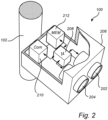
- the image processing system 100 comprises a first (left) 202 and a second (right) camera 204 having optical lenses connected thereto, respectively.
- the image processing system 100 comprises a casing 206, preferably configured for handling outdoor use, the casing holding the cameras 202, 204 as well as processing and communication functionality for the image processing system 100.
- the image processing system 100 comprises a control unit 208 arranged in communication with the cameras 202, 204 as well as a communication module 210 (for allowing communication with e.g. the above mentioned remote server) and a memory element 212 (e.g. for intermediate storage of image data).
- the cameras 202, 204 may not necessarily be provided as separate elements, but may be integrated as one single unit provided with a first and a second set of optical lenses arranged to a first and a second image sensor (i.e. provided for the cameras 202, 204 respectively).
- the image processing system 100 is configured for stereo collection of image data using the first and the second camera 202, 204.
- ToF time-of-flight
- the general concept of the invention may be implemented based on image data captured using "external" cameras (i.e. not necessarily including the cameras themselves). That is, the invention may for example be implemented as a server solution where the server receives image data from e.g. remotely arranged cameras. As such, at least some of the processing performed could be implemented in a distributed manner, e.g. partly as a "cloud” solution.
- the process starts by the control unit 208 receiving, S1, an image stream from the first and the second camera 202, 204.
- the control unit 208 subsequently process, S2, the image stream for forming a three dimensional representation of the scene monitored by the cameras 202, 204.
- the three dimensional representation is typically formed based on depth information extracted based on the predetermined separation of the first 202 and the second 204 camera, thereby forming depth maps for each image of the image stream (i.e. pair of images from the cameras 202, 204).
- the background model defines an "empty" scene where no foreground objects are present.
- the background model could also be determined in other manners as would be readily understood by the skilled addressee.
- the height maps are subsequently used for extracting a physical foreground object from the scene, such as a pedestrian 104, a car 106 or a bicycle 110.
- the extracted foreground objects are typically defined to have a "boundary box" closely surrounding the object.
- the boundary box may typically be rectangular but may also be defined in a more freeform manner.
- the relative position is defined as being relative to e.g. one or a plurality of predetermined "points" within the scene. However, it may of course be possible to make the position "absolute” by correlating one or a plurality of points within the scene to e.g. be a real GPS position, or similar.
- a first probability as to the type of object is determined, S6.
- a set of object types are predefined.
- Each of the set of the predefined object types are defined to have at least a length, a height and a width being within a predetermined range.
- the foreground object being extracted from the scene is accordingly matched to the set of predefined object types, and a probability is determined for the extracted foreground object as compared to the predefined object types.
- the set of predefined object types typically includes a set of height, width and length parameters defining the pedestrian, the bicycle, the car and the truck. The size (e.g. the boundary box as mentioned above) of the extracted foreground object is thus compared to the predefined parameters for each of the type of objects for determining the first probability.
- a second probability is determined, S7, where the extracted foreground object essentially is "tracked" between subsequent image pairs of the image stream.
- a difference in the relative position is determined for the extracted foreground object, i.e. from one image pair to the next. Accordingly, it may be possible to, for each of the predefined object types, form a set of "speed" parameters/profile defining how fast the specific object type likely will move between subsequent image pairs.
- the tracking will generally also include determination of the direction of movement of the extracted object.
- the type of the foreground object is determined, S8, by combining the first and the second probability, possibly with further information for increasing the probability of correctly determining the object type for the extracted foreground object.
- Fig. 4 shows details of the object classification method according to the invention.
- the flowchart illustrates the above discussed geometric matching classification, e.g. including matching of size and "moving object positions" for subsequent image pairs with predefined object type parameters (i.e. 404 and 406).
- a further, e.g. possibly defined as a third probability may be determined by performing an image matching 408 between the extracted foreground object and representative image data stored in a database 410.
- the image matching may preferably take into account the direction of movement of the extracted object, for example for use in improving the selection of the "correct" image to match with, i.e. as the stored images to match with may be annotated to include information as to an aspect angle for the stored image.
- the third probability for the object type may typically be combined with the first and the second probability.
- the combination of the first, second and third probability may be weighted, e.g. more weight could for example be given to the height, width and length parameter matching as compared to the remaining two probabilities. Any type of weighting may be possible and is within the scope of the invention.
- the combined probability may be accumulated over time, i.e. by allowing further geometric matching classifications and/or image based classifications to be made for the same object. That is, it will likely be preferred to continue to track the object as long as the object is visible within the scene. Thereby, the likelihood of determining the correct object type will be increased.
- the image processing system 100 could be used in a traffic counting scenario comprising tracking mixed object types for categorizing the behavior for each of the object types.
- the image processing system 100 according to the invention could be used for controlling traffic patterns, i.e. to control traffic lights in a city, for example by adapting time given for passing a street. For example, at peak hours with a high density of bicycles, the bicycles could be given more passing time as compared to cars, possibly improving the overall traffic environment within the city.
- control functionality of the present disclosure may be implemented using existing computer processors, or by a special purpose computer processor for an appropriate system, incorporated for this or another purpose, or by a hardwired system.
- Embodiments within the scope of the present disclosure include program products comprising machine-readable media for carrying or having machine-executable instructions or data structures stored thereon. Such machine-readable media can be any available media that can be accessed by a general purpose or special purpose computer or other machine with a processor.
- machine-readable media can comprise RAM, ROM, EPROM, EEPROM, CD-ROM or other optical disk storage, magnetic disk storage or other magnetic storage devices, or any other medium which can be used to carry or store desired program code in the form of machine-executable instructions or data structures and which can be accessed by a general purpose or special purpose computer or other machine with a processor.
- a network or another communications connection either hardwired, wireless, or a combination of hardwired or wireless
- any such connection is properly termed a machine-readable medium.
- Machine-executable instructions include, for example, instructions and data which cause a general purpose computer, special purpose computer, or special purpose processing machines to perform a certain function or group of functions.
Landscapes
- Engineering & Computer Science (AREA)
- Theoretical Computer Science (AREA)
- General Physics & Mathematics (AREA)
- Physics & Mathematics (AREA)
- Multimedia (AREA)
- Computer Vision & Pattern Recognition (AREA)
- Artificial Intelligence (AREA)
- Evolutionary Computation (AREA)
- Data Mining & Analysis (AREA)
- Databases & Information Systems (AREA)
- Software Systems (AREA)
- Medical Informatics (AREA)
- General Health & Medical Sciences (AREA)
- Computing Systems (AREA)
- Health & Medical Sciences (AREA)
- Bioinformatics & Cheminformatics (AREA)
- Life Sciences & Earth Sciences (AREA)
- Bioinformatics & Computational Biology (AREA)
- Evolutionary Biology (AREA)
- General Engineering & Computer Science (AREA)
- Signal Processing (AREA)
- Image Analysis (AREA)
- Image Processing (AREA)
Claims (13)
- Computerimplementiertes Verfahren zum Klassifizieren eines Typs eines sich bewegenden Objekts (104, 106, 108, 110) innerhalb einer Szene, wobei das sich bewegende Objekt eines von mehreren verschiedenen Typen von vorbestimmten Objekten ist, wobei das Verfahren umfasst:- Empfangen (S1) eines Bildstroms, der mehrere Bilder umfasst, von einer ersten (202) und einer zweiten (204) Kamera, die in einer erhöhten Position in Bezug auf eine Bodenebene innerhalb der Szene angeordnet sind, wobei die erste Kamera und die zweite Kamera derart angeordnet sind, dass eine jeweilige Kamera ein vorbestimmtes, räumlich getrenntes, entsprechendes Bild der Szene aufnimmt, wobei die aufgenommenen Bilder zusammen ein Paar von Bildern bilden, wobei jedes Bild des Paars von Bildern eine aufgenommene Darstellung der Szene ist, wobei der Inhalt der Szene mindestens ein physisches Vordergrundobjekt und einen physischen Hintergrund umfasst;- Verarbeiten (S2) des Paars von Bildern, um für jedes Paar von Bildern eine Tiefenkarte zu erzeugen;- Bilden (S3) einer Höhenkarte für jedes Paar von Bildern unter Verwendung eines vorbestimmten Modells des Hintergrunds und der entsprechenden Tiefenkarte, wobei das Hintergrundmodell die Szene definiert, wenn keine physischen Vordergrundobjekte vorhanden sind;- Extrahieren (S4) des mindestens einen physischen Vordergrundobjekts aus jedem Paar von Bildern unter Verwendung der entsprechenden Höhenkarte;- Bestimmen (S5), für jedes Paar von Bildern, einer relativen Position des mindestens einen physischen Vordergrundobjekts innerhalb der Szene unter Verwendung der Höhenkarte, wobei die relative Position relativ zu mehreren vorbestimmten Punkten innerhalb der Szene ist;- Bestimmen (S6) eines ersten Wahrscheinlichkeitsniveaus für den Typ des mindestens einen Vordergrundobjekts innerhalb jedes Paars von Bildern durch Abgleichen des mindestens einen extrahierten physischen Vordergrundobjekts mit einem vorbestimmten Satz von verschiedenen Objekttypen, wobei jeder Objekttyp innerhalb des Satzes eine Länge, eine Höhe und eine Breite aufweist, die innerhalb eines vorbestimmten Bereichs liegen;- Bestimmen (S7) eines zweiten Wahrscheinlichkeitsniveaus für den Typ des mindestens einen Vordergrundobjekts durch Bestimmen einer Differenz zwischen den relativen Positionen des mindestens einen Vordergrundobjekts in mindestens zwei Bildern der mehreren Bilder, Umwandeln der Differenz der relativen Positionen in eine relative Geschwindigkeit für das mindestens eine Vordergrundobjekt und Abgleichen der relativen Geschwindigkeit mit Geschwindigkeitsprofilen für den vorbestimmten Satz von verschiedenen Objekttypen; und- Kombinieren (S8) des ersten und des zweiten Wahrscheinlichkeitsniveaus, um den Typ des mindestens einen Vordergrundobjekts zu definieren.
- Verfahren nach Anspruch 1, wobei die verschiedenen Typen von vorbestimmten Objekten einen Fußgänger, ein Fahrrad und ein Fahrzeug umfassen.
- Verfahren nach einem der Ansprüche 1 und 2, ferner umfassend Definieren des Typs des mindestens einen Vordergrundobjekts basierend auf einem dritten Wahrscheinlichkeitsniveau für den Typ des mindestens einen Vordergrundobjekts, wobei die dritte Wahrscheinlichkeit bestimmt wird durch:- Abgleichen des mindestens einen extrahierten Vordergrundobjekts mit einem Satz von vordefinierten Bildern für die mehreren verschiedenen Typen von Objekten, und- Bestimmen eines Wahrscheinlichkeitsniveaus, das eine Darstellung für die dritte Wahrscheinlichkeit ist, basierend auf einem resultierenden Abgleichniveau.
- Verfahren nach einem der Ansprüche 1 und 2, wobei die Bestimmung des ersten und des zweiten Wahrscheinlichkeitsniveaus definiert ist, durch einen geometrischen Klassifikator gebildet zu werden.
- Verfahren nach Anspruch 3, wobei die Bestimmung des dritten Wahrscheinlichkeitsniveaus definiert ist, durch einen bildbasierten Klassifikator gebildet zu werden.
- Verfahren nach einem der Ansprüche 1 und 2, ferner umfassend:- Bestimmen eines dreidimensionalen Begrenzungsrahmens, der das mindestens eine extrahierte Vordergrundobjekt umgibt.
- Verfahren nach einem der Ansprüche 1 und 2, ferner umfassend:- Verfolgen des mindestens einen extrahierten Vordergrundobjekts innerhalb aufeinanderfolgender Bilder des Bildstroms.
- Verfahren nach einem der vorhergehenden Ansprüche, ferner umfassend:- Speichern, für jedes der mehreren Bilder, von Daten, die den Typ des mindestens einen extrahierten Vordergrundobjekts und seine relative Position darstellen, in einer Datenbank.
- Verfahren nach einem der vorhergehenden Ansprüche, ferner umfassend:- Bestimmen einer absoluten Position für das mindestens eine extrahierte Vordergrundobjekt basierend auf einer absoluten Position für mindestens einen Ort in der Szene.
- Bildverarbeitungssystem (100) zum Klassifizieren eines Typs eines sich bewegenden Objekts (104, 106, 108, 110) innerhalb einer Szene, wobei das sich bewegende Objekt ein Objekt eines Typs aus mehreren verschiedenen Typen von vorbestimmten Objekten ist, wobei das Bildverarbeitungssystem eine Steuereinheit aufweist, die eingerichtet ist zum:- Empfangen eines Bildstroms, der mehrere Bilder umfasst, von einer ersten (202) und einer zweiten (204) Kamera, die in einer erhöhten Position in Bezug auf eine Bodenebene innerhalb der Szene angeordnet sind, wobei die erste Kamera und die zweite Kamera derart angeordnet sind, dass eine jeweilige Kamera ein vorbestimmtes, räumlich getrenntes, entsprechendes Bild der Szene aufnimmt, wobei die aufgenommenen Bilder zusammen ein Paar von Bildern bilden, wobei jedes Bild des Paars von Bildern eine aufgenommene Darstellung der Szene ist, wobei der Inhalt der Szene mindestens ein physisches Vordergrundobjekt und einen physischen Hintergrund umfasst;- Verarbeiten der mehreren Bilder, um für jedes Paar von Bildern eine Tiefenkarte zu erzeugen;- Bilden einer Höhenkarte für jedes Paar von Bildern unter Verwendung eines vorbestimmten Modells des Hintergrunds und der entsprechenden Tiefenkarte;- Extrahieren des mindestens einen physischen Vordergrundobjekts aus jedem Paar von Bildern unter Verwendung der entsprechenden Höhenkarte;- Bestimmen, für jedes Paar von Bildern, einer relativen Position des mindestens einen physischen Vordergrundobjekts innerhalb der Szene unter Verwendung der Höhenkarte, wobei das Hintergrundmodell die Szene definiert, wenn keine physischen Vordergrundobjekte vorhanden sind;- Bestimmen eines ersten Wahrscheinlichkeitsniveaus für den Typ des mindestens einen Vordergrundobjekts innerhalb jedes der Bilder durch Abgleichen des mindestens einen extrahierten physischen Vordergrundobjekts mit einem vorbestimmten Satz von verschiedenen Objekttypen, wobei jeder Objekttyp innerhalb des Satzes eine Länge, eine Höhe und eine Breite aufweist, die innerhalb eines vorbestimmten Bereichs liegen;- Bestimmen eines zweiten Wahrscheinlichkeitsniveaus für den Typ des mindestens einen Vordergrundobjekts durch Bestimmen einer Differenz zwischen den relativen Positionen des mindestens einen Vordergrundobjekts in mindestens zwei Bildern der mehreren Bilder, Umwandeln der Differenz der relativen Positionen in eine relative Geschwindigkeit für das mindestens eine Vordergrundobjekt und Abgleichen der relativen Geschwindigkeit mit Geschwindigkeitsprofilen für den vorbestimmten Satz von verschiedenen Objekttypen; und- Kombinieren des ersten und des zweiten Wahrscheinlichkeitsniveaus, um den Typ des mindestens einen Vordergrundobjekts zu definieren.
- System nach Anspruch 10, ferner umfassend:- eine Positionsschnittstelle zum Empfangen einer absoluten Position für mindestens einen Ort innerhalb der Szene,wobei die Steuereinheit ferner eingerichtet ist zum:- Bestimmen einer absoluten Position für das mindestens eine extrahierte Vordergrundobjekt basierend auf der absoluten Position.
- System nach Anspruch 11, ferner umfassend einen GPS-Empfänger, der mit der Positionsschnittstelle verbunden ist und die absolute Position des Systems bereitstellt.
- Computerprogrammprodukt, umfassend Anweisungen, die, wenn das Programm von einem Computer ausgeführt wird, den Computer veranlassen, das Verfahren nach Anspruch 1 auszuführen.
Applications Claiming Priority (2)
| Application Number | Priority Date | Filing Date | Title |
|---|---|---|---|
| SE1550006A SE1550006A1 (sv) | 2015-01-07 | 2015-01-07 | Method and system for categorization of a scene |
| PCT/SE2015/051382 WO2016111640A1 (en) | 2015-01-07 | 2015-12-21 | Method and system for categorization of a scene |
Publications (3)
| Publication Number | Publication Date |
|---|---|
| EP3243165A1 EP3243165A1 (de) | 2017-11-15 |
| EP3243165A4 EP3243165A4 (de) | 2018-08-15 |
| EP3243165B1 true EP3243165B1 (de) | 2023-08-02 |
Family
ID=56108394
Family Applications (1)
| Application Number | Title | Priority Date | Filing Date |
|---|---|---|---|
| EP15877226.9A Active EP3243165B1 (de) | 2015-01-07 | 2015-12-21 | Verfahren und system zur kategorisierung einer szene |
Country Status (5)
| Country | Link |
|---|---|
| US (1) | US10127458B2 (de) |
| EP (1) | EP3243165B1 (de) |
| CA (1) | CA2970911C (de) |
| SE (1) | SE1550006A1 (de) |
| WO (1) | WO2016111640A1 (de) |
Families Citing this family (12)
| Publication number | Priority date | Publication date | Assignee | Title |
|---|---|---|---|---|
| US10453187B2 (en) * | 2017-07-21 | 2019-10-22 | The Boeing Company | Suppression of background clutter in video imagery |
| CN111066302B (zh) * | 2017-09-15 | 2023-07-21 | 金伯利-克拉克环球有限公司 | 洗手间装置增强现实安装系统 |
| US10650530B2 (en) * | 2018-03-29 | 2020-05-12 | Uveye Ltd. | Method of vehicle image comparison and system thereof |
| US10643332B2 (en) * | 2018-03-29 | 2020-05-05 | Uveye Ltd. | Method of vehicle image comparison and system thereof |
| US10861165B2 (en) * | 2019-01-11 | 2020-12-08 | Microsoft Technology Licensing, Llc | Subject tracking with aliased time-of-flight data |
| WO2021204344A1 (en) * | 2020-04-06 | 2021-10-14 | HELLA GmbH & Co. KGaA | Method and system for detecting a vehicle having at least one wheel |
| US11461993B2 (en) * | 2021-01-05 | 2022-10-04 | Applied Research Associates, Inc. | System and method for determining the geographic location in an image |
| KR20220131646A (ko) * | 2021-03-22 | 2022-09-29 | 현대자동차주식회사 | 객체 추적 방법과 장치 및 이 방법을 실행하기 위한 프로그램을 기록한 기록 매체 |
| EP4123598B1 (de) * | 2021-07-19 | 2025-10-15 | Axis AB | Maskierung von objekten in einem videostrom |
| EP4343709B1 (de) * | 2022-09-23 | 2024-10-30 | Axis AB | Verfahren und bildverarbeitungsvorrichtung zur bestimmung eines wahrscheinlichkeitswertes, der anzeigt, dass ein in einem bildrahmenstrom aufgenommenes objekt zu einem objekttyp gehört |
| US20250378563A1 (en) * | 2024-06-07 | 2025-12-11 | Qualcomm Incorporated | Object detection and tracking with a location prior |
| CN118397202B (zh) * | 2024-06-28 | 2024-09-06 | 杭州群核信息技术有限公司 | 图像处理方法、装置、设备以及存储介质 |
Citations (1)
| Publication number | Priority date | Publication date | Assignee | Title |
|---|---|---|---|---|
| US20090010490A1 (en) * | 2007-07-03 | 2009-01-08 | Shoppertrak Rct Corporation | System and process for detecting, tracking and counting human objects of interest |
Family Cites Families (26)
| Publication number | Priority date | Publication date | Assignee | Title |
|---|---|---|---|---|
| JP3573512B2 (ja) * | 1994-05-17 | 2004-10-06 | オリンパス株式会社 | 画像処理方法及び画像処理装置 |
| JP3745117B2 (ja) | 1998-05-08 | 2006-02-15 | キヤノン株式会社 | 画像処理装置及び画像処理方法 |
| US6570608B1 (en) | 1998-09-30 | 2003-05-27 | Texas Instruments Incorporated | System and method for detecting interactions of people and vehicles |
| US7127083B2 (en) * | 2003-11-17 | 2006-10-24 | Vidient Systems, Inc. | Video surveillance system with object detection and probability scoring based on object class |
| EP1709568A4 (de) | 2003-12-15 | 2009-07-29 | Sarnoff Corp | Verfahren und vorrichtung zur objektverfolgung vor einer anstehende-kollision-detektion |
| JP2005215909A (ja) | 2004-01-29 | 2005-08-11 | Hitachi Ltd | 動画像処理技術を使用した市街の交通状況調査システム |
| KR100519782B1 (ko) | 2004-03-04 | 2005-10-07 | 삼성전자주식회사 | 스테레오 카메라를 이용한 사람 검출 방법 및 장치 |
| WO2006026688A2 (en) | 2004-08-27 | 2006-03-09 | Sarnoff Corporation | Method and apparatus for classifying an object |
| GB0502369D0 (en) * | 2005-02-04 | 2005-03-16 | British Telecomm | Classifying an object in a video frame |
| US7602944B2 (en) | 2005-04-06 | 2009-10-13 | March Networks Corporation | Method and system for counting moving objects in a digital video stream |
| US7567704B2 (en) | 2005-11-30 | 2009-07-28 | Honeywell International Inc. | Method and apparatus for identifying physical features in video |
| DE102007058959A1 (de) * | 2007-12-07 | 2009-06-10 | Robert Bosch Gmbh | Konfigurationsmodul für ein Überwachungssystem, Überwachungssystem, Verfahren zur Konfiguration des Überwachungssystems sowie Computerprogramm |
| JP5264396B2 (ja) * | 2008-10-03 | 2013-08-14 | キヤノン株式会社 | 画像処理装置及び画像種別特定方法 |
| CN101388145B (zh) * | 2008-11-06 | 2010-09-15 | 北京汇大基业科技有限公司 | 道路交通安全自动警示方法及装置 |
| CA2747544C (en) | 2008-12-19 | 2016-06-21 | Saab Ab | System and method for mixing a scene with a virtual scenario |
| US8571261B2 (en) * | 2009-04-22 | 2013-10-29 | Checkvideo Llc | System and method for motion detection in a surveillance video |
| WO2012029058A1 (en) * | 2010-08-30 | 2012-03-08 | Bk-Imaging Ltd. | Method and system for extracting three-dimensional information |
| US8903119B2 (en) * | 2010-10-11 | 2014-12-02 | Texas Instruments Incorporated | Use of three-dimensional top-down views for business analytics |
| US8704887B2 (en) * | 2010-12-02 | 2014-04-22 | GM Global Technology Operations LLC | Multi-object appearance-enhanced fusion of camera and range sensor data |
| CN103959308B (zh) | 2011-08-31 | 2017-09-19 | Metaio有限公司 | 以参考特征匹配图像特征的方法 |
| US9530060B2 (en) | 2012-01-17 | 2016-12-27 | Avigilon Fortress Corporation | System and method for building automation using video content analysis with depth sensing |
| US10202135B2 (en) | 2013-05-17 | 2019-02-12 | International Electronic Machines Corp. | Operations monitoring in an area |
| CN103324955A (zh) | 2013-06-14 | 2013-09-25 | 浙江智尔信息技术有限公司 | 一种基于视频处理的行人检测方法 |
| US9656667B2 (en) * | 2014-01-29 | 2017-05-23 | Continental Automotive Systems, Inc. | Method for minimizing automatic braking intrusion based on collision confidence |
| EP3026653A1 (de) * | 2014-11-27 | 2016-06-01 | Kapsch TrafficCom AB | Verfahren zur Steuerung eines Verkehrsüberwachungssystems |
| US9754490B2 (en) * | 2015-11-04 | 2017-09-05 | Zoox, Inc. | Software application to request and control an autonomous vehicle service |
-
2015
- 2015-01-07 SE SE1550006A patent/SE1550006A1/sv not_active IP Right Cessation
- 2015-12-21 CA CA2970911A patent/CA2970911C/en active Active
- 2015-12-21 US US15/538,498 patent/US10127458B2/en active Active
- 2015-12-21 WO PCT/SE2015/051382 patent/WO2016111640A1/en not_active Ceased
- 2015-12-21 EP EP15877226.9A patent/EP3243165B1/de active Active
Patent Citations (1)
| Publication number | Priority date | Publication date | Assignee | Title |
|---|---|---|---|---|
| US20090010490A1 (en) * | 2007-07-03 | 2009-01-08 | Shoppertrak Rct Corporation | System and process for detecting, tracking and counting human objects of interest |
Also Published As
| Publication number | Publication date |
|---|---|
| US20170344835A1 (en) | 2017-11-30 |
| WO2016111640A1 (en) | 2016-07-14 |
| SE538405C2 (en) | 2016-06-14 |
| SE1550006A1 (sv) | 2016-06-14 |
| EP3243165A1 (de) | 2017-11-15 |
| EP3243165A4 (de) | 2018-08-15 |
| CA2970911C (en) | 2021-03-02 |
| CA2970911A1 (en) | 2016-07-14 |
| US10127458B2 (en) | 2018-11-13 |
Similar Documents
| Publication | Publication Date | Title |
|---|---|---|
| EP3243165B1 (de) | Verfahren und system zur kategorisierung einer szene | |
| CN108345822B (zh) | 一种点云数据处理方法及装置 | |
| Grassi et al. | Parkmaster: An in-vehicle, edge-based video analytics service for detecting open parking spaces in urban environments | |
| CN112417953B (zh) | 道路状况检测和地图数据更新方法、装置、系统及设备 | |
| US9858816B2 (en) | Determining parking space occupancy using a 3D representation | |
| US9970774B2 (en) | Automatic content analysis method and system | |
| JP2022522605A (ja) | 車両ナビゲーションのためのイベント情報のクラスタ化 | |
| WO2018055378A1 (en) | Autonomous route determination | |
| EP2605181A2 (de) | Verfahren und Vorrichtung zur Erkennung einer Straßenteilung | |
| WO2018153211A1 (zh) | 获取交通路况信息的方法及装置、计算机存储介质 | |
| US9760783B2 (en) | Vehicle occupancy detection using passenger to driver feature distance | |
| CN116778748A (zh) | 基于深度学习的车辆转弯盲区智能预警方法 | |
| CN103577790A (zh) | 道路转弯类型检测方法和装置 | |
| US20240262386A1 (en) | Iterative depth estimation | |
| CN114913470B (zh) | 一种事件检测方法及装置 | |
| KR102368262B1 (ko) | 다중 관측정보를 이용한 신호등 배치정보 추정 방법 | |
| Peláez et al. | Road detection with thermal cameras through 3D information | |
| CN117593685B (zh) | 真值数据的构建方法和装置、存储介质 | |
| KR20250157517A (ko) | 엔드 투 엔드 변환기 기반 경계 박스 추적 | |
| KR20260005265A (ko) | 3d 대상체 검출을 위한 고정밀 맵 융합 | |
| Koetsier et al. | Trajectory extraction for analysis of unsafe driving behaviour | |
| KR20250047338A (ko) | 맵 및 그룹 파라미터로부터 대상체 배향 결정 | |
| KR20240162127A (ko) | 의사 이미지에서의 인스턴스 분할 | |
| Nedevschi et al. | Stereovision-based sensor for intersection assistance | |
| Ke | Real-time video analytics empowered by machine learning and edge computing for smart transportation applications |
Legal Events
| Date | Code | Title | Description |
|---|---|---|---|
| STAA | Information on the status of an ep patent application or granted ep patent |
Free format text: STATUS: THE INTERNATIONAL PUBLICATION HAS BEEN MADE |
|
| PUAI | Public reference made under article 153(3) epc to a published international application that has entered the european phase |
Free format text: ORIGINAL CODE: 0009012 |
|
| STAA | Information on the status of an ep patent application or granted ep patent |
Free format text: STATUS: REQUEST FOR EXAMINATION WAS MADE |
|
| 17P | Request for examination filed |
Effective date: 20170607 |
|
| AK | Designated contracting states |
Kind code of ref document: A1 Designated state(s): AL AT BE BG CH CY CZ DE DK EE ES FI FR GB GR HR HU IE IS IT LI LT LU LV MC MK MT NL NO PL PT RO RS SE SI SK SM TR |
|
| AX | Request for extension of the european patent |
Extension state: BA ME |
|
| DAV | Request for validation of the european patent (deleted) | ||
| DAX | Request for extension of the european patent (deleted) | ||
| REG | Reference to a national code |
Ref country code: NO Ref legal event code: TC |
|
| A4 | Supplementary search report drawn up and despatched |
Effective date: 20180718 |
|
| RIC1 | Information provided on ipc code assigned before grant |
Ipc: H04N 7/18 20060101ALI20180712BHEP Ipc: G06T 7/20 20170101ALI20180712BHEP Ipc: G06K 9/62 20060101ALI20180712BHEP Ipc: G06T 7/00 20170101ALI20180712BHEP Ipc: G06K 9/00 20060101AFI20180712BHEP |
|
| STAA | Information on the status of an ep patent application or granted ep patent |
Free format text: STATUS: EXAMINATION IS IN PROGRESS |
|
| 17Q | First examination report despatched |
Effective date: 20190710 |
|
| REG | Reference to a national code |
Ref country code: DE Ref legal event code: R079 Free format text: PREVIOUS MAIN CLASS: G06K0009620000 Ipc: G06F0018250000 Ref country code: DE Ref legal event code: R079 Ref document number: 602015084973 Country of ref document: DE Free format text: PREVIOUS MAIN CLASS: G06K0009620000 Ipc: G06F0018250000 |
|
| RIC1 | Information provided on ipc code assigned before grant |
Ipc: G06V 20/54 20220101ALI20230124BHEP Ipc: G06V 20/52 20220101ALI20230124BHEP Ipc: G06V 10/80 20220101ALI20230124BHEP Ipc: G06F 18/25 20230101AFI20230124BHEP |
|
| GRAP | Despatch of communication of intention to grant a patent |
Free format text: ORIGINAL CODE: EPIDOSNIGR1 |
|
| STAA | Information on the status of an ep patent application or granted ep patent |
Free format text: STATUS: GRANT OF PATENT IS INTENDED |
|
| INTG | Intention to grant announced |
Effective date: 20230329 |
|
| GRAS | Grant fee paid |
Free format text: ORIGINAL CODE: EPIDOSNIGR3 |
|
| GRAA | (expected) grant |
Free format text: ORIGINAL CODE: 0009210 |
|
| STAA | Information on the status of an ep patent application or granted ep patent |
Free format text: STATUS: THE PATENT HAS BEEN GRANTED |
|
| AK | Designated contracting states |
Kind code of ref document: B1 Designated state(s): AL AT BE BG CH CY CZ DE DK EE ES FI FR GB GR HR HU IE IS IT LI LT LU LV MC MK MT NL NO PL PT RO RS SE SI SK SM TR |
|
| REG | Reference to a national code |
Ref country code: GB Ref legal event code: FG4D |
|
| REG | Reference to a national code |
Ref country code: CH Ref legal event code: EP |
|
| REG | Reference to a national code |
Ref country code: DE Ref legal event code: R096 Ref document number: 602015084973 Country of ref document: DE |
|
| REG | Reference to a national code |
Ref country code: IE Ref legal event code: FG4D |
|
| REG | Reference to a national code |
Ref country code: LT Ref legal event code: MG9D |
|
| REG | Reference to a national code |
Ref country code: NL Ref legal event code: MP Effective date: 20230802 |
|
| REG | Reference to a national code |
Ref country code: NO Ref legal event code: T2 Effective date: 20230802 |
|
| REG | Reference to a national code |
Ref country code: AT Ref legal event code: MK05 Ref document number: 1595598 Country of ref document: AT Kind code of ref document: T Effective date: 20230802 |
|
| PG25 | Lapsed in a contracting state [announced via postgrant information from national office to epo] |
Ref country code: GR Free format text: LAPSE BECAUSE OF FAILURE TO SUBMIT A TRANSLATION OF THE DESCRIPTION OR TO PAY THE FEE WITHIN THE PRESCRIBED TIME-LIMIT Effective date: 20231103 |
|
| PG25 | Lapsed in a contracting state [announced via postgrant information from national office to epo] |
Ref country code: IS Free format text: LAPSE BECAUSE OF FAILURE TO SUBMIT A TRANSLATION OF THE DESCRIPTION OR TO PAY THE FEE WITHIN THE PRESCRIBED TIME-LIMIT Effective date: 20231202 |
|
| PG25 | Lapsed in a contracting state [announced via postgrant information from national office to epo] |
Ref country code: SE Free format text: LAPSE BECAUSE OF FAILURE TO SUBMIT A TRANSLATION OF THE DESCRIPTION OR TO PAY THE FEE WITHIN THE PRESCRIBED TIME-LIMIT Effective date: 20230802 Ref country code: RS Free format text: LAPSE BECAUSE OF FAILURE TO SUBMIT A TRANSLATION OF THE DESCRIPTION OR TO PAY THE FEE WITHIN THE PRESCRIBED TIME-LIMIT Effective date: 20230802 Ref country code: PT Free format text: LAPSE BECAUSE OF FAILURE TO SUBMIT A TRANSLATION OF THE DESCRIPTION OR TO PAY THE FEE WITHIN THE PRESCRIBED TIME-LIMIT Effective date: 20231204 Ref country code: NL Free format text: LAPSE BECAUSE OF FAILURE TO SUBMIT A TRANSLATION OF THE DESCRIPTION OR TO PAY THE FEE WITHIN THE PRESCRIBED TIME-LIMIT Effective date: 20230802 Ref country code: LV Free format text: LAPSE BECAUSE OF FAILURE TO SUBMIT A TRANSLATION OF THE DESCRIPTION OR TO PAY THE FEE WITHIN THE PRESCRIBED TIME-LIMIT Effective date: 20230802 Ref country code: LT Free format text: LAPSE BECAUSE OF FAILURE TO SUBMIT A TRANSLATION OF THE DESCRIPTION OR TO PAY THE FEE WITHIN THE PRESCRIBED TIME-LIMIT Effective date: 20230802 Ref country code: IS Free format text: LAPSE BECAUSE OF FAILURE TO SUBMIT A TRANSLATION OF THE DESCRIPTION OR TO PAY THE FEE WITHIN THE PRESCRIBED TIME-LIMIT Effective date: 20231202 Ref country code: HR Free format text: LAPSE BECAUSE OF FAILURE TO SUBMIT A TRANSLATION OF THE DESCRIPTION OR TO PAY THE FEE WITHIN THE PRESCRIBED TIME-LIMIT Effective date: 20230802 Ref country code: GR Free format text: LAPSE BECAUSE OF FAILURE TO SUBMIT A TRANSLATION OF THE DESCRIPTION OR TO PAY THE FEE WITHIN THE PRESCRIBED TIME-LIMIT Effective date: 20231103 Ref country code: FI Free format text: LAPSE BECAUSE OF FAILURE TO SUBMIT A TRANSLATION OF THE DESCRIPTION OR TO PAY THE FEE WITHIN THE PRESCRIBED TIME-LIMIT Effective date: 20230802 Ref country code: AT Free format text: LAPSE BECAUSE OF FAILURE TO SUBMIT A TRANSLATION OF THE DESCRIPTION OR TO PAY THE FEE WITHIN THE PRESCRIBED TIME-LIMIT Effective date: 20230802 |
|
| PGFP | Annual fee paid to national office [announced via postgrant information from national office to epo] |
Ref country code: FR Payment date: 20231215 Year of fee payment: 9 Ref country code: DE Payment date: 20231218 Year of fee payment: 9 |
|
| PG25 | Lapsed in a contracting state [announced via postgrant information from national office to epo] |
Ref country code: PL Free format text: LAPSE BECAUSE OF FAILURE TO SUBMIT A TRANSLATION OF THE DESCRIPTION OR TO PAY THE FEE WITHIN THE PRESCRIBED TIME-LIMIT Effective date: 20230802 |
|
| PG25 | Lapsed in a contracting state [announced via postgrant information from national office to epo] |
Ref country code: ES Free format text: LAPSE BECAUSE OF FAILURE TO SUBMIT A TRANSLATION OF THE DESCRIPTION OR TO PAY THE FEE WITHIN THE PRESCRIBED TIME-LIMIT Effective date: 20230802 |
|
| PG25 | Lapsed in a contracting state [announced via postgrant information from national office to epo] |
Ref country code: SM Free format text: LAPSE BECAUSE OF FAILURE TO SUBMIT A TRANSLATION OF THE DESCRIPTION OR TO PAY THE FEE WITHIN THE PRESCRIBED TIME-LIMIT Effective date: 20230802 Ref country code: RO Free format text: LAPSE BECAUSE OF FAILURE TO SUBMIT A TRANSLATION OF THE DESCRIPTION OR TO PAY THE FEE WITHIN THE PRESCRIBED TIME-LIMIT Effective date: 20230802 Ref country code: ES Free format text: LAPSE BECAUSE OF FAILURE TO SUBMIT A TRANSLATION OF THE DESCRIPTION OR TO PAY THE FEE WITHIN THE PRESCRIBED TIME-LIMIT Effective date: 20230802 Ref country code: EE Free format text: LAPSE BECAUSE OF FAILURE TO SUBMIT A TRANSLATION OF THE DESCRIPTION OR TO PAY THE FEE WITHIN THE PRESCRIBED TIME-LIMIT Effective date: 20230802 Ref country code: DK Free format text: LAPSE BECAUSE OF FAILURE TO SUBMIT A TRANSLATION OF THE DESCRIPTION OR TO PAY THE FEE WITHIN THE PRESCRIBED TIME-LIMIT Effective date: 20230802 Ref country code: CZ Free format text: LAPSE BECAUSE OF FAILURE TO SUBMIT A TRANSLATION OF THE DESCRIPTION OR TO PAY THE FEE WITHIN THE PRESCRIBED TIME-LIMIT Effective date: 20230802 Ref country code: SK Free format text: LAPSE BECAUSE OF FAILURE TO SUBMIT A TRANSLATION OF THE DESCRIPTION OR TO PAY THE FEE WITHIN THE PRESCRIBED TIME-LIMIT Effective date: 20230802 |
|
| REG | Reference to a national code |
Ref country code: DE Ref legal event code: R097 Ref document number: 602015084973 Country of ref document: DE |
|
| PG25 | Lapsed in a contracting state [announced via postgrant information from national office to epo] |
Ref country code: IT Free format text: LAPSE BECAUSE OF FAILURE TO SUBMIT A TRANSLATION OF THE DESCRIPTION OR TO PAY THE FEE WITHIN THE PRESCRIBED TIME-LIMIT Effective date: 20230802 |
|
| PGFP | Annual fee paid to national office [announced via postgrant information from national office to epo] |
Ref country code: NO Payment date: 20231218 Year of fee payment: 9 |
|
| PLBE | No opposition filed within time limit |
Free format text: ORIGINAL CODE: 0009261 |
|
| STAA | Information on the status of an ep patent application or granted ep patent |
Free format text: STATUS: NO OPPOSITION FILED WITHIN TIME LIMIT |
|
| 26N | No opposition filed |
Effective date: 20240503 |
|
| PG25 | Lapsed in a contracting state [announced via postgrant information from national office to epo] |
Ref country code: SI Free format text: LAPSE BECAUSE OF FAILURE TO SUBMIT A TRANSLATION OF THE DESCRIPTION OR TO PAY THE FEE WITHIN THE PRESCRIBED TIME-LIMIT Effective date: 20230802 |
|
| REG | Reference to a national code |
Ref country code: CH Ref legal event code: PL |
|
| PG25 | Lapsed in a contracting state [announced via postgrant information from national office to epo] |
Ref country code: LU Free format text: LAPSE BECAUSE OF NON-PAYMENT OF DUE FEES Effective date: 20231221 |
|
| PG25 | Lapsed in a contracting state [announced via postgrant information from national office to epo] |
Ref country code: MC Free format text: LAPSE BECAUSE OF FAILURE TO SUBMIT A TRANSLATION OF THE DESCRIPTION OR TO PAY THE FEE WITHIN THE PRESCRIBED TIME-LIMIT Effective date: 20230802 |
|
| GBPC | Gb: european patent ceased through non-payment of renewal fee |
Effective date: 20231221 |
|
| REG | Reference to a national code |
Ref country code: BE Ref legal event code: MM Effective date: 20231231 |
|
| PG25 | Lapsed in a contracting state [announced via postgrant information from national office to epo] |
Ref country code: MC Free format text: LAPSE BECAUSE OF FAILURE TO SUBMIT A TRANSLATION OF THE DESCRIPTION OR TO PAY THE FEE WITHIN THE PRESCRIBED TIME-LIMIT Effective date: 20230802 Ref country code: LU Free format text: LAPSE BECAUSE OF NON-PAYMENT OF DUE FEES Effective date: 20231221 |
|
| REG | Reference to a national code |
Ref country code: IE Ref legal event code: MM4A |
|
| PG25 | Lapsed in a contracting state [announced via postgrant information from national office to epo] |
Ref country code: IE Free format text: LAPSE BECAUSE OF NON-PAYMENT OF DUE FEES Effective date: 20231221 |
|
| PG25 | Lapsed in a contracting state [announced via postgrant information from national office to epo] |
Ref country code: GB Free format text: LAPSE BECAUSE OF NON-PAYMENT OF DUE FEES Effective date: 20231221 |
|
| PG25 | Lapsed in a contracting state [announced via postgrant information from national office to epo] |
Ref country code: BE Free format text: LAPSE BECAUSE OF NON-PAYMENT OF DUE FEES Effective date: 20231231 |
|
| PG25 | Lapsed in a contracting state [announced via postgrant information from national office to epo] |
Ref country code: CH Free format text: LAPSE BECAUSE OF NON-PAYMENT OF DUE FEES Effective date: 20231231 |
|
| PG25 | Lapsed in a contracting state [announced via postgrant information from national office to epo] |
Ref country code: IE Free format text: LAPSE BECAUSE OF NON-PAYMENT OF DUE FEES Effective date: 20231221 Ref country code: GB Free format text: LAPSE BECAUSE OF NON-PAYMENT OF DUE FEES Effective date: 20231221 Ref country code: CH Free format text: LAPSE BECAUSE OF NON-PAYMENT OF DUE FEES Effective date: 20231231 Ref country code: BE Free format text: LAPSE BECAUSE OF NON-PAYMENT OF DUE FEES Effective date: 20231231 |
|
| PG25 | Lapsed in a contracting state [announced via postgrant information from national office to epo] |
Ref country code: BG Free format text: LAPSE BECAUSE OF FAILURE TO SUBMIT A TRANSLATION OF THE DESCRIPTION OR TO PAY THE FEE WITHIN THE PRESCRIBED TIME-LIMIT Effective date: 20230802 |
|
| PG25 | Lapsed in a contracting state [announced via postgrant information from national office to epo] |
Ref country code: BG Free format text: LAPSE BECAUSE OF FAILURE TO SUBMIT A TRANSLATION OF THE DESCRIPTION OR TO PAY THE FEE WITHIN THE PRESCRIBED TIME-LIMIT Effective date: 20230802 |
|
| REG | Reference to a national code |
Ref country code: DE Ref legal event code: R119 Ref document number: 602015084973 Country of ref document: DE |
|
| PG25 | Lapsed in a contracting state [announced via postgrant information from national office to epo] |
Ref country code: CY Free format text: LAPSE BECAUSE OF FAILURE TO SUBMIT A TRANSLATION OF THE DESCRIPTION OR TO PAY THE FEE WITHIN THE PRESCRIBED TIME-LIMIT; INVALID AB INITIO Effective date: 20151221 |
|
| PG25 | Lapsed in a contracting state [announced via postgrant information from national office to epo] |
Ref country code: HU Free format text: LAPSE BECAUSE OF FAILURE TO SUBMIT A TRANSLATION OF THE DESCRIPTION OR TO PAY THE FEE WITHIN THE PRESCRIBED TIME-LIMIT; INVALID AB INITIO Effective date: 20151221 |
|
| PG25 | Lapsed in a contracting state [announced via postgrant information from national office to epo] |
Ref country code: DE Free format text: LAPSE BECAUSE OF NON-PAYMENT OF DUE FEES Effective date: 20250701 |
|
| PG25 | Lapsed in a contracting state [announced via postgrant information from national office to epo] |
Ref country code: NO Free format text: LAPSE BECAUSE OF NON-PAYMENT OF DUE FEES Effective date: 20241231 |
|
| PG25 | Lapsed in a contracting state [announced via postgrant information from national office to epo] |
Ref country code: FR Free format text: LAPSE BECAUSE OF NON-PAYMENT OF DUE FEES Effective date: 20241231 |
|
| PG25 | Lapsed in a contracting state [announced via postgrant information from national office to epo] |
Ref country code: TR Free format text: LAPSE BECAUSE OF FAILURE TO SUBMIT A TRANSLATION OF THE DESCRIPTION OR TO PAY THE FEE WITHIN THE PRESCRIBED TIME-LIMIT Effective date: 20230802 |