EP3242298A1 - Method for processing liquid radioactive waste and for the recovery thereof - Google Patents
Method for processing liquid radioactive waste and for the recovery thereof Download PDFInfo
- Publication number
- EP3242298A1 EP3242298A1 EP15875780.7A EP15875780A EP3242298A1 EP 3242298 A1 EP3242298 A1 EP 3242298A1 EP 15875780 A EP15875780 A EP 15875780A EP 3242298 A1 EP3242298 A1 EP 3242298A1
- Authority
- EP
- European Patent Office
- Prior art keywords
- waste
- liquid phase
- selective sorbents
- processing
- radioactive waste
- Prior art date
- Legal status (The legal status is an assumption and is not a legal conclusion. Google has not performed a legal analysis and makes no representation as to the accuracy of the status listed.)
- Granted
Links
Images
Classifications
-
- G—PHYSICS
- G21—NUCLEAR PHYSICS; NUCLEAR ENGINEERING
- G21F—PROTECTION AGAINST X-RADIATION, GAMMA RADIATION, CORPUSCULAR RADIATION OR PARTICLE BOMBARDMENT; TREATING RADIOACTIVELY CONTAMINATED MATERIAL; DECONTAMINATION ARRANGEMENTS THEREFOR
- G21F9/00—Treating radioactively contaminated material; Decontamination arrangements therefor
- G21F9/04—Treating liquids
-
- G—PHYSICS
- G21—NUCLEAR PHYSICS; NUCLEAR ENGINEERING
- G21F—PROTECTION AGAINST X-RADIATION, GAMMA RADIATION, CORPUSCULAR RADIATION OR PARTICLE BOMBARDMENT; TREATING RADIOACTIVELY CONTAMINATED MATERIAL; DECONTAMINATION ARRANGEMENTS THEREFOR
- G21F9/00—Treating radioactively contaminated material; Decontamination arrangements therefor
- G21F9/04—Treating liquids
- G21F9/06—Processing
-
- B—PERFORMING OPERATIONS; TRANSPORTING
- B01—PHYSICAL OR CHEMICAL PROCESSES OR APPARATUS IN GENERAL
- B01D—SEPARATION
- B01D39/00—Filtering material for liquid or gaseous fluids
- B01D39/14—Other self-supporting filtering material ; Other filtering material
-
- B—PERFORMING OPERATIONS; TRANSPORTING
- B01—PHYSICAL OR CHEMICAL PROCESSES OR APPARATUS IN GENERAL
- B01D—SEPARATION
- B01D46/00—Filters or filtering processes specially modified for separating dispersed particles from gases or vapours
-
- B—PERFORMING OPERATIONS; TRANSPORTING
- B01—PHYSICAL OR CHEMICAL PROCESSES OR APPARATUS IN GENERAL
- B01J—CHEMICAL OR PHYSICAL PROCESSES, e.g. CATALYSIS OR COLLOID CHEMISTRY; THEIR RELEVANT APPARATUS
- B01J20/00—Solid sorbent compositions or filter aid compositions; Sorbents for chromatography; Processes for preparing, regenerating or reactivating thereof
- B01J20/02—Solid sorbent compositions or filter aid compositions; Sorbents for chromatography; Processes for preparing, regenerating or reactivating thereof comprising inorganic material
- B01J20/0203—Solid sorbent compositions or filter aid compositions; Sorbents for chromatography; Processes for preparing, regenerating or reactivating thereof comprising inorganic material comprising compounds of metals not provided for in B01J20/04
- B01J20/0225—Compounds of Fe, Ru, Os, Co, Rh, Ir, Ni, Pd, Pt
-
- B—PERFORMING OPERATIONS; TRANSPORTING
- B01—PHYSICAL OR CHEMICAL PROCESSES OR APPARATUS IN GENERAL
- B01J—CHEMICAL OR PHYSICAL PROCESSES, e.g. CATALYSIS OR COLLOID CHEMISTRY; THEIR RELEVANT APPARATUS
- B01J20/00—Solid sorbent compositions or filter aid compositions; Sorbents for chromatography; Processes for preparing, regenerating or reactivating thereof
- B01J20/02—Solid sorbent compositions or filter aid compositions; Sorbents for chromatography; Processes for preparing, regenerating or reactivating thereof comprising inorganic material
- B01J20/0203—Solid sorbent compositions or filter aid compositions; Sorbents for chromatography; Processes for preparing, regenerating or reactivating thereof comprising inorganic material comprising compounds of metals not provided for in B01J20/04
- B01J20/0225—Compounds of Fe, Ru, Os, Co, Rh, Ir, Ni, Pd, Pt
- B01J20/0229—Compounds of Fe
-
- B—PERFORMING OPERATIONS; TRANSPORTING
- B01—PHYSICAL OR CHEMICAL PROCESSES OR APPARATUS IN GENERAL
- B01J—CHEMICAL OR PHYSICAL PROCESSES, e.g. CATALYSIS OR COLLOID CHEMISTRY; THEIR RELEVANT APPARATUS
- B01J20/00—Solid sorbent compositions or filter aid compositions; Sorbents for chromatography; Processes for preparing, regenerating or reactivating thereof
- B01J20/02—Solid sorbent compositions or filter aid compositions; Sorbents for chromatography; Processes for preparing, regenerating or reactivating thereof comprising inorganic material
- B01J20/0203—Solid sorbent compositions or filter aid compositions; Sorbents for chromatography; Processes for preparing, regenerating or reactivating thereof comprising inorganic material comprising compounds of metals not provided for in B01J20/04
- B01J20/0233—Compounds of Cu, Ag, Au
- B01J20/0237—Compounds of Cu
-
- B—PERFORMING OPERATIONS; TRANSPORTING
- B01—PHYSICAL OR CHEMICAL PROCESSES OR APPARATUS IN GENERAL
- B01J—CHEMICAL OR PHYSICAL PROCESSES, e.g. CATALYSIS OR COLLOID CHEMISTRY; THEIR RELEVANT APPARATUS
- B01J20/00—Solid sorbent compositions or filter aid compositions; Sorbents for chromatography; Processes for preparing, regenerating or reactivating thereof
- B01J20/02—Solid sorbent compositions or filter aid compositions; Sorbents for chromatography; Processes for preparing, regenerating or reactivating thereof comprising inorganic material
- B01J20/0203—Solid sorbent compositions or filter aid compositions; Sorbents for chromatography; Processes for preparing, regenerating or reactivating thereof comprising inorganic material comprising compounds of metals not provided for in B01J20/04
- B01J20/0274—Solid sorbent compositions or filter aid compositions; Sorbents for chromatography; Processes for preparing, regenerating or reactivating thereof comprising inorganic material comprising compounds of metals not provided for in B01J20/04 characterised by the type of anion
- B01J20/0281—Sulfates of compounds other than those provided for in B01J20/045
-
- B—PERFORMING OPERATIONS; TRANSPORTING
- B01—PHYSICAL OR CHEMICAL PROCESSES OR APPARATUS IN GENERAL
- B01J—CHEMICAL OR PHYSICAL PROCESSES, e.g. CATALYSIS OR COLLOID CHEMISTRY; THEIR RELEVANT APPARATUS
- B01J20/00—Solid sorbent compositions or filter aid compositions; Sorbents for chromatography; Processes for preparing, regenerating or reactivating thereof
- B01J20/02—Solid sorbent compositions or filter aid compositions; Sorbents for chromatography; Processes for preparing, regenerating or reactivating thereof comprising inorganic material
- B01J20/0203—Solid sorbent compositions or filter aid compositions; Sorbents for chromatography; Processes for preparing, regenerating or reactivating thereof comprising inorganic material comprising compounds of metals not provided for in B01J20/04
- B01J20/0274—Solid sorbent compositions or filter aid compositions; Sorbents for chromatography; Processes for preparing, regenerating or reactivating thereof comprising inorganic material comprising compounds of metals not provided for in B01J20/04 characterised by the type of anion
- B01J20/0285—Sulfides of compounds other than those provided for in B01J20/045
-
- B—PERFORMING OPERATIONS; TRANSPORTING
- B01—PHYSICAL OR CHEMICAL PROCESSES OR APPARATUS IN GENERAL
- B01J—CHEMICAL OR PHYSICAL PROCESSES, e.g. CATALYSIS OR COLLOID CHEMISTRY; THEIR RELEVANT APPARATUS
- B01J20/00—Solid sorbent compositions or filter aid compositions; Sorbents for chromatography; Processes for preparing, regenerating or reactivating thereof
- B01J20/02—Solid sorbent compositions or filter aid compositions; Sorbents for chromatography; Processes for preparing, regenerating or reactivating thereof comprising inorganic material
- B01J20/04—Solid sorbent compositions or filter aid compositions; Sorbents for chromatography; Processes for preparing, regenerating or reactivating thereof comprising inorganic material comprising compounds of alkali metals, alkaline earth metals or magnesium
- B01J20/048—Solid sorbent compositions or filter aid compositions; Sorbents for chromatography; Processes for preparing, regenerating or reactivating thereof comprising inorganic material comprising compounds of alkali metals, alkaline earth metals or magnesium containing phosphorus, e.g. phosphates, apatites, hydroxyapatites
-
- B—PERFORMING OPERATIONS; TRANSPORTING
- B01—PHYSICAL OR CHEMICAL PROCESSES OR APPARATUS IN GENERAL
- B01J—CHEMICAL OR PHYSICAL PROCESSES, e.g. CATALYSIS OR COLLOID CHEMISTRY; THEIR RELEVANT APPARATUS
- B01J20/00—Solid sorbent compositions or filter aid compositions; Sorbents for chromatography; Processes for preparing, regenerating or reactivating thereof
- B01J20/02—Solid sorbent compositions or filter aid compositions; Sorbents for chromatography; Processes for preparing, regenerating or reactivating thereof comprising inorganic material
- B01J20/06—Solid sorbent compositions or filter aid compositions; Sorbents for chromatography; Processes for preparing, regenerating or reactivating thereof comprising inorganic material comprising oxides or hydroxides of metals not provided for in group B01J20/04
-
- B—PERFORMING OPERATIONS; TRANSPORTING
- B01—PHYSICAL OR CHEMICAL PROCESSES OR APPARATUS IN GENERAL
- B01J—CHEMICAL OR PHYSICAL PROCESSES, e.g. CATALYSIS OR COLLOID CHEMISTRY; THEIR RELEVANT APPARATUS
- B01J20/00—Solid sorbent compositions or filter aid compositions; Sorbents for chromatography; Processes for preparing, regenerating or reactivating thereof
- B01J20/02—Solid sorbent compositions or filter aid compositions; Sorbents for chromatography; Processes for preparing, regenerating or reactivating thereof comprising inorganic material
- B01J20/10—Solid sorbent compositions or filter aid compositions; Sorbents for chromatography; Processes for preparing, regenerating or reactivating thereof comprising inorganic material comprising silica or silicate
- B01J20/103—Solid sorbent compositions or filter aid compositions; Sorbents for chromatography; Processes for preparing, regenerating or reactivating thereof comprising inorganic material comprising silica or silicate comprising silica
-
- B—PERFORMING OPERATIONS; TRANSPORTING
- B01—PHYSICAL OR CHEMICAL PROCESSES OR APPARATUS IN GENERAL
- B01J—CHEMICAL OR PHYSICAL PROCESSES, e.g. CATALYSIS OR COLLOID CHEMISTRY; THEIR RELEVANT APPARATUS
- B01J20/00—Solid sorbent compositions or filter aid compositions; Sorbents for chromatography; Processes for preparing, regenerating or reactivating thereof
- B01J20/30—Processes for preparing, regenerating, or reactivating
- B01J20/3028—Granulating, agglomerating or aggregating
-
- C—CHEMISTRY; METALLURGY
- C02—TREATMENT OF WATER, WASTE WATER, SEWAGE, OR SLUDGE
- C02F—TREATMENT OF WATER, WASTE WATER, SEWAGE, OR SLUDGE
- C02F9/00—Multistage treatment of water, waste water or sewage
-
- G—PHYSICS
- G21—NUCLEAR PHYSICS; NUCLEAR ENGINEERING
- G21F—PROTECTION AGAINST X-RADIATION, GAMMA RADIATION, CORPUSCULAR RADIATION OR PARTICLE BOMBARDMENT; TREATING RADIOACTIVELY CONTAMINATED MATERIAL; DECONTAMINATION ARRANGEMENTS THEREFOR
- G21F9/00—Treating radioactively contaminated material; Decontamination arrangements therefor
- G21F9/04—Treating liquids
- G21F9/06—Processing
- G21F9/12—Processing by absorption; by adsorption; by ion-exchange
-
- G—PHYSICS
- G21—NUCLEAR PHYSICS; NUCLEAR ENGINEERING
- G21F—PROTECTION AGAINST X-RADIATION, GAMMA RADIATION, CORPUSCULAR RADIATION OR PARTICLE BOMBARDMENT; TREATING RADIOACTIVELY CONTAMINATED MATERIAL; DECONTAMINATION ARRANGEMENTS THEREFOR
- G21F9/00—Treating radioactively contaminated material; Decontamination arrangements therefor
- G21F9/04—Treating liquids
- G21F9/06—Processing
- G21F9/16—Processing by fixation in stable solid media
- G21F9/162—Processing by fixation in stable solid media in an inorganic matrix, e.g. clays, zeolites
- G21F9/165—Cement or cement-like matrix
-
- G—PHYSICS
- G21—NUCLEAR PHYSICS; NUCLEAR ENGINEERING
- G21F—PROTECTION AGAINST X-RADIATION, GAMMA RADIATION, CORPUSCULAR RADIATION OR PARTICLE BOMBARDMENT; TREATING RADIOACTIVELY CONTAMINATED MATERIAL; DECONTAMINATION ARRANGEMENTS THEREFOR
- G21F9/00—Treating radioactively contaminated material; Decontamination arrangements therefor
- G21F9/04—Treating liquids
- G21F9/20—Disposal of liquid waste
-
- B—PERFORMING OPERATIONS; TRANSPORTING
- B01—PHYSICAL OR CHEMICAL PROCESSES OR APPARATUS IN GENERAL
- B01D—SEPARATION
- B01D15/00—Separating processes involving the treatment of liquids with solid sorbents; Apparatus therefor
-
- B—PERFORMING OPERATIONS; TRANSPORTING
- B01—PHYSICAL OR CHEMICAL PROCESSES OR APPARATUS IN GENERAL
- B01J—CHEMICAL OR PHYSICAL PROCESSES, e.g. CATALYSIS OR COLLOID CHEMISTRY; THEIR RELEVANT APPARATUS
- B01J2220/00—Aspects relating to sorbent materials
- B01J2220/40—Aspects relating to the composition of sorbent or filter aid materials
- B01J2220/42—Materials comprising a mixture of inorganic materials
-
- B—PERFORMING OPERATIONS; TRANSPORTING
- B01—PHYSICAL OR CHEMICAL PROCESSES OR APPARATUS IN GENERAL
- B01J—CHEMICAL OR PHYSICAL PROCESSES, e.g. CATALYSIS OR COLLOID CHEMISTRY; THEIR RELEVANT APPARATUS
- B01J2220/00—Aspects relating to sorbent materials
- B01J2220/50—Aspects relating to the use of sorbent or filter aid materials
- B01J2220/60—Use in several different columns
- B01J2220/603—Use in several different columns serially disposed columns
-
- C—CHEMISTRY; METALLURGY
- C02—TREATMENT OF WATER, WASTE WATER, SEWAGE, OR SLUDGE
- C02F—TREATMENT OF WATER, WASTE WATER, SEWAGE, OR SLUDGE
- C02F1/00—Treatment of water, waste water, or sewage
- C02F1/28—Treatment of water, waste water, or sewage by sorption
- C02F1/281—Treatment of water, waste water, or sewage by sorption using inorganic sorbents
-
- C—CHEMISTRY; METALLURGY
- C02—TREATMENT OF WATER, WASTE WATER, SEWAGE, OR SLUDGE
- C02F—TREATMENT OF WATER, WASTE WATER, SEWAGE, OR SLUDGE
- C02F1/00—Treatment of water, waste water, or sewage
- C02F1/52—Treatment of water, waste water, or sewage by flocculation or precipitation of suspended impurities
- C02F1/5236—Treatment of water, waste water, or sewage by flocculation or precipitation of suspended impurities using inorganic agents
-
- C—CHEMISTRY; METALLURGY
- C02—TREATMENT OF WATER, WASTE WATER, SEWAGE, OR SLUDGE
- C02F—TREATMENT OF WATER, WASTE WATER, SEWAGE, OR SLUDGE
- C02F1/00—Treatment of water, waste water, or sewage
- C02F1/72—Treatment of water, waste water, or sewage by oxidation
- C02F1/78—Treatment of water, waste water, or sewage by oxidation with ozone
-
- C—CHEMISTRY; METALLURGY
- C02—TREATMENT OF WATER, WASTE WATER, SEWAGE, OR SLUDGE
- C02F—TREATMENT OF WATER, WASTE WATER, SEWAGE, OR SLUDGE
- C02F2101/00—Nature of the contaminant
- C02F2101/006—Radioactive compounds
-
- C—CHEMISTRY; METALLURGY
- C02—TREATMENT OF WATER, WASTE WATER, SEWAGE, OR SLUDGE
- C02F—TREATMENT OF WATER, WASTE WATER, SEWAGE, OR SLUDGE
- C02F2301/00—General aspects of water treatment
- C02F2301/08—Multistage treatments, e.g. repetition of the same process step under different conditions
-
- G—PHYSICS
- G21—NUCLEAR PHYSICS; NUCLEAR ENGINEERING
- G21C—NUCLEAR REACTORS
- G21C19/00—Arrangements for treating, for handling, or for facilitating the handling of, fuel or other materials which are used within the reactor, e.g. within its pressure vessel
- G21C19/42—Reprocessing of irradiated fuel
- G21C19/44—Reprocessing of irradiated fuel of irradiated solid fuel
- G21C19/46—Aqueous processes, e.g. by using organic extraction means, including the regeneration of these means
-
- G—PHYSICS
- G21—NUCLEAR PHYSICS; NUCLEAR ENGINEERING
- G21F—PROTECTION AGAINST X-RADIATION, GAMMA RADIATION, CORPUSCULAR RADIATION OR PARTICLE BOMBARDMENT; TREATING RADIOACTIVELY CONTAMINATED MATERIAL; DECONTAMINATION ARRANGEMENTS THEREFOR
- G21F3/00—Shielding characterised by its physical form, e.g. granules, or shape of the material
- G21F3/04—Bricks; Shields made up therefrom
-
- Y—GENERAL TAGGING OF NEW TECHNOLOGICAL DEVELOPMENTS; GENERAL TAGGING OF CROSS-SECTIONAL TECHNOLOGIES SPANNING OVER SEVERAL SECTIONS OF THE IPC; TECHNICAL SUBJECTS COVERED BY FORMER USPC CROSS-REFERENCE ART COLLECTIONS [XRACs] AND DIGESTS
- Y02—TECHNOLOGIES OR APPLICATIONS FOR MITIGATION OR ADAPTATION AGAINST CLIMATE CHANGE
- Y02W—CLIMATE CHANGE MITIGATION TECHNOLOGIES RELATED TO WASTEWATER TREATMENT OR WASTE MANAGEMENT
- Y02W30/00—Technologies for solid waste management
- Y02W30/50—Reuse, recycling or recovery technologies
Definitions
- the invention relates generally to the field of treating liquid radioactive waste produced by the nuclear fuel cycle and can be used as part of processing liquid radioactive waste (LRW) to reduce its overall volume and remove radionuclides in a solid phase by concentration method.
- LGW liquid radioactive waste
- This method can be used for processing low-level, as well as intermediate-level liquid radioactive waste in the nuclear power industry including: at nuclear power plants; for processing solutions, formed as a result of deactivating buildings, constructions, equipment, transport etc.; for processing natural water polluted by radionuclides.
- Processing of liquid radioactive waste has to address two main challenges: cleaning the bulk of waste from radionuclides and reducing the volume of radionuclides concentration to the minimum.
- a method for processing liquid radioactive waste and its utilization involves waste oxidation; separation of sludge, colloids and suspended particles from the liquid phase; and removal of radionuclides from the liquid phase, for the subsequent recovery using selective sorbents and filters.
- the proposed invention meets the challenge of improving radiation safety of nuclear industry personnel, that is: decreasing the radiation exposure of personnel processing LRW, streamlining the technological process by avoiding the use of expensive and difficult-to-operate radioactive waste cementing unit, reducing the number of other special maintenance equipment, as well as decreasing the amount of secondary waste; and, in the course of LRW processing, delivering a final product - a block that is safe to transport, to use and that doesn't require any radiation safety precautions.
- the challenge is tackled by applying a method of processing liquid radioactive waste and its utilization that involves oxidation of waste, separation of sludge, colloids and suspended particles from a liquid phase, and removal of radionuclides from a liquid phase for the purpose of their subsequent recovery using selective sorbents and filters.
- This method is characterized by the addition of the selective sorbents in a form of powders and mixing them into the liquid waste, prior to a stage of sludge, colloids and suspended particles separation from the liquid phase of the radioactive waste. Then, an obtained suspension is filtered by pumping through at least one waste disposal container and featuring at least one filter element at its exit, which separates insoluble substances from the liquid phase.
- the filtrate is passed through at least one waste disposal reservoir with granulated selective sorbents; with said container and reservoir placed in concrete blocks.
- one or several selective sorbents can be used.
- Waste disposal container used for the removal of sludge, colloids and suspended particles from the solution can have two or more filter elements.
- the obtained suspension can be passed through two or more sequentially connected waste disposal containers with filter elements.
- the filtrate can be passed through two or more sequentially connected reservoirs containing granulated selective sorbents.
- high-penetrating cement mortar is poured into the reservoir containing granulated selective sorbents, as well as into the container with insoluble substances removed from the liquid phase.
- the reservoir Prior to pouring the cement mortar, the reservoir is vacuumized and/or heated with hot air or inert gas.
- the size of granules of the selective sorbents is in a range of 1 to 3mm.
- the size of particles of the selective sorbents added in the form of powder is in a range of 0.1 to 0.7mm.
- Concrete blocks containing reservoirs with separated radioactive sludge or used-up sorbents are a final product of LRW processing and its utilization. They do not require further conditioning and can be sent directly for burial or can be used as construction materials for building storage facilities.
- Figure 1 shows:
- COREBRICK-F is a concrete 1500 ⁇ 1500 ⁇ 1500mm block containing a hollow 2001iter chamber and also featuring two filter elements sequentially installed at its exit.
- COREBRICK-C is a concrete 1500 ⁇ 1500 ⁇ 1500mm block containing a cylinder 401iter reservoir with a selective sorbent.
- the suggested method mainly uses a composition comprising amorphous silicon dioxide from the Sukholozhsky deposit (with size of particles varying up to 500 microns).
- a composition comprising amorphous silicon dioxide from the Sukholozhsky deposit (with size of particles varying up to 500 microns).
- One or several selective sorbents and a coagulating substance f.e. nickel sulfate
- Such composition helps to handle several challenges:
- Amorphous silicon dioxide is a rather light material (0.6 g/cm3). Its mesopores have a large volume and can hold one or several selective sorbents, which provide high availability of the sorption centers.
- the filtrate is passed through reservoirs with granulated sorbent, since a certain height of sorbent layer is necessary for effective sorption (that ensures optimal time for a filtrate-sorbent contact).
- sorbents in powder forms and at such high level will create high hydrodynamic resistance, thus decreasing filtration speed and making it close to zero.
- the set interval (0.1 - 0.7mm) in sizes of particles of the powder sorbents is based on the fact that larger particles (more than 0.7mm) have a smaller surface of absorbing material and, respectively, smaller absorption efficiency, while smaller particles (less than 0.1mm) are more difficult to separate from the filtrate.
- the set interval (1 to 3 mm) in sizes of particles of the granulated sorbents is based on the fact that larger granules (more than 3mm) have a smaller surface of absorbing material and, respectively, smaller absorption efficiency, while smaller granules (less than 1mm) create high hydrodynamic resistance and can reduce efficacy of LRW processing.
- Tank 1 was pumped with 5M 3 of LRW of the aforesaid composition. Then a composition consisting of nickel ferrocyanide selective sorbent (5kg), applied to the powder of amorphous silicon dioxide from the Sukholozhsky deposit, that had particles sized 200 to 500 microns, and of nickel sulfate (0.5kg) as a coagulant was stirred in.
- nickel ferrocyanide selective sorbent 5kg
- the suspension comprising sorbent, LRW-derived suspended particles and a coagulant
- COREBRICK F 2 equipped with two filter elements.
- a solution which was purified from the suspension, was directed for the ozone treatment 3, where the destruction of organic compounds and complexes took place.
- Suspended solids obtained during the oxidation were mixed with 5kg of the same sorbent that was stirred into the tank, and a resulting suspension was directed to COREBRICK F 4 equipped with two filter elements. Filtrate purified from the suspended solids was passed through sequentially connected COREBRICKs C 5&6 with granular selective sorbent based on nickel ferrocyanide.
- the purified filtrate containing less than 10 Bq/l of Cs-137 and Co-60, was sent to evaporation and crystallization.
- the final product can be placed at the nonradioactive waste storage site.
- COREBRICKs F containing sludge were filled with high-penetrating cement mortar that embeds the inside chamber.
- COREBRICKs C containing selective sorbents were blasted with hot air and also built in with high-penetrating cement mortar.
- the tank was pumped with 25M 3 of LRW comprising sea water of the following composition:
- Sea water scrubbed of cesium radionuclides contains less than 5 Bq/l of cesium-137 and may be dumped back into the sea.
- Used-up sorbents that are in COREBRICKs C and F are built in with high-penetrating cement mortar.
- the tank was pumped with 12M 3 of LRW of the aforementioned composition, and then thirty kilograms of selective sorbent in a form of dry powder based on manganese dioxide were added, and after that 30 kg of powder sorbent based on copper sulfide.
- the particle size of the powder sorbents did not exceed 0.5 mm.
- COREBRICK F equipped with two filter elements with a pore size of 0.4 and 0.1mm.
- filtrate separated from the powder sorbent was passed through COREBRICK C, comprising fifty kilograms of granular selective sorbent, based on manganese dioxide. The total specific activity of isotopes remaining in LRW accounted for no more than 10 Bq/l.
- the tank containing 10M 3 of LRW was consecutively pumped with twenty kilograms of selective sorbents in a form of dry powder (with a particle size of less than 0.3mm) and of the following composition:
- LRW was pumped through two COREBRICKs F with a pore size of 0.2mm in the first filter and 0.1mm in the second one. Afterwards, filtrate was passed through three consecutively connected COREBRICKs C, comprising sixty liters of mechanical mixture of selective sorbents with granular size of 3mm.
- the total specific activity of isotopes remaining in LRW made up not more than 10 Bq/l.
- the use of the described method can decrease radiation exposure of personnel processing LRW, streamline the technological procedures of LRW processing, delivering a final product - a block that is safe to transport and use and that doesn't require any radiation safety precautions.
Landscapes
- Chemical & Material Sciences (AREA)
- Chemical Kinetics & Catalysis (AREA)
- Organic Chemistry (AREA)
- Inorganic Chemistry (AREA)
- Analytical Chemistry (AREA)
- Engineering & Computer Science (AREA)
- General Engineering & Computer Science (AREA)
- Physics & Mathematics (AREA)
- High Energy & Nuclear Physics (AREA)
- Environmental & Geological Engineering (AREA)
- Life Sciences & Earth Sciences (AREA)
- Hydrology & Water Resources (AREA)
- Water Supply & Treatment (AREA)
- Solid-Sorbent Or Filter-Aiding Compositions (AREA)
- Treatment Of Sludge (AREA)
- Heat Treatment Of Water, Waste Water Or Sewage (AREA)
Abstract
Description
- The invention relates generally to the field of treating liquid radioactive waste produced by the nuclear fuel cycle and can be used as part of processing liquid radioactive waste (LRW) to reduce its overall volume and remove radionuclides in a solid phase by concentration method.
- This method can be used for processing low-level, as well as intermediate-level liquid radioactive waste in the nuclear power industry including: at nuclear power plants; for processing solutions, formed as a result of deactivating buildings, constructions, equipment, transport etc.; for processing natural water polluted by radionuclides.
- Processing of liquid radioactive waste has to address two main challenges: cleaning the bulk of waste from radionuclides and reducing the volume of radionuclides concentration to the minimum.
- There is a technical solution introduced in the patent
RU 2066493 - the method includes preliminary evaporation of the waste, which produces the condensate and evaporator bottoms; ozone treatment of the bottoms; separation of the radioactive sludge; and deep evaporation that reduces the filtrate. In this case, ozone treatment of evaporator bottoms is performed directly after preliminary evaporation at pH solution level of 12 to 13.5. After separation of radioactive sludge, the filtrate is passed through the filter container with inorganic sorbent selective to caesium. After that, the used-up filter container is sent away for storage or burial.
- Another technical solution was suggested in patent
RU 2226726 - the method includes preliminary evaporation of the waste, which produces the condensate and evaporator bottoms; ozone treatment of the bottoms; separation of the radioactive sludge; and deep evaporation that reduces the filtrate. Herein, ozone treatment of evaporator bottoms is performed directly after preliminary evaporation of solution. After separation of radioactive sludge, the filtrate is passed via the filter container with inorganic sorbent selective to caesium. After that, the used-up filter container is sent away for storage or burial.
- This well-known method, however, has a few deficiencies, such as: low purification rate of salts emitted at the evaporator bottoms processing stage; a substantial and unsustainable consumption of reagents that interact with initial solution, and also with a permeate and a concentrate, which are derived at later stages.
- The closest approach to processing and treatment of liquid radioactive waste is a method described in the US patent #
8753518 , B01 D 35/00 published in 2014. - A method for processing liquid radioactive waste and its utilization involves waste oxidation; separation of sludge, colloids and suspended particles from the liquid phase; and removal of radionuclides from the liquid phase, for the subsequent recovery using selective sorbents and filters.
- Main deficiencies of this method are:
- a really complex and costly system of separating liquid components from the solid fractions. The equipment requires accurate adjustment and remote servicing, as it has high radiation exposure for personnel;
- the processing results in a high-level waste (sludge from filtering equipment, used-up sorbents or containers with used-up sorbents, filter elements). Managing this waste requires special high-cost radiation safety and protection protocols, so its transportation, disposal and storage (burial) generates significant economic expenses.
- The proposed invention meets the challenge of improving radiation safety of nuclear industry personnel, that is: decreasing the radiation exposure of personnel processing LRW, streamlining the technological process by avoiding the use of expensive and difficult-to-operate radioactive waste cementing unit, reducing the number of other special maintenance equipment, as well as decreasing the amount of secondary waste; and, in the course of LRW processing, delivering a final product - a block that is safe to transport, to use and that doesn't require any radiation safety precautions.
- The challenge is tackled by applying a method of processing liquid radioactive waste and its utilization that involves oxidation of waste, separation of sludge, colloids and suspended particles from a liquid phase, and removal of radionuclides from a liquid phase for the purpose of their subsequent recovery using selective sorbents and filters. This method is characterized by the addition of the selective sorbents in a form of powders and mixing them into the liquid waste, prior to a stage of sludge, colloids and suspended particles separation from the liquid phase of the radioactive waste. Then, an obtained suspension is filtered by pumping through at least one waste disposal container and featuring at least one filter element at its exit, which separates insoluble substances from the liquid phase. After that, the filtrate is passed through at least one waste disposal reservoir with granulated selective sorbents; with said container and reservoir placed in concrete blocks. In the course of processing LRW, one or several selective sorbents can be used. Waste disposal container used for the removal of sludge, colloids and suspended particles from the solution, can have two or more filter elements. The obtained suspension can be passed through two or more sequentially connected waste disposal containers with filter elements. The filtrate can be passed through two or more sequentially connected reservoirs containing granulated selective sorbents. In the end of the process, high-penetrating cement mortar is poured into the reservoir containing granulated selective sorbents, as well as into the container with insoluble substances removed from the liquid phase. Prior to pouring the cement mortar, the reservoir is vacuumized and/or heated with hot air or inert gas. The size of granules of the selective sorbents is in a range of 1 to 3mm. The size of particles of the selective sorbents added in the form of powder is in a range of 0.1 to 0.7mm.
- Concrete blocks containing reservoirs with separated radioactive sludge or used-up sorbents are a final product of LRW processing and its utilization. They do not require further conditioning and can be sent directly for burial or can be used as construction materials for building storage facilities.
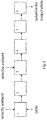
- The principle of the invention is explained in
Figure 1 that presents a scheme of implementing the proposed method. -
Figure 1 shows: - 1. Tank for mixing LRW with inorganic selective sorbents in powder form.
- 2. COREBRICK-F with 2 filter elements (50 microns and 5 microns).
- 3. Ozone treatment unit.
- 4. COREBRICK-F with 2 filter elements (5 microns and 0.5 microns).
- 5. COREBRICK-C filled with selective sorbent.
- 6. 6. COREBRICK-C filled with selective sorbent.
- COREBRICK-F is a concrete 1500×1500×1500mm block containing a hollow 2001iter chamber and also featuring two filter elements sequentially installed at its exit.
- COREBRICK-C is a concrete 1500×1500×1500mm block containing a cylinder 401iter reservoir with a selective sorbent.
- The suggested method mainly uses a composition comprising amorphous silicon dioxide from the Sukholozhsky deposit (with size of particles varying up to 500 microns). One or several selective sorbents and a coagulating substance (f.e. nickel sulfate) can be placed in its pores. Such composition helps to handle several challenges:
- remove part of radionuclides from the liquid phase and evenly distribute activity in filter elements and sorption blocks.
- mold suspended particles and colloids into solid fractions that can be separated easily, which simplifies the process of separating liquid LRW components from the solid ones and reduces the costs.
- Amorphous silicon dioxide is a rather light material (0.6 g/cm3). Its mesopores have a large volume and can hold one or several selective sorbents, which provide high availability of the sorption centers.
- Practical implementation of this method implies the use of reservoirs with simple filter elements (grids, ceramic filters, etc.), which are placed in concrete casings that are, essentially, concrete blocks themselves. This rules out personnel's radiation exposure. The filtered high-level waste remain inside the concrete blocks, instead of being removed as sludge at the stage of flushing filter elements, as is the case with the prototype and all other known methods. Concrete blocks are safe for transportation and storage. They can be used as elements in special purpose structural units (e.g. for construction of warehouses, radioactive waste storage facilities etc.)
- The filtrate is passed through reservoirs with granulated sorbent, since a certain height of sorbent layer is necessary for effective sorption (that ensures optimal time for a filtrate-sorbent contact). Using sorbents in powder forms and at such high level will create high hydrodynamic resistance, thus decreasing filtration speed and making it close to zero.
- The set interval (0.1 - 0.7mm) in sizes of particles of the powder sorbents is based on the fact that larger particles (more than 0.7mm) have a smaller surface of absorbing material and, respectively, smaller absorption efficiency, while smaller particles (less than 0.1mm) are more difficult to separate from the filtrate.
- The set interval (1 to 3 mm) in sizes of particles of the granulated sorbents is based on the fact that larger granules (more than 3mm) have a smaller surface of absorbing material and, respectively, smaller absorption efficiency, while smaller granules (less than 1mm) create high hydrodynamic resistance and can reduce efficacy of LRW processing.
- The described method was used to process LRW (pH of 12.1) containing:
- solids content (after drying at 105°C) - 285 g/l;
- suspended particles (separated on the filter with a blue belt), 5.1 g/l;
- specific activity of Cs-137: 1.1·10-3 Ci/l
- specific activity cobalt-60: 1.4·10-6 Ci/l
- Tank 1 was pumped with 5M3 of LRW of the aforesaid composition. Then a composition consisting of nickel ferrocyanide selective sorbent (5kg), applied to the powder of amorphous silicon dioxide from the Sukholozhsky deposit, that had particles sized 200 to 500 microns, and of nickel sulfate (0.5kg) as a coagulant was stirred in. The combination of amorphous silicon dioxide and agglomerates, which forms during the interaction process between nickel-based coagulant and LRW suspended particles, makes separation of liquid components from the solid ones inside COREBRICK F very easy.
- After a two-hour stirring, the suspension comprising sorbent, LRW-derived suspended particles and a coagulant, was pumped into
COREBRICK F 2 equipped with two filter elements. Afterwards, a solution, which was purified from the suspension, was directed for theozone treatment 3, where the destruction of organic compounds and complexes took place. Suspended solids obtained during the oxidation were mixed with 5kg of the same sorbent that was stirred into the tank, and a resulting suspension was directed to COREBRICK F 4 equipped with two filter elements. Filtrate purified from the suspended solids was passed through sequentially connected COREBRICKs C 5&6 with granular selective sorbent based on nickel ferrocyanide. The purified filtrate, containing less than 10 Bq/l of Cs-137 and Co-60, was sent to evaporation and crystallization. The final product can be placed at the nonradioactive waste storage site. - COREBRICKs F containing sludge were filled with high-penetrating cement mortar that embeds the inside chamber. COREBRICKs C containing selective sorbents were blasted with hot air and also built in with high-penetrating cement mortar.
- Activity registered in COREBRICKs F amounted to 5Ki each, while in COREBRICKs C it amounted to 9.8Ki in the first one and 0.2Ki in the second.
- The tank was pumped with 25M3 of LRW comprising sea water of the following composition:
- total salt content - 30 g/l; pH of 7.9; specific activity of Cs-137: 2.4*105 Ci/l.
- Fifty kilograms of selective sorbent, based on "Prussian Blue" (Iron (III) hexacyanoferrate (II)) in a form of a dry powder with a particle size of 0.2 to 0.5 mm, was stirred into LRW. After eight hours of mixing, LRW and the sorbent were directed to COREBRICK F featuring one filter element with a pore size of 0.1 mm. Filtrate separated from the sorbent was passed through COREBRICK C, comprising one hundred kilograms of granular selective sorbent based on iron ferrocyanide with a granule size of 1-2 mm. Sea water scrubbed of cesium radionuclides contains less than 5 Bq/l of cesium-137 and may be dumped back into the sea. Used-up sorbents that are in COREBRICKs C and F are built in with high-penetrating cement mortar.
- The proposed method was used to process LRW containing:
- total salt content -- 228 g/l; pH=10.9;
- specific activity of strontium-90, 4.2*104 Bq/l;
- specific activity of cobalt-60: 1.5*104 Bq/l.
- The tank was pumped with 12M3 of LRW of the aforementioned composition, and then thirty kilograms of selective sorbent in a form of dry powder based on manganese dioxide were added, and after that 30 kg of powder sorbent based on copper sulfide. The particle size of the powder sorbents did not exceed 0.5 mm. After a three-hour mixing, LRW was directed to COREBRICK F equipped with two filter elements with a pore size of 0.4 and 0.1mm. Afterwards, filtrate separated from the powder sorbent was passed through COREBRICK C, comprising fifty kilograms of granular selective sorbent, based on manganese dioxide. The total specific activity of isotopes remaining in LRW accounted for no more than 10 Bq/l.
- The suggested method was used to process LRW containing:
Boric acid g/L, pH = 4; Cs -137 5.2*106 Bq/l; Co-60 3.1*104 Bq/l; Ag-110 8.1*103 Bq/l; Sr-90 1.9*105 Bq/l. - The tank containing 10M3 of LRW was consecutively pumped with twenty kilograms of selective sorbents in a form of dry powder (with a particle size of less than 0.3mm) and of the following composition:
- copper ferrocyanide, magnesium phosphate, zirconium hydroxide.
- After a five-hour mixing, LRW was pumped through two COREBRICKs F with a pore size of 0.2mm in the first filter and 0.1mm in the second one. Afterwards, filtrate was passed through three consecutively connected COREBRICKs C, comprising sixty liters of mechanical mixture of selective sorbents with granular size of 3mm.
- Mechanical mixture consisted of homogeneously mixed sorbents:
- 20L of copper ferrocyanide,
- 20L of magnesium phosphate,
- 20L of zirconium hydroxide.
- The total specific activity of isotopes remaining in LRW made up not more than 10 Bq/l.
- The use of the described method can decrease radiation exposure of personnel processing LRW, streamline the technological procedures of LRW processing, delivering a final product - a block that is safe to transport and use and that doesn't require any radiation safety precautions.
Claims (10)
- A method of processing liquid radioactive waste and its utilization that involves oxidation of waste, separation of sludge, colloids and suspended particles from a liquid phase, and removal of radionuclides from a liquid phase for the purpose of their subsequent recovery using selective sorbents and filters; the method is characterized by the addition of the selective sorbents in a form of powders and mixing them into the liquid waste, prior to a stage of sludge, colloids and suspended particles separation from the liquid phase of the radioactive waste and then an obtained suspension is filtered by pumping through at least one waste disposal container and featuring at least one filter element at its exit, which separates insoluble substances from the liquid phase; than a filtrate is passed through at least one waste disposal reservoir with granulated selective sorbents; with said container and reservoir placed in concrete blocks.
- The method of Claim 1, wherein one or several selective sorbents are used in the LRW processing.
- The method of Claim 1, wherein the waste disposal container used for the removal of sludge, colloids and suspended particles from the solution, can have two or more filter elements.
- The method of Claim 1, wherein the obtained suspension passed through two or more sequentially connected waste disposal containers with the filter elements.
- The method of Claim 1, wherein the filtrate passed through two or more sequentially connected reservoirs with the granulated selective sorbents.
- The method of Claim 1, further comprising after processing filling the reservoir containing the granulated selective sorbents with a high-penetrating cement mortar.
- The method of Claim 1, further comprising after processing filling the reservoir containing insoluble substances removed from the liquid phase, with a high-penetrating cement mortar.
- The method of Claim 6 and 7, wherein prior to pouring the cement mortar the reservoir and the container are vacuumized and/or heated with a hot air or an inert gas.
- The method of Claim 1, wherein a size of granules of the selective sorbents is in a range from 1 to 3 mm.
- The method of Claim 1, wherein a size of particles of the selective sorbents added in the form of powder is in a range from 0.1 to 0.7 mm.
Priority Applications (1)
| Application Number | Priority Date | Filing Date | Title |
|---|---|---|---|
| SI201531189T SI3242298T1 (en) | 2014-12-29 | 2015-11-12 | Method for processing liquid radioactive waste |
Applications Claiming Priority (2)
| Application Number | Priority Date | Filing Date | Title |
|---|---|---|---|
| RU2014153336/07A RU2577512C1 (en) | 2014-12-29 | 2014-12-29 | Method of processing liquid radioactive wastes and recycling thereof |
| PCT/RU2015/000768 WO2016108727A1 (en) | 2014-12-29 | 2015-11-12 | Method for processing liquid radioactive waste and for the recovery thereof |
Publications (3)
| Publication Number | Publication Date |
|---|---|
| EP3242298A1 true EP3242298A1 (en) | 2017-11-08 |
| EP3242298A4 EP3242298A4 (en) | 2018-08-15 |
| EP3242298B1 EP3242298B1 (en) | 2020-02-12 |
Family
ID=55647861
Family Applications (1)
| Application Number | Title | Priority Date | Filing Date |
|---|---|---|---|
| EP15875780.7A Not-in-force EP3242298B1 (en) | 2014-12-29 | 2015-11-12 | Method for processing liquid radioactive waste |
Country Status (14)
| Country | Link |
|---|---|
| US (1) | US10014088B2 (en) |
| EP (1) | EP3242298B1 (en) |
| JP (1) | JP6409235B2 (en) |
| KR (1) | KR102058277B1 (en) |
| CN (1) | CN107430897B (en) |
| CA (1) | CA2972799C (en) |
| EA (1) | EA032408B1 (en) |
| ES (1) | ES2790825T3 (en) |
| HU (1) | HUE050106T2 (en) |
| LT (1) | LT3242298T (en) |
| RU (1) | RU2577512C1 (en) |
| SI (1) | SI3242298T1 (en) |
| UA (1) | UA136062U (en) |
| WO (1) | WO2016108727A1 (en) |
Cited By (3)
| Publication number | Priority date | Publication date | Assignee | Title |
|---|---|---|---|---|
| RU2675251C1 (en) * | 2017-12-19 | 2018-12-18 | Общество с ограниченной ответственностью Научно-производственное предприятие "Эксорб" | Method for processing liquid radioactive wastes |
| RU2675787C1 (en) * | 2017-12-19 | 2018-12-25 | Общество с ограниченной ответственностью Научно-производственное предприятие "Эксорб" | Method for processing liquid radioactive wastes |
| FR3089830A1 (en) * | 2018-12-18 | 2020-06-19 | Orano Cycle | Method of conditioning by cementing an acidic waste |
Families Citing this family (6)
| Publication number | Priority date | Publication date | Assignee | Title |
|---|---|---|---|---|
| RU2631244C1 (en) * | 2016-07-25 | 2017-09-20 | Общество с ограниченной ответственностью Научно-производственное предприятие "Эксорб" | Method for liquid radioactive waste processing |
| CN108877978B (en) * | 2018-07-16 | 2021-06-22 | 南华大学 | Method for treating uranium-containing wastewater by using sludge of water treatment plant |
| RU2737954C1 (en) | 2019-11-27 | 2020-12-07 | Виктор Павлович Ремез | Method of processing liquid radioactive wastes containing, among other things, tritium isotopes |
| RU2747775C1 (en) * | 2020-09-14 | 2021-05-14 | Виктор Павлович Ремез | Method for ion-selective decontamination of radioactive solutions |
| CN112509723B (en) * | 2020-11-12 | 2024-04-12 | 中国核电工程有限公司 | A radioactive mud treatment method and system |
| CN115881333B (en) * | 2022-12-02 | 2024-02-20 | 中国原子能科学研究院 | Treatment methods for sediments in natural evaporation ponds |
Family Cites Families (16)
| Publication number | Priority date | Publication date | Assignee | Title |
|---|---|---|---|---|
| JPS5438500A (en) * | 1977-08-30 | 1979-03-23 | Akira Toyama | Device for processing high radiation substance |
| JPS58140696A (en) * | 1982-02-17 | 1983-08-20 | 株式会社日立製作所 | Radioactive liquid waste processing vessel |
| JPS63228099A (en) * | 1987-03-17 | 1988-09-22 | 住友化学工業株式会社 | Solidifying processing method of radioactive waste |
| JPH04219103A (en) * | 1990-12-18 | 1992-08-10 | Mitsubishi Heavy Ind Ltd | Method for adsorbing and removing specified material in solution in storage tank |
| JPH07260997A (en) * | 1994-03-17 | 1995-10-13 | Hitachi Ltd | Method and apparatus for treating radioactive waste liquid containing organic matter |
| RU2066493C1 (en) * | 1995-11-13 | 1996-09-10 | Товарищество с ограниченной ответственностью "Лаборатория технологий водоочистки - Наука-LTD" | Method of atomic power stations liquid radioactive wastes treatment |
| JP2002002799A (en) * | 2000-06-28 | 2002-01-09 | Suzumo Machinery Co Ltd | Triangle food storage container |
| RU2226726C2 (en) * | 2002-04-27 | 2004-04-10 | Открытое акционерное общество "Всероссийский научно-исследовательский институт по эксплуатации АЭС" | Method for recovering liquid radioactive wastes of nuclear power plant |
| JP2004340814A (en) * | 2003-05-16 | 2004-12-02 | Mitsubishi Heavy Ind Ltd | Vacuum dryer of waste and method therefor |
| RU2268513C1 (en) * | 2004-12-28 | 2006-01-20 | Закрытое акционерное общество "РАОТЕХ" | Method of processing of radioactive effluent |
| ES2587439T3 (en) * | 2010-10-15 | 2016-10-24 | Avantech, Inc. | Method and concentrate treatment system |
| JP5849342B2 (en) * | 2011-04-26 | 2016-01-27 | 株式会社化研 | Decontamination equipment and decontamination method for radioactive substances from radioactive contaminated water mixed with seawater |
| JP2013050418A (en) * | 2011-08-31 | 2013-03-14 | Toyo Eng Works Ltd | Method and system for processing radioactive contaminated water |
| RU2473145C1 (en) * | 2012-01-20 | 2013-01-20 | Российская Федерация, от имени которой выступает Государственная корпорация по атомной энергии "Росатом" | Method of processing liquid radioactive wastes from use of decontamination solutions |
| US20160372225A1 (en) * | 2012-05-15 | 2016-12-22 | Pentek, Inc. | Waste container for collecting hazardous material |
| JP2013250158A (en) * | 2012-05-31 | 2013-12-12 | Heisei Syouji Co Ltd | Producing method and producing device for purification healthy water detoxifying radioactive contamination |
-
2014
- 2014-12-29 RU RU2014153336/07A patent/RU2577512C1/en active
-
2015
- 2015-11-12 HU HUE15875780A patent/HUE050106T2/en unknown
- 2015-11-12 ES ES15875780T patent/ES2790825T3/en active Active
- 2015-11-12 CA CA2972799A patent/CA2972799C/en not_active Expired - Fee Related
- 2015-11-12 EA EA201600567A patent/EA032408B1/en not_active IP Right Cessation
- 2015-11-12 JP JP2016552509A patent/JP6409235B2/en not_active Expired - Fee Related
- 2015-11-12 UA UAA201707397U patent/UA136062U/en unknown
- 2015-11-12 CN CN201580071599.0A patent/CN107430897B/en not_active Expired - Fee Related
- 2015-11-12 KR KR1020177021065A patent/KR102058277B1/en not_active Expired - Fee Related
- 2015-11-12 EP EP15875780.7A patent/EP3242298B1/en not_active Not-in-force
- 2015-11-12 WO PCT/RU2015/000768 patent/WO2016108727A1/en not_active Ceased
- 2015-11-12 SI SI201531189T patent/SI3242298T1/en unknown
- 2015-11-12 LT LTEP15875780.7T patent/LT3242298T/en unknown
- 2015-11-12 US US15/540,393 patent/US10014088B2/en not_active Expired - Fee Related
Cited By (5)
| Publication number | Priority date | Publication date | Assignee | Title |
|---|---|---|---|---|
| RU2675251C1 (en) * | 2017-12-19 | 2018-12-18 | Общество с ограниченной ответственностью Научно-производственное предприятие "Эксорб" | Method for processing liquid radioactive wastes |
| RU2675787C1 (en) * | 2017-12-19 | 2018-12-25 | Общество с ограниченной ответственностью Научно-производственное предприятие "Эксорб" | Method for processing liquid radioactive wastes |
| EP3736819A4 (en) * | 2017-12-19 | 2021-11-24 | Eksorb Ltd. | Method for reprocessing liquid radioactive waste |
| FR3089830A1 (en) * | 2018-12-18 | 2020-06-19 | Orano Cycle | Method of conditioning by cementing an acidic waste |
| WO2020128229A1 (en) * | 2018-12-18 | 2020-06-25 | Orano Cycle | Method for conditioning an acid waste by cementation |
Also Published As
| Publication number | Publication date |
|---|---|
| US10014088B2 (en) | 2018-07-03 |
| JP2017511467A (en) | 2017-04-20 |
| WO2016108727A1 (en) | 2016-07-07 |
| CA2972799C (en) | 2018-05-08 |
| US20170365369A1 (en) | 2017-12-21 |
| EP3242298A4 (en) | 2018-08-15 |
| EA032408B1 (en) | 2019-05-31 |
| UA136062U (en) | 2019-08-12 |
| LT3242298T (en) | 2020-05-25 |
| EP3242298B1 (en) | 2020-02-12 |
| KR20170101962A (en) | 2017-09-06 |
| HUE050106T2 (en) | 2020-11-30 |
| EA201600567A1 (en) | 2016-12-30 |
| RU2577512C1 (en) | 2016-03-20 |
| SI3242298T1 (en) | 2020-07-31 |
| JP6409235B2 (en) | 2018-10-24 |
| ES2790825T3 (en) | 2020-10-29 |
| CA2972799A1 (en) | 2016-07-07 |
| CN107430897B (en) | 2020-05-26 |
| CN107430897A (en) | 2017-12-01 |
| KR102058277B1 (en) | 2019-12-20 |
Similar Documents
| Publication | Publication Date | Title |
|---|---|---|
| CA2972799C (en) | Method for processing liquid radioactive waste and for the recovery thereof | |
| GB2583276A (en) | Method and system for concentrating and solidifying nuclides in radioactive liquid waste | |
| RU2467419C1 (en) | Method of cleaning still residues of liquid radioactive wastes from radioactive cobalt and caesium | |
| CN114746956A (en) | Method for treating tritium-containing radioactive waste liquid | |
| RU2144708C1 (en) | Method for decontaminating low- mineralized and low-active liquid wastes under field conditions | |
| RU2631244C1 (en) | Method for liquid radioactive waste processing | |
| Huang et al. | Treatment of spent nuclear fuel debris contaminated water in the Taiwan Research Reactor spent fuel pool | |
| CN202189565U (en) | Civil dual nuclear radiation-resistant water purifying device | |
| RU2675251C1 (en) | Method for processing liquid radioactive wastes | |
| EP3416173B1 (en) | Method for purifying liquid radioactive waste | |
| KR101678805B1 (en) | Decontamination method and system of radioactive spent resin | |
| RU2769953C1 (en) | Method for sequential deactivation of radioactive solutions | |
| RU2669013C1 (en) | Method for processing low-mineralized medium- and low-active liquid radioactive wastes | |
| RU2747775C1 (en) | Method for ion-selective decontamination of radioactive solutions | |
| RU2675787C1 (en) | Method for processing liquid radioactive wastes | |
| RU2664893C1 (en) | Method for obtaining sorbent matrix material based on natural zeolite for immobilizing radionuclides | |
| RU2499309C2 (en) | Sorbent for removing radionuclides from water | |
| RU2091874C1 (en) | Radioactive waste treatment | |
| RU2410779C1 (en) | Method of cementing spent radioactive selective sorbents in container in field conditions | |
| RU2189650C2 (en) | Liquid radioactive waste decontamination process | |
| RU2158449C1 (en) | Method for decontaminating slightly radioactive water under field conditions | |
| Hanh | Using bentonite for NPP liquid waste treatment |
Legal Events
| Date | Code | Title | Description |
|---|---|---|---|
| STAA | Information on the status of an ep patent application or granted ep patent |
Free format text: STATUS: THE INTERNATIONAL PUBLICATION HAS BEEN MADE |
|
| PUAI | Public reference made under article 153(3) epc to a published international application that has entered the european phase |
Free format text: ORIGINAL CODE: 0009012 |
|
| STAA | Information on the status of an ep patent application or granted ep patent |
Free format text: STATUS: REQUEST FOR EXAMINATION WAS MADE |
|
| 17P | Request for examination filed |
Effective date: 20170712 |
|
| AK | Designated contracting states |
Kind code of ref document: A1 Designated state(s): AL AT BE BG CH CY CZ DE DK EE ES FI FR GB GR HR HU IE IS IT LI LT LU LV MC MK MT NL NO PL PT RO RS SE SI SK SM TR |
|
| AX | Request for extension of the european patent |
Extension state: BA ME |
|
| DAV | Request for validation of the european patent (deleted) | ||
| DAX | Request for extension of the european patent (deleted) | ||
| A4 | Supplementary search report drawn up and despatched |
Effective date: 20180718 |
|
| RIC1 | Information provided on ipc code assigned before grant |
Ipc: B01D 46/00 20060101ALI20180706BHEP Ipc: G21F 9/12 20060101ALI20180706BHEP Ipc: B01D 39/00 20060101ALI20180706BHEP Ipc: B01D 39/14 20060101ALI20180706BHEP Ipc: G21C 19/46 20060101ALN20180706BHEP Ipc: G21F 9/06 20060101ALI20180706BHEP Ipc: G21F 9/20 20060101ALI20180706BHEP Ipc: B01J 20/00 20060101ALI20180706BHEP Ipc: C02F 9/00 20060101ALI20180706BHEP Ipc: B01D 15/00 20060101ALN20180706BHEP Ipc: G21F 3/04 20060101ALN20180706BHEP Ipc: G21F 9/16 20060101AFI20180706BHEP |
|
| STAA | Information on the status of an ep patent application or granted ep patent |
Free format text: STATUS: EXAMINATION IS IN PROGRESS |
|
| 17Q | First examination report despatched |
Effective date: 20190527 |
|
| REG | Reference to a national code |
Ref country code: DE Ref legal event code: R079 Ref document number: 602015047095 Country of ref document: DE Free format text: PREVIOUS MAIN CLASS: G21F0009040000 Ipc: G21F0009160000 |
|
| GRAP | Despatch of communication of intention to grant a patent |
Free format text: ORIGINAL CODE: EPIDOSNIGR1 |
|
| STAA | Information on the status of an ep patent application or granted ep patent |
Free format text: STATUS: GRANT OF PATENT IS INTENDED |
|
| RIC1 | Information provided on ipc code assigned before grant |
Ipc: G21F 9/20 20060101ALI20191023BHEP Ipc: B01J 20/06 20060101ALI20191023BHEP Ipc: C02F 1/28 20060101ALN20191023BHEP Ipc: B01J 20/30 20060101ALI20191023BHEP Ipc: C02F 1/78 20060101ALN20191023BHEP Ipc: C02F 1/52 20060101ALN20191023BHEP Ipc: C02F 9/00 20060101ALI20191023BHEP Ipc: G21F 9/06 20060101ALI20191023BHEP Ipc: B01J 20/02 20060101ALI20191023BHEP Ipc: G21F 9/16 20060101AFI20191023BHEP Ipc: G21F 3/04 20060101ALN20191023BHEP Ipc: B01D 39/00 20060101ALI20191023BHEP Ipc: B01J 20/10 20060101ALI20191023BHEP Ipc: G21C 19/46 20060101ALN20191023BHEP Ipc: B01D 46/00 20060101ALI20191023BHEP Ipc: G21F 9/12 20060101ALI20191023BHEP Ipc: B01J 20/00 20060101ALI20191023BHEP Ipc: B01D 39/14 20060101ALI20191023BHEP Ipc: B01D 15/00 20060101ALN20191023BHEP Ipc: C02F 101/00 20060101ALN20191023BHEP Ipc: B01J 20/04 20060101ALI20191023BHEP |
|
| RIC1 | Information provided on ipc code assigned before grant |
Ipc: B01J 20/10 20060101ALI20191105BHEP Ipc: G21F 9/16 20060101AFI20191105BHEP Ipc: G21C 19/46 20060101ALN20191105BHEP Ipc: B01D 46/00 20060101ALI20191105BHEP Ipc: G21F 9/06 20060101ALI20191105BHEP Ipc: B01D 15/00 20060101ALN20191105BHEP Ipc: B01D 39/14 20060101ALI20191105BHEP Ipc: B01J 20/02 20060101ALI20191105BHEP Ipc: C02F 9/00 20060101ALI20191105BHEP Ipc: C02F 1/52 20060101ALN20191105BHEP Ipc: G21F 3/04 20060101ALN20191105BHEP Ipc: C02F 1/28 20060101ALN20191105BHEP Ipc: B01J 20/30 20060101ALI20191105BHEP Ipc: C02F 1/78 20060101ALN20191105BHEP Ipc: G21F 9/20 20060101ALI20191105BHEP Ipc: B01J 20/04 20060101ALI20191105BHEP Ipc: B01J 20/06 20060101ALI20191105BHEP Ipc: B01D 39/00 20060101ALI20191105BHEP Ipc: G21F 9/12 20060101ALI20191105BHEP Ipc: C02F 101/00 20060101ALN20191105BHEP Ipc: B01J 20/00 20060101ALI20191105BHEP |
|
| INTG | Intention to grant announced |
Effective date: 20191119 |
|
| RIN1 | Information on inventor provided before grant (corrected) |
Inventor name: REMEZ, VIKTOR PAVLOVICH |
|
| GRAS | Grant fee paid |
Free format text: ORIGINAL CODE: EPIDOSNIGR3 |
|
| GRAA | (expected) grant |
Free format text: ORIGINAL CODE: 0009210 |
|
| STAA | Information on the status of an ep patent application or granted ep patent |
Free format text: STATUS: THE PATENT HAS BEEN GRANTED |
|
| AK | Designated contracting states |
Kind code of ref document: B1 Designated state(s): AL AT BE BG CH CY CZ DE DK EE ES FI FR GB GR HR HU IE IS IT LI LT LU LV MC MK MT NL NO PL PT RO RS SE SI SK SM TR |
|
| REG | Reference to a national code |
Ref country code: GB Ref legal event code: FG4D |
|
| REG | Reference to a national code |
Ref country code: CH Ref legal event code: EP |
|
| REG | Reference to a national code |
Ref country code: AT Ref legal event code: REF Ref document number: 1233187 Country of ref document: AT Kind code of ref document: T Effective date: 20200215 |
|
| REG | Reference to a national code |
Ref country code: IE Ref legal event code: FG4D |
|
| REG | Reference to a national code |
Ref country code: DE Ref legal event code: R096 Ref document number: 602015047095 Country of ref document: DE |
|
| REG | Reference to a national code |
Ref country code: FI Ref legal event code: FGE |
|
| REG | Reference to a national code |
Ref country code: NL Ref legal event code: FP |
|
| REG | Reference to a national code |
Ref country code: SE Ref legal event code: TRGR |
|
| PG25 | Lapsed in a contracting state [announced via postgrant information from national office to epo] |
Ref country code: RS Free format text: LAPSE BECAUSE OF FAILURE TO SUBMIT A TRANSLATION OF THE DESCRIPTION OR TO PAY THE FEE WITHIN THE PRESCRIBED TIME-LIMIT Effective date: 20200212 Ref country code: NO Free format text: LAPSE BECAUSE OF FAILURE TO SUBMIT A TRANSLATION OF THE DESCRIPTION OR TO PAY THE FEE WITHIN THE PRESCRIBED TIME-LIMIT Effective date: 20200512 |
|
| REG | Reference to a national code |
Ref country code: SK Ref legal event code: T3 Ref document number: E 34258 Country of ref document: SK |
|
| PG25 | Lapsed in a contracting state [announced via postgrant information from national office to epo] |
Ref country code: IS Free format text: LAPSE BECAUSE OF FAILURE TO SUBMIT A TRANSLATION OF THE DESCRIPTION OR TO PAY THE FEE WITHIN THE PRESCRIBED TIME-LIMIT Effective date: 20200612 Ref country code: HR Free format text: LAPSE BECAUSE OF FAILURE TO SUBMIT A TRANSLATION OF THE DESCRIPTION OR TO PAY THE FEE WITHIN THE PRESCRIBED TIME-LIMIT Effective date: 20200212 Ref country code: GR Free format text: LAPSE BECAUSE OF FAILURE TO SUBMIT A TRANSLATION OF THE DESCRIPTION OR TO PAY THE FEE WITHIN THE PRESCRIBED TIME-LIMIT Effective date: 20200513 Ref country code: LV Free format text: LAPSE BECAUSE OF FAILURE TO SUBMIT A TRANSLATION OF THE DESCRIPTION OR TO PAY THE FEE WITHIN THE PRESCRIBED TIME-LIMIT Effective date: 20200212 |
|
| REG | Reference to a national code |
Ref country code: ES Ref legal event code: FG2A Ref document number: 2790825 Country of ref document: ES Kind code of ref document: T3 Effective date: 20201029 |
|
| PG25 | Lapsed in a contracting state [announced via postgrant information from national office to epo] |
Ref country code: DK Free format text: LAPSE BECAUSE OF FAILURE TO SUBMIT A TRANSLATION OF THE DESCRIPTION OR TO PAY THE FEE WITHIN THE PRESCRIBED TIME-LIMIT Effective date: 20200212 Ref country code: PT Free format text: LAPSE BECAUSE OF FAILURE TO SUBMIT A TRANSLATION OF THE DESCRIPTION OR TO PAY THE FEE WITHIN THE PRESCRIBED TIME-LIMIT Effective date: 20200705 Ref country code: EE Free format text: LAPSE BECAUSE OF FAILURE TO SUBMIT A TRANSLATION OF THE DESCRIPTION OR TO PAY THE FEE WITHIN THE PRESCRIBED TIME-LIMIT Effective date: 20200212 Ref country code: SM Free format text: LAPSE BECAUSE OF FAILURE TO SUBMIT A TRANSLATION OF THE DESCRIPTION OR TO PAY THE FEE WITHIN THE PRESCRIBED TIME-LIMIT Effective date: 20200212 |
|
| REG | Reference to a national code |
Ref country code: DE Ref legal event code: R097 Ref document number: 602015047095 Country of ref document: DE |
|
| REG | Reference to a national code |
Ref country code: AT Ref legal event code: MK05 Ref document number: 1233187 Country of ref document: AT Kind code of ref document: T Effective date: 20200212 |
|
| REG | Reference to a national code |
Ref country code: HU Ref legal event code: AG4A Ref document number: E050106 Country of ref document: HU |
|
| PLBE | No opposition filed within time limit |
Free format text: ORIGINAL CODE: 0009261 |
|
| STAA | Information on the status of an ep patent application or granted ep patent |
Free format text: STATUS: NO OPPOSITION FILED WITHIN TIME LIMIT |
|
| 26N | No opposition filed |
Effective date: 20201113 |
|
| PG25 | Lapsed in a contracting state [announced via postgrant information from national office to epo] |
Ref country code: AT Free format text: LAPSE BECAUSE OF FAILURE TO SUBMIT A TRANSLATION OF THE DESCRIPTION OR TO PAY THE FEE WITHIN THE PRESCRIBED TIME-LIMIT Effective date: 20200212 |
|
| PGFP | Annual fee paid to national office [announced via postgrant information from national office to epo] |
Ref country code: CZ Payment date: 20201110 Year of fee payment: 6 |
|
| PG25 | Lapsed in a contracting state [announced via postgrant information from national office to epo] |
Ref country code: PL Free format text: LAPSE BECAUSE OF FAILURE TO SUBMIT A TRANSLATION OF THE DESCRIPTION OR TO PAY THE FEE WITHIN THE PRESCRIBED TIME-LIMIT Effective date: 20200212 |
|
| REG | Reference to a national code |
Ref country code: DE Ref legal event code: R119 Ref document number: 602015047095 Country of ref document: DE |
|
| REG | Reference to a national code |
Ref country code: FI Ref legal event code: MAE |
|
| REG | Reference to a national code |
Ref country code: SE Ref legal event code: EUG |
|
| PG25 | Lapsed in a contracting state [announced via postgrant information from national office to epo] |
Ref country code: MC Free format text: LAPSE BECAUSE OF FAILURE TO SUBMIT A TRANSLATION OF THE DESCRIPTION OR TO PAY THE FEE WITHIN THE PRESCRIBED TIME-LIMIT Effective date: 20200212 |
|
| REG | Reference to a national code |
Ref country code: CH Ref legal event code: PL |
|
| REG | Reference to a national code |
Ref country code: NL Ref legal event code: MM Effective date: 20201201 |
|
| GBPC | Gb: european patent ceased through non-payment of renewal fee |
Effective date: 20201112 |
|
| REG | Reference to a national code |
Ref country code: SK Ref legal event code: MM4A Ref document number: E 34258 Country of ref document: SK Effective date: 20201112 |
|
| PG25 | Lapsed in a contracting state [announced via postgrant information from national office to epo] |
Ref country code: SK Free format text: LAPSE BECAUSE OF NON-PAYMENT OF DUE FEES Effective date: 20201112 Ref country code: RO Free format text: LAPSE BECAUSE OF NON-PAYMENT OF DUE FEES Effective date: 20200212 Ref country code: BG Free format text: LAPSE BECAUSE OF NON-PAYMENT OF DUE FEES Effective date: 20210531 Ref country code: FI Free format text: LAPSE BECAUSE OF NON-PAYMENT OF DUE FEES Effective date: 20201112 Ref country code: LU Free format text: LAPSE BECAUSE OF NON-PAYMENT OF DUE FEES Effective date: 20201112 |
|
| REG | Reference to a national code |
Ref country code: BE Ref legal event code: MM Effective date: 20201130 |
|
| PG25 | Lapsed in a contracting state [announced via postgrant information from national office to epo] |
Ref country code: HU Free format text: LAPSE BECAUSE OF NON-PAYMENT OF DUE FEES Effective date: 20201113 Ref country code: LI Free format text: LAPSE BECAUSE OF NON-PAYMENT OF DUE FEES Effective date: 20201130 Ref country code: SI Free format text: LAPSE BECAUSE OF NON-PAYMENT OF DUE FEES Effective date: 20201113 Ref country code: SE Free format text: LAPSE BECAUSE OF NON-PAYMENT OF DUE FEES Effective date: 20201113 Ref country code: CH Free format text: LAPSE BECAUSE OF NON-PAYMENT OF DUE FEES Effective date: 20201130 Ref country code: NL Free format text: LAPSE BECAUSE OF NON-PAYMENT OF DUE FEES Effective date: 20201201 |
|
| REG | Reference to a national code |
Ref country code: LT Ref legal event code: MM4D Effective date: 20201112 |
|
| REG | Reference to a national code |
Ref country code: SI Ref legal event code: KO00 Effective date: 20210810 |
|
| PG25 | Lapsed in a contracting state [announced via postgrant information from national office to epo] |
Ref country code: FR Free format text: LAPSE BECAUSE OF NON-PAYMENT OF DUE FEES Effective date: 20201130 Ref country code: LT Free format text: LAPSE BECAUSE OF NON-PAYMENT OF DUE FEES Effective date: 20201112 Ref country code: IE Free format text: LAPSE BECAUSE OF NON-PAYMENT OF DUE FEES Effective date: 20201112 |
|
| PG25 | Lapsed in a contracting state [announced via postgrant information from national office to epo] |
Ref country code: GB Free format text: LAPSE BECAUSE OF NON-PAYMENT OF DUE FEES Effective date: 20201112 Ref country code: DE Free format text: LAPSE BECAUSE OF NON-PAYMENT OF DUE FEES Effective date: 20210601 |
|
| REG | Reference to a national code |
Ref country code: ES Ref legal event code: FD2A Effective date: 20220201 |
|
| PG25 | Lapsed in a contracting state [announced via postgrant information from national office to epo] |
Ref country code: IT Free format text: LAPSE BECAUSE OF NON-PAYMENT OF DUE FEES Effective date: 20201112 |
|
| PG25 | Lapsed in a contracting state [announced via postgrant information from national office to epo] |
Ref country code: TR Free format text: LAPSE BECAUSE OF FAILURE TO SUBMIT A TRANSLATION OF THE DESCRIPTION OR TO PAY THE FEE WITHIN THE PRESCRIBED TIME-LIMIT Effective date: 20200212 Ref country code: MT Free format text: LAPSE BECAUSE OF FAILURE TO SUBMIT A TRANSLATION OF THE DESCRIPTION OR TO PAY THE FEE WITHIN THE PRESCRIBED TIME-LIMIT Effective date: 20200212 Ref country code: ES Free format text: LAPSE BECAUSE OF NON-PAYMENT OF DUE FEES Effective date: 20201113 Ref country code: CY Free format text: LAPSE BECAUSE OF FAILURE TO SUBMIT A TRANSLATION OF THE DESCRIPTION OR TO PAY THE FEE WITHIN THE PRESCRIBED TIME-LIMIT Effective date: 20200212 |
|
| PG25 | Lapsed in a contracting state [announced via postgrant information from national office to epo] |
Ref country code: MK Free format text: LAPSE BECAUSE OF FAILURE TO SUBMIT A TRANSLATION OF THE DESCRIPTION OR TO PAY THE FEE WITHIN THE PRESCRIBED TIME-LIMIT Effective date: 20200212 Ref country code: AL Free format text: LAPSE BECAUSE OF FAILURE TO SUBMIT A TRANSLATION OF THE DESCRIPTION OR TO PAY THE FEE WITHIN THE PRESCRIBED TIME-LIMIT Effective date: 20200212 |
|
| PG25 | Lapsed in a contracting state [announced via postgrant information from national office to epo] |
Ref country code: CZ Free format text: LAPSE BECAUSE OF NON-PAYMENT OF DUE FEES Effective date: 20211112 Ref country code: BE Free format text: LAPSE BECAUSE OF NON-PAYMENT OF DUE FEES Effective date: 20201130 |
|
| PG25 | Lapsed in a contracting state [announced via postgrant information from national office to epo] |
Ref country code: IS Free format text: LAPSE BECAUSE OF NON-PAYMENT OF DUE FEES Effective date: 20200612 |