EP3241577A1 - Verfahren zur füllung und spülung eines blutschlauchsatzes - Google Patents
Verfahren zur füllung und spülung eines blutschlauchsatzes Download PDFInfo
- Publication number
- EP3241577A1 EP3241577A1 EP17172400.8A EP17172400A EP3241577A1 EP 3241577 A1 EP3241577 A1 EP 3241577A1 EP 17172400 A EP17172400 A EP 17172400A EP 3241577 A1 EP3241577 A1 EP 3241577A1
- Authority
- EP
- European Patent Office
- Prior art keywords
- substituate
- line
- arterial
- venous
- blood
- Prior art date
- Legal status (The legal status is an assumption and is not a legal conclusion. Google has not performed a legal analysis and makes no representation as to the accuracy of the status listed.)
- Granted
Links
Images


Classifications
-
- A—HUMAN NECESSITIES
- A61—MEDICAL OR VETERINARY SCIENCE; HYGIENE
- A61M—DEVICES FOR INTRODUCING MEDIA INTO, OR ONTO, THE BODY; DEVICES FOR TRANSDUCING BODY MEDIA OR FOR TAKING MEDIA FROM THE BODY; DEVICES FOR PRODUCING OR ENDING SLEEP OR STUPOR
- A61M1/00—Suction or pumping devices for medical purposes; Devices for carrying-off, for treatment of, or for carrying-over, body-liquids; Drainage systems
- A61M1/34—Filtering material out of the blood by passing it through a membrane, i.e. hemofiltration or diafiltration
- A61M1/342—Adding solutions to the blood, e.g. substitution solutions
- A61M1/3424—Substitution fluid path
- A61M1/3431—Substitution fluid path upstream of the filter
-
- A—HUMAN NECESSITIES
- A61—MEDICAL OR VETERINARY SCIENCE; HYGIENE
- A61M—DEVICES FOR INTRODUCING MEDIA INTO, OR ONTO, THE BODY; DEVICES FOR TRANSDUCING BODY MEDIA OR FOR TAKING MEDIA FROM THE BODY; DEVICES FOR PRODUCING OR ENDING SLEEP OR STUPOR
- A61M1/00—Suction or pumping devices for medical purposes; Devices for carrying-off, for treatment of, or for carrying-over, body-liquids; Drainage systems
- A61M1/14—Dialysis systems; Artificial kidneys; Blood oxygenators ; Reciprocating systems for treatment of body fluids, e.g. single needle systems for hemofiltration or pheresis
- A61M1/15—Dialysis systems; Artificial kidneys; Blood oxygenators ; Reciprocating systems for treatment of body fluids, e.g. single needle systems for hemofiltration or pheresis with a cassette forming partially or totally the flow circuit for the treating fluid, e.g. the dialysate fluid circuit or the treating gas circuit
- A61M1/155—Dialysis systems; Artificial kidneys; Blood oxygenators ; Reciprocating systems for treatment of body fluids, e.g. single needle systems for hemofiltration or pheresis with a cassette forming partially or totally the flow circuit for the treating fluid, e.g. the dialysate fluid circuit or the treating gas circuit with treatment-fluid pumping means or components thereof
-
- A—HUMAN NECESSITIES
- A61—MEDICAL OR VETERINARY SCIENCE; HYGIENE
- A61M—DEVICES FOR INTRODUCING MEDIA INTO, OR ONTO, THE BODY; DEVICES FOR TRANSDUCING BODY MEDIA OR FOR TAKING MEDIA FROM THE BODY; DEVICES FOR PRODUCING OR ENDING SLEEP OR STUPOR
- A61M1/00—Suction or pumping devices for medical purposes; Devices for carrying-off, for treatment of, or for carrying-over, body-liquids; Drainage systems
- A61M1/14—Dialysis systems; Artificial kidneys; Blood oxygenators ; Reciprocating systems for treatment of body fluids, e.g. single needle systems for hemofiltration or pheresis
- A61M1/16—Dialysis systems; Artificial kidneys; Blood oxygenators ; Reciprocating systems for treatment of body fluids, e.g. single needle systems for hemofiltration or pheresis with membranes
- A61M1/1601—Control or regulation
-
- A—HUMAN NECESSITIES
- A61—MEDICAL OR VETERINARY SCIENCE; HYGIENE
- A61M—DEVICES FOR INTRODUCING MEDIA INTO, OR ONTO, THE BODY; DEVICES FOR TRANSDUCING BODY MEDIA OR FOR TAKING MEDIA FROM THE BODY; DEVICES FOR PRODUCING OR ENDING SLEEP OR STUPOR
- A61M1/00—Suction or pumping devices for medical purposes; Devices for carrying-off, for treatment of, or for carrying-over, body-liquids; Drainage systems
- A61M1/14—Dialysis systems; Artificial kidneys; Blood oxygenators ; Reciprocating systems for treatment of body fluids, e.g. single needle systems for hemofiltration or pheresis
- A61M1/16—Dialysis systems; Artificial kidneys; Blood oxygenators ; Reciprocating systems for treatment of body fluids, e.g. single needle systems for hemofiltration or pheresis with membranes
- A61M1/1601—Control or regulation
- A61M1/1603—Regulation parameters
-
- A—HUMAN NECESSITIES
- A61—MEDICAL OR VETERINARY SCIENCE; HYGIENE
- A61M—DEVICES FOR INTRODUCING MEDIA INTO, OR ONTO, THE BODY; DEVICES FOR TRANSDUCING BODY MEDIA OR FOR TAKING MEDIA FROM THE BODY; DEVICES FOR PRODUCING OR ENDING SLEEP OR STUPOR
- A61M1/00—Suction or pumping devices for medical purposes; Devices for carrying-off, for treatment of, or for carrying-over, body-liquids; Drainage systems
- A61M1/14—Dialysis systems; Artificial kidneys; Blood oxygenators ; Reciprocating systems for treatment of body fluids, e.g. single needle systems for hemofiltration or pheresis
- A61M1/16—Dialysis systems; Artificial kidneys; Blood oxygenators ; Reciprocating systems for treatment of body fluids, e.g. single needle systems for hemofiltration or pheresis with membranes
- A61M1/1621—Constructional aspects thereof
-
- A—HUMAN NECESSITIES
- A61—MEDICAL OR VETERINARY SCIENCE; HYGIENE
- A61M—DEVICES FOR INTRODUCING MEDIA INTO, OR ONTO, THE BODY; DEVICES FOR TRANSDUCING BODY MEDIA OR FOR TAKING MEDIA FROM THE BODY; DEVICES FOR PRODUCING OR ENDING SLEEP OR STUPOR
- A61M1/00—Suction or pumping devices for medical purposes; Devices for carrying-off, for treatment of, or for carrying-over, body-liquids; Drainage systems
- A61M1/14—Dialysis systems; Artificial kidneys; Blood oxygenators ; Reciprocating systems for treatment of body fluids, e.g. single needle systems for hemofiltration or pheresis
- A61M1/16—Dialysis systems; Artificial kidneys; Blood oxygenators ; Reciprocating systems for treatment of body fluids, e.g. single needle systems for hemofiltration or pheresis with membranes
- A61M1/26—Dialysis systems; Artificial kidneys; Blood oxygenators ; Reciprocating systems for treatment of body fluids, e.g. single needle systems for hemofiltration or pheresis with membranes and internal elements which are moving
- A61M1/267—Dialysis systems; Artificial kidneys; Blood oxygenators ; Reciprocating systems for treatment of body fluids, e.g. single needle systems for hemofiltration or pheresis with membranes and internal elements which are moving used for pumping
-
- A—HUMAN NECESSITIES
- A61—MEDICAL OR VETERINARY SCIENCE; HYGIENE
- A61M—DEVICES FOR INTRODUCING MEDIA INTO, OR ONTO, THE BODY; DEVICES FOR TRANSDUCING BODY MEDIA OR FOR TAKING MEDIA FROM THE BODY; DEVICES FOR PRODUCING OR ENDING SLEEP OR STUPOR
- A61M1/00—Suction or pumping devices for medical purposes; Devices for carrying-off, for treatment of, or for carrying-over, body-liquids; Drainage systems
- A61M1/34—Filtering material out of the blood by passing it through a membrane, i.e. hemofiltration or diafiltration
- A61M1/342—Adding solutions to the blood, e.g. substitution solutions
- A61M1/3424—Substitution fluid path
-
- A—HUMAN NECESSITIES
- A61—MEDICAL OR VETERINARY SCIENCE; HYGIENE
- A61M—DEVICES FOR INTRODUCING MEDIA INTO, OR ONTO, THE BODY; DEVICES FOR TRANSDUCING BODY MEDIA OR FOR TAKING MEDIA FROM THE BODY; DEVICES FOR PRODUCING OR ENDING SLEEP OR STUPOR
- A61M1/00—Suction or pumping devices for medical purposes; Devices for carrying-off, for treatment of, or for carrying-over, body-liquids; Drainage systems
- A61M1/36—Other treatment of blood in a by-pass of the natural circulatory system, e.g. temperature adaptation, irradiation ; Extra-corporeal blood circuits
- A61M1/3621—Extra-corporeal blood circuits
-
- A—HUMAN NECESSITIES
- A61—MEDICAL OR VETERINARY SCIENCE; HYGIENE
- A61M—DEVICES FOR INTRODUCING MEDIA INTO, OR ONTO, THE BODY; DEVICES FOR TRANSDUCING BODY MEDIA OR FOR TAKING MEDIA FROM THE BODY; DEVICES FOR PRODUCING OR ENDING SLEEP OR STUPOR
- A61M1/00—Suction or pumping devices for medical purposes; Devices for carrying-off, for treatment of, or for carrying-over, body-liquids; Drainage systems
- A61M1/36—Other treatment of blood in a by-pass of the natural circulatory system, e.g. temperature adaptation, irradiation ; Extra-corporeal blood circuits
- A61M1/3621—Extra-corporeal blood circuits
- A61M1/3627—Degassing devices; Buffer reservoirs; Drip chambers; Blood filters
-
- A—HUMAN NECESSITIES
- A61—MEDICAL OR VETERINARY SCIENCE; HYGIENE
- A61M—DEVICES FOR INTRODUCING MEDIA INTO, OR ONTO, THE BODY; DEVICES FOR TRANSDUCING BODY MEDIA OR FOR TAKING MEDIA FROM THE BODY; DEVICES FOR PRODUCING OR ENDING SLEEP OR STUPOR
- A61M1/00—Suction or pumping devices for medical purposes; Devices for carrying-off, for treatment of, or for carrying-over, body-liquids; Drainage systems
- A61M1/36—Other treatment of blood in a by-pass of the natural circulatory system, e.g. temperature adaptation, irradiation ; Extra-corporeal blood circuits
- A61M1/3621—Extra-corporeal blood circuits
- A61M1/3643—Priming, rinsing before or after use
-
- A—HUMAN NECESSITIES
- A61—MEDICAL OR VETERINARY SCIENCE; HYGIENE
- A61M—DEVICES FOR INTRODUCING MEDIA INTO, OR ONTO, THE BODY; DEVICES FOR TRANSDUCING BODY MEDIA OR FOR TAKING MEDIA FROM THE BODY; DEVICES FOR PRODUCING OR ENDING SLEEP OR STUPOR
- A61M1/00—Suction or pumping devices for medical purposes; Devices for carrying-off, for treatment of, or for carrying-over, body-liquids; Drainage systems
- A61M1/36—Other treatment of blood in a by-pass of the natural circulatory system, e.g. temperature adaptation, irradiation ; Extra-corporeal blood circuits
- A61M1/3621—Extra-corporeal blood circuits
- A61M1/3643—Priming, rinsing before or after use
- A61M1/3644—Mode of operation
-
- A—HUMAN NECESSITIES
- A61—MEDICAL OR VETERINARY SCIENCE; HYGIENE
- A61M—DEVICES FOR INTRODUCING MEDIA INTO, OR ONTO, THE BODY; DEVICES FOR TRANSDUCING BODY MEDIA OR FOR TAKING MEDIA FROM THE BODY; DEVICES FOR PRODUCING OR ENDING SLEEP OR STUPOR
- A61M1/00—Suction or pumping devices for medical purposes; Devices for carrying-off, for treatment of, or for carrying-over, body-liquids; Drainage systems
- A61M1/36—Other treatment of blood in a by-pass of the natural circulatory system, e.g. temperature adaptation, irradiation ; Extra-corporeal blood circuits
- A61M1/3621—Extra-corporeal blood circuits
- A61M1/3643—Priming, rinsing before or after use
- A61M1/3644—Mode of operation
- A61M1/3647—Mode of operation with recirculation of the priming solution
-
- A—HUMAN NECESSITIES
- A61—MEDICAL OR VETERINARY SCIENCE; HYGIENE
- A61M—DEVICES FOR INTRODUCING MEDIA INTO, OR ONTO, THE BODY; DEVICES FOR TRANSDUCING BODY MEDIA OR FOR TAKING MEDIA FROM THE BODY; DEVICES FOR PRODUCING OR ENDING SLEEP OR STUPOR
- A61M1/00—Suction or pumping devices for medical purposes; Devices for carrying-off, for treatment of, or for carrying-over, body-liquids; Drainage systems
- A61M1/36—Other treatment of blood in a by-pass of the natural circulatory system, e.g. temperature adaptation, irradiation ; Extra-corporeal blood circuits
- A61M1/3621—Extra-corporeal blood circuits
- A61M1/3643—Priming, rinsing before or after use
- A61M1/3644—Mode of operation
- A61M1/3649—Mode of operation using dialysate as priming or rinsing liquid
-
- A—HUMAN NECESSITIES
- A61—MEDICAL OR VETERINARY SCIENCE; HYGIENE
- A61M—DEVICES FOR INTRODUCING MEDIA INTO, OR ONTO, THE BODY; DEVICES FOR TRANSDUCING BODY MEDIA OR FOR TAKING MEDIA FROM THE BODY; DEVICES FOR PRODUCING OR ENDING SLEEP OR STUPOR
- A61M60/00—Blood pumps; Devices for mechanical circulatory actuation; Balloon pumps for circulatory assistance
- A61M60/50—Details relating to control
- A61M60/508—Electronic control means, e.g. for feedback regulation
-
- A—HUMAN NECESSITIES
- A61—MEDICAL OR VETERINARY SCIENCE; HYGIENE
- A61M—DEVICES FOR INTRODUCING MEDIA INTO, OR ONTO, THE BODY; DEVICES FOR TRANSDUCING BODY MEDIA OR FOR TAKING MEDIA FROM THE BODY; DEVICES FOR PRODUCING OR ENDING SLEEP OR STUPOR
- A61M2202/00—Special media to be introduced, removed or treated
- A61M2202/04—Liquids
- A61M2202/0413—Blood
-
- A—HUMAN NECESSITIES
- A61—MEDICAL OR VETERINARY SCIENCE; HYGIENE
- A61M—DEVICES FOR INTRODUCING MEDIA INTO, OR ONTO, THE BODY; DEVICES FOR TRANSDUCING BODY MEDIA OR FOR TAKING MEDIA FROM THE BODY; DEVICES FOR PRODUCING OR ENDING SLEEP OR STUPOR
- A61M2205/00—General characteristics of the apparatus
- A61M2205/33—Controlling, regulating or measuring
-
- A—HUMAN NECESSITIES
- A61—MEDICAL OR VETERINARY SCIENCE; HYGIENE
- A61M—DEVICES FOR INTRODUCING MEDIA INTO, OR ONTO, THE BODY; DEVICES FOR TRANSDUCING BODY MEDIA OR FOR TAKING MEDIA FROM THE BODY; DEVICES FOR PRODUCING OR ENDING SLEEP OR STUPOR
- A61M2205/00—General characteristics of the apparatus
- A61M2205/33—Controlling, regulating or measuring
- A61M2205/3331—Pressure; Flow
- A61M2205/3337—Controlling, regulating pressure or flow by means of a valve by-passing a pump
-
- A—HUMAN NECESSITIES
- A61—MEDICAL OR VETERINARY SCIENCE; HYGIENE
- A61M—DEVICES FOR INTRODUCING MEDIA INTO, OR ONTO, THE BODY; DEVICES FOR TRANSDUCING BODY MEDIA OR FOR TAKING MEDIA FROM THE BODY; DEVICES FOR PRODUCING OR ENDING SLEEP OR STUPOR
- A61M2205/00—General characteristics of the apparatus
- A61M2205/50—General characteristics of the apparatus with microprocessors or computers
Definitions
- the invention relates to a method for filling and flushing a blood tubing set comprising a pumping segment for a blood pump, an arterial line connected to an input of a dialyzer and a venous line connected to an outlet of a dialyzer via a substituate line.
- Such blood tubing sets are used in extracorporeal blood therapies, for example in hemodialysis, and thereby form the extracorporeal blood circulation.
- This filling and rinsing of the blood tubing set is also called priming and serves to avoid the contact of the blood with air during extracorporeal therapy.
- the disposable bloodline system is filled with substituate before the patient is connected for treatment, so that the extracorporeal system after priming is virtually free of air.
- venous and arterial lines are usually connected to each other, so that the Substituate in this cycle of arterial line, dialyzer and venous line can circulate until the patient is connected to the system. After connection of the patient, the substituate is displaced by the incoming blood, so that a possible contact of the blood with the air is reduced to a minimum.
- Procedures for filling and flushing blood tubing using physiological solution bags and corresponding bags to collect the used solution are known.
- a bag of saline is usually connected to the arterial line and filled.
- the blood pump is now used to fill and flush the venous line as well.
- the pumping segment of the blood tubing set a tube section with certain properties, is inserted into the blood pump, usually a peristaltic pump or a roller pump, so that the blood pump can pump saline into the venous line via the pump segment.
- EP 831 945 B1 proposed a method in which a T-connector is used to short for filling and rinsing the arterial line and the venous line and connect via the T-connector with a bag for collecting the used solution. Furthermore, in the vicinity of the connector valves are provided on the blood lines, that is the arterial and the venous line, in order to control the filling and rinsing process. First, the substituate is filled by the use of gravity from a bag into the arterial line. After opening and closing the corresponding valves, the liquid is then filled from the arterial line into the venous line.
- the substituate in the arterial line, dialyzer and venous line can then be circulated through the blood pump.
- Attaching the controllable valves on the blood tubing set is cumbersome and must not be forgotten, requires additional electrical and pneumatic connections and is prone to Operating error of dialysis nurse, z. B. by confusion or incorrect positioning of the valves.
- a source of sterile fluid eg, a bag of sterile saline
- To automate the valve actuation valves must also be controlled hardware and software, while ensuring that none of the valves fails or is in connecting the solution bag in a wrong closed position.
- Object of the present invention is therefore to provide a method for filling and irrigation of a blood tubing set available, which is safer to use and easier, faster and cheaper to carry out.
- the object is achieved by a method for filling and rinsing a blood tubing set according to claim 1. It comprises the steps known per se of connecting the arterial line to the venous line and connecting these two lines to a rinse port, connecting the substituate line to a substituate port, opening the rinse port, filling the arterial and venous lines Conducting, purging the arterial and venous lines, closing the rinse port, circulating the substituate in the circulatory system from the arterial line, dialyzer and venous line through the blood pump, but characterized in that the filling and / or purging of the arterial and the venous line is performed simultaneously, with substituate being supplied from the substituate line.
- the pumping segment of the blood tubing set will be inserted into it.
- this method can be dispensed with attaching valves to the blood tubing set, which would have to control the filling or rinsing of the arterial line and the subsequent filling or rinsing of the venous line.
- the error sources associated with the attachment of these valves in the Operation is thus excluded.
- the simultaneous filling and / or rinsing of the arterial and venous lines allows a faster filling and rinsing process, as can be dispensed with different process steps.
- the method is also easier to automate and the time required for a dialysis nurse to fill and flush the blood tubing set is minimized.
- the blood tubing set is inexpensive and need not be changed during the procedure.
- the method can be carried out completely on the treatment machine and can be completely completed before the patient is connected, so that the patient can usually be absent during the preparation of the treatment machine.
- the interfaces for the blood tube set are the substituate port, via which substituate is introduced into the substituate line, as well as the rinse port, via which used substituate can be removed again.
- Both substituate port and rinse port usually have valves with which they can be closed and opened for application of the method.
- filling and rinsing form a continuous process.
- this does not result in any interruption of the liquid flow, thus avoiding the otherwise given risk of foaming due to the temporary interruption of the inflowing liquid flow as a result of bubble promotion.
- not only arterial and venous lines are filled or rinsed simultaneously, but this filling and rinsing process also takes place continuously.
- this also allows a simpler automation, since in particular the use of valves on the blood tubing set can be dispensed with.
- the filling and rinsing takes place by the same process. As a result, it is not necessary to switch over between filling and rinsing process, so that the control or operating effort for the process is reduced and safety is increased.
- the simultaneous filling and / or rinsing of the arterial and venous lines takes place in that the blood pump in the blood tubing set carries substituate, while at the same time substituate is supplied from the substituate line.
- the substituate from the substituate line is fed into the blood tubing set, while the blood pump ensures that both the arterial and venous lines are flowed through by the substituate.
- valves can be dispensed with and both the arterial and the venous line can be filled or rinsed simultaneously.
- the blood pump delivers a quantity n of substituate, wherein the suction-side line to the blood pump is supplied with a quantity m + n of substituate from the substituate line.
- the blood pump pumps a part n of the substituate supplied from the substituate line through the pressure-side part of the blood tubing set, while the suction-side part of the blood tubing set is directly flowed through by the remaining amount m of the substituate from the substituate line from the supply line of the substituate line.
- both parts of the blood tubing are simultaneously flowed through in parallel and in the same direction, both substituate streams meet again after filling the blood tubing set on the rinse port and are derived from there.
- the blood pump runs backwards.
- the blood pump directly pumps substituate through the arterial line to the rinse port while the remaining substituate flows through the dialyzer and the venous line and then combines in the rinse port with the directly pumped from the blood pump Substituate.
- the blood pump may circulate at least a portion of the substituate in the arterial line, dialyzer and venous line circuit while additionally supplying substituate from the substituate line.
- the substituate thus no longer flows in parallel through the arterial and the venous line, but circulates through it, while the substituate added to the connection of the substituate line into the blood tubing set flows out again at the rinse port.
- This also allows a simple and safe method for filling and rinsing the blood tubing set. In particular, it is not critical in this method how much substituate is fed from the substituate line.
- the blood pump sucks substituate of the amount n into the extracorporeal blood circulation and circulates the substituate there, so that a particularly effective rinsing results.
- Fresh Substituat the amount m flows through the Substituat für to and repeatedly diluted with the used Substituat so that in the area after the supply of Substituat für Substituate the amount m + n flows, which partially, with the amount m, on the Rinse -Port flows off again.
- less substituate can be supplied via the substituate line than is circulated by the blood pump in the extracorporeal blood circulation, resulting in a particularly effective filling and irrigation.
- the point of addition for the amount m of substituate is at the pressure-side line of the forward-running blood pump.
- the pump segment for the blood pump is arranged in the arterial line.
- the substituate is supplied between the blood pump and the dialyzer, at the pre-dilution access of the blood tubing set.
- freshly added substituate at least partially flows through the dialyzer first, whereby it is purified particularly effectively.
- the amount n of substituate which is pumped by the blood pump is thereby conveyed through the arterial line in the direction of the rinse port.
- the amount of m + n of substituate which is fed from the substituate line into the pre-dilution access of the blood tubing set in this method is thus partially pumped from the blood pump into the arterial line while the remainder flows through the dialyzer and the venous line.
- the blood pump advances and sucks Substituate at the connection between venous and arterial line from the venous line in the arterial line and pumps it on through the dialyzer and back into the venous line.
- the substituate is supplied via the pre-dilution access and mixes with the already circulating substituate. To the same extent as the substituate is supplied to the pre-dilution access, it is removed again at the rinse port as soon as the blood tubing set is filled.
- inventive method can also be operated using bags for filling and rinsing and corresponding bags for collecting the used solution, but it is particularly advantageous in a system with integrated substituate preparation used.
- the substituate port and the rinse port are part of this system, the fresh substituate being provided via the substituate port, while the substituate used is returned to the reprocessing via the rinse port. This means in particular that the blood tubing set is integrated into a cycle.
- both ports have a machine-side valve, so that the valves do not have to be part of the blood tubing set.
- a machine-side valve so that the valves do not have to be part of the blood tubing set.
- no longer resort to bags so that the cost of procurement, storage, use and disposal of these bags omitted.
- a particular advantage of the method according to the invention is, in particular, existing systems with integrated substituate preparation do not have to be changed in terms of hardware in order to use the method according to the invention. All that is required is a new software control so that existing systems can be easily equipped with the new method.
- the activation of the rinse port and the blood pump takes place automatically.
- the connections of the hose set must be made at the beginning, while the entire filling and rinsing process takes place automatically.
- the dialysis nurse is spared a great deal of work, while at the same time possible errors due to incorrect operation are excluded.
- the substituate is fed via a substituate pump. This allows precise control of the amount added so that filling and rinsing can be extremely controlled.
- the actuation of the substituate pump takes place automatically, so that here too no manual operating steps are necessary, so that sources of error associated therewith are excluded and time can be saved.
- a pump segment for the substituate pump is integrated in the substituate line.
- this system does not have to be modified in terms of hardware since all components necessary for operating the method are available outside the system.
- the control of the substituate pump is carried out automatically.
- the system with integrated substituate preparation should advantageously be equipped with a new software which controls the interaction according to the invention of substituate port, rinse port, blood pump and substituate pump. There is no need for further hardware-specific changes in particular existing systems can be easily equipped with the new procedure.
- a T-connector is used for connecting the arterial line, the venous line and the rinse port, so that this connection can be produced in a simple and reliable manner.
- the present invention comprises a blood tubing set comprising a pumping segment for a blood pump, an arterial line connectable to an input of a dialyzer and a venous line connectable to an output of a dialyzer, and a substituate line and a connector, the connector connected to the arterial line , the venous line and a rinse port is connectable, wherein a pumping segment for the substituate pump is integrated in the substituate line.
- FIG. 1 a first embodiment of the invention is shown.
- the extracorporeal blood treatment system with integrated substituate preparation comprises the substituate port 1 and the rinse port 2 on the machine side.
- Substituate 1 is used to deliver fresh substituate into the blood tubing set, while substituate used via the rinse port 2 is again removed and processed.
- the actual blood tubing set consists of an arterial line 20 and a venous line 30.
- the arterial line 20 is the pumping segment for the blood pump 25, in the venous line 30 of the air separator 35.
- the dialyzer 40 comprises two chambers, a dialysate 42 for the Rinsing fluid and a blood chamber 41, via which the dialyzer 40 is integrated into the extracorporeal blood circulation.
- the arterial line 20 is connected behind the blood pump 25 to the entrance of the blood chamber 41 of the dialyzer 40.
- the output of the blood chamber 41 is connected to the venous line 30, wherein liquid flowing from the blood chamber 41 first passes into the air separator 35 in order to separate any air bubbles that may occur.
- the pre-dilution access 21 is located in the arterial line 20. Between the outlet of the blood chamber 41 and the air separator 35, there is the post-dilution access in the venous line 30, but in the present embodiments of the method according to the invention not used.
- the substituate line 10 is connected to the pre-dilution access and has a pumping segment for a substituate pump 15.
- the substituate line 10 is connected to the substituate port 1 of the blood treatment system.
- the patient-side ends of the venous line 30 and the arterial line 20 are short-circuited via a T-connector 50 and connected to the rinse port 2 of the blood treatment system. Both Substituate Port 1 and Rinse Port 2 are open.
- a variant m + n Substituate is sucked by means of the substituate pump 15 via the substituate port 1 and fed via the pre-dilution access 21 in the arterial line 20 between the blood pump 25 and input of the dialyzer 40 shown method variant.
- the blood pump 25 runs in the opposite direction of rotation and pumps a quantity n of substituate directly through the arterial line 20 to the T-connector 50 and thus into the rinse port 2.
- the remaining part of the substituate that is to say the quantity m, inevitably flows through the blood chamber 41 of the dialyzer 40 and then the air separator 35 before this partial flow through the venous line 30 also flows into the T-connector 50 and thus into the rinse port 2.
- the arterial line and the venous line are thus flowed through during flushing parallel and simultaneously by two partial streams.
- the partial streams separate at the pre-dilution access 21 and reunite in the rinse port, from where they are fed to the substituate preparation of the blood treatment system.
- both venous and arterial lines can be filled simultaneously, with only the blood pump 25 and the substituate pump 15 must be controlled to control this process, without the blood hose set more valves must be provided. Also done so filling and rinsing in a single operation, since the substituate from the substituate port 1 first fills the blood tubing set and then rinsed in on-going pumps, the used Substituate flows through the open Rinse port 2.
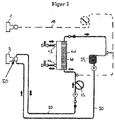
- FIG. 3 Now shows a second embodiment of the method according to the invention for filling and flushing the blood tubing set.
- the construction and connection of the blood tubing set is identical to the first embodiment, but the filling and flushing process now takes place when the fluid flow circulates in the blood tubing set.
- T-connector 50 an amount m of used substituate now flows via the rinse port, while the remainder of the liquid flow of quantity n is drawn by the blood pump 25 into the arterial line 20.
- the arterial line 20 and the venous line 30 are flowed through in series at the same time.
- the substituate flows through the blood tubing set in the order of dialyzer 40, air separator 35, venous patient line 30, T-connector 50, arterial patient line 20 to then return to the blood pump 25 and be pumped from there on.
- the substituate pump 15 In order to proceed to precirculation, only the substituate pump 15 has to be switched off and the substituate port 1 and the rinse port 2 have to be closed.
- the blood pump 25 simply continues to circulate and circulates the substituate as in FIG. 2 shown in the blood tubing set.
- the blood pump 25 is stopped. Then, the arterial line 20 and the venous line 30 are disconnected from the T-connector 50, so that the patient can be connected to these lines.
- the blood tubing set is completely machine-controlled and filled and flushed in a controlled manner and, moreover, it is passed on without interruption to precirculate the substituate.
- the filling and rinsing takes place continuously and without any interruption of the liquid flow, which additionally increases safety.
- the error sources associated with manual treatment steps are thus excluded.
Landscapes
- Health & Medical Sciences (AREA)
- Heart & Thoracic Surgery (AREA)
- Vascular Medicine (AREA)
- Engineering & Computer Science (AREA)
- Anesthesiology (AREA)
- Biomedical Technology (AREA)
- Hematology (AREA)
- Life Sciences & Earth Sciences (AREA)
- Animal Behavior & Ethology (AREA)
- General Health & Medical Sciences (AREA)
- Public Health (AREA)
- Veterinary Medicine (AREA)
- Cardiology (AREA)
- Urology & Nephrology (AREA)
- Emergency Medicine (AREA)
- Mechanical Engineering (AREA)
- External Artificial Organs (AREA)
Abstract
Description
- Die Erfindung betrifft ein Verfahren zur Füllung und Spülung eines Blutschlauchsatzes, der ein Pumpsegment für eine Blutpumpe, eine mit einem Eingang eines Dialysators verbundene arterielle Leitung und eine mit einem Ausgang eines Dialysators verbundene venöse Leitung umfasst, über eine Substituatleitung.
- Solche Blutschlauchsätze kommen bei extrakorporalen Bluttherapien, z.B. bei der Hämodialyse, zum Einsatz und bilden dabei den extrakorporalen Blutkreislauf. Als arterielle und venöse Leitung eines solchen Blutschlauchsatzes werden üblicherweise steril verpackte Einmalartikel verwendet, welche vor der Behandlung gefüllt und gespült werden müssen. Dieses Füllen und Spülen des Blutschlauchsatzes wird auch Priming genannt und dient zur Vermeidung des Kontaktes des Blutes mit Luft bei der extrakorporalen Therapie. Hierbei wird das als Disposable-System ausgeführte Blutschlauchsystem mit Substituat gefüllt, bevor der Patient zur Behandlung angeschlossen wird, so dass das extrakorporale System nach dem Priming nahezu luftfrei ist. Nach dem Füllen und Spülen des Schlauchsystems werden venöse und arterielle Leitungen üblicherweise miteinander verbunden, so dass das Substituat in diesem Kreislauf aus arterieller Leitung, Dialysator und venöser Leitung zirkulieren kann, bis der Patient an das System angeschlossen wird. Nach dem Anschluss des Patienten wird das Substituat durch das einströmende Blut verdrängt, so dass ein möglicher Kontakt des Blutes mit der Luft auf ein Minimum reduziert wird.
- Verfahren zur Füllung und Spülung von Blutschlauchsätzen unter Verwendung von Beuteln mit physiologischer Lösung und entsprechenden Beuteln zum Auffangen der benutzten Lösung sind bekannt. Dabei wird üblicherweise ein Beutel mit Kochsalzlösung mit der arteriellen Leitung verbunden und diese gefüllt. Nach dem Füllen der arteriellen Leitung wird nun die Blutpumpe verwendet, um auch die venöse Leitung zu füllen und zu spülen. Hierzu wird das Pumpsegment des Blutschlauchsatzes, ein Schlauchabschnitt mit bestimmten Eigenschaften, in die Blutpumpe, üblicherweise eine peristaltische Pumpe bzw. eine Rollenpumpe, eingesetzt, so dass die Blutpumpe über das Pumpsegment Kochsalzlösung in die venöse Leitung pumpen kann.
- Um den Füll- und Spülvorgang weitestgehend zu automatisieren, wurde in
EP 831 945 B1 - Aufgabe der vorliegenden Erfindung ist es deshalb, ein Verfahren zur Füllung und Spülung eines Blutschlauchsatzes zur Verfügung zu stellen, welches sicherer in der Anwendung und einfacher, schneller und kostengünstiger durchführbar ist.
- Erfindungsgemäß wird die Aufgabe von einem Verfahren zur Füllung und Spülung eines Blutschlauchsatzes gemäß Anspruch 1 erfüllt. Es umfasst dabei die an sich bekannten Schritte des Verbindens der arteriellen Leitung mit der venösen Leitung sowie des Verbindens dieser beiden Leitungen mit einem Rinse-Port, Verbinden der Substituatleitung mit einem Substituat-Port, Öffnen des Rinse-Ports, Füllen der arteriellen und der venösen Leitung, Spülen der arteriellen und der venösen Leitung, Schließen des Rinse-Ports, Zirkulieren des Substituats im Kreislauf aus arterieller Leitung, Dialysator und venöser Leitung durch die Blutpumpe, wobei es jedoch dadurch gekennzeichnet ist, dass das Füllen und/oder das Spülen der arteriellen und der venösen Leitung gleichzeitig erfolgt, wobei Substituat aus der Substituatleitung zugeführt wird. Natürlich wird vor Verwendung der Blutpumpe das Pumpsegment des Blutschlauchsatzes in diese eingesetzt.
- Insbesondere kann durch dieses Verfahren darauf verzichtet werden, Ventile am Blutschlauchsatz anzubringen, welche das Füllen oder Spülen der arteriellen Leitung und das darauf folgende Füllen oder Spülen der venösen Leitung steuern müssten. Die mit dem Anbringen dieser Ventile verbundenen Fehlerquellen bei der Bedienung sind damit ausgeschlossen. Zudem ermöglicht das gleichzeitige Füllen und/oder Spülen der arteriellen und der venösen Leitungen einen schnelleren Füll- und Spülvorgang, da auf unterschiedliche Verfahrensschritte verzichtet werden kann. Zudem ist das Verfahren auch einfacher zu automatisieren und die Zeit, welche eine Dialyseschwester zur Füllung und Spülung des Blutschlauchsatzes benötigt, wird minimiert. Außerdem ist so der Blutschlauchsatz kostengünstig und muss während des Verfahrens nicht geändert werden. Zudem kann das Verfahren komplett an der Behandlungsmaschine durchgeführt werden und noch vor der Konnektion des Patienten vollständig abgeschlossen werden, so dass der Patient in der Regel während der Vorbereitung der Behandlungsmaschine abwesend sein kann.
- Die Schnittstellen für den Blutschlauchsatz sind dabei der Substituat-Port, über welchen Substituat in die Substituatleitung eingeführt wird, sowie der Rinse-Port, über welchen benutztes Substituat wieder abgeführt werden kann. Sowohl Substituat-Port als auch Rinse-Port verfügen üblicherweise über Ventile, mit welchen sie zur Anwendung des Verfahrens geschlossen und geöffnet werden können.
- Vorteilhafterweise bilden bei dem erfindungsgemäßen Verfahren das Füllen und das Spülen einen kontinuierlichen Vorgang. Hierdurch ergibt sich insbesondere keinerlei Unterbrechung des Flüssigkeitsstroms, womit die sonst gegebene Gefahr, dass durch zeitweiliges Unterbrechen des nachströmenden Flüssigkeitsstroms in Folge von Luftblasenförderung eine Schaumbildung auftritt, vermieden wird. Hierbei werden also nicht nur arterielle und venöse Leitungen gleichzeitig gefüllt bzw. gespült, sondern dieser Füll- und Spülvorgang erfolgt auch kontinuierlich. Neben der eben erwähnten Erhöhung der Sicherheit erlaubt auch dies eine einfachere Automatisierung, da insbesondere auf den Einsatz von Ventilen am Blutschlauchsatz verzichtet werden kann.
- Weiterhin vorteilhafterweise erfolgt dabei das Füllen und das Spülen durch den gleichen Vorgang. Hierdurch muss nicht extra zwischen Füll- und Spülvorgang umgeschaltet werden, so dass sich der Steuerungs- bzw. Bedienaufwand für das Verfahren vermindert und die Sicherheit erhöht.
- Vorteilhafterweise erfolgt das gleichzeitige Füllen und/oder Spülen der arteriellen und der venösen Leitung dadurch, dass die Blutpumpe im Blutschlauchsatz Substituat befördert, während gleichzeitig Substituat aus der Substituatleitung zugeführt wird. So muss lediglich auf bereits vorhandene Komponenten des Blutschlauchsatzes zurückgegriffen werden, um den Füll- und/oder Spülvorgang zu steuern. Das Substituat aus der Substituatleitung wird dabei in den Blutschlauchsatz zugeführt, während die Blutpumpe dafür sorgt, dass sowohl die arterielle als auch die venöse Leitung mit dem Substituat durchströmt werden. Hierdurch kann auf Ventile verzichtet werden und sowohl die arterielle als auch die venöse Leitung gleichzeitig gefüllt bzw. gespült werden.
- Vorteilhafterweise fördert während des Füll- und/oder Spülvorgangs die Blutpumpe eine Menge n an Substituat, wobei der saugseitigen Leitung zur Blutpumpe eine Menge m+n an Substituat aus der Substituatleitung zugeführt wird. Hierdurch pumpt die Blutpumpe einen Teil n des aus der Substituatleitung zugeführten Substituats durch den druckseitigen Teil des Blutschlauchsatzes, während der saugseitige Teil des Blutschlauchsatzes ab der Zuleitung der Substituatleitung von der verbleibenden Menge m des Substituats aus der Substituatleitung direkt durchströmt wird. Bei diesem Verfahren werden also beide Teile des Blutschlauchsatzes gleichzeitig parallel und in gleicher Richtung durchströmt, wobei beide Substituatströme nach dem Füllen des Blutschlauchsatzes am Rinse-Port wieder zusammentreffen und von dort abgeleitet werden.
- Auf diese Art und Weise ergibt sich ein einfaches Verfahren, mit welchem der Blutschlauchsatz sicher und schnell befüllt und gespült werden kann, wobei lediglich die Mengen gesteuert werden müssen, welche von der Blutpumpe gefördert werden bzw. welche aus der Substituatleitung zugeführt werden.
- Vorteilhafterweise läuft dabei die Blutpumpe rückwärts. Insbesondere wenn das Pumpsegment für die Blutpumpe in der arteriellen Leitung integriert ist, pumpt die Blutpumpe damit direkt Substituat durch die arterielle Leitung zum Rinse-Port, während das restliche Substituat den Dialysator und die venöse Leitung durchströmt und sich dann im Rinse-Port mit dem direkt von der Blutpumpe gepumpten Substituat vereinigt.
- Alternativ kann während des gleichzeitigen Füllens und/oder Spülens der arteriellen und der venösen Leitung die Blutpumpe zumindest einen Teil des Substituats im Kreislauf aus arterieller Leitung, Dialysator und venöser Leitung zirkulieren, während zusätzlich Substituat aus der Substituatleitung zugeführt wird. Das Substituat fließt also nicht mehr parallel durch die arterielle und die venöse Leitung, sondern zirkuliert durch diese, während das am Anschluss der Substituatleitung in den Blutschlauchsatz zugegebene Substituat am Rinse-Port wieder abfließt. Auch dies ermöglicht ein einfaches und sicheres Verfahren zum Füllen und Spülen des Blutschlauchsatzes. Insbesondere ist es bei diesem Verfahren nicht entscheidend, wieviel Substituat aus der Substituatleitung zugeführt wird. Die Blutpumpe saugt an der Verbindungsstelle zwischen arterieller und venöser Leitung Substituat der Menge n in den extrakorporalen Blutkreislauf und zirkuliert dort das Substituat, so dass sich eine besonders effektive Spülung ergibt. Frisches Substituat der Menge m fließt dabei über die Substituatleitung zu und verdünnt damit immer wieder das gebrauchte Substituat, so dass im Bereich nach der Zuleitung der Substituatleitung Substituat der Menge m+n fließt, welches teilweise, und zwar mit der Menge m, über den Rinse-Port wieder abfließt. Insbesondere kann dabei über die Substituatleitung weniger Substituat zugeführt werden, als von der Blutpumpe im extrakorporalen Blutkreislauf zirkuliert wird, so dass sich eine besonders effektive Füllung und Spülung ergibt. Vorteilhafterweise liegt die Zugabestelle für die Menge m an Substituat dabei an der druckseitigen Leitung der vorwärts laufenden Blutpumpe.
- Vorteilhafterweise ist bei dem erfindungsgemäßen Verfahren das Pumpsegment für die Blutpumpe in der arteriellen Leitung angeordnet. Weiterhin vorteilhafterweise wird das Substituat zwischen Blutpumpe und Dialysator zugeführt, am Prädilutionszugang des Blutschlauchsatzes. So durchströmt frisch zugegebenes Substituat zumindest teilweise zuerst den Dialysator, wodurch dieser besonders effektiv gereinigt wird.
- Läuft die Blutpumpe rückwärts, wird dadurch die Menge n an Substituat, welche von der Blutpumpe gepumpt wird, durch die arterielle Leitung in Richtung Rinse-Port gefördert. Die Menge m + n an Substituat, welche bei diesem Verfahren aus der Substituatleitung in den Prädilutionszugang des Blutschlauchsatzes zugeführt wird, wird also teilweise von der Blutpumpe in die arterielle Leitung gepumpt, während der Rest durch den Dialysator und die venöse Leitung strömt.
- Bei der zweiten Verfahrensalternative läuft die Blutpumpe dagegen vorwärts und saugt Substituat an der Verbindung zwischen venöser und arterieller Leitung aus der venösen Leitung in die arterielle Leitung und pumpt dieses weiter durch den Dialysator und wieder in die venöse Leitung. Das Substituat wird dabei über den Prädilutionszugang zugeführt und mischt sich mit dem bereits zirkulierenden Substituat. In dem gleichen Maße, wie das Substituat am Prädilutionszugang zugeführt wird, wird es am Rinse-Port wieder abgeführt, sobald der Blutschlauchsatz gefüllt ist.
- Zwar kann das erfindungsgemäße Verfahren auch unter Verwendung von Beuteln zum Füllen und Spülen und entsprechenden Beuteln zum Auffangen der benutzten Lösung betrieben werden, besonders vorteilhafterweise kommt es aber in einem System mit integrierter Substituataufbereitung zum Einsatz. Der Substituat-Port und der Rinse-Port sind dabei Teil dieses Systems, wobei über den Substituat-Port das frische Substituat bereit gestellt wird, während über den Rinse-Port das benutzte Substituat zur Aufbereitung zurückgeführt wird. Dies bedeutet insbesondere, dass der Blutschlauchsatz in einen Kreislauf integriert ist.
- Weiterhin vorteilhafterweise verfügen dabei beide Ports über ein maschinenseitiges Ventil, so dass die Ventile nicht Bestandteil des Blutschlauchsatzes sein müssen. Insbesondere muss bei einem solchen System mit integrierter Substituataufbereitung nicht mehr auf Beutel zurückgegriffen werden, so dass die Kosten für die Beschaffung, Lagerhaltung, Anwendung und Entsorgung dieser Beutel entfallen. Ein besonderer Vorteil des erfindungsgemäßen Verfahrens besteht insbesondere darin, dass bestehende Systeme mit integrierter Substituataufbereitung nicht hardwaremäßig verändert werden müssen, um das erfindungsgemäße Verfahren anzuwenden. Es bedarf dazu lediglich einer neuen Softwareansteuerung, so dass bestehende Systeme auf einfache Art und Weise mit dem neuen Verfahren ausgestattet werden können.
- Vorteilhafterweise erfolgt dabei bei dem erfindungsgemäßen Verfahren die Ansteuerung des Rinse-Ports und der Blutpumpe automatisch. Es müssen bei dem erfindungsgemäßen Verfahren lediglich die Verbindungen des Schlauchsatzes am Anfang hergestellt werden, während der gesamte Füll- und Spülvorgang automatisch erfolgt. Hierdurch wird der Dialyseschwester sehr viel Arbeit erspart, wobei gleichzeitig Fehlermöglichkeiten durch falsche Bedienung ausgeschlossen werden.
- Weiterhin vorteilhafterweise wird das Substituat über eine Substituatpumpe zugeführt. Dies ermöglicht eine genaue Steuerung der zugegebenen Menge, so dass das Füllen und das Spülen äußerst kontrolliert erfolgen kann.
- Vorteilhafterweise erfolgt die Ansteuerung der Substituatpumpe dabei automatisch, so dass auch hier keine manuellen Bedienschritte von Nöten sind, so dass damit verbundene Fehlerquellen ausgeschlossen sind und Zeit gespart werden kann.
- Weiterhin vorteilhafterweise ist ein Pumpsegment für die Substituatpumpe dabei in der Substituatleitung integriert. Insbesondere bei einem Anschluß an ein System mit integrierter Substituataufbereitung muss dieses System hierdurch hardwaremäßig nicht verändert werden, da alle zum Betreiben des Verfahren notwendigen Komponenten außerhalb des Systems zur Verfügung stehen.
- Vorteilhafterweise erfolgt auch die Ansteuerung der Substituatpumpe automatisch. Hierzu sollte vorteilhafterweise das System mit integrierter Substituataufbereitung mit einer neuen Software ausgestattet werden, welche das erfindungsgemäße Zusammenwirken von Substituat-Port, Rinse-Port, Blutpumpe und Substituatpumpe steuert. Weiterer insbesondere hardwareseitiger Veränderungen bedarf es nicht, so dass bestehende Systeme einfach mit dem neuen Verfahren ausgestattet werden können.
- Vorteilhafterweise kommt dabei zum Verbinden der arteriellen Leitung, der venösen Leitung und des Rinse-Port ein T-Konnektor zum Einsatz, so dass diese Verbindung auf einfache und sichere Weise hergestellt werden kann.
- Während beim gleichzeitigen Spülen der arteriellen und der venösen Leitung das Substituat über den Rinse-Port abgeführt wird, ist es ebenso möglich, während dem Spülen bzw. dem Zirkulieren des Substituats auch über den Dialysator Substituat abzuführen.
- Weiterhin umfasst die vorliegende Erfindung einen Blutschlauchsatz, der ein Pumpsegment für eine Blutpumpe, eine mit einem Eingang eines Dialysators verbindbare arterielle Leitung und eine mit einem Ausgang eines Dialysators verbindbare venöse Leitung umfasst, sowie eine Substituatleitung und einen Konnektor, wobei der Konnektor mit der arteriellen Leitung, der venösen Leitung und einem Rinse-Port verbindbar ist, wobei ein Pumpsegment für die Substituatpumpe in der Substituatleitung integriert ist. Durch die Integration des Pumpsegments für die Substituatpumpe in der Substituatleitung ist insbesondere der Anschluss an ein System mit integrierter Substituataufbereitung möglich, ohne dieses hardwaremäßig zu verändern. So lässt sich mit dem erfindungsgemäßen Blutschlauchsatz das erfindungsgemäße Verfahren zur Füllung und Spülung des Blutschlauchsatzes besonders einfach und kostengünstig umsetzen.
- Ausführungsbeispiele der vorliegenden Erfindung werden nun anhand von Zeichnungen näher beschrieben. Dabei zeigen:
- Figur 1:
- ein erstes Ausführungsbeispiel des erfindungsgemäßen Füll- und Spülvorgangs,
- Figur 2:
- ein erstes Ausführungsbeispiel des erfindungsgemäßen Zirkulierens und
- Figur 3:
- ein zweites Ausführungsbeispiel des erfindungsgemäßen Füll- und Spülvorgangs.
- In
Figur 1 ist ein erstes Ausführungsbeispiel der Erfindung gezeigt. Das extrakorporale Blutbehandlungssystem mit integrierter Substituataufbereitung umfasst dabei maschinenseitig den Substituat-Port 1 und den Rinse-Port 2. Über den Substituat-Port 1 wird frisches Substituat in den Blutschlauchsatz abgegeben, während über den Rinse-Port 2 gebrauchtes Substituat wieder abgeführt und aufbereitet wird. - Der eigentliche Blutschlauchsatz besteht aus einer arteriellen Leitung 20 und einer venösen Leitung 30. In der arteriellen Leitung 20 befindet sich das Pumpsegment für die Blutpumpe 25, in der venösen Leitung 30 der Luftabscheider 35. Der Dialysator 40 umfasst zwei Kammern, eine Dialysatkammer 42 für die Spülflüssigkeit und eine Blutkammer 41, über welche der Dialysator 40 in den extrakorporalen Blutkreislauf integriert wird. Hierzu ist die arterielle Leitung 20 hinter der Blutpumpe 25 mit dem Eingang der Blutkammer 41 des Dialysators 40 verbunden. Der Ausgang der Blutkammer 41 ist mit der venösen Leitung 30 verbunden, wobei aus der Blutkammer 41 strömende Flüssigkeit zuerst in den Luftabscheider 35 gelangt, um eventuell auftretende Luftblasen abzuscheiden. Zwischen der Blutpumpe 25 und dem Eingang der Blutkammer 41 befindet sich in der arteriellen Leitung 20 der Prädilutionszugang 21. Zwischen dem Ausgang der Blutkammer 41 und dem Luftabscheider 35 befindet sich in der venösen Leitung 30 der Postdilutionszugang, der jedoch bei den vorliegenden Ausführungsbeispielen des erfindungsgemäßen Verfahrens nicht zum Einsatz kommt. Die Substituatleitung 10 ist am Prädilutionszugang angeschlossen und verfügt über ein Pumpsegment für eine Substituatpumpe 15.
- Zur Durchführung des erfindungsgemäßen Verfahrens zur Füllung und Spülung des Blutschlauchsatzes ist die Substituatleitung 10 am Substituat-Port 1 des Blutbehandlungssystems angeschlossen. Die patientenseitigen Enden der venösen Leitung 30 und der arteriellen Leitung 20 sind über einen T-Konnektor 50 kurzgeschlossen und mit dem Rinse-Port 2 des Blutbehandlungssystems verbunden. Sowohl Substituat-Port 1 als auch Rinse-Port 2 sind geöffnet.
- Bei der in
Figur 1 gezeigten Verfahrensvariante wird eine Menge m + n Substituat mittels der Substituatpumpe 15 über den Substituat-Port 1 angesaugt und über den Prädilutionszugang 21 in die arterielle Leitung 20 zwischen Blutpumpe 25 und Eingang des Dialysators 40 eingespeist. Die Blutpumpe 25 läuft in umgekehrter Drehrichtung und pumpt eine Menge n an Substituat direkt durch die arterielle Leitung 20 zum T-Konnektor 50 und damit in den Rinse-Port 2. Der verbleibende Teil des Substituats, also die Menge m, durchströmt zwangsläufig die Blutkammer 41 des Dialysators 40 und danach den Luftabscheider 35, bevor dieser Teilstrom durch die venöse Leitung 30 ebenfalls in den T-Konnektor 50 und damit in den Rinse-Port 2 strömt. - Bei diesem Ausführungsbeispiel werden die arterielle Leitung und die venöse Leitung beim Spülen also parallel und gleichzeitig von zwei Teilströmen durchströmt. Die Teilströme trennen sich beim Prädilutionszugang 21 und vereinigen sich wieder im Rinse-Port, von wo aus sie der Substituataufbereitung des Blutbehandlungssystems zugeführt werden. Auf diese Weise können sowohl venöse als auch arterielle Leitungen gleichzeitig gefüllt werden, wobei zur Steuerung dieses Vorgangs lediglich die Blutpumpe 25 und die Substituatpumpe 15 angesteuert werden müssen, ohne dass am Blutschlauchsatz weitere Ventile vorgesehen sein müssen. Auch geschehen so Füll- und Spülvorgang in einem einzigen Arbeitsgang, da das Substituat aus dem Substituat-Port 1 zuerst den Blutschlauchsatz füllt und dann bei weiter laufenden Pumpen durchspült, wobei das gebrauchte Substituat über den geöffneten Rinse-Port 2 abfließt.
- In
Figur 2 wurden nun sowohl Substituat-Port 1 als auch Rinse-Port 2 geschlossen, so dass kein Substituat mehr in das Blutschlauchsystem zufließt und auch kein Substituat mehr abfließt. In diesem Vorzirkulierbetrieb arbeitet die Blutpumpe 25 nun in ihrer üblichen Drehrichtung und fördert somit vorwärts. Das Substituat zirkuliert im Blutschlauchsatz nun im Kreislauf in der Reihenfolge Dialysator 40, Luftabscheider 35, venöse Patientenleitung 30, T-Konnektor 50, arterielle Patientenleitung 20, bevor es wieder in die Blutpumpe 25 gelangt und von dort aus weiter gepumpt wird. Damit ist auch der Übergang vom Spülbetrieb in den Vorzirkulierbetrieb möglich, ohne dass Anschlüsse geändert werden müssen oder Ventile am Blutschlauchsatz geöffnet oder geschlossen werden müssen. Wiederum ist also die Steuerung allein über das Öffnen und Schließen der maschinenseitigen Ports und die Ansteuerung der Pumpen möglich. -
Figur 3 zeigt nun ein zweites Ausführungsbeispiel des erfindungsgemäßen Verfahrens zur Füllung und Spülung des Blutschlauchsatzes. Der Aufbau und der Anschluss des Blutschlauchsatzes ist identisch zum ersten Ausführungsbeispiel, das Füll- und Spülverfahren erfolgt nun aber bei im Blutschlauchsatz zirkulierender Flüssigkeitsströmung. - Hierbei wird bei laufender Substituatpumpe 15 permanent eine Menge m an Substituat in den Prädilutionszugang 21 des Blutschlauchsatzes gepumpt. Über den T-Konnektor wird permanent die gleiche Menge m gebrauchtes Substituat über den Rinse-Port abgegeben, während die Blutpumpe 25 in der arteriellen Leitung 20 in Vorwärtsrichtung arbeitet und eine Menge n an Substituat pumpt. Im Prädilutionszugang 21 vereinigen sich also die Substituatströme aus der Blutpumpe 25 und aus der Substituatleitung 10 zu einem Substituatstrom der Menge m + n, welcher über die Blutkammer 41 des Dialysators 40 weiter in den Luftabscheider 35 und von dort aus über die venöse Leitung 30 zum T-Konnektor 50 fließt. Beim T-Konnektor 50 fließt nun eine Menge m an gebrauchtem Substituat über den Rinse-Port ab, während der Rest des Flüssigkeitsstroms der Menge n von der Blutpumpe 25 in die arterielle Leitung 20 gesogen wird. Bei dieser Verfahrensvariante werden also die arterielle Leitung 20 und die venöse Leitung 30 gleichzeitig in Reihe durchströmt. Das Substituat durchströmt dabei den Blutschlauchsatz in der Reihenfolge Dialysator 40, Luftabscheider 35, venöse Patientenleitung 30, T-Konnektor 50, arterielle Patientenleitung 20, um dann wieder zur Blutpumpe 25 zu gelangen und von dort aus weiter gepumpt zu werden.
- Um zum Vorzirkulieren überzugehen, muss lediglich die Substituatpumpe 15 abgeschaltet werden und der Substituat-Port 1 und der Rinse-Port 2 geschlossen werden. Die Blutpumpe 25 läuft einfach weiter und zirkuliert das Substituat wie bereits in
Figur 2 gezeigt im Blutschlauchsatz. Durch dieses Verfahren geschieht nicht nur das Füllen und das Spülen des Blutschlauchsatzes in einem Vorgang, sondern es erfolgt auch das Spülen und das danach folgende Vorzirkulieren übergangslos. - Zum Beenden des Vorzirkulierens wird die Blutpumpe 25 angehalten. Dann werden die arterielle Leitung 20 sowie die venöse Leitung 30 vom T-Konnektor 50 getrennt, so dass der Patient an diese Leitungen konnektiert werden kann.
- Die Änderungen zum Einsatz des erfindungsgemäßen Verfahrens zur Füllung und Spülung des Blutschlauchsatzes, welche an bestehenden Blutbehandlungssystemen vorgenommen werden müssen, beschränken sich dabei auf den Einsatz des speziellen T-Konnektors 50, der als kostengünstiger Einmalartikel ausgeführt werden kann, und der integrierten Substituatpumpe, sowie die Änderung des Steuerprogramms der Behandlungsmaschine, wobei keine neuen Komponenten berücksichtigt bzw. angesteuert werden müssen. Die Änderungen beschränken sich deshalb auf Änderungen der Software. Insbesondere ist die Notwendigkeit einer zusätzlichen, störenden und mit Kosten verbundenen elektrischen Verkabelung nicht gegeben.
- Weiterhin ergibt sich der Vorteil, dass der Blutschlauchsatz komplett maschinengesteuert und kontrolliert befüllt und gespült wird und zudem ohne Unterbrechung zum Vorzirkulieren des Substituats übergegangen wird. Insbesondere erfolgt die Füllung und Spülung dabei kontinuierlich und ohne jede Unterbrechung des Flüssigkeitsstroms, was die Sicherheit zusätzlich erhöht. Die mit manuellen Behandlungsschritten verbundenen Fehlerquellen sind damit ausgeschlossen.
Claims (17)
- Verfahren zur Füllung und Spülung eines Blutschlauchsatzes, der ein Pumpsegment für eine Blutpumpe, eine mit einem Eingang eines Dialysators verbundene arterielle Leitung und eine mit einem Ausgang eines Dialysators verbundene venöse Leitung umfasst, über eine Substituatleitung, wobei das Verfahren die Schritte umfasst:- Verbinden der arteriellen Leitung mit der venösen Leitung sowie Verbinden dieser beiden Leitungen mit einem Rinse-Port,- Verbinden der Substituatleitung mit einem Substituat-Port,- Öffnen des Rinse-Ports- Füllen der arteriellen und der venösen Leitung,- Spülen der arteriellen und der venösen Leitung,- Schließen des Rinse-Ports,- Zirkulieren des Substituats im Kreislauf aus arterieller Leitung, Dialysator und venöser Leitung durch die Blutpumpe,dadurch gekennzeichnet,
dass das Füllen und/oder das Spülen der arteriellen und der venösen Leitung gleichzeitig erfolgt, wobei Substituat aus der Substituatleitung zugeführt wird. - Verfahren nach Anspruch 1, wobei das Füllen und das Spülen einen kontinuierlichen Vorgang darstellen.
- Verfahren nach Anspruch 1, wobei das Füllen und das Spülen durch den gleichen Vorgang erfolgen.
- Verfahren nach einem der vorhergehenden Ansprüche, wobei das gleichzeitige Füllen und/oder Spülen der arteriellen und der venösen Leitung dadurch erfolgt, dass die Blutpumpe im Blutschlauchsatz Substituat befördert, während gleichzeitig Substituat aus der Substituatleitung zugeführt wird.
- Verfahren nach Anspruch 4, wobei die Blutpumpe während des Füll- und/oder Spülvorgangs eine Menge n an Substituat befördert und der saugseitigen Leitung der Blutpumpe eine Menge m + n an Substituat aus der Substituatleitung zugeführt wird.
- Verfahren nach Anspruch 4 oder 5, wobei die Blutpumpe rückwärts läuft.
- Verfahren nach Anspruch 4, wobei die Blutpumpe zumindest einen Teil des Substituats im Kreislauf aus arterieller Leitung, Dialysator und venöser Leitung zirkuliert, während zusätzlich Substituat aus der Substituatleitung zugeführt wird.
- Verfahren nach Anspruch 1, wobei die Blutpumpe in der arteriellen Leitung angeordnet ist und das Substituat zwischen Blutpumpe und Dialysator zugeführt wird.
- Verfahren nach Anspruch 1, wobei Substituat-Port und Rinse-Port Teil eines Systems mit integrierter Substituataufbereitung sind.
- Verfahren nach Anspruch 1, wobei die Ansteuerung des Rinse-Ports und der Blutpumpe automatisch erfolgt.
- Verfahren nach Anspruch 1, wobei das Substituat über eine Substituatpumpe zugeführt wird.
- Verfahren nach Anspruch 11, wobei ein Pumpsegment für eine Substituatpumpe in der Substituatleitung integriert ist.
- Verfahren nach Anspruch 11, wobei die Ansteuerung der Substituatpumpe automatisch erfolgt.
- Verfahren nach Anspruch 1, wobei die arterielle Leitung, die venöse Leitung und der Rinse-Port über einen T-Konnektor verbunden werden.
- Verfahren nach Anspruch 1, wobei beim gleichzeitigen Spülen der arteriellen und der venösen Leitung Substituat über den Rinse-Port abgeführt wird.
- Verfahren nach Anspruch 1, wobei beim gleichzeitigen Spülen der arteriellen und der venösen Leitung oder beim Zirkulieren Substituat über den Dialysator abgeführt wird.
- Blutschlauchsatz, welcher ein Pumpsegment für eine Blutpumpe, eine mit einem Eingang eines Dialysators verbindbare arterielle Leitung und eine mit einem Ausgang eines Dialysators verbindbare venöse Leitung umfasst, sowie eine Substituatleitung und einen Konnektor, wobei der Konnektor mit der arteriellen Leitung, der venösen Leitung und einem Rinse-Port verbindbar ist,
dadurch gekennzeichnet,
dass ein Pumpsegment für eine Substituatpumpe in der Substituatleitung integriert ist.
Applications Claiming Priority (3)
| Application Number | Priority Date | Filing Date | Title |
|---|---|---|---|
| DE102006022122A DE102006022122A1 (de) | 2006-05-11 | 2006-05-11 | Verfahren zur Füllung und Spülung eines Blutschlauchsatzes |
| PCT/EP2007/003767 WO2007131611A2 (de) | 2006-05-11 | 2007-04-27 | Verfahren zur füllung und spülung eines blutschlauchsatzes |
| EP07724694.0A EP2015797B1 (de) | 2006-05-11 | 2007-04-27 | Verfahren zur füllung und spülung eines blutschlauchsatzes |
Related Parent Applications (2)
| Application Number | Title | Priority Date | Filing Date |
|---|---|---|---|
| EP07724694.0A Division-Into EP2015797B1 (de) | 2006-05-11 | 2007-04-27 | Verfahren zur füllung und spülung eines blutschlauchsatzes |
| EP07724694.0A Division EP2015797B1 (de) | 2006-05-11 | 2007-04-27 | Verfahren zur füllung und spülung eines blutschlauchsatzes |
Publications (2)
| Publication Number | Publication Date |
|---|---|
| EP3241577A1 true EP3241577A1 (de) | 2017-11-08 |
| EP3241577B1 EP3241577B1 (de) | 2020-11-18 |
Family
ID=38318624
Family Applications (2)
| Application Number | Title | Priority Date | Filing Date |
|---|---|---|---|
| EP07724694.0A Active EP2015797B1 (de) | 2006-05-11 | 2007-04-27 | Verfahren zur füllung und spülung eines blutschlauchsatzes |
| EP17172400.8A Active EP3241577B1 (de) | 2006-05-11 | 2007-04-27 | Verfahren zur füllung und spülung eines blutschlauchsatzes |
Family Applications Before (1)
| Application Number | Title | Priority Date | Filing Date |
|---|---|---|---|
| EP07724694.0A Active EP2015797B1 (de) | 2006-05-11 | 2007-04-27 | Verfahren zur füllung und spülung eines blutschlauchsatzes |
Country Status (12)
| Country | Link |
|---|---|
| US (3) | US8980094B2 (de) |
| EP (2) | EP2015797B1 (de) |
| JP (1) | JP5409350B2 (de) |
| KR (2) | KR101433965B1 (de) |
| CN (2) | CN101443057B (de) |
| AU (1) | AU2007250295B2 (de) |
| BR (1) | BRPI0711400B8 (de) |
| CA (1) | CA2650595C (de) |
| DE (1) | DE102006022122A1 (de) |
| EA (1) | EA015057B1 (de) |
| ES (1) | ES2643141T3 (de) |
| WO (1) | WO2007131611A2 (de) |
Families Citing this family (17)
| Publication number | Priority date | Publication date | Assignee | Title |
|---|---|---|---|---|
| US7744553B2 (en) | 2003-12-16 | 2010-06-29 | Baxter International Inc. | Medical fluid therapy flow control systems and methods |
| CA2683051C (en) | 2007-04-12 | 2012-11-27 | Gambro Lundia Ab | Method and apparatus for priming an extracorporeal blood circuit |
| US9713670B2 (en) | 2009-11-24 | 2017-07-25 | Fresenius Medical Care Deutschland Gmbh | Method for temporarily interrupting an extracorporeal blood treatment, control device and blood treatment apparatus |
| DE102010032182B4 (de) * | 2010-07-23 | 2016-09-29 | Fresenius Medical Care Deutschland Gmbh | Spülleitung, medizintechnische Funktionseinrichtung, medizintechnische Behandlungsvorrichtung sowie Verfahren |
| EP2465555B1 (de) | 2010-12-20 | 2014-01-15 | Gambro Lundia AB | Verfahren und System zur Bereitstellung von Füll- und Restitutionsflüssigkeiten für eine extrakorporale Blutbehandlung |
| JP5621591B2 (ja) * | 2010-12-29 | 2014-11-12 | ニプロ株式会社 | 血液浄化装置及びその血液循環路の自動プライミング方法 |
| DE102011102492A1 (de) * | 2011-05-24 | 2012-11-29 | Fresenius Medical Care Deutschland Gmbh | Verfahren zum Spülen und/oder zum Befüllen einer Blutbehandlungsvorrichtung sowie Blutbehandlungsvorrichtung |
| DE102011116262A1 (de) | 2011-10-19 | 2013-04-25 | Fresenius Medical Care Deutschland Gmbh | Verfahren sowie Vorrichtungen zum retrograden Befüllen wenigstens einer Calciumleitung eines extrakorporalen Blutkreislaufs |
| EP2662101B2 (de) † | 2012-05-09 | 2018-05-30 | D_MED Consulting AG | Verfahren zur Vorfüllung eines Hämodialysegerätes |
| US9987411B2 (en) | 2014-12-19 | 2018-06-05 | Fenwal, Inc. | Methods and systems for priming a biological fluid processing circuit |
| DE102015107269B4 (de) | 2015-05-10 | 2019-05-02 | Uwe Jost | Dialyseeinrichtung |
| DE102017102829A1 (de) * | 2017-02-13 | 2018-08-16 | Cardiobridge Gmbh | Spülsystem |
| ES2629163B1 (es) | 2017-03-30 | 2017-12-01 | Grifols Worldwide Operations Limited | Dispositivo de recambio plasmático terapéutico |
| KR20200137375A (ko) | 2019-05-30 | 2020-12-09 | 구순자 | 옷걸이를 겸하는 멀티 진열대 |
| DE102021133300A1 (de) | 2021-12-15 | 2023-06-15 | Fresenius Medical Care Deutschland Gmbh | Spülanschluss für ein medizinisches Behandlungsgerät, insbesondere extrakorporale Blutbehandlungsvorrichtung, medizinisches Behandlungsgerät mit einem Spülanschluss und Verfahren zum Spülen eines Blutschlauchsystems einer extrakorporalen Blutbehandlungsvorrichtung sowie Verfahren zum Betreiben einer extrakorporalen Blutbehandlungsvorrichtung |
| US12350413B2 (en) | 2022-06-22 | 2025-07-08 | B. Braun Medical Inc. | Fluid handling systems and methods |
| DE102025104745A1 (de) * | 2025-02-10 | 2026-08-13 | Fresenius Medical Care Deutschland Gmbh | Medizintechnische Behandlungsvorrichtung mit Spülport |
Citations (5)
| Publication number | Priority date | Publication date | Assignee | Title |
|---|---|---|---|---|
| DE4240681A1 (de) * | 1992-12-03 | 1994-06-09 | Fresenius Ag | Vorrichtung zur Hämodialyse ohne Antikoagulation |
| WO1996040320A1 (en) * | 1995-06-07 | 1996-12-19 | Cobe Laboratories, Inc. | Technique for priming and recirculating fluid through a dialysis machine |
| US5776345A (en) * | 1993-02-12 | 1998-07-07 | Cobe Laboratories, Inc. | Automatic priming technique |
| WO1999020376A1 (en) * | 1997-10-21 | 1999-04-29 | Dsu Medical Corporation | Automatic priming of blood sets |
| DE10011208C1 (de) * | 2000-03-08 | 2001-09-27 | Fresenius Medical Care De Gmbh | Befüllen und/oder Spülen eines extrakorporalen Kreislaufs eines Hämodialyse- und/oder Hämofiltrationsgerätes und Blutschlauchset hierfür |
Family Cites Families (9)
| Publication number | Priority date | Publication date | Assignee | Title |
|---|---|---|---|---|
| JPH0614964B2 (ja) * | 1989-08-08 | 1994-03-02 | 日機装株式会社 | 血液浄化回路の自動プライミング処理方法および装置 |
| IT1295530B1 (it) | 1997-10-20 | 1999-05-12 | Tiziano Giordani | Macchina filtrante a dischi rotanti |
| US6187198B1 (en) * | 1997-10-21 | 2001-02-13 | Dsu Medical Corporation | Automatic priming of connected blood sets |
| DE10011207C2 (de) | 2000-03-08 | 2002-11-07 | Kuper Heinrich Gmbh Co Kg | Verfahren und Vorrichtung zum Querverleimen von Furnierstreifen |
| KR100713606B1 (ko) | 2000-06-15 | 2007-05-02 | 가부시끼가이샤 제이엠에스 | 자동 혈액투석장치 |
| US6916424B2 (en) * | 2001-02-07 | 2005-07-12 | Nephros, Inc. | Method and apparatus for a hemodiafiltration delivery module |
| JP4457235B2 (ja) | 2001-12-18 | 2010-04-28 | 株式会社北九州バイオフィジックス研究所 | 自動血液透析装置および該装置を使用したプライミング方法。 |
| EP1539271B1 (de) | 2002-09-11 | 2014-04-16 | Fresenius Medical Care Deutschland GmbH | Blutbehandlungsvorrichtung mit blutrückgabe |
| JP3937436B2 (ja) * | 2003-06-05 | 2007-06-27 | ニプロ株式会社 | 血液浄化装置および血液回路の自動プライミング方法 |
-
2006
- 2006-05-11 DE DE102006022122A patent/DE102006022122A1/de not_active Ceased
-
2007
- 2007-04-27 AU AU2007250295A patent/AU2007250295B2/en not_active Ceased
- 2007-04-27 CA CA2650595A patent/CA2650595C/en active Active
- 2007-04-27 CN CN200780017163.9A patent/CN101443057B/zh active Active
- 2007-04-27 ES ES07724694.0T patent/ES2643141T3/es active Active
- 2007-04-27 EA EA200802308A patent/EA015057B1/ru not_active IP Right Cessation
- 2007-04-27 WO PCT/EP2007/003767 patent/WO2007131611A2/de not_active Ceased
- 2007-04-27 US US12/227,220 patent/US8980094B2/en active Active
- 2007-04-27 BR BRPI0711400A patent/BRPI0711400B8/pt not_active IP Right Cessation
- 2007-04-27 KR KR1020087029793A patent/KR101433965B1/ko active Active
- 2007-04-27 EP EP07724694.0A patent/EP2015797B1/de active Active
- 2007-04-27 EP EP17172400.8A patent/EP3241577B1/de active Active
- 2007-04-27 CN CN201610210081.7A patent/CN105833372B/zh not_active Expired - Fee Related
- 2007-04-27 KR KR1020137027803A patent/KR101434130B1/ko not_active Expired - Fee Related
- 2007-04-27 JP JP2009508183A patent/JP5409350B2/ja not_active Expired - Fee Related
-
2015
- 2015-02-19 US US14/626,555 patent/US9566378B2/en active Active
-
2017
- 2017-01-26 US US15/416,891 patent/US9867924B2/en active Active
Patent Citations (5)
| Publication number | Priority date | Publication date | Assignee | Title |
|---|---|---|---|---|
| DE4240681A1 (de) * | 1992-12-03 | 1994-06-09 | Fresenius Ag | Vorrichtung zur Hämodialyse ohne Antikoagulation |
| US5776345A (en) * | 1993-02-12 | 1998-07-07 | Cobe Laboratories, Inc. | Automatic priming technique |
| WO1996040320A1 (en) * | 1995-06-07 | 1996-12-19 | Cobe Laboratories, Inc. | Technique for priming and recirculating fluid through a dialysis machine |
| WO1999020376A1 (en) * | 1997-10-21 | 1999-04-29 | Dsu Medical Corporation | Automatic priming of blood sets |
| DE10011208C1 (de) * | 2000-03-08 | 2001-09-27 | Fresenius Medical Care De Gmbh | Befüllen und/oder Spülen eines extrakorporalen Kreislaufs eines Hämodialyse- und/oder Hämofiltrationsgerätes und Blutschlauchset hierfür |
Also Published As
| Publication number | Publication date |
|---|---|
| US20150165109A1 (en) | 2015-06-18 |
| KR101434130B1 (ko) | 2014-08-26 |
| JP2009536537A (ja) | 2009-10-15 |
| KR20090007791A (ko) | 2009-01-20 |
| US20090114593A1 (en) | 2009-05-07 |
| WO2007131611A2 (de) | 2007-11-22 |
| ES2643141T3 (es) | 2017-11-21 |
| US8980094B2 (en) | 2015-03-17 |
| BRPI0711400B1 (pt) | 2019-02-05 |
| BRPI0711400B8 (pt) | 2021-06-22 |
| CA2650595C (en) | 2016-10-04 |
| US20170197022A1 (en) | 2017-07-13 |
| EA200802308A1 (ru) | 2009-04-28 |
| CN105833372B (zh) | 2018-02-23 |
| BRPI0711400A2 (pt) | 2011-11-01 |
| CA2650595A1 (en) | 2007-11-22 |
| WO2007131611A3 (de) | 2008-01-10 |
| DE102006022122A1 (de) | 2007-11-15 |
| AU2007250295A1 (en) | 2007-11-22 |
| CN101443057A (zh) | 2009-05-27 |
| CN101443057B (zh) | 2016-04-27 |
| EA015057B1 (ru) | 2011-04-29 |
| US9867924B2 (en) | 2018-01-16 |
| KR20130128011A (ko) | 2013-11-25 |
| EP2015797B1 (de) | 2017-07-05 |
| EP2015797A2 (de) | 2009-01-21 |
| US9566378B2 (en) | 2017-02-14 |
| KR101433965B1 (ko) | 2014-08-25 |
| AU2007250295B2 (en) | 2013-10-10 |
| EP3241577B1 (de) | 2020-11-18 |
| CN105833372A (zh) | 2016-08-10 |
| JP5409350B2 (ja) | 2014-02-05 |
Similar Documents
| Publication | Publication Date | Title |
|---|---|---|
| EP2015797B1 (de) | Verfahren zur füllung und spülung eines blutschlauchsatzes | |
| EP1539271B1 (de) | Blutbehandlungsvorrichtung mit blutrückgabe | |
| DE102006012087B4 (de) | Verfahren zum zumindest teilweise Entleeren eines extrakorporalen Blutkreislaufs und Hämodialysegerät zur Anwendung des Verfahrens | |
| EP3173111B1 (de) | Externe funktionseinrichtung und blutbehandlungsvorrichtung mit einer erfindungsgemässen externen funktionseinrichtung | |
| DE60031966T2 (de) | Extrakorporaler kreislauf | |
| DE69634724T2 (de) | Technik zum vorfüllen und rezirkulieren einer flüssigkeit in einer dialysemaschine | |
| EP2579912B1 (de) | Vorrichtung und verfahren zum fördern von flüssigkeiten in die behandlungseinheit einer medizinischen behandlungsvorrichtung, insbesondere in den dialysator einer dialysevorrichtung | |
| EP0408955B1 (de) | Verfahren und Vorrichtung zur Steuerung von Blutpumpen bei einem extrakorporalen Kreislauf mit einer Single-Needle-Anordnung | |
| DE102011008223B4 (de) | Dialysebehandlungseinheit | |
| EP3554578A1 (de) | Blutbehandlungsvorrichtung zur durchführung einer extrakorporalen blutbehandlung, blutführungsvorrichtung, blutbehandlungssystem | |
| DE19704564A1 (de) | Vorrichtung zur periodischen Spülung des extrakorporalen Kreislaufs einer Blutbehandlungseinrichtung | |
| EP3177340B1 (de) | Verfahren zum auswaschen von gasblasen in einem extrakorporalen blutkreislauf | |
| EP2954911B1 (de) | Dialysemaschinen-integrierte substituatpumpe | |
| EP2595671B1 (de) | Spülleitung, medizintechnische funktionseinrichtung, medizintechnische behandlungsvorrichtung sowie verfahren | |
| EP3773791B1 (de) | Steuer- oder regelvorrichtung und blutbehandlungsvorrichtung für die single needle-behandlung | |
| EP2950846B1 (de) | Extrakorporale blutbehandlungsvorrichtung für den betrieb mit einem einzigen patientenanschluss und verfahren zum betreiben einer extrakorporalen blutbehandlungsvorrichtung mit einem einzigen patientenanschluss | |
| EP3177339A1 (de) | Verfahren zum spülen eines extrakorporalen blutkreislaufs | |
| DE19962315A1 (de) | Vorrichtung zur Peritonealdialyse | |
| DE10245619B4 (de) | Verfahren zur Blutrückgabe aus einer Blutbehandlungsvorrichtung und Vorrichtung zur Durchführung des Verfahrens | |
| DE102014008546B4 (de) | Haemofiltrationsgerät, Schlauchset und dessen Verwendung und Verfahren zum Betrieb eines Haemofiltationsgeräts |
Legal Events
| Date | Code | Title | Description |
|---|---|---|---|
| PUAI | Public reference made under article 153(3) epc to a published international application that has entered the european phase |
Free format text: ORIGINAL CODE: 0009012 |
|
| STAA | Information on the status of an ep patent application or granted ep patent |
Free format text: STATUS: THE APPLICATION HAS BEEN PUBLISHED |
|
| AC | Divisional application: reference to earlier application |
Ref document number: 2015797 Country of ref document: EP Kind code of ref document: P |
|
| AK | Designated contracting states |
Kind code of ref document: A1 Designated state(s): AT BE BG CH CY CZ DE DK EE ES FI FR GB GR HU IE IS IT LI LT LU LV MC MT NL PL PT RO SE SI SK TR |
|
| STAA | Information on the status of an ep patent application or granted ep patent |
Free format text: STATUS: REQUEST FOR EXAMINATION WAS MADE |
|
| 17P | Request for examination filed |
Effective date: 20180412 |
|
| STAA | Information on the status of an ep patent application or granted ep patent |
Free format text: STATUS: EXAMINATION IS IN PROGRESS |
|
| 17Q | First examination report despatched |
Effective date: 20190124 |
|
| GRAP | Despatch of communication of intention to grant a patent |
Free format text: ORIGINAL CODE: EPIDOSNIGR1 |
|
| STAA | Information on the status of an ep patent application or granted ep patent |
Free format text: STATUS: GRANT OF PATENT IS INTENDED |
|
| INTG | Intention to grant announced |
Effective date: 20200609 |
|
| GRAS | Grant fee paid |
Free format text: ORIGINAL CODE: EPIDOSNIGR3 |
|
| GRAA | (expected) grant |
Free format text: ORIGINAL CODE: 0009210 |
|
| STAA | Information on the status of an ep patent application or granted ep patent |
Free format text: STATUS: THE PATENT HAS BEEN GRANTED |
|
| AC | Divisional application: reference to earlier application |
Ref document number: 2015797 Country of ref document: EP Kind code of ref document: P |
|
| AK | Designated contracting states |
Kind code of ref document: B1 Designated state(s): AT BE BG CH CY CZ DE DK EE ES FI FR GB GR HU IE IS IT LI LT LU LV MC MT NL PL PT RO SE SI SK TR |
|
| REG | Reference to a national code |
Ref country code: GB Ref legal event code: FG4D Free format text: NOT ENGLISH |
|
| REG | Reference to a national code |
Ref country code: CH Ref legal event code: EP |
|
| REG | Reference to a national code |
Ref country code: IE Ref legal event code: FG4D Free format text: LANGUAGE OF EP DOCUMENT: GERMAN |
|
| REG | Reference to a national code |
Ref country code: DE Ref legal event code: R096 Ref document number: 502007016930 Country of ref document: DE |
|
| REG | Reference to a national code |
Ref country code: AT Ref legal event code: REF Ref document number: 1335058 Country of ref document: AT Kind code of ref document: T Effective date: 20201215 |
|
| REG | Reference to a national code |
Ref country code: NL Ref legal event code: MP Effective date: 20201118 |
|
| PG25 | Lapsed in a contracting state [announced via postgrant information from national office to epo] |
Ref country code: GR Free format text: LAPSE BECAUSE OF FAILURE TO SUBMIT A TRANSLATION OF THE DESCRIPTION OR TO PAY THE FEE WITHIN THE PRESCRIBED TIME-LIMIT Effective date: 20210219 Ref country code: FI Free format text: LAPSE BECAUSE OF FAILURE TO SUBMIT A TRANSLATION OF THE DESCRIPTION OR TO PAY THE FEE WITHIN THE PRESCRIBED TIME-LIMIT Effective date: 20201118 Ref country code: PT Free format text: LAPSE BECAUSE OF FAILURE TO SUBMIT A TRANSLATION OF THE DESCRIPTION OR TO PAY THE FEE WITHIN THE PRESCRIBED TIME-LIMIT Effective date: 20210318 |
|
| PG25 | Lapsed in a contracting state [announced via postgrant information from national office to epo] |
Ref country code: SE Free format text: LAPSE BECAUSE OF FAILURE TO SUBMIT A TRANSLATION OF THE DESCRIPTION OR TO PAY THE FEE WITHIN THE PRESCRIBED TIME-LIMIT Effective date: 20201118 Ref country code: PL Free format text: LAPSE BECAUSE OF FAILURE TO SUBMIT A TRANSLATION OF THE DESCRIPTION OR TO PAY THE FEE WITHIN THE PRESCRIBED TIME-LIMIT Effective date: 20201118 Ref country code: IS Free format text: LAPSE BECAUSE OF FAILURE TO SUBMIT A TRANSLATION OF THE DESCRIPTION OR TO PAY THE FEE WITHIN THE PRESCRIBED TIME-LIMIT Effective date: 20210318 Ref country code: LV Free format text: LAPSE BECAUSE OF FAILURE TO SUBMIT A TRANSLATION OF THE DESCRIPTION OR TO PAY THE FEE WITHIN THE PRESCRIBED TIME-LIMIT Effective date: 20201118 Ref country code: BG Free format text: LAPSE BECAUSE OF FAILURE TO SUBMIT A TRANSLATION OF THE DESCRIPTION OR TO PAY THE FEE WITHIN THE PRESCRIBED TIME-LIMIT Effective date: 20210218 |
|
| REG | Reference to a national code |
Ref country code: LT Ref legal event code: MG9D |
|
| PG25 | Lapsed in a contracting state [announced via postgrant information from national office to epo] |
Ref country code: LT Free format text: LAPSE BECAUSE OF FAILURE TO SUBMIT A TRANSLATION OF THE DESCRIPTION OR TO PAY THE FEE WITHIN THE PRESCRIBED TIME-LIMIT Effective date: 20201118 Ref country code: CZ Free format text: LAPSE BECAUSE OF FAILURE TO SUBMIT A TRANSLATION OF THE DESCRIPTION OR TO PAY THE FEE WITHIN THE PRESCRIBED TIME-LIMIT Effective date: 20201118 Ref country code: EE Free format text: LAPSE BECAUSE OF FAILURE TO SUBMIT A TRANSLATION OF THE DESCRIPTION OR TO PAY THE FEE WITHIN THE PRESCRIBED TIME-LIMIT Effective date: 20201118 Ref country code: SK Free format text: LAPSE BECAUSE OF FAILURE TO SUBMIT A TRANSLATION OF THE DESCRIPTION OR TO PAY THE FEE WITHIN THE PRESCRIBED TIME-LIMIT Effective date: 20201118 Ref country code: RO Free format text: LAPSE BECAUSE OF FAILURE TO SUBMIT A TRANSLATION OF THE DESCRIPTION OR TO PAY THE FEE WITHIN THE PRESCRIBED TIME-LIMIT Effective date: 20201118 |
|
| REG | Reference to a national code |
Ref country code: DE Ref legal event code: R026 Ref document number: 502007016930 Country of ref document: DE |
|
| PLBI | Opposition filed |
Free format text: ORIGINAL CODE: 0009260 |
|
| PG25 | Lapsed in a contracting state [announced via postgrant information from national office to epo] |
Ref country code: DK Free format text: LAPSE BECAUSE OF FAILURE TO SUBMIT A TRANSLATION OF THE DESCRIPTION OR TO PAY THE FEE WITHIN THE PRESCRIBED TIME-LIMIT Effective date: 20201118 |
|
| PLAX | Notice of opposition and request to file observation + time limit sent |
Free format text: ORIGINAL CODE: EPIDOSNOBS2 |
|
| 26 | Opposition filed |
Opponent name: B. BRAUN AVITUM AG Effective date: 20210817 |
|
| PG25 | Lapsed in a contracting state [announced via postgrant information from national office to epo] |
Ref country code: IT Free format text: LAPSE BECAUSE OF FAILURE TO SUBMIT A TRANSLATION OF THE DESCRIPTION OR TO PAY THE FEE WITHIN THE PRESCRIBED TIME-LIMIT Effective date: 20201118 Ref country code: NL Free format text: LAPSE BECAUSE OF FAILURE TO SUBMIT A TRANSLATION OF THE DESCRIPTION OR TO PAY THE FEE WITHIN THE PRESCRIBED TIME-LIMIT Effective date: 20201118 |
|
| PG25 | Lapsed in a contracting state [announced via postgrant information from national office to epo] |
Ref country code: MC Free format text: LAPSE BECAUSE OF FAILURE TO SUBMIT A TRANSLATION OF THE DESCRIPTION OR TO PAY THE FEE WITHIN THE PRESCRIBED TIME-LIMIT Effective date: 20201118 Ref country code: SI Free format text: LAPSE BECAUSE OF FAILURE TO SUBMIT A TRANSLATION OF THE DESCRIPTION OR TO PAY THE FEE WITHIN THE PRESCRIBED TIME-LIMIT Effective date: 20201118 |
|
| PG25 | Lapsed in a contracting state [announced via postgrant information from national office to epo] |
Ref country code: LU Free format text: LAPSE BECAUSE OF NON-PAYMENT OF DUE FEES Effective date: 20210427 |
|
| PLBB | Reply of patent proprietor to notice(s) of opposition received |
Free format text: ORIGINAL CODE: EPIDOSNOBS3 |
|
| REG | Reference to a national code |
Ref country code: BE Ref legal event code: MM Effective date: 20210430 |
|
| PG25 | Lapsed in a contracting state [announced via postgrant information from national office to epo] |
Ref country code: ES Free format text: LAPSE BECAUSE OF FAILURE TO SUBMIT A TRANSLATION OF THE DESCRIPTION OR TO PAY THE FEE WITHIN THE PRESCRIBED TIME-LIMIT Effective date: 20201118 Ref country code: LI Free format text: LAPSE BECAUSE OF NON-PAYMENT OF DUE FEES Effective date: 20210430 Ref country code: CH Free format text: LAPSE BECAUSE OF NON-PAYMENT OF DUE FEES Effective date: 20210430 |
|
| PG25 | Lapsed in a contracting state [announced via postgrant information from national office to epo] |
Ref country code: IE Free format text: LAPSE BECAUSE OF NON-PAYMENT OF DUE FEES Effective date: 20210427 |
|
| PG25 | Lapsed in a contracting state [announced via postgrant information from national office to epo] |
Ref country code: IS Free format text: LAPSE BECAUSE OF FAILURE TO SUBMIT A TRANSLATION OF THE DESCRIPTION OR TO PAY THE FEE WITHIN THE PRESCRIBED TIME-LIMIT Effective date: 20210318 |
|
| REG | Reference to a national code |
Ref country code: AT Ref legal event code: MM01 Ref document number: 1335058 Country of ref document: AT Kind code of ref document: T Effective date: 20210427 |
|
| PG25 | Lapsed in a contracting state [announced via postgrant information from national office to epo] |
Ref country code: BE Free format text: LAPSE BECAUSE OF NON-PAYMENT OF DUE FEES Effective date: 20210430 |
|
| PG25 | Lapsed in a contracting state [announced via postgrant information from national office to epo] |
Ref country code: AT Free format text: LAPSE BECAUSE OF NON-PAYMENT OF DUE FEES Effective date: 20210427 |
|
| REG | Reference to a national code |
Ref country code: DE Ref legal event code: R100 Ref document number: 502007016930 Country of ref document: DE |
|
| PLCK | Communication despatched that opposition was rejected |
Free format text: ORIGINAL CODE: EPIDOSNREJ1 |
|
| PG25 | Lapsed in a contracting state [announced via postgrant information from national office to epo] |
Ref country code: HU Free format text: LAPSE BECAUSE OF FAILURE TO SUBMIT A TRANSLATION OF THE DESCRIPTION OR TO PAY THE FEE WITHIN THE PRESCRIBED TIME-LIMIT; INVALID AB INITIO Effective date: 20070427 Ref country code: CY Free format text: LAPSE BECAUSE OF FAILURE TO SUBMIT A TRANSLATION OF THE DESCRIPTION OR TO PAY THE FEE WITHIN THE PRESCRIBED TIME-LIMIT Effective date: 20201118 |
|
| PLBN | Opposition rejected |
Free format text: ORIGINAL CODE: 0009273 |
|
| STAA | Information on the status of an ep patent application or granted ep patent |
Free format text: STATUS: OPPOSITION REJECTED |
|
| P01 | Opt-out of the competence of the unified patent court (upc) registered |
Effective date: 20230602 |
|
| 27O | Opposition rejected |
Effective date: 20230208 |
|
| PG25 | Lapsed in a contracting state [announced via postgrant information from national office to epo] |
Ref country code: TR Free format text: LAPSE BECAUSE OF FAILURE TO SUBMIT A TRANSLATION OF THE DESCRIPTION OR TO PAY THE FEE WITHIN THE PRESCRIBED TIME-LIMIT Effective date: 20201118 |
|
| PG25 | Lapsed in a contracting state [announced via postgrant information from national office to epo] |
Ref country code: MT Free format text: LAPSE BECAUSE OF FAILURE TO SUBMIT A TRANSLATION OF THE DESCRIPTION OR TO PAY THE FEE WITHIN THE PRESCRIBED TIME-LIMIT Effective date: 20201118 |
|
| PGFP | Annual fee paid to national office [announced via postgrant information from national office to epo] |
Ref country code: GB Payment date: 20260319 Year of fee payment: 20 |
|
| PGFP | Annual fee paid to national office [announced via postgrant information from national office to epo] |
Ref country code: FR Payment date: 20260320 Year of fee payment: 20 |
|
| PGFP | Annual fee paid to national office [announced via postgrant information from national office to epo] |
Ref country code: DE Payment date: 20260319 Year of fee payment: 20 |