EP3241574A1 - Blood filter and manufacturing method therefor - Google Patents
Blood filter and manufacturing method therefor Download PDFInfo
- Publication number
- EP3241574A1 EP3241574A1 EP15875637.9A EP15875637A EP3241574A1 EP 3241574 A1 EP3241574 A1 EP 3241574A1 EP 15875637 A EP15875637 A EP 15875637A EP 3241574 A1 EP3241574 A1 EP 3241574A1
- Authority
- EP
- European Patent Office
- Prior art keywords
- filter
- blood
- woven fabrics
- pore size
- melt
- Prior art date
- Legal status (The legal status is an assumption and is not a legal conclusion. Google has not performed a legal analysis and makes no representation as to the accuracy of the status listed.)
- Granted
Links
- 210000004369 blood Anatomy 0.000 title claims abstract description 152
- 239000008280 blood Substances 0.000 title claims abstract description 152
- 238000004519 manufacturing process Methods 0.000 title claims abstract description 13
- 239000004745 nonwoven fabric Substances 0.000 claims abstract description 72
- 239000000835 fiber Substances 0.000 claims abstract description 65
- 239000011148 porous material Substances 0.000 claims abstract description 65
- 238000002203 pretreatment Methods 0.000 claims abstract description 45
- 238000011049 filling Methods 0.000 claims abstract description 28
- 238000009826 distribution Methods 0.000 claims abstract description 20
- 239000004744 fabric Substances 0.000 claims description 38
- 239000004750 melt-blown nonwoven Substances 0.000 claims description 37
- 238000009987 spinning Methods 0.000 claims description 22
- -1 polyethylene terephthalate Polymers 0.000 claims description 19
- 238000000034 method Methods 0.000 claims description 14
- 229920001707 polybutylene terephthalate Polymers 0.000 claims description 14
- 229920000139 polyethylene terephthalate Polymers 0.000 claims description 10
- 239000005020 polyethylene terephthalate Substances 0.000 claims description 10
- 238000010030 laminating Methods 0.000 claims description 8
- 238000002844 melting Methods 0.000 claims description 7
- 230000008018 melting Effects 0.000 claims description 7
- 238000007599 discharging Methods 0.000 claims description 6
- 238000005507 spraying Methods 0.000 claims description 5
- 210000000265 leukocyte Anatomy 0.000 abstract description 42
- 210000003743 erythrocyte Anatomy 0.000 abstract description 31
- 238000011084 recovery Methods 0.000 abstract description 17
- 230000008030 elimination Effects 0.000 abstract description 7
- 238000003379 elimination reaction Methods 0.000 abstract description 7
- 238000001914 filtration Methods 0.000 description 39
- 210000000601 blood cell Anatomy 0.000 description 7
- 230000003247 decreasing effect Effects 0.000 description 6
- 239000011324 bead Substances 0.000 description 5
- 210000001772 blood platelet Anatomy 0.000 description 5
- 230000000052 comparative effect Effects 0.000 description 5
- 230000000694 effects Effects 0.000 description 5
- 239000007788 liquid Substances 0.000 description 5
- 239000004615 ingredient Substances 0.000 description 4
- 230000004520 agglutination Effects 0.000 description 3
- 239000003795 chemical substances by application Substances 0.000 description 3
- 229920000642 polymer Polymers 0.000 description 3
- 238000002360 preparation method Methods 0.000 description 3
- XLYOFNOQVPJJNP-UHFFFAOYSA-N water Substances O XLYOFNOQVPJJNP-UHFFFAOYSA-N 0.000 description 3
- 229920002307 Dextran Polymers 0.000 description 2
- WOBHKFSMXKNTIM-UHFFFAOYSA-N Hydroxyethyl methacrylate Chemical compound CC(=C)C(=O)OCCO WOBHKFSMXKNTIM-UHFFFAOYSA-N 0.000 description 2
- 102000003855 L-lactate dehydrogenase Human genes 0.000 description 2
- 108700023483 L-lactate dehydrogenases Proteins 0.000 description 2
- 238000005259 measurement Methods 0.000 description 2
- 238000012986 modification Methods 0.000 description 2
- 230000004048 modification Effects 0.000 description 2
- XJMOSONTPMZWPB-UHFFFAOYSA-M propidium iodide Chemical compound [I-].[I-].C12=CC(N)=CC=C2C2=CC=C(N)C=C2[N+](CCC[N+](C)(CC)CC)=C1C1=CC=CC=C1 XJMOSONTPMZWPB-UHFFFAOYSA-M 0.000 description 2
- 238000003860 storage Methods 0.000 description 2
- 238000003466 welding Methods 0.000 description 2
- 229920002818 (Hydroxyethyl)methacrylate Polymers 0.000 description 1
- 229940044192 2-hydroxyethyl methacrylate Drugs 0.000 description 1
- GFFGJBXGBJISGV-UHFFFAOYSA-N Adenine Chemical compound NC1=NC=NC2=C1N=CN2 GFFGJBXGBJISGV-UHFFFAOYSA-N 0.000 description 1
- 229930024421 Adenine Natural products 0.000 description 1
- 102100026735 Coagulation factor VIII Human genes 0.000 description 1
- FBPFZTCFMRRESA-KVTDHHQDSA-N D-Mannitol Chemical compound OC[C@@H](O)[C@@H](O)[C@H](O)[C@H](O)CO FBPFZTCFMRRESA-KVTDHHQDSA-N 0.000 description 1
- WQZGKKKJIJFFOK-GASJEMHNSA-N Glucose Natural products OC[C@H]1OC(O)[C@H](O)[C@@H](O)[C@@H]1O WQZGKKKJIJFFOK-GASJEMHNSA-N 0.000 description 1
- 206010019233 Headaches Diseases 0.000 description 1
- 102000001554 Hemoglobins Human genes 0.000 description 1
- 108010054147 Hemoglobins Proteins 0.000 description 1
- 101000911390 Homo sapiens Coagulation factor VIII Proteins 0.000 description 1
- 229930195725 Mannitol Natural products 0.000 description 1
- WHNWPMSKXPGLAX-UHFFFAOYSA-N N-Vinyl-2-pyrrolidone Chemical compound C=CN1CCCC1=O WHNWPMSKXPGLAX-UHFFFAOYSA-N 0.000 description 1
- 206010037660 Pyrexia Diseases 0.000 description 1
- 206010070834 Sensitisation Diseases 0.000 description 1
- FAPWRFPIFSIZLT-UHFFFAOYSA-M Sodium chloride Chemical compound [Na+].[Cl-] FAPWRFPIFSIZLT-UHFFFAOYSA-M 0.000 description 1
- 208000036142 Viral infection Diseases 0.000 description 1
- 206010047700 Vomiting Diseases 0.000 description 1
- 238000007792 addition Methods 0.000 description 1
- 229960000643 adenine Drugs 0.000 description 1
- 230000000735 allogeneic effect Effects 0.000 description 1
- 230000004075 alteration Effects 0.000 description 1
- 239000000427 antigen Substances 0.000 description 1
- 102000036639 antigens Human genes 0.000 description 1
- 108091007433 antigens Proteins 0.000 description 1
- 230000009286 beneficial effect Effects 0.000 description 1
- WQZGKKKJIJFFOK-VFUOTHLCSA-N beta-D-glucose Chemical compound OC[C@H]1O[C@@H](O)[C@H](O)[C@@H](O)[C@@H]1O WQZGKKKJIJFFOK-VFUOTHLCSA-N 0.000 description 1
- 230000017531 blood circulation Effects 0.000 description 1
- 230000023555 blood coagulation Effects 0.000 description 1
- 238000005119 centrifugation Methods 0.000 description 1
- 239000003153 chemical reaction reagent Substances 0.000 description 1
- 230000006835 compression Effects 0.000 description 1
- 238000007906 compression Methods 0.000 description 1
- 239000012141 concentrate Substances 0.000 description 1
- 238000005520 cutting process Methods 0.000 description 1
- 230000007423 decrease Effects 0.000 description 1
- 239000003599 detergent Substances 0.000 description 1
- 238000000684 flow cytometry Methods 0.000 description 1
- 238000001943 fluorescence-activated cell sorting Methods 0.000 description 1
- 239000008103 glucose Substances 0.000 description 1
- 231100000869 headache Toxicity 0.000 description 1
- 238000005534 hematocrit Methods 0.000 description 1
- 238000003475 lamination Methods 0.000 description 1
- 238000011068 loading method Methods 0.000 description 1
- 230000014759 maintenance of location Effects 0.000 description 1
- 239000000594 mannitol Substances 0.000 description 1
- 235000010355 mannitol Nutrition 0.000 description 1
- 239000000203 mixture Substances 0.000 description 1
- 230000000704 physical effect Effects 0.000 description 1
- 229920000515 polycarbonate Polymers 0.000 description 1
- 239000004417 polycarbonate Substances 0.000 description 1
- 238000000746 purification Methods 0.000 description 1
- 238000007789 sealing Methods 0.000 description 1
- 230000008313 sensitization Effects 0.000 description 1
- 238000000926 separation method Methods 0.000 description 1
- 239000011780 sodium chloride Substances 0.000 description 1
- 238000001179 sorption measurement Methods 0.000 description 1
- 230000001954 sterilising effect Effects 0.000 description 1
- 238000004659 sterilization and disinfection Methods 0.000 description 1
- 238000003756 stirring Methods 0.000 description 1
- 238000006467 substitution reaction Methods 0.000 description 1
- 230000009385 viral infection Effects 0.000 description 1
- 230000008673 vomiting Effects 0.000 description 1
- 238000009736 wetting Methods 0.000 description 1
Images
Classifications
-
- A—HUMAN NECESSITIES
- A61—MEDICAL OR VETERINARY SCIENCE; HYGIENE
- A61M—DEVICES FOR INTRODUCING MEDIA INTO, OR ONTO, THE BODY; DEVICES FOR TRANSDUCING BODY MEDIA OR FOR TAKING MEDIA FROM THE BODY; DEVICES FOR PRODUCING OR ENDING SLEEP OR STUPOR
- A61M1/00—Suction or pumping devices for medical purposes; Devices for carrying-off, for treatment of, or for carrying-over, body-liquids; Drainage systems
- A61M1/02—Blood transfusion apparatus
- A61M1/0281—Apparatus for treatment of blood or blood constituents prior to transfusion, e.g. washing, filtering or thawing
-
- A—HUMAN NECESSITIES
- A61—MEDICAL OR VETERINARY SCIENCE; HYGIENE
- A61M—DEVICES FOR INTRODUCING MEDIA INTO, OR ONTO, THE BODY; DEVICES FOR TRANSDUCING BODY MEDIA OR FOR TAKING MEDIA FROM THE BODY; DEVICES FOR PRODUCING OR ENDING SLEEP OR STUPOR
- A61M1/00—Suction or pumping devices for medical purposes; Devices for carrying-off, for treatment of, or for carrying-over, body-liquids; Drainage systems
- A61M1/34—Filtering material out of the blood by passing it through a membrane, i.e. hemofiltration or diafiltration
- A61M1/3403—Regulation parameters
-
- A—HUMAN NECESSITIES
- A61—MEDICAL OR VETERINARY SCIENCE; HYGIENE
- A61M—DEVICES FOR INTRODUCING MEDIA INTO, OR ONTO, THE BODY; DEVICES FOR TRANSDUCING BODY MEDIA OR FOR TAKING MEDIA FROM THE BODY; DEVICES FOR PRODUCING OR ENDING SLEEP OR STUPOR
- A61M1/00—Suction or pumping devices for medical purposes; Devices for carrying-off, for treatment of, or for carrying-over, body-liquids; Drainage systems
- A61M1/02—Blood transfusion apparatus
-
- A—HUMAN NECESSITIES
- A61—MEDICAL OR VETERINARY SCIENCE; HYGIENE
- A61M—DEVICES FOR INTRODUCING MEDIA INTO, OR ONTO, THE BODY; DEVICES FOR TRANSDUCING BODY MEDIA OR FOR TAKING MEDIA FROM THE BODY; DEVICES FOR PRODUCING OR ENDING SLEEP OR STUPOR
- A61M1/00—Suction or pumping devices for medical purposes; Devices for carrying-off, for treatment of, or for carrying-over, body-liquids; Drainage systems
- A61M1/34—Filtering material out of the blood by passing it through a membrane, i.e. hemofiltration or diafiltration
-
- A—HUMAN NECESSITIES
- A61—MEDICAL OR VETERINARY SCIENCE; HYGIENE
- A61M—DEVICES FOR INTRODUCING MEDIA INTO, OR ONTO, THE BODY; DEVICES FOR TRANSDUCING BODY MEDIA OR FOR TAKING MEDIA FROM THE BODY; DEVICES FOR PRODUCING OR ENDING SLEEP OR STUPOR
- A61M1/00—Suction or pumping devices for medical purposes; Devices for carrying-off, for treatment of, or for carrying-over, body-liquids; Drainage systems
- A61M1/34—Filtering material out of the blood by passing it through a membrane, i.e. hemofiltration or diafiltration
- A61M1/3403—Regulation parameters
- A61M1/3406—Physical characteristics of the filtrate, e.g. urea
-
- A—HUMAN NECESSITIES
- A61—MEDICAL OR VETERINARY SCIENCE; HYGIENE
- A61M—DEVICES FOR INTRODUCING MEDIA INTO, OR ONTO, THE BODY; DEVICES FOR TRANSDUCING BODY MEDIA OR FOR TAKING MEDIA FROM THE BODY; DEVICES FOR PRODUCING OR ENDING SLEEP OR STUPOR
- A61M1/00—Suction or pumping devices for medical purposes; Devices for carrying-off, for treatment of, or for carrying-over, body-liquids; Drainage systems
- A61M1/34—Filtering material out of the blood by passing it through a membrane, i.e. hemofiltration or diafiltration
- A61M1/3472—Filtering material out of the blood by passing it through a membrane, i.e. hemofiltration or diafiltration with treatment of the filtrate
- A61M1/3482—Filtering material out of the blood by passing it through a membrane, i.e. hemofiltration or diafiltration with treatment of the filtrate by filtrating the filtrate using another cross-flow filter, e.g. a membrane filter
-
- A—HUMAN NECESSITIES
- A61—MEDICAL OR VETERINARY SCIENCE; HYGIENE
- A61M—DEVICES FOR INTRODUCING MEDIA INTO, OR ONTO, THE BODY; DEVICES FOR TRANSDUCING BODY MEDIA OR FOR TAKING MEDIA FROM THE BODY; DEVICES FOR PRODUCING OR ENDING SLEEP OR STUPOR
- A61M1/00—Suction or pumping devices for medical purposes; Devices for carrying-off, for treatment of, or for carrying-over, body-liquids; Drainage systems
- A61M1/34—Filtering material out of the blood by passing it through a membrane, i.e. hemofiltration or diafiltration
- A61M1/3496—Plasmapheresis; Leucopheresis; Lymphopheresis
-
- A—HUMAN NECESSITIES
- A61—MEDICAL OR VETERINARY SCIENCE; HYGIENE
- A61M—DEVICES FOR INTRODUCING MEDIA INTO, OR ONTO, THE BODY; DEVICES FOR TRANSDUCING BODY MEDIA OR FOR TAKING MEDIA FROM THE BODY; DEVICES FOR PRODUCING OR ENDING SLEEP OR STUPOR
- A61M1/00—Suction or pumping devices for medical purposes; Devices for carrying-off, for treatment of, or for carrying-over, body-liquids; Drainage systems
- A61M1/36—Other treatment of blood in a by-pass of the natural circulatory system, e.g. temperature adaptation, irradiation ; Extra-corporeal blood circuits
- A61M1/38—Removing constituents from donor blood and storing or returning remainder to body, e.g. for transfusion
- A61M1/382—Optimisation of blood component yield
-
- B—PERFORMING OPERATIONS; TRANSPORTING
- B01—PHYSICAL OR CHEMICAL PROCESSES OR APPARATUS IN GENERAL
- B01D—SEPARATION
- B01D39/00—Filtering material for liquid or gaseous fluids
- B01D39/14—Other self-supporting filtering material ; Other filtering material
- B01D39/16—Other self-supporting filtering material ; Other filtering material of organic material, e.g. synthetic fibres
- B01D39/1607—Other self-supporting filtering material ; Other filtering material of organic material, e.g. synthetic fibres the material being fibrous
- B01D39/1623—Other self-supporting filtering material ; Other filtering material of organic material, e.g. synthetic fibres the material being fibrous of synthetic origin
-
- B—PERFORMING OPERATIONS; TRANSPORTING
- B01—PHYSICAL OR CHEMICAL PROCESSES OR APPARATUS IN GENERAL
- B01D—SEPARATION
- B01D39/00—Filtering material for liquid or gaseous fluids
- B01D39/14—Other self-supporting filtering material ; Other filtering material
- B01D39/20—Other self-supporting filtering material ; Other filtering material of inorganic material, e.g. asbestos paper, metallic filtering material of non-woven wires
- B01D39/2003—Glass or glassy material
- B01D39/2006—Glass or glassy material the material being particulate
- B01D39/201—Glass or glassy material the material being particulate sintered or bonded by inorganic agents
-
- D—TEXTILES; PAPER
- D01—NATURAL OR MAN-MADE THREADS OR FIBRES; SPINNING
- D01D—MECHANICAL METHODS OR APPARATUS IN THE MANUFACTURE OF ARTIFICIAL FILAMENTS, THREADS, FIBRES, BRISTLES OR RIBBONS
- D01D1/00—Treatment of filament-forming or like material
- D01D1/04—Melting filament-forming substances
-
- D—TEXTILES; PAPER
- D01—NATURAL OR MAN-MADE THREADS OR FIBRES; SPINNING
- D01D—MECHANICAL METHODS OR APPARATUS IN THE MANUFACTURE OF ARTIFICIAL FILAMENTS, THREADS, FIBRES, BRISTLES OR RIBBONS
- D01D5/00—Formation of filaments, threads, or the like
- D01D5/08—Melt spinning methods
-
- D—TEXTILES; PAPER
- D01—NATURAL OR MAN-MADE THREADS OR FIBRES; SPINNING
- D01D—MECHANICAL METHODS OR APPARATUS IN THE MANUFACTURE OF ARTIFICIAL FILAMENTS, THREADS, FIBRES, BRISTLES OR RIBBONS
- D01D7/00—Collecting the newly-spun products
-
- D—TEXTILES; PAPER
- D01—NATURAL OR MAN-MADE THREADS OR FIBRES; SPINNING
- D01F—CHEMICAL FEATURES IN THE MANUFACTURE OF ARTIFICIAL FILAMENTS, THREADS, FIBRES, BRISTLES OR RIBBONS; APPARATUS SPECIALLY ADAPTED FOR THE MANUFACTURE OF CARBON FILAMENTS
- D01F6/00—Monocomponent artificial filaments or the like of synthetic polymers; Manufacture thereof
- D01F6/58—Monocomponent artificial filaments or the like of synthetic polymers; Manufacture thereof from homopolycondensation products
- D01F6/62—Monocomponent artificial filaments or the like of synthetic polymers; Manufacture thereof from homopolycondensation products from polyesters
-
- A—HUMAN NECESSITIES
- A61—MEDICAL OR VETERINARY SCIENCE; HYGIENE
- A61M—DEVICES FOR INTRODUCING MEDIA INTO, OR ONTO, THE BODY; DEVICES FOR TRANSDUCING BODY MEDIA OR FOR TAKING MEDIA FROM THE BODY; DEVICES FOR PRODUCING OR ENDING SLEEP OR STUPOR
- A61M2207/00—Methods of manufacture, assembly or production
-
- B—PERFORMING OPERATIONS; TRANSPORTING
- B01—PHYSICAL OR CHEMICAL PROCESSES OR APPARATUS IN GENERAL
- B01D—SEPARATION
- B01D2239/00—Aspects relating to filtering material for liquid or gaseous fluids
- B01D2239/04—Additives and treatments of the filtering material
- B01D2239/0414—Surface modifiers, e.g. comprising ion exchange groups
- B01D2239/0421—Rendering the filter material hydrophilic
-
- B—PERFORMING OPERATIONS; TRANSPORTING
- B01—PHYSICAL OR CHEMICAL PROCESSES OR APPARATUS IN GENERAL
- B01D—SEPARATION
- B01D2239/00—Aspects relating to filtering material for liquid or gaseous fluids
- B01D2239/04—Additives and treatments of the filtering material
- B01D2239/0471—Surface coating material
- B01D2239/0492—Surface coating material on fibres
-
- B—PERFORMING OPERATIONS; TRANSPORTING
- B01—PHYSICAL OR CHEMICAL PROCESSES OR APPARATUS IN GENERAL
- B01D—SEPARATION
- B01D2239/00—Aspects relating to filtering material for liquid or gaseous fluids
- B01D2239/06—Filter cloth, e.g. knitted, woven non-woven; self-supported material
-
- B—PERFORMING OPERATIONS; TRANSPORTING
- B01—PHYSICAL OR CHEMICAL PROCESSES OR APPARATUS IN GENERAL
- B01D—SEPARATION
- B01D2239/00—Aspects relating to filtering material for liquid or gaseous fluids
- B01D2239/06—Filter cloth, e.g. knitted, woven non-woven; self-supported material
- B01D2239/0604—Arrangement of the fibres in the filtering material
- B01D2239/0622—Melt-blown
-
- B—PERFORMING OPERATIONS; TRANSPORTING
- B01—PHYSICAL OR CHEMICAL PROCESSES OR APPARATUS IN GENERAL
- B01D—SEPARATION
- B01D2239/00—Aspects relating to filtering material for liquid or gaseous fluids
- B01D2239/10—Filtering material manufacturing
-
- B—PERFORMING OPERATIONS; TRANSPORTING
- B01—PHYSICAL OR CHEMICAL PROCESSES OR APPARATUS IN GENERAL
- B01D—SEPARATION
- B01D2239/00—Aspects relating to filtering material for liquid or gaseous fluids
- B01D2239/12—Special parameters characterising the filtering material
- B01D2239/1216—Pore size
-
- B—PERFORMING OPERATIONS; TRANSPORTING
- B01—PHYSICAL OR CHEMICAL PROCESSES OR APPARATUS IN GENERAL
- B01D—SEPARATION
- B01D2239/00—Aspects relating to filtering material for liquid or gaseous fluids
- B01D2239/12—Special parameters characterising the filtering material
- B01D2239/1233—Fibre diameter
Definitions
- the present invention relates to a blood filter and a method of manufacturing the same, and more particularly, the present invention relates to a blood filter which exhibits excellent leukocyte elimination performance as well as significantly improved blood throughput per unit time and erythrocyte recovery rates and a method of manufacturing the same.
- Transfusion of leukocyte-containing blood or erythrocyte concentration preparations may cause side effects such as headache, vomiting, chills, fever, viral infection, and allogeneic antigen sensitization. To prevent these side-effects, it is necessary to remove leukocytes present in blood of subjects who receive a transfusion.
- Methods of removing leukocytes from blood include a centrifugation method which separates leukocytes by rotating blood at a high rate, a filter method which separates leukocytes by allowing blood to pass through a filter to adsorb leukocytes on the filter, and a dextran method which includes adding dextran to blood, stirring the mixture and then removing a separated leukocyte layer by suction.
- a centrifugation method which separates leukocytes by rotating blood at a high rate
- a filter method which separates leukocytes by allowing blood to pass through a filter to adsorb leukocytes on the filter
- a dextran method which includes adding dextran to blood, stirring the mixture and then removing a separated leukocyte layer by suction.
- Such a blood filter should satisfy a variety of requirements.
- the blood filter should treat a large amount of blood within a short time to prevent blood coagulation.
- the blood filter should have a high leukocyte removal rate to prevent the aforementioned side-effects.
- the blood filter should allow other beneficial ingredients in blood, for example, erythrocytes, to pass therethrough without causing damage to the ingredients.
- Korean Patent No. 1441165 the present applicant disclosed a blood filter which has an increased blood throughput per unit time as well as improved leukocyte elimination performance and erythrocyte recovery rates by imparting excellent blood affinity to a melt-blown non-woven fabric.
- melt-blown non-woven fabric which is a porous material
- a plurality of porous materials need to be laminated to improve leukocyte elimination performance.
- the present invention relates to a blood filter and a method of manufacturing the same to prevent problems resulting from limitations and drawbacks of the related art, and it is one object of the present invention to provide.
- a blood filter including a pre-treatment filter for pre-treating fed blood, and a main filter for treating blood pre-treated by the pre-treatment filter
- the pre-treatment filter is a laminate of first non-woven fabrics having a mean fiber diameter of 5 to 30 ⁇ m and a mean pore size of 10 to 30 ⁇ m
- the main filter is a laminate of second non-woven fabrics having a mean fiber diameter of 1 to 5 ⁇ m, a mean pore size of 5 to 10 ⁇ m and a mean pore size distribution rate of 30% or more
- a filling density of the pre-treatment filter with respect to a target blood throughput of the blood filter is 0.1 g/100 ml to 1 g/100 ml
- a filling density of the main filter with respect to a target blood throughput of the blood filter is 1 g/100 ml to 3 g/100 ml.
- Each of the first and second non-woven fabrics may include polyethylene terephthalate or polybutylene terephthalate.
- a method of manufacturing a blood filter including producing first melt-blown non-woven fabrics having a mean fiber diameter of 5 to 30 ⁇ m and a mean pore size of 10 to 30 ⁇ m, laminating the first melt-blown non-woven fabrics to produce a pre-treatment filter, producing second melt-blown non-woven fabrics having a mean fiber diameter of 1 to 5 ⁇ m, a mean pore size of 5 to 10 ⁇ m and a mean pore size distribution rate of 30% or more, laminating the second melt-blown non-woven fabrics to produce a main filter, and mounting the pre-treatment filter and the main filter in a case, wherein the first melt-blown non-woven fabrics are laminated such that a filling density of the pre-treatment filter with respect to a target blood throughput of the blood filter is 0.1 g/100 ml to 1 g/100 ml, and the second melt-blown non-woven fabrics are laminated such that a filling density of the main filter with respect to a target blood through
- the producing the first melt-blown non-woven fabrics may include melting polyethylene terephthalate or polybutylene terephthalate to prepare a first dope, spinning the first dope through a first die to form first fibers, and collecting the first fibers on a first collector, wherein a distance from the first die to the first collector (die to collector distance) is 200 mm or more.
- the producing the second melt-blown non-woven fabrics may include melting polyethylene terephthalate or polybutyleneterephthalate to prepare a second dope, spinning the second dope through a second die to form second fibers, and collecting the second fibers on a second collector, wherein the spinning the second dope includes discharging the second dope through a nozzle of the second die, and spraying air to the second dope immediately before discharge through the nozzle, wherein a distance from the second die to the second collector is 60 mm or less, and an angle between the nozzle and the air is 60° or less.
- the blood filter includes a pre-treatment filter and a main filter and, at the same time, the mean pore size distribution rate of the main filter is controlled to be 30% or more, thereby realizing excellent leukocyte removal performance using a minimal porous material.
- the blood filter of the present invention includes a pre-treatment filter and a main filter.
- the pre-treatment filter is a laminate of first non-woven fabrics and conducts pre-treatment to remove microaggregates, which may be formed by agglutination of blood cells occurring during transport or storage of blood, from blood fed to the blood filter.
- the main filter is a laminate of second non-woven fabrics and removes leukocytes from blood from which microaggregates have been removed by the pre-treatment filter.
- the first and second non-woven fabrics which have a three-dimensional network structure in which continuous or discontinuous fibers made of polyethylene terephthalate (PET) or polybutylene terephthalate (PBT) entangle with one another can be produced by a melt-blown method.
- the first and second non-woven fabrics can have a wide surface area and exhibit excellent filtration efficiency owing to small fiber diameter.
- the first non-woven fabric has a mean fiber diameter of 5 to 30 ⁇ m and a mean pore size of 10 to 30 ⁇ m.
- the mean fiber diameter of the first non-woven fabric is less than 5 ⁇ m, since the fiber has a low strength and flexibility, the non-woven fabric is pressed during filtration of blood by free fall, the gap between adjacent fibers becomes narrow, pressure loss is increased and filtration time can thus be significantly lengthened.
- the mean fiber diameter of the first non-woven fabric exceeds 30 ⁇ m, the surface area of fibers filled for filtration is decreased and a chance of bringing fibers in contact with blood cells is reduced so that it may be difficult to efficiently filter blood cells.
- the mean pore size of the first non-woven fabric is less than 10 ⁇ m, microaggregates containing leukocytes cannot pass through the first non-woven fabric. For this reason, the blood cells are excessively collected in the first non-woven fabric, thus leading to a problem of shortened filtration lifespan.
- the mean pore size of the first non-woven fabric exceeds 30 ⁇ m, blood cells directly reach the second non-woven fabric without selective filtration of microaggregates including leukocytes. As a result, filtration time may be unlimitedly increased due to shortened lifespan of the second non-woven fabric.
- the filling density of the pre-treatment filter with respect to the target blood throughput of the blood filter is 0.1 to 1 g/100 ml, preferably 0.11 to 0.15 g/100 ml.
- the filling density of the pre-treatment filter is less than 0.1 g/100 ml
- microaggregates which may be formed due to blood agglutination occurring during transport or storage of blood, pass through the pre-treatment filter and then reach the main filter having a relatively small mean pore size.
- the microaggregates suppress flow of blood, significantly reducing a filtration rate and even causing filter clogging.
- the filling density of the pre-treatment filter exceeds 1 g/100 ml, the case of the blood filter may become unnecessarily large and excessively press the main filter, thus decreasing a mean pore size. As a result, a problem of deteriorated filtration speed may occur.
- the second non-woven fabric has a mean fiber diameter of 1 to 5 ⁇ m and a mean pore size of 5 to 10 ⁇ m.
- the mean fiber diameter of the second non-woven fabric constituting the main filter is less than 1 ⁇ m, pressure loss is increased during filtration of blood, cutting and fuzziness of fibers may occur due to weak strength of fibers. The cut fibers are contained in blood, thus causing transfusion side-effects.
- the mean fiber diameter of the second non-woven fabric exceeds 5 ⁇ m, a chance of bringing fibers in contact with leukocytes is decreased and the leukocyte removal rate of the non-woven fabric web is thus deteriorated.
- the mean pore size of the second non-woven fabric is less than 5 ⁇ m, erythrocytes having a size of 6 to 8 ⁇ m cannot smoothly pass through the main filter, leading to increased pressure loss, significantly deteriorated blood treatment rate and even clogging.
- the mean pore size of the second non-woven fabric exceeds 10 ⁇ m, leukocytes having a size of 12 to 25 ⁇ m easily pass through the leukocyte, thus reducing leukocyte removal rate of the blood filter.
- the second non-woven fabric has a maximum pore size of 10 to 30 ⁇ m, preferably 10 to 15 ⁇ m, thereby allowing for selective adsorption of only leukocytes thereon, while allowing erythrocytes and platelets to pass through the same.
- the second non-woven fabric has a mean pore size distribution rate of 30% or more, preferably 45% or more.
- mean pore size distribution rate refers a distribution rate of a range to which the mean pore size belongs in a pore size distribution graph measured from a capillary flow porometer (Model name: CFP-1100-AEL) produced by PMI, which indicates a degree of pore size uniformity of pores of non-woven fabrics.
- the second non-woven fabric has a mean pore size distribution rate of 30% or more, thereby securing excellent leukocyte elimination performance while minimizing filling density of the main filter with respect to the target blood throughput of the blood filter.
- the filling density of the main filter with respect to the target blood throughput of the blood filter is 1 to 3 g/100 ml, preferably 1 to 2 g/100 ml.
- fibers of the first and second non-woven fabrics preferably have a coefficient of diameter variation of 30 CV% or less.
- the coefficient of diameter variation is a percentage of the standard deviation of the mean fiber diameter.
- the coefficient of diameter variation of 30CV% or less can secure uniform blood flow throughout the first and second non-woven fabrics. As a result, superior filtration efficiency and filtration performance can be uniformly exerted.
- blood treatment is conducted by first filtration through the pre-treatment filter and second filtration through the main filter.
- leukocytes can be effectively removed using differences in size between platelets, erythrocytes and leukocytes.
- the method of the present invention includes: producing first melt-blown non-woven fabrics; laminating the first melt-blown non-woven fabrics to produce a pre-treatment filter; producing second melt-blown non-woven fabrics; laminating the second melt-blown non-woven fabrics to produce a main filter; and mounting the pre-treatment filter and the main filter in a case.
- the first melt-blown non-woven fabrics have a mean fiber diameter of 5 to 30 ⁇ m and a mean pore size of 10 to 30 ⁇ m.
- the producing the first melt-blown non-woven fabrics includes melting polyethylene terephthalate or polybutylene terephthalate to prepare a first dope, spinning the first dope through a first die to form first fibers, and collecting the first fibers on a first collector.
- the distance from the first die to the first collector may be 200 mm or more.
- the spinning the first dope may include discharging the first dope through a nozzle of the first die and spraying high-temperature high-pressure air to the second dope immediately before discharge through the nozzle.
- the angle between the nozzle and the air may be 30 to 120° and is preferably 45 to 60° so as to uniformly control the mean fiber diameter and the mean pore size.
- the pre-treatment filter is produced by laminating the first melt-blown non-woven fabrics such that the filling density of the pre-treatment filter with respect to the target blood throughput of the blood filter is 0.1 to 1 g/100 ml.
- the second melt-blown non-woven fabrics have a mean fiber diameter of 1 to 5 ⁇ m, a mean pore size of 5 to 10 ⁇ m and a mean pore size distribution rate of 30% or more.
- the producing the second melt-blown non-woven fabrics may include melting polyethylene terephthalate or polybutylene terephthalate to prepare a second dope, spinning the second dope through a second die to form second fibers, and collecting the second fibers on a second collector.
- the distance from the second die to the second collector (DCD) may be 60 mm or less.
- the spinning the second dope may include discharging the second dope through a nozzle of the second die, and spraying high-temperature high-pressure air to the second dope immediately before discharge through the nozzle.
- the angle between the nozzle and the air may be 60° or less.
- the main filter is produced by laminating the second melt-blown non-woven fabrics such that the filling density of the pre-treatment filter with respect to the target blood throughput of the blood filter is 1 to 3 g/100 ml.
- the blood filter may be sterilized at a temperature of 100 to 120°C and a pressure of 1 to 1.2 kgf/cm 2 for 20 minutes to 1 hour.
- the spinning of the dopes includes discharging the dope through the nozzle of the die, and spraying high-temperature high-pressure air to the dope immediately before discharge through the nozzle.
- the spinning is carried out at 230 to 300°C, and the high-temperature high-pressure air has a pressure of 0.5 to 2 kgf/cm 2 .
- the spinning temperature is less than 230°C, the fibers cannot be sufficiently drawn due to excessively low spinning temperature. As a result, it is impossible to obtain non-woven fabrics having a mean fiber diameter of 30 ⁇ m or less and it is difficult to satisfy required filter performance due to decreased bonding strength between fibers collected on the collector. On the other hand, when the spinning temperature exceeds 300°C, strength between fibers collected on the collector becomes excessively strong due to excessively high temperature. As a result, it is impossible to form pores having an appropriate pore size and texture similar to paper may occur. Accordingly, the subsequent process may not proceed efficiently.
- the spinning temperature applied to produce the second melt-blown non-woven fabrics for the main filter may be set to be higher than the spinning temperature applied to produce the first melt-blown non-woven fabrics for the pre-treatment filter.
- the pressure of the air applied to produce the second melt-blown non-woven fabrics for the main filter may be set to be higher than the pressure of the air applied to produce the first melt-blown non-woven fabrics for the pre-treatment filter.
- DCD used to produce the first melt-blown non-woven fabrics for the pre-treatment filter is 200 mm or more, while DCD used to produce the second melt-blown non-woven fabrics for the main filter is 60 mm or less.
- the angle between the nozzle for discharging the dope and the high-temperature high-pressure air in the spinning step is set to 45 to 60°.
- the angle of the nozzle When the angle is less than 45°, the angle of the nozzle is small, thus making it difficult to implement mass-production and management due to serious damage by impact during attachment and removal of the nozzle. Moreover, the fibers of the spun non-woven fabric orient in only one direction, making it difficult to control the mean pore size and causing a problem of lengthened filtration time due to increased pressure during filtration. On the other hand, when the angle exceeds 60°, the fibers spun from the nozzle and the high-temperature high-pressure air create turbulence, thus leading to a serious problem in controlling the mean pore size.
- the weight and mean thickness of the non-woven fabric can be controlled.
- the first melt-blown non-woven fabrics for the pre-treatment filter have a weight of 30 to 70 g/m 2 and a mean thickness of 0.15 to 0.40 mm
- the second melt-blown non-woven fabrics for the main filter have a weight of 10 to 40 g/m 2 and a mean thickness of 0.08 to 0.20 mm.
- CWST critical wetting surface tension
- the CWST can be obtained by dropping droplets of a liquid having a surface tension varying from 2 to 4 dyne/cm (mN/m) on the surface of a sample and then checking absorbed drops and non-absorbed drops while observing the liquid droplets.
- CWST represented in dyne/cm, is defined by an average of the surface tension of the absorbed liquid and surface tension of the non-absorbed liquid.
- a liquid having a lower surface tension than the CWST of the non-woven fabric spontaneously soaks the non-woven fabric when coming in contact with the non-woven fabric web.
- a non-woven fabric having lower CWST than water having a surface tension of 72 dyne/cm does not wet with water when contacting water. Accordingly, the CWST of the non-woven fabric may be considered an indicator of hydrophilicity and, as the CWST increases, the hydrophilicity of the non-woven fabric also increases.
- a polybutylene terephthalate (PBT) non-woven fabric has an advantage of maintaining pore physical properties during sterilization due to excellent heat resistance, but cannot have CWST satisfying the range defined above due to low hydrophobicity. Accordingly, the PBT non-woven fabric should be treated with a blood affinity agent containing a polymer having a non-ionic hydrophilic group.
- the polymer having a non-ionic hydrophilic group is, for example, 2-hydroxyethylmethacrylate, vinyl pyrrolidone or the like.
- the blood filter of the present invention produced above has a high leukocyte removal rate of 99.99% or more and a high erythrocyte recovery rate of 85% or more.
- a time required for treating 250 to 350 ml of an erythrocyte concentrate, or 320 to 400 ml of whole blood with the blood filter of the present invention is 30 minutes or less, which means that the blood filter of the present invention can provide treatment of blood at a high filtration rate.
- the blood filter of the present invention can be used as a blood purification device during blood transfusion and donation requiring excellent leukocyte removal rate and erythrocyte recovery rate.
- the mean fiber diameter of the non-woven fabric was measured using a scanning electron microscope and an image analyzer (JVC Digital Camera KY-F70B in combination with Image-Pro Plus software). At this time, 20 samples were measured.
- the mean pore size ( ⁇ m) and mean pore size distribution rate (%) of the non-woven fabric were measured using a capillary flow porometer (PMI, CFL-1100-AE) in accordance with ASTM F 316-03. Specifically, a circular sample having a diameter of 1 inch was sufficiently soaked in Galwick solution having a surface tension of 15.9 dyne/cm and then fed to the equipment. At this time, 10 samples were measured.
- PMI capillary flow porometer
- Polybutylene terephthalate having an intrinsic viscosity of 0.52 and a melting point of 224°C was melted at 250°C to prepare a spinning solution, and first non-woven fabrics for the pre-treatment filter and second non-woven fabrics for the main filter were produced under different process conditions using an ordinary melt-blown non-woven fabric manufacturing device.
- first non-woven fabrics having a mean fiber diameter of 11 ⁇ m, a mean pore size of 24.1 ⁇ m, a weight of 35 g/m 2 and a mean thickness of 0.31 mm were produced while controlling the dope discharge amount and air temperature under conditions of an air pressure of 0.7 kgf/cm 2 and a DCD of 250 mm.
- second non-woven fabrics having a mean fiber diameter of 1.3 ⁇ m, a mean pore size of 7.95 ⁇ m, a weight of 25 g/m 2 and a mean thickness of 0.14 mm were produced while controlling the dope discharge amount and air temperature under conditions of an air pressure of 1.2 kgf/cm 2 , a DCD of 50 mm and the angle between the nozzle and air of 60°.
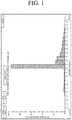
- the mean pore size distribution rate of the second non-woven fabrics was 57%, as shown in FIG. 1 .
- the first and second non-woven fabrics were coated with a blood affinity agent (hydroxyethylmethacrylate (HEMA) available from Daejung Co., Ltd.).
- HEMA hydroxyethylmethacrylate
- the first and second non-woven fabrics were cut so as to have a filtration area of 32 cm 2 .
- the cut first non-woven fabrics were laminated to produce 1.716 g of a pre-treatment filter, the cut second non-woven fabrics were laminated to produce 5.412 g of a main filter, and the pre-treatment filter and the main filter were mounted in a case made of polycarbonate and sealed using an ultrasonic welding machine to produce a blood filter having a target blood throughput of 330 ml.
- the filling density of the pre-treatment filter with respect to the target blood throughput of the blood filter was 0.52 g/100 ml and the filling density of the main filter with respect to the target blood throughput of the blood filter was 1.64 g/100 ml.
- the blood filter was sterilized at a temperature of 115°C and a pressure of 1.15 kgf/cm 2 for 30 minutes to complete a blood filter.
- a blood filter was completed in the same manner as in Example 1, except that the filling density of the main filter with regard to the target blood throughput of the blood filter was 1.22 g/100 ml.
- a blood filter was completed in the same manner as in Example 1, except that second non-woven fabrics having a mean pore size of 8.01 ⁇ m and a mean pore size distribution rate of 40% were produced using a DCD of 60 mm, and the filling density of the pre-treatment filter with regard to the target blood throughput of the blood filter was 0.44 g/100 ml.
- a blood filter was completed in the same manner as in Example 3, except that the filling density of the main filter with regard to the target blood throughput of the blood filter was 1.22 g/100 ml.
- a blood filter was completed in the same manner as in Example 1, except that the filling density of the pre-treatment filter with regard to the target blood throughput of the blood filter was 0.14 g/100 ml.
- a blood filter was completed in the same manner as in Example 1, except that the filling density of the main filter with regard to the target blood throughput of the blood filter was 0.98 g/100 ml.
- a blood filter was completed in the same manner as in Example 3, except that the filling density of the pre-treatment filter with regard to the target blood throughput of the blood filter was 0.09 g/100 ml.
- a blood filter was completed in the same manner as in Example 1, except that second non-woven fabrics having a mean fiber diameter of 1.3 ⁇ m, a mean pore size of 8.25 ⁇ m, a weight of 25 g/m 2 , a mean thickness of 0.14 mm and a mean pore size distribution rate of 28% were produced by setting the angle between the nozzle and air to 120° during production of the second non-woven fabrics and controlling the dope discharge amount and air temperature at an air pressure of 1.2 kgf/cm 2 and a DCD of 80 mm.
- the filtration time, erythrocyte recovery rate, residual leukocytes and filtration performance of the blood filters obtained by Examples and Comparative Examples mentioned above were measured using the following methods.
- Filtration time was obtained by measuring a time for 310 to 350 ml of an erythrocyte blood preparation (average 330 ml) containing SAG-M (saline, adenine, glucose, mannitol: 88.9 ml) used to lengthen a retention period of blood to pass through the filter and then be filtered.
- SAG-M saline, adenine, glucose, mannitol: 88.9 ml
- Erythrocyte recovery rate (%) was obtained by loading a blood filter in a 2 m-height stand, directly connecting the blood filter to a tube through which whole blood passes, filtering blood, and collecting 15 cc of blood before and after filtration.
- the number of blood cells was quantitatively measured using an automated hematology analyzer (SYSMEX, XP-300) under the conditions shown in Table 1 below to obtain an erythrocyte recovery rate. Detailed calculation is given in Equation 1 below.
- Erythrocyte recovery rate % Blood volume after filtration ⁇ Hct % after filtration Blood volume before filtration ⁇ Hct % before filtration [TABLE 1] Items Auto CBC Reference RBC Counter 3.80 ⁇ 6.5 M/ ⁇ l WBC Counter 4.0 ⁇ 11.0 K/ ⁇ l WBC differential counter Lym-: 20 ⁇ 45%, Neutro-: 40 ⁇ 75% Hemoglobin (Hb) 11.5 ⁇ 18 g/dL Hematocrit (Hct) 37.0 ⁇ 50.0 % Platelet 150 ⁇ 400 K/ ⁇ l
- the number of residual leukocytes was measured using a LeucoCOUNT Kit which is a bead-based flow cytometry method. 100 ⁇ l of blood was fed to a TruCOUNT tube containing a predetermined number of beads, 400 ⁇ l of a LeucoCOUNT reagent containing RNAse, a detergent and propidium iodide (PI) was then fed to the TruCOUNT tube, and these ingredients were reacted at room temperature in a dark room for 5 minutes.
- Filtration performance of the blood filters was evaluated on a four-point scale ( ⁇ : excellent, ⁇ : good, ⁇ : medium, ⁇ : poor) in consideration of all elements measured by the aforementioned methods.
Landscapes
- Health & Medical Sciences (AREA)
- Heart & Thoracic Surgery (AREA)
- Engineering & Computer Science (AREA)
- Life Sciences & Earth Sciences (AREA)
- Vascular Medicine (AREA)
- Animal Behavior & Ethology (AREA)
- Hematology (AREA)
- Veterinary Medicine (AREA)
- Public Health (AREA)
- General Health & Medical Sciences (AREA)
- Biomedical Technology (AREA)
- Anesthesiology (AREA)
- Chemical & Material Sciences (AREA)
- Chemical Kinetics & Catalysis (AREA)
- Textile Engineering (AREA)
- Mechanical Engineering (AREA)
- Inorganic Chemistry (AREA)
- Geology (AREA)
- General Chemical & Material Sciences (AREA)
- Cardiology (AREA)
- External Artificial Organs (AREA)
- Filtering Materials (AREA)
- Nonwoven Fabrics (AREA)
- Pharmacology & Pharmacy (AREA)
Abstract
Description
- The present invention relates to a blood filter and a method of manufacturing the same, and more particularly, the present invention relates to a blood filter which exhibits excellent leukocyte elimination performance as well as significantly improved blood throughput per unit time and erythrocyte recovery rates and a method of manufacturing the same.
- Transfusion of leukocyte-containing blood or erythrocyte concentration preparations may cause side effects such as headache, vomiting, chills, fever, viral infection, and allogeneic antigen sensitization. To prevent these side-effects, it is necessary to remove leukocytes present in blood of subjects who receive a transfusion.
- Methods of removing leukocytes from blood include a centrifugation method which separates leukocytes by rotating blood at a high rate, a filter method which separates leukocytes by allowing blood to pass through a filter to adsorb leukocytes on the filter, and a dextran method which includes adding dextran to blood, stirring the mixture and then removing a separated leukocyte layer by suction. Thereamong, the filter method which exhibits excellent leukocyte separation performance, is easy to handle and is inexpensive is widely used.
- Such a blood filter should satisfy a variety of requirements. First, the blood filter should treat a large amount of blood within a short time to prevent blood coagulation. Second, the blood filter should have a high leukocyte removal rate to prevent the aforementioned side-effects. Third, the blood filter should allow other beneficial ingredients in blood, for example, erythrocytes, to pass therethrough without causing damage to the ingredients.
- In Korean Patent No.
1441165 - However, the melt-blown non-woven fabric, which is a porous material, has a low pore size uniformity. For this reason, a plurality of porous materials need to be laminated to improve leukocyte elimination performance. As a result, there are limitations on increasing blood throughput per unit time, improving erythrocyte recovery rates and reducing erythrocyte damage rates.
- Therefore, the present invention relates to a blood filter and a method of manufacturing the same to prevent problems resulting from limitations and drawbacks of the related art, and it is one object of the present invention to provide.
- It is one object of the present invention to provide a blood filter which exhibits excellent leukocyte elimination performance as well as significantly improved blood throughput per unit time and erythrocyte recovery rates.
- It is another object of the present invention to provide a method of manufacturing a blood filter which exhibits excellent leukocyte elimination performance as well as significantly improved blood throughput per unit time and erythrocyte recovery rates.
- Other features and advantages of the present invention will be described in the following and would partially be obvious from such description. Alternatively, other features and advantages of the present invention could be understood through implementation of the present invention.
- In accordance with the present invention, the above and other objects can be accomplished by the provision of a blood filter including a pre-treatment filter for pre-treating fed blood, and a main filter for treating blood pre-treated by the pre-treatment filter, wherein the pre-treatment filter is a laminate of first non-woven fabrics having a mean fiber diameter of 5 to 30 µm and a mean pore size of 10 to 30 µm, the main filter is a laminate of second non-woven fabrics having a mean fiber diameter of 1 to 5 µm, a mean pore size of 5 to 10 µm and a mean pore size distribution rate of 30% or more, a filling density of the pre-treatment filter with respect to a target blood throughput of the blood filter is 0.1 g/100 ml to 1 g/100 ml, and a filling density of the main filter with respect to a target blood throughput of the blood filter is 1 g/100 ml to 3 g/100 ml.
- Each of the first and second non-woven fabrics may include polyethylene terephthalate or polybutylene terephthalate.
- In another aspect of the present invention, provided is a method of manufacturing a blood filter including producing first melt-blown non-woven fabrics having a mean fiber diameter of 5 to 30 µm and a mean pore size of 10 to 30 µm, laminating the first melt-blown non-woven fabrics to produce a pre-treatment filter, producing second melt-blown non-woven fabrics having a mean fiber diameter of 1 to 5 µm, a mean pore size of 5 to 10 µm and a mean pore size distribution rate of 30% or more, laminating the second melt-blown non-woven fabrics to produce a main filter, and mounting the pre-treatment filter and the main filter in a case, wherein the first melt-blown non-woven fabrics are laminated such that a filling density of the pre-treatment filter with respect to a target blood throughput of the blood filter is 0.1 g/100 ml to 1 g/100 ml, and the second melt-blown non-woven fabrics are laminated such that a filling density of the main filter with respect to a target blood throughput of the blood filter is 1 g/100 ml to 3 g/100 ml.
- The producing the first melt-blown non-woven fabrics may include melting polyethylene terephthalate or polybutylene terephthalate to prepare a first dope, spinning the first dope through a first die to form first fibers, and collecting the first fibers on a first collector, wherein a distance from the first die to the first collector (die to collector distance) is 200 mm or more.
- The producing the second melt-blown non-woven fabrics may include melting polyethylene terephthalate or polybutyleneterephthalate to prepare a second dope, spinning the second dope through a second die to form second fibers, and collecting the second fibers on a second collector, wherein the spinning the second dope includes discharging the second dope through a nozzle of the second die, and spraying air to the second dope immediately before discharge through the nozzle, wherein a distance from the second die to the second collector is 60 mm or less, and an angle between the nozzle and the air is 60° or less.
- Both the aforementioned general disclosure and the following Best Mode are provided only for illustration and description of the present invention and it should be understood that these are given for more detailed description of the inventions defined in the claims.
- According to the present invention, the blood filter includes a pre-treatment filter and a main filter and, at the same time, the mean pore size distribution rate of the main filter is controlled to be 30% or more, thereby realizing excellent leukocyte removal performance using a minimal porous material.
- In addition, by realizing excellent leukocyte removal performance with a minimal porous material, blood throughput per unit time and erythrocyte recovery rates can be remarkably improved.
- The attached drawings are given for a better understanding of the present invention and constitute a part of the disclosure, which aim to illustrate the embodiments of the present invention and describe the principles of the present invention in conjunction with the following detailed description, in which:
-
FIG. 1 is a graph showing a pore size distribution of a main filter according to an embodiment of the present invention. - Now, embodiments of the present invention will be described in detail with reference to the annexed drawings. These embodiments are provided only for illustration to aid in a better understanding of the present invention and should not be construed as limiting the scope of the present invention.
- Although the preferred embodiments of the present invention have been disclosed for illustrative purposes, those skilled in the art will appreciate that various modifications, additions and substitutions are possible, without departing from the scope and spirit of the invention as disclosed in the accompanying claims. Therefore, the present invention covers all of inventions defined in claims as well as modifications and alterations that fall into the scope of equivalents thereto.
- The blood filter of the present invention includes a pre-treatment filter and a main filter.
- The pre-treatment filter is a laminate of first non-woven fabrics and conducts pre-treatment to remove microaggregates, which may be formed by agglutination of blood cells occurring during transport or storage of blood, from blood fed to the blood filter.
- The main filter is a laminate of second non-woven fabrics and removes leukocytes from blood from which microaggregates have been removed by the pre-treatment filter.
- The first and second non-woven fabrics which have a three-dimensional network structure in which continuous or discontinuous fibers made of polyethylene terephthalate (PET) or polybutylene terephthalate (PBT) entangle with one another can be produced by a melt-blown method. The first and second non-woven fabrics can have a wide surface area and exhibit excellent filtration efficiency owing to small fiber diameter.
- According to the present invention, the first non-woven fabric has a mean fiber diameter of 5 to 30 µm and a mean pore size of 10 to 30 µm.
- When the mean fiber diameter of the first non-woven fabric is less than 5 µm, since the fiber has a low strength and flexibility, the non-woven fabric is pressed during filtration of blood by free fall, the gap between adjacent fibers becomes narrow, pressure loss is increased and filtration time can thus be significantly lengthened. On the other hand, when the mean fiber diameter of the first non-woven fabric exceeds 30 µm, the surface area of fibers filled for filtration is decreased and a chance of bringing fibers in contact with blood cells is reduced so that it may be difficult to efficiently filter blood cells.
- When the mean pore size of the first non-woven fabric is less than 10 µm, microaggregates containing leukocytes cannot pass through the first non-woven fabric. For this reason, the blood cells are excessively collected in the first non-woven fabric, thus leading to a problem of shortened filtration lifespan. On the other hand, when the mean pore size of the first non-woven fabric exceeds 30 µm, blood cells directly reach the second non-woven fabric without selective filtration of microaggregates including leukocytes. As a result, filtration time may be unlimitedly increased due to shortened lifespan of the second non-woven fabric.
- Meanwhile, in an embodiment of the present invention, the filling density of the pre-treatment filter with respect to the target blood throughput of the blood filter is 0.1 to 1 g/100 ml, preferably 0.11 to 0.15 g/100 ml. By setting the filling density of the pre-treatment filter blood filter within this range depending on the target blood throughput, microaggregates formed by agglutination of blood cells can be effectively removed and as a result, clogging of the main filter can be prevented.
- When the filling density of the pre-treatment filter is less than 0.1 g/100 ml, microaggregates, which may be formed due to blood agglutination occurring during transport or storage of blood, pass through the pre-treatment filter and then reach the main filter having a relatively small mean pore size. As a result, the microaggregates suppress flow of blood, significantly reducing a filtration rate and even causing filter clogging. On the other hand, when the filling density of the pre-treatment filter exceeds 1 g/100 ml, the case of the blood filter may become unnecessarily large and excessively press the main filter, thus decreasing a mean pore size. As a result, a problem of deteriorated filtration speed may occur.
- According to the present invention, the second non-woven fabric has a mean fiber diameter of 1 to 5 µm and a mean pore size of 5 to 10 µm.
- When the mean fiber diameter of the second non-woven fabric constituting the main filter is less than 1 µm, pressure loss is increased during filtration of blood, cutting and fuzziness of fibers may occur due to weak strength of fibers. The cut fibers are contained in blood, thus causing transfusion side-effects. On the other hand, when the mean fiber diameter of the second non-woven fabric exceeds 5 µm, a chance of bringing fibers in contact with leukocytes is decreased and the leukocyte removal rate of the non-woven fabric web is thus deteriorated.
- When the mean pore size of the second non-woven fabric is less than 5 µm, erythrocytes having a size of 6 to 8 µm cannot smoothly pass through the main filter, leading to increased pressure loss, significantly deteriorated blood treatment rate and even clogging. On the other hand, when the mean pore size of the second non-woven fabric exceeds 10 µm, leukocytes having a size of 12 to 25 µm easily pass through the leukocyte, thus reducing leukocyte removal rate of the blood filter.
- In addition, the second non-woven fabric has a maximum pore size of 10 to 30 µm, preferably 10 to 15 µm, thereby allowing for selective adsorption of only leukocytes thereon, while allowing erythrocytes and platelets to pass through the same.
- In addition, according to the present invention, the second non-woven fabric has a mean pore size distribution rate of 30% or more, preferably 45% or more. The term "mean pore size distribution rate" used herein refers a distribution rate of a range to which the mean pore size belongs in a pore size distribution graph measured from a capillary flow porometer (Model name: CFP-1100-AEL) produced by PMI, which indicates a degree of pore size uniformity of pores of non-woven fabrics.
- The second non-woven fabric has a mean pore size distribution rate of 30% or more, thereby securing excellent leukocyte elimination performance while minimizing filling density of the main filter with respect to the target blood throughput of the blood filter. According to an embodiment of the present invention, the filling density of the main filter with respect to the target blood throughput of the blood filter is 1 to 3 g/100 ml, preferably 1 to 2 g/100 ml.
- Meanwhile, fibers of the first and second non-woven fabrics preferably have a coefficient of diameter variation of 30 CV% or less. The coefficient of diameter variation is a percentage of the standard deviation of the mean fiber diameter. The coefficient of diameter variation of 30CV% or less can secure uniform blood flow throughout the first and second non-woven fabrics. As a result, superior filtration efficiency and filtration performance can be uniformly exerted.
- According to the present invention, blood treatment is conducted by first filtration through the pre-treatment filter and second filtration through the main filter. In this case, by controlling the mean pore size and mean pore size distribution rate of the filter used for each filtration, leukocytes can be effectively removed using differences in size between platelets, erythrocytes and leukocytes.
- In addition, by controlling the filling amount of the porous material of the filter used for each filtration depending on the target blood throughput of the blood filter, time required for filtration can be minimized, erythrocyte recovery rates can be increased and unnecessary stress of erythrocyte can be reduced so that hematocytolysis rates can be minimized.
- Hereinafter, a method of manufacturing a blood filter according to an embodiment of the present invention will be described in detail.
- The method of the present invention includes: producing first melt-blown non-woven fabrics; laminating the first melt-blown non-woven fabrics to produce a pre-treatment filter; producing second melt-blown non-woven fabrics; laminating the second melt-blown non-woven fabrics to produce a main filter; and mounting the pre-treatment filter and the main filter in a case.
- As described above, the first melt-blown non-woven fabrics have a mean fiber diameter of 5 to 30 µm and a mean pore size of 10 to 30 µm.
- The producing the first melt-blown non-woven fabrics includes melting polyethylene terephthalate or polybutylene terephthalate to prepare a first dope, spinning the first dope through a first die to form first fibers, and collecting the first fibers on a first collector. In this case, the distance from the first die to the first collector (die to collector distance: DCD) may be 200 mm or more.
- The spinning the first dope may include discharging the first dope through a nozzle of the first die and spraying high-temperature high-pressure air to the second dope immediately before discharge through the nozzle. In this case, the angle between the nozzle and the air may be 30 to 120° and is preferably 45 to 60° so as to uniformly control the mean fiber diameter and the mean pore size.
- Subsequently, the pre-treatment filter is produced by laminating the first melt-blown non-woven fabrics such that the filling density of the pre-treatment filter with respect to the target blood throughput of the blood filter is 0.1 to 1 g/100 ml.
- The second melt-blown non-woven fabrics have a mean fiber diameter of 1 to 5 µm, a mean pore size of 5 to 10 µm and a mean pore size distribution rate of 30% or more.
- The producing the second melt-blown non-woven fabrics may include melting polyethylene terephthalate or polybutylene terephthalate to prepare a second dope, spinning the second dope through a second die to form second fibers, and collecting the second fibers on a second collector. In this case, the distance from the second die to the second collector (DCD) may be 60 mm or less.
- The spinning the second dope may include discharging the second dope through a nozzle of the second die, and spraying high-temperature high-pressure air to the second dope immediately before discharge through the nozzle. In this case, the angle between the nozzle and the air may be 60° or less.
- Subsequently, the main filter is produced by laminating the second melt-blown non-woven fabrics such that the filling density of the pre-treatment filter with respect to the target blood throughput of the blood filter is 1 to 3 g/100 ml.
- After mounting the pre-treatment filter and main filter thus produced in a case, sealing is conducted using an ultrasonic welding machine in order to prevent blood leakage, thereby completing the blood filter of the present invention. Selectively, the blood filter may be sterilized at a temperature of 100 to 120°C and a pressure of 1 to 1.2 kgf/cm2 for 20 minutes to 1 hour.
- Hereinafter, the spinning steps of the first and second dopes will be described in more detail.
- As described above, the spinning of the dopes includes discharging the dope through the nozzle of the die, and spraying high-temperature high-pressure air to the dope immediately before discharge through the nozzle. According to an embodiment of the present invention, the spinning is carried out at 230 to 300°C, and the high-temperature high-pressure air has a pressure of 0.5 to 2 kgf/cm2.
- When the spinning temperature is less than 230°C, the fibers cannot be sufficiently drawn due to excessively low spinning temperature. As a result, it is impossible to obtain non-woven fabrics having a mean fiber diameter of 30 µm or less and it is difficult to satisfy required filter performance due to decreased bonding strength between fibers collected on the collector. On the other hand, when the spinning temperature exceeds 300°C, strength between fibers collected on the collector becomes excessively strong due to excessively high temperature. As a result, it is impossible to form pores having an appropriate pore size and texture similar to paper may occur. Accordingly, the subsequent process may not proceed efficiently.
- As the spinning temperature increases within the range of 230 to 300°C, the drawing of fibers is facilitated and the mean fiber diameter of the non-woven fabric is thus decreased. Hence, according to an embodiment of the present invention, the spinning temperature applied to produce the second melt-blown non-woven fabrics for the main filter may be set to be higher than the spinning temperature applied to produce the first melt-blown non-woven fabrics for the pre-treatment filter.
- Meanwhile, when the pressure of the air is lower than 0.5 kgf/cm2, the fibers cannot be sufficiently drawn, thus making it impossible to obtain non-woven fabrics having a mean fiber diameter of 30 µm or less. On the other hand, when the pressure of the compression gas exceeds 2 kgf/cm2, fibers may be blown off and it is difficult to produce non-woven fabrics suitable for production of the blood filter due to creation of excessive fuzzy fibers.
- As the pressure of the air increases within the range of 0.5 to 2 kgf/cm2, the drawing of fibers is facilitated and the mean fiber diameter of the non-woven fabrics is thus decreased. Hence, according to an embodiment of the present invention, the pressure of the air applied to produce the second melt-blown non-woven fabrics for the main filter may be set to be higher than the pressure of the air applied to produce the first melt-blown non-woven fabrics for the pre-treatment filter.
- In general, as DCD increases, the movement distance of high-temperature high-pressure air and spun fibers increases, the lamination uniformity ratio of fibers decreases and non-uniformity of the mean pore size thus increases. Thus, according to an embodiment of the present invention, DCD used to produce the first melt-blown non-woven fabrics for the pre-treatment filter is 200 mm or more, while DCD used to produce the second melt-blown non-woven fabrics for the main filter is 60 mm or less.
- According to an embodiment of the present invention, the angle between the nozzle for discharging the dope and the high-temperature high-pressure air in the spinning step is set to 45 to 60°.
- When the angle is less than 45°, the angle of the nozzle is small, thus making it difficult to implement mass-production and management due to serious damage by impact during attachment and removal of the nozzle. Moreover, the fibers of the spun non-woven fabric orient in only one direction, making it difficult to control the mean pore size and causing a problem of lengthened filtration time due to increased pressure during filtration. On the other hand, when the angle exceeds 60°, the fibers spun from the nozzle and the high-temperature high-pressure air create turbulence, thus leading to a serious problem in controlling the mean pore size.
- Meanwhile, by suitably controlling the spinning temperature, air pressure, DCD, angle between the nozzle and air and so on, the weight and mean thickness of the non-woven fabric can be controlled. According to an embodiment of the present invention, the first melt-blown non-woven fabrics for the pre-treatment filter have a weight of 30 to 70 g/m2 and a mean thickness of 0.15 to 0.40 mm, and the second melt-blown non-woven fabrics for the main filter have a weight of 10 to 40 g/m2 and a mean thickness of 0.08 to 0.20 mm.
- Meanwhile, according to an embodiment of the present invention, by treating the second non-woven fabric alone, or both the first and second non-woven fabrics, with a blood affinity agent containing a polymer having a non-ionic hydrophilic group, a critical wetting surface tension (CWST) of 63 to 120 dyne/cm, preferably 80 to 110 dyne/cm can be imparted to the non-woven fabrics.
- The CWST can be obtained by dropping droplets of a liquid having a surface tension varying from 2 to 4 dyne/cm (mN/m) on the surface of a sample and then checking absorbed drops and non-absorbed drops while observing the liquid droplets. CWST, represented in dyne/cm, is defined by an average of the surface tension of the absorbed liquid and surface tension of the non-absorbed liquid. A liquid having a lower surface tension than the CWST of the non-woven fabric spontaneously soaks the non-woven fabric when coming in contact with the non-woven fabric web. For example, a non-woven fabric having lower CWST than water having a surface tension of 72 dyne/cm does not wet with water when contacting water. Accordingly, the CWST of the non-woven fabric may be considered an indicator of hydrophilicity and, as the CWST increases, the hydrophilicity of the non-woven fabric also increases.
- When the affinity of the non-woven fabric to blood is excessively weak, blood treatment time becomes excessively long, which is impractical. On the other hand, when affinity to blood is excessively strong, leukocytes as well as erythrocytes and platelets can be adsorbed thereon and then removed. When the CWST of the non-woven fabric is lower than 63, affinity to blood becomes excessively weak, blood may coagulate due to excessively lengthened blood treatment time, and when blood passes through pores of the non-woven fabric web, collision between erythrocytes and fibers increases, and LDH (lactate dehydrogenase), an indicator of erythrocyte damage, increases. As a result, erythrocyte lifespan may be rapidly shortened. On the other hand, when the CWST of the non-woven fabric exceeds 120, as the fabric adsorbs erythrocytes and platelets, a blood preparation containing ingredients in degrees required in the art cannot be obtained.
- In particular, a polybutylene terephthalate (PBT) non-woven fabric has an advantage of maintaining pore physical properties during sterilization due to excellent heat resistance, but cannot have CWST satisfying the range defined above due to low hydrophobicity. Accordingly, the PBT non-woven fabric should be treated with a blood affinity agent containing a polymer having a non-ionic hydrophilic group. The polymer having a non-ionic hydrophilic group is, for example, 2-hydroxyethylmethacrylate, vinyl pyrrolidone or the like.
- The blood filter of the present invention produced above has a high leukocyte removal rate of 99.99% or more and a high erythrocyte recovery rate of 85% or more. In particular, a time required for treating 250 to 350 ml of an erythrocyte concentrate, or 320 to 400 ml of whole blood with the blood filter of the present invention is 30 minutes or less, which means that the blood filter of the present invention can provide treatment of blood at a high filtration rate. Accordingly, the blood filter of the present invention can be used as a blood purification device during blood transfusion and donation requiring excellent leukocyte removal rate and erythrocyte recovery rate.
- Hereinafter, the present invention will be described in more detail with reference to Examples and Comparative Examples. However, the following examples are provided only for a better understanding of the present invention and should be not construed as limiting the scope of the present invention.
- The mean fiber diameter of the non-woven fabric was measured using a scanning electron microscope and an image analyzer (JVC Digital Camera KY-F70B in combination with Image-Pro Plus software). At this time, 20 samples were measured.
- The mean pore size (µm) and mean pore size distribution rate (%) of the non-woven fabric were measured using a capillary flow porometer (PMI, CFL-1100-AE) in accordance with ASTM F 316-03. Specifically, a circular sample having a diameter of 1 inch was sufficiently soaked in Galwick solution having a surface tension of 15.9 dyne/cm and then fed to the equipment. At this time, 10 samples were measured.
- Polybutylene terephthalate having an intrinsic viscosity of 0.52 and a melting point of 224°C was melted at 250°C to prepare a spinning solution, and first non-woven fabrics for the pre-treatment filter and second non-woven fabrics for the main filter were produced under different process conditions using an ordinary melt-blown non-woven fabric manufacturing device.
- Specifically, first non-woven fabrics having a mean fiber diameter of 11 µm, a mean pore size of 24.1 µm, a weight of 35 g/m2 and a mean thickness of 0.31 mm were produced while controlling the dope discharge amount and air temperature under conditions of an air pressure of 0.7 kgf/cm2 and a DCD of 250 mm.
- In addition, second non-woven fabrics having a mean fiber diameter of 1.3 µm, a mean pore size of 7.95 µm, a weight of 25 g/m2 and a mean thickness of 0.14 mm were produced while controlling the dope discharge amount and air temperature under conditions of an air pressure of 1.2 kgf/cm2, a DCD of 50 mm and the angle between the nozzle and air of 60°. The mean pore size distribution rate of the second non-woven fabrics was 57%, as shown in
FIG. 1 . - Subsequently, the first and second non-woven fabrics were coated with a blood affinity agent (hydroxyethylmethacrylate (HEMA) available from Daejung Co., Ltd.).
- Subsequently, the first and second non-woven fabrics were cut so as to have a filtration area of 32 cm2.
- The cut first non-woven fabrics were laminated to produce 1.716 g of a pre-treatment filter, the cut second non-woven fabrics were laminated to produce 5.412 g of a main filter, and the pre-treatment filter and the main filter were mounted in a case made of polycarbonate and sealed using an ultrasonic welding machine to produce a blood filter having a target blood throughput of 330 ml.
- That is, the filling density of the pre-treatment filter with respect to the target blood throughput of the blood filter was 0.52 g/100 ml and the filling density of the main filter with respect to the target blood throughput of the blood filter was 1.64 g/100 ml.
- Subsequently, the blood filter was sterilized at a temperature of 115°C and a pressure of 1.15 kgf/cm2 for 30 minutes to complete a blood filter.
- A blood filter was completed in the same manner as in Example 1, except that the filling density of the main filter with regard to the target blood throughput of the blood filter was 1.22 g/100 ml.
- A blood filter was completed in the same manner as in Example 1, except that second non-woven fabrics having a mean pore size of 8.01 µm and a mean pore size distribution rate of 40% were produced using a DCD of 60 mm, and the filling density of the pre-treatment filter with regard to the target blood throughput of the blood filter was 0.44 g/100 ml.
- A blood filter was completed in the same manner as in Example 3, except that the filling density of the main filter with regard to the target blood throughput of the blood filter was 1.22 g/100 ml.
- A blood filter was completed in the same manner as in Example 1, except that the filling density of the pre-treatment filter with regard to the target blood throughput of the blood filter was 0.14 g/100 ml.
- A blood filter was completed in the same manner as in Example 1, except that the filling density of the main filter with regard to the target blood throughput of the blood filter was 0.98 g/100 ml.
- A blood filter was completed in the same manner as in Example 3, except that the filling density of the pre-treatment filter with regard to the target blood throughput of the blood filter was 0.09 g/100 ml.
- A blood filter was completed in the same manner as in Example 1, except that second non-woven fabrics having a mean fiber diameter of 1.3 µm, a mean pore size of 8.25 µm, a weight of 25 g/m2, a mean thickness of 0.14 mm and a mean pore size distribution rate of 28% were produced by setting the angle between the nozzle and air to 120° during production of the second non-woven fabrics and controlling the dope discharge amount and air temperature at an air pressure of 1.2 kgf/cm2 and a DCD of 80 mm.
- The filtration time, erythrocyte recovery rate, residual leukocytes and filtration performance of the blood filters obtained by Examples and Comparative Examples mentioned above were measured using the following methods.
- Filtration time was obtained by measuring a time for 310 to 350 ml of an erythrocyte blood preparation (average 330 ml) containing SAG-M (saline, adenine, glucose, mannitol: 88.9 ml) used to lengthen a retention period of blood to pass through the filter and then be filtered.
- Erythrocyte recovery rate (%) was obtained by loading a blood filter in a 2 m-height stand, directly connecting the blood filter to a tube through which whole blood passes, filtering blood, and collecting 15 cc of blood before and after filtration. The number of blood cells was quantitatively measured using an automated hematology analyzer (SYSMEX, XP-300) under the conditions shown in Table 1 below to obtain an erythrocyte recovery rate. Detailed calculation is given in Equation 1 below.

[TABLE 1] Items Auto CBC Reference RBC Counter 3.80∼6.5 M/µl WBC Counter 4.0∼11.0 K/µl WBC differential counter Lym-: 20∼45%, Neutro-: 40∼75% Hemoglobin (Hb) 11.5∼18 g/dL Hematocrit (Hct) 37.0∼50.0 % Platelet 150∼400 K/µl - The number of residual leukocytes was measured using a LeucoCOUNT Kit which is a bead-based flow cytometry method. 100 µl of blood was fed to a TruCOUNT tube containing a predetermined number of beads, 400 µl of a LeucoCOUNT reagent containing RNAse, a detergent and propidium iodide (PI) was then fed to the TruCOUNT tube, and these ingredients were reacted at room temperature in a dark room for 5 minutes. The number of beads (R1) and the number of leukocytes (R2) were measured using FACS (BD bioscience, San Jose, CA, USA) and the number of residual leukocytes after filtration was calculated in accordance with the following Equation 2.

- Filtration performance of the blood filters was evaluated on a four-point scale (⊚: excellent, ○: good, Δ: medium, ×: poor) in consideration of all elements measured by the aforementioned methods.
- Filtration time, erythrocyte recovery rate, the number of residual leukocytes and filtration performance of blood filters measured by the aforementioned methods are shown in the following Table 2.
[TABLE 2] Filling density of filter with target blood throughput of blood filter (g/100ml) Main filter Filtration time (min) Erythrocyte recovery rate (%) Number of residual leukocytes (1x10⁶/unit ) Filtration performance Pre-treatment filter Main filter Mean pore size (µm) Mean pore size distribution rate (%) Ex. 1 0.52 1.64 7.95 57 9.7 91.7 0 ⊚ Ex. 2 0.52 1.22 7.95 57 14.5 89.0 0.03 ⊚ Ex. 3 0.44 1.64 8.01 40 22.6 93.4 0 ⊚ Ex. 4 0.44 1.22 8.01 40 24.3 90.8 0.03 ⊚ Ex. 5 0.14 1.64 7.95 57 28.0 87.6 0 ○ Comp. Ex. 1 0.52 0.98 7.95 57 120 or more 87.6 3.34 × Comp. Ex. 2 0.09 1.64 8.01 40 120 or more 66.9 0 × Comp. Ex. 3 0.52 1.64 8.25 28 21.6 95.0 1.43 ×
Claims (5)
- A blood filter comprising:a pre-treatment filter for pre-treating fed blood; anda main filter for treating blood pre-treated by the pre-treatment filter,wherein the pre-treatment filter is a laminate of first non-woven fabrics having a mean fiber diameter of 5 to 30 µm and a mean pore size of 10 to 30 µm,the main filter is a laminate of second non-woven fabrics having a mean fiber diameter of 1 to 5 µm, a mean pore size of 5 to 10 µm and a mean pore size distribution rate of 30% or more,a filling density of the pre-treatment filter with respect to a target blood throughput of the blood filter is 0.1 g/100 ml to 1 g/100 ml, anda filling density of the main filter with respect to a target blood throughput of the blood filter is 1 g/100 ml to 3 g/100 ml.
- The blood filter according to claim 1, wherein each of the first and second non-woven fabrics comprises polyethylene terephthalate or polybutylene terephthalate.
- A method of manufacturing a blood filter comprising:producing first melt-blown non-woven fabrics having a mean fiber diameter of 5 to 30 µm and a mean pore size of 10 to 30 µm;laminating the first melt-blown non-woven fabrics to produce a pre-treatment filter;producing second melt-blown non-woven fabrics having a mean fiber diameter of 1 to 5 µm, a mean pore size of 5 to 10 µm and a mean pore size distribution rate of 30% or more;laminating the second melt-blown non-woven fabrics to produce a main filter; andmounting the pre-treatment filter and the main filter in a case,wherein the first melt-blown non-woven fabrics are laminated such that a filling density of the pre-treatment filter with respect to a target blood throughput of the blood filter is 0.1 g/100 ml to 1 g/100 ml, andthe second melt-blown non-woven fabrics are laminated such that a filling density of the main filter with respect to a target blood throughput of the blood filter is 1 g/100 ml to 3 g/100 ml.
- The method according to claim 3, wherein the producing the first melt-blown non-woven fabrics comprises:melting polyethylene terephthalate or polybutylene terephthalate to prepare a first dope;spinning the first dope through a first die to form first fibers; andcollecting the first fibers on a first collector,wherein a distance from the first die to the first collector (die to collector distance) is 200 mm or more.
- The method according to claim 4, wherein the producing the second melt-blown non-woven fabrics comprises:melting polyethylene terephthalate or polybutylene terephthalate to prepare a second dope;spinning the second dope through a second die to form second fibers; andcollecting the second fibers on a second collector,wherein the spinning the second dope comprises:discharging the second dope through a nozzle of the second die; andspraying air to the second dope immediately before discharge through the nozzle,wherein a distance from the second die to the second collector is 60 mm or less, and an angle between the nozzle and the air is 60° or less.
Applications Claiming Priority (2)
| Application Number | Priority Date | Filing Date | Title |
|---|---|---|---|
| KR20140193439 | 2014-12-30 | ||
| PCT/KR2015/014335 WO2016108543A1 (en) | 2014-12-30 | 2015-12-28 | Blood filter and manufacturing method therefor |
Publications (3)
| Publication Number | Publication Date |
|---|---|
| EP3241574A1 true EP3241574A1 (en) | 2017-11-08 |
| EP3241574A4 EP3241574A4 (en) | 2018-07-18 |
| EP3241574B1 EP3241574B1 (en) | 2020-03-04 |
Family
ID=56284615
Family Applications (1)
| Application Number | Title | Priority Date | Filing Date |
|---|---|---|---|
| EP15875637.9A Active EP3241574B1 (en) | 2014-12-30 | 2015-12-28 | Method of manufacturing a blood filter |
Country Status (6)
| Country | Link |
|---|---|
| US (1) | US10265456B2 (en) |
| EP (1) | EP3241574B1 (en) |
| JP (1) | JP6499296B2 (en) |
| KR (1) | KR102060642B1 (en) |
| CN (1) | CN107106745B (en) |
| WO (1) | WO2016108543A1 (en) |
Cited By (1)
| Publication number | Priority date | Publication date | Assignee | Title |
|---|---|---|---|---|
| EP3964620A4 (en) * | 2019-06-04 | 2023-01-04 | Mitsui Chemicals, Inc. | MELT-BLOWN NONWOVEN, FILTER AND METHOD FOR PRODUCING A MELT-BLOWN NONWOVEN |
Families Citing this family (5)
| Publication number | Priority date | Publication date | Assignee | Title |
|---|---|---|---|---|
| CN107847839B (en) * | 2015-08-21 | 2020-05-29 | 康明斯过滤Ip公司 | High speed rotating crankcase ventilation filter media and media pack |
| CN111001225B (en) | 2015-08-28 | 2021-11-19 | 康明斯过滤Ip公司 | Rotating coalescer element with directional liquid drain and gas outlet |
| EP3583962B1 (en) | 2018-06-20 | 2023-05-24 | Fresenius Hemocare Italia S.r.l. | Blood-collection container and manufacturing method |
| JP7277598B2 (en) * | 2019-10-11 | 2023-05-19 | 旭化成メディカル株式会社 | BLOOD PROCESSING FILTER, MANUFACTURING METHOD THEREOF, AND LEUKOCELL REMOVAL METHOD |
| US11180607B2 (en) * | 2019-12-10 | 2021-11-23 | Chang Chun Plastics Co., Ltd. | Polyesters with ultra-high flowability and superior stability and meltblown fibers thereof |
Family Cites Families (16)
| Publication number | Priority date | Publication date | Assignee | Title |
|---|---|---|---|---|
| ATE234621T1 (en) * | 1990-09-25 | 2003-04-15 | Asahi Medical Co | METHOD AND FILTER SYSTEM FOR REMOVAL OF LEUKOCYTES |
| CA2124389C (en) | 1993-11-16 | 2005-08-23 | Richard D. Pike | Nonwoven filter media |
| US5582907A (en) * | 1994-07-28 | 1996-12-10 | Pall Corporation | Melt-blown fibrous web |
| JP4187460B2 (en) | 2002-04-30 | 2008-11-26 | 旭化成クラレメディカル株式会社 | Cylindrical leukocyte remover and leukocyte removal system |
| US7591954B2 (en) * | 2002-12-02 | 2009-09-22 | Asahi Kasei Medical Co., Ltd. | Method for removing leukocytes, leukocyte-removing filter and utilization thereof |
| JP2004215873A (en) | 2003-01-15 | 2004-08-05 | Kawasumi Lab Inc | Leukocyte removal filter |
| US7425517B2 (en) | 2003-07-25 | 2008-09-16 | Kimberly-Clark Worldwide, Inc. | Nonwoven fabric with abrasion resistance and reduced surface fuzziness |
| AU2005323672B2 (en) | 2005-01-06 | 2008-12-18 | Asahi Kasei Medical Co., Ltd. | Method of removing leukocyte |
| JP2009263818A (en) | 2008-04-25 | 2009-11-12 | Nippon Synthetic Chem Ind Co Ltd:The | Laminated nonwoven fabric structure and method for producing the same |
| WO2011108454A1 (en) * | 2010-03-05 | 2011-09-09 | コニカミノルタホールディングス株式会社 | Cell detection method and cell detection system |
| KR101441165B1 (en) | 2010-09-30 | 2014-09-19 | 코오롱인더스트리 주식회사 | Blood Filter |
| WO2012057029A1 (en) * | 2010-10-25 | 2012-05-03 | 株式会社カネカ | Novel leucocyte removal filter |
| US20130323712A1 (en) | 2010-11-25 | 2013-12-05 | Kaneka Corporation | Method and material for separating leukocytes or mononuclear cells |
| JP2012183237A (en) | 2011-03-07 | 2012-09-27 | Kaneka Corp | New leukocyte removal filter |
| KR101361452B1 (en) | 2011-03-16 | 2014-02-11 | 코오롱인더스트리 주식회사 | Nonwoven Web for Blood Filter and Method for Manufacturing The Same |
| KR101866571B1 (en) | 2012-06-29 | 2018-06-11 | 코오롱인더스트리 주식회사 | Biodegradable Non-woven Web, Method for Manufacturing The Same, and Blood Filter Using The Same |
-
2015
- 2015-12-28 CN CN201580071607.1A patent/CN107106745B/en not_active Expired - Fee Related
- 2015-12-28 EP EP15875637.9A patent/EP3241574B1/en active Active
- 2015-12-28 WO PCT/KR2015/014335 patent/WO2016108543A1/en not_active Ceased
- 2015-12-28 US US15/540,817 patent/US10265456B2/en not_active Expired - Fee Related
- 2015-12-28 KR KR1020150187784A patent/KR102060642B1/en not_active Expired - Fee Related
- 2015-12-28 JP JP2017534679A patent/JP6499296B2/en not_active Expired - Fee Related
Cited By (1)
| Publication number | Priority date | Publication date | Assignee | Title |
|---|---|---|---|---|
| EP3964620A4 (en) * | 2019-06-04 | 2023-01-04 | Mitsui Chemicals, Inc. | MELT-BLOWN NONWOVEN, FILTER AND METHOD FOR PRODUCING A MELT-BLOWN NONWOVEN |
Also Published As
| Publication number | Publication date |
|---|---|
| KR102060642B1 (en) | 2019-12-30 |
| EP3241574A4 (en) | 2018-07-18 |
| JP2018507011A (en) | 2018-03-15 |
| EP3241574B1 (en) | 2020-03-04 |
| KR20160081825A (en) | 2016-07-08 |
| WO2016108543A1 (en) | 2016-07-07 |
| CN107106745A (en) | 2017-08-29 |
| CN107106745B (en) | 2019-11-01 |
| US20170354774A1 (en) | 2017-12-14 |
| US10265456B2 (en) | 2019-04-23 |
| JP6499296B2 (en) | 2019-04-10 |
Similar Documents
| Publication | Publication Date | Title |
|---|---|---|
| EP3241574B1 (en) | Method of manufacturing a blood filter | |
| EP1582228B1 (en) | Method of removing leukocytes, leukocyte-removing filter and utilization thereof | |
| EP3501561B1 (en) | Filter element for blood treatment filter, blood treatment filter, and leukocyte removal method | |
| KR100876819B1 (en) | How to remove leukocytes | |
| AU2014362169B2 (en) | Leukocyte removal filter material and leukocyte removal method | |
| EP3311857B1 (en) | Blood-processing filter | |
| JP4854083B2 (en) | Leukocyte removal method and filter used in the method | |
| EP3311858B1 (en) | Blood-processing filter and blood-processing method | |
| US11925740B2 (en) | Blood processing filter and method for producing blood processing filter | |
| CN114080246B (en) | Blood processing filter and method for producing blood preparation | |
| KR101441165B1 (en) | Blood Filter | |
| KR20170077666A (en) | Nonwoven Fabric for Blood Filter, Method for Manufacturing The Same and Blood Filter Comprising The Same | |
| JP2021137244A (en) | Blood processing filter | |
| KR20180036310A (en) | Method for Removing Leukocyte from Collected Blood |
Legal Events
| Date | Code | Title | Description |
|---|---|---|---|
| STAA | Information on the status of an ep patent application or granted ep patent |
Free format text: STATUS: THE INTERNATIONAL PUBLICATION HAS BEEN MADE |
|
| PUAI | Public reference made under article 153(3) epc to a published international application that has entered the european phase |
Free format text: ORIGINAL CODE: 0009012 |
|
| STAA | Information on the status of an ep patent application or granted ep patent |
Free format text: STATUS: REQUEST FOR EXAMINATION WAS MADE |
|
| 17P | Request for examination filed |
Effective date: 20170704 |
|
| AK | Designated contracting states |
Kind code of ref document: A1 Designated state(s): AL AT BE BG CH CY CZ DE DK EE ES FI FR GB GR HR HU IE IS IT LI LT LU LV MC MK MT NL NO PL PT RO RS SE SI SK SM TR |
|
| AX | Request for extension of the european patent |
Extension state: BA ME |
|
| DAV | Request for validation of the european patent (deleted) | ||
| DAX | Request for extension of the european patent (deleted) | ||
| RIC1 | Information provided on ipc code assigned before grant |
Ipc: B01D 39/16 20060101ALN20180607BHEP Ipc: A61M 1/34 20060101ALI20180607BHEP Ipc: B01D 63/08 20060101ALN20180607BHEP Ipc: D01F 6/62 20060101ALI20180607BHEP Ipc: A61M 1/02 20060101AFI20180607BHEP Ipc: D01D 1/04 20060101ALI20180607BHEP Ipc: B01D 71/48 20060101ALI20180607BHEP Ipc: D01D 5/08 20060101ALI20180607BHEP Ipc: A61M 1/38 20060101ALI20180607BHEP Ipc: D01D 7/00 20060101ALI20180607BHEP |
|
| A4 | Supplementary search report drawn up and despatched |
Effective date: 20180618 |
|
| STAA | Information on the status of an ep patent application or granted ep patent |
Free format text: STATUS: EXAMINATION IS IN PROGRESS |
|
| 17Q | First examination report despatched |
Effective date: 20190201 |
|
| RAP1 | Party data changed (applicant data changed or rights of an application transferred) |
Owner name: KOLON INDUSTRIES, INC. |
|
| RIC1 | Information provided on ipc code assigned before grant |
Ipc: B01D 63/08 20060101ALN20190624BHEP Ipc: B01D 39/20 20060101ALI20190624BHEP Ipc: A61M 1/38 20060101ALI20190624BHEP Ipc: D01F 6/62 20060101ALI20190624BHEP Ipc: A61M 1/34 20060101ALI20190624BHEP Ipc: B01D 71/48 20060101ALI20190624BHEP Ipc: D01D 5/08 20060101ALI20190624BHEP Ipc: D01D 7/00 20060101ALI20190624BHEP Ipc: D01D 1/04 20060101ALI20190624BHEP Ipc: A61M 1/02 20060101AFI20190624BHEP Ipc: B01D 39/16 20060101ALN20190624BHEP |
|
| RIC1 | Information provided on ipc code assigned before grant |
Ipc: A61M 1/34 20060101ALI20190711BHEP Ipc: B01D 63/08 20060101ALN20190711BHEP Ipc: B01D 39/16 20060101ALN20190711BHEP Ipc: A61M 1/02 20060101AFI20190711BHEP Ipc: D01D 1/04 20060101ALI20190711BHEP Ipc: D01D 5/08 20060101ALI20190711BHEP Ipc: B01D 71/48 20060101ALI20190711BHEP Ipc: D01D 7/00 20060101ALI20190711BHEP Ipc: B01D 39/20 20060101ALI20190711BHEP Ipc: D01F 6/62 20060101ALI20190711BHEP Ipc: A61M 1/38 20060101ALI20190711BHEP |
|
| GRAP | Despatch of communication of intention to grant a patent |
Free format text: ORIGINAL CODE: EPIDOSNIGR1 |
|
| STAA | Information on the status of an ep patent application or granted ep patent |
Free format text: STATUS: GRANT OF PATENT IS INTENDED |
|
| RIC1 | Information provided on ipc code assigned before grant |
Ipc: D01D 5/08 20060101ALI20190905BHEP Ipc: D01F 6/62 20060101ALI20190905BHEP Ipc: A61M 1/38 20060101ALI20190905BHEP Ipc: D01D 1/04 20060101ALI20190905BHEP Ipc: A61M 1/02 20060101AFI20190905BHEP Ipc: D01D 7/00 20060101ALI20190905BHEP Ipc: B01D 63/08 20060101ALN20190905BHEP Ipc: A61M 1/34 20060101ALI20190905BHEP Ipc: B01D 71/48 20060101ALI20190905BHEP Ipc: B01D 39/20 20060101ALI20190905BHEP Ipc: B01D 39/16 20060101ALN20190905BHEP |
|
| INTG | Intention to grant announced |
Effective date: 20191001 |
|
| GRAS | Grant fee paid |
Free format text: ORIGINAL CODE: EPIDOSNIGR3 |
|
| GRAA | (expected) grant |
Free format text: ORIGINAL CODE: 0009210 |
|
| STAA | Information on the status of an ep patent application or granted ep patent |
Free format text: STATUS: THE PATENT HAS BEEN GRANTED |
|
| AK | Designated contracting states |
Kind code of ref document: B1 Designated state(s): AL AT BE BG CH CY CZ DE DK EE ES FI FR GB GR HR HU IE IS IT LI LT LU LV MC MK MT NL NO PL PT RO RS SE SI SK SM TR |
|
| REG | Reference to a national code |
Ref country code: GB Ref legal event code: FG4D |
|
| REG | Reference to a national code |
Ref country code: CH Ref legal event code: EP |
|
| REG | Reference to a national code |
Ref country code: AT Ref legal event code: REF Ref document number: 1239641 Country of ref document: AT Kind code of ref document: T Effective date: 20200315 |
|
| REG | Reference to a national code |
Ref country code: DE Ref legal event code: R096 Ref document number: 602015048376 Country of ref document: DE |
|
| REG | Reference to a national code |
Ref country code: IE Ref legal event code: FG4D |
|
| PG25 | Lapsed in a contracting state [announced via postgrant information from national office to epo] |
Ref country code: NO Free format text: LAPSE BECAUSE OF FAILURE TO SUBMIT A TRANSLATION OF THE DESCRIPTION OR TO PAY THE FEE WITHIN THE PRESCRIBED TIME-LIMIT Effective date: 20200604 Ref country code: FI Free format text: LAPSE BECAUSE OF FAILURE TO SUBMIT A TRANSLATION OF THE DESCRIPTION OR TO PAY THE FEE WITHIN THE PRESCRIBED TIME-LIMIT Effective date: 20200304 Ref country code: RS Free format text: LAPSE BECAUSE OF FAILURE TO SUBMIT A TRANSLATION OF THE DESCRIPTION OR TO PAY THE FEE WITHIN THE PRESCRIBED TIME-LIMIT Effective date: 20200304 |
|
| REG | Reference to a national code |
Ref country code: NL Ref legal event code: MP Effective date: 20200304 |
|
| PG25 | Lapsed in a contracting state [announced via postgrant information from national office to epo] |
Ref country code: BG Free format text: LAPSE BECAUSE OF FAILURE TO SUBMIT A TRANSLATION OF THE DESCRIPTION OR TO PAY THE FEE WITHIN THE PRESCRIBED TIME-LIMIT Effective date: 20200604 Ref country code: GR Free format text: LAPSE BECAUSE OF FAILURE TO SUBMIT A TRANSLATION OF THE DESCRIPTION OR TO PAY THE FEE WITHIN THE PRESCRIBED TIME-LIMIT Effective date: 20200605 Ref country code: HR Free format text: LAPSE BECAUSE OF FAILURE TO SUBMIT A TRANSLATION OF THE DESCRIPTION OR TO PAY THE FEE WITHIN THE PRESCRIBED TIME-LIMIT Effective date: 20200304 Ref country code: LV Free format text: LAPSE BECAUSE OF FAILURE TO SUBMIT A TRANSLATION OF THE DESCRIPTION OR TO PAY THE FEE WITHIN THE PRESCRIBED TIME-LIMIT Effective date: 20200304 Ref country code: SE Free format text: LAPSE BECAUSE OF FAILURE TO SUBMIT A TRANSLATION OF THE DESCRIPTION OR TO PAY THE FEE WITHIN THE PRESCRIBED TIME-LIMIT Effective date: 20200304 |
|
| REG | Reference to a national code |
Ref country code: LT Ref legal event code: MG4D |
|
| PG25 | Lapsed in a contracting state [announced via postgrant information from national office to epo] |
Ref country code: NL Free format text: LAPSE BECAUSE OF FAILURE TO SUBMIT A TRANSLATION OF THE DESCRIPTION OR TO PAY THE FEE WITHIN THE PRESCRIBED TIME-LIMIT Effective date: 20200304 |
|
| PG25 | Lapsed in a contracting state [announced via postgrant information from national office to epo] |
Ref country code: IS Free format text: LAPSE BECAUSE OF FAILURE TO SUBMIT A TRANSLATION OF THE DESCRIPTION OR TO PAY THE FEE WITHIN THE PRESCRIBED TIME-LIMIT Effective date: 20200704 Ref country code: LT Free format text: LAPSE BECAUSE OF FAILURE TO SUBMIT A TRANSLATION OF THE DESCRIPTION OR TO PAY THE FEE WITHIN THE PRESCRIBED TIME-LIMIT Effective date: 20200304 Ref country code: ES Free format text: LAPSE BECAUSE OF FAILURE TO SUBMIT A TRANSLATION OF THE DESCRIPTION OR TO PAY THE FEE WITHIN THE PRESCRIBED TIME-LIMIT Effective date: 20200304 Ref country code: PT Free format text: LAPSE BECAUSE OF FAILURE TO SUBMIT A TRANSLATION OF THE DESCRIPTION OR TO PAY THE FEE WITHIN THE PRESCRIBED TIME-LIMIT Effective date: 20200729 Ref country code: SM Free format text: LAPSE BECAUSE OF FAILURE TO SUBMIT A TRANSLATION OF THE DESCRIPTION OR TO PAY THE FEE WITHIN THE PRESCRIBED TIME-LIMIT Effective date: 20200304 Ref country code: EE Free format text: LAPSE BECAUSE OF FAILURE TO SUBMIT A TRANSLATION OF THE DESCRIPTION OR TO PAY THE FEE WITHIN THE PRESCRIBED TIME-LIMIT Effective date: 20200304 Ref country code: CZ Free format text: LAPSE BECAUSE OF FAILURE TO SUBMIT A TRANSLATION OF THE DESCRIPTION OR TO PAY THE FEE WITHIN THE PRESCRIBED TIME-LIMIT Effective date: 20200304 Ref country code: SK Free format text: LAPSE BECAUSE OF FAILURE TO SUBMIT A TRANSLATION OF THE DESCRIPTION OR TO PAY THE FEE WITHIN THE PRESCRIBED TIME-LIMIT Effective date: 20200304 Ref country code: RO Free format text: LAPSE BECAUSE OF FAILURE TO SUBMIT A TRANSLATION OF THE DESCRIPTION OR TO PAY THE FEE WITHIN THE PRESCRIBED TIME-LIMIT Effective date: 20200304 |
|
| REG | Reference to a national code |
Ref country code: AT Ref legal event code: MK05 Ref document number: 1239641 Country of ref document: AT Kind code of ref document: T Effective date: 20200304 |
|
| REG | Reference to a national code |
Ref country code: DE Ref legal event code: R097 Ref document number: 602015048376 Country of ref document: DE |
|
| PLBE | No opposition filed within time limit |
Free format text: ORIGINAL CODE: 0009261 |
|
| STAA | Information on the status of an ep patent application or granted ep patent |
Free format text: STATUS: NO OPPOSITION FILED WITHIN TIME LIMIT |
|
| PG25 | Lapsed in a contracting state [announced via postgrant information from national office to epo] |
Ref country code: IT Free format text: LAPSE BECAUSE OF FAILURE TO SUBMIT A TRANSLATION OF THE DESCRIPTION OR TO PAY THE FEE WITHIN THE PRESCRIBED TIME-LIMIT Effective date: 20200304 Ref country code: DK Free format text: LAPSE BECAUSE OF FAILURE TO SUBMIT A TRANSLATION OF THE DESCRIPTION OR TO PAY THE FEE WITHIN THE PRESCRIBED TIME-LIMIT Effective date: 20200304 Ref country code: AT Free format text: LAPSE BECAUSE OF FAILURE TO SUBMIT A TRANSLATION OF THE DESCRIPTION OR TO PAY THE FEE WITHIN THE PRESCRIBED TIME-LIMIT Effective date: 20200304 |
|
| 26N | No opposition filed |
Effective date: 20201207 |
|
| PG25 | Lapsed in a contracting state [announced via postgrant information from national office to epo] |
Ref country code: PL Free format text: LAPSE BECAUSE OF FAILURE TO SUBMIT A TRANSLATION OF THE DESCRIPTION OR TO PAY THE FEE WITHIN THE PRESCRIBED TIME-LIMIT Effective date: 20200304 Ref country code: SI Free format text: LAPSE BECAUSE OF FAILURE TO SUBMIT A TRANSLATION OF THE DESCRIPTION OR TO PAY THE FEE WITHIN THE PRESCRIBED TIME-LIMIT Effective date: 20200304 |
|
| REG | Reference to a national code |
Ref country code: DE Ref legal event code: R119 Ref document number: 602015048376 Country of ref document: DE |
|
| REG | Reference to a national code |
Ref country code: CH Ref legal event code: PL |
|
| GBPC | Gb: european patent ceased through non-payment of renewal fee |
Effective date: 20201228 |
|
| PG25 | Lapsed in a contracting state [announced via postgrant information from national office to epo] |
Ref country code: MC Free format text: LAPSE BECAUSE OF FAILURE TO SUBMIT A TRANSLATION OF THE DESCRIPTION OR TO PAY THE FEE WITHIN THE PRESCRIBED TIME-LIMIT Effective date: 20200304 |
|
| REG | Reference to a national code |
Ref country code: BE Ref legal event code: MM Effective date: 20201231 |
|
| PG25 | Lapsed in a contracting state [announced via postgrant information from national office to epo] |
Ref country code: FR Free format text: LAPSE BECAUSE OF NON-PAYMENT OF DUE FEES Effective date: 20201231 Ref country code: LU Free format text: LAPSE BECAUSE OF NON-PAYMENT OF DUE FEES Effective date: 20201228 Ref country code: IE Free format text: LAPSE BECAUSE OF NON-PAYMENT OF DUE FEES Effective date: 20201228 |
|
| PG25 | Lapsed in a contracting state [announced via postgrant information from national office to epo] |
Ref country code: CH Free format text: LAPSE BECAUSE OF NON-PAYMENT OF DUE FEES Effective date: 20201231 Ref country code: DE Free format text: LAPSE BECAUSE OF NON-PAYMENT OF DUE FEES Effective date: 20210701 Ref country code: LI Free format text: LAPSE BECAUSE OF NON-PAYMENT OF DUE FEES Effective date: 20201231 Ref country code: GB Free format text: LAPSE BECAUSE OF NON-PAYMENT OF DUE FEES Effective date: 20201228 |
|
| PG25 | Lapsed in a contracting state [announced via postgrant information from national office to epo] |
Ref country code: TR Free format text: LAPSE BECAUSE OF FAILURE TO SUBMIT A TRANSLATION OF THE DESCRIPTION OR TO PAY THE FEE WITHIN THE PRESCRIBED TIME-LIMIT Effective date: 20200304 Ref country code: MT Free format text: LAPSE BECAUSE OF FAILURE TO SUBMIT A TRANSLATION OF THE DESCRIPTION OR TO PAY THE FEE WITHIN THE PRESCRIBED TIME-LIMIT Effective date: 20200304 Ref country code: CY Free format text: LAPSE BECAUSE OF FAILURE TO SUBMIT A TRANSLATION OF THE DESCRIPTION OR TO PAY THE FEE WITHIN THE PRESCRIBED TIME-LIMIT Effective date: 20200304 |
|
| PG25 | Lapsed in a contracting state [announced via postgrant information from national office to epo] |
Ref country code: MK Free format text: LAPSE BECAUSE OF FAILURE TO SUBMIT A TRANSLATION OF THE DESCRIPTION OR TO PAY THE FEE WITHIN THE PRESCRIBED TIME-LIMIT Effective date: 20200304 Ref country code: AL Free format text: LAPSE BECAUSE OF FAILURE TO SUBMIT A TRANSLATION OF THE DESCRIPTION OR TO PAY THE FEE WITHIN THE PRESCRIBED TIME-LIMIT Effective date: 20200304 |
|
| PG25 | Lapsed in a contracting state [announced via postgrant information from national office to epo] |
Ref country code: BE Free format text: LAPSE BECAUSE OF NON-PAYMENT OF DUE FEES Effective date: 20201231 |