EP3237828B1 - Sicherheitsmechanismus für feuerwaffe - Google Patents
Sicherheitsmechanismus für feuerwaffe Download PDFInfo
- Publication number
- EP3237828B1 EP3237828B1 EP15874369.0A EP15874369A EP3237828B1 EP 3237828 B1 EP3237828 B1 EP 3237828B1 EP 15874369 A EP15874369 A EP 15874369A EP 3237828 B1 EP3237828 B1 EP 3237828B1
- Authority
- EP
- European Patent Office
- Prior art keywords
- safety
- trigger
- shaft
- selector
- rotary cam
- Prior art date
- Legal status (The legal status is an assumption and is not a legal conclusion. Google has not performed a legal analysis and makes no representation as to the accuracy of the status listed.)
- Active
Links
Images






Classifications
-
- F—MECHANICAL ENGINEERING; LIGHTING; HEATING; WEAPONS; BLASTING
- F41—WEAPONS
- F41A—FUNCTIONAL FEATURES OR DETAILS COMMON TO BOTH SMALLARMS AND ORDNANCE, e.g. CANNONS; MOUNTINGS FOR SMALLARMS OR ORDNANCE
- F41A17/00—Safety arrangements, e.g. safeties
- F41A17/46—Trigger safeties, i.e. means for preventing trigger movement
-
- F—MECHANICAL ENGINEERING; LIGHTING; HEATING; WEAPONS; BLASTING
- F41—WEAPONS
- F41A—FUNCTIONAL FEATURES OR DETAILS COMMON TO BOTH SMALLARMS AND ORDNANCE, e.g. CANNONS; MOUNTINGS FOR SMALLARMS OR ORDNANCE
- F41A11/00—Assembly or disassembly features; Modular concepts; Articulated or collapsible guns
Definitions
- the present invention generally relates to firearms, and more particularly to a safety selector mechanism suitable for a bolt-action firearm such as a rifle.
- a safety selector that controls the firing mode so that it must be contained within the stock assembly or another component that can be separated from the receiver or action.
- Pistol grips as popularized by the AR-15 genre of rifles (adopted by the U.S. military as the M16 rifle) have been commonly used on other types of modern firearms; often on rifles that were not originally designed for pistol grips.
- the safety selector On bolt action rifles modified to add a pistol grip, the safety selector may be left in its original location typically alongside the back of the bolt or on top of the buttstock behind the bolt, which is not easily accessed when holding onto a pistol grip instead of cradling the stock.
- this top-mounted safety selector location is inconvenient.
- the safety selector On firearms like the AR-15, where all of the fire-control components are contained in the lower receiver, the safety selector remains in the same relative position and does not hinder disassembly. If the fire-control group of components is connected to the receiver or action, while the safety selector is attached or contained within another component, it may be difficult to separate these components without disassembling additional rifle parts. This is especially true for rotating safety selectors, like used in AR-15 type rifles, where the cross shaft of the safety interacts with or intersects part of the fire-control group to block the firing mechanism. Optimally, the safety mechanism and selector switch should be strategically located to minimize the number of components which need to be disassembled to access to the firearm's firing mechanism.
- US 2009/0188145 discloses a two-stage trigger apparatus for use with firearms including a trigger and a sear arm operatively coupled to the trigger.
- the sear arm detachably couples to a first catch of a hammer of the firearm.
- a disconnector is pivotally coupled relative to the sear arm and detachably couples to a second catch of the hammer.
- At least one trigger spring operatively couples to the sear arm to bias the sear arm to an initial position.
- the trigger pivots relative to the sear arm between a first travel stop and a second travel stop of the sear arm, where the first travel stop prevents the trigger from pivotally moving relative to the sear arm in a first direction and the second travel stop prevents the trigger from pivotally moving relative to the sear arm in a second direction opposite the first direction.
- the trigger pivots between the first travel stop and the second travel stop relative to the sear arm.
- a biasing element is disposed between the sear arm and the trigger to bias the trigger toward the first travel stop.
- the trigger spring exerts a greater force on the sear arm than the force exerted by the biasing element on the trigger.
- a firearm with as safety mechanism is provided as claimed in claim 1.
- a firearm according to the present disclosure includes a safety mechanism which allows the safety selector to be mounted in a removable stock component separate from the firing mechanism assembly mounted in a trigger housing, but can still be easily separated without additional disassembly of safety or fire-control components.
- the safety selector allows selection of a "safe" firing mode in which the firing mechanism is disabled and a "fire” firing mode in which the firing mechanism is enabled to discharge the firearm.
- the concept also prevents the stock component and trigger housing from being separated from the receiver unless the safety selector is in the "safe” position.
- the safety selector can be installed for either left or right hand operation.
- the present safety mechanism uses another separate component in the form of a safety shaft to interact directly with the trigger.
- the safety shaft still operated by the safety selector, is located forward of the trigger in one embodiment to selectively engage or disengage the trigger; the trigger's movement being arrested when engaged to disable the trigger-actuated firing mechanism.
- the safety selector is mounted rearward of the trigger on the lateral side of the firearm in the same convenient position as used on an AR-15 rifle.
- the physically separated safety shaft and safety selector are mechanically coupled via a mechanical linkage such that rotating the selector concomitantly rotates and operates the shaft.
- a pistol grip may be provided which takes advantage of the side-mounted safety selector.
- the present invention also relates to a trigger housing assembly as claimed in claim 11 11.
- a further object of the present invention is a method for operating a safety mechanism of a firearm as claimed in claim 14.
- any reference to direction or orientation is merely intended for convenience of description and is not intended in any way to limit the scope of the present invention.
- Relative terms such as “lower,” “upper,” “horizontal,” “vertical,”, “above,” “below,” “up,” “down,” “top” and “bottom” as well as derivative thereof (e.g., “horizontally,” “downwardly,” “upwardly,” etc.) should be construed to refer to the orientation as then described or as shown in the drawing under discussion. These relative terms are for convenience of description only and do not require that the apparatus be constructed or operated in a particular orientation.
- action is used herein in its conventional sense in the firearm art as meaning the mechanism that loads and ejects shells into/from the firearm and opens and closes the breech (i.e. the area in the receiver between an openable/closeable breech face on the front of the bolt and the rear face of the barrel chamber).
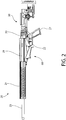
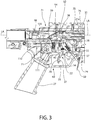
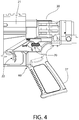
- FIGS. 1-4 depict a firearm 20 with safety selector and interlock mechanisms according to the present disclosure.
- the firearm 20 may be a bolt action rifle.
- firearm 20 generally includes a receiver 21, a trigger housing 22 detachably mounted to the receiver, a barrel 23 supported by the receiver, and optionally a handguard 24 enclosing and circumscribing at least part of the length of the barrel.
- the barrel includes an open front muzzle end 23a and an open rear breech end 23b (obscured beneath the handguard) coupled to the front end of the receiver 21 in any suitable manner (e.g. threading, interlocking lugs, barrel or lock nut, etc.).
- the barrel of rifle 20 defines a longitudinal axis LA and axial direction of the firearm coinciding with the centerline of the barrel 23 and its longitudinal bore formed therein between the muzzle and breech ends 23a, 23b (not shown) that defines the projectile pathway.
- Handguard 24 if provided may any type and coupled to the front end of the receiver and/or the barrel.
- Firearm 20 further includes a buttstock 30 extending rearward from the receiver 21 for placement against the user's shoulder when aiming the firearm held in a ready-to-fire position to acquire a target.
- Buttstock 30 may be any type or configuration of buttstock including fixed, adjustable and non-adjustable types, and folding and non-folding types. The invention is not limited by the type of buttstock which may be used.
- Firearm 20 further includes a lower assembly or stock 60, which in one non-limiting embodiment is detachably mounted to the bottom of the receiver 21.
- Lower stock 60 includes a front portion 33, opposing rear portion 34, trigger guard 31 position to enclose trigger 28, a pistol grip 27 rearward of the trigger guard, and magazine well 29 forward of the trigger guard.
- the magazine well is configured and structured to removably detain and latch an insertable box type ammunition magazine via pivotable latch 32 mounted to the lower stock 60 at the rear of the magazine well 29 (best shown in FIG. 3 ).
- a front mounting features includes an upwardly open locking recess 130 in lower stock 60 configured with a raised central rib.
- Recess 130 receives dual laterally spaced mounting lugs 132 projecting downwards from the front portion of receiver 21.
- One of the lugs 132 far or right lug
- one lug near or left side
- the lugs 132 are positioned on opposite sides of the raised rib central which is received between the lugs.
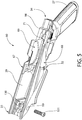
- the bottom of the lugs 132 may be convexly rounded and the recess 130 on opposite sides of the central rib may be concavely round by arcuate walls of the lower stock formed at the bottom of the recess (best shown in FIG. 5 ).
- the second rear mounting feature can be seen in FIGS. 3 and 5 .
- a socket head cap screw or other type threaded fastener 135 is inserted from the back of the firearm through the receiver 21 and lower stock 60.
- An axial threaded hole 98 formed in the rear of the lower stock receives the threaded fastener 135 extending through and from a concentrically aligned hole in the receiver which secures the rear end of the lower stock 60 to the receiver.
- this fastener 135 should be secured first, which helps brings the lower into a more consistent position and alignment relative to the receiver 21 and trigger housing 22, and afterwards the front bolt 131 may next be tightened lastly.
- the front bolt may be secured first before the rear bolt.
- the receiver 21 supports portions of the trigger-actuated fire control mechanism operable to discharge the firearm 20.
- the fire control mechanism includes an axially movable and elongated bolt 25 which may include a bolt handle 25a for manually operating the action to form a closed or open breech in relation to the chamber formed at the rear breech end 25b of barrel 25 which holds an ammunition cartridge.
- the bolt 25 is slidably moveable forward/rearward in an axially extending internal cavity 21a of receiver 21.
- the bolt assembly comprises a slidable striker or firing pin 26 carrier inside the bolt 25 for detonating a chambered cartridge when the firearm is discharged, a main spring 35 which acts to bias the firing pin rearward in a cocked ready-to-fire position, and a cocking piece 36 attached to the rear end of the firing pin (best shown in FIG. 3 ).
- the foregoing firing mechanism components are mounted in and supported by the receiver 21.
- the trigger housing 22 supports the other portions of the firing mechanism which operate together via pulling trigger 28 to release a cocked firing pin 26 for discharging the firearm.
- the trigger housing 22 has a generally rectangular elongated body defining an interior space 90 and various external openings to access the space for housing various firing mechanism components described herein.
- Trigger housing 22 may be removably attached to the receiver 21 by a variety of mechanical means.
- the trigger housing may include a plurality of laterally extending tabs 91 which interlock with mating tabs formed in the underside of the receiver (not shown) to suspend the housing from beneath the receiver.
- One or more fastener openings 92 may be provided which receive fasteners therethrough to complete securement of the trigger housing 22 to the receiver 21.
- fasteners alone may be used to secure the trigger housing to receiver.
- Other mechanical methods or combinations of methods may also be used.
- the invention is not limited by the type of means used to detachably secure the trigger housing to the receiver.
- the trigger housing 22 is securely attached to the receiver 21 of the firearm to ensure that the relationship between the sear 38 and the firing pin cocking piece 36 used to hold or release the firing pin 26 is maintained to prevent variable trigger feel and uncontrolled disengagement.
- the trigger housing 22 cannot be removed without first removing the lower stock 60 assembly from the firearm.
- the firing mechanism components supported by the trigger housing 22 includes a dual trigger mechanism including trigger 28 and trigger release member 37 which cooperates with the trigger to release a sear 38.
- Trigger 28 is movably mounted to trigger housing 22.
- the trigger is pivotably mounted to the module about transverse pin 56 which defines a pivot axis of the trigger.
- the trigger release member 37 is pivotably mounted to the trigger 28 about a second transverse pin 40 which is disposed just rearward of the trigger pin 40. This defines a separate pivot axis for the release member which is parallel to the trigger's pivot axis.
- Both the trigger 28 and the trigger release member 37 pivot in forward and rearward axial directions parallel to the longitudinal axis LA, as further described herein.
- Trigger 28 has a vertically elongated body including a lower arcuately curved operating end 43 for engaging a user's trigger finger and a vertically elongated upper sear catch protrusion 44 protruding upwards from the operating end.
- Lateral mounting hole 46 receives transverse pin 56 to pivotably mount the trigger to the trigger housing 22.
- Sear catch protrusion 44 includes an upward facing ledge 48 configured and arranged to selectively engage a mating downward facing hook-shaped sear catch 49 formed on the sear 38 for holding the sear in an upright position until the firearm 20 is discharged.
- the trigger release member 37 has a vertically elongated flat or plate-like elongate body defining an arcuately curved lower operating end 42 shaped for engaging a user's trigger finger and upper extension 41 protruding upwardly from the operating end. Lateral mounting hole 47 in the release member and mounting hole 61 in the trigger 28 receive transverse pin 40 to pivotably mount the release member to the trigger 28.
- the release member 37 is therefore supported by and movable in relation to the trigger.
- the operating end 42 of release member 37 is slideably received through a vertical slot 45 in curved operating end 43 of the trigger 28.
- Sear 38 has a horizontally elongated body including catch 49 formed on the front side or face, and an upwardly extending and vertically elongated firing pin catch protrusion 50.
- Lateral mounting hole 53 receives transverse pin 54 to pivotably mount the sear 38 to the trigger housing 22.
- Firing pin catch protrusion 50 defines a rear facing blocking surface 51 which is configured and arranged to abuttingly engage a mating front facing stop surface 52 formed on the cocking piece 36 of the bolt assembly (see, e.g. FIG. 3 ).
- Sear spring 39 biases the sear 38 into an upwards blocking position about pin 54 to force and positively maintain blocking surface 51 against stop surface 52 to prevent the release of the firing pin absent a trigger pull.
- spring 39 may be a helical compression spring; however, other types of springs (e.g. torsion) may be used.
- Trigger 28 in turn is biased into an upwards position about pin 56 by trigger spring 55.
- spring 55 may be a helical compression spring; however, other types of springs (e.g. torsion) may be used.
- Spring 55 acts on the vertical front side or surface 66 of the sear catch protrusion 44 of trigger 28 at a point above pin 56. This biases the trigger rearwards towards sear 38 which is mounted behind the sear catch protrusion 44 in the trigger housing 22. This in turn also forces the ledge 48 into positive engagement with the sear catch 49 on sear 38 for holding the sear in the upwards blocking position with a cocked firing pin 26.
- Spring 55 may be obliquely arranged to the longitudinal axis LA of firearm 20 to provide a line of action (extending along the axial centerline of the spring between its ends) which intersects the sear. This provides positive engagement of the ledge 48 on the trigger sear catch protrusion 44 with the sear catch 49.
- the sear catch protrusion 44 of trigger 28 is pivotable forwards about pin 56 to disengage and release the firing pin 26, as further described herein.
- a spring 57 is disposed between and has opposing ends which act against both the trigger 28 and trigger release member 37, as seen in FIG. 3 .
- the spring 57 is located above transverse pins 40 and 56 to bias the upper portions of the trigger and trigger release member apart. This in turn biases the curved lower operating end 42 of the trigger release member 37 to protrude forward beyond the curved lower operating end 43 of trigger 28 to maintain the release member. It bears noting that spring 57 is typically smaller in size than and has a lower spring force than trigger spring 55 so that the rearward spring force of spring 55 dominates and maintains positive engagement between the sear catch protrusion 44 and firing pin 26.
- the firearm 20 may be discharged in the following manner.
- the firing mechanism is shown in a ready-to-fire position.
- the bolt 25 is forward in a closed breech position in battery with the barrel 23 wherein a cartridge is chambered in the breech end 23b.
- Firing pin 26 is held rearward in a cocked position by sear 38 via engagement between blocking and stop surfaces 51, 52 of the sear and cocking piece 36 of the bolt respectively.
- the sear 38 is in the upwards blocking position being held there by the trigger release member 37 which similarly is in its upwards blocking position by spring 55.
- Trigger 28 is in a substantially vertical non-pulled position.
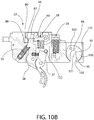
- a user To discharge the firearm, a user first pulls the exposed portions of the trigger 28 (via lower operating end 43) and trigger release member 37 (via lower operating end 42) rearward. It should be noted that the user initially engages the lower operating end 42 of the trigger release member 37 which protrudes forward of the trigger 28 in the normal un-pulled position (see, e.g. FIGS. 3 , 7 , and 8 ). The trigger release member moves rearward compressing spring 57 against the sear catch protrusion 44 which remains stationary at this stage until the front of operating end 42 of the trigger release member 37 is flush with the front of the operating end 43 of the trigger 28. It bears noting that trigger block pin 132 (see, e.g. FIG. 10B ) blocks the trigger movement until the trigger release is moved.
- a mechanical safety mechanism which acts to selectively arrest and disable the foregoing firing mechanism. This is intended to prevent inadvertent discharge of the firearm even if a trigger pull is attempted while the safety is "on.”
- the present safety mechanism provides for a bolt action rifle the convenience of a side-mounted AR-15 style safety selector with pistol grip both traditionally found only on conventional AR-15 semi-automatic action type rifles.
- a safety mechanism in one embodiment generally comprises a safety shaft 80, a safety selector 70, and a safety operating linkage such as control rod 100 operably coupling the shaft and selector together.
- the control rod operates and controls the position of the safety shaft 80 via rotating the safety selector 70, as further described herein. Both the safety shaft and safety selector are mounted to the trigger housing 22.
- the control rod 100 may a wire-form linkage to allow actuation of the safety shaft 80 from a different location or even a different amount of rotation.
- the safety shaft 80 in the illustrated embodiment is disposed forward of trigger 28 and the safety selector 70 is disposed rearward of the trigger in the trigger housing.
- This linkage system allows the safety selector position to be less critical because it is not directly contacting the trigger to arrest its movement. This is important because when the safety selector is connected to a different component than the trigger housing, very tight tolerances would be required to maintain a close relative position.
- the safety shaft 80 extends transversely through the trigger housing 22 between right and left opposing lateral sides 64, 65 of the housing and defines a pivot axis.
- the shaft has a generally cylindrical shape and includes opposing ends 81, 82.
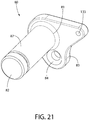
- a diametrically enlarged operating protrusion 83 extends radially from a first end 81 of the safety shaft in a direction perpendicular to the length of the shaft for coupling to the control rod 100.
- protrusion 83 may have an oblong or lobed shape as illustrated.
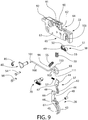
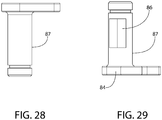
- An aperture 84 is formed in protrusion 83 which receives a first hook-shaped curved end 101 of control rod 100 (see also FIGS. 8 and 9 ).
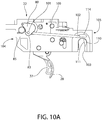
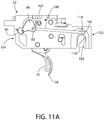
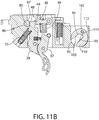
- Spring 85 may be a torsion spring in one embodiment and biases the safety shaft 80 into two rotational positions shown in FIGS. 10A and 11A .
- One end of spring 85 engages the trigger housing as shown and the other end engages hole 133 formed in protrusion 83 (see, e.g. FIG. 21 ).
- Spring 85 helps stabilize rotational motion of the safety shaft.
- Other types of springs may be used in other embodiments.
- Safety shaft 80 is rotatable between a blocking position in which the safety shaft disables the firing mechanism and an unblocking position in which the shaft enables the firing mechanism to discharge the firearm.
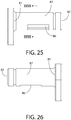
- Safety shaft 80 comprises a substantially flat operating surface 86 and a circumferentially adjoining arcuate blocking surface 87 formed by full diameter portions of the shaft on either side of the flat.
- the flat operating surface 86 is rotatable in radial position with the safety shaft.
- substantially flat indicates that although the operating surface 86 may be considered flat with respect to the arcuate blocking surface 87, the operating surface may in fact have a compound shape with portions of the surface 86 varying slightly in angularity to other portions of the surface 86 such as by 10 degrees or less; however, the overall profile of the operating surface may still be considered flat.
- the "flatness" of the surface will be dictated in part by configuration of the trigger 28 as explained below.
- the flat operating surface 86 is rotatable to a position arranged approximately parallel to a front surface 66 of the trigger 28 when the safety shaft is in the unblocking position. This provides a horizontal gap or clearance between the front surface 66 and flat operating surface 86 which allows pivotable movement of the trigger 28 sufficient to release the sear 38 and discharge the firearm by disengaging the cocking piece 36 of the firing pin 26. This corresponds to the rotational "fire" position of the safety selector 70.
- the safety shaft 80 is rotated to engage the arcuate blocking surface 87 with the front surface 66 of the trigger 28 when the safety shaft is in the blocking position. This prevents pivotable movement of the trigger sufficient to release the sear 38 and discharge the firearm. Movement of the trigger-actuated firing mechanism to discharge the firearm is therefore arrested. This corresponds to the rotational "safe" position of the safety selector 70.
- the safety selector 70 comprises a cylindrical control shaft 71 which extends transversely through the trigger housing 22 between the right and left opposing lateral sides 64, 65 of the housing when positioned therein.
- the control shaft 71 defines opposing ends 72 and 73, and a pivot axis of the safety selector 70.
- the pivot axis of the safety selector 70 is located lower in trigger housing 22 than the pivot axis of the safety shaft 80.
- An elongated selector switch 74 is disposed on a first end 73 of the shaft for operating the safety selector via a user's finger or thumb.
- the selector switch 74 extends radially in a direction perpendicular to the length of the control shaft 71 and may have any suitable shape and a surface texture selected to facilitate grasping by a user in some embodiments (e.g. ridges, knurling, etc.).
- the selector switch 74 may further comprise a firing mode indicator 79 adjoining end 73 of the control shaft 71.
- the indicator 79 may be circular in one embodiment and have a diameter the same as, or in a preferred embodiment larger than the diameter of the adjoining control shaft.
- An arrow 75 may be formed on the firing mode indicator 79 which is rotatable to point to indicia comprising for example "safe” and "fire” which optionally may be engraved in or otherwise marked on the lower stock 60 (e.g. lateral side 68) adjacent to the indicator. Other firing modes and indicia may be provided.
- the safety selector 70 is mounted in the lower stock 60 and supported independently of the trigger housing 22 such that removal of the lower stock from the firearm 20 and receiver 21 removes the safety selector with the lower stock without removing the safety selector from the lower stock or disassembling the safety or firing mechanism components.
- FIG. 5 shows this arrangement in the lower stock 60 with the control shaft 71 extending transversely and being received through apertures in opposing lateral right and left sides 67, 68 of the stock.
- the end 72 of the control shaft 71 opposite the selector switch 74 penetrates lateral side 67 of the lower stock 60 and is exposed for viewing by the user. End 72 may be provided with firing mode indicia 77 (e.g.
- the lateral sides 67, 68 of the lower stock 60 are spaced apart defining an axially elongated internal cavity 69 which is upwardly open to receive the trigger housing 22 therein when the lower stock is attached to the receiver 21.
- the safety selector 70 is held in place by the trigger housing, and not with a spring and plunger like the selector in an AR-15 rifle. Not only does this eliminate parts, but it makes it possible to reverse a standard AR-15 selector to provide the same function with the safety lever on either the left or right side. Eliminating the drag from the spring loaded plunger also allows the safety to rotate more smoothly and reduce the likely hood of the selector coming to rest in a partially engaged or disengaged position.
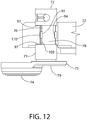
- FIGS. 12 and 13 are referenced now to describe this interface between the safety selector 70 and trigger housing 22.
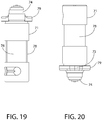
- the control shaft 71 of the safety selector 70 may have a stepped configuration defining a reduced diameter central portion formed by spaced apart shoulders on shaft.
- a pair of inward facing and opposing abutment surfaces 96 is formed by the stepped shaft 71. Abutment surfaces 96 abuttingly engages mating outward facing abutment surfaces 97 formed on each side of the vertical slot 103 in the housing.
- the safety selector control shaft 71 can only be downwardly withdrawn from the slot 103 in the trigger housing 22, and not laterally removed therefrom.
- the safety selector 70 can be removed from the lower stock just be sliding it laterally outwards. While installed on the receiver 21, however, the trigger housing 22 prevents the selector from sliding laterally out of the stock or trigger housing. If an ambidextrous style selector is used, with a lever or switch 74 on each side which may be provided in some implementations, it would first have to be disassembled for removal from the lower assembly.
- the control shaft 71 of the safety selector 70 further comprises a flat surface 76 and a circumferentially adjoining arcuate surface 78 formed on either side of the flat in the reduced diameter central portion of the shaft.
- the flat surface 76 is rotatable in position with rotation of the safety selector control shaft 71 via the selector switch 74.
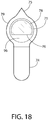
- the portion of the control shaft 71 including the flat surface 76 may have a generally semi-circular shape in transverse cross section, as illustrated in FIG. 18 . This shape lockingly mates with a complementary configured downwardly open vertical slot 111 formed in a rotary cam 110.
- rotary cam 110 cooperates with the safety selector 70 and control rod 100 to impart rotational movement to the safety shaft 80 which is inaccessible to a user when the lower stock 60 is attached to the receiver 21.
- the rotary cam operates to convert rotary motion of the selector switch 74 and control shaft 71 coupled thereto into substantially linear axial motion of the control rod 100 which moves the safety shaft 80 between the blocking and unblocking positions by rotating the safety selector 70.
- this permits placement of the safety selector 70 rear of the trigger 28 on the left lateral side 68 of the lower stock for convenient use with pistol grip 27 formed on the lower stock.
- the rotary cam 110 is mounted in an upwardly open recess 112 formed near the rear end 105 of the trigger housing 22 (see, e.g. FIGS. 8 , 10B , 11B ).
- the safety shaft 80 is disposed near the front end 104 of the housing 22.
- Recess 112 has an axial width which is slightly but not overly larger than the diameter of the rotary cam body to allow the cam to be inserted downwards into the recess when the safety mechanism components are installed in the trigger housing 22.
- the recess 112 may have a U-shape in transverse cross section and circumscribes a downwardly open vertical slot 103 formed in the trigger housing 22.
- the slot 103 may extend transversely through both the right and left lateral sides 64, 65 of the housing.
- the lower portions of the recess 112 on each side of the slot 103 in trigger housing 22 are bounded by bottom arcuate walls 95 which complement and engage the circular shape of the body of the rotary cam 110 on each side of slot 111.
- the rotary cam 110 is seated and rotatable on the arcuate walls 95 when fully installed in the trigger housing.
- the lower end of the recess 112 is smaller than the diameter of the rotary cam 110 so that the cam cannot fall through the vertical slot 103 in the trigger housing 22.
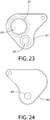
- Rotary cam 110 has a generally flat disk-like shape which is substantially but not perfectly circular in one embodiment as shown. In other embodiments, the shape may be perfectly circular.
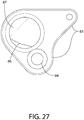
- Rotary cam 110 has a downwardly open vertical slot 111 for upwardly receiving the safety selector control shaft 71 and an aperture 113 which receives a second hook-shaped curved end 102 of control rod 100 which is coupled thereto. Access through the trigger housing 22 for end 102 of the control rod to engage the aperture 113 of the rotary cam 110 may be provided through an arcuate slot 114 formed in the left lateral side 65 of the housing. The arcuate slot 114 is located to follow the arcuate path of the curved end 102 of the control rod 100 as the safety selector 70 is rotated.
- the control shaft 71 of the safety selector 70 is removably received in both of the mating downwardly open slots 103, 111 disposed in the trigger housing 22 and the rotary cam 110, respectively.
- Slots 103 and 111 may have similar heights and axial widths which complement and are preferably slightly larger than the diameter of the safety selector control shaft 71 sufficient to allow both insertion and rotation of the shaft when positioned therein.
- Slot 111 of the rotary cam 110 has an open bottom end and a closed top end with a shape complementary to the shape semi-circular shape of the portion of the control shaft 71 containing the flat surface 76. Accordingly, the top end of slot 111 has a mating flat surface 93 and arcuate surface 94 (see, e.g. FIGS. 9 , 10B , 11B ). This provides a relatively tight interlocking fit and engagement between the control shaft 71 and rotary cam 110 such that rotating the shaft 71 concomitantly rotates the rotary cam.
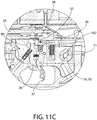
- Safety selector 70 is first assumed to be in the downward "fire" position shown in FIGS. 11A-C .
- the selector switch 74 is thus oriented obliquely to the longitudinal axis LA. In one embodiment, the selector switch 74 may be disposed at approximately 45 degrees to the longitudinal axis.
- the rotary cam 110 is oriented so that the lower rear quadrant obstructs the vertical slot 103 of the trigger housing 22.
- the rear curved end 102 of the control rod 100 is positioned at the rear of arcuate slot 114.
- the safety shaft 80 is in the unblocking position with the flat operating surface 86 of the positioned parallel to and facing the front surface 66 of the trigger 28. When the trigger is pulled, there is sufficient clearance between the safety selector 70 and front surface 66 of trigger 28 to allow the trigger sear catch protrusion 44 to move and release the sear 38 and firing pin 26 for discharging the firearm.
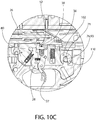
- the user moves and rotates the selector switch 74 upwards (counter-clockwise) to the horizontal "safe" position parallel to longitudinal axis LA as shown in FIGS. 10A-C .
- the rotary motion of the safety selector 70 moves or translates the control rod 100 axially forward.
- the curved end 102 of the control rod moves forward in turn to the front of the arcuate slot 114.
- the rotary cam 110 rotates counter-clockwise with the safety selector control shaft 71 such that the vertical slot 111 of the cam becomes vertically aligned with and approximately parallel to slot 103 of trigger housing 22. This would allow removal of the lower stock 60 from the receiver 21 if the firearm 20 were to be disassembled at this point, as already explained herein.
- the vertical slot 111 of the rotary cam 110 is rotatable in orientation with respect to the vertical slot 103 of the trigger housing 22 which remains stationary and fixed in position when mounted to the receiver 21.
- relative rotation between the rotary cam 110 and trigger housing 22 advantageously forms an interlock mechanism which prevents removal of the lower housing 60 from the receiver 21 when the safety selector 70 is in the "fire" position.
- the safety selector control shaft 71 is captured by the rotary cam 110 and the trigger housing 22, thereby preventing the lower assembly from being removed. While a firearm should always be unloaded before disassembly as dictated by responsible handling procedures, this mechanism is beneficial in that it ensures the safety of the firearm is engaged before the lower stock 60 can be removed and the trigger assembly is exposed. It also prevents the firearm from being re-assembled with the safety in the fire position.
- the vertical slots 103, 111 of the trigger housing 22 and rotary cam 110 are vertically aligned and fully open to at least the full diameter of the control shaft 71 of the safety selector. This allows the control shaft and safety selector 70 to be withdrawn downwards and removed from the slots 103, 111 with the lower stock 60 (in which the safety selector is rotatably mounted as shown in FIG. 4 ) to exposed the trigger housing 22 and trigger mechanism. Conversely when the safety selector 70 is in the "fire" position shown in FIGS.
- the vertical slots 103, 111 of the trigger housing 22 and rotary cam 110 are no longer vertically aligned and fully open to at least the full diameter of the control shaft 71 of the safety selector.
- the lower rear quadrant of the rotary cam now protrudes partially into and obstructs the slot 103 of the trigger housing 22 by a sufficient amount to prevent the control shaft 71 from passing downwards therethrough.
- Rotary cam slot 111 is no longer vertically aligned with but rather obliquely orientated to slot 103 of the trigger housing which traps the control shaft 71 of the safety selector 70 in the cam. This prevents the control shaft and safety selector 70 from being withdrawn downwards and removed from the slots 103, 111 when in the "fire" position so that the lower stock 60 cannot now be detached from the receiver 21, thereby forming an interlock mechanism.
Landscapes
- Engineering & Computer Science (AREA)
- General Engineering & Computer Science (AREA)
- Aiming, Guidance, Guns With A Light Source, Armor, Camouflage, And Targets (AREA)
Claims (15)
- Schusswaffe (20) mit Sicherheitsmechanismus, wobei die Schusswaffe umfasst:eine Aufnahme (21);einen Lauf (23), der mit der Aufnahme (21) gekoppelt ist und eine Längsachse (LA) definiert;ein Abzugsgehäuse (22), das lösbar mit der Aufnahme (21) gekoppelt ist;einen durch einen Abzug betätigten Schussmechanismus, der in dem Abzugsgehäuse (22) montiert ist und betätigbar ist, um die Schusswaffe (20) durch Ziehen eines Abzugs (28) abzufeuern;eine Sicherheitswelle (80), die sich quer durch das Abzugsgehäuse (22) erstreckt und eine erste Schwenkachse definiert, wobei die Sicherheitswelle zwischen einer Sperrposition, in der die Sicherheitswelle den Schussmechanismus deaktiviert, und einer Entsperrposition bewegbar ist, in der die Welle den Schussmechanismus aktiviert, um die Schusswaffe abzufeuern;einen Sicherheitsselektor (70) mit einer Steuerwelle (71), die sich quer durch das Abzugsgehäuse erstreckt und eine zweite Schwenkachse definiert, wobei der Sicherheitsselektor (70) durch eine axial verlängerte Steuerstange (100) mechanisch mit der Steuerwelle (80) gekoppelt ist, so dass die Drehung des Sicherheitsselektors (70) die Sicherheitswelle (80) dreht, wobei der Sicherheitsselektor (70) zwischen einer sicheren Position und einer Schussposition drehbar ist; undwobei der Sicherheitsselektor (70) ferner einen Selektorschalter (74) umfasst, der an einem ersten Ende der Steuerwelle angeordnet ist und sich radial von diesem nach außen erstreckt, um den Sicherheitsselektor zu drehen;wobei das Drehen des Sicherheitsselektors (70) um die zweite Schwenkachse in einer ersten Richtung von der sicheren Position in die Schussposition die Sicherheitswelle (80) um die erste Schwenkachse von der Sperrposition in die Entsperrposition dreht; undwobei das Drehen des Sicherheitsselektors (70) um die zweite Schwenkachse in einer zweiten Richtung von der Schussposition in die sichere Position die Sicherheitswelle (80) um die erste Schwenkachse von der Entsperrposition in die Sperrposition dreht;wobei die Schusswaffe ferner einen Drehnocken (110) umfasst, der drehbar in dem Abzugsgehäuse (22) montiert ist, wobei der Drehnocken durch die Steuerwelle (71) des Sicherheitsselektors (70) verriegelnd in Eingriff genommen ist;wobei der Drehnocken (110) die Drehbewegung des Selektorschalters (74) in eine lineare Bewegung der Steuerstange (100) umwandelt, die die Sicherheitswelle (80) durch Drehen des Sicherheitsselektors (70) zwischen der Sperr- und der Entsperrposition bewegt;die Steuerwelle (71) des Sicherheitsselektors (70) entfernbar in zusammenpassenden nach unten offenen Schlitzen (103, 111) aufgenommen ist, die in dem Abzugsgehäuse (22) und dem Drehnocken (110) angeordnet sind;wobei, wenn sich der Drehnocken (110) in einer ersten Drehposition befindet, der Schlitz (111) in dem Drehnocken parallel zu dem Schlitz (103) in dem Abzugsgehäuse (22) ausgerichtet ist, um einen vertikalen Entfernweg zu bilden, der ein Entfernen der Steuerwelle (71) und des Sicherheitsselektors (70) aus dem Abzugsgehäuse nach unten erlaubt; undwobei, wenn sich der Drehnocken in einer zweiten Drehposition befindet, der Schlitz (111) in dem Drehnocken (110) schräg zu dem Schlitz (103) in dem Abzugsgehäuse (22) angeordnet ist, so dass der Drehnocken den vertikalen Entfernweg blockiert, was ein Entfernen der Steuerwelle (71) und des Sicherheitsselektors (70) aus dem Abzugsgehäuse nach unten verhindert; undeinen unteren Schaft (60), der abnehmbar an der Aufnahme (21) montiert ist;wobei der Sicherheitsselektor (70) quer in dem unteren Schaft (60) montiert ist und unabhängig von dem Abzugsgehäuse (22) drehbar gelagert ist, so dass das Entfernen des unteren Schafts den Sicherheitsselektor mit diesem entfernt.
- Schusswaffe nach Anspruch 1, wobei die Sicherheitswelle (80) ferner einen länglichen Betätigungsvorsprung (83) umfasst, der sich radial von einem ersten Ende der Sicherheitswelle erstreckt, wobei ein erstes Ende der Steuerstange (100) mit dem Betätigungsvorsprung gekoppelt ist und ein zweites Ende der Steuerstange mit dem Drehnocken (110) gekoppelt ist.
- Schusswaffe nach Anspruch 2, wobei die Sicherheitswelle (80) vor dem Abzug (28) positioniert ist und der Sicherheitsselektor (70) hinter dem Abzug positioniert ist.
- Schusswaffe nach Anspruch 1, wobei die Sicherheitswelle (80) direkt mit dem Abzug (28) in Eingriff steht, um eine Schwenkbewegung davon zu verhindern, wenn sich die Sicherheitswelle in der Sperrposition befindet.
- Schusswaffe nach Anspruch 3, wobei:die Sicherheitswelle (80) eine im Wesentlichen flache Betätigungsfläche (86) und eine am Umfang angrenzende bogenförmige Sperrfläche (87) umfasst,die Betätigungsfläche (86) parallel zu einer Vorderseite des Abzuges (28) angeordnet ist, wenn sich der Sicherheitsschaft (80) in der Entsperrposition befindet, um einen Freiraum zu schaffen, der eine Schwenkbewegung des Abzuges zum Abfeuern der Schusswaffe ermöglicht; unddie bogenförmige Sperrfläche (87) an der Vorderseite des Abzuges (28) eingreift, wenn sich die Sicherheitswelle (80) in der Sperrstellung befindet, um eine Schwenkbewegung des Abzuges zu verhindern.
- Schusswaffe nach Anspruch 1, wobei sich die Steuerwelle (71) des Sicherheitsselektors (70) ferner quer durch den unteren Schaft (60) zwischen gegenüberliegenden ersten und zweiten lateralen Seiten erstreckt, wobei sich der Selektorschalter (74) an der Außenseite der ersten lateralen Seite des unteren Schafts für einen Betätigungszugriff befindet; und wobei sich ein dem Selektorschalter gegenüberliegendes zweites Ende der Steuerwelle durch die zweite laterale Seite erstreckt und zur Betrachtung freigelegt ist.
- Schusswaffe nach Anspruch 1, wobei die Steuerwelle (71) des Sicherheitsselektors (70) gegenüberliegende Anschlagsflächen (96) umfasst, die so angeordnet sind, dass sie mit zusammenpassenden Anschlagsflächen (97) in Eingriff kommen, die an dem Abzugsgehäuse (22) ausgebildet sind, wobei die Anschlagsflächen an dem Sicherheitsselektor und dem Abzugsgehäuse zusammenwirken, um ein laterales Entfernen des Sicherheitsselektors von dem Abzugsgehäuse zu verhindern.
- Schusswaffe nach Anspruch 1, ferner umfassend:einen manuell betätigten Bolzen (25), der in der Aufnahme (21) axial vorwärts und rückwärts bewegbar ist, wobei der Bolzen einen federvorgespannten Schlagbolzen (26) und ein mit dem Schlagbolzen gekoppeltes Ladestück (36) enthält;einen Abzugsstollen (38), der schwenkbar zwischen dem Abzug (28) und dem Ladestück (36) in Eingriff ist, wobei der Abzugsstollen zwischen einer Sperrposition, die mit dem Ladestück in Eingriff steht, um den Schlagbolzen (26) in einer nach hinten geladenen bzw. gespannten Position zu halten, und einer Entsperrposition schwenkbar ist, in der der Abzugsstollen durch die Schwenkbewegung des Abzuges den Schlagbolzen löst und freigibt, um eine in dem Lauf (23) untergebrachte Patrone zur Detonation zu bringen; undwobei die Sicherheitswelle (80) den Schussmechanismus durch Ineingriffnehmen des Abzugs (28) deaktiviert, um eine Schwenkbewegung davon zu verhindern, um den Abzugsstollen (38) freizugeben, wenn sich die Sicherheitswelle in der Sperrposition befindet.
- Schusswaffe nach Anspruch 1, wobei der Sicherheitsselektor (70) über eine axial verlängerte Steuerstange (100) mechanisch mit der Sicherheitswelle (80) gekoppelt ist.
- Schusswaffe nach Anspruch 9, ferner umfassend einen diametral vergrößerten Betätigungsvorsprung (83), der sich radial von einem ersten Ende der Sicherheitswelle (80) in einer Richtung senkrecht zu der Sicherheitswelle erstreckt, wobei ein vorderes Ende der Steuerstange (100) mit dem Betätigungsvorsprung gekoppelt ist.
- Abzugsgehäuseanordnung, die an einer Repetierschusswaffe (20) anbringbar ist, wobei die Abzugsgehäuseanordnung umfasst:einen Körper, der einen Innenraum (90) und eine Längsachse (LA) definiert;einen Schussmechanismus, der zumindest teilweise in dem Innenraum (90) angeordnet ist, wobei der Schussmechanismus betätigbar ist, um die Schusswaffe durch Ziehen eines Abzugs (28) abzufeuern, der beweglich an dem Körper angebracht ist;eine Sicherheitswelle (80), die sich quer durch das Abzugsgehäuse (22) erstreckt und eine erste Schwenkachse definiert, wobei die Sicherheitswelle zwischen einer Sperrposition, in der die Sicherheitswelle den Schussmechanismus deaktiviert, und einer Entsperrposition bewegbar ist, in der die Welle den Schussmechanismus aktiviert, um die Schusswaffe abzufeuern;einen nach unten offenen vertikalen ersten Schlitz (103), der in dem Körper ausgebildet ist;einen Drehnocken (110), der drehbar in dem Körper in der Nähe des ersten Schlitzes (103) angeordnet ist, wobei der Drehnocken einen zweiten Schlitz (111) mit einem offenen Ende und einem geschlossenen Ende umfasst;wobei der Drehnocken (110) zwischen einer ausgerichteten Position, in der der erste und der zweite Schlitz (103, 111) vertikal ausgerichtet sind, und einer fehlausgerichteten Position drehbar ist, in der der zweite Schlitz (111) des Drehnockens nicht vertikal mit dem ersten Schlitz (103) des Körpers ausgerichtet ist;eine axial verlängerte Steuerstange (100), die den Drehnocken (110) mit der Sicherheitswelle (80) koppelt; undeinen Sicherheitsselektor (70) mit einer Steuerwelle (71), die eine zweite Schwenkachse definiert, und einem länglichen Selektorschalter (74), der sich von einem ersten Ende der Steuerwelle radial nach außen erstreckt, um den Sicherheitsselektor zu betätigen, wobei die Steuerwelle quer durch den ersten und zweiten Schlitz des Körpers bzw. des Drehnockens (110) eingesetzt ist, wobei die Steuerwelle eine Verriegelungspassung mit dem Drehnocken bildet, so dass das Drehen des Sicherheitsselektors gleichzeitig den Drehnocken dreht;wobei das Drehen des Sicherheitsselektors (70) um die zweite Schwenkachse in einer ersten Richtung von der sicheren Position in die Schussposition gleichzeitig die Sicherheitswelle (80) um die erste Schwenkachse von der Sperrposition in die Entsperrposition dreht; undwobei das Drehen des Sicherheitsselektors (70) um die zweite Schwenkachse in einer zweiten Richtung von der Schussposition zu der sicheren Position gleichzeitig die Sicherheitswelle (80) um die erste Schwenkachse von der Entsperrposition in die Sperrposition dreht.
- Abzugsgehäuse nach Anspruch 11, wobei die erste und die zweite Schwenkachse parallel zueinander sind und quer zur Längsachse (LA) ausgerichtet sind; oder
wobei ein hinterer Quadrant des Drehnockens (110) den ersten Schlitz (103) des Körpers zumindest teilweise verdeckt, wenn sich der Drehnocken in der fehlausgerichteten Position befindet; oder
wobei die Steuerwelle (71) des Sicherheitsselektors (70) vertikal aus dem ersten und zweiten Schlitz (103, 111) entfernbar ist, wenn sich der Drehnocken (110) in der ausgerichteten Position befindet, und ein unterer Quadrant des Drehnockens verhindert, dass die Steuerwelle des Sicherheitsselektors vertikal aus dem ersten und dem zweiten Schlitz entfernbar ist, wenn sich der Drehnocken in der fehlausgerichteten Position befindet; oder
wobei der Drehnocken (110) eine Kreisform aufweist und drehbar in einer Aussparung (112) innerhalb des Körpers angeordnet ist, die durch bogenförmige Bodenwände auf jeder Seite des ersten vertikalen Schlitzes (103) begrenzt ist. - Abzugsgehäuse nach Anspruch 12, wobei der Sicherheitsselektor (70) unabhängig von dem Abzugsgehäuse (22) in einem unteren Schaft (60) drehbar gelagert ist, der lösbar an der Aufnahme (21) montiert ist, wobei der Sicherheitsselektor mit dem untere Schaft durch vertikales Entfernen des Sicherheitsselektors aus dem ersten und zweiten Schlitz (103, 111) entfernbar ist.
- Verfahren zum Betätigen eines Sicherheitsmechanismus einer Schusswaffe (20) nach Anspruch 1, wobei das Verfahren umfasst:Bereitstellen einer Schusswaffe mit einer Längsachse, einer Aufnahme (21), einem von der Aufnahme (21) getragenen Lauf (25) und einem Abzugsgehäuse (22), umfassend (i) einen durch Abzug betätigten Schussmechanismus, der zum Abfeuern der Schusswaffe operabel ist, (ii) einen Sicherheitsdrehselektor (70) mit einer Steuerwelle (71), die sich quer durch das Abzugsgehäuse (22) erstreckt, und einem Selektorschalter (74), (iii) einer Sicherheitsdrehwelle (80), die sich quer durch das Abzugsgehäuse erstreckt (22) und eine Sperrfläche (87) und einer Betätigungsfläche (86) enthält, und (iv) einer Steuerstange (100), die den Sicherheitsselektor (70) operabel mit der Sicherheitswelle (80) koppelt;Drehen des Sicherheitsselektors (70) in einer ersten Richtung in eine "sichere" Drehposition;gleichzeitiges Drehen der Sicherheitswelle (80) in einer zweiten Drehrichtung über die Steuerwelle (71) durch Drehen des Sicherheitsselektors (70) in der ersten Richtung;Ineingriffbringen der Sperrfläche (87) der Sicherheitswelle (80) mit einem Abzug (28) des Schussmechanismus, wobei eine Bewegung des Abzugs (28) verhindert wird, um den Schussmechanismus zu deaktivieren;Drehen des Sicherheitsselektors (70) entgegen der ersten Drehrichtung in eine "Schuss"-Drehposition;gleichzeitiges Drehen der Sicherheitswelle (80) entgegen der zweiten Drehrichtung über die Steuerwelle (71) durch Drehen des Sicherheitsselektors (70) entgegen der ersten Drehrichtung;Außereingriffbringen der Sperrfläche (87) der Sicherheitswelle (80) von dem Abzug (28) des Schussmechanismus; undAusrichten der Betätigungsfläche (86) der Sicherheitswelle (80) mit dem Abzug (28), was einen Freiraum bereitstellt, so dass die Bewegung des Abzugs (28) nicht verhindert wird, um den Schussmechanismus zu aktivieren.
- Verfahren nach Anspruch 14, ferner umfassend einen in dem Abzugsgehäuse (22) angeordneten Drehnocken (110), der die Steuerstange (100) mit dem Sicherheitsselektor (70) operativ koppelt, wobei der Drehnocken (110) verriegelnd mit der Steuerwelle (71) des Sicherheitsselektors (70) derart in Eingriff ist, dass der Drehnocken (110) mit der Drehung des Sicherheitsselektors (70) drehbar ist.
Applications Claiming Priority (2)
| Application Number | Priority Date | Filing Date | Title |
|---|---|---|---|
| US201462096981P | 2014-12-26 | 2014-12-26 | |
| PCT/US2015/067645 WO2016106412A1 (en) | 2014-12-26 | 2015-12-28 | Safety mechanism for firearm |
Publications (3)
| Publication Number | Publication Date |
|---|---|
| EP3237828A1 EP3237828A1 (de) | 2017-11-01 |
| EP3237828A4 EP3237828A4 (de) | 2018-08-15 |
| EP3237828B1 true EP3237828B1 (de) | 2019-11-27 |
Family
ID=56151550
Family Applications (1)
| Application Number | Title | Priority Date | Filing Date |
|---|---|---|---|
| EP15874369.0A Active EP3237828B1 (de) | 2014-12-26 | 2015-12-28 | Sicherheitsmechanismus für feuerwaffe |
Country Status (3)
| Country | Link |
|---|---|
| US (1) | US9441897B2 (de) |
| EP (1) | EP3237828B1 (de) |
| WO (1) | WO2016106412A1 (de) |
Families Citing this family (41)
| Publication number | Priority date | Publication date | Assignee | Title |
|---|---|---|---|---|
| USD774619S1 (en) * | 2015-09-30 | 2016-12-20 | Sturm, Ruger & Company, Inc. | Stock for rifle |
| US10739095B2 (en) * | 2015-12-01 | 2020-08-11 | Mean L.L.C. | Firearm operating system |
| TR201610866A2 (tr) * | 2016-08-03 | 2016-10-21 | Samsun Yurt Savunma Sanayi Ve Ticaret Anonim Sirketi | Çi̇ft hareket teti̇klerde ki̇li̇t mandali si̇stemi̇ |
| US9772156B1 (en) | 2016-08-10 | 2017-09-26 | Smith & Wesson Corp. | Method of installing and removing a safety selector |
| US10317158B2 (en) | 2016-09-30 | 2019-06-11 | WHG Properties, LLC | Firearm trigger safety assembly |
| USD827753S1 (en) * | 2016-12-20 | 2018-09-04 | Q, Llc | Firearm |
| USD810388S1 (en) * | 2016-12-23 | 2018-02-13 | F-1 Research, Llc | Cross-shaped safety switch |
| USD868190S1 (en) * | 2017-01-11 | 2019-11-26 | Smith & Wesson Inc. | Rifle |
| US9970723B1 (en) | 2017-03-22 | 2018-05-15 | Smith & Wesson Corp. | Sear block trigger safety |
| US10006734B1 (en) | 2017-03-22 | 2018-06-26 | Smith & Wesson Corp. | Trigger assembly with trigger block |
| US9995549B1 (en) * | 2017-03-29 | 2018-06-12 | David Marion Hamby | Bolt hold open, fire selector and safety for kalashnikov style weapons |
| US10663239B2 (en) | 2017-04-27 | 2020-05-26 | David Rian Timmons | Firearm takedown pin and upper receiver system |
| HRP20251076T1 (hr) | 2017-12-22 | 2025-11-07 | Sig Sauer, Inc. | Spremnik za streljivo |
| US10724814B2 (en) | 2017-12-22 | 2020-07-28 | Sig Sauer, Inc. | Handgun safety mechanism |
| US10648769B2 (en) | 2017-12-22 | 2020-05-12 | Sig Sauer, Inc. | Handgun grip module with a reinforcing bracket |
| US10465999B2 (en) | 2017-12-22 | 2019-11-05 | Sig Sauer, Inc. | Handgun with forward assist |
| US12480740B2 (en) | 2017-12-27 | 2025-11-25 | Magpul Industries Corp. | Two-part folding trigger for a folding firearm |
| US10443971B2 (en) | 2017-12-27 | 2019-10-15 | Magpul Industries Corp. | Foldable firearm |
| USD849869S1 (en) | 2018-01-03 | 2019-05-28 | Magpul Industries Corp. | Folding gun |
| USD858680S1 (en) | 2018-01-05 | 2019-09-03 | Sig Sauer, Inc. | Pistol magazine |
| USD854642S1 (en) | 2018-01-05 | 2019-07-23 | Sig Sauer, Inc. | Semiautomatic handgun |
| USD921149S1 (en) * | 2018-01-18 | 2021-06-01 | Crosman Corporation | Airgun stock |
| US10697725B2 (en) * | 2018-08-24 | 2020-06-30 | Colt's Manufacturing Ip Holding Company Llc | Tool for firearm selector removal and installation and method of firearm selector removal and installation |
| US11280570B2 (en) | 2019-03-11 | 2022-03-22 | James Matthew Underwood | Firearm operating mechanisms and bolt release |
| US10989489B2 (en) | 2019-04-05 | 2021-04-27 | Sturm, Ruger & Company, Inc. | Bolt release mechanism for firearm |
| US11085723B2 (en) | 2019-04-26 | 2021-08-10 | Magpul Industries Corp. | Selector track having varying heights and removable selector lever stop |
| IT201900007983A1 (it) * | 2019-06-04 | 2020-12-04 | Benelli Armi Spa | Gruppo scatto per arma |
| US11371789B2 (en) | 2019-08-06 | 2022-06-28 | James Matthew Underwood | Roller delayed firearm operating system |
| CN110525660B (zh) * | 2019-09-11 | 2021-05-11 | 中航技进出口有限责任公司 | 一种用于无人机的机枪挂载驱动结构 |
| USD954891S1 (en) * | 2020-05-15 | 2022-06-14 | David Pobutkiewicz | Adjustable bag rider with angled bolt |
| US11543195B2 (en) | 2020-07-03 | 2023-01-03 | James Matthew Underwood | Roller and bearing delayed firearm operating systems |
| CN112062656A (zh) | 2020-09-17 | 2020-12-11 | 南京延长反应技术研究院有限公司 | 一种对甲基苯酚的微界面制备系统及方法 |
| USD1017750S1 (en) * | 2020-09-25 | 2024-03-12 | Daniel Defense, Llc | Bolt action firearm |
| USD1069016S1 (en) | 2021-06-02 | 2025-04-01 | Magpul Industries Corp. | Folding gun |
| US11846476B2 (en) | 2021-10-07 | 2023-12-19 | James Matthew Underwood | Ejector for firearm |
| EP4430356B1 (de) | 2021-12-20 | 2026-01-28 | Magpul Industries Corp. | Modularer ar-sicherheitswähler mit hebelbefestigungsstiften |
| USD1085314S1 (en) | 2021-12-20 | 2025-07-22 | Magpul Industries Corp. | Folding gun |
| US11808540B2 (en) | 2022-03-16 | 2023-11-07 | Sig Sauer, Inc. | Safety mechanism for blowback firearm |
| US11624570B1 (en) | 2022-03-16 | 2023-04-11 | Sig Sauer, Inc | Takedown lever, takedown safety, and trigger shoe |
| US11913748B2 (en) | 2022-03-21 | 2024-02-27 | Sig Sauer, Inc. | Magazine for rimmed ammunition |
| US12480728B2 (en) * | 2023-04-12 | 2025-11-25 | Tyrant Designs CNC, LLC | Firearm trigger with safety blade |
Family Cites Families (29)
| Publication number | Priority date | Publication date | Assignee | Title |
|---|---|---|---|---|
| US660378A (en) | 1900-06-30 | 1900-10-23 | Josef Kalina | Safety device for triggers and hammers of firearms. |
| US2379946A (en) * | 1944-03-30 | 1945-07-10 | Baker Ralph Harold | Safety device for firearms |
| US2453683A (en) | 1946-02-13 | 1948-11-09 | Alexander W Caldow | Safety for firearms |
| US3735519A (en) | 1971-03-26 | 1973-05-29 | G Fox | Lock means for a firearm |
| US4463654A (en) | 1982-04-29 | 1984-08-07 | Armament Research Corporation Of America | Conversion kit for assault rifle and converted rifle of compact configuration |
| US4569145A (en) * | 1983-11-29 | 1986-02-11 | Sturm, Ruger & Company, Inc. | Inactivating selector arrangement for bolt action firearms |
| ATA98796A (de) * | 1996-06-07 | 2001-07-15 | Steyr Daimler Puch Ag | Sicherung für gewehre mit zylinderverschluss und verschlusshalterung |
| US7428795B2 (en) | 2005-02-11 | 2008-09-30 | Herring Geoffrey A | Receiver for firearm |
| US8756847B2 (en) | 2006-02-09 | 2014-06-24 | Colt Defense Llc | Firearm fire control selector |
| DE102006012834A1 (de) * | 2006-03-21 | 2007-09-27 | Edelbert Wasmer | Handfeuerwaffe |
| DE102006048436B4 (de) * | 2006-08-03 | 2008-07-17 | Heckler & Koch Gmbh | Zweiwegeabzug mit Druckpunkt |
| US20080302235A1 (en) | 2007-06-11 | 2008-12-11 | David Michael Lauck | Adjustable/lockable safety-selector switch for AR15/M16 style firearms |
| US8296990B2 (en) | 2008-12-30 | 2012-10-30 | Smith & Wesson Corp. | Snap-on dovetail pistol sight |
| US8109025B2 (en) | 2009-03-20 | 2012-02-07 | Ra Brands, L.L.C. | Trigger engagement link for firearm |
| AT507904B1 (de) * | 2009-06-30 | 2010-09-15 | Steyr Mannlicher Holding Gmbh | Prallschlagsicherung für eine schusswaffe |
| AT508016B1 (de) * | 2009-06-30 | 2010-10-15 | Steyr Mannlicher Holding Gmbh | Spann- und entspannvorrichtung für eine schusswaffe |
| US8276502B1 (en) | 2010-01-18 | 2012-10-02 | Robert Wright | Ambidextrous safety lever |
| US8615915B2 (en) | 2010-05-24 | 2013-12-31 | Bullpup Unlimited, Inc. | Bullpup conversion kit for firearm |
| US8549982B2 (en) | 2010-12-10 | 2013-10-08 | Stephen P. Troy, Jr. | Firearm control devices |
| US8438768B2 (en) * | 2011-01-07 | 2013-05-14 | Sturm, Ruger & Company, Inc. | Magazine disconnect mechanism for firearm |
| US8464455B2 (en) * | 2011-01-07 | 2013-06-18 | Sturm, Ruger & Company, Inc. | Lockable safety for firearm |
| WO2012097334A2 (en) | 2011-01-14 | 2012-07-19 | ArmWest, LLC | Quick barrel change firearm |
| US8572880B2 (en) | 2011-01-18 | 2013-11-05 | Terrence Dwight Bender | Firearm trigger group |
| US8683729B2 (en) | 2011-04-22 | 2014-04-01 | Sig Sauer, Inc. | Ambidextrous thumb safety assembly |
| US8650790B2 (en) | 2011-11-07 | 2014-02-18 | Megamet Solid Metals, Inc. | Firearm selector switch locking apparatus |
| US9658015B2 (en) * | 2014-09-22 | 2017-05-23 | Benjamin Alicea, JR. | Trigger blocking system for a firearm |
| US9557128B2 (en) * | 2014-09-25 | 2017-01-31 | Spike's Tactical, Llc | Reversible safety selector for AR15-type firearm |
| WO2016069702A1 (en) * | 2014-10-28 | 2016-05-06 | Sturm, Ruger & Company, Inc. | Firearm with tubular handguard mounting system |
| WO2016069741A1 (en) * | 2014-10-28 | 2016-05-06 | Sturm, Ruger & Company, Inc. | Firearm with folding buttstock |
-
2015
- 2015-12-28 US US14/980,563 patent/US9441897B2/en active Active
- 2015-12-28 WO PCT/US2015/067645 patent/WO2016106412A1/en not_active Ceased
- 2015-12-28 EP EP15874369.0A patent/EP3237828B1/de active Active
Non-Patent Citations (1)
| Title |
|---|
| None * |
Also Published As
| Publication number | Publication date |
|---|---|
| WO2016106412A1 (en) | 2016-06-30 |
| EP3237828A4 (de) | 2018-08-15 |
| EP3237828A1 (de) | 2017-11-01 |
| US20160187090A1 (en) | 2016-06-30 |
| US9441897B2 (en) | 2016-09-13 |
Similar Documents
| Publication | Publication Date | Title |
|---|---|---|
| US9441897B2 (en) | Safety mechanism for firearm | |
| US10030926B2 (en) | Trigger housing mounting system for firearm | |
| US9964370B2 (en) | Ambidextrously Operable Firearm Receiver Assembly | |
| EP3129739B1 (de) | Abzugssystem für feuerwaffen | |
| US10724814B2 (en) | Handgun safety mechanism | |
| US7644528B2 (en) | Machine guns having detachable barrels and methods of operating the same | |
| EP2791610B1 (de) | Bolzengriffanordnung für feuerwaffen | |
| US8615915B2 (en) | Bullpup conversion kit for firearm | |
| US8327749B2 (en) | Firearm receiver with ambidextrous functionality | |
| EP2661600B1 (de) | Magazinentnahmemechanismus für eine schusswaffe | |
| US20170131055A1 (en) | Trigger mechanism with momentary automatic safety | |
| US10794648B2 (en) | Magazine release and holding apparatus for use with firearms | |
| EP3894777B1 (de) | Unterbrochene halbautomatische betätigung für schusswaffen | |
| US10041751B2 (en) | Rotary lockup action | |
| US7096618B2 (en) | Pistol with magazine disconnect | |
| US11156421B2 (en) | Firearm and methods for operation and manufacture thereof | |
| EP3737905B1 (de) | Vorderschaft-repetierwaffe mit schiebeverriegelungsmechanismus | |
| EP3247968B1 (de) | Abzugsgehäusemontagesystem für feuerwaffe | |
| WO2019172771A2 (en) | A bolt action system, a firearm and a bolt action system operating method |
Legal Events
| Date | Code | Title | Description |
|---|---|---|---|
| STAA | Information on the status of an ep patent application or granted ep patent |
Free format text: STATUS: THE INTERNATIONAL PUBLICATION HAS BEEN MADE |
|
| PUAI | Public reference made under article 153(3) epc to a published international application that has entered the european phase |
Free format text: ORIGINAL CODE: 0009012 |
|
| STAA | Information on the status of an ep patent application or granted ep patent |
Free format text: STATUS: REQUEST FOR EXAMINATION WAS MADE |
|
| 17P | Request for examination filed |
Effective date: 20170726 |
|
| AK | Designated contracting states |
Kind code of ref document: A1 Designated state(s): AL AT BE BG CH CY CZ DE DK EE ES FI FR GB GR HR HU IE IS IT LI LT LU LV MC MK MT NL NO PL PT RO RS SE SI SK SM TR |
|
| AX | Request for extension of the european patent |
Extension state: BA ME |
|
| RIN1 | Information on inventor provided before grant (corrected) |
Inventor name: MATHER, JONATHAN PHILIP Inventor name: PARKER, BENJAMIN K. |
|
| DAV | Request for validation of the european patent (deleted) | ||
| DAX | Request for extension of the european patent (deleted) | ||
| A4 | Supplementary search report drawn up and despatched |
Effective date: 20180718 |
|
| RIC1 | Information provided on ipc code assigned before grant |
Ipc: F41A 11/00 20060101ALI20180712BHEP Ipc: F41A 17/46 20060101AFI20180712BHEP Ipc: F41A 19/33 20060101ALI20180712BHEP |
|
| GRAP | Despatch of communication of intention to grant a patent |
Free format text: ORIGINAL CODE: EPIDOSNIGR1 |
|
| STAA | Information on the status of an ep patent application or granted ep patent |
Free format text: STATUS: GRANT OF PATENT IS INTENDED |
|
| RIC1 | Information provided on ipc code assigned before grant |
Ipc: F41A 17/46 20060101AFI20190605BHEP Ipc: F41A 11/00 20060101ALI20190605BHEP Ipc: F41A 19/33 20060101ALI20190605BHEP |
|
| INTG | Intention to grant announced |
Effective date: 20190619 |
|
| GRAS | Grant fee paid |
Free format text: ORIGINAL CODE: EPIDOSNIGR3 |
|
| GRAA | (expected) grant |
Free format text: ORIGINAL CODE: 0009210 |
|
| STAA | Information on the status of an ep patent application or granted ep patent |
Free format text: STATUS: THE PATENT HAS BEEN GRANTED |
|
| AK | Designated contracting states |
Kind code of ref document: B1 Designated state(s): AL AT BE BG CH CY CZ DE DK EE ES FI FR GB GR HR HU IE IS IT LI LT LU LV MC MK MT NL NO PL PT RO RS SE SI SK SM TR |
|
| REG | Reference to a national code |
Ref country code: GB Ref legal event code: FG4D |
|
| REG | Reference to a national code |
Ref country code: CH Ref legal event code: EP Ref country code: CH Ref legal event code: NV Representative=s name: HEPP WENGER RYFFEL AG, CH |
|
| REG | Reference to a national code |
Ref country code: DE Ref legal event code: R096 Ref document number: 602015042729 Country of ref document: DE |
|
| REG | Reference to a national code |
Ref country code: AT Ref legal event code: REF Ref document number: 1207150 Country of ref document: AT Kind code of ref document: T Effective date: 20191215 |
|
| REG | Reference to a national code |
Ref country code: IE Ref legal event code: FG4D |
|
| REG | Reference to a national code |
Ref country code: NL Ref legal event code: MP Effective date: 20191127 |
|
| REG | Reference to a national code |
Ref country code: LT Ref legal event code: MG4D |
|
| PG25 | Lapsed in a contracting state [announced via postgrant information from national office to epo] |
Ref country code: GR Free format text: LAPSE BECAUSE OF FAILURE TO SUBMIT A TRANSLATION OF THE DESCRIPTION OR TO PAY THE FEE WITHIN THE PRESCRIBED TIME-LIMIT Effective date: 20200228 Ref country code: NO Free format text: LAPSE BECAUSE OF FAILURE TO SUBMIT A TRANSLATION OF THE DESCRIPTION OR TO PAY THE FEE WITHIN THE PRESCRIBED TIME-LIMIT Effective date: 20200227 Ref country code: NL Free format text: LAPSE BECAUSE OF FAILURE TO SUBMIT A TRANSLATION OF THE DESCRIPTION OR TO PAY THE FEE WITHIN THE PRESCRIBED TIME-LIMIT Effective date: 20191127 Ref country code: LT Free format text: LAPSE BECAUSE OF FAILURE TO SUBMIT A TRANSLATION OF THE DESCRIPTION OR TO PAY THE FEE WITHIN THE PRESCRIBED TIME-LIMIT Effective date: 20191127 Ref country code: SE Free format text: LAPSE BECAUSE OF FAILURE TO SUBMIT A TRANSLATION OF THE DESCRIPTION OR TO PAY THE FEE WITHIN THE PRESCRIBED TIME-LIMIT Effective date: 20191127 Ref country code: LV Free format text: LAPSE BECAUSE OF FAILURE TO SUBMIT A TRANSLATION OF THE DESCRIPTION OR TO PAY THE FEE WITHIN THE PRESCRIBED TIME-LIMIT Effective date: 20191127 Ref country code: FI Free format text: LAPSE BECAUSE OF FAILURE TO SUBMIT A TRANSLATION OF THE DESCRIPTION OR TO PAY THE FEE WITHIN THE PRESCRIBED TIME-LIMIT Effective date: 20191127 Ref country code: BG Free format text: LAPSE BECAUSE OF FAILURE TO SUBMIT A TRANSLATION OF THE DESCRIPTION OR TO PAY THE FEE WITHIN THE PRESCRIBED TIME-LIMIT Effective date: 20200227 |
|
| PG25 | Lapsed in a contracting state [announced via postgrant information from national office to epo] |
Ref country code: IS Free format text: LAPSE BECAUSE OF FAILURE TO SUBMIT A TRANSLATION OF THE DESCRIPTION OR TO PAY THE FEE WITHIN THE PRESCRIBED TIME-LIMIT Effective date: 20200327 Ref country code: RS Free format text: LAPSE BECAUSE OF FAILURE TO SUBMIT A TRANSLATION OF THE DESCRIPTION OR TO PAY THE FEE WITHIN THE PRESCRIBED TIME-LIMIT Effective date: 20191127 Ref country code: HR Free format text: LAPSE BECAUSE OF FAILURE TO SUBMIT A TRANSLATION OF THE DESCRIPTION OR TO PAY THE FEE WITHIN THE PRESCRIBED TIME-LIMIT Effective date: 20191127 |
|
| PG25 | Lapsed in a contracting state [announced via postgrant information from national office to epo] |
Ref country code: AL Free format text: LAPSE BECAUSE OF FAILURE TO SUBMIT A TRANSLATION OF THE DESCRIPTION OR TO PAY THE FEE WITHIN THE PRESCRIBED TIME-LIMIT Effective date: 20191127 |
|
| PG25 | Lapsed in a contracting state [announced via postgrant information from national office to epo] |
Ref country code: ES Free format text: LAPSE BECAUSE OF FAILURE TO SUBMIT A TRANSLATION OF THE DESCRIPTION OR TO PAY THE FEE WITHIN THE PRESCRIBED TIME-LIMIT Effective date: 20191127 Ref country code: DK Free format text: LAPSE BECAUSE OF FAILURE TO SUBMIT A TRANSLATION OF THE DESCRIPTION OR TO PAY THE FEE WITHIN THE PRESCRIBED TIME-LIMIT Effective date: 20191127 Ref country code: CZ Free format text: LAPSE BECAUSE OF FAILURE TO SUBMIT A TRANSLATION OF THE DESCRIPTION OR TO PAY THE FEE WITHIN THE PRESCRIBED TIME-LIMIT Effective date: 20191127 Ref country code: PT Free format text: LAPSE BECAUSE OF FAILURE TO SUBMIT A TRANSLATION OF THE DESCRIPTION OR TO PAY THE FEE WITHIN THE PRESCRIBED TIME-LIMIT Effective date: 20200419 Ref country code: EE Free format text: LAPSE BECAUSE OF FAILURE TO SUBMIT A TRANSLATION OF THE DESCRIPTION OR TO PAY THE FEE WITHIN THE PRESCRIBED TIME-LIMIT Effective date: 20191127 Ref country code: RO Free format text: LAPSE BECAUSE OF FAILURE TO SUBMIT A TRANSLATION OF THE DESCRIPTION OR TO PAY THE FEE WITHIN THE PRESCRIBED TIME-LIMIT Effective date: 20191127 |
|
| REG | Reference to a national code |
Ref country code: DE Ref legal event code: R097 Ref document number: 602015042729 Country of ref document: DE |
|
| PG25 | Lapsed in a contracting state [announced via postgrant information from national office to epo] |
Ref country code: MC Free format text: LAPSE BECAUSE OF FAILURE TO SUBMIT A TRANSLATION OF THE DESCRIPTION OR TO PAY THE FEE WITHIN THE PRESCRIBED TIME-LIMIT Effective date: 20191127 Ref country code: SK Free format text: LAPSE BECAUSE OF FAILURE TO SUBMIT A TRANSLATION OF THE DESCRIPTION OR TO PAY THE FEE WITHIN THE PRESCRIBED TIME-LIMIT Effective date: 20191127 Ref country code: SM Free format text: LAPSE BECAUSE OF FAILURE TO SUBMIT A TRANSLATION OF THE DESCRIPTION OR TO PAY THE FEE WITHIN THE PRESCRIBED TIME-LIMIT Effective date: 20191127 |
|
| REG | Reference to a national code |
Ref country code: AT Ref legal event code: UEP Ref document number: 1207150 Country of ref document: AT Kind code of ref document: T Effective date: 20191127 |
|
| PLBE | No opposition filed within time limit |
Free format text: ORIGINAL CODE: 0009261 |
|
| STAA | Information on the status of an ep patent application or granted ep patent |
Free format text: STATUS: NO OPPOSITION FILED WITHIN TIME LIMIT |
|
| GBPC | Gb: european patent ceased through non-payment of renewal fee |
Effective date: 20200227 |
|
| PG25 | Lapsed in a contracting state [announced via postgrant information from national office to epo] |
Ref country code: FR Free format text: LAPSE BECAUSE OF NON-PAYMENT OF DUE FEES Effective date: 20200127 Ref country code: IE Free format text: LAPSE BECAUSE OF NON-PAYMENT OF DUE FEES Effective date: 20191228 Ref country code: LU Free format text: LAPSE BECAUSE OF NON-PAYMENT OF DUE FEES Effective date: 20191228 |
|
| 26N | No opposition filed |
Effective date: 20200828 |
|
| PG25 | Lapsed in a contracting state [announced via postgrant information from national office to epo] |
Ref country code: PL Free format text: LAPSE BECAUSE OF FAILURE TO SUBMIT A TRANSLATION OF THE DESCRIPTION OR TO PAY THE FEE WITHIN THE PRESCRIBED TIME-LIMIT Effective date: 20191127 Ref country code: SI Free format text: LAPSE BECAUSE OF FAILURE TO SUBMIT A TRANSLATION OF THE DESCRIPTION OR TO PAY THE FEE WITHIN THE PRESCRIBED TIME-LIMIT Effective date: 20191127 |
|
| PG25 | Lapsed in a contracting state [announced via postgrant information from national office to epo] |
Ref country code: GB Free format text: LAPSE BECAUSE OF NON-PAYMENT OF DUE FEES Effective date: 20200227 |
|
| PG25 | Lapsed in a contracting state [announced via postgrant information from national office to epo] |
Ref country code: CY Free format text: LAPSE BECAUSE OF FAILURE TO SUBMIT A TRANSLATION OF THE DESCRIPTION OR TO PAY THE FEE WITHIN THE PRESCRIBED TIME-LIMIT Effective date: 20191127 |
|
| PG25 | Lapsed in a contracting state [announced via postgrant information from national office to epo] |
Ref country code: HU Free format text: LAPSE BECAUSE OF FAILURE TO SUBMIT A TRANSLATION OF THE DESCRIPTION OR TO PAY THE FEE WITHIN THE PRESCRIBED TIME-LIMIT; INVALID AB INITIO Effective date: 20151228 Ref country code: MT Free format text: LAPSE BECAUSE OF FAILURE TO SUBMIT A TRANSLATION OF THE DESCRIPTION OR TO PAY THE FEE WITHIN THE PRESCRIBED TIME-LIMIT Effective date: 20191127 |
|
| PG25 | Lapsed in a contracting state [announced via postgrant information from national office to epo] |
Ref country code: TR Free format text: LAPSE BECAUSE OF FAILURE TO SUBMIT A TRANSLATION OF THE DESCRIPTION OR TO PAY THE FEE WITHIN THE PRESCRIBED TIME-LIMIT Effective date: 20191127 |
|
| PG25 | Lapsed in a contracting state [announced via postgrant information from national office to epo] |
Ref country code: MK Free format text: LAPSE BECAUSE OF FAILURE TO SUBMIT A TRANSLATION OF THE DESCRIPTION OR TO PAY THE FEE WITHIN THE PRESCRIBED TIME-LIMIT Effective date: 20191127 |
|
| REG | Reference to a national code |
Ref country code: CH Ref legal event code: U11 Free format text: ST27 STATUS EVENT CODE: U-0-0-U10-U11 (AS PROVIDED BY THE NATIONAL OFFICE) Effective date: 20260101 |
|
| PGFP | Annual fee paid to national office [announced via postgrant information from national office to epo] |
Ref country code: AT Payment date: 20251218 Year of fee payment: 11 |
|
| PGFP | Annual fee paid to national office [announced via postgrant information from national office to epo] |
Ref country code: IT Payment date: 20251117 Year of fee payment: 11 |
|
| PGFP | Annual fee paid to national office [announced via postgrant information from national office to epo] |
Ref country code: BE Payment date: 20251231 Year of fee payment: 11 |
|
| PGFP | Annual fee paid to national office [announced via postgrant information from national office to epo] |
Ref country code: DE Payment date: 20251229 Year of fee payment: 11 |
|
| PGFP | Annual fee paid to national office [announced via postgrant information from national office to epo] |
Ref country code: CH Payment date: 20260101 Year of fee payment: 11 |