EP3224239B1 - Hydrodabcyl - Google Patents
Hydrodabcyl Download PDFInfo
- Publication number
- EP3224239B1 EP3224239B1 EP15801828.3A EP15801828A EP3224239B1 EP 3224239 B1 EP3224239 B1 EP 3224239B1 EP 15801828 A EP15801828 A EP 15801828A EP 3224239 B1 EP3224239 B1 EP 3224239B1
- Authority
- EP
- European Patent Office
- Prior art keywords
- hydrodabcyl
- dabcyl
- dimethylamino
- compound
- resorcinol
- Prior art date
- Legal status (The legal status is an assumption and is not a legal conclusion. Google has not performed a legal analysis and makes no representation as to the accuracy of the status listed.)
- Active
Links
- WCKQPPQRFNHPRJ-WUKNDPDISA-N CN(C)c(cc1)ccc1/N=N/c(cc1)ccc1C(O)=O Chemical compound CN(C)c(cc1)ccc1/N=N/c(cc1)ccc1C(O)=O WCKQPPQRFNHPRJ-WUKNDPDISA-N 0.000 description 1
- NBCNCUZKSAHFQB-WUKNDPDISA-N CN(C)c(cc1O)cc(O)c1/N=N/c(cc1)cc(O)c1C(O)=O Chemical compound CN(C)c(cc1O)cc(O)c1/N=N/c(cc1)cc(O)c1C(O)=O NBCNCUZKSAHFQB-WUKNDPDISA-N 0.000 description 1
Images








Classifications
-
- C—CHEMISTRY; METALLURGY
- C07—ORGANIC CHEMISTRY
- C07C—ACYCLIC OR CARBOCYCLIC COMPOUNDS
- C07C245/00—Compounds containing chains of at least two nitrogen atoms with at least one nitrogen-to-nitrogen multiple bond
- C07C245/02—Azo compounds, i.e. compounds having the free valencies of —N=N— groups attached to different atoms, e.g. diazohydroxides
- C07C245/06—Azo compounds, i.e. compounds having the free valencies of —N=N— groups attached to different atoms, e.g. diazohydroxides with nitrogen atoms of azo groups bound to carbon atoms of six-membered aromatic rings
- C07C245/08—Azo compounds, i.e. compounds having the free valencies of —N=N— groups attached to different atoms, e.g. diazohydroxides with nitrogen atoms of azo groups bound to carbon atoms of six-membered aromatic rings with the two nitrogen atoms of azo groups bound to carbon atoms of six-membered aromatic rings, e.g. azobenzene
-
- C—CHEMISTRY; METALLURGY
- C09—DYES; PAINTS; POLISHES; NATURAL RESINS; ADHESIVES; COMPOSITIONS NOT OTHERWISE PROVIDED FOR; APPLICATIONS OF MATERIALS NOT OTHERWISE PROVIDED FOR
- C09B—ORGANIC DYES OR CLOSELY-RELATED COMPOUNDS FOR PRODUCING DYES, e.g. PIGMENTS; MORDANTS; LAKES
- C09B29/00—Monoazo dyes prepared by diazotising and coupling
- C09B29/06—Monoazo dyes prepared by diazotising and coupling from coupling components containing amino as the only directing group
- C09B29/08—Amino benzenes
- C09B29/0805—Amino benzenes free of acid groups
- C09B29/0807—Amino benzenes free of acid groups characterised by the amino group
- C09B29/0809—Amino benzenes free of acid groups characterised by the amino group substituted amino group
- C09B29/081—Amino benzenes free of acid groups characterised by the amino group substituted amino group unsubstituted alkylamino, alkenylamino, alkynylamino, cycloalkylamino, aralkylamino or arylamino
-
- G—PHYSICS
- G01—MEASURING; TESTING
- G01N—INVESTIGATING OR ANALYSING MATERIALS BY DETERMINING THEIR CHEMICAL OR PHYSICAL PROPERTIES
- G01N21/00—Investigating or analysing materials by the use of optical means, i.e. using sub-millimetre waves, infrared, visible or ultraviolet light
- G01N21/62—Systems in which the material investigated is excited whereby it emits light or causes a change in wavelength of the incident light
- G01N21/63—Systems in which the material investigated is excited whereby it emits light or causes a change in wavelength of the incident light optically excited
- G01N21/64—Fluorescence; Phosphorescence
Definitions
- the present invention concerns the provision of a novel dark quencher, called Hydrodabcyl, which is water-soluble and suitable for assembling a fluorogenic probe for in vivo as well as in vitro application.
- the present invention also concerns a method of preparing Hydrodabcyl and the use of Hydrodabcyl as a dark quencher in biological systems.
- Biomolecular processes are extensively studied by employing fluorescent dyes that either bind non-covalently to a target in the system or, to gain specificity, are covalently linked to the investigated biomolecule. Changes in fluorescence intensity or wavelength indicate that a biochemical event has taken place.
- fluorescent dyes whose signal is affected by several physico-chemical parameters, such as pH, hydrophobicity, oxidation state or ionic strength.
- quencher dyes have been developed to provide dual-labeled probes, in which the quencher is paired with the reporter dye to enhance the observable change in fluorescence.
- these probes have a closed (i.e. quenched) form in which the reporter and the quencher are close to each other in space and an open form (i.e. fluorescent) in which the reporter and the quencher are spatially separated.
- the quencher can be a second fluorescent dye.
- the fluorescence of the reporter can be monitored alone, or both the increase in the fluorescence of the quencher and the decrease in fluorescence of the reporter are observed.
- An overlap between quencher and reporter fluorescence spectra may cause background noise, which necessitates dedicated care in the instrumental set-up and data analysis as well.
- Dark quenchers e.g. non-fluorescent dyes
- the dual-labeled probes including a reporter and a dark quencher are also called fluorogenic or turn-on probes, since a (bio-)chemical event causes their transition from a non-fluorescent to a (typically highly) fluorescent form.
- Dabcyl (4-(4'-dimethylamino-phenylazo)benzoic acid) is a widely used dark quencher [1] in dual-labeled probes for a variety of biomolecular applications, like enzymatic catalysis and nucleic acid probes [2, 3].
- dabcyl is one of the most popular acceptors for developing fluorescence resonance energy transfer-(FRET)-based biological probes
- the very poor solubility in water set limits to its use in biological systems where the natural solvent is water.
- this hydrophobicity can be compensated by the hydrophilicity of the substrate to which dabcyl is linked (e.g. long DNA segments or peptide chains), it represents a real problem in case of comparatively small substrate (e.g. glutathione) in which this compensation is more difficult.
- Decreasing the hydrophobicity of a compound is usually done by adding either sulfonate or hydroxyl groups to the compound.
- the modification must not lead to a change of the desired properties of the compound.
- the fluorescence properties namely the function as dark quencher
- the emitting properties of the compound must not be significantly affected by the modification. If the modification leads to a change of the emitting properties, the compound might become fluorescent itself and therefore is no longer suitable as a dark quencher. This effect is known to occur when hydroxyl groups are added to a compound. For example, the addition of one hydroxyl group transforms the weak fluorescence of phenylalanine in the red-shifted stronger fluorescence of tyrosine.
- the modification must not lead to a significant change in the electrostatic profile of the compound, as its function is to interact with molecules in the context of biological systems, wherein the molecular interactions are often driven by electrostatics (e.g. enzymatic reactions).
- a change in the electrostatic profile is a known effect of the addition of sulfonate groups [5].
- the modification must not lead to a significant structural change of the compound, which affects the interaction with molecules in the biological systems, where the compound is to be used.
- catechols are formed by the modification, as the catechols strongly chelate metals (e.g. Fe(III)).
- the chelation leads to unwanted reactions that may interfere with the system under investigation. This aspect is particularly important for the investigation of enzymatic reactions in which metals are essential cofactors and for possible applications in vivo.
- Hydrodabcyl is easier to handle compared to dabcyl as it is soluble in aqueous solutions. It is superior to dabcyl as it has superior quenching abilities due to a higher molar absorbance compared to dabcyl.
- a further problem to be solved by the present invention was to provide an improved method for synthesizing Hydrodabcyl. This problem is solved by providing the method as described.
- a compound which acts as a dark quencher, and is water soluble.
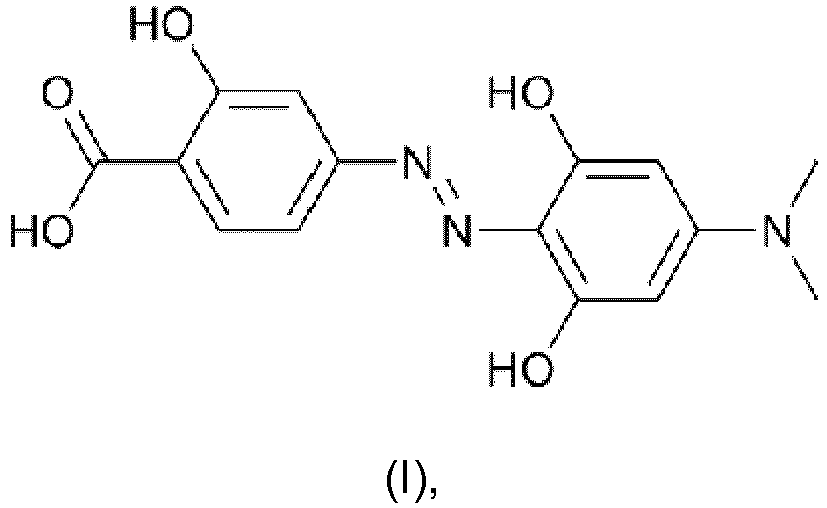
- This compound is 4-((4'-(dimethylamino)2',6'-dihydroxyphenyl)azo)2-hydroxybenzoic acid, which is herein also called Hydrodabcyl.
- a new compound is provided that is compatible with aqueous systems and thereby overcomes the problem of insolubility in aqueous solution and avoids the need for organic co-solvents, and at the same time has spectroscopic properties like dabcyl.
- the structure of the compound was designed and synthesized and it was found that a dimethylamino phenyl azobenzoic acid that is substituted with 3 hydroxyl groups at specific sites as indicated in the formula above is water-soluble and is surprisingly a superior dark quencher.
- the new compound - Hydrodabcyl or (4-((4'-(Dimethylamino)-2',6'-dihydroxyphenyl)azo)-2-hydroxybenzoic acid) thus, provides a very useful combination of properties.
- the modification of the ring system with hydroxyl groups has the advantage that no charged groups are present, in contrast to the presence of sulfonate groups. Consequently, Hydrodabcyl will not significantly modify the electrostatic profile of the molecule to which it is linked and thus the binding properties of the labeled molecule are not altered. In addition, the position of the hydroxyl groups prevents the formation of catechols. Moreover, the choice of modifying the ring system has the practical advantage to keep the carboxyl group available for the coupling to an amino group in the substrate through a standard amide bond formation.
- the new compound carries three hydroxyl groups in comparison to dabcyl, the emitting properties of the compound compared to those of dabcyl are not adversely affected.
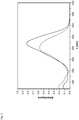
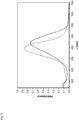
- the absorption spectra of dabcyl and Hydrodabcyl are similar.
- Hydrodabcyl is not only a water soluble alternative to dabcyl, but provides even better properties.
- Hydrodabcyl has a higher molar absorbance in aqueous solution compared to DMSO. This property makes Hydrodabcyl an effective quencher for wavelengths up to 530 nm.
- Hydrodabcyl is also substantially easier to handle than dabcyl. In fact due to the water solubility, the aqueous solutions are easier to prepare, and glassware washing becomes easier. Moreover, Hydrodabcyl shows higher stability to light exposure in comparison to dabcyl (see Example 8 and Figures 15 and 16 ).
- a further advantage of the compound of the present invention is that the solubility of Hydrodabcyl is achieved without changing the dimension of the chromophore appreciably.
- a small chromophore has the advantage to minimize the sterical hindrances introduced in the molecular system by the labelling process.
- a labelling chromophore should not affect the molecular system to investigate at all; in practice, the influence of the labelling chromophore, which is often unavoidable, has to be minimized. Therefore the comparatively small dimension of Hydrodabcyl is a crucial feature that, together with the absence of charged groups, makes it an excellent chromophore, especially in the case of small substrate.
- Hydrodabcyl is also suitable to be used in biological systems as it has been determined that Hydrodabcyl is neither carcinogenic (see Example 3), nor cytotoxic (see Examples 3 and 4), or teratoxic (see Example 6). It was further shown that Hydrodabcyl is functional in vivo, as it effectively quenches the fluorescence of a fluorescent substrate in vivo (see Example 5).
- a compound suitable for use as a component of a fluorogenic probe in biological systems has to be stable and is preferably in purified form. Therefore, a further aspect of the present invention is a method for producing Hydrodabcyl in stable and pure form. It has been found that Hydrodabcyl can be synthesized and obtained as non-fluorescent compound that is useful as dark quencher by using the method as claimed in claim 2.
- 4-diazo-salicylic acid can be obtained by reacting 4-aminosalicylic acid with NaNO 2 and HCI.
- Hydrodabcyl can be synthesized in two steps (see also Figure 1 and Example 1).
- the first step in the chemical synthesis consists in exchanging one -OH group of phloroglucinol with a dimethylamino group and isolating the intermediate product (see Figure 1 and Example 1), in a second step 4-diazo salicylic acid and 5-dimethylamino-resorcinol are reacted to yield the compound of the present invention.
- the method of producing the compound having formula (I) can comprise a further step a1) wherein the compound obtained in step a) is purified by (i) concentrating the 5-dimethylamino-resorcinol; (ii) purifying the residue obtained in step (i) by column chromatography; and (iii) crystallizing the purified compound obtained in step (ii).
- the method of the present invention comprises the following steps.
- 5-dimethylamino-resorcinol is prepared by reacting phloroglucinol and dimethylamine hydrochloride.
- phloroglucinol is dissolved in a mixture of dimethylformamide and water, preferably degassed, under argon.
- Dimethylamine hydrochloride is added.
- a base such as NaOH is added to adjust the pH.
- the addition of dimethylamine hydrochloride and base can be repeated several times.
- the resulting dark solution comprises the desired intermediate product 5-dimethylamino-resorcinol.
- the intermediate product is isolated and purified to remove undesirable impurities.
- the intermediate product is concentrated in vacuo and the residue is purified by column chromatography on a silica gel.
- Purified 5-dimethylamino-resorcinol can be crystallised from dichloromethane as white crystals. These crystals can be used directly for the next step without storage.
- the second step consists of azo-coupling 5-dimethylamino-resorcinol and 4-diazo-salicylic acid to get the final product 4-((4'-(dimethylamino)-2',6'-dihydroxyphenyl)azo)-2-hydroxybenzoic acid.
- 4-diazo-salicylic acid can be prepared by adding a solution of NaNO 2 to a solution of 4-aminosalicylic acid. The reaction can be carried out by heating.
- the end product can be isolated by dissolving the desired product in a solvent, for example in methanol, filtering off impurities, and removing the solvent, such as by evaporation.
- the obtained product can be further purified, for example as follows.
- the sediment can be diluted in a base, for example NaOH, and then filtered.
- An acid for example formic acid, for acidification and a solvent, for example ethanol, are then added to the filtrate and the mixture is cooled, for example, in a fridge.
- the residue is dispersed in distillate water by ultrasonic bath and then frozen, for example in liquid nitrogen and dried, for example by lyophilisation.
- the method of producing the compound having formula (I) can further comprise a step b1), wherein the compound obtained in step b) is purified by precipitation at pH ⁇ 4 followed by centrifugation.
- Hydrodabcyl is a novel dark quencher, based on an azobenzene-scaffold, with an optimal solubility in aqueous solution. Its small dimension, the absence of charged groups and its absorption range make Hydrodabcyl the dark quencher of choice in tandem with many commercially available fluorescence donors.
- the novel dark quencher Hydrodabcyl represents an improved alternative to the very popular dabcyl in the design of fluorogenic probes.
- reaction progress was monitored by Thin Layer Chromatography (TLC) on pre-coated silica plates (Merck TLC Silica gel 60 F254) and the spots were visualized by UV light and stained with ceric ammonium molybdate.
- TLC Thin Layer Chromatography
- IR spectra were recorded with a FT-IR spectrometer PerkinElmer S100 equipped with an Attenuated Total Reflection (ATR) unit.
- HPLC High Performance Liquid Chromatography
- Double beam Perkin Elmer Lambda 750 UV/Vis spectrophotometer equipped with a thermostated cuvette holder was used to record the absorption spectra over a wavelength range 200-800 nm at 20°C.
- the quartz cuvettes with 1 cm light path used were from Hellma.
- the first step consists in the production of 5-dimethylamino-resorcinol (1), based on the method of (Petrzilka [6]), which has been further developed and improved to allow to obtain Hydrodabcal in the desired quality.
- the method comprises a purification step over silica gel following the completion of the reaction.
- the purification step yields colourless crystals, whereas the crystals obtained by the method described previously yielded pink crystals [6].
- the reported pink color is most probably caused by contaminations by a degradation product. This assumption is supported by the observation that the product turns pink when it is stored for several weeks in the refrigerator. This contamination leads in the next step to an undesired fluorescent product (in addition to the desired Hydrodabcyl), which cannot be separated even by HPLC.
- the method of the present invention avoids the formation of this by-product.
- 5-Dimethylamino-resorcinol (1) phloroglucinol (9.23 g, 73.2 mmol) was dissolved in a degassed mixture of dimethylformamide (128 ml) and water (95 ml) under argon. Then dimethylamine hydrochloride (8 g, 91.5 mmol) was added. Subsequently over a time period of 5 hours one pellet of NaOH after another was added (whole amount 3.66 g, 91.5 mmol). The mixture was stirred overnight at room temperature. During the next 48 hours dimethylamine hydrochloride and NaOH were added 3 times (every time 10% of first addition).
- IR (ATR) 3276, 2972, 2884, 2512, 1604, 1512, 1462, 1435, 1377, 1347, 1312, 1276, 1247, 1128, 1042, 1005, 987, 853, 831, 809, 686, 634, 576 cm-1; 1 H NMR (300 MHz, DMSO- d 6 ) ⁇ ppm 2.78 (s, 6 H), 5.61 (s, 3 H), 8.82 (s, 2 H); 13 C NMR (75 MHz, DMSO- d 6 ) ⁇ 158.8, 152.3, 92.0, 91.5, 40.1 ppm.
- the second step consists of modified azo-coupling to get the final product 4-((4'-(dimethylamino)2',6'-dihydroxyphenyl)azo)2-hydroxybenzoic acid (2) with overall yield 58% after 2 steps [7].
- the purification of the product is optimized through its precipitation at pH ⁇ 4 and centrifugation.
- a cooled freshly prepared solution of 2.5 M NaNO 2 (9 ml, 22.5 mmol) was added dropwise to a cooled solution of 4-aminosalicylic acid (3.46 g, 22.5 mmol) in a half concentrated HCI (6 ml) at 0-5°C.
- the solution was then stirred for another 15 min and introduced dropwise at 0-5°C to 5-dimethylamino-resorcinol (3.45 g, 22.5 mmol) in 1M NaOH (23.5 ml).
- the mixture was heated at 70°C for 15 min and then stirred for 1 h at room temperature. Methanol was added to the red mixture and the mixture was then put in an ultrasonic bath for several minutes.
- the impurities were filtered and the filtrate was evaporated.
- the sediment was diluted in 0.1N NaOH and then filtered.
- Formic acid for acidification and ethanol were added to the filtrate and the mixture was placed into the fridge for 15 h. Then the mixture was centrifuged at -4 °C, and the pellet was suspended in 0.1% formic acid and centrifuged again. This procedure was repeated 3 times. Afterwards the residue was resuspended in bi-distillate water and centrifuged twice. Finally, the substance was dispersed in bi-distillate water by ultrasonic bath and then frozen in liquid nitrogen and dried by lyophilisation.
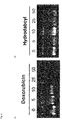
- Circular and linear double-stranded DNA was incubated with various concentrations of Hydrodabcyl and doxorubicin (a known intercalating substance). After 24 h of incubation time, agarose gel electrophoresis was carried out. The results are shown in Fig. 6 and 7 .
- Table 1 shows the inhibitory concentration (IC 50 ) after incubation for 72 hours.
- Table 1 Cell culture type IC 50 [ ⁇ M] HT-29 >50 EaHy.926 >50 CHF >100
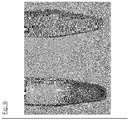
- Figure 8 shows the results of the in vivo fluorescence assay.
- Fig. 8a shows an oocyte injected with buffer. No fluorescence is detected.
- Fig. 8b shows an oocyte injected with Substrate-Bim. Fluorescence is detected.
- Fig. 8c shows an oocyte injected with Bim-Substrate-Hydrodabcyl. No fluorescence is detected, because Hydrodabcyl quenches the fluorescence of Substrate-Bim. This assay proves that Hydrodabcyl is an effective fluorescence quencher in vivo.
- Example 7 Quantitative determination of the solubility of Hydrodabcyl (in comparison to the parent molecule dabcvl)
- Hydrodabcyl is soluble in water, in contrast to dabcyl.
- a limiting concentration of 5.71 ⁇ 10 -4 M for Hydrodabcyl in water was measured at 20° C. It was not possible to obtain a saturated solution of dabcyl due to precipitation.
- Evidence of precipitation of dabcyl in water is shown in Figure 9 on the left. On the right in Figure 9 , a clear solution of Hydrodabcyl in water (7 ⁇ M) can be seen.
- Hydrodabcyl is very well soluble in aqueous solution over the whole biologically relevant pH range. From basic pH down to pH 6, solutions with concentrations in the millimolar range can be prepared directly at the desired pH. Although at pH ⁇ 6 the solubility is lower, as the solubility test in pure water showed, solutions with mM concentrations can still be prepared by gradual acidification of an alkaline solution down to a pH value of 4.3.
Landscapes
- Chemical & Material Sciences (AREA)
- Organic Chemistry (AREA)
- Health & Medical Sciences (AREA)
- Nuclear Medicine, Radiotherapy & Molecular Imaging (AREA)
- Physics & Mathematics (AREA)
- Life Sciences & Earth Sciences (AREA)
- Analytical Chemistry (AREA)
- Biochemistry (AREA)
- General Health & Medical Sciences (AREA)
- General Physics & Mathematics (AREA)
- Immunology (AREA)
- Pathology (AREA)
- Organic Low-Molecular-Weight Compounds And Preparation Thereof (AREA)
Claims (6)
- Verbindung mit Formel (I)

- Verfahren zur Herstellung einer Verbindung mit Formel (I)
 a) 5-Dimethylaminoresorcin (5-(Dimethylamino)benzol-1,3-diol)
 b) 4-Diazosalicylsäure an 5-Dimethylaminoresorcin azogekoppelt wird, um die Verbindung mit Formel (I) zu erhalten.
 - Verfahren nach Anspruch 2, das weiterhin Schritt a1) umfasst, wobei die in Schritt a) von Anspruch 2 erhaltene Verbindung durch(i) Konzentrieren des 5-Dimethylaminoresorcins;(ii) Aufreinigen des in Schritt (i) erhaltenen Rückstands durch Säulenchromatographie; und(iii) Kristallisieren der in Schritt (ii) erhaltenen aufgereinigten Verbindung aufgereinigt wird.
- Verfahren nach Anspruch 2 oder Anspruch 3, wobei 4-Diazosalicylsäure erhalten wird, indem 4-Aminosalicylsäure mit NaNO2 und HCl reagiert wird, um eine 4-Diazosalicylsäure mit der Formel:

- Verfahren nach einem der Ansprüche 2 bis 4, wobei das Verfahren weiterhin einen Schritt b1) umfasst, wobei die in Schritt b) von Anspruch 2 erhaltene Verbindung durch Fällung bei pH<4 gefolgt von Zentrifugation aufgereinigt wird.
- Verwendung einer Verbindung mit Formel (I) als einen dunklen Quencher in einem biologischen System in vitro und/oder in vivo.
Applications Claiming Priority (3)
| Application Number | Priority Date | Filing Date | Title |
|---|---|---|---|
| EP14195529 | 2014-11-28 | ||
| EP14197181.2A EP3031797A1 (de) | 2014-12-10 | 2014-12-10 | Hydrodabcyl |
| PCT/EP2015/077982 WO2016083611A1 (en) | 2014-11-28 | 2015-11-27 | Hydrodabcyl |
Publications (2)
| Publication Number | Publication Date |
|---|---|
| EP3224239A1 EP3224239A1 (de) | 2017-10-04 |
| EP3224239B1 true EP3224239B1 (de) | 2018-12-26 |
Family
ID=54707786
Family Applications (1)
| Application Number | Title | Priority Date | Filing Date |
|---|---|---|---|
| EP15801828.3A Active EP3224239B1 (de) | 2014-11-28 | 2015-11-27 | Hydrodabcyl |
Country Status (3)
| Country | Link |
|---|---|
| US (1) | US9815774B1 (de) |
| EP (1) | EP3224239B1 (de) |
| WO (1) | WO2016083611A1 (de) |
-
2015
- 2015-11-27 EP EP15801828.3A patent/EP3224239B1/de active Active
- 2015-11-27 US US15/529,700 patent/US9815774B1/en not_active Expired - Fee Related
- 2015-11-27 WO PCT/EP2015/077982 patent/WO2016083611A1/en not_active Ceased
Non-Patent Citations (1)
| Title |
|---|
| None * |
Also Published As
| Publication number | Publication date |
|---|---|
| EP3224239A1 (de) | 2017-10-04 |
| US20170327460A1 (en) | 2017-11-16 |
| WO2016083611A1 (en) | 2016-06-02 |
| US9815774B1 (en) | 2017-11-14 |
Similar Documents
| Publication | Publication Date | Title |
|---|---|---|
| Zhang et al. | Meso-heteroaryl BODIPY dyes as dual-responsive fluorescent probes for discrimination of Cys from Hcy and GSH | |
| Sun et al. | An efficient TP-FRET-based lysosome-targetable fluorescent probe for imaging peroxynitrite with two well-resolved emission channels in living cells, tissues and zebrafish | |
| Liu et al. | A new fluorescent probe with a large turn-on signal for imaging nitroreductase in tumor cells and tissues by two-photon microscopy | |
| US5624798A (en) | Detection method of nucleic acid by use of fluorescent pyrylium stain in intercalation into nucleic acids | |
| US6469051B2 (en) | Diaminorhodamine derivative | |
| Wang et al. | A highly selective colorimetric and fluorescent probe for quantitative detection of Cu2+/Co2+: The unique ON-OFF-ON fluorimetric detection strategy and applications in living cells/zebrafish | |
| Yabaş et al. | The water soluble ball-type phthalocyanine as new potential anticancer drugs | |
| Lu et al. | A two-separated-emission fluorescent probe for simultaneous discrimination of Cys/Hcy and GSH upon excitation of two different wavelengths | |
| Kaur et al. | 2-(4-Amino-2-hydroxyphenyl) benzothiazole based Schiff-base: Complexation/decomplexation driven photo physical tuning of fluorescence leading to Cu2+ and PO43− detection | |
| Nehra et al. | Simpler molecular structure as selective & sensitive ESIPT-based fluorescent probe for cysteine and Homocysteine detection with DFT studies | |
| Deng et al. | Systematic study of synthesizing various heteroatom-substituted rhodamines from diaryl ether analogues | |
| CN109438319B (zh) | 一种检测亮氨酸氨肽酶的化合物及其制备方法和应用 | |
| Grzelakowska et al. | Novel fluorescent probes for L-cysteine based on the xanthone skeleton | |
| Shen et al. | A mitochondria-oriented fluorescent probe for ultrafast and ratiometric detection of HSO 3− based on naphthalimide–hemicyanine | |
| Albakour et al. | Zn (ii) phthalocyanines tetra substituted by aryl and alkyl azides: design, synthesis and optical detection of H 2 S | |
| WO2021160732A1 (en) | Fluorescent rhodamine dyes with enhanced cell permeability | |
| Shi et al. | Multifunctional near-infrared fluorescent probe for sensing of lysine and Cu2+/Fe3+ and relay detection of biothiols | |
| Patel et al. | Chemical and photophysical studies on the interaction of reactive oxygen species with carbonylated diazo derivatives: Their chromogenic, fluorescent detection and mechanistic investigation | |
| CN110105391B (zh) | 碱性磷酸酶响应型分子探针及其应用 | |
| EP3031797A1 (de) | Hydrodabcyl | |
| CN113637048A (zh) | 一种γ-谷氨酰转肽酶的双光子荧光探针及其制备方法和应用 | |
| US9815774B1 (en) | Hydrodabcyl | |
| CN108484479B (zh) | 一种咔唑基双光子荧光探针及其制备方法和用途 | |
| CN111533761B (zh) | 一类具有细胞器或蛋白质靶向功能的比率型pH探针及应用 | |
| CN109608495B (zh) | 一种检测hno的化合物及其制备方法和应用 |
Legal Events
| Date | Code | Title | Description |
|---|---|---|---|
| STAA | Information on the status of an ep patent application or granted ep patent |
Free format text: STATUS: THE INTERNATIONAL PUBLICATION HAS BEEN MADE |
|
| PUAI | Public reference made under article 153(3) epc to a published international application that has entered the european phase |
Free format text: ORIGINAL CODE: 0009012 |
|
| STAA | Information on the status of an ep patent application or granted ep patent |
Free format text: STATUS: REQUEST FOR EXAMINATION WAS MADE |
|
| 17P | Request for examination filed |
Effective date: 20170621 |
|
| AK | Designated contracting states |
Kind code of ref document: A1 Designated state(s): AL AT BE BG CH CY CZ DE DK EE ES FI FR GB GR HR HU IE IS IT LI LT LU LV MC MK MT NL NO PL PT RO RS SE SI SK SM TR |
|
| AX | Request for extension of the european patent |
Extension state: BA ME |
|
| DAV | Request for validation of the european patent (deleted) | ||
| DAX | Request for extension of the european patent (deleted) | ||
| GRAP | Despatch of communication of intention to grant a patent |
Free format text: ORIGINAL CODE: EPIDOSNIGR1 |
|
| STAA | Information on the status of an ep patent application or granted ep patent |
Free format text: STATUS: GRANT OF PATENT IS INTENDED |
|
| INTG | Intention to grant announced |
Effective date: 20180720 |
|
| GRAS | Grant fee paid |
Free format text: ORIGINAL CODE: EPIDOSNIGR3 |
|
| GRAA | (expected) grant |
Free format text: ORIGINAL CODE: 0009210 |
|
| STAA | Information on the status of an ep patent application or granted ep patent |
Free format text: STATUS: THE PATENT HAS BEEN GRANTED |
|
| AK | Designated contracting states |
Kind code of ref document: B1 Designated state(s): AL AT BE BG CH CY CZ DE DK EE ES FI FR GB GR HR HU IE IS IT LI LT LU LV MC MK MT NL NO PL PT RO RS SE SI SK SM TR |
|
| REG | Reference to a national code |
Ref country code: GB Ref legal event code: FG4D |
|
| REG | Reference to a national code |
Ref country code: CH Ref legal event code: EP |
|
| REG | Reference to a national code |
Ref country code: AT Ref legal event code: REF Ref document number: 1081194 Country of ref document: AT Kind code of ref document: T Effective date: 20190115 |
|
| REG | Reference to a national code |
Ref country code: DE Ref legal event code: R096 Ref document number: 602015022480 Country of ref document: DE |
|
| REG | Reference to a national code |
Ref country code: IE Ref legal event code: FG4D |
|
| REG | Reference to a national code |
Ref country code: CH Ref legal event code: NV Representative=s name: VALIPAT S.A. GEVERS SA, CH |
|
| REG | Reference to a national code |
Ref country code: CH Ref legal event code: PCAR Free format text: NEW ADDRESS: RUE DES NOYERS 11, 2000 NEUCHATEL (CH) |
|
| PG25 | Lapsed in a contracting state [announced via postgrant information from national office to epo] |
Ref country code: FI Free format text: LAPSE BECAUSE OF FAILURE TO SUBMIT A TRANSLATION OF THE DESCRIPTION OR TO PAY THE FEE WITHIN THE PRESCRIBED TIME-LIMIT Effective date: 20181226 Ref country code: BG Free format text: LAPSE BECAUSE OF FAILURE TO SUBMIT A TRANSLATION OF THE DESCRIPTION OR TO PAY THE FEE WITHIN THE PRESCRIBED TIME-LIMIT Effective date: 20190326 Ref country code: LV Free format text: LAPSE BECAUSE OF FAILURE TO SUBMIT A TRANSLATION OF THE DESCRIPTION OR TO PAY THE FEE WITHIN THE PRESCRIBED TIME-LIMIT Effective date: 20181226 Ref country code: HR Free format text: LAPSE BECAUSE OF FAILURE TO SUBMIT A TRANSLATION OF THE DESCRIPTION OR TO PAY THE FEE WITHIN THE PRESCRIBED TIME-LIMIT Effective date: 20181226 Ref country code: NO Free format text: LAPSE BECAUSE OF FAILURE TO SUBMIT A TRANSLATION OF THE DESCRIPTION OR TO PAY THE FEE WITHIN THE PRESCRIBED TIME-LIMIT Effective date: 20190326 Ref country code: LT Free format text: LAPSE BECAUSE OF FAILURE TO SUBMIT A TRANSLATION OF THE DESCRIPTION OR TO PAY THE FEE WITHIN THE PRESCRIBED TIME-LIMIT Effective date: 20181226 |
|
| REG | Reference to a national code |
Ref country code: NL Ref legal event code: MP Effective date: 20181226 |
|
| REG | Reference to a national code |
Ref country code: LT Ref legal event code: MG4D |
|
| PG25 | Lapsed in a contracting state [announced via postgrant information from national office to epo] |
Ref country code: AL Free format text: LAPSE BECAUSE OF FAILURE TO SUBMIT A TRANSLATION OF THE DESCRIPTION OR TO PAY THE FEE WITHIN THE PRESCRIBED TIME-LIMIT Effective date: 20181226 Ref country code: RS Free format text: LAPSE BECAUSE OF FAILURE TO SUBMIT A TRANSLATION OF THE DESCRIPTION OR TO PAY THE FEE WITHIN THE PRESCRIBED TIME-LIMIT Effective date: 20181226 Ref country code: GR Free format text: LAPSE BECAUSE OF FAILURE TO SUBMIT A TRANSLATION OF THE DESCRIPTION OR TO PAY THE FEE WITHIN THE PRESCRIBED TIME-LIMIT Effective date: 20190327 Ref country code: SE Free format text: LAPSE BECAUSE OF FAILURE TO SUBMIT A TRANSLATION OF THE DESCRIPTION OR TO PAY THE FEE WITHIN THE PRESCRIBED TIME-LIMIT Effective date: 20181226 |
|
| REG | Reference to a national code |
Ref country code: AT Ref legal event code: MK05 Ref document number: 1081194 Country of ref document: AT Kind code of ref document: T Effective date: 20181226 |
|
| PG25 | Lapsed in a contracting state [announced via postgrant information from national office to epo] |
Ref country code: NL Free format text: LAPSE BECAUSE OF FAILURE TO SUBMIT A TRANSLATION OF THE DESCRIPTION OR TO PAY THE FEE WITHIN THE PRESCRIBED TIME-LIMIT Effective date: 20181226 |
|
| PG25 | Lapsed in a contracting state [announced via postgrant information from national office to epo] |
Ref country code: PT Free format text: LAPSE BECAUSE OF FAILURE TO SUBMIT A TRANSLATION OF THE DESCRIPTION OR TO PAY THE FEE WITHIN THE PRESCRIBED TIME-LIMIT Effective date: 20190426 Ref country code: CZ Free format text: LAPSE BECAUSE OF FAILURE TO SUBMIT A TRANSLATION OF THE DESCRIPTION OR TO PAY THE FEE WITHIN THE PRESCRIBED TIME-LIMIT Effective date: 20181226 Ref country code: IT Free format text: LAPSE BECAUSE OF FAILURE TO SUBMIT A TRANSLATION OF THE DESCRIPTION OR TO PAY THE FEE WITHIN THE PRESCRIBED TIME-LIMIT Effective date: 20181226 Ref country code: PL Free format text: LAPSE BECAUSE OF FAILURE TO SUBMIT A TRANSLATION OF THE DESCRIPTION OR TO PAY THE FEE WITHIN THE PRESCRIBED TIME-LIMIT Effective date: 20181226 Ref country code: ES Free format text: LAPSE BECAUSE OF FAILURE TO SUBMIT A TRANSLATION OF THE DESCRIPTION OR TO PAY THE FEE WITHIN THE PRESCRIBED TIME-LIMIT Effective date: 20181226 |
|
| PG25 | Lapsed in a contracting state [announced via postgrant information from national office to epo] |
Ref country code: EE Free format text: LAPSE BECAUSE OF FAILURE TO SUBMIT A TRANSLATION OF THE DESCRIPTION OR TO PAY THE FEE WITHIN THE PRESCRIBED TIME-LIMIT Effective date: 20181226 Ref country code: SM Free format text: LAPSE BECAUSE OF FAILURE TO SUBMIT A TRANSLATION OF THE DESCRIPTION OR TO PAY THE FEE WITHIN THE PRESCRIBED TIME-LIMIT Effective date: 20181226 Ref country code: SK Free format text: LAPSE BECAUSE OF FAILURE TO SUBMIT A TRANSLATION OF THE DESCRIPTION OR TO PAY THE FEE WITHIN THE PRESCRIBED TIME-LIMIT Effective date: 20181226 Ref country code: IS Free format text: LAPSE BECAUSE OF FAILURE TO SUBMIT A TRANSLATION OF THE DESCRIPTION OR TO PAY THE FEE WITHIN THE PRESCRIBED TIME-LIMIT Effective date: 20190426 Ref country code: RO Free format text: LAPSE BECAUSE OF FAILURE TO SUBMIT A TRANSLATION OF THE DESCRIPTION OR TO PAY THE FEE WITHIN THE PRESCRIBED TIME-LIMIT Effective date: 20181226 |
|
| REG | Reference to a national code |
Ref country code: DE Ref legal event code: R097 Ref document number: 602015022480 Country of ref document: DE |
|
| PG25 | Lapsed in a contracting state [announced via postgrant information from national office to epo] |
Ref country code: DK Free format text: LAPSE BECAUSE OF FAILURE TO SUBMIT A TRANSLATION OF THE DESCRIPTION OR TO PAY THE FEE WITHIN THE PRESCRIBED TIME-LIMIT Effective date: 20181226 Ref country code: AT Free format text: LAPSE BECAUSE OF FAILURE TO SUBMIT A TRANSLATION OF THE DESCRIPTION OR TO PAY THE FEE WITHIN THE PRESCRIBED TIME-LIMIT Effective date: 20181226 |
|
| PLBE | No opposition filed within time limit |
Free format text: ORIGINAL CODE: 0009261 |
|
| STAA | Information on the status of an ep patent application or granted ep patent |
Free format text: STATUS: NO OPPOSITION FILED WITHIN TIME LIMIT |
|
| 26N | No opposition filed |
Effective date: 20190927 |
|
| REG | Reference to a national code |
Ref country code: DE Ref legal event code: R082 Ref document number: 602015022480 Country of ref document: DE Representative=s name: HOEFER & PARTNER PATENTANWAELTE MBB, DE Ref country code: DE Ref legal event code: R081 Ref document number: 602015022480 Country of ref document: DE Owner name: KEMPF, KARL, DE Free format text: FORMER OWNER: UNIVERSITAET BAYREUTH, 95447 BAYREUTH, DE Ref country code: DE Ref legal event code: R081 Ref document number: 602015022480 Country of ref document: DE Owner name: KEMPF, OXANA, DE Free format text: FORMER OWNER: UNIVERSITAET BAYREUTH, 95447 BAYREUTH, DE Ref country code: DE Ref legal event code: R081 Ref document number: 602015022480 Country of ref document: DE Owner name: SCHOBERT, RAINER, DE Free format text: FORMER OWNER: UNIVERSITAET BAYREUTH, 95447 BAYREUTH, DE Ref country code: DE Ref legal event code: R081 Ref document number: 602015022480 Country of ref document: DE Owner name: ULLMANN, G. MATTHIAS, DE Free format text: FORMER OWNER: UNIVERSITAET BAYREUTH, 95447 BAYREUTH, DE Ref country code: DE Ref legal event code: R081 Ref document number: 602015022480 Country of ref document: DE Owner name: BOMBARDA, ELISA, DR., DE Free format text: FORMER OWNER: UNIVERSITAET BAYREUTH, 95447 BAYREUTH, DE |
|
| REG | Reference to a national code |
Ref country code: GB Ref legal event code: 732E Free format text: REGISTERED BETWEEN 20200130 AND 20200205 |
|
| PG25 | Lapsed in a contracting state [announced via postgrant information from national office to epo] |
Ref country code: SI Free format text: LAPSE BECAUSE OF FAILURE TO SUBMIT A TRANSLATION OF THE DESCRIPTION OR TO PAY THE FEE WITHIN THE PRESCRIBED TIME-LIMIT Effective date: 20181226 |
|
| REG | Reference to a national code |
Ref country code: CH Ref legal event code: NV Representative=s name: BRAUNPAT BRAUN EDER AG, CH Ref country code: CH Ref legal event code: PUE Owner name: ELISA BOMBARDA, DE Free format text: FORMER OWNER: UNIVERSITAET BAYREUTH, DE |
|
| PG25 | Lapsed in a contracting state [announced via postgrant information from national office to epo] |
Ref country code: TR Free format text: LAPSE BECAUSE OF FAILURE TO SUBMIT A TRANSLATION OF THE DESCRIPTION OR TO PAY THE FEE WITHIN THE PRESCRIBED TIME-LIMIT Effective date: 20181226 |
|
| PG25 | Lapsed in a contracting state [announced via postgrant information from national office to epo] |
Ref country code: MC Free format text: LAPSE BECAUSE OF FAILURE TO SUBMIT A TRANSLATION OF THE DESCRIPTION OR TO PAY THE FEE WITHIN THE PRESCRIBED TIME-LIMIT Effective date: 20181226 Ref country code: LU Free format text: LAPSE BECAUSE OF NON-PAYMENT OF DUE FEES Effective date: 20191127 |
|
| REG | Reference to a national code |
Ref country code: BE Ref legal event code: MM Effective date: 20191130 |
|
| PG25 | Lapsed in a contracting state [announced via postgrant information from national office to epo] |
Ref country code: IE Free format text: LAPSE BECAUSE OF NON-PAYMENT OF DUE FEES Effective date: 20191127 |
|
| PG25 | Lapsed in a contracting state [announced via postgrant information from national office to epo] |
Ref country code: BE Free format text: LAPSE BECAUSE OF NON-PAYMENT OF DUE FEES Effective date: 20191130 |
|
| PG25 | Lapsed in a contracting state [announced via postgrant information from national office to epo] |
Ref country code: CY Free format text: LAPSE BECAUSE OF FAILURE TO SUBMIT A TRANSLATION OF THE DESCRIPTION OR TO PAY THE FEE WITHIN THE PRESCRIBED TIME-LIMIT Effective date: 20181226 |
|
| PG25 | Lapsed in a contracting state [announced via postgrant information from national office to epo] |
Ref country code: MT Free format text: LAPSE BECAUSE OF FAILURE TO SUBMIT A TRANSLATION OF THE DESCRIPTION OR TO PAY THE FEE WITHIN THE PRESCRIBED TIME-LIMIT Effective date: 20181226 Ref country code: HU Free format text: LAPSE BECAUSE OF FAILURE TO SUBMIT A TRANSLATION OF THE DESCRIPTION OR TO PAY THE FEE WITHIN THE PRESCRIBED TIME-LIMIT; INVALID AB INITIO Effective date: 20151127 |
|
| PG25 | Lapsed in a contracting state [announced via postgrant information from national office to epo] |
Ref country code: MK Free format text: LAPSE BECAUSE OF FAILURE TO SUBMIT A TRANSLATION OF THE DESCRIPTION OR TO PAY THE FEE WITHIN THE PRESCRIBED TIME-LIMIT Effective date: 20181226 |
|
| PGFP | Annual fee paid to national office [announced via postgrant information from national office to epo] |
Ref country code: GB Payment date: 20231123 Year of fee payment: 9 |
|
| PGFP | Annual fee paid to national office [announced via postgrant information from national office to epo] |
Ref country code: FR Payment date: 20231124 Year of fee payment: 9 Ref country code: DE Payment date: 20231130 Year of fee payment: 9 Ref country code: CH Payment date: 20231201 Year of fee payment: 9 |
|
| REG | Reference to a national code |
Ref country code: DE Ref legal event code: R119 Ref document number: 602015022480 Country of ref document: DE |
|
| REG | Reference to a national code |
Ref country code: CH Ref legal event code: PL |
|
| REG | Reference to a national code |
Ref country code: CH Ref legal event code: PL |
|
| GBPC | Gb: european patent ceased through non-payment of renewal fee |
Effective date: 20241127 |
|
| PG25 | Lapsed in a contracting state [announced via postgrant information from national office to epo] |
Ref country code: CH Free format text: LAPSE BECAUSE OF NON-PAYMENT OF DUE FEES Effective date: 20241130 |
|
| PG25 | Lapsed in a contracting state [announced via postgrant information from national office to epo] |
Ref country code: DE Free format text: LAPSE BECAUSE OF NON-PAYMENT OF DUE FEES Effective date: 20250603 |
|
| PG25 | Lapsed in a contracting state [announced via postgrant information from national office to epo] |
Ref country code: GB Free format text: LAPSE BECAUSE OF NON-PAYMENT OF DUE FEES Effective date: 20241127 |
|
| PG25 | Lapsed in a contracting state [announced via postgrant information from national office to epo] |
Ref country code: FR Free format text: LAPSE BECAUSE OF NON-PAYMENT OF DUE FEES Effective date: 20241130 |