EP3207966B1 - Billiard table lighting and game play monitor - Google Patents
Billiard table lighting and game play monitor Download PDFInfo
- Publication number
- EP3207966B1 EP3207966B1 EP17156538.5A EP17156538A EP3207966B1 EP 3207966 B1 EP3207966 B1 EP 3207966B1 EP 17156538 A EP17156538 A EP 17156538A EP 3207966 B1 EP3207966 B1 EP 3207966B1
- Authority
- EP
- European Patent Office
- Prior art keywords
- motion
- table surface
- billiard table
- balls
- images
- Prior art date
- Legal status (The legal status is an assumption and is not a legal conclusion. Google has not performed a legal analysis and makes no representation as to the accuracy of the status listed.)
- Active
Links
Images









Classifications
-
- A—HUMAN NECESSITIES
- A63—SPORTS; GAMES; AMUSEMENTS
- A63D—BOWLING GAMES, e.g. SKITTLES, BOCCE OR BOWLS; INSTALLATIONS THEREFOR; BAGATELLE OR SIMILAR GAMES; BILLIARDS
- A63D15/00—Billiards, e.g. carom billiards or pocket billiards; Billiard tables
-
- A—HUMAN NECESSITIES
- A63—SPORTS; GAMES; AMUSEMENTS
- A63D—BOWLING GAMES, e.g. SKITTLES, BOCCE OR BOWLS; INSTALLATIONS THEREFOR; BAGATELLE OR SIMILAR GAMES; BILLIARDS
- A63D15/00—Billiards, e.g. carom billiards or pocket billiards; Billiard tables
- A63D15/20—Scoring or registering devices
-
- F—MECHANICAL ENGINEERING; LIGHTING; HEATING; WEAPONS; BLASTING
- F21—LIGHTING
- F21S—NON-PORTABLE LIGHTING DEVICES; SYSTEMS THEREOF; VEHICLE LIGHTING DEVICES SPECIALLY ADAPTED FOR VEHICLE EXTERIORS
- F21S4/00—Lighting devices or systems using a string or strip of light sources
- F21S4/20—Lighting devices or systems using a string or strip of light sources with light sources held by or within elongate supports
- F21S4/28—Lighting devices or systems using a string or strip of light sources with light sources held by or within elongate supports rigid, e.g. LED bars
-
- F—MECHANICAL ENGINEERING; LIGHTING; HEATING; WEAPONS; BLASTING
- F21—LIGHTING
- F21S—NON-PORTABLE LIGHTING DEVICES; SYSTEMS THEREOF; VEHICLE LIGHTING DEVICES SPECIALLY ADAPTED FOR VEHICLE EXTERIORS
- F21S8/00—Lighting devices intended for fixed installation
- F21S8/04—Lighting devices intended for fixed installation intended only for mounting on a ceiling or the like overhead structures
- F21S8/046—Lighting devices intended for fixed installation intended only for mounting on a ceiling or the like overhead structures having multiple lighting devices, e.g. connected to a common ceiling base
-
- H—ELECTRICITY
- H04—ELECTRIC COMMUNICATION TECHNIQUE
- H04N—PICTORIAL COMMUNICATION, e.g. TELEVISION
- H04N5/00—Details of television systems
- H04N5/76—Television signal recording
-
- H—ELECTRICITY
- H04—ELECTRIC COMMUNICATION TECHNIQUE
- H04N—PICTORIAL COMMUNICATION, e.g. TELEVISION
- H04N5/00—Details of television systems
- H04N5/76—Television signal recording
- H04N5/765—Interface circuits between an apparatus for recording and another apparatus
- H04N5/77—Interface circuits between an apparatus for recording and another apparatus between a recording apparatus and a television camera
-
- H—ELECTRICITY
- H04—ELECTRIC COMMUNICATION TECHNIQUE
- H04N—PICTORIAL COMMUNICATION, e.g. TELEVISION
- H04N7/00—Television systems
- H04N7/18—Closed-circuit television [CCTV] systems, i.e. systems in which the video signal is not broadcast
- H04N7/181—Closed-circuit television [CCTV] systems, i.e. systems in which the video signal is not broadcast for receiving images from a plurality of remote sources
-
- H—ELECTRICITY
- H04—ELECTRIC COMMUNICATION TECHNIQUE
- H04N—PICTORIAL COMMUNICATION, e.g. TELEVISION
- H04N9/00—Details of colour television systems
- H04N9/79—Processing of colour television signals in connection with recording
- H04N9/80—Transformation of the television signal for recording, e.g. modulation, frequency changing; Inverse transformation for playback
- H04N9/82—Transformation of the television signal for recording, e.g. modulation, frequency changing; Inverse transformation for playback the individual colour picture signal components being recorded simultaneously only
- H04N9/8205—Transformation of the television signal for recording, e.g. modulation, frequency changing; Inverse transformation for playback the individual colour picture signal components being recorded simultaneously only involving the multiplexing of an additional signal and the colour video signal
- H04N9/8211—Transformation of the television signal for recording, e.g. modulation, frequency changing; Inverse transformation for playback the individual colour picture signal components being recorded simultaneously only involving the multiplexing of an additional signal and the colour video signal the additional signal being a sound signal
-
- H—ELECTRICITY
- H05—ELECTRIC TECHNIQUES NOT OTHERWISE PROVIDED FOR
- H05B—ELECTRIC HEATING; ELECTRIC LIGHT SOURCES NOT OTHERWISE PROVIDED FOR; CIRCUIT ARRANGEMENTS FOR ELECTRIC LIGHT SOURCES, IN GENERAL
- H05B45/00—Circuit arrangements for operating light-emitting diodes [LED]
-
- H—ELECTRICITY
- H05—ELECTRIC TECHNIQUES NOT OTHERWISE PROVIDED FOR
- H05B—ELECTRIC HEATING; ELECTRIC LIGHT SOURCES NOT OTHERWISE PROVIDED FOR; CIRCUIT ARRANGEMENTS FOR ELECTRIC LIGHT SOURCES, IN GENERAL
- H05B45/00—Circuit arrangements for operating light-emitting diodes [LED]
- H05B45/20—Controlling the colour of the light
- H05B45/22—Controlling the colour of the light using optical feedback
-
- H—ELECTRICITY
- H05—ELECTRIC TECHNIQUES NOT OTHERWISE PROVIDED FOR
- H05B—ELECTRIC HEATING; ELECTRIC LIGHT SOURCES NOT OTHERWISE PROVIDED FOR; CIRCUIT ARRANGEMENTS FOR ELECTRIC LIGHT SOURCES, IN GENERAL
- H05B47/00—Circuit arrangements for operating light sources in general, i.e. where the type of light source is not relevant
- H05B47/10—Controlling the light source
- H05B47/105—Controlling the light source in response to determined parameters
- H05B47/115—Controlling the light source in response to determined parameters by determining the presence or movement of objects or living beings
-
- H—ELECTRICITY
- H05—ELECTRIC TECHNIQUES NOT OTHERWISE PROVIDED FOR
- H05B—ELECTRIC HEATING; ELECTRIC LIGHT SOURCES NOT OTHERWISE PROVIDED FOR; CIRCUIT ARRANGEMENTS FOR ELECTRIC LIGHT SOURCES, IN GENERAL
- H05B47/00—Circuit arrangements for operating light sources in general, i.e. where the type of light source is not relevant
- H05B47/10—Controlling the light source
- H05B47/105—Controlling the light source in response to determined parameters
- H05B47/115—Controlling the light source in response to determined parameters by determining the presence or movement of objects or living beings
- H05B47/12—Controlling the light source in response to determined parameters by determining the presence or movement of objects or living beings by detecting audible sound
-
- F—MECHANICAL ENGINEERING; LIGHTING; HEATING; WEAPONS; BLASTING
- F21—LIGHTING
- F21V—FUNCTIONAL FEATURES OR DETAILS OF LIGHTING DEVICES OR SYSTEMS THEREOF; STRUCTURAL COMBINATIONS OF LIGHTING DEVICES WITH OTHER ARTICLES, NOT OTHERWISE PROVIDED FOR
- F21V21/00—Supporting, suspending, or attaching arrangements for lighting devices; Hand grips
- F21V21/02—Wall, ceiling, or floor bases; Fixing pendants or arms to the bases
- F21V21/03—Ceiling bases, e.g. ceiling roses
-
- F—MECHANICAL ENGINEERING; LIGHTING; HEATING; WEAPONS; BLASTING
- F21—LIGHTING
- F21V—FUNCTIONAL FEATURES OR DETAILS OF LIGHTING DEVICES OR SYSTEMS THEREOF; STRUCTURAL COMBINATIONS OF LIGHTING DEVICES WITH OTHER ARTICLES, NOT OTHERWISE PROVIDED FOR
- F21V33/00—Structural combinations of lighting devices with other articles, not otherwise provided for
- F21V33/008—Leisure, hobby or sport articles, e.g. toys, games or first-aid kits; Hand tools; Toolboxes
-
- F—MECHANICAL ENGINEERING; LIGHTING; HEATING; WEAPONS; BLASTING
- F21—LIGHTING
- F21V—FUNCTIONAL FEATURES OR DETAILS OF LIGHTING DEVICES OR SYSTEMS THEREOF; STRUCTURAL COMBINATIONS OF LIGHTING DEVICES WITH OTHER ARTICLES, NOT OTHERWISE PROVIDED FOR
- F21V7/00—Reflectors for light sources
- F21V7/005—Reflectors for light sources with an elongated shape to cooperate with linear light sources
-
- F—MECHANICAL ENGINEERING; LIGHTING; HEATING; WEAPONS; BLASTING
- F21—LIGHTING
- F21W—INDEXING SCHEME ASSOCIATED WITH SUBCLASSES F21K, F21L, F21S and F21V, RELATING TO USES OR APPLICATIONS OF LIGHTING DEVICES OR SYSTEMS
- F21W2131/00—Use or application of lighting devices or systems not provided for in codes F21W2102/00-F21W2121/00
- F21W2131/40—Lighting for industrial, commercial, recreational or military use
-
- F—MECHANICAL ENGINEERING; LIGHTING; HEATING; WEAPONS; BLASTING
- F21—LIGHTING
- F21Y—INDEXING SCHEME ASSOCIATED WITH SUBCLASSES F21K, F21L, F21S and F21V, RELATING TO THE FORM OR THE KIND OF THE LIGHT SOURCES OR OF THE COLOUR OF THE LIGHT EMITTED
- F21Y2103/00—Elongate light sources, e.g. fluorescent tubes
- F21Y2103/10—Elongate light sources, e.g. fluorescent tubes comprising a linear array of point-like light-generating elements
-
- F—MECHANICAL ENGINEERING; LIGHTING; HEATING; WEAPONS; BLASTING
- F21—LIGHTING
- F21Y—INDEXING SCHEME ASSOCIATED WITH SUBCLASSES F21K, F21L, F21S and F21V, RELATING TO THE FORM OR THE KIND OF THE LIGHT SOURCES OR OF THE COLOUR OF THE LIGHT EMITTED
- F21Y2115/00—Light-generating elements of semiconductor light sources
- F21Y2115/10—Light-emitting diodes [LED]
-
- H—ELECTRICITY
- H05—ELECTRIC TECHNIQUES NOT OTHERWISE PROVIDED FOR
- H05B—ELECTRIC HEATING; ELECTRIC LIGHT SOURCES NOT OTHERWISE PROVIDED FOR; CIRCUIT ARRANGEMENTS FOR ELECTRIC LIGHT SOURCES, IN GENERAL
- H05B47/00—Circuit arrangements for operating light sources in general, i.e. where the type of light source is not relevant
- H05B47/10—Controlling the light source
- H05B47/105—Controlling the light source in response to determined parameters
- H05B47/115—Controlling the light source in response to determined parameters by determining the presence or movement of objects or living beings
- H05B47/125—Controlling the light source in response to determined parameters by determining the presence or movement of objects or living beings by using cameras
-
- Y—GENERAL TAGGING OF NEW TECHNOLOGICAL DEVELOPMENTS; GENERAL TAGGING OF CROSS-SECTIONAL TECHNOLOGIES SPANNING OVER SEVERAL SECTIONS OF THE IPC; TECHNICAL SUBJECTS COVERED BY FORMER USPC CROSS-REFERENCE ART COLLECTIONS [XRACs] AND DIGESTS
- Y02—TECHNOLOGIES OR APPLICATIONS FOR MITIGATION OR ADAPTATION AGAINST CLIMATE CHANGE
- Y02B—CLIMATE CHANGE MITIGATION TECHNOLOGIES RELATED TO BUILDINGS, e.g. HOUSING, HOUSE APPLIANCES OR RELATED END-USER APPLICATIONS
- Y02B20/00—Energy efficient lighting technologies, e.g. halogen lamps or gas discharge lamps
- Y02B20/40—Control techniques providing energy savings, e.g. smart controller or presence detection
Definitions
- This invention relates generally to billiard table lighting and more particularly to providing substantially uniform billiard table lighting to facilitate automated game play monitoring including image capture and automated image and video merging and other associated features.
- billiards and related table top games have been known for many years. Such games involve movement of balls on a table top. Typically a ball is struck with an instrument such as a cue to move the ball around the table top surface for positioning, to strike and move other balls, and the like. In some variants, balls are struck into holes in or at edges of the table top called pockets. In other variants, balls are struck so as to contact in a particular way other balls on the table top and/or cushions that line the table top to keep the balls on the table top surface.
- These games have a variety of names including cue sports, billiards, pool, snooker, pocket billiards, among others. For clarity and convenience, such games will be referred to collectively as billiards or billiard.
- the billiard table surface should be substantially uniformly lighted.
- the scene segmentation portion of the image analysis procedure is most efficiently accomplished by having a flat uniformly lit background.
- Billiard tables are typically lit using one or more light sources disposed above a center portion of the table such that lighting at the edges of the table is markedly worse than at the center.
- the World Pool-Billiard Association provides the following equipment specifications for lighting, such specifications do not suggest the level of uniform illumination typically needed for imaging projects: "15. Lights The bed and rails of the table must receive at least 520 lux (48 footcandles) of light at every point.
- a screen or reflector configuration is advised so that the center of the table does not receive noticeably more lighting than the rails and the corners of the table. If the light fixture above the table may be moved aside (referee), the minimum height of the fixture should be no lower than 40 inches (1.016 m) above the bed of the table. If the light fixture above the table is non-movable, the fixture should be no lower than 65 inches (1.65 m) above the bed of the table. The intensity of any directed light on the players at the table should not be blinding. Blinding light starts at 5000 lux (465 footcandles) direct view.
- the rest of the venue should receive at least 50 lux (5 footcandles) of light." Under such specifications, uniform illumination sufficient for imaging analysis is not readily available. As a result, automatic image analysis of balls at table edges can result in inaccurate ball identification or insufficiently accurate ball location determinations. As a result, rapid automatic image analysis of ball movement and location cannot be accomplished efficiently and cost effectively with conventional billiard table lighting.
- US 2016/0037139 A1 shows an apparatus according to the preamble of claim 1. Similar apparatus are disclosed in US 2011/0021256 A1 and JP 2009 273542 A1 .
- US 2014/0064693 A1 refers to a method and system for video event detection for contextual annotation and synchronization. An event and a location corresponding to the event is determined from a video stream and content is inserted in the video stream at the determined location.
- the present invention provides an apparatus for use with a billiard table according to claim 1 and a method of tracking data for billiard table game play according to claim 11.
- a billiard table top lighting apparatus is described that provides substantially uniform lighting of a billiard table surface, but also optionally includes as an integrated component with multiple devices for recording and viewing game play embedded in the light structure itself.
- the lighting apparatus includes a frame supporting lights that are non-centrally placed such that no lights are supported above a middle portion of the billiard table surface. Other lighting configurations are possible.
- the frame can have an attractive profile and further include additional items above the billiard table surface to enable a variety of other features.
- the frame may support one or more cameras, one or more motion sensors, one or more microphones, and/or one or more computing devices to enable any of a variety of innovative features.
- Such features could include automatic game play recording from one or more perspectives by multiple cameras, automatically reconstructed, merged video track storage from the multiple camera views for replay, review, and analysis, automatic lighting and dimming control, control of the apparatus from any mobile device, and the like.
- Another feature that can be added is automatic tracking of game play and player data. For example, analysis of the balls on the table surface can facilitate tracking of time between shots, which clock information can be provided on a video display of the game play.
- the lighting apparatus 100 includes a frame 120 configured to support one or more lights 130 at a spaced distance Z above the billiard table surface 110.
- the one or more lights 130 include a light source or sources mounted in the frame 120 in a configuration to provide substantially uniform illumination of the billiard table surface 110.
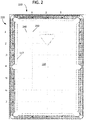
- FIG. 2 illustrates how the table markers labeled 1, 2, and 3 at the foot end 210 and 1 through 7 at the table side 220 were used to establish measurement points 230 on the table surface where projections 240 from the table markers intersected.
- An Extech foot-candle/lux light meter was placed at each of the measurement points on a standard billiard table illuminated by a typical overhead, centered billiard table light manufactured by Diamond Billiards with no other ambient light sources on.
- the illumination measurements at the measurement points illustrated in FIG. 2 are listed in both foot-candles and lux in Table 1 below.
- Table 1 further notes the average illumination (AVG), the coefficient of variation of the measurements (CV) (which is a normalized measure of dispersion of a probability distribution or frequency distribution and is defined as the ratio of the standard deviation to the mean or average), and the standard deviation of the measurements (STD).
- AVG average illumination
- CV coefficient of variation of the measurements
- STD standard deviation of the measurements
- Table 2 lists illumination measurements taken at the same measurement points of a billiard table using a light configured in accord with the approaches of FIGS. 1 and 7-12 with no other ambient light sources on.
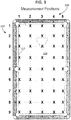
- FIG. 3 illustrates a similar approach to establishing illumination measurement points X except to expand the points X to include the intersection of the marker projections with the cushions 117 to determine the lighting uniformity for more of the billiard table surface 110.
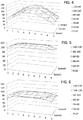
- the illumination for the table having the standard Diamond Billiards light was re-measured using these measurement points with results shown in Table 3 below and in FIG. 4 .
- measurements were made on a number of other pool tables with other commonly used center table lights in two commercial pool establishments in the Chicago area with similar measurement results to those illustrated in Table 3 below.
- the billiard table lighted with the prototype light for which first measurements are listed above also had its illumination re-measured but with a dimmer set to adjust the average lighting output to closer to the commercially available Diamond Billiard light using the measurement points of FIG. 3 .
- the results are listed in Table 4 below and are illustrated in FIG. 5 .
- the arrangements described herein demonstrate substantially uniform illumination of the billiard table surface of between about 50 and 115 foot-candles.
- the disclosed lighting apparatus instead of a variance of 15% when using only mid-table readings or 28% when including illumination at the cushions, the disclosed lighting apparatus has a coefficient of variation of only 3% using the mid-table readings and only 7% when using illumination at the cushions.
- the cushion to cushion overall illumination uniformity for the disclosed lighting apparatus was better than the mid-table illumination uniformity for a standard billiard table light.
- substantially uniform illumination for the table will include an illumination coefficient of variation of about 14% or less, more preferably 10% or less, from cushion to cushion measured at the locations described above as shown in FIG. 3 .
- a frame 120 is mounted above the billiard table surface with one or more light sources 130 mounted in the frame 120.
- the light source or sources may include light sources 130 mounted in the frame 120 in a configuration around a periphery of the billiard table surface 110.
- the periphery will typically correspond to an area projected above the cushions or edges of the billiard table surface 110.
- the frame 120 can be configured to mount the one or more lights 130 within a given horizontal distance from edges of the billiard table 110 such as within ten inches of the vertical projection of the cushion's 117 edge, and more preferably within five inches.
- the one or more lights are non-centrally placed such that no light sources are placed approximately directly above a middle portion of the billiard table surface 110.
- the middle portion of the billiard table surface 110 will be generally understood to correspond to the area of the surface 110 between projections of the foot end 210 markers 2 and 4 of FIG. 3 from about marker 2 to about marker 8 of the side table 220 markers of FIG. 3 .
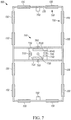
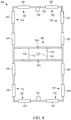
- the frame 120 is configured to mount pairs 710 of the one or more lights 130 in a generally perpendicular configuration above each corner of the billiard table surface 110. In a further aspect, the frame 120 is configured to mount two of the one or more lights 130 generally equally spaced along each long side of billiard table surface 110 as illustrated in FIG. 1 .
- the frame 120 may further include a middle frame portion 720 spanning across a middle portion 160 of the frame 120 corresponding to a middle portion of the billiard table surface 110 when mounted above the billiard table surface 110.
- the light sources 130 can comprise any suitable light source.
- the light sources 130 each include a set of light emitting diode (LED) lights 930 mounted in a linear configuration such as illustrated in FIG. 9 .
- the light source 130 is an off the shelf light bar manufactured by PHILIPS having a mounting surface 940 on which the LED lights 930 are mounted, here in a linear configuration only, although additional LED lights could be mounted in addition to those set in a linear configuration.
- Mounting holes 950 in the mounting surface 940 facilitate mounting of the light source 130 to the frame 120.
- Electrical connectors 960 allow for wired connections to a power source or driver or to another light source 130 such that one power source or driver can power and drive more than one light source 130.
- FIG. 10 illustrates an example driver or power circuit for powering the light sources 130 of the lighting apparatus, in this example, a PHILIPS XITANIUM 75W 0.7 -2.0A 0 - 10V dimming device.
- the light sources 130 are divided into two groups with each group having its own otherwise identical circuit 1010 and 1012.
- Each circuit in turn includes a power source 1020, resistor 1030, and rheostat 1040 connected in series with the light sources 130.
- the rheostat 1040 controls the amount of current flowing through the LED light sources 130 thereby controlling the brightness of the lights as a group.
- a pulse width modulation (PWM) circuit may be used to modulate the light intensity.
- PWM pulse width modulation
- the frame 120 further supports shades, reflectors, or the like to direct light from the light sources 130 to the billiard table surface and protect the players' eyes from direct exposure to the LEDs.
- one or more reflectors and/or a diffuser element can be added to diffuse the light from the LEDs and provide a more uniform aesthetic.
- the frame 1120 is in the shape of a troffer, i.e., a narrow inverted trough, serving as a light source support, reflector, and holder of diffusers.
- the troffer frame 1120 is substantially hollow in its inner structure, which is configured to support one or more lights by a top portion or upper support construction 1124 of the inner structure opposing a portion of the troffer frame closest to the billiard table surface when installed. Opposing sides of the troffer frame 1120 extend down from the top portion encasing the lights and support reflective surfaces.
- the illustrated example is constructed from extruded aluminum and has continuous t-slots along the length of the top surface and inside surface to provide attachment points for supports to mount the frame to room ceilings, and for the attachment of video cameras 750, or other devices.
- the t-slots accommodate a t-slot nut and screw/bolt 1122 which slides along the t-slot track to aid various attachments.
- the frame's upper support construction 1124 supports the lighting elements (here an LED circuit board 1140 supporting LEDs 1130) to face in the direction of the table surface.
- the LEDs 1130 are supported to face essentially straight down, in other words, such that the plane in which the LEDs 1130 are supported is essentially horizontal with the table surface although other arrangements are possible.
- Light from the LED's 1130 emits in a variety of directions and can be distractingly bright in one's field of view.
- the frame 1120 supports one or more diffusers.
- a particular diffuser arrangement is illustrated that redirects light rays from the LED 1130 that would otherwise be absorbed by the frame or be directed in a manner to not hit the table, so as to adequately light the billiard table surface and still diffuse light from the LEDs 1130, and so as to not be distracting to a player.
- a first mirrored diffuser 1150 is disposed between the light source or sources (such as LED 1130) and an outer wall 1126 of the frame 1120 that faces away from the center of the billiard table surface.
- the back surface 1155 is mirrored and the rest of the thicker portion of the diffuser 1150 is constructed from a substance that diffuses the reflected light, both before and after reflection by the mirrored surface 1155.
- the width of the diffuser 1150 is oriented essentially perpendicular with the billiard table surface so that the mirrored surface 1155 of the diffuser 1150 reflects light toward the center of the billiard table to help provide adequate lighting of the table surface.
- this diffuser 1150 is a commercially available diffuser (Evonik Platinum Ice OM001 X1) and is 0.34 inch thick.
- the mirrored diffusor is 1.8 inches from top to bottom in the cross section of FIG. 11 and, for a standard size 9 foot pocket billiard table, is 95.8 inches along the sides of the frame and is 45.8 inches along the ends of the frame. Other lengths are possible.
- a bottom diffuser 1160 is supported to be disposed between the light source or sources (such as LED 1130) and the billiard table surface.
- the bottom diffuser 1160 is a commercially available diffuser (Evonik Satin Ice OD002 DF) that is 0.08 inch thick and 2.125 inches wide. This diffuser 1160 diffuses the LED's 1130 light so that game players will not be distracted by the strong light that can emanate from individual LEDs. Instead, the observed light is diffused to provide a more uniform appearing light. This diffusing also spreads the light in a more uniform manner across the table surface.
- the bottom diffuser 1160 protects the LEDs 1130 from being struck by a cue.
- a second mirrored diffuser 1170 is disposed between the light source or sources (such as LED 1130) and an inner wall 1128 of the frame 1120 that faces toward the center of the billiard table surface.
- the inner wall 1128 may define a t-slot channel 1129 which optionally supports additional elements such as one or more cameras, motion sensors, or the lighting apparatus's middle section 160.
- the second mirrored diffuser 1160 is a commercially available diffuser (Evonik Platinum Ice OM001 X1) that is 0.118 inch thick, 1.3 inches wide, and, for a standard size 9 foot pocket billiard table, is 95.8 inches along the sides of the frame and is 45.8 inches along the ends of the frame. Other lengths are possible.
- the second mirrored diffuser 1170 is disposed at an angle so that its mirrored surface 1175 reflects light generally toward both the bottom diffuser 1160 and the first mirrored diffuser 1150 to effect direction of more light at the billiard table surface through the bottom diffuser 1160 and via additional reflection off of the first mirrored diffuser 1140.
- the diffusers 1150, 1160, and 1170 extend at least the length of the frame 1120 corresponding to a length of the frame along which the LED's 130 are supported although the diffusers 1150, 1160, and 1170 can extend any length along the frame.
- the bottom diffuser 1160 will extend around the entire frame 1120 to provide a more uniform aesthetic for the frame 1120.
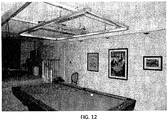
- FIG. 12 An example implementation of the frame 1120 as installed above a billiard table is illustrated in FIG. 12 , where the combined internal frame mirror and diffuser configuration smooth's out the light from the LEDs creating an aesthetic, even illumination on the table surface.
- the middle frame portion 720 may be configured to support a variety of other elements to add a variety of features to the lighting apparatus. For example, all or some of the electrical and/or computing elements needed to provide a variety of function can be mounted on the middle frame portion 720 top side to be not visible to the players.
- an A/C power strip 722 is mounted to the middle frame portion 720 to provide outlet power to various elements.
- An A/C switch 724 provides a master power switch for the lighting apparatus 100.
- the middle portion 720 of the frame 120 supports a middle camera 730 directed to record images of the billiard table surface 110.
- the camera 730 may be mounted so that the image sensor is in a plane essentially parallel to the table surface and high enough above the table such that the camera lens projects the entire table surface area onto its image sensor. If necessary, depending on the camera lens and image sensor size, and to keep the distance Z in FIG. 1 within a preferred height, the light path from the table to the camera may be deflected with a 45 degree mirror or similar optical arrangement, so that the image sensor is perpendicular to the table surface.
- the light path distance is made adjustable within the middle portion of the frame 720, horizontally, so as not to alter the preferred height of the frame above the table, but to still obtain a mapping of the complete table surface area onto the image sensor.
- one frame of video from middle camera 730 maps the entire table surface onto the image sensor for rapid and efficient image processing purposes.
- the image processing of the table surface single frames is made even more efficient by the controlled uniform illumination provided by the lighting apparatus.
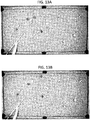
- FIGS. 13A-B show example images captured by the middle camera 730.
- the lighting apparatus as further described herein may include a processing device 745 in operative communication to receive the images recorded by the middle camera 730.
- a processing device 745 in operative communication to receive the images recorded by the middle camera 730.
- a processor device can comprise a fixed-purpose hardwired platform or can comprise a partially or wholly programmable platform. All of these architectural options are well known and understood in the art and require no further description here.
- the processing device 745 can also be configured to determine whether balls on the billiard table surface 110 are in motion or non-motion based on the images recorded by the middle camera 730, such as by using image by image comparison techniques or by using object identification of billiard balls on a frame by frame comparison basis to track the ball motion between frames. Then, the processing device 745 can automatically control a setting for the lighting apparatus 100 based at least in part on the balls being either in motion or non-motion. For example, in response to determining non-motion of balls on the billiard table surface, the processing device 745 effects stopping recording or provision of images from the middle camera 730.
- the processing device 745 and middle camera 730 can work together to operate efficiently because there is no reason to continue to transmit or record images of the billiard table surface 110 when image does not change, i.e., in between shots by the players.
- the processing device 745 effects provision of images from the middle camera 730 and from the end cameras 750 to reconstruct a real time or recorded video record from the combination of cameras as described herein.
- the processing device 745 is configured to detect particular images in the field of view of the middle camera 730, in response to which, the processing device 745 can effect starting, stopping, or pausing recording or provision of images.
- a card having a particular image could be placed on the billiard table surface so as to be in the middle camera's 730 field of view or a particular hand gesture may be made over the table surface.
- the processing device 745 may react in particular corresponding ways. For example, in response to detecting one particular image (such as a large red dot on a card or other unique indicator), the processing device 745 can automatically stop execution of the program relating to the monitored game.
- the processing device 740 can automatically restart the program in response to detecting removal of the particular image.
- the processing device 745 may automatically start recording of a "new" game in response to detecting a particular image associated with that action such as a large green dot on a card.
- an end portion of the frame 120 corresponding to a head or foot end portion of the billiard table surface 110 when mounted above the billiard table surface 110 can support an end camera 750 directed to record images of at least a portion of the billiard table surface 110 and an area surrounding a head or foot end portion of the billiard table surface 110 opposite that over which the end camera 750 is mounted.
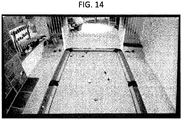
- FIG. 14 shows an example of an image captured by an end camera 750.
- the frame 120 can support end cameras 750 at both the head and foot ends to capture images of both ends of the table.
- the end cameras 750 provide video images of player movement around the table and the player's approach to a shot. Such images can be useful for real time viewing, recording or transmission.
- the images can also be used to construct composite video frames together with the table view image frames obtained simultaneously by the middle camera 730.
- Motion sensors 760 can be used to facilitate operation of the lighting apparatus.
- the processing device 740 can be in operative communication with the motion sensor 760 to automatically control a setting for the lighting apparatus in response to detection of motion.
- the processing device 740 may be configured to power off the plurality of lights 130 automatically in response to the motion sensor's 760 failing to detect motion for a threshold set time period by electronically communicating with an A/C switch circuit 724.
- the processing device 740 may be configured to increase the lighting level by communicating with a pulse width modulation circuit 1040, going from dimmed to a brightness sufficient to enable image capture and recording as described herein.
- the processing device 740 may be configured to provide images from a first camera in response to detecting motion from a first motion sensor and to provide images from a second camera in response to detecting motion from a second motion sensor. For instance, video or images will be recorded or transmitted from a camera oriented to capture images from an area from which motion is detected to ensure that the player movement is automatically recorded or transmitted.
- the processing device 745 may be configured to monitor sound captured by a microphone 770 to detect a strike sound having characteristics of a cue striking a billiard ball, and in response to detecting the strike sound, to automatically control a setting for the lighting apparatus 100.
- the microphone 770 may be mounted to the frame 120 or be a part of another device (such as one of the video cameras) that is in communication with the processing device 745.
- the processing device can be configured to, in response to detecting the strike sound, start recording or provision of images from the middle camera 730 mounted on the middle frame portion 720 of the frame 120 to automatically capture images of the moving balls.
- a processing device is configured to communicate with a user communication device, here the mobile device 1510 although other devices could be used, to provide images from the one or more cameras 730 and 750 disposed to capture images of the billiard table surface 110 and/or areas surrounding the billiard table surface 110.
- the processing device may communicate directly with the user communication device.
- the processing device may then communicate with at least two cameras of the one or more cameras 730 and 750 to coordinate storage of the images or provision of the images to the user communication device 1510.
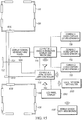
- FIG. 15 One such example arrangement is illustrated in FIG. 15 , utilizing first and second processing devices 740 and 745 (Computer 1 and Computer 2 respectively in FIG. 15 ) where the first processing device 740 is operating the lighting apparatus to turn on, adjust the brightness, and start game play, and where the second processing device 745 is dedicated to communications with the cameras 730 and 750 to facilitate selection of the cameras from which individual video streams will be stored and/or provided to a user communication device 1510.
- the second processing device 745 is in operative communication with the first processing device 740 via the wired connection 742 (such as an Ethernet or similar method) to receive commands with respect to starting and stopping the viewing or recording of images.
- the wired connection 742 such as an Ethernet or similar method
- a generally available router device 1520 can coordinate wireless communication such as through WiFi between the mobile device 1510 and the processing device 740 of the lighting apparatus 100.
- the processing device 745 operates a server that hosts a web page operated from the mobile device 1510.
- One example of the web page is shown in FIG. 16 .
- the server is assigned a local IP address by the router 1520, and the IP address is displayed in the LCD panel 1560.
- the mobile device 1510 interacts through the web page to control the light and allows the user to turn the light on or off by clicking the button 1720.
- the web page interface also allows the user to adjust the light level by clicking on one of a series of bars 1730 in the interface. Clicking higher on the screen provides a higher light level that is indicated by the bar 1740 moving up.
- the web page of FIG. 16 allows control of the lamp on/off and intensity through a background program running on the processing device 1641 interfaced via the web page to either switch power on or off through the A/C switch 724 from the processing device 1641 to the lamp circuit, or in the case of adjusting the intensity, by controlling a pulse width modulation circuit interface to the lamp power supplies 1020.
- the background program monitors the motion detectors 760 and adjusts the light intensity according to whether there is motion in the field of view of the motion detectors. As long as motion is present the lamp stays at the level set by the user. If there is no motion for a preset period, then the lamp automatically dims to a lower level using the pulse width modulation control. If there continues to be no motion for an additional preset period, the lamp turns off through the power on/off switch.
- the second processor 745 is operated by the display screen, keyboard, and mouse 1685 to run a software program to display in real time (e.g., 30 frames per second) an automatically generated composite video that combines the output from all three video cameras 730 and 750.
- the composite video may optionally be recorded for later retrieval and review.
- the video is a recording, reproducing, or displaying of visual images made digitally of a scene captured sequentially in time, such that they can be viewed as moving visual images, even if there is no apparent motion for certain periods.
- the method of creating a video of billiard game play recorded simultaneously from multiple video cameras includes operating at least three independent image capture threads individually associated with separate cameras asynchronously in a same time interval.
- the independent image capture threads use shared memory resources and event done flags to communicate with each other.
- the independent image capture threads asynchronously capture individual image frames from the separate cameras.
- Image analysis of the captured individual image frames from the separate cameras is used to compare the individual image frames from a given camera of the separate cameras to determine which of the individual image frames are recording motion in the respective sequence of recordings from the respective ones of the separate cameras.
- Certain frames are chosen, displayed, and saved in a single video memory based on which of the separate cameras is recording motion.
- the method includes recording at specific time intervals, such as 30 frames per second, the chosen frames into a video file of the billiard game play.
- the chosen frames recorded into the video file comprise whatever is present at that instant in the single video memory.
- the video streams from the three cameras 730 and 750 are connected through USB ports to the second processing device 745 (labeled Computer 2 in FIG. 15 ).
- the video streams from the three video cameras are connected through USB ports to the processing device 745, also labeled Computer 2.
- the processing device 745 has an Intel quad-core CPU with hyper-threading, i.e., eight separate logical CPUs.
- the operating system for Computer 2 is an Ubuntu system.
- the eight logical CPUs can run simultaneously and asynchronously in a multi-threaded, multi-processor environment, such that a separate software thread can be running in each of the eight logical CPUs simultaneously.
- each video stream is input to a separate software module running on its own thread, sharing the memory allocations listed in Table 6.
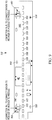
- TABLE 6 Shared Memory Allocations CFB0 Current Frame Buffer - Camera 0 PFB0 Previous Frame Buffer - Camera 0 DIF0 Result of difference comparison calculation between CFB0 and PFB0 CFLG0 Frame Capture Flag 0 PFLG0 ProcessorThread 0 Done Flag CFB1 Current Frame Buffer - Camera 1 PFB1 Previous Frame Buffer - Camera 1 DIF1 Difference Comparison Calculation 1 CFLG1 Frame Capture Flag 1 PFLG1 ProcessorThread 1 Done Flag CFB2 Current Frame Buffer - Camera 2 PFB2 Previous Frame Buffer - Camera 2 DIF2 Difference Comparison Calculation 2 CFLG2 Frame Capture Flag 2 PFLG2 ProcessorThread 2 Done Flag THRS Comparison threshold, to determine motion in Camera 0 view AVGDIF Running average motion difference calculation for video stream 0 DFB Display Frame Memory Buffer PIP PIP PIP
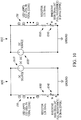
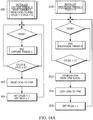
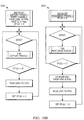
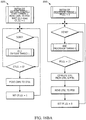
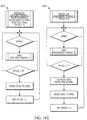
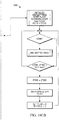
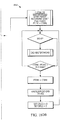
- FIGs. 18A , 18B , and 18C eight flow diagrams are shown 1810, 1820, 1830, 1840, 1850, 1860, 1870, and 1880 wherein each flow diagram represents a separate software thread.
- a main parent software process runs from the processing device 745, which launches all of these threads asynchronously. However, they may share images and data through the use of shared memory resources allocated in the parent process. These shared resources are named and listed in TABLE 6 to enable clarity of presentation and understanding of the action of the different threads.
- CaptureThread 0 receives video input from the middle camera 730 in FIG. 7 .
- Each successive frame of video is available in that camera's internal hardware image buffer for 33.3 msec (at 30 frames/sec).
- the thread moves the image frame from CAM0 internally into the processing device's 745 process allocated memory CFB0 for that video stream.
- the thread sets its Frame Capture Flag CFLG0 to 1, which then allows the companion ProcessThread 0 to compute a difference metric DIF0 between the current frame and the previous frame PFB0 at 1822.
- ProcessThread 0 then continues to copy the current image in CFB0 to replace the image in the previous frame buffer PFB0 at step 1824 and then sets its PFLG0 to 1, thus allowing the asynchronously running DirectorThread to use the DIF0 value in FIG 18C to update the AVGDIF.
- ImageCapture threads 1 and 2 1830 and 1850 are operating similarly to acquire image frames from their respective video cameras 750 in FIG. 7
- ProcessorThreads 1 and 2 1840 and 1860 are operating to compute the difference metrics DIF1 and DIF2 respectively between their current and previous image frames.
- six threads, operating on six separate logical CPUs are operating in this manner to achieve image frame input from the three video streams.
- the DirectorThread 1870 and the WriterThread 1880 are running to construct a composite video stream, combining the three separate video streams into one final composite stream.
- This composite video is displayed by the DirectorThread, and the DirectorThread 1870 determines which frames of video will be used to construct the composite video from the three inputs. If the record flag RFLG is set the composite video is also stored at 30 frames/sec, and an audio file is also recorded that is combined with the composite video stream at the end of the process.
- the SoX Sound Exchange program running on the Ubuntu operating system is used to merge the recorded .wav files with the recorded .avi files created by the WriterThread.
- the primary input, collected on a frame by frame basis, for the reconstructed composite video comes from camera 0, which is the middle camera 730 in FIG. 7 , and which provides an overview of the table surface.
- camera 0 is the middle camera 730 in FIG. 7 , and which provides an overview of the table surface.
- One of the purposes of the composite video is to obtain an accurate record of ball positioning prior to each shot and during the movement of the balls afterwards. However, there are periods after the balls stop moving where other interesting and informational aspects of the play are occurring.
- the reconstructed composite video captures both of these activities through the utilization of the 3 cameras and reconstructing one composite video record. As long as motion is occurring, in the middle camera 730 view, the other two end table video streams from cameras 750 are not included in the reconstruction.
- the determination of motion in this example is determined by monitoring the difference DIF0 between successive frames from camera 0, and computed at 1822 in ProcessThread 0 1820.
- the Director thread computes AVGDIF, a running average of the last 30 sequential DIF0 values, and compares this value to a fixed threshold THRS to decide if motion is occurring.
- DFB is the memory buffer that displays the current image frame, and it will either be the current CFB0 video frame without modification, or will later in the thread be overlaid in the corner with a PIP image.
- the AVGDIF value is updated by averaging the current DIF0 into the running average, and then at 1874 the updated AVGDIF is compared to THRS to decide if motion is present in the middle camera table view.
- 13A and 13B illustrate the type of frames that are included in the case of detected motion. These figures are from a sequence of a video frames showing the darker "4 ball” being hit by the white cue ball, propelling the "4" ball towards the side pocket. Because the ball motion from these and prior sequential frames results in an AVGDIF value above the threshold THRS, these frames would simply be added to the reconstructed composite video stream to the exclusion of the end camera views.
- the thread compares DIF1 and DIF2 at 1875 to see which end view has the most motion going on.
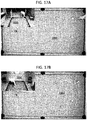
- the video stream having the most motion as reflected by the higher difference value DIF1 or DIF2 will be chosen to provide the end view frame to be reduced in size by 1 ⁇ 4 at step 1876 or 1877 and overlaid in a corner of DFB at step 1879 to create a picture-in-picture reconstructed image frame. If the difference value DIF1 for video stream 1 is greater that the difference value DIF2 for video stream 2, the PIP frame is constructed 1870 from video frames from video streams 0 and 1.
- the PIP frame is constructed 1876 from video frames from video streams 0 and 2.
- the resulting video frames correspond to those illustrated in FIGS. 17A and 17B where the end view frame chosen is the one with the most motion.
- the operation of the DirectorThread is to determine if there is motion and choose the appropriate next sequential image frame for the displayed video. If there is no motion on the table, then the reconstructed video should show the activity around the periphery of the table, which is usually the player getting ready for the next shot.
- the PIP frame shows this, but still in the context of the overview of the balls on the table surface prior to motion stoppage.
- the WriterThread controls the synchronization of the process of recording the composite video record.
- the WriterThread is activated optionally by the operator of the apparatus and in that case the WriterThread is created and started by the DirectorThread. It also starts the audio recording during its initialization and starts a msec clock to measure the recorded frame time interval precisely. Because the audio signal is being recorded in real time, a composite video stream must be generated that corresponds exactly to the audio record with regard to its visual content.
- the three separate video camera streams can be started and operated asynchronously in CaptureThreads 0, 1 and 2, and their captured images can be subjected asynchronously to image processing in ProcessorThreads 0, 1, and 2 to compute a motion analysis metric.
- the DirectorThread may further select asynchronously and if necessary add PIP frames for inclusion.
- the WriterThread without time variance must record the contents of the display buffer DFM at exactly 1/30 th of a second to acquire and construct the composite video. Whatever happens to be in the DFM display at that precise time is written to the recorded video output file.
- the determination of which end camera view to display can be made using information from motion sensors disposed on the frame to detect motion in areas around the table corresponding to the respective fields of view of the respective end cameras.
- one or more the processing devices can perform image analysis on the video feeds provided by the respective cameras to determine which camera is capturing the most motion.
- the determination of when to remove the overlaid video feed from an end camera can be made by detecting the sound of the cue striking a ball, image analysis of the video feed from the center camera, or a combination of both.
- the center camera may capture motion other than that of the balls on the table such as movement of a cue which can be confused with motion of the balls.
- Combining image analysis of the balls with sound detection of the striking cue allows the removal of the overlaid video frame in response to sound detection of the striking cue and maintaining removal of the overlaid video frame while detecting ball motion.
- the processing required to effect these actions can done on any combination of processing devices.
- the processing device is in communication with a middle camera 730 in FIG. 7 , to capture images of the table surface into video memory VM2, and cameras 750 at both ends of the frame to respectively capture images from opposite ends of the billiard table and first and second areas surrounding the respective ends of the table into video memories VM1 or VM3 respectively, and motion sensors 760 in FIG. 7 (labeled MS 1 and MS2 in FIG. 19 ) disposed to detect motion in the areas surrounding the opposing ends of the table, and a microphone.
- the cameras and motion detectors could be mounted over and/or capturing images of or sensing motion around sides of the table in addition to or in lieu of the cameras over the ends of the table.
- the processing device wakes or resets with an initialization process 1910. Then, assuming that there is no motion of the balls on the table, the processing device monitors for motion from the first area and the second area surrounding the billiard table surface through the use of one or more motion detectors or real time image analysis techniques described above. Then, the processing device determines at step 1920 with respect to detected motion from which camera images should be stored or displayed in video memory VM4 (the output or display/recorded video memory).
- the processing device effects stopping storing or providing images from the second side/end camera into VM4, and effects storing or providing images 1933 from the first side/end camera to store or provide images from the first area into VM4. For example, this includes storing or providing video or a video file that can be played on a display.
- the processing device effects stopping storing or providing images from the first side/end camera into VM4, and effects storing or providing images 1936 from the second side/end camera to store or provide images from the second area.
- the processing device next monitors for a ball hit; by detecting motion, for example, by real time image analysis, and/or by the striking of a ball, for example, by detecting a strike sound having characteristics of a cue striking a billiard ball.
- the processing device effects stopping storing or providing images from the respective side/end camera into VM4 and effects storing or providing images VM2 into VM4 at step 1950 from the middle camera' memory VM2 so that images of the field of view capturing the table and the balls' motion are captured.
- the processing device then monitors 1960 for stoppage of the balls' motion, such as through use of one or more motion detectors or real time image analysis techniques described above.
- the processing device effects stopping storing or providing images from the middle camera and effects storing or providing images from the one of the side/end cameras as discussed above.
- the processing device may determine 1970 that the game is finished either by tracking which balls are on the table with respect to the game being played or by receiving a user initiated signal that indicates completion of play. In response to determining that the game is finished, the image capture and other game process is ended 1980.
- the described system can be further configured to provide the ability to automatically capture and display certain game play statistics such as a shot clock.
- game play statistics such as a shot clock.
- BCA Billiard Congress of America
- “Definitions used in the Rules” 8.2 A shot begins when the tip contacts the ball due to the forward stroke motion of the cue stick. A shot ends when all the balls in play have stopped moving and spinning. A shot is said to be legal if the shooter did not foul during the shot.”
- Hot time is defined as the time between shots during active billiard play, for example, while a player is still at the table and taking successive legal shots. Typically this is the time taken by the player to evaluate the ball positions on the table, to formulate a strategy for continuing play, and to position for the next shot.
- shot time begins when ball motion stops on the table from the last shot and ends when the player strikes the cue ball for the next shot.
- a "shot clock” is defined as a device that measures the shot time. The shot time can be measured, for example, by using a device that requires an operator to manually push buttons to start and stop a real time clock and display the shot time. This is the present state of the art in pocket billiards.
- various embodiments of the system described herein provides an automatic apparatus and method of providing a real time shot clock that can be used during game play.
- the shot time is automatically measured using video cameras and computers that are an integral part of the lighting apparatus positioned over the pool table.
- the shot clock is automatically started at a preset time after each shot and is decremented and displayed on a video screen in real time for player and observer view during the time between shots.
- One such apparatus for use with a billiard table surface includes a frame configured to mount above the billiard table surface, which frame may be any of the frames 100 described herein.
- a camera is mounted to the frame to record images of the billiard table surface; an example of such a camera is the middle camera 730 described above, also referred to as camera 0 in the processing thread.
- a processing device is in operative communication to receive the images recorded by the camera. The processing device is configured to determine whether balls on the billiard table surface are in motion or non-motion based on the images recorded by the camera and to automatically control a clock based on whether on the balls are in motion or non-motion.
- the processing device can be further configured to determine the non-motion of balls on the billiard table surface and, in response to determining non-motion of the balls on the billiard table surface, automatically control the clock by starting a shot clock.
- the processing device is configured to communicate with a user communication device to provide images from one or more cameras disposed to capture images of the billiard table surface and/or areas surrounding the billiard table surface and to display the shot clock overlaid on the images.
- the processing device may be the processing device 745 described above.
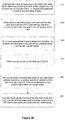
- Figure 20 illustrates an overview flow chart of an example video frame analysis for the automatic shot clock method.
- the process occurs in the processing thread while other processes are happening in other threads, and these processes/threads are asynchronous.
- This approach uses two different imaging methods to detect ball motion. One method is used to detect the stoppage of motion for all of the balls on the table, which resets and starts the shot clock, and another method is used to detect the initial cue ball hit, which stops the shot clock. A motion flag that is common to all the threads is used to pass the information about whether motion is occurring or not.
- the image frame processing and detection of general motion and cue ball motion is implemented with software called OpenCV (Open Source Computer Vision) available from www.opencv.org.
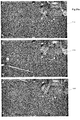
- Figures 21a and 21b illustrate a sequence of video screen displays of the shot clock during a player turn at the table as the shot clock counts down during play.
- Figures 21a and 21b show video screen displays of the shot clock time during a player turn at the table.
- the balls have recently stopped and the player is evaluating optional shots. There are two possible shots, a straight-in shot or a combination along the side rail. The shot time started at 45 seconds and is showing 36 seconds remaining in green.
- the player is considering the combination shot along the side rail; the shot clock is at 25 seconds.
- the shot clock is at 10 seconds.
- the player In 2140 the player is in position for the straight-in shot; however, the shot clock is already in the warning period and shows only 2 seconds remaining in yellow. In 2150 the player has just hit the cue ball, but has used 8 seconds more that his allotted 45 seconds, so the shot clock shows -8 seconds in red. In 2160 the balls are in motion, so the shot clock has stopped, and the PIP window is not in view. This sequence of video is displayed during all parts of the overview flow chart of Figure 20 .
- Program flow at 2010 is a prelude to the starting of the shot clock and would correspond to a 2160 in Figure 21b .
- general ball motion has stopped and the shot time has been reset and is running. This corresponds to 2110 in Figure 21a , where the shot clock had been set at 45 seconds and is now at 36 seconds.
- the processing device is configured to, after determining the non-motion of the balls, determine whether a shot is made on the billiard table surface and, in response to determining the shot, stop the shot clock.
- the processing device is further configured to determine whether the shot is made by analyzing the images to identify one or more candidate cue balls and locations of the one or more candidate cue balls in the images and determine change in the location of the one or more candidate cue balls in consecutive ones of the images. This is illustrated at 2030 where the program flow has proceeded to test for cue ball motion as described below with reference to Figure 24 .
- the 1 st part of that test at 2040 is to find potential cue ball objects.
- the processing device executes the SimpleBlobDetector algorithm from OpenCV; however, the algorithm does not specifically identify the cue ball as an independent object. Instead, the SimpleBlobDetector algorithm isolates several possible cue ball candidates as shown in Figure 22 .
- the candidate cue balls are shown with a red perimeter and a pixel count number in Figure 22 .
- the balls in this instance are the cue ball (1550 pixels), the yellow stripped ball (1669 pixels), and the orange stripped ball (1630 pixels).
- the SimpleBlobDetector algorithm assumes that the image, in this case a 1920 x 1080 pixel video frame from the camera capturing the billiard table surface, has been converted from color to grey levels.
- the algorithm then uses thresholding procedure to create a black and white binary image and then uses several filters to detect objects, for example: color (this is really grey level Intensity, which ends up being white versus black), area, circularity, inertia and convexity.
- the SimpleBlobDetector has a number of output parameters for detected objects.
- the parameters of interest for this embodiment are the number of objects detected and the x, y coordinate position in the image of each object. In the case of Figure 22 three objects were detected as possible cue balls, given the limited filtering capabilities of the algorithm.
- the cue ball motion algorithm tests each current video frame potential cue ball's x, y location against all positions in the last frame. This is shown in more detail in Figure 24 . A difference in any x, y location position between the two frames is taken as cue ball motion. In response to detection of cue ball motion, the shot clock is stopped, and the PIP window is removed from the reconstructed, recorded video stream. This corresponds to 2160 in figure 21b .
- the processing device is further configured to determine the non-motion of balls on the billiard table surface by analyzing the images to identify location of the balls in the images and determine change in the location of the balls in consecutive ones of the images.
- Figure 23 illustrates an example process for determining general ball motion on the table surface. The method compares the current table surface image frame 2310 with the two sequentially preceding previous table surface image frames 2320 and 2330 for differences in pixel values using an image differencing procedure. The method used in this embodiment utilizes the various OpenCV software routines specified herein. Other known methods in the art could be used to determine image motion between frames as well.
- the video frame images are first converted from color images to gray level using cvtColor.
- the current image and the two preceding images are compared against each other as shown in FIG. 23 , first producing difference images 2340 and 2350 with the absdiff algorithm, and then producing a motion image 2360 using the bitwise_and algorithm.
- This motion image 2360 is then analyzed by threshold and countNonZero to produce a motionCount measurement 2370 for the current table surface image.
- the threshold T is set at a value of 35, i.e., the number of pixels in the derived motion image frame that are above the value of 35.
- the next step is to compute the final measurement of avgMotion 2380. This is accomplished by averaging the motionCount measurement over a number of frames. In this embodiment, the number N is set at 8 times the frame rate.
- the avgMotion measurement accurately reflects motion in the field of view of the camera that captures the whole of the billiard table surface and is constantly computed and updated on a real time basis by the ProcessorThread. It is also an extremely reliable and efficient way of indicating no motion on the table from ball movement. When balls have stopped and are not moving, the avgMotion stays at zero with no false or spurious non-zero measurements. So it is a very reliable method to use to start a shot clock. However, the MotionCount is not a robust method to detect the striking of a cue ball to end the shot clock time. That is better measured by specifically detecting just cue ball motion, as additionally described herein.
- a ball motion flag is set based on detection of the ball motion from the image analysis, and a shot clock is started based on the ball motion flag indicating detection of no ball motion.
- the event that turns off the shot clock is cueBallMotion, as described herein.
- the shooter steps back from the table until the balls stop. This further enables the avgMotion measurement to be used as a primary signal to indicate the stoppage of ball movement and to reset and turn on the shot clock and its display to the players.
- Figure 24 is an overview of the program flow for determining cue ball motion. The essence of this method is to locate potential cue ball objects in a current frame and compare the locations of each potential cue ball object with the locations of potential cue ball objects in previous frames. If all the potential cue ball locations are in the same place in the two frames, then there has been no cue ball movement. If at least one potential cue ball object location is not the same, the start of cue ball motion is detected and the bBallMoveMent flag is set to True.
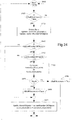
- Figure 24 illustrates the major steps in this process. The program is running in the processor thread and initially loops continually on the bBallMoveMent flag 2420 to determine if ball motion has stopped on the table.
- program flow goes back to the top of the thread to consider the next frame 2410.
- the time for ball movement to stop after a cue ball hit often takes several seconds. Thus, for example, this short loop may be executed for perhaps 100 times. The purpose of this step is to make sure that there is no ball movement on the table before the next steps are executed.
- the next two steps, at 2440 and 2450, are for the first time through and special situations.
- the first time through the currentNumberOfObjects is greater than zero, but the lastNumberOfObjects is not. So, program flow goes to 2490 where the lastNumberOfObjects and last(x,y)Locations are updated.
- the currentNumberOfObjects is zero, it might mean that the cue ball has been removed, and the program flow will loop until it appears again. After the balls have stopped moving, most of the time spent in program flow is in the slightly larger loop consisting of 2460, 2470, 2480, 2490 and then back to 2410, 2420 and 2430 for consideration of the next frame.
- Another purpose of the apparatus described herein is to provide a lighting system with video cameras mounted within the structure of the apparatus, the whole contained as one piece of equipment, and yet enable a top surface video field of view of the table surface, at the same time enabling other oblique video side and end views to show player activities.
- the same apparatus can allow image processing of the various cameras video streams to record the play including the oblique views with the table surface view and provide meaningful real time data of game play. Accomplishing these requirements involves streaming and analyzing a lot of data in a coordinated fashion.
- the avgMotion measurement is fast, robust, and efficient, allowing the overall apparatus to work within the time parameters of receiving three streams of video at once and performing image analysis on individual frames as necessary. It also works well as a prelude to the specific detection of cue ball motion because it ensures that there is no ball motion on the table before new cue ball movement analysis is started.
- the apparatus and methods relating to the shot clock need not be embodied in a lighting frame approach.
- the camera used to record images for the motion detection described herein may be placed in any manner to capture the billiard table surface and not necessarily directly above a middle portion of the surface.
- the shot clock in such an embodiment could be provided via a dedicated display instead of being overlaid on top of video images from the game play.
- each block may represent a module, segment, or portion of code that comprises program instructions to implement the specified logical function(s).
- the program instructions may be embodied in the form of source code that comprises human-readable statements written in a programming language or machine code that comprises numerical instructions recognizable by a suitable execution system such as a processor in a computer system or other system. The machine code may be converted from the source code, etc.
- each block may represent a circuit or a number of interconnected circuits to implement the specified logical function(s).
- a computer readable medium (being non-transitory or tangible) may store such instructions that are configured to cause a processing device to perform operations as described herein.
Landscapes
- Engineering & Computer Science (AREA)
- Multimedia (AREA)
- Signal Processing (AREA)
- General Engineering & Computer Science (AREA)
- Image Analysis (AREA)
- Indicating Or Recording The Presence, Absence, Or Direction Of Movement (AREA)
Applications Claiming Priority (1)
| Application Number | Priority Date | Filing Date | Title |
|---|---|---|---|
| US15/046,067 US9827483B2 (en) | 2014-08-01 | 2016-02-17 | Billiard table lighting and game play monitor |
Publications (2)
| Publication Number | Publication Date |
|---|---|
| EP3207966A1 EP3207966A1 (en) | 2017-08-23 |
| EP3207966B1 true EP3207966B1 (en) | 2019-06-05 |
Family
ID=58054073
Family Applications (1)
| Application Number | Title | Priority Date | Filing Date |
|---|---|---|---|
| EP17156538.5A Active EP3207966B1 (en) | 2016-02-17 | 2017-02-16 | Billiard table lighting and game play monitor |
Country Status (3)
| Country | Link |
|---|---|
| EP (1) | EP3207966B1 (enExample) |
| JP (1) | JP6873730B2 (enExample) |
| CN (1) | CN107088301B (enExample) |
Families Citing this family (3)
| Publication number | Priority date | Publication date | Assignee | Title |
|---|---|---|---|---|
| CN107073328A (zh) | 2014-08-01 | 2017-08-18 | 智能台球照明有限责任公司 | 台球桌照明与比赛进行监视器 |
| CN110443859B (zh) * | 2019-07-30 | 2023-05-30 | 佛山科学技术学院 | 一种基于计算机视觉的桌球犯规判断方法及系统 |
| CN116370945B (zh) * | 2023-02-24 | 2026-02-24 | 乔冰 | 一种用于台球桌的一体化库边 |
Family Cites Families (16)
| Publication number | Priority date | Publication date | Assignee | Title |
|---|---|---|---|---|
| DE4132678A1 (de) * | 1991-10-01 | 1993-04-08 | Thorn Licht Gmbh | Arbeitsplatzleuchte mit mindestens einer leuchtstofflampe |
| FR2804879A1 (fr) * | 2000-02-10 | 2001-08-17 | Thierry Lecoq | Billard interactif |
| JP2002186702A (ja) * | 2000-12-22 | 2002-07-02 | Sefamedeia Create:Kk | 撞球練習装置および撞球練習システム |
| JP2006043017A (ja) * | 2004-08-03 | 2006-02-16 | Seiko Epson Corp | 表示装置 |
| US7766536B2 (en) * | 2008-02-15 | 2010-08-03 | Lunera Lighting, Inc. | LED light fixture |
| JP5356724B2 (ja) * | 2008-05-13 | 2013-12-04 | 株式会社タイトー | ビリヤード台の球移動管理装置 |
| KR20100015258A (ko) * | 2008-08-04 | 2010-02-12 | 신진석 | 당구점수 계산장치 |
| US8727875B2 (en) * | 2009-07-27 | 2014-05-20 | Obscura Digital, Inc. | Automated enhancements for billiards and the like |
| EP2459288A4 (en) * | 2009-07-27 | 2013-01-09 | Obscura Digital Inc | AUTOMATED EXTENSIONS FOR BILLIARDS OR SIMILAR |
| GB2479902A (en) * | 2010-04-28 | 2011-11-02 | Christopher Mark Southworth | Billiards apparatus for automatically tallying a player's score |
| CN202315254U (zh) * | 2011-10-08 | 2012-07-11 | 罗忠贵 | 一种具有新型台球进球计时器的台球桌 |
| CN102327697B (zh) * | 2011-10-14 | 2013-04-10 | 李姣昂 | 投影式台球训练系统及其实现方法 |
| KR101329889B1 (ko) * | 2012-07-13 | 2013-11-15 | 주식회사 필립인텍스 | 엘이디가 장착된 써크라인 조명등 장치 |
| US9124856B2 (en) * | 2012-08-31 | 2015-09-01 | Disney Enterprises, Inc. | Method and system for video event detection for contextual annotation and synchronization |
| CN103871078B (zh) * | 2013-07-12 | 2016-04-13 | 北京瑞盖科技有限公司 | 一种台球击球关键信息检测方法及系统 |
| CN107073328A (zh) * | 2014-08-01 | 2017-08-18 | 智能台球照明有限责任公司 | 台球桌照明与比赛进行监视器 |
-
2017
- 2017-02-15 JP JP2017025546A patent/JP6873730B2/ja active Active
- 2017-02-16 EP EP17156538.5A patent/EP3207966B1/en active Active
- 2017-02-17 CN CN201710085506.0A patent/CN107088301B/zh active Active
Non-Patent Citations (1)
| Title |
|---|
| None * |
Also Published As
| Publication number | Publication date |
|---|---|
| JP2017151100A (ja) | 2017-08-31 |
| CN107088301A (zh) | 2017-08-25 |
| EP3207966A1 (en) | 2017-08-23 |
| CN107088301B (zh) | 2020-10-20 |
| JP6873730B2 (ja) | 2021-05-19 |
Similar Documents
| Publication | Publication Date | Title |
|---|---|---|
| US11654346B2 (en) | Billiard table lighting | |
| US10226685B2 (en) | Billiard table lighting and game play monitor | |
| US7805739B2 (en) | Methods and apparatus for indirect illumination in electronic media rating systems | |
| US20230076734A1 (en) | Method and system for filming | |
| US10842003B2 (en) | Ambience control system | |
| US20210103203A1 (en) | Method and system for filming | |
| JP2017524507A5 (enExample) | ||
| US20180077345A1 (en) | Predictive camera control system and method | |
| EP3207966A1 (en) | Billiard table lighting and game play monitor | |
| EP3165264A1 (en) | Infrared projection billiard entertainment system and implementation method thereof | |
| US11385184B2 (en) | System and method for optical inspection of an object | |
| CN115426752B (zh) | 一种舞台集成控制系统 | |
| JP2020164265A (ja) | ピッキングシステム | |
| KR20090112538A (ko) | 조명 제어를 이용한 골프 영상 획득 장치, 및 그를 이용한 영상처리 기반의 골프 연습 시스템 | |
| CN110286548B (zh) | 一种舞台系统 |
Legal Events
| Date | Code | Title | Description |
|---|---|---|---|
| PUAI | Public reference made under article 153(3) epc to a published international application that has entered the european phase |
Free format text: ORIGINAL CODE: 0009012 |
|
| STAA | Information on the status of an ep patent application or granted ep patent |
Free format text: STATUS: THE APPLICATION HAS BEEN PUBLISHED |
|
| AK | Designated contracting states |
Kind code of ref document: A1 Designated state(s): AL AT BE BG CH CY CZ DE DK EE ES FI FR GB GR HR HU IE IS IT LI LT LU LV MC MK MT NL NO PL PT RO RS SE SI SK SM TR |
|
| AX | Request for extension of the european patent |
Extension state: BA ME |
|
| STAA | Information on the status of an ep patent application or granted ep patent |
Free format text: STATUS: REQUEST FOR EXAMINATION WAS MADE |
|
| 17P | Request for examination filed |
Effective date: 20180108 |
|
| RBV | Designated contracting states (corrected) |
Designated state(s): AL AT BE BG CH CY CZ DE DK EE ES FI FR GB GR HR HU IE IS IT LI LT LU LV MC MK MT NL NO PL PT RO RS SE SI SK SM TR |
|
| GRAP | Despatch of communication of intention to grant a patent |
Free format text: ORIGINAL CODE: EPIDOSNIGR1 |
|
| STAA | Information on the status of an ep patent application or granted ep patent |
Free format text: STATUS: GRANT OF PATENT IS INTENDED |
|
| RIC1 | Information provided on ipc code assigned before grant |
Ipc: F21V 33/00 20060101ALI20181205BHEP Ipc: H05B 37/02 20060101ALI20181205BHEP Ipc: H04N 7/18 20060101ALI20181205BHEP Ipc: H04N 5/77 20060101ALI20181205BHEP Ipc: H04N 9/82 20060101ALI20181205BHEP Ipc: A63D 15/20 20060101AFI20181205BHEP Ipc: H04N 5/247 20060101ALI20181205BHEP Ipc: F21S 4/28 20160101ALI20181205BHEP Ipc: F21V 7/00 20060101ALI20181205BHEP Ipc: F21V 21/03 20060101ALI20181205BHEP Ipc: F21S 8/04 20060101ALI20181205BHEP |
|
| INTG | Intention to grant announced |
Effective date: 20190104 |
|
| GRAS | Grant fee paid |
Free format text: ORIGINAL CODE: EPIDOSNIGR3 |
|
| GRAA | (expected) grant |
Free format text: ORIGINAL CODE: 0009210 |
|
| STAA | Information on the status of an ep patent application or granted ep patent |
Free format text: STATUS: THE PATENT HAS BEEN GRANTED |
|
| AK | Designated contracting states |
Kind code of ref document: B1 Designated state(s): AL AT BE BG CH CY CZ DE DK EE ES FI FR GB GR HR HU IE IS IT LI LT LU LV MC MK MT NL NO PL PT RO RS SE SI SK SM TR |
|
| REG | Reference to a national code |
Ref country code: GB Ref legal event code: FG4D |
|
| REG | Reference to a national code |
Ref country code: CH Ref legal event code: EP |
|
| REG | Reference to a national code |
Ref country code: AT Ref legal event code: REF Ref document number: 1139412 Country of ref document: AT Kind code of ref document: T Effective date: 20190615 |
|
| REG | Reference to a national code |
Ref country code: IE Ref legal event code: FG4D |
|
| REG | Reference to a national code |
Ref country code: DE Ref legal event code: R096 Ref document number: 602017004246 Country of ref document: DE |
|
| REG | Reference to a national code |
Ref country code: NL Ref legal event code: MP Effective date: 20190605 |
|
| REG | Reference to a national code |
Ref country code: LT Ref legal event code: MG4D |
|
| PG25 | Lapsed in a contracting state [announced via postgrant information from national office to epo] |
Ref country code: AL Free format text: LAPSE BECAUSE OF FAILURE TO SUBMIT A TRANSLATION OF THE DESCRIPTION OR TO PAY THE FEE WITHIN THE PRESCRIBED TIME-LIMIT Effective date: 20190605 Ref country code: LT Free format text: LAPSE BECAUSE OF FAILURE TO SUBMIT A TRANSLATION OF THE DESCRIPTION OR TO PAY THE FEE WITHIN THE PRESCRIBED TIME-LIMIT Effective date: 20190605 Ref country code: NO Free format text: LAPSE BECAUSE OF FAILURE TO SUBMIT A TRANSLATION OF THE DESCRIPTION OR TO PAY THE FEE WITHIN THE PRESCRIBED TIME-LIMIT Effective date: 20190905 Ref country code: HR Free format text: LAPSE BECAUSE OF FAILURE TO SUBMIT A TRANSLATION OF THE DESCRIPTION OR TO PAY THE FEE WITHIN THE PRESCRIBED TIME-LIMIT Effective date: 20190605 Ref country code: SE Free format text: LAPSE BECAUSE OF FAILURE TO SUBMIT A TRANSLATION OF THE DESCRIPTION OR TO PAY THE FEE WITHIN THE PRESCRIBED TIME-LIMIT Effective date: 20190605 Ref country code: FI Free format text: LAPSE BECAUSE OF FAILURE TO SUBMIT A TRANSLATION OF THE DESCRIPTION OR TO PAY THE FEE WITHIN THE PRESCRIBED TIME-LIMIT Effective date: 20190605 |
|
| PG25 | Lapsed in a contracting state [announced via postgrant information from national office to epo] |
Ref country code: LV Free format text: LAPSE BECAUSE OF FAILURE TO SUBMIT A TRANSLATION OF THE DESCRIPTION OR TO PAY THE FEE WITHIN THE PRESCRIBED TIME-LIMIT Effective date: 20190605 Ref country code: RS Free format text: LAPSE BECAUSE OF FAILURE TO SUBMIT A TRANSLATION OF THE DESCRIPTION OR TO PAY THE FEE WITHIN THE PRESCRIBED TIME-LIMIT Effective date: 20190605 Ref country code: GR Free format text: LAPSE BECAUSE OF FAILURE TO SUBMIT A TRANSLATION OF THE DESCRIPTION OR TO PAY THE FEE WITHIN THE PRESCRIBED TIME-LIMIT Effective date: 20190906 Ref country code: BG Free format text: LAPSE BECAUSE OF FAILURE TO SUBMIT A TRANSLATION OF THE DESCRIPTION OR TO PAY THE FEE WITHIN THE PRESCRIBED TIME-LIMIT Effective date: 20190905 |
|
| REG | Reference to a national code |
Ref country code: AT Ref legal event code: MK05 Ref document number: 1139412 Country of ref document: AT Kind code of ref document: T Effective date: 20190605 |
|
| PG25 | Lapsed in a contracting state [announced via postgrant information from national office to epo] |
Ref country code: PT Free format text: LAPSE BECAUSE OF FAILURE TO SUBMIT A TRANSLATION OF THE DESCRIPTION OR TO PAY THE FEE WITHIN THE PRESCRIBED TIME-LIMIT Effective date: 20191007 Ref country code: CZ Free format text: LAPSE BECAUSE OF FAILURE TO SUBMIT A TRANSLATION OF THE DESCRIPTION OR TO PAY THE FEE WITHIN THE PRESCRIBED TIME-LIMIT Effective date: 20190605 Ref country code: SK Free format text: LAPSE BECAUSE OF FAILURE TO SUBMIT A TRANSLATION OF THE DESCRIPTION OR TO PAY THE FEE WITHIN THE PRESCRIBED TIME-LIMIT Effective date: 20190605 Ref country code: RO Free format text: LAPSE BECAUSE OF FAILURE TO SUBMIT A TRANSLATION OF THE DESCRIPTION OR TO PAY THE FEE WITHIN THE PRESCRIBED TIME-LIMIT Effective date: 20190605 Ref country code: NL Free format text: LAPSE BECAUSE OF FAILURE TO SUBMIT A TRANSLATION OF THE DESCRIPTION OR TO PAY THE FEE WITHIN THE PRESCRIBED TIME-LIMIT Effective date: 20190605 Ref country code: AT Free format text: LAPSE BECAUSE OF FAILURE TO SUBMIT A TRANSLATION OF THE DESCRIPTION OR TO PAY THE FEE WITHIN THE PRESCRIBED TIME-LIMIT Effective date: 20190605 Ref country code: EE Free format text: LAPSE BECAUSE OF FAILURE TO SUBMIT A TRANSLATION OF THE DESCRIPTION OR TO PAY THE FEE WITHIN THE PRESCRIBED TIME-LIMIT Effective date: 20190605 |
|
| PG25 | Lapsed in a contracting state [announced via postgrant information from national office to epo] |
Ref country code: SM Free format text: LAPSE BECAUSE OF FAILURE TO SUBMIT A TRANSLATION OF THE DESCRIPTION OR TO PAY THE FEE WITHIN THE PRESCRIBED TIME-LIMIT Effective date: 20190605 Ref country code: IS Free format text: LAPSE BECAUSE OF FAILURE TO SUBMIT A TRANSLATION OF THE DESCRIPTION OR TO PAY THE FEE WITHIN THE PRESCRIBED TIME-LIMIT Effective date: 20191005 Ref country code: IT Free format text: LAPSE BECAUSE OF FAILURE TO SUBMIT A TRANSLATION OF THE DESCRIPTION OR TO PAY THE FEE WITHIN THE PRESCRIBED TIME-LIMIT Effective date: 20190605 |
|
| REG | Reference to a national code |
Ref country code: DE Ref legal event code: R097 Ref document number: 602017004246 Country of ref document: DE |
|
| PG25 | Lapsed in a contracting state [announced via postgrant information from national office to epo] |
Ref country code: TR Free format text: LAPSE BECAUSE OF FAILURE TO SUBMIT A TRANSLATION OF THE DESCRIPTION OR TO PAY THE FEE WITHIN THE PRESCRIBED TIME-LIMIT Effective date: 20190605 |
|
| PLBE | No opposition filed within time limit |
Free format text: ORIGINAL CODE: 0009261 |
|
| STAA | Information on the status of an ep patent application or granted ep patent |
Free format text: STATUS: NO OPPOSITION FILED WITHIN TIME LIMIT |
|
| PG25 | Lapsed in a contracting state [announced via postgrant information from national office to epo] |
Ref country code: PL Free format text: LAPSE BECAUSE OF FAILURE TO SUBMIT A TRANSLATION OF THE DESCRIPTION OR TO PAY THE FEE WITHIN THE PRESCRIBED TIME-LIMIT Effective date: 20190605 Ref country code: DK Free format text: LAPSE BECAUSE OF FAILURE TO SUBMIT A TRANSLATION OF THE DESCRIPTION OR TO PAY THE FEE WITHIN THE PRESCRIBED TIME-LIMIT Effective date: 20190605 |
|
| 26N | No opposition filed |
Effective date: 20200306 |
|
| PG25 | Lapsed in a contracting state [announced via postgrant information from national office to epo] |
Ref country code: SI Free format text: LAPSE BECAUSE OF FAILURE TO SUBMIT A TRANSLATION OF THE DESCRIPTION OR TO PAY THE FEE WITHIN THE PRESCRIBED TIME-LIMIT Effective date: 20190605 |
|
| REG | Reference to a national code |
Ref country code: CH Ref legal event code: PL |
|
| PG25 | Lapsed in a contracting state [announced via postgrant information from national office to epo] |
Ref country code: LU Free format text: LAPSE BECAUSE OF NON-PAYMENT OF DUE FEES Effective date: 20200216 Ref country code: ES Free format text: LAPSE BECAUSE OF FAILURE TO SUBMIT A TRANSLATION OF THE DESCRIPTION OR TO PAY THE FEE WITHIN THE PRESCRIBED TIME-LIMIT Effective date: 20190605 Ref country code: MC Free format text: LAPSE BECAUSE OF FAILURE TO SUBMIT A TRANSLATION OF THE DESCRIPTION OR TO PAY THE FEE WITHIN THE PRESCRIBED TIME-LIMIT Effective date: 20190605 |
|
| PG25 | Lapsed in a contracting state [announced via postgrant information from national office to epo] |
Ref country code: CH Free format text: LAPSE BECAUSE OF NON-PAYMENT OF DUE FEES Effective date: 20200229 Ref country code: LI Free format text: LAPSE BECAUSE OF NON-PAYMENT OF DUE FEES Effective date: 20200229 |
|
| PG25 | Lapsed in a contracting state [announced via postgrant information from national office to epo] |
Ref country code: FR Free format text: LAPSE BECAUSE OF NON-PAYMENT OF DUE FEES Effective date: 20200229 Ref country code: IE Free format text: LAPSE BECAUSE OF NON-PAYMENT OF DUE FEES Effective date: 20200216 |
|
| PG25 | Lapsed in a contracting state [announced via postgrant information from national office to epo] |
Ref country code: MT Free format text: LAPSE BECAUSE OF FAILURE TO SUBMIT A TRANSLATION OF THE DESCRIPTION OR TO PAY THE FEE WITHIN THE PRESCRIBED TIME-LIMIT Effective date: 20190605 Ref country code: CY Free format text: LAPSE BECAUSE OF FAILURE TO SUBMIT A TRANSLATION OF THE DESCRIPTION OR TO PAY THE FEE WITHIN THE PRESCRIBED TIME-LIMIT Effective date: 20190605 |
|
| PG25 | Lapsed in a contracting state [announced via postgrant information from national office to epo] |
Ref country code: MK Free format text: LAPSE BECAUSE OF FAILURE TO SUBMIT A TRANSLATION OF THE DESCRIPTION OR TO PAY THE FEE WITHIN THE PRESCRIBED TIME-LIMIT Effective date: 20190605 |
|
| PGFP | Annual fee paid to national office [announced via postgrant information from national office to epo] |
Ref country code: GB Payment date: 20260106 Year of fee payment: 10 |
|
| PGFP | Annual fee paid to national office [announced via postgrant information from national office to epo] |
Ref country code: DE Payment date: 20251224 Year of fee payment: 10 |
|
| PGFP | Annual fee paid to national office [announced via postgrant information from national office to epo] |
Ref country code: BE Payment date: 20260105 Year of fee payment: 10 |