EP3206366B1 - Systeme d'alerte anomalie pour la detection des cyber-menaces - Google Patents
Systeme d'alerte anomalie pour la detection des cyber-menaces Download PDFInfo
- Publication number
- EP3206366B1 EP3206366B1 EP17155356.3A EP17155356A EP3206366B1 EP 3206366 B1 EP3206366 B1 EP 3206366B1 EP 17155356 A EP17155356 A EP 17155356A EP 3206366 B1 EP3206366 B1 EP 3206366B1
- Authority
- EP
- European Patent Office
- Prior art keywords
- probability
- given
- value
- values
- anomalous
- Prior art date
- Legal status (The legal status is an assumption and is not a legal conclusion. Google has not performed a legal analysis and makes no representation as to the accuracy of the status listed.)
- Active
Links
Images

Classifications
-
- G—PHYSICS
- G06—COMPUTING OR CALCULATING; COUNTING
- G06F—ELECTRIC DIGITAL DATA PROCESSING
- G06F21/00—Security arrangements for protecting computers, components thereof, programs or data against unauthorised activity
- G06F21/50—Monitoring users, programs or devices to maintain the integrity of platforms, e.g. of processors, firmware or operating systems
- G06F21/55—Detecting local intrusion or implementing counter-measures
-
- H—ELECTRICITY
- H04—ELECTRIC COMMUNICATION TECHNIQUE
- H04L—TRANSMISSION OF DIGITAL INFORMATION, e.g. TELEGRAPHIC COMMUNICATION
- H04L63/00—Network architectures or network communication protocols for network security
- H04L63/14—Network architectures or network communication protocols for network security for detecting or protecting against malicious traffic
- H04L63/1408—Network architectures or network communication protocols for network security for detecting or protecting against malicious traffic by monitoring network traffic
- H04L63/1425—Traffic logging, e.g. anomaly detection
-
- G—PHYSICS
- G06—COMPUTING OR CALCULATING; COUNTING
- G06F—ELECTRIC DIGITAL DATA PROCESSING
- G06F21/00—Security arrangements for protecting computers, components thereof, programs or data against unauthorised activity
- G06F21/50—Monitoring users, programs or devices to maintain the integrity of platforms, e.g. of processors, firmware or operating systems
- G06F21/55—Detecting local intrusion or implementing counter-measures
- G06F21/552—Detecting local intrusion or implementing counter-measures involving long-term monitoring or reporting
-
- H—ELECTRICITY
- H04—ELECTRIC COMMUNICATION TECHNIQUE
- H04L—TRANSMISSION OF DIGITAL INFORMATION, e.g. TELEGRAPHIC COMMUNICATION
- H04L63/00—Network architectures or network communication protocols for network security
- H04L63/14—Network architectures or network communication protocols for network security for detecting or protecting against malicious traffic
- H04L63/1408—Network architectures or network communication protocols for network security for detecting or protecting against malicious traffic by monitoring network traffic
- H04L63/1416—Event detection, e.g. attack signature detection
-
- H—ELECTRICITY
- H04—ELECTRIC COMMUNICATION TECHNIQUE
- H04L—TRANSMISSION OF DIGITAL INFORMATION, e.g. TELEGRAPHIC COMMUNICATION
- H04L63/00—Network architectures or network communication protocols for network security
- H04L63/14—Network architectures or network communication protocols for network security for detecting or protecting against malicious traffic
- H04L63/1441—Countermeasures against malicious traffic
Definitions
- An unsupervised anomaly detection algorithm and its application to the field of cyber threat detection is disclosed. More specifically, but not exclusively, a method for calculating the probability that a device is behaving anomalously is disclosed.
- a cyber threat detection system for computer networks is disclosed. More specifically, a cyber threat detection system that incorporates both a method for detecting potentially malicious network activity and a method for representing the output of anomaly detection algorithms to non-expert users is disclosed.
- the inputs of the system may be measurements of network activity which may be generated by a network traffic monitoring system that is capable of extracting the meta-data of packets moving across the network.
- These measurements of network activity may typically be quantities such as number of packets sent between two endpoints, volume of data transferred, number of connections established etc.
- the system may work in several stages.
- the measurements of network activity may be processed to produce behavioural metrics.
- Two different types of metric may be computed:
- the first type of metrics may be referred to as network metrics and the second type as derived metrics.
- time series data of each individual behavioural metric may be analysed and a mathematical model of what is considered to be normal behaviour for that metric may be constructed for each device on the network.
- the third stage of the system may comprise analysing the activity of each network device in real time to detect anomalous behaviour. This may be done by first processing the new network activity measurement of each device to compute the values of the corresponding behavioural metrics. These values may then be analysed to see how anomalous the value of each metric is. Finally the levels of anomalousness of the values of each behavioural metric of a device may be combined to produce a measure of the overall anomalousness of the behaviour of each device. Network system administrators / security officers may be sent alerts about any device whose behaviour is determined to be sufficiently anomalous.
- the outputs of the machine learning algorithms can be technical in nature and difficult for someone without sufficient mathematical expertise to interpret, therefore, a method of using the weight of evidence of a posterior probability of anomalous behaviour to represent the significance of a result is disclosed.
- a method for use in detection of anomalous behaviour of a device of a computer system comprising: deriving values, m 1 ,..., m N , of a metric, M , representative of data associated with the device where N denotes the number of available observations of the metric; modelling a distribution of the values; determining, in accordance with the distribution of the values, the probability of observing a more extreme value of the metric than a given value, m , of the metric, wherein the probability is used to determine whether the device is behaving anomalously; determining, in accordance with the probability of observing a more extreme value, and a probabilistic model of the device, a posterior probability of the given value, m , being the result of anomalous behaviour of the device, wherein the posterior probability is used to determine whether the device is behaving anomalously; determining posterior probabilities for one or more given values, m i , of one or more of
- the probability of observing a more extreme value may be the probability of observing a greater value than the given value, m , when the given value is greater than a suitable quantile point of the values, m 1 ,..., m N ; and/or wherein the probability of observing a more extreme value is the probability of observing a smaller value than the given value, m , when the given value is less than a suitable quantile point of the values, m 1 ,..., m N .
- the method may further comprise determining, in accordance with the probability of observing a more extreme value, and a probabilistic model of the device, a posterior probability of the given value, m , being the result of anomalous behaviour of the device, wherein the posterior probability is used to determine whether the device is behaving anomalously.
- the method may yet further comprise: determining posterior probabilities for one or more given values, m i , of one or more of a plurality of metrics, M i , wherein the metrics, M i , i ⁇ ⁇ 1,..., n ⁇ , are representative of data associated with the device; and in accordance with the posterior probabilities for given values, m i , determining an overall posterior probability of the device being in an anomalous state, wherein the overall posterior probability is used to determine whether the device is behaving anomalously.
- the probabilistic model may be a Bayesian model.
- the metrics, M i may be assumed to be statistically dependent, the statistical dependencies modelled using copulas.
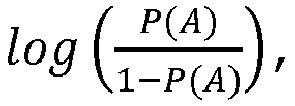
- a logarithm of the Bayes factor, log P A 1 ⁇ P A may be used to describe a measure of anomalousness of the device, where P ( A ) is the posterior probability or overall posterior probability.
- the measure of anomalousness of the device may be determined relative to a reference measure of anomalousness.
- the measure of anomalousness of the device may be attenuated above a given level.
- the distribution of the values of the metric may be modelled using extreme value theory.
- the distribution of the values of the metric may be modelled as a generalised Pareto, Gumbel or Fréchet distribution.
- the probabilities may be modelled using a peaks over thresholds method.
- the data associated with the device may comprise network traffic data of the computer system. Anomaly detection may be performed using a subset, M 1 ,..., M n ' , of the metrics, M 1 ,...,M n , where n' ⁇ n .
- the subset, M 1 ,..., M n ' , of the metrics, M 1 ,..., M n , where n' ⁇ n, may be chosen by removing values for which P ( M i > m i ) exceeds a threshold probability, where P ( M i > m i ) is the probability of M i > m i .
- the subset, M 1 ,..., M n ' , of the metrics, M 1 ,..., M n , where n' ⁇ n, may be chosen by removing values for which P ( M i ⁇ m i ) exceeds a threshold probability, where P ( M i ⁇ m i ) is the probability of M i ⁇ m i .
- ⁇ ( A ) and ⁇ ( N ) denote prior probabilities that the given value, m i , of the metric, M i , is the result of anomalous or normal behaviour of the device, respectively
- P ( M i ⁇ m i ) is the probability of M i ⁇ m i .
- P ⁇ ( i ) denotes P Z ⁇ i ⁇ z ⁇ i
- Z denotes the transformed variables, z 1 ..,z n , ⁇ denotes a permutation of the indexes i, ⁇ 1,..., n ⁇ , and ⁇ ( A ) and ⁇ ( N ) denote prior probabilities that the given value, m i , of the metric, M i , is the result of anomalous or normal behaviour of the device.
- the permutation of indexes i, ⁇ 1,..., n ⁇ , may maximise the value of P d ( A ) .
- the suitable quantile point may be the median.
- a method for use in detection of anomalous behaviour of a device of a computer system is provided.
- the method is arranged to be performed by a processing system, may comprise: deriving values, m 1 , ..., m N , of a metric, M , representative of data associated with the device; optionally modelling a distribution of the values; and further optionally determining, in accordance with the distribution of the values, the probability of a given value, m, being exceeded, P ( M > m ), wherein the probability is used to determine whether the device is behaving anomalously.
- a method for use in detection of anomalous behaviour of a device of a computer system may comprise: deriving values, m 1 ,..., m N , of a metric, M , representative of data associated with the device; optionally modelling a distribution of the values; and optionally determining, in accordance with the distribution of the values, the probability of observing a more extreme value than a given value, m , wherein the probability is used to determine whether the device is behaving anomalously; further optionally, wherein the probability of observing a more extreme value is the probability of observing a greater value than the given value, m , when the given value is greater than a suitable quantile point of the values, m 1 ,..., m N ; and/or wherein the probability of observing a more extreme value is the probability of observing a smaller value than the given value, m , when the given value is less than a suitable quantile point of the values, m
- the suitable quantile point may be the median, the 75% quartile or the 90% quartile.
- a computer readable medium comprising computer readable code operable, in use, to instruct a computer to perform any method disclosed herein.
- an anomalous behaviour detection system comprising a processor, and a memory comprising computer readable code operable, in use, to instruct the processor to perform any method disclosed herein.
- the suitable quantile point may be the median, the 25% quartile or the 10% quartile.
- Values may be considered to be extreme if they are unusually small or unusually large. Values may be considered to be unusually small if, for example, they fall far below a suitable quantile point. Values may be considered to be unusually large if they fall far above a suitable quantile point.
- An observation or given value m of some metric M may be considered to be extreme if either of the tail probabilities P M > m , P M ⁇ m are sufficiently small. Depending on the size of the network, sufficiently small may be if either of the tail probabilities are below some value in the range of 10 -2 to 10 -7 .
- the metrics are representative of data associated with a device of a computer system, such as a network of computers.
- the distribution is then used to calculate the survival probabilities of observations of values of the metric.
- the survival probability is the probability of observing a more extreme value than the observed value, for example, the probability of a large value being exceeded or vice versa.
- a probabilistic model of the device of the computer system is then described.
- a method of calculating the probability that the device is behaving abnormally is disclosed, wherein the probability is calculated in accordance with observed given values and the probabilistic model.
- a method of using copulas to describe the dependencies between metrics is described.
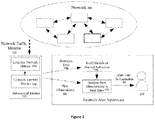
- Figure 1 illustrates a network of computer systems 100 using an anomalous behaviour detection system.
- the system depicted by Figure 1 is a simplified illustration which is provided for ease of explanation.
- the network 100 comprises a first computer system 10 within a building, which uses the anomalous behaviour detection system to detect anomalous behaviour and thereby attempt to prevent threats to computing devices within its bounds.
- the first computer system 10 comprises three computers 1, 2, 3, a local server 4, and a multifunctional device (MFD) 5 that provides printing, scanning and facsimile functionalities to each of the computers 1, 2, 3. All of the devices within the first computer system 10 are communicatively coupled via a Local Area Network 6. Consequently, all of the computers 1, 2, 3 are able to access the local server 4 via the LAN 6 and use the functionalities of the MFD 5 via the LAN 6.
- MFD multifunctional device
- the LAN 6 of the first computer system 10 is connected to the Internet 20, which in turn provides computers 1, 2, 3 with access to a multitude of other computing devices including server 30 and second computer system 40.
- Second computer system 40 also includes two computers 41, 42, connected by a second LAN 43.
- computer 1 on the first computer system 10 has the anomalous behaviour detection system and therefore runs the anomalous behaviour detection method for detecting anomalous behaviour of the first computer system.
- it comprises a processor arranged to run the steps of the process described herein, memory required to store information related to the running of the process, as well as a network interface for collecting the required information.
- the computer 1 builds and maintains a dynamic, ever-changing model of the 'normal behaviour' of each device within the system 10, based on the distribution of metrics.
- the approach is based on a Bayesian probabilistic model, described in more detail below, and monitors all interactions, events and communications within the system 10 - which computer is talking to which, files that have been created, networks that are being accessed.
- computer 2 is based in a company's San Francisco office and operated by a marketing employee who regularly accesses the marketing network, usually communicates with machines in the company's U.K. office in second computer system 40 between 9.30 a.m. and midday, and is active from about 8.30 a.m. until 6 p.m.
- the same employee virtually never accesses the employee time sheets, very rarely connects to the company's Atlanta network and has no dealings in South-East Asia.
- the anomalous behaviour detection system takes all the information that is available relating to this employee and establishes a 'pattern of life' for that person, which is dynamically updated as more information is gathered.
- the 'normal' model is used as a moving benchmark, allowing the system to spot behaviour of a device that seems to fall outside of this normal pattern, and flags this behaviour as anomalous, requiring further investigation.
- a network traffic monitor 110 extracts meta-data of packets moving across a network 100.
- behavioural metrics 120 Two different types may be computed: network metrics 130 and derived metrics 140. These are fed to the anomaly alert system 200.
- each individual behavioural metric may be analysed.
- a mathematical model of what is considered to be normal behaviour 170 for that metric is constructed for each device on the network from historical data.
- the third stage of the system comprises receiving new observations 160 and analysing the new observations of the activity of each network device in real time 180 to detect anomalous behaviour. This is done by first processing the new network activity measurement of each device to compute the values of the corresponding behavioural metrics. These values are then analysed to see how anomalous the value of each metric is. Finally the levels of anomalousness of the values of each behavioural metric of a device are combined to produce a measure of the overall anomalousness of the behaviour of each device. Network system administrators / security officers 210 may be sent alerts 190 about any device whose behaviour is determined to be sufficiently anomalous.
- the anomaly alert system consists of at least two innovations:
- the behavioural metrics are computed from data sampled by the network traffic monitoring system. As described above there are two types of metric, network metrics and derived metrics.
- the network metrics may include:
- the derived metrics are the results of anomaly detection algorithms applied to subsets of the network metrics.
- Anomaly detection algorithms may include:
- the network and derived metrics form the inputs of the threat alert system that is detailed in the remaining sections.
- the problem of detecting anomalous behaviour of network devices given the values of a collection of real valued metrics M 1 ,..., M n for each device is considered.
- the framework for anomaly detection is based on the idea that users of anomaly detection systems may be looking to be alerted to values of metrics that are extreme in some way. If the data is real valued then extreme must mean either unusually large or unusually small. Values may be considered to be unusually small if, for example, they fall far below a suitable quantile point. Values may be considered to be unusually large if they fall far above a suitable quantile point. It follows that an observation or given value m of some metric M is anomalous if either of the tail probabilities P M > m , P M ⁇ m are sufficiently small.
- Tail probabilities of the form P M > m may also be considered or alternatively can be incorporated by looking instead at the tail probability P ⁇ M > ⁇ m .
- tail probabilities of the form P ( M > m ) when an observation m is greater than a suitable quantile point of the value of the metric M
- tail probabilities of the form P ( M ⁇ m ) when an observation m is less than a suitable quantile point the value of the metric M .
- extreme values may be used for modelling the probabilities of events that lie far into the tails of a distribution, typically beyond the range of any empirical data.
- the exceedence probabilities of P can be described in the following manner.
- GPDs Generalised Pareto distributions
- Algorithm 1 Assume that Assumption 1 holds.
- the observation m may or may not have been used to model the distribution of m 1 ,..., m N . That is to say, m may or may not belong to m 1 ,..., m N . It may be preferable to model the tail probabilities (1) using a restricted set of the set of GPDs. In many cases one may want to assume that the probabilities P ( M > u ) belong to either the Gumbel or Fréchet family of distributions (equivalent to assuming that ⁇ ⁇ 0). Moreover when computing the distribution of the tail probabilities (1) it may be desirable to avoid having the estimates of the tail parameters skewed by any outliers in the observations. This may be done by either discarding a certain fraction of the largest observations or by employing some kind of M-estimator.
- This method is based on the following probabilistic model. Given an observation m of a metric M the behaviour that generated it can be either anomalous or normal. Let ⁇ ( N ) and ⁇ ( A ) denote the prior probabilities that the value m is the result of normal or anomalous behaviour respectively. Later, a method for selecting the values of the priors in the context of network anomaly detection is described. For the moment it will be assumed that they have been given sui generis.
- the posterior probability i.e. the the conditional probability that is assigned after the relevant evidence or background is taken into account, of the behaviour that generated the value of M being normal or anomalous respectively using Bayes theorem as follows.
- a P M A ⁇ A P E
- a ) denote the probabilities of the event E given that the generating behaviour is normal or anomalous respectively.
- a natural choice of event E may be the set of all possible behaviours such that the value of M is greater than the observed value m .
- a ) for some m ⁇ R can be thought of as the probability that M>m given the class of all possible models of anomalous behaviour.
- A ⁇ ⁇ p x > m ⁇ dp ⁇ ⁇ ⁇ dp
- ⁇ is the space of probability measures on and ⁇ is a positive measure defined on ⁇ . If ⁇ was a finite measure on ⁇ then it would follow that lim m ⁇ ⁇ P M > m
- A 0 which would imply that the anomaly model would fail to explain the full set of possible anomalies.
- (5) may define an improper probability distribution, i.e. a probability distribution whose cumulative distribution function F has the property that lim x ⁇ ⁇ ⁇ F x > 0 and / o r lim x ⁇ ⁇ ⁇ F x ⁇ 1.
- the tail probabilities P ( M > m ) can be computed using Algorithm 1.
- a network device d is behaving anomalously if and only if one or more of the observed values of the metrics M 1 ,..., M n (more specifically one or more of the underlying behaviours generating the values of these metrics) are anomalous.
- Definition 1 leads to an algorithm for computing the probability that a device is in an anomalous state.
- P d ( N ) and P d ( A ) denote the probabilities that it is in a normal or anomalous state respectively.
- P i M N and P i M A denote the probabilities that the behaviour generating the value of metric M is normal or anomalous respectively.
- P d N ⁇ P i M N
- P d A 1 ⁇ ⁇ P i M N
- the anomaly probabilities P i M A can all be computed using Algorithm 2.
- P d N ⁇ ⁇ N P M i > m i ⁇ N P M i > m i + ⁇ A
- P d A 1 ⁇ ⁇ ⁇ N P M i > m i ⁇ N P M i > m i + ⁇ A with the quantities P M i > m i estimated using the method detailed in Algorithm 1.
- the power of the copula method is that there are a wide range of parametric families of copulas which together provide users of copulas with a way of modelling a broad range of different statistical dependencies.
- a suitable choice of copula for modelling the dependencies between the exceedence probabilities of different behavioural metrics will now be given.
- a copula should be both effective at capturing dependencies and allow for efficient computation of the conditional probabilities (8).
- ⁇ is the cumulative distribution function of the standard univariate normal with mean zero and variance one
- ⁇ R is the cumulative distribution function of the multivariate normal distribution with standard normal marginals and correlation matrix R .
- Remark 1 Least squares models are known to be sensitive to outliers. The above procedure can be made robust by replacing the observations u ⁇ ,i with their ranks and then setting the transformed variables z ⁇ ,i to be the corresponding quantile points.
- (7) can then be computed by estimating the conditional probabilities (8) applied to the restricted set of observations ⁇ 1 ,..., ⁇ n' with P U ⁇ i ⁇ u ⁇ i
- Algorithm 7 Assume that one has a set of behavioural metrics M 1 ,..., M n and let ⁇ ( N ) and ⁇ ( A ) denote the prior probabilities that the behaviour generating the value of a metric M i is normal or anomalous respectively, P thresh denote the exceedence probability threshold, 0 ⁇ ⁇ ⁇ 1 denote the regularisation parameter and ⁇ > 0 the lasso penalty.
- R denote the estimate of the correlation matrix of the Gaussian copula that describes the dependencies of the exceedence probabilities P ( M i > m i ) computed in the model fitting step. Given observations m 1 ,..., m n
- Algorithm 8 Assume that one has a set of behavioural metrics M 1 ,..., M n and that the conditions of Assumption 1 hold.
- ⁇ ( N ) and ⁇ ( A ) denote the prior probabilities that the behaviour generating the value of a behavioural metric is normal or anomalous respectively
- P thresh denote the exceedence probability threshold
- 0 ⁇ ⁇ ⁇ 1 denote the regularisation parameter
- ⁇ > 0 the lasso penalty Assume that one has a set of behavioural metrics M 1 ,..., M n and that the conditions of Assumption 1 hold.
- R denote the estimate of the correlation matrix of the Gaussian copula that describes the dependencies of the exceedence probabilities P ( M i > m i ) computed in the model fitting part of the system. Given observations m 1 ,..., m n of the behavioural metrics M 1 ,..., M n
- the value of the Bayes factor is such that the corresponding posterior P ( A
- An increase of the Bayes factor by a factor of 10 will cause the value of the posterior to increase to roughly 0.999.
- an increase of the Bayes factor by a factor of 100 will cause the value of the posterior to increase to only approximately 0.9999.
- the larger the posterior probability the more difficult it is to differentiate between the significance of different alerts.
- the posterior probability of an entity being anomalous is determined by the quantity ⁇ A P E
- the level of anomalousness one needs to know the value of the prior probabilities.
- the user of an anomaly alert system does not need the absolute level of anomalousness of each event but instead wishes only to be able to identify those alerts which are most significant. It follows that what is important is the relative weight of evidence of any pair of events.
- the weight of evidence based method describes a way to give scores to events without ever having to compute or know the prior probabilities ⁇ ( N ) and ⁇ ( A ).
- Algorithm 9 Assume the conditions of Assumption 3 hold.
- Algorithm 10 Assume the conditions of Assumption 3 hold.
- the anomaly alert system consists of three main parts; a model fitting system, the anomaly detection system and a user alert system.
- R be the Gaussian copula correlation matrix computed by the model fitting part of the system. Given values m 1 ,..., m n of the behavioural metrics M 1 ,..., M n for a device d . These may be new observations 160.
- the various methods described above may be implemented by a computer program product.
- the computer program product may include computer code arranged to instruct a computer or an arrangement of computers to perform the functions of one or more of the various methods described above.
- the computer program and/or the code for performing such methods may be provided to an apparatus, such as a computer, on a computer readable medium or computer program product.
- the computer readable medium may be transitory or non-transitory.
- the computer readable medium could be, for example, an electronic, magnetic, optical, electromagnetic, infrared, or semiconductor system, or a propagation medium for data transmission, for example for downloading the code over the Internet.
- the computer readable medium could take the form of a physical computer readable medium such as semiconductor or solid state memory, magnetic tape, a removable computer diskette, a random access memory (RAM), a read-only memory (ROM), a rigid magnetic disc, and an optical disk, such as a CD-ROM, CD-R/W or DVD.
- a physical computer readable medium such as semiconductor or solid state memory, magnetic tape, a removable computer diskette, a random access memory (RAM), a read-only memory (ROM), a rigid magnetic disc, and an optical disk, such as a CD-ROM, CD-R/W or DVD.
- An apparatus such as a computer may be configured in accordance with such code to perform one or more processes in accordance with the various methods discussed herein.
- Such an apparatus may take the form of a data processing system.
- a data processing system may be a distributed system.
- such a data processing system may be distributed across a network.
Landscapes
- Engineering & Computer Science (AREA)
- Computer Security & Cryptography (AREA)
- Computer Hardware Design (AREA)
- General Engineering & Computer Science (AREA)
- Theoretical Computer Science (AREA)
- Software Systems (AREA)
- Signal Processing (AREA)
- Computer Networks & Wireless Communication (AREA)
- Computing Systems (AREA)
- Physics & Mathematics (AREA)
- General Physics & Mathematics (AREA)
- Data Exchanges In Wide-Area Networks (AREA)
- Complex Calculations (AREA)
Claims (12)
- Procédé destiné à être utilisé lors de la détection d'un comportement anormal d'un dispositif appartenant à un système informatique, le procédé étant agencé pour être réalisé par un système de traitement, le procédé comprenant :la déduction des valeurs, m1, ..., mN, d'une mesure, M, représentatives de données associées au dispositif,la modélisation d'une distribution des valeurs,la détermination, en fonction de la distribution des valeurs, d'une probabilité d'observation d'une valeur de la mesure plus extrême qu'une valeur donnée, m, de la mesure, la probabilité étant utilisée pour déterminer si le dispositif se comporte de manière anormale,la détermination, en fonction de la probabilité d'observation d'une valeur plus extrême et d'un modèle probabiliste du dispositif, d'une probabilité postérieure de la valeur donnée, m, représentant le résultat d'un comportement anormal du dispositif, la probabilité postérieure étant utilisée pour déterminer si le dispositif se comporte de manière anormale,la détermination de probabilités postérieures pour une ou plusieurs valeurs, mi, données d'une ou de plusieurs d'une pluralité de mesures, Mi, les mesures, Mi, étant représentatives de données associées au dispositif,en fonction des probabilités postérieures pour les valeurs données, mi, la détermination d'une probabilité globale postérieure du dispositif s'il se trouve dans un état anormal, la probabilité globale postérieure étant utilisée pour déterminer si le dispositif se comporte de manière anormale, etdans lequel les mesures, Mi, sont supposées être statistiquement dépendantes et où les dépendances statistiques sont modélisées en utilisant des copules.
- Procédé selon la revendication 1, dans lequel la probabilité d'observation d'une valeur plus extrême représente la probabilité d'observation d'une valeur supérieure à la valeur donnée, m, lorsque la valeur donnée est supérieure à un point de quantile approprié des valeurs, m1, ..., mN, et/ou
dans lequel la probabilité d'observation d'une valeur plus extrême représente la probabilité d'observation d'une valeur inférieure à la valeur donnée, m, lorsque la valeur donnée est inférieure à un point de quantile approprié des valeurs, m1, ..., mN. - Procédé selon la revendication 1, comprenant en outre le calcul de variables transformées, z1, ...,zn, les variables transformées étant telles que :


- Procédé selon la revendication 1, dans lequel le modèle probabiliste est un modèle Bayésien et dans lequel le logarithme du facteur de Bayes,
- Procédé selon la revendication 4, dans lequel la mesure d'anomalie du dispositif est déterminée par rapport à une mesure de référence d'anomalie, et elle est atténuée au-dessus d'un niveau donné.
- Procédé selon l'une quelconque des revendications précédentes, dans lequel la distribution des valeurs de la mesure est modélisée en utilisant une théorie des valeurs extrêmes, et/ou est modélisée sous forme d'une distribution généralisée de Pareto, Gumbel ou Fréchet, et/ou les probabilités sont modélisées en utilisant un procédé de dépassements de seuils.
- Procédé selon l'une quelconque des revendications précédentes, dans lequel une détection d'anomalie est réalisée en utilisant un sous-ensemble, M1, ..., Mn', des mesures, M1, ..., Mn, où n' ≤ n.
- Procédé selon la revendication 7, dans lequel le sous-ensemble, M1, ..., Mn, des mesures, M1, ..., Mn, où n' ≤ n est choisi en éliminant des valeurs pour lesquelles P(Mi > mi ) dépasse une probabilité de seuil, ou bien il est choisi en éliminant des valeurs pour lesquelles P(Mi < mi ) dépasse une probabilité de seuil, où P(Mi > mi ) représente la probabilité de Mi > mi et où P(Mi < mi ) représente la probabilité de Mi < mi.
- Procédé selon la revendication 1, dans lequel la probabilité postérieure de ce que la valeur donnée, m, de la mesure M représente le résultat d'un comportement anormal du dispositif, PM(A), est donnée par :

- Procédé selon la revendication 1, dans lequel la probabilité postérieure combinée de ce que le dispositif se trouve dans un état anormal, Pd(A), est donnée par :

- Procédé selon la revendication 4, dans lequel la probabilité postérieure combinée de ce que le dispositif se trouve dans un état anormal, Pd(A), est donnée par :


- Support pouvant être lu par ordinateur comprenant un code pouvant être lu par ordinateur qui peut être mis en oeuvre, en service, pour ordonner à un ordinateur de réaliser le procédé conforme à l'une quelconque des revendications précédentes.
Applications Claiming Priority (1)
| Application Number | Priority Date | Filing Date | Title |
|---|---|---|---|
| GB1602309.5A GB2547202B (en) | 2016-02-09 | 2016-02-09 | An anomaly alert system for cyber threat detection |
Publications (2)
| Publication Number | Publication Date |
|---|---|
| EP3206366A1 EP3206366A1 (fr) | 2017-08-16 |
| EP3206366B1 true EP3206366B1 (fr) | 2018-11-14 |
Family
ID=55642033
Family Applications (1)
| Application Number | Title | Priority Date | Filing Date |
|---|---|---|---|
| EP17155356.3A Active EP3206366B1 (fr) | 2016-02-09 | 2017-02-09 | Systeme d'alerte anomalie pour la detection des cyber-menaces |
Country Status (4)
| Country | Link |
|---|---|
| US (4) | US10701093B2 (fr) |
| EP (1) | EP3206366B1 (fr) |
| GB (1) | GB2547202B (fr) |
| IL (1) | IL250040B (fr) |
Cited By (2)
| Publication number | Priority date | Publication date | Assignee | Title |
|---|---|---|---|---|
| WO2022040725A1 (fr) * | 2020-08-25 | 2022-03-03 | Hyprfire Pty Ltd | Système et procédé destinés à détecter une anomalie |
| US20230019150A1 (en) * | 2019-09-26 | 2023-01-19 | Valeria SURIANO | Method for securing an electronic device |
Families Citing this family (79)
| Publication number | Priority date | Publication date | Assignee | Title |
|---|---|---|---|---|
| GB2529150B (en) | 2014-08-04 | 2022-03-30 | Darktrace Ltd | Cyber security |
| US9699205B2 (en) * | 2015-08-31 | 2017-07-04 | Splunk Inc. | Network security system |
| GB2547202B (en) | 2016-02-09 | 2022-04-20 | Darktrace Ltd | An anomaly alert system for cyber threat detection |
| US10749881B2 (en) * | 2017-06-29 | 2020-08-18 | Sap Se | Comparing unsupervised algorithms for anomaly detection |
| EP3652654B1 (fr) * | 2017-07-12 | 2025-08-27 | Visa International Service Association | Systèmes et procédés de génération de profils de comportement pour de nouvelles entités |
| CN107483251B (zh) * | 2017-08-22 | 2020-02-21 | 国网辽宁省电力有限公司辽阳供电公司 | 一种基于分布式探针监测的网络业务异常侦测方法 |
| US12063243B2 (en) | 2018-02-20 | 2024-08-13 | Darktrace Holdings Limited | Autonomous email report generator |
| US12549566B2 (en) | 2018-02-20 | 2026-02-10 | Darktrace Holdings Limited | Helper agent and system |
| US11463457B2 (en) | 2018-02-20 | 2022-10-04 | Darktrace Holdings Limited | Artificial intelligence (AI) based cyber threat analyst to support a cyber security appliance |
| US11477222B2 (en) | 2018-02-20 | 2022-10-18 | Darktrace Holdings Limited | Cyber threat defense system protecting email networks with machine learning models using a range of metadata from observed email communications |
| DK3528462T3 (da) | 2018-02-20 | 2024-02-26 | Darktrace Holdings Ltd | Fremgangsmåde til at dele en cybersikkerhedstrusselsanalyse og defensive forholdsregler i et fællesskab |
| US11277421B2 (en) * | 2018-02-20 | 2022-03-15 | Citrix Systems, Inc. | Systems and methods for detecting and thwarting attacks on an IT environment |
| US12463985B2 (en) | 2018-02-20 | 2025-11-04 | Darktrace Holdings Limited | Endpoint agent client sensors (cSENSORS) and associated infrastructures for extending network visibility in an artificial intelligence (AI) threat defense environment |
| US11924238B2 (en) | 2018-02-20 | 2024-03-05 | Darktrace Holdings Limited | Cyber threat defense system, components, and a method for using artificial intelligence models trained on a normal pattern of life for systems with unusual data sources |
| US11962552B2 (en) | 2018-02-20 | 2024-04-16 | Darktrace Holdings Limited | Endpoint agent extension of a machine learning cyber defense system for email |
| GB201810294D0 (en) | 2018-06-22 | 2018-08-08 | Senseon Tech Ltd | Cybe defence system |
| US11438357B2 (en) | 2018-06-22 | 2022-09-06 | Senseon Tech Ltd | Endpoint network sensor and related cybersecurity infrastructure |
| GB201812171D0 (en) | 2018-07-26 | 2018-09-12 | Senseon Tech Ltd | Cyber defence system |
| US11916953B2 (en) * | 2018-09-24 | 2024-02-27 | Cybereason, Inc. | Method and mechanism for detection of pass-the-hash attacks |
| EP3657364A1 (fr) * | 2018-11-20 | 2020-05-27 | Nagravision SA | Autorisation d'opérations pour des dispositifs dans un réseau |
| US10986121B2 (en) | 2019-01-24 | 2021-04-20 | Darktrace Limited | Multivariate network structure anomaly detector |
| US20220215144A1 (en) * | 2019-05-16 | 2022-07-07 | Nippon Telegraph And Telephone Corporation | Learning Apparatus, Learning Method and Learning Program |
| US11263104B2 (en) * | 2019-05-30 | 2022-03-01 | Micro Focus Llc | Mapping between raw anomaly scores and transformed anomaly scores |
| US11582246B2 (en) | 2019-08-02 | 2023-02-14 | Crowd Strike, Inc. | Advanced incident scoring |
| US11588832B2 (en) | 2019-08-02 | 2023-02-21 | Crowdstrike, Inc. | Malicious incident visualization |
| US11792210B2 (en) * | 2019-08-02 | 2023-10-17 | Crowdstrike, Inc. | Mapping unbounded incident scores to a fixed range |
| US11516237B2 (en) | 2019-08-02 | 2022-11-29 | Crowdstrike, Inc. | Visualization and control of remotely monitored hosts |
| US12034767B2 (en) | 2019-08-29 | 2024-07-09 | Darktrace Holdings Limited | Artificial intelligence adversary red team |
| US12526303B2 (en) | 2019-08-29 | 2026-01-13 | Darktrace Holdings Limited | Intelligent prioritization of assessment and remediation of common vulnerabilities and exposures for network nodes |
| US12574393B2 (en) | 2019-08-29 | 2026-03-10 | Darktrace Holdings Limited | Cyber security system utilizing interactions between detected and hypothesize cyber-incidents |
| JP7648353B2 (ja) | 2019-08-29 | 2025-03-18 | ダークトレース リミテッド | 電子メール用の機械学習サイバー防御システムのエンドポイント・エージェント拡張 |
| US11487880B2 (en) * | 2019-09-13 | 2022-11-01 | Microsoft Technology Licensing, Llc | Inferring security incidents from observational data |
| GB201915265D0 (en) | 2019-10-22 | 2019-12-04 | Senseon Tech Ltd | Anomaly detection |
| GB2590927A (en) * | 2020-01-07 | 2021-07-14 | British Telecomm | Network discovery and management |
| WO2021165257A1 (fr) | 2020-02-17 | 2021-08-26 | British Telecommunications Public Limited Company | Prévision de propagation de logiciels malveillants |
| US12526309B2 (en) * | 2020-02-17 | 2026-01-13 | British Telecommunications Public Limited Company | Real-time malware propagation forecasting |
| US11985142B2 (en) | 2020-02-28 | 2024-05-14 | Darktrace Holdings Limited | Method and system for determining and acting on a structured document cyber threat risk |
| US12069073B2 (en) | 2020-02-28 | 2024-08-20 | Darktrace Holdings Limited | Cyber threat defense system and method |
| US12603822B2 (en) | 2020-02-28 | 2026-04-14 | Darktrace Holdings Limited | Software as a service (SaaS) user interface (UI) for displaying user activities in an artificial intelligence (AI)-based cyber threat defense system |
| WO2021171093A1 (fr) | 2020-02-28 | 2021-09-02 | Darktrace, Inc. | Cybersécurité pour risque de factorisation de logiciel en tant que service |
| US12499218B2 (en) | 2020-04-03 | 2025-12-16 | British Telecommunications Public Limited Company | Malware protection based on final infection size |
| US12130908B2 (en) * | 2020-05-01 | 2024-10-29 | Forcepoint Llc | Progressive trigger data and detection model |
| US12615290B2 (en) * | 2020-05-18 | 2026-04-28 | Darktrace Holdings Limited | Cyber security for instant messaging across platforms |
| WO2021253003A1 (fr) * | 2020-06-12 | 2021-12-16 | Virginia Tech Intellectual Properties, Inc. | Détection de menace interne basée sur une preuve probabiliste et raisonnement |
| US11652832B2 (en) * | 2020-07-01 | 2023-05-16 | Vmware, Inc. | Automated identification of anomalous devices |
| US11601457B2 (en) | 2020-08-26 | 2023-03-07 | Bank Of America Corporation | Network traffic correlation engine |
| US11822618B2 (en) * | 2020-08-31 | 2023-11-21 | Dell Products L.P. | System and method for profiling for microsegmentation based on unique signature of a device |
| GB2602628B (en) | 2020-12-31 | 2023-03-29 | British Telecomm | Identifying Computer Systems for Malware Infection Mitigation |
| US11652843B1 (en) | 2020-12-31 | 2023-05-16 | Radware Ltd. | Quantile regression analysis method for detecting cyber attacks |
| EP4275153A4 (fr) | 2021-01-08 | 2024-06-05 | Darktrace Holdings Limited | Analyste basé sur l'intelligence artificielle en tant qu'évaluateur |
| AU2022205661A1 (en) | 2021-01-08 | 2023-07-20 | Darktrace Holdings Limited | User agent inference and active endpoint fingerprinting for encrypted connections |
| US20220239682A1 (en) * | 2021-01-28 | 2022-07-28 | Armis Security Ltd. | System and method for securing networks based on categorical feature dissimilarities |
| CN115134102B (zh) * | 2021-03-24 | 2024-08-27 | 北京字节跳动网络技术有限公司 | 异常访问检测方法、装置、存储介质及电子设备 |
| US20220382837A1 (en) * | 2021-05-27 | 2022-12-01 | EMC IP Holding Company LLC | Access Control Using User Behavior Profile and Storage System-Based Multi-Factor Authentication |
| WO2023283357A1 (fr) * | 2021-07-07 | 2023-01-12 | Darktrace, Inc. | Priorisation intelligente d'évaluation et de remédiation de vulnérabilités et d'expositions communes pour des nœuds de réseau |
| CN113554183B (zh) * | 2021-08-03 | 2022-05-13 | 同济大学 | 一种基于无监督机器学习算法的极值预测方法 |
| US12052274B2 (en) | 2021-09-23 | 2024-07-30 | Armis Security Ltd. | Techniques for enriching device profiles and mitigating cybersecurity threats using enriched device profiles |
| CN113949550B (zh) * | 2021-10-08 | 2022-09-09 | 东北大学 | 一种SDN环境下的DDoS攻击检测方法 |
| US12335293B2 (en) | 2021-11-01 | 2025-06-17 | Darktrace Holdings Limited | Capturing importance in a network using graph theory |
| US12556555B2 (en) | 2021-11-22 | 2026-02-17 | Darktrace Holdings Limited | Artificial intelligence based cybersecurity system monitoring telecommunications networks |
| KR102783148B1 (ko) | 2021-12-29 | 2025-03-19 | 한국전자통신연구원 | 심볼릭 공간에서의 네트워킹 행위 이상도 측정 기반 공격 탐지 장치 및 방법 |
| EP4490633A4 (fr) | 2022-03-07 | 2025-08-20 | Darktrace Holdings Ltd | Système pour détecter des courriers électroniques malveillants et des campagnes de courrier électronique |
| US12572846B2 (en) | 2022-03-22 | 2026-03-10 | Armis Security Ltd. | System and method for device attribute identification based on host configuration protocols |
| CN114866333B (zh) * | 2022-06-09 | 2023-06-30 | 中国平安财产保险股份有限公司 | 暴力破解请求的智能识别方法、装置、电子设备及介质 |
| US12487872B2 (en) | 2022-06-17 | 2025-12-02 | The Board Of Trustees Of The Leland Stanford Junior University | Systems and methods for anomaly detection in multi-modal data streams |
| US12531885B1 (en) * | 2022-06-20 | 2026-01-20 | ThetaRay Ltd. | System and method for identifying the cause of an undesirable event |
| US12470593B2 (en) | 2022-07-11 | 2025-11-11 | Armis Security Ltd. | Malicious lateral movement detection using remote system protocols |
| US12614404B2 (en) | 2022-07-22 | 2026-04-28 | Dell Products L.P. | Method and system for preprocessing digital documents for data extraction |
| US20240029002A1 (en) * | 2022-07-22 | 2024-01-25 | Dell Products L.P. | Method and system for identifying anomalies in compensation data |
| CN115277178B (zh) * | 2022-07-26 | 2024-08-23 | 上海卫道信息技术有限公司 | 基于企业网网络流量的异常监测方法、装置及存储介质 |
| CA3264314A1 (fr) * | 2022-08-08 | 2024-02-15 | Darktrace Holdings Limited | Moteur de restauration de cybersécurité |
| EP4569431A1 (fr) | 2022-09-16 | 2025-06-18 | Darktrace Holdings Limited | Générateur de bac à sable automatisé pour un exercice de cyberattaque sur un réseau mimétique dans un environnement en nuage |
| US12561477B2 (en) * | 2022-10-11 | 2026-02-24 | International Business Machines Corporation | Automated sparsity feature selection |
| US12348550B2 (en) * | 2022-11-15 | 2025-07-01 | At&T Intellectual Property Ii, L.P. | Predicting and using threat levels for cyber threats using data from public data sources |
| WO2024145597A1 (fr) * | 2022-12-30 | 2024-07-04 | Darktrace, Inc. | Système de cybersécurité à métriques en nuage améliorées |
| US20240283803A1 (en) * | 2023-02-16 | 2024-08-22 | Edgehawk Security Ltd. | System and method for detecting and mitigating data security attacks |
| US20240289441A1 (en) * | 2023-02-23 | 2024-08-29 | Dell Products L.P. | Service impairment isolation in information processing system environment |
| DE102024201665A1 (de) * | 2024-02-22 | 2025-08-28 | Robert Bosch Gesellschaft mit beschränkter Haftung | Verfahren und Vorrichtung zum Verarbeiten von mit einem Kommunikationssystem assoziierten Daten |
| CN119001591B (zh) * | 2024-10-24 | 2025-02-07 | 浙江腾飞电器有限公司 | 一种电表箱运行状态实时检测方法 |
Family Cites Families (123)
| Publication number | Priority date | Publication date | Assignee | Title |
|---|---|---|---|---|
| US6154844A (en) | 1996-11-08 | 2000-11-28 | Finjan Software, Ltd. | System and method for attaching a downloadable security profile to a downloadable |
| JP3591191B2 (ja) * | 1997-03-11 | 2004-11-17 | トヨタ自動車株式会社 | 検出手段異常判別装置 |
| US7418731B2 (en) | 1997-11-06 | 2008-08-26 | Finjan Software, Ltd. | Method and system for caching at secure gateways |
| US6671811B1 (en) | 1999-10-25 | 2003-12-30 | Visa Internation Service Association | Features generation for use in computer network intrusion detection |
| US7630986B1 (en) | 1999-10-27 | 2009-12-08 | Pinpoint, Incorporated | Secure data interchange |
| US7307999B1 (en) | 2001-02-16 | 2007-12-11 | Bbn Technologies Corp. | Systems and methods that identify normal traffic during network attacks |
| US20020186698A1 (en) | 2001-06-12 | 2002-12-12 | Glen Ceniza | System to map remote lan hosts to local IP addresses |
| US6907430B2 (en) | 2001-10-04 | 2005-06-14 | Booz-Allen Hamilton, Inc. | Method and system for assessing attacks on computer networks using Bayesian networks |
| US7448084B1 (en) * | 2002-01-25 | 2008-11-04 | The Trustees Of Columbia University In The City Of New York | System and methods for detecting intrusions in a computer system by monitoring operating system registry accesses |
| US7031884B1 (en) * | 2002-07-12 | 2006-04-18 | Netscout Systems, Inc. | System and method for analyzing data streams |
| US8046835B2 (en) | 2002-10-23 | 2011-10-25 | Frederick S. M. Herz | Distributed computer network security activity model SDI-SCAM |
| AU2003303250A1 (en) * | 2002-12-20 | 2004-07-14 | Accenture Global Services Gmbh | Quantification of operational risks |
| JP2004309998A (ja) | 2003-02-18 | 2004-11-04 | Nec Corp | 確率分布推定装置および異常行動検出装置,ならびにその確率分布推定方法および異常行動検出方法 |
| US6965968B1 (en) | 2003-02-27 | 2005-11-15 | Finjan Software Ltd. | Policy-based caching |
| US6950773B1 (en) * | 2004-02-10 | 2005-09-27 | Sun Microsystems, Inc. | Detecting thermal anomalies in computer systems based on correlations between instrumentation signals |
| US20060242706A1 (en) * | 2005-03-11 | 2006-10-26 | Ross Robert B | Methods and systems for evaluating and generating anomaly detectors |
| US7930752B2 (en) | 2005-11-18 | 2011-04-19 | Nexthink S.A. | Method for the detection and visualization of anomalous behaviors in a computer network |
| US7739211B2 (en) | 2006-11-08 | 2010-06-15 | 21St Century Technologies, Inc. | Dynamic SNA-based anomaly detection using unsupervised learning |
| WO2007142936A2 (fr) | 2006-05-30 | 2007-12-13 | Duke University | Prédiction de la récurrence de tumeurs cancéreuses pulmonaires |
| US7739082B2 (en) * | 2006-06-08 | 2010-06-15 | Battelle Memorial Institute | System and method for anomaly detection |
| US20080005137A1 (en) | 2006-06-29 | 2008-01-03 | Microsoft Corporation | Incrementally building aspect models |
| US7716011B2 (en) * | 2007-02-28 | 2010-05-11 | Microsoft Corporation | Strategies for identifying anomalies in time-series data |
| US8601575B2 (en) * | 2007-03-30 | 2013-12-03 | Ca, Inc. | Statistical method and system for network anomaly detection |
| US8028061B2 (en) * | 2007-10-18 | 2011-09-27 | Trendium, Inc. | Methods, systems, and computer program products extracting network behavioral metrics and tracking network behavioral changes |
| GB2456567B (en) * | 2008-01-18 | 2010-05-05 | Oxford Biosignals Ltd | Novelty detection |
| WO2009120083A1 (fr) | 2008-03-28 | 2009-10-01 | Nederlandse Organisatie Voor Toegepast-Natuurwetenschappelijk Onderzoek Tno | Remplissage automatisé de données de probabilités conditionnelles dans un appareil de support de décision qui utilise un réseau de croyance bayésien |
| US8312540B1 (en) | 2008-06-13 | 2012-11-13 | Juniper Networks, Inc. | System for slowing password attacks |
| CN101686235B (zh) | 2008-09-26 | 2013-04-24 | 北京神州绿盟信息安全科技股份有限公司 | 网络异常流量分析设备和方法 |
| US8069210B2 (en) | 2008-10-10 | 2011-11-29 | Microsoft Corporation | Graph based bot-user detection |
| JP2010122774A (ja) | 2008-11-18 | 2010-06-03 | Toshiba Storage Device Corp | 記憶装置、情報処理装置、情報処理システム |
| US20100235908A1 (en) | 2009-03-13 | 2010-09-16 | Silver Tail Systems | System and Method for Detection of a Change in Behavior in the Use of a Website Through Vector Analysis |
| US8356001B2 (en) | 2009-05-19 | 2013-01-15 | Xybersecure, Inc. | Systems and methods for application-level security |
| US20120137367A1 (en) | 2009-11-06 | 2012-05-31 | Cataphora, Inc. | Continuous anomaly detection based on behavior modeling and heterogeneous information analysis |
| US9866426B2 (en) | 2009-11-17 | 2018-01-09 | Hawk Network Defense, Inc. | Methods and apparatus for analyzing system events |
| US8725666B2 (en) | 2010-02-26 | 2014-05-13 | Lawrence Livermore National Security, Llc. | Information extraction system |
| US20120016633A1 (en) * | 2010-07-16 | 2012-01-19 | Andreas Wittenstein | System and method for automatic detection of anomalous recurrent behavior |
| US9032521B2 (en) | 2010-10-13 | 2015-05-12 | International Business Machines Corporation | Adaptive cyber-security analytics |
| US8874763B2 (en) * | 2010-11-05 | 2014-10-28 | At&T Intellectual Property I, L.P. | Methods, devices and computer program products for actionable alerting of malevolent network addresses based on generalized traffic anomaly analysis of IP address aggregates |
| US8966036B1 (en) | 2010-11-24 | 2015-02-24 | Google Inc. | Method and system for website user account management based on event transition matrixes |
| WO2012089902A1 (fr) | 2010-12-30 | 2012-07-05 | Nokia Corporation | Procédé, appareil et produit-programme informatique de regroupement d'images |
| US8621618B1 (en) * | 2011-02-07 | 2013-12-31 | Dell Products, Lp | System and method for assessing whether a communication contains an attack |
| US20120210388A1 (en) | 2011-02-10 | 2012-08-16 | Andrey Kolishchak | System and method for detecting or preventing data leakage using behavior profiling |
| US20120209575A1 (en) * | 2011-02-11 | 2012-08-16 | Ford Global Technologies, Llc | Method and System for Model Validation for Dynamic Systems Using Bayesian Principal Component Analysis |
| KR101747079B1 (ko) * | 2011-02-17 | 2017-06-14 | 세이블 네트웍스 인코포레이티드 | 하이 레이트 분산 서비스 거부(DDoS) 공격을 검출하고 완화하는 방법 및 시스템 |
| US9038172B2 (en) | 2011-05-06 | 2015-05-19 | The Penn State Research Foundation | Robust anomaly detection and regularized domain adaptation of classifiers with application to internet packet-flows |
| US8528088B2 (en) | 2011-05-26 | 2013-09-03 | At&T Intellectual Property I, L.P. | Modeling and outlier detection in threat management system data |
| US20140165207A1 (en) | 2011-07-26 | 2014-06-12 | Light Cyber Ltd. | Method for detecting anomaly action within a computer network |
| US8930295B2 (en) * | 2011-09-12 | 2015-01-06 | Stanley Victor CAMPBELL | Systems and methods for monitoring and analyzing transactions |
| US8793790B2 (en) | 2011-10-11 | 2014-07-29 | Honeywell International Inc. | System and method for insider threat detection |
| US20150052606A1 (en) | 2011-10-14 | 2015-02-19 | Telefonica, S.A. | Method and a system to detect malicious software |
| US9141914B2 (en) * | 2011-10-31 | 2015-09-22 | Hewlett-Packard Development Company, L.P. | System and method for ranking anomalies |
| US9106687B1 (en) | 2011-11-01 | 2015-08-11 | Symantec Corporation | Mechanism for profiling user and group accesses to content repository |
| US9349103B2 (en) * | 2012-01-09 | 2016-05-24 | DecisionQ Corporation | Application of machine learned Bayesian networks to detection of anomalies in complex systems |
| US9043905B1 (en) | 2012-01-23 | 2015-05-26 | Hrl Laboratories, Llc | System and method for insider threat detection |
| US9129108B2 (en) | 2012-01-31 | 2015-09-08 | International Business Machines Corporation | Systems, methods and computer programs providing impact mitigation of cyber-security failures |
| US9117076B2 (en) | 2012-03-14 | 2015-08-25 | Wintermute, Llc | System and method for detecting potential threats by monitoring user and system behavior associated with computer and network activity |
| US9185095B1 (en) | 2012-03-20 | 2015-11-10 | United Services Automobile Association (Usaa) | Behavioral profiling method and system to authenticate a user |
| US20130282331A1 (en) * | 2012-04-24 | 2013-10-24 | Ira Cohen | Detecting abnormal behavior |
| US9112895B1 (en) * | 2012-06-25 | 2015-08-18 | Emc Corporation | Anomaly detection system for enterprise network security |
| US8819803B1 (en) | 2012-06-29 | 2014-08-26 | Emc Corporation | Validating association of client devices with authenticated clients |
| CN104885427B (zh) | 2012-12-06 | 2018-03-30 | 波音公司 | 用于威胁检测的情景感知型网络安全监控 |
| US9679131B2 (en) | 2013-01-25 | 2017-06-13 | Cybereason Inc. | Method and apparatus for computer intrusion detection |
| US9904893B2 (en) * | 2013-04-02 | 2018-02-27 | Patternex, Inc. | Method and system for training a big data machine to defend |
| US9264442B2 (en) | 2013-04-26 | 2016-02-16 | Palo Alto Research Center Incorporated | Detecting anomalies in work practice data by combining multiple domains of information |
| US20140324409A1 (en) * | 2013-04-30 | 2014-10-30 | Hewlett-Packard Development Company, L.P. | Stochastic based determination |
| CN104424235B (zh) | 2013-08-26 | 2018-01-05 | 腾讯科技(深圳)有限公司 | 实现用户信息聚类的方法和装置 |
| US9558347B2 (en) | 2013-08-27 | 2017-01-31 | Globalfoundries Inc. | Detecting anomalous user behavior using generative models of user actions |
| US9401925B1 (en) | 2013-09-12 | 2016-07-26 | Symantec Corporation | Systems and methods for detecting security threats based on user profiles |
| JP5891213B2 (ja) * | 2013-09-18 | 2016-03-22 | ヤフー株式会社 | 事後確率算出装置、事後確率算出方法、およびプログラム |
| US9712548B2 (en) | 2013-10-27 | 2017-07-18 | Cyber-Ark Software Ltd. | Privileged analytics system |
| US9516039B1 (en) | 2013-11-12 | 2016-12-06 | EMC IP Holding Company LLC | Behavioral detection of suspicious host activities in an enterprise |
| US9753796B2 (en) | 2013-12-06 | 2017-09-05 | Lookout, Inc. | Distributed monitoring, evaluation, and response for multiple devices |
| US9361463B2 (en) * | 2013-12-11 | 2016-06-07 | Ut-Batelle, Llc | Detection of anomalous events |
| US10063654B2 (en) | 2013-12-13 | 2018-08-28 | Oracle International Corporation | Systems and methods for contextual and cross application threat detection and prediction in cloud applications |
| US9386034B2 (en) | 2013-12-17 | 2016-07-05 | Hoplite Industries, Inc. | Behavioral model based malware protection system and method |
| KR101501669B1 (ko) | 2013-12-24 | 2015-03-12 | 한국인터넷진흥원 | 비정상 행위를 탐지하기 위한 행위 탐지 시스템 |
| US20150207696A1 (en) * | 2014-01-23 | 2015-07-23 | Sodero Networks, Inc. | Predictive Anomaly Detection of Service Level Agreement in Multi-Subscriber IT Infrastructure |
| US10560469B2 (en) * | 2014-01-24 | 2020-02-11 | Hewlett Packard Enterprise Development Lp | Identifying deviations in data |
| GB2522926A (en) * | 2014-02-11 | 2015-08-12 | Ge Aviat Systems Ltd | Method of identifying anomalies |
| US20150039513A1 (en) | 2014-02-14 | 2015-02-05 | Brighterion, Inc. | User device profiling in transaction authentications |
| US20150253463A1 (en) * | 2014-03-04 | 2015-09-10 | Universiti Brunei Darussalam | Generating an Ensemble of Forecasting Models |
| US20160078365A1 (en) | 2014-03-21 | 2016-03-17 | Philippe Baumard | Autonomous detection of incongruous behaviors |
| US9589245B2 (en) | 2014-04-07 | 2017-03-07 | International Business Machines Corporation | Insider threat prediction |
| WO2015168203A1 (fr) | 2014-04-29 | 2015-11-05 | PEGRight, Inc. | Caractérisation de comportement d'utilisateur au moyen d'une analyse d'identité intelligente |
| US9503467B2 (en) | 2014-05-22 | 2016-11-22 | Accenture Global Services Limited | Network anomaly detection |
| US9984334B2 (en) | 2014-06-16 | 2018-05-29 | Mitsubishi Electric Research Laboratories, Inc. | Method for anomaly detection in time series data based on spectral partitioning |
| US9727723B1 (en) | 2014-06-18 | 2017-08-08 | EMC IP Holding Co. LLC | Recommendation system based approach in reducing false positives in anomaly detection |
| US9996444B2 (en) * | 2014-06-25 | 2018-06-12 | Vmware, Inc. | Automated methods and systems for calculating hard thresholds |
| US9705914B2 (en) * | 2014-07-23 | 2017-07-11 | Cisco Technology, Inc. | Signature creation for unknown attacks |
| GB2529150B (en) | 2014-08-04 | 2022-03-30 | Darktrace Ltd | Cyber security |
| US9848007B2 (en) * | 2014-08-29 | 2017-12-19 | Microsoft Technology Licensing, Llc | Anomalous event detection based on metrics pertaining to a production system |
| US20160062950A1 (en) * | 2014-09-03 | 2016-03-03 | Google Inc. | Systems and methods for anomaly detection and guided analysis using structural time-series models |
| US9462009B1 (en) * | 2014-09-30 | 2016-10-04 | Emc Corporation | Detecting risky domains |
| SG11201703164RA (en) * | 2014-10-21 | 2017-05-30 | Ironnet Cybersecurity Inc | Cybersecurity system |
| US9661010B2 (en) | 2014-11-21 | 2017-05-23 | Honeywell International Inc. | Security log mining devices, methods, and systems |
| US9866578B2 (en) | 2014-12-03 | 2018-01-09 | AlphaSix Corp. | System and method for network intrusion detection anomaly risk scoring |
| US9571512B2 (en) | 2014-12-15 | 2017-02-14 | Sophos Limited | Threat detection using endpoint variance |
| KR101621019B1 (ko) * | 2015-01-28 | 2016-05-13 | 한국인터넷진흥원 | 시계열 통계 기반 공격의심 이상징후를 탐지하기 위한 방법 |
| US20160241576A1 (en) * | 2015-02-13 | 2016-08-18 | Canon Kabushiki Kaisha | Detection of anomalous network activity |
| US20180027006A1 (en) | 2015-02-24 | 2018-01-25 | Cloudlock, Inc. | System and method for securing an enterprise computing environment |
| US9979606B2 (en) * | 2015-03-04 | 2018-05-22 | Qualcomm Incorporated | Behavioral analysis to automate direct and indirect local monitoring of internet of things device health |
| JP6313730B2 (ja) * | 2015-04-10 | 2018-04-18 | タタ コンサルタンシー サービシズ リミテッドTATA Consultancy Services Limited | 異常検出システムおよび方法 |
| WO2016177437A1 (fr) | 2015-05-05 | 2016-11-10 | Balabit S.A. | Procédé mis en œuvre par ordinateur permettant l'identification de menaces concernant la sécurité d'un système informatique, système lié au centre des opérations de sécurité et produit programme d'ordinateur |
| US20160359695A1 (en) * | 2015-06-04 | 2016-12-08 | Cisco Technology, Inc. | Network behavior data collection and analytics for anomaly detection |
| AU2016204068B2 (en) * | 2015-06-17 | 2017-02-16 | Accenture Global Services Limited | Data acceleration |
| US20170024660A1 (en) * | 2015-07-23 | 2017-01-26 | Qualcomm Incorporated | Methods and Systems for Using an Expectation-Maximization (EM) Machine Learning Framework for Behavior-Based Analysis of Device Behaviors |
| US9756067B2 (en) * | 2015-08-10 | 2017-09-05 | Accenture Global Services Limited | Network security |
| GB201515394D0 (en) * | 2015-08-28 | 2015-10-14 | Status Today Ltd | Predictive activity detection on a computer network |
| US20180248902A1 (en) * | 2015-08-28 | 2018-08-30 | Mircea DÃNILÃ-DUMITRESCU | Malicious activity detection on a computer network and network metadata normalisation |
| US9699205B2 (en) | 2015-08-31 | 2017-07-04 | Splunk Inc. | Network security system |
| US9641544B1 (en) | 2015-09-18 | 2017-05-02 | Palo Alto Networks, Inc. | Automated insider threat prevention |
| US20170083815A1 (en) * | 2015-09-18 | 2017-03-23 | Ca, Inc. | Current behavior evaluation with multiple process models |
| US10116674B2 (en) * | 2015-10-30 | 2018-10-30 | Citrix Systems, Inc. | Framework for explaining anomalies in accessing web applications |
| US11049004B1 (en) * | 2015-11-15 | 2021-06-29 | ThetaRay Ltd. | System and method for anomaly detection in dynamically evolving data using random neural network decomposition |
| US10375095B1 (en) * | 2015-11-20 | 2019-08-06 | Triad National Security, Llc | Modeling behavior in a network using event logs |
| US10581902B1 (en) * | 2015-11-30 | 2020-03-03 | F5 Networks, Inc. | Methods for mitigating distributed denial of service attacks and devices thereof |
| US10237194B2 (en) * | 2016-01-06 | 2019-03-19 | Futurewei Technologies, Inc. | Maximize network capacity policy with heavy-tailed traffic |
| GB2547202B (en) | 2016-02-09 | 2022-04-20 | Darktrace Ltd | An anomaly alert system for cyber threat detection |
| GB2547201B (en) | 2016-02-09 | 2022-08-31 | Darktrace Holdings Ltd | Cyber security |
| GB201603304D0 (en) | 2016-02-25 | 2016-04-13 | Darktrace Ltd | Cyber security |
| US20170270422A1 (en) | 2016-03-16 | 2017-09-21 | Canon Kabushiki Kaisha | Information processing apparatus, information processing method, and program |
| US10986121B2 (en) | 2019-01-24 | 2021-04-20 | Darktrace Limited | Multivariate network structure anomaly detector |
| US12069073B2 (en) | 2020-02-28 | 2024-08-20 | Darktrace Holdings Limited | Cyber threat defense system and method |
-
2016
- 2016-02-09 GB GB1602309.5A patent/GB2547202B/en active Active
-
2017
- 2017-01-10 IL IL250040A patent/IL250040B/en active IP Right Grant
- 2017-02-06 US US15/425,906 patent/US10701093B2/en active Active
- 2017-02-09 EP EP17155356.3A patent/EP3206366B1/fr active Active
-
2020
- 2020-05-19 US US16/878,347 patent/US11470103B2/en active Active
- 2020-12-29 US US17/137,193 patent/US12126636B2/en active Active
-
2024
- 2024-09-27 US US18/900,360 patent/US20250023897A1/en active Pending
Non-Patent Citations (1)
| Title |
|---|
| RYOHEI FUJIMAKI ET AL: "Online heterogeneous mixture modeling with marginal and copula selection", PROCEEDINGS OF THE 17TH ACM SIGKDD INTERNATIONAL CONFERENCE ON KNOWLEDGE DISCOVERY AND DATA MINING (KDD '11), 21-24 AUGUST 2011, SAN DIEGO, CA, USA, 21 August 2011 (2011-08-21), New York, USA, pages 645 - 653, XP055125805, ISBN: 978-1-45-030813-7, DOI: 10.1145/2020408.2020509 * |
Cited By (3)
| Publication number | Priority date | Publication date | Assignee | Title |
|---|---|---|---|---|
| US20230019150A1 (en) * | 2019-09-26 | 2023-01-19 | Valeria SURIANO | Method for securing an electronic device |
| WO2022040725A1 (fr) * | 2020-08-25 | 2022-03-03 | Hyprfire Pty Ltd | Système et procédé destinés à détecter une anomalie |
| US12513159B2 (en) | 2020-08-25 | 2025-12-30 | Hyprfire Pty Ltd | System for and method of detecting an anomaly |
Also Published As
| Publication number | Publication date |
|---|---|
| US11470103B2 (en) | 2022-10-11 |
| GB2547202B (en) | 2022-04-20 |
| US20200280575A1 (en) | 2020-09-03 |
| US20170230392A1 (en) | 2017-08-10 |
| EP3206366A1 (fr) | 2017-08-16 |
| US12126636B2 (en) | 2024-10-22 |
| IL250040B (en) | 2019-08-29 |
| GB201602309D0 (en) | 2016-03-23 |
| GB2547202A (en) | 2017-08-16 |
| IL250040A0 (en) | 2017-03-30 |
| US10701093B2 (en) | 2020-06-30 |
| US20250023897A1 (en) | 2025-01-16 |
| US20210120027A1 (en) | 2021-04-22 |
Similar Documents
| Publication | Publication Date | Title |
|---|---|---|
| US20250023897A1 (en) | Anomaly alert system for cyber threat detection | |
| US10305917B2 (en) | Graph-based intrusion detection using process traces | |
| EP3211854B1 (fr) | Cybersécurité | |
| US10296739B2 (en) | Event correlation based on confidence factor | |
| US11503054B2 (en) | Systems and methods for identifying access anomalies using network graphs | |
| US10986121B2 (en) | Multivariate network structure anomaly detector | |
| Simmross-Wattenberg et al. | Anomaly detection in network traffic based on statistical inference and\alpha-stable modeling | |
| EP3206153A1 (fr) | Cybersécurité | |
| Moore et al. | Internet traffic classification using bayesian analysis techniques | |
| EP2814218B1 (fr) | Détection d'anomalies dans des données d'exercice de travail par combinaison de multiples domaines d'informations | |
| Xu et al. | Cyber epidemic models with dependences | |
| US20190132343A1 (en) | Method and system for generating synthetic feature vectors from real, labelled feature vectors in artificial intelligence training of a big data machine to defend | |
| IL265849B (en) | System and method for improved anomaly detection using relationship graphs | |
| EP2908495A1 (fr) | Système et procédé de modélisation de changement de comportement et de la consistance pour détecter des intrusions malveillantes | |
| He et al. | Learning influence functions from incomplete observations | |
| CN103455842B (zh) | 贝叶斯算法和MapReduce相结合的信任度量方法 | |
| WO2017019391A1 (fr) | Détection d'intrusion orientée graphique au moyen de traces de traitements | |
| Jing et al. | [Retracted] Detection of DDoS Attack within Industrial IoT Devices Based on Clustering and Graph Structure Features | |
| US20210329026A1 (en) | Reconstructing missing complex networks against adversarial interventions | |
| Grana et al. | A likelihood ratio anomaly detector for identifying within-perimeter computer network attacks | |
| Lee et al. | ATMSim: An anomaly teletraffic detection measurement analysis simulator | |
| Rubin-Delanchy et al. | Disassortativity of computer networks | |
| Cheng et al. | Step: Spatial-temporal network security event prediction | |
| Zhang et al. | Pricing Cyber Risks Over Modern Networks via Bayesian Attack Graphs | |
| Miao et al. | A robust learning framework for smart grids in defense against false-data injection attacks |
Legal Events
| Date | Code | Title | Description |
|---|---|---|---|
| PUAI | Public reference made under article 153(3) epc to a published international application that has entered the european phase |
Free format text: ORIGINAL CODE: 0009012 |
|
| STAA | Information on the status of an ep patent application or granted ep patent |
Free format text: STATUS: THE APPLICATION HAS BEEN PUBLISHED |
|
| AK | Designated contracting states |
Kind code of ref document: A1 Designated state(s): AL AT BE BG CH CY CZ DE DK EE ES FI FR GB GR HR HU IE IS IT LI LT LU LV MC MK MT NL NO PL PT RO RS SE SI SK SM TR |
|
| AX | Request for extension of the european patent |
Extension state: BA ME |
|
| STAA | Information on the status of an ep patent application or granted ep patent |
Free format text: STATUS: REQUEST FOR EXAMINATION WAS MADE |
|
| 17P | Request for examination filed |
Effective date: 20180216 |
|
| RBV | Designated contracting states (corrected) |
Designated state(s): AL AT BE BG CH CY CZ DE DK EE ES FI FR GB GR HR HU IE IS IT LI LT LU LV MC MK MT NL NO PL PT RO RS SE SI SK SM TR |
|
| GRAP | Despatch of communication of intention to grant a patent |
Free format text: ORIGINAL CODE: EPIDOSNIGR1 |
|
| STAA | Information on the status of an ep patent application or granted ep patent |
Free format text: STATUS: GRANT OF PATENT IS INTENDED |
|
| INTG | Intention to grant announced |
Effective date: 20180530 |
|
| GRAS | Grant fee paid |
Free format text: ORIGINAL CODE: EPIDOSNIGR3 |
|
| GRAA | (expected) grant |
Free format text: ORIGINAL CODE: 0009210 |
|
| STAA | Information on the status of an ep patent application or granted ep patent |
Free format text: STATUS: THE PATENT HAS BEEN GRANTED |
|
| AK | Designated contracting states |
Kind code of ref document: B1 Designated state(s): AL AT BE BG CH CY CZ DE DK EE ES FI FR GB GR HR HU IE IS IT LI LT LU LV MC MK MT NL NO PL PT RO RS SE SI SK SM TR |
|
| REG | Reference to a national code |
Ref country code: CH Ref legal event code: EP Ref country code: AT Ref legal event code: REF Ref document number: 1066195 Country of ref document: AT Kind code of ref document: T Effective date: 20181115 |
|
| REG | Reference to a national code |
Ref country code: DE Ref legal event code: R096 Ref document number: 602017000868 Country of ref document: DE |
|
| REG | Reference to a national code |
Ref country code: IE Ref legal event code: FG4D |
|
| REG | Reference to a national code |
Ref country code: NL Ref legal event code: MP Effective date: 20181114 |
|
| REG | Reference to a national code |
Ref country code: LT Ref legal event code: MG4D |
|
| REG | Reference to a national code |
Ref country code: AT Ref legal event code: MK05 Ref document number: 1066195 Country of ref document: AT Kind code of ref document: T Effective date: 20181114 |
|
| PG25 | Lapsed in a contracting state [announced via postgrant information from national office to epo] |
Ref country code: FI Free format text: LAPSE BECAUSE OF FAILURE TO SUBMIT A TRANSLATION OF THE DESCRIPTION OR TO PAY THE FEE WITHIN THE PRESCRIBED TIME-LIMIT Effective date: 20181114 Ref country code: IS Free format text: LAPSE BECAUSE OF FAILURE TO SUBMIT A TRANSLATION OF THE DESCRIPTION OR TO PAY THE FEE WITHIN THE PRESCRIBED TIME-LIMIT Effective date: 20190314 Ref country code: NO Free format text: LAPSE BECAUSE OF FAILURE TO SUBMIT A TRANSLATION OF THE DESCRIPTION OR TO PAY THE FEE WITHIN THE PRESCRIBED TIME-LIMIT Effective date: 20190214 Ref country code: AT Free format text: LAPSE BECAUSE OF FAILURE TO SUBMIT A TRANSLATION OF THE DESCRIPTION OR TO PAY THE FEE WITHIN THE PRESCRIBED TIME-LIMIT Effective date: 20181114 Ref country code: LV Free format text: LAPSE BECAUSE OF FAILURE TO SUBMIT A TRANSLATION OF THE DESCRIPTION OR TO PAY THE FEE WITHIN THE PRESCRIBED TIME-LIMIT Effective date: 20181114 Ref country code: LT Free format text: LAPSE BECAUSE OF FAILURE TO SUBMIT A TRANSLATION OF THE DESCRIPTION OR TO PAY THE FEE WITHIN THE PRESCRIBED TIME-LIMIT Effective date: 20181114 Ref country code: ES Free format text: LAPSE BECAUSE OF FAILURE TO SUBMIT A TRANSLATION OF THE DESCRIPTION OR TO PAY THE FEE WITHIN THE PRESCRIBED TIME-LIMIT Effective date: 20181114 Ref country code: BG Free format text: LAPSE BECAUSE OF FAILURE TO SUBMIT A TRANSLATION OF THE DESCRIPTION OR TO PAY THE FEE WITHIN THE PRESCRIBED TIME-LIMIT Effective date: 20190214 Ref country code: HR Free format text: LAPSE BECAUSE OF FAILURE TO SUBMIT A TRANSLATION OF THE DESCRIPTION OR TO PAY THE FEE WITHIN THE PRESCRIBED TIME-LIMIT Effective date: 20181114 |
|
| PG25 | Lapsed in a contracting state [announced via postgrant information from national office to epo] |
Ref country code: AL Free format text: LAPSE BECAUSE OF FAILURE TO SUBMIT A TRANSLATION OF THE DESCRIPTION OR TO PAY THE FEE WITHIN THE PRESCRIBED TIME-LIMIT Effective date: 20181114 Ref country code: PT Free format text: LAPSE BECAUSE OF FAILURE TO SUBMIT A TRANSLATION OF THE DESCRIPTION OR TO PAY THE FEE WITHIN THE PRESCRIBED TIME-LIMIT Effective date: 20190314 Ref country code: SE Free format text: LAPSE BECAUSE OF FAILURE TO SUBMIT A TRANSLATION OF THE DESCRIPTION OR TO PAY THE FEE WITHIN THE PRESCRIBED TIME-LIMIT Effective date: 20181114 Ref country code: NL Free format text: LAPSE BECAUSE OF FAILURE TO SUBMIT A TRANSLATION OF THE DESCRIPTION OR TO PAY THE FEE WITHIN THE PRESCRIBED TIME-LIMIT Effective date: 20181114 Ref country code: RS Free format text: LAPSE BECAUSE OF FAILURE TO SUBMIT A TRANSLATION OF THE DESCRIPTION OR TO PAY THE FEE WITHIN THE PRESCRIBED TIME-LIMIT Effective date: 20181114 Ref country code: GR Free format text: LAPSE BECAUSE OF FAILURE TO SUBMIT A TRANSLATION OF THE DESCRIPTION OR TO PAY THE FEE WITHIN THE PRESCRIBED TIME-LIMIT Effective date: 20190215 |
|
| PG25 | Lapsed in a contracting state [announced via postgrant information from national office to epo] |
Ref country code: CZ Free format text: LAPSE BECAUSE OF FAILURE TO SUBMIT A TRANSLATION OF THE DESCRIPTION OR TO PAY THE FEE WITHIN THE PRESCRIBED TIME-LIMIT Effective date: 20181114 Ref country code: PL Free format text: LAPSE BECAUSE OF FAILURE TO SUBMIT A TRANSLATION OF THE DESCRIPTION OR TO PAY THE FEE WITHIN THE PRESCRIBED TIME-LIMIT Effective date: 20181114 Ref country code: DK Free format text: LAPSE BECAUSE OF FAILURE TO SUBMIT A TRANSLATION OF THE DESCRIPTION OR TO PAY THE FEE WITHIN THE PRESCRIBED TIME-LIMIT Effective date: 20181114 Ref country code: IT Free format text: LAPSE BECAUSE OF FAILURE TO SUBMIT A TRANSLATION OF THE DESCRIPTION OR TO PAY THE FEE WITHIN THE PRESCRIBED TIME-LIMIT Effective date: 20181114 |
|
| REG | Reference to a national code |
Ref country code: DE Ref legal event code: R097 Ref document number: 602017000868 Country of ref document: DE |
|
| PG25 | Lapsed in a contracting state [announced via postgrant information from national office to epo] |
Ref country code: EE Free format text: LAPSE BECAUSE OF FAILURE TO SUBMIT A TRANSLATION OF THE DESCRIPTION OR TO PAY THE FEE WITHIN THE PRESCRIBED TIME-LIMIT Effective date: 20181114 Ref country code: SM Free format text: LAPSE BECAUSE OF FAILURE TO SUBMIT A TRANSLATION OF THE DESCRIPTION OR TO PAY THE FEE WITHIN THE PRESCRIBED TIME-LIMIT Effective date: 20181114 Ref country code: RO Free format text: LAPSE BECAUSE OF FAILURE TO SUBMIT A TRANSLATION OF THE DESCRIPTION OR TO PAY THE FEE WITHIN THE PRESCRIBED TIME-LIMIT Effective date: 20181114 Ref country code: SK Free format text: LAPSE BECAUSE OF FAILURE TO SUBMIT A TRANSLATION OF THE DESCRIPTION OR TO PAY THE FEE WITHIN THE PRESCRIBED TIME-LIMIT Effective date: 20181114 |
|
| PLBE | No opposition filed within time limit |
Free format text: ORIGINAL CODE: 0009261 |
|
| STAA | Information on the status of an ep patent application or granted ep patent |
Free format text: STATUS: NO OPPOSITION FILED WITHIN TIME LIMIT |
|
| 26N | No opposition filed |
Effective date: 20190815 |
|
| PG25 | Lapsed in a contracting state [announced via postgrant information from national office to epo] |
Ref country code: MC Free format text: LAPSE BECAUSE OF FAILURE TO SUBMIT A TRANSLATION OF THE DESCRIPTION OR TO PAY THE FEE WITHIN THE PRESCRIBED TIME-LIMIT Effective date: 20181114 Ref country code: LU Free format text: LAPSE BECAUSE OF NON-PAYMENT OF DUE FEES Effective date: 20190209 Ref country code: SI Free format text: LAPSE BECAUSE OF FAILURE TO SUBMIT A TRANSLATION OF THE DESCRIPTION OR TO PAY THE FEE WITHIN THE PRESCRIBED TIME-LIMIT Effective date: 20181114 |
|
| REG | Reference to a national code |
Ref country code: BE Ref legal event code: MM Effective date: 20190228 |
|
| REG | Reference to a national code |
Ref country code: IE Ref legal event code: MM4A |
|
| PG25 | Lapsed in a contracting state [announced via postgrant information from national office to epo] |
Ref country code: IE Free format text: LAPSE BECAUSE OF NON-PAYMENT OF DUE FEES Effective date: 20190209 |
|
| PG25 | Lapsed in a contracting state [announced via postgrant information from national office to epo] |
Ref country code: BE Free format text: LAPSE BECAUSE OF NON-PAYMENT OF DUE FEES Effective date: 20190228 |
|
| PG25 | Lapsed in a contracting state [announced via postgrant information from national office to epo] |
Ref country code: TR Free format text: LAPSE BECAUSE OF FAILURE TO SUBMIT A TRANSLATION OF THE DESCRIPTION OR TO PAY THE FEE WITHIN THE PRESCRIBED TIME-LIMIT Effective date: 20181114 |
|
| PG25 | Lapsed in a contracting state [announced via postgrant information from national office to epo] |
Ref country code: MT Free format text: LAPSE BECAUSE OF NON-PAYMENT OF DUE FEES Effective date: 20190209 |
|
| REG | Reference to a national code |
Ref country code: CH Ref legal event code: PL |
|
| PG25 | Lapsed in a contracting state [announced via postgrant information from national office to epo] |
Ref country code: CH Free format text: LAPSE BECAUSE OF NON-PAYMENT OF DUE FEES Effective date: 20200229 Ref country code: LI Free format text: LAPSE BECAUSE OF NON-PAYMENT OF DUE FEES Effective date: 20200229 |
|
| PG25 | Lapsed in a contracting state [announced via postgrant information from national office to epo] |
Ref country code: CY Free format text: LAPSE BECAUSE OF FAILURE TO SUBMIT A TRANSLATION OF THE DESCRIPTION OR TO PAY THE FEE WITHIN THE PRESCRIBED TIME-LIMIT Effective date: 20181114 |
|
| PG25 | Lapsed in a contracting state [announced via postgrant information from national office to epo] |
Ref country code: HU Free format text: LAPSE BECAUSE OF FAILURE TO SUBMIT A TRANSLATION OF THE DESCRIPTION OR TO PAY THE FEE WITHIN THE PRESCRIBED TIME-LIMIT; INVALID AB INITIO Effective date: 20170209 |
|
| REG | Reference to a national code |
Ref country code: DE Ref legal event code: R079 Ref document number: 602017000868 Country of ref document: DE Free format text: PREVIOUS MAIN CLASS: H04L0029060000 Ipc: H04L0065000000 |
|
| REG | Reference to a national code |
Ref country code: DE Ref legal event code: R081 Ref document number: 602017000868 Country of ref document: DE Owner name: DARKTRACE HOLDINGS LIMITED, CAMBRIDGE, GB Free format text: FORMER OWNER: DARKTRACE LTD., CAMBRIDGE, CAMBRIDGESHIRE, GB |
|
| PG25 | Lapsed in a contracting state [announced via postgrant information from national office to epo] |
Ref country code: MK Free format text: LAPSE BECAUSE OF FAILURE TO SUBMIT A TRANSLATION OF THE DESCRIPTION OR TO PAY THE FEE WITHIN THE PRESCRIBED TIME-LIMIT Effective date: 20181114 |
|
| P01 | Opt-out of the competence of the unified patent court (upc) registered |
Effective date: 20230530 |
|
| PGFP | Annual fee paid to national office [announced via postgrant information from national office to epo] |
Ref country code: GB Payment date: 20251218 Year of fee payment: 10 |
|
| PGFP | Annual fee paid to national office [announced via postgrant information from national office to epo] |
Ref country code: FR Payment date: 20251128 Year of fee payment: 10 |
|
| PGFP | Annual fee paid to national office [announced via postgrant information from national office to epo] |
Ref country code: DE Payment date: 20251216 Year of fee payment: 10 |