EP3204776B1 - Verfahren zum personalisieren von patientenkrebstherapien mit einem mdm2-antagonist - Google Patents
Verfahren zum personalisieren von patientenkrebstherapien mit einem mdm2-antagonist Download PDFInfo
- Publication number
- EP3204776B1 EP3204776B1 EP15780808.0A EP15780808A EP3204776B1 EP 3204776 B1 EP3204776 B1 EP 3204776B1 EP 15780808 A EP15780808 A EP 15780808A EP 3204776 B1 EP3204776 B1 EP 3204776B1
- Authority
- EP
- European Patent Office
- Prior art keywords
- mdm2
- cancer
- patient
- gene
- cells
- Prior art date
- Legal status (The legal status is an assumption and is not a legal conclusion. Google has not performed a legal analysis and makes no representation as to the accuracy of the status listed.)
- Not-in-force
Links
- BCHADTMRSHWOPE-HLNVOFQHSA-N CC(C)(C)C[C@@H]([C@@]([C@H]1c2cccc(Cl)c2F)(c(ccc(Cl)c2)c2F)N)N[C@H]1C(Nc(ccc(C(O)=O)c1)c1OC)=O Chemical compound CC(C)(C)C[C@@H]([C@@]([C@H]1c2cccc(Cl)c2F)(c(ccc(Cl)c2)c2F)N)N[C@H]1C(Nc(ccc(C(O)=O)c1)c1OC)=O BCHADTMRSHWOPE-HLNVOFQHSA-N 0.000 description 1
- 0 CC(OC(c(cc1)cc(OC)c1NC([C@@]([C@]1c2cccc(Cl)c2F)N[C@@](CC(C)(C)C)[C@]1(C=NC)c(ccc(Cl)c1)c1F)=O)=O)OC(OCC*(C)OCC*(C)OC)=O Chemical compound CC(OC(c(cc1)cc(OC)c1NC([C@@]([C@]1c2cccc(Cl)c2F)N[C@@](CC(C)(C)C)[C@]1(C=NC)c(ccc(Cl)c1)c1F)=O)=O)OC(OCC*(C)OCC*(C)OC)=O 0.000 description 1
- UMSNGYQVIYOHED-BAJMHEOQSA-N C[C@@H]([C@](C)([C@H]1/C(/C=C\C=C)=C(/CCl)\F)N=C)N[C@H]1C(Nc(ccc(C(O)=O)c1)c1OC)=O Chemical compound C[C@@H]([C@](C)([C@H]1/C(/C=C\C=C)=C(/CCl)\F)N=C)N[C@H]1C(Nc(ccc(C(O)=O)c1)c1OC)=O UMSNGYQVIYOHED-BAJMHEOQSA-N 0.000 description 1
Images





Classifications
-
- G—PHYSICS
- G01—MEASURING; TESTING
- G01N—INVESTIGATING OR ANALYSING MATERIALS BY DETERMINING THEIR CHEMICAL OR PHYSICAL PROPERTIES
- G01N33/00—Investigating or analysing materials by specific methods not covered by groups G01N1/00 - G01N31/00
- G01N33/48—Biological material, e.g. blood, urine; Haemocytometers
- G01N33/50—Chemical analysis of biological material, e.g. blood, urine; Testing involving biospecific ligand binding methods; Immunological testing
- G01N33/53—Immunoassay; Biospecific binding assay; Materials therefor
- G01N33/575—Immunoassay; Biospecific binding assay; Materials therefor for cancer
- G01N33/57505—Immunoassay; Biospecific binding assay; Materials therefor for cancer of the blood, e.g. leukaemia
-
- A—HUMAN NECESSITIES
- A61—MEDICAL OR VETERINARY SCIENCE; HYGIENE
- A61K—PREPARATIONS FOR MEDICAL, DENTAL OR TOILETRY PURPOSES
- A61K31/00—Medicinal preparations containing organic active ingredients
- A61K31/33—Heterocyclic compounds
- A61K31/395—Heterocyclic compounds having nitrogen as a ring hetero atom, e.g. guanethidine or rifamycins
- A61K31/40—Heterocyclic compounds having nitrogen as a ring hetero atom, e.g. guanethidine or rifamycins having five-membered rings with one nitrogen as the only ring hetero atom, e.g. sulpiride, succinimide, tolmetin, buflomedil
-
- A—HUMAN NECESSITIES
- A61—MEDICAL OR VETERINARY SCIENCE; HYGIENE
- A61K—PREPARATIONS FOR MEDICAL, DENTAL OR TOILETRY PURPOSES
- A61K31/00—Medicinal preparations containing organic active ingredients
- A61K31/70—Carbohydrates; Sugars; Derivatives thereof
- A61K31/7028—Compounds having saccharide radicals attached to non-saccharide compounds by glycosidic linkages
- A61K31/7034—Compounds having saccharide radicals attached to non-saccharide compounds by glycosidic linkages attached to a carbocyclic compound, e.g. phloridzin
- A61K31/704—Compounds having saccharide radicals attached to non-saccharide compounds by glycosidic linkages attached to a carbocyclic compound, e.g. phloridzin attached to a condensed carbocyclic ring system, e.g. sennosides, thiocolchicosides, escin, daunorubicin
-
- A—HUMAN NECESSITIES
- A61—MEDICAL OR VETERINARY SCIENCE; HYGIENE
- A61K—PREPARATIONS FOR MEDICAL, DENTAL OR TOILETRY PURPOSES
- A61K31/00—Medicinal preparations containing organic active ingredients
- A61K31/70—Carbohydrates; Sugars; Derivatives thereof
- A61K31/7042—Compounds having saccharide radicals and heterocyclic rings
- A61K31/7052—Compounds having saccharide radicals and heterocyclic rings having nitrogen as a ring hetero atom, e.g. nucleosides, nucleotides
- A61K31/706—Compounds having saccharide radicals and heterocyclic rings having nitrogen as a ring hetero atom, e.g. nucleosides, nucleotides containing six-membered rings with nitrogen as a ring hetero atom
- A61K31/7064—Compounds having saccharide radicals and heterocyclic rings having nitrogen as a ring hetero atom, e.g. nucleosides, nucleotides containing six-membered rings with nitrogen as a ring hetero atom containing condensed or non-condensed pyrimidines
- A61K31/7068—Compounds having saccharide radicals and heterocyclic rings having nitrogen as a ring hetero atom, e.g. nucleosides, nucleotides containing six-membered rings with nitrogen as a ring hetero atom containing condensed or non-condensed pyrimidines having oxo groups directly attached to the pyrimidine ring, e.g. cytidine, cytidylic acid
-
- A—HUMAN NECESSITIES
- A61—MEDICAL OR VETERINARY SCIENCE; HYGIENE
- A61K—PREPARATIONS FOR MEDICAL, DENTAL OR TOILETRY PURPOSES
- A61K31/00—Medicinal preparations containing organic active ingredients
- A61K31/74—Synthetic polymeric materials
- A61K31/765—Polymers containing oxygen
- A61K31/77—Polymers containing oxygen of oxiranes
-
- A—HUMAN NECESSITIES
- A61—MEDICAL OR VETERINARY SCIENCE; HYGIENE
- A61K—PREPARATIONS FOR MEDICAL, DENTAL OR TOILETRY PURPOSES
- A61K45/00—Medicinal preparations containing active ingredients not provided for in groups A61K31/00 - A61K41/00
- A61K45/06—Mixtures of active ingredients without chemical characterisation, e.g. antiphlogistics and cardiaca
-
- A—HUMAN NECESSITIES
- A61—MEDICAL OR VETERINARY SCIENCE; HYGIENE
- A61P—SPECIFIC THERAPEUTIC ACTIVITY OF CHEMICAL COMPOUNDS OR MEDICINAL PREPARATIONS
- A61P35/00—Antineoplastic agents
-
- A—HUMAN NECESSITIES
- A61—MEDICAL OR VETERINARY SCIENCE; HYGIENE
- A61P—SPECIFIC THERAPEUTIC ACTIVITY OF CHEMICAL COMPOUNDS OR MEDICINAL PREPARATIONS
- A61P35/00—Antineoplastic agents
- A61P35/02—Antineoplastic agents specific for leukemia
-
- A—HUMAN NECESSITIES
- A61—MEDICAL OR VETERINARY SCIENCE; HYGIENE
- A61P—SPECIFIC THERAPEUTIC ACTIVITY OF CHEMICAL COMPOUNDS OR MEDICINAL PREPARATIONS
- A61P43/00—Drugs for specific purposes, not provided for in groups A61P1/00-A61P41/00
-
- G—PHYSICS
- G01—MEASURING; TESTING
- G01N—INVESTIGATING OR ANALYSING MATERIALS BY DETERMINING THEIR CHEMICAL OR PHYSICAL PROPERTIES
- G01N2333/00—Assays involving biological materials from specific organisms or of a specific nature
- G01N2333/435—Assays involving biological materials from specific organisms or of a specific nature from animals; from humans
- G01N2333/46—Assays involving biological materials from specific organisms or of a specific nature from animals; from humans from vertebrates
- G01N2333/47—Assays involving proteins of known structure or function as defined in the subgroups
- G01N2333/4701—Details
- G01N2333/4748—Details p53
-
- G—PHYSICS
- G01—MEASURING; TESTING
- G01N—INVESTIGATING OR ANALYSING MATERIALS BY DETERMINING THEIR CHEMICAL OR PHYSICAL PROPERTIES
- G01N2333/00—Assays involving biological materials from specific organisms or of a specific nature
- G01N2333/435—Assays involving biological materials from specific organisms or of a specific nature from animals; from humans
- G01N2333/705—Assays involving receptors, cell surface antigens or cell surface determinants
- G01N2333/70589—CD45
-
- G—PHYSICS
- G01—MEASURING; TESTING
- G01N—INVESTIGATING OR ANALYSING MATERIALS BY DETERMINING THEIR CHEMICAL OR PHYSICAL PROPERTIES
- G01N2800/00—Detection or diagnosis of diseases
- G01N2800/52—Predicting or monitoring the response to treatment, e.g. for selection of therapy based on assay results in personalised medicine; Prognosis
-
- G—PHYSICS
- G01—MEASURING; TESTING
- G01N—INVESTIGATING OR ANALYSING MATERIALS BY DETERMINING THEIR CHEMICAL OR PHYSICAL PROPERTIES
- G01N33/00—Investigating or analysing materials by specific methods not covered by groups G01N1/00 - G01N31/00
- G01N33/48—Biological material, e.g. blood, urine; Haemocytometers
- G01N33/483—Physical analysis of biological material
- G01N33/487—Physical analysis of biological material of liquid biological material
- G01N33/49—Blood
- G01N33/4915—Blood using flow cells
Definitions
- the TP53 gene encodes a tumor suppressor protein that plays a critical role in the protection during the development of cancers.
- P53 is crucial in multi-cellular organisms where it regulates cell cycle, and thus acts as a tumor suppressor that is involved in preventing cancer. Further, it is a transcription factor that regulates multiple genes involved in cell cycle control, such as apoptosis, DNA repair and senescence.
- MDM2 Murine Double Minute 2
- MDM2 protein binds to the TP53 protein and blocks its transactivation domain.
- MDM2 can also function as a p53 ubiquitin ligase, which marks p53 for ubiquitin dependent degradation.
- P53 In cells that overexpress MDM2, P53 is inactivated, leading to inefficient growth arrest and apoptosis. Blocking the P53--MDM2 interaction might restore P53 function and could be a novel approach to cancer treatment. Treatment of tumor cells with MDM2 antagonists should enable p53 to mediate its downstream functions, including activation of gene transcription and induction of cell cycle arrest and apoptosis.
- TP53 mutations are rare in Acute Myeloid Leukemia (AML) and are generally not considered to be of primary importance in the development of these malignancies.
- AML Acute Myeloid Leukemia
- MDM2 has been found to be frequently overexpressed in AML, and can enhance the tumorigenic potential and resistance to apoptosis through abrogation of p53 function. It has been found that AML cell lines and 16 primary aAML samples with wild-type p53 responded to MDM2 antagonist (inhibitor) by induction of p53-dependent apoptosis.
- biomarker based on the amount of certain MDM2 protein expressing stem cells could provide a means of selecting patients most likely to respond to MDM2 antagonist therapy.
- This method also has the potential to be combined with other biomarker assessments, including in particular the p53 mutation status, age and the ECOG performance status for algorithms with greater sensitivity and specificity in discriminating clinical endpoints.
- WO2011/127058 discloses different biomarkers to predict which leukemia patients are likely to benefit from MDM2 inhibitor therapy.
- the present invention provides an in vitro method for determining a cancer patient's response to treatment with an MDM2 inhibitor, characterized in that the higher the % MDM2 positve cells, detected in a sample obtained from that patient prior to treatment, the higher is the likelihood of said patient to reach a beneficial clinical endpoint, wherein the MDM2 positive (or MDM2 expressing) cells are selected from the group consisting of CD45dim blast cells, CD117+ (c-kit) and CD34+ stem cells, or combinations thereof, and wherein said MDM2 inhibitor is selected from the compounds: 4- ⁇ [2R,3S,4R,5S)-4-(4-Cholor-2-fluoro-phenyl)-3-(3-chloro-2-fluoro-phenyl)-4-cyano-5-(2,2-dimethyl-propyl)-pyrrolidine-2-carbonyl]-amino ⁇ -3-methoxy-benzoic acid of the formula (B) and 4- ⁇ [(2R,3S,4
- the present invention relates to a method for predicting the response of a patient having cancer to therapy, wherein the patients therapy comprises the treatment with a compound which acts as inhibitor of the MDM2-p53 interaction of formula (B) or (C) as disclosed herein, said method comprising the steps of:
- MDM2-inhibitors Compounds which act as inhibitor of the MDM2-p53 interaction (MDM2-inhibitors, MDM2-antagonists) are known in the art. MDM2-inhibitors and methods for making them are for example disclosed in U.S. Patent 8,354,444 B2 , as well as in WO 2007/063013 , WO 2010/031713 and WO 2011/098398 . Additional MDM2-inhibitors are disclosed in WO 2013/135648 .
- WO 2013/135648 discloses for example compounds of formula III
- the present invention relates to an in vitro method for predicting the response of a patient having cancer to therapy, wherein the patients therapy comprises the treatment with a compound which acts as inhibitor of the MDM2-p53 interaction (an "MDM2-inhibitor") as specifically disclosed in the working examples of U.S. Patent 8,354,444 B2 , or in WO 2013/135648 .
- MDM2-inhibitor a compound which acts as inhibitor of the MDM2-p53 interaction
- the present invention relates to an in vitro method for identifying sensitivity to MDM2 antagonist therapy.
- the present invention also relates to the use of CD45dim cells, CD117+ (c-kit) and/or CD34+ stem cells as predictive mechanism for determining the response of a patient suffering from cancer, more particularly acute myeloid leukemia (AML), to treatment with an MDM2-inhibitor as defined herein.
- CD45dim cells CD117+ (c-kit)
- CD34+ stem cells as predictive mechanism for determining the response of a patient suffering from cancer, more particularly acute myeloid leukemia (AML), to treatment with an MDM2-inhibitor as defined herein.
- the present invention also relates to any of the above methods for identifying sensitivity to MDM2 antagonist therapy, further comprising detecting a level of at least one gene selected from the group consisting of BAX, RPS27L, EDA2R, XPC, DDB2, FDXR, MDM2, CDKN1A, TRIAP1, BBC3, CCNG1, TNFRSF10B, or CDKN2A and combining that value with said relative amount of MDM2-protein expressing cells detected according any of the above methods, in order to obtain a combined score "S", and using that combined score "S" as a biomarker for predicting the patient's response to a compound, wherein the compound is an inhibitor of the MDM2-p53 interaction.
- the compound inhibiting the MDM2-p53 interaction for use in the method according to present invention is a compound as specifically disclosed in U.S. Patent 8,354,444 B2 , or in WO 2013/135648 .
- Reference compounds as MDM2-inhibitor for use in the method according to present invention is a compound of formula I wherein
- Reference compounds of formula I may have a stereochemical structure shown as formula II:
- MDM2-inhibitor for use in the method according to present invention is a compound of formula IIa wherein
- R 6 is -(CH 2 ) n -R'
- R' is phenyl, pyridinyl, pyrazinyl or pyrimidinyl which can be each unsubstituted or once or twice substituted with a substituent independently selected from halogen, C1-6 alkoxy, C1-6 alkyl, hydroxycarbonyl, carboxy, carboxy C1-6 alkoxy, oxo and CN; and n is 0.
- MDM2-inhibitor for use in the method according to present invention is a compound of formula III wherein
- Reference compounds of formula III are disclosed, wherein X is selected from H, F or Cl, Y is selected from H, F or Cl, R 1 is lower alkyl or substituted lower alkyl, R 3 is hydrogen or lower alkyl, R 5 is selected from the group consisting of lower alkyl, substituted lower alkyl, natural and unnatural amino acids, -(OCH 2 CH 2 ) n -OH, -(OCH 2 CH 2 ) n -OCH 3 , -(NCH 2 CH 2 ) n -OH,-(NCH 2 CH 2 ) n -OCH 3 , -(OCH 2 CH 2 ) n -OP(O)(OR 6 ) 2 , wherein n is from 3 to 60, preferably from 3 to 45, and R 6 is hydrogen; or a pharmaceutically acceptable salt thereof.
- X is selected from H, F or Cl
- Y is selected from H, F or Cl
- Z is C1-6 alkoxy
- R 1 is C1-6 alkyl
- R 2 is wherein
- a benzodioxyl group halogen, hydroxy, CN, CF 3 , NH 2 , N(H, lower-alkyl), N(lower-alkyl) 2 , aminocarbonyl, carboxy, NO 2 , lower-alkoxy, thio-lower-alkoxy, lower-alkylsufonyl, aminosulfonyl, lower-alkylcarbonyl, lower-alkylcarbonyloxy, lower-alkoxycarbonyl, lower-alkyl-carbonyl-NH, fluoro-lower-alkyl, fluoro-lower-alkoxy, lower-alkoxy-carbonyl-lower-alkoxy, carboxy-lower-alkoxy, carbamoyl-lower-alkoxy, hydroxy-lower-alkoxy, NH 2 -lower-alkoxy, N(H, lower-alkyl)-lower-alkoxy, N(lower-alkyl) 2 -
- Preferred substituents for the cycloalkyl, cycloalkenyl, aryl, heteroaryl and heterocycle rings are halogen, lower alkoxy, lower alkyl, hydroxycarbonyl, carboxy, carboxy lower alkoxy, oxo and CN.
- Preferred substituents for alkyl are alkoxy and N(lower alkyl) 2 .
- alkyl refers to straight- or branched-chain saturated hydrocarbon groups having from 1 to about 20 carbon atoms, including groups having from 1 to about 7 carbon atoms. In certain embodiments, alkyl substituents may be lower alkyl substituents.
- lower alkyl refers to alkyl groups having from 1 to 6 carbon atoms, and in certain embodiments from 1 to 4 carbon atoms. Examples of alkyl groups include, but are not limited to, methyl, ethyl, n-propyl, i-propyl, n-butyl, s-butyl, t-butyl, n-pentyl, and s-pentyl.
- cycloalkyl is intended to refer to any stable monocyclic or polycyclic system which consists of carbon atoms only, any ring of which being saturated
- cycloalkenyl is intended to refer to any stable monocyclic or polycyclic system which consists of carbon atoms only, with at least one ring thereof being partially unsaturated.
- cycloalkyls include, but are not limited to, cyclopropyl, cyclobutyl, cyclopentyl, cyclohexyl, cycloheptyl, adamantyl, cyclooctyl, bicycloalkyls, including bicyclooctanes such as [2.2.2]bicyclooctane or [3.3.0]bicyclooctane, bicyclononanes such as [4.3.0]bicyclononane, and bicyclodecanes such as [4.4.0]bicyclodecane (decalin), or spiro compounds.
- cycloalkenyls include, but are not limited to, cyclopentenyl or cyclohexenyl.
- alkenyl as used herein means an unsaturated straight-chain or branched aliphatic hydrocarbon group containing one double bond and having 2 to 6, preferably 2 to 4 carbon atoms.
- alkenyl group examples include vinyl ethenyl, allyl, isopropenyl, 1-propenyl, 2-methyl-1-propenyl, 1-butenyl, 2-butenyl, 3-butenyl, 2-ethyl-1-butenyl, 3-methyl-2-butenyl, 1-pentenyl, 2-pentenyl, 3-pentenyl, 4-pentenyl, 4-methyl-3-pentenyl, 1-hexenyl, 2-hexenyl, 3-hexenyl, 4-hexenyl and 5-hexenyl.
- alkynyl as used herein means an unsaturated straight-chain or branched aliphatic hydrocarbon group containing one triple bond and having 2 to 6, preferably 2 to 4 carbon atoms.
- alkynyl group examples include ethynyl, 1-propynyl, 2-propynyl, 1-butynyl, 2-butynyl, 3-butynyl, 1-pentynyl, 2-pentynyl, 3-pentynyl, 4-pentynyl, 1-hexynyl, 2-hexynyl, 3-hexynyl, 4-hexynyl and 5-hexynyl.
- halogen as used in the definitions means fluorine, chlorine, bromine, or iodine, preferably fluorine and chlorine.
- Aryl means a monovalent, monocyclic or bicyclic, aromatic carbocyclic hydrocarbon radical, preferably a 6-10 member aromatic ring system.
- Preferred aryl groups include, but are not limited to, phenyl, naphthyl, tolyl, and xylyl. Where the aryl group is bicyclic a preferred group is 1,3-dioxo-2,3-dihydro-1H-isoindol-5-yl group.
- Heteroaryl means an aromatic heterocyclic ring system containing up to two rings.
- Preferred heteroaryl groups include, but are not limited to, thienyl, furyl, indolyl, pyrrolyl, pyridinyl, pyrazinyl, oxazolyl, thiaxolyl, quinolinyl, pyrimidinyl, imidazole substituted or unsubstituted triazolyl and substituted or unsubstituted tetrazolyl.
- aryl or heteroaryl which are bicyclic it should be understood that one ring may be aryl while the other is heteroaryl and both being substituted or unsubstituted.
- Heterocycle or “heterocyclic ring”means a substituted or unsubstituted 5 to 8 membered, mono- or bicyclic, non-aromatic hydrocarbon, wherein 1 to 3 carbon atoms are replaced by a hetero atom selected from nitrogen, oxygen or sulfur atom. Examples include pyrrolidin-2-yl; pyrrolidin-3-yl; piperidinyl; morpholin-4-yl and the like which in turn can be substituted. "Hetero atom” means an atom selected from N, O and S.
- Alkoxy, alkoxyl or lower alkoxy refers to any of the above lower alkyl groups attached to an oxygen atom.
- Typical lower alkoxy groups include methoxy, ethoxy, isopropoxy or propoxy, butyloxy and the like.
- Further included within the meaning of alkoxy are multiple alkoxy side chains, e.g. ethoxy ethoxy, methoxy ethoxy, methoxy ethoxy ethoxy and the like and substituted alkoxy side chains, e.g., dimethylamino ethoxy, diethylamino ethoxy, dimethoxy-phosphoryl methoxy and the like.
- mPEG methoxy polyethylene glycol, which is commercially available (e.g. Sigma-Aldrich or ID Biochem (Korea)).
- the molecular weight distribution of mPEG may vary according to the manufacturer and/or batch. In one embodiment of the present invention, mPEG has an average molecular weight (MW) of about 1500 Da to about 3000 Da. In another embodiment of the present invention mPEG has an average MW of about 2000 Da and about 2200 Da. Average MW is determined by MALDI-TOF mass spectrometry.
- “Pharmaceutically acceptable salt” refers to conventional acid-addition salts or base-addition salts that retain the biological effectiveness and properties of the compounds of the present invention and are formed from suitable non-toxic organic or inorganic acids or organic or inorganic bases.
- Sample acid-addition salts include those derived from inorganic acids such as hydrochloric acid, hydrobromic acid, hydroiodic acid, sulfuric acid, sulfamic acid, phosphoric acid and nitric acid, and those derived from organic acids such as p-toluenesulfonic acid, salicylic acid, methanesulfonic acid, oxalic acid, succinic acid, citric acid, malic acid, lactic acid, fumaric acid, trifluoro acetic acid and the like.
- Sample base-addition salts include those derived from ammonium, potassium, sodium and, quaternary ammonium hydroxides, such as for example, tetramethylammonium hydroxide.
- Chemical modification of a pharmaceutical compound (i.e. drug) into a salt is a technique well known to pharmaceutical chemists to obtain improved physical and chemical stability, hygroscopicity, flowability and solubility of compounds. See, e.g., Ansel et al., Pharmaceutical Dosage Forms and Drug Delivery Systems (6th Ed. 1995) at pp. 196 and 1456- 1457 .
- ECOG scale or ECOG performance status means a parameter or criteria developed by scientists and physicians to assess how a patient's disease (cancer) is progressing and affects the daily living abilities of said partient.
- the scale was developed by the Eastern Cooperative Oncology Group (ECOG) and is well known to a person of skill in the art. For details see e.g. Oken, M.M. et al, Am. J. Clin. Oncol., 1982, 649-655 .
- a specific reference MDM2-inhibitor in accordance with the present invention is the compound of formula (A), also designated as Compound A (RG7112) This compound and methods of making it are for example disclosed in WO 2007/063013 .
- an MDM2-inhibitor for use in the method according to present invention is 4- ⁇ [(2R,3S,4R,5S)-4-(4-Chloro-2-fluoro-phenyl)-3-(3-chloro-2-fluorophenyl)-4-cyano-5-(2,2-dimethyl-propyl)-pyrrolidine-2-carbonyl]-amino ⁇ -3-methoxy-benzoic acid of the formula (B)
- This compound and methods for making it are for example disclosed in WO 2011/098398 .
- Another specific reference compound in accordance with the present invention is 2-((1-(4-((2R,3S,4R,5S)-3-(3-Chloro-2-fluorophenyl)-4-(4-chloro-2-fluorophenyl)-4-cyano-5-neopentylpyrrolidine-2-carboxamido)-3-methoxybenzoyloxy)ethoxy)carbonylamino)acetic acid.
- Another specific reference compound in accordance with the present invention is 2-(((4-((2R,3S,4R,5S)-3-(3-Chloro-2-fluorophenyl)-4-(4-chloro-2-fluorophenyl)-4-cyano-5-neopentylpyrrolidine-2-carboxamido)-3-methoxybenzoyloxy)methoxy)-carbonylamino)acetic acid.
- a further reference compound in accordance with the present invention is 3-Oxo-2,4,7,10,13,16,19-heptaoxaicosyl 4-((2R,3S,4R,5S)-3-(3-chloro-2-fluorophenyl)-4-(4-chloro-2-fluorophenyl)-4-cyano-5-neopentylpyrrolidine-2-carboxamido)-3-methoxybenzoate.
- a specific compound in accordance with the present invention is 4- ⁇ [(2R,3S,4R,5S)-3-(3-Chloro-2-fluoro-phenyl)-4-(4-chloro-2-fluoro-phenyl)-4-cyano-5-(2,2-dimethyl-propyl)-pyrrolidine-2-carbonyl]-amino ⁇ -3-methoxy-benzoic acid 1-mPEG-carbonyloxy-ethyl ester (mPEG, average MW, ⁇ 2000).
- a specific compound in accordance with the present invention is 4- ⁇ [(2R,3S,4R,5S)-3-(3-Chloro-2-fluoro-phenyl)-4-(4-chloro-2-fluoro-phenyl)-4-cyano-5-(2,2-dimethyl-propyl)-pyrrolidine-2-carbonyl]-amino ⁇ -3-methoxy-benzoic acid 1-mPEG-carbonyloxy-ethyl ester (mPEG, average MW, ⁇ 2200)
- a specific reference compound in accordance with the present invention is 4- ⁇ [(2R,3S,4R,5S)-3-(3-Chloro-2-fluoro-phenyl)-4-(4-chloro-2-fluoro-phenyl)-4-cyano-5-(2,2-dimethyl-propyl)-pyrrolidine-2-carbonyl]-amino ⁇ -3-methoxy-benzoic acid 1-mPEG-carbonyloxy-methyl ester (mPEG, average MW, ⁇ 2000).
- a specific reference compound in accordance with the present invention is 3-Oxo-2,4,7,10,13-pentaoxatetradecyl 4-((2R,3S,4R,5S)-3-(3-chloro-2-fluorophenyl)-4-(4-chloro-2-fluorophenyl)-4-cyano-5-neopentylpyrrolidine-2-carboxamido)-3-methoxybenzoate;
- a specific reference compound in accordance with the present invention is 27-Oxo-2,5,8,11,14,17,20,23,26,28-decaoxatriacontan-29-yl 4-((2R,3S,4R,5S)-3-(3-chloro-2-fluorophenyl)-4-(4-chloro-2-fluorophenyl)-4-cyano-5-neopentylpyrrolidine-2-carboxamido)-3-methoxybenzoate.
- a specific reference compound in accordance with the present invention is 4- ⁇ [(2R,3S,4R,5S)-3-(3-Chloro-2-fluoro-phenyl)-4-(4-chloro-2-fluoro-phenyl)-4-cyano-5-(2,2-dimethyl-propyl)-pyrrolidine-2-carbonyl]-amino ⁇ -3-methoxy-benzoic acid 1-[(2R,3R,4R,5S)-2-((R)-1,2-dihydroxy-ethyl)-4,5-dihydroxy-tetrahydro-furan-3-yloxycarbonyloxy]-ethyl ester.
- Another specific reference compound in accordance with the present invention is 4- ⁇ [(2R,3S,4R,5S)-3-(3-Chloro-2-fluoro-phenyl)-4-(4-chloro-2-fluoro-phenyl)-4-cyano-5-(2,2-dimethyl-propyl)-pyrrolidine-2-carbonyl]-amino ⁇ -3-methoxy-benzoic acid 1-(2- ⁇ 2-[2-(2-dibenzyloxyphosphoryloxy-ethoxy)-ethoxy] -ethoxy ⁇ -ethoxycarbonyloxy)-ethyl ester.
- a specific reference compound in accordance with the present invention is 4- ⁇ [(2R,3S,4R,5S)-3-(3-Chloro-2-fluoro-phenyl)-4-(4-chloro-2-fluoro-phenyl)-4-cyano-5-(2,2-dimethyl-propyl)-pyrrolidine-2-carbonyl]-amino ⁇ -3-methoxy-benzoic acid 1-(2- ⁇ 2-[2-(2-phosphonooxy-ethoxy)-ethoxy]-ethoxy ⁇ -ethoxycarbonyloxy)-ethyl ester.
- a specific compound in accordance with the present invention is 4- ⁇ [(2R,3S,4R,5S)-3-(3-Chloro-2-fluoro-phenyl)-4-(4-chloro-2-fluoro-phenyl)-4-cyano-5-(2,2-dimethyl-propyl)-pyrrolidine-2-carbonyl]-amino ⁇ -3-methoxy-benzoic acid 1-mPEG-carbonyloxy-ethyl ester (mPEG, average MW, ⁇ 2000) of formula (C)
- mPEG-carbonyloxy-ethyl ester mPEG, average MW, ⁇ 2000
- a specific compound in accordance with the present invention is 4- ⁇ [(2R,3S,4R,5S)-3-(3-Chloro-2-fluoro-phenyl)-4-(4-chloro-2-fluoro-phenyl)-4-cyano-5-(2,2-dimethyl-propyl)-pyrrolidine-2-carbonyl]-amino ⁇ -3-methoxy-benzoic acid 1-mPEG-carbonyloxy-ethyl ester (mPEG, average MW, ⁇ 2200) of formula (D)
- mPEG-carbonyloxy-ethyl ester mPEG, average MW, ⁇ 2200
- a method to predict responsiveness of a patient, with cancer, to a therapy comprising detecting the relative amount of one or several MDM2 protein expressing cell types in a sample obtained from said cancer patient prior to treatment (at baseline), and using said relative amount, or percentage (%) of cells expressing MDM2 protein, as a biomarker for predicting said patient's response to treatment with a medicament, wherein the medicament comprises a compound acting as inhibitor of the MDM2-p53 interaction, as defined herein, and wherein said MDM2 protein expressing cell type, or biomarker, is selected from the group consisting of CD45dim cells, CD117+ (c-kit) and/or CD34+ stem cells, or combinational subsets thereof.
- the method in accordance with the present invention is an in vitro method.
- the relative amount (%) of each of the MDM2 expressing cell types selected from CD45dim cells, CD117+ (c-kit) and CD34+ stem cells can be used as biomarker for predicting said patient's response to treatment with said MDM2-inhibitor.
- combinational subsets of said cell types can also be used.
- preferred subsets are i) relative amount (%) of MDM2 positive CD117+ (c-kit) and CD45dim cells; or ii) relative amount (%) of MDM2 positive CD34+ and CD45dim cells; or iii) relative amount (%) of MDM2 positive CD34+ and CD117+ and CD45dim cells; or iv) relative amount (%) of MDM2 positive CD45dim cells.
- the present invention provids a method to predict responsiveness of a patient, with cancer, to a therapy, said method comprising detecting the relative amount of at least CD45dim (blast) cells in a sample obtained from said cancer patient prior to treatment (at baseline), and using said relative amount, or percentage (%) of CD45dim (blast) cells expressing MDM2 protein, as a biomarker for predicting said patient's response to treatment with a medicament, wherein the medicament comprises a compound acting as inhibitor of the MDM2-p53 interaction, as defined herein.
- the "amount” is a relative amount indicated in percent (%) of MDM2 expressing cells of a given type, such as e.g.
- CD45dim, CD34+ or CD117+ among all cells of that same type detected in the sample obtained from said cancer patient prior to treatment (at baseline). Detection of cells can be carried out by any means known to the skilled artisan, preferably by flow cytometry.
- the present method is a continuous variable measurement.
- the present method is based on a multivariate approach, thus considering one or several sets of variables.
- the subsets of MDM2 expressing cells as defined in para [00050] above are preferred variables.
- the multivariate approach according to the present invention additionally comprises the patient's age and/or ECOG score as additional variats.
- the basic principle of multivariate analysis for stratifying patients into groups representing an expected treatment outcome is well known to the person of skill in the art, such as e.g. a clinical oncologist. It is one object of the present invention to define the relative amount of certain MDM2 expressing cells and subsets as defined herein (see e.g. para [00050]) alone or together with the patient's age and/or ECOG score as variants in said analysis.
- the present invention identifies a threshold (or cut-off) value or set of values, such as for example a range, characterized by the amount of MDM2 protein expressing CD45dim (Blast) cells based on clinical data (Study No. NP28679, Part 1 and 2) that identify patients most likely to respond to MDM2 antagonist therapy.
- the amount is a relative amount indicated in percent (%) of MDM2 expressing cells among all CD45 dim blast cells.
- the amount is preferably detected by flow cytometry, and is characterized by at least 45%, preferably at least 50% MDM2 protein expressing CD45dim (Blast) cells.
- MDM2 protein expressing CD45dim (Blast) cells above those levels are most likely to respond to treatment with an MDM2 inhibitor (MDM2 antagonist), i.e. to reach a beneficial clinical endpoint.
- MDM2 antagonist MDM2 inhibitor
- the term "response” is further defined herein.
- the relative amount of said MDM2 expressing CD45dim blast cells is measured in a sample obtained from a cancer patient prior to treatment, and therefore has the potential to serve as a prognostic and/or predictive biomarker for the treatment of said cancer patient with an MDM2 inhibitor as defined herein.
- the threshold value for the specific subsets of cells as defined under i) to iv) in para [00050] above is 10%; or 15% or 20%.
- Patients with a relative amount of MDM2 protein expressing cells above those levels are most likely to respond to treatment with an MDM2 inhibitor (MDM2 antagonist), i.e. to reach a beneficial clinical endpoint.
- the cancer is selected from the group consisting of breast cancer, prostate cancer, cervical cancer, ovarian cancer, gastric cancer, colorectal cancer (i.e. including colon cancer and rectal cancer), pancreatic cancer, liver cancer, brain cancer, neuroendocrine cancer, lung cancer, kidney cancer, hematological malignancies, melanoma and sarcomas.
- the cancer is selected from the group consisting of hematological malignancies, including leukemias, lymphomas, and multiple myeloma.
- the cancer is acute myeloid leukemia (AML), or Myelodysplatic Syndrome (MDS), or Myeloproliferative Neoplams (MPN).
- response means meeting any clinical endpoint.
- the clinical endpoint is beneficial for the patient, when for example compared to placebo or standard of care.
- clinical endpoint, or response as used herein means Overall Survival (OS), Progression Free Survival (PFS) or Event Free Survival (EFS).
- response means Complete Response (CR), partial response (PR), Complete Response with incomplete platelet recovery (CRi), Hematologic Improvement (HI), or Morphologic Leukemia-Free State (MLFS).
- MDM2 expressing cells or “MDM2 positive cells” or “MDM2 protein expressing cells” means a cell type selected from the group consisting of MDM2 protein expressing CD45dim (blast) cells, CD34+ and CD117+ (c-kit) stem cells.
- a “relative amount” of MDM2 protein expressing cells means the percent (%) of MDM2 protein expressing cells among all cells of the same type of cells as defined above. In one embodiment, the term “relative amount” means from about 30% to about 100%, or from about 45% to about100% MDM2 positive cells among all cells of the same type detected in the patient's sample. In another embodiment, the term “relative amount” means from about 45% to about 90%, or from about 55% to about 85%, or from about 65% to about 80%, or from about 70% to about 75% MDM2 protein expressing cells. In another embodiment the term “relative amount” means at least about 45%, or at least about 55% or at least about 65%, or at least about 75% MDM2 protein expressing cells.
- the relative amounts indicated above refer to the amounts of MDM2 positive CD45dim (blast) cells, and the amount of MDM2 positive CD45dim (Blast) cells is relative to all CD45 blast cells in the sample. If several types of cells (subsets) are used for analysis, the term "relative amount” can also mean the percentage of MDM2 expressing cells based on the total number of cells within said subset.
- the relative amounts of said MDM2 protein expressing cells can be measured in any suitable sample obtained from said cancer patient prior to treatment (at baseline).
- said sample is a blood sample.
- said sample is a bone marrow sample. Any technique know to the person of skill in the art is applicable to detect said relative amount of said MDM2 protein expressing cells.
- the relative amount of said MDM2 protein expressing cells, and in particular of CD45dim (Blast) cells is detected by flow cytometry.
- the patient is a person suffering from cancer as defined herein.
- the patient suffers from a hematological disaorder, such as for example AML.
- the present invention provides a method for determining a cancer patient's response to treatment with an MDM2 inhibitor, comprising the following steps:
- the present invention provides an in vitro method of identifying a patient suffering from cancer as likely to respond to a therapy comprising an MDM2 inhibitor, the method comprising,
- a relative amount obtained in a) above the reference level indicates a patient's high likelihood to respond to treatment with an MDM2 inhibitor, whereas a relative amount below said level indicates that said patient is less likely to respond to that treatment.
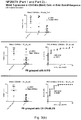
- the performance of the MDM2 antagonist predictive CD45 dim (Blast) cells signature is tested in the clinical setting with specimens from the NP28679 leukemia trial ( Figure 3 ).
- 30 AML patients treated as part of a dose-escalation study provided whole blood specimens that were analyzable by flow cytometry.
- the clinical response endpoint was stratified into 5 categories: Complete Response (CR), Complete Response with incomplete platelet recovery (CRi), Morphologic Leukemia-Free State (MLFS), Partial Response (PR), Hematologic Improvement (HI), and Progressive Disease (PD). Blood leukemia samples were collected at baseline screening.
- the present invention provides a method for determining a cancer patient's response to treatment with an MDM2 inhibitor, characterized in that the higher the % MDM2 positve CD45 dim blast cells, detected in a sample obtained from that patient prior to treatment, the higher is the likelihood of said patient's response to said treatment as for example indicated by ROC (AUC) values and analyses, well known to the person of skill in the art of clinical pharmacology.
- ROC ROC
- the present invention provides a method for determining a cancer patient's response to treatment with an MDM2 inhibitor, comprising the following steps:
- the present invention provides an in vitro method of identifying a patient suffering from cancer as likely to respond to a therapy comprising an MDM2 inhibitor, the method comprising,
- the relative amount obtained in a) above the reference level indicates a patient's high likelihood to respond to treatment with an MDM2 inhibitor, whereas a relative amount below said level indicates that said patient is less likely to respond to that treatment.
- the sample obtained in a) is blood leukemia sample, or a bone marrow biopsy sample.
- the MDM2-inhibitor is a compound as specifically disclosed in U.S. Patent 8,354,444 B2 , or in WO 2013/135648 ; or a compound according to formulae (B), or (C).
- the MDM2 inhibitor is the compound 4- ⁇ [(2R,3S,4R,5S)-4-(4-Chloro-2-fluoro-phenyl)-3-(3-chloro-2-fluoro-phenyl)-4-cyano-5-(2,2-dimethyl-propyl)-pyrrolidine-2-carbonyl]-amino ⁇ -3-methoxy-benzoic acid, of the formula (B)
- the MDM2 inhibitor is the compound 4- ⁇ [(2R,3S,4R,5S)-3-(3-Chloro-2-fluoro-phenyl)-4-(4-chloro-2-fluoro-phenyl)-4-cyano-5-(2,2-dimethyl-propyl)-pyrrolidine-2-carbonyl]-amino ⁇ -3-methoxy-benzoic acid 1-mPEG-carbonyloxy-ethyl ester (mPEG, average MW, ⁇ 2000), of the formula (C)
- the MDM2 inhibitor is the compound 4- ⁇ [(2R,3S,4R,5S)-3-(3-Chloro-2-fluoro-phenyl)-4-(4-chloro-2-fluoro-phenyl)-4-cyano-5-(2,2-dimethyl-propyl)-pyrrolidine-2-carbonyl]-amino ⁇ -3-methoxy-benzoic acid 1-mPEG-carbonyloxy-ethyl ester (mPEG, average MW, ⁇ 2200) of the formula (D)
- the MDM2-inhibitors for use in accordance with the present invention are known to the person of skill in the art.
- the compound of formula (B), methods for making it as well as pharmaceutical preparations containing it are for example disclosed in US Patent No. 8,354,444 .
- the compounds of formula (C), or (D) and their preparation are for example disclosed in WO2013/135648 .
- these compounds can be processed as pharmaceutical preparations according to techniques well known to a person of skill in drug delivery.
- compound (B) is administered as an oral dosage form wherein it is molecularly dispersed in its amorpheous form.
- compound (B) is administered in a unit dose solid formulation, characterized in that a solid dispersion obtained by spray drying of the compound (B) together with Copovidone (PVP VA 64) representing about 80% wt/wt of the kernel weight is further blended with a filler (6.8% up to 10.8% of kernel weight), preferably selected from mannitol, microcrystalline cellulose, lactose monohydrate or silicon dioxide; one or two disintegrants (4% wt/wt of kernel weight) selected from croscarmellose sodium or crospovidone; a glidant (1% wt/wt of kernel weight) preferably colloidal silicon dioxide; and a lubricant (0.2% wt/wt of kernel weight) magnesium stearate, using a tumble mixer.
- the above dosage form, as well as other applicable dosage forms for compound (B) are for example
- compositions for compounds of formuala (C), or (D) include those suitable for oral, nasal and/or parenteral or intravenous administration.
- the formulations may conveniently be presented in unit dosage form and may be prepared by any methods well known in the art of pharmacy.
- the compound of formula (C) or (D) is provided in a stable lyophilized formulation for intravenous administration comprising from about 0.1 mg to about 100 mg of compound (I), from about 10mM to about 100mM of a buffering agent, from about 25 mg to about 125 mg of a lyophilization bulking agent and an isotonicity builder.
- the resultant formulation should have a pH of about 5-7 via adjustment with HCl or NaOH.
- the compound of formula (C) or (D) is dissolved in 0.9% sodium chloride in sterile water by vortexing, then filtered through a filter into a septum sealed vial for intravenous administration. are preferably administered as lyophilized formulation for intravenous administration.
- These preparations, as well as other applicable preparations for compounds of formula (C), or (D) are for example disclosed in WO 2014/206866 .
- compounds of formula III, and in particular of formula (C) and (D) are prodrugs of the compound of formula (B).
- the compounds of formula III, in particular of formula (C) and (D) will thus be administered in a way to achieve an effective dose of the compound of formula (B) in the patients blood plasma.
- the medicaments according to the present invention comprise compounds of formula (C) or (D) characterized in that they are dosed in such way as to deliver the compound of formula (B) in an amount of from about 50 to about 3000 mg/day, or from about 80 to about 2500 mg/day, or from about 80 to about 1600 mg/day, or from about 200 to about 1600 mg/day, or from about 400 to about 1600 mg/day, or from about 400 to about 1200 mg/day, or from about 400 to about 1000 mg/day, or from about 400 to about 800 mg/day, or from about 400 to about 600 mg/day for an administration period of up to about 7 days, preferably up to about 5 days, on days 1-7, or preferably days 1-5, of a 28 day treatment cycle, followed by a rest period of from about 21 to about 23 days, preferably up to about 23 days.
- the daily dosage i.e. the amount of compound (B) expressed in mg/day
- two doses are given, they are preferably administered in equal amounts, once in the morning and once in the afternoon.
- the present medicaments comprise compounds of formula (C) or (D), characterized in that they are dosed in such way as to deliver the compound of formula (B) in an amount of from about 200 to about 1200 mg/day, or from about 400 to about 1200 mg/day, for an administration period of up to 5 days, on days 1-5, of a 28 day treatment cycle, followed by a rest period of 23 days.
- the compound of formula (B) can also be directly administered, i.e. not via the prodrugs of formula III, or (C), or (D), and using the oral dosage forms as described above.
- the compound of formula (B) is administerd using a solid, oral dosage form, for example a film coated tablet, providing compound of formula (B) in its amorpheous form and in an amount of from about 200 to about 1200 mg/day, or from about 400 to about 1200 mg/day, for an administration period of up to 5 days, on days 1-5, of a 28 day treatment cycle, followed by a rest period of 23 days.
- the medicament comprising an MDM2 inhibitor as defined herein may be administered in combination with another therapy known for a given type of cancer.
- said MDM2-inhibitor is preferably combined with cytarabine or with cytarabine and anthracycline.
- a therapeutically effective amount (or "effective amount") of cytarabine in accordance with this invention means an amount effective to achieve the synergistic, i.e. more than additive effect. Since cytarabine is used as the backbone therapy for AML for many years, a lot of information is available to the person of skill in the art, for example a clinical physician, about effective and tolerated doses in humans.
- cytarabine can be dosed as single agent in the treatment of AML (induction regimen) in high amounts, such as amounts up to 3 g/m2 (intravenous) over 2 hours every 12 hours days 1 to 6.
- AML induction regimen
- cytarabine can be dosed as single agent in the treatment of AML (induction regimen) in high amounts, such as amounts up to 3 g/m2 (intravenous) over 2 hours every 12 hours days 1 to 6.
- a review about the use of cytarabine in the treatment of leukemias is for example provided in " Nicholas D. Reese, Gary J. Schiller; Curr Hematol Malig Rep, 2013, 8:141-148 .”
- combination therapies e.g.
- the usual cytarabine dose in combination with other anti-cancer drugs is 100 mg/m2/day by continuous iv infusion (Days 1-7) or 100 mg/m2 iv every 12 hours (Days 1-7). (see for example www.hospira.com ).
- anthracycline based cancer therapies are well aware of the availability and use of anthracycline based cancer therapies.
- An extensive review of such treatment option is for example provided in: G. Minotti et al, Anthracyclines: Molecular Advances and Pharmacologic Developments in Antitumor Activity and Cardiotoxicity, Pharmacological Reviews, 2004, Vol. 56 No. 2, 185-229 .
- the MDM2 inhibitor according to the present invention preferably the compound of formulae formula III, or (B), or (C), or (D) is administered in combination with the compound cobimetinib for the treatment of cancer as defined herein.
- Dosage forms, dosages and dosage schemes for cobimetinib are for example available from the published coBRIM Phase III trial (ClinicalTrials.gov identifier NCT01689519).
- MDM2 positive cells as defined herein in particular MDM2 positive CD45dim (blast) cells
- the information obtained on MDM2 positive cells as defined herein, in particular MDM2 positive CD45dim (blast) cells can be used in the context of p53 gene mutation status to more accurately discriminate patient responses/outcomes to treatment.
- the patient's p53 gene mutation status may serve as an additional marker to detect said patients response to treatment with an MDM2 inhibitor according to the present invention with improved sensitivity and/or specificity. Therefore, in yet another embodiment, the present invention provides any of the methods for measuring the % of MDM2 expressing cells as defined herein, in particular CD45dim (blast) cells, in a samle obtained from a cancer patient, as disclosed herein before, further comprising the step of detecting p53 gene mutation status in said patient's sample.
- the p53 gene mutation status is preferably wild-type.
- detection of p53 gene mutations should not in general be understood as an exclusion criterion for that patient's likelihood to respond to - or benefit from treatment with an MDM2-inhibitor as disclosed herein.
- the present invention provides a combined, multivariate analysis of % MDM2 expressing cells as defined herein, in particular CD45dim (blast) cells, and p53 mutation status in order to provide a more refined prediction of said patient's likelihood to meet a beneficial clinical endpoint, i.e. to respond to treatment.
- the present disclosure also involves a method of treatment, wherein the relative amount of MDM2 protein expressing cells as defined herein, in particular CD45dim (blast) cells, is first detected from a sample, preferably a blood- or bone marrow sample, obtained from a patient suffering from cancer for sensitivity relative to a standard level or set of standard levels or pre-treatment initiation levels and then an MDM2-inhibitor is administered.
- a sample preferably a blood- or bone marrow sample
- an MDM2-inhibitor is administered.
- said MDM2-inhibitor is a compound of general formula I, II, III, or a pharmaceutically acceptable derivative thereof as defined above, more preferably a compound of formula IIa or III or a pharmaceutically acceptable derivative thereof.
- Said compounds may be administered in a pharmaceutical composition, as is well known to a person skilled in the art.
- compositions for administration such as nasal, buccal, rectal or, especially, oral administration, and for parenteral administration, such as intravenous, intramuscular or subcutaneous administration, to warm-blooded animals, especially humans, are especially preferred. More particularly, compositions for intravenous administration are preferred.
- a compound of general formula I, II or III, preferably IIa or III, or a pharmaceutically acceptable derivative thereof can be administered alone or in combination with one or more other therapeutic agents.
- Possible combination therapy may take the form of fixed combinations, or the administration of a compound of the invention and one or more other therapeutic agents which are staggered or given independently of one another, or the combined administration of fixed combinations and one or more other therapeutic agents.
- a compound of general formal I, II or III, preferably IIa or III, or a pharmaceutically acceptable derivative thereof can, besides or in addition, be administered especially for tumour therapy in combination with chemotherapy (cytotoxic therapy), targeted therapy, endocrine therapy, radiotherapy, immunotherapy, surgical intervention, or a combination of these.
- chemotherapy cytotoxic therapy
- targeted therapy endocrine therapy
- radiotherapy immunotherapy
- surgical intervention or a combination of these.
- Long-term therapy is equally possible as is adjuvant therapy in the context of other treatment strategies, as described above.
- Other possible treatments are therapy to maintain the patient's status after tumour regression, or even chemo-preventive therapy for example in patients at risk.
- the present disclosure relates to a kit and in another aspect to a device for predicting the response, preferably of a cancer in a subject (or patient), to a compound of general formula I, II, III; or IIa or III; or (A), (B), (C) or (D) or a pharmaceutically acceptable derivative thereof as defined herein, said kit comprising means, tools or devices for sample collection, especially for collection of blood- or bone marrow samples and instructions how to detect relative amounts of MDM2 protein expressing cells as defined herein, in particular CD45dim (blast) cells, in said samples.
- the kit and device may also preferably comprise a comparator module which comprises a standard value or set of standard values to which the level of said MDM2 protein expressing cells as defined herein, in particular CD45dim (blast) cells, in the sample is compared.
- a comparator module which comprises a standard value or set of standard values to which the level of said MDM2 protein expressing cells as defined herein, in particular CD45dim (blast) cells, in the sample is compared.
- kits for predicting the response to treatment with a medicament comprising a compound which acts as inhibitor of the MDM2-p53 interaction, comprising;
- kits as described above, wherein the compound acting as inhibitor of the MDM2-p53 interaction is a compound formula I, II, III; or IIa or III; or (A), (B), (C) or (D) or a pharmaceutically acceptable derivative thereof as defined herein.
- the standard value or set of standard values may be determined as described above.
- MDM2 protein expressing cells as defined herein, in particular CD45dim (blast) cells, as a biomarker to predict a patients response to treatment with an MDM2 inhibitor (antagonist).
- the present method i.e. the detection of the relative amount (%) of MDM2 protein expressing cells according to any embodiment as defined herein before, can be combined with the assessment of a gene signature detected from samples of the same patient at baseline as another co-variate.
- Suitable gene signatures and methods for obtaining them are for example disclosed in WO 2015/000945 .
- Such combination is done by applying specific algorythms (multivariate analysis) which may provide more accurate prediction of a ptients clinical benefit from treatment with an MDM2- inhibitor as defined herein. Improved accuracy can for example be demonstrated by increase of AUC (i.e. from 0.93 to 0.95) and an increase in p-values from 10 -3 to 10 -5 for the multivariate analysis, compared to any of the already strong biomarkers (MDM2 expressing cells; or gene signature) alone.
- the present invention provides a method to predict responsiveness of a patient with cancer to a therapy, said method comprising a) taking one or several samples from said patient; b) measuring the relative amount (%) of at least one MDM2-protein expressing cell type in said sample obtained in step a); c) detecting the expression level of at least one gene according to Table 1 in a sample obtained in step a); d) applying a multivariate analysis using the information of a) and b) in order to calculate a value (combined score "S"); e) comparing said value for "S" to a standard value (or reference value); and f) identifying said patient as more likely to respond to the therapy when the value of "S" is above said standard value; wherein said therapy comprises administering to said patient a compound acting as inhibitor of the MDM2-p53 interaction (MDM2-inhibitor) as defined herein before.
- MDM2-inhibitor MDM2-inhibitor
- the method is an in vitro method.
- the patient is a cancer patient, and the term "cancer” is defined as herein before.
- the sample for measurements in steps b) and c) can be the same or different, and is as defined herein before.
- said same or different sample is a blood - and/or bone marrow sample, taken from said patient prior to start of treatment (at baseline).
- the terms "relative amount” and "MDM2 expressing cell types” in step b) are as defined herein before.
- MDM2 protein expressing cell types are selected from CD45dim cells, CD117+ (c-kit) and CD34+ stem cells.
- the relative amount of one single cell type or combinational subsets of said cell types can be used, as also defined herein before. Measurement of said cell type(s) is carried out as defined above, preferably by flow cytometry.
- the detection of "at least one gene" in method step c) comprises detection of one single or combined levels comprising 2, or 3, or 4, or 5, or 6, or 7, or 8, or 9, or 10, or 11, or 12, or detection of all 13 genes according to Table 1. Detection of genes preferably means detection of mRNA expression levels for example by RT-PCR (real time polymerase chain reaction) or array technology as disclosed in WO 2015/000945 , and as also known to the skilled person.
- the patient's signature score is calculated from the sum of relative expression levels (2 delta-CP ) measured at baseline (i.e. prior to treatment), multiplied by the observed direction in-vitro.
- the combined score "S" obtained in step d) is construed based on multiplication or addition of the value obtained from MDM2 flow measurements obtained in b) with the gene signature scores obtained in c).
- Preferably said combined score "S” is calculated based on multiplication or addition of MDM2 flow measurements obtained in b) with a 3-gene or 4-gene signature scores according to the algorythms listed in Table 2. TABLE 2: Algorithms for calculating the combined score "S" No.
- the combined score "S" as obtainable according to the algorithms in Table 2 correlates to the patient's response to treatment with said MDM2-inhibitor.
- a value for "S" above a standard value indicates the patient's likelihood to respond to or benefit from treatment with said MDM2-inhibitor, whereas a relative amount below said standard value indicates that said patient is less likely to respond to or benefit from that treatment.
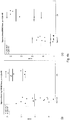
- the standard value may depend on the algorithm used for calculating "S". For example, the reference level is different when a 3-gene or 4-gene signature is used in the calculation for S, or when the log2 scale is applied (see Fig. 4 ).
- the term "response" is as defined herein before.
- MDM2-inhibitor is as defined above.
- MDM2-inhibitor is a compound of formula IIa, or III, or (B), or (C), or (D) as defined herein, including any of the pharmaceutical preparation as defined herein before.
- said MDM2-inhibitor can also be combined with other pharmaceutically active compounds, e.g. with cytarabine or cobimetinib, as also disclosed herein before.
- a 3- or 4-gene signature score is used in step c) of the above method.
- the 3-gene signature consists of mRNA expression levels of XPC, BBC3 and CDKN2A; or MDM2, XPC and BBC3;
- the 4-gene signature consists of mRNA expression levels of MDM2, XPC, BBC3 and CDKN2A.
- mRNA expression levels are measured by RT-PCR, the patient's signature score is calculated from the sum of relative expression levels (2 delta-CP ) measured at baseline (i.e.
- S 4-gene-RT-1CR G MDM2 + G XPC + G BBC3 - G CDKN2A
- delta-CP XPC CP housekeeper -CP XPC
- delta-CP BBC3 CP housekeeper -CP BBC3
- delta-CP CDKN2A CP housekeeper -CP CDKN2A .
- the term "housekeeper” means any suitable control gene. In one embodiment of the present invention the "housekeeper” is TMEM55B as the endogenous control gene.
- S MDM2-flow denote the percentage of cells having detectable MDM2 protein expression in a selected cell type, for example the CD45 dim blast cell population.
- S 3-gene-RT-PCR G XPC + G BBC3 - G CDKN2A , which omits G MDM2 from score calculation
- S S 3 ⁇ -gene-RT-PCR ⁇ S MDM 2 ⁇ -flow
- S S 3 ⁇ -gene-RT-PCR ⁇ log 2 S MDM 2 ⁇ -flow
- S S 3 ⁇ -gene-RT-PCR + log 2 S MDM 2 ⁇ -flow .
- the combined signature score "S" was correlated with clinical responses of the NP29679 trial (indication: AML) Part 1 and 2 by testing whether signature scores based on any of the above six definitions can significantly differentiate responders from non-responders using two-sample Wilcoxon rank sum tests and via computing classification area-under-the-curves (AUC).
- step b) of the above method comprises detection of the relative amount of
- step b) of the above method comprises detection of the relative amount of
- an in vitro method to predict responsiveness of a patient, with cancer, to a therapy comprises the following steps:
- the standard value for comparison according to step e) is about 7, or about 8, or about 8.5, or about 9 (see Fig. 4b iii ) and vi ) ).
- an in vitro method to predict responsiveness of a patient, with cancer, to a therapy comprises the following steps:
- the standard value for comparison according to step e) is about 10, or about 10.5, or about 11, or about 11.5 or about 12 (see Fig. 4a iii ) and vi ) ).
- the combined score "S" as defined in any of the embodiments above is used during treatment, i.e. monitoring of a cancer patient's treatment with an MDM2-inhibitor as defined herein before.
- the sample(s) in step a) according to any of the methods described above is taken during treatment, and the treatment is continued when the combined score obtained in d) is above the corresponding standard value.
- the present invention provides a method for determining a cancer patient's response to treatment with an MDM2 inhibitor as defined herein, characterized in that the higher the combined score "S", as obtained according to any algorithm defined herein before, the higher is the likelihood of said patient's response to said treatment as for example indicated by ROC (AUC) values and analyses, well known to the person of skill in the art of clinical pharmacology.
- the combined score "S" can be used in the context of p53 gene mutation status to even more accurately discriminate patient responses/benefits to treatment.
- the patient's p53 gene mutation status may serve as an additional marker to detect said patients response to treatment with an MDM2 inhibitor as defined herein with improved sensitivity and/or specificity. Therefore, in yet another embodiment, the present invention provides any of the methods for obtaining the combined score "S" as defined herein, further comprising the step of detecting p53 gene mutation status in said patient's sample.
- the p53 gene mutation status is preferably wild-type.
- the present invention provides a combined, multivariate analysis combining % MDM2 expressing cells as defined herein, in particular CD45dim (blast) cells with gene signature scores, preferably 3- and 4 gene signature scores as defined above, and p53 mutation status in order to provide a more refined prediction of said patient's likelihood to meet a beneficial clinical endpoint, i.e. to respond to treatment.
- further co-variates in this multivariate analysis are the patient's age and/or ECOG score.
- Also disclosed herein is a method for treating a cancer patient comprising obtaining a combined score "S" according to any one of the methods defined above, and administering to said patient an MDM2-inhibitor if said value for "S" is above a standard - or reference value as also defined herein before.
- the MDM2-inhibitor is as defined herein before.
- the MDM2-inhibitor is a compound of formula (II), (IIa), (B), (C) or (D) as defined above.
- the p-53 mutation status as also detected in a sample obtained from said cancer patient is preferably wild-type.
- the disclosure relates to a kit and in another aspect to a device for predicting the response, preferably of a cancer in a subject (or patient), to a compound of general formula I, II, III; or IIa or III; or (A), (B), (C) or (D) or a pharmaceutically acceptable derivative thereof as defined herein, said kit comprising means, tools or devices for sample collection, especially for collection of blood- or bone marrow samples and instructions how to detect relative amounts of MDM2 protein expressing cells as defined herein, in particular CD45dim (blast) cells, and mRNA levels of one ore several genes, preferably a 3- or 4-gene signature, according to Table 1 in said samples.
- a kit comprising means, tools or devices for sample collection, especially for collection of blood- or bone marrow samples and instructions how to detect relative amounts of MDM2 protein expressing cells as defined herein, in particular CD45dim (blast) cells, and mRNA levels of one ore several genes, preferably a 3- or 4-gene signature, according to Table
- the kit and device also comprises instructions how to obtain the combined score "S" from the detected releative amount(s) of MDM2-protein expressing cells and mRNA levels.
- the kit and device may also preferably comprise a comparator module which comprises a standard value or set of standard values to which the value of "S" obtained from the patient's sample(s) is compared.
- kits for predicting the response to treatment with a medicament comprising a compound which acts as inhibitor of the MDM2-p53 interaction, comprising;
- kits as described above, wherein the compound acting as inhibitor of the MDM2-p53 interaction is a compound formula I, II, III; or IIa or III; or (A), (B), (C) or (D) or a pharmaceutically acceptable derivative thereof as defined herein.
- the standard value or set of standard values may be determined as described above.
- This Example describes the detection of the relative amount of MDM2 expressing CD45dim blast cells obtained from patients participating in Study NP28679 (Part 1 and 2) using flow cytometry.
- Cells were stained according to the following procedure: 100 ⁇ l blood of appropriate donor was added to appropriately labelled tubes. Surface markers except CD34 were subsequently stained by adding antibody fluorochrome conjugates or respective isotype controls were used. Tubes were then vortexed and incubated for 20 minutes in the dark at room temperature. After washing with PBS BSA buffer, subes were centrifuged and decanted. 2 ml of prewarmed 1x BD Lyse/ fix solution was then added, tubes were vortexed and incubated 15 minutes in a 37°C water bath. After incubation, tubes were centrifuged and supernatant decanted.
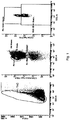
- a gate is drawn around all cells with normal size (forwards scatter, FSC) and granular characteristics (side scatter, SSC): the total nucleated cell gate (TNC, R1 in figure 1 ).
- FSC forwards scatter
- SSC side scatter
- the AML blast population is then identified by drawing a region around cells with dim CD45 expression and low side scatter porperties (R3 in figure 1 ).
- the blast population can be further refined by gating on CD34 positive or negative blasts ( Figure 1 , R6 and R39, respectively).
- the threshold for CD34 positivity can be identified by using an isotype control staining in that respective channel (not shown).
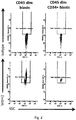
- the CD45 dim general blast population and the more refined blast population additionally expressing CD34 are displayed in dot plots as shown in figure 2 .
- the isotype control used instead of Mdm2 staining can be used to set the threshold for Mdm2 positivity (upper two panels figure 2 .)
- the staining condition including Mdm2 recognizing antibody is displayed at the bottom of figure 2 .
- the cell population falling in the regions defined as Mdm2 positive is determined by calculating the percentage of Mdm2 expressing cells within the respective blast parent population.
- the relative amount of MDM2 expressing CD45dim blast cells was obtained according to the above described method for patients participating in Study NP28679 (Part 1 and 2) and said amount plotted over the response of said patients ( Fig. 3 ).
- PR partial response
- the relative amount of MDM2 expressing cells prior to treatment is indicative for that patient's response to treatment with the MDM2 inhibitor of formula (B).
- This Example describes the calculation of the combined score "S" as defined herein, and its correlation with response of patients participating in Study NP28679 (Part 1 and 2).
- the relative amount of MDM2 positive CD45 dim cells were detected according to Example 1, and mRNA expression levels of MDM2, XPC, BBC3 and CDKN2A at baseline were measured by RT-PCR.
- Total RNA isolated from either blood or bone marrow is quantitated by UV absorption.
- PCR a fixed total RNA input is used. PCR is performed using a proprietary DNA polymerase from Roche Molecular systems. The polymerase is capable of reverse transcription so that direct amplification and detection from RNA is performed in one reaction with a single set of gene specific primers.
- Real-time PCR utilizes TaqMan® technology with primers and TaqMan® probes for amplification and for detection of the target and control nucleic acids. Three reaction wells are used to detect the 4 target genes. In each reaction well the endogenous control is included. The cobas® z480 analyzer is used for amplification and detection.
- the patient's signature score was then calculated from the sum of relative expression levels (G x ) measured at baseline (i.e. prior to treatment), multiplied by the observed direction in-vitro, defined as a 4-gene signature score
- S 4-gene-RT-PCR G MDM2 + G XPC + G BBC3 - G CDKN2A .
- S MDM2-flow denote the percentage of cells having detectable MDM2 protein expression in the CD45 dim blast population.
- the combined signature score "S” was then correlated with clinical responses seen in clinical trials with patients suffering from AML (NP29679 trial Part 1 and 2) by testing whether signature scores based on any of the above six definitions can significantly differentiate responders from non-responders using two-sample Wilcoxon rank sum tests and via computing classification area-under-the-curves (AUC).
- AUC classification area-under-the-curves
- Fig. 4a and 4b Comparative data correlating the patient's response with mRNA expression levels of each of MDM2, BBC3, XPC and CDKN2A alone are shown in Fig. 5 .
Landscapes
- Health & Medical Sciences (AREA)
- Life Sciences & Earth Sciences (AREA)
- Chemical & Material Sciences (AREA)
- Medicinal Chemistry (AREA)
- General Health & Medical Sciences (AREA)
- Veterinary Medicine (AREA)
- Public Health (AREA)
- Animal Behavior & Ethology (AREA)
- Pharmacology & Pharmacy (AREA)
- Epidemiology (AREA)
- Engineering & Computer Science (AREA)
- Molecular Biology (AREA)
- Immunology (AREA)
- Hematology (AREA)
- Biomedical Technology (AREA)
- Urology & Nephrology (AREA)
- Food Science & Technology (AREA)
- Physics & Mathematics (AREA)
- Organic Chemistry (AREA)
- Biotechnology (AREA)
- Cell Biology (AREA)
- Microbiology (AREA)
- Nuclear Medicine, Radiotherapy & Molecular Imaging (AREA)
- General Chemical & Material Sciences (AREA)
- Chemical Kinetics & Catalysis (AREA)
- Pathology (AREA)
- Analytical Chemistry (AREA)
- Biochemistry (AREA)
- General Physics & Mathematics (AREA)
- Oncology (AREA)
- Bioinformatics & Cheminformatics (AREA)
- Pharmaceuticals Containing Other Organic And Inorganic Compounds (AREA)
- Investigating Or Analysing Biological Materials (AREA)
- Measuring Or Testing Involving Enzymes Or Micro-Organisms (AREA)
- Medicines That Contain Protein Lipid Enzymes And Other Medicines (AREA)
Claims (16)
- In-vitro-Verfahren zum Vorhersagen des Ansprechvermögens eines Patienten mit Krebs auf eine Therapie, wobei das Verfahren das Nachweisen der relativen Menge von einem oder mehreren MDM2-Protein exprimierenden Zelltypen in einer Probe, die vor der Behandlung von dem Krebspatienten erhalten wurde, und das Verwenden der relativen Menge, oder des Prozentsatzes (%), von Zellen, die MDM2-Protein exprimieren, als ein Biomarker zum Vorhersagen des Ansprechens des Patienten auf die Behandlung mit einem Medikament umfasst, wobei das Medikament eine Verbindung umfasst, die als ein Inhibitor der MDM2-p53-Wechselwirkung agiert, und wobei der MDM2-Protein exprimierende Zelltyp, oder der Biomarker, ausgewählt ist aus der Gruppe, bestehend aus CD45dim-Zellen, CD117+ (c-kit) oder CD34+ Stammzellen oder Kombinationsteilmengen davon, und wobei der Inhibitor der MDM2-p53-Wechselwirkung aus den folgenden Verbindungen ausgewählt ist: 4-{[2R,3S,4R,5S)-4-(4-Chlor-2-fluor-phenyl)-3-(3-chlor-2-fluor-phenyl)-4-cyano-5-(2,2-dimethyl-propyl)-pyrrolidin-2-carbonyl]-amino}-3-methoxy-benzoesäure der Formel (B)


- Verfahren nach Anspruch 1, wobei das Verfahren Folgendes umfasst:a) Nachweisen der relativen Menge von MDM2-Protein exprimierenden CD45dim-Blastzellen in einer Probe, die von einem Patienten erhalten wurde, der an Krebs leidet;b) Vergleichen der relativen Menge von MDM2-Protein exprimierenden CD45dim-Blastzellen, die in a) erhalten wurde, mit Standardwerten von einem Patienten mit dem gleichen Krebs.
- Verfahren nach Anspruch 1 oder 2, wobei der Krebs ausgewählt ist aus der Gruppe, bestehend aus Brustkrebs, Prostatakrebs, Gebärmutterhalskrebs, Eierstockkrebs, Magenkrebs, Dickdarmkrebs, Bauchspeicheldrüsenkrebs, Leberkrebs, Hirnkrebs, neuroendokrinem Krebs, Lungenkrebs, Nierenkrebs, hämatologischen Malignitäten, Melanom und Sarkomen.
- Verfahren nach Anspruch 3, wobei der Patient an einem hämatologischen Krebs, insbesondere Leukämie leidet.
- Verfahren nach Anspruch 4, wobei der Patient an akuter myeloischer Leukämie leidet.
- Verfahren nach einem der Ansprüche 1 bis 5, wobei die relative Menge von MDM2-Protein exprimierenden CD45dim-Blastzellen mit Hilfe von Durchflusszytometrie nachgewiesen wird.
- Verfahren nach einem von Anspruch 1 oder 7, wobei die von dem Patienten erhaltene Probe eine Blutprobe oder eine Knochenmarkprobe ist.
- Verfahren nach einem der Ansprüche 1 bis 7, wobei die relative Menge von MDM2-Protein exprimierenden CD45dim-Blastzellen, die in der von dem Patienten vor der Behandlung erhaltenen Probe nachgewiesen wurde, 45 % oder 55 % übersteigt.
- Verfahren nach Anspruch 1, wobei das Verfahren Folgendes umfasst:a) Nachweisen der relativen Menge von MDM2-Protein exprimierenden CD45dim-Blastzellen in einer Blut- oder Knochenmarkprobe, die von einem Patienten erhalten wurde, der an akuter myeloischer Leukämie leidet, mit Hilfe von Durchflusszytometrie;b) Vergleichen der relativen Menge von MDM2-Protein exprimierenden CD45dim-Blastzellen, die in a) erhalten wurde, mit Standardwerten von einem Patienten mit dem gleichen Krebs.
- Verfahren nach einem der Ansprüche 1 bis 9, ferner umfassend den Schritt des Nachweisens des p53-Genmutationsstatus des Krebspatienten vor der Behandlung.
- In-vitro-Verwendung von MDM2-Protein exprimierenden CD45dim-Blastzellen zum Vorhersagen des Ansprechens eines Patienten, der an Krebs leidet, auf eine Behandlung mit einem Medikament, das eine Verbindung umfasst, die als Inhibitor der MDM2-p53-Wechselwirkung agiert, und wobei die Verbindung, die als Inhibitor der MDM2-p53-Wechselwirkung agiert, eine Verbindung der Formel (B) oder (C) nach Anspruch 1 ist.
- In-vitro-Verwendung nach Anspruch 11, wobei der Patient an einer hämatologischen Störung wie Leukämie, insbesondere akuter myeloischer Leukämie leidet.
- Verfahren nach einem der Ansprüche 1 bis 10, ferner umfassend das Nachweisen eines mRNA-Expressionsniveaus von mindestens einem Gen, das ausgewählt ist aus der Gruppe, bestehend aus BAX, RPS27L, EDA2R, XPC, DDB2, FDXR, MDM2, CDKN1A, TRIAP1, BBC3, CCNG1, TNFRSF10B oder CDKN2A, und das Kombinieren dieses Wertes mit der relativen Menge von MDM2-Protein exprimierenden Zellen nach Anspruch 1 zum Erhalten einer kombinierten Wertung "S" und das Verwenden dieser kombinierten Wertung "S" als einen Biomarker zum Vorhersagen des Ansprechens des Patienten auf eine Verbindung, wobei die Verbindung ein Inhibitor der MDM2-p53-Wechselwirkung nach Anspruch 1 ist.
- Verfahren nach Anspruch 13, wobei das Verfahren ein In-vitro-Verfahren zum Vorhersagen des Ansprechvermögens eines Patienten mit Krebs auf eine Therapie ist, umfassend die folgenden Schritte:a) Messen der relativen Menge (%) von MDM2-Protein exprimierenden CD45dim-(Blast-)-Zellen in einer Blut- und/oder Knochenmarkbiopsieprobe (SMDM2-Fluss), die von einem Patienten erhalten wurde, der an akuter myeloischer Leukämie leidet, an der Grundlinie;b) Messen der mRNA-Expressionsniveaus von MDM2, XPC, BBC3 und CDKN2A in einer Probe, die in a) erhalten wurde, mit Hilfe von RT-PCR und Berechnen einer 3-Gensignatur-Wertung S3-Gen-RT-PCR gemäß der Formel

 c) Anwenden einer multivariaten Analyse unter Verwendung der in a) und b) erhaltenen Werte gemäß einem der folgenden Algorithmen zur Berechnung eines Wertes S

 d) Vergleichen des in c) erhaltenen Wertes für "S" mit Standardwerten, zum Beispiel Werten, die von einem Patienten mit dem gleichen Krebs erhalten wurden.
 - Verfahren nach Anspruch 13, wobei das Verfahren ein In-vitro-Verfahren zum Vorhersagen des Ansprechvermögens eines Patienten mit Krebs auf eine Therapie ist, umfassend die folgenden Schritte:a) Messen der relativen Menge (SMDM2-Fluss in %) von MDM2-Protein exprimierenden CD45dim-(Blast-)-Zellen in einer Blut- und/oder Knochenmarkbiopsieprobe, die von einem Patienten erhalten wurde, der an AML leidet, an der Grundlinie;b) Messen der mRNA-Expressionsniveaus von MDM2, XPC, BBC3 und CDKN2A in einer Probe, die in a) erhalten wurde, mit Hilfe von RT-PCR und Berechnen einer 4-Gensignatur-Wertung S4-Gen-RT-PCR gemäß der Formel
 c) Anwenden einer multivariaten Analyse unter Verwendung der in a) und b) erhaltenen Werte gemäß einem der folgenden Algorithmen zur Berechnung eines Wertes S

 d) Vergleichen des in c) erhaltenen Wertes für "S" mit Standardwerten, zum Beispiel Werten, die von einem Patienten mit dem gleichen Krebs erhalten wurden.
 - Verfahren nach den Ansprüchen 1, 14 oder 15, ferner umfassend mindestens eine zusätzliche Kovariate, unabhängig voneinander ausgewählt aus der Gruppe des p53-Mutationsstatus, dem Alter oder der ECOG-Wertung des Patienten.
Applications Claiming Priority (3)
| Application Number | Priority Date | Filing Date | Title |
|---|---|---|---|
| US201462062214P | 2014-10-10 | 2014-10-10 | |
| US201462085863P | 2014-12-01 | 2014-12-01 | |
| PCT/EP2015/073078 WO2016055497A1 (en) | 2014-10-10 | 2015-10-07 | Methods for personalizing patient cancer therapy with an mdm2 antagonist |
Publications (2)
| Publication Number | Publication Date |
|---|---|
| EP3204776A1 EP3204776A1 (de) | 2017-08-16 |
| EP3204776B1 true EP3204776B1 (de) | 2019-09-04 |
Family
ID=54324951
Family Applications (1)
| Application Number | Title | Priority Date | Filing Date |
|---|---|---|---|
| EP15780808.0A Not-in-force EP3204776B1 (de) | 2014-10-10 | 2015-10-07 | Verfahren zum personalisieren von patientenkrebstherapien mit einem mdm2-antagonist |
Country Status (5)
| Country | Link |
|---|---|
| US (1) | US20170227544A1 (de) |
| EP (1) | EP3204776B1 (de) |
| JP (1) | JP6608439B2 (de) |
| CN (1) | CN106716131B (de) |
| WO (1) | WO2016055497A1 (de) |
Families Citing this family (7)
| Publication number | Priority date | Publication date | Assignee | Title |
|---|---|---|---|---|
| US8592377B2 (en) | 2007-03-28 | 2013-11-26 | President And Fellows Of Harvard College | Stitched polypeptides |
| TW201806968A (zh) | 2011-10-18 | 2018-03-01 | 艾利倫治療公司 | 擬肽巨環化合物 |
| EP2819688A4 (de) | 2012-02-15 | 2015-10-28 | Aileron Therapeutics Inc | Triazol- und thioethervernetzte peptidomimetische makrozyklen |
| WO2014071241A1 (en) | 2012-11-01 | 2014-05-08 | Aileron Therapeutics, Inc. | Disubstituted amino acids and methods of preparation and use thereof |
| AU2015320545C1 (en) | 2014-09-24 | 2020-05-14 | Aileron Therapeutics, Inc. | Peptidomimetic macrocycles and formulations thereof |
| EP3197478A4 (de) | 2014-09-24 | 2018-05-30 | Aileron Therapeutics, Inc. | Peptidomimetische makrozyklen und verwendungen davon |
| WO2016154058A1 (en) | 2015-03-20 | 2016-09-29 | Aileron Therapeutics, Inc. | Peptidomimetic macrocycles and uses thereof |
Family Cites Families (9)
| Publication number | Priority date | Publication date | Assignee | Title |
|---|---|---|---|---|
| US20090215895A1 (en) * | 2004-01-30 | 2009-08-27 | Peplin Biolipids Pty Ltd | Therapeutic and carrier molecules |
| CN101415420B (zh) * | 2006-04-05 | 2012-09-05 | 诺瓦提斯公司 | 用于治疗癌症的治疗剂的组合 |
| US8354444B2 (en) * | 2008-09-18 | 2013-01-15 | Hoffmann-La Roche Inc. | Substituted pyrrolidine-2-carboxamides |
| SG184288A1 (en) * | 2010-04-09 | 2012-11-29 | Univ Michigan | Biomarkers for mdm2 inhibitors for use in treating disease |
| CA3062500C (en) * | 2010-12-20 | 2022-01-18 | Cameron K. Tebbi | Methods of detecting leukemia/ lymphoma and induction of the same |
| US8993614B2 (en) * | 2012-03-15 | 2015-03-31 | F. Hoffmann-La Roche Ag | Substituted pyrrolidine-2-carboxamides |
| US20130245089A1 (en) * | 2012-03-19 | 2013-09-19 | Hoffmann-La Roche Inc. | Method for administration |
| ES2742285T3 (es) * | 2012-07-31 | 2020-02-13 | Novartis Ag | Marcadores asociados con la sensibilidad a inhibidores del doble minuto humano 2 (MDM2) |
| US9657351B2 (en) * | 2013-12-06 | 2017-05-23 | Hoffman-La Roche Inc. | MRNA-based gene expression for personalizing patient cancer therapy with an MDM2 antagonist |
-
2015
- 2015-10-07 EP EP15780808.0A patent/EP3204776B1/de not_active Not-in-force
- 2015-10-07 US US15/502,339 patent/US20170227544A1/en not_active Abandoned
- 2015-10-07 JP JP2017518845A patent/JP6608439B2/ja not_active Expired - Fee Related
- 2015-10-07 CN CN201580048899.7A patent/CN106716131B/zh not_active Expired - Fee Related
- 2015-10-07 WO PCT/EP2015/073078 patent/WO2016055497A1/en not_active Ceased
Non-Patent Citations (1)
| Title |
|---|
| None * |
Also Published As
| Publication number | Publication date |
|---|---|
| JP6608439B2 (ja) | 2019-11-20 |
| CN106716131B (zh) | 2020-07-24 |
| JP2017533422A (ja) | 2017-11-09 |
| US20170227544A1 (en) | 2017-08-10 |
| CN106716131A (zh) | 2017-05-24 |
| EP3204776A1 (de) | 2017-08-16 |
| WO2016055497A1 (en) | 2016-04-14 |
Similar Documents
| Publication | Publication Date | Title |
|---|---|---|
| EP3204776B1 (de) | Verfahren zum personalisieren von patientenkrebstherapien mit einem mdm2-antagonist | |
| US20230146638A1 (en) | Treatment of EGFR-Driven Cancer with Fewer Side Effects | |
| Steinberg et al. | Myeloid cells that impair immunotherapy are restored in melanomas with acquired resistance to BRAF inhibitors | |
| Wang et al. | MYC-regulated mevalonate metabolism maintains brain tumor–initiating cells | |
| EP3017061B1 (de) | Mrna-basierte genexpression zur personalisierung einer patientenkrebstherapie mit einem mdm2-antagonisten | |
| Keenan et al. | Clinical efficacy and molecular response correlates of the WEE1 inhibitor adavosertib combined with cisplatin in patients with metastatic triple-negative breast cancer | |
| US11395821B2 (en) | Treatment of EGFR-driven cancer with fewer side effects | |
| Casaluce et al. | Resistance to crizotinib in advanced non-small cell lung cancer (NSCLC) with ALK rearrangement: mechanisms, treatment strategies and new targeted therapies | |
| EP3331558B1 (de) | Auf mitochondriale biogenese abzielende kombinationstherapien zur krebstherapie | |
| US20220175787A1 (en) | Patient selection for enhancement of anti-tumor immunity in cancer patients | |
| TWI821227B (zh) | 胺甲喋呤誘發的免疫耐受性之生物標記 | |
| CN113521069A (zh) | 用于治疗癌症的mdm2抑制剂的给药方案 | |
| Wu et al. | Inhibition of B-cell receptor signaling disrupts cell adhesion in mantle cell lymphoma via RAC2 | |
| Zhou et al. | Real‐world utilization of PD‐1/PD‐L1 inhibitors with palliative radiotherapy in patients with metastatic non‐small cell lung cancer | |
| WO2024220440A1 (en) | Inhibiting mitogen-activated protein (map)/erk kinase (mek)1 and mek2 and related methods of treatment | |
| EP2754441B1 (de) | Zusammensetzung zur vorbeugung und behandlung von nichtkleinzelligem lungenkrebs mit pyrazin-triazin-derivaten | |
| Chakraborty et al. | AZD4625 is a potent and selective inhibitor of KRASG12C | |
| US20210113562A1 (en) | Pim kinase inhibitors for treatment of myeloproliferative neoplasms and fibrosis associated with cancer | |
| US20230365673A1 (en) | Means for reducing radio- and chemotherapy resistance and adverse effects | |
| HK1238330A1 (en) | Methods for personalizing patient cancer therapy with an mdm2 antagonist | |
| Deng et al. | In vivo metabolomics identifies CD38 as an emergent vulnerability in LKB1-mutant lung cancer | |
| WO2011130429A2 (en) | Methods and materials for treating lung cancer | |
| WO2024221005A2 (en) | Methods for inhibiting resistance to immune blockade inhibitor therapy | |
| Clark | Samantha M. Goodstal, Jing Lin, Timothy Crandall, Lindsey Crowley, Andrew T. Bender 2, Albertina Pereira 2, Maria Soloviev 3, John S. Wesolowski 3, Riham Iadevaia, Sven‑Eric Schelhorn 4, Edith Ross 4, Federica Morandi 5, Jianguo Ma & | |
| WO2025007147A2 (en) | Methods for sensitizing drug-resistant cancer cells |
Legal Events
| Date | Code | Title | Description |
|---|---|---|---|
| STAA | Information on the status of an ep patent application or granted ep patent |
Free format text: STATUS: THE INTERNATIONAL PUBLICATION HAS BEEN MADE |
|
| PUAI | Public reference made under article 153(3) epc to a published international application that has entered the european phase |
Free format text: ORIGINAL CODE: 0009012 |
|
| STAA | Information on the status of an ep patent application or granted ep patent |
Free format text: STATUS: REQUEST FOR EXAMINATION WAS MADE |
|
| 17P | Request for examination filed |
Effective date: 20170510 |
|
| AK | Designated contracting states |
Kind code of ref document: A1 Designated state(s): AL AT BE BG CH CY CZ DE DK EE ES FI FR GB GR HR HU IE IS IT LI LT LU LV MC MK MT NL NO PL PT RO RS SE SI SK SM TR |
|
| AX | Request for extension of the european patent |
Extension state: BA ME |
|
| DAV | Request for validation of the european patent (deleted) | ||
| DAX | Request for extension of the european patent (deleted) | ||
| STAA | Information on the status of an ep patent application or granted ep patent |
Free format text: STATUS: EXAMINATION IS IN PROGRESS |
|
| 17Q | First examination report despatched |
Effective date: 20180525 |
|
| GRAP | Despatch of communication of intention to grant a patent |
Free format text: ORIGINAL CODE: EPIDOSNIGR1 |
|
| STAA | Information on the status of an ep patent application or granted ep patent |
Free format text: STATUS: GRANT OF PATENT IS INTENDED |
|
| RIC1 | Information provided on ipc code assigned before grant |
Ipc: G01N 33/574 20060101AFI20190423BHEP Ipc: G01N 33/49 20060101ALN20190423BHEP |
|
| RIC1 | Information provided on ipc code assigned before grant |
Ipc: G01N 33/574 20060101AFI20190507BHEP Ipc: G01N 33/49 20060101ALN20190507BHEP |
|
| INTG | Intention to grant announced |
Effective date: 20190521 |
|
| GRAS | Grant fee paid |
Free format text: ORIGINAL CODE: EPIDOSNIGR3 |
|
| GRAA | (expected) grant |
Free format text: ORIGINAL CODE: 0009210 |
|
| STAA | Information on the status of an ep patent application or granted ep patent |
Free format text: STATUS: THE PATENT HAS BEEN GRANTED |
|
| AK | Designated contracting states |
Kind code of ref document: B1 Designated state(s): AL AT BE BG CH CY CZ DE DK EE ES FI FR GB GR HR HU IE IS IT LI LT LU LV MC MK MT NL NO PL PT RO RS SE SI SK SM TR |
|
| REG | Reference to a national code |
Ref country code: GB Ref legal event code: FG4D |
|
| REG | Reference to a national code |
Ref country code: CH Ref legal event code: EP |
|
| REG | Reference to a national code |
Ref country code: AT Ref legal event code: REF Ref document number: 1176091 Country of ref document: AT Kind code of ref document: T Effective date: 20190915 |
|
| REG | Reference to a national code |
Ref country code: DE Ref legal event code: R096 Ref document number: 602015037270 Country of ref document: DE |
|
| REG | Reference to a national code |
Ref country code: IE Ref legal event code: FG4D |
|
| REG | Reference to a national code |
Ref country code: NL Ref legal event code: MP Effective date: 20190904 |
|
| REG | Reference to a national code |
Ref country code: LT Ref legal event code: MG4D |
|
| PG25 | Lapsed in a contracting state [announced via postgrant information from national office to epo] |
Ref country code: FI Free format text: LAPSE BECAUSE OF FAILURE TO SUBMIT A TRANSLATION OF THE DESCRIPTION OR TO PAY THE FEE WITHIN THE PRESCRIBED TIME-LIMIT Effective date: 20190904 Ref country code: HR Free format text: LAPSE BECAUSE OF FAILURE TO SUBMIT A TRANSLATION OF THE DESCRIPTION OR TO PAY THE FEE WITHIN THE PRESCRIBED TIME-LIMIT Effective date: 20190904 Ref country code: BG Free format text: LAPSE BECAUSE OF FAILURE TO SUBMIT A TRANSLATION OF THE DESCRIPTION OR TO PAY THE FEE WITHIN THE PRESCRIBED TIME-LIMIT Effective date: 20191204 Ref country code: NO Free format text: LAPSE BECAUSE OF FAILURE TO SUBMIT A TRANSLATION OF THE DESCRIPTION OR TO PAY THE FEE WITHIN THE PRESCRIBED TIME-LIMIT Effective date: 20191204 Ref country code: SE Free format text: LAPSE BECAUSE OF FAILURE TO SUBMIT A TRANSLATION OF THE DESCRIPTION OR TO PAY THE FEE WITHIN THE PRESCRIBED TIME-LIMIT Effective date: 20190904 Ref country code: LT Free format text: LAPSE BECAUSE OF FAILURE TO SUBMIT A TRANSLATION OF THE DESCRIPTION OR TO PAY THE FEE WITHIN THE PRESCRIBED TIME-LIMIT Effective date: 20190904 |
|
| PG25 | Lapsed in a contracting state [announced via postgrant information from national office to epo] |
Ref country code: ES Free format text: LAPSE BECAUSE OF FAILURE TO SUBMIT A TRANSLATION OF THE DESCRIPTION OR TO PAY THE FEE WITHIN THE PRESCRIBED TIME-LIMIT Effective date: 20190904 Ref country code: GR Free format text: LAPSE BECAUSE OF FAILURE TO SUBMIT A TRANSLATION OF THE DESCRIPTION OR TO PAY THE FEE WITHIN THE PRESCRIBED TIME-LIMIT Effective date: 20191205 Ref country code: AL Free format text: LAPSE BECAUSE OF FAILURE TO SUBMIT A TRANSLATION OF THE DESCRIPTION OR TO PAY THE FEE WITHIN THE PRESCRIBED TIME-LIMIT Effective date: 20190904 Ref country code: LV Free format text: LAPSE BECAUSE OF FAILURE TO SUBMIT A TRANSLATION OF THE DESCRIPTION OR TO PAY THE FEE WITHIN THE PRESCRIBED TIME-LIMIT Effective date: 20190904 Ref country code: RS Free format text: LAPSE BECAUSE OF FAILURE TO SUBMIT A TRANSLATION OF THE DESCRIPTION OR TO PAY THE FEE WITHIN THE PRESCRIBED TIME-LIMIT Effective date: 20190904 |
|
| REG | Reference to a national code |
Ref country code: AT Ref legal event code: MK05 Ref document number: 1176091 Country of ref document: AT Kind code of ref document: T Effective date: 20190904 |
|
| PG25 | Lapsed in a contracting state [announced via postgrant information from national office to epo] |
Ref country code: NL Free format text: LAPSE BECAUSE OF FAILURE TO SUBMIT A TRANSLATION OF THE DESCRIPTION OR TO PAY THE FEE WITHIN THE PRESCRIBED TIME-LIMIT Effective date: 20190904 Ref country code: PT Free format text: LAPSE BECAUSE OF FAILURE TO SUBMIT A TRANSLATION OF THE DESCRIPTION OR TO PAY THE FEE WITHIN THE PRESCRIBED TIME-LIMIT Effective date: 20200106 Ref country code: EE Free format text: LAPSE BECAUSE OF FAILURE TO SUBMIT A TRANSLATION OF THE DESCRIPTION OR TO PAY THE FEE WITHIN THE PRESCRIBED TIME-LIMIT Effective date: 20190904 Ref country code: IT Free format text: LAPSE BECAUSE OF FAILURE TO SUBMIT A TRANSLATION OF THE DESCRIPTION OR TO PAY THE FEE WITHIN THE PRESCRIBED TIME-LIMIT Effective date: 20190904 Ref country code: PL Free format text: LAPSE BECAUSE OF FAILURE TO SUBMIT A TRANSLATION OF THE DESCRIPTION OR TO PAY THE FEE WITHIN THE PRESCRIBED TIME-LIMIT Effective date: 20190904 Ref country code: AT Free format text: LAPSE BECAUSE OF FAILURE TO SUBMIT A TRANSLATION OF THE DESCRIPTION OR TO PAY THE FEE WITHIN THE PRESCRIBED TIME-LIMIT Effective date: 20190904 Ref country code: RO Free format text: LAPSE BECAUSE OF FAILURE TO SUBMIT A TRANSLATION OF THE DESCRIPTION OR TO PAY THE FEE WITHIN THE PRESCRIBED TIME-LIMIT Effective date: 20190904 |
|
| PG25 | Lapsed in a contracting state [announced via postgrant information from national office to epo] |
Ref country code: SK Free format text: LAPSE BECAUSE OF FAILURE TO SUBMIT A TRANSLATION OF THE DESCRIPTION OR TO PAY THE FEE WITHIN THE PRESCRIBED TIME-LIMIT Effective date: 20190904 Ref country code: SM Free format text: LAPSE BECAUSE OF FAILURE TO SUBMIT A TRANSLATION OF THE DESCRIPTION OR TO PAY THE FEE WITHIN THE PRESCRIBED TIME-LIMIT Effective date: 20190904 Ref country code: IS Free format text: LAPSE BECAUSE OF FAILURE TO SUBMIT A TRANSLATION OF THE DESCRIPTION OR TO PAY THE FEE WITHIN THE PRESCRIBED TIME-LIMIT Effective date: 20200224 Ref country code: CZ Free format text: LAPSE BECAUSE OF FAILURE TO SUBMIT A TRANSLATION OF THE DESCRIPTION OR TO PAY THE FEE WITHIN THE PRESCRIBED TIME-LIMIT Effective date: 20190904 |
|
| REG | Reference to a national code |
Ref country code: DE Ref legal event code: R097 Ref document number: 602015037270 Country of ref document: DE |
|
| PLBE | No opposition filed within time limit |
Free format text: ORIGINAL CODE: 0009261 |
|
| STAA | Information on the status of an ep patent application or granted ep patent |
Free format text: STATUS: NO OPPOSITION FILED WITHIN TIME LIMIT |
|
| PG2D | Information on lapse in contracting state deleted |
Ref country code: IS |
|
| PG25 | Lapsed in a contracting state [announced via postgrant information from national office to epo] |
Ref country code: DK Free format text: LAPSE BECAUSE OF FAILURE TO SUBMIT A TRANSLATION OF THE DESCRIPTION OR TO PAY THE FEE WITHIN THE PRESCRIBED TIME-LIMIT Effective date: 20190904 Ref country code: LU Free format text: LAPSE BECAUSE OF NON-PAYMENT OF DUE FEES Effective date: 20191007 Ref country code: IS Free format text: LAPSE BECAUSE OF FAILURE TO SUBMIT A TRANSLATION OF THE DESCRIPTION OR TO PAY THE FEE WITHIN THE PRESCRIBED TIME-LIMIT Effective date: 20200105 |
|
| 26N | No opposition filed |
Effective date: 20200605 |
|
| REG | Reference to a national code |
Ref country code: BE Ref legal event code: MM Effective date: 20191031 |
|
| PG25 | Lapsed in a contracting state [announced via postgrant information from national office to epo] |
Ref country code: BE Free format text: LAPSE BECAUSE OF NON-PAYMENT OF DUE FEES Effective date: 20191031 Ref country code: SI Free format text: LAPSE BECAUSE OF FAILURE TO SUBMIT A TRANSLATION OF THE DESCRIPTION OR TO PAY THE FEE WITHIN THE PRESCRIBED TIME-LIMIT Effective date: 20190904 Ref country code: MC Free format text: LAPSE BECAUSE OF FAILURE TO SUBMIT A TRANSLATION OF THE DESCRIPTION OR TO PAY THE FEE WITHIN THE PRESCRIBED TIME-LIMIT Effective date: 20190904 |
|
| PG25 | Lapsed in a contracting state [announced via postgrant information from national office to epo] |
Ref country code: IE Free format text: LAPSE BECAUSE OF NON-PAYMENT OF DUE FEES Effective date: 20191007 |
|
| PGFP | Annual fee paid to national office [announced via postgrant information from national office to epo] |
Ref country code: GB Payment date: 20200930 Year of fee payment: 6 Ref country code: FR Payment date: 20200923 Year of fee payment: 6 |
|
| PGFP | Annual fee paid to national office [announced via postgrant information from national office to epo] |
Ref country code: CH Payment date: 20200918 Year of fee payment: 6 |
|
| PGFP | Annual fee paid to national office [announced via postgrant information from national office to epo] |
Ref country code: DE Payment date: 20200916 Year of fee payment: 6 |
|
| PG25 | Lapsed in a contracting state [announced via postgrant information from national office to epo] |
Ref country code: CY Free format text: LAPSE BECAUSE OF FAILURE TO SUBMIT A TRANSLATION OF THE DESCRIPTION OR TO PAY THE FEE WITHIN THE PRESCRIBED TIME-LIMIT Effective date: 20190904 |
|
| PG25 | Lapsed in a contracting state [announced via postgrant information from national office to epo] |
Ref country code: MT Free format text: LAPSE BECAUSE OF FAILURE TO SUBMIT A TRANSLATION OF THE DESCRIPTION OR TO PAY THE FEE WITHIN THE PRESCRIBED TIME-LIMIT Effective date: 20190904 Ref country code: HU Free format text: LAPSE BECAUSE OF FAILURE TO SUBMIT A TRANSLATION OF THE DESCRIPTION OR TO PAY THE FEE WITHIN THE PRESCRIBED TIME-LIMIT; INVALID AB INITIO Effective date: 20151007 |
|
| REG | Reference to a national code |
Ref country code: DE Ref legal event code: R119 Ref document number: 602015037270 Country of ref document: DE |
|
| REG | Reference to a national code |
Ref country code: CH Ref legal event code: PL |
|
| PG25 | Lapsed in a contracting state [announced via postgrant information from national office to epo] |
Ref country code: TR Free format text: LAPSE BECAUSE OF FAILURE TO SUBMIT A TRANSLATION OF THE DESCRIPTION OR TO PAY THE FEE WITHIN THE PRESCRIBED TIME-LIMIT Effective date: 20190904 |
|
| GBPC | Gb: european patent ceased through non-payment of renewal fee |
Effective date: 20211007 |
|
| PG25 | Lapsed in a contracting state [announced via postgrant information from national office to epo] |
Ref country code: MK Free format text: LAPSE BECAUSE OF FAILURE TO SUBMIT A TRANSLATION OF THE DESCRIPTION OR TO PAY THE FEE WITHIN THE PRESCRIBED TIME-LIMIT Effective date: 20190904 |
|
| PG25 | Lapsed in a contracting state [announced via postgrant information from national office to epo] |
Ref country code: GB Free format text: LAPSE BECAUSE OF NON-PAYMENT OF DUE FEES Effective date: 20211007 Ref country code: DE Free format text: LAPSE BECAUSE OF NON-PAYMENT OF DUE FEES Effective date: 20220503 |
|
| PG25 | Lapsed in a contracting state [announced via postgrant information from national office to epo] |
Ref country code: LI Free format text: LAPSE BECAUSE OF NON-PAYMENT OF DUE FEES Effective date: 20211031 Ref country code: CH Free format text: LAPSE BECAUSE OF NON-PAYMENT OF DUE FEES Effective date: 20211031 |
|
| PG25 | Lapsed in a contracting state [announced via postgrant information from national office to epo] |
Ref country code: FR Free format text: LAPSE BECAUSE OF NON-PAYMENT OF DUE FEES Effective date: 20211031 |