EP3202047B1 - Verfahren und anordnung in einem dsl-vektorsystem - Google Patents
Verfahren und anordnung in einem dsl-vektorsystem Download PDFInfo
- Publication number
- EP3202047B1 EP3202047B1 EP14783684.5A EP14783684A EP3202047B1 EP 3202047 B1 EP3202047 B1 EP 3202047B1 EP 14783684 A EP14783684 A EP 14783684A EP 3202047 B1 EP3202047 B1 EP 3202047B1
- Authority
- EP
- European Patent Office
- Prior art keywords
- dle
- line
- lines
- channel
- vce
- Prior art date
- Legal status (The legal status is an assumption and is not a legal conclusion. Google has not performed a legal analysis and makes no representation as to the accuracy of the status listed.)
- Not-in-force
Links
- 238000000034 method Methods 0.000 title claims description 65
- 239000011159 matrix material Substances 0.000 claims description 48
- 230000005540 biological transmission Effects 0.000 claims description 46
- 229920006235 chlorinated polyethylene elastomer Polymers 0.000 claims description 43
- 230000008859 change Effects 0.000 claims description 28
- 230000008878 coupling Effects 0.000 claims description 18
- 238000010168 coupling process Methods 0.000 claims description 18
- 238000005859 coupling reaction Methods 0.000 claims description 18
- 238000000136 cloud-point extraction Methods 0.000 claims description 16
- 238000004590 computer program Methods 0.000 claims description 3
- 101100368149 Mus musculus Sync gene Proteins 0.000 description 28
- 239000008186 active pharmaceutical agent Substances 0.000 description 16
- 238000013127 simulated treatment comparison Methods 0.000 description 10
- 239000013598 vector Substances 0.000 description 9
- 238000004891 communication Methods 0.000 description 8
- 238000011144 upstream manufacturing Methods 0.000 description 7
- 238000001514 detection method Methods 0.000 description 6
- 208000006926 Discoid Lupus Erythematosus Diseases 0.000 description 5
- 230000009471 action Effects 0.000 description 5
- 208000004921 cutaneous lupus erythematosus Diseases 0.000 description 5
- 238000012545 processing Methods 0.000 description 5
- 238000004422 calculation algorithm Methods 0.000 description 4
- 238000005516 engineering process Methods 0.000 description 4
- 230000006870 function Effects 0.000 description 4
- 238000012986 modification Methods 0.000 description 4
- 230000004048 modification Effects 0.000 description 4
- 230000008569 process Effects 0.000 description 4
- 230000008901 benefit Effects 0.000 description 3
- 238000010586 diagram Methods 0.000 description 3
- 238000007726 management method Methods 0.000 description 3
- 230000007246 mechanism Effects 0.000 description 3
- 230000004044 response Effects 0.000 description 3
- RYGMFSIKBFXOCR-UHFFFAOYSA-N Copper Chemical compound [Cu] RYGMFSIKBFXOCR-UHFFFAOYSA-N 0.000 description 2
- 239000000654 additive Substances 0.000 description 2
- 230000000996 additive effect Effects 0.000 description 2
- 229910052802 copper Inorganic materials 0.000 description 2
- 239000010949 copper Substances 0.000 description 2
- 238000013500 data storage Methods 0.000 description 2
- 238000005259 measurement Methods 0.000 description 2
- 230000003213 activating effect Effects 0.000 description 1
- 230000006978 adaptation Effects 0.000 description 1
- 238000004458 analytical method Methods 0.000 description 1
- 238000013459 approach Methods 0.000 description 1
- 230000002238 attenuated effect Effects 0.000 description 1
- 239000000969 carrier Substances 0.000 description 1
- 230000007423 decrease Effects 0.000 description 1
- 239000000835 fiber Substances 0.000 description 1
- 230000000977 initiatory effect Effects 0.000 description 1
- 230000000116 mitigating effect Effects 0.000 description 1
- 238000004088 simulation Methods 0.000 description 1
Images



Classifications
-
- H—ELECTRICITY
- H04—ELECTRIC COMMUNICATION TECHNIQUE
- H04B—TRANSMISSION
- H04B3/00—Line transmission systems
- H04B3/02—Details
- H04B3/32—Reducing cross-talk, e.g. by compensating
-
- H—ELECTRICITY
- H04—ELECTRIC COMMUNICATION TECHNIQUE
- H04M—TELEPHONIC COMMUNICATION
- H04M11/00—Telephonic communication systems specially adapted for combination with other electrical systems
- H04M11/06—Simultaneous speech and data transmission, e.g. telegraphic transmission over the same conductors
- H04M11/062—Simultaneous speech and data transmission, e.g. telegraphic transmission over the same conductors using different frequency bands for speech and other data
Definitions
- the invention relates to a method and an arrangement in a Digital Subscriber Line, DSL, system, in particular to the handling of Disorderly Leaving Events, DLE, in a DSL vectoring system.
- Vectoring technology cancels the FEXT (far-end crosstalk) between DSL lines, and therefore maximizes DSL system performance.
- Vectoring technology enables offering 100 Mbps per user with DSL lines e.g. between the end of a fiber network and the Customer Premises Equipment, CPE.
- the Telecommunication Standardization Sector of the International Telecommunication Union, ITU-T has been standardizing a vectoring standard G.993.5 [1], and the first recommendation of G.993.5 was approved on April 22 nd , 2010.
- the cancellation of the FEXT is done at the DSLAM (Digital Subscriber Line Access Multiplexer) side.
- the downstream FEXT is pre-cancelled by a precoder in the DSLAM, while the upstream FEXT is cancelled by an upstream crosstalk canceller in the DSLAM.
- the recommendation provides a way to estimate the FEXT channel in both downstream and upstream and utilize the estimated channel to cancel the crosstalk.
- a Disorderly Leaving Event, DLE which may alternatively be denoted e.g. Disorderly Shutdown Event, DSE, on a DSL line occurs e.g. when a user unplugs the telephone cable or turns off the CPE abruptly.
- the disorderly shutdown of a DSL line may change the crosstalk channel characteristics, i.e. the crosstalk coupling to other lines, due to the impedance change at the CPE end which is disorderly shut down.
- the precoder in the DSLAM remains unchanged after a DLE and continues to be optimized for the original channel characteristics, i.e. the channel characteristics before the DLE. This could result in a significant SNR (Signal to Noise Ratio) drop for other lines, since the precoder is outdated and thus cannot completely cancel the crosstalk from the line which is disorderly shut down.
- a DLE on one line can make other lines retrain. In VDSL2, retraining a line may take 30 seconds, which is a considerable interruption, e.g. in IP-TV services. Even though the retrain time is significantly shorter in G.fast, it is still several seconds, which would still cause undesirable service interruption.
- a method for handling DLEs is presented in [1], which is the work of two of the inventors of the present disclosure.
- a partial channel estimate is derived after the DLE, and is combined with a channel estimate derived before the DLE. That is, a part of the original channel estimate, in form of a channel coefficient matrix, is replaced with a new estimate, e.g. a column of the channel coefficient matrix.
- This method works very well for frequencies where the crosstalk between lines is within certain limits. However, when using higher frequencies for communication, such as in G.fast, the crosstalk between lines is larger, and thus all parts of the channel coefficient matrix are affected to a larger extent, even though the change in some parts may still be dominant.
- US 2012/320959 A1 discloses a method of handling disorderly events in a DSL system wherein channel coefficients affected by the disorderly event are recalculated to provide a fast, partial channel estimate.
- WO 2014/098684 A1 discloses a method wherein an action for mitigating the negative impact of a disconnect event is determined on the basis of the magnitude of a change in a downstream crosstalk coefficient and on where the disconnect event occurred.
- An object of the invention is to provide a fast channel tracking mechanism for handling Disorderly Leaving Events, DLEs in DSL systems.
- a method for handling DLEs causing Sudden Termination Change, STC, in a DSL system.
- the method comprises, when a DLE occurs on a line m in a vectored group of DSL lines, and the transmission on line m is, at least partly, continued: obtaining at least one error sample from CPEs connected to other lines in the vectored group of DSL lines, and calculating an estimate of the channel coefficients, H', changed due to the DLE. The estimate is calculated based on the at least one error sample, and thus a channel estimate is provided.
- the method further comprises modifying a downstream precoder, based on the channel estimate, such that retraining of the other lines in the vectored group due to the DLE is avoided, and errors are also minimized.
- a Vectoring Control Entity for handling DLEs causing Sudden Termination Change, STC, in a DSL system.
- the VCE is configured to: when a DLE occurs on a line m in a vectored group of DSL lines, and the transmission on line m is, at least partly, continued: obtain at least one error sample from CPEs connected to other lines in the vectored group of DSL lines, and further to calculate an estimate of the channel coefficients, H', changed due to the DLE, based on the at least one error sample, thus providing a channel estimate.
- the VCE is further configured to modify a downstream precoder, based on the channel estimate, such that retraining of the other lines in the vectored group due to the DLE is avoided and errors are also minimized.
- a fast channel estimation method is provided to fast track the channel change and quickly update the precoder accordingly.
- the fast channel estimation, or tracking, method utilizes a new model for estimating the channel, and is applicable for all frequencies used for DSL communication, also for higher frequencies around 30MHz and beyond.
- the solution described herein relates in particular to emerging wideband communication systems over multi-pair copper cables, such as the recently drafted standard ITU-T G.fast [1].
- it is distinguished between sudden impedance changes, caused by lines inside a vectoring group, hereinafter referred to as disorderly leaving lines, and outside a vectoring group, hereinafter referred to as alien-line termination changes.
- This invention focuses on the former, i.e. disorderly leaving lines, especially when occuring on the CPE side.
- such events are often referred to as Disorderly Leaving Events, DLEs or Disorderly Shutdown Event, DSE, as stated previously. These terms will also be used herein for denoting such events.
- Another term which may be used herein to denote such events is Sudden Termination Changes, STCs. Any change in the termination impedance on one or more of the channel's line(s) manifests itself as a change of a channel coefficient matrix.
- a DLE alters all the coefficients of a channel matrix, and the changes increase with increasing frequencies. As previously mentioned, measurements indicate that the impact of DLE is serious for frequencies around 30MHz and beyond.
- Advanced wideband wireline communication systems employ signal coordination in order to mitigate crosstalk among lines.
- Corresponding techniques referred to as vectoring, rely on accurate channel information. Sudden channel changes disturb the vectoring operation since a precoder, which was designed for the channel before the change, is no longer up to date. The mismatch may result in residual crosstalk causing a signal-to-noise ratio, SNR, drop that is beyond a reserved SNR margin and makes active end users suffer from packet errors and losses.
- SNR signal-to-noise ratio
- An exemplifying procedure according to an embodiment of the herein disclosed solution will be described below as comprising three parts, where at least b is optionally performed in order to reduce interference to other lines in a vectored group.
- step b) it has been realized by the inventors that it is advantageous to set the gain scaling factor of the leaving line to zero during the data symbols and other non-sync symbols after the detection of a DLE, or loss of signal on the line, while keeping the precoder coefficients unchanged, especially the coefficients on the columns associated with the victim lines.
- the direct signal intended to its own CPE is muted, while the precompensated signal from other lines to the disorderly leaving line is kept.
- step b above is not performed, and regular transmission is continued and step c is performed directly, the fast tracking algorithm is very robust with false detections.
- step b is easy to implement and also relax the time requirement for the fast tracking implementation. With step b, step c can gain more time for the algorithm execution while not causing errors and therefore reduce the hardware complexity for fast tracking.
- the muting method is advantageous but optional.
- An alternative to the muting method/ step b) is to continue the transmission on the leaving line as before the DLE.
- the gain scaling factor of the leaving line is not set to zero. So, when applying an exemplifying embodiment comprising the muting method, the gain scaling factor may alternate between zero, or close to zero, and the original value during data symbols and sync symbols, respectively.
- the gain scaling factor is equal to, or at least in parity with, the gain scaling factor used for transmission before the DLE; and during transmission in data symbol positions after the DLE, the gain scaling factor is set to zero, or at least close to zero.
- gain scaling can be set to any non-zero number. When the non-zero number is known by the VCE/CO, the channel estimation can be resolved. However, using original value is of interest of practical implementation.
- the precoding coefficients of the other lines i.e. lines other than the leaving line
- the crosstalk channel change is modeled as the reflected crosstalk from the leaving line. Based on this model, a fast channel estimation method is proposed to estimate only the modeled reflected crosstalk coefficients, which are modeled as a vector with the elements of the number of other lines. The estimated elements of the vector are much fewer than that of a matrix.
- the channel change can be estimated with only one error sample report corresponding to one sync symbol, which is much faster than for a prior art conventional channel estimation scheme. For example, for 10 lines, a normal conventional channel estimation scheme needs the error samples of 16 sync symbols. Thus, the invented method is potentially much faster.
- VCE Vectoring Control Entity
- the method is suitable for handling DLE causing STC in a DSL system.
- the VCE is a function block which is operable to provide vectoring for a group of lines in a DSL system. Physically, the VCE may be; be comprised in Central Office, CO, or Distribution Point, DP.
- the VCE may be comprised in a DSLAM, connectable to wirelines in the DSL system. Usually, for a small system with a small number of lines, VCE is integrated in to a DSLAM. Alternativley, the VCE may be comprised in a node outside a DSLAM, which is often the case when the system is large and the VCE needs to coordinate multiple DSLAMs.
- a method performed by a VCE is illustrated in figure 3 .
- the network node determines 301 whether a DLE has occurred on a line in a vectored group of DSL lines.
- a DLE occurs on a line m
- at least one error sample is obtained 303 from Customer Premises Equipments, CPEs, connected to other lines in the vectored group of DSL lines.
- the transmission on line m which may also be denoted e.g. the leaving line, is at least partly continued after the DLE, which will be further described below.
- an estimate is calculated 304, of the channel coefficients, H', changed due to the DLE. The estimate is calculated based on the obtained at least one error sample, thus providing a channel estimate.
- the method further comprises modifying 305 a downstream precoder, based on the channel estimate.
- the error samples may be obtained by transmitting an error feedback request to the CPEs connected to the other lines in the vectored group.
- other lines is here meant “other than line m”. That is, the error samples may be received from the CPEs in response to such error feedback requests.
- Such requests may be transmitted to the CPEs over a robust management channel. In VDSL2, it is called robust embedded operations channel, ROC. In G.fast, it is called the Robust Management Channel (RMC).
- RMC Robust Management Channel
- Such requests can also be transmitted to the CPEs over the embedded operations channel (eoc) without robustness enhancement.
- the transmission is continued 302:1 on line m after the DLE just as it was before the DLE. That is, the transmission on line m is not changed in response to the detection of a DLE on line m.
- the transmission on line m may be changed 302:2 in response to the DLE, in order to mitigate the interference subjected to the other lines during the channel tracking procedure.
- the transmission of sync signals in sync symbol positions could be continued but the transmission of the direct signal in line m in data symbol positions on line m could be muted, e.g. by setting a gain value to zero, which will be further described below.
- Other alternatives for the continued transmission are also possible, and considered to be encompassed by the present disclosure.
- DLE Disorderly Leaving Event
- OLE orderly leaving event
- ⁇ is a diagonal matrix with the reflection coefficients, after the STC, of the CPE-end of the cables associated with the vectored group, as previously mentioned. It is assumed here that all CPEs, except for the one subjected to a DLE, are perfectly matched to the lines. In this example with three lines, let line 3 be the leaving line. This means that there will be no reflection for lines 1 and 2, since the CPE impedance, alt. termination, is perfectly matched. Thus the reflection coefficients, on the diagonal of ⁇ , are zero for lines 1 and 2.
- the transmission on line 3 will eventually be stopped.
- the channel matrix will then have a reduced dimension, i.e. 2x2 in this example.
- H 2 is a part of the original matrix H 3 , i.e. the channel matrix for the three lines before the DLE.
- H 3 is a part of the original matrix H 3 , i.e. the channel matrix for the three lines before the DLE.
- step b is implemented or not.
- the precoder may first be updated by fast tracking to adapte to the change while the leaving line, i.e. line 3, keeps transmitting until it is believed to have left. Then, the transmission on the leaving line may be completely stopped.
- the channel matrix then becomes smaller as H 2, DLE .
- the precoder needs to be further updated since an inverse of H 2, DLE does not equal to the corresponding 2x2 submatrix of inverse of H 3, DLE .
- step b the leaving line transmits the muted signal on data symbol slots and regular sync symbols on sync symbols slots. It may continue do this until it is believed left already.
- the fast tracking algorithm may be applied to estimate the channel and calculate the precoder accordingly for the reduced 2-lines system, i.e. only line 1 and line 2. Then the leaving line stops its transmission totally while the precoder is updated with the calculated precoder coefficients simultaneusly.
- the transmission in data symbol positions on other lines than line m, before the DLE comprises far-end crosstalk precompensation signals, including the precompensated signal from line m, and a direct signal of its own.
- the far-end crosstalk precompensation signal from line m may be stopped on the other lines, while the other signals are continued after the DLE, such that the reflection of cross-talk from the precomensated signal from line m on other lines become zero.
- the respective signals which precompensate cross-talk from line m on the other lines before the DLE may be stopped after the DLE, when there is no cross-talk from line m if the direct signal of line m is stopped when step b is performed.
- a "precompensated signal from line m" is a signal which precompensates for crosstalk from line m. This signal may be generated by the precoder based on the direct signal on line m.
- Vectoring enables the cooperative signal processing within the vectored group by configuring an appropriate precoder for the downstream and a crosstalk canceller, in upstream at the DP/CO to cancel FEXT.
- a DLE at the CPE side exhibits STC and changes the whole channel coupling environment. Equivalently, every entry of the matrix H changes. Before further processed, the outdated precoder P o fails at anti-crosstalk and makes all receiving ends suffer from residual crosstalk.
- the estimation effort reduces from (K-1)xK parameters to K-1.
- Fast estimation and adaption may further be supported by controlling the transmitted signal on the leaving line.
- the near-end coupling matrix C ⁇ C K ⁇ K describes the NEXT or attenuated NEXT at the CPE end, depending on the relative cable length, which is also illustrated in figure 1 for the l -th column of C .
- the CPE-near-end coupling matrix C has no contribution on the whole coupling environment.
- a reference time-line for G.fast TDD frames is shown in figure 2 .
- Time gaps are reserved between paired DS and US as T g 2 , and between US and next DS as T g 1 .
- the first frame of each superframe is specified as sync frame, which contains one sync symbol locating on predefined symbol position in both directions. The sync frame is then followed by 7 regular frames.
- the VCE/DP/CO may transmit the muted signal on data symbol positions by controlling the gain adjuster g l on the leaving line.
- the detailed illustration for this special operation will be given below. If a DLE occurs during an US transmission interval, the "muting" for DS may launch directly, if step b is implemented.
- the transmission on the leaving line is turned off immediately when a DLE is detected.
- the precoder is kept “outdated” as P o until estimation is completed if step b is implemented. That is, the precoder, which is optimized for the channel as it was before the DLE, is kept also after the DLE, even though it then is outdated.
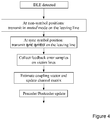
- the DS operation for new channel estimation, or "fast tracking" may be accomplished by sending two kinds of special symbols: muted symbol and sync symbol. An exemplifying embodiment is illustrated in figure 4 .
- the idle symbols are equivalent to the muted symbols here if set the gain scaling factor to zero or set the symbol constellation points to zero.
- the expression muted symbols is considered to also cover the alternative option of continuing to transmit the symbols, but at a very low power.
- Sync symbols are transmitted every 6 ms , i.e. one superframe duration, on each line in G.fast (cf. figure 2 ). Assume that J superframes are required before the update is completed. Let t j sc be the time instant to transmit the j -th DS sync symbol. On this specific time slot, the l -th gain adjuster is set back to g l , which may be stored e.g. in the bits-and-gains table assigned during initialization.
- the error samples of sync symbols e t j sc on victim lines are then fed back to DP/CO.
- the transmission on line l goes back to quasi-quiet symbols for all data symbol positions.
- the transmitter may keep on alternatively sending quasi-quiet symbols and sync symbols on the disorderly leaving line until DP/CO have collected a reasonable number of e t j sc to do an elegant coupling vector estimation.
- victim lines is meant the other lines in a vectored group except the disorderly leaving line.
- ⁇ is a dimension reducing function by excluding the i -th column and row.
- the DP may update the precoder based on the channel matrix change and may shut down the transmission on the leaving line completely.
- the fast channel estimation described herein is different from the one described in [1].
- the new method explicitly estimates the reflected crosstalk coefficients which cause the channel changes and then calculate the channel change. This is especially important in high frequencies for G.fast use, where the whole channel matrix changes due to a DLE.
- the previous method described in [1] actually is an approximate of the new method described herein. In low frequencies, the changes in other columns are much smaller than the column associated with the leaving line. Thus, for certain frequencies, e.g. VDSL2 frequency range, the method in [1] works sufficiently well by estimating the dominant column changed and neglecting other columns.
- VCE Vectoring Control Entity
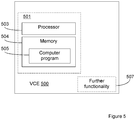
- FIG. 5 is a schematic illustration of an exemplifying embodiment of a VCE 500 in which a method embodying any of the presently described techniques can be implemented.
- a computer program for controlling the VCE 500 to carry out a method embodying the present invention is stored in a program storage 504, which comprises one or several memory devices. Data used during the performance of a method embodying the present invention may also be stored in the program storage 504, or a separate data storage, which also may comprise one or more memory devices.
- instructions 505, such as program steps may be fetched from the program storage 504 and be executed by processing means 503, such as a Central Processing Unit, CPU, or other processor.
- Output information resulting from performance of a method embodying the present invention can be stored back in a data storage, or, be sent to an Input/Output (I/O) interface, which includes a network interface for sending and receiving data to and from other network nodes and which may also include a radio transceiver for communicating with one or more terminals.
- I/O Input/Output
- the VCE 500 is associated with the same technical features, objects and advantages as the previously described method embodiments. The VCE is described in brief in order to avoid unnecessary repetition.
- the part of the network node 500 which is most affected by the adaptation to the herein described solution is illustrated as an arrangement 501, surrounded by a dashed line.
- the further functionality 506 illustrated in figure 5 may be assumed to carry out regular VCE and/or node functions.
- the execution of the instructions 505 by the processing means 503 causes the VCE 500 to obtain at least one error sample from CPEs connected to other lines in the vectored group of DSL lines, and to calculate an estimate of the channel coefficients, H', changed due to the DLE, based on the at least one error sample.
- the execution of the instructions further causes the VCE to modify a downstream precoder, based on the channel estimate.
- the execution of the instructions may further cause the VCE to configured to continue the transmission of sync symbols on line m after the DLE.
- the transmission in data symbol positions on line m before the DLE comprises a far-end crosstalk precompensation signal and a direct signal.
- the execution of the instructions may cause the VCE to continue the transmission of the far-end crosstalk precompensation signal after the DLE, and further to transmit the direct signal on line m with reduced power after the DLE, as compared to before the DLE.
- the execution of the instructions may further cause the VCE to obtain at least one error sample from the CPE of at least one other line in the vectored group, and further to send at least one error feedback request over the embedded operations channel (eoc) in both VDSL2 and G.fast or over a robust embedded operations channel, ROC, in VDSL2, or over a robust management channel, RMC, in G.fast, in order to collect one or more error samples.
- embedded operations channel eoc
- ROC embedded operations channel
- RMC robust management channel
- the VCE 600 or arrangement 601 comprises an obtaining unit 602, configured to obtain at least one error sample from CPEs connected to other lines in the vectored group of DSL lines.
- the VCE 600 further comprises a calculating unit 604, configured to calculate an estimate of the channel coefficients, H', changed due to the DLE, based on the at least one error sample, thus providing a channel estimate.
- the VCE 600 further comprises a modifying unit 605, configured to modify a downstream precoder, based on the channel estimate.
- the arrangement 601 could further comprise a determining or detecting unit 602, configured to detect the occurrence of an DLE on a line in the vectored group. Alternatively, this detection could be regarded as a part of the standard functionality 607.
- VCE described above could comprise further units or modules configured for the different method embodiments described herein.
- the units or modules in the arrangements in the respective different network node embodiments and wireless device embodiments described above could be implemented e.g. by one or more of: a processor or a microprocessor and adequate software and memory for storing thereof, a Programmable Logic Device (PLD) or other electronic component(s) or processing circuitry configured to perform the actions described above, and illustrated e.g. in figures 5-10 . That is, the units or modules in the arrangements in the different nodes described above could be implemented by a combination of analog and digital circuits, and/or one or more processors configured with software and/or firmware, e.g. stored in a memory.
- PLD Programmable Logic Device
- processors may be included in a single application-specific integrated circuitry, ASIC, or several processors and various digital hardware may be distributed among several separate components, whether individually packaged or assembled into a system-on-a-chip, SoC.
- the VCE could be implemented as a computer program, e.g. a software module, which is run on a node which is operable to communicate with and/or control at least parts of the DLE system.
- a node may be located locally, near the DSL lines, or remote, such as in a distributed system, e.g. a cloud solution.
Landscapes
- Engineering & Computer Science (AREA)
- Computer Networks & Wireless Communication (AREA)
- Signal Processing (AREA)
- Cable Transmission Systems, Equalization Of Radio And Reduction Of Echo (AREA)
Claims (16)
- Verfahren, das von einem Vektorisierungs-Steuerelement (Vectoring Control Entity), VCE, zur Handhabung eines ungeordnet-Verlassen-Ereignisses (Disorderly Leaving Event), DLE, durchgeführt wird, das eine plötzliche Abschlussänderung (Sudden Termination Change), STC, in einem digitalen Teilnehmerleitungssystem (Digital Subscriber Line), DSL, verursacht, wobei das Verfahren umfasst:wenn ein DLE auf einer Leitung m in einer vektorisierten Gruppe von DSL-Leitungen auftritt und die Übertragung auf der Leitung m zumindest teilweise fortgesetzt wird:- Erlangen (104) von zumindest einer Fehlerprobe von kundeneignen Ausrüstungen (Customer Premises Equipments), CPE, die mit anderen Leitungen in der vektorisierten Gruppe von DSL-Leitungen verbunden sind,- Berechnen (108) einer Schätzung der Kanalkoeffizienten, H', die aufgrund des DLE geändert wurden, basierend auf der zumindest einen Fehlerprobe, somit Bereitstellen einer Kanalschätzung, und- Modifizieren (110) eines nachgeschalteten Vorcodierers, basierend auf der Kanalschätzung, sodass ein Umlernen der anderen Leitungen in der vektorisierten Gruppe aufgrund des DLE vermieden wird,dadurch gekennzeichnet, dass die Schätzung der Kanalkoeffizienten basierend auf dem Modell H' = H + CΛH berechnet wird, wobeiC eine Nahnebensprechen-Kopplungsmatrix für das CPE-Ende der vektorisierten Gruppe ist;A eine Diagonalmatrix mit den Reflexionskoeffizienten, nach dem DLE, des CPE-Endes der Kabel, die der vektorisierten Gruppe zugeordnet sind, ist;H eine Matrix mit den Kanalkoeffizienten vor dem DLE ist; undH' eine Matrix mit den geschätzten Kanalkoeffizienten nach dem DLE ist.
- Verfahren nach Anspruch 1, wobei die Übertragung von Sync-Symbolen auf der Leitung m nach dem DLE fortgesetzt wird.
- Verfahren nach Anspruch 1 oder 2, wobei die Übertragung in Datensymbolpositionen auf der Leitung m vor dem DLE ein Fernnebensprechen-Vorkompensationssignal von anderen Leitungen und ein Direktsignal der Leitung m umfasst, und wobei das Fernnebensprechen-Vorkompensationssignal nach dem DLE fortgesetzt wird, sodass die Reflexion des Nebensprechens von den anderen Leitungen an dem CPE-Ende der Leitung m aufgehoben bleibt.
- Verfahren nach Anspruch 3, wobei das auf der Leitung m übertragene direkte Signal nach dem DLE im Vergleich zu vor dem DLE in Leistung reduziert wird.
- Verfahren nach einem der vorstehenden Ansprüche, weiter umfassend ein Anwenden von einem oder mehreren der Folgenden für Datensymbolpositionen auf der Leitung m nach dem DLE:- Einstellen eines Verstärkungsskalierungsfaktors auf Null oder nahe zu Null;- Einstellen von Symbolkonstellationspunkten auf Null oder nahe zu Null in einem Symbolcodierer.
- Verfahren nach einem der vorstehenden Ansprüche, wobei die Übertragung in Datensymbolpositionen auf anderen Leitungen als auf der Leitung m vor dem DLE Fernnebensprechen-Vorkompensationssignale umfasst, die das vorkompensierte Signal von der Leitung m und ein eigenes Direktsignal einschließen, und wobei das Fernnebensprechen-Vorkompensationssignal von der Leitung m auf den anderen Leitungen gestoppt wird oder nach dem DLE im Vergleich zu vor dem DLE in Leistung reduziert wird, während die anderen Signale nach dem DLE fortgesetzt werden.
- Verfahren nach einem der vorstehenden Ansprüche, wobei das Erlangen von Fehlerproben ein Senden von zumindest einer Fehlerrückmeldeanfrage über entweder den eingebetteten Betriebskanal (embedded operations channel, eoc) sowohl in VDSL2 als auch in G.schnell (G.fast) oder einen robusten eingebetteten Betriebskanal (robust embedded operations channel, ROC) in VDLS2 oder einen robusten Managementkanal (robust management channel), RMC, in G.schnell umfasst.
- Vektorisierungs-Steuerelement (Vectoring Control Entity), VCE, zur Handhabung eines ungeordnet-Verlassen-Ereignisses (Disorderly Leaving Event), DLE, das eine plötzliche Abschlussänderung (Sudden Termination Change), STC, in einem digitalen Teilnehmerleitungssystem (Digital Subscriber Line), DSL, verursacht, wobei das VCE konfiguriert ist, zum:wenn ein DLE auf einer Leitung m in einer vektorisierten Gruppe von DSL-Leitungen auftritt und die Übertragung auf der Leitung m zumindest teilweise fortgesetzt wird:- Erlangen von zumindest einer Fehlerprobe von kundeneignen Ausrüstungen (Customer Premises Equipments), CPE, die mit anderen Leitungen in der vektorisierten Gruppe von DSL-Leitungen verbunden sind,- Berechnen einer Schätzung der Kanalkoeffizienten, H', die aufgrund des DLE geändert wurden, basierend auf der zumindest einen Fehlerprobe, somit Bereitstellen einer Kanalschätzung, und- Modifizieren eines nachgeschalteten Vorcodierers, basierend auf der Kanalschätzung, sodass ein Umlernen der anderen Leitungen in der vektorisierten Gruppe aufgrund des DLE vermieden wird,dadurch gekennzeichnet, dass die VCE weiter konfiguriert ist, um die Schätzung der Kanalkoeffizienten basierend auf dem Modell H' = H + CAH zu berechnen, wobeiC eine Nah-Nebensprech-Kopplungsmatrix für das CPE-Ende der vektorisierten Gruppe ist;A eine Diagonalmatrix mit den Reflexionskoeffizienten, nach dem DLE, des CPE-Endes der Kabel, die der vektorisierten Gruppe zugeordnet sind, ist;H eine Matrix mit den Kanalkoeffizienten vor dem DLE ist; undH' eine Matrix mit den geschätzten Kanalkoeffizienten nach dem DLE ist.
- Vektorisierungs-Steuerelement (Vectoring Control Entity), VCE, nach Anspruch 8, das konfiguriert ist, um die Übertragung von Sync-Symbolen auf der Leitung m nach dem DLE fortzusetzen.
- Vektorisierungs-Steuerelement (Vectoring Control Entity), VCE, nach Anspruch 8 oder 9, wobei die Übertragung in Datensymbolpositionen auf der Leitung m vor dem DLE ein Fernnebensprechen-Vorkompensationssignal von anderen Leitungen und ein Direktsignal der Leitung m umfasst, und wobei das VCE konfiguriert ist, um die Übertragung des Fernnebensprechen-Vorkompensationssignals nach dem DLE fortzusetzen, sodass die Reflexion des Nebensprechens von den anderen Leitungen an dem CPE-Ende der Leitung m aufgehoben bleibt.
- Vektorisierungs-Steuerelement (Vectoring Control Entity), VCE, nach Anspruch 10, das konfiguriert ist, um das direkte Signal auf der Leitung m nach dem DLE im Vergleich zu vor dem DLE mit einer reduzierten Leistung zu übertragen.
- Vektorisierungs-Steuerelement (Vectoring Control Entity), VCE, nach einem der Ansprüche 8-11, das konfiguriert ist, um eins oder mehrere der Folgenden für Datensymbolpositionen auf der Leitung m nach dem DLE anzuwenden:- Einstellen eines Verstärkungsskalierungsfaktors auf Null oder nahe zu Null;- Einstellen von Symbolkonstellationspunkten auf Null oder nahe zu Null in einem Symbolcodierer.
- Vektorisierungs-Steuerelement (Vectoring Control Entity), VCE, nach einem der Ansprüche 8-12, wobei die Übertragung in Datensymbolpositionen auf anderen Leitungen als auf der Leitung m vor dem DLE Fernnebensprechen-Vorkompensationssignale umfasst, die das vorkompensierte Signal von der Leitung m und ein eigenes Direktsignal einschließen, und wobei das VCE konfiguriert ist, um das Fernnebensprechen-Vorkompensationssignal von der Leitung m auf den anderen Leitungen zu stoppen oder nach dem DLE im Vergleich zu vor dem DLE in Leistung zu reduzieren, während die anderen Signale nach dem DLE fortgesetzt werden.
- Vektorisierungs-Steuerelement (Vectoring Control Entity), VCE, nach einem der Ansprüche 8-13, wobei das Erlangen von Fehlerproben ein Senden von zumindest einer Fehlerrückmeldeanfrage über entweder den eingebetteten Betriebskanal (embedded operations channel, eoc) sowohl in VDSL2 als auch in G.schnell (G.fast) oder einen robusten eingebetteten Betriebskanal (robust embedded operations channel), ROC, in VDLS2 oder einen robusten Managementkanal (robust management channel), RMC, in G.schnell umfasst.
- Digitaler Teilnehmerleitung-Zugriffsmultiplexer (Digital Subscriber Line Access Multiplexer), umfassend ein VCE nach einem der Ansprüche 8-14.
- Computerprogramm zum Durchführen eines Verfahrens nach einem der Ansprüche 1-7 in einem Vektorisierungs-Steuerelement (Vectoring Control Entity), VCE.
Applications Claiming Priority (1)
| Application Number | Priority Date | Filing Date | Title |
|---|---|---|---|
| PCT/SE2014/051135 WO2016053153A1 (en) | 2014-09-30 | 2014-09-30 | Method and arrangement in a dsl vectoring system |
Publications (2)
| Publication Number | Publication Date |
|---|---|
| EP3202047A1 EP3202047A1 (de) | 2017-08-09 |
| EP3202047B1 true EP3202047B1 (de) | 2018-05-30 |
Family
ID=51690428
Family Applications (1)
| Application Number | Title | Priority Date | Filing Date |
|---|---|---|---|
| EP14783684.5A Not-in-force EP3202047B1 (de) | 2014-09-30 | 2014-09-30 | Verfahren und anordnung in einem dsl-vektorsystem |
Country Status (4)
| Country | Link |
|---|---|
| US (1) | US9893762B2 (de) |
| EP (1) | EP3202047B1 (de) |
| CN (1) | CN106716853B (de) |
| WO (1) | WO2016053153A1 (de) |
Families Citing this family (3)
| Publication number | Priority date | Publication date | Assignee | Title |
|---|---|---|---|---|
| US9912376B2 (en) * | 2014-07-15 | 2018-03-06 | Adtran, Inc. | Managing crosstalk in vectored transmissions |
| CN107113024A (zh) * | 2014-11-19 | 2017-08-29 | 领特投资两合有限公司 | 链路丢失检测 |
| EP3745603B1 (de) * | 2019-05-29 | 2023-12-20 | Nokia Solutions and Networks Oy | Umgekehrte/entfernte leistungsverwaltung in kombination mit vektorisierung |
Family Cites Families (4)
| Publication number | Priority date | Publication date | Assignee | Title |
|---|---|---|---|---|
| EP1998465A1 (de) * | 2007-05-29 | 2008-12-03 | Nokia Siemens Networks Oy | Verfahren und Vorrichtung zur Übersprechungsbeurteilung und eine solche Vorrichtung umfassendes Kommunikationssystem |
| WO2011152768A1 (en) * | 2010-06-01 | 2011-12-08 | Telefonaktiebolaget Lm Ericsson (Publ) | Method and arrangement in a dsl vectoring system |
| EP2717485B1 (de) * | 2011-07-29 | 2016-04-27 | Huawei Technologies Co., Ltd. | Verfahren, vorrichtung und system zur signalverarbeitung |
| WO2014098684A1 (en) * | 2012-12-21 | 2014-06-26 | Telefonaktiebolaget L M Ericsson (Publ) | Mitigation of disconnect events in vectoring based dsl systems |
-
2014
- 2014-09-30 WO PCT/SE2014/051135 patent/WO2016053153A1/en not_active Ceased
- 2014-09-30 US US15/509,210 patent/US9893762B2/en active Active
- 2014-09-30 CN CN201480082166.0A patent/CN106716853B/zh not_active Expired - Fee Related
- 2014-09-30 EP EP14783684.5A patent/EP3202047B1/de not_active Not-in-force
Non-Patent Citations (1)
| Title |
|---|
| None * |
Also Published As
| Publication number | Publication date |
|---|---|
| EP3202047A1 (de) | 2017-08-09 |
| US20170250731A1 (en) | 2017-08-31 |
| CN106716853A (zh) | 2017-05-24 |
| CN106716853B (zh) | 2021-04-09 |
| WO2016053153A1 (en) | 2016-04-07 |
| US9893762B2 (en) | 2018-02-13 |
Similar Documents
| Publication | Publication Date | Title |
|---|---|---|
| CN103141033B (zh) | 用于控制dsl系统中的干扰的方法和装置 | |
| US9020017B2 (en) | Signal processing method, device and system | |
| EP3334054B1 (de) | Verfahren und anordnung in einem dsl-vektorsystem | |
| US9667450B2 (en) | Detection and correction of impulse noise in communication channel crosstalk estimates | |
| US20170054473A1 (en) | Non-linear precoder with separate tracking | |
| EP2055014A2 (de) | Systeme und verfahren für mimo-vorkodierung in einem xdsl-system | |
| WO2012102917A1 (en) | Method and device for the precompensation and postcompensation of crosstalk in a dsl mimo system | |
| US20160105215A1 (en) | Crosstalk Cancellation Over Multiple Mediums | |
| US9917617B2 (en) | Randomization of crosstalk probing signals | |
| US11728844B2 (en) | Partial echo cancellation duplexing | |
| EP3251223B1 (de) | Mehrbenutzer-mimo für digitale teilnehmerleitung | |
| CN103765789B (zh) | 一种线路初始化方法、装置和系统 | |
| EP3202047B1 (de) | Verfahren und anordnung in einem dsl-vektorsystem | |
| EP3062471A1 (de) | Skalierte, orthogonale pilotsequenzen zur parallelen kanalschätzung | |
| US10455079B2 (en) | Effective crosstalk estimation in presence of clipping errors | |
| US20110075834A1 (en) | Crosstalk control using delayed post-compensation in a multi-channel communication system | |
| CN108702176B (zh) | 用于矢量化矩阵的确定的方法和装置 | |
| JP6205059B2 (ja) | 通信経路をアクティブ化および非アクティブ化するための方法およびシステム | |
| Zafaruddin et al. | Iterative receiver based on SAGE algorithm for crosstalk cancellation in upstream vectored VDSL | |
| Huang et al. | Mitigating disorderly leaving events in G. fast | |
| Huang | Crosstalk in Wideband Wireline Systems--Curse and Blessing | |
| Zafaruddin et al. | Krylov algorithms for FEXT cancellation in upstream MIMO VDSL | |
| CN101610103B (zh) | 一种信道估计方法、装置和系统 | |
| EP2779475B1 (de) | Fehler-Feedback mit erkanntem Konstellationspunkt |
Legal Events
| Date | Code | Title | Description |
|---|---|---|---|
| PUAI | Public reference made under article 153(3) epc to a published international application that has entered the european phase |
Free format text: ORIGINAL CODE: 0009012 |
|
| 17P | Request for examination filed |
Effective date: 20170223 |
|
| AK | Designated contracting states |
Kind code of ref document: A1 Designated state(s): AL AT BE BG CH CY CZ DE DK EE ES FI FR GB GR HR HU IE IS IT LI LT LU LV MC MK MT NL NO PL PT RO RS SE SI SK SM TR |
|
| AX | Request for extension of the european patent |
Extension state: BA ME |
|
| DAX | Request for extension of the european patent (deleted) | ||
| GRAP | Despatch of communication of intention to grant a patent |
Free format text: ORIGINAL CODE: EPIDOSNIGR1 |
|
| INTG | Intention to grant announced |
Effective date: 20180214 |
|
| GRAS | Grant fee paid |
Free format text: ORIGINAL CODE: EPIDOSNIGR3 |
|
| GRAA | (expected) grant |
Free format text: ORIGINAL CODE: 0009210 |
|
| AK | Designated contracting states |
Kind code of ref document: B1 Designated state(s): AL AT BE BG CH CY CZ DE DK EE ES FI FR GB GR HR HU IE IS IT LI LT LU LV MC MK MT NL NO PL PT RO RS SE SI SK SM TR |
|
| REG | Reference to a national code |
Ref country code: GB Ref legal event code: FG4D |
|
| REG | Reference to a national code |
Ref country code: CH Ref legal event code: EP |
|
| REG | Reference to a national code |
Ref country code: AT Ref legal event code: REF Ref document number: 1004661 Country of ref document: AT Kind code of ref document: T Effective date: 20180615 |
|
| REG | Reference to a national code |
Ref country code: IE Ref legal event code: FG4D |
|
| REG | Reference to a national code |
Ref country code: DE Ref legal event code: R096 Ref document number: 602014026349 Country of ref document: DE |
|
| REG | Reference to a national code |
Ref country code: NL Ref legal event code: FP |
|
| REG | Reference to a national code |
Ref country code: LT Ref legal event code: MG4D |
|
| PG25 | Lapsed in a contracting state [announced via postgrant information from national office to epo] |
Ref country code: CY Free format text: LAPSE BECAUSE OF FAILURE TO SUBMIT A TRANSLATION OF THE DESCRIPTION OR TO PAY THE FEE WITHIN THE PRESCRIBED TIME-LIMIT Effective date: 20180530 Ref country code: LT Free format text: LAPSE BECAUSE OF FAILURE TO SUBMIT A TRANSLATION OF THE DESCRIPTION OR TO PAY THE FEE WITHIN THE PRESCRIBED TIME-LIMIT Effective date: 20180530 Ref country code: FI Free format text: LAPSE BECAUSE OF FAILURE TO SUBMIT A TRANSLATION OF THE DESCRIPTION OR TO PAY THE FEE WITHIN THE PRESCRIBED TIME-LIMIT Effective date: 20180530 Ref country code: NO Free format text: LAPSE BECAUSE OF FAILURE TO SUBMIT A TRANSLATION OF THE DESCRIPTION OR TO PAY THE FEE WITHIN THE PRESCRIBED TIME-LIMIT Effective date: 20180830 Ref country code: ES Free format text: LAPSE BECAUSE OF FAILURE TO SUBMIT A TRANSLATION OF THE DESCRIPTION OR TO PAY THE FEE WITHIN THE PRESCRIBED TIME-LIMIT Effective date: 20180530 Ref country code: SE Free format text: LAPSE BECAUSE OF FAILURE TO SUBMIT A TRANSLATION OF THE DESCRIPTION OR TO PAY THE FEE WITHIN THE PRESCRIBED TIME-LIMIT Effective date: 20180530 Ref country code: BG Free format text: LAPSE BECAUSE OF FAILURE TO SUBMIT A TRANSLATION OF THE DESCRIPTION OR TO PAY THE FEE WITHIN THE PRESCRIBED TIME-LIMIT Effective date: 20180830 |
|
| PG25 | Lapsed in a contracting state [announced via postgrant information from national office to epo] |
Ref country code: LV Free format text: LAPSE BECAUSE OF FAILURE TO SUBMIT A TRANSLATION OF THE DESCRIPTION OR TO PAY THE FEE WITHIN THE PRESCRIBED TIME-LIMIT Effective date: 20180530 Ref country code: RS Free format text: LAPSE BECAUSE OF FAILURE TO SUBMIT A TRANSLATION OF THE DESCRIPTION OR TO PAY THE FEE WITHIN THE PRESCRIBED TIME-LIMIT Effective date: 20180530 Ref country code: GR Free format text: LAPSE BECAUSE OF FAILURE TO SUBMIT A TRANSLATION OF THE DESCRIPTION OR TO PAY THE FEE WITHIN THE PRESCRIBED TIME-LIMIT Effective date: 20180831 Ref country code: HR Free format text: LAPSE BECAUSE OF FAILURE TO SUBMIT A TRANSLATION OF THE DESCRIPTION OR TO PAY THE FEE WITHIN THE PRESCRIBED TIME-LIMIT Effective date: 20180530 |
|
| REG | Reference to a national code |
Ref country code: AT Ref legal event code: MK05 Ref document number: 1004661 Country of ref document: AT Kind code of ref document: T Effective date: 20180530 |
|
| PG25 | Lapsed in a contracting state [announced via postgrant information from national office to epo] |
Ref country code: DK Free format text: LAPSE BECAUSE OF FAILURE TO SUBMIT A TRANSLATION OF THE DESCRIPTION OR TO PAY THE FEE WITHIN THE PRESCRIBED TIME-LIMIT Effective date: 20180530 Ref country code: PL Free format text: LAPSE BECAUSE OF FAILURE TO SUBMIT A TRANSLATION OF THE DESCRIPTION OR TO PAY THE FEE WITHIN THE PRESCRIBED TIME-LIMIT Effective date: 20180530 Ref country code: AT Free format text: LAPSE BECAUSE OF FAILURE TO SUBMIT A TRANSLATION OF THE DESCRIPTION OR TO PAY THE FEE WITHIN THE PRESCRIBED TIME-LIMIT Effective date: 20180530 Ref country code: EE Free format text: LAPSE BECAUSE OF FAILURE TO SUBMIT A TRANSLATION OF THE DESCRIPTION OR TO PAY THE FEE WITHIN THE PRESCRIBED TIME-LIMIT Effective date: 20180530 Ref country code: SK Free format text: LAPSE BECAUSE OF FAILURE TO SUBMIT A TRANSLATION OF THE DESCRIPTION OR TO PAY THE FEE WITHIN THE PRESCRIBED TIME-LIMIT Effective date: 20180530 Ref country code: RO Free format text: LAPSE BECAUSE OF FAILURE TO SUBMIT A TRANSLATION OF THE DESCRIPTION OR TO PAY THE FEE WITHIN THE PRESCRIBED TIME-LIMIT Effective date: 20180530 Ref country code: CZ Free format text: LAPSE BECAUSE OF FAILURE TO SUBMIT A TRANSLATION OF THE DESCRIPTION OR TO PAY THE FEE WITHIN THE PRESCRIBED TIME-LIMIT Effective date: 20180530 |
|
| PG25 | Lapsed in a contracting state [announced via postgrant information from national office to epo] |
Ref country code: IT Free format text: LAPSE BECAUSE OF FAILURE TO SUBMIT A TRANSLATION OF THE DESCRIPTION OR TO PAY THE FEE WITHIN THE PRESCRIBED TIME-LIMIT Effective date: 20180530 Ref country code: SM Free format text: LAPSE BECAUSE OF FAILURE TO SUBMIT A TRANSLATION OF THE DESCRIPTION OR TO PAY THE FEE WITHIN THE PRESCRIBED TIME-LIMIT Effective date: 20180530 |
|
| REG | Reference to a national code |
Ref country code: DE Ref legal event code: R097 Ref document number: 602014026349 Country of ref document: DE |
|
| PLBE | No opposition filed within time limit |
Free format text: ORIGINAL CODE: 0009261 |
|
| STAA | Information on the status of an ep patent application or granted ep patent |
Free format text: STATUS: NO OPPOSITION FILED WITHIN TIME LIMIT |
|
| PG25 | Lapsed in a contracting state [announced via postgrant information from national office to epo] |
Ref country code: MC Free format text: LAPSE BECAUSE OF FAILURE TO SUBMIT A TRANSLATION OF THE DESCRIPTION OR TO PAY THE FEE WITHIN THE PRESCRIBED TIME-LIMIT Effective date: 20180530 |
|
| REG | Reference to a national code |
Ref country code: CH Ref legal event code: PL |
|
| 26N | No opposition filed |
Effective date: 20190301 |
|
| REG | Reference to a national code |
Ref country code: BE Ref legal event code: MM Effective date: 20180930 |
|
| REG | Reference to a national code |
Ref country code: IE Ref legal event code: MM4A |
|
| PG25 | Lapsed in a contracting state [announced via postgrant information from national office to epo] |
Ref country code: LU Free format text: LAPSE BECAUSE OF NON-PAYMENT OF DUE FEES Effective date: 20180930 |
|
| PG25 | Lapsed in a contracting state [announced via postgrant information from national office to epo] |
Ref country code: IE Free format text: LAPSE BECAUSE OF NON-PAYMENT OF DUE FEES Effective date: 20180930 |
|
| PG25 | Lapsed in a contracting state [announced via postgrant information from national office to epo] |
Ref country code: LI Free format text: LAPSE BECAUSE OF NON-PAYMENT OF DUE FEES Effective date: 20180930 Ref country code: CH Free format text: LAPSE BECAUSE OF NON-PAYMENT OF DUE FEES Effective date: 20180930 Ref country code: FR Free format text: LAPSE BECAUSE OF NON-PAYMENT OF DUE FEES Effective date: 20180930 Ref country code: BE Free format text: LAPSE BECAUSE OF NON-PAYMENT OF DUE FEES Effective date: 20180930 |
|
| PG25 | Lapsed in a contracting state [announced via postgrant information from national office to epo] |
Ref country code: AL Free format text: LAPSE BECAUSE OF FAILURE TO SUBMIT A TRANSLATION OF THE DESCRIPTION OR TO PAY THE FEE WITHIN THE PRESCRIBED TIME-LIMIT Effective date: 20180530 |
|
| PG25 | Lapsed in a contracting state [announced via postgrant information from national office to epo] |
Ref country code: MT Free format text: LAPSE BECAUSE OF NON-PAYMENT OF DUE FEES Effective date: 20180930 |
|
| PG25 | Lapsed in a contracting state [announced via postgrant information from national office to epo] |
Ref country code: TR Free format text: LAPSE BECAUSE OF FAILURE TO SUBMIT A TRANSLATION OF THE DESCRIPTION OR TO PAY THE FEE WITHIN THE PRESCRIBED TIME-LIMIT Effective date: 20180530 |
|
| PG25 | Lapsed in a contracting state [announced via postgrant information from national office to epo] |
Ref country code: PT Free format text: LAPSE BECAUSE OF FAILURE TO SUBMIT A TRANSLATION OF THE DESCRIPTION OR TO PAY THE FEE WITHIN THE PRESCRIBED TIME-LIMIT Effective date: 20180530 |
|
| PG25 | Lapsed in a contracting state [announced via postgrant information from national office to epo] |
Ref country code: HU Free format text: LAPSE BECAUSE OF FAILURE TO SUBMIT A TRANSLATION OF THE DESCRIPTION OR TO PAY THE FEE WITHIN THE PRESCRIBED TIME-LIMIT; INVALID AB INITIO Effective date: 20140930 Ref country code: MK Free format text: LAPSE BECAUSE OF NON-PAYMENT OF DUE FEES Effective date: 20180530 |
|
| PG25 | Lapsed in a contracting state [announced via postgrant information from national office to epo] |
Ref country code: IS Free format text: LAPSE BECAUSE OF FAILURE TO SUBMIT A TRANSLATION OF THE DESCRIPTION OR TO PAY THE FEE WITHIN THE PRESCRIBED TIME-LIMIT Effective date: 20180930 |
|
| PG25 | Lapsed in a contracting state [announced via postgrant information from national office to epo] |
Ref country code: SI Free format text: LAPSE BECAUSE OF NON-PAYMENT OF DUE FEES Effective date: 20180930 |
|
| PGFP | Annual fee paid to national office [announced via postgrant information from national office to epo] |
Ref country code: NL Payment date: 20210926 Year of fee payment: 8 |
|
| PGFP | Annual fee paid to national office [announced via postgrant information from national office to epo] |
Ref country code: GB Payment date: 20210927 Year of fee payment: 8 |
|
| PGFP | Annual fee paid to national office [announced via postgrant information from national office to epo] |
Ref country code: DE Payment date: 20220629 Year of fee payment: 9 |
|
| REG | Reference to a national code |
Ref country code: NL Ref legal event code: MM Effective date: 20221001 |
|
| GBPC | Gb: european patent ceased through non-payment of renewal fee |
Effective date: 20220930 |
|
| PG25 | Lapsed in a contracting state [announced via postgrant information from national office to epo] |
Ref country code: NL Free format text: LAPSE BECAUSE OF NON-PAYMENT OF DUE FEES Effective date: 20221001 |
|
| PG25 | Lapsed in a contracting state [announced via postgrant information from national office to epo] |
Ref country code: GB Free format text: LAPSE BECAUSE OF NON-PAYMENT OF DUE FEES Effective date: 20220930 |
|
| REG | Reference to a national code |
Ref country code: DE Ref legal event code: R119 Ref document number: 602014026349 Country of ref document: DE |
|
| PG25 | Lapsed in a contracting state [announced via postgrant information from national office to epo] |
Ref country code: DE Free format text: LAPSE BECAUSE OF NON-PAYMENT OF DUE FEES Effective date: 20240403 |