EP3201162B1 - Dehydrierung von alkanen zu alkenen - Google Patents
Dehydrierung von alkanen zu alkenen Download PDFInfo
- Publication number
- EP3201162B1 EP3201162B1 EP15767482.1A EP15767482A EP3201162B1 EP 3201162 B1 EP3201162 B1 EP 3201162B1 EP 15767482 A EP15767482 A EP 15767482A EP 3201162 B1 EP3201162 B1 EP 3201162B1
- Authority
- EP
- European Patent Office
- Prior art keywords
- dehydrogenation
- hydrogen
- alkanes
- benzene
- styrene
- Prior art date
- Legal status (The legal status is an assumption and is not a legal conclusion. Google has not performed a legal analysis and makes no representation as to the accuracy of the status listed.)
- Active
Links
- 238000006356 dehydrogenation reaction Methods 0.000 title claims description 85
- 150000001335 aliphatic alkanes Chemical class 0.000 title claims description 40
- 150000001336 alkenes Chemical class 0.000 title claims description 31
- UHOVQNZJYSORNB-UHFFFAOYSA-N Benzene Chemical compound C1=CC=CC=C1 UHOVQNZJYSORNB-UHFFFAOYSA-N 0.000 claims description 102
- YXFVVABEGXRONW-UHFFFAOYSA-N Toluene Chemical compound CC1=CC=CC=C1 YXFVVABEGXRONW-UHFFFAOYSA-N 0.000 claims description 102
- YNQLUTRBYVCPMQ-UHFFFAOYSA-N Ethylbenzene Chemical group CCC1=CC=CC=C1 YNQLUTRBYVCPMQ-UHFFFAOYSA-N 0.000 claims description 96
- 238000000034 method Methods 0.000 claims description 94
- PPBRXRYQALVLMV-UHFFFAOYSA-N Styrene Natural products C=CC1=CC=CC=C1 PPBRXRYQALVLMV-UHFFFAOYSA-N 0.000 claims description 93
- 230000008569 process Effects 0.000 claims description 93
- RWSOTUBLDIXVET-UHFFFAOYSA-N Dihydrogen sulfide Chemical compound S RWSOTUBLDIXVET-UHFFFAOYSA-N 0.000 claims description 63
- 239000003054 catalyst Substances 0.000 claims description 48
- 229910000037 hydrogen sulfide Inorganic materials 0.000 claims description 46
- 239000012159 carrier gas Substances 0.000 claims description 45
- VNWKTOKETHGBQD-UHFFFAOYSA-N methane Chemical compound C VNWKTOKETHGBQD-UHFFFAOYSA-N 0.000 claims description 36
- 239000001257 hydrogen Substances 0.000 claims description 34
- 229910052739 hydrogen Inorganic materials 0.000 claims description 34
- 150000004996 alkyl benzenes Chemical class 0.000 claims description 26
- UFHFLCQGNIYNRP-UHFFFAOYSA-N Hydrogen Chemical compound [H][H] UFHFLCQGNIYNRP-UHFFFAOYSA-N 0.000 claims description 22
- 230000003647 oxidation Effects 0.000 claims description 21
- 238000007254 oxidation reaction Methods 0.000 claims description 21
- 239000000047 product Substances 0.000 claims description 19
- 239000007789 gas Substances 0.000 claims description 16
- 230000015572 biosynthetic process Effects 0.000 claims description 14
- 150000002431 hydrogen Chemical class 0.000 claims description 14
- UCKMPCXJQFINFW-UHFFFAOYSA-N Sulphide Chemical compound [S-2] UCKMPCXJQFINFW-UHFFFAOYSA-N 0.000 claims description 13
- OTMSDBZUPAUEDD-UHFFFAOYSA-N Ethane Chemical compound CC OTMSDBZUPAUEDD-UHFFFAOYSA-N 0.000 claims description 12
- 238000011144 upstream manufacturing Methods 0.000 claims description 10
- 239000006227 byproduct Substances 0.000 claims description 9
- 239000000126 substance Substances 0.000 claims description 8
- 239000007795 chemical reaction product Substances 0.000 claims description 4
- 150000005194 ethylbenzenes Chemical class 0.000 claims description 3
- 238000003303 reheating Methods 0.000 claims description 3
- 125000003011 styrenyl group Chemical group [H]\C(*)=C(/[H])C1=C([H])C([H])=C([H])C([H])=C1[H] 0.000 claims description 3
- 238000006243 chemical reaction Methods 0.000 description 28
- ATUOYWHBWRKTHZ-UHFFFAOYSA-N Propane Chemical compound CCC ATUOYWHBWRKTHZ-UHFFFAOYSA-N 0.000 description 16
- 239000000203 mixture Substances 0.000 description 14
- OKTJSMMVPCPJKN-UHFFFAOYSA-N Carbon Chemical compound [C] OKTJSMMVPCPJKN-UHFFFAOYSA-N 0.000 description 12
- 229910052799 carbon Inorganic materials 0.000 description 12
- 229910052751 metal Inorganic materials 0.000 description 11
- 239000002184 metal Substances 0.000 description 11
- 229910052976 metal sulfide Inorganic materials 0.000 description 11
- JJWKPURADFRFRB-UHFFFAOYSA-N carbonyl sulfide Chemical compound O=C=S JJWKPURADFRFRB-UHFFFAOYSA-N 0.000 description 10
- 238000004519 manufacturing process Methods 0.000 description 10
- RAHZWNYVWXNFOC-UHFFFAOYSA-N Sulphur dioxide Chemical compound O=S=O RAHZWNYVWXNFOC-UHFFFAOYSA-N 0.000 description 8
- 150000001875 compounds Chemical class 0.000 description 8
- XEEYBQQBJWHFJM-UHFFFAOYSA-N iron Substances [Fe] XEEYBQQBJWHFJM-UHFFFAOYSA-N 0.000 description 8
- 239000001294 propane Substances 0.000 description 8
- QQONPFPTGQHPMA-UHFFFAOYSA-N Propene Chemical compound CC=C QQONPFPTGQHPMA-UHFFFAOYSA-N 0.000 description 7
- NINIDFKCEFEMDL-UHFFFAOYSA-N Sulfur Chemical compound [S] NINIDFKCEFEMDL-UHFFFAOYSA-N 0.000 description 7
- 238000004458 analytical method Methods 0.000 description 7
- 230000008901 benefit Effects 0.000 description 7
- VGGSQFUCUMXWEO-UHFFFAOYSA-N Ethene Chemical compound C=C VGGSQFUCUMXWEO-UHFFFAOYSA-N 0.000 description 6
- 239000005977 Ethylene Substances 0.000 description 6
- 239000003085 diluting agent Substances 0.000 description 6
- 229910052742 iron Inorganic materials 0.000 description 6
- 229910052596 spinel Inorganic materials 0.000 description 6
- 238000004821 distillation Methods 0.000 description 5
- 238000001704 evaporation Methods 0.000 description 5
- 230000008020 evaporation Effects 0.000 description 5
- 239000000376 reactant Substances 0.000 description 5
- 229910052717 sulfur Inorganic materials 0.000 description 5
- 239000011593 sulfur Substances 0.000 description 5
- IJGRMHOSHXDMSA-UHFFFAOYSA-N Atomic nitrogen Chemical compound N#N IJGRMHOSHXDMSA-UHFFFAOYSA-N 0.000 description 4
- 229910026161 MgAl2O4 Inorganic materials 0.000 description 4
- VYPSYNLAJGMNEJ-UHFFFAOYSA-N Silicium dioxide Chemical compound O=[Si]=O VYPSYNLAJGMNEJ-UHFFFAOYSA-N 0.000 description 4
- 230000003197 catalytic effect Effects 0.000 description 4
- -1 ethylene, propylene Chemical group 0.000 description 4
- 238000010438 heat treatment Methods 0.000 description 4
- 230000006872 improvement Effects 0.000 description 4
- 229910052750 molybdenum Inorganic materials 0.000 description 4
- OFBQJSOFQDEBGM-UHFFFAOYSA-N n-pentane Natural products CCCCC OFBQJSOFQDEBGM-UHFFFAOYSA-N 0.000 description 4
- 229910052759 nickel Inorganic materials 0.000 description 4
- 238000007086 side reaction Methods 0.000 description 4
- CURLTUGMZLYLDI-UHFFFAOYSA-N Carbon dioxide Chemical compound O=C=O CURLTUGMZLYLDI-UHFFFAOYSA-N 0.000 description 3
- 229910052802 copper Inorganic materials 0.000 description 3
- 230000009849 deactivation Effects 0.000 description 3
- 238000010790 dilution Methods 0.000 description 3
- 239000012895 dilution Substances 0.000 description 3
- 239000000446 fuel Substances 0.000 description 3
- 229930195733 hydrocarbon Natural products 0.000 description 3
- 150000002430 hydrocarbons Chemical class 0.000 description 3
- 229910052748 manganese Inorganic materials 0.000 description 3
- XLYOFNOQVPJJNP-UHFFFAOYSA-N water Substances O XLYOFNOQVPJJNP-UHFFFAOYSA-N 0.000 description 3
- 239000004215 Carbon black (E152) Substances 0.000 description 2
- UQSXHKLRYXJYBZ-UHFFFAOYSA-N Iron oxide Chemical compound [Fe]=O UQSXHKLRYXJYBZ-UHFFFAOYSA-N 0.000 description 2
- 239000005864 Sulphur Substances 0.000 description 2
- 229910045601 alloy Inorganic materials 0.000 description 2
- 239000000956 alloy Substances 0.000 description 2
- 238000013459 approach Methods 0.000 description 2
- 150000004945 aromatic hydrocarbons Chemical class 0.000 description 2
- DALDUXIBIKGWTK-UHFFFAOYSA-N benzene;toluene Chemical compound C1=CC=CC=C1.CC1=CC=CC=C1 DALDUXIBIKGWTK-UHFFFAOYSA-N 0.000 description 2
- 239000001273 butane Substances 0.000 description 2
- 229910002092 carbon dioxide Inorganic materials 0.000 description 2
- 229910017052 cobalt Inorganic materials 0.000 description 2
- 239000010941 cobalt Substances 0.000 description 2
- GUTLYIVDDKVIGB-UHFFFAOYSA-N cobalt atom Chemical compound [Co] GUTLYIVDDKVIGB-UHFFFAOYSA-N 0.000 description 2
- 238000010410 dusting Methods 0.000 description 2
- 230000000694 effects Effects 0.000 description 2
- 238000005265 energy consumption Methods 0.000 description 2
- NNPPMTNAJDCUHE-UHFFFAOYSA-N isobutane Chemical compound CC(C)C NNPPMTNAJDCUHE-UHFFFAOYSA-N 0.000 description 2
- 239000000463 material Substances 0.000 description 2
- IJDNQMDRQITEOD-UHFFFAOYSA-N n-butane Chemical compound CCCC IJDNQMDRQITEOD-UHFFFAOYSA-N 0.000 description 2
- 229910052757 nitrogen Inorganic materials 0.000 description 2
- 229910000510 noble metal Inorganic materials 0.000 description 2
- 230000003071 parasitic effect Effects 0.000 description 2
- 238000004064 recycling Methods 0.000 description 2
- 230000008929 regeneration Effects 0.000 description 2
- 238000011069 regeneration method Methods 0.000 description 2
- 238000000926 separation method Methods 0.000 description 2
- 239000000377 silicon dioxide Substances 0.000 description 2
- 239000011029 spinel Substances 0.000 description 2
- 229910052721 tungsten Inorganic materials 0.000 description 2
- 229910017083 AlN Inorganic materials 0.000 description 1
- FYYHWMGAXLPEAU-UHFFFAOYSA-N Magnesium Chemical compound [Mg] FYYHWMGAXLPEAU-UHFFFAOYSA-N 0.000 description 1
- ZOKXTWBITQBERF-UHFFFAOYSA-N Molybdenum Chemical compound [Mo] ZOKXTWBITQBERF-UHFFFAOYSA-N 0.000 description 1
- 239000011865 Pt-based catalyst Substances 0.000 description 1
- 229910000831 Steel Inorganic materials 0.000 description 1
- IYABWNGZIDDRAK-UHFFFAOYSA-N allene Chemical compound C=C=C IYABWNGZIDDRAK-UHFFFAOYSA-N 0.000 description 1
- 239000004411 aluminium Substances 0.000 description 1
- 229910052782 aluminium Inorganic materials 0.000 description 1
- XAGFODPZIPBFFR-UHFFFAOYSA-N aluminium Chemical compound [Al] XAGFODPZIPBFFR-UHFFFAOYSA-N 0.000 description 1
- PNEYBMLMFCGWSK-UHFFFAOYSA-N aluminium oxide Inorganic materials [O-2].[O-2].[O-2].[Al+3].[Al+3] PNEYBMLMFCGWSK-UHFFFAOYSA-N 0.000 description 1
- 229910000147 aluminium phosphate Inorganic materials 0.000 description 1
- 229910001038 basic metal oxide Inorganic materials 0.000 description 1
- 239000000440 bentonite Substances 0.000 description 1
- 229910000278 bentonite Inorganic materials 0.000 description 1
- SVPXDRXYRYOSEX-UHFFFAOYSA-N bentoquatam Chemical compound O.O=[Si]=O.O=[Al]O[Al]=O SVPXDRXYRYOSEX-UHFFFAOYSA-N 0.000 description 1
- 239000011230 binding agent Substances 0.000 description 1
- 239000001569 carbon dioxide Substances 0.000 description 1
- NQZFAUXPNWSLBI-UHFFFAOYSA-N carbon monoxide;ruthenium Chemical group [Ru].[Ru].[Ru].[O+]#[C-].[O+]#[C-].[O+]#[C-].[O+]#[C-].[O+]#[C-].[O+]#[C-].[O+]#[C-].[O+]#[C-].[O+]#[C-].[O+]#[C-].[O+]#[C-].[O+]#[C-] NQZFAUXPNWSLBI-UHFFFAOYSA-N 0.000 description 1
- 239000000571 coke Substances 0.000 description 1
- 230000006835 compression Effects 0.000 description 1
- 238000007906 compression Methods 0.000 description 1
- 238000010276 construction Methods 0.000 description 1
- 238000001816 cooling Methods 0.000 description 1
- 238000005260 corrosion Methods 0.000 description 1
- 230000007797 corrosion Effects 0.000 description 1
- 238000005336 cracking Methods 0.000 description 1
- 230000003247 decreasing effect Effects 0.000 description 1
- 229940117927 ethylene oxide Drugs 0.000 description 1
- 230000007717 exclusion Effects 0.000 description 1
- 238000002474 experimental method Methods 0.000 description 1
- 229910001385 heavy metal Inorganic materials 0.000 description 1
- 238000005984 hydrogenation reaction Methods 0.000 description 1
- 238000011065 in-situ storage Methods 0.000 description 1
- 238000009776 industrial production Methods 0.000 description 1
- 239000001282 iso-butane Substances 0.000 description 1
- 229910052749 magnesium Inorganic materials 0.000 description 1
- 239000011777 magnesium Substances 0.000 description 1
- 239000011733 molybdenum Substances 0.000 description 1
- 150000004767 nitrides Chemical class 0.000 description 1
- 239000007800 oxidant agent Substances 0.000 description 1
- 238000005691 oxidative coupling reaction Methods 0.000 description 1
- 238000005839 oxidative dehydrogenation reaction Methods 0.000 description 1
- 230000001590 oxidative effect Effects 0.000 description 1
- 239000012188 paraffin wax Substances 0.000 description 1
- YWAKXRMUMFPDSH-UHFFFAOYSA-N pentene Chemical compound CCCC=C YWAKXRMUMFPDSH-UHFFFAOYSA-N 0.000 description 1
- BASFCYQUMIYNBI-UHFFFAOYSA-N platinum Chemical group [Pt] BASFCYQUMIYNBI-UHFFFAOYSA-N 0.000 description 1
- 125000004805 propylene group Chemical group [H]C([H])([H])C([H])([*:1])C([H])([H])[*:2] 0.000 description 1
- MWWATHDPGQKSAR-UHFFFAOYSA-N propyne Chemical compound CC#C MWWATHDPGQKSAR-UHFFFAOYSA-N 0.000 description 1
- 238000000746 purification Methods 0.000 description 1
- 239000011541 reaction mixture Substances 0.000 description 1
- 238000011084 recovery Methods 0.000 description 1
- 230000009467 reduction Effects 0.000 description 1
- 229910052702 rhenium Inorganic materials 0.000 description 1
- WUAPFZMCVAUBPE-UHFFFAOYSA-N rhenium atom Chemical compound [Re] WUAPFZMCVAUBPE-UHFFFAOYSA-N 0.000 description 1
- 229910021332 silicide Inorganic materials 0.000 description 1
- FVBUAEGBCNSCDD-UHFFFAOYSA-N silicide(4-) Chemical compound [Si-4] FVBUAEGBCNSCDD-UHFFFAOYSA-N 0.000 description 1
- 229910052566 spinel group Inorganic materials 0.000 description 1
- 238000000629 steam reforming Methods 0.000 description 1
- 239000010959 steel Substances 0.000 description 1
- 150000004763 sulfides Chemical class 0.000 description 1
- 230000001629 suppression Effects 0.000 description 1
- 238000012360 testing method Methods 0.000 description 1
- 125000000383 tetramethylene group Chemical group [H]C([H])([*:1])C([H])([H])C([H])([H])C([H])([H])[*:2] 0.000 description 1
- 238000012546 transfer Methods 0.000 description 1
- 230000001131 transforming effect Effects 0.000 description 1
- 239000010457 zeolite Substances 0.000 description 1
- 229910052725 zinc Inorganic materials 0.000 description 1
Images


Classifications
-
- C—CHEMISTRY; METALLURGY
- C07—ORGANIC CHEMISTRY
- C07C—ACYCLIC OR CARBOCYCLIC COMPOUNDS
- C07C5/00—Preparation of hydrocarbons from hydrocarbons containing the same number of carbon atoms
- C07C5/32—Preparation of hydrocarbons from hydrocarbons containing the same number of carbon atoms by dehydrogenation with formation of free hydrogen
- C07C5/327—Formation of non-aromatic carbon-to-carbon double bonds only
- C07C5/333—Catalytic processes
-
- C—CHEMISTRY; METALLURGY
- C07—ORGANIC CHEMISTRY
- C07C—ACYCLIC OR CARBOCYCLIC COMPOUNDS
- C07C5/00—Preparation of hydrocarbons from hydrocarbons containing the same number of carbon atoms
- C07C5/32—Preparation of hydrocarbons from hydrocarbons containing the same number of carbon atoms by dehydrogenation with formation of free hydrogen
- C07C5/327—Formation of non-aromatic carbon-to-carbon double bonds only
- C07C5/333—Catalytic processes
- C07C5/3332—Catalytic processes with metal oxides or metal sulfides
-
- B—PERFORMING OPERATIONS; TRANSPORTING
- B01—PHYSICAL OR CHEMICAL PROCESSES OR APPARATUS IN GENERAL
- B01J—CHEMICAL OR PHYSICAL PROCESSES, e.g. CATALYSIS OR COLLOID CHEMISTRY; THEIR RELEVANT APPARATUS
- B01J27/00—Catalysts comprising the elements or compounds of halogens, sulfur, selenium, tellurium, phosphorus or nitrogen; Catalysts comprising carbon compounds
- B01J27/02—Sulfur, selenium or tellurium; Compounds thereof
- B01J27/04—Sulfides
-
- C—CHEMISTRY; METALLURGY
- C07—ORGANIC CHEMISTRY
- C07C—ACYCLIC OR CARBOCYCLIC COMPOUNDS
- C07C11/00—Aliphatic unsaturated hydrocarbons
- C07C11/02—Alkenes
-
- C—CHEMISTRY; METALLURGY
- C07—ORGANIC CHEMISTRY
- C07C—ACYCLIC OR CARBOCYCLIC COMPOUNDS
- C07C11/00—Aliphatic unsaturated hydrocarbons
- C07C11/22—Aliphatic unsaturated hydrocarbons containing carbon-to-carbon triple bonds
-
- C—CHEMISTRY; METALLURGY
- C07—ORGANIC CHEMISTRY
- C07C—ACYCLIC OR CARBOCYCLIC COMPOUNDS
- C07C15/00—Cyclic hydrocarbons containing only six-membered aromatic rings as cyclic parts
- C07C15/40—Cyclic hydrocarbons containing only six-membered aromatic rings as cyclic parts substituted by unsaturated carbon radicals
- C07C15/42—Cyclic hydrocarbons containing only six-membered aromatic rings as cyclic parts substituted by unsaturated carbon radicals monocyclic
- C07C15/44—Cyclic hydrocarbons containing only six-membered aromatic rings as cyclic parts substituted by unsaturated carbon radicals monocyclic the hydrocarbon substituent containing a carbon-to-carbon double bond
- C07C15/46—Styrene; Ring-alkylated styrenes
-
- C—CHEMISTRY; METALLURGY
- C07—ORGANIC CHEMISTRY
- C07C—ACYCLIC OR CARBOCYCLIC COMPOUNDS
- C07C5/00—Preparation of hydrocarbons from hydrocarbons containing the same number of carbon atoms
- C07C5/32—Preparation of hydrocarbons from hydrocarbons containing the same number of carbon atoms by dehydrogenation with formation of free hydrogen
- C07C5/35—Formation of carbon-to-carbon triple bonds only
-
- C—CHEMISTRY; METALLURGY
- C07—ORGANIC CHEMISTRY
- C07C—ACYCLIC OR CARBOCYCLIC COMPOUNDS
- C07C5/00—Preparation of hydrocarbons from hydrocarbons containing the same number of carbon atoms
- C07C5/42—Preparation of hydrocarbons from hydrocarbons containing the same number of carbon atoms by dehydrogenation with a hydrogen acceptor
- C07C5/46—Preparation of hydrocarbons from hydrocarbons containing the same number of carbon atoms by dehydrogenation with a hydrogen acceptor with sulfur or a sulfur-containing compound as an acceptor
-
- C—CHEMISTRY; METALLURGY
- C07—ORGANIC CHEMISTRY
- C07C—ACYCLIC OR CARBOCYCLIC COMPOUNDS
- C07C2521/00—Catalysts comprising the elements, oxides or hydroxides of magnesium, boron, aluminium, carbon, silicon, titanium, zirconium or hafnium
- C07C2521/02—Boron or aluminium; Oxides or hydroxides thereof
-
- C—CHEMISTRY; METALLURGY
- C07—ORGANIC CHEMISTRY
- C07C—ACYCLIC OR CARBOCYCLIC COMPOUNDS
- C07C2521/00—Catalysts comprising the elements, oxides or hydroxides of magnesium, boron, aluminium, carbon, silicon, titanium, zirconium or hafnium
- C07C2521/10—Magnesium; Oxides or hydroxides thereof
-
- C—CHEMISTRY; METALLURGY
- C07—ORGANIC CHEMISTRY
- C07C—ACYCLIC OR CARBOCYCLIC COMPOUNDS
- C07C2527/00—Catalysts comprising the elements or compounds of halogens, sulfur, selenium, tellurium, phosphorus or nitrogen; Catalysts comprising carbon compounds
- C07C2527/02—Sulfur, selenium or tellurium; Compounds thereof
- C07C2527/04—Sulfides
- C07C2527/043—Sulfides with iron group metals or platinum group metals
-
- C—CHEMISTRY; METALLURGY
- C07—ORGANIC CHEMISTRY
- C07C—ACYCLIC OR CARBOCYCLIC COMPOUNDS
- C07C2527/00—Catalysts comprising the elements or compounds of halogens, sulfur, selenium, tellurium, phosphorus or nitrogen; Catalysts comprising carbon compounds
- C07C2527/02—Sulfur, selenium or tellurium; Compounds thereof
- C07C2527/04—Sulfides
- C07C2527/047—Sulfides with chromium, molybdenum, tungsten or polonium
-
- C—CHEMISTRY; METALLURGY
- C07—ORGANIC CHEMISTRY
- C07C—ACYCLIC OR CARBOCYCLIC COMPOUNDS
- C07C2527/00—Catalysts comprising the elements or compounds of halogens, sulfur, selenium, tellurium, phosphorus or nitrogen; Catalysts comprising carbon compounds
- C07C2527/02—Sulfur, selenium or tellurium; Compounds thereof
- C07C2527/04—Sulfides
- C07C2527/047—Sulfides with chromium, molybdenum, tungsten or polonium
- C07C2527/049—Sulfides with chromium, molybdenum, tungsten or polonium with iron group metals or platinum group metals
-
- C—CHEMISTRY; METALLURGY
- C07—ORGANIC CHEMISTRY
- C07C—ACYCLIC OR CARBOCYCLIC COMPOUNDS
- C07C2527/00—Catalysts comprising the elements or compounds of halogens, sulfur, selenium, tellurium, phosphorus or nitrogen; Catalysts comprising carbon compounds
- C07C2527/02—Sulfur, selenium or tellurium; Compounds thereof
- C07C2527/04—Sulfides
- C07C2527/047—Sulfides with chromium, molybdenum, tungsten or polonium
- C07C2527/051—Molybdenum
-
- Y—GENERAL TAGGING OF NEW TECHNOLOGICAL DEVELOPMENTS; GENERAL TAGGING OF CROSS-SECTIONAL TECHNOLOGIES SPANNING OVER SEVERAL SECTIONS OF THE IPC; TECHNICAL SUBJECTS COVERED BY FORMER USPC CROSS-REFERENCE ART COLLECTIONS [XRACs] AND DIGESTS
- Y02—TECHNOLOGIES OR APPLICATIONS FOR MITIGATION OR ADAPTATION AGAINST CLIMATE CHANGE
- Y02P—CLIMATE CHANGE MITIGATION TECHNOLOGIES IN THE PRODUCTION OR PROCESSING OF GOODS
- Y02P20/00—Technologies relating to chemical industry
- Y02P20/50—Improvements relating to the production of bulk chemicals
- Y02P20/52—Improvements relating to the production of bulk chemicals using catalysts, e.g. selective catalysts
Definitions
- the present invention relates to a process for the dehydrogenation of alkanes to alkenes, primarily for the dehydrogenation of ethane, propane and butane to the respective alkene products (olefins) ethylene, propylene and butylene.
- the present invention relates also to the dehydrogenation of alkenes to the corresponding unsaturated chemical compounds.
- the present invention relates in particular also to the dehydrogenation of alkylbenzenes to the corresponding unsaturated chemical compounds, primarily the dehydrogenation of ethylbenzene to styrene.
- the dehydrogenation is conducted catalytically by contacting the alkanes, alkenes or alkylbenzenes with a metallic sulfide (MeS) in the presence of hydrogen sulfide (H 2 S), yet where no hydrogen sulfide (H 2 S) is formed and without using steam as carrier gas in the process.
- a metallic sulfide MeS
- H 2 S hydrogen sulfide
- carrier gases which have a higher heat capacity to heat of evaporation ratio and which are produced in the process can be utilized.
- the dehydrogenation of alkanes is normally carried out without diluents or with hydrogen as diluent.
- the currently used industrial processes are conducted by using a promoted iron oxide catalyst and using water/steam as carrier gas (diluent) and carbon suppressor.
- metal sulfides for dehydrogenation of alkanes
- sulfided metal catalysts supported on silica in which the metal is Zn, Cu or Mn, Mo, Fe, Co or Ni, for isobutane dehydrogenation.
- the metal sulfides present low stability, since an otherwise high catalytic activity normally tends to drop quickly during the dehydrogenation.
- US patent 3,787,517 discloses oxidative dehydrogenation of paraffins, in which the paraffin (alkane) reacts with carbonyl sulfide (COS) as oxidant and in the presence of a supported heavy metal catalyst, such as iron on silica.
- COS carbonyl sulfide
- a supported heavy metal catalyst such as iron on silica.
- the conversion of ethylbenzene to styrene according to this process is disclosed, as is the use of mixed basic metal oxide/sulfide catalyst for the production of styrene from toluene by oxidative coupling of methane, thus avoiding the use of ethylbenzene as feed and the use of superheated steam, which uses are normal in industrial production of styrene.
- Patent application US 2004/0092784 discloses a process for the catalytic conversion of alkanes to alkenes by reaction of the alkane with a sulfur containing compound in the presence of a metallic sulfide catalyst, but under the production of hydrogen sulfide in the process, i.e. by forming hydrogen sulfide as reaction product.
- US patent 3,801,661 discloses the dehydrogenation of nonaromatic alkanes to alkenes via metal sulfide catalysts in which H 2 S and steam are present, although not as coreactants.
- US patent 4,420,649 discloses the dehydrogenation of dehydrogenatable hydrocarbons by using a pyrolyzed ruthenium carbonyl component, a rhenium component and a platinum group component.
- the catalyst is thus expensive, and additionally, no use of hydrogen sulfide (H 2 S) in the dehydrogenation is described.
- Patent application US 2015/0018593 discloses catalysts for the conversion of C2-C4 alkanes to olefins, in which the catalysts are metal carbide, metal nitride, metal silicide, metal phosphide, metal sulfide, or mixtures of these, combined with a non-Br ⁇ nsted-acidic binder selected from AlPO 4 , bentonite, AlN and N 4 Si 3 . There is no use of hydrogen sulfide (H 2 S) in the dehydrogenation.
- H 2 S hydrogen sulfide
- Patent application US 2014/0114107 discloses a variation of a conventional process for the dehydrogenation of ethylbenzene in the presence of steam, where benzene and toluene are recycled. No use of hydrogen sulfide (H 2 S) in the dehydrogenation is disclosed.
- US patent 2,315,107 discloses a process for the dehydrogenation of alkanes to the corresponding alkenes, which is carried out without using steam and in the presence of hydrogen sulfide (H 2 S) without formation of H 2 S as a reaction product.
- the metal sulfide (MeS) catalysts Me being e.g. Fe, Co, Ni, Mn or Cu, are not provided via a pre-sulfiding step, but being formed in situ. While a heat carrier such as a hydrocarbon (benzene or methane) is used, steam is inapplicable in dehydrogenation reactions of the type in question which directs exclusion of steam as part of a carrier gas.
- the present invention is directed to a dehydrogenation process involving a "blend" of carrier components, i.e. hydrogen sulfide, benzene, toluene or combinations thereof, or methane, ethane or combinations thereof, and steam (H 2 O) below 10 vol% of the carrier gas.
- carrier components i.e. hydrogen sulfide, benzene, toluene or combinations thereof, or methane, ethane or combinations thereof
- steam H 2 O
- the hydrogen sulfide content is at a low molar ratio.
- steam represents below 10% (vol. flow) of the carrier gas used.
- Metallic sulfide catalysts are well known for refinery processes like hydrotreating and so-called sour shift water gas shift processes. Yet, these processes typically take place at about 300°C, whereas dehydrogenation takes place at temperatures around 600°C. Thus, much more severe demands are set for the stability of such catalysts, notably thermal stability of the support as well as stability of the sulfide catalyst.
- Still another object of the present invention is to provide a process for dehydrogenation of alkanes, alkenes or alkylbenzenes, which is more inexpensive than the prior art processes.
- metallic sulfided catalysts can dehydrogenate alkanes or alkylbenzenes to alkenes, such as propane to propene, and ethylbenzene to styrene, respectively, in an efficient manner with a high stability and selectivity, when the dehydrogenation reaction is conducted in the presence of small amounts of H 2 S, yet without the use of steam as carrier gas.
- no sulphur-containing compound, such as COS, SO 2 or elemental sulphur will be needed as reactant in the dehydrogenation process. Accordingly, no H 2 S is formed as a result of the dehydrogenation process.
- a key element in existing dehydrogenation processes, which the present invention addresses, is the heat transfer to the reaction. Particularly, in a conventional styrene process, this is done by using steam as carrier gas.
- the reaction is often carried out by means of 2 or 3 adiabatic catalytic beds with reheating to 600-650°C in between.
- the sulfide-based dehydrogenation process according to the present invention offers other significant advantages. Apart from avoiding unnecessary formation of CO 2 by steam reforming, since no use of steam is involved in the process, a very important advantage is the flexibility and improvement of energy efficiency in the process obtained by, instead of steam, using aromatic hydrocarbons formed during the process of converting ethylbenzene to styrene as carrier gas, like benzene or toluene. These aromatic hydrocarbons have a very high heat capacity and they are, thermally speaking, very stable.
- the ratio of heat capacity/heat evaporation for the benzene-toluene mixture is higher than that for water-steam, thus resulting in a significantly lower hot utility requirement which will have to be provided by burning additional fuel in a boiler. Although the requirement for cold utility increases, this utility is at much lower costs.
- the hydrogen gas produced in the process is easy to separate from the rest, simply by condensing benzene, toluene, ethylbenzene and styrene out. The condensed product is sent to distillation, and benzene, toluene and ethylbenzene are recycled.
- the present invention in its broadest aspect, relates to a process for the dehydrogenation of alkanes, alkenes or alkyl benzenes to the corresponding unsaturated chemical products and hydrogen (H 2 ), comprising contacting the alkane, alkene or alkyl benzene with a metallic sulfide (MeS) catalyst, wherein
- MeS metallic sulfide
- the molar ratio of hydrogen sulfide (H 2 S) to hydrogen (H 2 ) preferably is 0.05-0.06.
- the alkyl benzene is ethylbenzene and the corresponding unsaturated chemical product is styrene.
- Unreacted alkanes, alkenes, alkyl benzenes and by-products are preferably recycled to the one or more dehydrogenation reactors.
- the unreacted alkanes, alkyl benzenes and by-products include methane, ethane, ethylbenzenes, benzene, toluene and any combinations thereof.
- the present invention avoids using compounds such as COS which yield H 2 S as a product in the process. Also, no formation of sulfur dioxide (SO 2 ) takes place, and there is no need to use steam in the process as carrier gas in the dehydrogenation of ethylbenzene to styrene.
- the metallic sulfide (MeS) is preferably also provided via a pre-sulfiding step.
- metal sulfide As used herein, the terms “metallic sulfide” and “metal sulfide” are used interchangeably.
- the term "carrier gas” means a gas which significantly contributes to the dilution of the reactant to favour the thermodynamic equilibrium of the dehydrogenation reaction, suppression of carbon formation on the catalyst and provision of heat of reaction by acting as heat carrier.
- the carrier gas is a gas that at least represents 20% (mass basis) of the feed to be dehydrogenated, such as a feed of alkanes, alkenes or alkylbenzene, or a mixture of these.
- carrier gases may be combined to form the carrier gas, so the carrier gas may then represent at least 90% (mass basis) of the feed to be hydrogenated, preferably at least 100%, more preferably above 200%, i.e.
- the total amount of carrier gas being at least 2 times that of the feed to be dehydrogenated.
- the term "without using steam (H 2 O) as carrier gas” means that steam represents below 10% (vol. flow) of the carrier gas used, as it is recognized that small amounts of steam may be carried over or produced in any process stream.
- steam may represent 0.5-10% of the carrier gas. More specifically, steam may represent even below 5% of the carrier gas, for instance 1-5% or 0.5-5%.
- the major contribution to the dilution of the reactant to favour the thermodynamic equilibrium of the dehydrogenation reaction, to suppress carbon formation on the catalyst and to provide heat of reaction by acting as heat carrier is not provided by steam.
- the amount of steam in the carrier gas is zero or at least below any detectable limits.
- the molar ratio of hydrogen sulfide (H 2 S) to alkanes, alkenes or alkylbenzene (in the feed) is between 0.01 and 0.2, preferably between 0.01 and 0.1. Hence, small amounts of H 2 S are used in the process, particularly at the ppmv level. In one particular embodiment, the molar ratio of H 2 S to alkanes or alkylbenzene is between 0.02 and 0.05. For instance, the concentration of alkanes, such as propane, can be 10%, while H 2 S is present in an amount of 2000 ppmv.
- the molar ratio of hydrogen sulfide (H 2 S) to hydrogen (H 2 ) is between 0.01 and 0.2, preferably between 0.01 and 0.1, more preferably where the temperature of the dehydrogenation process is 600°C or above. This is the initial molar ratio of H 2 S to H 2 . It has been found that, by maintaining H 2 S at such proportions thus resulting in small amounts of H 2 S in the process, it is now possible to keep the catalyst stability high, as the catalysts are kept as metal sulfides during the dehydrogenation process. Carbon formation, which is the major driver for catalyst deactivation and for concomitant undesired effects, such as metal dusting, is thereby suppressed.
- H 2 S The feed to the process, that is alkanes, alkenes or alkylbenzenes together with the carrier gas other than steam, is combined with a continuous stream of H 2 S which is largely enough to keep the metal, here cobalt, in a sulfided state.
- this amount of H 2 S has to be higher than the equilibrium constant K p at the respective temperature, which is preferably the temperature at the inlet of a dehydrogenation reactor(s). Accordingly, the initial molar ratio of H 2 S to H 2 , e.g. at the inlet of the dehydrogenation reactor(s), will be maintained at about the same low level during dehydrogenation and high enough to keep the metal sulfide (MeS) intact, despite hydrogen being produced during the dehydrogenation.
- MeS metal sulfide
- the molar ratio of hydrogen sulfide (H 2 S) to hydrogen (H 2 ) is 0.05-0.06, for instance 0.055. Again, this is the initial molar ratio of H 2 S to H 2 .
- the temperature is 600°C or above, for instance up to 650°C or 700°C
- the molar ratio of hydrogen sulfide to ethylbenzene is 0.05-0.06, for instance 0.055.
- the catalyst is CoMo oxides supported on an MgAl 2 O 4 carrier, where the catalyst was sulfided before use, i.e. pre-sulfided.
- the metal (Me) of the metallic sulfide (MeS) is selected from Fe, Co, Ni, Mn, Cu, Mo, W and combinations thereof.
- the metal is a combination of cobalt (Co) and molybdenum (Mo).
- the metal sulfides are preferably supported on alumina or spinels, such as magnesium aluminium spinel (MgAl 2 O 4 ).
- the process is conducted at temperatures in the range 450-700°C, preferably 500-650°C. These temperatures enable the proper conditions for the endothermic dehydrogenation reactions.
- the feed to be dehydrogenated consists of alkanes, alkenes, ethylbenzenes and combinations thereof.
- the feed is one of alkanes, alkenes or ethylbenzene.
- the alkane is selected from ethane, propane, butane, pentane and combinations thereof.
- the alkene is selected from ethylene, propylene, butene, pentene and combinations thereof.
- the dehydrogenation results in the corresponding unsaturated chemical product, e.g. propadiene/propyne where the alkene in the feed is propylene.
- the alkylbenzene is ethylbenzene and the corresponding unsaturated chemical product is styrene.
- unreacted alkanes, alkenes, alkylbenzenes and by-products are recycled to the one or more dehydrogenation reactors.
- the unreacted alkanes and by-products include methane, ethane, ethylbenzene, benzene, toluene, and combinations thereof.
- benzene and toluene are produced in side reactions, when the process concerns the dehydrogenation of ethylbenzene to styrene.
- benzene, toluene or combinations of both are used as carrier gas. Because of the very high heat capacity of benzene and toluene, as well as their thermal stability, their use as carrier gas in the process instead of steam provides enormous benefits in terms of energy efficiency, i.e. there is a surprisingly drastic reduction in energy consumption in terms of hot utility requirements.
- the side reaction producing benzene also produces ethylene
- the side reaction producing toluene also produces methane.
- Ethane may also be generated as byproduct in the process.
- methane, ethane or combinations of both are used as carrier gas. These have also higher ratios of heat capacity to heat of evaporation than steam, and they provide similar benefits in terms of energy efficiency.
- Valuable hydrogen can be used as a product instead of being used as diluent (as is the case in current conventional dehydrogenation processes), while the condensed product is sent to distillation, and benzene, toluene and ethylbenzene are recycled to the dehydrogenation reactors.
- the dehydrogenation is conducted in adiabatic reactors with a reheating step and selective oxidation of hydrogen produced in the process in between the reactors.
- This embodiment enables even higher energy efficiency.
- the selective oxidation of the hydrogen produced in the first reactor is preferably conducted over a noble metal catalyst, such as a Pt-based catalyst.
- off-gas containing H 2 and CH 4 produced in the process is used as carrier gas and selective oxidation of hydrogen is conducted upstream the first dehydrogenation reactor.
- Selective oxidation of hydrogen may thus be conducted upstream the first dehydrogenation reactor and/or upstream the second dehydrogenation reactor.
- the use of benzene-toluene and off-gas containing H 2 and CH 4 produced in the process as carrier gases together with the use of selective oxidation of hydrogen upstream the first dehydrogenation reactor and preferably also in between the reactors (e.g.
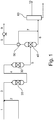
- Fig. 1 corresponds to Example 3 and shows a process according to the prior art for conversion of ethylbenzene to styrene, where steam is used as carrier gas.
- Fig. 2 corresponds to Example 4 and shows a process according to the present invention, where ethylbenzene is converted to styrene, in which the carrier gas is a mixture of benzene/toluene and H 2 S is also used in the process.
- Fig. 3 corresponds to Example 5 and shows a process according to the prior art for conversion of ethylbenzene to styrene, where steam is used as carrier gas, and where selective oxidation of hydrogen produced in the first reactor is conducted.
- Fig. 4 corresponds to Example 6 and shows a process according to the present invention, where ethylbenzene is converted to styrene, in which the carrier gas is a mixture of benzene and toluene, H 2 S is also used in the process, and selective oxidation of hydrogen produced in the first reactor is conducted.
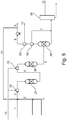
- Fig. 5 corresponds to Example 7 and shows a process according to the present invention, where ethylbenzene is converted to styrene, in which the carrier gas is a benzene/toluene mixture and an off-gas recycle containing H 2 and CH 4 , H 2 S is also used in the process, and selective oxidation before the first and second reactor is conducted.
- the catalyst used consisted of CoMo oxides supported on a carrier of MgAl 2 O 4 .
- the catalyst was sulfided before use, i.e. pre-sulfided.
- the amount loaded in the reactor was 10 g of catalyst mixed with 10 g of inert material also consisting of a carrier of MgAl 2 O 4 (spinel).
- the loading zone in the reactor was 635 mm to 244 mm from the top flange.
- the total flow has been around 48 Nl/h throughout the testing period for ethylbenzene dehydrogenation.
- the pressure was 3 barg, which is the minimum pressure at which the experiment could be conducted using the present setup.
- the non-selective products were benzene, toluene, methane, ethane and ethylene. Nitrogen was used as carrier gas.
- Hydrogen sulfide was added from a hydrogen sulfide/hydrogen mixture, thereby adding hydrogen. The surplus of hydrogen may give rise to increased cracking besides limiting the conversion, which is relatively close to the calculated equilibrium value.
- the dehydrogenation of propane was conducted on the same catalyst as the dehydrogenation of ethylbenzene in Example 1.
- the conditions with respect to pressure and nitrogen as diluent as well as addition of a mixture of hydrogen and hydrogen sulfide for keeping the catalyst sulfided were the same.
- the by-products found were methane, ethane and ethylene. No mercaptans were found.
- Styrene is produced in very large quantities worldwide and used in a variety of products.
- the dominant process today is based on catalytic dehydrogenation of ethylbenzene using an iron-based catalyst.
- Fig. 1 shows a typical process layout.
- the figures in this patent application are provided without a detailed heat exchange network, e.g. the streams to be heated and cooled are divided into convenient segments where heating and cooling is carried out to the dew or bubble points in order to provide input to a pinch analysis.
- the pinch analysis provides answers on what will be the minimum needed hot and cold utility provided a predetermined minimum temperature approach in the heat exchanger network. A minimum approach of 20°C has been used in all cases (Examples 3-7).
- ethylbenzene 1 is mixed with steam 2 to form mixed feed stream 3 and preheated to the inlet temperature of 645°C at the inlet of the first reactor 20.
- the effluent stream 4 from reactor 20 is reheated to 645°C before entering the second reactor 30, where effluent 5 leaves at 600°C. It is cooled down to 20°C before the separator 40, where water is decanted off and the crude styrene/benzene/toluene mixture 6 together with unconverted ethylbenzene is separated out.
- the remaining traces of aromatics 7 are recovered by means of zeolites or the like in unit 50 and added to the crude styrene stream 6.
- the off-gas 8, consisting of mainly hydrogen, methane, ethylene and carbon dioxide, is compressed to slightly above ambient pressure and used as fuel 9.
- the crude styrene stream is sent to the distillation section 60, where styrene product 10 is obtained.
- styrene product 10 is obtained in a first column (not shown), benzene/toluene is separated from ethylbenzene/styrene, and in a second column (also not shown), ethylbenzene is separated from styrene.
- Final purification of the styrene and benzene/toluene separation has not been included in the process comparisons as they are assumed identical in all cases.
- the other two functions of steam namely dilution of reaction mixture and heat carrier, are performed by recycling a benzene/toluene mixture, i.e. a benzene/toluene mixture is used as carrier gas.
- This stream can be obtained by recycling from the product separation columns, i.e. the first distillation column.
- the feed to the first reactor comprises ethylbenzene, a small amount of H 2 S and benzene/toluene as carrier gas.
- Hydrogen sulfide is recuperated as stream 12 after the benzene/toluene recovery 50.
- the selective hydrogen oxidation 70 using air 13 in between dehydrogenation reactors is combined with the recycle of benzene/toluene as carrier gas 2 and the addition of small amounts of H 2 S in stream 11 according to the invention.
- This is illustrated in Fig. 4 .
- the result of the pinch analysis in Table 3 shows a surprisingly higher effect on energy efficiency, giving rise to about 23% percentage points improvement (from 278 MW to 214 MW of hot utility). The expected result would have been a 14% improvement, as for the prior art processes as described in Example 5.
Landscapes
- Chemical & Material Sciences (AREA)
- Organic Chemistry (AREA)
- Chemical Kinetics & Catalysis (AREA)
- Engineering & Computer Science (AREA)
- Materials Engineering (AREA)
- Organic Low-Molecular-Weight Compounds And Preparation Thereof (AREA)
- Low-Molecular Organic Synthesis Reactions Using Catalysts (AREA)
Claims (7)
- Verfahren zur Dehydrierung von Alkanen, Alkenen oder Alkylbenzolen zu den entsprechenden ungesättigten chemischen Produkten und Wasserstoff (H2), umfassend das Inkontaktbringen des Alkans, Alkens oder Alkylbenzols mit einem Metallsulfid(MeS)-Katalysator, wobei- die Dehydrierung in einem oder mehreren Dehydrierungsreaktoren in Gegenwart von Schwefelwasserstoff (H2S) ohne Bildung von H2S als Reaktionsprodukt durchgeführt wird,- Dampf (H2O) weniger als 10 % (Volumenstrom) des Gases ausmacht, das als Trägergas für die Alkane, Alkene oder Alkylbenzole genutzt wird,- das Molverhältnis von Schwefelwasserstoff zu Alkanen, Alkenen oder Alkylbenzol zwischen 0,01 und 0,2 liegt,- das Molverhältnis von Schwefelwasserstoff (H2S) zu Wasserstoff (H2) zwischen 0,01 und 0,2 liegt, und- entweder Benzol, Toluol oder Kombinationen von beiden oder Methan, Ethan oder Kombinationen von beiden als Trägergas verwendet werden.
- Verfahren gemäß Anspruch 1, wobei das Molverhältnis von Schwefelwasserstoff (H2S) zu Wasserstoff (H2) 0,05 - 0,06 beträgt.
- Verfahren gemäß Anspruch 1 bis 2, wobei das Alkylbenzol Ethylbenzol und das entsprechende ungesättigte chemische Produkt Styrol ist.
- Verfahren gemäß einem der Ansprüche 1 - 3, wobei nicht umgesetzte Alkane, Alkene, Alkylbenzole und Nebenprodukte in den einen oder die mehreren Dehydrierungsreaktoren zurückgeführt werden.
- Verfahren gemäß Anspruch 4, wobei die nicht umgesetzten Alkane, Alkylbenzole und Nebenprodukte Methan, Ethan, Ethylbenzole, Benzol, Toluol und Kombinationen davon einschließen.
- Verfahren gemäß einem der Ansprüche 1 - 5, wobei die Dehydrierung in adiabatischen Reaktoren mit einem Wiedererwärmungsschritt und einer selektiven Oxidation des im Verfahren erzeugten Wasserstoffs zwischen den Reaktoren durchgeführt wird.
- Verfahren gemäß einem der Ansprüche 1 - 6, wobei das im Verfahren erzeugte Abgas enthaltend H2 und CH4 als Trägergas verwendet wird und die selektive Oxidation von Wasserstoff stromaufwärts des ersten Dehydrierungsreaktors durchgeführt wird.
Priority Applications (1)
| Application Number | Priority Date | Filing Date | Title |
|---|---|---|---|
| PL15767482T PL3201162T3 (pl) | 2014-09-29 | 2015-09-23 | Odwodornianie alkanów do alkenów |
Applications Claiming Priority (2)
| Application Number | Priority Date | Filing Date | Title |
|---|---|---|---|
| DKPA201400553 | 2014-09-29 | ||
| PCT/EP2015/071858 WO2016050583A1 (en) | 2014-09-29 | 2015-09-23 | Dehydrogenation of alkanes to alkenes |
Publications (2)
| Publication Number | Publication Date |
|---|---|
| EP3201162A1 EP3201162A1 (de) | 2017-08-09 |
| EP3201162B1 true EP3201162B1 (de) | 2020-04-15 |
Family
ID=58933692
Family Applications (1)
| Application Number | Title | Priority Date | Filing Date |
|---|---|---|---|
| EP15767482.1A Active EP3201162B1 (de) | 2014-09-29 | 2015-09-23 | Dehydrierung von alkanen zu alkenen |
Country Status (7)
| Country | Link |
|---|---|
| US (1) | US10150715B2 (de) |
| EP (1) | EP3201162B1 (de) |
| CN (1) | CN106715367A (de) |
| ES (1) | ES2802382T3 (de) |
| PL (1) | PL3201162T3 (de) |
| RU (1) | RU2692254C2 (de) |
| WO (1) | WO2016050583A1 (de) |
Families Citing this family (10)
| Publication number | Priority date | Publication date | Assignee | Title |
|---|---|---|---|---|
| KR102079036B1 (ko) * | 2016-12-28 | 2020-02-20 | 한국화학연구원 | 발열반응과 흡열반응의 결합에 의한 메탄의 고효율 전환 방법 |
| WO2018124791A1 (ko) * | 2016-12-28 | 2018-07-05 | 한국화학연구원 | 메탄의 산화이량화 반응용 열교환 마이크로채널 반응기 |
| US20210139394A1 (en) * | 2017-03-17 | 2021-05-13 | Haldor Topsøe A/S | A process for the dehydrogenation of alkanes to alkenes and iron-based catalysts for use in the process |
| SG11202007516SA (en) | 2018-01-08 | 2020-09-29 | Swift Fuels Llc | Processes for an improvement to gasoline octane for long-chain paraffin feed streams |
| BR112020021259A2 (pt) * | 2018-04-16 | 2021-02-02 | Swift Fuels, Llc | processo para converter hidrocarbonetos c2-c5 em misturas de gasolina e combustível diesel |
| US10941357B2 (en) | 2018-04-16 | 2021-03-09 | Swift Fuels, Llc | Process for converting C2—C5 hydrocarbons to gasoline and diesel fuel blendstocks |
| CN111250096A (zh) * | 2018-11-30 | 2020-06-09 | 中国石油化工股份有限公司 | 载体为六方介孔材料的非贵金属系异丁烷脱氢催化剂及其制法和应用 |
| CN111250095A (zh) * | 2018-11-30 | 2020-06-09 | 中国石油化工股份有限公司 | 载体为球形面包圈介孔材料硅胶复合材料的非贵金属系异丁烷脱氢催化剂及其制法和应用 |
| CA3179173A1 (en) | 2020-03-31 | 2021-10-07 | Chris D'acosta | Process for converting c2-c5 hydrocarbons to gasoline and diesel fuel blendstocks |
| CN113019412B (zh) * | 2021-03-08 | 2022-06-17 | 大连理工大学 | 一种轻质烷烃脱氢制烯烃催化剂、其制备方法及应用 |
Family Cites Families (11)
| Publication number | Priority date | Publication date | Assignee | Title |
|---|---|---|---|---|
| US2315107A (en) * | 1941-04-29 | 1943-03-30 | Shell Dev | Catalytic dehydrogenation |
| US3787517A (en) | 1970-02-07 | 1974-01-22 | Mobil Oil Corp | Oxidative dehydrogenation of paraffins |
| US3801661A (en) * | 1972-07-11 | 1974-04-02 | Dow Chemical Co | Selective process for the continuous dyhydrogenation of nonaromatic hydrocarbons |
| US4420649A (en) | 1977-11-04 | 1983-12-13 | Uop Inc. | Hydrocarbon dehydrogenation with a multimetallic catalytic composite |
| US5527979A (en) * | 1993-08-27 | 1996-06-18 | Mobil Oil Corporation | Process for the catalytic dehydrogenation of alkanes to alkenes with simultaneous combustion of hydrogen |
| EP1136467A1 (de) * | 2000-03-24 | 2001-09-26 | Aventis Animal Nutrition S.A. | Verfahren zur katalytischen Umsetzung von Alkanen in Alkenen |
| BRPI0518308A2 (pt) * | 2004-11-18 | 2008-11-11 | Shell Int Research | catalisador de desidrogenaÇço com base em àxido de ferro de alta estabilidade e alta atividade tendo uma baixa concentraÇço de titÂnio e a fabricaÇço e uso deste |
| RU2314281C1 (ru) * | 2006-09-20 | 2008-01-10 | Институт Катализа Имени Г.К. Борескова Сибирского Отделения Российской Академии Наук | Способ получения стирола |
| JP2015516867A (ja) | 2012-03-16 | 2015-06-18 | トリッシュラー、クリスツィアンTRISCHLER,Christian | 触媒、触媒の調製方法、ならびにオレフィン調製のための方法および装置における触媒の使用 |
| US20140114107A1 (en) | 2012-10-24 | 2014-04-24 | Lummus Technology Inc. | Use of hydrocarbon diluents to enhance conversion in a dehydrogenation process at low steam/oil ratios |
| CN103861619A (zh) * | 2012-12-11 | 2014-06-18 | 江苏省海洋石化股份有限公司 | 一种烷烃脱氢硫化物催化剂及烷烃脱氢的方法 |
-
2015
- 2015-09-23 RU RU2017115226A patent/RU2692254C2/ru active
- 2015-09-23 EP EP15767482.1A patent/EP3201162B1/de active Active
- 2015-09-23 WO PCT/EP2015/071858 patent/WO2016050583A1/en not_active Ceased
- 2015-09-23 ES ES15767482T patent/ES2802382T3/es active Active
- 2015-09-23 PL PL15767482T patent/PL3201162T3/pl unknown
- 2015-09-23 US US15/507,985 patent/US10150715B2/en not_active Expired - Fee Related
- 2015-09-23 CN CN201580049584.4A patent/CN106715367A/zh active Pending
Non-Patent Citations (1)
| Title |
|---|
| None * |
Also Published As
| Publication number | Publication date |
|---|---|
| WO2016050583A1 (en) | 2016-04-07 |
| CN106715367A (zh) | 2017-05-24 |
| US10150715B2 (en) | 2018-12-11 |
| EP3201162A1 (de) | 2017-08-09 |
| PL3201162T3 (pl) | 2020-09-07 |
| RU2017115226A3 (de) | 2018-11-05 |
| ES2802382T3 (es) | 2021-01-19 |
| US20170247302A1 (en) | 2017-08-31 |
| RU2692254C2 (ru) | 2019-06-24 |
| RU2017115226A (ru) | 2018-11-05 |
Similar Documents
| Publication | Publication Date | Title |
|---|---|---|
| EP3201162B1 (de) | Dehydrierung von alkanen zu alkenen | |
| US9776935B2 (en) | Method for olefins production | |
| US10722871B2 (en) | Sulfide-based alkane dehydrogenation catalysts | |
| EP0345950B1 (de) | Verfahren zur Dehydrierung von Kohlenwasserstoffen die aus einer Kombination von isothermischen und adiabatischen Stufen zusammengesetzt sind | |
| CN107814693A (zh) | Lpg或ngl的脱氢和在此获得的烯烃的灵活应用 | |
| EP3572391A2 (de) | Verfahren zur dehydrierung von alkan | |
| WO2016133704A1 (en) | Upgrading paraffins to distillates and lube basestocks | |
| EP2364342A1 (de) | Verfahren zum katalytischen cracken eines stroms von kohlenwasserstoffen zur maximierung von leichten olefinen | |
| US7094942B2 (en) | Carbon dioxide promoted dehydrogenation process for olefins | |
| CA2402734A1 (en) | Catalytic conversion of alkanes to alkenes | |
| CA2753127C (en) | Hydrocarbon dehydrogenation process | |
| AU601642B2 (en) | Catalyst composition and method for conversion of c3 and c4 hydrocarbons | |
| US5866745A (en) | Catalytic/oxidative promoted hydrocarbon pyrolysis | |
| CN113454051B (zh) | 烯烃生产过程中乙炔加氢单元的操作方法 | |
| US20090143631A1 (en) | Process For the Production of Olefins By Autothermal Cracking | |
| US11858886B2 (en) | Process of selectively hydrogenating gas mixture having high acetylene content | |
| US4657886A (en) | Catalyst for conversion of C3 and C4 hydrocarbons | |
| CA2561986A1 (en) | Simultaneous dehydrogenation of ethylbenzene and ethane in the presence of co2 or steam | |
| US10221110B2 (en) | Dehydrogenation of olefin-rich hydrocarbon mixtures | |
| WO2014128718A2 (en) | A process for the preparation of conjugated diene | |
| CA3226757A1 (en) | Method and system for light olefin generation with high yields and selectivity | |
| US3244760A (en) | Method for cracking aliphatic hydrocarbons | |
| CZ2011546A3 (cs) | Zpusob dehydrogenace uhlovodíku |
Legal Events
| Date | Code | Title | Description |
|---|---|---|---|
| STAA | Information on the status of an ep patent application or granted ep patent |
Free format text: STATUS: THE INTERNATIONAL PUBLICATION HAS BEEN MADE |
|
| PUAI | Public reference made under article 153(3) epc to a published international application that has entered the european phase |
Free format text: ORIGINAL CODE: 0009012 |
|
| STAA | Information on the status of an ep patent application or granted ep patent |
Free format text: STATUS: REQUEST FOR EXAMINATION WAS MADE |
|
| 17P | Request for examination filed |
Effective date: 20170228 |
|
| AK | Designated contracting states |
Kind code of ref document: A1 Designated state(s): AL AT BE BG CH CY CZ DE DK EE ES FI FR GB GR HR HU IE IS IT LI LT LU LV MC MK MT NL NO PL PT RO RS SE SI SK SM TR |
|
| AX | Request for extension of the european patent |
Extension state: BA ME |
|
| DAV | Request for validation of the european patent (deleted) | ||
| DAX | Request for extension of the european patent (deleted) | ||
| STAA | Information on the status of an ep patent application or granted ep patent |
Free format text: STATUS: EXAMINATION IS IN PROGRESS |
|
| 17Q | First examination report despatched |
Effective date: 20180419 |
|
| GRAP | Despatch of communication of intention to grant a patent |
Free format text: ORIGINAL CODE: EPIDOSNIGR1 |
|
| STAA | Information on the status of an ep patent application or granted ep patent |
Free format text: STATUS: GRANT OF PATENT IS INTENDED |
|
| INTG | Intention to grant announced |
Effective date: 20191031 |
|
| RIN1 | Information on inventor provided before grant (corrected) |
Inventor name: HANSEN, JOHN BOEGILD Inventor name: HOEJLUND NIELSEN, POUL ERIK |
|
| GRAJ | Information related to disapproval of communication of intention to grant by the applicant or resumption of examination proceedings by the epo deleted |
Free format text: ORIGINAL CODE: EPIDOSDIGR1 |
|
| STAA | Information on the status of an ep patent application or granted ep patent |
Free format text: STATUS: EXAMINATION IS IN PROGRESS |
|
| GRAR | Information related to intention to grant a patent recorded |
Free format text: ORIGINAL CODE: EPIDOSNIGR71 |
|
| GRAS | Grant fee paid |
Free format text: ORIGINAL CODE: EPIDOSNIGR3 |
|
| STAA | Information on the status of an ep patent application or granted ep patent |
Free format text: STATUS: GRANT OF PATENT IS INTENDED |
|
| GRAA | (expected) grant |
Free format text: ORIGINAL CODE: 0009210 |
|
| STAA | Information on the status of an ep patent application or granted ep patent |
Free format text: STATUS: THE PATENT HAS BEEN GRANTED |
|
| INTC | Intention to grant announced (deleted) | ||
| INTG | Intention to grant announced |
Effective date: 20200304 |
|
| AK | Designated contracting states |
Kind code of ref document: B1 Designated state(s): AL AT BE BG CH CY CZ DE DK EE ES FI FR GB GR HR HU IE IS IT LI LT LU LV MC MK MT NL NO PL PT RO RS SE SI SK SM TR |
|
| REG | Reference to a national code |
Ref country code: CH Ref legal event code: EP |
|
| REG | Reference to a national code |
Ref country code: DE Ref legal event code: R096 Ref document number: 602015050765 Country of ref document: DE |
|
| REG | Reference to a national code |
Ref country code: IE Ref legal event code: FG4D |
|
| REG | Reference to a national code |
Ref country code: AT Ref legal event code: REF Ref document number: 1257109 Country of ref document: AT Kind code of ref document: T Effective date: 20200515 |
|
| REG | Reference to a national code |
Ref country code: NL Ref legal event code: FP |
|
| REG | Reference to a national code |
Ref country code: LT Ref legal event code: MG4D |
|
| PG25 | Lapsed in a contracting state [announced via postgrant information from national office to epo] |
Ref country code: NO Free format text: LAPSE BECAUSE OF FAILURE TO SUBMIT A TRANSLATION OF THE DESCRIPTION OR TO PAY THE FEE WITHIN THE PRESCRIBED TIME-LIMIT Effective date: 20200715 Ref country code: PT Free format text: LAPSE BECAUSE OF FAILURE TO SUBMIT A TRANSLATION OF THE DESCRIPTION OR TO PAY THE FEE WITHIN THE PRESCRIBED TIME-LIMIT Effective date: 20200817 Ref country code: LT Free format text: LAPSE BECAUSE OF FAILURE TO SUBMIT A TRANSLATION OF THE DESCRIPTION OR TO PAY THE FEE WITHIN THE PRESCRIBED TIME-LIMIT Effective date: 20200415 Ref country code: FI Free format text: LAPSE BECAUSE OF FAILURE TO SUBMIT A TRANSLATION OF THE DESCRIPTION OR TO PAY THE FEE WITHIN THE PRESCRIBED TIME-LIMIT Effective date: 20200415 Ref country code: IS Free format text: LAPSE BECAUSE OF FAILURE TO SUBMIT A TRANSLATION OF THE DESCRIPTION OR TO PAY THE FEE WITHIN THE PRESCRIBED TIME-LIMIT Effective date: 20200815 Ref country code: SE Free format text: LAPSE BECAUSE OF FAILURE TO SUBMIT A TRANSLATION OF THE DESCRIPTION OR TO PAY THE FEE WITHIN THE PRESCRIBED TIME-LIMIT Effective date: 20200415 Ref country code: GR Free format text: LAPSE BECAUSE OF FAILURE TO SUBMIT A TRANSLATION OF THE DESCRIPTION OR TO PAY THE FEE WITHIN THE PRESCRIBED TIME-LIMIT Effective date: 20200716 |
|
| PGFP | Annual fee paid to national office [announced via postgrant information from national office to epo] |
Ref country code: CZ Payment date: 20200922 Year of fee payment: 6 Ref country code: GB Payment date: 20200925 Year of fee payment: 6 Ref country code: NL Payment date: 20200925 Year of fee payment: 6 Ref country code: FR Payment date: 20200928 Year of fee payment: 6 |
|
| REG | Reference to a national code |
Ref country code: AT Ref legal event code: MK05 Ref document number: 1257109 Country of ref document: AT Kind code of ref document: T Effective date: 20200415 |
|
| PG25 | Lapsed in a contracting state [announced via postgrant information from national office to epo] |
Ref country code: HR Free format text: LAPSE BECAUSE OF FAILURE TO SUBMIT A TRANSLATION OF THE DESCRIPTION OR TO PAY THE FEE WITHIN THE PRESCRIBED TIME-LIMIT Effective date: 20200415 Ref country code: RS Free format text: LAPSE BECAUSE OF FAILURE TO SUBMIT A TRANSLATION OF THE DESCRIPTION OR TO PAY THE FEE WITHIN THE PRESCRIBED TIME-LIMIT Effective date: 20200415 Ref country code: BG Free format text: LAPSE BECAUSE OF FAILURE TO SUBMIT A TRANSLATION OF THE DESCRIPTION OR TO PAY THE FEE WITHIN THE PRESCRIBED TIME-LIMIT Effective date: 20200715 Ref country code: LV Free format text: LAPSE BECAUSE OF FAILURE TO SUBMIT A TRANSLATION OF THE DESCRIPTION OR TO PAY THE FEE WITHIN THE PRESCRIBED TIME-LIMIT Effective date: 20200415 |
|
| PGFP | Annual fee paid to national office [announced via postgrant information from national office to epo] |
Ref country code: BE Payment date: 20200925 Year of fee payment: 6 |
|
| PG25 | Lapsed in a contracting state [announced via postgrant information from national office to epo] |
Ref country code: AL Free format text: LAPSE BECAUSE OF FAILURE TO SUBMIT A TRANSLATION OF THE DESCRIPTION OR TO PAY THE FEE WITHIN THE PRESCRIBED TIME-LIMIT Effective date: 20200415 |
|
| REG | Reference to a national code |
Ref country code: DE Ref legal event code: R097 Ref document number: 602015050765 Country of ref document: DE |
|
| REG | Reference to a national code |
Ref country code: ES Ref legal event code: FG2A Ref document number: 2802382 Country of ref document: ES Kind code of ref document: T3 Effective date: 20210119 |
|
| PG25 | Lapsed in a contracting state [announced via postgrant information from national office to epo] |
Ref country code: RO Free format text: LAPSE BECAUSE OF FAILURE TO SUBMIT A TRANSLATION OF THE DESCRIPTION OR TO PAY THE FEE WITHIN THE PRESCRIBED TIME-LIMIT Effective date: 20200415 Ref country code: AT Free format text: LAPSE BECAUSE OF FAILURE TO SUBMIT A TRANSLATION OF THE DESCRIPTION OR TO PAY THE FEE WITHIN THE PRESCRIBED TIME-LIMIT Effective date: 20200415 Ref country code: EE Free format text: LAPSE BECAUSE OF FAILURE TO SUBMIT A TRANSLATION OF THE DESCRIPTION OR TO PAY THE FEE WITHIN THE PRESCRIBED TIME-LIMIT Effective date: 20200415 Ref country code: SM Free format text: LAPSE BECAUSE OF FAILURE TO SUBMIT A TRANSLATION OF THE DESCRIPTION OR TO PAY THE FEE WITHIN THE PRESCRIBED TIME-LIMIT Effective date: 20200415 Ref country code: DK Free format text: LAPSE BECAUSE OF FAILURE TO SUBMIT A TRANSLATION OF THE DESCRIPTION OR TO PAY THE FEE WITHIN THE PRESCRIBED TIME-LIMIT Effective date: 20200415 |
|
| PGFP | Annual fee paid to national office [announced via postgrant information from national office to epo] |
Ref country code: IT Payment date: 20200923 Year of fee payment: 6 Ref country code: ES Payment date: 20201020 Year of fee payment: 6 Ref country code: DE Payment date: 20201127 Year of fee payment: 6 |
|
| PLBE | No opposition filed within time limit |
Free format text: ORIGINAL CODE: 0009261 |
|
| STAA | Information on the status of an ep patent application or granted ep patent |
Free format text: STATUS: NO OPPOSITION FILED WITHIN TIME LIMIT |
|
| PG25 | Lapsed in a contracting state [announced via postgrant information from national office to epo] |
Ref country code: SK Free format text: LAPSE BECAUSE OF FAILURE TO SUBMIT A TRANSLATION OF THE DESCRIPTION OR TO PAY THE FEE WITHIN THE PRESCRIBED TIME-LIMIT Effective date: 20200415 |
|
| PGFP | Annual fee paid to national office [announced via postgrant information from national office to epo] |
Ref country code: PL Payment date: 20200911 Year of fee payment: 6 |
|
| 26N | No opposition filed |
Effective date: 20210118 |
|
| PG25 | Lapsed in a contracting state [announced via postgrant information from national office to epo] |
Ref country code: MC Free format text: LAPSE BECAUSE OF FAILURE TO SUBMIT A TRANSLATION OF THE DESCRIPTION OR TO PAY THE FEE WITHIN THE PRESCRIBED TIME-LIMIT Effective date: 20200415 |
|
| REG | Reference to a national code |
Ref country code: CH Ref legal event code: PL |
|
| PG25 | Lapsed in a contracting state [announced via postgrant information from national office to epo] |
Ref country code: SI Free format text: LAPSE BECAUSE OF FAILURE TO SUBMIT A TRANSLATION OF THE DESCRIPTION OR TO PAY THE FEE WITHIN THE PRESCRIBED TIME-LIMIT Effective date: 20200415 |
|
| PG25 | Lapsed in a contracting state [announced via postgrant information from national office to epo] |
Ref country code: LU Free format text: LAPSE BECAUSE OF NON-PAYMENT OF DUE FEES Effective date: 20200923 |
|
| PG25 | Lapsed in a contracting state [announced via postgrant information from national office to epo] |
Ref country code: IE Free format text: LAPSE BECAUSE OF NON-PAYMENT OF DUE FEES Effective date: 20200923 Ref country code: LI Free format text: LAPSE BECAUSE OF NON-PAYMENT OF DUE FEES Effective date: 20200930 Ref country code: CH Free format text: LAPSE BECAUSE OF NON-PAYMENT OF DUE FEES Effective date: 20200930 |
|
| REG | Reference to a national code |
Ref country code: DE Ref legal event code: R119 Ref document number: 602015050765 Country of ref document: DE |
|
| REG | Reference to a national code |
Ref country code: NL Ref legal event code: MM Effective date: 20211001 |
|
| REG | Reference to a national code |
Ref country code: BE Ref legal event code: MM Effective date: 20210930 |
|
| GBPC | Gb: european patent ceased through non-payment of renewal fee |
Effective date: 20210923 |
|
| PG25 | Lapsed in a contracting state [announced via postgrant information from national office to epo] |
Ref country code: TR Free format text: LAPSE BECAUSE OF FAILURE TO SUBMIT A TRANSLATION OF THE DESCRIPTION OR TO PAY THE FEE WITHIN THE PRESCRIBED TIME-LIMIT Effective date: 20200415 Ref country code: MT Free format text: LAPSE BECAUSE OF FAILURE TO SUBMIT A TRANSLATION OF THE DESCRIPTION OR TO PAY THE FEE WITHIN THE PRESCRIBED TIME-LIMIT Effective date: 20200415 Ref country code: CZ Free format text: LAPSE BECAUSE OF NON-PAYMENT OF DUE FEES Effective date: 20210923 Ref country code: CY Free format text: LAPSE BECAUSE OF FAILURE TO SUBMIT A TRANSLATION OF THE DESCRIPTION OR TO PAY THE FEE WITHIN THE PRESCRIBED TIME-LIMIT Effective date: 20200415 |
|
| PG25 | Lapsed in a contracting state [announced via postgrant information from national office to epo] |
Ref country code: NL Free format text: LAPSE BECAUSE OF NON-PAYMENT OF DUE FEES Effective date: 20211001 Ref country code: MK Free format text: LAPSE BECAUSE OF FAILURE TO SUBMIT A TRANSLATION OF THE DESCRIPTION OR TO PAY THE FEE WITHIN THE PRESCRIBED TIME-LIMIT Effective date: 20200415 |
|
| PG25 | Lapsed in a contracting state [announced via postgrant information from national office to epo] |
Ref country code: GB Free format text: LAPSE BECAUSE OF NON-PAYMENT OF DUE FEES Effective date: 20210923 Ref country code: FR Free format text: LAPSE BECAUSE OF NON-PAYMENT OF DUE FEES Effective date: 20210930 Ref country code: DE Free format text: LAPSE BECAUSE OF NON-PAYMENT OF DUE FEES Effective date: 20220401 Ref country code: BE Free format text: LAPSE BECAUSE OF NON-PAYMENT OF DUE FEES Effective date: 20210930 |
|
| REG | Reference to a national code |
Ref country code: ES Ref legal event code: FD2A Effective date: 20221028 |
|
| PG25 | Lapsed in a contracting state [announced via postgrant information from national office to epo] |
Ref country code: IT Free format text: LAPSE BECAUSE OF NON-PAYMENT OF DUE FEES Effective date: 20210923 |
|
| PG25 | Lapsed in a contracting state [announced via postgrant information from national office to epo] |
Ref country code: ES Free format text: LAPSE BECAUSE OF NON-PAYMENT OF DUE FEES Effective date: 20210924 |
|
| PG25 | Lapsed in a contracting state [announced via postgrant information from national office to epo] |
Ref country code: PL Free format text: LAPSE BECAUSE OF NON-PAYMENT OF DUE FEES Effective date: 20210923 |