EP3198911B1 - Scalable authentication process selection based upon sensor inputs - Google Patents
Scalable authentication process selection based upon sensor inputs Download PDFInfo
- Publication number
- EP3198911B1 EP3198911B1 EP15762885.0A EP15762885A EP3198911B1 EP 3198911 B1 EP3198911 B1 EP 3198911B1 EP 15762885 A EP15762885 A EP 15762885A EP 3198911 B1 EP3198911 B1 EP 3198911B1
- Authority
- EP
- European Patent Office
- Prior art keywords
- mobile device
- authentication processes
- authentication
- trust
- index
- Prior art date
- Legal status (The legal status is an assumption and is not a legal conclusion. Google has not performed a legal analysis and makes no representation as to the accuracy of the status listed.)
- Not-in-force
Links
Images



Classifications
-
- H—ELECTRICITY
- H04—ELECTRIC COMMUNICATION TECHNIQUE
- H04L—TRANSMISSION OF DIGITAL INFORMATION, e.g. TELEGRAPHIC COMMUNICATION
- H04L63/00—Network architectures or network communication protocols for network security
- H04L63/10—Network architectures or network communication protocols for network security for controlling access to devices or network resources
- H04L63/105—Multiple levels of security
-
- G—PHYSICS
- G06—COMPUTING OR CALCULATING; COUNTING
- G06F—ELECTRIC DIGITAL DATA PROCESSING
- G06F21/00—Security arrangements for protecting computers, components thereof, programs or data against unauthorised activity
- G06F21/30—Authentication, i.e. establishing the identity or authorisation of security principals
- G06F21/31—User authentication
- G06F21/32—User authentication using biometric data, e.g. fingerprints, iris scans or voiceprints
-
- G—PHYSICS
- G06—COMPUTING OR CALCULATING; COUNTING
- G06F—ELECTRIC DIGITAL DATA PROCESSING
- G06F21/00—Security arrangements for protecting computers, components thereof, programs or data against unauthorised activity
- G06F21/30—Authentication, i.e. establishing the identity or authorisation of security principals
- G06F21/31—User authentication
- G06F21/34—User authentication involving the use of external additional devices, e.g. dongles or smart cards
- G06F21/35—User authentication involving the use of external additional devices, e.g. dongles or smart cards communicating wirelessly
-
- G—PHYSICS
- G06—COMPUTING OR CALCULATING; COUNTING
- G06F—ELECTRIC DIGITAL DATA PROCESSING
- G06F21/00—Security arrangements for protecting computers, components thereof, programs or data against unauthorised activity
- G06F21/30—Authentication, i.e. establishing the identity or authorisation of security principals
- G06F21/31—User authentication
- G06F21/40—User authentication by quorum, i.e. whereby two or more security principals are required
-
- G—PHYSICS
- G06—COMPUTING OR CALCULATING; COUNTING
- G06F—ELECTRIC DIGITAL DATA PROCESSING
- G06F21/00—Security arrangements for protecting computers, components thereof, programs or data against unauthorised activity
- G06F21/50—Monitoring users, programs or devices to maintain the integrity of platforms, e.g. of processors, firmware or operating systems
- G06F21/57—Certifying or maintaining trusted computer platforms, e.g. secure boots or power-downs, version controls, system software checks, secure updates or assessing vulnerabilities
- G06F21/577—Assessing vulnerabilities and evaluating computer system security
-
- H—ELECTRICITY
- H04—ELECTRIC COMMUNICATION TECHNIQUE
- H04W—WIRELESS COMMUNICATION NETWORKS
- H04W12/00—Security arrangements; Authentication; Protecting privacy or anonymity
- H04W12/06—Authentication
-
- H—ELECTRICITY
- H04—ELECTRIC COMMUNICATION TECHNIQUE
- H04L—TRANSMISSION OF DIGITAL INFORMATION, e.g. TELEGRAPHIC COMMUNICATION
- H04L2463/00—Additional details relating to network architectures or network communication protocols for network security covered by H04L63/00
- H04L2463/082—Additional details relating to network architectures or network communication protocols for network security covered by H04L63/00 applying multi-factor authentication
-
- H—ELECTRICITY
- H04—ELECTRIC COMMUNICATION TECHNIQUE
- H04L—TRANSMISSION OF DIGITAL INFORMATION, e.g. TELEGRAPHIC COMMUNICATION
- H04L63/00—Network architectures or network communication protocols for network security
- H04L63/08—Network architectures or network communication protocols for network security for authentication of entities
- H04L63/0861—Network architectures or network communication protocols for network security for authentication of entities using biometrical features, e.g. fingerprint, retina-scan
-
- H—ELECTRICITY
- H04—ELECTRIC COMMUNICATION TECHNIQUE
- H04W—WIRELESS COMMUNICATION NETWORKS
- H04W12/00—Security arrangements; Authentication; Protecting privacy or anonymity
- H04W12/60—Context-dependent security
- H04W12/65—Environment-dependent, e.g. using captured environmental data
-
- H—ELECTRICITY
- H04—ELECTRIC COMMUNICATION TECHNIQUE
- H04W—WIRELESS COMMUNICATION NETWORKS
- H04W12/00—Security arrangements; Authentication; Protecting privacy or anonymity
- H04W12/60—Context-dependent security
- H04W12/67—Risk-dependent, e.g. selecting a security level depending on risk profiles
-
- H—ELECTRICITY
- H04—ELECTRIC COMMUNICATION TECHNIQUE
- H04W—WIRELESS COMMUNICATION NETWORKS
- H04W88/00—Devices specially adapted for wireless communication networks, e.g. terminals, base stations or access point devices
- H04W88/02—Terminal devices
Definitions
- the present invention relates to a mobile device that selects an authentication process based upon sensor inputs.
- biometric authentication is typically required when accessing service providers, websites, networks, applications, devices, etc.
- a commonly deployed authentication method is to use a password, but various biometric authentication methods are becoming more popular.
- biometric authentication methods are convenient since there is nothing to lose or remember, in order for them to be highly secure, increased user effort is required and many false rejections during authentication attempts are common.
- Increased user effort translates into increased attention to authentication behavior in order to successfully authenticate using biometric methods (e.g., for an iris scan - holding the device the right way, the right distance, for the right time, in the right lighting, with the proper head pose, with the proper eye position) and/or multiple authentication attempts are required in order to successfully authenticate.
- EP 2743873 A1 describes techniques dynamic authentication of transactions. Rule sets corresponding to particular transaction types specify, for that transaction type, one or more context factors to be evaluated, evaluation criteria for evaluating the context factors, and one or more parameters.
- United States Patent Application with publication number US 2014/0157401 A1 describes a method of dynamically adjusting identification levels of biometric authentication sensors using a device context, user history and inferred identity.
- United States Patent Application with publication number US 2014/0208419 A1 describes techniques for user authentication.
- a risk profile of a user is dynamically monitored, and a further authentication request is sent to the user if their risk level becomes higher than an existing authentication level.
- a mobile device comprising: a plurality of sensors; and a processor configured to: determine multiple authentication processes based upon sensor inputs and mobile device capabilities for authentication with at least one of an application or a service provider; determine a risk index based upon contextual inputs; select, from amongst the multiple authentication processes, one or more authentication processes for which a determined trust index is greater than the determined risk index, wherein the trust index is determined based upon trust levels associated with each of the one or more authentication processes, and wherein the trust level associated with at least one of the selected authentication processes is weighted based on at least one of ambient levels of sound, light, or motion; and execute the one or more selected authentication processes.
- a method comprising: determining multiple authentication processes based upon sensor inputs and mobile device capabilities for authentication with at least one of an application or a service provider; determining a risk index based upon contextual inputs; selecting, from amongst the multiple authentication processes, one or more authentication processes for which a determined trust index is greater than the determined risk index, wherein the trust index is determined based upon trust levels associated with each of the one or more authentication processes, and wherein the trust level associated with at least one of the selected authentication processes is weighted based on at least one of ambient levels of sound, light, or motion; and executing the one or more selected authentication processes.
- a non-transitory computer-readable medium including code that, when executed by a processor, causes the processor to: determine multiple authentication processes based upon sensor inputs and mobile device capabilities for authentication with at least one of an application or a service provider; determine a risk index based upon contextual inputs; select, from amongst the multiple authentication processes, one or more authentication processes for which a determined trust index is greater than the determined risk index, wherein the trust index is determined based upon trust levels associated with each of the one or more authentication processes, and wherein the trust level associated with at least one of the selected authentication process is weighted based on at least one of ambient levels of sound, light, or motion; and execute the one or more selected authentication process.
- mobile device refers to any form of programmable computer device including but not limited to laptop computers, tablets, smartphones, televisions, desktop computers, home appliances, cellular telephones, personal television devices, personal data assistants (PDA's), palm-top computers, wireless electronic mail receivers, multimedia Internet enabled cellular telephones, Global Positioning System (GPS) receivers, wireless gaming controllers, receivers within vehicles (e.g., automobiles), interactive game devices, notebooks, smartbooks, netbooks, mobile television devices, or any computing device or data processing apparatus.
- GPS Global Positioning System
- FIG. 1 is block diagram illustrating an exemplary device in which embodiments of the invention may be practiced.
- the system may be a computing device (e.g., a mobile device 100), which may include one or more processors 101, a memory 105, I/O controller 125, and network interface 110.
- Mobile device 100 may also include a number of sensors coupled to one or more buses or signal lines further coupled to the processor 101.
- mobile device 100 may also include a display 120 (e.g., a touch screen display), a user interface 119 (e.g., keyboard, touch screen, or similar devices), a power device 121 (e.g., a battery), as well as other components typically associated with electronic devices.
- mobile device 100 may be a transportable device, however, it should be appreciated that device 100 may be any type of computing device that is mobile or non-mobile (e.g., fixed at a particular location).
- Mobile device 100 may include sensors such as: a clock 130, ambient light sensor (ALS) 135, heart rate sensor 137, accelerometer 140, gyroscope 145, magnetometer 150, orientation sensor 151, fingerprint sensor 152, weather sensor 155 (e.g., temperature, wind, humidity, barometric pressure, etc.), Global Positioning Sensor (GPS) 160, infrared (IR) sensor 153, proximity sensor 167, and near field communication (NFC) sensor 169. Further, sensors/devices may include a microphone (e.g. voice sensor) 165 and camera 170.
- ALS ambient light sensor
- IR infrared
- NFC near field communication
- Communication components may include a wireless subsystem 115 (Bluetooth 166, Wi-Fi 111, cellular 161), which may also be considered sensors, that are used to analyze the environment (e.g., position) of the device.
- a wireless subsystem 115 Bluetooth 166, Wi-Fi 111, cellular 161
- sensors that are used to analyze the environment (e.g., position) of the device.
- multiple cameras are integrated or accessible to the device.
- a mobile device may have at least a front and rear mounted camera.
- other sensors may also have multiple installations or versions.
- Memory 105 may be coupled to processor 101 to store instructions for execution by processor 101.
- memory 105 is non-transitory.
- Memory 105 may also store one or more models, modules, engines to implement embodiments described below that are implemented by processor 101.
- Memory 105 may also store data from integrated or external sensors.
- Mobile device 100 may include one or more antenna(s) 123 and a transceiver 122.
- the transceiver 122 may be configured to communicate bidirectionally, via the antenna(s) and/or one or more wired or wireless links, with one or more networks, in cooperation with network interface 110 and wireless subsystems 115.
- Network interface 110 may be coupled to a number of wireless subsystems 115 (e.g., Bluetooth 166, Wi-Fi 111, Cellular 161, or other networks) to transmit and receive data streams through a wireless link to/from a wireless network, or may be a wired interface for direct connection to networks (e.g., the Internet, Ethernet, or other wireless systems).
- Mobile device 100 may include one or more local area network transceivers connected to one or more antennas.
- the local area network transceiver comprises suitable devices, hardware, and/or software for communicating with and/or detecting signals to/from WAPs, and/or directly with other wireless devices within a network.
- the local area network transceiver may comprise a Wi-Fi (802.11x) communication system suitable for communicating with one or more wireless access points.
- Mobile device 100 may also include one or more wide area network transceiver(s) that may be connected to one or more antennas.
- the wide area network transceiver comprises suitable devices, hardware, and/or software for communicating with and/or detecting signals to/from other wireless devices within a network.
- the wide area network transceiver may comprise a CDMA communication system suitable for communicating with a CDMA network of wireless base stations; however in other aspects, the wireless communication system may comprise another type of cellular telephony network or femtocells, such as, for example, TDMA, LTE, Advanced LTE, WCDMA, UMTS, 4G, or GSM.
- any other type of wireless networking technologies may be used, for example, WiMax (802.16), Ultra Wide Band, ZigBee, wireless USB, etc.
- WiMax 802.16
- Ultra Wide Band 802.16
- ZigBee Ultra Wide Band
- wireless USB wireless USB
- position location capability can be provided by various time and/or phase measurement techniques.
- one position determination approach used is Advanced Forward Link Trilateration (AFLT).
- AFLT Advanced Forward Link Trilateration
- device 100 may be a: mobile device, wireless device, cellular phone, personal digital assistant, mobile computer, wearable device (e.g., head mounted display, wrist watch, virtual reality glasses, etc.), car, home monitoring device, internet appliance, gaming console, digital video recorder, e-reader, robot navigation system, tablet, personal computer, laptop computer, or any type of device that has processing capabilities.
- a mobile device may be any portable, or movable device or machine that is configurable to acquire wireless signals transmitted from, and transmit wireless signals to, one or more wireless communication devices or networks.
- mobile device 100 may include a radio device, a cellular telephone device, a computing device, a personal communication system device, or other like movable wireless communication equipped device, appliance, or machine.
- the term "mobile device” is also intended to include devices which communicate with a personal navigation device, such as by short-range wireless, infrared, wire line connection, or other connection - regardless of whether satellite signal reception, assistance data reception, and/or position-related processing occurs at the device 100.
- mobile device is intended to include all devices, including wireless communication devices, computers, laptops, etc., which are capable of communication with a server, such as via the Internet, Wi-Fi, or other network, and regardless of whether satellite signal reception, assistance data reception, and/or position-related processing occurs at the device, at a server, or at another device associated with the network. Any operable combination of the above are also considered a “mobile device.”
- circuitry of the device including but not limited to processor 101, may operate under the control of a program, routine, or the execution of instructions to execute methods or processes in accordance with embodiments of the invention.
- a program may be implemented in firmware or software (e.g. stored in memory 105 and/or other locations) and may be implemented by processors, such as processor 101, and/or other circuitry of device.
- processor microprocessor, circuitry, controller, etc.
- processor may refer to any type of logic or circuitry capable of executing logic, commands, instructions, software, firmware, functionality and the like.
- the functions of each unit or module within the mobile device 100 may also be implemented, in whole or in part, with instructions embodied in a memory, formatted to be executed by one or more general or application-specific processors.
- Embodiments of the invention may relate to an apparatus and method for the dynamic selection and scaling of multiple authentication processes based upon various sensor inputs and device capabilities to meet the dynamic security requirements of a service provider, application, or device, using various contextual inputs.
- mobile device 100 under the control of processor 101, may select an authentication process from a multitude of different authentication processes to meet the dynamic security requirements of a service provider, application, or device, using various contextual inputs.
- Sensor inputs may refer to any input from any of the previously described sensors, e.g.: clock 130, ambient light sensor (ALS) 135, heart rate sensor 137, accelerometer 140, gyroscope 145, magnetometer 150, orientation sensor 151, fingerprint sensor 152, weather sensor 155 (e.g., temperature, wind, humidity, barometric pressure, etc.), Global Positioning Sensor (GPS) 160, infrared (IR) sensor 153, microphone 165 (e.g., for voice input), proximity sensor 167, near field communication (NFC) sensor 169, camera 170.
- GPS Global Positioning Sensor
- IR infrared
- NFC near field communication
- biometric sensor inputs may be referred to as biometric sensor inputs from biometric sensors, which may include: heart rate sensor 137, fingerprint sensor 152 (e.g., fingerprint input), touch-screen 120 (e.g., hand geometry), pressure sensors (hand geometry), microphone 165 (e.g., voice scan), camera 170 (facial scan), camera 170 (iris or sclera scan), etc.
- biometric sensor inputs may include: heart rate sensor 137, fingerprint sensor 152 (e.g., fingerprint input), touch-screen 120 (e.g., hand geometry), pressure sensors (hand geometry), microphone 165 (e.g., voice scan), camera 170 (facial scan), camera 170 (iris or sclera scan), etc.
- biometric sensor inputs may include: heart rate sensor 137, fingerprint sensor 152 (e.g., fingerprint input), touch-screen 120 (e.g., hand geometry), pressure sensors (hand geometry), microphone 165 (e.g., voice scan), camera 170 (facial scan), camera 1
- contextual information or contextual inputs may refer to the current environment that the mobile device 100 is currently in. Therefore, a contextual sensor may be considered to be any type of sensor that relates to the current context situation of the mobile device which may relate to such contextual sensing information as: light; acceleration; velocity; weather; orientation; location, proximity, sound, etc. Accordingly, examples of contextual sensors may include: ambient light sensor 135; accelerometer 140; weather sensor 155; orientation sensor 151; GPS 160, proximity sensor 167; microphone 165, etc. These merely being examples of context inputs and contextual sensors.
- contextual inputs may also be characterized as data collected about the end user, such as: transaction amounts during purchases, user spending data, crowd source data, demographic data, websites visited, emails; phone calls made, files opened, networks used, applications used, etc., as will be described in more detail hereinafter.
- mobile device 100 selects an authentication process from multiple different authentication processes based upon sensor inputs, contextual inputs, and mobile device capabilities.
- mobile device 100 may include a plurality of sensors (as previously described) and a processor 101.
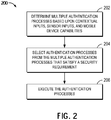
- the processor 101 may be configured to: determine multiple authentication processes based upon contextual inputs, sensor inputs, and the capabilities of the mobile device 100 for authentication with at least one of a service provider 190 or an application 192, or a device. Further, processor 101 may be configured to: select an authentication process from the multiple authentication processes that satisfies a security requirement; and execute the authentication process.
- the service provider 190 that operates an application 192 may be a website (e.g., a bank website, a medical website, a store website, a social media website, etc.), a private/public network, or any type of computing device that provides data/service that may be connected to via a link.
- mobile device 100 may connect to the service provider 190 via a wireless link (e.g., cellular, Wi-Fi, or other networks, etc.) or a wired link.
- the application 192 may be on the mobile device 100 itself.
- mobile device capabilities may refer to the capabilities of the wireless device 100 itself, such as, whether or not it includes particular sensors such as: clock 130, ambient light sensor (ALS) 135, heart rate sensor 137, accelerometer 140, gyroscope 145, magnetometer 150, orientation sensor 151, fingerprint sensor 152, weather sensor 155, Global Positioning Sensor (GPS) 160, infrared (IR) sensor 153, microphone 165, proximity sensor 167, near field communication (NFC) sensor 169, camera 170, etc.
- Mobile device capabilities may also include the type of processor, memory, speed, and the accuracy of the sensors themselves.
- the contextual inputs may be inputs from a contextual sensor and/or may include at least one of current user input data, previous user input data, location, time, or demographic data.
- a contextual sensor may be considered to be any type of sensor that relates to the current context situation of the mobile device which may relate to such sensing information as: light; acceleration; weather; orientation; location, proximity, sound, etc.
- examples of contextual sensors may include: ambient light sensor 135; accelerometer 140; weather sensor 155; orientation sensor 151; GPS 160, proximity sensor 167; microphone 165, etc.
- the sensor inputs include biometric sensor inputs from biometric sensors.
- biometric sensors for biometric sensor inputs may include: heart rate sensor 137, fingerprint sensor 152 (e.g., fingerprint input), touch-screen 120 (e.g., hand geometry), pressure sensors (hand geometry), microphone 165 (e.g., voice scan), camera 170 (facial scan), camera 170 (iris or scerla scan), etc.
- fingerprint sensor 152 e.g., fingerprint input
- touch-screen 120 e.g., hand geometry
- pressure sensors hand geometry
- microphone 165 e.g., voice scan
- camera 170 facial scan
- camera 170 iris or scerla scan
- processor 101 may be further configured to determine a risk index based upon the contextual inputs and to determine a trust index based upon the sensor inputs.
- the security requirement may be determined to be satisfied if the trust index is greater than the risk index.
- an authentication process that satisfies the security requirement is selected from the plurality of multiple authentication processes and the authentication process is executed to allow the mobile device 101 to be authenticated to a service provider 190 and/or application 192 and/or a device.
- mobile device 100 may implement a process 200 to: determine multiple authentication processes based upon contextual inputs, sensor inputs, and the capabilities of the mobile device 100 for authentication with at least one of a service provider 190 or an application 192 (block 202); select an authentication process from the multiple authentication processes that satisfies a security requirement (block 204); and execute the authentication process (block 206).
- mobile device 100 under control of processor 101 may connect to service provider 190 to perform a function, such as: to complete a purchase transaction (e.g., service provider 190 is a store website) or to transfer money (e.g., service provider 190 is a bank website). Further, mobile device 101 under control of processor 101 may attempt to login to an application 192 or a device. In either of these scenarios, an authentication process may be required and a Risk Level may be calculated for use in the authentication process.
- a function such as: to complete a purchase transaction (e.g., service provider 190 is a store website) or to transfer money (e.g., service provider 190 is a bank website).
- mobile device 101 under control of processor 101 may attempt to login to an application 192 or a device. In either of these scenarios, an authentication process may be required and a Risk Level may be calculated for use in the authentication process.
- Utilizing the bank transaction (e.g., service provider 190 is a bank website), as the example, the transfer amount, location of the user, and other contextual inputs may be used to calculate a Risk Index using pre-assigned Risk Levels.
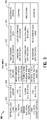
- An example of Risk Indexes 300 may be seen with reference to FIG. 3 .
- service 302 has a High Risk Rating 302.
- the transaction amount 304 e.g., > $1000.00
- the location 310 e.g., Far Away
- a Trust Index may be calculated based on the level of trust associated with each of the biometric authentication strategies registered with the mobile device 100.
- An example of Trust Indexes 400 may be seen with reference to FIG. 4 .
- Processor 101 of mobile device 100 may select biometric authentication processes (e.g., fingerprint sensor) 406 such that the Trust Index is high and greater than the Risk Index, so that the security requirement is satisfied in order to successfully authenticate and complete the transaction with the service provider 190. Based upon this calculation to satisfy the security requirement, this biometric authentication process (e.g., fingerprint sensor) 406 is selected from multiple other authentication processes and this authentication process may be executed to authenticate the mobile device 101 to the service provider 190.
- biometric authentication processes e.g., fingerprint sensor
- the mobile device 100 may determine multiple authentication processes based upon contextual inputs and sensor inputs.
- a function e.g., a financial transaction through a service provider 190, application 192 login, device login
- the mobile device 100 may determine multiple authentication processes based upon contextual inputs and sensor inputs.
- Application/Service Provider/Device Login 302 this includes Low (e.g., games), Medium (e.g., social network), High (e.g., bank transaction); Transaction Dollar Amount 304 (e.g., Low less than $100.00, Medium less than $1000.00, or High greater than $1000.00); Location (GPS, WiFi determined) 310 - this includes Low (e.g., near home/work), Medium (e.g., in town/region), High (e.g., far away); User Spending Behavior Deviation 312 from learned spending behavior patterns - Low (e.g., consistent with past data), Medium (e.g., mostly consistent with past data), High (e.g., inconsistent with past data); Crowd sourced data collected during an event 314 - Low (e.g., lots of confirmed), Medium (e.
- the user could be attempting to access (login to) an application, service provider or device that requires authentication.
- a gaming application may have lower security requirements (low risk index), while a banking service could have higher security requirements (high risk index). Evolving security requirements could also be supported using this method (e.g., security requirements for a photo sharing service increases due to new policies).
- a user could be attempting to complete an online transaction of some dollar amount each of which may have particular risks, e.g., Transaction Dollar Amount 304 (e.g., Low risk less than $100.00, Medium risk less than $1000.00, or High risk greater than $1000.00).
- location determined by a location sensor may be utilized as a Risk Index.
- the Risk Index may be Low for users accessing a service or transaction in or near common everyday locations, such as home, work or a relative's home, while High risk may be associated with public settings, especially if far from a common location (e.g., another city or country).
- General regions or specific locations within a region could be tagged as "High risk” (e.g., places where known fraudulent activity has been reported in the past).
- other regions or specific locations could be tagged as "Low risk” (e.g., if no known fraudulent activity has been reported).
- user spending behavior deviation 312 may be utilized.
- Crowd sourced data collected during an event 314 may be utilized as contextual input in determining security requirements. If for example an event is being held at a particular time and place (e.g., county fair) and many people are spending at a particular vendor(s) (e.g., entrance fee), this data could inform the overall Risk Index. In this example, the many transactions occurring in one location during the event would result in a Lower Risk level.
- Demographic profile data 316 may be utilized as contextual input in determining security requirements. Some features of a demographic profile (e.g., gender, age, ethnicity, income, credit score, identity theft history, etc.) may be used as a global multiplier of the Risk Index for an individual.
- a multiplier could be globally applied to the calculated Risk Index (e.g., Risk Index ⁇ 1.2).
- Individuals who have had their identity stolen in the past might also benefit from a slightly raised Risk Index.
- Other groups may derive the most benefit most from globally lowering the Risk Index score a slight amount (e.g., persons with moderate income level who are between ages 25 - 55, Risk Index ⁇ .80).
- a Risk Index can be calculated by using the contextual input parameters, previously described, with reference to table 300 of FIG. 300.
- the overall Risk Index might range from 1 - 10, where 1-3 might be Low Risk, 4-7 might be Medium Risk, and 8-10 might be High Risk.
- Each contextual input available could be used to calculate the Risk Index.
- the user could directly set a Risk Index for each selected application or service. In this implementation it would be possible to allow some applications or services to use a dynamic (calculated) Risk Index that depends on the contextual inputs above and for others to use a static setting Risk Index that is applied every time.
- a Risk Index may be determined based upon the contextual inputs and a Trust Index may be determined based upon the sensor inputs.
- the security requirement may be determined to be satisfied if the Trust Index is greater than the Risk Index (Trust Index > Risk Index).
- an authentication process that satisfies the security requirement is selected from the plurality of multiple authentication processes and the authentication process is executed to allow the mobile device 101 to be authenticated with a service provider and/or application and/or device.
- a particular example of calculating a Risk Index based upon contextual inputs utilizing the example of the risk index table 300 will be illustrated.
- the overall Risk Index is determined to be: 8.8.
- an authentication process that satisfies the security requirement (Trust Index > Risk Index) is selected from the plurality of multiple authentication processes and requires an authentication process with a High Trust Index (e.g., Iris scan, or Fingerprint scan and Voice scan, etc.)
- a High Trust Index e.g., Iris scan, or Fingerprint scan and Voice scan, etc.
- Authentication strategies range from very high security methods, such as iris scanners (with very low False Accepts), to lower security but more convenient and socially acceptable methods, such as finger print scans and hand geometry scans.
- a Trust level can be associated with each authentication method based on basic False Accepts and False Rejects for a given enrolled database size. While technical implementations of biometric authentication methods may differ, the human physiological limitations of the uniqueness and consistency of a particular biometric trait do not change in the population at large- some traits are more unique (between people) and consistent (within a person) than other traits, and thus are capable of stronger security.
- FAR false accept rate
- fingerprints generally result in 1 false accepts in 10,000 trials, similar to a 4 digit PIN.
- Hand geometry in contrast, has a FAR of 1: 1000 when extracted using standard cameras and methods, while extraction of hand geometry features from a touch screen results in a FAR of much less, given a similar number of trials and database size.
- Lower security biometrics in contrast, tend to be less invasive, but more socially accepted and more convenient to use than higher security biometric methods.
- sensor inputs include biometric sensor inputs from biometric sensors that are utilized to create a Trust Index.
- biometric sensors for biometric sensor inputs may include: heart rate sensor 137, fingerprint sensor 152 (e.g., fingerprint input), touch-screen 120 (e.g., hand geometry), pressure sensors (hand geometry), microphone 165 (e.g., voice scan), camera 170 (facial scan), etc.
- a Trust Index 400 can be generated using the following authentication methods that provide example trust levels. As shown in FIG 4 , low trust levels (1-3) may only require low biometric authentication processes 402: soft biometrics (e.g., hair color); fingerprint/hand geometry; ECG scan; etc. Medium trust levels (4-7) may require medium biometric authentication processes 404: voice scan; facial scan; password; etc. On the other hand, high trust levels (8-10) may require high biometric authentication processes 406: fingerprint scan; iris scan; etc.
- low biometric authentication processes 402 soft biometrics (e.g., hair color); fingerprint/hand geometry; ECG scan; etc.
- Medium trust levels (4-7) may require medium biometric authentication processes 404: voice scan; facial scan; password; etc.
- high trust levels (8-10) may require high biometric authentication processes 406: fingerprint scan; iris scan; etc.
- a risk index may be determined based upon the contextual inputs and a trust index may be determined based upon the sensor inputs, and in particular, biometric sensor inputs.
- the security requirement may be determined to be satisfied if the trust index is greater than the risk index (Trust Index > Risk Index).
- an authentication process that satisfies the security requirement is selected from the plurality of multiple authentication processes and the authentication process is executed to allow the mobile device 101 to be authenticated to a service provider and/or application and/or device.
- a particularly high risk bank transaction e.g., High Risk Index
- authentication method(s) that are associated with a high trust level to yield a Trust Index that is at least equal to if not greater than the Risk Index is selected.
- the required security level could require a Fingerprint scan process having a High Trust Index level (8-10), such that the Trust Index level exceeds the Risk Index Level.
- a Fingerprint scan process having a High Trust Index level (8-10), such that the Trust Index level exceeds the Risk Index Level.
- a Face scan + Voice scan etc., may be utilized to meet the Trust Index Level required.
- ambient levels of sound, light and motion could be sampled from microphone 165, light sensor 135, and accelerometer 140, respectively, to help select and scale optimal biometric method(s) that yield the most reliable data. For example, if background noise is determined to be too loud to gather voice biometric data, then other authentication methods may be selected (e.g., facial scan, iris scan, fingerprint scan, ECG monitoring, etc.). Further, if a voice scan is gathered by microphone 165, the trust level associated with it may be weighted accordingly (e.g., trust level of a voice scan falls proportional to background noise level).
- an authentication process may be selected that optimizes biometric feature reliability. For example, the biometric authentication process for a teenage boy may forego voiceprint authentication, since there may be a higher probability of a cracking or changing voice, or if used could be weighted lower on the Trust Index for this group of users.
- fingerprint profiles for elderly users e.g., > age 75
- fingerprint scan for these users may not be selected, or if it were used it could be weighted potentially lower on the Trust Index for this group.
- a user accesses a service provider, an application, or a device which requires authentication (block 502).
- a user accesses a bank website to pursue a money transfer.
- a Risk Index is calculated.
- the Risk Index may be calculated based on a Risk Level associated with each registered Contextual Input in accordance with the Risk Index equation of block 504.
- Contextual Inputs 510 include: Transaction amount; Location data (GPS, WiFi, etc.); User spending behavior deviation; Crowd sourced data; Demographic profile.
- the determination of Risk Indexes based upon Contextual Inputs has been previously described in detail with reference to FIG. 3 .
- the Risk Index is calculated at the time of authentication based upon the level of risk associated with each of the previously described available Contextual Inputs. It should be appreciated that some contextual inputs/variable may be stored in the mobile device and accessed at a different time.
- a Trust Index is calculated.
- the Trust Index may be calculated based upon the Trust Level associated with each of the selected Authentication processes in accordance with the Trust Index equation of block 530.
- Examples of Authentication processes or methods 532 include: hand geometry; voice scan; facial scan; password; fingerprint scan; iris scan; etc.
- the determination of Trust Indexes based upon Authentication processes, particularly biometric authentication processes, has been previously described in detail with reference to FIG. 4 .
- the Trust Index is calculated based upon the level of trust associated with each of the selected authentication processes.
- Trust Index > Risk Index is satisfied.
- the Trust Index is calculated based upon the level of trust associated with each of the authentication processes available on the mobile device. Examples of these types selections, in which the Trust Index > Risk Index, have been previously described in detail (e.g., Voice Scan + Finger Scan equals a High Trust Index (9) that is greater than a Risk Index of 7). Further, as previously described, ambient motion levels, ambient light levels, and ambient sound levels may be utilized in the selection and weighting of Trust Indexes.
- a secure execution environment (e.g., TrustZone) may be implemented by processor 101 of mobile device 100 to secure the necessary hardware components for the authentication processes (block 542).
- secure hardware components 550 include: IR sensor 153/camera 170 for Iris scan; fingerprint sensor 152 for fingerprint scan; user interface/keyboard 116 for password or PIN; camera 170 for facial scan; microphone 165 for voice scan; touch-screen display 120 for hand geometry scan, etc. It should be appreciated, that in some embodiments, higher security methods having high trust levels (e.g., high trust level 406, FIG.
- the user may be initially required, and after a predefined time period and/or if the Risk Index based upon contextual inputs has not changed significantly to effect the threshold (e.g., Trust Index > Risk Index), then the user may be allowed to utilize lower security methods having lower trust levels (e.g., low trust level 402, FIG. 4 ), until the situation (e.g., the context) changes.
- the threshold e.g., Trust Index > Risk Index
- each of the multiple selected authentication processes may be displayed to the user sequentially or in parallel. Although, only one authentication process may be required. However, it should be appreciated that a "passive" authentication process may be beneficial that does not require any manual input by the user and is therefore the least intrusive. Accordingly, if a trust index is selectable by the mobile device (based upon passive authentication processes) that is greater than the risk index, then a passive authentication process (e.g., hand geometry from the touch-screen) will be selected and manual input is not required by the user and the authentication processes do not need to be displayed.
- the features e.g., sensor inputs
- the captured features match the enrolled features from a stored template, then the service/application/device is authenticated block 572 and, if not, then the service/application/device is not authenticated block 570.
- the authentication process 500 may include an embodiment in which two or more people are required to perform the authentication process 500 such that the service/application/device is authenticated.
- a parent may be required to perform the authentication process 500 on behalf of a minor.
- a mobile device 100 may select an authentication process using multiple authentication methods based upon contextual inputs (e.g., transaction amount, location data, user spending behavior data, crowd sourced data, demographic profiles, etc.) and biometric sensor inputs (e.g., hand geometry, voice scan, facial scan, fingerprint scan, iris scan, etc.)
- the processor 101 of the mobile device 100 may be configured to: determine multiple authentication processes based upon the contextual inputs, biometric sensor inputs, and the capabilities of the mobile device 100 for authentication with at least one of a service provider/application/device, etc.
- the processor 101 may be configured to select an authentication process from the multiple authentication methods that satisfies a security requirement, in which the security requirement may be defined as the Trust Index being greater than the Risk Index, as previously described in detail.
- the authentication methods may be user-defined. For example, a user may enroll and use multiple authentication methods that the mobile device is capable of utilizing (e.g., password, facial scan, voice scan, hand geometry, ECG, fingerprint scan, iris scan, etc.) and elect to not enroll others. Also, in some embodiments, if a particular biometric sensor can only extract partial data due to noise (e.g., partial data due to dirt or movement), or partial facial scan due to shadowing, or partial voice scan due to background noise, or partial iris scan due to reflection, squinting or eye movement, then the Trust Index may be calculated based upon only the limited features that can be extracted.
- partial data due to noise e.g., partial data due to dirt or movement
- partial facial scan due to shadowing e.g., partial voice scan due to background noise
- a partial scan for example may meet the security requirements (Trust Index > Risk Index) to authenticate a low-security application (e.g., view photos).
- Trust Index ⁇ Risk Index i.e., Trust Index ⁇ Risk Index
- additional authentication may be required.
- PIN or password authentication may be a requirement for an online financial service or mobile service, this may serve as the minimum level of required security.
- Contextual inputs may bump up a calculated Risk Index such that it exceeds the trust level associated with the online PIN or password, requiring additional biometric authentication methods to meet the Risk Index score.
- circuitry of the devices may operate under the control of a program, routine, or the execution of instructions to execute methods or processes in accordance with embodiments of the invention.
- a program may be implemented in firmware or software (e.g. stored in memory and/or other locations) and may be implemented by processors and/or other circuitry of the devices.
- processors microprocessor, circuitry, controller, etc.
- processors refer to any type of logic or circuitry capable of executing logic, commands, instructions, software, firmware, functionality, etc
- the devices are mobile or wireless devices that they may communicate via one or more wireless communication links through a wireless network that are based on or otherwise support any suitable wireless communication technology.
- the wireless device and other devices may associate with a network including a wireless network.
- the network may comprise a body area network or a personal area network (e.g., an ultra-wideband network).
- the network may comprise a local area network or a wide area network.
- a wireless device may support or otherwise use one or more of a variety of wireless communication technologies, protocols, or standards such as, for example, 3G, LTE, Advanced LTE, 4G, CDMA, TDMA, OFDM, OFDMA, WiMAX, and WiFi.
- a wireless device may support or otherwise use one or more of a variety of corresponding modulation or multiplexing schemes.
- a wireless device may thus include appropriate components (e.g., air interfaces) to establish and communicate via one or more wireless communication links using the above or other wireless communication technologies.
- a device may comprise a wireless transceiver with associated transmitter and receiver components (e.g., a transmitter and a receiver) that may include various components (e.g., signal generators and signal processors) that facilitate communication over a wireless medium.
- a mobile wireless device may therefore wirelessly communicate with other mobile devices, cell phones, other wired and wireless computers, Internet web-sites, etc.
- teachings herein may be incorporated into (e.g., implemented within or performed by) a variety of apparatuses (e.g., devices).
- a phone e.g., a cellular phone
- PDA personal data assistant
- a tablet e.g., a mobile computer
- a laptop computer e.g., an entertainment device (e.g., a music or video device)
- a headset e.g., headphones, an earpiece, etc.
- a medical device e.g., a heart rate monitor, a pedometer, an EKG device, etc.
- a user I/O device e.g., a computer, a wired computer, a fixed computer, a desktop computer, a server, a point-of-sale device, a set-top box, or any other suitable device.
- These devices may have different power and data requirements
- DSP digital signal processor
- ASIC application specific integrated circuit
- FPGA field programmable gate array
- a general purpose processor may be a microprocessor, but in the alternative, the processor may be any conventional processor, controller, microcontroller, or state machine.
- a processor may also be implemented as a combination of computing devices, e.g., a combination of a DSP and a microprocessor, a plurality of microprocessors, one or more microprocessors in conjunction with a DSP core, or any other such configuration.
- a software module may reside in RAM memory, flash memory, ROM memory, EPROM memory, EEPROM memory, registers, hard disk, a removable disk, a CD-ROM, or any other form of storage medium known in the art.
- An exemplary storage medium is coupled to the processor such the processor can read information from, and write information to, the storage medium.
- the storage medium may be integral to the processor.
- the processor and the storage medium may reside in an ASIC.
- the ASIC may reside in a user terminal.
- the processor and the storage medium may reside as discrete components in a user terminal.
- the functions described may be implemented in hardware, software, firmware, or any combination thereof. If implemented in software as a computer program product, the functions may be stored on or transmitted over as one or more instructions or code on a computer-readable medium.
- Computer-readable media includes both computer storage media and communication media including any medium that facilitates transfer of a computer program from one place to another.
- a storage media may be any available media that can be accessed by a computer.
- such computer-readable media can comprise RAM, ROM, EEPROM, CD-ROM or other optical disk storage, magnetic disk storage or other magnetic storage devices, or any other medium that can be used to carry or store desired program code in the form of instructions or data structures and that can be accessed by a computer.
- any connection is properly termed a computer-readable medium.
- the software is transmitted from a web site, server, or other remote source using a coaxial cable, fiber optic cable, twisted pair, digital subscriber line (DSL), or wireless technologies such as infrared, radio, and microwave
- the coaxial cable, fiber optic cable, twisted pair, DSL, or wireless technologies such as infrared, radio, and microwave are included in the definition of medium.
- Disk and disc includes compact disc (CD), laser disc, optical disc, digital versatile disc (DVD), floppy disk and blu-ray disc where disks usually reproduce data magnetically, while discs reproduce data optically with lasers. Combinations of the above should also be included within the scope of computer-readable media.
Landscapes
- Engineering & Computer Science (AREA)
- Computer Security & Cryptography (AREA)
- Theoretical Computer Science (AREA)
- Computer Hardware Design (AREA)
- General Engineering & Computer Science (AREA)
- Software Systems (AREA)
- General Physics & Mathematics (AREA)
- Physics & Mathematics (AREA)
- Computer Networks & Wireless Communication (AREA)
- Signal Processing (AREA)
- Computing Systems (AREA)
- Telephone Function (AREA)
- Collating Specific Patterns (AREA)
Applications Claiming Priority (2)
| Application Number | Priority Date | Filing Date | Title |
|---|---|---|---|
| US14/494,543 US9992207B2 (en) | 2014-09-23 | 2014-09-23 | Scalable authentication process selection based upon sensor inputs |
| PCT/US2015/047578 WO2016048583A1 (en) | 2014-09-23 | 2015-08-28 | Scalable authentication process selection based upon sensor inputs |
Publications (2)
| Publication Number | Publication Date |
|---|---|
| EP3198911A1 EP3198911A1 (en) | 2017-08-02 |
| EP3198911B1 true EP3198911B1 (en) | 2020-11-25 |
Family
ID=54073030
Family Applications (1)
| Application Number | Title | Priority Date | Filing Date |
|---|---|---|---|
| EP15762885.0A Not-in-force EP3198911B1 (en) | 2014-09-23 | 2015-08-28 | Scalable authentication process selection based upon sensor inputs |
Country Status (5)
| Country | Link |
|---|---|
| US (1) | US9992207B2 (enExample) |
| EP (1) | EP3198911B1 (enExample) |
| JP (1) | JP2017538180A (enExample) |
| CN (1) | CN107077551B (enExample) |
| WO (1) | WO2016048583A1 (enExample) |
Families Citing this family (85)
| Publication number | Priority date | Publication date | Assignee | Title |
|---|---|---|---|---|
| US9813270B2 (en) * | 1999-08-09 | 2017-11-07 | Kamilo Feher | Heart rate sensor and medical diagnostics wireless devices |
| US10917431B2 (en) | 2010-11-29 | 2021-02-09 | Biocatch Ltd. | System, method, and device of authenticating a user based on selfie image or selfie video |
| US11223619B2 (en) | 2010-11-29 | 2022-01-11 | Biocatch Ltd. | Device, system, and method of user authentication based on user-specific characteristics of task performance |
| US10069837B2 (en) | 2015-07-09 | 2018-09-04 | Biocatch Ltd. | Detection of proxy server |
| US10949514B2 (en) | 2010-11-29 | 2021-03-16 | Biocatch Ltd. | Device, system, and method of differentiating among users based on detection of hardware components |
| US10621585B2 (en) | 2010-11-29 | 2020-04-14 | Biocatch Ltd. | Contextual mapping of web-pages, and generation of fraud-relatedness score-values |
| US10834590B2 (en) | 2010-11-29 | 2020-11-10 | Biocatch Ltd. | Method, device, and system of differentiating between a cyber-attacker and a legitimate user |
| US11210674B2 (en) | 2010-11-29 | 2021-12-28 | Biocatch Ltd. | Method, device, and system of detecting mule accounts and accounts used for money laundering |
| US20190158535A1 (en) * | 2017-11-21 | 2019-05-23 | Biocatch Ltd. | Device, System, and Method of Detecting Vishing Attacks |
| US12101354B2 (en) * | 2010-11-29 | 2024-09-24 | Biocatch Ltd. | Device, system, and method of detecting vishing attacks |
| US10728761B2 (en) | 2010-11-29 | 2020-07-28 | Biocatch Ltd. | Method, device, and system of detecting a lie of a user who inputs data |
| US12641120B2 (en) * | 2010-11-29 | 2026-05-26 | Biocatch Ltd. | Device, system, and method of detecting vishing attacks |
| US9887983B2 (en) | 2013-10-29 | 2018-02-06 | Nok Nok Labs, Inc. | Apparatus and method for implementing composite authenticators |
| US10706132B2 (en) * | 2013-03-22 | 2020-07-07 | Nok Nok Labs, Inc. | System and method for adaptive user authentication |
| US10270748B2 (en) | 2013-03-22 | 2019-04-23 | Nok Nok Labs, Inc. | Advanced authentication techniques and applications |
| US9961077B2 (en) | 2013-05-30 | 2018-05-01 | Nok Nok Labs, Inc. | System and method for biometric authentication with device attestation |
| JP2015090589A (ja) * | 2013-11-06 | 2015-05-11 | ソニー株式会社 | 認証制御システム、認証制御方法およびプログラム |
| US10447677B1 (en) * | 2014-03-14 | 2019-10-15 | United Services Automobile Association (Usaa) | Mobile application authentication infrastructure |
| US9577999B1 (en) | 2014-05-02 | 2017-02-21 | Nok Nok Labs, Inc. | Enhanced security for registration of authentication devices |
| US9654469B1 (en) | 2014-05-02 | 2017-05-16 | Nok Nok Labs, Inc. | Web-based user authentication techniques and applications |
| US10148630B2 (en) | 2014-07-31 | 2018-12-04 | Nok Nok Labs, Inc. | System and method for implementing a hosted authentication service |
| US9875347B2 (en) | 2014-07-31 | 2018-01-23 | Nok Nok Labs, Inc. | System and method for performing authentication using data analytics |
| US9749131B2 (en) | 2014-07-31 | 2017-08-29 | Nok Nok Labs, Inc. | System and method for implementing a one-time-password using asymmetric cryptography |
| KR102143308B1 (ko) | 2014-09-02 | 2020-08-10 | 애플 인크. | 경고를 관리하기 위한 축소된 크기의 인터페이스 |
| US9736154B2 (en) | 2014-09-16 | 2017-08-15 | Nok Nok Labs, Inc. | System and method for integrating an authentication service within a network architecture |
| CN109951436B (zh) * | 2014-10-24 | 2021-04-27 | 创新先进技术有限公司 | 一种可信终端验证方法、装置 |
| US9628477B2 (en) * | 2014-12-23 | 2017-04-18 | Intel Corporation | User profile selection using contextual authentication |
| US10154818B2 (en) * | 2014-12-24 | 2018-12-18 | Samsung Electronics Co., Ltd. | Biometric authentication method and apparatus |
| US20160224973A1 (en) * | 2015-02-01 | 2016-08-04 | Apple Inc. | User interface for payments |
| US11171941B2 (en) | 2015-02-24 | 2021-11-09 | Nelson A. Cicchitto | Mobile device enabled desktop tethered and tetherless authentication |
| US11122034B2 (en) | 2015-02-24 | 2021-09-14 | Nelson A. Cicchitto | Method and apparatus for an identity assurance score with ties to an ID-less and password-less authentication system |
| US20160364727A1 (en) * | 2015-06-11 | 2016-12-15 | Early Warning Services, Llc | System and method for identifying compromised accounts |
| CN106295270B (zh) * | 2015-06-25 | 2019-03-29 | 联想(北京)有限公司 | 一种用户识别方法及电子设备 |
| GB2539705B (en) | 2015-06-25 | 2017-10-25 | Aimbrain Solutions Ltd | Conditional behavioural biometrics |
| US10178126B2 (en) * | 2015-06-29 | 2019-01-08 | International Business Machines Corporation | Activity-based risk selection of open Wi-Fi networks |
| KR102466995B1 (ko) * | 2015-12-21 | 2022-11-14 | 삼성전자주식회사 | 사용자 인증 장치 및 방법 |
| US10817593B1 (en) * | 2015-12-29 | 2020-10-27 | Wells Fargo Bank, N.A. | User information gathering and distribution system |
| US11295316B2 (en) * | 2016-06-10 | 2022-04-05 | OneTrust, LLC | Data processing systems for identity validation for consumer rights requests and related methods |
| SG10201605364XA (en) | 2016-06-29 | 2018-01-30 | Mastercard Asia Pacific Pte Ltd | Method For Effecting An Authentication Procedure Associated With A Service Provider Or An Application |
| GB2552032B (en) | 2016-07-08 | 2019-05-22 | Aimbrain Solutions Ltd | Step-up authentication |
| US10637853B2 (en) | 2016-08-05 | 2020-04-28 | Nok Nok Labs, Inc. | Authentication techniques including speech and/or lip movement analysis |
| US10769635B2 (en) | 2016-08-05 | 2020-09-08 | Nok Nok Labs, Inc. | Authentication techniques including speech and/or lip movement analysis |
| US10776519B2 (en) | 2016-08-08 | 2020-09-15 | International Business Machines Corporation | Information presentation management |
| US11144928B2 (en) | 2016-09-19 | 2021-10-12 | Early Warning Services, Llc | Authentication and fraud prevention in provisioning a mobile wallet |
| GB2554399B (en) * | 2016-09-26 | 2020-02-12 | Aimbrain Solutions Ltd | Testing the suitability of an authentication process by passive availability testing |
| US10027662B1 (en) * | 2016-12-06 | 2018-07-17 | Amazon Technologies, Inc. | Dynamic user authentication |
| US10237070B2 (en) | 2016-12-31 | 2019-03-19 | Nok Nok Labs, Inc. | System and method for sharing keys across authenticators |
| US10091195B2 (en) | 2016-12-31 | 2018-10-02 | Nok Nok Labs, Inc. | System and method for bootstrapping a user binding |
| JP6628116B2 (ja) * | 2017-01-06 | 2020-01-08 | 京セラドキュメントソリューションズ株式会社 | 電子機器 |
| US10356617B2 (en) * | 2017-02-08 | 2019-07-16 | Qualcomm Incorporated | Mobile device to provide continuous authentication based on contextual awareness |
| KR102314241B1 (ko) * | 2017-03-28 | 2021-10-20 | 삼성전자주식회사 | 적응적 인증 수행 방법 및 이를 지원하는 전자 장치 |
| US9882918B1 (en) * | 2017-05-15 | 2018-01-30 | Forcepoint, LLC | User behavior profile in a blockchain |
| JP2019008527A (ja) * | 2017-06-23 | 2019-01-17 | 富士通コネクテッドテクノロジーズ株式会社 | 情報処理装置、生体認証制御方法、及び生体認証制御プログラム |
| JP6939266B2 (ja) * | 2017-08-30 | 2021-09-22 | コニカミノルタ株式会社 | データ処理装置、ユーザー認証方法及びユーザー認証プログラム |
| JP2019075007A (ja) * | 2017-10-18 | 2019-05-16 | シャープ株式会社 | 携帯端末装置、および、制御プログラム |
| EP3477982B1 (en) * | 2017-10-30 | 2021-12-22 | Hewlett-Packard Development Company, L.P. | Location based authentication |
| US11868995B2 (en) | 2017-11-27 | 2024-01-09 | Nok Nok Labs, Inc. | Extending a secure key storage for transaction confirmation and cryptocurrency |
| US11831409B2 (en) | 2018-01-12 | 2023-11-28 | Nok Nok Labs, Inc. | System and method for binding verifiable claims |
| SG10201800338TA (en) * | 2018-01-15 | 2019-08-27 | Mastercard International Inc | User authentication systems and methods |
| US10911464B2 (en) * | 2018-04-27 | 2021-02-02 | Oracle International Corporation | Framework for multi-level and multi-factor inline enrollment |
| US11100204B2 (en) * | 2018-07-19 | 2021-08-24 | Motorola Mobility Llc | Methods and devices for granting increasing operational access with increasing authentication factors |
| KR102120674B1 (ko) * | 2018-09-19 | 2020-06-10 | 엘지전자 주식회사 | 이동 단말기 |
| KR102758937B1 (ko) * | 2019-02-18 | 2025-01-23 | 삼성전자주식회사 | 생체 정보를 인증하기 위한 전자 장치 및 그의 동작 방법 |
| US12041039B2 (en) | 2019-02-28 | 2024-07-16 | Nok Nok Labs, Inc. | System and method for endorsing a new authenticator |
| US11741203B1 (en) * | 2019-03-01 | 2023-08-29 | Alclear, Llc | Mobile identity information controlled device |
| US11531736B1 (en) | 2019-03-18 | 2022-12-20 | Amazon Technologies, Inc. | User authentication as a service |
| US11792024B2 (en) | 2019-03-29 | 2023-10-17 | Nok Nok Labs, Inc. | System and method for efficient challenge-response authentication |
| US11096059B1 (en) * | 2019-08-04 | 2021-08-17 | Acceptto Corporation | System and method for secure touchless authentication of user paired device, behavior and identity |
| US11509642B2 (en) * | 2019-08-21 | 2022-11-22 | Truist Bank | Location-based mobile device authentication |
| US11432149B1 (en) | 2019-10-10 | 2022-08-30 | Wells Fargo Bank, N.A. | Self-sovereign identification via digital credentials for selected identity attributes |
| EP4629199A3 (en) | 2020-09-25 | 2025-12-24 | Apple Inc. | Flexible illumination for imaging systems |
| US12688268B2 (en) * | 2020-09-25 | 2026-07-21 | Apple Inc. | Pose optimization in biometric authentication systems |
| US12003506B2 (en) * | 2020-10-07 | 2024-06-04 | Arris Enterprises Llc | Biometrics based access controls for network features |
| US11811762B2 (en) | 2021-02-05 | 2023-11-07 | Cisco Technology, Inc. | Sponsor delegation for multi-factor authentication |
| JP2022178691A (ja) * | 2021-05-20 | 2022-12-02 | ヤフー株式会社 | 情報処理装置、情報処理方法及び情報処理プログラム |
| US12189756B2 (en) | 2021-06-06 | 2025-01-07 | Apple Inc. | User interfaces for managing passwords |
| US20240386081A1 (en) * | 2021-07-08 | 2024-11-21 | Telefonaktiebolaget Lm Ericsson (Publ) | Method, authentication system, and computer program for authenticating a user for a service |
| US11606353B2 (en) | 2021-07-22 | 2023-03-14 | Biocatch Ltd. | System, device, and method of generating and utilizing one-time passwords |
| JP2023026890A (ja) * | 2021-08-16 | 2023-03-01 | 富士フイルムビジネスイノベーション株式会社 | 認証装置及びコンピュータプログラム |
| US12126613B2 (en) | 2021-09-17 | 2024-10-22 | Nok Nok Labs, Inc. | System and method for pre-registration of FIDO authenticators |
| US12683958B2 (en) * | 2022-04-06 | 2026-07-14 | Citrix Systems, Inc. | Biometric multi-factor authentication |
| JP7799558B2 (ja) * | 2022-05-23 | 2026-01-15 | 株式会社日立ソリューションズ | リスクベース認証システム及びリスクベース認証方法 |
| CN116471114A (zh) * | 2023-05-11 | 2023-07-21 | 中电科网络空间安全研究院有限公司 | 物联网安全认证方法、装置、系统、设备及介质 |
| US12684066B2 (en) | 2023-05-25 | 2026-07-14 | Capital One Services, Llc | Computer-based systems configured to dynamically reduce a plurality of subsequent authentication steps required to execute security action(s) and methods of use thereof |
| US20250337747A1 (en) * | 2024-04-29 | 2025-10-30 | Palantir Technologies Inc. | Systems and methods for managing access control to one or more resources |
Family Cites Families (16)
| Publication number | Priority date | Publication date | Assignee | Title |
|---|---|---|---|---|
| US7623970B2 (en) * | 2001-04-17 | 2009-11-24 | Panasonic Corporation | Personal authentication method and device |
| JP2003044442A (ja) * | 2001-07-30 | 2003-02-14 | Fujitsu Support & Service Kk | データ認証方法及びデータ認証装置 |
| US20030033524A1 (en) | 2001-08-13 | 2003-02-13 | Luu Tran | Client aware authentication in a wireless portal system |
| US20030115142A1 (en) | 2001-12-12 | 2003-06-19 | Intel Corporation | Identity authentication portfolio system |
| EP1664687A4 (en) | 2003-09-12 | 2009-01-14 | Rsa Security Inc | SYSTEM AND METHOD FOR AUTHENTICATION TO RISK BASIS |
| US7194763B2 (en) | 2004-08-02 | 2007-03-20 | Cisco Technology, Inc. | Method and apparatus for determining authentication capabilities |
| JP4574335B2 (ja) * | 2004-11-19 | 2010-11-04 | 株式会社日立製作所 | セキュリティシステム、認証サーバ、認証方法、およびプログラム |
| JP2006285329A (ja) * | 2005-03-31 | 2006-10-19 | Nec Corp | モバイルセキュリティ決定支援システム、方法、プログラム、移動体通信端末装置及び情報管理運営サーバ |
| WO2007023756A1 (ja) * | 2005-08-24 | 2007-03-01 | Nec Corporation | 本人認証システム、ユーザ端末、サービス事業者装置、信頼性保証サーバ、これらの動作方法と動作プログラム |
| JP2010198536A (ja) * | 2009-02-27 | 2010-09-09 | Brother Ind Ltd | ユーザ認証装置、会議システム、ユーザ認証方法およびユーザ認証プログラム |
| KR101361161B1 (ko) | 2011-12-29 | 2014-02-17 | 한국인터넷진흥원 | 모바일 클라우드 접속 상황 정보 이용 인증 강화 시스템 및 방법 |
| US9100825B2 (en) | 2012-02-28 | 2015-08-04 | Verizon Patent And Licensing Inc. | Method and system for multi-factor biometric authentication based on different device capture modalities |
| CN102685106B (zh) * | 2012-03-27 | 2015-09-30 | 北京百纳威尔科技有限公司 | 一种安全验证方法及设备 |
| US20140157401A1 (en) * | 2012-11-30 | 2014-06-05 | Motorola Mobility Llc | Method of Dynamically Adjusting an Authentication Sensor |
| US10049361B2 (en) | 2012-12-14 | 2018-08-14 | Accenture Global Services Limited | Dynamic authentication technology |
| GB2510120A (en) * | 2013-01-24 | 2014-07-30 | Ibm | User authentication based on dynamically selected service authentication levels |
-
2014
- 2014-09-23 US US14/494,543 patent/US9992207B2/en active Active
-
2015
- 2015-08-28 JP JP2017515104A patent/JP2017538180A/ja active Pending
- 2015-08-28 WO PCT/US2015/047578 patent/WO2016048583A1/en not_active Ceased
- 2015-08-28 EP EP15762885.0A patent/EP3198911B1/en not_active Not-in-force
- 2015-08-28 CN CN201580049423.5A patent/CN107077551B/zh not_active Expired - Fee Related
Non-Patent Citations (1)
| Title |
|---|
| None * |
Also Published As
| Publication number | Publication date |
|---|---|
| CN107077551A (zh) | 2017-08-18 |
| CN107077551B (zh) | 2020-07-10 |
| US9992207B2 (en) | 2018-06-05 |
| WO2016048583A1 (en) | 2016-03-31 |
| EP3198911A1 (en) | 2017-08-02 |
| US20160087952A1 (en) | 2016-03-24 |
| JP2017538180A (ja) | 2017-12-21 |
Similar Documents
| Publication | Publication Date | Title |
|---|---|---|
| US9992207B2 (en) | Scalable authentication process selection based upon sensor inputs | |
| US12182816B2 (en) | Transaction confirmation and authentication based on device sensor data | |
| EP3108397B1 (en) | Trust broker authentication method for mobile devices | |
| US20150242605A1 (en) | Continuous authentication with a mobile device | |
| US10111093B2 (en) | Mobile device to provide continuous and discrete user authentication | |
| US9654978B2 (en) | Asset accessibility with continuous authentication for mobile devices | |
| US20160232516A1 (en) | Predictive authorization of mobile payments | |
| US20190114060A1 (en) | User interface customization based on facial recognition | |
| US11924636B2 (en) | System and method for authenticating using a multi-provider platform | |
| US20200137213A1 (en) | Evaluating environmental information during a transaction | |
| US12248935B2 (en) | Systems and methods for conducting remote user authentication | |
| CN109165328A (zh) | 一种用户身份认证方法及装置 |
Legal Events
| Date | Code | Title | Description |
|---|---|---|---|
| STAA | Information on the status of an ep patent application or granted ep patent |
Free format text: STATUS: THE INTERNATIONAL PUBLICATION HAS BEEN MADE |
|
| PUAI | Public reference made under article 153(3) epc to a published international application that has entered the european phase |
Free format text: ORIGINAL CODE: 0009012 |
|
| STAA | Information on the status of an ep patent application or granted ep patent |
Free format text: STATUS: REQUEST FOR EXAMINATION WAS MADE |
|
| 17P | Request for examination filed |
Effective date: 20170213 |
|
| AK | Designated contracting states |
Kind code of ref document: A1 Designated state(s): AL AT BE BG CH CY CZ DE DK EE ES FI FR GB GR HR HU IE IS IT LI LT LU LV MC MK MT NL NO PL PT RO RS SE SI SK SM TR |
|
| AX | Request for extension of the european patent |
Extension state: BA ME |
|
| DAV | Request for validation of the european patent (deleted) | ||
| DAX | Request for extension of the european patent (deleted) | ||
| STAA | Information on the status of an ep patent application or granted ep patent |
Free format text: STATUS: EXAMINATION IS IN PROGRESS |
|
| 17Q | First examination report despatched |
Effective date: 20190820 |
|
| GRAP | Despatch of communication of intention to grant a patent |
Free format text: ORIGINAL CODE: EPIDOSNIGR1 |
|
| STAA | Information on the status of an ep patent application or granted ep patent |
Free format text: STATUS: GRANT OF PATENT IS INTENDED |
|
| RIC1 | Information provided on ipc code assigned before grant |
Ipc: H04W 12/06 20090101AFI20200528BHEP Ipc: G06F 21/57 20130101ALI20200528BHEP Ipc: G06F 21/40 20130101ALI20200528BHEP Ipc: H04W 88/02 20090101ALN20200528BHEP Ipc: G06F 21/32 20130101ALI20200528BHEP Ipc: G06F 21/35 20130101ALI20200528BHEP Ipc: H04L 29/06 20060101ALN20200528BHEP |
|
| RIC1 | Information provided on ipc code assigned before grant |
Ipc: H04W 88/02 20090101ALN20200604BHEP Ipc: H04L 29/06 20060101ALN20200604BHEP Ipc: G06F 21/40 20130101ALI20200604BHEP Ipc: G06F 21/35 20130101ALI20200604BHEP Ipc: H04W 12/06 20090101AFI20200604BHEP Ipc: G06F 21/32 20130101ALI20200604BHEP Ipc: G06F 21/57 20130101ALI20200604BHEP |
|
| INTG | Intention to grant announced |
Effective date: 20200617 |
|
| GRAS | Grant fee paid |
Free format text: ORIGINAL CODE: EPIDOSNIGR3 |
|
| GRAA | (expected) grant |
Free format text: ORIGINAL CODE: 0009210 |
|
| STAA | Information on the status of an ep patent application or granted ep patent |
Free format text: STATUS: THE PATENT HAS BEEN GRANTED |
|
| AK | Designated contracting states |
Kind code of ref document: B1 Designated state(s): AL AT BE BG CH CY CZ DE DK EE ES FI FR GB GR HR HU IE IS IT LI LT LU LV MC MK MT NL NO PL PT RO RS SE SI SK SM TR |
|
| REG | Reference to a national code |
Ref country code: GB Ref legal event code: FG4D |
|
| REG | Reference to a national code |
Ref country code: CH Ref legal event code: EP |
|
| REG | Reference to a national code |
Ref country code: AT Ref legal event code: REF Ref document number: 1339717 Country of ref document: AT Kind code of ref document: T Effective date: 20201215 |
|
| REG | Reference to a national code |
Ref country code: DE Ref legal event code: R096 Ref document number: 602015062545 Country of ref document: DE |
|
| REG | Reference to a national code |
Ref country code: IE Ref legal event code: FG4D |
|
| REG | Reference to a national code |
Ref country code: AT Ref legal event code: MK05 Ref document number: 1339717 Country of ref document: AT Kind code of ref document: T Effective date: 20201125 |
|
| REG | Reference to a national code |
Ref country code: NL Ref legal event code: MP Effective date: 20201125 |
|
| PG25 | Lapsed in a contracting state [announced via postgrant information from national office to epo] |
Ref country code: NO Free format text: LAPSE BECAUSE OF FAILURE TO SUBMIT A TRANSLATION OF THE DESCRIPTION OR TO PAY THE FEE WITHIN THE PRESCRIBED TIME-LIMIT Effective date: 20210225 Ref country code: FI Free format text: LAPSE BECAUSE OF FAILURE TO SUBMIT A TRANSLATION OF THE DESCRIPTION OR TO PAY THE FEE WITHIN THE PRESCRIBED TIME-LIMIT Effective date: 20201125 Ref country code: RS Free format text: LAPSE BECAUSE OF FAILURE TO SUBMIT A TRANSLATION OF THE DESCRIPTION OR TO PAY THE FEE WITHIN THE PRESCRIBED TIME-LIMIT Effective date: 20201125 Ref country code: PT Free format text: LAPSE BECAUSE OF FAILURE TO SUBMIT A TRANSLATION OF THE DESCRIPTION OR TO PAY THE FEE WITHIN THE PRESCRIBED TIME-LIMIT Effective date: 20210325 Ref country code: GR Free format text: LAPSE BECAUSE OF FAILURE TO SUBMIT A TRANSLATION OF THE DESCRIPTION OR TO PAY THE FEE WITHIN THE PRESCRIBED TIME-LIMIT Effective date: 20210226 |
|
| PG25 | Lapsed in a contracting state [announced via postgrant information from national office to epo] |
Ref country code: AT Free format text: LAPSE BECAUSE OF FAILURE TO SUBMIT A TRANSLATION OF THE DESCRIPTION OR TO PAY THE FEE WITHIN THE PRESCRIBED TIME-LIMIT Effective date: 20201125 Ref country code: BG Free format text: LAPSE BECAUSE OF FAILURE TO SUBMIT A TRANSLATION OF THE DESCRIPTION OR TO PAY THE FEE WITHIN THE PRESCRIBED TIME-LIMIT Effective date: 20210225 Ref country code: LV Free format text: LAPSE BECAUSE OF FAILURE TO SUBMIT A TRANSLATION OF THE DESCRIPTION OR TO PAY THE FEE WITHIN THE PRESCRIBED TIME-LIMIT Effective date: 20201125 Ref country code: PL Free format text: LAPSE BECAUSE OF FAILURE TO SUBMIT A TRANSLATION OF THE DESCRIPTION OR TO PAY THE FEE WITHIN THE PRESCRIBED TIME-LIMIT Effective date: 20201125 Ref country code: IS Free format text: LAPSE BECAUSE OF FAILURE TO SUBMIT A TRANSLATION OF THE DESCRIPTION OR TO PAY THE FEE WITHIN THE PRESCRIBED TIME-LIMIT Effective date: 20210325 Ref country code: SE Free format text: LAPSE BECAUSE OF FAILURE TO SUBMIT A TRANSLATION OF THE DESCRIPTION OR TO PAY THE FEE WITHIN THE PRESCRIBED TIME-LIMIT Effective date: 20201125 |
|
| REG | Reference to a national code |
Ref country code: LT Ref legal event code: MG9D |
|
| PG25 | Lapsed in a contracting state [announced via postgrant information from national office to epo] |
Ref country code: HR Free format text: LAPSE BECAUSE OF FAILURE TO SUBMIT A TRANSLATION OF THE DESCRIPTION OR TO PAY THE FEE WITHIN THE PRESCRIBED TIME-LIMIT Effective date: 20201125 |
|
| PG25 | Lapsed in a contracting state [announced via postgrant information from national office to epo] |
Ref country code: SM Free format text: LAPSE BECAUSE OF FAILURE TO SUBMIT A TRANSLATION OF THE DESCRIPTION OR TO PAY THE FEE WITHIN THE PRESCRIBED TIME-LIMIT Effective date: 20201125 Ref country code: CZ Free format text: LAPSE BECAUSE OF FAILURE TO SUBMIT A TRANSLATION OF THE DESCRIPTION OR TO PAY THE FEE WITHIN THE PRESCRIBED TIME-LIMIT Effective date: 20201125 Ref country code: EE Free format text: LAPSE BECAUSE OF FAILURE TO SUBMIT A TRANSLATION OF THE DESCRIPTION OR TO PAY THE FEE WITHIN THE PRESCRIBED TIME-LIMIT Effective date: 20201125 Ref country code: RO Free format text: LAPSE BECAUSE OF FAILURE TO SUBMIT A TRANSLATION OF THE DESCRIPTION OR TO PAY THE FEE WITHIN THE PRESCRIBED TIME-LIMIT Effective date: 20201125 Ref country code: SK Free format text: LAPSE BECAUSE OF FAILURE TO SUBMIT A TRANSLATION OF THE DESCRIPTION OR TO PAY THE FEE WITHIN THE PRESCRIBED TIME-LIMIT Effective date: 20201125 Ref country code: LT Free format text: LAPSE BECAUSE OF FAILURE TO SUBMIT A TRANSLATION OF THE DESCRIPTION OR TO PAY THE FEE WITHIN THE PRESCRIBED TIME-LIMIT Effective date: 20201125 |
|
| REG | Reference to a national code |
Ref country code: DE Ref legal event code: R097 Ref document number: 602015062545 Country of ref document: DE |
|
| PG25 | Lapsed in a contracting state [announced via postgrant information from national office to epo] |
Ref country code: DK Free format text: LAPSE BECAUSE OF FAILURE TO SUBMIT A TRANSLATION OF THE DESCRIPTION OR TO PAY THE FEE WITHIN THE PRESCRIBED TIME-LIMIT Effective date: 20201125 |
|
| PLBE | No opposition filed within time limit |
Free format text: ORIGINAL CODE: 0009261 |
|
| STAA | Information on the status of an ep patent application or granted ep patent |
Free format text: STATUS: NO OPPOSITION FILED WITHIN TIME LIMIT |
|
| PG25 | Lapsed in a contracting state [announced via postgrant information from national office to epo] |
Ref country code: IT Free format text: LAPSE BECAUSE OF FAILURE TO SUBMIT A TRANSLATION OF THE DESCRIPTION OR TO PAY THE FEE WITHIN THE PRESCRIBED TIME-LIMIT Effective date: 20201125 Ref country code: AL Free format text: LAPSE BECAUSE OF FAILURE TO SUBMIT A TRANSLATION OF THE DESCRIPTION OR TO PAY THE FEE WITHIN THE PRESCRIBED TIME-LIMIT Effective date: 20201125 Ref country code: NL Free format text: LAPSE BECAUSE OF FAILURE TO SUBMIT A TRANSLATION OF THE DESCRIPTION OR TO PAY THE FEE WITHIN THE PRESCRIBED TIME-LIMIT Effective date: 20201125 |
|
| 26N | No opposition filed |
Effective date: 20210826 |
|
| PG25 | Lapsed in a contracting state [announced via postgrant information from national office to epo] |
Ref country code: SI Free format text: LAPSE BECAUSE OF FAILURE TO SUBMIT A TRANSLATION OF THE DESCRIPTION OR TO PAY THE FEE WITHIN THE PRESCRIBED TIME-LIMIT Effective date: 20201125 |
|
| PG25 | Lapsed in a contracting state [announced via postgrant information from national office to epo] |
Ref country code: ES Free format text: LAPSE BECAUSE OF FAILURE TO SUBMIT A TRANSLATION OF THE DESCRIPTION OR TO PAY THE FEE WITHIN THE PRESCRIBED TIME-LIMIT Effective date: 20201125 |
|
| REG | Reference to a national code |
Ref country code: DE Ref legal event code: R119 Ref document number: 602015062545 Country of ref document: DE |
|
| REG | Reference to a national code |
Ref country code: CH Ref legal event code: PL |
|
| PG25 | Lapsed in a contracting state [announced via postgrant information from national office to epo] |
Ref country code: MC Free format text: LAPSE BECAUSE OF FAILURE TO SUBMIT A TRANSLATION OF THE DESCRIPTION OR TO PAY THE FEE WITHIN THE PRESCRIBED TIME-LIMIT Effective date: 20201125 |
|
| REG | Reference to a national code |
Ref country code: BE Ref legal event code: MM Effective date: 20210831 |
|
| GBPC | Gb: european patent ceased through non-payment of renewal fee |
Effective date: 20210828 |
|
| PG25 | Lapsed in a contracting state [announced via postgrant information from national office to epo] |
Ref country code: LI Free format text: LAPSE BECAUSE OF NON-PAYMENT OF DUE FEES Effective date: 20210831 Ref country code: CH Free format text: LAPSE BECAUSE OF NON-PAYMENT OF DUE FEES Effective date: 20210831 |
|
| PG25 | Lapsed in a contracting state [announced via postgrant information from national office to epo] |
Ref country code: IS Free format text: LAPSE BECAUSE OF FAILURE TO SUBMIT A TRANSLATION OF THE DESCRIPTION OR TO PAY THE FEE WITHIN THE PRESCRIBED TIME-LIMIT Effective date: 20210325 Ref country code: LU Free format text: LAPSE BECAUSE OF NON-PAYMENT OF DUE FEES Effective date: 20210828 |
|
| PG25 | Lapsed in a contracting state [announced via postgrant information from national office to epo] |
Ref country code: IE Free format text: LAPSE BECAUSE OF NON-PAYMENT OF DUE FEES Effective date: 20210828 Ref country code: GB Free format text: LAPSE BECAUSE OF NON-PAYMENT OF DUE FEES Effective date: 20210828 Ref country code: FR Free format text: LAPSE BECAUSE OF NON-PAYMENT OF DUE FEES Effective date: 20210831 Ref country code: DE Free format text: LAPSE BECAUSE OF NON-PAYMENT OF DUE FEES Effective date: 20220301 Ref country code: BE Free format text: LAPSE BECAUSE OF NON-PAYMENT OF DUE FEES Effective date: 20210831 |
|
| PG25 | Lapsed in a contracting state [announced via postgrant information from national office to epo] |
Ref country code: HU Free format text: LAPSE BECAUSE OF FAILURE TO SUBMIT A TRANSLATION OF THE DESCRIPTION OR TO PAY THE FEE WITHIN THE PRESCRIBED TIME-LIMIT; INVALID AB INITIO Effective date: 20150828 |
|
| PG25 | Lapsed in a contracting state [announced via postgrant information from national office to epo] |
Ref country code: CY Free format text: LAPSE BECAUSE OF FAILURE TO SUBMIT A TRANSLATION OF THE DESCRIPTION OR TO PAY THE FEE WITHIN THE PRESCRIBED TIME-LIMIT Effective date: 20201125 |
|
| PG25 | Lapsed in a contracting state [announced via postgrant information from national office to epo] |
Ref country code: MK Free format text: LAPSE BECAUSE OF FAILURE TO SUBMIT A TRANSLATION OF THE DESCRIPTION OR TO PAY THE FEE WITHIN THE PRESCRIBED TIME-LIMIT Effective date: 20201125 |
|
| PG25 | Lapsed in a contracting state [announced via postgrant information from national office to epo] |
Ref country code: TR Free format text: LAPSE BECAUSE OF FAILURE TO SUBMIT A TRANSLATION OF THE DESCRIPTION OR TO PAY THE FEE WITHIN THE PRESCRIBED TIME-LIMIT Effective date: 20201125 |
|
| PG25 | Lapsed in a contracting state [announced via postgrant information from national office to epo] |
Ref country code: MT Free format text: LAPSE BECAUSE OF FAILURE TO SUBMIT A TRANSLATION OF THE DESCRIPTION OR TO PAY THE FEE WITHIN THE PRESCRIBED TIME-LIMIT Effective date: 20201125 |