EP3176274A1 - Aluminium alloy extruded material with superior machinability and production method therefor - Google Patents
Aluminium alloy extruded material with superior machinability and production method therefor Download PDFInfo
- Publication number
- EP3176274A1 EP3176274A1 EP14898493.3A EP14898493A EP3176274A1 EP 3176274 A1 EP3176274 A1 EP 3176274A1 EP 14898493 A EP14898493 A EP 14898493A EP 3176274 A1 EP3176274 A1 EP 3176274A1
- Authority
- EP
- European Patent Office
- Prior art keywords
- mass
- extruded material
- aluminum alloy
- billet
- particles
- Prior art date
- Legal status (The legal status is an assumption and is not a legal conclusion. Google has not performed a legal analysis and makes no representation as to the accuracy of the status listed.)
- Granted
Links
Images

Classifications
-
- B—PERFORMING OPERATIONS; TRANSPORTING
- B21—MECHANICAL METAL-WORKING WITHOUT ESSENTIALLY REMOVING MATERIAL; PUNCHING METAL
- B21C—MANUFACTURE OF METAL SHEETS, WIRE, RODS, TUBES, PROFILES OR LIKE SEMI-MANUFACTURED PRODUCTS OTHERWISE THAN BY ROLLING; AUXILIARY OPERATIONS USED IN CONNECTION WITH METAL-WORKING WITHOUT ESSENTIALLY REMOVING MATERIAL
- B21C23/00—Extruding metal; Impact extrusion
- B21C23/002—Extruding materials of special alloys so far as the composition of the alloy requires or permits special extruding methods of sequences
-
- B—PERFORMING OPERATIONS; TRANSPORTING
- B21—MECHANICAL METAL-WORKING WITHOUT ESSENTIALLY REMOVING MATERIAL; PUNCHING METAL
- B21C—MANUFACTURE OF METAL SHEETS, WIRE, RODS, TUBES, PROFILES OR LIKE SEMI-MANUFACTURED PRODUCTS OTHERWISE THAN BY ROLLING; AUXILIARY OPERATIONS USED IN CONNECTION WITH METAL-WORKING WITHOUT ESSENTIALLY REMOVING MATERIAL
- B21C31/00—Control devices for metal extruding, e.g. for regulating the pressing speed or temperature of metal; Measuring devices, e.g. for temperature of metal, combined with or specially adapted for use in connection with extrusion presses
-
- C—CHEMISTRY; METALLURGY
- C22—METALLURGY; FERROUS OR NON-FERROUS ALLOYS; TREATMENT OF ALLOYS OR NON-FERROUS METALS
- C22C—ALLOYS
- C22C21/00—Alloys based on aluminium
- C22C21/02—Alloys based on aluminium with silicon as the next major constituent
-
- C—CHEMISTRY; METALLURGY
- C22—METALLURGY; FERROUS OR NON-FERROUS ALLOYS; TREATMENT OF ALLOYS OR NON-FERROUS METALS
- C22F—CHANGING THE PHYSICAL STRUCTURE OF NON-FERROUS METALS AND NON-FERROUS ALLOYS
- C22F1/00—Changing the physical structure of non-ferrous metals or alloys by heat treatment or by hot or cold working
- C22F1/04—Changing the physical structure of non-ferrous metals or alloys by heat treatment or by hot or cold working of aluminium or alloys based thereon
- C22F1/043—Changing the physical structure of non-ferrous metals or alloys by heat treatment or by hot or cold working of aluminium or alloys based thereon of alloys with silicon as the next major constituent
Definitions
- the present invention relates to an Al-Mg-Si based aluminum alloy extruded material that is suitable for use in mechanical parts and the like, requiring many machining processes during manufacturing procedures and that has high strength and excellent machinability, and also to a manufacturing method thereof.
- Patent Documents 1 to 4 disclose the Al-Mg-Si based aluminum alloy extruded materials for machining. To improve the machinability in these aluminum alloy extruded materials for machining, 1.5% or more by mass of Si is added, and a large amount of Si crystallized grains (Si phase), which are second-phase hard particles, are distributed in a matrix.
- Si phase Si crystallized grains
- the Al-Mg-Si based aluminum alloy for machining crystallizes into Si and Mg 2 Si during the solidification process, and also crystallizes into a needle-like ⁇ -AlFeSi-based compound ( ⁇ -AlFeSi phase) made of Fe as inevitable impurities, and A1 and Si.
- Fig. 1 shows a micrograph of a billet before a homogenization treatment. Strip-shaped Si phases (in gray) are connected in a net shape, in which Mg 2 Si phases (in black) are distributed as dots, while needle-like ⁇ -AlFeSi phases (in white) are formed along the Si phases.
- Extruding the Al-Mg-Si based aluminum alloy billet poses a problem in which burning (pickup) might occur in extruded materials, degrading the smoothness of the surface of the extruded material.
- the occurrence of burning in the Al-Mg-Si based aluminum alloy extruded material is based on the following reasons.
- the strip-shaped Si phases existing in the billet before extruding cause a eutectic reaction with an Al phase and a Mg 2 Si phase due to the deformation of material by extruding and the heat generation during the process resulting from the friction between the material and a die-bearing portion, thereby causing local melting.
- a shearing force upon the extruded material when it passes through the die-bearing portion makes the material of the surface of the extruded material (cells surrounded by the Si phases) fall off starting at the melting point, causing burning of the extruded material.
- the needle-like ⁇ -AlFeSi phases existing in the billet before extruding cause a eutectic reaction with a Mg 2 Si phase due to heat generation during the extrusion process, causing local melting. If local melting continuously occurs to couple melted parts, the material on the surface of the extruded material will fall off due to the shearing force that the extruded material receives when passing through the die-bearing portion, causing burning of the extruded material.
- the burning generated by the eutectic reaction in the Si, Al, and Mg 2 Si phases can be reduced by applying the homogenization treatment to the billet before extruding, at a temperature of 500 to 550°C for four hours or more, and separating (spheroidizing) the Si phase crystallized in the strip shape.
- the burning generated by the peritectic reaction between the ⁇ -AlFeSi and Mg 2 Si phases can be reduced by conducting homogenization treatment at a temperature of 500°C or higher for a long time (approximately 50 hours when Si and Fe contents are large), thereby converting the ⁇ -AlFeSi phase into ⁇ phase (spherodizing), or by decreasing the extrusion rate to reduce the amount of heat generated during processing.
- the long-term homogenization treatment inhibits productivity and is disadvantageous in terms of cost. Further, the reduction in the extrusion rate also inhibits productivity.
- the present invention has been made in view of the foregoing problems associated with manufacturing of an Al-Mg-Si based aluminum alloy extruded material for machining, and it is an object of the present invention to obtain an Al-Mg-Si based aluminum alloy extruded material with a smooth surface and no burning without requiring the long-term homogenization treatment and the reduction in extrusion rate.
- An Al-Mg-Si based aluminum alloy extruded material according to the present invention includes: Si: 2.0 to 6.0% by mass; Mg: 0.3 to 1.2% by mass; and Ti: 0.01 to 0.2% by mass, a Fe content being restricted to 0.2% or less by mass, with the balance being Al and inevitable impurities, wherein the number of AlFeSi particles having a diameter of 5 ⁇ m or more is 20 or less per 50 ⁇ m square area of the extruded material, and the number of Mg 2 Si particles having a diameter of 2 ⁇ m or more is 20 or less per 5.0 ⁇ m square area of the extruded material, and wherein a ten-point average roughness Rz of a surface of the extruded material is 80 ⁇ m or less.
- the aluminum alloy extruded material can further contain one or more kinds of: Mn: 0.1 to 1.0% by mass; and Cu: 0.1 to 0.4% by mass, as needed.
- the aluminum alloy extruded material can further contain one or more kinds of: Cr: 0.03 to 0.1% by mass; and Zr: 0.03 to 0.1% by mass, as needed.
- a method for manufacturing an Al-Mg-Si based aluminum alloy extruded material according to the present invention includes the steps of: applying a homogenization treatment to an aluminum alloy billet having the above-mentioned composition by keeping at 500 to 550 °C for 4 to 15 hours; forcibly cooling the billet to 250 °C or lower at an average cooling rate of 50°C/hr or higher; hot-extruding the billet at an extrusion rate of 3 to 10 m/min by heating at 450 to 500°C; forcibly cooling the extruded material at an average cooling rate of 50°C/sec or higher; and applying an aging treatment to the extruded material.
- the above-mentioned Al-Mg-Si based aluminum alloy extruded material according to the present invention can be obtained.
- the present invention can obtain the Al-Si-Mg based aluminum alloy extruded material with excellent machinability and a smooth surface having a ten-point average roughness Rz of 80 ⁇ m or less, while reducing burning without being accompanied by the long-term homogenization treatment as well as reduction in extrusion rate in the manufacture of the Al-Si-Mg based aluminum alloy extruded material having a relatively large Si content.
- the Al-Si-Mg based aluminum alloy extruded material in the present invention has high strength, excellent machinability, and good appearance due to the smooth surface.
- the Al-Si-Mg based aluminum alloy extruded material enables reduction in amount of machining processing, and can, in some cases, have a part of its surface used as a surface of a product as it is (without machining).
- An aluminum alloy in the present invention includes: Si: 2.0 to 6.0% by mass; Mg: 0.3 to 1.2% by mass; and Ti: 0.01 to 0.2% by mass, with the balance being Al and inevitable impurities.
- the aluminum alloy further includes one or more kinds of: Mn: 0.1 to 1.0% by mass; and Cu: 0.1 to 0.4% by mass, as needed.
- the aluminum alloy includes one or more kinds of: Cr: 0.03 to 0.1% by mass; and Zr: 0.03 to 0.1% by mass, as needed.
- the present invention is characterized by that a Fe content in the inevitable impurities is restricted to 0.2% or less by mass. Each component of the aluminum alloy in the present invention will be described below.
- Si serves to form Si-based crystallized grains (Si phase) in aluminum, which are second-phase hard particles, and to improve the fragmentation of chips and the machinability.
- Si needs to be added in an amount of 2% or more by mass that exceeds the amount of solid solution of Si into aluminum.
- the addition of more than 6% by mass of Si might form coarsened Si phases, whereby the eutectic reaction among the Si phase, the Al phase, and Mg 2 Si phase occur to lower the melting start point.
- the Si content is set at 2.0 to 6.0% by mass.
- the lower limit of Si content is preferably 3.5% by mass, while the upper limit of Si content is preferably 4.5% by mass.
- Mg Magnesium precipitates fine particles of Mg 2 Si by the aging precipitation treatment, thereby improving the strength of the extruded material.
- Mg is desirably added in an amount of 0.3% or more by mass.
- Mg 2 Si is also formed as crystallized grains during solidification and might cause peritectic reaction with ⁇ -AlFeSi during the extrusion, which leads to local melting, causing burning of the extruded material.
- the Mg content exceeds 1.2% by mass, the crystallized grains of Mg 2 Si are formed in a large amount, so that the burning of the extruded material tends to easily occur. Therefore, the Mg content is set at 0.3 to 1.2% by mass.
- the lower limit of Mg content is preferably 0.5% by mass, while the upper limit of Mg content is preferably 0.9% by mass.
- Titanium (Ti) serves to refine a cast structure, thereby stabilizing the mechanical properties of the extruded material. To attain this effect, Ti is added. However, when the Ti content is less than 0.01% by mass, its effect cannot be obtained. On the other hand, even if the Ti content exceeds 0.2% by mass, the effect of refining cannot be further improved. Therefore, the Ti content is set at 0.01 to 0.2% by mass.
- the lower limit of Ti content is preferably 0.01% by mass, while the upper limit of Ti content is preferably 0.1% by mass.
- Manganese (Mn) has an effect of improving the strength of extruded material by being precipitated as dispersion particles during the homogenization treatment to thereby refine crystal grains of the extruded material. For this reason, Mn is added as needed. When the Mn content is less than 0.1% by mass, the above-mentioned effect cannot be sufficiently exhibited. On the other hand, when the Mn content exceeds 1.0% by mass in adding Mn, the extrudability is degraded. Therefore, the Mn content is set at 0.1 to 1.0% by mass. The lower limit of Mn content is preferably 0.4% by mass, while the upper limit of Mn content is preferably 0.8% by mass.
- Copper (Cu) is added as appropriate, instead of or together with Mn, to enhance the strength of the extruded material by being solid-soluted.
- Cu content is less than 0.1% by mass, the above-mentioned effect cannot be sufficiently exhibited.
- the Cu content exceeds 0.4% by mass in adding Cu, the corrosion resistance and extrudability of the extruded material are degraded. Therefore, the Cu content is set at 0.1 to 0.4% by mass.
- the lower limit of Cu content is preferably 0.2% by mass, while the upper limit of Cu content is preferably 0.3% by mass.
- Chrome (Cr) is added as appropriate to suppress recrystallization and refine crystal grains, thereby enhancing the strength of the extruded material.
- Cr content is less than 0.03% by mass, the above-mentioned effect cannot be sufficiently obtained.
- the Cr content exceeds 0.1% by mass in adding Cr, burning tends to occur in the extruded material during the extrusion process. Therefore, the Cr content is set at 0.03 to 0.1% by mass.
- Zinc (Zr) is added as appropriate, instead of or together with Cr, to suppress the recrystallization and refine crystal particles, thereby enhancing the strength of the extrusion.
- Zr content is less than 0.03% by mass, the above-mentioned effect cannot be sufficiently obtained.
- the Zr content exceeds 0.1% by mass in adding Zr, a compound including a mixture of Al and Zr becomes coarsened during the homogenization treatment, failing to exhibit the effect of suppressing the recrystallization. Therefore, the Zr content is set at 0.03 to 0.1% by mass.
- Iron (Fe) existing as the inevitable impurity in the aluminum alloy generates ⁇ -AlFeSi phase, which is a needle-like crystallized grain, during a cooling process after casting.
- ⁇ -AlFeSi phase which is a needle-like crystallized grain, during a cooling process after casting.
- the homogenization treatment needs to be performed to convert the ⁇ -AlFeSi phase into ⁇ phase (spherodizing), or the Fe content in the aluminum alloy needs to be decreased.
- the homogenization treatment is required to be carried out at a high temperature for a long time, which degrades the productivity of the extrusions.
- the Fe content of the aluminum alloy is restricted to 0.2% or less by mass, the amount of the generated ⁇ -AlFeSi phases is reduced.
- a manufacturing method to be described below can prevent the burning of the extrusions during the extrusion process without applying the homogenization treatment for a long time. Note that the Fe content normally included as the inevitable impurity in the aluminum alloy is approximately 0.3% by mass.
- the homogenization treatment for the cast billet is performed under holding conditions of 500 to 550°C for 4 to 15 hours.
- a holding temperature is set at 500°C or higher, and a holding time is set at 4 hours or more. This is because strip-shaped crystallized Si phases are divided (spheroidized) while crystallized Mg 2 Si is solid-soluted.
- these conditions would be more preferable for the homogenization treatment because they promote the division of Si phase and the solid solution of Mg 2 Si and reduce the burning.
- a temperature exceeding 550°C local dissolution might occur, while for a holding time exceeding 15 hours, the productivity of extrusions might be reduced.
- the homogenization treatment should be performed under holding conditions, specifically, at a temperature of 500 to 550°C and for a time of 4 to 15 hours. Note that these holding conditions cannot sufficiently achieve the conversion of ⁇ -AlFeSi phase into ⁇ phase.
- the billet After the homogenization treatment, the billet is forcibly cooled at an average cooling rate of 50°C/hr or higher.
- the billet obtained after the homogenization treatment is taken out of a furnace and cooled by being allowed to stand, or by being air-cooled.
- the cooling rate is generally estimated to be less than 30°C/hr even in air-cooling with fans. No attention has been paid particularly to the cooling rate after the homogenization treatment.
- the billet is forcibly cooled to a temperature of less than 250°C, which can minimize the precipitation of Mg 2 Si (to such a degree that can prevent the occurrence of burning during extrusion).
- the billet may be allowed to stand to cool to the room temperature.
- the desirable average cooling rate is 80°C/hr or more, which can be achieved by forcibly performing air-cooling with fans under the condition that the billets are not accumulated. Further, water cooling is more desirable. In this case, the cooling rate of about 100, 000°C/hr can be achieved.
- the billet is reheated to a temperature of 450 to 500°C and then subjected to hot-extruding at an extrusion rate of 3 to 10 m/min.
- the extruded material in the present invention is a solid-core material (solid material)
- the extrusion ratio thereof is relatively small, and the heat generation therefrom does not become so much during processing.
- the temperature of the extruded material at the outlet of an extrusion machine does not reach 500°C or higher that is required for solution.
- the processing heat generation is added, increasing the temperature of extrusion material, leading to the risk of burning of the extruded material.
- the extrusion temperature (heating temperature of the billet) is set at 450 to 500°C.
- the productivity of extruded materials is degraded.
- the extrusion rate exceeds 10 m/min, the processing heat generation becomes large, increasing the temperature of material for extrusion, leading to the risk of burning of the extruded material.
- the extrusion rate is set at 3 to 10 m/min.
- the extrusion ratio i.e. the ratio of the cross-sectional area of an extrusion container to that of the extrusion outlet
- the extrusion ratio is preferably in a range of 15 to 40.
- the extruded material obtained directly after the extrusion process is forcibly cooled (die-quenched) online from the outlet temperature of the extrusion machine to a temperature of 250°C or less at an average cooling rate of 50°C/sec or higher. At a temperature of 250°C or lower, the extruded material may be allowed to stand to cool to the room temperature. By setting the average cooling rate to 50°C/sec or higher, the precipitation of Mg 2 Si is prevented.
- Preferable cooling means is water-cooling.
- the extruded material die-quenched is subjected to an aging treatment.
- the aging treatment may be performed at a temperature of 160 to 200°C for 2 to 10 hours.
- the distribution state of the coarse ⁇ -AlFeSi particles and Mg 2 Si particles in the Al-Mg-Si based aluminum alloy extruded material in the present invention reflects the distribution state of the ⁇ -AlFeSi phase and Mg 2 Si phase in the billet after the homogenization treatment (after cooling). This point will be described referring to scanning electron micrographs of Figs. 2A to 4B .
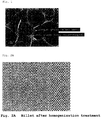
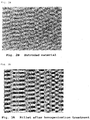
- Figs. 2A , 3A , and 4A are the scanning electron micrographs showing the distribution states of ⁇ -AlFeSi phases and Mg 2 Si phases in the billets of Examples No. 1, 12, and 13, respectively.
- the ⁇ -AlFeSi phase is shown as white needle-like particles
- the Mg 2 Si phase is shown as black granular particles.
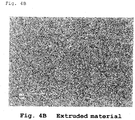
- Figs. 2B , 3B , and 4B are the scanning electron micrographs showing the distribution states of AlFeSi particles and Mg 2 Si particles in the extrusion material obtained from these billets, respectively.
- the original ⁇ -AlFeSi phase is divided when being extruded and then formed into an aggregate of white granular particles.
- each of the number of AlFeSi particles having a diameter of 5 ⁇ m or more and the number of Mg 2 Si particles having a diameter of 2 ⁇ m or more per certain area (50 ⁇ m square) falls within a specified range of the present invention.
- the number of AlFeSi particles having a diameter of 5 ⁇ m or more is relatively large, exceeding the specified range of the present invention, while as illustrated in Fig.
- the number of Mg 2 Si particles having a diameter of 2 ⁇ m or more is relatively large, exceeding the specified range of the present invention.
- the amount of ⁇ -AlFeSi phases is small while the size of Mg 2 Si phases is small; as illustrated in Fig. 3A , the amount of ⁇ -AlFeSi phases is relatively large; and as illustrated in Fig. 4A , the size of Mg 2 Si phases is relatively large.
- the distribution states of the ⁇ -AlFeSi particles having a diameter of 5 ⁇ m or more and of the Mg 2 Si particles having a diameter of 2 ⁇ m or more in the extruded material are specified, thereby indirectly specifying the distribution states of the ⁇ -AlFe-Si phases and Mg 2 Si phases in the billet before the extrusion (after the homogenization treatment).
- the amount of generated ⁇ -AlFeSi phases in the billet is small, the precipitation of Mg 2 Si particles in the billet is suppressed, and the size of Mg 2 Si phase is small.
- the number of AlFeSi particles having a diameter of 5 ⁇ m or more per certain area in the extruded material exceeds the specific range in the present invention, the amount of generated ⁇ -AlFeSi phases in the billet is large.
- the number densities of the AlFeSi particles and Mg 2 Si particles in the present invention will be measured in the following procedure.
- the billet of the Al-Mg-Si based aluminum alloy with the above-mentioned composition is subjected to the homogenization treatment under the conditioned mentioned above, so that the strip-shaped Si phases crystallized in the billet are spheroidized and Mg 2 Si is solid-soluted. Subsequently, the billet held at the homogeneous processing temperature is forcibly cooled to 250°C or lower at a cooling rate of 50°C/hr or more, which is larger than the usual one, thereby suppressing the precipitation of Mg 2 Si particles during the cooling process.
- the billet is designed to reduce the amount of generated ⁇ -AlFeSi phases and to suppress the precipitation of Mg 2 Si phases, the peritectic reaction between the ⁇ -AlFeSi phase and Mg 2 Si phase is suppressed, and the precipitation of Mg 2 Si phase is suppressed during the extrusion process, whereby the eutectic reaction among Si, Al, and Mg 2 Si is also suppressed.
- an Al-Mg-Si based aluminum alloy extruded material (extruded material as it is) can be manufactured that reduces burning of the extruded material and has a small surface roughness.
- the surface roughness of the Al-Mg-Si based aluminum alloy extruded material can be reduced to 80 ⁇ m or lower in terms of ten-point average roughness Rz (JIS B0601:1994).
- An Al-Si-Mg based aluminum alloy having a chemical composition shown in Table 1 (composition after fusion) was fused and then subjected to semicontinuous casting, thereby producing a billet having a diameter of 400 mm.
- the billet was subjected to the homogenization treatment under the homogenization treatment conditions (holding temperature, holding time and cooling rate) shown in Table 1. Note that the balance of the composition mentioned in Table 1 included Al and inevitable impurities except for Fe.
- extrusion molding was performed on the billet at an extrusion ratio of 33 under the extrusion conditions shown in Table 1 (extrusion temperature (billet heating temperature) extrusion rate and cooling rate), thereby producing a solid extruded material having a rectangular cross section (100 mm x 40 mm), followed by an aging treatment at 180°C for 4 hours.
- cooling rate in each case means a cooling rate to 250°C.
- Tr. 520 5 50 471 8.5 120 6 3.72 0.13 0.74 0.36 Tr. 0.19 Tr. Tr. 520 5 50 470 8.5 200 7 4.53 0.05 0.45 0.38 0.15 0.04 0.03 Tr. 520 5 50 473 5.0 150 8 3.65 0.08 0.35 Tr. Tr. 0.04 Tr. 0.08 520 14 80 490 3.0 130 9 3.54 0.14 0.84 Tr. Tr. 0.06 0.03 Tr. 500 14 50 480 5.0 100 10 6.34* 0.16 0.86 0.25 Tr. 0.02 0.03 Tr. 520 14 120 470 3.0 100 11 1.54* 0.13 0.69 Tr. 0.36 0.02 0.03 Tr. 520 14 120 470 3.0 100 12 5.75 0.22* 0.85 0.23 Tr. 0.02 0.03 Tr.
- the thus-obtained extruded material was used as a sample material, and each sample material was measured on the number densities of coarse AlFeSi particles and Mg 2 Si particles, machinability, hardness, surface roughness (ten-point average roughness Rz), and extrudability in the following way.
- two square observation regions in 50 ⁇ m square (a pair of sides being in parallel to the extrusion direction) for measurement of the number density were selected from each sample material by observation with a scanning electron microscope (SEM).
- SEM scanning electron microscope
- the two selected observation regions were observed with the SEM having a magnification scale set at 1,000 times, and then the number of AlFeSi particles having a diameter (circle equivalent diameter) of 5 ⁇ m or more and the number of Mg 2 Si particles having a diameter (circle equivalent diameter) of 2 ⁇ m or more that could be observed in each observation range were measured.
- the average of the number of each kind of particles measured in the two observation regions was determined. The results of the measurements are shown in Table 2. Note that the particles existing on the side of the observation region was counted as one.
- a hole punching was performed on each sample using a commercially available high-speed steel drill having a diameter of 4 mm under the conditions, specifically, at the number of revolutions of 1500 rpm and a feeding velocity of 300 mm/min, and then the number of machining chips in 100 g machining chip aggregate obtained was counted to measure the machinability of the extruded material in each sample (fragmentation of machining chip).
- Samples containing more than 7000 machining chips are rated excellent "A”; samples containing 5000 to 7000 machining chips are rated good "B”; samples containing 3000 to less than 5000 machining chips are rated satisfactory "C”; and samples containing less than 3000 machining chips are rated unsatisfactory "D".
- the results of the measurements are shown in the item "properties" of Table 2.
- a Rockwall hardness (HRB) of each sample was measured based on the Rockwell hardness test of JIS Z 2245:2011 as a test method.
- the upper, lower, left and right surfaces (four surfaces in total) of the extruded material in each sample were visually observed across its entire length.
- the surface roughness (ten-point average roughness Rz) of a part of each surface, at which its surface roughness was determined to be largest by the visually observation, was measured in the direction vertical to the extrusion direction based on the standard of JIS B0601:1994.
- the maximum ten-point average roughness Rz obtained at each surface is shown as the surface roughness (ten-point average roughness Rz) of the extruded material in the item "properties" of Table 2.
- the billet was extruded at an extrusion rate higher than the extrusion rate shown in Table 1, and then the presence or absence of occurrence of the corner crack was checked.
- the extrusion rates were set at any one of 3 m/min, 5 m/min, and 10 m/min, and the homogenization treatment conditions and the extrusion conditions (except for the extrusion rate) were set as mentioned in Table 1.
- the extruded materials Nos. 1 to 9 had the composition specified by the present invention and satisfied the number densities of the AlFeSi particles and Mg 2 Si particles, whereby these extruded materials had a small surface roughness (ten-point average surface roughness Rz ⁇ 80 ⁇ m) and excellent machinability. Further, these extruded materials had a Rockwell hardness of 38 HRB or more and excellent strength.
- the extruded materials Nos. 1 to 9 were manufactured by the manufacturing method specified by the present invention.
- Figs. 2A and 2B illustrate the scanning electron micrographs of the billet No. 1 (after the homogenous treatment) and the extruded material obtained from the billet No.1, respectively.
- the extruded material No. 11 had degraded machinability because of excessively small Si content.
- Figs. 3A and 3B illustrate the scanning electron micrographs of the billet No. 12 (after the homogenous treatment) and the extruded material obtained from the billet No.12, respectively. As shown in Fig. 3A , the amount of ⁇ -AlFeSi phases is large in the billet, causing burning during the extrusion process, resulting in the large surface roughness.
- Figs. 4A and 4B illustrate the scanning electron micrographs of the billet No. 13 (after the homogenous treatment) and the extruded material obtained from the billet No. 13, respectively. As shown in Fig. 4A , since the cooling rate after the homogenization treatment is low, the size of the Mg 2 Si phase in the billet becomes large, causing burning during the extrusion process, resulting in a large surface roughness.
Landscapes
- Chemical & Material Sciences (AREA)
- Engineering & Computer Science (AREA)
- Mechanical Engineering (AREA)
- Materials Engineering (AREA)
- Metallurgy (AREA)
- Organic Chemistry (AREA)
- Physics & Mathematics (AREA)
- Thermal Sciences (AREA)
- Crystallography & Structural Chemistry (AREA)
- Extrusion Of Metal (AREA)
- Powder Metallurgy (AREA)
Abstract
Description
- The present invention relates to an Al-Mg-Si based aluminum alloy extruded material that is suitable for use in mechanical parts and the like, requiring many machining processes during manufacturing procedures and that has high strength and excellent machinability, and also to a manufacturing method thereof.
- Patent Documents 1 to 4 disclose the Al-Mg-Si based aluminum alloy extruded materials for machining. To improve the machinability in these aluminum alloy extruded materials for machining, 1.5% or more by mass of Si is added, and a large amount of Si crystallized grains (Si phase), which are second-phase hard particles, are distributed in a matrix.
-
- Patent Document 1:
JP 9-249931 A - Patent Document 2:
JP 10-8175 A - Patent Document 3:
JP 2002-47525 A - Patent Document 4:
JP 2003-147468 A - The Al-Mg-Si based aluminum alloy for machining crystallizes into Si and Mg2Si during the solidification process, and also crystallizes into a needle-like β-AlFeSi-based compound (β-AlFeSi phase) made of Fe as inevitable impurities, and A1 and Si.
Fig. 1 shows a micrograph of a billet before a homogenization treatment. Strip-shaped Si phases (in gray) are connected in a net shape, in which Mg2Si phases (in black) are distributed as dots, while needle-like β-AlFeSi phases (in white) are formed along the Si phases. Extruding the Al-Mg-Si based aluminum alloy billet poses a problem in which burning (pickup) might occur in extruded materials, degrading the smoothness of the surface of the extruded material. - The occurrence of burning in the Al-Mg-Si based aluminum alloy extruded material is based on the following reasons. The strip-shaped Si phases existing in the billet before extruding cause a eutectic reaction with an Al phase and a Mg2Si phase due to the deformation of material by extruding and the heat generation during the process resulting from the friction between the material and a die-bearing portion, thereby causing local melting. A shearing force upon the extruded material when it passes through the die-bearing portion makes the material of the surface of the extruded material (cells surrounded by the Si phases) fall off starting at the melting point, causing burning of the extruded material.
- Further, the needle-like β-AlFeSi phases existing in the billet before extruding cause a eutectic reaction with a Mg2Si phase due to heat generation during the extrusion process, causing local melting. If local melting continuously occurs to couple melted parts, the material on the surface of the extruded material will fall off due to the shearing force that the extruded material receives when passing through the die-bearing portion, causing burning of the extruded material.
- Although the inner peripheral surface of the die is mirror-finished, the occurrence of burning might coarsen the surface of the extruded material, losing the smoothness thereof.
- The burning generated by the eutectic reaction in the Si, Al, and Mg2Si phases can be reduced by applying the homogenization treatment to the billet before extruding, at a temperature of 500 to 550°C for four hours or more, and separating (spheroidizing) the Si phase crystallized in the strip shape.
- On the other hand, the burning generated by the peritectic reaction between the β-AlFeSi and Mg2Si phases can be reduced by conducting homogenization treatment at a temperature of 500°C or higher for a long time (approximately 50 hours when Si and Fe contents are large), thereby converting the β-AlFeSi phase into α phase (spherodizing), or by decreasing the extrusion rate to reduce the amount of heat generated during processing. However, the long-term homogenization treatment inhibits productivity and is disadvantageous in terms of cost. Further, the reduction in the extrusion rate also inhibits productivity.
- The present invention has been made in view of the foregoing problems associated with manufacturing of an Al-Mg-Si based aluminum alloy extruded material for machining, and it is an object of the present invention to obtain an Al-Mg-Si based aluminum alloy extruded material with a smooth surface and no burning without requiring the long-term homogenization treatment and the reduction in extrusion rate.
- An Al-Mg-Si based aluminum alloy extruded material according to the present invention includes: Si: 2.0 to 6.0% by mass; Mg: 0.3 to 1.2% by mass; and Ti: 0.01 to 0.2% by mass, a Fe content being restricted to 0.2% or less by mass, with the balance being Al and inevitable impurities, wherein the number of AlFeSi particles having a diameter of 5 µm or more is 20 or less per 50 µm square area of the extruded material, and the number of Mg2Si particles having a diameter of 2 µm or more is 20 or less per 5.0 µm square area of the extruded material, and wherein a ten-point average roughness Rz of a surface of the extruded material is 80 µm or less. The aluminum alloy extruded material can further contain one or more kinds of: Mn: 0.1 to 1.0% by mass; and Cu: 0.1 to 0.4% by mass, as needed. The aluminum alloy extruded material can further contain one or more kinds of: Cr: 0.03 to 0.1% by mass; and Zr: 0.03 to 0.1% by mass, as needed.
- A method for manufacturing an Al-Mg-Si based aluminum alloy extruded material according to the present invention includes the steps of: applying a homogenization treatment to an aluminum alloy billet having the above-mentioned composition by keeping at 500 to 550 °C for 4 to 15 hours; forcibly cooling the billet to 250 °C or lower at an average cooling rate of 50°C/hr or higher; hot-extruding the billet at an extrusion rate of 3 to 10 m/min by heating at 450 to 500°C; forcibly cooling the extruded material at an average cooling rate of 50°C/sec or higher; and applying an aging treatment to the extruded material. By this manufacturing method, the above-mentioned Al-Mg-Si based aluminum alloy extruded material according to the present invention can be obtained.
- Accordingly, the present invention can obtain the Al-Si-Mg based aluminum alloy extruded material with excellent machinability and a smooth surface having a ten-point average roughness Rz of 80 µm or less, while reducing burning without being accompanied by the long-term homogenization treatment as well as reduction in extrusion rate in the manufacture of the Al-Si-Mg based aluminum alloy extruded material having a relatively large Si content.
- The Al-Si-Mg based aluminum alloy extruded material in the present invention has high strength, excellent machinability, and good appearance due to the smooth surface. Thus, the Al-Si-Mg based aluminum alloy extruded material enables reduction in amount of machining processing, and can, in some cases, have a part of its surface used as a surface of a product as it is (without machining).
-
-
Fig. 1 shows a scanning electron micrograph of a billet before a homogenization treatment. -
Fig. 2A shows a scanning electron micrograph of a billet in Example No. 1 after the homogenization treatment. -
Fig. 2B shows a scanning electron micrograph of an extruded material obtained from the billet in Example No. 1. -
Fig. 3A shows a scanning electron micrograph of a billet in Example No. 12 after the homogenization treatment. -
Fig. 3B shows a scanning electron micrograph of an extruded material obtained from the billet in Example No. 12. -
Fig. 4A shows a scanning electron micrograph of a billet in Example No. 13 after the homogenization treatment. -
Fig. 4B shows a scanning electron micrograph of an extruded material obtained from the billet in Example No. 13. - An Al-Si-Mg based aluminum alloy extruded material and a manufacturing method therefor according to the present invention will be described in more detail below.
- An aluminum alloy in the present invention includes: Si: 2.0 to 6.0% by mass; Mg: 0.3 to 1.2% by mass; and Ti: 0.01 to 0.2% by mass, with the balance being Al and inevitable impurities. The aluminum alloy further includes one or more kinds of: Mn: 0.1 to 1.0% by mass; and Cu: 0.1 to 0.4% by mass, as needed. Moreover, the aluminum alloy includes one or more kinds of: Cr: 0.03 to 0.1% by mass; and Zr: 0.03 to 0.1% by mass, as needed. Although the aluminum alloy compositions itself is well known, the present invention is characterized by that a Fe content in the inevitable impurities is restricted to 0.2% or less by mass. Each component of the aluminum alloy in the present invention will be described below.
- Silicon (Si) serves to form Si-based crystallized grains (Si phase) in aluminum, which are second-phase hard particles, and to improve the fragmentation of chips and the machinability. To this end, Si needs to be added in an amount of 2% or more by mass that exceeds the amount of solid solution of Si into aluminum. On the other hand, the addition of more than 6% by mass of Si might form coarsened Si phases, whereby the eutectic reaction among the Si phase, the Al phase, and Mg2Si phase occur to lower the melting start point. To prevent the occurrence of local melting and burning together with a decrease in melting start point, it is necessary to suppress the amount of heat during an extrusion process. For this reason, the extrusion rate needs to be reduced. Therefore, the Si content is set at 2.0 to 6.0% by mass. The lower limit of Si content is preferably 3.5% by mass, while the upper limit of Si content is preferably 4.5% by mass.
- Magnesium (Mg) precipitates fine particles of Mg2Si by the aging precipitation treatment, thereby improving the strength of the extruded material. Thus, Mg is desirably added in an amount of 0.3% or more by mass. On the other hand, Mg2Si is also formed as crystallized grains during solidification and might cause peritectic reaction with β-AlFeSi during the extrusion, which leads to local melting, causing burning of the extruded material. When the Mg content exceeds 1.2% by mass, the crystallized grains of Mg2Si are formed in a large amount, so that the burning of the extruded material tends to easily occur. Therefore, the Mg content is set at 0.3 to 1.2% by mass. The lower limit of Mg content is preferably 0.5% by mass, while the upper limit of Mg content is preferably 0.9% by mass.
- Titanium (Ti) serves to refine a cast structure, thereby stabilizing the mechanical properties of the extruded material. To attain this effect, Ti is added. However, when the Ti content is less than 0.01% by mass, its effect cannot be obtained. On the other hand, even if the Ti content exceeds 0.2% by mass, the effect of refining cannot be further improved. Therefore, the Ti content is set at 0.01 to 0.2% by mass. The lower limit of Ti content is preferably 0.01% by mass, while the upper limit of Ti content is preferably 0.1% by mass.
- Manganese (Mn) has an effect of improving the strength of extruded material by being precipitated as dispersion particles during the homogenization treatment to thereby refine crystal grains of the extruded material. For this reason, Mn is added as needed. When the Mn content is less than 0.1% by mass, the above-mentioned effect cannot be sufficiently exhibited. On the other hand, when the Mn content exceeds 1.0% by mass in adding Mn, the extrudability is degraded. Therefore, the Mn content is set at 0.1 to 1.0% by mass. The lower limit of Mn content is preferably 0.4% by mass, while the upper limit of Mn content is preferably 0.8% by mass.
- Copper (Cu) is added as appropriate, instead of or together with Mn, to enhance the strength of the extruded material by being solid-soluted. When the Cu content is less than 0.1% by mass, the above-mentioned effect cannot be sufficiently exhibited. On the other hand, when the Cu content exceeds 0.4% by mass in adding Cu, the corrosion resistance and extrudability of the extruded material are degraded. Therefore, the Cu content is set at 0.1 to 0.4% by mass. The lower limit of Cu content is preferably 0.2% by mass, while the upper limit of Cu content is preferably 0.3% by mass.
- Chrome (Cr) is added as appropriate to suppress recrystallization and refine crystal grains, thereby enhancing the strength of the extruded material. However, when the Cr content is less than 0.03% by mass, the above-mentioned effect cannot be sufficiently obtained. On the other hand, when the Cr content exceeds 0.1% by mass in adding Cr, burning tends to occur in the extruded material during the extrusion process. Therefore, the Cr content is set at 0.03 to 0.1% by mass.
- Zinc (Zr) is added as appropriate, instead of or together with Cr, to suppress the recrystallization and refine crystal particles, thereby enhancing the strength of the extrusion. However, when the Zr content is less than 0.03% by mass, the above-mentioned effect cannot be sufficiently obtained. On the other hand, when the Zr content exceeds 0.1% by mass in adding Zr, a compound including a mixture of Al and Zr becomes coarsened during the homogenization treatment, failing to exhibit the effect of suppressing the recrystallization. Therefore, the Zr content is set at 0.03 to 0.1% by mass.
- Iron (Fe) existing as the inevitable impurity in the aluminum alloy generates β-AlFeSi phase, which is a needle-like crystallized grain, during a cooling process after casting. To reduce the β-AlFeSi content in the billet and to prevent burning during the extrusion process, the homogenization treatment needs to be performed to convert the β-AlFeSi phase into α phase (spherodizing), or the Fe content in the aluminum alloy needs to be decreased.
- However, to convert the β-AlFeSi phase into α phase, the homogenization treatment is required to be carried out at a high temperature for a long time, which degrades the productivity of the extrusions. In contrast, when the Fe content of the aluminum alloy is restricted to 0.2% or less by mass, the amount of the generated β-AlFeSi phases is reduced. A manufacturing method to be described below can prevent the burning of the extrusions during the extrusion process without applying the homogenization treatment for a long time. Note that the Fe content normally included as the inevitable impurity in the aluminum alloy is approximately 0.3% by mass.
- The homogenization treatment for the cast billet is performed under holding conditions of 500 to 550°C for 4 to 15 hours. A holding temperature is set at 500°C or higher, and a holding time is set at 4 hours or more. This is because strip-shaped crystallized Si phases are divided (spheroidized) while crystallized Mg2Si is solid-soluted. As the holding temperature is higher and the holding time is longer, these conditions would be more preferable for the homogenization treatment because they promote the division of Si phase and the solid solution of Mg2Si and reduce the burning. However, at a temperature exceeding 550°C, local dissolution might occur, while for a holding time exceeding 15 hours, the productivity of extrusions might be reduced. Therefore, the homogenization treatment should be performed under holding conditions, specifically, at a temperature of 500 to 550°C and for a time of 4 to 15 hours. Note that these holding conditions cannot sufficiently achieve the conversion of β-AlFeSi phase into α phase.
- After the homogenization treatment, the billet is forcibly cooled at an average cooling rate of 50°C/hr or higher. Conventionally, the billet obtained after the homogenization treatment is taken out of a furnace and cooled by being allowed to stand, or by being air-cooled. In the real operation, since a number of high-temperature billets are cooled while being accumulated, the cooling rate is generally estimated to be less than 30°C/hr even in air-cooling with fans. No attention has been paid particularly to the cooling rate after the homogenization treatment. At an average cooling rate of 50°C/hr or higher, the billet is forcibly cooled to a temperature of less than 250°C, which can minimize the precipitation of Mg2Si (to such a degree that can prevent the occurrence of burning during extrusion). At a temperature of 250 °C or lower, the billet may be allowed to stand to cool to the room temperature. The desirable average cooling rate is 80°C/hr or more, which can be achieved by forcibly performing air-cooling with fans under the condition that the billets are not accumulated. Further, water cooling is more desirable. In this case, the cooling rate of about 100, 000°C/hr can be achieved.
- After the homogenization treatment, the billet is reheated to a temperature of 450 to 500°C and then subjected to hot-extruding at an extrusion rate of 3 to 10 m/min. Since the extruded material in the present invention is a solid-core material (solid material), the extrusion ratio thereof is relatively small, and the heat generation therefrom does not become so much during processing. At an extrusion temperature of less than 450°C, the temperature of the extruded material at the outlet of an extrusion machine does not reach 500°C or higher that is required for solution. On the other hand, once the extrusion temperature exceeds 500°C, the processing heat generation is added, increasing the temperature of extrusion material, leading to the risk of burning of the extruded material. Therefore, the extrusion temperature (heating temperature of the billet) is set at 450 to 500°C. At an extrusion rate of less than 3 m/min, the productivity of extruded materials is degraded. On the other hand, once the extrusion rate exceeds 10 m/min, the processing heat generation becomes large, increasing the temperature of material for extrusion, leading to the risk of burning of the extruded material. When the extruded material has a corner at its cross section, the phenomenon of corner cracks tends to occur as metal does not spread out into the corner. Thus, the extrusion rate is set at 3 to 10 m/min. In the manufacturing method of the present invention, the extrusion ratio (i.e. the ratio of the cross-sectional area of an extrusion container to that of the extrusion outlet) is preferably in a range of 15 to 40.
- The extruded material obtained directly after the extrusion process is forcibly cooled (die-quenched) online from the outlet temperature of the extrusion machine to a temperature of 250°C or less at an average cooling rate of 50°C/sec or higher. At a temperature of 250°C or lower, the extruded material may be allowed to stand to cool to the room temperature. By setting the average cooling rate to 50°C/sec or higher, the precipitation of Mg2Si is prevented. Preferable cooling means is water-cooling.
- The extruded material die-quenched is subjected to an aging treatment. The aging treatment may be performed at a temperature of 160 to 200°C for 2 to 10 hours.
- The distribution state of the coarse β-AlFeSi particles and Mg2Si particles in the Al-Mg-Si based aluminum alloy extruded material in the present invention reflects the distribution state of the β-AlFeSi phase and Mg2Si phase in the billet after the homogenization treatment (after cooling). This point will be described referring to scanning electron micrographs of
Figs. 2A to 4B . -
Figs. 2A ,3A , and4A are the scanning electron micrographs showing the distribution states of β-AlFeSi phases and Mg2Si phases in the billets of Examples No. 1, 12, and 13, respectively. The β-AlFeSi phase is shown as white needle-like particles, and the Mg2Si phase is shown as black granular particles.Figs. 2B ,3B , and4B are the scanning electron micrographs showing the distribution states of AlFeSi particles and Mg2Si particles in the extrusion material obtained from these billets, respectively. The original β-AlFeSi phase is divided when being extruded and then formed into an aggregate of white granular particles. - As shown in Table 2 of Examples to be mentioned later, referring to
Fig. 2B , each of the number of AlFeSi particles having a diameter of 5 µm or more and the number of Mg2Si particles having a diameter of 2 µm or more per certain area (50 µm square) falls within a specified range of the present invention. Using the distribution state of each kind of particles shown inFig. 2B as a reference, as illustrated inFig. 3B , the number of AlFeSi particles having a diameter of 5 µm or more is relatively large, exceeding the specified range of the present invention, while as illustrated inFig. 4B , the number of Mg2Si particles having a diameter of 2 µm or more is relatively large, exceeding the specified range of the present invention. By comparison between the distribution state of β-AlFeSi phases and that of Mg2Si phases with reference toFigs. 2A ,3A , and4A , as illustrated inFig. 2A , the amount of β-AlFeSi phases is small while the size of Mg2Si phases is small; as illustrated inFig. 3A , the amount of β-AlFeSi phases is relatively large; and as illustrated inFig. 4A , the size of Mg2Si phases is relatively large. - In this way, when the number of coarse AlFeSi particles having a diameter of 5 µm or more in the extruded material is large, it suggests that the amount of the β-AlFeSi phases in the billet before the extrusion (after the homogenization treatment) is large. When the number of coarse Mg2Si particles having a diameter of 2 µm or more in the extruded material is large, it suggests that the size of the Mg2Si particles in the billet before the extrusion (after the homogenization treatment) is large. These relationships can be satisfied except for when the extrusion ratio is excessively large (e.g., 45 or higher). Thus, the distribution states of the β-AlFeSi particles having a diameter of 5 µm or more and of the Mg2Si particles having a diameter of 2 µm or more in the extruded material are specified, thereby indirectly specifying the distribution states of the β-AlFe-Si phases and Mg2Si phases in the billet before the extrusion (after the homogenization treatment).
- When the numbers of AlFeSi particles having a diameter of 5 µm or more and Mg2Si particles having a diameter of 2 µm or more per certain area in the extruded material are within respective specific ranges in the present invention, the amount of generated β-AlFeSi phases in the billet is small, the precipitation of Mg2Si particles in the billet is suppressed, and the size of Mg2Si phase is small. Conversely, when the number of AlFeSi particles having a diameter of 5 µm or more per certain area in the extruded material exceeds the specific range in the present invention, the amount of generated β-AlFeSi phases in the billet is large. When the number of Mg2Si particles having a diameter of 2 µm or more per certain area in the extruded material exceeds the specific range in the present invention, the precipitation of Mg2Si phase in the billet is not sufficiently suppressed and the size of Mg2Si phase in the billet is large.
- The number densities of the AlFeSi particles and Mg2Si particles in the present invention will be measured in the following procedure.
- 1) After grinding the cross section of the extruded material to have its number density measured, two or more observation regions in 50 µm square (a pair of sides being in parallel to the extrusion direction) where the number density is measured are selected from the cross section by observation with a scanning electron microscope (SEM).
- 2) The numbers of AlFeSi particles having a diameter of 5 µm or more and of Mg2Si particles having a diameter of 2 µm or more that are included in these observation regions are respectively measured (the diameter of each particle being the circle equivalent diameter). Note that to achieve the accurate measurements, the magnification scale of SEM is preferably set at 1,000 times or more in measuring the number of particles included in the region. The particles existing on the side of the observation region is counted as one.
- 3) The number of each kind of particles is measured for each selected observation region in the above-mentioned procedure 2), and an average value of the numbers of each kind of particles in all selected observation regions is determined.
- The billet of the Al-Mg-Si based aluminum alloy with the above-mentioned composition is subjected to the homogenization treatment under the conditioned mentioned above, so that the strip-shaped Si phases crystallized in the billet are spheroidized and Mg2Si is solid-soluted. Subsequently, the billet held at the homogeneous processing temperature is forcibly cooled to 250°C or lower at a cooling rate of 50°C/hr or more, which is larger than the usual one, thereby suppressing the precipitation of Mg2Si particles during the cooling process. Since the billet is designed to reduce the amount of generated β-AlFeSi phases and to suppress the precipitation of Mg2Si phases, the peritectic reaction between the β-AlFeSi phase and Mg2Si phase is suppressed, and the precipitation of Mg2Si phase is suppressed during the extrusion process, whereby the eutectic reaction among Si, Al, and Mg2Si is also suppressed. As a result, an Al-Mg-Si based aluminum alloy extruded material (extruded material as it is) can be manufactured that reduces burning of the extruded material and has a small surface roughness. In the present invention, the surface roughness of the Al-Mg-Si based aluminum alloy extruded material can be reduced to 80 µm or lower in terms of ten-point average roughness Rz (JIS B0601:1994).
- An Al-Si-Mg based aluminum alloy having a chemical composition shown in Table 1 (composition after fusion) was fused and then subjected to semicontinuous casting, thereby producing a billet having a diameter of 400 mm. The billet was subjected to the homogenization treatment under the homogenization treatment conditions (holding temperature, holding time and cooling rate) shown in Table 1. Note that the balance of the composition mentioned in Table 1 included Al and inevitable impurities except for Fe. Subsequently, extrusion molding was performed on the billet at an extrusion ratio of 33 under the extrusion conditions shown in Table 1 (extrusion temperature (billet heating temperature) extrusion rate and cooling rate), thereby producing a solid extruded material having a rectangular cross section (100 mm x 40 mm), followed by an aging treatment at 180°C for 4 hours. Note that the term "cooling rate" in each case means a cooling rate to 250°C.
[Table 1] No. Composition (% by mass) Homogeneous treatment conditions Extrusion condition Si Fe Mg Cu Mn Ti Cr Zr Temperature °C Time h Cooling rate °C/h Temperature °C Rate m/min Cooling rate °C/s 1 4.02 0.15 0.74 Tr. 0.64 0.02 Tr. Tr. 520 14 80 475 4.5 100 2 5.81 0.16 0.34 Tr. 0.32 0.02 Tr. Tr. 500 14 80 479 5.0 50 3 2.15 0.14 0.46 Tr. 0.95 0.02 Tr. Tr. 520 14 80 480 5.5 80 4 5.64 0.20 0.57 Tr. 0.59 0.03 Tr. Tr. 500 5 50 476 7.5 100 5 5.86 0.15 0.75 0.23 0.41 0.03 Tr. Tr. 520 5 50 471 8.5 120 6 3.72 0.13 0.74 0.36 Tr. 0.19 Tr. Tr. 520 5 50 470 8.5 200 7 4.53 0.05 0.45 0.38 0.15 0.04 0.03 Tr. 520 5 50 473 5.0 150 8 3.65 0.08 0.35 Tr. Tr. 0.04 Tr. 0.08 520 14 80 490 3.0 130 9 3.54 0.14 0.84 Tr. Tr. 0.06 0.03 Tr. 500 14 50 480 5.0 100 10 6.34* 0.16 0.86 0.25 Tr. 0.02 0.03 Tr. 520 14 120 470 3.0 100 11 1.54* 0.13 0.69 Tr. 0.36 0.02 0.03 Tr. 520 14 120 470 3.0 100 12 5.75 0.22* 0.85 0.23 Tr. 0.02 0.03 Tr. 520 14 120 470 3.0 100 13 4.62 0.16 0.74 Tr. 0.63 0.02 Tr. Tr. 520 14 40* 470 3.0 100 14 4.10 0.14 0.69 Tr. 0.62 0.02 Tr. Tr. 520 3* 80 470 3.0 100 15 3.60 0.17 0.54 Tr. 0.61 0.02 Tr. Tr. 480* 14 120 470 3.0 100 16 3.72 0.26* 0.62 0.21 Tr. 0.02 0.03 Tr. 520 14 120 470 2.5* 100 17 4.46 0.23* 0.70 0.23 Tr. 0.02 0.04 Tr. 520 22* 120 470 3.5 100 18 5.64 0.14 0.90 Tr. 0.58 0.02 Tr. Tr. 520 14 80 520* 3.5 100 19 2.98 0.05 1.02 Tr. 0.57 0.02 Tr. Tr. 520 14 80 470 12.0* 100 20 3.56 0.16 0.65 0.56* Tr. 0.06 Tr. Tr. 500 15 50 480 5.0 90 21 3.67 0.15 0.20* 0.32 Tr. 0.06 Tr. 0.05 520 10 60 475 3.0 120 22 4.32 0.10 1.25* Tr. 0.45 0.05 Tr. Tr. 515 6 100 480 3.0 130 *Item departing from specific range of the present invention - The thus-obtained extruded material was used as a sample material, and each sample material was measured on the number densities of coarse AlFeSi particles and Mg2Si particles, machinability, hardness, surface roughness (ten-point average roughness Rz), and extrudability in the following way.
- After grinding the cross section of each sample material to have its number density measured, two square observation regions in 50 µm square (a pair of sides being in parallel to the extrusion direction) for measurement of the number density were selected from each sample material by observation with a scanning electron microscope (SEM). For each sample materials, the two selected observation regions were observed with the SEM having a magnification scale set at 1,000 times, and then the number of AlFeSi particles having a diameter (circle equivalent diameter) of 5 µm or more and the number of Mg2Si particles having a diameter (circle equivalent diameter) of 2 µm or more that could be observed in each observation range were measured. The average of the number of each kind of particles measured in the two observation regions was determined. The results of the measurements are shown in Table 2. Note that the particles existing on the side of the observation region was counted as one.
- A hole punching was performed on each sample using a commercially available high-speed steel drill having a diameter of 4 mm under the conditions, specifically, at the number of revolutions of 1500 rpm and a feeding velocity of 300 mm/min, and then the number of machining chips in 100 g machining chip aggregate obtained was counted to measure the machinability of the extruded material in each sample (fragmentation of machining chip). Samples containing more than 7000 machining chips are rated excellent "A"; samples containing 5000 to 7000 machining chips are rated good "B"; samples containing 3000 to less than 5000 machining chips are rated satisfactory "C"; and samples containing less than 3000 machining chips are rated unsatisfactory "D". The results of the measurements are shown in the item "properties" of Table 2.
- A Rockwall hardness (HRB) of each sample was measured based on the Rockwell hardness test of JIS Z 2245:2011 as a test method.
- The upper, lower, left and right surfaces (four surfaces in total) of the extruded material in each sample were visually observed across its entire length. The surface roughness (ten-point average roughness Rz) of a part of each surface, at which its surface roughness was determined to be largest by the visually observation, was measured in the direction vertical to the extrusion direction based on the standard of JIS B0601:1994. The maximum ten-point average roughness Rz obtained at each surface is shown as the surface roughness (ten-point average roughness Rz) of the extruded material in the item "properties" of Table 2.
- The corners of the extruded materials in samples Nos. 1 to 22 were visually observed across the entire length of the extruded material, and the presence or absence of occurrence of any corner crack (whether the extrudability were good or bad) was checked for each sample. Additionally, regarding the billets corresponding to the extruded materials in specimen Nos. that were observed to have any corner crack, each billet was extruded at an extrusion rate lower than the extrusion rate shown in Table 1, and then the presence or absence of occurrence of the corner crack was checked. Further, regarding the billets corresponding to the extruded materials in specimen Nos. observed to have no corner crack, the billet was extruded at an extrusion rate higher than the extrusion rate shown in Table 1, and then the presence or absence of occurrence of the corner crack was checked. At this time, the extrusion rates were set at any one of 3 m/min, 5 m/min, and 10 m/min, and the homogenization treatment conditions and the extrusion conditions (except for the extrusion rate) were set as mentioned in Table 1. Samples that were observed to have no corner crack at the extrusion rate of 10 m/min were rated as having excellent extrudability "A"; samples that were observed to have a corner crack at the extrusion rate of 10 m/min but no corner crack at the extrusion rate of 5 m/min were rated as having good extrudability "B"; and samples that were observed to have a corner crack even at the extrusion rate of 3 m/min were rated as having bad extrudability "C". The results of the measurements are shown in Table 2.
[Table 2] No. Number density of particles Properties AlFeSi Mg2Si Machinability Hardness HRB RZ µm Extrudability 1 12 12 B 50.6 56 A 2 15 6 A 46.8 64 B 3 14 8 C 50.6 19 A 4 18 12 A 53.0 78 B 5 15 16 A 56.2 70 B 6 10 19 B 54.7 53 A 7 5 14 B 56.4 50 A 8 4 12 B 45.6 50 A 9 11 16 B 38.5 55.8 A 10 19 17 A 60.5 97* B 11 9 15 D 50.5 53.1 A 12 27* 16 B 56.4 85.4* B 13 18 27* B 54.1 90.6* A 14 22* 21* B 53.0 102* A 15 23* 20 B 54.2 105* A 16 21* 16 B 56.1 74.1 A 17 22* 20 B 52.8 72.8 A 18 19 15 B 57.0 132* B 19 4 15 B 59.4 1.42* A 20 12 11 B 59.4 45.6 C 21 13 4 B 35.2* 56.7 A 22 9 26* B 65.0 87.9* A *Item departing from specific range of the present invention - As shown in Tables 1 and 2, the extruded materials Nos. 1 to 9 had the composition specified by the present invention and satisfied the number densities of the AlFeSi particles and Mg2Si particles, whereby these extruded materials had a small surface roughness (ten-point average surface roughness Rz ≤ 80 µm) and excellent machinability. Further, these extruded materials had a Rockwell hardness of 38 HRB or more and excellent strength. The extruded materials Nos. 1 to 9 were manufactured by the manufacturing method specified by the present invention.
Figs. 2A and2B illustrate the scanning electron micrographs of the billet No. 1 (after the homogenous treatment) and the extruded material obtained from the billet No.1, respectively. - On the other hand, the extruded material No. 10 had burning occurred because of the excessive Si content and had the large surface roughness.
- The extruded material No. 11 had degraded machinability because of excessively small Si content.
- In the extruded material No. 12, the number density of AlFeSi particles exceeded the specific range of the present invention because of the excessive content of Fe as inevitable impurity, resulting in large surface toughness (ten-point average toughness Rz > 80 µm).
Figs. 3A and3B illustrate the scanning electron micrographs of the billet No. 12 (after the homogenous treatment) and the extruded material obtained from the billet No.12, respectively. As shown inFig. 3A , the amount of β-AlFeSi phases is large in the billet, causing burning during the extrusion process, resulting in the large surface roughness. - In the extruded material of sample No. 13, the number density of Mg2Si particles exceeded the specific range of the present invention, resulting in large surface roughness (ten-point average roughness Rz > 80 µm).
Figs. 4A and4B illustrate the scanning electron micrographs of the billet No. 13 (after the homogenous treatment) and the extruded material obtained from the billet No. 13, respectively. As shown inFig. 4A , since the cooling rate after the homogenization treatment is low, the size of the Mg2Si phase in the billet becomes large, causing burning during the extrusion process, resulting in a large surface roughness. - In the extruded material of sample No. 14, the number densities of AlFeSi particles and Mg2Si particles exceeded the respective specific range of the present invention, and in the extruded material of sample No. 15, the number density of AlFeSi particles exceeded the specific range of the present invention, resulting in large surface roughness in both sample No. 14 and No. 15 (ten-point average roughness Rz > 80 µm). This is because in sample No. 14, the time for the homogenization treatment was short, while in sample No. 15, the temperature of the homogenization treatment was low, whereby in both samples, the conversion of the β-AlFeSi particles into α phase did not proceed, and the division of the Si phase as well as the solid-solution of Mg2Si phase in the billet were insufficient.
- In both the extruded materials in samples No. 16 and 17, the Fe content was excessive, and the number density of AlFeSi particles exceeded the specific range of the present invention, but the surface roughness was small (ten-point average roughness Rz ≤ 80 µm). This is because in sample No. 16, the extrusion rate was set much lower than the lower limit of the specific range, namely, 3 m/min, while in sample No. 17, the time for the homogenization treatment was set much longer than the upper limit of the specific range, namely, 15 hours. In this way, the productivity in each of samples No. 16 and 17 was degraded.
- In the extruded materials of samples No. 18 and 19, both the number densities of AlFeSi particles and Mg2Si particles satisfied the specific ranges of the present invention, but their surface roughness were large (ten-point average roughness Rz > 80 µm). This is because in sample No. 18, the extrusion temperature was too high, while in sample No. 19, the extrusion rate was too high, increasing the material temperature due to the heat generation during the processing, causing burning in the extruded material.
- In the extruded material of sample No. 20, the Cu content was excessive, and thus the extrudability were degraded.
- In the extruded material of sample No. 21, the Mg content was too small, and thus the strength (hardness) thereof was low.
- In the extruded material of sample No. 22, the Mg content was excessive, and the number density of Mg2Si particles exceeded the specific range of the present invention, resulting in a large surface roughness (ten-point average roughness Rz > 80 µm). This is considered to be because Mg2Si phases are formed in a large amount in the billet due to the excessive Mg content, causing burning in the extruded material during the extrusion process.
- The present application claims priority based on Japanese Patent Application No.
2014-156634 filed on July 31, 2014
Claims (8)
- An Al-Si-Mg based aluminum alloy extruded material with excellent machinability, comprising:Si: 2.0 to 6.0% by mass;Mg: 0.3 to 1.2% by mass; andTi: 0.01 to 0.2% by mass,a Fe content being restricted to 0.2% or less by mass,with the balance being Al and inevitable impurities, whereinthe number of AlFeSi particles having a diameter of 5 µm or more is 20 or less per 50 µm square area of the extruded material,the number of Mg2Si particles having a diameter of 2 µm or more is 20 or less per 50 µm square area of the extruded material, anda ten-point average roughness Rz of a surface of the extruded material is 80 µm or less.
- The Al-Si-Mg based aluminum alloy extruded material according to claim 1, further comprising one or more kinds of:Mn: 0.1 to 1.0% by mass; andCu: 0.1 to 0.4% by mass.
- The Al-Si-Mg based aluminum alloy extruded material according to claim 1, further comprising one or more kinds of:Cr: 0.03 to 0.1% by mass; andZr: 0.03 to 0.1% by mass.
- The Al-Si-Mg based aluminum alloy extruded material according to claim 2, further comprising one or more kinds of:Cr: 0.03 to 0.1% by mass; andZr: 0.03 to 0.1% by mass.
- A method for manufacturing an Al-Si-Mg based aluminum alloy extruded material with excellent machinability using an aluminum alloy billet comprising:Si: 2.0 to 6.0% by mass;Mg: 0.3 to 1.2% by mass; andTi: 0.01 to 0.2% by mass,a Fe content being restricted to 0.2% or less by mass,with the balance being Al and inevitable impurities, the method comprising the steps of:applying a homogenization treatment to the aluminum alloy billet by keeping at 500 to 550°C for 4 to 15 hours; forcibly cooling the billet to 250°C or lower at an average cooling rate of 50°C/hr or higher; hot-extruding the billet at an extrusion rate of 3 to 10 m/min by heating at 450 to 500°C; forcibly cooling the extruded material at an average cooling rate of 50°C/sec or higher; and applying an aging treatment to the extruded material.
- The method for manufacturing an Al-Si-Mg based aluminum alloy extruded material according to claim 5, the aluminum alloy further comprising one or more kinds of:Mn: 0.1 to 1.0% by mass; andCu: 0.1 to 0.4% by mass.
- The method for manufacturing an Al-Si-Mg based aluminum alloy extruded material according to claim 5, the aluminum alloy further comprising one or more kinds of:Cr: 0.03 to 0.1% by mass; andZr: 0.03 to 0.1% by mass.
- The method for manufacturing an Al-Si-Mg based aluminum alloy extruded material according to claim 6, the aluminum alloy further comprising one or more kinds of:Cr: 0.03 to 0.1% by mass; andZr: 0.03 to 0.1% by mass.
Applications Claiming Priority (2)
| Application Number | Priority Date | Filing Date | Title |
|---|---|---|---|
| JP2014156634A JP5777782B2 (en) | 2013-08-29 | 2014-07-31 | Manufacturing method of extruded aluminum alloy with excellent machinability |
| PCT/JP2014/084569 WO2016017046A1 (en) | 2014-07-31 | 2014-12-26 | Aluminium alloy extruded material with superior machinability and production method therefor |
Publications (3)
| Publication Number | Publication Date |
|---|---|
| EP3176274A1 true EP3176274A1 (en) | 2017-06-07 |
| EP3176274A4 EP3176274A4 (en) | 2018-01-24 |
| EP3176274B1 EP3176274B1 (en) | 2019-06-26 |
Family
ID=55216978
Family Applications (1)
| Application Number | Title | Priority Date | Filing Date |
|---|---|---|---|
| EP14898493.3A Active EP3176274B1 (en) | 2014-07-31 | 2014-12-26 | Aluminium alloy extruded material with excellent machinability and manufacturing method thereof |
Country Status (4)
| Country | Link |
|---|---|
| EP (1) | EP3176274B1 (en) |
| KR (2) | KR102156008B1 (en) |
| CN (1) | CN105473747B (en) |
| WO (1) | WO2016017046A1 (en) |
Families Citing this family (5)
| Publication number | Priority date | Publication date | Assignee | Title |
|---|---|---|---|---|
| CN109576620B (en) * | 2018-08-13 | 2020-10-20 | 广东宏锦新材料科技有限公司 | Aluminum alloy processing method |
| CN110358938A (en) * | 2019-07-29 | 2019-10-22 | 广东坚美铝型材厂(集团)有限公司 | A kind of free machining aluminium alloy and preparation method thereof |
| CN113564429A (en) * | 2021-08-10 | 2021-10-29 | 江苏亚太航空科技有限公司 | Fine-grain aluminum alloy block and preparation process and application thereof |
| CN115572868B (en) * | 2022-09-09 | 2023-11-03 | 江苏亚太轻合金科技股份有限公司 | Low-performance and hardness 6-series aluminum alloy and preparation method thereof |
| CN118389916B (en) * | 2024-06-19 | 2025-04-04 | 广州众山紧固件有限公司 | A deformed aluminum alloy, a deformed aluminum alloy product and a preparation method thereof |
Family Cites Families (11)
| Publication number | Priority date | Publication date | Assignee | Title |
|---|---|---|---|---|
| JP3335732B2 (en) * | 1993-10-12 | 2002-10-21 | 日本軽金属株式会社 | Hypoeutectic Al-Si alloy and casting method thereof |
| JP3107517B2 (en) | 1995-03-30 | 2000-11-13 | 株式会社神戸製鋼所 | High corrosion resistant aluminum alloy extruded material with excellent machinability |
| JPH0941062A (en) * | 1995-07-27 | 1997-02-10 | Furukawa Electric Co Ltd:The | Al-Mg-Si-based Al alloy sheet material for automobile body sheets which is small in aging and excellent in bake hardenability, and a method for producing the same |
| JP3301919B2 (en) * | 1996-06-26 | 2002-07-15 | 株式会社神戸製鋼所 | Aluminum alloy extruded material with excellent chip breaking performance |
| JP3886329B2 (en) * | 2000-05-26 | 2007-02-28 | 株式会社神戸製鋼所 | Al-Mg-Si aluminum alloy extruded material for cutting |
| JP3846702B2 (en) * | 2001-11-09 | 2006-11-15 | 株式会社神戸製鋼所 | Al-Mg-Si aluminum alloy extruded material for cutting |
| US20050109429A1 (en) * | 2003-11-21 | 2005-05-26 | Showa Denko K.K. | Aluminum alloy, bar-like material, forge-formed article, machine-formed article, wear-resistant aluminum alloy with excellent anodized coat using the same and production methods thereof |
| AU2008277325A1 (en) * | 2007-07-18 | 2009-01-22 | Clean Mobile Ag | External-rotor electric motor with or without a planetary gear mechanism, motor vehicle with an external-rotor electric motor and a method for operating such a vehicle |
| JP5160930B2 (en) * | 2008-03-25 | 2013-03-13 | 株式会社神戸製鋼所 | Aluminum alloy extruded material excellent in bending crushability and corrosion resistance and method for producing the same |
| WO2011001870A1 (en) * | 2009-06-29 | 2011-01-06 | アイシン軽金属株式会社 | Wear-resistant aluminum alloy extruded material having excellent fatigue strength and cutting properties |
| JP5698695B2 (en) * | 2012-03-30 | 2015-04-08 | 株式会社神戸製鋼所 | Aluminum alloy forgings for automobiles and manufacturing method thereof |
-
2014
- 2014-12-26 WO PCT/JP2014/084569 patent/WO2016017046A1/en not_active Ceased
- 2014-12-26 CN CN201480046489.4A patent/CN105473747B/en active Active
- 2014-12-26 EP EP14898493.3A patent/EP3176274B1/en active Active
- 2014-12-26 KR KR1020167027531A patent/KR102156008B1/en active Active
- 2014-12-26 KR KR1020157021657A patent/KR101688358B1/en active Active
Also Published As
| Publication number | Publication date |
|---|---|
| KR102156008B1 (en) | 2020-09-15 |
| CN105473747A (en) | 2016-04-06 |
| EP3176274A4 (en) | 2018-01-24 |
| KR20160024837A (en) | 2016-03-07 |
| CN105473747B (en) | 2019-04-26 |
| KR20170027316A (en) | 2017-03-09 |
| KR101688358B1 (en) | 2016-12-20 |
| EP3176274B1 (en) | 2019-06-26 |
| WO2016017046A1 (en) | 2016-02-04 |
Similar Documents
| Publication | Publication Date | Title |
|---|---|---|
| US11136658B2 (en) | High strength aluminum alloy extruded material with excellent corrosion resistance and favorable quenching properties and manufacturing method therefor | |
| US20190078180A1 (en) | Free-machining aluminum alloy extruded material with reduced surface roughness and excellent productivity | |
| EP2878692B1 (en) | High-strength aluminum-base alloy products and process for production thereof | |
| KR100994812B1 (en) | High-strength high-ductility magnesium alloy extrudate and manufacturing method thereof | |
| EP3176274B1 (en) | Aluminium alloy extruded material with excellent machinability and manufacturing method thereof | |
| EP3392358A1 (en) | Low-cost high-heat-conduction die-casting magnesium alloy and manufacturing method therefor | |
| US20080000561A1 (en) | Cast aluminum alloy excellent in relaxation resistance property and method of heat-treating the same | |
| CN105316545B (en) | Aluminum alloy rolling prepared material | |
| CN107735503A (en) | The excellent aluminum alloy extrusion material of exterior quality with anodic oxide coating and its manufacture method | |
| JP2016151044A (en) | Aluminum alloy extruded material excellent in machinability and production method therefor | |
| JP3909543B2 (en) | Aluminum alloy extruded material with excellent axial crushing properties | |
| CN109790612A (en) | By the process of semi-finished of acieral production deformation | |
| KR101680046B1 (en) | Method for manufacturing high-strength wrought magnesium alloy by conducting aging treatment prior to plastic working and high-strength wrought magnesium alloy manufactured thereby | |
| JP6452042B2 (en) | Method for producing magnesium alloy | |
| JP7002711B2 (en) | Magnesium alloy | |
| JP2016169431A5 (en) | ||
| JP2016108654A (en) | Magnesium alloy extrusion material and method for producing the same | |
| JP6017625B2 (en) | Aluminum alloy extruded material with excellent machinability | |
| JP2007092125A (en) | Aluminum alloy, aluminum alloy bar, method for manufacturing aluminum alloy ingot for forging, and forged and formed article | |
| JP5825990B2 (en) | Al-Mg-Si alloy extruded material | |
| JP5522692B2 (en) | High strength copper alloy forging | |
| EP4394066A1 (en) | Extruded multi-hole tube and production method for same | |
| JP2004269937A (en) | Abrasion-resistant Al-Si alloy excellent in machinability and casting method thereof | |
| EP4488397A1 (en) | Aluminum alloy for casting and aluminum alloy casting | |
| WO2025263139A1 (en) | Aluminum alloy extrusion material |
Legal Events
| Date | Code | Title | Description |
|---|---|---|---|
| 17P | Request for examination filed |
Effective date: 20160225 |
|
| AK | Designated contracting states |
Kind code of ref document: A1 Designated state(s): AL AT BE BG CH CY CZ DE DK EE ES FI FR GB GR HR HU IE IS IT LI LT LU LV MC MK MT NL NO PL PT RO RS SE SI SK SM TR |
|
| AX | Request for extension of the european patent |
Extension state: BA ME |
|
| PUAI | Public reference made under article 153(3) epc to a published international application that has entered the european phase |
Free format text: ORIGINAL CODE: 0009012 |
|
| STAA | Information on the status of an ep patent application or granted ep patent |
Free format text: STATUS: REQUEST FOR EXAMINATION WAS MADE |
|
| DAX | Request for extension of the european patent (deleted) | ||
| A4 | Supplementary search report drawn up and despatched |
Effective date: 20180102 |
|
| RIC1 | Information provided on ipc code assigned before grant |
Ipc: B21C 23/00 20060101ALI20171218BHEP Ipc: C22F 1/043 20060101ALI20171218BHEP Ipc: C22F 1/00 20060101ALI20171218BHEP Ipc: C22C 21/02 20060101AFI20171218BHEP |
|
| RIC1 | Information provided on ipc code assigned before grant |
Ipc: C22C 21/02 20060101AFI20181022BHEP Ipc: C22F 1/043 20060101ALI20181022BHEP Ipc: C22F 1/00 20060101ALN20181022BHEP Ipc: B21C 23/00 20060101ALN20181022BHEP |
|
| GRAP | Despatch of communication of intention to grant a patent |
Free format text: ORIGINAL CODE: EPIDOSNIGR1 |
|
| STAA | Information on the status of an ep patent application or granted ep patent |
Free format text: STATUS: GRANT OF PATENT IS INTENDED |
|
| INTG | Intention to grant announced |
Effective date: 20181207 |
|
| GRAS | Grant fee paid |
Free format text: ORIGINAL CODE: EPIDOSNIGR3 |
|
| RIN1 | Information on inventor provided before grant (corrected) |
Inventor name: MIYATA, YUKIMASA Inventor name: SHIKAMA, TAKAHIRO Inventor name: YOSHIHARA, SHINJI |
|
| GRAA | (expected) grant |
Free format text: ORIGINAL CODE: 0009210 |
|
| STAA | Information on the status of an ep patent application or granted ep patent |
Free format text: STATUS: THE PATENT HAS BEEN GRANTED |
|
| AK | Designated contracting states |
Kind code of ref document: B1 Designated state(s): AL AT BE BG CH CY CZ DE DK EE ES FI FR GB GR HR HU IE IS IT LI LT LU LV MC MK MT NL NO PL PT RO RS SE SI SK SM TR |
|
| REG | Reference to a national code |
Ref country code: GB Ref legal event code: FG4D |
|
| REG | Reference to a national code |
Ref country code: CH Ref legal event code: EP |
|
| REG | Reference to a national code |
Ref country code: AT Ref legal event code: REF Ref document number: 1148346 Country of ref document: AT Kind code of ref document: T Effective date: 20190715 |
|
| REG | Reference to a national code |
Ref country code: DE Ref legal event code: R096 Ref document number: 602014049297 Country of ref document: DE |
|
| REG | Reference to a national code |
Ref country code: IE Ref legal event code: FG4D |
|
| REG | Reference to a national code |
Ref country code: NL Ref legal event code: MP Effective date: 20190626 |
|
| PG25 | Lapsed in a contracting state [announced via postgrant information from national office to epo] |
Ref country code: AL Free format text: LAPSE BECAUSE OF FAILURE TO SUBMIT A TRANSLATION OF THE DESCRIPTION OR TO PAY THE FEE WITHIN THE PRESCRIBED TIME-LIMIT Effective date: 20190626 Ref country code: NO Free format text: LAPSE BECAUSE OF FAILURE TO SUBMIT A TRANSLATION OF THE DESCRIPTION OR TO PAY THE FEE WITHIN THE PRESCRIBED TIME-LIMIT Effective date: 20190926 Ref country code: FI Free format text: LAPSE BECAUSE OF FAILURE TO SUBMIT A TRANSLATION OF THE DESCRIPTION OR TO PAY THE FEE WITHIN THE PRESCRIBED TIME-LIMIT Effective date: 20190626 Ref country code: LT Free format text: LAPSE BECAUSE OF FAILURE TO SUBMIT A TRANSLATION OF THE DESCRIPTION OR TO PAY THE FEE WITHIN THE PRESCRIBED TIME-LIMIT Effective date: 20190626 Ref country code: HR Free format text: LAPSE BECAUSE OF FAILURE TO SUBMIT A TRANSLATION OF THE DESCRIPTION OR TO PAY THE FEE WITHIN THE PRESCRIBED TIME-LIMIT Effective date: 20190626 Ref country code: SE Free format text: LAPSE BECAUSE OF FAILURE TO SUBMIT A TRANSLATION OF THE DESCRIPTION OR TO PAY THE FEE WITHIN THE PRESCRIBED TIME-LIMIT Effective date: 20190626 |
|
| REG | Reference to a national code |
Ref country code: LT Ref legal event code: MG4D |
|
| PG25 | Lapsed in a contracting state [announced via postgrant information from national office to epo] |
Ref country code: LV Free format text: LAPSE BECAUSE OF FAILURE TO SUBMIT A TRANSLATION OF THE DESCRIPTION OR TO PAY THE FEE WITHIN THE PRESCRIBED TIME-LIMIT Effective date: 20190626 Ref country code: GR Free format text: LAPSE BECAUSE OF FAILURE TO SUBMIT A TRANSLATION OF THE DESCRIPTION OR TO PAY THE FEE WITHIN THE PRESCRIBED TIME-LIMIT Effective date: 20190927 Ref country code: BG Free format text: LAPSE BECAUSE OF FAILURE TO SUBMIT A TRANSLATION OF THE DESCRIPTION OR TO PAY THE FEE WITHIN THE PRESCRIBED TIME-LIMIT Effective date: 20190926 Ref country code: RS Free format text: LAPSE BECAUSE OF FAILURE TO SUBMIT A TRANSLATION OF THE DESCRIPTION OR TO PAY THE FEE WITHIN THE PRESCRIBED TIME-LIMIT Effective date: 20190626 |
|
| REG | Reference to a national code |
Ref country code: AT Ref legal event code: MK05 Ref document number: 1148346 Country of ref document: AT Kind code of ref document: T Effective date: 20190626 |
|
| PG25 | Lapsed in a contracting state [announced via postgrant information from national office to epo] |
Ref country code: AT Free format text: LAPSE BECAUSE OF FAILURE TO SUBMIT A TRANSLATION OF THE DESCRIPTION OR TO PAY THE FEE WITHIN THE PRESCRIBED TIME-LIMIT Effective date: 20190626 Ref country code: PT Free format text: LAPSE BECAUSE OF FAILURE TO SUBMIT A TRANSLATION OF THE DESCRIPTION OR TO PAY THE FEE WITHIN THE PRESCRIBED TIME-LIMIT Effective date: 20191028 Ref country code: NL Free format text: LAPSE BECAUSE OF FAILURE TO SUBMIT A TRANSLATION OF THE DESCRIPTION OR TO PAY THE FEE WITHIN THE PRESCRIBED TIME-LIMIT Effective date: 20190626 Ref country code: RO Free format text: LAPSE BECAUSE OF FAILURE TO SUBMIT A TRANSLATION OF THE DESCRIPTION OR TO PAY THE FEE WITHIN THE PRESCRIBED TIME-LIMIT Effective date: 20190626 Ref country code: CZ Free format text: LAPSE BECAUSE OF FAILURE TO SUBMIT A TRANSLATION OF THE DESCRIPTION OR TO PAY THE FEE WITHIN THE PRESCRIBED TIME-LIMIT Effective date: 20190626 Ref country code: SK Free format text: LAPSE BECAUSE OF FAILURE TO SUBMIT A TRANSLATION OF THE DESCRIPTION OR TO PAY THE FEE WITHIN THE PRESCRIBED TIME-LIMIT Effective date: 20190626 Ref country code: EE Free format text: LAPSE BECAUSE OF FAILURE TO SUBMIT A TRANSLATION OF THE DESCRIPTION OR TO PAY THE FEE WITHIN THE PRESCRIBED TIME-LIMIT Effective date: 20190626 |
|
| PG25 | Lapsed in a contracting state [announced via postgrant information from national office to epo] |
Ref country code: ES Free format text: LAPSE BECAUSE OF FAILURE TO SUBMIT A TRANSLATION OF THE DESCRIPTION OR TO PAY THE FEE WITHIN THE PRESCRIBED TIME-LIMIT Effective date: 20190626 Ref country code: IS Free format text: LAPSE BECAUSE OF FAILURE TO SUBMIT A TRANSLATION OF THE DESCRIPTION OR TO PAY THE FEE WITHIN THE PRESCRIBED TIME-LIMIT Effective date: 20191026 Ref country code: IT Free format text: LAPSE BECAUSE OF FAILURE TO SUBMIT A TRANSLATION OF THE DESCRIPTION OR TO PAY THE FEE WITHIN THE PRESCRIBED TIME-LIMIT Effective date: 20190626 Ref country code: SM Free format text: LAPSE BECAUSE OF FAILURE TO SUBMIT A TRANSLATION OF THE DESCRIPTION OR TO PAY THE FEE WITHIN THE PRESCRIBED TIME-LIMIT Effective date: 20190626 |
|
| PG25 | Lapsed in a contracting state [announced via postgrant information from national office to epo] |
Ref country code: TR Free format text: LAPSE BECAUSE OF FAILURE TO SUBMIT A TRANSLATION OF THE DESCRIPTION OR TO PAY THE FEE WITHIN THE PRESCRIBED TIME-LIMIT Effective date: 20190626 |
|
| PG25 | Lapsed in a contracting state [announced via postgrant information from national office to epo] |
Ref country code: DK Free format text: LAPSE BECAUSE OF FAILURE TO SUBMIT A TRANSLATION OF THE DESCRIPTION OR TO PAY THE FEE WITHIN THE PRESCRIBED TIME-LIMIT Effective date: 20190626 Ref country code: PL Free format text: LAPSE BECAUSE OF FAILURE TO SUBMIT A TRANSLATION OF THE DESCRIPTION OR TO PAY THE FEE WITHIN THE PRESCRIBED TIME-LIMIT Effective date: 20190626 |
|
| PG25 | Lapsed in a contracting state [announced via postgrant information from national office to epo] |
Ref country code: IS Free format text: LAPSE BECAUSE OF FAILURE TO SUBMIT A TRANSLATION OF THE DESCRIPTION OR TO PAY THE FEE WITHIN THE PRESCRIBED TIME-LIMIT Effective date: 20200224 |
|
| REG | Reference to a national code |
Ref country code: DE Ref legal event code: R097 Ref document number: 602014049297 Country of ref document: DE |
|
| PLBE | No opposition filed within time limit |
Free format text: ORIGINAL CODE: 0009261 |
|
| STAA | Information on the status of an ep patent application or granted ep patent |
Free format text: STATUS: NO OPPOSITION FILED WITHIN TIME LIMIT |
|
| PG2D | Information on lapse in contracting state deleted |
Ref country code: IS |
|
| REG | Reference to a national code |
Ref country code: CH Ref legal event code: PL |
|
| 26N | No opposition filed |
Effective date: 20200603 |
|
| REG | Reference to a national code |
Ref country code: BE Ref legal event code: MM Effective date: 20191231 |
|
| PG25 | Lapsed in a contracting state [announced via postgrant information from national office to epo] |
Ref country code: SI Free format text: LAPSE BECAUSE OF FAILURE TO SUBMIT A TRANSLATION OF THE DESCRIPTION OR TO PAY THE FEE WITHIN THE PRESCRIBED TIME-LIMIT Effective date: 20190626 Ref country code: MC Free format text: LAPSE BECAUSE OF FAILURE TO SUBMIT A TRANSLATION OF THE DESCRIPTION OR TO PAY THE FEE WITHIN THE PRESCRIBED TIME-LIMIT Effective date: 20190626 |
|
| GBPC | Gb: european patent ceased through non-payment of renewal fee |
Effective date: 20191226 |
|
| PG25 | Lapsed in a contracting state [announced via postgrant information from national office to epo] |
Ref country code: GB Free format text: LAPSE BECAUSE OF NON-PAYMENT OF DUE FEES Effective date: 20191226 Ref country code: IE Free format text: LAPSE BECAUSE OF NON-PAYMENT OF DUE FEES Effective date: 20191226 Ref country code: FR Free format text: LAPSE BECAUSE OF NON-PAYMENT OF DUE FEES Effective date: 20191231 Ref country code: LU Free format text: LAPSE BECAUSE OF NON-PAYMENT OF DUE FEES Effective date: 20191226 |
|
| PG25 | Lapsed in a contracting state [announced via postgrant information from national office to epo] |
Ref country code: BE Free format text: LAPSE BECAUSE OF NON-PAYMENT OF DUE FEES Effective date: 20191231 Ref country code: LI Free format text: LAPSE BECAUSE OF NON-PAYMENT OF DUE FEES Effective date: 20191231 Ref country code: CH Free format text: LAPSE BECAUSE OF NON-PAYMENT OF DUE FEES Effective date: 20191231 |
|
| PG25 | Lapsed in a contracting state [announced via postgrant information from national office to epo] |
Ref country code: CY Free format text: LAPSE BECAUSE OF FAILURE TO SUBMIT A TRANSLATION OF THE DESCRIPTION OR TO PAY THE FEE WITHIN THE PRESCRIBED TIME-LIMIT Effective date: 20190626 |
|
| PG25 | Lapsed in a contracting state [announced via postgrant information from national office to epo] |
Ref country code: HU Free format text: LAPSE BECAUSE OF FAILURE TO SUBMIT A TRANSLATION OF THE DESCRIPTION OR TO PAY THE FEE WITHIN THE PRESCRIBED TIME-LIMIT; INVALID AB INITIO Effective date: 20141226 Ref country code: MT Free format text: LAPSE BECAUSE OF FAILURE TO SUBMIT A TRANSLATION OF THE DESCRIPTION OR TO PAY THE FEE WITHIN THE PRESCRIBED TIME-LIMIT Effective date: 20190626 |
|
| PG25 | Lapsed in a contracting state [announced via postgrant information from national office to epo] |
Ref country code: MK Free format text: LAPSE BECAUSE OF FAILURE TO SUBMIT A TRANSLATION OF THE DESCRIPTION OR TO PAY THE FEE WITHIN THE PRESCRIBED TIME-LIMIT Effective date: 20190626 |
|
| P01 | Opt-out of the competence of the unified patent court (upc) registered |
Effective date: 20230523 |
|
| PGFP | Annual fee paid to national office [announced via postgrant information from national office to epo] |
Ref country code: DE Payment date: 20250930 Year of fee payment: 12 |