EP3166259B1 - Robuste elektromagnetische kompatibilitätsleistung für fahrzeuginterne ethernet-phys mit verwendung von zeitmultiplexing - Google Patents
Robuste elektromagnetische kompatibilitätsleistung für fahrzeuginterne ethernet-phys mit verwendung von zeitmultiplexing Download PDFInfo
- Publication number
- EP3166259B1 EP3166259B1 EP16002333.9A EP16002333A EP3166259B1 EP 3166259 B1 EP3166259 B1 EP 3166259B1 EP 16002333 A EP16002333 A EP 16002333A EP 3166259 B1 EP3166259 B1 EP 3166259B1
- Authority
- EP
- European Patent Office
- Prior art keywords
- ethernet transceiver
- controller
- tdd
- pair
- shielded
- Prior art date
- Legal status (The legal status is an assumption and is not a legal conclusion. Google has not performed a legal analysis and makes no representation as to the accuracy of the status listed.)
- Active
Links
Images



Classifications
-
- H—ELECTRICITY
- H04—ELECTRIC COMMUNICATION TECHNIQUE
- H04L—TRANSMISSION OF DIGITAL INFORMATION, e.g. TELEGRAPHIC COMMUNICATION
- H04L67/00—Network arrangements or protocols for supporting network services or applications
- H04L67/01—Protocols
- H04L67/12—Protocols specially adapted for proprietary or special-purpose networking environments, e.g. medical networks, sensor networks, networks in vehicles or remote metering networks
-
- H—ELECTRICITY
- H04—ELECTRIC COMMUNICATION TECHNIQUE
- H04L—TRANSMISSION OF DIGITAL INFORMATION, e.g. TELEGRAPHIC COMMUNICATION
- H04L5/00—Arrangements affording multiple use of the transmission path
- H04L5/14—Two-way operation using the same type of signal, i.e. duplex
-
- H—ELECTRICITY
- H04—ELECTRIC COMMUNICATION TECHNIQUE
- H04B—TRANSMISSION
- H04B1/00—Details of transmission systems, not covered by a single one of groups H04B3/00 - H04B13/00; Details of transmission systems not characterised by the medium used for transmission
- H04B1/38—Transceivers, i.e. devices in which transmitter and receiver form a structural unit and in which at least one part is used for functions of transmitting and receiving
- H04B1/3822—Transceivers, i.e. devices in which transmitter and receiver form a structural unit and in which at least one part is used for functions of transmitting and receiving specially adapted for use in vehicles
-
- H—ELECTRICITY
- H04—ELECTRIC COMMUNICATION TECHNIQUE
- H04L—TRANSMISSION OF DIGITAL INFORMATION, e.g. TELEGRAPHIC COMMUNICATION
- H04L12/00—Data switching networks
- H04L12/28—Data switching networks characterised by path configuration, e.g. LAN [Local Area Networks] or WAN [Wide Area Networks]
- H04L12/2854—Wide area networks, e.g. public data networks
- H04L12/2856—Access arrangements, e.g. Internet access
-
- H—ELECTRICITY
- H04—ELECTRIC COMMUNICATION TECHNIQUE
- H04L—TRANSMISSION OF DIGITAL INFORMATION, e.g. TELEGRAPHIC COMMUNICATION
- H04L12/00—Data switching networks
- H04L12/28—Data switching networks characterised by path configuration, e.g. LAN [Local Area Networks] or WAN [Wide Area Networks]
- H04L12/40—Bus networks
- H04L12/403—Bus networks with centralised control, e.g. polling
- H04L12/4035—Bus networks with centralised control, e.g. polling in which slots of a TDMA packet structure are assigned based on a contention resolution carried out at a master unit
-
- H—ELECTRICITY
- H04—ELECTRIC COMMUNICATION TECHNIQUE
- H04L—TRANSMISSION OF DIGITAL INFORMATION, e.g. TELEGRAPHIC COMMUNICATION
- H04L47/00—Traffic control in data switching networks
- H04L47/10—Flow control; Congestion control
- H04L47/30—Flow control; Congestion control in combination with information about buffer occupancy at either end or at transit nodes
-
- H—ELECTRICITY
- H04—ELECTRIC COMMUNICATION TECHNIQUE
- H04L—TRANSMISSION OF DIGITAL INFORMATION, e.g. TELEGRAPHIC COMMUNICATION
- H04L12/00—Data switching networks
- H04L12/28—Data switching networks characterised by path configuration, e.g. LAN [Local Area Networks] or WAN [Wide Area Networks]
- H04L12/40—Bus networks
- H04L2012/40267—Bus for use in transportation systems
- H04L2012/40273—Bus for use in transportation systems the transportation system being a vehicle
Definitions
- This application relates generally to in-vehicle networks, including Ethernet based in-vehicle networks.
- the electronics in an automobile are typically divided into different domains, such as the power train domain, the chassis domain, the body/comfort domain, the driver assistance domain, and the human-machine interface (HMI) domain.
- each of these domains contained a set of control units and sensors that operated independently from the control units and sensors of the other domains.
- these new, advanced features have further led to an increase in the number of control units and sensors within each domain and the sophistication of these units in terms of the amount of data they process and the speed at which they operate.
- the in-vehicle network infrastructure used to support communications within and between these domains, has suffered as a result of the increased electronic complexity.
- the amount of cabling alone used by conventional in-vehicle network infrastructures has caused the car cable assembly to become not only one of the highest cost components in the car (often behind only the engine and chassis), but also one of the heaviest, which negatively effects fuel economy.
- the conventional in-vehicle network infrastructure has evolved into a heterogeneous network of various communications networks and protocols, such as the Local Interconnect Network (LIN), FlexRay, Controller Area Network (CAN), Low-Voltage Differential Signaling (LVDS), and the Media Oriented Systems Transport (MOST) protocol.
- LIN Local Interconnect Network
- CAN Controller Area Network
- LVDS Low-Voltage Differential Signaling
- MOST Media Oriented Systems Transport
- FIG. 1 illustrates an example overview of a conventional in-vehicle network 100.
- conventional in-vehicle network 100 is divided among several different domains, including a power train domain, an HMI domain, a body/comfort domain, a chassis domain, and a driver assistance domain.
- the power train domain includes electronic controllers and sensors that are active in the forward and backward movement of the vehicle, including electronic controllers and sensors associated with the operation of the engine, transmission, and shafts.
- the chassis domain includes electronic controllers and sensors that relate to the framework of the automobile and the movement/position of the wheels.
- the chassis domain can include electronic controllers and sensors that support steering, braking, and suspension.
- the body/comfort domain includes electronic controllers and sensors for such things as door locks, climate control, and seat control.
- the HMI domain includes electronics that provide for information exchange between the automobile's electronics and the driver/passengers.
- the HMI domain includes video systems, phone systems, and infotainment systems.
- the driver assistance domain includes electronic controllers and sensors that aid the driver in driving the automobile.
- the electronic controllers and sensors in the driver assistance domain relate to such systems as cruise control, lane departure warning, and collision avoidance.
- the power train domain uses a CAN based network 102
- the HMI domain uses a LVDS/MOST based network 104
- the body/comfort domain uses a LIN based network 106
- the chassis domain uses a FlexRay based network 108.
- This network heterogeneity requires each domain to have a separate gateway 110-118, as further shown in FIG. 1 , to allow for communications between the domains over a backbone network.
- Patent application EP 2 568 652 A1 discloses a method for defining e.g. an uplink transmission period of a time division duplex frame in an Ethernet physical layer device, wherein transmission control is relinquished to an Ethernet physical layer device.
- Patent application US 2014/010537 A1 discloses a line terminal for an Ethernet passive optical network, having a medium access control module for controlling a transmit physical layer module based on a control signal identifying a downstream transmission slot on the physical medium.
- Patent application US 2006/092967 A1 discloses a transmission method of forward and backward sequences of Ethernet packets, wherein asymmetry frequency or time characteristics between forward and backward signals are allowed, to allow transmission of signals at same time (full-duplex via FDD or TDD).
- references in the specification to "one embodiment,” “an embodiment,” “an example embodiment,” etc., indicate that the embodiment described may include a particular feature, structure, or characteristic, but every embodiment may not necessarily include the particular feature, structure, or characteristic. Moreover, such phrases are not necessarily referring to the same embodiment. Further, when a particular feature, structure, or characteristic is described in connection with an embodiment, it is submitted that it is within the knowledge of one skilled in the art to affect such feature, structure, or characteristic in connection with other embodiments whether or not explicitly described.
- module shall be understood to include software, firmware, or hardware (such as one or more circuits, microchips, processors, and/or devices), or any combination thereof.
- each module can include one, or more than one, component within an actual device, and each component that forms a part of the described module can function either cooperatively or independently of any other component forming a part of the module.
- multiple modules described herein can represent a single component within an actual device. Further, components within a module can be in a single device or distributed among multiple devices in a wired or wireless manner.
- a homogenous, switched Ethernet based in-vehicle network could be used to this end.
- conventional switched Ethernet networks are generally costly for automotive applications and do not meet automotive electromagnetic interference (EMI) requirements while the car is moving.
- EMI automotive electromagnetic interference
- common Ethernet PHYs such as 100BASE-TX PHYs and 1000BASE-TX PHYs
- Shielded cables can be used to reduce EMI, but at increased cost and weight.
- Certain embodiments of the present disclosure may be found in a local PHY in an automobile that converts standard Ethernet media independent interface (MII) data from a 4-bit packet stream, for example, to a 3-bit packet stream (where 4-bits and 3-bits are only exemplary values and can be different values as would be appreciated by one of ordinary skill in the art based on the teachings herein).
- the 3-bit packet stream may be mapped to first and second ternary bits streams for communication to a remote PHY in the automobile utilizing PAM-3 over an unshielded twisted-pair cable.
- the local PHY can multiplex the ternary bits streams into a single stream for transmission over the unshielded twisted-pair cable.
- the data flow of the Ethernet line code may begin from a 4-bit MII data stream and then undergo reformation into a 3-bit binary data stream (4b3b) and further converted to two ternary bit (3b2t) streams.
- the two ternary bit streams may represent nine possible values where only eight values may be needed to represent the 3-bit binary data.
- the extra ninth value in the ternary bits representation may be utilized in start and/or end of stream control codes and may also be utilized to indicate transmit error.
- the ninth value in the ternary bit representation may also be utilized to resolve the ordering of the ternary symbol stream over a single twisted-pair wire connection.
- Ethernet line code can allow the line rate to be slowed down in order to reduce EMI so that cheaper and lighter weight unshielded cabling can be used while still meeting automotive EMI requirements.
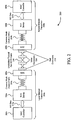
- FIG. 2 illustrates an example block diagram of an Ethernet over unshielded twisted-pair (UTP) cabling link 200 between a local Ethernet transceiver 202a and a remote Ethernet transceiver.
- the two transceivers can be implemented within an automobile.
- the local Ethernet transceiver 202a comprises a medium access control (MAC) controller 204a, a physical layer (PHY) device 206a, and a medium dependent interface (MDI) 208a.
- the remote Ethernet transceiver 202b similarly comprises a MAC controller 204b, a PHY device 206b, and a MDI 208b.
- MAC medium access control
- PHY physical layer
- MDI medium dependent interface
- the UTP cable 210 comprises a single pair of unshielded copper wires, for example.
- Certain performance criteria for UTP copper cabling have been standardized. For example, Category 3 cabling may provide the necessary performance for 10 Mbps Ethernet transmissions over twisted-pair cabling (10BASE-T). In another example, Category 5 cabling may provide the necessary performance for 1000 Mbps Ethernet transmissions over twisted-pair cabling (1000BASE-T).
- the data transmitted and received by the transceivers 202a and 202b can be formatted in accordance with the well-known Open Systems Interconnection (OSI) model.
- the OSI model partitions operability and functionality into seven distinct and hierarchical layers.
- each layer in the OSI model is structured so that it may provide a service to the immediately higher interfacing layer.
- layer 1, or the PHY layer can provide services to layer 2, or the data link layer, and layer 2 can provide services to layer 3, or the network layer.
- the data transmitted can comprise frames of Ethernet media independent interface (MII) data 212a and 212b, which can be delimited by start-of-stream and end-of-stream delimiters, for example.
- the data transmitted can also comprise IDLE codes that can be communicated between frames of data.
- MII Ethernet media independent interface
- the MAC controllers 204a and 204b represent layer 2 devices and the PHY devices 206a and 206b represent layer 1 devices.
- Devices not shown in FIG. 2 but coupled to MAC controllers 204a and 204b, represent one or more of the five highest layers.
- each layer can add its own header to the data passed on from the interfacing layer above it.
- a compatible device having a similar OSI stack as the transmitting device can strip off the headers as the message or packet passes from the lower layers up to the higher layers.
- the MAC controllers 204a and 204b comprise suitable logic, circuitry, and/or code configured to provide the layer 2 requirements.
- the MAC controllers 204a and 204b can be configured as standard Ethernet MACs, such as those based on the IEEE 802.3 standard (e.g., the 100BASE-T IEEE 802.3 standard or the 1000BASE-T IEEE 802.3 standard).
- the PHY devices 206a and 206b comprise suitable logic, circuitry, and/or code configured to provide layer 1 requirements, which include, but are not limited to, packetization, data transfer, and serialization/deserialization.
- Data packets respectively received by the PHY devices 206a and 206b from MAC controllers 204a and 204b can include data and header information for each of the above six functional layers of the OSI model.
- the PHY devices 206a and 206b can be configured to encode data packets that are to be transmitted over the UTP cable 210 and/or to decode data packets received from the UTP cable 210.
- the PHY devices 206a and 206b may not be configured as standard Ethernet PHY devices based on the IEEE 802.3 standard.
- the changes to the PHY devices 206a and 206b may be made in order to meet cost, weight, and EMI demands of automotive in-vehicle networks.
- PHY devices 206a and 206b can be configured to respectively convert Ethernet MII data 212a and 212b, respectively produced by MAC controllers 204a and 204b, from 4-bit packet streams to 3-bit packet streams.
- the 3-bit packet streams can each be mapped to first and second ternary bits streams for communication to the other PHY device utilizing PAM-3 over the unshielded twisted-pair cable 210.
- the transmitting PHY device can multiplex the ternary bits streams into a single stream for transmission over the unshielded twisted-pair cable 210.
- this Ethernet line code provided by the PHY devices 206a and 206b can allow the line rate to be slowed down as compared to standard PHY devices compliant with the IEEE 802.3 standard in order to reduce EMI so that cheaper, lightweight unshielded cabling, such as UTP cable 210, can be used while still meeting automotive EMI requirements.
- the PHY devices 206a and 206b can transmit and receive data over a single pair of cables instead of two or four pairs of cables used by 100BASE-T and 1000-BASE-T Ethernet transceivers.
- CMCs 214a and 214b can be used to suppress common-mode noise and that UTP cable 210 can have, in addition to two end connectors 216, two or more inline connectors 218.
- FIG. 2 provides only one example environment in which embodiments of the present disclosure can be implemented and is not meant to be limiting.
- the Ethernet system shown in FIG. 2 can be used, for example, to support communications within and between the different electronic domains in an automobile as shown in FIG. 1 .
- TDD Time division duplexing
- FIG. 3 an example block diagram of the PHY device 206a in FIG. 2 is illustrated in accordance with embodiments of the present disclosure. It should be noted that the implementation of the PHY device 206a in FIG. 3 is not limited to use within the Ethernet system in FIG. 2 and can be used in any appropriate Ethernet system as would be appreciated by one of ordinary skill in the art.
- the PHY device 206a uses TDD to transmit and receive data over a single pair of shielded or coaxial cables coupled to a remote Ethernet transceiver and can be used, for example, to support communications within and between the different electronic domains in an automobile as shown in FIG. 1 .
- the PHY device 206a includes a transmitter 302 that receives MII data 212a from the MAC controller 204a in FIG. 2 , and a receiver 304 that transmits MII data 212a to the MAC controller 204a.
- the transmitter 302 is coupled to a hybrid 306 through a digital-to-analog converter (DAC) 308 and the receiver 304 is coupled to the hybrid 306 through a programmable gain amplifier (PGA) 310 and an analog-to-digital converter (ADC) 312.
- DAC digital-to-analog converter
- ADC analog-to-digital converter
- the hybrid 306 enables signals transmitted and received over the UTP cable 210 by the PHY device 206a to be separated to allow for full-duplex communication (i.e., simultaneous communications in both directions over the UTP cable 210).
- the PHY device 206a further includes a TDD controller 314, a TX buffer 316, and a RX buffer 318. Also, because TDD is used, no echo canceller is implemented (or needed) by PHY device 206a.
- the TX buffer 316 is used to allow for temporary storage of MII data 212a received from a MAC controller (not shown) while the PHY device 206a is receiving data over the shielded or coaxial cable.
- the MAC controller can be, for example, a standard IEEE 802.3 10 Gbps MAC controller.
- the MII data 212a stored in the TX buffer 316 is to be transmitted over the shielded or coaxial cable coupled to the remote Ethernet transceiver.
- the RX buffer 318 provides elasticity in matching clocks between the clock used by the PHY device 206a to receive data over the shielded or coaxial cable and the clock used by the MAC controller (again, not shown) to receive the MII data 212a stored in the RX buffer 318.
- TX buffer 316 If the TX buffer 316 is filled and the shielded or coaxial cable is not available to transmit, data may be lost. The probability of packet loss is reduced using a large TX buffer 316 and reducing the effective data flow from the MAC to the PHY device 206a. The system throughput, latency, and buffer size are better utilized if a flow control mechanism exists between the MAC and the PHY device 206a.
- a control signal shown in FIG. 3 as being generated by the TX buffer 316 is for this purpose. Before the TX buffer 316 is filled and data is lost, the control signal (COL) is generated by the TX buffer 316 to signal to the MAC to pause its MII data 212a transmission to the PHY device 206a.
- the PHY device 206a may generate a PAUSE command as per the IEEE 802.3 standard to provide for flow control.
- the TX buffer 316 can be sized large enough to avoid packet loss.
- the TDD controller 314 is configured to control the transmit and receive time of the components of the PHY device 206a within the dashed box.
- the TDD controller 314 can provide a control signal to the components of the PHY device 206a within the dashed box that indicates when the PHY device 206a is to transmit.
- the receiver 304 can use this control signal provided by the TDD controller 314 to prevent adapting any filter it may use during times when the PHY device 206a is transmitting.
- any filters used by the receiver 304 to perform equalization or crosstalk cancellation can be halted from updating or adapting during times when the PHY device 206a is transmitting.
- the transmitter 302 can use this control signal provided by the TDD controller 314 to start and stop transmitting.
- the hybrid 306 can use the control signal provided by the TDD controller 314 to isolate the receive path of the PHY device 206a, which includes the RX buffer 318, the receiver 304, the ADC 312, and the PGA 310, from the shielded or coaxial cable coupled to the remote Ethernet transceiver when the PHY device 206a is transmitting.
- the hybrid 306 can use the control signal provided by the TDD controller 314 to isolate the transmit path of the PHY device 206a, which includes the TX buffer 314, the transmitter 302, and the DAC 308, from the shielded or coaxial cable coupled to the remote Ethernet transceiver when the PHY device 206a is receiving.
- FIG. 4 a timing diagram 400 that shows exemplary timing assignments for the local Ethernet transceiver, in which the PHY device 206a is implemented, and exemplary timing assignments for the remote Ethernet transceiver, to which the PHY device 206a is in communication, is illustrated in accordance with embodiments of the present disclosure.
- the timing Diagram 400 specifically illustrates two complete TDD frames, including TDD frame 402, during which each of the local and remote Ethernet transceivers have an opportunity to transmit and receive.
- the local Ethernet transceiver is the first device to transmit over the communication link to the remote Ethernet transceiver.
- the local Ethernet transceiver's transmission can begin with a Start Stream Delimiter (SSD) 404, which contains a known sequence marking the start of the TDD frame 402.
- the local Ethernet transceiver can further end its transmission with End of Stream Delimiter (ESD) 406, which contains a known sequence marking the end of the local Ethernet transceiver's transmission.
- SSD Start Stream Delimiter
- ESD End of Stream Delimiter
- the remote Ethernet transceiver After receiving the ESD 406 and after a predetermined Inter Burst Gap (IBG) 410 has elapsed, the remote Ethernet transceiver can begin its transmission.
- the remote Ethernet transceiver can continue transmitting until the end of the TDD frame 402 less the amount of time reserved for a predetermined Inter Frame Gap (IFG) 408.
- IBG Inter Frame Gap
- the remote Ethernet transceiver's transmission can include SSD and ESD markings as well. In such a case, these markings inform the local Ethernet transceiver when the remote Ethernet transceiver has finished transmitting its data.
- the local Ethernet transceiver can take advantage of this information by beginning the next TDD frame early.
- the local Ethernet transceiver can have control of the length of time the remote Ethernet transceiver can transmit, allowing for a variable or adaptive TDD frame length.
- the TDD frame length can be predetermined or set during a link up period.
- the transmit time assignment for the local and remote Ethernet transceivers does not have to be equal or symmetrical. For example, for applications like automotive camera, data generated by the camera is typically much greater than the amount of data needed to control the camera.
- the transmit times of the two Ethernet transceivers can be assigned such that the remote Ethernet transceiver has more transmit time than the local Ethernet transceiver during a TDD frame.
- the TDD approach allows such asymmetric time assignment as shown in the timing diagram 500 of FIG. 5 .
- the transmit time assigned to that device can be shortened to reduce power. In such a case, there are two options available: the first option is to keep the TDD frame length fixed, and the second option is to reduce the TDD frame length.
- the TDD controller 314 can provide a control signal that can signal to the transmitter 302 when to start and stop transmitting a transmit signal over the shielded or coaxial cable and for how long (i.e., the duration in time) the transmitter 302 is to transmit the transmit signal over the shielded or coaxial cable.
- the TDD controller 314 can adapt such transmit duration based on a number of factors, including current amounts of data being buffered by the TX buffer 316 or a control signal received from a high layer application.
- Embodiments of the present disclosure can be implemented in hardware, or as a combination of software and hardware. Consequently, embodiments of the disclosure may be implemented in the environment of a computer system or other processing system.
- An example of such a computer system 600 is shown in FIG. 6 .
- Blocks depicted in FIGS. 2 and 3 may execute on one or more computer systems 600 to perform the functionality described herein.
- Computer system 600 includes one or more processors, such as processor 604.
- Processor 604 can be a special purpose or a general purpose digital signal processor.
- Processor 604 is connected to a communication infrastructure 602 (for example, a bus or network).
- a communication infrastructure 602 for example, a bus or network.
- Computer system 600 also includes a main memory 606, preferably random access memory (RAM), and may also include a secondary memory 608.
- Secondary memory 608 may include, for example, a hard disk drive 610 and/or a removable storage drive 612, representing a floppy disk drive, a magnetic tape drive, an optical disk drive, or the like.
- Removable storage drive 612 reads from and/or writes to a removable storage unit 616 in a well-known manner.
- Removable storage unit 616 represents a floppy disk, magnetic tape, optical disk, or the like, which is read by and written to by removable storage drive 612.
- removable storage unit 616 includes a computer usable storage medium having stored therein computer software and/or data.
- secondary memory 608 may include other similar means for allowing computer programs or other instructions to be loaded into computer system 600.
- Such means may include, for example, a removable storage unit 618 and an interface 614.
- Examples of such means may include a program cartridge and cartridge interface (such as that found in video game devices), a removable memory chip (such as an EPROM, or PROM) and associated socket, a thumb drive and USB port, and other removable storage units 618 and interfaces 614 which allow software and data to be transferred from removable storage unit 618 to computer system 600.
- Computer system 600 may also include a communications interface 620.
- Communications interface 620 allows software and data to be transferred between computer system 600 and external devices. Examples of communications interface 620 may include a modem, a network interface (such as an Ethernet card), a communications port, a PCMCIA slot and card, etc.
- Software and data transferred via communications interface 620 are in the form of signals which may be electronic, electromagnetic, optical, or other signals capable of being received by communications interface 620. These signals are provided to communications interface 620 via a communications path 622.
- Communications path 622 carries signals and may be implemented using wire or cable, fiber optics, a phone line, a cellular phone link, an RF link and other communications channels.
- computer program medium and “computer readable medium” are used to generally refer to tangible storage media such as removable storage units 616 and 618 or a hard disk installed in hard disk drive 610. These computer program products are means for providing software to computer system 600.
- Computer programs are stored in main memory 606 and/or secondary memory 608. Computer programs may also be received via communications interface 620. Such computer programs, when executed, enable the computer system 600 to implement the present disclosure as discussed herein. In particular, the computer programs, when executed, enable processor 604 to implement the processes of the present disclosure, such as any of the methods described herein. Accordingly, such computer programs represent controllers of the computer system 600. Where the disclosure is implemented using software, the software may be stored in a computer program product and loaded into computer system 600 using removable storage drive 612, interface 614, or communications interface 620.
- features of the disclosure are implemented primarily in hardware using, for example, hardware components such as application-specific integrated circuits (ASICs) and gate arrays.
- ASICs application-specific integrated circuits
- gate arrays gate arrays
Landscapes
- Engineering & Computer Science (AREA)
- Signal Processing (AREA)
- Computer Networks & Wireless Communication (AREA)
- Health & Medical Sciences (AREA)
- Computing Systems (AREA)
- General Health & Medical Sciences (AREA)
- Medical Informatics (AREA)
- Small-Scale Networks (AREA)
- Cable Transmission Systems, Equalization Of Radio And Reduction Of Echo (AREA)
Claims (14)
- Ethernet-Transceiver (202a) in einem In-Vehicle-Netzwerk, der aufweist:einen Media Access Control, MAC, -Controller (204a);eine Physical Layer, PHY, -Vorrichtung (206a); die aufweist:einen Sendepuffer (316), der dazu konfiguriert ist, erste Media Independent Interface, MII, -Daten, die von dem MAC-Controller (204a) über einen ersten Pfad empfangen werden, zwischenzuspeichern;einen Empfangspuffer (318), der dazu konfiguriert ist, zweite MII-Daten zur Übertragung an den MAC-Controller (204a) über einen zweiten Pfad zwischenzuspeichern;einen Sender (302), der dazu konfiguriert ist, die ersten MII-Daten, die von dem Sendepuffer (316) zwischengespeichert werden, von einem ersten Bitpaketstrom in einen zweiten Bitpaketstrom umzuwandeln,wobei der zweite Bitpaketstrom weniger Bits hat als der erste Bitpaketstrom, den zweiten Bitpaketstrom auf eine Vielzahl erster Bitströme zu mappen, und die Vielzahl erster Bitströme in einen einzigen ersten Strom zu multiplexen, um ein Sendesignal zur Übertragung über ein Einzelpaarkabel, ein abgeschirmtes Kabel oder ein Koaxialkabel zu einem fernen Ethernet-Empfänger (202b) in dem In-Vehicle-Netzwerk zu bilden;einen Empfänger, der dazu konfiguriert ist, ein Empfangssignal, das über das Einzelpaarkabel, das abgeschirmte Kabel oder das Koaxialkabel von dem fernen Ethernet-Transceiver (202b) in dem In-Vehicle-Netzwerk empfangen wird, zu verarbeiten, um das Empfangssignal von einem zweiten Einzelstrom in eine Vielzahl zweiter Bitströme zu demultiplexen, die Vielzahl zweiter Bitströme auf einen dritten Bitpaketstrom zu mappen, und den dritten Bitpaketstrom in einen vierten Bitpaketstrom umzuwandeln, wobei der dritte Bitpaketstrom weniger Bits hat als der vierte Bitpaketstrom, um die zweiten MII-Daten zum Zwischenspeichern an den Empfangspuffer (318) zu liefern; undeinen Time Division Duplex, TDD, -Controller (204b), der dazu konfiguriert ist, eine Zeitspanne zu steuern, in der der Sender (302) das Sendesignal während eines TDD-Frames (402) über das Einzelpaarkabel, das abgeschirmte Kabel oder das Koaxialkabel an den fernen Ethernet-Transceiver (202b) sendet.
- Ethernet-Transceiver nach Anspruch 1, wobei der TDD-Controller (314) dazu konfiguriert ist, die Zeitspanne anzupassen.
- Ethernet-Transceiver nach Anspruch 2, wobei der TDD-Controller (314) dazu konfiguriert ist, die Zeitspanne basierend auf einer Menge der ersten MII-Daten, die von dem Sendepuffer (316) zwischengespeichert werden, anzupassen.
- Ethernet-Transceiver nach einem der vorhergehenden Ansprüche, wobei der TDD-Controller (314) dazu konfiguriert ist, die Dauer des TDD-Frames (402) anzupassen.
- Ethernet-Transceiver nach einem der vorhergehenden Ansprüche, wobei die PHY-Vorrichtung (206a) des Weiteren ein Hybrid (306) aufweist, das dazu konfiguriert ist, den Empfänger von dem Einzelpaarkabel, dem abgeschirmten Kabel oder dem Koaxialkabel zu isolieren, basierend darauf, dass der Sender (302) das Sendesignal über das Einzelpaarkabel sendet.
- Ethernet-Transceiver nach einem der vorhergehenden Ansprüche, wobei der TDD-Controller (314) des Weiteren dazu konfiguriert ist, den Empfänger zu steuern, die Anpassung eines Entzerrers oder Übersprech-Unterdrückers zu stoppen, der von dem Empfänger implementiert wird, basierend darauf, dass der Sender (302) das Sendesignal über das Einzelpaarkabel, das abgeschirmte Kabel oder das Koaxialkabel sendet.
- Ethernet-Transceiver nach einem der vorhergehenden Ansprüche, wobei der MAC-Controller (204a) ein 10 Gigabit pro Sekunde MAC-Controller ist, der mit dem IEEE 802.3 Standard kompatibel ist.
- Ethernet-Transceiver nach einem der vorhergehenden Ansprüche, wobei der TDD-Controller (314) dazu konfiguriert ist zu steuern, wann der Sender (302) damit beginnt, das Sendesignal während des TDD-Frames (402) über das Einzelpaarkabel, das abgeschirmte Kabel oder das Koaxialkabel an den fernen Ethernet-Transceiver (202b) in dem In-Vehicle-Netzwerk zu senden.
- Ethernet-Transceiver nach Anspruch 8, wobei der TDD-Controller (314) dazu konfiguriert ist, die Dauer anzupassen.
- Ethernet-Transceiver nach Anspruch 8, wobei der TDD-Controller (314) dazu konfiguriert ist, die Dauer basierend auf einer Menge der ersten MII-Daten, die von dem Sendepuffer (316) zwischengespeichert werden, anzupassen.
- Ethernet-Transceiver nach Anspruch 8 oder 9, wobei der TDD-Controller (314) dazu konfiguriert ist, eine Zeitdauer des TDD-Frames (402) anzupassen.
- Ethernet-Transceiver nach Anspruch 1, wobei ein Steuersignal, das von dem TDD-Controller (314) bereitgestellt wird, verwendet wird, um den Empfangspfad der PHY-Vorrichtung (206a) von dem Einzelpaarkabel, dem abgeschirmten Kabel oder dem Koaxialkabel zu isolieren, wenn die PHY-Vorrichtung (206a) sendet, und einen Sendepfad der PHY-Vorrichtung (206a) von dem Einzelpaarkabel, dem abgeschirmten Kabel oder dem Koaxialkabel zu isolieren, wenn die PHY-Vorrichtung (206a) empfängt.
- Ethernet-Transceiver nach Anspruch 12, wobei der Empfänger (304) dazu ausgelegt ist, das von dem TDD-Controller (314) bereitgestellte Steuersignal zu verwenden, um das Anpassen eines oder mehrerer Filter während Zeiten, zu denen die PHY-Vorrichtung (206a) sendet, zu verhindern.
- Ethernet-Transceiver nach Anspruch 12 oder 13, wobei der Sender (302) dazu ausgelegt ist, das Steuersignal, das von dem TDD-Controller (314) bereitgestellt wird, zu verwenden, um das Senden zu starten und zu stoppen.
Priority Applications (4)
| Application Number | Priority Date | Filing Date | Title |
|---|---|---|---|
| EP19199894.7A EP3621247B1 (de) | 2015-11-06 | 2016-11-03 | Robuste leistung von elektromagnetischer verträglichkeit für fahrzeuginterne ethernet-phys mit verwendung von zeitmultiplexing |
| EP23203214.4A EP4297349B1 (de) | 2015-11-06 | 2016-11-03 | Robuste leistung von elektromagnetischer verträglichkeit für fahrzeuginterne ethernet-phys mit verwendung von zeitmultiplexing |
| EP19156782.5A EP3518473B1 (de) | 2015-11-06 | 2016-11-03 | Robuste leistung von elektromagnetischer verträglichkeit für fahrzeuginterne ethernet-phys mit verwendung von zeitmultiplexing |
| EP25223752.4A EP4694044A3 (de) | 2015-11-06 | 2016-11-03 | Robuste leistung von elektromagnetischer kompatibilität für fahrzeuginterne ethernet-phys mit verwendung von zeitduplexing |
Applications Claiming Priority (2)
| Application Number | Priority Date | Filing Date | Title |
|---|---|---|---|
| US201562252182P | 2015-11-06 | 2015-11-06 | |
| US15/135,302 US10313091B2 (en) | 2015-11-06 | 2016-04-21 | Robust electromagnetic compatibility performance for in-vehicle Ethernet PHYs utilizing time division duplexing |
Related Child Applications (5)
| Application Number | Title | Priority Date | Filing Date |
|---|---|---|---|
| EP25223752.4A Division EP4694044A3 (de) | 2015-11-06 | 2016-11-03 | Robuste leistung von elektromagnetischer kompatibilität für fahrzeuginterne ethernet-phys mit verwendung von zeitduplexing |
| EP19199894.7A Division EP3621247B1 (de) | 2015-11-06 | 2016-11-03 | Robuste leistung von elektromagnetischer verträglichkeit für fahrzeuginterne ethernet-phys mit verwendung von zeitmultiplexing |
| EP23203214.4A Division EP4297349B1 (de) | 2015-11-06 | 2016-11-03 | Robuste leistung von elektromagnetischer verträglichkeit für fahrzeuginterne ethernet-phys mit verwendung von zeitmultiplexing |
| EP19156782.5A Division EP3518473B1 (de) | 2015-11-06 | 2016-11-03 | Robuste leistung von elektromagnetischer verträglichkeit für fahrzeuginterne ethernet-phys mit verwendung von zeitmultiplexing |
| EP19156782.5A Division-Into EP3518473B1 (de) | 2015-11-06 | 2016-11-03 | Robuste leistung von elektromagnetischer verträglichkeit für fahrzeuginterne ethernet-phys mit verwendung von zeitmultiplexing |
Publications (2)
| Publication Number | Publication Date |
|---|---|
| EP3166259A1 EP3166259A1 (de) | 2017-05-10 |
| EP3166259B1 true EP3166259B1 (de) | 2019-10-09 |
Family
ID=57485271
Family Applications (5)
| Application Number | Title | Priority Date | Filing Date |
|---|---|---|---|
| EP16002333.9A Active EP3166259B1 (de) | 2015-11-06 | 2016-11-03 | Robuste elektromagnetische kompatibilitätsleistung für fahrzeuginterne ethernet-phys mit verwendung von zeitmultiplexing |
| EP23203214.4A Active EP4297349B1 (de) | 2015-11-06 | 2016-11-03 | Robuste leistung von elektromagnetischer verträglichkeit für fahrzeuginterne ethernet-phys mit verwendung von zeitmultiplexing |
| EP19199894.7A Active EP3621247B1 (de) | 2015-11-06 | 2016-11-03 | Robuste leistung von elektromagnetischer verträglichkeit für fahrzeuginterne ethernet-phys mit verwendung von zeitmultiplexing |
| EP25223752.4A Pending EP4694044A3 (de) | 2015-11-06 | 2016-11-03 | Robuste leistung von elektromagnetischer kompatibilität für fahrzeuginterne ethernet-phys mit verwendung von zeitduplexing |
| EP19156782.5A Active EP3518473B1 (de) | 2015-11-06 | 2016-11-03 | Robuste leistung von elektromagnetischer verträglichkeit für fahrzeuginterne ethernet-phys mit verwendung von zeitmultiplexing |
Family Applications After (4)
| Application Number | Title | Priority Date | Filing Date |
|---|---|---|---|
| EP23203214.4A Active EP4297349B1 (de) | 2015-11-06 | 2016-11-03 | Robuste leistung von elektromagnetischer verträglichkeit für fahrzeuginterne ethernet-phys mit verwendung von zeitmultiplexing |
| EP19199894.7A Active EP3621247B1 (de) | 2015-11-06 | 2016-11-03 | Robuste leistung von elektromagnetischer verträglichkeit für fahrzeuginterne ethernet-phys mit verwendung von zeitmultiplexing |
| EP25223752.4A Pending EP4694044A3 (de) | 2015-11-06 | 2016-11-03 | Robuste leistung von elektromagnetischer kompatibilität für fahrzeuginterne ethernet-phys mit verwendung von zeitduplexing |
| EP19156782.5A Active EP3518473B1 (de) | 2015-11-06 | 2016-11-03 | Robuste leistung von elektromagnetischer verträglichkeit für fahrzeuginterne ethernet-phys mit verwendung von zeitmultiplexing |
Country Status (3)
| Country | Link |
|---|---|
| US (1) | US10313091B2 (de) |
| EP (5) | EP3166259B1 (de) |
| CN (2) | CN206283535U (de) |
Cited By (1)
| Publication number | Priority date | Publication date | Assignee | Title |
|---|---|---|---|---|
| EP4465576A4 (de) * | 2022-02-11 | 2025-10-15 | Huawei Tech Co Ltd | Kommunikationsverfahren und kommunikationsvorrichtung |
Families Citing this family (15)
| Publication number | Priority date | Publication date | Assignee | Title |
|---|---|---|---|---|
| JP7123939B2 (ja) | 2017-01-09 | 2022-08-23 | テレフオンアクチーボラゲット エルエム エリクソン(パブル) | Nr tddシステムにおける二重方向の調整 |
| DE102017208884A1 (de) * | 2017-05-24 | 2018-11-29 | Conti Temic Microelectronic Gmbh | Elektrische Verbindungseinheit und Verfahren zu deren Herstellung |
| FR3067896B1 (fr) * | 2017-06-19 | 2019-06-28 | Peugeot Citroen Automobiles Sa | Systeme de raccordement d'elements electriques dans un vehicule automobile |
| EP3457617B1 (de) * | 2017-09-18 | 2020-06-17 | Nokia Technologies Oy | Verfahren und vorrichtung zur koordinierung von fdx- und tdd-kommunikation in einem kommunikationssystem |
| CN110224909A (zh) * | 2018-03-02 | 2019-09-10 | 上海擎感智能科技有限公司 | 车载网络系统及汽车 |
| CN110875796B (zh) * | 2018-08-30 | 2021-02-23 | 华为技术有限公司 | 物理层端口通道化的方法和装置 |
| US11424953B2 (en) * | 2018-11-28 | 2022-08-23 | Kinnexa, Inc. | Modular physical layer and integrated connector module for local area networks |
| EP3932007B1 (de) | 2019-02-28 | 2025-08-13 | ABB E-mobility B.V. | Ethernet über eine grundschnittstelle zwischen versorgungsgeräten eines elektrofahrzeugs und elektrofahrzeugen |
| US11296858B2 (en) | 2019-03-29 | 2022-04-05 | Nxp B.V. | Communications device and method of communications |
| CN113748653B (zh) * | 2019-08-28 | 2024-11-15 | 马维尔亚洲私人有限公司 | 用于非对称双向以太网物理层的预编码 |
| WO2021181242A1 (en) * | 2020-03-09 | 2021-09-16 | Marvell Asia Pte Ltd | Noise mitigation in an automotive ethernet network |
| CN112821918B (zh) * | 2021-02-20 | 2022-07-05 | 武汉电信器件有限公司 | 一种可插拔的无线信号收发模块和无线信号收发的方法 |
| US12170637B2 (en) | 2021-03-10 | 2024-12-17 | Marvell Asia Pte Ltd | Configurable transfer rates over a two-way ethernet link |
| US11784779B2 (en) | 2021-12-09 | 2023-10-10 | Marvell Asia Pte Ltd | Automotive asymmetric ethernet using a frequency-division duplex scheme with a low-rate echo cancelation |
| CN121488435A (zh) * | 2023-05-16 | 2026-02-06 | 英飞凌科技美洲公司 | 取决于电缆长度的车辆phy配置 |
Family Cites Families (12)
| Publication number | Priority date | Publication date | Assignee | Title |
|---|---|---|---|---|
| US6614372B1 (en) * | 2002-02-12 | 2003-09-02 | Intel Corporation | (N-1)/n current reduction scheme in a n-to-one parallel-to-serial conversion |
| US7126378B2 (en) * | 2003-12-17 | 2006-10-24 | Rambus, Inc. | High speed signaling system with adaptive transmit pre-emphasis |
| CA2525355A1 (en) | 2004-11-04 | 2006-05-04 | Jacobi Systems Corp. | A method and apparatus for transmission of digital signals over a coaxial cable |
| CN101142673B (zh) * | 2005-03-18 | 2010-04-14 | 富士通微电子株式会社 | 半导体器件及其制造方法 |
| US7835389B2 (en) * | 2006-09-20 | 2010-11-16 | Broadcom Corporation | Method and system for an extended range Ethernet line code using 4B/3B mapping |
| KR100968368B1 (ko) * | 2006-10-27 | 2010-07-06 | 삼성전자주식회사 | 시분할복신 무선통신시스템에서 송수신 안테나 스위칭 장치 |
| US20130035954A1 (en) * | 2009-05-07 | 2013-02-07 | Pathway Genomics | Genomics-based alerting systems |
| US8942144B2 (en) * | 2011-05-12 | 2015-01-27 | Micrel, Inc. | Adaptive pause time energy efficient ethernet PHY |
| US9001714B2 (en) * | 2011-09-06 | 2015-04-07 | Broadcom Corporation | Ethernet physical layer device using time division duplex |
| US9356700B2 (en) | 2012-07-06 | 2016-05-31 | Broadcom Corporation | EPON/EPOC time division duplex (TDD) mode |
| KR101490409B1 (ko) * | 2014-02-13 | 2015-02-05 | 현대자동차주식회사 | 차량용 이더넷을 위한 제어기 및 그 제어방법 |
| US9495812B2 (en) * | 2015-03-10 | 2016-11-15 | GM Global Technology Operations LLC | Calibrating electronic modules of a vehicle using a configuration application |
-
2016
- 2016-04-21 US US15/135,302 patent/US10313091B2/en active Active
- 2016-11-03 EP EP16002333.9A patent/EP3166259B1/de active Active
- 2016-11-03 EP EP23203214.4A patent/EP4297349B1/de active Active
- 2016-11-03 EP EP19199894.7A patent/EP3621247B1/de active Active
- 2016-11-03 EP EP25223752.4A patent/EP4694044A3/de active Pending
- 2016-11-03 EP EP19156782.5A patent/EP3518473B1/de active Active
- 2016-11-04 CN CN201621198244.6U patent/CN206283535U/zh active Active
- 2016-11-04 CN CN201610964672.3A patent/CN107026891B/zh active Active
Non-Patent Citations (1)
| Title |
|---|
| None * |
Cited By (1)
| Publication number | Priority date | Publication date | Assignee | Title |
|---|---|---|---|---|
| EP4465576A4 (de) * | 2022-02-11 | 2025-10-15 | Huawei Tech Co Ltd | Kommunikationsverfahren und kommunikationsvorrichtung |
Also Published As
| Publication number | Publication date |
|---|---|
| EP3621247B1 (de) | 2024-01-10 |
| EP4694044A2 (de) | 2026-02-11 |
| EP4297349A3 (de) | 2024-03-20 |
| EP3518473B1 (de) | 2021-02-24 |
| EP4297349B1 (de) | 2026-01-14 |
| CN107026891A (zh) | 2017-08-08 |
| US10313091B2 (en) | 2019-06-04 |
| EP4297349C0 (de) | 2026-01-14 |
| CN107026891B (zh) | 2020-10-27 |
| US20170134149A1 (en) | 2017-05-11 |
| CN206283535U (zh) | 2017-06-27 |
| EP3621247A1 (de) | 2020-03-11 |
| EP3166259A1 (de) | 2017-05-10 |
| EP4297349A2 (de) | 2023-12-27 |
| EP4694044A3 (de) | 2026-04-01 |
| EP3518473A1 (de) | 2019-07-31 |
Similar Documents
| Publication | Publication Date | Title |
|---|---|---|
| EP3166259B1 (de) | Robuste elektromagnetische kompatibilitätsleistung für fahrzeuginterne ethernet-phys mit verwendung von zeitmultiplexing | |
| US10205539B2 (en) | Magnetic circuit for high speed automotive ethernet over UTP channels | |
| KR102398193B1 (ko) | 통신 채널을 통해 데이터를 전송하기 위한 방법, 상응하게 설계된 장치 및 통신 인터페이스, 및 상응하게 설계된 컴퓨터 프로그램 | |
| Matheus et al. | Automotive ethernet | |
| US9374614B2 (en) | Method and system for enabling video communication via ethernet utilizing asymmetrical physical layer operations | |
| US8081625B2 (en) | Method and system for utilizing a 10/100/1G/10G base-T PHY device for single channel and shared channel networks | |
| US8665902B2 (en) | Method and system for reducing transceiver power via a variable symbol rate | |
| US11296858B2 (en) | Communications device and method of communications | |
| US8787402B2 (en) | Systems and methods to control flow and to define and interleave multiple channels | |
| JP3228805U (ja) | 制約された環境における双方向通信の管理 | |
| CN111788797B (zh) | 用于串行总线系统的用户站和用于在串行总线系统中发送消息的方法 | |
| CN110301115B (zh) | 用于总线系统的用户站和用于在总线系统中的数据传输的方法 | |
| US20020159460A1 (en) | Flow control system to reduce memory buffer requirements and to establish priority servicing between networks | |
| CN110875866B (zh) | 用于在通信网络中执行网络操作的网络装置和方法 | |
| Min et al. | Interrupt-enabled physical layer collision avoidance for 10base-t1s automotive ethernet | |
| CN116346751B (zh) | 一种车载以太网交换机、以太网络以及控制方法 | |
| EP4297348A1 (de) | Kollisionsvermeidung auf phy-ebene mit qos mit niedrigerer latenzzeit | |
| CN115413410B (zh) | 串行总线系统的用户站的通信控制装置和发送/接收装置以及串行总线系统中的通信方法 | |
| US20240388471A1 (en) | Vehicle PHY configuration depending on cable length | |
| CN117082013A (zh) | 一种车载以太网交换机通讯控制方法及以太网交换机 |
Legal Events
| Date | Code | Title | Description |
|---|---|---|---|
| PUAI | Public reference made under article 153(3) epc to a published international application that has entered the european phase |
Free format text: ORIGINAL CODE: 0009012 |
|
| STAA | Information on the status of an ep patent application or granted ep patent |
Free format text: STATUS: REQUEST FOR EXAMINATION WAS MADE |
|
| 17P | Request for examination filed |
Effective date: 20161103 |
|
| AK | Designated contracting states |
Kind code of ref document: A1 Designated state(s): AL AT BE BG CH CY CZ DE DK EE ES FI FR GB GR HR HU IE IS IT LI LT LU LV MC MK MT NL NO PL PT RO RS SE SI SK SM TR |
|
| AX | Request for extension of the european patent |
Extension state: BA ME |
|
| STAA | Information on the status of an ep patent application or granted ep patent |
Free format text: STATUS: EXAMINATION IS IN PROGRESS |
|
| 17Q | First examination report despatched |
Effective date: 20170725 |
|
| RAP1 | Party data changed (applicant data changed or rights of an application transferred) |
Owner name: AVAGO TECHNOLOGIES GENERAL IP (SINGAPORE) PTE. LTD |
|
| RBV | Designated contracting states (corrected) |
Designated state(s): AL AT BE BG CH CY CZ DE DK EE ES FI FR GB GR HR HU IE IS IT LI LT LU LV MC MK MT NL NO PL PT RO RS SE SI SK SM TR |
|
| RAP1 | Party data changed (applicant data changed or rights of an application transferred) |
Owner name: AVAGO TECHNOLOGIES INTERNATIONAL SALES PTE. LIMITE |
|
| GRAP | Despatch of communication of intention to grant a patent |
Free format text: ORIGINAL CODE: EPIDOSNIGR1 |
|
| STAA | Information on the status of an ep patent application or granted ep patent |
Free format text: STATUS: GRANT OF PATENT IS INTENDED |
|
| RIC1 | Information provided on ipc code assigned before grant |
Ipc: H04L 12/403 20060101AFI20190409BHEP Ipc: H04L 12/40 20060101ALN20190409BHEP |
|
| INTG | Intention to grant announced |
Effective date: 20190429 |
|
| GRAS | Grant fee paid |
Free format text: ORIGINAL CODE: EPIDOSNIGR3 |
|
| GRAA | (expected) grant |
Free format text: ORIGINAL CODE: 0009210 |
|
| STAA | Information on the status of an ep patent application or granted ep patent |
Free format text: STATUS: THE PATENT HAS BEEN GRANTED |
|
| AK | Designated contracting states |
Kind code of ref document: B1 Designated state(s): AL AT BE BG CH CY CZ DE DK EE ES FI FR GB GR HR HU IE IS IT LI LT LU LV MC MK MT NL NO PL PT RO RS SE SI SK SM TR |
|
| REG | Reference to a national code |
Ref country code: GB Ref legal event code: FG4D |
|
| REG | Reference to a national code |
Ref country code: CH Ref legal event code: EP |
|
| REG | Reference to a national code |
Ref country code: IE Ref legal event code: FG4D |
|
| REG | Reference to a national code |
Ref country code: DE Ref legal event code: R096 Ref document number: 602016021925 Country of ref document: DE |
|
| REG | Reference to a national code |
Ref country code: AT Ref legal event code: REF Ref document number: 1190115 Country of ref document: AT Kind code of ref document: T Effective date: 20191115 |
|
| REG | Reference to a national code |
Ref country code: NL Ref legal event code: MP Effective date: 20191009 |
|
| REG | Reference to a national code |
Ref country code: LT Ref legal event code: MG4D |
|
| REG | Reference to a national code |
Ref country code: AT Ref legal event code: MK05 Ref document number: 1190115 Country of ref document: AT Kind code of ref document: T Effective date: 20191009 |
|
| PG25 | Lapsed in a contracting state [announced via postgrant information from national office to epo] |
Ref country code: PL Free format text: LAPSE BECAUSE OF FAILURE TO SUBMIT A TRANSLATION OF THE DESCRIPTION OR TO PAY THE FEE WITHIN THE PRESCRIBED TIME-LIMIT Effective date: 20191009 Ref country code: BG Free format text: LAPSE BECAUSE OF FAILURE TO SUBMIT A TRANSLATION OF THE DESCRIPTION OR TO PAY THE FEE WITHIN THE PRESCRIBED TIME-LIMIT Effective date: 20200109 Ref country code: NL Free format text: LAPSE BECAUSE OF FAILURE TO SUBMIT A TRANSLATION OF THE DESCRIPTION OR TO PAY THE FEE WITHIN THE PRESCRIBED TIME-LIMIT Effective date: 20191009 Ref country code: LT Free format text: LAPSE BECAUSE OF FAILURE TO SUBMIT A TRANSLATION OF THE DESCRIPTION OR TO PAY THE FEE WITHIN THE PRESCRIBED TIME-LIMIT Effective date: 20191009 Ref country code: FI Free format text: LAPSE BECAUSE OF FAILURE TO SUBMIT A TRANSLATION OF THE DESCRIPTION OR TO PAY THE FEE WITHIN THE PRESCRIBED TIME-LIMIT Effective date: 20191009 Ref country code: LV Free format text: LAPSE BECAUSE OF FAILURE TO SUBMIT A TRANSLATION OF THE DESCRIPTION OR TO PAY THE FEE WITHIN THE PRESCRIBED TIME-LIMIT Effective date: 20191009 Ref country code: SE Free format text: LAPSE BECAUSE OF FAILURE TO SUBMIT A TRANSLATION OF THE DESCRIPTION OR TO PAY THE FEE WITHIN THE PRESCRIBED TIME-LIMIT Effective date: 20191009 Ref country code: NO Free format text: LAPSE BECAUSE OF FAILURE TO SUBMIT A TRANSLATION OF THE DESCRIPTION OR TO PAY THE FEE WITHIN THE PRESCRIBED TIME-LIMIT Effective date: 20200109 Ref country code: GR Free format text: LAPSE BECAUSE OF FAILURE TO SUBMIT A TRANSLATION OF THE DESCRIPTION OR TO PAY THE FEE WITHIN THE PRESCRIBED TIME-LIMIT Effective date: 20200110 Ref country code: PT Free format text: LAPSE BECAUSE OF FAILURE TO SUBMIT A TRANSLATION OF THE DESCRIPTION OR TO PAY THE FEE WITHIN THE PRESCRIBED TIME-LIMIT Effective date: 20200210 Ref country code: ES Free format text: LAPSE BECAUSE OF FAILURE TO SUBMIT A TRANSLATION OF THE DESCRIPTION OR TO PAY THE FEE WITHIN THE PRESCRIBED TIME-LIMIT Effective date: 20191009 Ref country code: AT Free format text: LAPSE BECAUSE OF FAILURE TO SUBMIT A TRANSLATION OF THE DESCRIPTION OR TO PAY THE FEE WITHIN THE PRESCRIBED TIME-LIMIT Effective date: 20191009 |
|
| PG25 | Lapsed in a contracting state [announced via postgrant information from national office to epo] |
Ref country code: IS Free format text: LAPSE BECAUSE OF FAILURE TO SUBMIT A TRANSLATION OF THE DESCRIPTION OR TO PAY THE FEE WITHIN THE PRESCRIBED TIME-LIMIT Effective date: 20200224 Ref country code: RS Free format text: LAPSE BECAUSE OF FAILURE TO SUBMIT A TRANSLATION OF THE DESCRIPTION OR TO PAY THE FEE WITHIN THE PRESCRIBED TIME-LIMIT Effective date: 20191009 Ref country code: HR Free format text: LAPSE BECAUSE OF FAILURE TO SUBMIT A TRANSLATION OF THE DESCRIPTION OR TO PAY THE FEE WITHIN THE PRESCRIBED TIME-LIMIT Effective date: 20191009 |
|
| PG25 | Lapsed in a contracting state [announced via postgrant information from national office to epo] |
Ref country code: AL Free format text: LAPSE BECAUSE OF FAILURE TO SUBMIT A TRANSLATION OF THE DESCRIPTION OR TO PAY THE FEE WITHIN THE PRESCRIBED TIME-LIMIT Effective date: 20191009 |
|
| REG | Reference to a national code |
Ref country code: CH Ref legal event code: PL |
|
| REG | Reference to a national code |
Ref country code: DE Ref legal event code: R097 Ref document number: 602016021925 Country of ref document: DE |
|
| PG2D | Information on lapse in contracting state deleted |
Ref country code: IS |
|
| PG25 | Lapsed in a contracting state [announced via postgrant information from national office to epo] |
Ref country code: MC Free format text: LAPSE BECAUSE OF FAILURE TO SUBMIT A TRANSLATION OF THE DESCRIPTION OR TO PAY THE FEE WITHIN THE PRESCRIBED TIME-LIMIT Effective date: 20191009 Ref country code: DK Free format text: LAPSE BECAUSE OF FAILURE TO SUBMIT A TRANSLATION OF THE DESCRIPTION OR TO PAY THE FEE WITHIN THE PRESCRIBED TIME-LIMIT Effective date: 20191009 Ref country code: LU Free format text: LAPSE BECAUSE OF NON-PAYMENT OF DUE FEES Effective date: 20191103 Ref country code: CH Free format text: LAPSE BECAUSE OF NON-PAYMENT OF DUE FEES Effective date: 20191130 Ref country code: EE Free format text: LAPSE BECAUSE OF FAILURE TO SUBMIT A TRANSLATION OF THE DESCRIPTION OR TO PAY THE FEE WITHIN THE PRESCRIBED TIME-LIMIT Effective date: 20191009 Ref country code: LI Free format text: LAPSE BECAUSE OF NON-PAYMENT OF DUE FEES Effective date: 20191130 Ref country code: RO Free format text: LAPSE BECAUSE OF FAILURE TO SUBMIT A TRANSLATION OF THE DESCRIPTION OR TO PAY THE FEE WITHIN THE PRESCRIBED TIME-LIMIT Effective date: 20191009 Ref country code: CZ Free format text: LAPSE BECAUSE OF FAILURE TO SUBMIT A TRANSLATION OF THE DESCRIPTION OR TO PAY THE FEE WITHIN THE PRESCRIBED TIME-LIMIT Effective date: 20191009 Ref country code: IS Free format text: LAPSE BECAUSE OF FAILURE TO SUBMIT A TRANSLATION OF THE DESCRIPTION OR TO PAY THE FEE WITHIN THE PRESCRIBED TIME-LIMIT Effective date: 20200209 |
|
| PLBE | No opposition filed within time limit |
Free format text: ORIGINAL CODE: 0009261 |
|
| STAA | Information on the status of an ep patent application or granted ep patent |
Free format text: STATUS: NO OPPOSITION FILED WITHIN TIME LIMIT |
|
| REG | Reference to a national code |
Ref country code: BE Ref legal event code: MM Effective date: 20191130 |
|
| PG25 | Lapsed in a contracting state [announced via postgrant information from national office to epo] |
Ref country code: SM Free format text: LAPSE BECAUSE OF FAILURE TO SUBMIT A TRANSLATION OF THE DESCRIPTION OR TO PAY THE FEE WITHIN THE PRESCRIBED TIME-LIMIT Effective date: 20191009 Ref country code: IT Free format text: LAPSE BECAUSE OF FAILURE TO SUBMIT A TRANSLATION OF THE DESCRIPTION OR TO PAY THE FEE WITHIN THE PRESCRIBED TIME-LIMIT Effective date: 20191009 Ref country code: SK Free format text: LAPSE BECAUSE OF FAILURE TO SUBMIT A TRANSLATION OF THE DESCRIPTION OR TO PAY THE FEE WITHIN THE PRESCRIBED TIME-LIMIT Effective date: 20191009 |
|
| 26N | No opposition filed |
Effective date: 20200710 |
|
| PG25 | Lapsed in a contracting state [announced via postgrant information from national office to epo] |
Ref country code: FR Free format text: LAPSE BECAUSE OF NON-PAYMENT OF DUE FEES Effective date: 20191209 Ref country code: IE Free format text: LAPSE BECAUSE OF NON-PAYMENT OF DUE FEES Effective date: 20191103 |
|
| PG25 | Lapsed in a contracting state [announced via postgrant information from national office to epo] |
Ref country code: BE Free format text: LAPSE BECAUSE OF NON-PAYMENT OF DUE FEES Effective date: 20191130 Ref country code: SI Free format text: LAPSE BECAUSE OF FAILURE TO SUBMIT A TRANSLATION OF THE DESCRIPTION OR TO PAY THE FEE WITHIN THE PRESCRIBED TIME-LIMIT Effective date: 20191009 |
|
| PG25 | Lapsed in a contracting state [announced via postgrant information from national office to epo] |
Ref country code: CY Free format text: LAPSE BECAUSE OF FAILURE TO SUBMIT A TRANSLATION OF THE DESCRIPTION OR TO PAY THE FEE WITHIN THE PRESCRIBED TIME-LIMIT Effective date: 20191009 |
|
| GBPC | Gb: european patent ceased through non-payment of renewal fee |
Effective date: 20201103 |
|
| PG25 | Lapsed in a contracting state [announced via postgrant information from national office to epo] |
Ref country code: HU Free format text: LAPSE BECAUSE OF FAILURE TO SUBMIT A TRANSLATION OF THE DESCRIPTION OR TO PAY THE FEE WITHIN THE PRESCRIBED TIME-LIMIT; INVALID AB INITIO Effective date: 20161103 Ref country code: MT Free format text: LAPSE BECAUSE OF FAILURE TO SUBMIT A TRANSLATION OF THE DESCRIPTION OR TO PAY THE FEE WITHIN THE PRESCRIBED TIME-LIMIT Effective date: 20191009 |
|
| PG25 | Lapsed in a contracting state [announced via postgrant information from national office to epo] |
Ref country code: GB Free format text: LAPSE BECAUSE OF NON-PAYMENT OF DUE FEES Effective date: 20201103 |
|
| PG25 | Lapsed in a contracting state [announced via postgrant information from national office to epo] |
Ref country code: TR Free format text: LAPSE BECAUSE OF FAILURE TO SUBMIT A TRANSLATION OF THE DESCRIPTION OR TO PAY THE FEE WITHIN THE PRESCRIBED TIME-LIMIT Effective date: 20191009 |
|
| PG25 | Lapsed in a contracting state [announced via postgrant information from national office to epo] |
Ref country code: MK Free format text: LAPSE BECAUSE OF FAILURE TO SUBMIT A TRANSLATION OF THE DESCRIPTION OR TO PAY THE FEE WITHIN THE PRESCRIBED TIME-LIMIT Effective date: 20191009 |
|
| PGFP | Annual fee paid to national office [announced via postgrant information from national office to epo] |
Ref country code: DE Payment date: 20251112 Year of fee payment: 10 |