EP3165673A1 - Production line for producing fiber webs - Google Patents
Production line for producing fiber webs Download PDFInfo
- Publication number
- EP3165673A1 EP3165673A1 EP15193630.9A EP15193630A EP3165673A1 EP 3165673 A1 EP3165673 A1 EP 3165673A1 EP 15193630 A EP15193630 A EP 15193630A EP 3165673 A1 EP3165673 A1 EP 3165673A1
- Authority
- EP
- European Patent Office
- Prior art keywords
- fiber web
- production line
- drying
- yankee
- cylinder
- Prior art date
- Legal status (The legal status is an assumption and is not a legal conclusion. Google has not performed a legal analysis and makes no representation as to the accuracy of the status listed.)
- Granted
Links
- 239000000835 fiber Substances 0.000 title claims abstract description 125
- 238000004519 manufacturing process Methods 0.000 title claims abstract description 51
- 238000001035 drying Methods 0.000 claims abstract description 90
- 239000007787 solid Substances 0.000 claims description 5
- 239000000123 paper Substances 0.000 description 37
- 239000004744 fabric Substances 0.000 description 10
- 239000002655 kraft paper Substances 0.000 description 4
- 238000004806 packaging method and process Methods 0.000 description 4
- 238000003825 pressing Methods 0.000 description 4
- 239000000126 substance Substances 0.000 description 4
- 238000011282 treatment Methods 0.000 description 4
- 238000003490 calendering Methods 0.000 description 3
- XLYOFNOQVPJJNP-UHFFFAOYSA-N water Substances O XLYOFNOQVPJJNP-UHFFFAOYSA-N 0.000 description 3
- 230000002745 absorbent Effects 0.000 description 2
- 239000002250 absorbent Substances 0.000 description 2
- 230000015572 biosynthetic process Effects 0.000 description 2
- 239000012141 concentrate Substances 0.000 description 2
- 230000003247 decreasing effect Effects 0.000 description 2
- 238000010790 dilution Methods 0.000 description 2
- 239000012895 dilution Substances 0.000 description 2
- 239000012467 final product Substances 0.000 description 2
- 239000011888 foil Substances 0.000 description 2
- 238000007639 printing Methods 0.000 description 2
- 241001122767 Theaceae Species 0.000 description 1
- 230000004075 alteration Effects 0.000 description 1
- 230000004888 barrier function Effects 0.000 description 1
- 235000013361 beverage Nutrition 0.000 description 1
- 210000000481 breast Anatomy 0.000 description 1
- 239000003990 capacitor Substances 0.000 description 1
- 238000005266 casting Methods 0.000 description 1
- 235000019504 cigarettes Nutrition 0.000 description 1
- 239000011248 coating agent Substances 0.000 description 1
- 238000000576 coating method Methods 0.000 description 1
- 230000001419 dependent effect Effects 0.000 description 1
- 125000000664 diazo group Chemical group [N-]=[N+]=[*] 0.000 description 1
- 239000000428 dust Substances 0.000 description 1
- 238000005516 engineering process Methods 0.000 description 1
- 238000009459 flexible packaging Methods 0.000 description 1
- 238000003384 imaging method Methods 0.000 description 1
- 238000010030 laminating Methods 0.000 description 1
- 238000003475 lamination Methods 0.000 description 1
- 230000000873 masking effect Effects 0.000 description 1
- 238000000034 method Methods 0.000 description 1
- 238000012986 modification Methods 0.000 description 1
- 230000004048 modification Effects 0.000 description 1
- 230000008569 process Effects 0.000 description 1
- 230000003252 repetitive effect Effects 0.000 description 1
- 238000009987 spinning Methods 0.000 description 1
- 238000007651 thermal printing Methods 0.000 description 1
- 125000000391 vinyl group Chemical group [H]C([*])=C([H])[H] 0.000 description 1
- 229920002554 vinyl polymer Polymers 0.000 description 1
- 239000003643 water by type Substances 0.000 description 1
Images

Classifications
-
- D—TEXTILES; PAPER
- D21—PAPER-MAKING; PRODUCTION OF CELLULOSE
- D21F—PAPER-MAKING MACHINES; METHODS OF PRODUCING PAPER THEREON
- D21F9/00—Complete machines for making continuous webs of paper
-
- D—TEXTILES; PAPER
- D21—PAPER-MAKING; PRODUCTION OF CELLULOSE
- D21F—PAPER-MAKING MACHINES; METHODS OF PRODUCING PAPER THEREON
- D21F5/00—Dryer section of machines for making continuous webs of paper
- D21F5/18—Drying webs by hot air
- D21F5/181—Drying webs by hot air on Yankee cylinder
-
- D—TEXTILES; PAPER
- D21—PAPER-MAKING; PRODUCTION OF CELLULOSE
- D21G—CALENDERS; ACCESSORIES FOR PAPER-MAKING MACHINES
- D21G1/00—Calenders; Smoothing apparatus
Definitions
- the invention relates generally to producing fiber webs. Particularly the invention relates to a production line for producing special fiber web grades, especially machine glazed fiber web grades, according to the preamble of claim 1.
- a typical production and treatment line comprises a forming section comprising a head box and a forming unit and a press section as well as a subsequent drying section and a reel-up.
- the production and treatment line can further comprise other devices and sections for finishing the fiber web, for example, a size press, a calender, a coating section.
- the production and treatment line also comprises typically at least one winder for forming customer rolls as well as a roll packaging apparatus.
- Fiber webs especially paper and board are available in a wide variety of types and can be divided according to basis weight in two grades: papers with a single ply and a basis weight of 25-300 g/m 2 and boards manufactured in multiply technology and having a basis weight of 150-600 m/m 2 .
- the borderline between paper and board is flexible since board grades with lightest basis weights are lighter than the heaviest paper grades.
- paper is used for printing and board for packaging.
- the present invention relates especially to production of fiber webs for special paper grades, which are typically paper grades with a specific feature. It is also typically only a minor component in the final product.
- Typical special fiber web grades are: Electrical papers (cable paper, capacitor tissue, transformer board, conductive paper, creped papers), Absorbent lamination papers, furniture papers (absorbent kraft, décor paper, overlay, pre-impregnated foils, laminating kraft), Filter papers (engine protection, laboratory and diagnostics, food and beverage, coffee filters, tea bags, vacuum cleaner dust bag), Special strong papers (abrasive base, spinning kraft, hunting cartridge paper), Release papers (pressure-sensitive labels, posters, signs and manual labels, vinyl casting, cover strips, masking tape), Copy and imaging papers (photographic paper, blueprint diazo paper, carbonless copy, thermal printing paper), Packaging grades (sack kraft, flexible packaging, label papers), Specialty printing grades, Special fine papers (security papers, artists' papers, tracing paper, plotting paper, luxury stationery), Building papers (wallpaper, barrier papers), Cigarette papers and Functional papers.
- the present invention relates to MG (machine glazed)-grades, in production of which Yankee dryer is used typically for improved top side smoothness.
- the Yankee dryer gives a smooth surface and also closes the surface structure of the fiber web very efficiently.
- the MG grades are used as specialty papers or boards, for example as wrapping papers and wraps for foodstuffs.
- a fiber web machine for producing paper grades which have one smooth surface comprising a head box, a forming unit of fourdrinier type, a press section comprising at least one press nip in a line press, a drying section comprising at least one normal Yankee dryer having at least one nip against the Yankee cylinder and a reel-up.
- the fiber web is guided directly from the press section to the Yankee cylinder.
- This fiber web machine is a so called MG machine.
- the MG machines are typically used as multi-grades machines i.e. different grades of fiber webs are produced in the machine.
- One object of the present invention is to create a production line for producing fiber webs of the MG machine type, in which capacity is not limiting the variety of grades to be produced.
- An object of the invention is to create a production line for producing special fiber web grades, especially machine glazed fiber web grades in which the disadvantages and problems of prior art are eliminated or at least minimized.
- an object of the invention is to provide a new type of production line for producing machine glazed fiber web grades.
- top surface of the fiber web is meant the side of the fiber web that in the final product will be towards the contents of the wrap or the package. And thus the bottom surface of the fiber web is the other side of the web.
- the production line for producing special fiber web grades comprises a forming section comprising a head box and a forming unit, a press section, a drying section comprising a Yankee dryer, a calender and a reel-up, wherein the Yankee dryer comprises a reversed Yankee cylinder and the top surface of the fiber web is against the surface of the Yankee cylinder.
- the drying section of the production line comprises a wire drying part comprising at least one single wire drying group and the wire drying part is in the production line before the Yankee dryer.
- the drying section of the production line comprises a wire drying part comprising at least one single wire drying group and the wire drying part is in the production line after the Yankee dryer.
- the wire drying part located after the Yankee dryer is descending such that a center line of a drying cylinder in respect of a center line of its successive drying cylinder is at higher location.
- the forming section contains only one forming unit and one head box and the forming unit is a fourdrinier forming unit or a hybrid forming unit.
- the forming unit is a fourdrinier forming unit or a hybrid forming unit.
- the Yankee dryer comprises at least one roll, which forms a nip against the Yankee cylinder.
- the Yankee dryer comprises two one roll, each of which form a nip against the Yankee cylinder and one of the rolls is a smooth roll and one of the rolls is a grooved roll.
- the press section is a center roll press section and in the press section a smooth roll is against the bottom surface of the fiber web.
- dry solids content of the fiber web is 45 - 55%, when the fiber web reaches the surface of the Yankee cylinder.
- a Yankee dryer comprising a Yankee cylinder and around its outer surface located Yankee hoods is used for closing the surface structure of the fiber web and to improve top side smoothness of the fiber web and advantageously before and after the Yankee dryer at least one drying cylinder group with advantageously single wire draw is located for providing further drying possibility of the fiber web.
- the bottom side of the fiber web is against the drying cylinders and in the possible wire drying part after the Yankee dryer the bottom side of the fiber web is against the drying cylinders, respectively.
- the Yankee dryer provides for the machine glazed surface of the fiber web and in the Yankee dryer the top surface of the fiber web is against the Yankee cylinder.
- the Yankee cylinder is a reversed Yankee cylinder, in which the fiber web is first guided downwards along the cylinder surface and the rotating direction of the Yankee cylinder is counter-clockwise, when fiber web running direction is from left to right.
- the fiber web is pressed against the cylinder surface of the Yankee cylinder by a drying fabric, advantageously by a drying felt.
- At least one nip is located at the Yankee cylinder formed by a roll pressing against the Yankee cylinder surface.
- two pressing nips are formed against the Yankee cylinder by rolls, one of which is a smoot roll or a grooved roll or a perforated roll and the other is advantageously a grooved roll.
- the fiber web is thus attached to the cylinder surface and in the other nip, which is advantageously the nip with the grooved roll, properties of the fiber web are improved, in case the grooved roll is used it is applied for marking the fiber web.
- the dry solids content of the fiber web is 45 - 55%, when the fiber web reached the surface of the Yankee cylinder.
- the fiber web is advantageously guided to and from the Yankee cylinder as a supported run, i.e. the fiber web is supported by a fabric during its run.
- the fiber web may have a free run from the press section to the wire drying part located before the Yankee dryer.
- the fiber web is guided to the wire drying part with single wire draw, in which the wire drying part is descending i.e. center line of a first drying cylinder in respect the center line of its successive drying cylinder is at higher position.
- the advantageous, additional wire drying parts provide drying variation needed in multi-grade production and also provide for flexibility for dry capacity content variation as the drying capacity of a single wire drying part is effectively variable by adjusting the drying capacity of the drying cylinders.
- Single wire drying groups provide good runnability of the fiber web.
- the forming unit in the forming section is advantageously a fourdrinier forming unit or a hybrid forming unit, in which the fine substances in the fiber web concentrate on the side of the top surface of the fiber web and do not drain away with the white waters. Also the desired formation of the fiber web is achievable.
- the forming section contains only one head box and one forming unit and the single-ply forming is applied.
- the press section comprises advantageously a center roll with two press nip in which a smooth roll is against the bottom surface of the fiber web.
- a shoe press nip is located.
- a felt is advantageously used as press fabric.
- good density of the fiber web is provided.
- the production begins from a head box, type of which is advantageously a dilution head box but other types of head boxes can be used as well.
- a head box type of which is advantageously a dilution head box but other types of head boxes can be used as well.
- a one layer head box is used.
- the fiber web After drying in the production line for producing fiber webs the fiber web is calendered in a calender comprising at least one calender nip and at the end the full width fiber web is reeled to a parent roll in a reel-up.
- a thermo roll of the calendering nip will be against the top side of the fiber web.
- further treatments can be provided and the full width web is typically before sending to customers formed to customer rolls in a slitter-winder and packed in roll packaging apparatus.
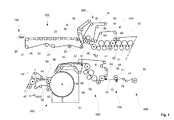
- figure 1 is shown schematically an advantageous example of a production line for producing fiber webs according to the invention.
- figure 2 is shown schematically another advantageous example of a production line for producing fiber webs according to the invention.
- the production line for producing fiber webs comprises a forming section comprising a head box 100 and a forming unit 200 and a press section 300 as well as a subsequent drying section comprising a drying cylinder part 400, a Yankee dryer 500 and another wire drying part 600 followed by a calender 700 and a reel-up 800.
- the examples of figures 1 and 2 differ only in respect of the forming unit type and thus in figure 2 only the beginning of the production line is shown.
- the head box 100 in the examples of the figures is a dilution head box but other types of head boxes are applicable in the production line. From the head box mass is fed on to a wire 20 of the forming unit 200.
- the forming unit 200 in the example of figure 1 is a fourdrinier type former and in the example of figure 2 is a hybrid type former.
- the forming unit 200 in the example of figure 1 comprises the wire 20, which runs as a continuous loop guided by guide rolls 21 located inside the wire loop, some rolls 23 are provided with a drive. Tension of the wire 20 is adjusted by outside the loop located tension roll 22. The wire 20 forms a continuous planar surface onto which the mass is fed form the head box 100 and below the planar run are located suction boxes 25 form removing water.
- the forming unit 200 is a hybrid type former and comprises the wire 20, which runs as a continuous loop guided by guide rolls 21 located inside the wire loop, some rolls 23 are provided with a drive. Tension of the wire 20 is adjusted by outside the loop located tension roll 22.
- the wire 20 forms a continuous planar surface onto which the mass is fed form the head box 100 and below the planar run are located suction boxes 25 for removing water.
- the hybrid forming unit 200 of the example of figure 2 also comprises above the planar section located suction box 28 with a wire loop 21 with inside the loop located guide rolls 23. In this example water can also be removed upwards and thus the fine contents on the top layer can be further adjusted by the suction box 28.
- the forming unit 200 as the fourdrinier former ( fig. 1 ) or the hybrid former ( fig. 2 ) provides for the fine substances in the fiber web W concentrate on the side of the top surface of the fiber web W and the desired formation of the fiber web W is achieved.
- the forming unit 200 may also comprise a breast roll 26 shaker known as such from prior art.
- the forming unit 200 can also be provided with adjustable or loadable foils. From the forming unit 200 the fiber web W is guided to the press section 300.
- the press section 300 is a center roll press section, in which press nips are formed by rolls 31, 32 located to create the press nip against the common center roll 30.
- the roll 31 is advantageously a suction roll.
- Each roll 31, 32 are provided with a press fabric 34 guided by guide rolls 35 located inside the loop formed by the press fabric.
- the tension of the fabrics 34 is adjusted by outside the loops located tension roll 36.
- the press section 300 thus comprises a center roll 30 with two press nips in which the center roll 30 has a smooth surface and it is against the bottom surface of the fiber web W.
- Against the top surface of the fiber web W advantageously at least one shoe press nip is formed by the press roll 32.
- a felt is advantageously used as press fabric 34.
- the press section 300 good surface smoothness on to the bottom side of the fiber web W and good density of the fiber web W is provided.
- the fiber web W is guided to the a subsequent drying section comprising a wire drying part 400, a Yankee dryer 500 and another wire drying part 600.
- the fiber web W may have a free run from the press section 400 to the wire drying part 400 located before the Yankee dryer 500 or the fiber web W may be transferred from the press section to the wire drying part by closed transfer.
- each group comprises a drying wire 40, heated drying cylinders 41 in the top row and reversing cylinders 42 in the bottom row.
- the fiber web W that is being dried runs on support of the drying wire 40 such that the drying wire 40 presses the fiber web W on a drying cylinders 41 against heated cylinder surfaces, and the fiber web W remains at the side of the outside curve of reversing cylinders 42 located between drying cylinders 41.
- the drying wires 40 run as continuous loops guided by guide rolls 48 located inside the loop and tension of the wires 40 can be adjusted by outside the loop located tension roll 49.
- the bottom side of the fiber web W is in contact with the surface of the drying cylinders 41. From the first wire drying section the fiber web W is guided as a supported run to the Yankee dryer.
- the first wire drying part 400 contains only single wire draw drying group / groups and the wire drying part 400 is in the production line before the Yankee dryer 500.
- the fiber web W is supported by the support fabric 45 forming a continuous loop guided by guide rolls 46 located inside the loop and tensions of which can be adjusted by the outside the loop located tension roll 47. Also for smooth transfer of the fiber web W from the wire drying part to the Yankee dryer runnability devices 43, 44 are provided.
- the fiber web W is dried to the dry solids content of the fiber web is 45 - 55% and thus the fiber web reaches the surface of the Yankee cylinder in this dry solid content.
- the Yankee dryer 500 comprises a heated Yankee cylinder 50 and around its outer surface located Yankee hoods 51.
- the Yankee dryer 500 closes the surface structure of the fiber web W and improves top side smoothness of the fiber web W.
- the Yankee dryer 500 also provides for the machine glazed surface of the fiber web W.
- the top surface of the fiber web W is dried against the Yankee cylinder 50.
- the Yankee cylinder is a reversed Yankee cylinder, in which the fiber web W is first guided downwards along the cylinder surface and the rotating direction of the Yankee cylinder is counter-clockwise, when the running direction of the fiber web W is from left to right.
- the fiber web W is pressed against the cylinder surface of the Yankee cylinder 50 by a drying fabric, advantageously by a drying felt.
- At least one nip is located at the Yankee cylinder formed by a roll 52, 53 pressing against the Yankee cylinder surface.
- Advantageously two pressing nips are formed against the Yankee cylinder by rolls 52, 53, first one 52 of which is a smooth roll or a grooved roll or a perforated roll and the other 53 is advantageously a grooved roll.
- the fiber web W is attached to the cylinder surface and in the other nip, which is advantageously the nip with the grooved roll 53, properties of the fiber web W are improved, in case the grooved roll 53 is used it is applied for marking the fiber web.
- a web tray 54 is located for collecting the fiber web W in case of a web break.
- the Yankee hoods 51 blow hot air towards the fiber web W on the area of Yankee cylinder 50.
- the fiber web W is guided by a support fabric 55, guided by guide rolls 57 and tension roll 58 and aided by runnability devices 56 to a wire drying section 600 of single wire draw having one drying cylinder group with drying cylinders 62, reversing cylinders 62 and a drying wire 60 and its guide rolls 68 and tension roll 69 for providing further drying possibility of the fiber web W and in which the bottom side of the fiber web W is in contact with the surface of the drying cylinders 41.
- This wire drying part 600 is descending i.e. center line of a first drying cylinder 61 in respect of center line of its successive the drying cylinder is at higher position. After the wire drying part 600 the fiber web W is guided in a free run to the calender 700.
- the wire drying part 600 contains only single wire draw drying group / groups and the wire drying part 600 is in the production line after the Yankee dryer 500.
- fiber web W is supported at least from the beginning of first wire drying part 400 until the end of wire drying part 600.
- the fiber web W is calendered in a calender nip formed between two calender rolls 71, 72 on which one is a thermo roll 71 that is against the top side of the fiber web W. From the calender 700 the fiber web W is guided to the reel-up 800.
- the full width fiber web W is reeled to a parent roll 80.
Landscapes
- Paper (AREA)
Abstract
Description
- The invention relates generally to producing fiber webs. Particularly the invention relates to a production line for producing special fiber web grades, especially machine glazed fiber web grades, according to the preamble of claim 1.
- As known from the prior art in fiber web machines, especially in paper and board machines, the fiber web is produced and treated in an assembly formed by a number of apparatuses arranged consecutively in a process line. A typical production and treatment line comprises a forming section comprising a head box and a forming unit and a press section as well as a subsequent drying section and a reel-up. The production and treatment line can further comprise other devices and sections for finishing the fiber web, for example, a size press, a calender, a coating section. The production and treatment line also comprises typically at least one winder for forming customer rolls as well as a roll packaging apparatus. In this description and the following claims by fiber webs are meant for example paper and board webs.
- Fiber webs, especially paper and board are available in a wide variety of types and can be divided according to basis weight in two grades: papers with a single ply and a basis weight of 25-300 g/m2 and boards manufactured in multiply technology and having a basis weight of 150-600 m/m2. It should be noted that the borderline between paper and board is flexible since board grades with lightest basis weights are lighter than the heaviest paper grades. Generally speaking, paper is used for printing and board for packaging. The present invention relates especially to production of fiber webs for special paper grades, which are typically paper grades with a specific feature. It is also typically only a minor component in the final product. Typical special fiber web grades are: Electrical papers (cable paper, capacitor tissue, transformer board, conductive paper, creped papers), Absorbent lamination papers, furniture papers (absorbent kraft, décor paper, overlay, pre-impregnated foils, laminating kraft), Filter papers (engine protection, laboratory and diagnostics, food and beverage, coffee filters, tea bags, vacuum cleaner dust bag), Special strong papers (abrasive base, spinning kraft, hunting cartridge paper), Release papers (pressure-sensitive labels, posters, signs and manual labels, vinyl casting, cover strips, masking tape), Copy and imaging papers (photographic paper, blueprint diazo paper, carbonless copy, thermal printing paper), Packaging grades (sack kraft, flexible packaging, label papers), Specialty printing grades, Special fine papers (security papers, artists' papers, tracing paper, plotting paper, luxury stationery), Building papers (wallpaper, barrier papers), Cigarette papers and Functional papers. In particular the present invention relates to MG (machine glazed)-grades, in production of which Yankee dryer is used typically for improved top side smoothness. The Yankee dryer gives a smooth surface and also closes the surface structure of the fiber web very efficiently. The MG grades are used as specialty papers or boards, for example as wrapping papers and wraps for foodstuffs.
- In publication
FI20135150 - The MG machines are typically used as multi-grades machines i.e. different grades of fiber webs are produced in the machine. One object of the present invention is to create a production line for producing fiber webs of the MG machine type, in which capacity is not limiting the variety of grades to be produced.
- An object of the invention is to create a production line for producing special fiber web grades, especially machine glazed fiber web grades in which the disadvantages and problems of prior art are eliminated or at least minimized.
- In particular an object of the invention is to provide a new type of production line for producing machine glazed fiber web grades.
- In order to achieve the above mentioned objects the production line according to the invention is mainly characterized by the features of the characterizing clause of claim 1. Advantageous embodiments and features are disclosed in the dependent claims.
- In this description and in the claims by term top surface of the fiber web is meant the side of the fiber web that in the final product will be towards the contents of the wrap or the package. And thus the bottom surface of the fiber web is the other side of the web.
- According to the invention the production line for producing special fiber web grades, especially machine glazed fiber web grades, comprises a forming section comprising a head box and a forming unit, a press section, a drying section comprising a Yankee dryer, a calender and a reel-up, wherein the Yankee dryer comprises a reversed Yankee cylinder and the top surface of the fiber web is against the surface of the Yankee cylinder.
- According to an advantageous feature of the invention the drying section of the production line comprises a wire drying part comprising at least one single wire drying group and the wire drying part is in the production line before the Yankee dryer.
- According to an advantageous feature of the invention the drying section of the production line comprises a wire drying part comprising at least one single wire drying group and the wire drying part is in the production line after the Yankee dryer.
- According to an advantageous feature of the invention the wire drying part located after the Yankee dryer is descending such that a center line of a drying cylinder in respect of a center line of its successive drying cylinder is at higher location.
- According to an advantageous feature of the invention the forming section contains only one forming unit and one head box and the forming unit is a fourdrinier forming unit or a hybrid forming unit. Thus a single-ply forming is advantageously applied in the production line according to the invention.
- According to an advantageous feature of the invention the Yankee dryer comprises at least one roll, which forms a nip against the Yankee cylinder. Advantageously the Yankee dryer comprises two one roll, each of which form a nip against the Yankee cylinder and one of the rolls is a smooth roll and one of the rolls is a grooved roll.
- According to an advantageous feature of the invention the press section is a center roll press section and in the press section a smooth roll is against the bottom surface of the fiber web. According to an advantageous feature of the invention in the production line dry solids content of the fiber web is 45 - 55%, when the fiber web reaches the surface of the Yankee cylinder.
- Thus according to the invention in the production line for producing fiber webs a Yankee dryer comprising a Yankee cylinder and around its outer surface located Yankee hoods is used for closing the surface structure of the fiber web and to improve top side smoothness of the fiber web and advantageously before and after the Yankee dryer at least one drying cylinder group with advantageously single wire draw is located for providing further drying possibility of the fiber web. In the possible wire drying part before the Yankee dryer the bottom side of the fiber web is against the drying cylinders and in the possible wire drying part after the Yankee dryer the bottom side of the fiber web is against the drying cylinders, respectively. The Yankee dryer provides for the machine glazed surface of the fiber web and in the Yankee dryer the top surface of the fiber web is against the Yankee cylinder. In the Yankee dryer the Yankee cylinder is a reversed Yankee cylinder, in which the fiber web is first guided downwards along the cylinder surface and the rotating direction of the Yankee cylinder is counter-clockwise, when fiber web running direction is from left to right. By this the height of the production line is decreased, which f. ex. saves building costs of the machine hall for the production line. The fiber web is pressed against the cylinder surface of the Yankee cylinder by a drying fabric, advantageously by a drying felt.
- Advantageously at least one nip is located at the Yankee cylinder formed by a roll pressing against the Yankee cylinder surface. Advantageously two pressing nips are formed against the Yankee cylinder by rolls, one of which is a smoot roll or a grooved roll or a perforated roll and the other is advantageously a grooved roll. In the first nip the fiber web is thus attached to the cylinder surface and in the other nip, which is advantageously the nip with the grooved roll, properties of the fiber web are improved, in case the grooved roll is used it is applied for marking the fiber web.
- According to an advantageous feature of the invention the dry solids content of the fiber web is 45 - 55%, when the fiber web reached the surface of the Yankee cylinder. By this good attachment for the fiber web to the Yankee cylinder surface is achieved and good adherence during the run of the fiber web on the Yankee cylinder surface is achieved and the fiber web is unfastened only at the end run on the Yankee cylinder surface.
- The fiber web is advantageously guided to and from the Yankee cylinder as a supported run, i.e. the fiber web is supported by a fabric during its run. The fiber web may have a free run from the press section to the wire drying part located before the Yankee dryer.
- Advantageously from the Yankee cylinder of the Yankee dryer the fiber web is guided to the wire drying part with single wire draw, in which the wire drying part is descending i.e. center line of a first drying cylinder in respect the center line of its successive drying cylinder is at higher position. The advantageous, additional wire drying parts provide drying variation needed in multi-grade production and also provide for flexibility for dry capacity content variation as the drying capacity of a single wire drying part is effectively variable by adjusting the drying capacity of the drying cylinders. Single wire drying groups provide good runnability of the fiber web.
- The forming unit in the forming section is advantageously a fourdrinier forming unit or a hybrid forming unit, in which the fine substances in the fiber web concentrate on the side of the top surface of the fiber web and do not drain away with the white waters. Also the desired formation of the fiber web is achievable. Typically the forming section contains only one head box and one forming unit and the single-ply forming is applied.
- The press section comprises advantageously a center roll with two press nip in which a smooth roll is against the bottom surface of the fiber web. Against the top surface of the fiber web advantageously a shoe press nip is located. In connection with each nip a felt is advantageously used as press fabric. In the press section good density of the fiber web is provided.
- In the production line for producing fiber webs the production begins from a head box, type of which is advantageously a dilution head box but other types of head boxes can be used as well. Typically a one layer head box is used.
- After drying in the production line for producing fiber webs the fiber web is calendered in a calender comprising at least one calender nip and at the end the full width fiber web is reeled to a parent roll in a reel-up. In the calender advantageously a thermo roll of the calendering nip will be against the top side of the fiber web. Depending on the final use of the fiber web further treatments can be provided and the full width web is typically before sending to customers formed to customer rolls in a slitter-winder and packed in roll packaging apparatus.
- As is clear from the above by the production line according to the invention many advantages are achieved and for example in the forming section a fine substance rich top side of the fiber web is created and in the press section the top surface receives good density and in the Yankee cylinder the by the forming section created fine substance rich top side of the fiber web is against the cylinder and additionally the reversed Yankee cylinder also provides for cost savings due to the decreased height of the production line.
- In the following the invention is explained in detail with reference to the accompanying drawing to which the invention is not to be narrowly limited.
- In
figure 1 is shown schematically an advantageous example of a production line for producing fiber webs according to the invention. - In
figure 2 is shown schematically another advantageous example of a production line for producing fiber webs according to the invention. - During the course of the following description like numbers and signs will be used to identify like elements according to the different views which illustrate the invention and its advantageous examples. In the figures some repetitive reference signs have been omitted for clarity reasons. In the figures rolls and cylinders provided with a drive are denoted by a black center circle.
- In the examples of
figures 1 and2 the production line for producing fiber webs comprises a forming section comprising ahead box 100 and a formingunit 200 and apress section 300 as well as a subsequent drying section comprising adrying cylinder part 400, aYankee dryer 500 and anotherwire drying part 600 followed by acalender 700 and a reel-up 800. The examples offigures 1 and2 differ only in respect of the forming unit type and thus infigure 2 only the beginning of the production line is shown. - The
head box 100 in the examples of the figures is a dilution head box but other types of head boxes are applicable in the production line. From the head box mass is fed on to awire 20 of the formingunit 200. - The forming
unit 200 in the example offigure 1 is a fourdrinier type former and in the example offigure 2 is a hybrid type former. - The forming
unit 200 in the example offigure 1 comprises thewire 20, which runs as a continuous loop guided by guide rolls 21 located inside the wire loop, somerolls 23 are provided with a drive. Tension of thewire 20 is adjusted by outside the loop locatedtension roll 22. Thewire 20 forms a continuous planar surface onto which the mass is fed form thehead box 100 and below the planar run are locatedsuction boxes 25 form removing water. - In the example of
figure 2 the formingunit 200 is a hybrid type former and comprises thewire 20, which runs as a continuous loop guided by guide rolls 21 located inside the wire loop, somerolls 23 are provided with a drive. Tension of thewire 20 is adjusted by outside the loop locatedtension roll 22. Thewire 20 forms a continuous planar surface onto which the mass is fed form thehead box 100 and below the planar run are locatedsuction boxes 25 for removing water. Thehybrid forming unit 200 of the example offigure 2 also comprises above the planar section located suction box 28 with awire loop 21 with inside the loop located guide rolls 23. In this example water can also be removed upwards and thus the fine contents on the top layer can be further adjusted by the suction box 28. - The forming
unit 200 as the fourdrinier former (fig. 1 ) or the hybrid former (fig. 2 ) provides for the fine substances in the fiber web W concentrate on the side of the top surface of the fiber web W and the desired formation of the fiber web W is achieved. The formingunit 200 may also comprise abreast roll 26 shaker known as such from prior art. The formingunit 200 can also be provided with adjustable or loadable foils. From the formingunit 200 the fiber web W is guided to thepress section 300. - The
press section 300 is a center roll press section, in which press nips are formed byrolls common center roll 30. For pick-up of the fiber web form the forming section theroll 31 is advantageously a suction roll. Eachroll press fabric 34 guided by guide rolls 35 located inside the loop formed by the press fabric. The tension of thefabrics 34 is adjusted by outside the loops locatedtension roll 36. Thepress section 300 thus comprises acenter roll 30 with two press nips in which thecenter roll 30 has a smooth surface and it is against the bottom surface of the fiber web W. Against the top surface of the fiber web W advantageously at least one shoe press nip is formed by thepress roll 32. In connection with each nip a felt is advantageously used aspress fabric 34. In thepress section 300 good surface smoothness on to the bottom side of the fiber web W and good density of the fiber web W is provided. From thepress section 300 the fiber web W is guided to the a subsequent drying section comprising awire drying part 400, aYankee dryer 500 and anotherwire drying part 600. The fiber web W may have a free run from thepress section 400 to thewire drying part 400 located before theYankee dryer 500 or the fiber web W may be transferred from the press section to the wire drying part by closed transfer. - In the first
wire drying part 400 before theYankee dryer 500 the fiber web W is dried in two drying groups of single wire draw. Each group comprises adrying wire 40, heated dryingcylinders 41 in the top row and reversingcylinders 42 in the bottom row. The fiber web W that is being dried runs on support of thedrying wire 40 such that thedrying wire 40 presses the fiber web W on a dryingcylinders 41 against heated cylinder surfaces, and the fiber web W remains at the side of the outside curve of reversingcylinders 42 located between dryingcylinders 41. The dryingwires 40 run as continuous loops guided by guide rolls 48 located inside the loop and tension of thewires 40 can be adjusted by outside the loop locatedtension roll 49. In thewire drying part 400 before theYankee dryer 500 the bottom side of the fiber web W is in contact with the surface of the dryingcylinders 41. From the first wire drying section the fiber web W is guided as a supported run to the Yankee dryer. Advantageously the firstwire drying part 400 contains only single wire draw drying group / groups and thewire drying part 400 is in the production line before theYankee dryer 500. The fiber web W is supported by the support fabric 45 forming a continuous loop guided by guide rolls 46 located inside the loop and tensions of which can be adjusted by the outside the loop located tension roll 47. Also for smooth transfer of the fiber web W from the wire drying part to the Yankeedryer runnability devices - The
Yankee dryer 500 comprises aheated Yankee cylinder 50 and around its outer surface locatedYankee hoods 51. TheYankee dryer 500 closes the surface structure of the fiber web W and improves top side smoothness of the fiber web W. TheYankee dryer 500 also provides for the machine glazed surface of the fiber web W. In the Yankee dryer the top surface of the fiber web W is dried against theYankee cylinder 50. In theYankee dryer 500 the Yankee cylinder is a reversed Yankee cylinder, in which the fiber web W is first guided downwards along the cylinder surface and the rotating direction of the Yankee cylinder is counter-clockwise, when the running direction of the fiber web W is from left to right. The fiber web W is pressed against the cylinder surface of theYankee cylinder 50 by a drying fabric, advantageously by a drying felt. At least one nip is located at the Yankee cylinder formed by aroll rolls grooved roll 53, properties of the fiber web W are improved, in case thegrooved roll 53 is used it is applied for marking the fiber web. In connection with the Yankee cylinder 50 aweb tray 54 is located for collecting the fiber web W in case of a web break. TheYankee hoods 51 blow hot air towards the fiber web W on the area ofYankee cylinder 50. - After the
Yankee dryer 500 the fiber web W is guided by asupport fabric 55, guided by guide rolls 57 andtension roll 58 and aided byrunnability devices 56 to awire drying section 600 of single wire draw having one drying cylinder group with dryingcylinders 62, reversingcylinders 62 and adrying wire 60 and its guide rolls 68 and tension roll 69 for providing further drying possibility of the fiber web W and in which the bottom side of the fiber web W is in contact with the surface of the dryingcylinders 41. Thiswire drying part 600 is descending i.e. center line of afirst drying cylinder 61 in respect of center line of its successive the drying cylinder is at higher position. After thewire drying part 600 the fiber web W is guided in a free run to thecalender 700. Advantageously thewire drying part 600 contains only single wire draw drying group / groups and thewire drying part 600 is in the production line after theYankee dryer 500. By this arrangement fiber web W is supported at least from the beginning of firstwire drying part 400 until the end ofwire drying part 600. In thecalender 700 the fiber web W is calendered in a calender nip formed between two calender rolls 71, 72 on which one is athermo roll 71 that is against the top side of the fiber web W. From thecalender 700 the fiber web W is guided to the reel-up 800. - In the reel-up 800 the full width fiber web W is reeled to a
parent roll 80. - Above only some advantageous examples of the inventions has been described to which examples the invention is not to be narrowly limited and many modifications and alterations are possible within the invention.
Claims (9)
- Production line for producing special fiber web grades, especially machine gazed fiber web grades, which production line comprises a forming section comprising a head box (100) and a forming unit (200), a press section (300), a drying section comprising a Yankee dryer (500), a calender (700) and a reel-up (800), characterized in that the Yankee dryer (50) comprises a reversed Yankee cylinder (50) and that the top surface of the fiber web (W) is against the surface of the Yankee cylinder (50).
- Production line according to claim 1, characterized in that the drying section of the production line comprises a wire drying part (400) comprising at least one single wire drying group and that the wire drying part (400) is in the production line before the Yankee dryer (500).
- Production line according to claim 1 or 2, characterized in that the drying section of the production line comprises a wire drying part (600) comprising at least one single wire drying group and that the wire drying part (600) is in the production line after the Yankee dryer (500).
- Production line according to claim 3, characterized in that the wire drying part (600) located after the Yankee dryer (500) is descending such that a center line of a drying cylinder (61) in respect of a center line of its successive drying cylinder (61) is at higher position.
- Production line according to any of claims 1 - 4, characterized in that the forming section contains only one forming unit (200) and one head box (100) and that the forming unit (200) is a fourdrinier forming unit or a hybrid forming unit.
- Production line according to any of claims 1 - 5, characterized in that the Yankee dryer (500) comprises at least one roll (52, 53), which forms a nip against the Yankee cylinder (50).
- Production line according to claim 6, characterized in that, the Yankee dryer (500) comprises two one roll (52, 53), each of which form a nip against the Yankee cylinder (50) and that one of the rolls (52,53) is a smooth roll and one of the rolls (52,53) is a grooved roll.
- Production line according to any of claims 1 - 7, characterized in that, the press section (300) is a center roll press section and that in the press section a smooth roll (30) is against the bottom surface of the fiber web (W).
- Production line according to any of claims 1 - 8, characterized in that, in the production line dry solids content of the fiber web (W) is 45 - 55%, when the fiber web (W) reaches the surface of the Yankee cylinder (50).
Priority Applications (2)
| Application Number | Priority Date | Filing Date | Title |
|---|---|---|---|
| EP15193630.9A EP3165673B1 (en) | 2015-11-09 | 2015-11-09 | Production line for producing fiber webs |
| CN201611018983.7A CN106996051B (en) | 2015-11-09 | 2016-11-09 | For producing the production line of fiber web |
Applications Claiming Priority (1)
| Application Number | Priority Date | Filing Date | Title |
|---|---|---|---|
| EP15193630.9A EP3165673B1 (en) | 2015-11-09 | 2015-11-09 | Production line for producing fiber webs |
Publications (2)
| Publication Number | Publication Date |
|---|---|
| EP3165673A1 true EP3165673A1 (en) | 2017-05-10 |
| EP3165673B1 EP3165673B1 (en) | 2018-06-27 |
Family
ID=54477933
Family Applications (1)
| Application Number | Title | Priority Date | Filing Date |
|---|---|---|---|
| EP15193630.9A Not-in-force EP3165673B1 (en) | 2015-11-09 | 2015-11-09 | Production line for producing fiber webs |
Country Status (2)
| Country | Link |
|---|---|
| EP (1) | EP3165673B1 (en) |
| CN (1) | CN106996051B (en) |
Cited By (5)
| Publication number | Priority date | Publication date | Assignee | Title |
|---|---|---|---|---|
| WO2019029864A1 (en) * | 2017-08-10 | 2019-02-14 | Voith Patent Gmbh | MACHINE AND METHOD FOR PRODUCING A FIBROUS WEB |
| WO2019029863A1 (en) * | 2017-08-10 | 2019-02-14 | Voith Patent Gmbh | MACHINE AND METHOD FOR PRODUCING A FIBROUS WEB |
| US20200385927A1 (en) * | 2017-11-27 | 2020-12-10 | Voith Patent Gmbh | Method for determining the dryness of a fibrous web, and method for controlling or regulating a machine for producing a paper web, and computer program for carrying out the methods |
| DE102020125395A1 (en) | 2020-09-29 | 2022-03-31 | Voith Patent Gmbh | Machine and method for manufacturing a fibrous web |
| WO2024008405A3 (en) * | 2022-07-05 | 2024-03-28 | Voith Patent Gmbh | Machine and method |
Families Citing this family (4)
| Publication number | Priority date | Publication date | Assignee | Title |
|---|---|---|---|---|
| CN108277679B (en) * | 2017-12-28 | 2020-02-21 | 仙鹤股份有限公司 | Production method of reinforced paper |
| CN108360281A (en) * | 2017-12-28 | 2018-08-03 | 仙鹤股份有限公司 | Body paper for tobacco-use tipping paper is manufactured paper with pulp equipment and papermaking process |
| CN108677588A (en) * | 2018-05-15 | 2018-10-19 | 浙江永鑫特种纸有限公司 | Numerial code spray drawing thermal transfer body paper paper machine and papermaking process |
| AT527976A1 (en) * | 2024-01-30 | 2025-08-15 | Mondi Ag | Drying section for the production of kraft paper |
Citations (4)
| Publication number | Priority date | Publication date | Assignee | Title |
|---|---|---|---|---|
| US3079700A (en) * | 1959-02-20 | 1963-03-05 | Beloit Iron Works | Method for producing paper |
| WO1981002704A1 (en) * | 1980-03-18 | 1981-10-01 | Valmet Oy | Procedure and paper machine for manufacturing creped paper web |
| WO1999023298A1 (en) * | 1997-10-31 | 1999-05-14 | Kimberly-Clark Worldwide, Inc. | Method of producing low density resilient webs |
| DE102014205381A1 (en) * | 2014-03-24 | 2015-09-24 | Voith Patent Gmbh | Machine for producing a fibrous web |
Family Cites Families (4)
| Publication number | Priority date | Publication date | Assignee | Title |
|---|---|---|---|---|
| FI108241B (en) * | 2000-08-10 | 2001-12-14 | Metso Paper Inc | Process for the manufacture of coated fiber web, improved paper or paperboard machine and coated paper or paperboard |
| DE102008000133A1 (en) * | 2008-01-23 | 2009-07-30 | Voith Patent Gmbh | drying section |
| DE102010031440A1 (en) * | 2010-07-16 | 2012-01-19 | Voith Patent Gmbh | Method for manufacturing fibrous material web, particularly paper, cardboard or tissue web, involves providing upper side in press gap, where upper side is smoothed than lower side |
| CN102817273A (en) * | 2012-06-08 | 2012-12-12 | 方汉佐 | Special high-speed multi-roll drying paper machine with reverse net |
-
2015
- 2015-11-09 EP EP15193630.9A patent/EP3165673B1/en not_active Not-in-force
-
2016
- 2016-11-09 CN CN201611018983.7A patent/CN106996051B/en not_active Expired - Fee Related
Patent Citations (4)
| Publication number | Priority date | Publication date | Assignee | Title |
|---|---|---|---|---|
| US3079700A (en) * | 1959-02-20 | 1963-03-05 | Beloit Iron Works | Method for producing paper |
| WO1981002704A1 (en) * | 1980-03-18 | 1981-10-01 | Valmet Oy | Procedure and paper machine for manufacturing creped paper web |
| WO1999023298A1 (en) * | 1997-10-31 | 1999-05-14 | Kimberly-Clark Worldwide, Inc. | Method of producing low density resilient webs |
| DE102014205381A1 (en) * | 2014-03-24 | 2015-09-24 | Voith Patent Gmbh | Machine for producing a fibrous web |
Cited By (6)
| Publication number | Priority date | Publication date | Assignee | Title |
|---|---|---|---|---|
| WO2019029864A1 (en) * | 2017-08-10 | 2019-02-14 | Voith Patent Gmbh | MACHINE AND METHOD FOR PRODUCING A FIBROUS WEB |
| WO2019029863A1 (en) * | 2017-08-10 | 2019-02-14 | Voith Patent Gmbh | MACHINE AND METHOD FOR PRODUCING A FIBROUS WEB |
| US20200385927A1 (en) * | 2017-11-27 | 2020-12-10 | Voith Patent Gmbh | Method for determining the dryness of a fibrous web, and method for controlling or regulating a machine for producing a paper web, and computer program for carrying out the methods |
| US11926963B2 (en) * | 2017-11-27 | 2024-03-12 | Voith Patent Gmbh | Method for determining the dryness of a fibrous web, and method for controlling or regulating a machine for producing a paper web, and computer program for carrying out the methods |
| DE102020125395A1 (en) | 2020-09-29 | 2022-03-31 | Voith Patent Gmbh | Machine and method for manufacturing a fibrous web |
| WO2024008405A3 (en) * | 2022-07-05 | 2024-03-28 | Voith Patent Gmbh | Machine and method |
Also Published As
| Publication number | Publication date |
|---|---|
| CN106996051B (en) | 2019-10-18 |
| CN106996051A (en) | 2017-08-01 |
| EP3165673B1 (en) | 2018-06-27 |
Similar Documents
| Publication | Publication Date | Title |
|---|---|---|
| EP3165673B1 (en) | Production line for producing fiber webs | |
| AU2002350230C1 (en) | Methods and system for manufacturing and finishing web products at high speed without reeling and unwinding | |
| US3044228A (en) | Cellulosic product and method for making same | |
| WO1982002938A1 (en) | A vacuum box for use in high speed papermaking | |
| WO1999032722A1 (en) | Paper sheet with increased cross machine direction stretchability | |
| RU2768672C2 (en) | Methods of producing paper products using a patterned cylinder | |
| EP3231937B1 (en) | Production line for producing fiber webs and a cooler | |
| CN101374998A (en) | Method and arrangement in a dryer section of a fiber web machine, such as a paper or board machine | |
| CA3091525C (en) | Method and device for treating a pulp web in an extended-nip press unit | |
| FI127456B (en) | Production line for producing special fiber web grades | |
| CN110612370B (en) | Production device and method for producing a fibrous web | |
| US20060060321A1 (en) | Machine for producing a fibrous web | |
| JP2011136504A (en) | Method for manufacturing secondary whole roll for tissue paper product | |
| FI107172B (en) | Method and apparatus for producing smooth and glossy papers | |
| ES553638A0 (en) | A MACHINE FOR THE FORMATION, PRESSING AND DRYING OF THIN PAPER BANDS | |
| CN108884633B (en) | Apparatus and method for making multi-layered fibrous webs | |
| JP6445881B2 (en) | Paper machine | |
| EP2796617A1 (en) | Shoe press application for the production of tissue grades | |
| US9523173B1 (en) | Press apparatus | |
| JP5736470B2 (en) | Method for producing secondary roll for tissue paper products | |
| US20080236776A1 (en) | Method For the Production of a Paper Web, Especially Rotogravure Paper | |
| CN108291366B (en) | Equipment for making fibrous webs | |
| JP6491487B2 (en) | Paper machine | |
| GB2418929A (en) | Producing paper product | |
| FI117801B (en) | Process and apparatus for making cardboard |
Legal Events
| Date | Code | Title | Description |
|---|---|---|---|
| PUAI | Public reference made under article 153(3) epc to a published international application that has entered the european phase |
Free format text: ORIGINAL CODE: 0009012 |
|
| AK | Designated contracting states |
Kind code of ref document: A1 Designated state(s): AL AT BE BG CH CY CZ DE DK EE ES FI FR GB GR HR HU IE IS IT LI LT LU LV MC MK MT NL NO PL PT RO RS SE SI SK SM TR |
|
| AX | Request for extension of the european patent |
Extension state: BA ME |
|
| 17P | Request for examination filed |
Effective date: 20171108 |
|
| RBV | Designated contracting states (corrected) |
Designated state(s): AL AT BE BG CH CY CZ DE DK EE ES FI FR GB GR HR HU IE IS IT LI LT LU LV MC MK MT NL NO PL PT RO RS SE SI SK SM TR |
|
| GRAP | Despatch of communication of intention to grant a patent |
Free format text: ORIGINAL CODE: EPIDOSNIGR1 |
|
| INTG | Intention to grant announced |
Effective date: 20180215 |
|
| GRAS | Grant fee paid |
Free format text: ORIGINAL CODE: EPIDOSNIGR3 |
|
| GRAA | (expected) grant |
Free format text: ORIGINAL CODE: 0009210 |
|
| AK | Designated contracting states |
Kind code of ref document: B1 Designated state(s): AL AT BE BG CH CY CZ DE DK EE ES FI FR GB GR HR HU IE IS IT LI LT LU LV MC MK MT NL NO PL PT RO RS SE SI SK SM TR |
|
| REG | Reference to a national code |
Ref country code: GB Ref legal event code: FG4D |
|
| REG | Reference to a national code |
Ref country code: AT Ref legal event code: REF Ref document number: 1012467 Country of ref document: AT Kind code of ref document: T Effective date: 20180715 |
|
| REG | Reference to a national code |
Ref country code: IE Ref legal event code: FG4D |
|
| REG | Reference to a national code |
Ref country code: DE Ref legal event code: R096 Ref document number: 602015012674 Country of ref document: DE |
|
| PG25 | Lapsed in a contracting state [announced via postgrant information from national office to epo] |
Ref country code: LT Free format text: LAPSE BECAUSE OF FAILURE TO SUBMIT A TRANSLATION OF THE DESCRIPTION OR TO PAY THE FEE WITHIN THE PRESCRIBED TIME-LIMIT Effective date: 20180627 Ref country code: BG Free format text: LAPSE BECAUSE OF FAILURE TO SUBMIT A TRANSLATION OF THE DESCRIPTION OR TO PAY THE FEE WITHIN THE PRESCRIBED TIME-LIMIT Effective date: 20180927 Ref country code: FI Free format text: LAPSE BECAUSE OF FAILURE TO SUBMIT A TRANSLATION OF THE DESCRIPTION OR TO PAY THE FEE WITHIN THE PRESCRIBED TIME-LIMIT Effective date: 20180627 Ref country code: NO Free format text: LAPSE BECAUSE OF FAILURE TO SUBMIT A TRANSLATION OF THE DESCRIPTION OR TO PAY THE FEE WITHIN THE PRESCRIBED TIME-LIMIT Effective date: 20180927 Ref country code: SE Free format text: LAPSE BECAUSE OF FAILURE TO SUBMIT A TRANSLATION OF THE DESCRIPTION OR TO PAY THE FEE WITHIN THE PRESCRIBED TIME-LIMIT Effective date: 20180627 |
|
| REG | Reference to a national code |
Ref country code: NL Ref legal event code: MP Effective date: 20180627 |
|
| REG | Reference to a national code |
Ref country code: LT Ref legal event code: MG4D |
|
| PG25 | Lapsed in a contracting state [announced via postgrant information from national office to epo] |
Ref country code: GR Free format text: LAPSE BECAUSE OF FAILURE TO SUBMIT A TRANSLATION OF THE DESCRIPTION OR TO PAY THE FEE WITHIN THE PRESCRIBED TIME-LIMIT Effective date: 20180928 Ref country code: HR Free format text: LAPSE BECAUSE OF FAILURE TO SUBMIT A TRANSLATION OF THE DESCRIPTION OR TO PAY THE FEE WITHIN THE PRESCRIBED TIME-LIMIT Effective date: 20180627 Ref country code: LV Free format text: LAPSE BECAUSE OF FAILURE TO SUBMIT A TRANSLATION OF THE DESCRIPTION OR TO PAY THE FEE WITHIN THE PRESCRIBED TIME-LIMIT Effective date: 20180627 Ref country code: RS Free format text: LAPSE BECAUSE OF FAILURE TO SUBMIT A TRANSLATION OF THE DESCRIPTION OR TO PAY THE FEE WITHIN THE PRESCRIBED TIME-LIMIT Effective date: 20180627 |
|
| REG | Reference to a national code |
Ref country code: AT Ref legal event code: MK05 Ref document number: 1012467 Country of ref document: AT Kind code of ref document: T Effective date: 20180627 |
|
| PG25 | Lapsed in a contracting state [announced via postgrant information from national office to epo] |
Ref country code: NL Free format text: LAPSE BECAUSE OF FAILURE TO SUBMIT A TRANSLATION OF THE DESCRIPTION OR TO PAY THE FEE WITHIN THE PRESCRIBED TIME-LIMIT Effective date: 20180627 |
|
| PG25 | Lapsed in a contracting state [announced via postgrant information from national office to epo] |
Ref country code: SK Free format text: LAPSE BECAUSE OF FAILURE TO SUBMIT A TRANSLATION OF THE DESCRIPTION OR TO PAY THE FEE WITHIN THE PRESCRIBED TIME-LIMIT Effective date: 20180627 Ref country code: RO Free format text: LAPSE BECAUSE OF FAILURE TO SUBMIT A TRANSLATION OF THE DESCRIPTION OR TO PAY THE FEE WITHIN THE PRESCRIBED TIME-LIMIT Effective date: 20180627 Ref country code: CZ Free format text: LAPSE BECAUSE OF FAILURE TO SUBMIT A TRANSLATION OF THE DESCRIPTION OR TO PAY THE FEE WITHIN THE PRESCRIBED TIME-LIMIT Effective date: 20180627 Ref country code: PL Free format text: LAPSE BECAUSE OF FAILURE TO SUBMIT A TRANSLATION OF THE DESCRIPTION OR TO PAY THE FEE WITHIN THE PRESCRIBED TIME-LIMIT Effective date: 20180627 Ref country code: EE Free format text: LAPSE BECAUSE OF FAILURE TO SUBMIT A TRANSLATION OF THE DESCRIPTION OR TO PAY THE FEE WITHIN THE PRESCRIBED TIME-LIMIT Effective date: 20180627 Ref country code: IS Free format text: LAPSE BECAUSE OF FAILURE TO SUBMIT A TRANSLATION OF THE DESCRIPTION OR TO PAY THE FEE WITHIN THE PRESCRIBED TIME-LIMIT Effective date: 20181027 Ref country code: AT Free format text: LAPSE BECAUSE OF FAILURE TO SUBMIT A TRANSLATION OF THE DESCRIPTION OR TO PAY THE FEE WITHIN THE PRESCRIBED TIME-LIMIT Effective date: 20180627 |
|
| PG25 | Lapsed in a contracting state [announced via postgrant information from national office to epo] |
Ref country code: IT Free format text: LAPSE BECAUSE OF FAILURE TO SUBMIT A TRANSLATION OF THE DESCRIPTION OR TO PAY THE FEE WITHIN THE PRESCRIBED TIME-LIMIT Effective date: 20180627 Ref country code: ES Free format text: LAPSE BECAUSE OF FAILURE TO SUBMIT A TRANSLATION OF THE DESCRIPTION OR TO PAY THE FEE WITHIN THE PRESCRIBED TIME-LIMIT Effective date: 20180627 Ref country code: SM Free format text: LAPSE BECAUSE OF FAILURE TO SUBMIT A TRANSLATION OF THE DESCRIPTION OR TO PAY THE FEE WITHIN THE PRESCRIBED TIME-LIMIT Effective date: 20180627 |
|
| REG | Reference to a national code |
Ref country code: DE Ref legal event code: R097 Ref document number: 602015012674 Country of ref document: DE |
|
| PLBE | No opposition filed within time limit |
Free format text: ORIGINAL CODE: 0009261 |
|
| STAA | Information on the status of an ep patent application or granted ep patent |
Free format text: STATUS: NO OPPOSITION FILED WITHIN TIME LIMIT |
|
| PG25 | Lapsed in a contracting state [announced via postgrant information from national office to epo] |
Ref country code: DK Free format text: LAPSE BECAUSE OF FAILURE TO SUBMIT A TRANSLATION OF THE DESCRIPTION OR TO PAY THE FEE WITHIN THE PRESCRIBED TIME-LIMIT Effective date: 20180627 |
|
| 26N | No opposition filed |
Effective date: 20190328 |
|
| REG | Reference to a national code |
Ref country code: CH Ref legal event code: PL |
|
| PG25 | Lapsed in a contracting state [announced via postgrant information from national office to epo] |
Ref country code: LU Free format text: LAPSE BECAUSE OF NON-PAYMENT OF DUE FEES Effective date: 20181109 Ref country code: MC Free format text: LAPSE BECAUSE OF FAILURE TO SUBMIT A TRANSLATION OF THE DESCRIPTION OR TO PAY THE FEE WITHIN THE PRESCRIBED TIME-LIMIT Effective date: 20180627 |
|
| REG | Reference to a national code |
Ref country code: BE Ref legal event code: MM Effective date: 20181130 |
|
| REG | Reference to a national code |
Ref country code: IE Ref legal event code: MM4A |
|
| PG25 | Lapsed in a contracting state [announced via postgrant information from national office to epo] |
Ref country code: LI Free format text: LAPSE BECAUSE OF NON-PAYMENT OF DUE FEES Effective date: 20181130 Ref country code: SI Free format text: LAPSE BECAUSE OF FAILURE TO SUBMIT A TRANSLATION OF THE DESCRIPTION OR TO PAY THE FEE WITHIN THE PRESCRIBED TIME-LIMIT Effective date: 20180627 Ref country code: CH Free format text: LAPSE BECAUSE OF NON-PAYMENT OF DUE FEES Effective date: 20181130 |
|
| PG25 | Lapsed in a contracting state [announced via postgrant information from national office to epo] |
Ref country code: FR Free format text: LAPSE BECAUSE OF NON-PAYMENT OF DUE FEES Effective date: 20181130 Ref country code: IE Free format text: LAPSE BECAUSE OF NON-PAYMENT OF DUE FEES Effective date: 20181109 |
|
| PG25 | Lapsed in a contracting state [announced via postgrant information from national office to epo] |
Ref country code: BE Free format text: LAPSE BECAUSE OF NON-PAYMENT OF DUE FEES Effective date: 20181130 Ref country code: AL Free format text: LAPSE BECAUSE OF FAILURE TO SUBMIT A TRANSLATION OF THE DESCRIPTION OR TO PAY THE FEE WITHIN THE PRESCRIBED TIME-LIMIT Effective date: 20180627 |
|
| PG25 | Lapsed in a contracting state [announced via postgrant information from national office to epo] |
Ref country code: MT Free format text: LAPSE BECAUSE OF NON-PAYMENT OF DUE FEES Effective date: 20181109 |
|
| PG25 | Lapsed in a contracting state [announced via postgrant information from national office to epo] |
Ref country code: TR Free format text: LAPSE BECAUSE OF FAILURE TO SUBMIT A TRANSLATION OF THE DESCRIPTION OR TO PAY THE FEE WITHIN THE PRESCRIBED TIME-LIMIT Effective date: 20180627 |
|
| PG25 | Lapsed in a contracting state [announced via postgrant information from national office to epo] |
Ref country code: PT Free format text: LAPSE BECAUSE OF FAILURE TO SUBMIT A TRANSLATION OF THE DESCRIPTION OR TO PAY THE FEE WITHIN THE PRESCRIBED TIME-LIMIT Effective date: 20180627 |
|
| PG25 | Lapsed in a contracting state [announced via postgrant information from national office to epo] |
Ref country code: HU Free format text: LAPSE BECAUSE OF FAILURE TO SUBMIT A TRANSLATION OF THE DESCRIPTION OR TO PAY THE FEE WITHIN THE PRESCRIBED TIME-LIMIT; INVALID AB INITIO Effective date: 20151109 Ref country code: MK Free format text: LAPSE BECAUSE OF NON-PAYMENT OF DUE FEES Effective date: 20180627 Ref country code: CY Free format text: LAPSE BECAUSE OF FAILURE TO SUBMIT A TRANSLATION OF THE DESCRIPTION OR TO PAY THE FEE WITHIN THE PRESCRIBED TIME-LIMIT Effective date: 20180627 |
|
| GBPC | Gb: european patent ceased through non-payment of renewal fee |
Effective date: 20191109 |
|
| PG25 | Lapsed in a contracting state [announced via postgrant information from national office to epo] |
Ref country code: GB Free format text: LAPSE BECAUSE OF NON-PAYMENT OF DUE FEES Effective date: 20191109 |
|
| PGFP | Annual fee paid to national office [announced via postgrant information from national office to epo] |
Ref country code: DE Payment date: 20201119 Year of fee payment: 6 |
|
| REG | Reference to a national code |
Ref country code: DE Ref legal event code: R119 Ref document number: 602015012674 Country of ref document: DE |
|
| PG25 | Lapsed in a contracting state [announced via postgrant information from national office to epo] |
Ref country code: DE Free format text: LAPSE BECAUSE OF NON-PAYMENT OF DUE FEES Effective date: 20220601 |